


Abstract
Increasing global insecurity for potable water has led to atmospheric water harvesting as a viable supplementary source. Passive dew water harvesting is simple to carry out but atmospheric conditions determine the frequency and amount of dew that can be collected, and up to 0.5 L/m2/night can be considered as an upper ceiling. Thus, active condensers using refrigeration and cooling systems have been developed to increase collection totals, requiring an electrical or solar power supply. In the last decade, adsorption/absorption techniques of water vapor have been studied to maximize collection, with the potential for low costs, portability, and high volumes, and they are operational even in arid regions with low humidity, islands, and remote regions. This could become a gamechanger in securing affordable potable water. Citizen Science is suggested for dew observation and collection data to increase observation points that could be used to improve the resolution/accuracy of local, regional, or global dew modelling. It would promote environmental and water literacy by engaging participants ranging from primary school communities to senior individuals. Teleconferencing now provides access to a worldwide audience and the inclusion of participants no matter their location.
1. Introduction
“‘What makes the desert beautiful,’ said the little prince, ‘is that somewhere it hides a well…’”The Little Prince by Antoine de Saint-Exupéry.
Dew has fascinated Mankind for thousands of years. Unlike rain and fog, dew droplets can be observed in situ in the early morning, sparkling on plants and spiderwebs and with refracted light generating prisms of color. Thus, perhaps not surprisingly, dew has strong religious and spiritual symbolism in Judaism, Christianity and Islam, Hinduism, and other religions. Boedeker [1] explored the extensive symbolism and religious significance of dew in ancient Greek thought and literature. The study analyzed how dew, moisture that appeared to descend enigmatically from the sky, was perceived in Greek culture.
In the bible Book of Judges, Gideon asks God for a sign in the form of dew appearing only on a wool fleece placed on the ground and “Early the next day, he squeezed the fleece and wrung out the dew from the fleece, a bowlful of water”. Giles [2] provided a physical explanation for this in what he called “the earliest recorded vapor phase adsorption experiment”. It was Wells’ 1814 publication [3] on the origin of dew that was the first to recognize from his experiments that dew forms on surfaces that lose heat through radiation on clear, calm nights and cool such that moisture in the surrounding air condenses into droplets. The theory at that time was that dew formed by water vapor rising from the ground or as a form of rain deposition from above.
Climatological and meteorological models are being used to assess the potential impacts of climate change and require data from meteorological stations to predict and project such changes at scales from regional to global. Temperature, precipitation, wind, humidity, and radiative parameters have standard measuring instruments. Dew, however, is unique as there is no defined measuring sensor. There are differing factors influencing the dew point of a given surface and dew formation, such as the sky view exposure, atmosphere emissivity, atmospheric water vapor content, wind speed, cloud cover, height of the condensing surface above the ground, and nature of the condensing surface such as rock, soil, plant, or manufactured surfaces such as glass, aluminum, steel, cement, foils, etc. Beysens et al. [4] reviewed dew measurement limitations and offered a new condenser device that continuously weighs and records dew mass. This would allow a site to be assessed for potential dew production.
In Nature, dew is present in relatively small quantities; thus, it should be especially sensitive to climate changes, both in terms of conditions favoring an increase or a decrease in frequency and amount. A thirstier atmosphere implies fewer occurrences of dew and less surface condensation. Dew climatology requires meteorological data, but long-term meteorological stations are usually limited to airports, agricultural monitoring stations, research institutions, coastal regions, and urban areas.
Considering climate change, this paper presents how atmospheric water harvesting has grown in importance as a source of potable water, on the advent of technologies that can convert atmospheric water vapor into water in quantities far greater than passive radiative collectors. Fog and rain collection are excluded in this paper. In addition, as a contribution towards assessing atmospheric moisture in a changing climate, we propose that daily dew collection totals could provide long-term observations to supplement meteorological data. Towards this end, Citizen Science (CS) could be harnessed to carry out dew observations and collection for scientific purposes. In addition, CS can make a valuable contribution to water literacy education in schools and the public regarding climate change. A dew collection network would provide the opportunity for more geographically distributed points, given the large gaps in meteorological station distribution and remote regions.
2. Atmospheric Water Harvesting in Scientific Literature
The last 25 years have seen a remarkable surge in interest in dew and fog water harvesting and the development of new technologies to extract water from air. We ascribe this to intensified stress on the world’s limited freshwater resources, the awareness of climate change, rapid population growth, and the growing movement of people from rural to urban centers. Below are six recent examples of literature searches highlighting such interest. The choice of search keywords of course affects the results.
Bilal et al. [5] identified scientific literature from 1967 to 2022 using the Elsevier Scopus database. They used a broad search for articles, conference papers, reviews, book chapters, reports, letters, editorials, and short surveys using the terms “Atmospheric water” OR “Water harvesting” OR “Water from air” OR “Water harvesting from air” OR “Atmospheric water generators” and found over 8600 references. Within these, they searched for adsorption-based atmospheric water harvesting, whereby water vapor is captured onto desiccant materials, using “Desiccant” OR “Adsorbent” OR “Sorbent” OR “Adsorption”, and found about 270 publications.
Khamdevi et al. [6] carried out a literature search on dew and fog water harvesting using The Lens searchable online bibliometric database of scholarly literature. For dew, the following keywords were used: “Dew catcher”, “Dew collector”, “Dew collection”, “Dew harvesting”, “Dew condenser”, and “Dew condensation”. They found over 1300 publications for the search period 1950–2022, but there was no separation of the analyses into dew and fog; thus, their results are combined. Nevertheless, of interest is their histogram of publications showing that 2005 appears as the start of a sharp increase in publications on both topics, from under 10 publications per year prior to 2005 to about 120 per year in 2020. This coincides with climate change issues gaining importance in climate research. However, additional keywords such as atmospheric water harvesting would likely have led to additional results.
Agyekum et al. [7] made a bibliometric review of atmospheric water technologies (AWT) from 2009 to 2023 using the Elsevier Scopus database. Here they were interested in identifying future trends in atmospheric water harvesting by linking current AWT research that also included intentions or plans for future AWT research. Their key search terms were “Atmospheric water harvesting” OR “Atmospheric water harvester AND “Technologies”. After screening, they found about 130 appropriate papers that fulfilled their objective. Their analysis also included breakdowns by most relevant authors, corresponding author countries, author keywords, and a country collaboration map.
Verbrugghe and Khan [8] searched for ancient techniques of both fog and dew water collection using the Elsevier Scopus and Google Scholar databases and the Google search engine with the keywords “Atmospheric AND moisture OR water OR fog OR dew”; “Harvesting OR collecting”; “Ancient OR past”; and “Methods OR practices OR techniques OR wisdom”. They found 91 relevant scientific papers from Scopus and Google Scholar and 40 articles from grey literature sources (including historical records) using Google.
Campos et al. [9] carried out a critical review of recent technological advances in atmospheric water harvesting and generation. They searched Web of Science, Elsevier Scopus and PubMed databases using Boolean combinations “atmospheric water harvesting”, “atmospheric water generation”, “moisture harvesting”, “sorption-based water harvesting”, “condensation based systems”, and “relative humidity”. The results were then sifted, and 133 publications were selected based on their criteria of explicit reference to technologies, material performance, and climatic constraints.
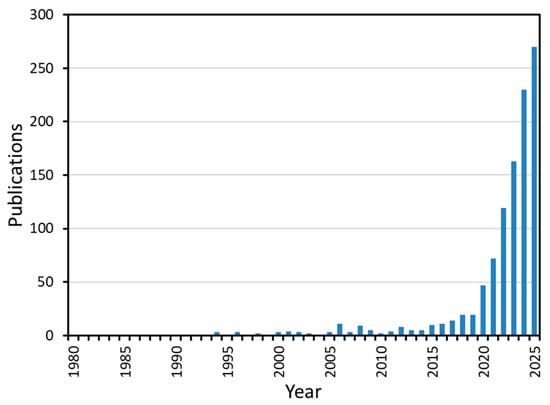
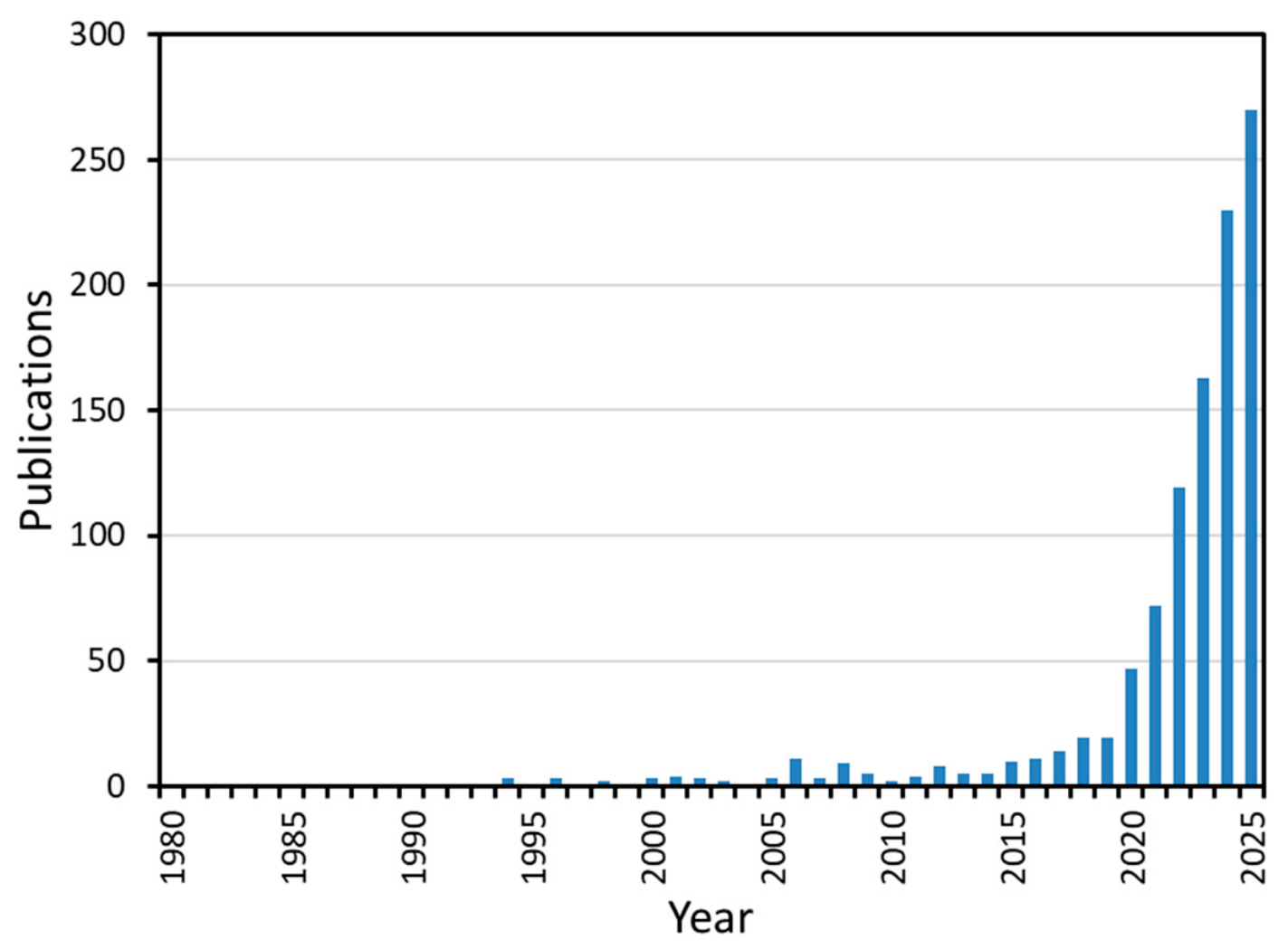
We carried out a Web of Science journal search using the key words “dew water” OR “dew harvesting” OR “dew collection” OR “atmospheric water collection” OR “atmospheric water harvesting”. About 1100 articles were indexed from 1981 to 2026 (including those in press or to be released). The keyword “atmospheric water” was excluded as it was too encompassing and generated over 5700 articles that were either tangential, ecological, or unrelated. Figure 1 presents the sharp increase in dew collection as reflected by the number of publications per year.
Figure 1.
Histogram of publications related to dew collection from Clarivate Web of Science.
3. Water Scarcity and Need for Atmospheric Water Harvesting
According to Gleick [10], between 2–5 L per day are the minimum water requirements for human survival. Madani [11] used the term “water bankruptcy” to describe the global water crisis facing humanity, which will lead to more critical water insecurity with climate change. In 2025, cities and towns contained over half of the world’s population and this is forecast to increase to over two-thirds by 2050 [12]. A study recently published by WaterAid [13] highlighted the changing global climate affecting the world’s most populated cities. Among the cities analyzed, 20% are experiencing noticeable climate shifts. The European cities analyzed in their study exhibited drying trends over the last 42 years, particularly cities in the Middle East and North Africa. Madrid and Barcelona both display what the study called “climate hazard flips”, experiencing a flip to extreme dry conditions.
As potable water is becoming an increasingly scarce global commodity, alternative sources such as collecting rain, fog, and dew have attracted attention. According to a 2025 report by the World Health Organization and UNICEF [14], 2.1 billion people lack clean water, about 106 million people use water from untreated sources, and they estimate that 1000 children under the age of five die every day from diseases caused by unsafe water, poor sanitation, and lacking water that could improve hygiene.
Islands, rural areas, and isolated regions are also at risk and present different challenges. In addition, emergency situations may force individuals to seek a temporary water source. Lack of water security is particularly acute in drylands. Those most affected are developing countries situated within arid to subtropical regions. During hot and rainless periods, dew collection may be the only viable alternative water source. According to a report published by the United Nations Convention to Combat Desertification [15]:
- In 2020, the number of people living in drylands was about 2.3 billion, versus 1.2 billion in 1990.
- The Earth’s land area of drylands increased from 37.5% in 1961–1990 to 40.6% in 1991–2020.
- Worst-case climate models forecast that up to 5 billion people could be living in drylands by 2100.
- In 2020, Africa has the highest percentage of drylands at 70.5%, with almost 50% of the population living in drylands.
4. Impact on Dew in a Changing Climate
It is recognized that global climate change will likely have a negative impact on the dryland biome. Predictive modelling is complex and projecting to the near future will require more data and experimental work. Whereas soil, biological crusts, vegetation, and animals have been studied extensively, forecasting the impact of a changing climate on dew occurrence, quantity, and seasonality into ecosystems is more recent [16,17,18,19,20,21].
Gebrechorkos et al. [22] assessed atmospheric evaporative demand and its impact on droughts. They found that drought severity increased worldwide between 1901 and 2022 and that in 2022, 30% of the world’s land area was impacted by moderate to extreme droughts. A drier atmosphere implies that dew occurrence is expected to decline in frequency and quantity. Glantz et al. [23] also noted what was termed the “humidity paradox” in climate change studies. While warmer air can contain more water vapor (higher specific humidity), the capacity of the air to hold more water increases faster than the moisture supply over land. This results in a decrease in relative humidity, especially in expanding cities.
There is limited literature on dew forecasting due to climate change. Beysens [24] estimated dew yield worldwide using basic meteorological data. Wang et al. [25] examined dryland expansion during a changing climate and reviewed the debate on whether drylands will expand under model climate scenarios. For dew and fog water inputs, they anticipate that higher vapor pressure deficits will lead to a global-scale reduction in both dew and fog occurrence and duration.
Forzini et al. [26] considered atmospheric moisture inputs from fog and dew on plants, micro-organisms, and animals as a nature-based ecosystem service in different environments of the world. A rapidly changing climate favoring a drier atmosphere will generate negative shifts in dew and/or fog frequency and quantity that can be harvested. Such shifts and dew/fog “drought” periods will have a long-term impact on the delicate ecohydrology of drylands.
In Jordan, Atashi et al. [27] carried out simulations of annual dew yield for a 40-year period and found a decreasing trend.
Tomaszkiewicz et al. [28] carried out a dew yield forecast of the Mediterranean basin using meteorological data from 142 stations within the basin area. Their projection was that a 27% decline in dew yield would be expected in the dry summer months by the year 2080.
In an application of dew harvesting for agriculture and reforestation, Tomaszkiewicz et al. [29] investigated the amounts of dew in a semi-arid mountain region in Lebanon that could be collected to help support tree seedlings and their survival and crop irrigation. The warm months from April to October are largely rainless. They found that an inclined 2 m2 planar dew condenser plate could provide 4.5 L per tree seedling in the hot and rainless months of June and July and thus mitigate seedling water stress and increase survival. However, negative trends in dew duration and collection quantities can undermine its sustainability for such purposes.
Feng et al. [30] carried out global warming experiments on dew in an alpine grassland ecosystem in the Tibetan Plateau, China. Their field plots included passive dew collectors, leaf wetness sensors, and direct in situ measurements on plant functional groups to quantify dew reduction under control and under infrared heating. Their analyses compared dew formation, duration, and volume within the control and warmed plots. They warned that artificial warming reduced dew formation and thus might lead to overestimating the ecological impact of global warming.
Vuollekoski et al. [31] utilized 34 years of global meteorological reanalysis data to model the potential for passive dew collection. Global maps were generated and identified areas where such collection could serve as a supplementary water source. They found statistically significant dew yield trends in their time series ranging between ±10% depending on the region.
Rasoafaniry et al. [32] assessed dew yields in SW Madagascar for the period 1991–2023, with extrapolation to 2033, calculated using meteorological data and an energy model. For this period, the overall trend was found to be negative for dew. For Gujarat, India, Budhbhatti et al. [33] found an increase in dew condensation for the study period 2005–2021.
5. Atmospheric Water Harvesting (AWH) Approaches
During the last 10 years, there have been several comprehensive reviews on extracting ambient humidity from the air to provide drinking water and comparisons made for different systems and influencing parameters [34,35,36,37,38,39,40]. Although these reviews overlap, they contain valuable additional perspectives and insights.
There are two primary approaches: passive radiative collectors and active condensers, which use differing techniques to cool a surface below the ambient air’s dew point to condense atmospheric water vapor.
5.1. Passive Radiative Collectors
These rely on natural cooling of a surface made with materials with high emissivity and without additional energy input. Collectors are typically installed as inclined planes (around 30° angle from horizontal) with a clear view of the sky to maximize radiative cooling and allow water to flow into a collection trough/bottle by gravity flow. But passive radiative cooling on surfaces has a physical limit of how much can be collected per m2/night and 0.5 L would be an upper boundary, considering surface radiative properties (solar and thermal), the heat capacity of the collecting surface, surface runoff properties, surface inclination, size and edge effects, and wind exposure. The simplicity in passive collection gained much early interest [34,41,42,43,44,45,46,47] because of its potential to be used for drinking and gardening purposes.
Gindel [48] provided an early example of a passive radiative condenser using plastic sheets made of polyethylene and placed on an inclined frame. Arvidsson and Hellstrom [49] tested collectors in Egypt using inverted pyramid structures with dew runoff emptying into a measuring glass at the bottom. They used wood, insulated aluminum plating, and plastic polyvinylchloride collectors. Takenaka [50] tested 9 different kinds of passive dew collector surfaces in an urban area in Japan including aluminum, pyrex glass, and a polytetrafluoroethylene sheet and analyzed the collected dew ion concentrations.
Beysens and colleagues have been very active in experimenting with passive dew collection ([51], and references therein). Beysens established the International Organization for Dew Utilization (OPUR) [52] and developed a standard plastic film (around 400 μm thick) for planer collectors that is highly effective due to its specific radiative properties.
Berkowicz et al. [41] used differing materials such as a clear ultraviolet protected polyvinylchloride sheet, an ultraviolet protected white corrugated polyvinylchloride sheet, an ultraviolet protected white polycarbonate sheet, and thin foil made of TiO2 and BaSO4 microspheres embedded in polyethylene manufactured by OPUR [https://www.opur.cloud]. The TiO2 increases emissivity (radiative cooling), while the white color was for solar reflection to extend dew formation in the morning hours.
Sharan et al. [46,47] constructed the world’s largest dew collecting system, totaling 850 m2 with 10 ridge-and-trough modules. In 2007, the condensers gave an output of 6545 L.
Corraide da Silva et al. [53] used the OPUR foil, black plastic used in construction and plantations, anodized aluminum, cellophane (polypropylene plastic), and polypropylene packing tape. Tuure et al. [54] tested four different plastic foils, including the OPUR foil, for passive dew collection as a source of irrigation water in an arid region. Mango tree seedlings were planted and irrigated with dew water collected from their collectors.
Haechler et al. [55] tried a novel approach to passive dew collecting that allows for continuous atmospheric water collection that is uninterrupted even during the day. The collector consists of a specially coated glass pane contained within a radiation shield in the shape of a cone. The cone deflects heat radiation from the atmosphere and acts as a shield from incoming solar radiation, leading to fully passive self-cooling. According to their experiments, the glass pane has the capacity to cool 15C below the ambient temperature. On the underside of this pane, water vapor from the air condenses into water.
Kord et al. [56] carried out a field experiment to increase passive dew collection by modifying collector surface roughness, panels with corrugated geometry, and thin wires to help transport dew droplets to the collector gutter.
Surface morphology on passive collectors can be optimized inspired by emulating nature (biomimicry). A thorough survey of water harvesting systems was made by Wang et al. [57] applying biomimetic principles to select species of plants and animals that manage their water needs from dew. Their review includes an extensive set of explanations and images to illustrate various water-harvesting technologies and mechanisms for dew, moisture, and solar still systems. Malik et al. [58] fabricated the spine and stem structure of a dew-harvesting cactus plant to increase dew harvesting quantities. Dai et al. [59] was influenced by pitcher plants and rice leaves to develop hydrophilic slippery surfaces and microscale surface roughness to increase the total area for dew nucleation. Nano-textured microgrooves were added to encourage the channeling of droplets in one specific direction by capillary action and gravity for rapid drainage.
5.2. Passive Collector Surface Residue
One limitation using passive dew collectors is that drops remain on the collector surface in the morning and then evaporate [44]. This allows for two kinds of potential dew totals: dew collected by gravity force and additional dew wiped from the surface. For the latter, the observation should best be made no later than 1 h after sunrise, before the surface temperature of the condenser exceeds the dewpoint temperature of the ambient air, but it will also depend on the season, latitude, and panel orientation. To quantify the remaining surface water, a visual observation may suffice to make a calibration of simple categories of dew drops analogous to the Duvdevani method [60].
Kord et al. [61] studied the impact of an automated wiping device placed on a passive dew collector. Wiping events at 2:00 AM, 4:00 AM, and 6:00 AM were more effective than a single manual wipe in the morning and increased the amount of dew collected by up to 70%. Wiping affected the condensation dynamics on the surface by resetting the surface to a new wetting state. Muselli et al. [44,62] carried out a manual wiping of their dew collector setup once in the morning and found around 50% more water could be collected. The condensing surface is a factor as foils can age and lose their hydrophilic properties.
Another limitation is an evening when light dew commences but does not lead to dew drops entering the collection container. Accordingly, this would not be recorded as a dew event. However, nearby weather station data can be used for dew modelling to estimate such events. In addition, a leaf wetness sensor installed near the collector can be sensitive enough to indicate surface wetness for a light dew event on the collector. It should be noted that a leaf wetness sensor is much smaller than a collector and may differ significantly in wetness hours.
There are some drawbacks to dew formation. Photovoltaic solar cell panels will be covered in dew water droplets in the morning until evaporation takes place, but the presence of dew facilitates soiling on the panel surfaces due to the accumulation of dirt, dust, and organic or inorganic particles and the gradual cementation of such material. The caking of material limits natural cleaning from wind. This results in diminished performance as the contaminants absorb or reflect incoming solar radiation, causing less light to reach the surface of the panels, coupled with resulting higher maintenance costs [63]. This is of particular importance in arid and semi-arid regions with high humidity fostering dew formation, where extensive areas of solar energy plants rely on photovoltaic solar cell panels for power production. If climate change leads to fewer dew occurrences or lower amounts, then the amount of soiling on PV panels could decline. However, a drier atmosphere might bring with it more dust deposition. Dahlioui et al. [64] reviewed the literature on the soiling of solar panels as affected by dew. Interestingly, they found that 61% of publications favored the enhancement of dew water formation for self-cleaning, while 39% proposed dew suppression techniques.
5.3. Active Condensers (Atmospheric Water Generator (AWG))
Technological advances in AWH have been evolving rapidly with new prospects for the future. An AWG is a machine that extracts water vapor from the air to produce water. There are two principal approaches. The first is cooling condensation as in the way an air conditioner works. The ambient air is chilled as it flows over coils and water droplets form as the dew point is reached and the droplets then drip by gravity flow into a collecting tank. Such machines have typically relied on energy sources (e.g., electricity, solar) to cool a surface below the dew point, resulting in significantly higher water yields than passive methods but capable of operating in a wide range of meteorological conditions regardless of ambient temperature or humidity fluctuations (within limits).
The second are desiccant-based systems that use substances that naturally attract and hold water [65,66,67,68,69]. Humid air passes over a desiccant, such as silica gel, specialized salts, or sorbent materials such as metal–organic frameworks or covalent organic frameworks, and moisture is drawn from the air even at very low humidity levels. Once the material is saturated, it is heated (often using solar thermal energy) to release the trapped water as concentrated vapor. The vapor is then cooled and condensed into liquid water. Covalent organic frameworks are increasingly recognized in recent literature for their high porosity and chemical stability, which allow them to capture water molecules even in arid, low-humidity environments.
The need for solar heating to evaporate water from the desiccant can take hours. A new approach was developed to speed up this process by using a device that emits ultrasound waves that shake the water molecules out of the sorbent material in minutes [70]. They have been tried in drylands where standard cooling condensation is less effective. The capability of operating with relative humidity as low as 20% means that such systems can function 24 h/day to produce water.
Lax et al. [71] assessed 33 megacities of the world with populations exceeding 10 million people to characterize humidity levels and heat stress and referred to new AWG technologies. Until recently, AWG technologies required humid air with at least an RH of 50%, but optimally when the RH exceeds 75%. Their analyses established that these megacities are characterized by high RH exceeding 60% more than 50% of the year; thus, AWG has the potential to supply the market for potable water in such cities.
Campos et al. [9] assessed AWG/AWH technologies through a literature search, patent analyses, and a survey of systems that are commercially available. They pointed to the difficulty of bringing new technologies to the marketplace because of the materials cost, scale, energy source, and climate conditions. As with any device, one must consider the investment of capital costs, maintenance, repairs, and the device life cycle.
5.4. Water Quality
Various studies have examined the chemical and bacterial quality of passive dew harvesting water quality [47,72,73,74]. This is an issue that can complicate the utility of passive dew water collection as a potable source. In urban areas, air pollution can lead to a variety of contaminants such as particulate matter, sediment, chemicals, bacteria, bird fecal matter, etc., settling on collector surfaces. The collected water must thus undergo filtration and disinfection, such as using activated carbon, UV, or the boiling of water. However, this applies to rural areas as well, as polluted air plumes can extend long distances from the source(s) of the emissions and bacterial contamination from livestock on farms can occur. If treated carefully, the collected water can be potable.
Commercially available AWGs claim to use a variety of filtering systems to ensure potable water. However, there are limited published data on the quality of water produced by AWGs. Kaplan et al. [75] carried out a detailed survey of the air chemical composition and its effects on water quality of two AWGs in a region with heavy industrial pollution. According to the authors, this is the first such study on an AWG (see also references therein). They found that their AWGs could produce potable water even in a zone of high air pollution but would require the testing and monitoring of contaminants. In contrast, passive dew collector surfaces are continuously exposed to contaminants, and the collected water is held in an exposed storage container.
6. Industry Involvement
Because of water insecurity, commercial opportunities have appeared to condense atmospheric moisture into water. Four examples are provided below for information purposes only and do not constitute a recommendation. The descriptions are taken from their respective websites. Note that techniques using solar energy will be affected by cloudiness and day length.
- Aqua de Sol [76] manufactures a glass panel that relies on sunlight to transform air into water. The panel consists of an inclined frame that is 1 m high by 70 cm wide, an adsorbent bed, a condensation glass panel, and a solar-powered fan that weighs 35 kg. During the night, humid air is drawn into the panel by a fan and water molecules are captured by the adsorbent bed. Then, during daytime, solar heating in the panel transforms the adsorbed moisture into vapor, which condenses under the panel’s glass. The droplets flow by gravity into a collector. The panel produces up to 1 liter of drinking water per day and is priced at 500 EUR.
- The H2OLL company [77] develops electric generator systems to extract moisture from the air using a proprietary, energy-efficient absorption–desorption process. Their technology is specifically designed to provide water in dry, remote, or off-grid locations. It is claimed that their generator can work in drylands with water vapor as low as 5 gm water per kg of air, with a capacity of 1000 L per day.
- Watergen [78] also produces electrical or solar-powered generator systems to extract water with relative humidity ranging from 20 to 95% and air temperatures ≥15 °C. The device captures ambient air through a fan and filters it. The air’s moisture is then condensed in a chamber using a heat-exchange system cooled by a refrigeration circuit. The resulting water droplets undergo a multi-stage purification process, including UV sterilization and mineralization, and they fall by gravity into a collection tray. Their compact units are available for home/office use and are capable of producing about 20 L/day, with a factory price of about 1700 EUR/unit, while their large-scale leasing models can produce 6000 L per day, depending on humidity and temperature (0.08 EUR/liter). They also produce options for vehicles for camping trips, campervans, and solar-powered trailers for off-grid water supply.
- The SOURCE company [79] manufactures hydropanels to generate drinking water by extracting moisture from the air. The system captures water vapor through a hygroscopic material, which is then condensed into liquid form using solar thermal energy. The collected water undergoes a sterilization process and is mineralized with calcium and magnesium to meet potable water quality standards. Each hydropanel unit is approximately 2.4 m long x 1.2 m wide x 0.2 m high and weighs about 155 kg. A two-panel array costs between 4700 EUR and 5600 EUR, including installation, and produces an average of 3–5 L per day. A large-scale project using SOURCE hydropanels is being financed by the Green Climate Fund [79] for the Marshall Islands, Papua New Guinea, Tonga, and Vanuatu due to their acute water shortage and is expected to install 15,000 units across 1000 sites.
7. Green Roofs and Urban Climate
Green roofs can use both passive and active condensers to help augment rooftop vegetation water supply and cultivation for selected salad crops, herbs, and vegetables. Richards [80,81,82] noted that most dew studies and leaf wetness research were carried out in rural areas. Richards experimented with urban residential dewfall in Vancouver, Canada, and found that such roofs can accumulate significant amounts of dew, yet little research has been conducted on urban dew.
Roof greening systems have become popular as they can provide variety of social, environmental, and economic benefits that promote green roofing [83,84]. Pirouz et al. [83] investigated using rooftop fog and dew harvesting systems to supplement rainfall, especially during dry periods or dry seasons. They proposed using photo-voltaic panels as a solar-engine water generator to power fans and the use of proprietary materials to extract water from air. According to their study, such panels could provide 15–26% of the water requirements needed for green roofs.
Dirks et al. [85] proposed establishing extensive green roofs in a dryland environment by selecting perennial and annual plants that are adapted to harsh dryland conditions and that rely on dew uptake or high relative humidity.
Apart from aesthetic value, greening roofs reduces roof temperatures and thus has a potential mitigating influence on the urban heat island. But as cities become increasingly high-density and high-rise, they are less hospitable for passive dew collection due to the urban heating effect generated by such buildings, urban canyons, streets, and vastly reduced green open space. The thermal radiation from buildings depends on the thermal characteristics of their materials, which are still poorly available, such as heat capacity, heat conduction, and thermal emissivity. Thus, CS dew data from within cities could improve the modeling of the thermal radiation balance and also reveal nocturnal urban hotspots.
8. Dew, Citizen Science, and Art
Regardless of technological advances in atmospheric water harvesting, dew observations and collection can serve as sensitive indicators of local, regional, or global climate change, with minimal instrumentation needed. However, meteorological data from long-term observation stations are usually limited to airports, agricultural monitoring stations, urban stations, research institutions, and coastal regions. Developed countries notably have a higher meteorological station density than in the rest of the world, and there are significant remote land regions around the world with minimal or no stations such as within the interiors of Australia, Canada, and Russia.
This led to the idea of applying citizen science (CS) for dew monitoring for both educational and scientific purposes. Citizen science is defined as the involvement of the public in collecting or making observations to advance scientific knowledge. This activity is usually initiated and supervised by scientists and educators and can also include data analyses and interpretation by participants. Advances in technology in the last decade have greatly simplified the ability to create CS networks. Websites can be established to upload or download data, cloud data storage, smart phones with apps, and geotagging to send images or data to a central processing platform and teleconferencing to facilitate communication with or the training of participants. The long-term value is that a body of volunteers can make field observations, increase the number of observation points in a monitoring network, contribute to large datasets, and carry out tasks that could not be funded otherwise.
There are numerous benefits for those participating in a dew CS, no matter their age. By beings “hands-on”, experiential participation can contribute to
- Increased interest in water literacy
- The awareness of water issues relevant to their community or region
- Cooperating with scientists and appreciation of complexity
- The potential to generate long-term community involvement
- Learning field techniques or how to make observations
- Involvement in other CS networks and fostering new social contacts
- Enjoying contributing to a meaningful cause
- Encouraging imagination and creativity in making dew observations or collection
- The development of educational curricula and activities ranging from school settings to institutes of higher education
- Having a snowball effect whereby participants directly or indirectly encourage others to become involved
Frazer et al. [86] surveyed publication databases from 2012 to 2023 for CS literature to assess the experience of children and young people who participated in such activities. They found that participants benefited from personal growth, improved relationships, and self-confidence.
The concept of environmental/ecological CS can be traced back centuries. In Kyoto, Japan, a continuous dataset of the timing of peak cherry blossoms exists from the year 812, providing information to assess climate change [87]. In the US, one of the oldest examples of CS is the Christmas Bird Count, initiated by the National Audubon Society, which has been active since 1900. In Europe, grape harvest dates from archival records in Beaune, France, were compiled to create a dataset from 1354 to 2018 [88].
CS research appears in various environmental journals such as Frontiers in Environmental Science, BMC Ecology and Evolution, and British Ecological Society journals. The Journal of Science Communication [89] frequently publishes on citizen science and outreach. Journals on CS, such as Citizen Science: Theory and Practice, focus on the global field of CS and other participatory sciences [90].
In the last decades, ecosystem research and environmental studies networks have been notable for the incorporation of CS to study biodiversity, hydrology, agriculture, coastal monitoring, and water and air pollution. The platform Zooniverse is claimed as the world’s largest for CS research, connecting scientists with millions of volunteers worldwide.
The US National Aeronautics and Space Administration has a Citizen Science for Earth Systems Program that enables the public to collect data. One example is a project called Mountain Rain or Snow [91] where 1700 volunteer observers in the US report using a phone app when it is raining or snowing. Such data have improved overall precipitation measurement accuracy, prediction, detection, and modeling.
Loglisci et al. [92] caried out a meteorological study in and near Genoa, Italy, where part of the data were collected by volunteer cyclists carrying a lightweight, compact, mini weather station designed for measurements on the move.
The European Commission is currently supporting a Horizon Europe project entitled “Pro-Bleu: Promoting ocean and water literacy in school communities” [93,94]. The stated goal is to use the growing deterioration of ocean and coastal water quality to promote environmental education in schools from a young age to instill responsibility and behavioral change in youth towards protecting the environment and, ideally, to lead to continued involvement as adults. The expected outcome of the project is to reach 400 schools in Europe, with 30,000 students and 1300 schoolteachers. Sayuda et al. [95] established a nine-week after-school citizen science programmed for elementary-age children on ocean microplastics.
The European Union is promoting CS in Europe through their “Science with and for Society” program and has funded the EU-Citizen Science project. This is an online CS platform [96,97] whose goal is to “become the reference point for citizen science through cross-network knowledge sharing for citizen science participants, practitioners, researchers, policy makers and society across Europe”. It contains hundreds of active and past CS projects, training resources, organizations involved in CS, and platforms for the development of CS.
We are aware of only one CS project that has a component demonstrating atmospheric water collection [98] aimed at university-level students and supported by the European Union ERASMUS+ program for 2023–2026. This project included a Citizen Science for Water Conference, which took place in June 2025 [99].
The goals for dew CS are severalfold:
- A dew observation and collection network would contribute quantitative datapoints to improve the resolution/accuracy of local, regional, or global dew models.
- Dew collection materials, devices, and approaches can be tested in educational facilities.
- Dew water could be collected for chemical analysis to assess air pollution and its spatial variation.
- Knowledge platforms could share work on dew collection, data, educational activities, and experiments for schools, colleges, and universities.
- To promote environmental and water literacy by engaging participants ranging from primary school communities to senior individuals.
- Hackathon events on dew collecting would amplify interest in dew collection and could be led by university departments of meteorology, engineering, and architecture and design schools.
- Science nights are increasingly popular and can be harnessed for educational purposes on dew.
- Teleconferencing now provides access to a worldwide audience and thus allows for the inclusion of participants no matter their location, but more importantly, it allows for the inclusion of those living in low-income economies.
At this stage, what is needed is a simple, inexpensive, light, standard dew collector that is collapsible and can be distributed through the mail system. The authors have ideas for such a collector, but these are not presented here to encourage independent approaches.
Passive collector examples were presented in Section 5, above. A basic planar collector can use the International Organization for Dew Utilization [52] standard plastic film, or sheets made of polyvinylchloride, corrugated polyvinylchloride, or polycarbonate. All are relatively easy to obtain, light, and inexpensive and only require insulation beneath the sheet, such as 3 cm thick Styrofoam. Polypropylene channel plates have high emissivity and the channels enhance insulation from below. The collector should be inclined at 30° and installed away from nearby walls or trees, and the azimuth should preferably face West so as to delay early morning warming. An inverted pyramid-shaped collector is also simple and has the advantage of being unaffected by the azimuth.
Beysens et al. [100] and Muselli et al. [101] proposed a novel proxy approach for dew observations by assessing overnight dew yield observed on car roofs at sunrise. They compared the car data with standard planar dew condensers and established an observation index of 4 categories, with 20–30% uncertainty. For CS, such dew observations do not need any special training or skills and can take place wherever there are cars situated in open spaces.
What kind of data could initially serve as input needed by scientists preparing dew models and forecasting from local, regional, and global scales?
- Total dew collected per night, in ml
- Daily cloud cover, early morning and at sunset, in oktas
- Plots of dew collection volume versus date and the number of dew nights per month and per year
- Histogram of dew collection data into volume categories, i.e., less than 25 mL, 26–50, 51–100, etc. or consolidation of such categories, and by month and annually
- Histogram of the frequency of consecutive nights with dew in a calendar year (i.e., 2, 3 4, etc. consecutive nights)
- Histogram of the frequency of consecutive nights without dew in a calendar year (i.e., 2, 3 4, etc. consecutive nights)
- Seasonal patterns
- Urban to rural comparisons
- If the school or academic institution has a basic meteorological station, it can contribute air temperature, relative humidity, wind speed/direction, and rainfall data.
Another facet of CS is scientific art (“sci-art)” involving dew whereby collaborations between artists and scientists can share knowledge and explore the intersection of the two groups, sometimes with inspiration from nature to develop aesthetic but practical water-harvesting solutions. Sci-art collaborations can help communicate the importance of water scarcity and innovative solutions to a wide public audience. Biomimicry, for example, has allowed artists and designers to work with scientists to create dew collection systems imitating natural dew collectors such as spider webs, plant leaves and desert beetles.
The architectural project, “Dew Catcher”, [102] involved constructing an outdoor cabin integrating specifically angled meshes and surfaces into the cabin’s design for the purpose of collecting dew, fog, and rain and making the technology part of the visual structure.
Thiagarajan [103] used nature-inspired geometries assisted by computer-aided-design to develop shapes and surfaces to improve dew collection efficiency. Planar, funnel, helicoidal, and spiral shapes were designed, with the spiral version claiming to have a severa-fold greater efficiency than a planar dew collector.
Lily Clark is an American artist using a range of materials, including stone, ceramic, and metal to shape and contain water. She creates ceramic sculptures that use superhydrophobic surfaces to manifest dew. Her website illustrates the movement of water droplets in a basin where individual droplets appear to emerge from nowhere, eventually tumbling into a central drain to repeat the cycle [104]. Another American artist, Ruth Wallen, designed a dew flower water collecting sculpture at the Cuyamaca Water Garden, El Cajon, California [105].
9. Concluding Comments
Atmospheric water harvesting has the potential to provide potable water in quantities that can support domestic needs and emergency use. Point-of-use water sources reduce reliance on centralized infrastructure or long-distance transportation, which is essential for remote regions, islands, and for mitigating water scarcity in drylands.
Technological advances in adsorption and absorption systems have the capability of pulling large quantities of moisture out of the air. Recent innovations, such as metal–organic frameworks and covalent organic frameworks, allow such systems to operate efficiently even in low-humidity conditions using only sunlight, offering a sustainable alternative to traditional water sources. This can mitigate the impact of climate change on water scarcity.
Citizen Science is suggested for dew observation and collection data to increase observation points that could be used to improve the resolution/accuracy of local, regional, or global dew modelling. In addition, it can play a powerful role in furthering water literacy in the general population as well as involve academia.
Frank Herbert’s highly successful science fiction novel, Dune, published in 1964 and its acclaimed film trilogy first introduced an international audience to the concept of extracting water from air. It takes place on an almost rainless desert planet where moisture-catching wind-traps and plastic dew precipitators were devised by its scientists to capture night condensation in order for the inhabitants to survive. This novel can be considered as a precursor to present-day atmospheric water harvesting research, with escalating global water scarcity compounded by the reality of climate change now pushing technological innovations towards the significant extraction of water from air.
Author Contributions
Concept and original draft writing, S.M.B.; additional writing and review, B.G.H. The authors contributed jointly to the conceptualization and writing of the manuscript. All authors have read and agreed to the published version of the manuscript.
Funding
This research received no external funding.
Institutional Review Board Statement
Not applicable.
Informed Consent Statement
Not applicable.
Data Availability Statement
No new data were created or analyzed in this study. Data sharing is not applicable to this article.
Acknowledgments
The authors are grateful to the former Minerva Arid Ecosystems Research Center of the Hebrew University of Jerusalem, which allowed us to carry out field experiments on dew in their desert field station. The research grew to include dew collection. The authors utilized Google’s Nano Banana generative model to prepare the graphical abstract. The authors reviewed and edited the schematic components such as the radiative cooling parameters, biomimetic wettability, and active and sorption systems configurations. The authors assume full responsibility for the contents of the graphical abstract.
Conflicts of Interest
The authors declare no conflicts of interest.
Abbreviations
The following abbreviations are used in this manuscript:
| CS | Citizen Science |
| AWG | Atmospheric water generator |
| AWH | Atmospheric water harvesting |
| AWT | Atmospheric water technologies |
| OPUR | International Organization for Dew Utilization |
| RH | Relative humidity |
References
- Boedeker, D. Descent from Heaven: Images of Dew in Greek Poetry and Religion; Scholars Press: Chico, CA, USA, 1984. [Google Scholar]
- Giles, C.H. The earliest recorded vapor phase adsorption experiment. J. Chem. Educ. 1962, 39, 584–585. [Google Scholar] [CrossRef] [Scilit]
- Wells, W.C. An Essay on Dew, and Several Appearances Connected with It; Taylor and Hessey: London, UK, 1814; Available online: https://wellcomecollection.org/works/n4a67f7k (accessed on 31 December 2025).
- Beysens, D.A.; Lefavrais, S.; Muselli, M.; Rébillout, P.; Royon, L. A standard for dew measurement. J. Hydrol. 2025, 661, 133527. [Google Scholar] [CrossRef] [Scilit]
- Bilal, M.; Sultan, M.; Majeed, F.; Farooq, M.; Sajjad, U.; Ibrahim, S.M.; Khan, M.U.; Azizi, S.; Javaid, M.Y.; Ahmad, R. Investigating Adsorption-Based Atmospheric Water Harvesting Potential for Pakistan. Sustainability 2022, 14, 12582. [Google Scholar] [CrossRef] [Scilit]
- Khamdevi, M.; Mlt, M. Architecture Science Field Position in Dew and Fog Harvesting Research: A Bibliometric Analysis. MARKA J. Ilm. Penelit. 2023, 6, 45–62. [Google Scholar] [CrossRef] [Scilit]
- Agyekum, E.B.; Odoi-Yorke, F.; Mbasso, W.F.; Darko, R.O.; Adegboye, O.R.; Abbey, A.A. Towards a comprehensive understanding of atmospheric water harvesting technologies—A systematic and bibliometric review. Energy Rep. 2024, 12, 3795–3811. [Google Scholar] [CrossRef] [Scilit]
- Verbrugghe, N.; Khan, A.Z. Atmospheric water harvesting as a sustainable and resilient resource in arid climates: Gaining insights from ancient techniques. Water Supply 2024, 24, 3810–3830. [Google Scholar] [CrossRef] [Scilit]
- Campos, V.; Gonçalves, G.G.; Matos, G.M.; Domingos, J.M.F.; Marques, D.G. Feasibility of atmospheric water harvesting and generation technologies: Bridging innovation and market adoption. J. Environ. Manag. 2026, 398, 128547. [Google Scholar] [CrossRef] [Scilit] [PubMed]
- Gleick, P.H. Basic Water Requirements for Human Activities: Meeting Basic Needs. Water Int. 1996, 21, 83–92. [Google Scholar] [CrossRef] [Scilit]
- Madani, K. Global Water Bankruptcy: Living Beyond Our Hydrological Means in the Post-Crisis Era; United Nations University Institute for Water, Environment and Health (UNU-INWEH): Richmond Hill, ON, Canada, 2026. [Google Scholar] [CrossRef] [Scilit]
- United Nations. World Urbanization Prospects 2025: Summary of Results; UN DESA/POP/2025/TR/NO. 12; United Nations: New York, NY, USA, 2025; Available online: https://desapublications.un.org/publications/world-urbanization-prospects-2025-summary-results (accessed on 31 December 2025).
- WaterAid. Water and Climate: Rising Risks for Urban Populations. 2025. Available online: https://washmatters.wateraid.org/publications/rising-risks-urban-populations-water-climate-change (accessed on 31 December 2025).
- WHO; UNICEF. Progress on Household Drinking Water, Sanitation and Hygiene 2000–2024: Special Focus on Inequalities; World Health Organization (WHO): Geneva, Switzerland; United Nations Children’s Fund (UNICEF): Geneva, Switzerland, 2025. [Google Scholar]
- Vicente-Serrano, S.M.; Pricope, N.G.; Toreti, A.; Morán-Tejeda, E.; Spinoni, J.; Ocampo-Melgar, A.; Archer, E.; Diedhiou, A.; Mesbahzadeh, T.; Ravindranath, N.H.; et al. The Global Threat of Drying Lands: Regional and Global Aridity Trends and Future Projections; United Nations Convention to Combat Desertification (UNCCD): Bonn, Germany, 2024. [Google Scholar]
- Maestre, F.T.; Salguero-Gómez, R.; Quero, J.L. It is getting hotter in here: Determining and projecting the impacts of global environmental change on drylands. Philos. Trans. R. Soc. B Biol. Sci. 2012, 367, 3062–3075. [Google Scholar] [CrossRef] [Scilit] [PubMed]
- Javanmardi, S.; Qiao, N.; Marais, E.; Wang, L. Investigating dew trends and drivers using ground-based meteorological observations at the Namib Desert. Atmosphere 2025, 16, 1257. [Google Scholar] [CrossRef] [Scilit]
- Tian, C.; Wang, L.; Li, F.; Zhang, X.; Jiao, W.; Medici, M.-G.; Farai Kaseke, K.; Beysens, D. The moisture origin of dew: Insights from three sites with contrasting climatic conditions. Hydrol. Process. 2023, 37, e14902. [Google Scholar] [CrossRef] [Scilit]
- Li, H.; Han, C.; Yang, Y.; Chen, R. Advances and challenges in dew research on land surface: A review. Hydrology 2025, 12, 320. [Google Scholar] [CrossRef] [Scilit]
- Muselli, M.; Beysens, D. Mapping past, present and future dew and rain water resources for biocrust evolution in southern Africa. J. Hydrol. Hydromech. 2021, 69, 400–420. [Google Scholar] [CrossRef] [Scilit]
- Dou, Y.; Quan, J.; Jia, X.; Wang, Q.; Liu, Y. Near-surface warming reduces dew frequency in China. Geophys. Res. Lett. 2021, 48, e2020GL091923. [Google Scholar] [CrossRef] [Scilit]
- Gebrechorkos, S.H.; Sheffield, J.; Vicente-Serrano, S.M.; Funk, C.; Miralles, D.G.; Peng, J.; Dyer, E.; Talib, J.; Beck, H.E.; Singer, M.B.; et al. Warming accelerates global drought severity. Nature 2025, 642, 628–635. [Google Scholar] [CrossRef] [Scilit] [PubMed]
- Glantz, P.; Noone, K.J.; Devasthale, A.; Schenk, F. The humidity paradox: How drier conditions and fewer clouds amplify terrestrial warming due to global climate change. EGUsphere 2026. Preprints. [Google Scholar] [CrossRef] [Scilit]
- Beysens, D. Estimating dew yield worldwide from a few meteo data. Atmos. Res. 2016, 167, 146–155. [Google Scholar] [CrossRef] [Scilit]
- Wang, L.; Jiao, W.; MacBean, N.; Rulli, M.C.; Manzoni, S.; Vico, G.; D’Odorico, P. Dryland productivity under a changing climate. Nat. Clim. Change 2022, 12, 981–994. [Google Scholar] [CrossRef] [Scilit]
- Forzini, E.; Bresci, E.; Castelli, G. Fog and Dew Collection as Nature-Based Solutions for Sustainable Water Management: Overview and Perspectives. In Handbook of Nature-Based Drought Solutions; Eslamian, S., Eslamian, F., Eds.; Elsevier: Amsterdam, The Netherlands, 2025; pp. 699–713. [Google Scholar] [CrossRef] [Scilit]
- Atashi, N.; Rahimi, D.; Al Kuisi, M.; Jiries, A.; Vuollekoski, H.; Kulmala, M.; Vesala, T.; Hussein, T. Modeling long-term temporal variation of dew formation in Jordan and its link to climate change. Water 2020, 12, 2186. [Google Scholar] [CrossRef] [Scilit]
- Tomaszkiewicz, M.; Najm, M.A.; Beysens, D.; Alameddine, I.; Abou Najm, M.; El-Fadel, M. Projected climate change impacts on dew yield as a non-conventional water source. Sci. Total Environ. 2016, 566–567, 554–561. [Google Scholar] [CrossRef] [Scilit] [PubMed]
- Tomaszkiewicz, M.; Najm, M.A.; Beysens, D.; Alameddine, I.; El-Fadel, M. Dew as an adaptation measure to meet water demand in agriculture and reforestation. Agric. For. Meteorol. 2017, 232, 411–421. [Google Scholar] [CrossRef] [Scilit]
- Feng, T.; Zhang, L.; Chen, Q.; Ma, Z.; Wang, H.; Shangguan, Z.; Wang, L.; He, J.-S. Dew formation reduction in global warming experiments and the potential consequences. J. Hydrol. 2021, 593, 125819. [Google Scholar] [CrossRef] [Scilit]
- Vuollekoski, H.; Vogt, M.; Sinclair, V.A.; Duplissy, J.; Järvinen, H.; Kyrö, E.-M.; Makkonen, R.; Petäjä, T.; Prisle, N.L.; Räisänen, P.; et al. Estimates of global dew collection potential on artificial surfaces. Hydrol. Earth Syst. Sci. 2015, 19, 601–613. [Google Scholar] [CrossRef] [Scilit]
- Rasoafaniry, A.; Muselli, M.; Beysens, D. Dew and rain evolution from climate change in semi-arid south-western Madagascar between 1991 and 2033 (extrapolated). Atmosphere 2024, 15, 784. [Google Scholar] [CrossRef] [Scilit]
- Budhbhatti, R.; Roy, A.K.; Muselli, M.; Beysens, D. Evolution of dew and rain water resources in Gujarat (India) between 2005 and 2021. Atmosphere 2024, 15, 989. [Google Scholar] [CrossRef] [Scilit]
- Khalil, B.; Adamowski, J.; Shabbir, A.; Jang, C.; Rojas, M.; Reilly, K.; Ozga-Zielinski, B. A review: Dew water collection from radiative passive collectors to recent developments of active collectors. Sustain. Water Resour. Manag. 2016, 2, 71–86. [Google Scholar] [CrossRef] [Scilit]
- Nikkhah, H.; Azmi, B.Z.; Bakar, A.S.A.; Matori, K.A. A comprehensive review on atmospheric water harvesting technologies: From thermodynamic concepts to mechanism and process development. J. Water Process Eng. 2023, 53, 103816. [Google Scholar] [CrossRef] [Scilit]
- Siddiqui, M.A.; Azam, M.A.; Khan, M.M.; Iqbal, S.; Khan, M.U.; Raffat, Y. Current trends on extraction of water from air: An alternative solution to water supply. Int. J. Environ. Sci. Technol. 2023, 20, 1055–1068. [Google Scholar] [CrossRef] [Scilit]
- Tashtoush, B.; Alshoubaki, A. Atmospheric water harvesting: A review of techniques, performance, renewable energy solutions, and feasibility. Energy 2023, 280, 128186. [Google Scholar] [CrossRef] [Scilit]
- Thavalengal, M.S.; Jamil, M.A.; Mehroz, M.; Xu, B.B.; Yaqoob, H.; Sultan, M.; Imtiaz, N.; Shahzad, M.W. Progress and prospects of air water harvesting system for remote areas: A comprehensive review. Energies 2023, 16, 2686. [Google Scholar] [CrossRef] [Scilit]
- Ehtisham, M.; Saeed-Ul-Hassan, M.; Poater, A. A comprehensive review of approaches, systems, and materials used in adsorption-based atmospheric water harvesting. Sci. Total Environ. 2025, 958, 177885. [Google Scholar] [CrossRef] [Scilit] [PubMed]
- Wang, J.; Yang, Z.; Li, Z.; Fu, H.; Chen, J. Comprehensive review on atmospheric water harvesting technologies. J. Water Process Eng. 2025, 69, 106836. [Google Scholar] [CrossRef] [Scilit]
- Berkowicz, S.M.; Beysens, D.; Milimouk, I.; Heusinkveld, B.; Muselli, M.; Jacobs, A.F.G.; Clus, O. Urban dew collection in Jerusalem: A three-year analysis. In Proceedings of the 4th International Conference on Fog, Fog Collection and Dew, La Serena, Chile, 22–27 July 2007; pp. 497–500. [Google Scholar]
- Beysens, D.; Muselli, M.; Milimouk, I.; Ohayon, C.; Berkowicz, S.M.; Soyeux, E.; Mileta, M.; Ortega, P. Application of passive radiative cooling for dew condensation. Energy 2006, 31, 2303–2315. [Google Scholar] [CrossRef] [Scilit]
- Lekouch, I.; Kabbachi, B.; Milimouk-Melnytchouk, I.; Muselli, M.; Beysens, D. Dew, fog, and rain as supplementary sources of water in south-western Morocco. Energy 2011, 36, 2257–2265. [Google Scholar] [CrossRef] [Scilit]
- Muselli, M.; Beysens, D.; Marcillat, J.; Milimouk, I.; Nilsson, T. Dew water collector for potable water in Ajaccio (Corsica Island, France). Atmos. Res. 2002, 64, 297–312. [Google Scholar] [CrossRef] [Scilit]
- Nilsson, T.M.J. Initial experiments on dew collection in Sweden and Tanzania. Sol. Energy Mater. Sol. Cells 1996, 40, 23–32. [Google Scholar] [CrossRef] [Scilit]
- Sharan, G.; Clus, O.; Choisnel, C.; Muselli, M.; Beysens, D. A very large dew and rain ridge collector in the Kutch area (Gujarat, India). J. Hydrol. 2011, 405, 171–181. [Google Scholar] [CrossRef] [Scilit]
- Sharan, G.; Roy, A.K.; Royon, L.; Mongruel, A.; Beysens, D. Dew plant for bottling water. J. Clean. Prod. 2017, 155, 83–92. [Google Scholar] [CrossRef] [Scilit]
- Gindel, I. Irrigation of plants with atmospheric water within the desert. Nature 1965, 207, 1173–1175. [Google Scholar] [CrossRef] [Scilit]
- Arvidsson, I.; Hellström, B. A note on dew in Egypt. Bull. Inst. Hydraul. R. Inst. Technol. Stockh. 1955, 48, 416–426. [Google Scholar]
- Takenaka, N.; Soda, H.; Sato, K.; Terada, H.; Suzue, T.; Bandow, H.; Maeda, Y. Difference in amounts and composition of dew from different types of dew collectors. Water Air Soil Pollut. 2003, 147, 51–60. [Google Scholar] [CrossRef] [Scilit]
- Beysens, D. Dew Water; River Publishers: New York, NY, USA, 2018; p. 348. [Google Scholar] [CrossRef] [Scilit]
- International Organization for Dew Utilization (OPUR). Available online: https://www.opur.cloud (accessed on 31 December 2025).
- Corraide da Silva, L.C.; Filho, D.O.; Imbuzeiro, H.M.A.; Monteiro, P.M.B. Analysis of different condensing surfaces for dew harvesting. Water Supply 2022, 22, 697–706. [Google Scholar] [CrossRef] [Scilit]
- Tuure, J.; Korpela, A.; Hautala, M.; Rautkoski, H.; Hakojärvi, M.; Mikkola, H.; Duplissy, J.; Pellikka, P.; Petäjä, T.; Kulmala, M.; et al. Comparing plastic foils for dew collection: Preparatory laboratory-scale method and field experiment in Kenya. Biosyst. Eng. 2020, 196, 145–158. [Google Scholar] [CrossRef] [Scilit]
- Haechler, I.; Park, H.; Schnoering, G.; Gulich, T.; Rohner, M.; Tripathy, A.; Schutzius, T.M.; Poulikakos, D. Exploiting radiative cooling for uninterrupted 24-hour water harvesting from the atmosphere. Sci. Adv. 2021, 7, eabf3978. [Google Scholar] [CrossRef] [Scilit] [PubMed]
- Kord, S.M.Z.; Tuure, J.; Räsänen, M.; Galambosi, S.; Alakukku, L. Geometry and surface manipulation impact on passive dew and rain collection. Agr. For. Meteorol. 2024, 356, 110180. [Google Scholar] [CrossRef] [Scilit]
- Wang, Y.; Zhao, W.; Han, M.; Xu, J.; Chiu Tam, K.M. Biomimetic surface engineering for sustainable water harvesting systems. Nat. Water 2023, 1, 587–601. [Google Scholar] [CrossRef] [Scilit]
- Malik, T.; Gethin, D.; Boy, F.; Davies, G.; Parker, A. Re-Engineering Dew-Harvesting Cactus Macrostructures to Enhance Water Collection as an Adaptive Climate Change Strategy: An Experimental Comparison. Atmosphere 2023, 14, 1736. [Google Scholar] [CrossRef] [Scilit]
- Dai, X.; Sun, N.; Nielsen, S.O.; Stogin, B.B.; Wang, J.; Han, S.; Wong, T.S. Hydrophilic directional slippery rough surfaces for water harvesting. Sci. Adv. 2018, 4, eaaq0919. [Google Scholar] [CrossRef] [Scilit] [PubMed]
- Duvdevani, S. An optical method of dew estimation. Quart. J. Roy. Meteor. Soc. 1947, 73, 282–296. [Google Scholar] [CrossRef] [Scilit]
- Kord, M.; Shokrollahi, A.; Al-Janabi, A.H.; Beysens, D. Automatic wiping effect on passive dew collection. Agric. For. Meteorol. 2025, 375, 110891. [Google Scholar] [CrossRef] [Scilit]
- Muselli, M.; Beysens, D.; Mileta, M.; Milimouk, I. Dew and rain water collection in the Dalmatian Coast, Croatia. Atmos. Res. 2009, 92, 455–463. [Google Scholar] [CrossRef] [Scilit]
- Simsek, E.; Williams, M.J.; Pilon, L. Effect of dew and rain on photovoltaic solar cell performances. Sol. Energy Mater. Sol. Cells 2021, 222, 110908. [Google Scholar] [CrossRef] [Scilit]
- Dahlioui, D.; Alami Merrouni, A.; Ghennioui, A.; El Alani, G. Review on dew water effect on soiling of solar panels: Towards its enhancement or mitigation. Sustain. Energy Technol. Assess. 2022, 49, 101774. [Google Scholar] [CrossRef] [Scilit]
- Li, R.; Wang, P. Sorbents, processes and applications beyond water production in sorption-based atmospheric water harvesting. Nat. Water 2023, 1, 573–586. [Google Scholar] [CrossRef] [Scilit]
- Feng, Y.; Wang, R.; Ge, T. Full passive MOF water harvester in a real desert climate. Device 2023, 1, 100054. [Google Scholar] [CrossRef] [Scilit]
- Song, W.; Zheng, Z.; Alawadhi, A.H.; Yaghi, O.M. MOF water harvester produces water from Death Valley desert air in ambient sunlight. Nat. Water 2023, 1, 626–634. [Google Scholar] [CrossRef] [Scilit]
- Liu, C.; Yan, X.-Y.; Li, S.; Zhang, H.; Deng, B.; Fang, N.X.; Habibi, Y.; Chen, S.-C.; Zhao, X. A metre-scale vertical origami hydrogel panel for atmospheric water harvesting in Death Valley. Nat. Water 2025, 3, 714–722. [Google Scholar] [CrossRef] [Scilit]
- Schweng, P.; Naryshkina, A.; Glabonjat, R.A.; Woodward, R.T. Scalable sulfonated activated carbons as high-capacity sorbents for atmospheric water harvesting. Carbon 2026, 247, 120964. [Google Scholar] [CrossRef] [Scilit]
- Shuvo, I.I.; Díaz-Marín, C.D.; Christen, M.; Wang, E.N. High-efficiency atmospheric water harvesting enabled by ultrasonic extraction. Nat. Commun. 2025, 16, 9947. [Google Scholar] [CrossRef] [Scilit] [PubMed]
- Lax, J.Y.; Price, C.; Saaroni, H. Heat and humidity exposure in megacities: An applied tool for energy and water harvesting technologies. Geogr. J. 2024, 190, e12568. [Google Scholar] [CrossRef] [Scilit]
- Beysens, D.; Ohayon, C.; Muselli, M.; Clus, O. Chemical and bacterial characteristics of dew and rain water in an urban coastal area (Bordeaux, France). Atmos. Environ. 2006, 40, 3710–3723. [Google Scholar] [CrossRef] [Scilit]
- Lekouch, I.; Mileta, M.; Muselli, M.; Milimouk-Melnytchouk, I.; Šojat, V.; Kabbachi, B.; Beysens, D. Comparative chemical analysis of dew and rain water. Atmos. Res. 2010, 95, 224–234. [Google Scholar] [CrossRef] [Scilit]
- Tomaszkiewicz, M.; Najm, M.A.; Beysens, D.; Alameddine, I.; El-Fadel, M. Dew as a sustainable non-conventional water resource: A critical review. Environ. Rev. 2015, 23, 425–442. [Google Scholar] [CrossRef] [Scilit]
- Kaplan, A.; Ronen-Eliraz, G.; Ratner, S.; Aviv, Y.; Wolanov, Y.; Avisar, D. Impact of industrial air pollution on the quality of atmospheric water production. Environ. Pollut. 2023, 325, 121447. [Google Scholar] [CrossRef] [Scilit] [PubMed]
- Aqua de Sol. Available online: https://agua-de-sol.com/sunair-fountain (accessed on 31 December 2025).
- H2OLL Company. Available online: https://www.h2oll.com (accessed on 31 December 2025).
- Watergen. Available online: https://watergen.com (accessed on 31 December 2025).
- SOURCE. Available online: https://source.co (accessed on 31 December 2025).
- Richards, K. A review of scaling theory for hardware models and application to an urban dew model. Phys. Geogr. 2002, 23, 212–230. [Google Scholar] [CrossRef] [Scilit]
- Richards, K. Urban and rural dewfall, surface moisture, and associated canopy-level air temperature and humidity measurements for Vancouver, Canada. Bound.-Layer. Meteorol. 2005, 114, 143–163. [Google Scholar] [CrossRef] [Scilit]
- Richards, K. Adaptation of a leaf wetness model to estimate dewfall amount on a roof surface. Agric. For. Meteorol. 2009, 149, 1377–1383. [Google Scholar] [CrossRef] [Scilit]
- Pirouz, B.; Palermo, S.A.; Turco, M. Improving the efficiency of green roofs using atmospheric water harvesting systems (An innovative design). Water 2021, 13, 546. [Google Scholar] [CrossRef] [Scilit]
- Shafique, M.; Kim, R.; Rafiq, M. Green roof benefits, opportunities and challenges—A review. Renew. Sustain. Energy Rev. 2018, 90, 757–773. [Google Scholar] [CrossRef] [Scilit]
- Dirks, I.; Raviv, B.; Shelef, O.; Hill, A.; Eppel, A.; Aidoo, M.K.; Hoefgen, B.; Rapaport, T.; Gil, H.; Geta, E.; et al. Green roofs: What can we learn from desert plants? Isr. J. Ecol. Evol. 2016, 62, 58–67. [Google Scholar] [CrossRef] [Scilit]
- Frazer, M.T.; Creaser, A.; Tatterton, M.J.; Daly-Smith, A.; Hall, J. Exploring children and young people’s experience of participating in citizen science—A qualitative evidence synthesis. PLoS ONE 2024, 19, e0304976. [Google Scholar] [CrossRef] [Scilit] [PubMed]
- Aono, Y.; Kazui, K. Phenological data series of cherry tree flowering in Kyoto, Japan, and its application to reconstruction of springtime temperatures since the 9th century. Int. J. Climatol. 2008, 28, 905–914. [Google Scholar] [CrossRef] [Scilit]
- Labbé, T.; Pfister, C.; Brönnimann, S.; Rousseau, D.; Franke, J.; Bois, B. The longest homogeneous series of grape harvest dates, Beaune 1354–2018, and its significance for the understanding of past and present climate. Clim. Past. 2019, 15, 1485–1501. [Google Scholar] [CrossRef] [Scilit]
- The Journal of Science Communication. Available online: https://jcom.sissa.it (accessed on 31 December 2025).
- Citizen Science: Theory and Practice. Available online: https://theoryandpractice.citizenscienceassociation.org (accessed on 31 December 2025).
- Mountain Rain or Snow. Available online: https://www.rainorsnow.org (accessed on 31 December 2025).
- Loglisci, N.; Milelli, M.; Iurato, J.; Galia, T.; Galizia, A.; Parodi, A. Validation of citizen science meteorological data: Can they be considered a valid help in weather understanding and community engagement? Sensors 2024, 24, 4598. [Google Scholar] [CrossRef] [Scilit] [PubMed]
- Pro-Bleu: Promoting Ocean and Water Literacy in School Communities. Available online: https://cordis.europa.eu/project/id/101113001 (accessed on 31 December 2025).
- Ceccaroni, L.; Woods, S.M.; Butkevičius, E.; Parkinson, S.; Sprinks, J.; Costa, P.; Simis, S.G.H.; Lessin, G.; Liñán, S.; Companys, B.; et al. The role of citizen science in promoting ocean and water literacy in school communities: The ProBleu methodology. Sustainability 2023, 15, 11410. [Google Scholar] [CrossRef] [Scilit]
- Sayuda, T.; Kinoshita, H.; Kato, F.; Pennington, M. Creative-motivated citizen science after-school STEAM programme for motivating actions related to the oceanic microplastics problem. Citiz. Sci. Theory Pract. 2025, 10, 4. [Google Scholar] [CrossRef] [Scilit]
- Science with and for Society. Available online: https://citizenscience.eu (accessed on 31 December 2025).
- About Citizen Science. Available online: https://citizenscience.eu/about (accessed on 31 December 2025).
- The Acting4water Project. Available online: https://acting4water.eu (accessed on 31 December 2025).
- Citizen Science for Water Conference, June 2025. Available online: https://cs4water.net (accessed on 31 December 2025).
- Beysens, D.; Pruvost, V.; Pruvost, B. Dew observed on cars as a proxy for quantitative measurements. J. Arid Environ. 2016, 135, 90–95. [Google Scholar] [CrossRef] [Scilit]
- Muselli, M.; Carvajal, D.; Beysens, D. A study to explore the dew condensation potential of cars. Atmosphere 2022, 13, 65. [Google Scholar] [CrossRef] [Scilit]
- Dew Catcher. Available online: https://casestudyhomes.com/project/dew-catcher (accessed on 31 December 2025).
- Thiagarajan, R.C.N. Nature Inspired Architectural Forms to Deepen Dew Collection Case Study: CAD-Enabled Dew Collector for Water Harvesting; ATOA Technical Report TR 25 CS1; ATOA Scientific Technologies Pvt Ltd.: Karnataka, India, 2025; Available online: https://www.researchgate.net/publication/393418537_Nature_inspired_Architectural_Forms_to_Deepen_Dew_Collection_Case_Study_CAD-Enabled_Dew_Collector_for_Water_Harvesting (accessed on 31 December 2025).
- Water Droplets. Available online: https://lily-clark.com/Home (accessed on 31 December 2025).
- Dew Flower Water Collecting Sculpture. Available online: https://www.ruthwallen.net/art/water-collecting-sculptures (accessed on 31 December 2025).
Disclaimer/Publisher’s Note: The statements, opinions and data contained in all publications are solely those of the individual author(s) and contributor(s) and not of MDPI and/or the editor(s). MDPI and/or the editor(s) disclaim responsibility for any injury to people or property resulting from any ideas, methods, instructions or products referred to in the content. |
© 2026 by the authors. Licensee MDPI, Basel, Switzerland. This article is an open access article distributed under the terms and conditions of the Creative Commons Attribution (CC BY) license.