


Abstract
The X-ray occultation technique has emerged as a novel remote sensing method for probing planetary neutral atmospheres, complementing traditional radio and ultraviolet stellar occultations. This study evaluates the feasibility and effective altitude range of X-ray occultation for retrieving Martian atmospheric density. Using the Mars Climate Database (MCD) for atmospheric number density profiles and the XrayDB database for photoabsorption cross-sections, we calculate the X-ray transmittance as a function of tangent altitude for photon energies ranging from 0.25 keV to 20 keV. An onion-peeling ray-tracing model is employed to simulate the line-of-sight optical depth. The results indicate that X-ray photons in the soft to hard X-ray band (0.25–20 keV) are sensitive to the Martian atmosphere at altitudes between approximately 50 km and 160 km, bridging the gap between accelerometer measurements (surface to ∼50 km) and extreme ultraviolet (EUV) remote sensing (>100 km). This forward modeling framework provides a theoretical baseline for future X-ray occultation-based density retrieval in the Martian mid-atmosphere.
1. Introduction
The characterization of the Martian atmosphere is essential for understanding climate evolution and planning Entry, Descent, and Landing (EDL) maneuvers [1,2]. Various techniques have been employed to measure atmospheric density profiles. Radio occultation has historically provided density data from the surface up to 50 km altitude using missions such as Mariner, Mars Global Surveyor (MGS), Mars Reconnaissance Orbiter (MRO), and Tianwen-1 [3,4,5,6]. Stellar and solar occultations in the ultraviolet and infrared bands, such as those conducted by SPICAM on Mars Express (MEX), extend the measurement range up to 130 km, primarily targeting specific species like CO2 and H2O [7,8,9].
However, the altitude region between 50 km and 100 km (the mid-atmosphere) presents observational challenges [10,11]. It is too high for reliable accelerometer measurements during aerobraking but often lies near the noise floor for UV instruments [12,13,14]. X-ray occultation has recently been validated as a diagnostic tool for this specific region. The technique relies on the absorption and scattering of X-ray photons from bright astrophysical sources (e.g., Sco X-1) as they graze the planetary limb [10,15,16]. Rahmati et al. [10] pioneered this method using the Solar Energetic Particle (SEP) instrument on the Mars Atmosphere and Volatile Evolution (MAVEN) mission, demonstrating a successful density inversion between 50–100 km. Building upon their observational work, the present study provides a complementary forward-modeling framework to systematically evaluate the theoretical transmittance and altitude sensitivity of X-ray occultation across a broader energy range (0.25–20 keV), independent of specific instrument responses or noise levels.
This paper aims to model the theoretical penetration depth and transmittance of X-rays in the Martian atmosphere to define the operational envelope of this technique. By combining the Mars Climate Database (MCD) for atmospheric composition and the XrayDB for cross-sections, we calculate the altitude-resolved optical depth and transmittance for a range of X-ray energies.
2. Methodology
2.1. Atmospheric Density Model
Atmospheric mass density profiles are obtained from the Mars Climate Database (MCD) version 5.3 [17]. The corresponding number density profiles are then calculated using Equation (1). The MCD is a validated general circulation model (GCM) database that provides climatological atmospheric parameters as a function of season, dust loading, solar activity, and local time. Atmospheric density profiles were extracted from the Mars Climate Database version 5.3 using its official Python interface, available at https://www-mars.lmd.jussieu.fr/mcd_python/, accessed on 13 April 2026. For this study, we selected a representative scenario corresponding to low-dust conditions and minimal solar activity, as summarized in Table 1. The altitude range considered is 0–280 km, with a vertical resolution of approximately 1.1 km. In this study, we focus on this representative baseline scenario (low dust, minimum solar activity). Future work will extend the analysis to a wider range of atmospheric conditions, including dusty scenarios and varying solar activity levels.
Table 1.
MCD Input Parameters for Atmospheric Profile Simulation.
The MCD provides atmospheric mass density in units of kg·m−3. Assuming the Martian lower and middle atmosphere is dominated by carbon dioxide (CO2 volume mixing ratio > 95%), the total number density (in m−3) is calculated using the molar mass of the Martian atmosphere, M = 43.34 g·mol−1, and Avogadro’s constant = 6.022 × 10²³ mol−1:
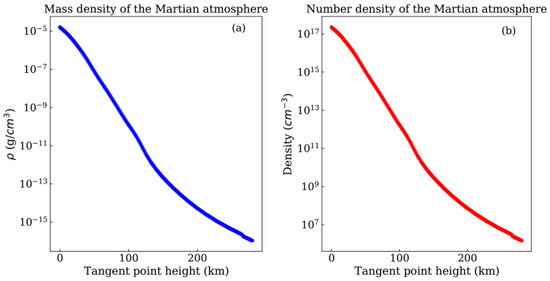
Figure 1a shows the mass density profile from the MCD, and Figure 1b shows the corresponding number density profile derived from Equation (1). The number density decreases approximately exponentially with altitude, with scale heights varying from 10 km in the lower atmosphere to >30 km in the thermosphere.
Figure 1.
Panel (a) shows mass density of the Martian atmosphere. Panel (b) shows number density of the Martian atmosphere. Both panels cover an altitude range of 0–280 km with a vertical resolution of 1.1 km.
2.2. X-Ray Cross-Sections
For photon energies in the 0.25–20 keV range, the dominant attenuation mechanism in the Martian atmosphere is photoelectric absorption. Scattering contributions (Rayleigh and Compton) are negligible compared to the photoabsorption cross-section at these energies for the gas densities encountered. Nevertheless, both scattering and photoabsorption cross-sections are included in our total attenuation calculation for completeness [18].
The X-ray cross-section for CO2 is computed using the XrayDB Python module, which provides atomic photoabsorption cross-sections based on evaluated data from NIST (National Institute of Standards and Technology) and other sources. The molecular cross-section (E) is constructed by summing the atomic cross-sections of its constituent atoms:
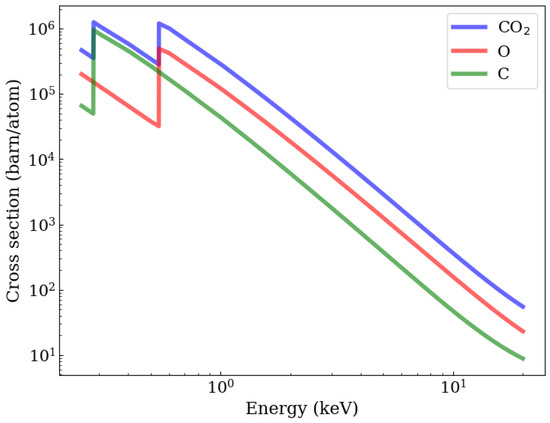
where (E) and (E) are the energy-dependent photoabsorption cross-sections for carbon and oxygen, respectively. Figure 2 displays the individual atomic cross-sections for C and O, along with the resulting molecular cross-section for CO2, across the energy range 0.25–20 keV. The cross-sections exhibit the characteristic E−3 dependence of photoelectric absorption, punctuated by absorption edges corresponding to inner-shell electron binding energies (e.g., O K-edge at 0.53 keV).
Figure 2.
X-ray cross-sections of C, O, and CO2 within the energy range of 0.25–20 keV.
2.3. Optical Depth and Transmittance Calculation
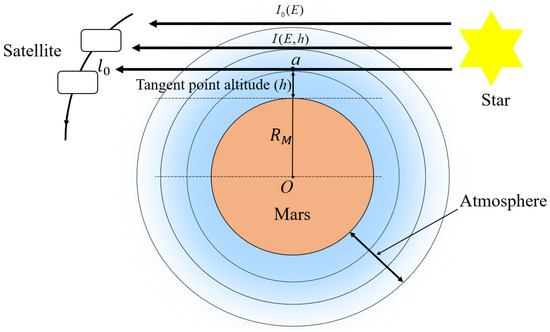
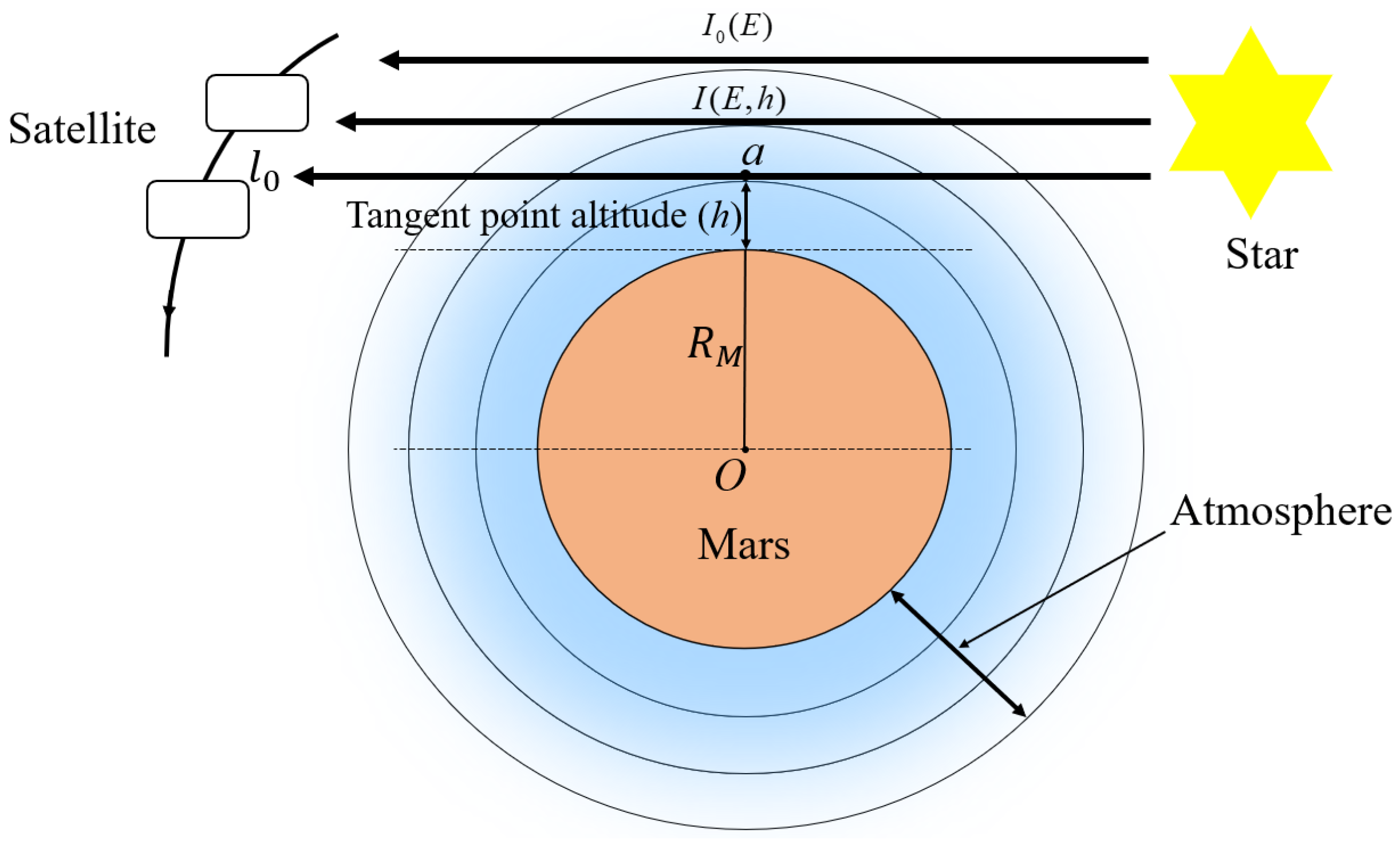
The observation geometry is illustrated in Figure 3. In Figure 3, represents the intensity of the unattenuated X-rays, and represents the intensity of the X-rays after attenuation at the point height h. Then, the X-ray transmittance can be expressed as:
where is the optical depth, which is a function of energy (E) and tangent point altitude (h), and can be expressed by the following:
where represents the number density of CO2 at the point height h, is the position of the spacecraft, and is the position of the celestial X-ray source, is the integration variable, is the mean radius of Mars, taken as 3396 km.
Figure 3.
Geometric Observations of X-Ray Occultation in Mars’ Atmosphere.
3. Results
In this study, the effective altitude range of X-ray occultation is defined as the tangent altitude interval where the transmittance changes from approximately 90% to 10%. This corresponds to the altitude region where the atmosphere transitions from nearly transparent to nearly opaque, with an optical depth ranging from approximately 0.1 (T = 90%) to 2.3 (T = 10%). This operational criterion is used throughout the paper to quantify the sensitivity range of X-ray photons of different energies.
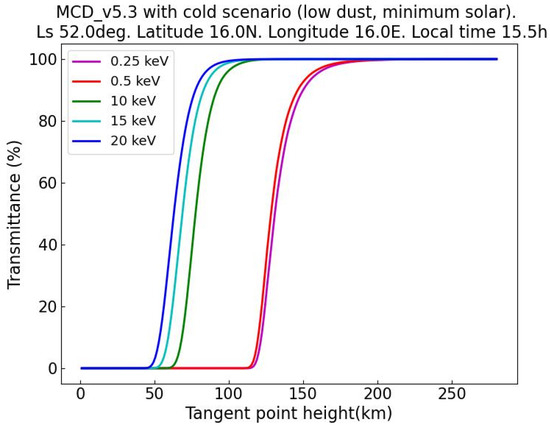
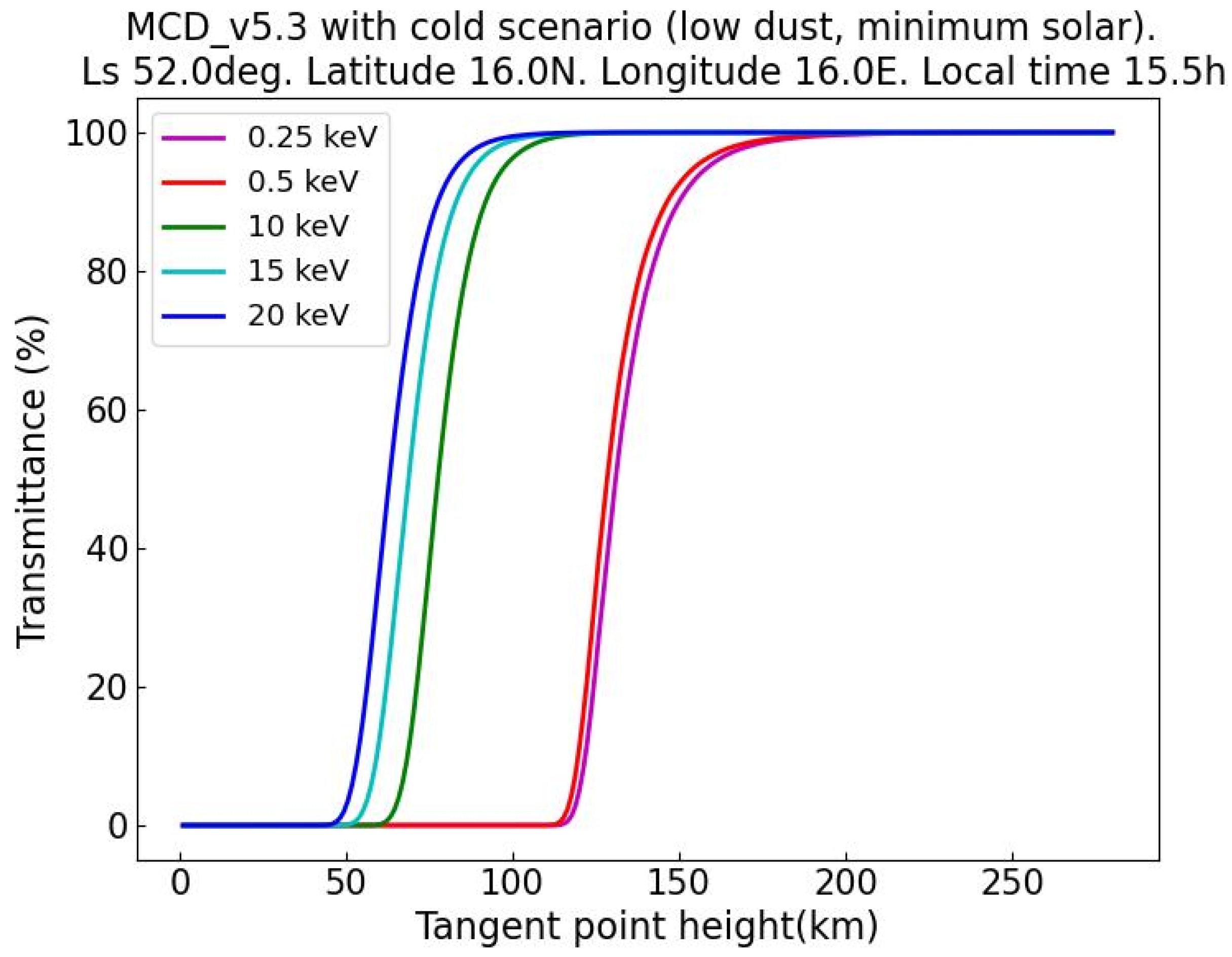
Figure 4 presents the principal result of this study, the transmittance as a function of tangent altitude for five representative photon energies spanning the soft to hard X-ray regime. To quantitatively summarize the energy-dependent sensitivity shown in Figure 4, Table 2 lists the tangent altitudes at which the X-ray transmittance equals 90%, 50%, and 10% for each of the selected photon energies (0.25, 0.5, 10, 15, 20 keV). These values are extracted from the same simulation data presented in Figure 4.
Figure 4.
The transmittance of X-ray photons of different energies within the altitude range of 0–280 km on Mars.
Table 2.
Tangent altitudes (km) at which X-ray transmittance equals 90%, 50%, and 10% for selected photon energies.
For soft X-rays at 0.25 keV and 0.5 keV, the low-energy photons experience strong attenuation due to the relatively large photoabsorption cross-sections. The transmittance drops from near-unity to near-zero over a narrow altitude range centered at approximately 160 km for the 0.25 keV channel and 140 km for the 0.5 keV channel. This behavior indicates that soft X-ray occultation is optimally suited for probing the Martian upper thermosphere, where densities are sufficiently low to yield measurable transmission gradients.
For hard X-rays at 10 keV, 15 keV, and 20 keV, the smaller cross-sections at these energies allow photons to penetrate much deeper into the atmosphere. The transmittance curves shift systematically to lower altitudes, with the transition from transparent to opaque occurring between approximately 100 km and 50 km. The 20 keV curve, for instance, exhibits near-complete transmission above 100 km and near-complete attenuation below 40 km. This energy range is therefore sensitive to the mid-atmosphere, precisely the region where radio occultation loses sensitivity and UV stellar occultation becomes challenging. Our modeled transmittance transition altitudes for 10–20 keV X-rays (approximately 50–100 km) are consistent with the observational retrieval range of 50–100 km reported by Rahmati et al. [10] using MAVEN/SEP data. This agreement supports the credibility of our forward-modeling framework.
In summary, the X-ray occultation technique demonstrates sensitivity to the Martian atmosphere across a broad altitude range spanning approximately 50 km to 160 km. Soft X-rays in the 0.25–0.5 keV band undergo strong attenuation in the upper thermosphere, with the transmittance transition centered near 140–160 km, making them well-suited for probing this high-altitude region. Conversely, hard X-rays at 10–20 keV penetrate deeper into the atmosphere, with the onset of significant attenuation occurring between 50 km and 100 km, thereby providing access to the mid-atmosphere where conventional radio and ultraviolet occultation methods face observational challenges. Collectively, these results establish that energy-resolved X-ray occultation offers a viable and complementary remote sensing approach for retrieving atmospheric density profiles throughout the 50–160 km altitude interval on Mars. For soft X-rays at 0.25–0.5 keV, our model predicts sensitivity above 140 km, a regime that has not yet been observationally tested by MAVEN/SEP. The consistency between our modeled transition altitudes for hard X-rays and the published retrieval range supports the credibility of our forward-modeling framework and suggests that our extended predictions for soft X-rays may be testable with future observations.
4. Conclusions
This study has presented a forward-modeling framework for evaluating X-ray transmittance through the Martian atmosphere based on MCD density profiles and XrayDB photoabsorption cross-sections. The results demonstrate that X-ray occultation is sensitive to tangent altitudes between approximately 50 km and 160 km, with soft X-rays (0.25–0.5 keV) probing the upper thermosphere above 140 km and hard X-rays (10–20 keV) penetrating to the mid-atmosphere between 50 and 100 km. This energy-dependent altitude coverage bridges the observational gap between radio occultation and ultraviolet remote sensing, and the modeling methodology is readily extendable to X-ray occultation studies of other planetary atmospheres. We acknowledge that the present analysis is based on a single representative MCD scenario; future work will systematically explore a wider range of atmospheric conditions, including dusty scenarios and varying solar activity levels.
Funding
This research was funded by the financial support from project ZR2024QA229, supported by the Shandong Provincial Natural Science Foundation, and the Jining University 2023 “100 Outstanding Talents” support program cultivation project (2023ZYRC34).
Data Availability Statement
The software XrayDB used to obtain the X-ray cross sections of C and O in this paper can be obtained at https://xraypy.github.io/XrayDB/python.html (accessed on 13 April 2026).
Acknowledgments
D.Y. thanks the editors and reviewers for their valuable comments and suggestions.
Conflicts of Interest
The author declares no conflicts of interest.
References
- Mischna, M.A.; Villar, G.; Kass, D.M.; Dutta, S.; Rafkin, S.; Tyler, D.; Barnes, J.; Cantor, B.; Lewis, S.R.; Hinson, D.; et al. Pre- and Post-entry, Descent and Landing Assessment of the Martian Atmosphere for the Mars 2020 Rover. Planet. Sci. J. 2022, 3, 147. [Google Scholar] [CrossRef] [Scilit]
- Liu, X.; Li, S.; Xin, M. Survey of Trajectory Optimization Methods for Mars Entry and Powered Descent. J. Guid. Control. Dyn. 2026, 49, 216–239. [Google Scholar] [CrossRef] [Scilit]
- Albee, A.L.; Arvidson, R.E.; Palluconi, F.; Thorpe, T. Overview of the Mars Global Surveyor mission. J. Geophys. Res. Planets 2001, 106, 23291–23316. [Google Scholar] [CrossRef] [Scilit]
- Hinson, D.P.; Asmar, S.W.; Kahan, D.S.; Akopian, V.; Haberle, R.M.; Spiga, A.; Schofield, J.T.; Kleinböhl, A.; Abdou, W.A.; Lewis, S.R.; et al. Initial results from radio occultation measurements with the Mars Reconnaissance Orbiter: A nocturnal mixed layer in the tropics and comparisons with polar profiles from the Mars Climate Sounder. Icarus 2014, 243, 91–103. [Google Scholar] [CrossRef] [Scilit]
- Parrott, J.; Svedhem, H.; Sánchez-Cano, B.; Witasse, O.; Wilson, C.; Müller-Wodarg, I. Ionospheric analysis with Martian mutual radio occultation. J. Geophys. Res. Planets 2025, 130, e2024JE008854. [Google Scholar] [CrossRef] [Scilit]
- Hu, X.; Wu, X.; Song, S.; Ma, M.; Zhou, W.; Xu, Q.; Li, L.; Xiao, C.; Li, X.; Wang, C.; et al. First Observations of Mars Atmosphere and Ionosphere with Tianwen-1 Radio-Occultation Technique on 5 August 2021. Remote. Sens. 2022, 14, 2718. [Google Scholar] [CrossRef] [Scilit]
- Fedorova, A.; Korablev, O.; Bertaux, J.L.; Rodin, A.; Montmessin, F.; Belyaev, D.; Reberac, A. Solar infrared occultation observations by SPICAM experiment on Mars-Express: Simultaneous measurements of the vertical distributions of H2O, CO2 and aerosol. Icarus 2009, 200, 96–117. [Google Scholar] [CrossRef] [Scilit]
- Giuranna, M.; Tellmann, S.; Montmessin, F.; Belyaev, D.; Trompet, L.; Pätzold, M.; Wolkenberg, P.; Lopez-Valverde, M.; Korablev, O.; Forget, F. Vertical structure of the Martian atmosphere: The view from Mars Express. Space Sci. Rev. 2025, 221, 36. [Google Scholar] [CrossRef] [Scilit]
- Bibring, J.P.; Bertaux, J.L.; Bonnet, R.; Bonneville, R.; Korablev, O.; Langevin, Y.; Frécon, L.; Poinsignon, V.; Schmidt, R. Mars Express: Genesis and Infancy. Space Sci. Rev. 2026, 222, 21. [Google Scholar] [CrossRef] [Scilit]
- Rahmati, A.; Larson, D.; Cravens, T.; Lillis, R.; Lee, C.; Dunn, P. MAVEN SEP observations of Scorpius X-1 X-rays at Mars: A midatmosphere occultation analysis technique. Geophys. Res. Lett. 2020, 47, e2020GL088927. [Google Scholar] [CrossRef] [Scilit]
- Sánchez-Lavega, A.; del Río-Gaztelurrutia, T.; Spiga, A.; Hernández-Bernal, J.; Larsen, E.; Tirsch, D.; Cardesín-Moinelo, A.; Machado, P. Dynamical phenomena in the Martian atmosphere through Mars Express imaging. Space Sci. Rev. 2024, 220, 16. [Google Scholar] [CrossRef] [Scilit]
- Lipatov, A.; Ekonomov, A.; Makarov, V.; Lesnykh, V.; Goretov, V.; Zakharkin, G.; Zaitsev, M.; Khlyustova, L.; Antonenko, S. Accelerometers of the meteorological complex for the study of the upper atmosphere of Mars. Sol. Syst. Res. 2023, 57, 349–357. [Google Scholar] [CrossRef] [Scilit]
- Sharma, G.; Dhall, A.; Subramanian, R. MARS: A multiview contrastive approach to human activity recognition from accelerometer sensor. IEEE Sens. Lett. 2024, 8, 6002004. [Google Scholar] [CrossRef] [Scilit]
- Määttänen, A.; Lefèvre, F.; Verdier, L.; Montmessin, F.; Listowski, C.; Guilbon, S.; Fedorova, A.; Korablev, O. Ozone vertical distribution in Mars years 27–30 from SPICAM/MEX UV occultations. Icarus 2022, 387, 115162. [Google Scholar] [CrossRef] [Scilit]
- Katsuda, S.; Fujiwara, H.; Ishisaki, Y.; Yoshitomo, M.; Mori, K.; Motizuki, Y.; Sato, K.; Tashiro, M.S.; Terada, Y. New Measurement of the Vertical Atmospheric Density Profile From Occultations of the Crab Nebula With X-Ray Astronomy Satellites Suzaku and Hitomi. J. Geophys. Res. Space Phys. 2021, 126, e2020JA028886. [Google Scholar] [CrossRef] [Scilit]
- Yu, D.; Li, H.; Li, B.; Ge, M.; Tuo, Y.; Li, X.; Xue, W.; Liu, Y. New method for Earth neutral atmospheric density retrieval based on energy spectrum fitting during occultation with LE/Insight-HXMT. Adv. Space Res. 2022, 69, 3426–3434. [Google Scholar] [CrossRef] [Scilit]
- Millour, E.; Forget, F.; Spiga, A.; Vals, M.; Zakharov, V.; Montabone, L.; Lefèvre, F.; Montmessin, F.; Chaufray, J.Y.; López-Valverde, M.; et al. The Mars climate database (version 5.3). In Proceedings of the Scientific Workshop: “From Mars Express to ExoMars”, Madrid, Spain, 27–28 February 2018; p. 68. [Google Scholar]
- Yu, D.; Li, H.; Li, B.; Ge, M.; Tuo, Y.; Li, X.; Xue, W.; Liu, Y.; Wang, A.; Zhu, Y.; et al. Measurement of the vertical atmospheric density profile from the X-ray Earth occultation of the Crab Nebula with Insight-HXMT. Atmos. Meas. Tech. 2022, 15, 3141–3159. [Google Scholar] [CrossRef] [Scilit]

Disclaimer/Publisher’s Note: The statements, opinions and data contained in all publications are solely those of the individual author(s) and contributor(s) and not of MDPI and/or the editor(s). MDPI and/or the editor(s) disclaim responsibility for any injury to people or property resulting from any ideas, methods, instructions or products referred to in the content. |
© 2026 by the author. Licensee MDPI, Basel, Switzerland. This article is an open access article distributed under the terms and conditions of the Creative Commons Attribution (CC BY) license.