


Abstract
Low birth weight (LBW) is associated with neonatal morbidity, mortality and long-term health complications. Global studies report an association between air pollution, such as tropospheric ozone, and LBW. This study aims to analyze the association between ozone exposure during pregnancy and LBW in 130 municipalities in rural and semi-urban Spain. We conducted a retrospective population-based cohort study using data from the Instituto Nacional de Estadística (INE) and air quality data from the Spanish Government for the 2001–2017 period. We performed descriptive analysis, logistic regression and linear regression analyses adjusted for various covariates. In addition, we fitted generalized additive models (GAMs) to estimate non-linear relationships. An association between decreased neonatal weight and high ozone exposure was found, especially in the first and second trimester. An increase in ozone concentration could lower neonatal weight but not enough evidence demonstrates an association with LBW. More research is needed to understand the impact of ozone exposure on neonates during pregnancy.
1. Introduction
Over the past three decades, low birth weight (LBW) has been a key concern in perinatal research due to its association with neonatal morbidity, mortality, and long-term health complications [1,2,3]. LBW, defined as the weight at birth being <2500 g, has been shown to be caused by intrauterine growth restriction, prematurity or both [3]. Globally, in 2020, approximately 14.7% of infants were born with LBW [4].
Air pollution consists of a combination of particulate matter (PM), carbon monoxide (CO), ozone (O3), nitrogen dioxide (NO2), and sulphur dioxide (SO2), and 99% of the global population is exposed to levels that exceed recommended limits [5,6]. Previous studies have demonstrated that air pollution can be associated with health issues [7,8], with certain risk groups being identified such as children and fetuses [9,10,11]. Specific studies on birth outcomes suggest that air pollutants, such as ozone, could be associated with adverse results [12,13,14,15,16]. However, findings in Spain remain inconclusive, especially regarding ozone exposure [17].
Tropospheric ozone (O3), also referred to as ground-level ozone, is a secondary air pollutant formed through the photochemical oxidation of precursors such as volatile organic compounds (VOCs) and nitrogen oxides (NOx) under ultraviolet radiation [8]. In many cases, ozone levels in downwind regions can exceed those at the original emission sources, as transported precursors undergo continued photochemical reactions, with concentrations strongly influenced by geographical and climatic conditions. This should be a pressing issue since 56.7% of deaths in Europe, attributed to ozone pollution, were due to O3 produced at a distance from the origin and transported [8,17].
Regarding LBW, discrepancies can be seen between Spain and other countries. On the one hand, a study in Iran (N = 4,068,843) found an association between ozone pollution and low birth weight between 2012 and 2018 [11]. On the other hand, a study in Spain found no association between O3 and LBW in the period 2001–2009 [16]. More recently, a study published in 2025 in Finland concluded that increases in ozone levels were associated with a 0.9 g increase in birth weight [13]. Since previous studies addressing this issue have inconsistencies in their results, there is a need to continue investigating this, especially in areas that are under-researched in Spain, such as suburban and rural environments [8]. In this context, this study aims to analyze the impact of daily maximum eight-hour ozone concentration on LBW in rural and semi-urban Spain, and to explore if a window of susceptibility exists.
2. Materials and Methods
2.1. Study Design and Population
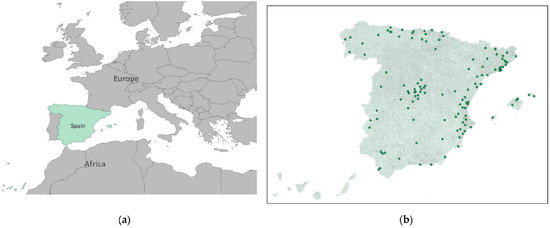
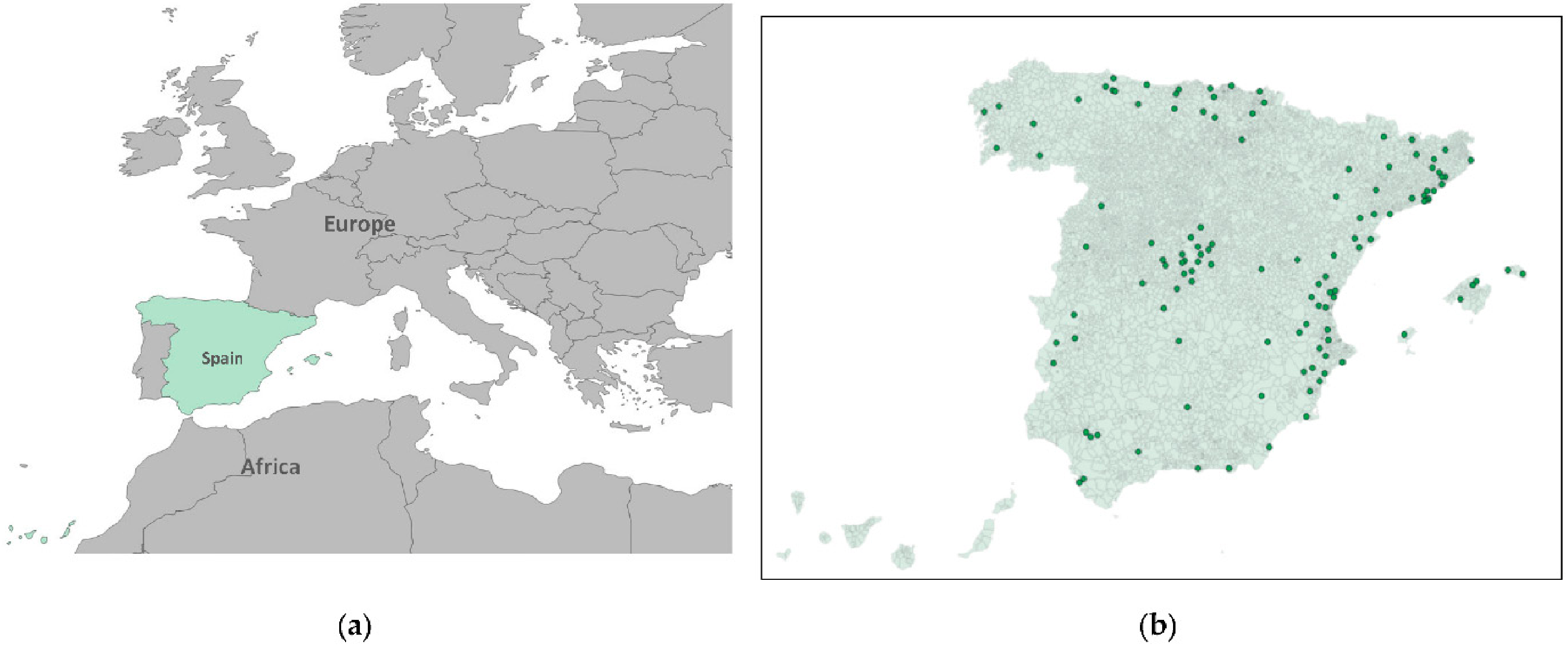
We set up a retrospective study using the information from the Spain Birth Registry Statistics database from the National Statistics Institute (INE) [18]. The study populations consisted of all newborns recorded in 130 suburban and rural Spanish municipalities (Figure 1), between the years 2001 and 2017. We selected only singleton live births born between gestation weeks 37 and 42, excluding records with missing or implausible birth weight.
Figure 1.
(a) Spain in its geographical context; (b) geographic distribution of the ozone monitoring and control station sited in suburban and rural municipalities included in the analysis in green points (Spain).
2.2. Ozone-Polluted Air Dataset
Air pollution data is published by the Spanish government and includes air pollution dataset measures for the contaminant ozone (O3) [19]. We selected the period from 2001 through 2017. The independent variable in this study was the daily maximum eight-hour average ozone concentration (µg/m3), obtained from air quality monitoring stations in selected municipalities that record hourly ozone levels. Following current legislation, monitoring stations are classified by area type: urban, with dense and continuous building structures; suburban, characterized by built environments interspersed with non-urban features such as small lakes or forests; and rural, which do not fit the criteria of urban or suburban [8]. Stations are also categorized according to their main emission sources: traffic stations, influenced primarily by vehicle emissions; industrial stations located near major industrial sources; and background stations, which are not dominated by a single emission source. For this study, we considered background stations situated in suburban and rural municipalities (Figure 1). Each of these municipalities contains a single station, which is regarded as representative of ozone concentrations for the entire area [8].
The independent variable was defined as the maximum 8 h average O3 concentration calculated using an hourly moving window. In addition, 24 h mean concentrations were obtained from the datasets.
2.3. Conversion Rate of O3 Data
In most of the literature, O3 is reported in parts per billion (ppb); however, as previously stated, the collection of O3 concentration for this study is measured and collected in the unit (µg/m3). Moreover, the EU regulations are expressed in µg/m3 [20,21], supporting the use of this unit in the present study. As a result, the regression and OR tables in the analysis of this study were reported in (µg/m3). However, to aid with the comparison between different results, a corresponding conversion rate was added to the results. Effect estimates were converted from ppb to µg/m3.
2.4. Low Birth Weight Assessment
The primary outcome measured is low birth weight (g) as a dichotomous variable. The binary variable for LBW was created from the neonatal weight in grams defined as 1 for babies born < 2500 g and 0 for those with weight ≥ 2500 g. We excluded preterm babies (gestational period < 37 weeks), babies born with very low weight (<2000 g) and those with very high birth weight (>4650 g), because of the absence of data about maternal conditions influencing birth weight, such as gestational diabetes, and because of possible errors in the birth registry. This was done to ensure that the study examined only the association between ozone pollution and the previously mentioned adverse birth outcomes.
2.5. Covariates
We included the following covariates from the official birth statistics gathered by the Instituto Nacional de Estadística (INE): infant sex, birth year, maternal age, paternal age, maternal autonomous community of residence, size of municipality and maternal socio-economic status [18,21]. We also included in the model the daily mean temperature of the municipality because of its high correlation with ozone levels [17].
We used the date of birth and maternal residence municipality to map the corresponding date and location of the ozone data set to link with the levels of ozone during the gestation period.
2.6. Statistical Analysis
To begin with, a descriptive analysis was performed to the primary outcome and the covariates. Mean and standard deviation or percentages were calculated for the following variables: population size, age of mother at childbirth, age of father at childbirth, gestational period, sex of neonate, weight of infant, socio-economic factor of the neighborhood and autonomous community (País Vasco, Castilla La Mancha, Comunidad Valenciana, Andalucía, Castilla León, Extremadura, Baleares, Cataluña, Galicia, Aragón, La Rioja, Madrid, Murcia, Navarra, Asturias, Cantabria).
To quantify the association between LBW and O3, we fitted a multivariate logistic regression. Odds ratio (OR) and its corresponding 95% confidence intervals (95% CI) were calculated for the total pregnancy mean and by trimesters. Models were adjusted for all the covariates: age of father at time of birth, age of mother at time of birth, sex of neonate, socio-economic rate, size of population where mother resides and autonomous community. Initially we used the continuous variable, then the variable O3 was split into 4 quartiles, following categorical levels: low, moderate, high and very high-level exposure, respectively, to measure the association with LBW both in a qualitative and quantitative manner.
To analyze the continuous variable birth weight (g), we fitted multivariable linear regression models using the same strategy as for LBW. Finally, two generalized additive model (GAM) graphs were produced to show the O3 exposure non-linear relationship with risk of LBW and birth weight. For all analyses and tests a p-value ≤ 0.05 was considered as the significant statistical level. All data was analyzed with the statistical program R 4.4.2.
3. Results
3.1. Descriptive Analysis
The full descriptive analysis of the study population of the births across Spain from the years (2001–2017) are presented in Table 1. The population study included 723,501 birth records where 27,164 (3.75%) of them showed LBW. From the overall population, the mean weight of the neonate was 3269.68 g (±445.71) while weight of LBW neonates was 2273.79 (±224.34) g. The overall mean age of mothers at the time of birth was 31.55 (±5.06), while the mean age of fathers was 33.52 (±5.52). Parents of LBW babies were older, with a mean maternal age of 31.77 (±5.35) and a mean paternal age of 33.94 (±5.83) years at birth.
Table 1.
Overall characteristics based on ozone exposure and by quartile of ozone level, 2001–2017 (n = 723,501).
3.2. Adjusted Association of LBW and Ozone-Polluted Air
The results for the analysis of LBW are shown in Table 2. The analyses using the continuous variable over the whole pregnancy showed an estimated OR of 1.01 per 10 μg/m3 increase in ozone exposure, meaning an increase of 1% in LBW risk; however, this association was not statistically significant. The OR for the second trimester was also 1.01 and statistically significant. ORs for the first trimesters showed no association between level of O3 and LBW.
Table 2.
Adjusted odds ratio for LBW (<2500 g) during 2001–2017, Spain.
The analyses using the categorical variable showed a similar pattern. ORs over the whole pregnancy and second trimester suggested an increasing risk with increasing ozone level exposure. Pregnancies in the very high exposure group showed increased risk of LBW compared with those in the low group, specifically 5% (95% CI: −1–11%) of increased risk for total pregnancy and 7% (95% CI: 3–12%) for the second trimester. And again, only the OR for the second trimester was statistically significant. Estimations associated with the first and third trimester did not show association.
3.3. Adjusted Association of Birth Weight and Ozone-Polluted Air
Table 3 shows the results for the relationship between weight of neonate and ozone across whole gestational period and trimester. These models also controlled covariates. Continuous exposure analyses showed that ozone concentration was statistically associated with lower neonatal birth weight throughout pregnancy, as well as during the first and second trimester. A 10 µg/m3 increase in ozone exposure during the total pregnancy period was related to a minimal mean reduction of less than a gram in the three scenarios.
Table 3.
Adjusted odds ratio for mean weight at birth (g) and ozone concentration on during 2001–2017, Spain.
As for the association between weight at birth and the different categories for ozone exposure, we found that very high-level ozone exposure compared with low exposure was negatively associated with birth weight across the total pregnancy, meaning a mean weight loss of 9.62 g (95% CI: –13.81, –5.44, p < 0.001), 7.24 g (95% CI: –10.72, –3.76, p < 0.001) in the first trimester and 7.78 g (95% CI: –11.36, –4.38; p < 0.001) in the second trimester. However, for the third trimester, high-level exposure showed an increase in birth weight of 4.33 g (95% CI: 0.88, 7.78, p = 0.014).
3.4. Regression Models
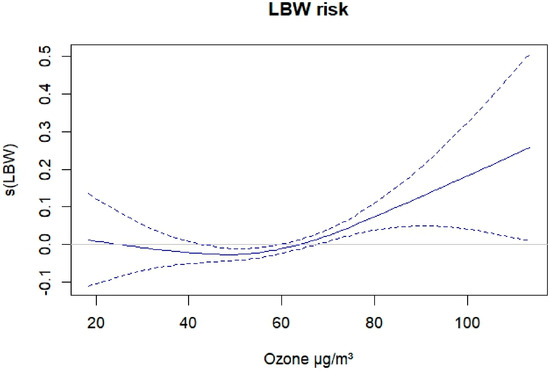
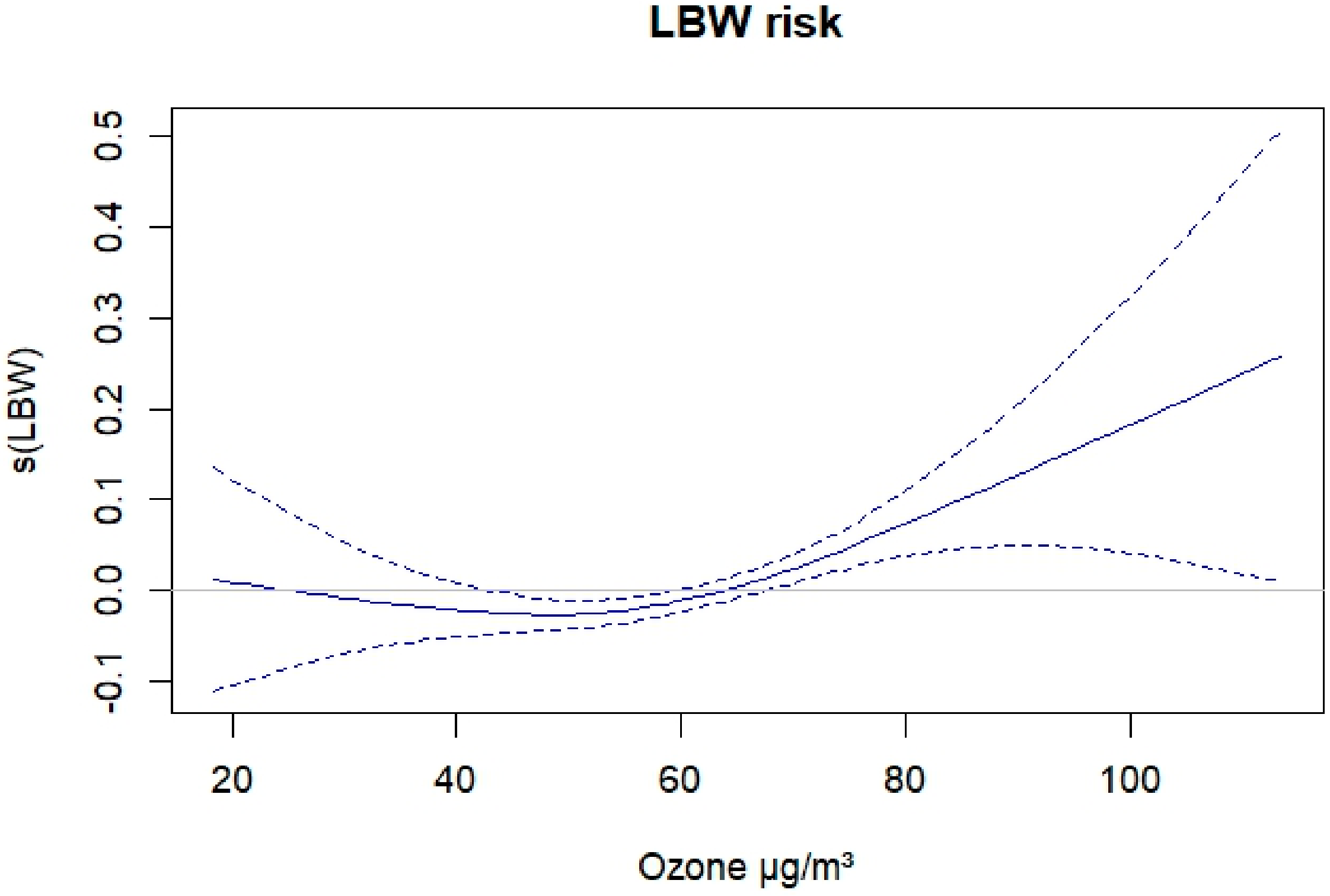
In order to analyze the relationship between ozone exposure and its effect on birth weight, we also generated graphics for two linear regression GAM. The graphic from Figure 2 illustrates the variation in LBW risk with increased mean pregnancy ozone exposure concentrations. The effect seems near null at lower concentrations but shows a gradual increase beyond ~70 µg/m3 with uncertainty widening at higher exposure levels due to reduced sample size.
Figure 2.
Variation in LBW risk with increased mean pregnancy ozone exposure concentrations. Result from the nonlinear models (GAM).
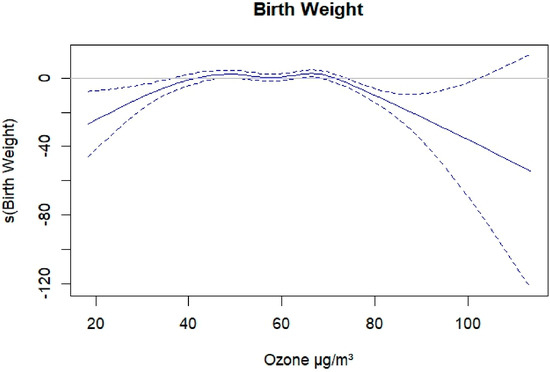
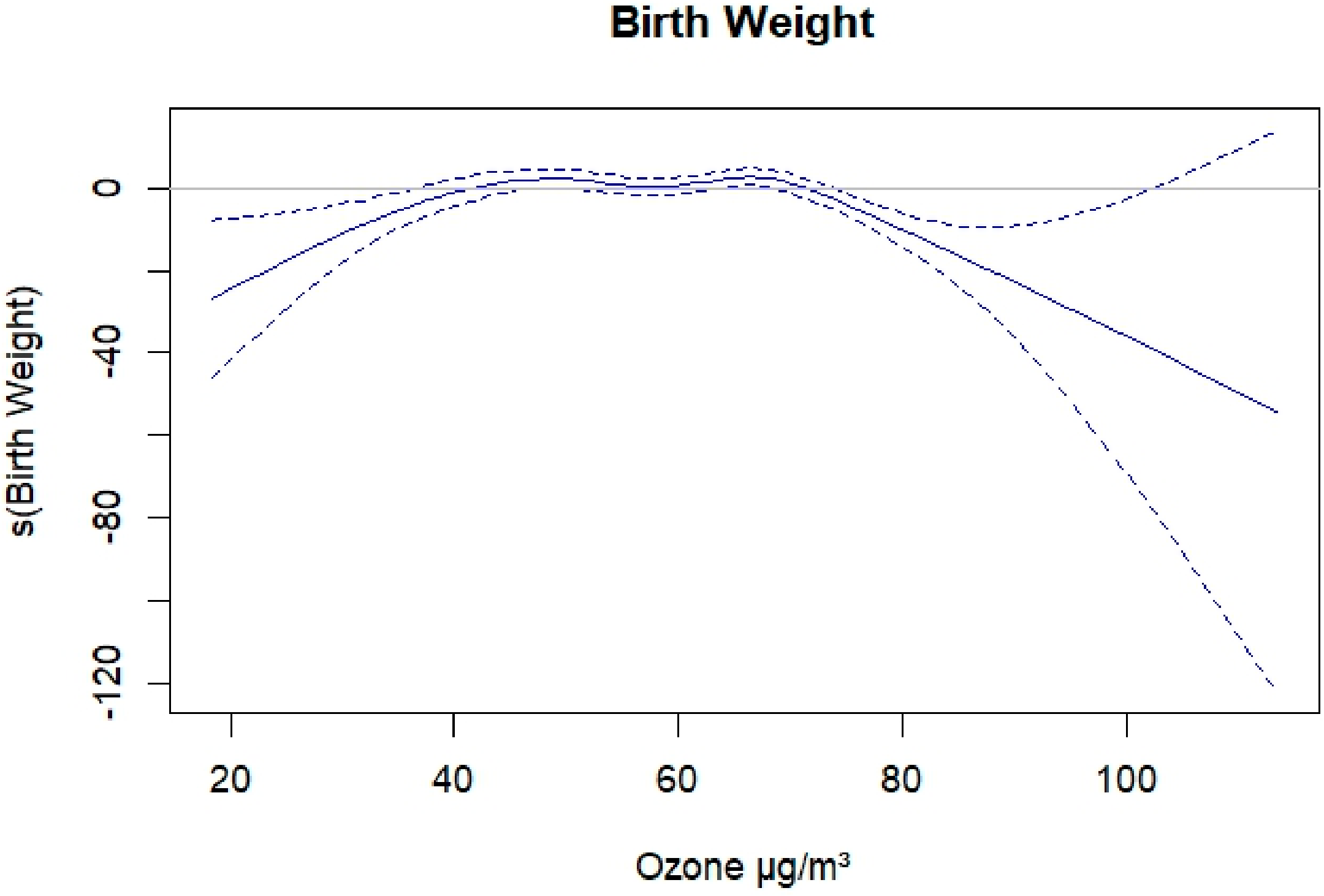
The graphic from Figure 3 shows the variation in birth weight with increased mean pregnancy ozone exposure concentrations. These results suggest that at low (<30 µg/m3) and high (>70 µg/m3) ozone exposure concentrations, birth weight seems to be lower than average, with a stronger weight reduction observed at higher concentrations, although estimates showed greater uncertainty.
Figure 3.
Variation in birth weight risk with increased mean pregnancy ozone exposure concentrations. Result from the non-linear models (GAM).
4. Discussion
In this study, we found that increased ozone concentration could be associated with increased LBW risk and lower birth weight, especially when very high exposure levels occurred during the second trimester of the pregnancy. This suggests that the second trimester may represent a critical window of susceptibility in which maternal exposure poses a heightened risk of adverse birth outcomes related to neonate weight.
As for the association between lower birth weight and ozone exposure over the whole pregnancy, studies such as Laurent O et al. [22] in Southern Carolina and the systematic review by Bekkar et al. [23] are consistent with our findings. This association was also observed during the second or third trimesters in the 2003–2005 study by Vinikoor-Imler et al. in North Carolina State [24].
Regarding the link between LBW and ozone exposure, other studies have reported similar outcomes focused on the second trimester as the window of susceptibility, such as the study by Laurent O et al. [22], the work by Zhu et al. conducted in Iran [11], the study by Wang Q et al. in China [14] or a Spanish study in Comunidad de Valencia by Ballester F et al. [25]. However, no association between LBW and ozone exposure was found by Díaz J et al. [15], Rumrich IK et al. [26] or Bhardwaj N et al. [27] in their respective papers. The study by Díaz J et al. gathered data for an eight-year period time of study between 2001 and 2009 and was focused on Madrid city [15], an urban environment, whereas our paper analyzed data within a sixteen year-period time of study between 2001 and 2017 and focused on a semi-urban and rural scenario with 130 municipalities around the whole Spain. Differences in the results could be explained by the different scenarios studied, urban versus rural areas, where the ozone concentration is higher in the rural ones.
Bhardwaj N et al. conducted a retrospective study in India with birth data during a shorter period, from January 2021 to July 2022, evaluating 1155 neonates [27] compared to our 723,501 sample from a wider study period. This larger sample size may provide more representative results. The study conducted by Rumrich IK et al. in Finland studied 1,745,980 neonates and came to a surprising conclusion at first: exposure to ozone in the third trimester increased the weight of the babies but, when adjusted for all covariates (socio-economic status, maternal smoking, gestational age, diseases during pregnancy, sex of the baby) association was no longer statistically significant [26]. We share this outcome for third trimester too and, in fact, our model was already adjusted for our covariates considered (maternal and paternal age, sex of the neonate, gestational age, province of residence, socio-economic status and temperature).
Although the biological mechanisms are not yet fully understood, previous studies provide supporting evidence for the conclusions of this research [24,28,29]. The fetus is particularly vulnerable to environmental contaminants due to its heightened susceptibility [29]. Emerging evidence also suggests that during pregnancy, women may be particularly vulnerable to the cardiovascular impacts of air pollution because of the rapid physiological adaptations that occur, especially in the first and second trimesters [30]. Air pollution exposure may influence maternal blood pressure by activating the sympathetic nervous system, increasing oxidative stress and systemic cytokine release, or impairing vascular endothelial function [24,31,32]. Among these pathways, oxidative stress-mediated DNA damage has been identified as a key mechanism underlying the effects of urban particulate matter [31]. Moreover, one animal experiment showed that an increase in inhaled ozone negatively impacted the development of placenta in early gestational stages, leading to placental insufficiency [31]. During the second trimester, fetal weight begins to increase, leading to greater oxygen and nutrient demands [33], which may provide some insight into the obtained results.
Our findings suggest a potential negative association between ozone exposure and birth weight, with GAM analyses (Figure 2 and Figure 3) indicating possible risks of LBW beginning at concentrations around 70 µg/m3 and decreases in birth weight evident above ~60 µg/m3. In Spain, the legal framework defines a daily maximum is 8 h average limit of 120 µg/m3 (not to be exceeded on more than 25 days per year, averaged over 3 years), an information threshold of 180 µg/m3 (hourly average), and an alert threshold of 240 µg/m3 (hourly average), established by BOE [34]. Compared with these standards, our findings suggest potential effects at substantially lower concentrations. However, it is important to note that the legal limits apply to maximum short-term concentrations, whereas our results are based on mean averages for total pregnancy or trimesters, making direct comparison difficult. Moreover, the World Health Organization (WHO) uses the same metric as our study—the daily maximum 8 h average—and recommends a much stricter air quality guideline of 70 µg/m3 [5]. Notably, this threshold coincides with the concentration at which our GAM began to show increased risks of low birth weight, suggesting that current Spanish legal limits are not adequate to protect maternal and infant health. Nevertheless, Figure 3 showed lower weight at levels below 30 µg/m3, which should be studied too.
Overall, the biological mechanisms underlying critical windows remain insufficiently studied. The limited body of evidence makes it difficult to fully interpret the findings of this study. Moreover, different countries contribute to this discussion with varying results due to the heterogeneity of the investigations. As ozone levels continue to increase, more research should be conducted to fully understand the health impact for neonates during their time in utero.
This study has several limitations related to both LBW and O3 datasets. Firstly, as reported in other studies, maternal health history was not sufficiently detailed to account for additional risk factors affecting neonatal birth weight, such as dietary or smoking habits or pregnancy-related complications and diseases [35]. Moreover, we cannot rule out potential influence of other air pollutants on the observed associations, as this study focused only on ozone exposure, whereas other studies have also considered multiple air pollutants and their interactions [24,27,35]. Another limitation shared with other investigations is that we assumed mothers remained at the same place throughout pregnancy: if women changed residence during pregnancy, they could have been exposed to different ozone levels than those estimated using their residential address [24,26,35]. Other studies addressed this issue and found that ignoring exposure outside the maternal residential area may have only a limited impact on the identification of potential critical exposure windows [13,36].
Nevertheless, this study also has strengths, including the use of publicly available birth data from the Spanish Civil Register and environmental exposure data provided at the national level by the Spanish Government. These data are highly reliable, as they are collected following strict protocols. In addition, we were able to study a population with homogeneous ozone exposure levels within the same location (municipalities). The extended study period of sixteen years is also a strength, allowing the inclusion of data from 723,501 births. Finally, unlike previous works, this study focuses on semi-urban and rural areas of Spain, which are often overlooked in research [37].
5. Conclusions
In conclusion, our findings indicate a potential association between low birth weight and ozone exposure concentration during pregnancy across rural and suburban Spain. The results suggest that critical windows may occur during the second trimester and possibly the first. Therefore, further research must be conducted to address existing gaps in knowledge regarding the potential association and to improve understanding of the underlying biological mechanisms. Based on these results, public health strategies and environmental policies should implement new plans to reduce ozone levels in Spain in order to promote healthier pregnancies and newborns.
Author Contributions
Conceptualization, R.R.-P.; methodology, R.R.-P. and S.M.-P.; validation and formal analysis, S.M.-P.; investigation, S.M.-P. and R.R.-P.; resources, R.R.-P. and B.N.-C.; data curation, S.M.-P. and M.A.-C.; writing—original draft preparation, S.M.-P. and L.P.O.; writing—review and editing, L.P.O., M.A.-C., J.A.O.-G., D.G.-B., B.N.-C. and R.R.-P.; visualization, S.M.-P. and L.P.O.; supervision, R.R.-P.; project administration, R.R.-P.; funding acquisition, R.R.-P. and B.N.-C. All authors have read and agreed to the published version of the manuscript.
Funding
This study was funded by the Carlos III Institute of Health, Spain (grant numbers PI24CIII/00057, PI19CIII/00025 and PI16CIII/00009); Spain’s Health Research Fund (Fondo de Investigación Sanitaria-FIS grant number 12/01416); and by the Spanish Consortium for Research on Epidemiology and Public Health (ESP20PI01/2020). The funders had no role in the design of the study; in the collection, analyses, or interpretation of data; in the writing of the manuscript, or in the decision to publish the results.
Institutional Review Board Statement
The study was conducted in accordance with the Declaration of Helsinki and was approved by the Ethics Committee of the Carlos III Institute of Health (CEI PI 72_2016-v2, 6 February 2017.
Informed Consent Statement
Not applicable.
Data Availability Statement
Restrictions apply to the availability of these data. Data were obtained from Spanish National Statistics Institute (INE) www.ine.es (accessed on 31 March 2025).
Conflicts of Interest
The authors declare no conflicts of interest. The funders had no role in the design of the study; in the collection, analyses, or interpretation of data; in the writing of the manuscript, or in the decision to publish the results. This article presents independent research. The views expressed are those of the authors and not necessarily those of the Carlos III Institute of Health.
Abbreviations
The following abbreviations are used in this manuscript:
| BOE | Boletín Oficial del Estado (Offcial State Gazette) |
| CI | Confidence interval |
| CO | Carbon monoxide |
| DNA | Desoxyrribonucleic acid |
| GAM | Generalized additive model |
| GLM | Generalized linear model |
| LBW | Low birth weight |
| INE | Instituto Nacional de Estadística (Statistics National Institute) |
| NO2 | Nitrogen dioxide |
| O3 | Ozone |
| OR | Odds ratio |
| PM | Particulate Matter |
| SES | Socioeconomical status |
| SO2 | Sulphur dioxide |
| WHO | World Health Organization |
References
- Behrman, R.E.; Butler, A.S. Institute of Medicine (US) Committee on Understanding Premature Birth and Assuring Healthy Outcomes; National Academies Press: Washington, DC, USA, 2007. Available online: https://www.ncbi.nlm.nih.gov/books/NBK11350/ (accessed on 1 March 2025).
- WHO. Low Birth Weight. Available online: https://www.who.int/data/nutrition/nlis/info/low-birth-weight (accessed on 1 March 2025).
- Wardlaw, T.; Wardlaw, T.M.; Weltgesundheits Organization. Low Birthweight: Country, Regional and Global Estimates; Weltgesundheits Organization, Ed.; World Health Organization: Geneva, Switzerland, 2004; ISBN 978-92-806-3832-5. [Google Scholar]
- WHO. Joint Low Birthweight Estimates. Available online: https://www.who.int/teams/nutrition-and-food-safety/monitoring-nutritional-status-and-food-safety-and-events/joint-low-birthweight-estimates (accessed on 26 May 2025).
- WHO. Ambient (Outdoor) Air Pollution. Available online: https://www.who.int/news-room/fact-sheets/detail/ambient-(outdoor)-air-quality-and-health (accessed on 18 February 2025).
- WHO. Air Pollution. Available online: https://www.who.int/health-topics/air-pollution (accessed on 10 September 2025).
- Brugha, R.; Grigg, J. Urban air pollution and respiratory infections. Paediatr. Respir. Rev. 2014, 15, 194–199. [Google Scholar] [CrossRef] [Scilit]
- Doronzo, M.A.; Martinez Fernandez, J.R.; Gómez-Barroso, D.; Alonso-Colón, M.; Nuñez-Corcuera, B.; Ramis, R. Short-term ozone exposure and daily mortality in suburban and rural areas of southern Europe. Atmosphere 2025, 16, 625. [Google Scholar] [CrossRef] [Scilit]
- Rani, P.; Dhok, A. Effects of pollution on pregnancy and infants. Cureus 2023, 15, e33906. [Google Scholar] [CrossRef] [Scilit]
- Lin, Y.T.; Jung, C.R.; Lee, Y.L.; Hwang, B.F. Associations between ozone and preterm birth in women who develop gestational diabetes. Am. J. Epidemiol. 2015, 181, 280–287. [Google Scholar] [CrossRef] [Scilit] [PubMed]
- Zhu, L.; Yuan, Y.; Mayvaneh, F.; Sun, H.; Zhang, Y.; Hu, C. Maternal ozone exposure lowers infant’s birthweight: A nationwide cohort of over 4 million livebirths in Iran. Ecotoxicol. Environ. Saf. 2024, 283, 116840. [Google Scholar] [CrossRef] [Scilit] [PubMed]
- Fussell, J.C.; Jauniaux, E.; Smith, R.B.; Burton, G.J. Ambient air pollution and adverse birth outcomes: A review of underlying mechanisms. BJOG 2024, 131, 538–550. [Google Scholar] [CrossRef] [Scilit]
- Rumrich, I.K.; Korhonen, A.; Forsberg, B.; Frohn, L.M.; Geels, C.; Brandt, J.; Hänninen, O. The association of low-level air pollution with birth weight in a register-based study: Potential effects below WHO AQ guidelines. BMC Pregnancy Childbirth 2025, 25, 162. [Google Scholar] [CrossRef] [Scilit] [PubMed]
- Wang, Q.; Miao, H.; Warren, J.L.; Ren, M.; Benmarhnia, T.; Knibbs, L.D.; Zhang, H.; Zhao, Q.; Huang, C. Association of maternal ozone exposure with term low birth weight and susceptible window identification. Environ. Int. 2021, 146, 106208. [Google Scholar] [CrossRef] [Scilit]
- Díaz, J.; Arroyo, V.; Ortiz, C.; Carmona, R.; Linares, C. Effect of environmental factors on low weight in non-premature births: A time series analysis. PLoS ONE 2016, 11, e0164741. [Google Scholar] [CrossRef] [Scilit]
- Arroyo, V.; Díaz, J.; Salvador, P.; Linares, C. Impact of air pollution on low birth weight in Spain: An approach to a National Level Study. Environ. Res. 2019, 171, 69–79. [Google Scholar] [CrossRef] [Scilit]
- Zhang, J.J.; Wei, Y.; Fang, Z. Ozone pollution: A major health hazard worldwide. Front. Immunol. 2019, 10, 2518. [Google Scholar] [CrossRef] [Scilit] [PubMed]
- INE. Estadísticas del Movimiento Natural de la Población. Available online: https://www.ine.es/metodologia/t20/t2030301.pdf (accessed on 20 February 2025).
- Ministerio para la Transición Ecológica y el Reto Demográfico. Ministerio para la Transición Ecológica y el Reto Demográfico. Available online: https://www.miteco.gob.es/es/calidad-y-evaluacion-ambiental/temas/atmosfera-y-calidad-del-aire/evaluacion-y-datos-de-calidad-del-aire/datos/historico_calidad_aire.html (accessed on 1 March 2025).
- European Environment Agency. Available online: https://www.eea.europa.eu/en/analysis/publications/air-quality-status-report-2026/acronyms-and-abbreviation-list (accessed on 14 September 2025).
- Canto, M.V.; Guxens, M.; Ramis, R. Exposure to traffic density during pregnancy and birth weight in a national cohort, 2000–2017. Int. J. Environ. Res. Public Health 2022, 19, 8611. [Google Scholar] [CrossRef] [Scilit]
- Laurent, O.; Wu, J.; Li, L.; Chung, J.; Bartell, S. Investigating the association between birth weight and complementary air pollution metrics: A cohort study. Environ. Health 2013, 12, 18. [Google Scholar] [CrossRef] [Scilit] [PubMed]
- Bekkar, B.; Pacheco, S.; Basu, R.; DeNicola, N. Association of air pollution and heat exposure with preterm birth, low birth weight, and stillbirth in the US: A systematic review: A systematic review. JAMA Netw. Open. 2020, 3, e208243. [Google Scholar] [CrossRef] [Scilit]
- Vinikoor-Imler, L.C.; Davis, J.A.; Meyer, R.E.; Messer, L.C.; Luben, T.J. Associations between prenatal exposure to air pollution, small for gestational age, and term low birthweight in a state-wide birth cohort. Environ. Res. 2014, 132, 132–139. [Google Scholar] [CrossRef] [Scilit]
- Ballester, F.; Estarlich, M.; Iñiguez, C.; Llop, S.; Ramón, R.; Esplugues, A.; Lacasaña, M.; Rebagliato, M. Air pollution exposure during pregnancy and reduced birth size: A prospective birth cohort study in Valencia, Spain. Environ. Health 2010, 9, 6. [Google Scholar] [CrossRef] [Scilit]
- Rumrich, I.K.; Vähäkangas, K.; Viluksela, M.; Gissler, M.; Surcel, H.-M.; de Ruyter, H.; Jokinen, J.; Hänninen, O. The MATEX cohort—A Finnish population register birth cohort to study health effects of prenatal exposures. BMC Public Health 2017, 17, 871. [Google Scholar] [CrossRef] [Scilit]
- Bhardwaj, N.; Nigam, A.; De, A.; Gupta, N. Ambient air pollution: A new intrauterine environmental toxin for preterm birth and low birth weight. J. Obstet. Gynaecol. India 2023, 73, 25–29. [Google Scholar] [CrossRef] [Scilit] [PubMed]
- Sun, H.Z.; Chen, H.; Tian, Y.; Wang, Z.; Zhou, J.; Zhang, L.; Fang, J.; Gao, J.; van Daalen, K.R.; Shek, L.P.; et al. Synergistic risks of ambient air particulate matter and ozone exposure on low birth weight: An 11-year longitudinal Chinese maternity cohort study. Environ. Int. 2025, 202, 109640. [Google Scholar] [CrossRef] [Scilit]
- Grabowski, B.; Feduniw, S.; Orzel, A.; Drab, M.; Modzelewski, J.; Pruc, M.; Gaca, Z.; Szarpak, L.; Rabijewski, M.; Baran, A.; et al. Does Exposure to Ambient Air Pollution Affect Gestational Age and Newborn Weight?—A Systematic Review. Healthcare 2024, 12, 1176. [Google Scholar] [CrossRef] [Scilit]
- Sears, C.G.; Braun, J.M.; Ryan, P.H.; Xu, Y.; Werner, E.F.; Lanphear, B.P.; Wellenius, G.A. The association of traffic-related air and noise pollution with maternal blood pressure and hypertensive disorders of pregnancy in the HOME study cohort. Environ. Int. 2018, 121, 574–581. [Google Scholar] [CrossRef] [Scilit]
- Mayer, C.; Joseph, K.S. Fetal growth: A review of terms, concepts and issues relevant to obstetrics: Fetal growth. Ultrasound Obstet. Gynecol. 2013, 41, 136–145. [Google Scholar] [CrossRef] [Scilit]
- Garcia, M.; Salazar, R.; Wilson, T.; Lucas, S.; Herbert, G.; Young, T.; Begay, J.; Denson, J.L.; Zychowski, K.; Ashley, R.; et al. Early Gestational Exposure to Inhaled Ozone Impairs Maternal Uterine Artery and Cardiac Function. Toxicol. Sci. 2021, 179, 121–134. [Google Scholar] [CrossRef] [Scilit] [PubMed] [PubMed Central]
- Kannan, S.; Misra, D.P.; Dvonch, J.T.; Krishnakumar, A. Exposures to airborne particulate matter and adverse perinatal outcomes: A biologically plausible mechanistic framework for exploring potential effect modification by nutrition. Environ. Health Perspect. 2006, 114, 1636–1642. [Google Scholar] [CrossRef] [Scilit] [PubMed]
- del Estado, J. Ley 7/1985, de 2 de Abril, Reguladora de las Bases del Regimen Local. Bol. Of. Estado 1985, 80, 8945–8964. Available online: https://www.boe.es/buscar/act.php?id=BOE-A-1985-5392 (accessed on 2 April 2025).
- Li, C.; Yang, M.; Zhu, Z.; Sun, S.; Zhang, Q.; Cao, J.; Ding, R. Maternal exposure to air pollution and the risk of low birth weight: A meta-analysis of cohort studies. Env. Res. 2020, 190, 109970. [Google Scholar] [CrossRef] [Scilit] [PubMed]
- Warren, J.L.; Son, J.Y.; Pereira, G.; Leaderer, B.P.; Bell, M.L. Investigating the impact of maternal residential mobility on identifying critical windows of susceptibility to ambient air pollution during pregnancy. Am. J. Epidemiol. 2018, 187, 992–1000. [Google Scholar] [CrossRef] [Scilit] [PubMed]
- Notario, A.; Díaz de Mera, Y.; Aranda, A.; Adame, J.A.; Parra, A.; Romero, E.; Parra, J.; Muñoz, F. Surface ozone comparison conducted in two rural areas in central-southern Spain. Environ. Sci. Pollut. Res. Int. 2012, 19, 186–200. [Google Scholar] [CrossRef] [Scilit]

Disclaimer/Publisher’s Note: The statements, opinions and data contained in all publications are solely those of the individual author(s) and contributor(s) and not of MDPI and/or the editor(s). MDPI and/or the editor(s) disclaim responsibility for any injury to people or property resulting from any ideas, methods, instructions or products referred to in the content. |
© 2026 by the authors. Licensee MDPI, Basel, Switzerland. This article is an open access article distributed under the terms and conditions of the Creative Commons Attribution (CC BY) license.