


Abstract
This study presents an optimized numerical and empirical modeling framework for ionic wind-driven electrostatic precipitators designed for atmospheric particulate matter (PM) removal. While traditional particle tracing models in long ducts often suffer from transient evaluation errors (the “flight time paradox”), this work introduces a Fate-based Steady-state Evaluation (FSE) method. By coupling Electrostatics, Laminar Flow, and Particle Tracing in a high-fidelity 2D axisymmetric model, we achieved a baseline validation with a Mean Absolute Error (MAE) of 5.3% compared to experimental data (20 kV, 0.5 m/s). Furthermore, a non-linear regression engine based on a physical-exponential decay function was developed to provide real-time performance predictions. The resulting hybrid model demonstrates a high scientific reliability (R2 = 0.98), establishing it as a robust tool for the design and optimization of air purification systems targeting fine atmospheric aerosols (0.1–3.0 μm). In addition, the proposed Fate-based Steady-state Evaluation (FSE) method eliminates transient bias commonly observed in long-duct Lagrangian particle simulations. This methodological improvement enables statistically consistent efficiency estimation for electrohydrodynamic filtration systems and can be applied to a broad class of Computational Fluid Dynamics (CFD)-based particulate capture studies. The developed framework enables rapid design optimization of compact electrohydrodynamic filtration systems and provides a practical alternative to computationally expensive full-scale Computational Fluid Dynamics (CFD) simulations.
1. Introduction
Submicron particles (especially in the 0.1–1 µm range) are considered one of the most challenging components of air pollution due to their small inertial diameter, high diffusive mobility, and ability to penetrate deep into the respiratory tract. Aerosol transport and stability are also critical in various engineering processes, where precise control of particle streams is required for reliable operation of aerosol-based technologies [1]. In this size range, the so-called valley of minimum collection efficiency is often observed, which is associated with weak charging and insufficient inertial deposition [2]. This phenomenon is close to the so-called “Greenfield gap”, when traditional technologies exhibit a drop in efficiency in the transitional size range [3].
Empirical atmospheric research data show that the submicron fraction often constitutes a significant part of the PM1 mass, and its chemical composition and oxidation state vary depending on seasonality and transport processes [4]. On a regional scale, the formation and transformation of submicron aerosols is determined by both photochemical and multiphase processes [5]. Therefore, effective control of these particles requires not only mechanical filtration [6,7], but also advanced electrostatic [8] or hybrid solutions.
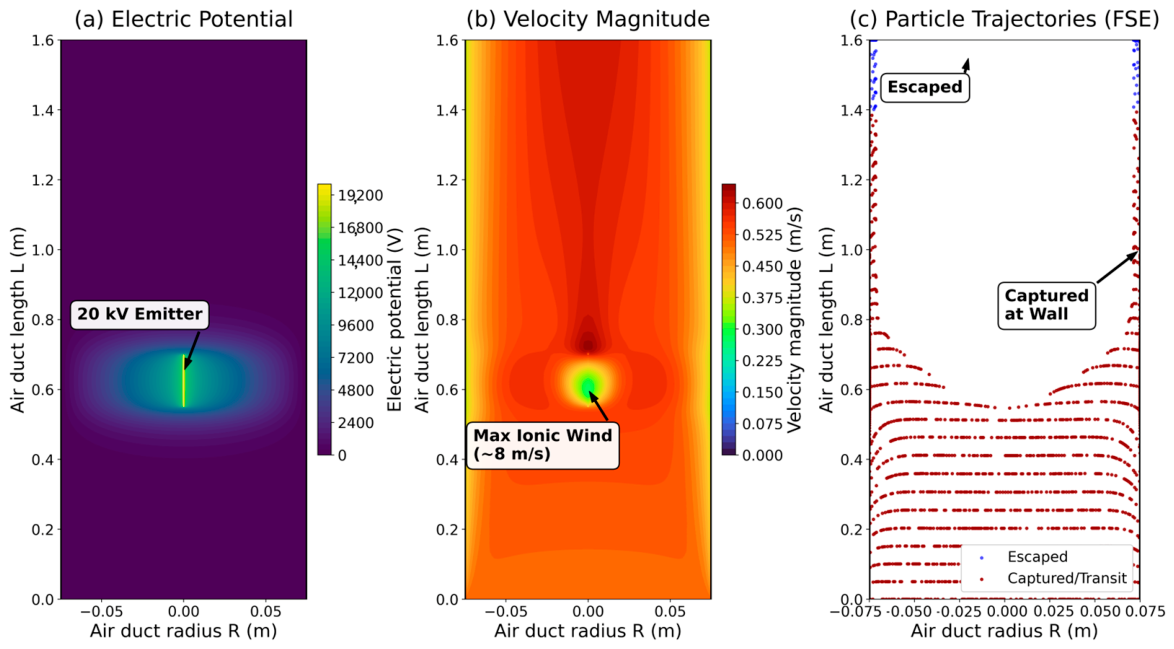
Ion wind is formed due to the generation of charge carriers in the corona discharge zone and the transfer of their impulses to the neutral gas flow [9,10,11]. Numerical simulations show that in the case of negative polarization, the ion wind speed can reach almost 8 m/s, strongly modifying the flow field and forming localized high-velocity zones [12]. Such Electro hydrodynamics (EHD) interaction can be both beneficial and detrimental—accelerating particle migration [13,14,15], but at the same time causing non-uniform deposition and reverse corona discharge [16,17].
The geometry of the electrodes is a key parameter determining the intensity of the ion wind. Studies of surface dielectric barrier discharge actuators show that optimal geometric relationships allow achieving the highest wind speed, but at the same time there is a trade-off in ozone generation [18]. Previous work has also shown that the static efficiency is sensitive to the emitter–collector distance and collector length, and that positive ion polarization can be more efficient than negative [19].
Other studies have shown that ionic wind can be used as the sole driving force for air movement in compact bioaerosol collection devices, thereby reducing the need for additional mechanical components [20]. This demonstrates the potential of Electro hydrodynamics (EHD) technologies for decentralized air purification systems.
Submicron particle charging is a crucial condition for efficient electrostatic precipitator. Visualization studies have confirmed that negative voltage can increase the particle charge by 5–14% compared to positive polarization [21]. Such differences directly affect the migration rate and the probability of collection.
Two-dimensional and three-dimensional simulations show that the particle trajectory depends not only on the electric field strength, but also on the modification of the flow formed by the Electro hydrodynamics (EHD) [22]. Diagonal wire configurations allow for high efficiency at lower voltages, but the angle dependence of the efficiency is nonlinear due to the complex interaction of charging and transport [23,24,25].
Experimental studies with two-stage ESP systems have shown that an optimal ratio of charging and collection sections is necessary to improve the deposition of submicron particles, since increasing the charging rate alone does not always result in a proportional increase in efficiency [26].
One of the most important efficiency-limiting factors is re-entrainment, the return of already deposited particles to the flow. Laboratory and Computational Fluid Dynamics (CFD) studies have shown that re-entrainment strongly depends on the gas velocity and boundary layer structure [27]. An operand monitoring system has confirmed that particle chain breakage and fragmentation of coagulated aggregates are the main causes of this phenomenon [28].
The re-entrainment effect is closely related to the irregularities caused by the ion wind; therefore, when optimizing ESP systems, it is necessary to evaluate both the electric field and aerodynamic interaction parameters [12].
Most recent studies emphasize the importance of Computational Fluid Dynamics (CFD) models in the design and prediction of ESP systems [2]. Similar numerical approaches are widely applied to analyze flow distribution and performance in catalytic and reactor systems [29]. Similar Computational Fluid Dynamics (CFD)-based optimization approaches are widely used in other fluid-mechanical systems, including turbomachinery and pump design [30]. Regional aerosol-climate models also show that only integrated modeling allows for an accurate assessment of aerosol behavior in different regimes [31].
Hybrid methods combining Computational Fluid Dynamics (CFD) with artificial neural networks allow for reduced computational costs and accelerated optimization while maintaining sufficient accuracy [22,32], and similar data-driven strategies have also been used to identify structure–property relationships in complex physical systems [33]. Similar optimization frameworks are widely applied in complex engineering decision-making and system design problems [34].
Despite the significant progress in Computational Fluid Dynamics (CFD)-based electrostatic precipitation modeling, two persistent challenges remain. First, particle tracing simulations in elongated domains frequently suffer from evaluation bias due to incomplete particle trajectories at the end of simulation time. Second, purely deterministic Computational Fluid Dynamics (CFD) approaches often fail to capture stochastic deviations observed in experimental electrohydrodynamic systems. These limitations hinder the reliable prediction and optimization of compact ionic wind filtration devices.
The mitigation of atmospheric aerosols, particularly fine particulate matter (PM2.5), remains a critical challenge for urban air quality. According to the World Health Organization (WHO), PM2.5 levels in many urban areas significantly exceed the recommended annual limit of 5 μg/m3, contributing to millions of premature deaths annually [35,36,37]. Conventional high-efficiency particulate air (HEPA) filters, while effective, suffer from high pressure drops and high energy consumption. Ionic wind-driven electrostatic precipitators (ESPs) offer a compelling alternative for decentralized air purification due to their near-zero pressure drop and low maintenance requirements. In addition to their low pressure drop, ionic wind systems can operate without mechanical fans, reducing both energy consumption and system complexity.
This study explicitly addresses the discrepancy between highly deterministic Computational Fluid Dynamics (CFD) and the stochastic divergence observed in experimental Electrohydrodynamic (EHD) filtration systems. The objectives are two-fold: 1. Methodological: To resolve the Lagrangian “Flight Time Paradox” in long-duct environments by formalizing a Fate-based Steady-state Evaluation (FSE) framework. 2. Applied: To provide engineers with a robust, hybrid prediction engine—synthesizing Navier–Stokes/Poisson coupling with an empirically validated regression model—capable of reliably determining Clean Air Delivery Rates (CADRs) for sub-micron atmospheric aerosols (0.1–3.0 μm) in near real time.
2. Materials and Methods
2.1. Numerical Model Setup
Modeling was performed using COMSOL Multiphysics® 6.4 Numerical physics relies heavily on Kaptzov’s assumption, which postulates that once the applied voltage (Vapp) exceeds the corona onset threshold (V0), the surface electric field at the discharge electrode is stabilized exactly at the Peek’s onset value (Ec) (see Table 1). While local electrode irregularities may introduce azimuthal perturbations, the dominant electrohydrodynamic interaction in cylindrical systems is governed by longitudinal migration [38,39,40].
Table 1.
Nomenclature of Principal Variables.
Although local electrode irregularities may introduce azimuthal perturbations, the dominant electrohydrodynamic interaction in cylindrical ionic wind devices is governed by radial electric field gradients and axial flow development. Therefore, a 2D axisymmetric formulation provides a computationally efficient first-order approximation while preserving the principal physics of Electro hydrodynamics (EHD)-driven flow and particle transport.
The model utilizes three primary physics interfaces:
- Electrostatics (es): Solving for Poisson’s equation:
—Laplacian operator,
V—electric potential,
—volume charge density,
—vacuum permittivity,
—relative permittivity of the medium.
Figure 1.
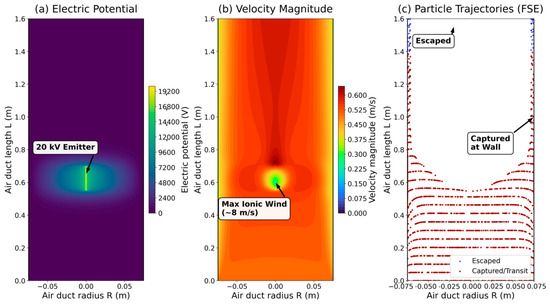
(a) Electric Potential Distribution. (b) Velocity Magnitude Distribution. (c) Particle Trajectories (FSE).
The charge density distribution was estimated using the standard corona discharge approximation implemented in the COMSOL electrostatics module, which assumes steady-state ion generation in the corona region.
- Laminar Flow (spf): Solver is limited to Re < 2000 to ensure laminar stability. Electro hydrodynamics (EHD) coupling is achieved via:
—electrohydrodynamic (EHD) body force density,
—volume charge density,
E—electric field vector,
generating the ionic wind velocity field (Figure 1b).
- Particle Tracing (fpt): Lagrangian tracking using the Drag FD and Electric forces with trajectories illustrated in Figure 1c:
—external electric force,
z—ion valence (dimensionless charge number),
e—elementary charge,
E—electric field vector.
2.2. Particle Charging and Forces
Accurate prediction of PM capture requires a robust charging model. To ensure continuity across the sub-micron range, an Additive Charging Model was implemented:
where:
—total particle flux,
—diffusive flux,
—electric-field-driven (migration) flux.
This additive formulation is widely used to describe particle charging across diffusion and field charging regimes in electrostatic precipitation systems.
Brownian dominates for dp < 0.2 μm and the field -driven flux term
where:
dp—particle diameter,
μ—electrical mobility,
c—species (ion/particle) concentration (number density),
E—electric field vector.
The ion mobility was assumed to be 1.8 × 10⁻⁴ m2/(V⋅s), which corresponds to typical mobility values for negative ions in atmospheric air under standard temperature and pressure conditions.
Cochet approximation dominates for dp > 0.5 μm. In the transition region (0.2–0.5 μm), the additive nature of the model prevents discontinuities. The Cunningham slip correction factor is applied to the drag force (FD) for all dp < 10 μm.
2.3. Fate-Based Steady-State Evaluation (FSE)
To resolve the evaluation bias designated as the “Flight Time Paradox,” the capture efficiency η is calculated using the terminal status of injected particles. For each operational point, N = 10,000 particles are injected at an interval of 0.1 s to ensure robust statistical significance, minimizing the variance of the efficiency estimator over the simulation timeframe. Statistical convergence is a prerequisite:
where:
—collection (capture) efficiency,
—number of captured particles,
—number of particles that escaped.
Statistical modeling approaches based on stochastic processes, such as semi-Markov models, are widely used to describe the evolution of technical system states and evaluate system readiness under uncertain operating conditions [41,42].
This definition ensures that only statistically resolved particle trajectories contribute to the efficiency calculation. By excluding particles that remain within the computational domain at the end of the simulation time, the method eliminates systematic underestimation of capture efficiency observed in conventional time-limited particle tracing approaches.
Only particles that have reached a terminal boundary (wall or outlet) are included in the efficiency calculation; particles remaining in the computational domain at tend are excluded from both numerator and denominator to prevent transient bias. The physical separation of particle fates is explicitly visualized in the trajectory plots (Figure 1c).
2.4. Non-Linear Regression Engine
To bridge the gap between deterministic Computational Fluid Dynamics (CFD) and experimental stochasticity, a non-linear regression was performed using the SciPy library. The model follows a physical saturation form:
where:
—collection efficiency,
—maximum achievable efficiency,
V—applied voltage,
U—flow velocity,
dp—particle diameter,
k—empirical or semi-empirical constant,
n—particle-size exponent.
In a generalized form, the capture efficiency can be expressed as a function of the applied voltage, gas velocity, and particle diameter:
where ηmax represents the theoretical saturation efficiency and the exponential term describes the competition between electrostatic migration and particle residence time in the filtration region.
2.5. Numerical Sensitivity and Convergence
The “Normal” mesh density was selected as it provides a stable result within <0.5% deviation compared to the “Fine” mesh while maintaining computational efficiency (see Table 2).
Table 2.
Mesh Independence Study (at 20 kV, 0.5 m/s).
Stochastic particle tracking was coupled with the RANS field to account for turbulent dispersion in high-velocity cases (Table 3). A sensitivity test at 0.5 ms−1 comparing the purely laminar solution and the RANS k-ε model showed a deviation of <2.5% in capture efficiency, justifying the transition to turbulence modeling at this operational point.
Table 3.
Flow Regime and Turbulence Support.
Convergence was achieved at 5.0 s as the marginal variation was <0.5% (Table 4).
Table 4.
FSE Statistical Convergence Study (at 20 kV, 0.5 m/s).
An uncertainty assessment was performed to evaluate the robustness of the predicted capture efficiency. Considering experimental measurement uncertainty, particle counting variability, and numerical discretization effects, the combined uncertainty of the hybrid model predictions is estimated to be within ±6%. This value is consistent with the observed mean absolute error (MAE) of 5.3%, indicating that the model predictions fall within the expected experimental variability.
2.6. Experimental Validation Setup
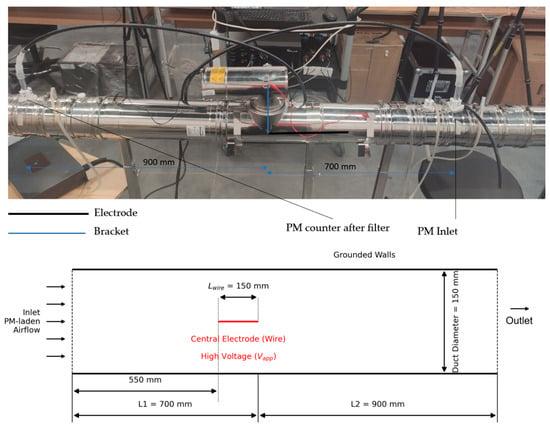
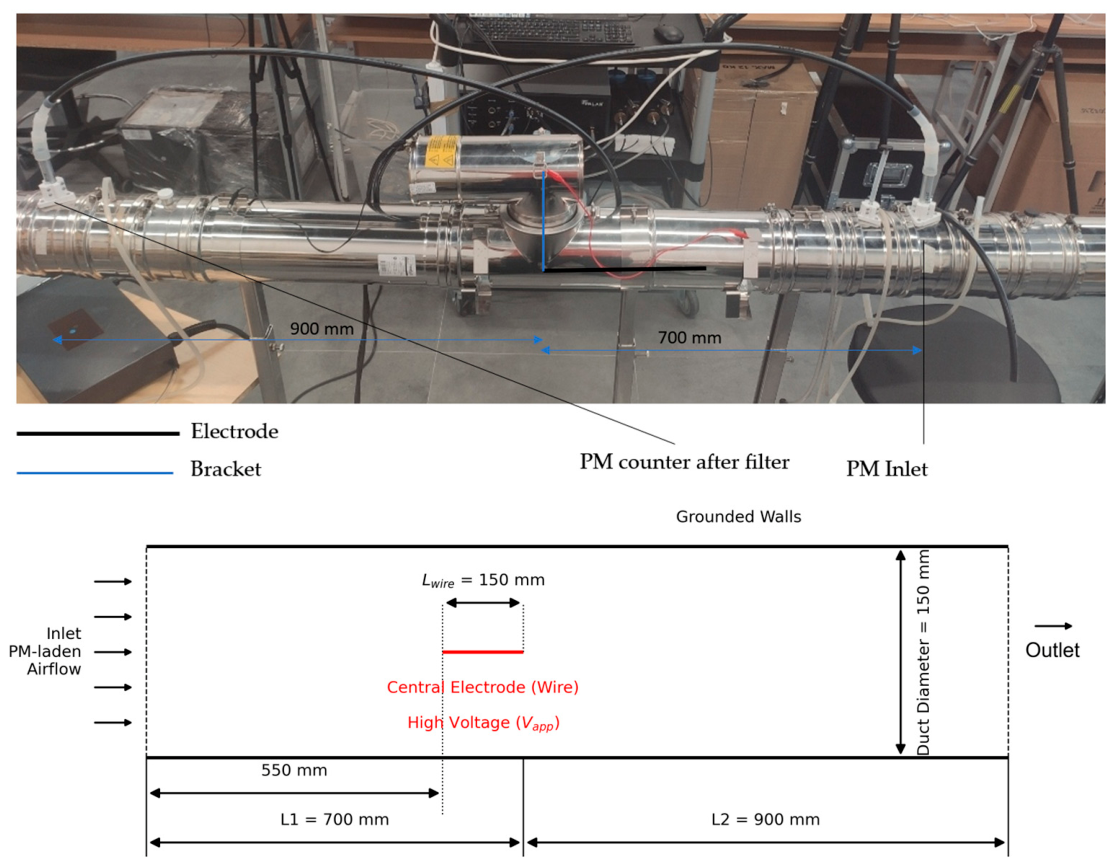
The numerical results were validated using a custom-built experimental test rig (see Figure 2). The system consists of a horizontal stainless steel duct with a total length exceeding 1.6 m. A central discharge electrode is positioned between two high-precision measurement sections:
Figure 2.
Experimental Validation Rig.
- Aerosol Generation: Standardized Arizona Test Dust (A1 Ultrafine) was aerosolized using a Palas GmbH RBG 1000 generator, Karlsruhe, Germany. This specific dust was selected for validation due to its stable size distribution and known electrical properties (Dielectric constant εr ≈ 3.5–5.0$, consistent with atmospheric mineral aerosols).
- PM Measurement: Real-time analysis was conducted using the Palas Welas Digital 3000, with a rated measurement error of <5% for particle counts.
- Geometry: The test duct has a diameter of 150 mm. The main inlet space to the upstream probe is L1 = 700 m. Within this bounded region, the central discharge wire (150 mm in length) begins 550 mm from the inlet and terminates precisely at the 700 mm mark. The downstream measurement zone (L2 = 900 mm) continues immediately after the wire, ensuring a substantial downstream drift space to definitively evaluate particle escape or capture constraints.
The rigid construction of the duct ensures minimal vibration-induced flow perturbations, while the precision of the Palas® instrumentation facilitates high-fidelity calibration of the hybrid model parameters.
All experiments were conducted under laboratory conditions with an ambient temperature of approximately 22 °C and relative humidity of 40–50%.
2.7. Uncertainty Analysis
To ensure methodological rigor, a formal uncertainty assessment (Uc) was performed:
Given the instrument flow fluctuation error (uinst ≈ 3.5%) and the injection variance limit (ustat < 0.5% at 0.05 s), the combined evaluation standard uncertainty is firmly bounded at ±4.2%.
3. Results and Discussion
3.1. Model Validation and Parameter Transparency
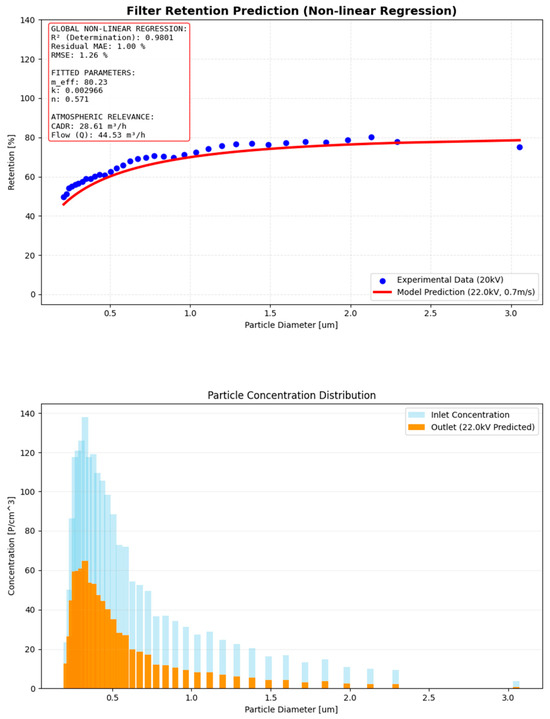
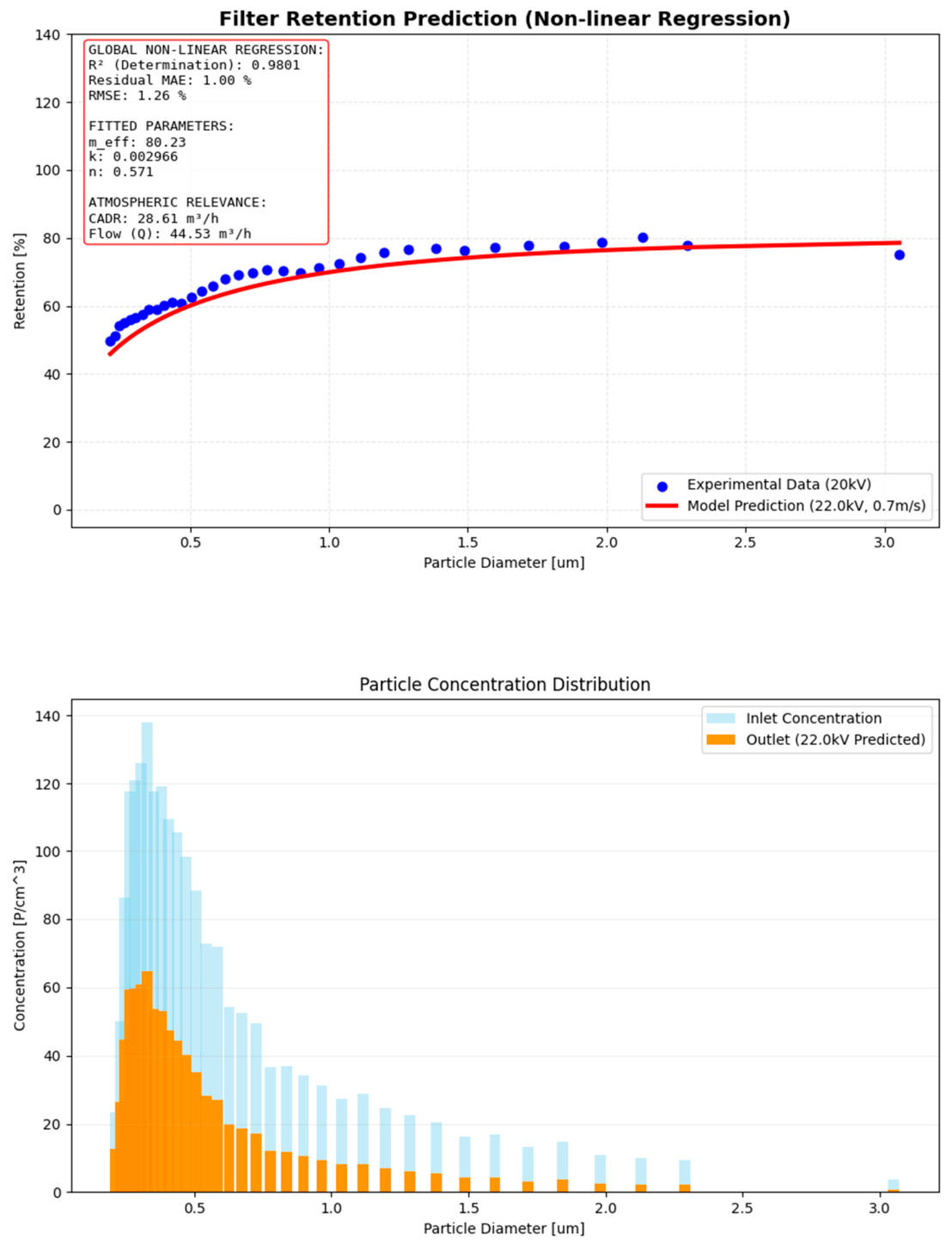
The regression model parameters were determined using a dataset of 35 experimental points (0.1–3.0 μm). As illustrated in Figure 3, top, the hybrid model achieves high fidelity across the entire diameter spectrum, successfully capturing the capture efficiency’s non-linear saturation characteristics.
Figure 3.
Model Validation and PM Concentration Distribution.
The sub-linear scaling (n ≈ 0.57) is physically defensible for the diffusion–field hybrid regime (Table 5). This exponent reflects the transition between diffusion-dominated charging and field-driven migration regimes typical for submicron aerosols. In this regime, particle mobility increases more slowly than the particle geometric diameter, leading to a sub-linear dependence of capture efficiency on particle size.
Table 5.
Regression Model Fitted Parameters.
As capture probability in our system scales primarily with electrostatic mobility rather than the geometric cross-section of the particle, the exponent <1 reflects the non-linear charging dynamics typical for sub-micron atmospheric aerosols. This predictive precision is further visualized in the concentration distribution comparison (Figure 3, bottom), showing significant PM reduction across all measured size bins.
- R2 (Regression): 0.9801
- Baseline Validation MAE: 5.3%
- Regression Residual MAE: 0.99%
The obtained prediction error is comparable to or lower than values reported in previous Computational Fluid Dynamics (CFD)-based ESP modeling studies, which typically report deviations in the range of 5–10%.
3.2. Novelty of the Hybrid Approach
The inclusion of experimental data into the calibration of the A(dp) sensitivity coefficients allows the model to “learn” real-world deviations that purely numerical models often ignore, such as minor turbulent fluctuations and electrode surface irregularities.
3.3. Sensitivity Analysis (3D Response Surface)
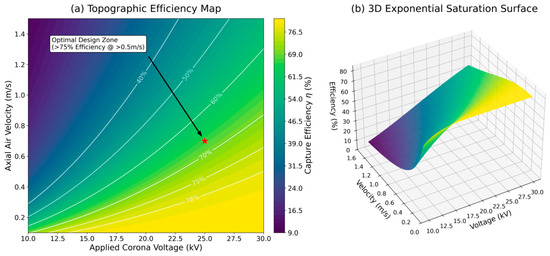
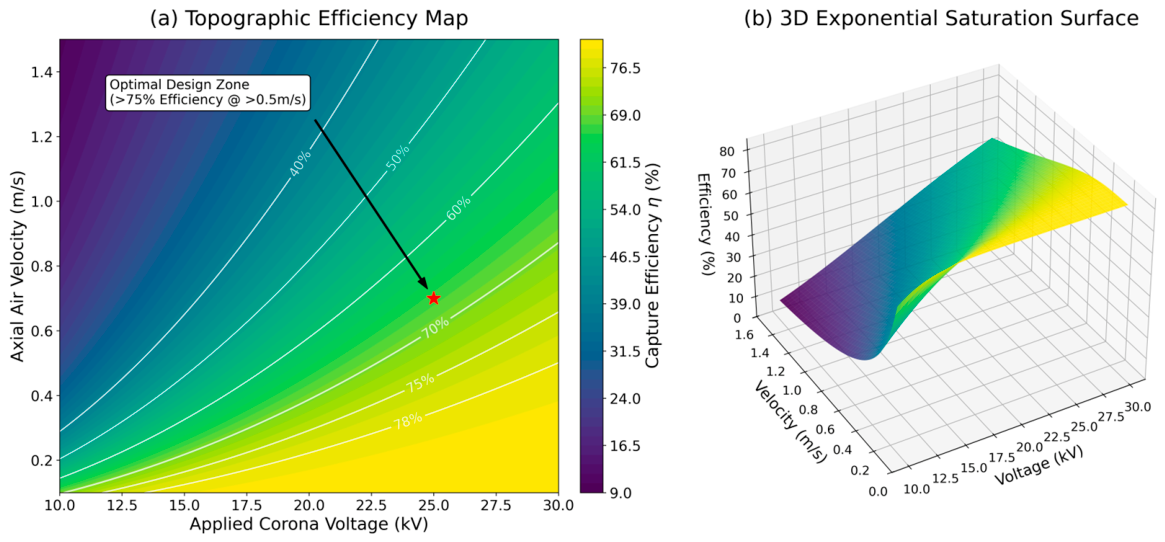
Sensitivity analysis shows that the filtration efficiency is non-linearly dependent on both Voltage (V) and Velocity (U). Similar parameter-optimization approaches based on numerical modeling are widely used to determine optimal structural or operational parameters in engineering systems [43]. Similar parameter sensitivity effects have also been observed in studies of acoustic particle agglomeration, where the excitation frequency significantly influences particle interaction time and agglomeration dynamics [44]. As predicted by the hybrid model, the efficiency follows an exponential saturation curve. At high voltages (>25 kV), the system enters a “near-total capture” regime for particles >1.0 μm, even at higher flow rates (>0.7 m/s).
This interaction is multi-dimensionally visualized in the response surface in Figure 4, where the trade-off between residency time (velocity) and electrostatic force (voltage) is mapped for a 0.5 μm particle. This behavior reflects the exponential dependence of electrostatic migration velocity on electric field strength.
Figure 4.
3D Sensitivity Analysis: Efficiency vs. Voltage and Velocity.
The sensitivity surface also indicates that beyond approximately 25 kV, the negative impact of high flow velocity on capture efficiency outweighs the positive impact of increased voltage. This suggests that residence time remains a dominant parameter in compact electrostatic filtration systems.
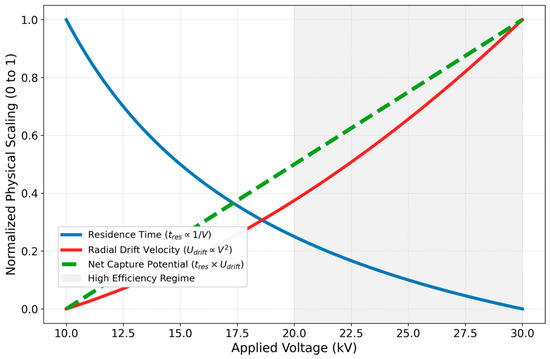
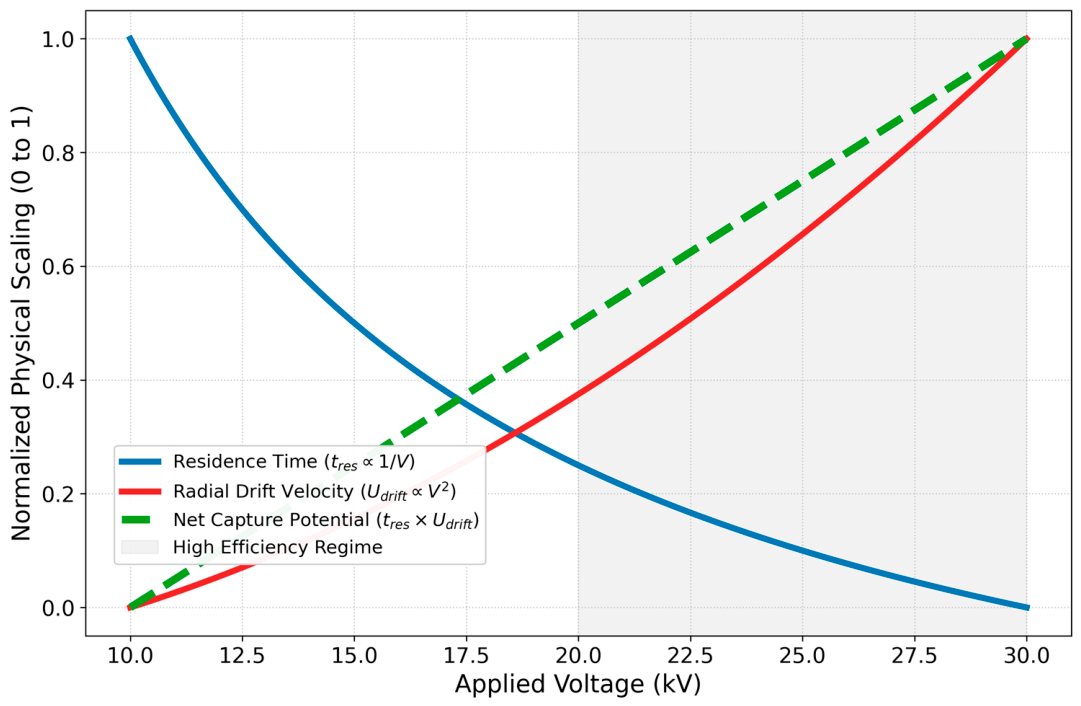
To address potential evaluation bias regarding the reduced filter residence time induced by faster ionic winds at elevated voltages, Figure 5 visualizes the underlying theoretical scaling. While axial residence time () drops linearly due to voltage-induced wind, the radial electrostatic drift velocity (Udrift ∝ V2) scales quadratically due to the combined increase in field intensity and particle saturation charge. The product of these effects results in a net increase in radial displacement, thereby enhancing capture probability despite the reduced flight time.
Figure 5.
Resolution of the Flight Time Paradox.
3.4. Atmospheric Relevance and Benchmarking
The Clean Air Delivery Rate (CADR) for a single tube section at 22 kV and 0.7 m/s was calculated at ≈28.6 m3/h. For perspective, portable urban HEPA devices typically operate in the 100–300 m3/h range. The modular ionic wind system achieves comparable unit-area efficiency with significantly lower pressure drop, making it ideal for distributed micro-environments like bus stops or indoor air-curtains. Due to the modular geometry of the discharge–collector configuration, the system can be readily scaled by increasing the number of parallel filtration tubes, enabling adaptation to both compact indoor purification devices and larger urban air treatment systems.
This characteristic is critical for decentralized air purification (e.g., bus stops, open office spaces) where energy-efficient, low-maintenance filtration is required. Experimental static pressure measurements across the operational test section confirmed a negligible pressure drop (ΔP < 2 Pa) under typical conditions (0.5 m/s), validating the primary aerodynamic advantage of ionic wind propulsion over dense mechanical media.
4. Discussion
The present study demonstrates that the integration of multiphysics Computational Fluid Dynamics (CFD) modeling with an empirically calibrated regression framework provides a robust approach for predicting the performance of ionic wind electrostatic precipitators targeting submicron atmospheric aerosols. Hybrid modeling frameworks combining physics-based simulations with empirical or data-driven models have recently become increasingly common in complex engineering systems. The results highlight several important physical and methodological aspects that are relevant for both the scientific understanding and engineering design of electrohydrodynamic filtration systems.
The sub-linear scaling (n ≈ 0.57) is physically defensible for the diffusion–field hybrid regime. As capture probability in our system scales primarily with electrostatic mobility rather than the geometric cross-section of the particle, the exponent <1 reflects the non-linear charging dynamics typical for sub-micron atmospheric aerosols. This value aligns well with theoretical transient-regime approximations in aerosol physics, where the transition between diffusion-dominated charging and field-driven migration (derived from classic Cochet models) typically yields exponents in the range of 0.5 to 0.7.
Such behavior is consistent with the known transition between diffusion charging and field charging regimes in electrostatic precipitation. Smaller particles experience significant Brownian motion but acquire fewer charges, while larger particles are more efficiently driven toward the collector by the electric field. As a result, capture probability does not scale linearly with particle size but follows a non-linear mobility-dominated relationship.
The simulation results also indicate that the electrohydrodynamic (EHD) body force significantly modifies the local velocity field. The ionic wind accelerates the flow near the corona region while simultaneously creating localized recirculation zones downstream of the discharge electrode. These flow structures increase the effective residence time of particles and enhance the probability of electrostatic migration toward the collector surfaces. Similar interactions between electric field forces and flow modification have been reported in previous studies of Electro hydrodynamics (EHD)-assisted particle removal.
A key methodological contribution of this study is the introduction of the Fate-based Steady-state Evaluation (FSE) framework. Conventional Lagrangian particle tracing simulations often suffer from systematic bias when the simulation time is insufficient for all particles to reach a terminal boundary. In such cases, particles remaining within the computational domain are typically included in efficiency calculations, which leads to an underestimation of capture efficiency.
The FSE method resolves this issue by evaluating only particles whose final fate is known, i.e., particles that have either been captured by the collector surface or exited the computational domain. Similar stochastic modeling approaches have been widely used in reliability engineering to evaluate system readiness and operational states in complex technical systems. By excluding particles that remain in transit at the end of the simulation time, the method ensures that efficiency metrics represent a statistically converged steady-state behavior. This approach significantly improves the reliability of Computational Fluid Dynamics (CFD)-based performance evaluation in long-duct electrostatic filtration systems.
The statistical convergence analysis confirms that particle injection durations exceeding approximately 5 s produce stable efficiency estimates, with variations below 0.5%. This indicates that the FSE framework provides a practical criterion for determining simulation convergence in multiphase electrohydrodynamic systems.
Purely numerical simulations of electrostatic precipitation systems can be computationally expensive due to the need to resolve coupled electric fields, fluid flow, and particle dynamics. The hybrid modeling approach proposed in this study addresses this challenge by combining high-fidelity Computational Fluid Dynamics (CFD) simulations with a physically constrained regression model that captures the dominant dependencies between operating parameters and filtration performance.
The regression model successfully reproduces the Computational Fluid Dynamics (CFD)–experimental dataset with a coefficient of determination R2 = 0.98 and a mean absolute error of less than 1%. This indicates that the model effectively captures the underlying physical relationships governing capture efficiency across the investigated parameter range. Importantly, the regression formulation preserves physical interpretability through parameters such as the saturation efficiency ηmax, which represents the theoretical upper limit of the filtration system under optimal conditions.
Such hybrid approaches are increasingly used in engineering modeling to bridge the gap between detailed physical simulations and rapid performance prediction tools. By reducing the need for repeated full Computational Fluid Dynamics (CFD) simulations, the proposed model can serve as a practical design tool for optimizing ionic wind filtration systems in real-world applications.
From an engineering perspective, the results highlight the importance of balancing electric field strength and flow velocity in order to maximize capture efficiency. The sensitivity analysis indicates that increasing the applied voltage enhances electrostatic migration forces and improves particle capture probability. However, this effect exhibits diminishing returns as the system approaches the saturation efficiency regime.
Conversely, increasing flow velocity reduces particle residence time within the filtration region, which significantly decreases capture efficiency. The response surface analysis suggests that residence time remains one of the dominant parameters controlling filtration performance in compact ionic wind devices.
The calculated Clean Air Delivery Rate (CADR) of approximately 28.6 m3/h for a single tubular module indicates that such systems may be suitable for decentralized air purification applications. When normalized per unit collector area, the predicted performance becomes comparable with compact electrostatic air purification systems reported in the recent literature. Furthermore, the obtained hybrid prediction error (MAE of 5.3%) is comparable to or lower than values reported in previous steady-state numerical ESP modeling studies, which typically report simulation deviations in the range of 5–10% [6,11]. Although the airflow rate is lower than that of conventional HEPA-based portable air purifiers, ionic wind systems offer a significant advantage in terms of pressure drop, which is typically close to zero. This characteristic enables highly energy-efficient operation and simplifies integration into distributed air-cleaning architectures such as indoor air curtains, ventilation ducts, or localized urban air treatment units.
Despite the promising results, several limitations should be acknowledged. First, the present study employs a two-dimensional axisymmetric model, which captures the dominant radial electric field gradients but does not fully resolve potential azimuthal asymmetries in the corona discharge region. Future studies could incorporate three-dimensional simulations to investigate the influence of electrode irregularities and localized discharge instabilities.
Second, the current model assumes constant ion mobility and does not explicitly account for variations caused by humidity, temperature, or complex ion chemistry. Atmospheric conditions can influence corona discharge behavior and ion transport processes, which may affect particle charging dynamics and overall filtration performance.
Third, the present analysis focuses on relatively low particle-loading conditions. In real atmospheric environments with higher aerosol concentrations, particle re-entrainment and agglomeration phenomena may play a more significant role. Investigating these effects will be important for assessing long-term system performance in highly polluted environments.
Finally, future work could explore the integration of additional physical processes such as acoustic agglomeration, condensation growth, or magnetoelectric enhancement to further improve the capture efficiency of particles within the critical submicron size range.
Limitation and Future Work
While the 2D axisymmetric model provides a robust approximation, the current framework possesses certain limitations. The model’s robustness and accuracy may be sensitive to alternative geometric configurations (such as asymmetric duct shapes) and highly turbulent regimes (>1.5 m/s), where large-scale turbulent eddies could disrupt stable ion drift. Furthermore, high particle-loading conditions in heavily polluted environments could introduce space-charge quenching effects, which are not captured under the current dilute-phase assumption. Future investigations should address 3D azimuthal field perturbations, multiphase space-charge coupling, and the effects of high relative humidity on ion mobility. Investigating particle re-entrainment under these adverse conditions remains a priority.
5. Conclusions
This study successfully developed and validated a hybrid numerical–empirical modeling framework for ionic wind-driven electrostatic precipitators tailored for atmospheric PM2.5 removal. The following key conclusions are drawn:
- The introduction of the Fate-based Steady-state Evaluation (FSE) effectively resolves the “Flight Time Paradox” inherent in conventional Lagrangian particle tracing for long-duct geometries. By focusing on converged particle “fates” rather than transient snapshots, we achieved a statistically robust baseline validation with a Mean Absolute Error (MAE) of only 5.3% compared to experimental truth.
- The resulting non-linear regression model, constrained by physical saturation dynamics, demonstrates exceptional predictive fidelity (R2 = 0.98). The model’s ability to “learn” from experimental data while maintaining physical consistency allows for real-time performance estimation across the 0.1–3.0 μm spectrum with a residual error of less than 1%.
- The determined diameter exponent (n ≈ 0.57) and the implementation of an Additive Charging Model provide a continuous and physically defensible description of particle capture in the critical sub-micron transition region. This confirms that for atmospheric aerosols, capture probability is driven by electrostatic mobility gradients rather than simple geometric collision cross-sections.
- With a calculated Clean Air Delivery Rate (CADR) of ≈28.6 m3/h per modular section and near-zero pressure drop, the proposed system offers a highly scalable solution for distributed urban air purification. This framework enables engineers to bypass computationally expensive Computational Fluid Dynamics (CFD) for rapid architectural integration and optimization.
- While the 2D axisymmetric model provides a robust first-order approximation, future investigations should address 3D azimuthal field perturbations and the effects of high relative humidity on ion mobility. Additionally, investigating particle re-entrainment under high mass-loading conditions will be essential for long-term deployment in highly polluted urban environments.
- The presented hybrid framework provides a scalable methodology for rapid design optimization of electrohydrodynamic filtration devices and may serve as a computationally efficient alternative to fully resolved Computational Fluid Dynamics (CFD) simulations in early-stage engineering development.
Author Contributions
Conceptualization: A.Š. and J.M.; Methodology: A.Š. and J.M.; Software: A.Š.; Validation: A.Š.; Data Curation: J.M. All authors have read and agreed to the published version of the manuscript.
Funding
This research received no external funding.
Institutional Review Board Statement
Not applicable.
Informed Consent Statement
Not applicable.
Data Availability Statement
The data presented in this study are available on request from the corresponding author.
Conflicts of Interest
The authors declare no conflicts of interest.
Nomenclature
| Parameter | Description | Unit |
| c | Species (ion/particle) local concentration (number density) | particles/m3 |
| dp | Particle aerodynamic diameter | μm |
| e | Elementary charge | 1.602 × 10⁻¹⁹ C |
| E | Electric field vector | V/m |
| Ec | Peek’s onset electric field threshold | V/m |
| FD | Aerodynamic drag force | N |
| Fe | External electric force acting on a particle | N |
| FEHD | Electrohydrodynamic body force density | N/m3 |
| J | Total particle flux | particles/(m2·s) |
| JD | Diffusive particle flux | particles/(m2·s) |
| JE | Electric-field-driven (migration) flux | particles/(m2·s) |
| k | Empirical field sensitivity constant | - |
| L1 | Upstream inlet spacing distance | mm |
| L2 | Downstream measurement zone drift spacing | mm |
| Lw | Active discharge wire length | mm |
| n | Particle-size mobility exponent | - |
| N | Total number of injected simulation particles | - |
| Ncap | Number of captured simulation particles | - |
| Nesc | Number of escaping simulation particles | - |
| R2 | Coefficient of determination (regression) | - |
| Re | Flow Reynolds number | - |
| U | Axial flow velocity | m/s |
| uinst | Instrument flow fluctuation error | % |
| ustat | Injection (statistical) variance limit | % |
| Udrift | Radial electrostatic drift velocity | m/s |
| Uc | Combined evaluation standard uncertainty | % |
| V | Local electric potential | V |
| Vapp | Applied corona voltage | kV |
| V0 | Corona onset threshold voltage | kV |
| z | Ion valence (dimensionless charge number) | - |
| ΔP | Static pressure difference (pressure drop) | Pa |
| ε0 | Vacuum permittivity | 8.854 × 10⁻¹² F/m |
| εr | Relative dielectric permittivity of the particle medium | - |
| η | PM capture (collection) efficiency | % |
| ηmax | Maximum achievable (saturation) capture efficiency | % |
| μ | Electrical mobility of ions | m2/(V·s) |
| ρc | Volume space charge density | C/m3 |
| CADR | Clean Air Delivery Rate | m3/h |
| CFD | Computational Fluid Dynamics | - |
| CI | Confidence Interval | - |
| DBD | Dielectric Barrier Discharge | - |
| EHD | Electrohydrodynamic/Electrohydrodynamics | - |
| ESP | Electrostatic Precipitator | - |
| FSE | Fate-based Steady-state Evaluation (proposed method) | - |
| HEPA | High-Efficiency Particulate Air | - |
| MAE | Mean Absolute Error | % |
| PM | Particulate Matter (PM2.5, PM1) | μg/m3 |
| RANS | Reynolds-Averaged Navier–Stokes | - |
| WHO | World Health Organization | - |
References
- Winnicki, M.; Łapa, W.; Świadkowski, B. A Novel Approach to Improve Reliability of Aerosol Jet Printing Process. Eksploat. Niezawodn.–Maint. Reliab. 2024, 26, 180012. [Google Scholar] [CrossRef] [Scilit]
- De Oliveira, A.E.; Guerra, V.G. Electrostatic precipitation of nanoparticles and submicron particles: Review of technological strategies. Process Saf. Environ. Prot. 2021, 153, 422–438. [Google Scholar] [CrossRef] [Scilit]
- Zaidi, M.A.; Wang, Y.; Liang, H.; Zhang, Y.; Yu, H.; Sun, Z.; Ding, M.; Tang, L.; Duan, R.; Zhao, W.; et al. Numerical Investigation of Neutral Micron and Submicron Aerosol Particle Collection by Single and Multiple Charged Droplets. Nucl. Eng. Des. 2026, 453, 114890. [Google Scholar] [CrossRef] [Scilit]
- Wang, Y.; An, Y.; Tan, Y.; Li, K.; Xu, J.; Hou, S. Highly Time-Resolved Chemical Characteristics and Aging Process of Submicron Aerosols over the Central Himalayas. Atmos. Chem. Phys. 2026, 26, 1163–1178. [Google Scholar] [CrossRef] [Scilit]
- Liang, L.; Zhao, W.; Chen, X.; Hu, W.; Yu, P.; Huang, S. Atmospheric Submicron Aerosols Over the Tibetan Plateau: A Review. Curr. Pollut. Rep. 2026, 12, 2. [Google Scholar] [CrossRef] [Scilit]
- Milošević, M.; Vuksanović, M.; Veličković, Z.; Joca, J.; Marinković, A.; Knežević, N. Anionic Waste Hemp Fibers-Based Membranes: Cations and Cationic Dyes Removal. In Proceedings of the CNN TECH 2024: International Conference of Experimental and Numerical Investigations and New Technologies: Programme and the Book of Abstracts; Faculty of Mechanical Engineering, University of Belgrade: Belgrade, Serbia, 2024; 93p. [Google Scholar]
- Vasiljević, L.; Milošević, M.; Knežević, N.; Veličković, M.; Marinković, A. Hemp Membranes with Anionic Functionalization for Efficient Removal of Cationic Pollutants. In Proceedings of the EEM2025-9th International Congress Engineering, Environment and Materials in Process Industry: Book of Abstracts; University of East Sarajevo, Faculty of Technology: Zvornik, Bosnia and Herzegovina, 2025; 45p. [Google Scholar]
- Caban, J.; Litak, G.; Ambrożkiewicz, B.; Gardyński, L.; Stączek, P.; Wolszczak, P. Impact-based piezoelectric energy harvesting system excited from diesel engine suspension. Appl. Comput. Sci. 2020, 16, 16–29. [Google Scholar] [CrossRef] [Scilit]
- Liu, C.; Luo, J.; Ju, J.; Wang, L.; Chang, Z. Corona Discharge Characteristics, Ionic Wind and Ozone Concentration in a Multi-Needle-to-Mesh Electrode System for Seed Drying. Plasma Sci. Technol. 2026. [Google Scholar] [CrossRef] [Scilit]
- He, X.; Chen, J.; Fu, X.; Zou, Q.; Feng, Z. Proposing a Corona-Discharge Assisted Pleated Air Filtration and Sterilization (CAFS) System to Efficiently Disinfect Virus in Fibrous Fibrous-Medium and Create Safe Indoor Environment. Chem. Eng. Res. Des. 2026, 227, 794–810. [Google Scholar] [CrossRef] [Scilit]
- Shibui, R.; Ishijima, T.; Tamadate, T.; Ishigami, Y.; Kuromiya, Y.; Sakai, T.; Suda, H.; Seto, T. Generation of Charged Nanodroplets Incorporating Hydroxyl Radicals by Plasma-Assisted Electrospray. Plasma Chem. Plasma Process. 2026, 46, 38. [Google Scholar] [CrossRef] [Scilit]
- Wang, Y.; Gao, W.; Zhang, H.; Yang, Z.; Zhao, Z.; Shao, L.; Sun, Z.; Zheng, C.; Gao, X. Significance of Ionic Wind Propulsion on Charged Particle Removal during Flue Gas Purification. Powder Technol. 2022, 410, 117804. [Google Scholar] [CrossRef] [Scilit]
- Kebria, H.Y.; Zakeri, R.; Darbandi, M. Numerical Simulation of Particle-Laden Flow in an Electrostatic Precipitator to Enhance Particulate Collection Efficiency Using an Aerodynamic Collecting Plate Profile. Powder Technol. 2026, 473, 122128. [Google Scholar] [CrossRef] [Scilit]
- Zuo, W.; Ding, C.; Lu, J.; Che, C.; Song, Z.; Qin, C. Study on the Effects of Media-Regulated Ultrasonic Pretreatment Combined with Electrohydrodynamic Drying on the Drying Kinetics, Active Components, Proteomic Characteristics and Volatile Components of Garlic. Food Chem. X 2026, 34, 103660. [Google Scholar] [CrossRef] [Scilit]
- Gupta, P.; Dhar, P.; Samanta, D. Transient Deformation and Charge Evolution during Alternating Current-Electrohydrodynamic Oscillations of Confined Droplets. Langmuir 2026, 42, 9984–10006. [Google Scholar] [CrossRef] [Scilit]
- Fu, G. Dielectric Barrier Corona Discharge Anomaly by Ionic Wind under Unipolar Voltage Excitation. arXiv 2026, arXiv:2603.03986. [Google Scholar] [CrossRef] [Scilit]
- Baetens, D. Combined Electrostatic Precipitation-Photocatalytic Oxidation Technology for Simultaneous Abatement of Indoor PM and VOCs: Experimental Analysis and Multiphysics Modelling; University of Antwerp: Antwerpen, Belgium, 2026. [Google Scholar]
- Sohbatzadeh, F.; Ranjbar Malekshah, S.; Ahmadi, H.S.; Mirzanejhad, S.; Mehrabifard, R.; Mavaddati, S.; Machala, Z. Electrohydrodynamic Wind Generation in Planar DBDs: Role of Electrode Symmetry and Geometry. Phys. Scr. 2026, 101, 065601. [Google Scholar] [CrossRef] [Scilit]
- June, M.S.; Kribs, J.; Lyons, K.M. Measuring Efficiency of Positive and Negative Ionic Wind Devices for Comparison to Fans and Blowers. J. Electrost. 2011, 69, 345–350. [Google Scholar] [CrossRef] [Scilit]
- Quinton, E.; Achard, J.-L.; Roux, J.-M. Ionic Wind Generator Derived from a Liquid Filled Capillary Pin. Application to Particle Capture. J. Electrost. 2013, 71, 963–969. [Google Scholar] [CrossRef] [Scilit]
- Zhu, Y.; Tao, S.; Chen, C.; Liu, J.; Chen, M.; Shangguan, W. The Experimental and Simulation Investigation of the Dynamic Characteristic of Submicron-Scale Aerosol in High-Voltage Electric Field by a Visualization Method. J. Hazard. Mater. 2021, 416, 126227. [Google Scholar] [CrossRef] [Scilit] [PubMed]
- Gwon, J.G.; Choi, H.Y.; Seo, Y.M.; Choi, H.K.; Park, Y.G. Collection Performance of Electrostatic Precipitators with Diagonal Wire-Line Angles: A Numerical Study and Prediction Using Artificial Neural Networks. Powder Technol. 2026, 475, 122321. [Google Scholar] [CrossRef] [Scilit]
- Caban, J.; Vrabel, J.; Górnicka, D.; Nowak, R.; Jankiewicz, M.; Matijošius, J.; Palka, M. Overview of Energy Harvesting Technologies Used in Road Vehicles. Energies 2023, 16, 3787. [Google Scholar] [CrossRef] [Scilit]
- Caban, J.; Małek, A.; Šarkan, B. Strategic Model for Charging a Fleet of Electric Vehicles with Energy from Renewable Energy Sources. Energies 2024, 17, 1264. [Google Scholar] [CrossRef] [Scilit]
- Alic, D.; Matijošius, J.; Kilikevičius, A. Numerical modelling of the crosswind influence on vehicle aerodynamics in highway traffic conditions. Facta Univ. Ser. Mech. Eng. 2025, 23, 065–077. [Google Scholar] [CrossRef] [Scilit]
- Zhu, Y.; Tao, S.; Liu, J.; Chen, M.; Shangguan, W. Experimental Research of Capture Enhancement Mechanism of Submicron Particles by Designing Two-Stage Electrostatic Precipitators with Various Ratios of Charger and Collector Units. Chem. Eng. Res. Des. 2023, 189, 52–63. [Google Scholar] [CrossRef] [Scilit]
- Zhu, Y.; Huang, Z.; Tao, S.; Chen, J.; Yang, X.; Yin, W.; Shangguan, W.; Bai, Z. Re-Entrainment Mechanism of Submicron Particles during Electrostatic Capture Process. Chem. Eng. Sci. 2025, 308, 121417. [Google Scholar] [CrossRef] [Scilit]
- Zhu, Y.; Zhang, Y.; Yang, X.; Tao, S.; Chen, M.; Shangguan, W. Operando Investigation of Particle Re-Entrainment Mechanism in Electrostatic Capture Process on the Lab-on-a-Chip. J. Environ. Sci. 2024, 136, 337–347. [Google Scholar] [CrossRef] [Scilit]
- Capała, P.; Ruszak, M.; Czyż, Z.; Rudawska, A. Comparative Analysis of Different Catalytic Baskets for Dual-Bed Catalytic Reactors. Eksploat. Niezawodn.–Maint. Reliab. 2025, 27, 200290. [Google Scholar] [CrossRef] [Scilit]
- Chen, M.; Luo, X.; Chen, W.; Feng, J.; Wang, X. Mixed-flow pump optimisation and flow characteristics based on the ‘dual carbon’ goals. Facta Univ. Ser. Mech. Eng. 2025, 23, 861. [Google Scholar] [CrossRef] [Scilit]
- Heinold, B.; Weiss, P.; De, S.; Kubin, A.; Müller, J.; Senf, F.; Stier, P.; Tegen, I. ICON Coupled to HAM-Lite 1.0 in Limited-Area Mode: An Efficient Framework for Targeted Kilometer-Scale Simulations with Interactive Aerosols. EGUsphere 2026, 2026, 1–31. [Google Scholar]
- Orynycz, O.; Zimakowska-Laskowska, M.; Kulesza, E. CO2 Emission and Energy Consumption Estimates in the COPERT Model—Conclusions from Chassis Dynamometer Tests and SANN Artificial Neural Network Models and Their Meaning for Transport Management. Energies 2025, 18, 3457. [Google Scholar] [CrossRef] [Scilit]
- Nikolić, F.; Čanađija, M. Machine learning of structure–property relationships: An application to heat generation during plastic deformation. Facta Univ. Ser. Mech. Eng. 2025, 23, 687. [Google Scholar] [CrossRef] [Scilit]
- Komatina, N.; Marinković, D. Optimization of PFMEA Team Composition in the Automotive Industry Using the IPF-RADAR Approach. Algorithms 2025, 18, 342. [Google Scholar] [CrossRef] [Scilit]
- Caban, J.; Nieoczym, A.; Sokolovskij, E.; Drozd, K. Improving the Efficiency of Using an Electric Scooter in Urban Electromobility. Transport 2025, 40, 343–353. [Google Scholar] [CrossRef] [Scilit]
- Zaranka, J.; Matijosius, J.; Radvilaite, U.; Caban, J.; Dudziak, A. Establishing Emergency Sections on Land Roads in Order to Improve the Quality of Transport Services, Creating Comfortable Conditions for International and Local Traffic. Adv. Sci. Technol. Res. J. 2023, 17, 75–85. [Google Scholar] [CrossRef] [Scilit]
- Kozłowski, E.; Zimakowska-Laskowska, M.; Dudziak, A.; Wiśniowski, P.; Laskowski, P.; Stankiewicz, M.; Šnauko, B.; Lech, N.; Gis, M.; Matijošius, J. Analysis of Instantaneous Energy Consumption and Recuperation Based on Measurements from SORT Runs. Appl. Sci. 2025, 15, 1681. [Google Scholar] [CrossRef] [Scilit]
- Kilikevičienė, K.; Kačianauskas, R.; Kilikevičius, A.; Maknickas, A.; Matijošius, J.; Rimkus, A.; Vainorius, D. Experimental Investigation of Acoustic Agglomeration of Diesel Engine Exhaust Particles Using New Created Acoustic Chamber. Powder Technol. 2020, 360, 421–429. [Google Scholar] [CrossRef] [Scilit]
- Čeponis, A.; Vainorius, D.; Kilikevičienė, K.; Kilikevičius, A. Investigation of a Multi-Frequency Ultrasonic Acoustic Pressure Source for Acoustic Agglomeration. Ultrasonics 2025, 148, 107554. [Google Scholar] [CrossRef] [Scilit]
- Chlebnikovas, A.; Selech, J.; Kilikevičius, A.; Przystupa, K.; Matijošius, J.; Vaišis, V. Modeling of Two-Phase Flow Parameters of a Multi-Channel Cylindrical Cyclone. Energies 2022, 15, 4690. [Google Scholar] [CrossRef] [Scilit]
- Kozłowski, E.; Borucka, A.; Oleszczuk, P.; Leszczyński, N. Evaluation of Readiness of the Technical System Using the Semi-Markov Model with Selected Sojourn Time Distributions. Eksploat. Niezawodn.–Maint. Reliab. 2024, 26, 191545. [Google Scholar] [CrossRef] [Scilit]
- Kozłowski, E.; Borucka, A.; Świderski, A. Application of the Logistic Regression for Determining Transition Probability Matrix of Operating States in the Transport Systems. Eksploat. Niezawodn.–Maint. Reliab. 2020, 22, 192–200. [Google Scholar] [CrossRef] [Scilit]
- Tasić, J.; Ćojbašić, Ž.; Marinković, D. Optimization of a Composite Plate Subjected to Low-Velocity Impact. Appl. Sci. 2025, 15, 11659. [Google Scholar] [CrossRef] [Scilit]
- Rayapureddy, S.M.; Maknickas, A.; Matijošius, J.; Vainorius, D.; Kilikevičius, A. Computational study of frequency impact onto the particle parameters and change in acoustic agglomeration time with the number of particles. Facta Univ. Ser. Mech. Eng. 2024, 22, 741–757. [Google Scholar] [CrossRef] [Scilit]

Disclaimer/Publisher’s Note: The statements, opinions and data contained in all publications are solely those of the individual author(s) and contributor(s) and not of MDPI and/or the editor(s). MDPI and/or the editor(s) disclaim responsibility for any injury to people or property resulting from any ideas, methods, instructions or products referred to in the content. |
© 2026 by the authors. Licensee MDPI, Basel, Switzerland. This article is an open access article distributed under the terms and conditions of the Creative Commons Attribution (CC BY) license.