


Abstract
Methane is naturally removed from the atmosphere through oxidation by hydroxyl (•OH) and chlorine (•Cl) radicals, which represent respectively about ~90% and 1% of the total natural sink mechanism. Recently, there has been a growing number of proposals for atmospheric methane removal (AMR) by enhancement of these two natural sinks. Here, we hypothesise that •OH enhancement, and probably also •Cl enhancement, besides removing methane, might also remove several anthropogenic and biogenic short-lived halocarbons (SLHs), which also deplete the ozone layer. These SLHs are not included among long-lived anthropogenic ozone-depleting substances (ODSs) listed by the Montreal Protocol. We compare the reaction kinetics of OH and Cl radicals with some halocarbons versus methane, highlighting that the principal SLHs exhibit faster bimolecular reaction kinetics with •OH and •Cl radicals and can, therefore, potentially be removed from the troposphere alongside methane; consequently, AMR could slow their flux into the stratosphere. Nonetheless, the relatively low concentrations of those SLHs mean that their presence will not weaken the effectiveness of methane removal, even if the AMR technology is located in sites such as forests, where their levels are somewhat above the global averages. If these hypotheses and perspectives can be proven, they will strengthen the justification for additional research on the implementation of AMR based on atmospheric oxidation enhancement, as the simultaneous removal of some halocarbons depleting stratospheric ozone could provide additional health and environmental benefits. The hypothesis and perspectives developed in this review article require thorough testing in chamber experiments and in full-chemistry models to improve our understanding of the complex impacts on SLHs of potential and still-hypothetical AMR via atmospheric oxidation enhancement. Net changes in SLH burdens, product distributions, stratospheric transport, total reactive-halogen loading, or stratospheric ozone need to be established in future work.
1. Introduction
In recent decades, the world has confronted two major crises related to the global contamination of the atmosphere: global warming and ozone layer depletion. Global warming has, for the first time, in 2024, surpassed 1.5 °C since preindustrial times [1]. The ozone layer protects the Earth from dangerous UV-B radiation, which damages DNA, thus harming plants, animals, and humans [2]. In 1987, the Montreal Protocol controlled the production or restricted the use of numerous human-made ozone-depleting substances (ODSs) [3], but it does not include natural biogenic SLHs which also deplete the ozone layer [4,5]. Without the Montreal Protocol, UV index values today would have increased by approximately 20% since that time and would be projected to quadruple by 2100 [6]. Nonetheless, despite the success of the Montreal Protocol, the ozone layer is not expected to recover to 1980s levels until about 2070 [7,8], or approximately 2040 for the near-global mean (60° S–60° N), 2045 for the Arctic, and 2066 for the Antarctic according to the 2022 WMO assessment [9].
While CO2 has made the largest contribution of 0.9 °C to global warming, methane (CH4) has also made an important contribution of 0.5 °C [10]. The global warming potential (GWP20, i.e., 20-year basis) of CH4 is about 80 times greater than that of CO2, and its lifetime is only ~10 years compared with a few hundred years for CO2 [11]. This means that curbing or reversing CH4 emissions can slow the rate of warming relatively quickly [12]. Without action, global anthropogenic CH4 emissions are projected to rise by up to 13% between 2020 and 2030 [13]. The atmospheric concentration of CH4 already grew by 62.6 ppb between 2020 and 2024 and has now exceeded 1930 ppb [14]. Since 2015, the year when the Paris Agreement was signed, warming due to new CH4 emissions has exceeded that due to new CO2 emissions [15].
Prompted by this rising threat, 159 countries have committed to the Global Methane Pledge [16], which targets a reduction of at least 30% in global anthropogenic CH4 emissions by 2030 compared with emissions in 2020. The pledge is expected to avoid an additional 0.2 °C of warming by 2050 [12,16,17], insufficient to slow down the global warming that has now reached a rate of about 0.26 °C per decade [18].
To achieve further reductions in warming, methods have been proposed to remove CH4 already emitted, i.e., atmospheric methane removal (AMR). AMR relies on oxidising CH4 to less harmful by-products as regards climate, ultimately CO2 and water. The research field of AMR was reviewed in 2024 by a report of the US National Academies [19], which identified five general categories of AMR, namely, (1) atmospheric oxidation enhancement, i.e., enhancing directly in the open troposphere the hydroxyl radical (•OH), which is the principal natural sink of CH4 [20], or the chlorine radical (•Cl), which is another natural sink of CH4 [21] (this enhancement can be performed by iron-induced sunlight catalytic chlorine radical generation [22], by hydrogen peroxide generation or by ozone generation [23,24]); (2) surface treatments, i.e., heterogenous photocatalysis using surfaces such as buildings [25,26,27,28] or large-scale air-moving devices such as solar updraft towers [29,30,31]; (3) methane concentrators, i.e., thermal catalysis [32] after initial preconcentration on mineral or organic fibre-based or pore-based filters, or on metal organic frameworks [33,34]; (4) methane reactors, for instance, based on electrocatalysis [35], on plasma generation [36] or chlorine generation on-site [37]; and finally, (5) ecosystem uptake enhancement by methanotrophs in soils or plants [38,39]. Among these, this article develops the idea that methods based on enhancement of the OH radical, and maybe the Cl radical, natural sinks might also be promising to accelerate ozone layer recovery alongside greenhouse gas removal because many biogenic and some anthropogenic SLHs also react with these two radicals.
For example, biogenic halomethanes such as CH3Cl (methyl chloride or chloromethane) and CH3Br (methyl bromide or bromomethane) are weak GHGs with low concentrations and short lifetimes (Table 1), but they are important SLHs, as they contribute respectively to about ~16 % [40] and ~14% [41] of the stratospheric chlorine and bromine loading and are part of the natural year-to-year variation in the ozone layer. Chlorofluorocarbons (CFCs) are ODSs and have been phased out by industry. Although CH3Cl is present in the atmosphere through natural emissions and CH3Br is present in the atmosphere through both natural and anthropogenic emissions, and although their natural abundance has not changed much with time, they will largely control future levels of stratospheric chlorine and bromine responsible for ozone layer depletion [40]. AMR by •OH and potentially also by •Cl enhancement in the lower troposphere could synergistically mineralise and thus remove such biogenic halogenated volatile organic compounds (HVOCs). AMR could also remove other HVOCs that are SLHs, such as CHCl3 (trichloromethane or chloroform) and CH2Cl2 (methylene chloride or dichloromethane), which arise partially from anthropogenic sources. Particular concern surrounds the sustained growth of CH2Cl2 emissions, which could undo some of the progress achieved under the Montreal Protocol and thereby delay the recovery of the Earth’s ozone layer [42,43]. Consequently, AMR in the lower troposphere by •OH and possibly by •Cl might reduce the stratospheric halogen burden, and large-scale AMR could potentially accelerate the recovery of the ozone layer.
Table 1.
Second-order reaction coefficients of the principal halogenated gases with •OH and •Cl at 298K, GWP100, lifetime and relative oxidation efficiency of Cl over OH radicals (data from IPCC AR6 [10]).
To our knowledge, so far, only one study has considered SLH atmospheric removal [44], and none has considered potential synergies between AMR and stratospheric ozone depletion recovery [45]. In this review, the sources of important SLHs and the reaction kinetics at 298K of atmospheric halocarbons with •OH and •Cl of both biogenic and anthropogenic origin will be discussed in comparison with those of CH4. Then, we will provide examples of possible implementation of the removal processes, followed by a discussion on the limitations of this study and further research needs.
2. Principal Sources of Biogenic and Anthropogenic SLHs
Thousands of halogenated natural compounds are produced by trees, plants, insects, sponges, fungi, plankton, algae, bacteria and other microorganisms [46]. In 2014, more than 5000 halogen-containing compounds, including organo-chlorines, bromines, iodines [47], and even a few organo-fluorides [48], were known to be produced naturally in the environment from a wide variety of marine and terrestrial plant and animal sources, and new ones are discovered regularly. Their origin is mainly biotic [49], but natural abiotic processes also exist, such as in salt-lake sediments [50,51].
The emissions of volatile mono- or tri-halomethyl compounds occurs from various unpolluted terrestrial environments: temperate [52,53] and tropical forests [54], rainforests [40,55], boreal forests [56,57,58,59], grasslands [60,61], peatlands [62,63], wetlands [64,65,66], Arctic tundra [67], Antarctic tundra [68], rice paddies [69,70,71], salt marshes [72,73], saline and hypersaline environments [74], costal oceans [75,76], sea plankton [77,78,79], retreating Arctic glacier forefields [80], and many other ecosystems [81,82].
The sources or uses of anthropogenic halocarbons are also numerous. Concerning ODSs such as CFCs, among their uses, we can cite, for instance, refrigerants, foaming agents, fire retardants and solvents. CFC-11 banks largely reside in foams and with halons contained in fire extinguishers, whereas CFC-12 and HCFC-22 are largely in non-hermetic refrigeration [83]. A substantial drop in CFC-11 emissions after 2019, following the increase in 2011 due to illicit production in China [84], caused its atmospheric concentration to decline [85,86]. Despite the high overall success of the Montreal Protocol in controlling and phasing out CFCs worldwide, there remain significant legacy banks of these substances that are contributing significantly to ongoing stratospheric ozone depletion [87].
The global annual fluxes of the principal SLHs, which are mainly halogenated methanes, are shown in Appendix A. Appendix B shows the ozone-depleting potentials (ODPs) of some natural SLHs, when known [9].
The estimates of the global annual fluxes of CH3Cl are 4.4 Tg y−1 [88] and 3.7 Tg y−1 [89]. Global CH2Cl2 emissions were estimated to be 0.64 Tg yr−1 in 2006 and 1.17 Tg yr−1 in 2017 [90], now 0.88 Tg yr−1 [91]. As such, the fluxes are much smaller than those of methane estimated at 669 Tg yr−1 [92].
The recent estimates for CH2ICl and CH2IBr are respectively 0.234 and 0.087 Tg yr−1 [93], and for the global oceanic emissions of the most abundant bromo-carbons—CHBr3 and CH2Br2—they are 0.533 and 0.067 Tg yr−1, respectively [94]. Additional estimates are provided in Appendix A [88,89,90,91,93,94,95,96,97]. CHBr3 (bromoform) is largely produced by marine organisms such as macroalgae and phytoplankton, with elevated production in coastal and shelf waters. As disinfection of seawater in many industries produces large amounts of CHBr3, it can also result from anthropogenic sources such as ballast water, power plants and desalination facilities [98]. The case of CHBr3 is particular, as its main atmospheric sink is through photolysis and not by reaction with OH or Cl radicals. Therefore, the ODP of CHBr3 is seasonally dependent, and, for instance, the ODPs of CHBr3 emitted in the Indian sub-continent were estimated to be respectively 0.10, 0.34, 0.72, and 0.23 in winter, spring, summer and fall [99]. The efficiency of transport from the troposphere to the stratosphere changes with location and also needs to be taken into account in future work [100]. For instance, the Asian Summer Monsoon plays a primary role in the troposphere-to-stratosphere transport of very short-lived substances [101].
The relatively rapid phase-out of some shorter-lived chemicals such as CH3CCl3 (methyl chloroform) has reduced the total reactive halogen concentration [102,103], although emissions of CHCl3 have been detected in China [84], and the atmospheric abundances of some long-lived CFCs and HCFCs present at low concentrations continue to increase (for many unknown reasons) [104,105,106].
The ODP of the principal biogenic halogenated gases (Appendix B) show that, despite the natural emissions of CH3Br being much lower than that of CH3Cl, their Cl and Br stratospheric burden is comparable, as Br atoms are about 45 times more effective than Cl atoms at destroying stratospheric O3 [107].
Methyl bromide (CH3Br) has been a controlled substance under Annex E since 1992; its anthropogenic production ban took place in 1998, although quarantine and pre-shipment uses and some other uses were treated differently or exempted. Since its phase-out in 2014, its global concentration varies little, since its principal source is now natural, with small variations observed during El Niño years and attributed to enhanced biomass burning [108].
Over the last three decades, the NOAA’s Ozone-Depleting Gas Index [109] declined rapidly, mainly thanks to the rapid phase-out and atmospheric oxidation of short-lived chemicals such as CH3CCl3 and (anthropogenic) CH3Br [103]. Many of the major ODSs (CFCs and CCl4) are not destroyed by OH or Cl radicals. AMR will not alter the impact of these gases on ozone-layer recovery. The timescale of ozone-layer recovery is still strongly influenced by these species because of their large historical abundance. A future decline in this index relies on sustained decreases in emissions and concentrations of CFCs, unless emissions of biogenic SLHs such as CH3Cl, CHCl3, and CHBr3 could be reduced or removed, for example, by implementing large-scale AMR in the form of enhanced atmospheric oxidation technologies, which is, therefore, a very important option to tackle such emissions.
3. Reaction Kinetics and Possible Effects of Enhancing the Natural •OH and •Cl Sinks
While this article synthesises the reaction kinetics of SLHs with OH and Cl radicals, it is important to emphasise that bimolecular rate coefficients cannot directly quantify atmospheric removal efficiency or ozone recovery potential, which remain among the research needs. Model studies have shown that due to complex, nonlinear interactions in atmospheric chemistry, under some conditions, increases in •Cl could reduce the amount of OH radicals and, therefore, increase the lifetime of CH4 [110,111]. Exploring these aspects requires running full chemistry models, which are beyond the scope of this review.
3.1. •OH Sink Enhancement
The loss of SLHs, such as methyl chloride, from reaction with •OH is given by the following equation, based on second-order kinetics:
Accordingly, the additional removal (in this example, of methyl chloride) caused by an increase in the concentration of the oxidising agent is
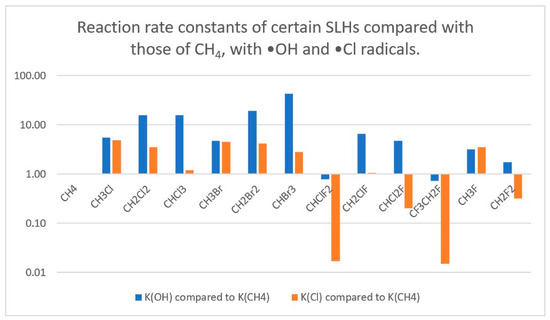
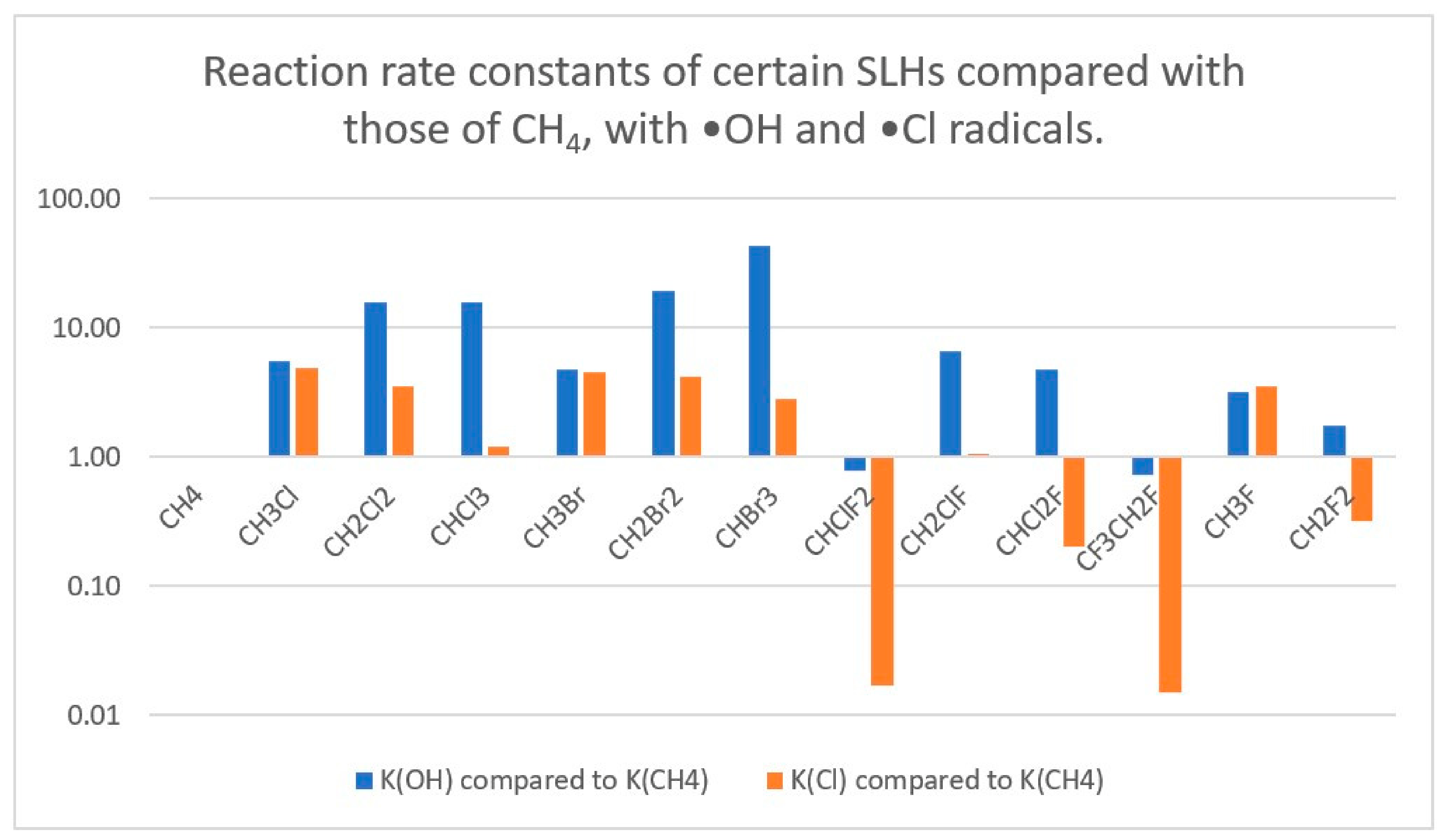
According to the second-order reaction coefficients k at 298K presented in Table 1 and Figure 1, •OH reacts with SLHs at least as fast as it does with CH4. For example, the coefficient for •OH is 5.5 times greater with CH3Cl than with CH4; consequently, a significant increase in the •OH sink may accelerate the removal of CH3Cl alongside that of CH4 at 298K.
Figure 1.
Reaction coefficients with •OH and •Cl of some SLHs compared with CH4 at 298K (for CHBr3, the value of kOH/kCH4 is 43, but its main sink is photolysis). Note: Figure 1 cannot be interpreted as a general comparison applicable throughout the troposphere, as the reaction rate ratios are not temperature-invariant.
Note that the reaction rate ratios provided in Table 1 and Figure 1 are given at 298K, but they are temperature-sensitive; for example, (k(OH + CH3Cl))/k(OH + CH4)) increases from approximately 5.5 at 298K to 8.0 at 250K and 10.9 at 220K, while (k(Cl + CHBr3)/k(OH + CHBr3) changes from approximately 1.04 at 298K to 0.76 at 250 K and 0.58 at 220 K [112]. Complete modelling will need to account for this variation alongside the spatial and temporal variations in the concentrations of the reacting substances.
We also included CH2Cl2 (dichloromethane) in Table 1 and Figure 1, as it is among the several short-lived halogenated chemicals that are not regulated by the Montreal Protocol, despite their global concentrations having increased substantially in recent years. At the present time, their contribution to stratospheric chlorine is about one-third as large as that of total chlorine from stratospheric hydrochlorofluorocarbons (HCFCs) (which is about 4%) [41].
Based on data from 1981–1996, the global average concentration of CH3Cl was estimated at 0.606 ppb [89], about 3000 times less than the 1751 ppb reported for CH4 in 1996. Similarly, the estimated atmospheric concentrations of CHCl3 and CH3Br are only 0.018 ppb and 0.0101 ppb respectively [113,114], about five orders of magnitude lower than that of CH4. Therefore, despite the relatively high value of k for CH3Cl and several other SLHs compared with CH4, this is compensated by the much lower typical concentrations of SLHs compared with CH4 [89,97,113,114,115,116]. Consequently, SLHs are unlikely to deplete the capacity of the OH radical sink for CH4.
Some startup companies have planned to perform AMR by enhancing its principal radical sink, •OH [36,117], in locations poor in VOCs and HVOCs, but if they start also targeting point sources of HVOCs, they will, therefore, only need to produce slightly more •OH to maintain their targeted AMR goals. At the same time, significant additional benefits might be obtained from removal of SLHs. These could include reductions in skin cancers and cataracts and reduced risks of infections due to immunosuppression, together with benefits for all other living organisms, ecosystems, and natural and synthetic materials [118].
At 298K, •OH reacts about 3.2 times faster with CH3F and 1.7 times faster with CH2F2 than with CH4, which means that a significant increase in the •OH sink might remove additional CH3F and CH2F2.
The natural process for generating OH radicals is through the interaction of UV photons with water and ozone. Therefore, it has been proposed to enhance this process using UV lamps that could be deployed on towers, drones or balloons in the troposphere and powered by photovoltaic generators [20].
3.2. Cl Radical Enhancement
According to the second-order reaction coefficients k presented in Table 1 and Figure 1, •Cl reacts with SLHs faster than it does with CH4. For example, at 298K, the coefficient for •Cl is 4.9 times greater with CH3Cl than with CH4.
Figure 1 highlights that for methane and most SLHs, •Cl is often a more effective oxidant than •OH, suggesting that Cl radicals could be a more practical option to deploy and maintain at the required scale, but safety risks and environmental impacts should also be carefully examined.
Hydrofluorocarbons (HFCs) are often anthropogenic compounds, but they are not ODSs (although they also indirectly participate in ozone destruction [119]). Nonetheless, we included in Table 1 a few HFC examples, as they are GHGs with high GWP, which may also be affected by large-scale AMR deployment; therefore, their accelerated oxidation might also offer climate benefits [106] but needs to be confirmed by further research and modelling.
At 298K, •Cl reacts 3.5 times faster with CH3F than with CH4, but the reaction is approximately 3.1 times slower with CH2F2, which means that even a significant increase in the •Cl sink will not remove CH2F2, but will indeed reduce the lifetime of CH3F.
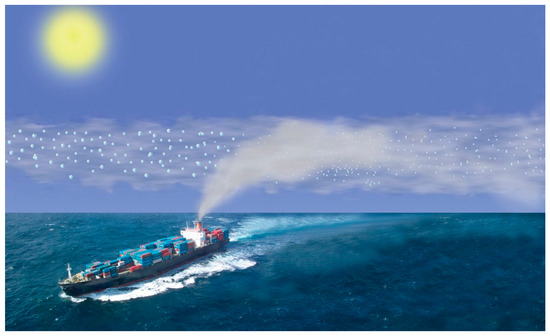
In the case of •Cl, it has been proposed to enhance its atmospheric levels with the help of sprays of iron trichloride as a catalyst deployed from ship funnels or from aircraft [22], or by using other chlorine sources [21].
Although chlorine-radical enhancement in the troposphere is a serious hypothesis for AMR [22,110,120], it could seem contradictory to reducing chlorinated biogenic and anthropogenic halocarbons in order to reduce the amount of chlorine reaching the stratosphere. The amounts of chlorine required to remove atmospheric methane have been estimated according to several climate targets: additional chlorine fluxes of 630, 1250, and 1880 Tg Cl/year are needed in order to decrease the surface temperature by 0.2, 0.4, and 0.6 °C respectively by 2050 [110], but such high levels of chlorine will increase the stratospheric chlorine burden, resulting in enhanced depletion of stratospheric O3 by respectively 1.0, 2.4 and 4.1% [110]. Also, depending on different ambient NOx and O3 tropospheric levels, chlorine production rates below 1 × 10⁶ Cl2/(cm3 s) might have the negative effect of increasing methane lifetime [111]. Therefore, this AMR strategy using Cl radicals might be evaluated separately from the one using OH radicals, with more complete chemistry global models and a preliminary study [44] discussed in Section 5, which found different effects on SLHs of the •OH and •Cl strategies.
For the marine atmosphere, a Cl/HCl ratio of the order of 2.0 × 10⁻⁶ has been measured, implying •Cl radical levels in the range of 1 to 3.0 × 10⁵ atom cm−3 (0.004 to 0.012 ppt), while measured levels of daytime •OH were from ~1 to ~4 × 10⁶ radical cm−3 (0.04 to 0.16 ppt) [121].
The mineralisation of chlorinated VOCs initiated by OH radicals results in carbon dioxide, water and hydrochloric acid (HCl). It, therefore, locally enhances the HCl concentration, and reactions that form HCl in the gas phase can produce •Cl through the reaction HCl + •OH → •Cl + H2O; consequently, the participation of both •OH and •Cl in the oxidation of SLHs under the marine boundary layer is possible through this process. But, as stated earlier, targeted modelling studies are necessary, as there are complex, nonlinear interactions in atmospheric chemistry [110,111].
4. Possible Implementation of AMR Technologies
According to Svensson [122], the most important contributors to the stratospheric Cl and Br burden are, respectively, forests and oceans; therefore, they can be targeted there. The strongest single CH3Cl source is the tropical rainforest, contributing more than half of the global annual CH3Cl emissions with about 4–5 Tg yr−1 [40]. Tropical wetlands are among the largest sources of CH4, with emissions estimated at 94 Tg yr−1 [123], while global CH4 emissions from all wetlands are estimated to be 161–175 Tg yr−1 [92]. It, therefore, seems logical to perform AMR over these sources, especially since CH4 emissions from wetlands are projected to increase under warming [124,125].
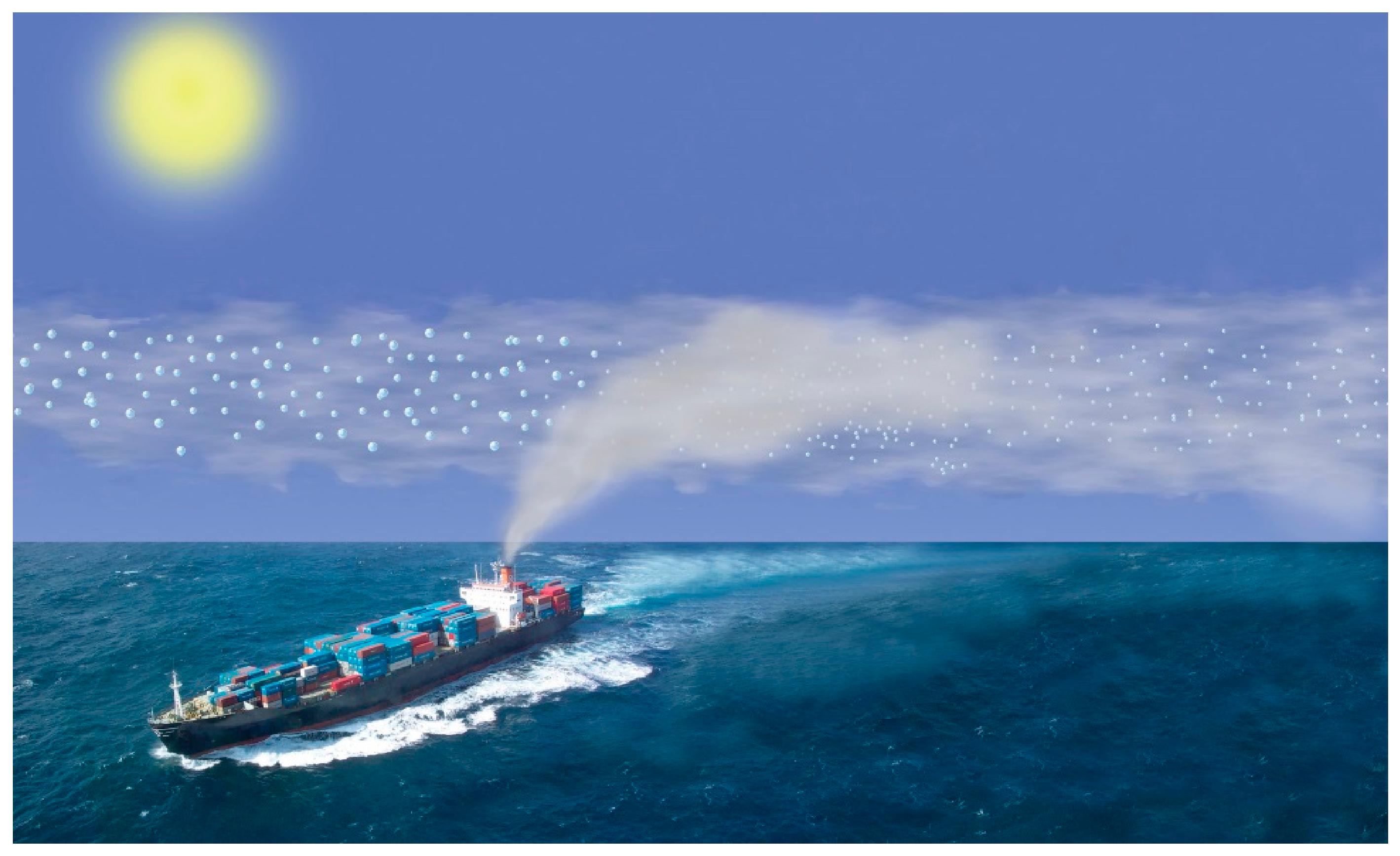
AMR may be implemented using aircraft or ships, as proposed by some startups, with some [36,117] targeting •OH enhancement, while others [126,127] aim to perform •Cl radical enhancement. Figure 2 illustrates plausible implementation using ship funnels according to the methods described by [20,21,22].
Figure 2.
Plausible enhancement of natural radicals •OH or •Cl under the marine boundary layer using containerships to disperse monatomic chlorine or iron salt aerosols [117,126,127].
5. Discussion and Conclusions
A recent study by Horowitz [44] modelled, using GEOS-Chem, the impact of several proposed methods of atmospheric oxidation enhancement on SLHs using chlorine gas, iron salt aerosol, or hydrogen peroxide, or by imposing increased •OH.
The study [44] found mixed effects on SLHs, with decreased SLHs using •OH-based methods. Concerning •Cl-based methods, the results depend on the location of implementation and on the scale of •Cl generation, with increased or decreased SLHs, although with minimal changes, predicted in stratospheric ozone after 1 year of deployment. Among SLHs, CHBr3 and CH2Br2 exhibit the most significant variations throughout the troposphere, with decreases in experiments involving hydrogen peroxide and increases in those involving chlorine. The Horowitz study [44] also showed that, in populated and polluted areas, •OH-based methods increase ozone air pollution, but this is strongly nonlinear. All atmospheric oxidation enhancement methods studied increased surface particulate matter pollution, especially in NOx-polluted areas, by generating secondary aerosols [44]. But the knowledge in this area is still highly uncertain, and there are still many unknowns: For example, a recent study found that spraying seawater under the marine boundary layer to perform marine cloud brightening (MCB), thanks to its sea salt content, might shorten methane lifetime by up to 15% when taking into account the effects on particulate nitrate photolysis [128]. Meanwhile, an earlier article on the same MCB topic, but without taking into account the effects on particulate nitrate photolysis, found increases in methane lifetime (3 to 6%) [129].
More targeted modelling studies, and more models, are required to deepen the analysis of these issues [130]; the local and temporary effects of •OH- and •Cl-based methods at a large scale need to be further modelled and quantified, given that, globally, a reduction in atmospheric methane also reduces the tropospheric ozone burden [13,131]. Connecting tropospheric loss to stratospheric ozone additionally requires consideration of emission location and season, vertical transport, product-gas and source-gas injection, fractional release, and stratospheric chemistry. The numerous research needs are highlighted in the research agendas for AMR [19,132] as well as in this review.
The Montreal Protocol has been a highly successful international agreement. It not only preserved the ozone layer by controlling the production of CFCs, HCFCs and many other ODSs, but also had beneficial effects on the climate by avoiding additional warming, since many CFCs have very high GWPs [133]. For instance, CFC-11 and CFC-12 have GWP100 values of 6230 and 12,500 respectively, while the GWP100 of CO2 is 1 by definition. Compared with a scenario where ODS use increased by 3–3.5% per year, the avoided global warming will be of approximately 0.5–1 °C by 2050, corresponding to a ∼25% mitigation of global warming [4,133]. Without the Montreal Protocol, an additional 0.85 °C warming would occur by the end of the century, as plants and soils would carry 325–690 Gt less carbon [134].
The depletion of the ozone layer has had a cooling effect on Earth’s surface temperatures. Although new research suggests that the warming effect of the restored ozone layer will be much higher than previously anticipated [135], its recovery is necessary, in the same way that the implementation of air quality policies reducing emissions of dangerous pollutants such as SO2 and NOx are necessary to save many lives, reduce illnesses and crop losses.
It has been estimated that the mean global surface temperature reduction obtained by removing 1 Gt (1000 Tg) of CH4 is 0.21 ± 0.04 °C, together with a mean global surface O3 reduction of 1.0 ± 0.2 ppb [131]. As a driver of tropospheric O3 formation, CH4 causes more than 1 million premature deaths per year [13]. Thus, a 30% reduction in anthropogenic CH4 emissions by mitigation measures by 2030 compared with 2020 levels [13,16] would have multiple benefits immediately, not only for the climate (0.2 °C of additional warming avoided by 2050 [16], and a 45% reduction of 0.3 °C of additional warming avoided by 2050 [13]), but also for agriculture and ecosystem health (preventing more than 26 Mt of staple crop losses) and human health (preventing annually 0.255 million deaths from cardiovascular and respiratory diseases, 0.775 million asthma-related hospital visits, and 73 billion lost work hours) [13]. These benefits could reach about US$470 billion in global savings [13]. In case of large-scale AMR deployment in addition to the mitigation measures, even a small acceleration of the recovery of the stratospheric ozone layer could enhance these benefits and might have additional ones.
This article presents a simple comparison of reaction rate constants at 298C and emissions of SLHs and highlights some hypothetical additional benefits of •OH- or •Cl-based AMR methods on ozone layer recovery. However, further investigation is needed to quantify these potential benefits. Model-based research is needed to answer questions such as the following: How much ozone layer recovery can be expected, given a certain level of AMR deployment? What is the required scale of AMR to have a meaningful impact on ozone layer recovery? What are the cost and energy requirements to produce •OH and •Cl radicals? A full study will require chemical transport modelling, or climate chemistry modelling integrating both the stratosphere and the troposphere, and should take into account the spatial and temporal overlap between each compound and the radical perturbation, competing radical sinks including CO, VOCs, NOx, and O3, and existing loss pathways such as photolysis, ocean uptake, and soil uptake, which are all among the research needs. These limitations are among the research needs, as atmospheric interactions among the different and very numerous chemical species are highly nonlinear, affected by the method and location of implementation at a large scale of still-hypothetical AMR methods. Such modelling could be carried out using, for instance, the TOMCAT [136], GEOS-Chem [44,128] and/or the LMDZ-INCA models [137,138]. New modelling is also needed to quantify the impacts of AMR on climate and atmospheric chemistry, including in the stratosphere [139], in a wide range of scenarios over this century, and to evaluate more precisely the pros and cons of siting AMR near or away from sources of CH4, SLHs and VOCs. It will also be valuable to quantify the co-benefits for ecosystems and human health [140,141], which is crucial to guide future policy decisions concerning development of AMR based on enhanced atmospheric oxidation.
Reducing CH4 emissions is the fastest way to slow down the rate of global warming. Just as mitigation of CO2 emissions and negative emissions measures (i.e., CDR) are necessary to achieve net-zero CO2 emissions [142,143], similarly, reducing human-induced CH4 emissions and remediation through AMR are complementary for hard-to-abate emissions [17]. Targeting non-CO2 GHG emissions combined with decarbonisation can reduce the rate of warming by about 50% between now and 2050 [144]. Temporary surface cooling is among the co-benefits of large-scale AMR [131], as well as a reduction in tropospheric ozone levels [13,131], which will, in turn, significantly reduce premature deaths, medical expenses, crop losses and much more [13].
In this review article, we have hypothesised that, given that the rate constants for the reactions of SLHs with OH and Cl radicals are higher than those for methane, an enhancement in •OH and possibly •Cl could affect some ozone-depleting substances as well as SLHs, and we suggest that implementation of AMR at a climatically relevant scale might reduce, in the troposphere, the amount of natural SLHs reaching the stratosphere and, therefore, the chlorine and bromine burden in the stratosphere. This may help to restore the protective ozone layer and may accelerate its recovery, which, in turn, can avoid large increases in DNA-damaging UV-B radiation. In turn, important human health benefits can arise, such as fewer skin cancers and cataracts, reduced risks of infections due to immunosuppression, and benefits for all other living organisms, ecosystems, and natural and synthetic materials [118]. Nonetheless, the potential side effects of both methods also need to be assessed by more in-depth studies, especially through environmental impact assessments and modelling. This study highlights the need for research to fully identify and estimate all the risks, costs, drawbacks, benefits and co-benefits of large-scale AMR for all living organisms and for human health.
Author Contributions
R.d.R. and W.L. elaborated the concept and performed the bibliographical research together with K.T.; R.d.R. wrote the first draft of this article, with contributions from P.A.D.; all co-authors participated in discussions and corrections of the following versions; T.M. supervised this work. All authors have read and agreed to the published version of the manuscript.
Funding
This research was supported by the European Commission H2020 Marie S Curie Research and Innovation Staff Exchange (RISE) award (Grant No. 871998) and Innovation Staff Exchange (RISE) award (Grant No. 871998), the National Natural Science Foundation of China (Grant No. 52278123), and the Bezos Earth Fund Greenhouse Gas Removal Ideation Prize.
Institutional Review Board Statement
Not applicable.
Informed Consent Statement
Not applicable.
Data Availability Statement
All information is included in this review article; no additional data was generated. No new data were created or analyzed in this study.
Acknowledgments
No AI was used to generate text. The authors take full responsibility for the content of the published article.
Conflicts of Interest
P.A.D., W.L., K.T., H.X. and T.M. declare that they do not have any conflicts of interest. R.d.R. has been a science advisor for the NGO “methaneaction.org” and is now a science advisor for the philanthropic organisation “cieif.org” and has provided “pro bono advice” to several startups in the AMR field.
Appendix A
Table A1.
Estimations of the annual fluxes of the principal SLHs, which are chloro-methanes and bromo-methanes, are provided [88,89,90,91,93,94,95,96,97].
Appendix B
Table A2.
Some of the known ozone-depleting potentials of the principal natural tropospheric halogenated gases are provided [9,91,145].
References
- Copernicus. The 2024 Annual Climate Summary—Global Climate Highlights. 2024. Available online: https://climate.copernicus.eu/global-climate-highlights-2024 (accessed on 15 January 2025).
- United Nations Environment Programme (UNEP). Environmental Consequences of Interacting Effects of Changes in Stratospheric Ozone, Ultraviolet Radiation and Climate: UNEP Environmental Effects Assessment Panel, Update 2024; UNEP: Nairobi, Kenya, 2024; Available online: https://ozone.unep.org/ (accessed on 10 September 2026).
- Perry, C.; Nickson, T.; Starr, C.; Grabiel, T.; Geoghegan, S.; Porter, B.; Mahapatra, A.; Walravens, F. More to offer from the Montreal protocol: How the ozone treaty can secure further significant greenhouse gas emission reductions in the future. J. Integr. Environ. Sci. 2024, 21, 2362124. [Google Scholar] [CrossRef] [Scilit]
- Villamayor, J.; Iglesias-Suarez, F.; Cuevas, C.A.; Fernandez, R.P.; Li, Q.; Abalos, M.; Hossaini, R.; Chipperfield, M.P.; Kinnison, D.E.; Tilmes, S.; et al. Very short-lived halogens amplify ozone depletion trends in the tropical lower stratosphere. Nat. Clim. Change 2023, 13, 554–560. [Google Scholar] [CrossRef] [Scilit]
- Bednarz, E.M.; Hossaini, R.; Chipperfield, M.P. Atmospheric impacts of chlorinated very short-lived substances over the recent past–Part 2: Impacts on ozone. Atmos. Chem. Phys. 2023, 23, 13701–13711. [Google Scholar] [CrossRef] [Scilit]
- McKenzie, R.; Bernhard, G.; Liley, B.; Disterhoft, P.; Rhodes, S.; Bais, A.; Morgenstern, O.; Newman, P.; Oman, L.; Brogniez, C.; et al. Success of Montreal Protocol demonstrated by comparing high-quality UV measurements with “World Avoided” calculations from two chemistry-climate models. Sci. Rep. 2019, 9, 12332. [Google Scholar] [CrossRef] [Scilit] [PubMed]
- Newman, P.A.; Nash, E.R.; Douglass, A.R.; Nielsen, J.E.; Stolarski, R.S. Estimating when the Antarctic ozone hole will recover. In Twenty Years of Ozone Decline: Proceedings of the Symposium for the 20th Anniversary of the Montreal Protocol; Springer: Dordrecht, The Netherlands, 2009; pp. 191–200. [Google Scholar]
- Newman, P.A.; Nash, E.R.; Kawa, S.R.; Montzka, S.A.; Schauffler, S.M. When will the Antarctic ozone hole recover? Geophys. Res. Lett. 2006, 33, L12814. [Google Scholar] [CrossRef] [Scilit]
- World Meteorological Organization (WMO). Scientific Assessment of Ozone Depletion: 2022; GAW Report No. 278; WMO: Geneva, Switzerland, 2022; p. 509. Available online: https://ozone.unep.org/system/files/documents/Scientific-Assessment-of-Ozone-Depletion-2022.pdf (accessed on 27 October 2025).
- IPCC. AR6 WG1 Climate Change 2021: The Physical Science Basis. 2021. Available online: https://www.ipcc.ch/report/ar6/wg1/downloads/report/IPCC_AR6_WGI_Full_Report.pdf (accessed on 4 May 2022).
- Joos, F.; Roth, R.; Fuglestvedt, J.S.; Peters, G.P.; Enting, I.G.; von Bloh, W.; Brovkin, V.; Burke, E.J.; Eby, M.; Edwards, N.R.; et al. Carbon dioxide and climate impulse response functions for the computation of greenhouse gas metrics: A multi-model analysis. Atmos. Chem. Phys. 2013, 13, 2793–2825. [Google Scholar] [CrossRef] [Scilit]
- Ocko, I.B.; Sun, T.; Shindell, D.; Oppenheimer, M.; Hristov, A.N.; Pacala, S.W.; Mauzerall, D.L.; Xu, Y.; Hamburg, S.P. Acting rapidly to deploy readily available methane mitigation measures by sector can immediately slow global warming. Environ. Res. Lett. 2021, 16, 054042. [Google Scholar] [CrossRef] [Scilit]
- UNEP. Global Methane Assessment: Benefits and Costs of Mitigating Methane Emissions. Available online: https://www.unep.org/resources/report/global-methane-assessment-benefits-and-costs-mitigating-methane-emissions (accessed on 22 June 2021).
- National Oceanic and Atmospheric Administration (NOAA). Global Monitoring Laboratory—Earth System Research Laboratories. Available online: https://gml.noaa.gov/ccgg/trends_ch4/ (accessed on 12 March 2025).
- Methane-Emergency-Brake. More New Heat Than CO2. Available online: https://methaneemergencybrake.org/more-heat-than-co2/ (accessed on 25 August 2025).
- Global-Methane-Pledge. The Global Methane Pledge. Available online: https://www.globalmethanepledge.org/resources/global-methane-pledge (accessed on 25 August 2025).
- Johansson, D.J.; Azar, C.; Lehtveer, M.; Peters, G.P. The role of negative carbon emissions in reaching the Paris climate targets: The impact of target formulation in integrated assessment models. Environ. Res. Lett. 2020, 15, 124024. [Google Scholar] [CrossRef] [Scilit]
- Forster, P.M.; Smith, C.; Walsh, T.; Lamb, W.F.; Lamboll, R.; Hall, B.; Hauser, M.; Ribes, A.; Rosen, D.; Gillett, N.P.; et al. Indicators of Global Climate Change 2023: Annual update of key indicators of the state of the climate system and human influence. Earth Syst. Sci. Data 2024, 16, 2625–2658. [Google Scholar] [CrossRef] [Scilit]
- National Academies of Sciences, Engineering, and Medicine. A Research Agenda Toward Atmospheric Methane Removal; The National Academies Press: Washington, DC, USA, 2024. [Google Scholar] [CrossRef] [Scilit] [PubMed]
- Wang, Y.; Ming, T.; Li, W.; Yuan, Q.; de Richter, R.; Davies, P.; Caillol, S. Atmospheric Removal of Methane by enhancing the natural hydroxyl radical sink. Greenh. Gases Sci. Technol. 2022, 12, 784–795. [Google Scholar] [CrossRef] [Scilit]
- Yuan, Q.; Xiao, B.; de Richter, R.; Li, W.; Quesada Cabrera, R.; Ming, T. Tropospheric methane remediation by enhancing chlorine sinks. RSC Sustain. 2025, 3, 1524–1538. [Google Scholar] [CrossRef] [Scilit]
- Ming, T.; de Richter, R.; Oeste, F.D.; Tulip, R.; Caillol, S. A nature-based negative emissions technology able to remove atmospheric methane and other greenhouse gases. Atmos. Pollut. Res. 2021, 12, 101035. [Google Scholar] [CrossRef] [Scilit]
- Mayhew, A.W.; Haskins, J.D. Potential Air Quality Side-Effects of Emitting H2O2 to Enhance Methane Oxidation as a Climate Solution. Environ. Sci. Technol. 2025, 59, 679–688. [Google Scholar] [CrossRef] [Scilit] [PubMed]
- de Richter, R.; Ming, T.; Li, W. Surge in tropospheric methane concentrations: New analysis and development of new NETs. In Proceedings of the 3rd International Conference on Negative CO2 Emissions Conference Proceedings, Oxford, UK, 18–21 June 2024. [Google Scholar] [CrossRef]
- de Richter, R.; Ming, T.; Davies, P.; Liu, W.; Caillol, S. Removal of non-CO2 greenhouse gases by large-scale atmospheric solar photocatalysis. Prog. Energy Combust. Sci. 2017, 60, 68–96. [Google Scholar] [CrossRef] [Scilit]
- Xiong, H.; Ming, T.; Shi, T.; Gao, Y.; Wu, Y.; Li, W.; de Richter, R.; Fang, Y.; Li, W.; Peng, C. Numerical analysis of environmental influences on ventilation solar chimney coupled with photocatalytic reactor/photovoltaic system. Sol. Energy 2026, 318, 115077. [Google Scholar] [CrossRef] [Scilit]
- Tomlinson, S.D.; Tsopelakou, A.M.; Onn, T.M.; Barrett, S.R.; Boies, A.M.; Fitzgerald, S. Modelling the photocatalytic oxidation of methane and other air pollutants for applications in ventilation systems. Int. J. Heat Mass Transf. 2026, 271, 129432. [Google Scholar] [CrossRef] [Scilit]
- Tomlinson, S.D.; Tsopelakou, A.M.; Onn, T.M.; Barrett, S.R.; Boies, A.M.; Fitzgerald, S.D. Evaluating the Scale of Natural and Mechanical Airflows for Surface-Based Atmospheric Pollutant Removal. Environ. Sci. Technol. 2026, 60, 21609–21621. [Google Scholar] [CrossRef] [Scilit] [PubMed]
- Xiong, H.; Peng, C.; Ming, T.; de Richter, R.; Li, W.; Yuan, Q.; Yuan, Y.; Zhou, N. Solar chimney power plant plus solar pond to remove atmospheric methane: A novel concept. J. Therm. Sci. 2025, 34, 2196–2203. [Google Scholar] [CrossRef] [Scilit]
- Xiong, H.; Ming, T.; Wu, Y.; Lin, W.; Li, W.; de Richter, R.; Yuan, Q.; Peng, C.; Li, W. Atmospheric methane removal using a solar chimney power plant plus solar pond: A numerical analysis. Appl. Therm. Eng. 2026, 300, 131362. [Google Scholar] [CrossRef] [Scilit]
- Xiong, H.; Ming, T.; Wu, Y.; Lin, W.; Li, W.; de Richter, R.; Yuan, Q.; Peng, C.; Li, W. Numerical sensitivity analysis of methane mitigation and carbon-reduction performance in a solar chimney power plant coupled with a solar pond system. Int. Commun. Heat Mass Transf. 2026, 179, 112321. [Google Scholar] [CrossRef] [Scilit]
- Tsopelakou, A.M.; Tomlinson, S.D.; Fitzgerald, S.; Onn, T.M.; Boies, A.M. Evaluating the potential of thermal catalysis for environmental methane mitigation. Sustain. Sci. Technol. 2026, 3, 024002. [Google Scholar] [CrossRef] [Scilit]
- Tomlinson, S.D.; Tsopelakou, A.M.; Onn, T.M.; Barrett, S.R.; Boies, A.M.; Fitzgerald, S.D. Modelling laminar flow in V-shaped filters integrated with catalyst technologies for atmospheric pollutant removal. Int. J. Heat Mass Transf. 2026, 257, 128206. [Google Scholar] [CrossRef] [Scilit]
- Jackson, R.; Solomon, E.; Canadell, J.; Cargnello, M.; Field, C. Methane removal and atmospheric restoration. Nat. Sustain. 2019, 2, 436–438. [Google Scholar] [CrossRef] [Scilit]
- Tsopelakou, A.M.; Stallard, J.; Archibald, A.T.; Fitzgerald, S.; Boies, A.M. Exploring the bounds of methane catalysis in the context of atmospheric methane removal. Environ. Res. Lett. 2024, 19, 054020. [Google Scholar] [CrossRef] [Scilit]
- Ramsay, W. Startup Sixteen44. Available online: https://www.sixteen44.com/ (accessed on 9 September 2026).
- Krogsbøll, M.; Russell, H.S.; Johnson, M.S. A high efficiency gas phase photoreactor for eradication of methane from low-concentration sources. Environ. Res. Lett. 2024, 19, 014017. [Google Scholar] [CrossRef] [Scilit]
- Song, H.; Peng, C.; Zhu, Q.; Chen, Z.; Blanchet, J.-P.; Liu, Q.; Li, T.; Li, P.; Liu, Z. Quantification and uncertainty of global upland soil methane sinks: Processes, controls, model limitations, and improvements. Earth-Sci. Rev. 2024, 252, 104758. [Google Scholar] [CrossRef] [Scilit]
- Gauci, V. Forests and methane: Looking beyond carbon for nature-based climate solutions. Environ. Res. Lett. 2024, 19, 081005. [Google Scholar] [CrossRef] [Scilit]
- Bahlmann, E.; Keppler, F.; Wittmer, J.; Greule, M.; Schöler, H.F.; Seifert, R.; Zetzsch, C. Evidence for a major missing source in the global chloromethane budget from stable carbon isotopes. Atmos. Chem. Phys. 2019, 19, 1703–1719. [Google Scholar] [CrossRef] [Scilit]
- Yvon-Lewis, S.A.; Saltzman, E.S.; Montzka, S.A. Recent trends in atmospheric methyl bromide: Analysis of post-Montreal Protocol variability. Atmos. Chem. Phys. 2009, 9, 5963–5974. [Google Scholar] [CrossRef] [Scilit]
- Hossaini, R.; Chipperfield, M.P.; Montzka, S.A.; Leeson, A.A.; Dhomse, S.S.; Pyle, J.A. The increasing threat to stratospheric ozone from dichloromethane. Nat. Commun. 2017, 8, 15962. [Google Scholar] [CrossRef] [Scilit] [PubMed]
- Zhang, X.; An, M.; Chen, Z.; Jiang, P.; Bai, F.; Zhao, X.; Xu, W.; Hu, J. Chlorinated VSLSs Surpass HCFCs in CFC-11-Equivalent Emissions for Ozone Layer Depletion in China. Nat. Commun. 2026, 17, 8197. [Google Scholar] [CrossRef] [Scilit] [PubMed]
- Horowitz, H.M. Intended and unintended consequences of atmospheric methane oxidation enhancement. Atmos. Chem. Phys. 2026, 26, 9471–9491. [Google Scholar] [CrossRef] [Scilit]
- Daniel, J.; Fleming, E.; Portmann, R.; Velders, G.; Jackman, C.; Ravishankara, A. Options to accelerate ozone recovery: Ozone and climate benefits. Atmos. Chem. Phys. 2010, 10, 7697–7707. [Google Scholar] [CrossRef] [Scilit]
- Field, J.A. Natural production of organohalide compounds in the environment. In Organohalide-Respiring Bacteria; Springer: Berlin/Heidelberg, Germany, 2016; pp. 7–29. [Google Scholar]
- Gribble, G.W. A recent survey of naturally occurring organohalogen compounds. Environ. Chem. 2015, 12, 396–405. [Google Scholar] [CrossRef] [Scilit]
- Ren, S.; Feng, C.; Loh, T.-P. Iron-or silver-catalyzed oxidative fluorination of cyclopropanols for the synthesis of β-fluoroketones. Org. Biomol. Chem. 2015, 13, 5105–5109. [Google Scholar] [CrossRef] [Scilit] [PubMed]
- Ruecker, A.; Weigold, P.; Behrens, S.; Jochmann, M.; Laaks, J.; Kappler, A. Predominance of biotic over abiotic formation of halogenated hydrocarbons in hypersaline sediments in Western Australia. Environ. Sci. Technol. 2014, 48, 9170–9178. [Google Scholar] [CrossRef] [Scilit] [PubMed]
- Ruecker, A.; Weigold, P.; Behrens, S.; Jochmann, M.; Barajas, X.O.; Kappler, A. Halogenated hydrocarbon formation in a moderately acidic salt lake in Western Australia–role of abiotic and biotic processes. Environ. Chem. 2015, 12, 406–414. [Google Scholar] [CrossRef] [Scilit][Green Version]
- Comba, P.; Kerscher, M.; Krause, T.; Schöler, H.F. Iron-catalysed oxidation and halogenation of organic matter in nature. Environ. Chem. 2015, 12, 381–395. [Google Scholar] [CrossRef] [Scilit]
- Albers, C.N.; Hansen, P.E.; Jacobsen, O.S. Trichloromethyl compounds—Natural background concentrations and fates within and below coniferous forests. Sci. Total Environ. 2010, 408, 6223–6234. [Google Scholar] [CrossRef] [Scilit] [PubMed]
- Clarke, N.; Gryndler, M.; Liste, H.-H.; Schroll, R.; Schröder, P.; Matucha, M. Haloorganics in Temperate Forest Ecosystems: Sources, Transport and Degradation. In Organic Xenobiotics and Plants: From Mode of Action to Ecophysiology; Springer: Dordrecht, The Netherlands, 2010; pp. 17–45. [Google Scholar]
- Yokouchi, Y.; Ikeda, M.; Inuzuka, Y.; Yukawa, T. Strong emission of methyl chloride from tropical plants. Nature 2002, 416, 163–165. [Google Scholar] [CrossRef] [Scilit] [PubMed]
- Hartmann, S.C. Investigation of Natural Halogenated Volatile Organic Compounds in the Amazon Rainforest. Ph.D. Thesis, Johannes Gutenberg University Mainz, Mainz, Germany, 2024. [Google Scholar]
- Rinne, J.; Bäck, J.; Hakola, H. Biogenic volatile organic compound emissions from the Eurasian taiga: Current knowledge and future directions. Boreal Environ. Res. 2009, 14, 807. [Google Scholar]
- Clarke, N.; Fuksová, K.; Gryndler, M.; Lachmanová, Z.; Liste, H.-H.; Rohlenová, J.; Schroll, R.; Schröder, P.; Matucha, M. The formation and fate of chlorinated organic substances in temperate and boreal forest soils. Environ. Sci. Pollut. Res. 2009, 16, 127–143. [Google Scholar] [CrossRef] [Scilit] [PubMed]
- Mäki, M.; Aaltonen, H.; Heinonsalo, J.; Hellén, H.; Pumpanen, J.; Bäck, J. Boreal forest soil is a significant and diverse source of volatile organic compounds. Plant Soil 2019, 441, 89–110. [Google Scholar] [CrossRef] [Scilit]
- Albers, C.; Jacobsen, O.; Flores, É.M.; Pereira, J.; Laier, T. Spatial variation in natural formation of chloroform in the soils of four coniferous forests. Biogeochemistry 2011, 103, 317–334. [Google Scholar] [CrossRef] [Scilit]
- Valtanen, A.; Solloch, S.; Hartikainen, H.; Michaelis, W. Emissions of volatile halogenated compounds from a meadow in a coastal area of the Baltic Sea. Boreal Environ. Res. 2009, 14, 915. [Google Scholar]
- Cox, M.L.; Fraser, P.J.; Sturrock, G.A.; Siems, S.T.; Porter, L.W. Terrestrial sources and sinks of halomethanes near Cape Grim, Tasmania. Atmos. Environ. 2004, 38, 3839–3852. [Google Scholar] [CrossRef] [Scilit]
- Dimmer, C.H.; Simmonds, P.G.; Nickless, G.; Bassford, M.R. Biogenic fluxes of halomethanes from Irish peatland ecosystems. Atmos. Environ. 2001, 35, 321–330. [Google Scholar] [CrossRef] [Scilit]
- Khan, M.; Whelan, M.; Rhew, R. Effects of temperature and soil moisture on methyl halide and chloroform fluxes from drained peatland pasture soils. J. Environ. Monit. 2012, 14, 241–249. [Google Scholar] [CrossRef] [Scilit] [PubMed]
- Varner, R.K.; Crill, P.M.; Talbot, R.W. Wetlands: A potentially significant source of atmospheric methyl bromide and methyl chloride. Geophys. Res. Lett. 1999, 26, 2433–2435. [Google Scholar] [CrossRef] [Scilit]
- Hardacre, C.J.; Heal, M.R. Characterization of methyl bromide and methyl chloride fluxes at temperate freshwater wetlands. J. Geophys. Res. Atmos. 2013, 118, 977–991. [Google Scholar] [CrossRef] [Scilit]
- Jiao, Y.; Ruecker, A.; Deventer, M.J.; Chow, A.T.; Rhew, R.C. Halocarbon emissions from a degraded forested wetland in coastal South Carolina impacted by sea level rise. ACS Earth Space Chem. 2018, 2, 955–967. [Google Scholar] [CrossRef] [Scilit]
- Rhew, R.C.; Teh, Y.A.; Abel, T.; Atwood, A.; Mazéas, O. Chloroform emissions from the Alaskan Arctic tundra. Geophys. Res. Lett. 2008, 35, L21811. [Google Scholar] [CrossRef] [Scilit]
- Zhang, W.; Jiao, Y.; Zhu, R.; Rhew, R.C. Methyl chloride and methyl bromide production and consumption in coastal Antarctic tundra soils subject to sea animal activities. Environ. Sci. Technol. 2020, 54, 13354–13363. [Google Scholar] [CrossRef] [Scilit] [PubMed]
- Redeker, K.; Wang, N.-Y.; Low, J.; McMillan, A.; Tyler, S.; Cicerone, R. Emissions of methyl halides and methane from rice paddies. Science 2000, 290, 966–969. [Google Scholar] [CrossRef] [Scilit] [PubMed]
- Khan, M.; Rhew, R.; Whelan, M.; Zhou, K.; Deverel, S. Methyl halide and chloroform emissions from a subsiding Sacramento–San Joaquin Delta island converted to rice fields. Atmos. Environ. 2011, 45, 977–985. [Google Scholar] [CrossRef] [Scilit]
- Redeker, K.; Cicerone, R. Environmental controls over methyl halide emissions from rice paddies. Glob. Biogeochem. Cycles 2004, 18, GB1027. [Google Scholar] [CrossRef] [Scilit]
- Rhew, R.C.; Miller, B.R.; Weiss, R.F. Natural methyl bromide and methyl chloride emissions from coastal salt marshes. Nature 2000, 403, 292–295. [Google Scholar] [CrossRef] [Scilit] [PubMed]
- Wang, J.; Li, R.; Guo, Y.; Qin, P.; Sun, S. The flux of methyl chloride along an elevational gradient of a coastal salt marsh, Eastern China. Atmos. Environ. 2006, 40, 6592–6605. [Google Scholar] [CrossRef] [Scilit]
- Kotte, K.; Löw, F.; Huber, S.; Krause, T.; Mulder, I.; Schöler, H. Organohalogen emissions from saline environments–spatial extrapolation using remote sensing as most promising tool. Biogeosciences 2012, 9, 1225–1235. [Google Scholar] [CrossRef] [Scilit]
- Hu, L.; Yvon-Lewis, S.A.; Liu, Y.; Salisbury, J.E.; O’Hern, J.E. Coastal emissions of methyl bromide and methyl chloride along the eastern Gulf of Mexico and the east coast of the United States. Glob. Biogeochem. Cycles 2010, 24, GB1007. [Google Scholar] [CrossRef] [Scilit]
- Liu, S.-S.; He, Z.; Yang, G.-P. Bromoform, dibromochloromethane, and dibromomethane over the East China Sea and the western Pacific Ocean: Oceanic emission and spatial variation. Chemosphere 2020, 257, 127151. [Google Scholar] [CrossRef] [Scilit] [PubMed]
- Moore, R.; Tokarczyk, R.; Tait, V.; Poulin, M.; Geen, C. Marine phytoplankton as a natural source of volatile organohalogens. In Naturally-Produced Organohalogens; Springer: Dordrecht, The Netherlands, 1995; pp. 283–294. [Google Scholar]
- Paul, C.; Pohnert, G. Production and role of volatile halogenated compounds from marine algae. Nat. Product. Rep. 2011, 28, 186–195. [Google Scholar] [CrossRef] [Scilit] [PubMed]
- Colomb, A.; Yassaa, N.; Williams, J.; Peeken, I.; Lochte, K. Screening volatile organic compounds (VOCs) emissions from five marine phytoplankton species by head space gas chromatography/mass spectrometry (HS-GC/MS). J. Environ. Monit. 2008, 10, 325–330. [Google Scholar] [CrossRef] [Scilit] [PubMed]
- Macdonald, M.L.; Wadham, J.L.; Young, D.; Lunder, C.R.; Hermansen, O.; Lamarche-Gagnon, G.; O’DOherty, S. Consumption of CH3Cl, CH3Br, and CH3I and emission of CHCl3, CHBr3, and CH2Br2 from the forefield of a retreating Arctic glacier. Atmos. Chem. Phys. 2020, 20, 7243–7258. [Google Scholar] [CrossRef] [Scilit]
- Rhew, R.C.; Miller, B.R.; Weiss, R.F. Chloroform, carbon tetrachloride and methyl chloroform fluxes in southern California ecosystems. Atmos. Environ. 2008, 42, 7135–7140. [Google Scholar] [CrossRef] [Scilit]
- Raffel, A.E.; Jones, R.D.; Butenhoff, C.; Rice, A.L.; Scully, N.M. Methyl chloride production by calcareous periphyton mats from the Florida Everglades. Mar. Ecol. Prog. Ser. 2014, 514, 35–41. [Google Scholar] [CrossRef] [Scilit]
- Dreyfus, G.B.; Montzka, S.A.; Andersen, S.O.; Ferris, R. A method for calculating offsets to ozone depletion and climate impacts of ozone-depleting substances. Atmos. Chem. Phys. 2024, 24, 2023–2032. [Google Scholar] [CrossRef] [Scilit]
- Fang, X.; Park, S.; Saito, T.; Tunnicliffe, R.; Ganesan, A.L.; Rigby, M.; Li, S.; Yokouchi, Y.; Fraser, P.J.; Harth, C.M.; et al. Rapid increase in ozone-depleting chloroform emissions from China. Nat. Geosci. 2019, 12, 89–93. [Google Scholar] [CrossRef] [Scilit]
- Park, S.; Western, L.M.; Saito, T.; Redington, A.L.; Henne, S.; Fang, X.; Prinn, R.G.; Manning, A.J.; Montzka, S.A.; Fraser, P.J.; et al. A decline in emissions of CFC-11 and related chemicals from eastern China. Nature 2021, 590, 433–437. [Google Scholar] [CrossRef] [Scilit] [PubMed]
- Montzka, S.A.; Dutton, G.S.; Portmann, R.W.; Chipperfield, M.P.; Davis, S.; Feng, W.; Manning, A.J.; Ray, E.; Rigby, M.; Hall, B.D.; et al. A decline in global CFC-11 emissions during 2018–2019. Nature 2021, 590, 428–432. [Google Scholar] [CrossRef] [Scilit] [PubMed]
- Lickley, M.; Solomon, S.; Fletcher, S.; Velders, G.J.M.; Daniel, J.; Rigby, M.; Montzka, S.A.; Kuijpers, L.J.M.; Stone, K. Quantifying contributions of chlorofluorocarbon banks to emissions and impacts on the ozone layer and climate. Nat. Commun. 2020, 11, 1380. [Google Scholar] [CrossRef] [Scilit] [PubMed]
- Yoshida, Y.; Wang, Y.; Zeng, T.; Yantosca, R. A three-dimensional global model study of atmospheric methyl chloride budget and distributions. J. Geophys. Res. Atmos. 2004, 109, D24309. [Google Scholar] [CrossRef] [Scilit]
- Khalil, M.; Rasmussen, R. Atmospheric methyl chloride. Atmos. Environ. 1999, 33, 1305–1321. [Google Scholar] [CrossRef] [Scilit]
- Claxton, T.; Hossaini, R.; Wilson, C.; Montzka, S.A.; Chipperfield, M.P.; Wild, O.; Bednarz, E.M.; Carpenter, L.J.; Andrews, S.J.; Hackenberg, S.C.; et al. A synthesis inversion to constrain global emissions of two very short lived chlorocarbons: Dichloromethane, and perchloroethylene. J. Geophys. Res. Atmos. 2020, 125, e2019JD031818. [Google Scholar] [CrossRef] [Scilit]
- Wang, X.; Jacob, D.J.; Downs, W.; Zhai, S.; Zhu, L.; Shah, V.; Holmes, C.D.; Sherwen, T.; Alexander, B.; Evans, M.J.; et al. Global tropospheric halogen (Cl, Br, I) chemistry and its impact on oxidants. Atmos. Chem. Phys. 2021, 21, 13973–13996. [Google Scholar] [CrossRef] [Scilit]
- Saunois, M.; Martinez, A.; Poulter, B.; Zhang, Z.; Raymond, P.A.; Regnier, P.; Canadell, J.G.; Jackson, R.B.; Patra, P.K.; Bousquet, P.; et al. Global Methane Budget 2000–2020. Earth Syst. Sci. Data Discuss. 2025, 17, 1873–1958. [Google Scholar] [CrossRef] [Scilit]
- Ordóñez, C.; Lamarque, J.-F.; Tilmes, S.; Kinnison, D.E.; Atlas, E.L.; Blake, D.R.; Santos, G.S.; Brasseur, G.; Saiz-Lopez, A. Bromine and iodine chemistry in a global chemistry-climate model: Description and evaluation of very short-lived oceanic sources. Atmos. Chem. Phys. 2012, 12, 1423–1447. [Google Scholar] [CrossRef] [Scilit]
- Roozitalab, B.; Hornbrook, R.S.; Kinnison, D.E.; Fernandez, R.P.; Gaubert, B.; Cuevas, C.A.; Hills, A.J.; Saiz-Lopez, A.; Emmons, L.K.; Apel, E.C. Impacts of socio-economic development scenarios on long-term oceanic emissions and abundances of atmospheric bromoform and dibromomethane. J. Geophys. Res. Atmos. 2025, 130, e2025JD044790. [Google Scholar] [CrossRef] [Scilit]
- Liang, Q.; Stolarski, R.S.; Kawa, S.R.; Nielsen, J.E.; Douglass, A.R.; Rodriguez, J.M.; Blake, D.R.; Atlas, E.L.; Ott, L.E. Finding the missing stratospheric Br y: A global modeling study of CHBr3 and CH2Br2. Atmos. Chem. Phys. 2010, 10, 2269–2286. [Google Scholar] [CrossRef] [Scilit]
- Warwick, N.; Pyle, J.; Shallcross, D. Global modelling of the atmospheric methyl bromide budget. J. Atmos. Chem. 2006, 54, 133–159. [Google Scholar] [CrossRef] [Scilit]
- Keene, W.C.; Khalil, M.A.K.; Erickson, D.J.; McCulloch, A.; Graedel, T.E.; Lobert, J.M.; Aucott, M.L.; Gong, S.L.; Harper, D.B.; Kleiman, G.; et al. Composite global emissions of reactive chlorine from anthropogenic and natural sources: Reactive Chlorine Emissions Inventory. J. Geophys. Res. Atmos. 1999, 104, 8429–8440. [Google Scholar] [CrossRef] [Scilit]
- Jia, Y.; Hahn, J.; Quack, B.; Jones, E.; Brehon, M.; Tegtmeier, S. Anthropogenic bromoform at the extratropical tropopause. Geophys. Res. Lett. 2023, 50, e2023GL102894. [Google Scholar] [CrossRef] [Scilit]
- Brioude, J.; Portmann, R.W.; Daniel, J.S.; Cooper, O.R.; Frost, G.J.; Rosenlof, K.H.; Granier, C.; Ravishankara, A.R.; Montzka, S.A.; Stohl, A. Variations in ozone depletion potentials of very short-lived substances with season and emission region. Geophys. Res. Lett. 2010, 37, L19804. [Google Scholar] [CrossRef] [Scilit]
- Bednarz, E.M.; Hossaini, R.; Chipperfield, M.P.; Abraham, N.L.; Braesicke, P. Atmospheric impacts of chlorinated very short-lived substances over the recent past–Part 1: Stratospheric chlorine budget and the role of transport. Atmos. Chem. Phys. 2022, 22, 10657–10676. [Google Scholar] [CrossRef] [Scilit]
- Liang, Q.; Newman, P.A.; Fleming, E.L.; Lait, L.R.; Atlas, E.; Pan, L.; Kinnison, D.; Western, L.M.; Schauffler, S.; Smith, K.; et al. Asian summer monsoon anticyclone—The primary entryway for chlorinated very-short-lived substances to the stratosphere. Geophys. Res. Lett. 2025, 52, e2024GL110248. [Google Scholar] [CrossRef] [Scilit]
- Montzka, S.; Butler, J.; Elkins, J.; Thompson, T.; Clarke, A.; Lock, L. Present and future trends in the atmospheric burden of ozone-depleting halogens. Nature 1999, 398, 690–694. [Google Scholar] [CrossRef] [Scilit]
- Montzka, S.; Butler, J.; Hall, B.; Mondeel, D.; Elkins, J. A decline in tropospheric organic bromine. Geophys. Res. Lett. 2003, 30, 1826. [Google Scholar] [CrossRef] [Scilit]
- Western, L.M.; Vollmer, M.K.; Krummel, P.B.; Adcock, K.E.; Crotwell, M.; Fraser, P.J.; Harth, C.M.; Langenfelds, R.L.; Montzka, S.A.; Mühle, J.; et al. Global increase of ozone-depleting chlorofluorocarbons from 2010 to 2020. Nat. Geosci. 2023, 16, 309–313, Correction in Nat. Geosci. 2023, 16, 546. [Google Scholar] [CrossRef] [Scilit]
- Vollmer, M.K.; Mühle, J.; Henne, S.; Young, D.; Rigby, M.; Mitrevski, B.; Park, S.; Lunder, C.R.; Rhee, T.S.; Harth, C.M.; et al. Unexpected nascent atmospheric emissions of three ozone-depleting hydrochlorofluorocarbons. Proc. Natl. Acad. Sci. USA 2021, 118, e2010914118. [Google Scholar] [CrossRef] [Scilit] [PubMed]
- Velders, G.J.; Ravishankara, A.R.; Miller, M.K.; Molina, M.J.; Alcamo, J.; Daniel, J.S.; Fahey, D.W.; Montzka, S.A.; Reimann, S. Preserving Montreal Protocol climate benefits by limiting HFCs. Science 2012, 335, 922–923. [Google Scholar] [CrossRef] [Scilit] [PubMed]
- Daniel, J.; Solomon, S.; Portmann, R.; Garcia, R. Stratospheric ozone destruction: The importance of bromine relative to chlorine. J. Geophys. Res. Atmos. 1999, 104, 23871–23880. [Google Scholar] [CrossRef] [Scilit]
- Nicewonger, M.; Saltzman, E.S.; Montzka, S. ENSO-driven fires cause large interannual variability in the naturally emitted, ozone-depleting trace gas CH3Br. Geophys. Res. Lett. 2022, 49, e2021GL094756. [Google Scholar] [CrossRef] [Scilit]
- National Oceanic and Atmospheric Administration (NOAA). The NOAA Ozone Depleting Gas Index: Guiding Recovery of the Ozone Layer. Available online: https://gml.noaa.gov/odgi/ (accessed on 7 December 2025).
- Li, Q.; Meidan, D.; Hess, P.; Añel, J.A.; Cuevas, C.A.; Doney, S.; Fernandez, R.P.; van Herpen, M.; Höglund-Isaksson, L.; Johnson, M.S.; et al. Global environmental implications of atmospheric methane removal through chlorine-mediated chemistry-climate interactions. Nat. Commun. 2023, 14, 4045. [Google Scholar] [CrossRef] [Scilit] [PubMed]
- Pennacchio, L.; van Herpen, M.; Meidan, D.; Saiz-Lopez, A.; Johnson, M.S. Catalytic efficiencies for methane removal: Impact of HOx, NOx, and Chemistry in the High-Chlorine Regime. ACS Earth Space Chem. 2025, 9, 504–512. [Google Scholar] [CrossRef] [Scilit]
- Burkholder, J.; Caravan, R.L.; Huie, R.E.; Orkin, V.L.; Percival, C.J.; Sander, R.; Sander, S.P.; Wilmouth, D.M. Chemical Kinetics and Photochemical Data for USE in Atmospheric Studies; evaluation number 20; Jet Propulsion Laboratory, National Aeronautics and Space: Pasadena, CA, USA, 2025. Available online: https://science.jpl.nasa.gov/documents/1503/NASA_Data_Evaluation_20.pdf (accessed on 2 September 2026).
- Li, H.-J.; Yokouchi, Y.; Akimoto, H.; Narita, Y. Distribution of methyl chloride, methyl bromide, and methyl iodide in the marine boundary air over the western Pacific and southeastern Indian Ocean. Geochem. J. 2001, 35, 137–144. [Google Scholar] [CrossRef] [Scilit]
- Khalil, M.; Rasmussen, R. Atmospheric chloroform. Atmos. Environ. 1999, 33, 1151–1158. [Google Scholar] [CrossRef] [Scilit]
- Lobert, J.M.; Keene, W.C.; Logan, J.A.; Yevich, R. Global chlorine emissions from biomass burning: Reactive Chlorine Emissions Inventory. J. Geophys. Res. Atmos. 1999, 104, 8373–8389. [Google Scholar] [CrossRef] [Scilit]
- Inventory, R.C.E. Natural emissions of chlorine-containing gases Reactive Chlorine Emissions Inventory. J. Geol. Res. 1999, 104, 8333–8346. [Google Scholar] [CrossRef] [Scilit]
- Bennu-Climate, Startup. Available online: https://www.bennuclimate.com/technology (accessed on 14 June 2025).
- Barnes, P.W.; Robson, T.M.; Neale, P.J.; Williamson, C.E.; Zepp, R.G.; Madronich, S.; Wilson, S.R.; Andrady, A.L.; Heikkilä, A.M.; Bernhard, G.H.; et al. Environmental effects of stratospheric ozone depletion, UV radiation, and interactions with climate change: UNEP Environmental Effects Assessment Panel, Update 2021. Photochem. Photobiol. Sci. 2022, 21, 275–301. [Google Scholar] [CrossRef] [Scilit] [PubMed]
- Hurwitz, M.M.; Fleming, E.L.; Newman, P.A.; Li, F.; Mlawer, E.; Cady-Pereira, K.; Bailey, R. Ozone depletion by hydrofluorocarbons. Geophys. Res. Lett. 2015, 42, 8686–8692. [Google Scholar] [CrossRef] [Scilit]
- Oeste, F.D.; de Richter, R.; Ming, T.; Caillol, S. Climate engineering by mimicking natural dust climate control: The iron salt aerosol method. Earth Syst. Dyn. 2017, 8, 1–54. [Google Scholar] [CrossRef] [Scilit]
- Arsene, C.; Bougiatioti, A.; Kanakidou, M.; Bonsang, B.; Mihalopoulos, N. Tropospheric OH and Cl levels deduced from non-methane hydrocarbon measurements in a marine site. Atmos. Chem. Phys. 2007, 7, 4661–4673. [Google Scholar] [CrossRef] [Scilit]
- Svensson, T. Measurements and Fluxes of Volatile Chlorinated Organic Compounds (VOCl) from Natural Terrestrial Sources: Measurement Techniques and Spatio-Temporal Variability of Flux Estimates; Technical Report TR-18-09; Swedish Nuclar Fuel and Waste Management: Solna, Sweden, 2019; Available online: https://www.diva-portal.org/smash/get/diva2:1314576/FULLTEXT01.pdf (accessed on 29 October 2025).
- Murguia-Flores, F.; Jaramillo, V.; Gallego-Sala, A. Assessing methane emissions from tropical wetlands: Uncertainties from natural variability and drivers at the global scale. Glob. Biogeochem. Cycles 2023, 37, e2022GB007601. [Google Scholar] [CrossRef] [Scilit]
- Zhang, Z.; Poulter, B.; Feldman, A.F.; Ying, Q.; Ciais, P.; Peng, S.; Li, X. Recent intensification of wetland methane feedback. Nat. Clim. Change 2023, 13, 430–433. [Google Scholar] [CrossRef] [Scilit]
- Kleinen, T.; Gromov, S.; Steil, B.; Brovkin, V. Atmospheric methane underestimated in future climate projections. Environ. Res. Lett. 2021, 16, 094006, Erratum in Environ. Res. Lett. 2021, 16, 119502. [Google Scholar] [CrossRef] [Scilit]
- AMR. Startup Atmospheric Methane Removal. Available online: https://amr.earth/ (accessed on 4 May 2025).
- CIEIF. Acacia Impact Innovation. Available online: https://cieif.org/grants/acacia-impact-innovation/ (accessed on 16 August 2026).
- Emme, E.; Horowitz, H.M.; Moon, A.R.; Shah, V. Particulate Nitrate Photolysis Alters the Atmospheric Chemistry Response to Marine Cloud Brightening Sea Salt Aerosol Emissions. ESS Open Arch. 2026. [Google Scholar] [CrossRef] [Scilit] [PubMed]
- Horowitz, H.M.; Holmes, C.; Wright, A.; Sherwen, T.; Wang, X.; Evans, M.; Huang, J.; Jaeglé, L.; Chen, Q.; Zhai, S.; et al. Effects of sea salt aerosol emissions for marine cloud brightening on atmospheric chemistry: Implications for radiative forcing. Geophys. Res. Lett. 2020, 47, e2019GL085838. [Google Scholar] [CrossRef] [Scilit] [PubMed]
- Tanaka, K.; Xiong, W.; Hauglustaine, D.A.; Johansson, D.J.A.; Bauer, N.; Bousquet, P.; Ciais, P.; de Richter, R.; Lund, M.T.; Skeie, R.B.; et al. Atmospheric methane removal as a third climate intervention: Termination risks and air pollutant effects. npj Clim. Action 2026, 5, 56. [Google Scholar] [CrossRef] [Scilit]
- Abernethy, S.; O’Connor, F.; Jones, C.; Jackson, R. Methane removal and the proportional reductions in surface temperature and ozone. Philos. Trans. R. Soc. A 2021, 379, 20210104. [Google Scholar] [CrossRef] [Scilit] [PubMed]
- Jackson, R.; Abernethy, S.; Canadell, J.G.; Cargnello, M.; Davis, S.J.; Féron, S.; Fuss, S.; Heyer, A.J.; Hong, C.; Jones, C.D.; et al. Atmospheric methane removal: A research agenda. Philos. Trans. R. Soc. A, 2021; in press.
- Goyal, R.; England, M.H.; Sen Gupta, A.; Jucker, M. Reduction in surface climate change achieved by the 1987 Montreal Protocol. Environ. Res. Lett. 2019, 14, 124041. [Google Scholar] [CrossRef] [Scilit]
- Young, P.J.; Harper, A.B.; Huntingford, C.; Paul, N.D.; Morgenstern, O.; Newman, P.A.; Oman, L.D.; Madronich, S.; Garcia, R.R. The Montreal Protocol protects the terrestrial carbon sink. Nature 2021, 596, 384–388. [Google Scholar] [CrossRef] [Scilit] [PubMed]
- Collins, W.J.; O’COnnor, F.M.; Byrom, R.E.; Hodnebrog, Ø.; Jöckel, P.; Mertens, M.; Myhre, G.; Nützel, M.; Olivié, D.; Skeie, R.B.; et al. Climate forcing due to future ozone changes: An intercomparison of metrics and methods. Atmos. Chem. Phys. 2025, 25, 9031–9060. [Google Scholar] [CrossRef] [Scilit]
- Hossaini, R.; Sherry, D.; Wang, Z.; Chipperfield, M.P.; Feng, W.; Oram, D.E.; Adcock, K.E.; Montzka, S.A.; Simpson, I.J.; Mazzeo, A.; et al. On the atmospheric budget of 1,2-dichloroethane and its impact on stratospheric chlorine and ozone (2002–2020). Atmos. Chem. Phys. 2024, 24, 13457–13475. [Google Scholar] [CrossRef] [Scilit]
- Hourdin, F.; Musat, I.; Bony, S.; Braconnot, P.; Codron, F.; Dufresne, J.-L.; Fairhead, L.; Filiberti, M.-A.; Friedlingstein, P.; Grandpeix, J.-Y.; et al. The LMDZ4 general circulation model: Climate performance and sensitivity to parametrized physics with emphasis on tropical convection. Clim. Dyn. 2006, 27, 787–813. [Google Scholar] [CrossRef] [Scilit]
- Hauglustaine, D.A.; Balkanski, Y.; Schulz, M. A global model simulation of present and future nitrate aerosols and their direct radiative forcing of climate. Atmos. Chem. Phys. 2014, 14, 11031–11063. [Google Scholar] [CrossRef] [Scilit]
- Weber, J.; Wright, M.; Collins, W.J.; Shine, K.P.; O’Connor, F.M.; Folberth, G.A.; Griffiths, P.; Abernethy, S. Methane emission reductions slow stratospheric ozone recovery by amplifying the potency of ozone depleting substances. Geophys. Res. Lett. 2026, 53, e2025GL119900. [Google Scholar] [CrossRef] [Scilit]
- McDuffie, E.E.; Sarofim, M.C.; Raich, W.; Jackson, M.; Roman, H.; Seltzer, K.; Henderson, B.H.; Shindell, D.T.; Collins, M.; Anderton, J.; et al. The Social Cost of Ozone-Related Mortality Impacts From Methane Emissions. Earth’s Future 2023, 11, e2023EF003853. [Google Scholar] [CrossRef] [Scilit] [PubMed]
- Sampedro, J.; Waldhoff, S.; Sarofim, M.; Van Dingenen, R. Marginal damage of methane emissions: Ozone impacts on agriculture. Environ. Resour. Econ. 2023, 84, 1095–1126. [Google Scholar] [CrossRef] [Scilit] [PubMed]
- IPCC. AR6 WG3 Climate Change 2022: Mitigation of Climate Change. 2022. Available online: https://report.ipcc.ch/ar6wg3/pdf/IPCC_AR6_WGIII_FinalDraft_FullReport.pdf (accessed on 4 May 2022).
- Tanaka, K.; O’Neill, B.C. The Paris Agreement zero-emissions goal is not always consistent with the 1.5 C and 2 C temperature targets. Nat. Clim. Change 2018, 8, 319–324. [Google Scholar] [CrossRef] [Scilit]
- Dreyfus, G.B.; Xu, Y.; Shindell, D.T.; Zaelke, D.; Ramanathan, V. Mitigating climate disruption in time: A self-consistent approach for avoiding both near-term and long-term global warming. Proc. Natl. Acad. Sci. USA 2022, 119, e2123536119. [Google Scholar] [CrossRef] [Scilit] [PubMed]
- Wuebbles, D.J.; Rath, S.S.; Singh, D.K. Ozone: Ozone Depletion Potentials. In Reference Module in Earth Systems and Environmental Sciences; Elsevier: Amsterdam, The Netherlands, 2024. [Google Scholar] [CrossRef] [Scilit]

Disclaimer/Publisher’s Note: The statements, opinions and data contained in all publications are solely those of the individual author(s) and contributor(s) and not of MDPI and/or the editor(s). MDPI and/or the editor(s) disclaim responsibility for any injury to people or property resulting from any ideas, methods, instructions or products referred to in the content. |
© 2026 by the authors. Licensee MDPI, Basel, Switzerland. This article is an open access article distributed under the terms and conditions of the Creative Commons Attribution (CC BY) license.