Article

Genetic Determinants of Radiosensitivity: Evidence of Radioresistance-Associated SNP Enrichment in Occupational Workers Chronically Exposed to Low-Dose Radiation

by
Dauren Botbayev
1,2,*,
Kamalidin Sharipov
2,3,
Ayaz Belkozhayev
1,2,
Bakhytzhan Alzhanuly
2,
Ulbossyn Yerkinbek
4,
Daulet Sharipov
5,
Alexandr Gulyayev
6,7,
Sayagul Kairgeldina
6,
Kanat Tekebayev
6,
Gulnur Zhunussova
8 and
Madina Baurzhan
6,*
1
Department of Chemical and Biochemical Engineering, Geology and Oil-Gas Business Institute Named After K. Turyssov, Satbayev University, Almaty 050043, Kazakhstan
2
Structural and Functional Genomics Laboratory of M.A. Aitkhozhin Institute of Molecular Biology and Biochemistry, Almaty 050012, Kazakhstan
3
Department of Biochemistry, Asfendiyarov Kazakh National Medical University, Almaty 050000, Kazakhstan
4
Department of Biology, Faculty of Natural Sciences and Geography, Abai Kazakh National Pedagogical University, Almaty 050010, Kazakhstan
5
National Laboratory Astana, Nazarbayev University, Astana 010000, Kazakhstan
6
Ministry of Health of the Republic of Kazakhstan, Research Institute of Balneology and Medical Rehabilitation, Astana 010000, Kazakhstan
7
Laboratory of Drug Discovery and Development, Nazarbayev University, Astana 010000, Kazakhstan
8
Laboratory of Molecular Genetics, Institute of Genetics and Physiology, Almaty 050060, Kazakhstan
*
Authors to whom correspondence should be addressed.
Genes 2026, 17(2), 191; https://doi.org/10.3390/genes17020191
Submission received: 10 January 2026 / Revised: 30 January 2026 / Accepted: 1 February 2026 / Published: 3 February 2026
(This article belongs to the Section Molecular Genetics and Genomics)

Abstract

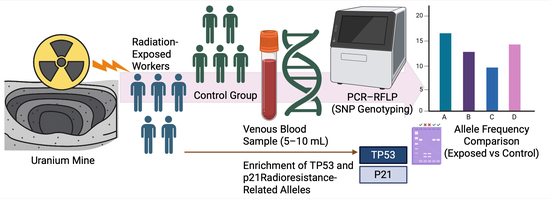
Background: Interindividual radiosensitivity is largely driven by genetic regulation of DNA damage recognition, repair, and cell-cycle control. TP53 and CDKN1A (p21) are key genomic markers associated with differential responses to ionizing radiation. Methods: This study investigated eight functional SNP markers across several key genes involved in DNA damage responses and cellular stress regulation, including TP53, CDKN1A/p21, APC, VEGF, XPD, and RAD51, in occupational groups exposed to chronic low-dose ionizing radiation at the Stepnogorsk Mining Chemical Combine and the Balkashinskoye uranium deposit. Genotyping was performed using PCR-based assays followed by restriction fragment length polymorphism (RFLP) analysis. Allele and genotype frequencies were compared between radiation-exposed workers and matched controls within Kazakh and Russian ethnic subgroups. Statistical differences were assessed using χ2 tests, and associations with radioresistance were interpreted based on established functional characteristics of each polymorphism. Results: Four SNPs showed significant allele and genotype frequency shifts in radiation-exposed populations. The TP53 intron 3 insertion allele, TP53 intron 6 A allele, TP53 Pro72 (C) allele, and p21 codon 31 A allele were consistently enriched among exposed individuals. The strongest deviations were observed in Russian workers from Stepnogorsk (p < 0.01). These alleles are functionally associated with enhanced DNA repair efficiency, modified apoptotic responses, and strengthened cell-cycle checkpoint regulation. Conclusions: Significant enrichment of radioresistance-associated TP53 and CDKN1A (p21) variants was observed in uranium industry workers chronically exposed to low-to-moderate ionizing radiation. The observed patterns support a polygenic model of adaptive responses and emphasize the importance of genetic background in determining individual radiosensitivity under occupational exposure conditions.
Keywords: radioresistance; TP53; p21; chronic radiation exposure; radiogenomics; DNA damage response radioresistance; TP53; p21; chronic radiation exposure; radiogenomics; DNA damage response
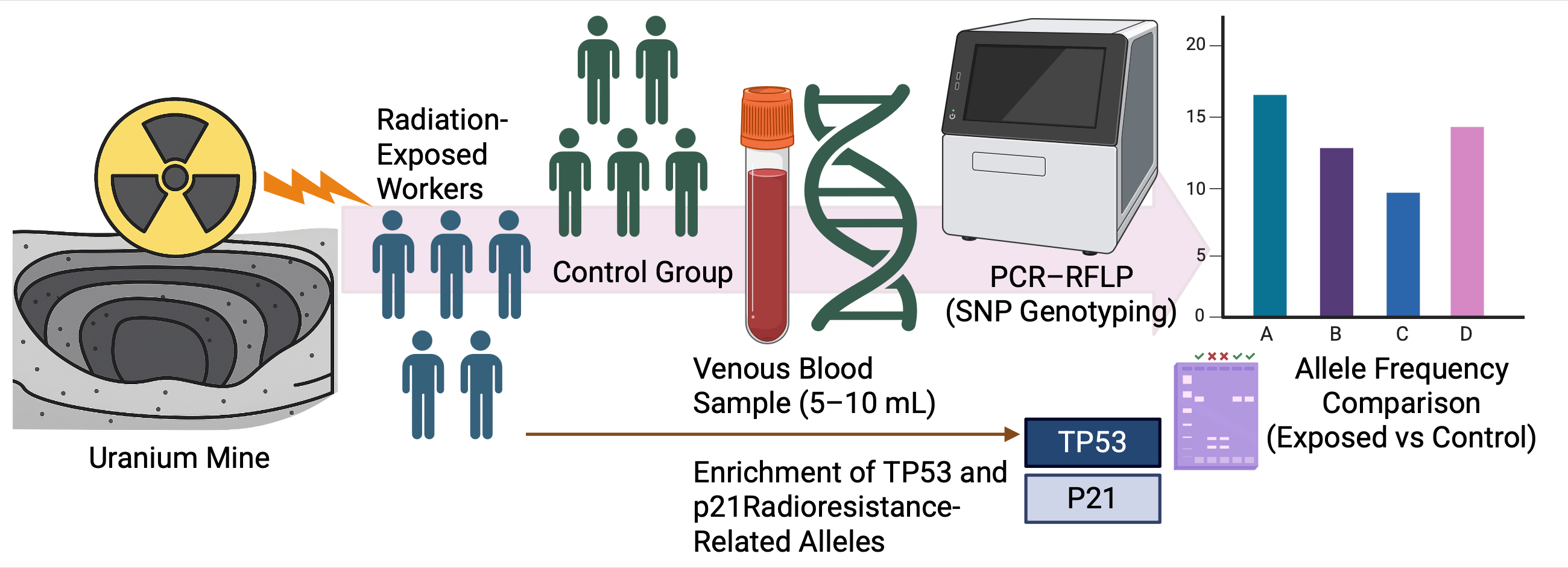
Graphical Abstract