


Abstract
Conventional short tandem repeat (STR)-based DNA profiling has transformed forensic identification; however, its investigative utility may be limited when no matching profile is available in forensic DNA databases. Forensic genetic genealogy (FGG) addresses this limitation by combining genome-wide single-nucleotide polymorphism (SNP) analysis with genetic genealogy and traditional genealogical research. Investigative forensic genetic genealogy (iFGG) emphasizes the application of these approaches to generate investigative leads. Unlike conventional DNA profiling, FGG enables the investigation of distant genetic relationships, although its findings require independent forensic verification. This narrative review critically examines the scientific principles, methodological developments, forensic applications, and limitations of FGG, particularly in cold case investigations and the identification of unidentified human remains. It also evaluates challenges related to DNA quality, mixed DNA profiles, population representation, database accessibility, genealogical interpretation, and the reliability of bioinformatic analyses. Genetic privacy, including its implications for biological relatives, and associated ethical and legal considerations are discussed, with particular attention to the potential application of FGG in Türkiye. By integrating scientific, investigative, and ethical perspectives, this review highlights the distinction between genealogical investigative leads and forensic evidence and identifies the need for methodological validation, transparent governance, and appropriate safeguards for genetic privacy.
1. Introduction
One of the primary objectives of forensic medicine and forensic sciences is to generate reliable and objective information that can be used in legal proceedings through the application of scientific methods. In this context, the examination of biological materials has become one of the most powerful tools in forensic investigations, particularly with the advancement of DNA analysis. The genetic variability among individuals and the ability to recover DNA from biological samples make DNA analysis a valuable tool for human identification.
With the widespread adoption of DNA profiling in forensic sciences, genetic profiles obtained from blood, saliva, semen, hair roots, tissue, and other biological materials have increasingly been used in investigations. The fundamental approach in conventional forensic DNA analysis is to compare a DNA profile obtained from a crime scene with a reference sample collected from a suspect or with a profile contained in a forensic DNA database [1]. This approach is highly effective for individuals whose profiles are already present in the database or whose identities are known to investigators.
However, a major limitation of conventional forensic DNA profiling arises when an individual’s genetic profile is absent from available forensic databases. The high discriminatory power of a DNA profile obtained from a crime scene may not, by itself, reveal the identity of the individual from whom the DNA originated. If no reference profile from the same individual is available or if the individual’s profile is not present in existing forensic DNA databases, the conventional comparison method may fail to yield a “match.” Beyond conventional STR-based profiling, advances in genomic technologies have expanded the analytical capabilities of forensic genetics. Massively parallel sequencing (MPS) enables the simultaneous analysis of multiple genetic markers, including STRs and single-nucleotide polymorphisms (SNPs), and can provide additional sequence-level information relevant to forensic identification [2]. Genome-wide SNP profiling, performed using high-density SNP microarrays or suitable sequencing approaches, has facilitated the investigation of distant genetic relationships and provides an important technical foundation for forensic genetic genealogy [3]. In parallel, computational and bioinformatics approaches are increasingly important for processing complex genomic datasets and interpreting genetic relationships. Although artificial intelligence-assisted methods are being explored in forensic genetics, their specific applications in FGG require further validation before they can be considered established components of routine investigative workflows [4].
It is precisely at this point that a technology that has attracted considerable attention in recent years has emerged: forensic genetic genealogy (FGG). The terms forensic genetic genealogy (FGG), investigative forensic genetic genealogy (iFGG), and forensic investigative genetic genealogy (FIGG) are used in the literature to describe closely related approaches, although their terminology and scope are not fully standardized. FGG is used in this review as a broad term describing the integration of genetic analysis and genealogical research for forensic purposes, including criminal investigations and the identification of unidentified human remains. The term investigative forensic genetic genealogy (iFGG), as proposed by Tuazon et al. in 2024, specifically refers to the use of genetic genealogy by law enforcement agencies to generate investigative leads concerning potential suspects in criminal investigations [5]. Accordingly, this review uses FGG as the overarching term, while iFGG is employed when specifically referring to investigative applications, consistent with the terminology proposed in the literature [5].
FGG uses genomic data not only to answer the question, “Whose DNA is this?” but also to investigate the question, “To whom might this individual be genetically related?” Thus, even when genetic data belonging to the individual are not available, it may be possible to progress toward identification through the genetic data of their biological relatives [6,7].
This approach has demonstrated considerable potential, particularly in homicide and sexual assault cases that have remained unsolved for decades, as well as in investigations involving unidentified human remains. The use of genetic genealogy methods to identify Joseph James DeAngelo, known as the Golden State Killer, in the United States in 2018 brought this technology to widespread public attention [8].
However, the success of this method also creates a new ethical paradox: when an individual voluntarily uploads their DNA to a genetic genealogy database, their genetic relatives may also become indirectly searchable. Therefore, the privacy of genetic data is no longer limited solely to the privacy of the individual whose DNA is analyzed [8].
2. Review Methodology
This narrative review examines selected scientific literature on forensic genetic genealogy (FGG), focusing on its scientific foundations, methodological developments, forensic applications, technical limitations, and ethical and legal implications. The literature also uses the term forensic investigative genetic genealogy (FIGG) to describe the integration of genetic analysis and genealogical research in forensic investigations, including criminal investigations and the identification of unidentified human remains [9,10,11]. Accordingly, both FGG and FIGG terminology were considered in evaluating the relevant literature. The literature search was primarily based on PubMed, resources from the National Institute of Justice, and peer-reviewed publications in scientific journals.
The literature search used the key terms “forensic genetic genealogy,” “forensic investigative genetic genealogy,” “investigative genetic genealogy,” “forensic DNA,” “genetic genealogy,” “familial searching,” “genetic privacy,” “forensic genetics,” “SNP,” “STR,” and “human identification.”
The literature search was conducted between March and August 2026. Priority was given to relevant peer-reviewed studies published between 2019 and 2025, while earlier foundational publications and institutional documents were also considered. Publications were selected according to their relevance to the scope of this review. Current statements issued by the Turkish Personal Data Protection Authority and relevant provisions of Personal Data Protection Law No. 6698 were also examined to evaluate the legal context governing genetic data protection in Türkiye.
As this study was designed as a narrative review, the selected literature was synthesized thematically to integrate evidence on the scientific foundations, methodological developments, forensic applications, limitations, and ethical and legal implications of FGG. Particular attention was given to identifying common findings, methodological differences, and areas of uncertainty across the reviewed publications.
3. From Conventional Forensic DNA Profiling to Genomic Approaches
3.1. STR-Based DNA Profiling
Short tandem repeats (STRs) are widely used in conventional forensic DNA profiling. STRs are polymorphic regions of the genome consisting of tandemly repeated DNA sequence motifs, typically 2–6 base pairs in length, with the number of repeat units varying among individuals. Allelic differences at these loci provide high discriminatory power for human identification [12].
Once an STR profile has been generated, it can be compared with a reference profile. If sufficient concordance is observed, the evidential significance of the findings is assessed statistically. Importantly, forensic DNA analysis is not merely a determination of whether profiles “match” or “do not match.” Statistical approaches based on population genetics, probability, and likelihood ratios are used to evaluate the strength of DNA evidence [12].
The DNA Commission of the International Society for Forensic Genetics (ISFG) continues its efforts to standardize the nomenclature and reporting of STR sequences [13]. Massively parallel sequencing (MPS) technologies enable the analysis of both STR numbers and sequence-level variation, potentially increasing the discriminatory power of forensic DNA profiling [14].
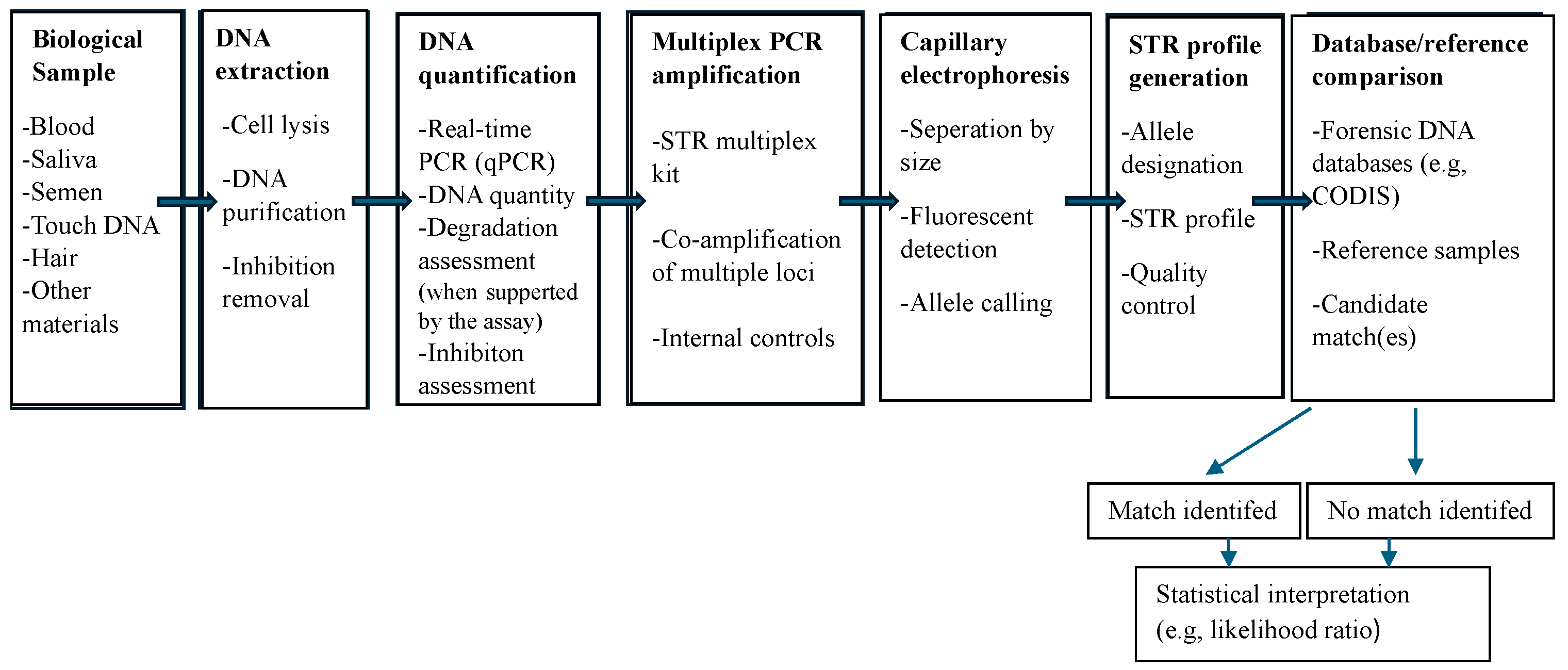
Conventional forensic DNA profiling typically involves the analysis of autosomal STR loci, which exhibit variation in the number of repeated DNA sequences among individuals. Commonly used markers include TH01, TPOX, vWA, FGA, D3S1358, D8S1179, and D21S11. Following DNA extraction and quantification, selected STR loci are amplified using multiplex polymerase chain reaction (PCR), and the resulting fragments are generally separated and detected by capillary electrophoresis. The resulting allelic profile can then be compared with reference samples or profiles stored in forensic DNA databases. Statistical interpretation, including likelihood ratios where appropriate, provides a framework for evaluating the evidential strength of DNA profiling results under competing hypotheses. Although STR profiling is highly effective for direct comparisons and close kinship analysis, conventional forensic STR panels provide more limited information for investigating distant genetic relationships than genome-wide SNP datasets [6,12,13]. The conventional STR-based forensic DNA profiling workflow is illustrated in Figure 1.
Figure 1.
Schematic workflow of conventional STR-based forensic DNA profiling. Biological samples undergo DNA extraction, quantification, multiplex PCR amplification, and capillary electrophoresis to generate an STR profile, which is compared with reference samples or forensic DNA databases. A candidate match is evaluated using appropriate statistical methods (e.g., likelihood ratio). The absence of a match does not necessarily indicate analytical failure or poor DNA quality.
3.2. Limitations of STR Profiles
An important advantage of STR profiling is its standardization and its applicability across numerous forensic DNA databases. However, compared with genome-wide SNP-based methods, conventional STR profiling provides more limited information for investigating distant kinship relationships and reconstructing genealogical relationships.
These limitations become particularly relevant when an individual’s profile is absent from forensic DNA databases, when no matching profile can be identified, or when close relatives of unidentified human remains are unavailable for comparison. Additional challenges arise when biological samples are old or degraded, when DNA quantity is insufficient, or when the investigation requires the identification of distant genetic relatives. Such circumstances have contributed to the development of broader genomic approaches that complement conventional STR-based forensic identification [15].
The limitations of conventional STR profiling should be distinguished according to their underlying causes. The absence of a matching profile in a forensic DNA database represents an investigative limitation rather than an analytical failure, whereas DNA degradation, low template quantity, and complex mixtures may directly affect the generation and interpretation of genetic profiles. Although genome-wide SNP analysis can provide additional information for investigating distant genetic relationships, its performance depends on the quantity and quality of the available DNA and the genotyping platform employed. In particular, SNP microarray-based approaches may produce incomplete or inaccurate genotypes when applied to highly degraded or low-quantity samples. Therefore, the transition from STR profiling to SNP-based forensic genetic genealogy (FGG), also referred to as forensic investigative genetic genealogy (FIGG) in the literature, should be regarded as a complementary investigative strategy rather than a universally superior alternative to conventional forensic DNA analysis [9,16].
Other forensic genetic approaches, including Y-chromosomal STR analysis and mitochondrial DNA analysis, may provide valuable lineage information, particularly in cases involving paternal or maternal relationships, respectively. However, these methods generally offer more limited individual discrimination within the same paternal or maternal lineage and do not replace the genome-wide genealogical approach used in FGG [7,17].
4. What Is Forensic Genetic Genealogy?
Forensic genetic genealogy (FGG) combines genomic data obtained from forensic biological samples with genetic genealogy methods and traditional genealogical research to generate investigative leads regarding unidentified individuals. This approach is also widely referred to as forensic investigative genetic genealogy (FIGG) in the scientific literature [9,10].
The terminology used in this field has not been fully standardized. Although FGG and FIGG are frequently used as alternative terms, some publications distinguish between the genetic profiling and investigative components of the process. In particular, the National Technology Validation and Implementation Collaborative (NTVIC) guidance distinguishes FGG, which involves developing SNP profiles for genealogical database searches, from investigative genetic genealogy (IGG), which encompasses genealogical research and investigative lead generation [10]. Furthermore, Tuazon et al. (2024) proposed the term investigative forensic genetic genealogy (iFGG) to describe applications involving law enforcement investigations [5].
The fundamental difference between FGG and conventional forensic DNA matching is that FGG does not necessarily require a direct DNA match with the individual under investigation. Instead, it can identify potential biological relatives through genome-wide genetic comparisons, enabling genealogical reconstruction and the generation of investigative leads [6,9].
Unlike conventional familial DNA searching, which primarily uses STR profiles in forensic DNA databases to identify potential close biological relatives, forensic genetic genealogy (FGG), also referred to as forensic investigative genetic genealogy (FIGG) in much of the literature, employs genome-wide SNP data and genealogical research to investigate more distant genetic relationships. These approaches therefore differ in their genetic markers, database architecture, kinship detection capabilities, and investigative workflows. Although both approaches can generate investigative leads, neither establishes a confirmed forensic identification without additional investigative verification and appropriate confirmatory DNA testing [6,9,10,18].
For example, in a typical FGG workflow, DNA obtained from a crime scene is used to generate a genomic SNP profile, which is compared with genetic genealogy databases to identify potential biological relatives. These matches are used to reconstruct family trees, identify possible family lines, and narrow the investigation to potential individuals. The resulting investigative leads are subsequently subjected to independent verification.
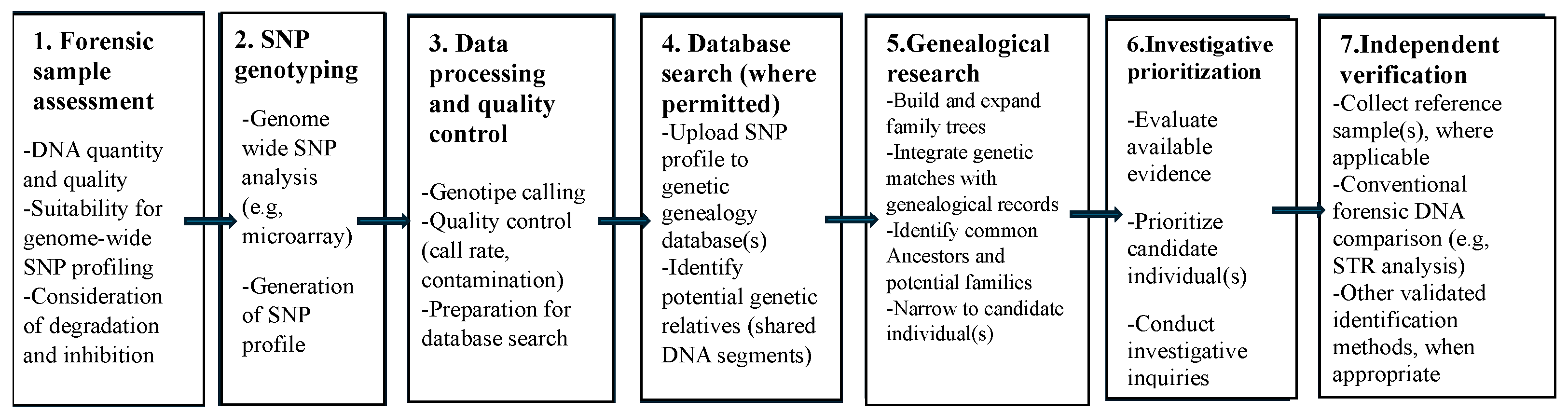
The application of forensic genetic genealogy involves a multistage process integrating laboratory analysis, computational processing, genealogical research, and conventional forensic investigation. Initially, the biological sample is assessed for DNA quantity, quality, and suitability for genome-wide SNP profiling. Following the selection of an appropriate genotyping platform, SNP data are generated and subjected to quality control before being prepared for comparison with genetic genealogy databases that permit the relevant forensic use. Potential genetic relatives are identified through shared genomic segments, particularly identity-by-descent (IBD) segments inherited from common ancestors, and the resulting matches are evaluated alongside genealogical records to reconstruct family relationships and identify possible common ancestors. Subsequent genealogical and investigative research may narrow the search to one or more candidate individuals. Importantly, these findings constitute investigative leads rather than definitive forensic identifications. When a candidate is identified, independent confirmation through appropriate forensic DNA comparison is required before a source attribution can be established [6,19]. The principal stages of the FGG workflow are illustrated in Figure 2.
Figure 2.
Schematic workflow of forensic genetic genealogy (FCG). The process includes forensic sample assessment, genome-wide SNP genotyping, data processing and quality control, database search to identify potential genetic relatives, genealogical research, investigative prioritization, and independent verification using conventional forensic DNA testing or other validated identification methods, when appropriate. Findings from FGG provide investigative leads and require independent confirmation before a source attribution can be established.
5. Scientific Basis of FGG
An investigative chain following this sequence can be established.
Therefore, the output of FGG is often not a “definitive identification that can be presented in court,” but rather an investigative lead. This distinction is of critical importance from a forensic perspective.
5.1. SNPs
The analysis of a large number of single-nucleotide polymorphisms (SNPs) is fundamental to FGG. SNPs represent variations at individual nucleotide positions within the DNA sequence. While conventional STR profiling examines a relatively small number of highly polymorphic loci, genome-wide SNP profiling used in genetic genealogy typically analyzes hundreds of thousands of markers distributed across the genome. This extensive genomic information enables the detection of shared DNA segments inherited from common ancestors, facilitating the investigation of distant genetic relationships between individuals.
5.2. Degree of Relatedness
In genetic genealogy, potential kinship relationships can be inferred by examining the amount and distribution of DNA shared between two individuals, particularly identity-by-descent (IBD) segments inherited from common ancestors. Close relatives generally share a greater amount of DNA, whereas the amount and distribution of shared genetic material change as the degree of relatedness becomes more distant. However, interpreting genetic relatedness is not straightforward, as similar amounts of shared DNA may be consistent with multiple categories of kinship.
Therefore, genealogical research evaluates genetic evidence, including the total amount of shared DNA and the number and lengths of shared segments, alongside other information such as age, geographic location, genealogical records, birth and marriage records, sibling relationships, and migration patterns. These sources of information are evaluated collectively to reconstruct family relationships and identify potential common ancestors.
Genome-wide SNP profiles used in FGG can be generated using high-density SNP microarrays or sequencing-based approaches. However, these methods differ in their analytical requirements and performance, particularly when DNA is degraded or available in limited quantities. Insufficient DNA quality or quantity may result in incomplete or unreliable SNP profiles, potentially reducing the accuracy of downstream kinship inference. Therefore, the suitability of the genotyping approach should be assessed according to sample characteristics and the validated capabilities of the laboratory method [6,16].
6. FGG Application Process
Although the operational process of FGG may vary across countries and laboratories, it can generally be divided into several stages.
6.1. Evaluation of the Crime Scene Sample
In the first stage, the biological material obtained from the crime scene is evaluated to determine whether it is suitable for FGG. Factors such as DNA quantity, DNA integrity, contamination, mixture profiles, and the biological source of the sample may affect the success of the analytical process. In particular, DNA mixtures containing genetic contributions from multiple individuals may complicate SNP profiling and the interpretation of genealogical matches. Single-source samples are generally preferred, although some laboratories may process mixed samples depending on the relative contributions of the individuals and the analytical method employed. Sample quality is one of the fundamental limiting factors in forensic genetics. Although next-generation sequencing technologies have expanded the capacity to analyze challenging samples, these technologies do not make poorly preserved or very low-quantity DNA samples universally suitable for analysis [19].
6.2. Generation of the SNP Profile
The aim of this stage is to obtain high-density SNP data from a suitable forensic biological sample. Unlike conventional STR profiling, which examines a limited number of highly polymorphic loci, FGG requires genomic data covering a substantially larger number of SNP markers. These profiles can be generated using high-density SNP microarrays, whole-genome sequencing (WGS), or targeted SNP sequencing approaches. The selection of an appropriate method depends on DNA quantity, degradation, sample composition, and the compatibility of the resulting data with genetic genealogy databases. The resulting genomic dataset enables the identification of shared DNA segments and the investigation of distant genetic relationships between individuals [19].
6.3. Search in a Genetic Database
The generated SNP profile can be searched against genetic genealogy databases that permit the relevant forensic use under applicable legal frameworks and database policies. Unlike conventional forensic DNA databases, which primarily contain STR profiles, genetic genealogy databases used in FGG enable comparisons based on genome-wide SNP data to identify potential biological relatives [6,19]. An important distinction should be made here: not all genetic genealogy companies or databases have the same policies regarding law enforcement use. In their 2020 review, Skeva et al. demonstrated that the 22 companies and databases examined had adopted different policies regarding law enforcement access [20]. Therefore, genetic genealogy databases should not be regarded as uniform in their technical characteristics or access policies.
Greytak et al. described the practical application of GEDmatch in forensic genetic genealogy, including one-to-many searches to identify database participants sharing autosomal DNA with an unknown sample contributor and subsequent one-to-one comparisons to examine the length and chromosomal location of shared DNA segments. These matches can guide genealogical research to identify potential common ancestors, followed by descendancy research to reconstruct family lines and narrow the range of possible candidates. However, the effectiveness of this approach depends on the availability of informative genetic matches and the completeness of genealogical records, and the resulting genealogical hypotheses should be treated as investigative leads rather than definitive identifications [6].
6.4. Construction of the Family Tree
Once genetic matches are obtained, researchers can investigate the genealogical relationships of these individuals. This stage is one of the most labor-intensive components of the method. A genetic match alone may not be sufficient; numerous family records and potential genealogical connections may need to be investigated to identify common ancestors and trace relevant family branches. Greytak et al. emphasized that FGG is sometimes oversimplified in public discourse as “upload the DNA to a database and find the perpetrator,” whereas, in reality, a database match represents only the beginning of a more comprehensive investigation [6].
6.5. Independent Verification of the Hypothesis
The potential individual or individuals identified through FGG must be independently verified as part of the investigation. This stage is critically important. A genetic genealogy result alone does not establish a definitive identification or demonstrate that an individual is guilty. The role of FGG is to generate an investigative lead. The hypothesis must subsequently be evaluated through appropriate confirmatory DNA testing and other independent investigative evidence, as applicable [19]. Even when a DNA association is confirmed, its evidential significance must be assessed within the broader circumstances of the case.
7. The Importance of FGG in Cold Cases
One of the most notable applications of FGG is in cold cases, that is, investigations that have remained unsolved for many years. When no match is found in a conventional forensic DNA database, an investigation may remain unresolved for an extended period. However, the presence of DNA at a crime scene provides an important resource for the application of emerging technologies. With the increasing use of FGG in the United States, new investigative avenues have emerged in numerous historical criminal cases. The National Institute of Justice states that FGG can be used as an investigative tool, particularly in violent crimes for which no match is found in existing DNA databases and in cases involving unidentified human remains [19].
This is particularly relevant to forensic medicine because establishing the identity of deceased individuals is an essential component of medicolegal death investigations, and conventional identification methods may be insufficient in some cases. Greytak et al. reported that 367 identifications of previously unidentified human remains using investigative genetic genealogy had been publicly announced at the time of their publication [21].
For example, in cases involving skeletonized human remains discovered many years ago, forensic anthropological examination may first be used to establish a biological profile. DNA analysis can then be performed to obtain genetic information, followed by SNP profiling and genetic genealogy research when appropriate. Potential biological relatives may be identified through genealogical database comparisons, and family tree reconstruction may help establish a possible identity. The proposed identification must subsequently be verified through appropriate comparative DNA testing or other independent identification methods [21].
Therefore, FGG is not limited to generating investigative leads concerning potential perpetrators; it can also contribute to the identification of unidentified human remains.
A notable example of the practical application of investigative forensic genetic genealogy (iFGG) is the 2004 double homicide in Linköping, Sweden, which remained unsolved for approximately 16 years. Following unsuccessful conventional investigative efforts, genome-wide SNP data were used to investigate distant genetic relationships and reconstruct genealogical connections. The genealogical investigation narrowed the search to two brothers, one of whom was subsequently linked to the crime through conventional STR-based DNA comparison. This case demonstrates the potential of iFGG to generate actionable investigative leads when conventional approaches have failed. However, it also highlights important methodological considerations, including the challenges associated with obtaining suitable genomic data from compromised forensic samples and the need to distinguish genealogical leads from independently verified forensic evidence. Thus, the Linköping investigation illustrates both the investigative value and the technical limitations of iFGG [22].
Another prominent example is the Golden State Killer investigation in the United States, which led to the identification of Joseph James DeAngelo as a suspect in 2018. Following unsuccessful conventional forensic DNA database searches, investigators used genetic genealogy to identify potential relatives and develop genealogical leads that contributed to narrowing the investigation. The case demonstrated how genetic relationships inferred from genealogy databases could assist criminal investigations even when a direct match was unavailable in conventional forensic databases. Nevertheless, genealogical findings were not sufficient on their own to establish the suspect’s identity, and independent forensic DNA comparison was necessary. Beyond its investigative significance, the case also generated substantial ethical debate concerning law enforcement access to genetic genealogy databases, informed consent, and the genetic privacy of individuals whose relatives may be implicated through database searches [7,8].
8. Advantages of FGG in Forensic Medicine
8.1. A New Investigative Avenue in Cases Without a Database Match
A profile that does not yield a match in a conventional DNA database can be investigated through kinship relationships using FGG. This feature is particularly important for cold cases.
8.2. Investigation of Unidentified Bodies
In cases involving unidentified human remains, direct relatives such as parents, children, or siblings may not be available. In such cases, the investigation of distant kinship relationships may provide an important alternative.
8.3. Complementing Traditional Investigative Methods
One of the most important features of FGG is that it serves as a complementary investigative tool rather than an alternative to conventional forensic methods. When used in conjunction with forensic anthropology, forensic pathology, STR analysis, dental records, fingerprints, and other identification methods, it can contribute to a more comprehensive investigative framework.
8.4. Re-Evaluation of Old Biological Evidence
With advances in technology, some biological materials previously considered insufficient may be re-evaluated. The inclusion of numerous emerging approaches, such as SNP analysis, microbiome research, RNA analysis, DNA transfer studies, DNA phenotyping, and FGG, among the research areas of the National Institute of Justice reflects the increasing diversity of molecular and genomic approaches in forensic biology [23].
9. Limitations of FGG
The portrayal of FGG in the media and popular culture as an almost “infallible identification method” is not scientifically accurate.
9.1. Database Size
The effectiveness of forensic genetic genealogy depends not only on the overall size of a genetic genealogy database but also on its population composition, the degree of genetic relatedness among its participants, and the availability of profiles eligible for forensic searching. Although larger databases may increase the likelihood of identifying genetically related individuals, the presence of numerous profiles does not necessarily guarantee an informative match. Investigative success may be limited when the relevant population is underrepresented, when available matches involve distant relatives, or when database access is restricted by user consent preferences and platform policies. Therefore, database size should not be regarded as an independent indicator of FGG performance; rather, it must be evaluated alongside population representation, genetic relatedness, and the practical accessibility of relevant profiles [6,7,20,24]. The principal differences in the accessibility and forensic use policies of selected genetic genealogy databases are summarized in Table 1.
Table 1.
Comparison of Genetic Genealogy Databases Relevant to Forensic Investigations.
9.2. Population Bias
Genetic databases may not represent all populations equally. Greater representation of certain populations in genetic databases may increase investigative capacity for some groups while reducing it for others. This issue is related to a broader problem in forensic genetics, namely the representation of reference populations [29].
In FGG, such disparities may affect the likelihood of identifying informative genetic relatives and reconstructing genealogical relationships, particularly when individuals from the relevant population are underrepresented in accessible databases. Consequently, investigative success cannot be assumed to be uniform across populations, and the interpretation of negative or inconclusive database searches should take population representation into account [6,7].
9.3. Incomplete Genealogical Records
Genetic genealogy is not solely a form of DNA analysis. Genealogical records may contain errors. Factors such as adoption, informal parentage, incomplete records, name changes, and migration may complicate the reconstruction of a family tree.
9.4. Mixed DNA Profiles
DNA mixtures represent an important analytical challenge in forensic genetics, particularly when biological material originates from multiple contributors or contains low quantities of DNA. Although conventional STR-based mixture interpretation has benefited from advances in statistical modeling, challenges remain in the interpretation of complex DNA mixtures [30]. These developments should not be assumed to translate directly to genome-wide SNP profiling used in forensic genetic genealogy. Standard SNP genotyping workflows for FGG generally require a sufficiently reliable genetic profile attributable to an individual, and mixed-source samples may complicate genotype assignment and downstream kinship inference. Consequently, the presence of a DNA mixture should be considered a potential limitation of FGG, and the feasibility of further analysis should be evaluated according to the characteristics of the sample and the validated capabilities of the selected laboratory method [6,16].
9.5. False-Positive Results or Incorrect Genealogical Hypotheses
A genetic match does not definitively establish that a particular individual is the source of a crime scene sample. Multiple individuals within the same family may be genetically similar. Furthermore, researchers may misinterpret a family tree or incorrectly link incomplete records. Therefore, it should be recognized that FGG serves as a hypothesis-generating tool during the investigative process. As emphasized in the literature on familial DNA searching, genetic relatedness may generate investigative leads but does not independently establish individual identification; therefore, genealogical hypotheses should be corroborated through conventional forensic DNA analysis or other independent evidence [29].
10. Difference Between Forensic DNA Phenotyping and FGG
When discussing the future of FGG, it should not be confused with forensic DNA phenotyping. Forensic DNA phenotyping aims to make probabilistic inferences about an individual’s physical appearance or biogeographical ancestry based on specific genetic variations in DNA. For example, genetic variations associated with eye, hair, and skin pigmentation can be investigated.
A comprehensive review published in 2024 examined SNP panels and prediction models used in forensic DNA phenotyping and reported standardization issues among different panels with respect to terminology, trait measurement, the level of genetic information, and prediction models [31].
FGG, in contrast, primarily seeks to establish identity through kinship and genealogical relationships.
These approaches can be distinguished as follows (Table 2):
Table 2.
Comparison of forensic DNA analysis approaches and their fundamental investigative questions.
Although FGG and forensic DNA phenotyping may provide complementary investigative information, they are distinct approaches with different analytical objectives. Their combined use should not be regarded as an established or routinely validated forensic workflow [6,31].
However, phenotyping results should not be interpreted as definitive physical characteristics. In particular, using the concepts of “genetic ancestry” and “race” interchangeably is scientifically and ethically problematic. The forensic genetics literature contains important warnings regarding the societal implications of conflating biogeographical ancestry, population structure, and the concept of “race” [32].
11. Genetic Privacy: The Major Ethical Concern of FGG
The most controversial aspect of FGG is genetic privacy. Unlike conventional forms of personal data, genetic information does not provide information solely about the individual. It may also contain information about their biological relatives. For example, when an individual voluntarily uploads their genetic data, this may indirectly provide information about the genetic relationships of their siblings, parents, children, or more distant relatives. Therefore, genetic privacy has not only an individual but also a familial dimension.
Kennett noted that the use of genetic genealogy databases by law enforcement may affect not only individuals who upload their DNA to a database but also their relatives who have not undergone DNA testing [7].
This situation challenges the conventional understanding of consent. Although individuals may voluntarily consent to the use of their genetic data, such consent does not constitute consent on behalf of their biological relatives, who may nevertheless be indirectly affected by genetic genealogy investigations. Therefore, FGG raises ethical concerns that extend beyond individual consent and require consideration of familial genetic privacy [7,8,33].
The ethical challenges associated with familial genetic information have also been examined beyond the context of forensic investigations. Phillips et al. systematically reviewed 35 normative documents addressing the disclosure of genetic information to family members, highlighting the complex relationship between individual confidentiality and familial interests [34]. Although these recommendations primarily concern clinical genetics and cannot be directly transferred to forensic investigations, they demonstrate that genetic privacy cannot be adequately addressed through an exclusively individual-centered approach. Similarly, Cho and Sankar emphasized the ethical, legal, and social implications of genetic information being used beyond its original context [35]. Considered together, these perspectives suggest that FGG requires a broader ethical framework that accounts for the interests of both database participants and their biological relatives, while recognizing the fundamental differences between clinical genetic disclosure and law enforcement access to genealogical information.
12. Security of Genetic Data
Genomic information is inherently sensitive because it contains persistent biological identifiers and may reveal information about an individual’s genetic characteristics and biological relatives. Unlike many other forms of personal information, an individual’s inherited genomic sequence cannot be readily altered following unauthorized disclosure. Consequently, breaches involving genomic data may have long-term privacy implications, highlighting the importance of secure data storage, controlled access, and appropriate safeguards against unauthorized use [33,36].
The literature on genomic data sharing has demonstrated that privacy may be compromised through identification, the disclosure of sensitive traits, and the integration of datasets from different sources [33]. In FGG, the issue is even more complex because the genetic information contained in a database may have been generated for genealogical rather than medical purposes. Therefore, when users upload their DNA to a database, they may not have anticipated the possibility of future law enforcement access.
13. Legal and Ethical Issues
The development of FGG has raised questions regarding how existing legal systems define genetic data and under what conditions law enforcement authorities may access such data.
Key legal and ethical considerations include determining which categories of crimes justify the use of FGG, which genetic databases may be accessed, and whether judicial authorization is required. Another important issue concerns whether individuals who upload their genetic data should provide explicit consent for law enforcement use and how the privacy of biological relatives who have not undergone genetic testing should be protected.
Additional concerns relate to the duration of genetic data retention, the protection of genetic information belonging to family members who are not implicated in an investigation, and the conditions under which law enforcement authorities may access genetic data held by private companies.
A policy Delphi study published in 2025 reported that experts in FGG prioritized issues related to consent and notification, case eligibility, data management, privacy, security, governance, and accountability [37]. This finding demonstrates that technological advancement alone is not sufficient.
The reliable application of FGG also requires an ethical and legal governance framework. Relevant ethical principles can also be identified in other areas of human genetic research. Alpaslan-Roodenberg et al. proposed five guidelines for DNA research involving human remains, emphasizing compliance with applicable regulations, clearly defined research objectives, minimization of damage to remains, responsible data accessibility, and engagement with relevant stakeholders [38]. Although these guidelines were developed primarily for ancient DNA research and do not directly regulate forensic genetic genealogy, several underlying principles, particularly transparency, responsible data management, and stakeholder engagement, may inform ethical discussions surrounding FGG. Nevertheless, their application to forensic investigations requires careful consideration of the distinct legal obligations, investigative objectives, and privacy implications associated with law enforcement use of genetic information.
14. Evaluation from the Perspective of Türkiye
From the perspective of Türkiye, FGG is particularly important because of the legal status of genetic data. Under Personal Data Protection Law No. 6698 (KVKK), biometric and genetic data are considered special categories of personal data [39]. The Turkish Personal Data Protection Authority has also emphasized the sensitive nature of genetic data and the need for appropriate safeguards.
Within this framework, the question “Is it technically feasible?” alone is not sufficient when considering the potential use of FGG in Türkiye. Additional considerations include the purpose and legal basis of data processing, the identity of the data controller and other parties involved in processing, data retention periods, data sharing practices, security measures, and the protection of the rights of data subjects and their biological relatives.
Particularly when FGG relies on databases maintained by direct-to-consumer genetic testing companies, conflicts between different legal systems may arise. Another issue concerns cross-border data transfers. Genetic data collected in one country may be stored in the database of a company located in another country. In such cases, the access authority of judicial authorities, data protection legislation, and international judicial cooperation rules should be evaluated together.
In Türkiye, the legal evaluation of FGG should consider both the Code of Criminal Procedure (Law No. 5271) and the Personal Data Protection Law (Law No. 6698). Articles 78–80 of the Code of Criminal Procedure regulate molecular genetic examinations, judicial authorization, and the use and handling of genetic examination results [40]. Genetic data are classified as special categories of personal data under Article 6 of Law No. 6698, while Article 28 establishes exemptions applicable to certain judicial activities [39]. However, these provisions do not explicitly regulate FGG or establish a general authorization for its use. Therefore, the potential application of FGG requires careful consideration of the applicable legal framework, genetic privacy, database access, and cross-border data transfers, including the provisions of Article 9 of Law No. 6698.
15. Distinction Between an “Investigative Lead” and “Forensic Evidence” in FGG
From a forensic medicine perspective, this is perhaps the most important conceptual distinction. As a result of FGG, investigators may identify an individual or a family. However, such a result does not establish that the identified individual is guilty. Rather, based on the available genetic and genealogical data, the individual should be regarded as a potential person of interest who warrants further investigation.
This distinction is a fundamental principle in the interpretation of evidence in forensic sciences. The purpose of FGG is to narrow the scope of the investigation. Subsequently, whether the identified candidate is actually the source of the crime scene DNA should be evaluated through an independent forensic DNA analysis [19]. Therefore, FGG should be regarded not only as a method of identification but also as a method for guiding investigations. Even when an independent forensic DNA comparison supports a source attribution, this finding does not, by itself, establish criminal responsibility, which requires evaluation of the evidence within the broader investigative and judicial context [12].
16. Scientific Validity and Standardization
One of the most important issues in the implementation of new technologies in forensic sciences is validation. The success of a method in scientific research does not necessarily mean that it can be directly implemented in routine forensic practice.
In forensic practice, several aspects should be evaluated, including the accuracy, reproducibility, error rates, and limitations of the method, its performance across different populations, interlaboratory compatibility, and software validation.
For this reason, the validation of biostatistical software is also critically important in forensic genetics. The ISFG DNA Commission has developed specific recommendations for the verification and validation of biostatistical calculation software used in forensic genetics [41]. As FGG becomes more widely adopted, the development and implementation of appropriate standard operating procedures, quality control systems, and reporting standards will be essential [10].
17. The Future of FGG
The future of FGG may be shaped by several key technological developments.
17.1. Higher-Resolution Genomic Profiles
Next-generation sequencing technologies and expanded SNP panels may provide more detailed genetic data.
17.2. Artificial Intelligence and Bioinformatics
Artificial intelligence-assisted systems may be used to analyze large family trees, assess probabilities of genetic relatedness, and process complex datasets. However, the potential integration of artificial intelligence into FGG raises questions regarding algorithmic transparency, interpretability, and the need for appropriate validation before routine forensic implementation [41,42].
17.3. Larger International Databases
The expansion of genetic databases may increase the success of FGG. However, as databases grow, privacy risks may also increase. Therefore, a continuous balance between technological capacity and privacy will need to be maintained.
17.4. Multiple Sources of Biological Information
Future research may explore the integration of FGG with complementary approaches, including forensic DNA phenotyping, epigenetic analysis, proteomics, and microbiome-based methods. However, such integrated applications remain largely exploratory, and their forensic utility, reliability, and validation requirements must be established before routine implementation.
18. Discussion
Forensic genetic genealogy extends conventional DNA-based investigative approaches by enabling the exploration of genetic relationships beyond direct profile matching. Whereas conventional DNA profiling primarily seeks to determine whether a forensic sample matches an existing reference profile, FGG investigates potential familial and genealogical relationships to generate investigative leads.
This distinction is not merely technical but also concerns how genetic findings are interpreted during investigations. While conventional DNA profiling primarily focuses on comparisons between individual profiles, FGG incorporates broader familial and genealogical relationships to generate investigative leads [6,12]. The ethical implications of this shift are highly significant. Because an individual’s DNA contains information about their biological relatives, genetic data can no longer be regarded solely as individual data. Furthermore, as genetic genealogy databases expand, it may become possible to re-identify individuals who were previously considered anonymous. The genomic privacy literature has demonstrated that combining data from different sources may increase the risk of identification [33,36].
However, the investigative potential of FGG must be considered alongside its scientific and operational limitations. The success of genealogical investigations depends on factors such as DNA quality, the availability of informative genetic matches, population representation in accessible databases, and the completeness of genealogical records. These limitations may affect the reliability and practical utility of FGG and should be considered when interpreting investigative outcomes.
A comparison of the reviewed literature reveals that the challenges associated with FGG extend beyond technical feasibility and involve differences in investigative practices, database accessibility, and the interpretation of genetic relationships. Scudder et al. examined the operational implementation of forensic genetic genealogy in Australia, emphasizing the importance of adapting investigative procedures to the relevant technical and regulatory environment [24]. In contrast, Mateen et al. discussed the limitations of familial DNA searching, including interpretative challenges, database-related biases, and privacy concerns [29]. Although conventional familial DNA searching and SNP-based FGG are methodologically distinct, both approaches demonstrate that identifying genetic relatives does not independently establish the identity of a forensic sample contributor. Taken together, these studies highlight the need to distinguish investigative leads from confirmatory identification and suggest that the effectiveness of FGG should be evaluated not only in terms of successful case resolutions but also through methodological reliability, population representation, and operational safeguards.
On the other hand, the ethical debate should not be framed solely in terms of privacy. The pursuit of justice is also an ethical value. Solving a homicide case that has remained unresolved for years, providing information to the family of an unidentified individual, and linking serial crimes to one another may provide significant societal benefits.
Therefore, the central issue is not simply whether FGG should be used, but under what conditions, for which crimes, in which databases, and with what oversight mechanisms it should be implemented. This approach may help strengthen public trust in forensic genetics [37].
19. Conclusions
Forensic genetic genealogy is one of the most notable technological developments to emerge in forensic sciences in recent years. By complementing conventional DNA profiling through the analysis of genomic kinship relationships and genealogical records, FGG offers additional investigative opportunities, particularly in cold cases and the identification of unidentified human remains.
However, the strength of FGG also constitutes its fundamental limitation. Even when an individual’s DNA is not available, the method may enable investigators to approach the identification of that individual through their relatives. Although this feature is powerful from an investigative perspective, it is highly sensitive in terms of genetic privacy.
FGG results should be regarded as investigative leads rather than direct evidence of guilt. Once a potential candidate has been identified, identification should be established using independent and verifiable forensic evidence.
From a scientific perspective, database structure, differences in population representation, DNA quality, kinship models, the accuracy of genealogical records, and the reliability of bioinformatic analyses should be taken into consideration.
From an ethical perspective, attention should extend beyond the concept of individual consent to encompass familial genetic privacy. This is because an individual’s genetic data may also provide information about the genetic relationships of their biological relatives.
In Türkiye, the potential application of FGG requires consideration of the existing legal framework governing forensic genetic examinations and the protection of genetic data. Its implementation should therefore be evaluated within a multidisciplinary framework that addresses legal, ethical, scientific, and societal considerations.
In conclusion, forensic genetic genealogy is more than a technology for “identifying individuals through DNA.” It is a multidisciplinary field of research at the intersection of genomic science, forensic medicine, genetics, bioinformatics, genealogy, law, and ethics. In the future, the success of this technology will not depend solely on the development of more powerful algorithms or larger databases. The key determinant will be the establishment of a sustainable balance between scientific validity and individual privacy.
Author Contributions
Conceptualization, F.Z.K., Z.E., Ö.A. and K.K.; methodology, F.Z.K., Z.E., Ö.A. and K.K.; investigation, F.Z.K., Z.E., Ö.A. and K.K.; writing—original draft preparation, F.Z.K., Z.E., Ö.A. and K.K.; writing—review and editing, F.Z.K., Z.E., Ö.A. and K.K. All authors have read and agreed to the published version of the manuscript.
Funding
This research received no external funding.
Institutional Review Board Statement
Not applicable.
Informed Consent Statement
Not applicable.
Data Availability Statement
No new data were created or analyzed in this study. Data sharing is not applicable to this article.
Conflicts of Interest
The authors declare no conflicts of interest.
References
- Jobling, M.A.; Gill, P. Encoded evidence: DNA in forensic analysis. Nat. Rev. Genet. 2004, 5, 739–751, Correction in Nat. Rev. Genet. 2005, 6, 246. [Google Scholar] [CrossRef] [Scilit] [PubMed]
- Bruijns, B.; Tiggelaar, R.; Gardeniers, H. Massively parallel sequencing techniques for forensics: A review. Electrophoresis 2018, 39, 2642–2654. [Google Scholar] [CrossRef] [Scilit] [PubMed]
- Kling, D.; Phillips, C.; Kennett, D.; Tillmar, A. Investigative genetic genealogy: Current methods, knowledge and practice. Forensic Sci. Int. Genet. 2021, 52, 102474. [Google Scholar] [CrossRef] [Scilit] [PubMed]
- Barash, M.; McNevin, D.; Fedorenko, V.; Giverts, P. Machine learning applications in forensic DNA profiling: A critical review. Forensic Sci. Int. Genet. 2024, 69, 102994. [Google Scholar] [CrossRef] [Scilit] [PubMed]
- Tuazon, O.M.; Wickenheiser, R.A.; Ansell, R.; Guerrini, C.J.; Zwenne, G.J.; Custers, B. Law enforcement use of genetic genealogy databases in criminal investigations: Nomenclature, definition and scope. Forensic Sci. Int. Synerg. 2024, 8, 100460. [Google Scholar] [CrossRef] [Scilit] [PubMed]
- Greytak, E.M.; Moore, C.; Armentrout, S.L. Genetic genealogy for cold case and active investigations. Forensic Sci. Int. 2019, 299, 103–113. [Google Scholar] [CrossRef] [Scilit] [PubMed]
- Kennett, D. Using genetic genealogy databases in missing persons cases and to develop suspect leads in violent crimes. Forensic Sci. Int. 2019, 301, 107–117. [Google Scholar] [CrossRef] [Scilit] [PubMed]
- Guerrini, C.J.; Robinson, J.O.; Petersen, D.; McGuire, A.L. Should police have access to genetic genealogy databases? Capturing the Golden State Killer and other criminals using a controversial new forensic technique. PLoS Biol. 2018, 16, e2006906. [Google Scholar] [CrossRef] [Scilit] [PubMed]
- Wang, M.; Chen, H.; Luo, L.; Huang, Y.; Duan, S.; Yuan, H.; Tang, R.; Liu, C.; He, G. Forensic investigative genetic genealogy: A review. J. Genet. Genom. 2025, 52, 460–472. [Google Scholar] [CrossRef] [Scilit] [PubMed]
- Wickenheiser, R.A.; Naugle, J.; Hoey, B.; Nowlin, R.; Kumar, S.A.; Minton, A.; Allen, L.; Glynn, C. National Technology Validation and Implementation Collaborative (NTVIC) guidelines for forensic investigative genetic genealogy. Forensic Sci. Int. Synerg. 2023, 6, 100316. [Google Scholar] [CrossRef] [Scilit] [PubMed]
- Guerrini, C.J.; Robinson, J.O.; Elsaid, M.I.; Brooks, W.B.; Levchenko, A.; Fullerton, S.M.; Huston, S.; Crossnohere, N.L.; Bridges, J.F.; Dahlquist, J.M.; et al. Forensic investigative genetic genealogy at five years: Perspectives and implications. Forensic Sci. Int. 2025, 367, 112372. [Google Scholar] [CrossRef] [Scilit] [PubMed]
- Butler, J.M. Fundamentals of Forensic DNA Typing; Academic Press: Amsterdam, The Netherlands, 2010. [Google Scholar] [CrossRef] [Scilit]
- Gettings, K.B.; Bodner, M.; Borsuk, L.A.; King, J.L.; Ballard, D.; Parson, W.; Benschop, C.C.; Børsting, C.; Budowle, B.; Butler, J.M.; et al. Recommendations of the DNA Commission of the International Society for Forensic Genetics (ISFG) on short tandem repeat sequence nomenclature. Forensic Sci. Int. Genet. 2024, 68, 102946. [Google Scholar] [CrossRef] [Scilit] [PubMed]
- Zupanič Pajnič, I. Autosomal STR Markers for Forensic Genetics: Applications, Challenges, and Future Directions. Genes 2026, 17, 285. [Google Scholar] [CrossRef] [Scilit] [PubMed]
- Shi, L.; Feng, X.; Zhao, M.; Wei, A.; Zhang, J.; Yuan, P.; Fan, H.; Yan, J. Development and validation of an MPS-based 513-Plex SNP identity panel for degraded forensic samples. Hum. Genet. 2025, 144, 1181–1198. [Google Scholar] [CrossRef] [Scilit] [PubMed]
- de Vries, J.H.; Kling, D.; Vidaki, A.; Arp, P.; Kalamara, V.; Verbiest, M.M.P.J.; Piniewska-Róg, D.; Parsons, T.J.; Uitterlinden, A.G.; Kayser, M. Impact of SNP microarray analysis of compromised DNA on kinship classification success in the context of investigative genetic genealogy. Forensic Sci. Int. Genet. 2022, 56, 102625. [Google Scholar] [CrossRef] [Scilit] [PubMed]
- Andersen, M.M.; Balding, D.J. Assessing the Forensic Value of DNA Evidence from Y Chromosomes and Mitogenomes. Genes 2021, 12, 1209. [Google Scholar] [CrossRef] [Scilit] [PubMed]
- Ge, J.; Budowle, B. Forensic investigation approaches of searching relatives in DNA databases. J. Forensic Sci. 2021, 66, 430–443. [Google Scholar] [CrossRef] [Scilit] [PubMed]
- Sorrell, C.; Rodriguez, A.L.; Shute, R.L.; Krauss, S.; Melton, P.A. An Introduction to Forensic Genetic Genealogy Technology for Forensic Science Service Providers; National Institute of Justice Forensic Technology Center of Excellence: Durham, NC, USA, 2022. Available online: https://www.ojp.gov/pdffiles1/nij/grants/305203.pdf (accessed on 10 October 2026).
- Skeva, S.; Larmuseau, M.H.D.; Shabani, M. Review of policies of companies and databases regarding access to customers’ genealogy data for law enforcement purposes. Pers. Med. 2020, 17, 141–153. [Google Scholar] [CrossRef] [Scilit] [PubMed]
- Greytak, E.M.; Wyatt, S.; Cady, J.; Moore, C.; Armentrout, S. Investigative genetic genealogy for human remains identification. J. Forensic Sci. 2024, 69, 1531–1545. [Google Scholar] [CrossRef] [Scilit] [PubMed]
- Tillmar, A.; Fagerholm, S.A.; Staaf, J.; Sjölund, P.; Ansell, R. Getting the conclusive lead with investigative genetic genealogy: A successful case study of a 16 year old double murder in Sweden. Forensic Sci. Int. Genet. 2021, 53, 102525. [Google Scholar] [CrossRef] [Scilit] [PubMed]
- National Institute of Justice. Forensic Biology Research and Development at NIJ; U.S. Department of Justice: Washington, DC, USA, 2024. Available online: https://nij.ojp.gov/topics/forensics/forensic-biology-research-and-development-nij (accessed on 11 October 2026).
- Scudder, N.; Daniel, R.; Raymond, J.; Sears, A. Operationalising forensic genetic genealogy in an Australian context. Forensic Sci. Int. 2020, 316, 110543. [Google Scholar] [CrossRef] [Scilit] [PubMed]
- GEDmatch. Terms of Service; GEDmatch: Germantown, MD, USA, 2024; Available online: https://www.gedmatch.com/terms-of-service-november-22-2024/ (accessed on 10 October 2026).
- FamilyTreeDNA. Investigative Genetic Genealogy Matching (IGGM) Consent; FamilyTreeDNA: Houston, TX, USA, 2024; Available online: https://www.familytreedna.com/legal/consent/iggm (accessed on 10 October 2026).
- Ancestry. Government and Law Enforcement; Ancestry: Lehi, UT, USA, 2026; Available online: https://www.ancestry.com/c/transparency/govt-and-law-enforcement (accessed on 10 October 2026).
- 23andMe. How 23andMe Responds to Law Enforcement Requests for Customer Information; 23andMe: South San Francisco, CA, USA, 2026; Available online: https://customercare.23andme.com/hc/en-us/articles/212271048-How-23andMe-Responds-to-Law-Enforcement-Requests-for-Customer-Information (accessed on 10 October 2026).
- Mateen, R.M.; Sabar, M.F.; Hussain, S.; Parveen, R.; Hussain, M. Familial DNA analysis and criminal investigation: Usage, downsides and privacy concerns. Forensic Sci. Int. 2021, 318, 110576. [Google Scholar] [CrossRef] [Scilit] [PubMed]
- Flores, M.; Ho, E.; Ly, C.; Ceberio, N.; Guardado, M.; Felix, K.; Thorner, H.M.; Paunovich, M.; Godek, C.; Kalaydjian, C.; et al. Decreased accuracy of forensic DNA mixture analysis for groups with lower genetic diversity. iScience 2024, 27, 111067. [Google Scholar] [CrossRef] [Scilit] [PubMed]
- Terrado-Ortuño, N.; May, P. Forensic DNA phenotyping: A review on SNP panels, genotyping techniques, and prediction models. Forensic Sci. Res. 2025, 10, owae013. [Google Scholar] [CrossRef] [Scilit] [PubMed]
- Jobling, M.A. Forensic genetics through the lens of Lewontin: Population structure, ancestry and race. Philos. Trans. R. Soc. B Biol. Sci. 2022, 377, 20200422. [Google Scholar] [CrossRef] [Scilit] [PubMed]
- Bonomi, L.; Huang, Y.; Ohno-Machado, L. Privacy challenges and research opportunities for genomic data sharing. Nat. Genet. 2020, 52, 646–654. [Google Scholar] [CrossRef] [Scilit] [PubMed]
- Phillips, A.; Borry, P.; Van Hoyweghen, I.; Vears, D.F. Disclosure of genetic information to family members: A systematic review of normative documents. Genet. Med. 2021, 23, 2038–2046. [Google Scholar] [CrossRef] [Scilit] [PubMed]
- Cho, M.K.; Sankar, P. Forensic genetics and ethical, legal and social implications beyond the clinic. Nat. Genet. 2004, 36, S8–S12. [Google Scholar] [CrossRef] [Scilit] [PubMed]
- Erlich, Y.; Narayanan, A. Routes for breaching and protecting genetic privacy. Nat. Rev. Genet. 2014, 15, 409–421, Erratum in Nat. Rev. Genet. 2014, 15, 570. [Google Scholar] [CrossRef] [Scilit] [PubMed]
- Guerrini, C.J.; Kalokairinou, L.; Robinson, J.O.; Brooks, W.B.; Fullerton, S.M.; Huston, S.; Dahlquist, J.; Madden, D.; Crossnohere, N.; Campoamor, N.; et al. Investigative genetic genealogy practices warranting policy attention: Results of a modified policy Delphi. PLoS Genet. 2025, 21, e1011520. [Google Scholar] [CrossRef] [Scilit] [PubMed]
- Alpaslan-Roodenberg, S.; Anthony, D.; Babiker, H.; Bánffy, E.; Booth, T.; Capone, P.; Deshpande-Mukherjee, A.; Eisenmann, S.; Fehren-Schmitz, L.; Frachetti, M.; et al. Ethics of DNA research on human remains: Five globally applicable guidelines. Nature 2021, 599, 41–46. [Google Scholar] [CrossRef] [Scilit] [PubMed]
- Republic of Türkiye. Personal Data Protection Law No. 6698; No. 29677; Official Gazette: Ankara, Türkiye, 2016. Available online: https://www.kvkk.gov.tr/Icerik/6649/Personal-Data-Protection-Law (accessed on 10 October 2026).
- Republic of Türkiye. Criminal Procedure Code (Law No. 5271); No. 25673; Official Gazette: Ankara, Türkiye, 2004.
- Coble, M.D.; Buckleton, J.S.; Butler, J.M.; Sherry, S.T.; Guttman, B. DNA Commission of the International Society for Forensic Genetics: Recommendations on the validation of software programs performing biostatistical calculations for forensic genetics applications. Forensic Sci. Int. Genet. 2016, 25, 191–197. [Google Scholar] [CrossRef] [Scilit] [PubMed]
- Brancato, D.; Coniglio, E.; Bruno, F.; Treccarichi, S.; Vinci, M.; Calì, F.; Saccone, S.; Federico, C. Beyond STRs: Integrative Forensic Genomics from MPS to Genetic Genealogy and AI-Based Prediction. Genes 2026, 17, 580. [Google Scholar] [CrossRef] [Scilit] [PubMed]

Disclaimer/Publisher’s Note: The statements, opinions and data contained in all publications are solely those of the individual author(s) and contributor(s) and not of MDPI and/or the editor(s). MDPI and/or the editor(s) disclaim responsibility for any injury to people or property resulting from any ideas, methods, instructions or products referred to in the content. |
© 2026 by the authors. Licensee MDPI, Basel, Switzerland. This article is an open access article distributed under the terms and conditions of the Creative Commons Attribution (CC BY) license.