


Abstract
Pancreatic ductal adenocarcinoma (PDAC) remains one of the most lethal malignancies, with a subset occurring in the context of hereditary cancer predisposition. BRIP1 is involved in homologous recombination repair, and pathogenic germline variants are established risk factors for ovarian cancer. However, its role in pancreatic cancer susceptibility and treatment response remains poorly defined. We report PDAC in a father and son whose tumors independently harbored the same BRIP1 p.K159E variant of uncertain significance (VUS), with clinical features suggestive of potential homologous recombination deficiency (HRD). A father and son developed PDAC at 70 and 39 years, respectively. Tumor profiling identified the same BRIP1 p.K159E VUS in both, alongside canonical PDAC-associated alterations. Germline testing was not performed. Both patients showed clinically meaningful sensitivity to platinum-based chemotherapy. The father achieved a partial response to FOLFIRINOX for early metastatic recurrence but subsequently deteriorated and died within one year of diagnosis. The son achieved prolonged disease control with platinum-based chemotherapy and multimodal treatment, including surgery and local therapies for oligoprogression, surviving approximately five years. Maintenance olaparib was briefly administered but discontinued because of hematological toxicity and subsequent disease progression. The occurrence of PDAC in two first-degree relatives, including early-onset disease in the son, together with the same BRIP1 p.K159E VUS in both tumors, represents an unusual familial and molecular observation. Although germline status and pathogenicity cannot be established, the shared alteration and platinum sensitivity raise the hypothesis that this BRIP1 variant may warrant further investigation in the context of homologous recombination repair. However, platinum sensitivity alone cannot be considered evidence of homologous recombination deficiency. The uncertain benefit from PARP inhibition further highlights the limitations of inferring therapeutic actionability from an individual HRR gene VUS. Further germline and functional investigation of BRIP1 alterations in PDAC is warranted.
1. Introduction
Pancreatic ductal adenocarcinoma (PDAC) continues to be one of the most devastating malignancies, with a dismal 5-year survival rate of less than 10% [1]. While the majority of PDAC cases are sporadic, approximately 5–10% are thought to have a hereditary basis, often associated with germline mutations in genes involved in DNA repair and cell cycle regulation [2]. One such gene gaining attention in the context of hereditary cancers is BRIP1 (BRCA1-interacting protein 1), also known as FANCJ or BACH1 [3]. BRIP1 encodes a DNA helicase that plays a central role in the homologous recombination (HR) pathway of DNA repair by interacting directly with BRCA1 [4]. Germline mutations in BRIP1 have been well documented in association with hereditary breast and ovarian cancers, conferring a moderate increase in risk [5,6,7]. More recently, the oncologic community has begun to recognize its possible involvement in other malignancies, including colorectal and pancreatic cancers [8]. Response to PARP inhibitors in the context of BRIP-1 mutated endometrial cancer has been described [9]. Here, we report PDAC in a father and son whose tumors harbored the same BRIP1 p.Lys159Glu variant of uncertain significance. Although this finding is of interest in the context of familial PDAC, its significance remains unclear, particularly in the absence of germline testing and functional characterization of the variant. This unusual familial observation raises questions regarding the potential relevance of BRIP1 alterations in pancreatic cancer and their possible implications for homologous recombination repair.
1.1. BRIP1: Molecular Function and Cancer Association
BRIP1 encodes a 1249–amino acid DNA helicase that plays a central role in maintaining genomic integrity. It is recruited to sites of DNA double-strand breaks through direct binding to the tandem BRCT domains of BRCA1 [4]. Structural studies have shown that these BRCT repeats act as phosphoserine/threonine-binding modules, mediating phospho-dependent recognition of repair factors such as BRIP1/BACH1 [10]. This interaction is crucial for the proper execution of homologous recombination–mediated repair, and disruption of BRCA1–BRIP1 binding abrogates checkpoint control and DNA repair efficiency, highlighting a tumor suppressor role for BRIP1 [4].
The physiological significance of BRIP1 in genome maintenance is also underscored by the observation that biallelic germline mutations cause Fanconi anemia, a disorder characterized by chromosomal instability, congenital abnormalities, and cancer predisposition [11].
Monoallelic truncating mutations in BRIP1 have been implicated in hereditary cancer susceptibility, though their impact differs between breast and ovarian cancer [6,7]. In a landmark study of Icelandic women, Rafnar et al. (2011) identified a rare BRIP1 frameshift mutation (c.2040_2041insTT) that increased ovarian cancer risk more than eightfold [5]. The study also demonstrated that deleterious BRIP1 variants can reduce lifespan and predispose carriers to multiple cancers. Indeed, two additional cancer types showed nominally significant association: pancreatic cancer (OR = 2.71) and rectal cancer (OR = 2.25).
In addition to the study by Rafnar and colleagues, which reported an association between BRIP1 mutations and pancreatic cancer risk, other investigations using next-generation sequencing of germline and somatic DNA from pancreatic cancer patients have identified frequent alterations—affecting nearly 10% of cases—in genes involved in double-strand DNA damage repair [5,12]. Among 289 patients affected by PDAC, 28 (9.7%) were found to carry pathogenic or likely pathogenic germline variants in double-strand DNA damage repair genes including 3 (1%) patients with BRIP1 alterations. All three patients had either personal or familial history of cancer (mainly breast cancer). In addition, one patient had a brother who was also diagnosed with pancreatic cancer [12]. Another large study evaluating prevalence of homologous recombination-related gene mutations across multiple cancer types found homologous recombination deficiency and BRIP1 alterations in respectively 15.4% and 0.48% of pancreatic cancer patients [13], while only one BRIP1 mutation was detected in the TCGA pancreatic cancer study [14,15].
1.2. Potential Implications for Treatment
Homologous recombination deficiency (HRD) plays an important role in tailoring treatment for pancreatic ductal adenocarcinoma (PDAC). The best-characterized genes are BRCA1, BRCA2, and PALB2, where evidence supports the use of platinum-based chemotherapy. Indeed, germline mutated patients show high overall response rates of 58% compared to 21% in wild type matched control group [16]. Furthermore, patients with borderline resectable PDAC harbouring germline BRCA1/2 mutations were more likely to achieve pathologic complete response (44.4% vs 10%) compared to BRCA non-carriers [17] under FOLFIRINOX treatment.
By contrast, impact on therapeutic decision regarding chemotherapy choice for other HRD-associated genes—such as ATM, CHEK2, RAD51—are less well defined and limited to case reports [18,19]. Regarding BRIP1, the case report mentioned above, describes remarkable responses to platinum-based chemotherapy (mFOLFIRINOX) with normalization of tumor marker CA19-9 [20].
Beyond chemotherapy, PARP inhibitors have emerged as an important therapeutic option for a broad range of solid tumors harboring homologous recombination deficiency gene alterations, particularly BRCA1/2. In pancreatic cancer, the strongest evidence comes from the POLO trial, in which patients with germline BRCA1/2 mutations were randomized to receive olaparib as maintenance therapy, provided they had no disease progression during first-line platinum-based chemotherapy. While an overall survival (OS) benefit was not demonstrated, a significant improvement in progression-free survival (PFS) was observed (7.4 months vs. 3.8 months in the placebo group) [21]. In contrast, for other HRD-associated genes such as ATM, CHEK2, and RAD51, PARP inhibitor activity is less well defined, with supporting evidence largely restricted to case series [22,23]. A clinical case was published in 2022 documenting a woman with BRIP1-mutated pancreatic adenocarcinoma who developed leptomeningeal disease (LMD), a rare and aggressive form of metastasis in PDAC [20]. The patient initially responded well to modified FOLFIRINOX, followed by maintenance therapy with olaparib, a PARP inhibitor. However, she experienced progression within 9 months, including brain metastases and extensive LMD leading to death within 11 months of diagnosis.
1.3. Clinical Case: Familial Occurrence of Pancreatic Ductal Adenocarcinoma (PDAC) in a Father and Son with an Identical BRIP1 p.Lys159Glu Variant
The father
Mr. X is a 70-year-old gentleman who presented to the emergency room with upper abdominal pain, weight loss, and pale stools. Laboratory tests revealed elevated lipase levels (964 U/L) and hyperbilirubinemia (64 µmol/L), along with a mixed pattern of liver function test abnormalities. Baseline characteristics of the patients are summarized in Table 1.
Table 1.
Baseline patients characteristics.
CT scan revealed a suspicious lesion in the uncinate process of the pancreas, measuring 3.4 cm, causing obstruction of the bile duct and the main pancreatic duct, with associated pancreatitis. Endoscopic ultrasound-guided biopsy confirmed a moderately differentiated adenocarcinoma. A biliary stent was placed. Baseline CA 19-9 was 11,328 kU/L. Following multidisciplinary team (MDT) discussion and review, which ruled out metastatic disease, the patient was referred for surgery and underwent a cephalic duodenopancreatectomy (Whipple procedure). Pathology confirmed a grade 2 pancreatic ductal adenocarcinoma, classified as pT2 (3.4 cm), pN2 (6/20), M0, L1, V1, Pn1, R0. Two months after surgery, follow-up CT showed progression of hepatic lesions and multiple bilateral pulmonary nodules, consistent with metastatic disease.
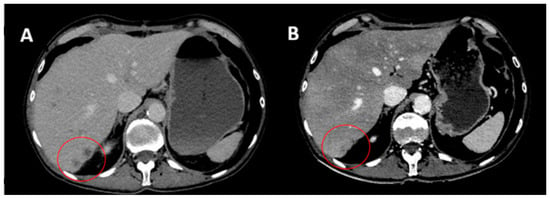
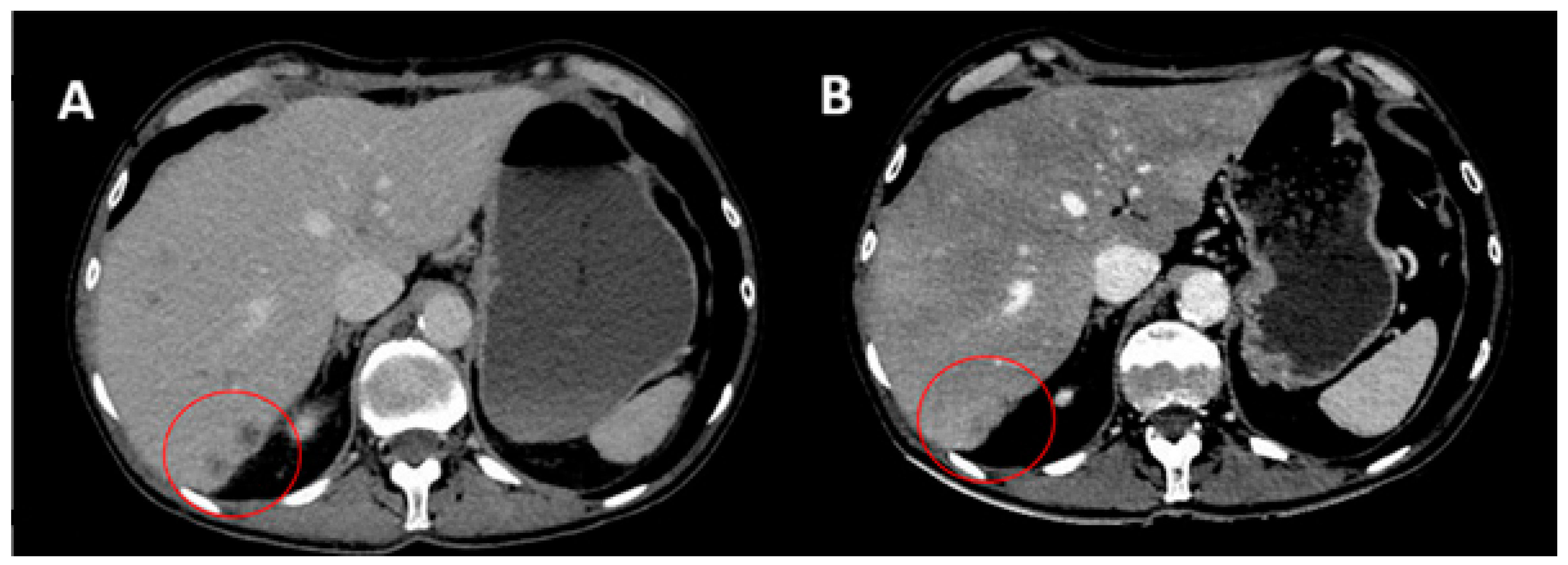
Over the course of 6 months, the patient received first-line palliative chemotherapy with FOLFIRINOX, later dose-reduced due to thrombocytopenia. The first restaging CT scan, performed after 3 months of chemotherapy, revealed evidence of a partial radiological response (Figure 1).
Figure 1.
“Father” Baseline (A) CT scan after 3 months (B) of palliative FOLFIRINOX chemotherapy.
Molecular analyses were performed on tumor tissue from the pancreatectomy specimen using next-generation sequencing (NGS) with an in-house-developed panel covering the full-coding sequences of 423 cancer-associated genes. The analysis identified variants in BRIP1, TP53, KRAS, and RB1 (Table 2), as well as amplifications of CCNE1, AKT2, and LTBP4. Biomarker analysis was negative for HER2, PD-L1, and pan-TRK, and the tumor mutational burden was low. The patient was discussed at our molecular tumor board. The BRIP1 p.Lys159Glu variant was further evaluated, in silico structural analysis suggested that Lys159 is located within a positively charged region that may function as a nuclear localization signal. Replacing lysine with the negatively charged glutamic acid could therefore affect BRIP1 nuclear localization. However, this remains a computational prediction and has not been confirmed experimentally. To the best of our knowledge, to date, there is no functional evidence showing that the p.Lys159Glu variant impairs BRIP1 nuclear localization or function. Given the role of BRIP1 in homologous recombination repair, the use of olaparib was proposed as a later-line treatment, acknowledging that supporting evidence is limited.
Table 2.
Variants identified by next-generation sequencing in the pancreatic adenocarcinoma of the father.
However, the patient developed severe hyperbilirubinemia and cholestasis, preventing initiation of next-line therapy. Imaging performed shortly after the 6-month FOLFIRINOX treatment demonstrated progression of hepatic, peritoneal, and nodal metastases. At that stage, given clear oncological progression, patient preference and limited treatment options, the recommendation was best supportive care with palliative management focused on comfort and pain control.
The son
The patient aged 39 with no significant medical history, has experienced heartburn and epigastric pain radiating to the periumbilical area, initially treated with antacids. His condition worsened with the onset of jaundice and weight loss of 4 kg. An abdominal CT scan showed biliary dilation caused by probable pancreatic head mass. ERCP and EUS revealed diffuse infiltration of the pancreatic head and a hepatic hilum lymph node, intra-ductal infiltration of the common bile duct, and signs of pancreatitis, leading to the placement of two stents. Biopsy confirmed infiltrating adenocarcinoma of the pancreas.
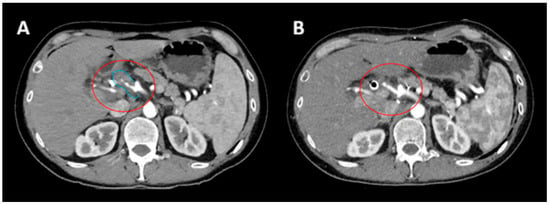
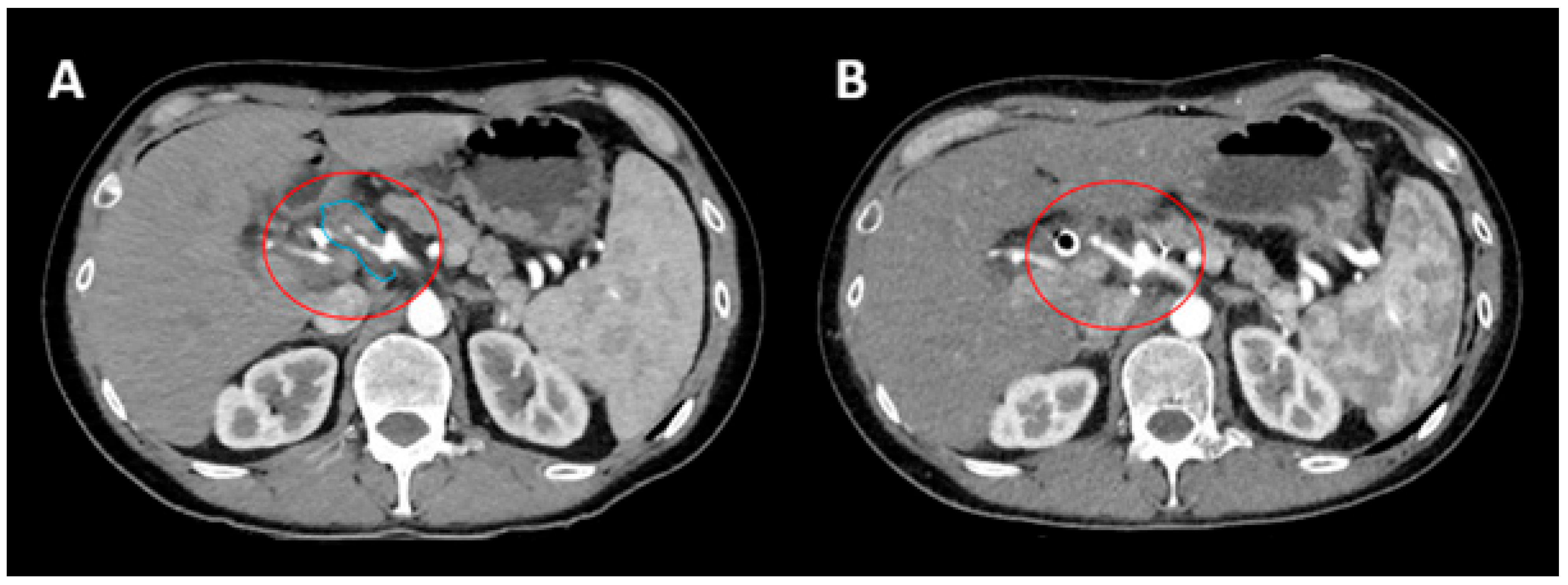
Baseline thoraco-abdominal CT demonstrated peri-pancreatic infiltration involving the gastroduodenal artery and contacting the hepatic artery, main portal vein stenosis without thrombus (Figure 2). MDT recommended induction chemotherapy. The patient received twelve cycles of neoadjuvant FOLFIRINOX. Restaging with CT showed disease stability with a 6% reduction per RECIST 1.1, but the tumor remained inoperable. The patient received 3 additional months of FOLFIRI chemotherapy, achieving a partial response (Figure 2). Following multidisciplinary discussion, a Whipple procedure was recommended following resolution of arterial encasement. The patient subsequently underwent surgery. Histopathological examination demonstrated a ypT2 tumor with ypN2 nodal involvement (4 of 12 nodes positive), lymphatic and vascular invasion (L1, V1), perineural invasion (Pn1), moderate differentiation (G2), and negative resection margins (R0).
Figure 2.
Baseline (A) CT scan demonstrating vascular involvement (around hepatic artery in blue) and partial response (B) after FOLFIRINOX based chemotherapy.
The patient was enrolled in a clinical trial with adjuvant chemotherapy, nivolumab, and an experimental vaccine from 3 months after surgery, with no recurrence until local progression at the pancreatic plexus confirmed by EUS biopsy 2 years after surgery.
At that point first-line palliative chemotherapy with gemcitabine and nab-paclitaxel was administered. CT after 9 months of chemotherapy showed significant growth of three bilateral lower lobe lung nodules, and radiotherapy (54 Gy in 3 fractions) was delivered to a progressive right lower lobe lesion. PET-CT performed 16 months after start of chemotherapy showed increased metabolism at the hepatic hilum and progression of known lung nodules without new lesions. Tumor board recommended local radiotherapy to the primary site and cryoablation for lung lesions. The patient received chemo-radiotherapy with weekly carboplatin (AUC2), stopped after two cycles due to thrombocytopenia, alongside peri-hilar liver radiotherapy (54 Gy in 27 fractions).Shortly after completion of chemo-radiotherapy CT showed progression with peritoneal carcinomatosis, leading to cancellation of lung-directed treatments. Chemotherapy with reduced-dose gemcitabine (75%) and nab-paclitaxel (60%) was continued.
Molecular analyses (Table 3) revealed several variants, including KRAS, TP53, and SMAD4 mutations, as well as a BRIP1 p.Lys159Glu variant, which was also present in the patient’s father. This variant was detected at approximately 50% VAF in both tumors, despite their low tumor cellularity (20–30%), suggesting a constitutional heterozygous variant rather than a tumor specific somatic event. No additional somatic BRIP1 variant or clear evidence of BRIP1 loss was identified in the NGS data from either tumor. However, given the low tumor cellularity, the sensitivity of NGS based copy-number and loss of heterozygosity (LOH) analyses is limited, and the presence of a somatic second hit or BRIP1 loss cannot be reliably excluded. The BRIP1 p.Lys159Glu variant is classified as a variant of uncertain significance (VUS) in available clinical variant databases. It is not reported in population databases, and there is currently insufficient clinical or functional evidence to support a pathogenic role. HER2 immunohistochemistry showed a score of 2+, whereas FISH was negative. Molecular tumor board suggested PARP inhibitors or trastuzumab deruxtecan as later-line options.
Table 3.
Variants identified by next-generation sequencing in the pancreatic adenocarcinoma of the son.
24 months after start of gemcitabine and nab-paclitaxel, maintenance with gemcitabine plus olaparib was initiated based on the potential functional involvement of BRIP1 in homologous recombination repair but complicated by thrombocytopenia requiring dose reductions; olaparib was stopped after ~2 months and 2 months later gemcitabine as well. Given the short treatment exposure and dose modifications, no conclusion regarding sensitivity or resistance to PARP inhibition could be drawn.
Restaging CT showed progression of peritoneal disease. Tumor board recommended palliative radiotherapy, portal stent revision, and switch to trastuzumab deruxtecan.
The subsequent course was complicated by recurrent infections (cholangitis with bacteremia and port-a-cath infections), requiring repeated hospitalizations and limiting further systemic therapy. The patient died 5 years after initial diagnosis.
2. Conclusions
We report PDAC in a father and son whose tumors both carried the same BRIP1 p.Lys159Glu variant of uncertain significance. The presence of PDAC in two first-degree relatives, including early-onset disease in the son, is notable. However, germline testing was not performed, and the functional significance of the variant is unknown. These cases therefore do not establish hereditary transmission or a causal role for BRIP1 in pancreatic cancer predisposition. Given the allelic frequency suggestive of a germline origin, formal germline testing was requested. However, this request was declined by the genetics team. The variant is currently classified as a variant of uncertain significance (VUS), and although BRIP1 is implicated in homologous recombination repair, its established association is primarily with ovarian cancer susceptibility. The genetics team concluded that, even if the variant were confirmed to be germline, its VUS classification would not have immediate clinical utility for patient management or familial counseling. Therefore, germline testing was not pursued. Without germline testing or functional assessment of the variant, its hereditary nature and potential contribution to pancreatic cancer susceptibility remain uncertain. This case therefore raises the possibility of an association but does not establish causality, and further investigation of BRIP1 variants in familial PDAC is needed. Both tumors also harbored KRAS codon 12 mutations, although the variants differed (G12D in the father and G12V in the son). KRAS mutations are found in approximately 90% of PDACs and are considered an early event in pancreatic carcinogenesis. G12D and G12V are among the most commonly observed variants [24]. Their presence in both tumors is therefore not unexpected and, importantly, the different substitutions do not suggest a shared familial alteration. From a therapeutic perspective, KRAS remains an area of active investigation, with several mutant-specific and broader RAS-targeted approaches currently in clinical development and entering practice.
Both patients had clinically meaningful responses to platinum-based chemotherapy. Although platinum sensitivity can occur in PDAC with HRD, particularly in tumors with pathogenic BRCA1/2 or PALB2 alterations, it is not specific to HRD and does not establish an HR-deficient phenotype. Because the BRIP1 variant was not functionally characterized and HRD was not assessed genomically, these treatment responses should be interpreted as clinical observations rather than evidence of BRIP1-related HRD. While the father’s disease followed an aggressive course, with survival of less than one year, the son has exhibited a more indolent trajectory and lived more than five years after diagnosis. It remains unclear whether this difference reflects inherent biological heterogeneity between their tumors or is influenced by the son’s exposure to personalized adjuvant vaccine and immunotherapy. The son received olaparib for only a short period, with treatment limited by hematological toxicity. This exposure was insufficient to assess sensitivity or resistance to PARP inhibition and should not be interpreted as evidence for or against the therapeutic relevance of the BRIP1 variant.
Continued reporting of BRIP1 (and other HRR genes)-related pancreatic cancer cases, along with mechanistic studies and clinical trials, will be essential to clarify the mutation’s penetrance, therapeutic relevance, and value in cancer prevention strategies.
Author Contributions
N.D. contributed to the conceptualization of the study, collection and interpretation of clinical data, literature review, and drafting of the manuscript. G.D.T. and M.T. contributed to the molecular and pathological data analysis and interpretation and critically reviewed the manuscript. K.H. contributed to the interpretation of clinical and molecular findings and critically revised the manuscript for important intellectual content. A.D. contributed to the conceptualization and supervision of the study, interpretation of the findings, and critical revision of the manuscript. All authors have read and agreed to the published version of the manuscript.
Funding
This research received no external funding.
Institutional Review Board Statement
The competent ethics committee, the Commission cantonale d’éthique de la recherche sur l’être humain du Canton de Vaud (CER-VD), was consulted regarding the need for ethical approval for the publication of these case reports. No formal ethical approval was requested by the committee. Both patients had provided written general consent during their lifetime for the use of their coded clinical data and biological samples for research purposes at Lausanne University Hospital (CHUV). The cases were reported in accordance with the principles of the Declaration of Helsinki and with due consideration for patient confidentiality.
Informed Consent Statement
Both patients provided written general consent during their lifetime for the use of their coded clinical data and biological samples for research purposes at Lausanne University Hospital (CHUV). Both patients are now deceased. The cases have been reported in a manner intended to preserve patient confidentiality and prevent identification.
Data Availability Statement
The data supporting the findings of this report are not publicly available due to patient privacy and confidentiality considerations. Additional information may be available from the corresponding author upon reasonable request, subject to applicable ethical and legal restrictions.
Conflicts of Interest
The authors declare no conflicts of interest.
Abbreviations
BRIP1: BRCA1-interacting protein 1; CT, computed tomography; ERCP, endoscopic retrograde cholangiopancreatography; EUS, endoscopic ultrasound; FOLFIRI, folinic acid, fluorouracil, and irinotecan; FOLFIRINOX, folinic acid, fluorouracil, irinotecan, and oxaliplatin; HER2, human epidermal growth factor receptor 2; HR, homologous recombination; HRD, homologous recombination deficiency; MDT, multidisciplinary team; NGS, next-generation sequencing; PARP, poly(ADP-ribose) polymerase; PDAC, pancreatic ductal adenocarcinoma; PD-L1, programmed death-ligand 1; RECIST, Response Evaluation Criteria in Solid Tumors; TMB, tumor mutational burden; VAF, variant allele frequency; VUS, variant of uncertain significance.
References
- Dreyer, S.B.; Beer, P.; Hingorani, S.R.; Biankin, A.V. Improving outcomes of patients with pancreatic cancer. Nat. Rev. Clin. Oncol. 2025, 22, 439–456. [Google Scholar] [CrossRef] [Scilit] [PubMed]
- Perkhofer, L.; Gout, J.; Roger, E.; Kude de Almeida, F.; Baptista Simoes, C.; Wiesmuller, L.; Seufferlein, T.; Kleger, A. DNA damage repair as a target in pancreatic cancer: State-of-the-art and future perspectives. Gut 2021, 70, 606–617. [Google Scholar] [CrossRef] [Scilit] [PubMed]
- Long, G.; Hu, K.; Zhang, X.; Zhou, L.; Li, J. Spectrum of BRCA1 interacting helicase 1 aberrations and potential prognostic and therapeutic implication: A pan cancer analysis. Sci. Rep. 2023, 13, 4435. [Google Scholar] [CrossRef] [Scilit] [PubMed]
- Cantor, S.B.; Bell, D.W.; Ganesan, S.; Kass, E.M.; Drapkin, R.; Grossman, S.; Wahrer, D.C.; Sgroi, D.C.; Lane, W.S.; Haber, D.A.; et al. BACH1, a novel helicase-like protein, interacts directly with BRCA1 and contributes to its DNA repair function. Cell 2001, 105, 149–160. [Google Scholar] [CrossRef] [Scilit] [PubMed]
- Rafnar, T.; Gudbjartsson, D.F.; Sulem, P.; Jonasdottir, A.; Sigurdsson, A.; Jonasdottir, A.; Besenbacher, S.; Lundin, P.; Stacey, S.N.; Gudmundsson, J.; et al. Mutations in BRIP1 confer high risk of ovarian cancer. Nat. Genet. 2011, 43, 1104–1107. [Google Scholar] [CrossRef] [Scilit] [PubMed]
- Seal, S.; Thompson, D.; Renwick, A.; Elliott, A.; Kelly, P.; Barfoot, R.; Chagtai, T.; Jayatilake, H.; Ahmed, M.; Spanova, K.; et al. Truncating mutations in the Fanconi anemia J gene BRIP1 are low-penetrance breast cancer susceptibility alleles. Nat. Genet. 2006, 38, 1239–1241. [Google Scholar] [CrossRef] [Scilit] [PubMed]
- Walsh, T.; King, M.C. Ten genes for inherited breast cancer. Cancer Cell 2007, 11, 103–105. [Google Scholar] [CrossRef] [Scilit] [PubMed]
- Ando, Y.; Dbouk, M.; Yoshida, T.; Abou Diwan, E.; Saba, H.; Dbouk, A.; Yoshida, K.; Roberts, N.J.; Klein, A.P.; Burkhart, R.; et al. Germline Pathogenic Variants in Patients With Pancreatic and Periampullary Cancers. JCO Precis. Oncol. 2024, 8, e2400101. [Google Scholar] [CrossRef] [Scilit] [PubMed]
- Nakamura, K.; Aimono, E.; Tanishima, S.; Imai, M.; Nagatsuma, A.K.; Hayashi, H.; Yoshimura, Y.; Nakayama, K.; Kyo, S.; Nishihara, H. Olaparib Monotherapy for BRIP1-Mutated High-Grade Serous Endometrial Cancer. JCO Precis. Oncol. 2020, 4, 283–290. [Google Scholar] [CrossRef] [Scilit] [PubMed]
- Clapperton, J.A.; Manke, I.A.; Lowery, D.M.; Ho, T.; Haire, L.F.; Yaffe, M.B.; Smerdon, S.J. Structure and mechanism of BRCA1 BRCT domain recognition of phosphorylated BACH1 with implications for cancer. Nat. Struct. Mol. Biol. 2004, 11, 512–518. [Google Scholar] [CrossRef] [Scilit] [PubMed]
- Mamrak, N.E.; Shimamura, A.; Howlett, N.G. Recent discoveries in the molecular pathogenesis of the inherited bone marrow failure syndrome Fanconi anemia. Blood Rev. 2017, 31, 93–99. [Google Scholar] [CrossRef] [Scilit] [PubMed]
- Yurgelun, M.B.; Chittenden, A.B.; Morales-Oyarvide, V.; Rubinson, D.A.; Dunne, R.F.; Kozak, M.M.; Qian, Z.R.; Welch, M.W.; Brais, L.K.; Da Silva, A.; et al. Germline cancer susceptibility gene variants, somatic second hits, and survival outcomes in patients with resected pancreatic cancer. Genet. Med. 2019, 21, 213–223. [Google Scholar] [CrossRef] [Scilit] [PubMed]
- Heeke, A.L.; Pishvaian, M.J.; Lynce, F.; Xiu, J.; Brody, J.R.; Chen, W.J.; Baker, T.M.; Marshall, J.L.; Isaacs, C. Prevalence of Homologous Recombination-Related Gene Mutations Across Multiple Cancer Types. JCO Precis. Oncol. 2018, 2018, 1–13. [Google Scholar] [CrossRef] [Scilit] [PubMed]
- Voutsadakis, I.A. Landscape of BRIP1 molecular lesions in gastrointestinal cancers from published genomic studies. World J. Gastroenterol. 2020, 26, 1197–1207. [Google Scholar] [CrossRef] [Scilit] [PubMed]
- The Cancer Genome Atlas Research Network. Integrated Genomic Characterization of Pancreatic Ductal Adenocarcinoma. Cancer Cell 2017, 32, 185–203.e13. [PubMed]
- Wattenberg, M.M.; Asch, D.; Yu, S.; O’Dwyer, P.J.; Domchek, S.M.; Nathanson, K.L.; Rosen, M.A.; Beatty, G.L.; Siegelman, E.S.; Reiss, K.A. Platinum response characteristics of patients with pancreatic ductal adenocarcinoma and a germline BRCA1, BRCA2 or PALB2 mutation. Br. J. Cancer 2020, 122, 333–339. [Google Scholar] [CrossRef] [Scilit] [PubMed]
- Golan, T.; Barenboim, A.; Lahat, G.; Nachmany, I.; Goykhman, Y.; Shacham-Shmueli, E.; Halpern, N.; Brazowski, E.; Geva, R.; Wolf, I.; et al. Increased Rate of Complete Pathologic Response After Neoadjuvant FOLFIRINOX for BRCA Mutation Carriers with Borderline Resectable Pancreatic Cancer. Ann. Surg. Oncol. 2020, 27, 3963–3970. [Google Scholar] [CrossRef] [Scilit] [PubMed]
- Martino, C.; Pandya, D.; Lee, R.; Levy, G.; Lo, T.; Lobo, S.; Frank, R.C. ATM-Mutated Pancreatic Cancer: Clinical and Molecular Response to Gemcitabine/Nab-Paclitaxel After Genome-Based Therapy Resistance. Pancreas 2020, 49, 143–147. [Google Scholar] [PubMed]
- Palacio, S.; Pollack, T.; Silva-Smith, R.; Sussman, D.A.; Hosein, P.J. Exceptional response to FOLFIRINOX in a patient with pancreatic cancer and a germline RAD51C mutation. J. Gastrointest. Oncol. 2018, 9, E19–E22. [Google Scholar] [CrossRef] [Scilit] [PubMed]
- Yim, E.; Leung, D. Leptomeningeal disease in BRIP1-mutated pancreatic adenocarcinoma. BMJ Case Rep. 2022, 15, e249837. [Google Scholar] [CrossRef] [Scilit] [PubMed]
- Golan, T.; Hammel, P.; Reni, M.; Van Cutsem, E.; Macarulla, T.; Hall, M.J.; Park, J.O.; Hochhauser, D.; Arnold, D.; Oh, D.Y.; et al. Maintenance Olaparib for Germline BRCA-Mutated Metastatic Pancreatic Cancer. N. Engl. J. Med. 2019, 381, 317–327. [Google Scholar] [CrossRef] [Scilit] [PubMed]
- Vornhulz, M.; Angelberger, M.; Sirtl, S.; Philipp, A.B.; Rossler, D.; Ondrejkova, K.; Markwardt, D.; Heinrich, K.; Westphalen, C.B.; Heinemann, V.; et al. Sustained Clinical Response to Olaparib in a Patient with Metastatic Pancreatic Cancer and Somatic ATM Mutation R2034Ter: A Case Report. Oncol. Res. Treat. 2025, 48, 548–554. [Google Scholar] [CrossRef] [Scilit] [PubMed]
- Joris, S.; Denys, H.; Collignon, J.; Rasschaert, M.; T’Kint de Roodenbeke, D.; Duhoux, F.P.; Canon, J.L.; Tejpar, S.; Mebis, J.; Decoster, L.; et al. Efficacy of olaparib in advanced cancers with germline or somatic mutations in BRCA1, BRCA2, CHEK2 and ATM, a Belgian Precision tumor-agnostic phase II study. ESMO Open 2023, 8, 102041. [Google Scholar] [CrossRef] [Scilit] [PubMed]
- Drizyte-Miller, K.; Talabi, T.; Somasundaram, A.; Cox, A.D.; Der, C.J. KRAS: The Achilles’ heel of pancreas cancer biology. J. Clin. Investig. 2025, 135, e191939. [Google Scholar] [CrossRef] [Scilit] [PubMed]

Disclaimer/Publisher’s Note: The statements, opinions and data contained in all publications are solely those of the individual author(s) and contributor(s) and not of MDPI and/or the editor(s). MDPI and/or the editor(s) disclaim responsibility for any injury to people or property resulting from any ideas, methods, instructions or products referred to in the content. |
© 2026 by the authors. Licensee MDPI, Basel, Switzerland. This article is an open access article distributed under the terms and conditions of the Creative Commons Attribution (CC BY) license.