


Abstract
Litter decomposition plays a critical role in the formation and turnover of soil organic carbon (SOC) and its fractions. However, the effects of litter on SOC dynamics across grassland degradation remain poorly understood. The objectives of this study were to investigate the responses of SOC and its fractions, including particulate organic carbon (POC) and mineral-associated organic carbon (MAOC), to litter decomposition in lightly, moderately, and highly degraded grasslands. A 240-day incubation experiment using Leymus chinensis litter incubated on day 0, 23, 60, and 240 was conducted to investigate the biotic and abiotic factors regulating SOC stability. Grassland degradation significantly reduced POC and MAOC concentrations; moreover, litter addition in degraded grasslands further reduced SOC. In the lightly and moderately degraded grasslands, litter addition modulated POC and MAOC via both microbial and physicochemical pathways. In the highly degraded grasslands, litter addition influenced POC and MAOC not only indirectly through microbial and physicochemical pathways but also directly by promoting MAOC formation. Overall, although litter decomposition altered SOC and its fractions, its effects were constrained by the degree of grassland degradation. These findings indicate that restoration strategies should prioritize enhancing microbial biomass and activity in lightly and moderately degraded grasslands while increasing litter inputs in highly degraded grasslands to improve soil carbon sequestration.
1. Introduction
Grasslands cover approximately 40.5% of the Earth’s land area and store about one-third of the global terrestrial carbon [1]. However, grassland degradation has led to a 33% to 90% reduction in soil organic carbon (SOC) [1,2]. SOC is a complex organic material composed of plant, animal, and microbial residues with varying degrees of decomposition [3,4]. It can be divided into particulate organic carbon (POC) and mineral-associated organic carbon (MAOC) fractions, with only a minor portion (1 to 2%) present as dissolved organic matter [5]. POC and MAOC differ in their formation, physical and chemical properties, and mean residence times in soil [6,7]. POC primarily consists of plant-derived polymers and is less decomposed within large soil aggregates [1]. In contrast, MAOC is predominantly microbial-derived and characterized by stable associations with mineral surfaces through physicochemical interactions [6]. Compared with POC, MAOC is more effectively protected against decomposition because of its association with soil minerals [8,9]. The POC to MAOC ratio therefore reflects the relative stability of SOC fractions [10]. This distinction is particularly important in degraded grasslands, where disruption of soil structure and weakening of mineral protection may limit MAOC preservation and alter the balance between labile and stable carbon pools [11]. Previous studies have shown that grassland degradation decreases SOC storage and alters the distribution of SOC fractions by reducing plant carbon inputs, weakening soil aggregation, and changing microbial processing of organic matter [1,7,12,13]. Consequently, POC usually declines rapidly because it is more labile and closely linked to fresh plant inputs, whereas MAOC often responds more slowly or variably depending on mineral protection and microbial transformation capacity [12,13,14]. Degradation-induced changes in vegetation composition, soil salinity/alkalinity, and nutrient availability may further shift the balance between labile and stable carbon pools [7,12]. Therefore, distinguishing between POC and MAOC is essential for understanding SOC dynamics in degraded grasslands, where disrupted soil structure and reduced mineral protection may limit MAOC preservation and compromise overall soil carbon stability [13]. Accordingly, investigating the responses of soil organic carbon and its fractions to grassland degradation is crucial for understanding carbon dynamics and informing effective restoration strategies.
Litter serves as a crucial source of SOC and its fractions in grassland ecosystems [15,16]. Research has shown that litter addition can increase SOC accumulation by increasing carbon inputs, stimulating microbial activity, and promoting the formation of both POC and MAOC [15,17,18]. For example, litter inputs may directly increase coarse organic matter pools and indirectly contribute to MAOC formation through microbial transformation and subsequent mineral association [15,18]. However, the magnitude and direction of these effects vary among ecosystems and degradation stages because litter decomposition is strongly regulated by soil physicochemical conditions, microbial communities, and nutrient availability. In degraded grasslands, litter addition has been shown to increase SOC fractions, whereas in other cases its effects are offset by adverse soil conditions or accelerated decomposition losses [17,18]. Therefore, litter addition emerges as a key driver that regulates soil carbon pool composition and sequestration through direct addition and indirect modulation in grassland ecosystems [18].
Leymus chinensis, a perennial rhizomatous bunchgrass, is widely distributed in the grasslands of East Asia [19,20]. It has strong tolerance to drought, high soil pH, and low soil fertility [21,22]. These characteristics make it a dominant species in grasslands and a pioneer species in grassland restoration [21]. Leymus chinensis contributes significantly to SOC through inputs of aboveground and belowground biomass [23]. Furthermore, its exudates serve as a labile carbon source for soil microorganisms, stimulating their growth and activity. This microbial response subsequently modulates the formation and stabilization of SOC through biochemical transformation and mineral association processes. At the same time, Leymus chinensis plays a critical role in regulating carbon input, influencing soil carbon steady-state dynamics, and shaping carbon sink potential under grassland degradation scenarios [21]. Although previous studies have documented the importance of litter inputs and degradation status for SOC dynamics, less is known about how Leymus chinensis litter decomposition affects POC and MAOC across different degradation levels, particularly through linked biotic and abiotic pathways. Therefore, Leymus chinensis was selected as the experimental material to examine the effects of litter addition on the grassland carbon pool. We hypothesized that POC and MAOC exhibited distinct responses to litter addition with increasing degradation levels. In order to explore the effects of litter decomposition on SOC fractions in degraded grasslands, we conducted a 240-day decomposition experiment using Leymus chinensis litter. This study aimed to (1) determine the effects of litter decomposition on SOC and its fractions (POC and MAOC) across grassland degradation gradients and (2) elucidate the mechanisms governing the cycling of SOC and its fractions across different degradation stages.
2. Materials and Methods
2.1. Study Sites and Sampling Collection
The study was conducted in the meadow steppe of the Grassland Ecological Research Station of Northeast Normal University, Jilin province, China (44°45′ N, 123°45′ E). This region is characterized by a semi-arid continental monsoon climate, with cold, dry winters and warm, rainy summers. The mean annual temperature is 4.6–6.4 °C, and the mean annual precipitation is 282–400 mm, mostly falling between June and August [24]. The soil type is saline–alkaline meadow soil with a high degree of heterogeneity. Soil pH in the study area ranges from 8.5 to 10.0 [25]. Based on soil pH, soil properties, plant cover, and the actual conditions of the study area, there are three levels of degradation in this region: lightly, moderately, and highly degraded grasslands [26,27,28]. Specifically, the degradation levels are distinguished according to the cover of Leymus chinensis, with approximately 70%, 50%, and 30% cover representing lightly, moderately, and highly degraded grasslands, respectively [29]. Plant community composition varies among degradation levels. The lightly degraded grassland is still dominated by Leymus chinensis, whereas the moderately degraded grassland is characterized by a greater abundance of Chloris virgata. In the highly degraded grassland, the plant community shifts further toward salt-tolerant species, with Suaeda heteroptera becoming dominant. The plant communities gradually change from Leymus chinensis to more salt-/degradation-tolerant species under increasing degradation [30].
Soil samples were collected from the three levels of degraded grasslands on 13 October 2019. In each degradation level, five plots (25 m × 25 m) were randomly selected as replicates. After the removal of surface impurities, 25 soil cores (0–10 cm depth, 5 cm diameter) were randomly collected from each plot using a soil auger and homogenized to form a composite sample. A total of about 6 kg of soil was collected as one soil sample from each plot. We collected the aboveground biomass of Leymus chinensis from Leymus chinensis-dominated communities for the subsequent decomposition experiment. All samples were transported to the laboratory and stored at 4 °C. The physicochemical properties of both the soil and the litter were measured and are listed in Table S1.
The Leymus chinensis was used as the litter material. After drying at 60 °C in an oven for 48 h, the Leymus chinensis litter was cut into 1 cm pieces. A total of 3.00 g litter was placed into each plastic litter bag (1 mm mesh). This amount was selected to provide a standardized litter input representative of the dominant species in the local Leymus chinensis grassland, where Leymus chinensis contributes most of the aboveground biomass, and to maintain consistency with previous decomposition microcosm studies conducted in the Songnen meadow steppe/saline–alkali grassland [31]. The soil samples were passed through an 8 mm sieve to remove stones and roots. A total of 400 g of field-moist soil was weighed into a PVC tube (9 cm inner diameter and 15 cm height). This amount was consistent with a comparable decomposition experiment previously conducted using soils from the same region [32]. All PVC tubes were pre-incubated in an incubator under standardized conditions (25 °C, 60% water-holding capacity) for 7 days to balance water and nutrients [33]. The litter bag was then placed on the soil surface of each PVC tube for the litter treatment, whereas the control treatment received no litter addition. The experiment began on 21 October 2019. PVC tubes were placed in an incubator under the same standardized conditions as the pre-incubation. All tubes were weighed and rehydrated every 2 days to maintain 60% water-holding capacity during the experimental period [34]. Destructive sampling was performed on days 0, 23, 60, and 240 using separate PVC tubes assigned to each sampling date. Each PVC tube was sampled only once, and soil and litter were collected only at its designated sampling time. Thus, observations from different sampling dates were derived from different independently incubated PVC tubes rather than from repeated measurements of the same experimental unit. There were 60 experimental units in total. A total of 60 experimental units were included. The no-litter control represented day 0 of litter decomposition and was established across the three degradation levels with five replicates per level (15 units in total). The litter treatment was sampled after 23, 60, and 240 days across the same three degradation levels, with five replicates for each treatment combination (45 units in total). Litter was gently sieved through a 2 mm sieve to remove any adhering soil particles and then oven-dried at 60 °C for 48 h to reach a constant weight. Soil samples were stored in plastic bags and maintained at 4 °C and analyzed within one week of sampling.
2.2. Soil Organic Carbon and Physicochemical Property Analysis
The SOC content was determined using the dichromate oxidation method by Walkley and Black [35]. The 53 μm cutoff is a widely used operational threshold in soil organic matter fractionation in which the coarse fraction (>53 μm) is considered particulate organic carbon whereas the fine fraction (<53 μm) is considered mineral-associated organic carbon because it is more closely associated with silt- and clay-sized minerals [36,37]. Therefore, the POC fraction (>53 μm) and the MAOC fraction (<53 μm) were separated using the sodium hexametaphosphate method [31]. Soil dissolved organic carbon (DOC) was extracted with deionized water, filtered through a 0.45 μm membrane, and then quantified using a total C analyzer (TOC VCPH, Shimadzu, Kyoto, Japan) [38]. Soil microbial biomass carbon (MBC) was extracted using the fumigation–extraction method and measured with a fully automated chemical analyzer (Multi C/N 2100S, Analytik Jena, Jena, Germany). Soil pH was measured using a pH meter (Orion 868, Thermo Fisher Scientific, Waltham, MA, USA) in a 1:5 soil–deionized water suspension. The contents of total carbon and total nitrogen in the litter (LitterC and LitterN) and soil (SoilC and SoilN) were determined using an automatic elemental analyzer (Flash EA 1112, Thermo Fisher Scientific, Milan, Italy). The contents of total phosphorus in the litter (LitterP) and soil (SoilP) were detected using a continuous flow analyzer (Skalar, Breda, The Netherlands).
2.3. Phospholipid Fatty Acid Analysis (PLFA)
The soil microbial communities were characterized by using phospholipid fatty acid analysis (PLFA) as described and modified by Bossio et al. [39] with further slight modifications as described by Certini et al. [40]. Lipids were extracted from 8 g of freeze-dried soil using a chloroform–methanol–citrate buffer mixture (1:2:0.8) (Sinopharm Chemical Reagent Co., Ltd., Shanghai, China). PLFA biomarkers were used to characterize bacteria, fungi, and arbuscular mycorrhizal fungi (AMF), and the specific biomarkers assigned to each microbial group are listed in Table S2 [41,42,43,44]. All of the PLFAs indicated above were considered to be representative of the total PLFAs of soil microbial communities. The PLFA richness was calculated as the number of different PLFAs in each sample, and the PLFA abundance was expressed in nmol g−1 dry soil [45,46,47].
2.4. Analysis of Enzyme Activity
The activities of soil extracellular enzymes, including C-acquiring enzyme (β-1,4-glucosidase (BG) and cellobiose (CB)), N-acquiring enzyme (β-1,4-N-acetyl glucosaminidase (NAG) and 1-leucine aminopeptidase (LAP), and P-acquiring enzyme (alkaline phosphatase (AP)), were assayed using a microplate protocol [48]. The enzyme activity was expressed as nmol g−1 soil h−1.
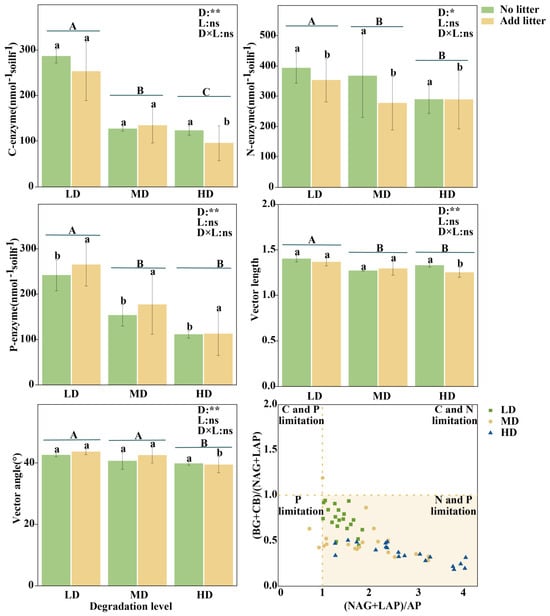
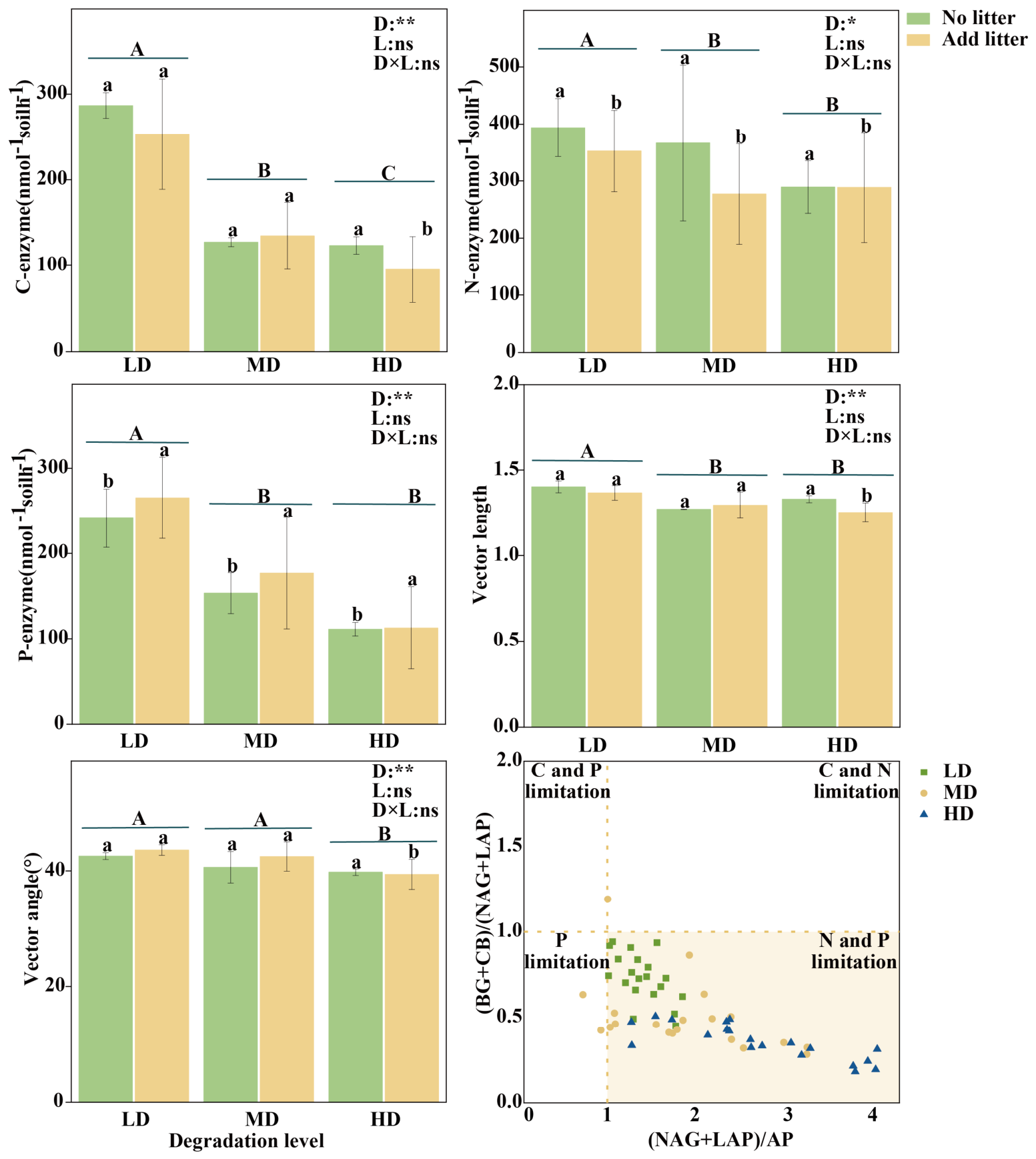
Microbial nutrient limitation was assessed using extracellular enzyme stoichiometric vector analysis following DeForest and Moorhead [49]. A greater vector length indicates stronger microbial C limitation. A vector angle of <45° indicates microbial N limitation, whereas a vector angle of >45° indicates microbial P limitation [44]. The x-axis was defined as (BG + CB)/AP, and the y-axis was defined as (BG + CB)/(LAP + NAG) [50,51]. Vector length (unitless) and vector angle (degree) were calculated as follows:
2.5. Statistical Analyses
A three-way ANOVA was first performed to examine the effects of degradation level, litter decomposition treatment, decomposition time, and their interactions on SOC, POC, and MAOC. Because decomposition time had no significant effect on these indicators, subsequent analyses were conducted using two-way ANOVA to evaluate the effects of degradation level, litter decomposition treatment, and their interaction. The two-way ANOVA approach was also used to assess soil physicochemical properties, microbial PLFA biomass, and enzyme activities. Duncan’s post hoc test was used for multiple comparisons when significant effects were detected (p < 0.05). Mantel tests were used to evaluate the relationships of POC and MAOC with litter, soil physicochemical properties, and microbial indices. Structural equation modeling (SEM) was used to test the conceptual hypothesis that litter decomposition influences POC and MAOC both directly and indirectly through changes in soil physicochemical properties and microbial attributes. The detailed conceptual logic of the SEM is presented in Supplementary Table S3. The SEM was fitted using the lavaan package based on independent observations, as samples collected at each incubation time were destructively harvested and therefore treated as independent rather than repeated measures. Model fit was assessed based on the chi-square statistic (χ2) and p-value, along with the standardized root mean square residual (SRMR), comparative fit index (CFI), and goodness-of-fit index (GFI). All SEM analyses were performed using the lavaan and piecewiseSEM packages in R 4.3.2 (R Foundation for Statistical Computing, Vienna, Austria). All statistical analyses were conducted using R 4.3.2. Final data visualization was performed using Origin 2024 (OriginLab Corporation, Northampton, MA, USA).
3. Results
3.1. Impact of Litter Addition on SOC and Its Fractions at Different Degradation Levels
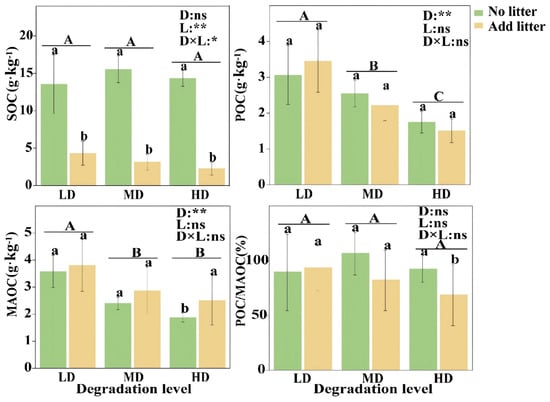
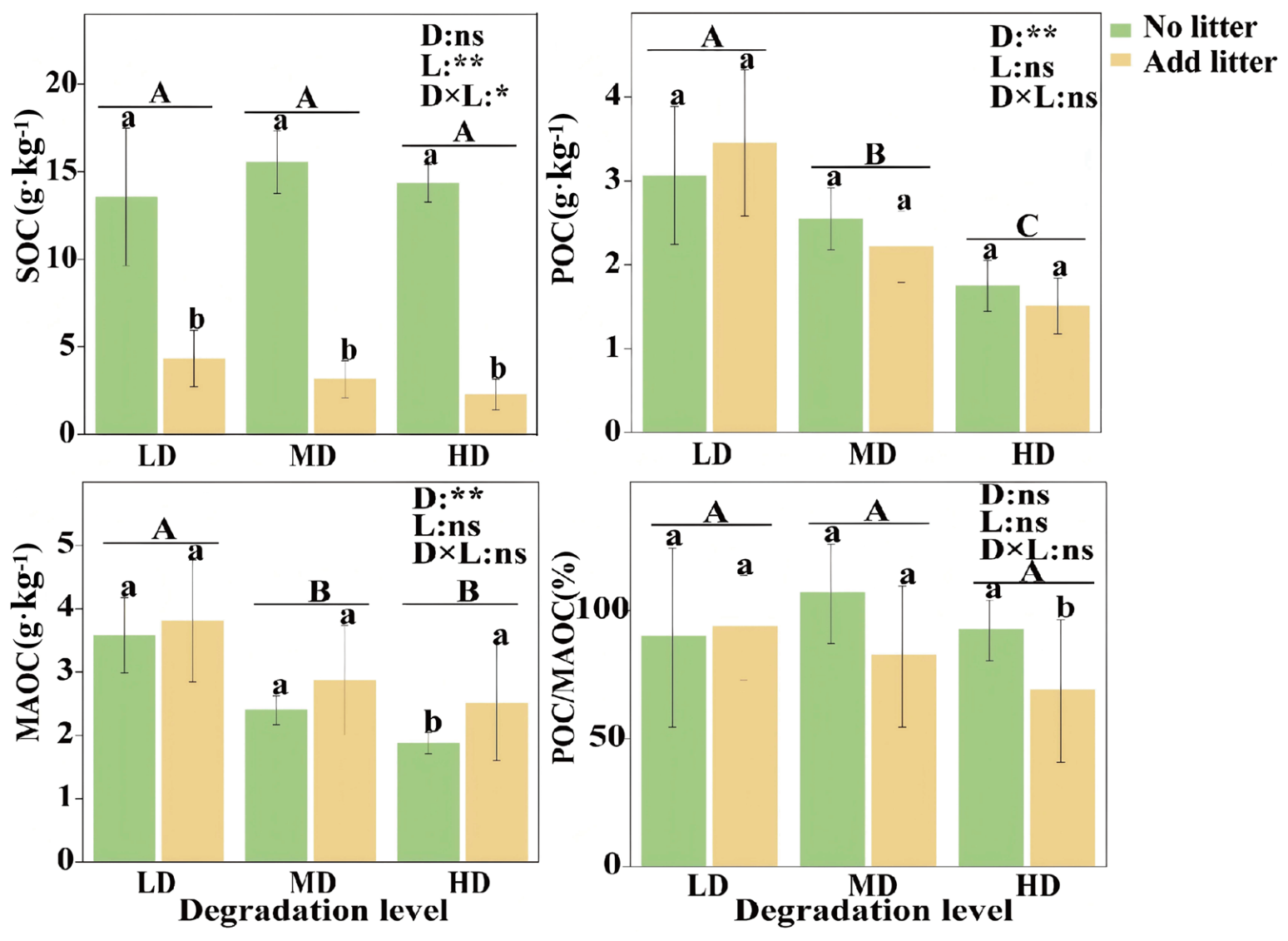
Grassland degradation significantly reduced POC and MAOC (p < 0.05) but had no significant effect on SOC (p > 0.05) (Figure 1). Litter decomposition significantly decreased SOC in degraded grasslands. In the highly degraded grassland, litter decomposition significantly increased MAOC (p < 0.05). The POC/MAOC ratio reflects the stability of SOC. A lower ratio indicates a shift of carbon from the more labile POC pool to the more stable MAOC pool. Degradation level had no significant effect on the POC/MAOC ratio (p > 0.05) (Figure 1). However, in the highly degraded grassland, litter decomposition significantly decreased the POC/MAOC ratio (p < 0.05).
Figure 1.
Effects of litter addition on SOC and its fractions in grasslands with different degradation levels. Different uppercase letters indicate significant differences among degradation-level treatments at p < 0.05; different lowercase letters indicate significant differences among litter addition treatments within the same degradation level at p < 0.05. D represents the degradation level; L represents litter decomposition; D × L represents the interaction between degradation level and litter decomposition; ns indicates no significant difference at the 0.05 level; * indicates significance at the 0.05 level; ** indicates significance at the 0.01 level.
3.2. Impact of Litter Addition on Soil Microbial Communities at Different Degradation Levels
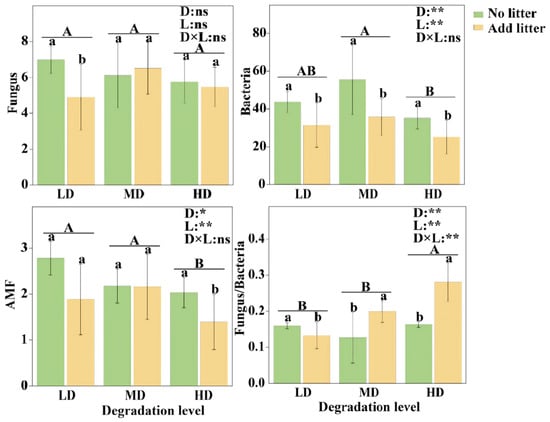
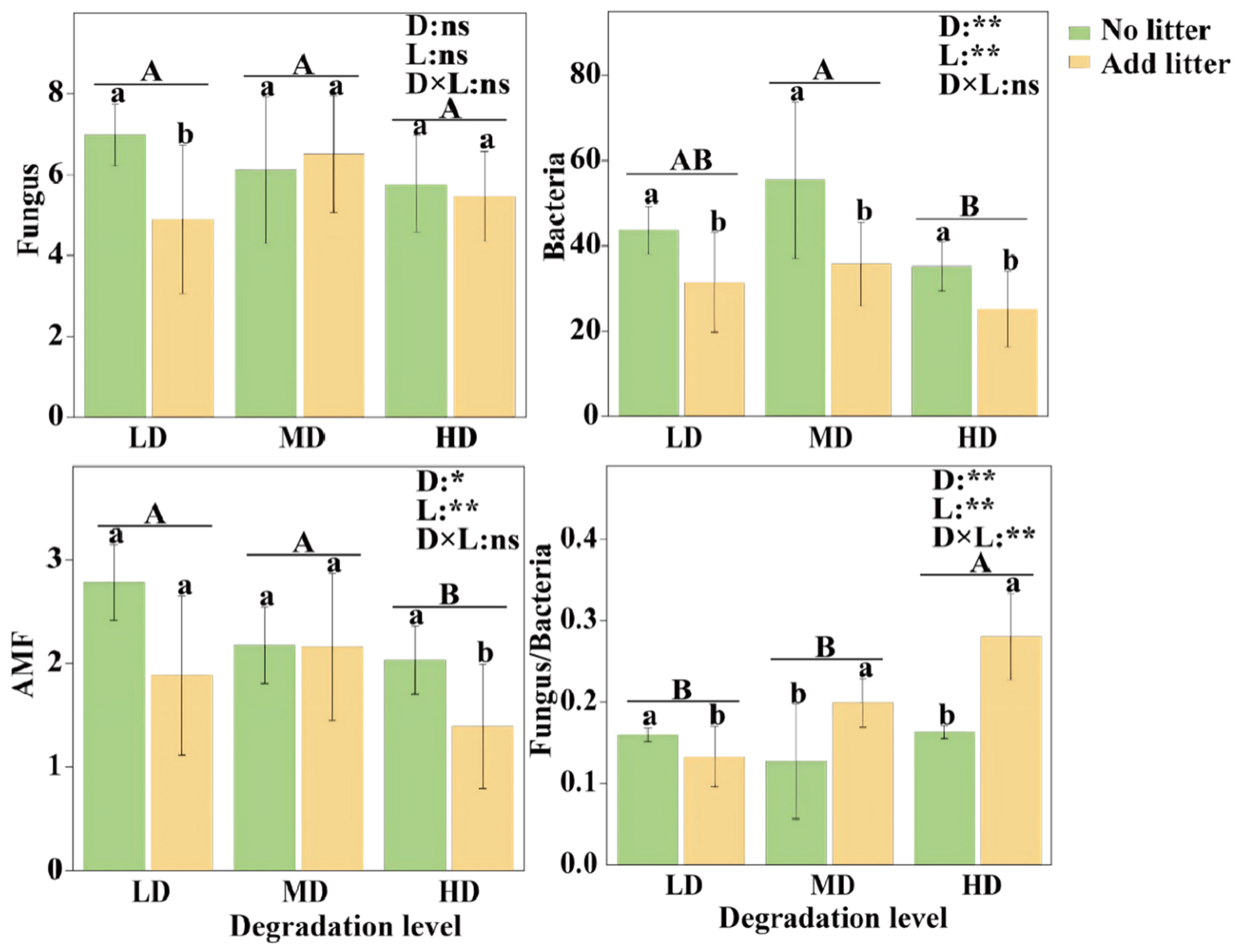
Based on absolute PLFA biomass values, grassland degradation had a significant effect on bacteria, AMF, and the fungi/bacteria ratio (p < 0.05). Bacteria biomass were higher in the moderately degraded grasslands than in the highly degraded ones. The fungi/bacteria ratio significantly increased (p < 0.05), while AMF declined as degradation intensified (p < 0.05). In the lightly degraded grassland, litter addition led to significant reductions in the absolute PLFA biomass of fungi, bacteria, and the fungi/bacteria ratio (p < 0.05). In the moderately degraded grassland, litter addition caused a significant decrease in bacteria biomass and a significant increase in the fungi/bacteria ratio (p < 0.05). In the highly degraded grasslands, litter addition significantly decreased the absolute PLFA biomass of bacteria and AMF while increasing the fungi/bacteria ratio (p < 0.05) (Figure 2).
Figure 2.
Effects of litter addition on PLFA in grasslands with different degradation levels. Different uppercase letters indicate significant differences among degradation-level treatments at p < 0.05; different lowercase letters indicate significant differences among litter addition treatments within the same degradation level at p < 0.05. D represents the degradation level; L represents litter decomposition; D × L represents the interaction between degradation level and litter decomposition; ns indicates no significant difference at the 0.05 level; * indicates significance at the 0.05 level; ** indicates significance at the 0.01 level.
3.3. Impact of Litter Addition on Soil Enzyme Activity at Different Degradation Levels
Grassland degradation significantly suppressed the C-enzyme, N-enzyme, and P-enzyme activity, vector length, and vector angle (p < 0.05). In the lightly and moderately degraded grasslands, litter addition significantly decreased N-enzyme activity and increased P-enzyme activity (p < 0.05). In the highly degraded grasslands, litter addition significantly suppressed the activities of C-enzyme and N-enzyme, vector length, and vector angle, whereas it significantly enhanced P-enzyme activity (p < 0.05). Across all three degradation levels, the vector angle remained below 45 degrees, indicating that soil microbial communities are predominantly in N-limited conditions (Figure 3).
Figure 3.
Effects of litter addition on soil extracellular enzyme activities, vector length, and angle in grasslands with different degradation levels. Different uppercase letters indicate significant differences among degradation-level treatments at p < 0.05; different lowercase letters indicate significant differences among litter addition treatments within the same degradation level at p < 0.05. D represents the degradation level; L represents litter decomposition; D × L represents the interaction between degradation level and litter decomposition; ns indicates no significant difference at the 0.05 level; * indicates significance at the 0.05 level; ** indicates significance at the 0.01 level.
3.4. Influence of Litter, Soil Physiochemistry, and Soil Microbes on POC and MAOC
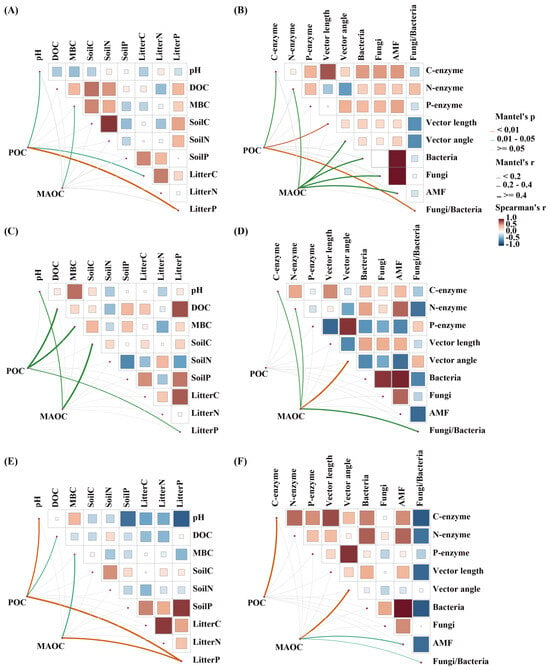
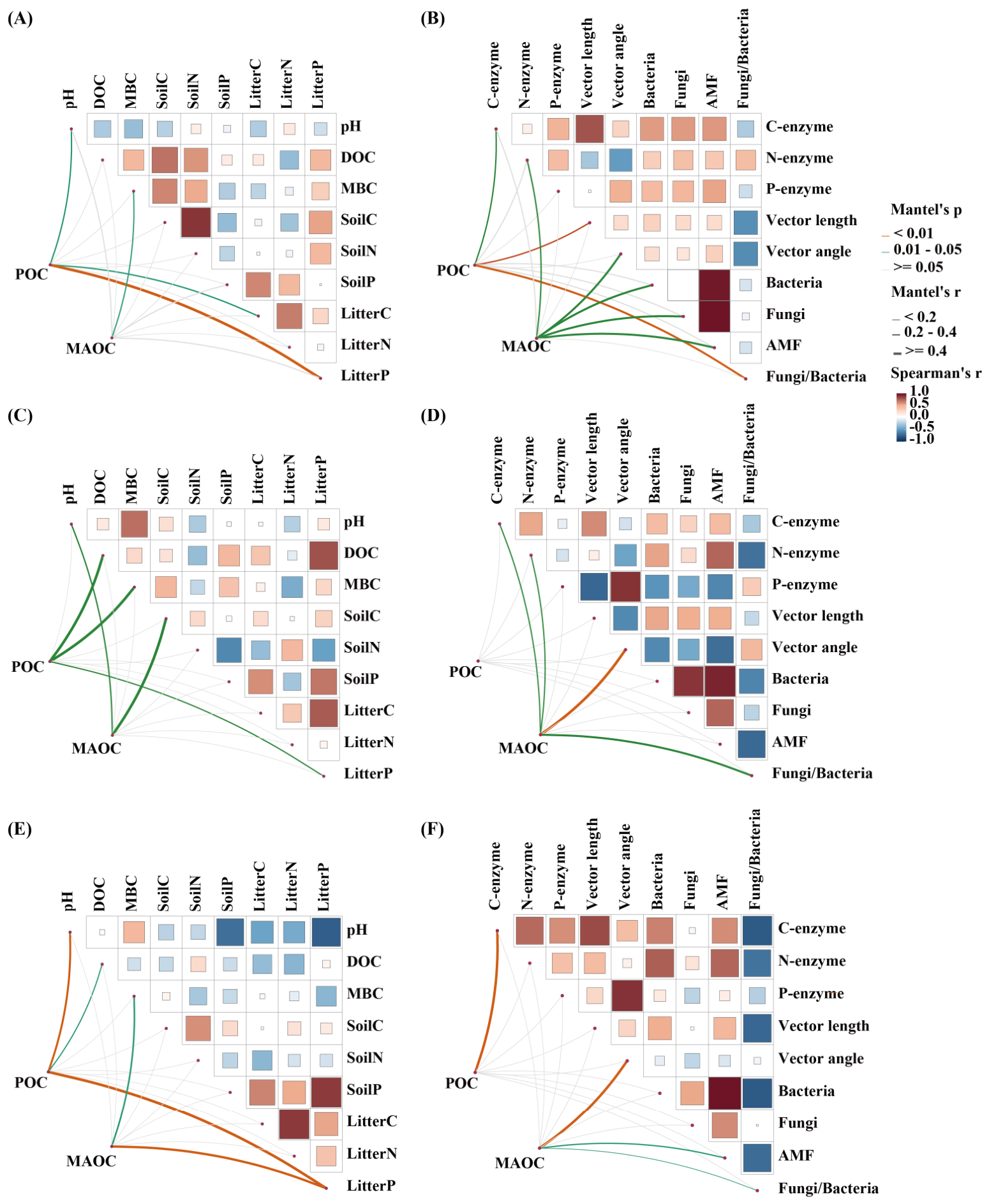
In the lightly degraded grasslands, POC significantly correlated with soil pH, litter carbon, litter phosphorus, C-enzyme, vector length, and the fungi/bacteria ratio, whereas MAOC was primarily related to microbial biomass and community composition (p < 0.05) (Figure 4A,B). In the moderately degraded grasslands, POC was mainly correlated with labile carbon and litter nutrient variables, while MAOC was significantly correlated with soil pH and microbial attributes (p < 0.05) (Figure 4C,D). In the highly degraded grasslands, POC was significantly correlated with soil pH, DOC, litter phosphorus, and C-enzyme, whereas MAOC was significantly associated with MBC, litter phosphorus, AMF, vector angle, and fungi/bacteria ratio (p < 0.05) (Figure 4E,F).
Figure 4.
Correlation of litter, soil physicochemical properties, and microorganisms with POC and MAOC in grasslands with different degradation levels: (A,B) lightly degraded level; (C,D) moderately degraded level; (E,F) highly degraded level.
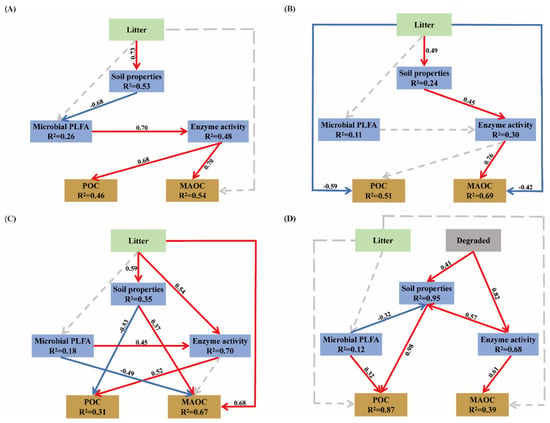
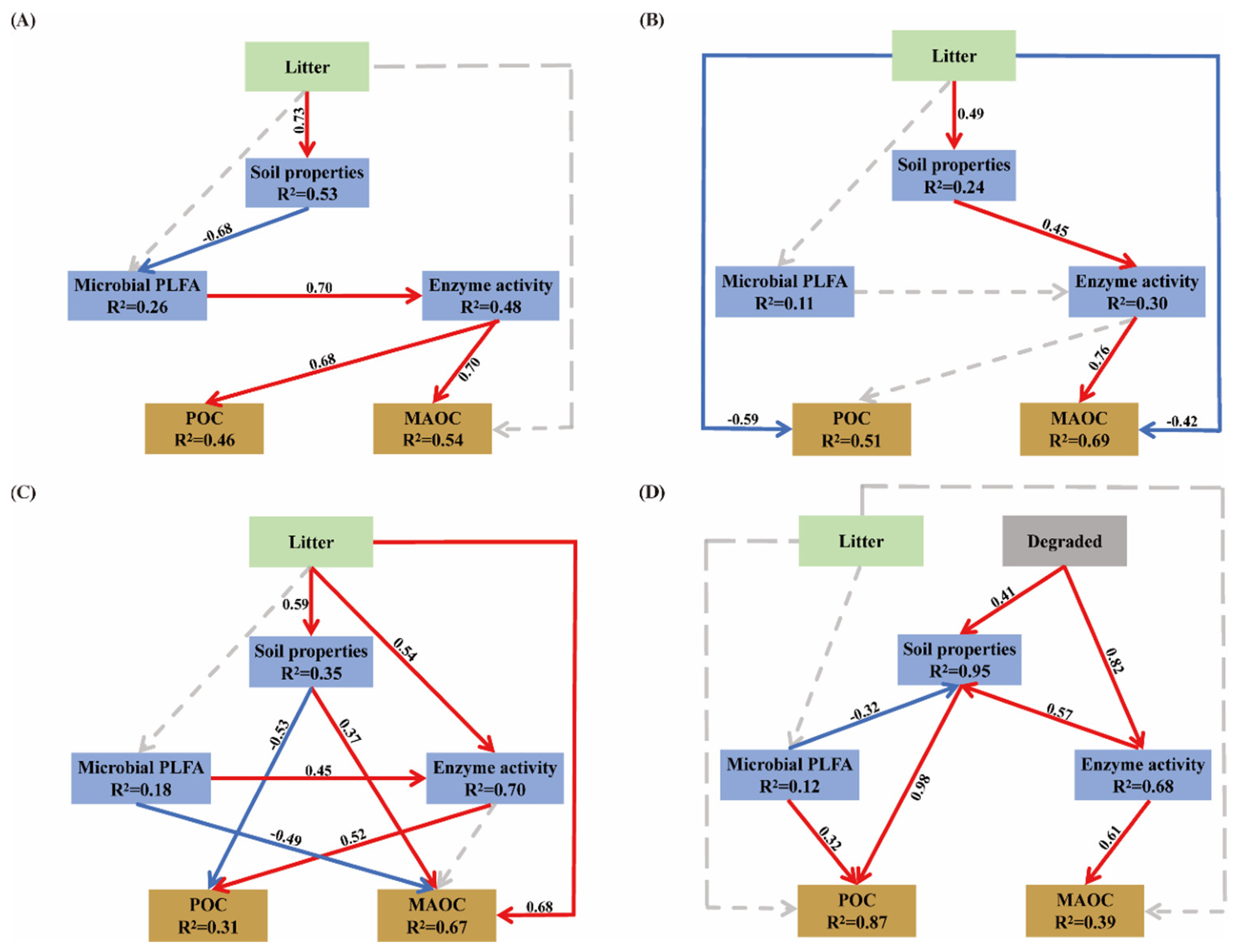
The SEM in the lightly degraded level provided a good fit to the data (p = 0.67, χ2 = 4.961, df = 7, SRMR = 0.05, CFI = 1.00, GFI = 0.91). Litter addition indirectly affected both POC and MAOC by influencing soil physicochemical properties and microbial and enzyme activity. The SEM in the moderately degraded level provided a good fit to the data (p = 0.68, χ2 = 4.00, df = 6, SRMR = 0.07, CFI = 1.00, GFI = 0.94). Litter addition was associated with soil physicochemical properties and enzyme activity, and litter addition can directly affect POC and MAOC. The SEM in the highly degraded level provided a good fit to the data (p = 0.70, χ2 = 2.19, df = 4, SRMR = 0.04, CFI = 1.00, GFI = 0.98). Litter addition indirectly regulated both POC and MAOC through modifications in soil physicochemical properties. Furthermore, litter addition directly enhanced MAOC and indirectly enhanced POC through enzyme activity. The SEM that examined the effects of degradation level and litter addition on POC and MAOC provided a good fit to the data (p = 0.58, χ2 = 3.80, df = 5, SRMR = 0.03, CFI = 1.00, GFI = 1.00). Degraded grassland affected POC by altering soil physicochemical properties and interacting with microorganisms. It influenced MAOC through modifications in enzyme activities. Litter addition showed no significant influence on POC or MAOC (Figure 5).
Figure 5.
Path model of the effects of litter addition on POC and MAOC in grasslands with different degradation levels: (A) lightly degraded level; (B) moderately degraded level; (C) highly degraded level; (D) an overall model including litter addition and degradation level as exogenous drivers. The red and blue solid arrows indicate significant positive and negative effects, respectively.
4. Discussion
4.1. Effects of Grassland Degradation and Litter Addition on SOC and Its Fractions Contents
Our study demonstrated that grassland degradation significantly reduced POC and MAOC. This may be attributed to the fact that degradation deteriorates both above- and belowground environmental conditions, ultimately decreasing carbon inputs to the soil [2,52]. As plant-derived carbon constitutes the primary source of POC, a degradation-induced reduction in litter input may directly decrease POC concentrations [53]. The decline in MAOC with degradation may be attributed to a decrease in microbial biomass, which slows the formation of MAOC from microbial residues [54,55]. This result is consistent with previous studies that degradation significantly reduced both POC and MAOC, with POC often exhibiting a greater decline than MAOC [12,56]. The POC/MAOC ratio was used as an indicator reflecting the relative distribution of SOC between the more labile POC pool and the more stable MAOC pool and thus as a proxy for SOC stability within the degraded grasslands. Degradation had no significant effect on the POC/MAOC ratio, which may indicate that grassland degradation did not significantly alter the overall distribution of SOC between POC and MAOC and therefore did not significantly change SOC stability in Songnen grassland [57,58]. However, it is, unlike previous reports, showing a decline in the POC/MAOC ratio under degradation. Such differences may reflect the relatively greater persistence of MAOC than POC, which may allow MAOC to decline more slowly during degradation [53,54,55]. This interpretation is also supported by previous studies emphasizing the relatively persistent nature of mineral-associated organic carbon in soils [59].
In the lightly and moderately degraded grasslands, POC, MAOC, and their ratio were unchanged by litter addition. This likely indicates that litter addition did not significantly change the contents of these carbon fractions in the degraded grasslands under the incubation conditions used in this study [60]. In the highly degraded grasslands, litter addition significantly increased MAOC. Compared to lightly and moderately degraded grasslands, highly degraded grasslands may have more fragile soil conditions and ecosystem instability, making them more responsive to microbial activation [61]. Thus, litter addition may stimulate microbial utilization of labile carbon components. Microorganisms may promote the association of labile carbon components with soil minerals, thereby facilitating the formation of MAOC [62]. Under the fragile habitat conditions of highly degraded grasslands, litter addition may therefore be more favorable for MAOC accumulation. Therefore, the effect of litter addition on SOC fractions became more evident as degradation intensified.
4.2. Mechanisms of SOC Fractions Following Litter Addition Across Grassland Degradation
In this study, the effects of litter addition on POC and MAOC varied with grassland degradation levels. The SEM results mainly reflected how litter addition influenced POC and MAOC through different pathways rather than whether litter addition significantly changed their final contents. In the lightly degraded grasslands, litter addition may have altered soil physicochemical properties, thereby influencing microbial enzyme activities and affecting POC and MAOC. One possible explanation is that changes in soil pH influenced microbial activity and organic carbon turnover [63]. However, according to the SOC fraction content results of this study, these pathway effects were not expressed as significant changes in POC or MAOC contents under light degradation. This suggests that in lightly degraded grasslands, litter addition may have modified the processes related to SOC fractions without producing sufficiently strong effects to alter their measured contents. In the moderately degraded grassland, the soil physicochemical and enzyme activities also contributed to POC and MAOC, but the mechanism was different from lightly degraded grassland. Similar patterns have also been reported in previous studies where microbial and environmental factors influenced the pathways related to SOC fractions even though no significant changes were observed in POC or MAOC contents [56,64]. Nevertheless, in the present study, litter addition did not significantly affect POC or MAOC contents under moderate degradation. Therefore, although litter addition influenced the pathways related to these two fractions, these effects were not strong enough to cause significant changes in their contents [65]. In the highly degraded grassland, biotic and abiotic factors exerted substantial effects on POC and MAOC. This may have been due to a combination of altering carbon availability and increasing environmental stress in the highly degraded grasslands. Under these conditions, fresh litter inputs may have been used more efficiently by microorganisms, thereby promoting microbial turnover and facilitating the incorporation of litter-derived carbon into POC and MAOC fractions [8,66,67]. This interpretation is consistent with previous studies on degraded grasslands showing that changes in carbon input and microbial carbon transformation can strongly affect the formation and stabilization of SOC fractions [54,68]. In our study, this interpretation is also consistent with the significant increase in MAOC under litter addition in the highly degraded grasslands.
Taken together, the following interpretation is intended as a conceptual framework for understanding the responses of SOC fractions along the degradation gradient, rather than as a direct result derived from this study. As degradation increased, litter addition appeared to influence POC and MAOC through an increasing variety of pathways. Within this conceptual context, the lightly degraded grasslands may approximate a relatively stable state close to a healthy ecosystem, the moderately degraded grasslands may be regarded as a transitional state with restoration potential, and the highly degraded grasslands may represent a more severely degraded condition with limited recovery potential [69]. This interpretation is also consistent with current conceptual frameworks of SOC formation, which emphasize that the balance among litter inputs, microbial transformation, and mineral stabilization governs the partitioning of carbon between POC and MAOC [70,71]. Accordingly, as ecosystems became increasingly vulnerable along the degradation gradient, biotic and abiotic constraints may have exerted progressively stronger effects on SOC fractions and their distribution in the degraded Songnen grasslands under the litter decomposition conditions examined in this study.
5. Conclusions
This study investigated the influence of litter addition on soil carbon through distinct transformation mechanisms in degraded grasslands. Grassland degradation led to an overall decline in SOC and its components, and litter addition exerted varying effects on MAOC across different degradation gradients. Litter addition in lightly degraded grasslands mainly acted through soil physicochemical and enzymatic pathways; in moderately degraded grasslands, it altered related pathways without significantly changing SOC fraction contents; and in highly degraded grasslands, stronger biotic and abiotic interactions were associated with clearer MAOC formation. As degradation increases, litter addition modulates SOC and its fractions through increasingly complex drivers involving a combination of biotic and abiotic factors. This suggests that the degraded soil ecosystem becomes more vulnerable, amplifying the effects of these factors on the SOC pool. Collectively, the positive effect of limited litter addition was insufficient to counteract degradation-induced carbon losses. The SEM results showed that increasing degradation was associated with more complex biotic and abiotic controls over POC and MAOC, indicating that degradation affected not only the magnitude of SOC decline but also the pathways regulating SOC fraction dynamics. Therefore, we recommend adopting restoration strategies that improve soil conditions conducive to MAOC formation (e.g., maintaining soil pH to facilitate microbial recovery) while implementing litter addition in degraded grasslands with sufficient duration and intensity to offset degradation-induced carbon losses and promote ecosystem recovery.
Supplementary Materials
The following supporting information can be downloaded at https://www.mdpi.com/article/10.3390/agronomy16080835/s1, Table S1: Effects of adding litter in degraded grasslands on litter and soil physicochemical properties. Table S2: Soil microbial phospholipid fatty acids (PLFA). Table S3: Ecological hypotheses to each pathway of the structural equation model [32,62,67,72,73,74,75,76,77,78,79,80,81,82,83,84,85].
Author Contributions
P.G. contributed to the study’s conception and design. S.W., C.F., J.L. and J.Z. performed material preparation and data collection. S.W., L.R. and W.T. performed data analyses. S.W. wrote the manuscript. P.G. revised the manuscript. All authors have read and agreed to the published version of the manuscript.
Funding
This research was funded by the National Key R&D Program of China (2024YFD1501305), the National Science and Technology Fundamental Resources Investigation Program of China (2024FY100400), and the National Nature Science Foundation of China (41807046).
Data Availability Statement
The original contributions presented in the study are included in the article/Supplementary Material. Further inquiries can be directed to the corresponding author.
Acknowledgments
We thank Yunga Wu, Chao Hao and Peng Zhang for helping with field work.
Conflicts of Interest
The authors declare no conflicts of interest.
Abbreviations
The following abbreviations are used in this manuscript:
| LD | Lightly degraded level |
| MD | Moderately degraded level |
| HD | Highly degraded level |
| Soil C | Soil total carbon |
| Soil N | Soil total nitrogen |
| Soil P | Soil total phosphorus |
| Litter C | Litter carbon |
| Litter N | Litter nitrogen |
| Litter P | Litter phosphorus |
References
- Bai, Y.; Cotrufo, M.F. Grassland soil carbon sequestration: Current understanding, challenges, and solutions. Science 2022, 377, 603–608. [Google Scholar] [CrossRef] [Scilit]
- Dlamini, P.; Chivenge, P.; Manson, A.; Chaplot, V. Land degradation impact on soil organic carbon and nitrogen stocks of sub-tropical humid grasslands in South Africa. Geoderma 2014, 235–236, 372–381. [Google Scholar] [CrossRef] [Scilit]
- Wu, Y.; He, J.; Liu, W.; Cheng, W.; Shaaban, M.; Jiang, Y. The effects of continuous straw returning strategies on SOC balance upon fresh straw incorporation. Environ. Res. 2023, 232, 116225. [Google Scholar] [CrossRef] [Scilit] [PubMed]
- Neubauer, T.A.; Hauffe, T.; Silvestro, D.; Schauer, J.; Kadolsky, D.; Wesselingh, F.P.; Harzhauser, M.; Wilke, T. Current extinction rate in European freshwater gastropods greatly exceeds that of the late Cretaceous mass extinction. Commun. Earth Environ. 2021, 2, 97. [Google Scholar] [CrossRef] [Scilit]
- Hu, Y.; Ao, G.; Fu, L.; Ji, C.; Zeng, H.; Zhu, B. Linking plant traits, soil nutrients, climate and soil microbes in temperate grasslands. Plant Soil, 2025; in press. [CrossRef] [Scilit]
- Lavallee, J.M.; Soong, J.L.; Cotrufo, M.F. Conceptualizing soil organic matter into particulate and mineral-associated forms to address global change in the 21st century. Glob. Change Biol. 2020, 26, 261–273. [Google Scholar] [CrossRef] [Scilit] [PubMed]
- Zhang, S.; Zhou, X.; Chen, Y.; Du, F.; Zhu, B. Soil organic carbon fractions in China: Spatial distribution, drivers, and future changes. Sci. Total Environ. 2024, 919, 170890. [Google Scholar] [CrossRef] [Scilit]
- Wu, J.; Zhang, H.; Pan, Y.; Cheng, X.; Zhang, K.; Liu, G. Particulate organic carbon is more sensitive to nitrogen addition than mineral-associated organic carbon: A meta-analysis. Soil Tillage Res. 2023, 232, 105770. [Google Scholar] [CrossRef] [Scilit]
- Zhu, Y.; Hu, M.; Hui, D.; Niu, G.; Li, J.; Yao, X.; Hu, Y.; Huang, X.; Li, Y.; Zhang, D.; et al. Plants and microorganisms both contribute to soil organic matter formation through mineral interactions: Evidence from a subtropical forest succession. Geoderma 2024, 452, 117099. [Google Scholar] [CrossRef] [Scilit]
- Zhang, Y.; Ge, X.; Li, Q.; Zhuang, S.; Shi, M.; Huang, X.; Qian, Z. Continuous organic mulching enhances the stability of soil organic carbon in Phyllostachys praecox: A 5-year in situ experiment. Soil Ecol. Lett. 2025, 7, 240290. [Google Scholar] [CrossRef] [Scilit]
- Zhang, X.; Chang, F.; Zhang, H.; Wang, X.; Li, H.; Song, J.; Kan, Z.; Du, Z.; Zhou, J.; Chen, J.; et al. Divergent responses of particulate and mineral-associated organic carbon with soil depth under straw interlayer in saline-alkali soil. Agric. Ecosys. Environ. 2024, 371, 109073. [Google Scholar] [CrossRef] [Scilit]
- Zhang, H.; Liu, G.; Wu, J. The Effect of Land Degradation and Restoration on Particulate and Mineral-Associated Organic Carbon. Appl. Soil Ecol. 2024, 196, 105322. [Google Scholar] [CrossRef] [Scilit]
- Macheroum, A.; Chenchouni, H. Short-term land degradation driven by livestock grazing does not affect soil properties in semiarid steppe rangelands. Front. Environ. Sci. 2022, 10, 846045. [Google Scholar] [CrossRef] [Scilit]
- Yang, N.; Zhang, M.; Pan, X.; Dang, P.; Wang, S.; Han, X.; Wang, X.; Zhang, C.; Meng, M.; Wang, W.; et al. Characteristics of changes to POC and MAOC after straw returning in China: A meta-analysis. Land Degrad. Dev. 2025, 36, 5199–5211. [Google Scholar] [CrossRef] [Scilit]
- Feng, J.; He, K.; Zhang, Q.; Han, M.; Zhu, B. Changes in plant inputs alter soil carbon and microbial communities in forest ecosystems. Glob. Change Biol. 2022, 28, 3426–3440. [Google Scholar] [CrossRef] [Scilit]
- Sokol, N.W.; Bradford, M.A. Microbial formation of stable soil carbon is more efficient from belowground than aboveground input. Nat. Geosci. 2019, 12, 46–53. [Google Scholar] [CrossRef] [Scilit]
- Su, T.; Jiang, Y.; Chen, H.; Wang, Y.; Yang, Q.; Li, J.; Lu, J.-L.; Ran, H.; Yang, H.; Liu, W.; et al. Short-term nutrient addition increases soil organic carbon accumulation in tropical forest. Plant Soil 2025, 514, 3013–3029. [Google Scholar] [CrossRef] [Scilit]
- Zeng, J.; Li, X.; Song, R.; Xie, H.; Li, X.; Liu, W.; Liu, H.; Du, Y.; Xu, M.; Ren, C.; et al. Mechanisms of litter input changes on soil organic carbon dynamics: A microbial carbon use efficiency-based perspective. Sci. Total Environ. 2024, 949, 175092. [Google Scholar]
- Zhang, X.; You, Y.; Wang, D.; Zhu, L. Quality evaluation of the soil-root composites layer of Leymus chinensis grassland based on different degradation degrees. Catena 2022, 215, 106330. [Google Scholar] [CrossRef] [Scilit]
- Liu, L.; Zuo, S.; Ma, M.; Li, J.; Guo, L.; Huang, D. Appropriate nitrogen addition regulates reproductive strategies of Leymus chinensis. Glob. Ecol. Conserv. 2021, 27, e01599. [Google Scholar] [CrossRef] [Scilit]
- Wang, R.Z. Responses of Leymus chinensis (Poaceae) to long-term grazing disturbance in the Songnen grasslands of north-eastern China. Grass Forage Sci. 2004, 59, 191–195. [Google Scholar] [CrossRef] [Scilit]
- Renzhong, W.; Ripley, E.A. Effects of grazing on a Leymus chinensis grassland on the Songnen plain of north-eastern China. J. Arid Environ. 1997, 36, 307–318. [Google Scholar] [CrossRef] [Scilit]
- He, N.; Yu, Q.; Wu, L.; Wang, Y.; Han, X. Carbon and nitrogen store and storage potential as affected by land-use in a Leymus chinensis grassland of northern China. Soil Biol. Biochem. 2008, 40, 2952–2959. [Google Scholar] [CrossRef] [Scilit]
- Wang, D.; Du, J.; Zhang, B.; Ba, L.; Hodgkinson, K.C. Grazing intensity and phenotypic plasticity in the clonal grass Leymus chinensis. Rangel. Ecol. Manag. 2017, 70, 740–747. [Google Scholar] [CrossRef] [Scilit]
- Li, X.; Liu, J.; Fan, J.; Ma, Y.; Ding, S.; Zhong, Z.; Wang, D. Combined effects of nitrogen addition and litter manipulation on nutrient resorption of Leymus chinensis in a semi-arid grassland of northern China. Plant Biol. 2015, 17, 9–15. [Google Scholar] [CrossRef] [Scilit]
- Pan, C.; Liu, C.; Zhao, H.; Wang, Y. Changes of soil physico-chemical properties and enzyme activities in relation to grassland salinization. Eur. J. Soil Biol. 2013, 55, 13–19. [Google Scholar] [CrossRef] [Scilit]
- Wu, X.; Yang, J.; Ruan, H.; Wang, S.; Yang, Y.; Naeem, I.; Wang, L.; Liu, L.; Wang, D. The diversity and co-occurrence network of soil bacterial and fungal communities and their implications for a new indicator of grassland degradation. Ecol. Indic. 2021, 129, 107989. [Google Scholar] [CrossRef] [Scilit]
- Yang, T.; Chen, J.; Zhong, X.; Yang, X.; Wang, G.; Yao, Y.; Sternberg, M.; Sun, W. Divergent responses of plant biomass and its allocation to the altered precipitation regimes among different degraded grasslands in China. Plant Soil 2022, 473, 149–166. [Google Scholar] [CrossRef] [Scilit]
- Liu, H.; Yin, Y.; Tian, Y.; Ren, J.; Wang, H. Climatic and anthropogenic controls of topsoil features in the semi-arid East Asian steppe. Geophys. Res. Lett. 2008, 35, L04401. [Google Scholar] [CrossRef] [Scilit]
- Liu, Y.; Zhou, Y.; Fang, L.; Yang, C. Arbuscular mycorrhizal fungal colonization at different succession stages in Songnen saline-alkali grassland. Phyton 2023, 92, 297. [Google Scholar] [CrossRef] [Scilit]
- Zhao, C.; Li, Q.; Cheng, L.; Zhong, R. Effects of mowing regimes on forage yield and crude protein of Leymus chinensis (Trin.) Tzvel in Songnen grassland. Grassl. Sci. 2021, 67, 275–284. [Google Scholar] [CrossRef] [Scilit]
- Li, J.; Niu, X.; Wang, P.; Yang, J.; Liu, J.; Wu, D.; Guan, P. Soil degradation regulates the effects of litter decomposition on soil microbial nutrient limitation: Evidence from soil enzymatic activity and stoichiometry. Front. Plant Sci. 2022, 13, 1090954. [Google Scholar] [CrossRef] [Scilit]
- Maggiotto, G.; Sabatté, L.; Marina, T.I.; Fueyo-Sánchez, L.; Ramírez Londoño, A.M.; Díaz Porres, M.; Rionda, M.; Domínguez, M.; Perelli, R.; Momo, F.R. Soil fauna community and ecosystem’s resilience: A food web approach. Acta Oecol. 2019, 99, 103445. [Google Scholar] [CrossRef] [Scilit]
- Creamer, C.A.; Macdonald, L.M.; Baldock, J.A.; Sanderman, J.; Farrell, M. Divergent responses of organic matter composition to incubation temperature. Geoderma 2015, 259–260, 279–287. [Google Scholar] [CrossRef] [Scilit]
- Cambardella, C.A.; Elliott, E.T. Particulate soil organic-matter changes across a grassland cultivation sequence. Soil Sci. Soc. Am. J. 1992, 56, 777–783. [Google Scholar] [CrossRef] [Scilit]
- Six, J.; Conant, R.T.; Paul, E.A.; Paustian, K. Stabilization mechanisms of soil organic matter: Implications for C-saturation of soils. Plant Soil 2002, 241, 155–176. [Google Scholar] [CrossRef] [Scilit]
- Castellano, M.J.; Mueller, K.E.; Olk, D.C.; Sawyer, J.E.; Six, J. Mechanisms of soil organic carbon and nitrogen stabilization in mineral-associated organic matter: Insights from modeling in phase space. Glob. Change Biol. 2015, 21, 4544–4559. [Google Scholar]
- Wu, H.; Lu, X.; Tong, S.; Batzer, D.P. Soil engineering ants increase CO2 and N2O emissions by affecting mound soil physicochemical characteristics from a marsh soil: A laboratory study. Appl. Soil Ecol. 2015, 87, 19–26. [Google Scholar] [CrossRef] [Scilit]
- Bossio, D.A.; Scow, K.M.; Gunapala, N.; Graham, K.J. Determinants of soil microbial communities: Effects of agricultural management, season, and soil type on phospholipid fatty acid profiles. Microb. Ecol. 1998, 36, 1–12. [Google Scholar] [CrossRef] [Scilit]
- Certini, G.; Campbell, C.D.; Edwards, A.C. Rock fragments in soil support a different microbial community from the fine earth. Soil Biol. Biochem. 2004, 36, 1119–1128. [Google Scholar] [CrossRef] [Scilit]
- Dempsey, M.A.; Fisk, M.C.; Yavitt, J.B.; Fahey, T.J.; Balser, T.C. Exotic earthworms alter soil microbial community composition and function. Soil Biol. Biochem. 2013, 67, 263–270. [Google Scholar] [CrossRef] [Scilit]
- Briar, S.S.; Fonte, S.J.; Park, I.; Six, J.; Scow, K.; Ferris, H. The distribution of nematodes and soil microbial communities across soil aggregate fractions and farm management systems. Soil Biol. Biochem. 2011, 43, 905–914. [Google Scholar] [CrossRef] [Scilit]
- Bach, E.M.; Baer, S.G.; Meyer, C.K.; Six, J. Soil texture affects soil microbial and structural recovery during grassland restoration. Soil Biol. Biochem. 2010, 42, 2182–2191. [Google Scholar] [CrossRef] [Scilit]
- McKinley, V.L.; Peacock, A.D.; White, D.C. Microbial community PLFA and PHB responses to ecosystem restoration in tallgrass prairie soils. Soil Biol. Biochem. 2005, 37, 1946–1958. [Google Scholar] [CrossRef] [Scilit]
- de Vries, F.T.; Thébault, E.; Liiri, M.; Birkhofer, K.; Tsiafouli, M.A.; Bjørnlund, L.; Jørgensen, H.B.; Brady, M.V.; Christensen, S.; de Ruiter, P.C.; et al. Soil food web properties explain ecosystem services across European land use systems. Proc. Natl. Acad. Sci. USA 2013, 110, 14296–14301. [Google Scholar] [CrossRef] [Scilit]
- Klamer, M. Estimation of conversion factors for fungal biomass determination in compost using ergosterol and PLFA 18:2ω6,9. Soil Biol. Biochem. 2004, 36, 57–65. [Google Scholar] [CrossRef] [Scilit]
- Olsson, P.A.; Bååth, E.; Jakobsen, I.; Söderström, B. The use of phospholipid and neutral lipid fatty acids to estimate biomass of arbuscular mycorrhizal fungi in soil. Mycol. Res. 1995, 99, 623–629. [Google Scholar] [CrossRef] [Scilit]
- Sinsabaugh, R.L.; Lauber, C.L.; Weintraub, M.N.; Ahmed, B.; Allison, S.D.; Crenshaw, C.; Contosta, A.R.; Cusack, D.; Frey, S.; Gallo, M.E.; et al. Stoichiometry of soil enzyme activity at global scale. Ecol. Lett. 2008, 11, 1252–1264. [Google Scholar] [CrossRef] [Scilit]
- DeForest, J.L.; Moorhead, D.L. Effects of elevated pH and phosphorus fertilizer on soil C, N and P enzyme stoichiometry in an acidic mixed mesophytic deciduous forest. Soil Biol. Biochem. 2020, 150, 107996. [Google Scholar] [CrossRef] [Scilit]
- Bai, X.; Dippold, M.A.; An, S.; Wang, B.; Zhang, H.; Loeppmann, S. Extracellular enzyme activity and stoichiometry: The effect of soil microbial element limitation during leaf litter decomposition. Ecol. Indic. 2021, 121, 107200. [Google Scholar] [CrossRef] [Scilit]
- Moorhead, D.L.; Rinkes, Z.L.; Sinsabaugh, R.L.; Weintraub, M.N. Dynamic relationships between microbial biomass, respiration, inorganic nutrients and enzyme activities: Informing enzyme-based decomposition models. Front. Microbiol. 2013, 4, 223. [Google Scholar] [CrossRef] [Scilit]
- Peng, F.; Xue, X.; You, Q.; Huang, C.; Dong, S.; Liao, J.; Duan, H.; Tsunekawa, A.; Wang, T. Changes of soil properties regulate the soil organic carbon loss with grassland degradation on the Qinghai-Tibet Plateau. Ecol. Indic. 2018, 93, 572–580. [Google Scholar] [CrossRef] [Scilit]
- Chen, J.; Xiao, W.; Zheng, C.; Zhu, B. Nitrogen addition has contrasting effects on particulate and mineral-associated soil organic carbon in a subtropical forest. Soil Biol. Biochem. 2020, 142, 107708. [Google Scholar] [CrossRef] [Scilit]
- Pereira, A.P.D.A.; Mendes, L.W.; Oliveira, F.A.S.; Antunes, J.E.L.; Melo, V.M.M.; Araujo, A.S.F. Land degradation affects the microbial communities in the Brazilian Caatinga biome. Catebna 2022, 211, 105961. [Google Scholar] [CrossRef] [Scilit]
- Liang, C.; Schimel, J.P.; Jastrow, J.D. The importance of anabolism in microbial control over soil carbon storage. Nat. Microbiol. 2017, 2, 17105. [Google Scholar] [CrossRef] [Scilit]
- Song, M.; Pang, R.; Tian, Y.; Li, Y.; Wang, G.; Xu, X. Functional shift in soil microbiome with decline in photosynthetic carbon input signifies rapid decrease of soil organic carbon during alpine grassland degradation. Biol. Fertil. Soils 2025, 61, 893–908. [Google Scholar] [CrossRef] [Scilit]
- Jiang, R.; Liu, S.; Jiang, F.; Guo, Z.; Adingo, S.; Chen, Z.; Gao, L.; Peng, X. Soil organic carbon trade-offs under conservation tillage: Carbon stock versus stability mediated by particulate and mineral-associated fractions. Soil Tillage Res. 2025, 254, 106704. [Google Scholar] [CrossRef] [Scilit]
- Kong, W.; Xiao, J.; Liu, J.; Yao, Y.; Qiu, L.; Shao, M.; Wei, X. Spatiotemporal variability in divergent accrual of particulate and mineral-associated organic carbon by vegetation restoration on the Loess Plateau. Agric. Ecosyst. Environ. 2025, 393, 109856. [Google Scholar] [CrossRef] [Scilit]
- Lavallee, J.M.; Soong, J.L.; Cotrufo, M.F. Soil carbon storage informed by particulate and mineral-associated organic matter. Nat. Geosci. 2020, 13, 794–804. [Google Scholar]
- Georgiou, K.; Angers, D.; Champiny, R.E.; Cotrufo, M.F.; Craig, M.E.; Doetterl, S.; Grandy, A.S.; Lavallee, J.M.; Lin, Y.; Lugato, E.; et al. Soil carbon saturation: What do we really know? Glob. Change Biol. 2025, 31, e70197. [Google Scholar] [CrossRef] [Scilit]
- Liao, C.; Chang, K.; Wu, B.; Zhang, D.; Wang, C.; Cheng, X. Divergence in soil particulate and mineral-associated organic carbon reshapes carbon stabilization along an elevational gradient. Catena 2024, 235, 107682. [Google Scholar] [CrossRef] [Scilit]
- Wang, K.; Ma, Z.; Qin, W.; Li, X.; Shi, H.; Hasi, B.; Liu, X. Soil nutrients and pH modulate carbon dynamics in particulate and mineral-associated organic matter during restoration of a tibetan alpine grassland. Ecol. Eng. 2025, 212, 107522. [Google Scholar] [CrossRef] [Scilit]
- Xu, S.; Sayer, E.J.; Eisenhauer, N.; Lu, X.; Wang, J.; Liu, C. Aboveground litter inputs determine carbon storage across soil profiles: A meta-analysis. Plant Soil 2021, 462, 429–444. [Google Scholar] [CrossRef] [Scilit]
- Kotroczó, Z.; Veres, Z.; Fekete, I.; Krakomperger, Z.; Tóth, J.A.; Lajtha, K.; Tóthmérész, B. Soil enzyme activity in response to long-term organic matter manipulation. Soil Biol. Biochem. 2014, 70, 237–243. [Google Scholar] [CrossRef] [Scilit]
- Kleber, M.; Eusterhues, K.; Keiluweit, M.; Mikutta, C.; Mikutta, R.; Nico, P.S. Mineral–organic associations: Formation, properties, and relevance in soil environments. In Advances in Agronomy; Sparks, D.L., Ed.; Academic Press: San Diego, CA, USA, 2015; Volume 130, pp. 1–140. [Google Scholar]
- Yang, Y.; Dou, Y.; Wang, B.; Wang, Y.; Liang, C.; An, S.; Soromotin, A.; Kuzyakov, Y. Increasing contribution of microbial residues to soil organic carbon in grassland restoration chronosequence. Soil Biol. Biochem. 2022, 170, 108688. [Google Scholar] [CrossRef] [Scilit]
- Hansen, P.M.; Zhang, Y.; Guseva, K.; Kaiser, C.; Cotrufo, M.F. Microbial community regulation of extracellular enzyme production can mediate patterns of particulate and mineral-associated organic matter accumulation in undersaturated soils. Soil Biol. Biochem. 2026, 214, 110056. [Google Scholar] [CrossRef] [Scilit]
- Bastida, F.; García, C.; Fierer, N.; Eldridge, D.J.; Bowker, M.A.; Abades, S.; Alfaro, F.D.; Berhe, A.A.; Cutler, N.A.; Gallardo, A.; et al. Global ecological predictors of the soil priming effect. Nat. Commun. 2019, 10, 3481. [Google Scholar] [CrossRef] [Scilit] [PubMed]
- Wu, M.; Chen, L.; Chen, S.; Chen, Y.; Ma, J.; Zhang, Y.; Pang, D.; Li, X. Soil microbial carbon and nitrogen limitation constraints soil organic carbon stability in arid and semi-arid grasslands. J. Environ. Manag. 2025, 373, 123675. [Google Scholar] [CrossRef] [Scilit]
- Kramer, C.; Gleixner, G. Variable use of plant- and soil-derived carbon by microorganisms in agricultural soils. Soil Biol. Biochem. 2006, 38, 3267–3278. [Google Scholar] [CrossRef] [Scilit]
- Liu, M.; Liu, S.; Xu, X.; Soromotin, A.V.; Kuzyakov, Y. Does restoration of degraded grasslands follow the theory of multiple stable states? Agric. Ecosyst. Environ. 2025, 383, 109508. [Google Scholar] [CrossRef] [Scilit]
- Chen, R.; Yin, L.; Wang, X.; Chen, T.; Jia, L.; Jiang, Q.; Lyu, M.; Yao, X.; Chen, G. Mineral-associated organic carbon predicts the variations in microbial biomass and specific enzyme activities in a subtropical forest. Geoderma 2023, 439, 116671. [Google Scholar] [CrossRef] [Scilit]
- Gao, H.; Zhang, S.; Yang, Z.; Xu, H.; Huang, H.; Wang, C.; Zhang, L. Effects of Litter Input on Soil Enzyme Activities and Their Stoichiometric Ratios in Sandy Soil. Agronomy 2025, 15, 1152. [Google Scholar] [CrossRef] [Scilit]
- Heijboer, A.; de Ruiter, P.C.; Bodelier, P.L.E.; Kowalchuk, G.A. Modulation of litter decomposition by the soil microbial food web under influence of land use change. Front. Microbiol. 2018, 9, 2860. [Google Scholar] [CrossRef] [Scilit] [PubMed]
- King, A.E.; Amsili, J.P.; Córdova, S.C.; Culman, S.; Fonte, S.J.; Kotcon, J.; Liebig, M.; Masters, M.D.; McVay, K.; Olk, D.C.; et al. A soil matrix capacity index to predict mineral-associated but not particulate organic carbon across a range of climate and soil pH. Biogeochemistry 2023, 165, 1–14. [Google Scholar] [CrossRef] [Scilit]
- Li, Y.; Zhao, L.; Hilal, M.G.; Guo, L.; Zhang, Y.; Ji, Y.; Jiang, X.; Hao, L.; Lin, K. Effects of grassland degradation on soil ecological stoichiometry and soil microbial community on the South of the Greater Khingan Mountains. Front. Microbiol. 2024, 15, 1438787. [Google Scholar] [CrossRef] [Scilit]
- Liang, Y.; Leifheit, E.F.; Lehmann, A.; Rillig, M.C. Soil organic carbon stabilization is influenced by microbial diversity and temperature. Sci. Rep. 2025, 15, 13990. [Google Scholar] [CrossRef] [Scilit]
- Norris, C.E.; Swallow, M.J.B.; Liptzin, D.; Cope, M.; Mac Bean, G.; Cappellazzi, S.B.; Greub, K.L.H.; Rieke, E.L.; Tracy, P.W.; Morgan, C.L.S.; et al. Use of phospholipid fatty acid analysis as phenotypic biomarkers for soil health and the influence of management practices. Appl. Soil Ecol. 2023, 185, 104793. [Google Scholar] [CrossRef] [Scilit]
- She, Y.; Zhang, Z.; Ma, L.; Xu, W.; Huang, X.; Zhou, H. Vegetation attributes and soil properties of alpine grassland in different degradation stages on the Qinghai-Tibet Plateau, China: A meta-analysis. Arab. J. Geosci. 2022, 15, 193. [Google Scholar] [CrossRef] [Scilit]
- Si, Q.; Chen, K.; Wei, B.; Zhang, Y.; Sun, X.; Liang, J. Dissolved carbon flow to particulate organic carbon enhances soil carbon sequestration. Soil 2024, 10, 441–450. [Google Scholar] [CrossRef] [Scilit]
- Taggart, M.G.; Baah, D.S.; Allen, S.; Khan, Z.; Arnscheidt, J.; Jordan, P.; O’Hagan, B.M.G.; Ibrahim, A.D.; Rao, J.R.; Ternan, N.G. Fitting soil extracellular enzyme activity into the complex network of abiotic and biotic soil properties often associated with soil health. Front. Microbiol. 2025, 16, 1638267. [Google Scholar] [CrossRef] [Scilit]
- Wang, S.; Abalori, T.A.; Wang, W.; Deng, X.; Liu, W.; Wang, J.; Cao, W. Response of soil microbial compositional and functional heterogeneity to grazing exclusion in alpine shrub and meadows in the Qinghai–Tibet Plateau. Front. Microbiol. 2022, 13, 1038805. [Google Scholar] [CrossRef] [Scilit] [PubMed]
- Yan, S.; Shang, Z.; Deng, A.; Zhang, W. Spatiotemporal Characteristics and Reduction Approaches of Farmland N2O Emission in China. Crops 2022, 38, 1–8. [Google Scholar]
- Zeng, P.; Zuo, H.; Sun, Q.; Wen, Y.; Zhang, Z.; Luo, Q.; Wang, X.; Zhu, J.; Wang, Q. Active restoration of degraded alpine grassland weakens mineral-associated soil organic carbon retention. J. Appl. Ecol. 2025, 62, 1282–1295. [Google Scholar] [CrossRef] [Scilit]
- Zheng, T.; Liang, C.; Xie, H.; Zhao, J.; Yan, E.; Zhou, X.; Bao, X. Rhizosphere effects on soil microbial community structure and enzyme activity in a successional subtropical forest. FEMS Microbiol. Ecol. 2019, 95, fiz043. [Google Scholar] [CrossRef] [Scilit] [PubMed]
Disclaimer/Publisher’s Note: The statements, opinions and data contained in all publications are solely those of the individual author(s) and contributor(s) and not of MDPI and/or the editor(s). MDPI and/or the editor(s) disclaim responsibility for any injury to people or property resulting from any ideas, methods, instructions or products referred to in the content. |
© 2026 by the authors. Licensee MDPI, Basel, Switzerland. This article is an open access article distributed under the terms and conditions of the Creative Commons Attribution (CC BY) license.