


Abstract
Rice yield is a complex quantitative trait. Although a lot of genes for yield have been cloned, their genetic basis remains unknown. In the present study, a set of chromosome segment substitution line population (CSSL) was developed, derived from the indica variety Huanghuazhan as the recipient parent and the Aus variety N22 as the donor parent, and a high-density bin map containing 609 bins was constructed by resequencing. The CSSL population comprised 155 families with an average background recovery rate of 93.02%. Nine yield-related traits, including plant height, panicle number, panicle length, primary branch number, spikelet number per panicle, grain number per panicle, seed setting rate, 1000-grain weight, and grain yield per plant, were evaluated across four environments. The results showed significant differences in yield-related traits between the two parents across four environments. All nine traits showed continuous distribution with transgressive segregation. Spikelet number per panicle, grain number per panicle and 1000-grain weight showed strong correlations with each other, whereas panicle number had weak correlations with them. A total of 80 main-effect quantitative trait loci (QTLs) affecting yield-related traits were identified, among which 13 QTLs were repeatedly detected in multiple environments, 45 QTLs were located in 8 pleiotropic QTL regions, and 47 QTLs showed significant interactions with environments. In addition, 260 pairs of epistatic QTLs underlying yield-related traits were identified, of which 2 pairs stably expressed across different environments, and 11 pairs controlled more than two traits. These findings provide a theoretical basis for clarifying the genetic differentiation between indica and Aus and cloning yield-related genes, and offer valuable gene resources for molecular breeding of high-yield rice varieties.
1. Introduction
Rice is one of the most important staple crops worldwide, feeding half of the global population [1]. Over the past decades, due to the application of green revolution gene and the utilization of heterosis, rice yield has increased by two times, and even tripled in some regions [2]. However, rice yield has barely increased since the late 20th century [3]. With the rapid growth of the global population, the world’s food supply needs to rise by 70% to meet the consumption of staple foods, meat, and biofuel use [4]. Given that the cultivated land area is almost impossible to increase, crop yield per unit area should be greatly increased. Therefore, it is of importance to elucidate the genetic basis of rice yield, identify and clone yield-related genes, mine favorable alleles, and breed new high-yield rice varieties through a molecular breeding strategy.
Grain yield per plant (YD) is determined by three factors, panicle number (PN), grain number per panicle (GN) and 1000-grain weight (KGW). It is also affected by plant height (PH), panicle length (PL), primary branch number (PB), spikelet number per panicle (SN) and seed setting rate (SSR). All of them are typical quantitative traits and controlled by multi-genes and highly affected by environments. In recent years, with the advances in rice functional genomics and development of molecular marker technology, researchers have identified a large number of quantitative trait loci (QTLs) associated with rice yield in many populations, such as F2, F2:3, Doubled Haploid, Recombinant Inbred Line, Introgression Line, Chromosome Segment Substitution Line (CSSL) populations and germplasm resources [1,2,3,4,5,6,7,8,9]. Among them, many genes such as sd1 [10], MOC1 [11], Gn1a [12], Ghd7 [13], Ghd7.1 [14], Ghd8/DTH8 [15,16], IPA1/OsSPL14 [17,18], GW2 [19], GL2/GS2/OsGRF4 [20,21,22], GS3 [23], GW5/GSE5 [24,25], GS5 [26], GW8 [27] and GS9 [28] have been successfully cloned. Studies have revealed that genes related to auxin, cytokinin and gibberellin have significant effects on rice yield [29]. In addition, genes involved in the G protein pathway, MAPK signaling pathway, peptide signaling pathway, ubiquitin-proteasome degradation pathway, as well as several transcription factors, are also involved in the regulation of rice yield. Notably, some genes have pleiotropic effects on multiple yield-related traits. For instance, IPA1/OsSPL14 [17,18] simultaneously affects PH, PN, PL, SN and YD. Ghd7 [13], Ghd7.1 [14] and Ghd8/DTH8 [15,16] have pleiotropic effects on heading date, PH and SN. GW2 [19], GL2/GS2/OsGRF4 [20,21,22], GS3 [23], GW5/GSE5 [24,25], GS5 [26], GW8 [27] and GS9 [28] affect both grain shape and KGW. Moreover, GW2 [19], GW8 [27] and GS9 [28] also affect chalkiness.
Asian cultivated rice is divided into two subspecies, indica and japonica. They were further classified into five distinct subpopulations, namely indica, temperate japonica, tropical japonica, Aus and aromatic [30]. Using whole-genome resequencing data of 3010 global accessions, Asian cultivated rice has been further divided into nine subpopulations [31]. Different subspecies/subpopulations harbor distinct favorable alleles. For instance, japonica harbors the Wxb allele, resulting in a lower amylose content and better eating quality compared with indica [32]. The elite allele of NRT1.1B is derived from indica, which endows indica with a higher nitrogen use efficiency than japonica [33]. The superior allele of GL7, originating from tropical japonica, can increase length to width ratio and reduce chalkiness [34,35]. The narrow-grain allele of GW8 is from basmati, which could improve the grain appearance quality [27]. In addition, due to strong heterosis between indica and japonica, breeders have developed a series of inter-subspecific hybrid rice varieties with over 10% higher yield than intra-subspecific varieties.
Aus is mainly distributed in Southeast Asia and had diverged from indica prior to domestication [36]. Compared with indica, most Aus varieties showed photoperiod insensitivity, blast resistance, drought tolerance, and local environmental adaptation [37]. It harbors numerous elite genes. Ma et al. [38] cloned a seed dormancy gene qSdn5 using the Aus variety N22, and the N22 allele has strong dormancy. Guo et al. [39] isolated a gene SDR3.1 for seed dormancy from the Aus variety Mengjialaxiaoli, with this allele also conferring strong dormancy. Introgression of this allele into the indica variety Zhonghui261 led to the development of new germplasm resources with pre-harvest sprouting resistance.
The genetic relationship of indica/Aus is closer than that of indica/japonica, and they have no reproductive isolation. However, as they belong to two subspecies, they might have some novel genes. Indica is widely cultivated in southern China, and its yield is often severely reduced due to higher temperatures during the heading stage. N22 is an elite Aus variety with heat tolerance [40]; it is a valuable resource for heat tolerance improvement for indica. Although previous studies have identified a large number of QTLs affecting rice yield using multiple genetic populations, there are very few reports on the genetic dissection of yield in Aus. In the present study, a set of CSSL population was developed, derived from the indica variety Huanghuazhan as the recipient parent and the Aus variety N22 as the donor parent [41], and a high-density bin map containing 609 bins was constructed via resequencing. Nine yield-related traits, including PH, PN, PL, PB, SN, GN, SSR, KWG and YD, were evaluated across four environments, and major QTLs and epistatic QTLs for rice yield-related traits were identified. In addition, interactions between major QTLs and environments were also detected. These findings provide a theoretical basis for clarifying the genetic differentiation of rice subspecies and cloning yield-related genes, and offer valuable gene resources for the molecular breeding of high-yield rice varieties.
2. Materials and Methods
2.1. Plant Materials and Development of CSSL Population
In the present study, the indica variety Huanghuazhan (HHZ) was used as the recipient parent, and the Aus variety N22 was used as the donor parent. HHZ is one of the indica conventional varieties with the largest planting area in southern China. It has early maturity, strong lodging resistance, high yield, and superior grain quality [40]. N22 is an Aus variety from India with strong heat tolerance and seed dormancy [37,41].
HHZ was crossed with N22, and the F1 was backcrossed with the recurrent parent HHZ three times, followed by three self-crosses to obtain the BC3F3 generation. Eventually, a set of CSSL population consisting of 155 lines was successfully developed.
2.2. Genotyping of the CSSL Population
Young leaves were sampled from all BC3F3 plants and the parental lines, and genomic DNA was extracted using the DNeasy mini Kit (Qiagen, Düsseldorf, Germany). Whole-genome resequencing was performed on the Illumina Genome Analyzer IIx (Illumina, Inc., San Diego, CA, USA), with sequencing depth of 25× for HHZ and N22, and 5× for the CSSLs. After obtaining the raw sequencing data, the genomic sequences of the two parents were first aligned to the Nipponbare reference genome to identify genome-wide single-nucleotide polymorphisms (SNPs) between them. After that, genomes of the CSSLs were aligned to the same reference genome using the same method and each CSSL was genotyped by comparison with the parental SNPs. A total of 87,299 SNPs were identified between the two parents. Finally, a bin map containing 609 bins was constructed in the CSSLs based on these SNPs following the method described by Xie et al. [42].
2.3. Field Experiment and Trait Measurement
A total of 155 CSSLs and their parents were grown in 2023 and 2024 on the experimental farm of Yangtze University at Jingzhou (30.18° N, 112.15° E). Two sowing dates, middle and late seasons, were set in each year. Thus, they were planted under four environments (represented as 23M, 23L, 24M and 24L). The sowing dates were 7 May and 1 June in 2023, and 5 May and 2 June in 2024, respectively. A randomized complete block design with two replications was adopted for each environment. Each line was planted in three rows with 10 plants per row, at a plant spacing of 20 cm × 20 cm. All field management practices were followed in conventional rice cultivation.
About two weeks after flowering, three plants of each line with consistent growth conditions in the middle row were selected to evaluate PH and PN. After maturing, the main panicles of these three plants were harvested for panicle trait measurement, and these three plants were bulked and harvested to determine YD. The panicle-related traits included PL, PB, SN, GN, SSR and KGW. They were evaluated according to the method description by Hu et al. [9].
2.4. Data Analysis
Descriptive statistics and correlation analysis of phenotypic data were performed using Statistica 5.5 [43]. The GGT32 [44] was used to calculate the background recovery rate and plot the graphical genotypes. Major effect QTL (M-QTL) and epistatic QTL (E-QTL) were identified using the BIP module in IciMapping 4.2 [45], and the analysis of interactions between M-QTLs and environments (Q × E) was conducted in the MET module. The inclusive composite interval mapping method was used for all analyses, with the logarithm of odds (LOD) thresholds set at 2.5, 5.0 and 2.5 for M-QTL, E-QTL identification, and Q × E analysis, respectively.
3. Results
3.1. Development of CSSL Population and Analysis of Genotypes
HHZ was used as the female parent and N22 as the male parent for crossing. A total of 15 F1 plants were grown and backcrossed with HHZ. At the BC1F1 generation, 37 individuals were planted, and they were backcrossed with HHZ. A total of 127 plants were grown at BC2F1 generation, and all of them were backcrossed with HHZ. At the BC3F1 generation, 203 plants were planted. About 10 seeds were harvested from each plant, and all harvested seeds were bulked. A total of 297 individual plants were grown at BC3F2 generation, and the same seed harvesting and bulking protocol was conducted. At the BC3F3 generation, 252 plants were grown, and all were harvested separately. Meanwhile, leaf samples were collected from each plant for DNA extraction, and the genotype was identified via whole-genome resequencing. CSSL with fewer than 10 introgressed segments were selected. Ultimately, a set of CSSL population consisting of 155 lines was successfully developed.
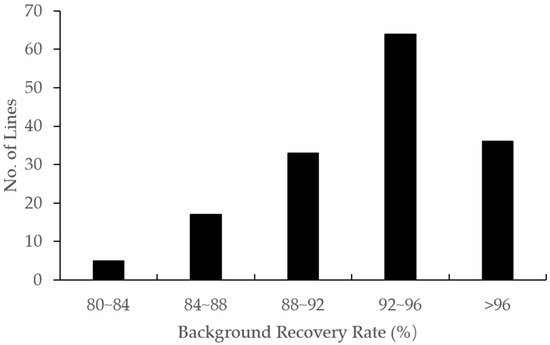
The genome of the CSSL population was 373.25 Mb, and they were divided into 609 bins based on the 87,299 SNPs between the two parents. Chromosome 5 had the most bins (106), while chromosome 9 had the fewest (only 2). The average bin length was 612.88 kb, ranging from 11 bp on chromosome 8 to 14.44 Mb on chromosome 9. The average background recovery rate of CSSLs was 93.02%, with the highest and lowest of 99.78% and 80.97%, respectively (Figure 1). The graphical genotypes of the CSSL are shown in Supplementary Figure S1.
Figure 1.
Background recovery rate of the CSSL population derived from indica HHZ and Aus N22.
3.2. Yield-Related Trait Performances of Parents and CSSL Population
The parents showed significant differences in almost all yield-related traits across the four environments (Table 1). Under four environments, N22 had significantly higher PH (on average 149.9 cm for N22, while 107.26 cm for HHZ) and lower PB (on average 8.6 for N22, while 13.18 for HHZ) than HHZ. Under two or three environments, N22 had more PN, higher SSR and YD (averagely 14.65, 93.62% and 52.05 g for N22 while 10.52, 82.66% and 25.83 g for HHZ respectively) but lower PL, SN, GN and KGW (averagely 22.93 cm, 140.58, 131.13, 20.73 g for N22 while 26.25 cm, 202.80, 181.45 and 25.27 g for HHZ respectively) than HHZ. All traits of the CSSL population were similar to HHZ, and showed continuous distributions with transgressive variations, indicating that they were controlled by multi-genes. Of the nine yield-related traits, the coefficients of variation (CV) for PL, PB, SSR, and KGW were less than 10% in most environments, suggesting low variation for these traits. The CVs for PH, PN, SN and GN ranged from 10% to 30% in most environments, indicating moderate to high variations. The CV for YD exceeded 30%, showing extremely high variation. In addition, genotype showed significant effects on all traits, environments had significant effects on most traits except SN and SSR, while genotype × environment had significant effects on PH, PN, PL, PB, SN, GN, SSR, and YD (Table 2).
Table 1.
Performance of nine yield-related traits of the two parents and the CSSL population derived from indica HHZ and Aus N22 across four environments.
Table 2.
Analysis of variance for yield-related traits of the two parents and the CSSL population derived from indica HHZ and Aus N22 across four environments.
As shown in Table 3, YD was significantly positively correlated with SN across all environments, and with GN under three environments. It was also significantly positively correlated with PN in two environments, and with KGW only in the middle season of 2024. Among three yield components, SN was significantly positively correlated with GN across all environments, and both of them were significantly negatively correlated with KGW in all environments. PN was significantly negatively correlated with SN and GN, and significantly positively correlated with KGW in only one environment. The results suggested that the correlations among SN, GN and KGW were stronger, whereas the correlation between the PN and them was weaker in the CSSL population.
Table 3.
Correlation analysis of nine yield-related traits of the CSSL population derived from indica HHZ and Aus N22 across four environments.
In addition, PH and PL were significantly positively correlated with PB, SN and GN, while significantly negatively correlated with SSR under multiple environments. PL and PB were significantly positively correlated with YD, while PB was significantly negatively correlated with KGW.
3.3. M-QTL Identification for Yield-Related Traits
A total of 80 M-QTLs for yield-related traits were identified in the CSSL population across four environments (Table 4), including 8, 5, 12, 14, 9, 6, 12, 12, and 2 QTLs for PH, PN, PL, PB, SN, GN, SSR, KGW and YD respectively. They were located on 11 chromosomes except chromosome 9 and explained 0.02–65.84% of phenotypic variations. N22 alleles reduced phenotypic values at 32 QTLs while increasing phenotypic values at the remaining 47 QTLs. At qPB1.3, the N22 allele decreased PB in 23L while increasing it in 24M.
Table 4.
M-QTLs affecting yield-related traits in the CSSL population derived from indica HHZ and Aus N22 across four environments.
Two QTLs affecting PH were repeatedly detected across multiple environments. Among them, qPH1.3 was consistently identified in both 24M and 24L, while qPH1.4 was stably expressed across all four environments. They explained that 0.54–48.35% of phenotypic variations under different environments, and N22 alleles at both loci increased PH.
qPL4 for PL was identified in both 23L and 24M, with 11.62% and 2.15% of phenotypic variations explained, respectively. The N22 allele increased PL in both environments.
Three QTLs controlling PB were repeatedly detected in two environments. Among them, qPB1.2 and qPB1.3 were stably expressed in 23M and 24M, while qPB8.1 was repeatedly detected in the 24M and 24L. They explained up to 60.13% of the variations. The N22 allele increased PB at qPB1.2, but decreased it at qPB1.3. Notably, the N22 allele at qPB1.3 decreased PB in 23M, while increasing it in the 24M.
qSN1.1 affected SN in 23M and 24M, with 13.91% and 23.04% of phenotypic variations explained, respectively. The N22 allele increased SN under both environments.
Two QTLs for GN on chromosome 1 were repeatedly detected across multiple environments. Of them, qGN1.1 was stably expressed in 23M and 24L, with an average phenotypic variation explained of 10.20%, and the N22 allele increased GN. qGN1.2 was repeatedly identified in 23M, 24M, and 24L, explaining at least 6.72% of phenotypic variations, and the N22 allele decreased GN.
qSSR1.3 and qSSR2.1 were repeatedly identified for SSR across multiple environments. qSSR1.3 was repeatedly detected in the 24M and 24L, while qSSR2.1 was stably expressed in 23M, 23L and 24M. The phenotypic variations explained by these two QTLs ranged from 3.30% to 11.07%, and N22 alleles increased SSR at both QTLs.
qKGW1.1 and qKGW4 were repeatedly detected to affect KGW under multiple environments. Among them, qKGW1.1 was identified in 24M and 24L, while qKGW4 was stably expressed in 23L and 24L. These two QTLs averagely explained 8.26% of the phenotypic variations, and N22 alleles reduced KGW.
3.4. Pleiotropic QTLs for Yield-Related Traits
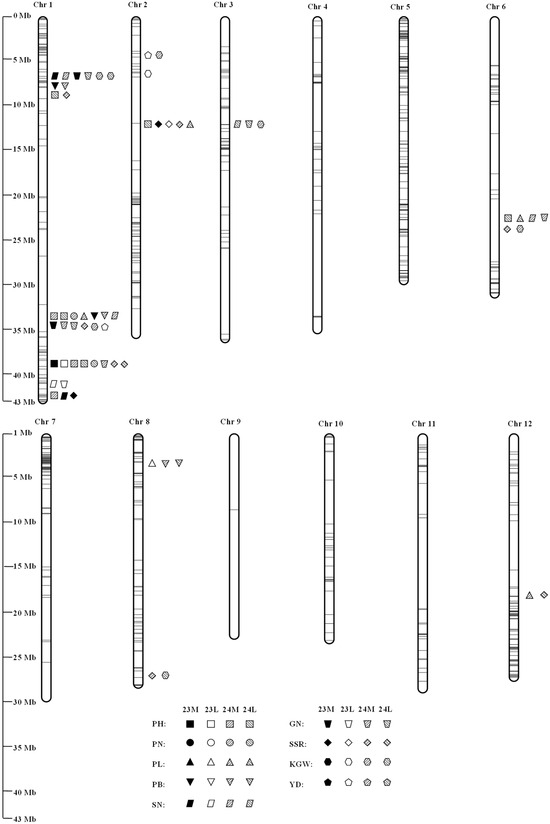
Of the 80 detected M-QTLs, 45 QTLs (56.25%) were located in eight pleiotropic QTL regions (Table 4; Figure 2).
Figure 2.
Pleiotropic QTLs detected in the CSSL population derived from indica HHZ and Aus N22 across four environments (23M, 23L, 24M and 24L, respectively).
Three pleiotropic QTLs containing six QTLs were identified in the 6.24–9.35 Mb region on chromosome 1. The region of 6.24–7.26 Mb affected SN, GN and KGW, the region of 7.49–7.97 Mb controlled PB, and the region of 7.97–9.35 Mb affected PH and SSR. These QTLs explained 3.68–23.04% of the phenotypic variations. The N22 allele increased phenotypic values at all QTLs except qKGW1.1.
The 32.17–42.40 Mb region on chromosome 1, identifying 18 QTLs, contained four adjacent pleiotropic QTLs. Among them, the 32.17–35.63 Mb region controlled all nine yield-related traits, the 38.28–39.28 Mb region showed pleiotropic effects on PH, PN, GN and SSR, the 40.82–41.61 Mb region affected both SN and GN, and the 42.22–42.92 Mb region controlled PH, SN and SSR. They explained at least 0.54% of the phenotypic variations. N22 allele decreased phenotypic values at qPH1.5, qSN1.5, qSN1.6, qGN1.2, qGN1.4 and qYD1, while increased phenotypic values at the rest QTLs.
CSSL, chromosome segment substitution line; HHZ, Huanghuazhan; 23M, middle season in 2023; 23L, late season in 2023; 24M, middle season in 2024; 24L, late season in 2024; PH, plant height; PN, panicle number; PL, panicle length; PB, primary branch number; SN, spikelet number per panicle; GN, grain number per panicle; SSR, seed setting rate; KGW, 1000-grain weight; YD, grain yield per plant.
Six QTLs in the region of 4.01–20.32 Mb on chromosome 2 simultaneously affected PH, PL, SSR, KGW and YD. They explained 5.41% of the average phenotypic variation. N22 allele increased PH, PL and SSR, while decreasing KGW and YD.
Three QTLs in the 6.16–6.43 Mb region on chromosome 3 simultaneously affected SN, GN and KGW. It explained up to 14.70% of the phenotypic variations. The HHZ allele increased all of SN, GN and KGW.
Six QTLs in the 17.62–27.55 Mb region on chromosome 6 controlled all yield-related traits except PN, PB and YD. This region explained 1.11–6.57% of the phenotypic variations. N22 allele decreased PH and KGW, while increasing the rest traits.
Two QTLs affecting both PL and PB were identified in the region of 3.39–4.50 Mb on chromosome 8. The N22 allele simultaneously increased both traits, with phenotypic variations explained ranging from 0.02% to 19.76%.
qSSR8 and qKGW8, simultaneously controlling SSR and KGW, were co-mapped in the 28.27–28.35 Mb region on chromosome 8. This region increased both traits, and explained 10.11% and 8.76% of the phenotypic variations respectively.
Both of qPL12.1 and qSSR12, which simultaneously affected PL and SSR, were identified in the region of 18.73–19.46 Mb on chromosome 12. It increased both PL and SSR, explaining 2.27% and 10.33% of the phenotypic variations, respectively.
3.5. E-QTL Underlying Yield-Related Traits
A total of 260 pairs of E-QTLs affecting yield-related traits were identified (Supplementary Table S1), 65, 51, 5, 3, 30, and 106 E-QTL pairs for PH, PL, SN, GN, SSR and KGW respectively. Among them, four pairs occurred between two M-QTLs, 50 pairs between one M-QTL and one locus, and the rest between two loci without main-effect. A total of 88 pairs decreased phenotypic values, while 172 pairs increased them.
Two pairs, between 6.24 and 7.26 Mb on chromosome 1 and 0.99–1.57 Mb on chromosome 7 and 0–2.45 Mb on chromosome 12, reduced KGW under 23M and 24M, explaining 0.89–1.25% of the phenotypic variations.
One pair between 0 and 23.01 Mb on chromosome 9 and 23.90–23.92 Mb on chromosome 12 was found for decreasing PH and increasing PL. One pair between 3.54 and 4.23 Mb on chromosome 3 and 17.31–20.97 Mb on chromosome 5 affected both PH and SSR. One pair between 12.92 and 13.74 Mb on chromosome 3 and 16.02–29.70 Mb on chromosome 7 was found for both PH and KGW. One pair between 22.52 and 23.07 Mb on chromosome 2 and 0.83–18.48 Mb on chromosome 5 had pleiotropic effects on PH, SN and SSR. One pair between 0.83 and 18.48 Mb on chromosome 5 and 0–23.01 Mb on chromosome 9 was identified for PL and KGW. Two pairs, between 0.83 and 18.48 Mb on chromosome 5 and 2.73–2.85 Mb on chromosome 7, and between 0.83 and 18.48 Mb on chromosome 5 and 19.99–20.02 Mb on chromosome 12, were found for SN and SSR. One pair between 4.39 and 5.12 Mb on chromosome 1 and 0.83–18.48 Mb on chromosome 5 simultaneously affected SN and KGW. Three pairs, between 0.17 and 23.33 Mb on chromosome 3 and 9.67–9.91 Mb on chromosome 6, between 0.83 and 18.48 Mb on chromosome 5 and 19.40–27.55 Mb on chromosome 6, and between 0.17 and 23.33 Mb on chromosome 8, were identified for both SSR and KGW. These E-QTLs explained 0.50% to 6.03% of phenotypic variations.
3.6. M-QTL × Environment Interaction Analysis
In the present study, 6, 2, 5, 9, 6, 4, 7, 7, and 1 Q × E were detected for PH, PN, PL, PB, SN, GN, SSR, KGW and YD, respectively (Table 5), with an average phenotypic variation explained of 7.90%. Among them, 20 interactions decreased phenotypic values across three environments, 16 interactions increased phenotypic values under two environments, and 11 interactions increased phenotypic values in three environments.
Table 5.
Interaction between M-QTL and environment for yield-related traits in the CSSL population derived from indica HHZ and Aus N22.
4. Discussion
In the present study, a total of 80 M-QTLs for rice yield-related traits were identified using a set of CSSL population derived from the indica variety HHZ as the recipient parent and the Aus variety N22 as donor parents. Of these, 56.25% of the QTLs were located in eight pleiotropic QTL regions. Most of these QTL regions were mapped in the same or adjacent regions with reported cloned yield-related genes/QTLs. For example, the region of 6.24–9.35 Mb on chromosome 1 (qPH1.1, qPB1.2, qSN1.1, qGN1.1, qSSR1.1 and qKGW1.1) was located in the adjacent region of Gn1a [12], qPPG1–2, qSSR1 [46] and qKw1.2 [47], and co-mapped with TN1a [48]; the region of 32.17–42.40 Mb (qPH1.3, qPH1.4, qPH1.5, qPN1.1, qPN1.2, qPL1.2, qPB1.3, qSN1.2, qSN1.5, qSN1.6, qGN1.2, qGN1.3, qGN1.4, qSSR1.2, qSSR1.3, qSSR1.4, qKGW1.3 and qYD1) was located in the same region of sd1 [10], OsPH1 [49], qGpp1, qKw1.2, qYd1 [47], and near RGN1a/qGNP1.3 [50]. The region of 4.01–20.32 Mb on chromosome 2 (qPH2, qPL2.1, qSSR2.1, qKGW2.1, qKGW2.2 and qYD2) was mapped in the same region of GW2 [19] and in the adjacent region of GL2/GS2/OsGRF4 [20,21,22]. The 6.16–6.43 Mb region on chromosome 3 (qSN3, qGN3 and qKGW3) was identified near gn3 [51]. The 17.62–27.55 Mb region on chromosome 6 (qPH6, qPL6, qSN6, qGN6, qSSR6 and qKGW6) was mapped in the same region of TGW6 [52], MOC1 [11], GW6a [53] and GL6 [54] and near DEP3 [55]. The 3.39–4.50 Mb region on chromosome 8 (qPL8 and qPB8.1) was mapped in the same region of Ghd8/DTH8 [15,16], and the region of 28.27–28.35 Mb (qSSR8 and qKGW8) was mapped in the same region of IPA1/OsSPL14 [17,18]. In addition, qSSR2.2, qPL3, qKGW5 and qPB7 was mapped in the same region of qGY2–1 [56], GS3 [23], GW5/GSE5 [24,25], GS5 [26] and Ghd7 [13], respectively; qPL2.2, qSSR3.2, qPB4, qKGW4, qKGW7, qKGW12 and qPL12.2 were mapped in the adjacent region of qPL2.2 [7], pss3 [51], GIF1 [57], NAL1 [58], BISEII [43], TGW12a [59] and PINOID [60], respectively. In the future, map-based cloning and transgenic verification would be used to determine whether these QTLs are identical or linked with the genes/QTLs reported in previous studies. Furthermore, there were also 25 M-QTLs newly identified in the present study, which may be specific to Aus. They would provide a theoretical basis for dissecting rice subspecies differentiation, and identifying elite alleles in germplasm resources will provide valuable gene resources for molecular breeding for high-yield rice varieties.
Of the two parents used in this study, N22 exhibited higher PH, PN, SSR, and YD, while HHZ had longer PL, more PB, SN, GN, and higher KGW. Besides the QTLs in the region of 32.17–42.92 Mb from N22, the N22 alleles at qPH1.1, qPH1.2, qPH2, and qPH11 increased PH, at qPN1.1 and qPN1.2 enhanced PN, and at all 12 QTLs raised SSR, and these alleles from N22 were novel alleles. Moreover, HHZ alleles at qPL1.3 increased PL, at qPB1.4, qPB2, qPB3.1, and qPB8.1 enhanced PB, at qSN1.3, qSN1.4, qSN1.5, qSN1.6, and qSN3 were associated with higher SN, at qGN1.2, qGN1.4, and qGN3 increased SN, at most QTLs except qKGW1.3 enhanced KGW, and these alleles from HHZ were novel alleles. In addition, HHZ alleles at 6 QTLs increased PH, PN, and YD, and N22 alleles at 28 QTLs enhanced PL, PB, SN, GN, and KGW. In total, besides the QTLs in the region of 32.17–42.92 Mb for PH, N22 and HHZ contained 46 and 31 novel alleles, respectively. The N22 allele was more predominant. However, HHZ is an elite indica variety in southern China and has strong lodging resistance and superior grain quality. Further, we could introgress the N22 novel alleles into HHZ background and increase its yield.
Rice yield-related traits are typical quantitative traits controlled by multiple genes and largely affected by the environment. Xing et al. [4] identified 25 M-QTLs for yield-related traits under two environments, of which 10 M-QTLs were repeatedly detected in both years. Wei et al. [8] identified 68 QTLs for yield-related traits using the same population under low-nitrogen and normal-nitrogen conditions over two years, with only 35.29% of the QTLs stably expressed in both years. Xu et al. [5] detected 19 yield QTLs using an indica-japonica recombinant inbred line population, of which only five were stably expressed in two years. Jiang et al. [6] detected 33 QTLs for panicle traits in F2 and F2:3 populations derived from the super rice “Chaoyou 1000”, with only 2 QTLs stably expressed in both populations. In this study, of the 80 M-QTLs for yield-related traits, only 13 QTLs (16.25%) were repeatedly detected under multiple environments, and 47 QTLs (58.75%) interacted with environments, suggesting that the environment had a large effect on the expression of M-QTLs. Moreover, only 2 of 260 E-QTLs were stably expressed across different environments, suggesting that E-QTLs were more sensitive to environmental effects, consistent with the report of Qiu et al. [43] on rice appearance quality traits. Breeders should use M-QTLs that are stably expressed across different environments and show minimal or no interaction with the environment in high-yield breeding programs to ensure varieties restore high yield across diverse environments.
Nowadays, increasing rice yield via breeding intra-subspecific varieties has become increasingly difficult. Therefore, breeders have proposed a new strategy of utilizing inter-subspecific heterosis. In the present study, a set of CSSL population was developed using an elite indica variety HHZ as the recipient parent and the Aus variety N22 as the donor parent. A total of 80 M-QTLs affecting rice yield-related traits were identified, of which 45 QTLs (56.25%) were located in eight pleiotropic QTL regions. By introgressing single or pyramiding a few pleiotropic QTLs into elite varieties via a backcross breeding strategy, breeders can simultaneously improve multiple yield-related traits. Compared with pyramiding multiple genes to increase yield, this method not only reduces labor and money but also decreases the risk of failure of genetic improvement [7]. Therefore, they are genetic resources with high value. In addition, 13 M-QTLs stably expressed across different environments can significantly enhance the yield stability across diverse environments. In the future, fine mapping and cloning of these important QTLs and mining favorable alleles in germplasm resources would provide valuable genes for high-yield breeding. Moreover, of the eight pleiotropic QTL regions, the region of 6.24–9.35 Mb on chromosome 1 simultaneously affected PH, PB, SN, GN, SSR, and KGW, and most QTLs were identified in two environments. N22 alleles increased most traits except KGW. It was the first priority to improve the yield-related trait. The second priority was the region of 17.62–27.55 Mb on chromosome 6. This region controlled PH, PL, SN, GN, SSR, and KGW. The N22 allele was associated with increased PL, SN, GN, and SSR, and decreased PH and KGW. The third priority was the region of 18.73–19.46 Mb for PL and SSR. The N22 allele could increase both traits. We could improve multiple yield-related traits across multiple environments by pyramiding these regions and other QTLs for KGW, which saves large amounts of labor and money. More importantly, the former two regions would help breeders improve the heat tolerance of indica varieties. Thus, they are the most important gene resources for yield improvement.
In addition, six high-yield CSSLs were screened in this study, which showed higher traits such as PN and GN than HHZ [41]. They can be directly cultivated as new high-yield varieties or used as elite germplasm resources for breeding new high-yield varieties.
5. Conclusions
In this study, a set of CSSL population was developed, derived from the indica variety HHZ and the Aus variety N22. A total of 80 M-QTLs and 260 E-QTLs for rice yield-related traits were identified across four environments. Among them, 56.25% of the M-QTLs were located in eight pleiotropic QTL regions, 13 QTLs were stably expressed across different environments, and 47 QTLs showed interactions with environment interactions. These findings provide a theoretical basis for clarifying the genetic differentiation of rice subspecies and cloning yield-related genes and offer valuable gene resources for the molecular breeding of high-yield rice varieties.
Supplementary Materials
The following supporting information can be downloaded at: https://www.mdpi.com/article/10.3390/agronomy16050580/s1, Figure S1: Graphical genotypes of CSSL population derived from indica HHZ and Aus N22; Table S1: E-QTLs affecting yield-related traits in the CSSL population derived from indica HHZ and Aus N22 across four environments.
Author Contributions
Conceptualization, H.H. and X.Q.; methodology, J.Y. and F.L.; software, Y.P., Y.S. and Z.Q.; investigation, Y.X. (Yongle Xu), Y.P., Y.S., Y.X. (Yong Xiang), J.X., H.L., L.Y., Z.Q. and F.L.; resources, X.Q. and Y.X. (Yong Xiang); data curation, H.H.; writing—original draft preparation, X.Q.; writing—review and editing, J.X., H.L., L.Y., X.T., H.H., X.Q. and J.Y.; supervision, H.H.; project administration, H.H., X.Q. and J.Y.; funding acquisition, X.Q., H.H., Y.X. (Yongle Xu) and X.T. All authors have read and agreed to the published version of the manuscript.
Funding
This research was funded by the National Natural Science Foundation of China (32171993), Central Guidance for Local Science and Technology Development Fun Project (2024BSB011), Hubei Provincial College Students’ Innovative Entrepreneurial Training Plan Program (S202513246002), and open funds of Engineering research center of ecology and agricultural use of wetland, Ministry of education (KFG202404, KFG202412), and Hubei Key Laboratory of Food Crop Germplasm and Genetic Improvement (2023lzjj07).
Data Availability Statement
The original contributions presented in the study are included in the article/Supplementary Materials. Further inquiries can be directed to the corresponding authors.
Conflicts of Interest
The authors declare no conflicts of interest.
References
- Hu, H.; Gao, R.Y.; He, L.P.; Liang, F.M.; Li, Z.X.; Yu, J.Y.; Yang, L.W.; Wang, C.R.; Liu, Z.Y.; Xu, J.L.; et al. Genetic dissection of rice ratooning ability using an introgression line population and substitution mapping of a pleiotropic quantitative trait locus qRA5. Plants 2022, 11, 1134. [Google Scholar] [CrossRef] [Scilit] [PubMed]
- Xing, Y.Z.; Zhang, Q.F. Genetic and molecular bases of rice yield. Annu. Rev. Plant Biol. 2012, 61, 421–442. [Google Scholar] [CrossRef] [Scilit] [PubMed]
- Zhao, J.G.; Jiang, K.F.; Yang, L.; Yang, Q.H.; Wan, X.Q.; Cao, Y.J.; You, S.M.; Luo, J.; Zhang, T.; Zheng, J.K. QTL mapping for yield components in a RIL population of rice. Chin. J. Rice Sci. 2013, 27, 344–352. [Google Scholar] [CrossRef]
- Xing, Y.Z.; Tan, Y.F.; Hua, J.P.; Sun, X.L.; Xu, C.G.; Zhang, Q.F. Characterization of the main effects, epistatic effects and their environmental interactions of QTLs on the genetic basis of yield traits in rice. Theor. Appl. Genet. 2002, 105, 248–257. [Google Scholar] [CrossRef] [Scilit]
- Xu, L.; Zhang, Y.D.; Zhu, Z.; Zhao, L.; Zhao, Q.Y.; Zhang, Q.F.; Wang, C.L. Dissection of QTLs in two years for yield component traits in rice (Oryza sativa L.). Chin. J. Rice Sci. 2008, 22, 370–376. [Google Scholar]
- Jiang, J.; Wang, L.; Fan, G.C.; Long, Y.; Lu, X.L.; Wang, R.; Liu, H.Y.; Qiu, X.J.; Zeng, D.L.; Li, Z.X. Genetic dissetion of panicle morphology traits in super high yield hybrid rice Chaoyou 1000. Plants 2024, 13, 179. [Google Scholar] [CrossRef] [Scilit]
- Zhang, J.; Ou, X.X.; Hu, H.; Du, B.; Lv, W.; Yang, L.; Xing, D.; Xu, J.; Xiu, X.; Zheng, T.; et al. Identification of QTLs for yield-related traits using two sets of introgression lines with a common donor parent in rice. Int. J. Agric. Biol. 2018, 20, 15–24. [Google Scholar]
- Wei, D.; Cui, K.H.; Pan, J.F.; Wang, Q.; Wang, K.; Zhang, X.M.; Xiang, J.; Nie, L.X.; Huang, J.L. Identification of quantitative trait loci for grain yield and its components in response to low nitrogen application in rice. Aust. J. Crop Sci. 2012, 6, 986–994. [Google Scholar]
- Hu, H.; Lv, W.K.; Li, Q.L.; Ou, X.X.; Xu, J.Y.; Li, Z.X.; Xing, D.Y.; Yang, L.W.; Xu, J.L.; Qiu, X.J.; et al. Characterization of main effects, epistatic effects and genetic background effects on QTL for yield related traits by two sets of reciprocal introgression lines in Rice (Oryza sativa). Int. J. Agric. Biol. 2018, 20, 2125–2132. [Google Scholar]
- Sasaki, A.; Ashikari, M.; Ueguchi-Tanaka, M.; Itoh, H.; Nishimura, A.; Swapan, D.; Ishiyama, K.; Saito, T.; Kobayashi, M.; Khush, G.S.; et al. A mutant gibberellin-synthesis gene in rice. Nature 2002, 416, 701–702. [Google Scholar] [CrossRef] [Scilit]
- Li, X.; Qian, Q.; Fu, Z.; Wang, Y.; Xiong, G.; Zeng, D.; Wang, X.; Liu, X.; Teng, S.; Hiroshi, F.; et al. Control of tillering in rice. Nature 2003, 422, 618–621. [Google Scholar] [CrossRef] [Scilit] [PubMed]
- Ashi, M.; Sakakibara, H.; Lin, S.Y.; Yamamoto, T.; Tkashi, T.; Nishimura, A.; Angeles, E.R.; Qian, Q.; Kitano, H.; Matsuoka, M. Cytokinin oxidase regulates rice grain Production. Science 2005, 309, 741–745. [Google Scholar] [CrossRef] [Scilit] [PubMed]
- Xue, W.; Xing, Y.; Weng, X.; Zhao, Y.; Tang, W.; Wang, L.; Zhou, H.; Yu, S.; Xu, C.; Li, X.; et al. Natural variation in Ghd7 is an important regulator of heading date and yield potential in rice. Nat. Genet. 2008, 40, 761–767. [Google Scholar] [CrossRef] [Scilit] [PubMed]
- Yan, W.; Liu, H.; Zhou, X.; Li, Q.; Zhang, J.; Lu, L.; Liu, T.; Liu, H.; Zhang, C.; Zhang, Z.; et al. Natural variation in Ghd7.1 plays an important role in grain yield and adaptation in rice. Cell Res. 2013, 23, 969–971. [Google Scholar] [CrossRef] [Scilit]
- Wei, X.; Xu, J.; Guo, H.; Jiang, L.; Chen, S.; Yu, C.; Zhou, Z.; Hu, P.; Zhai, H.; Wan, J. DTH8 suppresses flowering in Rice, influencing plant height and yield potential simultaneously. Plant Physiol. 2010, 153, 1747–1758. [Google Scholar] [CrossRef] [Scilit]
- Yan, W.H.; Wang, P.; Chen, H.X.; Zhou, H.J.; Li, Q.P.; Wang, C.R.; Ding, Z.H.; Zhang, Y.S.; Yu, S.B.; Xing, Y.Z.; et al. A major QTL, Ghd8, plays pleiotropic roles in regulating grain productivity, plant height, and heading date in rice. Mol. Plant 2011, 4, 319–330. [Google Scholar] [CrossRef] [Scilit]
- Miura, K.; Ikeda, M.; Matsubara, A.; Song, X.J.; Ito, M.; Asano, K.; Matsuoka, M.; Kitano, H.; Ashikari, M. OsSPL14 promotes panicle branching and higher grain productivity in rice. Nat. Genet. 2010, 42, 545–549. [Google Scholar] [CrossRef] [Scilit]
- Jiao, Y.; Wang, Y.; Xue, D.; Wang, J.; Yan, M.; Liu, G.; Dong, G.; Zeng, D.; Lu, Z.; Zhu, X.; et al. Regulation of OsSPL14 by OsmiR156 defines ideal plant architecture in rice. Nat. Genet. 2010, 42, 541–544. [Google Scholar] [CrossRef] [Scilit]
- Song, X.J.; Huang, W.; Shi, M.; Zhu, M.Z.; Lin, H.X. A QTL for rice grain width and weight encodes a previously unknown RING-type E3 ubiquitin ligase. Nat. Genet. 2007, 39, 623–630. [Google Scholar] [CrossRef] [Scilit]
- Che, R.; Tong, H.; Shi, B.; Liu, Y.; Fang, S.; Liu, D.; Xiao, Y.; Hu, B.; Liu, L.; Wang, H.; et al. Control of grain size and rice yield by GL2-mediated brassinosteroid responses. Nat. Plants 2015, 2, 15195. [Google Scholar] [CrossRef] [Scilit]
- Hu, J.; Wang, Y.; Fang, Y.; Zeng, L.; Xu, J.; Yu, H.; Shi, Z.; Pan, J.; Zhang, D.; Kang, S.; et al. A rare allele of GS2 enhances grain size and grain yield in rice. Mol. Plant 2015, 8, 1455–1465. [Google Scholar] [CrossRef] [Scilit]
- Duan, P.; Ni, S.; Wang, J.; Zhang, B.; Xu, R.; Wang, Y.; Chen, H.; Zhu, X.; Li, Y. Regulation of OsGRF4 by OsmiR396 controls grain size and yield in rice. Nat. Plants 2015, 2, 15203. [Google Scholar] [CrossRef] [Scilit]
- Sun, S.; Wang, L.; Mao, H.; Shao, L.; Li, X.; Xiao, J.; Ouyang, Y.; Zhang, Q. A G-protein pathway determines grain size in rice. Nat. Commun. 2018, 9, 851. [Google Scholar] [CrossRef] [Scilit] [PubMed]
- Shomura, A.; Izawa, T.; Ebana, K.; Ebitani, T.; Kanegae, H.; Konishi, S.; Yano, M. Deletion in a gene associated with grain size increased yields during rice domestication. Nat. Genet. 2008, 40, 1023–1028. [Google Scholar] [CrossRef] [Scilit]
- Duan, P.; Xu, J.; Zeng, D.; Zhang, B.; Geng, M.; Zhang, G.; Huang, K.; Huang, L.; Xu, R.; Ge, S.; et al. Natural Variation in the Promoter of GSE5 Contributes to Grain Size Diversity in Rice. Mol. Plant 2017, 10, 685–694. [Google Scholar] [CrossRef] [Scilit] [PubMed]
- Li, Y.; Fan, C.; Xing, Y.; Jiang, Y.; Luo, L.; Sun, L.; Shao, D.; Xu, C.; Li, X.; Xiao, J.; et al. Natural variation in GS5 plays an important role in regulating grain size and yield in rice. Nat. Genet. 2011, 43, 1266–1269. [Google Scholar] [CrossRef] [Scilit] [PubMed]
- Wang, S.; Wu, K.; Yuan, Q.; Liu, X.; Liu, Z.; Lin, X.; Zeng, R.; Zhu, H.; Dong, G.; Qian, Q.; et al. Control of grain size, shape and quality by OsSPL16 in rice. Nat. Genet. 2012, 44, 950–954. [Google Scholar] [CrossRef] [Scilit]
- Zhao, D.S.; Li, Q.F.; Zhang, C.Q.; Zhang, C.; Yang, Q.Q.; Pan, L.X.; Ren, X.Y.; Lu, J.; Gu, M.H.; Liu, Q.Q. GS9 acts as a transcriptional activator to regulate rice grain shape and appearance quality. Nat. Commun. 2018, 9, 1240. [Google Scholar] [CrossRef] [Scilit]
- Fan, Y.; Li, Y. Molecular, cellular and Yin-Yang regulation of grain size and number in rice. Mol. Breed. 2019, 39, 163. [Google Scholar] [CrossRef] [Scilit]
- Zhou, Y.; Chebotarov, D.; Kudrna, D.; Llaca, V.; Lee, S.; Rajasekar, S.; Mohammed, N.; Al-Bader, N.; Sobel-Sorenson, C.; Parakkal, P.; et al. A platinum standard pan-genome resource that represents the population structure of Asian rice. Sci. Data 2020, 7, 113. [Google Scholar] [CrossRef] [Scilit]
- Wang, W.; Mauleon, R.; Hu, Z.; Chebotarov, D.; Tai, S.; Wu, Z.; Li, M.; Zheng, T.; Fuentes, R.R.; Zhang, F.; et al. Genomic variation in 3,010 diverse accessions of Asian cultivated rice. Nature 2018, 557, 43–49. [Google Scholar] [CrossRef] [Scilit]
- Hirano, H.Y.; Eiguchi, M.; Sano, Y. A single base change altered the regulation of the Waxy gene at the posttranscriptional level during the domestication of rice. Mol. Biol. Evol. 1998, 15, 978–987. [Google Scholar] [CrossRef] [Scilit] [PubMed]
- Hu, B.; Wang, W.; Ou, S.; Tang, J.; Li, H.; Che, R.; Zhang, Z.; Chai, X.; Wang, H.; Wang, Y.; et al. Variation in NRT1.1B contributes to nitrate-use divergence between rice subspecies. Nat. Genet. 2015, 47, 834–838. [Google Scholar] [CrossRef] [Scilit]
- Wang, Y.; Xiong, G.; Hu, J.; Jiang, L.; Yu, H.; Xu, J.; Fang, Y.; Zeng, L.; Xu, E.; Xu, J.; et al. Copy number variation at the GL7 locus contributes to grain size diversity in rice. Nat. Genet. 2015, 47, 944–948. [Google Scholar] [CrossRef] [Scilit] [PubMed]
- Wang, D.W.; Wang, J.L.; Sun, W.Q.; Qiu, X.J.; Yuan, Z.Y.; Yu, S.B. Verifying the breeding value of a rare haplotype at Chalk7, GS3 and Chalk5 to improve grain appearance quality in rice. Plants 2022, 11, 1470. [Google Scholar] [CrossRef] [Scilit] [PubMed]
- Guo, D.; Li, Y.; Lu, H.; Zhao, Y.; Kurata, N.; Wei, X.; Wang, A.; Wang, Y.; Zhan, Q.; Fan, D.; et al. A pangenome reference of wild and cultivated rice. Nature 2025, 642, 662–671. [Google Scholar] [CrossRef] [Scilit]
- Kitony, J.K.; Sunohara, H.; Tasaki, M.; Mori, J.I.; Shimazu, A.; Reyes, J.K.; Yasui, H.; Yamagata, Y.; Yoshimura, A.; Yamasaki, M.; et al. Development of an Aus-derived Nested Association Maping (Aus-NAM) population in rice. Plants 2021, 10, 1255. [Google Scholar] [CrossRef] [Scilit]
- Ma, T.; Wang, Q.; Wu, T.; Hao, Q.; Huang, Y.; Mou, C.; Miao, R.; Lan, J.; Zhang, F.; Wang, P.; et al. Quiescin sulfhydryl oxidase-Like 1 positively regulates seed dormancy in Rice. Plant Biotechnol. J. 2025, 24, 489–503. [Google Scholar] [CrossRef] [Scilit]
- Guo, N.; Tang, S.; Wang, Y.; Chen, W.; An, R.; Ren, Z.; Hu, S.; Tang, S.; Wei, X.; Shao, G.; et al. A mediator of OsbZIP46 deactivation and degradation negatively regulates seed dormancy in rice. Nat. Commun. 2024, 15, 1134. [Google Scholar] [CrossRef] [Scilit]
- Mackill, D.J.; Coffman, W.R.; Rutger, J.N. Pollen shedding and combining ability for high temperature tolerance in rice. Crop Sci. 1982, 22, 730–733. [Google Scholar] [CrossRef] [Scilit]
- Xu, Y.L.; Lin, L.C.; Zhou, Q.Y.; Sun, H.W.; L.X., W.; Yuan, S.M.; Xu, J.Y.; Tian, Y.; Qiu, X.J.; Hu, H. Yield improvement of Xian (Indica) rice variety Huanghuazhan by backcross breeding. Barly Cereal Sci. 2025, 42, 45–49. [Google Scholar] [CrossRef]
- Xie, W.B.; Feng, Q.; Yu, H.H.; Huang, X.H.; Zhao, Q.; Xing, Y.Z.; Yu, S.B.; Han, B.; Zhang, Q.F. Parent-independent genotyping for constructing an ultrahigh-density linkage map based on population sequencing. Proc. Natl. Acad. Sci. USA 2010, 107, 10578–10583. [Google Scholar] [CrossRef] [Scilit] [PubMed]
- Qiu, X.J.; Chen, K.; Lv, W.K.; Ou, X.X.; Zhu, Y.Y.; Xing, D.Y.; Yang, L.W.; Fan, F.J.; Yang, J.; Xu, J.L.; et al. Examining two sets of introgression lines reveals background-independent and and stably expressed QTL that improve grain appearance quality in rice (Oryza sativa L.). Theor. Appl. Genet. 2017, 130, 951–967. [Google Scholar] [CrossRef] [Scilit] [PubMed]
- Ali, M.L.; Sanchez, P.L.; Yu, S.B.; Lorieux, M.; Eizenga, G.C. Chromosome segment substitution lines: A powerful tool for the introgression of valuable genes from Oryza wild species into cultivated rice (O. sativa). Rice 2010, 3, 218–234. [Google Scholar] [CrossRef] [Scilit]
- Li, H.H.; Ye, G.Y.; Wang, J.L. A modified algorithm for the improvement of composite interval mapping. Genetics 2007, 175, 361–374. [Google Scholar] [CrossRef] [Scilit]
- Liu, J.R.; Lou, X.Y.; Zhang, L.; Hou, T.G.; Xin, X.; Wang, Y.; Wang, S.; Huang, Y.C.; Zhou, C.C.; Jia, B.Y.; et al. Correlation of rice yield based on RILs population QTL analysis. BMC Genom. Data 2025, 26, 27. [Google Scholar] [CrossRef] [Scilit]
- Tan, C.; Han, Z.M.; Yu, H.H.; Zhan, W.; Xie, W.B.; Chen, X.; Zhao, H.; Zhou, F.S.; Xing, Y.Z. QTL scanning for rice yield using a whole genome SNP array. J. Genet. Genom. 2013, 40, 629–638. [Google Scholar] [CrossRef] [Scilit]
- Yang, T.; Ma, X.Q.; Zhang, Q.; Li, L.; Zhu, R.; Zeng, A.; Liu, W.Y.; Liu, H.X.; Wang, Y.L.; Han, S.C.; et al. Natural variation in the Tn1a promoter regulates tillering in rice. Plant Biotechnol. J. 2024, 22, 3345–3360. [Google Scholar] [CrossRef] [Scilit]
- Kovi, M.R.; Zhang, Y.; Yu, S.; Yang, G.; Yan, W.; Xing, Y. Candidacy of a chitin-inducible gibberellin-responsive gene for a major locus affecting plant height in rice that is closely linked to Green Revolution gene sd1. Theor. Appl. Genet. 2011, 123, 705–714. [Google Scholar] [CrossRef] [Scilit]
- Zhang, Q.; Xie, J.; Wang, X.; Liu, M.; Zhu, X.; Yang, T.; Khan, N.U.; Sun, C.; Li, J.; Zhang, Z.; et al. Natural variation of RGN1a regulates grain number per panicle in japonica rice. Front. Plant Sci. 2022, 13, 1097622. [Google Scholar] [CrossRef] [Scilit]
- Guo, L.B.; Xing, Y.Z.; Mei, H.W.; Cu, C.G.; Shi, C.H.; Wu, P.; Luo, L.J. Dissection of component QTL expression in yield formation in rice. Plant Breed. 2005, 124, 127–132. [Google Scholar] [CrossRef] [Scilit]
- Ishimaru, K.; Hirotsu, N.; Madoka, Y.; Murakami, N.; Hara, N.; Onodera, H.; Kashiwagi, T.; Ujiie, K.; Shimizu, B.-I.; Onishi, A.; et al. Loss of function of the IAA-glucose hydrolase gene TGW6 enhances rice grain weight and increases yield. Nat. Genet. 2013, 45, 707–711. [Google Scholar] [CrossRef] [Scilit]
- Bai, C.; Wang, G.J.; Feng, X.H.; Gao, Q.; Wang, W.Q.; Xu, R.; Guo, S.J.; Shen, S.Y.; Ma, M.; Lin, W.H.; et al. OsMAPK6 phosphorylation and CLG1 ubiquitylation of GW6a non-additively enhance rice grain size through stabilization of the substrate. Nat. Commun. 2024, 15, 4300. [Google Scholar] [CrossRef] [Scilit] [PubMed]
- Chen, S.; Xu, C.; Tan, Y.; Zhang, S.; Huang, Y.; Yang, Q.; Zhang, Z.; Li, F.; Wang, L.; Li, Z.; et al. The OsPLATZ1–OsGRF4–DEP1 regulatory pathway promotes grain length in rice. J. Integr. Plant Biol. 2025, 67, 2594–2608. [Google Scholar] [CrossRef] [Scilit] [PubMed]
- Qiao, Y.; Piao, R.; Shi, J.; Lee, S.I.; Jiang, W.; Kim, B.K.; Lee, J.; Han, L.; Ma, W.; Koh, H.J. Fine mapping and candidate gene analysis of dense and erect panicle 3, DEP3, which confers high grain yield in rice (Oryza sativa L.). Theor. Appl. Genet. 2011, 122, 1439–1449. [Google Scholar] [CrossRef] [Scilit] [PubMed]
- Zha, X.; Luo, X.; Qian, X.; He, G.; Yang, M.; Li, Y.; Yang, J. Over-expression of the rice LRK1 gene improves quantitative yield components. Plant Biotechnol. J. 2009, 7, 611–620. [Google Scholar] [CrossRef] [Scilit]
- Wang, E.; Wang, J.; Zhu, X.; Hao, W.; Wang, L.; Li, Q.; Zhang, L.; He, W.; Lu, B.; Lin, H.; et al. Control of rice grain-filling and yield by a gene with a potential signature of domestication. Nat. Genet. 2008, 40, 1370–1374. [Google Scholar] [CrossRef] [Scilit]
- Fujita, D.; Trijatmiko, K.R.; Tagle, A.G.; Sapasap, M.V.; Koide, Y.; Sasaki, K.; Tsakirpaloglou, N.; Gannaban, R.B.; Nishimura, T.; Yanagihara, S.; et al. NAL1 allele from a rice landrace greatly increases yield in modern indica cultivars. Proc. Natl. Acad. Sci. USA 2013, 110, 20431–20436. [Google Scholar] [CrossRef] [Scilit]
- Du, Z.; Huang, Z.; Li, J.; Bao, J.; Tu, H.; Zeng, C.; Wu, Z.; Fu, H.; Xu, J.; Zhou, D.; et al. qTGW12a, a naturally varying QTL, regulates grain weight in rice. Theor. Appl. Genet. 2021, 134, 2767–2776. [Google Scholar] [CrossRef] [Scilit]
- Wu, H.M.; Xie, D.J.; Tang, Z.S.; Shi, D.Q.; Yang, W.C. PINOID regulates floral organ development by modulating auxin transport and interacts with MADS16 in rice. Plant Biotechnol. J. 2020, 18, 1778–1795. [Google Scholar] [CrossRef] [Scilit]

Disclaimer/Publisher’s Note: The statements, opinions and data contained in all publications are solely those of the individual author(s) and contributor(s) and not of MDPI and/or the editor(s). MDPI and/or the editor(s) disclaim responsibility for any injury to people or property resulting from any ideas, methods, instructions or products referred to in the content. |
© 2026 by the authors. Licensee MDPI, Basel, Switzerland. This article is an open access article distributed under the terms and conditions of the Creative Commons Attribution (CC BY) license.