


Abstract
Herbicides have been pivotal tools but decreasing their use is currently a political and societal priority to minimize the risk for human health and the environment and to hinder the evolution of herbicide resistance. A 3-year experiment was conducted to compare three weed management strategies in winter wheat fields in northern Italy: (1) sole chemical control, (2) sole mechanical control, or (3) their combination. Agronomic and economic performances of the three strategies were assessed. Large variability of weed presence and crop yield was observed across the three years. Higher weed biomass was observed in the mechanical management, while the lowest weed presence and cost for weed control was estimated for the chemical management. Conversely, no differences were observed across the three management strategies in terms of crop yield or net return. The results confirmed that herbicides are currently the most cost-effective control tools, but the continuous variation in prices and costs can modify this situation. Thus, the economic assessment should be periodically updated to remain valid. However, the lack of differences between managements in terms of wheat grain yield or net profit suggested that mechanical or combined weed control can be sustainable alternatives for wheat production in northern Italy. Nevertheless, to ensure the long-term sustainability of weed management strategies with low or no herbicide use, a more holistic approach should be considered, involving a diversified set of control tactics arranged throughout the whole crop rotation.
1. Introduction
Herbicides have been pivotal for weed control in field crops for decades, providing undeniable economic and operational benefits [1]. Given their efficacy and facility to use, herbicides have become the preferred weed control tool and their application is often the only weed control operation performed during a crop cycle [2]. However, this over-reliance on herbicides caused several drawbacks, such as the evolution of herbicide resistance [3] and negative impacts on the environment [4,5,6]. Decreasing herbicide use to minimize the environmental impact and risk for human health has been repeatedly advocated by scientists [7,8] and declared a political and societal priority by the EU [9,10]. On the other hand, reducing the reliance on herbicides, and consequently reducing the selective pressure exerted on weeds, decreases the risk of the evolution of herbicide resistance and preserves long-term herbicide efficacy [11,12,13]. The annual rotations and tank mixtures of different herbicide MOAs can also contrast the evolution of resistance by reducing the selection pressure imposed by a single herbicide MOA, as exhaustively reviewed by Norsworthy et al. [13]. However, the paucity of discovery of new herbicide MOAs, combined with the withdrawals or non-renewals of previously approved active ingredients due to concerns for risks to the environment or human health, has notably reduced the availability of herbicide MOAs for EU farmers [14]. Furthermore, the use of tank mixtures or sequential applications of different herbicides during the same crop cycle can increase weed control costs and is in substantial disagreement with the current EU policy of reducing pesticide use. Thus, there is the need and urgency to move from the no longer sustainable highly herbicide-dependent management to Integrated Weed Management (IWM), including alternative and innovative tactics based on cultural, physical, and mechanical control [14,15,16]. Several studies have addressed the economic sustainability of alternative weed management strategies, concluding that those with reduced herbicide use can be as profitable as conventional managements [17,18,19,20]. However, to ensure long-term sustainability, the reduction of herbicide use must be complemented by a set of alternative tactics and tools able to provide a similar level of weed control [21,22,23]. Despite the numerous scientific reports on the efficacy and feasibility of IWM tactics, uptake of IWM or IPM holistic approaches by EU farmers remains limited [24,25]. The main barriers to IWM uptake have been related to farmers’ perception of IWM as a more risky, more complex, more time-consuming and less cost-effective alternative to herbicide-based management [8,24,26]. Consequently, innovation in this sector could only be implemented step-by-step, starting with changes that both require fewer modifications to the conventional management and have a good chance of achieving positive results in the short term. Thus, to foster a progressive shift of weed management toward a more sustainable and holistic approach, supporting the practical implementations at a larger scale of already available IWM tactics and tools has more impact than trying to develop more innovative ones. This approach has been the rationale of several research projects in recent years, such as the EU founded Horizon 2020 IWMPRAISE project that was conducted across several EU countries from 2017 to 2022 to provide practical IWM solutions for European farmers [27]. A variety of field trials were performed, following the concept that IWM solutions should be tailored to specific local conditions and tested at farm level to provide robust evidence of their efficacy and feasibility at the local scale [16]. Wheat is one of the main crops in the EU with a cultivated area of more than 20 Mha for bread wheat plus 2 Mha for durum wheat [28], reducing herbicide use in this crop would therefore have relevant environmental benefits. Wheat is often grown as a monoculture in the Mediterranean regions, whereas in many central European areas winter wheat is part of diversified cropping systems based on the rotation between winter and spring crops. The beneficial effect of crop diversification on reducing weed pressure has frequently been reported [20,23,29]; therefore, reducing herbicide use in wheat in those cropping systems seems more feasible and economically sustainable than in areas with wheat monoculture. Stale (or false) seedbed, which implies preparing the seedbed sufficiently in advance before crop sowing to let weed seeds germinate and emerge to eliminate them with herbicides, mechanical control, or flaming, is one of the main tactics adopted for organic and integrated weed control in many crops [30,31,32]. However, the efficacy of this tactic is largely dependent on environmental conditions such as soil refinement, soil temperature, and humidity [33]. Hence, prolonged dry or wet periods that can limit weed germination or hinder mechanical control operations, respectively, can strongly reduce the efficacy of this tactic [30,32,34]. Post-emergence mechanical control, mainly harrowing and hoeing, is the other main non-chemical control tactic adopted in winter cereals. Several studies have confirmed the efficacy of harrowing and hoeing in reducing weed density in wheat [35,36,37]; however, variability in weed control efficacy has been reported [38,39,40,41] in relation to environmental conditions. Dry soil conditions have been reported to increase harrowing efficacy while wet conditions at the time of, or immediately after harrowing/hoeing can increase weed survival [42,43,44].
The simple replacement of herbicides with mechanical tools would lead to the selection and adaptation of weed species or biotypes that are more tolerant to mechanical control, such as biotypes with root systems that are more resistant to uprooting or with increased seed dormancy that reduces early germination and consequently the efficacy of false seedbed technique [45]. A dynamic and balanced integration of chemical, mechanical, physical, and cultural tools seems the most promising approach to ensure a more stable control efficacy and long-term sustainability of weed management [37,45,46,47]. Given the lack of specific information on the effect of herbicide use reduction under local agronomic and environmental conditions, a 3-year experiment was conducted within the activity of the EU Horizon 2020 project IWMPRAISE to compare three weed management strategies in winter wheat in northern Italy. The three strategies were: (1) a standard management with sole chemical control, (2) an herbicide-free management with sole mechanical control, and (3) a management for herbicide resistance prevention with the combination of chemical and mechanical control. Agronomic (weed control, crop yield) and economic (variable costs, net return) performances of the three strategies were assessed.
2. Materials and Methods
2.1. Agronomic Management
Experiments were conducted for three consecutive cropping seasons (2017–2018, 2018–2019 and 2019–2020) on winter wheat fields at the “L. Toniolo” experimental farm of the University of Padua located at Legnaro, PD Italy (45°21′04″ N 11°57′02″ E, 8 m a.s.l.). The soil is silty loam (sand 16%, silt 65%, clay 19%, pH 8.04, OM 1.8%, cation-exchange capacity 14.8) and average annual rainfall is around 850–900 mm. The typical crop rotation in the area includes mainly spring crops such as maize, soybean, and sugarbeet, and winter wheat is usually grown every third or fourth year. Three different fields were used for the three experiments and similarly three different spring crops were grown in the cropping cycle before wheat sowing (2017 maize, 2018 soybean, and 2019 sugarbeet).
Three treatments, corresponding to different weed management strategies, were included: (1) only chemical control based on spring post-emergence herbicide application (treatment C, as the standard reference); (2) integration of chemical and mechanical control with false seedbed technique in autumn plus spring post-emergence herbicide application (treatment CM); and (3) only mechanical control with false seedbed technique in autumn plus flexible tine harrowing at crop tillering stage (treatment M). Since the main aim of this study was to compare the efficacy of two alternative strategies with the local standard strategy, and not to evaluate the effect of a single control tool, no untreated or “weedy” control was included. A completely randomized design (CRD) with three replicates (replicate plot size: 40 m × 9 m = 360 m2, total experiment size: about 5300 m2) was adopted.
The same sequence of soil tillage operations was adopted in the three experiments. Main tillage (2017 and 2018 plowing at 30 cm of depth, 2019 chisel at 30 cm of depth) was performed at the end of summer or early autumn after the harvest of the previous spring crop, then after a few days rotatory harrowing (15 cm of depth) was performed in plots of treatments CM and M to promote weed emergence during the false seedbed period. Finally, a second rotatory harrowing (15 cm of depth) was done at the end of October–mid-November on all plots for seedbed preparation and then winter wheat (cv. Rubisko) was sown at 220 kg seed ha−1. A summary of all agronomic operations including soil tillage with the specific dates is reported in the Supplementary Materials (Table S1). Flexible tine harrowing was performed in plots of treatment M at mid-March in 2018 and at the end of February in 2019 and 2020, with a 6-m wide harrow (SF 60 H, Faza srl, Città Di Castello, PG, Italy) equipped with flexible tines (25 mm distance between the tines, four tine rows, tine bending 120°, 8 mm tine diameter, 400 mm tine length). Tine angle was set to 45° in 2017–2018 and 60° for the other two experiments. Harrowing was performed with a single pass parallel to crop rows at 6 km h−1 in the 2017–2018 experiment and 8 km h−1 in the other two experiments. Tine angle and working speed were reduced in the 2017–2018 experiment to avoid crop injury, given that the harrowing was performed with the wheat at a more advanced development stage. At the moment of spring harrowing, wheat was indeed at the end of tillering-beginning of stem elongation stage (BBCH 29–30) in 2017–2018 experiment, while the crop was at the beginning of tillering-3 tillers detectable stage (BBCH 21–23) for the other two experiments. Post-emergence herbicides (mesosulfuron-methyl 15 g a.i. ha−1 + iodosulfuron-methyl-sodium 3 g a.i. ha−1 combined with a specific adjuvant containing alkyl ether sulfates and sodium salts at 1 L ha−1) were applied at the end of March in plots of treatments C and CM. Post-emergence herbicides were applied with a 10-m wide experimental boom sprayer (Vignoli group, San Pietro Polesine, RO, Italy) equipped with a spray control system (Teejet Spray controller series 73, TeeJet technologies, Glendale Heights, IL, USA) and flat fan nozzles (TeeJet TP11001-VH, TeeJet technologies, Glendale Heights, IL, USA) working at a pressure of 300 kPa with a speed of 6 km h−1 to deliver a spray volume of 300 L ha−1. The spray control system enabled real-time automatic adjustment of the working pressure according to actual speed to maintain the same spray volume. Wheat was at the beginning of the stem elongation phase (BBCH 30–32) at the moment of post-emergence herbicide application.
The same fertilization strategy was maintained for all treatments with an initial distribution of 8-24-24 NPK fertilizer (400 kg ha−1) during seedbed preparation, followed by two fertilizations during the crop cycle: the first took place in February with ammonium nitrate (200 kg ha−1) and the second in April–May with urea (180 kg ha−1). The total amount of nutrients was approximately 170, 96 and 96 kg ha−1 for N, P2O5, and K2O, respectively. The same crop protection strategy for pests and diseases was adopted for all treatments and included seed coating with fungicides and fungicide and insecticide application during the crop cycle when necessary. Detailed information about the different operations and active ingredients applied are reported in the Supplementary Materials (Table S1 Operations and Costs).
2.2. Data Collection
Weather data (hourly air temperature, daily rainfall) were collected from the local weather station of the Regional Agency for Environmental Prevention and Protection of Veneto region (https://www.arpa.veneto.it, accessed on 10 February 2026), which was located less than 1 km from the three experimental fields. Two separate weed assessments were conducted during each wheat cycle: the first assessment was in February–March before the application of flexible tine harrowing or post-emergence herbicides to evaluate weed density and botanical composition by counting and identifying emerged weeds in 12 quadrats (0.09 m2 each) per plot. The second weed assessment was conducted at wheat flowering at the end of April–May to evaluate the level of weed control obtained with the treatments. During the second assessment, weeds were counted and identified in 12 quadrats (0.09 m2 each) per plot; then, to estimate weed biomass, plants were collected in 12 quadrats (1 m2 each) per plot. The fresh weed biomass was then placed in an oven for 72 h at 65 C and then weighed to obtain the value of dry matter of weed biomass per plot. Wheat grain yield was determined per plot by harvesting the whole plot area and since different levels of grain Moisture Content (MC) were observed across plots or years, yield data were normalized to grain MC of 14%.
2.3. Economic Assessment
Only variable cultivation costs were considered since no effect of the experimental treatments on the fixed costs was expected. Variable costs were calculated for the different treatments by estimating and adding the costs of the single operations such as soil tillage, crop sowing or pesticide application. Given the large year-to-year or geographical price fluctuations, the cost of inputs like fertilizers, crop seeds, and pesticides was defined as their average price for that specific year and geographical area. In order to estimate those average prices, several local retailers of pesticides, fertilizer, and crop seeds were contacted. Machinery, fuel, and labor costs associated with each operation were not directly estimated since they are greatly dependent on the specific machineries, equipment, farm structure, and organization of each farm. Local contractor tariffs, which were found on official websites of local contractor unions (CAI Agromec, http://www.caiagromec.it, accessed on 10 February 2026; UNCAI https://www.contoterzisti.it, accessed on 10 February 2026), for each year were instead considered. Thus, the cost of the single operation (e.g., crop sowing) was calculated as the input cost (e.g., crop seed) plus the contractor tariff (e.g., sowing operation). Detailed information about the different operations and the corresponding costs are reported in the Supplementary Materials (Table S1). In addition, total cost for weed control was calculated for each treatment considering the costs for the false seedbed, flexible tine harrowing or post-emergence herbicide application. Benefit obtained with each treatment was estimated for each year considering the grain yield and the average annual price of winter wheat grain on the Italian market. Direct payments established by CAP for farmers’ income support were not considered for this economic assessment. Finally, yearly return was calculated for each strategy as the difference between the estimated benefit and variable costs.
2.4. Statistical Analysis
Means with their standard errors were calculated for each treatment for all agronomic (crop yield, weed density at first and second assessment, weed biomass) and economic (net return) response variables. In order to minimize the disturbance effect of annual fluctuations of costs, prices and weather and to enable comparison across the different experiments, values of the main response variables, i.e., crop yield, weed biomass, and net return obtained for the single replicates in a given experiment were normalized to the mean value of the standard reference (treatment C) in that experiment. Consequently, values of crop yield, weed biomass, and net return of a single replicate were expressed as a percentage of the mean of treatment C (%C). It is worth underlining that the three experiments were conducted in three different years, but also in three different fields, so differences in the density and botanical composition of weed flora should not be excluded. Hence, as normally occurs in any study involving field trials conducted in different sites or years, the three field experiments cannot be considered as canonical repetitions of the same experimental methodology under the same conditions; conversely, those experiments enabled the investigation of the effect of the different experimental treatments under a given range of environmental conditions that is somewhat representative of the study area. To account for the effect of the interaction between annual weather conditions and specific weed flora of the different fields, the factor “EXPERIMENT” was included in the statistical analysis. Data of several response variables showed non-normal distributions even after different procedures of data transformation were attempted, as confirmed by the Shapiro–Wilk test (p = 0.05). Thus, to maintain the same statistical approach for data analysis of all response variables, a non-parametric Kruskal–Wallis test (p = 0.05) was performed using JASP software version 0.19.1.0 (http://www.jasp-stats.org, Accessed on 10 February 2026) to investigate the effect of the experimental factors EXPERIMENT and TREATMENT on the response variables (weed density first, weed density second, weed biomass, weed biomass %C, crop yield, crop yield %C, net return, net return %C). Dunn’s test (p = 0.05) was then used to perform post hoc comparisons between treatments.
3. Results
3.1. Weather Conditions
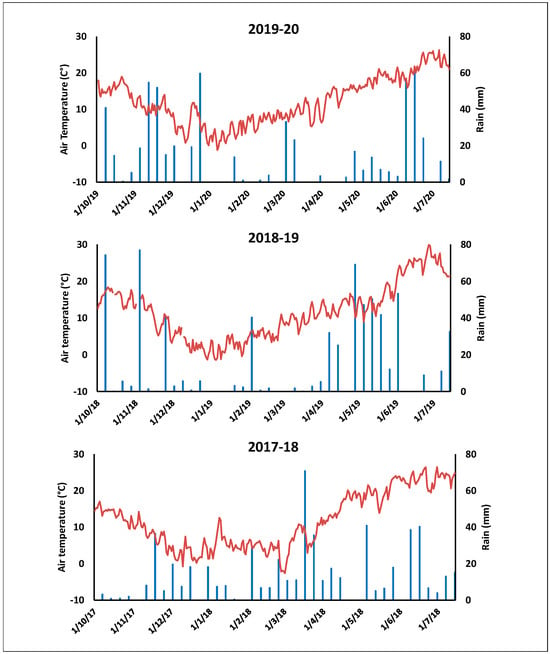
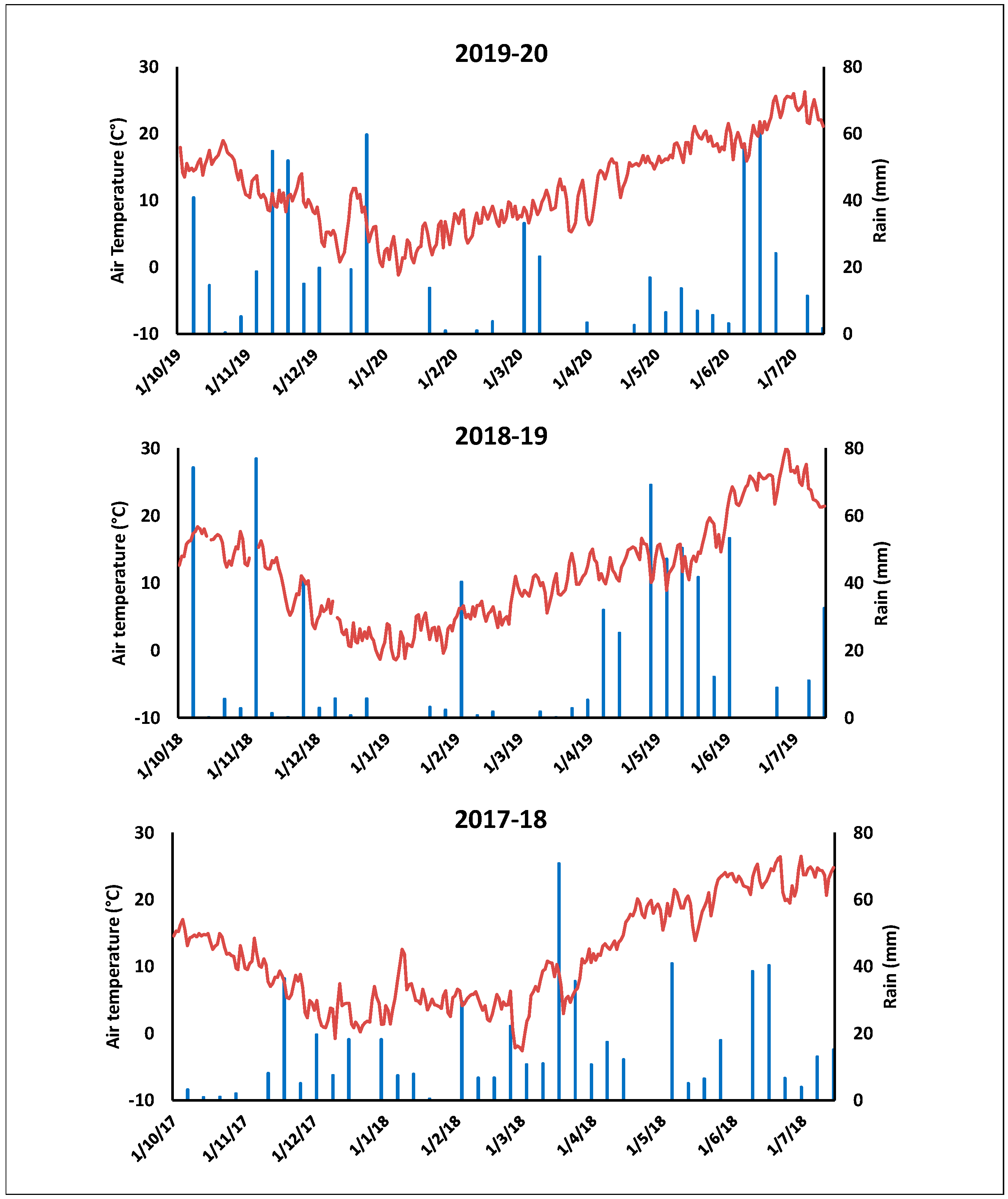
Different weather conditions during the wheat growing period (1st October–15th July) were observed among the three growing seasons (Figure 1). Higher temperatures were recorded during the 2019–2020 season, as the overall average daily medium temperature was 12.2 °C in comparison to 11.7 °C for the previous two seasons. Total rainfall was instead higher in 2018–2019 season (660 mm) than in the other two (580–590 mm); however, the most remarkable differences were observed in terms of rainfall pattern. It is worth focusing on two periods when rainfall intensity and frequency can strongly affect the efficacy of mechanical control of weeds, that is early autumn when scarcity of rainfall can limit weed germination and consequently the efficacy of false seedbed technique, and the end of winter-early spring when frequent and intense rainfall can hinder the application of flexible tine harrowing. The first growing season (2017–2018) presented a negative combination of dry autumn weather, with almost no rain in October, and rainy winter with 65 and 140 mm of monthly rainfall in February and March, respectively. The other two growing seasons had a rainy autumn (with 75 and 55 mm of precipitation in the first two weeks of October for 2018 and 2019, respectively) and prolonged dry periods during February and March.
Figure 1.
Weather conditions during the three growing seasons (1st October–15th July). The red line indicates average daily air temperature, and blue bars represent weekly precipitation.
3.2. Weed Density and Biomass
Weed floras observed in the three experiments were different in terms of both density and botanical composition, even if Dicots were the most abundant weeds in all experiments. Detailed information about botanical composition of weed flora in the three experiments are reported in the Supplementary Materials (Table S2 Botanical composition). In the first experiment (2017–2018), Veronica persica Poir. was the dominant weed and Matricaria chamomilla L., Stellaria media (L.) Vill., and Papaver rhoeas L. were the other main species. In the second experiment (2018–2019), M. chamomilla was the most abundant species, followed by Capsella bursa-pastoris (L.) Medik, S. media, and V. persica. In the third experiment (2019–2020), Lamium purpureum L. and S. media were the dominant species with V. persica, Cardamine hirsuta L., and Poa annua L. also being abundant.
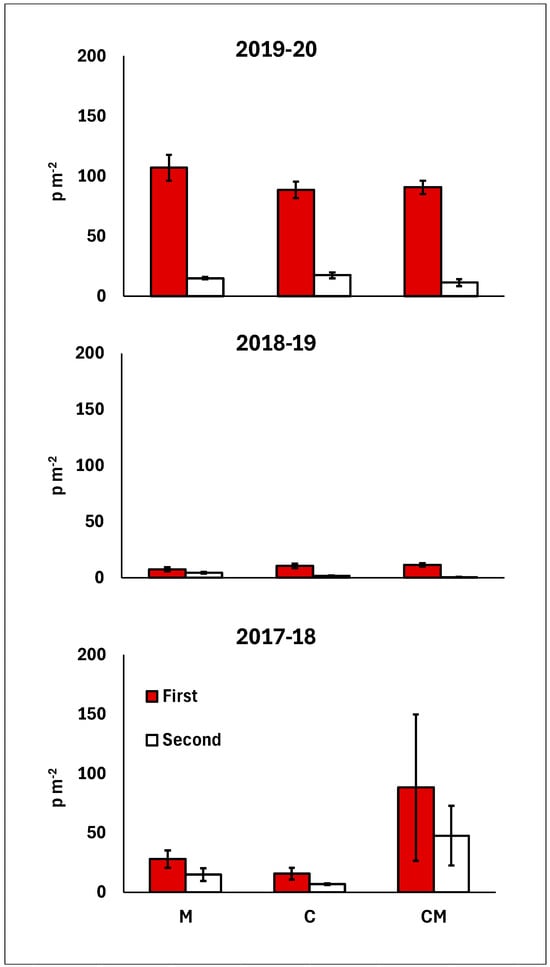
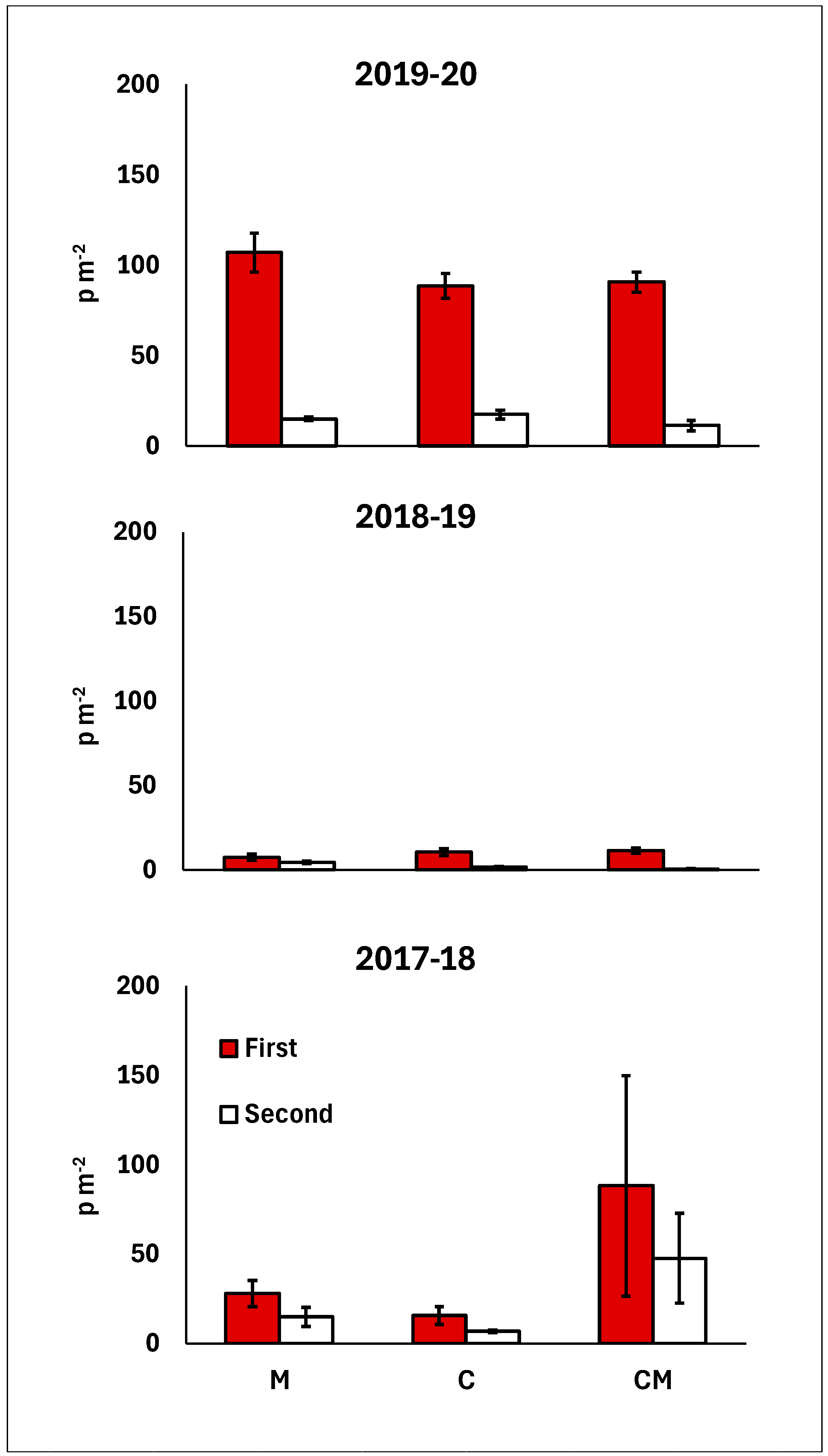
A significant effect was detected of the factor EXPERIMENT (p < 0.001) in the first assessment on weed density. Average weed density in the 2018–2019 experiment (about 10 plants m−2) across all treatments was significantly lower than the values observed in the other two experiments. The highest weed density was recorded for the 2019–2020 experiment (about 95 plants m−2). No significant effect of the factor TREATMENT (p = 0.813) on the first assessment of weed density was detected, and no differences were observed between treatments within the experiments (Figure 2). It is worth underlining the specific situation of the 2017–2018 experiment where higher average weed density was observed for treatment CM (about 90 plants m−2) in comparison to the other treatments (about 30 and 15 plants m−2 for treatment C and M, respectively) due to a dense patch of V. persica (>200 plants m−2) found in one of the plots. Regarding the second assessment, a strong reduction of weed density in comparison with the first assessment was observed across all treatments in the three experiments, except for treatment M in 2018–2019 and 2017–2018, as well as treatment CM in 2017–2018 (Figure 2). A highly significant effect of the factor EXPERIMENT (p < 0.001) and close to significant effect of the factor TREATMENT (p = 0.101) were identified. Similarly to what was observed for the first assessment, average weed density at the second assessment recorded in the 2018–2019 experiment (about 2 plants m−2) across all treatments was significantly lower than the other two experiments (Figure 2).
Figure 2.
Weed density (plants m−2) observed in the three treatments (M only mechanical weed control, C only chemical weed control, CM combined chemical and mechanical weed control) during the three experiments. Data of the first (red bar) and second weed assessment (white bar) are means of three replicates, bars represent standard errors.
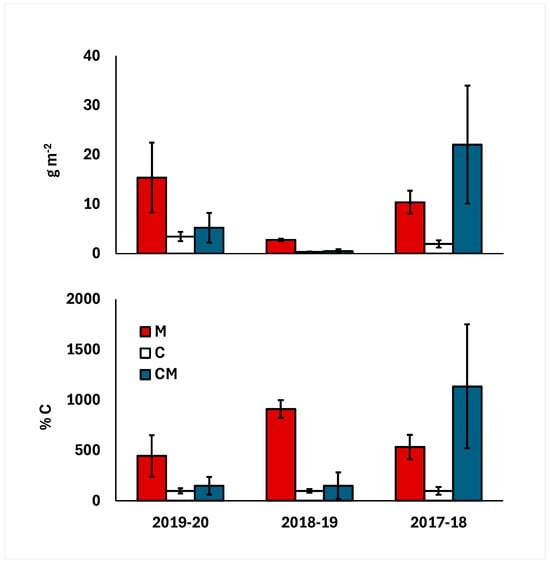
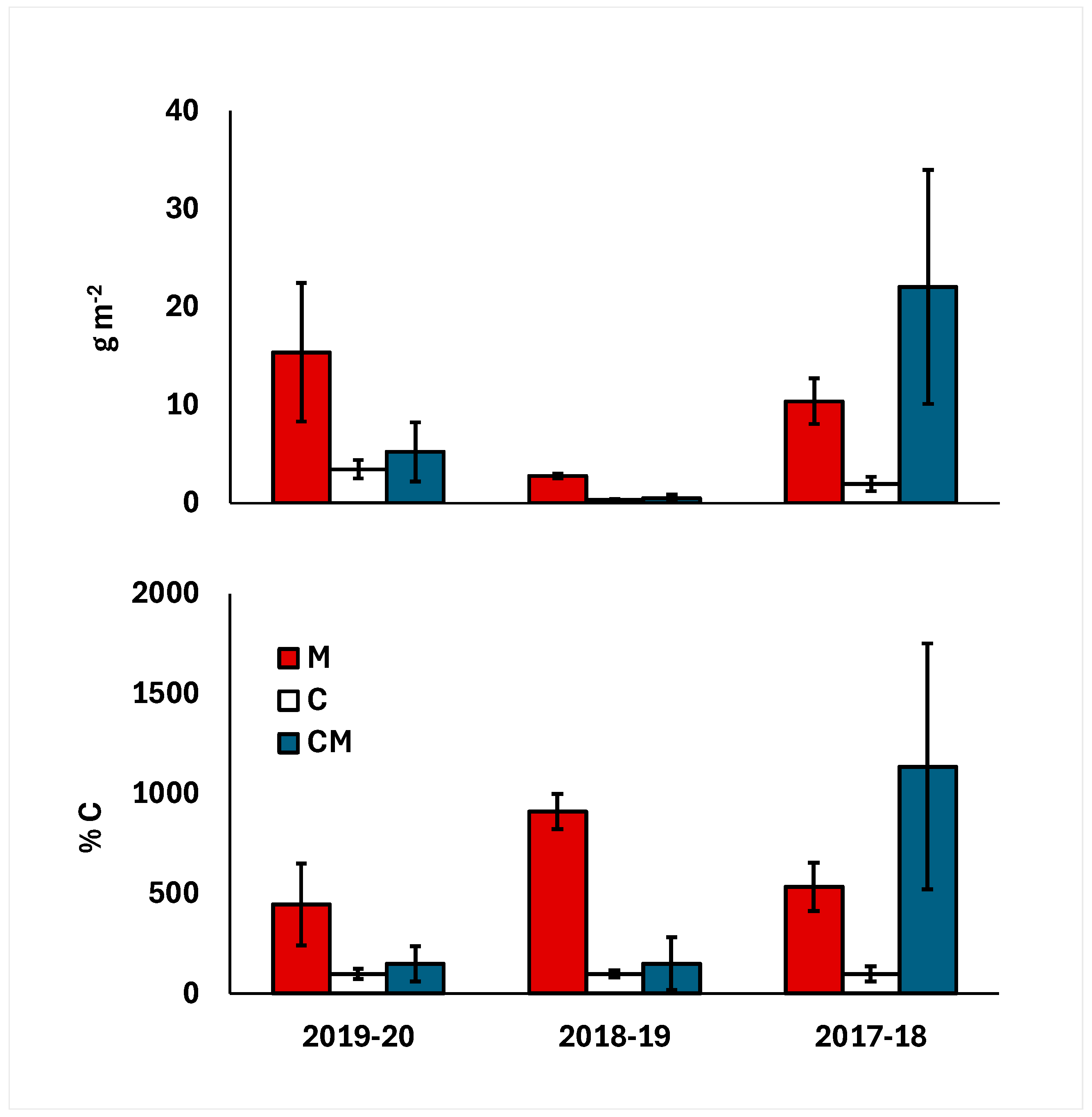
Weed biomass, expressed as dry matter, varied greatly across experiments and treatments, ranging from 22 g m−2 for treatment CM in the 2017–2018 experiment, to less than 1 g m−2 for treatment C and CM in 2018–2019 (Figure 3). Significant effects of the factor EXPERIMENT (p = 0.003) and TREATMENT (p = 0.04) on weed biomass were detected. Significantly lower weed biomass was observed in the 2018–2019 experiment, with an average of about 1 g m−2 across all treatments. In the other two experiments, average values of 8–11 g m−2 were recorded (Figure 3). Finally, a significantly higher weed biomass was measured for treatment M in comparison with treatment C. Differences between treatments were confirmed by the analysis of normalized data. The Kruskal–Wallis test identified significant effect of the factor TREATMENT (p = 0.005) and a non-significant effect of the factor EXPERIMENT (p = 0.553) on weed biomass %C, with a significantly higher value achieved for treatment M in comparison to treatment C. Weed biomass in treatment M was about 5-fold (for the 2017–2019 and 2019–2020 experiments) and 9-fold (for the 2018–2019 experiment) that of treatment C. Treatment CM reached values similar to treatment C in 2018–2019 and 2019–2020, while the abnormal weed density observed in a single plot of treatment CM in the 2017–2018 experiment led to a higher weed biomass in comparison to the other treatments (about 11-fold that of the value observed in treatment C).
Figure 3.
Weed biomass observed in the three treatments (M only mechanical weed control—red bar, C only chemical weed control—white bar, CM combined chemical and mechanical weed control—blue bar) during the three experiments. Weed biomass is reported as absolute value (upper graph) and as a percentage of the mean of treatment C for that given experiment (lower graph). Data are means of three replicates, bars represent standard errors.
3.3. Crop Yield
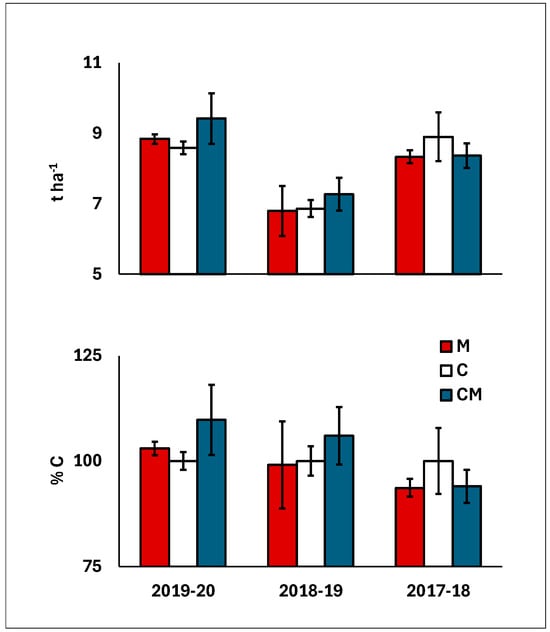
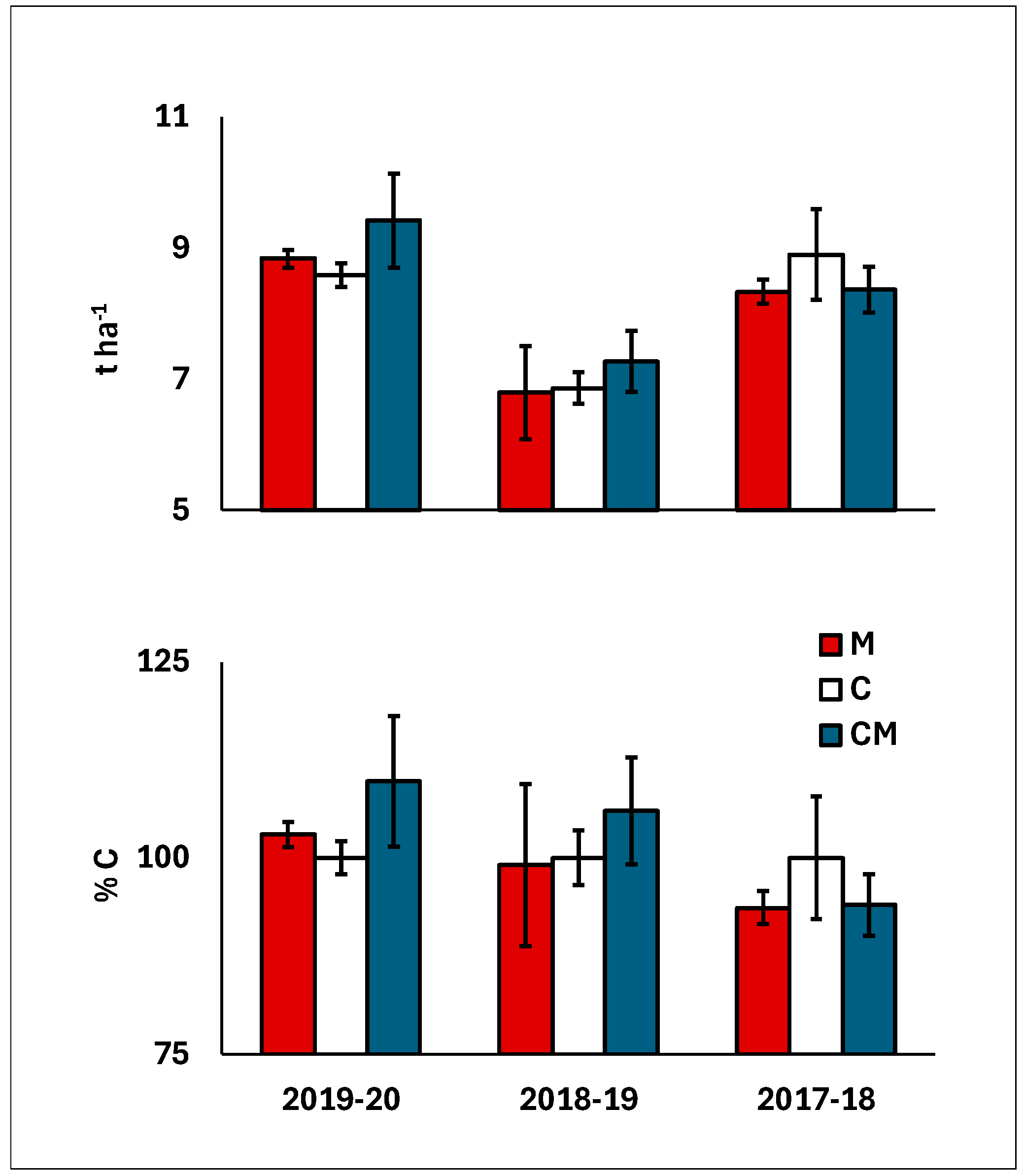
Large differences in wheat grain yield between the three experiments were observed (Figure 4). A highly significant effect of the factor EXPERIMENT (p < 0.001) and a non-significant effect of the factor TREATMENT (p = 0.979) on crop yield were detected. On average, significantly lower yields were obtained in the 2018–2019 experiment. In the second experiment (2018–2019), mean crop yield of the treatments ranged between 6.8 ± 0.71 (treatment M) and 7.3 ± 0.46 (treatment CM) t ha−1, while yields varied between 8.3 ± 0.19 (treatment M) and 8.9 ± 0.69 (treatment C) t ha−1 and between 8.6 ± 0.18 (treatment C) and 9.4 ± 0.72 (treatment CM) t ha−1 for the first and third experiment, respectively (Figure 4). A large variability between replicates was observed in the second experiment because some plots were affected by prolonged waterlogging. When the analysis was instead conducted on normalized yield data, no significant effect of the factor EXPERIMENT (p = 0.143) or TREATMENT (p = 0.658) on crop yield %C was detected.
Figure 4.
Crop yield observed in the three treatments (M only mechanical weed control—red bar, C only chemical weed control—white bar, CM combined chemical and mechanical weed control—blue bar) during the three experiments. Crop yield is reported as absolute values (upper graph) and as a percentage of the mean of treatment C for that given experiment (lower graph). Data are means of three replicates, bars represent standard errors.
3.4. Economic Assessment
The lowest variable costs were estimated for treatment C (with values ranging between 1136 and 1187 € ha−1) and the highest for treatment CM (with values ranging between 1251.5 and 1302.1 € ha−1), and this ranking remained rather stable across the three experiments (Table 1). Variations between experiments were limited and with the same trend across all treatments. Weed control costs were similar among the three experiments and largely differed between treatments, ranging from less than 100 € ha−1 to above 200 € ha−1 for treatment C and CM, respectively, while treatment M had an intermediate value. Weed control costs only represented 8–17% of total variable costs, while both soil tillage and fertilization costs each accounted for 25–30% of total variable costs. Grain price varied from a minimum of 185 € t−1 in 2018–2019 to a maximum of 215 € t−1 in 2019–2020.
Table 1.
Economic assessment reporting the main components of the variable costs, total revenue, and net return estimated for the three treatments (M only mechanical weed control, C only chemical weed control, CM combined chemical and mechanical weed control) across the three experiments.
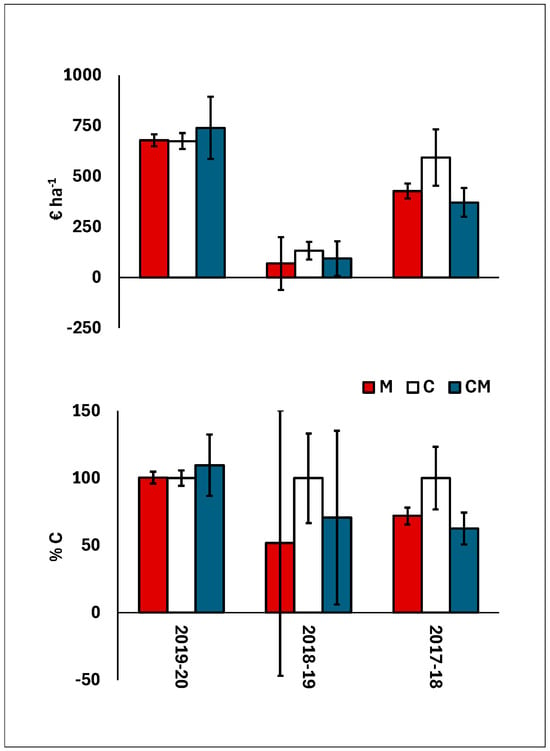
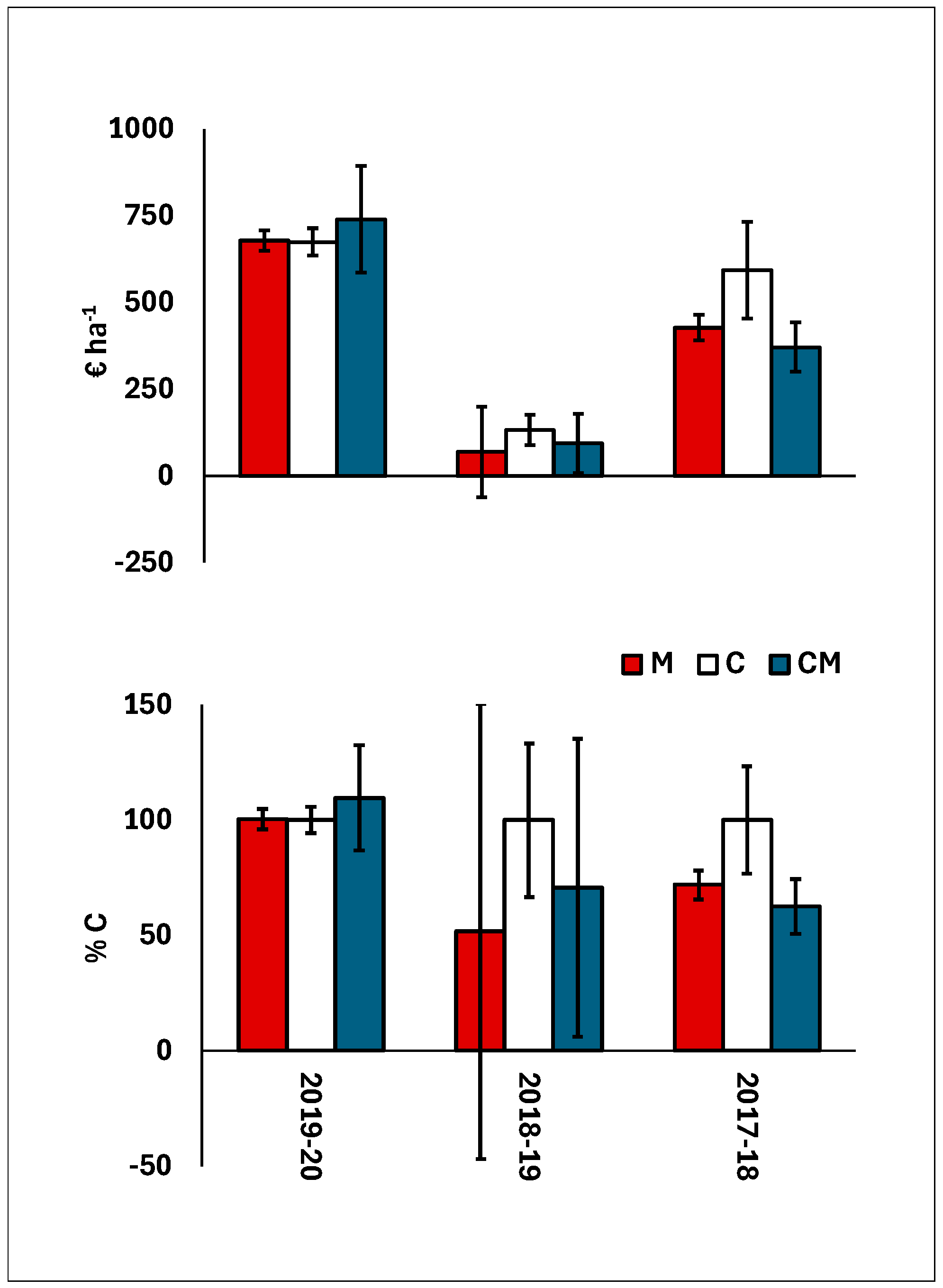
Given the limited variations in variable costs and grain price, the main factor determining differences in net return between treatments or years was crop yield. Kruskal–Wallis test identified a highly significant effect of the factor EXPERIMENT (p < 0.001) on net return, while no significant effect was detected for the factor TREATMENT (p = 0.875). Significant differences were identified between the second experiment (2018–2019) and the other two experiments, with the highest average net return (about 700 € ha−1) for the 2019–2020 experiment and the lowest (less than 100 € ha−1) for the 2018–2019 experiment (Figure 5). When the analysis was instead conducted on normalized data (net return %C), no significant effect of the factors EXPERIMENT (p = 0.192) and TREATMENT (p = 0.724) was identified. However, differences between treatments in terms of absolute values of net return %C were noticeable and the range of variation differed across experiments (Figure 5).
Figure 5.
Net return estimated for the three treatments (M only mechanical weed control—red bar, C only chemical weed control—white bar, CM combined chemical and mechanical weed control—blue bar) during the three experiments. Net return is reported as absolute value (upper graph) and as % of the mean of treatment C for that given experiment (lower graph). Data are means of three replicates, bars represent standard errors.
4. Discussion
Weed flora varied in botanical composition among the three experiments but their common feature was the low infestation of grass species, such as Avena spp., Lolium spp., or Alopecurus myosuroides that are the most troublesome weed species in wheat. This can be due to the positive effect of alternating winter wheat with other autumn or spring-sown crops in contrasting the spread and dominance of competitive weed species, such as autumn-emerging grasses [48,49,50]. Nevertheless, the main dicot species observed in this study, such as V. persica, M. chamomilla, S. media, and L. purpureum can also become problematic if they are present at high densities as occurred in CM plots in the 2017–2018 experiment. Considering that these species frequently colonize fields during inter-cropping periods, introducing autumn-sown cover crops could significantly limit their dissemination and reduce their abundance in the following wheat crop [51,52]. Differences were observed also in terms of weed density, with a 10-fold difference between the second and third experiment. Spatial variability in weed distribution across fields likely influenced this result as the experimental fields were in different parts of the farm and had a different history of crop rotation and agronomic management in the preceding years. Weather could also have contributed to the low weed density in the 2018–2019 experiment since the prolonged waterlogging in that experiment likely limited weed emergence and survival as well as reducing wheat yield. These findings are in agreement with previous studies that reported relevant differences between subsequent growing seasons in weed density in the same site due to weather conditions or agronomic practices [37,40,53,54].
Regardless of the initial density, a marked reduction in weed density between the first and second assessment was observed across experiments and treatments, underlying the good overall control efficacy of all weed management strategies. However, differences between treatments in terms of level and consistency of weed control were recorded. Treatments involving post-emergence herbicide application showed the highest efficacy in reducing weed density and biomass. Treatment M, which included only mechanical tools, achieved lower and more variable weed control in comparison with Treatment C. During the 2017–2018 experiment weather had a negative combination of dry autumn and rainy winter which decreased the efficacy of the false seedbed technique and forced postponing flexible tine harrowing till mid-March, thus enabling weeds to grow larger and make them more difficult to uproot [42,53]. The efficacy of treatment M was therefore non-optimal, confirming the sensitivity of weed management strategies based on mechanical control to weather conditions [37,44]. Even if suboptimal environmental conditions are known to possibly reduce herbicide efficacy by causing application postponement or reducing herbicide uptake by plants [55], herbicide spraying is less constrained by soil moisture than hoeing or harrowing, and many post-emergence herbicides are effective on a more advanced weed development stage than mechanical control.
Despite weather conditions during 2019–2020 experiment being favorable for mechanical control, the relatively high weed density (about 100 plants m−2) in treatment M, combined with a uniform infestation of a few large plants of L. multiflorum (about 1 plant m−2), could be the cause of the poor control efficacy. They created a dense biomass that clogged the flexible tine harrow and reduced weed uprooting [36,37,40,53]. This study underlines once more the higher risk of suboptimal weed control related with mechanical-only managements [37,39,41]. Control efficacy could be improved by increasing the number of harrow passes, although reports on this aspect are contrasting. Pannacci et al. [54] stated that performing two harrow passes on the same day was the best option in terms of efficacy and feasibility, while Saile et al. [39] reported good control with two or three consecutive harrow passes followed by a hoeing. Conversely, Lacroix et al. [37] observed that operating a second harrowing two weeks after the first one did not increase the level of weed control. Thus, the number of harrow passes required to achieve good weed control likely depends on many factors such as weed size and density and soil and weather conditions, as well as crop development. In addition, increasing the number of mechanical operations increases costs, management complexity, and the risk of crop injury. Following the flexible and dynamic approach of IWM, the opportunity of performing additional harrow passes should be evaluated on a case-by-case basis after assessing the efficacy of the first operation. Anyhow, a rapid technological development is being observed in the mechanical tools for weed control, such as sensor-based harrowing and hoeing machines able to adjust in real-time intensity of mechanical control, reduce crop injuries, and increase weed control [56,57]. The poor efficacy observed with high weed density for treatment M in 2019–2020 and treatment CM in 2017–2018 underlines the importance of adopting over the years combinations of preventive and curative tactics to reduce the weed seed bank, especially under the scenario of a progressive reduction in herbicide use [16,35].
Large variations in wheat yield were observed between experiments, but not among treatments of the same experiment, despite the large differences in terms of weed biomass. This can be related to good wheat competitiveness when crop growth and plant density are adequate [37]. The lack of significant differences in wheat yields between herbicide-based and IWM or mechanical control-based managements was previously observed in different geographical areas and under contrasting environmental conditions [37,40,58]. The results of this study confirmed wheat ability to tolerate and suppress weeds and consequently support the idea that reducing herbicide use in wheat cultivation is technically feasible and economically sustainable. However, suboptimal weed control leads to relevant seed production and potentially to an increase in seedling emergence in the following crops. If weed control remains poor for some years, a rapid increase in weed populations is therefore expectable. Ensuring good weed control by integrating different tools and tactics is therefore recommended to maintain long-term sustainability of cropping systems with reduced herbicide use [22]. This is particularly important in areas where wheat is grown as a monoculture or represents the main crop in rotation, because in those circumstances weed infestations are usually higher and often dominated by competitive grass species such as Avena fatua, Lolium rigidum, or Alopecurus myosuroides. The mechanical-only management tested in treatment M would likely achieve a lower control efficacy against those specialized weed communities, whereas at the same time, the chemical-only management of treatment C could not be sustainable in the long-term due to the selection of weed populations with multiple herbicide resistance.
Economic assessment highlighted that treatment C was the most profitable weed management in the short term due to its lower weed cost, while treatment CM had the highest cost because of the combination of both mechanical and chemical control; however, no significant difference could be detected between treatments in terms of net return. This is likely related to the fact that differences in weed control cost between treatment C and the other two treatments were only a small fraction of total variable costs and, more importantly, to the lack of significant effect of weed management on wheat yield that hindered the ability to detect significant differences between treatments also for net profit.
A reduction in herbicide use should also decrease the risk of herbicide resistance evolution that usually leads to an increase of weed control costs, yield losses, and use of herbicides with worse environmental and toxicological profiles. The potential agronomic and economic impact of uncontrolled spread of herbicide resistance on wheat production was clearly described [59,60,61] and adopting preventive measures was proven to be an economically convenient approach to manage herbicide resistance in wheat [62]. Accepting the higher costs related to the integration of diversified weed control tools, as done for treatment CM, should therefore be considered with the aim of preventing or delaying the evolution of herbicide resistance and consequently extending the efficacy of herbicides [13,14,63]. Given that lower cost-effectiveness is one of the main barriers to IWM implementation by farmers [16,26], adopting a flexible IWM strategy that involve firstly performing a mechanical control and, only in the event of poor efficacy or high weed density, completing with a herbicide application seems a sensible approach, as suggested by Lacroix et al. [37].
5. Conclusions
The herbicide-only management achieved the highest weed control with the lowest economic cost in comparison with both mechanical-only and the combined chemical plus mechanical, confirming that herbicides are currently the most cost-effective weed control tools. However, no significant differences were observed between managements in terms of wheat grain yield or net profit, suggesting that mechanical-only or the combined chemical plus mechanical can be sustainable alternatives to herbicide-only management for wheat production in northern Italy, even if a higher sensitivity to weather conditions and consequently a higher risk of non-optimal weed control should be expected. Consequently, a paradigm shift is necessary to ensure the long-term sustainability of weed management strategies with low or no herbicide use: weed management strategies should no longer be focused on the single crop growing season and a more holistic approach, involving a diversified set of control tactics arranged along the whole crop rotation, should be considered.
Supplementary Materials
The following supporting information can be downloaded at: https://www.mdpi.com/article/10.3390/agronomy16050554/s1, Table S1: Operations and costs; Table S2: Botanical composition; Table S3: Full dataset.
Author Contributions
Conceptualization, D.L. and M.S.; methodology, D.L. and M.S.; formal analysis, D.L.; investigation, D.L.; resources, M.S.; data curation, D.L.; writing—original draft preparation, D.L.; writing—review and editing, M.S.; visualization, D.L.; supervision, M.S.; project administration, M.S.; funding acquisition, M.S. All authors have read and agreed to the published version of the manuscript.
Funding
This work has received funding from the IWMPRAISE project of the European Union Horizon 2020 Research and Innovation Programme under grant agreement no. 727321.
Data Availability Statement
The original contributions presented in this study are included in the article/Supplementary Materials. Further inquiries can be directed to the corresponding author.
Acknowledgments
The authors thank the staff of the experimental farm “L. Toniolo” of the University of Padova (Italy) for their support during the field experiments. The authors are grateful to Alison Garside for revising the English text.
Conflicts of Interest
The authors declare no conflicts of interest.
References
- Gianessi, L.P. The increasing importance of herbicides in worldwide crop production. Pest Manag. Sci. 2013, 69, 1099–1105. [Google Scholar] [CrossRef] [Scilit]
- Kudsk, P.; Streibig, J.C. Herbicides—A two-edged sword. Weed Res. 2003, 43, 90–102. [Google Scholar] [CrossRef] [Scilit]
- Délye, C.; Jasieniuk, M.; Le Corre, V. Deciphering the evolution of herbicide resistance in weeds. Trends Genet. 2013, 29, 649–658. [Google Scholar] [CrossRef] [Scilit]
- Storkey, J.; Meyer, S.; Still, K.S.; Leuschner, C. The impact of agricultural intensification and land-use change on the European 459 arable flora. Proc. R. Soc. B Biol. Sci. 2012, 279, 1421–1429. [Google Scholar] [CrossRef] [Scilit] [PubMed]
- Rosenbom, A.E.; Olsen, P.; Plauborg, F.; Grant, R.; Juhler, R.K.; Brüsch, W.; Kjær, J. Pesticide leaching through sandy and loamy 461 fields—Long-term lessons learnt from the Danish Pesticide Leaching Assessment Programme. Environ. Pollut. 2015, 201, 75–90. [Google Scholar] [CrossRef] [Scilit]
- Rohr, J.R.; McCoy, K.A. qualitative meta-analysis reveals consistent effects of atrazine on freshwater fish and amphibians. Environ. Health Perspect. 2010, 118, 20–32. [Google Scholar] [CrossRef] [Scilit] [PubMed]
- Stoate, C.; Báldi, A.; Beja, P.; Boatman, N.D.; Herzon, I.; van Doorn, A.; de Snoo, G.R.; Rakosy, L.; Ramwell, C. Ecological 466 Impacts of early 21st century agricultural change in Europe—A Review. J. Environ. Manag. 2009, 91, 22–46. [Google Scholar] [CrossRef] [Scilit]
- Liebman, M.; Baraibar, B.; Buckley, Y.; Childs, D.; Christensen, S.; Cousens, R.; Eizenberg, H.; Heijting, S.; Loddo, D.; Merotto, A.; et al. Ecologically sustainable weed management: How do we get from proof-of-concept to adoption? Ecol. Appl. 2016, 26, 1352–1369. [Google Scholar] [CrossRef] [Scilit]
- European Parliament Directive 2009/128/EC of the European Parliament and of the Council of 21 October 2009 Establishing a framework for community action to achieve the sustainable use of pesticides. OJEU 2009, 309, 71–86. Available online: https://eur-lex.europa.eu/legal-content/EN/TXT/?uri=CELEX%3A32009L0128 (accessed on 10 January 2026).
- European Commission, X. Communication from the Commission to the European Parliament, the Council, the European Eco-Nomic and Social Committee and the Committee of the Regions: A Farm to Fork Strategy for a Fair, Healthy and Environmentally-Friendly Food System. COM/2020/381 Final. 2020. Available online: https://eur-lex.europa.eu/legal-content/EN/TXT/?uri=CELEX:52020DC0381 (accessed on 10 January 2026).
- FAO Guidelines on Prevention and Management of Pesticide Resistance. 2012. Available online: https://openknowledge.fao.org/items/64bb88d3-2a15-4f23-b94e-d25a8777ae5b (accessed on 10 January 2026).
- Harker, K.N.; Mallory-Smith, C.; Maxwell, B.D.; Mortensen, D.A.; Smith, R.G. Another view. Weed Sci. 2017, 65, 203–205. [Google Scholar] [CrossRef] [Scilit]
- Norsworthy, J.K.; Ward, S.M.; Shaw, D.R.; Llewellyn, R.S.; Nichols, R.L.; Webster, T.M.; Bradley, K.W.; Frisvold, G.; Powles, S.B.; Burgos, N.R.; et al. Reducing the risks of herbicide resistance: Best management practices and recommendations. Weed Sci. 2012, 60, 31–62. [Google Scholar] [CrossRef] [Scilit]
- Loddo, D.; McElroy, J.S.; Giannini, V. Problems and perspectives in weed management. Ital. J. Agron. 2021, 16, 1854. [Google Scholar] [CrossRef] [Scilit]
- Barzman, M.; Bàrberi, P.; Birch, A.N.E.; Boonekamp, P.; Dachbrodt-Saaydeh, S.; Graf, B.; Hommel, B.; Jensen, J.E.; Kiss, J.; Kudsk, P.; et al. Eight principles of Integrated Pest Management. Agron. Sustain. Dev. 2015, 35, 1199–1215. [Google Scholar] [CrossRef] [Scilit]
- Riemens, M.; Sønderskov, M.; Moonen, A.-C.; Storkey, J.; Kudsk, P. An Integrated Weed Management framework: A Pan European perspective. Eur. J. Agron. 2022, 133, 126443. [Google Scholar] [CrossRef] [Scilit]
- Cavan, N.; Omon, B.; Dubois, S.; Toqué, C.; Van Inghelandt, B.; Queyrel, W.; Colbach, N.; Angevin, F. Model-based evaluation 493 in terms of weed management and overall sustainability of cropping systems designed with three different approaches. Agric. Syst. 2023, 208, 103637. [Google Scholar] [CrossRef] [Scilit]
- Lechenet, M.; Bretagnolle, V.; Bockstaller, C.; Boissinot, F.; Petit, M.-S.; Petit, S.; Munier-Jolain, N.M. Reconciling pesticide reduction with economic and environmental sustainability in arable farming. PLoS ONE 2014, 9, e97922. [Google Scholar] [CrossRef] [Scilit] [PubMed]
- Lechenet, M.; Dessaint, F.; Py, G.; Makowski, D.; Munier-Jolain, N. Reducing pesticide use while preserving crop productivity and profitability on arable farms. Nat. Plants 2017, 3, 17008. [Google Scholar] [CrossRef] [Scilit]
- Davis, A.S.; Hill, J.D.; Chase, C.A.; Johanns, A.M.; Liebman, M. Increasing cropping system diversity balances productivity profitability and environmental health. PLoS ONE 2012, 7, e47149. [Google Scholar] [CrossRef] [Scilit]
- Petit, S.; Munier-Jolain, N.; Bretagnolle, V.; Bockstaller, C.; Gaba, S.; Cordeau, S.; Lechenet, M.; Mézière, D.; Colbach, N. Ecological intensification through pesticide reduction: Weed control, weed biodiversity and sustainability in arable farming. Environ. Manag. 2015, 56, 1078–1090. [Google Scholar] [CrossRef] [Scilit]
- Colbach, N.; Cordeau, S. Reduced herbicide use does not increase crop yield loss if it is compensated by alternative preventive and curative measures. Eur. J. Agron. 2018, 94, 67–78. [Google Scholar] [CrossRef] [Scilit]
- Weisberger, D.; Nichols, V.; Liebman, M. Does diversifying crop rotations suppress weeds? A meta-analysis. PLoS ONE 2019, 14, e0219847. [Google Scholar] [CrossRef] [Scilit] [PubMed]
- Moss, S. Integrated Weed Management (IWM): Why are farmers reluctant to adopt non-chemical alternatives to herbicides? Pest Manag. Sci. 2019, 75, 1205–1211. [Google Scholar] [CrossRef] [Scilit]
- Creissen, H.E.; Jones, P.J.; Tranter, R.B.; Girling, R.D.; Jess, S.; Burnett, F.J.; Gaffney, M.; Thorne, F.S.; Kildea, S. Identifying the drivers and constraints to adoption of IPM among arable farmers in the UK and Ireland. Pest Manag. Sci. 2021, 77, 4148–4158. [Google Scholar] [CrossRef] [Scilit] [PubMed]
- Hillocks, R.J.; Cooper, J.E. Integrated Pest Management-Can it contribute to sustainable food production in Europe with less reliance on conventional pesticides? Outlook Agric. 2012, 41, 237–242. [Google Scholar] [CrossRef] [Scilit]
- Kudsk, P.; Sønderskov, M.; Bonin, L.; Gonzalez-Andujar, J.L.; Jensen, J.E.; Melander, B.; Moonen, C.; Riemens, M.; Sattin, M.; Schaffner, U.; et al. Iwmpraise—An Eu Horizon 2020 project providing Integrated Weed Management solutions to European farmers. Outlooks Pest Manag. 2020, 31, 152–159. [Google Scholar] [CrossRef] [Scilit]
- European Commission Agriculture and Rural Development. Cereals Statistics. 2025. Available online: https://agriculture.ec.europa.eu/data-and-analysis/markets/overviews/market-observatories/crops/cereals-statistics_en (accessed on 10 January 2026).
- Adeux, G.; Munier-Jolain, N.; Meunier, D.; Farcy, P.; Carlesi, S.; Barberi, P.; Cordeau, S. Diversified grain-based cropping sytems provide long-term weed control while limiting herbicide use and yield losses. Agron. Sustain. Dev. 2019, 39, 42. [Google Scholar] [CrossRef] [Scilit]
- Rasmussen, I.A. The effect of sowing date, stale seedbed, row width and mechanical weed control on weeds and yields of organic winter wheat. Weed Res. 2004, 44, 12–20. [Google Scholar] [CrossRef] [Scilit]
- Boyd, N.S.; Brennan, E.B.; Fennimore, S.A. Stale seedbed techniques for organic vegetable production. Weed Technol. 2006, 20, 1052–1057. [Google Scholar] [CrossRef] [Scilit]
- Klauk, B.; Petersen, J. The potential of glyphosate-alternatives like electrophysicaweeding in the stale seedbed method for Alopecurus myosuroides (Huds.) control. Plant Soil Environ. 2023, 69, 522–531. [Google Scholar] [CrossRef] [Scilit]
- Benvenuti, S.; Selvi, M.; Mercati, S.; Cardinali, G.; Mercati, V.; Mazzoncini, M. Stale seedbed preparation for sustainable weed seed bank management in organic cropping systems. Sci. Hortic. 2021, 289, 110453. [Google Scholar] [CrossRef] [Scilit]
- Caldwell, B.; Mohler, C.L. Stale seedbed practices for vegetable production. HortScience 2001, 36, 703–705. [Google Scholar] [CrossRef] [Scilit]
- Melander, B.; Rasmussen, I.A.; Bàrberi, P. Integrating physical and cultural methods of weed control-Examples from European research. Weed Sci. 2005, 53, 369–381. [Google Scholar] [CrossRef] [Scilit]
- Gerhards, R.; Hüsgen, K.; Gehring, K. Evaluation of mechanical and combined chemical with mechanical weeding in maize (Zea mays L.), soybean (Glycine max (L.) Merr.) and winter wheat (Triticum aestivum L.). Plant Soil Environ. 2024, 70, 751–759. [Google Scholar] [CrossRef] [Scilit]
- Lacroix, C.; Pierreux, J.; Brostaux, Y.; Vandenberghe, C.; Dumont, B. Assessing the combined effects of mechanical and chemical weeding on weed dynamics in winter wheat. Weed Res. 2025, 65, e12677. [Google Scholar] [CrossRef] [Scilit]
- Naruhn, G.-P.; Peteinatos, G.G.; Butz, A.F.; Möller, K.; Gerhards, R. Efficacy of various mechanical weeding methods—Single and in combination—In terms of different field conditions and weed densities. Agronomy 2021, 11, 2084. [Google Scholar] [CrossRef] [Scilit]
- Saile, M.; Spaeth, M.; Schwarz, J.; Bahrs, E.; Claß-Mahler, I.; Gerhards, R. Weed control in a pesticide-free farming system with mineral fertilisers. Weed Res. 2023, 63, 196–206. [Google Scholar] [CrossRef] [Scilit]
- Pardo, G.; Cirujeda, A.; Aibar, J.; Cavero, J.; Zaragoza, C. Weed harrowing in winter cereal under semi-arid conditions. Span. J. Agric. Res. 2008, 6, 661–670. [Google Scholar] [CrossRef] [Scilit]
- Brandsæter, L.O.; Mangerud, K.; Rasmussen, J. Interactions between pre- and post-emergence weed harrowing in spring cereals. Weed Res. 2012, 52, 338–347. [Google Scholar] [CrossRef] [Scilit]
- Kurstjens, D.A.G.; Kropff, M.J. TThe impact of uprooting and soil-covering on the effectiveness of weed harrowing. Weed Res. 2001, 41, 211–228. [Google Scholar] [CrossRef] [Scilit]
- Cirujeda, A.; Taberner, A. Relating weed size, crop soil cover and soil moisture with weed harrowing efficacy on Papaver rhoeas and other dicotyledoneous weeds in Mediterranean conditions. Biol. Agric. Hortic. 2006, 24, 181–195. [Google Scholar] [CrossRef] [Scilit]
- Kolb, L.N.; Gallandt, E.R.; Mallory, E.B. Impact of spring wheat planting density, row spacing, and mechanical weed control on yield, grain protein, and economic return in Maine. Weed Sci. 2012, 60, 244–253. [Google Scholar] [CrossRef] [Scilit]
- Matzrafi, M.; Blank, L.; Lati, R.N. Selection and adaptation to weed management methods: Implications for non-chemical and Integrated Weed Management approaches. Pest Manag. Sci. 2025, 81, 22–27. [Google Scholar] [CrossRef] [Scilit] [PubMed]
- Klauk, B.; Petersen, J. Evaluation of different weed management strategies including non-chemical tools and cinmethylin for control of multiple herbicide resistant Alopecurus myosuroides. Weed Res. 2023, 63, 246–260. [Google Scholar] [CrossRef] [Scilit]
- Menegat, A.; Nilsson, A.T.S. nteraction of preventive, cultural, and direct methods for Integrated Weed Management in winter wheat. Agronomy 2019, 9, 564. [Google Scholar] [CrossRef] [Scilit]
- Swan, A.D.; Goward, L.; Hunt, J.R.; Kirkegaard, J.A.; Peoples, M.B. Diverse systems and strategies to cost-effectively manage herbicide-resistant annual ryegrass (Lolium rigidum) in no-till wheat (Triticum aestivum)-based cropping sequences in South Eastern Australia. Crop Pasture Sci. 2023, 74, 809–827. [Google Scholar] [CrossRef] [Scilit]
- MacLaren, C.; Labuschagne, J.; Swanepoel, P.A. Tillage practices affect weeds differently in monoculture vs. crop rotation. Soil Tillage Res. 2021, 205, 104795. [Google Scholar] [CrossRef] [Scilit]
- Ruisi, P.; Frangipane, B.; Amato, G.; Badagliacca, G.; Di Miceli, G.; Plaia, A.; Giambalvo, D. Weed seedbank size and composition in a long-term tillage and crop sequence experiment. Weed Res. 2015, 55, 320–328. [Google Scholar] [CrossRef] [Scilit]
- Adeux, G.; Rodriguez, A.; Penato, C.; Antichi, D.; Carlesi, S.; Sbrana, M.; Bàrberi, P.; Cordeau, S. Long-term cover cropping in tillage-based systems filters weed community phenology: A seedbank analysis. Field Crops Res. 2023, 291, 108769. [Google Scholar] [CrossRef] [Scilit]
- Raimondi, G.; Loddo, D.; Giannini, V.; Borin, M. Unveiling the impact of winter cover crops and weedy fallow on the soil seedbank. Eur. J. Agron. 2024, 160, 127309. [Google Scholar] [CrossRef] [Scilit]
- Zeng, Z.; Martin, A.; Chen, Y.; Ma, X. Weeding performance of a spring-tine harrow as affected by timing and operational parameters. Weed Sci. 2021, 69, 247–256. [Google Scholar] [CrossRef] [Scilit]
- Pannacci, E.; Tei, F.; Guiducci, M. Mechanical weed control in organic winter wheat. Ital. J. Agron. 2017, 12, 336–342. [Google Scholar] [CrossRef] [Scilit]
- Landau, C.; Bradley, K.; Burns, E.; Dobbels, A.; Essman, A.; Flessner, M.; Gage, K.; Hager, A.; Jhala, A.; Johnson, P.O.; et al. Searching for consistent postemergence weed control in progressively inconsistent weather. Weed Sci. 2025, 73, e3. [Google Scholar] [CrossRef] [Scilit]
- Spaeth, M.; Schumacher, M.; Gerhards, R. Comparing sensor-based adjustment of weed harrowing intensity with conventional harrowing under heterogeneous field conditions. Agronomy 2021, 11, 1605. [Google Scholar] [CrossRef] [Scilit]
- Gerhards, R.; Späth, M.; Sökefeld, M.; Peteinatos, G.G.; Nabout, A.; Rueda Ayala, V. Automatic adjustment of harrowing intensity in cereals using digital image analysis. Weed Res. 2021, 61, 68–77. [Google Scholar] [CrossRef] [Scilit]
- Masson, S.; Rueda-Ayala, V.; Bragazza, L.; Cordeau, S.; Munier-Jolain, N.; Wirth, J. Reducing tillage and herbicide use intensity while limiting weed-related wheat yield loss. Eur. J. Agron. 2024, 160, 127284. [Google Scholar] [CrossRef] [Scilit]
- Varah, A.; Ahodo, K.; Coutts, S.R.; Hicks, H.L.; Comont, D.; Crook, L.; Hull, R.; Neve, P.; Childs, D.Z.; Freckleton, R.P.; et al. The costs of human-induced evolution in an agricultural system. Nat. Sustain. 2020, 3, 63–71. [Google Scholar] [CrossRef] [Scilit] [PubMed]
- Maples, C.H.; Lambert, D.M.; Manuchehri, M.R. herbicide resistance in Southern Great Plains cropping systems. Agric. Syst. 2025, 227, 104336. [Google Scholar] [CrossRef] [Scilit]
- Collavo, A.; Strek, H.; Beffa, R.; Sattin, M. Management of an ACCase-inhibitor-resistant Lolium rigidum population based on the use of ALS inhibitors: Weed population evolution observed over a 7year field-scale investigation. Pest Manag. Sci. 2013, 69, 200–208. [Google Scholar] [CrossRef] [Scilit]
- Varah, A.; Ahodo, K.; Childs, D.Z.; Comont, D.; Crook, L.; Freckleton, R.P.; Goodsell, R.; Hicks, H.L.; Hull, R.; Neve, P.; et al. Acting pre-emptively reduces the long-term costs of managing herbicide resistance. Sci. Rep. 2024, 14, 6201. [Google Scholar] [CrossRef] [Scilit]
- Davis, A.S.; Frisvold, G.B. Are herbicides a once in a century method of weed control? Pest Manag. Sci. 2017, 73, 2209–2220. [Google Scholar] [CrossRef] [Scilit]

Disclaimer/Publisher’s Note: The statements, opinions and data contained in all publications are solely those of the individual author(s) and contributor(s) and not of MDPI and/or the editor(s). MDPI and/or the editor(s) disclaim responsibility for any injury to people or property resulting from any ideas, methods, instructions or products referred to in the content. |
© 2026 by the authors. Licensee MDPI, Basel, Switzerland. This article is an open access article distributed under the terms and conditions of the Creative Commons Attribution (CC BY) license.