


Abstract
Perennial groundcover (PGC) systems integrate appropriate grass species with a cash crop to provide continuous soil protection; however, competition between the groundcover and the cash crop can offset these conservation benefits through reduced crop performance. A randomized complete block (RCB) split-plot field experiment was conducted during the 2024 and 2025 growing seasons in Boone County, Iowa. This study evaluated the spatial response of individual maize (Zea mays L.) plants to increasing distance from established, unsuppressed kentucky bluegrass (KBG) strips. Two maize hybrids (P1185 and P1197) were assigned to main plots, and two starter nitrogen fertilizer rates (0 and 33.6 kg N ha−1) were assigned to subplots within each of four blocks. A diagonal planting arrangement was used to generate a continuous gradient of distances between individual maize plants and the KBG strips, allowing distance to be analyzed as a continuous variable rather than a set of discrete treatments. Maize emergence, plant height, phenological development, flowering date, and yield components (kernel number and total kernel weight per plant) were evaluated using mixed models, and quadratic-plateau regression to estimate the distance beyond which PGC proximity effects became minimal. Maize planted beyond approximately 30–55 cm from the KBG strips, depending on year and response variable, experienced reduced PGC interference. Kernel number increased with distance from KBG, whereas total kernel weight per plant showed a stronger distance-dependent response in 2024 than in 2025. Starter nitrogen fertilizer effects on total kernel weight varied with distance, indicating that the response to nitrogen application depended on spatial proximity to KBG. Hybrid P1185 showed slightly improved emergence and earlier flowering and produced more kernels per plant than P1197. Our findings suggest that targeted suppression of PGC adjacent to the crop row may help reduce competition while maintaining groundcover in the interrow, offering a potential spatial management strategy for integrating PGC into maize production.
1. Introduction
Current farming practices in developing and developed countries worldwide have greater reliance on monoculture cash crops [1] than intercropping. This shift from diverse crop–livestock rotations to simplified single- or double-crop systems has contributed to substantial depletion of soil nutrients and degradation of ecosystem function [2]. Concurrently, demands for food, feed, and fiber have increased with global population growth, placing additional pressure on often degraded agricultural land. As soil degradation reduces agricultural productivity, maintaining crop yields may require greater reliance on external inputs. Although crop rotations can improve soil health, fallow agricultural fields during the off-season are vulnerable to soil erosion and nutrient loss [3,4]. These fallow periods contribute to sediment and nutrient runoff, thus decreasing water quality and threatening aquatic ecosystems and human health [5,6].
Soil protection is a central goal of sustainable crop production systems, and the use of cover crops is a widely promoted approach. Cover crops reduce erosion [5], improve soil structure [6] and biological activity [7], enhance water retention, suppress weeds [8], and contribute to overall agroecosystem resilience [7]. Cover crops generally fall into two categories according to the species planted as groundcovers. Annual groundcovers (AGC), which are planted with annual species and are widely used, and perennial groundcovers (PGC), which offer several long-term benefits of perennial species but their use remains comparatively underexplored [9]. The adoption of AGC has been limited in many regions because their planting and termination often coincide with narrow weather-sensitive field operation windows for the cash crop. Delays in planting or termination of an annual groundcover may lead to increasing management risk and, sometimes, important yield penalties in the subsequent cash crop [10]. In addition, the recurring cost of AGC seed further constrains their adoption [11].
In contrast, PGC can provide continuous soil protection throughout the year because they persist across seasons and are maintained during the cash crop growing period [12]. This approach represents a form of intercropping, defined as the simultaneous cultivation of two or more species on the same field, either with coinciding or distinct growth periods [13]. PGC systems specifically integrate a perennial grass with a cash crop such as maize to protect soil, promote ecological diversity, and potentially enhance system stability and productivity [9]. Because the groundcover remains after grain harvest, PGC systems can provide year-round soil protection. Previous studies have shown that intercropping maize with a groundcover can reduce lodging, improve soil biological diversity and, in some cases, maintain or even increase yield compared with maize grown alone [14].
However, because both species occupy the same space at the same time, competition for light, water, and nutrients becomes a management challenge. Minimizing interspecific plant competition is essential for maintaining crop productivity in intercropping systems [15,16]. This challenge is especially important in modern maize production, where decades of genetic improvement have profoundly altered plant architecture, resource allocation, and optimal planting density. Over time, maize hybrids have been bred to tolerate and respond to higher plant populations, with changes in characteristics such as leaf angle, shoot biomass, and canopy structure that improve light capture and maximize yield per unit area under dense stands [17]. As a result, different hybrids now exhibit distinct responses to plant density, and deviations from their optimal spacing can substantially reduce growth, development, and final grain yield [17]. Differences in leaf orientation and canopy architecture have been associated with variation in maize yield under dense plant populations [18,19]. In PGC systems, this density response is further complicated by the spatial proximity of the groundcover, making planting distance a critical determinant of both competition intensity and crop performance [13]. Effectively managing the spatial relationship between maize and the PGC is important for minimizing competition and maintaining adequate resource acquisition. Nitrogen (N) is a major determinant of maize growth and productivity because it supports chlorophyll formation, photosynthetic capacity, leaf-area development, biomass accumulation, and ultimately grain production. Modern high-yielding maize hybrids require substantial nitrogen (N) uptake to support vegetative growth and reproductive development; however, nitrogen uptake and utilization efficiency vary with genotype, environmental conditions, and crop management practices [20,21]. In PGC systems, however, the simultaneous growth of maize and perennial vegetation creates the potential for competition for soil N, particularly during early maize development when both species are actively acquiring resources [22]. Adequate N management may therefore be important for reducing nutrient limitations in maize–PGC systems; however, additional N may not fully overcome competition when maize and the groundcover strongly overlap in their use of other resources, such as water, light, and rooting space. Consequently, the effectiveness of N fertilization in PGC systems likely depends on both nutrient availability and the spatial relationship between maize and the perennial groundcover. Understanding how N management, spatial proximity between the groundcover and cash crop, and maize hybrid characteristics interact is important for optimizing productivity in PGC systems. Plant interactions and resource dynamics in mixed-species stands are inherently more complex than in monocultures because neighboring species can compete for, or complement one another in their acquisition of light, water, and nutrients. The productivity of intercropping systems therefore depends partly on how species traits, spatial arrangement, and management influence the balance between resource competition and complementarity [23]. In PGC systems, spatial proximity to neighboring vegetation can alter maize growth and development, with responses also varying among hybrids [24]. However, the extent to which these spatial responses persist throughout maize development and interact with N management and hybrid characteristics under field conditions remains insufficiently understood. The objectives of this study are to determine the ideal crop zone of a maize plant relative to an established PGC to avoid competition, evaluate how starter nitrogen fertilization influences maize growth and yield across this spatial proximity gradient, and quantify the performance of two maize hybrids with a goal of identifying management strategies that preserve the soil conservation benefits of PGC while maintaining crop productivity.
2. Materials and Methods
2.1. Experimental Site
The research was conducted at the Iowa State University Agronomy and Agricultural Engineering Sorenson Research Farm in Boone, Iowa, at coordinates 42°0′36″ N 93°44′32″ W, during the 2024 and 2025 growing seasons. Soil survey data of the site indicated that soil type was 39% Nicollet loam (Fine-loamy, mixed, superactive, mesic Aquic Hapludolls) at the North end of the field with a slope of 1–3% and 61% Webster clay loam (Fine-loamy, mixed, superactive, mesic Typic Endoaquolls), at the South end of the field with a slope of 0–2%. Both soils have similar properties of high organic matter content but poor drainage.
2.2. Environmental Data Acquisition and Analysis
Daily weather data for precipitation (mm), air temperature (°C), and root-zone soil moisture, representing modeled volumetric soil moisture in the 0–100 cm soil profile, were obtained from the NASA Prediction of Worldwide Energy Resources (POWER) database for the experimental site. These data covered the historical period (2005–2023) and the 2024 and 2025 growing seasons. Daily values were aggregated into monthly values using PROC MEANS in SAS (SAS Institute, Cary, NC, USA). Monthly total precipitation was calculated as the sum of daily precipitation values, whereas monthly mean air temperature and root-zone soil moisture were calculated as the arithmetic mean of daily values within each calendar month. Historical monthly means were calculated for each calendar month using data from 2005 to 2023. Monthly precipitation, air temperature, and root-zone soil moisture during the 2024 and 2025 growing seasons were compared with their corresponding historical monthly means to characterize differences in environmental conditions during the experimental years.
2.3. Field Layout
The experiment was arranged in a split-plot design with four replications. The main plots measured 2.3 × 6.1 m and consisted of two maize hybrids with different shade-avoidance responses. Each main plot was divided into two subplots measuring 2.3 × 3.0 m, with starter nitrogen fertilizer applied at rates of either 33.6 kg N ha−1 or 0 kg N ha−1.
The plots were broadcast-fertilized prior to planting with an NPK of 5–112–123 kg ha−1 on 18 April 2024, according to established maize management practices for this area. The plots were disked with a John Deere 210 disk (John Deere, Moline, Illinois, USA) (conical blades spaced at 9 cm spacing) and a John Deere 6125R tractor at a depth of 10 cm to loosen the soil for easy air and water percolation. The John Deere 6125R auto-steer system was programmed to maintain a 14° planting angle relative to the PGC strips, ensuring consistent diagonal planting across all plots. Two weeks before planting, 207 kg ha−1 of urea (46-0-0) was applied to the entire experimental field with a Befco spreader mounted on John Deere 4710. A John Deere 210 disk, pulled by a John Deere 6125R tractor, was used to cut the remaining soybean residue and uniformly incorporate the residue and urea into the soil, after which the experimental field was leveled using a Stanhoist field cultivator mounted on a John Deere 6215 tractor. A preplant application of Prowl® (pendimethalin) was applied at a rate of 3.5 L ha−1 using a Stanhoist field cultivator 6 days before planting. The herbicide was incorporated into the soil during each of the two cultivation passes to provide pre-emergence weed control. A day before planting, the field was leveled using a Stanhoist field cultivator mounted on a John Deere 6215 tractor. Seed were planted using a Kinze 3100 planter calibrated to the recommended planting rate of 100,000 seed ha−1.
2.4. Kentucky Bluegrass (Kbg) Establishment and Management
Kentucky bluegrass (KBG) served as the perennial groundcover (PGC) throughout the study. KBG was established in March 2022 using sod strips measuring 0.5 × 6.1 m, which were placed in the designated groundcover rows and allowed to establish before the 2024 and 2025 growing seasons. During establishment, the sod was irrigated twice daily to prevent desiccation and promote successful establishment. The same experimental plots and KBG strips were maintained throughout the study, and maize was replanted in the same locations each year to preserve a consistent spatial relationship between the maize rows and the perennial groundcover. By the 2024 and 2025 growing seasons, the KBG was well established, and no additional establishment procedures were required.
2.5. Maize Planting
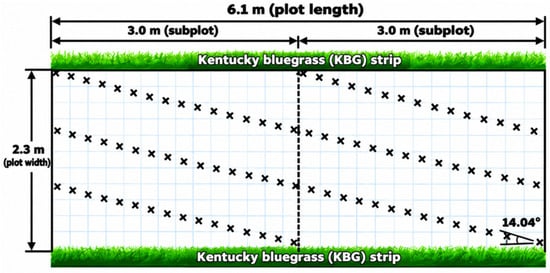
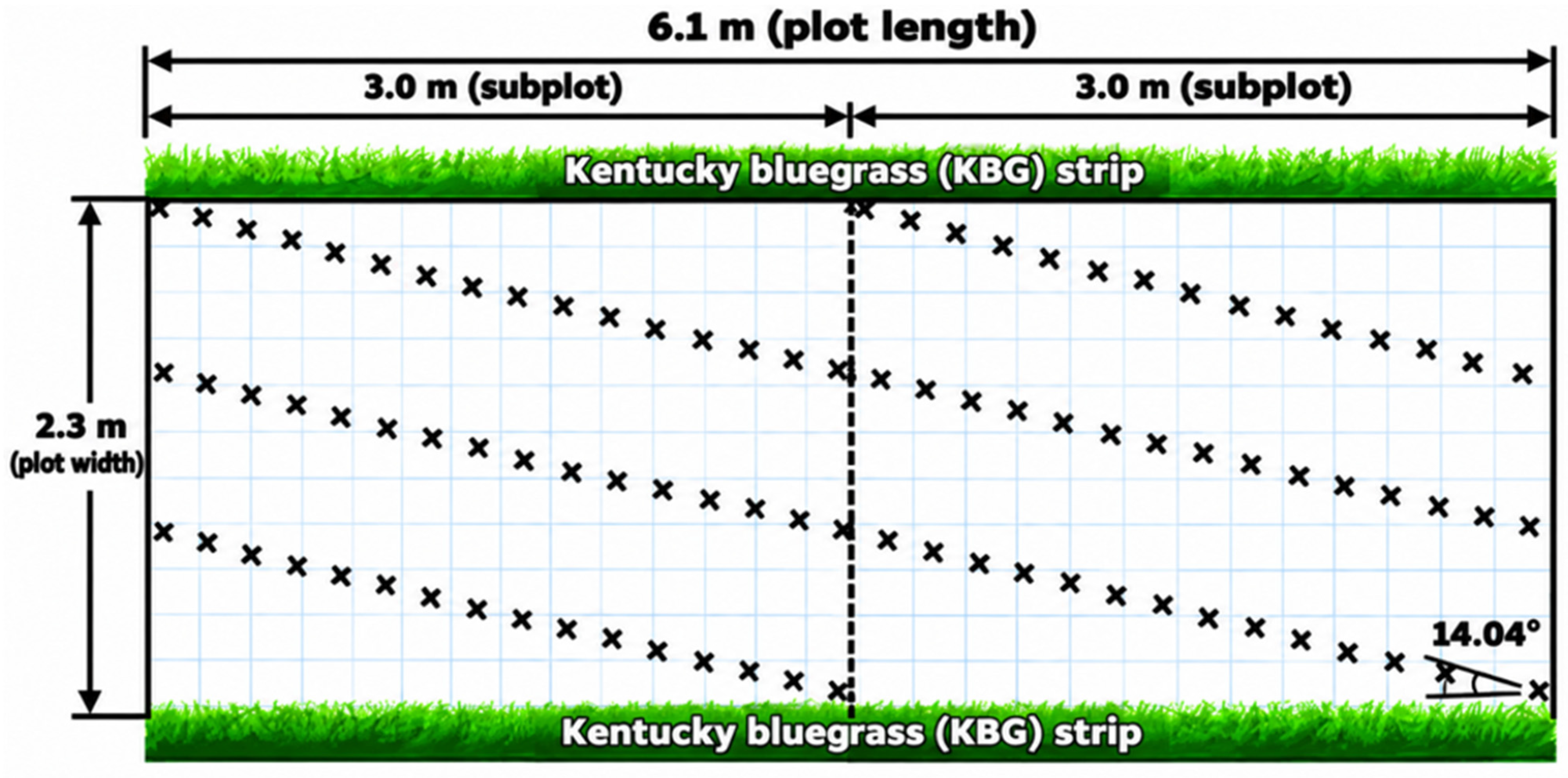
Maize was planted on 30 May 2024 and 11 May 2025 using a Kinze 3100 row planter (Kinze Manufacturing, Williamsburg, IA, USA) pulled by a John Deere 6125R tractor. Seed was planted at a depth of 3.3 cm in three rows spaced 76 cm apart at a target population of 100,000 plants ha−1. To create a continuous gradient of distances between individual maize plants and the PGC, the planter was guided using the tractor’s auto-steer system at an approximately 14° angle relative to the east–west orientation of the established KBG strips (Figure 1). This diagonal planting arrangement allowed individual maize plants within each row to occur at varying distances from the PGC, ranging from adjacent to the groundcover to the center of the maize row. The experimental setup was designed to answer our research question. Consequently, the effect of proximity to the PGC could be evaluated using distance as a continuous variable rather than discrete distance treatments. The two maize hybrids P1185 and P1197 were randomly assigned to the main plots, while starter nitrogen fertilizer treatments (0 and 33.6 kg N ha−1) were randomly assigned to the subplots. Starter nitrogen fertilizer was applied in a continuous band along the corn rows immediately after planting. Weeds within the maize rows were controlled by hand throughout the growing season. Hand weeding was performed twice each year: first at approximately the V6 growth stage, immediately before canopy closure, and again at V12-13, when the maize plants were transitioning from the late vegetative stage to the reproductive stage.
Figure 1.
Schematic of the experimental plot layout used to generate a continuous gradient of corn plant distances from perennial groundcover (PGC). The green horizontal bands represent established kentucky bluegrass (KBG) strips, while each × indicates the position of an individual corn plant. Corn rows were planted diagonally at an angle of 14.04° relative to the PGC strips, with 76 cm row spacing, creating a continuous gradient of distances between individual corn plants and the nearest PGC strip. The experimental plot measured 2.3 m × 6.1 m and was divided into two subplots, approximately 2.3 m × 3.0 m. Distances between individual corn plants and the nearest PGC strip were expressed in centimeters (cm), consistent with the units used in the statistical analysis.
2.6. Hybrid Description
Two corn hybrids, P1185 and P1197 (Corteva Agriscience, Johnston, IA, USA), were selected based on their contrasting responses to PGC observed in previous yield trials conducted at Bruner Farm in Boone County, Iowa [24,25]. The yield trial data showed that the two hybrids responded differently to the presence of PGC, which ultimately affected their final yield. P1197 is a high-yielding hybrid [26] under favorable management conditions but exhibited greater yield reduction when exposed to competition from PGC. In contrast, P1185 showed greater tolerance to PGC competition and is also tolerant to stresses such as mid-season brittle snap [27]. Both hybrids have a relative maturity of 111 days. P1185, released in 2015, has a shorter plant stature than P1197, which was released in 2014. These hybrids were selected for this study because of their contrasting responses to environmental competition, particularly competition associated with PGC.
2.7. Data Collection
The emergence date after planting (EDAP) of each seedling was flagged using golf tees of different colors, and the date was recorded. The field was inspected every 24 h, and emergence was recorded when the seedling coleoptile appeared 1.5 cm above the ground using a meter ruler. This continued for 13 days until no further emergence occurred [25].
After emergence, the distance from each maize plant to the KBG strip was measured, and the distance between maize plants was also determined. This was done by using a centimeter rule to measure each distance.
Plant height and phenology [12,28] were recorded weekly immediately after all the maize plants had emerged; height was taken from the soil surface to the highest point of the topmost fully developed collared leaf.
Flowering date after planting (FDAP) was recorded when a plant displayed both tassel and silk ready for fertilization. The plants were monitored every 24 h, and the flowering date was tagged with a caution tape of different colors, each color representing the flowering date from planting.
Harvesting was conducted following the procedure described by [25]. Each maize plant was harvested by hand at physiological maturity. Ears were dried to approximately 15% grain moisture before being shelled using an AEC roller maize sheller (AEC Corp., St. Charles, IA, USA). Total kernel number and total kernel weight from each maize plant were determined using a Gear 3 Ball Coleman Seed Counter connected to an electronic balance (Ball Coleman Seed Technologies, West Chicago, IL, USA). The system uses a photoelectric sensor to count individual seeds as they pass through a calibrated counting channel while simultaneously measuring the total weight of the seed sample, providing total kernel number and total kernel weight for each plant.
2.8. Statistical Analysis
The effects of PGC, maize hybrid, starter nitrogen and their interactions on maize growth and yield components were evaluated using linear mixed-effects models with restricted maximum likelihood (REML) estimation in PROC MIXED of SAS version 9.4 (SAS Institute Inc., Cary, NC, USA). The experiment was analyzed as a split-plot design, with year, hybrid, and starter fertilizer treatment considered as categorical fixed effects, and distance from the PGC strip treated as a continuous variable. Statistical analyses were conducted using individual maize plant observations collected at distances ranging from 0 to 76 cm from the nearest KBG strip. For response variables with more than one sampling date, day of collection was analyzed as a univariate repeated measure assuming no correlation among repeated observations taken on the same experimental unit over time. Block nested within year was included as a random effect. Degrees of freedom for fixed effects were estimated using the Kenward–Roger approximation.
Models were built sequentially for each response variable (emergence, plant height, phenological development, total kernel number, and total kernel weight). A base model containing only the categorical main effects and their interactions (year × hybrid × fertilizer) was fitted first. Distance was then added as a covariate to evaluate its effect independent of the categorical effects, and the model was expanded to include all interactions between distance and the categorical fixed effects. Non-significant higher-order interactions were removed in a stepwise manner, retaining only the significant interactions in the final model. Least-squares means were calculated for significant categorical fixed factors, and pairwise comparisons were performed using the least significant difference (LSD) test at α = 0.05.
To characterize the response of maize to increasing distance from the PGC, quadratic-plateau regression models were fitted separately by year using PROC NLIN with the Marquardt iterative method. For each response variable, the relationship with distance was modeled as quadratic-plateau regressions up to an estimated breakpoint, beyond which the response was held constant at the plateau value. The breakpoint was calculated as −b1/(2b2), where b1 and b2 are the linear and quadratic coefficients, respectively. Bounds were placed on the linear and/or quadratic coefficient, as appropriate for each response variable, to constrain the fitted curve to a biologically realistic shape consistent with the expected direction of the response before reaching a plateau. Breakpoint and plateau parameter estimates, along with their approximate confidence intervals, were obtained directly from the fitted models using the ESTIMATE statement.
Because PROC NLIN does not directly report a coefficient of determination, goodness of fit for each nonlinear regression model was assessed using an approximate coefficient of determination (R2), calculated as R2 = 1 − (RSS/SS Total corrected), where RSS is the residual sum of squares and SS Total corrected is the corrected total sum of squares. The R2 was used as an approximate measure of model fit and is reported in the corresponding figure captions.
Because significant distance × year interactions were detected, year-specific quadratic-plateau models were used to determine the distance beyond which competition from the PGC no longer affected maize performance, allowing the breakpoint and plateau to vary across years. Predicted values and residuals from each model were retained for diagnostic evaluation. Fitted quadratic-plateau curves, together with observed data and the estimated breakpoint and plateau values, were plotted for each year using PROC SGPLOT.
3. Results
3.1. Environmental Patterns
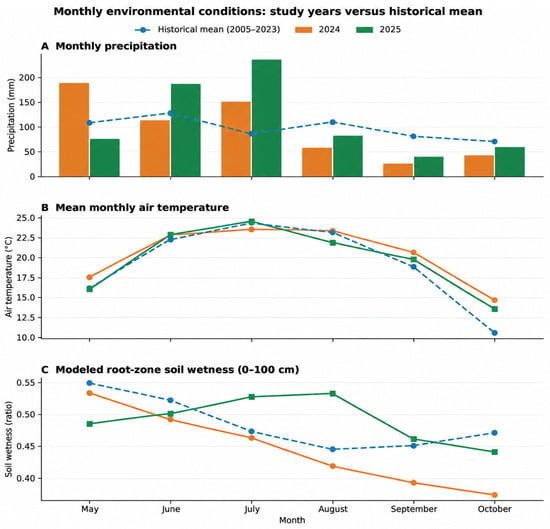
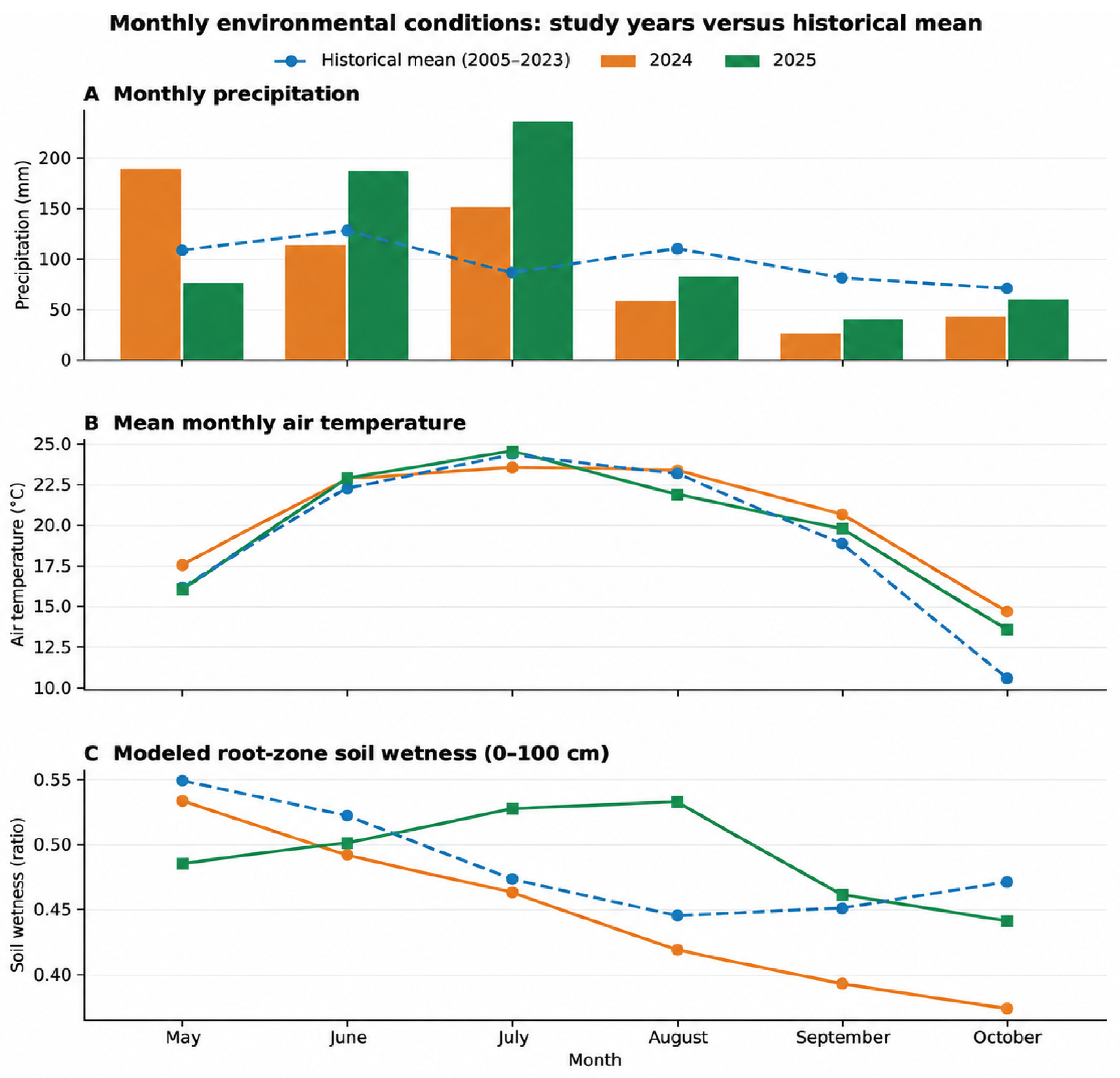
The timing and magnitude of monthly precipitation differed between 2024 and 2025 and relative to the 19-year historical mean (2005–2023; Figure 2A). In 2024, May precipitation (189 mm) was approximately 73% above the historical May mean (109 mm) and represented the highest monthly total during the period shown. June precipitation (114 mm) was below the historical mean (128 mm), whereas July precipitation (151 mm) exceeded the historical mean (87 mm) by approximately 74%. In contrast, May 2025 precipitation (76 mm) was approximately 30% below the historical mean, while June (187 mm) and July (236 mm) precipitation exceeded their respective historical means by approximately 46% and 171%. These patterns indicate contrasting seasonal precipitation distributions between the two study years (Figure 2A).
Figure 2.
Monthly environmental conditions at the experimental site in Boone County, Iowa, during the 2024 and 2025 growing seasons compared with the historical mean (2005–2023). (A) Total monthly precipitation (mm), (B) mean monthly air temperature (°C), and (C) mean monthly modeled root-zone soil wetness (moisture) (0–100 cm soil depth). Orange and green bars represent monthly precipitation totals for 2024 and 2025, respectively, while the dashed blue line represents the historical monthly mean. In Panels (B,C), orange and green lines represent 2024 and 2025, respectively, and the dashed blue line represents the historical monthly mean. Environmental data were obtained from NASA POWER.
Mean monthly air temperatures generally followed similar seasonal patterns in 2024 and 2025 and were relatively close to historical monthly means (Figure 2B). Temperatures increased from May through July before declining toward October. Differences between study years were generally modest during the growing season.
Modeled root-zone soil moisture also exhibited contrasting seasonal patterns between years (Figure 2C). In 2024, modeled soil moisture was relatively high in May and declined progressively through October. In 2025, modeled soil moisture remained relatively stable during May and June, increased during July and August, and subsequently declined in September and October. These differences coincide with the contrasting seasonal precipitation patterns observed between years. Because root-zone soil moisture was derived from NASA POWER rather than measured directly in the experimental plots, these estimates provide environmental context for interpreting year-to-year differences in maize growth and development.
3.2. Maize Emergence
Maize emergence days were significantly reduced by increasing distance from the PGC, although the magnitude of the response differed between years. The statistical analyses indicated that PGC distance and hybrid type had a strong effect on emergence timing (p < 0.0001, p = 0.0029 respectively) (Table 1). Starter fertilizer had no significant effect (p = 0.1591) (Table 1). None of the interactions involving hybrid or fertilizer were significant, indicating that the response to PGC distance was consistent across hybrids and fertilizer treatments.
Table 1.
Significance levels (p-values) for the main effects and interactions of year, days after planting, maize hybrid, starter nitrogen fertilizer, and distance from perennial groundcover (PGC) on maize emergence, plant height, phenology, flowering date, kernel number, and kernel weight during the 2024 and 2025 growing seasons.
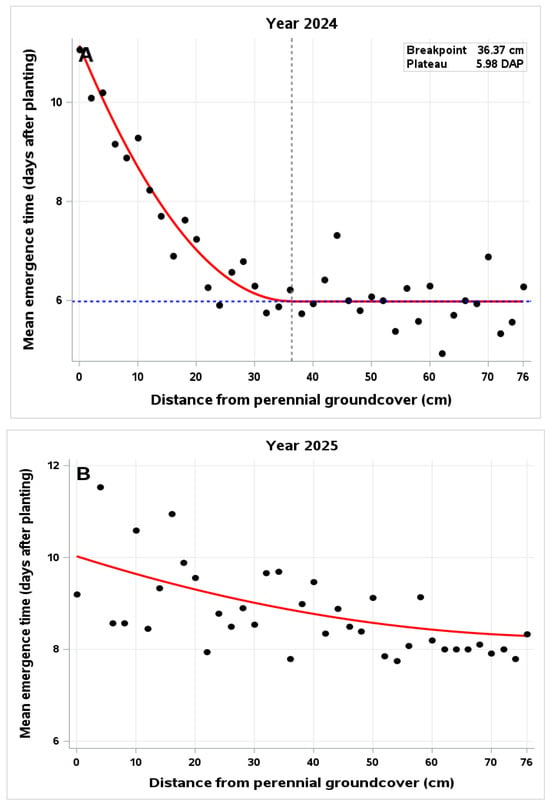
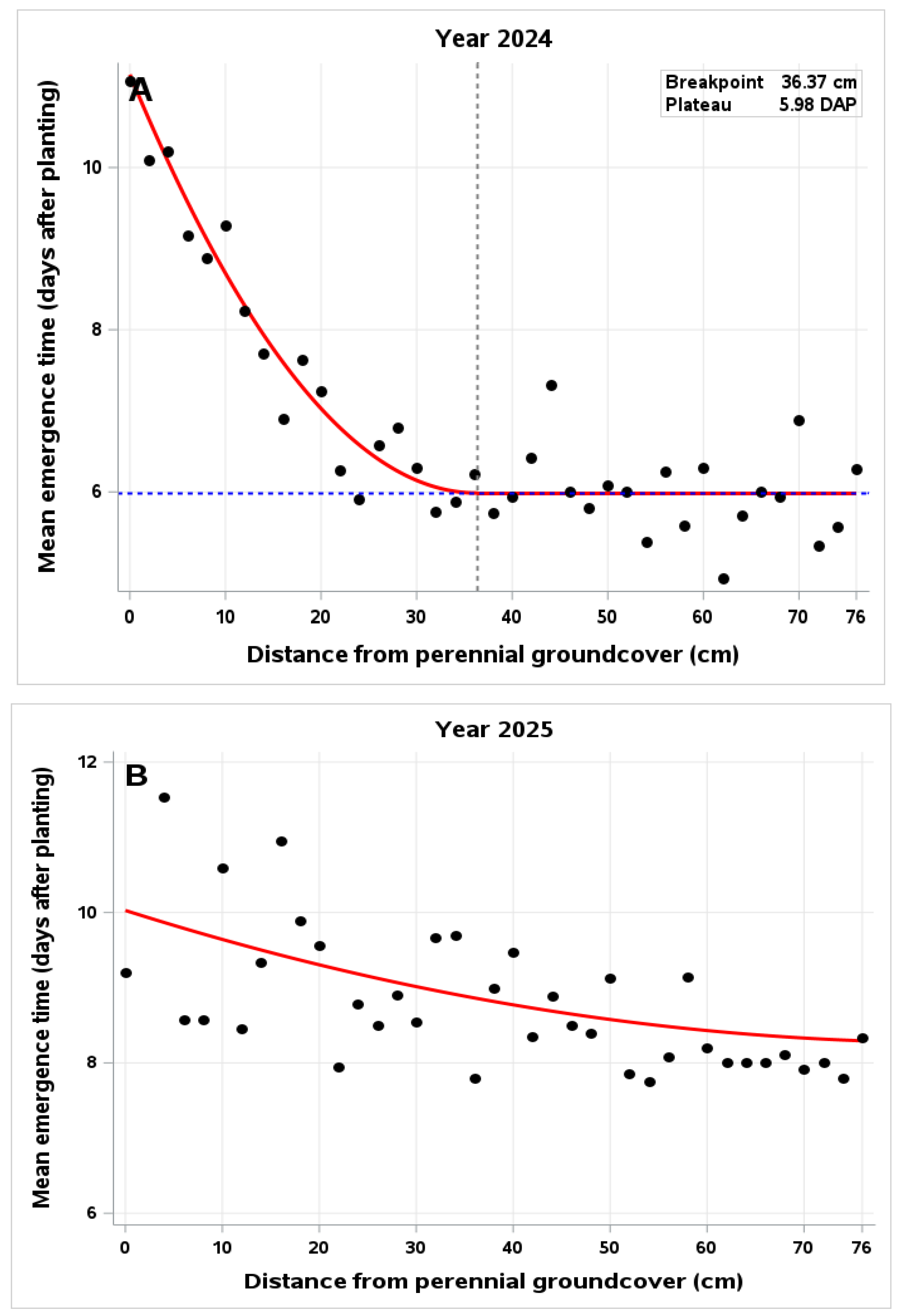
The quadratic-plateau regression identified a significant threshold distance of 36.4 cm (p < 0.0001; 95% CI = 29.8–45.5 cm) in 2024. Emergence days after planting (EDAP) declined nonlinearly with increasing distance from the PGC, until reaching the threshold. Emergence stabilized at 36.4 cm distance, approximately 5.98 days after planting (R2 = 0.305) (Figure 3A). These results indicate that increasing separation from the PGC accelerated maize emergence only up to about 36.4 cm, with little additional improvement beyond this distance.
Figure 3.
Quadratic-plateau regression showing the relationship between distance from perennial groundcover (PGC) and maize emergence time (days after planting) in 2024 (A) and 2025 (B). Black circles represent mean emergence times at each distance, while red lines represent the fitted quadratic-plateau regression models. The gray vertical dashed lines indicate the estimated breakpoints, and the blue horizontal dashed lines indicate the estimated plateau values.
In 2025, emergence also responded significantly to distance from the PGC. Although the quadratic-plateau model was statistically significant (p < 0.0001) (R2 = 0.421), the response did not exhibit a clear plateau within the observed distance range. Instead, emergence time decreased with increasing distance from the PGC up to approximately 56 cm, after which the rate of improvement slowed and changed very little (Figure 3B).
3.3. Plant Height
Plant height changed significantly throughout the growing season, as indicated by a highly significant effect of days after planting (DAP) (p = 0.0001; Table 1). There was also a significant effect of year, indicating that responses differed between the two growing seasons (p = 0.0001) (Table 1). There was no effect of hybrid (p = 0.9015) and starter fertilizer (p = 0.9577) on plant height. In contrast, distance from the PGC had a highly significant effect on plant height (p = 0.0001) (Table 1). The mean comparison showed that P1197 with 33.6 kg ha−1 fertilizer was taller than P1185 with or without fertilizer. However, P1197 without fertilizer did not differ significantly from P1185 under either fertilizer treatment (Table A1). indicating that maize height varied with planting distance from the PGC. There was a hybrid × DAP interaction (p < 0.0001) (Table 1) indicating that plant height differed between hybrids at each sampling date. A significant distance × days interaction (p < 0.0001) (Table 1) was also observed indicating the relationship between distance from PGC on maize height changed over the measurement days. Similarly, the hybrid × fertilizer × DAP interaction was significant (p = 0.0001) (Table 1), indicating that the influence of starter fertilizer on plant height varied between hybrids throughout the growing season.
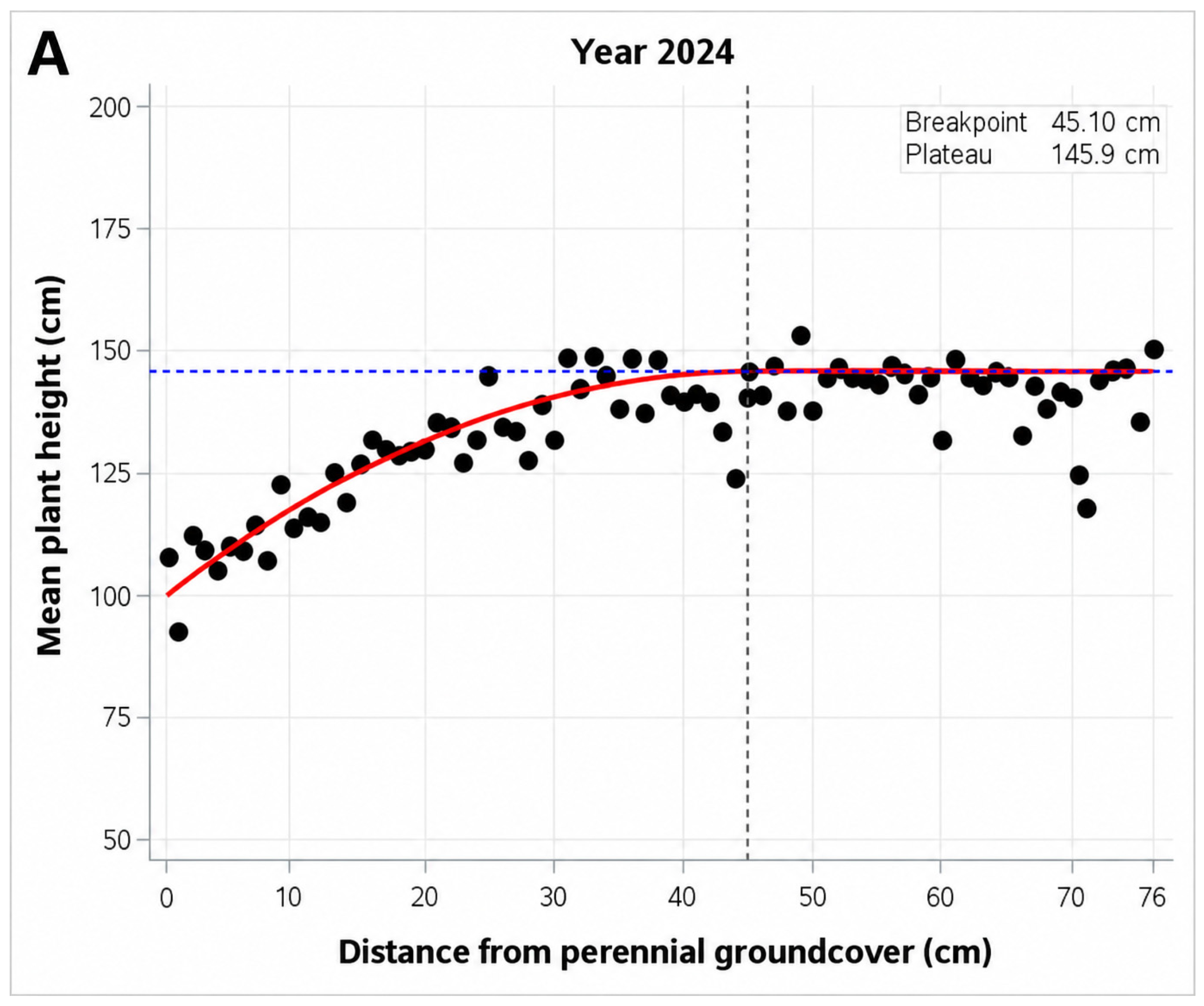
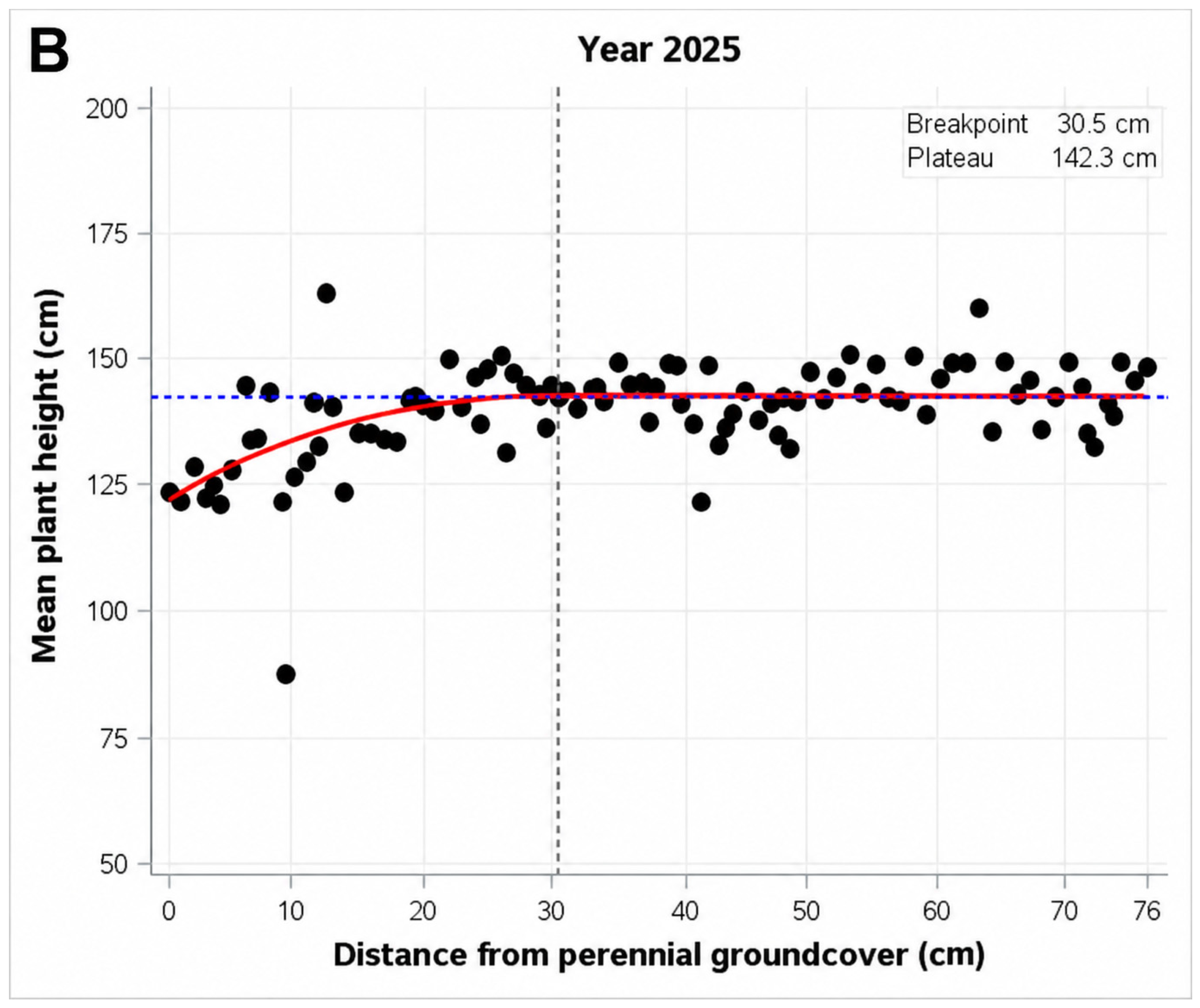
At flowering, plant height exhibited a significant quadratic-plateau response to distance from the PGC (p < 0.0001), increasing with distance before reaching a plateau.
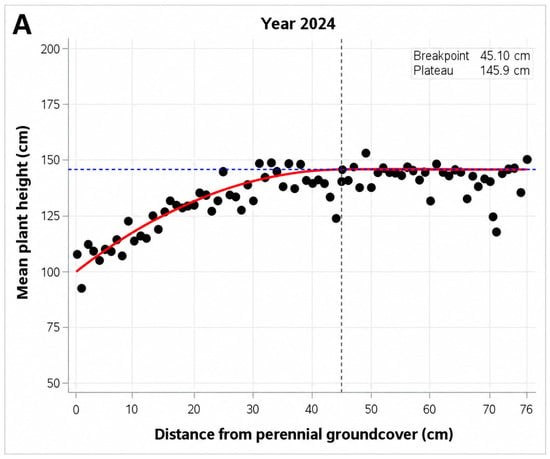
In 2024 (Figure 4A), plant height during flowering increased nonlinearly with respect to distance until reaching a breakpoint at 45.1 cm, after which further separation produced little additional increase in height. The predicted plateau height was 145.9 cm (R2 = 0.301).
Figure 4.
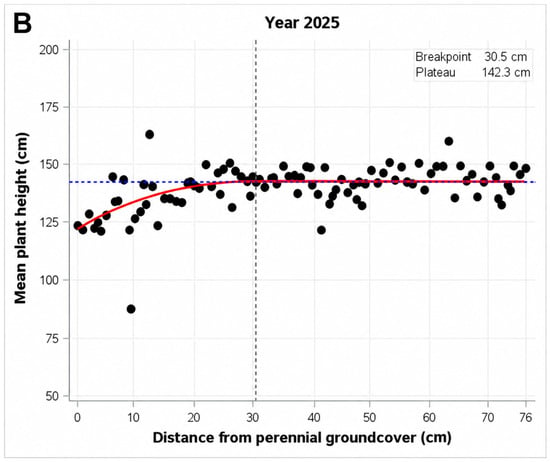
Relationship between distance from the perennial groundcover (PGC) and mean Maize plant height in 2024 (A) and 2025 (B). Black circles represent means taken at that distance; the red line represents the fitted quadratic-plateau regression; the vertical dashed line indicates the estimated breakpoint at which plant height reached a plateau; and the horizontal blue dashed line represents the predicted plateau height.
In 2025 (Figure 4B), the quadratic-plateau model was also significant (p < 0.0001), with a predicted breakpoint at 30.5 cm and a plateau height of 142.3 cm during flowering (R2 = 0.553).
3.4. Phenology
Phenology was significantly affected by distance from the PGC (p = 0.0001), whereas the main effects of year (p = 0.4970), hybrid (p = 0.07556), and fertilizer (p = 0.6711) were not significant (Table 1). Significant year × hybrid (p = 0.0095) and distance × year (p = 0.0009) (Table 1) interactions indicated that hybrid responses and the relationship between distance and phenology varied between growing seasons. Additionally, a significant distance × hybrid interaction (p = 0.0071) indicated that phenological responses to increasing distance from the PGC differed between hybrids.
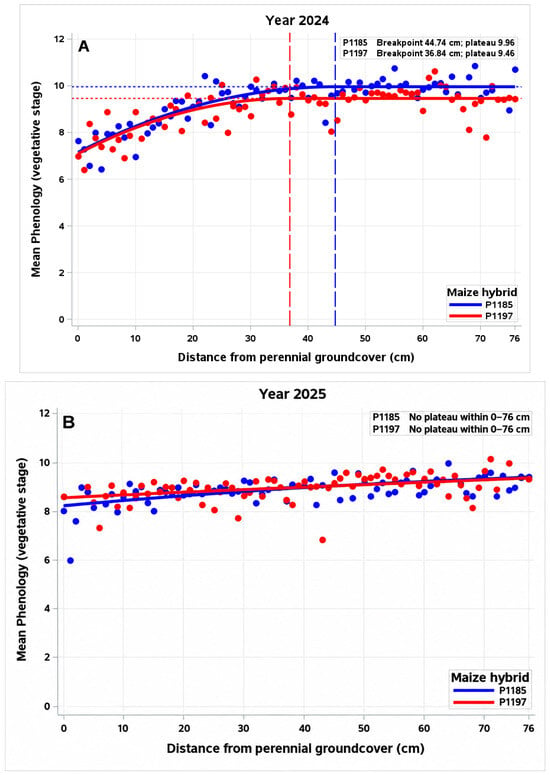
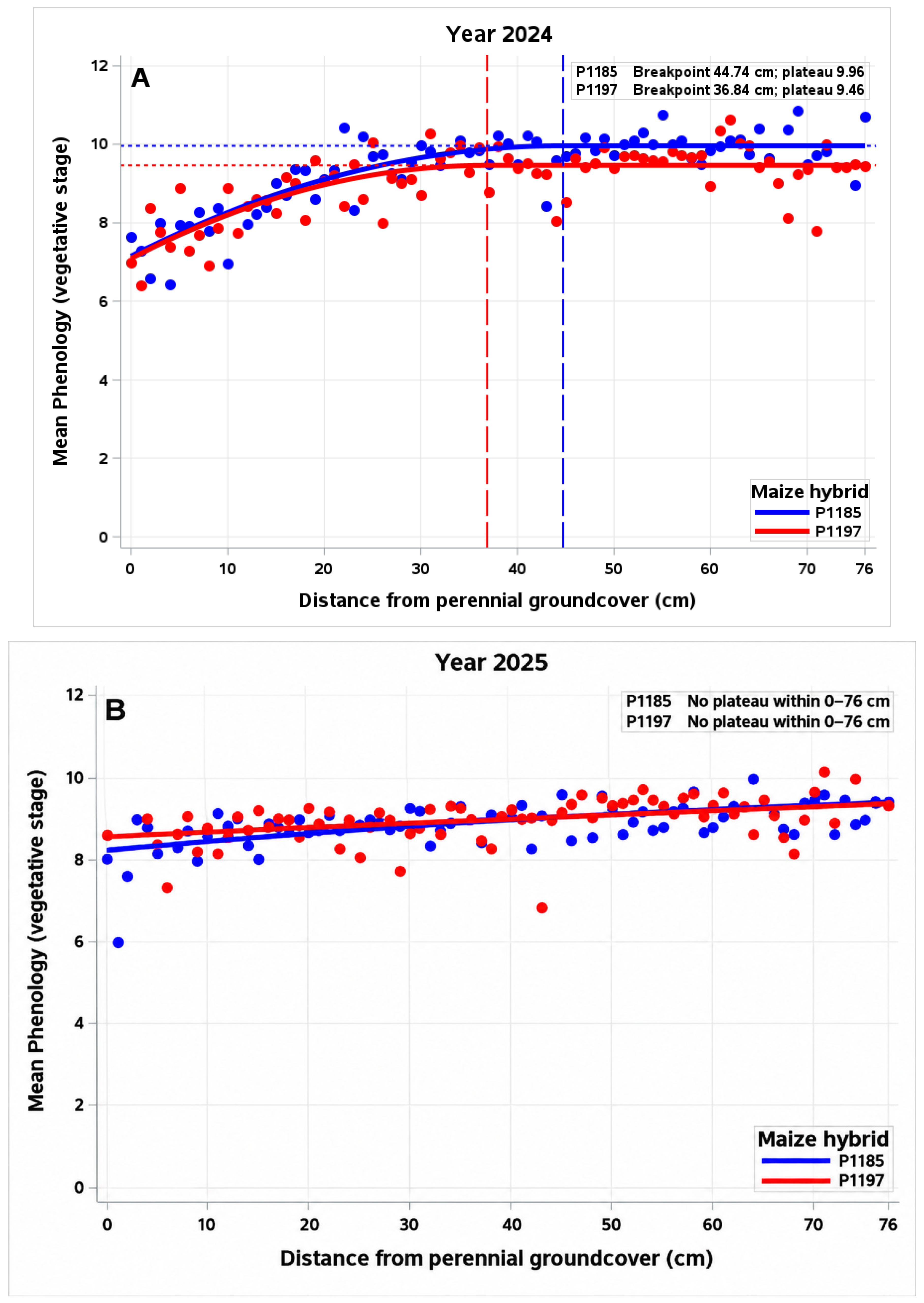
When analyzed separately by year using hybrid-specific quadratic-plateau regression models, based on observations collected during the late vegetative stage before flowering. Maize phenological development in 2024 increased with increasing distance from perennial groundcover (PGC), with distinct responses between hybrids. Hybrid P1185 reached a breakpoint at 44.74 cm, with a predicted plateau of 9.96 vegetative stages (R2 = 0.57), whereas P1197 reached a breakpoint at 36.84 cm, with a lower predicted plateau of 9.46 (R2 = 0.533) (Figure 5A). These results indicate that the effect of PGC proximity on maize phenological development extended over a greater distance for P1185 than for P1197. However, P1185 reached a higher predicted phenological stage once the distance threshold was exceeded.
Figure 5.
Relationship between distance from perennial groundcover (PGC) and mean maize vegetative growth stage (V-stage) in 2024 (A) and 2025 (B). Blue and red symbols represent the observed means for maize hybrids P1185 and P1197, respectively, while the corresponding solid lines represent the fitted quadratic-plateau regression models. Vertical dashed lines indicate the estimated breakpoints at which vegetative development reached a plateau, and horizontal dashed lines represent the predicted plateau values.
In 2025, phenological development increased gradually with increasing distance from PGC for both hybrids, but neither reached a plateau within the observed distance range of 0–76 cm (Figure 5B). The fitted curves showed relatively small increases in vegetative stage progression compared with 2024, with minimal differences between hybrids across the distance gradient (R2 = 0.387 for P1185 and 0.2027 for P1197), indicating a moderate, gradual phenological response to PGC proximity in 2025.
3.5. Flowering (Fdap)
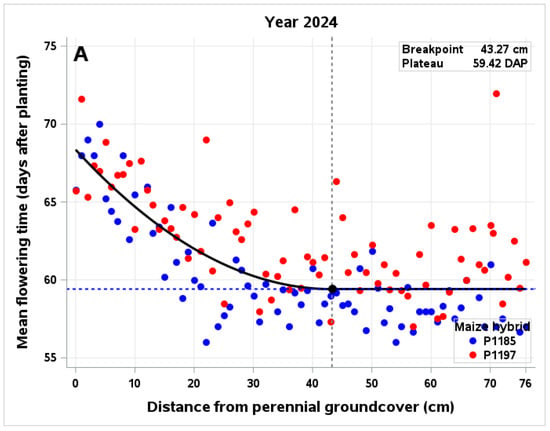
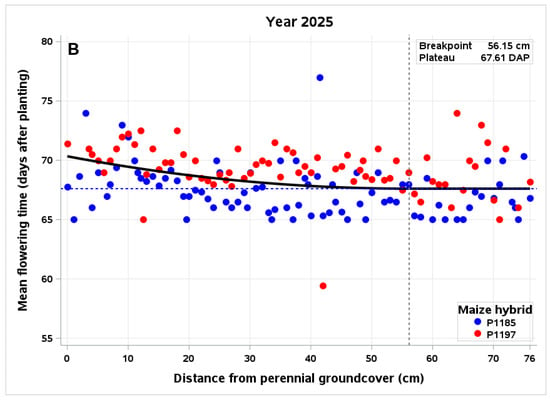
Days from planting to flowering was influenced by year (p < 0.0001), hybrid (p < 0.0001), and distance from the PGC (p < 0.0001) (Table 1). Significant year × hybrid (p = 0.0282) and distance × year (p < 0.0001) interactions (Table 1) indicated that hybrid differences in FDAP and the response to PGC distance varied between growing seasons. In contrast, starter fertilizer had no significant effect on FDAP (p = 0.3368) and did not interact with any other treatment factor. Least-squares means showed that hybrid P1185 flowered significantly earlier than hybrid P1197, averaging 63.2 and 65.3 DAP, respectively.
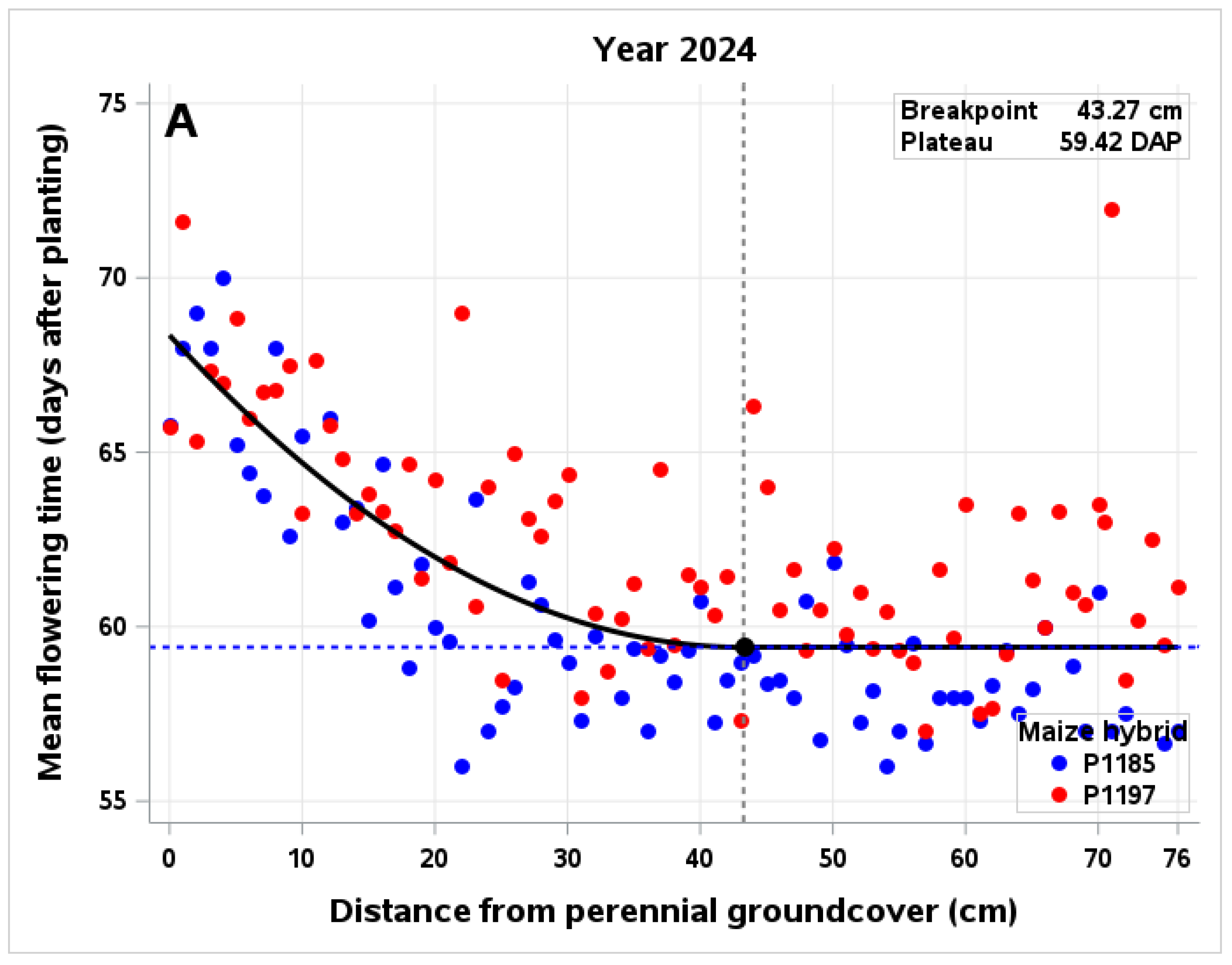
Quadratic-plateau regression showed that FDAP decreased with increasing distance from the PGC before reaching a stable minimum in both growing seasons (Figure 6). In 2024 (Figure 6A), FDAP decreased nonlinearly, approaching an estimated breakpoint of 43.3 cm (95% CI: 33.3–53.3 cm) at a plateau of 59.4 DAP (95% CI: 59.0–59.8 DAP) (R2 = 0.444). An increase in PGC distance beyond 43 cm did not further accelerate flowering.
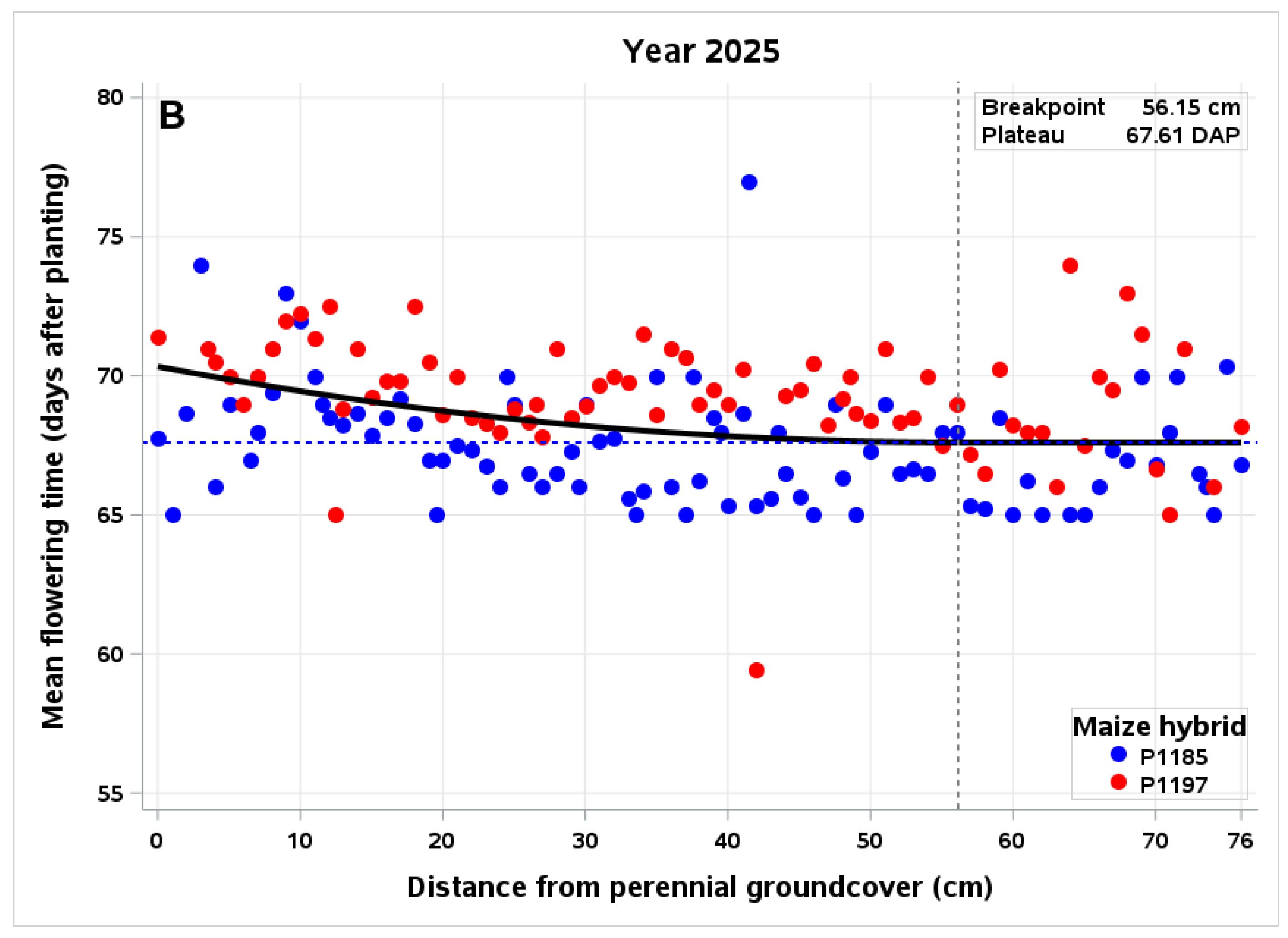
Figure 6.
Relationship between distance from perennial groundcover (PGC) and mean maize flowering time (days after planting, DAP) in 2024 (A) and 2025 (B). Blue and red circles represent the observed mean flowering times of maize hybrids P1185 and P1197, respectively, at each distance. The solid black line represents the fitted quadratic-plateau regression for both hybrids within each year. The vertical gray dashed line indicates the estimated breakpoint at which flowering time reaches a plateau, while the horizontal blue dashed line represents the predicted plateau value.
In 2025 (Figure 6B), the quadratic-plateau model was also significant (p < 0.0001). The estimated breakpoint occurred at 56.15 cm (95% CI: 32.39–79.92 cm), with a predicted plateau of 67.61 DAP (95% CI: 67.31–67.90 DAP) (R2 = 0.355). However, the wide confidence interval indicates substantial uncertainty in the breakpoint estimate, limiting its interpretation as a reliable biological threshold.
3.6. Kernel Number
Kernel number per plant was affected by year (p = 0.0001), hybrid (p = 0.0112), and distance from the PGC (p < 0.0001) (Table 1). Hybrid 1185 produced significantly more kernels per plant (665.4 kernels plant−1) than Hybrid 1197 (601.94 kernels plant−1), representing an average difference of 63.45 kernels plant−1. Although plants receiving 33.6 kg starter N ha−1 produced numerically more kernels per plant (642.78) than those receiving no starter fertilizer (624.56), the difference was not statistically significant (p = 0.0654).
The hybrid × fertilizer (p = 0.6238) and distance × hybrid (p = 0.6842) interactions were not significant, indicating that the response of the two hybrids to starter nitrogen and increasing distance from the PGC was similar. However, a significant distance × fertilizer interaction was detected (p = 0.0315), suggesting that the effect of starter nitrogen depended on the distance between maize plants and the PGC.
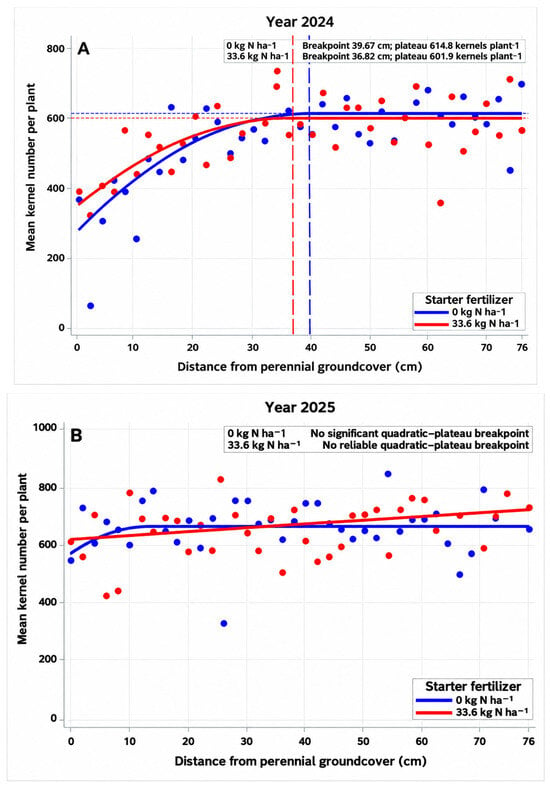
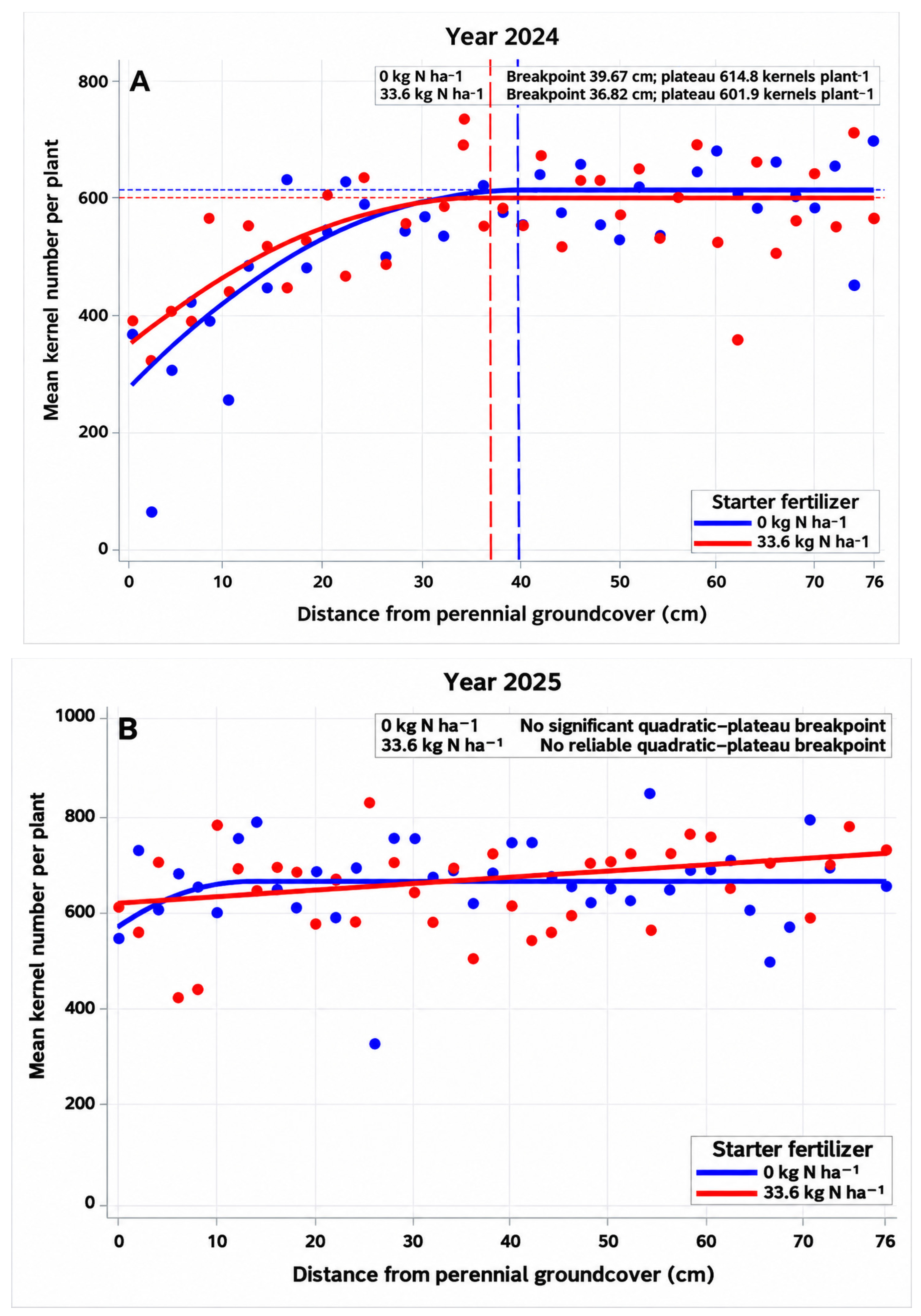
To determine the distance at which competition from PGC no longer limited kernel production, quadratic-plateau regression models were fitted separately by year and starter nitrogen fertilizer treatment (Figure 7). In 2024 (Figure 7A), kernel number increased with increasing distance from the PGC under both fertilizer treatments. At 0 kg N ha−1, kernel number increased until reaching a breakpoint at 39.67 cm, with a predicted plateau of 614.8 kernels plant−1 (R2 = 0.694). Similarly, at 33.6 kg N ha−1, the estimated breakpoint occurred at 36.82 cm, with a predicted plateau of 601.9 kernels plant−1 (R2 = 0.467). These results indicate that kernel production stabilized beyond approximately 37–40 cm from the PGC, with relatively small differences in the estimated breakpoints and plateau values between fertilizer treatments.
Figure 7.
Relationship between distance from perennial groundcover (PGC) and mean kernel number per maize plant in 2024 (A) and 2025 (B). Blue and red symbols represent the observed means for starter nitrogen fertilizer treatments of 0 and 33.6 kg N ha−1, respectively, while the corresponding solid lines represent the fitted regression models. Vertical dashed lines indicate the estimated breakpoints at which kernel number reached a plateau, and horizontal dashed lines represent the predicted plateau values.
In 2025 (Figure 7B), kernel number showed a less pronounced response to increasing distance from the PGC compared with 2024. Under 0 kg N ha−1, the fitted response increased slightly at shorter distances before remaining relatively stable across the distance gradient (R2 = 0.276), whereas the 33.6 kg N ha−1 treatment showed a gradual increase in kernel number with increasing distance in 2024 (R2 = 0.250). However, no statistically significant or reliable quadratic-plateau breakpoint was identified for either fertilizer treatment within the observed distance range of 0–76 cm in 2025. These findings suggest that the distance-dependent response of kernel production to PGC proximity was more pronounced in 2024 than in 2025.
3.7. Total Kernel Weight per Plant
Total kernel weight per plant was affected by starter fertilizer (p = 0.0009) and distance from PGC (p = 0.0426), whereas hybrid had no significant effect (p = 0.7329) (Table 1). Fertilizer interacted with hybrid (p = 0.0003) and distance (p = 0.0019) (Table 1), indicating that the response of total kernel weight to starter fertilizer depended on both hybrid and distance from the PGC. There was no significant hybrid × distance interaction (p = 0.9337), indicating no statistical evidence that the two hybrids responded differently to increasing distance from the PGC.
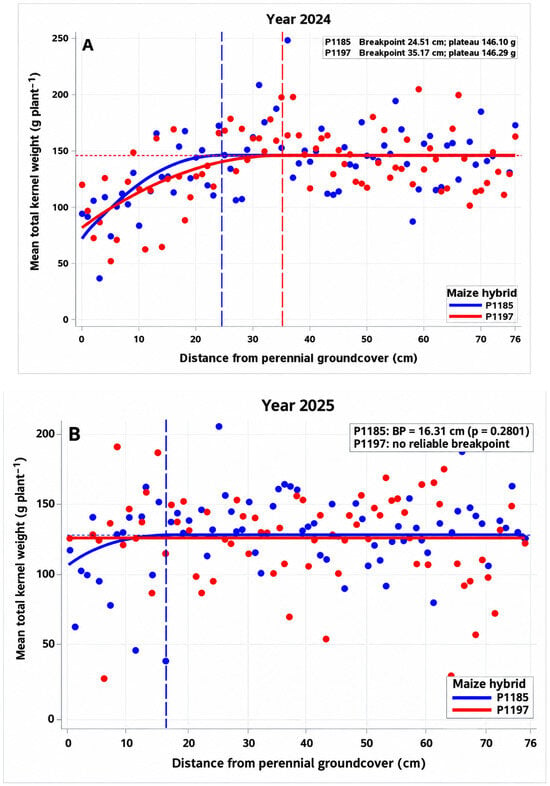
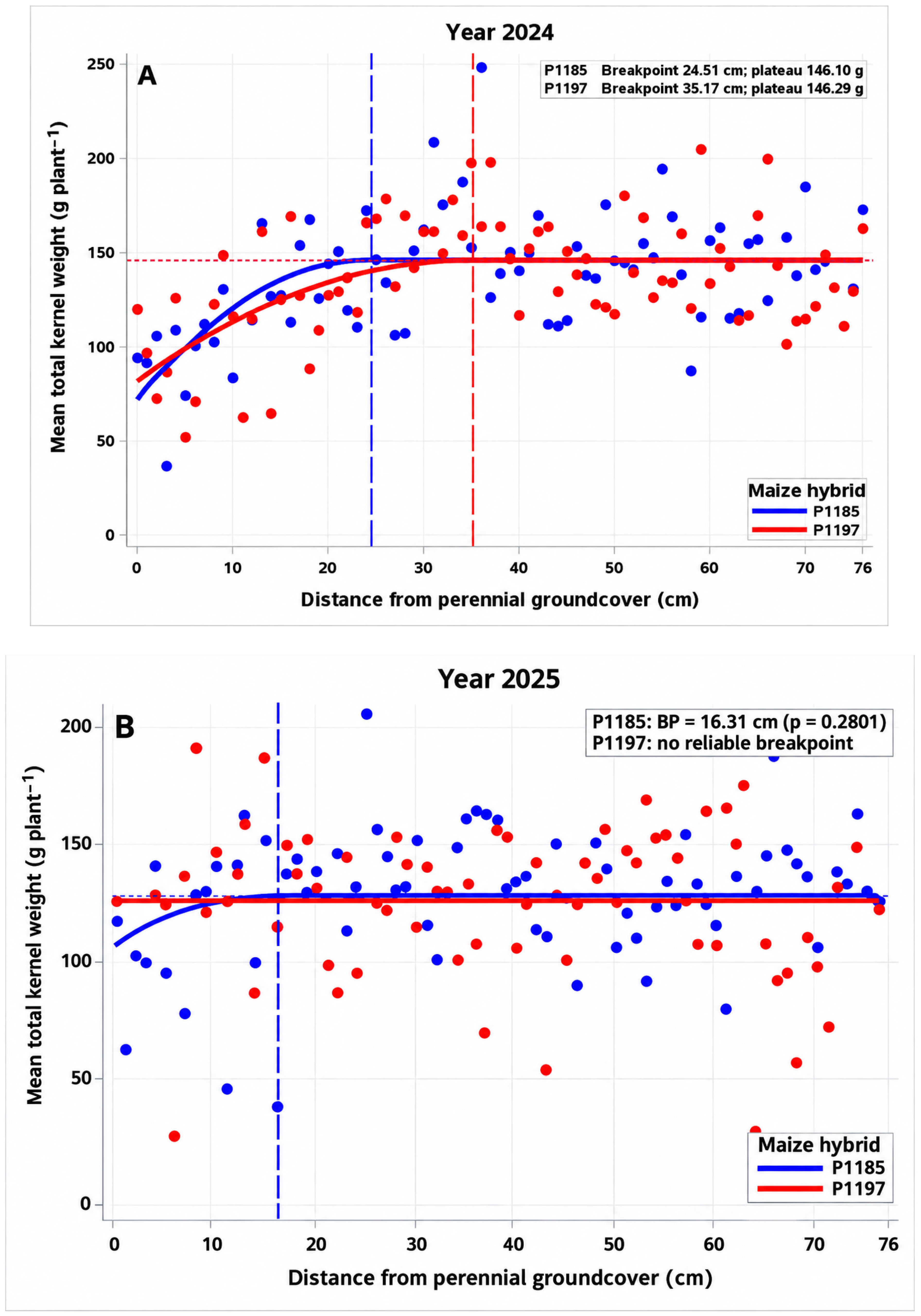
Quadratic-plateau regression models were fitted separately by year and maize hybrid to determine the distance at which total kernel weight reached a plateau (Figure 8). In 2024 (Figure 8A), total kernel weight increased with increasing distance from the PGC for both hybrids. Hybrid P1185 reached a breakpoint at 24.51 cm, with a predicted plateau of 146.10 g plant−1 (R2 = 0.0.538), whereas P1197 reached a breakpoint at 35.17 cm, with a predicted plateau of 146.29 g plant−1 (R2 = 0.324). Although both hybrids achieved similar plateau values, their estimated breakpoints differed by approximately 10.7 cm. However, the nonsignificant hybrid × distance interaction indicates that there was no statistical evidence of different distance responses between hybrids.
Figure 8.
Relationship between distance from perennial groundcover (PGC) and mean total kernel weight per maize plant in 2024 (A) and 2025 (B). Blue and red symbols represent the observed values for maize hybrids P1185 and P1197, respectively, while the corresponding solid lines represent the fitted quadratic-plateau regression models. Vertical dashed lines indicate the estimated breakpoints at which kernel weight reached a plateau, and horizontal dashed lines represent the predicted plateau values.
In 2025 (Figure 8B), total kernel weight showed a weaker response to increasing distance from the PGC. Hybrid P1185 reached an estimated breakpoint at 16.31 cm, with a predicted plateau of 128.41 g plant−1 (R2 = 0.326). In contrast, P1197 showed a nearly constant fitted response across the distance gradient, with no biologically meaningful breakpoint identified within the observed range of 0–76 cm and a predicted kernel weight of approximately 125.78 g plant−1 (R2 = 0.281). Overall, both hybrids exhibited lower predicted kernel weights and less pronounced distance-dependent responses in 2025 than in 2024.
4. Discussion
4.1. Environmental Conditions and Their Influence on Kbg and Maize Growth
The KBG was established in March 2022 and remained unsuppressed throughout the study to ensure a worst-case-scenario competitive environment, so maize was planted into a well-established PGC system. KBG is a cool-season grass adapted to active growth under cool, moist conditions in spring and fall, while growth generally declines during hot summer conditions [29,30]. Its persistent root and rhizome systems allow KBG to resume growth before maize establishment, potentially providing early access to soil water and nutrients [9,22]. This year-round persistence of KBG is central to the conservation value in a PGC system but can also increase competition for resources between the perennial cover and the crop during maize establishment.
Seasonal precipitation and soil-moisture patterns in the root zone differed substantially between years. In 2024, May was a wetter month than June and July, whereas May 2025 was 30% below the historical May mean. May 2024 was 73% above the historical average, supporting active growth of the established KBG at the time of maize establishment, while the subsequent decline in root-zone soil moisture possibly increased the potential for competition with the maize, as water became progressively scarce. In 2025, the relatively dry May and early maize planting may have increased competition between maize and actively growing KBG during establishment. Abundant June–July precipitation, 46% and 172% above their respective historical averages, increased root-zone water availability during maize vegetative and reproductive development in 2025. Under limited soil moisture, plants typically allocate greater resources to root growth and belowground resource acquisition, intensifying root competition between neighboring species [31]. Greater water availability at later stages of maize development could, therefore, reduce the physiological consequences of belowground competition between these two species. This difference could possibly explain the weaker spatial response to distance from PGC observed for several late-season maize traits in 2025.
The perennial nature of KBG also makes environmental conditions outside the maize growing season relevant. Following maize maturation, cooler temperatures and adequate soil moisture in fall can promote renewed KBG growth and carbohydrate accumulation, allowing plants to replenish reserves before winter dormancy [32]. Root-zone soil moisture declined to its seasonal lowest value in October 2024, whereas soil moisture remained consistently higher throughout August–October 2025, before declining in the fall. Although KBG biomass and root development were not directly measured, year-to-year differences in temperature and soil moisture may have contributed to variation in PGC growth and recovery, as both temperature and water availability strongly influence the growth and root dynamics of cool-season grasses [33,34]. Thus, the competitive influence of KBG on maize growth and development should be considered dynamic rather than fixed, reflecting the influence of year-round rainfall on the persistence of the PGC and the seasonal resource availability that regulates the intensity of maize–PGC interactions. This yearly variability suggests that the spatial thresholds identified in this study represent expected, rather than fixed management targets, and that PGC suppression strategies may need to be adjusted based on early-season precipitation forecasts.
4.2. Maize Emergence
Maize emergence was strongly influenced by distance from the PGC, although both the overall timing and the spatial pattern of that influence differed between years. In 2024, plants closer to the PGC required approximately 10–11 DAP to emerge, compared with approximately 6 DAP beyond the 36 cm breakpoint, producing a sharp, localized contrast. In 2025, emergence also improved with increasing distance from KBG, but the response was more gradual, extending to approximately 76 cm before plateauing, despite overall emergence occurring earlier in 2025 than in 2024. Emergence speed appears to have been governed primarily by temperature and soil-moisture conditions at planting rather than by proximity to KBG. Precipitation in May 2024 was 73% above the 19-year historical mean, and air temperature during maize emergence was 17.6 °C. In contrast, May 2025 received 30% less precipitation than the historical mean, and by early June, the mean air temperature had risen to 22.9 °C. Heavy rainfall shortly after the 2024 planting date may have contributed to less favorable seedbed conditions, including cooler and wetter soils, which can delay maize emergence independently of competition with the PGC [35]. The warmer, drier conditions surrounding the later 2025 planting date likely favored faster emergence overall.
The spatial extent of KBG’s competitive influence may have been influenced by the extent of KBG growth and development before maize establishment. As an established PGC, KBG may have developed a substantial root and canopy system before maize planting, potentially increasing its competitive influence on emerging maize seedlings. KBG has a dense, fibrous root system concentrated in the upper soil profile, directly overlapping the zone occupied by germinating maize seeds and developing roots [9]. A well-established KBG root and canopy system at the time of maize planting could increase competition for resources and may help explain the early competition and emergence delays observed in 2024.
Delayed emergence near KBG in both years is consistent with reduced seed-zone water potential limiting seed imbibition and early radicle elongation [36,37], as well as modification of the seed-zone microclimate through shading, evapotranspiration, and altered light quality near actively growing PGC [38,39]. This is agronomically important because delayed emergence can create plant-to-plant differences in development that persist throughout the growing season and ultimately reduce maize yield potential [25]. Defining and managing the crop growth zone near PGC during establishment may be crucial for improving emergence uniformity while retaining PGC farther from the maize row.
4.3. Maize Plant Height
Maize plant height was reduced at closer distance from the PGC in both years, defining a distinct spatial zone of interference. Beyond this distance, further separation from the PGC did not affect plant height. Other authors have found that the influence of a PGC on maize vegetative growth diminished with increasing distance, consistent with spatial competition reported in living mulch and PGC systems [30].
Reduced plant height near the PGC likely reflects the combined effects of delayed establishment and continued competition for resources. Plants near KBG emerged later, potentially creating an early developmental disadvantage that persisted through vegetative growth by limiting leaf expansion, internode elongation, and biomass accumulation [40]. This negative effect on vegetative growth may have been aggravated by belowground competition. The established, fibrous root system of KBG overlaps the upper soil profile occupied by developing maize roots [41] and competition for soil moisture can reduce plant water status and cell turgor pressure, thereby restricting cell expansion and stem elongation [42,43]. Increasing distance from KBG likely reduced root-zone overlap and resource competition, allowing maize to access soil resources more effectively and maintain greater growth. The smaller height-response threshold in 2025 coincided with substantially greater water availability during vegetative growth, with June and July precipitation 46% and 172% above their respective historical means. Greater soil moisture availability in 2025 may have buffered interspecific water competition between maize and KBG, thereby narrowing the spatial zone of vegetative suppression around the perennial ground cover [44]. Conversely, the progressive soil moisture deficit experienced in 2024 likely exacerbated belowground root interference, expanding the effective distance over which KBG suppressed maize height [45].
Differences in plant height among hybrids changed as the plants developed, with the response also depending on fertilizer treatment. Similarly, starter fertilizer did not consistently alleviate plant height reductions near the living PGC. This indicates that supplemental nitrogen alone is insufficient to fully mitigate the multi-factorial competition—such as light quality shifts and soil moisture depletion exerted by PGC proximity [38,43]. These findings clearly show that when water is not limiting, PGC interference has a smaller spatial effect, but managing competition near the maize row still matters most during early vegetative growth.
4.4. Phenology
Distance from the PGC influenced maize vegetative development, with plants near the KBG strip progressing through developmental stages more slowly than plants farther away. This response was particularly evident in 2024, when phenological development was delayed in the first 40 cm from PGC. Beyond this distance, additional separation from KBG produced little impact on developmental stage. In contrast, the spatial effect of KBG on phenological progression in 2025 was substantially weaker, with phenological development reaching a plateau at approximately 53 cm from the PGC. These findings demonstrate that the influence of KBG extended beyond emergence and affected subsequent vegetative development.
The phenological response was closely connected to the emergence and height responses observed in this study. Plants growing near KBG emerged later and subsequently remained shorter, suggesting that early PGC interference established a developmental disadvantage that persisted through vegetative growth. Previous work in KBG-based PGC systems similarly demonstrated delayed maize emergence in the presence of established KBG [25]. Delayed emergence can place later-emerging maize plants at a competitive disadvantage relative to earlier-established neighbors, resulting in reduced subsequent growth and productivity [40]. Later-emerging plants must compete with larger, earlier-emerging plants for light and soil resources. Consequently, these plants may accumulate less leaf area and biomass and remain smaller during subsequent development [46,47]. Competition for soil water between KBG and maize at close proximity may have contributed to transient water limitations during vegetative growth, potentially restricting cell expansion, internode elongation, and leaf-area development. Such responses are consistent with those reported by [48], who found that pre-anthesis water deficits in maize slowed leaf-tip emergence, reduced leaf area and internode size, and subsequently delayed tasseling and silking. Thus, competition experienced near KBG could affect both structural growth and developmental rate through a common limitation in resource availability. Maize leaf appearance is also strongly regulated by thermal time, providing an additional pathway through which modification of the soil microclimate near KBG could influence developmental progression [49]. The emergence, plant height, and phenological responses observed in this study suggest that competition from PGC may have affected maize growth from emergence through vegetative development, with early effects potentially influencing subsequent growth and development.
Genetic differences between maize hybrids may also influence their phenological responses to PGC proximity. Hybrids vary in their tolerance to competition for light, water, and nutrients, with some maintaining growth and development more effectively under resource-limited conditions. Traits such as rapid early growth, greater root development, and efficient resource acquisition may improve competitive ability. Previous studies have reported genetic variation in maize responses to weed interference and crowding stress [50]. Therefore, the differences observed between P1185 and P1197 may reflect variation in their ability to tolerate PGC competition and maintain phenological development.
The declining soil moisture availability in 2024 may have reinforced the developmental disadvantage established during emergence, contributing to greater reductions in plant height and more pronounced delays in phenological progression near KBG than in 2025 [40,43]. The findings from this study suggest that early emergence delays can persist through vegetative development, while genetic differences between hybrids and subsequent environmental conditions may influence the severity of PGC competition and its effects on maize development.
4.5. Flowering
Flowering time exhibited a clear spatial response to PGC proximity, but the magnitude and extent of the response differed between years. PGC effects on flowering were more severe near the KBG interface in 2024 but more gradual across a greater distance gradient in 2025. Delayed flowering near the PGC likely represents the cumulative consequence of developmental differences established earlier in the season. Plants near KBG emerged later, remained shorter, and progressed more slowly through vegetative development, indicating that early PGC interference was carried forward toward reproductive development. Delayed emergence places maize at an initial developmental disadvantage from which the plant does not recover later in the season [40,46]. Because maize development is strongly regulated by thermal-time accumulation units in the form of Growing Degree Days [51], declining soil moisture availability in 2024 may have reinforced the developmental disadvantage. Later-emerging plants begin thermal-time accumulation for post-emergence development later and therefore may require additional calendar days to reach reproductive stages [52]. Soil water deficits during vegetative growth can further restrict leaf expansion and internode elongation while slowing leaf appearance, thereby delaying tasseling and silking [53]. The flowering response, therefore, is influenced by the emergence, height, and phenological delays observed earlier in crop development rather than an independent effect of PGC occurring only at flowering. All the delayed vegetative growth with continuous competition for soil water may have reinforced this developmental lag, particularly as maize approached reproduction [54]. Because KBG remained unsuppressed, competition between established perennial roots and maize could persist throughout crop development. Water deficits before and during flowering can restrict reproductive growth and silk elongation, delay silking, and increase the anthesis–silking interval (ASI) [48,54]. In our study, the similar June and July air temperatures in both years seem to emphasize that soil moisture availability in 2025 might have reduced the intensity of competition for water, leading to more uniform flowering timing across PGC distances. This finding is consistent with evidence that pre-anthesis water deficits can slow leaf appearance and delay reproductive development in maize [53].
Reproductive timing in the presence of KBG appears to be driven by differential hybrid sensitivity to early-season competition rather than baseline relative maturity. Despite sharing a comparative relative maturity (CRM) 111 rating, P1185 flowered approximately 2 days earlier than P1197 on average, although the magnitude of this difference varied between years. This seasonal variation points to a significant genotype × environment interaction, where microclimatic conditions near the groundcover alter post-emergence thermal accumulation rates differently between hybrids [55,56]. Starter N did not significantly affect flowering, suggesting that additional N alone was insufficient to overcome the developmental effects associated with PGC proximity [57]. These results indicate that PGC interference initiated during seedling emergence and establishment can continue to affect the plant throughout the vegetative development and flowering, while seasonal water availability seems to regulate the magnitude of their effect.
4.6. Kernel Number and Total Kernel Weight
The PGC effects observed during early maize establishment and vegetative development ultimately carried over into the reproductive stage of the plant. Kernal number per plant increased with distance from KBG, whereas total kernel weight per plant showed a clear distance-dependent effect only in 2024.
Reduced kernel number near KBG was consistent with the cumulative developmental disadvantages observed at other stages of plant development. Plants near the PGC emerged later, were shorter, progressed more slowly through vegetative stages, and flowered later, potentially reducing plant growth and assimilate availability as they entered the critical period for kernel determination. Kernel number is particularly sensitive to plant growth around flowering, when ear growth, silk development, fertilization, and early kernel establishment occur [58,59,60].
Seasonal differences in water availability may have contributed to variation in the persistence of KBG proximity effects on maize reproductive development. In July 2025, modeled root-zone soil moisture was 11% above the historical average, whereas in July 2024, it was 2% below the historical average. These contrasting modeled soil moisture conditions suggest differences in the broader environmental conditions between growing seasons, which may have influenced maize responses to KBG proximity. However, because soil moisture was not directly measured in the experimental plots, the extent to which water availability contributed to the observed differences in reproductive development remains uncertain [43].
The spatial response observed in 2024 suggests that the effects of PGC proximity persisted into reproductive development and final grain accumulation, whereas the weaker response in 2025 suggests less carryover into grain filling under greater water availability during vegetative growth and kernel determination. Because final kernel weight per plant integrates both kernel number established late in vegetative growth (V5 to V7) and early flowering (silking), and the subsequent dry-matter accumulation during seed filling, environmental constraints operating earlier in development can influence final kernel weight through their effects on both sink establishment and kernel growth [61,62]. Favorable mid- to late-season water availability in 2025 may have supported assimilate supply and reduced the expression of earlier PGC interference in final seed mass. Starter N increased total kernel weight but did not consistently overcome the spatial effects of PGC, indicating that nutrient addition alone was insufficient to reduce or eliminate competition near KBG.
Shade-avoidance responses (SAR) in maize during early development and in the presence of a groundcover may also contribute to the lower grain weight per plant observed in this study. Maize can detect neighboring vegetation through the changes in light quality associated with reflection from other plants which reduces in the red-to-far-red (R:FR) light ratio. These light quality changes trigger early developmental changes in maize even before substantial shading occurs [63,64]. These early SAR can persist throughout maize development and modify leaf development and final plant morphology [65]. Thus, early SAR combined with competition for water and nutrients in 2024 may have affected maize plants near KBG and produced stress. Our results reveal a developmental carryover in which PGC interference during early plant establishment was associated with reduced vegetative growth (plant height) and delayed phenology, including delayed flowering, ultimately reducing kernel weight per plant [66]. However, the small kernel-number decline and absence of a meaningful kernel-weight threshold in 2025 could demonstrate that favorable water availability can reduce the persistence of early-season SAR. The effective PGC competition zone is, therefore, developmentally and environmentally dynamic, providing a physiological basis for defining a crop growth zone that minimizes yield penalties while maintaining PGC within the interrow.
5. Conclusions
PGC systems can provide important benefits for soil health and water quality, but competition between the groundcover and the cash crop may reduce crop performance. Defining a crop growth zone that minimizes this competition is therefore essential to realizing the environmental benefits of PGC systems without sacrificing productivity. Our results indicated that maize planted beyond approximately 30–55 cm from an established, non-suppressed KBG-PGC strip experienced substantially reduced effects of PGC proximity on vegetative and yield-related responses, with the exact breakpoint varying by year. Beyond the variable-specific breakpoints within this range, maize establishment, height, phenology, flowering date, and yield-related responses generally stabilized. Within the competitive zone, kernel numbers were the yield component most sensitive to early-season competition, while kernel weight remained relatively stable. This suggests that KBG proximity had a greater influence on kernel establishment than on subsequent kernel weight accumulation. The width of the competitive zone varied by year, suggesting that environmental conditions influenced the spatial extent of the maize response to KBG proximity. Starter nitrogen did not override this spatial constraint; however, its effect on kernel weight was more apparent once maize plants were farther from the KBG strip. Hybrid P1185 emerged slightly earlier, flowered sooner, and produced more kernels per plant than P1197, indicating that hybrid selection can shift, but not eliminate, the timing of PGC-related developmental delays.
Our research provides a basis for evaluating the management practice of suppressing KBG only within this zone adjacent to the maize row, rather than across the entire KBG strip. Such targeted suppression could potentially preserve more of the conservation benefits of an intact PGC system while limiting effects on maize productivity. Whether this threshold holds across other groundcover species, soils, and climates remains an open question for future work. Additionally, detailed monitoring of soil moisture and mineral nitrogen availability throughout the growing season is needed to better understand the mechanisms of resource competition between maize and KBG and their effects on maize growth and yield.
Author Contributions
Conceptualization, A.M., A.S.G. and K.J.M.; methodology, A.M., A.S.G. and K.J.M.; validation, A.M., A.S.G., K.J.M., A.K. and S.-Z.F.; formal analysis, A.M. and K.J.M.; investigation, A.M.; resources, A.S.G. and K.J.M.; data curation, A.M., K.J.M. and A.S.G.; writing—original draft preparation, A.M.; writing—review and editing, A.M., A.S.G., K.J.M., S.-Z.F. and A.K.; visualization, A.M.; supervision, A.S.G. and K.J.M.; funding acquisition, A.S.G. and K.J.M. All authors have read and agreed to the published version of the manuscript.
Funding
This research was funded by Regenerating America’s Working Landscapes to Enhance Natural Resources and Public Goods through Perennial Groundcover (RegenPGC). RegenPGC is supported by the Agriculture and Food Research Initiative Competitive Grant No. 2021-68012-35923 from the USDA National Institute of Food and Agriculture. Any opinions, findings, conclusions, or recommendations expressed in this publication are those of the author(s) and do not necessarily reflect the view of the U.S. Department of Agriculture.
Data Availability Statement
The raw data supporting the conclusions of this article will be made available by the authors on request.
Acknowledgments
We gratefully acknowledge Roger Hintz and Patrick Galland for their assistance with experimental setup and Alex Haus, Jacie Staedtler, and Kylie Buchholz for their contributions to data collection.
Conflicts of Interest
The authors declare no conflicts of interest.
Abbreviations
The following abbreviations are used in this manuscript:
| PGC | Perennial groundcover |
| DAP | Days after planting |
| AGC | Annual ground cover |
| ASI | Anthesis-silking interval |
| AGC | Annual grouncover |
| FDAP | Flowering day after planting |
| EDAP | Emergence days after planting |
Appendix A
Table A1.
Least-squares means for the hybrid × starter nitrogen fertilizer interaction on maize plant height and kernel weight.
References
- Fioratti Junod, M.; Reid, B.; Sims, I.; Miller, A.J. Cover Crops in Cereal Rotations: A Quantitative Review. Soil Tillage Res. 2024, 238, 105997. [Google Scholar] [CrossRef] [Scilit]
- Al-Shammary, A.A.G.; Al-Shihmani, L.S.S.; Fernández-Gálvez, J.; Caballero-Calvo, A. Optimizing Sustainable Agriculture: A Comprehensive Review of Agronomic Practices and Their Impacts on Soil Attributes. J. Environ. Manag. 2024, 364, 121487. [Google Scholar] [CrossRef] [Scilit] [PubMed]
- Christianson, R.; Christianson, L.; Wong, C.; Helmers, M.; McIsaac, G.; Mulla, D.; McDonald, M. Beyond the Nutrient Strategies: Common Ground to Accelerate Agricultural Water Quality Improvement in the Upper Midwest. J. Environ. Manag. 2018, 206, 1072–1080. [Google Scholar] [CrossRef] [Scilit] [PubMed]
- Hunt, N.D.; Hill, J.D.; Liebman, M. CroppingSystem Diversity Effects on Nutrient Discharge, Soil Erosion, and Agronomic Performance. Environ. Sci. Technol. 2019, 53, 1344–1352. [Google Scholar] [CrossRef] [Scilit] [PubMed]
- Olowoyeye, O.S.; Kaleita, A. Quantifying Sediment Deposition with Erosion Pad Techniques under Different Cropping Systems. Agrosystems Geosci. Env. 2026, 9, e70445. [Google Scholar] [CrossRef] [Scilit]
- Munna, M.N.H.; Lal, R. Impacts of Cover Cropping and Organic Amendments on Soil Physical Quality under Temperate Climate. Cogent Food Agric. 2025, 11, 2467452. [Google Scholar] [CrossRef] [Scilit]
- Dabney, S.M.; Delgado, J.A.; Reeves, D.W. Using Winter Cover Crops to Improve Soil and Water Quality. Commun. Soil Sci. Plant Anal. 2001, 32, 1221–1250. [Google Scholar] [CrossRef] [Scilit]
- Fernando, M.; Shrestha, A. The Potential of Cover Crops for Weed Management: A Sole Tool or Component of an Integrated Weed Management System? Plants 2023, 12, 752. [Google Scholar] [CrossRef] [Scilit] [PubMed]
- Schlautman, B.; Bartel, C.; Diaz-Garcia, L.; Fei, S.; Flynn, S.; Haramoto, E.; Moore, K.; Raman, D.R. Perennial Groundcovers: An Emerging Technology for Soil Conservation and the Sustainable Intensification of Agriculture. Emerg. Top. Life Sci. 2021, 5, 337–347. [Google Scholar] [CrossRef] [Scilit] [PubMed]
- Acharya, J.; Moorman, T.B.; Kaspar, T.C.; Lenssen, A.W.; Gailans, S.; Robertson, A.E. Effect of Planting into a Green Winter Cereal Rye Cover Crop on Growth and Development, Seedling Disease, and Yield of Corn. Plant Dis. 2022, 106, 114–120. [Google Scholar] [CrossRef] [Scilit] [PubMed]
- Duke, J.M.; Johnston, R.J.; Shober, A.L.; Liu, Z. Barriers to Cover Crop Adoption: Evidence from Parallel Surveys in Maryland and Ohio. J. Soil Water Conserv. 2022, 77, 198–211. [Google Scholar] [CrossRef] [Scilit]
- Bartel, C.A.; Moore, K.J.; Fei, S.; Lenssen, A.W.; Hintz, R.L.; Kling, S.M. Evaluating Chemical Suppression Treatments to Alter the Red: Far-Red Ratio in Perennial Groundcovers for Maize Production. Agronomy 2022, 12, 1854. [Google Scholar] [CrossRef] [Scilit]
- Moore, K.J.; Anex, R.P.; Elobeid, A.E.; Fei, S.; Flora, C.B.; Goggi, A.S.; Jacobs, K.L.; Jha, P.; Kaleita, A.L.; Karlen, D.L.; et al. Regenerating Agricultural Landscapes with Perennial Groundcover for Intensive Crop Production. Agronomy 2019, 9, 458. [Google Scholar] [CrossRef] [Scilit]
- Chen, A.; Fei, S.; Lenssen, A.W.; Moore, K.J. Evaluating Cool-season Grass Species as Potential Perennial Groundcover for Maize Production. Agron. J. 2022, 114, 2415–2429. [Google Scholar] [CrossRef] [Scilit]
- Toker, P.; Canci, H.; Turhan, I.; Isci, A.; Scherzinger, M.; Kordrostami, M.; Yol, E. The Advantages of Intercropping to Improve Productivity in Food and Forage Production—A Review. Plant Prod. Sci. 2024, 27, 155–169. [Google Scholar] [CrossRef] [Scilit]
- Manono, B.O. Beyond Monoculture: Exploring the Benefits, Challenges, and Potential of Intercropping Systems. Agron. J. 2026, 118, e70401. [Google Scholar] [CrossRef] [Scilit]
- Bernhard, B.J.; Below, F.E. Plant Population and Row Spacing Effects on Corn: Plant Growth, Phenology, and Grain Yield. Agron. J. 2020, 112, 2456–2465. [Google Scholar] [CrossRef] [Scilit]
- Jafari, F.; Wang, B.; Wang, H.; Zou, J. Breeding Maize of Ideal Plant Architecture for High-density Planting Tolerance through Modulating Shade Avoidance Response and Beyond. J. Integr. Plant Biol. 2024, 66, 849–864. [Google Scholar] [CrossRef] [Scilit] [PubMed]
- Tian, J.; Wang, C.; Chen, F.; Qin, W.; Yang, H.; Zhao, S.; Xia, J.; Du, X.; Zhu, Y.; Wu, L.; et al. Maize Smart-Canopy Architecture Enhances Yield at High Densities. Nature 2024, 632, 576–584. [Google Scholar] [CrossRef] [Scilit] [PubMed]
- Li, J.; Cao, H.; Li, S.; Dong, X.; Zhao, Z.; Jia, Z.; Yuan, L. Genetic and Molecular Mechanisms Underlying Nitrogen Use Efficiency in Maize. J. Genet. Genom. 2025, 52, 276–286. [Google Scholar] [CrossRef] [Scilit] [PubMed]
- Baum, M.E.; Sawyer, J.E.; Castellano, M.J.; Archontoulis, S.V. Ranking Genotype, Environment, Management Effects on the Optimum Nitrogen Rate for Maize: A Cropping System Modeling Analysis. Agron. J. 2024, 116, 1775–1791. [Google Scholar] [CrossRef] [Scilit]
- Wiggans, D.R.; Singer, J.W.; Moore, K.J.; Lamkey, K.R. Response of Continuous Maize with Stover Removal to Living Mulches. Agron. J. 2012, 104, 917–925. [Google Scholar] [CrossRef] [Scilit]
- Stomph, T.; Dordas, C.; Baranger, A.; de Rijk, J.; Dong, B.; Evers, J.; Gu, C.; Li, L.; Simon, J.; Jensen, E.S.; et al. Chapter One—Designing Intercrops for High Yield, Yield Stability and Efficient Use of Resources: Are There Principles? In Advances in Agronomy; Sparks, D.L., Ed.; Academic Press: Cambridge, MA, USA, 2020; Volume 160, pp. 1–50. [Google Scholar]
- Moro, A.; Goggi, A.S.; Moore, K.J.; Fei, S.; Kaleita, A. Spatial Proximity to Perennial Groundcover Triggers Shade Avoidance Responses in Corn. Agronomy 2026, 16, 729. [Google Scholar] [CrossRef] [Scilit]
- Kimmelshue, C.L.; Goggi, A.S.; Moore, K.J. Single-Plant Grain Yield in Corn (Zea mays L.) Based on Emergence Date, Seed Size, Sowing Depth, and Plant to Plant Distance. Crops 2022, 2, 62–86. [Google Scholar] [CrossRef] [Scilit]
- Get to Know Your Corn Numbers. Available online: https://www.dtnpf.com/agriculture/web/ag/crops/article/2020/10/20/get-know-corn-numbers (accessed on 3 February 2026).
- Product Detail. Available online: https://www.pioneer.com/us/product-catalog/crop-corn/product-detail.html (accessed on 3 February 2026).
- Hanway, J.J. Growth Stages of Corn (Zea mays, L.)1. Agron. J. 1963, 55, 487–492. [Google Scholar] [CrossRef] [Scilit]
- Moser, L.E.; Hoveland, C.S. Cool-Season Grass Overview. In Agronomy Monographs; Moser, L.E., Buxton, D.R., Casler, M.D., Eds.; Wiley: Hoboken, NJ, USA, 1996; Volume 34, pp. 1–14. ISBN 978-0-89118-130-9. [Google Scholar]
- Flynn, E.S.; Moore, K.J.; Singer, J.W.; Lamkey, K.R. Evaluation of Grass and Legume Species as Perennial Ground Covers in Corn Production. Crop Sci. 2013, 53, 611–620. [Google Scholar] [CrossRef] [Scilit]
- Foxx, A.J.; Fort, F. Root and Shoot Competition Lead to Contrasting Competitive Outcomes under Water Stress: A Systematic Review and Meta-Analysis. PLoS ONE 2019, 14, e0220674. [Google Scholar] [CrossRef] [Scilit] [PubMed]
- Duff, D.T. Influence of Fall Nitrogenous Fertilization on the Carbohydrates of Kentucky Bluegrass. In ASA, CSSA, and SSSA Books; Roberts, E.C., Ed.; Wiley: Hoboken, NJ, USA, 1974; pp. 112–119. ISBN 978-0-89118-007-4. [Google Scholar]
- Huang, B.; Liu, X. Summer Root Decline: Production and Mortality for Four Cultivars of Creeping Bentgrass. Crop Sci. 2003, 43, 258–265. [Google Scholar] [CrossRef] [Scilit]
- Liu, W.; Xie, F.; Chen, Y.; Cui, G. Growth and Morphological Responses of Kentucky Bluegrass to Homogeneous and Heterogeneous Soil Water Availabilities. Agronomy 2022, 12, 1265. [Google Scholar] [CrossRef] [Scilit]
- Gupta, S.C.; Swan, J.B.; Schneider, E.C. Planting Depth and Tillage Interactions on Corn Emergence. Soil Sci. Soc. Amer J. 1988, 52, 1122–1127. [Google Scholar] [CrossRef] [Scilit]
- Wuest, S.B. Water Transfer from Soil to Seed: The Role of Vapor Transport. Soil Sci. Soc. Amer J. 2002, 66, 1760–1763. [Google Scholar] [CrossRef] [Scilit]
- Stewart, S.; Kitchen, N.; Yost, M.; Conway, L.S.; Carter, P. Planting Depth and Within-field Soil Variability Impacts on Corn Stand Establishment and Yield. Agrosystems Geosci. Env. 2021, 4, e20186. [Google Scholar] [CrossRef] [Scilit]
- Rajcan, I.; Swanton, C.J. Understanding Maize–Weed Competition: Resource Competition, Light Quality and the Whole Plant. Field Crops Res. 2001, 71, 139–150. [Google Scholar] [CrossRef] [Scilit]
- Horton, P.; Ruban, A.V.; Walters, R.G. REGULATION OF LIGHT HARVESTING IN GREEN PLANTS. Annu. Rev. Plant. Physiol. Plant. Mol. Biol. 1996, 47, 655–684. [Google Scholar] [CrossRef] [Scilit] [PubMed]
- Nafziger, E.D.; Carter, P.R.; Graham, E.E. Response of Corn to Uneven Emergence. Crop Sci. 1991, 31, 811–815. [Google Scholar] [CrossRef] [Scilit]
- Schenk, H.J. Root Competition: Beyond Resource Depletion. J. Ecol. 2006, 94, 725–739. [Google Scholar] [CrossRef] [Scilit]
- Farooq, M.; Wahid, A.; Kobayashi, N.; Fujita, D.; Basra, S.M.A. Plant Drought Stress: Effects, Mechanisms and Management. Agron. Sustain. Dev. 2009, 29, 185–212. [Google Scholar] [CrossRef] [Scilit]
- Çakir, R. Effect of Water Stress at Different Development Stages on Vegetative and Reproductive Growth of Corn. Field Crops Res. 2004, 89, 1–16. [Google Scholar] [CrossRef] [Scilit]
- Hall, M.R.; Swanton, C.J.; Anderson, G.W. The Critical Period of Weed Control in Grain Corn (Zea mays). Weed sci. 1992, 40, 441–447. [Google Scholar] [CrossRef] [Scilit]
- Eberbach, P.; Pala, M. Crop Row Spacing and Its Influence on the Partitioning of Evapotranspiration by Winter-Grown Wheat in Northern Syria. Plant Soil 2005, 268, 195–208. [Google Scholar] [CrossRef] [Scilit]
- Liu, W.; Tollenaar, M.; Stewart, G.; Deen, W. Response of Corn Grain Yield to Spatial and Temporal Variability in Emergence. Crop Sci. 2004, 44, 847–854. [Google Scholar] [CrossRef] [Scilit]
- Uneven Corn Heights. Available online: https://crops.extension.iastate.edu/encyclopedia/uneven-corn-heights (accessed on 21 September 2026).
- Fuad-Hassan, A.; Tardieu, F.; Turc, O. Drought-induced Changes in Anthesis-silking Interval Are Related to Silk Expansion: A Spatio-temporal Growth Analysis in Maize Plants Subjected to Soil Water Deficit. Plant Cell Environ. 2008, 31, 1349–1360. [Google Scholar] [CrossRef] [Scilit] [PubMed]
- Bollero, G.A.; Bullock, D.G.; Hollinger, S.E. Soil Temperature and Planting Date Effects on Corn Yield, Leaf Area, and Plant Development. Agron. J. 1996, 88, 385–390. [Google Scholar] [CrossRef] [Scilit]
- Maddonni, G.A.; Otegui, M.E.; Cirilo, A.G. Plant Population Density, Row Spacing and Hybrid Effects on Maize Canopy Architecture and Light Attenuation. Field Crops Res. 2001, 71, 183–193. [Google Scholar] [CrossRef] [Scilit]
- Tollenaar, M.; Daynard, T.B.; Hunter, R.B. Effect of Temperature on Rate of Leaf Appearance and Flowering Date in Maize1. Crop Sci. 1979, 19, 363–366. [Google Scholar] [CrossRef] [Scilit]
- Bonhomme, R. Bases and Limits to Using ‘Degree.Day’ Units. Eur. J. Agron. 2000, 13, 1–10. [Google Scholar] [CrossRef] [Scilit]
- NeSmith, D.S.; Ritchie, J.T. Short- and Long-Term Responses of Corn to a Pre-Anthesis Soil Water Deficit. Agron. J. 1992, 84, 107–113. [Google Scholar] [CrossRef] [Scilit]
- Westgate, M.E.; Boyer, J.S. Reproduction at Low and Pollen Water Potentials in Maize1. Crop Sci. 1986, 26, 951–956. [Google Scholar] [CrossRef] [Scilit]
- Khan, S.N.; Li, D.; Maimaitijiang, M. A Geographically Weighted Random Forest Approach to Predict Corn Yield in the US Corn Belt. Remote Sens. 2022, 14, 2843. [Google Scholar] [CrossRef] [Scilit]
- Parent, B.; Leclere, M.; Lacube, S.; Semenov, M.A.; Welcker, C.; Martre, P.; Tardieu, F. Maize Yields over Europe May Increase in Spite of Climate Change, with an Appropriate Use of the Genetic Variability of Flowering Time. Proc. Natl. Acad. Sci. USA 2018, 115, 10642–10647. [Google Scholar] [CrossRef] [Scilit] [PubMed]
- Lemcoff, J.H.; Loomis, R.S. Nitrogen and Density Influences on Silk Emergence, Endosperm Development, and Grain Yield in Maize (Zea mays L.). Field Crops Res. 1994, 38, 63–72. [Google Scholar] [CrossRef] [Scilit]
- Tolley, S.A.; Brito, L.F.; Wang, D.R.; Tuinstra, M.R. Genomic Prediction and Association Mapping of Maize Grain Yield in Multi-Environment Trials Based on Reaction Norm Models. Front. Genet. 2023, 14, 1221751. [Google Scholar] [CrossRef] [Scilit] [PubMed]
- Otegui, M.E.; Bonhomme, R. Grain Yield Components in Maize. Field Crops Res. 1998, 56, 247–256. [Google Scholar] [CrossRef] [Scilit]
- Borrás, L.; Otegui, M.E. Maize Kernel Weight Response to Postflowering Source–Sink Ratio. Crop Sci. 2001, 41, 1816–1822. [Google Scholar] [CrossRef] [Scilit]
- Andrade, F.H.; Vega, C.; Uhart, S.; Cirilo, A.; Cantarero, M.; Valentinuz, O. Kernel Number Determination in Maize. Crop Sci. 1999, 39, 453–459. [Google Scholar] [CrossRef] [Scilit]
- Borrás, L.; Westgate, M.E. Predicting Maize Kernel Sink Capacity Early in Development. Field Crops Res. 2006, 95, 223–233. [Google Scholar] [CrossRef] [Scilit]
- Maddonni, G.A.; Otegui, M.E.; Andrieu, B.; Chelle, M.; Casal, J.J. Maize Leaves Turn Away from Neighbors. Plant Physiol. 2002, 130, 1181–1189. [Google Scholar] [CrossRef] [Scilit] [PubMed]
- Wang, H.; Wu, G.; Zhao, B.; Wang, B.; Lang, Z.; Zhang, C.; Wang, H. Regulatory Modules Controlling Early Shade Avoidance Response in Maize Seedlings. BMC Genom. 2016, 17, 269. [Google Scholar] [CrossRef] [Scilit] [PubMed]
- Zhu, J.; Vos, J.; Van Der Werf, W.; Van Der Putten, P.E.L.; Evers, J.B. Early Competition Shapes Maize Whole-Plant Development in Mixed Stands. J. Exp. Bot. 2014, 65, 641–653. [Google Scholar] [CrossRef] [Scilit] [PubMed]
- Cerrudo, D.; Page, E.R.; Tollenaar, M.; Stewart, G.; Swanton, C.J. Mechanisms of Yield Loss in Maize Caused by Weed Competition. Weed sci. 2012, 60, 225–232. [Google Scholar] [CrossRef] [Scilit]

Disclaimer/Publisher’s Note: The statements, opinions and data contained in all publications are solely those of the individual author(s) and contributor(s) and not of MDPI and/or the editor(s). MDPI and/or the editor(s) disclaim responsibility for any injury to people or property resulting from any ideas, methods, instructions or products referred to in the content. |
© 2026 by the authors. Licensee MDPI, Basel, Switzerland. This article is an open access article distributed under the terms and conditions of the Creative Commons Attribution (CC BY) license.