


Abstract
Improving soil fertility under climate change conditions is a major challenge for sustainable agriculture. This study evaluated the combined effects of charcoal waste and Tithonia diversifolia biomass on maize productivity in Kinshasa, DR Congo, using an alley-cropping system over two consecutive growing seasons. The objective was to assess the potential of this strategy to sustain maize yields and provide insights relevant to sub-Saharan Africa (SSA). Three treatments were compared: a control without amendment (T0), and two treatments receiving 5 t ha−1 of charcoal waste before cultivation combined with Tithonia in alley cropping, pruned at 50 cm (T1) or 100 cm (T2) and applied as mulch. Annual Tithonia biomass production reached approximately 100 t DM ha−1. Maize grain yields in the first season were higher in the amended plots (2.7 to 2.9 t ha−1) compared to T0 (1.6 t ha−1). The yields obtained in the second season were similar for all plots, but they declined significantly for T0 compared to the first season. While yields stabilized with amendments, they stayed below SSA self-sufficiency targets (4.45 t ha−1). The relatively low nitrogen uptake and nitrogen-use efficiency observed in this study suggest that their improvement is essential for narrowing the yield gap.
1. Introduction
Agricultural productivity in sub-Saharan Africa (SSA) remains substantially below its potential due to multiple biophysical and socioeconomic constraints, among which poor soil fertility is one of the most critical. Nitrogen (N) and phosphorus (P) deficiencies are particularly widespread and severely limit crop production. The low N supply capacity of many SSA soils is largely associated with their low soil organic matter (OM) content, which typically ranges from 2 to 4%, thereby restricting nutrient retention and availability [1,2,3,4,5]. Although the total P stock in SSA soils can be considerable (562.9 g m−2 in the top meter of soil), much of this nutrient remains unavailable to crops because of strong adsorption to iron (Fe) and aluminum (Al) oxides, which are abundant in highly weathered tropical soils [6,7,8,9]. In addition, continuous cultivation without adequate nutrient replenishment accelerates nutrient depletion and contributes to the progressive decline of soil fertility [2,9].
The adoption of conventional nutrient management practices remains constrained throughout SSA. Mineral fertilizers are often inaccessible or unaffordable for smallholder farmers because of limited availability and high market prices [10]. Likewise, organic amendments of animal origin are generally scarce owing to low livestock densities and competing uses [11]. Plant-derived organic resources are more readily available; however, their effectiveness is frequently limited by low nutrient concentrations and rapid decomposition rates under tropical conditions. Consequently, relatively high application rates (5–10 t DM ha−1 yr−1) are required to achieve significant agronomic benefits, particularly when the N concentration is below 2.5% [12,13,14,15]. As a result, nutrient inputs from all sources typically remain very low, rarely exceeding 10 kg ha−1 of N, P, and K combined in smallholder farming systems [5].
Maize (Zea mays L.) is one of the most important staple crops in SSA, providing food, feed, and income for millions of households. Nevertheless, current maize yields remain far below attainable levels, and regional production is insufficient to satisfy growing demand. It has been estimated that maize productivity must increase by 50–75% to meet both current and projected requirements by 2050 [5,16]. Achieving this objective will require the implementation of efficient and locally adapted soil fertility management strategies that combine productivity, sustainability, and affordability [17,18].
Among the agroecological options available, the integration of carbon-rich amendments and nutrient-rich organic biomass has received increasing attention. Tithonia diversifolia (Hemsl.) A. Gray is a fast-growing shrub that is well adapted to tropical environments and produces high-quality biomass characterized by elevated concentrations of K (>4%), as well as N (>2.5%) and P (>0.25%) above the net immobilization thresholds. In addition, T. diversifolia biomass contains appreciable amounts of micronutrients and can produce 7–15 t DM ha−1 yr−1 under favorable conditions. Biochar and charcoal materials, although generally characterized by lower N concentrations, can provide substantial quantities of K and, in some cases, P [19,20,21,22,23,24], Moreover, they can improve soil chemical properties through increases in soil pH and cation exchange capacity (CEC) [25].
Previous research has further demonstrated that the combined application of labile organic materials and black carbon amendments often produces greater benefits than the application of either amendment alone. Such integrated approaches can generate synergistic effects on soil fertility through complementary mechanisms involving nutrient supply, nutrient retention, microbial activity, and improvements in soil physical properties [21,26,27,28,29].
Despite the potential of this approach, several important knowledge gaps remain. The effective use of T. diversifolia as a soil amendment requires the establishment and management of biomass-producing systems, such as alley cropping. However, poorly managed hedgerows may compete with crops for water, light, and nutrients, or exert allelopathic effects that reduce crop performance. Furthermore, the nutrient composition of biomass produced under cultivated conditions may differ from that of naturally occurring stands, potentially affecting its fertilizing value [21,30,31,32,33,34]. Therefore, there is a need to identify management practices that optimize both biomass production and nutrient quality while maximizing positive interactions between hedgerows and associated crops.
Similarly, the agronomic effects of charcoal amendments require further investigation under practical SSA farming conditions. While most previous studies have focused on biochar, farmers in many SSA regions more commonly use charcoal residues, often at low application rates (<1 t ha−1 yr−1) [16,24,35]. The extent to which charcoal can contribute to sustainable soil fertility management, particularly when combined with nutrient-rich biomass inputs, remains insufficiently documented.
The objective of this study was therefore to evaluate the effectiveness of an integrated soil fertility management system combining charcoal application and T. diversifolia-based alley cropping for sustaining maize productivity in Kinshasa, DR Congo. Specifically, the study assessed the capacity of this combined approach to maintain maize yields over consecutive cropping seasons and to provide insights relevant to the development of sustainable soil fertility management strategies in SSA.
2. Materials and Methods
2.1. Description of the Experimental Site
The field experiment was conducted in Mafumfu Village, Kimwenza, located in the southwestern part of Kinshasa (4°30.695′ S, 15°15.379′ E; 390 m above sea level). The study area is situated within the humid tropical zone and is characterized by an Aw4 climate according to the Köppen–Geiger classification. The climate is marked by a distinct seasonality, with a dry season lasting approximately four months (June–September) and a rainy season extending from October to May [36].
Soils of Kinshasa are highly weathered tropical soils with low base saturation and a predominance of kaolinitic clay minerals. In the Kimwenza area, the dominant soil groups consist of Arenoferralsols and Haplic Acrisols [3,4,37,38]. At the experimental site, the soil exhibited a predominantly sandy texture, with more than 90% sand and less than 2% clay. The main chemical properties of the soil before the establishment of the experiment are presented in Table 1.
Table 1.
Chemical characteristics of the experimental soil according to depths.
2.2. Experimental Setup
The experiment was established using a randomized complete block design comprising three treatments and three replicates, resulting in a total of nine experimental plots. Each plot measured 9 m × 3 m (27 m2). Three treatments were applied: a control (T0) plot without any amendments; and two other plots receiving 5 t ha−1 of charcoal prior to cultivation combined with alley cropping using T. diversifolia pruned in situ at 50 cm (T1) or at 100 cm (T2) and applied as mulch.
Maize was cultivated continuously over three consecutive cropping cycles. However, data from the third cropping cycle were not considered in the analysis because severe insect damage substantially affected crop performance.
Throughout the experiment, T. diversifolia biomass harvested from the hedgerows was applied directly to the soil surface as fresh mulch without prior drying. The amounts of fresh biomass applied during the first, second, and third cropping cycles were 13.15, 5.12, and 9.15 t ha−1, respectively. Following each pruning event, leaves and young stems were collected, weighed, and distributed uniformly among the plots assigned to treatments T1 and T2.
Although similar quantities of T. diversifolia biomass were applied in T1 and T2, the two pruning regimes were expected to influence crop–hedgerow interactions differently. Differences in pruning height may affect hedgerow regrowth, root development, light interception, and belowground competition for water and nutrients, thereby altering the overall performance of the alley-cropping system [32,39,40]. Consequently, the comparison between T1 and T2 allowed the assessment of whether pruning height influences the effectiveness of the combined charcoal—T. diversifolia soil fertility management strategy.
A summary of the treatment composition is given in Table 2.
Table 2.
Experimental Treatments.
Tithonia diversifolia was established in April 2023 using 20-cm-long stem cuttings planted at a density of 250,000 plants ha−1, following local agronomic recommendations for DR Congo. Maize was sown two weeks later between adjacent T. diversifolia hedgerows, with an inter-hedgerow spacing of 1 m. Two maize varieties were cultivated during the study period: UPN1 during the first cropping season and SC 719 Tembo during the second season.
Because T. diversifolia and the first maize crop were established at the same month, the biomass produced by the newly planted hedgerows was insufficient to provide mulch at the beginning of the experiment. Therefore, the initial mulch application was derived from T. diversifolia biomass harvested from nearby natural hedgerows. Thereafter, mulch was supplied by biomass produced within the experimental plots. Based on the growth dynamics of the hedges, pruning operations were performed eight times between June 2023 and July 2024 to maintain the designated pruning heights and ensure a regular supply of biomass [41,42].
The charcoal used in the experiment was collected from several locations within Kinshasa, including one carbonization site on the Batéké Plateau and two major charcoal markets (Mikondo and Liberté), where non-commercial charcoal residues accumulate in substantial quantities. The material was crushed and sieved before application, and only particles smaller than 2 mm were retained. Charcoal was incorporated into the soil before crop establishment at a rate of 5 t ha−1 within the upper 20 cm of the soil profile [43,44,45,46].
Weed management was performed manually throughout the experiment. The weed flora was dominated by Chromolaena odorata. Following weeding, the cut vegetation was retained on the soil surface and used as additional mulch in all treatments. Weed biomass was generally more abundant in T0 than in the amended treatments.
2.3. Laboratory Analyses
All laboratory analyses were performed at the Bioresource Recovery Laboratory, Department of Green Chemistry and Technology, Faculty of Bioscience Engineering, Ghent University (Belgium). For T. diversifolia, the analyzed material consisted of a composite sample comprising young leaves and tender stems.
The quasi-total elemental composition of soil samples was determined following aqua regia digestion on a hot plate, and the resulting extracts were analyzed using inductively coupled plasma optical emission spectrometry (ICP–OES; iCAP PRO Series, Thermo Scientific, Waltham, MA, USA) [47]. For plant and charcoal samples, elemental analyses were performed after microwave-assisted digestion (Milestone Srl, Bergame, Italy) using concentrated HNO3 for plant material and aqua regia for charcoal, followed by ICP–OES determination [48,49].
Total N and total carbon (TC) in all samples were measured using a CN analyzer (Primacs100 Analyzer Series, Skalar, Breda, The Netherlands). Inorganic carbon (IC) was determined following acidification, and total organic carbon (OC) was calculated as the difference between TC and IC [50,51].
The pH of soil and charcoal samples was measured potentiometrically using a pH meter (Orion Star A211 Model, Thermo Scientific, Waltham, MA, USA). Concentrations of nitrate nitrogen (NO3−–N) and ammonium nitrogen (NH4+–N) were determined after extraction with 1 M KCl and subsequent analysis using a segmented flow analyzer (A100 Series, Seal Analytical, Nordestedt, Germany) [52].
Effective cation exchange capacity (ECEC) and exchangeable base cations (Ca, Mg, K, and Na) were determined using cobalt hexamine trichloride (Cohex) extraction, followed by ICP–OES analysis of the extracts [53].
For soil samples, available P was determined using the Bray-2 extraction method (0.03 M NH4F + 0.025 M HCl) [54]. Unlike the conventional molybdenum blue colorimetric procedure, P concentrations were quantified by ICP–OES [55]. Free Fe and Al oxides were extracted using the dithionite–citrate–bicarbonate (DCB) method [56]. The extracted Fe and Al concentrations were subsequently measured by ICP–OES rather than by colorimetric or atomic absorption techniques. Soil particle-size distribution was determined using the hydrometer method [57].
For charcoal samples, plant-available P was assessed by extraction with 2% citric acid [52,58], and P concentrations in the extracts were quantified by ICP–OES.
2.4. Statistical Analysis and Other Calculations
All data were analyzed using analysis of variance (ANOVA). For T. diversifolia biomass production, comparisons were performed between the cumulative biomass produced during two periods (April–December 2023 and January–July 2024) and between the two pruning heights (50 and 100 cm). The effects of pruning height and production period on biomass yield were evaluated at a significance level of 5%.
For maize, grain and straw yields were analyzed for the first two cropping seasons. Comparisons were conducted both among treatments within a given season and between seasons within the same treatment to assess treatment effects on crop productivity and yield stability over time.
The potential nutrient inputs supplied to maize by the amendments were estimated using the chemical composition of charcoal and T. diversifolia biomass, together with the quantities of biomass and charcoal applied during the experiment. The amounts of N, P, and K supplied to the cropping system were calculated from nutrient concentrations and application rates, while nutrient recovery coefficients reported in the literature were used to estimate the quantities potentially available for crop uptake. These calculations were used to evaluate the contribution of the integrated charcoal—T. diversifolia system to maize nutrition.
3. Results
3.1. Production of Dry Biomass of T. diversifolia from April 2023 to July 2024
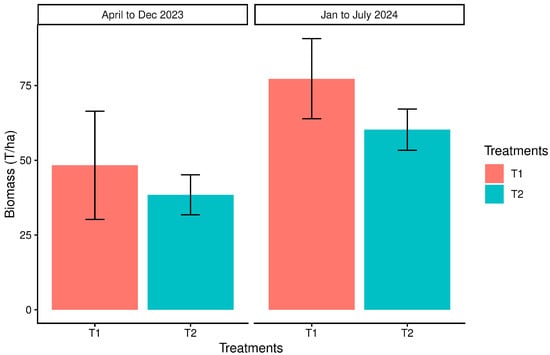
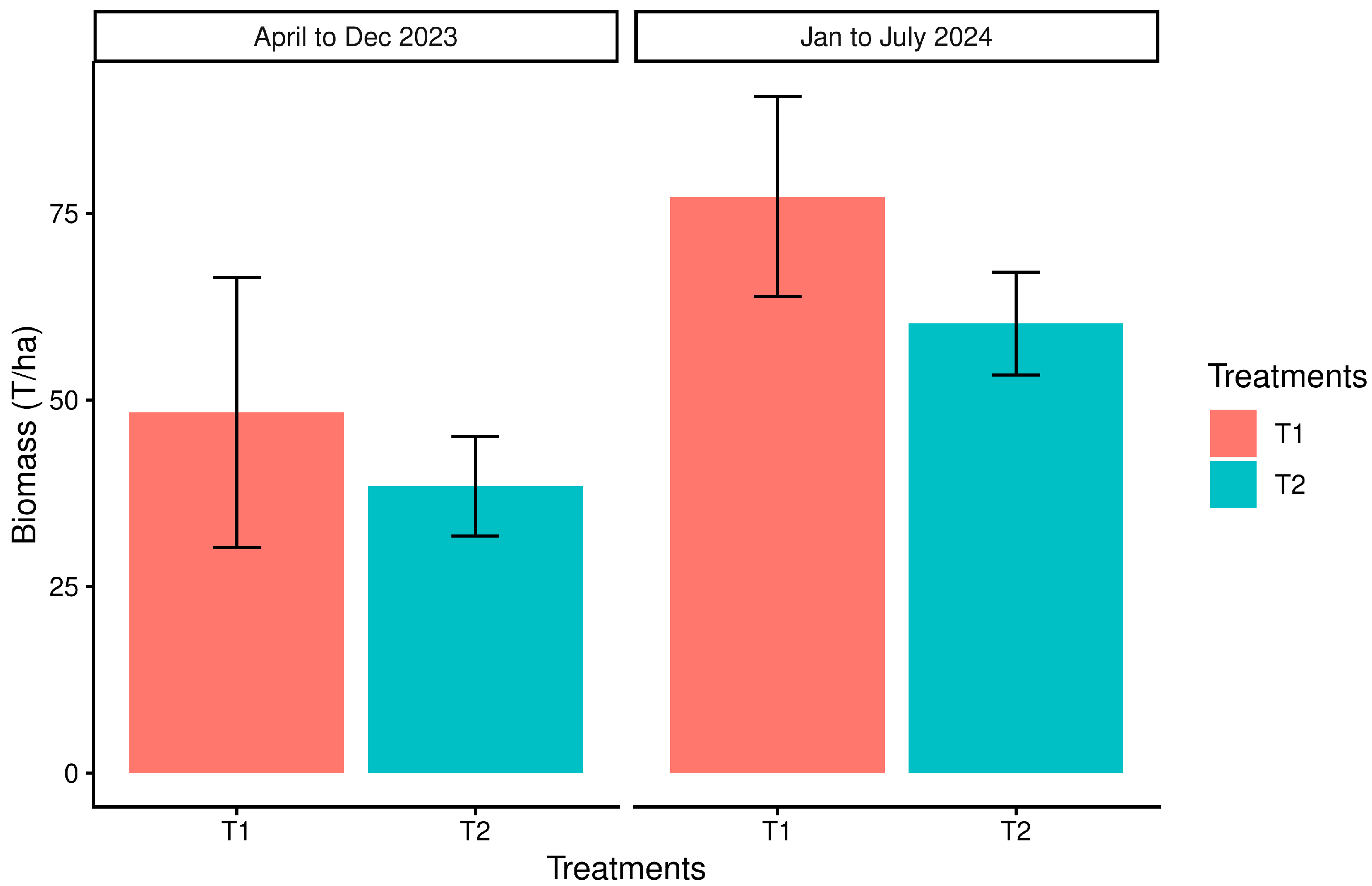
Pruning height had no significant effect on T. diversifolia biomass production throughout the 16-month experimental period, irrespective of the sampling date. Cumulative biomass production reached 125.56 t ha−1 in treatment T1, corresponding to 48.30 t ha−1 between April and December 2023 and 77.26 t ha−1 between January and July 2024. In treatment T2, cumulative production amounted to 98.71 t ha−1, of which 38.49 t ha−1 was produced during the first period and 60.22 t ha−1 during the second period (Figure 1). Despite the higher numerical values observed in T1, biomass production did not differ significantly between pruning treatments at the 5% significance level (p = 0.39). Nevertheless, biomass production increased markedly during the second monitoring period in both treatments. Relative to the April–December 2023 period, biomass production increased by 59.94% in T1 and by 56.41% in T2. These results indicate a progressive increase in the productivity of the T. diversifolia hedgerows over time, while suggesting that the pruning heights evaluated (50 and 100 cm) did not substantially influence overall biomass accumulation.
Figure 1.
Biomass production of Tithonia according to pruning heights and periods.
3.2. Chemical Composition of Charcoal Used
The chemical characteristics of the charcoal applied in this study are presented in Table 3. The material was slightly acidic and contained relatively low concentrations of immediately available nutrients. The combined concentration of NO3−–N and NH4+–N, considered as available N, was 0.045 g kg−1.
Table 3.
The chemical composition of the charcoal added to the experimental soil.
Based on literature estimates indicating that, on average, 38.13% of total K in charcoal-derived materials is plant available (range: 11.43–58.82%) [59], the available K concentration of the charcoal used in this study was estimated at 0.82 g kg−1. In contrast, available P, determined by citric acid extraction, was directly measured and represented a potentially accessible source of P for crop uptake.
Considering the application rate of 5 t ha−1, charcoal incorporation supplied approximately 0.225 kg ha−1 of available N, 2.03 kg ha−1 of available P, and 4.10 kg ha−1 of available K.
3.3. Chemical Composition and Mineral Exports of T. diversifolia
The dry matter (DM) content of T. diversifolia varied among plant components, averaging 25.0% in leaves, 33.0% in green stems, and 28.7% for the total harvested biomass. On a dry-weight basis, leaves accounted for 46% of the biomass, whereas stems represented 54%.
The chemical composition of T. diversifolia leaves and stems is presented Table 4.
Table 4.
Chemical composition of T. diversifolia depending on organs.
Apart from boron (B) and total carbon (TC), leaves contained significantly higher concentrations of mineral nutrients than stems. In addition to differences in nutrient concentrations, the relative abundance of individual elements also varied between plant organs, highlighting contrasting nutrient allocation patterns within the biomass.
Based on the respective proportions of leaves and stems in the harvested biomass, the weighted average nutrient concentrations of the whole T. diversifolia biomass were estimated at 1.904% N, 0.164% P, and 2.278% K. These values indicate that T. diversifolia biomass constitutes a substantial source of nutrients for crop production when recycled as mulch.
Using the cumulative biomass production recorded in treatment T1, the total quantities of nutrients accumulated in the harvested biomass reached 2390.66 kg N ha−1, 205.79 kg P ha−1, and 2860.26 kg K ha−1 over the study period (Appendix A).
3.4. Estimated Nutrient Inputs from T. diversifolia Biomass and Charcoal
The quantities of nutrients potentially supplied to maize depended on the application rates of charcoal and T. diversifolia biomass, their nutrient composition, and the proportion of applied nutrients recovered by the crop. For nutrients supplied through T. diversifolia mulch, nutrient recovery efficiencies reported by [14] were used to estimate plant-available inputs, assuming recovery rates of 25% for the first maize crop and 10% for the second crop.
Based on the nutrient concentrations of the biomass and the quantities of mulch applied during each cropping cycle, the estimated nutrient supplies from T. diversifolia were 62.59 kg N ha−1, 5.40 kg P ha−1, and 74.90 kg K ha−1 for the first maize crop. For the second crop, the corresponding nutrient inputs were estimated at 49.40 kg N ha−1, 4.21 kg P ha−1, and 59.05 kg K ha−1. The third mulch application was estimated to provide 53.25 kg N ha−1, 4.57 kg P ha−1, and 63.70 kg K ha−1 (Appendix B).
The direct nutrient contribution of charcoal was considerably lower than that of T. diversifolia biomass. Based on its chemical composition, the application of 5 t ha−1 of charcoal supplied approximately 0.225 kg ha−1 of available N, 2.03 kg ha−1 of available P, and 4.10 kg ha−1 of available K. For estimating nutrient availability, it was assumed that these soluble nutrient fractions were entirely accessible to the first maize crop following charcoal incorporation into the soil.
Consequently, the total quantities of N, P, and K potentially available to the first maize crop in the amended treatments were calculated as the sum of the nutrients supplied by T. diversifolia biomass and those directly contributed by charcoal.
3.5. Changes in Soil Properties
The physicochemical properties of the experimental soil at the end of the study are presented in Table 5. Significant treatment effects were observed for exchangeable K in the 0–20 cm soil layer and for NH4+–N in the 20–40 cm layer. In both cases, the amended treatments exhibited higher values than the control treatment (T1 = T2 > T0; p < 0.05).
Table 5.
Properties of the experimental soil at the end of the test for each treatment and depth.
In the surface soil (0–20 cm), exchangeable K concentrations increased by 50.47% and 52.08% in T1 and T2, respectively, relative to the control. Similarly, in the 20–40 cm layer, NH4+–N concentrations were substantially higher in the amended plots, showing increases of 128.38% for T1 and 113.33% for T2 compared with T0. These results indicate that the combined application of charcoal and T. diversifolia biomass enhanced soil nutrient status, particularly with respect to K availability in the topsoil and ammonium retention in the subsurface layer.
For some soil properties, contrasting responses were observed between T1 and T2, suggesting a possible influence of pruning height on soil processes. In the 20–40 cm layer, available P concentrations were higher in T1 than in the control, whereas T2 showed lower values than T0. An opposite pattern was observed for soil OM: OM contents in T2 were similar to those of the control, while T1 exhibited lower values. These differences suggest that the pruning regimes applied to the T. diversifolia hedgerows (50 cm in T1 and 100 cm in T2) may have influenced nutrient cycling and OM dynamics within the alley-cropping system.
In contrast, several soil properties were not significantly affected by the treatments. Notably, no significant differences were detected among treatments for soil pH or ECEC. The absence of measurable changes in these parameters is likely related to the relatively low application rate of charcoal and to the chemical characteristics of the amendments used during the study period.
3.6. Maize Grain Yields and Straw Yields for Both Seasons
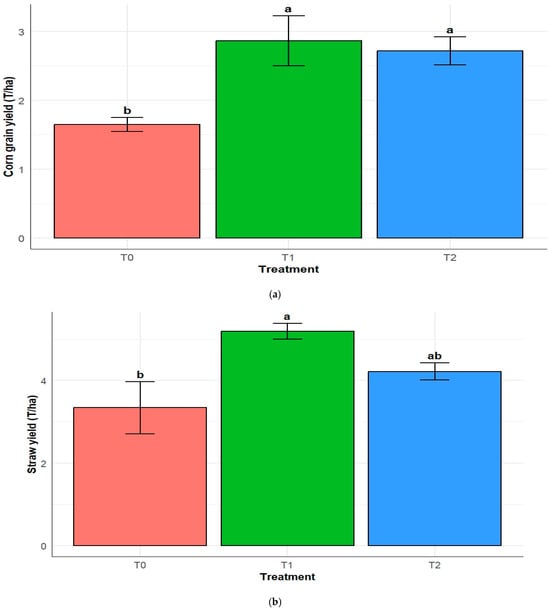
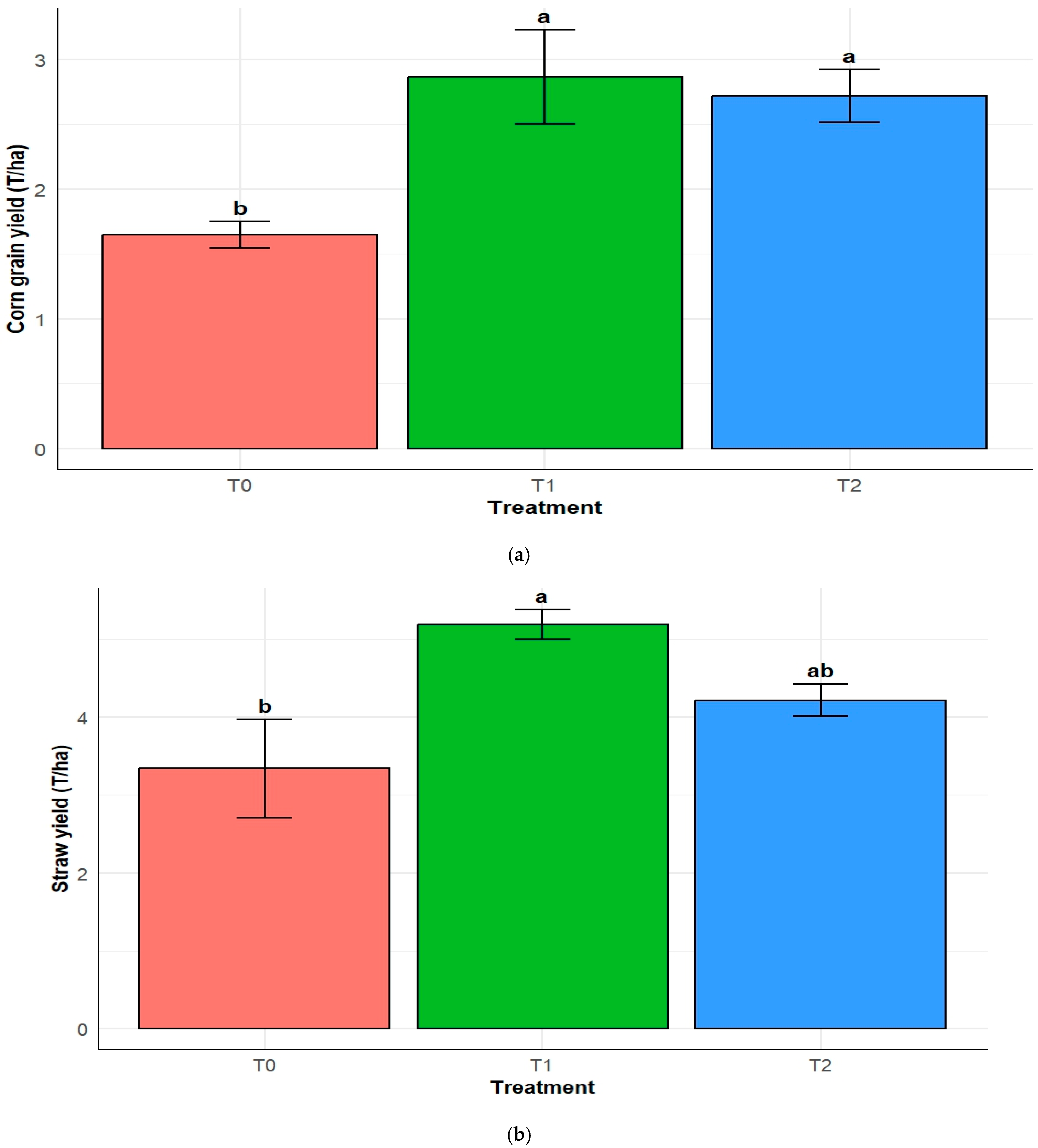
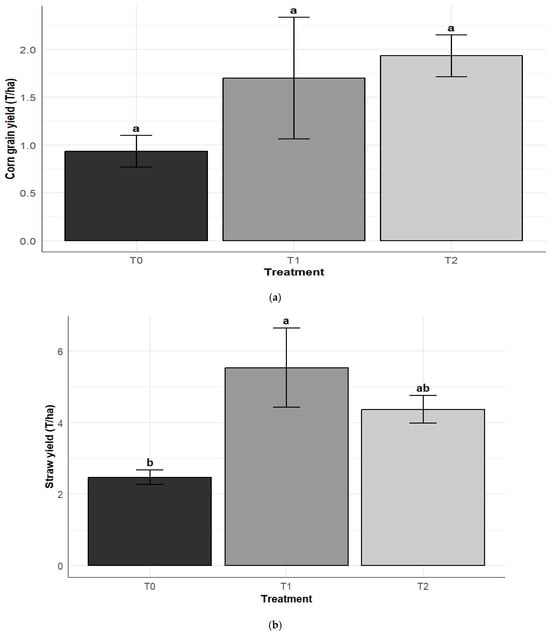
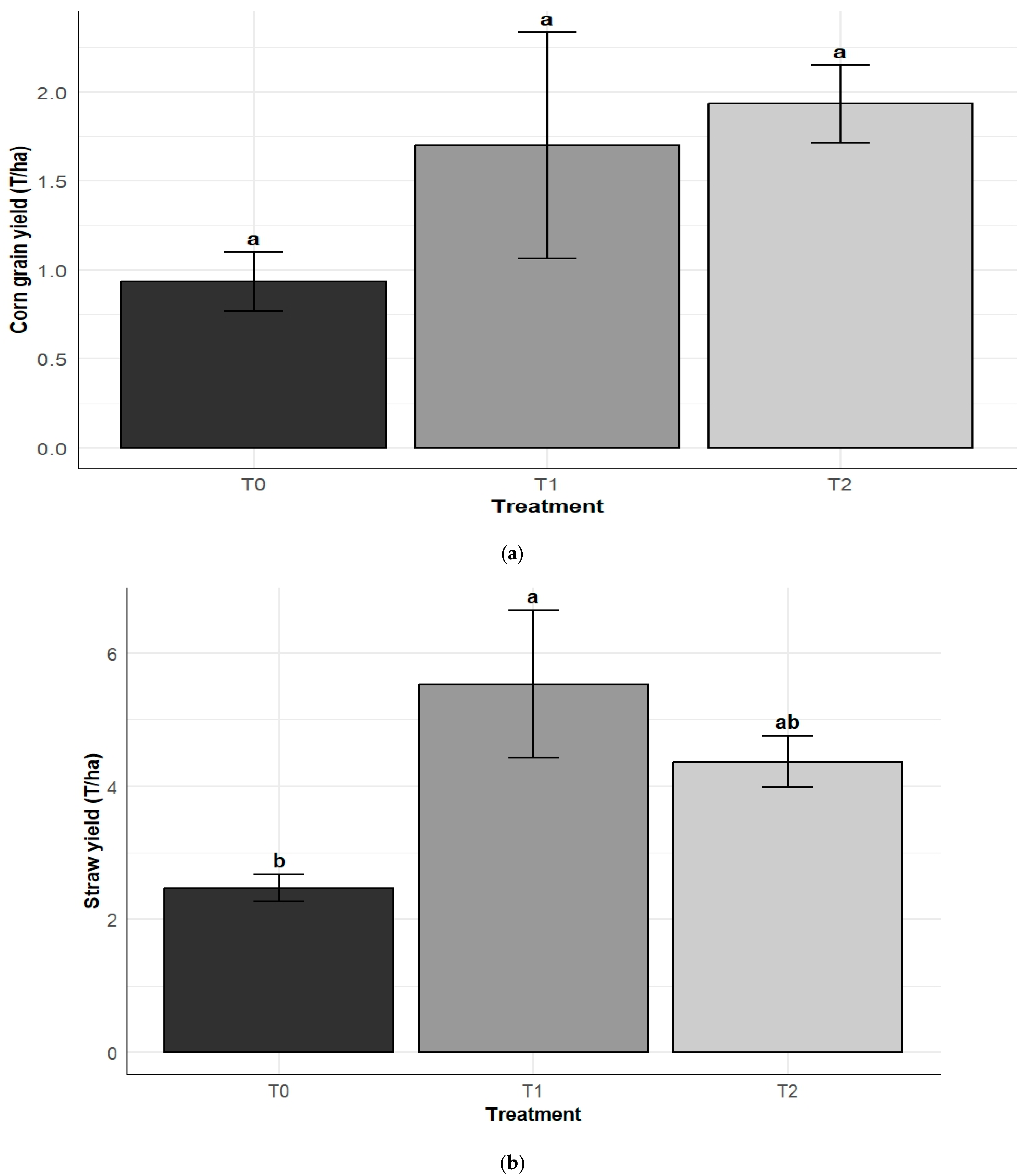
Figure 2a,b present maize grain and straw yields for the first season. Amended soils (T1 and T2) had the better grain yields (2.7 to 2.9 t ha−1) than the control (1.6 t ha−1, p-value = 0.025). Similarly, the straw yield of T1 (5.19 t ha−1) was higher than that of the control plot (3.34 t ha−1, p-value= 0.038). In the second growing season, grain yields were similar between treatments (p-value= 0.26), while T0 and T1 had different straw yields (p = 0.045) (Figure 3a,b). These results suggest that the yield advantage observed in the amended treatments during the first season was less apparent during the second cropping cycle.
Figure 2.
(a) Maize grain yields for the first crop; (b) Maize straw yields for the first crop. Values labeled with completely different letters above the error bars (a and b) are significantly different (p < 0.05). Values labeled “ab” are intermediate between the highest (a) and the lowest (b) values and therefore are not significantly different from either.
Figure 3.
(a) Maize grain yields for the second crop; (b) Maize straw yields for the second crop. Values labeled with completely different letters above the error bars (a and b) are significantly different (p < 0.05). Values labeled “ab” are intermediate between the highest (a) and the lowest (b) values and therefore are not significantly different from either.
To assess the temporal stability of the production systems, grain and straw yields obtained within each treatment were compared across the two consecutive growing seasons. Grain yields in the amended treatments remained relatively stable over time, as the reductions observed between seasons were not statistically significant for either T1 (p = 0.20) or T2 (p = 0.06). In contrast, grain yield in the control treatment declined significantly from the first to the second season (p = 0.025). This finding indicates that the combined application of charcoal and T. diversifolia biomass contributed to maintaining maize productivity over successive cropping cycles.
Although treatments receiving charcoal alone or T. diversifolia alone were not included in the experimental design, the sustained yields observed in the amended plots suggest that the combination of both amendments may have generated complementary or synergistic effects.
3.7. Mineral Contents of the Grains from the First Maize Crop
Similar values were observed across the three treatments for the concentrations of NPK in maize grains: approximately 16 g kg−1 for N, 3.9 g kg−1 for P and 4.5 g kg−1 for K (Table 6).
Table 6.
Concentrations of NPK in the grains of the first maize crop.
4. Discussion
4.1. Initial Soil Conditions
The experimental soil exhibited variable-charge behavior, as indicated by a positive difference between water-pH and KCl-pH (water-pH—KCl-pH > 0). Such soils are characterized by a predominance of pH-dependent charges and a strong affinity for phosphate sorption, which helps explain the relatively low levels of available P observed at the site (15–18 mg kg−1). These findings are consistent with the characteristics of highly weathered tropical soils, where P availability is often constrained by adsorption onto Fe and Al oxides despite the presence of substantial total P reserves. The values obtained for other soil properties, including total N, total P, and OM content (Table 1), were within the range commonly reported for desaturated tropical soils [4,60,61,62]. The concentrations of mineral N forms (NO3−–N and NH4+–N) were low relative to total N, indicating that most soil N was stored in organic forms and became available to plants mainly through OM mineralization. Moreover, NH4+–N concentrations exceeded those of NO3−–N, which may reflect a limited nitrification capacity in these highly weathered soils and/or substantial nitrate losses through leaching under tropical rainfall conditions [63].
4.2. Tithonia diversifolia Biomass Production
The absence of a significant effect of pruning height on T. diversifolia biomass production is consistent with the findings of [41] in Ghana, who reported that pruning at 50 and 100 cm resulted in higher biomass yields than pruning at 25 cm, while no significant differences were observed between the 50- and 100-cm pruning heights. These observations suggest the existence of a threshold pruning height, likely between 50 and 100 cm, above which biomass production is maintained and below which productivity may decline due to reduced regrowth capacity.
The progressive increase in biomass production observed during the study period is also in agreement with results reported by [42] in Sri Lanka, who found that repeated pruning did not compromise the long-term productivity of T. diversifolia hedgerows. The increasing biomass yields recorded over time therefore indicate that regular harvesting can be sustained without adversely affecting the growth potential of the species.
The annual DM production estimated in the present study (approximately 100 t DM ha−1 yr−1) was substantially greater than the values commonly reported in the literature, which generally range from less than 7 to 15 t DM ha−1 yr−1. This exceptionally high biomass production can primarily be attributed to the high planting density used in the experiment (approximately 120,000 plants ha−1), compared with the densities commonly adopted in previous studies (around 30,000 plants ha−1). In addition, the harvested biomass exhibited a relatively high DM content (28.7%), whereas values reported elsewhere typically range from 15% to 25% [41,42,64,65].
4.3. Nutrient Contents of T. diversifolia Biomass
The nutrient concentrations measured in T. diversifolia biomass (Table 4) were consistent with values previously reported for the species and fall within the range commonly observed in natural hedgerows used for soil fertility management [12,14,31].
Leaves generally constitute the most nutrient-rich fraction of T. diversifolia biomass and are largely responsible for its rapid nutrient-release characteristics following application to soil. In contrast, stems exhibited nutrient concentrations that were generally lower than those of leaves but contained comparable concentrations of B and higher concentrations of total C. The greater C content in stems is consistent with their structural function and higher proportion of lignified tissues, a trend previously reported for T. diversifolia and other woody plant species [66]. However, the absence of higher B concentrations in leaves differs from observations reported for several species within the Asteraceae family, where B tends to accumulate preferentially in leaf tissues [67,68]. This warrants further investigation to clarify B allocation dynamics within T. diversifolia biomass.
4.4. Nutrient Contents of Charcoal
The chemical properties of charcoal used in this study were generally consistent with those reported for biochar and charcoal materials. The main exception was the pH of the material, which was 6.71 and therefore lower than the minimum values generally reported for biochar (approximately 7.28 and above) [52,69]. Biochars are typically characterized by neutral to alkaline pH values due to the concentration of basic cations during the thermal conversion process. The comparatively lower pH observed in this study may be related to several factors, including the botanical origin of the feedstock, the carbonization conditions, and post-production handling and storage practices [70].
4.5. Evolution of Soil Properties
The post-harvest soil analyses showed that exchangeable K concentrations in the 0–20 cm layer and NH4+–N concentrations in the 20–40 cm layer were significantly greater in the amended treatments (T1 and T2) than in the control. These findings are consistent with previous studies reporting improvements in soil nutrient status following the combined application of T. diversifolia biomass and charcoal-derived amendments [26]. Considering the physicochemical characteristics of the materials applied, several complementary mechanisms may explain these results. These include nutrient release through the mineralization of T. diversifolia biomass and the labile fraction of charcoal, stimulation of native OM decomposition through positive priming effects, and enhanced nutrient retention resulting from both the protective mulch layer and the adsorption capacity of charcoal [27,40]. K+ and NH4+ may have been retained on newly created exchange sites or within the porous structure of the charcoal, thereby reducing nutrient losses and increasing their persistence in the soil. The substantial nutrient inputs provided by the amendments (>165 kg N ha−1 and >200 kg K ha−1: total reported in Appendix B) were therefore likely sufficient not only to satisfy crop demand but also to contribute to the replenishment of soil nutrient reserves [21,28].
In contrast, some soil properties responded differently to the two pruning treatments. Available P in the 20–40 cm layer increased in T1 relative to the control but decreased in T2. Similarly, soil OM contents in the subsurface layer were comparable between T0 and T2, whereas lower values were observed in T1. Based on previous findings, the observed variations in available P are likely related primarily to the addition of T. diversifolia biomass, which contains considerably higher P concentrations than charcoal [26,59]. Conversely, changes in soil OM may be more closely associated with charcoal dynamics, as T. diversifolia biomass generally has only a limited long-term effect on soil OM accumulation due to its rapid decomposition [21].
The contrasting responses observed between T1 and T2 suggest that pruning height may influence soil processes within the alley-cropping system. One possible explanation is that differences in hedge height modified the degree of soil shading, thereby affecting soil temperature, moisture dynamics, evaporation rates, and OM mineralization [71]. Another potential mechanism involves belowground interactions between hedgerows and maize, particularly competition for P and other nutrients through root activity and phosphatase-mediated nutrient acquisition [34]. However, evidence regarding the influence of pruning height on soil properties remains limited. A study conducted in Tanzania using Albizia harveyi and Albizia versicolor reported no significant effects of pruning management on soil characteristics [40]. Therefore, additional studies are required to clarify the extent to which pruning height affects nutrient cycling and soil fertility in T. diversifolia-based alley-cropping systems. It should also be noted that differences in weed biomass inputs, particularly from C. odorata retained as mulch after weeding, may have contributed to some of the observed variability among treatments.
Several soil properties, including ECEC and soil pH, were not significantly affected by the treatments. In integrated systems combining T. diversifolia biomass and charcoal, improvements in soil pH are generally attributed mainly to the liming effect of the charcoal component and its interaction with organic amendments rather than to T. diversifolia itself [21]. Likewise, changes in ECEC are generally more strongly associated with charcoal application than with fresh organic biomass inputs [72]. The lack of a measurable increase in ECEC suggests that the charcoal used in this study possessed a limited density of oxygen-containing functional groups and surface charges capable of enhancing cation retention [73].
4.6. Evolution of Maize Grain and Straw Yields, and Grain Mineral Concentrations
Maize grain yields during the first growing season were significantly higher in the amended treatments (2.7–2.9 t ha−1) than in the control (1.6 t ha−1; p = 0.025). Moreover, grain yields remained relatively stable across the two consecutive cropping seasons in the amended plots, as no significant differences were observed between seasons for T1 (p = 0.199) or T2 (p = 0.064). In contrast, grain yield declined significantly in the control treatment between the first and second seasons (p = 0.025). These results indicate that the combined application of charcoal and T. diversifolia biomass enhanced the resilience of the production system and contributed to maintaining maize productivity over time.
The superior and more stable performance of the amended treatments likely resulted from synergistic interactions between charcoal and T. diversifolia. The combined amendments improved selected soil fertility parameters and probably enhanced nutrient availability and plant nutrient uptake. Given the very limited quantities of directly available nutrients supplied by charcoal alone (0.225 kg available N ha−1, 2.03 kg available P ha−1, and 4.10 kg available K ha−1), it is unlikely that charcoal by itself could have sustained maize grain and straw production over successive growing seasons. The nutrient-rich biomass supplied by T. diversifolia therefore constituted the principal nutrient source within the system. In addition, the hedgerows may have contributed to the creation of a more favorable microclimate through partial shading, while the mulch layer helped conserve soil moisture and reduce nutrient losses. Furthermore, organic acids released during the decomposition of T. diversifolia biomass, including oxalic acid, may have increased the phytoavailability of nutrients associated with charcoal, particularly N and P, which are often only slowly available to plants [74,75]. Conversely, without charcoal application, nutrients released through the rapid mineralization of T. diversifolia biomass would likely have been more susceptible to leaching and other loss processes. These observations support previous reports demonstrating synergistic effects between charcoal-derived materials and Tithonia or other labile organic amendments [26,76].
Despite the positive effects on yield, no significant differences were observed among treatments for grain N, P, or K concentrations. Because nutrient accumulation in maize grain is strongly influenced by plant N uptake, these results suggest that N acquisition by the crop remained relatively limited, even though substantial quantities of this nutrient were supplied, particularly through T. diversifolia biomass. Since N and P accumulation in grains are major determinants of maize productivity [77], insufficient uptake of these nutrients may have been an important factor constraining yield potential in the present study [78].
Several mechanisms may explain the apparent limitation in N uptake. Nutrient release from decomposing biomass may not have been fully synchronized with crop nutrient demand, reducing nutrient-use efficiency. In addition, the predominance of NH4+–N relative to NO3−–N in the soil may have restricted N acquisition, as maize grown on acidic soils generally exhibits a preference for nitrate, particularly during early growth stages [26,79]. The low availability of soil P may also have limited crop uptake and contributed to reduced productivity [80]. Although the grain N, P, and K concentrations observed in this study are comparable to values reported elsewhere, maize yields in those studies were generally higher, suggesting that nutrient-use efficiency, especially N-use efficiency, remained relatively low under the conditions of the present experiment [77].
Consequently, maize yields obtained in the amended treatments remained below the average yield target of 4.45 t ha−1 considered necessary to achieve maize self-sufficiency in SSA [5]. These authors revealed that this production level typically requires nutrient inputs of approximately 91.0 kg N ha−1, 10.7 kg P ha−1, and 57.1 kg K ha−1. The results of the present study suggest that further increases in nutrient supply, particularly through T. diversifolia biomass, could help narrow the remaining yield gap. Such an approach appears feasible given the exceptionally high biomass production recorded during the experiment, which reached up to 125.56 t ha−1 over 16 months. Based on the nutrient concentrations of the biomass (1.904% N, 0.164% P, and 2.278% K) and reported nutrient recovery rates by maize following biomass mineralization (25% for the first crop and 10% for the second crop) [14], substantially greater nutrient inputs could potentially be delivered to the cropping system. Additional nutrient and OM inputs could also be obtained through the recycling of maize residues [78,81].
Beyond increasing biomass application rates, further improvements in productivity may require actions aimed at enhancing crop N uptake and nutrient-use efficiency [82]. Possible strategies include increasing plant density from the 26,667 plants ha−1 used in the present study to the commonly recommended density of approximately 53,333 plants ha−1, and selecting maize cultivars combining high yield potential with improved N-use efficiency [83].
Finally, the alley-cropping system evaluated in this study appears capable of ensuring the long-term production of T. diversifolia biomass for soil fertility management. Previous studies have shown that biomass production by T. diversifolia is primarily constrained by P availability [84]. Considering the substantial P reserves typically present in the upper 30 cm of African soils (approximately 1641 kg P ha−1) [85] and the cumulative P accumulation of 205.79 kg ha−1 measured in the harvested biomass, the system could potentially sustain biomass production for a decade, highlighting the long-term potential of this agroforestry-based fertility management strategy.
5. Conclusions
Low and unstable maize yields remain a major constraint to food security in SSA, largely due to inadequate soil fertility and insufficient nutrient inputs. This study evaluated the effectiveness of combining charcoal application with a T. diversifolia-based alley-cropping system for improving maize productivity under the highly weathered soils of Kinshasa, DR Congo. The results demonstrated that T. diversifolia produced exceptionally large amounts of biomass, reaching approximately 100 t DM ha−1 yr−1, which is substantially greater than values commonly reported in the literature. In addition, the biomass exhibited high nutrient concentrations, confirming its potential as an effective organic nutrient source. Furthermore, the high biomass productivity observed indicates that T. diversifolia-based alley cropping can provide a sustainable source of organic inputs for long-term soil fertility management. The combined application of charcoal and T. diversifolia biomass significantly increased maize grain yield during the first cropping season and improved yield stability over two consecutive seasons compared with the unamended control. Nevertheless, maize yields remained below the estimated SSA self-sufficiency target of 4.45 t ha−1. The results indicate that crop performance was strongly influenced by maize genotype and, most importantly, by N uptake and nutrient-use efficiency. Based on the findings of this study, the successful implementation of this integrated fertility management system in SSA should include: (i) high-density establishment of T. diversifolia hedgerows; (ii) regular pruning at heights between 50 and 100 cm; (iii) systematic recycling of the harvested biomass as mulch; (iv) maintenance of adequate nutrient inputs across cropping seasons; (v) the use of high-yielding maize cultivars with improved nutrient-use efficiency; (vi) adoption of recommended plant densities; (vii) measures to enhance N and P uptake by maize; and (viii) the recycling of maize residues as additional sources of OM and nutrients. Future research should focus on strategies to improve maize N uptake and N-use efficiency, and the evaluation of combining T. diversifolia biomass with low rates of mineral fertilizers and higher charcoal application rates. Such approaches could further enhance nutrient availability, increase crop productivity, and strengthen the resilience of smallholder farming systems in SSA.
Author Contributions
Conceptualization, J.R.N.F. and D.J.B.E.; methodology, R.S. and D.J.B.E.; software, J.R.N.F.; validation, R.S., D.J.B.E. and E.M.; formal analysis and investigation, J.R.N.F.; resources, D.J.B.E. and E.M.; data curation, R.S.; writing—original draft preparation, J.R.N.F.; writing—review and editing, R.S.; supervision, E.M.; project administration, D.J.B.E.; funding acquisition, D.J.B.E. and E.M. All authors have read and agreed to the published version of the manuscript.
Funding
This research was funded by the PASET Regional Scholarship and Innovation Fund.
Data Availability Statement
All data generated or analyzed during this study are included in this published article.
Acknowledgments
We gratefully acknowledge the Regional Scholarship and Innovation Fund (RSIF) of the Partnership for Skills in Applied Sciences, Engineering, and Technology (PASET) for providing the scholarship that made this research possible. We also thank the entire Lab for Bioresource Recovery team for granting access to the facilities required for laboratory analyses in Belgium. We extend our thanks to the owner of a farm at Mafumfu (Kinshasa) for providing the land used for the field experiment.
Conflicts of Interest
The authors declare no conflicts of interest.
Abbreviations
The following abbreviations are used in this manuscript:
| ANOVA | Analysis of variance |
| Cohex | Cobalt hexamine trichloride |
| DCB | Dithionite-citrate-bicarbonate |
| DM | Dry matter |
| DR Congo | Democratic Republic of the Congo |
| ECEC | Effective cation exchange capacity |
| IC | Inorganic Carbon |
| ICP-OES | Inductively Coupled Plasma Optical Emission Spectroscopy |
| OC | Organic Carbon |
| OM | Organic matter |
| SSA | sub-Saharan Africa |
| TC | Total Carbon |
Appendix A. Mineral Exports of Tithonia diversifolia
NPK exports by the biomass of Tithonia diversifolia were calculated by multiplying the NPK concentrations in the Tithonia biomass by the dry biomass quantities obtained for each of the two treatments. The concentrations considered include those of the leaves and stems, and the proportion of each of these organs in the total biomass (1.904% N, 0.1639% P, and 2.278% K). The results are presented in Table A1.
Table A1.
Mineral exports of Tithonia diversifolia from April 2023 to July 2024.
Appendix B. Potential Nutrient Quantities Available for the Three Successive Maize Crops
These nutrients are assumed to come from both the Tithonia biomass and the charcoal. With regard to Tithonia, we took into account the amounts applied during each of the three maize crops (13.15 t ha−1, 5.12 t ha−1, and 9.15 t ha−1, respectively), the nutrient concentrations in the total biomass (1.904% N, 0.1639% P, and 2.278% K), and the nutrient recovery rates by the crops (25% for the first crop and 10% for the second). Thus:
- for the first maize crop, the total amount of nitrogen supplied using Tithonia is: 13.15 t ha−1 × 1.904% N = 250.376 kg N ha−1.
- Since the recovery rate is 25% for the first crop, the amount of available nitrogen is: 25.0376 kg N ha−1 × 0.25 = 62.59 kg N ha−1
- the second maize crop is assumed to benefit from 10% of the N supplied by 13.15 t ha−1 of Tithonia (25.036 kg N ha−1), and 25% of the N from 5.12 t ha−1 of Tithonia (24.371 kg N ha−1). The total amount of N that the second maize crop would benefit from is equivalent to 49.4 kg N ha−1.
The results related to the potential nutrients quantities available for maize plants are presented in Table A2. For the first maize crop, the quantities shown are obtained by summing the inputs of Tithonia and charcoals.
Table A2.
Potential nutrient quantities available for the three successive maize crops from Tithonia biomass and charcoals.
References
- Landon, R. Booker Tropical Soil Manual. In A Handbook for Soil Survey and Agricultural Land Evaluation in the Tropics and Subtropics; Longman, Booker Tate Limited: Oxon, UK, 1991. [Google Scholar]
- Buresh, R.J.; Sánchez, P.A.; Calhoun, F.G. Replenishing soil fertility in Africa. In Proceedings of an International Symposium Cosponsored by Divisions A-6 (International Agronomy) and S-4 (Soil Fertility and Plant Nutrition), and the International Center for Research in Agroforestry, Held at the 88th Annual Meetings of the American Society of Agronomy and the Soil Science Society of America; Wiley: Indianapolis, Indiana, 1997. [Google Scholar]
- Ngongo, M.; Ranst, E.V.A.N.; Baert, G.; Lenge, E.K.; Verdoodt, A.; Mujinya, B.B.; Mukalay, J. Guide des Sols en R.D. Congo. Tome I: Etude et Gestion; UGent, HoGent, UNILU: Lubumbashi, Democratic Republic of the Congo, 2009. [Google Scholar]
- Mulaji, C. Utilisation des Composts de Biodéchets Ménagers Pour l’amélioration de la Fertilité des Sols Acides de la Province de Kinshasa (République Démocratique du Congo). Ph.D. Thesis, Université de Liège-Gembloux Agro-Bio Tech, Gembloux, Belgium, 2011. [Google Scholar]
- Berge, H.F.M.T.; Hijbeek, R.; Van Loon, M.P.; Rurinda, J.; Tesfaye, K.; Zingore, S.; Craufurd, P.; Van Heerwaarden, J.; Brentrup, F.; Schröder, J.J.; et al. Maize Crop Nutrient Input Requirements for Food Security in Sub-Saharan Africa. Glob. Food Secur. 2019, 23, 9–21. [Google Scholar] [CrossRef] [Scilit]
- Yang, L.; Wu, Y.; Wang, Y.; An, W.; Jin, J.; Sun, K.; Wang, X. Effects of Biochar Addition on the Abundance, Speciation, Availability, and Leaching Loss of Soil Phosphorus. Sci. Total Environ. 2021, 758, 143657. [Google Scholar] [CrossRef] [Scilit] [PubMed]
- He, X.; Augusto, L.; Goll, D.S.; Ringeval, B.; Wang, Y.; Helfenstein, J.; Huang, Y.; Yu, K.; Wang, Z.; Yang, Y.; et al. Supplementary Material to “Global Patterns and Drivers of Soil Total Phosphorus Concentration” 2021. Available online: https://essd.copernicus.org/preprints/essd-2021-166/essd-2021-166-supplement.pdf (accessed on 7 July 2026).
- Agegnehu, G.; Amede, T.; Erkossa, T.; Yirga, C.; Henry, C.; Tyler, R.; Nosworthy, M.G.; Beyene, S.; Sileshi, G.W. Extent and Management of Acid Soils for Sustainable Crop Production System in the Tropical Agroecosystems: A Review. Acta Agric. Scand. Sect. B Soil Plant Sci. 2021, 71, 852–869. [Google Scholar] [CrossRef] [Scilit]
- Oyebiyi, O.O. Distribution and Forms of Iron and Aluminium Oxides in Tropical Soils of Central Southwestern Nigeria. Environ. Earth Sci. 2024, 83, 95. [Google Scholar] [CrossRef] [Scilit]
- Liniger, H.P.; Studer, R.M.; Hauert, C.; Gurtner, M. La Pratique de la Gestion Durable des Terres. In Directives et Bonnes Pratiques en Afrique Subsaharienne; TerrAfrica, Panorama Mondial des Approches et Technologies de Conservation (WOCAT) et Organisation des Nations Unies Pour L’alimentation et L’agriculture (FAO): Rome, Italy, 2011. [Google Scholar]
- Yemadje, P.L.; Amonmidé, I.; Loison, R.; Crétenet, M.; Koussihouede, H.; Atakoun, A.M.; Fujisaki, K.; Dogliotti, S.; Sekloka, E.; Letourmy, P.; et al. Regenerating Productivity after Soil Fertility Depletion in a 20-Year Cotton–Maize Rotation in Benin. Nutr. Cycl. Agroecosystems 2025, 131, 253–270. [Google Scholar] [CrossRef] [Scilit]
- Jama, B.; Palm, C.A.; Buresh, R.J.; Niang, A.; Gachengo, C.; Nziguheba, G.; Amadalo, B. Tithonia diversifolia as a Green Manure for Soil Fertility Improvement in Western Kenya: A Review. Agrofor. Syst. 2000, 49, 201–221. [Google Scholar] [CrossRef] [Scilit]
- Glaser, B.; Lehmann, J.; Zech, W. Ameliorating Physical and Chemical Properties of Highly Weathered Soils in the Tropics with Charcoal—A Review. Biol. Fertil. Soils 2002, 35, 219–230. [Google Scholar] [CrossRef] [Scilit]
- Graves, A.; Matthews, R.; Waldie, K.; Bhurtel, R.; Quashie-Sam, J. Review of Technologies Being Evaluated for the Forest/Agriculture Interface. In Final Report Submitted to the UK Department for International Development’s (DFID) Natural Resources Systems Programme (NRSP) to Fulfil Requirements Under the Research Contract R7560; Institute of Water and Environment, Cranfield University: Bedfordshire, UK, 2001. [Google Scholar]
- Mucheru-Muna, M.; Mugendi, D.; Pypers, P.; Mugwe, J.; Kung’U, J.; Vanlauwe, B.; Merckx, R. Enhancing maize productivity and profitability using organic inputs and mineral fertilizer in central Kenya small-hold farms. Ex. Agric. 2014, 50, 250–269. [Google Scholar] [CrossRef] [Scilit]
- Kätterer, T.; Roobroeck, D.; Kimutai, G.; Karltun, E.; Nyberg, G.; Sundberg, C.; De Nowina, K.R. Maize Grain Yield Responses to Realistic Biochar Application Rates on Smallholder Farms in Kenya. Agron. Sustain. Dev. 2022, 42, 63. [Google Scholar] [CrossRef] [Scilit]
- Stavi, I.; Lal, R. Agroforestry and Biochar to Offset Climate Change: A Review. Agron. Sustain. Dev. 2013, 33, 81–96. [Google Scholar] [CrossRef] [Scilit]
- Singh, R.; Kumari, T.; Verma, P.; Singh, B.P.; Raghubanshi, A.S. Compatible Package-Based Agriculture Systems: An Urgent Need for Agro-Ecological Balance and Climate Change Adaptation. Soil Ecol. Lett. 2022, 4, 187–212. [Google Scholar] [CrossRef] [Scilit]
- Fungo, B.; Lehmann, J.; Kalbitz, K.; Tenywa, M.; Thionģo, M.; Neufeldt, H. Emissions Intensity and Carbon Stocks of a Tropical Ultisol after Amendment with Tithonia Green Manure, Urea and Biochar. Field Crops Res. 2017, 209, 179–188. [Google Scholar] [CrossRef] [Scilit] [PubMed]
- Obiakara, M.C.; Fourcade, Y. Climatic Niche and Potential Distribution of Tithonia diversifolia (Hemsl.) A. Gray in Africa. PLoS ONE 2018, 13, e0202421. [Google Scholar] [CrossRef] [Scilit] [PubMed]
- Opala, P.A. Recent Advances in the Use of Tithonia diversifolia Green Manure for Soil Fertility Management in Africa: A Review. Agric. Rev. 2020, 41, 256–263. [Google Scholar] [CrossRef] [Scilit]
- Arif, M.; Ali, S.; Ilyas, M.; Riaz, M.; Akhtar, K.; Ali, K.; Adnan, M.; Fahad, S.; Khan, I.; Shah, S.; et al. Enhancing Phosphorus Availability, Soil Organic Carbon, Maize Productivity and Farm Profitability through Biochar and Organic–Inorganic Fertilizers in an Irrigated Maize Agroecosystem under Semi-arid Climate. Soil Use Manag. 2021, 37, 104–119. [Google Scholar] [CrossRef] [Scilit]
- Kriticos, J.M.; Kriticos, D.J. Pretty (and) Invasive: The Potential Global Distribution of Tithonia diversifolia under Current and Future Climates. Invasive Plant Sci. Manag. 2021, 14, 205–213. [Google Scholar] [CrossRef] [Scilit]
- Ashraf, S.M.K.; Ripta, S.K.; Rana, M.T.; Islam, K.K. Biochar Enhanced Agroforestry Systems for Carbon Sequestration, Soil Health and Climate Resilience. Discov. For. 2025, 1, 53. [Google Scholar] [CrossRef] [Scilit]
- Spokas, K.A.; Cantrell, K.B.; Novak, J.M.; Archer, D.W.; Ippolito, J.A.; Collins, H.P.; Boateng, A.A.; Lima, I.M.; Lamb, M.C.; McAloon, A.J.; et al. Biochar: A Synthesis of Its Agronomic Impact beyond Carbon Sequestration. J. Environ. Qual. 2012, 41, 973–989. [Google Scholar] [CrossRef] [Scilit] [PubMed]
- Partey, S.T.; Preziosi, R.F.; Robson, G.D. Short-Term Interactive Effects of Biochar, Green Manure, and Inorganic Fertilizer on Soil Properties and Agronomic Characteristics of Maize. Agric. Res. 2014, 3, 128–136. [Google Scholar] [CrossRef] [Scilit]
- Manolikaki, I.; Diamadopoulos, E. Positive Effects of Biochar and Biochar-Compost on Maize Growth and Nutrient Availability in Two Agricultural Soils. Commun. Soil Sci. Plant Anal. 2019, 50, 512–526. [Google Scholar] [CrossRef] [Scilit]
- Frimpong, K.A.; Phares, C.A.; Boateng, I.; Abban-Baidoo, E.; Apuri, L. One-Time Application of Biochar Influenced Crop Yield across Three Cropping Cycles on Tropical Sandy Loam Soil in Ghana. Heliyon 2021, 7, e06267. [Google Scholar] [CrossRef] [Scilit] [PubMed]
- Zhao, H.; Xie, T.; Xiao, H.; Gao, M. Biochar-Based Fertilizer Improved Crop Yields and N Utilization Efficiency in a Maize–Chinese Cabbage Rotation System. Agriculture 2022, 12, 1030. [Google Scholar] [CrossRef] [Scilit]
- Kobayashi, K. Factors Affecting Phytotoxic Activity of Allelochemicals in Soil. Weed Biol. Manag. 2004, 4, 1–7. [Google Scholar] [CrossRef] [Scilit]
- Partey, S.T. The Agronomic Qualities of the Mexican Sunflower (Tithonia diversifolia) for Soil Fertility Improvement in Ghana: An Exploratory Study. Ph.D. Thesis, Kwame Nkrumah University of Science and Technology, Kumasi, Ghana, 2010. [Google Scholar]
- Agbede, T.M.; Adekiya, A.O.; Ogeh, J.S. Response of Soil Properties and Yam Yield to Chromolaena odorata (Asteraceae) and Tithonia diversifolia (Asteraceae) Mulches. Arch. Agron. Soil Sci. 2014, 60, 209–224. [Google Scholar] [CrossRef] [Scilit]
- Otusanya, O.O.; Ogunwole, A.A.; Tijani, M.O. Allelopathic Effect of Tithonia diversifolia and Chromolaena odorata on the Germination, Growth and Chlorophyll Accumulation of Hibiscus sabdariffa (L.). Int. J. Bot. Res. 2015, 5, 1–14. [Google Scholar]
- George, T.S.; Gregory, P.J.; Wood, M.; Read, D.; Buresh, R.J. Phosphatase Activity and Organic Acids in the Rhizosphere of Potential Agroforestry Species and Maize. Soil Biol. Biochem. 2002, 34, 1487–1494. [Google Scholar] [CrossRef] [Scilit]
- Yuan, Q.; Gao, Y.; Ma, G.; Wu, H.; Li, Q.; Zhang, Y.; Liu, S.; Jie, X.; Zhang, D.; Wang, D. The Long-Term Effect of Biochar Amendment on Soil Biochemistry and Phosphorus Availability of Calcareous Soils. Agriculture 2025, 15, 458. [Google Scholar] [CrossRef] [Scilit]
- Makanzu, F. Etude de l’érosion Ravinante à Kinshasa: Dynamisme Pluvio-Morphogénique et Développement d’un Outil de Prévision. Ph.D. Thesis, Université de Kinshasa, Kinshasa, Democratic Republic of the Congo, 2014. [Google Scholar]
- Kasongo, R.K.; Van Ranst, E.; Verdoodt, A.; Kanyankagote, P.; Baert, G. Impact of Acacia auriculiformis on the Chemical Fertility of Sandy Soils on the Batéké Plateau, D.R. Congo. Soil Use Manag. 2009, 25, 21–27. [Google Scholar] [CrossRef] [Scilit]
- Koy, R. Amélioration de la Qualité des Sols Sableux du Plateau des Batéké (RD Congo) Par Application des Matériels Géologiques et des Déchets Organiques Industriels Locaux. Ph.D. Thesis, Ghent University, Ghent, Belgium, 2010. [Google Scholar]
- Chalker-Scott, L. Impact of Mulches on Landscape Plants and the Environment—A Review. J. Environ. Hortic. 2007, 25, 239–249. [Google Scholar] [CrossRef] [Scilit]
- Vyamana, V.G.; Chamshama, S.A.O.; Andrew, S.M. Soil Nutrients and Maize Yields Responses to Indigenous Agroforestry Tree Post-Fallows Management in Tanzania. Trees For. People 2021, 6, 100164. [Google Scholar] [CrossRef] [Scilit]
- Partey, S.T. Effect of Pruning Frequency and Pruning Height on the Biomass Production of Tithonia diversifolia (Hemsl) A. Gray. Agrofor. Syst. 2011, 83, 181–187. [Google Scholar] [CrossRef] [Scilit]
- Senarathne, S.H.S.; Atapattu, A.J.; Raveendra, T.; Mensah, S.; Dassanayake, K.B. Biomass Allocation and Growth Performance of Tithonia diversifolia (Hemsl.) A. Gray in Coconut Plantations in Sri Lanka. Agrofor. Syst. 2019, 93, 1865–1875. [Google Scholar] [CrossRef] [Scilit]
- Whitman, T.; Nicholson, C.F.; Torres, D.; Lehmann, J. Climate Change Impact of Biochar Cook Stoves in Western Kenyan Farm Households: System Dynamics Model Analysis. Environ. Sci. Technol. 2011, 45, 3687–3694. [Google Scholar] [CrossRef] [Scilit] [PubMed]
- Joseph, S.; Graber, E.; Chia, C.; Munroe, P.; Donne, S.; Thomas, T.; Nielsen, S.; Marjo, C.; Rutlidge, H.; Pan, G.; et al. Shifting Paradigms: Development of High-Efficiency Biochar Fertilizers Based on Nano-Structures and Soluble Components. Carbon Manag. 2013, 4, 323–343. [Google Scholar] [CrossRef] [Scilit]
- Lehmann, J.; Jda Silva, P.; Rondon, M.; da Silva, C.M.; Greenwood, J.; Nehls, T.; Steiner, C.; Glaser, B. Slash-and-Char: A Feasible Alternative for Soil Fertility Management in the Central Amazon? In Proceedings of the 17th World Congress of Soil Science, Bangkok, Thailand, 14–21 August 2002. Paper No. 49. [Google Scholar]
- Dubiez, E.; Péroches, A.; Akalakou, M.C.; Gazull, L. Rapport D’étude Sur L’organisation de la Filière Bois-Énergie de la Ville de Kinshasa; CAFI, FONAREDD, PNUD: Geneva, Switzerland; Kinshasa, Democratic Republic of the Congo, 2021. [Google Scholar]
- FAO. Standard Operating Procedure for Quasi Total Elements in Soil by Acid Digestion, Including Heavy Metals; FAO: Rome, Italy, 2023. [Google Scholar]
- Karasakal, A. Determination of Major, Minor, and Toxic Elements in Tropical Fruits by ICP-OES After Different Microwave Acid Digestion Methods. Food Anal. Methods 2021, 14, 344–360. [Google Scholar] [CrossRef] [Scilit]
- Da Silva, I.J.S.; Da Silva, M.M.; Da Silva, R.G.M.F.; De França, E.J.; Da Silva, M.J.; Kato, M.T. Microwave-Assisted Digestion for Multi-Elemental Determination in Beans, Basil, and Mint by ICP OES and Flame Photometry: An Eco-Friendly Alternative. Food Chem. 2025, 481, 143970. [Google Scholar] [CrossRef] [Scilit] [PubMed]
- Dhaliwal, G.S.; Gupta, N.; Kukal, S.S.; Kaur, M. Standardization of Automated Vario EL III CHNS Analyzer for Total Carbon and Nitrogen Determination in Soils. Commun. Soil Sci. Plant Anal. 2011, 42, 971–979. [Google Scholar] [CrossRef] [Scilit]
- Gautam, V.P.; Mishra, S.; Ahmed, H. Comparison of Total Nitrogen Estimation by Kjeldahl Method and CHNS Analyzer in Dry Tropical Grassland. Int. J. Plant Environ. 2023, 9, 180–182. [Google Scholar] [CrossRef] [Scilit]
- Singh, B.; Camps-Arbestain, M.; Lehmann, J. (Eds.) Biochar: A Guide to Analytical Methods; CRC Press/Taylor and Francis Group: Bica Raton, FL, USA; London, UK; New York, NY, USA, 2017. [Google Scholar]
- Nel, T.; Bruneel, Y.; Smolders, E. Comparison of Five Methods to Determine the Cation Exchange Capacity of Soil. J. Plant Nutr. Soil Sci. 2023, 186, 311–320. [Google Scholar] [CrossRef] [Scilit]
- FAO. Standard Operating Procedure for Soil Available Phosphorus, Bray I and Bray II Method; FAO: Rome, Italy, 2021. [Google Scholar]
- Wanke, D.J.; Heichel, J.; Zikeli, S.; Müller, T.; Hartmann, T.E. Comparison of Soil Phosphorus Extraction Methods Regarding Their Suitability for Organic Farming Systems. J. Plant Nutr. Soil Sci. 2023, 186, 599–608. [Google Scholar] [CrossRef] [Scilit]
- Xue, B.; Huang, L.; Huang, Y.; Zhou, F.; Li, F.; Kubar, K.A.; Li, X.; Lu, J.; Zhu, J. Roles of Soil Organic Carbon and Iron Oxides on Aggregate Formation and Stability in Two Paddy Soils. Soil Tillage Res. 2019, 187, 161–171. [Google Scholar] [CrossRef] [Scilit]
- Beverwijk, A. Particle Size Analysis of Soils by Means of the Hydrometer Method. Sediment. Geol. 1967, 1, 403–406. [Google Scholar] [CrossRef] [Scilit]
- Weber, B.; Stadlbauer, E.A.; Schlich, E.; Eichenauer, S.; Kern, J.; Steffens, D. Phosphorus Bioavailability of Biochars Produced by Thermo-chemical Conversion. J. Plant Nutr. Soil Sci. 2014, 177, 84–90. [Google Scholar] [CrossRef] [Scilit]
- Jindo, K.; Audette, Y.; Higashikawa, F.S.; Silva, C.A.; Akashi, K.; Mastrolonardo, G.; Sánchez-Monedero, M.A.; Mondini, C. Role of Biochar in Promoting Circular Economy in the Agriculture Sector. Part 1: A Review of the Biochar Roles in Soil N, P and K Cycles. Chem. Biol. Technol. Agric. 2020, 7, 15. [Google Scholar] [CrossRef] [Scilit]
- Lele, N.B.; Kachaka, S.K.; Lejoly, J. Effet du biochar et des feuilles de Tithonia diversifolia combiné à l’engrais minéral sur la culture du maïs (Zea mays L.) et les propriétés d’un sol ferralitique à Kinshasa (RDC). Biotechnol. Agron. Soc. Environ. 2016, 20, 57–67. [Google Scholar] [CrossRef] [Scilit]
- Nziguheba, G.; Bünemann, E.K. 11. Organic Phosphorus Dynamics in Tropical Agroecosystems. In Organic Phosphorus in the Environment; Turner, B.L., Frossard, E., Baldwin, D.S., Eds.; CAB International: Oxfordshire, UK, 2005. [Google Scholar]
- Sollins, P.; Robertson, G.P.; Uehara, G. Nutrient Mobility in Variable- and Permanent-Charge Soils. Biogeochemistry 1988, 6, 181–199. [Google Scholar] [CrossRef] [Scilit]
- Ferraz-Almeida, R. Balance of Nitrate and Ammonium in Tropical Soil Conditions: Soil Factors Analyzed by Machine Learning. Nitrogen 2024, 5, 732–745. [Google Scholar] [CrossRef] [Scilit]
- Velázquez, V.T.V.; Hernández, P.P.; Ortiz, S.L.; Gallegos, E.C.; Lazo, C.C.; Rodríguez, J.J. Producción y Calidad Nutritiva de Tithonia diversifolia (Hemsl.) A. Grey En Tres Épocas Del Año y Su Efecto En La Preferencia Por Ovinos Pelibuey. Rev. Mex. Cienc. Pecu. 2022, 13, 240–257. [Google Scholar] [CrossRef] [Scilit]
- Nuwarapaksha, T.D.; Dissanayake, W.K.; Gunathilaka, W.S.; Udumann, S.S.; Dissanayaka, N.S.; Atapattu, A.J. Assessing the Optimum Harvesting Stage of Tithonia diversifolia as Climate Smart Soil Amendment for Coconut Plantations. Biol. Life Sci. Forum 2024, 30, 1. [Google Scholar] [CrossRef] [Scilit]
- Ma, S.; He, F.; Tian, D.; Zou, D.; Yan, Z.; Yang, Y.; Zhou, T.; Huang, K.; Shen, H.; Fang, J. Variations and Determinants of Carbon Content in Plants: A Global Synthesis. Biogeosciences 2018, 15, 693–702. [Google Scholar] [CrossRef] [Scilit]
- Brown, P. Phloem Mobility of Boron Is Species Dependent: Evidence for Phloem Mobility in Sorbitol-Rich Species. Ann. Bot. 1996, 77, 497–506. [Google Scholar] [CrossRef] [Scilit]
- Brown, P.H.; Shelp, B.J. Boron Mobility in Plants. In Boron in Soils and Plants: Reviews; Dell, B., Brown, P.H., Bell, R.W., Eds.; Springer Netherlands: Dordrecht, The Netherlands, 1997; pp. 85–101. [Google Scholar]
- WBC (World Biochar Certificate). Guidelines for a Sustainable Production of Biochar and Its Certification; WBC: Frick, Switzerland, 2023. [Google Scholar]
- Garcia, B.; Alves, O.; Rijo, B.; Lourinho, G.; Nobre, C. Biochar: Production, Applications, and Market Prospects in Portugal. Environments 2022, 9, 95. [Google Scholar] [CrossRef] [Scilit]
- Yulnafatmawita, Y.; Aprisal, A.; Hakim, N. Role of Alley Cropping System with Cultivated Tithonia (Tithonia diversifolia) on Soil Erosion and Soybean (Glycine max merr L) Production at Ultisol under Wet Tropical Area. Int. J. Civ. Eng. Technol. 2017, 8, 1237–1248. [Google Scholar]
- Sopha, G.A.; Hermanto, C.; Kerckhoffs, H.; Heyes, J.A.; Hanly, J. Response of Selected Chemical Properties of Extremely Acidic Soils on the Application of Limes, Rice Husk Biochar and Zeolite. J. Degrade. Min. Land Manag. 2022, 10, 4011. [Google Scholar] [CrossRef] [Scilit]
- Ghodszad, L.; Reyhanitabar, A.; Oustan, S.; Alidokht, L. Phosphorus Sorption and Desorption Characteristics of Soils as Affected by Biochar. Soil Tillage Res. 2022, 216, 105251. [Google Scholar] [CrossRef] [Scilit]
- Ikerra, S.T.; Semu, E.; Mrema, J.P. The ‘Secret’ Behind the Good Performance of Tithonia diversifolia on P Availability as Compared to Other Green Manures. In Innovations as Key to the Green Revolution in Africa; Bationo, A., Waswa, B., Okeyo, J.M., Maina, F., Kihara, J.M., Eds.; Springer Netherlands: Dordrecht, The Netherlands, 2011; pp. 235–243. [Google Scholar]
- IPCC. Summary for Policymakers. In Climate Change and Land: An IPCC Special Report on Climate Change, Desertification, Land Degradation, Sustainable Land Management, Food Security, and Greenhouse Gas Fluxes in Terrestrial Ecosystems; IPCC: Geneva, Switzerland, 2019. [Google Scholar]
- Abdul-Aziz, A.-L.; Abukari, I.A.; Galadima, M.M.; Haruna, A.; Abubakari, M.; Abdulai, R. Biochar Effects on Soil Properties and Yield of Maize in Northern Region, Ghana. Discov. Agric. 2025, 3, 103. [Google Scholar] [CrossRef] [Scilit]
- Singh, R.; Sawatzky, S.K.; Thomas, M.; Akin, S.; Zhang, H.; Raun, W.; Arnall, D.B. Nitrogen, Phosphorus, and Potassium Uptake in Rain-Fed Corn as Affected by NPK Fertilization. Agronomy 2023, 13, 1913. [Google Scholar] [CrossRef] [Scilit]
- Zeng, X.-L.; Zhang, Q.; Liu, Z.-X.; Dai, S.-Y. Difference of Maize Straw-to-Grain Ratio under Different Production Environments Based on Meta-Analysis. Chin. J. Agrometeorol. 2025, 46, 1708–1721. [Google Scholar]
- Zhang, H.-Q.; Shen, R.-F.; Zhao, X.-Q. Nitrogen Source Preference in Maize at Seedling Stage Is Mainly Dependent on Growth Medium pH. Agronomy 2022, 12, 2149. [Google Scholar] [CrossRef] [Scilit]
- Oyebanjo, O.; Ekosse, G.-I.; Odiyo, J. Phosphorus Sorption in Soils and Clay Fractions Developed from Different Parent Rocks in Limpopo Province, South Africa. Sustainability 2022, 14, 8528. [Google Scholar] [CrossRef] [Scilit]
- Yang, H.; Li, J.; Wu, G.; Huang, X.; Fan, G. Maize Straw Mulching with No-Tillage Increases Fertile Spike and Grain Yield of Dryland Wheat by Regulating Root-Soil Interaction and Nitrogen Nutrition. Soil Tillage Res. 2023, 228, 105652. [Google Scholar] [CrossRef] [Scilit]
- Ordóñez, R.A.; Olmedo-Pico, L.; Ferela, A.; Trifunovic, S.; Eudy, D.; Archontoulis, S.; Vyn, T.J. Modern Maize Hybrids Have Increased Grain Yield and Efficiency Tolerances to Nitrogen-Limited Conditions. Eur. J. Agron. 2025, 168, 127621. [Google Scholar] [CrossRef] [Scilit]
- Arisede, C.; Mainassara, Z.-A.; Jill, C.; Amsal, T.; Cosmos, M.; Bish, D.; Benhildah, M.; Mike, O.; Maruthi, P.B. Low-N Stress Tolerant Maize Hybrids Have Higher Fertilizer N Recovery Efficiency and Reduced N-Dilution in the Grain Compared to Susceptible Hybrids under Low N Conditions. Plant Prod. Sci. 2020, 23, 417–426. [Google Scholar] [CrossRef] [Scilit]
- Adesina, A.A.; Coulibaly, D.; Manyong, V.M.; Sanginga, P.C.; Mbila, D.; Chianu, J.; Kamleu, G. Policy Shifts and Adoption of Alley Farming in West and Central Africa; IITA: Oyo State, Nigeria, 1999. [Google Scholar]
- He, Y.T.; He, X.H.; Xu, M.G.; Zhang, W.J.; Yang, X.Y.; Huang, S.M. Long-Term Fertilization Increases Soil Organic Carbon and Alters Its Chemical Composition in Three Wheat-Maize Cropping Sites across Central and South China. Soil Tillage Res. 2018, 177, 79–87. [Google Scholar] [CrossRef] [Scilit]

Disclaimer/Publisher’s Note: The statements, opinions and data contained in all publications are solely those of the individual author(s) and contributor(s) and not of MDPI and/or the editor(s). MDPI and/or the editor(s) disclaim responsibility for any injury to people or property resulting from any ideas, methods, instructions or products referred to in the content. |
© 2026 by the authors. Licensee MDPI, Basel, Switzerland. This article is an open access article distributed under the terms and conditions of the Creative Commons Attribution (CC BY) license.