


Abstract
Bacterial blight caused by Xanthomonas oryzae pv. oryzae (Xoo) is the most serious bacterial disease that seriously reduces the yield of rice. Previous studies showed that insertion of effector binding elements (EBEs) into the Xa23 promoter can confer resistance to various Xanthomonas oryzae pv. oryzae in O. sativa japonica, a model cultivar for research purposes. Therefore, it is necessary to edit elite varieties to test whether this strategy works in rice production. In this research, the grand prime gene editing (PE) method was used to efficiently knock in four consecutive EBE sequences in the promoter region of the resistance gene Xa23 of the elite variety Suijing18. A PE vector was constructed and transformed into rice calli, and transgene-free homozygously edited plants were identified. Bioassay results show that the edited plants exhibited a significantly higher level of resistance to two strains of Xoo, PXO86 and PXO99A, than the wild-type control. This study demonstrated that Grand PE could efficiently introduce resistance to bacterial blight in elite varieties.
1. Introduction
Bacterial blight (BB), caused by the pathogenic variant of Xanthomonas oryzae pv. oryzae (Xoo), is one of the most significant rice diseases in Asia and Africa. In severe cases, it can cause a 30% loss in yield [1]. The pathogen Xoo mainly enters the interior of rice leaves through water pores or wounds. Xoo releases transcription activator-like effectors (TALEs) that target the effector binding element (EBE) in the promoter region of the susceptibility gene (S gene) to activate the expression of the S gene, leading to the death of leaf cells [1,2].
Rice production in East, Central and South China regions is severely affected by Xanthomonas oryzae pv. oryzae, while the Northeast and Southwest regions are less affected. Many different strains of Xanthomonas oryzae pv. oryzae can cause this disease. In the southern indica rice area, the physiological strains are mainly IX and V, while in the northern japonica rice area, they are mainly types I and II [2,3].
Up to now, chemicals such as zinc thiazole and thiodiazole-copper are widely used as effective bactericides [4]. However, large-scale use of bactericides not only increases the cost but also poses a risk of selecting chemical-resistant pathogens. Therefore, it is necessary to create a variety with broad-spectrum resistance to bacterial blight.
Genome editing technology provides an efficient tool for this purpose. Xu et al. [5,6] generated resistance to Xanthomonas oryzae pv. oryzae by knocking out the EBE sequences in the promoter region of susceptible genes (S genes) through CRISPR/Cas9 technology. In addition to knocking out the susceptibility genes, activating the resistance genes through the gene activation function of TALEs can also achieve resistance to bacterial blight [7].
In rice, Xa23 encodes a 113-amino-acid executor R protein with predicted transmembrane domains, triggering a localized hypersensitive response that stops pathogen spread. Its expression is tightly triggered by the TALE AvrXa23 from Xoo, which binds a specific EBE in the promoter. Therefore, rice Xa23 genes with EBE in the promoter region can confer resistance to Xoo strains that have corresponding TALEs [8].
Gupta et al. and Wei et al. [9,10] inserted a single EBE sequence into the promoter region of Xa23, a Xoo-resistant gene, and achieved resistance to bacterial blight. Given the high diversity of TALE repertoires among natural Xoo populations, inserting a single EBE is unlikely to provide durable broad-spectrum resistance in rice.
One approach to address this issue is to insert multiple EBE sequences, which can effectively expand the resistance spectrum. Indeed, it was found that by inserting multiple EBE sequences into the promoter regions of resistance genes (such as Xa23, Xa10, Xa7, etc.) through particle bombardment, the obtained plants could activate the expression of this R gene when infected by bacterial blight, thereby endowing broad-spectrum resistance to bacterial blight [11,12,13]. However, these efforts employed particle bombardment to achieve insertion of EBE sequences and suffered from low efficiency, and the receptor was a model variety for research purposes. Therefore, whether this strategy works in commercial varieties still requires further investigation.
Gene editing technology, especially Grand PE technology, can insert large fragments at high efficiency. The Grand PE technology employs a pair of guide RNAs (pegRNAs) harboring reverse transcription templates (RTT) that are complementary at the 3′ end and have no homology with the original sequence. The Grand PE creates two nicks and guides the synthesis of two new single-stranded DNA strands with complementary ends. These two new strands are bridged through complementary pairing, and then, under the action of the DNA repair mechanism, the original sequence in the middle is replaced with the target insertion fragment. This mechanism does not rely on exogenous DNA donors and can achieve precise insertion of large fragments (~250 bp) as well as deletion of large fragments [14].
The objective of this study is to precisely insert four conserved EBE sequences (Tal10–15, Tal15–45, TalS1, TalS2) stacked together [12] into the promoter region of the resistance gene Xa23 in the elite variety Suijing18 by using the Grand PE strategy, thereby endowing rice with broad-spectrum disease resistance against bacterial blight.
2. Materials and Methods
2.1. Plasmid Construction
DNA fragments that contained two pegRNA sequences (including the spacer sequence, PBS and RT template; the sequences are listed in Supplementary Table S1) were ordered from Nanjing GenScript Biotech Co., Ltd. (Nanjing, China). The synthesized pegRNA fragments were assembled into a PE template vector pG3H-Csy4PE6c.2 [15] (provided by Professor Qijun Chen, China Agricultural University).
Briefly, a 10-μL assembly reaction containing 200 ng of the pG3H-Csy4PE6c.2 vector, 100 ng of the synthesized pegRNA fragments, 10× T4 ligase buffer, T4 ligase, and BsaI (New England Biolabs, Ipswich, MA, USA)were set up and subjected to thermal cycling conditions as follows: 3 min at 37 °C, followed by 5 min at 16 °C, repeated for 60 cycles. The assembled DNA fragments were transformed into E. coli to generate the Grand PE plasmid. The sequence of the Grand PE vector was confirmed by Sanger sequencing. The sequencing chromatograms are provided in Supplementary Figure S5.
2.2. Protoplast Preparation and Transfection
Sterilized seeds of elite rice Suijing18 were germinated on 1/2 Murashige and Skoog medium (PhytoTechnology Laboratories ,Overland Park, KS, USA) and cultured in the dark at 28 °C for 10–14 days. The isolation and transfection of protoplasts were conducted following a protocol established previously [16]. In each transfection, 1 mg of plasmid DNA was introduced into 200 µL of protoplast. The transformed protoplasts were then incubated in the dark at 28 °C for 48 h. After incubation, the protoplasts were collected via centrifugation at 100 g for 3 min for DNA extraction and genotyping. Primers used in this work are listed in Supplementary Table S2.
2.3. Agrobacterium-Mediated Transformation of Rice
The plasmid was introduced into Agrobacterium tumefaciens strain LBA4404. For transformation, rice calli of an elite rice variety, Suijing18, were prepared. The transformation of rice calli was conducted following a protocol established previously [17] (Supplementary Figure S1).
2.4. Molecular Identification of T0 Plants
To confirm the integration of the EBEs, genomic DNA extracted from T0 plants was subjected to PCR amplification using primers specific to the promoter region of Xa23.
2.5. Xanthomonas oryzae pv. oryzae (Xoo) Inoculation and Disease Symptom Evaluation
Xanthomonas oryzae pv. oryzae strains PXO86 and PXO99A (from the laboratory of Chen Xujun and Luo Laixing, China Agricultural University) were grown on Nutrient Agar (NA) (Shanghai Bio-way Technology Co., Shanghai, China) medium plates at 28 °C for 5 days and then cultured in LB liquid medium with shaking until the bacterial suspension reached an optical density at 600 nm (OD600) = 0.8–1.0. The bacterial cells were collected by centrifugation and resuspended in 10 mM MgCl2 at OD600 = 0.8–1.0. Leaves of 8-week-old rice plants were cut with a pair of scissors, and the wounded area was challenged with the bacterial suspension. The lesion lengths were measured 14 days after inoculation [18].
Next, Xoo bioassay was conducted using transgene-free T2 homozygous edited seedlings and WT control. Two strains of Xoo, PXO86 and PXO99A, were prepared to challenge the seedlings following the method described [18].
2.6. RNA Extraction and qPCR Analysis
To detect the temporal expression of the edited gene, leaf tissues were harvested at 0, 6, and 18 h after Xoo strains PXO99A or PXO86 inoculation and subjected to RNA extraction and qRT-PCR analysis.
Total RNA was extracted using TRIzol reagent (Thermo Fisher Scientific, Waltham, MA, USA). Reverse transcription was performed using HiScript III Reverse Transcriptase (Vazyme, Nanjing, China) according to the manufacturer’s instructions. Quantitative PCR was performed using SYBR qPCR Master Mix (Vazyme, Nanjing, China) according to the manufacturer’s instructions. Three biological replicates (n = 3) were used for each qPCR assay with two technical replicates. The rice UBI5 gene served as the reference gene. The primers used in this study are listed in Supplementary Table S2. The expression level was normalized relative to the expression level of Xa23 in WT plants at 0 h before inoculation.
2.7. Statistics
Edited plants and WT plants were grown side by side alternatively in a greenhouse to avoid location effects. Upon inoculation, uniform edited and WT plants were selected and arranged in the same block. Data were analyzed according to one-way ANOVA, and means were compared between edited and WT plants using Welch’s t-test at the 0.05 level. When multiple comparisons were needed, i.e., in the case of comparing WT, segregated WT, homozygous, and heterozygous edited plants, means were separated by Tukey’s test at the 0.05 level. A chi-square goodness-of-fit test was applied to evaluate whether the observed segregation ratio fit the expected ratio predicted by Mendel’s law at the 0.05 level. All analyses were performed using GraphPad Prism 10.1.2 (GraphPad Software, San Diego, CA, USA).
3. Results
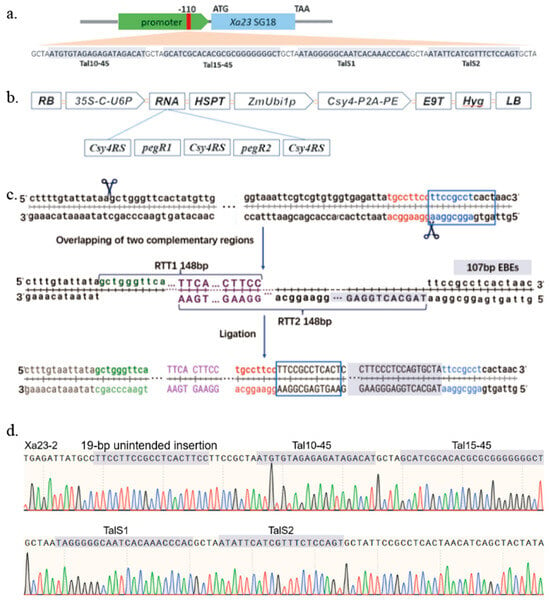
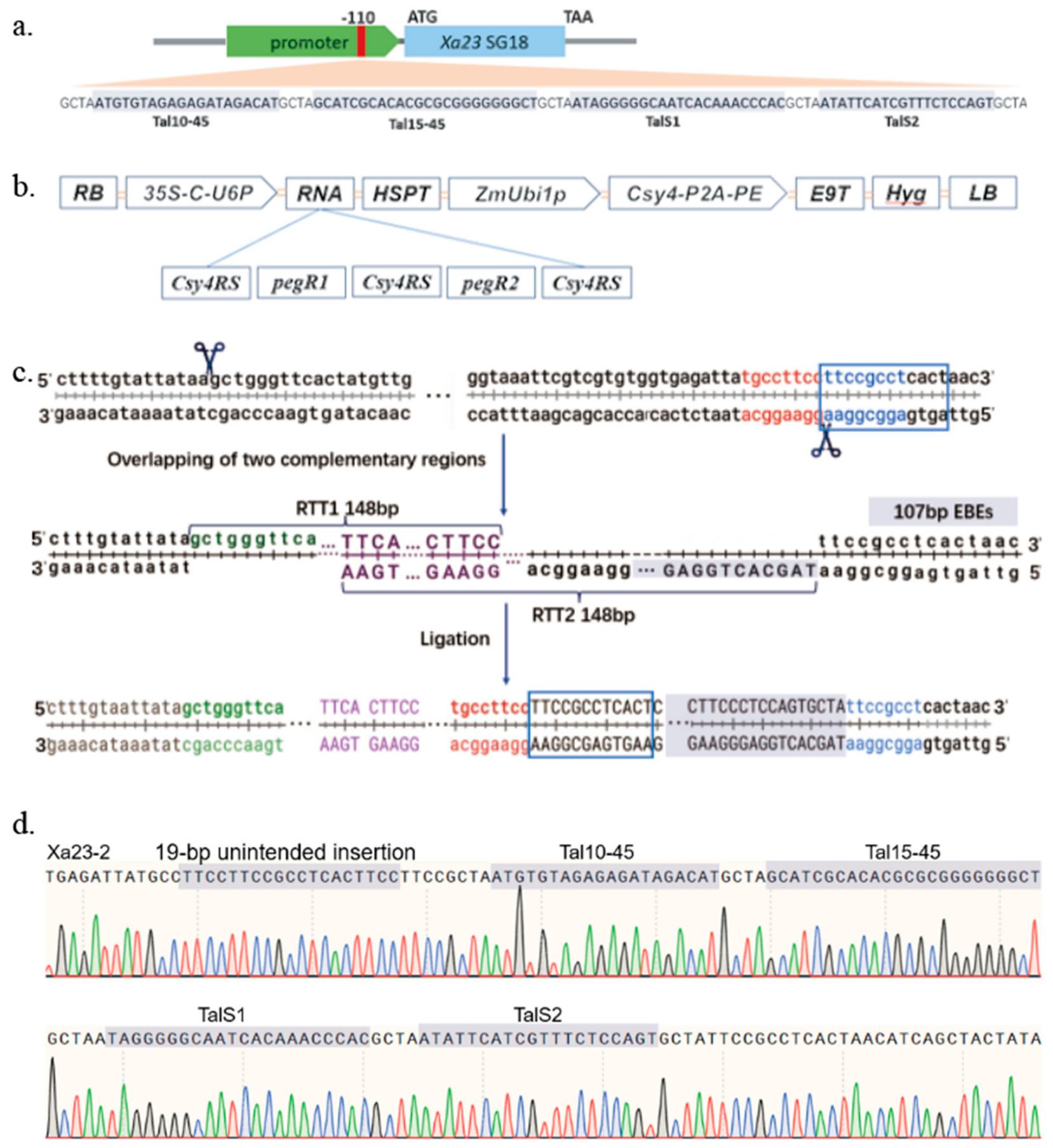
Aiming to introduce the designed edits as shown in Figure 1a to the promoter region of Xa23, a grand PE vector was constructed as shown in Figure 1b. In order to examine whether this vector could work in rice cells, a transient editing experiment was conducted using rice protoplast cells.
Figure 1.
Schematic map for insertion of four EBEs via Grand PE strategy. (a) Target site and donor DNA sequences for Xa23 in SG18. (b) The structure of the GRAND PE vector. (c) Principle of inserting EBE sequences into cells using gene editing technology. (d) The genotype of the successfully edited plant with a 19 bp unintended insertion.
DNA was extracted from the transfected cells, and specific primers were designed to amplify the insertion events. Amplicons with the expected size were acquired and sent for Sanger sequencing. The sequencing results of the left and right border junctions are presented in Supplementary Figures S2 and S3. The results showed that the PE vector could insert the designed fragment at the precise position with the precise sequence.
Next, this PE vector was transferred into Agrobacterium, which was used to transform rice calli derived from an elite rice variety, Suijing18. After selection with hygromycin, two T0 transgenic rice plants were obtained. DNA was extracted, and PCR was performed. The result showed that one plant had an EBE insertion at the Xa23 promoter region.
Detailed sequencing data, however, failed to perfectly match our design. The actual edit is 19 bp longer than the designed edit, and this 19 bp insertion is actually a rice genomic fragment at the right junction. Luckily, this edit contains the entire four EBE sequences, and therefore, we expect the biological function should be retained, as this 19 bp insertion is a part of endogenous fragment in the promoter. The exact reason why a 19 bp additional insertion occurred is unknown; however, it is very common in genome editing attempts.
Meanwhile, we picked the top five off-targets for each pegRNA predicted by CRISPOR (Supplementary Figure S7), designed primers (Supplementary Table S4) and amplified these off-target regions. The results showed no difference between edited and WT plants, suggesting a very low chance of off-targeting by this PE method.
In order to examine whether the edited allele could pass down to the next generation, T1 seeds were harvested from the edited plant, and the resulting T1 seedlings were examined for the presence of the transgene and edited alleles. The genotyping result showed that the ratio of transgene-positive plants (n = 59) to transgene-negative plants (n = 25) fit the segregation ratio predicted by Mendel’s Law (3:1, p = 0.26). The edited allele followed a similar segregation pattern (p = 0.80). Eventually, we obtained 15 transgene-free plants that had homozygous edited alleles.
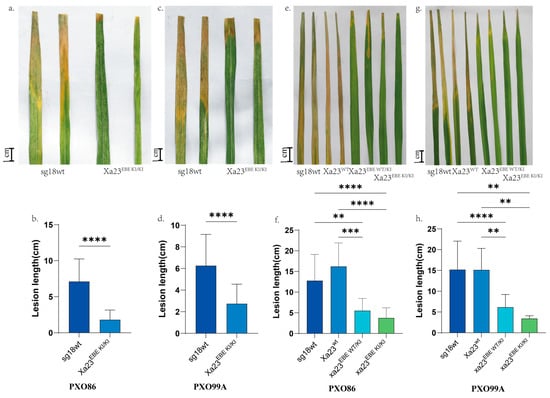
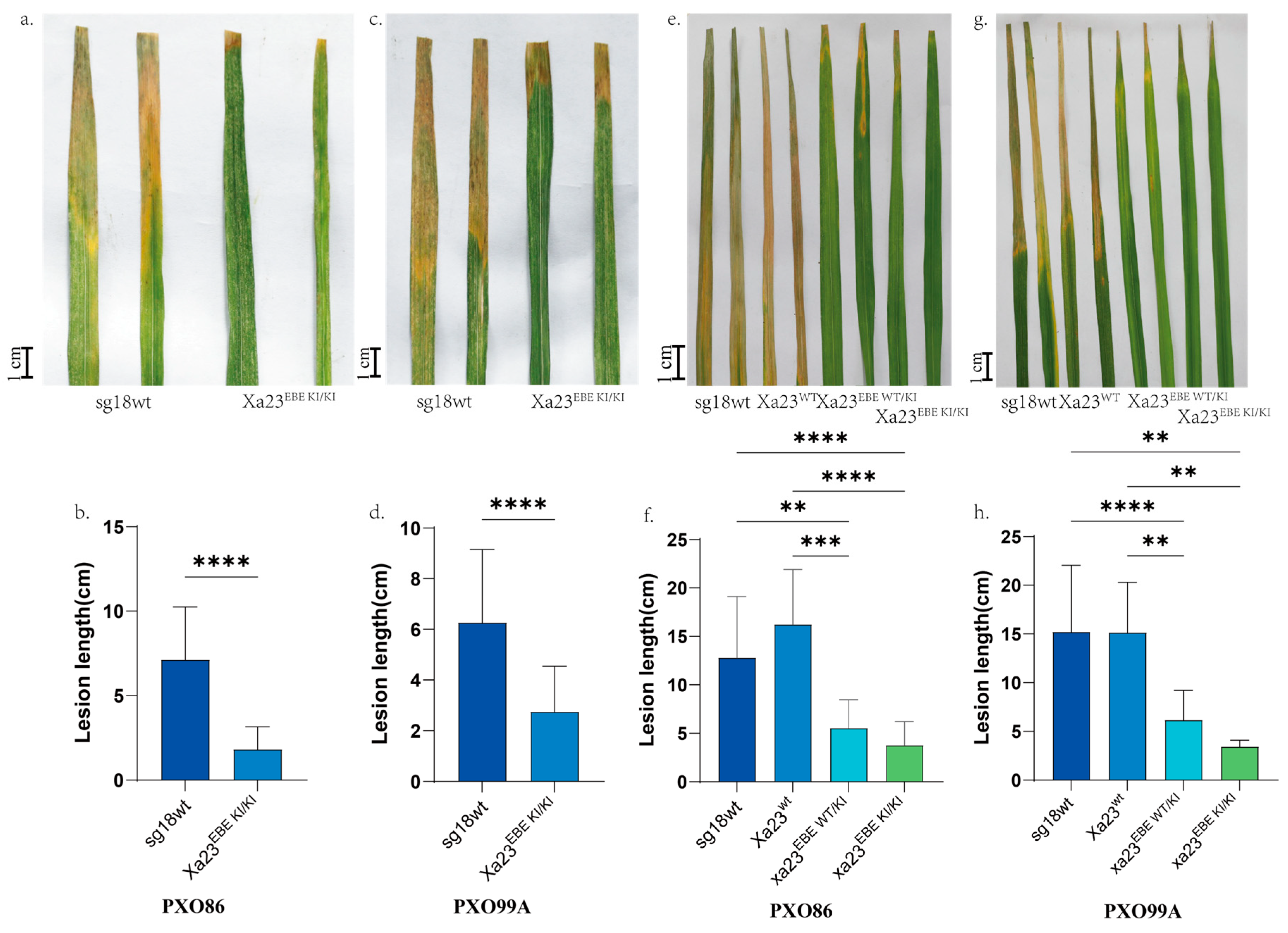
Next, Xanthomonas oryzae pv. oryzae bioassay was conducted using transgene-free T2 homozygous edited seedlings and WT control. Two strains of Xanthomonas oryzae pv. oryzae, PXO86 and PXO99A, were prepared to challenge the seedlings following the method described [15]. Fourteen days after inoculation, lesion length was measured, and the results showed that WT plants had an average of 7.11 cm lesion while edited plants had 1.82 cm for PXO86 (Figure 2a–d). Similar results were observed with PXO99A, suggesting edited plants conferred enhanced resistance to Xanthomonas oryzae pv. oryzae PXO86 and PXO99A.
Figure 2.
Activation of resistance in edited plants inoculated with PXO86 and PXO99A. (a–d) Lesion lengths 14 days after inoculation of Suijing18 WT and Xa23EBE KI/KI lines with 2 Xoo strains (PXO86, PXO99A). (e–h) Lesion lengths 14 days after inoculation of Suijing18 WT and Xa23WT, Xa23EBE WT/KI, Xa23EBE KI/KI lines with 2 Xoo strains (PXO86, PXO99A). Xa23WT, wild-type plant; Xa23EBE WT/KI, heterozygous edited plants; Xa23EBE KI/KI, homozygous edited plants. * p < 0.05; ** p < 0.01; *** p < 0.001; **** p < 0.0001. Data are presented as mean ± SD (n ≥ 4).
To explore whether there is a difference in resistance between heterozygous and homozygous edited plants, a bioassay was conducted. The results showed that heterozygous edited plants had a similar level of resistance to both strains as homozygous edited plants (Figure 2e–h), fulfilling the prediction that in theory an edited allele should function as a dominant disease resistance trait. This feature could facilitate its application in hybrid rice seed production as only one parent needs to be edited.
Following inoculation with Xanthomonas oryzae pv. oryzae strains PXO99A and PXO86, qRT-PCR analysis showed that Xa23 transcription levels were significantly up-regulated at 6 h post-inoculation in edited plants, at more than 40-fold the wild-type control for both strains (Supplementary Figure S6). This expression pattern well supported the increased resistance level observed in edited plants to these two Xoo strains.
4. Discussion
Unlike previous strategies that weakened susceptibility by knocking out S genes or their EBEs in the promoter regions, this study adopted a “reverse” design by inserting EBEs into the promoter region of the R gene Xa23. The TALE effector of the pathogenic bacteria was “hijacked” to activate immune defense mediated by R genes. The multiple EBE sequences used in this study have been suggested by previous research as the conserved targets of the TALE in various strains of Xanthomonas oryzae pv. oryzae. Therefore, the insertion of these EBEs into the Xa23 promoter in an elite rice variety should confer resistance to more strains of Xanthomonas oryzae pv. oryzae.
This study has several limitations. First, the resistance phenotype was characterized from a single editing event. Although the edited allele segregated normally and the resistance was stably inherited, somaclonal variation cannot be entirely excluded. Moreover, this editing event had an extra 19 bp insertion along with the entire four EBEs. The qRT-PCR data demonstrated that the edited promoter with the 19 bp insertion could be effectively activated upon bacterial inoculation. However, whether the 19 bp insertion alone affects baseline and inducible promoter activity remains to be clarified. A definitive assessment would require a perfectly edited promoter containing only the intended EBE insertion without the 19 bp duplication, which was not obtained in this study. Therefore, it represents a limitation for the current study and warrants further investigation. Secondly, it should be acknowledged that the bioassay in this study was limited to two Xanthomonas oryzae pv. oryzae strains, and the edited lines were not assessed across a broader range of geographical strains or under diverse field conditions. Therefore, the full spectrum and stability of the resistance remain to be further characterized. Moreover, we did not observe obvious differences between edited and WT plants in plant height and seed-setting rate; however, a detailed study needs to be conducted to examine whether edited plants have the same or better agronomic performance under field conditions.
Meanwhile, we used Grand PE rather than particle bombardment, thus providing a much more efficient tool to install this specific trait into other elite varieties. Following a similar philosophy, Xanthomonas oryzae pv. oryzicola, another severe rice bacterial pathogen that delivers TALEs to plant cells, could also be well managed by inserting corresponding EBEs into Xa23 or other suitable R genes. Therefore, PE-mediated multiple EBE insertion into R genes offers an effective strategy to generate multiple disease resistance traits in rice.
5. Conclusions
In this study, we demonstrated that the Grand PE strategy can efficiently mediate insertion of multiple effector binding elements (EBEs) into the Xa23 promoter, and the edited plants showed enhanced resistance to bacterial blight in rice. Further studies should be carried out to validate disease resistance spectrum and agronomic performance of edited plants under field conditions.
Supplementary Materials
The following supporting information can be downloaded at: https://www.mdpi.com/article/10.3390/agronomy16212105/s1, Figure S1. The schematics of rice transformation procedure. Figure S2. The sequencing results of the left border junction after plasmid transfection to rice protoplast cells. Figure S3. The sequencing results of the right border junction after plasmid transfection to rice protoplast cells. Figure S4. Identification of transgene-free plants by PCR analysis. Figure S5. Sanger sequencing confirmation of the Grand PE vector. Figure S6. Relative expression of Xa23 after inoculation of Xoo. Figure S7. The five most likely off-target sites for each target locus. Table S1. vector elements contained in this Grand PE vector. Table S2. Primers used in this work. Table S3. Segregation of different genotypes at T1 generation. Table S4. Primers used in off-target analysis.
Author Contributions
Conceptualization, L.J. and Y.C.; methodology, Y.C. and L.J.; validation, Y.C., X.J. and D.D.; formal analysis, Y.C. and Y.L.; investigation, Y.C.; resources, Y.C. and D.D.; data curation, Y.C. and X.J.; writing—original draft preparation, Y.C. and L.J.; writing—review and editing, Y.C. and L.J.; visualization, Y.C. and D.D.; supervision, L.J. and L.L.; project administration, L.J. and L.L. All authors have read and agreed to the published version of the manuscript.
Funding
This research was supported by the National Natural Science Foundation of China 32272629.
Data Availability Statement
The original contributions presented in the study are included in the article. Further inquiries can be directed to the corresponding author.
Acknowledgments
We would like to express our sincere gratitude to Chen Qijun, Chen Xujun, and members of their lab at China Agricultural University for their valuable assistance with the PE template vector pG3H-Csy4PE6c.2 and Xanthomonas oryzae pv. oryzae strains PXO86, PXO99A.
Conflicts of Interest
The authors declare no conflicts of interest.
References
- Tauqeer, Z.; Tauqeer, A.; Memon, S.P.; Younas, M.U.; Wang, G.; Islam, W. Unraveling rice defense against bacterial blight: Molecular pathways, resistance genes and breeding perspectives. Microb. Pathog. 2025, 209, 108128. [Google Scholar] [CrossRef] [Scilit]
- Wang, R.; Ji, Z.; Kou, Y.; Yang, X.; Huang, W.; Sun, Z.; Zuo, S.; Li, Z.; Xiong, Y.; Deng, Y.; et al. Occurrence and integrated control of major rice diseases in China. New Plant Prot. 2025, 2, e70004. [Google Scholar] [CrossRef] [Scilit]
- Hou, Y.; Liang, Y.; Yang, C.; Ji, Z.; Zeng, Y.; Li, G.; E, Z. Complete genomic sequence of Xanthomonas oryzae pv. oryzae strain, LA20, for studying resurgence of rice bacterial blight in the yangtze river region, China. Int. J. Mol. Sci. 2023, 24, 8132. [Google Scholar] [CrossRef] [Scilit]
- Wang, S.; Yang, H.; Zhao, C.; Hu, D.; Song, B. Antibacterial agrochemicals: Recent research progress and outlook. Chin. Chem. Lett. 2026, 37, 111543. [Google Scholar] [CrossRef] [Scilit]
- Xu, Z.; Xu, X.; Li, Y.; Liu, L.; Wang, Q.; Wang, Y.; Wang, Y.; Yan, J.; Cheng, G.; Zou, L.; et al. Tal6b/AvrXa27A, a hidden TALE targeting the susceptibility gene OsSWEET11a and the resistance gene Xa27 in rice. Plant Commun. 2024, 5, 100721. [Google Scholar] [CrossRef] [Scilit]
- Xu, Z.; Xu, X.; Wang, Y.; Liu, L.; Li, Y.; Yang, Y.; Liu, L.; Zou, L.; Chen, G. Engineering broad-spectrum bacterial blight resistance by simultaneously disrupting variable TALE-binding elements of multiple susceptibility genes in rice. Mol. Plant 2019, 12, 1434–1446. [Google Scholar] [CrossRef] [Scilit]
- He, L.; Liu, P.; Mei, L.; Luo, H.; Ban, T.; Chen, X.; Ma, B. Disease resistance features of the executor R gene Xa7 reveal novel insights into the interaction between rice and Xanthomonas oryzae pv. oryzae. Front. Plant Sci. 2024, 15, 1365989. [Google Scholar] [CrossRef] [Scilit]
- Wang, C.; Zhang, X.; Fan, Y.; Gao, Y.; Zhu, Q.; Zheng, C.; Qin, T.; Li, Y.; Che, J.; Zhang, M.; et al. Xa23 is an executor r protein and confers broad-spectrum disease resistance in rice. Mol. Plant 2015, 8, 290–302. [Google Scholar] [CrossRef] [Scilit]
- Gupta, A.; Liu, B.; Chen, Q.-J.; Yang, B. High-efficiency prime editing enables new strategies for broad-spectrum resistance to bacterial blight of rice. Plant Biotechnol. J. 2023, 21, 1454–1464. [Google Scholar] [CrossRef] [Scilit]
- Wei, Z.; Abdelrahman, M.; Gao, Y.; Ji, Z.; Mishra, R.; Sun, H.; Sui, Y.; Wu, C.; Wang, C.; Zhao, K. Engineering broad-spectrum resistance to bacterial blight by CRISPR-Cas9-mediated precise homology directed repair in rice. Mol. Plant 2021, 14, 1215–1218. [Google Scholar] [CrossRef] [Scilit]
- Yu, M.; Zhang, S.; Yan, J.; Huang, J.; Ji, Z.; Zhou, X.; Sun, W.; Zhou, H. Prime editing-mediated correction of the endogenous Xa23 gene confers broad-spectrum resistance to rice bacterial blight. New Plant Prot. 2025, 2, e70026. [Google Scholar] [CrossRef] [Scilit]
- Zhang, X.; Song, M.; Wang, Y.; Yao, Q.; Shen, R.; Tian, Y.; Lu, Y.; Zhu, J.K. Programmable broad-spectrum resistance to bacterial blight using targeted insertion in rice. Cell Discov. 2024, 10, 100. [Google Scholar] [CrossRef] [Scilit]
- Wang, M.; Li, S.; Li, H.; Song, C.; Xie, W.; Zuo, S.; Zhou, X.; Zhou, C.; Ji, Z.; Zhou, H. Genome editing of a dominant resistance gene for broad-spectrum resistance to bacterial diseases in rice without growth penalty. Plant Biotechnol. J. 2023, 23, 529–531. [Google Scholar] [CrossRef] [Scilit]
- Wang, J.; He, Z.; Wang, G.; Zhang, R.; Duan, J.; Gao, P.; Lei, X.; Qiu, H.; Zhang, C.; Zhang, Y.; et al. Efficient targeted insertion of large DNA fragments without DNA donors. Nat. Methods. 2022, 19, 331–340. [Google Scholar] [CrossRef] [Scilit]
- Cao, Z.; Sun, W.; Qiao, D.; Wang, J.; Li, S.; Liu, X.; Xin, C.; Lu, Y.; Gul, S.L.; Wang, X.C.; et al. PE6c greatly enhances prime editing in transgenic rice plants. J. Integr. Plant Biol. 2024, 66, 1864–1870. [Google Scholar] [CrossRef] [Scilit]
- Jabnoune, M.; Secco, D.; Lecampion, C.; Robaglia, C.; Shu, Q.; Poirier, Y. An efficient procedure for protoplast isolation from mesophyll cells and nuclear fractionation in rice. Bio-Protocol 2015, 5, e1412. [Google Scholar] [CrossRef] [Scilit]
- Do, V.G.; Kim, S.; Win, N.M.; Kwon, S.-I.; Kweon, H.; Yang, S.; Park, J.; Do, G.; Lee, Y. Efficient regeneration of transgenic rice from embryogenic callus via agrobacterium-mediated transformation: A case study using GFP and apple MDFT1 genes. Plants 2024, 13, 2803. [Google Scholar] [CrossRef] [Scilit]
- Zhang, C.; Fang, L.; He, F.; You, X.; Wang, M.; Zhao, T.; Hou, Y.; Xiao, N.; Li, A.; Yang, J.; et al. Ubiquitination of OsCSN5 by OsPUB45 activates immunity by modulating the OsCUL3a-OsNPR1 module. Sci. Adv. 2025, 11, eadr2441. [Google Scholar] [CrossRef] [Scilit]
Disclaimer/Publisher’s Note: The statements, opinions and data contained in all publications are solely those of the individual author(s) and contributor(s) and not of MDPI and/or the editor(s). MDPI and/or the editor(s) disclaim responsibility for any injury to people or property resulting from any ideas, methods, instructions or products referred to in the content. |
© 2026 by the authors. Licensee MDPI, Basel, Switzerland. This article is an open access article distributed under the terms and conditions of the Creative Commons Attribution (CC BY) license.