


Abstract
Peach production is economically important in Portugal’s Beira Interior region, which holds roughly half the country’s peach area. Orchard management can affect soil fertility, but the changes develop slowly and are rarely studied. We hypothesised that soil organic matter would increase after orchard establishment, that high soil K, P, and Cu levels would be reflected in leaf nutrients and tree growth, and that soil changes would be greater in tree rows than in inter-rows. To test these hypotheses, we tracked soil fertility, leaf nutrients, and trunk sectional area from orchard establishment (2018) to half-life (2024). Of the initial 31 orchards, only 16 remained by 2024, mainly because of bacterial canker (Pseudomonas syringae). Soil nutrients were generally high, suggesting overfertilisation, while leaf nutrients were mostly within the reference ranges, although K and Zn were low in several orchards. Although soil Cu content was high (ranging from 25 mg/kg to 49 mg/kg), no phytotoxic effects were observed. Soil changes were more frequent in the rows, where organic matter rose, though not significantly, from 2.65% to 3.45%–3.46%, a promising result given the region’s coarse-textured soils and hot summers. The results indicate that fertilisation should be guided by soil and leaf analysis.
1. Introduction
In Portugal, peach production is concentrated mainly in the east-central region of Beira Interior, which accounts for approximately half of the country’s total area of peach orchards (3764 ha) [1]. Precipitation falls mainly in winter and early spring, and summers are typically hot and dry [2,3]. July is typically the hottest month, with temperatures >40 °C on several days and usually no precipitation [3]. These conditions favour peach production where irrigation water is available. However, they also promote organic matter degradation, which helps to explain the relatively low organic matter levels in the soils of this region [4].
Peach orchards may increase soil organic matter content, both by reducing the rate of organic matter degradation and through organic matter inputs. The former occurs because the soil is not tilled after orchard establishment, which reduces soil aeration and, consequently, organic matter degradation. The latter includes regular manure applications and the shredding of pruning wood [4].
The effect of peach orchards on other soil nutrients is difficult to predict and depends strongly on orchard management. For example, Zhang et al. [5], in a study involving peach orchards in North Carolina (USA), reported a decrease in soil P, K, and Mg contents after eight years. In contrast, Li et al. [6], in a study on peach orchards in Shandong (China), described an increase in available P, available K, and organic matter after 10 years.
Nutrient management in peach orchards in this region faces important challenges. In particular, fertilisation is often based on low-cost compound fertilisers rather than on the requirements of each nutrient. For example, at orchard establishment, the binary fertiliser 0:21:21 (N:P:K) is commonly applied because of its low price, which often leads to K overfertilisation [7]. Likewise, annual rates of ternary N–P–K fertilisers are often calculated to meet K requirements, resulting in excessive P inputs, since P requirements are 5–10 times lower than those of N and K [8,9]. These challenges are aggravated by the increasingly rapid orchard turnover, driven mainly by the high incidence of bacterial canker (caused by Pseudomonas syringae), which leads to tree decline and yield losses and often results in premature uprooting [10].
These differences highlight the need for comprehensive studies covering multiple orchards over several years. However, few studies have done so, and to our knowledge, none has combined the effect of peach orchards on soil nutrients with plant nutrition and growth. This is probably due to the difficulty of conducting such studies, which not only span long periods but also require the collaboration of several farmers and farmers’ associations. Nevertheless, combining soil and leaf nutrient contents with tree growth is essential to fully understand how orchards affect soil nutrients and, in turn, plant nutrition and growth. Soil analysis quantifies the nutrient stock and its changes over time, which is relevant for both fertilisation planning and environmental risk assessment, although it does not show how much of that stock is taken up by trees. Leaf analysis integrates nutrient availability, root uptake, and interactions among nutrients, and is, therefore, essential for diagnosing tree nutritional status. In this regard, discrepancies between soil and leaf analyses have been reported, for example, by Brital et al. [11] in orange orchards in Morocco, and by Arrobas et al. [12] in chestnut groves in Portugal. Furthermore, Caballero-Calvo et al. [13] showed that soil management in perennial crops also depends on socioeconomic and behavioural factors shaping farmers’ decisions. Trunk sectional area (TSA), in turn, is an indicator of tree vigour, showing whether soil conditions or nutritional imbalances are reflected in growth.
Within orchards, these effects are unlikely to be uniform, as fertilisers, irrigation, and herbicides are concentrated in the tree rows, whereas the inter-rows are covered by spontaneous vegetation, which is periodically mown together with the pruning wood. Therefore, the two zones receive different inputs and are subject to different moisture regimes, which may lead to divergent trends in soil organic matter and nutrients over time.
This study aimed to address these knowledge gaps. Specifically, three hypotheses were tested: (H1) soil organic matter content increases after orchard establishment because of the organic matter inputs and the absence of tillage, despite regional conditions that favour its degradation, (H2) the expected high soil K, P, and Cu levels resulting from fertilisation and plant-protection practices are reflected in leaf nutrient status and affect tree growth, and (H3) the soil parameters in the tree rows, where fertilisers and irrigation are applied, diverge over time from those in the inter-rows, with greater changes in the rows.
2. Materials and Methods
2.1. Study Area and Design
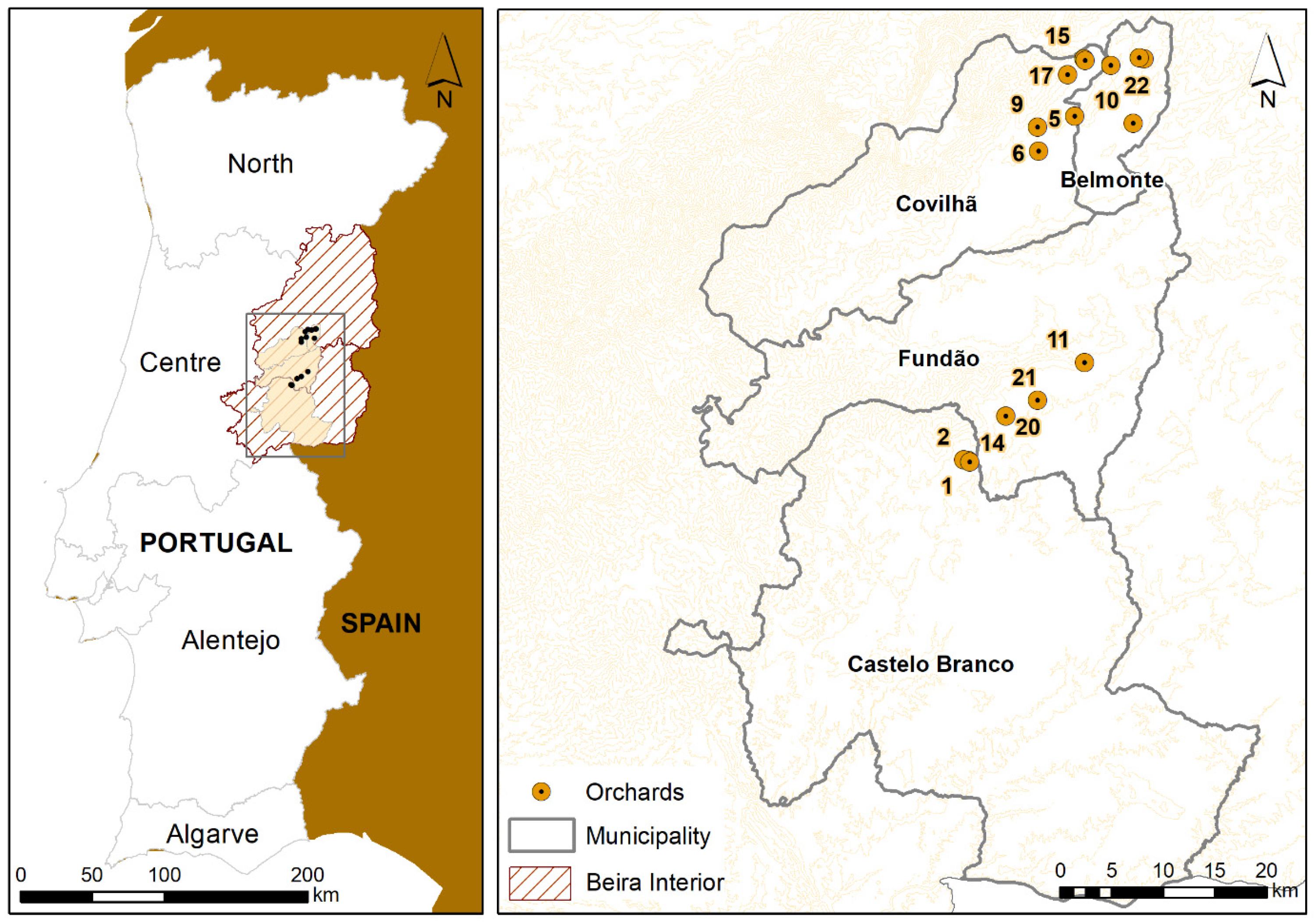
The study began in 2018, with a total of 31 peach orchards belonging to different farmers and located in the Beira Interior region, in east-central Portugal (Figure 1). By 2024, which corresponds approximately to the orchards’ half-life, the number of monitored orchards had fallen to 16, mainly because of uprooting caused by the high incidence of bacterial canker. The main characteristics of these orchards are presented in Table 1, namely, their approximate location, soil type, cultivars, and planting distances between and within rows. Detailed records of fertilisation, pesticide applications, and rootstocks were not available. Nevertheless, the common practices for each of these aspects are described below.
Table 1.
Orchard characterisation. The 16 orchards described in this table are those still in existence in 2024, at approximately half the orchards’ lifespan. The study started in 2018 with 31 orchards, all located in the Portuguese region of Beira Interior. The reduction in the number of orchards was mainly due to uprooting following a high incidence of bacterial canker (Pseudomonas syringae). Public irrigation systems are collective systems run by irrigators’ associations that pipe water from reservoirs to farms. Soil types follow the FAO classification and were retrieved from Guerreiro et al. [14].
This region has a Mediterranean climate, with hot, dry summers and mild, wet winters, corresponding to the Köppen–Geiger class Csa [2]. The soils under peach orchards in this region are derived from granite or schist, have a coarse or medium texture, and are typically classified as Dystric Cambisols (63.1%) and Dystric Fluvisols (27.7%) [15]. Dystric Cambisols also predominated in our study, occurring in 50% of the orchards.
Several cultivars are grown, covering a harvest period from June to September [16,17], and GF305 and Montclar are the main rootstocks in this region.
Orchard management followed common practice in the region. Post-emergence herbicides (e.g., glyphosate, 2,4-D, and MCPA) are periodically applied in a 1 m-wide strip centred on the tree row, while weeds cover the inter-row space and are periodically mown. From April to September, trees are irrigated via drip systems fed by on-farm rainfed ponds (56%), public irrigation systems (25%), and wells (19%). Public irrigation systems are collective systems, built by the State and run by irrigators’ associations, that deliver water from reservoirs to farms through a pipe network. This distribution is similar to that described by Dias et al. [15] for peach orchards in this region, where rainfed ponds and public irrigation systems were the two main water sources.
At orchard establishment, fertilisation is based on the analysis of soil samples collected before tillage and typically uses the binary fertiliser 0:21:21 (N:P:K) because of its low price, which frequently leads to K overfertilisation [7]. The same applies to annual fertilisation, in which ternary N–P–K fertilisers are frequently used at rates calculated to meet K requirements, leading to excessive P doses, since P requirements are 5–10 times lower than those of N and K [8,9].
Figure 1.
Location of the orchards in 4 municipalities in the Beira Interior region. The data used to prepare this figure were compiled with QGIS [18] and can be accessed at DGT [19]. Numbers indicate the code assigned to each monitored orchard.
At the beginning of the study, just after establishment, 10 trees were labelled in each orchard, distributed across 3 rows, which constituted 3 experimental blocks. These corresponded approximately to the 3 inner rows obtained by dividing the orchard into 4 parts, following the methodology of Simões [20] adapted from Lalancette and Polk [21]. The labelled trees were used to assess plant nutrition and tree growth and as references for soil sampling.
Spatial field data were collected using a Trimble GeoExplorer XP GeoXP GNSS/GPS receiver (Trimble Inc., Sunnyvale, CA, USA), operating with Trimble TerraSync acquisition software (v.2.41). Field positioning was subjected to differential post-processing using Trimble GPS Pathfinder Office software (v.5.81), with data from official reference (base) stations of the National Network of Permanent GNSS Stations—ReNEP [19], to ensure planimetric and altimetric accuracy. Slope (the angle of inclination to the horizontal) was calculated from the elevation data using QGIS software version 3.44.12 [18].
2.2. Soil Samples and Analysis
Two groups of soil samples were collected at 0–30 cm depth in 2018, 2022, and 2024: one in the tree rows, 1 m from each labelled tree, and the other in the inter-rows, 2 m from the labelled tree, perpendicular to the row. The soil samples from each experimental block were thoroughly mixed, resulting in 3 composite samples per orchard. Each sample was dried at 40 °C until constant weight and passed through a 2 mm sieve. Sample collection followed the procedure described in Veloso et al. [4].
Soil pH was determined potentiometrically in a 1:2.5 soil–water suspension [22], and electrical conductivity was measured in a 1:5 soil–water extract [23]. Organic matter content was determined by the Walkley–Black wet oxidation method [24]. Available K2O and P2O5 were extracted using the ammonium lactate method [25] and the sodium bicarbonate (Olsen) method [26], respectively. The former was quantified by atomic absorption spectrophotometry and the latter by molecular absorption spectrophotometry. Cu, Zn, and Mn were extracted using the aqua regia method and quantified by atomic absorption spectrophotometry [27], while B was determined using the hot-water extraction method and quantified by molecular absorption spectrophotometry [28]. Soil fertility data at orchard establishment (2018) have been published previously by Simões et al. [29].
2.3. Leaf Samples and Analysis
Leaf analysis was used to evaluate plant nutritional status in 2020, 2022, and 2024. In each orchard, 100 leaves were collected (10 leaves per labelled tree) from the middle portion of current-season shoots on the outer mid-canopy, at 110–120 days after full bloom, corresponding to mid-July. In each year, all orchards were sampled within 2–3 days, with no rain recorded during sampling or on the preceding days. Leaves were weighed, washed, dried at 65 °C for 48 h, and then reweighed and milled.
N content was determined by the Kjeldahl method. For B determination, the dry sample was heated in a muffle furnace at 550 °C for 6 h. The resulting ash was dissolved in sulfuric acid (H2SO4, 0.18 M). B was then quantified by molecular absorption spectrophotometry. For the quantification of the remaining parameters (i.e., P, K, Ca, Mg, Mn, Fe, Cu, and Zn), the dry sample was heated in a muffle furnace at 450 °C for 16 h, and the resulting ash was dissolved in hydrochloric acid (HCl, 20% v/v). P was quantified by molecular absorption spectrophotometry, while the contents of the remaining nutrients were determined by atomic absorption spectrophotometry.
2.4. Trunk Sectional Area
Trunk sectional area (TSA) was used as an indicator of tree growth. It was calculated from the trunk circumference, measured at a marked point approximately 10 cm above the graft union in January–February of 2019, 2020, 2021, 2022, and 2024.
2.5. Statistical Analysis
Statistical analysis and visualisation were performed with R (version 4.6.1) and RStudio (version 2026.07.0). Normality and homogeneity of variances were evaluated using the Shapiro–Wilk and Levene tests, respectively, the latter using the “car” R package [30]. Comparisons between years were performed using analysis of variance (ANOVA) followed by Tukey’s HSD post hoc test [31]. When either ANOVA assumption was not met, the non-parametric Kruskal–Wallis test followed by Dunn’s test with Bonferroni correction was used instead [32]. Rows and inter-rows were compared within each sampling year using Student’s t-test. The “ggplot2” package was used for data visualisation, together with the “ggcorrplot” R package [33] for Spearman correlations. Two separate correlation diagrams—one including the soil-related variables and the other the leaf-related variables—were prepared using the 2024 data. Altitude and slope were added to the first diagram because of their potential influence on soil nutrients and tree growth, and TSA, as an indicator of tree growth, was added to both diagrams. The significance level was set at 0.05 throughout the analysis.
3. Results
3.1. Number of Orchards
The number of monitored orchards decreased from 31 in 2018 to 23 in 2022 and 16 in 2024, which corresponds to 52% of the initial number of orchards. This sharp reduction was mainly due to uprooting by the farmers, mostly following a high incidence of bacterial canker caused by Pseudomonas syringae. Consequently, to ensure temporal consistency and comparability, the final results refer only to the 16 orchards monitored throughout the study.
3.2. Soil Parameters
According to the thresholds presented by INIAV [34], the soil collected was slightly acidic to neutral (pH between 6.29 and 6.86), had a very low electrical conductivity (0.07 dS/m–0.15 dS/m), a medium to high organic matter content (2.54–3.46%), very high K2O and P2O5 contents, and a medium B content (Table 2). For electrical conductivity, organic matter, P2O5, K2O, and Mn contents, no significant differences (p ≥ 0.05) were found among the three sampling years (2018, 2022, and 2024) in either the tree rows or the inter-rows.
Table 2.
Soil fertility-related variables in the rows and inter-rows of peach orchards in the Portuguese east-central region of Beira Interior, from 2018 to 2024. Soil samples were collected at 0–30 cm depth. Within each sample group (row/inter-row), different letters in the same row indicate statistically significant differences among sampling years (p < 0.05). EC: electrical conductivity; OM: organic matter. The font colours indicate the classification according to the thresholds available in INIAV [34]. Orange: low to very low; green: medium; blue: high to very high. Results are expressed as mean ± standard deviation.
In the rows, statistically significant differences among sampling years were found for pH and for Cu, Zn, and B contents. Cu content increased significantly from 2018 (25 mg/kg) to 2022 (49 mg/kg). However, Cu content in 2024 (44 mg/kg) did not differ significantly from either year. Zn content was 64 mg/kg in 2018, 62 mg/kg in 2022, and 90 mg/kg in 2024, with the only significant difference between 2022 and 2024. B content was 0.68 mg/kg in 2018, 0.69 mg/kg in 2022, and 1.02 mg/kg in 2024. The results showed a significantly higher B content six years after establishment. In the inter-rows, B was the only variable that differed significantly among sampling years, with a higher content in 2024 (0.75 mg/kg) than in 2022 (0.49 mg/kg). B content at orchard establishment (0.57 mg/kg) did not differ significantly from that of the other two years.
Table 3 compares soil nutrient-related variables between the rows and inter-rows in each sampling year.
Table 3.
Soil nutrient-related variables in the rows and in the inter-rows of peach orchards in the Portuguese east-central region of Beira Interior. Soil samples were collected at 0–30 cm depth. Within each sampling year (2018, 2022, and 2024), different letters in the same row indicate statistically significant differences between sample types (row and inter-row; p < 0.05). EC: electrical conductivity; OM: organic matter. Results are expressed as mean ± standard deviation.
Electrical conductivity and P2O5 content were significantly higher in the rows than in the inter-rows in all sampling years. A similar relationship was found for K2O in 2018 and for B in 2024.
At orchard establishment, organic matter content did not differ significantly between the rows and inter-rows. In 2022 and in 2024, the differences were not significant at the 0.05 level but would have been at the 0.10 level (p = 0.065 in 2022 and p = 0.081 in 2024).
3.3. Leaf Mineral Composition
Plant nutritional status was generally adequate, with the mean contents of all leaf nutrient contents within the reference intervals in all sampling years [34] (Table 4).
Table 4.
Leaf nutrient contents of peach orchards in the Portuguese east-central region of Beira Interior. Different letters in the same row indicate statistically significant differences among sampling years (p < 0.05). Results are expressed as mean ± standard deviation.
Significant differences among the sampling years were found for N and Mg contents. N content was significantly higher in 2020 (2.87%) than in 2022 (2.48%), whereas 2024 (2.75%) did not differ significantly from either of the other two years. Mg content was 0.49% in 2020, 0.56% in 2022, and 0.62% in 2024, showing a significant increase between 2020 and 2024.
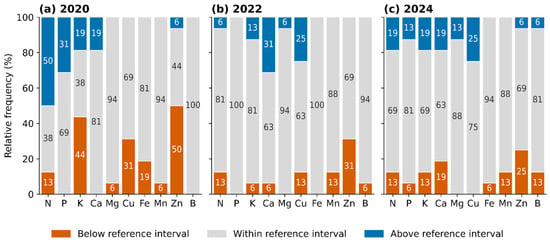
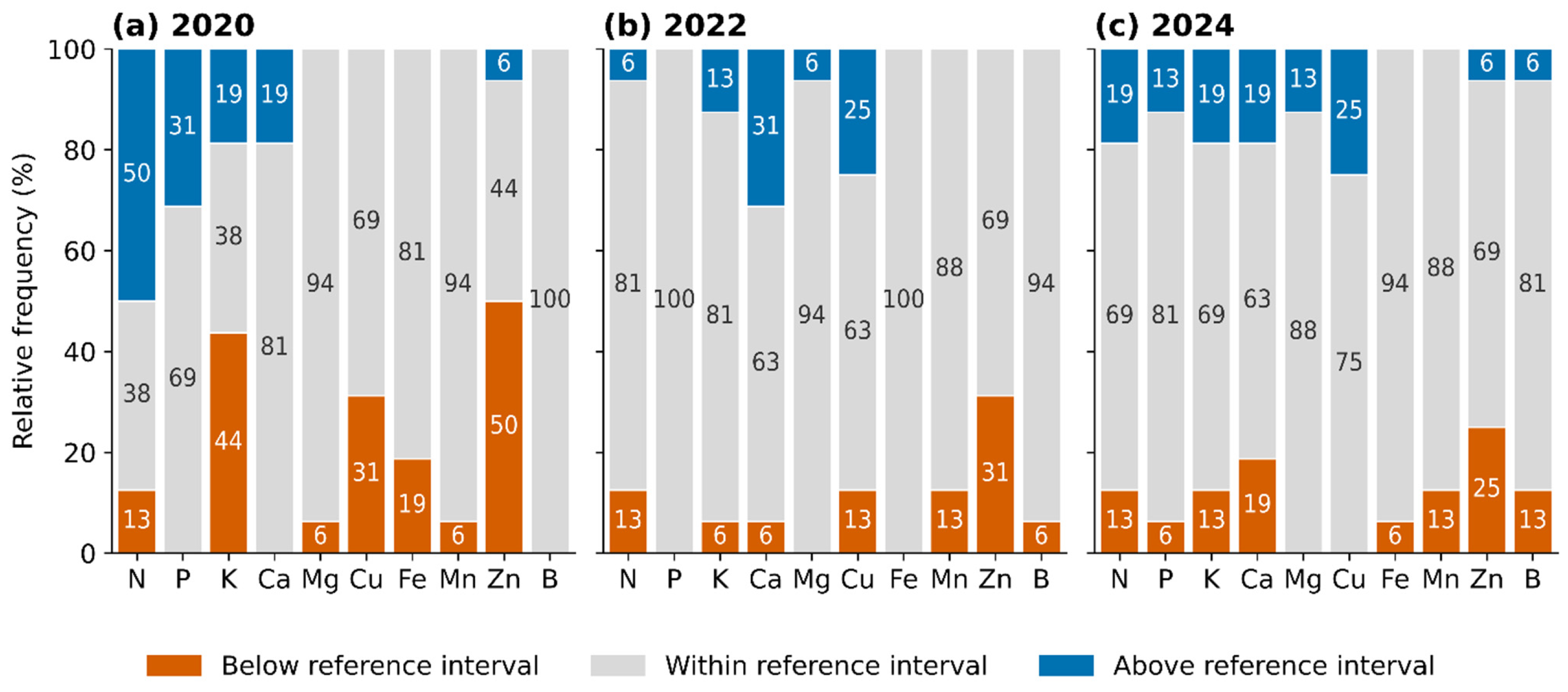
The distribution of orchards across the classes defined by the reference interval of each nutrient (Figure 2) shows that nutrient deficiencies or excesses generally occurred in a relatively small percentage of orchards.
Figure 2.
Percentage of orchards in which each leaf nutrient content was low (below the reference interval), within the reference interval, or high (above the reference interval). Reference intervals for each nutrient were retrieved from INIAV [34]. The results were obtained from leaf samples collected in 2020 (a), 2022 (b), and 2024 (c) in peach orchards in the Portuguese east-central region of Beira Interior. N = 16 orchards/year.
N content was above the reference interval in 50% of the orchards in 2020. In 2022 and 2024, this occurred in only 6% and 19% of the orchards, respectively, suggesting an adjustment in agricultural practices. However, 13% of the orchards showed N levels below the reference interval in all three sampling years.
P content was above the reference interval in 31% of the orchards in 2020. In 2022, it was within that interval in all orchards, and in 2024 it was above the reference interval in 13% of them.
K content was below the reference interval in 44% of the orchards in 2020. In 2022 and 2024, it was low in 6% and 13% of the orchards, and high in 13% and 19%, respectively.
The percentage of orchards with high Ca content was 19% in 2020, 31% in 2022, and 19% in 2024, whereas the percentage with low Ca content was 0%, 6%, and 19%, respectively. The high Ca contents may be related to liming (with CaCO3) by the farmers to correct soil pH.
Low Mg content occurred only in 2020. The percentage of orchards with high Mg content increased from 6% in 2022 to 13% in 2024. As with Ca, this may be explained by the use of dolomitic lime (which contains Mg) for liming.
For Cu content, the initial values (in 2020) indicate a more unfavourable situation, with 31% of the orchards showing low Cu content. In 2022, only 13% had low values and 25% already had high Cu content. In 2024, no orchards had low values, and 25% had high values.
No orchard had high Fe or Mn leaf contents. For Fe, the percentage of orchards with low values was 19% in 2020, 0% in 2022, and 6% in 2024. For Mn, it was 6% in 2020 and 13% in 2022 and 2024.
Zn content was low in a considerable percentage of orchards, although this percentage decreased from 50% in 2020 to 31% in 2022 and 25% in 2024, probably because of the use of ziram as a fungicide to control leaf curl disease, caused by Taphrina deformans.
B content was within the reference interval in all orchards in 2020. However, low values were observed in 6% and 13% of the orchards in 2022 and 2024, respectively.
3.4. Trunk Sectional Area
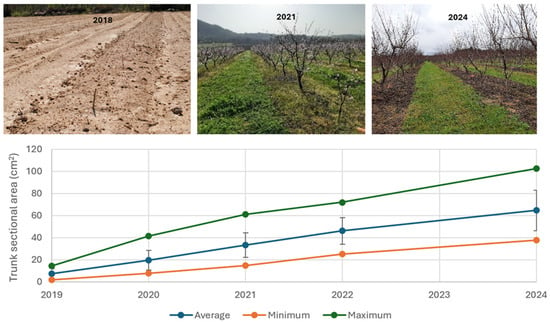
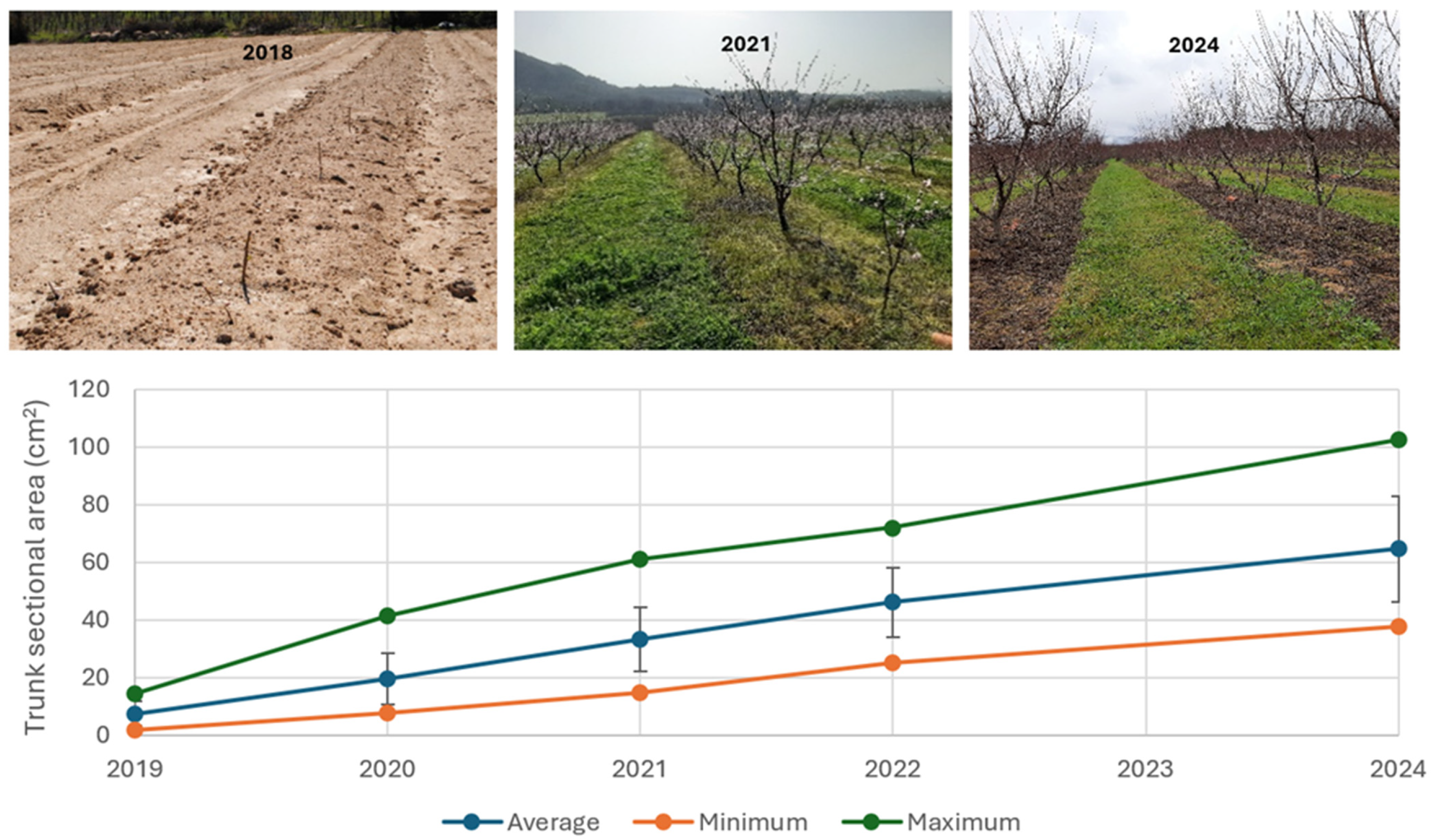
Mean trunk sectional area increased from 7.3 cm2 in 2019 to 64.6 cm2 in 2024 (Figure 3). The annual increment ranged from 9 cm2/year between 2022 and 2024 to 14 cm2/year between 2020 and 2021. In 2024, the minimum and maximum values were 38 cm2 and 103 cm2, respectively.
Figure 3.
Evolution of trunk sectional area in the peach orchards monitored in this study in the Portuguese east-central region of Beira Interior. Lines show the average, minimum, and maximum orchard values, and error bars represent the standard deviation of the average. N = 16.
3.5. Relationships Among Variables
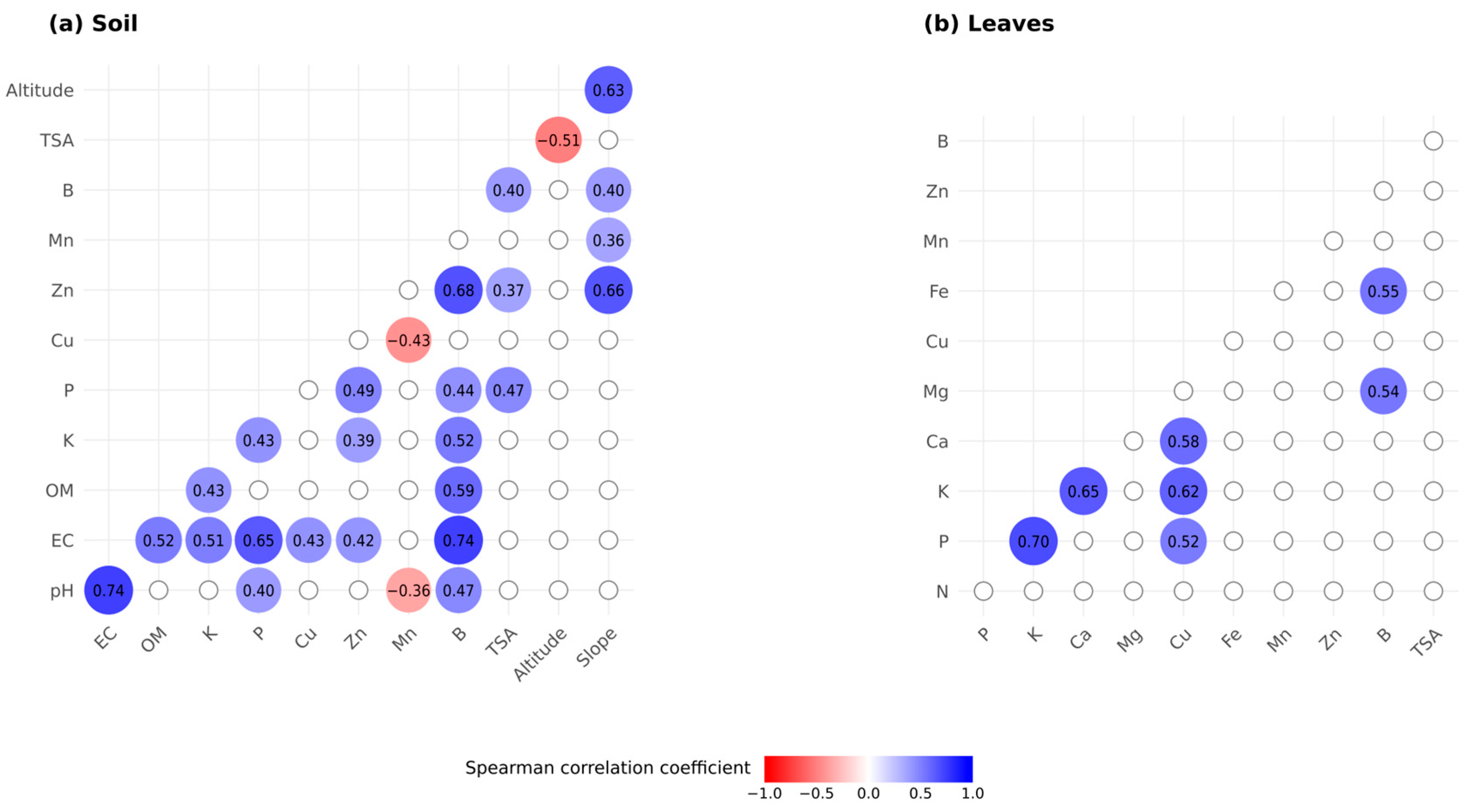
Spearman correlations among the soil-related (a) and leaf-related (b) variables are presented in Figure 4.
Figure 4.
Spearman correlations among soil-related variables (a) and among leaf-related variables (b) in 2024. The study was conducted in peach orchards in the Portuguese east-central region of Beira Interior. Coloured circles indicate significant correlations between variables (p < 0.05). The numbers inside the circles correspond to the Spearman correlation coefficients. TSA: trunk sectional area; EC: electrical conductivity; OM: organic matter. N = 16.
Overall, more significant correlations were found among the soil-related variables than among the leaf-related variables.
Among the soil-related variables, tree growth (TSA) was positively correlated with P, Zn, and B, and negatively correlated with altitude. The most relevant correlations were related to electrical conductivity and B. Electrical conductivity was positively correlated with organic matter, K, P, Cu, Zn, and B. B was positively correlated with pH, electrical conductivity, organic matter, K, P, Zn, TSA, and slope.
Among the leaf-related variables, none was significantly correlated with TSA. The highest correlation coefficient occurred between leaf P and K contents. Cu showed positive correlations with P, K, and Ca.
4. Discussion
A sharp reduction in the number of orchards was observed from their establishment in 2018 to 2024, corresponding approximately to the expected half-life of peach orchards [20,35]. This was mainly caused by bacterial canker (Pseudomonas syringae), which affects roughly 70% of peach orchards in this region [36] and leads to tree decline, yield losses, and uprooting [10]. A lower-than-expected cultivar performance under the specific soil and climate characteristics of the region may also have contributed to orchard uprooting [4].
In the rows, organic matter content showed a numerical, although not statistically significant, upward trend from 2.65% at orchard establishment to 3.45%–3.46% in 2022–2024, which is consistent with hypothesis H1. This may be related to organic and mineral fertilisation and leaf litter, combined with the absence of tillage. Organic fertilisers directly supply organic C to the soil, part of which is stabilised as organic matter [37], whereas mineral fertilisation contributes indirectly by increasing plant residue inputs and stimulating soil microbial activity [38]. Although herbicide use has been associated with lower soil organic matter contents than mowing [39], the upward trend observed in the rows, but not in the inter-rows, suggests that the inputs concentrated in the rows (fertilisation, irrigation, and leaf litter), together with the absence of tillage, outweighed any negative effect of herbicide use. Since fertiliser types and rates were not recorded for individual orchards, the relative contribution of each could not be quantified.
In the inter-rows, organic matter content remained approximately unchanged over the six years, despite the shredding of pruning wood in this area. Changes in soil organic matter content may take a long time to become detectable [40]. In addition, the high C/N ratio of the pruning wood and the dry summer conditions in the inter-rows are unfavourable to humification, whereas the lower C/N ratio of the leaves, which fall mainly in the rows, and summer irrigation favour microbial activity [41]. Future work should, therefore, evaluate the application of pruning wood after composting or its conversion into biochar.
A higher number of soil-related variables differed significantly among sampling years in the rows (pH, Cu, Zn, and B) than in the inter-rows (B), supporting hypothesis H3. This was expected, since fertilisers are applied mainly in the rows. The same explanation applies to the significantly higher electrical conductivity in the rows (Table 3), which is supported by its positive correlations with organic matter, K, P, Cu, Zn, and B (Figure 4). Nevertheless, mean electrical conductivity values were low (≤0.15 dS/m), posing no limitation to plant development.
Soil Cu content was generally high, which is common in orchards and vineyards because of the use of Cu as a fungicide and bactericide [42,43]. Although these applications are restricted to the autumn, winter, and early spring because of Cu phytotoxicity, soil Cu content increased after orchard establishment. A legacy effect resulting from previous orchard cultivation on the same soils may also have contributed. Reducing Cu applications is difficult, as Cu-based products are practically the only approved active ingredients effective against bacterial canker [44], although EU Regulation 2018/1981 [45] already limits Cu applications to 28 kg/ha over seven years.
High soil Cu levels may impair nutrient uptake and cause nutrient imbalances that, in turn, may reduce photosynthesis, growth, and yield [46]. However, contrary to hypothesis H2, soil Cu was negatively correlated only with soil Mn, and leaf Cu was positively correlated with P, K, and Ca. These results, together with the absence of a significant correlation between Cu and TSA, suggest that soil Cu levels were not high enough for these negative effects to occur. In addition, the Cu determined in this study was total Cu, which does not correspond to the plant-available fraction.
TSA was significantly and positively correlated with soil P, Zn, and B, but not with any leaf nutrient, suggesting that plant nutrition did not limit tree growth. This may be related to leaf nutrient contents being within or above the reference interval in most orchards.
Although soil nutrient levels were generally high, leaf nutrient contents were mostly within the reference intervals. This is not necessarily contradictory, as leaf nutrient contents may respond only weakly to further increases in soil supply when this is already high [47,48]. The surplus is, therefore, likely to accumulate in the soil, which is consistent with excessive fertilisation, particularly of K and P [7,8,9], and suggests that fertiliser inputs could be reduced without compromising tree nutrition. The low leaf K and Zn contents found in some orchards despite high soil levels may be explained by nutrient antagonism, as K uptake may have been reduced by Ca and Mg supplied through dolomitic liming, and Zn uptake by the high soil P levels [49]. Additionally, soil Zn was determined as total content, which may overestimate the fraction available to the trees. Differences among cultivars and rootstocks may also have contributed, as nutrient uptake differs among genotypes [50].
Leaf K may also have been influenced by crop load, as K is largely exported to the fruit [48,51]. Since the cultivars ripen from June to September, early-season cultivars had already been harvested by the time of leaf sampling (mid-July), whereas late cultivars still carried fruit. Interannual weather variation may also have affected nutrient uptake [52], particularly in spring before irrigation starts, as well as the leaching of mobile nutrients such as K and B in these coarse-textured soils. As yield was not recorded and only three sampling years were available for soil and leaves, these effects could not be tested. Future studies should, therefore, include yield and weather variables.
5. Conclusions
Peach orchards were monitored from establishment in 2018 to their approximate half-life in 2024 in the central Portuguese region of Beira Interior. The high incidence of bacterial canker (Pseudomonas syringae) was the main reason why 48% of the orchards had been uprooted by 2024.
Soil nutrient contents in the monitored orchards were generally high relative to the trees’ needs, particularly for K and P. This suggests that fertilisation rates may be higher than is economically and environmentally advisable. However, this should be interpreted with caution, as leaf nutrient contents were within the reference interval in the majority of the orchards. This should be further clarified by future studies.
Soil Cu contents were very high as a result of the use of Cu as a fungicide and bactericide, but no clear effect on tree growth or nutrient uptake was found. Since total soil Cu was determined, future studies should also monitor available soil Cu to assess its potential phytotoxicity more accurately.
Within the tree rows, soil organic matter showed a numerical but not significant upward trend, from 2.65% at establishment to 3.45% after the first four years. This value remained essentially unchanged, at 3.46%, after six years. In the inter-rows, organic matter content remained essentially unchanged throughout the six growing seasons (2.54–2.68%). Given the edaphoclimatic conditions of this region, which favour organic matter degradation, this can be considered a promising result, although it requires confirmation over a longer period.
Author Contributions
Conceptualisation, A.V., C.H. and M.P.S.; methodology, A.V., C.H., A.B., C.R., S.L., P.F., P.S., F.V., R.P., N.R. and M.P.S.; validation, A.V., C.H. and M.P.S.; formal analysis, A.V. and M.P.S.; investigation, A.V., C.H. and M.P.S.; data curation, A.V. and M.P.S.; writing—original draft preparation, A.V. and M.P.S.; writing—review and editing, A.V., N.R., C.H. and M.P.S.; visualisation, A.V., N.R. and M.P.S.; supervision, C.H. and M.P.S.; project administration, M.P.S. All authors have read and agreed to the published version of the manuscript.
Funding
This research work is part of the project “MoMOPP—Organic matter monitoring in peach orchards”. This work was supported by the Polytechnic University of Castelo Branco, AAPIM, APPIZÊZERE, and by CERNAS (Research Centre for Natural Resources, Environment and Society), under the project UID/00681/2025 (https://doi.org/10.54499/UID/00681/2025) through the Portuguese Foundation for Science and Technology (FCT).
Data Availability Statement
The datasets presented in this article are not readily available because the data are part of an ongoing study. Requests to access the datasets should be directed to the corresponding author (abel.veloso@ipcb.pt).
Acknowledgments
The authors are thankful to the farmers involved in the study.
Conflicts of Interest
The authors declare no conflicts of interest.
References
- INE Instituto Nacional de Estatística 2025. Available online: https://www.ine.pt/xportal/xmain?xpgid=ine_main&xpid=INE (accessed on 15 October 2026).
- Beck, H.E.; Zimmermann, N.E.; McVicar, T.R.; Vergopolan, N.; Berg, A.; Wood, E.F. Present and Future Köppen-Geiger Climate Classification Maps at 1-Km Resolution. Sci. Data 2018, 5, 180214. [Google Scholar] [CrossRef]
- IPMA Normal Climatológica Castelo Branco 1991–2020 2024. Available online: https://www.ipma.pt/pt/oclima/normais.clima/1991-2020/#570 (accessed on 15 October 2026).
- Veloso, A.; Roque, N.; Barateiro, A.; Ramos, C.; Lopes, S.; Fragoso, P.; Silvino, P.; Vieira, F.; Horta, M.C.; Gaspar, P.D.; et al. Nutrient Status and Organic Matter Content of Newly-Established Peach Orchards in Central Portugal. Acta Hortic. 2022, 1352, 177–184. [Google Scholar] [CrossRef] [Scilit]
- Zhang, Y.; Wang, L.; Yuan, Y.; Xu, J.; Tu, C.; Fisk, C.; Zhang, W.; Chen, X.; Ritchie, D.; Hu, S. Irrigation and Weed Control Alter Soil Microbiology and Nutrient Availability in North Carolina Sandhill Peach Orchards. Sci. Total Environ. 2018, 615, 517–525. [Google Scholar] [CrossRef] [Scilit]
- Li, T.; Zhang, B.; Du, A.; Yang, S.; Huang, K.; Peng, F.; Xiao, Y. Dynamic Monitoring of Nutrition Inputs and Fertility Evaluation during a Decade in the Main Peach-Producing Areas of Shandong Province, China. Plants 2023, 12, 1725. [Google Scholar] [CrossRef] [Scilit]
- Melgar, J.C.; Lawrence, B.T.; Zhou, Q. Rational Fertilization in Peach Orchards: Considering Orchard-Specific Variables to Improve Mineral Nutrition Programs. Acta Hortic. 2022, 1352, 169–176. [Google Scholar] [CrossRef] [Scilit]
- Zhou, Q.; Melgar, J.C. Tree Age Influences Nutrient Partitioning among Annually Removed Aboveground Organs of Peach. HortScience 2020, 55, 560–564. [Google Scholar] [CrossRef] [Scilit]
- Zhou, Q.; Melgar, J.C. Ripening Season Affects Tissue Mineral Concentration and Nutrient Partitioning in Peach Trees. J. Plant Nutr. Soil Sci. 2019, 182, 203–209. [Google Scholar] [CrossRef] [Scilit]
- Marroni, M.V.; Casonato, S.; Pitman, A.R.; Visnovsky, S.B.; Beresford, R.M.; Jones, E.E. Review of Pseudomonas Species Causing Bacterial Canker of Prunus Species with Emphasis on Sweet Cherry (Prunus Avium) in New Zealand. Eur. J. Plant Pathol. 2024, 168, 297–314. [Google Scholar] [CrossRef] [Scilit]
- Brital, R.; Ibriz, M.; Benmrich, A.M.; Benyahia, H.; Aboutayeb, R.; Abail, Z. Soil and Leaf Nutrient Status of Selected Valencia Orange Orchards in the Gharb Plain of Morocco. Agronomy 2024, 14, 3040. [Google Scholar] [CrossRef] [Scilit]
- Arrobas, M.; Afonso, S.; Rodrigues, M.Â. Diagnosing the Nutritional Condition of Chestnut Groves by Soil and Leaf Analyses. Sci. Hortic. 2018, 228, 113–121. [Google Scholar] [CrossRef] [Scilit]
- Caballero-Calvo, A.; Sobczyk, R.; Ocaña-Peinado, F.M.; Romero-Frías, E.; Rodrigo-Comino, J. Towards Sustainable Viticulture: Soil Management Decisions, Technological Adoption and Gender Equity in Mediterranean Vineyards. Front. Hum. Dyn. 2026, 8, 1869635. [Google Scholar] [CrossRef] [Scilit]
- Guerreiro, S.; Florentino, V.; Arsénio, P.; Madeira, M. Carta de Aptidão Da Terra de Portugal Continental 2025. Available online: https://snisolos.dgadr.gov.pt/images/docs/Carta_Aptidao_Terra_Portugal_Continental_Manual_Interpretacao2025.pdf (accessed on 12 September 2026).
- Dias, C.; Alberto, D.; Simões, M.P. Capítulo 1—Produção de pêssego e nectarina na Beira Interior. In Mais Pêssego-Guia Prático da Produção; Centro Operativo e Tecnológico Hortofrutícola Nacional–Centro de Competências: Alcobaça, Portugal, 2016; Volume 1, p. 214. [Google Scholar]
- Ferreira, D.; Gouveia, C.; Gavinhos, C.; Simões, M.P. Qualidade Dos Pêssegos Recolhidos e Analisados Pela ESACB. In +Pêssego–Resultados de Apoio à Gestão; Simões, M.P., Ed.; Centro Operativo e Tecnológico Hortofrutícola Nacional–Centro de Competências: Alcobaça, Portugal, 2017; pp. 33–49. [Google Scholar]
- Nunes, A.; Pintado, C.M.; Beato, H.; Paulo, L.; Resende, M.; Antunes, P. Qualidade Dos Pêssegos Recolhidos e Analisados Pela CATAA. In +Pêssego–Resultados de Apoio à Gestão; Simões, M.P., Ed.; Centro Operativo e Tecnológico Hortofrutícola Nacional–Centro de Competências: Alcobaça, Portugal, 2017; pp. 51–66. [Google Scholar]
- QGIS Development Team QGIS Geographic Information System 2024. Available online: https://www.qgis.org/ (accessed on 15 September 2026).
- DGT Rede Nacional de Estações Permanentes GNSS (ReNEP) 2026. Available online: https://renep.dgterritorio.gov.pt/ (accessed on 15 October 2026).
- Simões, M.P. A Fertilização Azotada Em Pessegueiros: Influência No Estado de Nutrição, Produção e Susceptibilidade a Phomopsis Amygdali. Ph.D. Thesis, Universidade Técnica de Lisboa—Instituto Superior de Agronomia, Lisboa, Portugal, 2008. [Google Scholar]
- Lalancette, N.; Polk, D.F. Estimating Yield and Economic Loss from Constriction Canker of Peach. Plant Dis. 2000, 84, 941–946. [Google Scholar] [CrossRef] [Scilit]
- FAO. Standard Operating Procedure for Soil pH Determination. 2021. Available online: https://openknowledge.fao.org/server/api/core/bitstreams/6ad6862a-eadc-437c-b359-ef14cb687222/content (accessed on 15 October 2026).
- FAO Standard Operating Procedure for Soil Electrical Conductivity Soil/Water, 1:5. Available online: https://openknowledge.fao.org/server/api/core/bitstreams/80c029bc-0dc5-4060-8b14-1dbcc20e6528/content (accessed on 21 March 2025).
- FAO Soil Organic Carbon Walkley-Black Method: Titration and Colorimetric Method. Available online: https://openknowledge.fao.org/server/api/core/bitstreams/e498d73e-1711-4d18-9183-aa8476387e2c/content (accessed on 21 March 2025).
- Egnér, H.; Riehm, H.; Domingo, W.R. Untersuchungen Über Die Chemische Bodenanalyse Als Grundlage Für Die Beurteilung Des Nährstoffzustandes Der Böden. II. Chem. Extraktionsmethoden Zur Phosphor- Kaliumbestimmung K. Lantbrukshögskolans Ann. 1960, 26, 199–215. [Google Scholar]
- Olsen, S.; Cole, C.; Watanabe, F.; Dean, L. Estimation of Available Phosphorus in Soils by Extraction with Sodium Bicarbonate; US Gov. Print. Office: Washington, DC, USA, 1954; USDA Circular Nr 939. [Google Scholar]
- FAO. Standard Operating Procedure for Quasi Total Elements in Soil by Acid Digestion, Including Heavy Metals. 2023. Available online: https://openknowledge.fao.org/server/api/core/bitstreams/f43a7f17-04de-4027-9791-02800d6d4c58/content (accessed on 15 October 2026).
- FAO Standard Operating Procedure for Boron Determination in Soil: Hot Water Extraction. Available online: https://openknowledge.fao.org/items/93a5c690-96db-4e8e-8968-e5c1125bb638 (accessed on 21 March 2025).
- Simões, M.P.; Horta, M.C.; Canavarro, C.; Ferreira, D.; Batista, M.; Roque, N.; Vieira, F.; Silvino, P.; Ramos, C.; Fragoso, P.; et al. Soil Fertility of Peach Orchards at Installation and First Year Plant Growth. Acta Hortic. 2020, 1289, 151–158. [Google Scholar] [CrossRef] [Scilit]
- Fox, J.; Weisberg, S.; Price, B. Car: Companion to Applied Regression 2001, 3.1-3. Available online: https://cran.r-project.org/web/packages/car/index.html (accessed on 15 October 2026). [CrossRef] [Scilit]
- de Mendiburu, F. Agricolae: Statistical Procedures for Agricultural Research 2006, 1.3-7. Available online: https://CRAN.R-project.org/package=agricolae (accessed on 15 October 2026). [CrossRef] [Scilit]
- Dinno, A. Dunn.Test: Dunn’s Test of Multiple Comparisons Using Rank Sums 2014, 1.3.6. Available online: https://CRAN.R-project.org/package=dunn.test (accessed on 15 October 2026). [CrossRef] [Scilit]
- Kassambara, A. Ggcorrplot: Visualization of a Correlation Matrix Using “Ggplot2” 2016, 0.1.4.1. Available online: https://CRAN.R-project.org/package=ggcorrplot (accessed on 15 October 2026). [CrossRef] [Scilit]
- INIAV. Manual de Fertilização das Culturas; INIAV—Instituto de Investigação Agrária e Veterinária: Oeiras, Portugal, 2022. [Google Scholar]
- Ciclo Biológico Do Pessegueiro [Prunus Persica (l.) Batsch]. In +Pêssego–Guia Prático da Produção; Simões, M.P., Ed.; Centro Operativo e Tecnológico Hortofrutícola Nacional–Centro de Competências: Alcobaça, Portugal, 2016; pp. 37–51. [Google Scholar]
- Canavarro, C.; Barateiro, A.; Ramos, C.; Lopes, S.; Fragoso, P.; Vieira, F.; Silvino, P.; Simões, M.P. Incidência e Severidade Do Cancro Bacteriano Em Pessegueiros Na Região Da Beira Interior. In PrunusFITO–Proteção Fitossanitária nas Culturas de Cerejeira e Pessegueiro; Simões, M.P., Ed.; Centro Operativo e Tecnológico Hortofrutícola Nacional–Centro de Competências: Alcobaça, Portugal, 2022; pp. 16–51. [Google Scholar]
- Gross, A.; Glaser, B. Meta-Analysis on How Manure Application Changes Soil Organic Carbon Storage. Sci. Rep. 2021, 11, 5516. [Google Scholar] [CrossRef] [Scilit]
- Fu, H.; Chen, H.; Ma, Z.; Liang, G.; Tian, J.; Wanek, W.; Chadwick, D.R.; Jones, D.L.; Wu, L.; Ma, Q. Global Synthesis of Fertilisation-Induced Changes in the Microbial Entombing Effect. Glob. Change Biol. 2025, 31, e70276. [Google Scholar] [CrossRef] [Scilit]
- Malamataris, D.; Pisinaras, V.; Babakos, K.; Chatzi, A.; Hatzigiannakis, E.; Kinigopoulou, V.; Hatzispiroglou, I.; Panagopoulos, A. Effects of Weed Removal Practices on Soil Organic Carbon in Apple Orchards Fields. Environ. Sci. Proc. 2023, 25, 25. [Google Scholar] [CrossRef] [Scilit]
- Munna, M.N.H.; Lal, R. Long-Term Organic Inputs Effects on Soil Carbon and Nitrogen Sequestration in a Temperate Agroecosystem. Soil Use Manag. 2026, 42, e70161. [Google Scholar] [CrossRef] [Scilit]
- Poeplau, C.; Begill, N.; Liang, Z.; Schiedung, M. Root Litter Quality Drives the Dynamic of Native Mineral-Associated Organic Carbon in a Temperate Agricultural Soil. Plant Soil 2023, 491, 439–456. [Google Scholar] [CrossRef] [Scilit]
- Matse, D.T.; Geretharan, T.; Van Gorp, E.F.; Anderson, S.; Jeyakumar, P.; Anderson, C.W.N. The Potential Impact of Long-Term Copper Fungicide Sprays on Soil Health in Avocado Orchards. Environments 2024, 11, 109. [Google Scholar] [CrossRef] [Scilit]
- Neaman, A.; Schoffer, J.-T.; Navarro-Villarroel, C.; Pelosi, C.; Peñaloza, P.; Dovletyarova, E.; Schneider, J. Copper Contamination in Agricultural Soils: A Review of the Effects of Climate, Soil Properties, and Prolonged Copper Pesticide Application in Vineyards and Orchards. Plant Soil Environ. 2024, 70, 407–417. [Google Scholar] [CrossRef] [Scilit]
- Broniarek-Niemiec, A.; Børve, J.; Puławska, J. Control of Bacterial Canker in Stone Fruit Trees by Chemical and Biological Products. Agronomy 2023, 13, 1166. [Google Scholar] [CrossRef] [Scilit]
- European Commission Commission Implementing Regulation (EU) 2018/1981 of 13 December 2018. 2018. Available online: https://eur-lex.europa.eu/legal-content/EN/TXT/HTML/?uri=CELEX:32018R1981 (accessed on 15 October 2026).
- Mir, A.R.; Pichtel, J.; Hayat, S. Copper: Uptake, Toxicity and Tolerance in Plants and Management of Cu-Contaminated Soil. BioMetals 2021, 34, 737–759. [Google Scholar] [CrossRef] [Scilit]
- Cetinkaya, H.; Kılıç, A.; Türker, S.; Gözel, H. Linking Soil Physicochemical Properties to Leaf Nutrient Composition in Olive Orchards on Semi-Arid Calcareous Soils. Sci. Rep. 2026, 16, 23674. [Google Scholar] [CrossRef] [Scilit]
- Hahn, L.; Basso, C.; Moura-Bueno, J.M.; Argenta, L.C.; Nava, G.; Toselli, M.; Carranca, C.; Rozane, D.E.; Brunetto, G. Yield Response and Calibration of Critical Potassium Levels in Soil, Leaves, and Fruit Pulp of “Royal Gala” and “Fuji Suprema” Apples. Plants 2026, 15, 1866. [Google Scholar] [CrossRef] [Scilit]
- Nath, S.; Dey, S.; Kundu, R.; Paul, S. Phosphate and Zinc Interaction in Soil and Plants: A Reciprocal Cross-Talk. Plant Growth Regul. 2024, 104, 591–615. [Google Scholar] [CrossRef] [Scilit]
- Pou, A.; Rivacoba, L.; Portu, J.; Mairata, A.; Labarga, D.; García-Escudero, E.; Martín, I. How Rootstocks Impact the Scion Vigour and Vine Performance of Vitis vinifera L. Cv. Tempranillo. Aust. J. Grape Wine Res. 2022, 2022, 9871347. [Google Scholar] [CrossRef] [Scilit]
- Kuzin, A.; Solovchenko, A. Essential Role of Potassium in Apple and Its Implications for Management of Orchard Fertilization. Plants 2021, 10, 2624. [Google Scholar] [CrossRef] [Scilit]
- Mishra, S.; Spaccarotella, K.; Gido, J.; Samanta, I.; Chowdhary, G. Effects of Heat Stress on Plant-Nutrient Relations: An Update on Nutrient Uptake, Transport, and Assimilation. Int. J. Mol. Sci. 2023, 24, 15670. [Google Scholar] [CrossRef] [Scilit]

Disclaimer/Publisher’s Note: The statements, opinions and data contained in all publications are solely those of the individual author(s) and contributor(s) and not of MDPI and/or the editor(s). MDPI and/or the editor(s) disclaim responsibility for any injury to people or property resulting from any ideas, methods, instructions or products referred to in the content. |
© 2026 by the authors. Licensee MDPI, Basel, Switzerland. This article is an open access article distributed under the terms and conditions of the Creative Commons Attribution (CC BY) license.