


Abstract
Biochar is widely used to remediate acidic soils, but the long-term risks from its endogenous heavy metals remain unclear. We hypothesized that simulated environmental aging would increase cadmium (Cd) extractability in biochar-amended acidic clean soils. Two rice-straw biochars derived from clean (CB) and polluted (PB) sites were prepared and Cd extractability were investigated in the two biochars and their amended acidic soils before and after accelerated simulated aging. Environmental aging was simulated by combination of the cycles of wetting–drying, freezing–thawing, acid rain, and fertilizer application. Results showed that aging significantly reduced biochar pH by 1.05–2.02 units and increased oxygen-containing functional groups, while decreased aromaticity and graphitization. These changes may have contributed to endogenous Cd release, as indicated by increase in water-soluble and CaCl2-extractable Cd by 19.9–150.7% and 26.1–109.9%, respectively. Biochar application at 5% rate raised soil pH by 1.12 units but increased total soil Cd by 81.3–120.3%. The 1–8 years of aging increased water-soluble (17.19–281.6 µg·kg−1) and CaCl2-extractable (37.07–279.78 µg·kg−1) Cd by 2.53–56.8-fold and 1.76–18.9-fold in amended soils, but only decreased the acid-soluble Cd by 13.7–24.0% for CB-treated soils. Collectively, the accelerated simulated aging equivalent to 8 years weakened pH amelioration, but increased Cd extractability. Our findings suggest that biochar application at such a high rate offers short-term pH benefits in acidic clean soils, but amplifies soil Cd extractability, highlighting the need for long-term field risk assessment.
1. Introduction
Soil acidification is a global environmental challenge, which is continuously exacerbated by persistent acid deposition, excessive nitrogen fertilizer application, and ion leaching processes [1,2]. Soil acidification would increase the loss of base cations and mobilize toxic elements such as aluminum, manganese, and heavy metals [3,4,5]. Collectively, these effects threaten crop growth and the health of agricultural ecosystems. Therefore, developing effective remediation strategies has become an urgent necessity for soil protection.
Various soil amendments, such as lime, industrial wastes, crop straws, and biochars have been employed to mitigate soil acidification [6]. Lime is widely used to neutralize soil acidity, and this method is characteristic with operational convenience, low cost, and high effectiveness [7]. However, long-term and excessive application of lime can lead to soil compaction, degradation of microbial activity, and nutrient leaching [8,9]. Biochar is a porous carbonaceous material generated via the thermochemical processing of biomass in an oxygen-deficient environment, and characterized by high carbon content, large specific surface area, and high cation exchange capacity [10,11]. Most biochars are alkaline, their addition to acidic soils can effectively increase soil pH [12]. Compared with lime, biochar can also adsorb toxic ions, enhance soil organic carbon and water-holding capacity, and promote plant growth as well [13]. Masud et al. reported that poultry litter biochar at a rate of 15 g·kg−1 effectively increased soil pH by 0.68 unit in an acidic soil [14]. Similarly, Cen et al. reported that soil pH buffering capacity (pHBC) was increased by 72.5–160.8% after 1–3% biochar application [15].
However, recent studies revealed that biochar contained heavy metals, dioxins, and polycyclic aromatic hydrocarbons (PAHs), and may exert potential environmental toxicity to plants and microorganisms [16,17]. For example, the Cd concentrations in biochar derived from straw or animal manure ranged from 2.62 mg·kg−1 to 6.31 mg·kg−1 [18,19], which were 1.75–4.21 times higher than the threshold of European Biochar Certificate (Cd, 1.5 mg·kg−1). Thomas et al. found that biochar leachate was highly toxic to wheat and Lactuca sativa L. seedlings, and significantly inhibited their growth [20]. Our recent study also observed that Cd accumulation in lettuce tissues was higher in biochar-treated soil than that of the soil without biochar [21]. Moreover, biochar application rates ranged from 0.2% to 10% [22], meaning that the net increase in total Cd could exceed the risk controlling value (1.5 mg·kg−1, pH < 5.5, GB 15618-2018 [23]) when biochar (total endogenous Cd in biochar >15.5 mg·kg−1) was applied to the surface soil (1.3 g·cm−3, bulk density; a depth of 20 cm) at 10% rate. Therefore, applying biochar with high endogenous heavy metal content to acidic clean soil may pose a potential secondary pollution risk.
Under field conditions, biochar would undergo natural aging driven by flood and drought events, extreme temperatures, and acid deposition, etc. [24], which may significantly alter the properties of biochar. For instance, drying–wetting (DW) and freezing–thawing (FT) aging can reduce biochar alkalinity, and increase specific surface area (SSA), and their adsorption capacity for trace metals [25,26]. Moreover, environmental aging significantly enhanced the abundance of oxygen-containing functional groups and promoted the release of endogenous copper and Cd from biochar [18]. Conversely, Wang et al. reported that aged biochar can enhance the long-term stabilization of heavy metals due to an increase in oxygen-containing functional groups [27]. These conflicting results therefore highlight the need to assess the potential risk of heavy metals from biochar before its application to uncontaminated soils.
This study prepared two rice-straw biochars from unpolluted and polluted cultivation sites, and applied them into an acidic clean soil. A laboratory-accelerated simulated composite aging method was designed to evaluate the changes in Cd extractability in the biochars and their treated acidic clean soil. This research aimed: (i) to clarify the activation mechanisms of endogenous Cd in biochars before and after accelerated simulated aging; and (ii) to investigate the effects of accelerated simulated aging on soil pH and Cd extractability in acidic clean soil amended with biochars. We hypothesized that simulated environmental aging would increase Cd extractability in biochar-amended soils. Our findings will offer a novel perspective of the negative effects associated with the amendment of acidic clean soil with biochar containing endogenous pollutants under simulated environmental aging.
2. Materials and Methods
2.1. Materials
Rice straws were collected from a Cd contaminated farmland in Jiangnan Village (117°10′31″ E, 28°18′24″ N), Guixi, and a clean soil at the Red Soil Ecological Station of the Chinese Academy of Sciences (116°55′30″ E, 28°15′20″ N) in Yingtan, Jiangxi Province, China, respectively. The straws were washed, oven-dried, crushed, and then pyrolyzed in a muffle furnace (KSL-1200X, Hefei, China) at 400 °C for 2 h. The heating rate was 5 °C min−1, and pyrolysis was conducted in a covered alumina crucible under oxygen-limited conditions maintained by covering the crucible with a lid. After pyrolysis, the obtained biochars were milled, sieved to a fine particle size (<0.15 mm), and designated as PB (from Jiangnan Village, contaminated soil) and CB (from the Red Soil Ecological Station, clean soil). The total endogenous Cd content in PB and CB were 8.29 mg·kg−1 and 5.51 mg·kg−1, respectively.
The acidic clean soil was collected from the top 20 cm of agricultural fields in the vicinity of the Red Soil Ecological Station, Chinese Academy of Sciences, in Yingtan, Jiangxi Province, China. The soil pH, total Cd, soil organic matter, and cation exchange capacity were 4.78, 0.35 mg·kg−1, 17.2 g·kg−1, and 12.1 cmol·kg−1, respectively.
2.2. Experimental Design
(1) Accelerated simulated aging experiment for single biochar
A simulated composite aging method incorporating DW, FT, acid rain, and fertilizer application was designed. Similar to the approach of Meng et al., we defined one DW cycle occurred when rainfall exceeded 50 mm, and one FT cycle when temperatures fell below −2 °C [28]. Based on local meteorological data from Yingtan City over the past decade, the average annual occurrences of rainfall >50 mm and temperatures <−2 °C were 4.6 days and 1.9 days, respectively. Simulated acid rain (SAR) was prepared following our previous study [29], consisting of H2SO4 (Nanjing, China) and HNO3 (Nanjing, China) mixed at a 2:1 molar ratio to pH 2.5. Assuming that all acid precipitation was retained in the top 20 cm of soil (bulk density 1.2 g·cm−3) without runoff loss, the biochar-amended soil received SAR at a rate equivalent to 7.08 mL·g−1. Since no solution loss occurs during FT cycles, the total volume of SAR was evenly distributed across the five DW cycles (1.416 mL·g−1 per cycle). Fertilizer application was accorded to the conventional practice for single-season rice cultivation in southern China. Nitrogen, phosphorus, and potassium were supplied as urea (CO(NH2)2 (Nanjing, China), 66.9 mg·kg soil−1), monocalcium phosphate (Ca(H2PO4)2·H2O (Nanjing, China), 25 mg·kg soil−1), and potassium chloride (KCl (Nanjing, China), 25 mg·kg soil−1), respectively. All the fertilizers were dissolved in the SAR solution. The alternations of DW and FT would occur 5 (5 days) and 2 (2 days) times for the accelerated composite aging each year (Table S1, Figure S1), thus annual accelerated simulated aging lasted 7 days in this study. Accordingly, accelerated simulated aging treatments equivalent to 1, 4, and 8 years corresponded to 7, 28, and 56 days, respectively. Each treatment was replicated twelve times, with three replicates destructively sampled at nominally equivalent years 0, 1, 4, and 8 (Figure S2).
(2) Accelerated simulated aging experiment for biochar-amended soil
To evaluate the effects of successive biochar application in acidic clean soil, CB and PB were incorporated into the soil at 5% (w/w) and equilibrated for 28 days at 70% of the maximum water-holding capacity [30]. The aging procedure for biochar-amended soil was the same accelerated protocol for the single biochar aging experiment. Similarly, each treatment repeated twelve times, with three replicates destructively sampled at nominally equivalent years 0, 1, 4, and 8 (Figures S1 and S3).
2.3. Analytical Methods
(1) Characterization of biochars
The characterization of biochars included morphology, specific surface area, crystal structure, and functional groups was investigated before and after accelerated simulated aging. The surface morphology, specific surface area, and crystal structure of the biochars were examined by scanning electron microscopy (SEM), the Brunauer–Emmett–Teller (BET) method, and X-ray diffraction (XRD), respectively. The compositions of O- and C-containing functional groups on the biochar surface were characterized by X-ray photoelectron spectroscopy (XPS). Raman spectra were recorded using a Horiba LabRam HR800 Evolution spectrometer to study the structural properties of carbon materials. Further identification of functional groups was performed using Fourier transform infrared spectroscopy (FTIR). Detailed analytical procedures are provided in Text S1.
(2) Chemical analysis
Total Cd, water-soluble, CaCl2-extractable, and chemical fractions of Cd in biochars and their amended soils were analyzed in this study. Total Cd was determined after digestion with a mixture of HF-HNO3-HClO4 (10 mL:5 mL:5 mL) [31]. Water-soluble and CaCl2-extractable Cd were measured according to the methods described by Luo et al. [32]. Cd in acid-soluble (F1), reducible (F2), oxidizable (F3) fractions was determined using the sequential extraction procedure of the Community Bureau of Reference (BCR) [33]. Residual fraction (F4) of Cd was calculated by subtracting the sum of the F1, F2, and F3 from the total Cd. The concentrations of Cd for all samples were analyzed by graphite furnace atomic absorption spectrometry (AAS, A3AFG-12, PERSEE, Beijing, China). One certified soil reference material, GBW-07389 (GSS-33) from the Chinese Academy of Geological Sciences, was used for Quality assurance and Quality control for the total Cd analysis in biochars and their amended soils. The Cd recovery from GSS-33 ranged from 97% to 105%. Procedural blanks (without biochar or soil) were subjected to the same digestion procedure, and Cd concentrations were below the detection limit in all blanks. The instrumental limits of detection and quantification for Cd were 0.025 μg·L−1 and 0.08 μg·L−1, respectively. External standard calibration curves were constructed at Cd concentrations of 0, 1.0, 2.0, and 3.0 μg·L−1, with R2 > 0.999.
2.4. Statistical Analysis
Data are presented as the mean ± standard deviation. Statistical analysis was performed using IBM SPSS Statistics 23. Prior to analysis, normality and homogeneity of variances were assessed using the Shapiro–Wilk and Levene’s tests, respectively. Two-way ANOVA was conducted with biochar treatment (single biochar aging: CB and PB; biochar-amended soil aging: CK, CBS, and PBS) and simulated aging time (0, 1, 4, and 8 years) as fixed factors. Given the significant interaction effects (p < 0.001), simple-effects analyses were conducted, followed by Tukey’s post hoc tests (p < 0.05). All graphs were created with Microsoft Excel 2021 and Origin 2022.
3. Results and Discussion
3.1. Effects of Accelerated Simulated Aging on Cd Extractability in Biochar
3.1.1. Changes in Biochar Properties
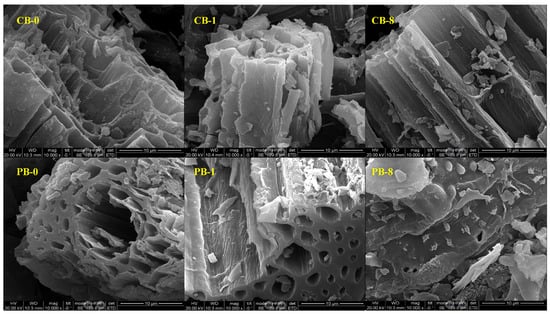
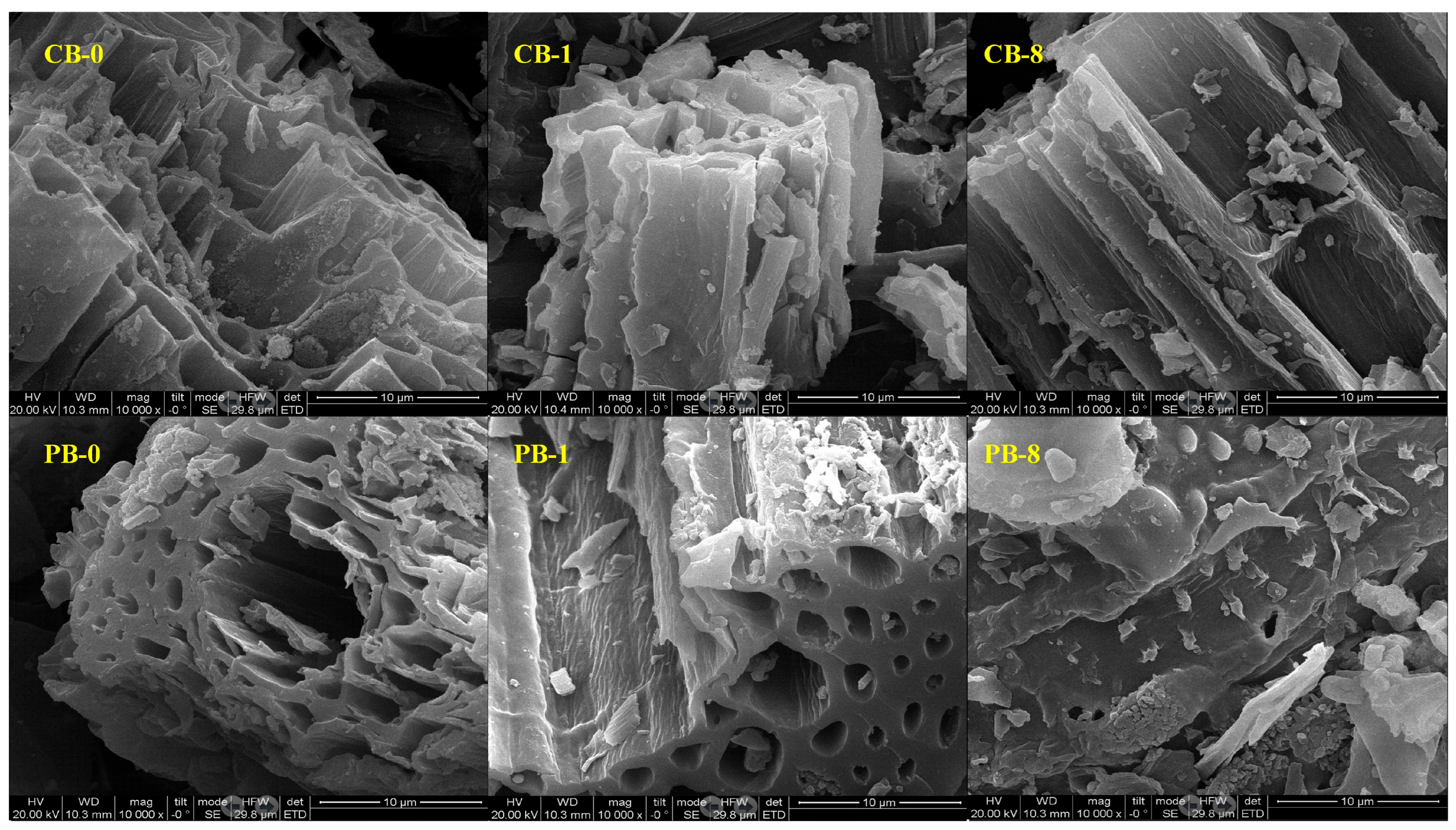
CB and PB had abundant pores densely arranged before accelerated simulated aging (Figure 1). The accelerated simulated aging treatment did not markedly alter the surface morphology of the biochars, but it increased the total pore volume of CB-8 and PB-8 by 12.4% and 26.6% compared to CB-0 and PB-0 (Table S2), respectively. The N2 adsorption–desorption isotherms of biochar before and after accelerated simulated aging were classified as Type IV with H3 hysteresis loop (Figure S4), indicating highly irregular pore structure. After the accelerated simulated aging treatment, the porous structure of biochars was partially collapsed, accompanied by an increase in fragment abundance. The specific surface area of CB-8 and PB-8 were increased by 41.8% and 4.55% than those before aging, respectively (Table S2). This enhancement was likely due to the DW, FT, and SAR aging treatments, which dissolved pore-clogging ash and unstable carbon components [34].
Figure 1.
SEM of biochars at 10 μm before and after accelerated simulated aging. Note: The “CB-0”, “CB-1”, and “CB-8” referred to the original CB and CB aged for 1 and 8 years, respectively. The “PB-0”, “PB-1”, and “PB-8” referred to the original PB and PB aged for 1 and 8 years, respectively.
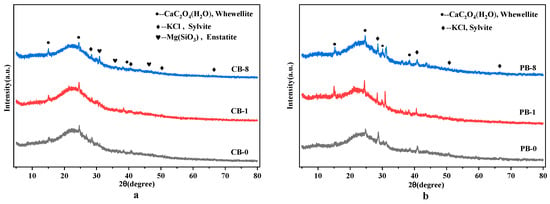
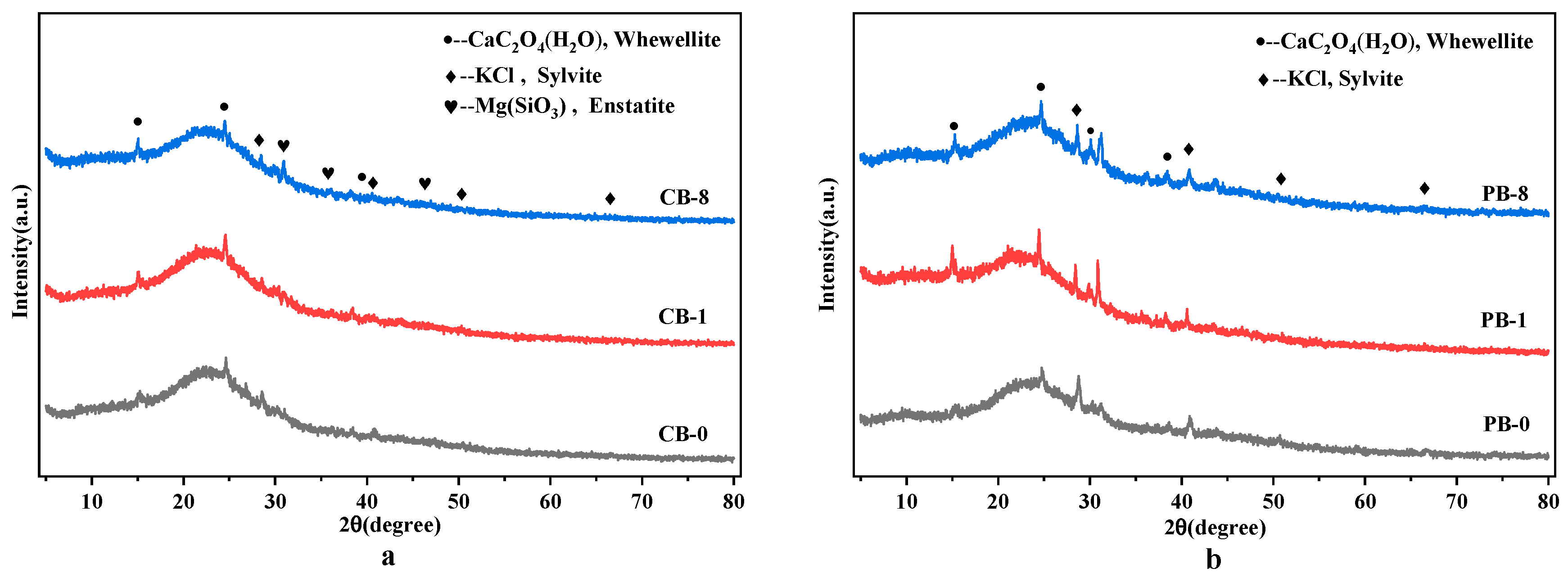
The main diffraction peaks of the biochars appeared within the 15–60° 2θ range (Figure 2). The primary minerals identified in CB and PB were CaC2O4·H2O (2θ = 18.8°, 26.4°, and 40.6°) and KCl (2θ = 28.4°, 40.7°, 50.2°, and 66.5°), which likely originated from the volatilization of labile components and the decomposition of straw. Additionally, CB exhibited diffraction peaks corresponding to MgSiO3 (2θ = 31.6°, 45.9°, and 48.3°) that were not detected in PB, which may be attributed to variations in feedstock composition. The surface mineralogy of both biochars was unaffected by the accelerated simulated aging treatment, remaining unchanged from their original state. However, the diffraction peak intensities were decreased after the aging, indicating a reduction in the crystallinity of the major components. This decline was likely attributable to the corrosion of the biochar’s crystal structure by SAR.
Figure 2.
XRD patterns of CB (a) and PB (b) before and after accelerated simulated aging.
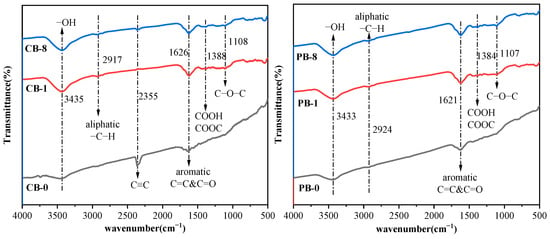
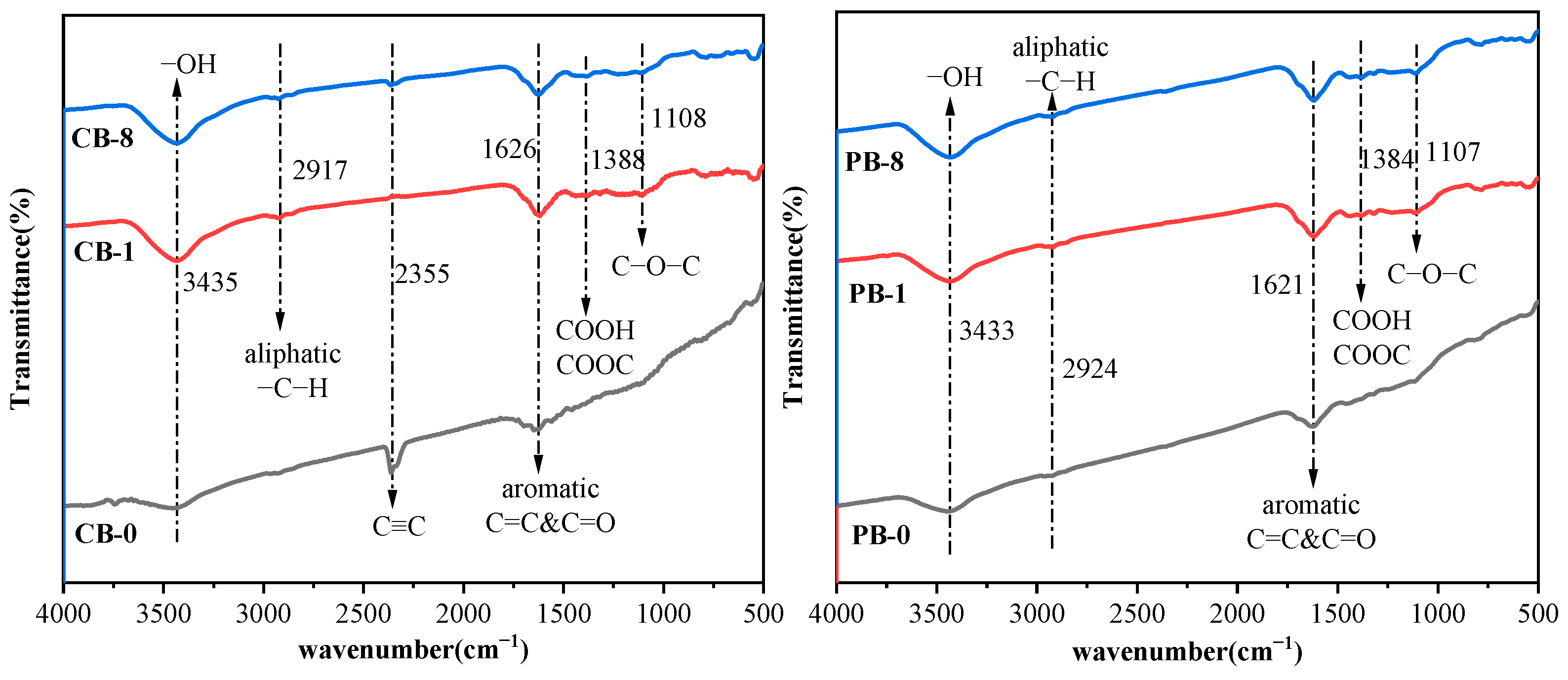
The two biochars showed vibrational peaks corresponding to aliphatic or aromatic C=C and C=O bonds at 1626 cm−1 and 1621 cm−1, respectively [35,36] (Figure 3). The C≡C stretching vibration peak was observed for CB-0 at 2355 cm−1, while an aliphatic C–H stretching vibration peak appeared for PB-0 at 2924 cm−1. After the accelerated simulated aging, the absorption peak intensity at 2355 cm−1 was decreased in CB, indicating that aging effectively reduced the surface C≡C content. Furthermore, FTIR revealed the emergence and enrichment of surface oxygen functionalities (–OH, C=C/C=O, O=C–O, and C–O–C) during accelerated simulated aging, which was attributed to the exposure of biochars to ambient air.
Figure 3.
FTIR spectra of biochars before and after accelerated simulated aging.
The XPS full spectra and C1s spectra of the biochars are shown in Figures S5 and S6. Five peaks were identified in both biochars, corresponding to C–C/C–H (284.7–284.8 eV), C–O (285.8–286.0 eV), C=O (286.5–287.3 eV), O=C–O (288.3–288.8 eV), and π–π* shake-up satellites (293.2–293.4 eV) [37,38,39]. Before accelerated simulated aging, C atoms on the biochar surfaces were predominantly in the form of C–C/C–H bonds, accounting for 77.6% and 76.8% of the total carbon in CB and PB, respectively (Table 1). After the accelerated simulated aging treatment, the relative C–C/C–H content in CB and PB was decreased by 8.0% and 9.3%, indicating a reduction in aromaticity. This decline may be attributed to the conversion of hydroxyl groups into carboxyl groups during the accelerated simulated aging process, or to oxidative depletion caused by SAR. Changes in C–O and C=O for CB, and in C=O and O=C–O for PB were opposite to those of C–C/C–H after the accelerated simulated aging. For instance, contents of C–O and C=O on CB after accelerated simulated aging equivalent to 8 years were increased by 5.74% and 3.02% than that before aging, respectively. Moreover, the total contents of oxygen-containing functional groups in CB-8 and in PB-8 were increased by 11.5% and 2.24% in PB-8 compared with them before aging, respectively. This increase was mainly attributed to air exposure during the accelerated simulated aging process, which was consistent with the FTIR results.
Table 1.
C1s bonding state and their relative percentage (%) on the biochars.
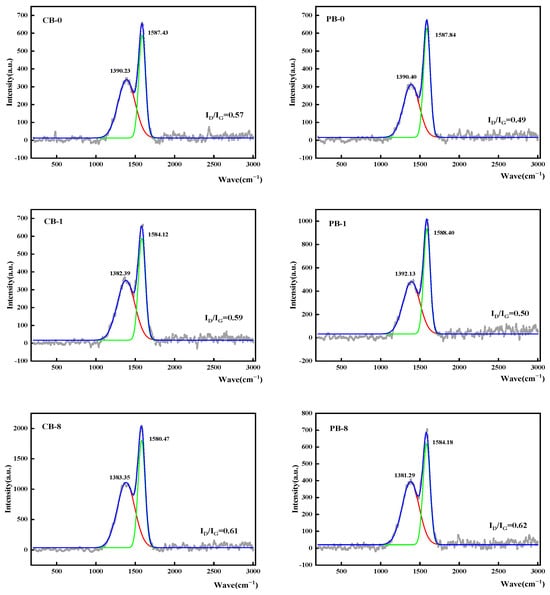
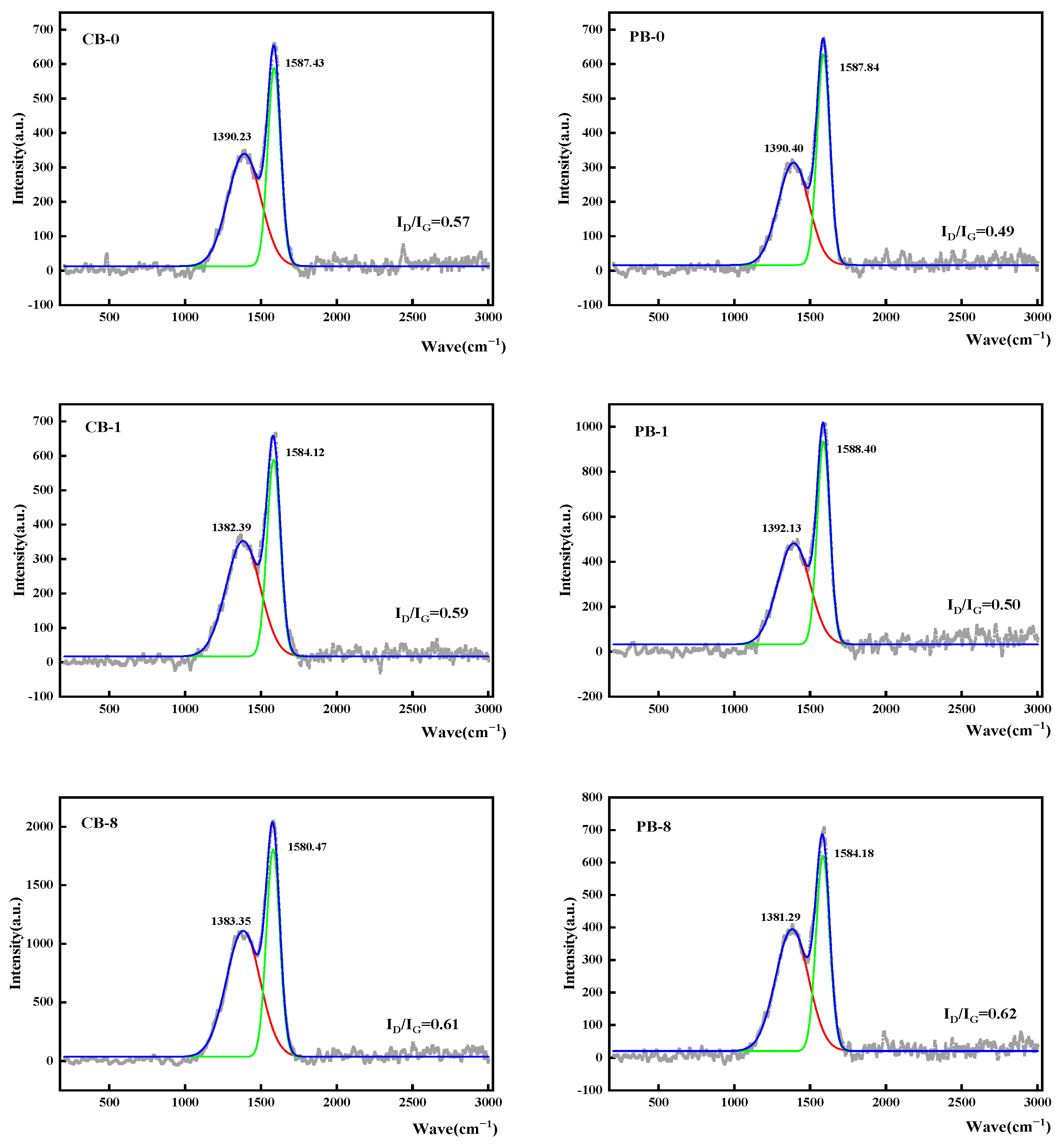
The G-band (1581–1589 cm−1) and D-band (1381–1403 cm−1) correspond to the vibration of sp2-hybridized carbon atoms in graphitic structures and C=C bonds, and to the breathing modes of disordered graphitic rings, respectively [40]. The ID/IG ratio can be used to quantify the degree of defects and graphitization in biochars. After the accelerated simulated aging equivalent to 8 years, the ID/IG ratios of CB and PB were increased by 7.02% and 26.5%, respectively (Figure 4), indicating an increase in structural defects and a decrease in the degree of graphitization of the biochars. The increase was likely attributable to the incorporation of O-containing functional groups, which disrupted the regular sp2 graphite structure and thereby promoted defect formation and structural disorder.
Figure 4.
Raman spectra of CB and PB before and after accelerated simulated aging.
3.1.2. Changes in Cd Extractability in Two Biochars
The CB and PB both showed alkaline properties, with pH values of 9.71 and 9.85, respectively (Table 2). This alkalinity may originate from carbonates of alkali (Na, K) and alkaline earth metals (Ca, Mg) formed during straw pyrolysis [41]. The accelerated simulated aging significantly decreased the pH of CB and PB by 1.05–1.82 units and 1.42–2.02 units, respectively. For instance, the pH of CB-1, CB-4, and CB-8 were decreased by 1.05, 1.76, and 1.82 units than CB before aging, respectively. The decline of biochar pH was primarily attributed to the introduction of SAR, neutralizing alkaline components in the biochars. Furthermore, accelerated simulated aging promoted the formation of oxygen-containing functional groups (–COOH and –OH), as evidenced by FTIR and XPS, which contributed to the pH reduction.
Table 2.
The pH, water-soluble, and CaCl2-extractable Cd in two biochars before and after aging.
The water-soluble Cd in PB was measured at 28.7 μg·kg−1, which is 1.38 times higher than that in CB (Table 2). Accelerated simulated aging treatment significantly increased the water-soluble Cd for CB and PB by 19.9–150.7% and 30.1–120.9%, respectively. Similarly, the CaCl2-extractable Cd in PB was 1.50 times higher than that in CB (Table 2), and aging significantly increased the CaCl2-extractable Cd for CB and PB by 26.1–109.9% and 30.3–76.9%, respectively. The water-soluble and CaCl2-extractable Cd in PB were higher than those of CB, likely because PB was prepared from rice straw collected from contaminated soils. Moreover, two-way ANOVA showed that water-soluble and CaCl2-extractable Cd were significantly associated with biochar type and aging time, but the interaction was not significant for CaCl2-extractable Cd (p = 0.058) (Table S3).
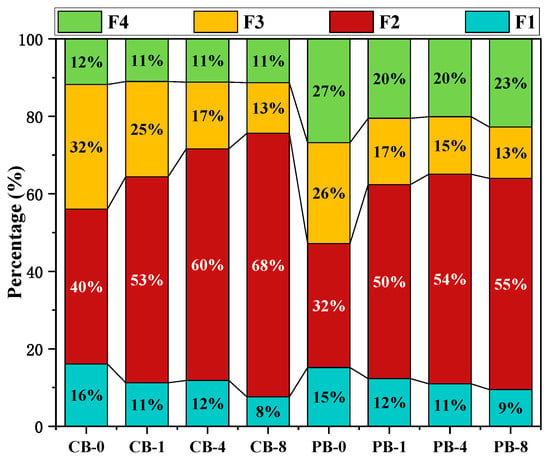
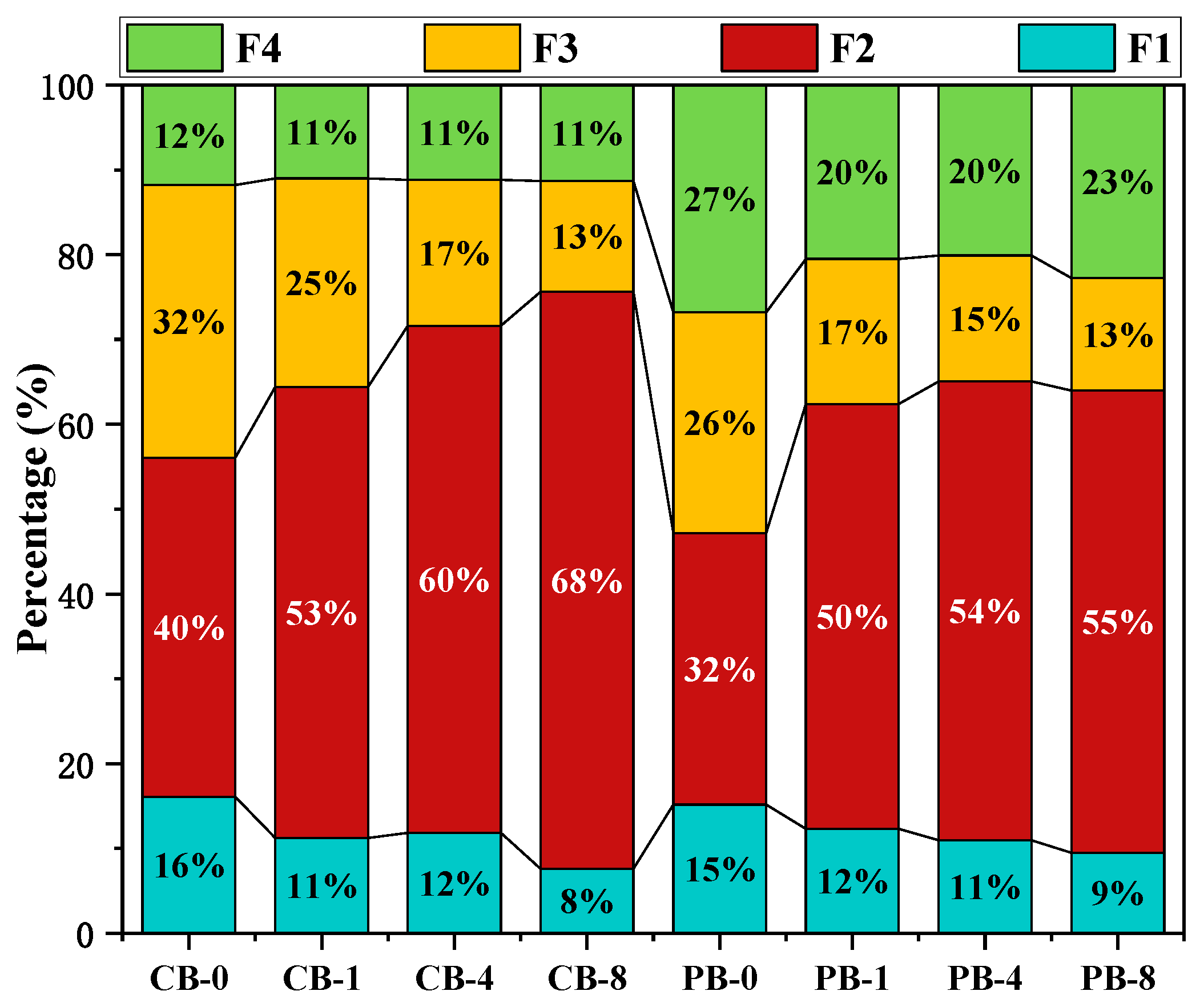
In CB-0, endogenous Cd was primarily concentrated in the reducible (F2, 40%) and oxidizable (F3, 32%) fractions, whereas it was dominated by the reducible (F2, 32%) and residual (F4, 27%) fractions in PB-0 (Figure 5). Compared with CB-0 and PB-0, the acid-soluble fraction (F1) in CB-8 and PB-8 was decreased significantly by 52.1% and 37.9% (Table S4), respectively. The F1 fraction, which reflects metal toxicity and extractability, includes water-soluble, ion-exchangeable, and carbonate-bound Cd [42]. The CaCl2-extractable Cd includes water-soluble, part of ion-exchangeable and part of weakly bound to carbonate, and oxides [43]. The increase in water-soluble and CaCl2-extractable Cd after aging (Table 2) suggested that the decrease in F1 may have been mainly due to the decline in carbonate-bound Cd, a process driven by the pronounced drop in biochar pH. Similarly, the F3 fraction in CB-8 and PB-8 were decreased by 19% and 13% compared with CB-0 and PB-0 (Figure 5), respectively. This indicated that accelerated simulated aging may have contributed to the release of Cd bound to organic matter, possibly due to the rise in O-containing functional groups of the biochar. In contrast, the F2 fraction in CB-8 and PB-8 were increased by 28% and 23% compared with CB-0 and PB-0 (Figure 5), respectively. Moreover, the labile fraction (F1 + F2) of endogenous Cd in CB-8 and PB-8 was increased by 20% and 17% than those before aging, respectively. These results suggested that the accelerated simulated aging process may promote the transformation of F1 and F3 into F2, thereby raising the proportion of labile Cd. Two-way ANOVA showed that the F1, F2, and F3 fractions were significantly influenced by both biochar type and aging time (p < 0.001), while the F4 fraction remained unaffected by aging time (Table S5).
Figure 5.
The proportion of endogenous Cd in two biochars before and after accelerated simulated aging. Note: F1: acid-soluble fraction, F2: reducible fraction, F3: oxidizable fraction, F4: residual fraction.
The above results suggested that the accelerated simulated aging treatment mobilized the endogenous Cd from the two biochars. The extractability of endogenous Cd during accelerated simulated aging may be governed by multiple mechanisms. First, the increase in acidic functional groups and the decrease in biochar pH likely activated the endogenous Cd. The Cd mobilization in CB and PB is more likely dominated by the dissolution of carbonate-bound Cd, which induced redistribution of Cd among various fractions. Our previous studies indicated that Cd activation was primarily driven by changes in inorganic components and the decline in biochar pH [18]. Similarly, Chang et al. reported that Cd bound to carbonate compounds in biochar became more labile after application to highly acidic soil, due to the decomposition of Cd carbonates and hydroxides [44]. Second, the accelerated simulated aging process significantly increased the specific surface area (SSA) of the biochars (Table S2), thereby enhancing their exposure to air and water and facilitating the release of endogenous Cd. Although the increase in SSA was greater for CB (41.8%) than for PB (4.55%), Cd mobilization occurred in both biochars, indicating the SSA was not a key factor influencing Cd mobility. Third, the shifts in the composition of organic functional groups decreased the efficacy of biochar in stabilizing endogenous Cd. In this study, the decrease in carbon-containing functional groups during the accelerated simulated aging process promoted the activation of organic matter-bound Cd. Cui et al. also observed that unstable aliphatic hydrocarbon or cycloalkane groups, especially aliphatic -CHx (-CH2- or -CH3-) groups, degraded during the accelerated simulated aging process [45]. Finally, previous studies suggested that the composite accelerated simulated aging can increase the release of dissolved organic carbon from biochar [46,47], which may further contribute to Cd mobilization. Overall, our findings suggested that the increase in Cd extractability in biochar may be mainly attributable to alterations in biochar properties and the decomposition or mineralization of organic carbon that binds Cd. However, the detailed activation mechanisms and their relative contributions to the overall Cd release require further investigation.
3.2. Changes in Chemical Fractions of Cd in Biochar-Amended Soils
The addition of CB and PB effectively enhanced soil pH (CBS-0 and PBS-0) by 1.12 units compared to the control soil (Table 3). Similarly to single biochar aging, the accelerated simulated aging significantly decreased soil pH. For example, soil pH in CBS-8 and PBS-8 was decreased by 2.33 and 2.21 units than those before aging, respectively. Moreover, the soil pH in all biochar-treated soils was close to the control soil after the simulated 4-year aging treatment, indicating that the amelioration effect on soil pH by the two biochars was not sustainable. This trend was consistent with our previous in situ experiment, in which soil pH in charcoal-amended plots was dropped from 4.90 after one year to 4.41 after five years [48].
Table 3.
Soil pH, water-soluble and CaCl2-extractable Cd in biochar-amended soils before and after aging.
The addition of CB and PB significantly increased soil total Cd by 81.3–83.2% and 118.0–120.3% than the control soil, respectively, owing to the high endogenous Cd in both biochars (Table S7). Before aging, the soil application of CB and PB significantly increased the water-soluble Cd by 267.1% and 331.0%, respectively, but had no significant effect on CaCl2-extractable Cd. Moreover, 1–8 years of aging increased the water-soluble Cd in CB- and PB-treated soils by 3.81–39.0 and 2.53–56.8 times than those before aging, respectively, and CaCl2-extractable Cd by 1.76–18.9 and 1.96–14.6 times, relative to pre-aging levels (Table 3). The results indicated that the increases in water-soluble and CaCl2-extractable Cd were substantially greater than that of total Cd. Although total Cd in the amended soils (0.63–0.77 mg·kg−1) remained below the risk screening value of 1.5 mg·kg−1 (GB 15618-2018), the concentrations of water-soluble Cd in CBS-4, CBS-8, PBS-4, and PBS-8 (25.99–56.32 μg·L−1, Figure S7) were 2.60–5.63 times higher than farmland irrigation water limit (0.01 mg·L−1, GB5084-2021 [49]). Exceeding the irrigation water quality limit for Cd in the soil solution did not imply that the soil was contaminated; rather, it indicated an elevated potential availability of Cd in the soil and can serve as an early warning signal. Furthermore, the control soil also exhibited a marked increase in Cd extractability during accelerated simulated aging, with water-soluble Cd increasing from 1.13 to 69.75 μg·kg−1 and CaCl2-extractable Cd increasing from 16.84 to 65.84 μg·kg−1, accompanied by a decrease in soil pH from 4.78 to 3.66 (Table 3). This indicated that the accelerated aging protocol itself strongly mobilized native soil Cd through acidification. Therefore, the increase in Cd extractability during accelerated simulated aging may be due to the Cd from soil itself and biochar-borne. Moreover, after 4 and 8 years of aging, the absolute increases in water-soluble and CaCl2-extractable Cd were significantly greater in the biochar-amended soils than in the control soil (Table 3).
Two-way ANOVA indicated that biochar treatment, aging time, and their interaction significantly affected the soil pH, water-soluble Cd, and CaCl2-extractable Cd (Table S6). The soil pH was significantly negatively correlated with the water-soluble (r = −0.69, p < 0.05) and CaCl2-extractable (r = −0.65, p < 0.05) Cd (Figure S8). These results indicated the decrease in soil pH result from the accelerated simulated aging enhanced the Cd extractability in soil. Similarly, Van Gestel et al. [50] and Zhang et al. [51] also reported that the reduce of soil pH can effectively mobile soil Cd through increasing the water-soluble and CaCl2-extractable Cd. Furthermore, the higher availability of Cd in PBS than CBS was similar to that of single biochar accelerated simulated aging (the detailed activation mechanism has been discussed above). Overall, the increased extractability indicated greater mobility of Cd, but it cannot reflect the potential environmental risk in soil. In future, the potential environmental risk due to the application of biochars in acidic clean soil should be further assessed together with plant uptake and toxicity data.
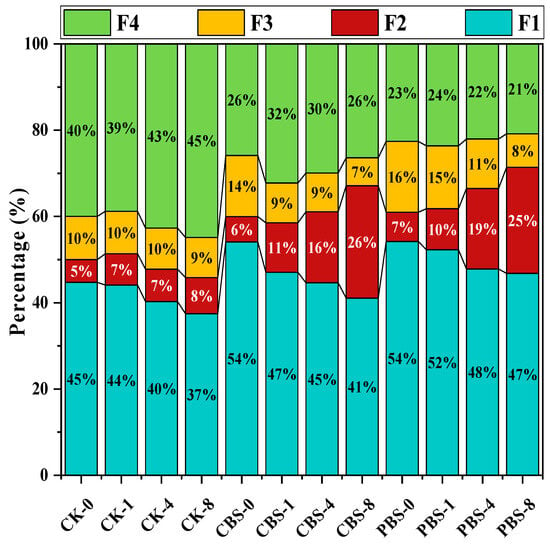
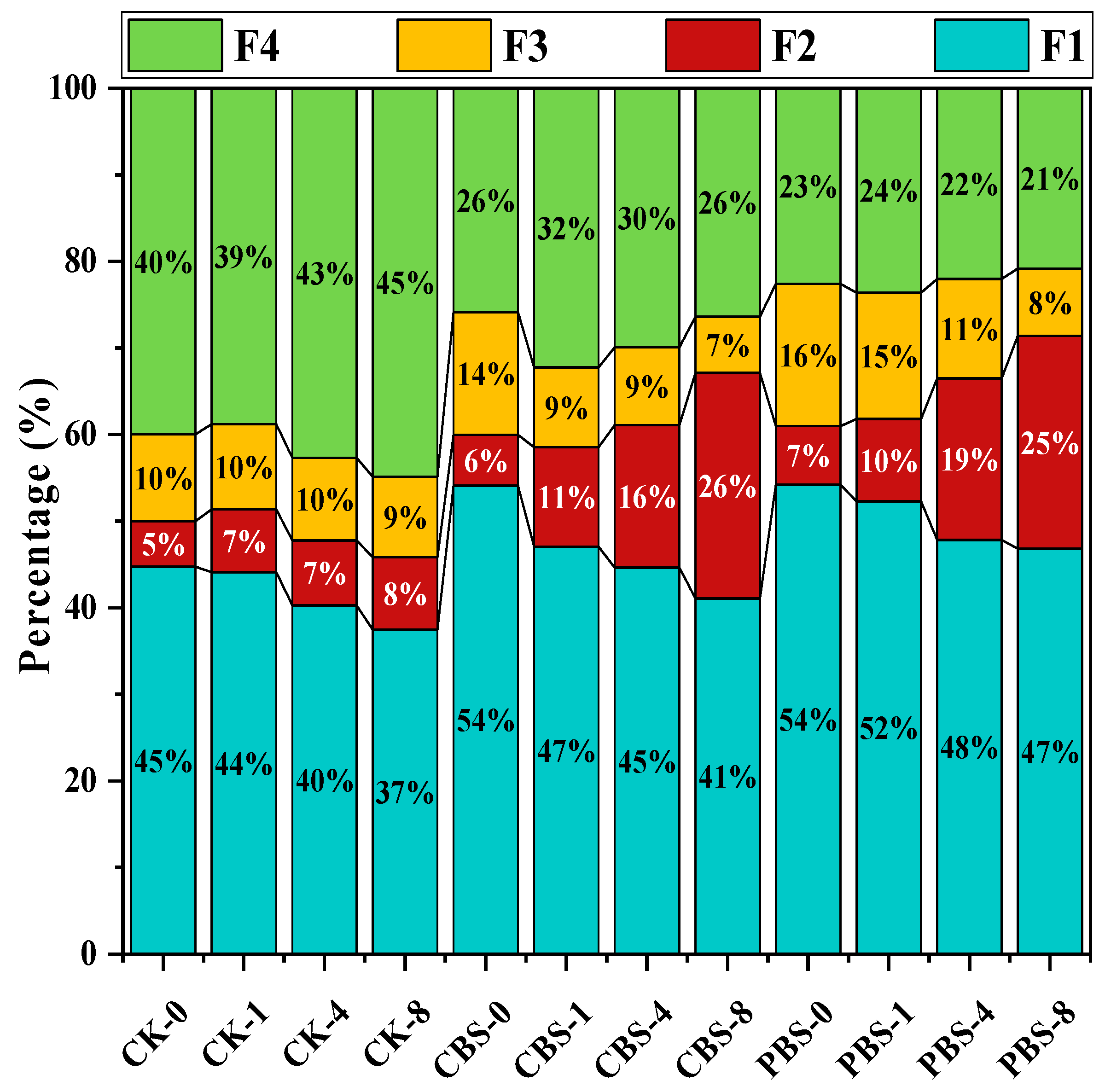
Before accelerated simulated aging, total Cd was predominantly present in the acid-soluble (F1, 32–54%) and residual (F4, 23–64%) fractions for all soils (Figure 6). Compared with CK-0, the F1, F2, and F3 fractions in CBS-0 and PBS-0 were 3.08- and 3.70-fold, 5.62- and 7.79-fold, and 16.2- and 22.5-fold higher, respectively (Table S7). Moreover, the F1 in PB- and CB-treated soils was elevated by 0.99–1.80-fold compared to those in the control soil during the accelerated simulated aging process, suggesting the significant negative effects from the application of biochars. The accelerated simulated aging did not significantly change the F1, F2, and F3 in the control soil, but it decreased the F1 fraction by 13.7–24.0% for CB-treated soils. Compared with CBS-0 and PBS-0, the accelerated simulated 1–8-year aging treatment decreased the F1 fraction (by 13.7–24.0% and 3.52–14.3%, respectively) and the F3 fraction (by 35.4–54.0% and 11.1–53.1%, respectively), but increased the F2 fraction (by 94.3–344.5% and 40.2–260.3%, respectively). The similar changes for the F1, F2, and F3 among the single biochars (Table S4) and their amended soils (Table S7) indicated the endogenous Cd in biochars may have contributed to the increased Cd availability in soil. Compared with CK-0, the labile fraction (F1 + F2) of Cd in CBS-0 and PBS-0 was increased by 10% and 11%, respectively. Furthermore, the accelerated simulated aging equivalent to 8 years increased the labile fraction by 7% in CBS-8 and 11% in PBS-8 compared to those of CBS-0 and PBS-0, respectively. Similar to the single biochar accelerated simulated aging, the labile fraction of Cd in PB-treated soils was higher than that in CB-treated soils. These results suggested that applying biochars with high endogenous Cd elevated Cd extractability in originally background soil, primarily because the biochars introduced more Cd. Two-way ANOVA showed that both biochar type and simulated aging time significantly affected the F1, F2, and F3 fractions (p < 0.001). The F4 fraction was significantly affected only by biochar type (p < 0.001), not by aging time (p = 0.391). The interactions between biochar type and simulated aging time were significant for the F2 and F3 fractions (p < 0.001), but not for the F1 (p = 0.165) or F4 (p = 0.195) fractions (Table S8).
Figure 6.
Effect of simulated composite aging on the proportion of chemical forms of Cd in biochar-amended soils. Note: F1: acid-soluble fraction, F2: reducible fraction, F3: oxidizable fraction, F4: residual fraction.
3.3. Environment Implications
Biochar is commonly used as a soil amendment to improve soil structure and neutralize soil acidity [12]. In this study, biochar application effectively increased soil pH, but the ameliorating effect was short-lived, with pH in treated soils approaching that of the untreated control by year 4 of aging. Unfortunately, previous studies overlooked the potential risks posed by endogenous pollutants from biochar when it was applied into the clean soils [52]. The accelerated simulated aging treatment resulted in a marked enhancement in the water-soluble and CaCl2-extractable Cd for biochars. Collectively, amending acidic clean soil with 5% (w/w) biochar not only raised the total Cd content but also increased the water-soluble, CaCl2-extractable, and acid-soluble Cd, and these environmental risks were further amplified under the accelerated simulated aging. These findings suggested that biochar containing high levels of endogenous Cd may increase Cd extractability and the potentially labile Cd pool when used for soil acidification mitigation.
In addition, some biochars possess even higher endogenous Cd concentrations than those used in this study, especially at higher application rates. For example, the endogenous Cd concentration in tobacco stem-derived biochar was 7.63 mg·kg−1, and the application rate of 15 t·ha−1 biochar increased the accumulation of heavy metals in tobacco crops [53]. Therefore, it is indispensable to limit the concentration of endogenous pollutants in biochar and the application dosage. For example, both the endogenous pollutant content and the application rate should be strictly controlled to ensure pollutant levels remain below soil risk screening values when amending clean soils. Meanwhile, some pre-experiments are indispensable to evaluate the biotoxicity before soil application. However, there are significant discrepancies in permissible limits for endogenous pollutants in biochar. For Cd, limits for Cd in the Internet Biochar Initiative, European Biochar Certificate, and UK Biochar Quality Mandate ranged from 1.40 mg·kg−1 to 39.0 mg·kg−1 [54]. Moreover, biochar quality standards, standardized guidelines for biochar application rates and duration of continuous use are lacking in China. Previous studies have reported application rates ranging from 1.5 to 40 t·ha−1 (often exceeding 10 t·ha−1) [55] and experimental durations from 1 to 10 years [56]. The high rate (5%) in this study is very high when translated to a field-equivalent dose (112.5 t·ha−1), which amplify the potential effects of biochar aging on soil pH and Cd extractability within the accelerated simulated aging period. Therefore, the Cd activation observed here may overestimate the short-term risk under normal field application rates, and the long-term risk under repeated or excessive biochar application need further investigated in future.
Meanwhile, it should also be noted that this study focused solely on Cd, neglecting other potential contaminants such as organic pollutants and persistent free radicals (PFRs). Wang et al. found that the total PAH concentrations in rice husk-derived biochar were 12,347 μg·kg−1, which exert significant toxic effects on eight edible vegetables [57]. PFRs, which are ubiquitous in biochars, also exhibit considerable cytotoxicity and phytotoxicity in soil environments [58]. Beyond endogenous pollutants, biochar application can alter soil physical properties. For instance, Yang and Lu observed that biochar addition significantly reduced soil tensile strength [59]. To ensure the safe and sustainable use of biochar, greater attention must be paid to feedstock selection, production processes and application dosages. Moreover, the biochar used in this study was exclusively derived from rice straws. In fact, the feedstock types and pyrolysis conditions substantially influence biochar’s physico-chemical properties and the chemical speciation of inherent heavy metals. Thus, the conclusions from this study may not be representative of biochars produced from other biomass sources, such as sewage sludge, animal manure, or wood chips. Although the accelerated laboratory aging protocol incorporated multiple environmental stressors (DW, FT, SAR, and fertilization), it inherently simplified the intricate and synergistic interactions among natural field conditions, such as solar radiation, microbial colonization, seasonal climatic extremes, and rhizosphere effects. In particular, laboratory aging cannot fully reproduce microbial activity, plant uptake, seasonal variability, or natural weathering. As a result, this design limitations undermined the representativeness of the study’s findings. Consequently, there is a clear need for future field experiments to systematically evaluate the environmental risks associated with different biochar dosages in diverse soil types. Finally, a standardized methodology for assessing the environmental risks of biochar is urgently needed. Prior to large scale deployment, it is critical to establish guidelines for dosage, toxicity testing, and risk assessment.
4. Conclusions
This study elucidated the potential impact of rice-straw biochars with high levels of endogenous Cd on Cd extractability in acidic soils under simulated environmental aging. For the individual biochars, accelerated simulated aging decreased biochar pH by 1.05–2.02 units and may promote the transformation of carbonate-bound Cd to the reducible fraction. It also increased water-soluble and CaCl2-extractable Cd, while reducing the oxidizable fraction by 13–19%. These changes suggested that accelerated simulated aging may have enhanced the mobility of endogenous Cd from biochars under the accelerated simulated aging conditions. For CB- and PB-amended soils at 5% dosage, biochar addition significantly increased soil pH, but they were close to control soil after the accelerated simulated aging equivalent to 8 years. Across the accelerated simulated aging equivalent to 1–8 years, biochar addition increased water-soluble and CaCl2-extractable Cd by 2.53–56.8-fold and 1.76–18.9-fold, respectively, relative to pre-aging levels. These increases were substantially greater than the corresponding rise in total soil Cd (81.3–120.3%). Although acid-soluble Cd was decreased after the accelerated simulated aging equivalent to 8 years treatment for CB-treated soils, the labile Cd pool (F1 + F2) was increased by 7–11% in CB- and PB-amended soils, suggesting continuous redistribution of endogenous Cd into more labile fractions. These findings indicated that accelerated simulated aging may mobilize endogenous Cd in biochar and enhance its extractability in acidic soil. Given that this study was limited to a single acidic soil, one high-dose application (unconventional agronomic rate), and an accelerated laboratory protocol, long-term field validation is necessary to confirm these trends under natural conditions.
Supplementary Materials
The following supporting information can be downloaded at: https://www.mdpi.com/article/10.3390/agronomy16202039/s1, Text S1: Characterization of biochar for analytical determination of parameters; Table S1: The detailed cycle count and sampling schedule for the CB treatment; Table S2: Specific surface area and porosity of biochars before and after the accelerated simulated aging; Table S3: Two-way ANOVA test showing F-value of parameters of biochar affected by biochar types (BC: CB and PB) and simulated aging years (SY: 0, 1, 4, and 8 years); Table S4: The chemical fractions of endogenous Cd (µg·kg−1) in biochars; Table S5: Two-way ANOVA test showing F-value of F1, F2, F3, F4 of biochars affected by biochar types (BC: CB and PB) and simulated aging years (SY: 0, 1, 4, and 8 years); Table S6: Two-way ANOVA test showing F-value of parameters of soil affected by biochar types (BC: CK, CBS, and PBS) and simulated aging years (SY: 0, 1, 4, and 8 years); Table S7: The chemical fractions of Cd (µg·kg−1) in biochar amended soil; Table S8: Two-way ANOVA test showing F-value of F1, F2, F3, F4 of biochar-amended soils affected by biochar types (BC: CK, CB, and PB) and simulated aging years (SY: 0, 1, 4, and 8 years); Figure S1: The process of annual accelerated simulated aging; Figure S2: The destructively sampling process for the single biochar (CB) accelerated simulated aging; Figure S3: The destructively sampling process for the aging of biochar amended soil (CBS); Figure S4: N2 adsorption-desorption isotherms of biochars before and after the accelerated simulated composite aging treatments; Figure S5: The XPS full spectrum of biochar before and after the accelerated simulated composite aging; Figure S6: C1s XPS spectra of biochars before and after the accelerated simulated composite aging; Figure S7: Changes of soil water-soluble Cd before and after accelerated simulated composite aging; Figure S8: Correlation between pH and chemical fractions of Cd in soil. *, **, and *** indicate significant correlation at p < 0.05, p < 0.01, and p < 0.001.
Author Contributions
X.L.: Methodology, Formal analysis, Investigation, Visualization, Writing—original draft, Writing—review and editing. Y.F.: Conceptualization, Methodology, Resources, Supervision, Validation, Investigation, Visualization, Writing—original draft, Writing—review and editing. H.C.: Conceptualization, Methodology, Resources, Supervision, Validation, Investigation, Visualization, Writing—original draft, Funding acquisition, Writing—review and editing. L.L.: Formal analysis, Investigation, Writing—original draft, Writing—review and editing. R.X.: Conceptualization, Methodology, Funding acquisition, Project administration, Resources, Supervision, Validation, Investigation, Visualization, Writing—original draft, Writing—review and editing. L.Z.: Conceptualization, Methodology, Resources, Supervision, Project administration, Funding acquisition, Writing—review and editing. Q.W.: Project administration, Writing—review and editing. J.Z.: Conceptualization, Methodology, Resources, Supervision, Validation, Investigation, Visualization, Writing—review and editing. All authors have read and agreed to the published version of the manuscript.
Funding
The project was supported by the Opening Foundation of Anhui Province Engineering Research Center of Water and Soil Resources Comprehensive Utilization and Ecological Protection in High Groundwater Mining Area (Grant No. 2024-WSREPMA-03), the Anhui Province Natural Science Foundation, China (2208085MD87), Key Special Research Projects on Core Agricultural Technologies in Jiangxi Province (JXN02607-05), and the Jiangsu Provincial Natural Science Foundation (BK20251701).
Data Availability Statement
The original contributions presented in this study are included in the article/Supplementary Material. Further inquiries can be directed to the corresponding authors.
Acknowledgments
The authors extended thanks to the Analytical and Testing Center of Anhui University of Science and Technology for providing accurate test data from FTIR, XRD, and XPS analytical instruments.
Conflicts of Interest
The authors declare no conflicts of interest.
References
- Zhu, Q.; Liu, X.; Hao, T.; Zeng, M.; Shen, J.; Zhang, F.; de Vries, W. Cropland Acidification Increases Risk of Yield Losses and Food Insecurity in China. Environ. Pollut. 2020, 256, 113145. [Google Scholar] [CrossRef] [Scilit] [PubMed]
- Zamanian, K.; Taghizadeh Mehrjardi, R.; Tao, J.; Fan, L.; Raza, S.; Guggenberger, G.; Kuzyakov, Y. Acidification of European Croplands by Nitrogen Fertilization: Consequences for Carbonate Losses, and Soil Health. Sci. Total Environ. 2024, 924, 171631. [Google Scholar] [CrossRef] [Scilit] [PubMed]
- Xiao, H.; Wang, B.; Lu, S.; Chen, D.; Wu, Y.; Zhu, Y.; Hu, S.; Bai, Y. Soil Acidification Reduces the Effects of Short-Term Nutrient Enrichment on Plant and Soil Biota and Their Interactions in Grasslands. Glob. Change Biol. 2020, 26, 4626–4637. [Google Scholar] [CrossRef] [Scilit] [PubMed]
- Kicińska, A.; Pomykała, R.; Izquierdo-Diaz, M. Changes in Soil pH and Mobility of Heavy Metals in Contaminated Soils. Eur. J. Soil Sci. 2022, 73, e13203. [Google Scholar] [CrossRef] [Scilit]
- Zhang, M.-W.; Sun, M.-Z.; Wu, Y.; Wu, C.-H.; Song, H.-J.; Hu, D.-D.; Xia, J.; Sun, H.; Liu, K.-L. Application of Oyster Shell Powder for Five Consecutive Years Effectively Controlled Soil Acidification and Reduced Cadmium Accumulation in Rice Grains. Sci. Rep. 2025, 15, 12008. [Google Scholar] [CrossRef] [Scilit] [PubMed]
- Zhang, S.; Zhu, Q.; De Vries, W.; Ros, G.H.; Chen, X.; Muneer, M.A.; Zhang, F.; Wu, L. Effects of Soil Amendments on Soil Acidity and Crop Yields in Acidic Soils: A World-Wide Meta-Analysis. J. Environ. Manag. 2023, 345, 118531. [Google Scholar] [CrossRef] [Scilit] [PubMed]
- Nguyen, T. Lime Requirement for Agricultural Soils: A Review of the Current and Potential Methods for Routine Use. J. Plant Nutr. Soil Sci. 2023, 186, 23–29. [Google Scholar] [CrossRef] [Scilit]
- Wenyika, P.; Enesi, R.O.; Gorim, L.Y.; Dyck, M. Effects of Liming on Soil Physical and Chemical Properties in Europe and North America: A Review. Geosci. Environ. 2025, 8, e70175. [Google Scholar] [CrossRef] [Scilit]
- Olsson Nyström, Å.; Blomquist, J.; Persson, L.; Gunnarsson, A.; Berglund, K. Long-Term Effects of Liming on Crop Yield, Plant Diseases, Soil Structure and Risk of Phosphorus Leaching. Agric. Food Sci. 2023, 32, 139–153. [Google Scholar] [CrossRef] [Scilit]
- Islam, T.; Li, Y.; Cheng, H. Biochars and Engineered Biochars for Water and Soil Remediation: A Review. Sustainability 2021, 13, 9932. [Google Scholar] [CrossRef] [Scilit]
- Jiang, T.; Wang, B.; Gao, B.; Cheng, N.; Feng, Q.; Chen, M.; Wang, S. Degradation of Organic Pollutants from Water by Biochar-Assisted Advanced Oxidation Processes: Mechanisms and Applications. J. Hazard. Mater. 2023, 442, 130075. [Google Scholar] [CrossRef] [Scilit] [PubMed]
- Albalasmeh, A.A.; Quzaih, M.Z.; Gharaibeh, M.A.; Rusan, M.; Mohawesh, O.E.; Rababah, S.R.; Alqudah, A.; Alghamdi, A.G.; Naserin, A. Significance of Pyrolytic Temperature, Application Rate and Incubation Period of Biochar in Improving Hydro-Physical Properties of Calcareous Sandy Loam Soil. Sci. Rep. 2024, 14, 7012. [Google Scholar] [CrossRef] [Scilit] [PubMed]
- Narciso Ferreira, P.H.; Silva, N.V.; Woloche, C.S.; De Sousa, J.E.S.; Da Silva, J.C.G.; Cassiano, G.H.; Pereira, V.H.; Carazzolle, M.F.; Pereira, G.A.G.; De Abreu, L.G.F. Influence of Biochar on Agave Development and on Soil Characteristics from a Brazilian Semi-Arid Region. Biomass Bioenerg. 2026, 205, 108497. [Google Scholar] [CrossRef] [Scilit]
- Masud, M.M.; Baquy, M.A.-A.; Akhter, S.; Sen, R.; Barman, A.; Khatun, M.R. Liming Effects of Poultry Litter Derived Biochar on Soil Acidity Amelioration and Maize Growth. Ecotoxicol. Environ. Saf. 2020, 202, 110865. [Google Scholar] [CrossRef] [Scilit] [PubMed]
- Cen, Y.; Tu, P.; Ahmed, N.; Deng, L.; Huang, B.; Wang, C.; Deng, L. Phosphorus Availability, Soil Quality and Cucumber Growth in Acidic Soil Was Impacted by the Tobacco Stem-Based Biochar. Plant Soil 2025, 513, 2537–2551. [Google Scholar] [CrossRef] [Scilit]
- Liu, J.; Yin, M.; Zhang, W.; Tsang, D.C.; Wei, X.; Zhou, Y.; Xiao, T.; Wang, J.; Dong, X.; Sun, Y.; et al. Response of Microbial Communities and Interactions to Thallium in Contaminated Sediments near a Pyrite Mining Area. Environ. Pollut. 2019, 248, 916–928. [Google Scholar] [CrossRef] [Scilit] [PubMed]
- Xia, H.; Riaz, M.; Zhang, M.; Liu, B.; El-Desouki, Z.; Jiang, C. Biochar Increases Nitrogen Use Efficiency of Maize by Relieving Aluminum Toxicity and Improving Soil Quality in Acidic Soil. Ecotoxicol. Environ. Saf. 2020, 196, 110531. [Google Scholar] [CrossRef] [Scilit] [PubMed]
- Cui, H.; Li, D.; Liu, X.; Fan, Y.; Zhang, X.; Zhang, S.; Zhou, J.; Fang, G.; Zhou, J. Dry-Wet and Freeze-Thaw Aging Activate Endogenous Copper and Cadmium in Biochar. J. Clean. Prod. 2021, 288, 125605. [Google Scholar] [CrossRef] [Scilit]
- Zeng, X.; Xiao, Z.; Zhang, G.; Wang, A.; Li, Z.; Liu, Y.; Wang, H.; Zeng, Q.; Liang, Y.; Zou, D. Speciation and Bioavailability of Heavy Metals in Pyrolytic Biochar of Swine and Goat Manures. J. Anal. Appl. Pyrolysis 2018, 132, 82–93. [Google Scholar] [CrossRef] [Scilit]
- Thomas, S.C.; Ruan, R.; Gale, N.V.; Gezahegn, S. Phytotoxicity and Hormesis in Common Mobile Organic Compounds in Leachates of Wood-Derived Biochars. Biochar 2024, 6, 51. [Google Scholar] [CrossRef] [Scilit] [PubMed]
- Cui, H.; Cheng, J.; Shen, L.; Zheng, X.; Zhou, J.; Zhou, J. Activation of Endogenous Cadmium from Biochar under Simulated Acid Rain Enhances the Accumulation Risk of Lettuce (Lactuca sativa L.). Ecotoxicol. Environ. Saf. 2023, 255, 114820. [Google Scholar] [CrossRef] [Scilit] [PubMed]
- Yi, W.; Liu, L.; Wang, D.; Zhang, X.; Yu, G. Potential of Biochar Derived from Sewage Sludge and Calcium Sulfate as an Amendment for Acidic Soils: Milk Chinese Cabbage Cultivation. J. Environ. Chem. Eng. 2025, 13, 115641. [Google Scholar] [CrossRef] [Scilit]
- GB15618-2018; Soil Environmental Quality Risk Control Standard for Soil Contamination of Agricultural Land. Ministry of Ecology and Environment of the People’s Republic of China: Bejing, China, 2018.
- Chen, X.; Jiang, S.; Wu, J.; Yi, X.; Dai, G.; Shu, Y. Three-Year Field Experiments Revealed the Immobilization Effect of Natural Aging Biochar on Typical Heavy Metals (Pb, Cu, Cd). Sci. Total Environ. 2024, 912, 169384. [Google Scholar] [CrossRef] [Scilit] [PubMed]
- Wang, L.; Dou, Z.; Ma, C.; Jia, X.; Wang, H.; Bao, W.; Wang, L.; Qu, J.; Zhang, Y. Remediation of Di(2-Ethylhexyl) Phthalate (DEHP) Contaminated Black Soil by Freeze-Thaw Aging Biochar. J. Environ. Sci. 2024, 135, 681–692. [Google Scholar] [CrossRef] [Scilit] [PubMed]
- Xu, Z.; Xu, X.; Tsang, D.C.W.; Cao, X. Contrasting Impacts of Pre- and Post-Application Aging of Biochar on the Immobilization of Cd in Contaminated Soils. Environ. Pollut. 2018, 242, 1362–1370. [Google Scholar] [CrossRef] [Scilit] [PubMed]
- Wang, L.; Bolan, N.S.; Tsang, D.C.W.; Hou, D. Green Immobilization of Toxic Metals Using Alkaline Enhanced Rice Husk Biochar: Effects of Pyrolysis Temperature and KOH Concentration. Sci. Total Environ. 2020, 720, 137584. [Google Scholar] [CrossRef] [Scilit] [PubMed]
- Meng, Z.; Huang, S.; Xu, T.; Deng, Y.; Lin, Z.; Wang, X. Transport and Transformation of Cd between Biochar and Soil under Combined Dry-Wet and Freeze-Thaw Aging. Environ. Pollut. 2020, 263, 114449. [Google Scholar] [CrossRef] [Scilit] [PubMed]
- Zhang, M.; Fan, Y.; Dong, T.; Cui, H.; Feng, X.; Zhang, S.; Zhou, J. The Impacts of Aging on the Mobility of Cadmium and Free Radicals from Biochars. Ecotoxicol. Environ. Saf. 2025, 305, 119283. [Google Scholar] [CrossRef] [Scilit] [PubMed]
- Lévesque, V.; Gagnon, B.; Ziadi, N. Soil Mehlich-3-Extractable Elements as Affected by the Addition of Biochars to a Clay Soil Co-Amended with or without a Compost. Can. J. Soil. Sci. 2022, 102, 97–107. [Google Scholar] [CrossRef] [Scilit]
- Cui, H.; Zhang, W.; Zhou, J.; Xu, L.; Zhang, X.; Zhang, S.; Zhou, J. Availability and Vertical Distribution of Cu, Cd, Ca, and P in Soil as Influenced by Lime and Apatite with Different Dosages: A 7-Year Field Study. Environ. Sci. Pollut. Res. 2018, 25, 35143–35153. [Google Scholar] [CrossRef] [Scilit] [PubMed]
- Luo, H.; Chen, J.; Yang, B.; Li, Y.; Wang, P.; Yu, J.; Yuan, B.; Zhang, Y.; Ren, J.; Du, P.; et al. Cadmium Distribution and Availability in Different Particle-Size Aggregates of Post-Harvest Paddy Soil Amended with Bio-Based Materials. Sci. Total Environ. 2024, 957, 177739. [Google Scholar] [CrossRef] [Scilit] [PubMed]
- Memoli, V.; Eymar, E.; García-Delgado, C.; Esposito, F.; Santorufo, L.; De Marco, A.; Barile, R.; Maisto, G. Total and Fraction Content of Elements in Volcanic Soil: Natural or Anthropogenic Derivation. Sci. Total Environ. 2018, 625, 16–26. [Google Scholar] [CrossRef] [Scilit] [PubMed]
- Tan, L.; Sun, C.; Wang, Y.; Wang, T.; Wu, G.; He, H.; Zheng, J. Changes in Biochar Properties in Typical Loess Soil under a 5-Year Field Experiment. J. Soils Sediments 2020, 20, 340–351. [Google Scholar] [CrossRef] [Scilit]
- Chu, G.; Zhao, J.; Huang, Y.; Zhou, D.; Liu, Y.; Wu, M.; Peng, H.; Zhao, Q.; Pan, B.; Steinberg, C.E.W. Phosphoric Acid Pretreatment Enhances the Specific Surface Areas of Biochars by Generation of Micropores. Environ. Pollut. 2018, 240, 1–9. [Google Scholar] [CrossRef] [Scilit] [PubMed]
- Yang, F.; Gao, Y.; Sun, L.; Zhang, S.; Li, J.; Zhang, Y. Effective Sorption of Atrazine by Biochar Colloids and Residues Derived from Different Pyrolysis Temperatures. Environ. Sci. Pollut. Res. 2018, 25, 18528–18539. [Google Scholar] [CrossRef] [Scilit] [PubMed]
- Li, M.; Dong, C.; Guo, C.; Yu, L. Magnetic Activated Biochar Fe3O4-MOS Made from Moringa Seed Shells for the Adsorption of Methylene Blue. Processes 2022, 10, 2720. [Google Scholar] [CrossRef] [Scilit]
- Lin, H.; Yang, D.; Zhang, C.; Liu, W.; Zhang, L.; Dong, Y. Selective Removal Behavior of Lead and Cadmium from Calcium-Rich Solution by MgO Loaded Soybean Straw Biochars and Mechanism Analysis. Chemosphere 2023, 319, 138010. [Google Scholar] [CrossRef] [Scilit] [PubMed]
- Feng, G.; Li, W.; Ye, H.; Wang, T.; Liu, Y.; Jing, B.; Nie, C.; Li, D.; Ao, Z. Molten Salt-Assisted Synthesis of a Nitrogen-Doped Biochar Catalyst at Low Temperature for Enhanced Degradation of Acetaminophen. J. Mater. Chem. A 2025, 13, 2677–2689. [Google Scholar] [CrossRef] [Scilit]
- Nwanno, C.E.; Gotame, R.C.; Watt, J.; Kuo, W.; Li, W. Vertically Aligned Carbon Nanotubes Grown on Copper Foil as Electrodes for Electrochemical Double Layer Capacitors. Nanomaterials 2025, 15, 1506. [Google Scholar] [CrossRef] [Scilit] [PubMed]
- Sathyabama, K.; Firdous, S. Effect of Pyrolysis Temperature on the Physicochemical Properties and Structural Characteristics of Agricultural Wastes-Derived Biochar. ACS Omega 2025, 10, 37013–37024. [Google Scholar] [CrossRef] [Scilit] [PubMed]
- Han, Y.; Gong, Z.; Xu, M.; Han, Y.; Gong, Z.; Xu, M. Study on the Effect of Mineral Compounds on the Behavior of Heavy Metals During Oily Sludge Incineration. Energies 2025, 18, 834. [Google Scholar] [CrossRef] [Scilit]
- Yan, Q.; Fang, H.; Wang, D.; Xiao, X.; Deng, T.; Li, X.; Wei, F.; Liu, J.; Lin, C. Transfer and Transformation Characteristics of Zn and Cd in Soil-Rotation Plant (Brassica Napus L. and Oryza Sativa L.) System and Its Influencing Factors. Sci. Rep. 2023, 13, 7393. [Google Scholar] [CrossRef] [Scilit] [PubMed]
- Chang, R.; Sohi, S.P.; Jing, F.; Liu, Y.; Chen, J. A Comparative Study on Biochar Properties and Cd Adsorption Behavior under Effects of Ageing Processes of Leaching, Acidification and Oxidation. Environ. Pollut. 2019, 254, 113123. [Google Scholar] [CrossRef] [Scilit] [PubMed]
- Cui, Z.; Wang, Y.; Wang, N.; Ma, F.; Yuan, Y. Effects of Ageing on Surface Properties of Biochar and Bioavailability of Heavy Metals in Soil. Agriculture 2024, 14, 1631. [Google Scholar] [CrossRef] [Scilit]
- Li, J.; Li, Q.; Liang, S.; Zhang, B.; Wang, J.; Yu, Y.; Xia, L.; Zhang, Y.; Wang, Y. Aging Mechanism of Biochar Based on Fluorescence Spectroscopy: Assessing Soil Dissolved Organic Matter (DOM) Dynamics and Cd Bioavailability. Chem. Eng. J. 2025, 505, 159538. [Google Scholar] [CrossRef] [Scilit]
- Wang, L.; O’Connor, D.; Rinklebe, J.; Ok, Y.S.; Tsang, D.C.W.; Shen, Z.; Hou, D. Biochar Aging: Mechanisms, Physicochemical Changes, Assessment, and Implications for Field Applications. Environ. Sci. Technol. 2020, 54, 14797–14814. [Google Scholar] [CrossRef] [Scilit] [PubMed]
- Cui, H.; Fan, Y.; Fang, G.; Zhang, H.; Su, B.; Zhou, J. Leachability, Availability and Bioaccessibility of Cu and Cd in a Contaminated Soil Treated with Apatite, Lime and Charcoal: A Five-Year Field Experiment. Ecotoxicol. Environ. Saf. 2016, 134, 148–155. [Google Scholar] [CrossRef] [Scilit] [PubMed]
- GB 5084-2021; Standard for Irrigation Water Quality. Ministry of Ecology and Environment of the People’s Republic of China. State Administration for Market Regulation: Beijing, China, 2021.
- Van Gestel, C.A.M.; Koolhaas, J.E. Water-Extractability, Free Ion Activity, and pH Explain Cadmium Sorption and Toxicity to Folsomia Candida (Collembola) in Seven Soil-pH Combinations. Environ. Toxicol. Chem. 2004, 23, 1822–1833. [Google Scholar] [CrossRef] [Scilit] [PubMed]
- Zhang, Z.; Zhong, J.; Guo, X.; Xu, C.; Huang, D.; Liu, J.; Chen, X. Differential Effects of pH on Cadmium Accumulation in Artemisia Argyi Growing in Low and Moderately Cadmium-Contaminated Paddy Soils. Chem. Biol. Technol. Agric. 2024, 11, 158. [Google Scholar] [CrossRef] [Scilit]
- Dong, M.; Jiang, M.; He, L.; Zhang, Z.; Gustave, W.; Vithanage, M.; Niazi, N.K.; Chen, B.; Zhang, X.; Wang, H.; et al. Challenges in Safe Environmental Applications of Biochar: Identifying Risks and Unintended Consequence. Biochar 2025, 7, 12. [Google Scholar] [CrossRef] [Scilit]
- Zhang, J.; Li, C.; Li, G.; He, Y.; Yang, J.; Zhang, J. Effects of Biochar on Heavy Metal Bioavailability and Uptake by Tobacco (Nicotiana Tabacum) in Two Soils. Agric. Ecosyst. Environ. 2021, 317, 107453. [Google Scholar] [CrossRef] [Scilit]
- Cui, H.; Wang, Q.; Zhang, X.; Zhang, S.; Zhou, J.; Zhou, D.; Zhou, J. Aging Reduces the Bioavailability of Copper and Cadmium in Soil Immobilized by Biochars with Various Concentrations of Endogenous Metals. Sci. Total Environ. 2021, 797, 149136. [Google Scholar] [CrossRef] [Scilit] [PubMed]
- He, L.; Zhong, H.; Liu, G.; Dai, Z.; Brookes, P.C.; Xu, J. Remediation of Heavy Metal Contaminated Soils by Biochar: Mechanisms, Potential Risks and Applications in China. Environ. Pollut. 2019, 252, 846–855. [Google Scholar] [CrossRef] [Scilit] [PubMed]
- Jiang, Z.; Huang, S.; Meng, Z. Long-Term Effects of Biochar on the Hydraulic Properties of Soil: A Meta-Analysis Based on 1–10 Years Field Experiments. Geoderma 2025, 458, 117318. [Google Scholar] [CrossRef] [Scilit]
- Wang, J.; Xia, K.; Waigi, M.G.; Gao, Y.; Odinga, E.S.; Ling, W.; Liu, J. Application of Biochar to Soils May Result in Plant Contamination and Human Cancer Risk Due to Exposure of Polycyclic Aromatic Hydrocarbons. Environ. Int. 2018, 121, 169–177. [Google Scholar] [CrossRef] [Scilit] [PubMed]
- Zhang, R.; Zimmerman, A.R.; Zhang, R.; Li, P.; Zheng, Y.; Gao, B. Persistent Free Radicals Generated from a Range of Biochars and Their Physiological Effects on Wheat Seedlings. Sci. Total Environ. 2024, 908, 168260. [Google Scholar] [CrossRef] [Scilit] [PubMed]
- Yang, C.D.; Lu, S.G. Effects of Five Different Biochars on Aggregation, Water Retention and Mechanical Properties of Paddy Soil: A Field Experiment of Three-Season Crops. Soil Tillage Res. 2021, 205, 104798. [Google Scholar] [CrossRef] [Scilit]

Disclaimer/Publisher’s Note: The statements, opinions and data contained in all publications are solely those of the individual author(s) and contributor(s) and not of MDPI and/or the editor(s). MDPI and/or the editor(s) disclaim responsibility for any injury to people or property resulting from any ideas, methods, instructions or products referred to in the content. |
© 2026 by the authors. Licensee MDPI, Basel, Switzerland. This article is an open access article distributed under the terms and conditions of the Creative Commons Attribution (CC BY) license.