


Abstract
Rainfed olive groves across the Mediterranean basin are increasingly threatened by prolonged droughts, soil erosion, shifting climate patterns, and lower profit margins, which undermine their long-term yields and viability. Incorporating agroforestry practices, specially intercropping, may have potential to optimize resource allocation, improve land productivity, and sustainability. This is the first systematic quantitative synthesis specifically focused on rainfed olive–annual crop intercropping across the Mediterranean basin, evaluating its impacts on land-use efficiency, component crop yields, and agronomic performance metrics. The final analysis included 25 studies spanning nine Mediterranean countries, covering a period from 2009 to 2023 under annual rainfall ranging from 164 to 1052 mm. Intercropping produced overall Land Equivalent Ratio (LER) values of 1.92 for above-ground biomass and 1.76 for grain yield, yielding a mean LER of 1.84. Legumes (LER = 2.08–1.89) showed better results than cereals (1.96–1.58). On average, companion crop relative yield and olive relative yield reflected stable co-existence, with intercropping systems showing clear evidence of facilitative dynamics. These findings demonstrate that intercropping is a viable agronomic strategy for optimizing rainfed olive production systems, enhancing economic diversification and promoting sustainable agricultural intensification. Future research should prioritize long-term field trials across a broader geographic distribution within Mediterranean-type climates.
1. Introduction
The semi-arid weather patterns typical of the Mediterranean basin, along with a heavy emphasis on rainfed farming practices, often lead to growing problems linked to water shortages, soil erosion, and climatic change, ultimately threatening both food availability and the health of surrounding natural systems [1]. Strategies centered on agroforestry, defined as the intentional mixing of tree elements with field crops and/or animal operations, provide a viable strategy for improving system sustainability and crop productivity in such areas [2,3]. Pairing long-lived olive trees (Olea europaea L.) with annual crops in mixed planting schemes has been practiced in the Mediterranean since ancient times. Olive agroforestry systems constitute one of the oldest cultural landscapes of the Mediterranean Basin. In Sicily, phytolith analyses of three historical olive agroecosystems demonstrate that olive trees and mixed land uses have been maintained for the past six millennia [4]. In Greece, ancient non-irrigated olive groves and extensive silvopastoral systems are described as “ancient non-irrigated olive groves” featuring centuries-old trees that form part of the Mediterranean biocultural heritage [5]. At the regional scale, olives are considered “the most traditional tree crop” since antiquity, shaping multifunctional cultural landscapes [6], while in Spain woody crops have historically been managed as combined agroforestry systems [7]. This allows for better exploitation of available water, reduced runoff and soil erosion, and higher overall resource use efficiency. These systems occur mainly in water-scarce lands where olive monoculture tends to cause soil deterioration and system output decline [8,9]. Olive cultivation in the Mediterranean has been carried out for many centuries, and the threat of extreme droughts has led to very sparse plantings in order to allocate sufficient water reserves that would prevent tree death in the years of severe water stress. The low tree densities used in many areas leave substantial bare land among trees that could be exploited to increase system productivity and sustainability.
Prior work has emphasized the merits of agroforestry relative to monocropping in Mediterranean areas, as demonstrated by the reviews of Scordia and Morugán-Coronado [1,10] which showed greater aggregate productivity from tree-crop combinations, even though effects on particular crop performances can vary. Systems centered on olives pairing with cereals and legumes have been investigated for their role in bolstering soil nutrient status and moisture conservation, representing a form of agrosilvicultural technique [2]. As an example, within premium European perennial systems such as olive orchards, these integrations have been tied to improved output and tolerance to water shortages, extending even to dry places like Morocco [9,11]. Analyses focused on the role of cover crops in environments constrained by water availability point to gains in environmental functions, including enhanced soil aggregation and element recirculation, commonly achieved through associations involving legumes or cereals [12,13].
That said, important knowledge gaps remain when it comes to quantifying the evidence of improvements in rainfed olive intercropping with cereals or legumes, especially in terms of longer-term consequences for erosion control and olive production. Earlier assessments encompass wider European agroforestry data or international perennial farming systems [8,11,14], where rainfed systems remain significantly underrepresented compared to irrigated ones [10]. Moreover, results from individual (standalone) field trials often produce inconsistent findings due to large variations in local climate, soil conditions, rainfall patterns, and management practices, underscoring the value of a systematic synthesis to gauge cumulative impacts by way of consistent measurements [15].
This investigation tackles the following core inquiries: (1) Does associating annual crops in non-irrigated olive groves enhance land efficiency over single-species cultivation? (2) In what ways do such arrangements alter olive and companion crop outputs amid water shortages? (3) How do companion species (e.g., cereals versus legumes) and management practices affect yield temporal stability and interannual productivity variations under rainfed conditions? We carried out a systematic review and multilevel mixed-effects analysis aligned with PRISMA (Preferred Reporting Items for Systematic Reviews and Meta-Analyses) standards, drawing from on-site trials to address constraints of disparate studies differing in extent and circumstances. Our work aims at supporting strategies for advancing agroforestry in Mediterranean croplands, and for assisting producers and decision-makers in implementing adaptive agricultural techniques that may improve productivity and reduce erosion risk in rainfed olive systems.
2. Materials and Methods
A comprehensive review of published works was performed in line with the PRISMA: Preferred Reporting Items for Systematic Reviews and Meta-Analyses [16] framework to guarantee completeness and repeatability. Sources consulted encompassed Google Scholar and Web of Science. The literature search was conducted on 21 January 2026, encompassing materials up to the search date.
In the Web of Science, the comprehensive Boolean query string used was: TS = ((agroforestry OR intercropping OR “alley-cropping” OR “relative yield” OR “Land equivalent ratio”) AND olive AND (rainfed OR “non-irrigated”) AND Mediterranean). For Google Scholar, simplified keywords were deployed, and screening was restricted to the first 200 retrieved records ordered by relevance, after which result suitability dropped substantially. Manual examination of citations in selected articles and pertinent overviews were conducted to identify items, alongside the inclusion of grey literature such as dissertations, meeting summaries, and institutional repository documents. Language filters were not imposed at the outset, yet only works in English, French, and Spanish were retained post-evaluation.
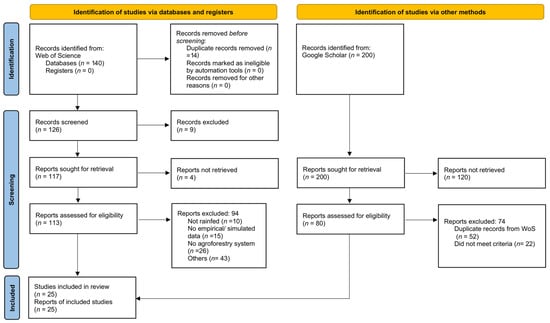
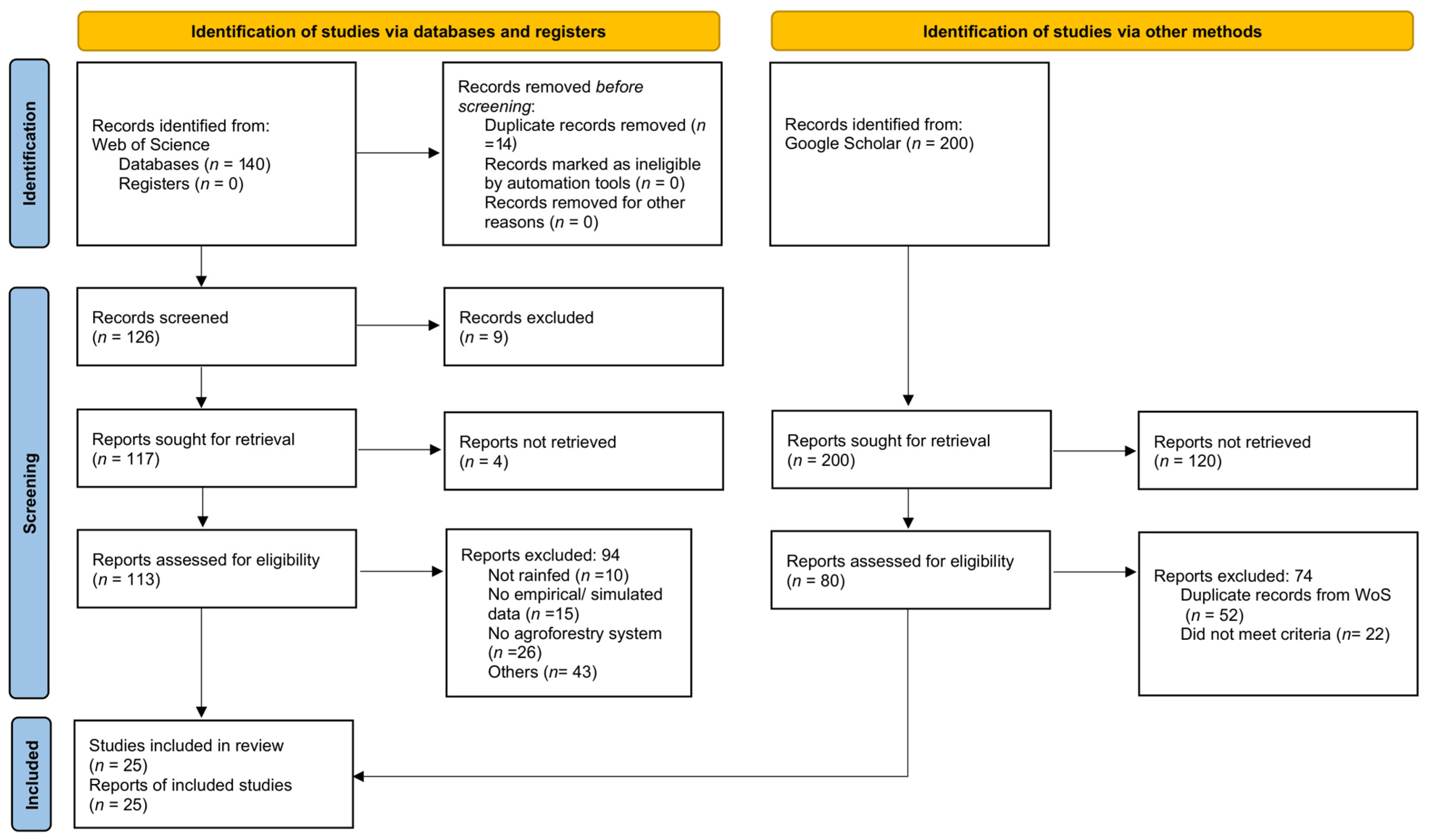
Literature search, record screening, and initial data extraction were carried out by the lead author (A.L.-G.) based on predefined inclusion and eligibility criteria. Study selection and extracted dataset entries were subsequently reviewed and validated by the senior author (E.F.). Any ambiguities or borderline cases regarding study eligibility were resolved through direct discussion and mutual agreement between both authors. Duplicate records were identified and removed prior to title and abstract screening. The complete study selection procedure and arithmetic traceability are summarized in the updated PRISMA 2020 flow diagram (Figure 1).
Figure 1.
PRISMA 2020 flow diagram for new systematic reviews which included searches of databases, registers and other sources. Source: Page et al. 2021 [16].
Contributions were selected based on the following standards: (1) refereed or unpublished reports presenting primary field-derived information from open-air trials in Mediterranean areas, featuring olives as a primary element; (2) centered on olive associations with any companion crop to olive-only or single-crop controls; (3) supplying numerical harvest information (e.g., averages ± SD/SE for olive output, intercropping crop, or land equivalent ratio) across associated and/or reference setups; (4) studies lasting at least one full growing season (or one year) were included to ensure that complete crop production cycles and harvest metrics were evaluated. Interannual variability was subsequently assessed by evaluating trial duration as a subgroup variable among multi-year studies; and (5) crops established under rainfed conditions, including studies with minimal strategic water applications reserved strictly for crop survival or for simulating historical average rainfall in abnormally dry years. Exclusion standards covered: (1) overlapping or repeated reports; (2) works offering solely descriptive accounts or broad summaries lacking numerical harvest figures; (3) fully irrigated systems where water was not a limiting factor; (4) areas outside Mediterranean climates; (5) controlled-environment or container-based trials; and (6) materials not in English, French, or Spanish. The eligibility criteria were defined using the PICO (Population, Intervention, Comparator, Outcome) framework (Table 1).
Table 1.
PICO framework defining the research question and eligibility criteria for the meta-analysis.
Summaries and full-text articles were systematically screened, and relevant information was extracted using a standardized data extraction template (https://doi.org/10.5281/zenodo.22085138, accessed on 24 August 2026). The dataset was structured in a spreadsheet format for data management and preliminary organization. To ensure mathematical consistency, all primary yield records reported in diverse metrics (e.g., kg/tree, kg/ha, or g/m2) were standardized into uniform units (t/ha for olive fruit yield and kg/ha for herbaceous companion crops) prior to effect size calculations. Orchard spatial configurations (originally reported as planting frames) were explicitly parsed and converted into individual tree surface areas (Surface area, in m2) to serve as a standardized spatial covariate in all subsequent models. Extracted variables included: site location, timeframe, olive orchards characteristics, crops category, precipitation, agronomic management and measurable results including averages and standard deviations (SD or SE). The data were extracted from the text, tables, or graphs (using the WebPlotDigitizer v.4 graphics digitization software [17]) when not reported numerically.
Studies were classified into two groups based on data completeness for land equivalent ratio (LER) calculations:
- Complete LER group (Group 1): Studies reporting sufficient quantitative data to compute total LER (or partial LERs for each component that could be summed to obtain total LER), including yields or relative yields for both olive and the companion crop in intercropping alongside corresponding monoculture controls.
- Partial/incomplete data group (Group 2): Studies providing some relevant yield metrics (e.g., companion crop yield in intercrop vs. monoculture, olive yield in intercrop without full monoculture comparison, or relative yield totals without full component breakdown), but insufficient for calculating total LER.
Systematic reviews were conducted separately for each group where appropriate. For Group 1, primary effect measures were total LER and, secondarily, partial LERs for olive and companion crops. For Group 2, analyses focused on available relative yields or other comparable metrics. Where possible, partial LERs were calculated from reported yields following the equation by Mead and Willey (1980) equation [18]: partial LER = Yintercrop/Ymonoculture, for each component. This stratification allowed assessment of potential reporting bias and exploration of land-use efficiency patterns under varying data availability. Subgroup analyses and regression were performed within and across groups to examine the effect of certain variables such as companion crop type, orchard density and rainfall regime. To ensure methodological consistency across all compiled studies, partial and total LER values were standardized. Specifically, for studies such as Temani et al., 2021 [9], which calculated the partial LER of annual crops by applying an explicit cropped area reduction factor (−43% due to uncultivated strip zones beneath the tree rows), we recalculated the corresponding LER values directly from the absolute or relative yields. This prevented structural biases and skewed comparisons against systems where total available inter-row area was fully accounted for.
2.1. Risk of Bias Assessment
The risk of bias of the included studies was assessed using a nine-domain tool specifically adapted for agricultural intercropping field trials, modified from the Cochrane Risk of Bias Tool [19] and an adapted version has been used in agronomy reviews [20]. The nine domains evaluated: (1) experimental design, (2) replication, (3) baseline comparability, (4) confounding control, (5) study duration, (6) outcome measurement, (7) data completeness, (8) selective reporting, and (9) other sources of bias (see Table 2). Each domains was rated as low, moderate, or high risk of bias based on pre-specified decision criteria tailored to agronomic field trials (see Supplementary Table S1). An overall risk-of-bias judgement was assigned to each study as follows: (i) Low overall risk, if all nine domains were rated as low risk, or if a maximum of two domains were rated as moderate risk without any high-risk domain; (ii) Moderate overall risk, if three or more domains were rated as moderate risk, or if a single domain was rated as high risk; and (iii) High overall risk, if two or more domains were rated as high risk. Assessments were independently conducted by the lead author (A.L.-G.) and verified by the senior author (E.F.), resolving discrepancies through joint consensus. This adaptation was selected because most included studies were comprised non-randomized field experiments, for which standard clinical tools are overly complex and less applicable.
Table 2.
Risk of bias assessment of the included studies using a nine-domain ((1) experimental design, (2) replication, (3) baseline comparability, (4) confounding control, (5) study duration, (6) outcome measurement, (7) data completeness, (8) selective reporting, (9) other sources of bias) tool adapted for intercropping field trials.
2.2. Statistical Analysis
Because many primary agronomic studies frequently omit complete dispersion measures (such as standard deviations or standard errors) required for traditional variance-inverse meta-analyses, a classical variance-weighted meta-analysis could not be uniformly applied in this work. Consequently, this study is framed as a systematic quantitative synthesis and multilevel mixed-effects analysis.
To account for multi-treatment and multi-year field trials, individual observations were nested within their respective primary sources using a unique study identifier (study_ID). Evaluated treatments often shared local monoculture controls within the same site and year, which isolates intercropping management effects from confounding edaphoclimatic factors. To address hierarchical dependencies and prevent variance distortion without relying on missing variance metrics, Linear Mixed-Effects Models (LMMs) were implemented using the statsmodels library in Python v.3.
A random intercept for study_ID was explicitly incorporated into the analytical model structure:
where represents the response variable (absolute yields or natural logarithm-transformed response ratios ) for observation in study ; is the fixed intercept; are the fixed-effect slope coefficients for orchard surface area (), trial duration (), and selected precipitation (); is the study-level random effect; and is the residual error.
Models were fitted using Restricted Maximum Likelihood (REML estimation). To handle potential convergence challenges typical of ecological datasets with unbalanced group sizes, a robust multi-algorithm optimization pipeline incorporating lbfgs, cg, bfgs, and powell solvers was applied. Variance components were partitioned into between-study variance (, evaluated as the Group Variance) and residual within-study variance (, evaluated as the Scale). Furthermore, the Intraclass Correlation Coefficient (ICC) was calculated to determine the proportion of total variance attributable to differences among literature sources:
Subgroup analyses were performed according to companion crop functional group (cereals, legumes, mixtures and others) and rainfall regime. Temporal stability was evaluated using the coefficient of variation () of annual yields across multi-year trials with a minimum duration of two consecutive experimental years ().
Publication bias could not be formally evaluated using traditional funnel plots or Egger’s regression tests due to the lack of reported within-study variance metrics across primary intercropping studies, alongside the limited number of fully independent study clusters. Consequently, potential publication bias remains an unquantified source of uncertainty in this synthesis. The complete source code and scripts reproducing these routines are publicly available at Zenodo (DOI: 10.5281/zenodo.22085138, accessed on 24 August 2026).
3. Results
3.1. Overview of Included Studies
The search through existing literature pinpointed 25 studies that satisfied our inclusion criteria for the systematic review, each carried out in non-irrigated olive agroforestry arrangements throughout the Mediterranean area (Morocco: n = 78, Portugal: n = 81, Spain: n = 52, Greece: n = 39, France: n = 28, Tunisia: n = 12, Turkey: n = 10, Italy: n = 4, and Algeria: n = 6). These investigations spanned trials conducted from 2009 up to 2023, generating 310 separate observation (214 intercropping arrangements and 96 monoculture controls) divided into two groups: Group 1 (G1 = 61 treatments), comprising studies with complete data on both relative yield and Land Equivalent Ratio (LER), and Group 2 (G2 = 249 treatments), which lacked one or both of these parameters. The research examined the pairing of olive trees with annual crops; covering cereals (n = 70 treatments), legumes (n = 88 treatments), a mixtures combination (n = 39 treatments), and others (n = 17 treatments). Olive tree spacings ranged from 6 × 6 m to 12 × 12 m, corresponding from low to moderately high densities, which are standard in the rainfed olive systems of these regions. Annual rainfall varied across locations and seasons (range 164–1052 mm). Operating under rainfed conditions was our primary filter; that said, we incorporated studies [22,23,24,25,26,27,28,29,30,31,32,33,34,35,36,37,38,39,40,41,42,43,44] featuring added watering interventions, given that their goal was to replicate the usual variations in local rainfall or prevent total crop failure [21] or to replicate the long-term average rainfall of the local Mediterranean climate [9]. All the studies offered appropriate figures for deriving or obtaining Land Equivalent Ratio (LER), relative yields (RY), or with supplementary results like grain/biomass outputs, and indicators related to economics in selected groups of studies.
To prevent information loss from studies reporting multi-year trials differently—some providing discrete annual metrics and others presenting aggregated multi-year averages—individual observations were mathematically weighted by trial duration and observational scale (n_eff), ensuring that multi-year experiments contributed proportionally to synthesized relative yields and LER calculations.
3.2. Land Equivalent Ratio (LER)
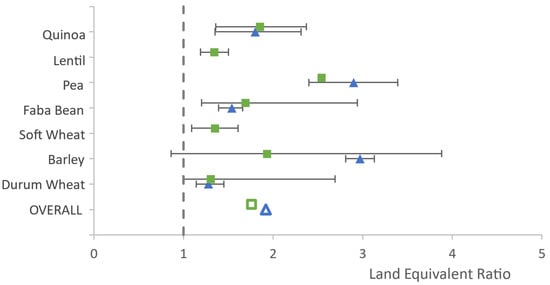
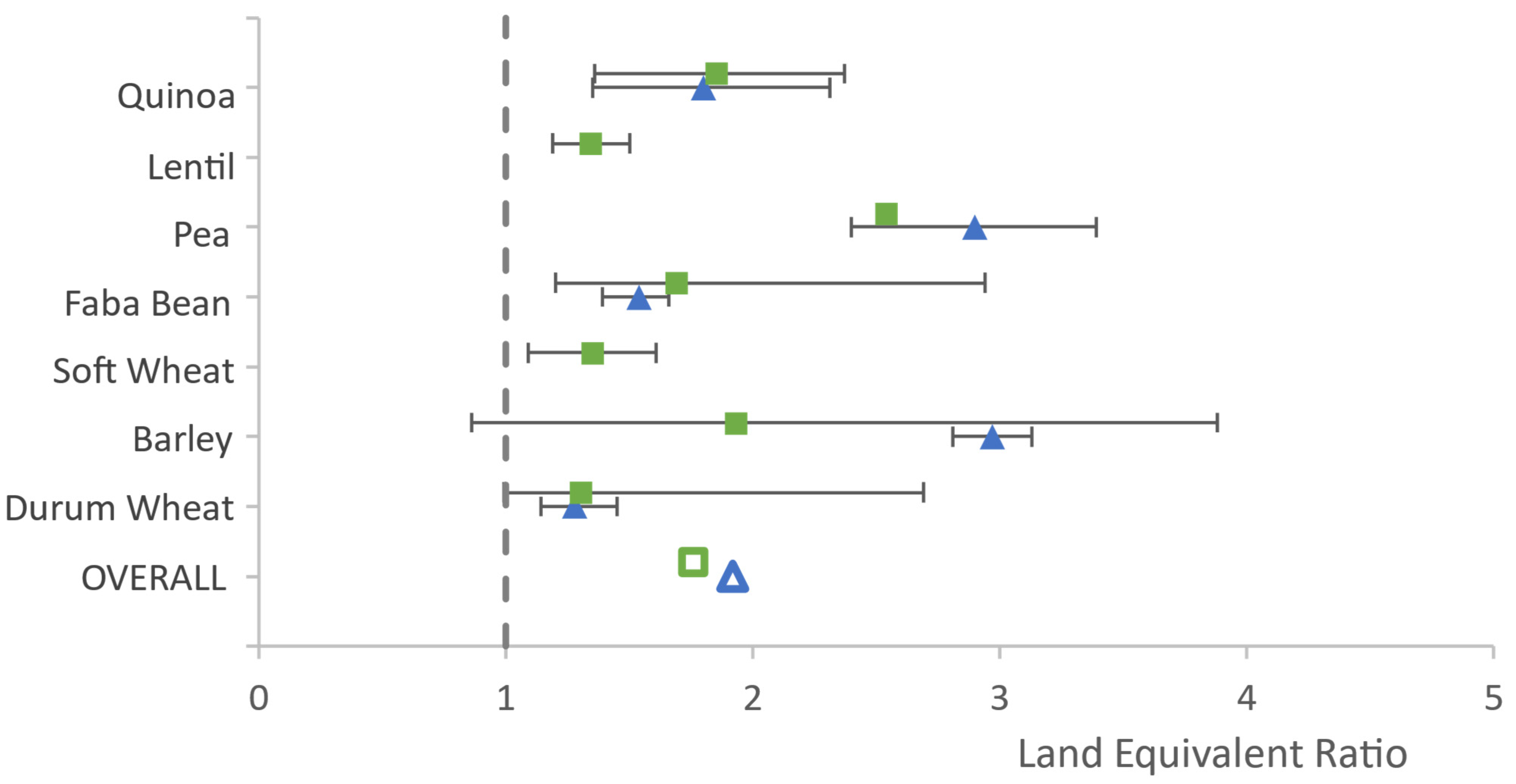
LER served as the key indicator for land-use effectiveness, determined as the total of partial LERs for the olive and the associated crop. Across the six studies providing complete LER data, LER values ranged from 1.28 to 2.97 for biomass and from 1.30 to 2.54 for grain yield. These studies yielded overall average LERs of 1.92 and 1.76, respectively, indicating a substantial gain in overall land productivity compared to single-crop systems. Numbers exceeding 1.0 appeared in over 80% of the treatments, implying that crop mixing tended to improve the system’s general performance as assessed by LER, even amid some yield adjustments (Figure 2).
Figure 2.
Weighted Land Equivalent Ratio (LER) for biomass (blue triangles) and grain/yield (green squares) in rainfed olive intercropping systems across companion crops. Points represent weighted overall LER values, and horizontal error bars represent the observed minimum–maximum range. The grey dash-dotted vertical line indicates LER = 1.
Analyses by subgroup brought out distinctions linked to companion crop category (Table 3). Arrangements centered on above ground biomass and grain yield of cereals (n_eff = 5 and 9, respectively) averaged an LER of 1.96 and 1.58, respectively, with the smaller values being in wheat. Legume plantings (n = 5 and 7; [9,23,26,35]) displayed higher LER than that of cereals [9,23,26,35,42] (2.08 and 1.89), propelled by high pea values (2.90 and 2.54) and low lentil LER (1.34). Pairings of quinoa with olives (n = 8) gave the average LER of1.80 and 1.85, varying among various quinoa cultivars [21].
Table 3.
Summary of pooled LER based on above ground biomass (AGB) and based on grain yield (GY) by intercrop subgroup.
To evaluate the potential distortion caused by extreme or outlier productivity values in intercropping trials, a sensitivity analysis was performed on the total Land Equivalent Ratio (). We evaluated the global dataset as well as functional subgroups (Legumes and Cereals) under progressive data filters (, , and ).
When filtering extreme values (), the global mean LER adjusted from an unconstrained mean of 15.918 (skewed by isolated high-density observations) to a robust mean of 1.551 (median 1.430, ). Further tightening the filter to yielded a stable global mean of 1.449 (median 1.410, ). Subgroup evaluations for legume-based and cereal-based intercropping systems followed a similar pattern of stabilization, confirming that the biological productivity advantage of olive intercropping remains robust, averaging a 40% to 50% land productivity increase across conservative filters.
3.3. Relative Yields (RY)
3.3.1. Intercropping Crops
Relative yield, defined as the crop yield intercropped in olive divided by that from the same crop alone, helped gauge the competitive dynamics of the systems tested. In the intercropped annuals, the overall average RY based on above ground biomass and based on grain yield stood at 0.57 and 0.67, respectively, signaling a 43.47% drop in biomass output and a 33.47% reduction in grain yield. Forages and mixtures ([29,32,33,34,42]) posted the smallest RY (0.42), with vetch at 0.35 as the low value and mix barley-vetch as the highest value (0.47). Cereals ([9,23,25,26,29,32,33,35,36,37,38,41,42]) including barley, durum wheat, soft wheat and triticale had biomass and grain RY values between 35.88% and 83.51% as detailed in Table 4. Legumes ([9,23,25,26,29,30,31,33,39]) registered better RY values, above 70% (72.12% for AGB to 69.98% for GY on average), spanning across chickpea, faba bean, lentil and pea (see Table 4).
Table 4.
Relative yield values differentiated by harvest type (Grain yield vs. Dry Biomass Matter).
3.3.2. Olive Tree
When it came to olive tree yields as affected by intercropping (Table 5), the mean RY stood at 0.90 overall (n = 97, n_eff = 75) indicating a very small negative effect from intercropping (an approximate 10% average drop in yield).
Table 5.
Effect of Intercropping Type on Olive Relative Yield (RY).
Across the treatments, olive RY frequently hit ≥0.90, with positive boosts seen in legume pairings (average RY = 1.03; [9,23,26,27,35,38,43]). Cereal intercropping reduced olive RY slightly more (0.89; [9,23,26,27,28,35,38,40,42,43]). Meanwhile, other systems showed wide performance variations, with legume mixes [44] yielding an olive RY around 100.07%, purple false brome [40], 0.85; and barley–vetch, [42] 0.15. In quinoa [21] setups, olive RY topped 1.21 for certain varieties (up to 1.39). RY achieved with coriander [38] and sainfoin [40] as an intercropped crop was 1.07 and 0.91, respectively. In contrast, recorded lower olive RY values when intercropped with saffron [22] (0.63), Lavandula [22] (0.47), and common vetch in rotation with oats [22] (0.49).
3.4. Effects of Orchard Density and Precipitation on Olive Yield
The Linear Mixed Model converged strictly (REML Log-Likelihood = −46.24) across 10 study groups (n = 83 observations). Variance component partitioning revealed a between-study variance () of and a residual variance () of , resulting in an Intraclass Correlation Coefficient () of . This high ICC confirms that of the total variance is attributable to study-level factors, strongly justifying the random-intercept model structure.
Fixed effect parameters within the LMM structure showed that when controlling for study-level clustering, orchard frame area (, , ), trial duration (, , ), and annual precipitation (, , ) did not retain statistically significant main fixed effects on log response ratios ().
Crucially, a sensitivity analysis comparing absolute olive yields (, ) against relative log response ratios (, ) confirmed that while absolute yield is strongly governed by tree frame density (, ), relative yield performance remains robust and unpenalized across density gradients and precipitation regimes.
3.5. Temporal Stability of Olive Yield
Temporal stability of olive yield was further examined by calculating the coefficient of variation (CV) within each individual multi-year study. Results were heterogeneous and strongly dependent on the companion crop. In legume-based systems, intercropping substantially reduced year-to-year variability compared to monoculture controls (CV 25–34% in AFS versus 52% in SCS). Similar buffering was observed with ryegrass [28] and sainfoin [40]. In contrast, pairings with certain cereals and especially aromatic plants or Crocus sativus [22] resulted in markedly higher variability in AFS (CV 72–93% versus 60% in SCS). Overall, intercropping did not consistently buffer olive yield against inter-annual stresses such as drought or alternate bearing.
3.6. Economic Outcomes
Economic analyses were based on data from two multi-year studies (three consecutive cropping seasons each). In both studies, three olive management options were systematically compared: conventional monoculture (control) and two intercropping systems with different annual species. This approach yielded annual economic records for six distinct systems (3 per study).
While the results from these studies suggested economic advantages to intercropping, specific technical advice and management research are required due to the wide variability in benefits. AFS total income averaged €1200–2200/ha (including subsidies), with gains of 20–70% over olive monoculture in legume-based setups, but it was often below monoculture levels in cereal systems (e.g., −€53/ha for barley AFS vs. +€863/ha in olive alone; [36,42]. Overall expenses in AFS were 10–30% higher, mainly due to additional labor and inputs.
Environmental assessments using Life Cycle Assessment showed that AFS reduced CO2 equivalents by 15–25% compared to monoculture (e.g., 0.8–1.2 t CO2-eq/ha), primarily from lower fertilizer requirements in legume intercropping [42].
4. Discussion
4.1. Interpretation of Main Findings
Overall, the results show that total system productivity tends to increase through intercropping in rainfed olive systems, with LER values consistently above the unit across a wide range of Mediterranean conditions. This pattern appears relatively robust despite differences in rainfall, management practices, and crop combinations. In particular, the better performance observed in legume-based systems points to a possible role of facilitation processes, such as improved nitrogen availability, in addition to simple resource complementarity. Altogether, this suggests that intercropping can be a useful strategy to improve resource use and productivity in water-limited olive systems.
Taken together, the 25 studies show that intercropping can work surprisingly well by enhancing productivity in rainfed Mediterranean olive systems. The overall land equivalent ratio averaged 1.92 for biomass and 1.76 for grain yield, which translates to a substantial increase in land productivity compared with growing the components separately. Legume-based systems gave strong results (biomass LER of 2.08 and grain LER of 1.89), cereal pairings averaged 1.96 for biomass and 1.58 for grain, and quinoa stood out with LER values of 1.80 (biomass) and 1.85 (grain).
Under intercropping, the companion crops lost on average 43.47% of their biomass (56.53% relative yield) and 33.47% of their grain yield (66.53% relative yield) because of competition, but the olive trees were only mildly affected (overall olive RY of 90.18%, rising to 102.78% when paired with legumes). Where economic and environmental data were reported, legume-based systems increased net income by 20–70% and cut CO2-equivalent emissions by 15–25%. In short, the evidence supports olive agroforestry under rainfed conditions as a realistic route toward sustainable intensification in these drylands.
4.2. Mechanisms Underlying the Response to Intercropping
The drop in companion crop yield could be mostly explained by solar radiation limitations from the permanent presence of the olive canopy [31,36,37], together with competition for water and nutrients—effects that were strongest with cereals and near the tree rows [23,26,38]. Legumes, on the other hand, may potentially enhance local nitrogen availability via biological nitrogen fixation, which could plausibly explain the preserved soil fertility and maintained olive tree performance (average legume-associated olive RY ~1.03). Quinoa showed competitive resilence, possibly thanks to its stress-tolerance traits [21], while forage/mixtures seemed to balance the competition better than pure stands [29,33,34].
The multiple regression analyses (Section 3.4) showed that orchard density was a key structural factor influencing absolute yields, whereas relative yield performance remained remarkably stable across density gradients and precipitation regimes. A likely mechanism governing absolute performance is the strong relationship between orchard density, canopy volume, and intercepted radiation. In denser plantings, trees intercept more radiation and develop efficient canopies, whereas wider spacing often results in larger individual trees that increase transpirational demand without a proportional gain in fruit production under water-limited conditions. This highlights the importance of considering canopy architecture rather than spacing alone when designing rainfed olive agroforestry systems.
4.3. Water and Environmental Variability
Rainfall had a moderate influence on LER, with strict rainfed treatments showing high biological efficiency. Even in drier years, legumes maintained high productivity and stability, probably attributable to a shorter growth cycle that overlaps less with the olives’ most critical water-demand periods.
The LER figures found here align well with broader Mediterranean agroforestry syntheses, and the strict rainfed filter used highlights a strong drought-resilience signal compared to reviews that also included irrigated systems [9,21,23]. The economic benefits found for legume mixtures match existing case studies [35,42], and the inclusion of grey literature helped reduce publication bias.
4.4. Profitability Assessment
While the agroecological benefits of intercropping in terms of LER and RY have been clearly documented, empirical evidence regarding financial profitability remains variable. For intercropping to be economically viable, the revenue generated by the companion crop must offset any potential economic loss resulting from olive yield reductions while covering additional operational costs (e.g., seeds, machinery passes, and labor).
In years with high olive market prices or high baseline yields, companion crops face higher performance thresholds or require flexible management (e.g., early forage harvesting during dry springs). Although a formal monetary meta-analysis was precluded by the lack of standardized cost-benefit data across primary studies, our synthesized LER values demonstrate that land-use advantages generally provide a buffer against price and climate volatility.
4.5. Implications for Practice and Policy
Across the literature, three main patterns stand out. First, annual crops almost always experienced a yield penalty under intercropping, caused mainly by reduced solar radiation. Second, the effect on olives depended strongly on the companion species: legumes were usually neutral or beneficial, while certain cereals caused clearer reductions in olive yields that could be partly offset by pruning and wider spacing. Third, at the whole-system level, the advantages were consistent—higher land productivity, potential ecological co-benefits such as enhanced soil organic matter retention and erosion control, and improved economic and environmental performance.
Intercropping may increase system resilience through crop diversification and flexible management. Farmers can adapt the harvest to water availability: in dry years, cutting the intercrop early for forage stops competition and salvages value; in wetter years, allowing it to reach grain maturity maximizes output. Legume-based systems appear particularly suitable for low-input rainfed olive groves, offering improved profitability and lower greenhouse gas emissions. These practices align with EU agroforestry promotion policies [15] and could enhance food security in drought-prone Mediterranean regions [10].
4.6. Limitations
A methodological limitation of this quantitative synthesis is the reliance on scope weighting based on trial duration (n_eff) instead of inverse-variance weighting, necessitated by the lack of reported variance metrics in several primary studies.
From an economic perspective, oil yield (kg oil/ha) represents the ultimate outcome for olive growers. In rainfed environments, water competition during mid-summer and autumn lipogenesis could potentially reduce fruit oil concentration even when fresh fruit biomass remains stable. Given that few primary studies evaluated oil content, future field experiments should systematically include fat content and oil quality parameters.
Finally, the assessment of publication bias was constrained by incomplete reporting of within-study dispersion metrics. Future primary experiments in olive intercropping should consistently report measures of variance (e.g., SD or SE) and raw data in public repositories to enable formal publication bias diagnostics and more detailed exploration of moderators in future meta-analyses.
5. Conclusions
This study shows that intercropping offers a practical and effective way to make rainfed olive systems in the Mediterranean more resilient and productive through proper management and suitable companion crop selection. On average, it delivers substantial land output gains (biomass LER of 1.92 and grain LER of 1.76), with the biggest biological advantages coming from legumes and quinoa, alongside minimal yield penalties for the olive trees (overall olive RY of 90.18%).
The system brings clear ecological benefits—better soil health, reduced erosion, and lower greenhouse gas emissions—while providing farmers with diversified income. Although trade-offs exist regarding companion crop yield reductions due to shade and competition for water, the net result remains positive, especially in variable rainfall years. Adopting these practices—favoring legumes, adjusting row spacing, and applying flexible management (such as switching between grain harvest and early forage cutting depending on seasonal rainfall)—helps growers adapt to increasingly dry conditions. The evidence supports the active promotion of olive agroforestry by policymakers and agricultural extension services through targeted incentives.
Supplementary Materials
The following supporting information can be downloaded at: https://www.mdpi.com/article/10.3390/agronomy16191975/s1, Table S1: Risk-of-Bias Decision Rules and Criteria. Table S2. Study-level overview of original yield data (numerators), monoculture baselines (denominators), and partial and total Land Equivalent Ratio (LER) values for olive-based intercropping systems.
Author Contributions
A.L.-G. and E.F.; methodology, A.L.-G.; software, E.F.; validation, A.L.-G. and E.F.; formal analysis, A.L.-G.; investigation, A.L.-G. and E.F.; resources, E.F.; data curation, A.L.-G.; writing—original draft preparation, A.L.-G. and E.F.; writing—review and editing, A.L.-G. and E.F.; visualization, A.L.-G.; supervision, E.F. All authors have read and agreed to the published version of the manuscript.
Funding
This research received no external funding.
Data Availability Statement
The dataset compiled for this systematic review, along with the full analytical script used for data weighting and Linear Mixed Modeling, are openly available in 10.5281/zenodo.22085138.
Conflicts of Interest
The authors declare no conflicts of interest.
References
- Scordia, D.; Corinzia, S.A.; Coello, J.; Vilaplana Ventura, R.; Jiménez-De-Santiago, D.E.; Singla Just, B.; Castaño-Sánchez, O.; Casas Arcarons, C.; Tchamitchian, M.; Garreau, L.; et al. Are Agroforestry Systems More Productive than Monocultures in Mediterranean Countries? A Meta-Analysis. Agron. Sustain. Dev. 2023, 43, 73. [Google Scholar] [CrossRef] [Scilit]
- Nair, P.K.R.; Kumar, B.M.; Nair, V.D. Classification of Agroforestry Systems. In An Introduction to Agroforestry: Four Decades of Scientific Developments; Nair, P.K.R., Kumar, B.M., Nair, V.D., Eds.; Springer International Publishing: Cham, Switzerland, 2021; pp. 29–44. [Google Scholar]
- Sinclair, F.L. A General Classification of Agroforestry Practice. Agrofor. Syst. 1999, 46, 161–180. [Google Scholar] [CrossRef] [Scilit]
- Ferrara, V.; Sala, G.; Garfì, G.; La Mantia, T.; Ekblom, A. Down with the Roots. Phytoliths as Biocultural Traces in Historical Olive Agroecosystems of Sicily. Front. Ecol. Evol. 2025, 13, 1625887. [Google Scholar] [CrossRef] [Scilit]
- Tsiakiris, R.; Stara, K.; Kazoglou, Y.; Kakouros, P.; Bousbouras, D.; Dimalexis, A.; Dimopoulos, P.; Fotiadis, G.; Gianniris, I.; Kokkoris, I.P.; et al. Agroforestry and the Climate Crisis: Prioritizing Biodiversity Restoration for Resilient and Productive Mediterranean Landscapes. Forests 2024, 15, 1648. [Google Scholar] [CrossRef] [Scilit]
- Wolpert, F.; Quintas-Soriano, C.; Plieninger, T. Exploring Land-Use Histories of Tree-Crop Landscapes: A Cross-Site Comparison in the Mediterranean Basin. Sustain. Sci. 2020, 15, 1267–1283. [Google Scholar] [CrossRef] [Scilit]
- Infante-Amate, J.; Iriarte-Goñi, I.; Aguilera, E. Historical Changes in Biomass Carbon Stocks in the Mediterranean (Spain, 1860–2010). Anthropocene 2023, 44, 100416. [Google Scholar] [CrossRef] [Scilit]
- Paut, R.; Garreau, L.; Ollivier, G.; Sabatier, R.; Tchamitchian, M. A Global Dataset of Experimental Intercropping and Agroforestry Studies in Horticulture. Sci. Data 2024, 11, 5. [Google Scholar] [CrossRef] [Scilit] [PubMed]
- Temani, F.; Bouaziz, A.; Daoui, K.; Wery, J.; Barkaoui, K. Olive Agroforestry Can Improve Land Productivity Even under Low Water Availability in the South Mediterranean. Agric. Ecosyst. Environ. 2021, 307, 107234. [Google Scholar] [CrossRef] [Scilit]
- Morugán-Coronado, A.; Linares, C.; Gómez-López, M.D.; Faz, Á.; Zornoza, R. The Impact of Intercropping, Tillage and Fertilizer Type on Soil and Crop Yield in Fruit Orchards under Mediterranean Conditions: A Meta-Analysis of Field Studies. Agric. Syst. 2020, 178, 102736. [Google Scholar] [CrossRef] [Scilit]
- Pantera, A.; Burgess, P.J.; Mosquera Losada, R.; Moreno, G.; López-Díaz, M.L.; Corroyer, N.; McAdam, J.; Rosati, A.; Papadopoulos, A.M.; Graves, A.; et al. Agroforestry for High Value Tree Systems in Europe. Agrofor. Syst. 2018, 92, 945–959. [Google Scholar] [CrossRef] [Scilit]
- Blanco-Canqui, H.; Shaver, T.M.; Lindquist, J.L.; Shapiro, C.A.; Elmore, R.W.; Francis, C.A.; Hergert, G.W. Cover Crops and Ecosystem Services: Insights from Studies in Temperate Soils. Agron. J. 2015, 107, 2449–2474. [Google Scholar] [CrossRef] [Scilit]
- Blanco-Canqui, H.; Ruis, S.J.; Holman, J.D.; Creech, C.F.; Obour, A.K. Can Cover Crops Improve Soil Ecosystem Services in Water-Limited Environments? A Review. Soil Sci. Soc. Am. J. 2022, 86, 1–18. [Google Scholar] [CrossRef] [Scilit]
- Ivezić, V.; Yu, Y.; van der Werf, W. Crop Yields in European Agroforestry Systems: A Meta-Analysis. Front. Sustain. Food Syst. 2021, 5, 606631. [Google Scholar] [CrossRef] [Scilit]
- Mosquera-Losada, M.R.; Rodríguez-Rigueiro, F.J.; Santiago-Freijanes, J.J.; Rigueiro-Rodríguez, A.; Silva-Losada, P.; Pantera, A.; Fernández-Lorenzo, J.L.; González-Hernández, M.P.; Romero-Franco, R.; Aldrey-Vázquez, J.A.; et al. European Agroforestry Policy Promotion in Arable Mediterranean Areas. Land Use Policy 2022, 120, 106274. [Google Scholar] [CrossRef] [Scilit]
- Page, M.J.; McKenzie, J.E.; Bossuyt, P.M.; Boutron, I.; Hoffmann, T.C.; Mulrow, C.D.; Shamseer, L.; Tetzlaff, J.M.; Akl, E.A.; Brennan, S.E.; et al. The PRISMA 2020 Statement: An Updated Guideline for Reporting Systematic Reviews. BMJ 2021, 372, n71. [Google Scholar] [CrossRef] [Scilit] [PubMed]
- WebPlotDigitizer—Copyright 2010–2024 Ankit Rohatgi. Available online: https://apps.automeris.io/wpd4/ (accessed on 22 June 2026).
- Mead, R.; Willey, R.W. The Concept of a ‘Land Equivalent Ratio’ and Advantages in Yields from Intercropping. Exp. Agric. 1980, 16, 217–228. [Google Scholar] [CrossRef] [Scilit]
- Higgins, J.P.T.; Altman, D.G.; Gøtzsche, P.C.; Jüni, P.; Moher, D.; Oxman, A.D.; Savović, J.; Schulz, K.F.; Weeks, L.; Sterne, J.A.C. The Cochrane Collaboration’s Tool for Assessing Risk of Bias in Randomised Trials. BMJ 2011, 343, d5928. [Google Scholar] [CrossRef] [Scilit] [PubMed]
- Sterne, J.A.C.; Savović, J.; Page, M.J.; Elbers, R.G.; Blencowe, N.S.; Boutron, I.; Cates, C.J.; Cheng, H.-Y.; Corbett, M.S.; Eldridge, S.M.; et al. RoB 2: A Revised Tool for Assessing Risk of Bias in Randomised Trials. BMJ 2019, 366, l4898. [Google Scholar] [CrossRef] [Scilit] [PubMed]
- Abidi, I.; Daoui, K.; Abouabdillah, A.; Belqadi, L.; Mahyou, H.; Bazile, D.; Douaik, A.; Gaboun, F.; Hassane Sidikou, A.A.; Alaoui, S.B. Quinoa–Olive Agroforestry System Assessment in Semi-Arid Environments: Performance of an Innovative System. Agronomy 2024, 14, 495. [Google Scholar] [CrossRef] [Scilit]
- Aguilera-Huertas, J.; Parras-Alcántara, L.; González-Rosado, M.; Lozano-García, B. Intercropping in Rainfed Mediterranean Olive Groves Contributes to Improving Soil Quality and Soil Organic Carbon Storage. Agric. Ecosyst. Environ. 2024, 361, 108826. [Google Scholar] [CrossRef] [Scilit]
- Amassaghrou, A.; Barkaoui, K.; Ahmed, B.; Alaoui, S.B.; Razouk, R.; Daoui, K. IMPACT OF LEGUMES AND CEREALS ON OLIVE PRODUCTIVITY IN THE SOUTH MEDITERRANEAN. Malays. J. Sustain. Agric. 2023, 7, 6–13. [Google Scholar] [CrossRef] [Scilit]
- Amassaghrou, A.; Barkaoui, K.; Bouaziz, A.; Alaoui, S.B.; Fatemi, Z.E.A.; Daoui, K. Yield and Related Traits of Three Legume Crops Grown in Olive-Based Agroforestry under an Intense Drought in the South Mediterranean. Saudi J. Biol. Sci. 2023, 30, 103597. [Google Scholar] [CrossRef] [Scilit] [PubMed]
- Ben Zineb, A.; Barkaoui, K.; Karray, F.; Mhiri, N.; Sayadi, S.; Mliki, A.; Gargouri, M. Olive Agroforestry Shapes Rhizosphere Microbiome Networks Associated with Annual Crops and Impacts the Biomass Production under Low-Rainfed Conditions. Front. Microbiol. 2022, 13, 977797. [Google Scholar] [CrossRef] [Scilit] [PubMed]
- Benalia, H.; Fatima, L.-L.; Fatma-Zohra, B.; Omar, K.; Bahia, Z.; Mounir, S.; Fouzi, G.; Merwa, F.; Mourad, L. Comparative Assessment of Agroforestry Performances between Pea and Barley Intercropping with Olive Tree under Mediterranean Conditions. Agrofor. Syst. 2024, 98, 619–635. [Google Scholar] [CrossRef] [Scilit]
- Bouhafa, K.; Moughli, L.; Daoui, K.; Douaik, A.; Taarabt, Y. Soil Properties at Different Distances of Intercropping in Three Olive Orchards in Morocco. Int. J. Plant Soil Sci. 2015, 7, 238–245. [Google Scholar] [CrossRef] [Scilit] [PubMed]
- Dimande, P.; Arrobas, M.; Correia, C.M.; Rodrigues, M.Â. Ground Management Through Grazing in Rainfed Olive Orchards Provides High Olive Yields and Has Other Potential Benefits for Both the Soil and the Farmer. Agriculture 2024, 14, 897. [Google Scholar] [CrossRef] [Scilit]
- Guesmi, H.; Aichi, H.; Menasseri, S.; Fouad, Y.; Ben Youssef, S.; Ben Ghanem, H.; Chaar, H. Effect of Olive Tree—Barley/Common Vetch Agroforestry System on Soil Organic Matter Under Low-Input Conditions in a Tunisian Semi-Arid Climate. Commun. Soil Sci. Plant Anal. 2022, 53, 2662–2684. [Google Scholar] [CrossRef] [Scilit]
- Mantino, A.; Ragaglini, G.; Tozzini, C.; Cappucci, A.; Mele, M.; Bonari, E. Yield and nutritive value of Alfalfa (Medicago sativa L.) in an olive (Olea europaea L.) Alley-Cropping Practice. In Proceedings of the 3rd European Agroforestry Conference, Montpellier, France, 23–25 May 2016. [Google Scholar]
- Mantino, A.; Tozzini, C.; Bonari, E.; Mele, M.; Ragaglini, G. Competition for Light Affects Alfalfa Biomass Production More Than Its Nutritive Value in an Olive-Based Alley-Cropping System. Forests 2021, 12, 233. [Google Scholar] [CrossRef] [Scilit]
- Mantzanas, K.; Pantera, A.; Koutsoulis, D.; Papadopoulos, A.; Kapsalis, D.; Ispikoudis, S.; Fotiadis, G.; Sidiropoulou, A.; Papanastasis, V.P. Intercrop of Olive Trees with Cereals and Legumes in Chalkidiki, Northern Greece. Agrofor. Syst. 2021, 95, 895–905. [Google Scholar] [CrossRef] [Scilit]
- Michalitsis, A.; Papakaloudis, P.; Pankou, C.; Lithourgidis, A.; Dordas, C. Sustainable Intensification of Olive Agroecosystems via Barley, Triticale, and Pea Intercropping. Agronomy 2025, 15, 2333. [Google Scholar] [CrossRef] [Scilit]
- Ozturkmen, A.; Ramazanoglu, E.; Almaca, A.; Çakmaklı, M. Effect of intercropping on soil physical and chemical properties in an olive orchard. Appl. Ecol. Environ. Res. 2020, 18, 7783–7793. [Google Scholar] [CrossRef] [Scilit]
- Panozzo, A.; Bernazeau, B.; Desclaux, D. Durum Wheat in Organic Olive Orchard: Good Deal for the Farmers? Agrofor. Syst. 2020, 94, 707–717. [Google Scholar] [CrossRef] [Scilit]
- Panozzo, A.; Huang, H.; Bernazeau, B.; Vamerali, T.; Samson, M.F.; Desclaux, D. Morphology, Phenology, Yield, and Quality of Durum Wheat Cultivated within Organic Olive Orchards of the Mediterranean Area. Agronomy 2020, 10, 1789. [Google Scholar] [CrossRef] [Scilit]
- Panozzo, A.; Huang, H.-Y.; Bernazeau, B.; Meunier, F.; Turc, O.; Duponnois, R.; Prin, Y.; Vamerali, T.; Desclaux, D. Impact of Olive Trees on the Microclimatic and Edaphic Environment of the Understorey Durum Wheat in an Alley Orchard of the Mediterranean Area. Agronomy 2022, 12, 527. [Google Scholar] [CrossRef] [Scilit]
- Razouk, R.; Daoui, K.; Abdelhamid, R.; Chergaoui, A. Optimal Distance between Olive Trees and Annual Crops in Rainfed Intercropping System in Northern Morocco. J. CROP Sci. Res. 2016, 1, 23–32. [Google Scholar]
- Rodrigues, M.Â.; Ferreira, I.Q.; Freitas, S.L.; Pires, J.M.; Arrobas, M.P. Self-Reseeding Annual Legumes for Cover Cropping in Rainfed Managed Olive Orchards. Span. J. Agric. Res. 2015, 13, e0302. [Google Scholar] [CrossRef] [Scilit]
- Sastre, B.; Pérez-Jiménez, M.Á.; Bienes, R.; García-Díaz, A.; de Lorenzo, C. The Effect of Soil Management on Olive Yield and VOO Quality in a Rainfed Olive Grove of Central Spain. J. Chem. 2016, 2016, 4974609. [Google Scholar] [CrossRef] [Scilit]
- Temani, F.; Barkaoui, K.; Bouaziz, A.; Wery, J. Assessment of Olive Tree-Barley Interactions in Mediterranean Agroforestry: Barley Grain and Straw along a Rainfall Gradient in Morocco. 2018. Available online: https://hal.inrae.fr/hal-02735715 (accessed on 22 June 2026).
- Tziolas, E.; Ispikoudis, S.; Mantzanas, K.; Koutsoulis, D.; Pantera, A. Economic and Environmental Assessment of Olive Agroforestry Practices in Northern Greece. Agriculture 2022, 12, 851. [Google Scholar] [CrossRef] [Scilit]
- Zayani, I.; Ammari, M.; Ben Allal, L.; Daoui, K.; Bouhafa, K. The Effect of Intercropping Crop Type on Soil Fertility, Olive Trees Productivity and Quality in Moroccan Agroforestry Systems. Vegetos 2025, 38, 1160–1169. [Google Scholar] [CrossRef] [Scilit]
- Zuazo, V.H.D.; Rodríguez, B.C.; García-Tejero, I.F.; Ruiz, B.G.; Tavira, S.C. Benefits of Organic Olive Rainfed Systems to Control Soil Erosion and Runoff and Improve Soil Health Restoration. Agron. Sustain. Dev. 2020, 40, 41. [Google Scholar] [CrossRef] [Scilit]

Disclaimer/Publisher’s Note: The statements, opinions and data contained in all publications are solely those of the individual author(s) and contributor(s) and not of MDPI and/or the editor(s). MDPI and/or the editor(s) disclaim responsibility for any injury to people or property resulting from any ideas, methods, instructions or products referred to in the content. |
© 2026 by the authors. Licensee MDPI, Basel, Switzerland. This article is an open access article distributed under the terms and conditions of the Creative Commons Attribution (CC BY) license.