


Abstract
Greenhouse tomato production in closed and semi-closed soilless systems can reduce water and fertilizer losses, but drainage reuse requires coordinated chemical, sanitary, and nutritional control. This review critically synthesizes evidence on drainage characterization, disinfection, nutrient reconditioning, and digital monitoring, with emphasis on coir-based systems. Structured searches of Scopus, Web of Science Core Collection, and PubMed were complemented by Google Scholar and reference-list screening. Evidence was classified as direct, related, transferable, or contextual according to its relevance to coir-grown tomato. Electrical conductivity and pH are necessary but insufficient because crop uptake, source-water quality, and substrate exchange processes alter individual ions. UV-based treatments can provide effective disinfection when dose, turbidity, flow, and target organism are controlled, whereas hydrogen peroxide is better supported as a complementary treatment. ToBRFV persistence in water requires virus-specific validation, and potential substrate- or biofilm-associated reservoirs remain insufficiently quantified. Only one study in the key-evidence matrix met the strict definition of direct evidence for coir-grown tomato with drainage recovery or recirculation; most sodium-management, disinfection, and monitoring evidence was therefore related or transferable. Safe reuse depends on a monitored, multi-barrier management chain with managed partial renewal when chemical or sanitary risks cannot be adequately controlled.
1. Introduction
The pressure to produce more food with less water, land, and energy is reshaping agricultural systems. Population growth, climate change, declining freshwater availability, and land-use change are directly affecting food security and the sustainability of food production [1,2,3]. The challenge is therefore not only to increase agricultural output, but also to improve the efficiency with which water, nutrients, and energy are used.
Soilless cultivation has expanded in response to these constraints because it enables greater control of the root-zone environment and can improve crop uniformity, yield, product quality, and resource-use efficiency [4,5,6,7,8]. Plants may be grown directly in nutrient solution or in organic and inorganic substrates. This degree of control also requires rigorous management because root volumes are restricted and many substrates have limited buffering capacity. Crop performance therefore depends not only on nutrient-solution composition but also on substrate properties, irrigation frequency, drainage generation, and the management of the solution leaving the root zone [6,7,8].
Coir is an important substrate for greenhouse tomato because it combines high water-holding capacity with aeration and structural stability. Unlike an inert support, however, coir can influence nutrient-solution composition through cation-exchange processes and through variable background concentrations of potassium, sodium, and chloride. Coir properties also change with source, processing, conditioning, moisture status, and cultivation history [9,10,11]. These features are particularly relevant when drainage is recovered because the collected solution reflects crop uptake and evapotranspiration together with substrate–solution interactions.
From a drainage-management perspective, soilless systems can operate as open, closed, or semi-closed systems. In open systems, a fraction of the applied nutrient solution is drained and discarded to limit salt accumulation. In closed systems, drainage is recovered, treated, adjusted, and reincorporated into the fertigation circuit, whereas semi-closed systems combine recirculation with controlled partial renewal or discharge when chemical or sanitary conditions require it [7,8,12,13]. Drainage recovery can reduce water and fertilizer losses and limit nutrient-rich effluent discharge, but it converts drainage management from a disposal issue into a continuous process of characterization, treatment, and reconditioning.
Reuse introduces two interacting constraints. First, selective crop uptake, evapotranspiration, source-water composition, and substrate exchange modify pH, electrical conductivity (EC), and individual ion concentrations; consequently, EC and pH alone cannot identify nutrient depletion or the accumulation of poorly absorbed ions [13,14,15,16,17]. Second, hydraulic connectivity can distribute root pathogens and waterborne viruses throughout the crop [18,19,20,21,22,23,24,25,26]. Major reviews of recycled irrigation-water sanitation likewise emphasize that treatment efficacy depends on the target organism, water quality, hydraulic conditions, and verification of the delivered treatment [27,28,29].
Previous reviews have addressed soilless production, fertigation-effluent recycling, disinfection technologies, and nutrient management from complementary perspectives [6,7,13,27,28,29]. However, these components are often considered separately, and evidence from different substrates and hydroponic configurations is not always distinguished by its direct applicability to coir-grown tomato. The present review therefore critically integrates drainage characterization, sanitary treatment, nutrient reconditioning, and digital monitoring within a single operational framework for drainage reuse in greenhouse tomato. This review pays particular attention to coir-specific hydraulic and ion-exchange properties, management of poorly absorbed ions such as Na+ and Cl−, the sanitary challenge posed by tomato brown rugose fruit virus (ToBRFV), and the limits of transferring quantitative thresholds from rockwool or substrate-free systems to coir-based production.
2. Materials and Methods
2.1. Review Design and Objective
This review used a structured literature search and critical evidence-synthesis approach to examine drainage recovery and reuse in greenhouse tomato, with particular emphasis on coir-based systems. The objective was to integrate evidence on drainage characterization, sanitary treatment, nutrient reconditioning, salinity and ionic balance, sensing, automation, and environmental performance while preserving the distinction between evidence obtained directly in coir-grown tomato and evidence transferred from related soilless systems.
The review was designed as a structured critical review rather than a systematic or scoping review, and it makes no claim of exhaustive record-level coverage. The analysis focused on the operational sequence required for drainage reuse and on the conditions that determine whether findings from other substrates or hydroponic configurations can reasonably be transferred to coir-grown tomato.
2.2. Information Sources and Search Strategy
Structured searches were conducted in Scopus, Web of Science Core Collection, and PubMed. Google Scholar was used as a complementary source for literature discovery and citation tracing. The search initially emphasized publications from 2000 to 2025 and was subsequently updated during manuscript preparation to incorporate relevant publications available through 2026. Seminal studies published before 2000 were retained when they provided foundational evidence directly relevant to nutrient-solution formulation, salinity management, disinfection, or recirculating soilless systems.
Search concepts combined tomato or Solanum lycopersicum with terms related to coir, soilless culture, substrate culture, nutrient solution, drainage, recirculation, closed-loop fertigation, disinfection, UV-C, ozone, hydrogen peroxide, slow sand filtration, ToBRFV, sodium and chloride accumulation, ion-selective sensors, Internet of Things, decision-support systems, and circular horticulture. Reference lists of relevant reviews and included studies were also examined. The structured search concepts are provided in Supplementary Material S1. No bibliometric analysis was performed, and record-level retrieval and screening counts were not reconstructed because the original search log was not prospectively retained.
2.3. Eligibility Criteria and Evidence Classification
Peer-reviewed original research was considered when it addressed drainage reuse, nutrient-solution chemistry, water or nutrient-use efficiency, salinity, crop response, pathogen transmission, disinfection, microbiome dynamics, sensing, automation, or environmental performance in tomato or in a clearly transferable soilless horticultural system. Conference proceedings and technical reports were retained only when they provided primary quantitative or foundational information not adequately available in peer-reviewed journal articles.
Studies were excluded when they involved soil cultivation without a relevant soilless comparison; open systems without information directly relevant to drainage reuse, substrate-mediated ionic or hydraulic mechanisms, or transferable treatment/monitoring technologies; unrelated crops or technologies; insufficient methodological information; duplicate publication of the same experiment; or claims that could not be verified from an accessible source.
Evidence was classified according to directness. Direct evidence involved tomato grown in a solid soilless substrate with drainage recovery or recirculation. Related evidence involved tomato in other recirculating hydroponic configurations or experimental coir/substrate studies that informed relevant hydraulic or ionic mechanisms without testing drainage recirculation. Transferable evidence involved another horticultural crop or system used to evaluate a treatment, monitoring technology, or mechanism directly relevant to tomato. Contextual evidence included reviews, books, proceedings, or technical sources used to explain principles or identify primary studies.
2.4. Source Selection, Evidence Extraction, and Quality Considerations
Bibliographic records were reconciled using DOI, title, authorship, and manual inspection, with particular attention to duplicate publications and reports belonging to the same experimental family. Evidence extraction considered publication year, crop and cultivar, substrate, cultivation and recirculation system, drainage fraction, source-water quality, irrigation and drainage EC and pH, ionic composition, treatment technology, target pathogen, treatment dose and contact time, crop response, sensor type, model validation, and environmental or operational indicators.
Evidence quality and directness were considered throughout the synthesis. Interpretation accounted for clarity of experimental design, presence of an appropriate comparator, replication, study duration, characterization of source water and nutrient solution, description of the hydraulic and recirculation system, reliability and location of measurements, appropriateness of statistical analysis, completeness of reporting, and relevance to commercial tomato production. These domains were used to qualify the strength and transferability of findings rather than to generate a composite methodological-quality score. The extraction fields and quality/directness framework are provided in Supplementary Material S1.
2.5. Evidence Synthesis
Because the included studies differed markedly in cultivar, substrate, climatic conditions, production scale, drainage-management strategy, measurement location, exposure duration, and outcome definition, the evidence synthesis was structured and primarily qualitative. Quantitative findings were compared only when their units, denominators, treatment conditions, and measurement compartments were sufficiently compatible. Values obtained from the applied nutrient solution, drainage solution, recirculation reservoir, root-zone solution, or substrate extract were not treated as directly equivalent.
The synthesis emphasized convergence and divergence among studies, methodological differences, evidence directness, and the operational conditions under which each outcome was obtained. Direct evidence from tomato grown in solid soilless substrates was ascribed greater interpretive weight for crop-specific conclusions, whereas evidence from other hydroponic systems or horticultural crops was used as related or transferable support. A key-evidence matrix (Table S5) was compiled to identify which conclusions are supported directly by coir-grown tomato and which rely on related or transferable evidence.
2.6. Use of Generative AI-Assisted Tools
During the preparation and revision of this manuscript, ChatGPT (GPT-5.6, OpenAI) was used to assist with language refinement, clarity and consistency of expression, restructuring of selected passages, and formatting. The tool was not used as a source of scientific evidence. All scientific statements, numerical information, references, interpretations, and conclusions retained in the manuscript were reviewed and verified by the authors against the relevant source literature.
3. Critical Evidence Synthesis
3.1. Evidence Profile
The evidence base spans nutrient management, drainage characterization, disinfection, pathogen transmission, microbiome dynamics, salinity, sensing, automation, and environmental performance. Direct evidence from coir-grown tomato is strongest for substrate-mediated ionic and hydraulic behavior and for irrigation/fertigation response [9,10,11,30,31,32]. By contrast, much of the quantitative evidence on disinfection, sodium management, and digital control originates from tomato in rockwool or substrate-free recirculating systems, or from transferable treatment studies [14,15,16,18,27,28,29,33,34,35,36,37,38,39,40,41,42,43,44,45,46].
Accordingly, the most transferable outputs are operational mechanisms and decision principles rather than substrate-specific numerical thresholds, treatment doses, or crop-specific set points. This distinction is applied throughout the synthesis so that direct coir evidence, related tomato evidence, transferable treatment evidence, and contextual sources are not interpreted as equivalent.
3.2. Nutritional Characterization of the Drained Nutrient Solution
Drainage characterization is the first requirement for safe reuse because the recovered solution does not retain the same composition as the applied nutrient solution. Its properties reflect selective crop uptake, evapotranspiration, irrigation management, source-water composition, and interactions with the substrate [6,13]. Consequently, drainage should be interpreted as an integrated response of the crop–substrate–fertigation system rather than as residual fertilizer solution.
This distinction is particularly important in coir. Coir can show substantial cation-exchange capacity and variable background salinity, with high K and potentially high Na and Cl depending on source and processing [9]. In closed tomato cultivation, coir has also altered root-zone K/Ca relationships and nutrient uptake relative to rockwool under the same nutrient supply [10], while multi-year use can change porosity, water retention, EC, and cation-exchange capacity [11]. These findings support coir-specific interpretation of drainage chemistry rather than direct transfer of thresholds derived from inert substrates.
Hydraulic conditions further modify drainage composition. Coir-grown tomato studies show that irrigation frequency and water depletion influence substrate moisture, drainage generation, EC, crop performance, and water-use efficiency [30,31]. The available studies converge in showing that drainage chemistry should be interpreted together with substrate moisture and irrigation strategy. They do not, however, support a single drainage fraction or moisture threshold for all coir-grown tomato systems because cultivar, climate, source-water quality, and crop stage differ among experiments.
Routine monitoring commonly relies on EC and pH because both provide rapid operational information. EC reflects total ionic concentration but does not identify which ions are accumulating or becoming depleted, whereas pH affects nutrient availability without describing nutrient balance [17,47,48]. Thus, two drainage solutions with similar EC can differ substantially in ionic composition. During recirculation, this limitation becomes more important as poorly absorbed ions accumulate while essential nutrients are removed according to crop demand.
Interpretation is therefore strengthened by comparing source water, applied nutrient solution, root-zone solution where available, and collected drainage. Ion-specific analysis allows identification of nutrients that are preferentially absorbed and ions that tend to accumulate [13,17]. Uptake-concentration approaches further relate nutrient removal to crop water consumption and provide a mechanistic basis for adaptive replenishment [14,15,49,50]. Historical tomato benchmarks are useful as orientation, but they are not universal set points because uptake concentrations vary with crop stage, climate, cultivar, water consumption, and production system [50].
Crop genotype adds further variability. Differences in leaf nutrient status among cultivars receiving the same fertigation program show that identical nutrient supply does not guarantee identical plant nutritional status [51]. Drainage characterization should therefore be repeated through the crop cycle and interpreted together with plant and environmental measurements rather than treated as a one-time analysis.
Physical and microbiological properties also determine whether drainage is suitable for reuse. Turbidity and suspended solids affect filtration and UV transmission, while water-associated microbial communities determine sanitary risk and may also contain non-pathogenic or potentially beneficial organisms [32,52]. These properties become operationally important because treatment performance depends on the quality of the water entering the disinfection stage.
Continuous sensors for EC, pH, substrate moisture, irrigation volume, and climate can reduce the delay between a system change and corrective action, while ion-selective electrodes may increase the frequency of nutrient-specific monitoring [53,54,55]. Their practical value depends on calibration, representative placement, matrix-specific validation, and periodic verification against laboratory methods.
The core variables used to evaluate drainage solution before reuse are summarized in Table 1.
Table 1.
Core variables for evaluating drainage solution before reuse.
No single measurement adequately describes drainage quality. The decision to reuse therefore requires combined hydraulic, chemical, physical, and microbiological information interpreted within the crop, substrate, and source-water context.
3.3. Disinfection of the Drained Nutrient Solution
Recirculation connects plants through a shared water pathway; so, drainage can redistribute fungi, oomycetes, bacteria, and viruses throughout the fertigation network [18,19,20,21,27,28,29]. The objective of disinfection is therefore risk control rather than indiscriminate sterilization, because recirculating water also contains non-pathogenic and potentially beneficial microorganisms [52,56].
ToBRFV illustrates the need for pathogen-specific validation. The virus can persist in aqueous environments and move through contaminated water [20], and infective virus has been detected in greenhouse hydroponic runoff [22]. However, direct UV-C dose–response data for ToBRFV in recirculating coir drainage remain insufficient. Evidence from other tobamoviruses can inform treatment design but should not be presented as a validated ToBRFV threshold.
A second sanitary issue is the possibility that pathogens persist outside the free-water phase. Root debris, suspended particles, biofilms, and substrate surfaces can act as reservoirs or sources of recontamination [27,28,29,52,57]. Pathogenic oomycetes and fungi have been recovered from used coir and rockwool in other production systems [57]. Nevertheless, direct quantitative evidence demonstrating adsorption, persistence, and subsequent release of ToBRFV specifically from horticultural coir is lacking; this should be treated as a plausible biosafety risk and an explicit research gap rather than an established coir-specific mechanism.
A multi-barrier approach is therefore more defensible than reliance on a single treatment. Removal of roots, particles, and organic matter can improve downstream treatment, especially UV, while tank and pipe design should minimize stagnant zones, hydraulic short-circuiting, biofilm formation, and post-treatment recontamination [27,28,29,33,34,35,36]. Treatment efficacy should be verified against the relevant target organism under the actual water matrix and flow conditions.
UV treatment is rapid, automatable, and residue-free, but performance depends on wavelength, delivered dose, turbidity or UV transmittance, flow, reactor configuration, and organism sensitivity [35,36,37,38,39,40,41,42]. Runia [44] reported that UV doses on the order of 100 mJ cm−2 are appropriate benchmarks for eliminating pathogenic fungi, whereas approximately 250 mJ cm−2 are recommended when complete disinfection, including viruses, is required. These values are useful design references, but they remain technology- and matrix-dependent and cannot be transferred directly to ToBRFV without virus-specific validation under the actual drainage conditions.
UV exposure can also affect nutrient-conditioning chemistry. Acher et al. [58] evaluated Fe-EDDHA, Fe-EDTA, and Fe-DTPA in nutrient solutions exposed to 254 nm UV and showed chelator-dependent effects on Fe stability and subsequent plant response. More recent work likewise confirms that susceptibility to UV depends on chelate structure and exposure conditions [46]. Consequently, repeated or high-dose UV treatment should be followed by verification of Fe status where micronutrient stability is a concern rather than by assuming that all nutrient components remain unchanged.
Slow sand filtration provides a relatively low-energy biological and physical barrier. Its efficacy depends on filter maturation, loading rate, temperature, aeration, maintenance, and operational continuity [33,36,43]. It is particularly useful as pre-treatment because particle removal can improve subsequent UV transmission, but pathogen removal is variable and should not be assumed to be complete.
Ozone provides broad oxidative activity and can simultaneously reduce pathogens and some pesticide residues [18,35]. In greenhouse effluent, Langlais et al. [35] reported operating conditions of approximately 10 g O3 m−3, an H2O2/O3 mass ratio of 0.15 g g−1, and a contact time of about 1–2 s. Under those study-specific conditions, atrazine removal was about 90%, while reported microbial reductions were approximately 3.5–4.0 log units for Clavibacter michiganensis, 1–1.5 log units for Pythium, and 2–4 log units for Fusarium. Soluble Fe and Mn also declined, illustrating that oxidation performance and nutrient effects must be assessed together.
Hydrogen peroxide can reduce microbial loads and contribute to line or biofilm sanitation, but the evidence base is heterogeneous and much of it is transferable rather than direct evidence from recirculating coir-grown tomato [35,59,60,61,62,63]. Efficacy depends strongly on concentration, contact time, organic load, target organism, and residual exposure. Tomato disease-control studies provide biological context [64] but are not equivalent to direct validation of drainage disinfection; universal H2O2 doses are therefore not justified from the current literature.
Heat treatment is broad-spectrum but energy intensive, whereas combined treatment trains can improve robustness when drainage quality varies [35,43]. Method selection should balance verified sanitary efficacy with hydraulic capacity, energy demand, capital and operating cost, nutrient effects, and the risk of recontamination.
The main operational characteristics and limitations of the principal drainage-disinfection methods are summarized in Table 2.
Table 2.
Comparative operational characteristics of drainage-disinfection methods.
To make evidence directness transparent across the synthesis, representative quantitative studies are summarized in Table 3; the expanded matrix is provided as Table S5.
Table 3.
Representative evidence supporting drainage recirculation management in greenhouse tomato, with emphasis on coir-specific directness.
3.4. Reconditioning of the Drained Nutrient Solution for Reuse
Disinfection does not restore nutrient balance. Reconditioning must account for the water and nutrients remaining in the recovered solution and for the fact that crop uptake changes with phenological stage, climate, and source-water quality [14,15,17]. The objective is not to recreate the original recipe exactly, but to generate a chemically suitable solution while limiting the accumulation of poorly absorbed ions.
Source-water quality largely determines how long continuous recirculation can be maintained. Sodium and chloride enter with irrigation water but are often absorbed more slowly than water, causing progressive accumulation in closed systems [65,66,67,68,69]. Because these ions can increase even while aggregate salinity appears operationally acceptable, decisions to dilute, reduce the reuse fraction, or partially renew the solution should be based on ion-specific information and mass balance.
Varlagas et al. [45] demonstrated this point quantitatively in closed-cycle tomato. Their model predicted Na+ uptake more reliably than Cl− uptake at low external Cl− concentrations. For the salt-excluding hybrid ‘Formula’, maintaining root-zone Na+ below 19 mmol L−1 required an irrigation-water Na+ concentration not exceeding approximately 0.53 mmol L−1 under the tested conditions. This is a cultivar- and system-specific benchmark, not a universal tomato threshold, but it illustrates how source-water quality can be linked to allowable ion accumulation.
Uptake concentration provides a complementary basis for nutrient replenishment because it expresses nutrient removal relative to crop water consumption [14,15,17,49]. Historical Wageningen data reported mean whole-cycle tomato uptake concentrations of approximately 9.6 mmol L−1 N, 1.1 mmol L−1 P, 1.2 mmol L−1 S, 6.1 mmol L−1 K, 2.2 mmol L−1 Ca, and 0.9 mmol L−1 Mg [50]. These values are useful reference benchmarks but vary with crop stage, climate, cultivar, water use, and system configuration.
Stage dependence is also evident in closed NFT tomato. Signore et al. [15] reported calculated recovery-solution concentrations for N, K, P, Ca, and Mg that declined substantially from early to late crop stages. Their solution-replacement strategies also produced large differences in discharged water and Na/Cl loads, demonstrating that both nutrient demand and salt losses depend on the replacement criterion rather than on EC alone.
More recent adaptive control strategies explicitly compensate for Na accumulation. In mineral-wool tomato, Giannothanasis et al. [16] allowed drainwater Na to rise to about 21 mmol L−1 while progressively reducing target macronutrient concentrations; yield was maintained, and nitrate losses declined by 25.5% under the tested conditions. This supports dynamic ionic management but remains related rather than coir-specific evidence because substrate exchange processes differ.
The practical consequence is that reconditioning should combine recovered volume, source-water quality, drainage EC and pH, ion-specific concentrations, crop uptake, and substrate status. A standard fertilizer recipe applied to drainage that still contains substantial nutrients can create cumulative imbalance. Conversely, overly early replacement wastes water and nutrients that could still be reused [14,15,16,17].
Recirculation can yield substantial resource savings when this control is effective. Sánchez-Del Castillo et al. [66] reported approximately 35% lower water use and 41% lower fertilizer use than an open system while maintaining comparable production under their conditions. Other studies likewise show that recirculation may need to be interrupted or partially renewed when ionic imbalance becomes operationally unacceptable [70]. Managed partial renewal is therefore an operational safeguard for preserving crop and system stability under circular management.
Sensors and decision-support systems can make reconditioning more responsive by integrating EC, pH, irrigation and drainage volumes, climate, and predictive ion-balance models [14,15,16,71,72,73,74,75]. Their value lies in anticipating deviations and guiding targeted correction, but they do not eliminate the need for periodic laboratory analysis or crop-specific validation.
3.5. Integration of Digital Monitoring and Circular Management
Digital monitoring connects characterization, treatment, and nutrient reconditioning into a responsive management system. EC, pH, substrate moisture, irrigation volume, drainage volume, temperature, radiation, humidity, and CO2 can be monitored continuously or at high frequency, whereas ion-specific measurements generally require greater calibration and periodic analytical verification [53,54,55,71,72,73,74,75].
Decision-support systems can combine these measurements with crop observations and laboratory analyses to identify deviations and recommend corrective action. Predictive approaches to sodium accumulation illustrate how control can move from fixed recipes toward adaptive management [16]. However, transferability across substrates and climates depends on representative training data, transparent decision rules, sensor calibration, and validation under commercial conditions [73,74,75,76].
Circularity should therefore be understood as controlled recovery rather than indefinite recirculation. Environmental assessments and cascade-reuse studies show that recovery can reduce freshwater demand, nutrient discharge, and environmental burdens, but the net benefit also depends on treatment energy, infrastructure, productivity, and replacement of concentrated solutions [71,77,78,79].
Adoption is consequently shaped by production scale, water quality, infrastructure, technical capacity, and cost. These factors vary widely among greenhouse industries; so, treatment thresholds and automation packages should not be transferred without site-specific validation. The evidence base is currently stronger for technical feasibility than for integrated commercial-scale economic performance across contrasting production contexts.
Common operational anomalies and corresponding diagnostic and corrective actions are summarized in Table 4.
Table 4.
Troubleshooting framework for drainage-reuse systems in coir-grown greenhouse tomato.
4. Discussion
4.1. Integrated Decision Framework
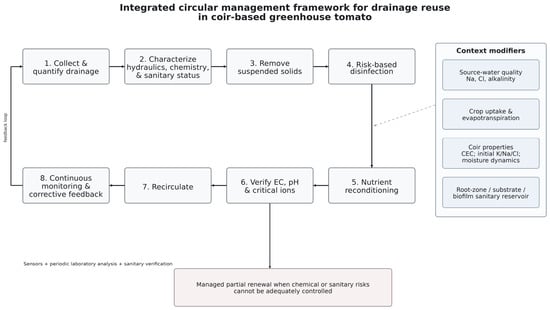
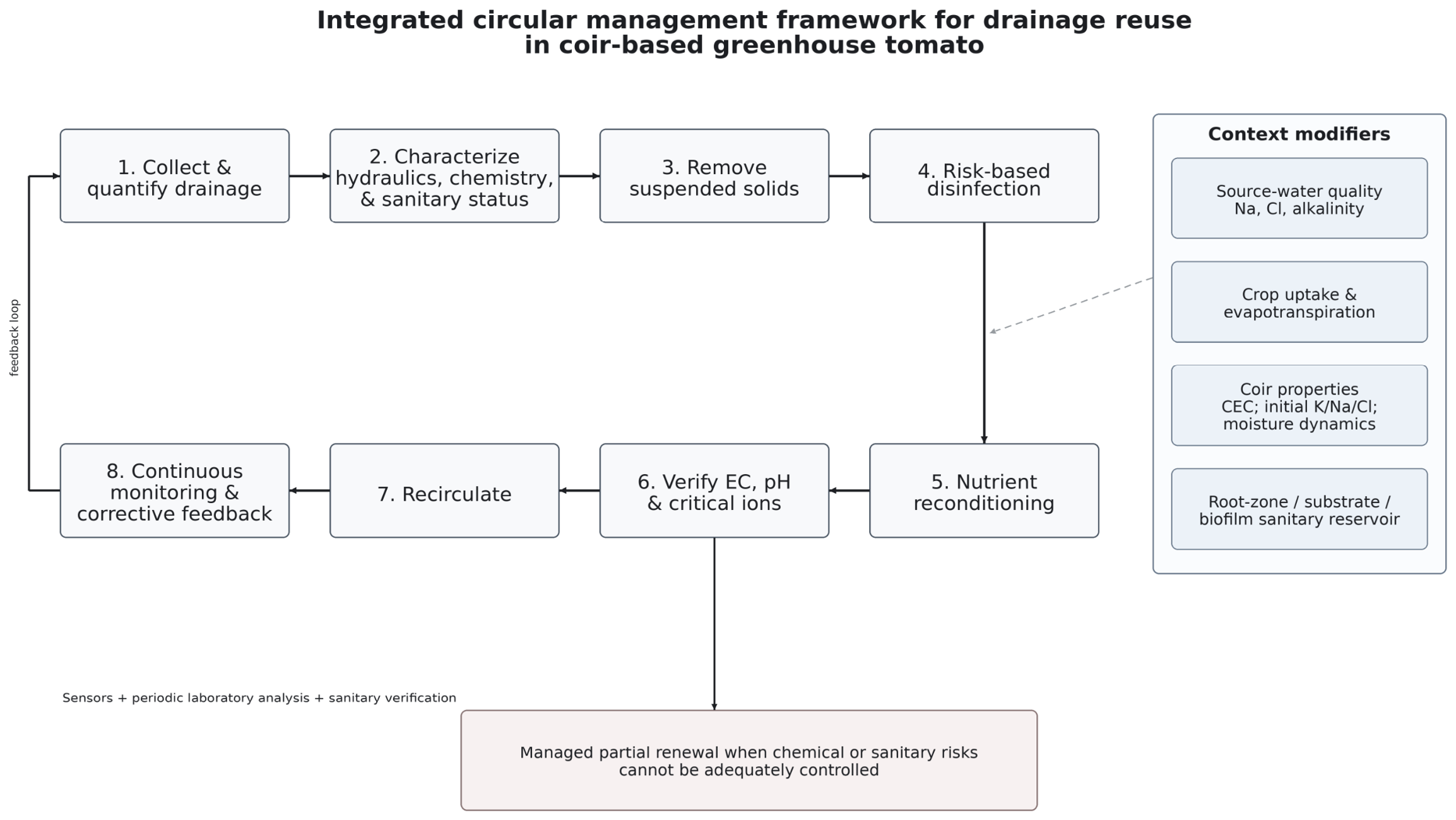
The evidence supports an integrated control concept rather than a single intervention for drainage reuse. Characterization identifies hydraulic, chemical, and sanitary deviations; solids removal protects downstream treatment; disinfection reduces liquid-phase sanitary risk; nutrient reconditioning addresses selective crop uptake and ion accumulation; and monitoring provides the temporal resolution needed to detect progressive change. The value of the framework lies in the interaction among these steps rather than in the addition of independent technologies.
Evidence directness is central to interpretation. Under the strict classification used in this review, only one study in the key-evidence matrix—Xiong et al. [10]—met the definition of direct evidence for coir-grown tomato with drainage recovery or recirculation. Additional coir studies informed substrate chemistry, ageing, or fertigation behavior, but not the full recirculating treatment chain. Consequently, broader conclusions on disinfection, sodium management, and monitoring rely largely on related tomato evidence or transferable evidence from other systems.
Adaptive circular management should maximize safe recovery while explicitly incorporating renewal as an operational safeguard when unresolved chemical or sanitary risks persist.
The proposed framework therefore combines source-water quality, crop uptake and evapotranspiration, coir-specific chemical and hydraulic properties, sanitary reservoirs in water and non-liquid compartments, and continuous feedback control. The resulting decision sequence is summarized in Figure 1.
Figure 1.
Integrated circular management framework for drainage reuse in coir-based greenhouse tomato. The eight-step sequence combines drainage collection and quantification, hydraulic/chemical/microbiological characterization, suspended-solids removal, risk-based disinfection, nutrient reconditioning, verification of EC, pH, and critical ions, recirculation, and continuous monitoring. Source-water quality, crop uptake and evapotranspiration, coir cation-exchange and moisture behavior, and root-zone/substrate/biofilm sanitary reservoirs modify the cycle. A decision node for managed partial renewal is included for cases in which chemical or sanitary risks cannot be adequately controlled.
4.2. Coir-Specific Implications
Coir cannot be treated as an inert equivalent of rockwool. Its cation-exchange behavior, initial soluble-ion content, processing and conditioning history, moisture distribution, and structural evolution influence root-zone and drainage chemistry. Abad et al. [9] found wide variability among 13 coir materials: cation-exchange capacity ranged from 31.7 to 95.4 cmol(c) kg−1 and salinity from 39 to 597 mS m−1, with high available K and elevated saline ions, especially Na and Cl. These ranges demonstrate why substrate source and pre-use verification matter.
Direct tomato evidence confirms that identical fertigation does not produce identical ionic conditions across substrates. Xiong et al. [10] reported an initial coir K content of 1560 mg kg−1 and an average root-zone K/Ca ratio of 2.3 in coir compared with 1.6 in rockwool under the same closed-system nutrient management. Coir also supported higher K uptake (41.2 g m−2) and higher total fruit yield than rockwool in that experiment. Drainage was recirculated directly to the reservoir, although the reservoir solution was replaced every two months; the study therefore provides direct but not permanent zero-discharge evidence.
Coir properties also change with use. Song et al. [11] reported total porosity of 65.4–73.1%, volumetric water-content changes with cultivation age, EC values of 22.2–53.5 dS m−1 using their substrate-extract method, and CEC values of 71.0–191.7 cmol kg−1 across new and repeatedly used coir. These analytical values should not be treated as direct root-zone solution concentrations, but they demonstrate that ageing changes the substrate’s physical and chemical boundary conditions.
Washing and Ca/Mg buffering are therefore relevant substrate-conditioning concepts, but the studies retained in this review do not establish a universal coir-specific washing or Ca/Mg-buffering dose for recirculating tomato. The evidence supports measuring initial salinity and ionic composition and accounting for the exchange of K/Na with Ca/Mg, while treatment intensity should be adapted to the actual material and supplier conditioning rather than inferred from a generic coir category [9,10,11]. Long-cycle experiments are still needed to quantify how these properties modify Na/Cl accumulation, nutrient reconditioning, disinfection performance, and complete-cycle stability under recirculation.
4.3. Strength and Limitations of the Evidence
The principal strength of the evidence base is the convergence among studies showing that drainage recovery can improve resource efficiency when supported by appropriate water, nutrient, and sanitary management. Direct coir-grown tomato studies provide useful evidence for substrate-mediated ionic and hydraulic behavior, but relatively few experiments combine coir, complete-cycle drainage recirculation, disinfection, nutrient reconditioning, and crop performance within the same study.
Evidence directness is therefore uneven. Much of the quantitative information on nutrient reconditioning, sodium management, disinfection, and digital control originates from rockwool, NFT, or other horticultural systems. Reporting of source-water quality, drainage fraction, treatment dose, hydraulic residence time, pathogen load, sensor calibration, and economic cost is also inconsistent. These limitations constrain transfer of numerical thresholds and operating protocols across substrates and production contexts.
The structured search was designed for critical evidence synthesis rather than exhaustive systematic or bibliometric coverage. Quantitative values were therefore interpreted within their original measurement compartment, treatment conditions, crop system, and experimental design. The conclusions should be read according to evidence directness and experimental context rather than as estimates of the prevalence of technologies in the literature.
4.4. Research Priorities
Four priorities emerge from the synthesis. First, complete-cycle experiments should quantify water, nutrient, and ion mass balances in coir-grown tomato under recirculation while documenting changes in substrate properties. Second, disinfection technologies require direct validation against relevant pathogens—particularly ToBRFV—under realistic drainage quality, turbidity, organic load, and hydraulic conditions. Third, sodium and chloride management should move toward crop- and site-specific predictive criteria integrating source-water composition, crop uptake, drainage fraction, and environmental conditions. Fourth, commercial-scale studies should combine agronomic performance with treatment energy, operating cost, labor, equipment maintenance, and life-cycle impacts.
Regulatory thresholds should also be reported by jurisdiction rather than generalized. Regulation (EU) 2020/741 establishes minimum requirements for reclaimed urban wastewater used for agricultural irrigation but does not establish a universal crop-specific sodium discharge limit for closed-loop greenhouse drainage [80]. Consequently, sodium management in greenhouse recirculation remains dependent on crop tolerance, source-water quality, system configuration, and applicable national or local requirements.
5. Conclusions
Drainage reuse in greenhouse tomato is technically feasible and can reduce water and nutrient losses when recovery is combined with chemical characterization, sanitary control, nutrient reconditioning, and adaptive monitoring. EC and pH remain essential operational indicators, but they cannot replace ion-specific assessment when poorly absorbed ions accumulate.
For coir-based tomato, substrate properties must be incorporated explicitly into recirculation management. Direct evidence shows that coir can modify ionic composition, water distribution, and root-zone conditions, and that these effects vary with substrate source and cultivation age. Long-cycle studies simultaneously integrating coir, drainage recirculation, disinfection, nutrient reconditioning, and crop performance remain limited.
Because most supporting studies are related or transferable rather than direct coir evidence, operational mechanisms and decision frameworks are more transferable than numerical thresholds or treatment doses. This is particularly important for ToBRFV, for which virus-specific treatment validation in recirculating coir-based tomato drainage remains a research priority.
The most robust pathway is therefore adaptive circular management that maximizes safe recovery while retaining controlled partial renewal when chemical or sanitary risks cannot be adequately managed. Commercial validation should integrate agronomic performance, water and nutrient savings, treatment energy, operating costs, source-water quality, and technical capacity.
Supplementary Materials
The following supporting information can be downloaded at: https://www.mdpi.com/article/10.3390/agronomy16191922/s1. Table S1. Structured search concepts used to organize the literature search; Table S2: Evidence-directness classification used in the review; Table S3: Evidence-extraction fields used during manuscript preparation; Table S4: Framework used to assess evidence quality and directness during interpretation; Table S5: Expanded key-evidence matrix linking representative studies, quantitative findings, and evidence directness.
Author Contributions
Conceptualization, J.M.G. and G.C.-S.; methodology, J.M.G., G.C.-S., F.F.-P., and P.M.; investigation, J.M.G.; data curation, J.M.G. and G.C.-S.; formal analysis, J.M.G. and G.C.-S.; writing—original draft preparation, J.M.G. and G.C.-S.; writing—review and editing, J.M.G., F.F.-P., P.M., and G.C.-S.; supervision, J.M.G. and G.C.-S. All authors have read and agreed to the published version of the manuscript.
Funding
This research received no external funding.
Data Availability Statement
No new data were created or analyzed in this study. Data sharing is not applicable to this article.
Conflicts of Interest
The authors declare no conflicts of interest.
Abbreviations
The following abbreviations are used in this manuscript:
| DSS | Decision-support system |
| EC | Electrical conductivity |
| H2O2 | Hydrogen peroxide |
| IoT | Internet of Things |
| ISE | Ion-selective electrode |
| ToBRFV | Tomato brown rugose fruit virus |
| UV-C | Ultraviolet-C radiation |
References
- Schneider, K.R.; Fanzo, J.; Haddad, L.; Herrero, M.; Rosero Moncayo, J.; Herforth, A.; Remans, R.; Guarin, A.; Resnick, D.; Covic, N.; et al. The state of food systems worldwide in the countdown to 2030. Nat. Food 2023, 4, 1090–1110. [Google Scholar] [CrossRef] [Scilit] [PubMed]
- Bununu, Y.A.; Bello, A.; Ahmed, A. Land cover, land use, climate change and food security. Sustain. Earth Rev. 2023, 6, 16. [Google Scholar] [CrossRef] [Scilit]
- Chrisendo, D.; Heikonen, S.; Piipponen, J.; Banafa, T.; Deryng, D.; El Wali, M.; Heino, M.; Irz, X.; Jalava, M.; Láng-Ritter, J.; et al. A systematic review of sustainable food systems identifies socio-economic pathways driving food systems transformations. Nat. Food 2026, 7, 234–246. [Google Scholar] [CrossRef] [Scilit] [PubMed]
- Guo, J.; Dong, L.; Kandel, S.L.; Jiao, Y.; Shi, L.; Yang, Y.; Shi, A.; Mou, B. Transcriptomic and metabolomic analysis provides insights into the fruit quality and yield improvement in tomato under soilless substrate-based cultivation. Agronomy 2022, 12, 923. [Google Scholar] [CrossRef] [Scilit]
- Elakrouch, M.; Mohaddab, M.; Rachid, A.; Jijakli, M.H. Soilless agriculture at a crossroads: Strengths, challenges, and prospects of hydroponics, aquaponics, and bioponics in relation to precision farming. Sustainability 2026, 18, 64. [Google Scholar] [CrossRef] [Scilit]
- Raviv, M.; Lieth, J.H.; Bar-Tal, A. (Eds.) Soilless Culture: Theory and Practice, 2nd ed.; Academic Press: London, UK, 2019. [Google Scholar]
- Savvas, D.; Gruda, N. Application of soilless culture technologies in the modern greenhouse industry—A review. Eur. J. Hortic. Sci. 2018, 83, 280–293. [Google Scholar] [CrossRef] [Scilit]
- Urrestarazu, M.; Carrasco, G. Soilless Culture and Hydroponics; Mundi-Prensa: Madrid, Spain, 2023. [Google Scholar]
- Abad, M.; Noguera, P.; Puchades, R.; Maquieira, A.; Noguera, V. Physico-chemical and chemical properties of some coconut coir dusts for use as a peat substitute for containerised ornamental plants. Bioresour. Technol. 2002, 82, 241–245. [Google Scholar] [CrossRef] [Scilit] [PubMed]
- Xiong, J.; Tian, Y.; Wang, J.; Liu, W.; Chen, Q. Comparison of Coconut Coir, Rockwool, and Peat Cultivations for Tomato Production: Nutrient Balance, Plant Growth and Fruit Quality. Front. Plant Sci. 2017, 8, 1327. [Google Scholar] [CrossRef] [Scilit] [PubMed]
- Song, S.-G.; Lee, K.-S.; Lee, D.-S.; Rhie, J.-H.; Hong, B.-D.; Bae, H.-S.; Seo, I.-H.; Chung, D.-Y. Changes in Physical and Chemical Properties of Coir Used as the Bag Culture Substrate of Greenhouse Tomatoes for Three Years. Korean J. Soil Sci. Fertil. 2016, 49, 503–509. [Google Scholar] [CrossRef] [Scilit]
- Cuervo, W.J.; Flórez, V.J.; González, C.A. Aspects to consider for optimizing a substrate culture system with drainage recycling. Agron. Colomb. 2012, 30, 379–387. Available online: https://revistas.unal.edu.co//index.php/agrocol/article/view/29029 (accessed on 7 September 2026).
- Savvas, D.; Giannothanasis, E.; Ntanasi, T.; Karavidas, I.; Ntatsi, G. State of the art and new technologies to recycle the fertigation effluents in closed soilless cropping systems aiming to maximise water and nutrient use efficiency in greenhouse crops. Agronomy 2024, 14, 61. [Google Scholar] [CrossRef] [Scilit]
- Neocleous, D.; Savvas, D. Validating a Smart Nutrient Solution Replenishment Strategy to Save Water and Nutrients in Hydroponic Crops. Front. Environ. Sci. 2022, 10, 965964. [Google Scholar] [CrossRef] [Scilit]
- Signore, A.; Serio, F.; Santamaria, P. A targeted management of the nutrient solution in a soilless tomato crop according to plant needs. Front. Plant Sci. 2016, 7, 391. [Google Scholar] [CrossRef] [Scilit] [PubMed]
- Giannothanasis, E.; Spanoudaki, E.; Kinnas, S.; Ntatsi, G.; Voogt, W.; Savvas, D. Development and Validation of an Innovative Algorithm for Sodium Accumulation Management in Closed-Loop Soilless Culture Systems. Agric. Water Manag. 2024, 301, 108968. [Google Scholar] [CrossRef] [Scilit]
- Sonneveld, C.; Voogt, W. Plant Nutrition of Greenhouse Crops; Springer: Dordrecht, The Netherlands, 2009. [Google Scholar] [CrossRef] [Scilit]
- van Ruijven, J.; van Os, E.; Stijger, I.; Beerling, E.; de Haan, C. Double use of water treatment in soilless growing systems: Disinfection of recirculating solution and removal of plant protection products from discharge water. Acta Hortic. 2017, 1170, 571–588. [Google Scholar] [CrossRef] [Scilit]
- Stouvenakers, G.; Dapprich, P.; Massart, S.; Jijakli, M.H. Plant pathogens and control strategies in aquaponics. In Aquaponics Food Production Systems; Goddek, S., Joyce, A., Kotzen, B., Burnell, G.M., Eds.; Springer: Cham, Switzerland, 2019; pp. 353–378. [Google Scholar] [CrossRef] [Scilit]
- Mehle, N.; Bačnik, K.; Bajde, I.; Brodarič, J.; Fox, A.; Gutiérrez-Aguirre, I.; Kitek, M.; Kutnjak, D.; Loh, Y.L.; Maksimović Carvalho Ferreira, O.; et al. Tomato brown rugose fruit virus in aqueous environments: Survival and significance of water-mediated transmission. Front. Plant Sci. 2023, 14, 1187920. [Google Scholar] [CrossRef] [Scilit] [PubMed]
- Sutton, J.C.; Sopher, C.R.; Owen-Going, T.N.; Liu, W.; Grodzinski, B.; Hall, J.C.; Benchimol, R.L. Etiology and epidemiology of Pythium root rot in hydroponic crops: Current knowledge and perspectives. Summa Phytopathol. 2006, 32, 307–321. [Google Scholar] [CrossRef] [Scilit]
- Zhou, J.; Gilliard, A.; Ling, K.-S. Tomato Brown Rugose Fruit Virus Is Transmissible through a Greenhouse Hydroponic System but May Be Inactivated by Cold Plasma Ozone Treatment. Horticulturae 2024, 10, 416. [Google Scholar] [CrossRef] [Scilit]
- Ehlers, J.; Nourinejhad Zarghani, S.; Kroschewski, B.; Büttner, C.; Bandte, M. Cleaning of Tomato brown rugose fruit virus (ToBRFV) from Contaminated Clothing of Greenhouse Employees. Horticulturae 2022, 8, 751. [Google Scholar] [CrossRef] [Scilit]
- Skelton, A.; Frew, L.; Ward, R.; Hodgson, R.; Forde, S.; McDonough, S.; Webster, G.; Chisnall, K.; Mynett, M.; Buxton-Kirk, A.; et al. Tomato Brown Rugose Fruit Virus: Survival and Disinfection Efficacy on Common Glasshouse Surfaces. Viruses 2023, 15, 2076. [Google Scholar] [CrossRef] [Scilit] [PubMed]
- Samarah, N.H.; Sulaiman, A.; Salem, N.M.; Turina, M. Disinfection treatments eliminated tomato brown rugose fruit virus in tomato seeds. Eur. J. Plant Pathol. 2021, 159, 153–162. [Google Scholar] [CrossRef] [Scilit]
- Zamora-Macorra, E.J.; Merino-Domínguez, C.L.; Ramos-Villanueva, C.; Mendoza-Espinoza, I.M.; Cadenas-Castrejón, E.; Aviña-Padilla, K. Analysis of Disinfectant Efficacy Against Tomato Brown Rugose Fruit Virus: Surface and Method Effects in Greenhouse Production. Agronomy 2026, 16, 15. [Google Scholar] [CrossRef] [Scilit]
- Stewart-Wade, S.M. Plant pathogens in recycled irrigation water in commercial plant nurseries and greenhouses: Their detection and management. Irrig. Sci. 2011, 29, 267–297. [Google Scholar] [CrossRef] [Scilit]
- Raudales, R.E.; Parke, J.L.; Guy, C.L.; Fisher, P.R. Control of waterborne microbes in irrigation: A review. Agric. Water Manag. 2014, 143, 9–28. [Google Scholar] [CrossRef] [Scilit]
- Ehret, D.L.; Alsanius, B.; Wohanka, W.; Menzies, G.J.; Utkhede, R. Disinfestation of recirculating nutrient solutions in greenhouse horticulture. Agronomie 2001, 21, 323–339. [Google Scholar] [CrossRef] [Scilit]
- Betancourt-Flores, A.; Soto-Bravo, F. Effect of water depletion on the physical-hydraulic, physicochemical, and agronomic properties of hydroponic pepper and tomato. Agron. Mesoam. 2026, 37, 9vvdjh52. [Google Scholar] [CrossRef] [Scilit]
- Liu, S.; Qiang, X.; Liu, H.; Han, Q.; Yi, P.; Ning, H.; Li, H.; Wang, C.; Zhang, X. Effects of nutrient solution application rates on yield, quality, and water–fertilizer use efficiency on greenhouse tomatoes grown in coir. Plants 2024, 13, 893. [Google Scholar] [CrossRef] [Scilit] [PubMed]
- Dyśko, J.; Szczech, M.; Kaniszewski, S.; Kowalczyk, W. Parameters of drainage waters collected during soilless tomato cultivation in mineral and organic substrates. Agronomy 2020, 10, 2009. [Google Scholar] [CrossRef] [Scilit]
- van Os, E.A.; Amsing, J.J.; van Kuik, A.J.; Willers, H. Slow sand filtration: A potential method for the elimination of pathogens and nematodes in recirculating nutrient solutions from glasshouse-grown crops. Acta Hortic. 1999, 481, 519–526. [Google Scholar] [CrossRef] [Scilit]
- van Os, E.A. Comparison of some chemical and non-chemical treatments to disinfect a recirculating nutrient solution. Acta Hortic. 2009, 843, 229–234. [Google Scholar] [CrossRef] [Scilit]
- Langlais, C.; Deniel, F.; Wolbert, D.; Tirilly, Y.; Laplanche, A. Study of the treatment and the recirculation of water from soil-less horticulture. Rev. Des. Sci. De l’Eau/J. Water Sci. 2000, 13, 5–20. [Google Scholar] [CrossRef] [Scilit][Green Version]
- Singh, K.G.; Singh, A.; Shah, A.I.; Singh, G. Design and evaluation of slow sand and UV filters for effective nutrient recycling in closed soilless cultivation. Indian J. Agric. Sci. 2024, 94, 564–568. [Google Scholar] [CrossRef] [Scilit]
- Kim, B.-S.; Youm, S.; Kim, Y.-K. Sterilization of Harmful Microorganisms in Hydroponic Cultivation Using an Ultraviolet LED Light Source. Sens. Mater. 2020, 32, 3773–3785. [Google Scholar] [CrossRef] [Scilit]
- Rudakov, V.O.; Baranov, V.L.; Tkachev, A.A. Evaluation of the effectiveness of ultraviolet disinfection (254 nm) of aqueous solutions from phytopathogenic microorganisms. Veg. Crops Russ. 2023, 2, 70–74. [Google Scholar] [CrossRef] [Scilit]
- Ghimire, B.; Pendyala, B.; Patras, A.; Baysal-Gurel, F. Assessing the Efficacy of UV-C Light for the Inactivation of Phytopythium and Phytophthora Species in Water: A Mathematical Modeling Approach Using an Ultraviolet Light-Emitting-Diode System. PhytoFrontiers 2024, 4, 347–359. [Google Scholar] [CrossRef] [Scilit]
- Scarlett, K.; Collins, D.; Tesoriero, L.; Jewell, L.; van Ogtrop, F.; Daniel, R. Efficacy of chlorine, chlorine dioxide and ultraviolet radiation as disinfectants against plant pathogens in irrigation water. Eur. J. Plant Pathol. 2016, 145, 27–38. [Google Scholar] [CrossRef] [Scilit]
- Wang, X.; Fang, W.; Zhao, Z. Design of UVA Ultraviolet Disinfection System for Nutrient Solution Residual Liquid and Development of Microbial Online Monitoring System. Sustainability 2023, 15, 173. [Google Scholar] [CrossRef] [Scilit]
- Ma, B.; Bright, K.R.; Ikner, L.A.; Ley, C.; Seyedi, S.R.; Gerba, C.P.; Sobsey, M.D.; Piper, P.; Linden, K.G. UV Inactivation of Common Pathogens and Surrogates Under 222 nm Irradiation from KrCl* Excimer Lamps. Photochem. Photobiol. 2023, 99, 975–982. [Google Scholar] [CrossRef] [Scilit] [PubMed]
- Mine, Y.; Suematsu, M.; Sugiyama, N. Aeration and heating improve slow sand filtration as a disinfection system for closed hydroponic systems. Environ. Control. Biol. 2007, 45, 179–187. [Google Scholar] [CrossRef] [Scilit]
- Runia, W.T. Disinfection of recirculation water from closed cultivation systems by heat treatment and UV-irradiation. Acta Hortic. 1994, 361, 361–371. [Google Scholar] [CrossRef] [Scilit]
- Varlagas, H.; Savvas, D.; Mouzakis, G.; Liotsos, C.; Karapanos, I.; Sigrimis, N. Modelling uptake of Na+ and Cl− by tomato in closed-cycle cultivation systems as influenced by irrigation water salinity. Agric. Water Manag. 2010, 97, 1242–1250. [Google Scholar] [CrossRef] [Scilit]
- Arcas, A.; Valverde, S.; Lucena, J.J.; López-Rayo, S. Photocatalytic degradation of iron chelates fertilizers under UV light: A rapid evaluation for hydroponic growing systems. Chem. Biol. Technol. Agric. 2025, 12, 96. [Google Scholar] [CrossRef] [Scilit]
- De la Rosa-Rodríguez, R.; Lara-Herrera, A.; Padilla-Bernal, L.E.; Avelar-Mejía, J.J.; España-Luna, M.P. Proporción de drenaje de la solución nutritiva en el rendimiento y calidad de tomate en hidroponía. Rev. Mex. Cienc. Agríc. 2018, 20, 4343–4353. [Google Scholar] [CrossRef] [Scilit]
- Steiner, A.A. A universal method for preparing nutrient solutions of a certain desired composition. Plant Soil 1961, 15, 134–154. [Google Scholar] [CrossRef] [Scilit]
- Blok, C.; Voogt, W.; Barbagli, T. Reducing Nutrient Imbalance in Recirculating Drainage Solution of Stone Wool Grown Tomato. Agric. Water Manag. 2023, 285, 108360. [Google Scholar] [CrossRef] [Scilit]
- Voogt, W. Nutrient uptake of year-round tomato crops. Acta Hortic. 1993, 339, 99–112. [Google Scholar] [CrossRef] [Scilit]
- Osvalde, A.; Karlsons, A.; Čekstere-Muižniece, G. Leaf nutrient status of tomatoes in coconut coir medium—Differences in cultivars, impact on yield and quality. Agron. Res. 2021, 19, 1850–1862. [Google Scholar] [CrossRef] [Scilit]
- Vallance, J.; Déniel, F.; Le Floch, G.; Guérin-Dubrana, L.; Blancard, D.; Rey, P. Pathogenic and beneficial microorganisms in soilless cultures. Agron. Sustain. Dev. 2011, 31, 191–203. [Google Scholar] [CrossRef] [Scilit]
- Wu, Y.-M.; Liu, S.-Y.; Shi, B.-Y.; Peng, J.-Y.; Kao, Z.-W.; Chen, Y.-Y.; Hsieh, T.-Y.; Chung, H.-Y.; Lin, C.-Y.; Fang, W.; et al. IoT-interfaced solid-contact ion-selective electrodes for cyber-monitoring of element-specific nutrient information in hydroponics. Comput. Electron. Agric. 2023, 214, 108266. [Google Scholar] [CrossRef] [Scilit]
- Cambra, C.; Sendra, S.; Lloret, J.; Lacuesta, R. Smart System for Bicarbonate Control in Irrigation for Hydroponic Precision Farming. Sensors 2018, 18, 1333. [Google Scholar] [CrossRef] [Scilit] [PubMed]
- Yegül, U. Development of an Embedded Software and Control Kit to Be Used in Soilless Agriculture Production Systems. Sensors 2023, 23, 3706. [Google Scholar] [CrossRef] [Scilit] [PubMed]
- Beneduce, L.; Piergiacomo, F.; Sikorska-Zimny, K. Different Nutritional Regimes in a Tomato Soilless System Affect the Bacterial Communities with Consequences on the Crop Quality. Agriculture 2024, 14, 2254. [Google Scholar] [CrossRef] [Scilit]
- McGehee, C.S.; Raudales, R.E. Pathogenicity and Mefenoxam Sensitivity of Pythium, Globisporangium, and Fusarium Isolates From Coconut Coir and Rockwool in Marijuana (Cannabis sativa L.) Production. Front. Agron. 2021, 3, 706138. [Google Scholar] [CrossRef] [Scilit]
- Acher, A.; Heuer, B.; Rubinskaya, E.; Fischer, E. Use of ultraviolet-disinfected nutrient solutions in greenhouses. J. Hortic. Sci. 1997, 72, 117–123. [Google Scholar] [CrossRef] [Scilit]
- Thakulla, D.; Dunn, B.L.; Goad, C.; Hu, B. Timing and Rates of Two Products Using Hydrogen Peroxide (H2O2) to Control Algae in Ebb and Flow Hydroponic Systems. HortScience 2022, 57, 32–39. [Google Scholar] [CrossRef] [Scilit]
- Bosmans, L.; Van Calenberge, B.; Paeleman, A.; Moerkens, R.; Wittemans, L.; Van Kerckhove, S.; De Mot, R.; Lievens, B.; Rediers, H. Efficacy of hydrogen peroxide treatment for control of hairy root disease caused by rhizogenic agrobacteria. J. Appl. Microbiol. 2016, 121, 519–527. [Google Scholar] [CrossRef] [Scilit] [PubMed]
- Hendrickson, T.D.; Dunn, B.L.; Goad, C.; Hu, B.; Singh, H. Effects of Hydrogen Peroxide Products on Basil, Lettuce, and Algae in an Ebb and Flow Hydroponic System. Horticulturae 2022, 8, 569. [Google Scholar] [CrossRef] [Scilit]
- Kriem, L.S.; Pietzka, C.; Beckett, M.; Gärtling, L.; Wriedt, B. Electrochemical In Situ Hydrogen Peroxide Production Can Reduce Microbial Load in Bioponic Nutrient Solutions Derived from Organic Waste. Agriculture 2023, 13, 2122. [Google Scholar] [CrossRef] [Scilit]
- Phornvillay, S.; Yodsarn, S.; Oonsrithong, J.; Srilaong, V.; Pongprasert, N. A Novel Technique Using Advanced Oxidation Process (UV-C/H2O2) Combined with Micro-Nano Bubbles on Decontamination, Seed Viability, and Enhancing Phytonutrients of Roselle Microgreens. Horticulturae 2022, 8, 53. [Google Scholar] [CrossRef] [Scilit]
- Hong, J.K.; Kang, S.R.; Kim, Y.H.; Yoon, D.J.; Kim, D.H.; Kim, H.J.; Sung, C.H.; Kang, H.S.; Choi, C.W.; Kim, S.H.; et al. Hydrogen Peroxide- and Nitric Oxide-mediated Disease Control of Bacterial Wilt in Tomato Plants. Plant Pathol. J. 2013, 29, 386–396. [Google Scholar] [CrossRef] [Scilit] [PubMed]
- Sonneveld, C.; van der Burg, A.M.M. Sodium chloride salinity in fruit vegetable crops in soilless culture. Neth. J. Agric. Sci. 1991, 39, 115–122. [Google Scholar] [CrossRef] [Scilit]
- Sánchez-Del Castillo, F.; Moreno-Pérez, E.C.; Pineda-Pineda, J.; Osuna, J.M.; Rodríguez-Pérez, J.E.; Osuna-Encino, T. Producción hidropónica de jitomate (Solanum lycopersicum L.) con y sin recirculación de la solución nutritiva. Agrociencia 2014, 48, 185–197. [Google Scholar]
- Incrocci, L.; Malorgio, F.; Della Bartola, A.; Pardossi, A. The influence of drip irrigation or subirrigation on tomato grown in closed-loop substrate culture with saline water. Sci. Hortic. 2006, 107, 365–372. [Google Scholar] [CrossRef] [Scilit]
- Mavrogianopoulos, G.; Savvas, D.; Vogli, V. Influence of NaCl-salinity imposed on half of the root system of hydroponically grown tomato on growth, yield, and tissue mineral composition. J. Hortic. Sci. Biotechnol. 2002, 77, 557–564. [Google Scholar] [CrossRef] [Scilit]
- Botrini, L.; Graifenberg, A.; Lipucci di Paola, M. Potassium affects sodium content in tomato plants grown in hydroponic cultivation under saline-sodic stress. HortScience 2000, 35, 1220–1222. [Google Scholar] [CrossRef] [Scilit]
- Méndez Tomalá, H.; Pertierra Lazo, R.; Balmaseda Espinosa, C. Eficiencia del agua en tomate cultivado en sustrato inerte. Rev. Cient. Tecnol. UPSE 2023, 10, 23–34. [Google Scholar] [CrossRef] [Scilit]
- D’Amico, A.; De Boni, A.; Ottomano Palmisano, G.; Acciani, C.; Roma, R. Environmental analysis of soilless tomato production in a high-tech greenhouse. Clean. Environ. Syst. 2023, 11, 100137. [Google Scholar] [CrossRef] [Scilit]
- Hasan, M.; Bhat, A.G.; Vinod Kumar, S.; Mahesh, R.; Yadav, A.K.; Saji, A.; Bharath, G.; Prakash, S.A. IoT-Based Smart Fertigation Scheduling and Wireless Microclimate Monitoring for a Greenhouse Dutch Bucket Hydroponic System. Irrig. Drain. 2025, 74, 1889–1903. [Google Scholar] [CrossRef] [Scilit]
- Sriman, B.; Anwar Basha, H.; Sampath, N.; Annie Silviya, S.H.; Vanitha Mani, R.; Varadarajan, V. Smart hydroponic greenhouse enhanced with the application of the internet of things. HKIE Trans. 2024, 31, 1–11. [Google Scholar] [CrossRef] [Scilit]
- Ardiansah, I.; Calibra, R.G.; Bafdal, N.; Bono, A.; Suryadi, E.; Nurhasanah, S. An IoT-enabled design for real-time water quality monitoring and control of greenhouse irrigation systems. INMATEH—Agric. Eng. 2023, 69, 417–426. [Google Scholar] [CrossRef] [Scilit]
- Ehret, D.L.; Lau, A.; Bittman, S.; Lin, W.; Shelford, T. Automated monitoring of greenhouse crops. Agronomie 2001, 21, 403–414. [Google Scholar] [CrossRef] [Scilit]
- Tuxun, A.; Xiang, Y.; Shao, Y.; Son, J.E.; Yamada, M.; Yamada, S.; Tagawa, K.; Baiyin, B.; Yang, Q. Soilless Cultivation: Precise Nutrient Provision and Growth Environment Regulation under Different Substrates. Plants 2025, 14, 2203. [Google Scholar] [CrossRef] [Scilit] [PubMed]
- Junge, R.; Schmautz, Z.; Milliken, S. Toward Nutrient Cycling from Organic Waste Streams for Soilless Cultivation. Curr. Opin. Food Sci. 2025, 61, 101257. [Google Scholar] [CrossRef] [Scilit]
- Elvanidi, A.; Benitez Reascos, C.M.; Gourzoulidou, E.; Kunze, A.; Max, J.F.J.; Katsoulas, N. Implementation of the Circular Economy Concept in Greenhouse Hydroponics for Ultimate Use of Water and Nutrients. Horticulturae 2020, 6, 83. [Google Scholar] [CrossRef] [Scilit]
- Rufí-Salís, M.; Calvo, M.J.; Petit-Boix, A.; Villalba, G.; Gabarrell, X. Exploring nutrient recovery from hydroponics in urban agriculture: An environmental assessment. Resour. Conserv. Recycl. 2020, 155, 104683. [Google Scholar] [CrossRef] [Scilit]
- European Parliament and Council. Regulation (EU) 2020/741 of the European Parliament and of the Council of 25 May 2020 on minimum requirements for water reuse. Off. J. Eur. Union 2020, L177, 32–55. Available online: https://eur-lex.europa.eu/eli/reg/2020/741/oj (accessed on 7 September 2026).

Disclaimer/Publisher’s Note: The statements, opinions and data contained in all publications are solely those of the individual author(s) and contributor(s) and not of MDPI and/or the editor(s). MDPI and/or the editor(s) disclaim responsibility for any injury to people or property resulting from any ideas, methods, instructions or products referred to in the content. |
© 2026 by the authors. Licensee MDPI, Basel, Switzerland. This article is an open access article distributed under the terms and conditions of the Creative Commons Attribution (CC BY) license.