


Abstract
Long-term fertilization can reshape soil microbial communities and alter soil ecosystem functioning. However, few studies have comprehensively investigated changes in microbial functional potential for carbon, nitrogen, phosphorus, and sulfur (CNPS) cycling in bulk and rhizosphere soils in response to long-term fertilization, or the relationships between microbial taxonomic shifts and functional responses. We combined 16S rRNA gene amplicon sequencing with high-throughput quantitative PCR targeting 71 CNPS cycling-related genes in a 32-year field experiment comprising an unfertilized control (CK), mineral fertilizer (NPK), manure (M), and NPK combined with manure (NPKM). The results showed that both mineral NPK fertilizer and manure increased soil nutrient availability but had contrasting effects on soil pH. Relative to CK, NPK, M, and NPKM increased rapeseed grain yield by 303.9%, 108.7%, and 397.8%, respectively, and biomass by 303.0%, 99.6%, and 410.5%, respectively. Fertilization also reshaped bacterial community composition, and the responses were similar between bulk and rhizosphere soils. In contrast, functional-gene abundances showed significant soil compartment-dependent responses to fertilization. NPK fertilization reduced most rhizosphere gene groups associated with C degradation, N transformation, P mobilization, and S cycling while increasing nitrification-related genes, whereas manure increased genes involved in carbohydrate degradation, methane metabolism, multiple N transformations, organic P mineralization, phosphate solubilization, and sulfate reduction. Network analysis showed that genes mediating similar processes clustered within common modules and were associated with shared bacterial taxa. Crop productivity was associated with variation in genes involved in N fixation and organic P mineralization in rhizosphere soil. Our results revealed associations between functional-gene abundances, soil nutrients, crop productivity, and bacterial community changes under long-term fertilization, highlighting the importance of quantitative functional-gene analysis as an indicator for evaluating soil multifunctionality.
1. Introduction
Soil multifunctionality refers to the simultaneous provision of multiple ecosystem functions, such as crop production, nutrient cycling, organic C storage, and the regulation of nutrient losses, and is fundamental to the productivity and sustainability of agroecosystems [1,2]. Fertilization is one of the most important management measures for maintaining crop production under modern intensive agricultural conditions. Mineral fertilizers provide available nutrients and often lead to rapid increases in crop productivity, but their long-term excessive application can cause soil acidification, nutrient imbalance, and soil degradation [3,4]. Organic fertilizer supplies both nutrients and organic matter, thereby simultaneously promoting the accumulation of soil organic matter and the retention of nutrients [5]. By altering nutrient availability, organic matter, and other soil physicochemical conditions, different fertilization regimes can influence soil multifunctionality [6,7].
Agroecosystem multifunctionality is closely related to the diversity and function of microbial communities in soil [2,8]. Across long-term field experiments, fertilization commonly reshapes soil microbial community composition [6,9]. Specifically, long-term mineral fertilization often favors copiotroph-dominated bacterial communities, but repeated N inputs may reduce microbial abundance and alter bacterial community composition when soil acidification is pronounced [9,10]. Organic fertilizer generally enriches copiotrophic and organic-matter-decomposing taxa by supplying organic C and nutrients and buffering soil acidification [11,12]. For example, bacterial richness and diversity were higher after 20 years of animal-slurry application than under mineral fertilization [9]. Microbial functional potential has conventionally been inferred from taxonomic community composition in previous studies. However, this approach may not accurately capture changes in soil functions because microbial communities exhibit substantial functional redundancy, as different taxa can perform similar ecological processes [13]. Directly quantifying functional genes provides a more specific assessment of the microbial potential underlying soil biochemical processes [8,14]. Therefore, integrating taxonomic information with the quantification of CNPS cycling-related functional genes is crucial for determining how long-term mineral and organic fertilization alter soil functioning by regulating microbially mediated elemental cycling.
Microbial functional genes have been widely used to estimate the capacity of soil microbial communities to mediate specific ecological processes [15,16]. For example, cbbL, chiA, and mcrA are associated with carbon fixation, chitin degradation, and methanogenesis, respectively; nifH, amoA, nirK/nirS, and nosZ represent key steps in nitrogen fixation, nitrification, and denitrification; and phoC/phoD, gcd, and pqqC are linked to organic phosphorus mineralization and mineral phosphate solubilization. Previous studies have shown that fertilizer type can induce distinct responses in specific microbial functional genes, particularly those involved in N cycling. For instance, mineral N fertilization generally increases the abundances of archaeal and bacterial amoA by increasing ammonium availability for ammonia oxidizers [17], whereas high N inputs may suppress nifH abundance by reducing microbial dependence on biological N fixation [18]. Organic fertilization, in contrast, has been reported to increase amoA and denitrification genes such as nirK, nirS, and nosZ, probably because it supplies both N substrates and organic C for nitrifiers and denitrifiers [8]. Despite this, most studies have focused mainly on individual or a few specific functional genes, particularly those involved in N cycling, and few have comprehensively evaluated functional genes across C, N, P, and S cycling pathways.
Moreover, there are distinct differences in microenvironments between rhizosphere and bulk soils [19,20]. Changes in microbial communities and functions in bulk soil mainly reflect the responses of microorganisms to the legacy effects of long-term fertilization [9,10]. In the rhizosphere soil, the input of plant root exudates can alter the content of easily accessible C for microorganisms, and the secretion of organic acids from roots will cause a decrease in pH, which will affect the growth and metabolism of microorganisms [21,22]. Meanwhile, plant nutrient uptake alters the concentrations and chemical forms of N, P, and other elements [23]. Therefore, rhizosphere microorganisms are simultaneously exposed to fertilization effects and root-induced changes in their microenvironment. As a result, fertilization effects on microbial functional genes may differ in magnitude and/or direction between rhizosphere and bulk soils. However, how this spatial heterogeneity shapes the responses of CNPS cycling-related functional genes to different fertilization regimes remains poorly understood.
The aim of this study was to determine how long-term mineral and organic fertilization regimes regulate bacterial CNPS cycling-related functions in bulk and rhizosphere soils and how these changes relate to bacterial composition and crop productivity. We investigated soil physicochemical properties, crop yield, bacterial community composition, and CNPS cycling-related functional genes based on a long-term fertilization experiment with four treatments: (i) no fertilizer control; (ii) mineral NPK fertilizer only; (iii) manure only; and (iv) mineral NPK fertilizer combined with manure. We hypothesized that (1) mineral NPK fertilization and manure addition would drive distinct shifts in bacterial community composition and CNPS cycling-related functional gene abundances; (2) the abundances of CNPS cycling-related functional genes would show greater variability among different fertilization treatments in rhizosphere soil than in bulk soil; and (3) long-term fertilization would alter the composition of soil CNPS cycling-related functional genes by selectively reshaping bacterial taxa associated with specific nutrient-cycling functions.
2. Materials and Methods
2.1. Field Experiment and Soil Sampling
The field experiment was carried out at the National Monitoring Station for Soil Fertility and Fertilizer Efficiency in Jiaxing, Zhejiang Province, China (30°26′ N, 120°25′ E). The site is located in a subtropical monsoon region, with a mean annual temperature of 16–17 °C and a mean annual precipitation of 1500–1600 mm. The long-term fertilizer trial was initiated in 1990. It was originally managed as a rice-barley rotation and was converted to a rice-rapeseed rotation in 2011, with the total annual fertilizer input remaining unchanged. The soil is an Inceptisol according to USDA Soil Taxonomy, containing 42% sand, 38% silt, and 20% clay.
In the present study, we selected four fertilization regimes from this long-term experiment: no fertilizer control (CK), mineral nitrogen, phosphorus, and potassium fertilizer (NPK), organic manure alone (M), and combined mineral NPK fertilizer plus organic manure (NPKM). For the mineral fertilizer treatments, urea, calcium superphosphate, and potassium chloride were used as the N, P, and K sources, respectively, at annual rates of 375 kg N ha−1, 187.5 kg P2O5 ha−1, and 187.5 kg K2O ha−1. Composted pig manure was incorporated annually at a rate of 22.5 Mg ha−1. The manure contained 68.9% water, and on a dry-weight basis consisted of 197.4 g C kg−1, 14.5 g N kg−1, 14.2 g P kg−1, and 13.1 g K kg−1. Accordingly, the manure provided annual total inputs of 1381.3 kg C ha−1, 101.5 kg N ha−1, 227.7 kg P2O5 ha−1, and 110.4 kg K2O ha−1. Four fertilization treatments, each with three field replicates, were arranged in a completely randomized block design (12 plots, 100 m2 each) under an oilseed rape (Brassica napus L., Zheyou 50)–rice (Oryza sativa L., Xiushui 134) rotation. Rice was direct-seeded at a rate of 0.5 kg per 100 m2, whereas oilseed rape was transplanted at a spacing of 30 cm × 30 cm. Each plot was hydrologically isolated from adjacent plots by concrete barriers to prevent cross-contamination among treatments. The percentages of applied fertilizers were 64% for rice and 36% for oilseed rape (68% for rice and 32% for barley before 2010). During each crop-growing season, 70% of the nitrogen fertilizer was applied as a basal fertilizer and the remaining 30% as a top dressing. In contrast, composted manure and P and K fertilizers were applied once as basal fertilizers before sowing. The fields were plowed before crop establishment. Crop-protection practices included prochloraz seed treatment and acetochlor application for weed control. Apart from fertilization, all plots received the same field management practices.
Soil samples (0–20 cm depth) were collected at the harvest stage in May 2022. For each plot, bulk soil was randomly collected from 15 soil cores taken away from the plant root zone. Meanwhile, 15 plants were randomly selected from each replicate plot. Loosely adhering soil was gently shaken off, and the soil tightly adhering to the roots was then collected by brushing and defined as rhizosphere soil. The same sampling procedure was applied consistently to all samples. Samples were labeled as BCK, BM, BNPK and BNPKM for bulk soils, and RCK, RM, RNPK and RNPKM for rhizosphere soils. In total, 24 soil samples were obtained (4 treatments × 2 soil compartments × 3 biological replicates). Fresh soil samples were immediately transported to the laboratory on ice and passed through a 2-mm sieve after visible roots, stones, and plant residues were removed. Each soil sample was split into two subsamples for molecular and chemical analyses and stored at −80 °C and room temperature, respectively. Rapeseed yield was measured at maturity by harvesting each plot.
2.2. Soil Physicochemical Analysis
Soil physicochemical properties were determined according to standard procedures described by Lu [24]. Soil pH was measured in a soil–water suspension (1:2.5) using a pH meter. Soil organic carbon (SOC) was determined by the potassium dichromate oxidation method. Soil total N (TN) was determined by the Kjeldahl method using a Lachat flow injection autoanalyzer (Lachat Instruments, Milwaukee, WI, USA). Ammonium (NH4+-N) and nitrate (NO3−-N) concentrations were extracted with KCl solution and measured using the same analyzer. Alkali-hydrolyzable N (ANH) was determined by alkaline hydrolysis diffusion. Soil total phosphorus (TP) was determined by molybdenum antimony blue colorimetry (ThermoFisher Scientific, Waltham, MA, USA) after digestion with HClO4-H2SO4. Available phosphorus (Olsen-P) was extracted with NaHCO3 and analyzed colorimetrically. Available potassium (AK) was extracted by CH3COONH4 and determined by flame photometry (Inesa Instrument, Shanghai, China). Water-soluble sulfate was extracted with deionized water and quantified using ion chromatography (ICS-1500, DIONEX, Sunnyvale, CA, USA).
2.3. DNA Extraction, 16S rRNA Gene Sequencing, and Bioinformatic Analysis
Soil total DNA was extracted from 0.5 g of dry soil using the MOBIO PowerSoil DNA Isolation Kit (MOBIO Laboratories, Carlsbad, CA, USA) following the manufacturer’s protocol, and its concentration and purity were assessed using a NanoDrop One spectrophotometer (ThermoFisher Scientific, Waltham, MA, USA). The V4 region of the bacterial 16S rRNA gene was amplified using barcoded primers 515F (5′-GTGCCAGCMGCCGCGGTAA-3′) and 806R (5′-GGACTACHVGGGTWTCTAAT-3′) [25]. The polymerase chain reaction (PCR) amplification was performed in a 50 μL reaction mixture containing 2 × Premix Taq (Takara Biotechnology Co., Ltd., Dalian, China), forward and reverse primers, and approximately 50 ng template DNA. The PCR program consisted of initial denaturation at 94 °C for 5 min, followed by 30 cycles of 94 °C for 30 s, 52 °C for 30 s, and 72 °C for 30 s, with a final extension at 72 °C for 10 min. PCR products were checked by 1.5% agarose gel electrophoresis and purified using an E.Z.N.A. Gel Extraction Kit (Omega Bio-tek, Norcross, GA, USA). Sequencing was performed by Guangdong Magigene Biotechnology Co., Ltd. (Guangzhou, China) on an Illumina NovaSeq 6000 platform (Illumina, Inc., San Diego, CA, USA), generating 2 × 250 bp paired-end reads.
Raw paired-end reads were processed using a standard amplicon sequencing pipeline. Briefly, raw reads were quality-filtered with fastp v0.14.1 using a sliding-window approach [26], and primer sequences were removed using cutadapt v1.14 [27]. Paired-end clean reads were merged using USEARCH v10.0.240 with a minimum overlap of 16 bp [28], and then quality-filtered with fastp to obtain clean tags. Amplicon sequence variants (ASVs) were generated after denoising using DADA2 [29]. Chimeric sequences, singletons, and sequences assigned to chloroplasts or mitochondria were removed before downstream analyses. Taxonomic assignment of representative ASV sequences was performed using the QIIME2 feature-classifier against the SILVA database (version 138) with a confidence threshold of 0.8 [30,31]. The data have been deposited in the NCBI Sequence Read Archive (SRA) under the BioProject accession number PRJNA1470553.
2.4. Quantification of CNPS Cycling-Related Functional Genes
The abundance of microbial genes involved in carbon, nitrogen, phosphorus, and sulfur cycling was quantified using a high-throughput qPCR chip, with the 16S rRNA gene as the reference gene [16]. In total, 18 C degradation genes, 12 C fixation genes, 5 methane metabolism genes, 22 N cycling genes, 9 P cycling genes, and 5 S cycling genes were targeted. The information on gene functions and primers is provided in Table S1. The absolute abundance of the 16S rRNA gene was determined by qPCR (Linegene 9600, Bioer Technology Co., Ltd., Hangzhou, China). The standard curve, ranging from 8 × 10⁹ down to 8 × 10³ gene copies μL−1, was diluted from known copy numbers of plasmids with insertions of the 16S rRNA gene. High-throughput qPCR amplification and fluorescence detection were performed on a SmartChip Real-Time PCR System (WaferGen Biosystems, Fremont, CA, USA), with each sample tested in triplicate [16,32]. Genes were excluded from further analysis if they met any of the following criteria: (1) amplification efficiency less than 80% or greater than 120%; (2) amplification was detected in negative controls; (3) Ct values exceeded 31. After quality filtering, the retained qPCR data were used to calculate the absolute abundance of each functional gene using Equations (1)–(4).
The relative copy number (C) was calculated as:
where 31 is the Ct threshold used by the analytical platform, and 10/3 represents the conversion constant for transforming Ct differences into ten-fold relative copy-number differences.
The relative abundance (R) of each target gene was calculated as:
The absolute abundance (A) of the 16S rRNA gene was calculated from the standard curve using:
where a is the 16S rRNA gene concentration obtained from the standard curve (copies μL−1), b is the DNA loading concentration (ng μL−1), m is the total extracted DNA amount (μg), and n is the weight of soil used for DNA extraction (g). The constant 1000 converts micrograms of DNA to nanograms. A16S is expressed as copies g−1 soil.
The absolute abundance of each functional gene was then calculated as:
and expressed as copies g−1 soil.
2.5. Statistical Analysis
One-way analysis of variance (ANOVA), followed by Duncan’s multiple range test, was used to compare soil physicochemical properties among treatments. Two-way ANOVA was conducted to determine the main and interactive effects of mineral NPK fertilization and manure application on soil physicochemical properties separately in bulk and rhizosphere soils, and on grain yield and biomass. In addition, two-way ANOVA was performed on the absolute abundances of 15 CNPS cycling-related functional gene subcategories. We first tested the effects of fertilization treatment, soil compartment, and their interaction, and then separately evaluated the main and interactive effects of mineral NPK fertilization and manure within each soil compartment. All analyses were performed using SPSS Statistics 22.0 (IBM, Armonk, NY, USA), with statistical significance defined at p < 0.05. The effect of fertilization, soil compartment, and their interaction on bacterial community composition and overall absolute abundances of CNPS functional genes was evaluated using permutational multivariate analysis of variance (PERMANOVA) based on Bray–Curtis dissimilarities [33]. Moreover, functional gene composition was analyzed separately for bulk and rhizosphere soils using PERMANOVA to assess the main and interactive effects of mineral NPK fertilization and manure application. Non-metric multidimensional scaling (NMDS) was used to visualize differences in community and functional gene composition among soil compartments and fertilization treatments [34,35]. Mantel tests were used to evaluate associations among soil properties, bacterial community composition, and functional gene composition [36]. Pearson correlation analysis was used to assess the relationships of CNPS cycling-related functional gene groups with soil physicochemical properties, grain yield, and biomass. p-values of the Mantel test and Pearson correlation were adjusted by the Benjamini–Hochberg false discovery rate (FDR) test.
2.6. Co-Occurrence Network and Strongly Associated Taxa Analysis
A total of 24 matched samples (4 fertilization treatments × 2 soil compartments × 3 replicates) were used to construct the bacterial taxon-functional gene co-occurrence network. Data filtering was performed before network construction to reduce spurious associations. ASV abundances were aggregated at the genus level, and only microbial taxa detected in at least six samples with a mean relative abundance > 0.01% were retained. The network was constructed based on Spearman correlations between genus-level microbial relative abundance and functional gene abundance, and p-values were adjusted by FDR test (r > 0.6 and p < 0.05). Network properties were calculated using the igraph package in R [37]. The network was graphed with a Fruchterman–Reingold layout using the Gephi software 0.11.2 (https://gephi.org/) [38,39]. Bacterial taxa strongly associated with functional genes were identified from the bacterial taxon-functional gene correlation network. For each functional gene, microbial taxa satisfying the threshold of r > 0.6 and permutation p < 0.05 were ranked by r, and the top 10 taxa were defined as strongly associated taxa. If no taxa met this threshold, the five taxa with the highest absolute Spearman correlation coefficients were retained as strongly associated taxa.
3. Results
3.1. Soil Physicochemical Properties and Crop Yield
Soil physicochemical properties were strongly affected by fertilization treatments in both bulk and rhizosphere soils (Table 1 and Table S2). Soil pH was significantly affected by NPK fertilization, manure, and their interaction. The lowest pH values occurred in the NPK treatment, with 5.94 in bulk soil and 5.78 in rhizosphere soil, whereas the highest values were observed in the M treatment. For SOC and soil N, P, and K, their patterns of response to different fertilization treatments were similar in bulk and rhizosphere soils. Compared with the unfertilized control (CK), applying NPK fertilizer alone significantly increased alkali-hydrolyzable N, TP, and Olsen P, but significantly decreased available K. In contrast, manure application alone or in combination with NPK fertilizer significantly increased the contents of SOC, TN, alkali-hydrolyzable N, TP, and Olsen P. For soil water-soluble SO42−, NPK application significantly decreased its concentration relative to the corresponding CK in both bulk and rhizosphere soils; M and NPKM treatments increased SO42− concentrations in bulk soil but decreased them in rhizosphere soil. In general, compared with the corresponding bulk soils, rhizosphere soils consistently had lower pH and total P concentrations and higher NH4+-N concentrations.
Table 1.
Soil physicochemical properties as affected by fertilization in bulk and rhizosphere soils.
Rapeseed grain yield and biomass were significantly increased by all fertilization regimes (Table 2). Compared with CK, NPK, M, and NPKM treatments increased grain yield by 303.9%, 108.7%, and 397.8%, respectively, and increased biomass by 303.0%, 99.6%, and 410.5%, respectively. Two-way ANOVA showed significant main effects of NPK and manure application on grain yield and biomass, while their interaction was not significant.
Table 2.
Rapeseed yield and biomass as affected by fertilization.
3.2. Soil Bacterial Community Composition
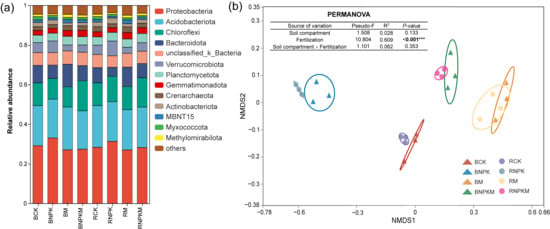
Proteobacteria (28.2–35.0%), Acidobacteriota (20.6–23.0%), and Chloroflexi (10.3–15.3%) were the dominant bacterial phyla across all soil samples, followed by Bacteroidota, Verrucomicrobiota, and Planctomycetota (Figure 1a). Compared with CK, the NPK treatment increased the relative abundances of Proteobacteria and Verrucomicrobiota while decreasing Bacteroidota. Manure showed the opposite pattern for Bacteroidota and Verrucomicrobiota. For most dominant phyla, the response under the NPKM treatment fell between those observed under the NPK treatment and manure alone. NMDS analysis showed that bacterial community composition differed among fertilization treatments (Figure 1b). PERMANOVA confirmed a significant fertilization effect on bacterial community composition (p < 0.001). In contrast, soil compartment did not significantly affect bacterial community composition (p = 0.133), and the interaction between soil compartment and fertilization was not significant either (p = 0.353).
Figure 1.
Effects of fertilization on soil bacterial community composition. (a) Relative abundance of dominant bacterial phyla in bulk and rhizosphere soils. (b) Non-metric multidimensional scaling (NMDS) ordination of bacterial community composition based on Bray–Curtis dissimilarity. The inset table shows PERMANOVA results for the effects of soil compartment, fertilization, and their interaction. *** p < 0.001.
3.3. Functional Gene Abundance and Diversity
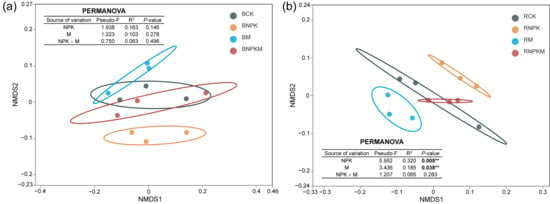
The NMDS analysis showed that the responses of CNPS cycling-related functional genes to fertilization differed between the bulk and rhizosphere soils (Figure 2). In the bulk soil, PERMANOVA detected no significant effects of NPK, manure, or their interaction on functional gene composition. In contrast, both NPK and manure significantly affected the absolute abundance of CNPS cycling-related functional genes in the rhizosphere soil, but their interaction was not significant.
Figure 2.
NMDS ordination of CNPS cycling-related functional gene composition based on Bray–Curtis in bulk soil (a) and rhizosphere soil (b). Inset tables show PERMANOVA results for the effects of NPK, manure, and their interaction. ** p < 0.01.
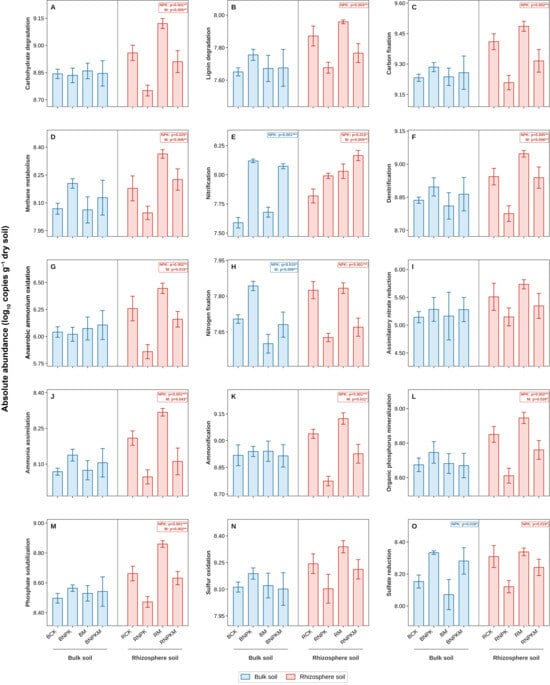

Long-term fertilization application altered the absolute abundance of CNPS cycling-related functional gene groups, and its effects differed between soil compartments (Tables S3 and S4; Figure 3). NPK fertilization and manure significantly affected more functional groups in rhizosphere soil than in bulk soil, and the associated changes were generally larger. In bulk soil, most C-, P-, and S-cycling gene groups showed limited variation among fertilization treatments. Significant positive effects of the NPK treatment were detected only for nitrification, nitrogen fixation, and sulfate reduction genes, while manure significantly reduced the abundance of nitrogen fixation genes. In rhizosphere soil, the NPK treatment significantly affected multiple CNPS cycling-related functional gene groups. Compared to CK, most functional gene groups decreased under the NPK treatment (27.4–61.7%), except that nitrification genes showed a significant increase (46.2%). The largest reductions occurred in anammox (61.7%), ammonification (45.7%), organic P mineralization (42.5%), and carbohydrate degradation genes (38.4%). Manure addition also had significant effects on several rhizosphere functional groups, particularly enhancing the absolute abundance of carbohydrate degradation, methane metabolism, nitrification, denitrification, anammox, ammonia assimilation, ammonification, organic phosphorus mineralization, and phosphate solubilization genes by 44.5%, 50.4%, 62.9%, 26.1%, 46.3%, 28.0%, 22.1%, 23.9%, and 56.1%, respectively. Notably, the interaction between the NPK and manure treatment was not significant for any functional gene group.
Figure 3.
Effects of long-term fertilization on the abundance of CNPS cycling-related functional gene groups (A), carbohydrate degradation; (B), lignin degradation; (C), carbon fixation; (D), methane metabolism; (E), nitrification; (F), denitrification; (G), anaerobic ammonium oxidation; (H), nitrogen fixation; (I), assimilatory nitrate reduction; (J), ammonia assimilation; (K), ammonification; (L), organic phosphorus mineralization; (M), phosphate solubilization; (N), sulfur oxidation; and (O), sulfate reduction) in bulk (blue) and rhizosphere (red) soils. Significant effects of NPK fertilization and manure addition were tested by two-way ANOVA within each soil compartment. * p < 0.05, ** p < 0.01 and *** p < 0.001.
3.4. Co-Occurrence Network Analysis and Identification of Strongly Associated Taxa
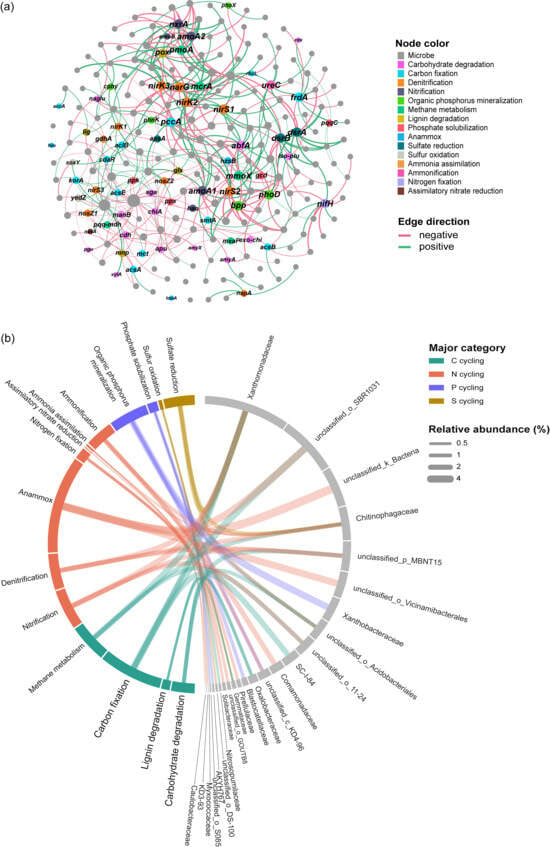
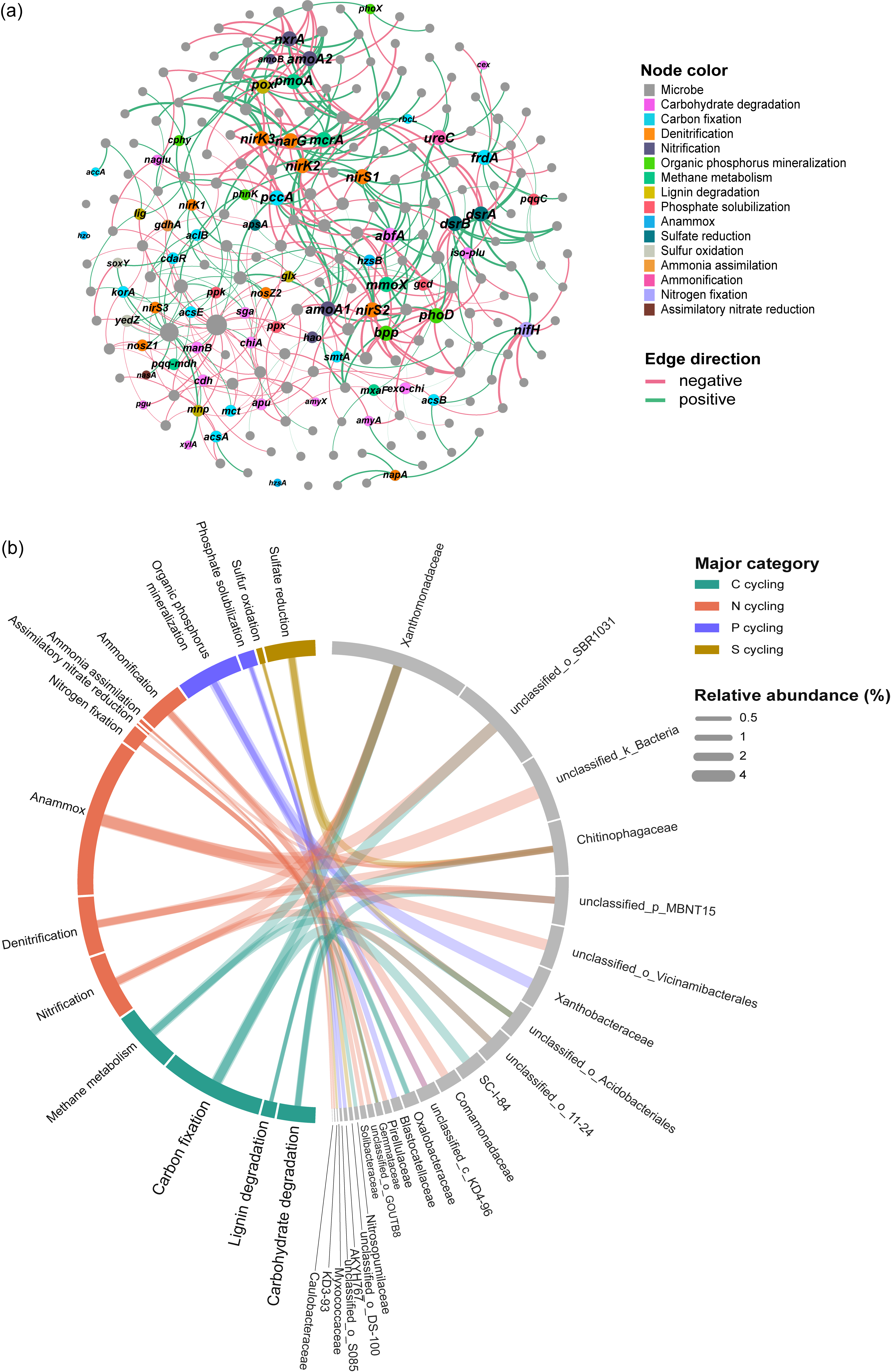
To explore the association patterns between CNPS cycling-related functional genes and microbial taxa, we constructed a co-occurrence network linking functional genes with bacterial taxa across fertilization treatments and mapped gene functional categories onto the network (Figure 4a). Most genes belonging to the same functional category were grouped within the same network modules. For example, nitrification genes were mainly clustered together, while denitrification genes formed a dense group in the central part of the network. Genes involved in phosphate solubilization, organic phosphorus mineralization, and sulfate reduction also showed clear functional clustering. Co-occurrence network analysis also showed that CNPS cycling-related functional genes were closely linked with specific bacterial taxa. In addition, several microbial taxa were associated with multiple functional genes across different CNPS cycling processes (Figure 4; Table S4). For example, an unclassified Gemmataceae taxon was associated with 15 genes involved in carbohydrate and lignin degradation (chiA, xylA, and mnp), carbon fixation (aclB, acsE, korA, and mct), methane metabolism (pqq-mdh), nitrogen transformations (nasA, nirK1, nirS3, and nosZ1), phosphorus cycling (ppk) and sulfur oxidation (soxY and yedZ); Mycobacterium was associated with 8 genes involved in carbohydrate degradation (sga), carbon fixation (korA), methane metabolism (pqq-mdh), denitrification (nosZ1 and nosZ2), phosphorus cycling (phnK and ppk) and sulfur oxidation (yedZ); Rhodanobacter was associated with 5 genes involved in nitrification (amoA2 and nxrA), denitrification (nirK2 and nirK3) and methane oxidation (pmoA).
Figure 4.
Correlation network between functional genes and bacterial taxa. (a) Gene nodes are colored by functional subcategory, microbial nodes are shown in grey, and edges indicate positive or negative Spearman correlations. (b) Chord diagram showing associations between CNPS cycling and bacterial families.
We further screened bacterial taxa that showed strong associations with CNPS cycling-related functional genes and summarized their taxonomic affiliations at the family level (Figure 4b and Table S4). Results showed that C-cycling genes were mainly linked with KD3-93, Gemmataceae, Chitinophagaceae, Xanthobacteraceae, Mycobacteriaceae, and Acidobacteriaceae-related families. N-cycling genes were associated with Xanthomonadaceae, Chitinophagaceae, Nitrosomonadaceae, Rhodanobacteraceae, Sphingomonadaceae, and Pirellulaceae, depending on the N transformation pathway. For P cycling, organic phosphorus mineralization was mainly linked with Xanthobacteraceae and Acidobacteriales-related families, whereas phosphate solubilization was associated with KD3-93, Chitinophagaceae, Comamonadaceae, and Gemmataceae. S-cycling genes were mainly associated with Chitinophagaceae, Blastocatellaceae, Solibacteraceae, Xanthomonadaceae, and Gemmataceae.
3.5. Relationships Among Soil Properties, Crop Yield and CNPS Cycling Functional Genes
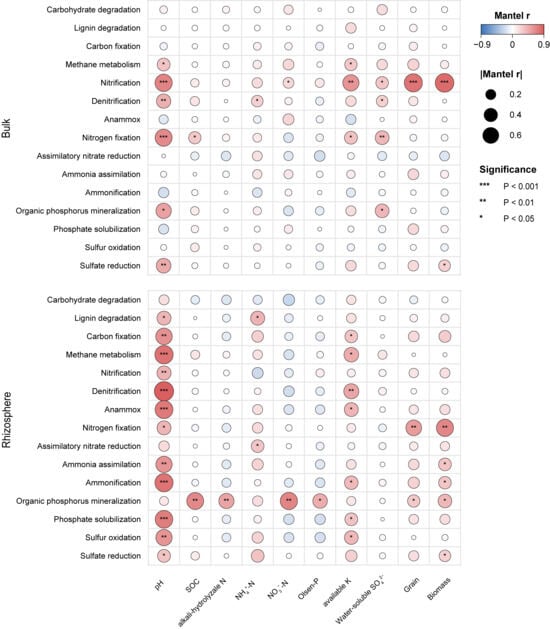
Mantel tests showed that the composition of CNPS cycling-related functional genes was closely associated with soil physicochemical properties, and these associations differed between the bulk and rhizosphere soils (Figure 5). In the bulk soil, the Mantel associations were mainly concentrated in N-cycling genes. Nitrification had the highest correlation coefficient with soil properties among the N-cycling processes examined (r = 0.436, p = 0.0066), followed by nitrogen fixation and denitrification. Among individual soil variables, pH was significantly associated with several functional groups, including nitrification, nitrogen fixation, denitrification, organic phosphorus mineralization, and sulfate reduction. Correlation analysis further showed that nitrification genes were positively correlated with NO3−-N, grain yield, and biomass, but negatively correlated with pH and available K. Sulfate reduction genes were also positively correlated with grain yield and biomass.
Figure 5.
Mantel tests between CNPS cycling-related functional gene groups and soil properties, grain yield, and biomass. Bubble color indicates Mantel r, bubble size represents the absolute Mantel r value, and asterisks indicate significance levels. * p < 0.05, ** p < 0.01, and *** p < 0.001.
In rhizosphere soil, Mantel tests detected a greater number of statistically significant associations between functional genes and soil properties than in bulk soil. For P-cycling genes, genes related to organic phosphorus mineralization exhibited the largest Mantel correlation coefficients with soil properties (P cycling: r = 0.566, p < 0.001; organic phosphorus mineralization: r = 0.555, p < 0.001). Soil pH was significantly associated with multiple functional groups, including ammonification, anammox, denitrification, methane metabolism, phosphate solubilization, and sulfur oxidation. Available K was also associated with the overall functional gene groups in the rhizosphere. Direct correlation analysis showed that biomass was negatively correlated with nitrogen fixation, ammonia assimilation, ammonification, organic phosphorus mineralization, and sulfate reduction genes. In contrast, grain yield was negatively correlated with nitrogen fixation and organic phosphorus mineralization genes.
4. Discussion
4.1. Long-Term Fertilization Reshaped Soil Nutrient Status, Crop Productivity, Bacterial Communities and Functional Gene Abundances
In this study, our results demonstrate that long-term fertilization substantially altered soil nutrient status and crop productivity (Table 1 and Table 2). Consistent with previous studies [3,10], NPK fertilization decreased soil pH in both bulk and rhizosphere soils but increased alkali-hydrolyzable N, TP, and Olsen-P, indicating that mineral fertilizer input enhanced inorganic nutrient availability while promoting soil acidification. Manure addition showed a different pattern, increasing pH, SOC, TN, alkali-hydrolyzable N, TP, and Olsen-P in both soil compartments, with greater increases in nutrient concentrations than under NPK alone. A previous study reported that manure raises soil pH mainly by supplying base cations and bicarbonate. The greater improvement in soil fertility could be attributed to the direct input of organic matter and multiple nutrients from manure, together with its capacity to enhance nutrient retention [5,40]. The improvement in soil nutrient status was further reflected in crop production. Both NPK and manure treatments significantly increased grain yield and biomass, with the highest values generally observed under the combined application of mineral fertilizers with manure (NPKM treatment) (Table 2). Thus, under the combined influence of long-term fertilization and plant growth, distinct nutrient conditions and rhizosphere environments were created, providing different ecological niches for microbial communities in bulk and rhizosphere soils. The results of β-diversity analyses and PERMANOVA confirmed that long-term fertilization reshaped both bacterial community composition and CNPS cycling-related functional gene abundances (Figure 1 and Figure 2), supporting our first hypothesis.
4.2. Rhizosphere Functional Genes Responded More Strongly and Differentially to Mineral and Organic Fertilization Relative to Bulk Soil Genes
The effects of fertilization on bacterial community composition were not fully consistent with its effects on CNPS cycling-related functional genes. For bacterial communities, we did not find statistical evidence that fertilization effects differed between the bulk and rhizosphere soils (Figure 1). In contrast, the microbial functional potential in rhizosphere soil responded more strongly to long-term nutrient inputs than that in bulk soil, as shown by the significant fertilization × soil compartment interaction for CNPS functional gene abundance (Tables S3 and S4), the significant fertilization effects on CNPS functional gene composition in the rhizosphere but not in the bulk soil (Figure 2), and the greater variation in absolute functional gene abundance in the rhizosphere (Figure 3). These findings support our second hypothesis. Previous studies have shown that the rhizosphere is a hotspot for microbial activity because root-derived C inputs, root-driven acceleration of nutrient cycling, and decreases in soil pH create microhabitats that differ from bulk soil (Table 1 and Table 2; [21,22]). Such rhizosphere-specific conditions can lead to stronger variation not only in microbial community composition but also in its growth. Therefore, quantitative functional gene analysis provides information beyond 16S rRNA gene-based community analysis and is necessary to evaluate how fertilization regulates soil microbial functional potential.
When the 15 functional categories were considered separately, the responses of different categories to the fertilization treatment varied in the bulk and rhizosphere soils (Figure 3). In the rhizosphere, inorganic NPK fertilization reduced the abundance of most functional gene groups involved in C degradation, N transformation, P mobilization, and S cycling. The negative effects of mineral fertilization on microbial functional abundance have been reported in previous studies [10,41], and are mainly due to soil acidification, high readily available nutrient contents, and reduced microbial demand for nutrient acquisition [3,10]. Likewise, we observed that the NPK treatment produced the lowest rhizosphere pH among all treatments (5.78), and also increased alkali-hydrolyzable N, total P, and Olsen-P contents compared with CK (Table 1). In contrast to the general decline in other functional groups, nitrification gene abundance increased under NPK fertilization, probably because mineral N inputs increased substrate availability for ammonia oxidizers [17].
As expected, manure addition enhanced multiple CNPS functional groups, including those involved in carbohydrate degradation, methane metabolism, nitrification, denitrification, anaerobic ammonia oxidation, ammonia assimilation, ammonification, organic P mineralization, and phosphate solubilization (Figure 3). The stimulatory effects of manure could be explained by three mechanisms. First, manure supplies abundant organic C that serves as an energy source for heterotrophic microorganisms, thereby promoting microbial growth and increasing the abundance of genes involved in C degradation and nutrient transformation [5,42]. Second, manure alleviates soil acidification and increases rhizosphere pH (e.g., from 6.31 to 6.59, see Table 1), creating more favorable conditions for microbial growth and functional activity [43,44]. Third, microbial growth is constrained by cellular C:N:P stoichiometric requirements [45]. As manure stimulates microbial growth, microbial demand for N and P increases accordingly. Although long-term manure application increased soil N and P stocks, substantial proportions of these nutrients may have remained in organic forms and therefore required microbial mineralization before becoming available, which is consistent with the higher abundance of ammonification and organic P mineralization genes under manure application (Figure 3). The release of inorganic N (e.g., ammonium and nitrate) could further provide substrate for nitrification, denitrification, anaerobic ammonia oxidation, and ammonia assimilation genes, which showed concurrent enrichment under manure application [46].
In the bulk soil, long-term fertilization has a limited impact on functional gene abundance, with significant increases under NPK detected only for nitrification, nitrogen fixation, and sulfate reduction genes (Figure 3). The enrichment of nitrification genes was in line with their response pattern in rhizosphere soil. Unexpectedly, NPK also increased nitrogen fixation gene abundance, contrasting with previous reports that high inorganic N inputs suppress diazotrophic abundance and N2-fixation activity [18]. We propose a hypothesis that the marked increase in TP and Olsen-P may have alleviated P limitation of diazotrophs, potentially supporting the energetically demanding process of biological N fixation (Table 1; [47,48,49]). The increase in sulfate reduction genes may be related to sulfate introduced through repeated calcium superphosphate application, because sulfate serves as a terminal electron acceptor for sulfate-reducing microorganisms under the periodically anoxic conditions of paddy soils [50]. By contrast, manure addition exerted a weaker influence on functional genes and only significantly reduced nitrogen fixation gene abundance (Figure 3). This response may be attributed to the gradual mineralization of manure-derived organic N, which led to increased soil N availability and reduced microbial dependence on energetically costly biological N fixation [18].
4.3. Specific Bacterial Families Shift with CNPS Functional Genes
Co-occurrence networks can provide insights into potential linkages between bacterial taxa and CNPS cycling-related genes [51,52]. In the present study, genes involved in similar CNPS cycling functions tended to cluster within the same network modules, sharing associations with similar bacterial taxa (Figure 4). Previous studies have suggested that members within a network module are more tightly connected to one another than to members of other modules, such that modularity reflects heterogeneity in co-occurrence patterns [53]. The observed clustering therefore indicates that functionally related genes and their associated taxa respond similarly to fertilization treatments and environmental factors such as soil pH and nutrient availability. Additionally, both positive and negative correlations were detected between bacterial taxa and functional genes. The positive correlation indicates that these bacterial taxa may be the carriers of the corresponding genes, or they may have similar environmental preferences to the bacterial taxa that carry those genes [54]. For example, Nitrosospira, a typical ammonia-oxidizing bacterial genus, was positively correlated with the ammonia monooxygenase gene amoA [15,55]. Therefore, taxa positively associated with specific genes within a module may serve as potential microbial indicators of the corresponding functions.
Among the taxa strongly associated with functional genes, several were closely linked to multiple functional genes. For instance, an unclassified Gemmataceae taxon showed 15 positive connections, and Mycobacterium and Rhodanobacter were positively associated with 8 and 5 genes, respectively (Figure 4). This pattern may arise from their broad metabolic capacities. For instance, in our network, Mycobacterium was positively associated with genes involved in C degradation and fixation, methane metabolism, denitrification, P cycling, and S cycling (Table S4). This finding is supported by previous physiological and genomic studies reporting that this genus has broad metabolic capabilities, with some strains capable of degrading complex aromatic compounds, reducing nitrate, regulating phosphate through polyphosphate metabolism, and mediating sulfur transformations [56,57,58,59]. When predicting how soil functions respond to disturbances (such as fertilization), it is crucial to focus on changes in the abundance of these highly connected microorganisms, as their responses to disturbance may influence soil ecological functions through multiple elemental cycling pathways. Taken together, these taxon–gene associations provide partial support for our third hypothesis; however, direct validation using metagenomic, metatranscriptomic, or other taxon-resolved functional approaches is still required.
4.4. Associations Between N- and P-Cycling-Related Functional Genes and Crop Productivity
Crop productivity was more closely associated with functional gene variation in rhizosphere than in bulk soil. Within the rhizosphere, Mantel tests showed that grain yield and biomass were mainly linked to the variation in nitrogen fixation and organic P mineralization genes (Figure 5), with consistently negative Pearson correlations (Figure S1). These patterns may be due to lower nutrient availability in lower-yielding soils, which could favor microorganisms carrying genes involved in N fixation and organic P mineralization [60,61,62]. Conversely, greater nutrient availability in high-yielding treatments reduced these microbial pathways. This was also supported by positive correlations between grain yield and biomass and nitrification gene abundance and NO3−–N content in bulk soil, suggesting that microbial potential for nitrate production was associated with greater plant-available N supply and improved crop productivity (Figure S1). Accordingly, we can infer that the abundances of functional genes, particularly those involved in N and P cycling in rhizosphere soil, may reflect soil nutrient supply capacity and could serve as predictors of crop yield. However, because microbial functional activity and plant nutrient uptake were not measured in this study, and our analysis was based on a single long-term field site, this inference could not be directly validated. Future studies across a wider range of soils and crops, incorporating measurements of microbial functional activity and plant nutrient uptake, could help clarify these relationships and develop predictive models of crop productivity.
5. Conclusions
In summary, long-term fertilization altered soil nutrient status, crop productivity, bacterial community composition, and CNPS cycling-related functional gene abundances. Although fertilization-induced changes in bacterial communities were similar between the bulk and rhizosphere soils, a larger number of functional gene groups showed significant responses in rhizosphere soil, with generally larger observed changes. Mineral NPK fertilization reduced most rhizosphere functional gene groups, except for nitrification genes, whereas manure increased genes involved in C degradation, N transformation, P mobilization, and S cycling. In contrast, functional genes in the bulk soil were comparatively stable and responded selectively to specific nutrient inputs. Network analysis further showed that functionally related genes shared modules and were associated with common bacterial taxa, with several highly connected taxa linked to multiple CNPS cycling pathways. Crop productivity was more closely associated with rhizosphere functional genes involved in N and P transformation. These findings demonstrate that bacterial community composition alone is insufficient to characterize fertilization-induced changes in microbial functioning. Quantitative analysis of functional genes, particularly in the rhizosphere, may therefore serve as a valuable complementary indicator for assessing the functional potential underlying soil microbial ecological processes.
Supplementary Materials
The following supporting information can be downloaded at: https://www.mdpi.com/article/10.3390/agronomy16191902/s1, Figure S1: Pearson correlations between CNPS cycling-related functional gene groups and soil properties, grain yield and biomass in bulk soil (a) and rhizosphere soil (b). Bubble color indicates Pearson r, bubble size represents the absolute correlation coefficient, and asterisks indicate significant correlations. AHN, alkali-hydrolyzable N; AK, available K. * p < 0.05, ** p < 0.01, and *** p < 0.001. Table S1: Primers for CNPS cycling-related functional genes quantified by high-throughput qPCR. Table S2: Two-way ANOVA results for the effects of mineral NPK fertilization, manure, and their interaction on soil physicochemical properties in bulk and rhizosphere soils. Table S3: Permutational multivariate analysis of variance (PERMANOVA) results for the effects of fertilization treatment, soil compartment, and their interaction on the overall composition of CNPS cycling-related functional genes. Table S4: Two-way ANOVA results for the effects of fertilization treatment, soil compartment, and their interaction on the absolute abundances of CNPS cycling-related functional genes. Table S5: Bacterial families strongly associated with CNPS cycling-related functional genes.
Author Contributions
Conceptualization, H.C., J.Z., and Y.L.; methodology, H.C., L.L., and W.Z.; software, H.C. and L.L.; validation, H.H., W.Z., X.F., C.Y., C.W., J.Z., and Y.L.; formal analysis, H.C. and L.L.; investigation, H.C., L.L., W.Z., X.F., C.Y., and C.W.; resources, W.Z., X.F., C.Y., C.W., and Y.L.; data curation, H.C., L.L., H.H., and W.Z.; writing—original draft preparation, H.C. and L.L.; writing—review and editing, H.C., H.H., W.Z., X.F., C.Y., C.W., J.Z., and Y.L.; visualization, L.L.; supervision, J.Z. and Y.L.; project administration, H.C., J.Z., and Y.L.; funding acquisition, H.C., J.Z., and Y.L. All authors have read and agreed to the published version of the manuscript.
Funding
This research was funded by Zhejiang Provincial Natural Science Foundation of China (LQN25D010008), the Fundamental Research Funds for the Central Universities (226-2024-00052), Innovation Research Project for Youth Scholar of School of Environment and Natural Resources, Zhejiang University of Science and Technology (HZQY202402), and the Norwegian Ministry of Foreign Affairs (CHN-2152, 22/0013 Sinograin III).
Data Availability Statement
The original contributions presented in the study are included in the article; further inquiries can be directed to the corresponding author.
Acknowledgments
We thank Nicholas Clarke for his assistance with English language editing and helpful comments on the manuscript. During the preparation of this manuscript, the authors used OpenAI Codex (GPT-5.5) to generate illustrative images of mineral NPK fertilizer, organic manure, and microorganisms for use in the graphical abstract. The prompt used was: “Create pictures of mineral NPK fertilizer, organic manure, and microorganisms in a consistent clean style, with transparent backgrounds.” The authors have reviewed and edited the output and take full responsibility for the content of this publication.
Conflicts of Interest
The authors declare no conflicts of interest.
References
- Manning, P.; van der Plas, F.; Soliveres, S.; Allan, E.; Maestre, F.T.; Mace, G.; Whittingham, M.J.; Fischer, M. Redefining ecosystem multifunctionality. Nat. Ecol. Evol. 2018, 2, 427–436. [Google Scholar] [CrossRef] [Scilit] [PubMed]
- Creamer, R.E.; Barel, J.M.; Bongiorno, G.; Zwetsloot, M.J. The life of soils: Integrating the who and how of multifunctionality. Soil Biol. Biochem. 2022, 166, 108561. [Google Scholar] [CrossRef] [Scilit]
- Guo, J.H.; Liu, X.J.; Zhang, Y.; Shen, J.L.; Han, W.X.; Zhang, W.F.; Christie, P.; Goulding, K.W.T.; Vitousek, P.M.; Zhang, F.S. Significant acidification in major Chinese croplands. Science 2010, 327, 1008–1010. [Google Scholar] [CrossRef] [Scilit] [PubMed]
- Li, J.; Wan, X.; Liu, X.; Chen, Y.; Slaughter, L.C.; Weindorf, D.C.; Dong, Y. Changes in soil physical and chemical characteristics in intensively cultivated greenhouse vegetable fields in North China. Soil Tillage Res. 2019, 195, 104366. [Google Scholar] [CrossRef] [Scilit]
- Luo, G.; Li, L.; Friman, V.P.; Guo, J.; Guo, S.; Shen, Q.; Ling, N. Organic amendments increase crop yields by improving microbe-mediated soil functioning of agroecosystems: A meta-analysis. Soil Biol. Biochem. 2018, 124, 105–115. [Google Scholar] [CrossRef] [Scilit]
- Luo, J.; Liao, G.; Banerjee, S.; Gu, S.; Liang, J.; Guo, X.; Zhao, H.; Liang, Y.; Li, T. Long-term organic fertilization promotes the resilience of soil multifunctionality driven by bacterial communities. Soil Biol. Biochem. 2023, 177, 108922. [Google Scholar] [CrossRef] [Scilit]
- Nazaries, L.; Singh, B.P.; Sarker, J.R.; Fang, Y.; Klein, M.; Singh, B.K. The response of soil multi-functionality to agricultural management practices can be predicted by key soil abiotic and biotic properties. Agric. Ecosyst. Environ. 2021, 307, 107206. [Google Scholar] [CrossRef] [Scilit]
- Jia, J.; de Goede, R.; Li, Y.; Zhang, J.; Wang, G.; Zhang, J.; Creamer, R. Unlocking soil health: Are microbial functional genes effective indicators? Soil Biol. Biochem. 2025, 204, 109768. [Google Scholar] [CrossRef] [Scilit]
- van der Bom, F.J.T.; Nunes, I.; Raymond, N.S.; Hansen, V.; Bonnichsen, L.; Magid, J.; Nybroe, O.; Jensen, L.S. Long-term fertilisation form, level and duration affect the diversity, structure and functioning of soil microbial communities in the field. Soil Biol. Biochem. 2018, 122, 91–103. [Google Scholar] [CrossRef] [Scilit]
- Geisseler, D.; Scow, K.M. Long-term effects of mineral fertilizers on soil microorganisms—A review. Soil Biol. Biochem. 2014, 75, 54–63. [Google Scholar] [CrossRef] [Scilit]
- Hu, X.; Liu, J.; Wei, D.; Zhu, P.; Cui, X.; Zhou, B.; Chen, X.; Jin, J.; Liu, X.; Wang, G. Soil bacterial communities under different long-term fertilization regimes in three locations across the black soil region of Northeast China. Pedosphere 2018, 28, 751–763. [Google Scholar] [CrossRef] [Scilit]
- Ye, G.; Lin, Y.; Liu, D.; Chen, Z.; Luo, J.; Bolan, N.; Fan, J.; Ding, W. Long-term application of manure over plant residues mitigates acidification, builds soil organic carbon and shifts prokaryotic diversity in acidic Ultisols. Appl. Soil Ecol. 2019, 133, 24–33. [Google Scholar] [CrossRef] [Scilit]
- Bender, S.F.; Wagg, C.; van der Heijden, M.G.A. An underground revolution: Biodiversity and soil ecological engineering for agricultural sustainability. Trends Ecol. Evol. 2016, 31, 440–452. [Google Scholar] [CrossRef] [Scilit] [PubMed]
- Trivedi, P.; Delgado-Baquerizo, M.; Trivedi, C.; Hu, H.W.; Anderson, I.C.; Jeffries, T.C.; Zhou, J.; Singh, B.K. Microbial regulation of the soil carbon cycle: Evidence from gene–enzyme relationships. ISME J. 2016, 10, 2593–2604. [Google Scholar] [CrossRef] [Scilit] [PubMed]
- Levy-Booth, D.J.; Prescott, C.E.; Grayston, S.J. Microbial functional genes involved in nitrogen fixation, nitrification and denitrification in forest ecosystems. Soil Biol. Biochem. 2014, 75, 11–25. [Google Scholar] [CrossRef] [Scilit]
- Zheng, B.; Zhu, Y.G.; Sardans, J.; Peñuelas, J.; Su, J.Q. QMEC: A tool for high-throughput quantitative assessment of microbial functional potential in C, N, P, and S biogeochemical cycling. Sci. China Life Sci. 2018, 61, 1451–1462. [Google Scholar] [CrossRef] [Scilit] [PubMed]
- Ouyang, Y.; Evans, S.E.; Friesen, M.L.; Tiemann, L.K. Effect of nitrogen fertilization on the abundance of nitrogen cycling genes in agricultural soils: A meta-analysis of field studies. Soil Biol. Biochem. 2018, 127, 71–78. [Google Scholar] [CrossRef] [Scilit]
- Fan, K.; Delgado-Baquerizo, M.; Guo, X.; Wang, D.; Wu, Y.; Zhu, M.; Yu, W.; Yao, H.; Zhu, Y.G.; Chu, H. Suppressed N fixation and diazotrophs after four decades of fertilization. Microbiome 2019, 7, 143. [Google Scholar] [CrossRef] [Scilit] [PubMed]
- Zhang, L.; Yuan, L.; Wen, Y.; Zhang, M.; Huang, S.; Wang, S.; Zhao, Y.; Hao, X.; Li, L.; Gao, Q.; et al. Maize functional requirements drive the selection of rhizobacteria under long-term fertilization practices. New Phytol. 2024, 242, 1275–1288. [Google Scholar] [CrossRef] [Scilit] [PubMed]
- Kuzyakov, Y.; Razavi, B.S. Rhizosphere size and shape: Temporal dynamics and spatial stationarity. Soil Biol. Biochem. 2019, 135, 343–360. [Google Scholar] [CrossRef] [Scilit]
- Zhalnina, K.; Louie, K.B.; Hao, Z.; Mansoori, N.; da Rocha, U.N.; Shi, S.; Cho, H.; Karaoz, U.; Loqué, D.; Bowen, B.P.; et al. Dynamic root exudate chemistry and microbial substrate preferences drive patterns in rhizosphere microbial community assembly. Nat. Microbiol. 2018, 3, 470–480. [Google Scholar] [CrossRef] [Scilit] [PubMed]
- Ling, N.; Wang, T.; Kuzyakov, Y. Rhizosphere bacteriome structure and functions. Nat. Commun. 2022, 13, 836. [Google Scholar] [CrossRef] [Scilit] [PubMed]
- Philippot, L.; Raaijmakers, J.M.; Lemanceau, P.; van der Putten, W.H. Going back to the roots: The microbial ecology of the rhizosphere. Nat. Rev. Microbiol. 2013, 11, 789–799. [Google Scholar] [CrossRef] [Scilit] [PubMed]
- Lu, R.K. Analytical Methods for Soil and Agro-Chemistry; China Agricultural Science and Technology Press: Beijing, China, 2000. [Google Scholar]
- Caporaso, J.G.; Lauber, C.L.; Walters, W.A.; Berg-Lyons, D.; Lozupone, C.A.; Turnbaugh, P.J.; Fierer, N.; Knight, R. Global patterns of 16S rRNA diversity at a depth of millions of sequences per sample. Proc. Natl. Acad. Sci. USA 2011, 108, 4516–4522. [Google Scholar] [CrossRef] [Scilit] [PubMed]
- Chen, S.; Zhou, Y.; Chen, Y.; Gu, J. Fastp: An ultra-fast all-in-one FASTQ preprocessor. Bioinformatics 2018, 34, i884–i890. [Google Scholar] [CrossRef] [Scilit]
- Martin, M. Cutadapt removes adapter sequences from high-throughput sequencing reads. EMBnet. J. 2011, 17, 10–12. [Google Scholar] [CrossRef] [Scilit]
- Edgar, R.C. Search and clustering orders of magnitude faster than BLAST. Bioinformatics 2010, 26, 2460–2461. [Google Scholar] [CrossRef] [Scilit] [PubMed]
- Callahan, B.J.; McMurdie, P.J.; Rosen, M.J.; Han, A.W.; Johnson, A.J.A.; Holmes, S.P. DADA2: High-resolution sample inference from Illumina amplicon data. Nat. Methods 2016, 13, 581–583. [Google Scholar] [CrossRef] [Scilit] [PubMed]
- Quast, C.; Pruesse, E.; Yilmaz, P.; Gerken, J.; Schweer, T.; Yarza, P.; Peplies, J.; Glöckner, F.O. The SILVA ribosomal RNA gene database project: Improved data processing and web-based tools. Nucleic Acids Res. 2013, 41, D590–D596. [Google Scholar] [CrossRef] [Scilit] [PubMed]
- Bolyen, E.; Rideout, J.R.; Dillon, M.R.; Bokulich, N.A.; Abnet, C.C.; Al-Ghalith, G.A.; Alexander, H.; Alm, E.J.; Arumugam, M.; Asnicar, F.; et al. Reproducible, interactive, scalable and extensible microbiome data science using QIIME 2. Nat. Biotechnol. 2019, 37, 852–857. [Google Scholar] [CrossRef] [Scilit] [PubMed]
- Dai, Z.; Guo, X.; Lin, J.; Wang, X.; He, D.; Zeng, R.; Meng, J.; Luo, J.; Delgado-Baquerizo, M.; Moreno-Jiménez, E.; et al. Metallic micronutrients are associated with the structure and function of the soil microbiome. Nat. Commun. 2023, 14, 8456. [Google Scholar] [CrossRef] [Scilit] [PubMed]
- Anderson, M.J. A new method for non-parametric multivariate analysis of variance. Austral Ecol. 2001, 26, 32–46. [Google Scholar] [CrossRef] [Scilit]
- R Core Team. R: A Language and Environment for Statistical Computing; R Foundation for Statistical Computing: Vienna, Austria, 2026; Available online: https://www.R-project.org/ (accessed on 10 March 2026).
- Oksanen, J.; Simpson, G.L.; Blanchet, F.G.; Kindt, R.; Legendre, P.; Minchin, P.R.; O’Hara, R.B.; Solymos, P.; Stevens, M.H.H.; Szoecs, E.; et al. Vegan: Community Ecology Package, R package version 2.7-3; The R Foundation for Statistical Computing: Vienna, Austria, 2026. [CrossRef] [Scilit]
- Mantel, N. The detection of disease clustering and a generalized regression approach. Cancer Res. 1967, 27, 209–220. [Google Scholar] [PubMed]
- Csárdi, G.; Nepusz, T. The igraph software package for complex network research. InterJournal Complex Syst. 2006, 1695, 1–9. Available online: https://igraph.org (accessed on 8 May 2026).
- Fruchterman, T.M.J.; Reingold, E.M. Graph drawing by force-directed placement. Softw. Pract. Exp. 1991, 21, 1129–1164. [Google Scholar] [CrossRef] [Scilit]
- Bastian, M.; Heymann, S.; Jacomy, M. Gephi: An open source software for exploring and manipulating networks. Proc. Int. AAAI Conf. Web Soc. Media 2009, 3, 361–362. [Google Scholar] [CrossRef] [Scilit]
- Wang, Y.; Hu, N.; Ge, T.; Kuzyakov, Y.; Wang, Z.L.; Li, Z.; Tang, Z.; Chen, Y.; Wu, C.; Lou, Y. Soil aggregation regulates distributions of carbon, microbial community and enzyme activities after 23-year manure amendment. Appl. Soil Ecol. 2017, 111, 65–72. [Google Scholar] [CrossRef] [Scilit]
- Shao, J.; Li, X.; Zhang, X.; Wang, Y.; Cotta, S.R.; Cherubin, M.R.; Canisares, L.P.; Shangguan, Z.; Yan, W.; Deng, L.; et al. Long-term N fertilization decreases soil multifunctionality and decouples its relationships with the microbial community. Appl. Soil Ecol. 2025, 214, 106371. [Google Scholar] [CrossRef] [Scilit]
- Wu, W.; Zhang, Y.; Turner, B.L.; He, Y.; Chen, X.; Che, R.; Cui, X.; Liu, X.; Jiang, L.; Zhu, J. Organic amendments promote soil phosphorus related functional genes and microbial phosphorus cycling. Geoderma 2025, 456, 117247. [Google Scholar] [CrossRef] [Scilit]
- Zhang, Y.; Shen, H.; He, X.; Thomas, B.W.; Lupwayi, N.Z.; Hao, X.; Thomas, M.C.; Shi, X. Fertilization shapes bacterial community structure by alteration of soil pH. Front. Microbiol. 2017, 8, 1325. [Google Scholar] [CrossRef] [Scilit] [PubMed]
- Wan, W.; Tan, J.; Wang, Y.; Qin, Y.; He, H.; Wu, H.; Zuo, W.; He, D. Responses of the rhizosphere bacterial community in acidic crop soil to pH: Changes in diversity, composition, interaction, and function. Sci. Total Environ. 2020, 700, 134418. [Google Scholar] [CrossRef] [Scilit] [PubMed]
- Wei, X.; Zhu, Z.; Liu, Y.; Luo, Y.; Deng, Y.; Xu, X.; Liu, S.; Richter, A.; Shibistova, O.; Guggenberger, G.; et al. C:N:P stoichiometry regulates soil organic carbon mineralization and concomitant shifts in microbial community composition in paddy soil. Biol. Fertil. Soils 2020, 56, 1093–1107. [Google Scholar] [CrossRef] [Scilit]
- Kuypers, M.M.M.; Marchant, H.K.; Kartal, B. The microbial nitrogen-cycling network. Nat. Rev. Microbiol. 2018, 16, 263–276. [Google Scholar] [CrossRef] [Scilit] [PubMed]
- Reed, S.C.; Cleveland, C.C.; Townsend, A.R. Functional ecology of free-living nitrogen fixation: A contemporary perspective. Annu. Rev. Ecol. Evol. Syst. 2011, 42, 489–512. [Google Scholar] [CrossRef] [Scilit]
- Tang, Y.; Zhang, M.; Chen, A.; Zhang, W.; Wei, W.; Sheng, R. Impact of fertilization regimes on diazotroph community compositions and N2-fixation activity in paddy soil. Agric. Ecosyst. Environ. 2017, 247, 1–8. [Google Scholar] [CrossRef] [Scilit]
- Zhang, L.-M.; Silvano, E.; Rihtman, B.; Aguilo-Ferretjans, M.; Han, B.; Shi, W.; Chen, Y. Biochemical mechanism of phosphorus limitation impairing nitrogen fixation in diazotrophic bacterium Klebsiella variicola W12. J. Sustain. Agric. Environ. 2022, 1, 108–117. [Google Scholar] [CrossRef] [Scilit]
- Muyzer, G.; Stams, A.J.M. The ecology and biotechnology of sulphate-reducing bacteria. Nat. Rev. Microbiol. 2008, 6, 441–454. [Google Scholar] [CrossRef] [Scilit] [PubMed]
- Faust, K.; Raes, J. Microbial interactions: From networks to models. Nat. Rev. Microbiol. 2012, 10, 538–550. [Google Scholar] [CrossRef] [Scilit] [PubMed]
- Weiss, S.; Van Treuren, W.; Lozupone, C.; Faust, K.; Friedman, J.; Deng, Y.; Xia, L.C.; Xu, Z.Z.; Ursell, L.; Alm, E.J.; et al. Correlation detection strategies in microbial data sets vary widely in sensitivity and precision. ISME J. 2016, 10, 1669–1681. [Google Scholar] [CrossRef] [Scilit] [PubMed]
- Olesen, J.M.; Bascompte, J.; Dupont, Y.L.; Jordano, P. The modularity of pollination networks. Proc. Natl. Acad. Sci. USA 2007, 104, 19891–19896. [Google Scholar] [CrossRef] [Scilit] [PubMed]
- Ma, B.; Zhao, K.; Lv, X.; Su, W.; Dai, Z.; Gilbert, J.A.; Brookes, P.C.; Faust, K.; Xu, J. Genetic correlation network prediction of forest soil microbial functional organization. ISME J. 2018, 12, 2492–2505. [Google Scholar] [CrossRef] [Scilit] [PubMed]
- Rotthauwe, J.H.; Witzel, K.P.; Liesack, W. The ammonia monooxygenase structural gene amoA as a functional marker: Molecular fine-scale analysis of natural ammonia-oxidizing populations. Appl. Environ. Microbiol. 1997, 63, 4704–4712. [Google Scholar] [CrossRef] [Scilit] [PubMed]
- Sohaskey, C.D.; Wayne, L.G. Role of narK2X and narGHJI in hypoxic upregulation of nitrate reduction by Mycobacterium tuberculosis. J. Bacteriol. 2003, 185, 7247–7256. [Google Scholar] [CrossRef] [Scilit] [PubMed]
- Kim, S.J.; Kweon, O.; Jones, R.C.; Edmondson, R.D.; Cerniglia, C.E. Genomic analysis of polycyclic aromatic hydrocarbon degradation in Mycobacterium vanbaalenii PYR-1. Biodegradation 2008, 19, 859–881. [Google Scholar] [CrossRef] [Scilit] [PubMed]
- Chuang, Y.M.; Belchis, D.A.; Karakousis, P.C. The polyphosphate kinase gene ppk2 is required for Mycobacterium tuberculosis inorganic polyphosphate regulation and virulence. mBio 2013, 4, e00039-13. [Google Scholar] [CrossRef] [Scilit] [PubMed]
- Kunota, T.T.R.; Rahman, M.A.; Truebody, B.E.; Mackenzie, J.S.; Saini, V.; Lamprecht, D.A.; Adamson, J.H.; Sevalkar, R.R.; Lancaster, J.R.; Berney, M.; et al. Mycobacterium tuberculosis H2S functions as a sink to modulate central metabolism, bioenergetics, and drug susceptibility. Antioxidants 2021, 10, 1285. [Google Scholar] [CrossRef] [Scilit] [PubMed]
- Sinsabaugh, R.L.; Hill, B.H.; Follstad Shah, J.J. Ecoenzymatic stoichiometry of microbial organic nutrient acquisition in soil and sediment. Nature 2009, 462, 795–798. [Google Scholar] [CrossRef] [Scilit] [PubMed]
- Orr, C.H.; James, A.; Leifert, C.; Cooper, J.M.; Cummings, S.P. Diversity and activity of free-living nitrogen-fixing bacteria and total bacteria in organic and conventionally managed soils. Appl. Environ. Microbiol. 2011, 77, 911–919. [Google Scholar] [CrossRef] [Scilit] [PubMed]
- Janes-Bassett, V.; Blackwell, M.S.A.; Blair, G.; Davies, J.; Haygarth, P.M.; Mezeli, M.M.; Stewart, G. A meta-analysis of phosphatase activity in agricultural settings in response to phosphorus deficiency. Soil Biol. Biochem. 2022, 165, 108537. [Google Scholar] [CrossRef] [Scilit]

Disclaimer/Publisher’s Note: The statements, opinions and data contained in all publications are solely those of the individual author(s) and contributor(s) and not of MDPI and/or the editor(s). MDPI and/or the editor(s) disclaim responsibility for any injury to people or property resulting from any ideas, methods, instructions or products referred to in the content. |
© 2026 by the authors. Licensee MDPI, Basel, Switzerland. This article is an open access article distributed under the terms and conditions of the Creative Commons Attribution (CC BY) license.