


Abstract
Background: Straw return, as an important practice for soil improvement and nutrient recycling, has great potential for enhancing soil fertility and crop productivity. However, its yield-enhancing effects and the major driving factors remain unclear under different ecological environments and agricultural management conditions. To address this issue, this study quantitatively evaluated the effects of straw return on maize yield and identified the major influencing factors. A meta-analysis was conducted using published data, with the log response ratio used as the effect size, followed by subgroup analysis and partial least squares structural equation modeling. Results: Compared with no straw return, straw return significantly increased maize yield, overall by 26.75% (p < 0.001). Among the different management practices, straw return combined with nitrogen application had the greatest yield-promoting effect. Climatic conditions significantly influenced the yield response, with higher yield increases in arid (by 28.8%) and semi-humid (25.3%) regions. The positive effect of straw return was more pronounced in soils with low-to-moderate nutrient levels, suggesting that straw return can effectively alleviate soil nutrient limitations. Cropping systems and management practices also played important regulatory roles in maize yield. Partial least squares structural equation modeling demonstrated that cropping systems (path coefficient 0.26) and management practices (0.38) had significant positive effects on maize yield, whereas soil factors (−0.236) exerted a significant negative effect. Climatic factors indirectly regulated maize yield through their influence on soil properties, while soil factors also indirectly affected maize yield by influencing cropping systems. Conclusion: Straw return is verified as an efficient and sustainable field management measure to improve maize productivity in China, with its effectiveness being strongly dependent on nitrogen fertilization regimes, cropping system and management practices. Further research into microbial and enzymatic mechanisms is required, which should be incorporated into future meta-analyses to complement microscopic theoretical evidence and provide a scientific basis for the efficient utilization of straw resources.
1. Introduction
Maize is an important staple crop worldwide and plays a key role in food, feed, and industrial production. In China, maize production has increased steadily in recent years, with the planting area reaching 44.96 million ha and total production reaching 301.24 million tonnes in 2025 [1,2]. Meanwhile, intensive maize production generates large amounts of straw residue. Straw return provides an effective way to recycle these resources and improve soil quality, and has therefore become an important practice for sustainable maize production [3,4].
Straw return can improve soil quality through coordinated changes in chemical, physical, and biological properties. It generally increases soil organic carbon and nutrient availability, reduces soil bulk density, and improves aggregate stability and water retention [5,6,7]. Meanwhile, straw inputs provide substrates for microorganisms and stimulate microbial biomass and extracellular enzyme activities, thereby accelerating the decomposition and transformation of soil organic matter [8,9,10,11]. These changes can further regulate carbon and nitrogen mineralization rates by altering substrate supply, microbial activity, soil moisture, aeration, and temperature, while climatic conditions can modify these processes and their responses to straw return [12,13]. Consequently, the effects of straw return on maize productivity depend not only on straw inputs themselves but also on environmental and agronomic conditions. Recent studies have increasingly highlighted the roles of climate, soil properties, nitrogen inputs, cropping systems, straw management, and other factors in determining yield responses [14,15]. However, these factors have often been examined separately, and their combined effects on maize yield remain insufficiently understood. In particular, the relative contributions of and potential interactions among climatic factors, soil properties, cropping systems, management practices, and nitrogen inputs have not been fully quantified at the national scale. Addressing these gaps requires an integrated framework that not only quantifies the overall yield response to straw return but also identifies the direct and indirect pathways through which different factors regulate this response.
Therefore, this study conducted a meta-analysis of published experiments across China to quantify the effects of straw return on maize yield and identify the major influencing factors. Partial least squares structural equation modeling was further used to disentangle the direct and indirect effects of these factors, providing a more comprehensive understanding of the drivers of maize yield responses to straw return.
2. Materials and Methods
2.1. Literature Sources
The literature included in this study was retrieved from the databases ScienceDirect, Web of Science, and the China National Knowledge Infrastructure, covering publications from 1981 to 2025. Studies published in Chinese or English were considered. The Chinese search terms used were “秸秆还田,” “玉米,” “产量,” and “减氮,” while the English search terms were “straw returning to field,” “corn,” “yield,” and “nitrogen reduction.” The selected studies met the following criteria: (i) only field experiments were included, while pot or laboratory studies, and those without data on straw return or maize yield were excluded; (ii) study sites were in mainland China; (iii) yield means for each treatment were reported; (iv) maize yield was included as a response variable; and (v) a control treatment was provided. Regarding nitrogen input, the major nitrogen sources reported in the selected studies were urea (46% N) and controlled-release fertilizer (26% N). After screening, a total of 203 publications comprising 3395 observations were included.
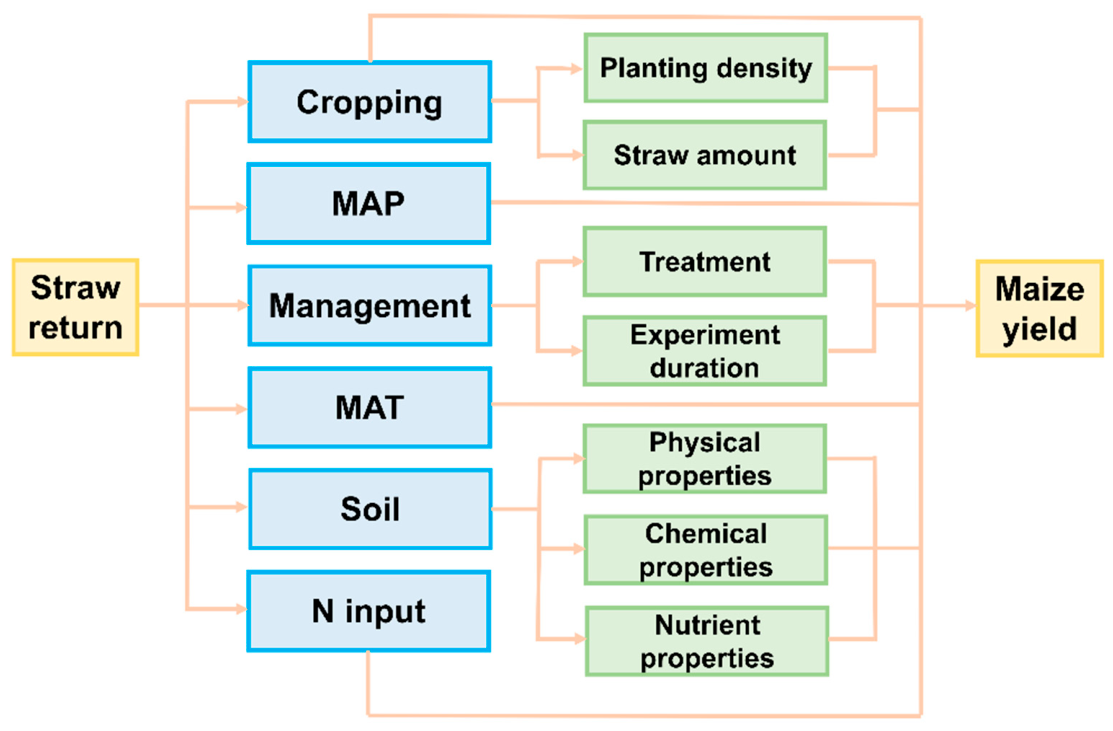
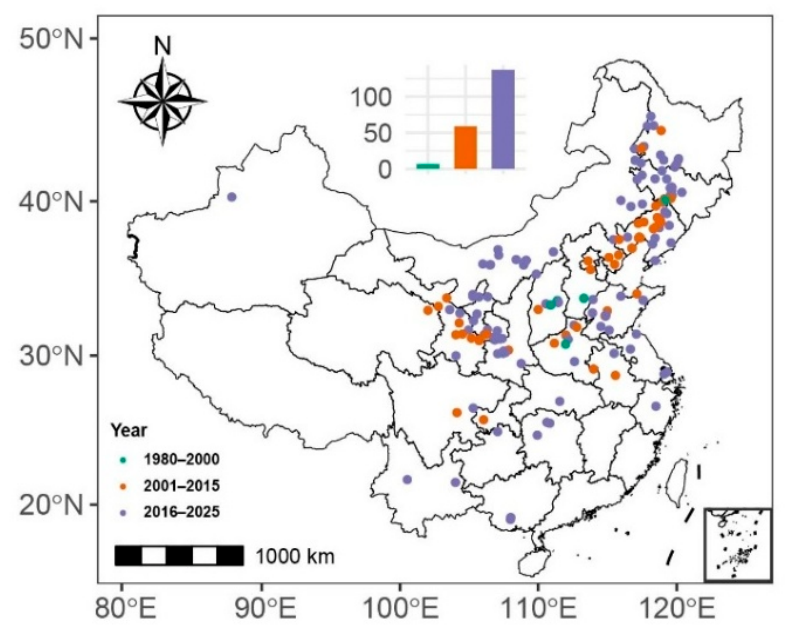
Based on the selected studies, key variables were extracted and a conceptual model was developed (Figure 1), while Figure 2 illustrates the spatiotemporal distribution of the straw return experiments included. Spatially, the experimental sites were concentrated in the Huang–Huai–Hai Plain, the Northeast China Plain, and the middle and lower reaches of the Yangtze River—major maize-producing regions characterized by abundant straw resources and intensive agricultural management. In contrast, relatively few studies were conducted in the arid regions of western China, likely due to constraints in natural conditions and agricultural development. Temporally, studies were sparse and scattered across a few provinces during 1980–2000. During 2001–2015, the number of studies increased substantially, with broader regional coverage. The period 2016–2025 had the highest number of publications, covering nearly all major maize-growing regions in China, indicating that straw return has become a prominent research focus in recent years.
Figure 1.
Conceptual framework illustrating the mechanisms by which straw return influences maize yield. Cropping refers to cropping systems, including planting density and straw return rate; MAP denotes mean annual precipitation; Management includes treatment methods and experimental duration; N input represents nitrogen application; MAT denotes mean annual temperature; Soil encompasses soil properties, including physical (e.g., soil texture), chemical (e.g., soil pH and organic matter), and nutrient characteristics (e.g., total nitrogen, total phosphorus, total potassium, available phosphorus, and available potassium).
Figure 2.
Spatial distribution of experimental sites included in this study (Map source: Tianditu, Map Review Approval No. GS (2024) 0650).
2.2. Data Collection and Analytical Methods
For the selected studies, data presented in graphical formats were extracted using Engauge Digitizer, while data provided in tabular or numerical form were directly recorded and analyzed. All extracted data were organized using Excel 2019. Statistical analyses and meta-analysis were conducted using R software (version 4.4.1). The tidyverse, dplyr, and tidyr packages were used for data cleaning and transformation. Effect sizes (lnRR) and random-effects models were calculated using the metafor package, and multiple comparisons were performed using the multcompView package. Missing values were imputed using the mice package. Partial least squares structural equation modeling (PLS-SEM) was performed using the plspm package to evaluate the direct and indirect effects of environmental and management factors on maize yield. Figures were generated using Origin 2024 (Origin Lab Corporation, Northampton, MA, USA, version 10.1) and Adobe Illustrator 2025 (Adobe Inc., San Jose, CA, USA, version 29.0), which were also used to evaluate the factors influencing maize yield.
To assess heterogeneity among independent experimental results, the heterogeneity statistic Qb was used. When p < 0.05 and I2 > 50%, a random-effects model was adopted; otherwise, a fixed-effects model was applied. Based on these criteria, a random-effects model was ultimately used.
- (1)
- Determination of sample size: When the sample size was explicitly reported, it was directly used. If the total sample size (N) was provided and the treatment and control groups had equal sizes, then nt = nc = N/2. If sample size was not reported, it was inferred from the number of replicates per treatment. When neither standard deviation (SD) nor standard error (SE) was provided, SD was estimated by multiplying the mean yield by the average coefficient of variation derived from reported studies. If SD and SE were both reported but sample size (n) was missing, then n was calculated as follows:
- (2)
- Effect size (LnY): The response ratio was used as the effect size, calculated as the natural logarithm of the ratio of maize yield under straw return (Xt) to that under no straw return (XC):where Xt is the mean maize yield under straw return (kg·ha−1), XC is the mean yield under no straw return, and LnY represents the natural logarithm of the response ratio.
- (3)
- Standard deviation: When SD was reported, it was directly used. Otherwise, SD was calculated from SE:
- (4)
- Relative change rate (RCR) of maize yield: The RCR standardizes differences relative to the control, allowing comparison across studies, and was calculated as follows:
A 95% confidence interval (CI) for the effect size was estimated using a resampling method. If the CI included zero, the effect of straw return on maize yield was considered not significant. If the CI was entirely below zero (p > 0.05), straw return was considered to significantly decrease yield. If the CI was entirely above zero (p < 0.05), straw return was considered to significantly increase yield.
- (5)
- Variance (Var): The Var was used to quantify the dispersion and uncertainty of individual study results and to calculate study weights:where and are the variances of the treatment and control groups, respectively, and and are their corresponding sample sizes.
- (6)
- Weight (wi): The contribution of each study was determined by wi:
3. Results and Analysis
3.1. Effects of Straw Return on Maize Yield Under Different Factors
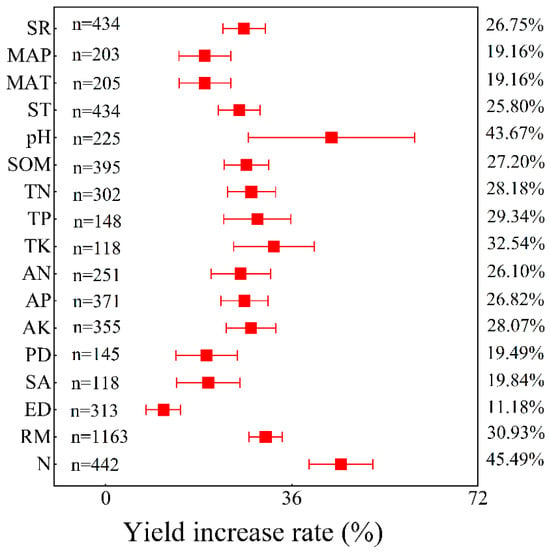
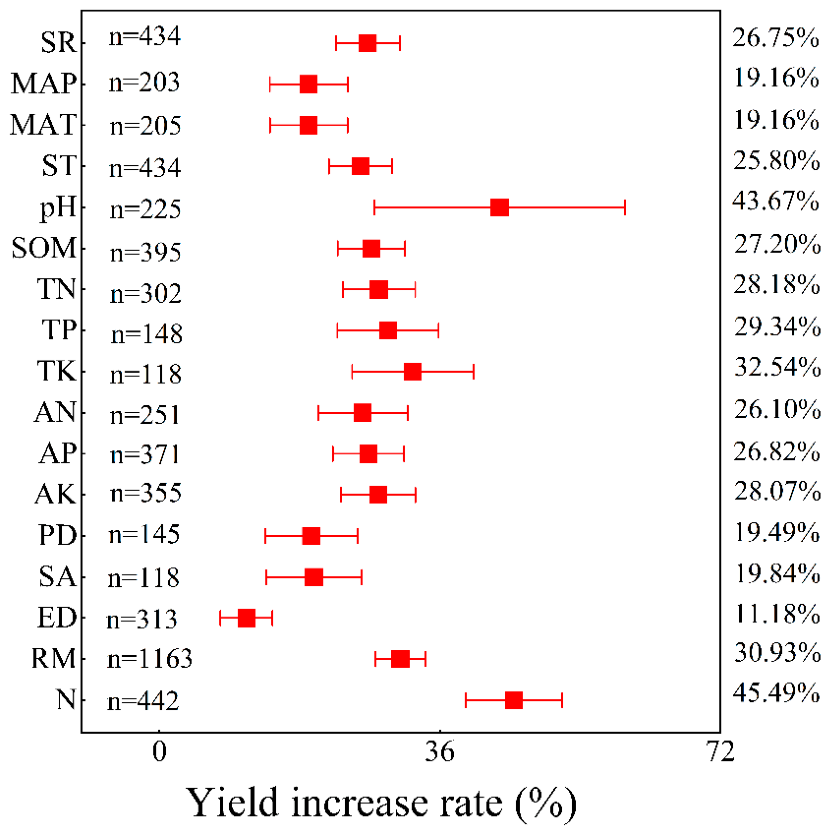
As shown in Figure 3, at the national scale, compared with no straw return, straw return significantly increased maize yield by an overall 26.75% (p < 0.001). Under straw return conditions, all investigated factors showed significantly greater positive effects on maize yield than under the no-straw-return treatment. Among these factors, N application exhibited the highest yield increase rate (45.49%). The yield-enhancing effects of the remaining factors, ranked from highest to lowest, were as follows: soil pH (43.67%), total potassium (TK, 32.54%), return management practices (30.93%), total phosphorus (TP, 29.34%), total N (TN, 28.18%), available potassium (AK, 28.07%), soil organic matter (SOM, 27.20%), available phosphorus (AP, 26.82%), available N (AN, 26.10%), soil texture (25.80%), straw return amount (19.84%), planting density (19.49%), mean annual precipitation (MAP, 19.16%), mean annual temperature (MAT, 19.16%), and experimental duration (11.18%).
Figure 3.
Yield increase rate of maize under different factors. Note: SR, straw return treatment; MAP, mean annual precipitation; MAT, mean annual temperature; ST, soil texture; pH, soil pH; SOM, soil organic matter; TN, total nitrogen; TP, total phosphorus; TK, total potassium; AN, available nitrogen; AP, available phosphorus; AK, available potassium; PD, maize planting density; SA, straw return amount; ED, experimental duration; RM, combined management practices under straw return; N, nitrogen application.
3.2. Factors Influencing Maize Yield Response Under Straw Return
3.2.1. Climate Factors
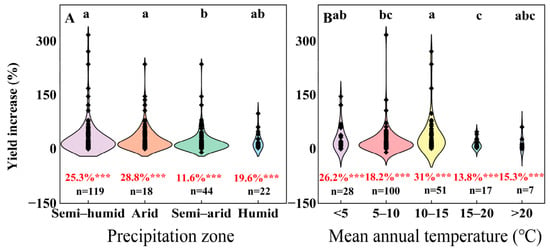
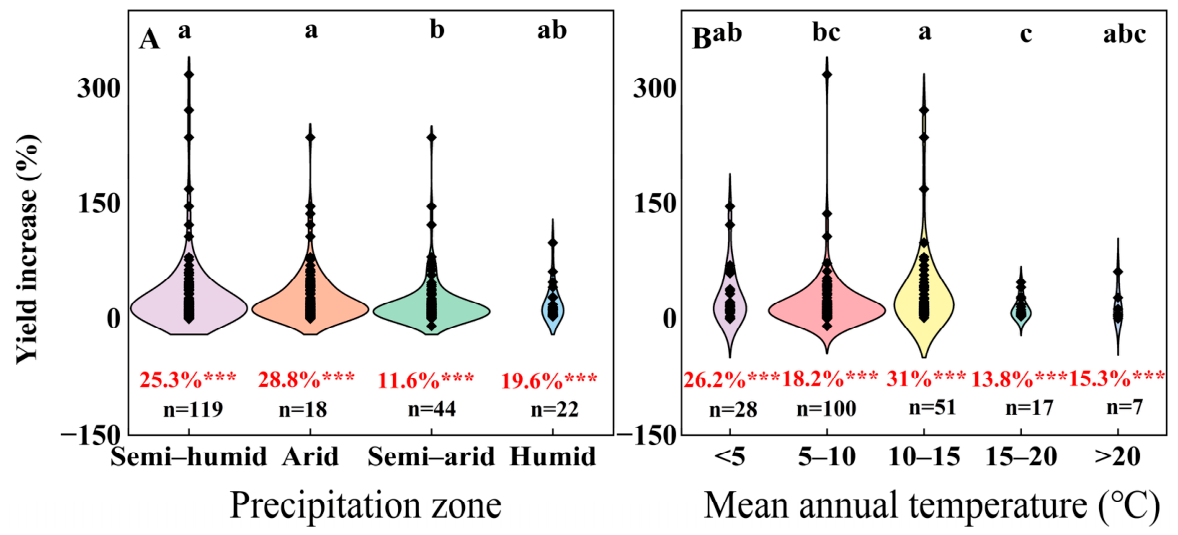
Using MAP, the study area was classified into four climatic zones: arid regions (MAP < 300 mm), semi-arid regions (300–500 mm), semi-humid regions (500–900 mm), and humid regions (≥900 mm) (Figure 4A). Compared with the no-straw-return treatment, straw return significantly increased maize yield across all precipitation zones (p < 0.001), with yield increases of 28.8% in arid regions, 25.3% in semi-humid regions, 19.6% in humid regions, and 11.6% in semi-arid regions. The yield-enhancing effects were significantly greater in semi-humid and arid than in semi-arid regions, representing increases of 118.1% and 148.3%, respectively. No significant differences were observed between humid regions and the other three regions (p > 0.05).
Figure 4.
Effects of climate factors on maize yield under straw return: (A) precipitation and (B) temperature. Note: Different lowercase letters (e.g., a, b, and c) above the bars indicate significant differences among groups at p < 0.05, whereas bars sharing the same letter are not significantly different. “*” below the bars indicates significant differences in yield compared with no straw return. *, p < 0.05, **, p < 0.01, ***, p < 0.001. The same applies to the following figures.
The MAT also significantly affected the yield response to straw return (Figure 4B). The yield increase rates under MAT ranges of <5, 5–10, 10–15, 15–20, and >20 °C were 26.2%, 18.2%, 31.0%, 13.8%, and 15.3%, respectively. The yield-enhancing effect for 10–15 °C was significantly higher than for 5–10 and 15–20 °C, with increases of 70.3% and 124.6%, respectively. In addition, the <5 °C group showed a significantly greater yield increase (by 89.9%) than the 15–20 °C group. There were no significant differences between the >20 °C group and other temperature groups.
3.2.2. Soil Properties
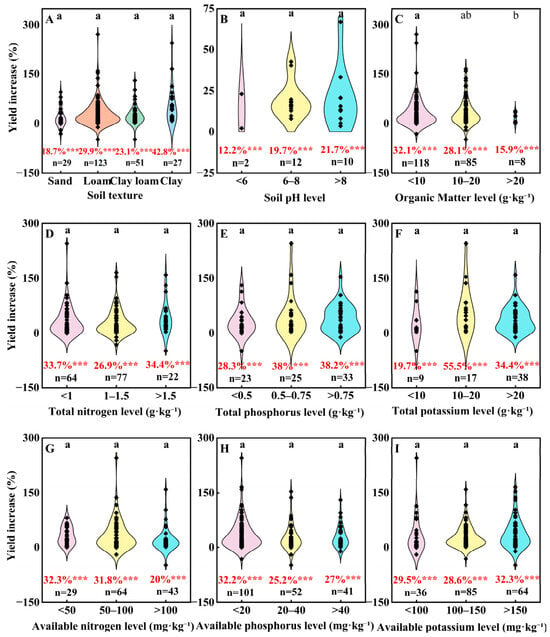
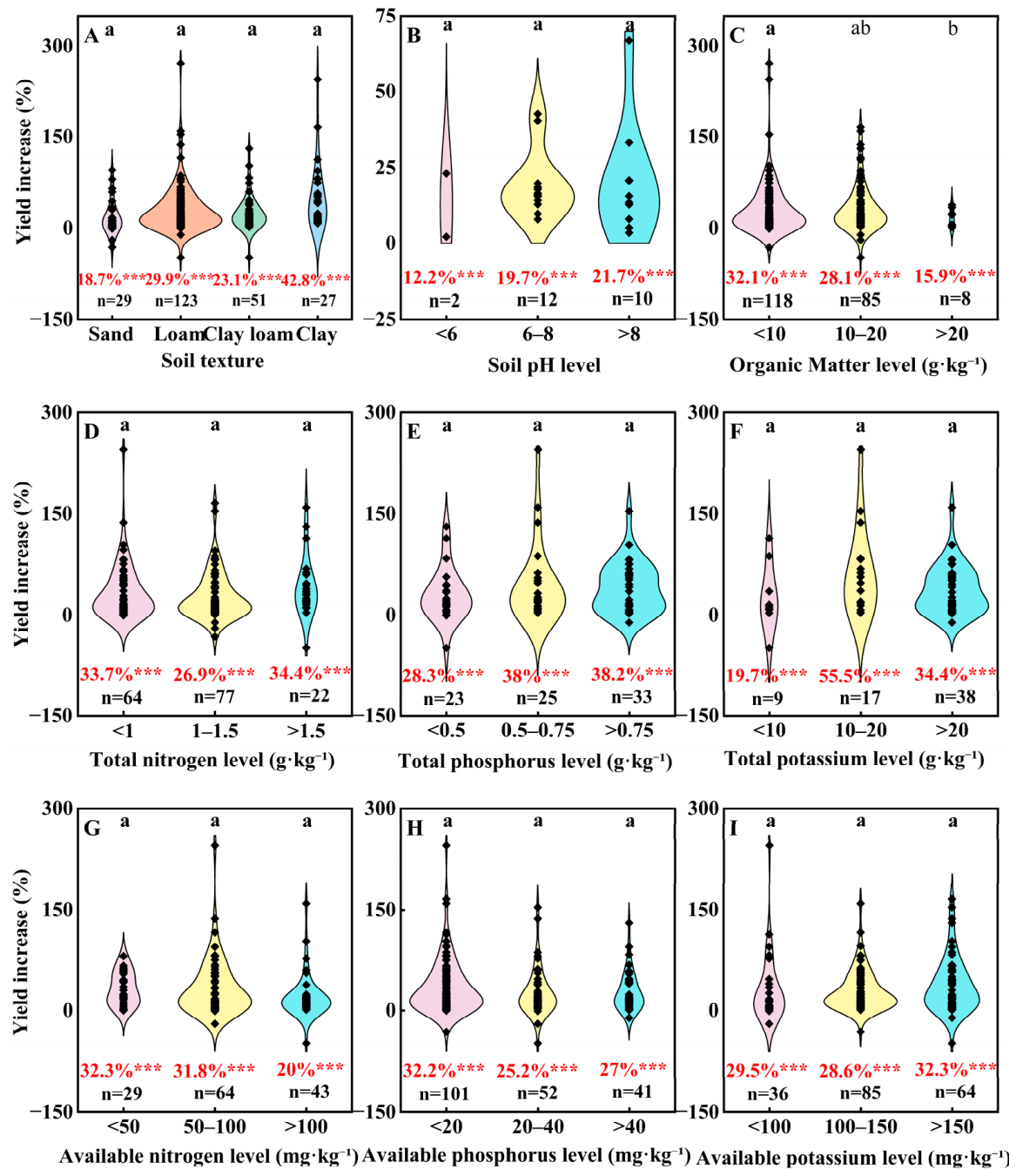
Under straw return conditions, soil nutrient levels in all groups significantly affected maize yield (Figure 5). For SOM, the yield increase in soils with SOM < 10 g kg−1 was significantly higher than in soils with >20 g kg−1, representing an increase of 101.89% (Figure 5C). However, no significant differences were observed between the 10–20 and the <10 or >20 g/kg SOM groups. No significant differences among groups were detected for the other soil nutrient indicators. For TK, AN, and AP, higher yield increases were generally observed under low- to moderate-nutrient levels (Figure 5F–H). Regarding soil texture, yield increases under clay and loam soils were 42.8% and 29.9%, respectively (Figure 5A). Overall, the yield-enhancing effect of straw return was stronger under low- to moderate-soil-nutrient conditions, indicating an important role of straw return in improving soil nutrient supply and alleviating nutrient limitations.
Figure 5.
Effects of soil properties on maize yield under straw return: (A) soil texture, (B) soil pH, (C) soil organic matter, (D) total nitrogen, (E) total phosphorus, (F) total potassium, (G) available nitrogen, (H) available phosphorus, and (I) available potassium.
3.2.3. Cropping Systems
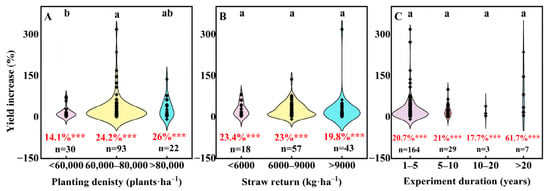
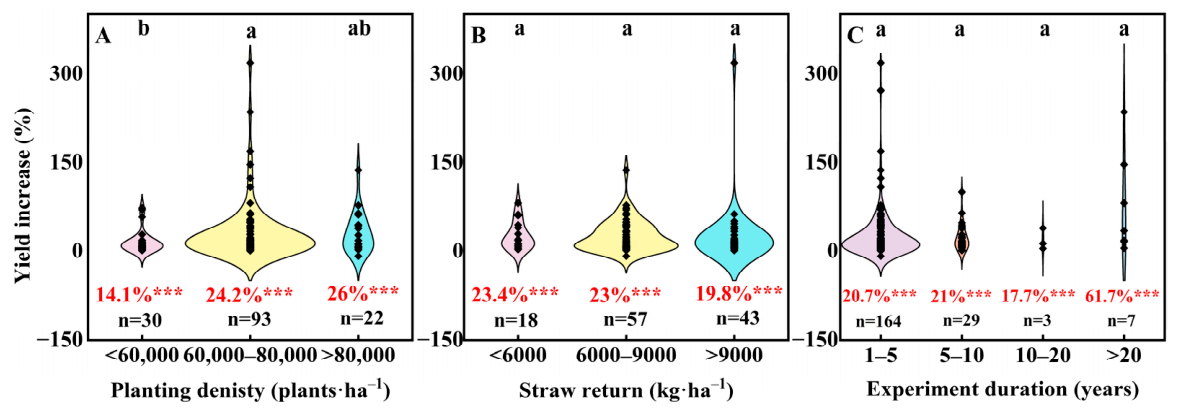
Straw return significantly increased maize yield under all planting density treatments (Figure 6A). Within each planting density group, straw return increased maize yield relative to the corresponding no-straw-return treatment. The yield increase was approximately 26% in the >80,000 plants ha−1 group. Among the planting density groups, the yield-enhancing effect of straw return was significantly greater in the 60,000–80,000 plants ha−1 group than in the <60,000 plants ha−1 group, with an increase of 71.63%. However, the effect in the >80,000 plants ha−1 group did not differ significantly from those in the other planting density groups. (p < 0.001, Figure 6B). As the amount of straw return increased, the effect size for maize yield showed a decreasing trend, although with no significant differences among groups. The effects of straw return on maize yield were significant across all experimental durations (Figure 6C). The yield-increasing effects were 20.7% and 21.0% for experimental durations of 1–5 and 5–10 years, respectively. With increasing experimental duration, the positive effect of straw return on maize yield tended to increase, although the differences among experimental-duration groups were not significant.
Figure 6.
Effects of cropping system and management practices on maize yield under straw return: (A) planting density, (B) straw return amount, and (C) experimental duration.
3.2.4. Management Practices and Nitrogen Fertilizer
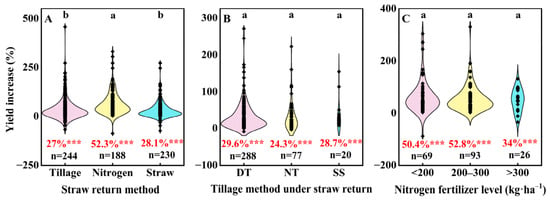
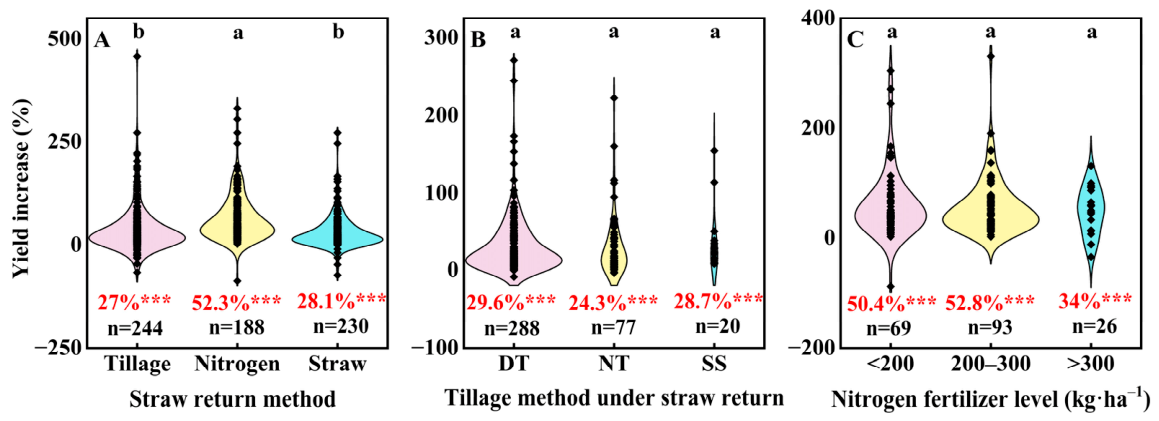
Figure 7A compares the effects of three different management practices on maize yield under straw return conditions, including straw return alone, straw return combined with N application, and straw return combined with tillage practices. The yield increase rates were all significant under these treatments: 28.1%, 52.3%, and 27.0%, respectively. Among the treatments, straw return combined with N application exhibited a significantly greater yield-enhancing effect than both straw return alone and straw return combined with tillage practices, with increases of 93.70% and 86.12%, respectively. Among tillage practices, deep tillage with straw return, subsoiling with straw return, and no-tillage straw mulching all significantly increased maize yield (Figure 7B) by 62.2%, 75.5%, and 60.5%, respectively, with no significant differences among treatments.
Figure 7.
Effects on maize yield under straw return of treatment modes and nitrogen application: (A) straw return treatments, (B) nitrogen application, and (C) nitrogen application rates. Note: Straw, straw return alone; Nitrogen, straw return combined with nitrogen application; Tillage, straw return combined with tillage practices; DT, deep tillage with straw return; NT, no-tillage straw mulching; and SS, subsoiling with straw return.
N application significantly affected maize yield under straw return conditions (Figure 7C). During the early stages of straw decomposition, strong competition for N between microorganisms and crops is common. Without additional N inputs, temporary soil N deficiency may be aggravated, thereby inhibiting crop growth. All three N application rates significantly increased maize yield under straw return conditions (Figure 7C). The yield increase rates were 50.4% for an N application of <200 kg·ha−1, 52.8% for 200–300 kg·ha−1, and 34.0% for >300 kg·ha−1. Among these, the 200–300 kg·ha−1 group showed a non-significantly greater yield enhancement than the <200 and >300 kg·ha−1 groups.
3.3. Relative Contributions of Factors to Maize Yield Improvement
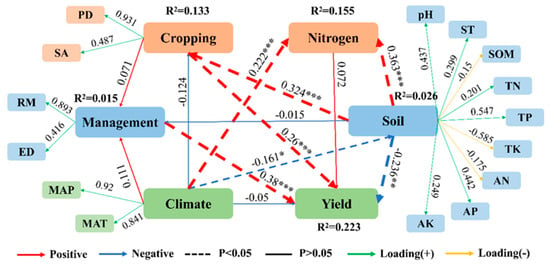
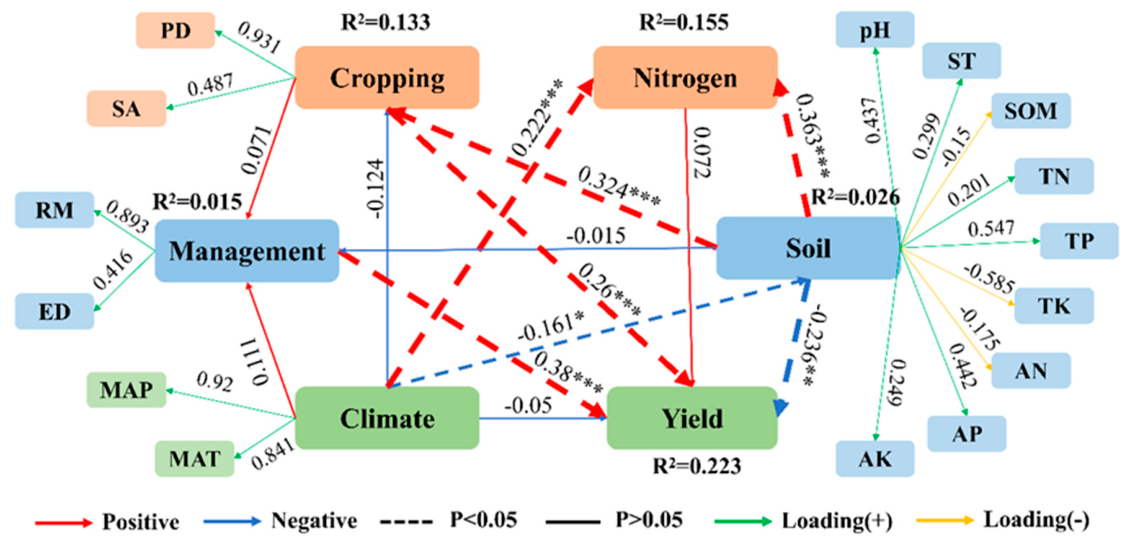
Figure 8 illustrates the direct and indirect pathways through which different factors influenced maize yield, as well as their relative contributions. Partial least squares structural equation modeling (PLS-SEM) revealed substantial differences in the effects of latent variables on maize yield. In the direct pathways, management practices and cropping systems exerted significant positive effects on maize yield (p < 0.001), with path coefficients of 0.26 and 0.38, respectively. In contrast, soil factors had a significant negative effect on maize yield (p < 0.01). In the indirect pathways, soil factors had a significant positive effect on cropping systems (p < 0.001), which in turn further influenced maize yield. Climatic factors exhibited a significant negative relationship with soil factors (p < 0.05), while soil factors negatively affected maize yield (p < 0.01). Furthermore, soil factors and climatic factors both exerted significant positive effects on N inputs (p < 0.001). However, the direct effect of N inputs on maize yield was non-significant.
Figure 8.
PLS-SEM model of the effects of various factors on maize yield. Note: The red lines represent positive paths, the blue lines represent negative paths, the green lines represent positive loading paths, and the yellow lines represent negative loading paths. The black lines shown in the figure are used only as significance indicators and do not represent paths.
4. Discussion
4.1. Effects on Maize Yield—Climatic Factors
In this study, MAP and MAT had significant effects on yield improvement, with the most pronounced effects in arid and semi-humid regions, supporting the results of previous studies. For example, Zhao et al. [16] showed that MAP has a significant effect on maize yield under straw return conditions. In arid regions, soil water deficiency is the primary limiting factor for maize production. Straw return can effectively alleviate drought stress by increasing SOM content, improving soil structure, and enhancing soil water-holding capacity, thus providing a more stable water supply for crops [17]. In semi-humid regions, the water-conserving effect of straw return, combined with suitable precipitation conditions, creates a synergistic effect that promotes the full decomposition and release of C and N resources from straw residues, thereby increasing nutrient supply, microbial activity, and maize yield [18,19]. In addition, precipitation not only affects the straw decomposition rate but also interacts with soil aeration and rhizosphere microbial community structure, jointly determining the yield-enhancing effect of straw return [20,21]. Ji et al. [22] found that regions with relatively high MAP (>600 mm) show more pronounced benefits from straw return. However, Zhang et al. [23] reported that the advantages of straw return are particularly evident in regions with a MAP of 400–600 mm. Both of these findings are consistent with our results. Therefore, at the national scale, appropriate use of straw return not only contributes to improving maize yield but also enhances soil ecological functions across different climatic zones and improves resource use efficiency. Regarding temperature, we found a stronger yield effect for MAT of 10–15 °C. Zhang et al. [24] reported that the positive effects of straw return are more stable within the 10–20 °C range, while the effect weakens at higher temperatures, consistent with our results. This indicates that suitable temperatures can promote soil microbial activity and nutrient cycling, whereas excessively high temperatures may inhibit microbial metabolism and intensify N losses, thereby weakening the yield-enhancing effect [25]. Wang et al. [14] also showed that straw return significantly increased yield for MAT > 20 °C, consistent with our results.
4.2. Effects on Maize Yield—Soil Factors
We found that the yield-enhancing effect of straw return on maize was jointly regulated by multiple environmental and management factors, including soil properties, cropping systems, management practices, and N inputs. Regarding soil texture, due to stronger water and nutrient retention capacities, clay, clay loam, and loam soils favor straw decomposition and nutrient release. Liu et al. [26] experimentally confirmed that straw return in clay loam soils significantly increases maize yield. Soil chemical properties, particularly soil pH, also play a crucial regulatory role in the straw return effect [27]. Our results indicate a stronger yield-enhancing effect of straw return in alkaline soils, suggesting that suitable pH facilitates straw decomposition and nutrient release. Previous studies have shown that neutral to slightly alkaline conditions support higher microbial activity, with greater diversity of cellulose-decomposing and N-fixing microorganisms, thereby accelerating organic matter mineralization and N availability [28]. In acidic soils, microbial activity is suppressed and nutrient loss or immobilization is more likely, and straw return can effectively alleviate these limitations. Cai et al. [29] reported a substantial yield increase after straw return in acidic soils (pH 5.65) in Northeast China. Straw itself has a buffering capacity, and long-term straw return may gradually improve soil physicochemical properties and enhance soil buffering capacity and nutrient availability [30]. In our study, SOM at different levels significantly increased maize yield, indicating that straw, as an external organic C input, continuously replenishes soil C pools and improves soil aggregate stability and water and nutrient retention capacities, thus providing a more stable nutrient supply for crops [31]. Therefore, SOM primarily influences the stability and long-term potential of the straw return effect rather than short-term yield responses [32]. Our results indicate that soil nutrient status significantly regulated the effect of straw return on maize yield, particularly under low TP and TK conditions, where yield advantages were more pronounced. This suggests that straw return not only improves soil physicochemical properties as a C source but also releases N, P, and K during decomposition, thus alleviating nutrient limitations for crop growth [33]. Zhang et al. [34] reported that straw decomposition can enhance N mineralization, increase soil P and K availability, and improve cation exchange capacity, thereby improving nutrient uptake efficiency. When soil fertility is relatively high, the marginal contribution of straw return decreases, and its yield effect is mainly reflected in improved soil structure and water retention [35]. The AK showed a dual effect, alleviating K limitation under low-K conditions, while under sufficient-K conditions it may act synergistically with straw return [36]. These results indicate that the nutrient effects of straw return are highly dependent on soil conditions, and optimized management based on soil fertility status can further enhance the yield benefits [23].
4.3. Effects on Maize Yield—Management Method
This study demonstrates that cropping systems played an important role in regulating the yield response to straw return; with increasing planting density, the yield-enhancing effect of straw return rose. This may be attributed to the higher demand for nutrients and water under high-density planting, while straw return improves nutrient availability (N, P, and K) and enhances the rhizosphere microenvironment [37]. However, yield did not increase linearly with increasing straw return rate. A straw return rate of 6000–9000 kg·ha−1 showed the best yield performance, but >9000 kg·ha−1 led to a yield decline. This is consistent with the findings of Jia et al. [38], suggesting that excessive straw input may degrade soil aeration and structure, intensify microbial competition for N, and lead to organic acid accumulation, thereby inhibiting crop growth. Experimental duration significantly affected the straw return yield response, indicating a clear time-dependent cumulative effect, consistent with long-term field studies [39]. In short-term treatments (1–5 years), incomplete decomposition of straw and temporary N immobilization by microorganisms may even suppress maize growth [40]. In contrast, in long-term experiments, particularly those of >10 years [41], yield responses increased, possibly reflecting the gradual improvement of soil physicochemical and biological properties following repeated straw return. However, this trend should be interpreted with caution because the number of studies available for the 10–20-year and >20-year groups in the present meta-analysis was relatively limited, with only 3 and 7 studies, respectively. These findings suggest that the benefits of straw return may become more evident over longer periods, but further long-term field studies are needed to confirm this pattern [42]. Application of N fertilizer played a key regulatory role in the effect of management practices on maize yield under straw return. A strong synergistic effect exists between straw return and N application, ensuring sufficient N supply during critical growth stages and significantly improving yield [43]. The N input not only increases soil AN but also optimizes the C:N of straw, accelerating decomposition and nutrient release, consistent with previous studies on straw–N interactions [44]. Straw return combined with tillage practices also significantly improved yield, consistent with multiple previous findings [45,46]. Therefore, future field management and policy design should integrate straw return and N fertilization to achieve both high yield and soil quality improvement. In this study, N inputs significantly influenced the yield response of straw return. Supplementation with N effectively alleviated temporary soil N deficiency caused by microbial immobilization during early straw decomposition, thereby preventing growth suppression at early maize stages [47]. A significant interaction exists between straw return and N application, whereby N not only directly increases soil N availability but also promotes a balanced C:N in straw, accelerating organic matter decomposition and nutrient release, ultimately leading to a stable and sustained yield increase [48]. Further analysis showed that the 200–300 kg·ha−1 N rate produced a higher yield increase (52.8%) than both higher (>300 kg·ha−1) and lower (<200 kg·ha−1) N levels. Excessive N application may lead to N leaching and greenhouse gas emissions [49,50].
4.4. Comprehensive Comparison of the Contributions of Different Factors to Maize Yield Improvement
The integrated PLS-SEM results indicate that different environmental and management factors jointly influence maize yield both directly and indirectly. Management practices and cropping systems exert significant positive direct effects on yield, whereas soil factors show a significant negative direct effect. This finding suggests that, under intensive agricultural utilization, excessively high nutrient levels may lead to nutrient imbalances in soils [51]. Previous studies reported that soil nutrient imbalances, structural degradation, and reduced microbial functioning can weaken crop yield potential, resulting in an overall negative feedback of soil-related effects on yield [52,53,54,55]. We also found that soil factors have a significant positive effect on cropping systems, indicating that soil conditions influence cropping pattern selection and indirectly affect yield through cropping system adjustments. This is consistent with the theory of Cassman et al. [56], which suggests that production decisions are often adjusted according to soil resource endowments, thereby forming indirect regulatory pathways. In addition, climatic factors significantly promoted N fertilizer inputs, suggesting that, under increasing climatic stress, farmers may increase N application to compensate for potential yield losses [57]. However, the effect of N inputs on yield was non-significant. This is consistent with results from several long-term field experiments, which indicate that the marginal benefit of N application decreases beyond a certain threshold and may even weaken yield responses due to reduced N-use efficiency [58]. This suggests that yield improvement in current agricultural systems is no longer driven solely by fertilizer inputs, but is increasingly regulated by the integrated effects of soil quality, cropping structure, and coordinated management practices [59]. Overall, the results demonstrate that climate indirectly affects the production system by regulating soil conditions and input levels, while soil properties and management practices act as key mediators and regulators within the system.
This meta-analysis integrates data from a large number of field studies across China, providing a comprehensive assessment of the factors influencing maize yield responses to straw return. However, the limitations of the present study should also be acknowledged. Soil microbial properties, soil structure, and water-holding capacity were not included in our analysis, although they may substantially regulate nutrient mineralization, soil C and N cycling, and maize productivity under straw return. Moreover, soil properties are highly interconnected, with changes in one property potentially affecting others and their responses to straw inputs. Therefore, isolating the independent contribution of individual soil attributes remains challenging in a meta-analysis based on published data. The relationships identified in this study should thus be interpreted as integrated statistical associations rather than completely independent effects. Future meta-analyses incorporating soil microbial, physical, and biochemical properties may further improve our understanding of the mechanisms regulating maize yield responses to straw return.
5. Conclusions
Straw return significantly increased maize yield at the national scale, overall by 26.75%, indicating that it is an important agronomic practice for enhancing maize productivity. Among different management combinations, straw return combined with N application showed the greatest yield-increasing effect, suggesting that N supplementation effectively alleviates N competition between microorganisms and crops during straw decomposition. Climatic conditions markedly influenced the yield response to straw return. Cropping systems and management practices significantly regulated the yield response to straw return. The PLS-SEM analysis further revealed that cropping systems and management practices were the primary direct drivers of maize yield, while soil factors exerted a significant negative effect. Overall, straw return is an effective practice for improving maize yield, with its effects jointly shaped by climatic conditions, cropping systems, and management practices. These findings highlight the importance of optimizing straw and nitrogen management according to local conditions to maximize the yield benefits of straw return. Further research on microbial and enzymatic mechanisms is needed and should be incorporated into future meta-analyses.
Author Contributions
Conceptualization, Y.-X.H. and H.-M.Z.; methodology, Y.-X.H.; software, Y.-X.H.; validation, Y.-X.H., Y.-Q.H. and H.-M.Z.; formal analysis, Y.-X.H. and J.-H.C.; investigation, Y.-X.H.; data curation, Y.-X.H.; writing—original draft preparation, Y.-X.H.; writing—review and editing, Y.-X.H., Y.-Q.H., J.-H.C. and H.-M.Z.; visualization, Y.-X.H.; supervision, H.-M.Z., W.-J.Y. and Y.-T.H.; project administration, H.-M.Z.; funding acquisition, H.-M.Z. All authors have read and agreed to the published version of the manuscript.
Funding
This study was sponsored by the Tianshan Talent Training Program “Agriculture, Countryside and Farmers” Backbone Talent Training Program (Grant No. 2024SNGGGCC020), the Xinjiang Graduate Research and Innovation Program (Grant No. XJ2026G114), the Special Fund of Xinjiang Key Laboratory of Soil and Plant Ecological Processes (Grant No. 25XJTRZW14), and The Tianshan Talent Training Program (Grant No. 2023TSYCCX0085).
Institutional Review Board Statement
Not applicable.
Informed Consent Statement
Not applicable.
Data Availability Statement
The original contributions presented in this study are included in the article. Further inquiries can be directed to the corresponding author.
Conflicts of Interest
The authors declare no conflict of interest.
References
- Ding, S.J.; Huang, S.M.; Zhang, S.Q.; Guo, D.D.; Song, X.; Zhang, K.K.; Yue, K.; Guo, T.F. Relationship between soil nitrogen indices and wheat/maize yield under long-term fertilization. J. Nucl. Agric. Sci. 2025, 39, 157–169. [Google Scholar] [CrossRef]
- National Bureau of Statistics of China. Announcement of the National Bureau of Statistics on the 2025 Grain Production Data. Available online: https://www.stats.gov.cn/sj/zxfb/202512/t20251212_1962049.html (accessed on 8 September 2026).
- Hu, M.; Qu, Z.Y.; Li, Y.; Xiong, Y.W.; Huang, G.H. Contrasting effects of different straw return modes on net ecosystem carbon budget and carbon footprint in saline-alkali arid farmland. Soil Tillage Res. 2024, 239, 106031. [Google Scholar] [CrossRef] [Scilit]
- Bian, J. Analysis of maize industry development status and supply-demand trends. China Price 2022, 8, 117–120. [Google Scholar]
- Shen, K.H.; Zhou, L.J.; Geng, Y.H.; Jiang, Z.L.; Zhang, J.; Li, H.; Liu, J. Effects of straw returning combined with sulfur fertilizer on spring maize growth and nitrogen use efficiency. J. Shandong Agric. Univ. Nat. Sci. Ed. 2023, 54, 360–366. [Google Scholar] [CrossRef]
- Wang, C.; Aihaimaiti, A.; Xiao, J.X.; Yang, Y.C. Effects of straw returning combined with decomposing agent on growth, yield and quality of summer maize. J. Hunan Agric. Univ. 2021, 47, 262–267. [Google Scholar] [CrossRef]
- Zhao, Y.H.; Yin, H.K.; Hu, X.C.; Xie, W.Y.; Liu, Z.P.; Zhou, H.P.; Yang, Z.X. Effects of long-term straw returning on soil organic carbon, nitrogen fractions and maize yield in cinnamon soil. Agric. Res. Arid Areas 2024, 42, 80–88. [Google Scholar] [CrossRef]
- He, J.S.; Li, X.M.; Wei, Y.P.; Guo, H.Z.; Yang, K.N.; Sun, L.K.; Li, X.Y.; Jia, X.C.; Li, Y.X.; Li, R.F.; et al. Effects of long-term deep tillage with straw returning combined with biochar on aggregates and wheat-maize yield in lime concretion black soil. Trans. Chin. Soc. Agric. Eng. 2024, 40, 161–171. [Google Scholar] [CrossRef]
- Xiao, G.M.; Liu, L.; Wang, X.Q.; Wang, C.; Zhao, Q.Y.; Hou, L.M.; Ru, S.H.; Wang, L.; Sun, S.Y. Effects of straw returning and nitrogen application on water-stable aggregates and distribution of organic carbon and total nitrogen in cinnamon soil. Chin. J. Eco-Agric. 2025, 33, 1301–1310. [Google Scholar] [CrossRef]
- Yang, B.W.; Gao, F.; Yan, P.; Chen, S.T.; Mi, W.H. Research progress on effects of straw returning on soil organic carbon pool and microbial community. Shandong Agric. Sci. 2025, 57, 174–180. [Google Scholar] [CrossRef]
- Li, Y.F.; Zhang, J.J.; Wang, M.X.; Liu, H.T.; Zhao, Y.; Yang, J.; Liu, S.L.; Liu, F. Effects of different straw return methods on soil organic carbon fractions, carbon pool management index and enzyme activities. Environ. Sci. 2026, 1–14. [Google Scholar] [CrossRef]
- Yang, L. Study on carbon sequestration and emission reduction measures of spring maize farmland in Northeast China based on DNDC model. J. Plant Nutr. Fertil. 2014, 20, 75–86. [Google Scholar] [CrossRef]
- Zhang, H.J.; Sun, T.; Wang, C.J.; Zhao, F.; Liu, J.H.; Li, R.; Wang, Y.B.; Xie, X.S. Effects of maize straw returning combined with decomposing agent on soil microbial community structure and function. Microbiol. China 2025, 52, 4078–4093. [Google Scholar] [CrossRef]
- Wang, X.; Tong, B.X.; Sun, M.Y.; Li, C.Q.; Sun, Z.M. Effects of deep tillage on maize yield at national and regional scales: A meta-analysis. Chin. J. Appl. Ecol. 2025, 36, 152–160. [Google Scholar] [CrossRef] [Scilit]
- Zhang, Z.Y.; Wu, H.; Lan, P.; Fu, X.; Ren, W.L.; Xin, J. Characteristics of carbon and nitrogen migration and transformation in farmland soil profiles during the initial stage of maize straw returning. Environ. Pollut. Control 2025, 47, 42–49. [Google Scholar] [CrossRef]
- Zhao, Z.X.; Wang, X.Y.; Tian, Y.J.; Wang, R.; Peng, Q.; Cai, H.J. Effects of straw returning and nitrogen fertilizer types on summer maize yield and soil ammonia volatilization under future climate conditions. Sci. Agric. Sin. 2023, 56, 104–117. [Google Scholar] [CrossRef]
- Yang, Z.P.; Zhou, H.P.; Li, H.M.; Wang, J.Z.; Ma, Y.Z. Effects of straw returning and autumn fertilization on yield and soil fertility in dryland maize. Agric. Res. Arid Areas 1999, 17, 10–15. [Google Scholar]
- Zhang, L.H.; Luan, T.Y.; Xu, C.; Yan, W.P.; Yu, J.; Sun, N.; Tan, G.B.; Zhao, H.X.; Li, F.; Meng, X.M.; et al. Effects of straw returning and tillage practices on soil moisture, maize photosynthetic characteristics and yield in semi-humid region. J. Maize Sci. 2022, 30, 100–107. [Google Scholar] [CrossRef]
- Xu, L.L.; Li, D.; Li, X.; Lu, W.M.; Yang, K.B.; Sheng, L.L. Effects of different straw returning amounts on soil physicochemical properties, microorganisms and fresh maize yield. Acta Agric. Shanghai 2023, 39, 115–118. [Google Scholar] [CrossRef]
- Li, R.; Mian, Y.M.; Hou, X.Q.; Li, P.F.; Wang, X.N. Effects of nitrogen application on straw decomposition, nutrient release, soil fertility and maize yield. Acta Agron. Sin. 2023, 49, 2012–2022. [Google Scholar] [CrossRef] [Scilit]
- Feng, C.; Sun, Z.X.; Zheng, J.M.; Feng, L.S.; Bai, W.; Zhang, Z.; Zhang, G.C. Effects of autumn plastic mulching on soil moisture and maize water use efficiency in semi-arid region of western Liaoning. Agric. Res. Arid Areas 2016, 34, 9–14. [Google Scholar] [CrossRef]
- Ji, Y.K.; Yan, L.; Zhu, J.F.; Liu, M. Response of soil organic carbon content to straw returning in major maize-producing regions based on meta-analysis. Trans. Chin. Soc. Agric. Eng. 2025, 41, 95–106. [Google Scholar] [CrossRef]
- Zhang, X.; Zhao, Z.; Li, Y.; Li, F.; Sun, Y.; Cai, H. Meta-analysis of the effects of straw incorporation on maize yield and water use efficiency in China under different production conditions. Agronomy 2024, 14, 1784. [Google Scholar] [CrossRef] [Scilit]
- Zhang, X.; Li, Y.; Sun, Y.; Yu, L.; Xu, J.; Gu, X.; Cai, H. Effects of straw mulching and plastic mulching on maize yield and crop water productivity in China: A meta-analysis. Agric. Water Manag. 2025, 315, 109549. [Google Scholar] [CrossRef] [Scilit]
- Chen, Y.F.; Wang, H.; Niu, B.; Yin, L.N.; Wang, S.W.; Deng, X.P. Response of nitrogen fertilizer productivity of spring maize to different tillage practices on the Loess Plateau: A meta-analysis. Chin. J. Eco-Agric. 2024, 32, 755–765. [Google Scholar] [CrossRef]
- Liu, R.Z.; Borjigin, Q.; Gao, J.L.; Yu, X.F.; Hu, S.P.; Li, R.P. Effects of different straw return methods on soil properties and yield potential of maize. Sci. Rep. 2024, 14, 8682. [Google Scholar] [CrossRef] [Scilit]
- Chen, Y.; Xin, L.; Liu, J. Changes in bacterial community of soil induced by long-term straw returning. Sci. Agric. 2017, 74, 349–356. [Google Scholar] [CrossRef] [Scilit]
- Gao, F.; Cui, Z.T.; Sun, S.M.; Guo, S.Q.; Fu, Q.M. Effects of straw returning amount on soil moisture, maize biological traits and yield in arid areas of central and eastern Gansu. Agric. Res. Arid Areas 2016, 34, 74–78. [Google Scholar] [CrossRef]
- Cai, H.G.; Liang, Y.; Yan, X.G.; Liu, J.Z.; Yuan, J.C.; Zhang, H.X.; Ren, J.; Wang, L.C. Maize yield and nutrient accumulation characteristics under different straw returning methods in black soil region of Northeast China. J. Maize Sci. 2016, 24, 68–74. [Google Scholar] [CrossRef]
- Gao, H.J.; Peng, C.; Zhang, X.Z.; Li, Q.; Zhu, P.; Fu, J.S. Effects of long-term straw returning on soil carbon, nitrogen and maize yield in black soil. J. Maize Sci. 2011, 19, 105–107. [Google Scholar] [CrossRef]
- Wu, Q.W.; Song, P.H.; Huang, J.H.; Qian, X.; Gao, Y.B.; Zhang, H.; Liu, K.C.; Wang, L.; Li, Z.X. Evaluation of annual straw returning amount on soil carbon pool and crop yield in wheat-maize cropping system. Environ. Sci. 2024, 46, 1016–1024. [Google Scholar] [CrossRef] [Scilit]
- Yin, M.Y.; Gao, S.Y.; Zhang, X.Y.; Li, Y.X.; Yu, X.Y.; Cheng, Q.G. Effects of conservation tillage on soil organic carbon content and greenhouse gas emissions in farmland of Northeast China: A meta-analysis. J. Shenyang Univ. Nat. Sci. 2025, 37, 107–114. [Google Scholar] [CrossRef]
- Zheng, Y.Z.; Sun, S.C. Effects of straw biochar and straw on soil nutrients and crop yield in wheat-maize rotation system. J. Agric. Sci. Technol. 2023, 25, 152–162. [Google Scholar] [CrossRef]
- Zhang, R.; Yu, H.; Zhang, W.; Li, W.; Su, H.; Wu, S.; Xu, Q.; Li, Y.; Yao, H. Straw return enhances grain yield and quality of three main crops: Evidence from a meta-analysis. Front. Plant Sci. 2024, 15, 1433220. [Google Scholar] [CrossRef] [Scilit]
- Huang, X.; Wang, L.X.; Xu, T.J.; Yan, Q.Y.; Yan, S.D.; Dong, F.; Qi, C.; Zhang, M.M. Effects of different tillage practices on soil organic carbon in dryland wheat fields of the Loess Plateau based on meta-analysis. Chin. J. Appl. Ecol. 2024, 35, 2725–2732. [Google Scholar] [CrossRef] [Scilit]
- Ma, Y.; Tian, Y.; Mou, W.Y.; Zhang, X.M.; Zhang, L.L.; Yu, J.; Li, Y.H.; Wang, H.L.; He, G.; Shi, M.; et al. Responses of wheat yield and grain NPK contents to monitored potassium application and soil available potassium in northern wheat region. Sci. Agric. Sin. 2022, 55, 3155–3169. [Google Scholar] [CrossRef]
- Ma, N.; Kang, J.H.; Lyu, K.Y.; Tan, X.M.; Liu, S. Effects of planting density on maize yield and soil physicochemical properties under straw returning. J. Agric. Sci. 2024, 45, 38–43. [Google Scholar] [CrossRef]
- Jia, R.F.; Cong, R.H.; Xu, Z.Y.; Sun, Y.F.; Li, X.Y.; Dai, Z.G.; Li, X.K.; Ren, T.; Lu, J.W. Effects of straw returning techniques on soil physicochemical properties and crop yield: A meta-analysis. Trans. Chin. Soc. Agric. Eng. 2025, 41, 80–89. [Google Scholar] [CrossRef]
- Liu, X.T.; Cao, C.Y.; Zheng, C.L.; Dang, H.K.; Ma, J.Y.; Li, K.J. Effects of long-term straw returning on carbon and nitrogen in soil aggregates and crop yield in fluvo-aquic soil. Soil Fertil. Sci. China 2023, 25–33. [Google Scholar] [CrossRef]
- Lu, B.L.; Che, Z.X.; Bao, X.G.; Zhang, J.D.; Wu, K.S.; Yang, R.J.; Cui, H. Response of maize yield to long-term straw strip mulching and returning practice in Hexi Oasis irrigation area. J. Plant Nutr. Fertil. 2023, 29, 1037–1047. [Google Scholar] [CrossRef]
- Yin, H.K.; Zhao, Y.H.; Xie, W.Y.; Liu, Z.P.; Zhou, H.P.; Yang, Z.X. Effects of long-term maize straw returning on fungal community and maize yield in cinnamon soil. Environ. Sci. 2024, 46, 4699–4709. [Google Scholar] [CrossRef] [Scilit]
- Wei, T.; Zhang, P.; Wang, K.; Ding, R.X.; Yang, B.P.; Nie, J.F.; Jia, Z.K.; Han, Q.F. Effects of wheat straw incorporation on the availability of soil nutrients and enzyme activities in semiarid areas. PLoS ONE 2015, 10, e0120994. [Google Scholar] [CrossRef] [Scilit]
- Song, F.; Liu, M.; Qi, Z.; Zhang, Z.; Wang, B.; Yin, Z.; Xu, J.; Sun, J. Straw returning and reducing nitrogen application rates maintain maize yields and reduce gaseous nitrogen emissions from black soil maize fields. Appl. Soil Ecol. 2024, 203, 105637. [Google Scholar] [CrossRef] [Scilit]
- Li, F.G.; Tan, X.M.; Su, M.; Hong, Z.Q.; Zhou, T.; Zhang, S.B.; Zhang, W.J.; Kang, J.H.; Wu, H.L. Effects of straw returning and planting density on carbon-to-nitrogen ratio and homeostatic stability of soil-microbe-plant leaf system. Environ. Sci. 2025, 46, 7022–7032. [Google Scholar] [CrossRef] [Scilit]
- Lyu, J.L.; Liu, Z.; Wang, N.; Shen, Y.; Yang, Q.; Li, G.; Ning, T.Y. Effects of continuous tillage and straw returning on soil nutrients and maize yield. J. North. Agric. 2024, 52, 16–25. [Google Scholar] [CrossRef]
- Li, N.N.; Li, Z.Q.; Huang, X.F.; Hao, K.D.; Liang, G.M. Effects of straw returning under different tillage practices on spatiotemporal distribution of soil water and yield in Jinzhong maize fields. J. Soil Water Conserv. 2023, 37, 312–319. [Google Scholar] [CrossRef]
- Li, T.Z.; Zhang, Y.J.; Dang, S.N.; Li, J. Effects of tillage and straw returning on soil aggregate distribution and organic carbon: A meta-analysis. Environ. Sci. 2025, 46, 5694–5704. [Google Scholar] [CrossRef] [Scilit]
- Guo, Z.; Liu, Y.; Meng, X.; Yang, X.; Ma, C.; Chai, H.; Li, H.; Ding, R.; Nazarov, K.; Zhang, X.; et al. The long-term nitrogen fertilizer management strategy based on straw return can improve the productivity of wheat-maize rotation system and reduce carbon emissions by increasing soil carbon and nitrogen sequestration. Field Crops Res. 2024, 317, 109561. [Google Scholar] [CrossRef] [Scilit]
- Fei, G.; Ren, K.; Li, Y.; Ye, C.; Ye, W.; Xiu, Z. Uncovering the potentials of long-term straw return and nitrogen supply on subtropical maize (Zea mays L.) photosynthesis and grain yield. Field Crops Res. 2023, 302, 109062. [Google Scholar] [CrossRef] [Scilit]
- Gao, J.H.; Sun, Z.X.; Feng, L.S.; Wen, F.; Wu, C.J. Effects of combined application of straw and nitrogen fertilizer on maize growth and water use efficiency. J. Northeast Agric. Univ. 2011, 42, 116–120. [Google Scholar] [CrossRef]
- Hao, X.Y.; He, W.; Lam, S.K.; Li, P.; Zong, Y.Z.; Zhang, D.S.; Li, F.Y. Enhancement of no-tillage, crop straw return and manure application on field organic matter content overweigh the adverse effects of climate change in the arid and semi-arid Northwest China. Agric. For. Meteorol. 2020, 295, 108199. [Google Scholar] [CrossRef] [Scilit]
- Liu, Y.; Ye, X.; Bao, H.J.; Wang, X.H.; Juan, Y.H. Effects of straw returning combined with chemical fertilizer on soil physicochemical properties and yield of spring maize in topsoil layer. Soils 2023, 55, 254–261. [Google Scholar] [CrossRef]
- Qi, Z.J.; Xu, J.W.; Zhang, Z.X.; Song, F.; Li, T.C.; Sun, J.L. Effects of straw returning combined with nitrogen fertilizer on soil CO2 emission and carbon balance in black soil maize field. Trans. Chin. Soc. Agric. Mach. 2024, 55, 284–293. [Google Scholar] [CrossRef]
- Tilman, D.; Cassman, K.G.; Polasky, S. Agricultural sustainability and intensive production practices. Nature 2002, 418, 671–677. [Google Scholar] [CrossRef] [Scilit]
- Lal, R. Restoring soil quality to mitigate soil degradation. Sustainability 2015, 7, 5875–5895. [Google Scholar] [CrossRef] [Scilit]
- Cassman, K.G.; Dobermann, A.; Walters, D.T. Agroecosystems, nitrogen-use efficiency, and nitrogen management. Ambio 2002, 31, 132–140. [Google Scholar] [CrossRef] [Scilit]
- Lou, Y.L.; Xu, M.G.; Wang, W.; Sun, X.L.; Zhao, K. Return rate of straw residue affects soil organic C sequestration by chemical fertilization. Soil Tillage Res. 2011, 113, 70–73. [Google Scholar] [CrossRef] [Scilit]
- Zhang, X.; Davidson, E.A.; Mauzerall, D.L.; Searchinger, T.D.; Dumas, P.; Shen, Y. Managing nitrogen for sustainable development. Nature 2015, 528, 51–59. [Google Scholar] [CrossRef] [Scilit]
- Dolan, M.S.; Clapp, C.E.; Allmaras, R.R.; Baker, J.M.; Molina, J.A.E. Soil organic carbon and nitrogen in a Minnesota soil as related to tillage, residue and nitrogen management. Soil Tillage Res. 2006, 89, 221–231. [Google Scholar] [CrossRef] [Scilit]
Disclaimer/Publisher’s Note: The statements, opinions and data contained in all publications are solely those of the individual author(s) and contributor(s) and not of MDPI and/or the editor(s). MDPI and/or the editor(s) disclaim responsibility for any injury to people or property resulting from any ideas, methods, instructions or products referred to in the content. |
© 2026 by the authors. Licensee MDPI, Basel, Switzerland. This article is an open access article distributed under the terms and conditions of the Creative Commons Attribution (CC BY) license.