


Abstract
To clarify the pollution characteristics and source composition of heavy metals in the paddy soils of the Yellow River irrigation district of Ningxia, a total of 515 surface soil samples were collected, and the concentrations of As, Hg, Pb, Cd, and Cr were measured. Regional-scale pollution assessment and source apportionment were conducted using the geo-accumulation index, spatial interpolation analysis, and the Positive matrix factorization (PMF) model. Based on the regional pollution assessment and spatial distribution patterns, a representative area with relatively elevated Cd accumulation and more pronounced anthropogenic influence was selected for local-scale isotope investigation. Eight paddy soil samples and potential end-member samples were collected, and, combined with literature-based end-member data, Pb and Cd isotopes were analyzed using the MixSIAR Bayesian (version 3.1.12) mixing model to further constrain the sources of Pb and Cd in village soils. The results showed that some sampling points in the study area exceeded the soil background values, but none of the points surpassed the screening values for agricultural soil pollution risk, indicating that the overall risk of paddy soils in the study area remained low. Geo-accumulation index results indicated that As, Pb, and Cr were predominantly classified as unpolluted, whereas Hg and Cd showed more pronounced accumulation, with most sampling points reaching unpolluted to moderately polluted or higher. PMF results revealed that heavy metals in the study area primarily originated from natural sources, agricultural activities, coal combustion-related sources, and industrial–traffic mixed sources. Cd was mainly influenced by agricultural sources, Hg was primarily affected by coal combustion and related industrial activities, and Pb exhibited a mixture of multiple sources. Local isotope analysis in the representative area further indicated that industrial and agricultural sources were the main contributors to soil Cd, accounting for 34.3% and 33.1%, respectively. Pb was primarily derived from agricultural activities (38.1%), while coal emissions, industrial sources, natural sources, and traffic contributed 19.2%, 18.3%, 16.9%, and 7.5%, respectively, indicating a complex mixture of agricultural, industrial, coal-combustion, natural, and traffic-related inputs. The combined application of PMF and Pb/Cd isotopes allowed for constraints on heavy metal sources at both regional and local scales, providing a scientific basis for pollution control and agricultural safety management in paddy soils of the Yellow River irrigation district.
1. Introduction
Heavy metals, due to their high toxicity, low biodegradability, and persistent transfer within the food chain, have become a significant focus in soil pollution research. According to the National Soil Pollution Status Survey Bulletin in 2014 [1], 19.4% of China’s agricultural soils have been affected by heavy metal pollution to varying degrees, with Cd contamination being particularly severe [2,3]. Heavy metals can degrade soil quality and enter the food chain through crop uptake, thereby threatening agricultural-product safety and human health [2,4]. For example, Cd can not only be absorbed by crops, but also affect plant growth, photosynthesis, and other physiological processes. Recent studies suggest that emerging contaminants, such as microplastics, may modify Cd bioavailability, uptake, and toxicity in ‘soil–plant’ systems, indicating the complexity of Cd risk in agricultural environments [5]. Due to the complexity of heavy metal sources and associated ecological risks, assessing contamination levels and accurately identifying their sources is a key step toward effective pollution control. Therefore, understanding the concentrations, pollution characteristics, spatial distribution patterns, and source composition of heavy metals in agricultural soils is an essential prerequisite for implementing soil pollution prevention and agricultural safety management. Paddy fields are a key component of China’s agricultural production and food-security system [6]. Compared with upland soils, the distribution and sources of heavy metals in paddy soils may be influenced by a greater number of input pathways as well as environmental factors [7,8,9]. Therefore, systematically investigating the distribution and sources of heavy metals in paddy soils is of great significance for identifying regional pollution characteristics and heavy metal sources, as well as ensuring the safety of agricultural products.
The study area is located in the arid–semiarid zone of northwestern China. The local soils have complex heavy metal sources due to alluvial deposits from the front of the Helan Mountains, Yellow River alluvium, eolian loess, as well as industrial activities, coal combustion, and traffic within the region. There have been previous studies that analyzed heavy metal concentrations, spatial distribution, and pollution risks in cultivated or local farmland soils of Ningxia [2,10,11,12]. However, source apportionment studies specifically focusing on heavy metals in paddy soils of Ningxia remain limited, particularly those combining receptor models with Cd and Pb isotope evidence to distinguish among natural and anthropogenic sources.
In recent years, there has been a rapid increase in studies using multivariate statistical methods and receptor models for soil pollution source analysis. The positive matrix factorization (PMF) model imposes non-negative constraints on both factor loadings and scores, preventing negative decomposition results. This feature makes the results more interpretable and gives them clear physical meaning, which has made PMF one of the most widely used methods for source apportionment in soils and the atmosphere. Anaman et al. [13] combined PCA, PMF, and GIS methods and found that heavy metals in grassland and farmland soils surrounding a smelting plant in Hunan primarily originated from surface runoff and atmospheric deposition, whereas heavy metals in forest soils were derived solely from atmospheric deposition. Additionally, isotopic tracing techniques provide more indicative evidence for identifying heavy metal sources [14]. The Pb isotopic composition is closely related to ore types, parent rock material, coal combustion, industrial activities, and traffic emissions, with different sources typically exhibiting distinct isotopic fingerprints; thus, Pb isotopes are commonly used to distinguish between natural and anthropogenic sources in soils [14,15,16]. In recent years, Cd isotopes have also been increasingly applied in the source apportionment of farmland soil pollution, allowing identification of potential sources such as parent material, phosphate fertilizers, organic amendments, industrial emissions, and wastewater irrigation [17,18]. Compared with concentration data alone, isotopic compositions provide independent source-tracing information, helping to compensate for the limitations of multivariate statistical models in source identification. Recent studies have also combined Cd and Pb isotopes with receptor models to improve the reliability of source apportionment. For example, Xia et al. [18] applied Cd and Pb isotope analyses to facility agricultural soils around typical urban and industrial areas, effectively distinguishing the effects of agricultural inputs, industrial emissions, and urban activities on different soil types. Wang et al. [19] combined PMF with Pb isotopes to apportion heavy metal sources in soils from industrial parks and farmland, and found that industrial activities contributed differently to the two soil types; MixSIAR was further used to more accurately quantify the contribution of different Pb sources. In addition, Wang et al. [20] integrated PMF, Cd isotopes, and Pb isotopes to identify heavy metal sources in sewage-irrigated agricultural soils in Wuqing District, Tianjin, showing that the metals mainly originated from soil parent materials, industrial emissions, agricultural practices, and mixed sources of sewage irrigation and transportation. The relative errors (REs) were also calculated to verify the accuracy of the PMF model.
To address these gaps, this study developed a multi-scale framework integrating regional PMF analysis with site-specific Cd and Pb isotope tracing to investigate five target heavy metals—As, Hg, Pb, Cd, and Cr—in paddy soils of the Yellow River irrigation district of Ningxia. These elements were listed as priority heavy metal pollutants in the 14th Five-Year Plan for Key Heavy Metal Pollution Prevention and Control in Ningxia Hui Autonomous Region (2022) [21]. The study systematically analyzed the concentrations, spatial distribution characteristics, and pollution accumulation. Subsequently, the PMF model was applied to identify the major sources of heavy metals in the paddy soils and to quantitatively estimate the contribution of each source type. In addition, soil samples from a representative village (Yonggu Village, Yinchuan) were analyzed for Pb and Cd isotopes. Using measured soil isotope data and potential source-endmember values obtained from field sampling and published literature, Bayesian isotope mixing models were applied to characterize the local sources of Cd and Pb. The isotope-based results were then integrated with the PMF results to compare regional source patterns with site-specific source mixtures. The study aims to reveal the pollution characteristics and source composition of heavy metals in paddy soils of Ningxia, clarify the relative contributions of natural background and anthropogenic inputs to metal accumulation, and provide a scientific basis for environmental quality assessment, pollution control, and agricultural safety management in the Yellow River irrigation district.
2. Materials and Methods
2.1. Study Area
The study area (37°30′–38°50′ N, 105°00′–106°40′ E) is located in the paddy fields along the Yellow River in Ningxia, within the arid to semi-arid region of northwest China, and represents an important irrigated agricultural region and grain production base. It borders Shaanxi Province to the east and the Inner Mongolia Autonomous Region to the west and north, and encompasses Pingluo County in Shizuishan City, Yinchuan City, Litong District and Qingtongxia City in Wuzhong City, and Zhongning County and Shapotou District in Zhongwei City. The terrain of this region is generally flat, with well-developed irrigation and drainage systems. Paddy fields are mainly distributed along the main stream of the Yellow River. The region has a typical temperate continental climate, the average annual temperature is 5–9 °C and the annual sunshine duration is approximately 2194–3082 h. Because evaporation greatly exceeds precipitation, its agricultural production is highly dependent on water diverted from the Yellow River through irrigation canals [11]. The dominant soils in the irrigated plains are alluvial and irrigation-silted soils, which are generally neutral to alkaline and may exhibit varying degrees of salinization. The main crops grown in the region include rice and maize, and all soil samples collected in this study were obtained from paddy fields. In addition, the region is characterized by intensive agricultural and industrial activities. Therefore, it represents a typical area for investigating the pollution characteristics and source apportionment of heavy metals in paddy soils of the Yellow River irrigation district.
2.2. Sample Collection
In April 2024, we collected a total of 515 surface soil samples (0–20 cm) from paddy fields in the Yellow River irrigation district of Ningxia. Sampling locations were determined based on the distribution of major rivers and farmland, with sampling density designed according to the varying pollution levels reported in previous studies [12] (Figure 1). Prior to field collection, sampling points were systematically planned using ArcGIS 10.8 based on remote sensing images of the study area. At each site, surface vegetation, stones, and other debris were carefully removed. Five topsoil samples were collected within an approximately 10 m × 10 m area around the central sampling point using a wooden shovel, following the five-point sampling method to minimize potential impacts on heavy metal measurements. The collected soils were then thoroughly mixed using the quartering method, and at least 1 kg of each composite sample was placed into labeled polyethylene ’zip-lock’ bags. Sampling coordinates, soil classification, and surrounding conditions were recorded on site.
Figure 1.
Location of the study area and distribution of sampling sites. (a) Location of Ningxia Hui Autonomous Region in China; (b) Distribution of paddy soil sampling sites and location of Yonggu Village in Ningxia; (c) Sampling locations in Yonggu Village.
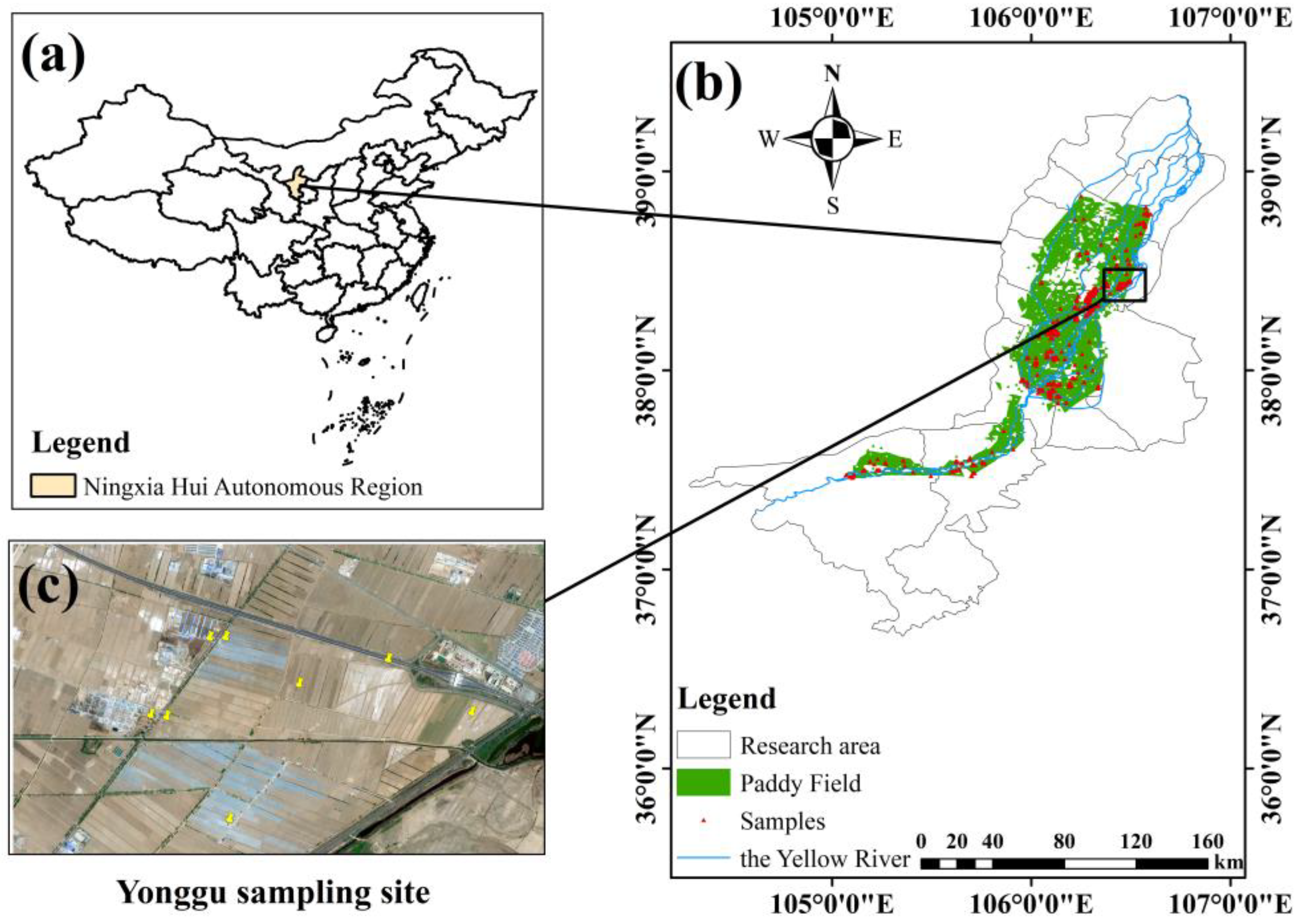
Additionally, 8 paddy soil samples were collected in this study in Yonggu Village, along with a set of potential source end-member samples, including 2 irrigation water samples, 3 commonly applied local agricultural fertilizers, and 9 dust deposition samples collected near factories and roads. Cd and Pb concentrations and isotopic compositions were subsequently measured in both soil and end-member samples. Due to the low concentrations of Cd or Pb in certain end-member samples (such as the irrigation water), complete isotopic data could not be obtained for all end-members. Therefore, isotopic compositions of similar source materials reported in the literature were used to supplement and constrain the potential end-member range, enabling Cd and Pb isotopic source apportionment.
2.3. Analytical Methods
The analytical procedures included determination of total heavy metal concentrations and measurement of Cd and Pb isotopic compositions. The specific procedures are as follows.
2.3.1. Soil Physicochemical Properties and Heavy Metal Concentration
After naturally air-drying, soil samples were carefully cleared of stones, gravel, and plant or animal debris. The soil was then ground in a mortar and passed through a 100-mesh sieve prior to digestion. Soil physicochemical properties were determined using standard methods. Specifically, soil pH, organic matter (OM), and cation exchange capacity (CEC) were determined according to NY/T 1121.2-2006 [22], NY/T 1121.6-2006 [23], and HJ 889-2017 [24], respectively. Concentrations of heavy metals (As, Hg, Pb, Cd, Cr) were measured using an Atomic Fluorescence Spectrometer 8510 (Tianjin, China) and ICP-PQ (Tianjin, China), with method detection limits as specified in Table S1. The procedures for sampling, collection, and analysis of heavy metals in farmland soils adhered to the Technical Rules for Monitoring the Environmental Quality of Farmland Soils (NY/T 395-2012) issued by the Ministry of Agriculture and Rural Affairs of China in 2012 [25], and the Technical Specification for Soil Environmental Monitoring (HJ/T 166-2004) published by the Ministry of Ecology and Environment in 2004 [26]. The national standard reference material GBW07401a (GSS-1a) was employed for calibration. A quality assurance system was implemented throughout the analysis to ensure precision and accuracy, with relative deviations maintained within 10%.
The concentrations of Cd and Pb in irrigation water samples were determined by ICP-MS. Cd concentrations were below the method detection limit, whereas Pb concentrations ranged from 0.33 to 1.24 ng/mL. The detection limits for Cd and Pb were 0.02 ng/mL and 0.07 ng/mL, respectively. Existing analytical methods generally require at least 200 ng of Cd and 500 ng of Pb after resin preconcentration for reliable isotope-ratio determination. However, the trace concentrations of Cd and Pb in the irrigation water samples were insufficient to meet these requirements for subsequent isotope analysis. Therefore, the irrigation water samples were not included as isotope endmembers in the MixSIAR model.
2.3.2. Cd Isotope
Approximately 0.15 g of soil sample was placed into a 10 mL PTFE (Teflon) vessel. A small amount of deionized water was added to moisten the sample, followed by 6 mL of sub-boiling HNO3. The vessel was sealed and heated on a hot plate at 110 °C for 24 h. After complete dissolution, the sample solution was evaporated to dryness and then re-dissolved in 5 mL of 2 M HCl (sub-boiling, secondary preparation). Following centrifugation, 2 mL of the supernatant was taken for determination of Cd concentration, while another 2 mL was used for chemical separation and purification of Cd isotopes.
Cd purification was carried out using an AG-MP-1M resin column. The column (3 mL) was first equilibrated with 20 mL of 2 M HCl. The 2 mL Cd-containing sample was then loaded, followed by sequential washes with 10 mL of 2 M HCl, 30 mL of 0.3 M HCl, 20 mL of 0.06 M HCl, and 5 mL of 0.012 M HCl to remove matrix components and elements such as Pb, Sn, and Zn. Finally, 20 mL of 0.0012 M HCl was used to elute and collect the purified Cd solution. The purified Cd solution, with a recovery of 95–98%, was dissolved in 3 mL of 1% HNO3 for isotopic analysis.
Cd isotopes were measured using a multi-collector inductively coupled plasma mass spectrometer (MC-ICP-MS, Thermo Fisher, Waltham, MA, USA). The samples, standards, and purified samples were introduced into the plasma through a DSN-100 desolvation system (Nu Instruments, Wrexham, UK). The sample concentration was 0.2 g/mL in 1% HNO3, with a flow rate of 100 µL/min, producing a signal intensity of approximately 52 V per ppm. For each sample, two sets of data were collected, with each set consisting of 30 data points and an integration time of 10 s per point. A 20 s background measurement was performed prior to each set of data acquisition. To ensure analytical accuracy, the BCR-2 international basalt standard was used to monitor data quality during chemical purification and mass spectrometry. The measured δ114/110Cd value was 0.02 ± 0.05‰ (2SD, N = 3), which was comparable to previously reported values for BCR-2, including −0.030 ± 0.063‰ reported by Tan et al. [27] and 0.018 ± 0.067‰ reported by Liu et al. [28], indicating good analytical precision.
2.3.3. Pb Isotope
In total, 100 mg of soil sample was accurately weighed and placed into a PTFE (Teflon) digestion vessel. To dissolve the sample, 2.5 mL HF, 0.5 mL HNO3, and 0.15 mL HClO4 were added, and the vessel was heated on a hot plate at 150 °C for one week. After complete dissolution, the solution was evaporated to dryness. The residue was redissolved in 2 mL of 6 M HCl at 120 °C for 6 h, then evaporated again. The sample was finally dissolved in 2 mL of 3 M HNO3, centrifuged, and subjected to Pb separation and purification using a 1 mL Sr-specific resin column.
The resin column was pre-cleaned sequentially with 10 mL 6 M HCl, 10 mL deionized water, and 10 mL 3 M HNO3. The Pb-containing solution (2 mL, dissolved in 3 M HNO3) was loaded onto the column, followed by 18 mL 3 M HNO3 to wash the matrix, 5 mL water to elute Sr, 4 mL 6 M HCl to further remove matrix components, and finally 5 mL 6 M HCl to elute Pb.
Pb isotopic ratios were measured using a Triton thermal ionization mass spectrometer (TIMS, Thermo Electron, MA, USA). Silica gel was used as the emitter and rhenium as the filament. Instrument performance was monitored using the Pb standard NBS981 (206Pb/204Pb = 16.9384 ± 0.0008, 207Pb/204Pb = 15.4936 ± 0.0010, 208Pb/204Pb = 36.7116 ± 0.0014, 2SE), which was consistent with the results reported by Galer et al. and Zhao et al., indicating good measurement precision [29,30]. The separation process was checked using the international basalt standard BCR-2 (206Pb/204Pb = 18.7472 ± 0.0016, 207Pb/204Pb = 15.6244 ± 0.0016, 208Pb/204Pb = 38.7269 ± 0.0056, 2SE), which were consistent within analytical uncertainty with the values reported by the Lamont-Doherty Earth Observatory radiogenic isotope group [31]. The agreement confirmed the accuracy and reliability of the isotopic measurements in the present study. During analysis, NBS981 standard solution was measured after every five samples for calibration.
2.4. Statistical Analysis and Source Apportionment
In this study, the geo-accumulation index (Igeo) was used to assess the accumulation and pollution levels of heavy metals in paddy soils relative to their regional background values.
PMF was applied to identify potential sources of heavy metals and quantify their relative contributions. In the PMF model, the observed concentration matrix is decomposed into a source contribution matrix and a source profile matrix while accounting for the uncertainty associated with each observation. Detailed equations, uncertainty calculations, and model settings are provided in the Supplementary Materials.
2.5. MixSIAR Bayesian Isotope Mixing Model
In this study, the MixSIAR model (version 3.1.12) was applied to quantify the proportional contributions of potential sources to Cd and Pb in soils based on their isotopic compositions. This Bayesian mixing framework incorporates source end-member variability, residual error, and isotopic uncertainty, and estimates source contributions using a Markov chain Monte Carlo method. The methodological details of this model have been described by Stock et al. [32].
2.6. Data Processing and Spatial Analysis
This paper used ArcMap 10.8.1 for spatial analysis. Microsoft Excel and Origin 2021 were used for data analysis (such as calculating the geo-accumulation index) and graph drawing. EPA PMF 5.0 and R software (version 4.5.2) were used for heavy metal source analysis.
3. Results and Discussion
3.1. Soil Properties, Heavy Metal Concentrations, Spatial Distributions, and Pollution Assessments in the Study Area
The soil pH ranged from 6.45 to 8.95, with a mean value of 8.14, indicating that the paddy soils in the study area were predominantly neutral to alkaline. Soil organic matter (SOM) contents ranged from 2.31 to 40.40 g/kg, with a mean value of 14.43 g/kg, whereas cation exchange capacity (CEC) ranged from 3.11 to 17.10 cmol/kg, with a mean value of 11.34 cmol/kg. The mean concentrations of As, Hg, Pb, Cd, and Cr in the paddy soils were 10.33, 0.042, 24.08, 0.265, and 63.00 mg/kg, respectively. Compared with the background values of Ningxia soils (Table 1), As, Hg, Pb, Cd and Cr exceeded the background values by 26.41%, 91.07%, 79.42%, 99.03% and 60.78%, respectively, indicating relatively high degrees of heavy metal enrichment in the study area. Among the five heavy metals, Cd and Hg showed the most pronounced accumulation characteristics. However, none of the sampling sites exceeded the agricultural soil pollution risk screening values, suggesting that the overall heavy metal contamination in the paddy soils remained at a relatively low risk level.
The coefficient of variance (CV) is an indicator reflecting the spatial dispersion of heavy metal concentrations [33]. In general, higher CV values indicate greater data dispersion and larger spatial differences in heavy metal concentrations, which correspond to a stronger influence of human activities [4,33,34]. Therefore, CV is commonly used to assess the extent of anthropogenic impact [33]. The CV values of pH, SOM, and CEC were 4.05%, 42.13%, and 18.43%, respectively. According to the CV classification, pH and CEC exhibited low spatial variability, whereas SOM showed moderate spatial variability, suggesting considerable spatial differences in organic matter accumulation across the study area. The CV values of heavy metals in paddy soils of Ningxia decrease in the order: Hg > Cd > As > Cr > Pb. Except for Pb, all other elements exhibit moderate variability, and Pb is close to moderate variability as well (Table 1). Hg has the highest CV, indicating that heavy metal concentrations in the study area display significant spatial heterogeneity, influenced to some extent by both regional background and human activities.
Table 1.
Characteristics of heavy metal content in surface soil of the study area.
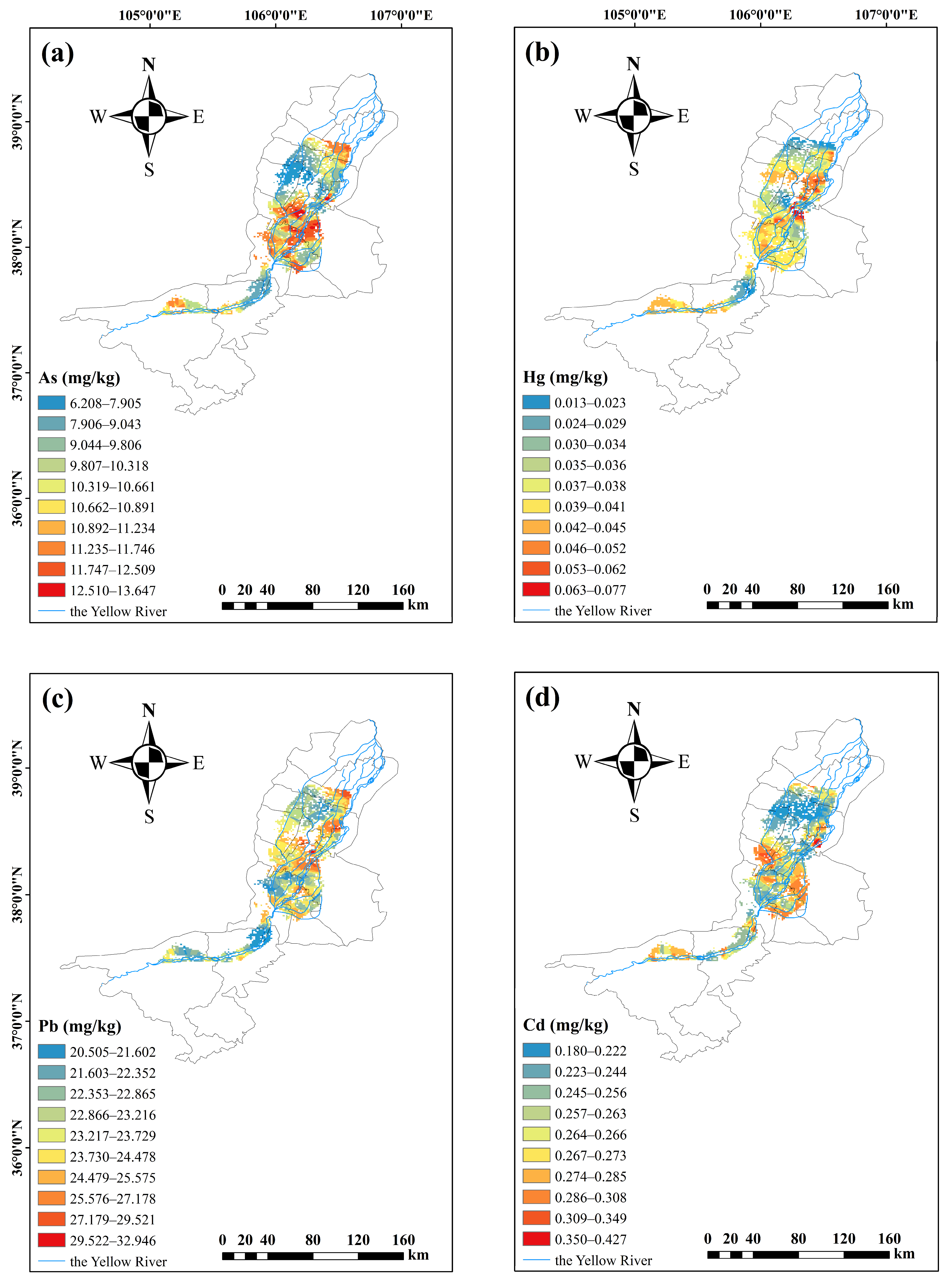
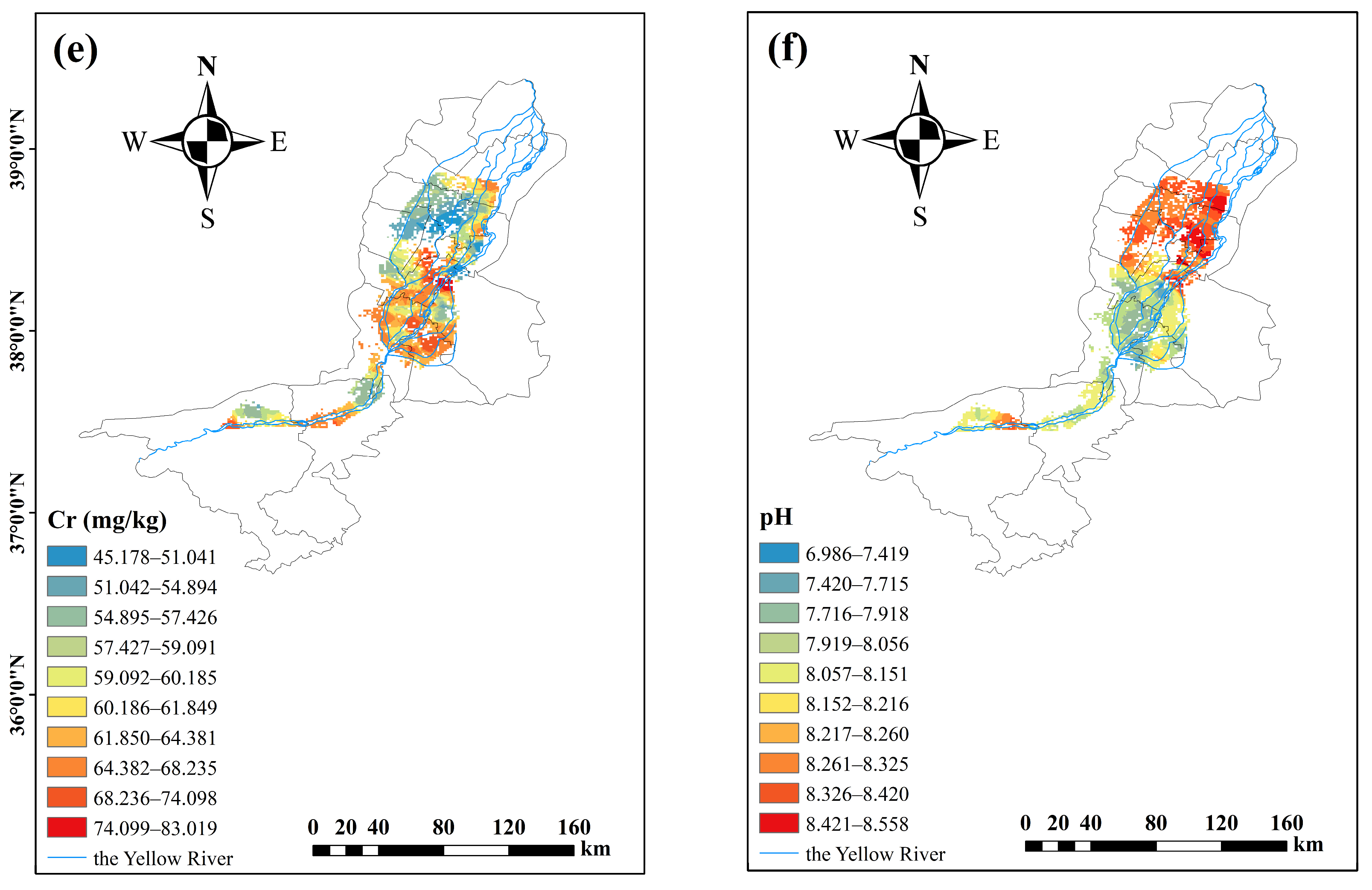
By delineating the paddy field boundaries using the sampling points and applying interpolation methods, spatial distribution maps of heavy metals were generated (Figure 2). From the spatial distribution maps, it can be observed that As and Cr exhibit similar spatial patterns, with higher concentrations in the central part of the study area and lower concentrations in the southern and northern regions. Hg displays pronounced spatial heterogeneity and patchy distribution, with low-value areas mainly located along the periphery of the study area and some regions within the Yellow River irrigation zone, whereas relatively high-value areas are concentrated in the central to central-eastern regions of the Yinchuan Plain, forming several local hotspots characterized by point- or patch-like clustering. Combined with the high proportion of Hg concentrations exceeding the Ningxia soil background value, these results indicate a certain degree of regional accumulation of Hg in the study area, which may be associated with anthropogenic factors such as atmospheric deposition, coal combustion, or industrial emissions [4]. High Pb values are primarily distributed in the central and northeastern parts of the study area, showing local enrichment. High-value zones of Cd not only occur in the central paddy field region but also form distinct hotspots in the southwestern Yellow River irrigation area and some local regions in the central-eastern part of the study area, exhibiting notable patchy or areal enrichment patterns. Soil pH also exhibited a distinct spatial pattern (Figure 2f). Relatively high pH values were mainly distributed in the northern part of the study area, whereas lower values occurred in parts of the central and southern Yellow River irrigation districts. Several heavy metals, particularly As, Hg, and Cr, tended to exhibit relatively lower concentrations in areas with higher soil pH. This spatial correspondence was consistent with the significant negative correlations between pH and these metals (Figure S1), suggesting that soil pH may be one of the factors associated with their regional distribution.
Figure 2.
Spatial distribution of heavy metal concentrations and soil physicochemical properties in paddy soils. (a) As; (b) Hg; (c) Pb; (d) Cd; (e) Cr; (f) pH.
Assessment of heavy metal accumulation in paddy soils of the study area using the geo-accumulation index revealed that As, Pb, and Cr generally exhibited low Igeo values, with the vast majority of sampling points classified as unpolluted (Figure 3). Specifically, the proportion of unpolluted points for As, Pb, and Cr was 99.42%, 98.25%, and 100%, respectively, indicating that these elements have not yet formed noticeable contamination. In contrast, Hg and Cd displayed more pronounced accumulation characteristics. Only 17.86% of Hg sampling points were classified as unpolluted, 72.43% as unpolluted to moderately polluted, and 9.71% as moderately polluted. For Cd, the proportion of unpolluted points was only 8.54%, with 73.20% and 18.25% of points classified as unpolluted to moderately polluted and moderately polluted, respectively. These results indicated that Hg and Cd were the main elements with higher accumulation in paddy soils of the study area. Combined with the spatial distribution patterns, the local hotspots of Hg and the patchy or areal enrichment of Cd further suggested that both elements were likely influenced to varying degrees by anthropogenic activities.
Figure 3.
Boxplots of heavy metal concentrations and geo-accumulation index in paddy fields of Ningxia. (a) Concentrations of As, Pb, and Cr are shown on the left y-axis, whereas Hg and Cd are shown on the right y-axis; (b) Geo-accumulation index values of As, Hg, Pb, Cd, and Cr. The dashed lines indicate the Igeo classification thresholds.
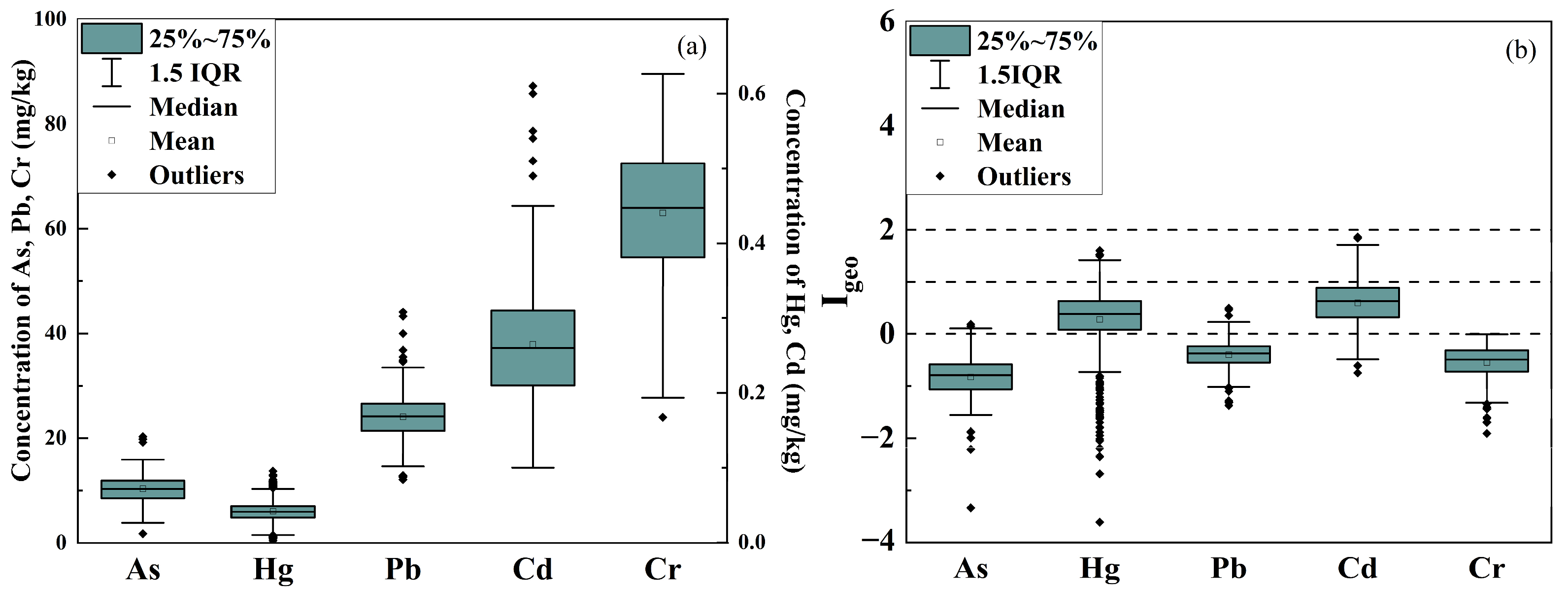
Overall, the concentrations of heavy metals in the paddy soils of the study area had not exceeded the screening values for agricultural soil pollution risk, indicating a generally low current safety risk for agricultural land. However, the geo-accumulation index results showed that Hg and Cd already exhibited unpolluted to moderately polluted and should be considered key elements for pollution prevention and control. This is also consistent with previous studies reporting that Cd and Hg are the major heavy metal pollutants with relatively high toxicity levels in cultivated soils of Ningxia [2,11,12].
3.2. Source Apportionment of Heavy Metals in Paddy Soils in Ningxia
The PMF model was employed to assess the origins of heavy metals in paddy soil in Ningxia. The detailed model settings and parameter configurations were provided in the Supplementary Materials. The results showed that As, Pb and Cr were highly associated with Factor 1 (Natural source), contributing 65.3%, 27.20%, and 28.20%, respectively (Figure 4). Previous studies have shown that As and Cr are mainly associated with natural processes such as parent material weathering [37]. Meanwhile, in this study, the geo-accumulation index values of As, Pb, and Cr were generally low, with the vast majority of sampling sites classified as unpolluted. The mean As concentration and most sampling points were also below the soil background value of Ningxia, indicating that As was mainly controlled by natural background conditions. Considering that the study area is located in the Yellow River irrigation district of northern Ningxia, the soils may be jointly influenced by alluvial deposits from the front of the Helan Mountains, Yellow River alluvium, and regional parent materials. Therefore, Factor 1 can be interpreted as a natural source dominated by parent material weathering and background inputs.
Figure 4.
Source apportionment of soil heavy metal by PMF.
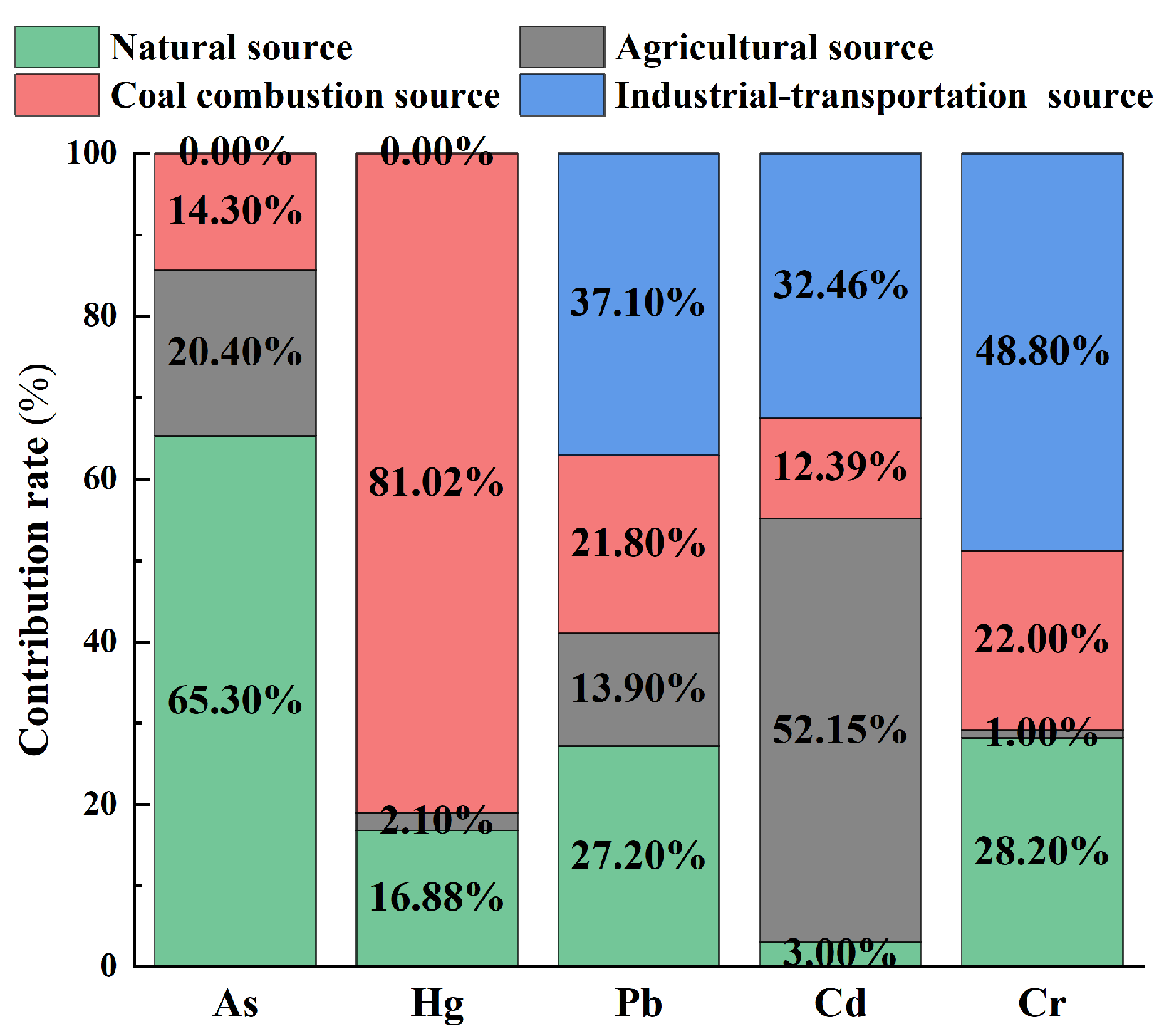
Cd was mainly associated with Factor 2 (agricultural source), which contributed 52.15% to Cd, indicating that agricultural activities were the main source of Cd accumulation. The mean Cd concentration and geo-accumulation index results in the study area both showed that Cd had exhibited relatively obvious accumulation. Previous studies have suggested that Cd is commonly related to agricultural activities, such as the application of phosphate fertilizers, pesticides, organic amendments, and irrigation inputs [38,39]. Field investigation showed that farmland management in the study area relied heavily on phosphate fertilizers, such as diammonium phosphate with relatively high Cd content and large application amounts in Yinchuan [2]. Spatially, high Cd values were mainly distributed in the central paddy fields and showed patchy or areal enrichment patterns, which were consistent with the diffusion characteristics of agricultural non-point source inputs. Therefore, long-term agricultural production, especially the application of chemical and organic fertilizers, may be the main driving factor for Cd accumulation in the study area.
Hg was mainly associated with Factor 3 (coal combustion source), which contributed as much as 81.02% to Hg accumulation, much higher than the contributions of other sources. Hg is generally considered to be strongly influenced by anthropogenic activities, and processes such as coal combustion, industrial emissions, mining activities, and waste incineration can release Hg into the atmosphere, which is subsequently deposited into agricultural soils through atmospheric deposition [40,41]. In this study, the mean Hg concentration was significantly higher than the regional background value, and the geo-accumulation index also indicated a certain degree of Hg accumulation. Spatially, Hg did not show a continuous distribution controlled by natural background, but formed local hotspots in some urban areas and regions with relatively intensive industrial activities, suggesting that it was more likely affected by coal combustion and related industrial emissions. The study area is characterized by intensive agricultural and industrial activities, and energy use and industrial production may be important sources of Hg input. Therefore, Factor 3 can be interpreted as a coal combustion-related anthropogenic source.
Factor 4 (industrial–transportation source) was mainly associated with Pb and Cr, contributing 37.10% and 48.80% to these two elements, respectively. Pb is one of the typical indicators of traffic emissions, and vehicle exhaust, tire wear, brake wear, and road dust may all contribute Pb to surface soils. Meanwhile, some industrial activities may also release Pb and Cr [2,42,43,44]. In addition, traffic-related sources such as tire wear and lubricant leakage may also lead to Cd enrichment [45], suggesting that the accumulation of these elements was related to traffic activities. Local industries, such as electroplating, pigment production, and dye manufacturing, may also contribute to Pb and Cr pollution, resulting in slight Cr enrichment in soils [46]. Therefore, Factor 4 can be preliminarily identified as a mixed industrial–traffic source.
Overall, Hg and Cd in paddy soils of the study area are primarily driven by anthropogenic activities, with Hg mainly associated with coal combustion and related industrial emissions, and Cd mainly linked to agricultural activities. As, Cr, and Pb are mainly controlled by natural background sources, although Pb and Cr also exhibit mixed contributions from anthropogenic inputs on top of the natural background. These results are consistent with previous studies and suggest that Hg and Cd should be prioritized for pollution control and source management in the region.
3.3. Cd Isotope Characteristics and Source Apportionment in Yonggu
Based on the above analysis, Cd was identified as a primary heavy metal pollutant derived from local agricultural activities. Considering the spatial distribution patterns of heavy metals in paddy soils of the study area (Figure 2), a representative polluted paddy field in Yonggu Village, Xingqing District, Yinchuan, was selected for further investigation. The δ114/110Cd ratio ranged from 0.16‰ to 0.63‰, with a mean value of 0.41‰. The average Cd concentration in soils was 0.31 ± 0.13 mg/kg, which was approximately 2.6 times the local soil background value in Yinchuan (0.12 mg/kg) [47], indicating Cd enrichment relative to the local background in farmland soils of the study area.
As shown in Figure 5a, δ114/110Cd values differed markedly among potential sources. Uncontaminated soil samples were concentrated in higher 1/Cd ranges (corresponding to lower Cd concentrations), with δ114/110Cd values generally ranging from −0.5‰ to 0.2‰. Agricultural end-members, including phosphate fertilizers, compound fertilizers, and organic amendments, exhibited δ114/110Cd values ranging from −0.6‰ to 0.5‰. Industrial and traffic-related sources, including smelting dust, slag, road dust, vehicle exhaust particles, and coal-related atmospheric deposition, showed wider δ114/110Cd ranges and were mainly distributed in low 1/Cd regions, reflecting high-concentration Cd from industrial activities.
Figure 5.
Relationship between 1/Cd and δ114/110Cd of possible sources and agricultural soils. (data presented in Table S3) (a) and calculation of Cd sources using the MixSIAR Bayesian (version 3.1.12) isotope mixing model (b).
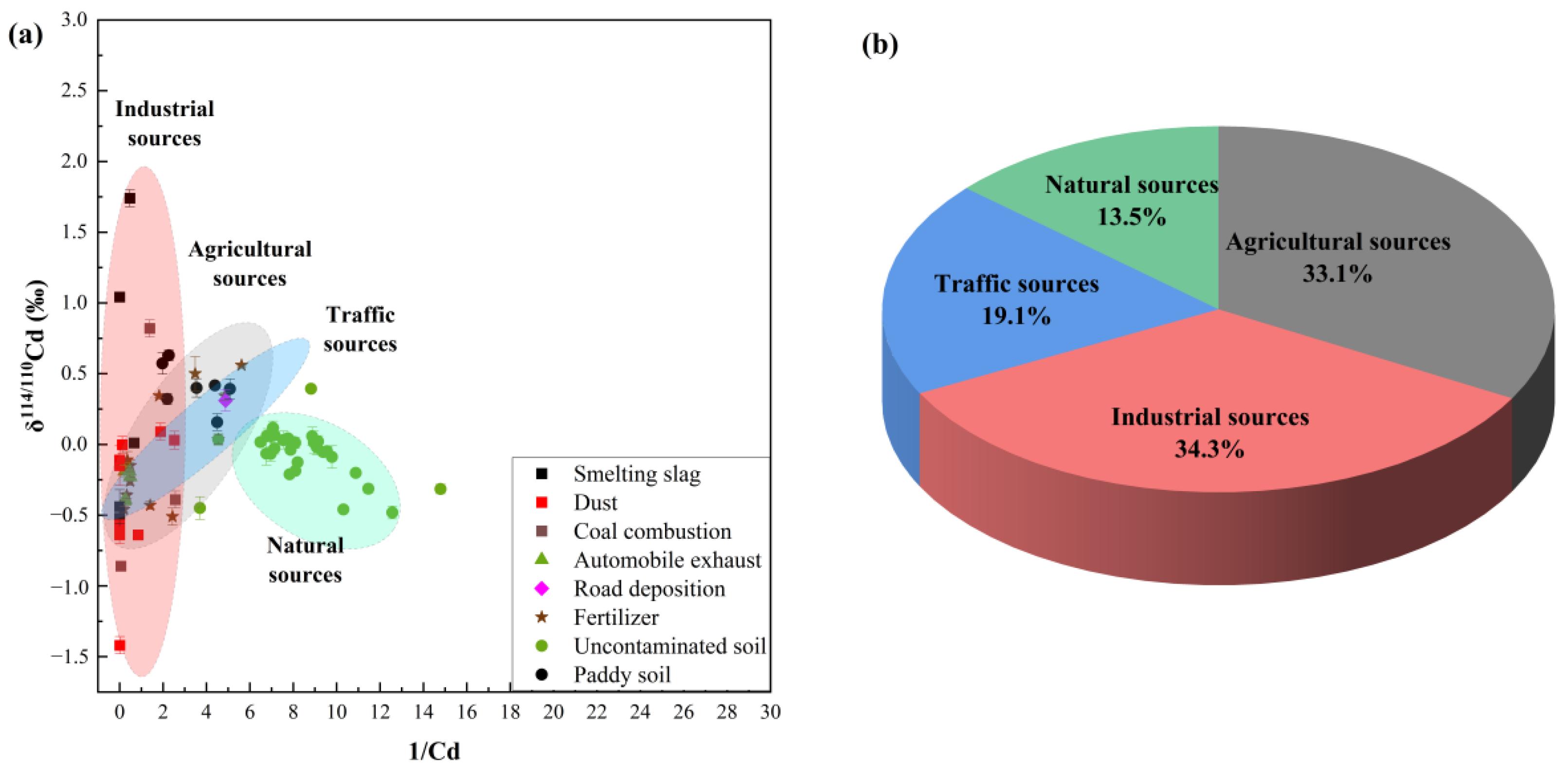
The relationship between δ114/110Cd and 1/Cd in paddy soils showed that most samples fell between natural and anthropogenic end-members, suggesting that Cd was predominantly controlled by mixed sources rather than a single dominant source. The δ114/110Cd composition of farmland soils (0.16‰–0.63‰) was closer to agricultural end-members (fertilizers), overlapping with their range, indicating that agricultural inputs had been an important factor influencing soil Cd isotopic composition. This was consistent with the recognition of Cd as an indicator of agricultural activity [2]. Given that the Yinchuan Plain irrigation district was a major “granary” with long-term and extensive fertilizer application, these practices likely further enhanced Cd accumulation in the plow layer.
Meanwhile, some samples exhibited δ114/110Cd values approaching industrial and traffic-related end-members. High-temperature processes such as smelting and coal combustion can induce Cd isotope fractionation and release Cd-bearing particles, which may subsequently enter soils through atmospheric deposition [48,49,50]. Additionally, Traffic-related particles may also contribute Cd to nearby surface soils [18]. These observations suggest that industrial and traffic-related inputs may have contributed to local Cd accumulation.
A Bayesian isotopic mixing model was then applied to quantitatively estimate contributions of different sources to soil Cd. The results showed that agricultural and industrial activities were the major contributors, accounting for 33.1% and 34.3%, respectively, followed by traffic (19.1%) and natural sources (13.5%) (Figure 5b), reflecting measurable Cd pollution consistent with high Cd concentrations in soils. The 95% credible intervals of the source contributions are provided in Table S5. This was also consistent with the PMF results, which indicated a stronger influence of agricultural activities in the area (Figure S2). The high contribution from agricultural sources was closely associated with long-term fertilizer use and irrigated farming practices. Since 2019, Yinchuan has implemented a relocation program for heavily polluting enterprises within urban built-up areas [51]. Enterprises associated with severe environmental pollution and prominent ecological risks, including those involved in steel production, non-ferrous metal processing, cement production, and chemical industries, have gradually been relocated or legally shut down. However, due to the persistent and non-degradable nature of heavy metals, the impacts of historical emissions from these enterprises on soil environments still remain. Additionally, sampling sites beneath the Hexi Overpass also confirmed that traffic activities contributed to Cd accumulation in the study area.
3.4. Pb Isotope Characteristics and Source Apportionment in Yonggu
Descriptive statistics of Pb isotopic compositions in paddy soils are presented in Table S3. The 206Pb/207Pb ratio ranged from 1.1938 to 1.1997, with a mean value of 1.1967. The 208Pb/206Pb ratio ranged from 2.0686 to 2.0807, with a mean value of 2.0763. The average Pb concentration in soils was 22.83 ± 2.31 mg/kg, which was above the local soil background value in Yinchuan (22.00 mg/kg) [47], indicating Pb accumulation in farmland soils of Yonggu.
In contrast to Cd, radiogenic Pb isotopes do not undergo fractionation during biogeochemical processes, making them reliable indicators of source [52,53]. Therefore, the 208Pb/206Pb and 206Pb/207Pb ratios can be used to identify the sources of Pb in soils and to provide cross-validation for Pb, which exhibited relatively poor fit in the PMF model.
To further identify potential sources of Pb in soils of Yonggu, a dual-isotope scatter plot of 208Pb/206Pb versus 206Pb/207Pb was constructed using soil Pb isotopic compositions and possible end-member data (Figure 6a), with specific data and sources listed in Table S4. Correlation analysis between Pb isotopic ratios and Pb concentrations (Figure S3) showed no significant relationship, indicating that Pb distribution in the study area is influenced by multiple pollution sources [16]. As shown in Figure 6a, uncontaminated soils exhibited higher 206Pb/207Pb and lower 208Pb/206Pb ratios, reflecting enrichment in 206Pb [16]. Anthropogenic sources, particularly coal emissions and industrial activities, displayed higher 208Pb/206Pb and lower 206Pb/207Pb ratios, suggesting that Pb from human activities is enriched in 208Pb and 207Pb. The scatter plot indicates that paddy soil samples in the study area mainly fall within the overlapping region of agricultural, coal-related, industrial, and natural sources, with relatively little overlap with traffic-related end-members, supporting a mixed-source interpretation for Pb. Accordingly, a Bayesian isotopic mixing model was applied to estimate the relative contributions of the potential sources.
Figure 6.
Relationship between 206/207Pb and 208/206Pb of possible sources and agricultural soils. (data presented in Table S4) (a) and calculation of Pb sources using the MixSIAR Bayesian (version 3.1.12) isotope mixing model (b).
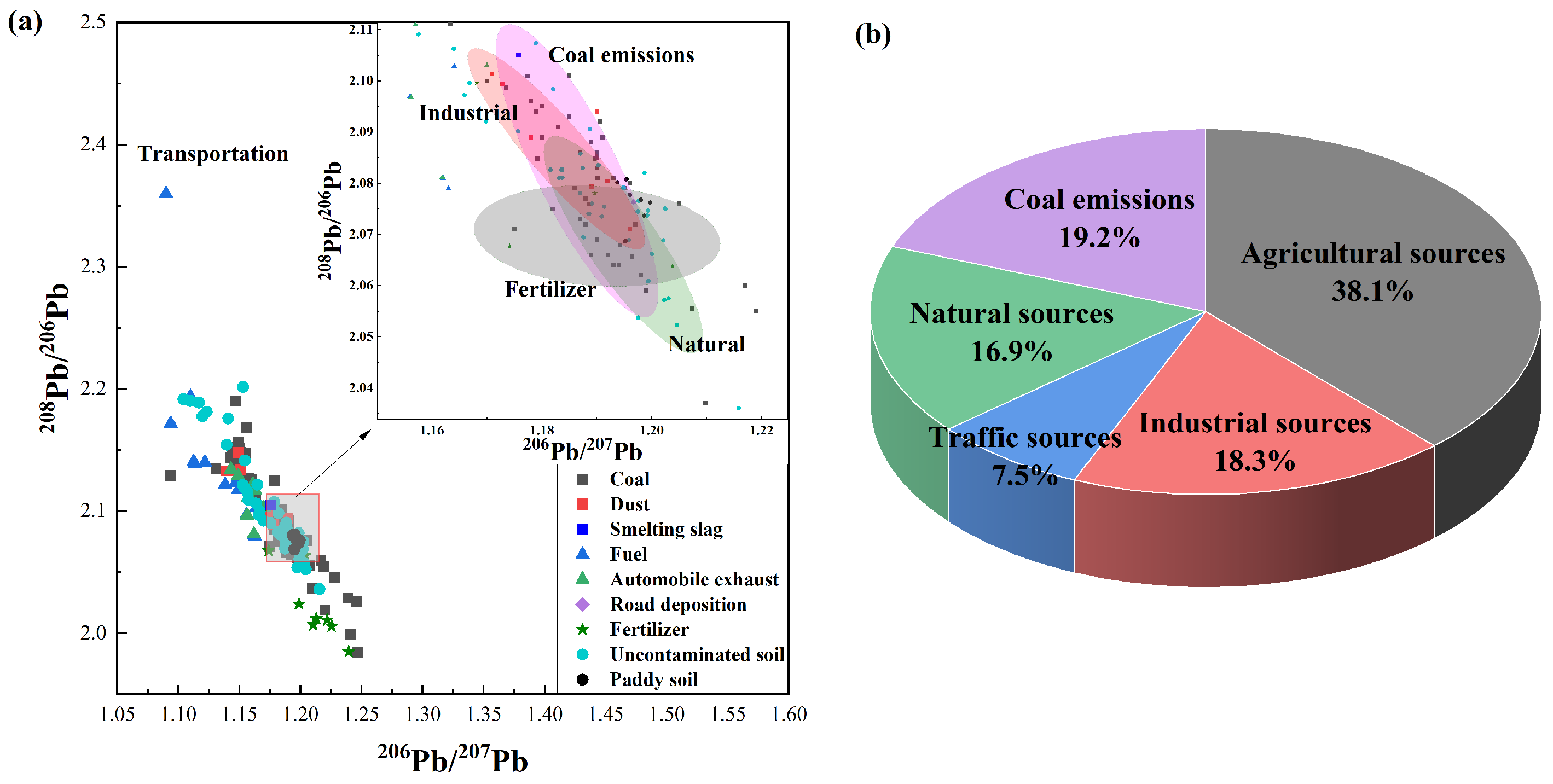
The Pb isotope data were analyzed using the MixSIAR Bayesian (version 3.1.12) mixing model in R, and model convergence was confirmed by Gelman–Rubin diagnostic values below 1.05. The 95% credible intervals of the source contributions are provided in Table S6. The Bayesian mixing model results (Figure 6b) indicate that Pb in the study area soils is primarily derived from anthropogenic inputs, with agricultural sources being the main contributor (38.1%), likely associated with long-term paddy cultivation and agricultural practices. Coal-related and industrial sources contributed similarly (19.2% and 18.3%, respectively), indicating that coal combustion, coal chemical enterprises, industrial particulate emissions, and associated atmospheric deposition are also important pathways of Pb input, consistent with observations that factories near the sampling sites are mostly related to coal chemical industries. Natural sources had a posterior mean contribution of 16.9%, indicating that regional parent materials and aeolian inputs may also influence the local Pb isotope composition. Traffic contributed the least (7.5%), highlighting the overall multi-source mixed nature of Pb in the study area soils.
Overall, the isotope results support a mixed-source interpretation for Pb in Yonggu Village. Fertilizer-related inputs showed the highest posterior mean contribution, while coal-related, industrial, natural, and transportation sources also contributed to varying degrees. However, the overlap among source-endmember isotope signatures and the limited number of local soil samples introduce uncertainty into the quantitative estimates. Given the poor PMF fit for Pb, the isotope-based results provide useful site-specific evidence.
3.5. Integration of Regional PMF Analysis and Local Cd, Pb Isotope Evidence
To further compare the isotope-based source apportionment results of Cd and Pb, the different sources were regrouped into three categories: natural sources, agricultural sources, and other anthropogenic sources, with the latter including coal combustion, industrial activities, and traffic activities (Figure 7). The results showed that Cd and Pb in paddy soils of Yonggu Village were both mainly contributed by anthropogenic sources, but the source structures were different. For Cd, the PMF results showed that agricultural sources had the highest contribution. In contrast, Cd isotope results showed that other anthropogenic sources contributed the most, suggesting that Cd was mainly controlled by agricultural activities at the regional scale, whereas industrial and traffic-related inputs also played an important role in Cd accumulation at the local scale in Yonggu Village. Previous studies have also reported that Cd in agricultural soils is strongly influenced by industrial emissions, atmospheric deposition, and traffic activities in areas affected by human disturbance [17,20]. Combined with field observations, some sampling sites were located near the Hexi Overpass, indicating that traffic-related deposition may also contribute to local Cd input [45]. The lower contribution of natural sources estimated by PMF may reflect the model’s sensitivity to outliers and the limited representation of geological background tracers in the input variables, which can lead to incomplete separation or underestimation of natural sources [17].
The source apportionment results for Pb also showed clear differences between the two methods. The results of Pb isotope analysis showed a relatively low contribution from natural sources, suggesting that the Pb isotopic composition in Yonggu Village was not mainly controlled by natural end-members, but may have been affected by anthropogenic input signals. Although anthropogenic inputs may not substantially increase total Pb concentrations, they can alter the Pb isotopic composition, resulting in relatively low estimated contributions from natural sources despite Pb concentrations being close to the local background value [54]. Compared with the regional PMF results, the Pb isotope analysis indicated a relatively greater contribution from agricultural activities. Because Pb isotopes provide element-specific source fingerprints, they can better distinguish local agricultural inputs at the field scale [55]. Therefore, the increased agricultural contribution in the isotope results indicates that local agricultural activities may be an important component of Pb input in Yonggu Village. Additionally, other anthropogenic sources accounted for relatively high proportions in both methods, with only a small difference between them, indicating that coal combustion, industrial activities, and traffic emissions remained important sources of Pb. However, the PMF model showed relatively poor performance for Pb (Table S2), which may be related to its complex and overlapping sources [16], indicating that the observed Pb concentrations were not adequately reproduced. In contrast, Pb isotopes provided element-specific source fingerprints and indicated a mixed local source structure in Yonggu Village. Accordingly, the Pb isotope results were treated as complementary site-specific evidence. Overall, Pb in the soils of Yonggu Village showed a clear multi-source mixing characteristic.
Figure 7.
Comparison of natural, agricultural, and other anthropogenic source (coal combustion, industrial sources, and traffic sources) contributions to Cd and Pb based on PMF and isotope-based source apportionment.
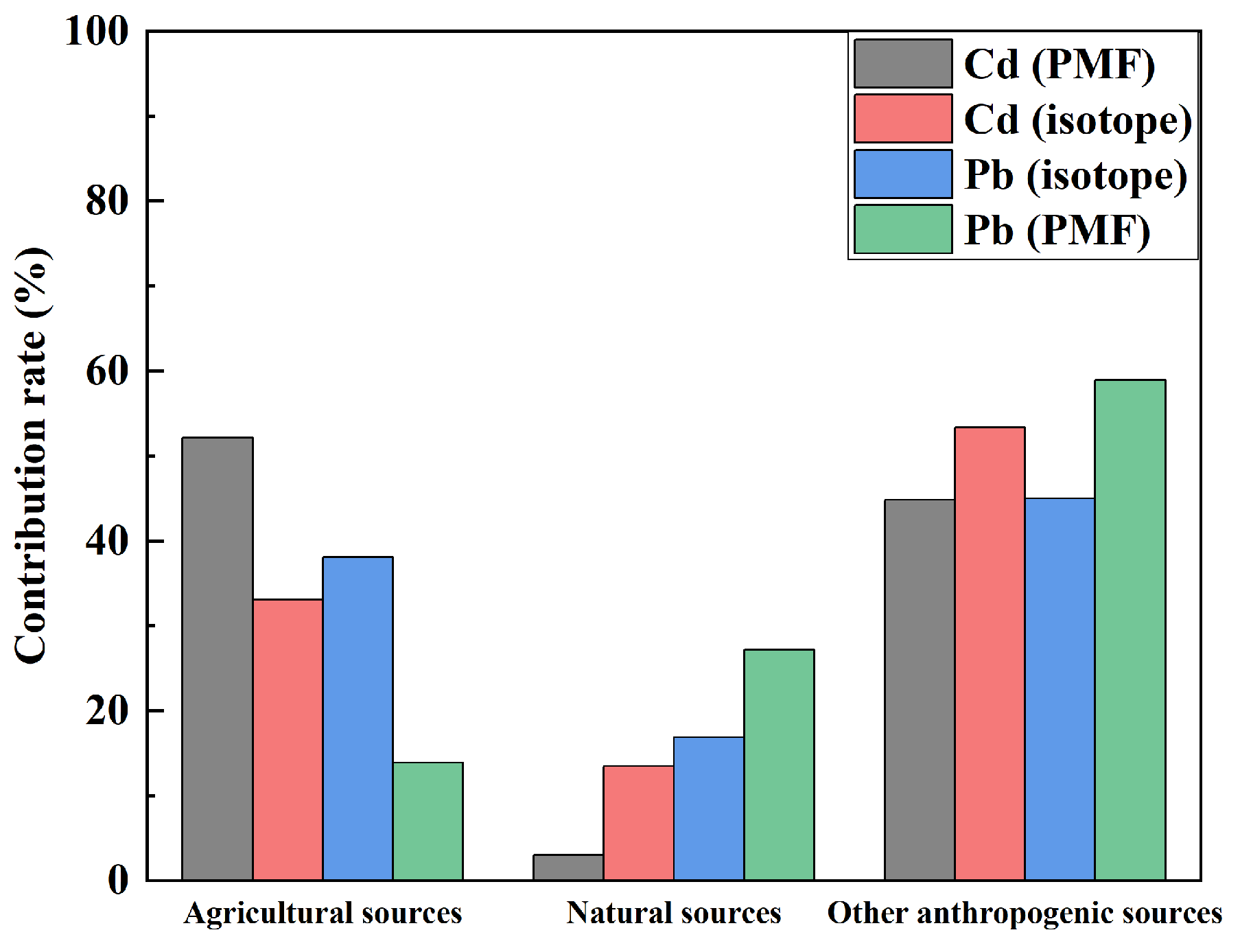
The Cd and Pb isotope source apportionment results indicated that both elements in the paddy soils of Yonggu Village were influenced by anthropogenic activities, although their source structures differed. Cd reflected combined agricultural, industrial, and traffic-related inputs, whereas Pb showed a more complex mixture of agricultural, other anthropogenic, and natural sources.
Overall, PMF and isotope analyses provide complementary source information. PMF identifies regional source patterns, whereas Cd and Pb isotopes provide element-specific evidence at the local scale, particularly for Pb, whose concentrations were not adequately reproduced by the PMF model. In addition, this study had several limitations. The isotope analysis was based on only 8 soil samples from Yonggu Village, and some source-endmember isotope values were obtained from published studies. Moreover, the relatively poor PMF fit for Pb introduced uncertainty into the regional source estimates. Future studies should include more local isotope samples and source endmembers to improve source apportionment.
4. Conclusions
This study showed that Hg and Cd exhibited relatively greater accumulation than As, Pb, and Cr in the paddy soils of Ningxia, although all measured concentrations remained below the agricultural soil pollution risk screening values. Regional PMF analysis identified natural sources, agricultural activities, coal combustion, and industrial–transportation activities as the principal source categories. Natural sources dominated As accumulation and also contributed to Cr and Pb, whereas industrial and traffic-related activities represented important additional sources of Pb and Cr. Cd was mainly associated with agricultural inputs, while Hg was predominantly linked to coal combustion. To further resolve source mixtures in a representative area with relatively elevated heavy-metal accumulation, Cd and Pb isotope analyses were conducted at the local scale. The results showed that Cd was jointly influenced by industrial, agricultural, and traffic-related inputs, whereas Pb exhibited a more complex mixture of agricultural, coal-combustion, industrial, natural, and traffic-related sources. These findings demonstrate that PMF and isotope tracing provide complementary information at regional and local scales and improve the interpretation of heavy-metal sources in agricultural soils. This integrated approach provides a useful basis for identifying priority sources and supports more targeted monitoring of heavy metals in paddy soils.
Supplementary Materials
The following supporting information can be downloaded at: https://www.mdpi.com/article/10.3390/agronomy16151408/s1.
Author Contributions
Conceptualization, J.M. (Jianjun Ma), X.L. (Xiaodong Li), X.L. (Xiaohua Li) and S.D.; methodology, Y.L. (Yiming Liu) and Y.L. (Yan Li); validation, Y.L. (Yiming Liu), X.L. (Xiaohua Li) and S.D.; formal analysis, Y.L. (Yiming Liu); investigation, Y.L. (Yiming Liu), Y.L. (Yan Li), H.L. and J.M. (Junhua Ma); data curation, Y.L. (Yiming Liu), H.L. and J.M. (Junhua Ma); writing—original draft preparation, Y.L. (Yiming Liu); writing—review and editing, Y.L. (Yiming Liu), S.D. and X.L. (Xiaodong Li); visualization, Y.L. (Yiming Liu); funding acquisition, J.M. (Jianjun Ma), S.D. and X.L. (Xiaodong Li). All authors have read and agreed to the published version of the manuscript.
Funding
This work was supported by Key Research and Development Program of Ningxia Hui Autonomous Region (Grant No. 2023BEG01002); the National Natural Science Foundation of China (No. 42473071).
Data Availability Statement
The data presented in this study are available on request from the corresponding author.
Conflicts of Interest
The authors declare no conflicts of interest.
References
- The National Soil Pollution Status Survey Bulletin; The Ministry of Ecology and Environment: Beijing, China, 2014.
- Liu, Y.; Yin, T.; Shi, R.; Li, Y.; Ma, J.; Li, H.; Yang, K.; Ding, S.; Li, X. Risk Assessment and Source Apportionment of Heavy Metals in Agricultural Soil Across Yinchuan, China. Agronomy 2025, 15, 2726. [Google Scholar] [CrossRef] [Scilit]
- Teng, Y.; Wu, J.; Lu, S.; Wang, Y.; Jiao, X.; Song, L. Soil and soil environmental quality monitoring in China: A review. Environ. Int. 2014, 69, 177–199. [Google Scholar] [CrossRef] [Scilit] [PubMed]
- Wu, Q.; Hu, W.; Wang, H.; Liu, P.; Wang, X.; Huang, B. Spatial distribution, ecological risk and sources of heavy metals in soils from a typical economic development area, Southeastern China. Sci. Total Environ. 2021, 780, 146557. [Google Scholar] [CrossRef] [Scilit] [PubMed]
- Azeem, I.; Shi, Z.; Xiong, L.; Ullah, J.; Shah, F.; Wu, W. Microplastic-mediated modulation of Cd toxicity: Evidence from a global meta-analysis. New Contam. 2026, 2, e016. [Google Scholar] [CrossRef] [Scilit]
- Wang, L.; Xu, J.; Liu, Y.; Zhang, S. Spatial Characteristics of the Non-Grain Production Rate of Cropland and Its Driving Factors in Major Grain-Producing Area: Evidence from Shandong Province, China. Land 2023, 13, 22. [Google Scholar] [CrossRef] [Scilit]
- Luo, S.; Jia, Z.; Tian, L.; Wang, S.; Chang, C.; Ji, L.; Chang, J.; Zhang, J.; Tian, C. Potential functional differentiation from microbial perspective under dryland-paddy conversion in black soils. Agric. Ecosyst. Environ. 2023, 353, 108562. [Google Scholar] [CrossRef] [Scilit]
- Gao, Y.; Jia, J.; Xi, B.; Cui, D.; Tan, W. Divergent response of heavy metal bioavailability in soil rhizosphere to agricultural land use change from paddy fields to various drylands. Environ. Sci. Process. Impacts 2021, 23, 417–428. [Google Scholar] [CrossRef] [Scilit] [PubMed]
- Wan, Y.; Liu, J.; Zhuang, Z.; Wang, Q.; Li, H. Heavy metals in agricultural soils: Sources, influencing factors, and remediation strategies. Toxics 2024, 12, 63. [Google Scholar] [CrossRef] [Scilit] [PubMed]
- Chen, L.; Ma, K. Spatial and Temporal Distribution and Source Analysis of Heavy Metals in Agricultural Soils of Ningxia, Northwest of China. Sustainability 2023, 15, 15360. [Google Scholar] [CrossRef] [Scilit]
- Yue, X.; Shi, R.; Ma, J.; Li, H.; Ma, T.; Ma, J.; Liang, X.; Ma, C. Spatial Distribution and Pollution Source Analysis of Heavy Metals in Cultivated Soil in Ningxia. Agronomy 2025, 15, 2543. [Google Scholar] [CrossRef] [Scilit]
- Guan, Y.; Zhang, N.; Li, B.; Ma, T.; Wu, W.; Shi, R. A novel evaluation of farmland soil environmental risk integrating heavy metal (loid) pollution risk and industrial risk potential. Stoch. Environ. Res. Risk Assess. 2025, 39, 3085–3102. [Google Scholar] [CrossRef] [Scilit]
- Anaman, R.; Peng, C.; Jiang, Z.; Liu, X.; Zhou, Z.; Guo, Z.; Xiao, X. Identifying sources and transport routes of heavy metals in soil with different land uses around a smelting site by GIS based PCA and PMF. Sci. Total Environ. 2022, 823, 153759. [Google Scholar] [CrossRef] [Scilit] [PubMed]
- Wiederhold, J.G. Metal stable isotope signatures as tracers in environmental geochemistry. Environ. Sci. Technol. 2015, 49, 2606–2624. [Google Scholar] [CrossRef] [Scilit] [PubMed]
- Lan, Y.; Li, Y.; Liu, K.; Chen, L.; Huang, H.; Cheng, X.; Ye, Z.; Jiang, Y.; Wang, M. Isotopic tracing of lead for source-specific probabilistic health risk assessment of heavy metals in soils of Lanzhou, China. J. Geochem. Explor. 2026, 282, 107964. [Google Scholar] [CrossRef] [Scilit]
- Cao, J.; Guo, J.; Shi, H.; Chen, Y.; Shen, Z.; Ma, H.; Hou, D. Sources apportionments of heavy metal(loid)s in soils based on positive matrix factorization (PMF) and lead isotope fingerprinting. J. Environ. Manag. 2025, 395, 127986. [Google Scholar] [CrossRef] [Scilit] [PubMed]
- Shao, F.; Li, K.; Ouyang, D.; Zhou, J.; Luo, Y.; Zhang, H. Sources apportionments of heavy metal (loid) s in the farmland soils close to industrial parks: Integrated application of positive matrix factorization (PMF) and cadmium isotopic fractionation. Sci. Total Environ. 2024, 924, 171598. [Google Scholar] [CrossRef] [Scilit] [PubMed]
- Xia, Y.; Liu, Y.; Chen, T.; Xu, Y.; Qi, M.; Sun, G.; Wu, X.; Chen, M.; Xu, W.; Liu, C. Combining Cd and Pb isotope analyses for heavy metal source apportionment in facility agricultural soils around typical urban and industrial areas. J. Hazard. Mater. 2024, 466, 133568. [Google Scholar] [CrossRef] [Scilit] [PubMed]
- Wang, Y.; Li, Y.; Yang, S.; Liu, J.; Zheng, W.; Xu, J.; Cai, H.; Liu, X. Source apportionment of soil heavy metals: A new quantitative framework coupling receptor model and stable isotopic ratios. Environ. Pollut. 2022, 314, 120291. [Google Scholar] [CrossRef] [Scilit] [PubMed]
- Wang, J.; Yu, D.; Wang, Y.; Du, X.; Li, G.; Li, B.; Zhao, Y.; Wei, Y.; Xu, S. Source analysis of heavy metal pollution in agricultural soil irrigated with sewage in Wuqing, Tianjin. Sci. Rep. 2021, 11, 17816. [Google Scholar] [CrossRef] [Scilit] [PubMed]
- The 14th Five-Year Plan for Key Heavy Metal Pollution Prevention and Control in Ningxia Hui Autonomous Region (2022); Yinchuan Ecological Environment Bureau: Yinchuan, China, 2022.
- NY/T 1121.2-2006; Soil Testing Part 2: Method for Determination of Soil pH. Ministry of Agriculture of the PRC: Beijing, China, 2006.
- NY/T 1121.6-2006; Soil Testing Part 6: Method for Determination of Soil Organic Matter. Ministry of Agriculture of the PRC: Beijing, China, 2006.
- HJ 889-2017; Soil Quality—Determination of Cation Exchange Capacity (CEC)—Hexamminecobalt Trichloride Solution—Spectrophotometric Method. The Ministry of Ecology and Environment: Beijing, China, 2017.
- NY/T 395-2012; The Technical Rules for Monitoring the Environmental Quality of Farmland Soils. The Ministry of Agriculture and Rural Affairs of China: Beijing, China, 2012.
- HJ/T 166-2004; The Technical Specification for Soil Environmental Monitoring. The Ministry of Ecology and Environment: Beijing, China, 2004.
- Tan, D.; Zhu, J.-M.; Wang, X.; Han, G.; Lu, Z.; Xu, W. High-sensitivity determination of Cd isotopes in low-Cd geological samples by double spike MC-ICP-MS. J. Anal. At. Spectrom. 2020, 35, 713–727. [Google Scholar] [CrossRef] [Scilit]
- Liu, M.-S.; Zhang, Q.; Zhang, Y.; Zhang, Z.; Huang, F.; Yu, H.-M. High-Precision Cd Isotope Measurements of Soil and Rock Reference Materials by MC-ICP-MS with Double Spike Correction. Geostand. Geoanal. Res. 2020, 44, 169–182. [Google Scholar] [CrossRef] [Scilit]
- Galer, S.; Abouchami, W. Practical application of lead triple spiking for correction of instrumental mass discrimination. Mineral. Mag. A 1998, 62, 491–492. [Google Scholar] [CrossRef] [Scilit]
- Zhao, Z.-Q.; Zhang, W.; Li, X.-D.; Yang, Z.; Zheng, H.-Y.; Ding, H.; Wang, Q.-L.; Xiao, J.; Fu, P.-Q. Atmospheric lead in urban Guiyang, Southwest China: Isotopic source signatures. Atmos. Environ. 2015, 115, 163–169. [Google Scholar] [CrossRef] [Scilit]
- Jweda, J.; Bolge, L.; Class, C.; Goldstein, S.L. High Precision Sr-Nd-Hf-Pb Isotopic Compositions of USGS Reference Material BCR-2. Geostand. Geoanal. Res. 2016, 40, 101–115. [Google Scholar] [CrossRef] [Scilit]
- Stock, B.C.; Jackson, A.L.; Ward, E.J.; Parnell, A.C.; Phillips, D.L.; Semmens, B.X. Analyzing mixing systems using a new generation of Bayesian tracer mixing models. PeerJ 2018, 6, e5096. [Google Scholar] [CrossRef] [Scilit] [PubMed]
- Xu, L.; Dai, H.; Skuza, L.; Xu, J.; Shi, J.; Wang, Y.; Shentu, J.; Wei, S. Integrated survey on the heavy metal distribution, sources and risk assessment of soil in a commonly developed industrial area. Ecotoxicol. Environ. Saf. 2022, 236, 113462. [Google Scholar] [CrossRef] [Scilit] [PubMed]
- Zhang, Z.; Tao, F.; Du, J.; Shi, P.; Yu, D.; Meng, Y.; Sun, Y. Surface water quality and its control in a river with intensive human impacts—A case study of the Xiangjiang River, China. J. Environ. Manag. 2010, 91, 2483–2490. [Google Scholar] [CrossRef] [Scilit] [PubMed]
- GB 15618-2018; Soil environment quality risk control standard for soilcontamination of agriculture land. Ministry of Ecology and Environment of the People’s Republic of China: Beijing, China, 2018.
- Zhang, C.; Zou, X.; Yang, H.; Liang, J.; Zhu, T. Bioaccumulation and Risk Assessment of Potentially Toxic Elements in Soil-Rice System in Karst Area, Southwest China. Front. Environ. Sci. 2022, 10, 866427. [Google Scholar] [CrossRef] [Scilit]
- Fei, X.; Lou, Z.; Xiao, R.; Ren, Z.; Lv, X. Contamination assessment and source apportionment of heavy metals in agricultural soil through the synthesis of PMF and GeogDetector models. Sci. Total Environ. 2020, 747, 141293. [Google Scholar] [CrossRef] [Scilit] [PubMed]
- Ran, H.; Guo, Z.; Yi, L.; Xiao, X.; Zhang, L.; Hu, Z.; Li, C.; Zhang, Y. Pollution characteristics and source identification of soil metal (loid) s at an abandoned arsenic-containing mine, China. J. Hazard. Mater. 2021, 413, 125382. [Google Scholar] [CrossRef] [Scilit] [PubMed]
- Yuan, X.; Xue, N.; Han, Z. A meta-analysis of heavy metals pollution in farmland and urban soils in China over the past 20 years. J. Environ. Sci. 2021, 101, 217–226. [Google Scholar] [CrossRef] [Scilit]
- Liu, H.; Zhang, Y.; Yang, J.; Wang, H.; Li, Y.; Shi, Y.; Li, D.; Holm, P.E.; Ou, Q.; Hu, W. Quantitative source apportionment, risk assessment and distribution of heavy metals in agricultural soils from southern Shandong Peninsula of China. Sci. Total Environ. 2021, 767, 144879. [Google Scholar] [CrossRef] [Scilit] [PubMed]
- Hu, J.; Zheng, L.; Liu, S.; Chen, Y.; Li, C.; Ni, J.; Chen, Y.; An, S. Quantifying the impacts of coal mining activities on topsoil using Hg stable isotope: A case study of Guqiao mining area, Huainan City. Environ. Pollut. 2023, 335, 122378. [Google Scholar] [CrossRef] [Scilit] [PubMed]
- Sun, J.; Hu, G.; Yu, R.; Lin, C.; Wang, X.; Huang, Y. Human health risk assessment and source analysis of metals in soils along the G324 Roadside, China, by Pb and Sr isotopic tracing. Geoderma 2017, 305, 293–304. [Google Scholar] [CrossRef] [Scilit]
- Yan, X.; Zhang, F.; Zeng, C.; Zhang, M.; Devkota, L.P.; Yao, T. Relationship between heavy metal concentrations in soils and grasses of roadside farmland in Nepal. Int. J. Environ. Res. Public Health 2012, 9, 3209–3226. [Google Scholar] [CrossRef] [Scilit] [PubMed]
- Zheng, X.; Wang, J.; Qiu, R.; Wang, Z.; Hu, X. Study on the influence of heavy metal content and pollution assessment in road environment under different diffusion conditions. For. Eng. 2021, 37, 118–125. (In Chinese) [Google Scholar]
- Pardyjak, E.; Speckart, S.; Yin, F.; Veranth, J. Near source deposition of vehicle generated fugitive dust on vegetation and buildings: Model development and theory. Atmos. Environ. 2008, 42, 6442–6452. [Google Scholar] [CrossRef] [Scilit]
- Wagner, S.; Funk, C.W.; Müller, K.; Raithel, D.J. The chemical composition and sources of road dust, and of tire and road wear particles—A review. Sci. Total Environ. 2024, 926, 171694. [Google Scholar] [CrossRef] [Scilit] [PubMed]
- Cheng, H.; Li, K.; Li, M.; Yang, K.; Liu, F.; Cheng, X. Geochemical background and baseline value of chemical elements in urban soil in China. Earth Sci. Front. 2014, 21, 265–306. (In Chinese) [Google Scholar]
- Wombacher, F.; Rehkämper, M.; Mezger, K. Determination of the mass-dependence of cadmium isotope fractionation during evaporation. Geochim. ET Cosmochim. Acta 2004, 68, 2349–2357. [Google Scholar] [CrossRef] [Scilit]
- Shiel, A.E.; Weis, D.; Orians, K.J. Evaluation of zinc, cadmium and lead isotope fractionation during smelting and refining. Sci. Total Environ. 2010, 408, 2357–2368. [Google Scholar] [CrossRef] [Scilit] [PubMed]
- Cloquet, C.; Carignan, J.; Libourel, G.; Sterckeman, T.; Perdrix, E. Tracing source pollution in soils using cadmium and lead isotopes. Environ. Sci. Technol. 2006, 40, 2525–2530. [Google Scholar] [CrossRef] [Scilit] [PubMed]
- Yinchuan Municipal People’s Government Office. Action Plan for the Relocation of Heavy-Polluting Enterprises from the Built-up Area of Yinchuan City. Yin Zheng Ban Fa [2019] No. 69. 2019. Available online: https://www.yinchuan.gov.cn/xxgk/bmxxgkml/szfbgt/xxgkml_1841/zfwj/yzbf/201905/t20190517_1497270.html (accessed on 1 May 2026).
- Cheng, H.; Hu, Y. Lead (Pb) isotopic fingerprinting and its applications in lead pollution studies in China: A review. Environ. Pollut. 2010, 158, 1134–1146. [Google Scholar] [CrossRef] [Scilit] [PubMed]
- Komárek, M.; Ettler, V.; Chrastný, V.; Mihaljevič, M. Lead isotopes in environmental sciences: A review. Environ. Int. 2008, 34, 562–577. [Google Scholar] [CrossRef] [Scilit] [PubMed]
- Wang, C.; Wang, J.; Zhao, Y.; Zhong, C. The vertical migration and speciation of the Pb in the paddy soil: A case study of the Yangtze River Delta, China. Environ. Res. 2019, 179, 108741. [Google Scholar] [CrossRef] [Scilit] [PubMed]
- Hu, W.; Wang, H.; Dong, L.; Huang, B.; Borggaard, O.K.; Bruun Hansen, H.C.; He, Y.; Holm, P.E. Source identification of heavy metals in peri-urban agricultural soils of southeast China: An integrated approach. Environ. Pollut. 2018, 237, 650–661. [Google Scholar] [CrossRef] [Scilit] [PubMed]
Disclaimer/Publisher’s Note: The statements, opinions and data contained in all publications are solely those of the individual author(s) and contributor(s) and not of MDPI and/or the editor(s). MDPI and/or the editor(s) disclaim responsibility for any injury to people or property resulting from any ideas, methods, instructions or products referred to in the content. |
© 2026 by the authors. Licensee MDPI, Basel, Switzerland. This article is an open access article distributed under the terms and conditions of the Creative Commons Attribution (CC BY) license.