


Abstract
Low-light environments severely affect rice yield and quality. As an important raw material for rice noodles, improving rice yield and quality under low-light conditions is very important. In this study, the grain-filling dynamics, yield, processing quality, and appearance quality of two rice noodle-specific cultivars, i.e., Gui Chao II (GCII) and Guangyou 2928 (GY2928), were investigated under shading in Sichuan. At the experimental site, the soil type is loam, average temperature reaches 23.1 °C, total rainfall reaches 780–830 mm, and total sunshine duration is about 760 h. A two-factor split-plot design was conducted. Two light intensities (natural light vs. 51% shading) served as the main plot, and two rice cultivars (GCII and GY2928) served as the subplot, and each was replicated three times. Results showed that, compared with normal light, shading reduced the average filling rate (Vmean) of GCII and GY2928 by 20.67% and 18.69%, the maximum filling rate (Vmax) decreased by 20.26% and 16.18%, the 100-grain weight (Gmax) at the maximum filling rate decreased by 0.42 g and 0.21 g, and the active filling period (D) was shortened by 1.47 days and 4.01 days, respectively. Compared with normal light, the decreased grain filling led to a significant decrease in spikelet fertility by 30.62% and 28.50% for GCII and GY2928 under shading. Finally, the yield of GCII and GY2928 significantly decreased by 25.33% and 27.82% compared with normal light. Compared with normal light, shading increased the head rice rate of GCII, while that of GY2928 was significantly reduced. In contrast, the chalkiness rate and chalkiness degree of GCII under shading were significantly reduced, but those of GY2928 significantly increased. In conclusion, GCII exhibited more stable yield and quality under shading, and breeding and planting such varieties could increase rice yield and quality in low-light environments.
1. Introduction
As the main food crop of Asia, the yield and quality of rice are important for Agricultural production [1]. Some rice is suitable for processing rice noodles, namely, rice noodle-specific cultivars [2,3]. Rice noodle-specific cultivars are usually indica rice varieties with high amylose content (>22%), and high-amylose rice is hard; therefore, cultivating rice noodle-specific cultivars can solve the problem of poor taste of rice with high amylose content [4,5]. Additionally, rice noodles, characterized by their low protein content, serve as a suitable dietary staple for patients with kidney disease and other populations requiring protein-restricted diets [6]. Consequently, the demand for rice cultivars specifically tailored for rice noodle processing is projected to rise. However, a recent study indicates a global decline in both sunshine duration and total solar radiation [7]. This will lead to a decrease in light energy resources during rice growth, thereby affecting rice yield and quality [8]. Especially, insufficient light during grain filling hinders grain filling, which may lead to reduced rice yields [9].
The grain-filling stage is a pivotal period in the rice growth cycle, as the capacity for grain filling directly determines final grain weight and yield [10]. However, this stage is highly sensitive to light availability, and insufficient radiation can severely compromise both yield and quality [11]. To investigate these impacts, shading treatments are commonly employed to simulate low-light stress [12], while Logistic or Richards equations are frequently used to model grain-filling dynamics. During yield formation, grain filling rate is one of the limiting factors for yield improvement [13,14]. Shading during the early growth stage of rice reduces spikelet filling rate, prolonging grain filling time, reducing grain weight, decreasing both spikelet fertility and 1000-grain weight of rice, and finally reducing rice yield [15]. Besides that, shading during the early grain filling period does not affect potential grain dry matter increase in rice [16]. Wei et al. [13] reported that under low nitrogen conditions, the grain weight per panicle decreased by 9.46%~10.60% after 20 days of shading after the heading stage of rice.
Shading affects dry matter accumulation by inhibiting leaf photosynthesis, reducing seed fullness, and ultimately reducing rice quality [17]. Shading inhibits grain filling and reduces the accumulation of substances in grains, ultimately reducing the milled rice rate and head rice rate [17]. Shading significantly reduces the milled rice rate of rice, while increasing chalkiness degree and chalkiness rate [18]. Shading inhibits the development of grain starch by inhibiting starch synthase, leading to changes in starch structure, such as amylose and large starch granules, resulting in a higher chalkiness degree, thereby deteriorating the appearance quality of rice and making the lower grains more pronounced [19,20].
Although the effects of shading on rice yield and quality have been well documented, studies focusing specifically on rice noodle-specific cultivars are scarce. Consequently, the grain filling characteristics, yield performance, and quality attributes (particularly processing and appearance quality) of these specialized cultivars remain poorly understood. Therefore, this study was conducted to investigate the impacts of a low-light environment on two rice noodle-specific cultivars, Gui Chao II (GCII) and Guangyou 2928 (GY2928). We predict that the grain filling dynamics, yield, and quality of the two cultivars will show different results due to differences in shade tolerance. By analyzing grain filling dynamics, yield, and quality indices under shaded versus normal light conditions, this research aims to provide a theoretical foundation for breeding superior rice varieties tailored for noodle processing in low-light regions.
2. Materials and Methods
2.1. Materials and Experimental Design
Field experiments were conducted during the 2021 and 2022 growing seasons at the experimental farm of Southwest University of Science and Technology (31°32′ N, 104°41′ E). During the rice growth stage, the average temperature reaches 23.1 °C, total rainfall reaches 780–830 mm, and total sunshine duration is about 760 h. Two rice noodle-specific cultivars were selected for this study: Gui Chao II (GCII) and Guangyou 2928 (GY2928). GCII is a high-quality cultivar characterized by superior processing attributes but a relatively low average yield of 6341.25 kg/ha. Its gel consistency is 58 mm, amylose reaches 26.38%, and protein content is 8.83%. In contrast, GY2928 is a newly approved high-yielding variety with an average yield of 8937.00 kg/ha, accompanied by a gel consistency of 86 mm, amylose content of 25.98%, and protein content of 8.24%. The physicochemical indices of GY2928 were comparable to those of GCII, and rice noodle processing and screening tests confirmed its suitability for rice noodle production.
A two-factor split-plot design was conducted. Two light intensities (natural light vs. 51% shading) were the main plot, and two rice cultivars (GCII and GY2928) were the subplot, and each was replicated three times. Shading was achieved using a black net (51% shading rate, 0.5 mm pores) framed by bamboo poles (2.0 m height) until maturity. The experiment was conducted over two years (sowing: April 17; transplanting: May 18) with a row spacing of 0.33 m × 0.13 m and plot dimensions of 2 m × 12 m. Shading starts from the boot stage and continues until rice maturity. The soil type is loam, and its basic samples were divided into a total nitrogen of 1.96 g/kg, total phosphorus of 1.55 g/kg, total potassium of 16.96 g/kg, available nitrogen of 81.50 mg/kg, available phosphorus of 44.70 mg/kg, and available potassium of 76.20 mg/kg. The soil contained 1.96 g/kg total N, 1.55 g/kg total P, 16.96 g/kg total K, 81.50 mg/kg available N, 44.70 mg/kg available P, and 76.20 mg/kg available K. Fertilizer application rates were 150 kg/ha N, 90 kg/ha P2O5, and 60 kg/ha K2O. Nitrogen was applied basally (70%) and as a top-dressing (30%), while P and K were applied solely as basal fertilizer. The base fertilizer was applied on May 25, and the fertilizer top-dressing was applied on July 17. Other field management measures were carried out according to local large-scale production standards.
2.2. Determination of Grain Fullness and Parameter Calculation
After shading, 400 panicles per treatment with uniform, medium-sized, and normally developing spikelets were marked with red cards at the bloom stage. Three tagged panicles per plot were sampled at 5-day intervals. One hundred grains from the center of each panicle were weighed and oven-dried at 105 °C for 30 min, then at 70 °C to constant weight for dry weight determination.
The grain filling rate was calculated using the Richards growth equation described by Zhu et al. [21] as follows:
where W is the weight of 100 seeds after flowering (g), A is the theoretical maximum weight of 100 grains, and t is the number of days after heading (d). A (ultimate growth), B (initial condition constant), K (growth rate constant), and N (curve shape parameter) are the parameters determined by regression analysis. Based on the simulation of the grain filling process, the filling characteristic parameters were calculated as follows:
The grain filling stage is divided into three stages: t1 (onset of the rapid grain-filling phase), t2 (termination of the peak grain-filling rate), and t3 (physiological maturity, defined as the time when grain weight reaches 99% of its maximum after flowering) [21]. When grain filling begins, t is 0, corresponding to the grain weight ; at the grain weight ; at the grain weight ; and at the grain weight .
According to the above description, the duration of the gradual increase period (), the rapid increase duration () and the slow increase duration () were qualified. The average rate of grain filling and the contribution rate of grain filling accumulation to the final grain weight (RGC) at each stage were calculated as follows:
2.3. Rice Yield and Its Constituent Factors
At the rice maturity stage, 60 holes of effective panicles were investigated in each plot. A total of 5~6 holes (total number of panicles not less than 50 panicles) were taken, and the samples were placed in a dry and ventilated place to dry naturally until the grain moisture content stabilized to 13.5%, then the number of effective panicles, number of grains per panicle, spikelet fertility, 1000-grain weight, and yield were investigated.
2.4. Determination of Processing Quality and Appearance Quality
The processing quality and appearance quality were determined according to Can et al. [22]. The brown rice rate was calculated after husking using brown rice processing equipment (TR-200, Kett Corporation, Ota-ku, Tokyo, Japan). The milled rice rate is obtained by fine grinding using a rice milling machine (LTJM-2099, Hiba Equipment Co., Ltd., Taizhou, Zhejiang Province, China), and the head rice rate is calculated by selecting the whole rice from the polished rice.
The chalkiness degree and chalkiness rate of whole rice were measured by a rice appearance quality tester (SC-E, China, Hangzhou Wanshen Testing Technology Co., Ltd.). The measurement was repeated three times, and the absolute difference between the three measurement results was less than 1%. The formula for calculating chalkiness rate and chalkiness degree is as follows:
2.5. Statistical Analysis
The data were analyzed by multivariate ANOVA using SPSS 26.0; the F-value was calculated by the between-subjects effect test, and the mean was compared (p < 0.05) using the Least Significant Difference (LSD) method. The data on yield and quality were measured in both 2021 and 2022, but the data on grain filling were only measured in 2022. Origin 2021 was used for fitting Richards equations and plotting correlation heatmaps. The Richards equation was fitted to treatment means, with its formula and detailed calculation method presented in Section 2.2; initial parameter values and convergence criteria are system defaults. Pearson correlation analysis was used to generate correlation heatmaps for grain filling parameters, yield, yield components, and processing and appearance quality of 2022.
3. Results
3.1. Effect of Shading on Grain Filling of Rice Noodle-Specific Cultivars
3.1.1. Dynamic Changes of Grain Weight and Grain Filling Rate
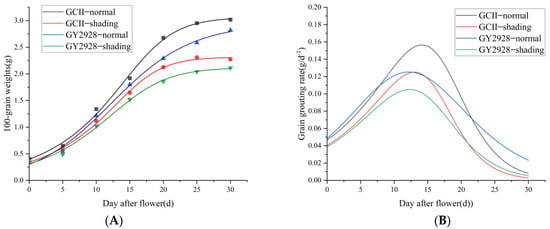
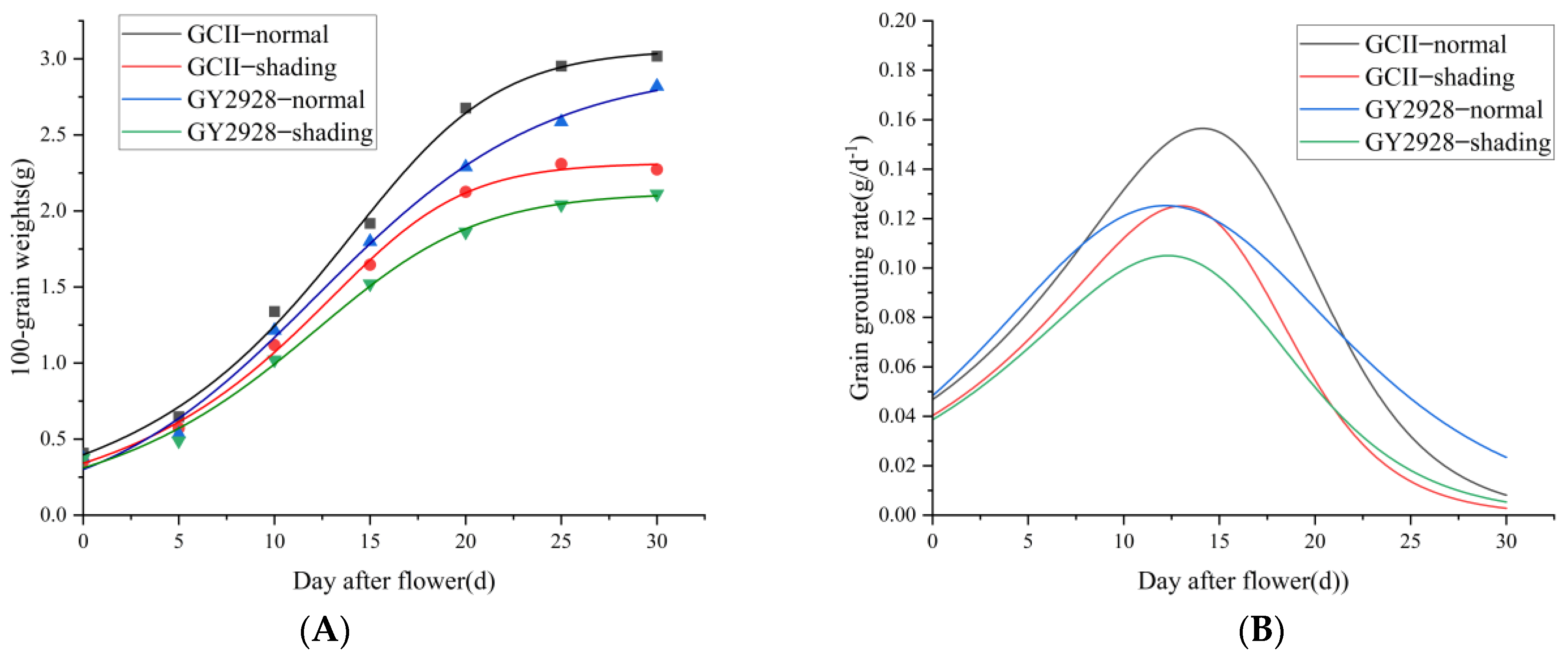
The Richards equation was fitted to the dynamics of 100-grain weight from 0 to 30 days after flowering under different treatments (Figure 1A). Subsequently, the grain-filling rate was derived by calculating the first-order derivative of the fitted curves (Figure 1B). Under both normal and shaded conditions, the 100-grain weight exhibited a characteristic “S”-shaped curve, following a slow-fast-slow growth pattern (Figure 1A). As grain filling progressed, the rate of weight gain gradually decelerated. Notably, shading consistently resulted in lower 100-grain weights for both GCII and GY2928 compared to their respective normal-light controls. At 30 DAF, the final grain weights followed the order: GCII (normal light) > GY2928 (normal light) > GCII (shaded) > GY2928 (shaded). The grain-filling rate displayed a unimodal curve (Figure 1B). Shading significantly reduced the filling rate compared to normal light conditions. Furthermore, the peak filling rate of GCII was higher than that of GY2928. Shading reduced both the 100-grain weight and the grain-filling rate of rice noodle-specific cultivars.
Figure 1.
Grain weight and grain filling rate of rice in 2022 under different treatment conditions. (A) was the grain weight gain dynamics of GCII and GY2928; (B) was the grain filling rate of GCII and GY2928. GCII-normal was treated under normal light of Gui Chao II; GCII-shading was treated under the shading of Guichao II; GY2928-normal was treated under normal light of Guangyou 2928; and GY2928-shading was treated under the shading of Guangyou 2928.
3.1.2. Characteristic Parameters of Grain Filling
Based on the Richards growth equation, the key parameters were derived, including A (ultimate growth amount), B (initial condition constant), K (growth rate constant), and N (curve shape parameter) (Table 1). Shading treatment exerted significant effects on the A, K, and N values of both cultivars. Compared with normal light conditions, shading substantially reduced the A values of GCII and GY2928 by 24.50% and 27.93%, respectively. These results indicate that shading imposes a severe constraint on grain filling; however, the smaller reduction observed in GCII suggests that it possesses greater tolerance to low-light stress than GY2928.
Table 1.
Parameters of rice grain fitting equation under different treatment conditions (2022).
Key filling parameters were calculated based on the equation formulas, including R0 (initial growth potential), Tmax (time to reach maximum filling rate), Vmean (average filling rate), Vmax (maximum filling rate), Gmax (grain weight at maximum filling rate), and D (active filling period) (Table 2). Compared with normal light conditions, shading significantly reduced these parameters. Specifically, the R0 of GCII and GY2928 decreased by 0.87% and 31.6%, respectively; Vmean decreased by 20.67% and 18.69%; and Vmax decreased by 20.26% and 16.18%. Additionally, the Gmax declined by 0.4212 g (22.70%) in GCII and 0.2064 g (14.36%) in GY2928. Furthermore, shading shortened the Tmax by 1.69 days (13.39%) and 1.50 days (12.50%) and reduced the active filling period (D) by 1.47 days (4.84%) and 4.01 days (11.41%) for GCII and GY2928, respectively. These results indicate that low-light stress significantly suppresses the grain-filling rate and shortens the active filling period in rice noodle-specific cultivars, thereby hindering grain development and ultimately reducing the 100-grain weight.
Table 2.
Characteristic parameters of rice grain filling under different treatment conditions (2022).
GCII exhibited significantly higher filling days and contribution rates in T1 (continuous increasing period) but lower values in T2 (fast growth) and T3 (slow increase) compared to GY2928, despite a consistently higher average filling rate across all periods. Shading significantly impacted filling parameters in T1, T2, and T3, with a partial cultivar × treatment interaction observed (Table 3). Under shading, the T1 average filling rates of GCII and GY2928 declined by 17.25% and 13.32%, whereas their contribution rates rose by 0.44% and 8.70%. In T2, filling duration decreased by 0.84 and 3.51 days, and average filling rates dropped by 17.25% and 13.32% for the two cultivars, respectively. During T3, shading shortened the filling duration by 1.32 and 8.61 days, reduced average filling rates by 19.60% and 11.22%, and lowered contribution rates by 0.65% and 5.99%, respectively. Overall, low-light stress curtailed the duration and rate of grain filling in the T2 and T3 stages, ultimately compromising final grain weight.
Table 3.
Grain characteristics of rice for rice noodle grains in T1, T2 and T3 stages under shading in 2022.
3.2. Effect of Shading on Yield and Its Components of Rice Noodle-Specific Cultivars
Analysis showed no significant interaction effects of treatments, cultivars, and years on yield and its components, though significant main effects of cultivar and shading treatment on spikelet fertility and yield were observed (Table 4). Shading significantly reduced yields, with two-year average declines of 25.33% for GCII and 27.82% for GY2928 compared to normal light. Among yield components, shading significantly lowered the spikelet fertility but did not significantly affect the number of effective panicles, grains per panicle, or 1000-grain weight. Under shading, the two-year average spikelet fertility of GCII and GY2928 decreased by 30.62% and 28.50%, respectively. Thus, the yield reduction in rice noodle-specific cultivars under shading is primarily attributable to decreased spikelet fertility.
Table 4.
Effects of shading on the yield and components of rice for rice noodles.
3.3. The Effect of Shading on Rice Processing and Appearance Quality
The variety and shading treatment significantly affected the brown rice rate, milled rice rate, head rice rate, and chalkiness degree of special rice used for noodle processing. Additionally, the interactions among shading treatment, year, and variety significantly influenced chalkiness degree (Table 5). All processing quality traits and chalkiness degree varied significantly across different treatments. Significant differences in processing and appearance qualities were also observed among varieties. Compared with normal light conditions, shading increased the head rice rate of GCII, though the change was not significant. In contrast, shading significantly reduced the head rice rate of GY2928, with decreases of 11.47% and 23.03% in 2021 and 2022, respectively. Shading also increased the brown rice rate and milled rice rate of both GCII and GY2928, but these differences were not significant. Regarding appearance quality, shading reduced the chalkiness rate and chalkiness degree of GCII compared with normal light but significantly increased those of GY2928. Specifically, the chalkiness rate of GY2928 increased by 6.30% and 14.03% in 2021 and 2022, respectively, relative to normal light, while the chalkiness degree increased by 13.18% and 25.51%, respectively. Therefore, the effects of shading on the processing and appearance qualities of special rice for noodle processing are variety-dependent. Shading improved the processing and appearance qualities of GCII but degraded those of GY2928.
Table 5.
Effects of shading on rice processing and appearance quality.
3.4. The Relationship Between Grain Filling Parameters and Yield and Yield Components, Processing and Appearance Quality
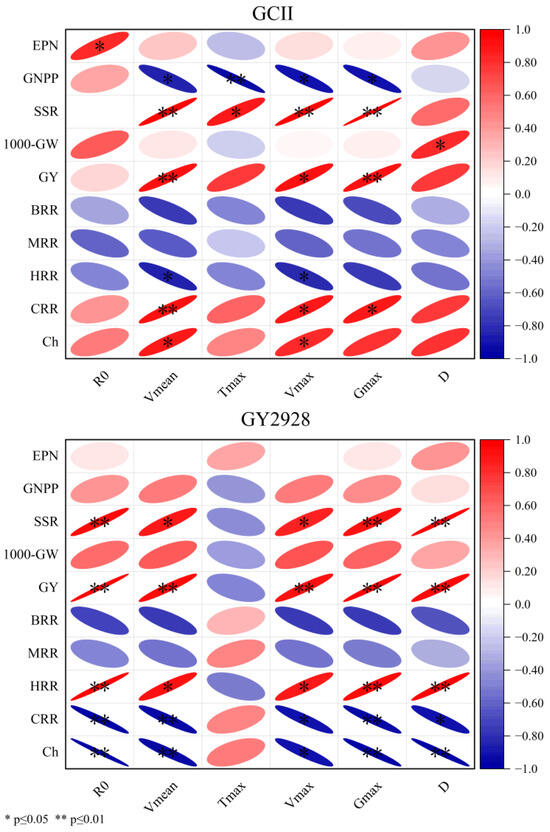
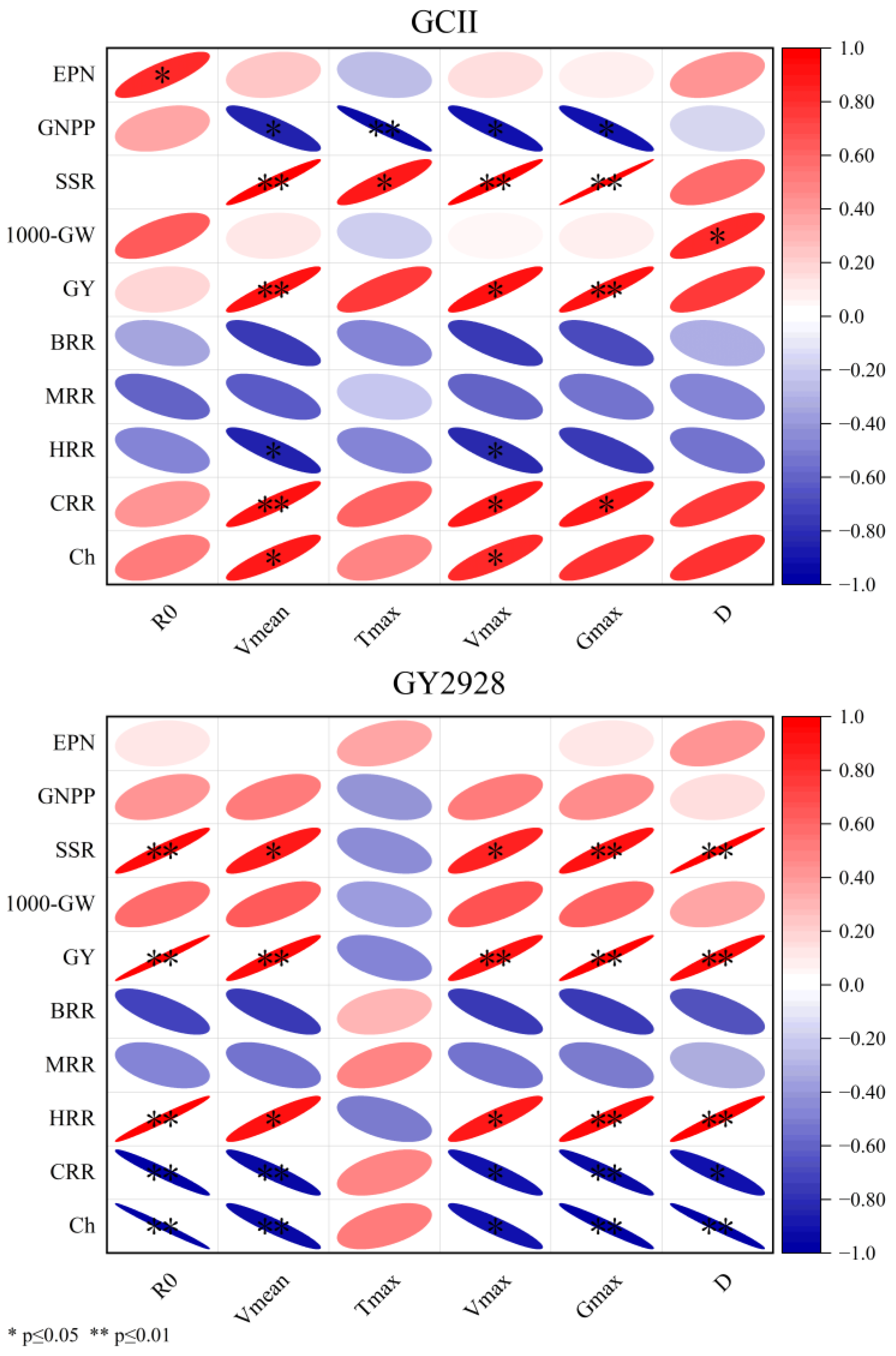
Pearson correlation analysis was used to generate correlation heatmaps for grain filling parameters, yield, yield components, and processing and appearance quality of GCII and GY2928 (Figure 2). The results showed that spikelet fertility, yield, chalkiness rate, and chalkiness degree were significantly positively correlated with Vmean, Vmax, and Gmax in GCII. In contrast, the number of grains per panicle of GCII was significantly negatively correlated with Vmean, Tmax, Vmax, and Gmax, and head rice rate was also negatively correlated with Vmean and Vmax. For GY2928, spikelet fertility, yield, and head rice rate were significantly positively correlated with R0, Vmean, Vmax, Gmax, and D. However, the chalkiness rate and chalkiness degree of GY2928 were significantly negatively correlated with the same parameters (R0, Vmean, Vmax, Gmax, and D).
Figure 2.
Correlation analysis of grain filling parameters and yield, processing and appearance quality in 2022. R0, initial growth potential; Vmean, average filling rate; Tmax, time to reach maximum filling rate; Vmax, maximum filling rate; Gmax, grain weight at the maximum filling rate; D, Time of active filling; GY, Yield; EPN, number of effective panicles; GNPP, number of grains per panicles; SSR, spikelet fertility; 1000-GW, 1000-grain weight; BRR, brown rice rate; MRR, milled rice rate; HRR, head rice rate; CRR, chalkiness rate; Ch, chalkiness degree.
4. Discussion
4.1. Effects of Shading on Grain Filling and Composition Factors and Yield of Rice Noodle-Specific Cultivars
In this study, shading was found to reduce the 100-grain weight and grain filling rate of two special rice varieties (GCII and GY2928) used for rice noodle processing (Figure 1). Grain filling is strongly influenced by environmental conditions [23]. The grain filling stage represents a critical period in the rice growing season, during which the filling process is supported by photosynthetic products; therefore, light availability at this stage is crucial for determining both yield and quality [24]. Previous studies have reported that insufficient light adversely affects grain filling in rice [25,26]. Shading primarily disrupts the grain filling process, reducing the filling rate and grain weight, and severely impairs grain development, leading to decreased grain fullness [11,27]. Similar negative effects of shading on grain filling rate have also been confirmed in wheat [28] and maize [29]. Our results further demonstrated significant differences in grain filling characteristics under shading treatment (Table 2). Following shading, the average grain filling rate (Vmean), maximum grain filling rate (Vmax), and grain weight at the maximum grain filling rate (Gmax) were all reduced. Grain filling rate is a key indicator of photosynthetic accumulation in grains [30]. Shading reduces light availability, thereby restricting photosynthesis and carbohydrate synthesis, ultimately lowering the grain filling rate [11,18]. The reduction in grain weight at the maximum filling rate (Gmax) indicates that shading not only inhibits filling intensity but also leads to insufficient dry matter accumulation during critical developmental stages. This may be attributed to an imbalance in the source–sink relationship, whereby shading diminishes the supply of photosynthetic products from leaves while limiting the capacity of grains to absorb assimilates [31].
The grain filling period is a critical stage in rice growth, and the filling rate directly influences grain development, thereby determining final yield [10]. In this study, the effects of shading on the three stages of grain filling exhibited certain differences (Table 3). Compared with normal light, shading reduced the number of filling days in the T2 and T3 stages, significantly increased the contribution rate of the T1 stage, and markedly decreased that of the T3 stage. Moreover, the average rate across all three stages declined under shading, which ultimately affected yield. Our results also revealed a significant interaction between shading and yield of rice noodle-specific cultivars, with shading significantly reducing the yield of both GCII and GY2928; however, the reduction was greater for GY2928 than for GCII (Table 4). Based on yield components and experimental results, this reduction was primarily attributable to a significant decrease in spikelet fertility. Correlation analysis further indicated that grain filling parameters of both cultivars were significantly positively correlated with spikelet fertility and yield (Figure 2), suggesting that shading affects grain filling parameters, which in turn influence spikelet fertility and ultimately reduce yield. These findings are consistent with those of Yoshinaga and Deng et al. [12,32] that shading significantly reduced rice yield by reducing spikelet fertility and 1000-grain weight. Deng et al. [33] pointed out that shading inhibits anther dehiscence and pollen viability, leading to a reduction in the number of pollen grains captured by stigmas and a marked decrease in fertilization rate, which directly increases the number of empty grains and lowers spikelet fertility. Additionally, shading suppresses the grain filling process, causing some fertilized grains to become shriveled due to insufficient dry matter accumulation, further reducing spikelet fertility and consequently decreasing rice yield [34]. Compared with normal light, the reductions in yield of GCII (Table 4) were slightly smaller than those of GY2928, suggesting that, under low-light conditions, GCII may capture more solar radiation and maintain a higher filling rate than GY2928 [27,35,36]. Furthermore, studies have shown that applying an appropriate amount of nitrogen fertilizer under shading conditions can enhance leaf photosynthesis, thereby mitigating the negative impact on grain filling rate and increasing rice yield [13]. Another study found that potassium fertilizer application improved the leaf area index and photosynthetic performance of rice, thereby increasing yield under shading stress [37]. Consequently, optimizing cultivation practices could improve the yield stability of rice noodle-specific cultivars in low-light environments, thereby meeting the growing industrial demand.
4.2. Effects of Shading on the Processing Quality and Appearance Quality of Rice Noodle-Specific Cultivars
Light is an important factor affecting rice quality during the grain filling and seed development stages. This study showed that shading increased the head rice rate of GCII, as well as the brown rice rate and milled rice rate of both GCII and GY2928, although these effects were not significant (Table 5). However, shading reduced the head rice rate of GY2928 by 11.47% and 23.03% in 2021 and 2022, respectively. Previous studies have primarily focused on the effects of shading on non-specialized rice, with limited research on the quality of rice noodle-specific cultivars [38]. Moreover, conclusions regarding the effect of shading on rice quality have been inconsistent. For instance, some studies suggest that shading reduces head rice rate [39], while others indicate that shading increases head rice rate [40]. The main component of rice is starch, and grain filling capacity depends on the starch synthesis ability of the endosperm [41]. By reducing the transport efficiency of photosynthetic products from leaves to grains, shading leads to a loose arrangement of starch granules in the endosperm. This structural change makes rice grains more prone to breakage during milling, ultimately reducing the head rice rate. Chalkiness degree and chalkiness rate are important indicators of rice appearance quality. Chalkiness degree is a key determinant of rice quality and is susceptible to abiotic stresses. In our study, shading improved the chalkiness rate and chalkiness degree of GCII but worsened those of GY2928 (Table 5). Chen et al. [39] found that shading significantly increased chalkiness rate and chalkiness degree in rice. Shading stress increases chalkiness degree by hindering caryopsis development and interfering with grain starch properties [42,43]. The results of Deng et al. [19] demonstrated that starch regularity affects rice chalkiness, and that shading-induced increases in the content of large starch granules and amylose lead to higher chalkiness. In the present experiment, the grain quality of GCII was improved under shading, whereas the responses of head rice rate, chalkiness rate, and chalkiness degree in GCII exhibited opposite trends to those observed in GY2928. Correlation analysis further revealed that head rice rate of GCII was significantly and negatively correlated with grain filling parameters, while chalkiness rate and chalkiness degree showed significant positive correlations with these parameters. Collectively, these results indicate that shading substantially influenced grain filling, which in turn restricted the differentiation, growth, and development of spikelets, ultimately leading to a reduction in spikelet fertility. The decrease in grain number led to an increase in the assimilates allocated to individual spikelets, which resulted in the improved quality of CGII. This is in accordance with previous results [39]. Therefore, shading treatment can improve the processing and appearance quality of GCII, but is not conducive to the improvement of these qualities in GY2928. Therefore, we propose that GCII, as a rice noodle-specific cultivar, is more suitable for cultivation under low-light conditions than GY2928.
4.3. Study Limitations
The derived grain-filling parameters are analytical functions of the same four fitted Richards parameters (A, B, K, N) and are therefore not statistically independent of one another. Submitting each of them to a separate ANOVA will inflate the risk of false-positive findings. Moreover, parameter B is unstable in Table 2 (GCII-normal, SD > mean) as a few outlying high values distort this fitting parameter, which can affect the derived parameters even if the results are relatively stable. Subsequently, the data processing method for nonlinear fitting should be optimized to more accurately present the grain filling.
5. Conclusions
Shading regulates grain filling characteristics, yield, and quality in rice. By affecting the grain filling process, shading inhibits grain formation and reduces spikelet fertility, thereby decreasing the yield of the two special rice varieties (GCII and GY2928) used for noodle processing. Furthermore, compared with normal light, shading increased the head rice rate of GCII while reducing its chalkiness degree and chalkiness rate. In contrast, shading decreased the head rice rate of GY2928 and increased its chalkiness degree and chalkiness rate. Under shading conditions, GCII exhibited more stable yield and quality performance than GY2928. Therefore, GCII is more suitable for cultivation under 51% shading rate conditions than GY2928. These findings provide a reference for achieving high yield and high quality in the cultivation of rice noodle-specific cultivars in low-light environments.
Author Contributions
Conceptualization, Y.S., P.Z., G.Z. and H.X.; methodology, Y.S., G.Z. and T.W.; formal analysis, P.Z., H.Y. and S.W.; investigation, G.Z., H.X., T.W. and H.Y.; resources, Y.S., G.Y. and S.Y.; data curation, G.Z., H.X. and T.W.; writing—original draft preparation, Y.S.; writing—review and editing, P.Z.; visualization, Y.S., P.Z., H.X. and H.Y.; supervision, S.W., G.Y. and S.Y.; project administration, S.W., G.Y. and S.Y.; funding acquisition, G.Y. and S.Y. All authors have read and agreed to the published version of the manuscript.
Funding
This research was funded by the Zigong Science and Technology Project (Project Category: Science and Technology Supports Rural Revitalization); Central Guidance for Local Science and Technology Development Fund Projects, grant number 2024ZYD0339; National Modern Agricultural Industry Technology System Sichuan Innovation Team Construction Project (Sichuan Finance and Education [2024] Document No. 104).
Data Availability Statement
The original contributions presented in the study are included in the article; further inquiries can be directed to the corresponding author.
Conflicts of Interest
The authors declare no conflicts of interest.
References
- Kobayashi, K.; Wang, X.; Wang, W. Genetically Modified Rice Is Associated with Hunger, Health, and Climate Resilience. Foods 2023, 12, 2776. [Google Scholar] [CrossRef]
- Chen, J.; Zhao, X.; Li, S.; Chen, Z. Ordered structural changes of retrograded instant rice noodles during the long-term storage. Food Res. Int. 2024, 175, 113727. [Google Scholar] [PubMed]
- Tong, L.-T.; Gao, X.; Lin, L.; Liu, Y.; Zhong, K.; Liu, L.; Zhou, X.; Wang, L.; Zhou, S. Effects of semidry flour milling on the quality attributes of rice flour and rice noodles in China. J. Cereal Sci. 2015, 62, 45–49. [Google Scholar] [CrossRef]
- Low, Y.K.; Effarizah, M.E.; Cheng, L.H. Factors Influencing Rice Noodles Qualities. Food Rev. Int. 2020, 36, 781–794. [Google Scholar]
- Lu, S.; Cik, T.; Lii, C.; Lai, P.; Chen, H. Effect of amylose content on structure, texture and α-amylase reactivity of cooked rice. LWT-Food Sci. Technol. 2013, 54, 224–228. [Google Scholar] [CrossRef]
- Shi, J.; Wang, Y.; Wang, S.; Lu, X.; Chen, X.; Zheng, D. Use of low-protein staple foods in the dietary management of patients with stage 3–4 chronic kidney disease: A prospective case-crossover study. BMC Nephrol. 2022, 23, 114. [Google Scholar] [PubMed]
- Ma, J.; Luo, Y.; Shen, Y.; Liang, H.; Li, S. Regional long-term trend of ground solar radiation in China over the past 50 years. Sci. China (Earth Sci.) 2013, 56, 1242–1253. [Google Scholar]
- Li, J.; Jiang, X.; Yang, S.; Tian, X. Changes of agricultural climate resources during rice growing season in the middle and lower reaches of the Yangtze River. Jiangsu J. Agric. Sci. 2020, 36, 99–107. [Google Scholar]
- Wang, L.; Zhong, D.; Chen, X.; Niu, Z.; Cao, Q. Impact of climate change on rice growth and yield in China: Analysis based on climate year type. Geogr. Sustain. 2024, 5, 548–560. [Google Scholar] [CrossRef]
- Liu, B.; Meng, S.; Yang, J.; Wu, J.; Peng, Y.; Zhang, J.; Ye, N. Carbohydrate flow during grain filling: Phytohormonal regulation and genetic control in rice (Oryza sativa). J. Integr. Plant Biol. 2025, 67, 1086–1104. [Google Scholar] [CrossRef] [PubMed]
- Li, Q.P.; Deng, F.; Chen, H.; Zeng, Y.; Li, B.; Zhong, X.; Wang, L.; Zhou, W.; Chen, Y.; Ren, W. Shading decreases rice yield by impeding grain-filling progress after heading. Agron. J. 2020, 112, 4018–4030. [Google Scholar] [CrossRef]
- Deng, F.; Wang, L.; Yao, X.; Wang, J.; Ren, W.; Yang, W. Effects of different-growing-stage shading on rice grain-filling and yield. J. Sichuan Agric. Univ. 2009, 27, 265–269. [Google Scholar]
- Wei, H.; Zhu, Y.; Qiu, S.; Han, C.; Hu, L.; Xu, D.; Zhou, N.; Xing, Z.; Hu, Y.; Cui, P.; et al. Combined effect of shading time and nitrogen level on grain filling and grain quality in japonica super rice. J. Integr. Agric. 2018, 17, 2405–2417. [Google Scholar] [CrossRef]
- Xu, T.; Xu, T.; Lyu, T.; Zhao, J.; Wang, R.; Chen, C.; Liu, Y.; Liu, X.; Wang, Y.; Liu, C. Photosynthetic characteristics, dry matter accumulation and translocation, grain filling parameter of three main maize varieties in production. Acta Agron. Sin. 2018, 44, 414–422. [Google Scholar] [CrossRef]
- Liu, Q.; Zhou, X.; Yang, L.; Li, T.; Zhang, J. Effects of early growth stage shading on rice flag leaf physiological characters and grain growth at grain-filling stage. Ying Yong Sheng Tai Xue Bao 2009, 20, 2135–2141. [Google Scholar] [PubMed]
- Kobata, T.; Sugawara, M.; Takatu, S. Shading during the early grain filling period does not affect potential grain dry matter increase in rice. Agron. J. 2000, 92, 411–417. [Google Scholar] [CrossRef]
- Shang, C.; Harrison, M.; Deng, J.; Ye, J.; Zhong, X.; Wang, C.; Tian, X.; Huang, L.; Liu, K.; Zhang, Y. Greater Propensity to Photosynthesize Enables Superior Grain Quality of Indica–japonica Hybrid Rice under Shading. Agronomy 2023, 13, 535. [Google Scholar] [CrossRef]
- Chen, H.; Li, Q.; Zeng, Y.; Deng, F.; Ren, W. Effect of different shading materials on grain yield and quality of rice. Sci. Rep. 2019, 9, 9992. [Google Scholar] [CrossRef] [PubMed]
- Deng, F.; Zeng, Y.; Li, Q.; He, C.; Li, B.; Zhu, Y.; Zhou, X.; Yang, F.; Zhong, X.; Wang, L.; et al. Relationship between chalkiness and the structural and thermal properties of rice starch after shading during grain-filling stage. Carbohydr. Polym. 2021, 252, 117212. [Google Scholar] [CrossRef] [PubMed]
- Wang, L.; Fei, D.; Ren, W.; Yang, W. Effects of shading on starch pasting characteristics of indica hybrid rice (Oryza sativa L.). PLoS ONE 2017, 8, e68220. [Google Scholar] [CrossRef]
- Zhu, Q.; Cao, X.; Luo, Y. Growth analysis on the process of grain filling in rice. Acta Agron. Sin. 1988, 03, 182–193. [Google Scholar]
- Zhao, C.; Liu, G.; Chen, Y.; Jiang, Y.; Shi, Y.; Zhao, L.; Liao, P.; Wang, W.; Xu, K.; Dai, Q.; et al. Excessive Nitrogen Application Leads to Lower Rice Yield and Grain Quality by Inhibiting the Grain Filling of Inferior Grains. Agriculture 2022, 12, 962. [Google Scholar] [CrossRef]
- Ku, H.; Hayashi, K.; Agbisit, R.; Villegas-Pangga, G. Effect of rates and sources of nitrogen on rice yield, nitrogen efficiency, and methane emission from irrigated rice cultivation. Arch. Agron. Soil Sci. 2017, 63, 1009–1022. [Google Scholar]
- Xiong, R.; Wang, H.; Mao, F.; Tao, L.; Tan, X.; Pan, X.; Zeng, Y.; Zeng, Y. The mechanism of carbon and nitrogen metabolism under low temperature and low light stress after heading in late indica rice. Plant Physiol. Biochem. 2025, 218, 109316. [Google Scholar] [CrossRef] [PubMed]
- Mo, Z.; Li, W.; Pan, S.; Fitzgerald, T.; Xiao, F.; Tang, Y.; Wang, Y.; Duan, M.; Tian, H.; Tang, X. Shading during the grain filling period increases 2-acetyl-1-pyrroline content in fragrant rice. Rice 2015, 8, 9. [Google Scholar] [CrossRef] [PubMed]
- Yang, W.; Peng, S.; Dionisio-Sese, M.; Laza, R.; Visperas, R. Grain filling duration, a crucial determinant of genotypic variation of grain yield in field-grown tropical irrigated rice. Field Crops Res. 2008, 105, 221–227. [Google Scholar] [CrossRef]
- Wang, L.; Deng, F.; Ren, W.-J. Shading tolerance in rice is related to better light harvesting and use efficiency and grain filling rate during grain filling period. Field Crops Res. 2015, 180, 54–62. [Google Scholar] [CrossRef]
- Li, T.; Arif, M.; Wang, Z.; Shi, G.; Aljumaiah, L.; Xu, L.; Ren, M.; Xu, R.; Li, L. Integrative physiological and transcriptome analyses elucidate the effect of shading during the grain-filling stage of wheat (Triticum aestivum) cv. ZY96-3. Funct. Plant Biol. 2025, 52, FP25013. [Google Scholar] [CrossRef] [PubMed]
- Yang, Y.; Liu, G.; Guo, X.; Liu, W.; Xue, J.; Ming, B.; Xie, R.; Wang, K.; Hou, P.; Li, S. Quantitative Relationship Between Solar Radiation and Grain Filling Parameters of Maize. Front. Plant Sci. 2022, 13, 906060. [Google Scholar] [CrossRef] [PubMed]
- Zhou, Y.; Wu, X.; Ju, W.; Zhang, L.; Chen, Z.; He, W.; Liu, Y.; Shen, Y. Modeling the Effects of Global and Diffuse Radiation on Terrestrial Gross Primary Productivity in China Based on a Two-Leaf Light Use Efficiency Model. Remote Sens. 2020, 12, 3355. [Google Scholar] [CrossRef]
- Shao, L.; Liu, Z.; Li, H.; Zhang, Y.; Dong, M.; Guo, X.; Zhang, H.; Huang, B.; Ni, R.; Li, G. The impact of global dimming on crop yields is determined by the source-sink imbalance of carbon during grain filling. Glob. Change Biol. 2021, 27, 689–708. [Google Scholar]
- Yoshinaga, S.; Takai, T.; Arai-Sanoh, Y.; Ishimaru, T.; Kondo, M. Varietal differences in sink production and grain-filling ability in recently developed high-yielding rice (Oryza sativa L.) varieties in Japan. Field Crops Res. 2013, 150, 74–82. [Google Scholar] [CrossRef]
- Deng, F.; Zeng, Y.; Li, Q.; He, C.; Li, B.; Zhu, Y.; Zhou, X.; Yang, F.; Zhong, X.; Wang, L.; et al. Decreased anther dehiscence contributes to a lower fertilization rate of rice subjected to shading stress. Field Crops Res. 2021, 273, 108291. [Google Scholar] [CrossRef]
- Li, Q.; Deng, F.; Zeng, Y.; Li, B.; He, C.; Zhu, Y.; Zhou, X.; Zhang, Z.; Wang, L.; Tao, Y. Low light stress increases chalkiness by disturbing starch synthesis and grain filling of rice. Int. J. Mol. Sci. 2022, 23, 9153. [Google Scholar] [CrossRef] [PubMed]
- Deng, N.; Ling, X.; Sun, Y.; Zhang, C.; Fahad, S.; Peng, S.; Cui, K.; Nie, L.; Huang, J. Influence of temperature and solar radiation on grain yield and quality in irrigated rice system. Eur. J. Agron. 2015, 64, 37–46. [Google Scholar] [CrossRef]
- Panda, D.; Mohanty, S.; Das, S.; Mishra, B.; Baig, M.; Behera, L. Light intensity–mediated auxin homeostasis in spikelets links carbohydrate metabolism enzymes with grain filling rate in rice. Protoplasma 2023, 260, 1233–1251. [Google Scholar] [CrossRef] [PubMed]
- Liu, T.; Deng, F.; Zhu, Y.; Wang, L.; He, C.; Liu, R.; Liu, Y.; Yang, J.; Li, Q.; Yuan, Y.; et al. Potassium fertilizer management improves rice yield by optimizing the morphological and physiological characteristics of leaves under shading stress. J. Integr. Agric. 2025, 33, 1988−2000. [Google Scholar]
- Xiu, W.; Jie, G. Effects of low light on agronomic and physiological characteristics of rice including grain yield and quality. Rice Sci. 2014, 21, 243–251. [Google Scholar] [CrossRef]
- Chen, H.; Wang, T.; Deng, F.; Yang, F.; Zhong, X.; Li, Q.; Ren, W. Changes in chemical composition and starch structure in rice noodle cultivar influence Rapid Visco analysis and texture analysis profiles under shading. Food Chem. X 2022, 14, 100360. [Google Scholar] [CrossRef] [PubMed]
- Shang, L.; Liu, Z.; Ye, J.; Sheng, T.; Li, R.; Deng, J.; Liu, K.; Tian, X.; Zhang, Y.; Huang, L. Shading at the Booting Stage Improved the Grain Quality of Hybrid Rice Due to Reduced Spikelet Production. Agriculture 2024, 14, 371. [Google Scholar] [CrossRef]
- Li, T.; Ohsugi, R.; Yamagishi, T.; Sasaki, H. Effects of weak light on rice starch accumulation and starch synthesis enzyme activities at grain filling stage. Chin. J. Rice Sci. 2005, 19, 545–550. [Google Scholar]
- Deng, F.; Wang, L.; Pu, S.; Mei, X.; Li, S.; Li, Q.; Ren, W. Shading stress increases chalkiness by postponing caryopsis development and disturbing starch characteristics of rice grains. Agric. For. Meteorol. 2018, 263, 49–58. [Google Scholar] [CrossRef]
- Jiang, N.; Chen, W. Shading effects on photosynthesis and chloroplast ultra-structure characteristics of leaves in japonica rice with different panicle types in northern China. J. Shenyang Agric. Univ. 2015, 46, 1–6. [Google Scholar]

Disclaimer/Publisher’s Note: The statements, opinions and data contained in all publications are solely those of the individual author(s) and contributor(s) and not of MDPI and/or the editor(s). MDPI and/or the editor(s) disclaim responsibility for any injury to people or property resulting from any ideas, methods, instructions or products referred to in the content. |
© 2026 by the authors. Licensee MDPI, Basel, Switzerland. This article is an open access article distributed under the terms and conditions of the Creative Commons Attribution (CC BY) license.