


Abstract
In arid and semi-arid regions, mesquite (Prosopis laevigata) pods represent a strategic feed resource for low-input livestock systems; however, the utilization of mesquite pod flour is severely limited by insect infestation during storage. This study evaluated the repellent effectiveness of Ricinus communis leaves and stems as plant-based additives for preserving mesquite pod flour against storage insects, primarily Tribolium castaneum (Coleoptera: Tenebrionidae). Dose-dependent repellency was assessed in a three-chamber choice-test system at concentrations of 1, 5, 10, and 20% (w·w−1), combining short-term laboratory assays with a 14-month storage experiment under ambient conditions representative of rural dryland systems. R. communis leaves exhibited a strong concentration-dependent repellent effect, consistently outperforming stem material. Logistic regression indicated that each 1% increase in leaf concentration increased the odds of insects remaining in the untreated substrate by 17%. Long-term storage assays showed that botanical additives altered insect population structure, while only R. communis leaf powder at 10% showed lower total insect abundance relative to the control. Proximate analysis revealed additional protein contribution from R. communis leaves, while ricin-like proteins remained at low concentrations in vegetative tissues. Overall, the results validate a traditional preservation practice and support the use of R. communis leaf biomass as a plant-based additive for protecting mesquite flour in dryland livestock systems.
1. Introduction
In arid and semi-arid regions, livestock production systems are strongly affected by seasonal forage scarcity, prolonged drought periods, and increasing dependence on external feed inputs. Under these conditions, native perennial species adapted to water-limited environments represent strategic resources for improving feed security and the resilience of low-input livestock systems. Among these species, mesquite (Prosopis spp.) plays an important ecological and productive role in dryland agroecosystems due to its drought tolerance, nitrogen fixation capacity, persistence under marginal conditions, and multiple uses within silvopastoral systems. In addition to providing shade, soil protection, and ecological services, mesquite pods constitute an important seasonal source of energy-rich biomass for livestock, particularly during dry periods when herbaceous forage availability is severely reduced.
Mesquite pods have been widely documented as a source of carbohydrates, protein, dietary fiber, and minerals, with a nutritional value comparable to or exceeding that of several conventional cereals [1]. In northern Jalisco, Mexico, mesquite is broadly distributed across semi-arid landscapes and has historically been used as a multipurpose resource for both human and animal consumption. Previous regional assessments based on remote sensing estimated approximately 9936 ha of mesquite-dominated areas within the northern region of Jalisco, highlighting its ecological and productive relevance in local dryland systems [2]. These attributes have supported the historical integration of mesquite into traditional silvopastoral systems and dryland livestock production across Mexico and other arid regions of the world.
However, despite its nutritional and ecological importance, the practical utilization of mesquite pod products as feed resources remains limited by postharvest deterioration during storage, particularly due to insect infestation. Intact pods and seeds of Prosopis spp. are highly susceptible to infestation by bruchid beetles (Coleoptera: Bruchidae), mainly Algarobius prosopis and Mimosestes amicus, which oviposit on the pod surface and complete their larval development within the seeds [3,4,5]. Infestation results in significant dry matter losses, reductions in carbohydrate and protein content, and contamination with insect excreta and associated microorganisms [3,4,6]. Infestation levels exceeding 80% have been reported in unprotected stored pods, seriously compromising their nutritional value and economic viability [3].
Processing mesquite pods into flour facilitates handling, storage, and incorporation into livestock feeding systems. However, milling also increases susceptibility to secondary storage pests because the resulting substrate becomes more accessible to insects associated with flour- and starch-based products, particularly Tribolium castaneum, a cosmopolitan tenebrionid commonly associated with stored flours and processed cereal products [6,7,8].
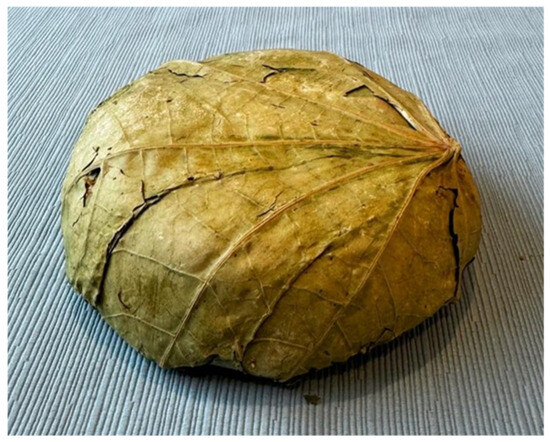
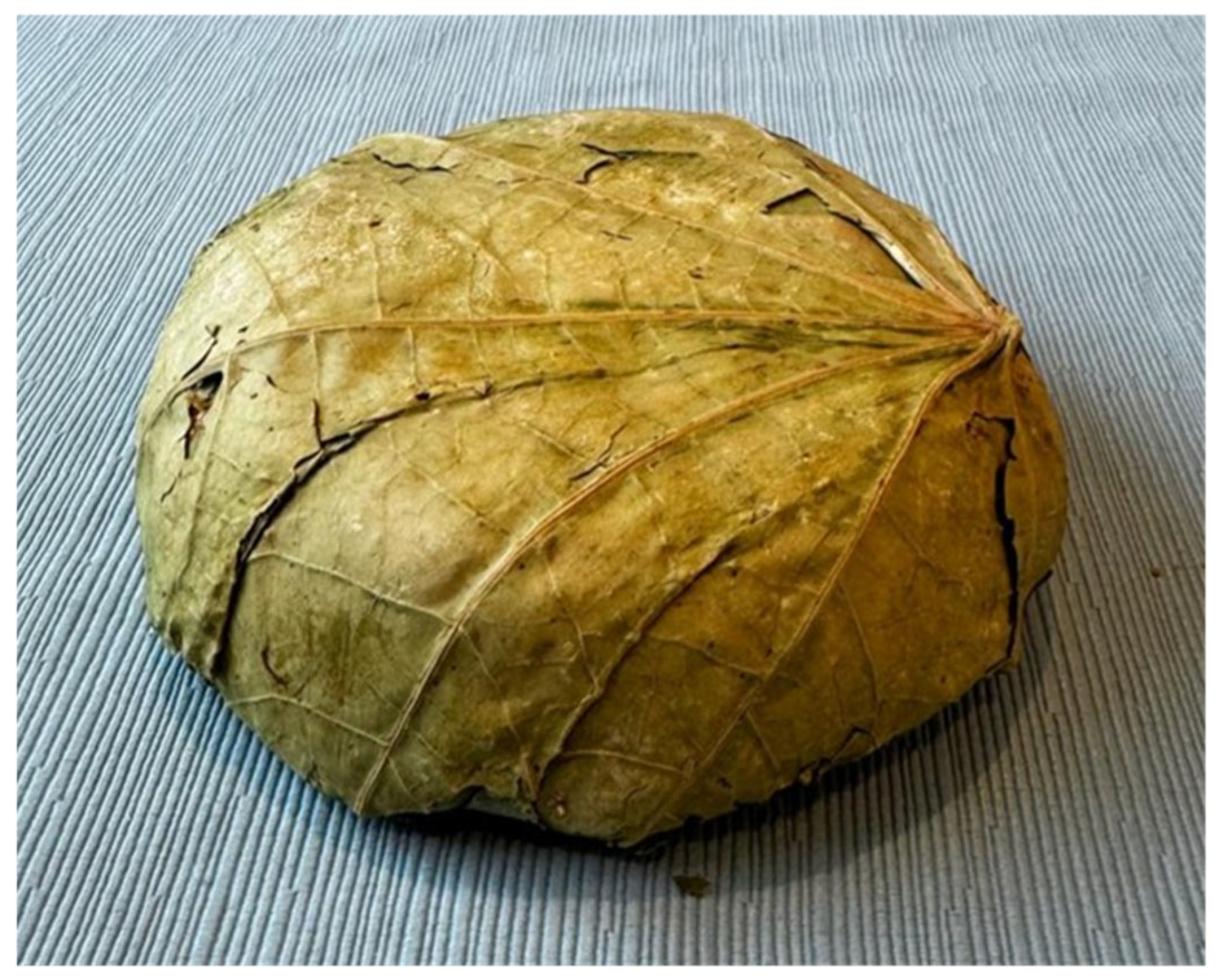
In rural communities of northern Jalisco, Mexico, traditional practices for preserving mesquite-derived products for human consumption have been documented through fieldwork and ethnographic interviews, involving the use of castor bean leaves (Ricinus communis). In this practice, the pod mesocarp is compacted and wrapped in castor bean leaves, locally referred to as mezquitamal, allowing storage for several months without visible insect infestation (Figure 1). Although this practice has not been previously described in scientific literature, its persistent use suggests the existence of empirical knowledge associated with mesquite postharvest conservation in dryland production systems.
Figure 1.
Traditional “mezquitamal”: mesquite mesocarp wrapped in Ricinus communis leaves after 12 months of ambient storage.
The biological plausibility of this practice is supported by studies documenting the bioactivity of R. communis against agricultural and stored-product insects. This species is widely distributed in tropical and semi-arid regions and is cultivated primarily for its oil, rich in ricinoleic acid. Extracts, powders, and oils derived from R. communis have shown insecticidal, fumigant, and repellent activity against economically important weevils and bruchids. Pacheco-Sánchez et al. [9] reported that hydroethanolic extracts from R. communis leaves significantly reduced attraction of the agave weevil (Scyphophorus acupunctatus) by up to 66% under laboratory conditions. Adabie-Gomez et al. [10] observed repellency levels of 96% against Callosobruchus maculatus and 60% against Sitophilus zeamais at 20% concentration. Gómez-Herrera et al. [11] further reported a high repellency index (0.95) at 3–5% against S. zeamais in stored maize.
Beyond its entomological bioactivity, R. communis has been explored as a non-conventional biomass resource in arid and semi-arid regions. R. communis leaves exhibit moderate protein content, fiber fractions, and bioactive secondary metabolites, supporting their potential functional value in low-input production systems [12].
Nevertheless, the use of R. communis biomass requires careful consideration due to the presence of toxic compounds whose effects vary according to plant organ, animal species, dose, and processing conditions. Available evidence indicates that toxicity is context-dependent and can be substantially reduced at low inclusion levels or following drying and storage [13,14]. In the present study, R. communis is not proposed as a primary forage ingredient, but rather as a plant-based additive associated with the postharvest preservation of mesquite-derived products.
Despite extensive literature documenting repellency of R. communis against insects infesting stored grains and legumes, its application in mesquite-derived products remains unexplored. In particular, the relative efficacy of R. communis leaves and stems against insects associated with Prosopis laevigata (syn. Neltuma laevigata) pod flour has not been previously evaluated.
Accordingly, the objective of the present study was to evaluate the dose-dependent repellent effects of R. communis leaves and stems against insects associated with mesquite pod products using a choice-test assay in an interconnected three-chamber system. Concentrations of 1, 5, 10, and 20% (w·w−1) were assessed, with Lippia origanoides included as positive control [15] and Medicago sativa as low-bioactivity reference material. In addition to short-term behavioral responses under controlled laboratory conditions, the persistence of repellency was evaluated through a long-term storage assay conducted under ambient, non-controlled conditions representative of traditional rural storage practices. In parallel, bromatological composition and lignin content were determined to contextualize the nutritional and structural attributes of the evaluated materials. Overall, the results provide a scientific basis to validate traditional knowledge and propose a sustainable strategy for the postharvest protection of forage resources in semi-arid livestock systems.
2. Materials and Methods
2.1. Plant Materials
Mature pods of Prosopis laevigata were manually collected in Colotlán, Jalisco, Mexico, during June and July of 2024 and 2025. Leaves and stems of Ricinus communis L., aerial parts of Lippia origanoides Kunth, aerial parts of Medicago sativa L., and leaves of Azadirachta indica A. Juss. were also evaluated as plant-based additives for mesquite flour preservation.
L. origanoides plants were harvested by local collectors in September 2024 and 2025. A. indica leaves were collected in 2024 from locally established trees in the same region. Leaves and stems of R. communis were collected between July and September of 2024 and 2025, selecting plants free of visible pest infestation, disease symptoms, or mechanical damage. M. sativa was obtained from a local market in Colotlán, Jalisco, Mexico, and originated from conventionally cultivated forage systems in the region.
R. communis leaves and stems, A. indica leaves, and L. origanoides aerial parts were used as treatment materials, while M. sativa served as a low-bioactivity reference material.
Plant species were identified using standard botanical keys and taxonomic identity was corroborated based on known regional distribution records.
2.2. Preparation of Mesquite Pod Flour
After collection, mature P. laevigata pods were sun-dried for 24 h under ambient field conditions. Whole pods were subsequently milled using a hammer mill (Azteca N.12) to obtain mesquite pod flour intended for storage and preservation assays. The flour was stored at −20 °C until use to minimize moisture variation and unintended insect infestation prior to experimentation.
2.3. Preparation of Plant-Based Additives
Leaves and stems of R. communis were manually separated prior to processing. Plant materials were sun-dried under ambient conditions until constant weight was achieved (final moisture content <10%, estimated gravimetrically). Leaves of A. indica were similarly dried after collection, whereas L. origanoides and M. sativa were obtained in dried form from local suppliers.
All dried plant materials were pulverized using an electric grain grinder and subsequently sieved through a 100-mesh screen to obtain uniform particle size. The resulting powders were stored in airtight containers at room temperature under dry conditions until their incorporation into mesquite flour treatments.
2.4. Insect Source and Maintenance
Insects used in the repellency and storage assays were obtained from naturally infested mesquite pod flour derived from milled P. laevigata pods. Emerging adults were collected and established as a laboratory colony maintained on untreated mesquite pod flour.
Based on external morphological characteristics and feeding behavior, adults used to establish the laboratory colony were identified as Tribolium castaneum (Herbst, 1797) (Coleoptera: Tenebrionidae), a secondary storage pest commonly associated with flour- and starch-based products.
The colony was maintained at 25 ± 2 °C under a 12:12 h light:dark photoperiod, with continuous access to untreated mesquite pod flour. Newly emerged adults were used in all assays to ensure comparable physiological condition and reproductive status.
2.5. Evaluation of Plant-Based Additives for Mesquite Flour Preservation
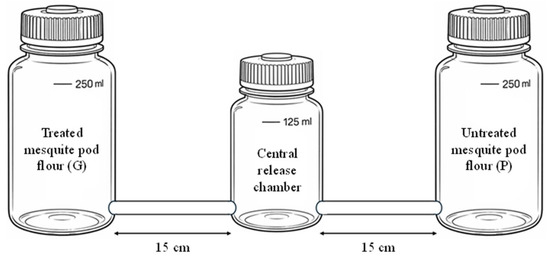
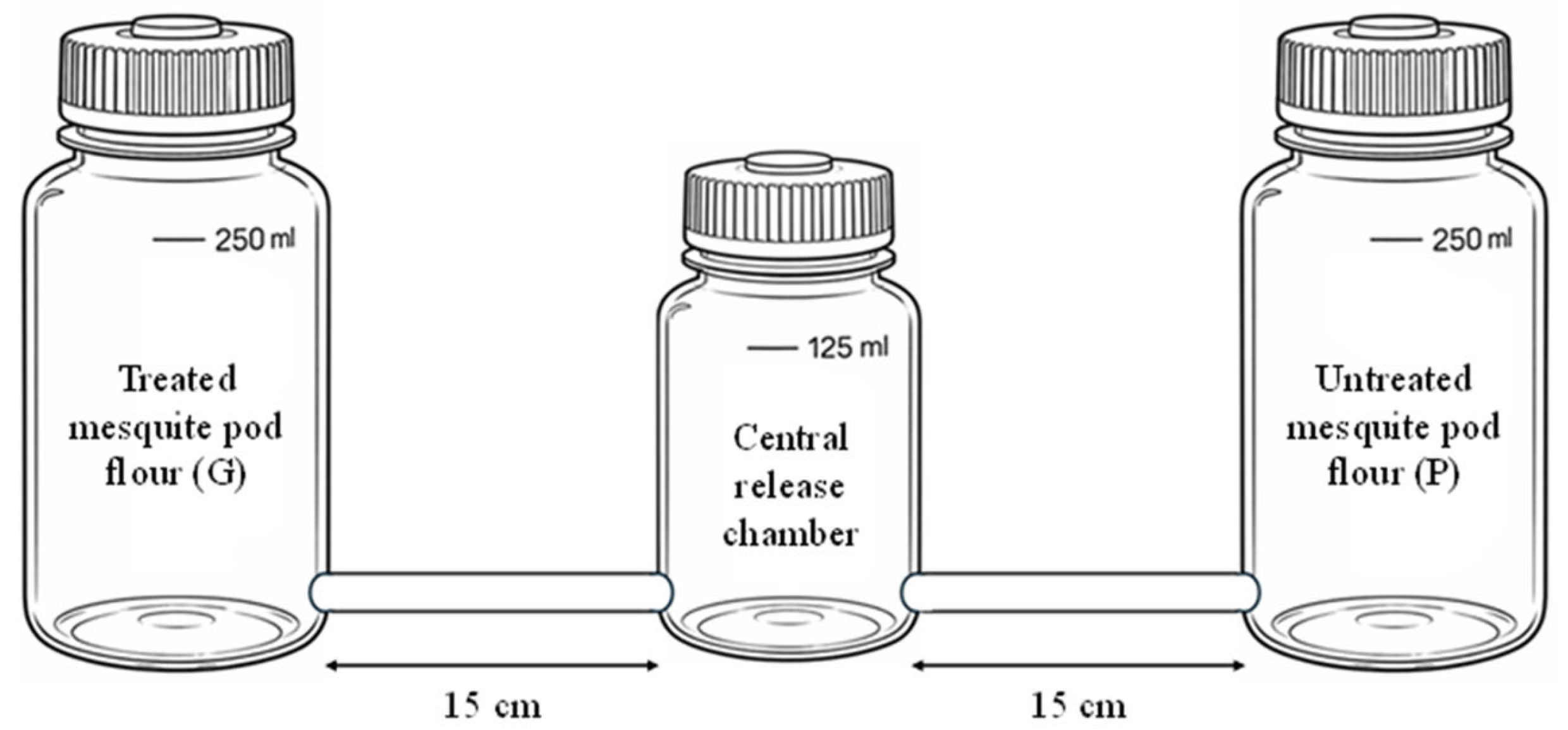
Repellent activity of plant-based additives was evaluated using a three-chamber choice-test system adapted from Peña-Flores et al. [16], with modifications in device dimensions, substrate type, and insect density to accommodate mesquite pod flour. The system consisted of three plastic containers interconnected by cylindrical plastic tubes, allowing unrestricted insect movement between chambers (Figure 2).
Figure 2.
Schematic representation of the three-chamber choice-test system used to evaluate the repellency of plant-based additives against storage insects in mesquite pod flour.
Two lateral chambers (250 mL capacity each) served as choice chambers, whereas a central chamber (125 mL capacity) was used as the insect release chamber. Chambers were connected using plastic tubes (15 cm length, 1 cm internal diameter). For each experimental unit, 15 g of substrate was placed in each lateral chamber. One chamber contained mesquite pod flour mixed with the corresponding plant-based additive, while the opposite chamber contained untreated mesquite pod flour as the control substrate.
Treatments consisted of incorporating powdered R. communis leaves or stems at concentrations of 1, 5, 10, and 20% (w·w−1). L. origanoides powder was included as a positive control due to its documented repellent activity, whereas M. sativa powder served as a low-bioactivity reference material. For each treatment and concentration, 50 unsexed adults (1–10 days old) were released into the central chamber.
After release, chambers were covered with perforated lids to allow ventilation while preventing insect escape. Assays were conducted at 25 ± 2 °C in complete darkness to minimize external visual stimuli. Insects were allowed to move freely within the system for 24 h, after which the number of individuals present in each lateral chamber was recorded.
Treatments were arranged in a completely randomized design with four independent replicates per concentration. The position of treated and untreated chambers was alternated between replicates to minimize positional bias.
2.6. Repellency Assessment and Response Variables
Repellent responses were evaluated based on the distribution of adult insects between treated and untreated mesquite flour chambers after 24 h of exposure. At the end of each assay, the number of insects present in the treated chamber (G) and in the untreated control chamber (P) was recorded. Individuals remaining in the central chamber or within the connecting tubes were considered non-responders and excluded from the choice analysis.
For statistical inference, only responding insects (G + P) were considered. The repellent effect of plant-based additives intended for mesquite flour preservation was analyzed using binary logistic regression. For each experimental unit, the response variable was defined as the number of insects present in the control chamber (P) relative to the total number of responding insects (G + P). Treatment concentration was included as a continuous predictor variable.
For descriptive comparison with previous studies, a repellency index (RI) was calculated according to Ail-Catzim et al. [17]:
where RI = 1 indicates a neutral effect, RI < 1 indicates repellency, and RI > 1 indicates attraction.
2.7. Long-Term Storage Assay and Experimental Conditions
A long-term storage assay was conducted to evaluate the performance of plant-based additives under conditions simulating traditional on-farm storage of mesquite pod flour. The objective was to determine whether plant-based additives could contribute to the preservation of mesquite pod flour during prolonged storage under conditions representative of low-input rural livestock systems in arid and semi-arid environments.
Mature pods of P. laevigata were collected in June 2024 and processed as described in Section 2.2 to obtain whole-pod flour. Prior to treatment application, the flour was thermally disinfested at 85 °C for 3 h to eliminate any pre-existing insect stages (eggs, larvae, pupae, or adults). After cooling to room temperature, the flour was immediately used for treatment preparation.
Three plant species with documented or reported insect-repellent activity were evaluated: A. indica, L. origanoides, and R. communis. Plant materials were dried, pulverized, and prepared as described in Section 2.3. Each plant powder was incorporated into mesquite flour at two concentrations (5% and 10%, w·w−1). Untreated mesquite flour without botanical additives served as the control.
For each plant species and concentration, two independent replicates were prepared, along with three independent control replicates. Measured quantities of mesquite flour and plant powder were thoroughly homogenized to ensure uniform distribution of the additives. Each experimental unit consisted of 100 g of treated or untreated flour placed in polyethylene storage bags.
No insects were intentionally introduced, and infestation resulted from natural colonization under ambient storage conditions. Therefore, this assay was designed to evaluate the long-term protective effect of plant-based additives on mesquite flour preservation rather than short-term behavioral repellency alone.
All samples were stored in a warehouse under ambient environmental conditions representative of rural storage systems, with temperatures ranging from 17 to 34 °C and relative humidity between 8 and 74%. The storage period lasted 14 months.
At the end of storage, each bag was opened and its contents were examined for insect infestation. The numbers of larvae, pupae, and adult beetles were recorded manually. Infestation was expressed as the total number of insects per sample and by developmental stage.
2.8. Evaluation of Insect Infestation During Storage
Insect infestation was evaluated at the end of the 14-month storage period by direct inspection of each experimental unit. Immediately after opening each bag, all visible insects were manually collected and counted to prevent escape or redistribution.
Individuals were classified according to developmental stage (larvae, pupae, and adults). Because infestation in the long-term storage assay resulted from natural colonization under ambient conditions, species-level identification was not performed for all recovered insects. Individuals were morphologically consistent with the genus Tribolium Macleay, 1825 and are therefore referred to as Tribolium spp. in this experiment. The objective of this assay was to evaluate overall infestation dynamics rather than species-specific responses. Therefore, all coleopteran individuals were pooled for quantitative analysis.
Infestation was expressed as the total number of insects per 100 g of sample, as well as the number of individuals per developmental stage.
2.9. Proximate Analysis
Proximate composition of mesquite pod flour and R. communis leaf powder was determined on a dry matter basis according to standard procedures for feed and plant materials described by the Association of Official Analytical Chemists (AOAC) [18]. These analyses were conducted to characterize the nutritional attributes of mesquite flour and the potential contribution of R. communis biomass when used as a plant-based additive for feed preservation. For each treatment, analyses were conducted using two independent experimental replicates. Chemical determinations were performed in triplicate for each replicate, and results are presented as the mean ± standard deviation.
Moisture content was determined by oven-drying approximately 2 g of sample at 100 °C for 24 h until constant weight. Ash content was quantified by incineration of pre-dried samples in a muffle furnace at 700 °C for 2 h following preliminary carbonization.
Crude protein content was determined by the Kjeldahl method, including acid digestion, alkaline distillation, and titration of released ammonia. Nitrogen content was converted to crude protein using a factor of 6.25.
Crude lipid content (ether extract) was determined by Soxhlet extraction of dried samples using diethyl ether as solvent for 6 h, and lipid percentage was calculated gravimetrically after solvent evaporation.
Crude fiber was measured after sequential acid (0.2 N H2SO4) and alkaline (0.2 N NaOH) digestion of defatted samples, followed by drying, incineration, and gravimetric determination.
Total carbohydrate content was calculated by difference from the proximate analysis.
2.10. Determination of Lignin Content
Lignin content was determined using the acetyl bromide soluble lignin (ABSL) method, a spectrophotometric procedure widely applied for total lignin quantification in lignocellulosic biomass due to its sensitivity and reproducibility [19,20,21]. This analysis was included to provide a comparative estimate of structural lignification associated with the evaluated plant materials and mesquite flour.
Samples of R. communis leaves and stems and mesquite pod flour (P. laevigata) were oven-dried at 40 °C for 48 h to constant weight, milled, and passed through a 100-mesh sieve to ensure homogeneous particle size.
Cell wall residue (CWR) was isolated following Foster et al. (2010) [19] with minor modifications. Briefly, milled samples were sequentially extracted with 70% (v·v−1) ethanol and chloroform:methanol (1:1, v·v−1) to remove soluble compounds. The resulting alcohol-insoluble residue was washed with acetone and air-dried prior to lignin determination.
For ABSL quantification, 4.5 mg of dried CWR were digested with 25% (v·v−1) acetyl bromide in glacial acetic acid at 50 °C for 2 h with periodic agitation. After cooling, the reaction was stopped by adding 2 M NaOH and 0.5 M hydroxylamine hydrochloride, and the final volume was adjusted to 6 mL with glacial acetic acid. Samples were centrifuged, and aliquots of the supernatant were transferred to UV-transparent 96-well plates. Absorbance was measured at 280 nm using a microplate spectrophotometer.
Acetyl bromide soluble lignin was calculated as:
where A280 is the absorbance at 280 nm, V is the final volume of the extract (L), m is the dry mass of cell wall material (g), l is the effective optical path length (0.539 cm), and ε is the extinction coefficient.
Because extinction coefficients vary among plant tissues, tissue-specific coefficients were selected based on comparable biomass types reported by Fukushima and Hatfield [21]. An extinction coefficient of 15.69 L g−1 cm−1 was applied to R. communis leaves, whereas a value of 17.90 L g−1 cm−1 was used for R. communis stems and mesquite pod flour, corresponding to leaf-type and hardwood-type lignin analogs, respectively.
2.11. Determination of Ricin-Like Content
The less toxic RCA120 agglutinin of R. communis is structurally similar to ricin, with sequence homology values of 93 and 84% between chains A and B, respectively [22]. Therefore, ricin-like proteins were quantified using RCA120 agglutinin as calibration standard because polyclonal anti-ricin antibodies also recognize RCA120.
Ricin-like protein content was determined in R. communis leaves and stems to assess the potential toxicological implications associated with the use of vegetative tissues as plant-based additives for mesquite flour preservation. For comparative purposes, ricin-like protein levels were also quantified in castor bean seeds and castor bean cake, which served as reference matrices with established ricin occurrence.
Protein extraction and quantification followed the general procedure described by Baldoni et al. [23], with minor modifications. Dried plant materials (leaves, stems, seeds, and cake) were finely ground, and 0.2 g of each sample was homogenized in 50 mM sodium phosphate buffer (pH 7.0) containing 20 mM NaCl, supplemented with dithiothreitol and protease inhibitor. Suspensions were agitated at 4 °C to facilitate protein extraction.
Extracts were centrifuged under refrigerated conditions at high speed, and the supernatants were collected. Soluble protein concentration was determined using the Bradford assay, with bovine serum albumin as standard [24].
Ricin-like proteins were quantified by enzyme-linked immunosorbent assay (ELISA) using rabbit polyclonal anti-ricin antibodies (ABCAM AB27169). R. communis agglutinin (RCA120, Sigma L7886) was used as the calibration standard, and results are expressed as RCA120 equivalents, reflecting total immunoreactive ricin-type proteins. Goat antibodies against rabbit antibodies coupled to radish peroxidase (ABCAM AB97051) were used to detect ricin antibodies bound to recognized proteins in the samples. 3,3′,5,5′-Tetramethylbenzidine (TMB) was employed as substrate of radish peroxidase and after 20 min of incubation in darkness the reaction was stopped with 2 M sulfuric acid.
Absorbance was measured at 450 nm using a microplate reader. Ricin-like protein content (RCA120 equivalents) was expressed both as micrograms per milligram of soluble protein (µg mg−1 protein) and as micrograms per gram of dry matter (µg g−1 DM), where DM refers to dry matter basis.
2.12. Statistical Analysis
Repellent responses associated with plant-based additives for mesquite flour preservation were analyzed using binary logistic regression [25]. For each experimental unit, the response variable was defined as the number of insects recorded in the untreated mesquite flour (control chamber, P) relative to the total number of responding insects (P + G), where G corresponds to insects present in the treated substrate. This binomial formulation allowed modeling the probability of insect presence in the control chamber as a function of plant material concentration.
The percentage (w·w−1) of R. communis leaf or stem powder incorporated into mesquite flour was treated as a continuous predictor variable. Models were fitted using a logit link function. The significance of predictors was evaluated using likelihood ratio chi-square tests.
Model fit was assessed using deviance and Pearson goodness-of-fit statistics, as well as the Hosmer–Lemeshow test. Odds ratios (OR) and corresponding 95% confidence intervals were calculated to quantify the effect of increasing plant material concentration on insect distribution between treated and untreated substrates. An OR > 1 was interpreted as an increased probability of insects remaining in the untreated substrate, indicating a repellent effect.
Predicted probabilities were derived from the fitted models across the evaluated concentration range (1–20% w·w−1), and binary fitted line plots were generated to visualize dose–response relationships. All analyses were performed using Minitab® 17 statistical software (Minitab LLC, State College, PA, USA). Statistical significance was established at p < 0.05.
The long-term storage experiment was designed as an exploratory assessment of the practical performance of botanical additives under ambient storage conditions. Because only two independent experimental replicates were available per treatment, no inferential statistical analyses were conducted for these data. Results are therefore presented descriptively as means ± standard deviations and interpreted as exploratory observations.
3. Results and Discussion
3.1. Repellent Response of Storage Insects to Ricinus communis Under Controlled Conditions
Under controlled laboratory conditions, Ricinus communis exhibited a clear plant-part- and concentration-dependent repellent response in the three-chamber choice assay (Table 1). Marked differences were observed between leaf- and stem-derived materials, and these responses were contextualized through comparison with the positive (Lippia origanoides) and low-bioactivity (Medicago sativa) reference materials. Overall, the results indicate that plant-based additives can substantially influence insect distribution in mesquite pod flour and may contribute to its preservation during storage.
Table 1.
Repellent response of storage insects to plant-based treatments under controlled conditions.
Powders derived from R. communis leaves induced repellency across the entire concentration range evaluated (1–20% w·w−1), with repellency index (RI) values consistently below the neutrality threshold (RI < 1). Even at the lowest inclusion level (1% w·w−1), insects preferentially accumulated in the untreated control chamber (RI = 0.65 ± 0.27). Increasing concentrations resulted in a progressive decline in RI values, reaching a minimum at 20% w·w−1 (RI = 0.09 ± 0.08). This monotonic decrease reflects a well-defined dose–response pattern consistent with behavioral avoidance of the treated mesquite flour.
In contrast, stem-derived material elicited a weaker and more variable response. At 1% w·w−1, stem powder produced slight attraction (RI = 1.18 ± 0.19), indicating that low stem inclusion levels did not provide sufficient deterrent cues. However, increasing concentrations (5–20% w·w−1) progressively shifted the response toward repellency (RI = 0.69 ± 0.33 at 5%, 0.47 ± 0.42 at 10%, and 0.25 ± 0.11 at 20%). Although this trend was concentration-dependent, repellency associated with stems remained consistently lower than that observed for leaves at equivalent inclusion levels. These results indicate that the repellent activity of R. communis is more strongly associated with foliar tissues than with stem material.
The positive control, Lippia origanoides, produced strong repellency across all tested concentrations, confirming the sensitivity of the experimental system. RI values were already low at 1% w·w−1 (RI = 0.36 ± 0.15) and approached near-complete avoidance at 20% w·w−1 (RI = 0.03 ± 0.02). At higher inclusion rates, L. origanoides yielded the lowest RI values among all treatments, supporting its suitability as a reference botanical repellent [15]. By contrast, M. sativa, used as a low-bioactivity reference material, did not behave as a strictly neutral substrate. Although RI values remained below 1 across all concentrations tested (0.63–0.67 at 1–5% and 0.27–0.31 at 10–20%), the magnitude of repellency was comparatively modest at low inclusion levels and became more pronounced only at higher concentrations. This pattern suggests that elevated incorporation levels of even low-bioactivity plant materials may influence insect distribution, possibly through physical modification of the flour matrix or dilution of attractive cues. Accordingly, M. sativa should be interpreted as a low-bioactivity reference rather than an inert control, particularly at inclusion levels ≥10% w·w−1.
Previous studies have demonstrated that the bioactivity of R. communis varies according to plant organ, with leaf-derived materials generally exhibiting stronger repellent or insecticidal effects than other tissues. Pacheco-Sánchez et al. [9] reported reduced insect visitation in agave plants treated with leaf extracts compared with seed extracts, highlighting the greater deterrent capacity of foliar tissues. Repellent effects of R. communis leaf extracts against stored-product insects have also been reported [9,10,26], whereas evidence regarding additional effects such as mortality or identification of specific active constituents remains comparatively limited [27].
These patterns were further supported by binary logistic regression analysis (Table 2), which confirmed a statistically significant dose-dependent repellent response for all evaluated plant materials (p < 0.001). In all cases, increasing botanical inclusion significantly increased the probability of insects remaining in the untreated control substrate, indicating progressive avoidance of treated mesquite flour as concentration increased.
Table 2.
Logistic regression analysis of dose-dependent repellency.
Within R. communis, clear differences were observed between plant organs. Leaf-derived material exhibited a stronger concentration effect than stem-derived material. Specifically, each 1% increase in leaf powder concentration was associated with a 17% increase in the odds of insect presence in the control chamber (OR = 1.17; 95% CI: 1.11–1.23), whereas stem powder produced a 13% increase per concentration unit (OR = 1.13; 95% CI: 1.08–1.17). These results quantitatively confirm the organ-dependent repellency observed in the descriptive analysis and indicate that foliar tissues provide stronger behavioral deterrent cues than stems.
The positive control, Lippia origanoides, displayed a concentration effect comparable in magnitude to that of R. communis leaves (OR = 1.17; 95% CI: 1.11–1.24), supporting its role as a reference repellent and confirming the sensitivity of the assay to detect graded behavioral responses. In contrast, M. sativa exhibited a weaker concentration effect (OR = 1.06; 95% CI: 1.03–1.09). Although statistically significant, the comparatively shallow slope suggests that its influence on insect distribution was modest and likely related to non-specific matrix effects rather than to strong repellent chemistry.
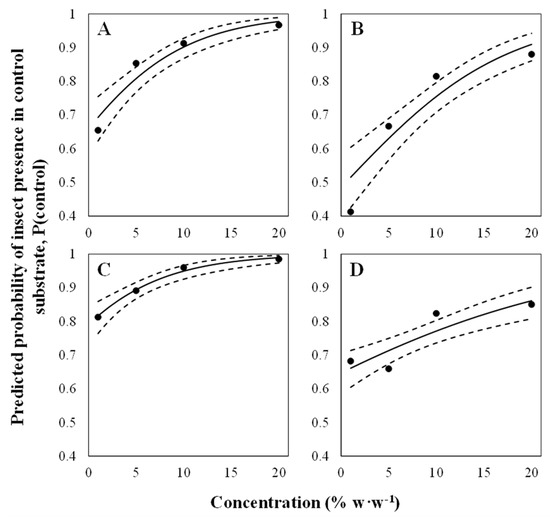
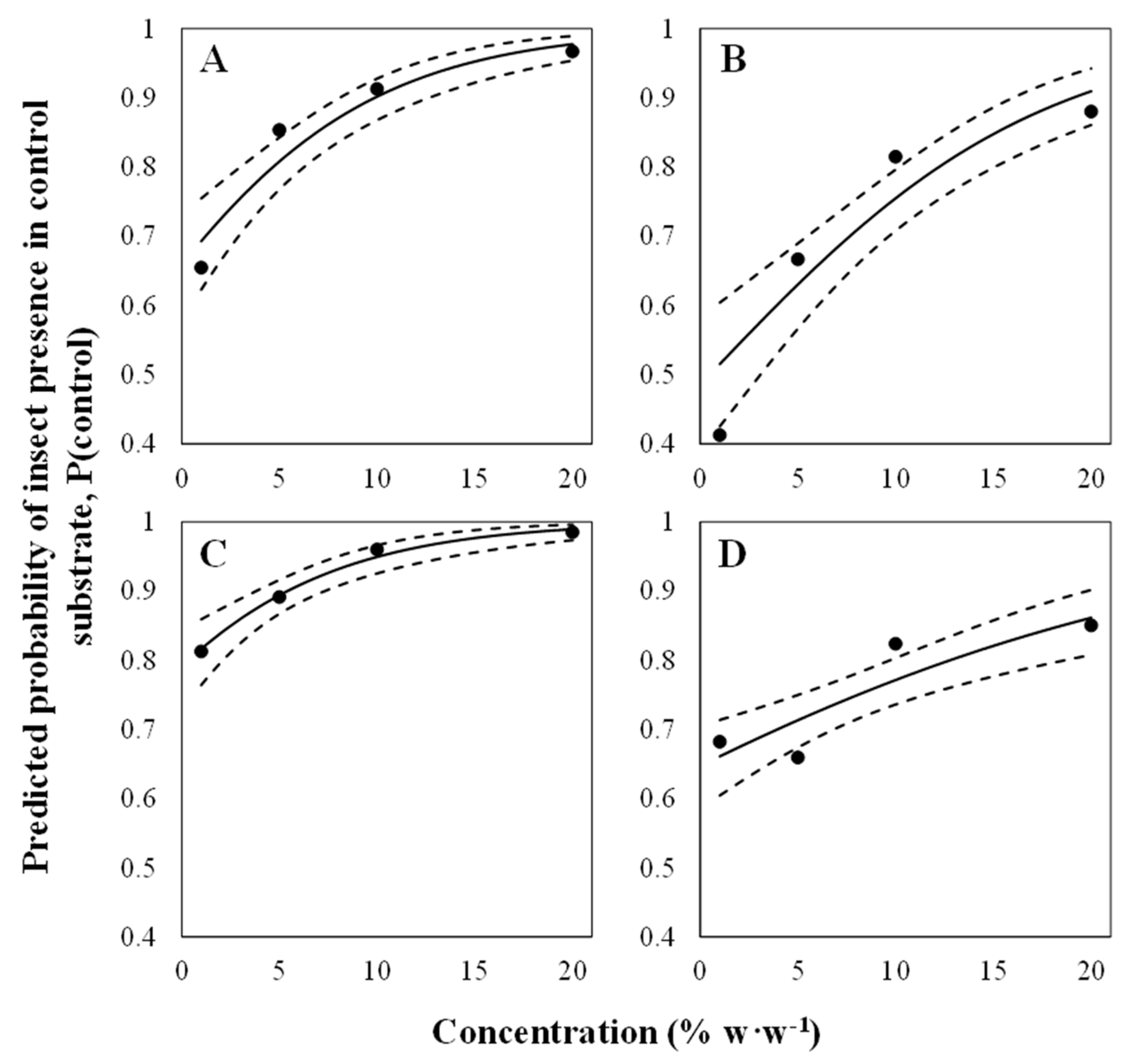
Binary fitted probability plots further illustrate these patterns (Figure 3), showing a monotonic increase in the predicted probability of insect presence in the control substrate as botanical concentration increased. Steeper dose–response curves were observed for L. origanoides and R. communis leaves, indicating a rapid shift in insect distribution even at moderate concentrations. In contrast, stem material displayed a more gradual response, and M. sativa showed the weakest concentration–response relationship.
Figure 3.
Binary logistic regression plots showing the relationship between botanical additive concentration (% w·w−1) and the probability of insect occurrence in the control substrate. (A) Ricinus communis leaf powder, (B) Ricinus communis stem powder, (C) Lippia origanoides aerial parts, and (D) Medicago sativa aerial parts. Points represent observed probabilities, solid lines represent model-predicted probabilities, and dashed lines indicate 95% confidence intervals.
Direct comparisons between leaves and stems under identical experimental conditions are scarce. The present study demonstrates that leaf material exhibits superior repellent performance relative to stems across a broad concentration range. From an applied perspective, these findings highlight the importance of organ-specific selection when developing plant-based preservation strategies for mesquite-derived feed resources intended for low-input livestock systems.
3.2. Long-Term Storage Performance of Plant-Based Additives Under Simulated Rural Conditions
Although laboratory choice assays demonstrated concentration-dependent behavioral repellency, short-term responses do not necessarily predict long-term performance under practical storage conditions. In stored feed systems, insects remain in continuous contact with treated substrates over extended periods, during which volatilization or degradation of bioactive compounds, redistribution of powders, reproduction, and population turnover may substantially modify treatment efficacy.
To explore whether the repellency patterns observed under controlled conditions were associated with differences in insect population characteristics during storage, a long-term assay was conducted under ambient, non-controlled conditions representative of rural dryland storage systems. This approach allowed evaluation of the persistence of botanical additives and their association with insect population development, life-stage structure, and overall infestation intensity during prolonged storage of mesquite pod flour intended for livestock use.
The selection of plant materials differed partially from that used in the laboratory assays. M. sativa, included previously as a low-bioactivity reference, was excluded from the storage experiment due to its limited repellent effect under controlled conditions. In contrast, A. indica was incorporated because of its well-documented insect growth regulatory activity in stored-product systems, providing a relevant benchmark for long-term botanical preservation performance.
After 14 months of storage, differences in infestation levels and population structure were observed among treatments (Table 3). Untreated mesquite flour exhibited high adult abundance, whereas samples containing botanical additives showed altered developmental stage distributions depending on plant species and concentration.
Table 3.
Insect infestation after long-term storage of mesquite flour treated with botanical additives.
In control samples, adults constituted the predominant life stage, with comparatively fewer larvae and pupae. This pattern is characteristic of uninterrupted population development in flour-based substrates, where favorable nutritional conditions permit continuous adult emergence [28]. Long-term storage studies indicate that pupae typically represent a small fraction of the total population under stable conditions, while adults accumulate as the dominant stage [29,30]. Therefore, the predominance of adults in untreated mesquite flour is consistent with sustained reproduction and successful life-cycle completion throughout the storage period [31].
In contrast, differences in insect population structure were observed among botanical treatments. Several treated samples showed lower adult abundance than the control and, in some cases, relatively higher proportions of immature stages, suggesting possible differences in developmental stage distribution and adult abundance. Botanical materials frequently act as repellents, antifeedants, or growth regulators rather than acute toxicants [9,10,11,32,33,34]. However, most available evidence derives from short-term laboratory studies, whereas documentation of sustained effects under prolonged storage conditions remains comparatively limited.
Among the evaluated treatments, R. communis leaf powder at 10% (w·w−1) showed the lowest total insect counts (77 ± 4) and one of the lowest larval abundances among the evaluated treatments, although larval abundance was not lower than that observed in the control. These observations suggest a potential association between R. communis supplementation and lower insect abundance under the conditions evaluated.
Treatments containing Azadirachta indica exhibited intermediate performance. Although total insect numbers remained comparable to the control, differences in developmental stage distribution were observed, particularly at 10% inclusion, where larval abundance was lower than at 5%. This pattern is consistent with the growth-regulatory effects attributed to neem-derived limonoids, which typically delay development and reduce adult emergence rather than inducing rapid mortality [35].
Lippia origanoides treatments were associated with moderate differences in infestation dynamics. Total insect numbers remained relatively high, particularly at 5% inclusion, although shifts in stage composition were evident. Essential oils and secondary metabolites from Lippia species are known to exhibit variable activity depending on concentration, volatility, and storage duration, which may explain the limited concentration–response pattern observed under extended storage [36].
Across treatments, total abundance and developmental stage composition were not always directly proportional. In some cases, lower adult abundance was observed without a corresponding increase in pupal density, suggesting altered developmental progression rather than acute mortality alone.
Overall, the long-term storage assay suggests that botanical additives may not completely prevent infestation under ambient rural storage conditions, although differences in insect abundance and developmental stage composition were observed among treatments. The lower adult abundance observed in treatments containing R. communis, particularly at higher inclusion levels, suggests that this species warrants further investigation as a plant-based additive for preserving mesquite-derived feed resources in low-input livestock systems of arid and semi-arid regions.
3.3. Nutritional Composition of Mesquite Flour and Plant-Based Additives
Because the proposed preservation strategy involves the incorporation of Ricinus communis leaf biomass into mesquite pod flour intended for livestock use, proximate composition was evaluated for both materials. This analysis was conducted to provide baseline compositional information relevant to the characterization of the feed resource and the botanical additive used in the preservation system.
Proximate analysis revealed marked compositional differences between mesquite pod flour and R. communis leaf powder (Table 4), indicating distinct and complementary nutritional profiles. Mesquite pod flour was characterized by a high total carbohydrate content (77.22 ± 0.16%), low ether extract (0.46 ± 0.04%), and moderate crude protein levels (8.84 ± 0.04%). This composition is consistent with previous reports describing Prosopis pods as carbohydrate-rich materials with limited lipid content and moderate protein contribution [37,38], supporting their importance as energy-rich feed resources for livestock systems in arid and semi-arid regions, particularly during periods of forage scarcity.
Table 4.
Proximate composition of mesquite pod flour and Ricinus communis leaf powder.
In contrast, R. communis leaf powder exhibited a substantially higher crude protein content (22.63 ± 0.01%), together with increased ash, ether extract, and crude fiber fractions relative to mesquite flour. These values are comparable to those reported by Su et al. [12], who documented crude protein levels near 20.6% in castor bean leaves, along with moderate fiber and low lipid concentrations. Minor differences among studies likely reflect variation in plant maturity, environmental conditions, and postharvest processing.
The comparatively high protein content of R. communis leaves suggests that even modest inclusion levels may contribute measurably to the overall protein fraction of mesquite-based formulations. In controlled feeding trials, supplementation with 0.5–2% processed castor leaf powder improved feed conversion efficiency and productive performance in laying hens over a 12-week period, without reported adverse effects [12]. Although the present study did not evaluate animal performance directly, these findings provide context for the potential nutritional relevance of R. communis vegetative biomass when incorporated at controlled inclusion levels.
From an applied perspective, the compositional complementarity observed between mesquite flour and R. communis leaves may be advantageous for low-input livestock systems in dryland environments. Mesquite pod flour functions primarily as an energy-rich substrate, whereas R. communis leaf powder provides comparatively greater protein and mineral contributions. Under the preservation strategy evaluated in the present study, the incorporation of plant-based additives may therefore contribute not only to storage protection but also to maintaining or modestly improving the nutritional profile of mesquite-derived feed resources during prolonged storage.
3.4. Lignin Content of Mesquite Flour and Ricinus communis Tissues
Acetyl bromide soluble lignin (ABSL) was quantified on a cell wall residue (CWR) basis to provide a comparative estimate of lignification within the structural fraction of the evaluated materials. This parameter was included as an indirect indicator of potential differences in digestibility, considering the well-established inverse relationship between lignin concentration and microbial degradation of cell wall polysaccharides in forage systems [39].
Lignin content, expressed as a percentage of the recovered cell wall fraction, differed among materials (Table 5). R. communis stems exhibited the highest lignin proportion (18.49 ± 1.40%), followed by R. communis leaves (14.26 ± 1.53%), whereas mesquite pod flour showed the lowest value (12.78 ± 1.60%).
Table 5.
Acetyl bromide soluble lignin content expressed as percentage of cell wall material.
These differences are consistent with the structural roles of the analyzed tissues. The greater lignification observed in stem material reflects its mechanical and support function, whereas the intermediate lignin content in leaves and the lower proportion in mesquite pod flour are typical of tissues with a higher contribution of parenchymatic and storage components [40].
From a forage perspective, the lignin level measured in mesquite pod flour falls within the range commonly reported for leguminous forages and crop residues (approximately 10–15% of the cell wall fraction) when determined using acetyl bromide–based methods [21]. This result supports the potential suitability of mesquite pod flour as a digestible feed resource for livestock systems in arid and semi-arid regions.
Although R. communis tissues exhibited higher lignification than mesquite flour, the values observed for leaves remained within ranges commonly reported for herbaceous biomass incorporated into animal feeding systems. Considering that R. communis was evaluated in the present study as a low-inclusion plant-based additive rather than as a primary forage source, the lignin levels detected are unlikely to substantially affect the overall structural quality of mesquite-derived feed formulations.
Overall, the lignin profiles obtained indicate that the incorporation of R. communis leaf biomass at the evaluated levels is compatible with the preservation-oriented strategy proposed for mesquite flour in low-input livestock systems.
3.5. Organ-Specific Ricin-Like Protein Content in Ricinus communis
R. communis is primarily recognized for the presence of ricin in its seeds, which represents the most extensively studied toxic compound associated with this species. Given the potential implications for the use of vegetative biomass as a plant-based additive in feed preservation systems, ricin-like protein content was specifically evaluated in the tissues analyzed in the present study.
Marked organ-specific differences in ricin-like protein distribution were detected (Table 6).
Table 6.
Soluble protein content and RCA120 equivalents in Ricinus communis tissues.
As expected, seeds exhibited the highest concentrations, whereas vegetative tissues contained substantially lower levels. On a dry matter basis, ricin equivalents in leaves (10 ± 1 µg g−1 DM) and stems (5 ± 1 µg g−1 DM) represented only 3.5% and 1.8%, respectively, of the concentration quantified in seeds (285 ± 11 µg g−1 DM). Seed cake showed intermediate values, consistent with its derivation from seed tissue.
These results confirm the well-established organ-specific accumulation pattern of ricin-like proteins in R. communis and indicate that the repellent responses observed in the present study are unlikely to be directly associated with ricin accumulation in vegetative tissues. This interpretation is consistent with previous reports indicating that ricin accumulates predominantly in seeds and related by-products, whereas leaves and stems contain negligible or substantially lower concentrations [13,23].
In addition to the low ricin-like protein content observed in vegetative tissues, previous studies have reported the presence of diverse bioactive secondary metabolites in R. communis leaves [41,42]. Extracts obtained from leaf tissues have exhibited biological activity against several agricultural and stored-product pests [9,10,11,42]; however, these extracts comprise complex mixtures of compounds, making it difficult to attribute the observed effects to any single constituent [42]. Therefore, the repellent responses observed in the present study may be associated with the overall phytochemical complexity of leaf tissues rather than with ricin-like proteins alone.
Nevertheless, the comparatively low ricin-like protein content detected in leaves and stems does not imply that vegetative biomass is toxicologically irrelevant. Adverse effects associated with ingestion of R. communis leaves have been reported in livestock and are considered mechanistically distinct from ricin intoxication, being attributed to other secondary metabolites present in vegetative tissues. These effects, which mainly involve neuromuscular alterations such as tremors and incoordination, have been described primarily at high intake levels of fresh or dried leaf material and exhibit clear dose dependence [13,14].
Processing conditions and inclusion level are critical determinants of toxicological risk. Drying and storage have been reported to reduce toxicity, and tolerance varies among animal species. In poultry, dietary inclusion of 0.5–2% dried and ground R. communis leaf powder produced no adverse clinical signs and improved feed conversion efficiency [12]. In the context of the present study, R. communis was evaluated as a low-inclusion plant-based additive intended for preservation of mesquite-derived feed resources rather than as a primary feed ingredient. Under this framework, the low ricin-like protein concentrations detected in vegetative tissues support the feasibility of further exploring controlled applications of R. communis biomass in storage protection strategies for low-input livestock systems.
4. Conclusions
This study demonstrates that Ricinus communis leaf powder exerts a strong concentration-dependent repellent effect against storage insects associated with mesquite (Prosopis laevigata) pod flour. Under controlled laboratory conditions, leaf material consistently outperformed stem tissue, confirming organ-specific bioactivity and supporting the selection of foliar biomass for preservation-oriented applications.
Importantly, the behavioral avoidance observed in short-term assays was associated with differences in population dynamics during prolonged storage. After 14 months under ambient conditions representative of rural dryland storage systems, lower adult abundance and differences in infestation structure were observed in treatments containing R. communis leaf powder compared with untreated mesquite flour.
Nutritional characterization showed that mesquite flour functions primarily as an energy-rich feed resource, whereas R. communis leaf powder provides additional protein within ranges reported for conventional forage materials. Likewise, lignin levels were comparable to those reported for digestible forage resources. Ricin-like protein content was markedly higher in seeds and castor cake, while vegetative tissues contained substantially lower concentrations, confirming organ-specific accumulation and suggesting that the repellent activity observed in leaves is unlikely to be directly associated with ricin-like proteins.
Collectively, these findings provide experimental support for a traditional preservation practice and identify dried R. communis leaves as a promising plant-based additive for protecting mesquite flour during prolonged storage under low-input conditions. The proposed strategy may contribute to the preservation of mesquite-derived feed resources in livestock systems of arid and semi-arid regions, where seasonal forage scarcity and storage limitations constrain feed availability. Further studies are required to define safe and effective inclusion thresholds across different animal production systems.
Author Contributions
Conceptualization, J.A.R. and M.A.C.-R.; methodology, J.A.R., M.A.C.-R., L.A.-M. and R.E.-S.; validation, R.M.C.-R.; formal analysis, M.A.C.-R.; investigation, I.C.R.-S., I.R.-R., L.A.-M., R.M.C.-R., R.E.-S., E.G.-A. and C.A.S.-T.; resources, I.R.-R., R.M.C.-R. and J.A.R.; data curation, I.R.-R., L.A.-M., R.M.C.-R., R.E.-S., E.G.-A. and C.A.S.-T.; writing—original draft preparation, I.C.R.-S. and M.A.C.-R.; writing—review and editing, I.C.R.-S., R.M.C.-R., J.A.R. and M.A.C.-R.; visualization, L.A.-M.; supervision, R.M.C.-R., J.A.R. and M.A.C.-R.; project administration, M.A.C.-R. All authors have read and agreed to the published version of the manuscript.
Funding
This research was supported by the Universidad de Guadalajara through institutional resources, research infrastructure, and publication support.
Data Availability Statement
The original contributions presented in this study are included in the article. Further inquiries can be directed to the corresponding author.
Acknowledgments
The authors acknowledge the support from the REBIORN Network (Red de Estudios en Biotecnología y Recursos Naturales). During the preparation of this manuscript, the authors used ChatGPT (OpenAI, San Francisco, CA, USA; https://chatgpt.com/), based on the GPT-5.5 model, for language editing, grammatical revision, text organization, and improvement of writing clarity and structure. The authors have reviewed and edited the output and take full responsibility for the content of this publication.
Conflicts of Interest
The authors declare no conflicts of interest.
Abbreviations
The following abbreviations are used in this manuscript:
| ABSL | Acetyl bromide soluble lignin |
| AOAC | Association of Official Analytical Chemists |
| CI | Confidence interval |
| CWR | Cell wall residue |
| DM | Dry matter |
| ELISA | Enzyme-linked immunosorbent assay |
| OR | Odds ratio |
| RCA120 | Ricinus communis agglutinin 120 |
| RI | Repellency index |
| SD | Standard deviation |
| SE | Standard error |
| TMB | 3,3′,5,5′-Tetramethylbenzidine |
| UV | Ultraviolet |
References
- Zhong, J.; Lu, P.; Wu, H.; Liu, Z.; Sharifi-Rad, J.; Setzer, W.N.; Suleria, H.A.R. Current insights into phytochemistry, nutritional, and pharmacological properties of Prosopis plants. Evid. Based Complement. Altern. Med. 2022, 2022, 2218029. [Google Scholar] [CrossRef] [Scilit] [PubMed]
- González-Aguayo, E.; Camacho-Ruiz, M.Á. Estimación de la superficie de mezquite (Prosopis spp.) con sensores remotos en la región norte de Jalisco [Estimation of mesquite (Prosopis spp.) area using remote sensing in northern Jalisco region]. In Pensar la ciencia desde la frontera: Aproximaciones multidisciplinarias; Rodríguez Rodríguez, N., Delgado Rodríguez, E.S., Briseño Aguilar, F., Eds.; University of Guadalajara: Jalisco, Mexico, 2020; Volume 1, pp. 57–64. [Google Scholar]
- Reséndez-Velázquez, K.L.; González-Castillo, M.P. Estimate of damage on mesquite pods and seeds (Prosopis laevigata (Willd) M.C. Johnst) (Mimosoideae) caused by bruchids (Coleoptera) in the municipality of Durango, Durango, Mexico. Am. J. Appl. Sci. 2016, 13. [Google Scholar] [CrossRef] [Scilit]
- Felker, P.; Xuetong, F. Chapter 15—Food safety issues and mitigation of Prosopis flour. In Prosopis as a Heat Tolerant Nitrogen Fixing Desert Food Legume; Puppo, M.C., Felker, P., Eds.; Elsevier: Amsterdam, The Netherlands, 2022; pp. 231–240. [Google Scholar]
- Kingsolver, J.M. A taxonomic study of the genus Algarobius. Entomography 1986, 4, 109–136. [Google Scholar]
- Stathas, I.G.; Sakellaridis, A.C.; Papadelli, M.; Kapolos, J.; Papadimitriou, K.; Stathas, G.J. The effects of insect infestation on stored agricultural products and the quality of food. Foods 2023, 12, 2046. [Google Scholar] [CrossRef] [Scilit] [PubMed]
- El Baghazaoui, R.; Bouiamrine, E.H.; Nassiri, L.; Boutagayout, A.; Belmalha, S. Ecological management of stored grain pests: Global insights and future directions. IOP Conf. Ser. Earth Environ. Sci. 2024, 1398, 012026. [Google Scholar] [CrossRef] [Scilit]
- Dawson, P.S. Life history strategy and evolutionary history of Tribolium flour beetles. Evolution 1977, 31, 226–229. [Google Scholar] [CrossRef] [Scilit] [PubMed]
- Pacheco-Sánchez, C.; Villa-Ayala, P.; Montes-Belmont, R.; Figueroa-Brito, R.; Jiménez-Pérez, A. Repellency of hydroethanolic extracts of Ricinus communis (Euphorbiaceae) to Scyphophorus acupunctatus (Coleoptera: Curculionidae) in the laboratory. Fla. Entomol. 2012, 95, 706–710. [Google Scholar] [CrossRef] [Scilit]
- Adabie-Gomez, D.A.; Monford, K.G.; Agyir-Yawson, A.; Owusu-Biney, A.; Osae, M. Evaluation of four local plant species for insecticidal activity against Sitophilus zeamais Motsch. (Coleoptera: Curculionidae) and Callosobruchus maculatus (F) (Coleoptera: Bruchidae). Ghana J. Agric. Sci. 2007, 39, 147–154. [Google Scholar] [CrossRef] [Scilit]
- Gómez-Herrera, H.A.; González-Mejía, O.; González-Cortázar, J.C. Powdered vegetables for the management of Sitophilus zeamais Motschulsky in storage. Rev. Mex. Cienc. Agríc. 2018, 9, 787–798. [Google Scholar] [CrossRef] [Scilit]
- Su, B.-W.; Lin, W.-C.; Lin, L.-J.; Huang, C.-M.; Chuang, W.-Y.; Wu, D.-J.; Shih, C.-H.; Lee, T.-T. Laying Diet Supplementation with Ricinus communis L. leaves and Evaluation of Productive Performance and Potential Modulation of Antioxidative Status. J. Poult. Sci. 2020, 57, 259–269. [Google Scholar] [CrossRef] [Scilit] [PubMed]
- Brito, L.B.; Riet-Correa, F.; Almeida, V.M.; Silva Filho, G.B.; Chaves, H.A.S.; Braga, T.C.; Evêncio Neto, J.; Mendonça, F.S. Spontaneous poisoning by Ricinus communis leaves (Euphorbiaceae) in goats. Pesqui. Vet. Bras. 2019, 39, 123–128. [Google Scholar] [CrossRef] [Scilit]
- Tokarnia, C.H.; Döbereiner, J.; Canella, C.F. Experimental poisoning by the leaves of Ricinus communis in cattle. Pesq. Agropecu. Bras. 1975, 10, 1–7. [Google Scholar]
- Caballero-Gallardo, K.; Fuentes-Lopez, K.; Stashenko, E.E.; Olivero-Verbel, J. Chemical composition, repellent action, and toxicity of essential oils from Lippia origanoide, Lippia. alba Chemotypes, and Pogostemon cablin on adults of Ulomoides dermestoides (Coleoptera: Tenebrionidae). Insects 2023, 14, 41. [Google Scholar] [CrossRef] [Scilit] [PubMed]
- Peña-Flores, C.; Zapién-Martínez, A.; Sánchez-Cruz, G.; Reyes-Velasco, L.; Segura-Salvador, A.; Vargas-Arzola, J.; Hernández-Osorio, L.A.; Torres-Aguilar, H.; Bernardino-Hernández, H.U. Insecticidal and repellent activity of plant powders on the weevil (Sitophilus zeamais) in stored corn grains in a rural community of Oaxaca, Mexico. Insects 2025, 16, 329. [Google Scholar] [CrossRef] [Scilit] [PubMed]
- Ail-Catzim, C.E.; García-López, A.M.; Troncoso-Rojas, R.; González-Rodríguez, R.E.; Sánchez-Segura, Y. Insecticidal and repellent effect of extracts of Pluchea sericea (Nutt.) on adults of Bemisia tabaci (Genn.). Rev. Chapingo Ser. Hortic. 2015, 21, 33–41. [Google Scholar] [CrossRef] [Scilit]
- Latimer, G.W.J. Official Methods of Analysis of AOAC INTERNATIONAL; Oxford University Press (OUP): Oxford, UK, 2023. [Google Scholar] [CrossRef] [Scilit]
- Foster, C.E.; Martin, T.M.; Pauly, M. Comprehensive compositional analysis of plant cell walls (lignocellulosic biomass) part I: Lignin. J. Vis. Exp. 2010, 37, e1745. [Google Scholar] [CrossRef] [Scilit] [PubMed]
- Fukushima, R.S.; Hatfield, R.D. Extraction and isolation of lignin for utilization as a standard to determine lignin concentration using the acetyl bromide spectrophotometric method. J. Agric. Food Chem. 2001, 49, 3133–3139. [Google Scholar] [CrossRef] [Scilit] [PubMed]
- Fukushima, R.S.; Hatfield, R.D. Comparison of the acetyl bromide spectrophotometric method with other analytical lignin methods for determining lignin concentration in forage samples. J. Agric. Food Chem. 2004, 52, 3713–3720. [Google Scholar] [CrossRef] [Scilit] [PubMed]
- Roberts, L.M.; Lamb, F.I.; Pappin, D.J.; Lord, J.M. The primary sequence of Ricinus communis agglutinin. Comparison with ricin. J. Biol. Chem. 1985, 260, 15682–15686. [Google Scholar] [CrossRef] [Scilit]
- Botega Baldoni, A.; Guerra Araújo, A.C.; Holanda de Carvalho, M.; Gomes, A.C.M.M.; Aragao, F.J.L. Immunolocalization of Ricin Accumulation during Castor Bean (Ricinus communis L.) Seed Development. Int. J. Plant Biol. 2010, 1, e12. [Google Scholar] [CrossRef] [Scilit]
- Bradford, M.M. A rapid and sensitive method for the quantitation of microgram quantities of protein utilizing the principle of protein-dye binding. Anal. Biochem. 1976, 72, 248–254. [Google Scholar] [CrossRef] [PubMed]
- Hosmer, D.W.; Lemeshow, S.; Sturdivant, R.X. Applied Logistic Regression, 2nd ed.; John Wiley & Sons, Inc.: New York, NY, USA, 2000; pp. 159–188. [Google Scholar]
- Haq, T.; Usmani, N.; Abbas, T. Screening of plant leaves as grain protectant against Tribolium castaneum during storage. Pak. J. Bot. 2005, 37, 149–153. [Google Scholar]
- Upasani, S.M.; Kotkar, H.M.; Mendki, P.S.; Maheshwari, V.L. Partial characterization and insecticidal properties of Ricinus communis L foliage flavonoids. Pest Manag. Sci. 2003, 59, 1349–1354. [Google Scholar] [CrossRef] [Scilit] [PubMed]
- Hagstrum, D.W.; Subramanyam, B. Chapter 7—Population growth. In Fundamentals of Stored-Product Entomology; Hagstrum, D.W., Subramanyam, B., Eds.; AACC International Press: St. Paul, MN, USA, 2006; pp. 115–126. [Google Scholar]
- Benoît, H.P.; McCauley, E.; Post, J.R. Testing the demographic consequences of cannibalism in Tribolium confusum. Ecology 1998, 79, 2839–2851. [Google Scholar] [CrossRef] [Scilit]
- Park, T.; Miller, E.V.; Lutherman, C.Z. Studies in population physiology. IX. The effect of imago population density on the duration of the larval and pupal stages of Tribolium confusum DuVal. Ecology 1939, 20, 365–373. [Google Scholar] [CrossRef] [Scilit]
- Campbell, J.F.; Arbogast, R.T. Stored-product insects in a flour mill: Population dynamics and response to fumigation treatments. Entomol. Exp. Appl. 2004, 112, 217–225. [Google Scholar] [CrossRef] [Scilit]
- Joseph, M.; Mukherjee, S.N.; Sharma, R.N. Growth inhibition and impairment of reproductive potential in Tribolium castaneum (Herbst) (Coleoptera: Tenebrionidae) by commercially available plant extracts. Int. J. Trop. Insect Sci. 1994, 15, 197–202. [Google Scholar] [CrossRef] [Scilit]
- Ferreira Da Silva, K.; Lopes Baldin, E.L.; Da Rocha Pannuti, L.E. Use of botanical insecticides as an alternative for the management of the mexican bean weevil. Rev. Caatinga 2016, 29, 348–357. [Google Scholar] [CrossRef] [Scilit]
- Chowański, S.; Adamski, Z.; Marciniak, P.; Rosiński, G.; Büyükgüzel, E.; Büyükgüzel, K.; Falabella, P.; Scrano, L.; Ventrella, E.; Lelario, F.; et al. A review of bioinsecticidal activity of Solanaceae alkaloids. Toxins 2016, 8, 60. [Google Scholar] [CrossRef] [Scilit] [PubMed]
- Kilani-Morakchi, S.; Morakchi-Goudjil, H.; Sifi, K. Azadirachtin-based insecticide: Overview, risk assessments, and future directions. Front. Agron. 2021, 3, 676208. [Google Scholar] [CrossRef] [Scilit]
- Tapia Mattar, V.; Borioni, J.L.; Hollman, A.; Rodriguez, S.A. Insecticidal action, repellency, and toxicity mechanism of the essential oil of Lippia turbinata against the stored product pest Rhipibruchus picturatus (F.). Pestic. Biochem. Physiol. 2024, 201, 105907. [Google Scholar] [CrossRef] [Scilit] [PubMed]
- Díaz-Batalla, L.; Hernández-Uribe, J.P.; Román-Gutiérrez, A.D.; Cariño-Cortés, R.; Castro-Rosas, J.; Téllez-Jurado, A.; Gómez-Aldapa, C.A. Chemical and nutritional characterization of raw and thermal-treated flours of mesquite (Prosopis laevigata) pods and their residual brans. CyTA J. Food 2018, 16, 444–451. [Google Scholar] [CrossRef] [Scilit]
- Barba De La Rosa, A.P.; Frias-Hernández, J.T.; Olalde-Portugal, V.; González Castañeda, J. Processing, nutritional evaluation, and utilization of whole mesquite flour (Prosopis laevigata). J. Food Sci. 2006, 71, S315–S320. [Google Scholar] [CrossRef] [Scilit]
- Grabber, J.H. Relationships between cell wall digestibility and lignin content as influenced by lignin type and analysis method. Crop Sci. 2019, 59, 1122–1132. [Google Scholar] [CrossRef] [Scilit]
- Moore, K.J.; Jung, H.J.G. Lignin and fiber digestion. J. Range Manag. 2001, 54, 420–430. [Google Scholar] [CrossRef] [Scilit]
- Ramothloa, T.P.; Mkolo, N.M.; Motshudi, M.C.; Mphephu, M.M.; Makhafola, M.A.; Naidoo, C.M. Phytochemical composition and multifunctional applications of Ricinus communis L.: Insights into therapeutic, pharmacological, and industrial potential. Molecules 2025, 30, 3214. [Google Scholar] [CrossRef] [Scilit] [PubMed]
- Sotelo-Leyva, C.; Toledo-Hernández, E.; Navarro-Tito, N.; Aguilar-Marcelino, L.; Hernández-Salinas, G.; Salinas-Sánchez, D.O.; Peña-Chora, G. Chemical composition and aphidicidal properties of castor-bean leaves against Rhopalosiphum maidis and Sipha flava (Hemiptera: Aphididae). Chil. J. Agric. Res. 2023, 83, 228–235. [Google Scholar] [CrossRef] [Scilit]

Disclaimer/Publisher’s Note: The statements, opinions and data contained in all publications are solely those of the individual author(s) and contributor(s) and not of MDPI and/or the editor(s). MDPI and/or the editor(s) disclaim responsibility for any injury to people or property resulting from any ideas, methods, instructions or products referred to in the content. |
© 2026 by the authors. Licensee MDPI, Basel, Switzerland. This article is an open access article distributed under the terms and conditions of the Creative Commons Attribution (CC BY) license.