


Abstract
Elucidating the response mechanisms of C-, N-, and P-cycling enzyme activities within soil aggregates to tea plantation age can provide a theoretical foundation for improving soil fertility, safeguarding soil health, and promoting the sustainable use of soil resources in tea plantations. In the present study, soil samples were collected from the 0–20 cm layer of tea plantations with different ages (3, 9, 16, and 24 years). Then, soil samples were separated into >2, 2–1, 1–0.25, and <0.25 mm aggregate size fractions using an optimal moisture sieving method, and the activities of β-glucosidase, invertase, urease, protease, and acid phosphatase were measured in each fraction. Across all tea plantation ages, the aggregate composition was dominated by the >2 mm fraction, whose content was significantly (p < 0.05) higher than that of other size fractions, averaging 54.47%. With increasing plantation age, the content of >2 mm aggregates first increased and then decreased, reaching a relatively high level at 16 years. The activities of β-glucosidase, invertase, urease, and protease in the tea plantation soils were predominantly distributed in the >2 mm aggregates, with average activities of 261.34, 585.31, 52.24, and 84.34 mg kg−1 h−1, respectively; in contrast, acid phosphatase activity was less affected by aggregate size. As plantation age increased, the activities of β-glucosidase, invertase, urease, and protease initially increased and then decreased, reaching relatively high levels at 16 years (322.98, 696.66, 67.00, and 100.98 mg kg−1 h−1, respectively), whereas acid phosphatase activity progressively increased with age. During the aggregate fractionation process, all enzyme activities were lost to varying degrees, with average recovery rates of 80.45% (β-glucosidase), 83.13% (invertase), 80.78% (urease), 82.16% (protease), and 81.66% (acid phosphatase). As the primary carriers of soil enzymes, the formation and stabilization of >2 mm aggregates are of great importance for promoting soil organic C and nutrient cycling. In tea plantation management, therefore, attention should be directed to the breakdown and disruption of >2 mm aggregates after 16 years of cultivation to maintain soil quality and sustain soil organic C and nutrient use efficiency.
1. Introduction
Guangxi is located in the southern border region of China and falls within a subtropical monsoon climate zone, characterized by abundant rainfall, sufficient sunlight and thermal resources, and predominantly acidic soils [1]. Combined with a long history of tea (Camellia sinensis L.) cultivation and processing, these conditions endow the region with a natural advantage for developing a high-quality tea industry, making it one of China’s major tea-producing areas [2]. By the end of 2025, the tea plantation area in Guangxi had reached 112,430 ha, with a tea output of 136,600 t and a gross value of primary tea exceeding 4.5 billion yuan, reflecting a steadily expanding industrial scale [3]. The tea industry has played a pivotal economic role in raising farmers’ incomes and supporting poverty alleviation efforts [4]. According to incomplete statistics, a total of 979 villages and 202,600 households in Guangxi are engaged in tea cultivation, covering 454 formerly impoverished villages and 49,600 formerly impoverished households [5]; over 80% of the tea plantations are concentrated in poverty-stricken counties, and the tea industry has become a pillar sector for poverty eradication and income generation in most of these counties, thereby underpinning regional rural revitalization [6]. However, within the tea plantation ecosystem, soil organic C and nutrient status undergo profound changes during tea cultivation due to the combined effects of long-term management practices, the substantial return of tea plant litter to the soil, and the continuous input of root exudates [7,8,9]. Improper management practices readily lead to nutrient imbalance and soil acidification [10]. Litter rich in recalcitrant constituents such as polyphenols markedly alters the chemical composition and turnover rate of soil organic C [11], while organic acids and other bioactive substances secreted by roots persistently reshape the nutritional environment of the rhizosphere microzone [12]. These changes, directly or indirectly, disrupt the normal growth and development of tea plants, thereby inducing yield fluctuations and quality degradation [10,11,12]. This has become a prominent bottleneck restricting the quality improvement, efficiency enhancement, and sustainable development of the tea industry in Guangxi, China [13].
Soil enzymes, as the most active biological components in ecosystem material cycling and energy flow, are highly diverse and originate primarily from microbial metabolism, plant root exudation, and the decomposition of plant and animal residues in soil [14]. By catalyzing a series of complex and diverse biochemical reactions, they play a central role in driving the release and transformation of soil nutrients [15]. In the soil C cycle, β-glucosidase and invertase play key roles: β-glucosidase hydrolyzes glycosidic bonds in cellobiose and other substrates to release glucose, whereas invertase specifically cleaves sucrose to release glucose and fructose. Together, they progressively degrade macromolecular carbohydrates into more labile low-molecular-weight sugars, thereby providing microorganisms with readily utilizable C sources and profoundly influencing the mineralization, turnover, and sequestration of soil organic C [16]. In the soil N cycle, urease and protease are two common hydrolases. Urease specifically catalyzes the hydrolysis of urea to produce ammonia and CO2, while protease hydrolyzes peptide chains in proteins into amino acids. These two enzymes sequentially convert organic N into ammonium N and amino acid N, thereby transforming soil organic N into plant-available forms and significantly regulating soil N supply intensity and N use efficiency [17]. The transformation of soil organic P relies primarily on phosphatases, which effectively hydrolyze phosphate ester bonds in various organic P compounds (e.g., nucleic acids, phospholipids, and phytate), releasing inorganic phosphate that can be directly absorbed by plant roots. Phosphatase activity has become an important biological indicator for characterizing the status of soil P cycling and P-supplying potential [18]. Collectively, the activities of key enzymes involved in soil C, N, and P cycling not only directly reflect microbial metabolic activity and substrate utilization patterns but also integrate the combined effects of soil physicochemical properties, nutrient status, and environmental changes [19]. Therefore, measuring soil enzyme activities to indirectly reflect or predict soil organic C and nutrient use efficiency, thereby assessing the trajectory of soil quality evolution, is theoretically and methodologically sound [20]. Particularly in long-term intensively managed soil ecosystems such as tea plantations, enzyme activities can serve as highly efficient biological tools for sensitively indicating changes in soil functions driven by management practices, litter input, and root exudation [21].
Soil aggregates, as the fundamental functional units of soil structure, are the material basis for the formation of favorable soil physical properties [22]. Based on particle size, they are generally classified into macroaggregates (>0.25 mm) and microaggregates (<0.25 mm) [23]. Aggregates of different sizes not only fundamentally determine the distribution pattern, abundance, and morphological characteristics of soil pores, as well as their sensitivity to external stresses such as wetting–drying cycles and mechanical disturbance, but also perform distinctly different functions in the retention, supply, and transformation of soil organic C and nutrients [24]. Macroaggregates tend to be rich in labile organic matter (OM) and act as a “source” for rapid nutrient turnover and release, whereas microaggregates, owing to their strong physical protection, can occlude organic C within their structure, serving as a “sink” for slow nutrient sequestration and stabilization [25]. Soil enzymes, as the core factors catalyzing biochemical reactions, exhibit pronounced spatial differentiation in their activities within the highly heterogeneous microsites of aggregates [26]. Because of marked differences in substrate availability, microbial community assembly, and microenvironmental conditions (e.g., oxygen and moisture) within aggregates of different size fractions [27], the activities of key enzymes involved in C, N, and P cycling inevitably display distinct distribution characteristics and response patterns [28]. Therefore, elucidating differences in soil enzyme activity across aggregate size fractions and their relationships with nutrient retention and supply processes holds substantial theoretical and practical value for achieving targeted regulation and enhancement of soil organic C and nutrient use efficiency through optimized soil structure management [29,30].
Our previous studies have confirmed that soil organic C and nutrients are unevenly distributed among aggregates of different particle sizes, and that this distribution pattern changes significantly with increasing tea plantation age [1,2]. However, these studies primarily focused on the static stocks of organic C and nutrients, leaving the dynamic processes of nutrient transformation—particularly the activities of key enzymes driving C, N, and P cycling—largely unexplored. Soil enzyme activities are not only sensitive indicators of microbial metabolic potential but also directly govern the release, mineralization, and bioavailability of organic C and nutrients [15,18,20]. Therefore, the response of aggregate-associated enzyme activities to tea plantation age represents a critical yet unresolved knowledge gap. To address this, the present study investigates the activities of β-glucosidase, invertase, urease, protease, and acid phosphatase across different aggregate size fractions under increasing tea cultivation years. We hypothesize that tea plantation age shapes soil enzyme activities through changes in aggregate size distribution. By bridging the gap between nutrient stocks and transformation functions, this work aims to provide a mechanistic understanding of soil functional evolution in aging tea plantations.
2. Materials and Methods
2.1. Study Area
The study area is located between 108°48′–109°37′ E and 22°08′–23°30′ N, within a subtropical monsoon climate zone. The mean annual temperature is 21.6 °C. The mean annual precipitation is approximately 1304 mm, with about 80% falling between April and September. The terrain is dominated by hilly platforms at elevations of 500–600 m and slopes of 12–16°, and the predominant soil type is Acrisols [31]. The region has a long history of tea cultivation, with the Nanshanbaimao tea (Camellia sinensis (L.) O. Kuntze var. Nanshanbaimao) as the main cultivar, resulting in the establishment of Nanshanbaimao tea plantations of various ages at a considerable scale.
The tea plants were cultivated at a density of approximately 6 × 10⁴ plants ha−1. Within the study area, all tea plantations were managed using organic ecological practices with no-tillage. Specifically, during tea cultivation, yellow sticky traps were used in place of chemical pesticides for pest control, while pruned branches and litter were returned to the soil to replenish soil OM and nutrients. Light pruning was predominantly conducted once a year after the autumn tea harvest, during which protruding branches on the canopy surface and 3–10 cm of shoots and leaves were cut off and returned to the soil.
2.2. Experiment Design
Based on a field survey and a careful consideration of the geological settings and management practices of tea plantations, Nanshanbaimao tea plantations, sharing the same parent material, similar slope aspect and gradient, and consistent management practices, but differing in tea planting ages (3, 9, 16, and 24 years), were selected as study sites in January 2025. For each planting age, five representative tea gardens (30 m × 30 m) were established as five replicates, with an inter-garden distance of approximately 800 m. It should be noted that this study employed a space-for-time substitution approach, wherein tea plantations of different ages were compared to infer temporal successional trends, rather than tracking a single plantation over decades [32]. This approach is widely adopted in soil chronosequence studies and is predicated on the critical assumption that all sites shared comparable initial soil properties prior to tea cultivation. To satisfy this assumption as rigorously as possible, we carefully selected all study sites with the same parent material, similar slope aspect and gradient, consistent organic ecological management practices, and the same tea cultivar (Nanshanbaimao), as described above. These stringent selection criteria substantially reduce the likelihood that observed differences among age classes are attributable to confounding factors such as soil texture, microclimate, or anthropogenic disturbance. Nevertheless, we must explicitly acknowledge that pre-existing spatial heterogeneity in initial soil properties—such as baseline organic C content, native microbial community composition, or inherent nutrient availability—cannot be completely ruled out, given the absence of archived pre-planting soil samples. This limitation is inherent to any chronosequence study and may introduce uncertainty into the causal attribution of age-related trends.
2.3. Sample Collection
Within each garden, five sampling points were arranged in an S-shaped pattern, each positioned vertically beneath the edge of the tea canopy. At each sampling point, a 1 m2 (1 m × 1 m) litter sample was collected from the soil surface, and undisturbed soil samples (0–20 cm) were taken. Our previous studies found that soil organic C and nutrients in tea plantations are mainly concentrated in the 0–20 cm soil layer, and that the organic C and nutrients in this layer are more sensitive to changes in tea planting age [30]. Therefore, the 0–20 cm soil layer was collected for this study. Litter and soil samples from each tea garden were separately homogenized, yielding 20 composite litter samples (4 ages × 5 replicates) and 20 composite soil samples (4 ages × 5 replicates). For the litter, each composite sample was oven-dried at 80 °C to a constant weight, weighed, and subsequently analyzed to determine its amount and quality (Table 1). For the soil, each composite sample was gently broken apart along its natural planes of weakness, passed through a 5 mm sieve to remove plant and animal residues and small stones, and then divided into two portions: one was used for bulk soil property analyses (Table 1), and the other was fractionated into >2, 2–1, 1–0.25, and <0.25 mm aggregate size classes using an optimal moisture sieving method [33]. Specifically, 500 g of field-moist soil clods were dried at 4 °C until the moisture content reached approximately 60 g kg−1. The dried clods were then separated using a set of sieves (2, 1, and 0.25 mm) on a sieve shaker operated at an oscillation frequency of 1 Hz, a vertical amplitude of 50 mm, and a shaking time of 15 min. Finally, aggregates of different size fractions were obtained for the measurement of soil properties in aggregates.
Table 1.
Litter and soil properties in tea plantations. Different lowercase letters indicate significant (p < 0.05) differences among tea plantation ages.
2.4. Indicator Measuring
Litter C content was determined using the high-temperature external-heating K2Cr2O7 oxidation-volumetric method [34]: the principle involves oxidizing organic C with a K2Cr2O7–H2SO4 solution under high temperature, after which the remaining K2Cr2O7 is titrated with standard FeSO4 solution using 1,10-phenanthroline as an indicator; the total C content is calculated from the difference in K2Cr2O7 consumption before and after oxidation. Litter N content was measured by the indophenol blue colorimetric method [35]: after digestion with H2SO4-H2O2, the ammonium ions in the digest react with hypochlorite and phenol in an alkaline medium to form indophenol blue, which is quantified colorimetrically at a specific wavelength using a spectrophotometer.
Soil texture was measured by the hydrometer (TM-85, Veichi, Suzhou, China) [36]. Soil pH was determined potentiometrically (water:soil = 2.5:1) [36]. Soil organic C was likewise measured by the high-temperature external-heating K2Cr2O7 oxidation-volumetric method [34]. Soil total N was determined using the Kjeldahl digestion method [35]. Soil microbial biomass C was determined using the chloroform fumigation-extraction method, with a conversion factor (K) of 2.64 applied in the calculation [37].
Soil C-cycling enzyme activities: β-glucosidase activity was measured by the p-nitrophenol colorimetric method with p-nitrophenyl-β-D-glucoside as the substrate; the p-nitrophenol released by enzymatic hydrolysis was quantified colorimetrically at 400 nm [38]. Invertase activity was assayed using the 3,5-dinitrosalicylic acid (DNS) colorimetric method with sucrose as the substrate; the activity was quantified by measuring the absorbance of the colored product formed by the reaction between reducing sugars generated by enzymatic hydrolysis and DNS [39].
Soil N-cycling enzyme activities: Urease activity was determined by the phenol-sodium hypochlorite colorimetric method using urea as the substrate; the activity was calculated from the absorbance of the ammonium-N produced by the enzymatic reaction in the phenol-sodium hypochlorite chromogenic system [40]. Protease activity was measured by the ninhydrin colorimetric method using casein as the substrate; the activity was quantified by determining the amount of purple complex formed from the reaction between amino acids released by enzymatic hydrolysis and ninhydrin [41].
Soil P-cycling enzyme activities: Acid phosphatase activity was assayed by the disodium phenyl phosphate colorimetric method with disodium phenyl phosphate as the substrate; the phenol liberated by enzymatic hydrolysis formed a blue complex in the presence of potassium ferricyanide, and the activity was measured colorimetrically using a spectrophotometer [42].
2.5. Data Processing
The contribution rate (CRi, %) of the i-th aggregate size fraction to the bulk soil enzyme activity was calculated using the following formula [7]:
where EAi is the enzyme activity of the i-th aggregate size fraction, Wi is the mass percentage (%) of the i-th aggregate size fraction, and EA is the bulk soil enzyme activity.
The recovery rate (RR, %) of the bulk soil enzyme activity was calculated using the following formula [7]:
where CRi is the contribution rate (%) of the i-th aggregate size fraction to the bulk soil enzyme activity.
SPSS 22.0 software (SPSS, Inc., Chicago, IL, USA) was used for statistical analysis (Table S1). The Shapiro–Wilk test was applied to assess the normality of the data sets, revealing that the original data could be directly utilized in subsequent statistical analyses without any transformation. Homogeneity of variances was verified by Levene’s test. The effects of tea plantation age on litter and bulk soil properties were examined using one-way analysis of variance (ANOVA). Repeated-measures ANOVA was conducted to evaluate the effects of tea plantation age and aggregate size fraction on soil aggregates’ characteristics. Tukey’s honestly significant difference (HSD) test was employed for post hoc multiple mean comparisons, with the significance threshold set at p < 0.05. In this study, data in the figures and tables are presented as the mean ± standard deviation of five replicates. Different uppercase letters indicate significant (p < 0.05) differences among aggregate size fractions, whereas different lowercase letters indicate significant (p < 0.05) differences among tea plantation ages.
3. Results
3.1. Soil Aggregate Composition Characteristics
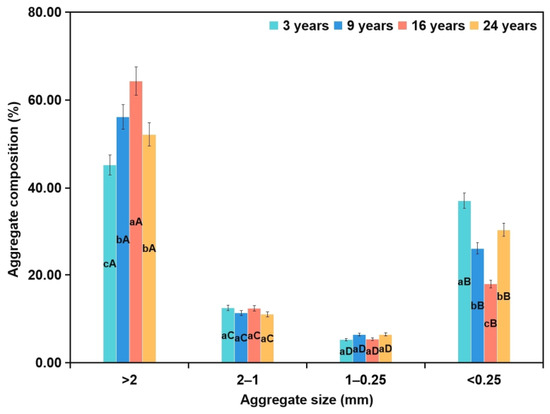
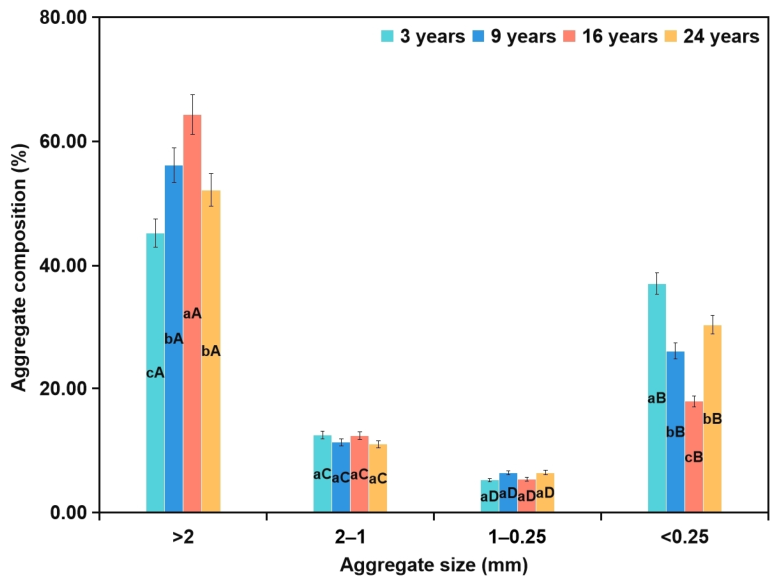
The aggregate composition of soils under different tea plantation ages was dominated by the >2 mm fraction, which was significantly (p < 0.05) higher in mass proportion than the other size fractions, with an average of 54.47%, followed by the <0.25 mm fraction (average 27.84%), whereas the 2–1 mm and 1–0.25 mm fractions showed relatively low mass proportions, averaging 11.82% and 5.88%, respectively (Figure 1). As tea plantation age increased, the temporal dynamics of aggregate size fractions diverged: the mass proportion of >2 mm aggregates rose initially and then declined, peaking at 16 years relative to other ages, whereas the <0.25 mm fraction displayed an inverse pattern. In contrast, no significant changes (p > 0.05) were detected in the 2–1 mm and 1–0.25 mm fractions over the course of tea cultivation.
Figure 1.
Soil aggregate composition in tea plantations. Different uppercase letters indicate significant (p < 0.05) differences among aggregate size fractions. Different lowercase letters indicate significant (p < 0.05) differences among tea plantation ages.
Moreover, compared with other land use types in the same subtropical region, such as adjacent natural forests or upland agricultural soils, where the >2 mm fraction typically accounts for 20–35% [43,44], the proportion observed here (averaging 54.47%) is notably elevated. However, this magnitude is generally consistent with previous findings from long-term tea plantations under similar no-tillage and high-litter-input management in southern China [1,2,7,8,9], suggesting that tea cultivation with organic ecological practices strongly promotes the formation and stabilization of macroaggregates.
3.2. Soil Aggregate-Associated Enzyme Activities
3.2.1. β-Glucosidase
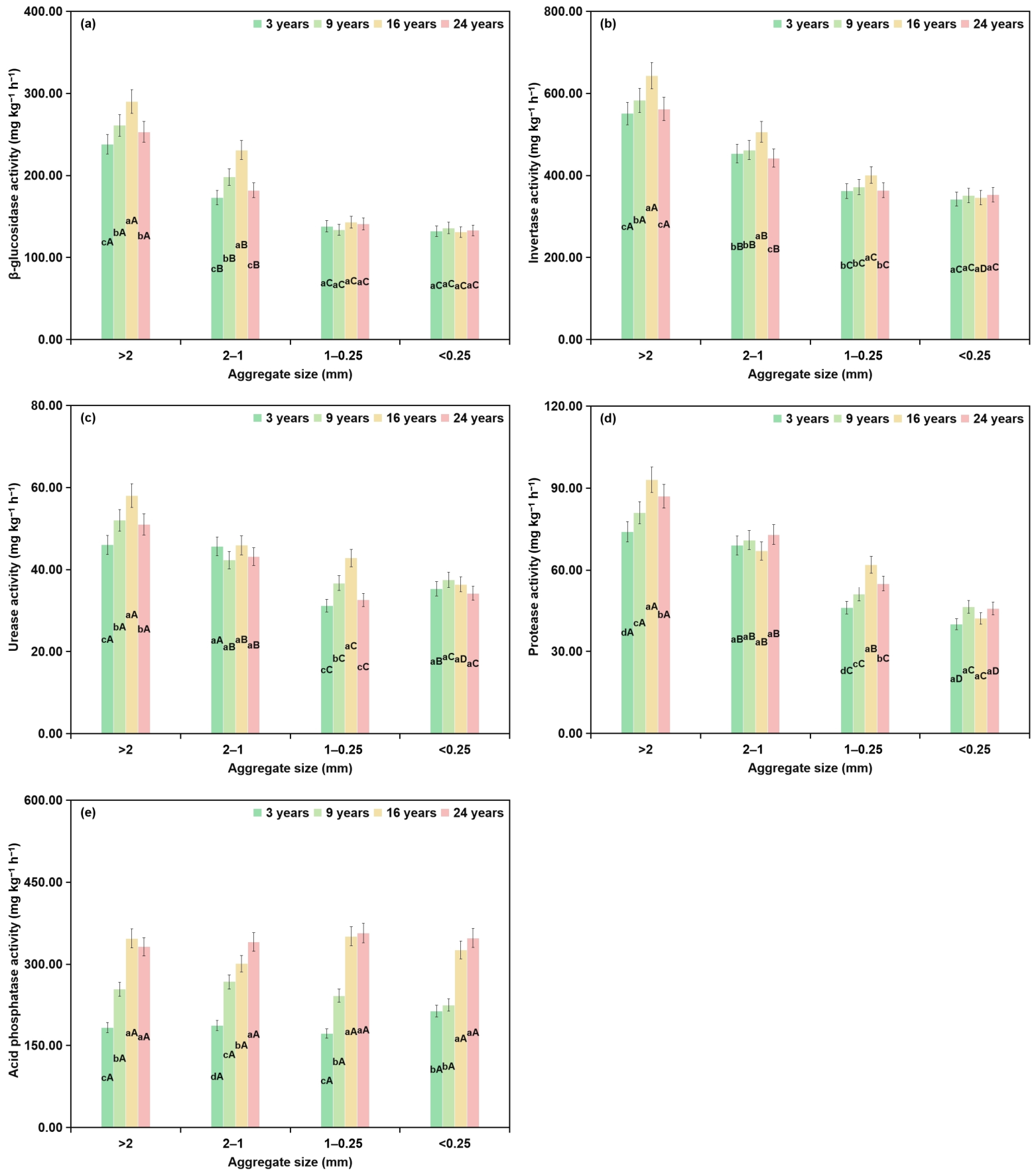
Across the different tea plantation ages, the >2 mm aggregate fraction displayed the highest β-glucosidase activity (mean: 261.34 mg kg−1 h−1), significantly (p < 0.05) exceeding that in the other size fractions (Figure 2a). The 2–1 mm fraction ranked second, with a mean activity of 196.48 mg kg−1 h−1, whereas the 1–0.25 mm and <0.25 mm fractions exhibited significantly (p < 0.05) lower activities, averaging 139.15 and 133.28 mg kg−1 h−1, respectively. With increasing tea plantation age, the trends in β-glucosidase activity differed among aggregate size fractions: activities in the >2 mm and 2–1 mm fractions initially increased and then decreased, reaching significantly (p < 0.05) higher levels at 16 years than at other plantation ages, while the activities in the 1–0.25 mm and <0.25 mm fractions did not change significantly (p > 0.05) during tea cultivation.
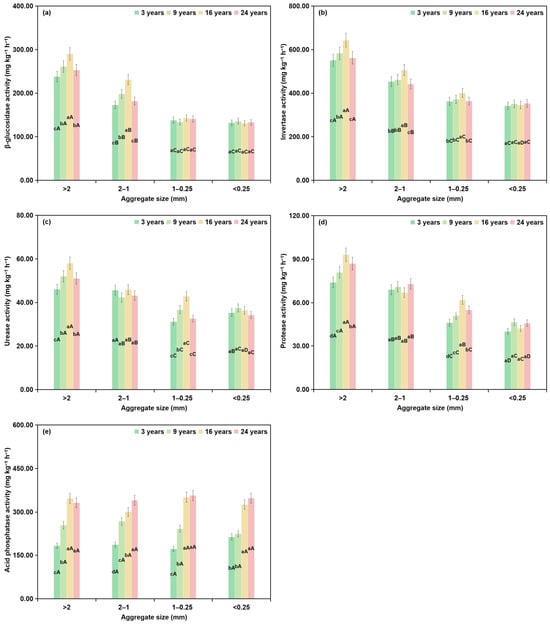
Figure 2.
Soil aggregate-associated enzyme activities in tea plantations. (a) β-glucosidase; (b) invertase; (c) urease; (d) protease; (e) acid phosphatase. Different uppercase letters indicate significant (p < 0.05) differences among aggregate size fractions. Different lowercase letters indicate significant (p < 0.05) differences among tea plantation ages.
3.2.2. Invertase
The distribution pattern of invertase activity among different aggregate size fractions was similar to that of β-glucosidase activity (Figure 2b). Across different tea plantation ages, invertase activity in the >2 mm aggregate fraction was significantly (p < 0.05) higher than that in the other size fractions, with an average of 585.31 mg kg−1 h−1, followed by the 2–1 mm fraction (average 466.32 mg kg−1 h−1), whereas the 1–0.25 mm and <0.25 mm fractions exhibited relatively low activities, averaging 375.82 and 348.57 mg kg−1 h−1, respectively. With increasing tea plantation age, all aggregate fractions >0.25 mm showed a similar trend in invertase activity, with values at 16 years being significantly (p < 0.05) higher than those at other plantation ages, while the invertase activity in the <0.25 mm fraction did not differ significantly (p > 0.05) among plantation ages.
3.2.3. Urease
Across the various tea plantation ages, the >2 mm aggregate fraction exhibited the greatest urease activity, with a mean value of 52.24 mg kg−1 h−1, which was significantly (p < 0.05) greater than that observed in the other aggregate size fractions; the 2–1 mm fraction exhibited the second-highest activity, averaging 44.51 mg kg−1 h−1, whereas the activities in the 1–0.25 mm and <0.25 mm fractions were at relatively low levels, averaging 36.34 and 35.87 mg kg−1 h−1, respectively (Figure 2c). With increasing tea plantation age, the trends in urease activity varied among aggregate size fractions: the >2 mm and 1–0.25 mm fractions exhibited an initial rise in activity followed by a subsequent decline, with values significantly (p < 0.05) greater at 16 years compared with other plantation ages. By contrast, no significant (p > 0.05) temporal changes were observed in the activities of the 2–1 mm and <0.25 mm fractions throughout the tea cultivation period.
3.2.4. Protease
The distribution pattern of protease activity among different aggregate size fractions was similar to that of urease activity (Figure 2d). Under different tea plantation ages, protease activity in the >2 mm aggregate fraction was the highest, averaging 84.34 mg kg−1 h−1, and was significantly (p < 0.05) higher than that in the other aggregate size fractions; the 2–1 mm fraction exhibited the second-highest activity, averaging 70.84 mg kg−1 h−1, whereas the activities in the 1–0.25 mm and <0.25 mm fractions were at relatively low levels, averaging 54.34 and 44.27 mg kg−1 h−1, respectively. With increasing tea plantation age, the >2 mm and 1–0.25 mm fractions showed a similar trend in protease activity, both peaking (p < 0.05) at 16 years, while the protease activities in the 2–1 mm and <0.25 mm fractions did not differ significantly (p > 0.05) among different plantation ages.
3.2.5. Acid Phosphatase
Across all tea plantation ages, acid phosphatase activity in soil aggregates did not differ significantly (p > 0.05) among the different size fractions, indicating that acid phosphatase activity is relatively insensitive to changes in aggregate size (Figure 2e). During tea cultivation, acid phosphatase activity in all aggregate size fractions increased progressively with plantation age, with activities at 16 and 24 years being significantly (p < 0.05) higher than those at 3 and 9 years.
In summary, the five enzymes exhibited two distinct distribution patterns with respect to aggregate size. The C-cycling (β-glucosidase and invertase) and N-cycling (urease and protease) enzymes consistently showed a declining trend with decreasing aggregate size, with the highest activities consistently recorded in the >2 mm fraction and the lowest in the <0.25 mm fraction. In marked contrast, acid phosphatase activity remained statistically uniform across all aggregate size fractions, demonstrating that this P-cycling enzyme is largely insensitive to aggregate size.
3.3. Contribution Rates of Different Aggregate Size Fractions to Soil Enzyme Activities
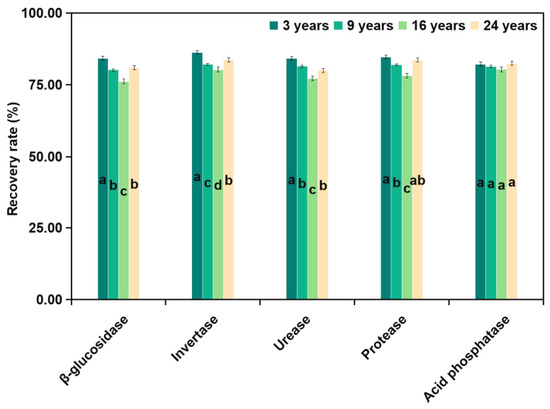
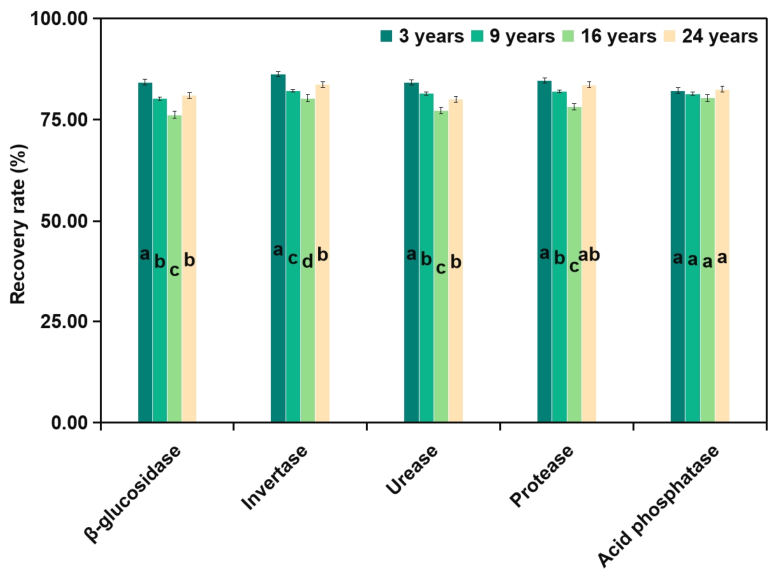
The average recovery rates of β-glucosidase, invertase, urease, protease, and acid phosphatase activities across different tea plantation ages were 80.45%, 83.13%, 80.78%, 82.16%, and 81.66%, respectively (Figure 3). The recovery rate of acid phosphatase activity did not differ significantly (p > 0.05) among plantation ages, whereas the recovery rates of the enzymes involved in soil C and N cycling (i.e., β-glucosidase, invertase, urease, and protease) were significantly (p < 0.05) lower at 16 years of tea cultivation than at the other plantation ages.
Figure 3.
Recovery rates of soil enzyme activities in tea plantations. Different lowercase letters indicate significant (p < 0.05) differences among tea plantation ages.
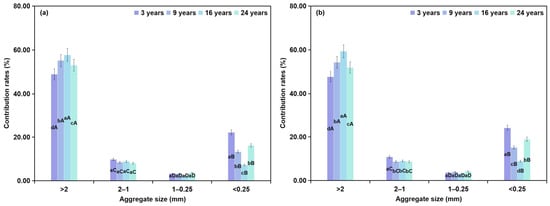
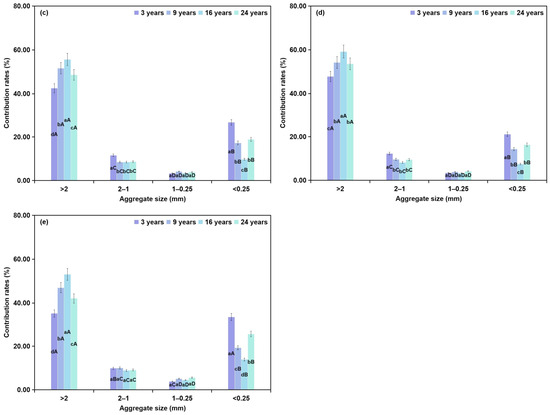
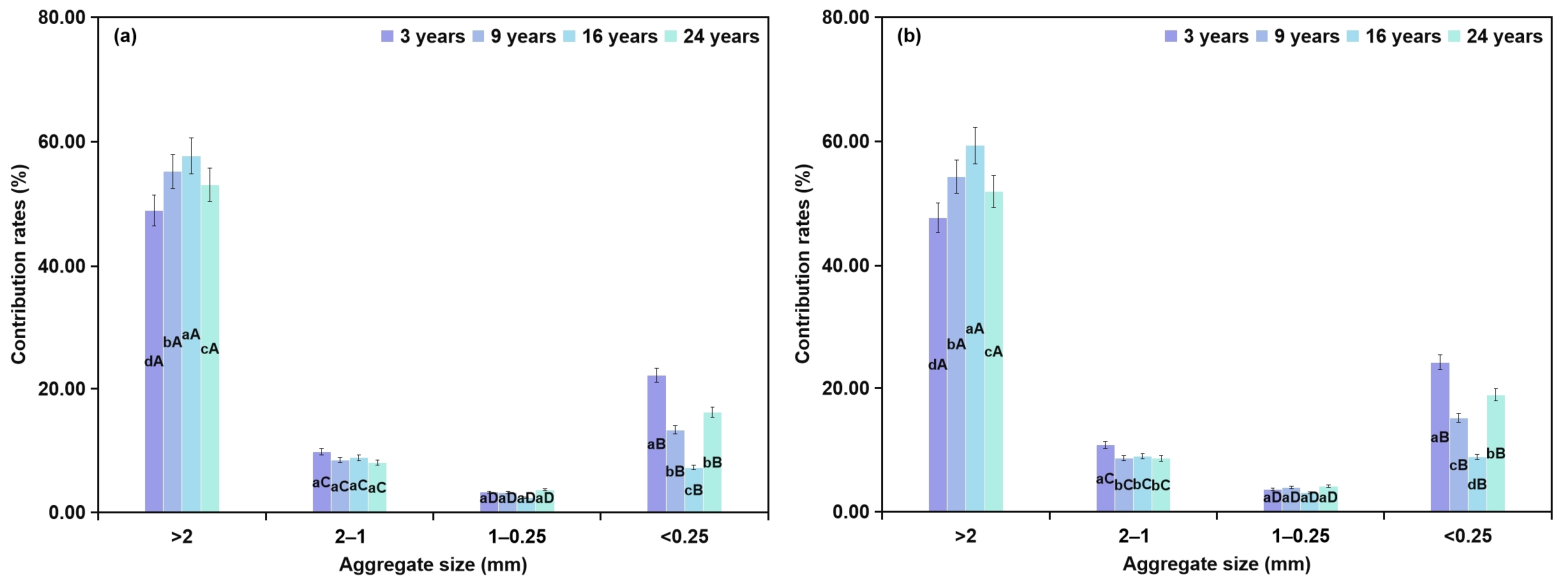
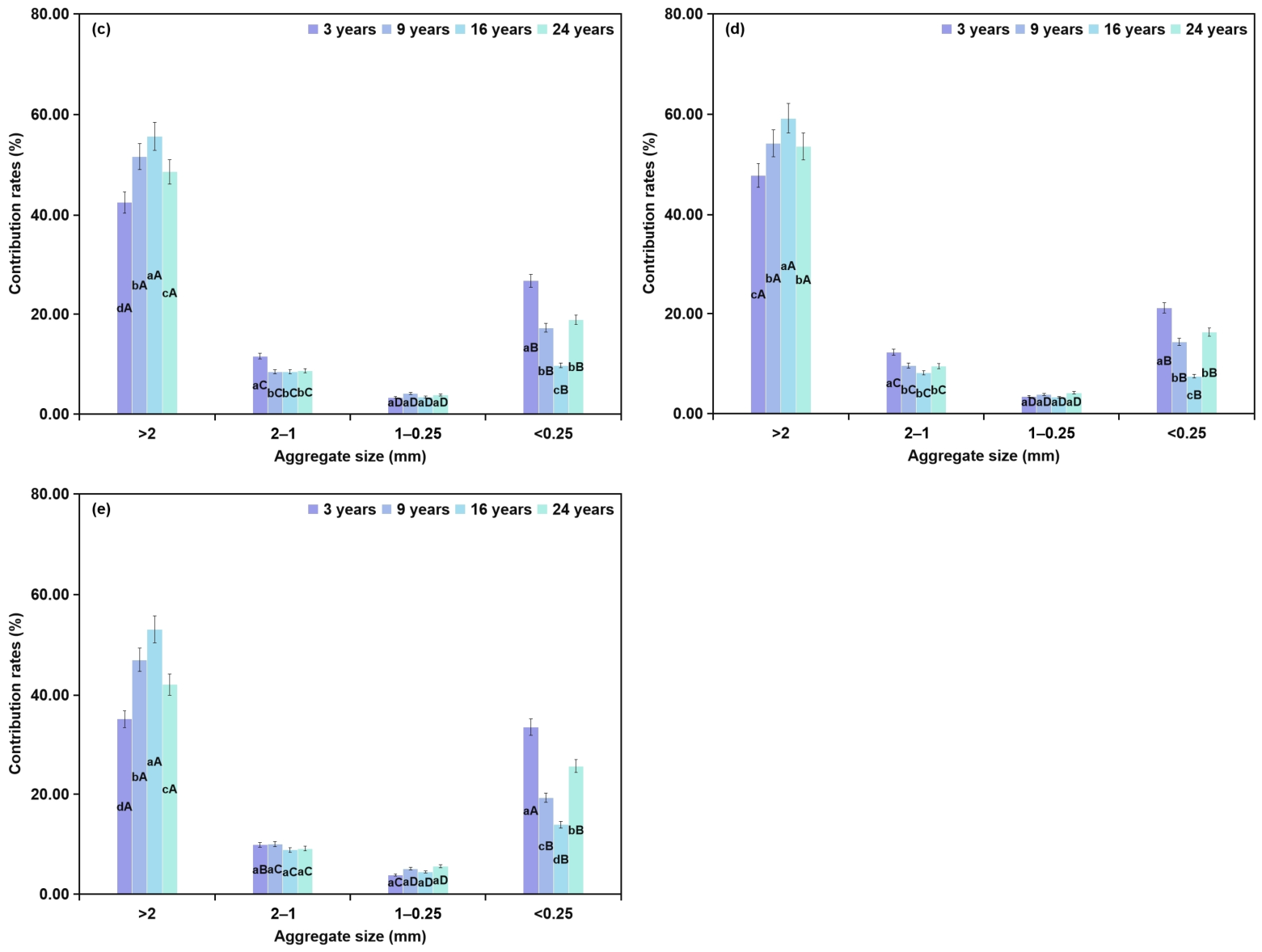
Furthermore, the contribution rates of different aggregate size fractions to soil enzyme activities showed significant (p < 0.05) differences (Figure 4). Across all plantation ages, the >2 mm fraction contributed the most to the activities of β-glucosidase, invertase, urease, protease, and acid phosphatase, accounting for 44.32–53.73%; this was followed by the <0.25 mm fraction, with contribution rates ranging from 14.77% to 23.08%. In contrast, the 2–1 mm and 1–0.25 mm fractions contributed relatively little, with ranges of 8.81–9.91% and 3.14–4.76%, respectively.
Figure 4.
Contribution rates of different aggregate size fractions to soil enzyme activities in tea plantations. (a) β-glucosidase; (b) invertase; (c) urease; (d) protease; (e) acid phosphatase. Different uppercase letters indicate significant (p < 0.05) differences among aggregate size fractions. Different lowercase letters indicate significant (p < 0.05) differences among tea plantation ages.
Although the rank order of contribution rates ([>2 mm fraction] > [<0.25 mm fraction] > [2–1 mm fraction] > [1–0.25 mm fraction]) was similar across all five enzymes (Figure 4), the underlying drivers of this pattern differed markedly between acid phosphatase and the other enzymes. For the C- and N-cycling enzymes, their high contribution rates from the >2 mm fraction were driven by a combination of high mass proportion and high enzyme activity in this fraction (Figure 1 and Figure 2a–d). In contrast, for acid phosphatase, the predominant contribution of the >2 mm fraction was achieved almost exclusively through its large mass proportion, because acid phosphatase activity did not differ significantly (p > 0.05) among aggregate size fractions (Figure 1 and Figure 2e). This distinction underscores that the contribution rate of acid phosphatase is primarily governed by physical mass distribution rather than by aggregate-specific functional specialization, a point that further differentiates P-cycling from C- and N-cycling processes in tea plantation soils.
4. Discussion
4.1. Effect of Soil Aggregate Size on Enzyme Activities
Soil enzyme activity is an important indicator for evaluating soil biological activity and soil fertility [45]. Generally, enzymes in soil aggregates are adsorbed onto or bound to soil colloids, thereby receiving physical protection against degradation and denaturation [46]. Because the primary cementing agents that bind aggregates of different sizes are not identical, the binding modes and adsorption capacities between enzymes occluded within aggregates and soil colloids differ, which in turn influences the variation in enzyme activities among aggregate fractions [47]. Some studies suggest that microaggregates exhibit higher enzyme activities [26,28]. This is mainly attributed to two factors: first, enzymes are readily adsorbed by organo-mineral complexes in microaggregates and thus are physically protected; second, most enzymes are primarily secreted by bacteria, and the higher bacterial richness and diversity in microaggregates favor enzyme accumulation [26,28]. In contrast, other studies suggest that soil macroaggregates contain relatively more fresh particulate OM, which provides a greater amount of readily utilizable substrates for enzymatic reactions, leading to higher enzyme activities in macroaggregates [7,21]. Collectively, these findings indicate that the distribution of enzyme activities among soil aggregates is rather complex and can be influenced by land use type, vegetation cover, and biological community composition.
In the present study, the activities of enzymes involved in soil C and N cycling (i.e., β-glucosidase, invertase, urease, and protease) exhibited a consistent pattern across aggregate size fractions under different tea plantation ages: the highest activities were found in the >2 mm aggregates, followed by the 2–1 mm fraction, whereas the 1–0.25 mm and <0.25 mm fractions exhibited relatively low activities (Figure 2a–d). This suggests that the higher C- and N-cycling enzyme activities in the >2 mm aggregates facilitated the decomposition of soil OM, thereby promoting nutrient release and supply. Previous studies have suggested that the variability in soil C- and N-cycling enzyme activities across aggregates is governed by the distribution of soil OM content [45,46,47]. In the present study, however, the spatial pattern of these enzyme activities did not coincide with that of soil OM content (as indicated by soil organic C and total N contents). Specifically, both the >2 mm and 2–1 mm fractions exhibited high organic C and total N contents (Table 2). Yet, while C- and N-cycling enzyme activities were elevated in the >2 mm fraction, they remained comparatively low in the 2–1 mm fraction (Figure 2a–d). This mismatch may be explained by variations in the distribution of OM availability within aggregates [48,49].
Table 2.
Soil aggregate-associated organic C, total N, and microbial quotient in tea plantations. Different uppercase letters indicate significant (p < 0.05) differences among aggregate size fractions. Different lowercase letters indicate significant (p < 0.05) differences among tea plantation ages.
Soil microbial quotient (microbial biomass C/organic C), an effective indicator of soil fertility level and quality status, can accurately reflect changes in soil OM quality; a higher quotient indicates higher OM availability [48,49]. Under different tea plantation ages, the soil microbial quotient in the >2 mm aggregates was significantly (p < 0.05) higher than that in the 2–1 mm fraction (Table 2). This suggests that substrate availability for soil microorganisms was relatively low in the 2–1 mm aggregates, leading to lower enzyme activities in this fraction [21]. According to the theory of soil aggregate formation (the “hierarchy model”), the 2–1 mm fraction represents a key transitional hub in aggregate turnover, where high OM content coexists with low availability [23]. The OM within this fraction is more likely to be strongly associated with mineral surfaces (particularly Fe- and Al-oxides, which are abundant in acidic Acrisols), rendering it less accessible to microbial attack and enzymatic hydrolysis than the fresh, labile particulate OM that resides in the macroaggregate interstices [23]. This physical and physicochemical protection effectively decouples the “total C pool” from its “bioavailable fraction”, manifesting as a significantly (p < 0.05) lower microbial quotient in the 2–1 mm fraction (Table 2). In contrast, the high availability of soil OM in the >2 mm aggregates could provide more energy and nutrients for microbial growth, thereby promoting microbial proliferation and enzyme activity [21]. The present findings further suggest that, within soil aggregates, the quality of OM played a more critical role in shaping the distribution of C- and N-cycling enzyme activities than did the content of OM.
Moreover, the elevated C- and N-cycling enzyme activities in macroaggregates also reflect a synergistic combination of three interrelated factors. First, fungal dominance in macroaggregates—where filamentous hyphae enmesh soil particles—favors the production of C- and N-cycling enzymes, whereas microaggregates are more densely colonized by bacteria with a narrower enzymatic repertoire per unit biomass [26]. Second, superior aeration in macroaggregates, sustained by larger inter-aggregate pores, supports aerobic hydrolase activities (e.g., β-glucosidase and urease), in contrast to the microaerophilic or anaerobic microsites prevalent within microaggregates [20]. Third, these physical and biological advantages are reinforced by higher OM availability (as indicated by microbial quotient in Table 2), which provides ample substrate for microbial enzyme production [21]. Importantly, these three factors operate in a positive feedback loop: fungal hyphae stabilize macroaggregates and maintain porous architecture, which sustains aerobic conditions that, in turn, favor fungal activity over bacterial competition, thereby perpetuating the functional differentiation between macro- and microaggregates.
No significant (p > 0.05) differences in acid phosphatase activity among aggregate size fractions across all plantation ages (Figure 2e) distinguishes it from the C- and N-cycling enzymes (Figure 2a–d). This uniformity suggests that acid phosphatase is less constrained by aggregate-scale physical protection or substrate accessibility, possibly because phosphatases are predominantly secreted by microorganisms and plant roots in a relatively diffusible form [15], and because organic P substrates are more evenly distributed among aggregates than labile organic C and N [18]. This spatial insensitivity implies that P mobilization in tea plantation soils is regulated more by bulk soil chemical properties (e.g., pH and P sorption capacity) than by aggregate architecture, reinforcing the view that P cycling operates under a distinct set of controls from C and N cycling [15,18].
Notably, no-tillage management has profound implications for the spatial distribution and functional expression of soil enzymes [50]. In the absence of tillage, enzyme molecules secreted by microorganisms and plant roots tend to be retained within the same aggregate microsites where they are produced, thereby forming hotspots of enzymatic activity preferentially located in macroaggregates, which are rich in labile organic substrates [51]. This may explain why we observed consistently higher C- and N-cycling enzyme activities in the >2 mm fraction compared with smaller aggregates (Figure 2a–d). Conversely, in microaggregates, enzymes are more likely to be adsorbed onto organo-mineral complexes and physically protected from degradation, which can decouple their activity from substrate availability [51]. The contrasting behavior of acid phosphatase—which showed no significant (p > 0.05) aggregate-size differentiation (Figure 2e)—may be partly attributed to the fact that this enzyme is less physically protected and more responsive to bulk soil chemical properties (e.g., pH and P deficiency), which are less influenced by aggregate turnover under no-tillage [52].
4.2. Response of Soil Aggregate-Associated Enzyme Activities to Tea Plantation Age
Soil enzymes involved in C and N cycling (i.e., β-glucosidase, invertase, urease, and protease) are key catalysts participating in the transformation and cycling of soil OM, and can serve as sensitive indicators for evaluating the potential of soil OM sequestration and decomposition [53]. In the present study, long-term tea cultivation contributed to soil OM accumulation (Table 1). In contrast, the activities of soil C- and N-cycling enzymes first increased and then decreased with increasing tea plantation age, peaking at 16 years (Table 1). The observed peak of C- and N-cycling enzyme activities at 16 years can be tentatively attributed to the following interrelated mechanisms. It is plausible that the low C/N ratio of tea litter and increasing amount of litter inputs during the early (3–9 years) and middle (9–16 years) stages enhanced enzyme activities [48], whereas the subsequent decline in litter quality, coupled with potential accumulation of inhibitory polyphenolic compounds [21] and progressive soil acidification [54], may have jointly suppressed enzyme activities in the late stage (16–24 years). Nevertheless, we acknowledge that these mechanisms are inferred from indirect evidence rather than directly tested in the present study; they should be viewed as testable hypotheses requiring future experimental verification (e.g., litter manipulation or pH adjustment experiments).
During the early and middle stages of tea cultivation, soil OM availability was relatively high (as indicated by the higher soil microbial quotient) (Table 1), and soil C- and N-cycling enzyme activities increased progressively (Table 1), indicating that the accumulated OM was more readily mineralized and decomposed, thereby releasing more nutrients for tea plant growth. In contrast, during the late stage of tea cultivation, soil OM availability was relatively low (as indicated by the lower soil microbial quotient) (Table 1), accompanied by a progressive decline in soil C- and N-cycling enzyme activities (Table 1), suggesting that the decomposition rate of accumulated OM was lower at this stage, which facilitated the sequestration of soil organic C and nutrients. Notably, the sensitivity of C- and N-cycling enzyme activities to tea plantation age differed across aggregate size fractions (Figure 2a–d). As plantation age increased, the enzyme activities associated with the >2 mm aggregates reached a maximum at 16 years, whereas no significant (p > 0.05) variation among ages was observed in the <0.25 mm fraction. This suggests that macroaggregate-bound C- and N-cycling enzymes were more responsive to plantation age than those residing in microaggregates.
Unlike the C- and N-cycling enzymes, which exhibited a unimodal response to tea plantation age, acid phosphatase activity showed a progressive and sustained increase with prolonged tea cultivation (Figure 2e). This contrasting pattern is mainly caused by the following two reasons. First, the continuous accumulation of soil OM under long-term tea cultivation (Table 1) provides an increasingly abundant pool of organic P substrates (e.g., nucleic acids, phospholipids, and phytate), which may act as a substrate-induced driver for phosphatase production [14]. In acidic soils, where inorganic P is largely immobilized by Fe3+ and Al3+ through precipitation and strong adsorption, organic P constitutes a major proportion of the available P pool [15]. Consequently, microorganisms and plant roots in acid tea plantation soils are compelled to invest more energy in secreting acid phosphatase to hydrolyze organic P esters, thereby acquiring inorganic phosphate for growth [14,15]. This is consistent with the well-documented “resource allocation” theory, which posits that microbial communities enhance the production of nutrient-acquiring enzymes under conditions of limited nutrient availability [46,50]. Second, the pH-dependent stability and catalytic efficiency of acid phosphatase itself should be considered. Unlike alkaline or neutral phosphatases, acid phosphatase exhibits optimal activity at low pH (typically pH 4.0–5.5), and its molecular conformation and active-site architecture are evolutionarily adapted to acidic microenvironments [18]. As tea plantation age increased, soil pH significantly declined from 4.58 to 4.32 (Table 1). This progressive acidification may not only favor the conformational stability of acid phosphatase but also enhance its substrate-binding affinity, thereby contributing to the observed upward trend in activity [19].
4.3. Contribution Rates of Different Aggregate Size Fractions to Soil Enzyme Activities
During the aggregate fractionation process, all soil enzymes suffered losses to varying degrees, with average recovery rates ranging from 80.45% to 83.13% (Figure 3). This occurred because the aggregates were disrupted during fractionation, causing the enzymes occluded within them to lose their physical protection and become inactivated, thereby resulting in the loss of soil enzyme activities [33]. The recovery rates of soil C- and N-cycling enzyme activities (i.e., β-glucosidase, invertase, urease, and protease) were significantly (p < 0.05) lower at 16 years of tea cultivation than at the other plantation ages, whereas the recovery rate of acid phosphatase activity did not differ significantly (p > 0.05) among different plantation ages (Figure 3). In this study, the soil under 16-year tea cultivation contained a greater amount of >2 mm aggregates (Figure 1). Although the activities of C- and N-cycling enzymes in these aggregates were relatively high (Figure 2a–d), these enzymes were more susceptible to disruption because of the lower stability of larger aggregates [33], which led to more severe losses of soil C- and N-cycling enzyme activities during the aggregate fractionation process at 16 years of tea cultivation.
Integrating the mass proportions of different aggregate size fractions with their enzyme activities provides a comprehensive assessment of the contribution of each fraction to soil enzyme activity [21]. In the present study, the relative contributions of aggregate size fractions to total soil enzyme activities were ranked as: [>2 mm fraction] > [<0.25 mm fraction] > [2–1 mm fraction] > [1–0.25 mm fraction] (Figure 4). Accordingly, the >2 mm fraction functioned as the dominant reservoir of soil enzymes in the tea plantations. It is noteworthy that, although the activities of C- and N-cycling enzymes were comparatively low in the <0.25 mm fraction (Figure 2a–d), the high mass proportion of this fraction within the soil led to a relatively large contribution to the overall C- and N-cycling enzyme activities (Figure 4a–d). This finding further indicates that the contribution of each aggregate fraction to soil enzyme activity is closely linked to its mass proportion.
In this study, the large contribution of the <0.25 mm fraction (14.77–23.08%) to total enzyme activities, driven primarily by its high mass proportion rather than elevated unit activity, carries practical implications for soil management. This finding reveals complementary functional roles of different aggregate fractions: macroaggregates serve as transformation hotspots sustaining rapid C and N turnover, while microaggregates constitute a large-volume physical reservoir that contributes baseline enzymatic function through sheer abundance [23]. Consequently, effective management should adopt a dual-target strategy. For macroaggregates, maintenance of structural stability—through continuous litter return and avoidance of mechanical disturbance—is paramount [23]. For microaggregates, however, management should emphasize chemical stabilization, particularly mitigating the progressive acidification observed after 16 years (Table 1), which threatens microaggregate integrity and their associated enzyme pools [23]. This differentiated approach—physical preservation for macroaggregates versus chemical stabilization for microaggregates—provides a more nuanced framework for sustaining soil enzyme functions in aging tea plantations.
Notably, the generalizability of our findings is constrained by the regional specificity of our study system (subtropical Acrisols, Nanshanbaimao cultivar, no-tillage management). At a mechanistic level, the observed functional differentiation between macro- and microaggregates, the preferential enrichment of C- and N-cycling enzymes in macroaggregates, and the distinct insensitivity of acid phosphatase to aggregate size are grounded in established soil ecological principles that should be qualitatively transferable to other tea-growing regions. However, the quantitative relationships and the specific 16-year turning point may be modulated by regional factors such as climate (affecting decomposition rates) [26], soil mineralogy (affecting P fixation and aggregation) [28], tea cultivar polyphenol content (affecting enzyme inhibition) [45], and management intensity [50]. We therefore recommend cautious extrapolation of the precise magnitudes and age thresholds identified here, while considering the qualitative mechanistic framework as broadly applicable. Site-specific validation is encouraged before applying our findings to regions with contrasting environmental or management conditions.
5. Conclusions
In this study, the activities of soil enzymes involved in C and N cycling initially increased and then decreased with increasing tea plantation age, reaching a relatively high level at 16 years, whereas soil acid phosphatase activity increased progressively with plantation age. Soil C- and N-cycling enzyme activities were relatively high in the >2 mm aggregate fraction, while acid phosphatase activity was less affected by changes in aggregate size. As the primary carrier of soil enzymes, the formation and stabilization of >2 mm aggregates are of great importance for maintaining soil enzyme activity and promoting soil organic C and nutrient cycling, thus supporting our hypothesis. In tea plantation management, attention should be directed to the breakdown and disruption of >2 mm aggregates after 16 years of cultivation, so as to safeguard soil quality and sustain soil organic C and nutrient use efficiency.
This study advances prior work on static nutrient stocks in aggregates by revealing the functional dynamics of enzyme-driven C, N, and P transformations in tea plantation soils. Three key findings emerge: (i) C- and N-cycling enzymes are consistently enriched in macroaggregates (>2 mm) as “hotspots” of nutrient transformation, whereas acid phosphatase activity is insensitive to aggregate size—a functional differentiation not previously documented; (ii) C- and N-cycling enzyme activities peak at 16 years, revealing a trade-off between organic matter accumulation and decomposability with increasing plantation age, while acid phosphatase increases monotonically, suggesting P-acquiring capacity is progressively reinforced rather than suppressed; and (iii) microaggregates (<0.25 mm) contribute substantially to total enzyme activity through their high mass proportion rather than elevated unit activity, underscoring their complementary role as physical reservoirs sustaining baseline enzymatic function.
In addition, several limitations point to future research priorities. The chronosequence approach requires long-term monitoring or reciprocal transplantation experiments to disentangle age effects from site legacies. The proposed mechanisms for the post-16-year decline—polyphenol accumulation and acidification—need targeted manipulative experiments (e.g., polyphenol addition or pH gradient incubations) to establish causality. Additionally, comparative studies across soil depths, climatic gradients, and management systems are necessary to test the generalizability of our findings. Addressing these gaps will refine mechanistic understanding of soil functional evolution in aging tea plantations and strengthen the scientific basis for sustainable soil management.
Supplementary Materials
The following supporting information can be downloaded at: https://www.mdpi.com/article/10.3390/agronomy16131244/s1, Table S1: One-way ANOVA regarding the effect of tea plantation age on the properties of litter and bulk soil, and repeated-measures ANOVA regarding the effects of tea plantation age and aggregate size on the properties of soil aggregates. **, *, and ns indicate significant differences at p < 0.01, p < 0.05, and p > 0.05 (not significant), respectively.
Author Contributions
X.Y.: experimental design, investigation, writing—original draft; S.Y. (Shuzhong Yu): investigation, data calculation, writing—original draft; S.Y. (Shaoming Ye): supervision, funding acquisition, writing—review and editing; S.W.: supervision, funding acquisition, writing—review and editing. All authors have read and agreed to the published version of the manuscript.
Funding
This study was supported by the National Natural Science Foundation of China (32460405) and the Guangxi Natural Science Foundation of China (2025GXNSFAA069845).
Data Availability Statement
The data supporting the discovered information here can be presented by the relevant author based on reasonable requests.
Acknowledgments
The authors express their gratitude to Yili Guo for his contributions to the data analysis in the article.
Conflicts of Interest
The authors declare no conflicts of interest.
References
- Wang, S.; He, X.; Ye, S. Soil aggregation and aggregate-associated carbon, nitrogen, and phosphorus under different aged tea (Camellia sinensis L.) plantations in hilly region of southern Guangxi, China. Sci. Hortic. 2020, 262, 109007. [Google Scholar] [CrossRef] [Scilit]
- Wang, S.; Zhang, Z.; Ye, S. Response of soil fertility characteristics in water-stable aggregates to tea cultivation age in hilly region of southern Guangxi, China. CATENA 2020, 191, 104578. [Google Scholar] [CrossRef] [Scilit]
- Cheng, R.; Du, L.; Ye, S.; Wang, S. Soil organic carbon and labile organic carbon fractions drive the dynamics of aggregate composition and stability in a chronosequence of tea plantations. Agronomy 2025, 15, 501. [Google Scholar] [CrossRef] [Scilit]
- Ying, H.; Jiang, Q.; Wang, J.; Qian, W.; Chen, Y. Countermeasures for the high-quality development of Guangxi’s tea industry under the background of rural revitalization. Tea Commun. 2023, 50, 405–412. [Google Scholar]
- Kang, R. Digital transformation of Guangxi’s tea industry: Current situation, problems and paths. J. Guangxi Agric. 2025, 40, 72–81. [Google Scholar]
- Kang, H.; Ye, G. Research on strategies for promoting high-quality development of Guangxi’s tea industry from the perspective of rural revitalization. Tea Commun. 2025, 52, 539–546. [Google Scholar]
- Wang, S.; Yao, X.; Ye, S. Soil aggregate-related organic carbon and relevant enzyme activities as affected by tea (Camellia sinensis L.) planting age in hilly region of southern Guangxi, China. Appl. Soil Ecol. 2020, 150, 103444. [Google Scholar] [CrossRef] [Scilit]
- Wang, S.; Ye, S. Dynamics of bacterial function characteristics in soil aggregates during the tea-planting process. Geoderma 2020, 377, 114609. [Google Scholar] [CrossRef] [Scilit]
- Wang, S.; Tang, L.; Ye, S. Dynamics of soil bacterial community diversity and composition at aggregate scales in a chronosequence of tea gardens. CATENA 2021, 206, 105486. [Google Scholar] [CrossRef] [Scilit]
- Yin, R.; Li, X.; Ning, Y.; Hu, Q.; Mao, Y.; Zhang, X.; Zhang, X. Machine learning unveils the role of biochar application in enhancing tea yield by mitigating soil acidification in tea plantations. Sci. Total Environ. 2025, 965, 178597. [Google Scholar] [CrossRef] [Scilit] [PubMed]
- Xu, Z.; Zou, Z.; Cooledge, E.; Feng, S.; Xu, P. Litter cellulose modulates dissolved organic carbon to drive co-denitrification contribution and nitrous oxide emissions in tea plantation soils. J. Environ. Manag. 2026, 402, 129073. [Google Scholar] [CrossRef] [Scilit]
- Jiang, Y.; Lin, X.; Wang, H.; Muhammad, W.; Xu, Y.; Lin, W. Evaluation of fertilization on microbial assembly, metabolites of root exudates and rhizosphere soil in tea plant. Sci. Hortic. 2024, 338, 113812. [Google Scholar] [CrossRef] [Scilit]
- Wang, D.; Wu, B.; Li, F.; Li, X.; Wang, Z.; Hou, J.; Cao, R.; Yang, W. Soil organic carbon stock in China’s tea plantations and their great potential of carbon sequestration. J. Clean. Prod. 2023, 421, 138485. [Google Scholar] [CrossRef] [Scilit]
- Wu, X.; Chen, J.; Su, Y.; Zhang, Z.; Wang, J. A systematic review of the soil C, N, and P cycles mediated by microplastics: Enzyme activities, greenhouse gas emissions and plant growth. Resour. Conserv. Recycl. 2026, 228, 108788. [Google Scholar] [CrossRef] [Scilit]
- Wang, Z.; Yun, S.; An, Y.; Shu, L.; Li, S.; Sun, K.; Zhang, W. Effect of fungicides on soil respiration, microbial community, and enzyme activity: A global meta-analysis (1975–2024). Ecotoxicol. Environ. Saf. 2025, 289, 117433. [Google Scholar] [PubMed]
- Reinhart, K.O.; Tossou, S.F.A.; Rinella, M.J. Soil carbon-enzyme relationships persist despite neutral long-term grazing effects in the northern Great Plains. Agric. Ecosyst. Environ. 2026, 406, 110404. [Google Scholar]
- Li, Y.; Liu, X.; Lu, J.; Feng, H.; Chen, J.; Yang, Q.; Zhou, L.; Li, N.; Siddique, K.H.M.; Liang, J. Soil extracellular enzymes, soil carbon and nitrogen storage under straw return: A data synthesis. Ind. Crops Prod. 2025, 228, 120884. [Google Scholar] [CrossRef] [Scilit]
- Liu, X.; Bai, Q.; Liang, K.; Pei, M.; Chen, J.; Zhu, B.; Yu, Q.; Peng, C.; Xiang, F.; Guo, L. Altered precipitation affects soil enzyme activity related to nitrogen and phosphorous but not carbon cycling: A meta-analysis. J. Environ. Manag. 2025, 377, 124709. [Google Scholar] [CrossRef] [Scilit]
- Wang, J.; Sun, L.; Sun, Y.; Yang, S.; Qin, Q.; Xue, Y. Long-term biochar-based fertilizer substitution promotes carbon, nitrogen, and phosphorus acquisition enzymes in dryland soils by affecting soil properties and regulating bacterial community. Appl. Soil Ecol. 2025, 206, 105801. [Google Scholar]
- Hu, Y.; Chen, J.; Olesen, J.E.; van Groenigen, K.J.; Hui, D.; He, X.; Chen, G.; Deng, Q. Mycorrhizal association controls soil carbon-degrading enzyme activities and soil carbon dynamics under nitrogen addition: A systematic review. Sci. Total Environ. 2024, 948, 175008. [Google Scholar] [CrossRef] [Scilit] [PubMed]
- Wang, S.; Li, T.; Zheng, Z. Effects of tea plantation age on soil aggregate-associated C- and N-cycling enzyme activities in the hilly areas of Western Sichuan, China. CATENA 2018, 171, 145–153. [Google Scholar]
- Yudina, A.; Kuzyakov, Y. Dual nature of soil structure: The unity of aggregates and pores. Geoderma 2023, 434, 116478. [Google Scholar] [CrossRef] [Scilit]
- Six, J.; Bossuyt, H.; Degryze, S.; Denef, K. A history of research on the link between (micro)aggregates, soil biota, and soil organic matter dynamics. Soil Tillage Res. 2004, 79, 7–31. [Google Scholar] [CrossRef] [Scilit]
- Yuan, H.; Xie, W.; Liu, Y.; Shen, F.; Li, W.; Yin, Y.; Ye, J.; Wu, W.; Li, W. Whole-life evolution of soil aggregate structure and nutrient (C-N-P) retention function in terraced citrus orchards. CATENA 2026, 269, 110091. [Google Scholar]
- Chen, Y.; Xu, L.; Zhao, X. Paddy-upland rotation outperforms upland rotation in enhancing soil nutrient multifunctionality in coastal saline-alkali farmlands through soil aggregate optimization. Geoderma 2026, 469, 117812. [Google Scholar]
- Huang, H.; Wang, Z.; Guan, P.; Ma, R.; Wang, C.; Megharaj, M.; Tian, H.; He, W. Modulating soil enzyme functions: The role of aggregate structure in arsenic-contaminated soils under dry-flood cycle. Appl. Soil Ecol. 2026, 222, 106972. [Google Scholar]
- Zhao, Y.; Yang, W.; Liu, Y.; Zhang, X.; Li, Y.; Qi, G.; Huang, S.; Luan, H. Linking soil organic carbon characteristics, nutrient stoichiometry, and microbial community to eco-enzymatic stoichiometry within aggregates in different aged walnut plantations. Eur. J. Soil Biol. 2024, 121, 103627. [Google Scholar] [CrossRef] [Scilit]
- Wang, J.; Sha, Z.; Qin, Q.; Sun, L.; Sun, Y.; Yang, S.; Xue, Y.; Cao, L. Soil aggregate-associated organic nitrogen pools, enzyme activities, and microbial community fertilized with food waste-derived organic fertilizer. Appl. Soil Ecol. 2024, 202, 105580. [Google Scholar] [CrossRef] [Scilit]
- Feng, D.; Yao, F.; Zhou, J.; Kong, W.; Guo, J.; Zhang, Q.; Jia, X. Responses of soil nutrients and enzyme activities to afforestation species and age on China’s Loess Plateau: An investigation from soil aggregates aspect. Agric. Ecosyst. Environ. 2025, 393, 109804. [Google Scholar] [CrossRef] [Scilit]
- Mao, L.; Ye, S.; Wang, S. Soil nutrient contents and stoichiometry within aggregate size classes varied with tea plantation age and soil depth in southern Guangxi in China. Soil 2022, 8, 487–505. [Google Scholar] [CrossRef] [Scilit]
- FAO. World Reference Base for Soil Resources; FAO: Rome, Italy, 2014. [Google Scholar]
- Sparling, G.; Ross, D.; Trustrum, N. Recovery of topsoil characteristics after landslip erosion in dry hill country of New Zealand, and a test of the space-for-time hypothesis. Soil Biol. Biochem. 2003, 35, 1575–1586. [Google Scholar]
- Bach, E.M.; Hofmockel, K.S. Soil aggregate isolation method affects measures of intra-aggregate extracellular enzyme activity. Soil Biol. Biochem. 2014, 69, 54–62. [Google Scholar] [CrossRef] [Scilit]
- Nelson, D.W.; Sommers, L.E. Total carbon, organic carbon and organic matter. In Part 3. Chemical Methods, No. 5; Sparks, D.L., Ed.; ASA and SSSA: Madison, WI, USA, 1996; pp. 961–1010. [Google Scholar]
- Bremner, J.M. Nitrogen-total. In Part 3. Chemical Methods, No. 5; Sparks, D.L., Ed.; ASA and SSSA: Madison, WI, USA, 1996; pp. 1085–1121. [Google Scholar]
- Lu, R. Analysis of Soil Agrochemistry; Chinese Agricultural Science and Technology Press: Beijing, China, 2000. [Google Scholar]
- Vance, E.D.; Brookes, P.C.; Jenkinson, D.S. An extraction method for measuring soil microbial biomass C. Soil Biol. Biochem. 1987, 19, 703–707. [Google Scholar] [CrossRef] [Scilit]
- Tabatabai, M.A. Soil enzymes. In Part 2. Microbiological and Biochemical Properties, No.5; Weaver, R.W., Angle, J.S., Bottomley, P.S., Eds.; ASA and SSSA: Madison, WI, USA, 1994; pp. 775–833. [Google Scholar]
- Schinner, F.; Mersi, W.V. Xylanase-, CM-cellulase- and invertase activity in soil: An improved method. Soil Biol. Biochem. 1990, 22, 511–515. [Google Scholar] [CrossRef] [Scilit]
- Gianfreda, L.; Sannino, F.; Ortefa, N. Activity of free and immobilized urease in soil: Effects of pesticides. Soil Biol. Biochem. 1994, 26, 777–784. [Google Scholar] [CrossRef] [Scilit]
- Keeney, D.R.; Nelson, D.W. Nitrogen-inorganic forms. In Part 3. Chemical Methods, No. 5; Page, A.L., Miller, R.H., Keeney, D.R., Eds.; ASA and SSSA: Madison, WI, USA, 1982; pp. 643–698. [Google Scholar]
- Hamm, D.; Feger, K.H. An optimized method for the determination of phosphatase activity in acid forest soils. Z. Pflanzenernahr. Bodenkd. 1996, 159, 37–39. [Google Scholar]
- Xiao, S.; Ye, Y.; Xiao, D.; Chen, W.; Zhang, W.; Wang, K. Effects of tillage on soil N availability, aggregate size, and microbial biomass in a subtropical karst region. Soil Tillage Res. 2019, 192, 187–195. [Google Scholar] [CrossRef] [Scilit]
- Zhao, R.; He, M.; Jiang, C.; Li, C.; Liu, F. Microbial community structure in rhizosphere soil rather than that in bulk soil characterizes aggregate-associated organic carbon under long-term forest conversion in subtropical region. Rhizosphere 2021, 20, 100438. [Google Scholar]
- Luo, X.; Xie, Y.; Han, C.; Zhao, Y.; Zhao, Y.; Li, J. Plant species richness increases the relationship between soil microbial and extracellular enzyme activities and enhances soil fertility. Ecol. Indic. 2025, 171, 113202. [Google Scholar] [CrossRef] [Scilit]
- Alía, T.; Abad-Calderón, R.; Quintana, J.R.; Casermeiro, M.A.; Fernández-Sanjulián, J.; González-Ubierna, S. Aggregate-scale carbon dynamics in urban mediterranean soils: Insights from enzyme activities and organic matter distribution. Appl. Soil Ecol. 2025, 212, 106176. [Google Scholar] [CrossRef] [Scilit]
- Feyissa, A.; Raza, S.T.; Gomez-Casanovas, N.; Timilsina, A.; Cheng, X. Linking extracellular enzyme activities in soil aggregates to carbon stabilization along an elevational gradient in alpine forest and grassland ecosystems. CATENA 2025, 250, 108702. [Google Scholar] [CrossRef] [Scilit]
- Cotrufo, M.F.; Wallenstein, M.D.; Boot, C.M. The Microbial Efficiency-Matrix Stabilization (MEMS) framework integrates plant litter decomposition with soil organic matter stabilization: Do labile plant inputs form stable soil organic matter. Glob. Change Biol. 2013, 19, 988–995. [Google Scholar]
- Chen, L.; Chen, H.; He, W.; Zeng, J. Response of soil microbial quotient to land use change: A global meta-analysis. J. Environ. Manag. 2026, 407, 129909. [Google Scholar] [CrossRef] [Scilit]
- Zhu, Y.; Zhang, H.; Wang, Q.; Zhu, W.; Kang, Y. Soil extracellular enzyme activity linkage with soil organic carbon under conservation tillage: A global meta-analysis. Eur. J. Agron. 2024, 155, 127135. [Google Scholar] [CrossRef] [Scilit]
- Liu, X.; Song, X.; Li, S.; Liang, G.; Wu, X. Understanding how conservation tillage promotes soil carbon accumulation: Insights into extracellular enzyme activities and carbon flows between aggregate fractions. Sci. Total Environ. 2023, 897, 165408. [Google Scholar] [CrossRef] [Scilit] [PubMed]
- Singh, G.; Bhattacharyya, R.; Das, T.K.; Sharma, A.R.; Ghosh, A.; Das, S.; Jha, P. Crop rotation and residue management effects on soil enzyme activities, glomalin and aggregate stability under zero tillage in the Indo-Gangetic Plains. Soil Tillage Res. 2018, 184, 291–300. [Google Scholar] [CrossRef] [Scilit]
- Zhao, K.; Xiao, W.; Wang, N.; Zhang, X.; Wang, Y. Carbon-nitrogen-phosphorus level regulation of potentially toxic elements and enzyme activities in paddy soil aggregates: Straw and organic fertilizer effects. J. Environ. Chem. Eng. 2025, 13, 118166. [Google Scholar]
- Xie, S.; Yang, F.; Feng, H.; Yu, Z.; Liu, C.; Wei, C.; Liang, T. Organic fertilizer reduced carbon and nitrogen in runoff and buffered soil acidification in tea plantations: Evidence in nutrient contents and isotope fractionations. Sci. Total Environ. 2021, 762, 143059. [Google Scholar] [CrossRef] [Scilit]

Disclaimer/Publisher’s Note: The statements, opinions and data contained in all publications are solely those of the individual author(s) and contributor(s) and not of MDPI and/or the editor(s). MDPI and/or the editor(s) disclaim responsibility for any injury to people or property resulting from any ideas, methods, instructions or products referred to in the content. |
© 2026 by the authors. Licensee MDPI, Basel, Switzerland. This article is an open access article distributed under the terms and conditions of the Creative Commons Attribution (CC BY) license.