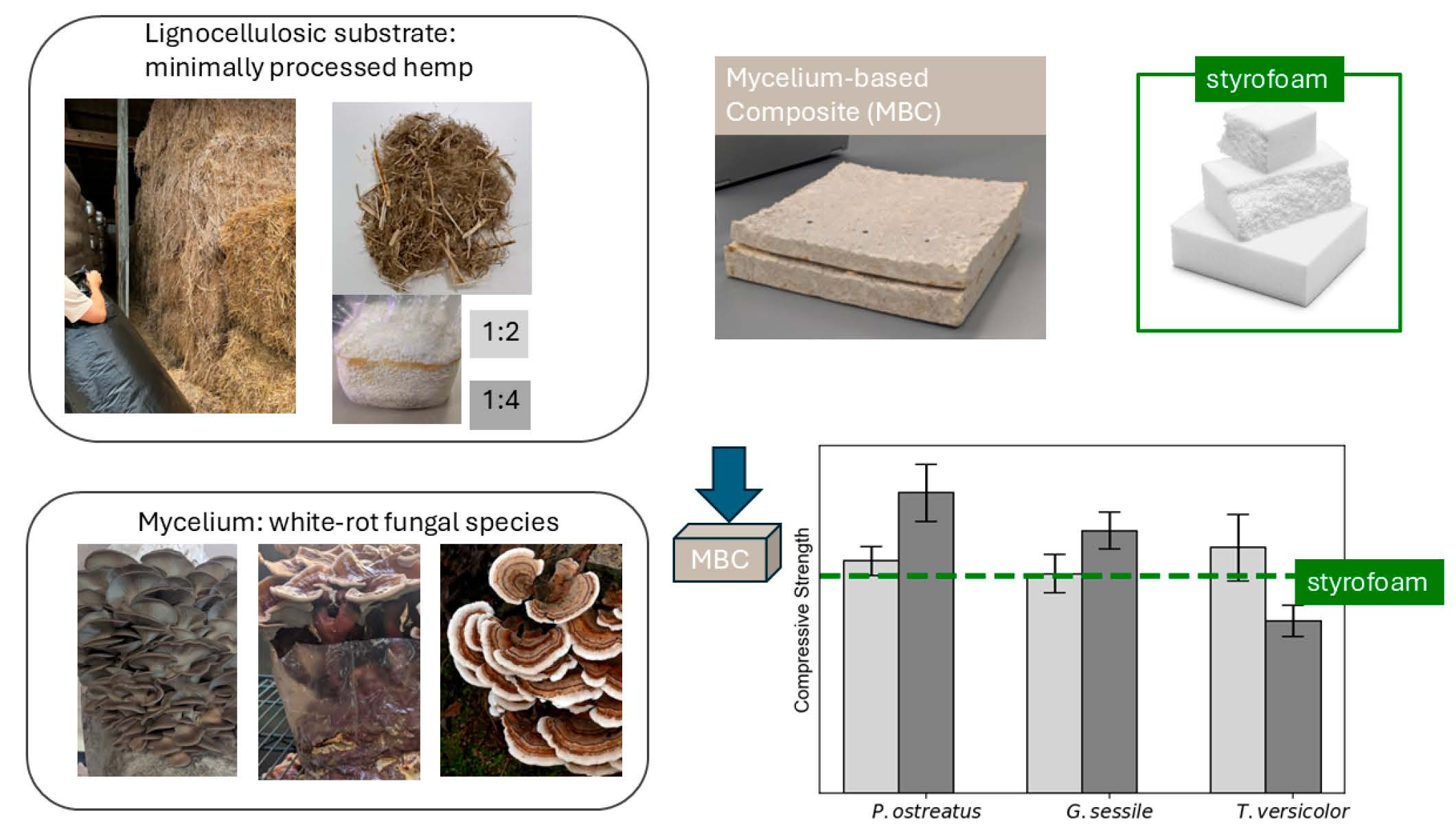
Mycelium-Based Composites Using Minimally Processed Industrial Hemp Biomass: Impact of Species and Feedstock Ratio on Mechanical Performance Compared to Polystyrene Packaging


Abstract
Share and Cite
Bhaskar, R.; Rutledge, T.; Trangone, K.; Latimore, O. Mycelium-Based Composites Using Minimally Processed Industrial Hemp Biomass: Impact of Species and Feedstock Ratio on Mechanical Performance Compared to Polystyrene Packaging. Polymers 2026, 18, 400. https://doi.org/10.3390/polym18030400
Bhaskar R, Rutledge T, Trangone K, Latimore O. Mycelium-Based Composites Using Minimally Processed Industrial Hemp Biomass: Impact of Species and Feedstock Ratio on Mechanical Performance Compared to Polystyrene Packaging. Polymers. 2026; 18(3):400. https://doi.org/10.3390/polym18030400
Chicago/Turabian StyleBhaskar, Radika, Tanisha Rutledge, Kevin Trangone, and Oneal Latimore. 2026. "Mycelium-Based Composites Using Minimally Processed Industrial Hemp Biomass: Impact of Species and Feedstock Ratio on Mechanical Performance Compared to Polystyrene Packaging" Polymers 18, no. 3: 400. https://doi.org/10.3390/polym18030400
APA StyleBhaskar, R., Rutledge, T., Trangone, K., & Latimore, O. (2026). Mycelium-Based Composites Using Minimally Processed Industrial Hemp Biomass: Impact of Species and Feedstock Ratio on Mechanical Performance Compared to Polystyrene Packaging. Polymers, 18(3), 400. https://doi.org/10.3390/polym18030400