Mechanical Properties of Granite Residual Soil Reinforced by Permeable Water-Reactive Polyurethane


Abstract
1. Introduction
2. Materials and Methods
2.1. Materials
2.1.1. Granite Residual Soil
2.1.2. Permeable Water-Reactive Polyurethane
2.2. Laboratory Test Procedure
3. Results and Discussion
3.1. Strain-Stress Relationship
3.2. Microcrack Formation Detection Using AE
3.3. Strain and Displacement Distribution and Macroscopic Cracks Production Analysis
3.4. Microscopic Mechanism Analysis of Reinforced Soil
4. Conclusions
- (1)
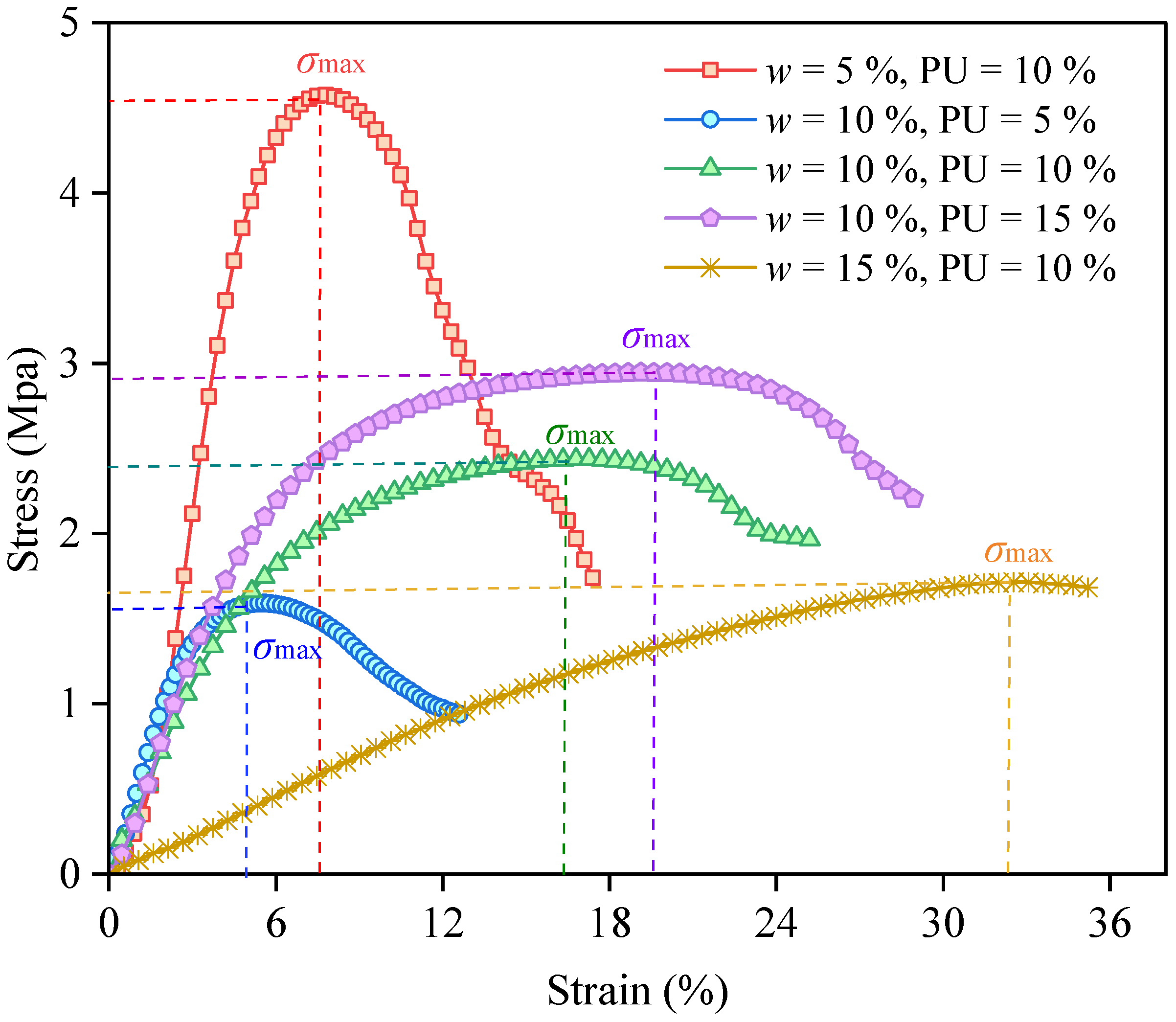
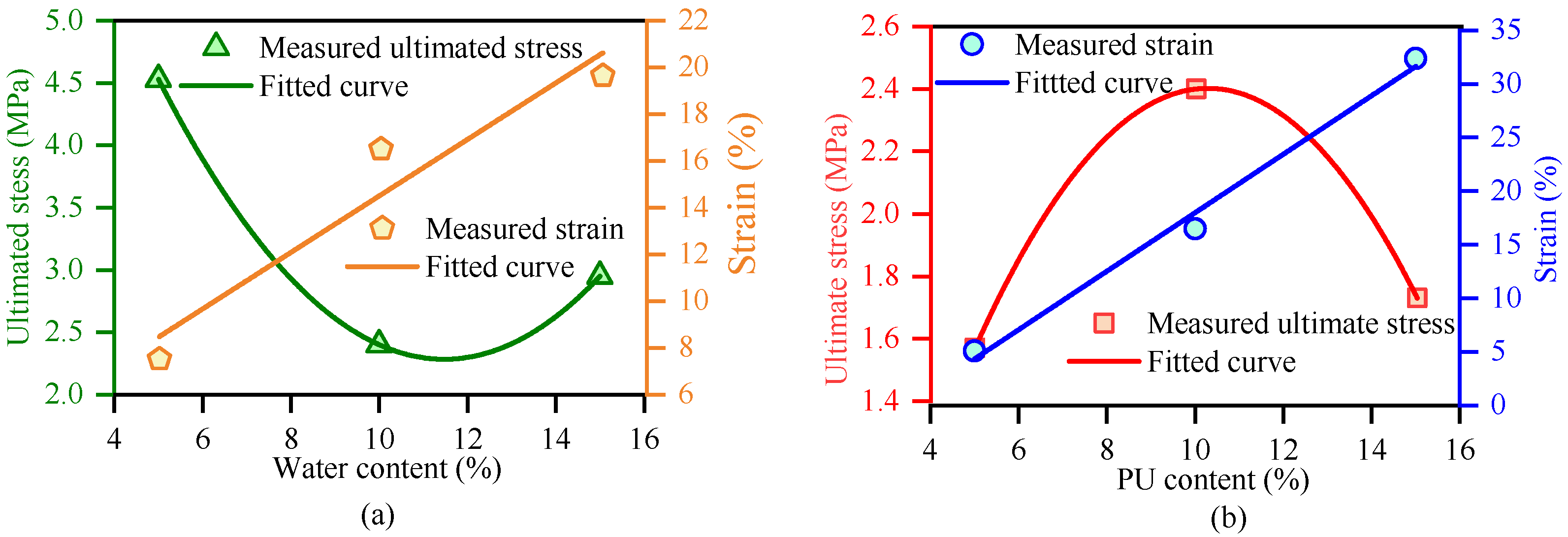
- The addition of PWPU significantly transforms the mechanical response of GRS from brittle failure to ductile yielding. The failure mode is governed by the coupling effect of initial water content (w) and PWPU content (PU). An optimal PU content of 10% was identified to maximize the compressive strength. Crucially, increasing the water content from 5% to 15% induces a shift from strain-softening to strain-hardening, with failure strains increasing linearly with PWPU dosage.
- (2)
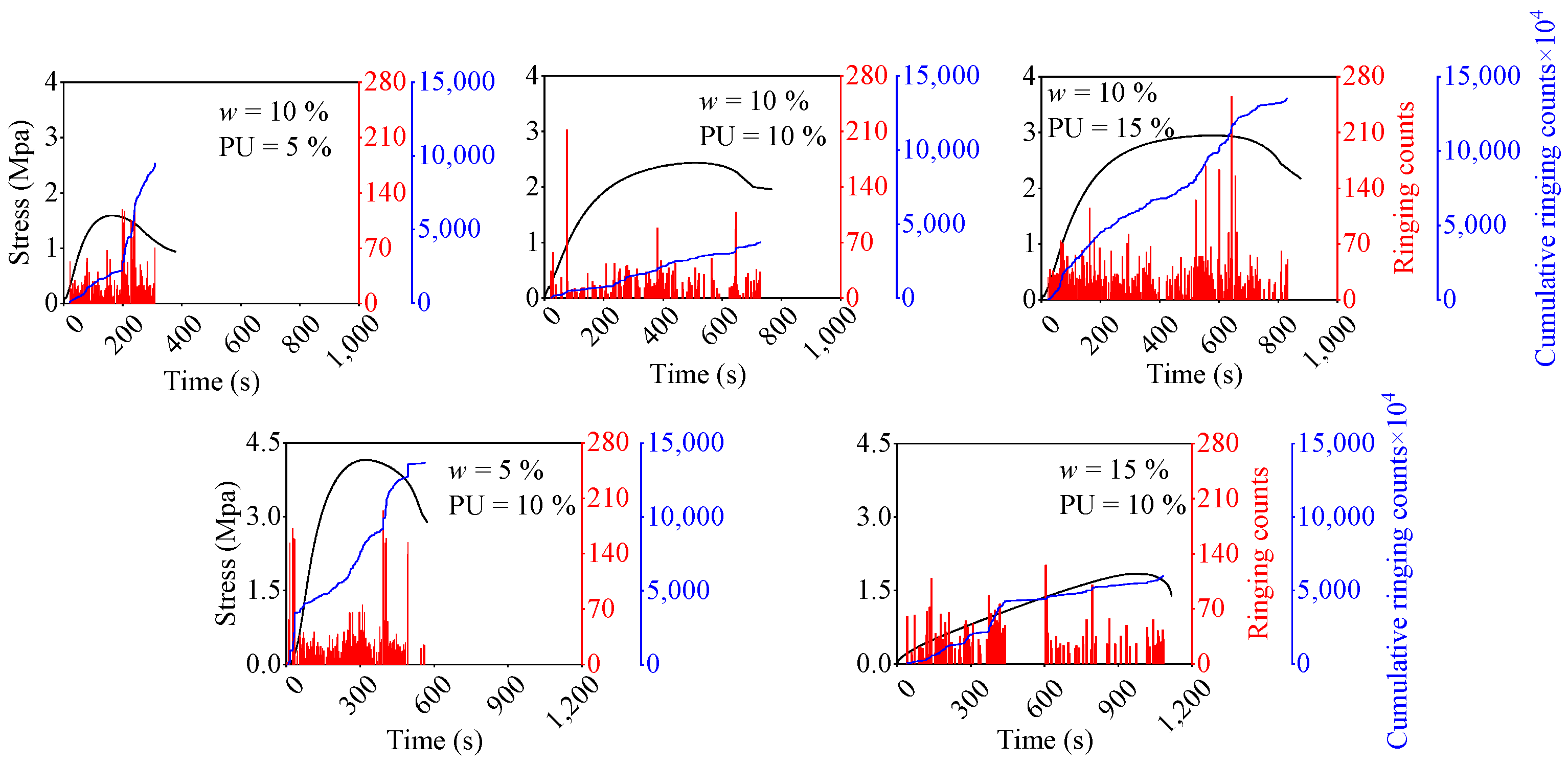
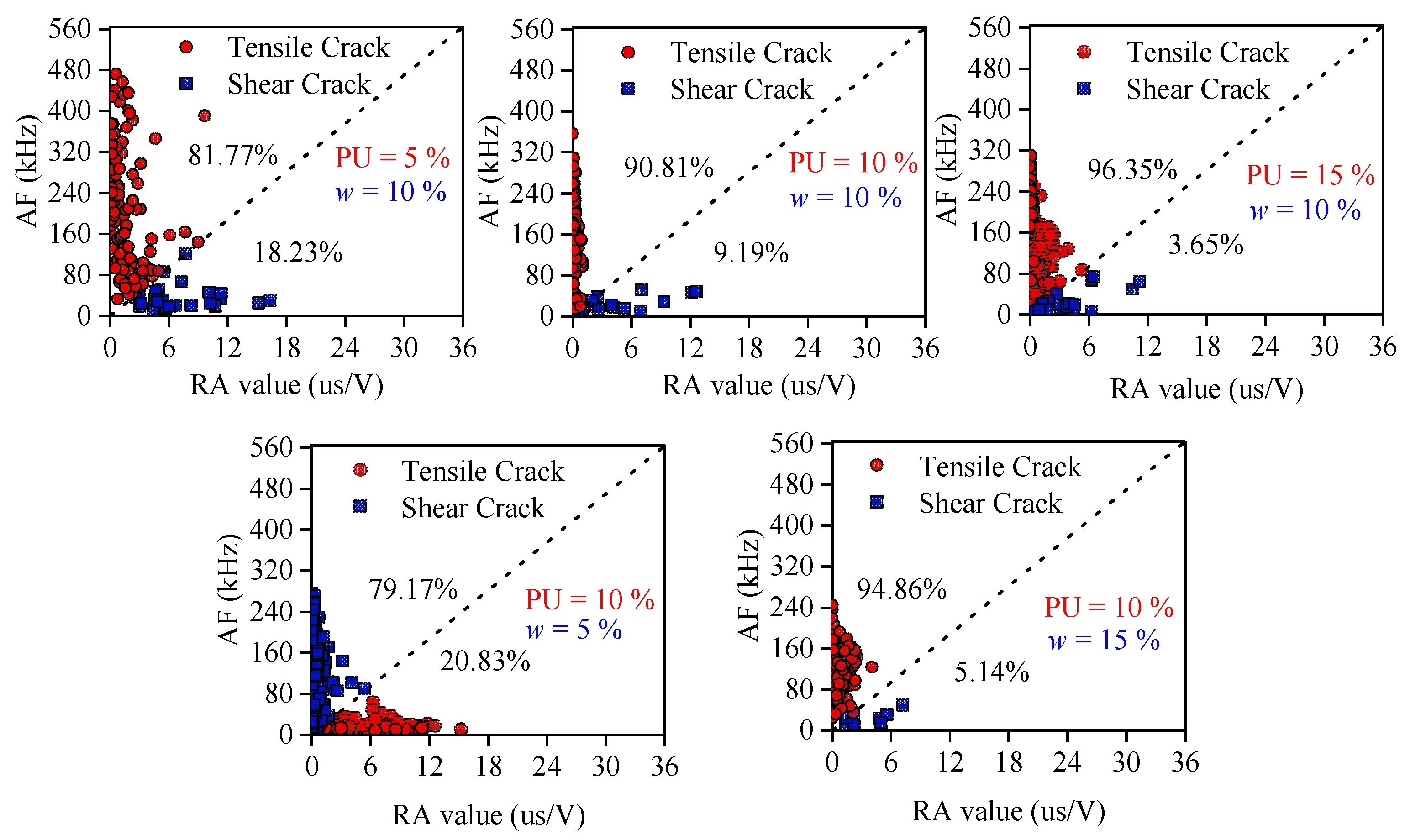
- Synchronous monitoring revealed distinct damage accumulation patterns. Brittle failure observed under low water and PWPU contents is characterized by localized shear bands and burst-type AE signals with step-like energy release. Conversely, ductile failure associated with high water and PWPU contents exhibits diffuse barreling deformation accompanied by continuous, low-amplitude AE activity. RA-AF analysis confirms that the failure mechanism shifts from shear-dominated friction to tensile-dominated fracturing involving the stretching of PWPU ligaments as the material becomes more ductile.
- (3)
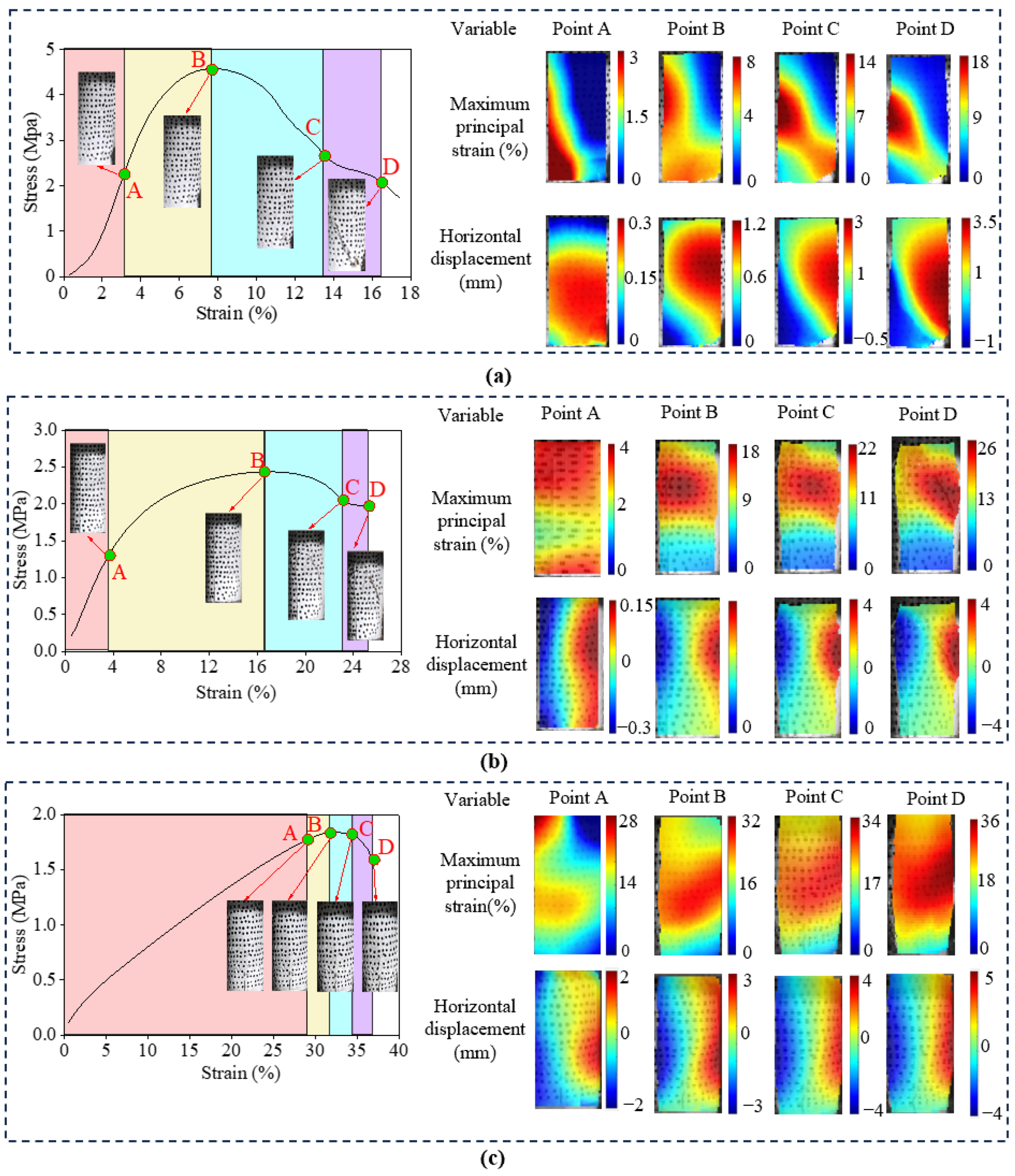
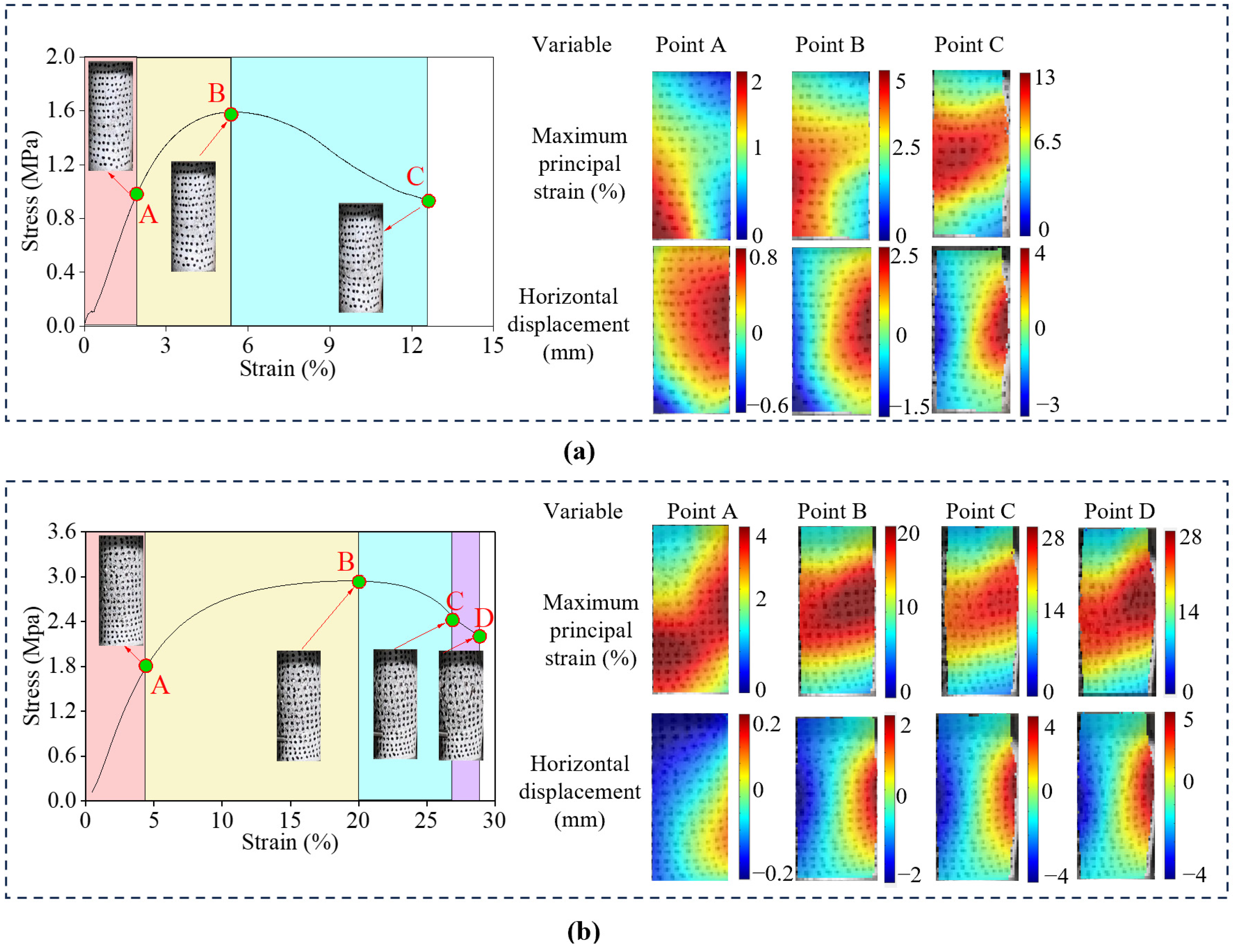
- DIC analysis visually quantified the capacity of the PWPU network to suppress strain localization. In brittle specimens, failure is driven by the rapid nucleation of a singular, high-intensity diagonal shear band. However, under optimal reinforcement conditions (PU = 10%, w = 10%), the polymer network effectively redistributes stress concentrations, preventing the premature formation of shear planes. Consequently, the deformation mode transforms into a diffuse barreling pattern, allowing the composite to sustain high axial loads even at large deformations.
- (4)
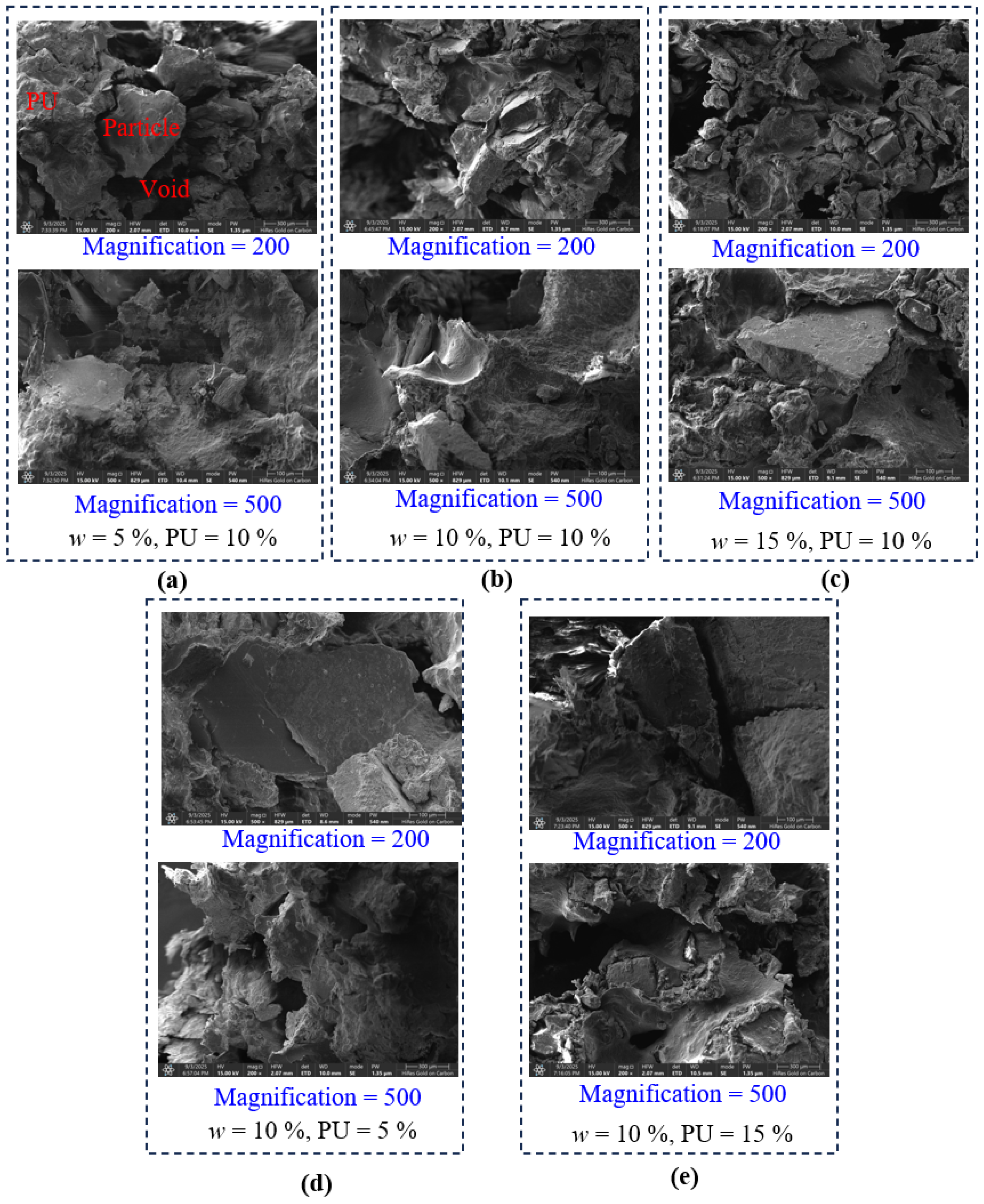
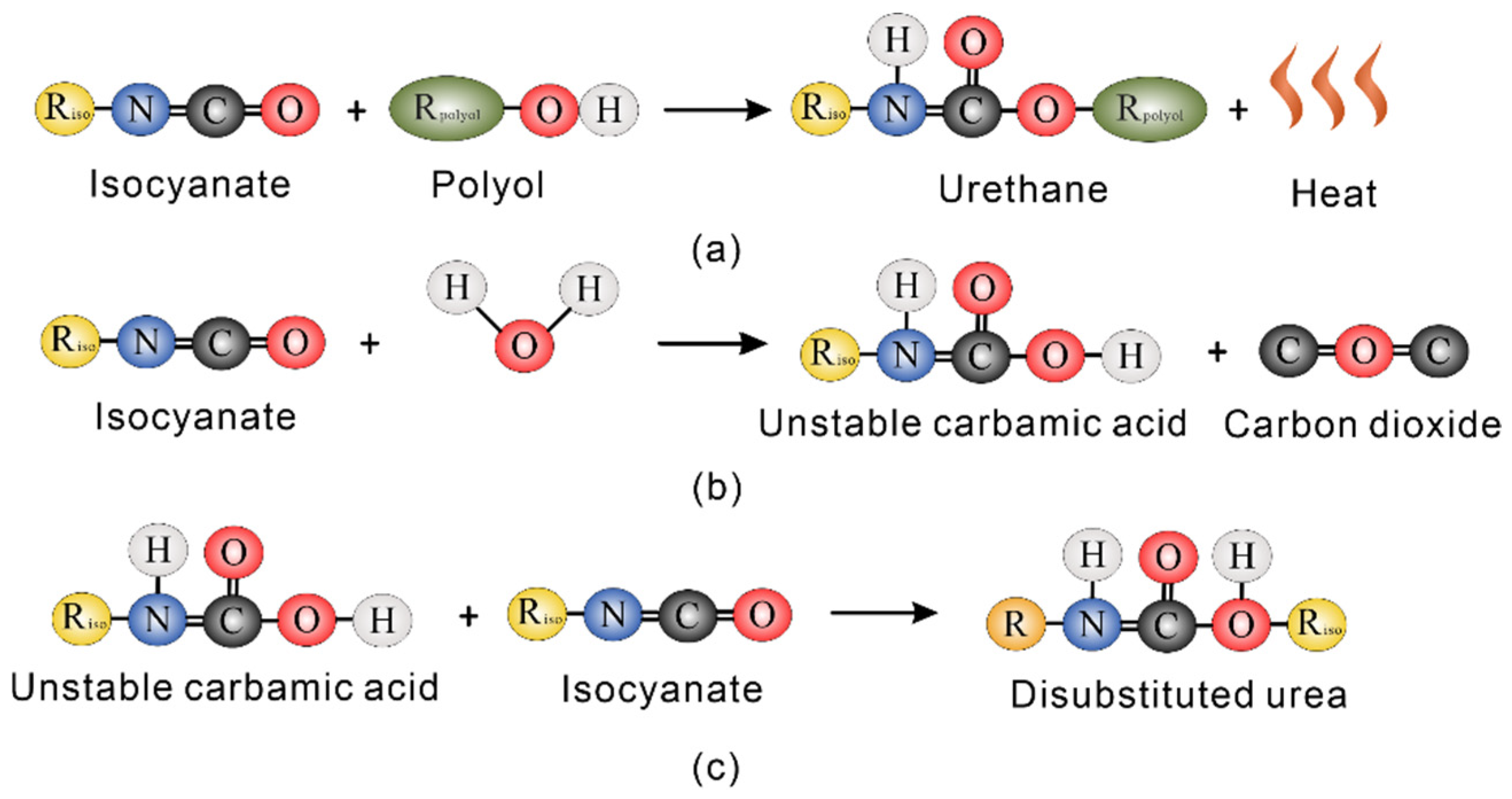
- SEM observations elucidated the physical basis of the macroscopic enhancement. The water-reactive foaming process creates a porous, reticulated polymer structure that stabilizes the soil through three primary mechanisms: the wrapping effect, the bridging effect, and the void-filling effect. The cellular foam formed at higher water contents acts as a micro-cushion, where the flexible pore walls undergo bending and stretching. This structure provides the necessary flexibility for strain-hardening behavior while preserving the hydraulic permeability of the soil.
Author Contributions
Funding
Institutional Review Board Statement
Data Availability Statement
Conflicts of Interest
Abbreviations
| AE | Acoustic emission |
| AF | Average Frequency |
| DIC | Digital image correlation |
| GRS | Granite residual soil |
| PU | Polyurethane |
| PWPU | Permeable water-reactive polyurethane |
| PWPU-GRS | PWPU-treated GRS |
| RA | Rise Time/Amplitude |
| SEM | Scanning electron microscopy |
| UCS | Uniaxial compressive strength |
| XRD | X-ray diffraction |
| XRF | X-ray Fluorescence Spectrometer |
References
- Meng, F.; Chen, R.; Wu, H.; Xie, S.; Liu, Y. Observed behaviors of a long and deep excavation and collinear underlying tunnels in Shenzhen granite residual soil. Tunn. Undergr. Space Technol. 2020, 103, 103504. [Google Scholar] [CrossRef] [Scilit]
- Liu, P.; Chen, R.; Wu, K.; Kang, X. Effects of Drying-Wetting Cycles on the Mechanical Behavior of Reconstituted Granite-Residual Soils. J. Mater. Civ. Eng. 2020, 32, 04020199. [Google Scholar] [CrossRef] [Scilit]
- Zhu, W.; Deng, H.; Ma, L.; Xiao, Y.; Lee, C.; Cheng, L.; Kong, G. Enhanced erosion resistance of granite residual soil through synergistic application of calcium lignosulfonate and microbial treatment. Eng. Geol. 2025, 355, 108256. [Google Scholar] [CrossRef] [Scilit]
- Lu, Y.; Huang, M.; Xu, C.; Xu, T. Experimental investigation on the interaction mechanism of aqueous foam and unsaturated granite residual soil during conditioning. Eng. Geol. 2025, 353, 108137. [Google Scholar] [CrossRef] [Scilit]
- Ouyang, J.; Zhang, Y.; Guo, Y.; Liu, S.; Deng, J.; Yi, C.; Fan, H. Green stabilization of granite residual soils through synergistic vegetation and biocementation treatments. J. Clean. Prod. 2025, 532, 146959. [Google Scholar] [CrossRef] [Scilit]
- Huang, Z.; Huang, J.; Zhang, J.; Li, X.; Zheng, H.; Liu, X. The Collapse Deformation Control of Granite Residual Soil in Tunnel Surrounding Rock: A Case Study. KSCE J. Civ. Eng. 2024, 28, 2034–2052. [Google Scholar] [CrossRef] [Scilit]
- Zhu, M.; Xia, C.; Chen, D.; Chen, W.; Hao, K.; Chen, X. Influence of Grouting Sequence on the Correction Effect of Horizontal Tunnel Displacement by Grouting in Granite Residual Soil. Buildings 2022, 12, 1655. [Google Scholar] [CrossRef] [Scilit]
- Zhao, Y.; Chen, X.; Wen, T.; Wang, P.; Li, W. Experimental investigations of hydraulic and mechanical properties of granite residual soil improved with cement addition. Constr. Build. Mater. 2022, 318, 126016. [Google Scholar] [CrossRef] [Scilit]
- Wang, S.; Hui, H.; Guo, S.; Zhang, P.; Chen, Z. Permeability and strength characteristics of silty sands grouted with cement and polymer. Acta Geotech. 2024, 19, 2125–2143. [Google Scholar] [CrossRef] [Scilit]
- Anagnostopoulos, C.A. Strength properties of an epoxy resin and cement-stabilized silty clay soil. Appl. Clay Sci. 2015, 114, 517–529. [Google Scholar] [CrossRef] [Scilit]
- Saleh, S.; Yunus, N.Z.M.; Ahmad, K.; Ali, N. Improving the strength of weak soil using polyurethane grouts: A review. Constr. Build. Mater. 2019, 202, 738–752. [Google Scholar] [CrossRef] [Scilit]
- Somarathna, H.M.C.C.; Raman, S.N.; Mohotti, D.; Mutalib, A.A.; Badri, K.H. The use of polyurethane for structural and infrastructural engineering applications: A state-of-the-art review. Constr. Build. Mater. 2018, 190, 995–1014. [Google Scholar] [CrossRef] [Scilit]
- Wang, J.; Gao, S.; Zhang, C.; Deng, Y.; Zhang, P. Preparation and Performance of Water-Active Polyurethane Grouting Material in Engineering: A Review. Polymers 2022, 14, 5099. [Google Scholar] [CrossRef] [Scilit]
- Das, A.; Mahanwar, P. A brief discussion on advances in polyurethane applications. Adv. Ind. Eng. Polym. Res. 2020, 3, 93–101. [Google Scholar] [CrossRef] [Scilit]
- Wang, C.; Diao, Y.; Guo, C.; Wu, H.; Guan, H.; Qin, L.; Chu, X.; Du, X. Experimental study on the mechanical behaviour of silty soil stabilized with polyurethane. Constr. Build. Mater. 2024, 416, 135251. [Google Scholar] [CrossRef] [Scilit]
- Zheng, J.; Cao, D.; Guo, C.; Wang, F.; Liu, Z.; Wu, J.; Teng, C.; Wang, D. Investigation of mechanical properties of calcareous sand treated with a water-reactive polyurethane using acoustic emission. Mar. Georesources Geotechnol. 2025, 1–24. [Google Scholar] [CrossRef] [Scilit]
- Fredlund, D.G.; Morgenstern, N.R.; Widger, R.A. The shear strength of unsaturated soils. Can. Geotech. J. 1978, 15, 313–321. [Google Scholar] [CrossRef] [Scilit]
- Goldaran, R.; Turer, A.; Kouhdaragh, M.; Ozlutas, K. Identification of corrosion in a prestressed concrete pipe utilizing acoustic emission technique. Constr. Build. Mater. 2020, 242, 118053. [Google Scholar] [CrossRef] [Scilit]
- Gama, N.V.; Ferreira, A.; Barros-Timmons, A. Polyurethane Foams: Past, Present, and Future. Materials 2018, 11, 1841. [Google Scholar] [CrossRef] [Scilit] [PubMed]
- Blaber, J.; Adair, B.; Antoniou, A. Ncorr: Open-Source 2D Digital Image Correlation Matlab Software. Exp. Mech. 2015, 55, 1105–1122. [Google Scholar] [CrossRef] [Scilit]
- Li, F.; Guo, C.; Ma, H.; Wang, H.; Pei, L.; Guo, J.; Wang, F. Experimental investigation on dynamic characteristics of coral sand solidified by permeable water-reacting polyurethane. Constr. Build. Mater. 2025, 470, 140500. [Google Scholar] [CrossRef] [Scilit]
- Yu, H.; Liu, R.; Xiao, D.; Li, S.; Han, X.; Hu, M.; Wang, Y. Experimental study on shear behavior of Polyurethane/water glass-filled planar rock joints. PLoS ONE 2025, 20, e0326262. [Google Scholar] [CrossRef] [Scilit] [PubMed]
- Komurlu, E.; Kesimal, A. Experimental study of polyurethane foam reinforced soil used as a rock-like material. J. Rock Mech. Geotech. Eng. 2015, 7, 566–572. [Google Scholar] [CrossRef] [Scilit]
- Wang, C.; Liu, Q.; Guo, C.; Xia, Y.; Hao, Y.; Shi, M.; Zhao, P.; Ye, X. An Experimental Study on the Reinforcement of Silt with Permeable Polyurethane by Penetration Grouting. Adv. Civ. Eng. 2020, 2020, 8834331. [Google Scholar] [CrossRef] [Scilit]
- Botero, E.; Ossa, A.; Sherwell, G.; Ovando-Shelley, E. Stress–strain behavior of a silty soil reinforced with polyethylene terephthalate (PET). Geotext. Geomembr. 2015, 43, 363–369. [Google Scholar] [CrossRef] [Scilit]
- Ates, M.; Karadag, S.; Eker, A.A.; Eker, B. Polyurethane foam materials and their industrial applications. Polym. Int. 2022, 71, 1157–1163. [Google Scholar] [CrossRef] [Scilit]
- Vydehi, K.V.; Moghal, A.A.B. Effect of biopolymeric stabilization on the strength and compressibility characteristics of cohesive soil. J. Mater. Civ. Eng. 2022, 34, 04021428. [Google Scholar] [CrossRef] [Scilit]
- Tan, P.; Wang, F.; Guo, C.; Liu, J.; Lei, Q.; Liu, Z. Performance evaluation and stabilization mechanism of red clay treated with polyurethane. Chemosphere 2023, 340, 139864. [Google Scholar] [CrossRef] [Scilit] [PubMed]
- Liu, Y.; Cheng, J.; Xu, C.; Wang, G.; Xu, J. Mechanical behaviors and instability of rocks subjected to hydraulic progressive wetting: Acoustic emission and uniaxial compression experiments. J. Rock Mech. Geotech. Eng. 2025, 18, 593–610. [Google Scholar] [CrossRef] [Scilit]
- Ma, J.; Song, L. Experimental study on uniaxial compression acoustic emission characteristics of fractured coal under dynamic disturbance. Mater. Today Commun. 2026, 50, 114398. [Google Scholar] [CrossRef] [Scilit]
- He, J.; Li, Y.; Li, H.; Ma, Y.; Feng, S.; Wang, Z. Shear behavior and damage identification of π-shaped demountable connector for composite beam equipped with acoustic emission sensors. Constr. Build. Mater. 2025, 497, 143811. [Google Scholar] [CrossRef] [Scilit]
- Qi, W.; Pang, H.; Huang, Y.; Zhao, Q.; Zhang, J.; Zhao, D.; Pang, H. Progressive damage of solid-waste coal-based geopolymer mortar based on acoustic emission: New indicators for precursor characterization of instability. Case Stud. Constr. Mater. 2025, 23, e05477. [Google Scholar] [CrossRef] [Scilit]
- Zhang, T.; Cao, D.; Guo, C.; Wang, F. Mechanical properties and reinforcement mechanism study of sulfate saline soil solidified by polyurethane and water glass. Case Stud. Constr. Mater. 2025, 22, e04328. [Google Scholar] [CrossRef] [Scilit]
- Wang, N.; Bao, Y.; Wang, W.; Zhang, M.; Zhang, L.; Chen, X.; Cai, X. Research on the properties and microstructural evolution of ecological flowable solidified soil prepared from water treatment plant residual sludge. J. Environ. Chem. Eng. 2026, 14, 120901. [Google Scholar] [CrossRef] [Scilit]
- Alhakim, G.; Núñez-Temes, C.; Ortiz-Sanz, J.; Arza-García, M.; Jaber, L.; Gil-Docampo, M.L. Experimental application and accuracy assessment of 2D-DIC in meso-direct-shear test of sandy soil. Measurement 2023, 211, 112645. [Google Scholar] [CrossRef] [Scilit]
- Wang, H.; Feng, T.; He, Y.; Yang, F.; Feng, Y.; Zhang, J. Fracture toughness of steel-polypropylene hybrid fibre reinforced shotcrete and its feasibility in squeezing tunnels. Constr. Build. Mater. 2025, 489, 142353. [Google Scholar] [CrossRef] [Scilit]
- Li, J.; Wang, L.; Chen, D.; Liu, Y.; Gao, Z.; Wang, W.; Yang, H. Acoustic Emission Characterization and Cracking Characteristics of Reinforced Concrete Pipe. KSCE J. Civ. Eng. 2023, 27, 3872–3886. [Google Scholar] [CrossRef] [Scilit]
- Liu, J.; Chen, Z.; Kanungo, D.P.; Song, Z.; Bai, Y.; Wang, Y.; Li, D.; Qian, W. Topsoil reinforcement of sandy slope for preventing erosion using water-based polyurethane soil stabilizer. Eng. Geol. 2019, 252, 125–135. [Google Scholar] [CrossRef] [Scilit]






| Component | Na2O | MgO | Al2O3 | SiO2 | K2O | Fe2O3 | Others |
|---|---|---|---|---|---|---|---|
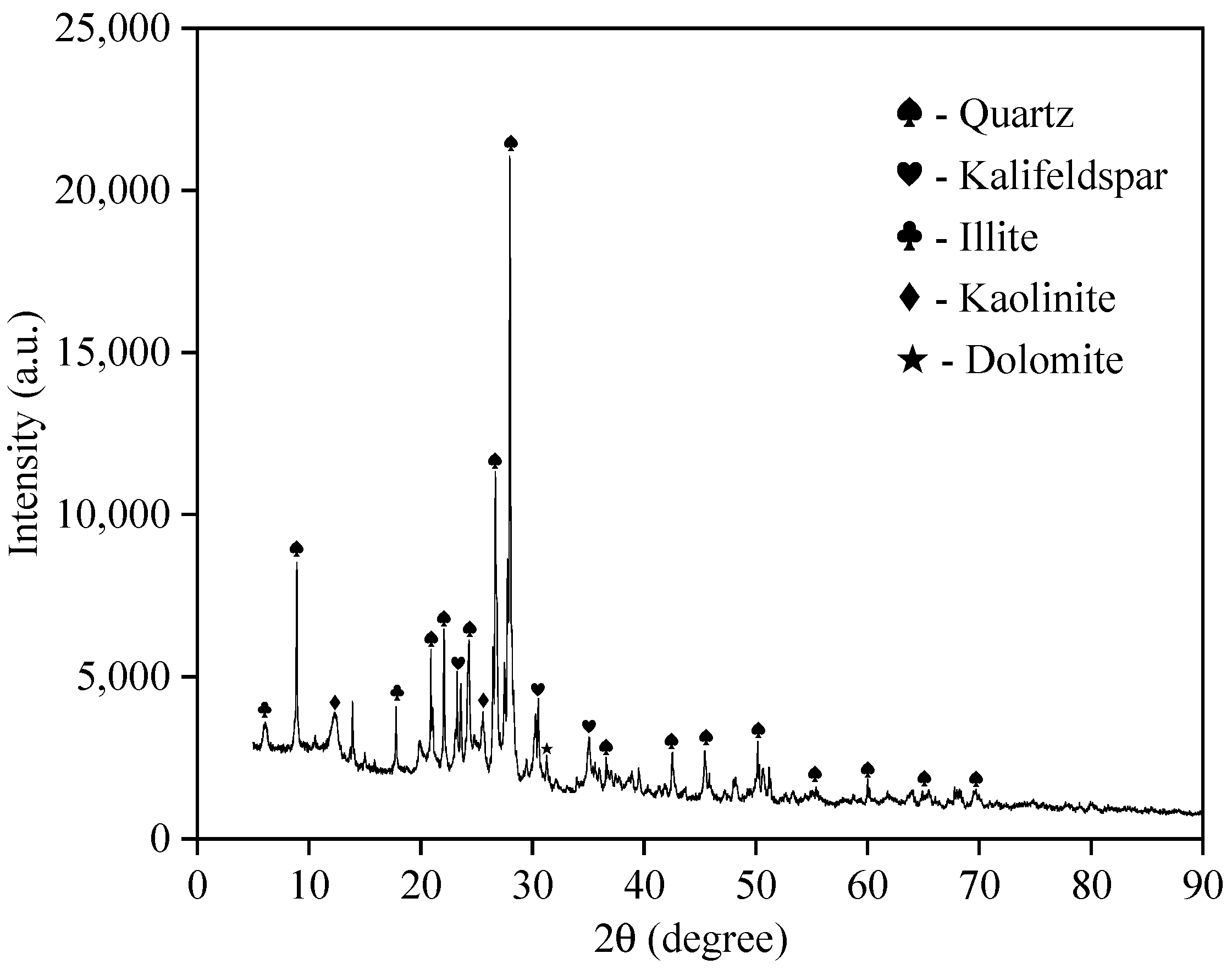
| Percent (%) | 3.36 | 1 | 24.96 | 59 | 5 | 3.73 | 2.95 |
Disclaimer/Publisher’s Note: The statements, opinions and data contained in all publications are solely those of the individual author(s) and contributor(s) and not of MDPI and/or the editor(s). MDPI and/or the editor(s) disclaim responsibility for any injury to people or property resulting from any ideas, methods, instructions or products referred to in the content. |
© 2026 by the authors. Licensee MDPI, Basel, Switzerland. This article is an open access article distributed under the terms and conditions of the Creative Commons Attribution (CC BY) license.
Share and Cite
Tan, S.; Li, J.; Cao, D.; Xiao, T.; Zheng, J. Mechanical Properties of Granite Residual Soil Reinforced by Permeable Water-Reactive Polyurethane. Polymers 2026, 18, 381. https://doi.org/10.3390/polym18030381
Tan S, Li J, Cao D, Xiao T, Zheng J. Mechanical Properties of Granite Residual Soil Reinforced by Permeable Water-Reactive Polyurethane. Polymers. 2026; 18(3):381. https://doi.org/10.3390/polym18030381
Chicago/Turabian StyleTan, Shuzhong, Jinyong Li, Dingfeng Cao, Tao Xiao, and Jiajia Zheng. 2026. "Mechanical Properties of Granite Residual Soil Reinforced by Permeable Water-Reactive Polyurethane" Polymers 18, no. 3: 381. https://doi.org/10.3390/polym18030381
APA StyleTan, S., Li, J., Cao, D., Xiao, T., & Zheng, J. (2026). Mechanical Properties of Granite Residual Soil Reinforced by Permeable Water-Reactive Polyurethane. Polymers, 18(3), 381. https://doi.org/10.3390/polym18030381