


Abstract
Microplastic (MP) pollution and dye-contaminated wastewater have emerged as major environmental concerns due to their persistence, widespread distribution, and potential risks to aquatic ecosystems and human health. In this study, ZIF-67 grown on Fe3O4-incorporated chitosan sponge (FCS-ZIF-67) was fabricated via electrochemical deposition (ECD) for MP filtration and methylene blue (MB) adsorption. Filtration was evaluated using polyethylene terephthalate (PET) MPs (particle type) and MPs (fiber type); in each cycle, 5 mg of MPs in 5 L of tap water was filtered at −2 kPa (gauge). FCS-ZIF-67 exhibited high removal efficiencies of 93.54% and 96.81% for MPs (particle type) and MPs (fiber type), respectively, over five cumulative filtration cycles, with average flow rates of approximately 0.5 L min−1. The enhanced capture performance was attributed to the combined effects of the porous sponge structure and ZIF-67 surface functionalization, which likely promoted physical entrapment and particle retention. In addition, FCS-ZIF-67 demonstrated high MB adsorption performance, achieving a maximum removal efficiency of 85.67% at pH 8.5 after 120 min in batch tests. These results indicate that FCS-ZIF-67 is an effective multifunctional platform that removes MPs with different morphologies by filtration and adsorbs dissolved organic dyes, highlighting its potential for advanced tertiary wastewater treatment applications.
1. Introduction
Microplastic (MP) contamination has emerged as a pervasive global environmental issue and has now been detected in marine ecosystems, rivers, and freshwater environments worldwide [1]. A 2017 assessment estimated annual inputs of 0.8–2.5 million tonnes of primary MPs into the world’s oceans [2]. MPs (fiber type) are elongated particles with a length-to-diameter ratio greater than 5:1, typically less than 5 mm in length and often under 20 μm in diameter, primarily released from synthetic textiles during laundering, whereas MPs (particle type) are fragmented plastic particles smaller than 5 mm generated from the degradation and abrasion of plastic packaging products [1]. MPs (fiber type) released during laundering are estimated to contribute approximately 35% of primary MPs entering marine environments, highlighting the substantial impact of textile-derived pollutants [3]. For example, domestic washing activities in the United Kingdom alone are estimated to release between 6860 and 17,847 tons of MPs (fiber type) each year [4]. MPs (particle type) generated from the fragmentation and abrasion of plastic packaging products are continuously released into aquatic environments through improper disposal, weathering, and wastewater discharge, contributing significantly to long-term environmental contamination [1].
MPs are readily ingested by wildlife across trophic levels, with numerous marine species, including fish, birds, and mammals, documented to contain MPs [5]. MPs have been detected in the gastrointestinal tracts of commercially important fish species [6]. In fish, the gastrointestinal tract has been identified as a primary target organ of MP exposure, resulting in oxidative stress, impaired digestive function, intestinal tissue damage, and, in severe cases, mortality [7]. Disruption of antioxidant defenses can promote excessive reactive oxygen species accumulation, inducing aberrant apoptosis, weakening intestinal structure, and impairing the digestion and absorption of proteins and amino acids [7]. Recent studies have also confirmed the presence of MPs in human food, drinking water, and even human tissues, including the lung, placenta, blood, and colon [8]. Although the full extent of health effects is still under investigation, emerging evidence suggests that MP exposure may induce inflammatory responses, oxidative stress, immune system impacts, and even DNA damage [8]. MPs have also been detected in lung ground-glass nodules, although their causal role in disease remains unresolved [9]. The potential for MPs to act as carriers of harmful chemicals or microorganisms further amplifies concerns regarding their long-term health impacts [8].
MP removal in water and wastewater treatment is reported by particle number or mass under the corresponding treatment conditions. A drinking-water treatment plant in Bangkok achieved overall MP removal efficiencies of 75–81% [10]. A textile-industry wastewater treatment plant (WWTP) in Guangdong, China, achieved 99% removal by particle number and 67.7% by the measured mass of PA66, PET, and PC [11]. A WWTP in Jordan reported approximately 62% removal for MPs in the 38–1000 µm size range [12]. Despite these removal efforts, a residual fraction of MPs, particularly those with smaller particle sizes, remains in treated effluent and is continuously discharged into aquatic environments, highlighting the limitations of conventional treatment systems in achieving complete MP removal.
Biomass-derived materials have demonstrated high MP capture performance. An optimized bamboo fiber/microfibrillated cellulose foam achieved a filtration efficiency of 99.4% [13]. Cellulose nanofibril-loaded filter paper removed more than 93% of polystyrene (PS), polypropylene (PP), and polyethylene terephthalate (PET) MPs and maintained 96% efficiency after ten cycles [14], while reusable chitin sponges removed 71.6–92.1% of approximately 1 μm PS-based MPs [15]. However, most of these materials have been evaluated for a single MP morphology, and the simultaneous removal of MPs (particle type), MPs (fiber type), and dissolved dyes by a single filter remains largely unexplored [15].
In addition to MP contamination, organic dyes are widely discharged into wastewater from industries such as textile dyeing, printing, and papermaking [16]. Among these pollutants, methylene blue (MB) is a common cationic dye and a widely used model contaminant in water treatment studies [16]. MB and similar dyes pose environmental risks because their intense coloration reduces light penetration in water, thereby inhibiting photosynthesis in aquatic ecosystems [16]. Experimental exposure to MB has been shown to impair the growth and reproduction of Daphnia magna and to alter oxidative-stress-related responses [17].
Metal–organic frameworks (MOFs) are crystalline porous materials constructed from metal nodes and organic linkers, exhibiting high surface areas, tunable porosity, and versatile physicochemical properties [18]. Among them, zeolitic imidazolate framework-67 (ZIF-67), composed of Co2+ nodes and 2-methylimidazolate linkers, has attracted considerable attention for water treatment for its porous structure and documented adsorption applications [19]. Hou et al. prepared porous chitosan–ZIF composite fibers by wet spinning and self-assembly and evaluated their dye adsorption [20]. ZIF-67 has also been applied to the removal of MPs from aqueous environments [21].
Porous composite design combines the architecture of a support with the interfacial properties of a functional material. Wang et al. used activated biochar as a support for BiVO4 in a visible-light photocatalyst [22]. Shahmansoori et al. grew ZIF-67 on chitosan beads to adsorb malachite green and tetracycline [23], and Peng et al. incorporated a ZIF-67-containing composite into a sponge for the treatment of multiple contaminants [24]. In this study, ZIF-67 was incorporated into a chitosan sponge with interconnected pores, and its MP filtration and dye adsorption performance were evaluated separately.
MOFs have been incorporated into various substrates, including fibers, polymeric matrices, and porous supports, using several approaches such as conventional solvothermal synthesis, hydrothermal synthesis, in situ growth, and post-synthetic surface coating methods [25]. However, solvothermal and hydrothermal routes can require elevated temperatures and extended reaction times, while the adhesion of deposited MOF layers depends on the synthesis conditions and substrate [25]. Electrochemical deposition (ECD) provides an alternative route in which applied current or potential can regulate interfacial nucleation and film growth [26,27]. ZIF-67 films have also been prepared by cathodic electrochemical deposition [28]. However, electrochemical processing does not inherently guarantee uniform coverage or strong adhesion, and film detachment remains dependent on deposition conditions [26].
In this study, Fe3O4 nanoparticles were incorporated into a porous chitosan sponge (CS) to obtain an Fe3O4-incorporated chitosan sponge (FCS) for the ECD-assisted immobilization of cobalt-containing species. The immobilized species were subsequently reacted with 2-methylimidazole (2MI) to grow ZIF-67, producing FCS-ZIF-67. This two-step procedure separates precursor deposition from ligand-induced crystallization. The resulting composite was systematically evaluated in terms of MB adsorption, removal of MPs (particle type) and MPs (fiber type), and flow-rate variation during repeated use to quantify pollutant removal and flow-rate changes.
2. Materials and Methods
2.1. Materials
Chitosan (high molecular weight), cobalt(II) nitrate hexahydrate (reagent grade, 98%), gelatin (from porcine skin), acetic acid (>99%), glutaraldehyde (GA) solution (25%), methylene blue (MB, ≥82%), 2MI (≥99.9%), ethanol (≥99.9%), Fe3O4 (50–100 nm particle size, 97%) and methanol (99.8%) were purchased from Sigma-Aldrich. A direct current (DC) power supply (UTP3315TFL-II, UNI-T, Dongguan, China) was used to apply the voltage, and a platinum electrode (KSIC-4084, Ku Ryong Scientific, Seoul, Republic of Korea) was employed as the counter electrode. Polyethylene oxide (PEO, Mw 100,000) was purchased from Alfa Aesar(Ward Hill, MA, USA), and PET was obtained from commercially available beverage bottles (Coca-Cola). Polyester fabrics used as MPs (fiber type) for the filtration tests were purchased from Hwan Tex (Seoul, Republic of Korea).
2.2. Synthesis of CS and FCS
Chitosan (1.5 wt%), gelatin (3.3 wt% relative to chitosan), and PEO (37 wt% relative to chitosan) were added to a 1 wt% aqueous acetic acid solution, and the mixture was magnetically stirred for 2 h to obtain a homogeneous polymer solution. For the FCS, Fe3O4 particles were then incorporated at 40 wt% relative to the chitosan solution and uniformly dispersed under continuous stirring. Subsequently, a 5 wt% GA solution was added as a crosslinking agent at a polymer solution/GA solution volume ratio of 200:3 (v/v), corresponding to a GA-to-chitosan mass ratio of approximately 1:20, and the mixture was gently mixed for 5 min to ensure homogeneous distribution of the crosslinker. For each sponge filter sample, 20 mL of the resulting mixture was poured into a cylindrical mold (diameter: 5 cm) and allowed to crosslink without stirring at room temperature (20 ± 2 °C) for 4 h. The samples were pre-frozen at −20 °C for 4 h and subsequently freeze-dried at −85 °C (5 mTorr) using a freeze dryer (TFD8501, Ilshin BioBase, Dongducheon, Republic of Korea) to obtain porous sponge structures. Ice crystals formed during pre-freezing act as pore templates, and their sublimation during freeze-drying generates interconnected pores. After freeze-drying, each sponge was washed three times with 40 mL of ethanol per wash to remove PEO. The washed sponges were then dried at room temperature (20 ± 2 °C) for 1 h before use. CS and FCS were obtained with a diameter of 5 cm and a thickness of 0.5 cm.
2.3. ECD-Assisted Growth of ZIF-67 on FCS
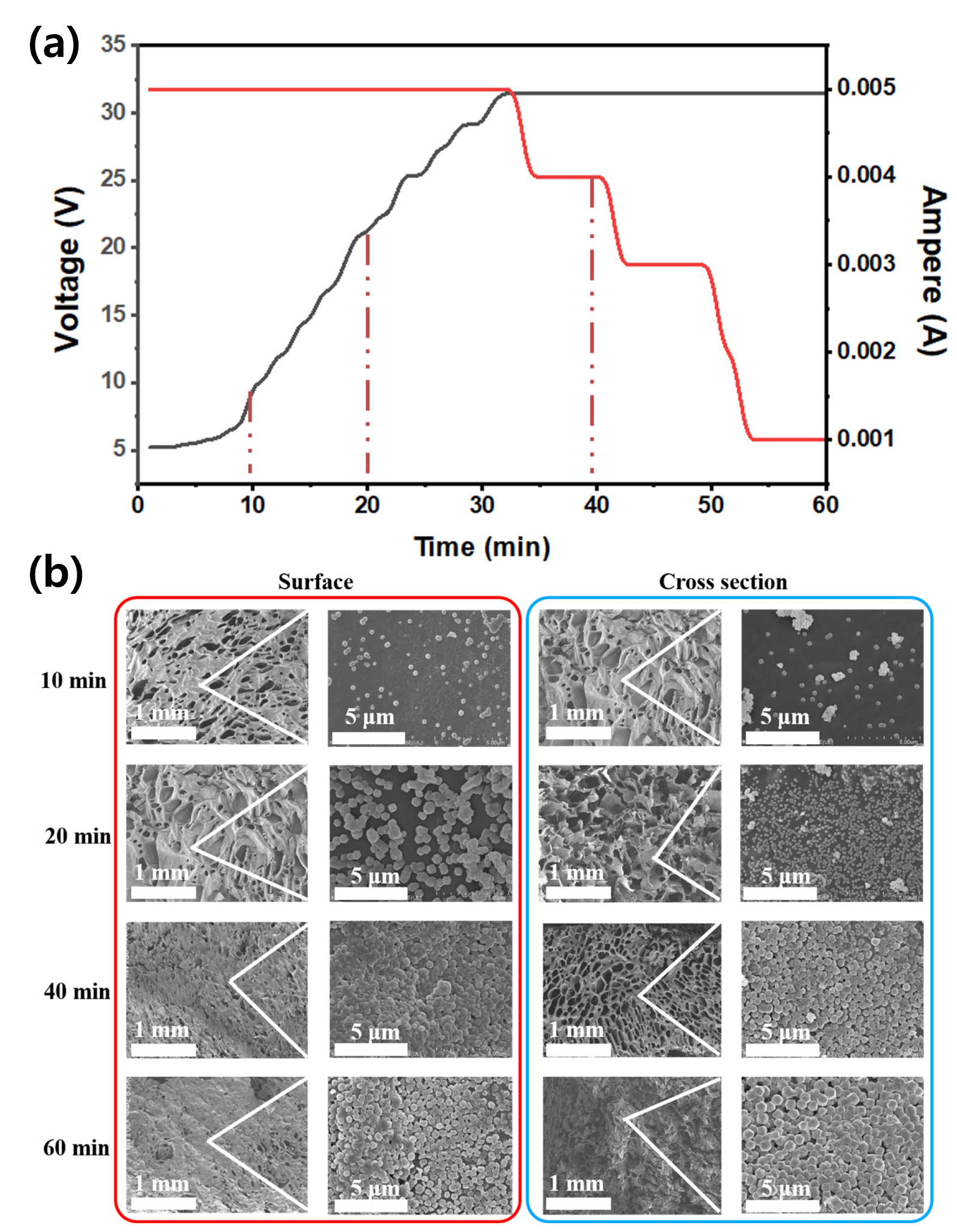
The metal precursor solution for ECD was prepared by dissolving cobalt(II) nitrate hexahydrate, which supplies divalent cobalt ions (Co2+), in methanol at a concentration of 0.19 mol L−1, with the quantities scaled proportionally to obtain a final solution volume of 300 mL. The ligand solution was prepared by dissolving 2MI in methanol at a concentration of 0.79 mol L−1, and 50 mL of this solution was used for each FCS sample following ECD. ECD was performed in the prepared metal precursor solution using FCS as the cathode (−) and a platinum rod as the anode (+). Fe3O4 was incorporated to impart electrical conductivity to FCS and provide nucleation sites for deposition of cobalt-containing species during ECD. The DC power supply was set to a current of 5 mA, and the current and voltage profiles were recorded during ECD. At 33 min, the output voltage reached the experimentally observed voltage limit of 31.5 V. Because the power supply could not increase the output voltage further, the preset current of 5 mA could no longer be maintained, and the current subsequently decreased. Both the front and back sides of the FCS were treated by ECD. The 60 min ECD sample was used for subsequent performance evaluation. The electrode spacing was fixed at 2.5 cm, and the process was conducted at room temperature (20 ± 2 °C). After ECD, each sample was immersed in 50 mL of the ligand solution for 2 h to induce ZIF-67 crystallization. The samples were subsequently washed and dried to obtain FCS-ZIF-67.
The apparent MOF loading was calculated from the net dry-mass gain after ECD and ligand treatment as a fraction of the final composite dry mass, according to Equation (1). The calculation includes the net mass of retained material and does not independently resolve ZIF-67 from other cobalt-containing species:
where WFCS is the initial dry mass of FCS prior to ECD, and Wfin is the final dry mass of the FCS-ZIF-67.
To investigate the effect of ECD duration on the apparent MOF loading, ECD was conducted at different deposition times (10, 20, 40, and 60 min). The extent of ZIF-67 attachment on the FCS substrate was evaluated using time-dependent voltage and current profiles, and surface and cross-sectional scanning electron microscopy (SEM).
2.4. Preparation and Size Analysis of MPs (Particle Type) and MPs (Fiber Type)
MPs (particle type) were prepared from PET bottles using a ball mill (MM 400, Retsch GmbH, Haan, Germany) operated at 30 Hz for 3 min. MPs (fiber type) were prepared from the polyester fabrics using a high-speed cutter mill (Pulverisette-14, FRITSCH GmbH, Idar-Oberstein, Germany) at 12,000 rpm for 1 min. The MPs were observed using a digital microscope system (Nexcope NM910, equipped with an N-MPFN 5×/0.15 BD objective lens, Ningbo, China) and scanning electron microscopy (FE-SEM, Hitachi, Tokyo, Japan). MP size analysis was performed using ImageJ software (version 1.54r, NIH, Rockville, MD, USA). For MPs (particle type), particle size was defined as the end-to-end straight-line length along the longitudinal axis of each particle and was manually measured in FE-SEM images using ImageJ. For MPs (fiber type), fiber length was defined as the path length from one end of each fiber to the other, following its curvature, and was measured by manually tracing the fiber in digital microscope images using ImageJ. The MPs in the images were marked in red using Photoshop (Adobe Inc., San Jose, CA, USA) to enhance visual distinction. For each input and retained-MP group, n > 200 MPs were manually measured to obtain the size or length distribution (Figure S1 and Text S1). Retained MPs were measured on one sponge per material.
2.5. Evaluation of MP Filtration Performance
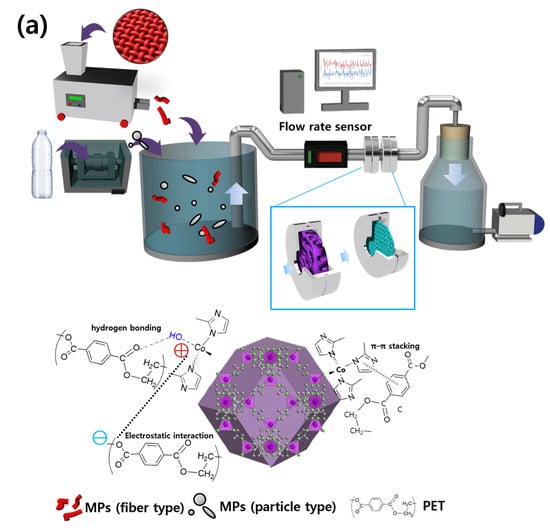
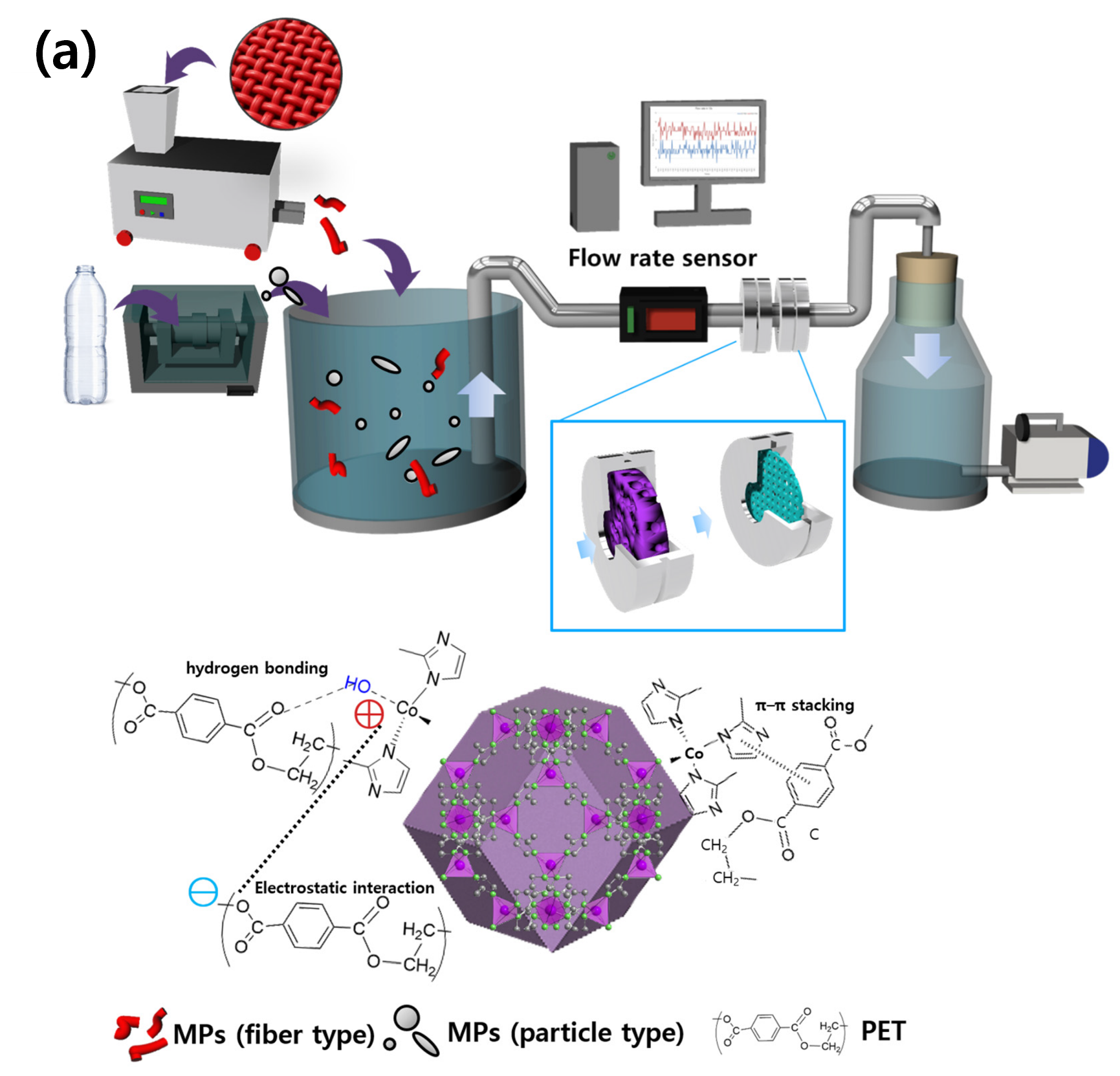
To evaluate the MP capture performance using controlled MP suspensions, a custom filtration test platform was developed (Figure 1a). For each filtration cycle, a total of 5 mg of pre-shredded MPs was dispersed in 5 L of tap water under ambient conditions (20 ± 2 °C, relative humidity 65% ± 4%). The suspension was continuously supplied to the filter module through flexible inlet tubing, while the outlet side was coupled to a diaphragm vacuum pump (HEB, GM-0.33II, Xi’an, China)operating at a constant gauge pressure of −2 kPa to ensure a steady flow. The instantaneous flow rate was monitored in real time using an installed digital flow sensor (FD-Q series, Keyence, Osaka, Japan). Flow signals were recorded at intervals of 5 ms and subsequently averaged over a 50 s period to evaluate filtration stability. To collect MPs (particle type) that passed through the test filter, the treated effluent was subsequently passed through a membrane (Filtratech®, model FL.QT41.A055, diameter Φ55 mm, Saint-Jean-de-Braye, France). For MPs (fiber type), a stainless-steel mesh filter (diameter Φ47 mm, pore size 100 μm) was used. Prior to testing, all experimental equipment was pre-rinsed with 5 L of clean tap water to eliminate background contamination. During filtration, each sponge was held in the module and the suspension was driven through it by the applied pressure difference. An additional five-cycle test of FCS-ZIF-67 with MPs (particle type) was conducted at −3 kPa gauge pressure using the same feed preparation and collection procedure to obtain a flow rate comparable to that of CS (Text S1 and Figure S5).
Figure 1.
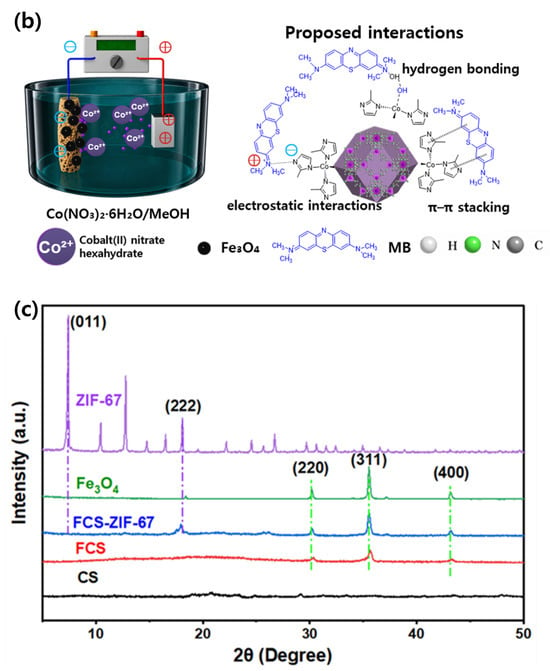
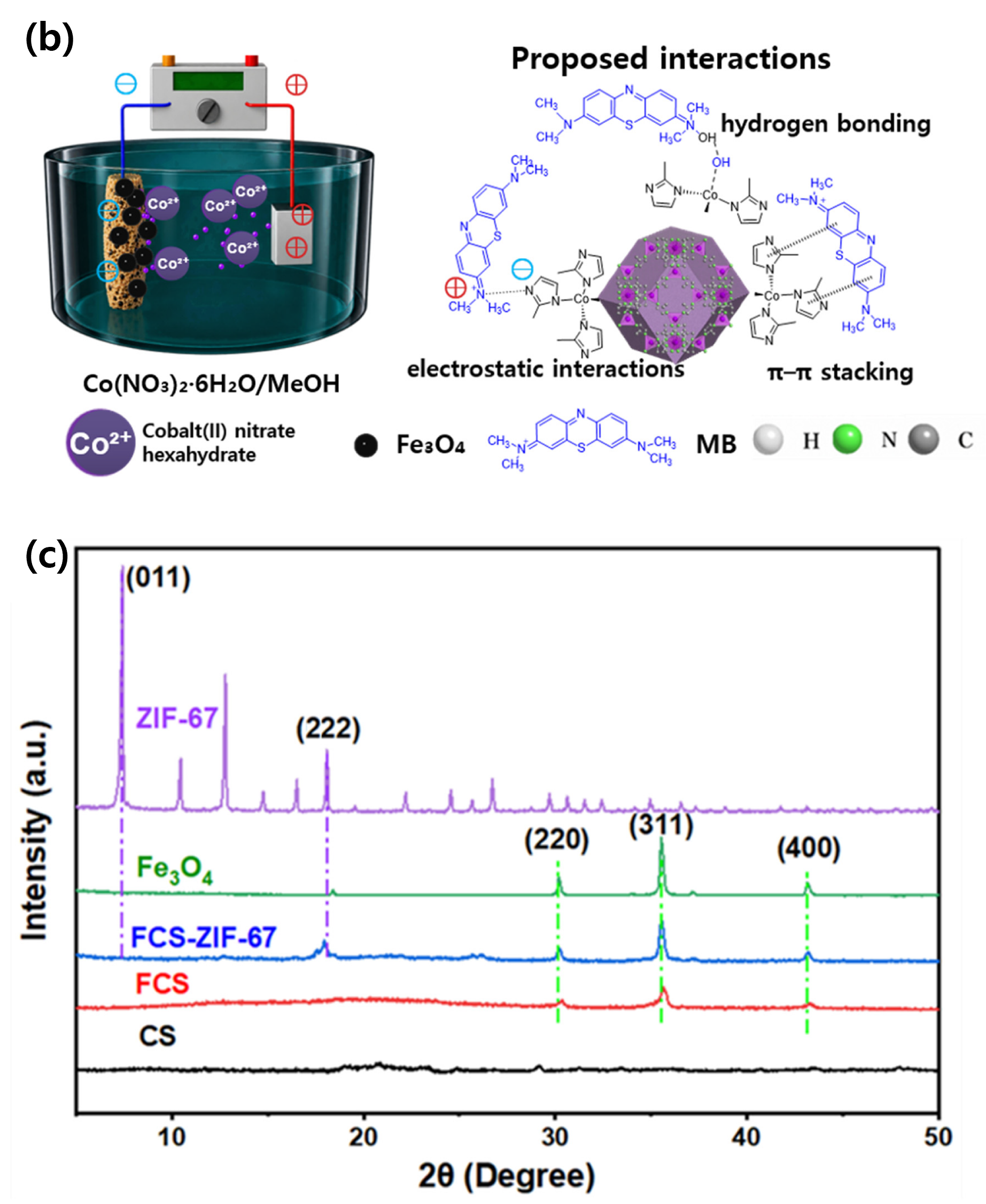
Design, fabrication, pollutant-removal mechanisms, and structural characterization of the multifunctional FCS-ZIF-67 filtration platform. (a) Schematic illustration of the MP filtration system and proposed MP–ZIF-67 interactions, (b) ECD-assisted ZIF-67 growth on FCS and proposed MB adsorption interactions, and (c) X-ray diffraction (XRD) patterns of ZIF-67, Fe3O4, FCS-ZIF-67, FCS, and CS.
Three types of filters (CS, FCS, and FCS-ZIF-67) were tested, and each filter was evaluated through three independent experiments consisting of five cumulative filtration cycles. This assessment focused on MP capture efficiency during repeated use, variations in flow rate, and the size distribution of retained MPs. The downstream collection medium was a membrane for MPs (particle type) and a stainless-steel mesh for MPs (fiber type). The dry-mass increase of the downstream collector was used to estimate the escaped MP mass. Before weighing, the collector was dried at 50 °C for 2 h to remove residual moisture.
For size analysis, the CS, FCS, and FCS-ZIF-67 groups in Table S1 refer to MPs retained on the corresponding sponge samples. The downstream membrane or stainless-steel mesh collected MPs that passed through the sponge for the gravimetric efficiency measurement. Retained MP sizes were measured directly by microscopy. They were not calculated by subtracting the sizes of downstream MPs from input sizes. The two sample fractions and their measurement bases are defined in Text S1.
The mass-based MP removal efficiency was calculated from the input MP mass and the escaped MP mass collected downstream, as expressed in Equation (2):
where the input MP mass is the mass introduced during the corresponding cycle and the escaped MP mass is the dry-mass increase of the downstream membrane or stainless-steel mesh. Equation (2) uses the recovered downstream mass to calculate removal. The gravimetric measurement does not separately resolve uncollected MPs or non-MP material retained by the collector.
For the washing-machine demonstration, FCS-ZIF-67 was installed in the drainage line of a commercial washing machine (LG FR9WP, Seoul, Republic of Korea). The washing machine’s internal filter was removed before testing. The test feed contained 5 mg of MPs (fiber type). A standard washing cycle lasting 85 min was run, and the recorded drainage volume was 30 L. Three independently prepared FCS-ZIF-67 filters were tested, with one washing-machine test per filter (n = 3). Filter integrity and drainage were inspected after operation. The conditions and results are described in Text S2, Table S2, Figure S2, and Video S1.
2.6. Evaluation of MB Adsorption by CS and FCS-ZIF-67
The MB adsorption experiments were carried out by immersing each CS or FCS-ZIF-67 filter in 100 mL of MB aqueous solution with a concentration of 3.13 × 10⁻⁵ mol L−1 at three different pH values (5.5, 7.0, and 8.5). The adsorption behavior was evaluated as a function of contact time, and aliquots were collected at predetermined intervals (0, 10, 20, 30, 60, 90, and 120 min) to determine the MB removal efficiency (%) under each pH condition. These batch tests characterize the time-dependent MB adsorption of the materials and were performed separately from the pressure-driven filtration tests used to evaluate MP removal (Text S4).
The residual MB concentration in the solution during the adsorption process was measured using UV–visible spectrophotometry (UV-1800, Shimadzu Corporation, Kyoto, Japan). The removal efficiency (%) was calculated from the variation in absorbance at the maximum absorption wavelength of MB (λmax at 664 nm), using samples measured without dilution, based on the Beer–Lambert law, which assumes a linear relationship between absorbance and solute concentration. The removal efficiency was calculated using Equation (3):
where A0 is the initial absorbance of the MB solution and At is the absorbance at contact time t.
2.7. XRD and XPS Characterization
Crystalline phases were examined by X-ray diffraction (XRD) using a D8 Advance (TRIO/TWIN) diffractometer (Bruker, Karlsruhe, Germany). The XRD data were collected over a 2θ range of 5–50° using Cu Kα radiation (λ = 1.54 Å). Surface chemical composition and chemical states before and after MB exposure were examined by X-ray photoelectron spectroscopy (XPS) using a PHI 5000 VersaProbe system (Ulvac-PHI, Chigasaki, Japan). Measurements were performed using an Al Kα X-ray source (1486.6 eV) operated at 25 W and 15 kV, with an X-ray beam size of 100 μm and a photoelectron take-off angle of 45° relative to the sample surface. The pass energies were 117.4 eV for survey spectra and 58.7 eV for high-resolution spectra. Charge neutralization was enabled throughout the measurements, and no sputter cleaning was performed before analysis. High-resolution spectra were analyzed by component peak fitting to examine changes in the surface chemical environments associated with MB exposure.
2.8. ICP-OES Analysis of Co and Fe
Liquid samples were collected immediately after completing five cumulative MP filtration cycles and the separate MB batch adsorption experiment using FCS-ZIF-67 at pH 8.5. The collected liquids were analyzed for Co and Fe using inductively coupled plasma optical emission spectrometry (ICP-OES, ULTIMA II, Kyoto, Japan). Calibration standards were prepared in 3% (v/v) HNO3 using Co and Fe standard stock solutions. Argon was used, with cooling and sheath gas flow rates of 12 and 0.1 L min−1, respectively. Elemental concentrations were determined from the mean of three instrumental measurements.
3. Results and Discussion
3.1. Growth and Structural Characterization of ZIF-67 on FCS
The formation of the FCS-ZIF-67 composite is illustrated in Figure 1b. Cobalt-containing species were first immobilized on FCS during ECD, followed by reaction with 2MI to induce ZIF-67 crystallization. Figure 1c shows the XRD patterns of CS, FCS, FCS-ZIF-67, Fe3O4, and ZIF-67. The broad diffraction profile of CS indicates limited long-range ordering in the prepared polymer network, consistent with reduced crystallinity reported for blended chitosan systems [29]. Distinct Fe3O4 reflections at 2θ = 30.16° (220), 35.54° (311), and 43.14° (400) are characteristic of the inverse spinel structure of magnetite [30]. Their presence in FCS indicates retention of the Fe3O4 crystalline phase after incorporation into the sponge. ZIF-67 exhibits characteristic low-angle reflections at 2θ = 7.51° (011) and 18.18° (222), consistent with its sodalite-type structure [21]. FCS-ZIF-67 retains the Fe3O4 reflections and displays additional low-angle peaks corresponding to ZIF-67, supporting successful ZIF-67 growth on FCS.
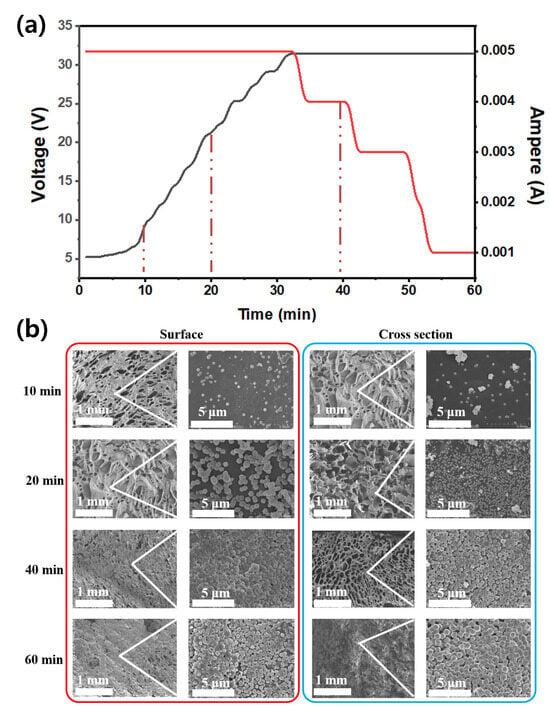
The time-dependent voltage and current profiles during ECD are shown in Figure 2a. The current was initially approximately 5 mA. The voltage increased from 5.18 V to approximately 31.48 V at 33 min and then remained near this level, while the current subsequently decreased to approximately 1 mA. The initial voltage rise at approximately constant current is consistent with increasing cell resistance and/or electrode polarization, but the full deposition period cannot be described as galvanostatic. Because 2MI was introduced only after ECD, the voltage rise cannot be attributed to the growth of a ZIF-67 layer during the electrochemical step. The voltage profile alone does not establish the chemical identity or thickness of the deposited cobalt-containing species.
Figure 2.
Electrochemical behavior during ECD and time-dependent growth of ZIF-67 on FCS. (a) The time-dependent voltage and current profiles, and (b) FCS-ZIF-67 structures after ligand treatment following ECD for 10, 20, 40, and 60 min.
The apparent MOF loading increased only from 23.27% at 40 min to 23.65% at 60 min, corresponding to a 1.63% relative increase despite a 50% increase in deposition time. The loading trend approached a plateau by 60 min, and the projected increase beyond 60 min was minimal (Figure S3 and Text S3). Therefore, extending the ECD duration beyond 60 min was considered to provide little practical gain in apparent MOF loading, and the 60 min sample, which showed the highest measured mean loading, was selected for subsequent MB adsorption and MP removal experiments. Visual inspection of the SEM images in Figure 2b indicates progressively more extensive ZIF-67 crystal coverage with increasing ECD duration after subsequent ligand treatment. At ECD durations of 40 min and longer, the observed sponge surfaces appeared largely covered with ZIF-67 crystals.
3.2. Filtration Efficiency and Flow Rate of CS, FCS, and FCS-ZIF-67
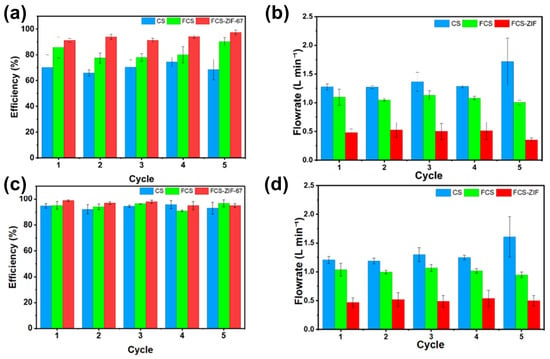
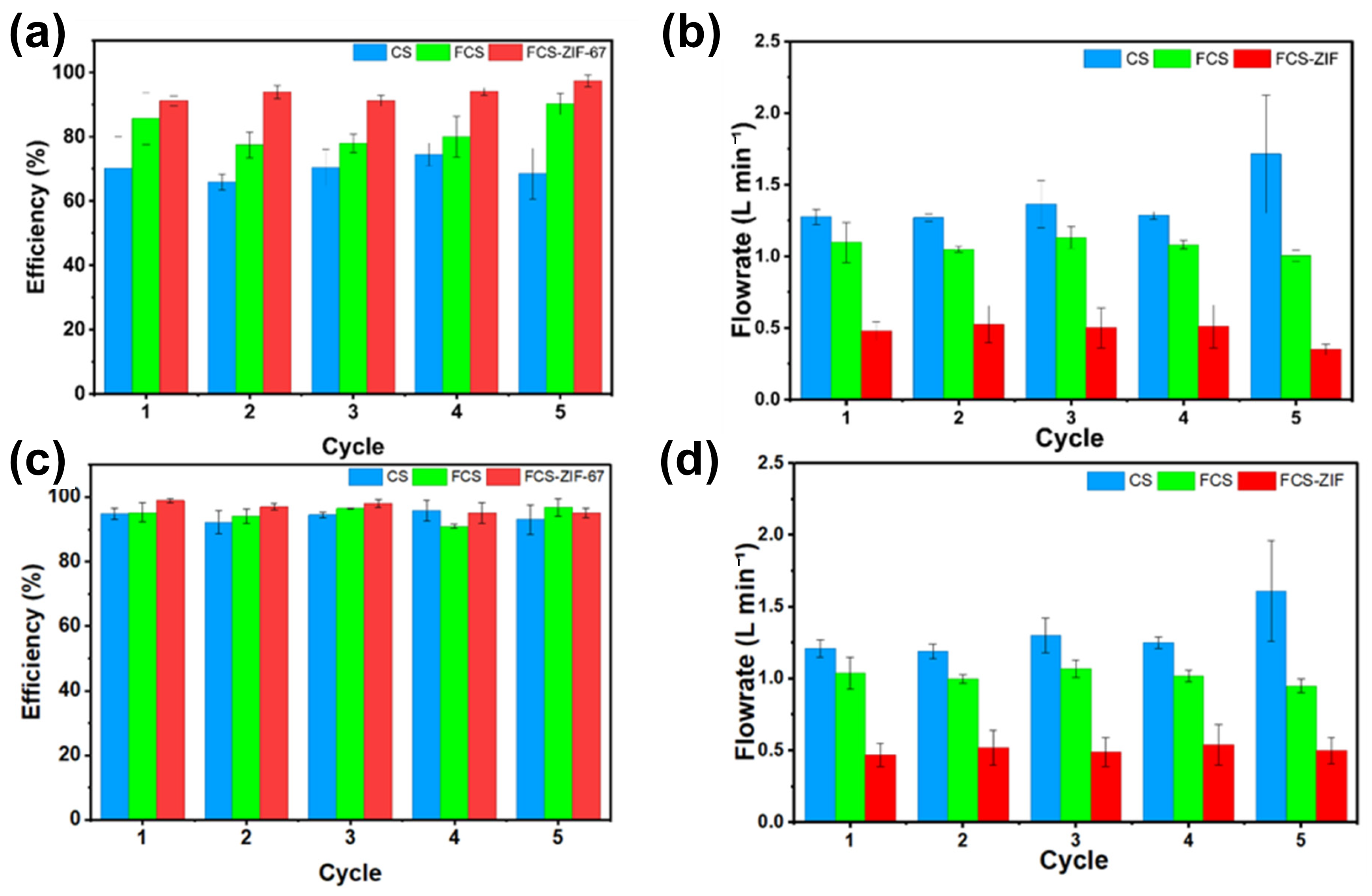
Figure 3a,b and Table 1 report five cumulative filtration cycles for MPs (particle type) at a gauge pressure of −2 kPa. Mean flow rates for CS, FCS, and FCS-ZIF-67 were 1.38, 1.07, and 0.47 L min−1, respectively, with corresponding mean mass-based removal efficiencies of 69.88%, 82.23%, and 93.54%. At this pressure, FCS-ZIF-67 had the lowest mean flow rate and highest mean removal. At a given effective flow volume, a lower flow rate increases the nominal hydraulic residence time. Prior work found longer MP residence times in porous media at lower flow velocities [31]. Slow sand filtration studies have also reported higher removal of MPs (fiber type) at lower filtration rates, with longer contact between MPs and the filter medium [32]. In the present work, the lower flow rate observed after ZIF-67 functionalization at the same gauge pressure was discussed as a design factor that can extend particle–medium contact within the sponge and aid capture. To examine whether the higher removal of FCS-ZIF-67 resulted only from its lower flow rate, FCS-ZIF-67 was additionally tested with MPs (particle type) at a gauge pressure of −3 kPa, which gave a mean flow rate of 1.31 L min−1, comparable to that of CS (1.38 L min−1). Under this condition, FCS-ZIF-67 achieved removal efficiencies of 94.23%, 94.12%, 93.88%, 94.00%, and 96.08% in cycles 1–5 (mean 94.46%), 24.58 percentage points higher than that of CS at a comparable flow rate (Figure S5). Increasing the applied suction from −2 to −3 kPa increased the mean FCS-ZIF-67 flow rate from 0.47 to 1.31 L min−1, while the mean removal efficiencies remained similar at 93.54% and 94.46%, respectively. Therefore, the higher removal achieved with FCS-ZIF-67 is not solely attributable to its lower operating flow rate. Cycle-by-cycle results are provided in Text S1 and Figure S5.
Figure 3.
Filtration performance over five cumulative filtration cycles of CS, FCS and FCS-ZIF-67. (a) Removal efficiency and (b) flow rate for MPs (particle type); (c) removal efficiency and (d) flow rate for MPs (fiber type).
Table 1.
Flow rates and mass-based MP removal efficiencies of CS, FCS, and FCS-ZIF-67 over five cumulative filtration cycles.
The baseline flow rates at −2 kPa were obtained under the same applied pressure difference and indicate differences in hydraulic resistance among the filters. Accordingly, the removal efficiencies are interpreted together with physical interception by the porous network and flow-dependent particle–surface contact conditions. Physical interception has also been identified as a capture mechanism in cellulose-based MP filters [14]. By the fifth cycle, the FCS-ZIF-67 flow rate decreased to 0.35 ± 0.04 L min−1, which may reflect partial pore blockage resulting from cumulative particle capture. In contrast, the CS flow rate increased to 1.71 ± 0.41 L min−1 in the fifth cycle, indicating a decrease in hydraulic resistance during repeated filtration. During filtration of MPs (particle type), the mean FCS-ZIF-67 flow rate decreased from 0.51 ± 0.15 L min−1 in cycle 4 to 0.35 ± 0.04 L min−1 in cycle 5, while mean removal increased from 94.05 ± 1.20% to 97.40 ± 1.81% (Table 1). Wang et al. reported a decrease in hydraulic conductivity as MPs accumulated in porous media [33]. The decrease in flow here was interpreted in terms of increased hydraulic resistance as retained particles accumulated during repeated filtration. Post-filtration SEM images are provided in Figure S6 and show preservation of the porous sponge structure with little visible damage.
Figure 3c,d and Table 1 report the flow rates and mass-based removal efficiencies for MPs (fiber type). The CS flow rate ranged from 1.19 ± 0.05 to 1.61 ± 0.35 L min−1, and its removal efficiency ranged from 92.15 ± 3.52% to 95.81 ± 3.12%. FCS recorded flow rates of 0.95 ± 0.05 to 1.07 ± 0.06 L min−1 and removal efficiencies of 90.93 ± 0.61% to 96.77 ± 2.74%. For FCS-ZIF-67, the ranges were 0.47 ± 0.08 to 0.54 ± 0.14 L min−1 and 95.05 ± 1.52% to 98.92 ± 0.61%. The average efficiencies were 94.04%, 94.69%, and 96.81% for CS, FCS, and FCS-ZIF-67, respectively. Although FCS-ZIF-67 recorded the highest measured average efficiency, its improvement over CS was limited to 2.77 percentage points, compared with 23.66 percentage points for MPs (particle type). Relative to FCS, ZIF-67 functionalization was associated with an increase of 11.31 percentage points for MPs (particle type) and 2.12 percentage points for MPs (fiber type). These comparisons indicate that the improvement associated with ZIF-67 functionalization was more pronounced for MPs (particle type).
Fe3O4 was introduced to impart electrical conductivity and provide nucleation sites for cobalt-containing precursor deposition during ECD. The filtration performance was evaluated with the sponge fixed in the module, where capture is discussed in terms of the porous network and ZIF-67-functionalized interfaces. Cross-sectional digital microscope images showed elongated pores, with mean equivalent diameters of 9.5 ± 5.1, 7.5 ± 3.9, and 7.2 ± 4.1 µm for CS, FCS, and FCS-ZIF-67, respectively (Figure S7). The smaller and more irregular pores of FCS-ZIF-67 are consistent with its lower flow rate and support physical straining and interception as the main capture modes.
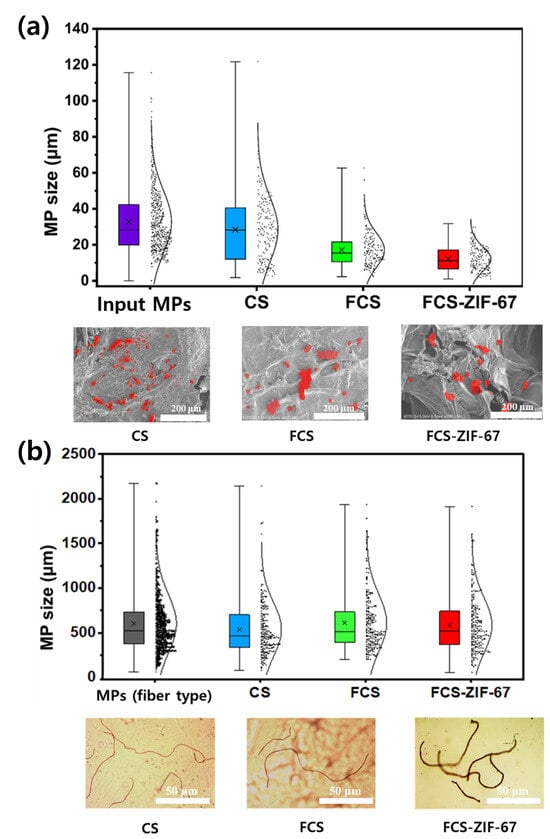
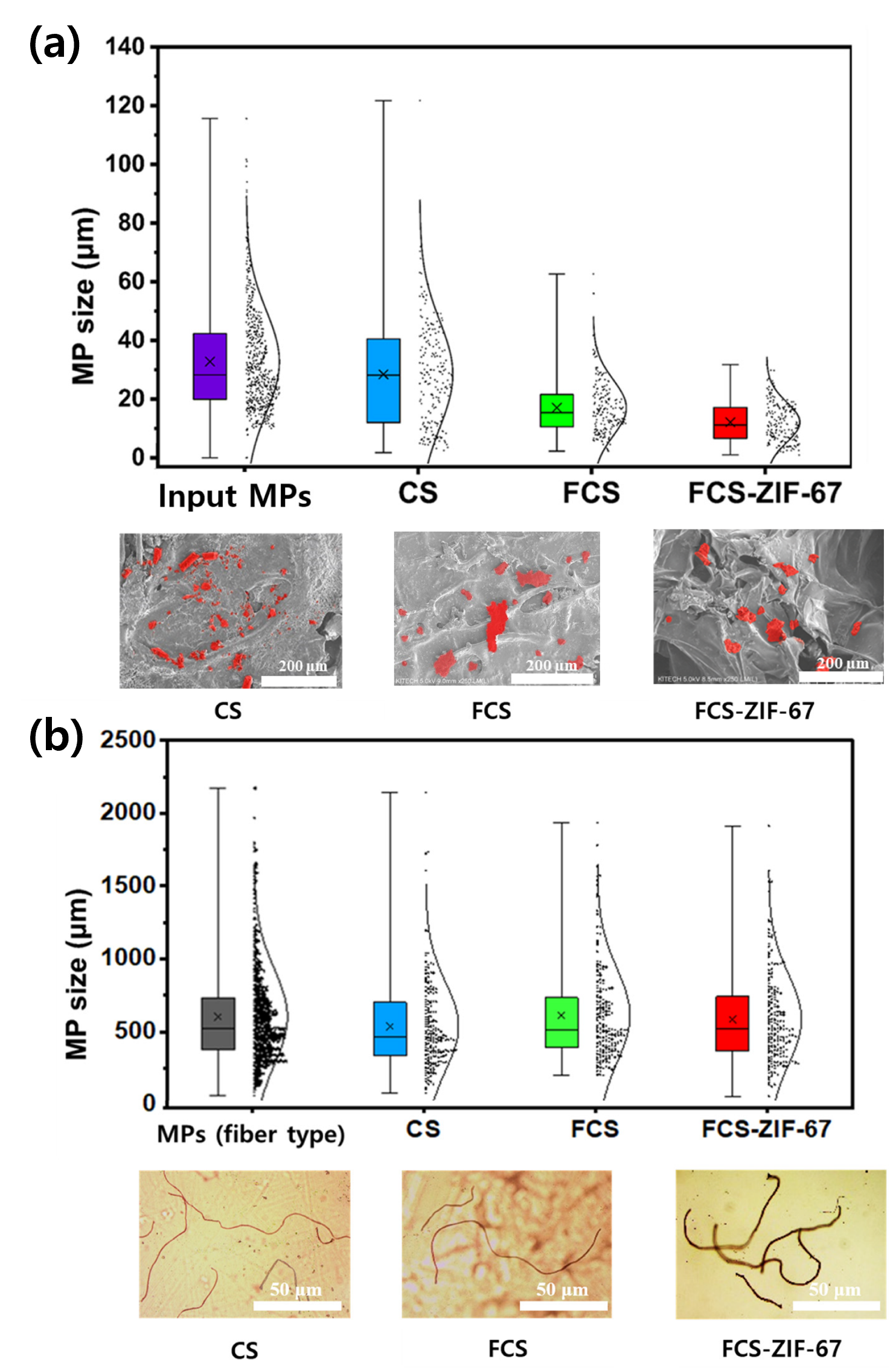
Figure 4a and Table S1 show that FCS-ZIF-67 retained MPs (particle type) with the smallest measured mean size among the three sponges. Retained MPs were measured directly on the surface of one filter per material. SD represents the sample standard deviation calculated using n − 1 in the denominator and describes variation among individual MP sizes within each group. The mean retained size was 12.12 ± 6.81 µm for FCS-ZIF-67, compared with 28.44 ± 18.08 µm for CS, 17.06 ± 9.49 µm for FCS, and 32.78 ± 17.34 µm for the input population (mean ± SD). The FCS-ZIF-67 mean was 57.38% smaller than the CS mean, 28.96% smaller than the FCS mean, and 63.03% smaller than the input mean. Its measured retained particles ranged from 1.43 to 31.75 µm. These measurements indicate that FCS-ZIF-67 retained a finer particle population under the tested conditions. Because retained MPs were imaged on the sponge surface, these values describe the surface-retained population. The porous sponge network provides pathways for physical interception, while the crystal-covered surface provides additional interfaces for fine-particle retention. The smaller mean retained size therefore reflects enhanced retention of fine particles rather than lower retention of large particles.
Figure 4.
Size distribution and representative microscopic images of captured MPs after filtration using CS, FCS, and FCS-ZIF-67. (a) MPs (particle type), (b) MPs (fiber type).
The smaller mean retained-particle size was accompanied by a higher overall mass-based removal efficiency. FCS-ZIF-67 achieved an average efficiency of 93.54 ± 2.78%, compared with 69.88% for CS and 82.23% for FCS, giving increases of 23.66 and 11.31 percentage points, respectively (Table 1). FCS-ZIF-67 therefore combined the highest overall mass removal with the smallest mean retained-particle size, indicating its capacity to retain fine MPs (particle type). The size statistics describe the measured retained population, whereas the removal efficiency describes the removed fraction of the input mass. As retained MPs were measured only on the sponge surface, the size distributions in Figure 4 and Table S1 represent surface-retained populations and may under-represent particles lodged within the internal pore network.
Figure 4b shows the measured length distributions and representative optical micrographs of retained MPs (fiber type). Mean retained lengths were 535.94 ± 301.60 µm for CS, 538.03 ± 325.45 µm for FCS, and 611.35 ± 331.83 µm for FCS-ZIF-67, compared with 591.81 ± 326.46 µm for the input population (mean ± SD, Table S1). The absolute differences between the retained-fiber mean lengths and the input mean were 55.87, 53.78, and 19.54 µm for CS, FCS, and FCS-ZIF-67, respectively. FCS-ZIF-67 exhibited the highest mean retained-fiber length among the three sponges and the closest mean length to that of the input population. The mean retained-fiber length was 3.30% higher than the input mean, showing close agreement in the group means alongside the high mass-based removal efficiency. The retained-length distributions are discussed in terms of physical interception and entanglement. Its measured retained-fiber lengths ranged from 60.52 to 1914.63 µm (Table S1). Together with its average mass-based removal efficiency of 96.81 ± 2.17% and maximum cycle removal efficiency of 98.92 ± 0.61% (Table 1), these results indicate high overall mass removal and retention of both short and long MPs (fiber type) under the tested conditions.
Cohen et al. tracked polypropylene fibers 20–150 µm long in a microfluidic porous network and observed greater retention of fibers longer than 50 µm [34]. Gao et al. reported 95.0% fiber removal by fine sand at 5 cm h−1, and 83.9–93.6% of fibers measured in the effluent were 10–50 µm long [32]. These studies reported removal and length distributions as distinct metrics. Zhu et al. also reported 99% removal by particle number and 67.7% by the measured mass of PA66, PET, and PC [11]. In the present work, Table S1 describes the sizes of MPs retained on the sponges, and Equation (2) uses downstream recovery to calculate mass-based removal. Fiber interception by structures and entanglement with other fibers reported in porous media provide a basis for interpreting the observed capture patterns [32,34].
Chitosan sponge adsorption and chitosan coagulation have been evaluated as distinct MP-removal approaches [35,36]. The chitosan sponge listed in Table 2a was evaluated using PS MPs with a nominal size of approximately 1 µm [35]. The present microscopy measurements record PET particles retained on the sponge surfaces. The gravimetric data quantify removed mass without separating individual molecular binding interactions.
Table 2.
Comparison of filtration materials for the removal of MPs (particle type) and MPs (fiber type). (a) Biomass-derived materials and reported MP (particle type) removal, (b) commercial devices and reported MP (fiber type) removal.
Table 2a compares FCS-ZIF-67 with previously reported biomass-derived MP-removal materials. FCS-ZIF-67 achieved an average removal efficiency of 93.54% for PET MPs (particle type) under the present filtration conditions. Differences in polymer type, MP size, adsorbent configuration, and operating conditions prevent a direct ranking of these materials. In particular, chitosan coagulation [36] should be distinguished from filtration or adsorption using porous sponges.
The filtration performance was also compared with commercial MP (fiber type) filtration systems in Table 2b. Reported removal efficiencies include 54.00% for the Guppyfriend bag [39], 31.00% for the Cora Ball [39], 87.00% by count for the Lint LUV-R filter [40], 89.00% (manufacturer-reported) for the Filtrol 160 [41], 90.00% reported in the whitepaper for the PlanetCare filter [42], 21.00% for the Fourth Element washing bag [39], and 78.00% for the XFiltra filter [39]. As shown in Table 1, the FCS-ZIF-67 filter developed in this study achieved an average mass-based MP (fiber type) removal efficiency of 96.81% over five cycles. The listed studies differ in feed material, filter design, and measurement basis and do not constitute a comparison under identical conditions.
In the washing-machine demonstration described in Section 2.5 and Text S2, FCS-ZIF-67 achieved an average mass-based removal efficiency of 96.77 ± 1.07% for MPs (fiber type) (Table S2). No visible structural damage or drainage obstruction was observed after operation (Figure S2 and Video S1).
ICP-OES analysis was performed on liquid samples collected immediately after five cumulative MP filtration cycles and the separate MB batch adsorption experiment to evaluate Co and Fe release from FCS-ZIF-67. In the MP-filtration effluent, Co and Fe concentrations were below their respective limits of quantification (LOQs) of 0.06 and 0.04 mg L−1. After MB adsorption, the Co concentration was 0.10 mg L−1, while the Fe concentration remained below its LOQ of 0.04 mg L−1 (Text S5 and Table S4). As shown in Figure S6, the filter retained its porous structure after filtration and showed little visible damage. Together, the SEM observations and ICP-OES results support preservation of the porous filter structure and limited Co and Fe release under the tested conditions.
3.3. MB Adsorption Performance of CS and FCS-ZIF-67
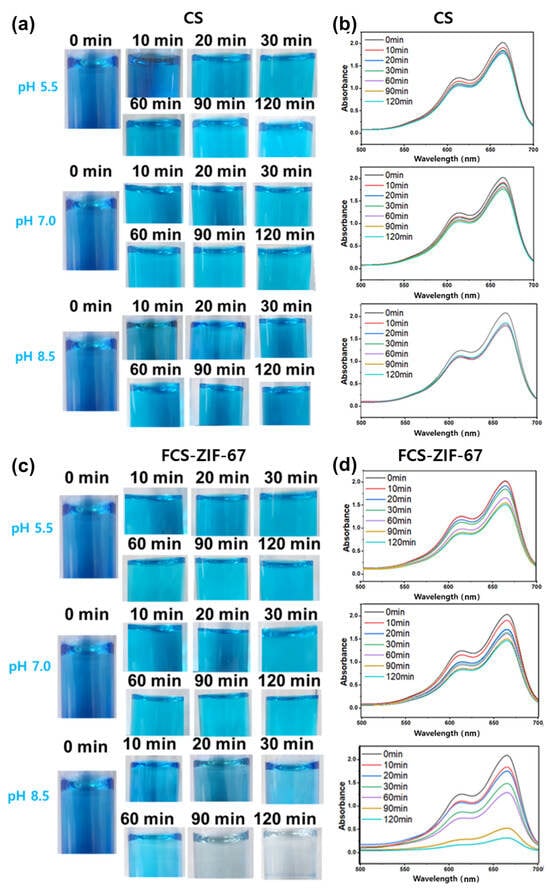
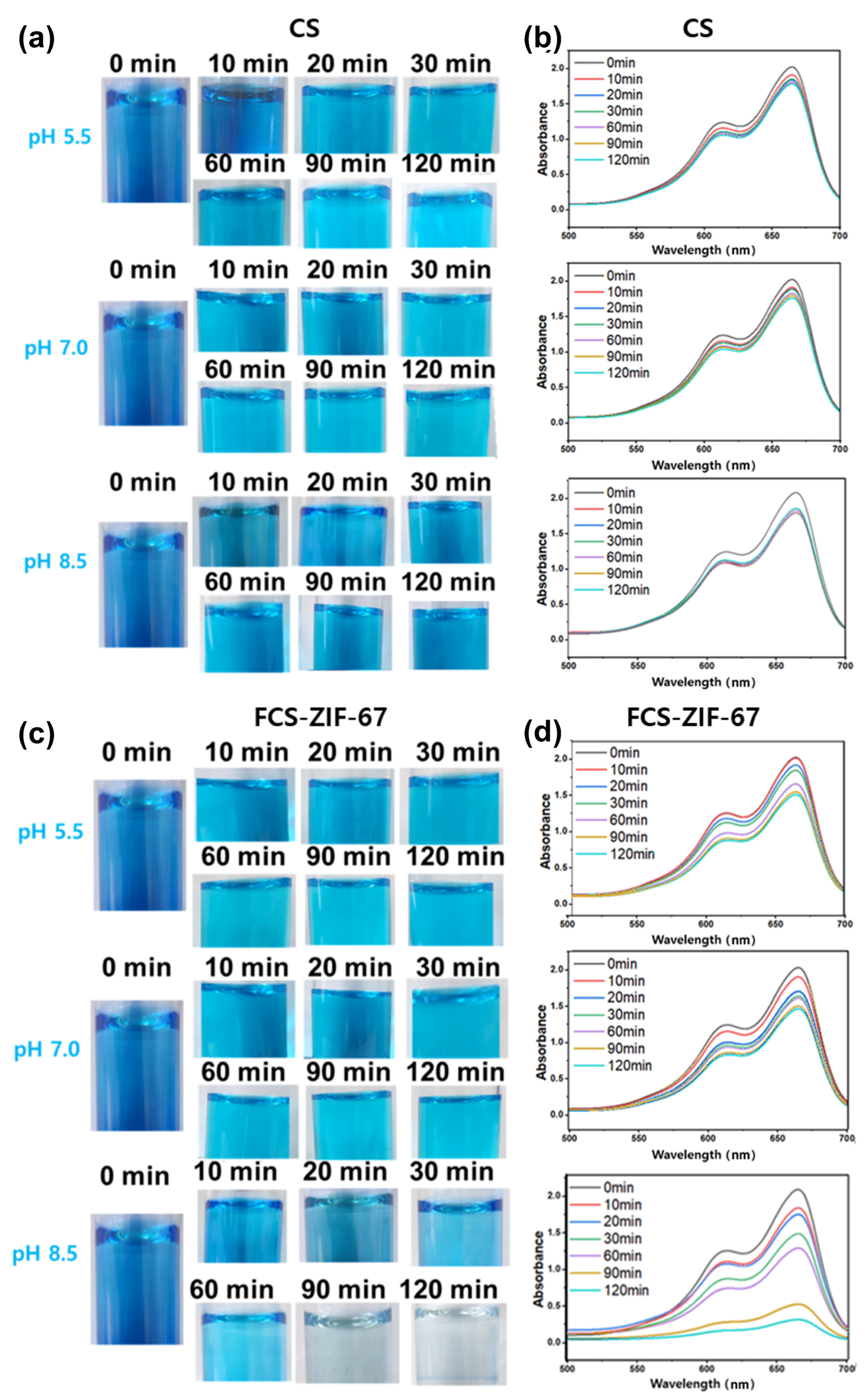
Figure 5a–d shows MB removal by CS and FCS-ZIF-67 at pH 5.5, 7.0, and 8.5, evaluated using absorbance measurements at 664 nm. The absorbance generally decreased during the 120 min adsorption period, although intermediate measurements were not strictly monotonic. CS showed limited MB removal of 11.90%, 12.90%, and 14.00% at pH 5.5, 7.0, and 8.5, respectively. The removal efficiencies of FCS-ZIF-67 at 120 min were 24.01%, 25.99%, and 85.67% at pH 5.5, 7.0, and 8.5, respectively, indicating greater MB removal under the alkaline condition tested. At pH 8.5, the absorbance decreased from 2.05 at 0 min to 0.29 at 120 min. Removal efficiencies were calculated using the unrounded absorbance values according to Equation (3). The PFO and PSO kinetic analysis and corresponding fitting results are provided in Text S4, Figure S4, and Table S3. PSO provided a better fit for CS at pH 5.5 and 7.0, with R2 values of 0.93 and 0.91, respectively. For FCS-ZIF-67, the two models showed similar agreement at pH 5.5 and 7.0, whereas PFO better described the uptake profile at pH 8.5, with R2 values of 0.88 for PFO and 0.78 for PSO (Figure S4 and Table S3). These fits describe the time-dependent MB uptake under the respective batch conditions. Chitosan-based dye adsorption and ZIF-67 composite adsorbents have been examined in previous studies [20,23,43]. A ZIF-67-decorated magnetic biochar hydrogel achieved 97.72% MB removal at pH 10 within 50 min [44]. However, differences in the material and adsorption conditions limit direct comparison with the present results. The absorbance measurements demonstrate MB removal but do not distinguish the contributions of individual adsorption interactions. Braish et al. attributed the lower MB uptake of chitosan and chitosan–nanozeolite composites at low pH to amine protonation and electrostatic repulsion of cationic MB [45]. In the present study, FCS-ZIF-67 removed 24.01% and 25.99% of MB at pH 5.5 and 7.0, respectively, after 120 min, and removal increased to 85.67% at pH 8.5. Because MB adsorption and MP filtration were evaluated in separate experiments, competition between MPs and MB for surface sites was not assessed; when both are present, captured MPs may partially cover ZIF-67 crystals and reduce the number of sites accessible to MB.
Figure 5.
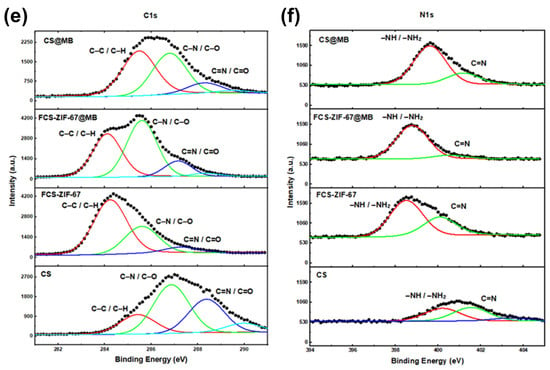
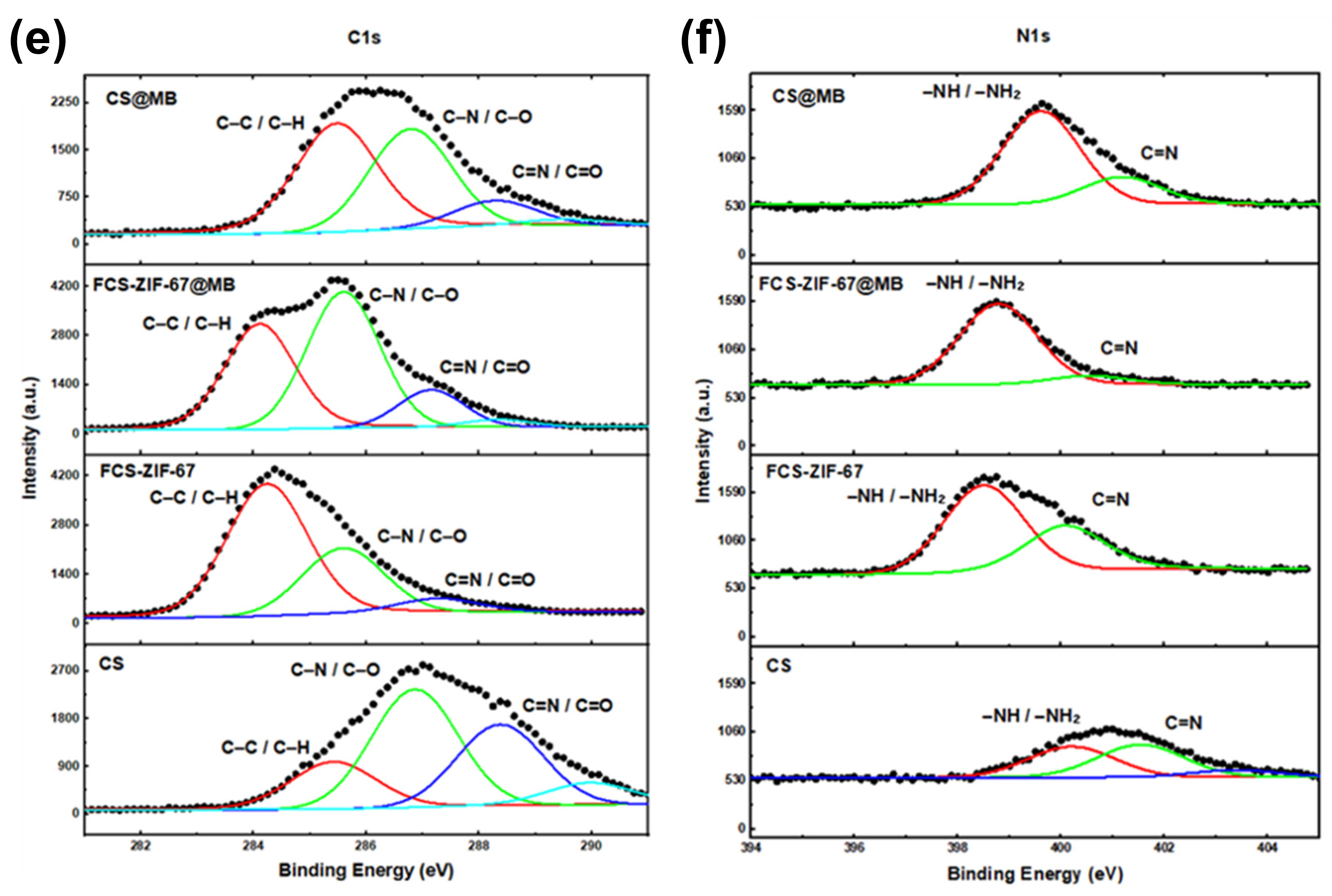
MB adsorption behavior and surface chemical analysis of CS and FCS-ZIF-67. (a) Photographic images and (b) UV–Vis absorption spectra of MB adsorption by CS. (c) Photographic images and (d) UV–Vis absorption spectra of MB adsorption by FCS-ZIF-67 at pH 5.5, 7.0, and 8.5 over 0–120 min at 20 ± 2 °C. XPS spectra before and after MB adsorption: (e) C 1s, and (f) N 1s.
Figure 5e,f present the high-resolution C 1s and N 1s spectra of CS, FCS-ZIF-67, CS after MB contact (CS@MB), and FCS-ZIF-67 after MB contact (FCS-ZIF-67@MB). The reported fitted spectra include a C 1s component at 291.38 eV after MB contact and N 1s components near 399.63 and 401.13 eV. As neither CS nor CS@MB contains ZIF-67, imidazolate nitrogen is not assigned to these samples. The spectra and the solution-absorbance measurements record changes following MB contact. Previous studies examined MP and dye removal using ZIF-based materials [21,43]. The interfacial interactions in Figure 1 are drawn from prior studies on capture and adsorption by ZIF-67-based materials. Wan et al. discussed hydrogen bonding, electrostatic interactions, and π–π interactions in the adsorption of PS MPs by ZIF-67 [21]. Electrostatic and π–π interactions have also been discussed for MB adsorption by a ZIF-67-containing composite [44] and for cationic dye adsorption by chitosan–ZIF-67 beads [23]. The XPS spectra in this study show changes in the sponge surface chemical environment following MB exposure (Figure 5e,f).
4. Conclusions
In this study, FCS-ZIF-67 was fabricated via ECD followed by ligand treatment as a multifunctional filtration platform for the removal of MPs and MB from aqueous environments. The ECD-assisted process enabled ZIF-67 growth on the surface and within the porous FCS structure, with an apparent MOF loading of 23.65 ± 1.20% after 60 min of deposition. Across five cumulative filtration cycles, FCS-ZIF-67 recorded average mass-based removal efficiencies of 93.54 ± 2.78% for MPs (particle type) and 96.81 ± 2.17% for MPs (fiber type). The corresponding maximum efficiencies were 97.40% and 98.92%, and the average flow rates were 0.47 ± 0.12 and 0.50 ± 0.09 L min−1. MB removal reached 85.67% at pH 8.5 after 120 min. These experiments establish the measured removal performance and retained-fiber size statistics under the tested conditions. The improved pollutant removal performance is attributed to the porous chitosan structure and ZIF-67 functionalization, which likely enhanced the physical entrapment of MPs and provided additional adsorption sites for MB. At −3 kPa, FCS-ZIF-67 maintained a mean MP (particle type) removal efficiency of 94.46% at a mean flow rate of 1.31 L min−1, compared with 93.54% at 0.47 L min−1 under −2 kPa, supporting a material contribution to capture beyond the effect of reduced flow. Post-filtration SEM and ICP-OES results also showed preservation of the porous structure and limited Co and Fe release under the tested conditions. For larger-scale production, uniform current distribution across the electrode is important for consistent precursor deposition and subsequent ZIF-67 growth. Practical water-treatment applications also require filter area and module configuration to be tailored to the target throughput and operating pressure. Overall, these results demonstrate that FCS-ZIF-67 can remove MPs with different morphologies by filtration and adsorb dissolved organic dyes, highlighting its potential as a multifunctional filtration material for advanced tertiary wastewater treatment.
Supplementary Materials
The following supporting information can be downloaded at: https://www.mdpi.com/article/10.3390/polym18222884/s1. Figure S1: Size distributions and representative micrographs of input MPs; Figure S2: FCS-ZIF-67 applied to a washing-machine filtration system; Figure S3: ECD-duration-dependent apparent MOF loading; Figure S4: PFO and PSO kinetic analysis of MB adsorption; Figure S5: MP (particle type) filtration by CS and FCS-ZIF-67 at comparable flow rates; Figure S6: SEM images of FCS-ZIF-67 after filtration; Figure S7: Cross-sectional digital microscope images and pore dimensions of CS, FCS, and FCS-ZIF-67; Table S1: Size distributions of input MPs and MPs captured on the CS, FCS, and FCS-ZIF-67 filters; Table S2: MP (fiber type) removal by three independent FCS-ZIF-67 filters in a washing-machine filtration system; Table S3: PFO and PSO parameters for MB adsorption on CS and FCS-ZIF-67; Table S4: Co and Fe concentrations and quantification limits in recovered liquids; Text S1: Definition and interpretation of the MP size distributions; Text S2: Washing-machine test conditions; Text S3: ECD-duration-dependent apparent MOF loading and empirical fitting; Text S4: PFO and PSO analysis of MB adsorption; Text S5: ICP-OES analysis of recovered liquids; Video S1: Washing-machine filtration test.
Author Contributions
Conceptualization, J.K.; methodology, J.S.; investigation, J.S.; formal analysis, J.S. and J.K.; writing—original draft preparation, K.E.L. and J.K.; writing—review and editing, K.E.L. and J.K.; supervision, J.K.; funding acquisition, J.K. All authors have read and agreed to the published version of the manuscript.
Funding
This research was funded by Korea Institute of Industrial Technology (PJE26040), and Inha University Research Grant, the Korea Institute of Energy Technology Evaluation and Planning (KETEP) and the Ministry of Climate, Energy & Environment (MCEE) (RS-2023-00243974).
Institutional Review Board Statement
Not applicable.
Data Availability Statement
The data presented in this study are available on request from the corresponding author.
Conflicts of Interest
The authors declare no conflicts of interest.
References
- Periyasamy, A.P.; Tehrani-Bagha, A. A review on microplastic emission from textile materials and its reduction techniques. Polym. Degrad. Stab. 2022, 199, 109901. [Google Scholar] [CrossRef] [Scilit]
- Boucher, J.; Friot, D. Primary Microplastics in the Oceans: A Global Evaluation of Sources; IUCN: Gland, Switzerland, 2017. [Google Scholar] [CrossRef] [Scilit]
- Gaylarde, C.; Baptista-Neto, J.A.; da Fonseca, E.M. Plastic microfibre pollution: How important is clothes’ laundering? Heliyon 2021, 7, e07105. [Google Scholar] [CrossRef] [Scilit]
- Hazlehurst, A.; Tiffin, L.; Sumner, M.; Taylor, M. Quantification of microfibre release from textiles during domestic laundering. Environ. Sci. Pollut. Res. 2023, 30, 43932–43949. [Google Scholar] [CrossRef] [Scilit]
- Shen, A.; Wei, Y.; Pan, Y.; Li, X.; Gong, L.; Pan, Y.; Jeppesen, E.; Duan, C. Current status of microplastic pollution in China’s aquatic environment and its interactions with metal pollutants on aquatic organisms. Water Res. X 2025, 28, 100392. [Google Scholar] [CrossRef] [Scilit]
- Borges-Ramírez, M.M.; Mendoza-Franco, E.F.; Escalona-Segura, G.; Osten, J.R. Plastic density as a key factor in the presence of microplastic in the gastrointestinal tract of commercial fishes from Campeche Bay, Mexico. Environ. Pollut. 2020, 267, 115659. [Google Scholar] [CrossRef] [Scilit]
- Alberghini, L.; Truant, A.; Santonicola, S.; Colavita, G.; Giaccone, V. Microplastics in fish and fishery products and risks for human health: A review. Int. J. Environ. Res. Public Health 2022, 20, 789. [Google Scholar] [CrossRef] [Scilit]
- Luo, Q.; Tan, H.; Ye, M.; Jho, E.H.; Wang, P.; Iqbal, B.; Zhao, X.; Shi, H.; Lu, H.; Li, G. Microplastics as an emerging threat to human health: An overview of potential health impacts. J. Environ. Manag. 2025, 387, 125915. [Google Scholar] [CrossRef] [Scilit]
- Chen, Q.; Gao, J.; Yu, H.; Su, H.; Yang, Y.; Cao, Y.; Zhang, Q.; Ren, Y.; Hollert, H.; Shi, H.; et al. An emerging role of microplastics in the etiology of lung ground glass nodules. Environ. Sci. Eur. 2022, 34, 25. [Google Scholar] [CrossRef] [Scilit]
- Ta, A.T.; Babel, S.; Don, C.D.Y.A. Microplastic removal efficiency in a megacity water treatment plant and dynamics in the distribution system. Environ. Technol. Innov. 2025, 40, 104478. [Google Scholar] [CrossRef] [Scilit]
- Zhu, Y.; Yang, S.; Gustavsson, M.; Huang, W.; Gao, S.; Wang, R. Investigation of Removal Efficiency of Microplastics at Different Process Stages of a Wastewater Treatment Plant in the Textile Industry in Southern China. Water 2025, 17, 574. [Google Scholar] [CrossRef] [Scilit]
- AlShamaileh, E.; Alzoubi, M. Microplastics removal efficiency in wastewater treatment plants in Jordan. Sci. Prog. 2025, 108, 00368504251376048. [Google Scholar] [CrossRef] [Scilit]
- Feng, Y.; Yu, Y.; Xi, T.; Chen, L.; Wang, X.; Xu, T.; Xiao, H.; Wang, Z.; Dai, H.; Bian, H. Scalable bamboo fiber/microfibrillated cellulose foam via solvent-exchange-assisted ambient drying for highly efficient microplastics capture. Adv. Funct. Mater. 2026, 36, e14273. [Google Scholar] [CrossRef] [Scilit]
- Yu, Y.; Chen, L.; Feng, Y.; Liu, C.; Wu, W.; Xiao, H.; Dai, H.; Yao, S.; Gao, Y.; Bian, H. Cellulose nanofibril-loaded filter paper for highly efficient removal of microplastics via multiscale capture mechanisms. J. Colloid Interface Sci. 2026, 706, 139574. [Google Scholar] [CrossRef] [Scilit]
- Sun, C.; Wang, Z.; Zheng, H.; Chen, L.; Li, F. Biodegradable and re-usable sponge materials made from chitin for efficient removal of microplastics. J. Hazard. Mater. 2021, 420, 126599. [Google Scholar] [CrossRef] [Scilit]
- Ewuzie, U.; Saliu, O.D.; Dulta, K.; Ogunniyi, S.; Bajeh, A.O.; Iwuozor, K.O.; Ighalo, J.O. A review on treatment technologies for printing and dyeing wastewater (PDW). J. Water Process Eng. 2022, 50, 103273. [Google Scholar] [CrossRef] [Scilit]
- Li, S.; Cui, Y.; Wen, M.; Ji, G. Toxic Effects of Methylene Blue on the Growth, Reproduction and Physiology of Daphnia magna. Toxics 2023, 11, 594. [Google Scholar] [CrossRef] [Scilit]
- Maurin, G.; Serre, C.; Cooper, A.; Férey, G. The new age of MOFs and of their porous-related solids. Chem. Soc. Rev. 2017, 46, 3104–3107. [Google Scholar] [CrossRef] [Scilit]
- Chen, L.; Li, P.; Li, K.; Zhao, S.; Chen, M.; Pan, W.; Liu, Y.; Li, Z. Zeolite Imidazole Frame-67 (ZIF-67) and Its Derivatives for Pollutant Removal in Water: A Review. Processes 2025, 13, 1724. [Google Scholar] [CrossRef] [Scilit]
- Hou, X.; Chen, W.; Fan, M.; Shi, C. Porous, environment-friendly chitosan-ZIF composite fibers for dye adsorption. RSC Adv. 2024, 14, 36063–36072. [Google Scholar] [CrossRef] [Scilit]
- Wan, H.; Wang, J.; Sheng, X.; Yan, J.; Zhang, W.; Xu, Y. Removal of polystyrene microplastics from aqueous solution using the metal–organic framework material of ZIF-67. Toxics 2022, 10, 70. [Google Scholar] [CrossRef] [Scilit]
- Wang, T.; Cai, J.; Zheng, J.; Fang, K.; Hussain, I.; Husein, D.Z. Facile synthesis of activated biochar/BiVO4 heterojunction photocatalyst to enhance visible light efficient degradation for dye and antibiotics: Applications and mechanisms. J. Mater. Res. Technol. 2022, 19, 5017–5036. [Google Scholar] [CrossRef] [Scilit]
- Shahmansoori, M.; Yaghmaei, S.; Mahmoodi, N.M. Green synthesis of chitosan-ZIF67 composite beads for efficient removal of Malachite Green and Tetracycline. Chem. Eng. Sci. 2025, 304, 121017. [Google Scholar] [CrossRef] [Scilit]
- Peng, S.; Ji, X.; Dong, H.; Guo, Z.; Ma, H.; Han, R.; Pang, K.; Chen, X.; Wang, X. Designing MOFs/CuCo-LDHs hybrid-based superhydrophobic sponge for speedy eliminating microplastics, dyes, and oils from high-salinity water. Colloids Surf. A 2024, 692, 133996. [Google Scholar] [CrossRef] [Scilit]
- Irfan, A.; Gandra, U.R.; Jaoudé, M.A.; Qurashi, A.; Price, G.J.; Burrows, A.D.; Mohideen, M.I.H. Advances in synthesis pathways towards metal-organic frameworks-fiber composites for chemical warfare agents and simulants degradation. Coord. Chem. Rev. 2025, 541, 216842. [Google Scholar] [CrossRef] [Scilit]
- Campagnol, N.; Van Assche, T.R.; Li, M.; Stappers, L.; Dincă, M.; Denayer, J.F.; Binnemans, K.; De Vos, D.E.; Fransaer, J. On the electrochemical deposition of metal–organic frameworks. J. Mater. Chem. A 2016, 4, 3914–3925. [Google Scholar] [CrossRef] [Scilit]
- Zhang, X.; Wan, K.; Subramanian, P.; Xu, M.; Luo, J.; Fransaer, J. Electrochemical deposition of metal–organic framework films and their applications. J. Mater. Chem. A 2020, 8, 7569–7587. [Google Scholar] [CrossRef] [Scilit]
- Elsayed, E.; Brevis, I.; Pandiyan, S.; Wildman, R.; van der Zee, K.G.; Tokay, B. Controlling ZIF-67 film properties in water-based cathodic electrochemical deposition. J. Solid State Chem. 2024, 338, 124820. [Google Scholar] [CrossRef] [Scilit]
- Madian, N.G.; El-Ashmanty, B.A.; Abdel-Rahim, H.K. Improvement of chitosan films properties by blending with cellulose, honey and curcumin. Polymers 2023, 15, 2587. [Google Scholar] [CrossRef] [Scilit]
- Nour, M.; Tony, M.A.; Fouad, M.K.; Nabwey, H.A. Hybrid PK-P/Fe3O4 Catalyst Derived from Pumpkin Peel (Bio-Waste) for Synozol Red KHL Dye Oxidation Under Photo-Fenton Reaction. Catalysts 2025, 15, 977. [Google Scholar] [CrossRef] [Scilit]
- Boos, J.-P.; Dichgans, F.; Fleckenstein, J.H.; Gilfedder, B.S.; Frei, S. Assessing the behavior of microplastics in fluvial systems: Infiltration and retention dynamics in streambed sediments. Water Resour. Res. 2024, 60, e2023WR035532. [Google Scholar] [CrossRef] [Scilit]
- Gao, F.; Busquets, R.; Campos, L.C. Transport and retention of laundry microplastic fibres in slow sand filtration systems. Sci. Rep. 2026, 16, 14445. [Google Scholar] [CrossRef] [Scilit]
- Wang, H.; Zhang, J.; Chen, Y.; Xia, Y.; Jian, P.; Liang, H. Clogging risk of microplastics particles in porous media during artificial recharge: A laboratory experiment. Front. Mar. Sci. 2024, 11, 1346275. [Google Scholar] [CrossRef] [Scilit]
- Cohen, N.; Edery, Y.; Radian, A. Pore-Scale Insights into Microplastic Fiber Transport and Retention in Porous Media. Environ. Sci. Technol. 2025, 59, 27657–27667. [Google Scholar] [CrossRef] [Scilit]
- Xu, J.; Guo, Y.; Tang, C.; Qian, Y.; Guo, C.; Wang, Z.; Li, L. Hardwood vessel-inspired chitosan-based sponge with superior compressibility, superfast adsorption and remarkable recyclability for microplastics removal in water. Chem. Eng. J. 2023, 475, 146130. [Google Scholar] [CrossRef] [Scilit]
- Prasetyo, S.; Santos, C.A.; Sugih, A.K.; Kristianto, H. Utilization of chitosan as a natural coagulant for polyethylene microplastic removal. Sustain. Chem. Environ. 2025, 9, 100225. [Google Scholar] [CrossRef] [Scilit]
- Zheng, B.; Li, B.; Wan, H.; Lin, X.; Cai, Y. Coral-inspired environmental durability aerogels for micron-size plastic particles removal in the aquatic environment. J. Hazard. Mater. 2022, 431, 128611. [Google Scholar] [CrossRef] [Scilit]
- Zhu, Z.; Wu, X.; Wang, Z. Effect of polyaniline dispersibility in chitin sponge matrix controlled by hydrophilicity on microplastics adsorption. Int. J. Biol. Macromol. 2023, 253, 127292. [Google Scholar] [CrossRef] [Scilit]
- Napper, I.E.; Barrett, A.C.; Thompson, R.C. The efficiency of devices intended to reduce microfibre release during clothes washing. Sci. Total Environ. 2020, 738, 140412. [Google Scholar] [CrossRef] [Scilit]
- McIlwraith, H.K.; Lin, J.; Erdle, L.M.; Mallos, N.; Diamond, M.L.; Rochman, C.M. Capturing microfibers–marketed technologies reduce microfiber emissions from washing machines. Mar. Pollut. Bull. 2019, 139, 40–45. [Google Scholar] [CrossRef] [Scilit]
- Filtrol 160. Available online: https://www.filtrol.net/ (accessed on 21 September 2025).
- A Plastic Planet; Matter; PlanetCare; Xeros Technologies; 5 Gyres Institute. Filtration as an Effective and Near-Term Solution to Reduce the Release of Microplastics in the Environment; A Plastic Planet: London, UK, 2023. [Google Scholar]
- Zanaty, M.; Zaki, A.H.; El-Dek, S.I.; Abdelhamid, H.N. Zeolitic imidazolate framework@hydrogen titanate nanotubes for efficient adsorption and catalytic oxidation of organic dyes and microplastics. J. Environ. Chem. Eng. 2024, 12, 112547. [Google Scholar] [CrossRef] [Scilit]
- Peighambardoust, S.J.; Rezaei-Aghdam, S.; Niroumand, J.S.; Pakdel, P.M.; Sillanpää, M. Efficient methylene blue elimination from water media by nanocomposite adsorbent-based carboxymethyl cellulose-grafted poly(acrylamide)/magnetic biochar decorated with ZIF-67. RSC Adv. 2025, 15, 32407–32423. [Google Scholar] [CrossRef] [Scilit]
- Braish, A.G.; Hassan, A.F.; El-Essawy, S.A.; El-Tahawy, M.M.T. Fabrication of nanozeolite-Y/chitosan composite based on rice husks for efficient adsorption of methylene blue dye: Kinetic and thermodynamic studies. Adsorption 2024, 30, 1643–1661. [Google Scholar] [CrossRef] [Scilit]

Disclaimer/Publisher’s Note: The statements, opinions and data contained in all publications are solely those of the individual author(s) and contributor(s) and not of MDPI and/or the editor(s). MDPI and/or the editor(s) disclaim responsibility for any injury to people or property resulting from any ideas, methods, instructions or products referred to in the content. |
© 2026 by the authors. Licensee MDPI, Basel, Switzerland. This article is an open access article distributed under the terms and conditions of the Creative Commons Attribution (CC BY) license.