Life-Cycle Performance of Poly(methyl methacrylate) in Digital Dentistry: A Critical Review of Material Efficiency, Waste Generation, and Circularity

 ,
,  ,
,
Abstract
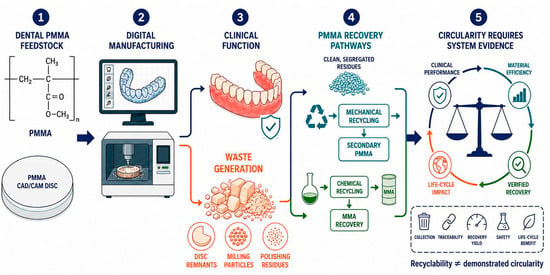
1. Introduction
2. Materials and Methods
2.1. Review Design
2.2. Information Sources and Search Strategy
2.3. Search Strategies
2.4. Eligibility Criteria
- PMMA materials used in dentistry, prosthodontics, or digital dental manufacturing;
- Subtractive or additive manufacturing of PMMA-based dental devices;
- Generation, characterization, collection, or valorization of dental PMMA waste;
- Mechanical recycling, dissolution, thermal or catalytic depolymerization, or methyl methacrylate recovery from PMMA;
- Reuse of recovered PMMA or methyl methacrylate in dental or non-dental applications;
- Environmental impacts, LCA, material efficiency, microplastic release, or circular-economy considerations relevant to PMMA;
- Development of bio-based, blended, reinforced, or otherwise modified PMMA materials with potential sustainability implications.
- Did not address PMMA or a directly relevant PMMA-containing material;
- Focused on dental materials without a meaningful connection to PMMA, material efficiency, waste, recycling, or environmental impact;
- Concerned only conventional clinical performance without relevance to digital manufacturing or sustainability;
- Addressed unrelated industrial, biomedical, optical, electronic, or construction applications without transferable relevance to dental PMMA;
- Were conference abstracts, editorials, letters, news items, or other records that did not provide sufficient methodological or technical information;
- Were not available in English;
- Fell outside the predefined publication period; or
- Duplicated another retrieved record.
2.5. Record Management and Study Selection
2.6. Data Charting
- Authors and year of publication;
- Study design and application field;
- PMMA source, formulation, or manufacturing route;
- Type of dental application or waste stream;
- Recycling, recovery, or valorization process;
- Proportion of recycled material or recovered monomer;
- Reported mechanical, physical, chemical, biological, or environmental outcomes;
- Presence of quantitative material-flow or life-cycle data;
- Principal findings and limitations; and
- Directness of the evidence to dental PMMA.
2.7. Evidence Classification and Critical Appraisal
- Direct dental evidence: studies involving dental PMMA, dental devices, dental manufacturing processes, or dental PMMA waste;
- Adjacent dental evidence: studies involving other dental polymers or dental manufacturing waste with clearly transferable implications for PMMA management;
- Indirect polymer evidence: studies of non-dental PMMA recycling, depolymerization, monomer recovery, or environmental behavior used to assess technical feasibility;
- Contextual evidence: standards, life-cycle frameworks, policy documents, technical reports, and broader sustainability literature.
2.8. Evidence Synthesis and Conceptual Framework
- PMMA composition, production, and dental applications;
- Performance of PMMA in digital dentistry;
- Material consumption and waste generation in subtractive and additive workflows;
- Mechanical recycling and incorporation of recovered polymer;
- Thermal and chemical depolymerization and methyl methacrylate recovery;
- Environmental implications, including microplastics and life-cycle considerations;
- Bio-based and modified PMMA materials; and
- Requirements for circular implementation in dentistry.
3. Evolution of the Evidence on PMMA in Digital Dentistry
3.1. From Material Performance to Material Flows
3.2. Structure and Directness of the Available Evidence
3.3. What the Current Evidence Supports
3.4. Claims That Remain Unresolved
3.5. Implications for Sustainable Digital Dentistry
3.6. Quantitative Evidence Gaps and Measurement Priorities
4. PMMA Performance in Digital Dentistry
4.1. Performance Determinants
4.2. Digital Manufacturing Routes
4.3. Clinical Function and Life-Cycle Performance
5. Environmental Sustainability of PMMA
5.1. Life-Cycle Perspective and System Boundaries
5.2. Potential Benefits and Burdens of Digital Manufacturing
5.3. Environmental Evidence and Remaining Uncertainties
5.4. From Technical Recyclability to Environmental Performance
6. PMMA Waste Generation in Digital Dentistry
6.1. Origin of Waste in Digital Workflows
6.2. Sources, Physical Form, and Recoverability
6.3. Material Utilization and Quantitative Evidence
6.4. Environmental and Occupational Implications
6.5. Management and Prevention Priorities
7. Recycling Pathways for Dental PMMA
7.1. Matching the Recovery Route to the Waste Stream
7.2. Mechanical and Solvent-Based Recycling
7.3. Chemical Recycling and MMA Recovery
7.4. Evidence from International and Industrial Initiatives
7.5. A Provisional Laboratory-Level Protocol
8. Sustainability Assessment Framework for PMMA in Digital Dentistry
8.1. Purpose and Scope of the Framework
8.2. Interpretation Across the Five Dimensions
8.3. Application and Reporting Logic
8.4. Research Priorities
8.5. Economic, Regulatory, and Cross-Sector Implementation Barriers
9. Discussion
9.1. Interpreting PMMA Performance Through a Life-Cycle Lens
9.2. Digitalization Is a Conditional, Not Intrinsic, Environmental Benefit
9.3. Technical Recyclability Does Not Establish Dental Circularity
9.4. Research and Implementation Priorities
10. Limitations
11. Conclusions
Supplementary Materials
Author Contributions
Funding
Institutional Review Board Statement
Data Availability Statement
Conflicts of Interest
Abbreviations
| 3D | Three-Dimensional |
| AI | Artificial Intelligence |
| CAD | Computer-Aided Design |
| CAD/CAM | Computer-Aided Design/Computer-Aided Manufacturing |
| CFU | Colony-Forming Units |
| CO2-eq | Carbon Dioxide Equivalent |
| GC-MS | Gas Chromatography–Mass Spectrometry |
| GWP | Global Warming Potential |
| HAp | Hydroxyapatite |
| HOK | Human Oral Keratinocytes |
| hPDLCs | Human Periodontal Ligament Cells |
| IC50 | Half-Maximal Inhibitory Concentration |
| ISO | International Organization for Standardization |
| LCA | Life-Cycle Assessment |
| MMA | Methyl Methacrylate |
| PEEK | Polyetheretherketone |
| PLA | Poly(lactic acid) |
| PMMA | Poly(methyl methacrylate) |
| PRISMA | Preferred Reporting Items for Systematic Reviews and Meta-Analyses |
| Ra | Arithmetic Mean Surface Roughness |
| SUP | Single-Use Plastics |
| Tg | Glass Transition Temperature |
| THP-1 | Human Monocytic Leukemia Cell Line |
| VHN | Vickers Hardness Number |
| ZrO2 | Zirconium Dioxide |
References
- Health Care Without Harm; Arup. Health Care’s Climate Footprint: How the Health Sector Contributes to the Global Climate Crisis and Opportunities for Action; Health Care Without Harm: Reston, VA, USA, 2019; Available online: https://global.noharm.org/resources/health-care-climate-footprint-report (accessed on 7 July 2026).
- Martin, N.; Mulligan, S.; Shellard, I.J.; Hatton, P.V. Frame of Reference. In Consensus on Environmentally Sustainable Oral Healthcare: A Joint Stakeholder Statement; Martin, N., Mulligan, S., Shellard, I.J., Hatton, P.V., Eds.; White Rose University Press: York, UK, 2022; pp. 11–36. [Google Scholar] [CrossRef] [Scilit]
- Lenzen, M.; Malik, A.; Li, M.; Fry, J.; Weisz, H.; Pichler, P.-P.; Chaves, L.S.M.; Capon, A.; Pencheon, D. The Environmental Footprint of Health Care: A Global Assessment. Lancet Planet. Health 2020, 4, e271–e279. [Google Scholar] [CrossRef] [Scilit] [PubMed]
- Pituru, S.M.; Greabu, M.; Totan, A.; Imre, M.; Pantea, M.; Spinu, T.; Tancu, A.M.C.; Popoviciu, N.O.; Stanescu, I.-I.; Ionescu, E. A Review on the Biocompatibility of PMMA-Based Dental Materials for Interim Prosthetic Restorations with a Glimpse into Their Modern Manufacturing Techniques. Materials 2020, 13, 2894. [Google Scholar] [CrossRef] [Scilit]
- Zafar, M.S. Prosthodontic Applications of Polymethyl Methacrylate (PMMA): An Update. Polymers 2020, 12, 2299. [Google Scholar] [CrossRef] [Scilit]
- Chuchulska, B.; Dimitrova, M.; Vlahova, A.; Hristov, I.; Tomova, Z.; Kazakova, R. Comparative Analysis of the Mechanical Properties and Biocompatibility between CAD/CAM and Conventional Polymers Applied in Prosthetic Dentistry. Polymers 2024, 16, 877. [Google Scholar] [CrossRef] [Scilit]
- Revilla-León, M.; Özcan, M. Additive Manufacturing Technologies Used for Processing Polymers: Current Status and Potential Application in Prosthetic Dentistry. J. Prosthodont. 2019, 28, 146–158. [Google Scholar] [CrossRef] [Scilit]
- Schwendicke, F.; Samek, W.; Krois, J. Artificial Intelligence in Dentistry: Chances and Challenges. J. Dent. Res. 2020, 99, 769–774. [Google Scholar] [CrossRef] [Scilit]
- Tigmeanu, C.V.; Ardelean, L.C.; Rusu, L.-C.; Negruțiu, M.-L. Additive Manufactured Polymers in Dentistry, Current State-of-the-Art and Future Perspectives–A Review. Polymers 2022, 14, 3658. [Google Scholar] [CrossRef] [Scilit]
- Dawood, A.; Marti Marti, B.; Sauret-Jackson, V.; Darwood, A. 3D Printing in Dentistry. Br. Dent. J. 2015, 219, 521–529. [Google Scholar] [CrossRef] [Scilit] [PubMed]
- Duane, B.; Berners-Lee, M.; White, S.; Stancliffe, R.; Steinbach, I. An Estimated Carbon Footprint of NHS Primary Dental Care within England. How Can Dentistry Be More Environmentally Sustainable? Br. Dent. J. 2017, 223, 589–593. [Google Scholar] [CrossRef] [Scilit]
- Martin, N.; Mulligan, S. Environmental Sustainability Through Good-Quality Oral Healthcare. Int. Dent. J. 2022, 72, 26–30. [Google Scholar] [CrossRef] [Scilit]
- Burcea, A.; Bănățeanu, A.-M.; Poalelungi, C.-V.; Forna, N.; Cumpătă, C.N. Enhanced Properties and Multifaceted Applications of Polymethyl Methacrylate (PMMA) in Modern Medicine and Dentistry. Rom. J. Oral Rehabil. 2024, 16, 108–123. [Google Scholar] [CrossRef] [Scilit]
- Bogdan-Andreescu, C.F.; Ionescu, T.P.; Burcea, A.; Bănățeanu, A.M.; Albu, C.-C.; Bohîlţea, L.-C. The Role of Removable Partial Dentures in Contemporary Dentistry. Rom. J. Oral Rehabil. 2025, 17, 253–261. [Google Scholar] [CrossRef] [Scilit]
- Hada, T.; Kanazawa, M.; Iwaki, M.; Katheng, A.; Minakuchi, S. Comparison of Mechanical Properties of PMMA Disks for Digitally Designed Dentures. Polymers 2021, 13, 1745. [Google Scholar] [CrossRef] [Scilit]
- Andreescu, C.F.; Ghergic, D.L.; Botoacă, O.; Hancu, V.; Bănățeanu, A.M.; Patroi, D.N. Evaluation of Different Materials Used for Fabrication of Complete Digital Denture. Mater. Plast. 2018, 55, 124–128. [Google Scholar] [CrossRef] [Scilit]
- Andreescu, C.F.; Ghergic, D.L.; Botoacă, O.; Barbu, H.M.; Cernusca Mitariu, I.S.; Patroi, D.N. The Advantages of High-Density Polymer CAD/CAM Interim Restorations in Oral Implantology. Mater. Plast. 2017, 54, 32–36. [Google Scholar] [CrossRef] [Scilit]
- Stawarczyk, B.; Ender, A.; Trottmann, A.; Özcan, M.; Fischer, J.; Hämmerle, C.H.F. Load-Bearing Capacity of CAD/CAM Milled Polymeric Three-Unit Fixed Dental Prostheses: Effect of Aging Regimens. Clin. Oral Investig. 2012, 16, 1669–1677. [Google Scholar] [CrossRef] [Scilit]
- Spitznagel, F.A.; Boldt, J.; Gierthmuehlen, P.C. CAD/CAM Ceramic Restorative Materials for Natural Teeth. J. Dent. Res. 2018, 97, 1082–1091. [Google Scholar] [CrossRef] [Scilit]
- Andreescu, C.F.; Ghergic, D.L.; Bănățeanu, A.M.; Bechir, A.; Patroi, D.N.; Hancu, V. Dimethacrylate Based Composite Resins for Interim Restorations in Achievement of Ceramic Veneers. Mater. Plast. 2017, 54, 244–248. [Google Scholar] [CrossRef] [Scilit]
- Biriș, C.; Bechir, E.S.; Bechir, A.; Curt-Mola, F.; Badiu, A.V.; Oltean, C.; Andreescu, C.; Gioga, C. Evaluations of Two Reinforced Polymers Used as Metal-Free Substructures in Fixed Dental Restorations. Mater. Plast. 2018, 55, 33–37. [Google Scholar] [CrossRef] [Scilit]
- Jockusch, J.; Özcan, M. Additive Manufacturing of Dental Polymers: An Overview on Processes, Materials and Applications. Dent. Mater. J. 2020, 39, 345–354. [Google Scholar] [CrossRef] [Scilit]
- Hijazi, Z.; Qutieshat, A.; Nlemorisa, C.; Salem, A. Recycled PMMA Particles from Milled Discs in Denture Base Materials for Improved Sustainability. BMC Oral Health 2025, 25, 639. [Google Scholar] [CrossRef] [Scilit]
- Alanazi, K.K.; Elkaffas, A.A. Physical Assessment of CAD/CAM and 3D-Printed Resin-Based Ceramics Integrating Additive and Subtractive Methods. Polymers 2025, 17, 2168. [Google Scholar] [CrossRef] [Scilit]
- Martin, N.; Mulligan, S.; Fuzesi, P.; Hatton, P.V. Quantification of Single-Use Plastics Waste Generated in Clinical Dental Practice and Hospital Settings. J. Dent. 2022, 118, 103948. [Google Scholar] [CrossRef] [Scilit]
- Hopewell, J.; Dvorak, R.; Kosior, E. Plastics Recycling: Challenges and Opportunities. Philos. Trans. R. Soc. B Biol. Sci. 2009, 364, 2115–2126. [Google Scholar] [CrossRef] [Scilit] [PubMed]
- Vollmer, I.; Jenks, M.J.F.; Roelands, M.C.P.; White, R.J.; van Harmelen, T.; de Wild, P.; van der Laan, G.P.; Meirer, F.; Keurentjes, J.T.F.; Weckhuysen, B.M. Beyond Mechanical Recycling: Giving New Life to Plastic Waste. Angew. Chem. Int. Ed. 2020, 59, 15402–15423. [Google Scholar] [CrossRef] [Scilit]
- Achilias, D.S. Chemical Recycling of Poly(Methyl Methacrylate) by Pyrolysis. Potential Use of the Liquid Fraction as a Raw Material for the Reproduction of the Polymer. Eur. Polym. J. 2007, 43, 2564–2575. [Google Scholar] [CrossRef] [Scilit]
- Rizan, C.; Mortimer, F.; Stancliffe, R.; Bhutta, M.F. Plastics in Healthcare: Time for a Re-Evaluation. J. R. Soc. Med. 2020, 113, 49–53. [Google Scholar] [CrossRef] [Scilit]
- ISO 14040:2006; Environmental Management–Life Cycle Assessment–Principles and Framework. ISO: Geneva, Switzerland, 2006.
- ISO 14044:2006; Environmental Management–Life Cycle Assessment–Requirements and Guidelines. ISO: Geneva, Switzerland, 2006.
- Ellen MacArthur Foundation. Towards the Circular Economy: Economic and Business Rationale for an Accelerated Transition; Ellen MacArthur Foundation: Cowes, UK, 2013. [Google Scholar]
- Ganesh, B.; Shoaib-ul-Hasan, S.; Temsamani, I.; Salehi, N. Towards a Circular Solution for Healthcare Plastic Waste: Understanding the Legal, Operational, and Technological Landscape. Recycling 2025, 10, 27. [Google Scholar] [CrossRef] [Scilit]
- Lyne, A.; Ashley, P.; Saget, S.; Porto Costa, M.; Underwood, B.; Duane, B. Combining Evidence-Based Healthcare with Environmental Sustainability: Using the Toothbrush as a Model. Br. Dent. J. 2020, 229, 303–309. [Google Scholar] [CrossRef] [Scilit]
- Martin, N.; Sheppard, M.; Gorasia, G.; Arora, P.; Cooper, M.; Mulligan, S. Drivers, Opportunities and Best Practice for Sustainability in Dentistry: A Scoping Review. J. Dent. 2021, 112, 103737. [Google Scholar] [CrossRef] [Scilit]
- Lohmann, V.; Jones, G.R.; Truong, N.P.; Anastasaki, A. The Thermodynamics and Kinetics of Depolymerization: What Makes Vinyl Monomer Regeneration Feasible? Chem. Sci. 2024, 15, 832–853. [Google Scholar] [CrossRef] [Scilit]
- Moens, E.K.C.; De Smit, K.; Marien, Y.W.; Trigilio, A.D.; Van Steenberge, P.H.M.; Van Geem, K.M.; Dubois, J.-L.; D’hooge, D.R. Progress in Reaction Mechanisms and Reactor Technologies for Thermochemical Recycling of Poly(Methyl Methacrylate). Polymers 2020, 12, 1667. [Google Scholar] [CrossRef] [Scilit]
- Achilias, D.S.; Andriotis, L.; Koutsidis, I.A.; Louka, D.A.; Nianias, N.P.; Siafaka, P.; Tsagkalias, I.; Tsintzou, G. Recent Advances in the Chemical Recycling of Polymers (PP, PS, LDPE, HDPE, PVC, PC, Nylon, PMMA). In Material Recycling—Trends and Perspectives; Achilias, D.S., Ed.; InTech: Rijeka, Croatia, 2012; pp. 3–64. [Google Scholar] [CrossRef] [Scilit]
- Esmizadeh, E.; Khalili, S.; Vahidifar, A.; Naderi, G.; Dubois, C. Waste Polymethyl Methacrylate (PMMA): Recycling and High-Yield Monomer Recovery. In Handbook of Ecomaterials; Martínez, L.M.T., Kharissova, O.V., Kharisov, B.I., Eds.; Springer: Cham, Switzerland, 2019; pp. 1–33. [Google Scholar] [CrossRef] [Scilit]
- Edo, G.I.; Ndudi, W.; Ali, A.B.M.; Yousif, E.; Zainulabdeen, K.; Onyibe, P.N.; Akpoghelie, P.O.; Ekokotu, H.A.; Isoje, E.F.; Igbuku, U.A.; et al. An Updated Review on the Modifications, Recycling, Polymerization, and Applications of Poly(methyl methacrylate) (PMMA). J. Mater. Sci. 2024, 59, 20496–20539. [Google Scholar] [CrossRef] [Scilit]
- Ribeiro, H.J.d.S.; Ferreira, A.C.; Ferreira, C.C.; Pereira, L.M.; Santos, M.C.; Guerreiro, L.H.H.; Assunção, F.P.d.C.; da Mota, S.A.P.; Castro, D.A.R.d.; Duvoisin, S., Jr.; et al. Depolymerization of PMMA-Based Dental Resin Scraps on Different Production Scales. Energies 2024, 17, 1196. [Google Scholar] [CrossRef] [Scilit]
- Ferreira, A.C.; Ribeiro, H.J.d.S.; Castro, D.A.R.d.; Santos, M.C.; Ferreira, C.C.; Assunção, F.P.d.C.; Duvoisin, S., Jr.; Pizarro Borges, L.E.; Teixeira Machado, N.; Bernar, L.P. Process Analysis of PMMA Dental Waste Depolymerization in Semi-Batch Reactors. Polymers 2025, 17, 2711. [Google Scholar] [CrossRef] [Scilit]
- Eriksen, M.K.; Christiansen, J.D.; Daugaard, A.E.; Astrup, T.F. Closing the Loop for PET, PE and PP Waste from Households: Influence of Material Properties and Product Design for Plastic Recycling. Waste Manag. 2019, 96, 75–85. [Google Scholar] [CrossRef] [Scilit] [PubMed]
- Whittemore, R.; Knafl, K. The Integrative Review: Updated Methodology. J. Adv. Nurs. 2005, 52, 546–553. [Google Scholar] [CrossRef] [Scilit] [PubMed]
- Kutcher, A.M.; LeBaron, V.T. A Simple Guide for Completing an Integrative Review Using an Example Article. J. Prof. Nurs. 2022, 40, 13–19. [Google Scholar] [CrossRef] [Scilit]
- Page, M.J.; McKenzie, J.E.; Bossuyt, P.M.; Boutron, I.; Hoffmann, T.C.; Mulrow, C.D.; Shamseer, L.; Tetzlaff, J.M.; Akl, E.A.; Brennan, S.E.; et al. The PRISMA 2020 Statement: An Updated Guideline for Reporting Systematic Reviews. BMJ 2021, 372, n71. [Google Scholar] [CrossRef] [Scilit] [PubMed]
- Ivanova, S.; Tomova, Z.; Vlahova, A.; Stoeva, I.L.; Vasileva, E.; Uzunova, Y.; Urumova, M.; Tomov, D.; Chonin, A. Contemporary Use of Polymers in Dentistry: A Narrative Review. Polymers 2026, 18, 138. [Google Scholar] [CrossRef] [Scilit]
- Elzahar, H.B.; El-Okaily, M.S.; Khedr, M.H.; Amgad Kaddah, M.; El-Shahawy, A.A.G. Novel Cold Cure Acrylic Denture Base with Recycled Zirconia Nano-Fillers That Were Functionalized by HEMA Agent Incorporation: Using the Sprinkle Approach. Int. J. Nanomed. 2022, 17, 4639–4658. [Google Scholar] [CrossRef] [Scilit]
- Salim, A.H.; Muhsin, S.A. Effects of Recycling-PEEK Waste from CAD-CAM on Surface Hardness and Roughness of PMMA. J. Oral Dent. Res. 2020, 7, 22–29. [Google Scholar] [CrossRef] [Scilit]
- Yerou, A.; Bachir Bouiadjra, B.A.; Khatir, O.; Bouziane, M.M.; Elmeguenni, M.; Khedr, M.; Järvenpää, A. Eco-Friendly Reinforcement of Dental Composites with Poly(Methyl Methacrylate) and Hydroxyapatite Synthesized from Eggshell Waste. Dent. Mater. 2026, 42, 207–218. [Google Scholar] [CrossRef] [Scilit]
- Charasseangpaisarn, T.; Wiwatwarrapan, C.; Thunyakitpisal, P.; Srimaneepong, V. Development of Poly(methyl methacrylate)/Poly(lactic acid) Blend as Sustainable Biomaterial for Dental Applications. Sci. Rep. 2023, 13, 16904. [Google Scholar] [CrossRef] [Scilit]
- Krishnamoorthi, D.; Suma, K.; Ali, S.A.; Rajkumar, G.; Santhakumari, S.; Ashna, S. Effect of Recycled Denture Base Polymeric Powder Incorporation on the Surface Properties of Heat-Cured PMMA Denture Base Acrylic Resin: An In Vitro Study. World J. Dent. 2022, 13, 527–533. [Google Scholar] [CrossRef] [Scilit]
- ISO 20795-1:2013; Dentistry—Base Polymers—Part 1: Denture Base Polymers. International Organization for Standardization: Geneva, Switzerland, 2013.
- Halib, N.; Said, Z.; Sa’adon, M.A.F.; Mohd Sabri, N.A.A. Evaluation of Mechanical and Biological Properties of Heat-Cured Denture Base Fabricated with Recycled PMMA Powder. Int. J. Dent. Mater. 2025, 7, 6–11. [Google Scholar] [CrossRef] [Scilit]
- Rivera, M.; Cifuentes, S.; Blatz, M.B. Complete Digital Dentures: Exploring Clinical Workflows, Materials, and Manufacturing Processes. Compend. Contin. Educ. Dent. 2025, 46, 469–473. [Google Scholar]
- Yao, M.; Guo, H.; Fang, Y.; Chen, Y.; Liu, Y.; Liu, S.; Guo, J.; Guo, Z.; Qian, J.; Ma, Q. Microplastics Released from Dental Materials Induce Oral Inflammatory Bone Resorption and Apoptosis via Mitochondrial Dysfunction. Environ. Int. 2026, 210, 110226. [Google Scholar] [CrossRef] [Scilit]
- Alqutaibi, A.Y.; Hamadallah, H.H.; Aloufi, A.M.; Alharbi, A.T.; Alaydaa, R.M.; Alghauli, M.A. Dental Zirconia Residuals Recycling: Processes, Applications, and Future Perspectives: A Scoping Review. BMC Oral Health 2025, 25, 725. [Google Scholar] [CrossRef] [Scilit]
- Rojas Varela, P.; Walker, S.; Ortega Asencio, I.; Rothman, R.; Pfefferkorn, F.; Seemann, R.; Martin, N. Environmental Impacts from Conventional and Digital Dental Crown Fabrication Workflows: A Comparative Life Cycle Assessment. Dent. Mater. 2026, in press. [Google Scholar] [CrossRef] [Scilit]
- Monalisa, S.; Alipuor, M.; Paul, D.; Rahman, M.A.; Siddika, N.; Apu, E.H.; Mostafiz, R.B. Transforming Dental Care, Practice and Education with Additive Manufacturing and 3D Printing: Innovations in Materials, Technologies, and Future Pathways. Dent. J. 2025, 13, 555. [Google Scholar] [CrossRef] [Scilit]
- dos Santos, P.B., Jr.; Ribeiro, H.J.d.S.; Ferreira, A.C.; Ferreira, C.C.; Bernar, L.P.; Assunção, F.P.d.C.; de Castro, D.A.R.; Santos, M.C.; Duvoisin, S., Jr.; Borges, L.E.P.; et al. Process Analysis of PMMA-Based Dental Resins Residues Depolymerization: Optimization of Reaction Time and Temperature. Energies 2022, 15, 91. [Google Scholar] [CrossRef] [Scilit]
- Rosenblatt, A.; Sabu, P.; McAuley, K.; Ryan, E.; Malaj, T.; Tiew, N.; Sheet, A.; Zheng, J.; Corr, S.; Duane, B. Life Cycle Assessment of the Complete Denture Fabrication Process Using Traditional Impressions versus Intra-Oral Scanning. Br. Dent. J. 2026, 240, 161–167. [Google Scholar] [CrossRef] [Scilit]
- Gussgard, A.M.; Jokstad, A. Polymer Waste and Pollution in Oral Healthcare Clinics: A Systematic Review. BDJ Open 2025, 11, 52. [Google Scholar] [CrossRef] [Scilit]
- Alqutaibi, A.Y.; Baik, A.; Almuzaini, S.A.; Farghal, A.E.; Alnazzawi, A.A.; Borzangy, S.; Aboalrejal, A.N.; AbdElaziz, M.H.; Mahmoud, I.I.; Zafar, M.S. Polymeric Denture Base Materials: A Review. Polymers 2023, 15, 3258. [Google Scholar] [CrossRef] [Scilit]
- de Oliveira Limírio, J.P.J.; Gomes, J.M.L.; Alves Rezende, M.C.R.; Lemos, C.A.A.; Rosa, C.D.D.R.D.; Pellizzer, E.P. Mechanical Properties of Polymethyl Methacrylate as a Denture Base: Conventional versus CAD-CAM Resin—A Systematic Review and Meta-Analysis of In Vitro Studies. J. Prosthet. Dent. 2022, 128, 1221–1229. [Google Scholar] [CrossRef] [Scilit]
- Cioloca Holban, C.; Tatarciuc, M.; Vitalariu, A.M.; Vasluianu, R.-I.; Antohe, M.; Diaconu, D.A.; Stamatin, O.; Dima, A.M. Three-Dimensional Printing and CAD/CAM Milling in Prosthodontics: A Scoping Review of Key Metrics Towards Future Perspectives. J. Clin. Med. 2025, 14, 4837. [Google Scholar] [CrossRef] [Scilit]
- Rexhepi, I.; Santilli, M.; D’Addazio, G.; Tafuri, G.; Manciocchi, E.; Caputi, S.; Sinjari, B. Clinical Applications and Mechanical Properties of CAD-CAM Materials in Restorative and Prosthetic Dentistry: A Systematic Review. J. Funct. Biomater. 2023, 14, 431. [Google Scholar] [CrossRef] [Scilit]
- Shinkai, R.S.A.; Biazevic, M.G.H.; Michel-Crosato, E.; de Campos, T.T. Environmental Sustainability Related to Dental Materials and Procedures in Prosthodontics: A Critical Review. J. Prosthet. Dent. 2025, 133, 1466–1473. [Google Scholar] [CrossRef] [Scilit]
- De Angelis, F.; Vadini, M.; Buonvivere, M.; Valerio, A.; Di Cosola, M.; Piattelli, A.; Biferi, V.; D’Arcangelo, C. In Vitro Mechanical Properties of a Novel Graphene-Reinforced PMMA-Based Dental Restorative Material. Polymers 2023, 15, 622. [Google Scholar] [CrossRef] [Scilit]
- Güdül, K.F.; Tonga, G. Scientific Reflections of the Concept of Sustainability in Dentistry: A Bibliometric Analysis. Med. Rec. 2026, 1, 7–13. [Google Scholar] [CrossRef] [Scilit]
- Wolf, T.G.; Müßig, L.; Paulmann, K.; Lamloum, D.; Campus, G. Green Dentistry and Sustainability in Oral Healthcare: A Systematic Review. Dent. J. 2026, 14, 377. [Google Scholar] [CrossRef] [Scilit]
- Chin, M.T.; Yang, T.; Quirion, K.P.; Lian, C.; Liu, P.; He, J.; Diao, T. Implementing a Doping Approach for Poly(Methyl Methacrylate) Recycling in a Circular Economy. J. Am. Chem. Soc. 2024, 146, 5786–5792. [Google Scholar] [CrossRef] [Scilit]
- Clark, R.A.; Shaver, M.P. Depolymerization within a Circular Plastics System. Chem. Rev. 2024, 124, 2617–2650. [Google Scholar] [CrossRef] [Scilit] [PubMed]
- Yang, X.-M.; Wang, X.-Y.; Tang, Y. The Chemical Recovery of PMMA into Monomer. Chem. Eur. J. 2025, 31, e202404030. [Google Scholar] [CrossRef] [Scilit]
- Harasymchuk, I.; Kočí, V.; Vitvarová, M. Chemical Recycling: Comprehensive Overview of Methods and Technologies. Int. J. Sustain. Eng. 2024, 17, 124–148. [Google Scholar] [CrossRef] [Scilit]
- Wimberger, L.; Ng, G.; Boyer, C. Light-Driven Polymer Recycling to Monomers and Small Molecules. Nat. Commun. 2024, 15, 2510. [Google Scholar] [CrossRef] [Scilit]
- Fisal, A.A.; Rohani, M.M.; Nor, N.A.M.; Tengku Hamzah, T.N.N. Reductions in Clinical Waste and Environmental Emissions through Recycling and Waste Segregation in a Dental School: A Cross-Sectional Study. Br. Dent. J. 2025. [Google Scholar] [CrossRef] [Scilit]
- Apevienyeku, H.K.; Ampofo, J.; Amoako, J.A.; Jodeit, F.; Siraj, K.T.; Eblenkamp, M.; Mela, P. Implementation of Medical Plastic Waste Segregation and Decontamination for Sustainable Recycling in Healthcare. J. Mater. Cycles Waste Manag. 2025, 27, 1531–1540. [Google Scholar] [CrossRef] [Scilit]
- Smith, L.; Ali, M.; Agrissais, M.; Mulligan, S.; Koh, L.; Martin, N. A Comparative Life Cycle Assessment of Dental Restorative Materials. Dent. Mater. 2023, 39, 13–24. [Google Scholar] [CrossRef] [Scilit]
- Ghaffari, M.; Hupponen, M.; Horttanainen, M. Life Cycle Assessment of the Healthcare Plastic Waste Management in Finland, a Case Study: HUS Meilahti Hospital Area. Waste Manag. 2026, 218, 115528. [Google Scholar] [CrossRef] [Scilit]
- Mortimer, F.; Isherwood, J.; Wilkinson, A.; Vaux, E. Sustainability in Quality Improvement: Redefining Value. Future Healthc. J. 2018, 5, 88–93. [Google Scholar] [CrossRef] [Scilit]
- Sherman, J.D.; Thiel, C.; MacNeill, A.; Eckelman, M.J.; Dubrow, R.; Hopf, H.; Lagasse, R.; Bialowitz, J.; Costello, A.; Forbes, M.; et al. The Green Print: Advancement of Environmental Sustainability in Healthcare. Resour. Conserv. Recycl. 2020, 161, 104882. [Google Scholar] [CrossRef] [Scilit]
- D’Alessandro, C.; Szopik-Depczyńska, K.; Tarczyńska-Łuniewska, M.; Silvestri, C.; Ioppolo, G. Exploring Circular Economy Practices in the Healthcare Sector: A Systematic Review and Bibliometric Analysis. Sustainability 2024, 16, 401. [Google Scholar] [CrossRef] [Scilit]
- Chat, K.; Tu, W.; Beena Unni, A.; Adrjanowicz, K. Influence of Tacticity on the Glass-Transition Dynamics of Poly(Methyl Methacrylate) (PMMA) under Elevated Pressure and Geometrical Nanoconfinement. Macromolecules 2021, 54, 8526–8537. [Google Scholar] [CrossRef] [Scilit]
- Srinivasan, M.; Gjengedal, H.; Cattani-Lorente, M.; Moussa, M.; Durual, S.; Schimmel, M.; Müller, F. CAD/CAM Milled Complete Removable Dental Prostheses: An In Vitro Evaluation of Biocompatibility, Mechanical Properties, and Surface Roughness. Dent. Mater. J. 2018, 37, 526–533. [Google Scholar] [CrossRef] [Scilit]
- Al-Dwairi, Z.N.; Tahboub, K.Y.; Baba, N.Z.; Goodacre, C.J. A Comparison of the Flexural and Impact Strengths and Flexural Modulus of CAD/CAM and Conventional Heat-Cured Poly(Methyl Methacrylate) (PMMA). J. Prosthodont. 2020, 29, 341–349. [Google Scholar] [CrossRef] [Scilit]
- Ayman, A.-D. The Residual Monomer Content and Mechanical Properties of CAD/CAM Resins Used in the Fabrication of Complete Dentures as Compared to Heat Cured Resins. Electron. Physician 2017, 9, 4766–4772. [Google Scholar] [CrossRef] [Scilit]
- Wechkunanukul, N.; Klomjit, K.; Kumtun, T.; Jaikumpun, P.; Kengtanyakich, S.; Katheng, A. Comparison of Mechanical and Surface Properties between Conventional and CAD/CAM Provisional Restorations. Eur. J. Dent. 2025, 19, 697–703. [Google Scholar] [CrossRef] [Scilit]
- Valenti, C.; Federici, M.I.; Coniglio, M.; Betti, P.; Pancrazi, G.P.; Tulli, O.; Masciotti, F.; Nanussi, A.; Pagano, S. Mechanical and Biological Properties of Polymer Materials for Oral Appliances Produced with Additive 3D Printing and Subtractive CAD-CAM Techniques Compared to Conventional Methods: A Systematic Review and Meta-Analysis. Clin. Oral Investig. 2024, 28, 396. [Google Scholar] [CrossRef] [Scilit]
- Skorulska, A.; Piszko, P.; Rybak, Z.; Szymonowicz, M.; Dobrzyński, M. Review on Polymer, Ceramic and Composite Materials for CAD/CAM Indirect Restorations in Dentistry—Application, Mechanical Characteristics and Comparison. Materials 2021, 14, 1592. [Google Scholar] [CrossRef] [Scilit]
- Azab, A.; Abdelhady, W.A.; Elwakeel, E.; Ashraf, M.; Wally, R.; Soliman, A.; Mohamed, M.A.; Abozaid, D. Systematic Review and Meta-Analysis of Mechanical Properties of 3D Printed Denture Bases Compared to Milled and Conventional Materials. Sci. Rep. 2025, 15, 29207. [Google Scholar] [CrossRef] [Scilit]
- Singh, R.; Mistry, G.; Choudhary, M.; Parab, S.; Ansari, R.; Sachdev, S.S. An Update on CAD-CAM Usage for Removable Partial Denture Fabrication: A Systematic Review. Bioinformation 2024, 20, 1794–1799. [Google Scholar] [CrossRef] [Scilit]
- Tabassum, R.; Mistry, G.; Prajapati, J.; Kini, A.; Pokharkar, A.; Sachdev, S.S. Shear Bond Strength of Artificial Teeth Used with CAD/CAM PMMA versus Heat Cure Acrylic Resins for Complete Denture—A Systematic Review. Bioinformation 2024, 20, 1095–1099. [Google Scholar] [CrossRef] [Scilit]
- Al-Humood, H.; Alfaraj, A.; Yang, C.-C.; Levon, J.; Chu, T.-M.G.; Lin, W.-S. Marginal Fit, Mechanical Properties, and Esthetic Outcomes of CAD/CAM Interim Fixed Dental Prostheses (FDPs): A Systematic Review. Materials 2023, 16, 1996. [Google Scholar] [CrossRef] [Scilit]
- Zol, S.M.; Alauddin, M.S.; Said, Z.; Mohd Ghazali, M.I.; Hao-Ern, L.; Mohd Farid, D.A.; Zahari, N.A.H.; Al-Khadim, A.H.A.; Abdul Aziz, A.H. Description of Poly(aryl-ether-ketone) Materials (PAEKs), Polyetheretherketone (PEEK) and Polyetherketoneketone (PEKK) for Application as a Dental Material: A Materials Science Review. Polymers 2023, 15, 2170. [Google Scholar] [CrossRef] [Scilit]
- Ong, A.; Teo, J.Y.Q.; Watts, D.C.; Silikas, N.; Lim, J.Y.C.; Rosa, V. The Global Burden of Plastics in Oral Health: Prospects for Circularity, Sustainable Materials Development and Practice. RSC Sustain. 2024, 2, 881–902. [Google Scholar] [CrossRef] [Scilit]
- Darabi Mahboub, M.J.; Dubois, J.-L.; Cavani, F.; Rostamizadeh, M.; Patience, G.S. Catalysis for the Synthesis of Methacrylic Acid and Methyl Methacrylate. Chem. Soc. Rev. 2018, 47, 7703–7738. [Google Scholar] [CrossRef] [Scilit]
- Daum, A.C.; Drath, K.J.; Weigand, H.; Schlenz, M.A.; Völker, F.; Rohn, H. Sustainability in Dentistry—Insights into Waste Impacts from a Carbon Footprint Comparison between Conventional and Digital Impression Techniques. Waste 2026, 4, 5. [Google Scholar] [CrossRef] [Scilit]
- Duane, B.; Borglin, L.; Pekarski, S.; Saget, S.; Duncan, H.F. Environmental Sustainability in Endodontics. A Life Cycle Assessment (LCA) of a Root Canal Treatment Procedure. BMC Oral Health 2020, 20, 348. [Google Scholar] [CrossRef] [Scilit]
- Nordahl, S.L.; Scown, C.D. Recommendations for Life-Cycle Assessment of Recyclable Plastics in a Circular Economy. Chem. Sci. 2024, 15, 9397–9407. [Google Scholar] [CrossRef] [Scilit] [PubMed]
- Šimunović, L.; Bačić, I.; Meštrović, S. Micro- and Nanoplastics in Dentistry: Challenges in Obtaining High-Quality Evidence. Materials 2025, 18, 4269. [Google Scholar] [CrossRef] [Scilit]
- Chaudhary, M.; Giri, A.K.; Giri, A. Micro and Nanoplastics in Dentistry: Emerging Sources, Health Implications, and Mitigation Pathways: A Narrative Review. Saudi Dent. J. 2026, 38, 30. [Google Scholar] [CrossRef] [Scilit]
- Logan, H.; Astrup, T.F.; Damgaard, A. Additive Inclusion in Plastic Life Cycle Assessments Part I: Review of Mechanical Recycling Studies. J. Ind. Ecol. 2024, 28, 1582–1597. [Google Scholar] [CrossRef] [Scilit]
- Chalotra, R.; Shenoy, R.; Dasson Bajaj, P.; Rao, A.; Pai, M.; Jodalli, P.; Avinash, B.R.; Priya, H.; D’Souza, V. A Scoping Review Exploring Carbon Emissions in Dentistry—A Step towards Sustainability. BMC Oral Health 2025, 25, 1674. [Google Scholar] [CrossRef] [Scilit]
- Guerra, M.; Morgado, M.; Leira, Y.; Leitão, T.; Botelho, J.; Mendes, J.J. Integrating Sustainability in Dentistry: A Pathway towards Achieving the UN 2030 Agenda. Front. Oral Health 2025, 6, 1549020. [Google Scholar] [CrossRef] [Scilit]
- Chanbandit, C.; Kanchanatawewat, K.; Oo, G.M.; Thongsri, J.; Tuntiwong, K. Airborne Dental Material Particulates and Occupational Exposure: Computational and Field Insights into Airflow Dynamics and Control Strategies. Toxics 2025, 13, 957. [Google Scholar] [CrossRef] [Scilit]
- Di Spirito, F.; Giordano, F.; Di Palo, M.P.; De Benedetto, G.; Aulisio, L.; Boccia, G. Sustainable Dental and Periodontal Practice: A Narrative Review on the 4R-Framework—Reduce, Reuse, Rethink, Recycle—And Waste Management Rationalization. Dent. J. 2025, 13, 392. [Google Scholar] [CrossRef] [Scilit]
- De Tommaso, J.; Dubois, J.-L. Risk Analysis on PMMA Recycling Economics. Polymers 2021, 13, 2724. [Google Scholar] [CrossRef] [Scilit]
- Popescu, V.; Vasile, C.; Brebu, M.; Popescu, G.L.; Moldovan, M. The Characterization of Recycled PMMA. J. Alloys Compd. 2009, 483, 432–436. [Google Scholar] [CrossRef] [Scilit]
- Khanna, R.; Konyukhov, Y.; Maslennikov, N.; Kolesnikov, E.; Burmistrov, I. An Overview of Dental Solid Waste Management and Associated Environmental Impacts: A Materials Perspective. Sustainability 2023, 15, 15953. [Google Scholar] [CrossRef] [Scilit]
- John, K.; Rao, A.; Srikrishna, S.B. Microplastic Release from Dental Materials: Environmental and Biological Implications. J. Int. Oral Health 2026, 18, 1–6. [Google Scholar] [CrossRef] [Scilit]
- Wilmott, S.; Duane, B. An Update on Waste Disposal in Dentistry. Br. Dent. J. 2023, 235, 370–372. [Google Scholar] [CrossRef] [Scilit]
- Antoniadou, M. Integrating Lean Management and Circular Economy for Sustainable Dentistry. Sustainability 2024, 16, 10047. [Google Scholar] [CrossRef] [Scilit]
- ISO 59004:2024; Circular Economy—Vocabulary, Principles and Guidance for Implementation. ISO: Geneva, Switzerland, 2024.
- Sponchioni, M.; Altinok, S. Poly(methyl methacrylate): Market Trends and Recycling. In Towards Circular Economy: Closing the Loop with Chemical Recycling of Solid Plastic Waste; Moscatelli, D., Pelucchi, M., Eds.; Advances in Chemical Engineering; Academic Press: Cambridge, MA, USA, 2022; pp. 269–287. [Google Scholar] [CrossRef] [Scilit]
- Nguyen, T.D.; Saadatkhah, N.; Zhuang, Y.; De Tommaso, J.; Stoeffler, K.; Faye, A.; Patience, G.S. Thermal Degradation of Impact-Modified PMMA in Mechanical and Chemical Recycling. Can. J. Chem. Eng. 2026, 104, 31–43. [Google Scholar] [CrossRef] [Scilit]
- Vidakis, N.; Petousis, M.; Michailidis, N.; Papadakis, V.; Mountakis, N.; Argyros, A.; Spiridaki, M.; Valsamos, J. Cyclic Economy Driven Additive Manufacturing: Valorization of Mechanically Recycled Poly(Methyl Methacrylate) Scrap in Material Extrusion 3D Printing. J. Clean. Prod. 2025, 486, 144639. [Google Scholar] [CrossRef] [Scilit]
- Highmoore, J.F.; Kariyawasam, L.S.; Trenor, S.R.; Yang, Y. Design of Depolymerizable Polymers toward a Circular Economy. Green Chem. 2024, 26, 2384–2420. [Google Scholar] [CrossRef] [Scilit]
- Zhuang, Y.; Saadatkhah, N.; Nguyen, T.-D.; De Tommaso, J.; Ng, C.Y.J.; Wang, C.; Ajji, A.; Patience, G.S. Upcycling Polymethyl Methacrylate to Methacrylic Acid. React. Chem. Eng. 2025, 10, 237–250. [Google Scholar] [CrossRef] [Scilit]
- Miao, Y.; von Jouanne, A.; Yokochi, A. Current Technologies in Depolymerization Process and the Road Ahead. Polymers 2021, 13, 449. [Google Scholar] [CrossRef] [Scilit]
- Ma, Y.; Yang, X.-M.; Shi, H.-N.; Li, J.; Wang, X.-Y.; Tang, Y. Efficient Catalytic Depolymerization of High-Molecular-Weight PMMA under Low-Temperature and High-Concentration Conditions. Green Chem. 2025, 27, 14350–14358. [Google Scholar] [CrossRef] [Scilit]
- Adam, M.; Hjalmarsson, N.; Lee, C.S.; Diaz Perez, N.; Fields, M.; Clarke, A.J.; Runnacles, J.; Irvine, D.J.; Robinson, J.; Binner, E. Microwave Depolymerisation of PMMA: Power Density, Char Management, and Reactor Design for High-Purity Monomer Recovery. Sustain. Mater. Technol. 2026, 47, e01807. [Google Scholar] [CrossRef] [Scilit]
- Xu, Z.; Sanchez-Rivera, K.; Granger, C.; Zhou, P.; Munguia-Lopez, A.d.C.; Ikegwu, U.M.; Avraamidou, S.; Zavala, V.M.; Van Lehn, R.C.; Bar-Ziv, E.; et al. Solvent-Based Plastic Recycling Technologies. Nat. Chem. Eng. 2025, 2, 407–423. [Google Scholar] [CrossRef] [Scilit]
- Hua, H.-C.; Lin, M.-W.; Su, Z.-C.; Chien, I.-L.; Yu, B.-Y. Unraveling the Potential of Chemical Recycling for Poly(Methyl Methacrylate) through Pyrolysis: Rigorous Modeling, Economic, and Environmental Evaluation. Process Saf. Environ. Prot. 2025, 199, 107258. [Google Scholar] [CrossRef] [Scilit]
- Braido, R.S.; Borges, L.E.P.; Pinto, J.C. Chemical Recycling of Crosslinked Poly(Methyl Methacrylate) and Characterization of Polymers Produced with the Recycled Monomer. J. Anal. Appl. Pyrolysis 2018, 132, 47–55. [Google Scholar] [CrossRef] [Scilit]
- Klotz, M.; Oberschelp, C.; Salah, C.; Subal, L.; Hellweg, S. The Role of Chemical and Solvent-Based Recycling within a Sustainable Circular Economy for Plastics. Sci. Total Environ. 2024, 906, 167586. [Google Scholar] [CrossRef] [Scilit]
- Avfall Sverige. Swedish Waste Management 2023. Available online: https://www.avfallsverige.se/media/cwibhsx2/svensk_avfallshantering_2023_en.pdf (accessed on 7 July 2026).
- Turku University of Applied Sciences. Filament Print Dentistry (FilaPriDe). Available online: https://www.turkuamk.fi/en/project/filament-print-dentistry-filapride/ (accessed on 7 July 2026).
- Röhm GmbH. Europe-Wide Alliance for PMMA Recycling. Available online: https://www.roehm.com/en/sustainability/alliance-for-pmma-recycling (accessed on 7 July 2026).
- MMAtwo Project. Second Generation Methyl Methacrylate–MMAtwo. Available online: https://www.mmatwo.eu/ (accessed on 7 July 2026).
- European Commission, CORDIS. Pioneering Tech Recycles End-of-Life Plastic Waste. Available online: https://cordis.europa.eu/article/id/450243-pioneering-tech-recycles-end-of-life-plastic-waste (accessed on 7 July 2026).
- Kikuchi, Y.; Hirao, M.; Ookubo, T.; Sasaki, A. Design of Recycling System for Poly(methyl methacrylate) (PMMA). Part 1: Recycling Scenario Analysis. Int. J. Life Cycle Assess. 2014, 19, 120–129. [Google Scholar] [CrossRef] [Scilit]
- Kikuchi, Y.; Hirao, M.; Sugiyama, H.; Papadokonstantakis, S.; Hungerbühler, K.; Ookubo, T.; Sasaki, A. Design of Recycling System for Poly(methyl methacrylate) (PMMA). Part 2: Process Hazards and Material Flow Analysis. Int. J. Life Cycle Assess. 2014, 19, 307–319. [Google Scholar] [CrossRef] [Scilit]
- Zhuang, Y.; Nguyen, T.D.; Sharifian, M.; Dubois, J.-L.; Ajji, A.; Patience, G.S. Reactive Extrusion Recycling of Polymethyl Methacrylate to Methyl Methacrylate and Methacrylic Acid. Chem. Eng. J. 2025, 515, 162709. [Google Scholar] [CrossRef] [Scilit]
- Chin, M.T.; Diao, T. Industrial and Laboratory Technologies for the Chemical Recycling of Plastic Waste. ACS Catal. 2024, 14, 12437–12453. [Google Scholar] [CrossRef] [Scilit]
- Kristensen, H.S.; Mosgaard, M.A. A Review of Micro Level Indicators for a Circular Economy—Moving Away from the Three Dimensions of Sustainability? J. Clean. Prod. 2020, 243, 118531. [Google Scholar] [CrossRef] [Scilit]
- ISO 59020:2024; Circular Economy—Measuring and Assessing Circularity Performance. ISO: Geneva, Switzerland, 2024.
- Saidani, M.; Shevchenko, T.; Shams Esfandabadi, Z.; Ranjbari, M.; Mesa, J.A.; Yannou, B.; Cluzel, F. The Future of Circular Economy Metrics: Expert Visions. Resour. Conserv. Recycl. 2024, 205, 107565. [Google Scholar] [CrossRef] [Scilit]
- Figueirinhas, D.; Vakulenko, Y.; Pålsson, H.; Hellström, D. Advancing Circularity Metrics: Revisiting the Ellen MacArthur Foundation’s Material Circularity Indicator. Resour. Conserv. Recycl. 2026, 226, 108682. [Google Scholar] [CrossRef] [Scilit]
- Yeslam, H.E.; von Maltzahn, N.F.; Nassar, H.M. Revolutionizing CAD/CAM-Based Restorative Dental Processes and Materials with Artificial Intelligence: A Concise Narrative Review. PeerJ 2024, 12, e17793. [Google Scholar] [CrossRef] [Scilit]
- Roy, S.; Richert, R.; Tavares, J.M.R.S.; Lahoud, P. Editorial: Applications of Digital Twin Technology in Dentistry. Front. Bioeng. Biotechnol. 2025, 13, 1624734. [Google Scholar] [CrossRef] [Scilit]
- Mansour, N.K.; Callera, A.; Potere, F.; Micalizzi, S.; Costantino, M.L.; De Gaetano, F.; Oliva, P. Circular Economy and 3D Printing in the Healthcare Sector. Front. Bioeng. Biotechnol. 2025, 13, 1548550. [Google Scholar] [CrossRef] [Scilit]
- European Parliament; Council of the European Union. Regulation (EU) 2017/745 of the European Parliament and of the Council of 5 April 2017 on Medical Devices, Amending Directive 2001/83/EC, Regulation (EC) No. 178/2002 and Regulation (EC) No. 1223/2009 and Repealing Council Directives 90/385/EEC and 93/42/EEC. Off. J. Eur. Union 2017, L117, 1–175. Available online: https://eur-lex.europa.eu/legal-content/EN/TXT/?uri=CELEX:02017R0745-20260101 (accessed on 20 August 2026).
- ISO 10993-1:2025; Biological Evaluation of Medical Devices—Part 1: Requirements and General Principles for the Evaluation of Biological Safety within a Risk Management Process. ISO: Geneva, Switzerland, 2025. Available online: https://www.iso.org/standard/10993-1 (accessed on 20 August 2026).
- ISO 10993-18:2020; Biological Evaluation of Medical Devices—Part 18: Chemical Characterization of Medical Device Materials within a Risk Management Process. ISO: Geneva, Switzerland, 2020. Available online: https://www.iso.org/standard/64750.html (accessed on 20 August 2026).
- Reviansyah, F.H.; Ristin, A.D.; Almughni, W.H.; Yolanda, Y.; Takarini, V.; Susilawati, S.; Komariah, M. Eco-Friendly Approaches to Enhance Dental Aesthetics and Patient Satisfaction Using Digital Smile Design: A Systematic Review. Clin. Cosmet. Investig. Dent. 2025, 17, 391–404. [Google Scholar] [CrossRef] [Scilit]
- Briscoe, S.; Shaw, L.; Lawal, H.M.; Martin Pintado, C.; Orr, N.; Asare, L.; Melendez-Torres, G.J.; Garside, R.; Thompson Coon, J. Environmental Impact of Dental Amalgam and Alternative Restorative Materials: A Systematic Review. BDJ Open 2026, 12, 11. [Google Scholar] [CrossRef] [Scilit]
- Aguilar, D.R.; Guimarães, N.S.; Cruz, A.J.S.; Pinto, A.L.B.V.; Pordeus, I.A.; Abreu, M.H.N.G. Sustainability of Oral Healthcare Services: A Mapping Review. Healthcare 2025, 13, 3023. [Google Scholar] [CrossRef] [Scilit]
- Roosen, M.; Tonini, D.; Albizzati, P.F.; Caro, D.; Cristóbal, J.; Lase, I.S.; Ragaert, K.; Dumoulin, A.; De Meester, S. Operational Framework to Quantify “Quality of Recycling” across Different Material Types. Environ. Sci. Technol. 2023, 57, 13669–13680. [Google Scholar] [CrossRef] [Scilit]
- Wiśniewska, P.; Saeb, M.R.; Bencherif, S.A. Biomaterials Recycling: A Promising Pathway to Sustainability. Front. Biomater. Sci. 2023, 2, 1260402. [Google Scholar] [CrossRef] [Scilit]
- Beaton, L.; Boyle, J.; Cassie, H.; Clarkson, J.; Colthart, I.; Duane, B.; Duncan, E.; Fennell-Wells, A.; Felix, D.H.; Field, J.; et al. Sustainable Oral Healthcare: What Is It and How Do We Achieve It? Br. Dent. J. 2024, 236, 907–910. [Google Scholar] [CrossRef] [Scilit]
- Hackley, D.M.; Luca, J. Sustainability in Dentistry: An Overview for Oral Healthcare Team Members. J. Calif. Dent. Assoc. 2024, 52, 2422150. [Google Scholar] [CrossRef] [Scilit]



| Category | Description |
|---|---|
| Review design | Critical narrative review supported by a structured literature search |
| Bibliographic and discovery sources | PubMed, Scilit, OpenAlex, and ScienceDirect |
| Complementary searching | Targeted Google Scholar searches, backward and forward citation chasing, and searches of standards and official technical sources |
| Coverage | English-language literature published from January 2000 to June 2026 |
| Core concepts | PMMA; poly(methyl methacrylate); dental; prosthodontics; CAD/CAM; digital manufacturing; milling waste; recycling; depolymerization; monomer recovery; LCA; circular economy |
| Evidence categories | Direct dental evidence; adjacent dental evidence; indirect polymer evidence; contextual evidence |
| Selection basis | Relevance to the review questions, methodological transparency, directness of evidence, and contribution to critical comparison or implementation analysis |
| Synthesis | Critical thematic synthesis; no meta-analysis or pooled effect estimates |
| Study | Design/Relationship to Review Question | Material or Process | Key Quantitative/Performance Data | Main Relevance/Limitation |
|---|---|---|---|---|
| Ivanova et al., 2026 [47] | Narrative review/contextual dental evidence | Contemporary dental polymers, including PMMA | ≈116 publications synthesized; no PMMA-specific quantitative waste or recycling outcomes reported. | Provides contemporary dental-polymer context; does not directly assess PMMA recovery or circularity. |
| Ferreira et al., 2025 [42] | Experimental process study/direct dental-PMMA evidence | Semi-batch depolymerization of dental PMMA waste; laboratory, technical, and pilot scales | Depolymerization was evaluated from laboratory to pilot scale (up to 20 kg feed). At technical scale, 425 °C produced ≈81% liquid yield, compared with ≈61% at 450–475 °C; liquid fractions contained >90% MMA. | Strong direct evidence of scale-dependent MMA recovery; does not demonstrate collection feasibility, dental-grade repolymerization, or net LCA benefit. |
| Elzahar et al., 2022 [48] | In vitro material study/adjacent waste-valorization evidence | Recycled CAD/CAM zirconia nanoparticles incorporated into PMMA | Recycled ZrO2 incorporated at 0.01, 0.1, 0.3, and 0.5 wt.%; 0.3 wt.% provided the best overall mechanical performance; 0.5 wt.% reduced impact strength; no significant difference in cell viability at 24 h, although slight cytotoxicity was observed at 0.5%. | Demonstrates dental waste valorization, but the recycled phase is zirconia rather than PMMA. |
| Salim and Muhsin, 2020 [49] | In vitro material study/adjacent CAD/CAM waste-valorization evidence | Recycled PEEK milling waste used as filler in PMMA | Recycled PEEK particles (~150 μm) incorporated at 1 and 2 wt.%; 2 wt.% produced a significant increase in surface hardness and reduction in surface roughness versus unmodified PMMA. | Shows reuse of CAD/CAM polymer waste, but the recovered material is PEEK rather than PMMA; no recovery-yield or LCA data. |
| Yerou et al., 2026 [50] | Experimental composite study/adjacent bio-waste evidence | Eggshell-derived hydroxyapatite incorporated into dental PMMA | HAp incorporated at 10, 20, and 30 wt.%; 10 wt.% provided the best balance of tensile/compressive and thermal performance; higher loadings produced agglomeration. Tg increased relative to pure PMMA (~68 °C), reaching ~71–72 °C at 30 wt.% HAp. | Demonstrates bio-waste valorization and material substitution, not PMMA recovery. |
| Charasseangpaisarn et al., 2023 [51] | In vitro blend study/adjacent material-substitution evidence | PMMA/PLA blends | PMMA/PLA ratios of 100/0, 75/25, 50/50, 25/75, and 0/100 were tested. At selected processing temperatures, blend flexural strengths were approximately 76–78 MPa and comparable to neat PMMA; Tg decreased from 102.4 °C for PMMA to 80.8, 68.4, and 61.8 °C as PLA content increased. | Demonstrates partial substitution with a bio-based polymer; no recycling or comparative LCA was performed. |
| Krishnamoorthi et al., 2022 [52] | In vitro material study/direct dental-PMMA recycling evidence | Recycled denture-base PMMA incorporated into heat-cured PMMA | r-PMMA, 10–50 wt.%; Ra increased from 0.10 μm (control) to 0.11–0.16 μm, while Vickers hardness decreased from 20.35 VHN (control) to 16.67–13.84 VHN (10–50 wt.% r-PMMA). All groups met ISO 20795-1:2013 [53] polishability and translucency requirements. | Direct evidence for PMMA reuse, but increasing recycled content adversely affected surface properties; long-term safety and life-cycle effects were not evaluated. |
| Halib et al., 2025 [54] | In vitro material study/direct dental-PMMA recycling evidence | Heat-cured denture-base PMMA containing 20 and 50% recycled PMMA powder | Flexural strength remained high across recycled-PMMA groups; the 50% r-PMMA group showed 125.80 ± 17.53 MPa. No significant differences in hardness were reported among groups. Candida albicans adhesion was lowest in the 20% r-PMMA group (186.33 CFU). | Provides combined mechanical and microbial-adherence evidence for recycled dental PMMA. However, the recycled material originated from conventional denture-base PMMA rather than digital CAD/CAM waste, and biological evaluation was limited to microbial adhesion; cytotoxicity, residual monomer/leachables, aging, repeated recycling, and clinical safety were not assessed. |
| Hijazi et al., 2025 [23] | In vitro material study/direct dental-PMMA evidence | Fine (<400 μm) and whole particles recovered from milled PMMA discs; 10 and 20 wt.% | Fine r-PMMA, 10/20 wt.%: flexural strength 92.52/92.13 MPa versus 96.41 MPa control; hardness 18.32/18.73 VHN versus 17.67 VHN control. Ra remained 0.09–0.13 μm across groups. Whole particles reduced flexural strength and hardness; all flexural values remained >65 MPa. | Strongest direct mechanical-recycling evidence; particle size is critical. Aging, repeated recycling, biocompatibility, and clinical-scale implementation remain untested. |
| Rivera et al., 2025 [55] | Narrative/clinical review/contextual digital-dentistry evidence | Milled versus additively manufactured complete dentures | No primary quantitative PMMA waste or LCA data reported; milling is described as leaving unused blank material, whereas additive production may improve material utilization. | Useful workflow context, but environmental advantages are inferred rather than demonstrated quantitatively. |
| Yao et al., 2026 [56] | Experimental biological study/adjacent environmental-health evidence | Dental material microplastics, including PMMA | PMMA IC50 values were 202.9 μg/mL for hPDLCs, 224.9 μg/mL for HOK cells, and 213 μg/mL for THP-1-derived macrophages; 100 and 200 μg/mL were subsequently used as low/high exposure levels and produced dose-dependent cellular toxicity and inflammatory responses. | Provides quantitative hazard evidence relevant to particulate PMMA waste; does not evaluate recovery or environmental exposure thresholds. |
| Alqutaibi et al., 2025 [57] | Scoping review/analogous dental-manufacturing evidence | Recycling of CAD/CAM zirconia residues | 26 studies included; 12 investigated residual blocks and 14 milling powder; 3 studies used recycled zirconia as PMMA fillers. Reported examples include recycled zirconia flexural strength of 680 MPa versus 800 MPa for commercial material. | Demonstrates recovery challenges and opportunities for another CAD/CAM waste stream; zirconia findings cannot be transferred directly to PMMA. |
| Rojas Varela et al., 2026 [58] | Comparative LCA/adjacent dental-LCA evidence | Conventional versus digital ceramic-crown fabrication | Functional unit: one clinically finished crown; cradle-to-grave analysis. Reported GWP was approximately 5.2 kg CO2-eq for a single-visit digital route, 10.8 kg CO2-eq for a multi-visit digital lithium-disilicate route, 13.1 kg CO2-eq for the zirconia-disc route, and 9.2 kg CO2-eq for the conventional route; patient transport was a major contributor. | Demonstrates that environmental performance depends on workflow and scenario assumptions; not PMMA-specific and does not evaluate recycling. |
| Monalisa et al., 2025 [59] | Narrative review/contextual additive-manufacturing evidence | Dental additive manufacturing and 3D printing | No PMMA-specific quantitative waste or LCA outcomes reported; this review describes reduced material waste, on-demand manufacturing, and possible use of recycled/bio-based polymers. | Broad contextual evidence; sustainability claims are largely indirect rather than based on comparative dental LCA. |
| dos Santos et al., 2022 [60] | Pilot-scale experimental process study/direct dental-PMMA evidence | Thermal depolymerization of dental PMMA residues in a 143 L reactor | Feed 14.6–15.0 kg. Liquid yields were 55.50, 48.73, and 48.20 wt.% at 345, 405, and 420 °C; gas yields were 31.69, 36.60, and 40.13 wt.%. MMA concentration ranged from 83.454–98.975 area%; >98% MMA was obtained at 30–80 min. | Strong quantitative proof of MMA recovery; does not demonstrate dental-grade repolymerization, repeated reuse, or environmental superiority. |
| Ribeiro et al., 2024 [41] | Multi-scale experimental study/direct dental-PMMA evidence | Depolymerization at laboratory (0.1 L), technical (2 L), and pilot (143 L) scales | Depolymerization was evaluated at laboratory (0.1 L), technical (2 L), and pilot (143 L) scales. At technical scale, 425 °C produced ≈81.6% liquid yield, compared with ≈61% at 450–475 °C; the liquid fraction contained >90% MMA. Scale-up increased thermal gradients and affected product yield and composition. | Demonstrates scale effects relevant to industrial translation; feedstock was controlled and collection/logistics and LCA were not assessed. |
| Martin et al., 2022 [25] | Observational waste audit/adjacent dental material-flow evidence | Single-use plastics generated during routine dental care | 152 clinical observations; mean 21 SUP items and 354 g of SUP waste per procedure, including setup and cleanup. | Demonstrates a reproducible mass-based dental waste-audit methodology; waste was not PMMA/CAD-CAM specific. |
| Rosenblatt et al., 2026 [61] | Comparative LCA/adjacent denture-workflow evidence | Traditional alginate impression versus intraoral scanning for removable prosthetic fabrication | Traditional workflows: 77.29 kg CO2-eq (local laboratory) and 94.67 kg CO2-eq (global); digital workflows: 65.22 and 78.63 kg CO2-eq, respectively. Digital scenarios were ≈16–17% lower; reduced appointments lowered travel-related emissions by ≈20%. | Quantifies workflow-level environmental differences, but results are scenario-specific and do not isolate PMMA production, milling waste, or recycling. |
| Gussgard and Jokstad, 2025 [62] | Systematic review/adjacent oral-healthcare polymer-waste evidence | Polymer waste and nano-/microplastic pollution in dental care | 30 studies: 16 waste audits, 8 clinical nano-/microplastic studies, and 6 landfill-related experiments. Reported polymer waste varied approximately 81–384 g per patient. | Provides quantitative dental polymer-waste context; evidence is heterogeneous and not PMMA-specific. |
| Application Group | Typical Routes | Life-Cycle Relevance |
|---|---|---|
| Dentures and large provisional prostheses | Conventional processing; CAD/CAM milling | Longevity, repairability, and remake rate; large blanks may generate recoverable remnants |
| Crowns, bridges, and implant provisionals | Conventional processing; CAD/CAM milling | Accuracy and fracture resistance must be balanced against offcuts and relatively high replacement turnover |
| Occlusal splints and orthodontic devices | Conventional, milled, or printed routes | Chemically different material systems require route-specific recovery assessment |
| Surgical guides, mock-ups, and custom trays | Milled or printed routes | Short service life increases the importance of material efficiency and source segregation |
| Maxillofacial and customized devices | Conventional and digital routes | Durability and repair can avoid resource-intensive replacement; composition and contamination affect recovery |
| Life-Cycle Stage | Potential Benefit | Potential Burden | Evidence Needed |
|---|---|---|---|
| Feedstock and polymer production | Industrial quality control | Fossil resources and process energy | Product specific inventory and energy source |
| Digital fabrication | Precision and fewer remakes | Equipment energy, consumables, and milling or resin waste | Equivalent workflow comparison |
| Clinical service | Durability and reproducibility | Repair or premature replacement | Clinical service life and remake rate |
| End of life | Mechanical or monomer recovery | Collection, contamination, transport, and processing | Recovery yield and displaced virgin material |
| Source | Typical Waste | Recovery Considerations |
|---|---|---|
| CAD/CAM milling | Coarse chips and fine particles | High potential if composition is known and collection is separate |
| Disc use and connector removal | Offcuts, remnants, and partly used blanks | Relatively clean; geometry may permit reuse before recycling |
| Finishing and polishing | Acrylic dust | Capture is difficult; mixtures and small particle size reduce recovery quality |
| Failed production | Mis-milled or failed devices | Potentially recoverable before clinical use if composition is traceable |
| Clinical replacement | Provisional restorations and denture bases | Contamination, additives, and mixed components require assessment |
| Expired material | Unused blanks or resins | Composition may be known, but route depends on condition and local rules |
| Indicator | Reported Evidence or Interpretation | References |
|---|---|---|
| Material utilization in complete-denture milling | A final complete denture weighing approximately 12–14 g was obtained from the illustrated PMMA-disc workflow | [95] |
| Unused disc material | Approximately 120–150 g remained as unused disc material after milling one complete denture | [95] |
| Fine milling powder | Approximately 150–180 g of fine powder was generated during the illustrated complete-denture milling workflow | [95] |
| Waste from optimized crown nesting | Milling 30 crowns from one PMMA disc generated approximately 55 g of waste | [95] |
| Mechanical recycling | Feasible for clean, ground PMMA; properties depend on waste quality and formulation | [26,27] |
| Chemical depolymerization | Optimized processes commonly report approximately 90–98% MMA recovery under controlled conditions | [27,28] |
| Primary workflow hotspot | Subtractive milling is a clearly identifiable source of solid PMMA residues, although its relative contribution has not been quantified across dental workflows | [23,95] |
| Finding | Critical Interpretation | References |
|---|---|---|
| MMA recovery above 90 wt.% | Demonstrated under optimized depolymerization conditions; not a dental collection rate | [28,39,41] |
| Repolymerization of recovered MMA | Mechanical properties can be retained, while aged feedstock impurities may reduce transparency | [108] |
| Economic feasibility | Sensitive to capital expenditure and the market value of regenerated MMA | [107] |
| Dental residue incorporation | CAD/CAM particles tested at 10 and 20 wt.% in heat-cured PMMA with acceptable reported performance | [23] |
| Source segregation | Uncontaminated, traceable PMMA is required for credible mechanical or chemical recovery | [26] |
| Study | Dental PMMA Feedstock | Process Scale | Feed Mass/Reactor Volume | Process Conditions | Liquid Yield (wt.%) | Gas Yield (wt.%) | MMA in Liquid Product | Main Interpretation |
|---|---|---|---|---|---|---|---|---|
| dos Santos et al., 2022 [60] | Cross-linked PMMA-based dental resin scraps | Pilot | 14.6 kg/143 L | 345 °C, atmospheric pressure | 55.50 | 31.69 | 83.454–98.975% area * | Lower temperature favored liquid recovery; MMA purity > 98% area was achieved during selected reaction intervals |
| dos Santos et al., 2022 [60] | Cross-linked PMMA-based dental resin scraps | Pilot | 15.0 kg/143 L | 405 °C, atmospheric pressure | 48.73 | 36.60 | 83.454–98.975% area * | Increasing temperature reduced liquid yield and increased gas formation |
| dos Santos et al., 2022 [60] | Cross-linked PMMA-based dental resin scraps | Pilot | 15.0 kg/143 L | 420 °C, atmospheric pressure | 48.20 | 40.13 | 83.454–98.975% area * | Higher temperature further increased gas formation; recovery performance remained strongly process-dependent |
| Ribeiro et al., 2024 [41] | PMMA-based dental resin scraps | Laboratory | 40 g/0.1 L | Final temperature 450 °C; 60 min | 95.63 | 0.73 | Scale- and time-dependent | Very high liquid yield was obtained at laboratory scale |
| Ribeiro et al., 2024 [41] | PMMA-based dental resin scraps | Technical | 625 g/2 L | Final temperature 455 °C; 100 min | 61.67 | 35.90 | Scale- and time-dependent | Scale-up substantially reduced liquid yield and increased gas formation |
| Ribeiro et al., 2024 [41] | PMMA-based dental resin scraps | Pilot | 20 kg/143 L | Final temperature 458 °C; 130 min | 59.18 | 32.32 | Scale- and time-dependent | Pilot-scale performance confirmed technical feasibility but showed important scale-related heat-transfer limitations |
| Pathway | Recovered Output | Main Advantage | Principal Limitation | Current Relevance to Dental Waste |
|---|---|---|---|---|
| Mechanical | Secondary PMMA | Relatively simple; preserves polymer | Contamination and cumulative degradation | Most plausible for clean, segregated chips; dental evidence limited |
| Solvent-based | Purified polymer | Potentially high polymer purity | Solvent management and limited adoption | Potential route requiring process and safety validation |
| Thermal/chemical | Recovered MMA | Potential virgin-feedstock substitution | Energy, purification, cost, and industrial scale | Technically demonstrated; collection chain not established |
| Catalytic and emerging | MMA or purified products | Potential gains in selectivity or efficiency | Technology maturity and scale-up | Research and industrial development rather than routine practice |
| Step | Proposed Action | Purpose | Supporting Basis |
|---|---|---|---|
| 1 | Segregate PMMA at the source | Preserve clean material before mixing occurs | [26,127,128] |
| 2 | Separate chips, offcuts, dust, failed devices, and clinical waste | Distinguish different contamination and recovery profiles | [23,127] |
| 3 | Use labeled, closed, dry containers | Limit cross-contamination and retain traceability | [127,128] |
| 4 | Exclude gypsum, metals, saliva, cements, polishing media, and other polymers | Protect feedstock quality and worker safety | [26,128] |
| 5 | Record material identity, source, mass, and period | Enable mass balance, benchmarking, and future LCA | [129,131,132] |
| 6 | Prioritize reuse of suitable unused blank geometry, then mechanical recovery | Prevent waste before lower-value processing | [23,128] |
| 7 | Transfer eligible fractions to authorized depolymerization where available | Enable MMA recovery at an appropriate industrial scale | [41,42,120,129,133] |
| 8 | Do not return recycled material to clinical use without validation | Protect biological safety, performance, and regulatory compliance | [23] |
| 9 | Include waste indicators in laboratory quality management | Link material flow to accountability and improvement | [33,131,132] |
| 10 | Report utilization, waste, collection, and verified recycling rates separately | Avoid conflating waste collected with material actually recycled | [41,129,131,132] |
| Dimension | Decision Question | Representative Indicators | Interpretive Precaution |
|---|---|---|---|
| Material performance | Does the device safely deliver its clinical function? | Strength, wear, stability, biocompatibility, service life | Environmental gains cannot offset inadequate safety or function |
| Manufacturing efficiency | How effectively are resources converted into an acceptable device? | Material yield, energy, consumables, failed jobs, remakes | Compare functionally equivalent workflows |
| Environmental performance | What burdens occur across the defined life cycle? | Climate impact, energy, resources, transport, waste, particles | Use explicit functional unit, boundary, geography, and scenario |
| Circularity | How much material value is demonstrably retained? | Collection, traceability, recovered yield, recycled content, substitution | Do not equate recyclability or collection with verified recycling |
| Clinical and societal value | Is the option feasible, safe, accessible, and compliant? | Patient safety, occupational exposure, cost, access, regulation | Identify trade-offs and affected stakeholders |
Disclaimer/Publisher’s Note: The statements, opinions and data contained in all publications are solely those of the individual author(s) and contributor(s) and not of MDPI and/or the editor(s). MDPI and/or the editor(s) disclaim responsibility for any injury to people or property resulting from any ideas, methods, instructions or products referred to in the content. |
© 2026 by the authors. Licensee MDPI, Basel, Switzerland. This article is an open access article distributed under the terms and conditions of the Creative Commons Attribution (CC BY) license.
Share and Cite
Bogdan-Andreescu, C.F.; Bănățeanu, A.-M.; Chelu, C.; Ion, G.; Paraschiv, V.; Albu, Ș.-D.; Slăvescu, D.A.; Chivu, M.V.; Alexe, D.; Rădulescu, E.D. Life-Cycle Performance of Poly(methyl methacrylate) in Digital Dentistry: A Critical Review of Material Efficiency, Waste Generation, and Circularity. Polymers 2026, 18, 2071. https://doi.org/10.3390/polym18172071
Bogdan-Andreescu CF, Bănățeanu A-M, Chelu C, Ion G, Paraschiv V, Albu Ș-D, Slăvescu DA, Chivu MV, Alexe D, Rădulescu ED. Life-Cycle Performance of Poly(methyl methacrylate) in Digital Dentistry: A Critical Review of Material Efficiency, Waste Generation, and Circularity. Polymers. 2026; 18(17):2071. https://doi.org/10.3390/polym18172071
Chicago/Turabian StyleBogdan-Andreescu, Claudia Florina, Andreea-Mariana Bănățeanu, Cristina Chelu, George Ion, Vivyiana Paraschiv, Ștefan-Dimitrie Albu, Dan Alexandru Slăvescu, Manuela Victoria Chivu, Dorin Alexe, and Eugenia Diana Rădulescu. 2026. "Life-Cycle Performance of Poly(methyl methacrylate) in Digital Dentistry: A Critical Review of Material Efficiency, Waste Generation, and Circularity" Polymers 18, no. 17: 2071. https://doi.org/10.3390/polym18172071
APA StyleBogdan-Andreescu, C. F., Bănățeanu, A.-M., Chelu, C., Ion, G., Paraschiv, V., Albu, Ș.-D., Slăvescu, D. A., Chivu, M. V., Alexe, D., & Rădulescu, E. D. (2026). Life-Cycle Performance of Poly(methyl methacrylate) in Digital Dentistry: A Critical Review of Material Efficiency, Waste Generation, and Circularity. Polymers, 18(17), 2071. https://doi.org/10.3390/polym18172071