Total Life Cycle of Polypropylene Products: Reducing Environmental Impacts in the Manufacturing Phase



Abstract
1. Introduction
2. Materials and Methods
2.1. Methodology and Scenarios
2.2. System Boundaries and Functional Unit
2.3. Allocation
2.4. LCA Software
2.5. Life Cycle Inventory (LCI) Methodology
2.6. Life Cycle Impact Assessment (LCIA) Method
3. Results and Discussion
3.1. Life Cycle Stages Setup Process
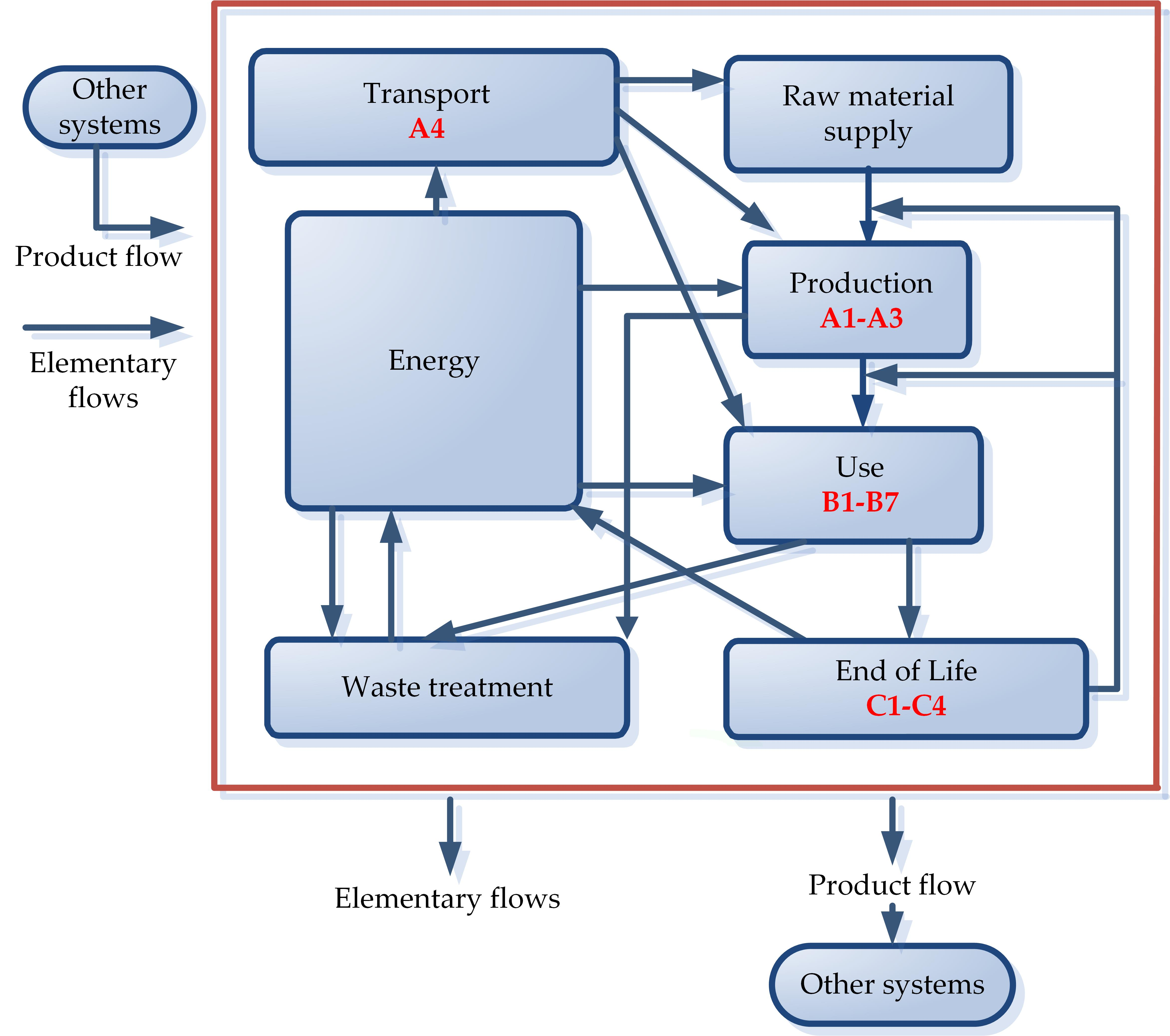
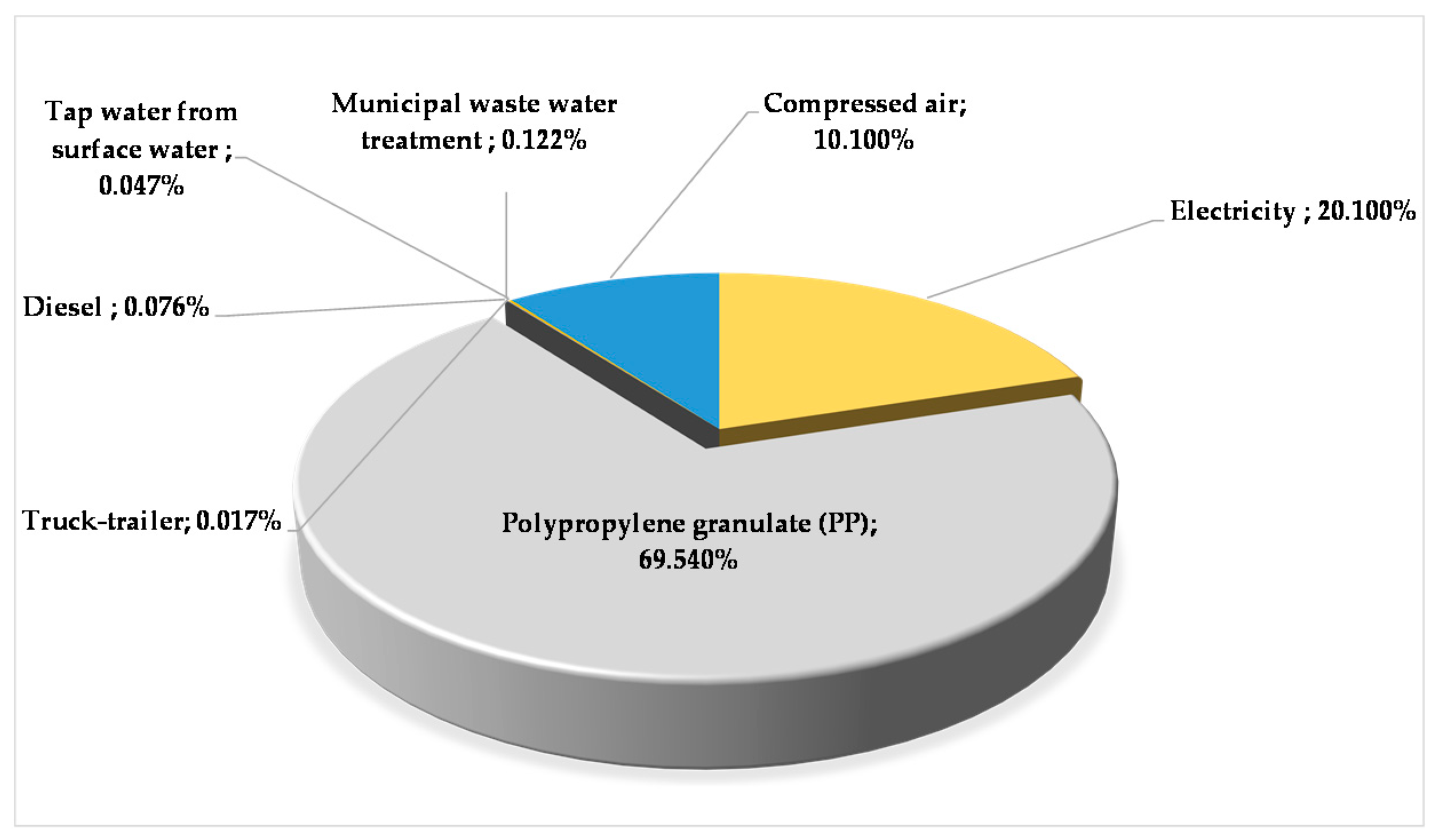
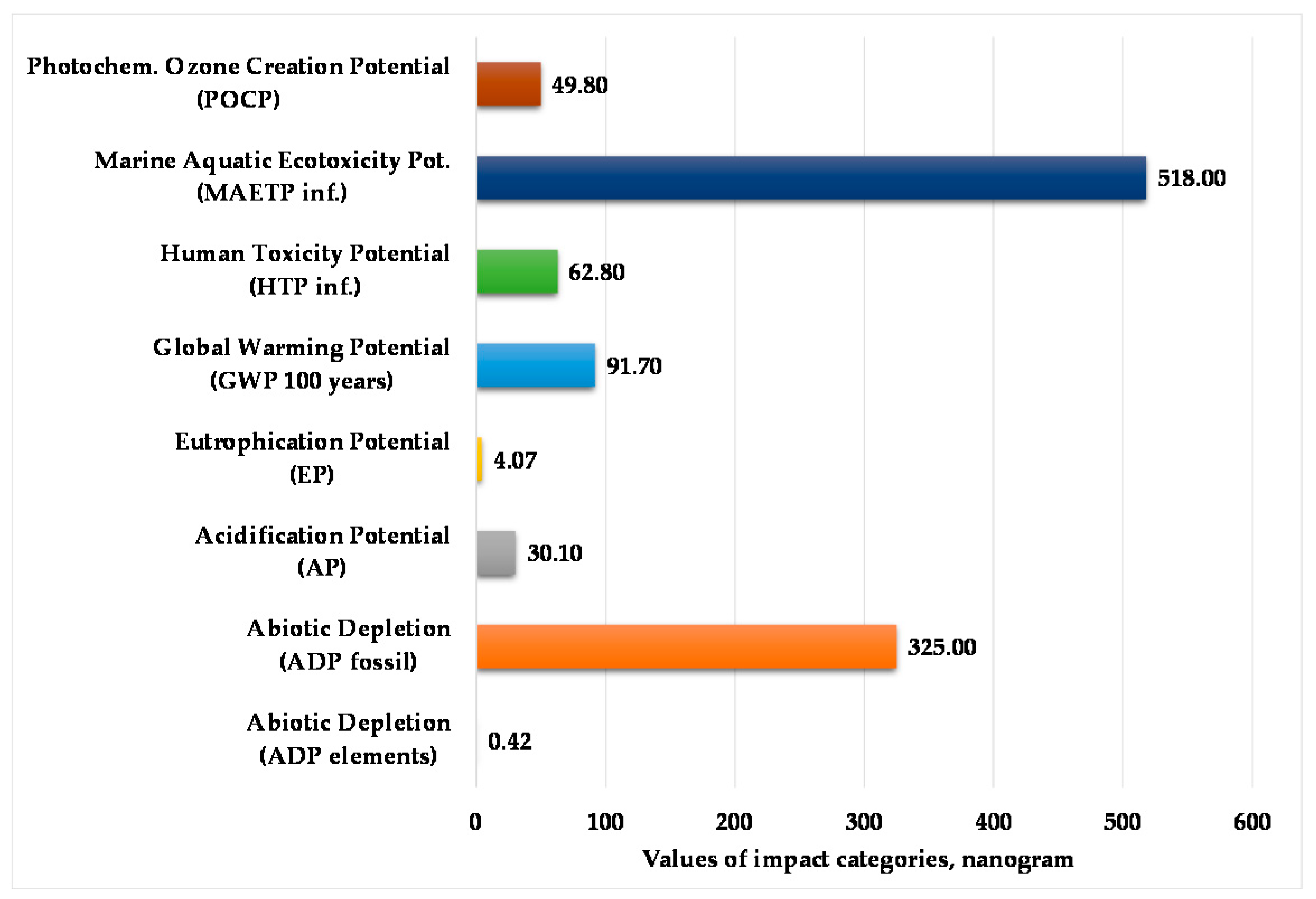
- A1‒A3: Production stage: supply of raw materials (polypropylene granules, compressed air, and top water from EU), energy supply (Hungarian electricity grid mix), and injection moulding.
- A4: Transport of the polypropylene product for use.
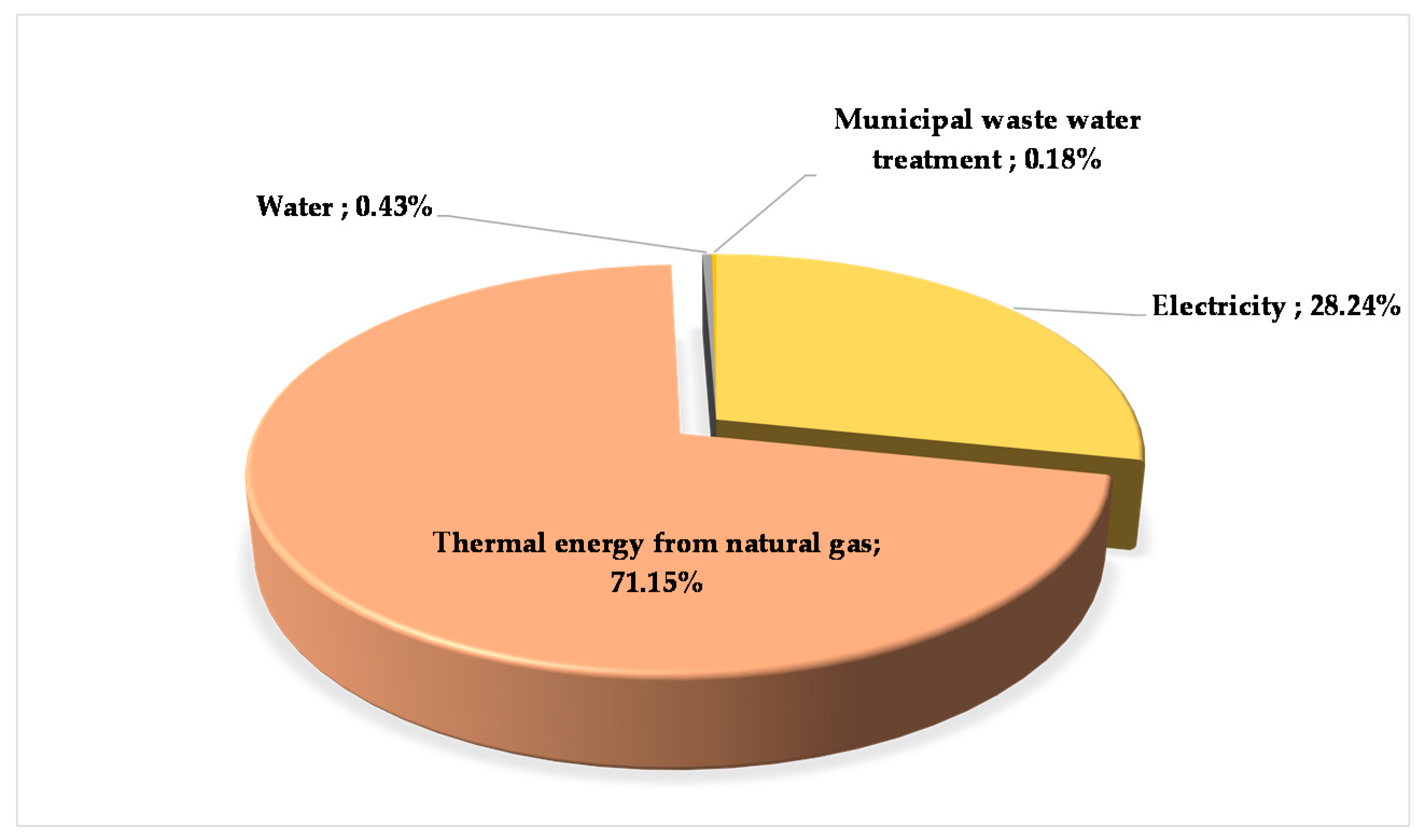
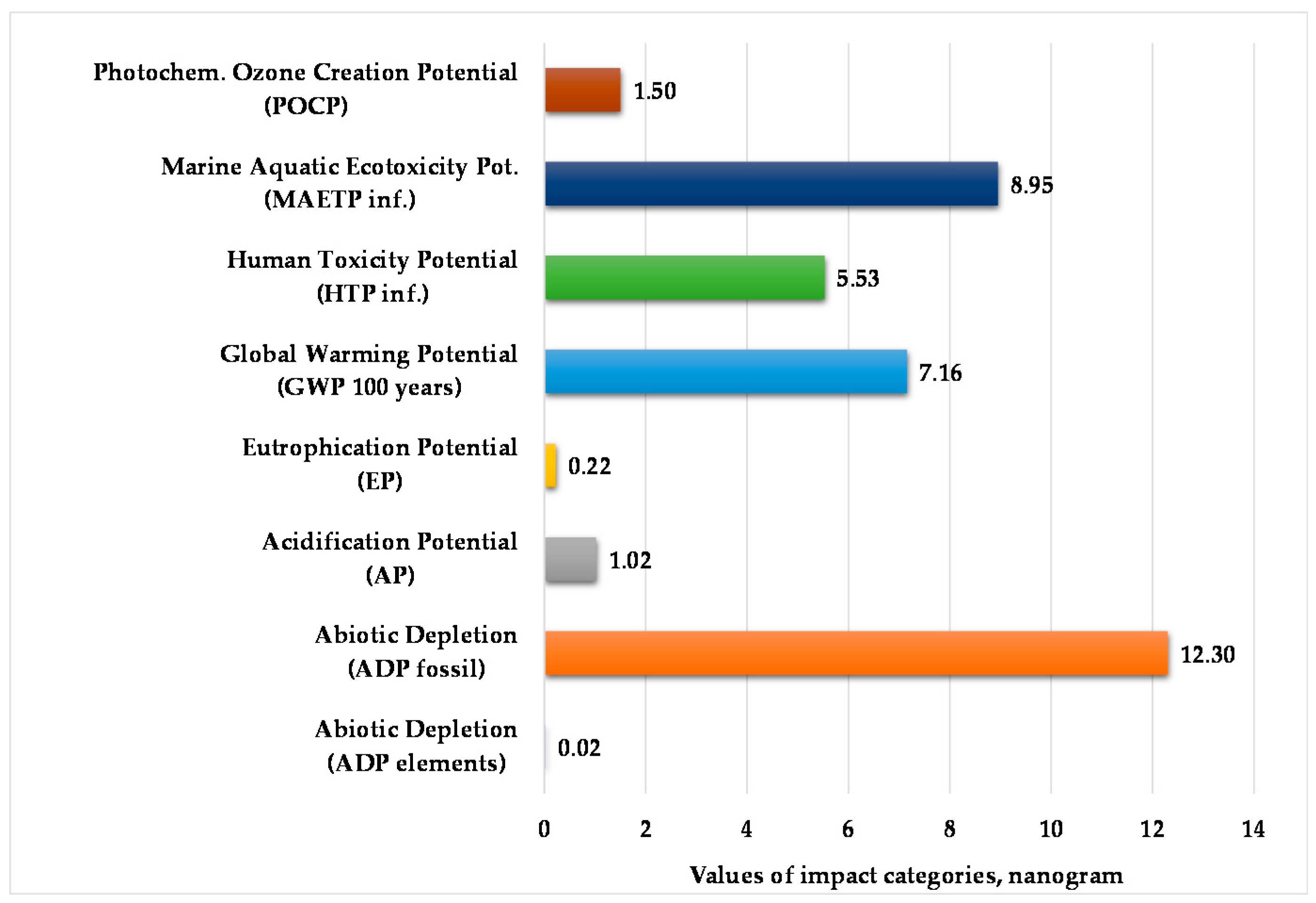
- B1‒B7: Use stage: washing of the polypropylene product, energy use (thermal energy from natural gas and Hungarian electricity grid mix), and deionised water use.
- C1‒C4: End-of-life stage: transport of used polypropylene product as waste, polypropylene waste disposal in EU-28 waste incineration plant, EU-28 municipal wastewater treatment, credit for steam and power.
3.2. Results of Production Stage
3.3. Results of Use Stage
3.4. Results of End-of-Life Stage
3.5. Results for the Complete Life Cycle of a Polypropylene Product
4. Conclusions
Author Contributions
Funding
Conflicts of Interest
Abbreviations
| AP | Acidification Potential |
| ADP elements, ADPE | Abiotic Depletion—elements |
| ADP fossil, ADPF | Abiotic Depletion—fossil fuels |
| EP | Eutrophication Potential |
| EPD | Environmental Product Declaration |
| FAETP inf. | Freshwater Aquatic Ecotoxicity Potential |
| FU | Functional unit |
| GWP 100 years | Global Warming Potential (for 100 years, excl. biogenic carbon) |
| HTP inf. | Human Toxicity Potential |
| LCA | Life Cycle Assessment |
| LCC | Life Cycle Cost |
| LCI | Life Cycle Inventory |
| LCIA | Life Cycle Impact Assessment |
| MAETP inf. | Marine Aquatic Ecotoxicity Potential |
| ODP steady state | Ozone Layer Depletion Potential |
| POCP | Photochemical Ozone Creation Potential |
| PP | Polypropylene |
| TETP inf. | Terrestrial Ecotoxicity Potential |
References
- Schwarz, A.E.; Ligthart, T.N.; Boukris, E.; van Harmelen, T. Sources, transport, and accumulation of different types of plastic litter in aquatic environments: A review study Jalaluddin, M. Use of plastic waste in civil constructions and innovative decorative material (eco-friendly). MOJ Civ. Eng. 2017, 3, 359–368. [Google Scholar] [CrossRef] [Scilit]
- Lukács, J.; Dobosy, Á.; Gáspár, M. Fatigue Crack Propagation Limit Curves for S690QL and S960M High Strength Steels and their Welded Joints. Adv. Mater. Res. 2018, 1146, 44–56. [Google Scholar] [CrossRef] [Scilit]
- Civancik-Uslu, D.; Puig, R.; Ferrer, L.; Fullana-i-Palmer, P. Influence of end-of-life allocation, credits and other methodological issues in LCA of compounds: An in-company circular economy case study on packaging. J. Clean. Prod. 2019, 212, 925–940. [Google Scholar] [CrossRef] [Scilit]
- European Environment Agency. Circular Economy in Europe—Developing the Knowledge Base; EEA Report 2/2016; EEA: Copenhagen, Denmark, 2016.
- Stahel, W.R. Circular economy. Nature 2016, 531, 435–438. [Google Scholar] [CrossRef] [Scilit] [PubMed]
- Szita, K. The Application of Life Cycle Assessment in Circular Economy. Hung. Agric. Eng. 2017, 31, 5–9. [Google Scholar] [CrossRef] [Scilit]
- Labuschagne, C.; Brent, A.C. Sustainable Project Life Cycle Management: The need to integrate life cycles inthe manufacturing sector. Int. J. Proj. Manag. 2005, 23, 159–168. [Google Scholar] [CrossRef] [Scilit]
- Geueke, B.; Groh, K.; Muncke, J. Food packaging in the circular economy: Overview of chemical safety aspects for commonly used materials. J. Clean. Prod. 2018, 193, 491–505. [Google Scholar] [CrossRef] [Scilit]
- European Bioplastics. Bioplastics—Facts and Figures; European Bioplastics: Berlin, Germany, 2017. [Google Scholar]
- Grosso, M.; Niero, M.; Rigamonti, L. Circular economy, permanent materials and limitations to recycling: Where do we stand and what is the way forward? Waste Manag. Res. 2017. [Google Scholar] [CrossRef] [Scilit]
- Ghisellini, P.; Cialani, C.; Ulgiati, S. A review on circular economy: The expected transition to a balanced interplay of environmental and economic systems. J. Clean. Prod. 2016, 114, 11–32. [Google Scholar] [CrossRef] [Scilit]
- Geyer, B.; Lorenz, G.; Kandelbauer, A. Recycling of poly (ethylene terephthalate)—A review focusing on chemical methods. Express Polym. Lett. 2016, 10, 559–586. [Google Scholar] [CrossRef] [Scilit]
- Ragaert, K.; Delva, L.; Van Geem, K. Mechanical and chemical recycling of solid plastic waste. Waste Manag. 2017, 69, 24–58. [Google Scholar] [CrossRef] [Scilit] [PubMed]
- Dole, P.; Feigenbaum, A.E.; Cruz, C.D.L.; Pastorelli, S.; Paseiro, P.; Hankemeier, T.; Voulzatis, Y.; Aucejo, S.; Saillard, P.; Papaspyrides, C. Typical diffusion behaviour in packaging polymers—Application to functional barriers. Food Addit. Contam. 2006, 23, 202–211. [Google Scholar] [CrossRef] [Scilit] [PubMed]
- Palkopoulou, S.; Joly, C.; Feigenbaum, A.; Papaspyrides, C.D.; Dole, P. Critical review on challenge tests to demonstrate decontamination of polyolefins intended for food contact applications. Trends Food Sci. Technol. 2016, 49, 110–120. [Google Scholar] [CrossRef] [Scilit]
- Coulier, L.; Orbons, H.G.M.; Rijk, R. Analytical protocol to study the food safety of (multiple-) recycled high-density polyethylene (HDPE) and polypropylene (PP) crates: Influence of recycling on the migration and formation of degradation products. Polym. Degrad. Stabil. 2007, 92, 2016–2025. [Google Scholar] [CrossRef] [Scilit]
- EFSA. Register of Questions. 2018. Available online: http://registerofquestions.efsa.europa.eu/roqFrontend/login?4 (accessed on 27 June 2017).
- Lahtela, V.; Hyvärinen, M.; Kärki, T. Composition of Plastic Fractions in Waste Streams: Toward More Efficient Recycling and Utilization. Polymers 2019, 11, 69. [Google Scholar] [CrossRef] [Scilit] [PubMed]
- Alwaeli, M. End-of-life vehicles recovery and recycling and the route to comply with eu directive targets. Environ. Prot. Eng. 2016, 42, 191–202. [Google Scholar] [CrossRef] [Scilit]
- Horowitz, N.; Frago, J.; Mu, D. Life cycle assessment of bottled water: A case study of Green2O products. Waste Manag. 2018, 76, 734–743. [Google Scholar] [CrossRef] [Scilit]
- Baldowska-Witos, P.; Kruszelnicka, W.; Kasner, R.; Rudnicki, J.; Tomporowski, A.; Flizikowski, J. Impact of the plastic bottle production on the natural environment. Part 1. Application of the ReCiPe 2016 assessment method to identify environmental problems. Przem. Chem. 2019, 98, 1662–1667. [Google Scholar] [CrossRef] [Scilit]
- Baldowska-Witos, P.; Kruszelnicka, W.; Kasner, R.; Tomporowski, A.; Flizikowski, J.; Mrozinski, A. Impact of the plastic bottle production on the natural environment. Part 2. Analysis of data uncertainty in the assessment of the life cycle of plastic beverage bottles using the Monte Carlo technique. Przem. Chem. 2019, 98, 1668–1672. [Google Scholar] [CrossRef] [Scilit]
- Alfarisi, S.; Sutopo, W. Simulation of Green Operations Supply Chain in Waste of Plastic. In IOP Conference Series: Materials Science and Engineering; IOP Publishing: Sarawak, Malaysia, 2019; Volume 495. [Google Scholar] [CrossRef] [Scilit]
- International Organization for Standardization. ISO 14025:2006. Environmental Labels and Declarations—Type III Environmental Declarations—Principles and Procedures; IOS: Geneva, Switzerland, 2006. [Google Scholar]
- PlasticsEurope. The PlasticsEurope Annual Review 2017–2018; PlasticsEurope Market Research Group (PEMRG)/Consultic Marketing & Industrieberatung GmbH; PlasticsEurope: Brussels, Belgium, 2018. [Google Scholar]
- International Organisation for Standardization. ISO 14040:2006, Environmental Management—Life Cycle Assessment—Principles and Framework; ISO: Geneva, Switzerland, 2006; Available online: https://www.iso.org/standard/37456.html (accessed on 6 June 2019).
- International Organisation for Standardization. ISO 14044:2006, Environmental Management—Life Cycle Assessment—Requirements and Guidelines; ISO: Geneva, Switzerland, 2006; Available online: https://www.iso.org/standard/38498.html (accessed on 6 June 2019).
- Kupfer, T.; Baitz, M.; Colodel, C.M.; Kokborg, M.; Schöll, S.; Rudolf, M.; Thellier, L.; Bos, U.; Bosch, F.; Gonzalez, M.; et al. GaBi Database & Modeling Principles; GaBi thinkstep, A.G., Ed.; Sphera: Chicago, IL, USA, 2018. [Google Scholar]
- Dreyer, L.C.; Niemann, A.L.; Hauschild, M.Z. Comparison of Three Different LCIA Methods: EDIP97, CML2001 and Eco-indicator 99. Int. J. Life Cycle Assess. 2003, 8, 191–200. [Google Scholar] [CrossRef] [Scilit]
- Vidal, B.; Maia De Souza, D.; Teixeira, R.F.M.; Antón, A.; Putman, W.B.; Sala, S. Soil quality, properties, and functions in life cycle assessment: An evaluation of models. J. Clean. Prod. 2017, 140, 502–515. [Google Scholar] [CrossRef] [Scilit]
- Guinee, J.B. Handbook on life cycle assessment—Operational guide to the ISO standards. Int. J. Life Cycle Assess. 2002, 7, 311. [Google Scholar] [CrossRef] [Scilit]
- Heijungs, R.; Sangwon, S. The Computational Structure of Life Cycle Assessment; Springer Science & Business Media: Berlin, Germany, 2002. [Google Scholar] [CrossRef] [Scilit]
- [CML] Institute of Environmental Sciences, Leiden University. CML-IA Characterisation Factors Portal [Internet]. 2016. Available online: https://www.universiteitleiden.nl/en/research/researchoutput/science/cml-ia-characterisation-factors (accessed on 29 June 2018).
- European Commission. Recommendations for Life Cycle Impact Assessment in the European context—Based on Existing Environmental Impact Assessment Models and Factors. In ILCD Handbook; European Commission, Joint Research Centre, Institute for Environment and Sustainability: Ispra, Italy, 2011; Available online: http://publications.jrc.ec.europa.eu/repository/handle/JRC61049 (accessed on 29 February 2016). [CrossRef]
- European Commission. Report on Critical Raw Materials for the EU; European Commission: Brussels, Belgium, 2014; Available online: http://ec.europa.eu/growth/sectors/raw-materials/specific-interest/critical/index_en.htm (accessed on 29 February 2016).
- European Commission. Analysis of Existing Environmental Impact Assessment methodologies for use in Life Cycle Assessment; European Commission, Joint Research Centre, Institute for Environment and Sustainability. 2010. Available online: http://eplca.jrc.ec.europa.eu/uploads/ILCD-Handbook-LCIA-Background-analysis-online-12March2010.pdf (accessed on 29 February 2016).
- Guinée, J.; Heijungs, R. A proposal for the definition of resource equivalency factors for use in product Life-Cycle Assessment. Environ. Toxicol. Chem. 1995, 14, 917–925. [Google Scholar] [CrossRef]
- Van Oers, L.; De Koning, A.; Guinée, J.B.; Huppes, G. Abiotic resource depletion in LCA. In Improving Characterisation Factors for Abiotic Resource Depletion as Recommended in the New Dutch LCA Handbook; RWS-DWW: Delft, The Netherlands, 2002; Available online: http://www.leidenuniv.nl/cml/ssp/projects/lca2/report_abiotic_depletion_web.pdf (accessed on 29 February 2016).
- Global Guidance on Environmental Life Cycle Impact Assessment Indicators Volume 2; United Nations Environment Programme: Nairobi, Kenya, 2019.
- Environmental Product Declaration (EPD). Multilayer Polypropylene Pipes Produced by ABN//INSTAL CT FASER RD and ABN//EVAC ENERGY PLUS; EPD International: Stockholm, Sweden, 2019. [Google Scholar]
- Pfister, S.; Koehler, A.; Hellweg, S. Assessing the environmental impacts of freshwater consumption in LCA. Environ. Sci. Technol. 2009, 43, 4098–4104. [Google Scholar] [CrossRef] [Scilit] [PubMed]
- Pfister, S.; Saner, D.; Koehler, A. The environmental relevance of freshwater consumption in global power production. Int. J. Life Cycle Assess. 2011, 16, 580–591. [Google Scholar] [CrossRef] [Scilit]
- Frischknecht, R.; Steiner, R.; Jungbluth, N. The Ecological Scarcity Method—Eco-Factors 2006: A Method for Impact Assessment in LCA; Federal Office for the Environment FOEN: Zürich, Switzerland, 2009. [Google Scholar]
- Tomporowski, A.; Flizikowski, J.; Wełnowski, J.; Najzarek, Z.; Topoliński, T.; Kruszelnicka, W.; Piasecka, I.; Śmigiel, S. Regeneration of rubber waste using an intelligent grinding system. Przem. Chem. 2018, 97, 1659–1665. [Google Scholar] [CrossRef] [Scilit]
- Kruszelnicka, W.; Kasner, R.; Bałdowska-Witos, P.; Flizikowski, J.; Tomporowski, A. The Integrated Energy Consumption Index for Energy Biomass Grinding Technology Assessment. Energies 2020, 13, 1417. [Google Scholar] [CrossRef] [Scilit]
- Jovanovic, S.; Savic, S.; Jovicic, N.; Boskovic, G.; Djordjevic, Z. Using multi-criteria decision making for selection of the optimal strategy for municipal solid waste management. Waste Manag. Res. 2016, 34, 884–895. [Google Scholar] [CrossRef] [Scilit]
- Sabbas, T.; Polettini, A.; Pomi, R.; Astrup, T.; Hjelmar, O.; Mostbauer, P.; Cappai, G.; Magel, G.; Salhofer, S.; Speiser, C.; et al. Management of Municipal Solid Waste Incineration Residues. Waste Manag. 2003, 23, 61–88. [Google Scholar] [CrossRef] [Scilit]
- Liu, A.; Ren, F.; Lin, W.Y.; Wang, J.-Y. A review of municipal solid waste environmental standards with a focus on incinerator residues. Int. J. Sustain. Built Environ. 2015, 4, 165–188. [Google Scholar] [CrossRef] [Scilit]
- Ramos, A.; Teixeira, C.A.; Rouboa, A. Environmental Assessment of Municipal Solid Waste by Two-Stage Plasma Gasification. Energies 2019, 12, 137. [Google Scholar] [CrossRef] [Scilit]
- Mazzoni, L.; Janajreh, I. Plasma gasification of municipal solid waste with variable content of polypropylene solid waste for enhanced energy recovery. Int. J. Hydrogen Energy 2017, 42, 19446–19457. [Google Scholar] [CrossRef] [Scilit]
- Mohai, I.; Szépvölgyi, J.; Karoly, Z.; Mohai, M.; Toth, M.; Babievskaya, I.Z.; Krenev, V.A. Reduction of metallurgical wastes in an RF thermal plasma reactor. Plasma Chem. Plasma Process. 2001, 21, 547–563. [Google Scholar] [CrossRef] [Scilit]
- Szamosi, Z.; Bodnár, I.; Szepesi, L.G.; Rosas-Casals, M.; Berényi, L. Improved environmental impact in the architecture industry: LCA analysis of an alternative masonry element. Renew. Energy 2020, 147, 1718–1727. [Google Scholar] [CrossRef] [Scilit]
- Vaida, D.; Lelea, D. Municipal Solid Waste Incineration: Recovery or Disposal. Case Study of City Timisoara, Romania. Procedia Eng. 2017, 181, 378–384. [Google Scholar] [CrossRef] [Scilit]
- Andersen, N.; Eriksson, O.; Hillman, K.; Wallhagen, M. Wind Turbines’ End-of-Life: Quantification and Characterisation of Future Waste Materials on a National Level. Energies 2016, 9, 999. [Google Scholar] [CrossRef] [Scilit]
- Moya, D.; Aldás, C.; López, G.; Kaparaju, P. Municipal solid waste as a valuable renewable energy resource: A worldwide opportunity of energy recovery by using Waste-To-Energy Technologies. Energy Procedia 2017, 134, 286–295. [Google Scholar] [CrossRef] [Scilit]
- Lewandowska, A. Environmental life cycle assessment as a tool for identification and assessment of environmental aspects in environmental management systems (EMS) part 1: Methodology. Int. J. Life Cycle Assess. 2011, 16, 178–186. [Google Scholar] [CrossRef] [Scilit]
- Lewandowska, A.; Matuszak-Flejszman, A. Eco-design as a normative element of Environmental Management Systems-the context of the revised ISO 14001:2015. Int. J. Life Cycle Assess. 2014, 19, 1794–1798. [Google Scholar] [CrossRef] [Scilit]

| Impact Categories | Equivalent |
|---|---|
| Abiotic Depletion ADP elements, ADPE | kg Sb Equivalent |
| Abiotic Depletion ADP fossil, ADPF | MJ |
| Acidification Potential AP | kg SO2 Equivalent |
| Eutrophication Potential EP | kg Phosphate Equivalent |
| Freshwater A. Ecot. P. FAETP inf. | kg DCB Equivalent |
| Global Warming Pot. GWP 100 years | kg CO2 Equivalent |
| Human Toxicity Potential HTP inf. | kg DCB Equivalent |
| Marine A. Ecotox. Pot. MAETP inf. | kg DCB Equivalent |
| Photochem. Ozone Creat. Pot. POCP | kg Ethylene Equivalent |
| Terrestric Ecotox. Pot. TETP inf. | kg DCB Equivalent |
| Ozone Depletion Pot. ODP steady state | kg R11 Equivalent |
| Flows | Prod. | Use | EoL | Total LC |
|---|---|---|---|---|
| Energy resources | 2.01 | 0.06 | 0.02 | 2.09 |
| Material resources | 2290.00 | 19.20 | 59.30 | 2369 |
| Deposited goods | 4.37 | 0.13 | 0.27 | 4.77 |
| Emissions to air | 46.00 | 1.37 | 9.64 | 57.01 |
| Emissions to freshwater | 2370.00 | 22.70 | 52.50 | 2445.00 |
| Emissions to seawater | 7.20 | 0.01 | 0.18 | 7.39 |
| Flows | 4720.00 | 43.47 | 122.00 | 4885.00 |
| Flows | Prod. | Use | EoL | Total LC |
|---|---|---|---|---|
| Energy resources | 1.89 | 0.06 | 0.02 | 1.97 |
| Material resources | 2090.00 | 19.20 | 59.30 | 2168.50 |
| Deposited goods | 5.1 | 0.13 | 0.27 | 5.50 |
| Emissions to air | 38.70 | 1.37 | 9.64 | 49.71 |
| Emissions to freshwater | 2230.00 | 22.70 | 52.50 | 2305.20 |
| Emissions to seawater | 6.54 | 0.01 | 0.18 | 6.73 |
| Flows | 4372.23 | 43.47 | 121.91 | 4537.61 |
| Impact Categories | Prod. | Use | End-of-Life |
|---|---|---|---|
| Abiotic Depletion ADP elements, ng | 0.017 | 0.001 | 0.002 |
| Abiotic Depletion ADP fossil, ng | 13.000 | 0.494 | 0.121 |
| Acidification Potential AP, ng | 1.200 | 0.041 | 0.189 |
| Eutrophication Potential EP, ng | 0.163 | 0.009 | 0.036 |
| Freshwater A. Ecot. P. FAETP inf., ng | 0.615 | 0.005 | 0.004 |
| Global Warming Pot. GWP 100 years, ng | 3.670 | 0.286 | 2.150 |
| Human Toxicity Potential HTP inf., ng | 2.510 | 0.221 | 0.069 |
| Marine A. Ecotox. Pot. MAETP inf., ng | 20.700 | 0.358 | 0.348 |
| Photochem. Ozone Creat. Pot. POCP, ng | 1.990 | 0.060 | 0.123 |
| Terrestric Ecotox. Pot. TETP inf., ng | 0.065 | 0.001 | 0.020 |
| Total value of environmental loads | 44.000 | 1.480 | 3.060 |
| Impact Categories | Prod. | Use | End-of-Life |
|---|---|---|---|
| Abiotic Depletion ADP fossil, MJ | 71.300 | 2.710 | 0.664 |
| Acidification Potential AP, kg SO2 eq | 0.004 | 0.000 | 0.001 |
| Freshwater A. Ecot. P. FAETP inf., kg DCB eq. | 0.021 | 0.000 | 0.000 |
| Global Warming Pot. GWP 100 years, kg CO2 eq | 2.180 | 0.170 | 1.270 |
| Human Toxicity Potential HTP inf., kg DCB eq. | 0.193 | 0.017 | 0.005 |
| Marine A. Ecotox. Pot. MAETP inf., kg DCB eq. | 149.000 | 2.580 | 2.510 |
| Photochem. Ozone Creat. Pot. POCP, ng | 0.001 | 0.000 | 0.000 |
| Terrestrial Ecotox. Pot. TETP inf., kg DCB eq. | 0.001 | 0.000 | 0.000 |
© 2020 by the authors. Licensee MDPI, Basel, Switzerland. This article is an open access article distributed under the terms and conditions of the Creative Commons Attribution (CC BY) license (http://creativecommons.org/licenses/by/4.0/).
Share and Cite
Mannheim, V.; Simenfalvi, Z. Total Life Cycle of Polypropylene Products: Reducing Environmental Impacts in the Manufacturing Phase. Polymers 2020, 12, 1901. https://doi.org/10.3390/polym12091901
Mannheim V, Simenfalvi Z. Total Life Cycle of Polypropylene Products: Reducing Environmental Impacts in the Manufacturing Phase. Polymers. 2020; 12(9):1901. https://doi.org/10.3390/polym12091901
Chicago/Turabian StyleMannheim, Viktoria, and Zoltan Simenfalvi. 2020. "Total Life Cycle of Polypropylene Products: Reducing Environmental Impacts in the Manufacturing Phase" Polymers 12, no. 9: 1901. https://doi.org/10.3390/polym12091901
APA StyleMannheim, V., & Simenfalvi, Z. (2020). Total Life Cycle of Polypropylene Products: Reducing Environmental Impacts in the Manufacturing Phase. Polymers, 12(9), 1901. https://doi.org/10.3390/polym12091901