


Abstract
Be–Al alloys are attractive for aerospace and precision-engineering applications because of their low density, high specific stiffness, and excellent dimensional stability. However, their broader application is constrained by multiscale defects arising from the low mutual solubility of Be and Al, their large melting-point difference, and the high reactivity of the Be/Al interface. This review critically examines defect formation and microstructural evolution in Be–Al alloys produced by casting, powder metallurgy, pressure infiltration, thermomechanical processing, and additive manufacturing, with particular emphasis on additive manufacturing. Rapid solidification can refine the Be-rich phase and suppress coarse segregation, but unstable melt-pool behavior, restricted gas escape, cyclic thermal loading, and insufficient interfacial diffusion may also promote porosity, compositional heterogeneity, residual stress, and interfacial degradation. The mechanical properties of Be–Al alloys depend strongly on Be-phase morphology, continuity of the Al matrix, interfacial integrity, and the spatial distribution of processing-induced defects. Recent progress in alloy design, process optimization, interfacial engineering, and post-processing is evaluated, together with the limitations of the available evidence. Future research should establish quantitative processing–defect–microstructure–property relationships through in situ monitoring, multiscale characterization, predictive modeling, and standardized mechanical validation. These advances are essential for the reliable manufacture of complex, high-performance Be–Al components.
1. Introduction
In recent years, aerospace structures have imposed increasingly stringent requirements on structural materials in terms of lightweight design, structural complexity, and long-term reliability [1,2]. Be–Al alloys have been widely applied in aerospace structures, space optical systems, and precision components due to their high specific stiffness and favorable dimensional stability [3,4,5]. With the increasing complexity of structural design, these components are progressively evolving toward thin-walled and geometrically complex configurations [6,7,8]. Despite the well-known health risks associated with beryllium exposure, Be-containing materials continue to attract scientific and engineering interest because of their irreplaceable combination of low density, high elastic modulus, excellent dimensional stability, and thermal stability. Consequently, the relationships among material behavior, processing quality, and structural reliability have therefore become increasingly important [9,10]. Safe manufacturing practices, closed processing environments, powder handling protocols, and occupational protection measures remain essential during fabrication.
1.1. Fundamental Characteristics of Be–Al Alloys
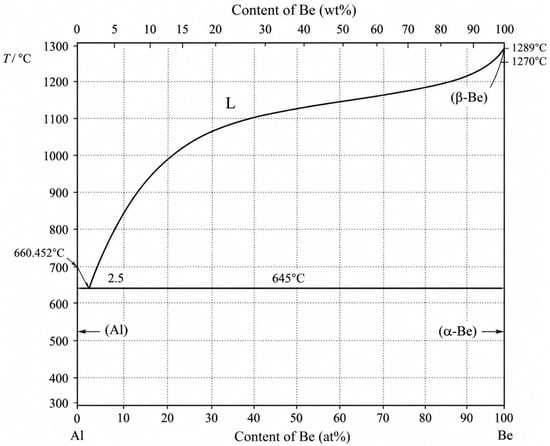
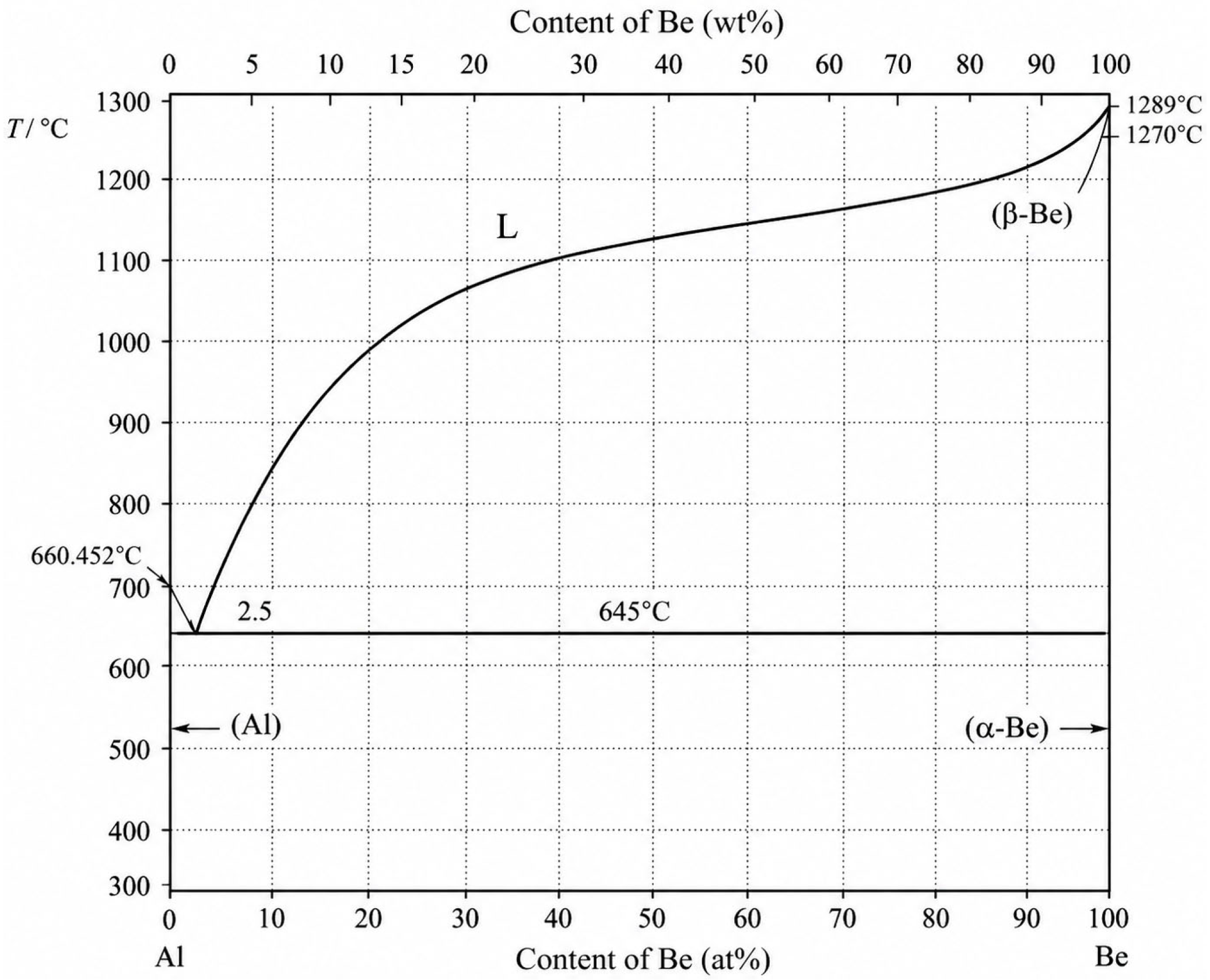
Be–Al alloys are typical dual-phase lightweight composite materials combining the high specific stiffness of beryllium with the ductility of aluminum. Their microstructure is governed by the Be–Al binary phase diagram, as shown in Figure 1, which indicates extremely limited mutual solubility and the absence of stable intermetallic compounds. Consequently, Be–Al alloys solidify into a dual-phase structure composed of Be-rich and Al-rich phases rather than solid-solution or intermetallic-strengthened structures [11,12].
Figure 1.
Phase diagram and phase field distribution of the Be–Al binary system.
The Be/Al ratio is a primary compositional variable governing phase fraction, matrix continuity, interfacial area, and the resulting mechanical response. Reported Be–Al composites cover a relatively broad composition range, whereas the most commonly investigated Lockalloy-type composition contains approximately 62 wt.% Be and 38 wt.% Al. For example, wavelength-dispersive X-ray fluorescence analysis of an investment-cast alloy by Xie et al. showed a measured composition of 62.04 wt.% Be and 37.62 wt.% Al, with the balance consisting of minor elements [10]. Therefore, the nominal or measured chemical composition should be considered when comparing microstructures and properties reported in different studies.
The melting points of Al and Be are approximately 660 °C and 1287 °C, respectively. This numerical difference is important because it indicates that the Al-rich and Be-rich constituents experience markedly different melting, redistribution, and solidification histories during processing. The Al-rich constituent may undergo extensive melting and flow while the Be-rich phase remains solid or preferentially forms primary skeletal structures, thereby contributing to asynchronous phase evolution and restricted liquid feeding. However, melting-point difference alone does not quantitatively determine the final defect population. Alloy composition, local cooling rate, thermal gradient, melt convection, component geometry, and interfacial oxidation also influence phase morphology, segregation, and porosity. Therefore, the melting-point values should be regarded as thermodynamic indicators of processing incompatibility rather than direct predictors of defect severity.
Both Be and Al exhibit strong oxygen affinity, leading to the formation of BeO and Al2O3 at or near interfaces during processing. These oxides hinder atomic diffusion and weaken interfacial bonding, thereby degrading load transfer efficiency and promoting defect formation in Be–Al alloys [13].
1.2. Key Challenges in the Fabrication of Complex Components
At present, Be–Al alloy components are primarily fabricated via casting, powder metallurgy, pressure infiltration, thermomechanical processing, and additive manufacturing. The fabrication of complex Be–Al alloy components is challenged by strong coupling between microstructural evolution and processing conditions. Due to the wide solidification temperature range, solidification often proceeds through an extended mushy zone, where phase evolution and liquid feeding are difficult to coordinate, leading to segregation and local heterogeneity. In addition, interfacial instability and oxidation weaken Be/Al bonding and serve as preferential sites for damage initiation [14].
For geometrically complex structures such as thin-walled and ribbed components, variations in heat transfer conditions further amplify microstructural heterogeneity and residual stress distribution. Consequently, typical defects such as porosity, shrinkage, lack of fusion, and microstructural anisotropy arise depending on the processing route. These defects are fundamentally governed by the coupled effects of material characteristics, thermal history, and geometric constraints [15].
Although considerable progress has been achieved in the development of Be–Al alloys, previous studies have mainly focused on individual fabrication routes or specific strengthening strategies. A systematic understanding of how different manufacturing processes govern defect evolution through distinct thermophysical pathways remains lacking. In particular, additive manufacturing has recently attracted increasing attention because it provides unprecedented design freedom for lightweight and complex Be–Al components. However, compared with conventional routes, AM introduces unique nonequilibrium phenomena, including transient melt-pool behavior, rapid solidification, cyclic thermal accumulation, and oxidation-sensitive interfaces, which fundamentally alter defect formation mechanisms. Therefore, this review aims to establish a comparative framework linking fabrication routes, defect mechanisms, microstructural evolution, and mechanical performance of Be–Al alloys, with particular emphasis on additive manufacturing challenges and future opportunities.
2. Fabrication Routes and Associated Defects
2.1. Investment Casting and Solidification Defects
Investment casting is one of the most important near-net-shape manufacturing routes for complex Be–Al alloy components. This process enables precise mold filling and solidification through ceramic shell molds, offering high dimensional accuracy and excellent surface quality. It is therefore widely applied in aerospace lightweight structural components and space opto-mechanical supporting structures [16,17,18].
Representative investment-casting studies have commonly employed Lockalloy-type compositions. Xie et al. investigated an alloy with a measured composition of 62.04 wt.% Be and 37.62 wt.% Al, whereas Wang et al. employed a nominal Be–38 wt.% Al alloy in numerical simulation and experimental validation of vacuum investment casting [10,19]. Although these alloys have similar nominal Be/Al ratios, the former composition was experimentally measured, while the latter was reported as a nominal composition. This distinction should be considered when comparing their microstructural and defect characteristics.
The solidification behavior of Be–Al alloys is significantly different from that of conventional aluminum alloys. This distinction originates from their intrinsic thermodynamic characteristics, including low mutual solid solubility, large density difference, and a wide solidification temperature range. These features collectively lead to sequential multiphase solidification and pronounced solute redistribution during solidification, thereby giving rise to complex microstructural evolution and defect formation mechanisms.
During the initial stage of solidification, the primary Be phase preferentially nucleates due to its extremely low solubility in Al and higher melting point. These Be phases rapidly interconnect to form a spatial skeletal network. The formation of this rigid skeleton significantly reduces the continuity of the remaining liquid phase, thereby restricting liquid feeding pathways of the Al-rich melt. As solidification proceeds into the shrinkage stage, isolated liquid regions form in thermally concentrated zones, leading to typical solidification shrinkage defects such as shrinkage porosity and shrinkage cavities.
In addition, the large density difference between Be and Al promotes gravity-driven solute redistribution and phase separation during solidification. Under diffusion-limited conditions, such segregation cannot be effectively eliminated by subsequent solid-state homogenization, resulting in a stable microchemical inhomogeneity [19]. This ultimately leads to heterogeneous microstructures and non-uniform mechanical properties.
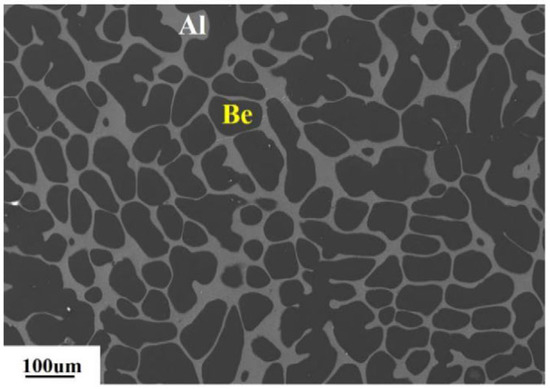
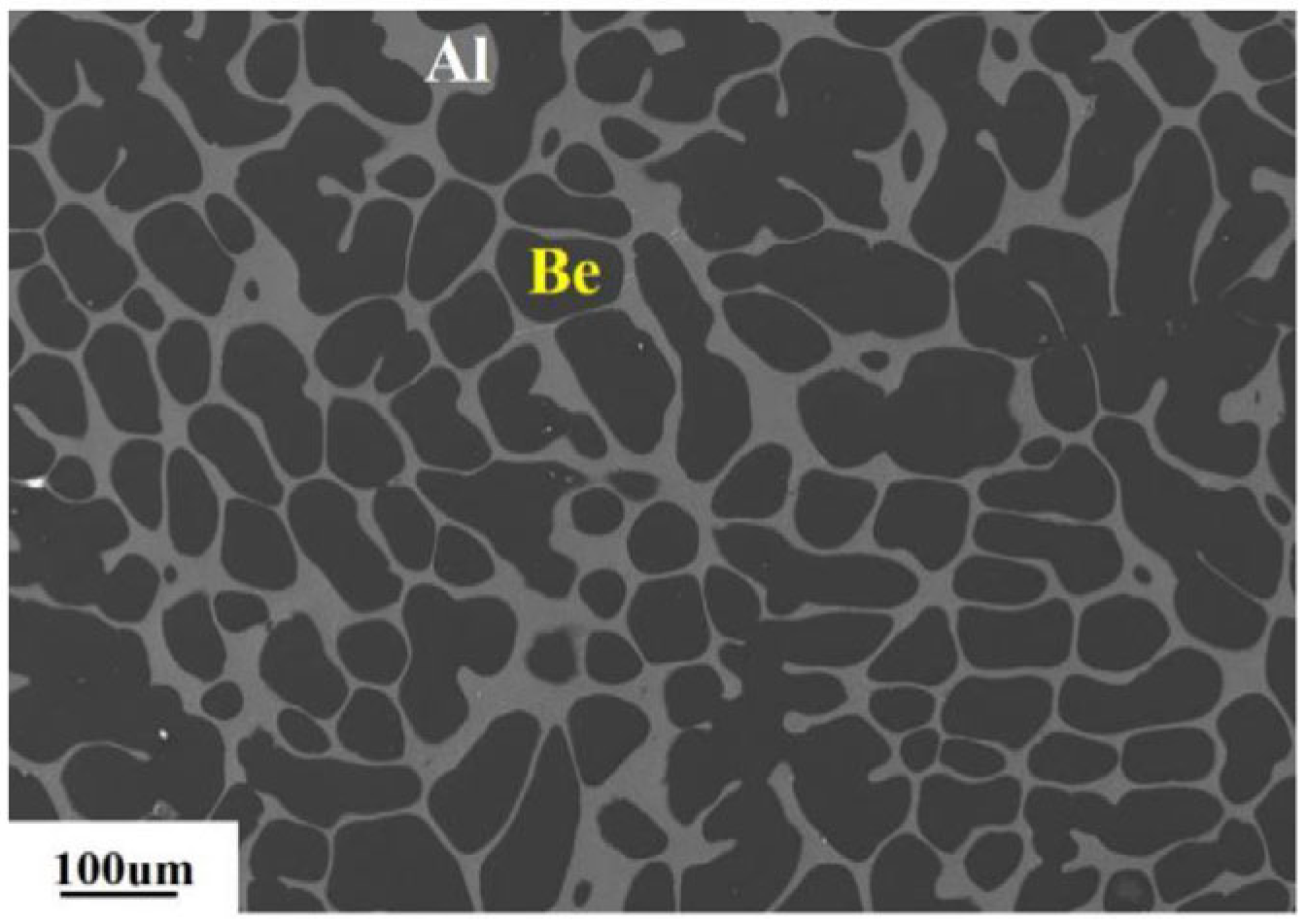
Figure 2 shows the typical solidification microstructure of vacuum investment-cast Be–Al alloy. A continuous Be-rich skeletal network can be clearly observed, while the Al phase fills the interdendritic regions, forming a typical dual-phase solidification structure. Local compositional and morphological heterogeneities are also evident, further confirming the occurrence of phase separation and solute segregation during solidification.
Figure 2.
Typical solidification microstructure of vacuum investment-cast Be–Al alloy [17]. Reprinted/adapted with permission from Ref. [17].
2.2. Powder Metallurgy and Densification-Related Defects
Powder metallurgy is one of the most important near-net-shape fabrication routes for producing Be–Al alloys with homogeneous microstructures and controllable mesoscopic features. This process employs high-purity beryllium and aluminum powders as raw materials, followed by powder blending, cold isostatic pressing (CIP) for pre-compaction, and hot isostatic pressing (HIP) for densification. Subsequent thermomechanical processing is applied to achieve the final component geometry. Since densification is conducted under solid-state or near-solid-state conditions, this route is particularly advantageous for manufacturing high-precision thin-walled and geometrically complex components, while improving microstructural uniformity and property consistency [20,21].
During densification, due to pronounced particle-scale effects and interface-dominated characteristics, defect formation is primarily governed by powder packing behavior, interparticle bonding mechanisms, and diffusion kinetics. Among these defects, residual porosity is the most prevalent. It originates from local packing inefficiency caused by the random arrangement of powder particles, as well as trapped gases and incomplete elimination of closed pores during compaction and HIP. Under insufficient diffusion driving force or limited mass transport pathways, these pores are not fully eliminated and are retained within the microstructure, acting as potential crack initiation sites.
Particle agglomeration of beryllium powders is mainly attributed to their high surface energy and limited wettability, which promotes localized bonding during powder mixing and compaction. This results in non-uniform particle distribution and discontinuous load transfer paths, thereby inducing local stress concentration and reducing plastic accommodation capability. In addition, oxide films inherently present on powder surfaces can hinder interfacial diffusion and metallurgical bonding during HIP. Although high-temperature and high-pressure conditions promote the partial fracture and disruption of these oxide layers, weakly bonded interfaces persist in regions with continuous oxide coverage or insufficient diffusion, thereby degrading interparticle bonding strength [22].
To further improve densification and microstructural homogeneity, thermomechanical post-processing such as hot extrusion or forging is commonly applied to powder-metallurgy-derived Be–Al alloys. These processes introduce additional plastic deformation, promoting pore closure, and refine the grain structure through dynamic recovery and recrystallization mechanisms. Meanwhile, they enhance the continuity of the aluminum matrix and improve the dispersion uniformity of beryllium particles, ultimately leading to significantly improved mechanical properties and microstructural stability.
2.3. Additive Manufacturing and Nonequilibrium Defects
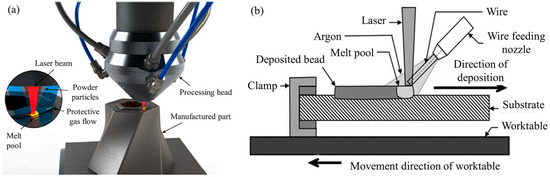
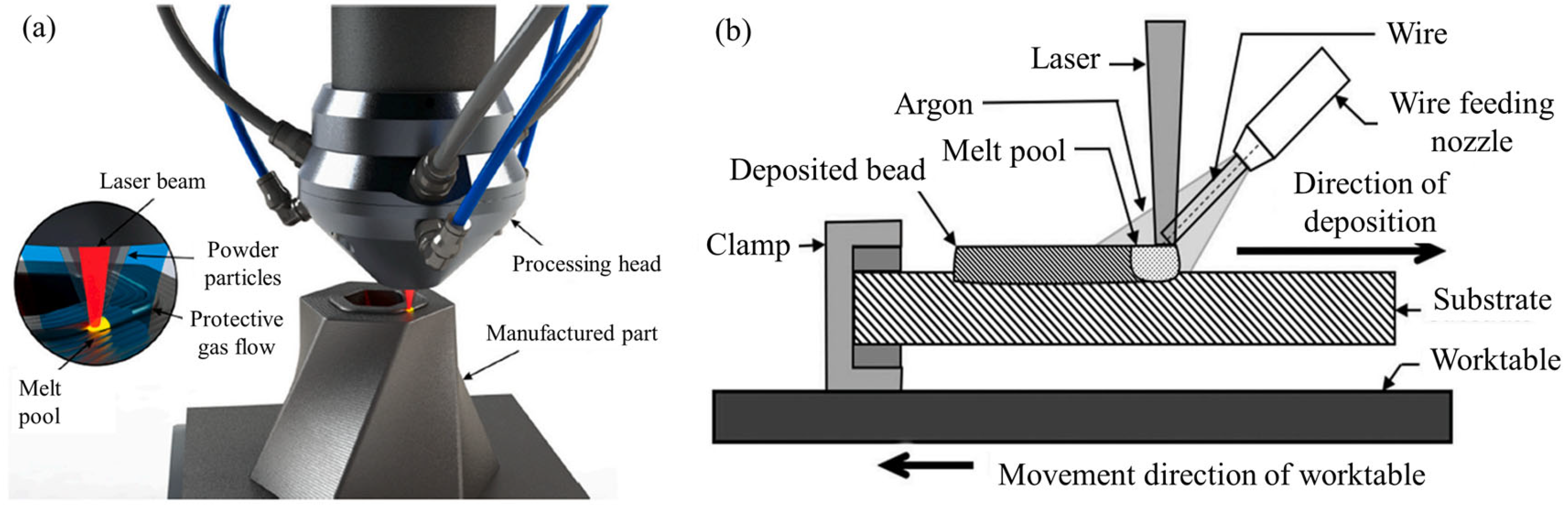
Unlike conventional manufacturing methods, additive manufacturing enables the fabrication of integrated thin-wall structures, topology-optimized components, and geometrically complex parts that are difficult to achieve by casting or powder metallurgy. With the increasing demand for complex structural components and lightweight design, additive manufacturing (AM) provides a promising near-net-shape fabrication route for Be–Al alloys. This layer-by-layer material deposition strategy enables integrated fabrication of components with high design freedom and material utilization efficiency [23]. Currently, research is mainly focused on laser powder bed fusion (LPBF) and laser-directed energy deposition (L-DED). LPBF achieves fine-feature fabrication through selective layer-wise melting of powders using a high-energy laser beam [24,25,26,27], whereas L-DED enables large-scale component fabrication and repair by synchronously feeding powder into a laser-generated melt pool [28,29]. The schematic principle of the L-DED process is shown in Figure 3 [30].
Figure 3.
Schematic illustration of laser-directed energy deposition (L-DED) feeding modes [28,30]. (a) Powder feeding; (b) wire feeding. Reprinted/adapted with permission from Refs. [28,30].
Compared with conventional casting and powder metallurgy routes, additive manufacturing offers significant advantages in terms of geometric complexity and material efficiency. However, its rapid solidification characteristics introduce highly nonequilibrium thermal conditions, making microstructural evolution and defect formation strongly dependent on transient thermal cycles [31,32,33].
In the LPBF process, the rapid heating–cooling cycles induced by high-energy-density laser irradiation often lead to thermal cracking, elemental segregation, and pronounced microstructural heterogeneity. It has been demonstrated that introducing grain-refining nanoparticles can effectively enhance heterogeneous nucleation and reduce crack susceptibility, highlighting that alloy design and nucleation engineering are key strategies for improving the manufacturability of high-strength alloys in LPBF processes [34]. Furthermore, studies on Al–Zn–Mg–Cu alloys have shown that rapid solidification produces refined microstructures and non-equilibrium precipitation behavior significantly different from cast counterparts, while post-processing heat treatment plays a critical role in microstructural regulation and property enhancement [35]. For Be–Al systems, due to their high thermal conductivity, high reflectivity, and interface sensitivity, energy coupling instability and solidification shrinkage-induced stress concentration are expected to be more severe [36,37].
Powder characteristics play a crucial role in process stability in additive manufacturing. In particular, powder particle size distribution and morphology significantly affect powder spreading behavior and melt pool stability. Typically, LPBF processes employ powders with particle sizes in the range of 40–105 μm. Excessively fine powders induce powder spattering and process instability, whereas overly coarse particles reduce melting uniformity. Spherical powders with a low fraction of satellite particles generally exhibit improved flowability and spreading behavior. Powders produced via plasma rotating electrode process (PREP) typically show superior packing and flow characteristics [38].
Electron beam powder bed fusion (EB-PBF) offers advantages for processing highly reflective materials due to its vacuum environment and efficient energy coupling; however, studies on Be–Al systems remain limited. Investigations on high-strength Al2024 alloys indicate that substrate preheating combined with interlayer thermal management can effectively suppress cracking [39]. In addition, EB-PBF processing of Al–Fe–V–Si alloys has achieved relative densities of approximately 98.2%, although porosity and localized cracking are still observed, indicating that the process window requires precise optimization [40]. This result demonstrates the potential of electron-beam processing for highly reflective Al-based alloys, but it cannot be directly transferred to Be–Al alloys because of differences in phase constitution, evaporation behavior, and interfacial oxidation. For Be–Al systems, EB-PBF offers potential advantages in reducing oxidation and improving energy coupling for highly reflective materials, and mitigating thermal stresses. However, its process applicability, evaporation behavior, and interfacial stability remain to be systematically investigated [41].
Overall, the dominant defects in additive manufacturing processes include porosity, lack of fusion, elemental evaporation, and compositional inhomogeneity induced by spattering. In LPBF, localized overheating and powder spatter caused by high laser energy input promotes Be–Al phase separation and microstructural heterogeneity. In contrast, although EB-PBF reduces oxidation effects due to its vacuum environment, preferential melting of Al and non-uniform evaporation behavior leads to microsegregation and pore formation.
2.4. Pressure Infiltration and Thermomechanical Processing Technologies
Pressure infiltration and thermomechanical processing (hot extrusion/forging) are commonly used supplementary fabrication and post-processing routes for Be–Al alloy systems, primarily aimed at further improving densification, interfacial bonding strength, and microstructural homogeneity. Pressure infiltration enables molten aluminum to penetrate into the porous Be powder preform under externally applied pressure, thereby achieving intimate solid–liquid interfacial contact. This process effectively eliminates residual porosity and local segregation inherited from casting and powder metallurgy routes, while also enhancing load-transfer continuity and interfacial bonding efficiency.
Pressure infiltration can reduce residual porosity and improve Be/Al interfacial contact; however, its effectiveness depends strongly on infiltration pressure, melt temperature, preform permeability, holding time, and the initial oxide condition of the Be surface. The reported improvement should therefore be evaluated using quantitative porosity measurements, such as Archimedes density, metallographic image analysis, or X-ray computed tomography, together with interfacial characterization and mechanical testing. In the absence of such correlated validation, reduced visible porosity alone should not be interpreted as evidence of improved interfacial load-transfer capability.
Hot extrusion and forging introduce additional macroscopic plastic deformation energy into the material, promoting pore closure and microstructural redistribution. During deformation, the orientation and spatial distribution of Be particles gradually become more uniform, while the continuity of the Al matrix is enhanced. Meanwhile, dynamic recovery and recrystallization processes refine the grain structure, resulting in significantly improved strength, toughness, and microstructural stability.
From a functional perspective, pressure infiltration is more suitable for fabricating components with high densification and strict interfacial bonding requirements, whereas hot extrusion and forging are more effective for further optimizing microstructural uniformity and overall mechanical performance. For Be–Al alloys prepared via casting or powder metallurgy, thermomechanical processing is therefore typically employed as a critical post-treatment route to achieve synergistic improvement in defect elimination and property enhancement.
2.5. Comparative Analysis of Defect Formation Mechanisms Across Fabrication Routes
Although investment casting, powder metallurgy, additive manufacturing, pressure infiltration, and thermomechanical processing (hot extrusion/forging) differ significantly in their processing routes, their common objective is the regulation of microstructural homogeneity and interfacial stability. The formation of defects in all processes is fundamentally associated with interfacial mismatch in the dual-phase Be–Al system and multiscale transport limitations (Table 1).
Table 1.
Characteristics of major fabrication routes for complex Be–Al alloy components.
Investment casting is a typical liquid-state processing route, and its defects primarily originate from microstructural instability during solidification. Due to the preferential precipitation of the Be phase, a skeletal network is first formed, which significantly restricts subsequent liquid feeding of the Al-rich phase. As a result, shrinkage porosity, shrinkage cavities, and compositional segregation are easily formed in thermally concentrated regions. Meanwhile, the formation of coarse columnar grains and dendritic structures during solidification leads to pronounced microstructural anisotropy, thereby reducing the uniformity of mechanical properties across the component.
Defects in powder metallurgy are mainly manifested as residual porosity, particle agglomeration, and surface oxide film retention. Compared with casting defects, pores and oxide films in powder-metallurgy materials are primarily located at interparticle interfaces, making them preferential sites for fatigue crack initiation. An increase in porosity or non-uniform particle distribution leads to reduced load-transfer efficiency, thereby degrading both strength and fatigue resistance.
Additive manufacturing exhibits distinct defect characteristics compared with conventional processes. Rapid solidification induced by laser or electron beam heat sources subjects the material to extremely high thermal gradients and cooling rates, resulting in porosity, lack-of-fusion defects, microstructural anisotropy, and residual stress accumulation. Lack-of-fusion defects and pores reduce densification, while layer-wise thermal cycling induces texture evolution and directional mechanical anisotropy. In Be–Al alloys, the significant mismatch in thermophysical properties between Be and Al further promotes oxide accumulation and localized interfacial debonding.
Pressure infiltration enhances densification and improves interfacial contact between Be and Al phases; however, its effectiveness is limited by poor wettability and incomplete infiltration in localized regions. Hot extrusion and forging promote pore closure, grain refinement, and interfacial reconstruction through plastic deformation, thereby enhancing strength and microstructural homogeneity. Nevertheless, non-uniform deformation or inappropriate process parameters induces local microstructural distortion and residual stress accumulation.
Overall, defects in casting are governed by solidification behavior, those in powder metallurgy are controlled by densification and interfacial packing, defects in additive manufacturing arise from nonequilibrium solidification, while those in infiltration and thermomechanical processing are primarily associated with interfacial wettability and plastic flow behavior. Ultimately, all defects influence mechanical performance and service reliability by altering densification, interfacial bonding, and microstructural uniformity.
3. Mechanisms of Defect Formation and Evolution
Defects in complex Be–Al alloy components do not form in isolation; rather, they arise from the coupled effects of intrinsic thermodynamic incompatibility, transient processing conditions, and geometric constraints during fabrication. The Be–Al system is characterized by low mutual solubility, a large melting point difference, and high interfacial reactivity, which collectively lead to multiscale microstructural instability during solidification, densification, and thermomechanical loading. As a result, defects such as porosity, segregation, interfacial mismatch, and microstructural anisotropy are readily generated. Fundamentally, these phenomena can be attributed to the competition between dual-phase coordination difficulty and insufficient interfacial stability.
3.1. Solidification-Induced Defects
Solidification is one of the most critical stages governing defect formation in Be–Al alloys. Due to the significantly higher melting point of Be compared with Al, the Be-rich phase preferentially nucleates and forms a skeletal structure during the early stage of solidification, while the Al-rich liquid phase solidifies and feeds shrinkage in the later stage. This pronounced temporal mismatch in phase evolution prevents a uniform solidification pathway and leads to strong microstructural heterogeneity [42].
As solidification proceeds, the primary Be phase continuously grows and develops into a dendritic network, while the remaining liquid Al becomes confined within interdendritic regions. When local feeding ability of the liquid phase is insufficient, solidification shrinkage defects such as shrinkage porosity and shrinkage cavities are readily formed [43]. Meanwhile, due to limited solute diffusion kinetics, compositional redistribution occurs in the liquid phase, leading to the formation of Be-rich and Al-rich regions, and consequently inducing both macrosegregation and microsegregation [44].
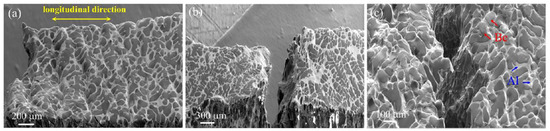
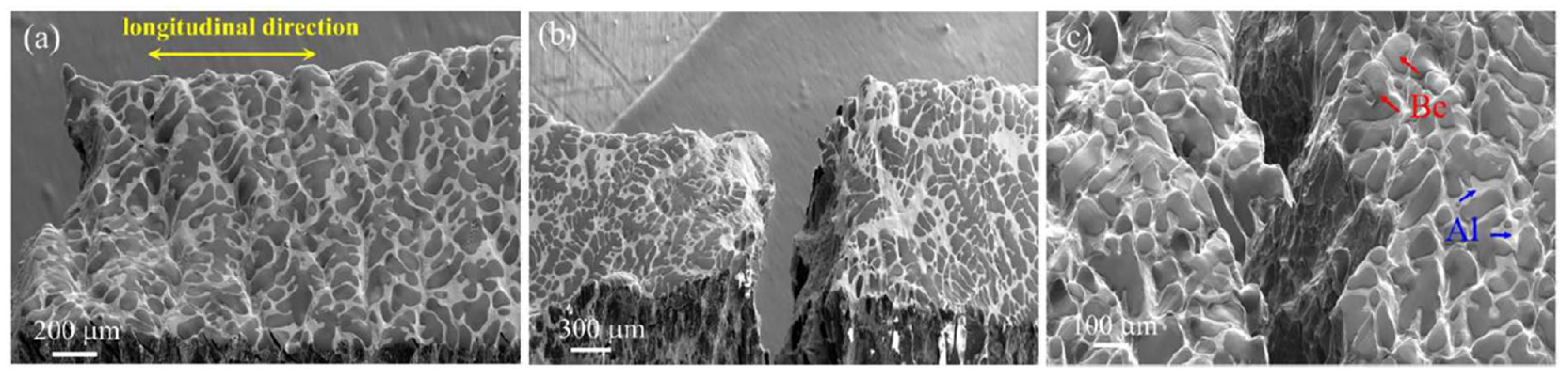
The longitudinal fracture sections cut along the tensile loading direction clearly reveal the crack propagation path of the alloy, as shown in Figure 4, cracks preferentially initiate and propagate within the continuous Al matrix, while the Be phase barely fractures. No large-scale debonding can be observed at the Be-Al phase boundaries, which indicates robust interfacial bonding between two phases. This phenomenon demonstrates that plastic tearing first occurs in the Al matrix, and the Be phase accommodates strain via pyramidal slip instead of premature basal cleavage fracture.
Figure 4.
Longitudinal sections through the fracture surface of a room-temperature tensile specimen of the Be–Al alloy. (a) A specimen; (b) B specimen; (c) C specimen. Reprinted/adapted with permission from Ref. [10].
Increased cooling rates can enhance nucleation density, refine the Be-rich phase, and restrict coarse dendritic growth. However, rapid solidification also shortens the time available for gas escape, liquid feeding, solute redistribution, and interfacial diffusion. Consequently, pores, lack-of-fusion regions, nonequilibrium segregation, and weakly bonded interfaces may be retained when melt-pool stability and energy input are not adequately controlled. Therefore, the final defect state is governed not by cooling rate alone, but by its interaction with thermal gradient, melt-pool convection, powder characteristics, atmospheric control, and cyclic reheating.
3.2. Pore Generation and Densification Mechanisms
Porosity is one of the most prevalent defects in Be–Al alloys, and its formation and evolution are closely associated with the fabrication route. In powder metallurgy processes, porosity primarily originates from interparticle packing voids, particle agglomeration, and trapped gases. Although sintering and hot isostatic pressing (HIP) can effectively promote pore closure, a fraction of closed pores still persist within the microstructure. When the pore size exceeds a critical threshold, these defects can act as preferential sites for crack initiation.
In additive manufacturing processes, pore formation mechanisms are more complex. On the one hand, insufficient laser or electron beam energy leads to incomplete melting of powders, resulting in lack-of-fusion porosity. On the other hand, gas entrapment within the melt pool and metal vaporization can also generate gas-induced pores. Under rapid solidification conditions, these defects cannot be eliminated via diffusion and are therefore retained in the final microstructure.
The presence of pores reduces the effective load-bearing cross-sectional area and induces local stress concentration. With increasing external loading, cracks preferentially initiate and propagate around pore regions, thereby degrading both the strength and fatigue resistance of the material.
3.3. Interfacial Oxidation and Corresponding Failure Mechanisms
In contrast to conventional single-phase metallic alloys, the mechanical performance of Be–Al alloys is governed primarily by phase interfacial defects rather than grain boundary features. Due to the absence of stable intermetallic compounds between Be and Al, phase bonding is primarily governed by interfacial wetting and limited atomic diffusion. Therefore, the interfacial state directly determines load-transfer efficiency and microstructural stability [45].
During processing, both Be and Al exhibit strong oxygen affinity and readily form BeO and Al2O3 oxides under high-temperature conditions. These oxides preferentially accumulate near the Be/Al interface, hindering atomic diffusion and metallurgical bonding. When the oxide layer becomes continuous, interfacial bonding strength is significantly reduced, leading to local interfacial debonding [46].
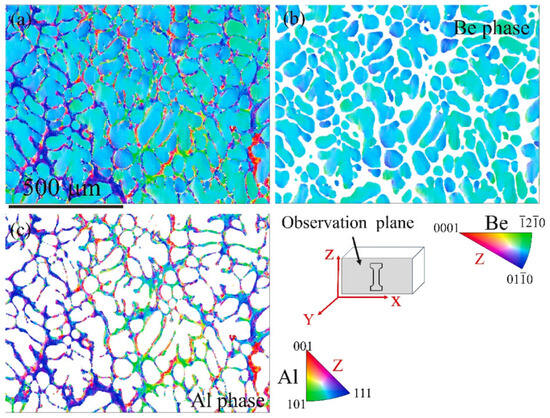
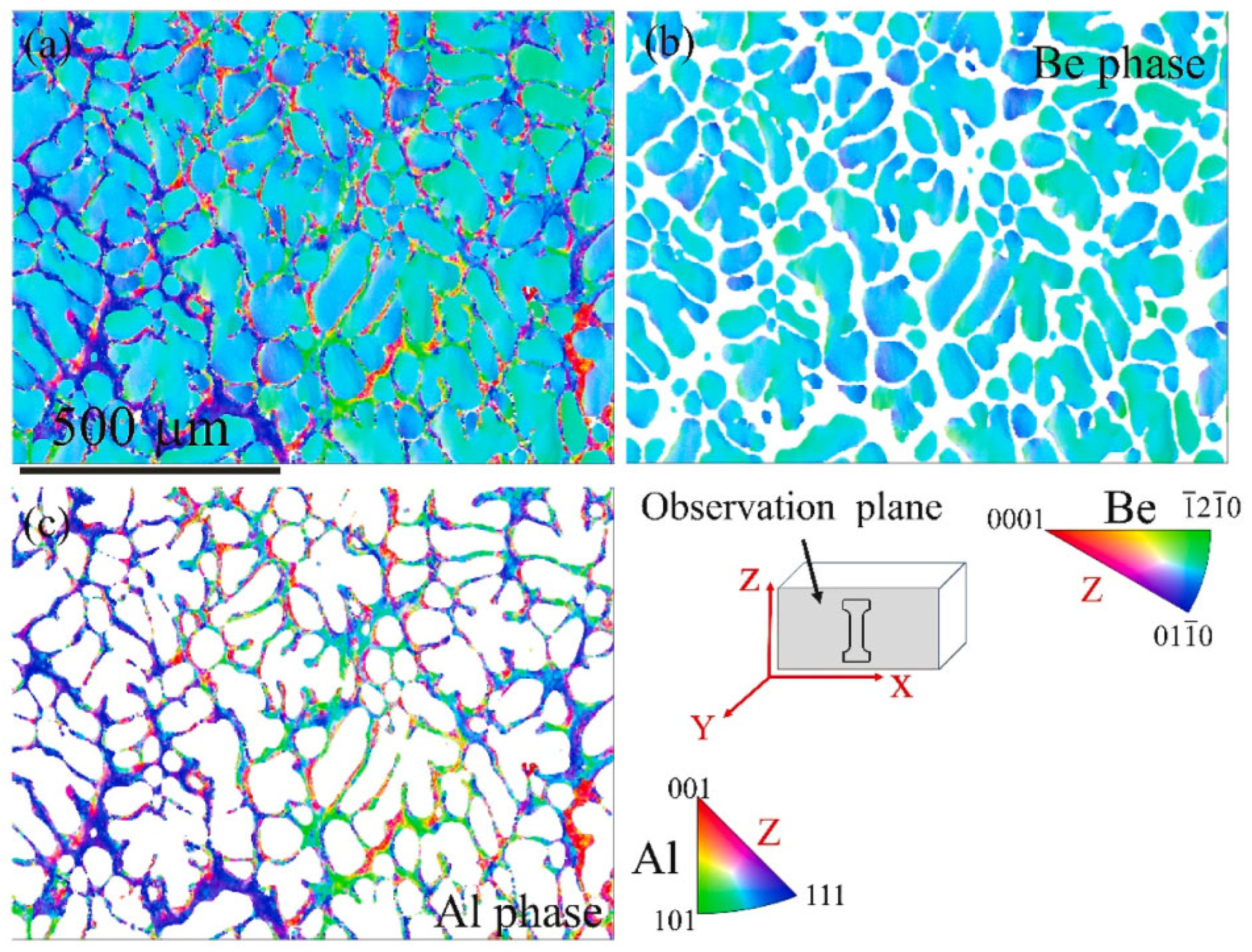
Oxidation-induced interfacial flaws impair the load transfer between the hard Be reinforcement and ductile Al matrix, and concurrently act as favorable sites for crack nucleation [47]. Under tensile or cyclic fatigue loadings, damage accumulates initially at the Be–Al phase boundaries displayed in Figure 5 and gradually propagates to form macroscopic fractures. It follows that the intrinsic dual-phase interfacial configuration combined with oxidation-modified bonding conditions constitutes the core factor controlling the service reliability of Be–Al alloys.
Figure 5.
EBSD analysis of investment-cast Be–Al alloy [10]. (a) Full orientation map of dual-phase Be–Al specimen; (b) Separated orientation map of Be dendritic phase; (c) Separated orientation map of continuous Al matrix phase. Reprinted/adapted with permission from Ref. [10].
4. Property Enhancement Strategies and Research Progress
The performance of Be–Al alloy components is not solely governed by chemical composition, but is strongly dependent on the coupled effects of dual-phase microstructural morphology, Be/Al interfacial state, defect types introduced during processing, and thermal history. Owing to the intrinsic characteristics of the Be–Al system, including low mutual solubility, absence of stable intermetallic compounds, and significant thermophysical mismatches, the core of property enhancement lies in maintaining the lightweight and high-specific-stiffness characteristics while achieving synergistic stability among the Be phase, Al phase, and interfacial regions [48].
From a mechanistic perspective, property enhancement in Be–Al alloys can be classified into four interrelated and mutually coupled strategies: interfacial structure engineering, compositional alloying design, process parameter optimization, and post-processing strengthening. These strategies act on interfacial bonding strength, phase morphology evolution, solidification/melt-pool behavior, and defect healing processes, respectively, and collectively govern microstructural integrity and service reliability.
4.1. Interfacial Engineering
4.1.1. Intrinsic Characteristics of the Be–Al Interface and Load-Transfer Mechanism
The Be/Al interface is a critical region governing the microstructural stability and mechanical properties of Be–Al alloys [49,50]. Due to the nearly negligible mutual solubility between Be and Al in the solid state and the absence of stable intermetallic compounds, interfacial bonding is primarily governed by local wetting behavior, limited atomic diffusion, and metallurgical bonding conditions during processing [51]. These interfacial characteristics give Be–Al alloys the behavior of a typical dual-phase composite, in which the Be phase provides low density, high elastic modulus, and high specific stiffness, while the Al phase serves as a continuous matrix responsible for plastic accommodation and load transfer.
When a sound interface is formed, external loads can be efficiently transferred from the Al matrix to the high-stiffness Be phase, enabling the superior lightweight and high-rigidity performance of the material. In contrast, interfacial defects such as oxides, pores, microcracks, or local debonding lead to stress concentration at the interface, thereby promoting crack initiation and propagation.
The study by Kuang et al. [51]. on Be/Al composites under different atmospheric preheating conditions showed that air atmosphere significantly promotes Be surface oxidation and leads to the formation of an interfacial oxide layer containing BeO nanoparticles. In contrast, under an inert atmosphere, the interface is dominated by direct metallurgical bonding, resulting in significantly enhanced interfacial strength. Interfacial oxides are a key factor degrading load-transfer efficiency and interfacial continuity.
4.1.2. Morphological Evolution and Regulation Mechanisms of the Be Phase
The morphology of the Be phase plays a crucial role in determining microstructural anisotropy and interfacial stress distribution. Under conventional casting conditions with relatively low cooling rates, the Be phase grows in coarse columnar or dendritic morphologies aligned with the heat-flow direction, resulting in pronounced crystallographic and morphological anisotropy. Although such structures contribute to high stiffness, they also intensify interfacial stress concentration and reduce fracture resistance.
An increase in cooling rate can significantly enhance nucleation density and suppress dendritic growth, thereby promoting the formation of equiaxed grains. This effect is particularly pronounced under rapid solidification conditions such as additive manufacturing; however, the final morphology is still governed by the coupled effects of local thermal gradients and transient heat input.
Heterogeneous nucleation plays a key role in refining the Be phase. Microalloying elements or second-phase particles act as effective nucleation sites, reducing the nucleation barrier and promoting grain refinement. For instance, Sc additions promote the formation of fine and dispersed nanoscale precipitates, which increase nucleation density and refine the Be phase, thereby improving microstructural homogeneity.
Plastic deformation is another effective approach for tailoring Be phase morphology. During hot extrusion and forging processes, columnar Be structures are fragmented and rearranged under high strain, gradually transforming into short rod-like or particulate morphologies. This evolution reduces microstructural anisotropy and improves the continuity of load transfer within the composite.
4.1.3. Interfacial Oxidation Behavior and Failure Mechanisms
Interfacial oxidation is a key factor governing the stability of the Be/Al interface. Both Be and Al exhibit strong oxygen affinity during melting, additive manufacturing, and thermal treatment, leading to the formation of BeO and Al2O3 at or near the interface. These oxides may hinder atomic diffusion and suppress metallurgical bonding, thereby weakening interfacial continuity. When oxide films become continuous, they act as effective barriers to load transfer and serve as preferential sites for crack initiation under mechanical loading.
Relevant studies have shown that BeO and Al2O3 are primarily distributed along the Be/Al interface and can induce interfacial debonding or crack initiation during tensile loading [52]. The presence of oxide phases not only reduces interfacial bonding strength but also significantly weakens the cooperative load-bearing capability of the dual-phase structure and enhances the heterogeneity of mechanical response [53]. Furthermore, Gaisin et al. reported that, in Al/Be bilayer systems, low-temperature oxidation and vacuum annealing significantly alter interfacial diffusion behavior and oxide distribution, indicating a strong coupling between interfacial oxidation and atomic diffusion processes [54].
Mitigation of interfacial oxidation requires a synergistic control strategy involving processing atmosphere, powder quality, and heat input. Vacuum or electron beam processing can effectively reduce oxygen content and oxidation risk, while high-purity inert atmospheres help suppress oxide formation. In powder metallurgy and additive manufacturing, powders with high sphericity and low oxygen content not only improve spreading behavior but also reduce interfacial contamination caused by surface oxide films. In laser-based additive manufacturing, laser energy density and melt pool residence time also significantly influence interfacial oxidation behavior.
4.1.4. Effect of Interfacial Structure Regulation on Mechanical Properties
The evolution of interfacial structure ultimately governs the mechanical properties and service reliability of Be–Al alloys. When Be phase refinement is achieved, interfacial continuity is enhanced, and oxide formation is effectively suppressed, significant improvements in strength, toughness, and fatigue life can be obtained. In contrast, when interfacial oxide accumulation coexists with coarse Be phases, stress tends to concentrate at the interface, thereby promoting crack propagation and leading to typical brittle failure behavior.
Beyond interfacial oxidation, the interfacial state also plays a critical role in subsequent microstructural coordination. Studies on solid-state joining processes have shown that powder metallurgy systems still exhibit pronounced interfacial reconstruction during friction stir welding [55], indicating that interfacial stability persists throughout the entire processing chain. In additive manufacturing systems, microstructural evolution is governed by a ternary coupling among the Be phase, Al phase, and interfacial oxides, rather than a single grain growth mechanism [56]. BeO and Al2O3 particles are primarily distributed along the Be/Al interface, and weak interfacial bonding can lead to interfacial debonding or cracking during tensile loading [57,58,59].
4.2. Alloy Design
Alloying design is a key strategy for tailoring the microstructure and properties of Be–Al alloys. Its role extends beyond matrix strengthening to the coupled regulation of Be-phase morphology, Al matrix continuity, interfacial wetting behavior, and solidification pathways [60,61]. Owing to the intrinsic dual-phase nature of Be–Al systems, it is difficult for a single alloying element to simultaneously optimize strength, ductility, interfacial stability, and defect suppression. Therefore, alloy design should be based on a multi-mechanism coupling strategy involving matrix strengthening, interfacial regulation, phase morphology control, and microstructural refinement [62].
4.2.1. Strengthening and Microstructural Regulation of the Al Matrix
The Al matrix serves as the continuous phase responsible for plastic deformation accommodation and stress coordination, and its load-bearing response directly influences the overall mechanical performance and interfacial stress partitioning. Strengthening the Al matrix through solid-solution and precipitation mechanisms can effectively improve the stress distribution around the Be phase and reduce local mechanical mismatch.
Ge has been reported as an effective alloying element for strengthening the Al matrix, which can enhance matrix strength through a combined solid-solution and precipitation mechanism, while also influencing solidification microstructural evolution. The Sc–Zr system promotes the formation of fine Al3Sc nanoscale precipitates, thereby increasing heterogeneous nucleation density and facilitating equiaxed grain formation. As a result, the microstructure is significantly refined and the secondary dendrite arm spacing in the Be–Al system is reduced.
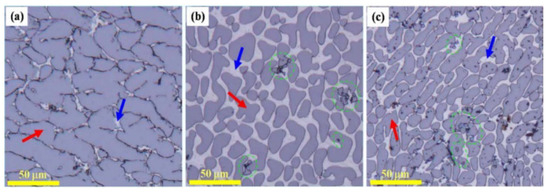
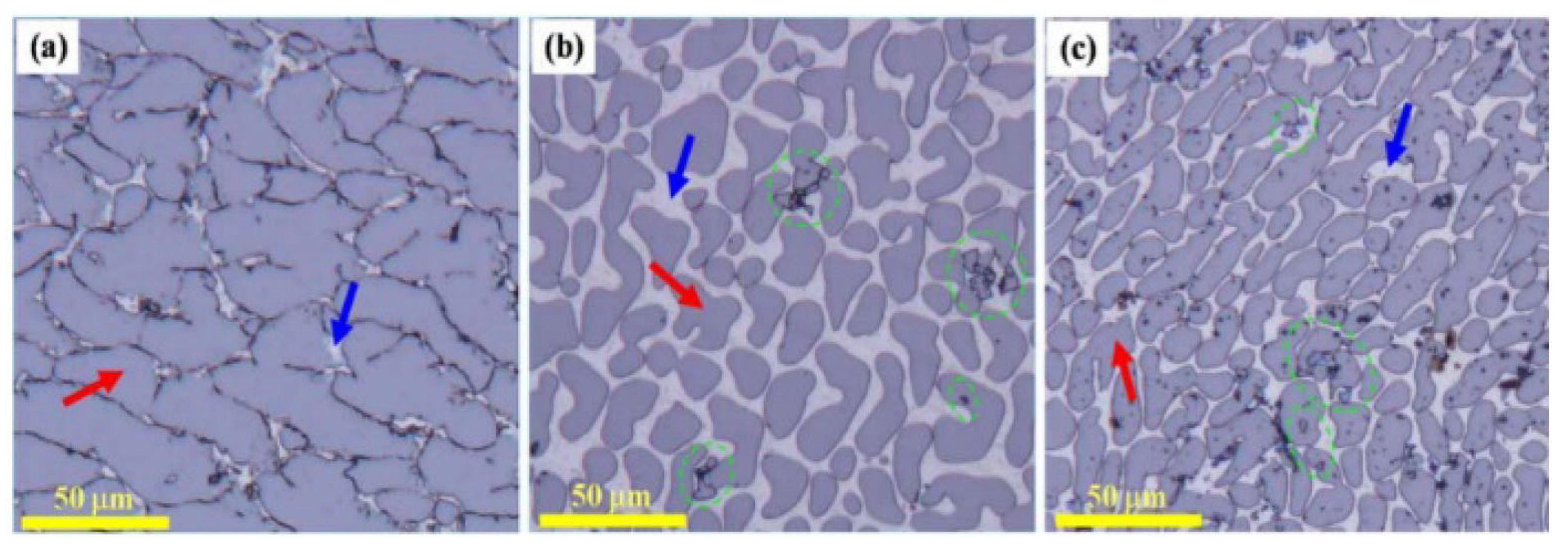
The optical micrographs displayed in Figure 6 intuitively demonstrate such microstructural evolution differences among three alloy systems. Binary Be–Al alloy without Sc/Zr additions develops large, elongated columnar Be dendrites with wide secondary dendrite spacing (Figure 6a). The red arrow represents Be, and the blue arrow represents Al. Single Sc addition refines dendritic structures and transforms partial columnar grains into cellular microstructures (Figure 6b). When Sc and Zr are added simultaneously, the synergistic refinement effect further diminishes Be grain size, delivers more uniform dual-phase morphology, and substantially eliminates oversized dendritic regions (Figure 6c). Existing experimental evidence confirms that the coupled addition of Sc and Zr yields marked grain refinement and improved microstructural homogeneity, which enables simultaneous improvements in tensile strength and ductility of Be–Al cast alloys [63].
Figure 6.
The OM images of as-cast alloys: (a) Be-A1, (b) Be-Al-Sc, and (c) Be-Al-Sc-Zr alloys [17]. Reprinted/adapted with permission from Ref. [17].
4.2.2. Regulation of Interfacial and Solidification Behavior by Si/Mg Additions
Si and Mg play important roles in regulating the solidification behavior of the Al matrix and the interfacial characteristics of Be/Al systems. Si modifies the solidification pathway and solute redistribution behavior of the Al matrix, leading to a more homogeneous Al network structure. Meanwhile, it suppresses the coarsening of the Be phase, thereby alleviating interfacial stress concentration.
Comparative studies by Xu et al. on Be–Al and Be–Al–Si–Mg systems revealed that the addition of Si significantly reduces the Be phase size and results in a more continuous and homogeneous Al matrix network. Consequently, the fracture mode gradually evolves from interface-controlled failure to matrix-dominated fracture behavior [64]. In addition, Mg provides solid-solution strengthening in the Al matrix, thereby increasing yield strength while maintaining the low-density advantage of the Be–Al system.
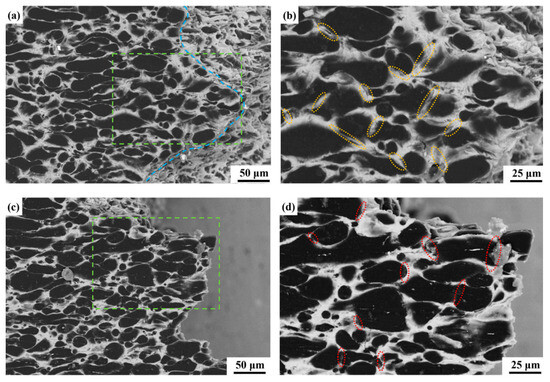
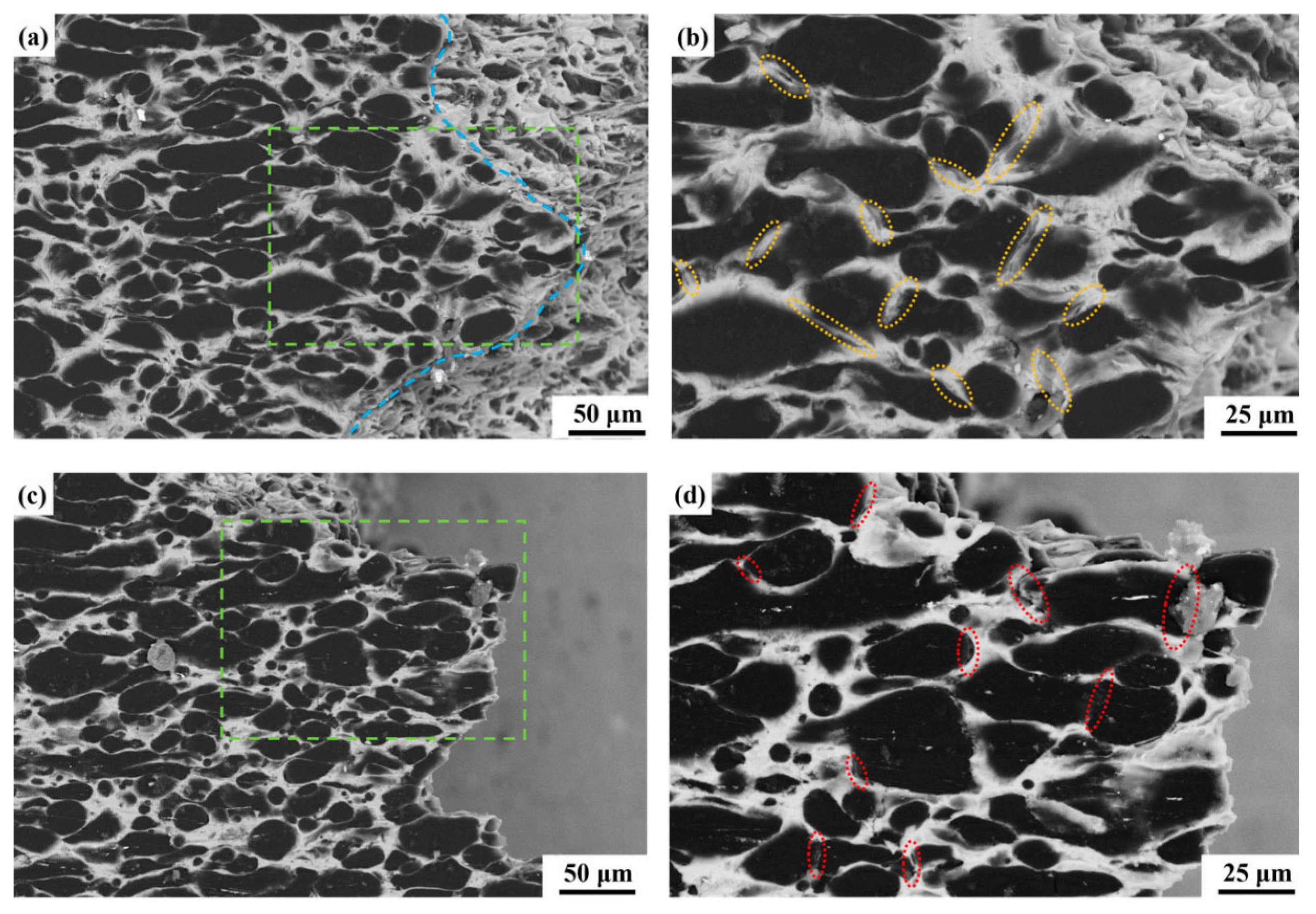
The fracture behavior comparison (Figure 7) shows that cracks in the Be/Al system primarily initiate within the Al matrix, whereas in the Mg-containing system, crack propagation tends to shift toward the Be/Al interface, accompanied by enhanced interfacial debonding. This transition is fundamentally attributed to Mg-induced changes in interfacial energy and local solute segregation behavior, which subsequently reconstruct the crack propagation path.
Figure 7.
Transverse microstructures of fractured composites [65]. (a,b) Be/Al; (c,d) Be/Al–Mg. Reprinted/adapted with permission from Ref. [65].
4.2.3. Be Phase Strengthening and Interfacial Load-Bearing Regulation
Compared with the Al matrix, strengthening of the Be phase has received relatively limited attention. Ni exhibits limited solid-solution strengthening in the Be phase, leading to increased local hardness and load-bearing capability. Co tends to segregate at the Be phase or interfacial regions, contributing to localized strengthening. However, due to the inherently low ductility of Be, excessive strengthening promotes embrittlement and intensifies interfacial stress concentration. Therefore, Be phase strengthening must be carefully balanced between stiffness enhancement and fracture toughness to avoid premature cracking.
4.2.4. Regulation of Interfacial Structure via Matrix Alloying
Multi-component microalloying represents an important direction in the compositional design of Be–Al alloys, aiming to achieve synergistic regulation of matrix strengthening, interfacial optimization, microstructural refinement, and defect suppression. While single alloying elements typically affect only localized mechanisms, multi-element systems can cooperatively regulate microstructural evolution across multiple length scales.
Mg reduces the interfacial energy between the Al matrix and Be phase, enhances the wettability of liquid Al on the Be phase, and promotes local fracture of oxide films, thereby improving interfacial contact and metallurgical bonding quality. Mg-containing AlBeMet562 alloys exhibit improved interfacial stability and overall mechanical performance, indicating that enhanced wettability plays a key role in property improvement of Be–Al alloys.
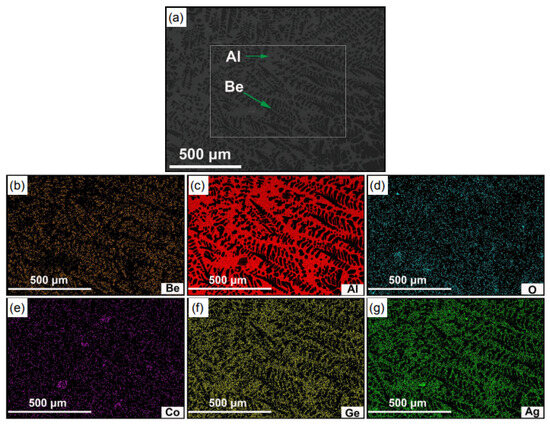
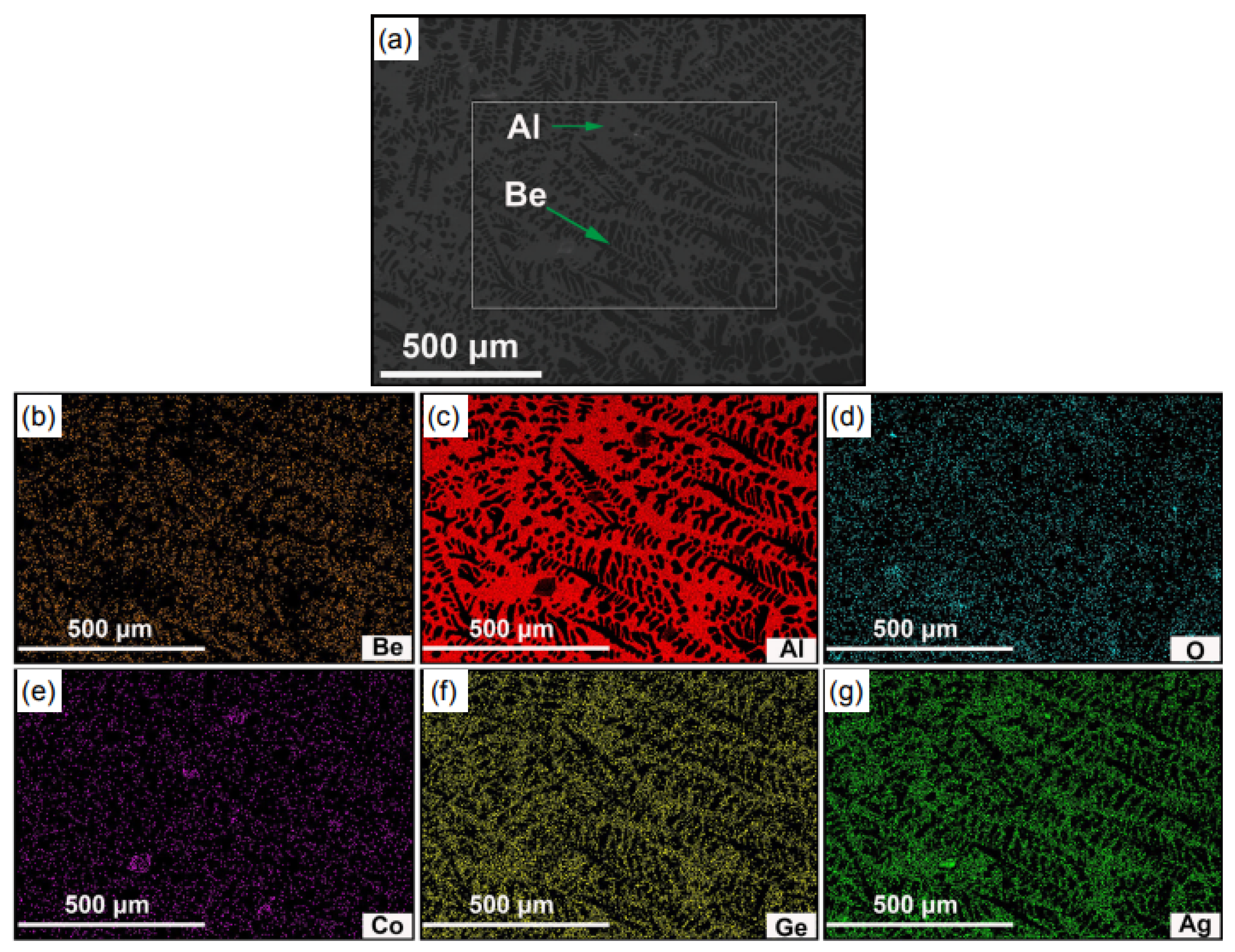
In addition, elements such as Ag, Ge, Co, and Ni can improve interfacial structure by regulating diffusion behavior or enhancing local load-bearing capacity. Recently, multi-element alloying has become an important strategy for interfacial engineering. The co-addition of Ag+Co+Ge can simultaneously strengthen the Al matrix, improve interfacial wettability, and enhance Be phase stability, as shown in Figure 8. Specifically, Ag promotes interfacial diffusion and wetting, Co enhances Be phase strength, and Ge strengthens the Al matrix while optimizing solidification microstructure. In the Ag+Co+Si+La system, the rare-earth element La acts as a melt purification agent, reducing oxygen content and improving interfacial quality from the source.
Figure 8.
Elemental distribution in Be–Al alloys [66]. (a) SEM images of microstructure; (b) Be; (c) Al; (d) O; (e) Co; (f) Ge; (g) Ag. Reprinted/adapted with permission from Ref. [66].
4.3. Fabrication Process Optimization
Process parameter optimization is a critical link between material design and component performance. The processing parameters of Be–Al alloys not only determine the macroscopic forming quality, but also significantly influence Be phase morphology, Al phase continuity, interfacial oxidation level, porosity distribution, and residual stress state.
In investment casting, pouring temperature, cooling rate, vacuum level, and solidification sequence are key parameters governing defect formation. An increased cooling rate promotes grain refinement and suppresses macrosegregation; however, excessive cooling may induce thermal stress and interfacial cracking. A higher pouring temperature improves filling ability, but extends the mushy zone, thereby increasing the tendency for shrinkage porosity, shrinkage cavities, and segregation. Therefore, process optimization in casting requires balancing mold filling integrity, feeding ability, and microstructural homogeneity, particularly in thin-walled, ribbed, and thickness-transition regions, where solidification path control is essential to mitigate localized thermal concentration effects.
In powder metallurgy, particle size distribution, powder homogeneity, compaction pressure, sintering schedule, and hot isostatic pressing parameters collectively govern densification behavior. Fine powders enhance sintering activity but are associated with higher surface oxygen content, increasing the risk of interfacial oxidation. Non-uniform powder mixing leads to Be particle agglomeration and localized Al enrichment, forming stress concentration zones. Hot isostatic pressing significantly improves densification; however, excessively high temperature or prolonged holding time induces grain coarsening and abnormal interfacial diffusion. Therefore, process optimization requires simultaneous control of densification efficiency, oxygen content, particle distribution uniformity, and interfacial stability.
In additive manufacturing, laser power, scanning speed, layer thickness, powder feeding rate, scanning strategy, and shielding atmosphere critically determine the final build quality. Both LPBF and L-DED involve rapid melting–solidification cycles and repeated thermal histories, leading to porosity, lack-of-fusion defects, spatter inclusions, element evaporation, and microstructural anisotropy. Higher energy input improves fusion quality and densification but exacerbates Al evaporation, melt pool instability, and interfacial oxidation; lower energy input increases the risk of lack-of-fusion and insufficient interlayer bonding. Therefore, AM parameter optimization focuses on stabilizing the melt pool, balancing energy input and thermal accumulation, and suppressing multi-source coupled defects such as oxidation, lack of fusion, and compositional segregation.
4.4. Post-Processing for Mechanical Property Enhancement
Post-processing is a critical stage for regulating defect states and microstructural stability in Be–Al alloys, particularly for mitigating inevitable defects such as porosity, shrinkage cavities, lack-of-fusion, residual stresses, and interfacial discontinuities generated during casting, powder metallurgy, and additive manufacturing. Its fundamental principle lies in driving the material from a non-equilibrium defective state toward a more thermodynamically stable configuration via thermo-mechanical coupling or diffusion-controlled processes, thereby enabling microstructural reconstruction and property enhancement [49].
HIP is one of the most effective post-processing routes for improving densification in Be–Al alloys. Under coupled high temperature and high pressure, internal pores and microcracks can be effectively closed and healed, leading to improved microstructural homogeneity and enhanced fatigue resistance. For cast alloys, HIP is effective in eliminating shrinkage porosity and cavities. For powder metallurgy materials, it further enhances densification and improves interfacial bonding quality. For additively manufactured components, HIP helps reduce porosity and mitigate lack-of-fusion defects and localized cracking. However, excessive temperature leads to grain coarsening, enhanced interfacial diffusion, or redistribution of oxide phases; therefore, process parameters such as temperature, pressure, and holding time must be carefully optimized.
Hot extrusion and forging can break coarse Be phases, improve particle distribution, and enhance interphase continuity through severe plastic deformation. For cast microstructures, these processes transform columnar or dendritic Be phases into equiaxed particles or short rod-like morphologies, thereby reducing anisotropy and improving ductility. For powder metallurgy materials, plastic deformation promotes pore closure and enhances the uniformity of Be particle distribution within the Al matrix, while also improving interfacial bonding quality. In addition, large plastic deformation can effectively tailor residual stress states, leading to improved fatigue resistance and fracture toughness.
Heat treatment is primarily used to regulate precipitation states, release residual stresses, and enhance interfacial stability. Vacuum annealing reduces interfacial oxidation risk and promotes atomic diffusion and microstructural homogenization. Proper annealing improves ductility and relieves residual stresses; however, excessive temperature or prolonged holding cause microstructural coarsening and strength degradation. For Be–Al alloys containing strengthening elements such as Sc, Cu, and Mg, heat treatment must carefully balance precipitation strengthening, interfacial diffusion, and microstructural stability to avoid performance deterioration caused by precipitate coarsening or interfacial embrittlement.
4.5. Exploration of Emerging Processing Routes
With the development of Be–Al alloy components toward thin-walled structures, integrated geometries, and high reliability, a single processing route is often insufficient to simultaneously satisfy requirements for complex shape fabrication, microstructural homogeneity, defect control, and stable mechanical performance. Therefore, multi-process hybrid routes have gradually become an important direction for manufacturing and property tailoring of Be–Al alloy components. The fundamental concept is to exploit the near-net-shape capability of a primary process while introducing subsequent densification, microstructural refinement, or interfacial stabilization treatments to overcome the limitations of individual processes.
The “casting + HIP + hot extrusion” route enables near-net-shape fabrication of complex components, followed by HIP to eliminate shrinkage porosity and cavities, and further hot extrusion to refine coarse Be phases and reduce microstructural anisotropy. The “powder metallurgy + HIP + heat treatment” route is suitable for producing high-density components with homogeneous microstructures. The “additive manufacturing + HIP + heat treatment” route integrates the geometric flexibility of AM, defect-healing capability of HIP, and microstructural stabilization via heat treatment, making it particularly suitable for thin-walled and functionally integrated components [67]. Compared with single-step processes, such hybrid routes provide a more effective balance among near-net-shape fabrication, defect elimination, microstructural regulation, and performance optimization.
In addition, emerging techniques such as self-venting pressure infiltration, laser-based 3D forming, and laser surface remelting provide new pathways for tailoring the properties of Be–Al alloys. Self-venting pressure infiltration improves interfacial wettability between Be and Al while reducing porosity and segregation defects. Laser-based 3D forming enables the formation of refined microstructures with tailored crystallographic orientation under rapid solidification conditions. Laser surface remelting can be used for surface defect healing and localized microstructural refinement. The integration of these emerging techniques with conventional casting, powder metallurgy, HIP, and thermomechanical processing is expected to enable a more flexible and integrated “forming–defect healing–microstructure regulation” manufacturing framework.
5. Conclusions
Be–Al alloys are inherently prone to multiscale defect formation, including elemental segregation, porosity, and interfacial discontinuities, due to their low mutual solubility, large melting point mismatch, and high interfacial reactivity. These intrinsic characteristics lead to complex microstructural evolution during solidification, densification, and thermal processing, thereby limiting the structural reliability of advanced components.
A variety of processing routes have been developed, including casting, powder metallurgy, pressure infiltration, thermomechanical processing, and additive manufacturing. Among them, additive manufacturing provides unique advantages in fabricating complex geometries and enabling local microstructural control; however, its rapid solidification nature also introduces strong thermal gradients and coupled defect formation mechanisms.
The properties of Be–Al alloys are mainly governed by Be phase morphology, Al matrix continuity, and interfacial stability. Defects originate from the synergistic mismatch among these features during processing. Accordingly, alloy design, process optimization, and post-processing treatments are effective strategies for improving microstructural uniformity and interfacial integrity.
Despite significant progress, key challenges remain, including incomplete understanding of multiscale defect evolution, insufficient quantitative correlation between processing conditions and local properties, and persistent interfacial oxidation and debonding issues, particularly under complex thermal cycling in additive manufacturing.
6. Future Perspectives
Despite recent progress in the fabrication and microstructural regulation of Be–Al alloys, several fundamental challenges remain unresolved, particularly in additive manufacturing. Future research should move beyond empirical process optimization and establish quantitative relationships among alloy composition, processing parameters, defect evolution, microstructure, and mechanical performance.
First, in situ monitoring should be introduced to clarify the dynamic formation of pores, lack-of-fusion defects, spattering, elemental evaporation, and melt-pool instability during additive manufacturing. High-speed imaging, infrared thermography, acoustic sensing, and melt-pool emission monitoring could be combined with ex situ X-ray computed tomography and metallographic characterization. Such correlative analysis would enable the identification of defect origins and support the development of closed-loop process control.
Second, computational alloy design should be integrated with process development. CALPHAD calculations can assist in predicting phase stability, solidification sequences, alloying-element partitioning, and nonequilibrium phase formation. Particular attention should be paid to the effects of Mg, Si, Sc, Zr, Ge, Ag, Co, and Ni on Be-phase morphology, Al-matrix strengthening, interfacial wettability, oxidation behavior, and solidification cracking. CALPHAD should be further coupled with phase-field modeling to describe the evolution of Be-rich and Al-rich phases under different cooling rates and thermal gradients.
Third, machine-learning methods provide a promising approach for optimizing the highly coupled processing parameters of Be–Al alloys. Models incorporating laser power, scanning speed, layer thickness, powder characteristics, preheating temperature, and atmosphere conditions could be used to predict relative density, porosity, compositional deviation, microstructural anisotropy, and mechanical properties. However, reliable models require standardized datasets and experimental validation. Physics-informed machine learning and Bayesian optimization may be particularly useful for reducing experimental costs while maintaining physical interpretability.
Residual stress and distortion also require further investigation. Multiscale thermomechanical models should consider the differences in thermal expansion, elastic modulus, thermal conductivity, and plastic response between the Be-rich and Al-rich phases. The effects of scanning strategy, build orientation, substrate preheating, support design, and post-processing on residual stress should be systematically evaluated and validated using diffraction-based or mechanical measurement techniques.
Finally, advanced characterization methods, including three-dimensional X-ray computed tomography, synchrotron diffraction, electron backscatter diffraction, transmission electron microscopy, and atom probe tomography, are needed to reveal the spatial distribution of pores, oxides, segregation, and interfacial damage. These techniques should be correlated with local mechanical testing to establish reliable defect–property relationships. Meanwhile, because of the toxicity of beryllium, future process development must incorporate enclosed powder handling, efficient filtration, occupational exposure monitoring, and safe waste treatment.
Overall, the future development of Be–Al alloys should integrate computational alloy design, in situ monitoring, intelligent process optimization, multiscale modeling, advanced characterization, and safety control. Such an integrated approach is essential for defining stable processing windows and enabling the reliable manufacture of complex, high-performance Be–Al components.
Author Contributions
Conceptualization, G.C.; writing—original draft preparation, G.C.; writing—review and editing, S.W. and D.W.; visualization, Z.Y. and L.Y.; formal analysis (microstructural mechanism discussion), Z.Y. and L.Y.; supervision, X.S. All authors have read and agreed to the published version of the manuscript.
Funding
This research was funded by the Independent Research Projects of State Key Laboratory of Rare Metal Special Materials (Grant No. 2026ZDSYS22).
Data Availability Statement
No new data were created or analyzed in this study. Data sharing is not applicable to this article.
Acknowledgments
The authors would like to thank State Key Laboratory of Rare Metal Special Materials for providing convenient research conditions.
Conflicts of Interest
All authors were employed by the company CNMC Ningxia Orient Group Co., Ltd. The authors declare that the research was conducted in the absence of any commercial or financial relationships that could be construed as a potential conflict of interest.
References
- Miracle, D.B. Metal matrix composites—From science to technological significance. Compos. Sci. Technol. 2005, 65, 2526–2540. [Google Scholar]
- Rawal, S.P. Metal-matrix composites for space applications. JOM 2001, 53, 14–17. [Google Scholar] [CrossRef] [Scilit]
- Yu, L.; Wang, J.; Wang, Z.; Qu, F.; Zhou, F.; Lai, X. Sc and Sc-Zr effects on microstructure and mechanical properties of Be-Al alloy. Mater. Sci. Technol. 2018, 34, 480–486. [Google Scholar] [CrossRef] [Scilit]
- Wang, Z.; Yu, D.; Wang, C.; Li, H.; Guo, X.; Tian, Q. One-Step Preparation of Be-Al Alloys by Magnesiothermic Reduction. JOM 2025, 77, 2453–2462. [Google Scholar] [CrossRef] [Scilit]
- Phiri, R.; Rangappa, S.M.; Siengchin, S.; Oladijo, O.P.; Ozbakkaloglu, T. Advances in lightweight composite structures and manufacturing technologies: A comprehensive review. Heliyon 2024, 10, e39661. [Google Scholar] [CrossRef] [Scilit] [PubMed]
- Jiang, Y.; Pan, X.; Zhang, S.; Yan, C. Applications of Be-Al alloy for improvement of FOG vibration performance. J. Chin. Inert. Technol. 2015, 23, 681–684. [Google Scholar] [CrossRef] [Scilit] [PubMed]
- Speer, W.; Es-Said, O.S. Applications of an aluminum–beryllium composite for structural aerospace components. Eng. Fail. Anal. 2004, 11, 895–902. [Google Scholar] [CrossRef] [Scilit]
- Parsonage, T. Beryllium metal matrix composites for aerospace and commercial applications. Mater. Sci. Technol. 2000, 16, 732–738. [Google Scholar] [CrossRef] [Scilit]
- Larose, J.; Lewandowski, J.J. Effects of processing conditions and test temperature on fatigue crack growth and fracture toughness of Be-Al metal matrix composites. Mater. Sci. Eng. A 2003, 344, 215–228. [Google Scholar] [CrossRef] [Scilit]
- Xie, Y.; Yin, Y.; Wang, D.; Yang, Y.; Liu, Z.; Zhou, J. High ductility of Be-Al alloy fabricated by investment casting. J. Mater. Res. Technol. 2024, 29, 1327–1337. [Google Scholar] [CrossRef] [Scilit]
- Nardone, V.C.; Garosshen, T.J. Evaluation of the tensile and fatigue behaviour of ingot metallurgy beryllium/aluminium alloys. J. Mater. Sci. 1997, 32, 3975–3985. [Google Scholar] [CrossRef] [Scilit]
- Yu, L.; Wang, W.; Li, B.; He, L.; Wang, Q.; Zhao, F.; Su, B.; Wang, J. Determination of homogenizing conditions and aging behaviors of cast 62Be-37.6Al-0.4Sc alloy. J. Alloys Compd. 2019, 808, 151742. [Google Scholar] [CrossRef] [Scilit]
- Kuang, Z.; Xia, Y.; Ju, B.; Han, Z.; Sun, Y.; Chen, G.; Sun, D.; Yang, W.; Wu, G. Effect of interfacial BeO content on microstructure and mechanical properties of beryllium/aluminum composites. Mater. Sci. Eng. A 2024, 893, 146123. [Google Scholar] [CrossRef] [Scilit]
- Kuang, Z.; Yang, W.; Ju, B.; Xia, Y.; Wang, Z.; Gong, D.; Fu, L.; Wu, Y.; Sun, D.; Wu, G. Effect of interfacial strength on mechanical behavior of Be/2024Al composites. Materials 2023, 16, 752. [Google Scholar] [CrossRef] [Scilit] [PubMed]
- Carter, D.H.; McGeorge, A.C.; Jacobson, L.A.; Stanek, P.W. Age hardening in beryllium-aluminum-silver alloys. Acta Mater. 1996, 44, 4311–4315. [Google Scholar] [CrossRef] [Scilit]
- Lv, Y.; Dai, Y.; Liu, Z.; Li, Z.; Zhao, Z.; Zhang, J.; Wei, D. Study on Effect of Hot Extrusion on Microstructure and Properties of Be-Al Alloy. Rare Met. Cem. Carbides 2019, 47, 60–63. [Google Scholar]
- Li, J.; Xie, Y.; Yang, Y.; Liu, Z.; Wang, D.; Yin, Y. Research Progress of Low Density and High Stiffness of Be-Al Alloy Fabricated by Investment Casting. Metals 2022, 12, 1379. [Google Scholar] [CrossRef] [Scilit]
- Yu, L.; Wang, Z.; Wu, J.; Meng, X.; Lai, X. Microstructure and Properties of Vacuum Cast Sc-Containing Be-Al Alloys. Int. J. Met. 2019, 13, 201–212. [Google Scholar]
- Wang, Z.H.; Wang, J.; Yu, L.B.; Wu, J.; Wang, M.; Su, B. Numerical Simulation and Process Optimization of Vacuum Investment Casting for Be-Al Alloys. Int. J. Met. 2019, 13, 74–81. [Google Scholar]
- Kuang, Z.; Yang, W.; Ju, B.; Xia, Y.; Wang, Z.; Gong, D.; Fu, L.; Wu, Y.; Sun, D.; Wu, G. Achieving ultra-high strength in Be/Al composites by self-exhaust pressure infiltration and hot extrusion process. Mater. Sci. Eng. A 2023, 862, 144473. [Google Scholar] [CrossRef] [Scilit]
- Gong, P.; Yao, K.F.; Shao, Y. Lightweight Ti-Zr-Be-Al bulk metallic glasses with improved glass-forming ability and compressive plasticity. J. Non-Cryst. Solids 2012, 358, 2620–2625. [Google Scholar] [CrossRef] [Scilit]
- Carter, D.H. Deformation of a Beryllium-Aluminum Composite. Ph.D. Thesis, University of California, Santa Barbara, CA, USA, 1999. [Google Scholar]
- Fan, H.; Hu, J.; Wang, Y.; Zhang, H.; Guo, W.; Li, J.; Xu, S.; Li, H.; Liu, P. A review of laser additive manufacturing (LAM) aluminum alloys: Methods, microstructures and mechanical properties. Opt. Laser Technol. 2024, 175, 110722. [Google Scholar] [CrossRef] [Scilit]
- Chowdhury, S.; Yadaiah, N.; Prakash, C.; Ramakrishna, S.; Dixit, S.; Gupta, L.R.; Buddhi, D. Laser powder bed fusion: A state-of-the-art review of the technology, materials, properties & defects, and numerical modelling. J. Mater. Res. Technol. 2022, 20, 2109–2172. [Google Scholar] [CrossRef] [Scilit]
- Kusoglu, I.M.; Gökce, B.; Barcikowski, S. Research trends in laser powder bed fusion of Al alloys within the last decade. Addit. Manuf. 2020, 36, 101489. [Google Scholar] [CrossRef] [Scilit]
- Zhang, X.; Zheng, H.; Yu, W. A review on solidification cracks in high-strength aluminum alloys via laser powder bed fusion. Mater. Today Proc. 2022, 70, 465–469. [Google Scholar] [CrossRef] [Scilit]
- Yu, W.; Zheng, H.; Xiao, Z. Microstructure of aluminum alloys manufactured via laser powder bed fusion: A review. Mater. Today Proc. 2022, 70, 382–387. [Google Scholar] [CrossRef] [Scilit]
- Chua, B.L.; Ahn, D.G. Estimation Method of Interpass Time for the Control of Temperature during a Directed Energy Deposition Process of a Ti–6Al–4V Planar Layer. Materials 2020, 13, 4935. [Google Scholar] [CrossRef] [Scilit] [PubMed]
- Zhang, H.; Zhu, H.; Qi, T.; Hu, Z.; Zeng, X. Selective laser melting of high strength Al–Cu–Mg alloys: Processing, microstructure and mechanical properties. Mater. Sci. Eng. A 2016, 656, 47–54. [Google Scholar] [CrossRef] [Scilit]
- Barro, Ó.; Arias-González, F.; Lusquiños, F.; Comesaña, R.; del Val, J.; Riveiro, A.; Badaoui, A.; Gómez-Baño, F.; Pou, J. Improved Commercially Pure Titanium Obtained by Laser Directed Energy Deposition for Dental Prosthetic Applications. Metals 2021, 11, 70. [Google Scholar]
- Bartlett, J.L.; Li, X. An overview of residual stresses in metal powder bed fusion. Addit. Manuf. 2019, 27, 131–149. [Google Scholar] [CrossRef] [Scilit]
- Shi, Y.; Gong, S.; Xu, H.; Yang, G.; Qiao, J.; Wang, Z.; Zhang, J.; Qi, B. Electron beam metal additive manufacturing: Defects formation and in-process control. J. Manuf. Process. 2023, 101, 386–431. [Google Scholar] [CrossRef] [Scilit]
- Takase, A.; Ishimoto, T.; Suganuma, R.; Nakano, T. Surface residual stress and phase stability in unstable β-type Ti–15Mo–5Zr–3Al alloy manufactured by laser and electron beam powder bed fusion technologies. Addit. Manuf. 2021, 47, 102257. [Google Scholar] [CrossRef] [Scilit]
- Martin, J.H.; Yahata, B.D.; Hundley, J.M.; Mayer, J.A.; Schaedler, T.A.; Pollock, T.M. 3D printing of high-strength aluminium alloys. Nature 2017, 549, 365–369. [Google Scholar] [CrossRef] [Scilit] [PubMed]
- Wang, P.; Li, H.C.; Prashanth, K.G.; Eckert, J.; Scudino, S. Selective laser melting of Al-Zn-Mg-Cu: Heat treatment, microstructure and mechanical properties. J. Alloys Compd. 2017, 707, 287–290. [Google Scholar] [CrossRef] [Scilit]
- Wei, Y.; Dou, Z.; Liu, Q.; Yang, L.; Yin, X.; Xu, Q.; Zhang, P. Study on the Microstructure Formation Mechanism and Fracture Behaviour of Laser-Welded Be-Al Alloy. Rare Met. Cem. Carbides 2025, 53, 101–107. [Google Scholar]
- Xu, Q.; Zhang, P.; Yang, L.; Le, G.; He, S.; He, X.; Liu, X.; Wang, W. Microstructure and mechanical properties of Be-Al alloy fabricated by laser solid forming. Mater. Sci. Eng. A 2021, 799, 140335. [Google Scholar] [CrossRef] [Scilit]
- Körner, C. Additive manufacturing of metallic components by selective electron beam melting—A review. Int. Mater. Rev. 2016, 61, 361–377. [Google Scholar] [CrossRef] [Scilit]
- Kenevisi, M.S.; Lin, F. Selective electron beam melting of high strength Al2024 alloy; microstructural characterization and mechanical properties. J. Alloys Compd. 2020, 843, 155866. [Google Scholar] [CrossRef] [Scilit]
- Sun, S.; Zheng, L.; Peng, H.; Zhang, H. Microstructure and mechanical properties of Al-Fe-V-Si aluminum alloy produced by electron beam melting. Mater. Sci. Eng. A 2016, 659, 207–214. [Google Scholar] [CrossRef] [Scilit]
- Xue, S.; Du, D.; Tang, Y.; Lu, Y.; Pu, Z.; Zhang, D.; Qi, J.; Zhang, J.; Chang, B. Studies on the microstructure and mechanical properties of AlCu4MgSi aluminum alloy repaired via electron beam directed energy deposition. J. Alloys Compd. 2024, 1004, 175971. [Google Scholar] [CrossRef] [Scilit]
- Zhang, J.; Li, Y.; Wang, Z.; Xia, B.; Dai, Y.; Lv, Y.; Li, M.; Zhong, J.; Li, J. Study on High and Low Temperature Mechanical Properties of Powder Metallurgy Be-Al Alloy. Rare Met. Cem. Carbides 2017, 45, 71–75. [Google Scholar]
- Xu, D.; Li, F.; Wang, Z.; He, L.; Ren, Y.; Pei, W.; Qin, G. Fracture mechanisms of hot isostatic pressed powder and as-cast Be-Al alloys under tensile tests at room temperature. Chin. J. Nonferrous Met. 2009, 19, 2128–2135. [Google Scholar]
- Elmer, J.W.; Aziz, M.J.; Tanner, L.E.; Smith, P.M.; Wall, M.A. Formation of bands of ultrafine beryllium particles during rapid solidification of Al Be alloys: Modeling and direct observations. Acta Metall. Mater. 1994, 42, 1065–1080. [Google Scholar] [CrossRef] [Scilit]
- Feng, T.; Ma, L.; Jiao, Q.; Zhao, S. Finite element analysis of microcosmic stress on the phase interfacial crack of powder metallurgy Be-Al alloy. Ordnance Mater. Sci. Eng. 2010, 33, 23–26. [Google Scholar]
- Wei, Y.; Yang, K.; Yin, X.; Zhao, Y.; Su, B.; He, J.; Shi, T.; Lu, C.; Li, R.; Yang, L.; et al. Micro-mechanical properties and associated strengthening mechanism of Be-Al-Ag-Si alloys fabricated by electron beam welding technique. Mater. Charact. 2024, 209, 113759. [Google Scholar] [CrossRef] [Scilit]
- Kovacs, C.J.; Bullard, T.J.; Haugan, T.J.; Sumption, M.D. Cryogenic Electrical Properties of an Aluminum-Beryllium Nanocomposite. IEEE Trans. Appl. Supercond. 2023, 33, 3601206. [Google Scholar] [CrossRef] [Scilit]
- Dou, Z.Y.; Ma, C.; Zhao, Y.W.; Wang, H.J.; Wang, M.; Tan, X.; Li, B.Q.; Jiang, C.L.; Liu, X.D.; Luo, J.R.; et al. Elevated temperature compressive behavior of a beryllium-aluminum casting alloy. Mater. Lett. 2018, 229, 89–92. [Google Scholar] [CrossRef] [Scilit]
- Liu, X.; Zhang, P.; He, S.; Xu, Q.; Dou, Z.; Wang, H. Effect of beryllium content and heat treatment on microstructure and yield strength in Be/6061Al composites. J. Alloys Compd. 2018, 743, 746–755. [Google Scholar] [CrossRef] [Scilit]
- Babay, K.A.A.; Esen, I.; Sagiroglu, S.; Ahlatci, H.; Keskin, E. Effect of 0.20% Beryllium (Be)-Added CuAl10Ni5Fe4 Alloy on Tribological Behavior and Microstructural Properties After Post-Casting Heat Treatment and Forging Process. Materials 2024, 17, 5757. [Google Scholar] [CrossRef] [Scilit] [PubMed]
- Kuang, Z.; Han, Z.; Wang, C.; Xia, Y.; Wu, G. Effects of Cu, Si and Mg additions on the interfacial properties and mechanical properties of Be/Al composites: First-principles calculations and experimental studies. Surf. Interfaces 2024, 46, 103971. [Google Scholar] [CrossRef] [Scilit]
- Ma, L.; Feng, T.; Jiao, Q.; Zhao, S. Be/Al Interface Structure of Powder Beryllium-aluminum Alloy. Hot Work. Technol. 2013, 42, 100–102. [Google Scholar]
- Yu, L.; Wang, J.; Meng, X.; Wang, Q.; Qu, F. Microstructure and mechanical properties of Be-Al and Be-Al-Sc alloys with various solidification rates. Mater. Res. Express 2018, 5, 066519. [Google Scholar] [CrossRef] [Scilit]
- Gaisin, A.U.; Filatova, E.O. Effect of low-temperature oxidation and heat treatment under vacuum on the Al-Be interdiffusion process. Phys. Chem. Chem. Phys. 2024, 26, 780–787. [Google Scholar] [CrossRef] [Scilit] [PubMed]
- Contreras, F.; Trillo, E.A.; Murr, L.E. Friction-stir welding of a beryllium-aluminum powder metallurgy alloy. J. Mater. Sci. 2002, 37, 89–99. [Google Scholar] [CrossRef] [Scilit]
- Masood Arif Bukhari, S.; Husnain, N.; Arsalan Siddiqui, F.; Tuoqeer Anwar, M.; Abbas Khosa, A.; Imran, M.; Hassan Qureshi, T.; Ahmad, R. Effect of laser surface remelting on Microstructure, mechanical properties and tribological properties of metals and alloys: A review. Opt. Laser Technol. 2023, 165, 109588. [Google Scholar] [CrossRef] [Scilit]
- Lu, Y.; Zhao, Z.; Dai, Y.; Zhang, J.; Li, Z.; Li, M.; Shao, W. Effect of Secondary Hot Pressing on Microstructure and Mechanical Properties of Be-Al Alloy Prepared by Powder Metallurgy. Rare Met. Cem. Carbides 2020, 48, 68–71. [Google Scholar]
- Xu, Q.; Yang, L.; He, S.; He, X.; Liu, X.; Shi, T.; Zhang, P. Three-dimensional microstructure and solidification behavior in laser remelting of beryllium-aluminum alloy. Mater. Lett. 2020, 274, 127963. [Google Scholar] [CrossRef] [Scilit]
- Xu, Q.; Luo, Y.; Liu, X.; Yang, L.; He, S.; Wang, X.; Wang, W.; Shi, T.; Li, R.; Zhang, P. Microstructural evolution and hardness of as-cast Be-Al-Sc-Zr alloy processed by laser surface remelting. Chin. J. Aeronaut. 2021, 34, 131–142. [Google Scholar] [CrossRef] [Scilit]
- Yu, L.; Wang, W.; Wang, J.; Su, B.; Dong, X.; Wang, Z. The Effects of Sc Addition on the Microstructure and Mechanical Properties of Be-Al Alloy Fabricated by Induction Melting. J. Mater. Eng. Perform. 2019, 28, 2378–2387. [Google Scholar] [CrossRef] [Scilit]
- Jiao, Q.; Ma, L.; Feng, T.; Zhao, S.; Wang, Z.; Mai, X.; Zhao, Y. Effects of Silver, Cobalt and Germanium on Microstructure and Mechanical Properties of Beryllium-aluminum Alloys. Spec. Cast. Non-Ferr. Alloys 2010, 30, 973–976, 988. [Google Scholar]
- Yu, L.; Wang, J.; Qu, F.; Wang, M.; Wang, W.; Bao, Y.; Lai, X. Effects of scandium addition on microstructure, mechanical and thermal properties of cast Be-Al alloy. J. Alloys Compd. 2018, 737, 655–664. [Google Scholar] [CrossRef] [Scilit]
- Wang, Z.; Lin, X.; Kang, N.; Chen, J.; Tan, H.; Feng, Z.; Qin, Z.; Yang, H.; Huang, W. Laser powder bed fusion of high-strength Sc/Zr-modified Al–Mg alloy: Phase selection, microstructural/mechanical heterogeneity, and tensile deformation behavior. J. Mater. Sci. Technol. 2021, 95, 40–56. [Google Scholar] [CrossRef] [Scilit]
- Xu, Q.; Wei, Y.; Zhang, P.; Shi, T.; Li, R.; He, S.; Yang, L.; Lu, C.; Su, B. A microcompression study on the mechanical properties and fracture behavior of Be-Al and Be-AlSi10Mg alloys fabricated by laser solid forming. Mater. Sci. Eng. A 2022, 836, 142715. [Google Scholar] [CrossRef] [Scilit]
- Li, W.; Xia, Y.; Sun, Y.; Hu, J.; Hao, L.; Liu, Y.; Ju, B.; Chen, G.; Yang, W. The Influence of Li on the Fracture Characteristics and Mechanical Properties of Extruded Beryllium–Aluminum Composites. Materials 2025, 18, 1055. [Google Scholar] [CrossRef] [Scilit] [PubMed]
- Xie, Y.; Yin, Y.; Wang, D.; Zhou, J.; Li, J.; Ji, X.; Liu, Z.; Shen, X.; Fu, W. Effects of Ag, Co, and Ge additions on microstructure and mechanical properties of Be-Al alloy fabricated by investment casting. China Foundry 2022, 19, 435–442. [Google Scholar] [CrossRef] [Scilit]
- Liu, T.; Wang, Y.; Li, X.; Zhang, W. Review on laser directed energy deposited aluminum alloys. Int. J. Extrem. Manuf. 2024, 6, 022004. [Google Scholar] [CrossRef] [Scilit]

Disclaimer/Publisher’s Note: The statements, opinions and data contained in all publications are solely those of the individual author(s) and contributor(s) and not of MDPI and/or the editor(s). MDPI and/or the editor(s) disclaim responsibility for any injury to people or property resulting from any ideas, methods, instructions or products referred to in the content. |
© 2026 by the authors. Licensee MDPI, Basel, Switzerland. This article is an open access article distributed under the terms and conditions of the Creative Commons Attribution (CC BY) license.