


Abstract
Cu–TiO2 nanoparticles of a broad range of compositions with 0, 0.002, 0.005, 0.02, 0.05, 0.2, 0.5, 1.0, 2.0, 3.0, 5.0, 7.0 and 10.0 mol% Cu were synthesized via the sol–gel method using copper (II) acetate and titanium tetraisopropoxide (TTIP) precursors at a low hydrolysis ratio of H = 1.25, which favours homogeneous TiO2 nucleation and Cu dispersion in the host matrix at nanoscale. The precipitated materials were dried at 80 °C and calcined at 450, 500, and 550 °C to form crystalline nanopowders, whose photocatalytic activity was evaluated on the decomposition of a representative pollutant, methylene blue (MB), in aqueous solutions under UVA and sunlight illuminations. The compositions with small Cu content of ~0.05 mol% showed the highest activity. A gain of activity over pure titania of 4 times after calcination at 450 °C, 2.5 times at 500 °C and 20% at 550 °C was measured under UVA illumination. Even higher gain of activity observed under sunlight illumination might be due to an extension of action spectrum to the visible range due to intra-gap defect states produced by Cu2+ insertion. The time-resolved microwave conductivity (TRMC) measurements of the photoinduced charges relaxation suggest that both excessive calcination temperature and Cu content decrease the activity due to Cu-defects clustering. Modelling relates the activity to the photoinduced electron-hole pair separation; the optimal Cu content is explained by accessibility of the recombination centre by a conduction band (CB) electron. Accordingly, an increase in calcination temperature resulted in a longer pathlength of CB electron.
1. Introduction
The cationic doping of TiO2 has received much attention in recent decades [1,2,3,4]. This material modification has helped improve the overall photocatalytic process efficiency as compared to pure titania due to a better separation of the photoinduced charges and a bandgap reduction, the latter of which shifts the action spectrum from UVA to the visible spectral range, enabling the reaction activation by sunlight. As a result, an effective photocatalytic process under sunlight illumination is under development worldwide (see, e.g., [5,6]). Among the investigated cations, Cu2+ appeared to be promising because of a similar ionic radius permitting Ti4+ substitution. At the same time, charge imbalance can promote anion (O2−) removal accompanied by the appearance of oxygen vacancy Vo, which leads to the formation of reduced Ti3+ small-polaron centres absorbing in the visible spectral range, whose contribution to the material activity is under debate [7,8,9]. The CuO–TiO2 composites commonly possess strong absorption in the visible spectral range and enhanced charge separation efficiency at the common interface [10,11].
The mixed metal oxides Cu–TiO2 have been synthesized by various methods: sol–gel, solvothermal, hydrothermal, microwave, impregnation, chemical reduction, mechanochemical, precipitation, thermal decomposition, low temperature hydrolysis, micro-arc oxidation, electrochemical, electrodeposition, atomic layer deposition, electrochemical anodization, etc. Among them, the sol–gel method, being versatile and inexpensive, has become the most widely used. The synthesized Cu–TiO2 materials have been prepared in powder form and as films. The relevant literature concerning optimal composition (x, mol%) and activity gain (with respect to pure TiO2) of Cu–TiO2 photocatalyst is summarized in Table 1.
Table 1.
Synthesis and activity of Cu–TiO2 photocatalysts.
Studies have confirmed the effectiveness of Cu-doped TiO2 in environmental photocatalysis under sunlight illumination [30,31,32]. Cu doping has been reported as more effective for Cr(VI) removal, as compared to Fe- and Zn-doped TiO2 [33]. The enhanced reactivity as compared to doping with Ag, Co, Au, Cr, Fe, Pd, Ni, Pt, Zn, and Y for hydrogen generation [34] and better hydrogen production as compared to doping with Fe, Ni, Co, and Zn [35] (however, smaller than with Mo and W doping [18]) have been reported. At the same time, Table 1 indicates a significant discrepancy in the optimum photocatalyst composition, varying in different studies from 0.05 mol% to 17 mol% Cu. Moreover, while most studies have shown an efficiency gain after Cu insertion into TiO2, some works have reported a decrease in the photocatalytic decomposition effectiveness of pollutants [36,37] and bacteria [38]. The large spread of optimal material composition seems to be due to a spatial inhomogeneity of the elemental distribution. In fact, this important aspect of the material synthesis has been discussed in previous papers on TiO2 doping with Fe [39], V [40], and W [41]. In particular, poor mixing at the preparation stage and attaining the solubility limit of the added cation to the relevant anatase TiO2 matrix must be considered. Otherwise, the synthesis can result in local clustering of the inserted atoms, thus perturbing functional properties of the material. Since the material composition can also be affected at the heat-treatment stage, the influence of the calcination temperature has to be taken into account as well in the evaluation of material properties.
In this paper, we report on the investigation of Cu–TiO2 mixed oxide photocatalyst with largely varying Cu content from 0 up to 10 mol%, covering the range of the available literature data about optimal photocatalyst composition (see Table 1). The nanopowders were prepared via the sol–gel method in conditions favourable for the elemental micromixing at the nanoscale. The decomposition of a representative pollutant, methylene blue (MB), in aqueous solutions was used for the evaluation of material activity under UVA and sunlight illuminations. The influence of calcination temperature on the activity was analyzed. A physical mechanism of the activity enhancement/suppression was proposed, relating to the photoinduced charge transfer and recombination, and confronted with the experimental data.
2. Materials and Methods
2.1. Chemicals
All chemicals were analytical grade and used without further purification. Titanium (IV) isopropoxide (TTIP) (≥98% purity) and copper (II) acetate (99% purity) were purchased from Acros Organics (Shanghai, China and Geel, Belgium, respectively). Methylene blue (MB) was from Sigma Aldrich (Bangalore, India), 2-propanol (99.5% purity) and water for chromatography were from Sigma Aldrich (Darmstadt, Germany), and copper standard solution (1000 ppm Cu(NO3)2 in 0.5 mol/L nitric acid) was from Merck (Darmstadt, Germany).
2.2. Synthesis
The colloidal solutions of Cu-doped titanium oxo-alkoxy (TOA) nanoparticles were prepared at room temperature via the sol–gel method at a low hydrolysis ratio H = Cw/Cpre = 1.25 (Cw is the concentration of water) and total precursor concentration Cpre = CCu + CTi = 0.3 mol/L in a volume of 100 mL. For the synthesis of pure TOA nanoparticles, TTIP precursor was dissolved in isopropanol solvent of total volume 50 mL, labelled as solution A. Water in isopropanol of 50 mL volume was labelled as solution B. Both solutions were stirred by a magnetic stirrer (RCT basic, IKA, Staufen, Germany) at 500 rpm for 10 min until homogenized, then solution B was slowly dropped into solution A. According to our previous studies [42,43], nucleation of TOA nanoparticles takes place in these conditions while prohibiting nucleus growth and agglomeration; this permits homogeneity at the nanoscale of the guest cations distribution in host titania matrix [40,41]. The mixed metal copper-titanium-oxo-alkoxo (CTOA) nanoparticles were prepared after the addition of solution A (as that was used for pure TOA) to solution B, prepared by dissolving copper (II) acetate and water in isopropanol. The following steps were the same as those used for the preparation of pure TOA colloids. The initially stable colloidal solutions were allowed to absorb atmospheric moisture and precipitate over several days, which were then dried in an oven at 80 °C overnight. The nanopowders were calcined at temperatures of 450, 500, and 550 °C for 4 h to form crystalline Cu–TiO2 photocatalysts. The elemental composition of nanopowders was labelled as x (mol% Cu) = 100 × CCu/(CCu + CTi), with Cu and Ti molar concentrations respectively CCu and CTi.
2.3. Characterization
X-ray diffraction (XRD) patterns were collected using an EQUINOX 1000 diffractometer (INEL, Orlean, France) equipped with a Cu-Kα source (λ = 1.541 Å). Phase quantification was estimated from the XRD patterns with a rutile-to-anatase ratio calculated from the respective (110) and (101) peaks intensities via equation Fr = 1 − (1 + 1.265 × Ir110/Ia101)−1 [44]. The diffraction patterns were processed using the Rietveld method implemented in MAUD (Material Analysis Using Diffraction) software (V2.998). Peaks were fitted according to a standardized procedure. The refined parameters were background parameters, cell parameters, NP size, and presence of microstrain. The crystallographic information file for TiO2 anatase and rutile were obtained from Inorganic Crystal Structure Database ICSD 9852 (TiO2 anatase, I41/amd S, a = 3.7842 Å, c = 9.5146 Å) and ICSD 36412 (TiO2 rutile, P 42/mnm, a = 4.593 Å, c = 2.959 Å). In the final step, an arbitrary texture option was used to optimize the quality of the Rietveld pattern refinement (uniquely for monophasic samples).
The relaxation of the photoinduced charges was monitored via the time-resolved microwave conductivity (TRMC) method by measuring the reflected microwave power by the semiconductor surface after illumination with pulsed laser light. The experimental installation has been described in Ref. [45]. In these experiments, the samples were irradiated with 360 nm light pulses of 8 ns duration and 1 mJ energy delivered by a cw OPO Nd:Yag laser (EKSPLA) operating at 10 Hz repetition rate. The laser photon energy hν > Eg (Eg = 3.2 eV is anatase TiO2 band gap energy) enabled intergap electronic transition, creating conduction band (CB) electron e- and valence band (VB) hole h+, whose concentration is proportional to the microwave reflection. A circular spot on the sample with a 1 cm2 area was illuminated, and the temporal evolution of the TRMC signal was accumulated over 200 laser pulses. The measurements were performed at room temperature in an ambient atmosphere. The experimental series was repeated to guarantee reproducibility of measurements.
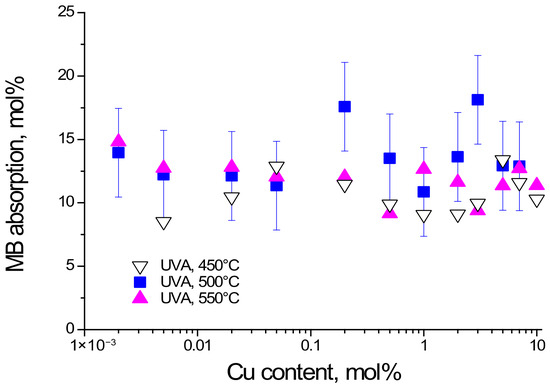
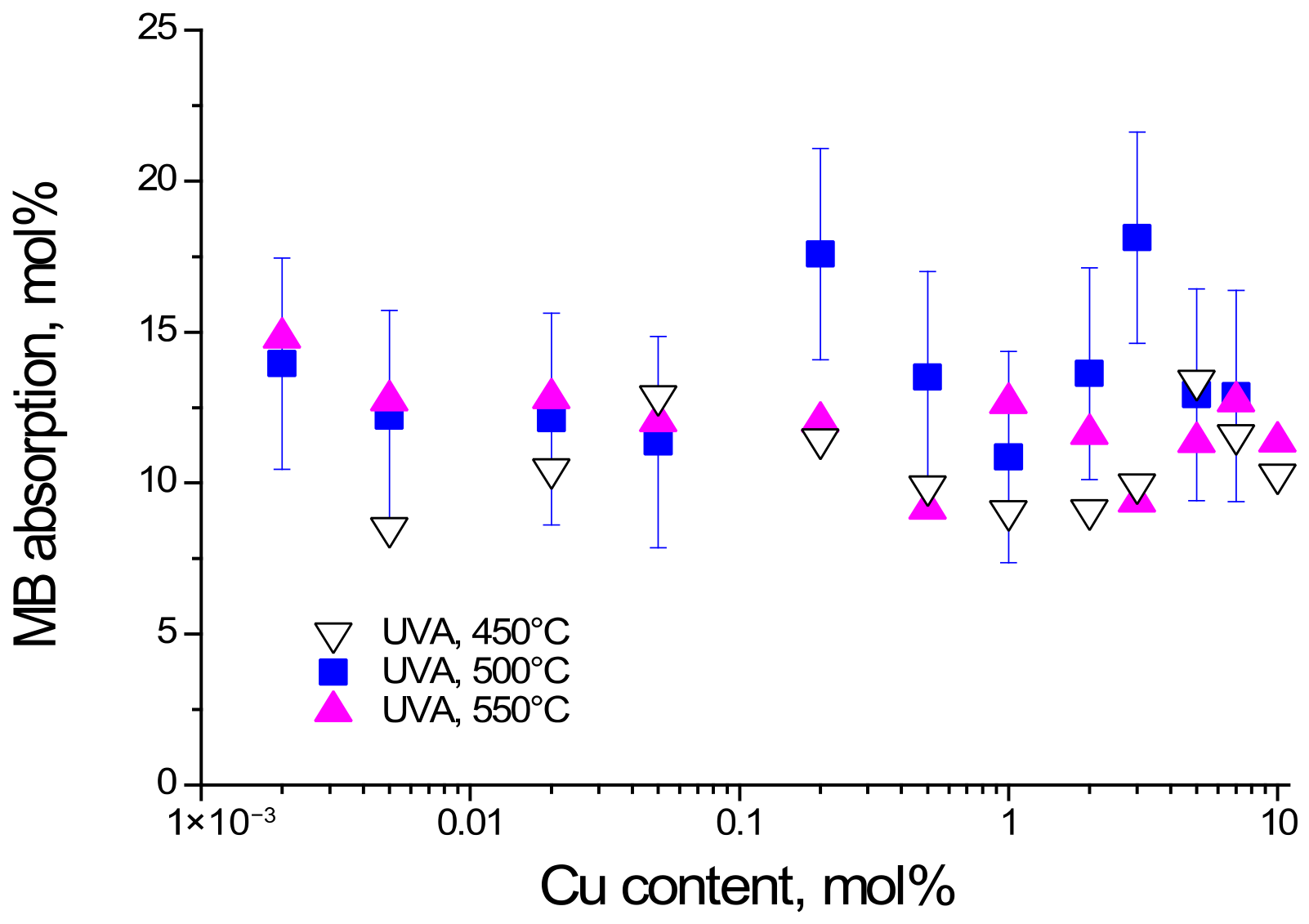
In the photocatalytic experiments, 1 g/L Cu-doped TiO2 nanopowders were added to a beaker with a 5 ppm MB aqueous solution of 250 mL volume under stirring at 500 rpm with a magnetic stirrer in the dark. No significant variation in the pollutant adsorption capacity by Cu–TiO2 nanopowders was observed amounting for 12.6 ± 3.6 mol% of the initial MB concentration, as shown in Figure 1. After 30 min of intense stirring, the solution was illuminated with a UVA lamp (365 nm) of 6 W power (model VL-6.LC, VWR International, Rosny-sous-Bois, France) at a distance of 25 cm. Alternatively, the photocatalytic experiments were performed under natural sunlight illumination in Phnom Penh city (Cambodia) between 9 am and 12 pm. The photocatalytic activity under UVA and sunlight illuminations was tested with the same nanoparticle concentration; the full series of Cu–TiO2 photocatalysts with different elemental compositions was placed in identical aqueous solutions of MB pollutant and simultaneously exposed. The MB concentration was monitored by absorbance measurements of the reactive solution, after 5 mL sampling every 15 min during 2 h. The samples were transferred into tubes and centrifuged at 5000 rpm to separate the catalyst and solution. Then, the pollutant solution was collected and absorbance measured by a UV-Vis spectrophotometer GENESYS 10S (Thermo Fisher Scientific, Waltham, MA, USA) at 664 nm wavelength, which corresponds to the maximum of MB absorbance. The first-order rate constants of MB decomposition were derived from the MB degradation kinetics and used as a measure of the materials activity.
Figure 1.
MB stationary absorption in photocatalytic experiments before illumination.
3. Results and Discussion
3.1. Structural Properties of Cu–TiO2 Nanopowders
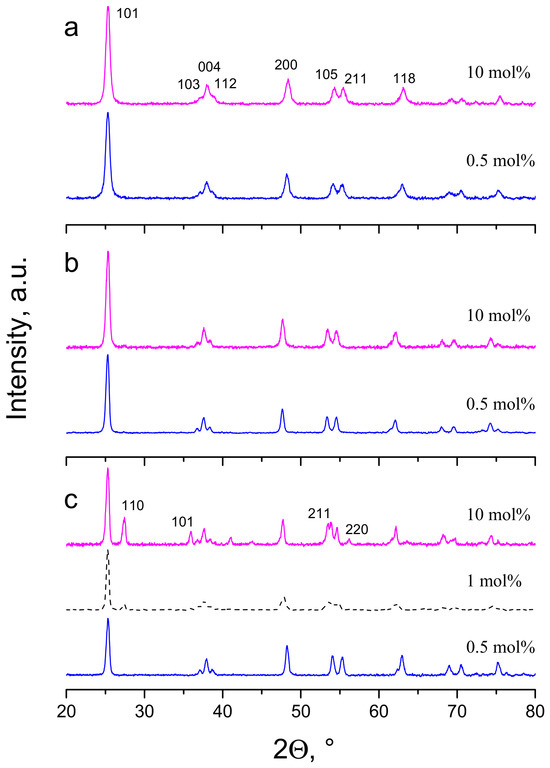
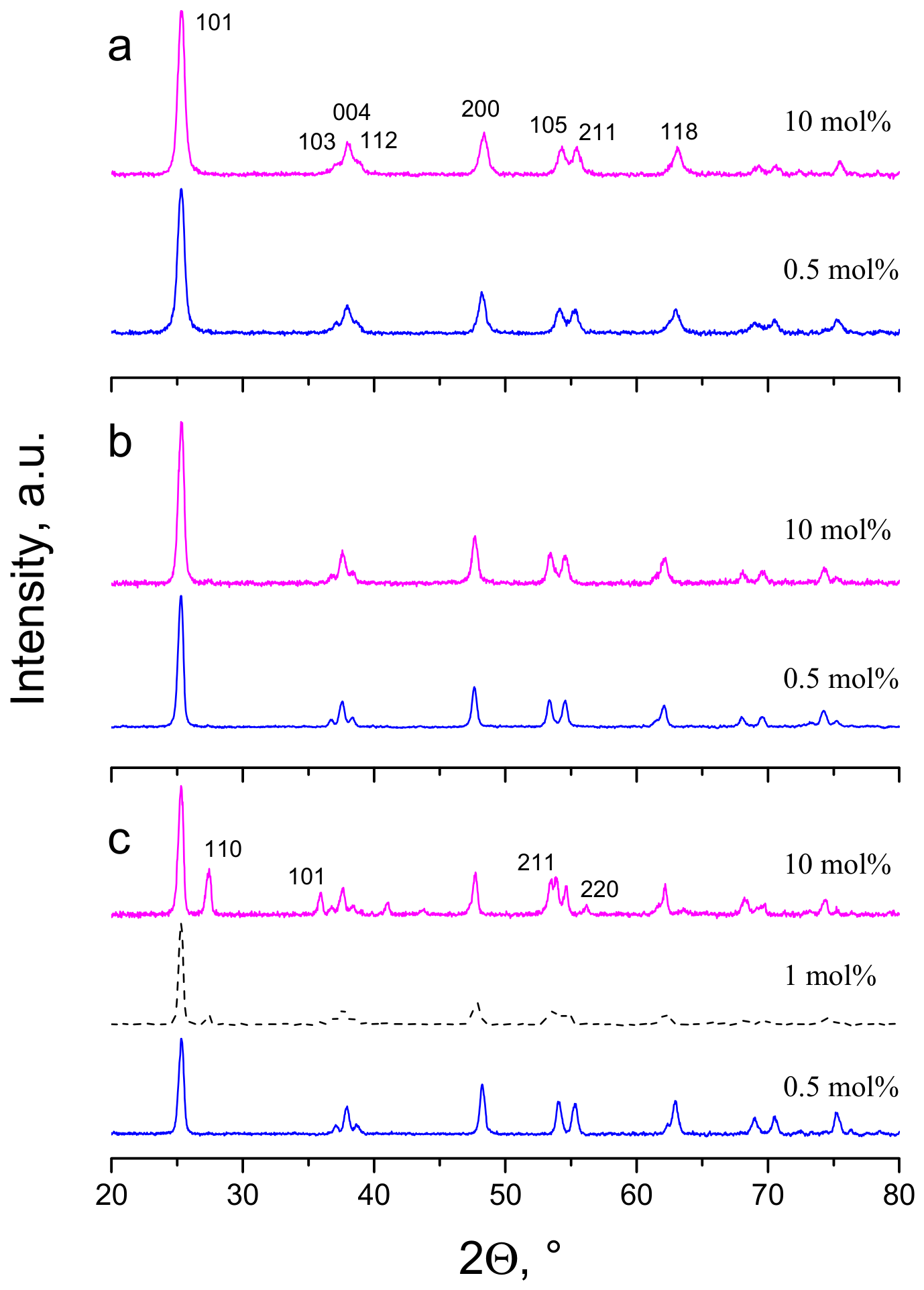
Before photocatalytic measurements, structural properties of the prepared nanopowders were accessed by analysis of XRD patterns, representatively shown in Figure 2. Their first evaluation indicated pure crystalline anatase at Cu content below 10 mol%, at calcination temperature T < 550 °C (Figure 2a,b). In contrast, after calcination at T = 550 °C (Figure 2c), the rutile phase was observed, increasing to a rutile ratio Fr ~ 10 mol%.
Figure 2.
X-ray diffraction patterns of selected Cu–TiO2 nanopowders with different Cu content (indicated in mol%) heat-treated at 450 °C (a), 500 °C (b), and 550 °C (c). Peaks indexation of anatase and rutile phases is shown respectively in (a) and (c).
The appearance of the rutile phase at 550 °C after calcination for 4 h is a common feature of pure TiO2. Furthermore, Byrne et al. [46] have reported on the inhibition of the anatase to rutile phase transformation with an increase in the Cu content. The phase transformation is known to be a kinetically limited process, and the anatase-rutile phase transformation has already been observed in TiO2 nanopowders at temperatures as low as 465 °C [47]. Therefore, the appearance of the rutile phase at 550 °C in pure TiO2 in this work is in line with that at 650 °C with a shorter calcination time of 2 h [46]. Accordingly, a small addition of ~0.5 mol% Cu resulted in the anatase lattice. However, we do not confirm the pure anatase phase of Cu–TiO2 nanopowders (heat treated at 550 °C) with Cu loading of 1 mol% and larger. No CuO phase inclusion was observed.
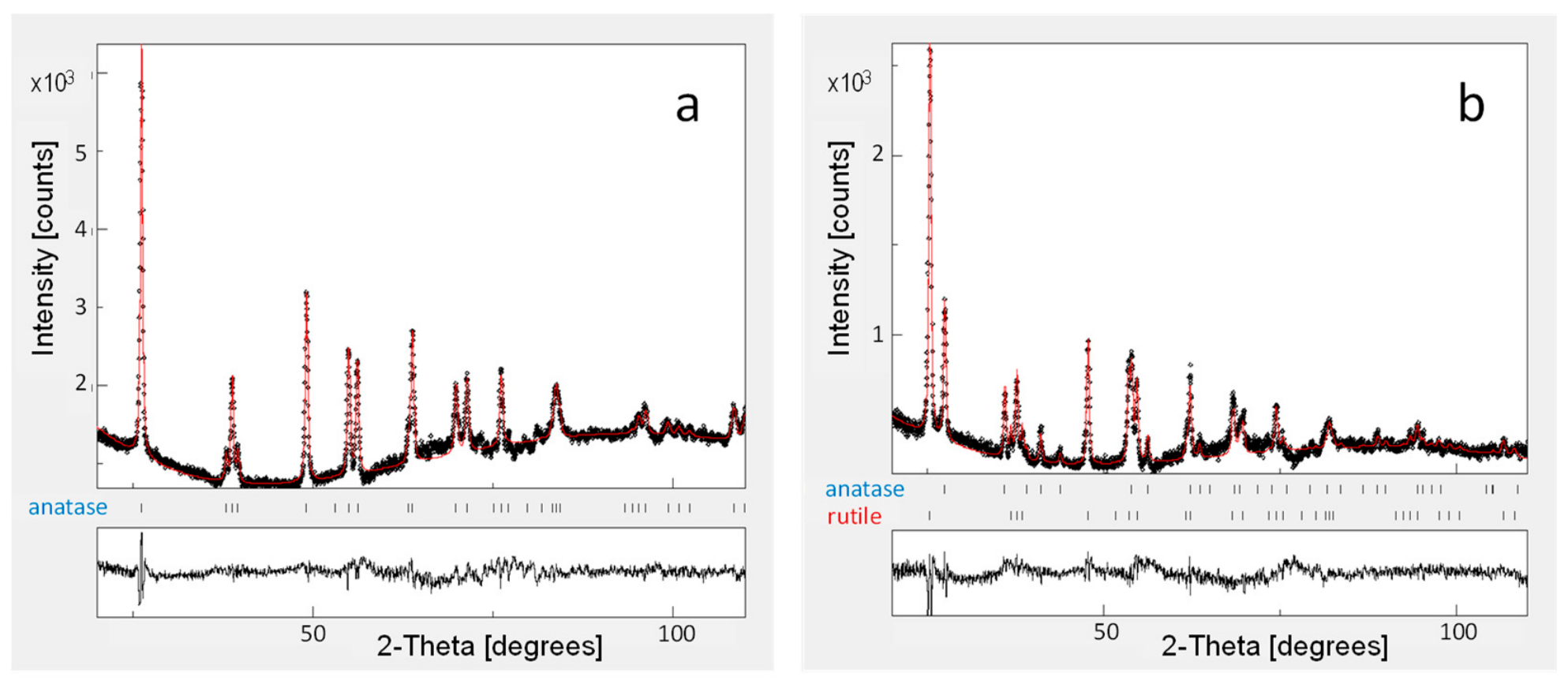
The Rietveld analysis shown in Figure 3 for two selected nanopowders from Figure 2 confirmed lattice parameters close to those of anatase TiO2 structure, as indicated in Table 2. Powders form large crystalline domains (D) of several tens of nanometers in size, i.e., much larger than the anatase crystalline cell.
Figure 3.
Rietveld analysis of Cu–TiO2 nanopowders with 0.5 mol% (a) and 10 mol% (b) Cu heat-treated at 500 °C (b).
Table 2.
Rietveld analysis of selected Cu–TiO2 nanopowders 1.
3.2. Photocatalytic Activity of Cu-Doped TiO2
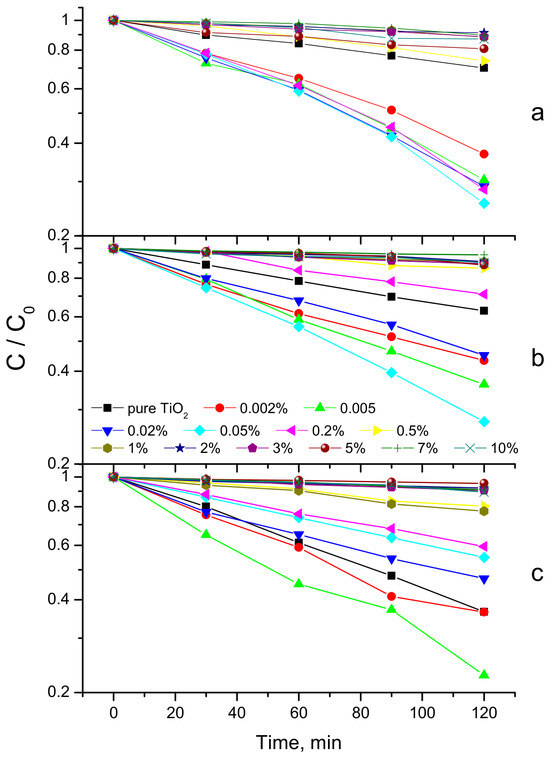
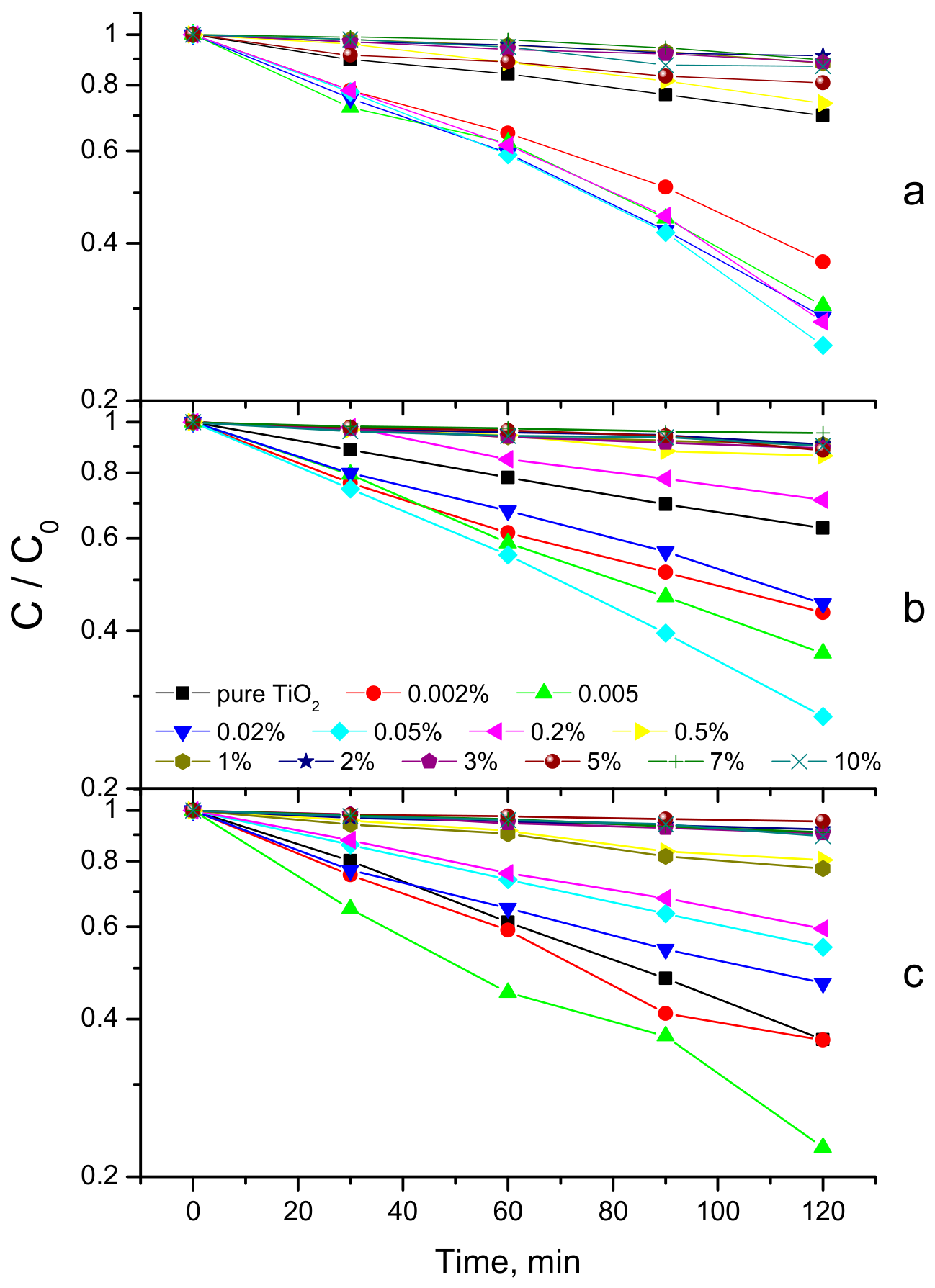
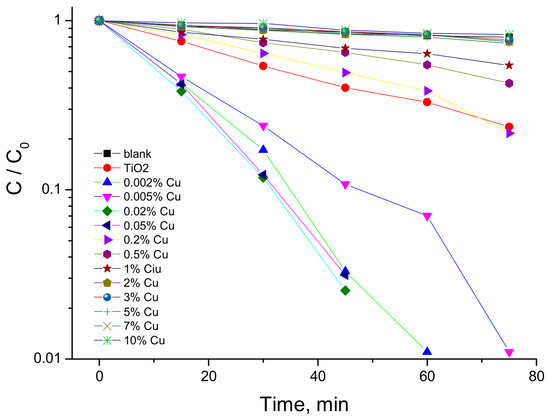
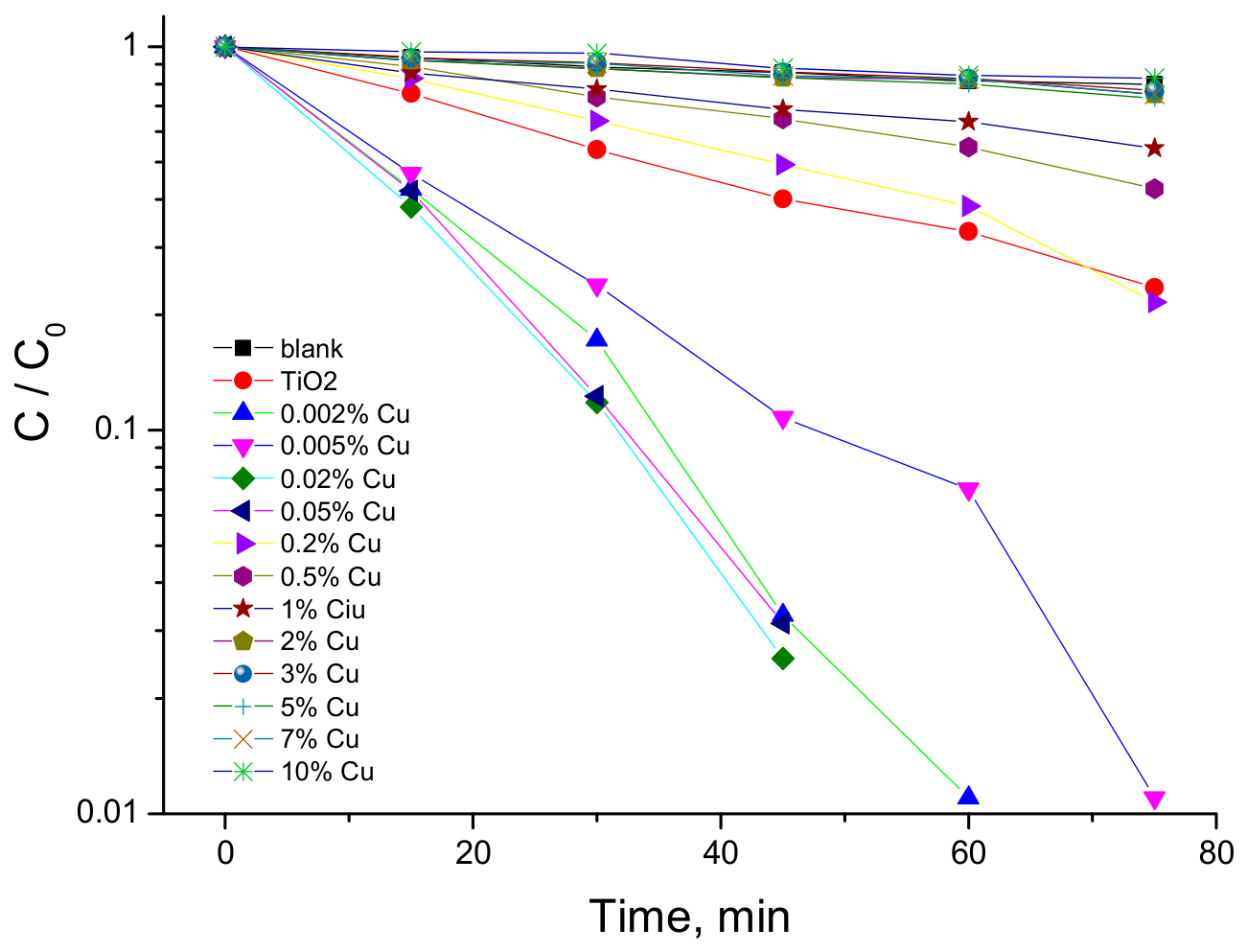
The photocatalytic degradation of MB using Cu–TiO2 photocatalyst under UVA radiation is shown in Figure 4, in the semi-logarithmic frame. The first-order reaction kinetics (where C0 and C are initial and current MB concentrations, respectively) was confirmed by the linear regression of experimental data, which enabled evaluation of the material activity [48]. By consequence, the strongest activity (k) corresponds to the compositions with Cu content in the range of 0.005–0.2 mol% and depends on the heat treatment conditions. In comparison with previous studies, our results match optimal values of the lowest Cu addition [16,17,29]. In contrast, the overestimated compositions with x ≥ 1 mol% Cu from Table 1 can be explained by the elemental inhomogeneity of the materials and, probably, guest (Cu) cation clustering. While the solubility limit of Cu2+ ions in anatase lattice is about Cs = 6 mol% [49], an insufficient mixing of the reacting products may lead to their local overloading and clustering, at the still lower mean copper concentration C < Cs. According to these data, a significant gain in activity over pure TiO2 was observed.
Figure 4.
MB degradation on Cu–TiO2 nanopowders calcined at 450 °C (a), 500 °C (b), and 550 °C (c) with different compositions (5 ppm MB, 1 g/L catalyst) under UVA illumination.
In addition, photocatalytic experiments were completed with the sunlight illumination. The results in Figure 5 (in semi-logarithmic frame) confirmed first-order reaction kinetics and provided optimal composition for heat-treated material with T = 500 °C in the range of 0.002 ≤ x ≤ 0.05 mol% Cu. This is in agreement with the measurements under UVA illumination.
Figure 5.
MB degradation on Cu–TiO2 nanopowders calcined at 500 °C with different compositions (5 ppm MB, 1 g/L catalyst) under sunlight illumination.
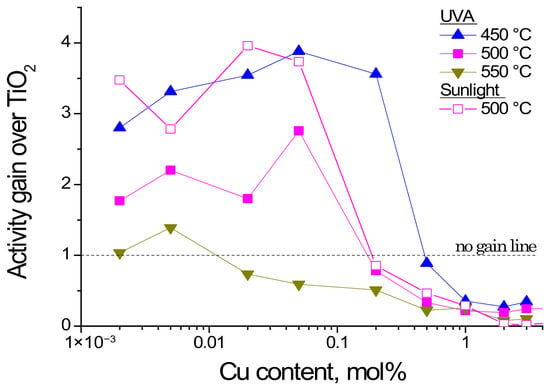
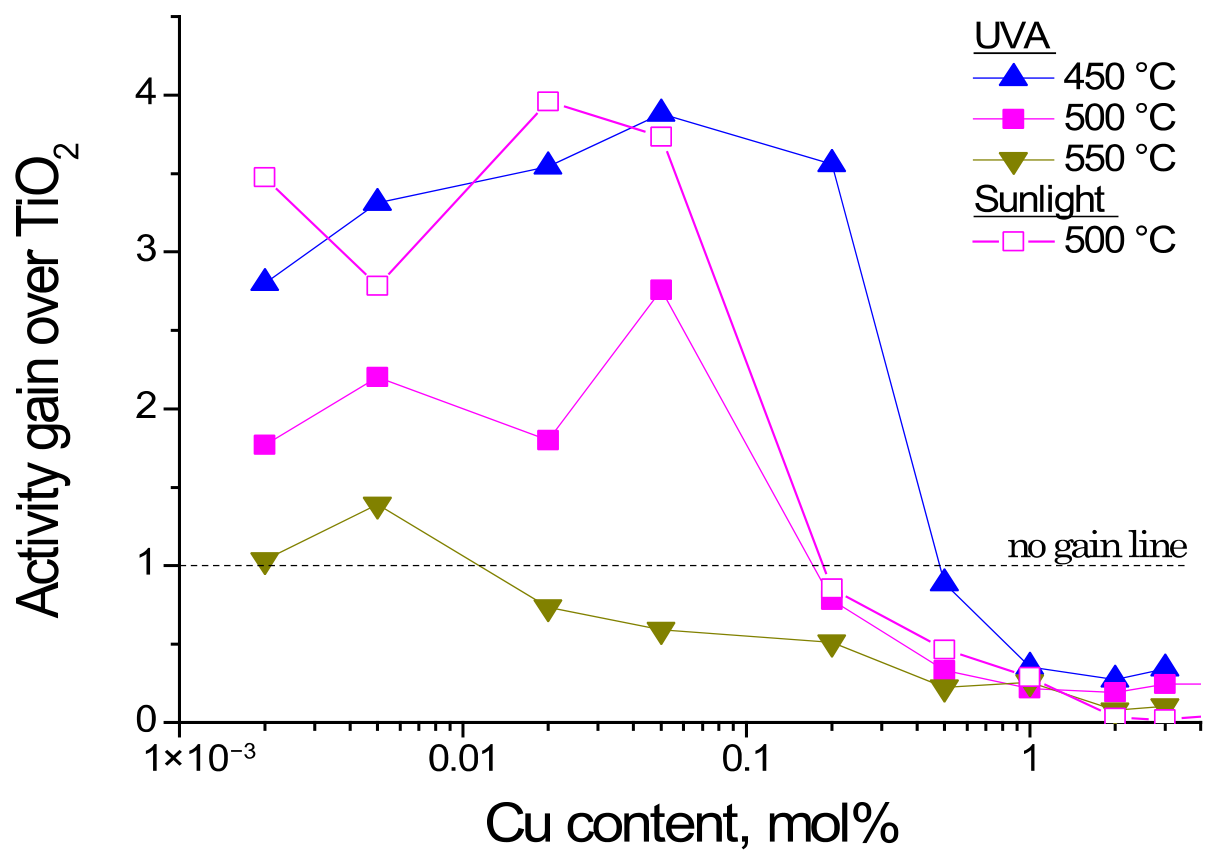
The photocatalytic experiments in Figure 4 and Figure 5 indicate a gain of the photocatalytic activity with the Cu addition to TiO2, defined as the ratio of MB decomposition rate constants using, respectively, Cu–TiO2 and TiO2 nanopowders: ), as Figure 6 shows. The gain clearly appeared at a small Cu insertion of x ≤ 0.1 mol%, decreasing with an increase in the calcination temperature. The rates of MB decomposition under sunlight vs. UVA illumination depend on the light source’s power and spectrum. In this connection, the gain of activity over pure titania increased up to 4 times under sunlight illumination. This is significantly stronger than under UVA illumination, where the activity gain over pure titania was ~2.5 times at the same calcination temperature of 500 °C. Further experiments with sunlight illumination are required to confirm this tendency, which might be due to an extension of the action spectrum of Cu–TiO2 photocatalyst compared to pure TiO2, related to the lattice intra-gap defect states produced by Cu2+ insertion.
Figure 6.
Gain of photocatalytic activity with Cu addition to TiO2.
Since the material crystallinity depends on the calcination temperature, the activity gain due to the Cu insertion in TiO2 is also expected to change. An increase in the CB electron path length before trapping with calcination temperature will be discussed below in the framework of a model.
3.3. Charge Transfer
Since no significant variation in the pollutant adsorption capacity was observed in the present study (see Figure 1), we relate the strong activity variation with Cu content to the photoinduced charge transfer and recombination. A model describing the influence of the Cu cation insertion into the TiO2 lattice on the photocatalyst activity has been introduced earlier in connection with Fe3+ doping of TiO2 [39]. This model assumes that the photoexcited charges undergo a random-walk displacement before localization: the CB electron e- localizes more rapidly than the VB hole h+ [50] and in a smaller region of radius re. Furthermore, the electron localizes on Ti4+, forming a polaron-like Ti3+ centre [8], on which the hole can effectively recombine. The guest cation in TiO2 lattice can also attract a photoinduced hole, which thus avoids annihilation with the localized electron on Ti3+ and can trigger photocatalytic reactions.
The defect energy levels of Cu2+ are not explicitly established. However, Cu2+ is expected to substitute Ti4+ in TiO2 because of quite similar cationic radii, creating a charge imbalance compensated by oxygen vacancy; the adjacent Cu and Ti cations in the absence of the removed oxygen atom have five-fold coordination forming a Ti3+ state [7]. The theoretical calculations have shown that the substitutional CuTi is placed 0.65 eV above the VB maximum for 0/1− transition and 1.57 eV above the VB maximum for 1−/2− transition, while the interstitial Cui is placed 0.37 eV below the CB minimum for 2+/1+ transition (Cu+) and ~0.05 eV above the CB minimum for 1+/0 transition (Cu°); the valence states Cu+ and Cu2+ thus coexist in the anatase TiO2 lattice [51]. We notice in this connection a progressive coloration of the prepared Cu-TiO2 nanopowders from white (0 mol% Cu) to grey (10 mol% Cu), which is in agreement with the Vo/Ti3+ defects formation and Cu2+ reduction to Cu+ or even Cu° [52]. We therefore assume that the mobile VB hole can be trapped on CuTi or, alternatively, on complex defect clusters of type Vo/Ti3+, thus suppressing annihilation with the photoinduced CB electron. In the following, we will call this defect centre {Cu}.
The principal relevant processes running at the UVA illumination of the doped TiO2 are given below (see Ref. [39]):
where k and τ with subscripts are, respectively, rate constants and lifetimes. The rate Equations (1)–(6) propose an analytic solution of the electron-hole separation probability:
where rTi ≈ 0.3 nm is the mean Ti–Ti distance in the anatase lattice. We tentatively relate γ to the photocatalytic yield.
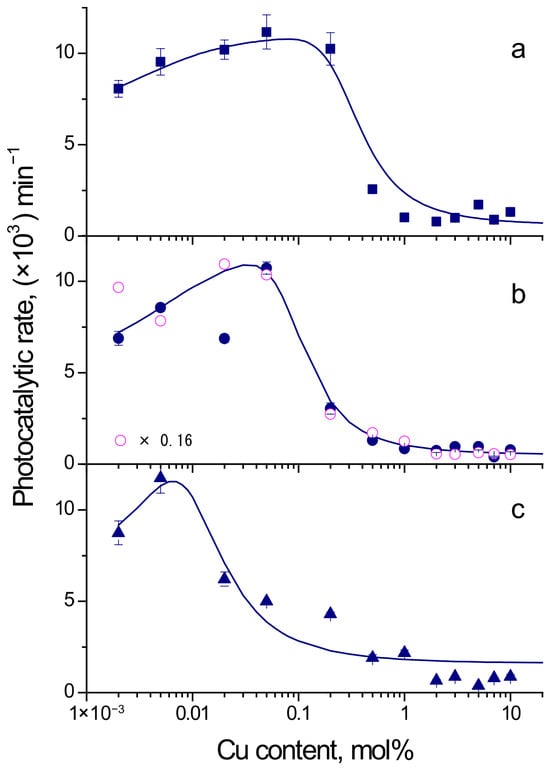
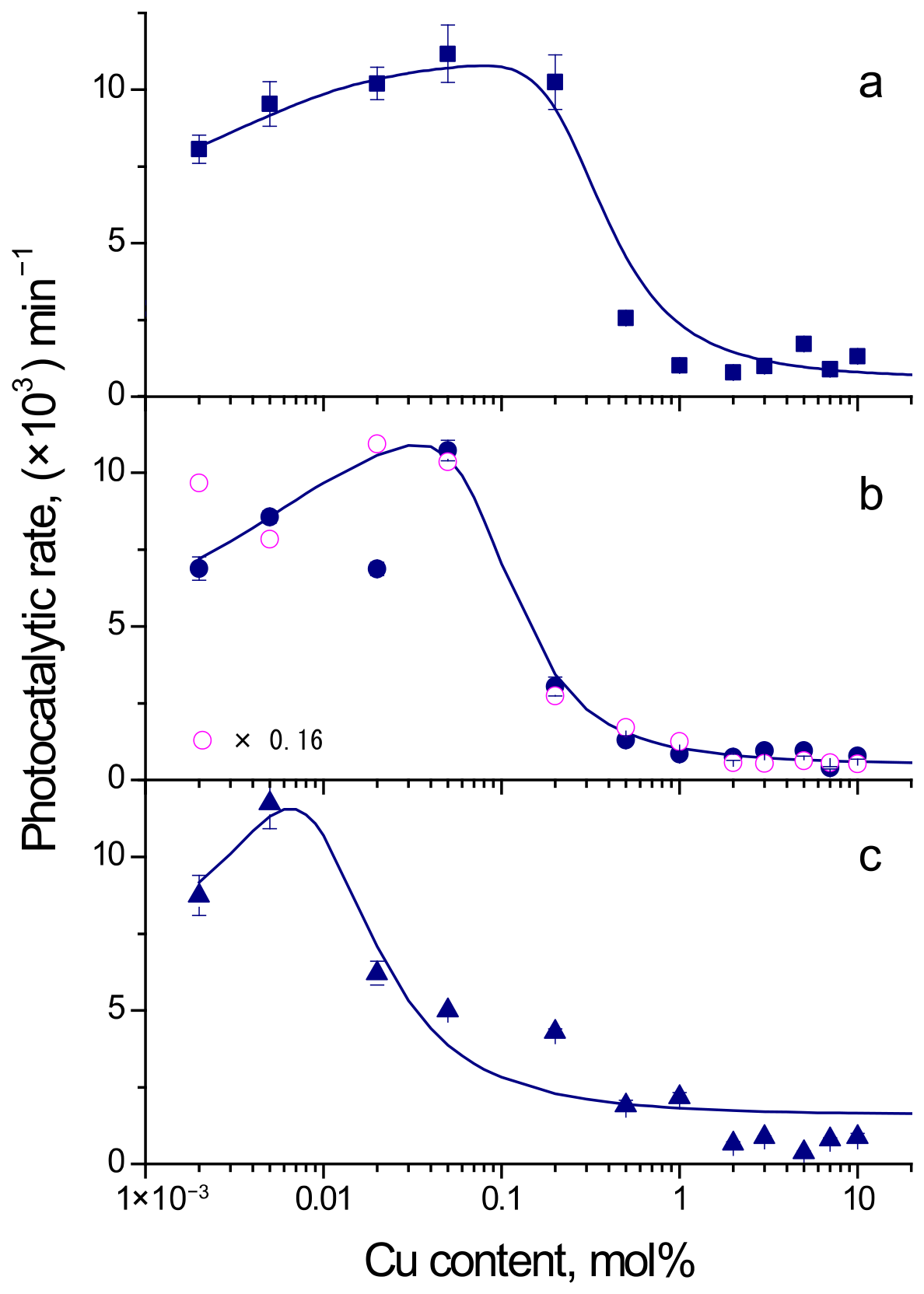
The model curves (7), traced over experimental photocatalytic rates k in Figure 7, successfully describe the experiment. The values of re = 1.39 (a), 1.61 (b), and 4.02 (c) nm were obtained for Cu–TiO2 nanopowders calcined respectively at 450 °C, 500 °C, and 550 °C. The increase in CB electron pathlength before localisation re supports crystallinity improvement, vanishing defect states, and thus, the decrease in activity gain over pure TiO2.
Figure 7.
Photocatalytic rate constant of Cu–TiO2 catalyst calcined at 450 °C (a), 500 °C (b), and 550 °C (c) with UVA lamp (■, ●, ▲) and sunlight (○) illumination (5 ppm MB, 1 g/L catalyst). Solid lines trace model curves corresponding to electron localisation distance of 1.39 (a), 1.61 (b) and 4.02 (c) nm. Relative error bars from the least-squares fit are included.
We notice that although a small presence of rutile phase was evidenced in Cu–TiO2 by XRD measurements, the highest activity of anatase compared to rutile titania and large crystalline domains D >> re suggest the dominant contribution of anatase phase to the photocatalytic reactions that allows the comparison.
3.4. TRMC Analysis
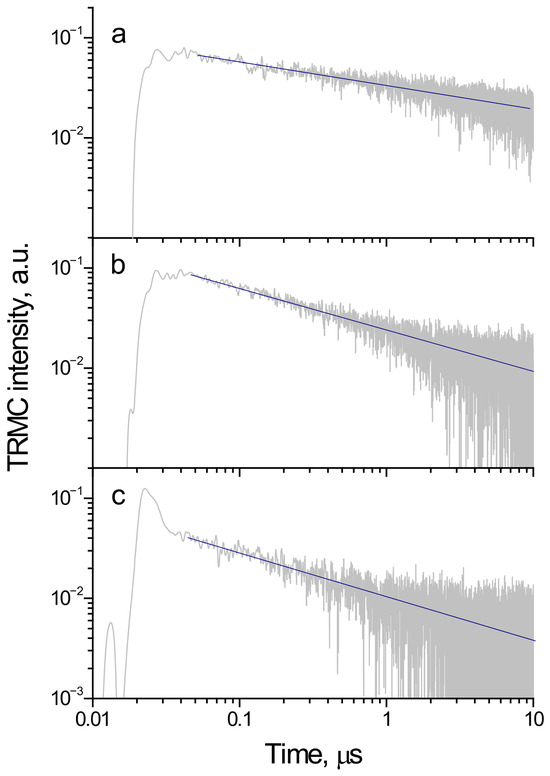
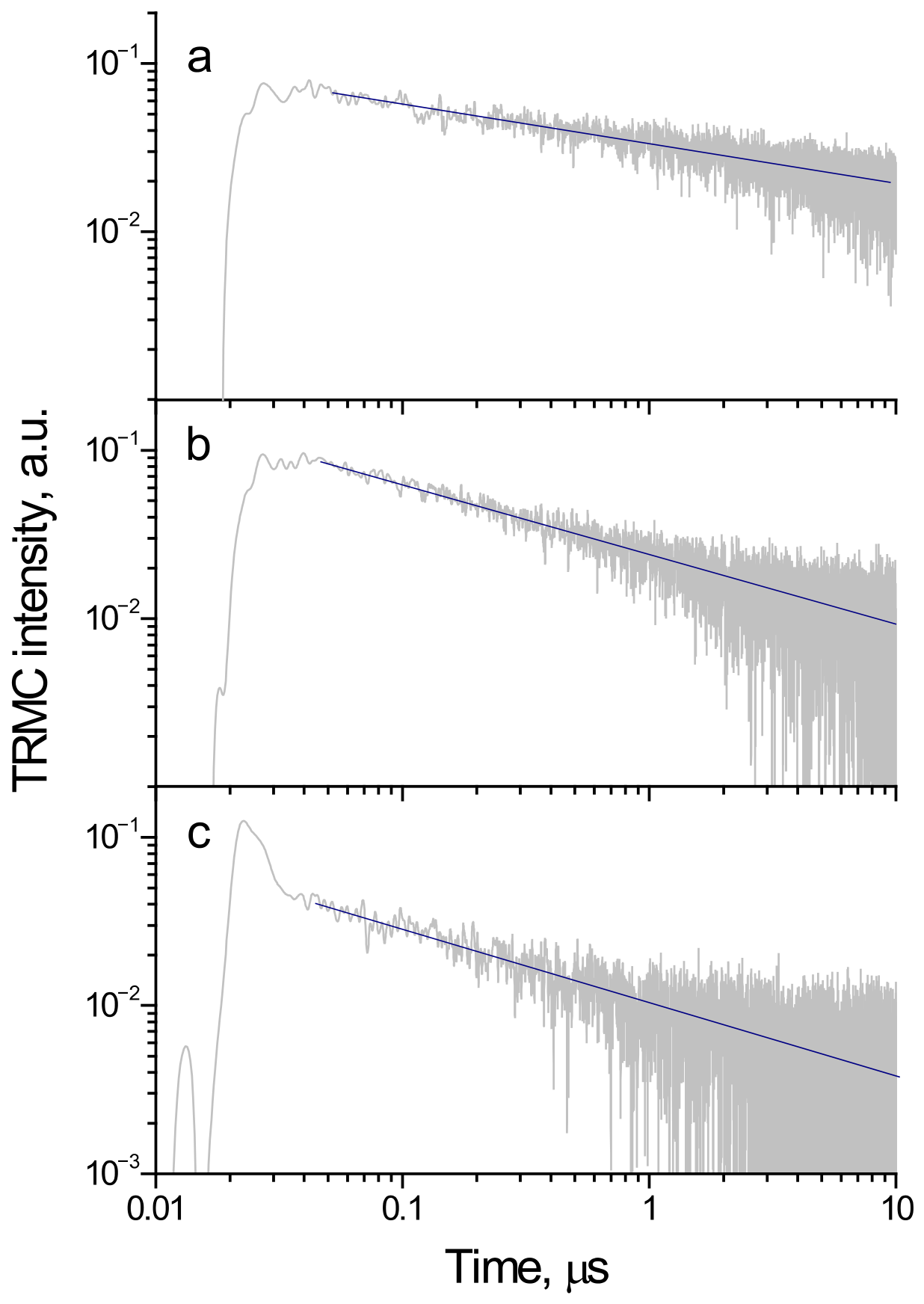
The relaxation kinetics of photoinduced charges after UV-laser pulsed excitation of Cu–TiO2 nanopowders with x = 0.005 calcined at different temperatures are shown in Figure 8. The experimental curves of the materials with T < 550 °C match the power law kinetics I = At−α related to the photoexcited electrons released from shallow traps [48,53]. In the materials calcined at T = 550 °C, a complementary short component appeared, which might be due to the rutile phase appearance, in agreement with Colbeau-Justin et al. [45]. However, its duration ~10 ns is much shorter compared to that of the plasma-like free charges recombination of ~200 ns duration, according to Ref. [53]; it was therefore ascribed to the laser pulse scattering by cluster defects accumulating in the sample under UVA irradiation.
Figure 8.
TRMC decay curves of Cu–TiO2 nanopowders with 0.005 mol% Cu calcined at 450 (a), 500 (b), and 550 (c) °C. Least-squares fits with power law function I = At−α are shown by straight lines.
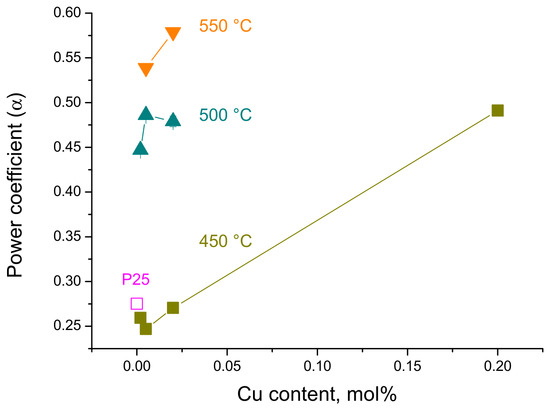
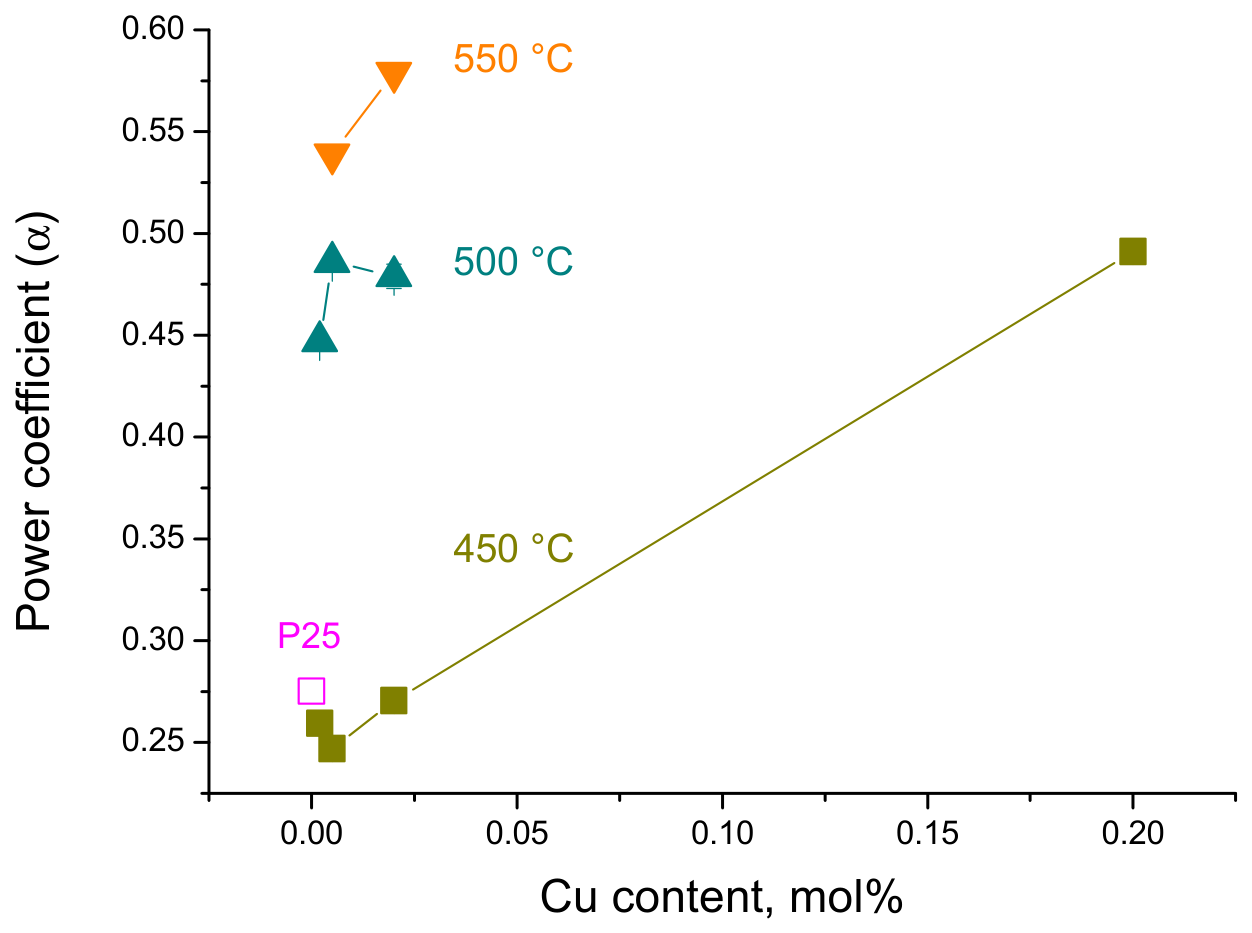
The power decay constant α is connected to the charge trap binding energy and does not directly reflect the photocatalyst activity of a material. However, slow relaxation of the photoinduced charges generally contributes to the effective charge-transfer reactions at contact with pollutant molecules. The power constants α obtained from TRMC measurements of the powders with low Cu content and different calcination temperatures are shown in Figure 9.
Figure 9.
Power coefficient α of TRMC decay of Cu–TiO2 nanopowders calcined at 450 (■), 500 (▲), and 550 (▼) °C, and of reference P25 TiO2 (□) powder.
The result indicates a significant shortening of the lifetime of the CB electron population, which, according to the above discussion of the activity gain of Cu–TiO2 over pure TiO2 catalysts, can be related to a decrease in the lattice defects concentration with an increase in the calcination temperature, which promotes long-lasting migration and recombination of charges [53]. This can support a contribution to the activity gain under sunlight illumination of the sub-band defect states (e.g., CuTi and/or Vo/Ti3+) absorbing visible light photons. Defect engineering in application to the TiO2-based photocatalysts has attracted much interest in the last few decades [54,55], and those associated with Cu insertion have already allowed the activity enhancement under UV illumination [56]. Although no control of the defect chemistry was proposed in our study, their easy and effective formation at the sol–gel synthesis in low-hydrolysis ratio conditions could be of interest for the elaboration process scale-up.
We notice the appearance of a short 10 ns decay component of the TRMC kinetics in Cu–TiO2 nanopowders calcined at 450 °C and 500 °C with compositions respectively x ≥ 3 and x ≥ 0.2 mol% Cu. This can be connected to the 1+/0 transition of Cui, which manifests at large Cu content and/or increased calcination temperature. Complementary, amplitudes of the TRMC signal strongly weaken in nanopowders calcined respectively at 450, 500, and 550 °C. Summing up, both excessive calcination temperature and Cu content decrease the material activity due to the Cu-defect clustering. Furthermore, lowering the calcination temperature promotes the formation of inter-gap defect states capable of enlarging the action spectrum of the Cu–TiO2 photocatalyst.
4. Conclusions
This study concerned the investigation of the photocatalytic activity enhancement of TiO2 after Cu cation insertion into the crystalline lattice. The nanoparticles of copper titanium oxo-alkoxide (CTOA) were successfully synthesized with the sol–gel method by using TTIP and copper (II) acetate precursors in 2-propanol solvent, in low hydrolysis ratio conditions of H = 1.25. The precipitated particles were dried at 80 °C and calcined at 450, 500, and 550 °C for four hours to form a crystalline product with a large variation of elemental compositions: x = 0, 0.002, 0.005, 0.02, 0.05, 0.2, 0.5, 1.0, 2.0, 3.0, 5.0, 7.0, and 10.0 mol% Cu. The crystalline nanopowders were used to decompose a representative pollutant, MB, in aqueous solutions. The compositions, with x between 0.002 and 0.05 mol% Cu, showed the highest activity towards MB decomposition both under UVA and sunlight illuminations. It was observed that both excessive calcination temperature and Cu content decrease the material activity due to the Cu-defect clustering. The gain of activity over pure titania of 4 times after calcination at 450 °C, 2.5 times at 500 °C, and only 20% at 550 °C was measured under UVA illumination. An even stronger gain of activity under sunlight illumination, observed at the calcination temperature of 500 °C, can be due to an extension of the action spectrum of Cu–TiO2 photocatalyst to the visible range. The TRMC measurements of the photoinduced charge relaxation support the conclusion about the negative influence of both excessive calcination temperature and Cu content on the material activity. Modelling allowed for the relation of the photocatalytic activity to the photoinduced charge separation, owing to the localization of a lighter charge (h+) on distant Cu+ cation and heavier charge (e−) migrating through Ti4+ sites by hopping. The electron localisation distances of 1.39 (a), 1.61 (b), and 4.02 (c) nm were obtained in Cu–TiO2 nanopowders calcined respectively at 450 °C, 500 °C, and 550 °C. Since the material crystallinity improvement is expected with an increase in the calcination temperature, the gain in activity due to defect states is expected in moderate heat treatment conditions. An effective formation of relevant defect states at the sol–gel synthesis in low-hydrolysis ratio conditions could be of interest for effective photocatalyst elaboration.
Author Contributions
K.C.: Investigation, Project administration, Resources, Supervision, Validation, Writing—original draft; S.C.: Data curation, Formal analysis, Investigation; V.S.: Investigation, Project administration; F.D.: Validation, Writing—original draft; S.L.: Investigation, Project administration, Validation, Resources; S.D.: Investigation, Validation, Visualization; A.L.: Investigation, Data curation, Validation, Visualization; M.T.: Resources, Investigation, Validation, Visualization; C.C.-J.: Resources, Validation, Visualization; A.K.: Methodology, Investigation, Validation, Writing—Review and Editing. All authors have read and agreed to the published version of the manuscript.
Funding
This work was funded by the Cambodia Higher Education Improvement Project (Credit No. 6221-KH).
Data Availability Statement
The original contributions presented in this study are included in the article. Further inquiries can be directed to the corresponding authors.
Conflicts of Interest
The authors declare no conflicts of interest.
References
- Zaleska-Medynska, A. Doped-TiO2: A review. Rec. Pat. Eng. 2008, 2, 157–164. [Google Scholar] [CrossRef] [Scilit]
- Orizu, G.E.; Ugwuoke, P.E.; Asogwa, P.U.; Offiah, S.U. Review on the inference of doping TiO2 with metals/nonmetals to improve its photocatalytic activities. IOP Conf. Ser. Earth Environ. Sci. 2023, 1178, 012008. [Google Scholar] [CrossRef] [Scilit]
- Kumaravel, V.; Mathew, S.; Bartlett, J.; Pillai, S.C. Photocatalytic hydrogen production using metal doped TiO2: A review of recent advances. Appl. Catal. B 2019, 244, 1021–1064. [Google Scholar] [CrossRef] [Scilit]
- Ibrahim, N.S.; Leaw, W.L.; Mohamad, D.; Alias, S.H.; Nur, H. A critical review of metal-doped TiO2 and its structureephysical propertiesephotocatalytic activity relationship in hydrogen production. Int. J. Hydrogen Energy 2020, 45, 28553–28565. [Google Scholar] [CrossRef] [Scilit]
- Arora, I.; Chawla, H.; Chandra, A.; Sagadevan, S.; Garg, S. Advances in the strategies for enhancing the photocatalytic activity of TiO2: Conversion from UV-light active to visible-light active photocatalyst. Inorg. Chem. Commun. 2022, 143, 109700. [Google Scholar] [CrossRef] [Scilit]
- Mittal, A.; Marí, B.; Sharma, S.; Kumari, V.; Maken, S.; Kumari, K.; Kumar, N. Non-metal modified TiO2: A step towards visible light photocatalysis. J. Mater. Sci. Mater. Electron. 2019, 30, 3186–3207. [Google Scholar] [CrossRef] [Scilit]
- Mathew, S.; Ganguly, P.; Rhatigan, S.; Kumaravel, V.; Byrne, C.; Hinder, S.; Bartlett, J.; Nolan, M.; Pillai, S. Cu-doped TiO2: Visible light assisted photocatalytic antimicrobial activity. Appl. Sci. 2018, 8, 2067. [Google Scholar] [CrossRef] [Scilit]
- Kuznetsov, V.N.; Glazkova, N.I.; Mikhaylov, R.V.; Serpone, N. Additional specific channel of photoactivation of solid semiconductors. A revisit of the thermo-/photo-stimulated bleaching of photoinduced Ti3+ color centers in visible-light-active photochromic rutile titania. J. Phys. Chem. C 2018, 122, 13294–13303. [Google Scholar] [CrossRef] [Scilit]
- Kuznetsov, A.; Kameneva, O.; Alexandrov, A.; Bityurin, N.; Chhor, C.; Kanaev, A. Chemical activity of photoinduced Ti3+ centers in titanium oxide gels. J. Phys. Chem. B 2006, 110, 435–441. [Google Scholar] [CrossRef] [Scilit]
- Edelmannová, M.; Lin, K.-Y.; Wu, J.C.S.; Troppová, I.; Čapek, L.; Kočí, K. Photocatalytic hydrogenation and reduction of CO2 over CuO/TiO2 photocatalysts. Appl. Surf. Sci. 2018, 454, 313–318. [Google Scholar] [CrossRef] [Scilit]
- Wang, R.; Cao, J.; Liu, J.; Zhang, Y. Synthesis of CuO@TiO2 nanocomposite and its photocatalytic and electrochemical properties. Application for treatment of azo dyes in industrial wastewater. Int. J. Electrochem. Sci. 2023, 18, 100316. [Google Scholar] [CrossRef] [Scilit]
- Moniz, S.J.A.; Tang, J. Charge transfer and photocatalytic activity in CuO/TiO2 nanoparticle heterojunctions synthesised through a rapid, one-pot, microwave solvothermal route. Chem. Cat. Chem. 2015, 7, 1659–1667. [Google Scholar]
- Marin, S.L.A.; de Oliveira, S.C.; Peralta-Zamora, P. Photocatalytic degradation of phenol by core-shell Cu@TiO2 nanostructures under visible radiation. J. Photochem. Photobiol. A 2022, 433, 114129. [Google Scholar] [CrossRef] [Scilit]
- Raguram, T.; Rajni, K.S. Synthesis and characterisation of Cu-doped TiO2 nanoparticles for DSSC and photocatalytic applications. Int. J. Hydrogen Energy 2022, 47, 4674–4689. [Google Scholar] [CrossRef] [Scilit]
- Yang, X.-J.; Wang, S.; Sun, H.-M.; Wang, X.-B.; Lian, J.-S. Preparation and photocatalytic performance of Cu-doped TiO2 nanoparticles. Trans. Nonferr. Met. Soc. China 2015, 25, 504–509. [Google Scholar] [CrossRef] [Scilit]
- Pascariu, P.; Cojocaru, C.; Samoila, P.; Airinei, A.; Olaru, N.; Rotaru, A.; Romanitan, C.; Tudoran, L.B.; Suchea, M. Cu/TiO2 composite nanofibers with improved photocatalytic performance under UV and UV–visible light irradiation. Surf. Interf. 2022, 28, 101644. [Google Scholar] [CrossRef] [Scilit]
- Zhang, M.; Yuan, S.; Wang, Z.; Zhao, Y.; Shi, L. Photoelectrocatalytic properties of Cu2+-doped TiO2 film under visible light. Appl. Catal. B 2013, 134–135, 185–192. [Google Scholar] [CrossRef] [Scilit]
- Khlyustova, A.; Sirotkin, N.; Kusova, T.; Kraev, A.; Titov, V.; Agafonov, A. Doped TiO2: The effect of doping elements on photocatalytic activity. Mater. Adv. 2020, 1, 1193–1201. [Google Scholar] [CrossRef] [Scilit]
- Aguilar, T.; Navas, J.; Alcántara, R.; Fernández-Lorenzo, C.; Gallardo, J.J.; Blanco, G.; Martín-Calleja, J. A route for the synthesis of Cu-doped TiO2 nanoparticles with a very low band gap. Chem. Phys. Lett. 2013, 571, 49–53. [Google Scholar] [CrossRef] [Scilit]
- Reda, S.M.; Khairy, M.; Mousa, M.A. Photocatalytic activity of nitrogen and copper doped TiO2 nanoparticles prepared by microwave-assisted sol-gel process. Arab. J. Chem. 2020, 13, 86–95. [Google Scholar] [CrossRef] [Scilit]
- Momeni, M.M.; Ghayeb, Y.; Ghonchegi, Z. Fabrication and characterization of copper doped TiO2 nanotube arrays by in situ electrochemical method as efficient visible-light photocatalyst. Ceram. Intern. 2015, 41, 8735–8741. [Google Scholar] [CrossRef] [Scilit]
- Abidi, M.; Hajjaji, A.; Bouzaza, A.; Trablesi, K.; Makhlouf, H.; Rtimi, S.; Assadi, A.A.; Bessais, B. Simultaneous removal of bacteria and volatile organic compounds on Cu2O-NPs decorated TiO2 nanotubes: Competition effect and kinetic studies. J. Photochem. Photobiol. A 2020, 400, 112722. [Google Scholar] [CrossRef] [Scilit]
- Gao, F.; Jiang, J.; Du, L.; Liu, X.; Ding, Y. Stable and highly efficient Cu/TiO2 nanocomposite photocatalyst prepared through atomic layer deposition. Appl. Catal. A 2018, 568, 168–175. [Google Scholar] [CrossRef] [Scilit]
- Yan, H.; Zhao, T.; Li, X.; Hun, C. Synthesis of Cu-doped nano-TiO2 by detonation method. Ceram. Intern. 2015, 41, 14204–14211. [Google Scholar] [CrossRef] [Scilit]
- Evgenidou, E.; Chatzisalata, Z.; Tsevis, A.; Bourikas, K.; Torounidou, P.; Sergelidis, D.; Koltsakidou, A.; Lambropoulou, D.A. Photocatalytic degradation of a mixture of eight antibiotics using Cu-modified TiO2 photocatalysts: Kinetics, mineralization, antimicrobial activity elimination and disinfection. J. Environ. Chem. Eng. 2021, 9, 105295. [Google Scholar] [CrossRef] [Scilit]
- Garlisi, C.; Scandura, G.; Szlachetko, J.; Ahmadi, S.; Sa, J.; Palmisano, G. E-beam evaporated TiO2 and Cu-TiO2 on glass: Performance in the discoloration of methylene blue and 2-propanol oxidation. Appl. Catal. A 2016, 526, 191–199. [Google Scholar] [CrossRef] [Scilit]
- Sudrajat, H.; Nguyen, T.K. Key factors controlling the durability of a Cu-doped TiO2 photocatalyst. Optik 2020, 217, 164914. [Google Scholar] [CrossRef] [Scilit]
- Liu, C.; Wang, J.; Chen, W.; Dong, C.; Li, C. The removal of DON derived from algae cells by Cu-doped TiO2 under sunlight irradiation. Chem. Eng. J. 2015, 280, 588–596. [Google Scholar] [CrossRef] [Scilit]
- Lin, C.-J.; Yang, W.-T. Ordered mesostructured Cu-doped TiO2 spheres as active visible-light-driven photocatalysts for degradation of paracetamol. Chem. Eng. J. 2014, 237, 131–137. [Google Scholar] [CrossRef] [Scilit]
- Sharma, S.B.; Qattan, I.A.; Jaoude, M.A.; Abedrabbo, S. First-principles DFT study of structural, electronic and optical properties of Cu-doped TiO2 (112) surface for enhanced visible-light photocatalysis. Comput. Mater. Sci. 2023, 218, 111952. [Google Scholar] [CrossRef] [Scilit]
- Zhang, H.; Yu, X.; McLeod, J.A.; Sun, X. First-principles study of Cu-doping and oxygen vacancy effects on TiO2 for water splitting. Chem. Phys. Lett. 2014, 612, 106–110. [Google Scholar] [CrossRef] [Scilit]
- Yao, G.-Y.; Zhao, Z.-Y.; Liu, Q.-L.; Dong, X.-D.; Zhao, Q.-M. Theoretical calculations for localized surface plasmon resonance effects of Cu/TiO2 nanosphere: Generation, modulation and application in photocatalysis. Sol. Energy Mater. Sol. Cells 2020, 208, 110385. [Google Scholar] [CrossRef] [Scilit]
- Wang, T.; Sun, F.; Liu, S.; Zhuang, G.; Li, B. Dioxygen-enhanced CO2 photoreduction on TiO2 supported Cu single-atom sites. Appl. Catal. B 2023, 325, 122339. [Google Scholar] [CrossRef] [Scilit]
- Cheng, C.; Fang, W.-H.; Long, R.; Prezhdo, O.V. Water splitting with a single-atom Cu/TiO2 photocatalyst: Atomistic origin of high efficiency and proposed enhancement by spin selection. JACS Au 2021, 1, 550–559. [Google Scholar] [CrossRef] [Scilit]
- Chen, M.; Wang, H.; Chen, X.; Wang, F.; Qin, X.; Zhang, C.; He, H. High-performance of Cu-TiO2 for photocatalytic oxidation of formaldehyde under visible light and the mechanism study. Chem. Eng. J. 2020, 390, 124481. [Google Scholar] [CrossRef] [Scilit]
- Wu, M.-C.; Wu, P.-Y.; Lin, T.-H.; Lin, T.-F. Photocatalytic performance of Cu-doped TiO2 nanofibers treated by the hydrothermal synthesis and air-thermal treatment. Appl. Surf. Sci. 2018, 430, 390–398. [Google Scholar] [CrossRef] [Scilit]
- Bensouici, F.; Bououdina, M.; Dakhel, A.A.; Tala-Ighil, R.; Tounane, M.; Iratni, A.; Souier, T.; Liu, S.; Cai, W. Optical, structural and photocatalysis properties of Cu-doped TiO2 thin films. Appl. Surf. Sci. 2017, 395, 110–116. [Google Scholar] [CrossRef] [Scilit]
- Liu, B.; Wang, J.; Parkin, I.P.; Zhao, X. The effect of Cu dopants on electron transfer to O2 and the connection with acetone photocatalytic oxidations over nano-TiO2. Phys. Chem. Chem. Phys. 2021, 23, 8300–8308. [Google Scholar] [CrossRef] [Scilit]
- Tieng, S.; Kanaev, A.; Chhor, K. New homogeneously doped Fe(III)-TiO2 photocatalyst for gaseous pollutant degradation. Appl. Catal. A 2011, 399, 191–197. [Google Scholar] [CrossRef] [Scilit]
- Sanchez Mendez, M.; Lemarchand, A.; Traore, M.; Perruchot, C.; Nikravech, M.; Kanaev, A. Preparation and photocalytic activity of coatings based on size-selective V-TiO2 nanoparticles. Chem. Eng. Trans. 2021, 84, 19–24. [Google Scholar]
- Cheng, K.; Heng, S.; Tieng, S.; David, F.; Dine, S.; Haddad, O.; Colbeau-Justin, C.; Traore, M.; Kanaev, A. Mixed metal oxide W-TiO2 nanopowder for environmental process: Synergy of adsorption and photocatalysis. Nanomaterials 2024, 14, 765. [Google Scholar] [CrossRef] [Scilit]
- Azouani, R.; Soloviev, A.; Benmami, M.; Chhor, K.; Bocquet, J.-F.; Kanaev, A. Stability and growth of titanium-oxo-alcoxy TixOy(OiPr)z clusters. J. Phys. Chem. C 2007, 111, 16243–16248. [Google Scholar] [CrossRef] [Scilit]
- Cheng, K.; Chhor, K.; Kanaev, A. Solvent effect on nucleation-growth of titanium-oxo-alkoxy nanoparticles. Chem. Phys. Lett. 2017, 672, 119–123. [Google Scholar] [CrossRef] [Scilit]
- Spurr, R.A.; Myers, H. Quantitative analysis of anatase-rutile mixtures with an x-ray diffractometer. Anal. Chem. 1957, 29, 760–762. [Google Scholar] [CrossRef] [Scilit]
- Colbeau-Justin, C.; Kunst, M.; Huguenin, D. Structural influence on charge-carrier lifetimes in TiO2 powders studied by microwave absorption. J. Mat. Sci. 2003, 38, 2429–2437. [Google Scholar] [CrossRef] [Scilit]
- Byrne, C.; Moran, L.; Hermosilla, D.; Merayo, N.; Blanco, Á.; Rhatigan, S.; Hinder, S.; Ganguly, P.; Nolan, M.; Pillai, S.C. Effect of Cu doping on the anatase-to-rutile phase transition in TiO2 photocatalysts: Theory and experiments. Appl. Catal. B 2019, 246, 266–276. [Google Scholar] [CrossRef] [Scilit]
- Gribb, A.A.; Banfield, J.F. Particle size effects on transformation kinetics and phase stability in nanocrystalline TiO2. Am. Mineral. 1997, 82, 717–728. [Google Scholar] [CrossRef] [Scilit]
- Cheng, K.; Chhor, K.; Passarello, J.-P.; Colbeau-Justin, C.; Kanaev, A. Photocatalytic nanoparticulate ZrxTi1−xO2 coatings with controlled homogeneity of elemental composition. Chem. Sel. 2018, 3, 11118–11126. [Google Scholar] [CrossRef] [Scilit]
- Sokoidanto, H.; Taufik, A.; Saleh, R. Structural and optical study of Cu-doped TiO2 nanoparticles synthesized by co-precipitation method. J. Phys. Conf. Ser. 2020, 1442, 012008. [Google Scholar] [CrossRef] [Scilit]
- Zou, X.; Vadell, R.B.; Liu, Y.; Mendalz, A.; Drillet, M.; Sá, J. Photophysical study of electron and hole trapping in TiO2 and TiO2/Au nanoparticles through a selective electron injection. J. Phys. Chem. C 2022, 126, 21467–21475. [Google Scholar] [CrossRef] [Scilit]
- Alotaibi, A.M.; Williamson, B.A.D.; Sathasivam, S.S.; Kafizas, A.; Alqahtani, M.; Sotelo-Vazquez, C.; Buckeridge, J.; Wu, J.; Nair, S.P.; Scanlon, D.O.; et al. Enhanced photocatalytic and antibacterial ability of Cu doped anatase TiO2 thin films: Theory and experiment. ACS Appl. Mater. Interfaces 2020, 12, 15348–15361. [Google Scholar] [CrossRef] [Scilit]
- Liu, L.; Gao, F.; Zhao, H.; Li, Y. Tailoring Cu valence and oxygen vacancy in Cu/TiO2 catalysts for enhanced CO2 photoreduction efficiency. Appl. Catal. B 2013, 134–135, 349–358. [Google Scholar] [CrossRef] [Scilit]
- Colbeau-Justin, C.; Kanaev, A. Time-resolved microwave conductivity of P25 TiO2: Distinguishing light-induced electron and hole transport. J. Phys. Chem. Solids 2026, 211, 113488. [Google Scholar] [CrossRef] [Scilit]
- Nowotny, M.K.; Sheppard, L.R.; Bak, T.; Nowotny, J. Defect chemistry of titanium dioxide. Application of defect engineering in processing of TiO2-based photocatalysts. J. Phys. Chem. C 2008, 112, 5275–5300. [Google Scholar] [CrossRef] [Scilit]
- Piler, K.; Bahrim, C.; Twagirayezu, S.; Benson, T.J. Chapter two—Lattice disorders of TiO2 and their significance in the photocatalytic conversion of CO2. Adv. Catal. 2020, 66, 109–233. [Google Scholar]
- Liccardo, L.; Moras, P.; Sheverdyaeva, P.M.; Vomiero, A.; Caballero, A.; Colón, G.; Moretti, E. Surface defect engineered nano-Cu/TiO2 photocatalysts for hydrogen production. Adv. Sustain. Syst. 2024, 8, 2300418. [Google Scholar] [CrossRef] [Scilit]

Disclaimer/Publisher’s Note: The statements, opinions and data contained in all publications are solely those of the individual author(s) and contributor(s) and not of MDPI and/or the editor(s). MDPI and/or the editor(s) disclaim responsibility for any injury to people or property resulting from any ideas, methods, instructions or products referred to in the content. |
© 2026 by the authors. Licensee MDPI, Basel, Switzerland. This article is an open access article distributed under the terms and conditions of the Creative Commons Attribution (CC BY) license.