


Abstract
Diacetylene monomers are known to undergo solid-state 1,4-addition polymerization when their crystal packing satisfies strict geometric criteria; however, the influence of bulky terminal protecting groups on the lattice adjustments required for bond formation remains insufficiently understood. Here, we synthesized amide derivatives of 2,4-hexadiyne-1,6-diamine, crystallized them via antisolvent vapor diffusion, and evaluated their thermal and photochemical reactivity. Single-crystal analysis shows that Boc-protected monomers (Boc-DA) form hydrogen-bond-directed parallel stacks that align diyne units in geometries nominally consistent with topochemical polymerization, yet they exhibit negligible photoreactivity under ambient UV irradiation. Structural inspection indicates that steric congestion from the tert-butoxycarbonyl termini restricts the subtle axial contraction and molecular shifts required for bond formation. Reducing steric bulk or applying combined thermal and photochemical activation enables polymerization of these diacetylenes. These findings demonstrate that globally favorable packing arrangements can coexist with local steric barriers that impose kinetic constraints on reactivity. Modulating terminal-group size and applying multimodal activation therefore provide a simple and tunable strategy to control diacetylene polymerization, offering design principles for switchable polydiacetylene materials in crystal engineering.
1. Introduction
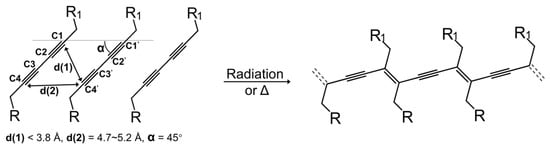
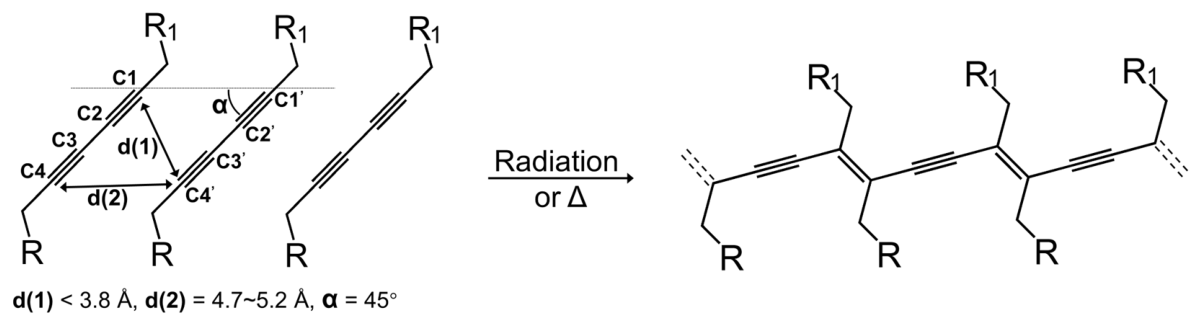
Diacetylene (DA) derivatives are well known for their ability to undergo solid-state 1,4-addition polymerization to form polydiacetylenes (PDAs) [1,2,3,4]. In favorable cases, this transformation proceeds in a single-crystal-to-single-crystal manner and is commonly rationalized using established topochemical criteria [5,6,7,8]. These criteria require (i) a C1⋯C4′ separation between adjacent diacetylene units shorter than approximately 3.8 Å, (ii) a translational repeat distance in the range 4.7–5.2 Å, and (iii) an orientation of the diacetylene rod at an angle close to 45° relative to the stacking direction [9,10] (Figure 1). Such arrangements are frequently achieved through directional intermolecular interactions, including hydrogen bonding and π–π stacking, which organize reactive units within the crystal lattice [11,12,13,14,15].
Figure 1.
Schematic illustration of the topochemical parameters for diacetylene 1,4-addition polymerization. The key parameters are the intermolecular C1⋯C4′ distance, d(1) < 3.8 Å; the translational repeat distance, d(2) = 4.7–5.2 Å; and the inclination angle between the diacetylene rod and the stacking direction, α ≈ 45°. Dashed lines indicate intermolecular contacts relevant to polymerization.
While compliance with these geometric parameters is widely regarded as a prerequisite for topochemical reactivity, the criteria themselves describe static spatial relationships. Polymerization, however, requires subtle molecular displacements within the lattice, typically involving small axial contractions and translational adjustments of adjacent diacetylene units [16,17,18]. Thus, geometric compliance does not necessarily guarantee that the crystal lattice can accommodate the structural rearrangements required for bond formation. Crystallographically characterized systems that satisfy the classical geometric criteria but fail to polymerize remain comparatively rare. Such systems are particularly informative for evaluating whether static geometric design principles are sufficient to predict reactivity. [19,20,21,22].
In hydrogen-bonded diacetylene systems, terminal functional groups play a dual structural role. On one hand, carbamate or amide groups can promote ordered packing and enforce alignment of reactive backbones through directional hydrogen bonding. On the other hand, bulky substituents attached to these termini may introduce local steric congestion that restricts lattice flexibility. The interplay between global geometric alignment and local steric constraint is therefore expected to influence whether a geometrically compliant arrangement is also dynamically permissive for polymerization [23,24].
In this work, we investigate bulky diamide derivatives of hexa-2,4-diyne-1,6-diamine as model systems to examine whether sterically demanding terminal groups can suppress topochemical reactivity despite satisfying classical geometric parameters. By comparing the solid-state reactivity of structurally related diamides, we evaluated the extent to which selected bulky substituents arrest polymerization behavior within these hydrogen-bonded frameworks.
2. Materials and Methods
2.1. Materials
N-Boc-propargylamine, TMEDA, CuCl, TEA, HCl (aq), NaOH, isopropyl chloroformate (IPCF) were purchased from commercial suppliers and used without further purification. Solvents were of analytical grade. Detailed procedures for syntheses and polymerizations are provided in the Supporting Information.
2.2. Characterization
UV–Vis absorption spectra of UV-irradiated Boc-DA, 2,4-hexadiyne-1,6-diamine (Diamine-DA) and iPrOCO-DA films on quartz plates were measured using a UV–Vis–NIR spectrophotometer (Lambda 750, PerkinElmer, Waltham, MA, USA). FTIR transmission spectra of UV-irradiated Diamine-DA films on KBr windows were recorded using a VERTEX 70v spectrometer (Bruker, Billerica, MA, USA) over the range 400–3000 cm−1. NMR spectra in solution were measured by a Bruker AvanceCore 400 spectrometer (Bruker, Billerica, MA, USA).
Single-crystal X-ray diffraction data for Boc-DA were collected at 223 K on a Bruker D8 Quest diffractometer (Bruker, Billerica, MA, USA) using Mo Kα radiation (λ = 0.71073 Å). The crystal selected for measurement was a colorless block with approximate dimensions 0.40 mm × 0.30 mm × 0.15 mm. Data collection covered a θ range of 2.271–27.489°, with 99.5% completeness to θmax. Frame integration and data reduction were performed using SAINT Version 8.34A. A multi-scan absorption correction was applied using SADABS (Bruker, 2015) (μ = 0.087 mm−1). A total of 39,685 reflections were measured, of which 3877 were independent (Rint = 0.0486), and 3192 satisfied the criterion I ≥ 2σ(I). The structure was solved by direct methods and refined by full-matrix least-squares on F2 using Olex2 with SHELXL. All non-hydrogen atoms were refined anisotropically. Hydrogen atoms attached to carbon atoms were placed at calculated positions and refined using a riding model with appropriate AFIX commands in Olex2, while the hydrogen atoms bonded to N1 and N2 were freely refined. The final refinement converged to R1 = 0.0480 and wR2 = 0.1226 for reflections with I ≥ 2σ(I), and R1 = 0.0632 and wR2 = 0.1330 for all data. The goodness-of-fit on F2 was 1.190. The largest residual electron density peaks were +0.25 and −0.25 e Å−3. Crystallographic data and refinement parameters are summarized in Table 1. The CIF has been deposited with the Cambridge Crystallographic Data Centre (CCDC deposition number: 2533640).
Table 1.
Crystallographic data for Boc-DA.
2.3. Crystallization
Single crystals of Boc-DA suitable for X-ray diffraction were obtained at ambient temperature by antisolvent vapor diffusion (ASVC) [25]. In a typical crystallization experiment, a saturated solution of Boc-DA in DMF (1 mL) was placed in a 3 mL vial. The uncapped 3 mL vial was subsequently placed inside a 20 mL vial. Deionized water was added to the outer 20 mL vial until the liquid level reached approximately 1 cm from the bottom. The 20 mL vial was then sealed and left undisturbed at ambient temperature for 3 days, yielding colorless block crystals (Figure S1).
2.4. Topochemical Polymerization of Boc-DA, Diamine-DA, and iPrOCO-DA
Photopolymerization experiments were performed under 254 nm UV irradiation (1 mW cm−2). Boc-DA, Diamine-DA, and iPrOCO-DA were subjected to UV irradiation for 60 min under ambient conditions. Thermal polymerization of iPrOCO-DA was carried out at 140 °C for varying durations. Given the melting point of Boc-DA (106 °C), combined thermal and photochemical treatment of Boc-DA was conducted at 95 °C under UV irradiation for 60 min. Experimental details are provided in the Supporting Information.
3. Results and Discussion
3.1. Synthesis
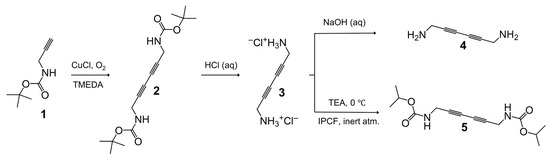
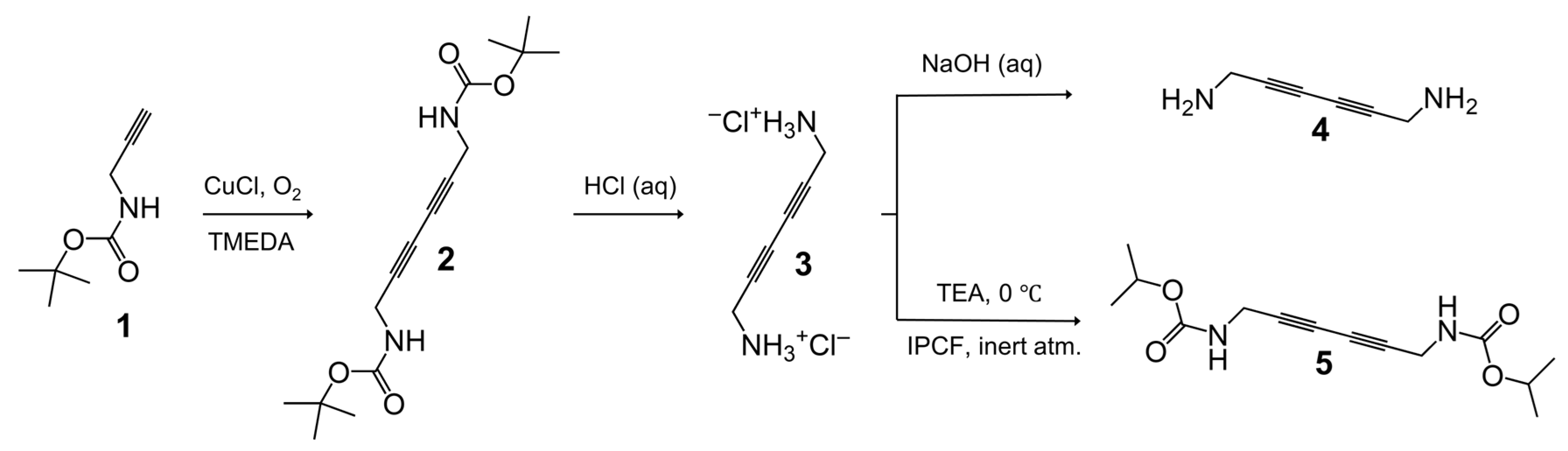
The synthetic route is shown in Scheme 1. Boc-DA (2) was prepared from commercially available N-Boc-propargylamine (1) following a modified literature procedure [26]. Acidic deprotection afforded 2,4-hexadiyne-1,6-diamine dihydrochloride (3), which was subsequently converted to Diamine-DA (4) and the isopropyl carbamate derivative iPrOCO-DA (5). All compounds were characterized by 1H NMR spectroscopy. Detailed synthetic procedures and spectroscopic data are provided in the Supporting Information.
Scheme 1.
Synthesis of Boc-DA, Diamine-DA, iPrOCO-DA; 1: N-Boc-propargylamine; 2: Boc-DA; 3: 2,4-hexadiyne-1,6-diamine dihydrochloride; 4: Diamine-DA; 5: iPrOCO-DA.
3.2. Single-Crystal Structure Analysis of Boc-DA
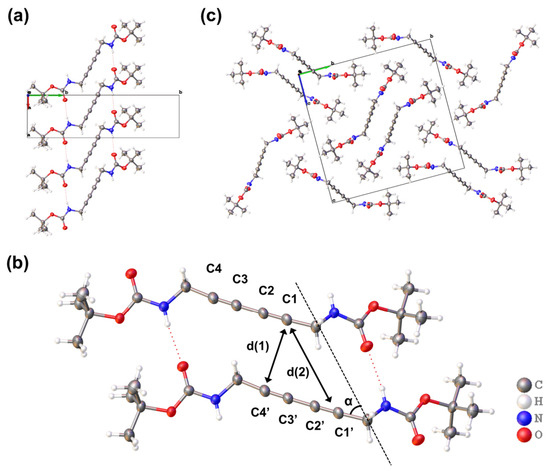
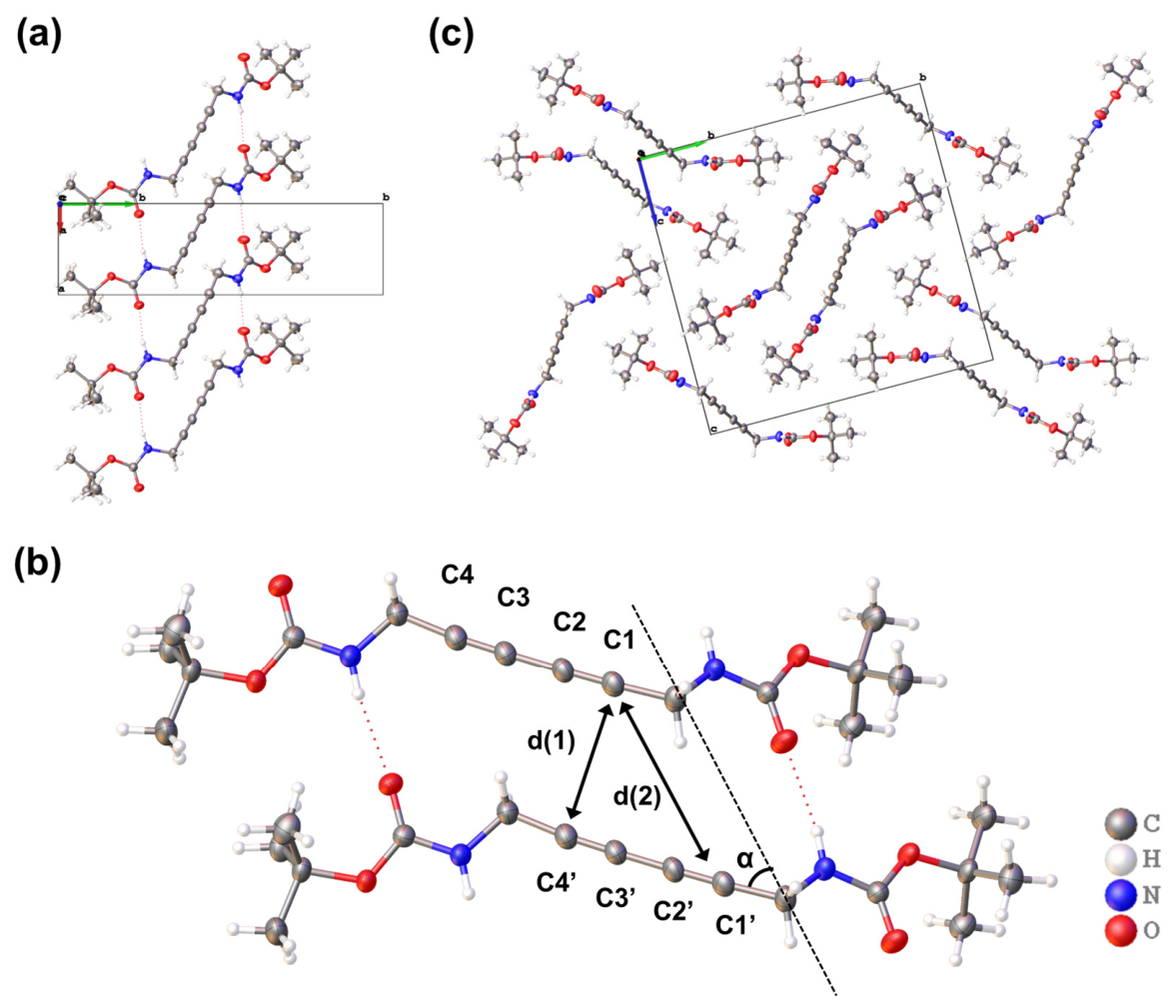
Single-crystal X-ray analyses have shown that Boc-DA crystallizes in P21/c space group with four molecules in the unit cell. No solvent or water molecules were detected in the crystal. All molecules are linked into 1D chains via N-H…O hydrogen bonding of carbamoyl groups. Consequently, each Ci-symmetric unit participates in four hydrogen bonds with two adjacent molecules. This arrangement gives rise to parallel stacking of the carbamate groups, which directs the alignment of the diyne units along the crystallographic a-axis (Figure 2a).
Figure 2.
Crystal structure of Boc-DA. (a) Parallel stacking of the carbamate groups directed by N–H⋯O hydrogen bonding. (b) Geometric parameters relevant to topochemical polymerization: d(1) = 3.59 Å, d(2) = 5.15 Å, and α = 44°. These values fall within the commonly accepted range for diacetylene polymerization. (c) Top view along the a-axis, showing the cross-aligned packing of the Boc groups. Dashed lines indicate hydrogen bonds (red)/intermolecular contacts (black).
According to the crystal structure (Figure 2), the one-dimensional stacking of diacetylene units occurs along the a-axis. In these stacks, the translational repeat distance is d(2) = 5.15 Å is d(2) = 5.15 Å, the C1–C4′ distance between two adjacent diacetylene moieties is d(1) = 3.59 Å, and the critical angle is α = 44° (Figure 2b). In the context of the established criteria for diacetylene polymerization [27,28,29], these geometric parameters appear favorable for topochemical polymerization (Table 2).
Table 2.
Comparison between the optimal geometrical parameters reported for topochemical polymerization and those observed for the stacking of Boc-DA along the a-axis (i.e., the direction parallel to the hydrogen bonds).
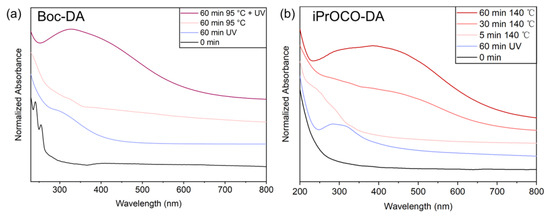
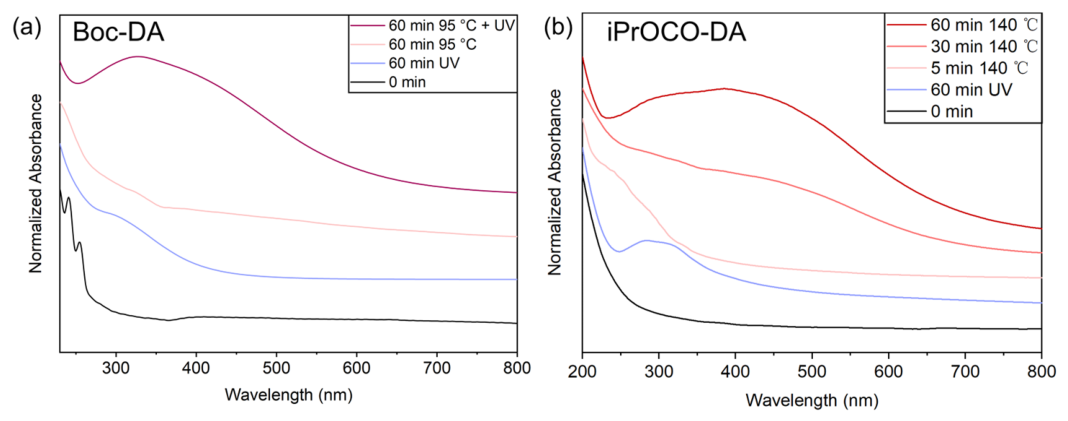
Single-crystal structure revealed that Boc-DA molecules assemble along the hydrogen-bonding direction and that the inter-diacetylene geometries fulfill the topochemical criteria for polymerization. Nevertheless, exposure to 254 nm UV light at an intensity of 1 mW cm−2 for 60 min did not produce detectable polymerization (Figure 3a). The polymer content was measured by NMR spectroscopy (Figure S2). No significant improvement was observed even after extending the irradiation duration to 67 h (Figure S3).
Figure 3.
Solid-state UV–Vis spectra of (a) Boc-DA after 60 min at 95 °C (heating only), 60 min UV irradiation (UV only), and combined 60 min heating + UV irradiation at 95 °C, and (b) iPrOCO-DA after thermal treatment at 140 °C for 5, 30, and 60 min compared with 60 min UV irradiation only.
Structural analysis suggests a possible explanation for this behavior. Specifically, the Boc-DA molecules pack in a cross-aligned motif (Figure 2c), which likely gives rise to an interlocking mechanism wherein the Boc groups impose substantial steric constraints, acting like interlocked gears. This arrangement may hinder the contraction required along the molecular long axis during polymerization—a subtle yet essential structural deformation typically on the order of 1–3% [30].
3.3. Topochemical Polymerization of Diamine-DA, iPrOCO-DA
To test whether the inactivity of Boc-DA originates from steric congestion, we first removed the bulky carbamate protecting groups and synthesized Diamine-DA (Scheme 1). Upon exposure to UV irradiation for 60 min, the powdered Diamine-DA sample underwent quantitative polymerization. After UV irradiation, its UV–Vis spectrum developed broad absorptions characteristic of polydiacetylene formation and its FTIR spectrum developed a distinct C=C peak (Figure S4). Its color turned from white to dark brown and became insoluble (Figure S5). This result suggests that removal of the sterically demanding terminal substituents facilitates topochemical polymerization.
We next examined iPrOCO-DA (Scheme 1), a structural analogue in which each terminus contains one fewer methyl group compared to Boc-DA. The Powder X-ray diffraction (PXRD) patterns of Boc-DA and iPrOCO-DA show that they share several reflections, suggesting related packing motifs, while differences in peak positions and intensities indicate related but non-identical molecular arrangements (Figure S6, Section S8). After 60 min of UV irradiation, iPrOCO-DA displayed more pronounced color development and spectral changes than Boc-DA, although the polymer yield remained low (Figure 3b). NMR analysis revealed a gradual increase in polymer content with extended irradiation: 6 ± 14% after 30 min, 13 ± 12% after 60 min, and 20 ± 10% after 120 min (Figures S7–S9). These observations suggest that the iPrOCO substituent is still sufficiently large to restrict molecular motion, thereby limiting the small lattice rearrangements, typically on the order of 1–3%, required during polymerization.
3.4. Thermal Polymerization of iPrOCO-DA
To overcome steric hindrance, we examined thermally activated polymerization, reasoning that elevated temperature could provide sufficient molecular mobility to partially unlock the sterically constrained packing. Heating iPrOCO-DA at 140 °C markedly accelerated the reaction: the sample rapidly turned from white to deep brown (Figure S10), and its UV–Vis spectrum developed broad absorptions characteristic of polydiacetylene formation (Figure 3b), resembling previously reported diamide derivatives [31]. Its FTIR spectrum developed a distinct C=C peak, which is a typical sign of diacetylene polymerization (Figure S11).
3.5. Thermal Polymerization of Boc-DA
An analogous experiment with Boc-DA was not possible because it melts at 106 °C. We observed only a slight color change of the powder upon heating beyond the melting point, and no solid polymer formed even after 12 h of heating.
We therefore attempted thermal activation below the melting point (95 °C for 60 min). The sample exhibited subtle color changes and minor changes in the UV–Vis spectrum (Figure 3a). NMR analysis detected no small-molecule degradation products (Figure S12), suggesting that the color change arises from partial polymerization, albeit at very low conversion. The polymer content is approximately 6 ± 9% (Figure S13). After heating at 95 °C for 22 h, the polymer content is approximately 7 ± 9%, indicating that heating alone is insufficient to induce effective polymerization (Figure S14).
3.6. Combined Thermal and UV Polymerization of Boc-DA
Hypothesizing that the polymerization of Boc-DA is inhibited by interlocking of the terminal groups, we were interested in testing the simultaneous action of thermal (95 °C) and photochemical (254 nm UV) activation. Combined heating at 95 °C and irradiation with 254 nm UV light for 60 min produced a clear increase in polymerization efficiency compared with either treatment alone (Figure 3a), and the polymer content is approximately 53 ± 8% (Figure S15). Although ideal polydiacetylenes with highly planar backbones often show excitonic absorption in the 500–700 nm region, the absorption maxima in this study were below 500 nm. Previous studies with structurally similar molecules reported comparable UV–Vis absorption spectra [31]. This may suggest less extended conjugation, possibly related to some degree of backbone distortion, structural disorder, limited conjugation length, or incomplete polymerization.
Extending the reaction time to 22 h, the sample treated with thermal and UV irradiation showed a more distinct color change (Figure S16) and a stronger C=C peak at 1632 cm−1 in the FTIR transmission spectrum than the sample treated with thermal only (Figure S17), indicating a much higher extent of polymerization with a polymer content of 77 ± 3% (Figure S18). The incomplete conversion (not reaching 100%) may stem from unpolymerized monomers existing as short, isolated stacks separated by PDA domains, which hinders further quantitative polymerization. Nevertheless, the results clearly indicate a synergistic effect of combined heating and UV irradiation: 1 h of heating + UV treatment produced a higher polymer content than either 22 h of heating alone or 67 h of UV irradiation alone (Figure S3).
DSC and TGA measurements were performed to rule out two possible scenarios: (1) an intermediate solid–solid phase transition in which the Boc-DA crystal structure (Figure 2) changes to a form more favorable for topochemical polymerization; (2) the known possibility of thermal deprotection of Boc groups, which would yield easily polymerizable Diamine-DA.
The DSC curve of Boc-DA shows one dominant thermal event at around 106 °C, which is consistent with the melting point of Boc-DA, while no obvious additional phase-transition peak was observed below this temperature (Figure S19a). Therefore, within the temperature range relevant to our combined heating/UV experiments (95 °C), the enhanced polymerization is unlikely to originate from a prior solid-state phase transition. These results suggest that heating mainly provides additional molecular mobility that helps partially overcome the steric constraints imposed by the interlocked packing.
A notable feature of this DSC is the absence of exothermic polymerization reaction typically observed for non-crowded diacetylenes [32]. Thus, simple 1,6-diacetylamino-2,4-hexadiyne is easily polymerized by heat already at 40 °C with strong exothermicity (heat of polymerization is ~30.7 kcal/mol) [33]. In DSC of iPrOCO-DA (Figure S19b), an endothermic event is observed before melting, which we attribute to the onset of thermal polymerization.
TGA of Boc-DA shows (Figure S20) that there is no thermal Boc deprotection below ~160–180 °C, while above that temperature, there was continuous loss of ~60% weight (full deprotection of all Boc groups corresponds to the loss of 64.9%). Knowing this, we attempted thermal and UV polymerization of the melt, but at a temperature (110 °C) well below the temperature required for the removal of Boc. The results were notable: polymerization occurred in all cases (Figures S21 and S22), and after 3 h of UV irradiation at 110 °C, the resulting polymer exhibited a UV–Vis absorption maximum at 530 nm, with a tail extending below 700 nm (Figure S21). This can be interpreted as the formation of a longer conjugated polymer chain.
4. Conclusions
This work demonstrates that compliance with “optimal” geometric parameters alone is insufficient to ensure solid-state reactivity. Although favorable intermolecular distances and orientations are necessary, they do not guarantee bond formation. We show that local steric constraints arising from densely packed bulky protecting groups restrict the subtle lattice adjustments required for topochemical polymerization. Reducing the steric bulk of the side groups alleviates these constraints and facilitates polymerization.
Furthermore, we demonstrate that in such cases, dual-mode activation combining UV irradiation and elevated temperature acts synergistically. This combined approach enables efficient polymerization of compounds that remain poorly reactive under purely thermal or purely photochemical activation.
From a practical perspective, the steric profile of protecting groups emerges as a simple and tunable design parameter for controlling topochemical polymerization. Bulky groups can enhance the shelf life of monomeric precursors by suppressing premature reactivity, while multimodal activation—either chemical (via deprotection) or combined thermal and photochemical stimuli—provides a strategy for designing systems with switchable or conditionally accessible polydiacetylene formation.
Supplementary Materials
The following supporting information can be downloaded at: https://www.mdpi.com/article/10.3390/cryst16050305/s1. Table S1: Refined Unit Cell Parameters for iPrOCO-DA (P2/m), Table S2: Experimental vs. Calculated Reflections for iPrOCO-DA (P2/m) [34], Table S3: Data Collection and Refinement Statistics for iPrOCO-DA, Figure S1: (a) Illustration of ASVC of Boc-DA; (b) Optical micrograph of a large crystal of Boc-DA (scale bar: 2 mm), Figure S2: 1H NMR (400 MHz, CDCl3) experimental spectra for Boc-DA UV irradiated for 60 min. Calculated polymer yield is: (2 ± 21)%, Figure S3: UV–Vis spectra of Boc-DA after UV irradiation for 67 h under an inert atmosphere, room temperature. The small, inserted photo showed the color change after the treatment (from white to yellow), Figure S4: Solid-state (a) UV–Vis and (b) FTIR spectra of Diamine-DA before and after UV irradiation (red trace), Figure S5: 1H NMR (400 MHz, CDCl3) experimental spectra for Diamine-DA UV irradiated for 60 min. No peaks other than solvent were detected. The small, inserted photo showed that the sample was insoluble after the treatment, Figure S6: PXRD patterns of Boc-DA and iPrOCO-DA collected at room temperature. Unit cell parameters of BocDA are taken from single-crystal determination. For the details of unit cell refinement of iPrOCO-DA see Section S8, Figure S7: 1H NMR (400 MHz, CDCl3) experimental spectra for iPrOCO-DA UV irradiated for 30 min. Calculated polymer yield is: (6 ± 14)%, Figure S8: 1H NMR (400 MHz, CDCl3) experimental spectra for iPrOCO-DA UV irradiated for 60 min. Calculated polymer yield is: (13 ± 12)%, Figure S9: 1H NMR (400 MHz, CDCl3) experimental spectra for iPrOCO-DA UV irradiated for 120 min. Calculated polymer yield is: (20 ± 10)%, Figure S10: Photo of iPrOCO-DA powder (a) before and (b) after thermal treatment. Photo of Boc-DA powder (c) before and (d) after thermal + UV treatment. For increased contrast, these images were taken through a polarized filter, Figure S11: FTIR spectra of iPrOCO-DA (black), iPrOCO-DA after 60 min 140 °C heating (red), Figure S12: 1H NMR (400 MHz, CDCl3) experimental spectra for Boc-DA heated at 95 °C for 60 min. No small molecule degradation products detected, Figure S13: 1H NMR (400 MHz, CDCl3) experimental spectra for Boc-DA heated at 95 °C for 1 h. Calculated polymer yield is: (6 ± 9)%, Figure S14: 1H NMR (400 MHz, CDCl3) experimental spectra for Boc-DA heated at 95 °C for 22 h. Calculated polymer yield is: (7 ± 9)%, Figure S15: 1H NMR (400 MHz, CDCl3) experimental spectra for Boc-DA UV heated at 95 °C + UV irradiated for 60 min. Calculated polymer yield is: (53 ± 8)%, Figure S16: Photos of Boc-DA after (a) 10 min, (b) 1 h and (c) 22 h treatment. The left part was treated with 95 °C heating only while the right part was treated with 95 °C + UV, Figure S17: FTIR spectra of Boc-DA (black), Boc-DA after 22 h 95 °C heating (red) and Boc-DA after 22 h 95 °C + UV treatment (blue), Figure S18: 1H NMR (400 MHz, CDCl3) experimental spectra for Boc-DA heated at 95 °C + UV irradiated for 22 h. Calculated polymer yield is: (77 ± 3)%, Figure S19: Differential Scanning Calorimetry (DSC) curves of (a) Boc-DA and (b) iPrOCO-DA collected at a heating rate of 2 °C min−1. Endo up, exo down, Figure S20: Thermogravimetric Analysis (TGA) of Boc-DA, Figure S21: Solid-state UV–Vis spectra of Boc-DA melted at 110 °C, treated with 110 °C for 1 h, treated with 110 ° C + UV 1 h, treated with 110 °C 3 h, treated with 110 °C + UV 3 h, Figure S22: Photos of (a) Boc-DA melted at 110 °C, (b) treated with 110 °C for 1 h, (c) treated with 110 °C + UV 1 h, (d) treated with 110 °C 3 h, (e) treated with 110 °C + UV 3 h, Figure S23: 1H NMR (400 MHz, DMSO-d6) experimental spectra for 2,4-hexadiyne-1,6-diamine dihydrochloride, Figure S24: 1H NMR (400 MHz, CDCl3) experimental spectra for Diamine-DA, Figure S25: 1H NMR (400 MHz, DMSO-d6) experimental spectra for Boc-DA, Figure S26: 1H NMR (400 MHz, DMSO-d6) experimental spectra for iPrOCO-DA.
Author Contributions
Conceptualization, R.D., Y.F. and O.I.; methodology, O.I.; validation, R.D. and K.T.; formal analysis, R.D. and K.T.; investigation, R.D. and K.T.; resources, O.I. and Y.F.; data curation, R.D. and K.T.; writing—original draft preparation, R.D.; writing—review and editing, all authors; supervision, O.I. All authors have read and agreed to the published version of the manuscript.
Funding
This research was funded by the National Natural Science Foundation of China (Grant No. 22372110, 22372111, 22350610244, U24A20496, and 22161132026), the Suzhou Key Laboratory of Surface and Interface Intelligent Matter (Grant No. SZS2022011), the Gusu Innovation and Entrepreneurship Talent Program—Major Innovation Team (Grant No.ZXD2023002), the Center for Innovation in the Molecular Science of Surface and Interface (CIMSSI), the Suzhou Key Laboratory of Functional Nano & Soft Materials, the Collaborative Innovation Center of Suzhou Nano Science & Technology, and the 111 Project.
Data Availability Statement
The data presented in this study are available on request from the corresponding authors.
Acknowledgments
The authors gratefully acknowledge the resources provided by Qiang Chen (Soochow University).
Conflicts of Interest
The authors declare no conflicts of interest.
Abbreviations
The following abbreviations are used in this manuscript:
| NMR | Nuclear magnetic resonance |
| DCM | Dichloromethane |
| DMF | Dimethylformamide |
| TMEDA | Tetramethylethylenediamine |
| TEA | Triethylamine |
| IPCF | Isopropyl chloroformate |
| UV | Ultraviolet |
| UV–Vis | Ultraviolet – visible |
| FTIR | Fourier transform infrared spectroscopy |
References
- Wegner, G. Topochemische Reaktionen von Monomeren mit konjugierten Dreifachbindungen: I. Mitt.: Polymerisation von Derivaten des 2.4-Hexadiin-1.6-diols im kristallinen Zustand. Z. Naturforsch. B 1969, 24, 824–832. [Google Scholar] [CrossRef] [Scilit]
- Baughman, R.H. Solid-state synthesis of large polymer single crystals. J. Polym. Sci. Polym. Phys. Ed. 1974, 12, 1511–1535. [Google Scholar] [CrossRef] [Scilit]
- Wegner, G. Solid-state polymerization mechanisms. Pure Appl. Chem. 1977, 49, 443–454. [Google Scholar] [CrossRef] [Scilit]
- Baughman, R.H. Solid-state polymerization of diacetylenes. J. Appl. Phys. 1972, 43, 4362–4370. [Google Scholar] [CrossRef] [Scilit]
- Enkelmann, V. Structural aspects of the topochemical polymerization of diacetylenes. Adv. Polym. Sci. 1984, 63, 91–136. [Google Scholar] [CrossRef] [Scilit]
- Lauher, J.W.; Fowler, F.W.; Goroff, N.S. Single-crystal-to-single-crystal topochemical polymerizations by design. Acc. Chem. Res. 2008, 41, 1215–1229. [Google Scholar] [CrossRef] [Scilit]
- Biradha, K.; Santra, R. Crystal engineering of topochemical solid state reactions. Chem. Soc. Rev. 2013, 42, 950–967. [Google Scholar] [CrossRef] [Scilit] [PubMed]
- Halasz, I. Single-crystal-to-single-crystal reactivity: Gray, rather than black or white. Cryst. Growth Des. 2010, 10, 2817–2823. [Google Scholar] [CrossRef] [Scilit]
- Baughman, R.H.; Chance, R.R. Solid-state polymerization of a diacetylene crystal: Thermal, ultraviolet, and γ-ray polymerization of 2,4-hexadiyne-1,6-diol bis-(p-toluene sulfonate). J. Polym. Sci. Polym. Phys. Ed. 1978, 16, 859–881. [Google Scholar] [CrossRef] [Scilit]
- Lim, C.; Sandman, D.J.; Sukwattanasinitt, M. Topological Polymerization of tert-Butylcalix[4]Arenes Containing Diynes. Macromolecules 2008, 41, 675–681. [Google Scholar] [CrossRef] [Scilit]
- Fowler, F.W.; Lauher, J.W. A rational design of molecular materials. J. Phys. Org. Chem. 2000, 13, 850–857. [Google Scholar] [CrossRef] [Scilit]
- Curtis, S.M.; Le, N.; Fowler, F.W.; Lauher, J.W. A rational approach to the preparation of polydipyridyldiacetylenes: An exercise in crystal design. Cryst. Growth Des. 2005, 5, 2313–2321. [Google Scholar] [CrossRef] [Scilit]
- Dautel, O.J.; Robitzer, M.; Lère-Porte, J.-P.; Serein-Spirau, F.; Moreau, J.J.E. Self-organized ureido substituted diacetylenic organogel. Photopolymerization of one-dimensional supramolecular assemblies to give conjugated nanofibers. J. Am. Chem. Soc. 2006, 128, 16213–16223. [Google Scholar] [CrossRef] [Scilit]
- Ikeshima, M.; Katagiri, H.; Fujiwara, W.; Tokito, S.; Okada, S. Synthesis, crystal structures, and solid-state polymerization of 8-[4-(dimethylamino)phenyl]octa-5,7-diynyl carbamates. Cryst. Growth Des. 2018, 18, 5991–6000. [Google Scholar] [CrossRef] [Scilit]
- Lee, J.; Yarimaga, O.; Lee, C.H.; Choi, Y.; Kim, J. Network Polydiacetylene Films: Preparation, Patterning, and Sensor Applications. Adv. Funct. Mater. 2011, 21, 1032–1039. [Google Scholar] [CrossRef] [Scilit]
- Baughman, R.H. Solid-state reaction kinetics in single-phase polymerizations. J. Chem. Phys. 1978, 68, 3110–3121. [Google Scholar] [CrossRef] [Scilit]
- Spagnoli, S.; Fave, J.-L.; Schott, M. Photopolymerization of thin polycrystalline diacetylene films and quenching of the precursor excited state. Macromolecules 2011, 44, 2613–2625. [Google Scholar] [CrossRef] [Scilit]
- Galukhin, A.; Kachmarzhik, A.; Rodionov, A.; Mamin, G.; Gafurov, M.; Vyazovkin, S. Kinetics and mechanism of liquid-state polymerization of 2,4-hexadiyne-1,6-diyl bis-(p-toluenesulfonate) as studied by thermal analysis. Polymers 2024, 16, 7. [Google Scholar] [CrossRef] [Scilit] [PubMed]
- Ouyang, X.; Fowler, F.W.; Lauher, J.W. Single-crystal-to-single-crystal topochemical polymerizations of a terminal diacetylene: Two remarkable transformations give the same conjugated polymer. J. Am. Chem. Soc. 2003, 125, 12400–12401. [Google Scholar] [CrossRef] [Scilit]
- Qian, X.; Städler, B. Recent Developments in Polydiacetylene-Based Sensors. Chem. Mater. 2019, 31, 1196–1222. [Google Scholar] [CrossRef] [Scilit]
- Weston, M.; Tjandra, A.D.; Chandrawati, R. Tuning Chromatic Response, Sensitivity, and Specificity of Polydiacetylene-Based Sensors. Polym. Chem. 2020, 11, 166–183. [Google Scholar] [CrossRef] [Scilit]
- Hall, A.V.; Yufit, D.S.; Apperley, D.C.; Senak, L.; Musa, O.M.; Hood, D.K.; Steed, J.W. The crystal engineering of radiation-sensitive diacetylene cocrystals and salts. Chem. Sci. 2020, 11, 8025–8035. [Google Scholar] [CrossRef] [Scilit]
- Menzel, H.; Horstmann, S.; Mowery, M.D.; Cai, M.; Evans, C.E. Diacetylene polymerization in self-assembled monolayers: Influence of the odd/even nature of the methylene spacer. Polymer 2000, 41, 8113–8119. [Google Scholar] [CrossRef] [Scilit]
- Hall, A.V.; Musa, O.M.; Hood, D.K.; Apperley, D.C.; Yufit, D.S.; Steed, J.W. Alkali metal salts of 10,12-pentacosadiynoic acid and their dosimetry applications. Cryst. Growth Des. 2021, 21, 2416–2422. [Google Scholar] [CrossRef] [Scilit]
- Shi, D.; Adinolfi, V.; Comin, R.; Yuan, M.; Alarousu, E.; Buin, A.; Chen, Y.; Hoogland, S.; Rothenberger, A.; Katsiev, K.; et al. Low Trap-State Density and Long Carrier Diffusion in Organolead Trihalide Perovskite Single Crystals. Science 2015, 347, 519−522. [Google Scholar] [CrossRef] [Scilit]
- Odani, T.; Okada, S.; Kabuto, C.; Kimura, T.; Shimada, S.; Matsuda, H.; Oikawa, H.; Matsumoto, A.; Nakanishi, H. Solid-State Reactions of Crystals Containing Two Kinds of Polymerizable Moieties of Diene and Diyne. Cryst. Growth Des. 2009, 9, 3481–3487. [Google Scholar] [CrossRef] [Scilit]
- Baillargeon, P.; Boivin, L.; Vaillancourt, D.; Bélanger, M.; Rahem, T.; Fortin, D.; Harvey, P.D. Selective Chirality-Driven Photopolymerization of Diacetylene Crystals. Cryst. Growth Des. 2024, 24, 6829–6837. [Google Scholar] [CrossRef] [Scilit] [PubMed]
- Xu, W.L.; Smith, M.D.; Krause, J.A.; Greytak, A.B.; Ma, S.; Read, C.M.; Shimizu, L.S. Single Crystal to Single Crystal Polymerization of a Self-Assembled Diacetylene Macrocycle Affords Columnar Polydiacetylenes. Cryst. Growth Des. 2014, 14, 993–1002. [Google Scholar] [CrossRef] [Scilit]
- Yao, Y.; Dong, H.; Liu, F.; Russell, T.P.; Hu, W. Approaching Intra- and Interchain Charge Transport of Conjugated Polymers Facilely by Topochemical Polymerized Single Crystals. Adv. Mater. 2017, 29, 1701251. [Google Scholar] [CrossRef] [Scilit]
- Dory, Y.L.; Caron, M.; Duguay, V.O.; Chicoine-Ouellet, L.; Fortin, D.; Baillargeon, P. Preparation and Single Crystal Structure Determination of the First Biobased Furan-Polydiacetylene Using Topochemical Polymerization. Crystals 2019, 9, 448. [Google Scholar] [CrossRef] [Scilit]
- Saleem, S.K.; Pramod, T.; Kuruva, P.; Haridas, S.V.; Shanmugam, A.; Thalakulam, M.; Sureshan, K.M. Light-Induced Transformation of a Supramolecular Gel to a Stronger Covalent Polymeric Gel. ChemPhysChem 2025, 26, e202400861. [Google Scholar] [CrossRef] [Scilit]
- Lee, D.-C.; Sahoo, S.K.; Cholli, A.L.; Sandman, D.J. Structural Aspects of the Thermochromic Transition in Urethane-Substituted Polydiacetylenes. Macromolecules 2002, 35, 4347–4355. [Google Scholar] [CrossRef] [Scilit]
- Kato, J.; Nakamura, K.; Yamazaki, S.; Tokushige, K.; Amano, T. Thermal behavior of amide substituted diacetylenes. J. Polym. Sci. Part A Polym. Chem. 1989, 27, 1853–1862. [Google Scholar] [CrossRef] [Scilit]
- Toby, B.H.; Von Dreele, R.B. GSAS-II: The genesis of a modern open-source all purpose crystallography software package. J. Appl. Crystallogr. 2013, 46, 544–549. [Google Scholar] [CrossRef] [Scilit]

Disclaimer/Publisher’s Note: The statements, opinions and data contained in all publications are solely those of the individual author(s) and contributor(s) and not of MDPI and/or the editor(s). MDPI and/or the editor(s) disclaim responsibility for any injury to people or property resulting from any ideas, methods, instructions or products referred to in the content. |
© 2026 by the authors. Licensee MDPI, Basel, Switzerland. This article is an open access article distributed under the terms and conditions of the Creative Commons Attribution (CC BY) license.