


Abstract
The rational design of electrode materials with tailored composition and architecture is crucial for advancing high-capability electrochemical energy storage systems. This study reports that gadolinium-modified NiFe2O4 nanosheet electrodes were effectively synthesized on nickel foam via a hydrothermal approach followed by thermal treatment. A series of compositions (NiFe, NiFe–Gd1, NiFe–Gd2, and NiFe–Gd3) were prepared to systematically examine the effect of Gd incorporation on structural features and electrochemical properties. X-ray diffraction (XRD) analysis confirmed the formation of the cubic spinel NiFe2O4 phase without detectable secondary phases, indicating that the crystal structure remains intact after Gd introduction. X-ray photoelectron spectroscopy (XPS) further verified the presence of Ni2+, Fe3+, and Gd3+ species within the lattice environment. Morphological analysis using field-emission scanning electron microscopy (FESEM) revealed a nanosheet-based architecture, where the optimized NiFe–Gd2 electrode exhibited a porous and interconnected nanosheet framework with abundant exposed edges. This structural configuration improves electrolyte penetration and facilitates efficient ion transport during charge storage processes. Electrochemical measurements demonstrated that the NiFe–Gd2 electrode delivers an areal capacitance of 5235 mF cm−2 at 10 mA cm−2, along with improved reaction kinetics and low internal resistance. An asymmetric supercapacitor assembled using NiFe–Gd2 as the positive electrode and activated carbon as the negative electrode operated stably within a 0–1.5 V potential window, achieving an energy density of 0.136 mWh cm−2 and a power density of 3.14 mW cm−2, while retaining 86.55% of its initial capacitance after 7000 cycles. These results highlight the potential of rare-earth engineering as a viable strategy for designing advanced spinel ferrite electrodes and pave the way for the development of high-performance, durable, and scalable supercapacitor systems for practical energy storage applications.
1. Introduction
The decarbonization of modern energy infrastructures requires electrochemical storage systems that can efficiently manage intermittent power generation while sustaining high-rate energy delivery [1,2]. The rising integration of intermittent renewable sources into power grids, together with the expanding market for portable and miniaturized electronics, requires energy storage devices that can operate efficiently under high power conditions without compromising durability [3]. While lithium-ion batteries dominate high-energy applications, their inherently slow charge–discharge kinetics, coupled with safety concerns at high-rate operation, restrict their suitability for fast energy buffering [4]. In this context, supercapacitors have emerged as complementary systems due to their high-power density and fast electrochemical response, and extended cycle life. However, their comparatively lower energy density remains a fundamental limitation, necessitating advanced material design strategies to overcome the intrinsic performance disparity between batteries and conventional capacitors [5]. The performance of supercapacitors is intrinsically governed by their charge storage mechanism. Electrochemical double-layer capacitors (EDLCs), typically based on porous carbon materials, store charge via reversible electrostatic ion adsorption/desorption at the electrode–electrolyte interface, ensuring excellent cycling stability but limited capacitance [6]. Conversely, pseudocapacitors rely on fast, reversible Faradaic charge-transfer reactions of redox-active materials, enabling significantly higher charge storage capacity [7]. Transition metal oxides such as Ruthenium dioxide (RuO2), Manganese dioxide (MnO2), Nickel oxide (NiO), and Cobalt oxide (Co3O4) have been widely investigated because of their rich redox chemistry and high theoretical capacitance [8]. While RuO2 exhibits excellent electrochemical reversibility, its high-cost limits practical applications. The other oxides, although economically viable, often suffer from insufficient low electrical conductivity coupled with structural instability during prolonged redox cycling. These boundaries have prompted exploration of multicomponent oxide systems with enhanced electronic and structural stability [9]. Spinel-structured mixed transition metal oxides (AB2O4) have attracted particular attention due to the synergistic interaction between two metal cations within a single crystalline lattice [10]. The coexistence of multiple redox-active centers promotes enhanced electrochemical activity, while the spinel framework provides structural robustness during ion insertion and extraction [11]. Among these materials, Nickel ferrite (NiFe2O4) stands out as a promising pseudocapacitive electrode owing to its low cost, environmental compatibility, and chemical stability [12]. The presence of Ni2+/Ni3+ and Fe2+/Fe3+ redox couples enable multiple electron-transfer pathways, contributing to improved charge storage performance compared with single-component oxides [13].
Emerging research highlights the significant promise of NiFe2O4-derived systems in energy storage technologies. Vidyadevi et al. reported that NiFe2O4 thin films synthesized by spray pyrolysis exhibited a cubic spinel structure and delivered a high specific capacitance of 707 F g−1 at 2 mV s−1 with an energy density of 83.88 Wh kg−1 in 1 M KOH [14]. Hsu et al. investigated Bi-substituted NiFe2O4 (NiFe2−x BixO4, 20% Bi), achieving 339.16 F g−1 with 90.76% capacitance retention after 5000 cycles [13]. Zhu et al. enhanced electrochemical performance through composite engineering by integrating NiFe2O4 with N-doped porous carbon, increasing capacitance from 136.4 to 201.4 F g−1 at 1 A g−1 with 85.7% retention after 10,000 cycles [15]. Furthermore, Yan et al. reported Mn-doped NiFe2O4 nanosheet arrays delivering an areal capacitance of 8.68 F cm−2 and demonstrating excellent cycling stability in hybrid supercapacitor devices [16]. Although these investigations confirm that morphology control, composite formation, and transition metal substitution can improve electrochemical performance, the intrinsic electronic conductivity and lattice-level defect chemistry of NiFe2O4 remain only partially optimized. Most reported modifications focus on surface engineering or secondary phase integration, while controlled structural modulation within the spinel lattice has received comparatively less systematic attention [17].
Cation substitution at the lattice level offers a direct strategy to regulate crystal structure, electronic environment, and defect formation. Transition metal dopants such as Co, Mn, and Zn can influence cation distribution and moderately enhance conductivity [18]. However, rare-earth elements introduce stronger lattice perturbations because of their larger ionic radii and distinct electronic configurations. Their incorporation can induce lattice strain, alter metal–oxygen bond characteristics, and generate oxygen vacancies, thereby facilitating improved charge transport and electrochemical kinetics. Among rare-earth ions, Gadolinium (Gd) is particularly attractive for structural engineering of spinel ferrites. Partial substitution of Gd into the Fe sublattice can lead to controlled lattice expansion, modified cation redistribution, and enhanced defect density [19]. Such rare-earth-induced structural modulation is expected to improve electronic conductivity, increase electroactive site accessibility, and accelerate ion diffusion during redox cycling [20]. Despite these promising attributes, a systematic correlation between Gd-induced lattice modification and device-level electrochemical performance in NiFe2O4-based asymmetric supercapacitors has not been comprehensively established [21,22].
The present study focuses on evaluating the impact of rare-earth doping on both the structural features and electrochemical performance of NiFe2O4 through the controlled incorporation of Gd into its spinel structure. A series of Gd-doped NiFe2O4 samples with different dopant concentrations was synthesized to determine the optimum Gd content and to better understand how doping influences the crystal structure, morphology, and charge storage behavior. Detailed structural and electrochemical studies were performed to establish a clear relationship between Gd-induced structural changes and supercapacitor performance. In addition, the optimized material was assembled into an asymmetric supercapacitor device to evaluate its energy density, power density, and cycling stability under practical operating conditions.
2. Experimental Section
Preparation of NiFe2O4 and Gd-Doped NiFe2O4 Electrodes
NiFe2O4 and Gd-doped NiFe2O4 electrodes were fabricated in situ on nickel foam using a hydrothermal process followed by annealing. For the preparation of 200 mL precursor solution, 0.10 mol of nickel nitrate hexahydrate (Ni (NO3)2·6H2O) and 0.20 mol of ferric nitrate nonahydrate (Fe(NO3)3·9H2O) were dissolved in deionized water under continuous stirring, maintaining a Ni2+:Fe3+ molar ratio of 1:2. The mixture was continuously stirred until a clear and uniform solution was obtained. For Gd doping, calculated amounts of gadolinium nitrate (Gd(NO3)3) were added to the precursor solution to obtain 1 mol %, 2 mol %, and 3 mol % substitution levels. The mixture was stirred thoroughly to ensure uniform distribution of Gd ions. The solution pH was subsequently adjusted to 9–10 through the gradual addition of ammonia solution under constant stirring to promote controlled precipitation of the mixed hydroxides. Nickel foam (NF) substrates (2 × 3 cm2) were cleaned by ultrasonication in 3 M hydrochloric acid (HCl), ethanol, and deionized water for 10 min each to remove surface impurities. The cleaned substrates were immersed in the prepared precursor solution, which was then transferred into a Teflon-lined stainless-steel autoclave(4science.net, Seongnam-si, Gyeonggi-do, Republic of Korea) and heated at 180 °C for 12 h. Upon cooling naturally to ambient temperature, the samples were removed, rinsed thoroughly with deionized water and ethanol, and dried at 80 °C. Finally, the electrodes were annealed in air at 500 °C for 3 h to obtain crystalline NiFe2O4. The prepared samples were labeled as NiFe (undoped), NiFe–Gd1 (1 mol % Gd), NiFe–Gd2 (2 mol % Gd), and NiFe–Gd3 (3 mol % Gd). The as-prepared electrodes were directly used as binder-free working electrodes for electrochemical measurements.
Table 1.
Precursor composition and nominal stoichiometry of synthesized samples.
3. Sample Characterization and Electrochemical Measurements
The structural, surface, and electrochemical properties of the synthesized NiFe and Gd-doped NiFe2O4 electrodes were examined using standard characterization techniques. Phase identification was carried out by XRD using a PANalytical X’Pert PRO (XRD: PANalytical, Almelo, The Netherlands) diffractometer with Cu-Kα radiation (λ = 1.5406 Å), operated at 40 kV and 40 mA. The chemical states and surface composition were further investigated by XPS using a Thermo Scientific Kα+ system (XPS: Cheshire, UK analysis system) equipped with a monochromatic Al Kα source (hν = 1486.6 eV). The surface morphology of the samples was analyzed using field-emission scanning electron microscopy (FE-SEM, Hitachi S-4800, Chiyoda, Tokyo, Japan) at an accelerating voltage of 5 kV. Prior to imaging, a thin platinum coating was applied to avoid surface charging. Elemental composition and distribution of Ni, Fe, Gd, and O were determined by energy-dispersive X-ray spectroscopy (EDS) attached to the FE-SEM system. Electrochemical measurements were performed using a Biologic WBCS3000 (BioLogic Science Instruments, Seyssinet-Pariset, France) workstation in a conventional three-electrode configuration. The as-prepared NiFe and NiFe–Gd electrodes grown on nickel foam served directly as the working electrodes, while a platinum wire and Ag/AgCl electrode were used as the counter and reference electrodes, respectively. A 2 M KOH aqueous solution was used as the electrolyte. Cyclic voltammetry (CV) measurements were recorded within an appropriate potential window at various scan rates to evaluate redox behavior. Galvanostatic charge–discharge (GCD) tests were conducted at different current densities to determine specific capacitance and rate performance. Electrochemical impedance spectroscopy (EIS) was carried out over a frequency range from 100 kHz to 0.01 Hz with a small AC amplitude to analyze charge transfer resistance and internal resistance characteristics.
4. Results and Discussions
4.1. XRD Elucidation
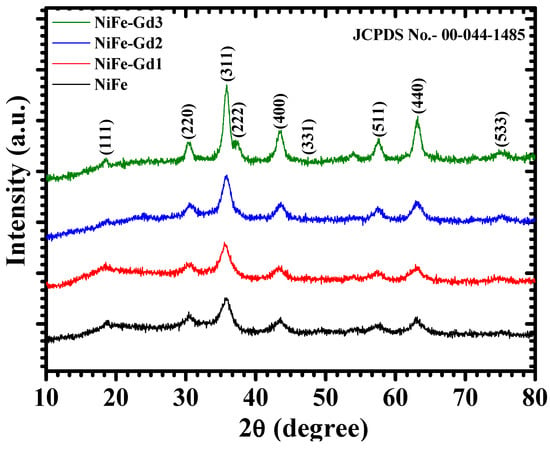
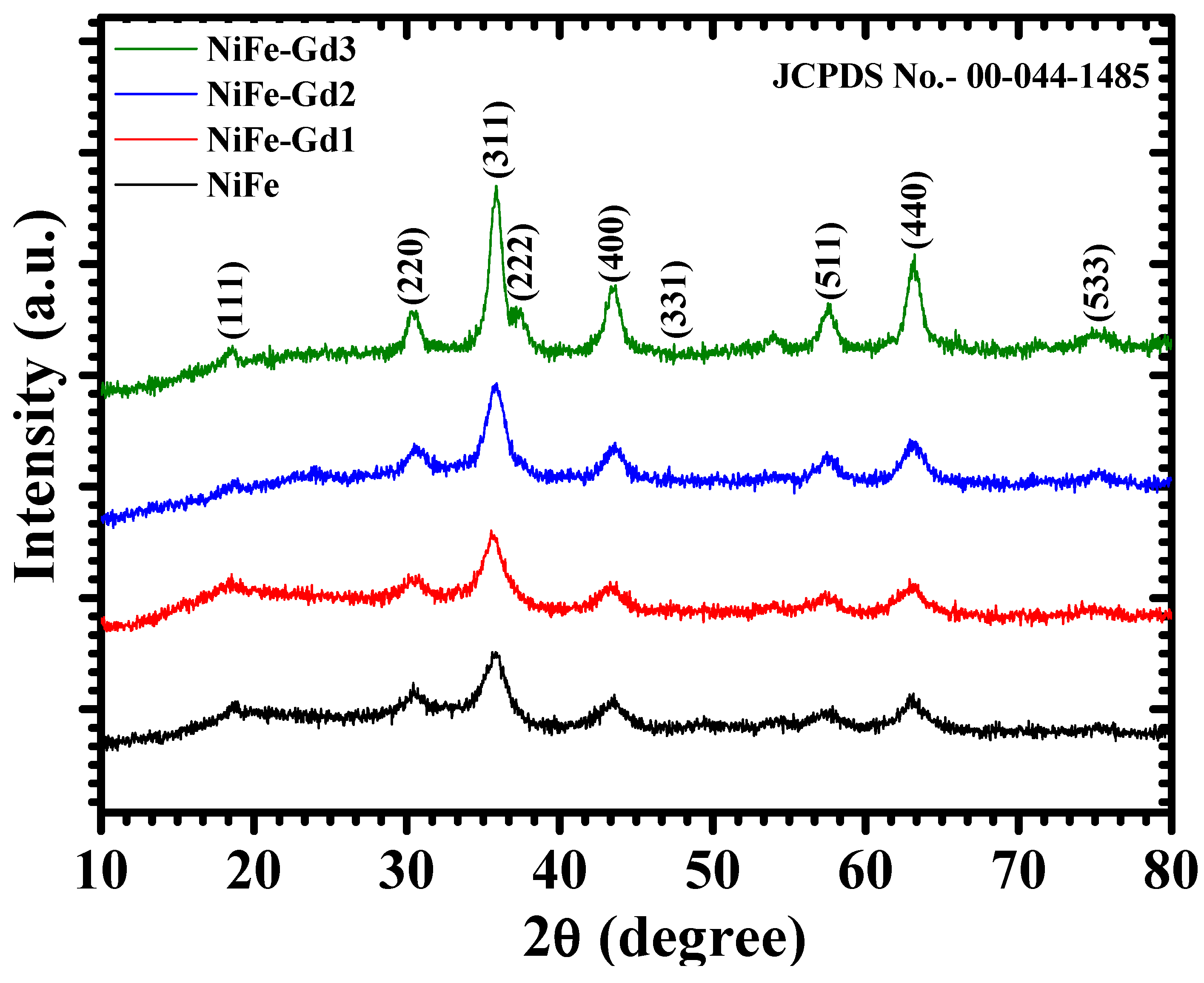
The crystal structure of the prepared NiFe and Gd-modified NiFe2O4 samples was examined by XRD, and the corresponding patterns are depicted in Figure 1. All the observed diffraction peaks can be well indexed to the cubic spinel structure of NiFe2O4 and are consistent with the standard JCPDS card No. 00-044-1485 [23]. The characteristic reflections appearing at approximately 2θ ≈ 18.3°, 30.2°, 35.5°, 37.13°, 43.3°, 47.7°, 53.6°, 57.2°, and 62.8° correspond to the (111), (220), (311), (222), (400), (331), (511), (440) and (533) crystallographic planes, respectively. Among these reflections, the (311) peak exhibits the highest intensity, which is a typical feature of crystalline spinel NiFe2O4. After the incorporation of Gd, the overall diffraction profiles remain almost unchanged, indicating that the fundamental spinel framework is preserved. No additional diffraction peaks related to secondary phases or Gd-based oxides are detected within the resolution limit of the instrument, suggesting that Gd is effectively incorporated into the NiFe2O4 lattice rather than forming a separate crystalline phase. A slight variation in peak position and intensity can be noticed for the Gd-modified samples compared with the bare NiFe. A closer examination of the primary diffraction peak reveals a slight shift toward lower 2θ values with increasing Gd content. Specifically, the peak position shifts from 35.60° for pristine NiFe to 35.32° for the NiFe-Gd3 sample, indicating lattice expansion. This behavior can be attributed to the substitution of Fe3+ ions by larger Gd3+ ions, resulting in lattice distortion within the spinel framework. The lattice parameter (a) was calculated using Bragg’s law and the cubic spinel relation based on the (311) reflection. The calculated values show a gradual increase from 8.36 Å for pristine NiFe, 8.38 Å for NiFe-Gd1, 8.40 Å for NiFe-Gd2 to 8.42 Å for the NiFe-Gd3 sample, further confirming the successful incorporation of Gd into the host lattice. Furthermore, the average crystallite size was estimated using the Debye–Scherrer Equation (1) [24]:
where λ is the X-ray wavelength (1.5406 Å), β is the full width at half maximum (FWHM), and θ is the Bragg angle. The calculated crystallite size decreases from approximately 34 nm for pristine NiFe, 28 nm for NiFe-Gd1, 24 nm for NiFe-Gd2, to 19 nm for NiFe-Gd3, indicating that Gd incorporation influences nucleation and growth kinetics, leading to refined nanocrystalline domains. From above all discussion, the XRD results confirm that the introduction of Gd does not alter the basic cubic spinel structure of NiFe2O4, while slightly modifying the lattice environment. It is important to note that Gd ions were introduced in small molar percentages (1–3 mol%) relative to Fe3+ without altering the initial Ni:Fe ratio. Despite this, XRD analysis shows no secondary phases and a systematic shift in primary peaks toward lower 2θ values along with lattice expansion, confirming effective incorporation of Gd into the NiFe2O4 lattice. This incorporation is likely achieved through partial substitution and defect-site occupation, leading to lattice distortion and enhanced electrochemical activity. Such structural modulation is expected to influence the electrochemical behavior of the material [25].
Figure 1.
XRD patterns of pristine NiFe and Gd-incorporated NiFe2O4 samples.
4.2. XPS Analysis
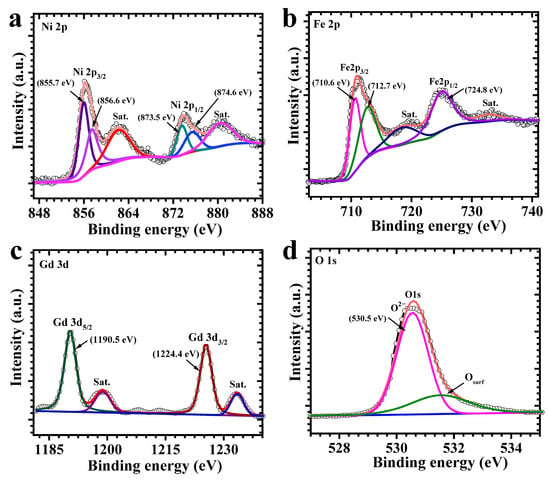
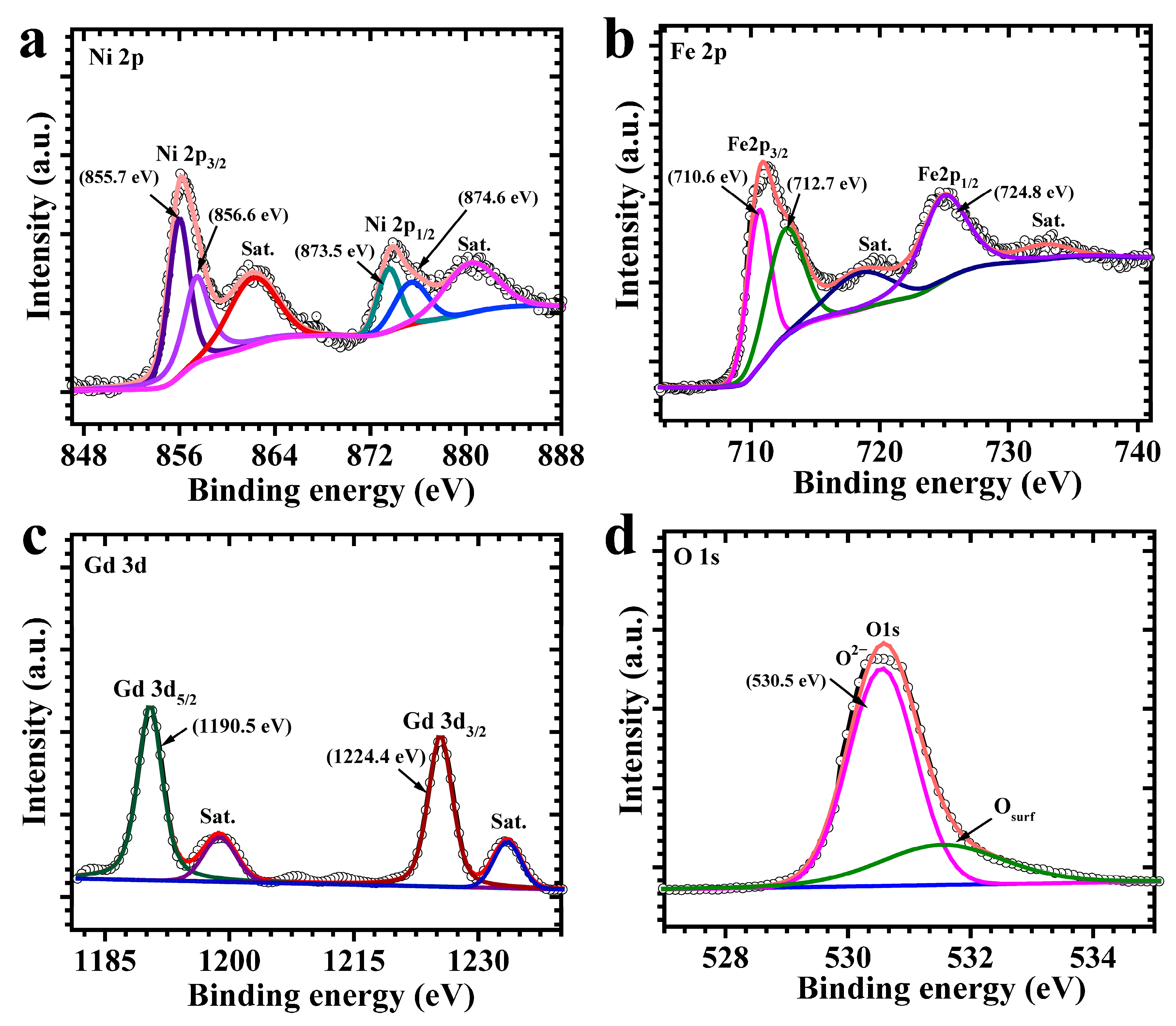
The surface chemical composition and oxidation states of the optimized NiFe–Gd2 sample were analyzed using XPS, and the corresponding high-resolution spectra are presented in Figure 2. The Ni 2p spectrum (Figure 2a) exhibits multiple components associated with the spin–orbit splitting of nickel. Two main peaks appear at binding energies of approximately 855.7 eV and 873.5 eV, corresponding to the Ni 2p3/2 and Ni 2p1/2 states. Additional components located near 856.6 eV and 874.6 eV are also observed, which are generally attributed to the multiplet splitting and satellite features characteristic of Ni2+ species in spinel ferrite structures. The presence of these satellite-related features indicates the oxidized state of nickel and confirms its participation in the NiFe2O4 lattice. The Fe 2p spectrum (Figure 2b) shows characteristic peaks located at approximately 710 eV and 724 eV, corresponding to Fe 2p3/2 and Fe 2p1/2, respectively. A component appearing near 712 eV is also evident, which is commonly associated with the multiplet splitting of iron and is indicative of the Fe3+ oxidation state in ferrite materials [26]. The observed binding energy positions are consistent with previously reported values for spinel NiFe2O4, confirming that the ferrite framework remains stable after the introduction of Gd. The coexistence of Ni2+ and Fe3+ species provides multiple redox-active sites, facilitating efficient charge storage through reversible electron transfer processes. Further evidence for the incorporation of gadolinium is provided by the Gd 3d spectrum (Figure 2c), where two distinct peaks are observed at approximately 1190.5 eV and 1224.4 eV, corresponding to the Gd 3d5/2 and Gd 3d3/2 states. These peak positions are characteristic of Gd3+, indicating that gadolinium is present in its trivalent oxidation state within the material. The incorporation of Gd ions into the ferrite structure can modify the local electronic environment and influence the interaction between the metal cations [25]. Unlike transition metals, Gd3+ does not directly participate in redox reactions; however, its presence significantly alters the local electronic structure. Owing to its larger ionic radius and strong electrostatic interaction, Gd3+ substitution induces lattice distortion and modifies the cation distribution within the spinel structure. The O 1s spectrum (Figure 2d) can be deconvoluted into two main components. The dominant peak centered at around 530.5 eV is attributed to lattice oxygen bonded to metal cations, representing the metal–oxygen framework of the spinel structure. A second component located at higher binding energy in the range of 531.8 eV corresponds to surface-adsorbed oxygen species or hydroxyl groups. These oxygen species are often associated with surface defects or oxygen vacancies, which can contribute to enhanced surface activity and improved charge transfer characteristics during electrochemical processes [27]. Notably, the relative intensity of this defect-related oxygen component is quit high in the Gd-modified sample, suggesting an increased concentration of oxygen vacancies, consistent with previous reports on doped spinel ferrites. The formation of these vacancies is primarily driven by lattice distortion and charge imbalance introduced by Gd3+ incorporation. Oxygen vacancies in oxide and spinel systems are known to exist in different charge states, including neutral, singly ionized, and doubly ionized vacancies, as reported in previous studies [28,29,30]. Such defect states are closely associated with lattice distortion and charge compensation mechanisms in complex oxides. In this context, the possible presence of oxygen vacancies in the present system is interpreted based on indirect experimental indications (XPS and XRD) in conjunction with established literature reports. These oxygen vacancies play a pivotal role in improving electrochemical performance by acting as active sites for OH− adsorption, facilitating ion diffusion, and enhancing surface reactivity.
Figure 2.
High-resolution XPS spectra of the optimized NiFe–Gd2 electrode showing (a) Ni 2p, (b) Fe 2p, (c) Gd 3d, and (d) O 1s regions.
4.3. Morphological and Elemental Composition
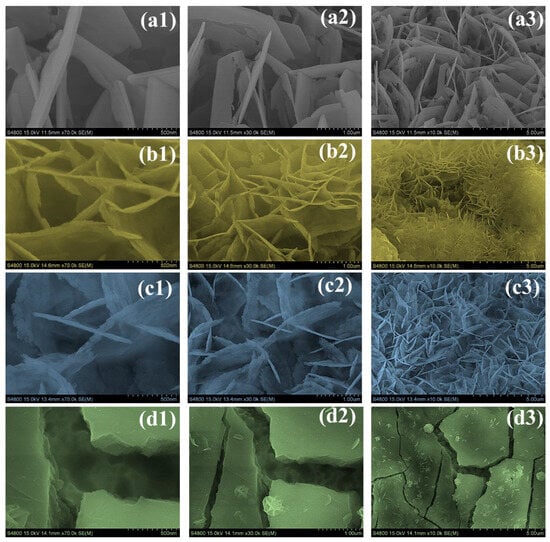
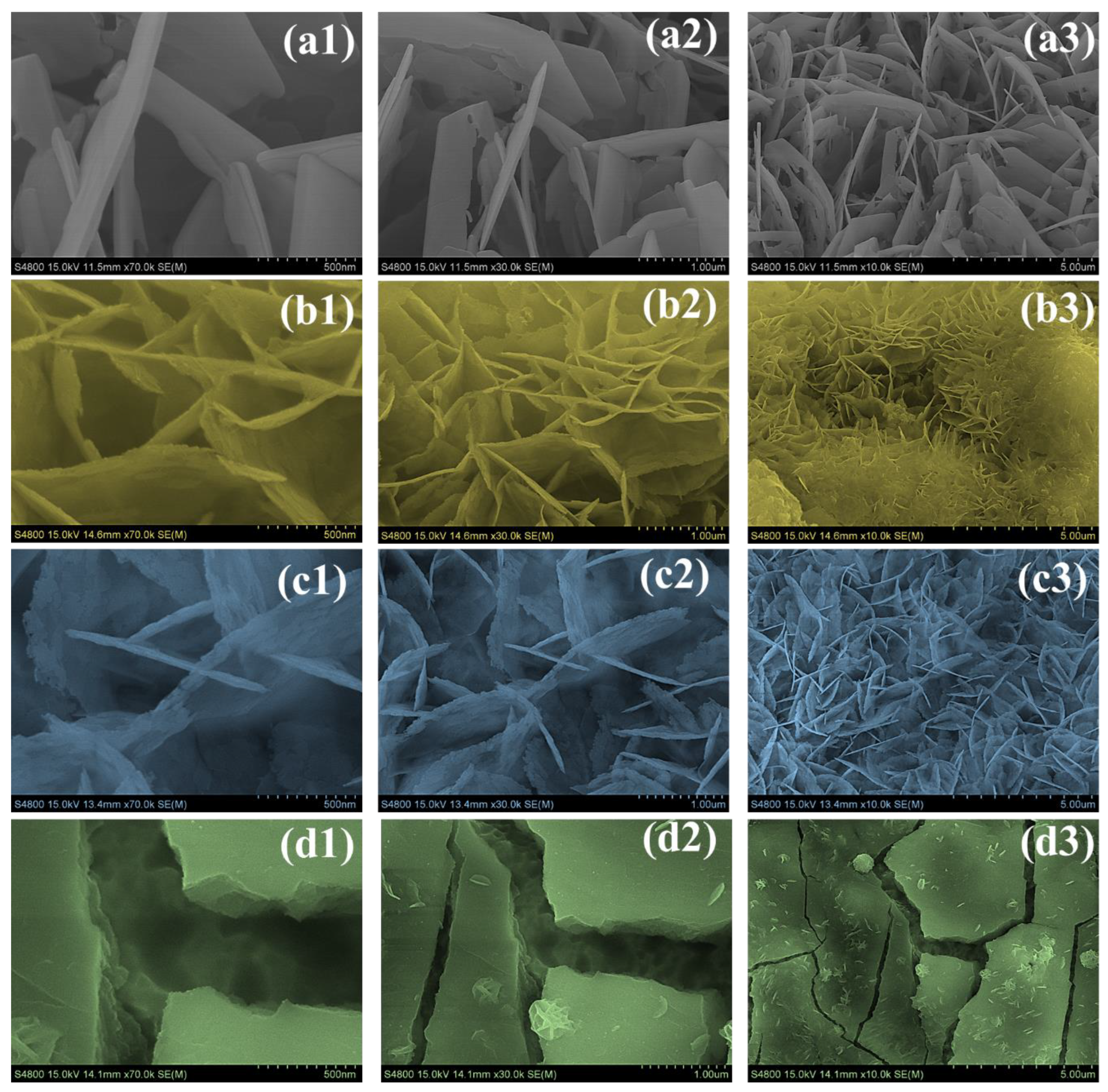
The surface morphology of the prepared samples was examined using FESEM, and the corresponding images are shown in Figure 3. The bare NiFe sample (Figure 3(a1–a3)) exhibits a structure composed mainly of stacked nanosheets with relatively smooth surfaces. These nanosheets are closely packed and partially overlapped, forming a compact layered arrangement with limited intersheet spacing. Such dense stacking may reduce the accessibility of electrolyte ions to the active surface. After the introduction of Gd, a noticeable change in the nanosheet morphology can be observed. The NiFe–Gd1 sample (Figure 3(b1–b3)) shows comparatively thinner nanosheets with a slightly more open arrangement. The sheets appear loosely interconnected and form a layered network with increased spacing between adjacent nanosheets. A more pronounced structural evolution is observed for the NiFe–Gd2 sample (Figure 3(c1–c3)). The morphology consists of well-developed nanosheets with sharp edges and thin protruding features distributed over the surface. The nanosheets appear more uniformly arranged, creating a porous framework with sufficient void spaces between the layers. Such nanosheet-based architecture can provide a larger exposed surface area and facilitate electrolyte diffusion through the structure. In contrast, the NiFe–Gd3 sample (Figure 3(d1–d3)) shows a relatively compact morphology. The nanosheets appear thicker and partially aggregated, and several cracks are visible across the surface. The formation of these compact regions may decrease the effective surface area and limit ion transport pathways. These observations suggest that moderate incorporation of Gd influences the growth of the nanosheet structure. Among the studied samples, NiFe–Gd2 exhibits a more favorable nanosheet arrangement with a relatively open and accessible structure, which may contribute to improved electrochemical behavior [31].
Figure 3.
FESEM images of (a1–a3) NiFe, (b1–b3) NiFe–Gd1, (c1–c3) NiFe–Gd2, and (d1–d3) NiFe–Gd3 samples.
A semi-quantitative morphological analysis was carried out using FESEM images through scale-bar calibration. The nanosheet thickness was estimated by measuring multiple regions across different micrographs to ensure statistical reliability. The pristine NiFe electrode shows relatively thick nanosheets (~45 nm), while Gd incorporation progressively reduces thickness, with NiFe–Gd1 have thickness around 40.18 nm. Further NiFe–Gd2 exhibiting ultrathin nanosheets with ~27 nm thickness and enhanced porosity. In contrast, NiFe–Gd3 shows increased thickness and partial aggregation. These structural variations strongly influence electrolyte accessibility and ion diffusion kinetics, thereby governing electrochemical performance.
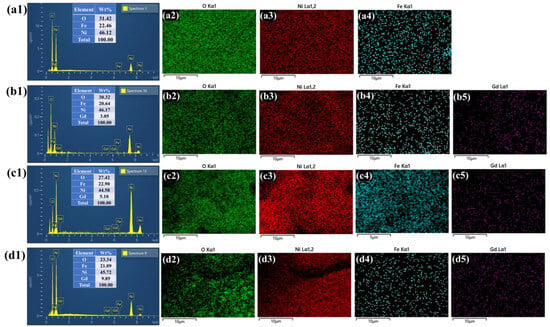
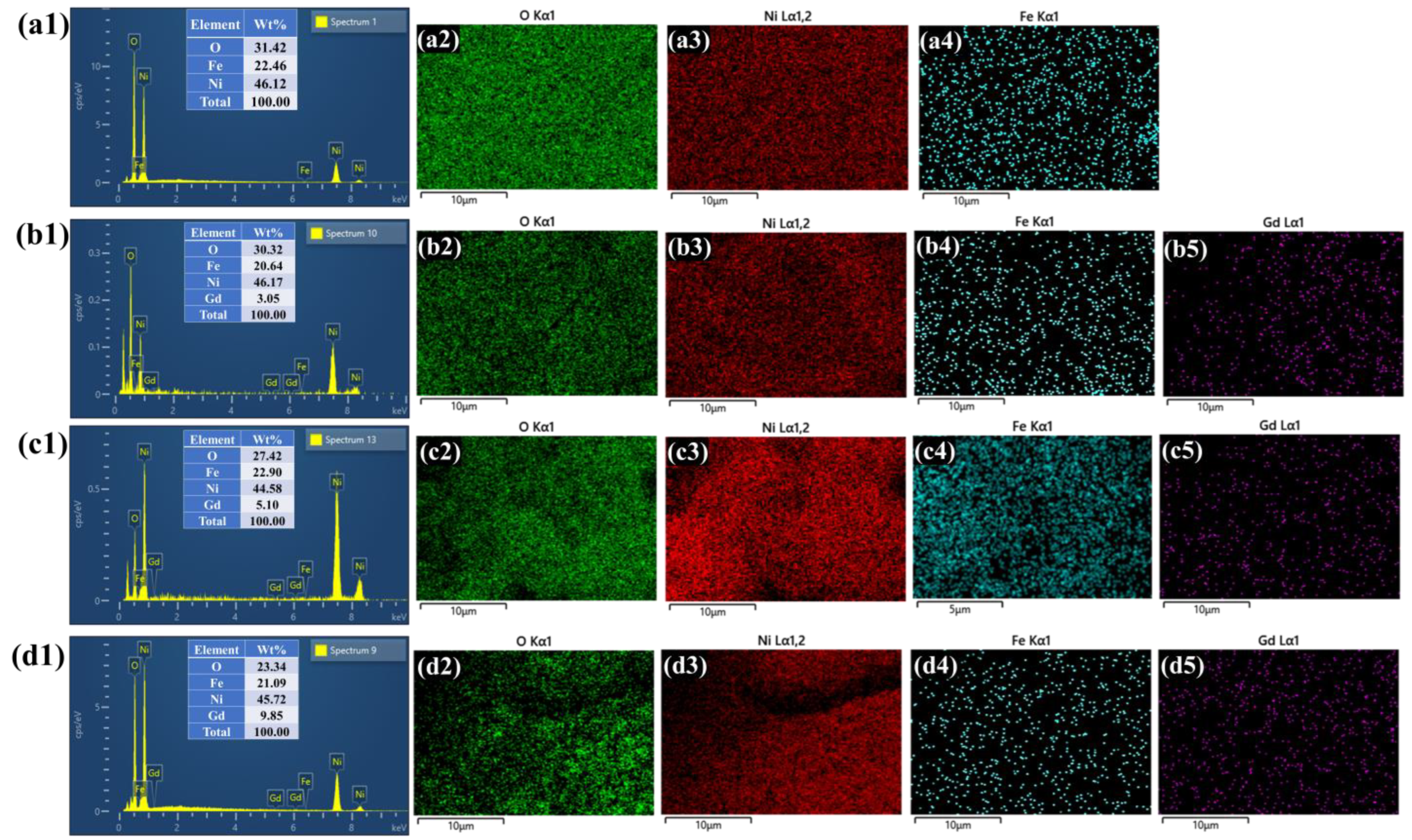
The elemental composition of the prepared samples was examined by energy dispersive EDS, and the corresponding spectra of NiFe, NiFe–Gd1, NiFe–Gd2, and NiFe–Gd3 are shown in Figure 4(a1–d1). The spectrum of the NiFe sample displays characteristic peaks of Ni, Fe, and O, confirming the successful formation of NiFe2O4. The quantitative results listed in the inset table indicate the relative weight percentages of the detected elements. With the introduction of Gd, additional peaks corresponding to Gd appear in the spectra of NiFe–Gd1, NiFe–Gd2, and NiFe–Gd3, confirming the successful incorporation of Gd into the NiFe2O4 framework. Furthermore, the Gd content gradually increases from NiFe–Gd1 to NiFe–Gd3, consistent with the designed variation in dopant concentration. Elemental mapping analysis was carried out to visualize the spatial distribution of the elements. The mapping images of NiFe (Figure 4(a2–a4)) reveal a uniform distribution of Ni, Fe, and O across the observed region, indicating good compositional homogeneity. Similar distribution patterns are observed for the Gd-containing samples. For NiFe–Gd1 (Figure 4(b2–b5)), Ni, Fe, O, and Gd are evenly dispersed, suggesting effective integration of the dopant within the host structure. The NiFe–Gd2 and NiFe–Gd3 samples (Figure 4(c2–c5,d2–d5) also exhibit homogeneous elemental distribution without noticeable aggregation. The EDS spectra and mapping results confirm the presence of all expected elements and verify the successful incorporation of Gd into the NiFe2O4 structure [14].
Figure 4.
EDS spectra and elemental mapping images of (a1–a4) NiFe, (b1–b5) NiFe–Gd1, (c1–c5) NiFe–Gd2, and (d1–d5) NiFe–Gd3 showing the uniform distribution of Ni, Fe, O, and Gd elements.
4.4. Electrochemical Analysis
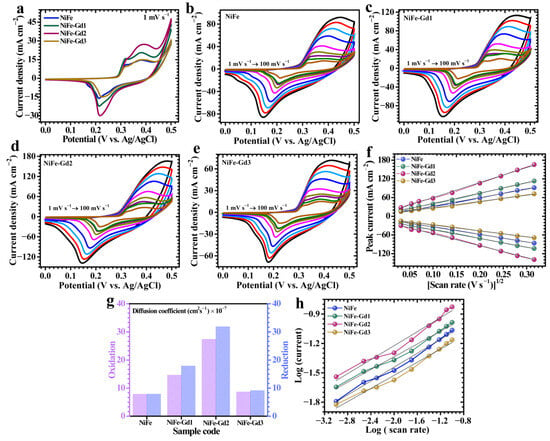
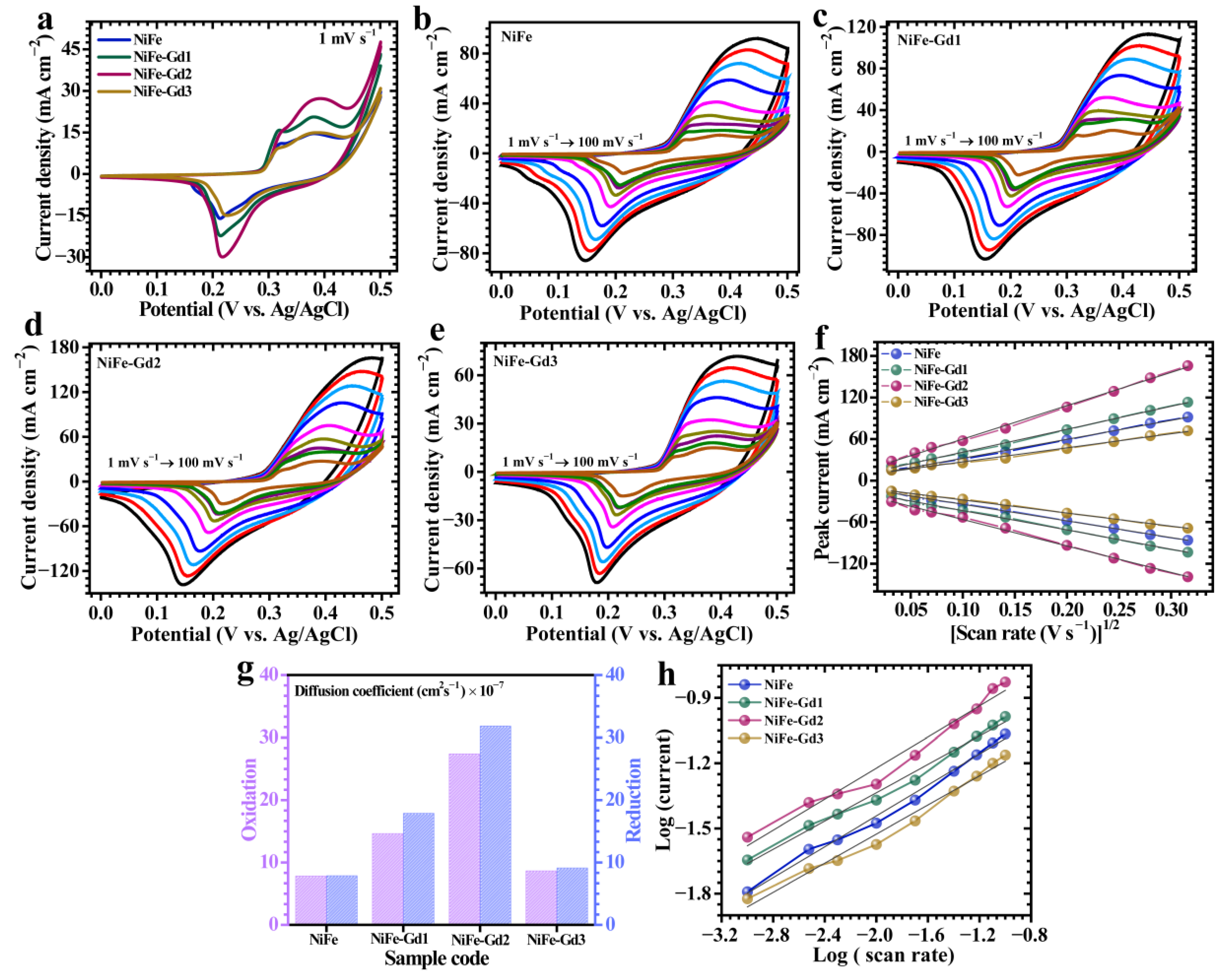
The electrochemical behavior of the pristine and Gd-substituted NiFe electrodes (1, 2, and 3 mol % Gd) was comprehensively evaluated in a three-electrode configuration using 2 M KOH electrolyte. CV, GCD, and EIS were employed to systematically assess the influence of rare-earth incorporation on charge storage characteristics. Figure 5a presents the CV curves recorded between 0 and 0.5 V at a scan rate of 1 mV s−1. All electrodes exhibit well-defined anodic and cathodic peaks, confirming that the capacitance originates predominantly from reversible faradaic reactions rather than purely electrostatic double-layer charging. These redox features are associated with the reversible oxidation and reduction in transition metal species within the spinel framework. The distinct peak formation verifies the battery-type behavior typical of ferrite-based pseudocapacitive materials [32]. To further examine the kinetic response, CV measurements were conducted at scan rates ranging from 1 to 100 mV s−1 for NiFe, NiFe-Gd1, NiFe-Gd2, and NiFe-Gd3 (Figure 5b–e). A progressive increase in current response with increasing scan rate was observed for all samples, while the overall curve shape remained preserved. This behavior reflects good structural integrity and rapid charge transfer capability under accelerated polarization conditions. The quasi-symmetrical profiles suggest efficient OH− diffusion and fast interfacial redox kinetics. Among the investigated compositions, the NiFe-Gd2 electrode demonstrates the most intense redox peaks and the largest integrated CV area, signifying superior charge storage capability. The enhanced electrochemical performance can be attributed to the optimized Gd incorporation level, which effectively modifies the electronic structure and defect chemistry without compromising crystallinity. Moderate Gd substitution likely introduces lattice distortion and oxygen vacancies, thereby increasing electrical conductivity and creating additional electroactive sites [14,33]. The superior behavior of the NiFe-Gd2 electrode is further supported by its favorable nanosheet morphology, characterized by uniformly distributed and interconnected structures. This architecture promotes extensive electrode–electrolyte contact, short ion diffusion pathways, and efficient electron transport. In contrast, the NiFe-Gd1 sample exhibits comparatively lower current response, which can be linked to insufficient structural evolution and limited exposure of active sites. Excessive doping in NiFe-Gd3 leads to partial structural densification and aggregation, which may hinder electrolyte accessibility and restrict ion migration. The undoped NiFe electrode displays the lowest electrochemical activity, reflecting its relatively less optimized nanostructural features and reduced defect density. The charge storage mechanism in NiFe2−xGdxO4 under alkaline conditions is governed by reversible redox transitions of Ni and Fe species. The overall electrochemical reaction can be expressed as Equation (2) [25]:
Figure 5.
CV analysis of NiFe and Gd-incorporated electrodes: (a) CV curves at 1 mV s−1, (b–e) CV curves at different scan rates for all electrodes, (f) Peak current vs. square root of scan rate, (g) Diffusion coefficient comparison, and (h) b-value determination.
The dominant contribution arises from the Ni2+/Ni3+ transformation, accompanied by Fe2+/Fe3+ redox transitions. Importantly, Gd3+ ions remain electrochemically stable within the spinel lattice and do not directly participate in faradaic reactions. Instead, their role is structural and electronic in nature. The incorporation of larger Gd3+ ions induce local lattice distortion and facilitates the formation of oxygen vacancies, which enhance charge carrier mobility and improve OH− adsorption and diffusion at the electrode surface. Consequently, optimized Gd substitution effectively amplifies pseudocapacitive behavior through defect-mediated conductivity enhancement rather than direct redox activity [25,34].
To further clarify the kinetic characteristics of the electrodes, the CV responses recorded at scan rates ranging from 1 to 100 mV s−1 were systematically examined. The dependence of peak current (ip) on the square root of scan rate (v1/2) is illustrated in Figure 5f. A strong linear relationship is observed for all compositions, indicating that the electrochemical process is predominantly governed by diffusion-controlled faradaic reactions. This behavior confirms that ion transport within the electrode–electrolyte interface plays a decisive role in determining overall charge storage performance. To quantitatively evaluate ion transport properties, the apparent diffusion coefficients (D) of the electroactive species were estimated using the Randles–Sevcik formalism applicable to reversible redox systems (3) [35]:
where ip represents the peak current, n is the number of electrons transferred, A denotes the effective electroactive surface area (cm2), C is the concentration of the electrolyte species, and v is the scan rate. The resulting values are summarized in Table 2 and comparatively visualized in Figure 5g. Among the investigated samples, the NiFe-Gd2 electrode exhibits the highest diffusion coefficients for both anodic and cathodic processes, signifying substantially improved ion mobility and faster redox kinetics. The enhancement in diffusion behavior can be directly correlated with the optimized rare-earth incorporation level. Moderate Gd3+ substitution induces controlled lattice distortion, which collectively improve ionic accessibility and reduce transport resistance. In contrast, the undoped NiFe electrode demonstrates comparatively sluggish diffusion characteristics, attributable to its relatively less favorable nanostructure. Similarly, the NiFe-Gd1 sample shows only moderate improvement, suggesting that insufficient doping does not fully activate defect-assisted ion pathways. Excessive substitution in NiFe-Gd3, however, appears to compromise structural homogeneity, leading to partial densification and restricted electrolyte infiltration, thereby lowering the effective diffusion coefficient. The superior diffusion kinetics exhibited by NiFe-Gd2 highlight the critical role of controlled rare-earth doping in tailoring ion transport dynamics within spinel ferrite electrodes. By optimizing concentration and nanoscale architecture simultaneously, the electrode achieves a favorable balance between structural integrity and rapid electrochemical reactivity, rendering it highly promising for advanced high-rate energy storage systems.
Table 2.
Performance metrics of diffusion coefficients (D), b-values, and ESR of studied electrodes.
Further, the intrinsic kinetics governing charge storage in the NiFe, NiFe-Gd1, NiFe-Gd2, and NiFe-Gd3 electrodes was performed (Figure 5h). The relationship between peak current and scan rate was quantitatively examined using the widely accepted power-law model Equations (4) and (5) [36,37]:
where i denotes the redox peak current at a scan rate (v), a is a constant related to the electroactive surface characteristics, and b is the kinetic exponent that reflects the dominant charge storage pathway. The magnitude of the b-value serves as a reliable indicator of electrochemical behavior: a value near 0.5 implies a semi-infinite diffusion-controlled process, while a value approaching 1.0 corresponds to a surface-controlled capacitive mechanism [38]. Linear regression of the log(i) versus log(v) plots yielded b-values in the range of 0.3–0.45 for all investigated electrodes (Table 2). These intermediate values clearly demonstrate that the redox process is purely dominated by diffusion-limited with minor influence of surface-driven; it arises from a synergistic contribution of diffusion-assisted faradaic reactions and interfacial pseudocapacitive effects. Such hybrid kinetics are characteristic of transition metal oxide systems, where charge storage proceeds through reversible redox transitions accompanied by ion insertion/extraction within the near-surface lattice region [39]. Notably, the optimized NiFe-Gd2 electrode exhibited comparatively b-value near to 0.5 range, suggesting an enhanced diffusion-controlled contribution. This behavior can be attributed to the structural modulation induced by the appropriate Gd3+ incorporation, which generates lattice distortion that promote electrolyte accessibility and accelerate charge-transfer dynamics.
To quantitatively distinguish between interfacial capacitive effects and bulk diffusion-controlled processes, the measured current response was deconvoluted according to the relationship Equation (6) [40]:
In this expression, the term k1v corresponds to the surface-controlled contribution originating from rapid redox reactions and electrostatic charge accumulation at or near the electrode–electrolyte interface. Conversely, k2v1/2 represents the diffusion-governed component associated with ion transport into the interior of the active material and the accompanying faradaic transformations. The constants k1 and k2 were extracted by plotting i(V)/v1/2 as a function of v1/2, enabling precise separation of the two charge storage pathways. Accordingly, the total stored charge (Qt) can be expressed as the sum of surface-derived charge (Qs) and diffusion-mediated charge (Qd) Equation (7) [40]:
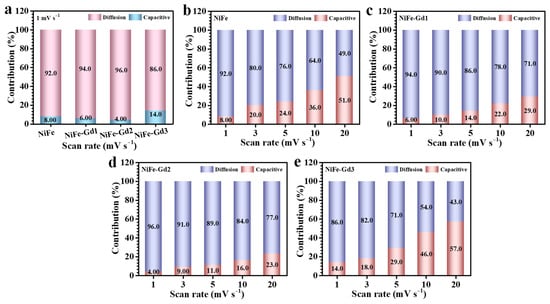
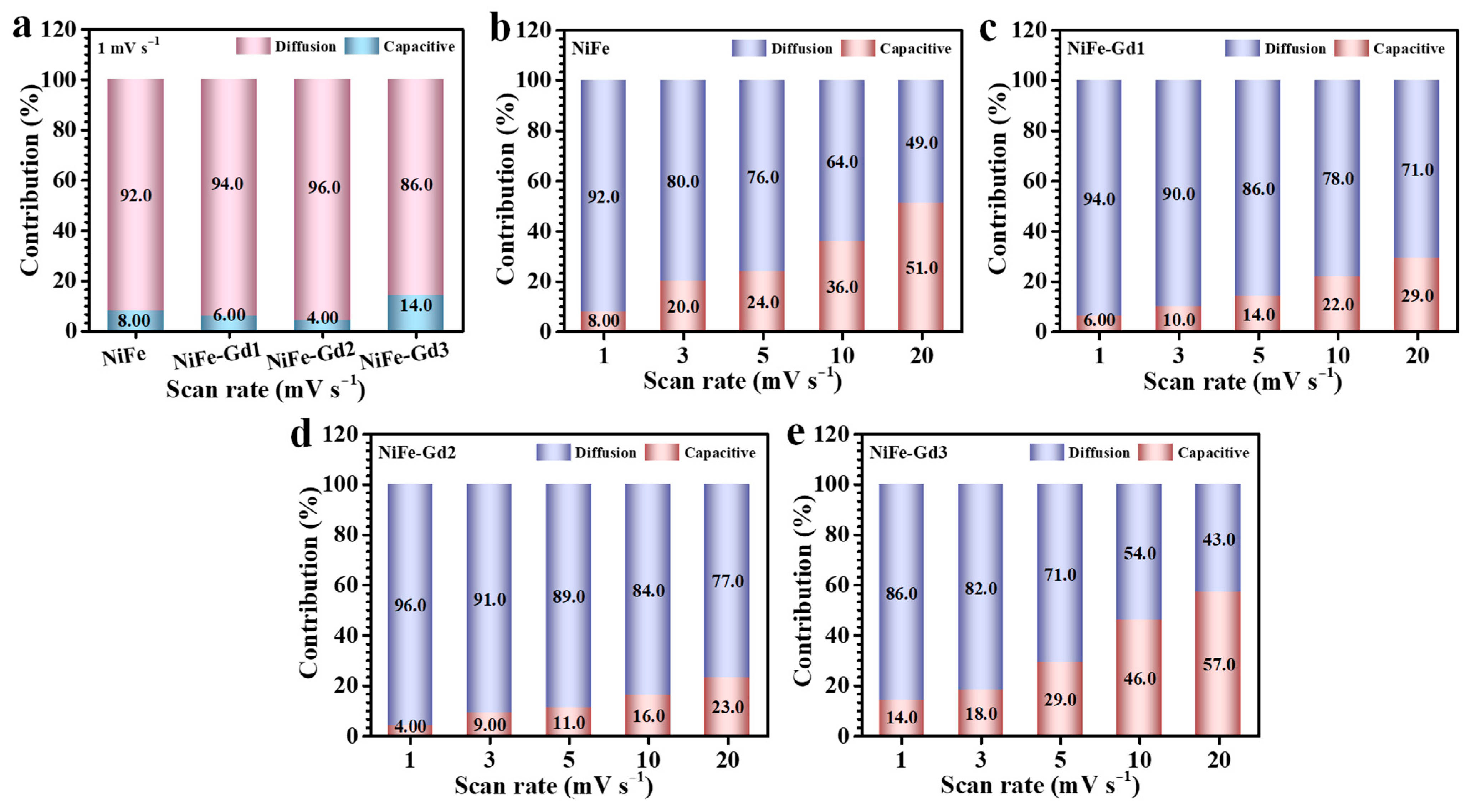
At a scan rate of 1 mV s−1, the relative capacitive/diffusion contributions for NiFe, NiFe-Gd1, NiFe-Gd2, and NiFe-Gd3 were determined to be 8.0/92.0%, 6.0/94.0%, 4.0/96.0%, and 14.0/86.0%, respectively (Figure 6a). These results clearly indicate that Gd incorporation substantially amplifies the diffusion-dominated fraction of charge storage, with the NiFe-Gd2 electrode exhibiting the highest diffusion-controlled contribution (~96%). Such a dominant bulk-redox participation signifies accelerated ion migration and highly efficient faradaic kinetics within the optimized structure. The evolution of charge storage behavior with increasing scan rate (1–20 mV s−1) was also systematically examined (Figure 6b–e). The b-values in the range of 0.31–0.44 indicate that the charge storage process is predominantly governed by diffusion-controlled faradaic reactions. However, further quantitative analysis using Dunn’s method reveals a finite capacitive contribution at all scan rates, confirming that surface-controlled processes also participate to a limited extent. Thus, the overall mechanism is best described as diffusion-dominated with a secondary capacitive contribution. For all compositions, the fraction of surface-controlled contribution progressively increased at higher sweep rates. This trend reflects the kinetic limitation imposed by rapid potential variation, where electrolyte ions cannot effectively penetrate into deeper regions of the electrode and thus predominantly participate in near-surface reactions [41]. Despite this expected shift toward capacitive dominance at elevated scan rates, NiFe-Gd2 consistently preserved a comparatively larger diffusion-driven component than the other samples. This retention of bulk-redox contribution even under fast polarization conditions underscores its superior ion accessibility, structural robustness, and highly reversible electrochemical behavior.
Figure 6.
(a) Capacitive and diffusion-controlled contribution at 1 mV s−1, (b–e) Charge storage contribution analysis showing capacitive and diffusion-controlled contributions for NiFe and Gd-modified electrodes at different scan rates.
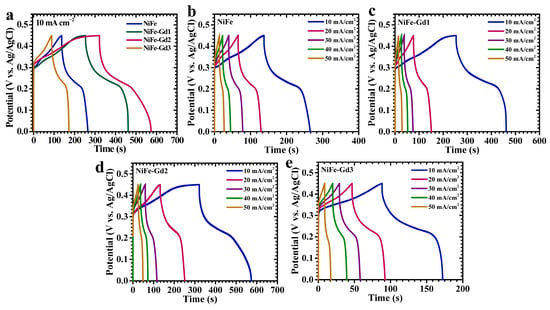
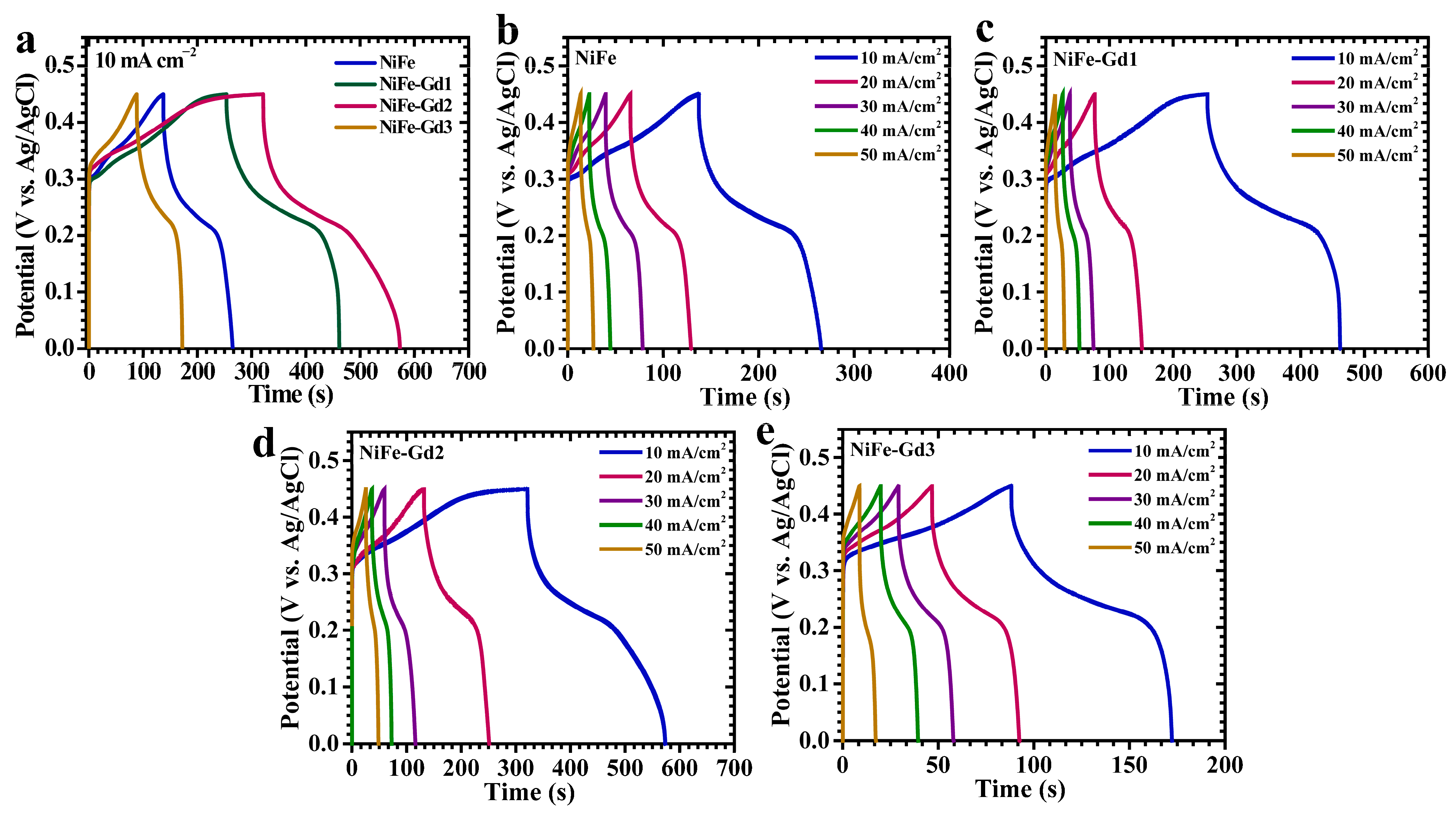
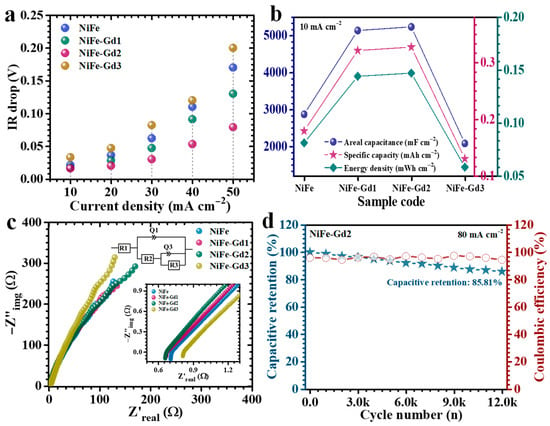
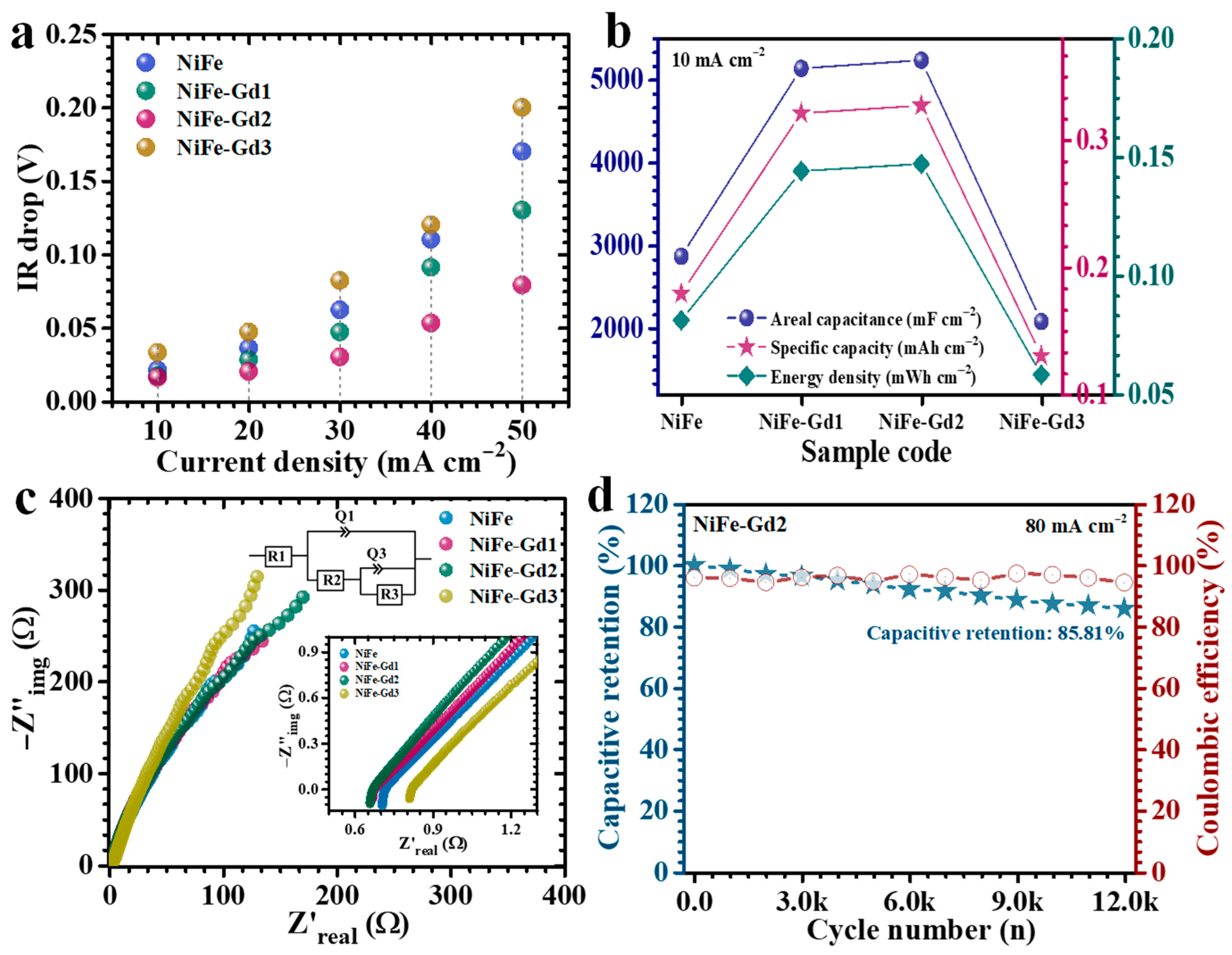
The GCD characteristics were systematically examined to further elucidate the charge storage efficiency and rate capability of the synthesized electrodes. A comparative set of GCD profiles obtained at 10 mA cm−2 within the potential window of 0 to 0.45 V is presented in Figure 7a, clearly highlighting the compositional dependence of electrochemical performance. To comprehensively assess rate behavior, the measurements were extended over a broad current density range (10–50 mA cm−2) for pristine NiFe and the Gd-doped variants (NiFe-Gd1, NiFe-Gd2, and NiFe-Gd3), as illustrated in Figure 7b–e. All electrodes exhibited distinctly nonlinear discharge curves accompanied by well-defined voltage plateaus, a characteristic signature of battery-type pseudocapacitive materials dominated by diffusion-assisted faradaic redox reactions [42]. Amongst the investigated samples, NiFe-Gd2 demonstrated the most pronounced characteristics with a smooth and gradual voltage decay, reflecting highly reversible ion insertion/extraction processes coupled with surface-confined redox activity. More importantly, its discharge duration was significantly prolonged relative to the other compositions, directly signifying enhanced charge storage capacity [43]. The nearly comparable symmetry between charge and discharge branches across all electrodes indicates high coulombic efficiency and excellent electrochemical reversibility. Especially, NiFe-Gd2 exhibited the smallest instantaneous voltage drop (IR-drop) at the onset of discharge, along with an almost ideal symmetry in its GCD profile. These features confirm reduced internal resistance, accelerated charge-transfer kinetics, and improved electrical conductivity. The IR-drop behavior as a function of current density (Figure 8a) further substantiates this observation: lower current densities produced diminished ohmic drops for all electrodes, consistent with reduced polarization and improved interfacial contact [44]. However, NiFe-Gd2 consistently maintained the lowest IR-drop across the entire current range, underscoring its optimized electronic pathways and superior ion-transport dynamics. To rigorously quantify performance metrics, the areal capacitance (CA), energy density (ED), and power density (PD) were calculated using integral expressions appropriate for nonlinear discharge curves Equations (8)–(10) [2,45]:
Figure 7.
GCD profiles of NiFe and Gd-incorporated electrodes (a) at 10 mA cm−2 and (b–e) at different current densities.
Figure 8.
Electrochemical performance comparison including (a) IR drop, (b) Areal capacitance, (c) Nyquist plots, and (d) Cycling stability of NiFe–Gd2.
Here, I represents the applied discharge current, ∫V(t)dt accounts for the time-dependent voltage integral during discharge (ensuring accurate treatment of non-ideal pseudocapacitive behavior), A is the effective electrode area, dV denotes the potential window, and Td is the discharge time. The use of integrated voltage profiles is essential for faradaic systems, where deviation from linear discharge behavior arises from redox kinetics rather than ideal double-layer capacitance. At 10 mA cm−2, the calculated areal capacitances were 2864 mF cm−2 (NiFe), 5136 mF cm−2 (NiFe-Gd1), 2074 mF cm−2 (NiFe-Gd3), and a substantially higher 5235 mF cm−2 for NiFe-Gd2 (Table 3; Figure 8b). The outstanding performance of NiFe-Gd2 clearly validates the beneficial role of optimized Gd3+ incorporation. Its superior capacitance can be attributed to multiple synergistic effects: (i) expansion of the electrochemically active surface area exposing abundant redox-active sites, (ii) improved electronic conductivity through well-connected nanosheet frameworks that minimize charge-transfer resistance, and (iii) enhanced electrolyte accessibility enabled by interconnected porous channels that shorten ion diffusion pathways. The optimized rare-earth content plays a pivotal role in preserving structural integrity. Controlled Gd substitution regulates nucleation and growth, suppresses particle aggregation, and prevents excessive nanosheet restacking, thereby maintaining a porous and accessible architecture essential for rapid redox kinetics. In contrast, insufficient or excessive dopant concentrations compromise structural uniformity, leading to reduced electrochemical utilization. As anticipated, increasing current density resulted in a gradual decline in both capacitance and energy density for all samples due to limited ion diffusion depth and incomplete activation of inner electroactive regions at high rates (Table 3) [12]. Nevertheless, NiFe-Gd2 exhibited remarkable rate performance, retaining approximately 48.12% of its initial capacitance even at 50 mA cm−2. This robust retention highlights its structural stability, efficient electron transport, and sustained ionic mobility under high-rate conditions.
Table 3.
Evaluation of electrochemical performance parameters: areal capacitance (CA), areal capacity (C), energy density (ED), and power density (PD) at variable current densities.
EIS was conducted to evaluate the charge transfer resistance and ion diffusion behavior of NiFe, NiFe-Gd1, NiFe-Gd2, and NiFe-Gd3 electrodes in 2 M KOH (Figure 8c). The Nyquist plots exhibit a high-frequency intercept (solution resistance, Rs), a semicircle in the intermediate region (charge transfer resistance, Rct), and a low-frequency linear tail. Among all samples, NiFe-Gd2 shows the smallest semicircle diameter, indicating the lowest Rct and the most efficient electron transfer at the electrode–electrolyte interface. It also presents a steeper low-frequency line, approaching vertical behavior, which confirms faster OH− ion diffusion and improved capacitive characteristics. To gain deeper insight into the charge transport characteristics, EIS data were further analyzed using an equivalent circuit model (R1+Q1/(R2+Q2/R3)), as shown in Figure 8c. The extracted fitting parameters reveal a clear dependence of resistance on Gd incorporation (Table 2). The pristine NiFe electrode exhibits an Rs of 0.7306 Ω and a relatively high Rct of 7.117 Ω, indicating comparatively slower charge-transfer kinetics. Upon Gd incorporation, both resistive components decrease significantly, with the NiFe-Gd2 electrode showing the lowest Rs (0.6798 Ω) and Rct (4.973 Ω). Notably, the optimized NiFe-Gd2 electrode demonstrates superior electrochemical kinetics, which can be associated with its enhanced electronic conductivity induced by Gd incorporation. In contrast, the NiFe-Gd1 electrode exhibits a reduced Rs of 0.6943 Ω and Rct 5.179 Ω compared to pristine NiFe, indicating improved electrochemical kinetics; however, its performance remains inferior to the optimally doped NiFe–Gd2, suggesting that lower Gd incorporation is insufficient to fully activate the defect-enhanced charge transport pathways. Further increasing Gd content (NiFe-Gd3) results in an increase in both Rs (0.8321 Ω) and Rct (7.424 Ω), indicating that excessive doping leads to structural distortion and possible agglomeration, thereby hindering charge transport. These findings clearly demonstrate that an optimal Gd concentration is crucial for achieving improved electrochemical performance.
To assess the long-term electrochemical durability of the optimized NiFe-Gd2 electrode, extended GCD cycling was carried out for 12,000 continuous cycles at a high current density 80 mA cm−2, as shown in Figure 8d. Remarkably, the electrode retained approximately 85.81% of its initial capacitance after prolonged cycling, accompanied by a remarkable coulombic efficiency of 94.38%, confirming highly reversible redox kinetics and minimal performance degradation. Such high capacitance retention clearly reflects the excellent structural integrity, electrochemical reversibility, and mechanical robustness of the Gd-modified NiFe framework. The superior cycling stability of NiFe-Gd2 can be primarily attributed to the optimized Gd3+ incorporation within the NiFe2O4 lattice. The controlled substitution induces lattice distortion and defect sites, which not only enhance electrical conductivity but also buffer the volumetric variations associated with repetitive OH− ion insertion and extraction. This structural adaptability effectively mitigates stress accumulation and suppresses pulverization or structural collapse during long-term cycling. Furthermore, the interconnected nanosheet network and porous architecture of NiFe-Gd2 facilitate continuous electrolyte penetration and uniform ion diffusion throughout the electrode matrix. Such an open framework minimizes localized current concentration and polarization effects, thereby preserving interfacial stability and sustaining efficient faradaic reactions over extended operation. The slight capacitance decay observed after extensive cycling may originate from gradual electrolyte ion trapping within microporous domains, minor surface restoration, or partial blockage of electroactive sites due to repeated redox transformations [46,47]. However, the limited magnitude of degradation confirms that the structural framework remains largely intact and electrochemically accessible. Overall, the outstanding cyclic retention of the NiFe-Gd2 electrode highlights the crucial role of optimized rare-earth doping in stabilizing spinel NiFe2O4 systems.
To evaluate the practical significance of the developed electrode, a comparative analysis with recently reported NiFe2O4-based and hybrid supercapacitor systems is presented in Table 4 [47,48,49,50,51,52]. It is evident that the electrochemical performance of the optimized NiFe-Gd2 electrode is highly competitive with, and in some cases superior to, previously reported materials. Specifically, the NiFe-Gd2 electrode delivers an areal capacitance of 5.235 F/cm2, which surpasses many conventional NiFe2O4 and composite-based systems. In addition to high capacitance, it demonstrates a favorable energy–power balance. These values are notably higher than those of several reported NiFe2O4-based electrodes, indicating the effectiveness of the present material design strategy. Furthermore, the electrode maintains excellent cycling stability, retaining 85.81% of its initial capacitance after 12,000 cycles, which confirms its structural robustness and long-term electrochemical reliability. The superior performance of the NiFe-Gd2 electrode can be attributed to the synergistic interplay between compositional tuning and structural engineering. The incorporation of Gd3+ ions induce lattice distortion, which enhances electrical conductivity and promotes rapid charge transfer. A deeper insight into the enhanced electrochemical performance of the NiFe-Gd2 electrode can be attributed to the multifaceted role of Gd incorporation in modulating the structural and electronic properties of NiFe2O4. Owing to its larger ionic radius compared to Fe3+, the insertion of Gd into the spinel lattice induces local lattice distortion, which in turn promotes the formation of oxygen vacancies and defect sites. These defects serve as additional electroactive centers and significantly enhance the adsorption and diffusion of OH− ions during redox reactions. Moreover, the introduction of Gd alters the electronic structure by creating localized states that facilitate improved electron transport and reduce charge-transfer resistance, as evidenced by the lower impedance observed in EIS measurements. The presence of such defect-induced states enhances electrical conductivity and accelerates faradaic reaction kinetics. In addition to electronic modulation, Gd incorporation also plays a crucial role in tailoring the morphology of the electrode material. It influences the nucleation and growth dynamics during hydrothermal synthesis, leading to the formation of a porous and interconnected nanosheet architecture. This structural configuration provides a high surface area and open diffusion pathways, thereby enabling efficient electrolyte penetration and rapid ion transport. Collectively, these structural, defect, and electronic modifications induced by Gd doping synergistically contribute to the superior electrochemical performance of the NiFe-Gd2 electrode, highlighting the effectiveness of rare-earth engineering in optimizing spinel ferrite-based supercapacitor materials.
Table 4.
Comparative analysis of electrochemical performances metrics of NiFe-Gd2 with recently reported NiFe2O4-based systems.
5. Electrochemical Performance of Asymmetric Supercapacitor Device
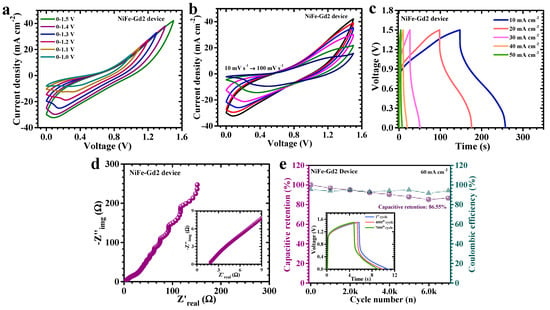
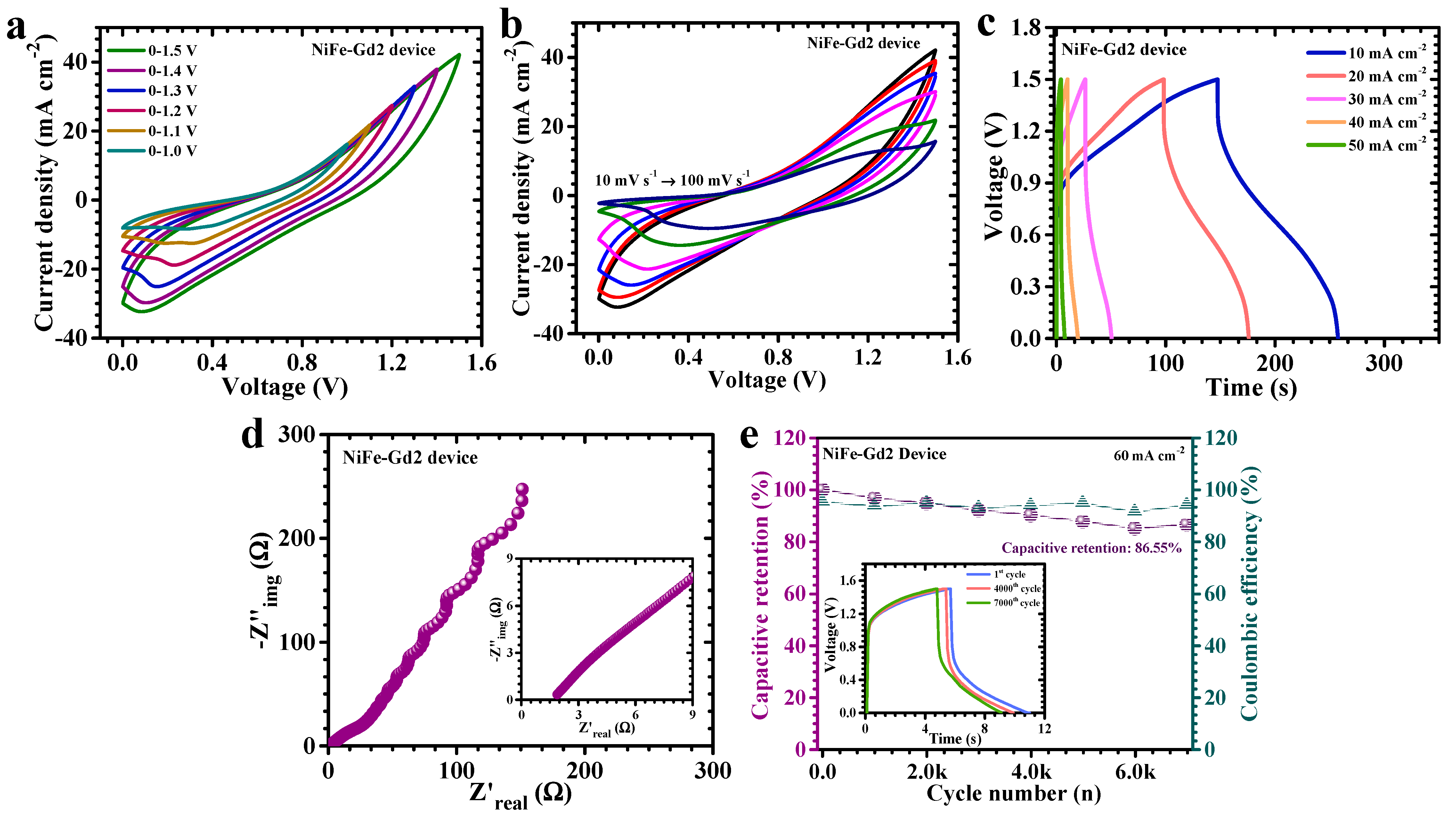
To bridge the gap between half-cell evaluation and practical applicability, an asymmetric supercapacitor device (ASD) was assembled using the optimized NiFe-Gd2 electrode as the positive electrode and activated carbon (AC) as the negative electrode. The selection of AC was strategic, owing to its stable electric double-layer capacitive (EDLC) behavior, high surface area, and excellent rate capability, which effectively complement the faradaic pseudocapacitive nature of the NiFe-Gd2 electrode. This rational pairing enables synergistic integration of diffusion-controlled redox reactions and surface-controlled charge storage, thereby maximizing the overall device performance. Both electrodes were prepared on nickel foam substrates to ensure low contact resistance and mechanical robustness. The negative electrode was fabricated by preparing a homogeneous slurry consisting of activated carbon, acetylene black, and polyvinylidene fluoride (PVDF) binder in weight ratio of 8:1:1, dispersed in N-methyl-2-pyrrolidone (NMP). The well-mixed slurry was uniformly coated onto nickel foam and dried at 60 °C for 12 h to ensure complete solvent evaporation and strong adhesion to the current collector. The assembled device employed 2 M KOH aqueous electrolyte with a porous separator to facilitate efficient ionic conduction while preventing electrical shorting. The electrochemical behavior of the NiFe-Gd2//AC device was systematically examined using CV, GCD, and EIS. CV of the NiFe-Gd2//AC device was recorded at progressively extended voltage windows from 0 to 1.0 V to 0–1.5 V to determine the maximum stable operating range (Figure 9a). The CV curves maintained their shape and structural integrity up to 1.5 V without any distortion or sharp current rise, indicating suppressed electrolyte decomposition. The gradual increase in enclosed CV area with increasing voltage confirms enhanced charge storage capability. These results validate the stable and widened operating potential window of the assembled asymmetric device. The CV profiles recorded at scan rates ranging from 10 to 100 mV s−1 (Figure 9b) exhibited quasi-rectangular shapes superimposed with distinct redox humps, confirming the coexistence of EDLC contribution from AC and battery-type pseudocapacitive behavior from the NiFe-Gd2 electrode. Importantly, the device operated stably within an extended potential window of 1.5 V, which is comparatively wide for aqueous electrolyte systems. This expanded voltage range is attributed to the complementary potential domains of the positive and negative electrodes, enabling enhanced energy density without inducing significant polarization. The corresponding GCD curves (Figure 9c) displayed nonlinear charge–discharge characteristics with well-defined voltage plateaus, further validating the dominant faradaic contribution of the NiFe-Gd2 electrode. At a current density of 10 mA cm−2, the device delivered an areal capacitance of 436 mF cm−2, achieving an energy density of 0.136 mWh cm−2 and a power density of 3.14 mW cm−2 (Table 5). These values demonstrate a well-balanced energy–power relationship. Even at elevated current densities, the device retained a substantial fraction of its capacitance, confirming excellent rate capability and rapid charge propagation across the electrode–electrolyte interfaces.
Figure 9.
Electrochemical performance of the NiFe–Gd2//AC asymmetric supercapacitor showing (a) CV curves at variable voltage window, (b) CVs at different scan rates, (c) GCD profiles, (d) Nyquist plot, and (e) Cycling stability.
Table 5.
Energy storage performance of the NiFe-Gd2 device.
EIS analysis further substantiated the superior electrochemical kinetics of the assembled device (Figure 9d). The equivalent series resistance (Rs) was determined to be approximately 1.88 Ω, reflecting minimal internal resistance and efficient ionic/electronic transport pathways. Long-term cycling durability was evaluated over 7000 continuous charge–discharge cycles at a high current density of 60 mA cm−2, shown in Figure 9e, accompanied with 1st, 4000th, and 7000th GCD cycles. Impressively, the device preserved approximately 86.55% of its initial capacitance while maintaining a high coulombic efficiency of 94.07%, demonstrating excellent electrochemical reversibility and structural resilience. The outstanding stability originates from the robust spinel framework of NiFe-Gd2, where controlled Gd3+ substitution induces lattice distortion and defect sites that buffer volumetric strain during repetitive ion insertion and extraction. Simultaneously, the porous nanosheet architecture accommodates mechanical stress and preserves continuous electron/ion transport channels, thereby minimizing structural degradation over prolonged operation. Overall, the NiFe-Gd2//AC asymmetric supercapacitor exhibits an exceptional combination of extended operating voltage, high areal capacitance, favorable energy–power output, low internal resistance, and durable cycling performance. These results clearly demonstrate that optimized rare-earth doping in spinel NiFe2O4 not only enhances half-cell electrochemical properties but also translates effectively into superior device-level performance. The present study highlights the critical importance of compositional engineering and structural optimization in advancing high-performance, practical supercapacitor systems suitable for next-generation portable and hybrid energy storage applications.
6. Conclusions
In this study, Gd-incorporated NiFe2O4 nanosheet electrodes were successfully synthesized on nickel foam to explore the influence of rare-earth modification on structural features and electrochemical performance. Structural analysis confirmed the formation of a stable cubic spinel NiFe2O4 phase, while XPS results verified the presence of Ni2+, Fe3+, and Gd3+ species within the lattice. The incorporation of Gd significantly influenced the growth behavior of the material, leading to noticeable changes in the nanosheet morphology. Among the investigated samples, the NiFe–Gd2 electrode exhibited a well-developed and interconnected nanosheet architecture, which provides improved electrolyte accessibility and a higher density of electroactive sites. As a result, the optimized electrode delivered a high areal capacitance of 5235 mF cm−2 at a current density of 10 mA cm−2, along with improved charge transfer characteristics. Furthermore, an asymmetric supercapacitor assembled using NiFe–Gd2 as the positive electrode and activated carbon as the negative electrode operated within a 0–1.5 V potential window, achieving an areal capacitance of 436 F cm−2, an energy density of 0.136 mWh cm−2, and a power density of 3.14 mW cm−2. The device also demonstrated good cycling stability, retaining 86.55% of its initial capacitance after 7000 cycles. These results suggest that controlled Gd incorporation effectively improves the electrochemical performance of NiFe2O4 nanosheet electrodes and highlights their potential for practical asymmetric supercapacitor applications.
Author Contributions
Writing—original draft, Methodology, Investigation: R.U.A. and P.J.M.; Writing—review and editing: A.M.T.; Formal Analysis: S.A.B.; Supervision, Writing—review and editing, Project administration, Funding acquisition: C.-W.J. All authors have read and agreed to the published version of the manuscript.
Funding
This research did not receive any specific grant from funding agencies in the public, commercial, or not-for-profit sectors.
Data Availability Statement
Data are available upon request due to restrictions.
Conflicts of Interest
The authors declare no conflicts of interest.
References
- Enasel, E.; Dumitrascu, G. Storage Solutions for Renewable Energy: A Review. Energy Nexus 2025, 17, 100391. [Google Scholar] [CrossRef] [Scilit]
- Dissanayake, K.; Kularatna-Abeywardana, D. A Review of Supercapacitors: Materials, Technology, Challenges, and Renewable Energy Applications. J. Energy Storage 2024, 96, 112563. [Google Scholar] [CrossRef] [Scilit]
- Liu, J.; Wang, J.; Ni, Y.; Zhang, K.; Cheng, F.; Chen, J. Recent Breakthroughs and Perspectives of High-Energy Layered Oxide Cathode Materials for Lithium Ion Batteries. Mater. Today 2021, 43, 132–165. [Google Scholar] [CrossRef] [Scilit]
- Ahmad, F.; Arif, A.; Khan, M.I.; Anjum, S.; Shanableh, A.; Taj, M.B.; Luque, R. Recent Progress and Perspectives on Lithium and Non-Lithium Rechargeable Battery Systems. J. Power Sources 2025, 648, 237362. [Google Scholar] [CrossRef] [Scilit]
- Morankar, P.J.; Amate, R.U.; Teli, A.M.; Bhosale, M.K.; Beknalkar, S.A.; Jeon, C.W. Architectonic Redox Interface Coupling in Bilayered NiFe2O4@Co3O4 Composites for Asymmetric Supercapacitive Energy Storage. J. Power Sources 2026, 661, 238690. [Google Scholar] [CrossRef] [Scilit]
- Song, L.; Hou, W.; Qiao, H.; Liu, Q.; Zhang, J.; Zhang, W.; Xiao, D.; Zhang, Q. Conquering Self-Discharge in Supercapacitors: Synergy of Mechanisms and Cross-Scale Mitigation Strategies. J. Mater. Chem. A 2025, 14, 12479–12508. [Google Scholar] [CrossRef] [Scilit]
- Pholauyphon, W.; Charoen-amornkitt, P.; Suzuki, T.; Tsushima, S. Guidelines for Supercapacitor Electrochemical Analysis: A Comprehensive Review of Methodologies for Finding Charge Storage Mechanisms. J. Energy Storage 2024, 98, 112833. [Google Scholar] [CrossRef] [Scilit]
- Wang, Y.; Guo, J.; Wang, T.; Shao, J.; Wang, D.; Yang, Y.W. Mesoporous Transition Metal Oxides for Supercapacitors. Nanomaterials 2015, 5, 1667–1689. [Google Scholar] [CrossRef] [Scilit]
- Hatami-Kakesh, S.; Zeinali, S.; Zerafat, M.M. Enhanced Supercapacitor Performance via Synergistic Integration of MOFs and Polyaniline: Structural and Electrochemical Investigations. Surf. Interfaces 2025, 75, 107757. [Google Scholar] [CrossRef] [Scilit]
- Patel, M.; Shirsath, S.E.; Fulari, A.V.; Patil, M.R.; Shah, J.; Kotnala, R.K.; Wagare, D.S.; Sathe, B.R.; Ramana, C.V.; Wang, D.; et al. Synergistic Engineering and Sintering-Induced Tuning of Al Sn Co-Doped Zn/Co Ferrites for Integrated Hydroelectric and Supercapacitive Energy Systems. J. Energy Storage 2026, 142, 119515. [Google Scholar] [CrossRef] [Scilit]
- Sajid, A.; Marwat, M.A.; Mohsin, H.; Shaheen, S.; Karim, M.A.; Ramzan, M.; Karim, A.; Tariq, M.; Ehsan, Z.; Arif, A.; et al. Silver Citrate Engineered NiCo2S4/MOF-Derived Oxide@carbon Frameworks for High-Energy Hybrid Supercapacitors. RSC Adv. 2026, 16, 7252–7270. [Google Scholar] [CrossRef] [Scilit]
- Askari, M.B.; Salarizadeh, P.; Tourchi Moghadam, M.T. NiFe2O4 as a Promising Electrode Material: A Comprehensive Review on Supercapacitor Applications. Fuel 2026, 403, 136104. [Google Scholar] [CrossRef] [Scilit]
- Hsu, T.E.; Manjunatha, K.; Ho, M.K.; Chiu, H.H.; Yu, S.L.; Lyu, B.L.; Yu, Y.T.; Kuo, H.C.; Yu, S.W.; Cheng, C.L.; et al. High-Performance Bi-Doped NiFe2O4 Nanoparticles for Advanced Supercapacitors and Room-Temperature Magnetic Memory Applications. ACS Appl. Electron. Mater. 2025, 7, 3704–3724. [Google Scholar] [CrossRef] [Scilit]
- Electrochemistry, D.; Patil, V.D.; Patil, D.A.; Jadhav, A.L.; Jadhav, S.L.; Kadam, A.V.; Dandwate, S.R.; Shinde, B.R. Spinel Nickel Ferrite (NiFe2O4) Materials Synthesized via Spray-Pyrolysis for Electrochemical Supercapacitor Application. Discov. Electrochem. 2024, 1, 2. [Google Scholar] [CrossRef] [Scilit]
- Zhu, W.; Shen, D. Boosting the Electrochemical Performance of NiFe2O4/Carbon Composite Materials by Nitrogen Doping for Supercapacitors Application. J. Energy Storage 2023, 73, 109058. [Google Scholar] [CrossRef] [Scilit]
- Yan, K.; Chen, R.; Ling, Q.; Zhao, Z.; Zhou, Z.; Li, X.; Lv, J.; Cao, C.; He, G.; Sun, Z.; et al. Rapid Synthesis of Mn-Doped NiFe2O4 Nanosheet Arrays for High-Performance Hybrid Supercapacitors. Electrochim. Acta 2024, 497, 144551. [Google Scholar] [CrossRef] [Scilit]
- Hu, Z.; Wu, Z.; Gao, S.; Zhao, J.; Zhai, S.; An, Q.; Xiao, Z. In-Situ Growth of ZIF-8 onto Zinc Alginate for High-Performance Electrode Material in Supercapacitors. Colloids Surfaces A Physicochem. Eng. Asp. 2025, 725, 137546. [Google Scholar] [CrossRef] [Scilit]
- Kim, D.; Kim, S.H.; Lee, J.A.; Heo, Y.W.; Lee, J.H. Effect of Zn Doping on the Structure and Electrical Conductivity of Mn1.5Co1.5O4 Spinel. Ceram. Int. 2024, 50, 9744–9752. [Google Scholar] [CrossRef] [Scilit]
- Kadam, A.B.; Mande, V.K.; Kadam, S.B.; Kadam, R.H.; Shirsath, S.E.; Borade, R.B. Influence of Gadolinium (Gd3+) Ion Substitution on Structural, Magnetic and Electrical Properties of Cobalt Ferrites. J. Alloys Compd. 2020, 840, 155669. [Google Scholar] [CrossRef] [Scilit]
- Ma, Y.; Bai, Y.; Liang, B.; Yang, R.; Jiang, X.; Zheng, S.; Zhang, C.; Hu, C. Doping-Induced Morphology Modulation for Boosting the Capacity and Stability of Nanocrystals Assembled Ni1-XCoxSe2. Appl. Surf. Sci. 2022, 579, 152156. [Google Scholar] [CrossRef] [Scilit]
- Xi, Y.; Xiao, Z.; Lv, H.; Sun, H.; Zhai, S.; An, Q. Construction of CuO/Cu-Nanoflowers Loaded on Chitosan-Derived Porous Carbon for High Energy Density Supercapacitors. J. Colloid Interface Sci. 2023, 630, 525–534. [Google Scholar] [CrossRef] [Scilit]
- Baytar, O.; Ekinci, A.; Şahin, Ö.; Akdag, A. The Use of NiFe2O4 and CoFe2O4 Nanoparticles Produced by Green Synthesis as Electrode Material for Supercapacitors. ChemistrySelect 2024, 9, e202304491. [Google Scholar] [CrossRef] [Scilit]
- Soomro, S.A.; Gul, I.H.; Khan, M.Z.; Naseer, H.; Khan, A.N. Dielectric Properties Evaluation of NiFe2O4/MWCNTs Nanohybrid for Microwave Applications Prepared via Novel One Step Synthesis. Ceram. Int. 2017, 43, 4090–4095. [Google Scholar] [CrossRef] [Scilit]
- Hassanzadeh-Tabrizi, S.A. Precise Calculation of Crystallite Size of Nanomaterials: A Review. J. Alloys Compd. 2023, 968, 171914. [Google Scholar] [CrossRef] [Scilit]
- Fatimah, F.M.; Almutairi, S.T.; Anwar, A.; Irshad, A.; Alrowaili, Z.A.; Sabeeh, H.; Zulfiqar, S.; Al-Buriahi, M.S. Rare Earth Gd-Doped NiFe2O4@ 2D Layered Carbonaceous Composite: Synthesis, Structural Evaluation and Photocatalytic Parameters Studies. Mater. Sci. Eng. B 2023, 297, 116794. [Google Scholar] [CrossRef] [Scilit]
- Sulemana, H.; Yi, C.; Nawaz, M.I.; Zhang, B.; Yi, R.; Zhang, J.; Nkudede, E. Synthesis and Characterization of Nickel Ferrite (NiFe2O4) Nano-Catalyst Films for Ciprofloxacin Degradation. Ceram. Int. 2025, 51, 8376–8387. [Google Scholar] [CrossRef] [Scilit]
- Bandgar, S.B.; Vadiyar, M.M.; Ling, Y.C.; Chang, J.Y.; Han, S.H.; Ghule, A.V.; Kolekar, S.S. Metal Precursor Dependent Synthesis of NiFe2O4 Thin Films for High-Performance Flexible Symmetric Supercapacitor. ACS Appl. Energy Mater. 2018, 1, 638–648. [Google Scholar] [CrossRef] [Scilit]
- Zdorovets, M.V.; Kozlovskiy, A.A.; ZhMoldabayeva, G.; Ivanov, I.A.; Konuhova, M. Radiation-Induced Degradation Effects of Optical Properties of MgO Ceramics Caused by Heavy Ion Irradiation. Opt. Mater. X 2025, 26, 100406. [Google Scholar] [CrossRef] [Scilit]
- Raj, S.S.; Gupta, S.K.; Grover, V.; Muthe, K.P.; Natarajan, V.; Tyagi, A.K. MgAl2O4 Spinel: Synthesis, Carbon Incorporation and Defect-Induced Luminescence. J. Mol. Struct. 2015, 1089, 81–85. [Google Scholar] [CrossRef] [Scilit]
- Kuzovkov, V.N.; Kotomin, E.A.; Lushchik, A.; Popov, A.I.; Shablonin, E. The annealing kinetics of the F-type defects in MgAl2O4 spinel single crystals irradiated by swift heavy ions. Opt. Mater. 2024, 147, 114733. [Google Scholar] [CrossRef] [Scilit]
- Ajay; Tanwar, V.; Gujare, A.A.; Ingole, P.P. High Performance Flexible Supercapacitor Based on Single Precursor Derived NiFe2O4 Spinel with Tailored Cationic Distribution and Oxygen Vacancies in Acidic Medium. Adv. Sustain. Syst. 2024, 8, 2400244. [Google Scholar] [CrossRef] [Scilit]
- Beknalkar, S.A.; Park, J.; Mane, S.M.; Satale, V.V.; Morankar, P.J.; Amate, R.U.; Shin, J.C.; Teli, A.M. Molybdenum-incorporated zinc phosphate hydrate nanorods for enhanced electrochemical performance in potassium-ion capacitors. Chem. Eng. J. 2026; in Press. [CrossRef] [Scilit]
- Kamala Bharathi, K.; Arout Chelvane, J.; Markandeyulu, G. Magnetoelectric Properties of Gd and Nd-Doped Nickel Ferrite. J. Magn. Magn. Mater. 2009, 321, 3677–3680. [Google Scholar] [CrossRef] [Scilit]
- Ganiger, S.; Naik, L.R.; Jituri, S.D.; Doddamani, J.S.; Chavan, G.; Mujawar, S.H. Designing compositionally driven Cu–NiFe2O4 based electrodes for high-performance supercapacitors. J. Energy Storage 2026, 155, 121563. [Google Scholar] [CrossRef] [Scilit]
- Sahariya, J.; Mund, H.S.; Sharma, A.; Dashora, A.; Itou, M.; Sakurai, Y.; Ahuja, B.L. Magnetic Properties of NiFe2-XRExO4 (RE=Dy, Gd) Using Magnetic Compton Scattering. J. Magn. Magn. Mater. 2014, 360, 113–117. [Google Scholar] [CrossRef] [Scilit]
- Morankar, P.J.; Amate, R.U.; Teli, A.M.; Bhosale, M.K.; Beknalkar, S.A.; Jeon, C.W. Cationic Surfactant-Driven Evolution of NiFe2O4 Nanosheets for High-Performance Asymmetric Supercapacitors. Materials 2025, 18, 1987. [Google Scholar] [CrossRef] [Scilit]
- Jiang, S.; Ding, J.; Wang, R.; Deng, Y.; Chen, F.; Zhou, M.; Gui, H.; Li, X.; Xu, C. High Performance NiCo-LDH//Fe2O3 Asymmetric Supercapacitors Based on Binder-Free Electrodes with Dual Conductive Networks. Chem. Eng. J. 2022, 431, 133936. [Google Scholar] [CrossRef] [Scilit]
- Gui, H.; Ding, J.; Wang, R.; Zhou, M.; Xiang, Y.; Li, X. Construction of Na0.5MnO2 Nanosheet/Vertical Graphene Nanoarrays as Binder-Free High-Voltage Cathode for Supercapacitors. J. Energy Storage 2022, 55, 105701. [Google Scholar] [CrossRef] [Scilit]
- Arun, T.; Kavinkumar, T.; Udayabhaskar, R.; Kiruthiga, R.; Morel, M.J.; Aepuru, R.; Dineshbabu, N.; Ravichandran, K.; Akbari-Fakhrabadi, A.; Mangalaraja, R.V. NiFe2O4 Nanospheres with Size-Tunable Magnetic and Electrochemical Properties for Superior Supercapacitor Electrode Performance. Electrochim. Acta 2021, 399, 139346. [Google Scholar] [CrossRef] [Scilit]
- Wang, D.; Wei, Z.; Lin, Y.; Chen, N.; Gao, Y.; Chen, G.; Song, L.; Du, F. Intercalation Pseudocapacitance in a NASICON-Structured Na2CrTi(PO4)3@carbon Nanocomposite: Towards High-Rate and Long-Lifespan Sodium-Ion-Based Energy Storage. J. Mater. Chem. A 2019, 7, 20604–20613. [Google Scholar] [CrossRef] [Scilit]
- Wu, Z.; Zhu, Y.; Ji, X. NiCo2O4-Based Materials for Electrochemical Supercapacitors. J. Mater. Chem. A 2014, 2, 14759–14772. [Google Scholar] [CrossRef] [Scilit]
- Yu, Z.Y.; Chen, L.F.; Yu, S.H. Growth of NiFe2O4 Nanoparticles on Carbon Cloth for High Performance Flexible Supercapacitors. J. Mater. Chem. A 2014, 2, 10889–10894. [Google Scholar] [CrossRef] [Scilit]
- Zhang, X.; Zhang, Z.; Sun, S.; Wu, Y.; Sun, Q.; Liu, X. A Facile One-Step Hydrothermal Approach to Synthesize Hierarchical Core-Shell NiFe2O4@NiFe2O4 Nanosheet Arrays on Ni Foam with Large Specific Capacitance for Supercapacitors. RSC Adv. 2018, 8, 15222–15228. [Google Scholar] [CrossRef] [Scilit] [PubMed]
- Sadavar, S.V.; Padalkar, N.S.; Shinde, R.B.; Patil, A.S.; Patil, U.M.; Magdum, V.V.; Chitare, Y.M.; Kulkarni, S.P.; Bulakhe, R.N.; Parale, V.G.; et al. Graphene Oxide as an Efficient Hybridization Matrix for Exploring Electrochemical Activity of Two-Dimensional Cobalt-Chromium-Layered Double Hydroxide-Based Nanohybrids. ACS Appl. Energy Mater. 2022, 5, 2083–2095. [Google Scholar] [CrossRef] [Scilit]
- Siva, P.; Sreelakshmi, C.; Ravinder, T.; Krishna, M.G.; Rao, S.V.S.N.; Vasu, K. Ir-Doped 1T-WS2 High Performance Symmetric Supercapacitor Electrode. J. Energy Storage 2026, 147, 120130. [Google Scholar] [CrossRef] [Scilit]
- Teli, A.M.; Beknalkar, S.A.; Satale, V.V.; Amate, R.U.; Morankar, P.J.; Khan, M.A.; Yewale, M.A.; Baek, S.H.; Shin, J.C. MnO2-Pd Integrated into NbP2O7 Electrodes for Hybrid Supercapacitors. Chem. Eng. J. 2026, 533, 174590. [Google Scholar] [CrossRef] [Scilit]
- Nithya, C.S.; Mazumdar, S.; Deka, S.; Praveen, V.K.; Joseph Joly, V.L. Synthesis of NiFe2O4-Graphene Mesoporous Hybrid Electrode Material for Supercapacitor Application. Carbon 2026, 247, 121044. [Google Scholar] [CrossRef] [Scilit]
- Nagaraj, R.; Aruchamy, K.; Halanur, M.M.; Maalige, R.N.; Mondal, D.; Nataraj, S.K.; Ghosh, D. Boosting the Electrochemical Performance of Polyaniline Based All-Solid-State Flexible Supercapacitor Using NiFe2O4 as Adjuvant. J. Electroanal. Chem. 2019, 851, 113482. [Google Scholar] [CrossRef] [Scilit]
- Sen, P.; De, A. Electrochemical Performances of Poly(3,4-Ethylenedioxythiophene)–NiFe2O4 Nanocomposite as Electrode for Supercapacitor. Electrochim. Acta 2010, 55, 4677–4684. [Google Scholar] [CrossRef] [Scilit]
- Toghan, A.; Khairy, M.; Kamar, E.M.; Mousa, M.A. Effect of Particle Size and Morphological Structure on the Physical Properties of NiFe2O4 for Supercapacitor Application. J. Mater. Res. Technol. 2022, 19, 3521–3535. [Google Scholar] [CrossRef] [Scilit]
- Chen, J.; Ma, C.; Song, D. Morphology-Controllable Preparation of NiFe2O4 as High Performance Electrode Material for Supercapacitor. Electrochim. Acta 2019, 296, 181–189. [Google Scholar] [CrossRef] [Scilit]
- Zhao, Y.; Xu, L.; Yan, J.; Yan, W.; Wu, C.; Lian, J.; Huang, Y.; Bao, J.; Qiu, J.; Xu, L.; et al. Facile Preparation of NiFe2O4/MoS2 Composite Material with Synergistic Effect for High Performance Supercapacitor. J. Alloys Compd. 2017, 726, 608–617. [Google Scholar] [CrossRef] [Scilit]

Disclaimer/Publisher’s Note: The statements, opinions and data contained in all publications are solely those of the individual author(s) and contributor(s) and not of MDPI and/or the editor(s). MDPI and/or the editor(s) disclaim responsibility for any injury to people or property resulting from any ideas, methods, instructions or products referred to in the content. |
© 2026 by the authors. Licensee MDPI, Basel, Switzerland. This article is an open access article distributed under the terms and conditions of the Creative Commons Attribution (CC BY) license.