


Abstract
Microcline is an important rock-forming mineral in the Earth’s crust, and characterizing its structural behavior under compression is essential for understanding the high-pressure response of feldspar minerals under geological conditions. In this study, the crystal structural evolution of microcline up to 12 GPa was investigated using first-principles calculations based on density functional theory. The results reveal an isosymmetric phase transition at approximately 6–7 GPa, accompanied by a ~7% volume collapse. Across this transition, the b-axis and unit-cell angles (α, β, γ) change abruptly, and the aluminum coordination transforms from fourfold to a distorted fivefold geometry intermediate between a trigonal bipyramid and a square pyramid. Analysis of bond lengths and angles indicates that compression in the low-pressure phase is primarily driven by shear deformation of tetrahedral Ring 1. Near the transition pressure, however, marked shear deformations of Ring 2 and Ring 3 induce a strong contraction of the b-axis and abrupt changes in the unit-cell angles. Comparison with the compression behavior of low albite reveals both similarities and distinct structural responses, highlighting the role of framework topology and extra-framework cations in controlling pressure-induced structural evolution in feldspar minerals. These results provide new insights into the high-pressure behavior of microcline and contribute to a better understanding of the structural stability of feldspar minerals in the Earth’s interior.
1. Introduction
Feldspars are essential rock-forming minerals in the Earth’s crust primarily classified into plagioclase and alkali feldspars; they collectively constitute approximately 50% of the crust by volume [1]. Plagioclase represents a solid-solution series between albite (NaAlSi3O8) and anorthite (CaAl2Si2O8) [2,3], whereas alkali feldspars contain little to no calcium and consist mainly of the potassium feldspar series (KAlSi3O8, e.g., microcline, orthoclase, and sanidine) and the albite series (NaAlSi3O8, e.g., low albite and high albite) [4,5]. The crystal structure of all feldspars consists of a three-dimensional framework of corner-sharing AlO4 and SiO4 tetrahedra, with larger cations occupying the cavities within the framework [6,7]. Although the various feldspars are topologically similar, their crystal structures belong to different space groups, such as C-1, C2/m, and I-1. This structural complexity arises mainly from the interplay between Al/Si ordering–disordering in the tetrahedral sites coupled with displacive framework distortions [8,9,10]. Thus, the correlation between their structural characteristics and formation temperature serves as a key geothermometer for inferring rock thermal histories [11,12,13].
Over the last three decades, extensive experimental and theoretical studies have been dedicated to uncovering the structural evolution of feldspars under both room temperature–high-pressure and high-pressure–temperature conditions [14,15,16,17,18,19,20,21,22,23,24,25,26,27,28,29]. These efforts have systematically elucidated the phase transition pathways of various feldspars under pressure and established corresponding high-pressure–temperature phase diagrams. Notably, Pakhomova et al. [24] extended the pressure range from the conventional ~10 GPa (1 GPa = 10 kbar) up to ~27 GPa. In anorthite (CaAl2Si2O8), albite (NaAlSi3O8), and microcline (KAlSi3O8), a series of new phase transitions accompanied by changes in the coordination numbers of Al and Si were discovered. Unlike the kinetically inhibited decomposition of feldspars at room temperature, under high-pressure–temperature conditions, the stability field of feldspars is typically limited to ~2–5 GPa [29,30]. Beyond this range, they decompose into mineral assemblages, such as pyroxene, quartz, garnet, and kyanite, depending on their specific chemical composition [29]. These metastable feldspar phases and their decomposition products are of great significance for understanding subduction-zone dynamics and related geophysical effects.
Another intriguing aspect of the structural evolution of feldspars under high pressure is the anomalous compression behavior exhibited by triclinic C-1 type feldspars [18,19,20,21,22,23,24]. For example, earlier single-crystal X-ray diffraction studies revealed that in low albite, when pressure exceeds about 4 GPa, the trends of lattice parameter evolution become abnormal and the unit-cell pressure–volume curve shows a negative second derivative (), indicating clear elastic softening [21]. Subsequent first-principles calculations further demonstrated that this elastic softening behavior is present in several elastic stiffness components [22,23]. Microcline and low albite are isostructural under ambient conditions; therefore, one would expect them to display similar elastic softening phenomena. Indeed, Pakhomova et al. [24] confirmed that the C-1 type microcline remains stable up to 10.8 GPa and begins to show elastic softening between 7 and 9 GPa, characterized by an increase in the a-axis and a pronounced decrease in the b-axis. However, because the pressure points in Pakhomova’s et al. [24] study were relatively sparse, it remains difficult to capture detailed images of the structural evolution. Meanwhile, it is noted that the evolution trends of the lattice angles α, β, and γ in microcline differ noticeably from those in low albite near the elastic softening pressure: the γ angle rises sharply in microcline but decreases in low albite [21,22,23,24]. Hence, more systematic studies are necessary to gain a deeper understanding of the high-pressure behavior of C-1 type microcline and its similarities and differences with low albite.
Here, first-principles calculations were employed to systematically investigate the compression behavior of microcline and low albite within the pressure range of 0–12 GPa and provide a detailed discussion of the similarities and differences in their compression mechanisms. This study contributes to a deeper understanding of the structural evolution of feldspars under high-pressure conditions.
2. Materials and Methods
Based on density functional theory [31], the crystal structures of microcline and low albite were optimized at 0 K under pressures ranging from 0 to 12 GPa using the hybrid Gaussian plane-wave method implemented in the CP2K/Quickstep package [32]. The initial crystal structures were taken from previous experimental data for microcline [33] and low albite [34], and calculations were performed in the primitive cell (space group: P-1). The results were subsequently transformed into the commonly used C-1 structure for analysis.
The exchange–correlation interaction was treated using the generalized gradient approximation using the PBE functional with PBESOL parameterization [35]. Norm-conserving Goedecker–Teter–Hutter (GTH) pseudopotentials and DZVP-MOLOPT-SR-GTH basis sets were employed for all elements [36,37]. The plane-wave cutoff energy was set to 1500 Ry with a relative cutoff of 60 Ry, and the SCF convergence criterion was 10−7. Brillouin-zone sampling was performed using Monkhorst-Pack k-point grids of 8 × 8 × 8 [38].
Structural optimizations were carried out using the BFGS algorithm with simultaneous relaxation of atomic positions and lattice parameters under externally applied pressures [39]. Periodic boundary conditions were applied in all three directions, and the stress tensor was calculated analytically during optimization to ensure accurate pressure control. Convergence criteria were max force < 4.5 × 10⁻⁵ a.u., RMS force < 3.0 × 10⁻⁵ a.u., max displacement < 3.0 × 10⁻⁴ a.u., and RMS displacement < 1.5 × 10⁻⁴ a.u. Space group symmetry was preserved throughout all optimizations. The chosen parameters were verified to yield well-converged total energies and structural properties for feldspars minerals, consistent with standard practice in the field.
3. Results
3.1. High-Pressure Unit-Cell Parameters of Microcline
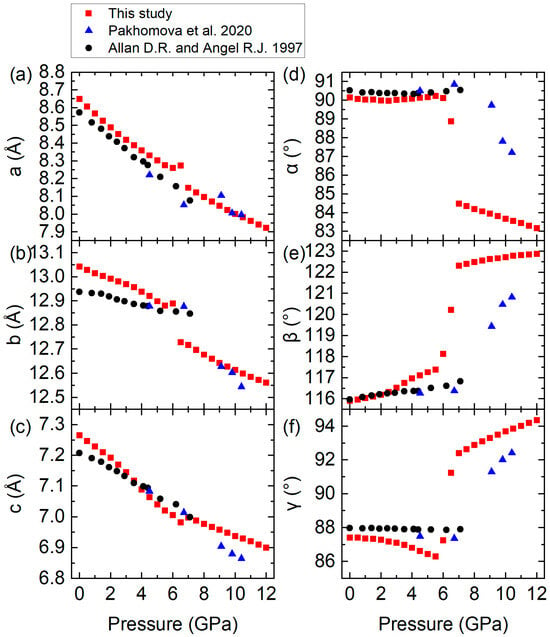
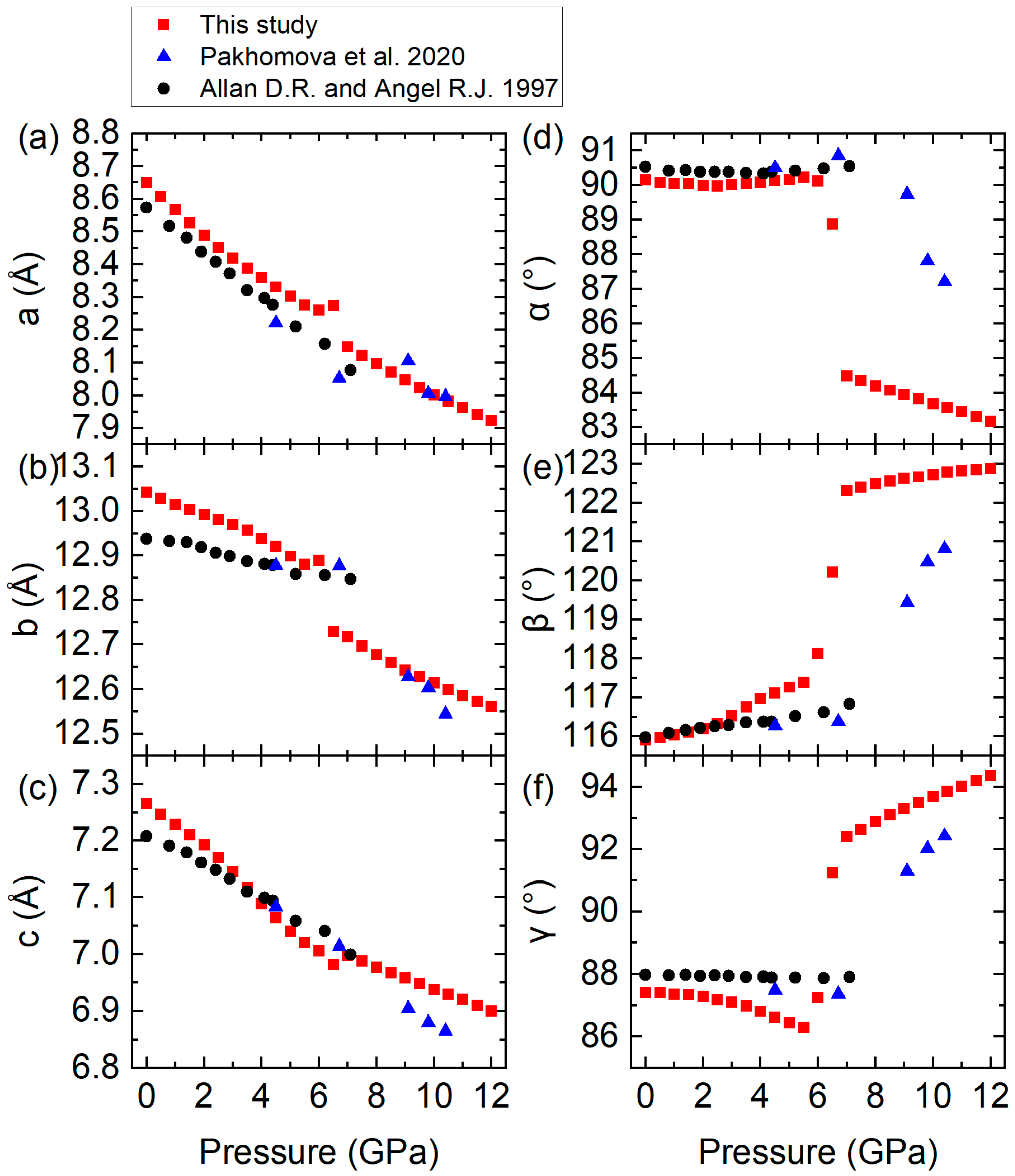
The calculated evolution of the unit-cell parameters and volume with pressure is presented in Figure 1 and Figure 2. Unit-cell axes a, b, and c generally decrease with increasing pressure but show discontinuous changes at 6–7 GPa, with the b-axis displaying a particularly abrupt contraction. Unit-cell angles α, β, and γ also exhibit sudden shifts: α jumps from 90° to 84°, β rises from 118° to 122°, and γ increases from 88° to 93°. These abrupt changes indicate that microcline undergoes an isosymmetric phase transition without space group change at 6–7 GPa.
Figure 1.
Pressure-induced evolution of unit-cell parameters of microcline. (a) Unit-cell parameter a as a function of pressure; (b) unit-cell parameter b as a function of pressure; (c) unit-cell parameter c as a function of pressure; (d) unit-cell angle α as a function of pressure; (e) unit-cell angle β as a function of pressure; (f) unit-cell angle γ as a function of pressure. Squares denote the results obtained in this study. Circles and triangles represent data from previous experiments [24,25].
Our theoretical results align well with earlier experimental data [24,25], particularly in capturing the key features reported by Pakhomova et al. [24]. For instance, their experiments observed a pronounced jump in the b-axis between 7 and 9.1 GPa, and the anomalous evolution of the α, β, and γ angles closely matches our calculated trends [24]. The minor discrepancy in transition pressure could stem from the fact that our calculations were conducted at 0 K or from possible subtle Al–Si disorder in experimental samples, which may raise the transition pressure [20]. Moreover, a recent high-pressure Raman study identified an inflection point in the full-width at half-maximum (FWHM) of the Ic mode around 6.5 GPa [40], which could be linked to this isosymmetric phase transition.
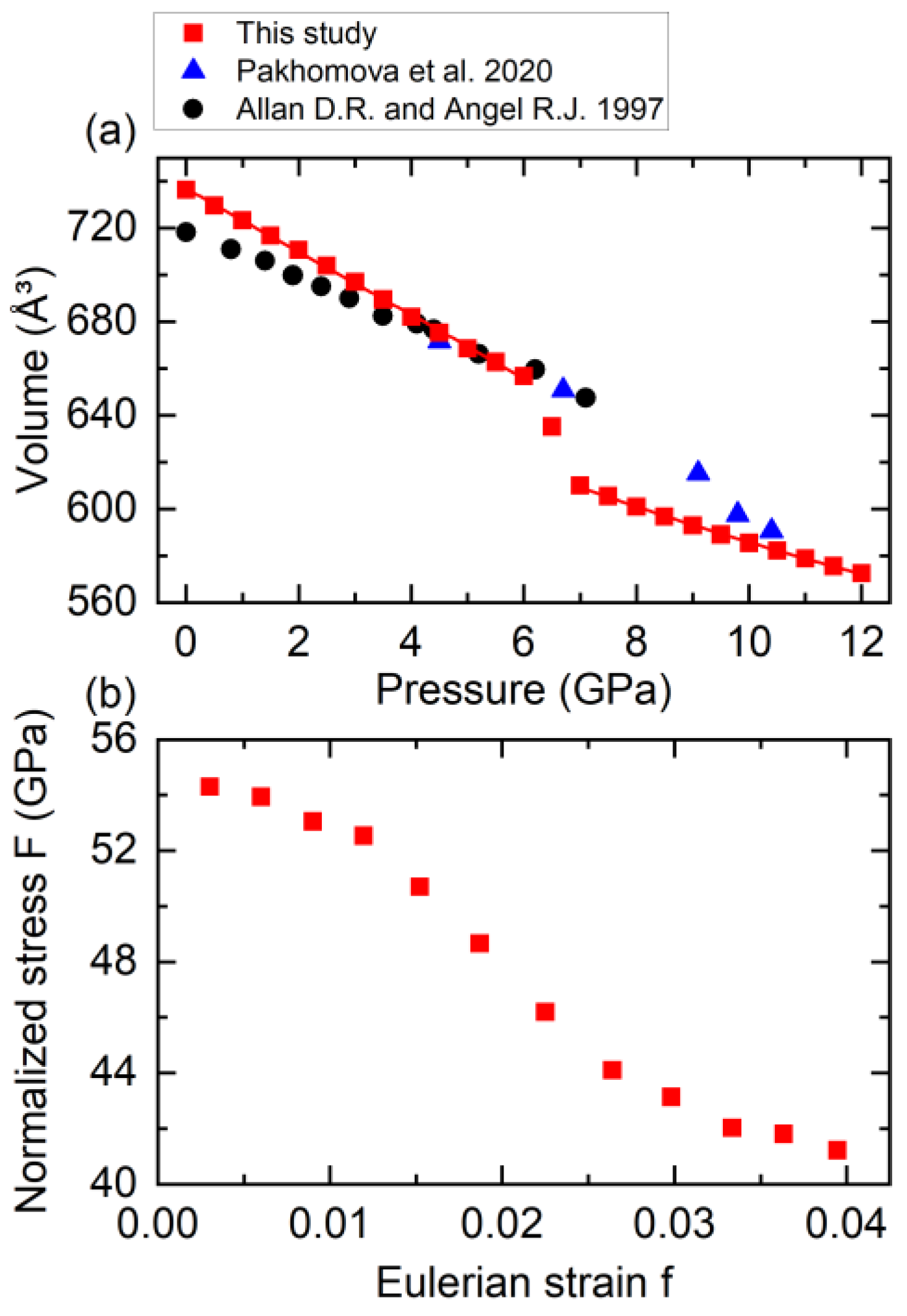
As shown in Figure 2, the unit-cell volume undergoes a jump of about 7% at 6–7 GPa. The low-pressure phase clearly exhibits a downward curvature with . The data for the low-pressure phase were fitted using a third-order Birch–Murnaghan equation of state [41], yielding zero-pressure volume = 736.99 Å3, bulk modulus = 53.37 GPa, and its first pressure derivative = 0.06. This unusual compression behavior is also evident in the normalized stress–finite strain (f-F) plot, where the Eulerian finite strain and the normalized stress (Figure 2b). The slope of the f-F plot is close to zero and becomes negative at higher pressures, a trend similar to that previously reported for albite [21,23]. In contrast, the high-pressure phase clearly shows an upward curvature with . A second-order Birch–Murnaghan equation was used to fit the HP-phase data, giving = 689.55 Å3, = 44.24 GPa, and = 4.
Figure 2.
Pressure–volume data and equations of state of microcline. (a) Pressure dependence of unit-cell volume. Solid lines represent fits to the Birch–Murnaghan equation of state [41]. (b) The f-F plot, where and . Squares denote the results obtained in this study. Circles and triangles represent data from previous experiments [24,25].
3.2. Crystal Structure Evolution of Microcline Under High Pressure
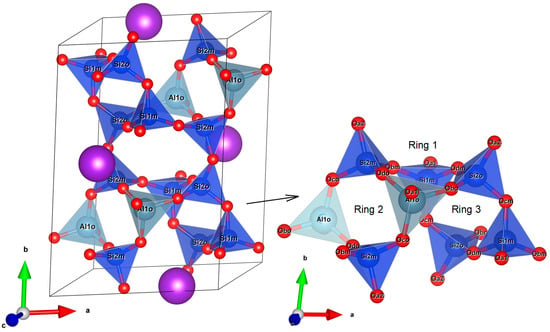
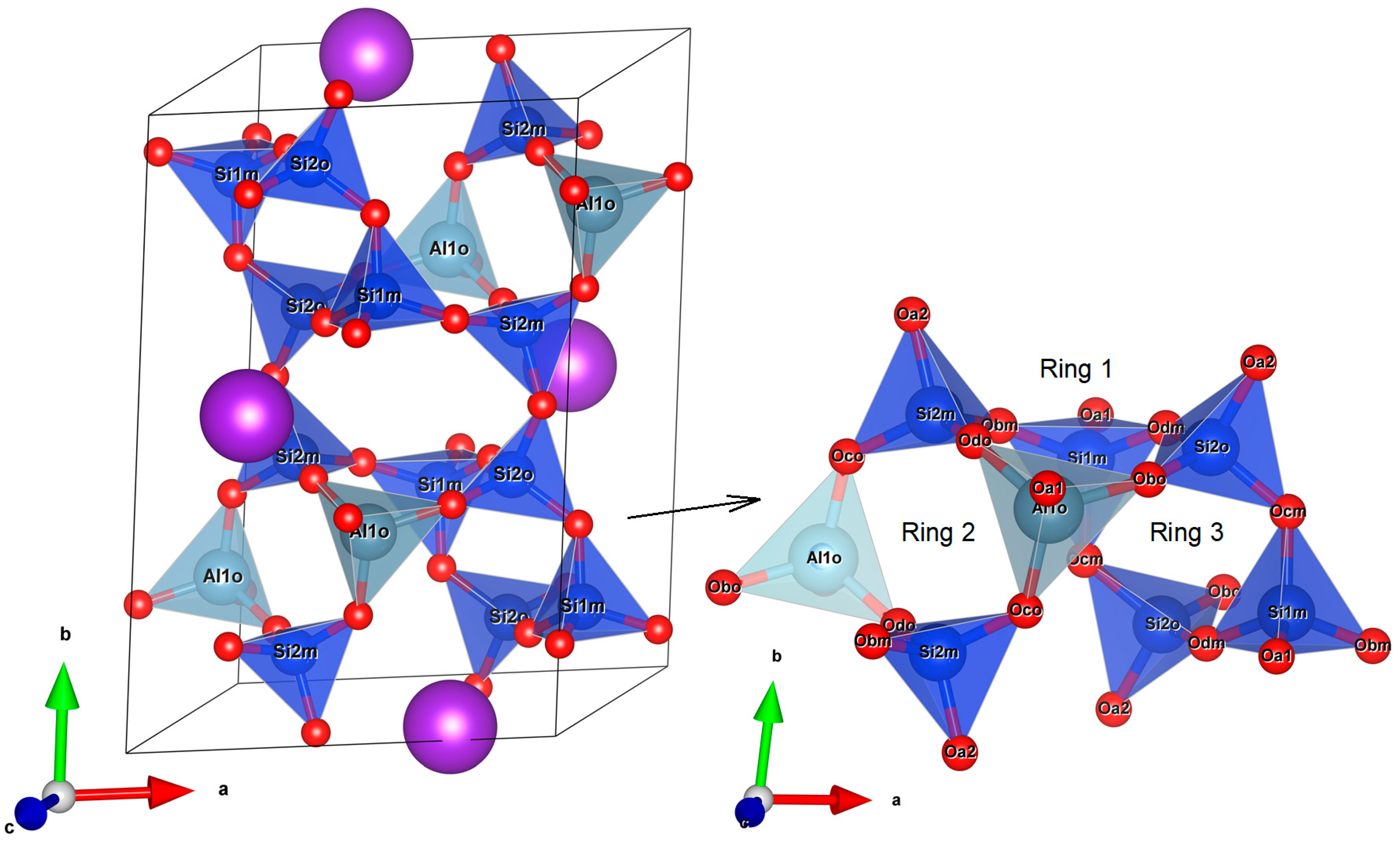
Although the primitive cell of microcline belongs to the triclinic P-1 space group, its structure is conventionally described using the C-1 space group, which preserves the topological characteristics of the monoclinic C2/m structure [42]. In the standard C2/m symmetric framework, there are two symmetrically distinct tetrahedral sites: T1 and T2. However, complete Al/Si ordering reduces the crystallographic symmetry to triclinic C-1, resulting in the splitting of the T1 site into a fully Al-occupied T1o site and a fully Si-occupied T1m site. Similarly, the T2 site splits into T2o and T2m sites, both occupied exclusively by Si. These tetrahedra form three types of four-membered rings: Ring 1 (Al1o–Si2o–Si1m–Si2m) lies parallel to (010), whereas Ring 2 (Al1o–Si2m–Al1o–Si2m) and Ring 3 (Si2o–Si1m–Si2o–Si1m) are approximately parallel to (1–10). These three rings connect to form crankshaft chains extending along the a-axis, with K+ ions occupying the inter-chain cavities (Figure 3).
Figure 3.
Crystal structure of microcline under ambient conditions. Al (silver), Si (blue), and O (red) atoms are labeled according to the standard feldspar notation [42]. The three distinct four-membered tetrahedral rings are highlighted: Rings 1, 2, and 3. Large Ks are shown in purple.
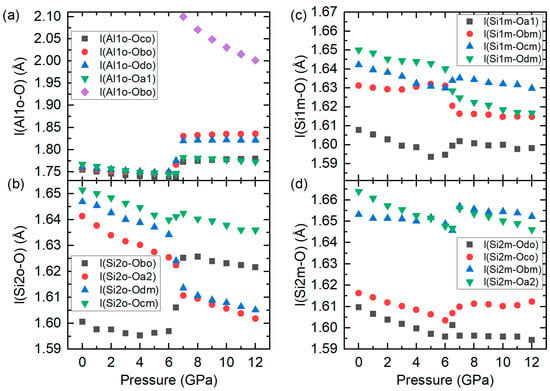
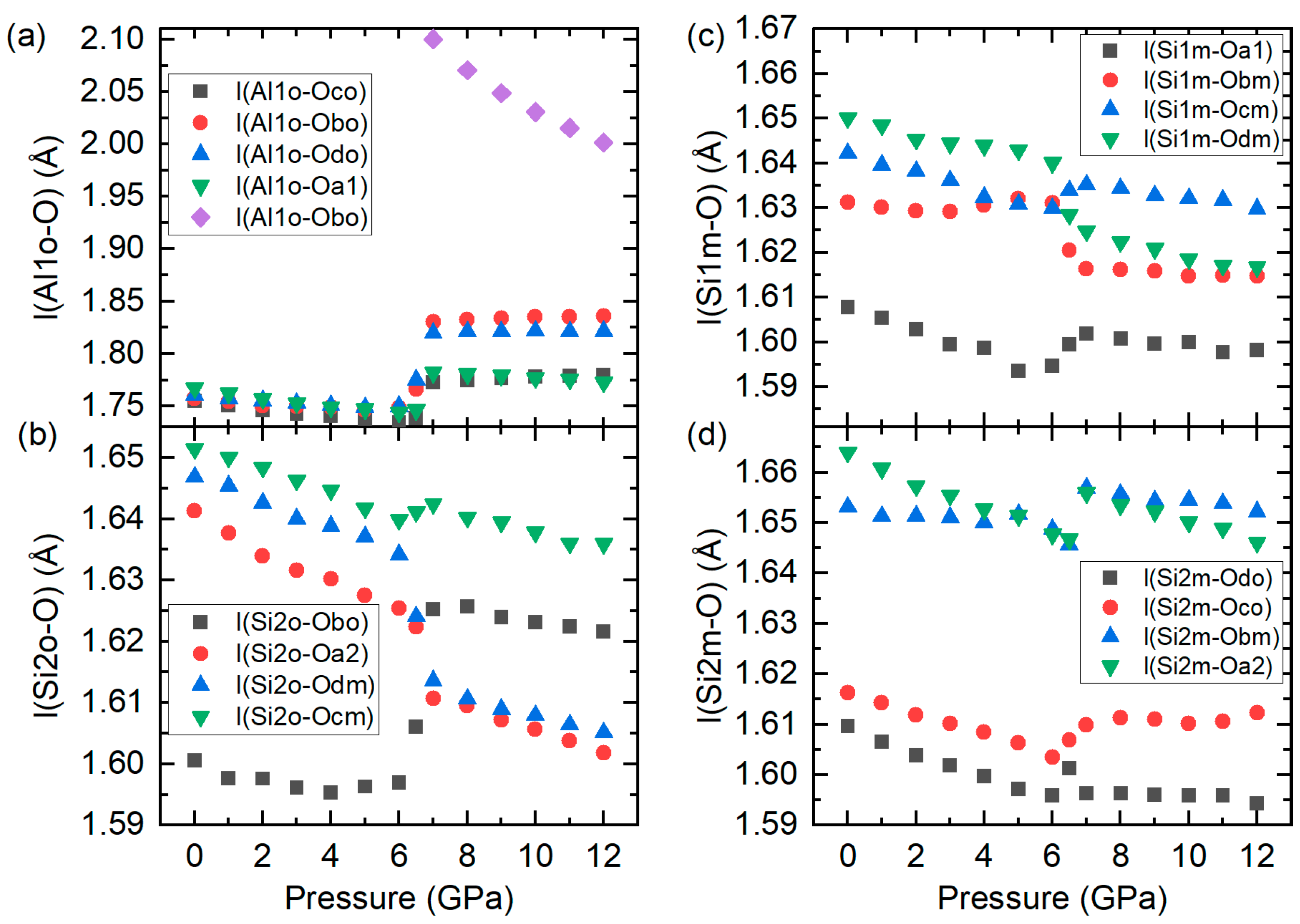
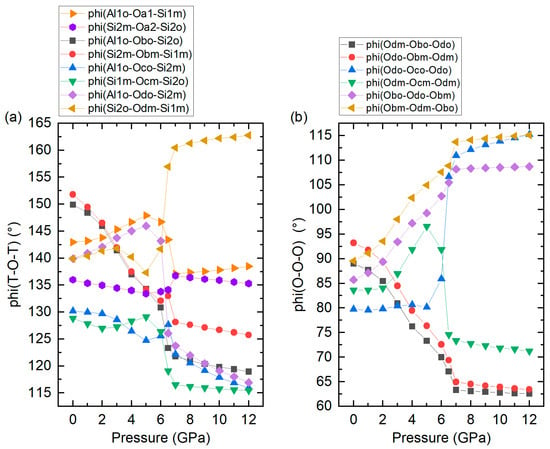
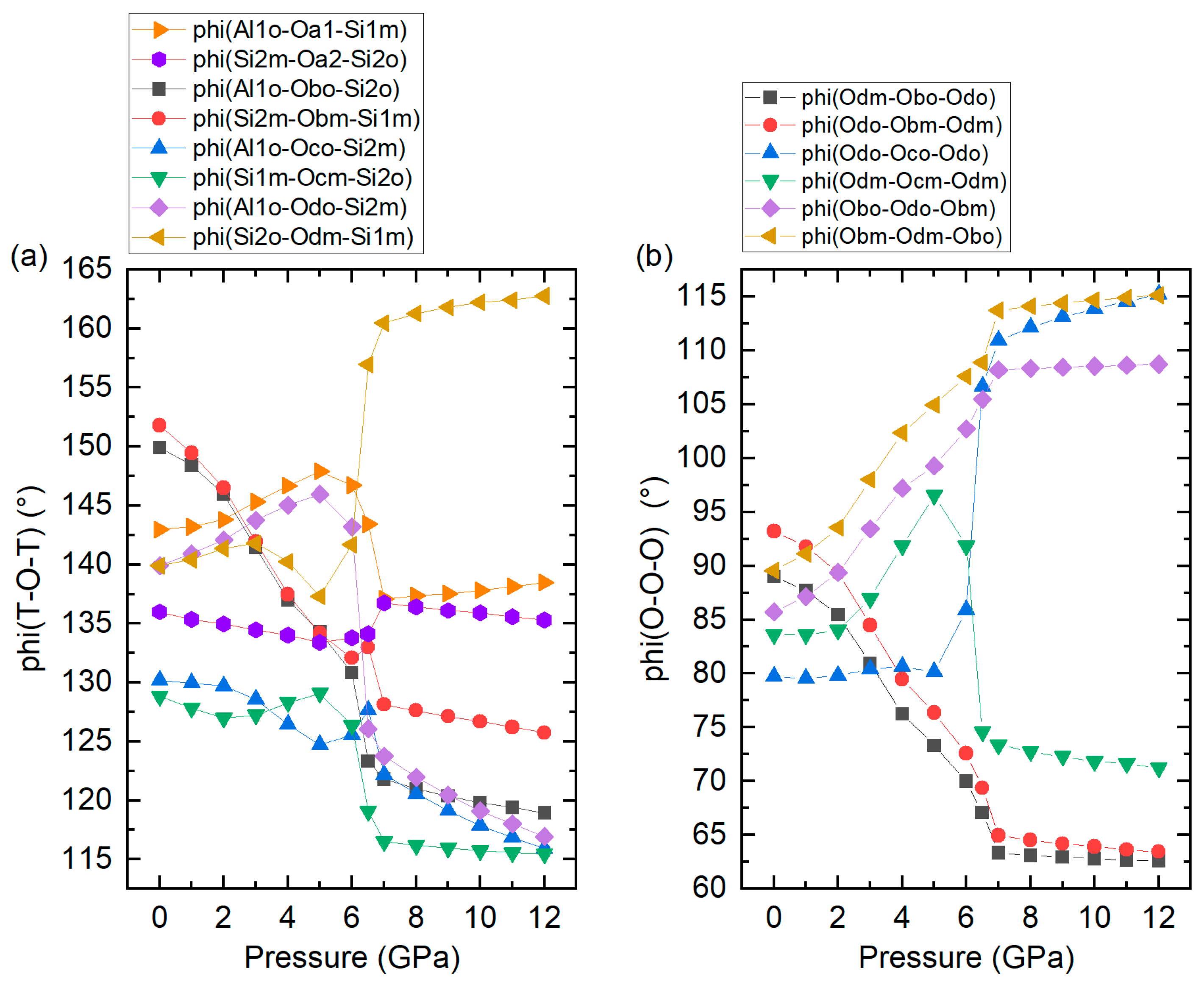
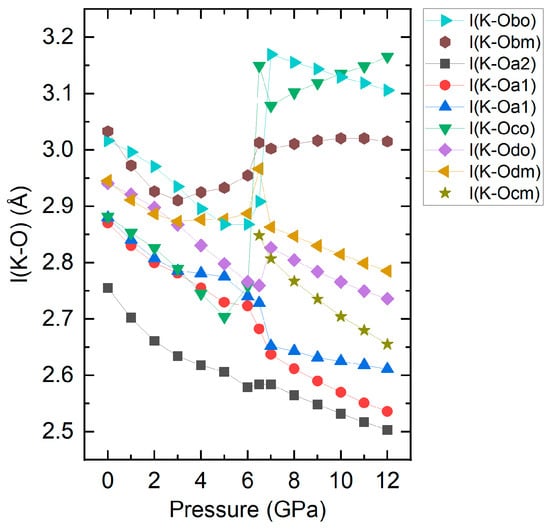
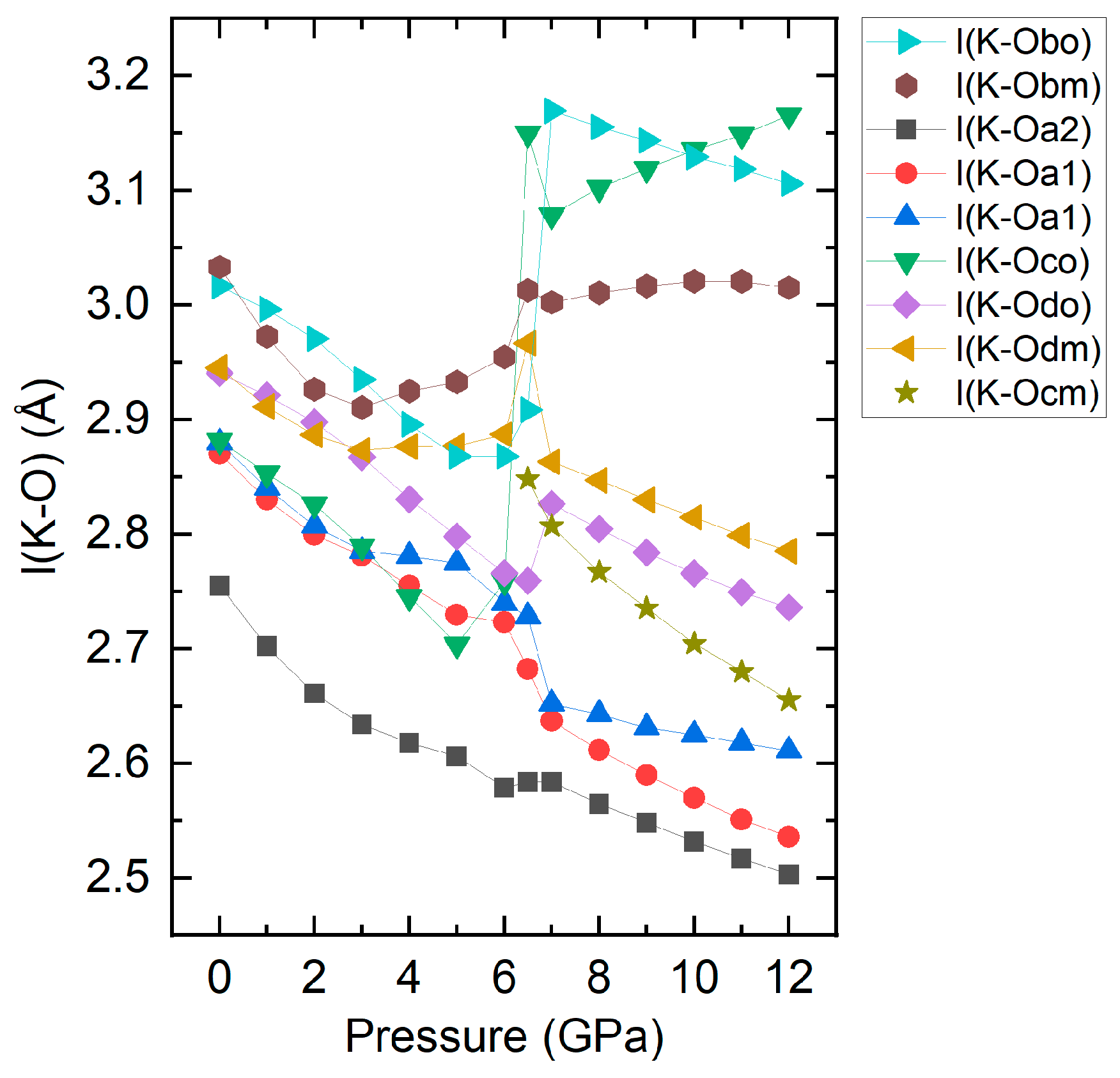
The complex variations in the unit-cell parameters of microcline are primarily governed by the response of its tetrahedral framework to compression. Below 6 GPa, the bond lengths of the tetrahedral T–O bonds change only slightly (Figure 4), so the structural compression is mainly accommodated through bending of the essentially rigid tetrahedral framework, which is reflected in systematic changes of the T–O–T angles (Figure 5a). The most pronounced change is the decrease of the Al1o–Obo–Si2o and Si2m–Obm–Si1m angles from about 150° to 130°, a reduction of roughly 20°, indicating significant shear deformation of Ring 1 (formed by Al1o–Si2o–Si1m–Si2m). This deformation leads to gradual closure of the crankshaft chains extending along [100] and pronounced shortening of the a-axis. In contrast, Ring 2 and Ring 3 undergo much weaker shear. The significant shear deformation of Ring 1 is also supported by changes in the O–O–O angles (Figure 5b), which follow trends consistent with those shown by the T–O–T angles. Meanwhile, the K–O bond lengths decrease markedly with increasing pressure (Figure 6). Thus, the deformation of microcline in its low-pressure phase mainly originates from the shear of Ring 1 and the contraction of K–O bonds, a mechanism similar to that observed in other feldspars [15,16,17,18,19,20,21,22,23,24,25].
Figure 4.
Pressure-induced variation of the tetrahedral bond (T–O) lengths in microcline. (a) Al1o–O bond length as a function of pressure; (b) Si2o–O bond length as a function of pressure; (c) Si1m–O bond length as a function of pressure; (d) Si2m–O bond length as a function of pressure.
Figure 5.
Variation of the T–O–T and O–O–O angles (in degrees °) in microcline as a function of pressure. (a) Evolution of the T–O–T angles with pressure. (b) Shear of the four-membered tetrahedral rings in microcline characterized by the O–O–O angles. Ring 1 is defined by the four corners Obo–Odo–Obm–Odm, where the four angles can vary independently. Ring 2 is defined by Oco–Odo–Oco–Odo and Ring 3 by Ocm–Odm–Ocm–Odm. Symmetry requires that the O-O-O angles in Rings 2 and 3 occur as pairs, with the pairs being complementary angles. The lines are drawn as guides for the eye.
Figure 6.
Pressure dependence of the K–O bond lengths in microcline. The lines are drawn as guides for the eye.
In the pressure range of 6–7 GPa, Ring 2 and Ring 3 begin to exhibit pronounced shear deformation. In Ring 3, the Si1m–Ocm–Si2o angle decreases from 126.4° to 116.5° (Figure 5a), and the corresponding Odm–Ocm–Odm angle drops from 91.8° to 73.4° (Figure 5b), causing Ring 3 to flatten noticeably and thereby driving rapid contraction of the b-axis. Simultaneously, a new bond forms between K and Ocm (bond length 2.848 Å), increasing the coordination number of K from eight to nine (taking into account K–O distances < 3.1 Å). In Ring 2, the Odo–Oco–Odo angle increases from 86.0° to 110.9°, flattening the ring along the c-axis. The flattening direction is perpendicular to that of Ring 3, causing the Obo, Obm, Odo, and Odm atoms in Ring 1 to deviate significantly from coplanarity. Concurrently, Ring 1 undergoes further shear, and a new Al1o–Obm bond forms (bond length 2.100 Å), yielding a coordination geometry intermediate between a trigonal bipyramid and a square pyramid. The remaining four Al–O bonds (1.7726, 1.8303, 1.8195, 1.7818 Å) yield an average length of 1.801 Å. This distribution suggests that the coordination polyhedron is better described as a [4 + 1] configuration. Similar anomalous (4 + 1) coordination of aluminum is observed for the anorthite-III phase [24]. The combined compression mechanisms described above lead to abrupt changes in the Al–O and K–O bond lengths as well as in the unit-cell angles at 6–7 GPa (Figure 4, Figure 5 and Figure 6).
Over the 7–12 GPa range, microcline remains in the high-pressure C-1 phase. Tetrahedral bond lengths show minimal variation in this regime, and the shortening of K–O bonds within the polyhedra is less pronounced compared to the low-pressure phase. However, the Al1o–Obo and K–Ocm bonds exhibit a sharp decrease. In contrast to the low-pressure phase, changes in T–O–T and O–O–O angles become more gradual.
The distinct pressure-dependent behaviors of bond lengths and bond angles provide key insights into the mechanism of the phase transition. Under high pressure, the average T–O bond lengths (T = Al, Si) in microcline show only minor variations, indicating that the tetrahedra themselves act as relatively incompressible rigid units. In contrast, the T–O–T and O–O–O bond angles exhibit pronounced changes, with clear discontinuity at approximately 6 GPa. This marked disparity suggests that the volume collapse is not driven by bond compression but rather by the flexible deformation of the framework: pressure is primarily accommodated through the tilting and rotation of the tetrahedra. The negative curvature in the P–V curve and elastic softening observed prior to the transition reflect the progressive reduction in the restoring forces resisting these tilts and rotation. At the critical pressure (~6 GPa), the framework reaches a geometric limit where continuous deformation can no longer accommodate further compression. This triggers an abrupt reorganization: the T–O–T and O–O–O angles jump, secondary Al–O bonds form, and the K polyhedron collapses. Collectively, these changes account for the large volume discontinuity of approximately 7%. This interpretation is fully consistent with the isosymmetric nature of the transition (i.e., the topology remains unchanged) and explains how a first-order volume jump can occur in a system without distinct bond breaking.
3.3. Comparison with Low Albite
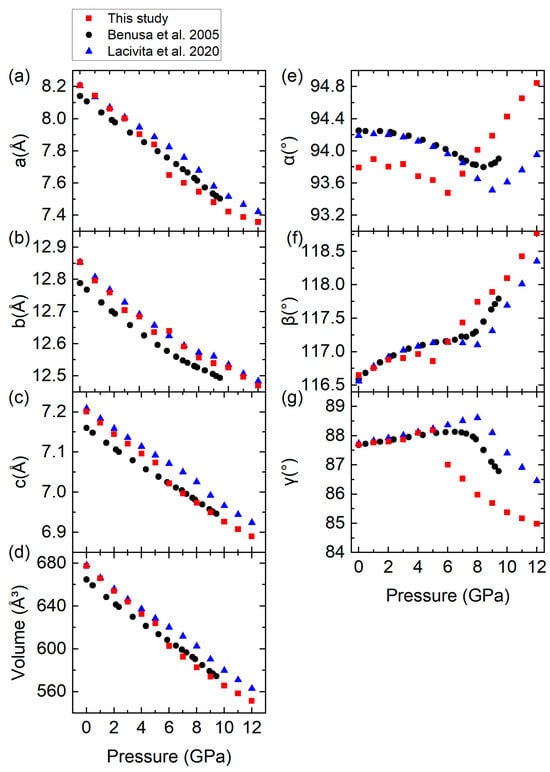
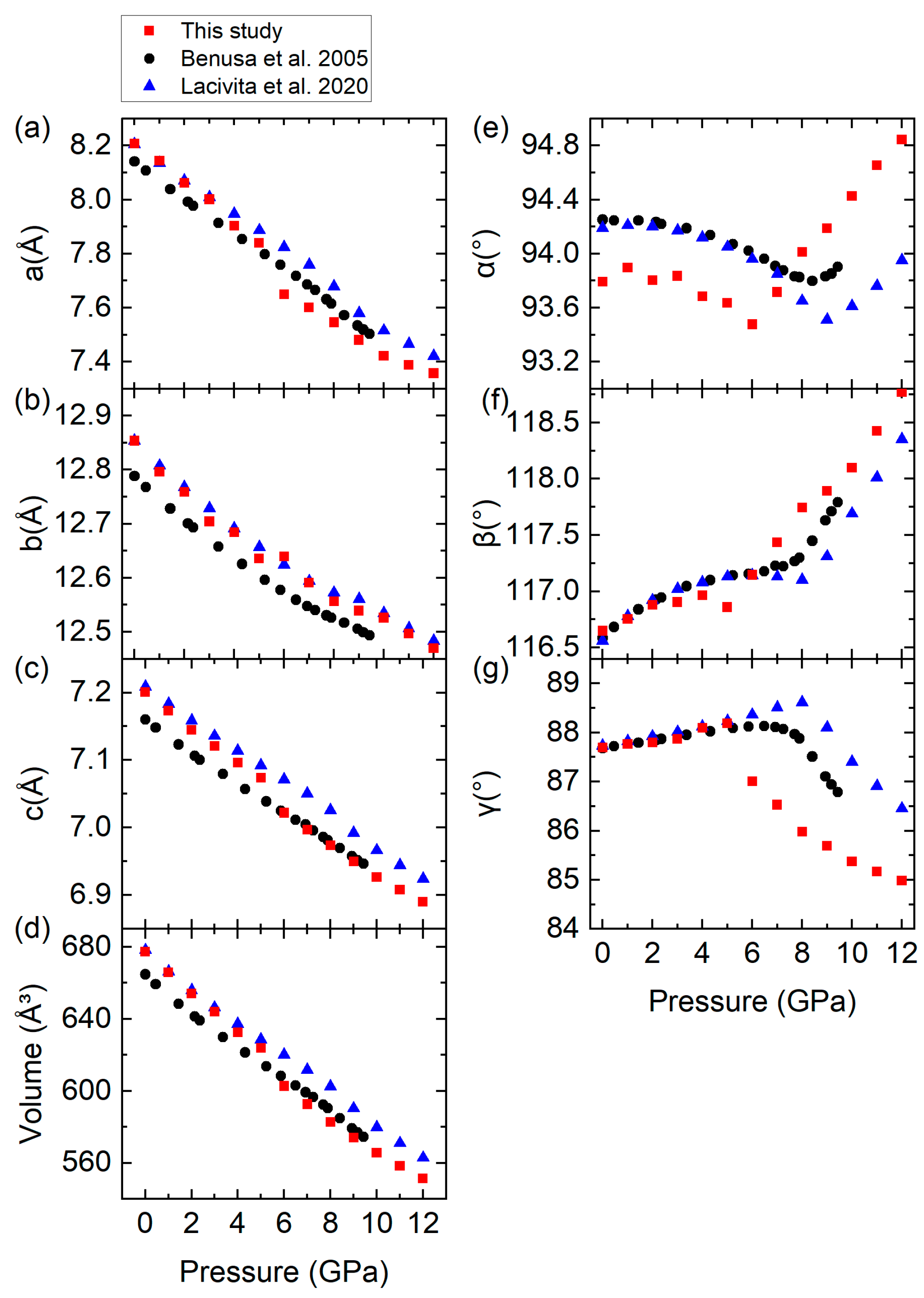
At ambient conditions, low albite and microcline share the same crystal structure. To compare their structural evolution under high pressure, theoretical calculations were conducted to examine the structural changes of low albite over a pressure range of 0–12 GPa. Figure 7 shows the evolution of its unit-cell parameters with pressure. The a- and c-axes exhibit slight discontinuous changes at 5–6 GPa, while the b-axis varies nearly continuously; the volume collapse is only about 3%. Meanwhile, the unit-cell angles α and β show an anomalous increase, and γ decreases around 5 GPa. These evolutionary trends align well with previous experimental and theoretical studies [21,22,23], with only minor differences in the transition pressure, indicating that our theoretical calculations are highly reliable. These anomalies can be attributed to an isosymmetric structural phase transition. The absence of clear volume discontinuity in previous experimental studies may be due to structural disorder in the samples or experimental uncertainties.
Figure 7.
Pressure-induced evolution of unit-cell parameters of low albite. (a) Unit-cell parameter a as a function of pressure; (b) unit-cell parameter b as a function of pressure; (c) unit-cell parameter c as a function of pressure; (d) pressure dependence of unit-cell volume; (e) unit-cell angle α as a function of pressure; (f) unit-cell angle β as a function of pressure; (g) unit-cell angle γ as a function of pressure. Squares denote the results obtained in this study. Circles and triangles represent data from previous experiments [21,23].
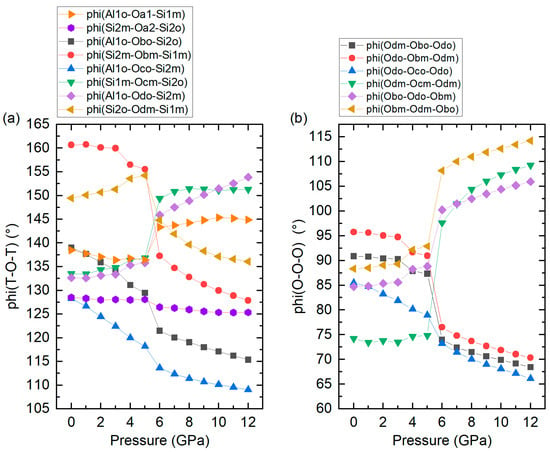
Below the critical pressure, the primary deformation mechanism of low albite and microcline is similar, both stemming from the shear of Ring 1 due to the reduction of the Al1o–Obo–Si2o and Si2m–Obm–Si1m angles (Figure 8). However, near the phase-transition pressure, their structural responses show significant differences. In low albite, the Odm–Ocm–Odm angle in Ring 3 increases from 74.8° to 97.6° (a rise of about 22.7°), while the Odo–Oco–Odo angle in Ring 2 decreases from 78.9° to 73.2° (a decrease of about 5.7°). In contrast, microcline exhibits opposite trends near the transition pressure: the Odm–Ocm–Odm angle in Ring 3 decreases by about 18.5°, and the Odo–Oco–Odo angle in Ring 2 increases by about 25°, with the changes being more pronounced. This difference in structural response leads to clearly distinct variations in their unit-cell parameters: the α and γ angles in low albite change in opposite directions, and its b-axis does not display a significant abrupt drop, whereas microcline shows a marked contraction of the b-axis. Moreover, the shear of Ring 1 near the transition pressure is stronger in low albite than in microcline, resulting in a slight discontinuity of the a-axis at the transition point in albite. In addition, the coordination environments of Al and Na in low albite remain stable, with no change up to 12 GPa.
Figure 8.
Variation of the T–O–T and O–O–O angles (in degrees °) in low albite as a function of pressure. (a) Evolution of the T–O–T angles with pressure. (b) Evolution of the O–O–O angles of the four-membered tetrahedral rings with pressure. All parameters are defined as in Figure 5, as low albite is isostructural with microcline.
Our study demonstrates that while low albite and microcline share the same crystal structure and exhibit certain similarities in their high-pressure structural evolution, their behaviors across the phase transition differ significantly. This difference likely stems from the flexible deformation behavior of the silicate framework and its sensitivity to the type of extra-framework cations. Previous studies also indicate that the high-pressure phases albite-II and albite-III possess crystal structures distinct from that of microcline-II. Moreover, albite decomposes into jadeite and quartz [28], whereas microcline decomposes into wadeite, kyanite, and quartz under high pressure-temperature conditions [27]. A comprehensive understanding of their phase behavior under variable pressure–temperature conditions and its relevance to subduction zone processes necessitates further work. In cold subduction zones in particular, such metastable phases and phase transitions may endure to depths of 200–300 km, offering crucial insights into the recycling of continental crust material.
4. Conclusions
In this study, first-principles calculations were used to investigate the high-pressure crystal-structural evolution of microcline and low albite. Our results reproduce earlier experimental and theoretical observations. More importantly, an isosymmetric phase transition without space group change was identified in microcline around 6–7 GPa. Across this transition, the evolution of the b-axis and lattice angles α, β, and γ shows abrupt changes, resulting in a volume jump of approximately 7%. The pressure–volume curve of the low-pressure phase exhibits a negative second derivative (), indicating elastic softening. Analysis of bond lengths and angles reveals that the tetrahedral units remain essentially rigid during compression and structural compression is mainly driven by changes in framework bond angles. Compression in the low-pressure phase is dominated by shear deformation of tetrahedral Ring 1, while marked shear deformations of Ring 2 and Ring 3 induce a strong contraction of the b-axis and abrupt changes in lattice parameters across the phase transition. The unit-cell parameter trends of low albite also change near 5–6 GPa, but the evolution of unit-cell angles α and γ follows trends opposite those observed in microcline. Detailed comparison of bond angles shows that these differences arise from distinct structural responses of the two minerals at the transition pressure. Specifically, the directions of flattening/elongation in Ring 2 and Ring 3 are fully reversed between microcline and low albite, with larger changes occurring in microcline, whereas shear deformation in Ring 1 is more pronounced in low albite. Our results demonstrate that the deformation behavior of silicate frameworks under high pressure is sensitive to the type of extra-framework cations.
Author Contributions
Conceptualization, B.W. and M.X.; methodology, B.W.; formal analysis, B.W. and M.X.; investigation, B.W.; resources, B.W.; data curation, B.W.; writing—original draft preparation, B.W.; writing—review and editing, B.W. and M.X.; supervision, B.W.; project administration, B.W.; funding acquisition, B.W. All authors have read and agreed to the published version of the manuscript.
Funding
This work is supported by the National Natural Science Foundation of China (Grant No. 42302046 and 42462002) and the Science and Technology Foundation of Guizhou Province (Grant No. QKHJC-ZK [2023] general 462).
Data Availability Statement
The essential data supporting the main findings of this study can be found in the manuscript. The source data are also deposited in https://doi.org/10.5281/zenodo.18397783.
Acknowledgments
We thank the reviewers for their valuable comments, which have helped improve the quality of the manuscript.
Conflicts of Interest
The authors declare no conflicts of interest.
References
- Almqvist, B.S.; Mainprice, D. Seismic properties and anisotropy of the continental crust: Predictions based on mineral texture and rock microstructure. Rev. Geophys. 2017, 55, 367–433. [Google Scholar] [CrossRef] [Scilit]
- Drake, M.J. Plagioclase—Melt equilibria. Geochim. Cosmochim. Acta 1976, 40, 457–465. [Google Scholar] [CrossRef] [Scilit]
- Lofgren, G. An experimental study of plagioclase crystal morphology; isothermal crystallization. Am. J. Sci. 1974, 274, 243–273. [Google Scholar] [CrossRef] [Scilit]
- Kroll, H.; Schmiemann, I.; von Coelln, G. Feldspar solid solutions. Am. Mineral. 1986, 71, 1–16. [Google Scholar]
- Brown, W.L.; Parsons, I. Alkali feldspars: Ordering rates, phase transformations and behaviour diagrams for igneous rocks. Mineral. Mag. 1989, 53, 25–42. [Google Scholar] [CrossRef] [Scilit]
- Brown, J.M.; Angel, R.J.; Ross, N.L. Elasticity of plagioclase feldspars. J. Geophys. Res. Solid Earth 2016, 121, 663–675. [Google Scholar] [CrossRef] [Scilit]
- Waeselmann, N.; Brown, J.M.; Angel, R.J.; Ross, N.; Zhao, J.; Kaminsky, W. The elastic tensor of monoclinic alkali feldspars. Am. Mineral. 2016, 101, 1228–1231. [Google Scholar] [CrossRef] [Scilit]
- Atkinson, A.J.; Ballaran, T.B.; Carpenter, M.A. Local strain heterogeneity associated with Al/Si ordering in anorthite, CaAl2Si2O8, with implications for thermodynamic mixing behavior and trace element partitioning in plagioclase feldspars. Am. Mineral. 2024, 109, 1292–1302. [Google Scholar] [CrossRef] [Scilit]
- Angel, R.J.; Carpenter, M.; Finger, L. Structural variation associated with compositional variation and order-disorder behavior in anorthite-rich feldspars. Am. Mineral. 1990, 75, 150–162. [Google Scholar]
- Laves, F. Phase relations of the alkali feldspars: I. Introductory remarks. J. Geol. 1952, 60, 436–450. [Google Scholar] [CrossRef] [Scilit]
- Benisek, A.; Kroll, H.; Cemic, L. New developments in two-feldspar thermometry. Am. Mineral. 2004, 89, 1496–1504. [Google Scholar] [CrossRef] [Scilit]
- Kroll, H.; Evangelakakis, C.; Voll, G. Two-feldspar geothermometry: A review and revision for slowly cooled rocks. Contrib. Mineral. Petrol. 1993, 114, 510–518. [Google Scholar] [CrossRef] [Scilit]
- Kudo, A.M.; Weill, D.F. An igneous plagioclase thermometer. Contrib. Mineral. Petrol. 1970, 25, 52–65. [Google Scholar] [CrossRef] [Scilit]
- Liu, L.-G.; El Gorsey, A. High-pressure phase transitions of the feldspars, and further characterization of lingunite. Int. Geol. Rev. 2007, 49, 854–860. [Google Scholar] [CrossRef] [Scilit]
- Nestola, F.; Ballaran, T.B.; Benna, P.; Tribaudino, M.; Bruno, E. High-pressure phase transitions in Ca0.2Sr0.8Al2Si2O8 feldspar. Am. Mineral. 2004, 89, 1474–1479. [Google Scholar] [CrossRef] [Scilit]
- Daniel, I.; Gillet, P.; McMillan, P.F.; Wolf, G.; Verhelst, M.A. High-pressure behavior of anorthite: Compression and amorphization. J. Geophys. Res. Solid Earth 1997, 102, 10313–10325. [Google Scholar] [CrossRef] [Scilit]
- Benna, P.; Nestola, F.; Ballaran, T.B.; Balić-Žunić, T.; Lundegaard, L.F.; Bruno, E. The high-pressure structural configurations of Ca0.2Sr0.8Al2Si2O8 feldspar: The I-1-I 2/c and I 2/c-P 21/c phase transitions. Am. Mineral. 2007, 92, 1190–1199. [Google Scholar] [CrossRef] [Scilit]
- Angel, R. Feldspars at high pressure. In Feldspars and Their Reactions; Springer: Berlin/Heidelberg, Germany, 1994; pp. 271–312. [Google Scholar]
- Nestola, F.; Curetti, N.; Benna, P.; Ivaldi, G.; Angel, R.J.; Bruno, E. Compressibility and high-pressure behavior of Ab63Or27An10 anorthoclase. Can. Mineral. 2008, 46, 1443–1454. [Google Scholar] [CrossRef] [Scilit]
- Curetti, N.; Sochalski-Kolbus, L.M.; Angel, R.J.; Benna, P.; Nestola, F.; Bruno, E. High-pressure structural evolution and equation of state of analbite. Am. Mineral. 2011, 96, 383–392. [Google Scholar] [CrossRef] [Scilit]
- Benusa, M.D.; Angel, R.J.; Ross, N.L. Compression of albite, NaAlSi3O8. Am. Mineral. 2005, 90, 1115–1120. [Google Scholar] [CrossRef] [Scilit]
- Mookherjee, M.; Mainprice, D.; Maheshwari, K.; Heinonen, O.; Patel, D.; Hariharan, A. Pressure induced elastic softening in framework aluminosilicate-albite (NaAlSi3O8). Sci. Rep. 2016, 6, 34815. [Google Scholar] [CrossRef] [Scilit]
- Lacivita, V.; D’Arco, P.; Mustapha, S.; Bernardes, D.F.; Dovesi, R.; Erba, A.; Rérat, M. Ab initio compressibility of metastable low albite: Revealing a lambda-type singularity at pressures of the Earth’s upper mantle. Phys. Chem. Miner. 2020, 47, 45. [Google Scholar] [CrossRef] [Scilit]
- Pakhomova, A.; Simonova, D.; Koemets, I.; Koemets, E.; Aprilis, G.; Bykov, M.; Gorelova, L.; Fedotenko, T.; Prakapenka, V.; Dubrovinsky, L. Polymorphism of feldspars above 10 GPa. Nat. Commun. 2020, 11, 2721. [Google Scholar] [CrossRef] [Scilit] [PubMed]
- Allan, D.R.; Angel, R.J. A high-pressure structural study of microcline (KAlSi3O8) to 7 GPa. Eur. J. Mineral. 1997, 9, 263–276. [Google Scholar] [CrossRef] [Scilit]
- Liu, X. Phase relations in the system KAlSi3O8-NaAlSi3O8 at high pressure-high temperature conditions and their implication for the petrogenesis of lingunite. Earth Planet. Sci. Lett. 2006, 246, 317–325. [Google Scholar] [CrossRef] [Scilit]
- Akaogi, M.; Kamii, N.; Kishi, A.; Kojitani, H. Calorimetric study on high-pressure transitions in KAlSi3O8. Phys. Chem. Miner. 2004, 31, 85–91. [Google Scholar] [CrossRef] [Scilit]
- Holland, T.J. The reaction albite = jadeite + quartz determined experimentally in the range 600–1200 C. Am. Mineral. 1980, 65, 129–134. [Google Scholar]
- Xi, L.; ZhangYi, H.; LiWei, D. Feldspars under conditions of high temperature-high pressure. Acta Petrol. Sin. 2010, 26, 3641–3650. [Google Scholar]
- Goldsmith, J.R. Plagioclase stability at elevated temperatures and water pressures. Am. Mineral. 1982, 67, 653–675. [Google Scholar]
- Hohenberg, P.; Kohn, W. Inhomogeneous electron gas. Phys. Rev. 1964, 136, B864. [Google Scholar] [CrossRef] [Scilit]
- Kühne, T.D.; Iannuzzi, M.; Del Ben, M.; Rybkin, V.V.; Seewald, P.; Stein, F.; Laino, T.; Khaliullin, R.Z.; Schütt, O.; Schiffmann, F. CP2K: An electronic structure and molecular dynamics software package-Quickstep: Efficient and accurate electronic structure calculations. J. Chem. Phys. 2020, 152, 194103. [Google Scholar] [CrossRef] [Scilit]
- Dal Negro, A.; De Pieri, R.; Quareni, S.; Taylor, W. The crystal structures of nine K feldspars from the Adamello Massif (Northern Italy). Struct. Sci. 1978, 34, 2699–2707. [Google Scholar]
- Harlow, G.E.; Brown, G.E. Low albite: An X-ray and neutron diffraction study. Am. Mineral. 1980, 65, 986–995. [Google Scholar]
- Perdew, J.P.; Burke, K.; Ernzerhof, M. Generalized Gradient Approximation Made Simple. Phys. Rev. Lett. 1996, 77, 3865–3868. [Google Scholar] [CrossRef] [Scilit]
- Goedecker, S.; Teter, M.; Hutter, J. Separable dual-space Gaussian pseudopotentials. Phys. Rev. B 1996, 54, 1703. [Google Scholar] [CrossRef] [Scilit] [PubMed]
- VandeVondele, J.; Hutter, J. Gaussian basis sets for accurate calculations on molecular systems in gas and condensed phases. J. Chem. Phys. 2007, 127, 114105. [Google Scholar] [CrossRef] [Scilit] [PubMed]
- Monkhorst, H.J.; Pack, J.D. Special points for Brillouin-zone integrations. Phys. Rev. B 1976, 13, 5188. [Google Scholar] [CrossRef] [Scilit]
- Pfrommer, B.G.; Côté, M.; Louie, S.G.; Cohen, M.L. Relaxation of crystals with the quasi-Newton method. J. Comput. Phys. 1997, 131, 233–240. [Google Scholar] [CrossRef] [Scilit]
- Chengcheng, H.; Li, H. A revisit to the phase transition behavior of K-feldspar at high-pressure and high-temperature: Implications on metastable K-feldspar in cold subduction. Am. Mineral. 2024, 109, 439–448. [Google Scholar]
- Birch, F. Finite strain isotherm and velocities for single-crystal and polycrystalline NaCl at high pressures and 300 K. J. Geophys. Res. Solid Earth 1978, 83, 1257–1268. [Google Scholar] [CrossRef] [Scilit]
- Megaw, H.D. Notation for felspar structures. Acta Crystallogr. 1956, 9, 56–60. [Google Scholar] [CrossRef] [Scilit]
Disclaimer/Publisher’s Note: The statements, opinions and data contained in all publications are solely those of the individual author(s) and contributor(s) and not of MDPI and/or the editor(s). MDPI and/or the editor(s) disclaim responsibility for any injury to people or property resulting from any ideas, methods, instructions or products referred to in the content. |
© 2026 by the authors. Licensee MDPI, Basel, Switzerland. This article is an open access article distributed under the terms and conditions of the Creative Commons Attribution (CC BY) license.