


Abstract
We present a low-temperature magnetotransport study of SrAs3 single crystals. For the field configuration with B ‖ b, the resistivity exhibits a large, non-saturating magnetoresistance reaching ~4.80 × 10³% at 14 T and 2 K, alongside a low-temperature residual resistivity ratio (RRR) of ≈17.60. Isothermal curves follow Kohler’s rule across the full 2–300 K temperature range, with a compensated-limit power-law exponent m ≈1.80 ± 0.02. The thermal factor n(T) in extended Kohler scaling remains within 0.90–1.02, indicating that carrier compensation is preserved across two orders of magnitude in temperature. Angle-resolved measurements reveal strongly anisotropic magnetoresistance that reflects the anisotropic nodal-ring Fermi surface, with anisotropy ratios of ~9.60 (b → a) and ~1.82 (b → c). Shubnikov–de Haas oscillations yield angle-dispersive frequencies that indicate a three-dimensional Fermi surface. The field-induced metal–insulator-like crossover and resistivity plateau, often interpreted as signatures of a field-induced gap, are quantitatively reproduced by classical Kohler scaling in a nearly compensated semimetal, without the need to invoke gap opening. These results complete the experimental transport picture of SrAs3 as a classically compensated, highly anisotropic nodal-line semimetal, and provide a reference dataset for alkaline-earth pnictide topological materials.
1. Introduction
Topological semimetals, in which the conduction and valence bands cross at isolated points or along closed lines in momentum space, have attracted sustained interest for two reasons: their low-energy excitations realize relativistic fermions in a solid-state setting and their unusual magnetotransport—extremely large, non-saturating magnetoresistance (XMR), high mobility and nontrivial Berry-phase effects—offers both fundamental insight and a potential route toward field-sensitive devices [1,2,3,4,5,6,7]. Within this family, nodal-line semimetals occupy a distinct position: the band crossing extends along a one-dimensional ring, which in the absence of spin–orbit coupling (SOC) is protected by the combination of inversion and time-reversal symmetry, and is predicted to support flat, drumhead-like surface states [8,9,10,11,12,13]. Nodal lines are not merely theoretical constructions but have been directly observed via angle-resolved photoemission in multiple layered pnictides and ZrSiS-family compounds [14,15]. Representative nodal-line semimetals include the ZrSiX (X = S, Se, Te) family, the PtSn4-type compounds, layered XTaSe2 (X = Pb, Tl) chalcogenides, and the alkaline-earth pnictide family of CaP3/CaAs3/SrP3/SrAs3/BaAs3. In these systems, the SOC strength and degree of band overlap determine the position of the Fermi surface relative to the nodal line [16,17]. Among these, SrAs3 stands out because its nodal line is predicted to lie sufficiently close to the Fermi level to dominate the transport response, while the broken inversion symmetry of its monoclinic C2/m structure enables a clear distinction from the more symmetric counterparts studied previously [18].
The transport signature most consistently associated with compensated semimetals is the XMR. In two-band systems with equal electron and hole densities, XMR scales as ρ(H)/ρ0 ∝ (μH2) at low fields, where μ denotes carrier mobility; at high fields, it transitions to a linear field dependence once Landau-level quantization emerges [19,20,21]. Kohler’s rule, which states that ρ(H)/ρ0 depends only on the dimensionless parameter H/ρ0, is widely employed as a fingerprint of carrier-compensation. Although Kohler’s rule holds to a good approximation in many compensated semimetals, it is violated in the Weyl semimetal TaP. Wang et al. demonstrated that this apparent violation is well described by an extended formulation ρ(H)/ρ0 = f(H/(nTρ0)), where n(T) is a temperature-dependent thermal factor that scales the effective carrier density [22].
Among nodal-line semimetal candidates, SrAs3 occupies a unique place. Predicted to host nodal-line behavior within the CaP3 family [23], it crystallizes in a layered monoclinic structure (space group C2/m) whose weak interlayer coupling gives rise to pronounced crystalline anisotropy. The transport literature on SrAs3 has expanded rapidly: an early study reported a field-induced metal-to-insulator-like crossover, alongside low-amplitude Shubnikov–de Haas (SdH) oscillations and a nontrivial Berry phase [24]; a subsequent work resolved two oscillation frequencies with light cyclotron masses (m* ≈ 0.03 − 0.10m0) and extracted nearly compensated carrier densities of nh ≈ 0.96 × 1017 cm−3 and ne ≈ 2.30 × 1017 cm−3 [25]; angle-resolved photoemission measurements confirmed a nodal loop and a small SOC gap of tens of meV [26]; and high-field measurements up to 31.6 T revealed a toroidal Fermi-surface geometry and two-dimensional weak antilocalization [27]. Optical and magneto-optical studies have further quantified the energy scales associated with the nodal line [28]. Despite this activity, three questions remain insufficiently addressed. (i) The crystallographic anisotropy of SrAs3 should imprint itself on the magnetoresistance, yet a systematic, quantitative mapping of the angular dependence of the semiclassical magnetoresistance—distinct from the angle dependence of quantum oscillations—has not been reported. (ii) The metal–insulator-like crossover observed in ρ(T) under magnetic field, with its characteristic low-temperature resistivity plateau, has been described phenomenologically [17], but whether it reflects genuine field-induced gap opening or is the natural consequence of classical Kohler scaling in a compensated semimetal—a debate that has been debated for a decade in the XMR literature [29,30] has not been quantitatively examined in SrAs3. (iii) Existing measurements were performed on crystals grown via different synthesis routes and over varying field ranges, such that a single dataset simultaneously constraining classical scaling, anisotropy, and quantum oscillation response is still lacking.
In this work, we report systematic magnetotransport measurements on Bi-flux-grown SrAs3 single crystals from the same batch as those used in our previous experimental study of these materials. By combining variable-temperature resistivity (1.8–300 K), longitudinal magnetoresistance up to 14 T, and angle-resolved magnetoresistance in the b → a and b → c rotation planes, we establish the following. (1) Kohler’s rule is obeyed within experimental accuracy over the entire 2–300 K window, with a power-law exponent m ≈ 2, demonstrating a common scattering time and persistent compensation; the local exponent map n(B, T) independently confirms the compensated limit at low temperatures. (2) The magnetoresistance is strongly anisotropic, and the anisotropy ratio is quantitatively consistent with the geometry of the nodal ring and its associated ellipsoidal electron and hole pockets. (3) Angle-dependent SdH oscillations identify a three-dimensional Fermi surface. Our results therefore provide an experimental transport picture of SrAs3 and a reference framework for anisotropic quantum transport in orthorhombic-family nodal-line semimetals.
2. Materials and Methods
SrAs3 single crystals with metallic luster were grown using the bismuth (Bi) flux method. High-purity elemental chunks of strontium (Sr, 99.9%, Alfa Aesar, Haverhill, MA, USA), arsenic (As, 99.999%, Alfa Aesar), and bismuth (Bi, 99.999%, Alfa Aesar) were weighed and loaded into an alumina crucible in a Sr:As:Bi molar ratio of 1:3.1:10. The loaded crucible was then placed inside a quartz ampoule, which was evacuated and flame-sealed to preserve an inert vacuum environment during crystal growth. The sealed ampoule was slowly heated to a target temperature of 1123 K and dwelled at this temperature for 24 h to allow sufficient elemental reaction and crystal nucleation. After the dwelling period, the ampoule was gradually cooled down to 723 K at a slow cooling rate of 2 K h−1. Upon reaching 723 K, the ampoule was promptly removed from the tube furnace, and the as-grown crystals were separated from the molten Bi flux by centrifugation. The as-grown crystals typically exhibit plate-like morphology with lateral dimensions of 2–4 mm and thicknesses of 0.2–0.5 mm, featuring flat, mirror-like natural cleavage surfaces.
Crystallographic axis assignment was performed based on the intrinsic cleavage behavior and well-documented in-plane transport anisotropy of SrAs3, a standard and widely accepted protocol for layered monoclinic semimetals, as validated in our prior work [25]. First, SrAs3 exhibits perfect natural cleavage exclusively along the ab plane, which unambiguously identifies the crystallographic basal plane and the out-of-plane direction. To distinguish the in-plane a and b axes, we utilized the strong intrinsic transport anisotropy of this material: the b-axis direction corresponds to the direction of higher magnetoresistance and lower residual resistivity, which has been systematically calibrated and cross-validated in our earlier systematic study. All samples in this work were grown under identical conditions and show consistent cleavage morphology and transport behavior, ensuring reliable and reproducible axis assignment. For transport measurements, the current direction was aligned along the a-axis under an optical microscope by referencing the characteristic straight cleaved edges of the crystal. We explicitly note that SrAs3 adopts a monoclinic C2/m structure, so the c axis is not strictly perpendicular to the ab plane; the rotation geometries described in this work correspond to rotations within the crystallographic b–a and b–c planes as defined by the unit cell. Elemental composition analysis was performed via energy-dispersive X-ray spectroscopy (EDS) using a Helios Nanolab 600i dual-beam system. Electrical transport measurements were performed on bulk single crystals using a physical property measurement system (PPMS). The magnetotransport measurements were performed on plate-like SrAs3 single crystals with typical dimensions of ~1.2 mm (length along the a-axis), ~0.35 mm (width), and ~0.08 mm (thickness). Four-probe ohmic contacts were fabricated by applying silver paste onto the natural ab cleavage plane.
3. Results and Discussion
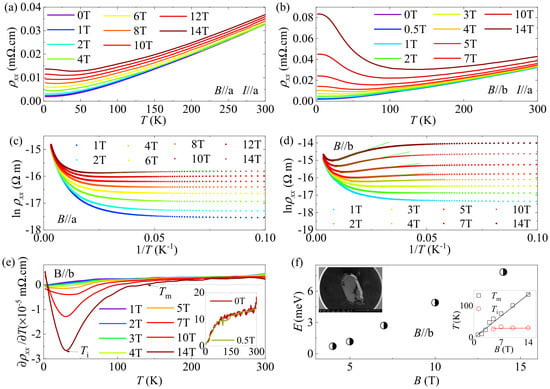
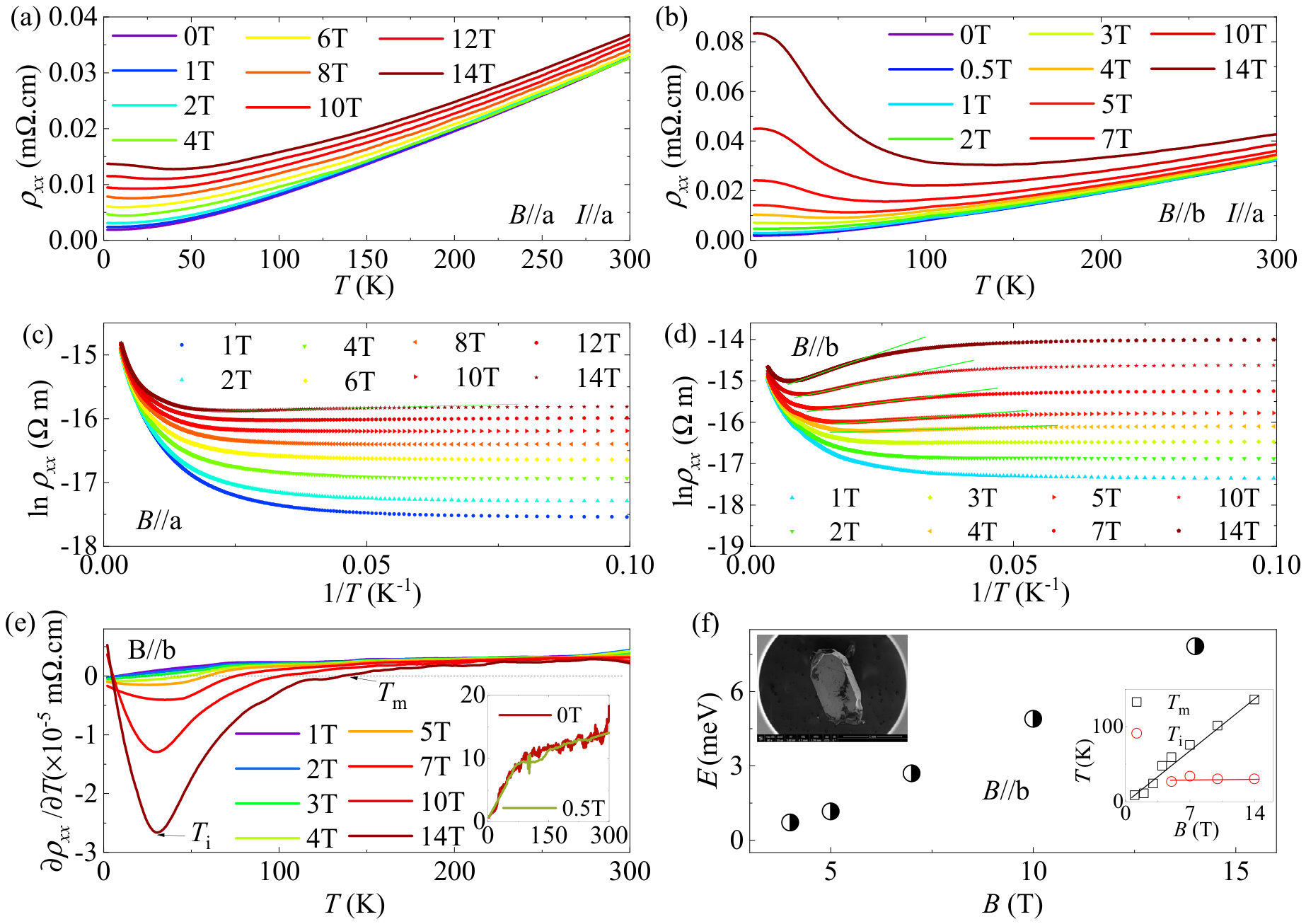
The temperature dependence of the longitudinal resistivity ρxx for the two principal field orientations is summarized in Figure 1a,b, corresponding to B ‖ a and B ‖ b, respectively. In both orientations, ρxx(300 K, 0 T) = 0.0328 mΩ·cm (a) and 0.0329 mΩ·cm (b), whereas ρxx(2 K, 0 T) ≈ 0.00186 mΩ·cm for both orientation, yielding a residual resistivity ratio RRR ≈ 17.60 ± 0.03. Upon application of a 14 T magnetic field, ρxx(2 K) increases to ≈ 0.0137 mΩ·cm (a), and ≈ 0.0833 m Ω·cm (b), corresponding to a magnetoresistance of ≈4.50 × 10³% for B ‖ b. For the B ‖ b geometry, the low-temperature ρxx(T) curves exhibit a saturation plateau below ≈10 K, in marked contrast to the B ‖ a configuration, where ρxx decreases monotonically with temperature down to the base temperature. Figure 1c,d replot lnρxx vs. 1/T scale for B ‖ a and B ‖ b, where the slope d(lnρxx)/d(1/T) = E/kB gives the effective activation energy at low temperatures. As B increases from 0 T to 14 T, the slope flattens gradually: lnρxx is essentially temperature independent below T ≈ 25 K in either geometry, indicating the disappearance of any thermally activated contribution to the conductivity and the onset of a temperature-independent metallic ground state.
Figure 1.
(a,b) Temperature-dependent longitudinal resistivity ρxx measured from 2 K to 300 K under discrete magnetic fields with field aligned along crystalline b- and a-axes, respectively. (c,d) Plots of lnρ against the reciprocal of temperature I/T. (e) Temperature dependence of ∂ρxx/∂T for B ‖ b. Tm and Ti are defined as the temperatures at which the ∂ρxx/∂T versus T curve changes sign and reaches its minimum value, respectively. (f) The values of energy gap are obtained by fitting the insulator-like regions using the relation ρ ∝ exp(E/kBT). The upper inset shows SEM image of an as-grown bulk SrAs3 single crystal. The large flat mirror-like facet is the natural ab cleavage plane. The lower inset shows the magnetic-field dependence of Tm and Ti, respectively.
The temperature derivative of resistivity ∂ρxx/∂T, shown in Figure 1e for B ‖ b, resolves the two characteristic temperatures: a low-temperature dip at Ti ≈ 30 K and a high-temperature shoulder at Tm. With increasing field, ∂ρxx/∂T reaches a minimum at Ti, consistent with an incipient metal–insulator-like crossover in the unperturbed semimetal. With decreasing field, the Ti minimum is rapidly suppressed: by 4 T it has already vanished across the entire temperature window, indicating that the field-induced resistivity saturation coincides with the field-driven closure of the Ti feature. By contrast, Tm shifts to higher temperatures with increasing field, consistent with the high-temperature structural relaxation often associated with the monoclinic-to-triclinic structural instability reported for related members of the CaP3 family. The field dependence of the two characteristic activation energies extracted from the slopes shown in Figure 1d is summarized in Figure 1f. The activation energy E increases monotonically and approximately linearly with B, from ≈0.71 meV at 4 T to ≈7.80 meV at 14 T. Below 5 T, the simultaneous vanishing of E and the resistivity plateau demonstrates the field-induced metal–insulator-like transition in SrAs3 to be a classical transport crossover: it reflects the redistribution of carriers between electron-like and hole-like bands as the field polarizes the compensated Fermi surface, rather than the opening of a real energy gap at the nodal crossing.
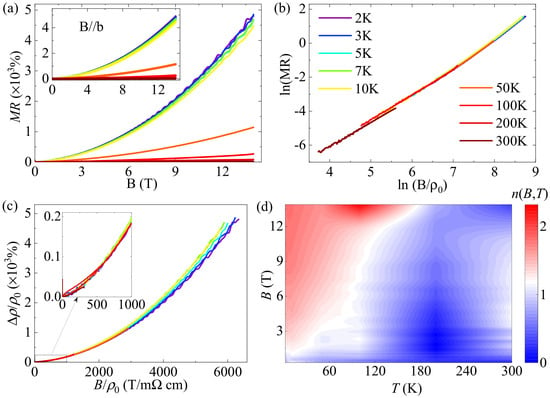
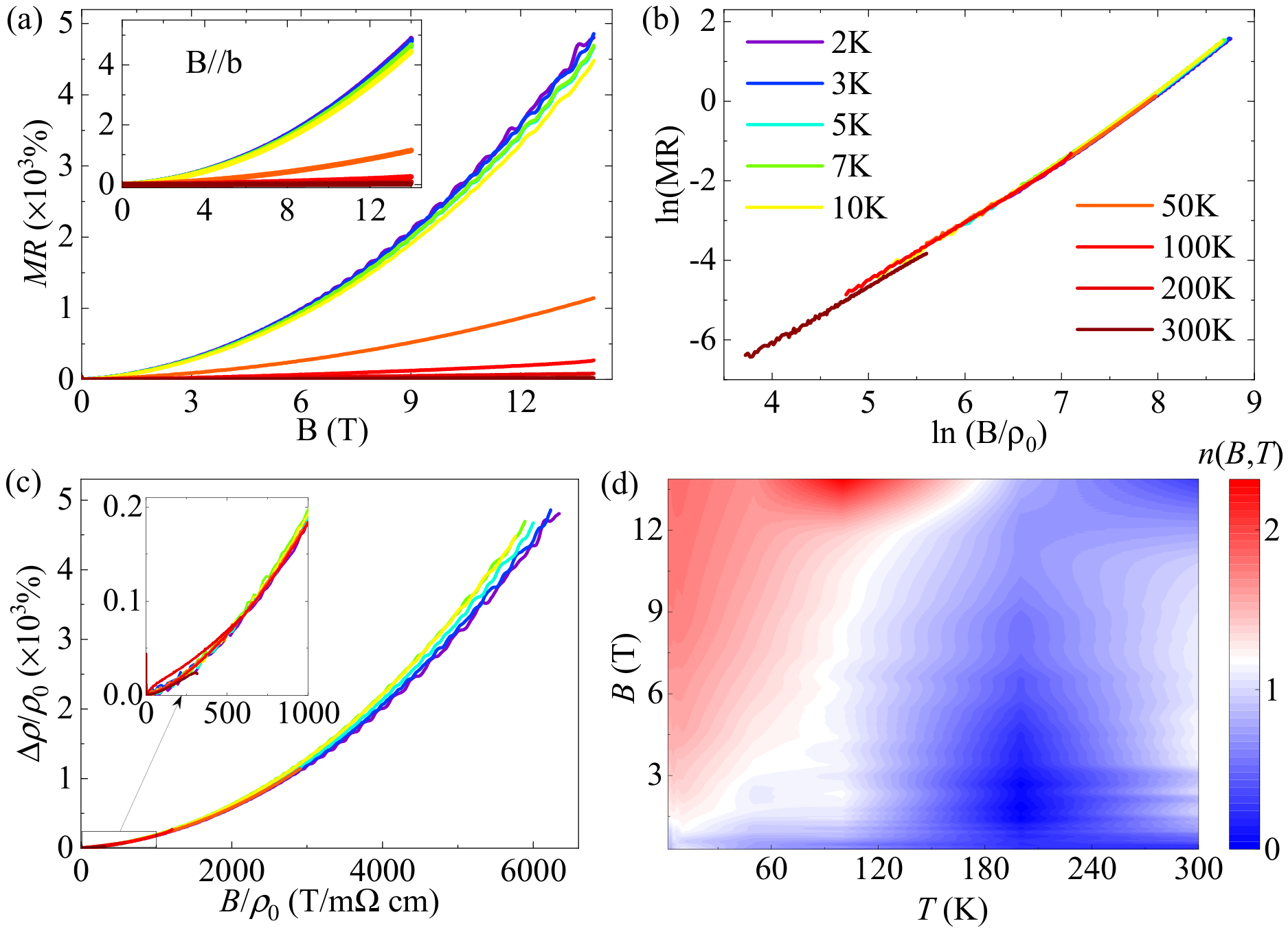
Figure 2a shows the magnetoresistance, defined as , measured at selected temperatures for B ‖ b. At T = 2 K, MR reaches 4.80 × 10³% at 14 T with no sign of saturation. It decreases rapidly with increasing temperature, dropping below 0.27 × 10³% above 100 K. The low-field data (inset) follow a quadratic law for T ≤ 10 T, and weak SdH oscillations are visible. This three-stage temperature evolution—giant non-saturating MR at low temperature, a rapid-decay crossover between 10 K and 50 K, and an ordinary metallic regime above 100 K—is a canonical transport signature of the XMR semimetals [19,31]. To examine whether this rich phenomenology arises from temperature-dependent variations in carrier density, mobility or compensation, we perform a Kohler scaling analysis. Figure 2b plots ln(MR) versus ln(B/ρ0) for all measured temperatures: all isotherms collapse onto a single master curve spanning two orders of magnitude in MR. A power-law fit to the master curve, MR = α(B/ρ0)m, yields m = 1.80 ± 0.04, α = −14. The compensated-semimetal limit m = 2 is approached to within 90%. This scaling collapse is verified on a linear scale in Figure 2c, where the low-field inset (B/ρ0 shows all isotherms overlapping with no detectable fan-out. The robust validity of Kohler’s rule from 2 to 300 K has two direct implications. First, ωτ—rather than any combination of independently temperature-dependent densities and mobilities—is the single scaling variable for the magnetotransport; equivalently, the electron and hole mobilities share a common temperature dependence through a single scattering rate, as expected for a nearly perfectly compensated two-band semimetal. Second, within the extended Kohler formalism [22], the thermal factor n (T) that scales B/ρ0 is unity within our 20.8% uncertainty over the whole temperature range, in contrast to TaP, where n (T) drops from 1 at 300 K to 0.45 at 2 K, arising from thermal activation across small Fermi pockets. SrAs3 therefore belongs, together with LuBi and YBi (m = 1.89 and 1.81, respectively) [32], to the class of “Kohler-obedient” XMR semimetals in which compensation is maintained up to room temperature—a non-trivial statement for a system whose Fermi level lies only tens of meV from the nodal-line energy scales [26,28]. A field- and temperature-resolved picture of this behavior is provided by the local power-law exponent n(B, T) = ∂ln(MR)/∂lnB, shown as a color map in Figure 2d after subtraction of the oscillatory background. At low temperatures and high fields, n approaches 2, the signature of the compensated quadratic regime, consistent with the global exponent m derived above. In the crossover regime, n decreases continuously toward 1.5, and at T > 150 K the apparent sublinear values reflect the small MR magnitude (a few percent) rather than a genuine linear-MR regime; we therefore limit quantitative analysis of n(B, T) to the region where MR exceeds 10%. Within the 14 T field range explored in this work, we find no evidence for an extended n = 1 plateau; whether a genuine quadratic-to-linear crossover emerges at higher fields, as reported by pulsed-field measurements on related nodal-line systems [33], remains to be confirmed by experiments beyond 14 T.
Figure 2.
(a) Temperature dependence of MR with the magnetic field applied parallel to the b-axis and current applied along the a-axis. Inset: non-oscillatory magnetoresistance data as a function of the magnetic field (after removal of SdH oscillations). (b) The plotted quantity ln(B/ρ0) implicitly uses a constant reference normalization to obtain a dimensionless argument for the logarithm; this constant factor only vertically shifts all curves and has no impact on the scaling analysis. (c) Kohler’s rule scaling of MR data with field parallel to the b axis. (d) Contour plot for the exponent n(B, T) of the power law fit of the non-oscillatory magnetoresistance, obtained as explained in the text, as a function of both temperature and magnetic field intensity.
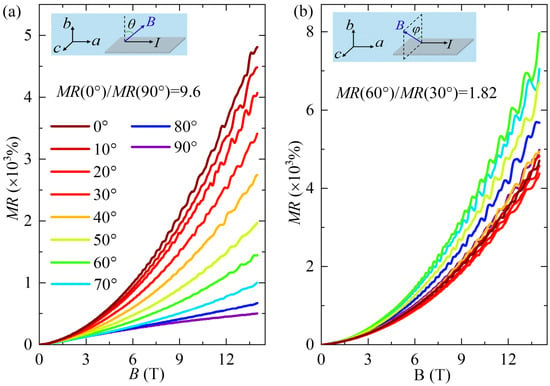
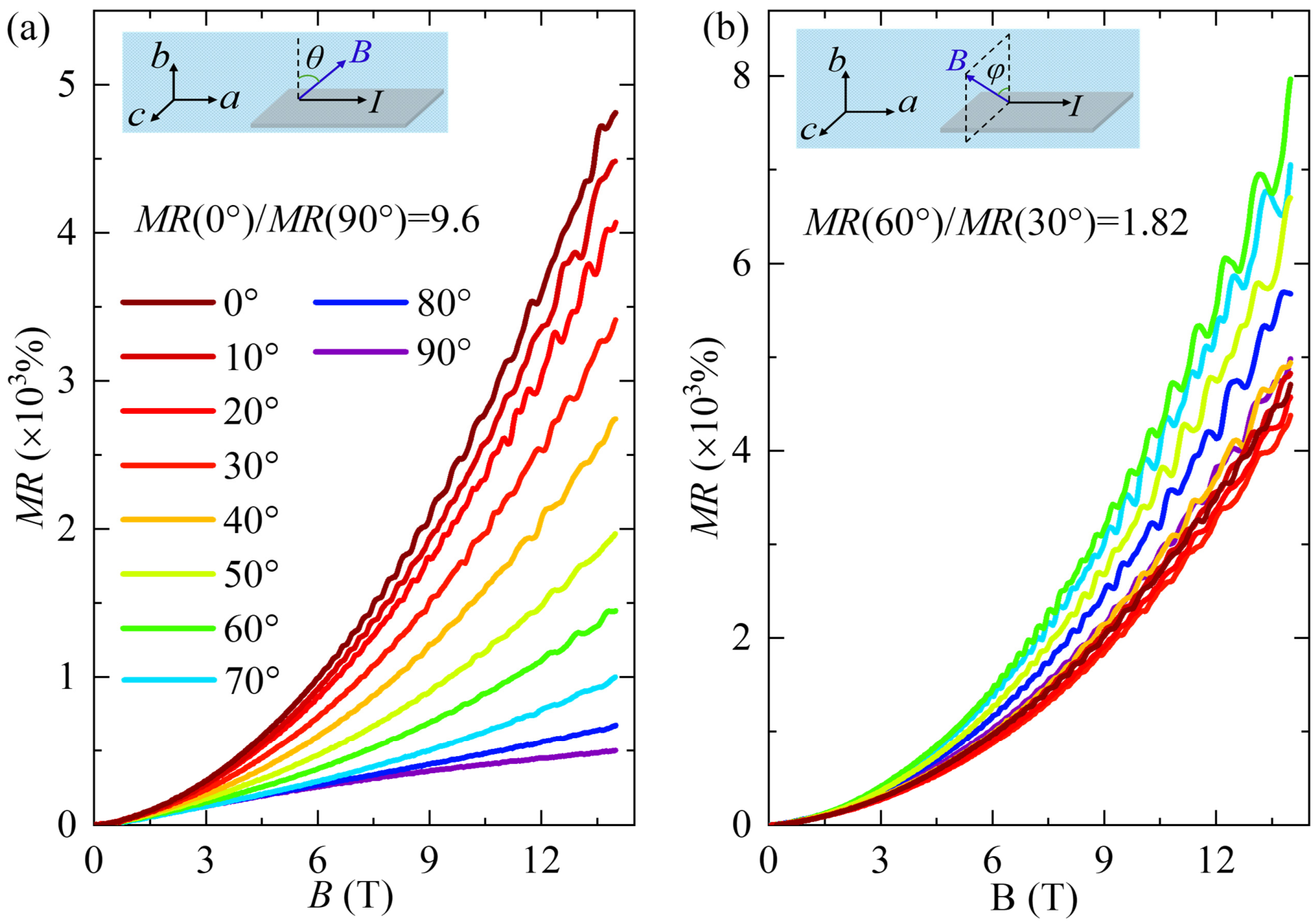
The angular dependence of the magnetoresistance measured in the b → a rotation plane, with the current I fixed along the a-axis, for θ rotating from 0° to 90° in 10° steps, is shown in Figure 3a. At θ = 0° (B ‖ b), the MR reaches ≈4.81 × 10³%; at 14 T, it decreases monotonically with increasing θ, falling to only ≈0.52 × 10³% at θ = 90° (B ‖ a). The resulting in-plane anisotropy ratio MR(θ = 0°)/MR(θ = 90°) = 9.60 ± 0.03 is therefore consistent with the value extracted from Figure 1b. In this geometry, the anisotropy ratio encodes a combination of the intrinsic nodal-ring Fermi-surface anisotropy and the Lorentz-force contribution; the dominant geometric suppression of the transverse MR as B rotates toward the current direction (θ → 90°) makes the b → a plane unsuitable for extracting the intrinsic in-plane transport anisotropy. By contrast, the angular dependence in the b → c rotation plane is non-monotonic (Figure 3b). At θ = 0° (B ‖ b), the MR is ≈4.71 × 10³% at 14 T. As φ increases, MR first decreases slightly, reaching a local minimum near θ ≈ 30° at ≈4.38 × 10³%, before rising again to a maximum of ≈7.97 × 10³% at θ ≈ 60° and finally falling at the largest accessible angles (θ = 90°). The extracted in-plane anisotropy ratio MR(θ = 60°)/MR(θ = 30°) = 1.80 ± 0.02 is consistent with this non-monotonic angular behavior. Given the monoclinic lattice of SrAs3, the b–c plane is not strictly orthogonal to the a-axis current direction; nevertheless, in our experimental b → c rotation geometry, the current remains largely transverse to the magnetic field over the full angular range. As a result, the non-monotonic dependence reflects the intrinsic angular anisotropy of the nodal-ring Fermi surface and is not contaminated by the geometric Lorentz-force suppression that dominates the b → a plane. This characteristic 30° minimum/60° maximum profile is the expected signature of a Fermi surface whose extremal cross-sectional area varies non-monotonically as the field rotates within the b–c plane, in qualitative agreement with the toroidal topology predicted for a nodal-ring semimetal. In the b → c plane, the angular evolution is qualitatively weaker. Two observations are noteworthy. First, we observe no negative longitudinal magnetoresistance at any angle within experimental uncertainty, in contrast to reports in other nodal-line systems, which have been attributed to current-jetting artifacts [34]; our result therefore places a conservative bound on the chiral-anomaly contribution in this crystal geometry. Second, the anisotropy follows the hierarchy MR(b) ≈ MR(c) > MR(a), which—together with the angular dependence of the oscillation frequencies shown in Figure 4—reflects the anisotropic electron and hole pockets of the nodal-line band structure [27,35].
Figure 3.
(a) MR plotted as a function of magnetic field B at various angles between the magnetic field and current directions. The upper inset shows the definition of θ. (b) Field dependence of MR measured with the magnetic field perpendicular to the electric current. The upper inset illustrates the measurement configuration, where φ denotes the angle between the magnetic field direction and the b-axis of the sample.
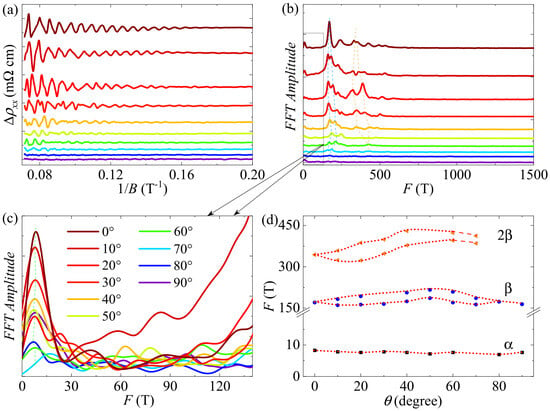
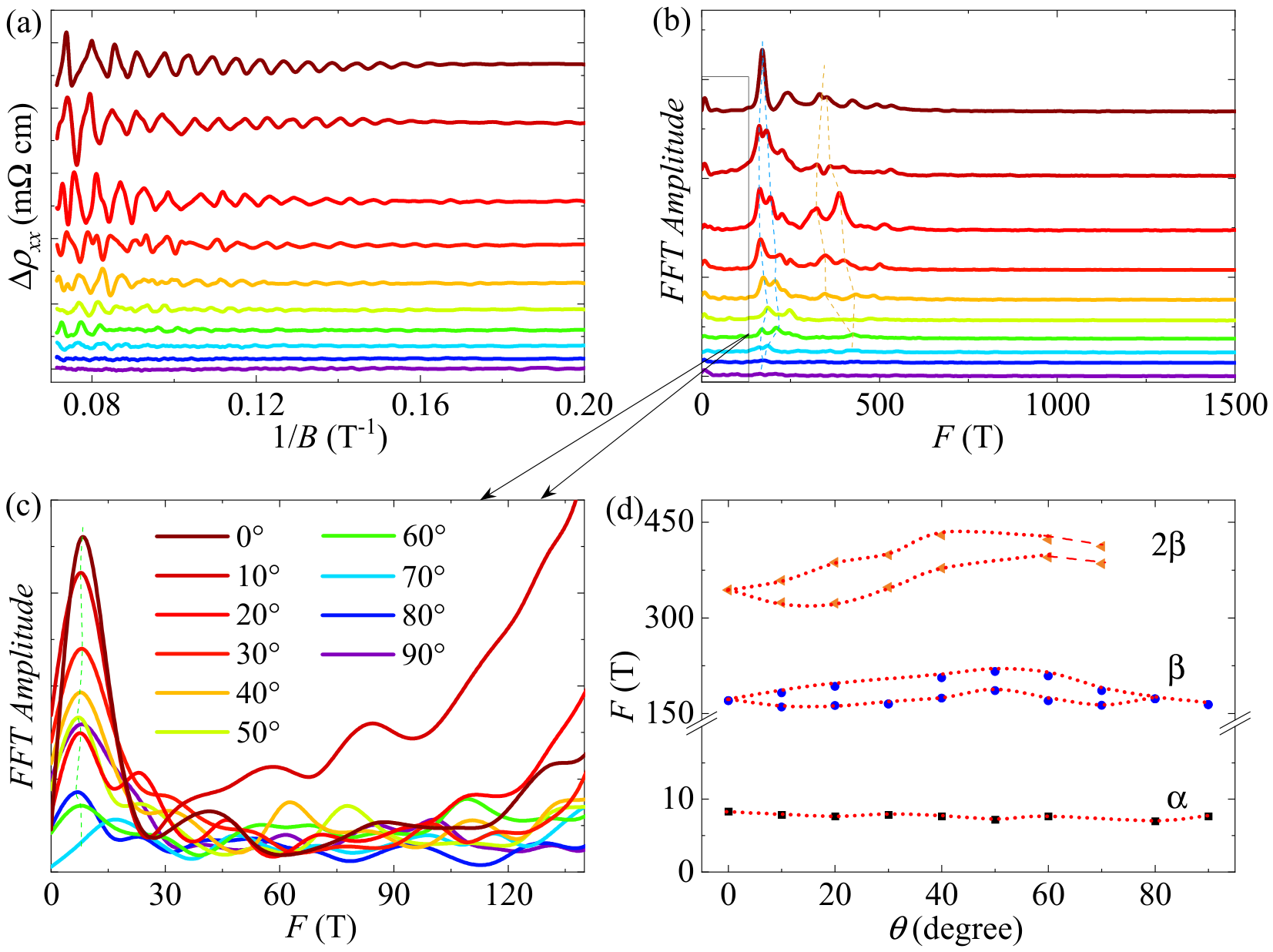
Figure 4.
(a) MR plotted as a function of B with different angles between B and I at T = 1.9 K. (b) The amplitude of SdH oscillations plotted as a function of 1/B. Dashed lines show the trend. (c) The FFT spectra of the corresponding SdH oscillations at various angles. (d) SdH frequencies plotted as a function of angle. Solid points are experimental data, and dashed lines show the trend.
After subtracting a smooth background from Figure 3a, we obtain the oscillatory component Δρxx, plotted as a function of 1/B for each tilt angle, as shown in Figure 4a. The oscillatory component Δρxx is well defined across the full 1/B range, corresponding to the magnetic-field range B ∈ [5, 12.5] T. The oscillation amplitude decays monotonically with increasing 1/B (decreasing B), consistent with the standard Lifshitz–Kosevich damping expected for high-quality single crystals. Traces measured at successive tilt angles are vertically offset for clarity; their envelopes maintain a common period in 1/B across the entire θ range investigated, indicating that the dominant oscillation frequency is approximately angle-independent. The corresponding fast-Fourier-transform (FFT) spectra of these SdH oscillations are displayed in Figure 4b,c. The FFT spectra acquired over the broad range F ∈ [0, 1500] T, displayed in Figure 4b, reveal three distinct features: a low-frequency peak near Fα ≈ 8 T (clearly resolved in the inset of Figure 4b and magnified in panel c, a higher-frequency peak near Fβ ≈ 160–200 T, and a second-harmonic component F2β ≈ 320–400 T that is consistent with the expected second harmonic of Fβ (the ratio F2β/Fβ ≈ 2 holds to within 5% at every tilt angle). The θ-resolved FFT spectra in Figure 4c reveal the angular evolution of the α pocket: the peak amplitude reaches a maximum at θ = 0° and decreases progressively toward θ = 90°, while its position remains Fα ≈ 8 T. Such an amplitude modulation is consistent with the Dingle factor changing as the cyclotron orbit samples different regions of an anisotropic Fermi surface, rather than with a true change of orbit area. The α peak remains sharp and narrow over the entire angular range, with a frequency shift ΔFα/Fα ≲ 5%, confirming that the α pocket is quasi-two-dimensional along the rotation axis probed. The intensities of the individual FFT peaks vary significantly with tilt angle, reflecting anisotropic orbital cross-sectional areas for the different Fermi-surface sheets upon field rotation. Figure 4d summarizes the extracted principal SdH oscillation frequencies as a function of tilt angle. Fα remains essentially constant at ≈8 T across the full rotation range, consistent with a quasi-two-dimensional cylindrical Fermi sheet whose projected area is independent of θ. By contrast, both Fβ and its second harmonic F2β exhibit non-monotonic angular dispersion: starting from ≈160 T and ≈320 T at θ = 0°, they rise to maxima of ≈ 190 T and ≈340 T near θ ≈ 30–40°, and decrease to ≈170 T and ≈320 T at θ = 90°. This characteristic dome-shaped angular dependence, together with the 2β: β frequency ratio, is a hallmark of closed three-dimensional extremal orbits on a toroidal Fermi surface encircling the nodal line, rather than elongated ellipsoidal pockets. This angular dispersion of the SdH frequencies is consistent with the presence of closed three-dimensional Fermi loops encircling the nodal line in bulk SrAs3.
4. Conclusions
In conclusion, we report a low-temperature magnetotransport study of Bi-flux-grown SrAs3 single crystals. The principal results are (i) a large, non-saturating transverse magnetoresistance that follows Kohler’s rule across the full 2–300 K temperature range with a compensated-limit exponent m, with the extended-Kohler thermal factor remaining pinned at unity; (ii) a strongly anisotropic magnetoresistance, quantified by angle-resolved measurements in the b → a and b → c planes, that reflects the anisotropic Fermi-surface geometry of the nodal ring; (iii) angle-dispersive oscillation frequencies, identifying a three-dimensional Fermi surface; (iv) quantitative evidence that the field-induced metal–insulator-like crossover and resistivity plateau arise from classical Kohler scaling in a nearly compensated semimetal rather than from field-induced gap opening. Taken together, these results complete the experimental transport picture of SrAs3 as a classically compensated, strongly anisotropic nodal-line semimetal, and provide a reference dataset for quantum transport in the family of alkaline-earth pnictide topological materials. Natural extensions of this work include pulsed-field measurements to map out the exponent map n(B, T) beyond 14 T, pressure-dependent transport studies across the structural phase transition, and the development of SrAs3-based angle-sensitive magnetoresistive devices.
Author Contributions
Formal analysis, L.A.; Data curation, L.A.; Writing—original draft, L.A.; Writing—review & editing, L.A., W.N. and X.Z.; Funding acquisition, L.A., W.N. and X.Z. All authors have read and agreed to the published version of the manuscript.
Funding
This research was funded by the National Key Research and Development Program of China (Grant No. 2023YFA1607400), the National Natural Science Foundation of China (NSFC- 12304138, 12005141 and 12674158), and the Natural Science Foundation of Anhui Province of China (2308085QA12). The APC was funded by the National Natural Science Foundation of China (Grant No. 12304138).
Data Availability Statement
The data that support the findings of this study are available within the article.
Acknowledgments
We thank Mingliang Tian and Peifeng Fan for fruitful discussions.
Conflicts of Interest
The authors declare no conflict of interest.
References
- Ghalgaoui, A.; Yang, F.; Pilch, P.; Kang, T.; Runge, M.; Yue, S.; Chen, Y.; Yang, Y.; Xiu, F.; Sheng, X.-L.; et al. Nonlinear terahertz phononics in the Dirac semimetal Cd3As2. Phys. Rev. B 2025, 112, L041117. [Google Scholar] [CrossRef] [Scilit]
- Bera, S.; Chatterjee, S.; Pradhan, S.; Pradhan, S.K.; Kalimuddin, S.; Bera, A.; Nandy, A.K.; Mondal, M. Anomalous hall effect induced by berry curvature in the topological nodal-line van der waals ferromagnet Fe4GeTe2. Phys. Rev. B 2023, 108, 115122. [Google Scholar] [CrossRef] [Scilit]
- Xi, T.; Jiang, H.; Li, J.; He, Y.; Gu, Y.; Fox, C.; Primeau, L.; Mao, Y.; Rollins, J.; Taniguchi, T.; et al. Terahertz sensing based on the nonlinear electrodynamics of the two-dimensional correlated topological semimetal TaIrTe4. Nat. Electron. 2025, 8, 578–586. [Google Scholar] [CrossRef] [Scilit]
- Gao, W.; Zhu, M.; Chen, D.; Liang, X.; Wu, Y.; Zhu, A.; Han, Y.; Li, L.; Liu, X.; Zheng, G.; et al. Evidences of topological surface states in the nodal-line semimetal SnTaS2 nanoflakes. ACS Nano 2023, 17, 4913–4921. [Google Scholar] [CrossRef] [Scilit] [PubMed]
- Bannies, J.; Razzoli, E.; Michiardi, M.; Kung, H.H.; Elfimov, I.S.; Yao, M.; Fedorov, A.; Fink, J.; Jozwiak, C.; Bostwick, A.; et al. Extremely large magnetoresistance from electron-hole compensation in the nodal-loop semimetal ZrP2. Phys. Rev. B 2021, 103, 155144. [Google Scholar] [CrossRef] [Scilit]
- Regmi, S.; Elius, I.B.; Sakhya, A.P.; Sprague, M.; Mondal, M.I.; Valadez, N.; Buturlim, V.; Booth, K.; Romanova, T.; Gofryk, K.; et al. Electronic structure in a rare-earth based nodal-line semimetal candidate PrSbTe. Phys. Rev. Mater. 2024, 8, L041201. [Google Scholar] [CrossRef] [Scilit]
- Bin Elius, I.; Casey, J.F.; Regmi, S.; Buturlim, V.; Sakhya, A.P.; Sprague, M.; Mondal, M.I.; Valadez, N.; Kumay, A.K.; Scrivens, J.; et al. Electronic structure of a nodal line semimetal candidate TbSbTe. Phys. Rev. Mater. 2025, 9, 064202. [Google Scholar] [CrossRef] [Scilit]
- Burkov, A.A.; Hook, M.D.; Balents, L. Topological nodal semimetals. Phys. Rev. B 2011, 84, 235126. [Google Scholar] [CrossRef] [Scilit]
- Yuan, D.; Huang, D.; Ma, X.; Chen, X.; Ren, H.; Zhang, Y.; Feng, W.; Zhu, X.; Wang, B.; He, X.; et al. Observation of Dirac nodal line states in topological semimetal candidate PrSbTe. Phys. Rev. B 2024, 109, 045113. [Google Scholar] [CrossRef] [Scilit]
- Yang, M.X.; Luo, W.; Chen, W. Quantum transport in topological nodal-line semimetals. Adv. Phys. X 2022, 7, 2065216. [Google Scholar] [CrossRef] [Scilit]
- Fang, C.; Chen, Y.; Kee, H.-Y.; Fu, L. Topological nodal line semimetals with and without spin-orbital coupling. Phys. Rev. B 2015, 92, 081201. [Google Scholar] [CrossRef] [Scilit]
- Park, H.; Gao, W.; Zhang, X.; Oh, S.S. Nodal lines in momentum space: Topological invariants and recent realizations in photonic and other systems. Nanophotonics 2022, 11, 2779–2801. [Google Scholar] [CrossRef] [Scilit] [PubMed]
- Stuart, B.A.; Choi, S.; Kim, J.; Muechler, L.; Queiroz, R.; Oudah, M.; Schoop, L.M.; Bonn, D.A.; Burke, S.A. Quasiparticle interference observation of the topologically nontrivial drumhead surface state in ZrSiTe. Phys. Rev. B 2022, 105, L121111. [Google Scholar] [CrossRef] [Scilit]
- Jin, X.; Zhang, Q.; Li, D.F.; Cheng, Z.X.; Wang, J.L.; Lv, X.; Zhou, X.; Wang, R.; Ding, X.; Yu, P.; et al. Anharmonicity-driven avoided phonon crossing and anomalous thermal transport in the nodal-line semimetal ZrSiS. Phys. Rev. B 2025, 112, 184311. [Google Scholar] [CrossRef] [Scilit]
- Schoop, L.M.; Ali, M.N.; Straßer, C.; Topp, A.; Varykhalov, A.; Marchenko, D.; Duppel, V.; Parkin, S.S.; Lotsch, B.V.; Ast, C.R. Dirac cone protected by non-symmorphic symmetry and three-dimensional Dirac line node in ZrSiS. Nat. Commun. 2016, 7, 11696. [Google Scholar] [CrossRef] [Scilit] [PubMed]
- Yin, S.; Ding, J.; Asta, M.; Ritchie, R.O. Ab initio modeling of the energy landscape for screw dislocations in body-centered cubic high-entropy alloys. npj Comput. Mater. 2020, 6, 110. [Google Scholar] [CrossRef] [Scilit]
- Hosen, M.; Dhakal, G.; Wang, B.; Poudel, N.; Dimitri, K.; Kabir, F.; Sims, C.; Regmi, S.; Gofryk, K.; Kaczorowski, D.; et al. Experimental observation of drumhead surface states in SrAs3. Sci. Rep. 2020, 10, 2874. [Google Scholar] [CrossRef] [Scilit] [PubMed]
- Bauhofer, W.; Wittmann, M.; Schnering, H. Structure, electrical and magnetic properties of CaAs3, SrAs3, BaAs3 and EuAs3. J. Phys. Chem. Solids 1981, 42, 687–695. [Google Scholar] [CrossRef] [Scilit]
- Shekhar, C.; Nayak, A.K.; Sun, Y.; Schmidt, M.; Nicklas, M.; Leermakers, I.; Zeitler, U.; Skourski, Y.; Wosnitza, J.; Liu, Z.; et al. Extremely large magnetoresistance and ultrahigh mobility in the topological Weyl semimetal candidate NbP. Nat. Phys. 2015, 11, 645–649. [Google Scholar] [CrossRef] [Scilit]
- Pippard, A.B. Magnetoresistance in Metals; Cambridge University Press: Cambridge, UK, 1989. [Google Scholar]
- Ali, M.; Xiong, J.; Flynn, S.; Tao, J.; Gibson, Q.D.; Schoop, L.M.; Liang, T.; Haldolaarachchige, N.; Hirschberger, M.; Ong, N.P.; et al. Large, non-saturating magnetoresistance in WTe2. Nature 2014, 514, 205–208. [Google Scholar] [CrossRef] [Scilit] [PubMed]
- Xu, J.; Han, F.; Wang, T.T.; Thoutam, L.R.; Pate, S.E.; Li, M.; Zhang, X.; Wang, Y.; Fotovat, R.; Welp, U.; et al. Extended Kohler’s Rule of Magnetoresistance. Phys. Rev. X 2021, 11, 041029. [Google Scholar] [CrossRef] [Scilit]
- Quan, Y.; Yin, Z.P.; Pickett, W.E. Single Nodal Loop of Accidental Degeneracies in Minimal Symmetry: Triclinic CaAs3. Phys. Rev. Lett. 2017, 118, 176402. [Google Scholar] [CrossRef] [Scilit] [PubMed]
- Li, S.C.; Guo, Z.P.; Fu, D.Z.; Pan, X.C.; Wang, J.; Ran, K.; Bao, S.; Ma, Z.; Cai, Z.; Wang, R.; et al. Evidence for a Dirac nodal-line semimetal in SrAs3. Sci. Bull. 2018, 63, 535–541. [Google Scholar] [CrossRef] [Scilit] [PubMed]
- An, L.L.; Zhu, X.D.; Gao, W.S.; Wu, M.; Ning, W.; Tian, M.L. Chiral anomaly and nontrivial Berry phase in the topological nodal-line semimetal SrAs3. Phys. Rev. B 2019, 99, 045143. [Google Scholar] [CrossRef] [Scilit]
- Song, Y.K.; Wang, G.W.; Li, S.C.; Liu, W.L.; Lu, X.L.; Liu, Z.T.; Li, Z.J.; Wen, J.S.; Yin, Z.P.; Liu, Z.H.; et al. Photoemission Spectroscopic Evidence for the Dirac Nodal Line in the Monoclinic Semimetal SrAs3. Phys. Rev. Lett. 2020, 124, 056402. [Google Scholar] [CrossRef] [Scilit] [PubMed]
- Kim, H.; Ok, J.M.; Cha, S.; Jang, B.G.; Kwon, C.I.; Kohama, Y.; Kindo, K.; Cho, W.J.; Choi, E.S.; Jo, Y.J.; et al. Quantum transport evidence of isolated topological nodal-line fermions. Nat. Commun. 2022, 13, 7188. [Google Scholar] [CrossRef] [Scilit] [PubMed]
- Jeon, J.; Jang, J.; Kim, H.; Park, T.; Kim, D.; Moon, S.; Kim, J.S.; Shim, J.H.; Min, H.; Choi, E. Optical Transitions of a Single Nodal Ring in SrAs3. Phys. Rev. Lett. Phys. Rev. Lett. 2023, 131, 236903. [Google Scholar] [CrossRef] [Scilit] [PubMed]
- Fawcett, E. Spin-density-wave antiferromagnetism in chromium. Rev. Mod. Phys. 1988, 60, 209. [Google Scholar] [CrossRef] [Scilit]
- Pei, Q.L.; Meng, W.J.; Luo, X.; Lv, H.Y.; Chen, F.C.; Lu, W.J.; Han, Y.Y.; Tong, P.; Song, W.H.; Hou, Y.B.; et al. Origin of the turn-on phenomenon in Td-MoTe2. Phys. Rev. B 2017, 96, 075132. [Google Scholar] [CrossRef] [Scilit]
- Isaacs, E.B.; Marianetti, C.A. Electronic correlations in monolayer VS2. Phys. Rev. B 2016, 94, 035120. [Google Scholar] [CrossRef] [Scilit]
- Pavlosiuk, O.; Ślebarski, A.; Maśka, M.M.; Fijałkowski, M.; Kaczorowski, D.; Gamża, M.B. Magnetoresistance in LuBi and YBi semimetals due to nearly perfect carrier compensation. Phys. Rev. B 2018, 97, 235132. [Google Scholar] [CrossRef] [Scilit]
- Narayanan, A.; Watson, M.D.; Blake, S.F.; Bruyant, N.; Drigo, L.; Chen, Y.L.; Prabhakaran, D.; Yan, B.; Felser, C.; Kong, T.; et al. Linear Magnetoresistance Caused by Mobility Fluctuations in n-Doped Cd3As2. Phys. Rev. Lett. 2015, 114, 117201. [Google Scholar] [CrossRef] [Scilit] [PubMed]
- Ali, M.N.; Schoop, L.M.; Garg, C.; Lippmann, J.M.; Lara, E.; Lotsch, B.; Parkin, S.P. Butterfly magnetoresistance, quasi-2D Dirac Fermi surface and topological phase transition in ZrSiS. Sci. Adv. 2016, 2, e1601742. [Google Scholar] [CrossRef] [Scilit] [PubMed]
- Xu, Q.; Yu, R.; Fang, Z.; Dai, X.; Weng, H. Topological nodal line semimetals in the CaP3 family of materials. Phys. Rev. B 2017, 95, 045136. [Google Scholar] [CrossRef] [Scilit]
Disclaimer/Publisher’s Note: The statements, opinions and data contained in all publications are solely those of the individual author(s) and contributor(s) and not of MDPI and/or the editor(s). MDPI and/or the editor(s) disclaim responsibility for any injury to people or property resulting from any ideas, methods, instructions or products referred to in the content. |
© 2026 by the authors. Licensee MDPI, Basel, Switzerland. This article is an open access article distributed under the terms and conditions of the Creative Commons Attribution (CC BY) license.