


Abstract
Microwave sintering enabled the efficient fabrication of bulk Mn3Cu0.5Ge0.5N0.9C0.1 NTE materials in 3–5 h, versus 2 to 8 days for conventional methods. The microwave approach demonstrated high efficiency and energy savings. By adjusting temperature and dwell time, the NTE operating range can be shifted to lower temperatures. Under the optimized condition of 800 °C for 4 h, the resulting bulk material achieved an NTE coefficient of −20.56 × 10⁻⁶ K−1 over a temperature interval ΔT of 88 K (from 159 K to 247 K), along with favorable densification and high hardness. The demonstrated processing efficiency, microstructural control, and tunable NTE properties establish a solid foundation for potential industrial scale-up.
1. Introduction
Antiperovskite manganese nitrides (Mn3AX, where A represents transition metals or semiconducting elements occupying the cube corners, and X denotes N or C at the body center site) exhibit negative thermal expansion (NTE) behavior [1,2,3,4,5] along with a wide spectrum of functional properties, such as magnetostriction, magnetoresistance, and magnetocaloric response [6,7,8,9], electrocatalytic activity for hydrogen evolution [10], diverse electronic characteristics [11,12,13,14], excellent mechanical performance [15], and so on. Composed of low-cost elements and possessing relatively high Young’s moduli, such materials are promising candidates for industrial thermal expansion compensators. They also offer broad potential for engineering, electronic, and structural applications, particularly in the development of advanced composites for aerospace and semiconductor industry.
To date, two main approaches have been employed to fabricate bulk Mn3AX materials: conventional sintering and spark plasma sintering (SPS). In conventional processing, cold-pressed pellets are typically sealed in quartz tubes and sintered in a furnace under controlled thermal profiles. For example, Ga1−xCrxN0.83Mn3 samples were prepared from mixed powders, encapsulated in quartz tubes, and annealed at 1073–1173 K for 8 days [16]. Similarly, Mn3Sn0.5Zn0.5Cx was heat-treated in quartz ampoules at 800 °C for 80 h followed by natural cooling [8]. The synthesis of Mn3Cu1−xSnxN antiperovskite involved two reaction steps at 1053 K for 40 h each, with intermediate grinding [9]. Mn3Cu0.6Six Ge0.4−xN exhibiting NTE was likewise prepared by holding at 850 °C for 48 h [17].
In contrast, SPS offers much faster processing. Typical SPS cycles for dense Mn3AX bulks involve hold times of only about 10–30 min, excluding heating and cooling periods. For instance, Mn3Zn0.6Ge0.4N has been sintered under various temperatures to study its NTE behavior [18], while Mn3Cu0.5Ge0.5N was consolidated at 820 °C with a 10-min hold [19]. Although SPS enables near-net-shape forming and progress has been made toward larger components, achieving uniform temperature and density distributions in very large or complex geometries remains a challenge. Moreover, the high equipment and die costs, together with scalability limitations, can restrict its suitability for mass production.
Microwave sintering employs high-frequency electromagnetic waves to achieve rapid and uniform volumetric heating throughout the material. This technique improves production efficiency, promotes densification, and suppresses grain growth in ceramics [20,21,22,23,24,25]. Unlike conventional sintering, which relies on thermal conduction from external sources, microwave heating enables energy to be absorbed directly within the material, leading to simultaneous internal heating. As a result, sintering occurs more rapidly and uniformly, with significantly lower energy consumption, making microwave sintering an energy-efficient and environmentally friendly fabrication method [26]. Moreover, the fast heating rates and short processing times associated with microwave sintering help achieve high densification while controlling grain growth, thereby enhancing the mechanical properties of the final product. Given these advantages, microwave sintering is widely regarded as an innovative technique with substantial research and application potential.
However, the preparation of antiperovskite-type manganese nitrides (Mn3AX) with negative thermal expansion (NTE) properties via microwave sintering has been rarely reported. In this work, we demonstrate the successful synthesis of antiperovskite Mn3Cu0.5Ge0.5N0.9C0.1 exhibiting NTE behavior using rapid microwave sintering, which reduces the processing time from the conventional 2–8 days to only 3–5 h. While maintaining high phase purity, we systematically investigated the influence of microwave sintering parameters on the NTE performance. This study establishes microwave sintering as an efficient and unconventional route for fabricating antiperovskite manganese nitrides with tailored NTE properties. Our findings offer practical guidance for optimizing sintering conditions to enable mass production of Mn3AX ceramics suitable for aerospace and semiconductor industrial applications.
2. Materials and Methods
2.1. Materials and Procedures
In this study, all raw materials were of high purity (≥99.9%). Manganese powder (99.9%, particle size < 44 µm, −325 mesh) and copper powder (99.95%, particle size ∼10 µm) were supplied by Beijing Rongyuan Technology Co., Ltd. Germanium powder (99.99%, supplied as bulk material and subsequently ball-milled to −200 mesh, particle size < 20 µm) was obtained from the same supplier. Graphite powder (99.95%, particle size < 10 µm) was provided by Qingdao Yanhai Carbon Materials Co., Ltd. (Qingdao, China), and high-purity nitrogen gas (99.99%) was sourced from Xisanjiao Gas Station.
First, Mn powder reacted with N2 gas in a vacuum furnace (MTI GSL 1600X) at 1023 K for 5 h to synthesize Mn2N0.86 powder via a solid–gas reaction [27]. Subsequently, Cu, Ge, C, and as-prepared Mn2N0.86 powders were weighed according to the stoichiometric ratio of Mn3Cu0.5Ge0.5N0.9C0.1 and homogeneously mixed by ball milling. The milling was conducted in stainless-steel jars with stainless-steel balls at ball-to-powder weight ratio 10:1 and a rotation speed of 80 rpm for 5 h. The starting materials and the chemical composition of the target compound are summarized in Table 1.
Table 1.
The raw materials and chemical composition of prepared Mn3Cu0.5Ge0.5N0.9C0.1.
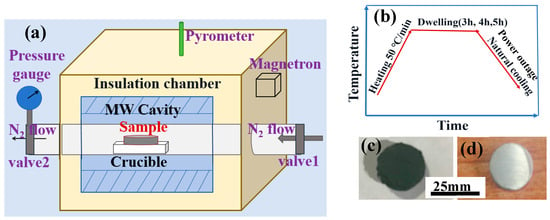
The mixed powder was then pressed into cylindrical pellets (Φ 25 mm × 10 mm) under a pressure of 30 MPa at room temperature. Each pellet was sealed in a quartz tub, which was placed inside the microwave furnace (Figure 1). The tube was purged with nitrogen for 30 min to completely remove air. After closing the valves, the system was allowed to stand for 10 min to confirm air-tightness by monitoring the pressure gauge. Once a leak-free condition was verified, a slight N2 overpressure of 0.5 MPa was maintained with high-purity N2 (99.99%) throughout the sintering process.
Figure 1.
Experimental setup, sintering profile, and sample appearance for microwave sintering: (a) Schematic of the microwave furnace configuration; (b) Time–temperature profile of the sintering process; (c) Macroscopic view of a sintered bulk sample; (d) Polished sample after removal of the surface oxide layer.
Sintering was carried out in a 4.4 kW Mobilelab microwave furnace (Tangshan Nayuan Microwave Thermal Instrument Manufacturing Co., Ltd., Tangshan, China.) operating at 2.45 GHz (Figure 1a). The temperature was monitored using a microwave-compatible sensor coupled with a pyrometer, with an accuracy of ±1 °C. A series of sintering experiments were conducted at different temperatures (600, 650, 700, 750, 800, 860, and 900 °C) and holding times (3, 4, and 5 h). The temperature range was selected to cover the critical densification stage and the reported thermal-decomposition threshold (~690 °C) of Mn3Cu0.5Ge0.5N [28]. Temperatures below 750 °C were used to examine incomplete sintering and phase evolution, whereas the range of 750–900 °C allowed us to study the competition between densification and decomposition-induced porosity. The holding times of 3–5 h were chosen based on preliminary tests, which indicated that this duration was sufficient for near-complete diffusion-controlled homogenization and phase formation under microwave heating, while avoiding excessive grain coarsening or decomposition.
After the holding period, the samples were cooled naturally inside the furnace. Although the cooling stage was not accelerated, the total process time remained substantially shorter than that of conventional sintering due to the rapid heating and reduced holding time enabled by microwave sintering.
2.2. Material Characterization
The sintered samples exhibited a surface oxidation layer, as shown in Figure 1c. This layer was removed prior to subsequent tests. Room-temperature and variable-temperature X-ray diffraction (XRD) patterns were collected using Cu Kα radiation on a Bruker D8-Discover diffractometer. Three types of XRD experiments were performed: phase refinement on bulk samples, phase quantification via an internal Si standard on powders, and variable-temperature XRD on powers to monitor negative thermal expansion via the (111) peak shift. Rietveld refinement of samples’ XRD patterns was performed using the GSAS-II software package. The linear thermal expansion (ΔL/L300K) was measured from 77 to 400 K using a thermodilatometer (L75PT Vertical, Linseis, Linseis Messgeräte GmbH, Selb, Germany) with liquid-nitrogen cooling. Room-temperature Vickers microhardness was evaluated on a T2500 Wilson-Wolpert (Instron corporation, Norwood, MA, USA) tester under a 1 kg load. The reported hardness for each sample is the average of five independent indentations. Microstructure was characterized using a Hitachi S-4800-I (Hitachi, Ltd., Tokyo, Japan) scanning electron microscope (VEGA 3 tungsten filament type).
3. Results and Discussion
3.1. Phase Analysis
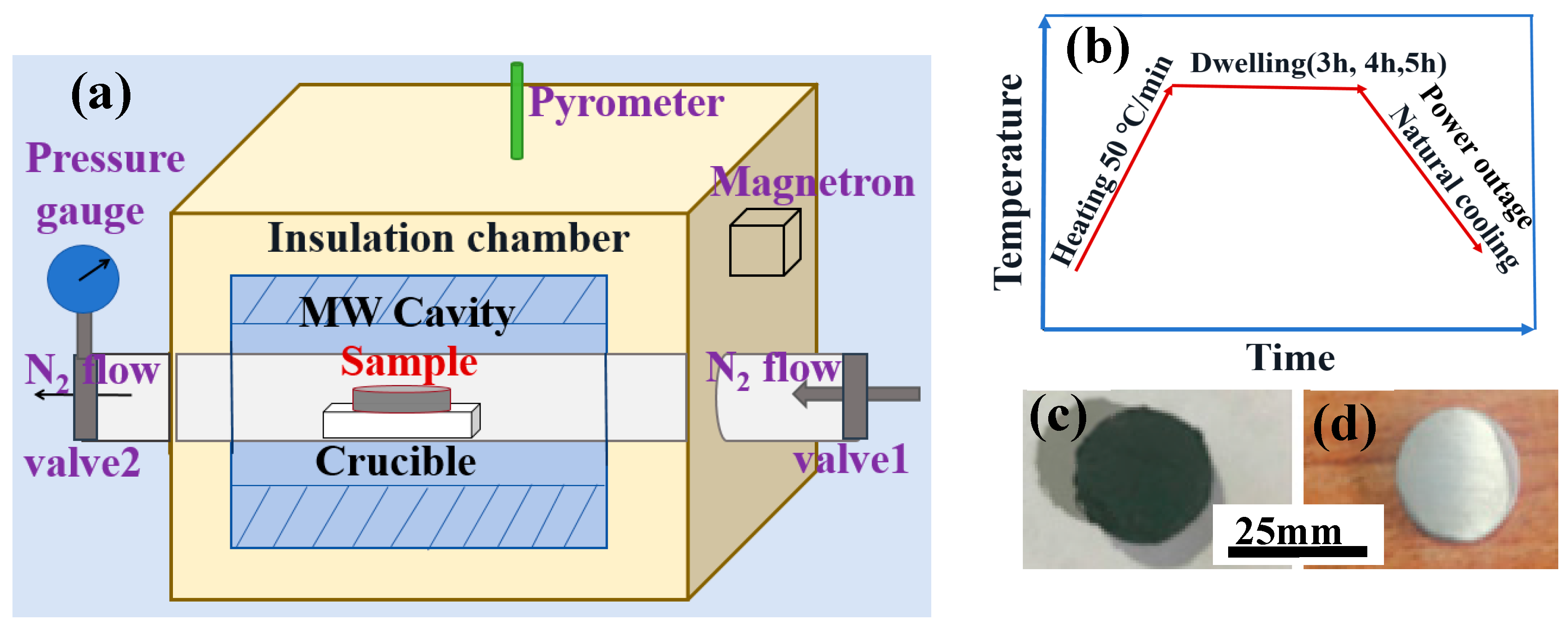
Figure 2a presents the XRD patterns of samples sintered at different temperatures. For specimens sintered above 750 °C, the predominant diffraction peaks are consistent with the antiperovskite Mn3CuN-type crystal structure (space group: Pm3m), marked by “♣”, along with minor MnO impurities marked by “◆”. These results confirm the successful doping of elements (Ge and C) into the corresponding lattice site (Figure 2b). The content of the Mn3CuN-type phase exceeds 90 wt% when the sintering temperature is above 750 °C, reaching 93.2 wt% at 860 °C. A representative Rietveld refinement profile of the sample sintered at 800 °C for 3 h is shown in Figure 2c, where the experimental data points (red dot), the calculated fit (blue line), the difference curve (black line), and the Bragg positions (green vertical ticks) are displayed. This demonstrates that the bulk Mn3Cu0.5Ge0.5N0.9C0.1 compound, containing only trace amounts of MnO, can be successfully synthesized via microwave sintering within a significantly shorter time (3 h) compared to conventional methods (2–8 days).
Figure 2.
XRD patterns of samples prepared at different microwave sintering temperature: (a) Patterns for samples sintered at various temperatures with a fixed holding time of 3 h; (b) Mn3CuN-type antiperovskite crystal structure; (c) Rietveld refinement of sample sintered 800 °C for 3 h; (d) Content of Mn3CuN-type antiperovskite phase as a function of sintering temperature.
In contrast, the XRD patterns of samples sintered at 700 °C, 650 °C, and 600 °C, visible diffraction peaks corresponding to unreacted Mn (marked by “▼”) were detected. There is only 60 wt% of the Mn3CuN-type antiperovskite phase in the 600 °C sintered sample. As the sintering temperature goes up, the content gradually rises. As summarized in Figure 2d, XRD quantification confirms that a phase purity exceeding 90 wt% is achieved only when the sintering temperature reaches or exceeds 750 °C. Therefore, the microwave sintering temperature for the preparation of phase-pure antiperovskite Mn3AX is recommended to be above 750 °C.
3.2. Microstructural Characterization and Mechanical Properties
3.2.1. Microstructural Characterization
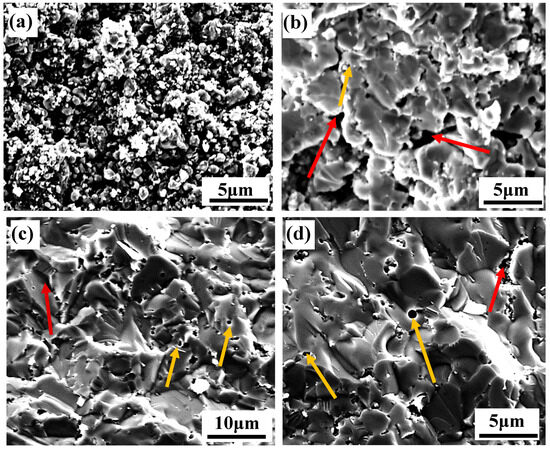
The fracture morphologies of Mn3Cu0.5Ge0.5N0.9C0.1 sintered at 700 °C, 860 °C, and 900 °C are shown in Figure 3. The sample sintered at 700 °C retains a microstructure resembling the initial ball-milled powder, consisting of individual, weakly bonded particles with minimal neck formation- characteristic of the initial stage of solid-phase sintering. At 860 °C, partial grain adhesion is evident, with a measured grain size of approximately 2 µm (determined by the linear intercept method). A limited number of intracrystalline pores (indicated by yellow arrows) and intergranular pores (highlighted by red arrows) are observed. As shown in Figure 3c,d, the sample sintered at 900 °C displays a relatively homogeneous microstructure, with an average grain size of 4–5 µm, while numerous pores are evident on the fracture surfaces. At this stage, sufficient thermal energy drives particle bonding and neck growth, thereby promoting densification [29,30,31,32]. Concurrently, nitrogen deficiency and porosity induced by the thermal decomposition of the compound. According to thermogravimetric analysis [28], the Mn3Cu0.5Ge0.5N compound begins to decompose thermally at around 690 °C. Once the sintering temperature exceeds this threshold, pore formation is primarily attributed to nitrogen loss from decomposition.
Figure 3.
SEM images of the fracture surfaces of Mn3Cu0.5Ge0.5N0.9C0.1 samples microwave-sintered at different temperatures: (a) 700 °C; (b) 860 °C; (c) and (d) 900 °C for 3 h holding time. Yellow arrows indicate intracrystalline pores. Red arrows highlight intergranular pores.
The marked increase in grain size within the 700–860 °C range aligns with the dominant role of solution-reprecipitation mechanisms. At higher temperatures (860–900 °C), grain growth and coarsening are governed by Ostwald ripening. Microwave radiation converts electromagnetic energy into heat, enhancing interparticle diffusion and accelerating the formation of sintering neck. Such grain growth behavior is also characteristic of conventional and spark plasma sintering (SPS) [33,34], indicating its generality across different sintering techniques.
3.2.2. Relative Density and Hardness
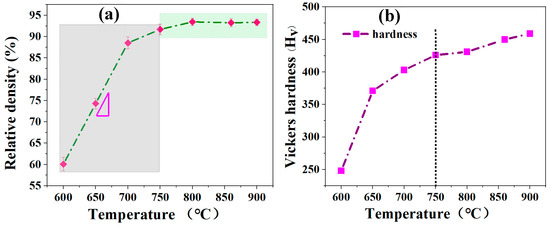
Figure 4a shows the variation in relative density with microwave sintering temperature at a fixed holding time of 3 h. As the temperature increases from 700 °C to 860 °C, the relative density improves from 88.2% to 94.6%, then slightly decreases to 93.1% at 900 °C. The plot in Figure 4a is divided into two characteristic regions. In the grey region (below 750 °C), the relative density increases linearly with temperature, as indicated by the pink triangle. Upon entering the light green region (above 750 °C), the relative density plateaus, indicating stabilized densification.
Figure 4.
The relative density and Vickers hardness dependence on the microwave sintering temperature: (a) The relative density. The pink triangles highlight the data points showing the linear increase in relative density within the grey region (below 750 °C) and the light-green region (above 750 °C), the relative density plateaus, indicating stabilized densification; (b) Vickers hardness. The dash divides the data into two regions with different trends.
Mechanical properties, particularly hardness, were evaluated to assess the integrity and potential durability of the sintered bulks, as these are critical indicators of sintering quality for prospective structural or functional applications. Figure 4b shows the corresponding Vickers hardness as a function of sintering temperature. As the temperature increases, the Vickers hardness increases from ~412 HV at 700 °C to a maximum of ~451 HV at 900 °C. The variation in hardness with temperature is similar to that of relative density with temperature, as demarcated by the dashed line separating the two distinct trend regions. The hardness of ~451 HV achieved at 900 °C for the microwave-sintered Mn3Cu0.5Ge0.5N0.9C0.1 is comparable to the value of ~430 HV reported for a similar composition prepared by conventional sintering [15,35]. This demonstrates that microwave sintering can achieve mechanical performance on par with conventional methods, but with significantly enhanced processing efficiency.
3.2.3. Mechanistic Interpretation
The improvement in density and hardness with increasing temperature is closely associated with microstructural evolution. At low temperatures (e.g., 700 °C), insufficient thermal energy results in poor interparticle bonding and numerous residual pores, leading to low density and hardness. Effective sintering of the Mn3Cu0.5Ge0.5N0.9C0.1 compound initiates between approximately 700 °C and 750 °C, as indicated by the onset of densification and microstructural development. This range represents a practical lower bound where bonding kinetics become significant, albeit in competition with the onset of thermal decomposition (~690 °C). As the temperature rises to 860 °C, enhanced atomic diffusion promotes particle coalescence, neck growth, and pore elimination, thereby improving both densification and hardness. At 900 °C, although density slightly increases due to further pore closure, grain coarsening (average grain size 4–5 µm) partially offsets the hardening effect, resulting in a marginal decrease in hardness. Furthermore, concurrent thermal decomposition above ~690 °C leads to partial nitrogen loss and pore formation, which moderately inhibits densification. This explains why density does not increase linearly with temperature and why the optimal sintering window lies around 800–860 °C, where densification and decomposition reach a dynamic balance.
Ceramic sintering is a temperature- and time-dependent densification process governed by diffusion. In the initial stages, surface and grain-boundary diffusion dominate, leading to neck formation between adjacent particles without substantial grain growth. As the process continues with sufficient thermal energy, grain boundary migration becomes active, resulting in grain growth and microstructural coarsening, while pores are gradually eliminated or isolated [29]. In the microwave sintering of Mn3Cu0.5Ge0.5N0.9C0.1, the correlation between sintering parameters, the resulting microstructure (Figure 3), and the final properties (Figure 4) reflects this progression from initial necking to subsequent densification and grain growth.
3.3. Effect of Sintering Temperature on Negative Thermal Expansion Performance
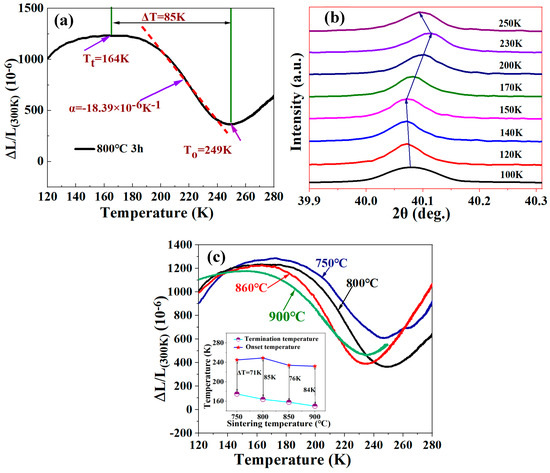
The key parameters used for quantifying NTE behavior—onset temperature (To), termination temperature (Tt), temperature range (ΔT = To − Tt), and linear coefficient of thermal expansion (α)—are defined graphically in Figure 5a. ΔT and α were derived from the linear thermal expansion curves: ΔT represents the interval between the zero-slope points marking the beginning and end of the NTE regime, while α is the slope of the linear regression fit over this interval. In contrast, the adjacent temperature region on both sides exhibit positive thermal expansion (PTE), where the material expands with rising temperature.
Figure 5.
Negative thermal expansion (NTE) behavior of the microwave-sintered Mn3Cu0.5Ge0.5N0.9C0.1 compound under different conditions (fixed 3 h hold): (a) Linear thermal expansion curve of the sample sintered at 800 °C; (b) Temperature-dependent shifts in the (111) diffraction peak for the sample sintered at 800 °C for 5 h; (c) Comparison of linear thermal expansion for samples sintered at different temperatures; the inset shows the dependence of NTE onset (To), termination (Tt) temperatures, and the temperature window (ΔT) on sintering temperature.
To further verify the intrinsic thermal expansion behavior, variable-temperature XRD patterns of the (111) plane were collected from 100 K to 250 K for a sample sintered at 800 °C for 5 h (Figure 5b). In typical PTE materials, diffraction peaks shift to higher angles upon cooling, indicating lattice contraction. In the microwave-sintered Mn3Cu0.5Ge0.5N0.9C0.1 specimen, however, the peaks shift to lower angles as temperature decreases within the 150–230 K range, directly confirming NTE behavior. Above 230 K, the peak shift reverses with increasing temperature, marking a return to PTE. Moreover, the variation in the lattice parameter with temperature mirrors the To and Tt determined from dilatometry, further establishing the intrinsic connection between sintering conditions, crystal structure, and NTE performance.
The linear thermal expansion curves of samples sintered at different temperatures (with a fixed holding time of 3 h) are compared in Figure 5c, with corresponding quantitative data summarized in Table 2. A clear dependence of NTE parameters on sintering temperature is observed. Notably, as the sintering temperature increases from 750 °C to 900 °C, both To and Tt shift systematically toward lower temperatures (Figure 5c), thereby narrowing the NTE window (ΔT). Simultaneously, the NTE coefficient (α) also varies, confirming that microwave sintering temperature comprehensively influences the NTE onset, termination, temperature range, and expansion magnitude. Among the tested conditions, sintering at 800 °C for 3 h yielded a relatively wide ΔT alongside a more negative α.
Table 2.
Thermal expansion data at different sintered temperature for 3 h.
Although a minor MnO secondary phase is present (Figure 2) and may introduce local strain, the consistent, systematic trends of NTE properties with sintering parameters and the high phase purity (>90 vol.% antiperovskite) indicate that the reported behavior is intrinsically governed by the dominant Mn3CuN-type antiperovskite phase.
3.4. Effect of Holding Time on Negative Thermal Expansion Performance
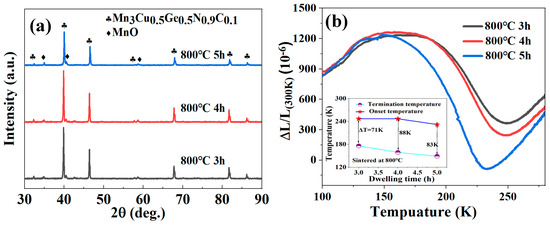
The negative thermal expansion (NTE) performance of samples sintered at 800 °C with varying holding durations is summarized in Table 3. Figure 6 illustrates the influence of holding time on NTE properties. As shown in Table 3, the sample sintered for 4 h exhibited optimal NTE performance, with the widest temperature window (ΔT = 88 K) and the larger negative expansion coefficient (α = −20.56 × 10⁻⁶ K−1). In contrast, the NTE termination temperature (Tt) showed only minor variations across the different holding times. The inset of Figure 6b further reveals that the entire NTE window systematically shifts toward lower temperatures as the holding time increases.
Table 3.
Thermal expansion data at 800 °C for different holding times.
Figure 6.
Effect of holding time on crystal structure and negative thermal expansion behavior of Mn3Cu0.5Ge0.5N0.9C0.1 compound sintered by microwave at 800 °C for 3 h, 4 h, and 5 h: (a) XRD patterns; (b) linear thermal expansions behavior, with the inset showing the dependence of NTE onset temperature (To), termination temperature (Tt), and temperature window (ΔT) on holding time.
These results demonstrate that the sintering of Mn3Cu0.5Ge0.5N0.9C0.1 involves a competition between densification and high-temperature decomposition. Nitrogen loss and pore formation intensify at higher temperatures. The variation in key properties between 800 °C and 860 °C stems directly from this competition (Figure 7a). At 800 °C, thermal energy drives effective densification while nitrogen loss remains moderate, producing a high-density, well-developed microstructure and the optimal NTE performance. At 860 °C, accelerated decomposition outweighs enhanced diffusion, increasing lattice vacancies and pore formation, which slightly degrades properties such as the NTE coefficient (α) and density.
Figure 7.
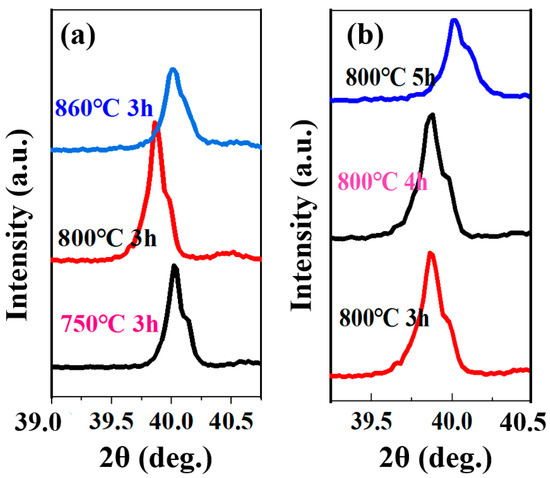
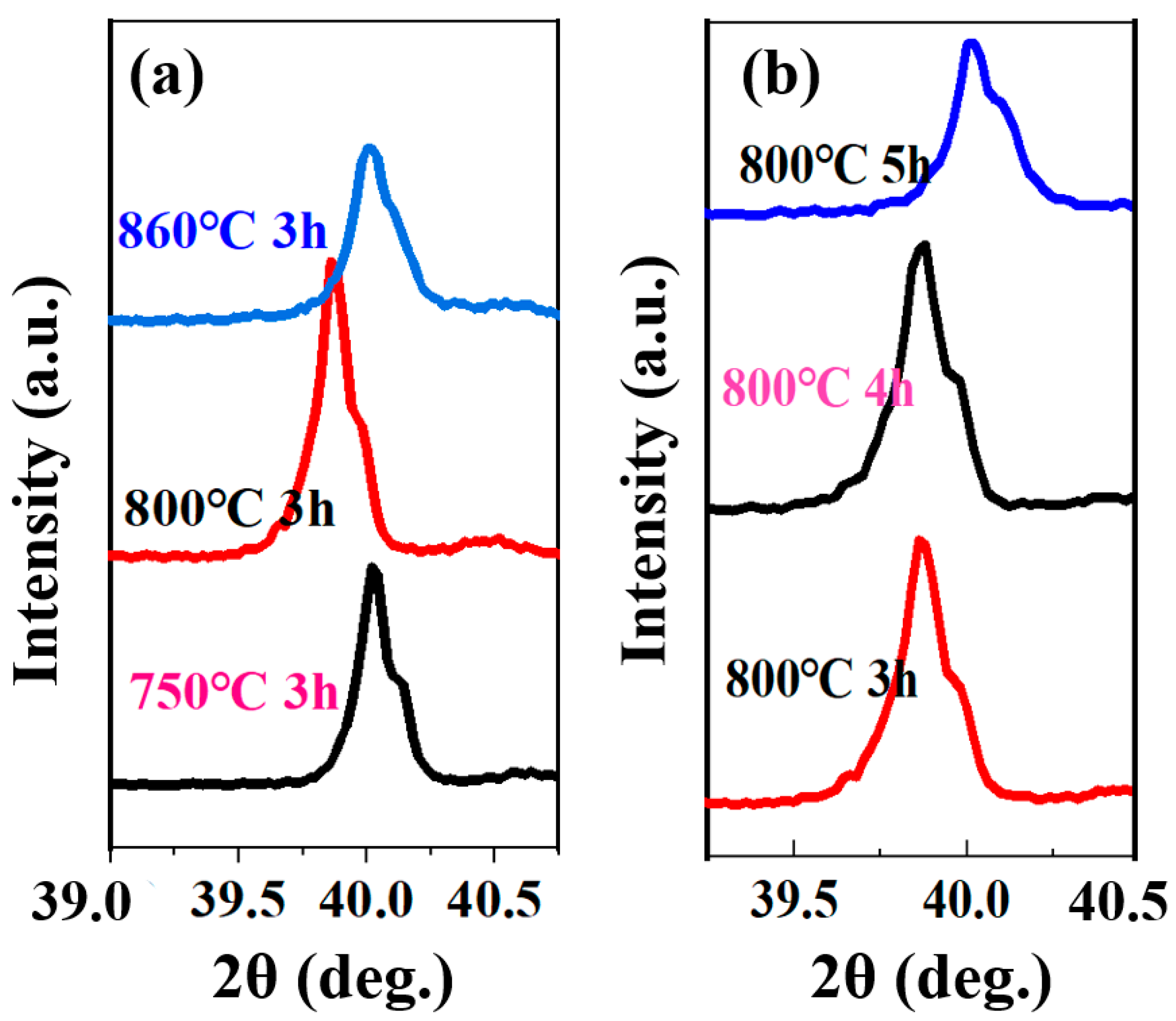
Temperature-dependent shifts in the (111) XRD peak position: (a) for samples sintered at different microwave temperatures with a fixed 3 h holding time; (b) for samples sintered at 800 °C with holding times of 3 h, 4 h, and 5 h.
XRD analysis supports this mechanism. The highest peak intensity for the 800 °C/4 h sample (Figure 7b) indicates superior crystallinity and phase purity. No structural phase transitions were detected. The peak broadening and slight splitting observed at 860 °C suggest lattice distortion and disorder induced by nitrogen deficiency. Peak shifts reveal the dynamic nature of nitrogen exchange: at 800 °C/3 h, lattice expansion from N2 incorporation dominates, while at 860 °C, lattice contraction from net nitrogen loss prevails, consistent with the reduced antiperovskite phase content at 900 °C (Figure 2b).
This work establishes rapid microwave sintering not merely as a faster alternative, but as an effective process for tailoring Mn3AX compound properties. The combination of a short processing cycle (3–5 h), a high achieved NTE coefficient, and the tunability of the NTE window through process-induced doping makes this a distinct and valuable fabrication route, providing a compelling performance-based rationale for its adoption.
4. Conclusions
- (1)
- Antiperovskite manganese nitride Mn3Cu0.5Ge0.5N0.9C0.1, exhibiting negative thermal expansion (NTE) properties and good ceramic quality, was successfully synthesized via rapid microwave sintering in a nitrogen atmosphere within only 3–5 h. Compared with conventional solid-state sintering, this approach drastically shortens the processing time significantly from 2–8 days to just 3–5 h.
- (2)
- During sintering, densification proceeds simultaneously with the thermal decomposition of the compound. As the temperature rises, nitrogen loss and the associated pore formation become more pronounced. When densification and decomposition reach an equilibrium, the microwave-sintered bulk material achieves an NTE coefficient of −20.56 × 10⁻⁶ K−1 over a temperature range of ΔT = 88 K.
- (3)
- The effects of microwave sintering parameters on both the NTE behavior and mechanical properties were systematically investigated. A suitable sintering window was identified between 750 °C and 900 °C with a dwell time of 3–5 h. The NTE operating range shifts toward lower temperatures with increased sintering temperature or extended dwell time. This direct relationship provides a key parameter for precisely tuning the material’s thermal expansion behavior.
This study confirms the feasibility of using microwave sintering for the efficient production of Mn3AX-type ceramics with tailored negative thermal expansion. The optimized sintering conditions and the elucidated structure–property correlations offer practical guidance for manufacturing, thereby promoting the application of antiperovskite nitrides in thermal expansion compensation, aerospace, and other high-technology fields.
Future work may focus on refining the compositional design to improve NTE stability over broader temperature ranges, as well as investigating the industrial scalability of the microwave sintering process for fabricating larger-sized components.
Author Contributions
Conceptualization, Y.D. and Z.S.; methodology, Y.D., B.L. and D.G.; software, H.Z. and B.L.; validation, H.Z., Z.H. and B.L.; formal analysis, H.Z., C.H. and B.L.; Investigation, B.L.; Resources, B.L.; data curation, H.Z. and C.H.; writing—original draft preparation, H.Z. and Z.H.; writing—review and editing, Y.D., B.L. and Z.S.; funding acquisition, Y.D.; Project administration, C.H. All authors have read and agreed to the published version of the manuscript.
Funding
This work was supported by the Tianjin Natural Science Foundation Project (22JCYBJC01660) and the Key Projects of the Tianjin Education Commission’s Research Program (2022ZD028).
Data Availability Statement
The data used to support the findings of this study are available from the corresponding author upon request. The datasets presented in this article are part of ongoing studies which have not yet been published. Requests for access to the datasets should be directed to the corresponding author. Each request will be considered on a case-by-case basis after evaluating all relevant factors, including the status of related research works and any applicable restrictions.
Conflicts of Interest
The author Zhonghua Sun was employed by Hangzhou Guillaume Technology Service Co. Ltd. The remaining authors declare that the research was conducted in the absence of any commercial or financial relationships that could be construed as potential conflicts of interest.
References
- Luo, J.C.; Zou, K.X.; Wang, B.; Yuan, X.L.; An, S.H.; Ma, Z.J.; Shi, K.W.; Deng, S.H.; Xu, J.P.; Yin, W.; et al. Zero thermal expansion behavior in high-entropy anti-pperovskite Mn3Fe0.2Co0.2Ni0.2Mn0.2Cu0.2N. Adv. Funct. Mater. 2024, 34, 2410608. [Google Scholar]
- Song, X.; Sun, Z.; Huang, Q.; Rettenmayr, M.; Liu, X.; Seyring, M.; Li, G.; Rao, G.; Yin, F.J. Adjustable zero thermal expansion in antiperovskite manganese nitride. Adv. Mater. 2011, 23, 4690–4694. [Google Scholar] [CrossRef] [Scilit]
- Takenaka, K.; Takagi, H.J. Giant negative thermal expansion in Ge-doped anti-perovskite manganese nitrides. Appl. Phys. Lett. 2005, 87, 261902. [Google Scholar]
- Song, Y.; Zhang, J.; Zhou, C.; Shi, N.; Chen, J.J. Research Progress on Zero Thermal Expansion Metallic Materials. Acta Metall. Sin. 2025, 61, 809–825. [Google Scholar]
- Zhou, C.; Zhang, Q.; Tan, X.; Deng, S.; Shi, K.; Cong, W.; Wu, G. Fully-dense Mn3Zn0.7Ge0.3N/Al composites with zero thermal expansion behavior around room temperature. Materialia 2019, 6, 100289. [Google Scholar] [CrossRef] [Scilit]
- Hu, D.; Shi, K.; Sun, Y.; Colin, C.V.; Deng, S.; An, S.; Ma, Z.; Bordet, P.; Wang, C.J. Effect of Fe-doping on magnetic structures and “spin-lattice-charge” strong correlation properties in Mn3Sn1−xFexC compounds. J. Alloys Compd. 2025, 1010, 177489. [Google Scholar] [CrossRef] [Scilit]
- Sobukawa, Y.; Yasuda, T.; Amemiya, K.; Suemasu, T.J. Magnetic compensation and preferential substitution site for Ag in Mn4−xAgxN epitaxial thin films. Phys. Rev. Mater. 2025, 9, 064408. [Google Scholar] [CrossRef] [Scilit]
- Ma, Z.; Sun, Y.; Lu, H.; Shi, K.; Deng, S.; Yuan, X.; Hao, W.; Du, Y.; Xia, Y.; Fang, L.J. Noncoplanar antiferromagnetism induced zero thermal expansion behavior in the antiperovskite Mn3Sn0.5Zn0.5Cx. Phys. Rev. B 2023, 107, 094412. [Google Scholar]
- Rendell-Bhatti, F.; Zeng, M.; Lloveras, P.; Tamarit, J.-L.; Barrio, M.; Connolly, E.T.; MacLaren, D.A.; Johnson, F.; Cohen, L.F.; Boldrin, D.J. Improving barocaloric properties by tailoring transition hysteresis in Mn3Cu1−xSnxN antiperovskites. J. Phys. Energy 2023, 5, 024018. [Google Scholar]
- Yan, Y.; Cao, Y.; Wang, Z.; Wang, K.; Ren, H.; Zhang, S.; Wang, Y.; Chen, J.; Zhou, Y.; Liu, L.; et al. Asymmetric orbital hybridization in Zn-doped antiperovskite Cu1−xZnxNMn3 enables highly efficient electrocatalytic hydrogen production. J. Energy Chem. 2024, 89, 304–312. [Google Scholar] [CrossRef] [Scilit]
- Torres-Amaris, D.; Bautista-Hernandez, A.; González-Hernández, R.; Romero, A.H.; Garcia-Castro, A.C. Anomalous Hall conductivity control in Mn3NiN antiperovskite by epitaxial strain along the kagome plane. Phys. Rev. B 2022, 106, 195113. [Google Scholar] [CrossRef] [Scilit]
- Miao, Z.; Guo, X.; Yang, G.; Wang, N.; Li, J.J. The spin-glass-like behavior in antiperovskite Mn3AgN. J. Appl. Phys. 2024, 136, 055104. [Google Scholar] [CrossRef] [Scilit]
- You, Y.; Bai, H.; Chen, X.; Zhou, Y.; Zhou, X.; Pan, F.; Song, C.J. Room temperature anomalous Hall effect in antiferromagnetic Mn3SnN films. Appl. Phys. Lett. 2020, 117, 222404. [Google Scholar] [CrossRef] [Scilit]
- Kong, H.; Guo, Y.; Yao, Y.; Liu, W.; Yang, Z.J. Temperature-Dependent Valence Electron Structures and Properties of the Antiperovskite Compound Mn3Ni1−XAgxN. Phys. B Condens. Matter 2025, 718, 417937. [Google Scholar] [CrossRef] [Scilit]
- Nakamura, Y.; Takenaka, K.; Kishimoto, A.; Takagi, H. Mechanical Properties of Metallic Perovskite Mn3Cu0.5Ge0.5N: High-Stiffness Isotropic Negative Thermal Expansion Material. J. Am. Ceram. Soc. 2009, 92, 2999–3003. [Google Scholar] [CrossRef] [Scilit]
- Guo, X.; Tong, P.; Lin, J.; Yang, C.; Zhang, K.; Lin, S.; Song, W.; Sun, Y.J. Effects of Cr Substitution on Negative Thermal Expansion and Magnetic Properties of Antiperovskite Ga1−xCrx N0.83Mn3 Compounds. Front. Chem. 2018, 6, 75. [Google Scholar] [CrossRef] [Scilit]
- Huang, R.; Li, L.; Cai, F.; Xu, X.; Qian, L.J. Low-temperature negative thermal expansion of the antiperovskite manganese nitride Mn3CuN codoped with Ge and Si. Appl. Phys. Lett. 2008, 93, 081902. [Google Scholar] [CrossRef] [Scilit]
- Tan, J.; Huang, R.; Wen, L.; Han, Y.; Li, L. Broadened negative thermal expansion operation-temperature window in antiperovskite Mn3Zn0.6Ge0.4N prepared by spark plasma sintering. J. Alloys Compd. 2014, 593, 103–105. [Google Scholar] [CrossRef] [Scilit]
- Sun, Z.; Song, X.Y.; Xu, L. Effects of sintering temperature on microstructure, nitrogen deficiency and densification of spark plasma sintered Mn3Cu0.5Ge0.5N. Ceram. Int. 2011, 37, 1693–1696. [Google Scholar] [CrossRef] [Scilit]
- Cao, H.; Su, Y.; Cui, D.; Zhang, D.; Ouyang, Q.J. Microstructural characterization, mechanical properties and thermal expansion of antiperovskite manganese nitride Mn3.1Zn0.5Sn0.4N fabricated by combing vacuum sintering and spark-plasma sintering. Mater. Charact. 2020, 160, 110100. [Google Scholar] [CrossRef] [Scilit]
- Lin, M.S.; Chu, K.R. On the Non-Thermal Mechanisms in Microwave Sintering of Materials. Materials 2025, 18, 668. [Google Scholar] [CrossRef] [Scilit]
- Lu, Y.; Shuai, M.; Gao, J.; Ye, X.; Guo, S.; Yang, L.; Huang, B.; Zhang, J.; Hou, M.; Gao, L.J.; et al. Numerical Simulation and Experimental Analysis for Microwave Sintering Process of Lithium Hydride (LiH). Materials 2024, 17, 5342. [Google Scholar] [CrossRef] [Scilit] [PubMed]
- Singh, C.; Khanna, V.; Singh, S.J. Sustainability of microwave heating in materials processing technologies. Mater. Today Proc. 2023, 73, 241–248. [Google Scholar] [CrossRef] [Scilit]
- Siddique, I.J.; Salema, A.A.; Antunes, E.; Vinu, R.J.R. Technical challenges in scaling up the microwave technology for biomass processing. Renew. Sustain. Energy Rev. 2022, 153, 111767. [Google Scholar] [CrossRef] [Scilit]
- Zhang, W.; Chen, H.; Shuai, M.; Zeng, X.; Huang, B.J. A Sintering–Resting Strategy of Microwave Heating for Lithium Hydride Ceramic Based on Numerical Analysis of Thermal Effects. Materials 2025, 18, 2832. [Google Scholar] [CrossRef] [Scilit]
- Savu, S.V.; Ghelsingher, C.D.; Ștefan, I.; Sîrbu, N.A.; Midan, A.A.; Dumitru, I.; Savu, I.D.; Nicolicescu, C.; David, A.J. Microwave Hybrid Sintering and Soldering of Cu-Cr-W Composite Material for Reactive Power Breakers. Materials 2024, 17, 4648. [Google Scholar] [CrossRef] [Scilit]
- Sun, Z.; Song, X. Preparation and magnetic characterization of ultrafine-grained ζ-Mn2N0.86 compound bulk. Mater. Lett. 2009, 63, 2059–2062. [Google Scholar] [CrossRef] [Scilit]
- Sun, Z.; Song, X.; Yin, F.; Sun, L.; Yuan, X.; Liu, X. Giant negative thermal expansion in ultrafine-grained Mn3(Cu1−xGex)N (x = 0.5) bulk. J. Phys. D-Appl. Phys. 2009, 42, 122004. [Google Scholar] [CrossRef] [Scilit]
- Rahaman, M.N. Ceramic Processing and Sintering, 2nd ed.; Taylor & Francis Group: New York, NY, USA, 2017. [Google Scholar]
- Chen, W.; Huang, W.; Yuan, J.; Yin, Z.J. Sintering kinetics and grain growth mechanisms of microwave sintered WC-10Co cemented carbide. Ceram. Int. 2025, 51, 27961–27970. [Google Scholar] [CrossRef] [Scilit]
- Chen, W.; Yin, Z.; Yuan, J.J. Microwave sintering of WC-HEA cemented carbide: Sintering process, microstructure and mechanical properties. Int. J. Refract. Met. Hard Mater. 2024, 123, 106789. [Google Scholar] [CrossRef] [Scilit]
- Kochawattana, S.; Stevenson, A.; Lee, S.-H.; Ramirez, M.; Gopalan, V.; Dumm, J.; Castillo, V.K.; Quarles, G.J.; Messing, G.L. Sintering and grain growth in SiO2 doped Nd: YAG. J. Eur. Ceram. Soc. 2008, 28, 1527–1534. [Google Scholar] [CrossRef] [Scilit]
- Marder, R.; Chaim, R.; Estournès, C. Grain growth stagnation in fully dense nanocrystalline Y2O3 by spark plasma sintering. Mater. Sci. Eng. A 2010, 527, 1577–1585. [Google Scholar] [CrossRef] [Scilit]
- Chen, X.; Zhao, L.; Yang, L.; Shen, X.; Yang, J.; Wang, H.J. Interfacial reaction of mixed pure metal powders under microwave heating. J. Mater. Res. Technol. 2024, 31, 2629–2635. [Google Scholar] [CrossRef] [Scilit]
- Hu, Z.; Han, C.; Zhang, H.; Dai, Y.; Sun, Z. Adjustable Cryogenic Near-Zero Thermal Expansion and Magnetic Properties in Antiperovskite Mn3Cu0.5Ge0.5N0.78C0.22. Crystals 2026, 16, 41. [Google Scholar] [CrossRef] [Scilit]

Disclaimer/Publisher’s Note: The statements, opinions and data contained in all publications are solely those of the individual author(s) and contributor(s) and not of MDPI and/or the editor(s). MDPI and/or the editor(s) disclaim responsibility for any injury to people or property resulting from any ideas, methods, instructions or products referred to in the content. |
© 2026 by the authors. Licensee MDPI, Basel, Switzerland. This article is an open access article distributed under the terms and conditions of the Creative Commons Attribution (CC BY) license.