


Abstract
Hydrogen storage and transportation technologies based on liquid organic hydrogen carriers (LOHCs) are of high research interest. The next generation of LOHCs with a higher hydrogen capacity and lower dehydrogenation temperature is required, and the decahydroquinoline/quinoline (DHQ/Q) system is among promising LOHCs. The catalysts comprising palladium nanoparticles supported on the synthesized high-surface area materials (CeO2, CeO2-ZrO2 mixed oxide, and Ce0.75Zr0.25O2), as well as reverse CeO2/Pd/oxide catalysts were tested in solvent-free dehydrogenation of DHQ at a high DHQ:Pd molar ratio, with DHQ being investigated as a hydrogen-storage source. The oxide-supported Pd nanoparticles were synthesized via the deposition–precipitation of Pd poly-hydroxo complexes, while a redox method was used to prepare the reverse catalysts. The highest hydrogen yields of 45% and 55% with the DHQ conversions of 61% and 76% at molar ratios DHQ:Pd of 1000 and 500, respectively, have been reached over the Pd/Ce0.75Zr0.25O2 catalyst at 220 °C, which results in hydrogen production exceeding that of other known catalysts studied in solvent-free DHQ dehydrogenation. The challenges and prospects for further catalyst development are discussed.
1. Introduction
Hydrogen applications in industry, power generation and transportation as a promising clean energy fuel aroused considerable interest in research on its storage and transportation technologies [1,2,3,4]. For medium- and small-scale hydrogen storage, liquid organic hydrogen carrier (LOHC) technology represents an innovative approach based on a reversible catalytic hydrogenation/dehydrogenation cycle including (i) hydrogen gas chemical bonding to a lean (dehydrogenated) form of a LOHC compound, which results in a hydrogenated rich form of LOHC (H-LOHC); and (ii) dehydrogenation of H-LOHC to a lean form with the release of hydrogen for end-use applications. Recent reviews [5,6,7,8] provide a comprehensive overview of LOHC technologies, highlight key systems and challenges, as well as outline future perspectives. A highly efficient catalyst for the selective dehydrogenation of H-LOHC is still a weak point in LOHC hydrogen-storage techniques [9,10,11,12]. Several companies have employed LOHC technology using the systems of toluene/methylcyclohexane and dibenzyl toluene/perhydrodibenzyl toluene, pioneering their commercialization [1,13,14]. However, there are several drawbacks of these LOHC systems, namely the high dehydrogenation temperature of 270–450 °C, the high percentage of released hydrogen required for maintaining dehydrogenation [15], as well as the high vapor pressure of the carrier that dictates hydrogen purification prior to fuel-cell utilization [14]. Hydrogen-saturated LOHCs based on N-heterocycles have been dehydrogenated at a lower temperature (140–250 °C) than those based on cyclic hydrocarbons [16,17,18]. The minimal hydrogen-release temperatures for carbazole and indole derivatives were revealed, yet these compounds have a relatively lower theoretical hydrogen capacity (5.6–6.4 wt%) as compared with the up-to-date requirement of 6.5 wt% [19]. The decahydroquinoline/quinoline (DHQ/Q) system has the larger hydrogen capacity of 7.2 wt%, which offers promise as an N-heterocyclic pair of LOHC substrates with relatively high availability and stability [18,20,21]. Its methoxy- and alkyl-substituted derivatives are also considered potential LOHCs [22,23], yet it is important to keep in mind a decrease in gravimetric storage capacity and the possibility of side-product formation. Nevertheless, the DHQ/Q system is seldom studied, which may be due to the significantly larger value of enthalpy for dehydrogenation than for the 12HNEC/NEC system, as well as to a higher temperature of dehydrogenation [10]. Unfortunately, up until now, there have been more publications that declare quinoline as a lean form of a LOHC, but in a 1,2,3,4-tetrahydroquinoline/quinoline (THQ/Q) system [18,24,25], in pair with other rich forms, despite of its low hydrogen capacity that is unacceptable for LOHC technology.
The complete hydrogenation of quinoline (Q) using H2 has been widely studied and successfully performed [26,27,28,29,30,31], whereas the complete dehydrogenation of decahydroquinoline (DHQ) is poorly investigated, and results are reported only by several research groups [31,32,33,34,35,36,37,38,39]. Publications [31,32,33,34] report that a temperature of at least 240–250 °C is required to perform the reaction of complete dehydrogenation of DHQ to quinoline with an appropriate H2 yield. Moreover, since the boiling points for DHQ isomers, intermediate products, and quinoline are significantly lower than the optimal reaction temperature, it was necessary to perform the reaction in a solvent with a higher boiling point to provide the liquid-phase reaction at the most favorable conditions. Tetraglyme was shown to exceed mesitylene, decalin, and hexadecane [33] in DHQ solubility and in reduced adsorption of the dehydrogenated forms of heterocycles on the Pd surface. However, the use of a solvent resulted in a decreased volumetric density of available hydrogen and increased energy demand. Another drawback of the published studies is the low efficiency for the application of a precious metal (Pd) as a catalyst (low mass ratio substrate:catalyst = 2.8 gsub/gcat and molar ratio DHQ:Pd = 200). DHQ conversion over the 1%Pd/C catalyst reached 92% at 240 °C in 1 h, resulting in a H2 yield of 74–78% and a Q yield of only 57.9% [33,34]. Both the increased quinoline yield (81%) and H2 yield (89%) were observed over a 1%Pd/Al2O3 catalyst. The highest H2 yield of 94% has been reached over 1%Pd/g-C3N4 [34]. Nickel-alumina-based catalysts demonstrated catalytic activity comparable to that of Pd-based catalysts (at 240 °C and DHQ:Ni = 4 for 1 h), whereas their modification with MgO significantly increased catalytic activity, resulting in a H2 yield of 97.1% for a 4MgO/70Ni-Al2O3 catalyst [31]. Moreover, it should be pointed out that all the above-mentioned studies on DHQ dehydrogenation to Q were performed in solutions with a high gravimetric solvent content reaching 95.6% that is vastly larger than a 50% limit permissible by the energy efficiency of the overall LOHC process [35].
Recently, solvent-free dehydrogenation has been studied by several research groups [36,37,38,39]. A hydrogen-release capacity of 6.7 wt% (H2 yield of 93%) at a DHQ conversion of 95.9% has been reached at 250 °C and a low molar ratio of DHQ:Pd = 76 over a commercial 5%Pd/C catalyst in 14 h [37]. The maximum hydrogen yield of 82.7% and a DHQ conversion of 83.9% have been reached over the commercial catalyst 5%Pd/Al2O3 at 240 °C and a low DHQ:Pd = 76 in 9 h [38]. However, when liquid DHQ was subjected to dehydrogenation over the 1%Pd/Al2O3 catalysts at a lower temperature of 230 °C and a larger DHQ:Pd = 1000 for 4 h, the efficiency of H2 evolution was only about 18% [36]. At close reaction conditions (DHQ:Pd = 1000, 220 °C and 5 h), the larger hydrogen yield of 28% has been obtained over the 1%Pd/TiO2 catalyst, while the activity of alumina- and silica-supported catalysts with the same Pd loading was significantly lower [39].
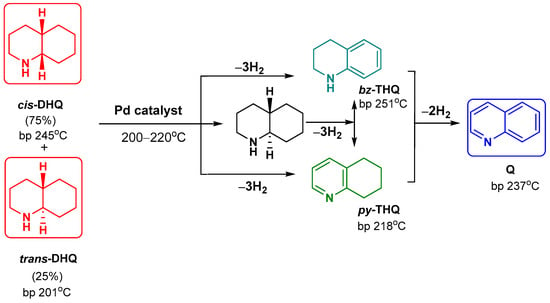
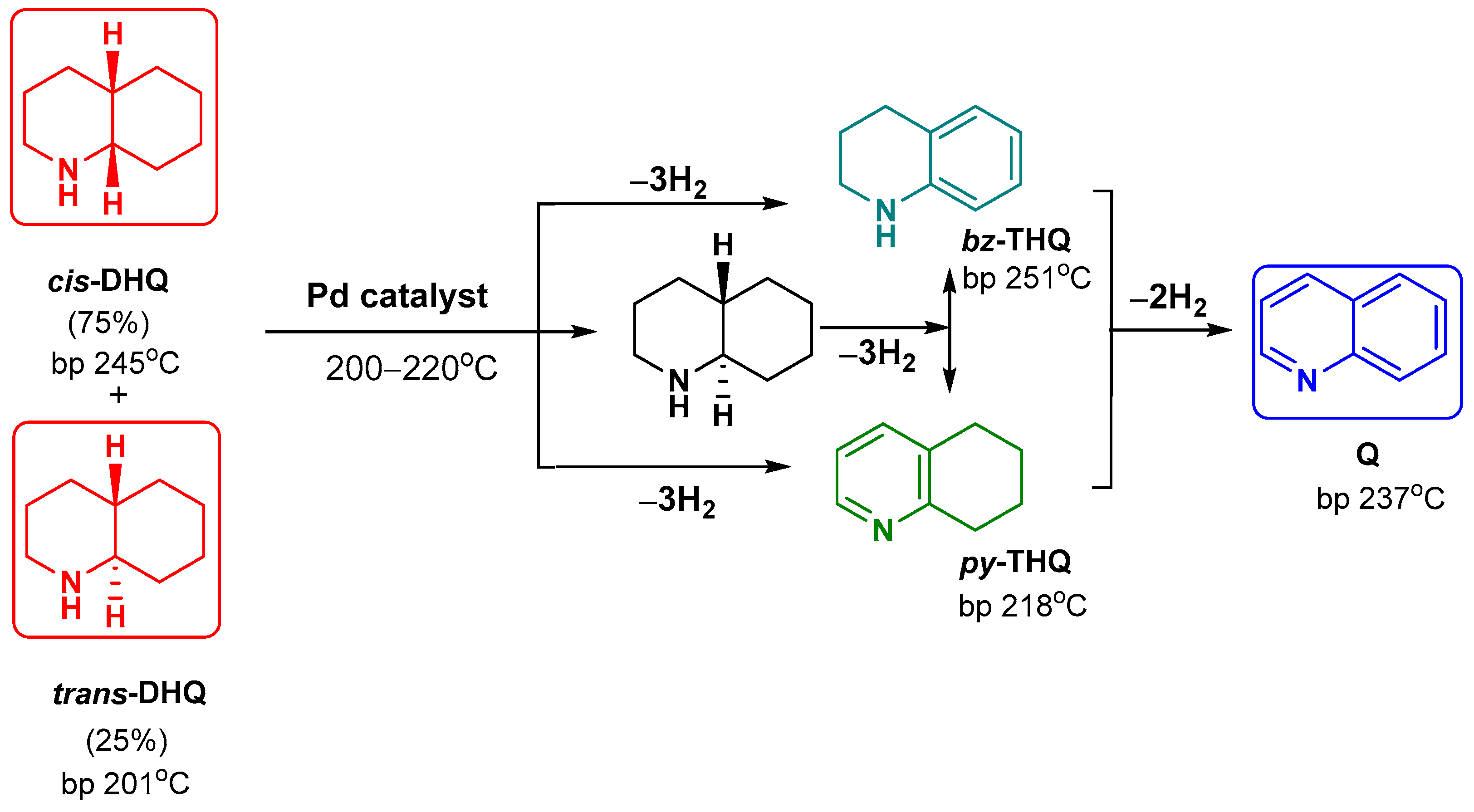
Dehydrogenation of DHQ to Q can proceed via the formation of two intermediates, namely 1,2,3,4-tetrahydroquinoline (py-THQ) and 5,6,7,8-tetrahydroquinoline (bz-THQ). Experimental GC data revealed py-THQ to be a dominant intermediate in a tetraglyme solution [33], indicating that the dehydrogenation of the aromatic fragment is a rate-limiting step over the 1%Pd/C catalyst which consists of metallic Pd nanoparticles of 3–6 nm (metal dispersion by CO chemisorption 41%) on the surface of the mesoporous carbon support [33]. This catalyst was prepared using a technique based on the deposition of Pd polynuclear hydroxo complexes (PHC) [40,41]. On the contrary, under solvent-free dehydrogenation over the commercial catalyst 5%Pd/Al2O3 (the mean Pd nanoparticle size is about 2 nm), the concentration of py-THQ was several times lower as compared with bz-THQ at 200–220 °C and became negligible at 240 °C [38]. The concentration of bz-THQ at 240 °C decreased to a very low value, whereas the Q amount considerably increased, and the conversion of bz-THQ to Q in the dehydrogenation process is considered to be the rate-limiting step. The molar ratio of intermediates was shown to depend on the support nature [39], and more than a triple predominance of bz-THQ was observed for the 1%Pd/TiO2 catalyst in the course of solvent-free dehydrogenation at 200–220 °C, whereas the ratio was reverse for the catalysts on silica and alumina supports. The simultaneously occurring dehydrogenation reactions and transformation of cis-DHQ to trans-DHQ under reaction conditions have been revealed over the 1%Pd/TiO2 catalyst as well [39]. The presented results reveal the low efficiency of studied Pd catalysts in DHQ dehydrogenation, and hence the development of a catalyst possessing a higher Pd-specific activity for the solvent-free DHQ dehydrogenation process is still required.
Maximizing the efficiency of precious-metal utilization is of great importance for the design of supported Pd catalysts. Hydrogen spillover over the surface of a support material significantly increases the catalytic activity of supported Pd catalysts in dehydrogenation of N-heterocyclic LOHCs [11]. The diffusion pathway for the spilled-over hydrogen depends on material nature [42]. For TiO2 and CeO2, the preferential diffusion pathway is along the surface. The catalyst with a higher hydrogen spillover capability possesses a lower activation barrier, and the catalytic activity in dehydrogenation follows the order of generally accepted hydrogen-spillover capabilities. For example, for the supported Pd nanoparticles with nearly identical average sizes [43], the initial reaction rate in formic acid dehydrogenation follows the order: CeO2 ≥ TiO2 > carbon > Al2O3 ≈ ZrO2. Therefore, CeO2 is an attractive support to be considered for LOHC dehydrogenation due to its excellent redox performance, superior adsorption capacity, and strong metal-carrier interaction. Nowadays, it is extensively employed in different catalytic reactions, including hydrogenation and dehydrogenation [44,45,46]. CeO2 supports with a mesoporous structure and relatively large specific surface area have been synthesized recently [44,46,47,48], which makes it possible to consider their application in Pd catalysts for dehydrogenation of LOHCs.
Pd/CeO2 catalysts were applied for dehydrogenation of several carbocyclic and heterocyclic hydrogen-rich forms of LOHCs [46,48,49,50,51,52,53,54]. 3%Pd/CeO2 catalysts have been studied in the reversible vapor phase dehydrogenation–hydrogenation reactions of cyclohexane/benzene [48]. An enhanced hydrogenation activity was noted for the catalyst on CeO2 with a 3D mesoporous structure (SBET = 108 m2g−1; Pd dispersion 83.8%). However, the activity in dehydrogenation of cyclohexane was low even at 450 °C. Recently, the reaction of dehydrogenation of tetrahydrofuran (THF) [49] has been performed over catalysts with Pd loadings of 0.5 and 1 wt% [50]. The highest activity and selectivity were revealed at 250–275 °C. Both deposition–precipitation (DP) and incipient wetness impregnation (IWI) techniques were applied to prepare the catalysts using H2[PdCl4] as a starting Pd compound. The wide particle size distribution within 1.5–6.5 nm was obtained for the samples, but the mean size for 0.5% Pd-IWI was the smallest (1.5–3.5 nm). Nevertheless, THF conversion was almost three times higher over the 1%Pd/CeO2-IWI catalyst. Among nanoporous Al2O3, CeO2, TiO2, and ZrO2 supports for Pd catalysts of dehydrogenation of 2-[(n-methylcyclohexyl)methyl]piperidine, CeO2 was characterized by the highest reducibility and the best ability to distribute Pd, resulting in the smallest Pd nanoparticle mean size of 3.45 nm [51]. Although the 5%Pd/CeO2 catalyst initially showed a lower H2 yield and a slower reaction rate than the 5%Pd/Al2O3 catalyst, it was the most stable in the recyclability test without a significant loss of activity. Variations in the conditions of CeO2 support and 5%Pd/CeO2 catalyst preparations have shown complete conversion of dodecahydro-N-ethylcarbazole with hydrogen release ranging from 83.71% to 97.24% at 180 °C in 7 h [52], even when Pd particle size distribution ranged 3–13 nm. Hydrogen release increased with increasing the specific surface area from 73 to 95 m2g−1 and the average pore size from 10 to 13 nm. Both Ce and Pd elements in the catalyst existed in two different valence states. The Pd/CeO2-Al2O3 catalysts with the specific surface area of 290 m2g−1 exhibited reversible hydrogen storage for the N-propylcarbazole system [53]. The Pd/Ce-TiO2 catalyst comprising ultrafine Pd NPs supported on a binary metal oxide outperformed several reported systems in 12H-NEC dehydrogenation [54]. However, Pd/CeO2 catalysts have not been studied in dehydrogenation of DHQ.
In this work, we studied the catalytic behavior of Pd NPs supported on laboratory-prepared CeO2 and CeO2-ZrO2 oxides with a high specific surface area, as well as CeO2/Pd nanoparticles supported on SiO2 and TiO2 carriers (reverse catalysts) in dehydrogenation of DHQ. The goal of this work is to reveal the potentials of Pd/CeO2 and CeO2/Pd nanosystems in DHQ dehydrogenation in order to efficiently develop the Pd catalyst in DHQ dehydrogenation. The oxide-supported Pd nanoparticles were synthesized via the deposition–precipitation of Pd poly-hydroxo complexes (PHC), followed by their reduction to Pd0 with H2 at ambient conditions by the procedure developed and described previously in our work [55,56,57].
2. Results and Discussion
2.1. Effect of the Ceria-Based Support Composition on Catalytic Activity
The mesoporous ceria and ceria-based supports with a high specific surface area and a relatively low pore volume (Table 1) were used for catalyst preparation. CeO2 and CeO2-ZrO2 mixed oxide (Ce:Zr = 4:1 w/w) materials were synthesized by the method developed and described in our previous work [58,59,60]. The Ce-Zr oxide solid solution sample with the same chemical composition and cerianite-based structure, Ce0.75Zr0.25O2, has been prepared by a method that implies calcination of metal salts mixed with urea, which we have proposed recently [61].
Table 1.
Textural features of the prepared oxide supports.
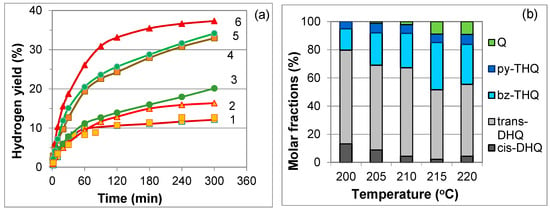
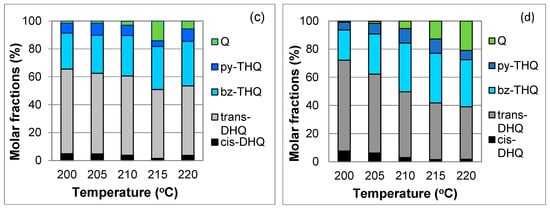
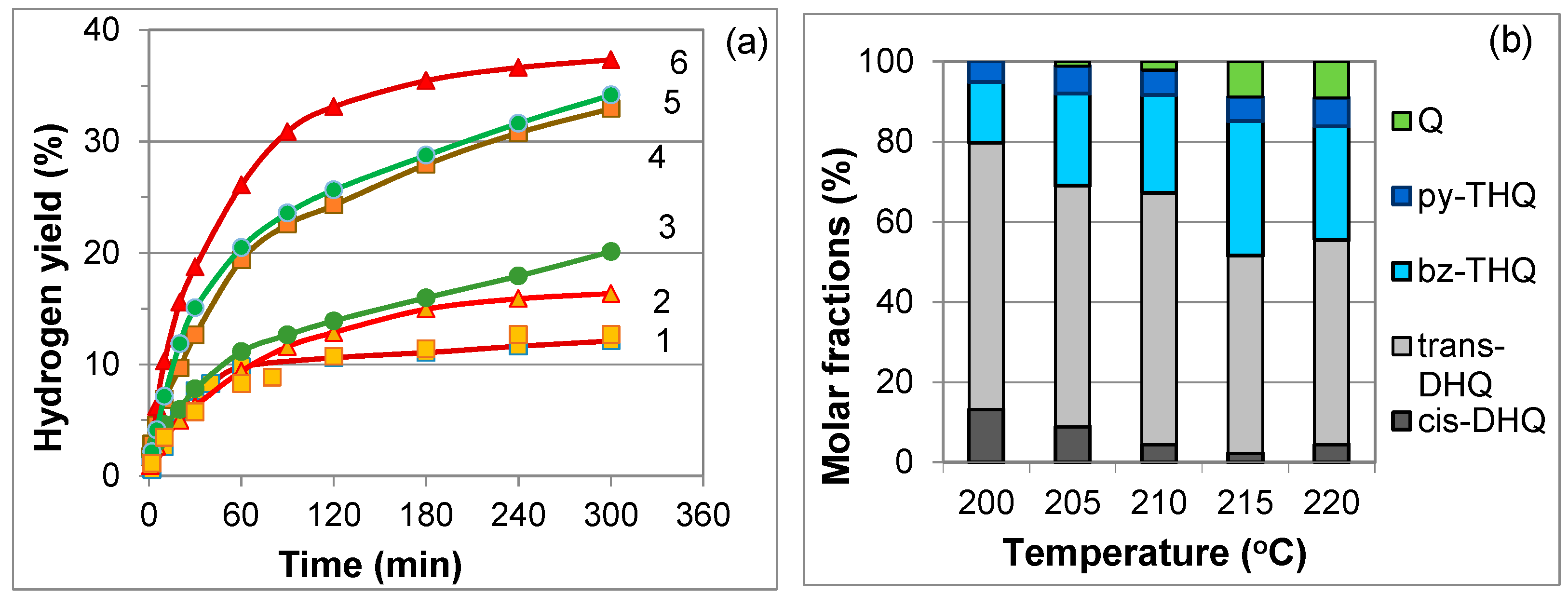
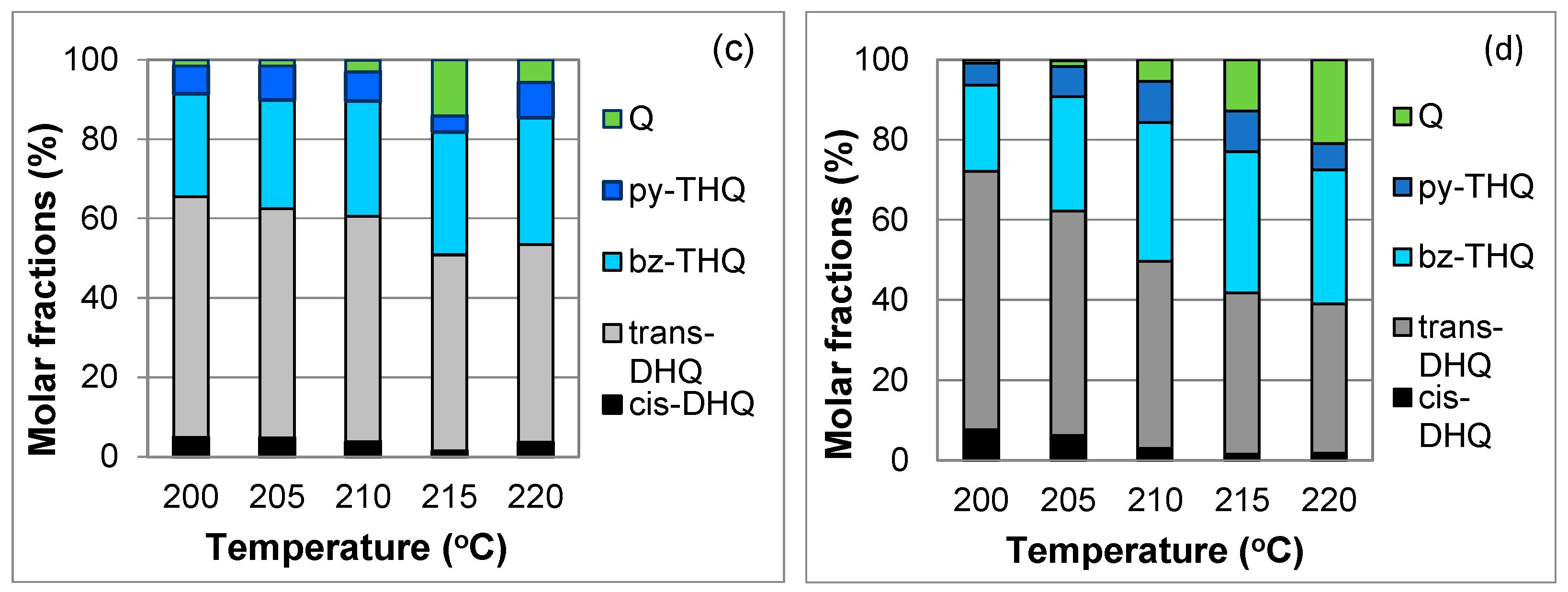
The effect of the reaction temperature on catalyst behavior has been studied using the catalysts with an average Pd loading of 1 wt%. The dehydrogenation process was studied starting from the reaction temperature of 200 °C, since it is the boiling temperature for trans-DHQ that is a significant constituent both in a synthesized [39] and commercial initial liquid reagent. Fast hydrogen release at this temperature was observed for 1 h, reaching a 10% H2 yield (Figure 1a), and further release proceeded considerably slower. The features of all these catalysts at 200 °C were cis-trans DHQ isomerization, the formation of THQs and a negligible amount of quinoline, with bz-THQ content significantly exceeding py-THQ content (Figure 1b–d). The observed features all add up and are in agreement with the results previously obtained over the Pd catalysts in tetraglyme solutions [33,34] and under solvent-free conditions [38,39]. Based on the obtained experimental results and previous publications, the reaction pathway for the dehydrogenation of DHQ over Pd nanoparticles deposited on CeO2-based supports or modified with CeO2 species (reverse catalysts) can be given as follows (Scheme 1). No isomerization was revealed on the supports alone.
Figure 1.
Kinetics of hydrogen release (a) at 200 °C (1–3) and 215 °C (4–6) over the catalysts: 1%Pd/CeO2 (1, 4), 1%Pd/CeZr-1 (3, 5) and 1%Pd/CeZr-2 (2, 6); molar fractions of DHQ and reaction products depending on the reaction temperature over the catalysts: 1%Pd/CeO2 (b), 1% Pd/CeZr-1 (c) and 1%Pd/CeZr-2 (d). Reaction conditions: DHQ 1.000 g (7.19 mmol); catalyst 75 mg (7.05∙10−3 mmol Pd); reaction time 5 h (b–d).
Scheme 1.
Dehydrogenation of decahydroquinoline to quinoline (required for its application as LOHC) over supported palladium catalysts.
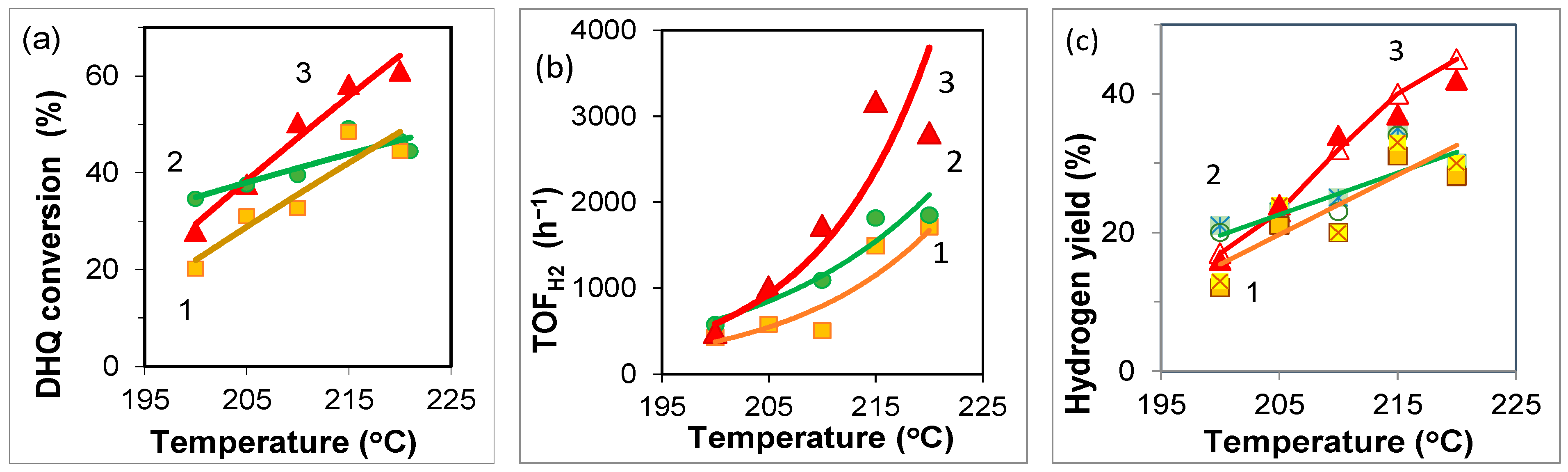
The observed hydrogen release and molar fractions of reaction products, especially quinoline, increased with the reaction temperature, the largest increase in the reaction products being observed for the catalyst on the ceria-based solid solution support (CeZr-2). This catalyst exhibited a significantly higher DHQ conversion, initial rate of H2 release, and H2 yield in 5 h for the studied temperature interval of 210–220 °C (Figure 2) as compared with other catalysts.
Figure 2.
DHQ conversion (a), initial rate of hydrogen release (b), and hydrogen yield in 5 h (c) for the catalysts: 1%Pd/CeO2 (1), 1%Pd/CeZr-1 (2) and 1% Pd/CeZr-2 (3). Reaction conditions: DHQ 1.000 g (7.19 mmol); catalyst 75 mg (7.05∙10−3 mmol Pd); reaction time 5 h (a,c).
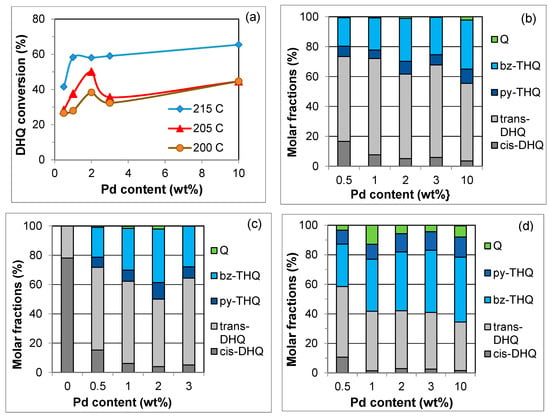
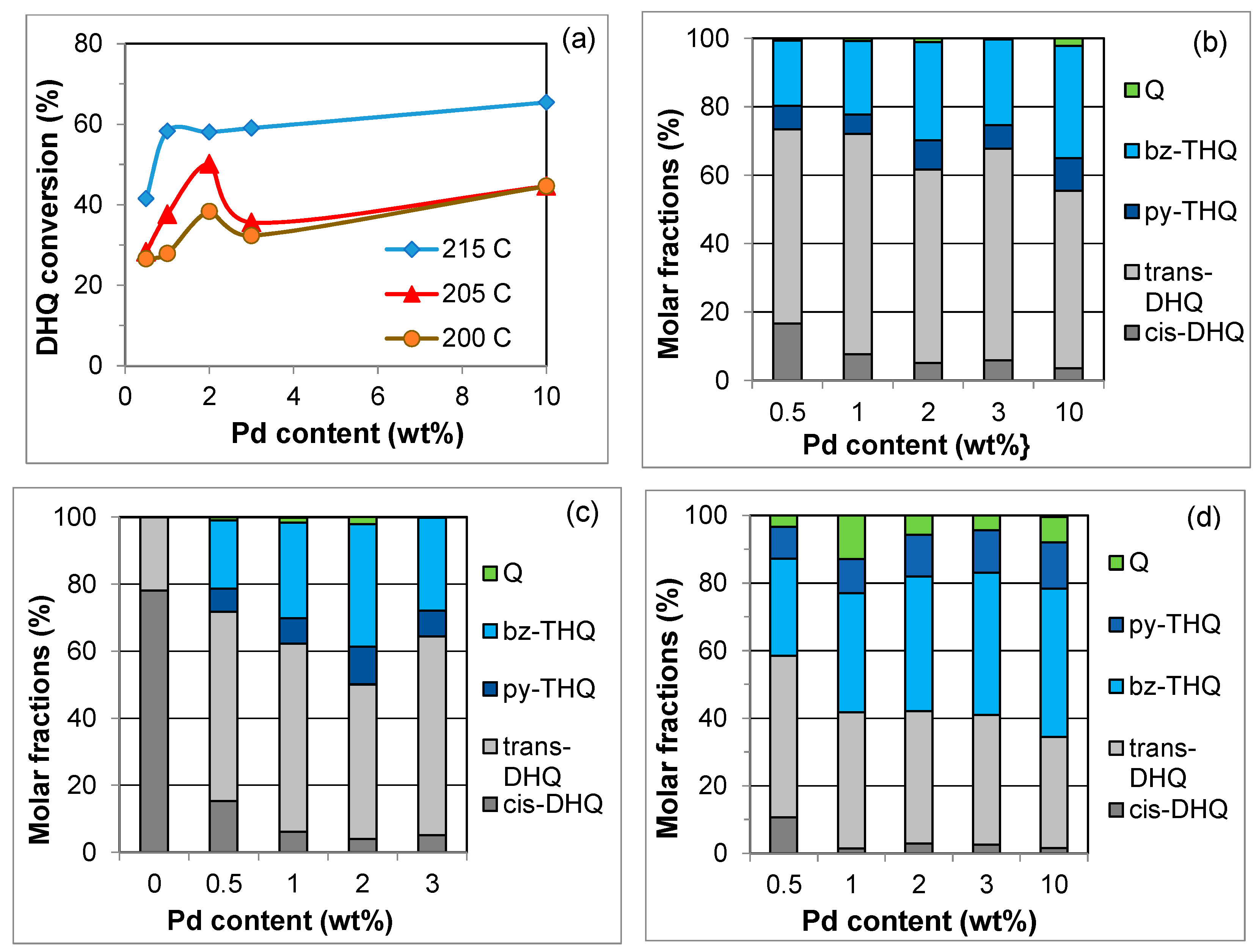
The dependence of catalytic activity on Pd loading has been studied for the most active Pd/CeZr-2 catalysts at 200–220 °C. DHQ conversion almost doubled at 205 °C, when the Pd content was raised from 0.5 to 2 wt%, while at 3 wt% it decreased and did not reach the maximum value even at 10 wt% of Pd. A similar tendency was obtained at 200 °C, whereas at 215–220 °C the significant conversion gain of 20% was obtained, when Pd loading was increased from 0.5 to only 1.0 wt% (Figure 3a).
Figure 3.
DHQ conversion (a) and molar fractions of DHQ and reaction products at 200 °C (b), 205 °C (c), 215 °C (d) as dependences on the Pd content in the catalysts Pd/CeZr-2. Reaction conditions: DHQ 1.000 g (7.19 mmol); catalyst 75 mg (7.05∙10−3 mmol Pd); reaction time 5 h.
The results of GC analysis of reaction mixtures in 5 h (Figure 3b–d) exhibit that: (i) Pd introduction brings about cis-trans DHQ isomerization enhanced with Pd loading; (ii) at 200–205 °C the amount of quinoline is negligible, while there is some variation in the molar fraction of bz-THQ depending on the Pd content; and (iii) a slight elevation of the reaction temperature to 215–220 °C significantly enhanced the formation of quinoline, and its content is maximal at 1 wt% of Pd.
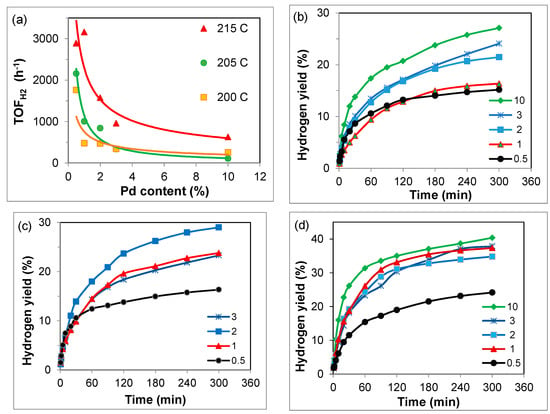
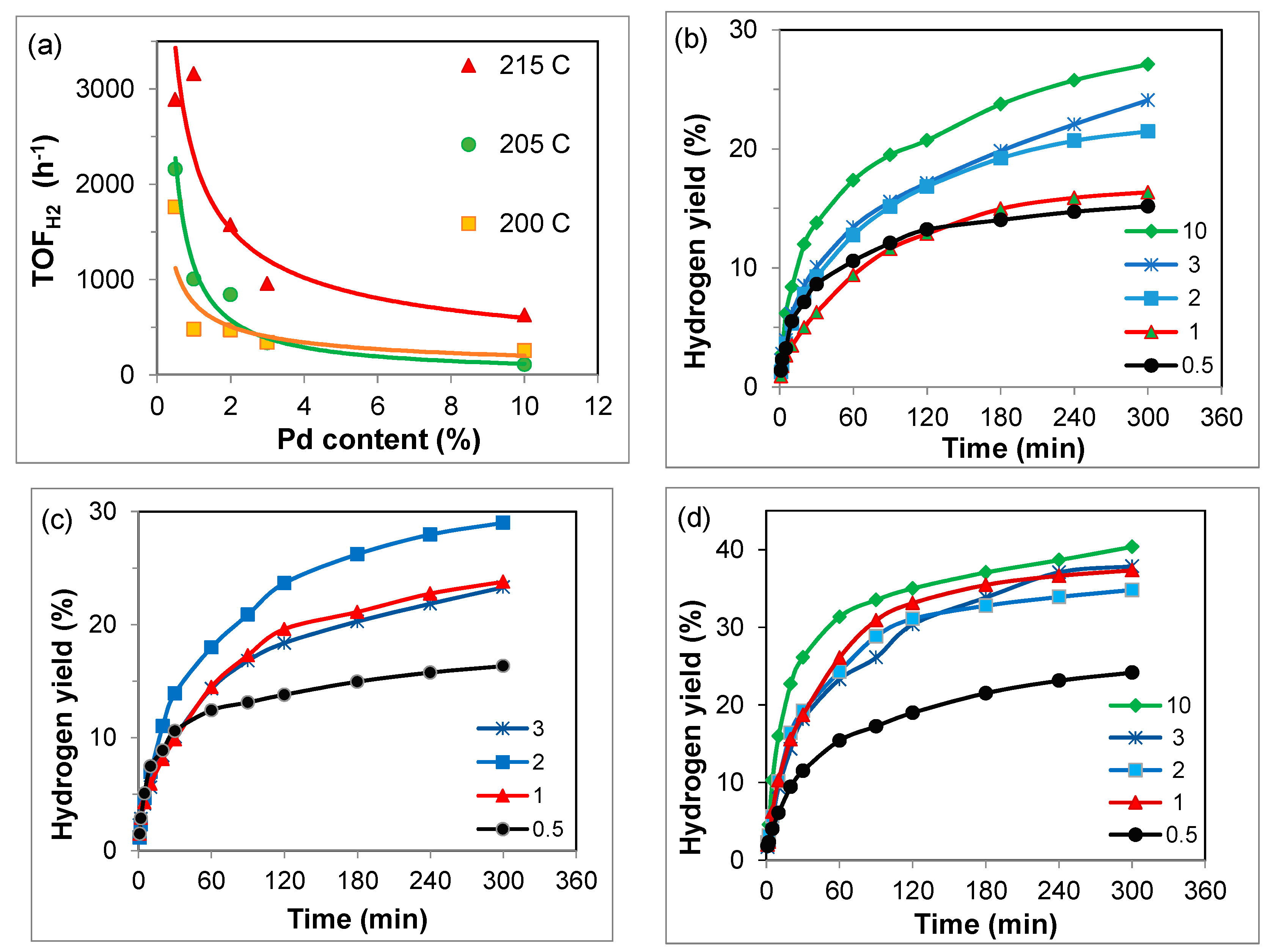
Calculation of the initial specific rate of hydrogen release per mole of Pd per hour (TOFH2) at a hydrogen yield of about 10% (corresponds to the DHQ conversion below 16%) revealed its dramatic decrease with an increasing Pd content up to 3 wt% (Figure 4a). Nevertheless, the observed overall hydrogen yield in 5 h increased with the Pd content in the catalyst (Figure 4b–d). Moreover, hydrogen release was considerably enhanced even with light elevation of the reaction temperature from 200 °C to 205 °C and further to 215 °C, being in progress over all five hours of the experiment. Such behavior suggests a possible increase in hydrogen release by prolonging the reaction, further elevating the reaction temperature and lowering the molar DHQ:Pd ratio.
Figure 4.
Initial rate of hydrogen release (a) and kinetics of hydrogen release at 200 °C (b), 205 °C (c), 215 °C (d) as functions of the Pd content in the catalysts Pd/CeZr-2. Reaction conditions: DHQ 1.000 g (7.19 mmol); catalyst 75 mg (7.05∙10−3 mmol Pd).
Profound changes did occur at 205 °C, with a doubled mass and reaction time of 7 h (Table 2, entries 1 and 2). A significant enhancement effect was also reached while raising the reaction temperature to 215 °C (entry 3). Surprisingly, at the reaction temperature of 220 °C, only a slight increase in efficiency was observed (Table 2, entry 4), as compared with the results found at 215 °C (entry 3), which may be explained by the intensive mass transport of formed trans-DHQ and bz-THQ (boiling points 201 °C and 218 °C, respectively) from the liquid reaction slurry to a catalyst-free gas volume of the reactor flask.
Table 2.
Variation in the efficiency of Pd/Ce0.75Zr0.25O2 catalysts depending on the reaction conditions and Pd loading.
Significant improvement of DHQ conversion and H2 yield has been reached for a doubled mass of the catalyst and somewhat increased reaction time (entry 5), yet it was not as marked as at 205 °C (entry 2), and the productivity of the catalyst was almost halved. By contrast, the tripled mass of the catalyst resulted in a slight decrease in DHQ conversion and H2 yield (entry 6), which may be due to arising mass and heat-transport limitations featured for a highly concentrated slurry of fine microparticles. The catalyst with a doubled Pd loading showed noticeably lower hydrogen production per catalyst mass (MH2 and VH2) and efficiency of palladium productivity (STYH2) (entry 7). The catalyst with a Pd loading of 10 wt% exhibited an efficiency (entries 8 and 9) comparable with data for the catalyst with 1% Pd (entries 3 and 4), except for the tenfold decrease in Pd productivity.
2.2. Effect of Ceria Loading and the Support Composition on the Catalytic Activity of Reverse Catalysts CeO2/Pd/Support
Reverse CeO2/1%Pd/TiO2 materials were catalytically active in DHQ dehydrogenation, predominantly to THQs, and their catalytic activity increased with CeO2 loading (Table 3), but passed through a maximum at a Ce content of 0.61 wt% (atomic ratio Ce:Pd = 0.46). The obtained optimal values of DHQ conversion, H2 yield, and molar fractions of products are aproximately the same values as for the supported 1%Pd/CeO2 catalyst (Table 3), which opens up a new avenue for other ways of preparation of less expensive catalysts with a low ceria content and an increased catalytic activity in DHQ dehydrogenation. However, the reverse catalysts with a CeO2/1%Pd/TiO2 composition are less active than the suppoted catalysts on the Ce0.75Zr0.25O2 material with the cerianite structure.
Table 3.
Effect of CeO2 introduction on DHQ conversion, molar fractions of the products and H2 yield (calculated and experimental) over CeO2/1%Pd/TiO2 catalysts.
On the other hand, although CeO2 introduction slightly enhanced the catalytic activity of reverse CeO2/1%Pd/SiO2 materals as compared with parent 1%Pd/SiO2 (Table 4), their activity was considerably lower as compared with other catalysts studied in this work. Nevertheless, a unique feature of these catalysts should be mentioned, i.e., weak isomerization of cis-DHQ to trans-DHQ even at 215 °C.
Table 4.
Effect of CeO2 introduction on DHQ conversion, molar fractions of the components in a reaction mixture and H2 yield (calculated and experimental) over CeO2/1%Pd/SiO2 catalysts.
Summarizing the above, DHQ conversion of 48–61% with a hydrogen release of 32–45% in five hours has been reached for the Pd catalyst on the ceria and ceria-based supports in solvent-free dehydrogenation of DHQ performed in a batch mode at a high molar loading of DHQ:Pd = 1000 at 215–220 °C, which is relatively mild for LOHC technologies. Hydrogen production per catalyst mass (MH2 and VH2) for these catalysts is considerably higher than for previously reported catalysts (Table 5). Moreover, the efficiency of palladium productivity (STYH2) values obtained as the H2 amount produced per mole of Pd per hour were higher than the values calculated based on the published data for Pd catalysts.
Table 5.
Activity of Pd catalysts in solvent-free DHQ dehydrogenation.
2.3. Characterization of Pd/CeZr-2 Catalysts
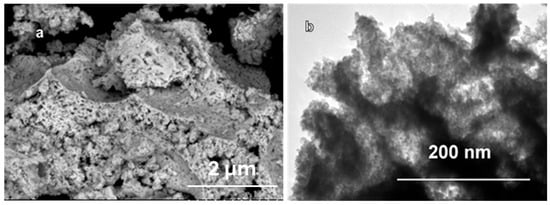
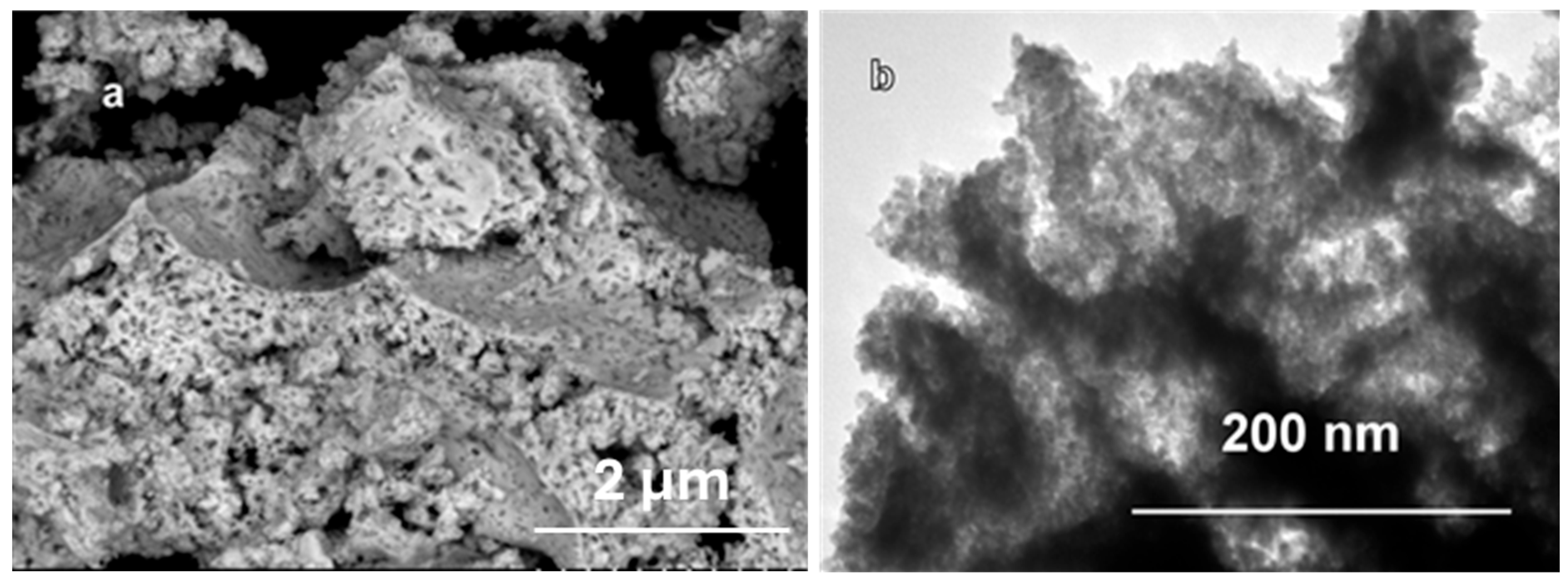
The surface morphology of Pd/CeZr-2 catalysts presents a net-like structure with large pores (Figure 5a). Interparticle pores of a much smaller size can also be recognized in the TEM image (Figure 5b). Unfortunately, it was impossible to detect any Pd particles by TEM even at a 10 wt% loading. SEM-EDX analysis confirms the uniform element distribution on the catalysts’ surfaces (Figure S4 in Supplementary Materials).
Figure 5.
SEM (a) and TEM (b) images of the 10%Pd/CeZr-2 catalyst.
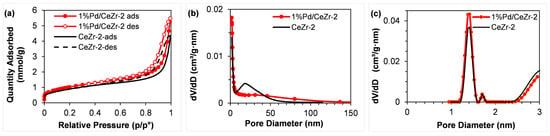
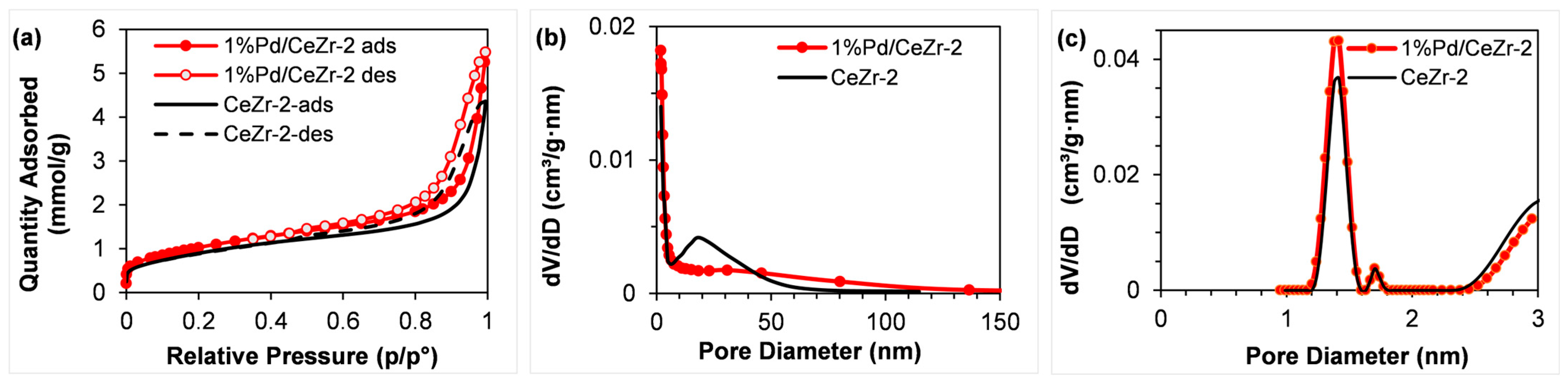
According to IUPAC classification, type IVa N2 adsorption–desorption isotherms with an H3 hysteresis loop were observed for both the catalyst and the initial support CeZr-2 (Figure 6a), which suggested the presence of ink-bottle-shaped or cylindrical mesopores [62,63]. The mesopore width distribution is wide (Figure 6b). The observed pronounced N2 uptake at low p/p◦ (Figure 6a) can be associated with the filling of micropores [62,63]. The micropore width distribution based on the DFT-cylinder model is bimodal for catalysts (Figure 6c). However, the textural features of the catalysts and the support differed appreciably. For 1 wt% Pd, as an example, SBET increased from 75 to 85 m2g−1, Vmeso increased from 0.15 to 0.19 cm3g−1, Vmicro, DFT increased from 0.009 to 0.012 cm3g−1, and the mesopore size distribution changed as well. The deposition of Pd nanoparticles of the size below 2.8 nm (possessed SBET more than 180 m2g−1 [64]) on the surface of mesopores, as well as the formation of additional micropores due to partial support dissolution and the mass-transport processes in a slurry during catalyst preparation may result in the above-mentioned changes. Similar changes have been observed for Cu/SiO2 catalysts [65].
Figure 6.
N2 adsorption–desorption isotherms (a); the mesopore (b) and micropore (c) size-distribution curves.
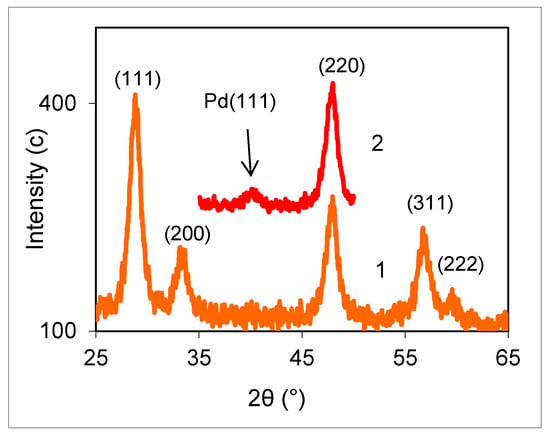
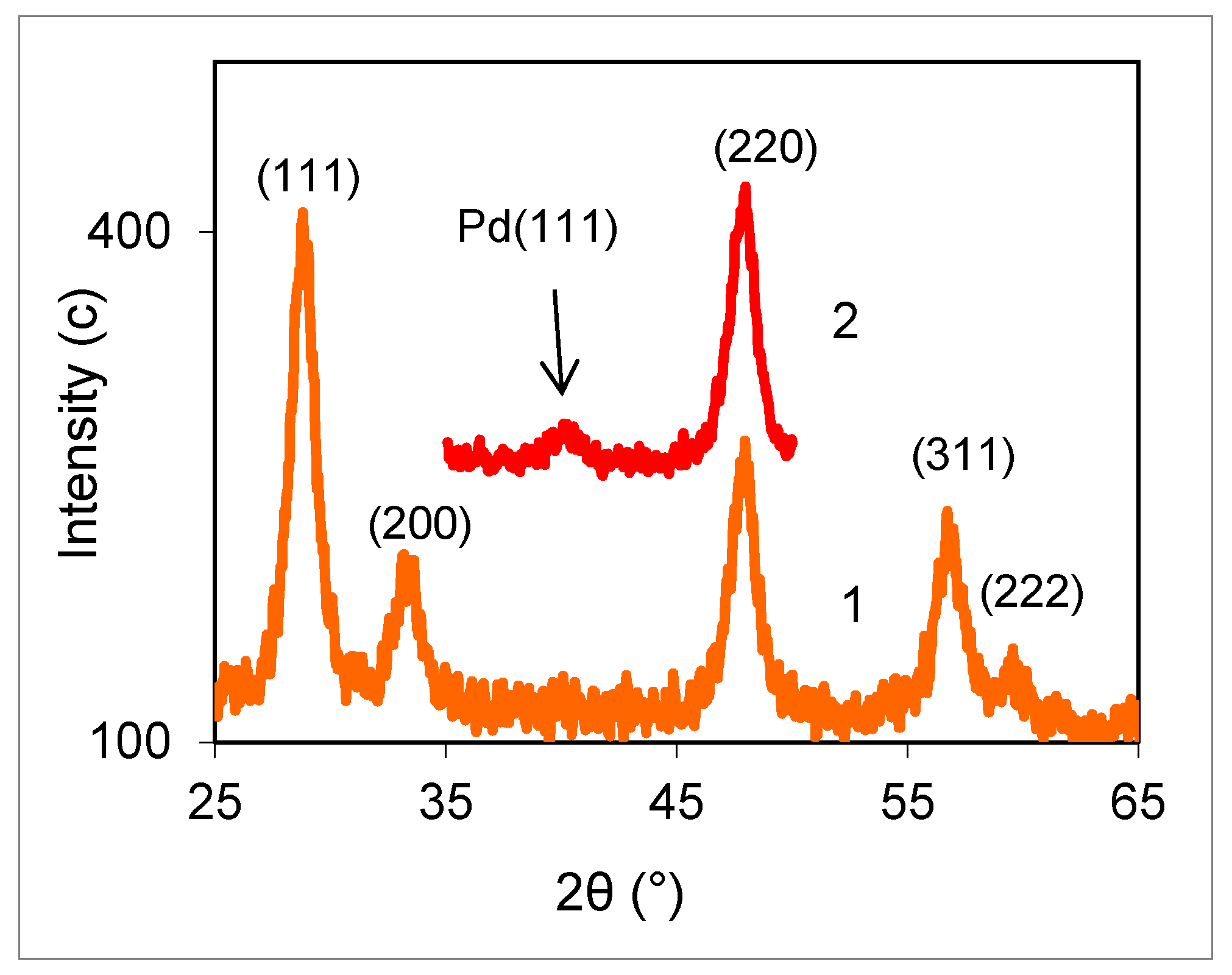
The XRD patterns of the samples with a Pd loading of 0.5–3.0 wt% were identical to that of the support, and no Pd reflections were observed, which may be due to the presence of Pd crystallites with sizes below 3 nm (detection limit) and the smaller Pd clusters or strong interaction of Pd-PHC with a support. Very weak major Pd reflection appeared only in the pattern of the 10%Pd/CeZr-2 sample (Figure 7), and the calculated average size of crystallites was estimated as 5.1 nm, which is slightly larger than the mean size of 3–4 nm for Pd nanoparticles in the 1%Pd/TiO2 catalyst prepared by the same procedure [39].
Figure 7.
XRD patterns of CeZr-2 (1) and 10%Pd/CeZr-2 (2).
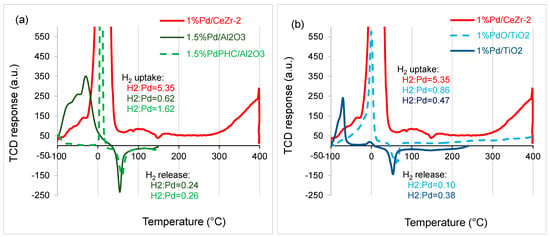
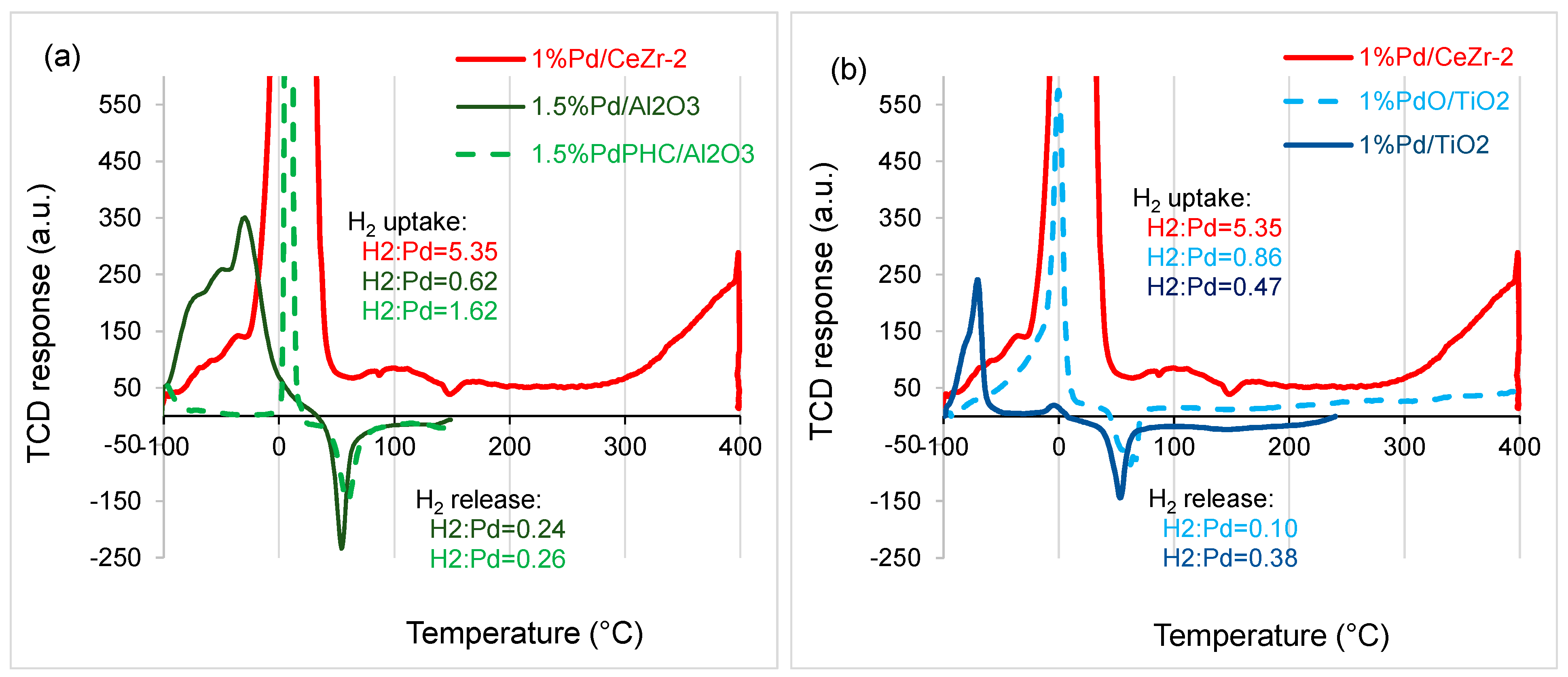
The TPR-H2 technique is a useful method for revealing interactions between the oxide support and a deposited metal compound. The catalysts, which, according to the preparation procedure, were preliminarily reduced in an H2 flow at 23 °C, were studied in a TPR-H2 system in the temperature range of −100–400 °C. First of all, there was no minimum of H2 release at 20–80 °C featured for the Pd nanocrystallites of the size 1–25 nm [66,67] in the TPR profile of the 1%Pd/CeZr-2 sample, although it is clearly observed on the TPR profiles of the samples prepared by the same procedure on γ-Al2O3 and TiO2 supports (Figure 8). This fact indicates the absence of metallic Pd nanocrystallites, which is in agreement with XRD results. On the other hand, the TPR profile of Pd/CeZr-2 exhibited an intense wide low-temperature H2 consumption peak at −25–40 °C and 0.50 mmol·g−1, the molar ratio of H2:Pd = 5.3 drastically exceeding the value of 1.0 required for reduction in Pd2+ to Pd0. This temperature range overlapped with the reduction regions for the supported PdO, which was obtained by prolonged calcination of the Pd/TiO2 sample at 300 °C, (−100–10 °C), PdPHC (0–20 °C), and highly intensive reduction proceeds up to 40 °C. The weak H2 consumption continued up to 400 °C and reached 0.33 mmol·g−1 from 40 °C to completion at 400 °C.
Figure 8.
TPR-H2 profiles of the 10%Pd/CeZr-2 catalyst in comparison with profiles of reference samples on Al2O3 (a) and TiO2 (b).
During the preparation step of reducing the PdPHC/CeZr-2 material in a slurry, the color of the solid commonly changes from yellow to dark gray or even black due to the reduction to Pd0. However, at the further steps of washing and drying, the solid tends to become light-colored, and storage in air results in a light olive-brown material, which may be caused by oxidation of Pd0 to Pd2+ species. For thus prepared catalysts on TiO2, SiO2, and γ-Al2O3 supports, this phenomenon was not observed during preparation and further storage even for years. Based on these facts, one can suppose that the lab-synthesized CeO2-based materials prepared in this work are of vital importance in oxidation of highly dispersed Pd nanoparticles at room temperature by oxygen from air or even oxygen dissolved in water. As it follows from the TPR profile of the PdO/TiO2 sample (Figure 8b), the reduction in Pd oxide species starts below 0 °C with a rising curve almost comparable with one for the 1%Pd/CeZr-2 sample. Further fast-growing H2 consumption may be explained by the CeZr-2 support reduction enhanced by hydrogen spillover, which was demonstrated for a platinum catalyst on a similar support [61].
2.4. Characterization of Reverse CeO2/1%Pd/TiO2 Catalysts
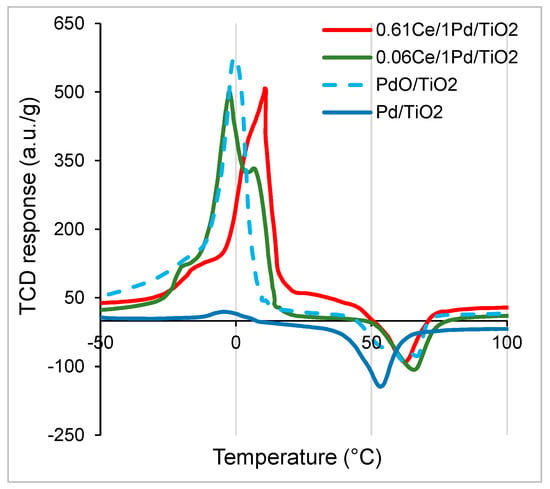
SEM-EDX analysis confirms the uniform Pd and Ce distribution on the catalyst’s surfaces (Figure S5 in Supplementary Materials). The method of temperature-programmed reduction with hydrogen (TPR-H2) was applied to reveal the catalyst reducibility and the Pd–CeOx interaction. The broad intensive peaks of hydrogen consumption appeared in the TPR curves of reverse catalysts in the range −50–20 °C, whereas negligible hydrogen consumption was observed for the parent Pd/TiO2 catalyst (Figure 9). They included the sharper maxima and shoulders whose position and intensity varied with Ce loading (Table 6).
Figure 9.
TPR-H2 profiles of the reverse CeO2/1%Pd/TiO2 catalysts in comparison with the profiles of the parent samples reduced at 23 °C (Pd/TiO2) and calcined at 300 °C for 24 h (PdO/TiO2).
Table 6.
Hydrogen uptake and release on the catalysts in different temperature ranges.
The first sharp peak coincides with a peak arising in the TPR curve of a parent catalyst after its calcination in air at the conditions used for the reverse catalyst (300 °C, 24 h). Therefore, it may be attributed to the reduction in PdO nanoparticles. A decline in its intensity with CeO2 loading points to the facts that CeO2 species have been deposited on the surface of Pd nanoparticles, as well as that this coverage inhibits Pd oxidation under calcination. The shoulder and a sharp peak at a higher temperature may be attributed to Ce4+ reduction to Ce3+ in CeO2 species, which is catalyzed by Pd. TPR-H2 data confirmed Pd0 phase presence in both the Pd/TiO2 and CeO2/1%Pd/TiO2 samples. The TPR curves of all samples exhibit hydrogen evolution at 36–82 °C with a varying peak minimum position. This negative peak is characteristic for the decomposition of palladium β-hydride, and its temperature, intensity and position of the minimum depend on the size of Pd nanoparticles [57,66,67]. The β-PdHx phase can be formed even at a negative temperature in the range from −100 °C to −50 °C [67] at the beginning of the TPR run or arise later at 10–30 °C in a decreased amount after the appearance of Pd0 particles (Figure 8b). The considerably larger hydrogen release for the reverse catalysts than for the PdO/TiO2 sample (Table 6) suggests the presence of Pd0 particles retained in initial samples due to CeO2 coverage, while the higher minimum position as compared with one for the parent catalyst suggests a larger particle size, perhaps, due to the sintering under the heating process at the calcination stage. The negative peak at 52 °C for Pd/TiO2 may be attributed to the Pd particles in the range of 2–4 nm [66], which is in agreement with particle-size distribution calculated based on TEM data (Figure S6), whereas the negative peaks at 62 °C and 65 °C for the CeO2/1%Pd/TiO2 catalysts fitted more to the particles of the size of 5 and 12 nm [66]. Coupled with CeOx, smaller Pd particles resulted in higher catalytic activity.
3. Materials and Methods
3.1. Materials and Synthesis
3.1.1. Support Preparation
The preparation of CeO2 and CeO2-ZrO2 mixed oxide was performed according to our previously published method [58,59,60]. To prepare a CeO2-ZrO2 (Ce:Zr = 4:1 by weight or molar ratio 3:1) mixed oxide support, the proper amount of ZrO(NO3)2 (Alfa Aesar, Ward Hill, MA, USA, 98%+) was dissolved in an oxalic acid aqueous solution (C (Zr) = 45 mg mL−1) under stirring. Then, the solution was poured into iso-propanol to achieve a 1:1 v/v ratio. The final solution was colorless and transparent. A proper amount of (NH4)2Ce(NO3)6 (Alfa Aesar, Ward Hill, MA, USA, 98%+) was dissolved in DI water. Then, iso-propanol was added to the solution to achieve an alcohol-to-H2O ratio of 1.7:1. The obtained zirconium oxalate alcohol solution was poured into the freshly prepared alcohol Ce salt solution under vigorous stirring. A yellowish precipitate was formed, and the pH of the slurry decreased to 0.3–0.4. After that, the pH of the slurry was raised up to 9.2–9.3 by the addition of NH4OH aqua solution (1.01 M) and kept at this pH for 1 h. The precipitate was then centrifuged, washed by distilled water, dried under a vacuum at 40 °C and calcined at 400°C in a muffle furnace.
The Ce0.75Zr0.25O2 solid solution based on the structure of the CeO2 cerianite phase was synthesized by thermal decomposition of the mixture consisting of metal salts and urea similar to our previously published procedure [61]. For example, to synthesize a Ce0.75Zr0.25O2 solid solution sample of 0.940 g, charges of 2.40 g of (NH4)2Ce(NO3)6 (Alfa Aesar, Ward Hill, MA, USA, 98%+), 0.27 g of ZrO(NO3)2 (Alfa Aesar, Ward Hill, MA, USA, 98%+) and 10.00 g of urea (Fluka, Seelze, Germany, ACS reagent, 99%+) were finely ground together in an agate mortar. The thermal decomposition process was performed at 550 °C for 2 h in a corundum crucible placed in a muffle furnace. The textural features of the prepared oxide supports are listed in Table 1, while N2 adsorption–desorption isotherms and the mesopore and micropore size-distribution curves are depicted in Figure S7.
For the preparation of inverse catalysts, commercial oxide carriers SiO2 (mesoporous KSKG CHIMMED, GOST 3956-76; Russia, SBET = 100 m2 g−1, Vpore = 1.08 cm3 g−1, Dpore = 30 nm) and TiO2 (nonporous P-25, EVONIC, Essen, Germany; SBET = 57 m2 g−1) were used.
3.1.2. Catalyst Preparation
The samples of supported Pd nanoparticle samples were synthesized via the deposition–precipitation of Pd polyhydroxo-complexes (PHC) followed by their reduction to Pd0 with H2 at 23 °C in an aqueous slurry by the procedure that we developed and described in detail previously [55,56]. The important conditions of catalyst preparation are given in Table S1.
The reverse CeO2/Pd/TiO2 and CeO2/Pd/SiO2 catalysts were prepared via redox deposition of a poorly soluble (0.19 g∙L−1) Ce2(C2O4)3 compound on the surface of supported Pd nanoparticles using reduction in Ce4+ by hydrogen preadsorbed on the surface of Pd nanoparticles. The newly developed preparation procedure differs from the previously described one for the preparation of FeOx/Pd/SiO2 catalysts [68]. To provide complete deposition, the following steps were used: (i) a weighted sample of a supported Pd catalyst with a Pd loading of 1 wt% was dispersed in a 0.024 M (NH4)2C2O4 aqueous solution; (ii) the slurry was stirred under an H2 flow for one hour; and then (iii) the required volume of a 0.022 M (NH4)2Ce(NO3)6 (98.5%, Alfa Aesar) aqueous solution was introduced in the slurry. The stirring of slurry extended over 17–24 h until complete Ce4+ reduction tested by a KI probe. The obtained sample was separated, washed, dried and calcined in air at 300 °C for 24 h to produce CeO2 [69,70,71]. The detailed conditions of catalyst preparation are outlined in Supplementary Materials, Tables S2 and S3. The atomic Ce;Pd ratio varied in a wide range of 0.05–2.0.
3.1.3. Synthesis of the Initial Substrate
The initial decahydroquinoline (DHQ) was synthesized via the quinoline catalytic hydrogenation by a known procedure [27] at a hydrogen pressure of 3 MPa and at 85 °C. A more detailed procedure is given in Supplementary Materials. The product (mixture of cis-DHQ and trans-DHQ) was analyzed by GC, 1H NMR and 13C NMR spectroscopy.
3.2. Characterization of Materials
To determine the textural characteristics, we performed an isotherm analysis by the BJH method. The N2 adsorption–desorption isotherms were obtained using an ASAP 2020 Plus unit (Micromeritics, Norcross, GA, USA). Reducibility of the samples was studied by temperature-programmed reduction with hydrogen (TPR-H2); the conditions were as follows: 5%H2/Ar (30 mL min−1), heating ramp 10 °C min−1 up to 400 °C. The XRD analysis was performed using an ARL X’TRA (Thermo Fisher Scientific, Waltham, MA, USA) diffractometer equipped with a theta–theta goniometer (CuKα radiation, 2θ = 5–70°, a scanning rate 1° min−1, CCDC data files). Electron microscopy methods were applied to study the particle size and morphology, as well as element distributions. A target-oriented approach was utilized for the optimization of the analytic measurements [72]. A Hitachi Regulus8230 (Tokyo, Japan) field-emission scanning electron microscope (FE-SEM) was used to carry out observations and to acquire images in backscattered electron mode (compositional contrast) at a 5 kV accelerating voltage and in secondary electron mode at a 5 kV accelerating voltage. Before measurements, the sample was mounted on a 25 mm aluminum specimen stub, fixed by conductive carbon tape and coated with a 30 nm film of carbon. EDS-SEM studies were carried out using the Bruker Quantax 400 EDS (Billerica, MA, USA) system equipped with a XFlash 6|60 detector at a 20 kV accelerating voltage. Hitachi HT7700 (Tokyo, Japan) transmission electron microscope was used to observe the sample morphology, and images were acquired at a 100 kV accelerating voltage in the bright-field TEM mode. Before measurements, the samples were deposited on the 3 mm carbon-coated copper grids from isopropanol suspension.
3.3. Catalytic Activity Characterization
For comparison of the catalytic behavior in DHQ dehydrogenation, different catalysts were tested under the same conditions: 75 mg of a catalyst (7.05·10−3 mmol of Pd for the catalyst with a Pd loading of 1 wt%) and 1000 mg (7.19 mmol) of DHQ were loaded into the reactor (a 25 mL pear-shaped flask) with a Teflon bar; then, the flask was connected to the gas volume analysis line (consisting of an air condenser and a burette graduated in 1 cm3 for measuring the gas volume) using a pass-through adaptor and a Teflon sleeve. The system was purged with an argon flow, and the reactor was introduced into a stirring oil bath preliminarily heated to the required temperature (200–220 °C). This set-up provided the formation of a condensate fast-flowing downslope only on the flask and adaptor walls (no visible condensate in a condenser), as well as exhibited the highest reproducible results. An increase in gas volume in a burette due to H2 release was monitored for 300 min. After switching off the stirring, the reactor was removed from the system, cooled to room temperature; and a 2.0 mL batch of methanol was added into the reactor. After stirring and catalyst separation, a probe of the obtained reaction mixture solution (1.5 mL) was withdrawn and analyzed by the GC internal standard method using 2-ethylhexanol (100 μL) as a standard. Conditions of GC analysis and an example of a chromatogram, as well as Equations (S1)–(S5) used for calculation of the catalytic activity features, are presented in Supplementary Materials. DHQ conversion values were calculated based on GC analysis of the reaction mixture and a reference DHQ solution in methanol. The formed H2 amount values and H2 efficiency (yield) were calculated using both the H2 released volume data and the results of GC analysis. If the discrepancy between these values and an average value exceeded 5 relative %, the experiment was repeated.
4. Conclusions
Catalysts with a Pd loading of 0.5–10 wt% consisting of Pd nanoparticles of the size below 5 nm placed on the surface of CeO2, CeO2-ZrO2 mixed oxide (Ce:Zr = 4:1 w/w) and cerianite-based-structure Ce0.75Zr0.25O2 materials have first been synthesized by the facile method of deposition–precipitation of palladium poly-hydroxo complexes accompanied with a reduction in a slurry at room temperature, which seems more preferable than any separate reduction, especially for an industrial application. These catalysts first exhibited considerable activity in decahydroquinoline dehydrogenation to tetrahydroquinoline at 200–215 °C and significant activity in further dehydrogenation to quinoline at 220 °C. The optimal Pd loading was revealed to range between 1.0 and 3.0 wt%. We have successfully performed the process at a large molar ratio of DHQ:Pd = 1000 with the corresponding value of mass ratio DHQ:catalyst = 13:1. The catalysts maintained the activity after prolonged storage in air.
The reverse CeO2/Pd/TiO2 and CeO2/Pd/SiO2 catalysts have been prepared for the first time via redox deposition of a Ce3+ compound on the surface of Pd nanoparticles using reduction with pre-adsorbed hydrogen. The atomic ratio Ce;Pd varied in a wide range of 0.05–2.0. The reverse CeO2/Pd/TiO2 catalysts were less active in DHQ dehydrogenation than the supported Pd/Ce0.75Zr0.25O2 catalysts.
The presented results bring notice to the engineering and scientific society of the potential for application of supported palladium catalysts on the ceria-based materials and ceria-modified carriers, as well as solvent-free dehydrogenation of decahydroquinoline as a hydrogen-rich form of liquid organic hydrogen carriers (LOHC) to produce a lean form (quinoline) of the considerably promising LOHC pair DHQ/Q. The results of the present work demonstrate that liquid-phase dehydrogenation of THQs to quinoline requires temperatures higher than 220 °C, yet evaporation of trans-DHQ reagent and bz-THQ intermediate, because of their low boiling-point values, would present a considerable challenge to the reactor and process design. From this point of view, performance of the process in a vapor phase over a heterogeneous catalyst is preferable. Therefore, the research on vapor-phase DHQ dehydrogenation to quinoline could be of high interest in the immediate future.
Supplementary Materials
The following supporting information can be downloaded at: https://www.mdpi.com/article/10.3390/catal16090835/s1, Procedure descriptions: Preparation of reverse catalysts, Synthesis of initial substrate, GC analysis of reaction mixture, Calculation of the catalytic activity features; Figure S1: 1H NMR spectrum of initial decahydroquinoline DHQ; Figure S2: 13C NMR spectrum of initial decahydroquinoline; Figure S3: A chromatogram of the DHQ dehydrogenation products; Figure S4: SEM-EDX maps for the 1%Pd/CeZr-2 catalyst; Figure S5: SEM-EDX maps for the CeO2/1%Pd/TiO2 catalyst (Ce loading 0.61 wt%); Figure S6: TEM image and particle-size distribution for the parent 1% Pd/TiO2 catalyst; Figure S7: N2 adsorption-desorption isotherms (a); the mesopore (b) and micropore (c) size distribution curves for the supports synthesized; Table S1: Important conditions of the catalyst preparation procedure via the deposition–precipitation of Pd polyhydroxo-complexes; Table S2: Important conditions of the catalyst preparation procedure of CeO2/1%Pd/TiO2; Table S3: Important conditions of the catalyst preparation procedure of CeO2/1%Pd/SiO2. References [68,69,70,71,73,74] are cited in the Supplementary Materials.
Author Contributions
Conceptualization, O.K. and L.K.; methodology, O.K., E.R. and E.S.; validation, O.K., E.S. and E.R.; formal analysis, O.K., E.S. and G.K.; investigation, O.K., E.S., E.R., I.I. and G.K.; data curation, O.K., E.S., E.R., and G.K.; writing—original draft preparation, O.K.; writing—review and editing, E.R. and L.K.; supervision, L.K.; project administration, E.R.; funding acquisition, E.R. All authors have read and agreed to the published version of the manuscript.
Funding
This research was funded by the Russian Science Foundation, grant number 24-73-10149.
Data Availability Statement
The data are contained within the article and Supplementary Materials.
Acknowledgments
Electron microscopy characterization, NMR, and HRMS analyses were performed using the equipment of the Shared Research Center (Department of Structural Studies) of N.D. Zelinsky Institute of Organic Chemistry RAS, Moscow. The authors acknowledge the LLC Center for Hydrogen Energy (Chernogolovka, Moscow Region).
Conflicts of Interest
The authors declare no conflicts of interest.
Abbreviations
The following abbreviations are used in this manuscript:
| DHQ | Decahydroquinoline |
| GC | Gas chromatography |
| H-LOHC | Hydrogenated rich form of LOHC |
| LOHC | Liquid organic hydrogen carriers |
| PHC | Polynuclear hydroxo complexes |
| Q | Quinoline |
| TEM | Transmission electron microscopy |
| THQ | Tetrahydroquinoline |
| py-THQ | 1,2,3,4-tetrahydroquinoline |
| bz-THQ | 5,6,7,8-tetrahydroquinoline |
| TPR-H2 | Temperature-programmed reduction by hydrogen |
| SEM | Scanning electron microscope |
| XRD | X-ray Diffraction |
References
- Mehr, A.S.; Phillips, A.D.; Brandon, M.P.; Pryce, M.T.; Carton, J.G. Recent Challenges and Development of Technical and Technoeconomic Aspects for Hydrogen Storage, Insights at Different Scales; A State of Art Review. Int. J. Hydrogen Energy 2024, 70, 786–815. [Google Scholar] [CrossRef] [Scilit]
- Aditiya, H.B.; Mahlia, T.M.I.; Huang, Z. Scaling Green Hydrogen: Production, Storage, Techno-Economics and Global Perspectives. Renew. Sustain. Energy Rev. 2026, 226, 116444. [Google Scholar] [CrossRef] [Scilit]
- Guan, J.; Lang, C.; Yao, X. Innovative Carbon-Based Materials for Efficient Hydrogen Storage: A Review of Solid, Gaseous, and Liquid Systems. Prog. Mater. Sci. 2026, 157, 101596. [Google Scholar] [CrossRef] [Scilit]
- Ali, S.A.; Usman, M.; Shaikh, M.N. Advancements in Catalytic Technologies for Chemical Hydrogen Storage: Materials, Mechanisms, and Future Prospects. Small 2026, 22, e11191. [Google Scholar] [CrossRef] [Scilit] [PubMed]
- Le, T.-H.; Tran, N.; Lee, H.-J. Development of Liquid Organic Hydrogen Carriers for Hydrogen Storage and Transport. Int. J. Mol. Sci. 2024, 25, 1359. [Google Scholar] [CrossRef] [Scilit] [PubMed]
- Ndhlozi, L.; Khumalo, A.A.; Iroegbu, A.O.C.; Zinyemba, O.; Meijboom, R. Cyclic Liquid Organic Hydrogen Carriers for Efficient Hydrogen Storage Using Mesoporous Catalytic Systems. Discov. Energy 2025, 5, 18. [Google Scholar] [CrossRef] [Scilit]
- Meda, U.S.; Raikar, O.M.; Acharya, A.; Kashyap S G, A.; Mahesh, R.; Shetty, T. Nuances in Liquid Organic Hydrogen Carriers. Renew. Sustain. Energy Rev. 2026, 226, 116237. [Google Scholar] [CrossRef] [Scilit]
- Nnabuife, S.G.; Hamzat, A.K.; Darko, C.K.; Udemu, C.; Quainoo, K.A.; Yang, J.; Kuang, B. Low-Carbon Energy Storage via Liquid Organic Hydrogen Carriers: From New Developments to Global Initiatives. Energy 2026, 11, 100533. [Google Scholar] [CrossRef] [Scilit]
- Gemechu, D.N.; Mohammed, A.M.; Redi, M.; Bessarabov, D.; Mekonnen, Y.S.; Obodo, K.O. First Principles-Based Approaches for Catalytic Activity on the Dehydrogenation of Liquid Organic Hydrogen Carriers: A Review. Int. J. Hydrogen Energy 2023, 48, 33186–33206. [Google Scholar] [CrossRef] [Scilit]
- Zhou, M.; Miao, Y.; Gu, Y.; Xie, Y. Recent Advances in Reversible Liquid Organic Hydrogen Carrier Systems: From Hydrogen Carriers to Catalysts. Adv. Mater. 2024, 36, 2311355. [Google Scholar] [CrossRef] [Scilit] [PubMed]
- Kirichenko, O.A.; Kustov, L.M. Recent Progress in Development of Supported Palladium Catalysts for Dehydrogenation of Heterocyclic Liquid Organic Hydrogen Carriers (LOHC). Int. J. Hydrogen Energy 2024, 88, 97–119. [Google Scholar] [CrossRef] [Scilit]
- Dai, M.; Qin, Y.; Chen, L.; Chen, X. A Review of Reversible Hydrogenation and Dehydrogenation Catalysts for Liquid Organic Hydrogen Carriers. Catal. Sci. Technol. 2025, 15, 2440–2449. [Google Scholar] [CrossRef] [Scilit]
- Modisha, P.M.; Ouma, C.N.M.; Garidzirai, R.; Wasserscheid, P.; Bessarabov, D. The Prospect of Hydrogen Storage Using Liquid Organic Hydrogen Carriers. Energy Fuels 2019, 33, 2778–2796. [Google Scholar] [CrossRef] [Scilit]
- Niermann, M.; Beckendorff, A.; Kaltschmitt, M.; Bonhoff, K. Liquid Organic Hydrogen Carrier (LOHC)—Assessment Based on Chemical and Economic Properties. Int. J. Hydrogen Energy 2019, 44, 6631–6654. [Google Scholar] [CrossRef] [Scilit]
- Hurskainen, M.; Ihonen, J. Techno-Economic Feasibility of Road Transport of Hydrogen Using Liquid Organic Hydrogen Carriers. Int. J. Hydrogen Energy 2020, 45, 32098–32112. [Google Scholar] [CrossRef] [Scilit]
- Zhang, J.; Yang, F.; Wang, B.; Li, D.; Wei, M.; Fang, T.; Zhang, Z. Heterogeneous Catalysts in N-Heterocycles and Aromatics as Liquid Organic Hydrogen Carriers (LOHCs): History, Present Status and Future. Materials 2023, 16, 3735. [Google Scholar] [CrossRef] [Scilit] [PubMed]
- Cabrera, G.; Mora, M.; Gil-Burgos, J.P.; Visbal, R.; Machuca-Martínez, F.; Mosquera-Vargas, E. Liquid Organic Hydrogen Carrier Concepts and Catalysts for Hydrogenation and Dehydrogenation Reactions. Molecules 2024, 29, 4938. [Google Scholar] [CrossRef] [Scilit] [PubMed]
- Jangir, J.; Jagirdar, B.R. Unveiling the Potential of Heterogeneous Systems for Reversible Hydrogen Storage in Liquid Organic Hydrogen Carriers. ChemSusChem 2025, 18, e202402018. [Google Scholar] [CrossRef] [Scilit] [PubMed]
- Sage, V.; Patel, J.; Hazewinkel, P.; Yasin, Q.U.A.; Wang, F.; Yang, Y.; Kozielski, K.; Li, C. Recent Progress and Techno-Economic Analysis of Liquid Organic Hydrogen Carriers for Australian Renewable Energy Export—A Critical Review. Int. J. Hydrogen Energy 2024, 56, 1419–1434. [Google Scholar] [CrossRef] [Scilit]
- Steele, W.V.; Archer, D.G.; Chirico, R.D.; Collier, W.B.; Hossenlopp, I.A.; Nguyen, A.; Smith, N.K.; Gammon, B.E. The Thermodynamic Properties of Quinoline and Isoquinoline. J. Chem. Thermodyn. 1988, 20, 1233–1264. [Google Scholar] [CrossRef] [Scilit]
- Steele, W.V.; Chirico, R.D.; Nguyen, A.; Knipmeyer, S.E. The Thermodynamic Properties of 2-Methylaniline and Trans-(R,S)-Decahydroquinoline. J. Chem. Thermodyn. 1994, 26, 515–544. [Google Scholar] [CrossRef] [Scilit]
- Verevkin, S.P.; Safronov, S.P.; Samarov, A.A.; Vostrikov, S.V. Hydrogen Storage: Thermodynamic Analysis of Alkyl-Quinolines and Alkyl-Pyridines as Potential Liquid Organic Hydrogen Carriers (LOHC). Appl. Sci. 2021, 11, 11758. [Google Scholar] [CrossRef] [Scilit]
- Samarov, A.A.; Müller, K.; Wasserscheid, P.; Verevkin, S.P. Thermodynamics of Reversible Hydrogen Storage: Are Methoxy-Substituted Aromatics Better through Oxygen Functionality? Chem. Eng. Technol. 2024, 47, 739–745. [Google Scholar] [CrossRef] [Scilit]
- Wei, Z.; Shao, F.; Wang, J. Recent Advances in Heterogeneous Catalytic Hydrogenation and Dehydrogenation of N-Heterocycles. Chin. J. Catal. 2019, 40, 980–1002. [Google Scholar] [CrossRef] [Scilit]
- Aakko-Saksa, P.T.; Mykkänen, A.M.; Repo, T. Solvent-Free Hydrogenation and Dehydrogenation of Quinoline and Quinaldine for the LOHC Concept. ACS Omega 2026, 11, 14073–14081. [Google Scholar] [CrossRef] [Scilit] [PubMed]
- Sun, Y.-P.; Fu, H.-Y.; Zhang, D.; Li, R.-X.; Chen, H.; Li, X.-J. Complete Hydrogenation of Quinoline over Hydroxyapatite Supported Ruthenium Catalyst. Catal. Commun. 2010, 12, 188–192. [Google Scholar] [CrossRef] [Scilit]
- Fan, G.-Y.; Wu, J. Mild Hydrogenation of Quinoline to Decahydroquinoline over Rhodium Nanoparticles Entrapped in Aluminum Oxy-Hydroxide. Catal. Commun. 2013, 31, 81–85. [Google Scholar] [CrossRef] [Scilit]
- Martinez-Espinar, F.; Blondeau, P.; Nolis, P.; Chaudret, B.; Claver, C.; Castillón, S.; Godard, C. NHC-Stabilised Rh Nanoparticles: Surface Study and Application in the Catalytic Hydrogenation of Aromatic Substrates. J. Catal. 2017, 354, 113–127. [Google Scholar] [CrossRef] [Scilit]
- Bourriquen, F.; Hervochon, J.; Bartling, S.; Rockstroh, N.; Fischmeister, C.; Junge, K.; Beller, M. Teaching an Old Dog New Tricks: Simple Selective and Regiodivergent Quinoline Hydrogenation. ACS Sustain. Chem. Eng. 2023, 11, 12853–12858. [Google Scholar] [CrossRef] [Scilit]
- Bagwan, F.M.; Kinage, A.K.; Vasireddy, S.N. Reaction Kinetics for Catalytic Hydrogenation of Quinoline to Decahydroquinoline as Liquid Organic Hydrogen Carrier. Int. J. Hydrogen Energy 2024, 92, 102–112. [Google Scholar] [CrossRef] [Scilit]
- Koskin, A.P.; Zhang, J.; Belskaya, O.B.; Bulavchenko, O.A.; Konovalova, D.A.; Stepanenko, S.A.; Ishchenko, A.V.; Danilova, I.G.; Yurpalov, V.L.; Larichev, Y.V.; et al. Efficiency of High-Loaded Nickel Catalysts Modified by Mg in Hydrogen Storage/Extraction Using Quinoline/Decahydroquinoline Pair as LOHC Substrates. J. Magnes. Alloys 2024, 12, 3245–3263. [Google Scholar] [CrossRef] [Scilit]
- Su, H.; Sun, L.-H.; Xue, Z.-H.; Gao, P.; Zhang, S.-N.; Zhai, G.-Y.; Zhang, Y.-M.; Lin, Y.-X.; Li, X.-H.; Chen, J.-S. Nitrogen-Thermal Modification of the Bifunctional Interfaces of Transition Metal/Carbon Dyads for the Reversible Hydrogenation and Dehydrogenation of Heteroarenes. Chem. Commun. 2019, 55, 11394–11397. [Google Scholar] [CrossRef] [Scilit] [PubMed]
- Stepanenko, S.A.; Shivtsov, D.M.; Koskin, A.P.; Koskin, I.P.; Kukushkin, R.G.; Yeletsky, P.M.; Yakovlev, V.A. N-Heterocyclic Molecules as Potential Liquid Organic Hydrogen Carriers: Reaction Routes and Dehydrogenation Efficacy. Catalysts 2022, 12, 1260. [Google Scholar] [CrossRef] [Scilit]
- Koskin, A.P.; Larichev, Y.V.; Stepanenko, S.A.; Dubinin, Y.V.; Ayupov, A.B.; Saraev, A.A.; Suprun, E.A.; Yeletsky, P.M. Carbonized Melamine Cyanurate as a Palladium Catalyst Support for the Dehydrogenation of N-Heterocyclic Compounds in LOHC Technology. C 2023, 9, 83. [Google Scholar] [CrossRef] [Scilit]
- Tran, B.L.; Bowden, M.E.; Autrey, T.; Byun, M.Y.; Müller, K. Roles of Solvent in the Catalytic Hydrogen Release from Liquid Organic Hydrogen Carriers: Chemical, Thermodynamical and Technological Aspects. Top. Catal. 2024, 67, 892–899. [Google Scholar] [CrossRef] [Scilit]
- Oh, J.; Bathula, H.B.; Park, J.H.; Suh, Y.-W. A Sustainable Mesoporous Palladium-Alumina Catalyst for Efficient Hydrogen Release from N-Heterocyclic Liquid Organic Hydrogen Carriers. Commun. Chem. 2019, 2, 68. [Google Scholar] [CrossRef] [Scilit]
- Girase, A.; Nichinde, C.; Patil, B.; Chaudhari, S.; Kinage, A. Reversible Hydrogenation and Dehydrogenation of N-Heteroaryl with Heterogeneous Palladium Catalyst for Hydrogen Storage and Transport Application. Catal. Lett. 2025, 155, 403. [Google Scholar] [CrossRef] [Scilit]
- Bagwan, F.M.; Dadkar, S.S.; Kinage, A.K.; Vasireddy, S.N. Reaction Kinetics for Dehydrogenation of Decahydroquinoline to Quinoline for Hydrogen Generation. Chem. Eng. Technol. 2026, 49, e70177. [Google Scholar] [CrossRef] [Scilit]
- Shuvalova, E.V.; Kirichenko, O.A.; Kustov, L.M. Solvent-free dehydrogenation of decahydroquinoline over palladium nanoparticles supported on oxide carriers. Mendeleev Commun. 2026, 36, 573–575. [Google Scholar] [CrossRef] [Scilit]
- Simonov, P.A.; Romanenko, A.V.; Likholobov, V.A. Hydrogenation of Ethyl P-Nitrobenzoate on Pd/Sibunit Catalysts. Solid Fuel Chem. 2014, 48, 364–370. [Google Scholar] [CrossRef] [Scilit]
- Simakova, O.A.; Simonov, P.A.; Romanenko, A.V.; Simakova, I.L. Preparation of Pd/C Catalysts via Deposition of Palladium Hydroxide onto Sibunit Carbon and Their Application to Partial Hydrogenation of Rapeseed Oil. React. Kinet. Catal. Lett. 2008, 95, 3–12. [Google Scholar] [CrossRef] [Scilit]
- Shun, K.; Mori, K. Unlocking Hydrogen Spillover: Dynamic Behavior and Advanced Applications. Acc. Chem. Res. 2025, 58, 3060–3070. [Google Scholar] [CrossRef] [Scilit] [PubMed]
- Kim, Y.; Kim, D.H. Support-Dependent Formic Acid Dehydrogenation over Pd-Supported Catalysts Induced by Hydrogen Spillover. Energy Fuels 2025, 39, 16399–16406. [Google Scholar] [CrossRef] [Scilit]
- Ma, Y.; Gao, W.; Zhang, Z.; Zhang, S.; Tian, Z.; Liu, Y.; Ho, J.C.; Qu, Y. Regulating the Surface of Nanoceria and Its Applications in Heterogeneous Catalysis. Surf. Sci. Rep. 2018, 73, 1–36. [Google Scholar] [CrossRef] [Scilit]
- Zhang, Y.; Zhao, S.; Feng, J.; Song, S.; Shi, W.; Wang, D.; Zhang, H. Unraveling the Physical Chemistry and Materials Science of CeO2-Based Nanostructures. Chem 2021, 7, 2022–2059. [Google Scholar] [CrossRef] [Scilit]
- Atran, A.A.; Ibrahim, F.A.; Hamdy, M.S. Functionalization and Applications of the Versatile CeO2 Nanoparticles: A Review. Inorg. Chem. Commun. 2024, 163, 112359. [Google Scholar] [CrossRef] [Scilit]
- Redina, E.A.; Krylov, I.B.; Novikov, R.A.; Kapustin, G.I.; Tkachenko, O.P.; Vikanova, K.V.; Ivanova, I.I.; Dmitrenok, A.S.; Kustov, L.M. High-Performance Pt/CeO2-ZrO2 Catalysts for Selective Hydrogenation of α,β-Unsaturated Aldehydes to Unsaturated Alcohols under Mild Reaction Conditions: “Giant” Hydrogen Spillover behind the Activity Enhancement. J. Catal. 2024, 429, 115231. [Google Scholar] [CrossRef] [Scilit]
- Zhou, G.; Li, T.; Chen, J.; Deng, L.; Xie, H. Nano-Pd/CeO2 Catalysts for Hydrogen Storage by Reversible Benzene Hydrogenation/Dehydrogenation Reactions. Int. J. Hydrogen Energy 2021, 46, 14540–14555. [Google Scholar] [CrossRef] [Scilit]
- Prieto, I.; Díaz, E.; Ordóñez, S. Biobased Furanic Molecules as Potential LOHCs: Catalytic Dehydrogenation of Tetrahydrofuran. ACS Sustain. Chem. Eng. 2025, 13, 2793–2804. [Google Scholar] [CrossRef] [Scilit]
- Prieto, I.; Díaz, E.; Ordóñez, S. Role of Ceria Surface Chemistry on Pd/CeO2 Catalytic Performance for Tetrahydrofuran Dehydrogenation. J. Catal. 2026, 457, 116797. [Google Scholar] [CrossRef] [Scilit]
- Kim, Y.; Song, Y.; Choi, Y.; Jeong, K.; Park, J.H.; Ko, K.C.; Na, K. Catalytic Consequences of Supported Pd Catalysts on Dehydrogenative H2 Evolution from 2-[(n-Methylcyclohexyl)Methyl]Piperidine as the Liquid Organic Hydrogen Carrier. ACS Sustain. Chem. Eng. 2021, 9, 809–821. [Google Scholar] [CrossRef] [Scilit]
- Zhang, J.; Yang, F.; Fang, T.; Wang, B.; Yang, Q.; Wu, Z.; Zhang, Z. Composite Strategy for Enhancing Dehydrogenation Performance of Pd/CeO2 Catalysts in Dodecahydro-N-Ethylcarbazole through Support and Active Metal Optimization. Int. J. Hydrogen Energy 2025, 120, 78–88. [Google Scholar] [CrossRef] [Scilit]
- Li, C.; Zhang, Q.; Xu, Z.; Liu, L.; Zhu, T.; Chen, Z.; Dong, Y.; Yang, M. Ce-Promoted Highly Active Bifunctional Pd/Al2O3 Catalyst for Reversible Catalytic Hydrogenation and Dehydrogenation of N-Propylcarbazole. Int. J. Hydrogen Energy 2023, 48, 90–100. [Google Scholar] [CrossRef] [Scilit]
- Luo, F.; Liang, Z.; Jing, W.; Lai, Y.; Huang, J.; Tang, X.; Li, L.; Yang, Z.; Qin, R.; Zheng, N. Tailored Electronic Metal–Support Interaction Boosts Hydrogen Release from Organic Carriers. J. Am. Chem. Soc. 2025, 147, 38562–38570. [Google Scholar] [CrossRef] [Scilit] [PubMed]
- Kustov, L.M.; Tarasov, A.L.; Kirichenko, O.A. Microwave-Activated Dehydrogenation of Perhydro-N-Ethylcarbazol over Bimetallic Pd-M/TiO2 Catalysts as the Second Stage of Hydrogen Storage in Liquid Substrates. Int. J. Hydrogen Energy 2017, 42, 26723–26729. [Google Scholar] [CrossRef] [Scilit]
- Shuvalova, E.V.; Kirichenko, O.A. Hydrogenation of Dinitrobenzenes over Titania-Supported Palladium Nanoparticles. Mendeleev Commun. 2024, 34, 587–590. [Google Scholar] [CrossRef] [Scilit]
- Redina, E.A.; Kirichenko, O.A.; Novikov, R.A.; Krylov, I.B.; Chernova, M.S.; Gerasimov, E.Y.; Tkachenko, O.P.; Kapustin, G.I.; Kustov, L.M. “Upside-Down” Cr2 O3/Pd0/TiO2 Catalysts for Ambient Hydrogenation of Nitriles to Primary Amines: Insights into the Activity and Selectivity. ACS Catal. 2026, 16, 10174–10193. [Google Scholar] [CrossRef] [Scilit]
- Redina, E.A.; Vikanova, K.V.; Kapustin, G.I.; Mishin, I.V.; Tkachenko, O.P.; Kustov, L.M. Selective Room-Temperature Hydrogenation of Carbonyl Compounds under Atmospheric Pressure over Platinum Nanoparticles Supported on Ceria-Zirconia Mixed Oxide. Eur. J. Org. Chem. 2019, 2019, 4159–4170. [Google Scholar] [CrossRef] [Scilit]
- Vikanova, K.V.; Redina, E.A.; Kapustin, G.I.; Mishin, I.V.; Davshan, N.A.; Kustov, L.M. Selective Hydrogenation of α,β-Unsaturated Aldehydes over Pt Supported on Cerium–Zirconium Mixed Oxide of Different Composition. Mendeleev Commun. 2022, 32, 488–491. [Google Scholar] [CrossRef] [Scilit]
- Kirichenko, O.A.; Graham, G.W.; Chun, W.; McCabe, R.W. Effect of Coprecipitation Conditions on the Surface Area, Phase Composition, and Reducibility of CeO2-ZrO2-Y2O3 Materials for Automotive Three-Way Catalysts. In Studies in Surface Science and Catalysis; Elsevier: Amsterdam, The Netherlands, 1998; Volume 118, pp. 411–420. ISBN 978-0-444-50031-1. [Google Scholar]
- Redina, E.; Ivanova, I.; Tkachenko, O.; Kapustin, G.; Mishin, I.; Kustov, L. Ceria–Zirconia-Supported Pt as an Efficient Catalyst for the Sustainable Synthesis of Hydroxylamines and Primary Amines via the Hydrogenation of Oximes Under Ambient Conditions. Molecules 2025, 30, 1926. [Google Scholar] [CrossRef] [Scilit] [PubMed]
- Thommes, M.; Kaneko, K.; Neimark, A.V.; Olivier, J.P.; Rodriguez-Reinoso, F.; Rouquerol, J.; Sing, K.S.W. Physisorption of gases, with special reference to the evaluation of surface area and pore size distribution (IUPAC Technical Report). Pure Appl. Chem. 2015, 87, 1051–1069. [Google Scholar] [CrossRef] [Scilit]
- Neimark, A.V.; Sing, K.S.W.; Thommes, M. Characterization of solid catalysts: Surface area and porosity. In Handbook of Heterogeneous Catalysis; Ertl, G., Knozinger, H., Schuth, F., Weitkamp, J., Eds.; Wiley-VCH Verlag GmbH & Co. KGaA: Weinheim, Germany, 2008; pp. 721–729. [Google Scholar]
- Kirichenko, O.A.; Redina, E.A.; Kapustin, G.I.; Chernova, M.S.; Shesterkina, A.A.; Kustov, L.M. Facile Redox Synthesis of Novel Bimetallic Crn+/Pd0 Nanoparticles Supported on SiO2 and TiO2 for Catalytic Selective Hydrogenation with Molecular Hydrogen. Catalysts 2021, 11, 583. [Google Scholar] [CrossRef] [Scilit]
- Kirichenko, O.A.; Shuvalova, E.V.; Kapustin, G.I.; Davshan, N.A.; Mishin, I.V.; Kustov, L.M. Reduction of Trinitrobenzene to Amines with Molecular Hydrogen over Chrysocolla-like Catalysts. Catalysts 2024, 14, 686. [Google Scholar] [CrossRef] [Scilit]
- Wang, J.; Tan, H.; Jiang, D.; Zhou, K. Enhancing H2 Evolution by Optimizing H Adatom Combination and Desorption over Pd Nanocatalyst. Nano Energy 2017, 33, 410–417. [Google Scholar] [CrossRef] [Scilit]
- Pinna, F.; Signoretto, M.; Strukul, G.; Polizzi, S.; Pernicone, N. Pd-SiO2 Catalysts. Stability of β-PdHx as a Function of Pd Dispersion. React. Kinet. Catal. Lett. 1997, 60, 9–13. [Google Scholar] [CrossRef] [Scilit]
- Kirichenko, O.; Strekalova, A.; Kapustin, G.; Shesterkina, A.; Redina, E.; Kustov, L. Redox Behavior of Novel FeOx/Pd/SiO2 Catalytic Nanomaterials. J. Therm. Anal. Calorim. 2019, 138, 1913–1922. [Google Scholar] [CrossRef] [Scilit]
- Heintz, J.M.; Bernier, J.C. Synthesis and Sintering Properties of Cerium Oxide Powders Prepared from Oxalate Precursors. J. Mater. Sci. 1986, 21, 1569–1573. [Google Scholar] [CrossRef] [Scilit]
- Titov, A.A.; Klimenko, M.A.; Goryacheva, E.G.; Opolchenova, N.L.; Stepareva, N.N.; Sokolova, N.P. Preparation of Ceria and Yttria Nanopowders via Thermal Decomposition of Oxalates, Carbonates, and Hydroxides. Inorg. Mater. 2008, 44, 1101–1104. [Google Scholar] [CrossRef] [Scilit]
- Li, Y.; Wu, X.; Wu, W.; Wang, K.; Qin, L.; Liao, S.; Wen, Y. Synthesis of CeO2 by Thermal Decomposition of Oxalate and Kinetics of Thermal Decomposition of Precursor. J. Therm. Anal. Calorim. 2014, 117, 499–506. [Google Scholar] [CrossRef] [Scilit]
- Kachala, V.V.; Khemchyan, L.L.; Kashin, A.S.; Orlov, N.V.; Grachev, A.A.; Zalesskiy, S.S.; Ananikov, V.P. Target-Oriented Analysis of Gaseous, Liquid and Solid Chemical Systems by Mass Spectrometry, Nuclear Magnetic Resonance Spectroscopy and Electron Microscopy. Russ. Chem. Rev. 2013, 82, 648–685. [Google Scholar] [CrossRef] [Scilit]
- Bhatt, T.; Natte, K. Transfer Hydrogenation of N- and O-Containing Heterocycles Including Pyridines with H3 N–BH3 Under the Catalysis of the Homogeneous Ruthenium Precatalyst. Org. Lett. 2024, 26, 866–871. [Google Scholar] [CrossRef] [Scilit] [PubMed]
- Wanner, B.; Kreituss, I.; Gutierrez, O.; Kozlowski, M.C.; Bode, J.W. Catalytic Kinetic Resolution of Disubstituted Piperidines by Enantioselective Acylation: Synthetic Utility and Mechanistic Insights. J. Am. Chem. Soc. 2015, 137, 11491–11497. [Google Scholar] [CrossRef] [Scilit] [PubMed]

Disclaimer/Publisher’s Note: The statements, opinions and data contained in all publications are solely those of the individual author(s) and contributor(s) and not of MDPI and/or the editor(s). MDPI and/or the editor(s) disclaim responsibility for any injury to people or property resulting from any ideas, methods, instructions or products referred to in the content. |
© 2026 by the authors. Licensee MDPI, Basel, Switzerland. This article is an open access article distributed under the terms and conditions of the Creative Commons Attribution (CC BY) license.