


Abstract
Industrial wastewater in Islamabad has led to serious environmental and human health impacts due to the release of endocrine-disrupting chemicals (EDCs) and volatile organic compounds (VOCs) in the water bodies. The advent of wastewater treatment technologies has led to the development of novel approaches like the use of an electrocatalyst for efficient and safe removal of toxic contaminants from the wastewater. In this study, an efficient tri-metallic NiCoFe2-LDH electrocatalyst was prepared by optimizing the metal ratios in the synthesis process using a co-precipitation method. The catalyst was characterized by various tools such as UV-visible spectroscopy, SEM, EDX, and FTIR. A three-electrode electrochemical system (counter, reference, and working electrodes) was used for electrocatalytic activity and simultaneous removal of EDCs from the wastewater. Wastewater samples were collected from selected locations along the industrial discharge channel (Nullah Lai) in the industrial zone of Islamabad city. The physio-chemical analysis showed significant water pollution, including EDCs, VOC, and heavy metals. The electrochemical treatment using NiCoFe2-LDH demonstrated high efficiency across different scan rates (5 to 50 mV/s) and voltages (−0.02 to 1.6 V); for instance, at 1.6 V, the current density rises from 10 mA/cm2 in Scan 5 to 50 mA/cm2 in Scan 50. Furthermore, COD levels were significantly reduced by 74.9%, from 665.6 mg/L to 166.4 mg/L, after electrochemical treatment with NiCoFe2-LDH. GCMS analysis of organics revealed that the electrochemical process was effective in reducing several EDC- and VOC-related peak groups. Overall, this study highlights the potential of the electrochemical approach for treating EDC-contaminated wastewater and its applicability as a sustainable solution for industrial wastewater treatment.
1. Introduction
The extent of chemical consumption and particular exposure to endocrine-disrupting chemicals (EDCs) in humans is a matter of serious concern [1] The rising health concerns worldwide, though seemingly unrelated, have found a considerable linkage with EDCs [2]. Pakistan is among the fastest-growing economies of South Asia, and Several industrial zones have been developed throughout the country, which include textile, plastics, cosmetics, manufacturing, and chemical processing industries. The untreated and unprocessed waste from these industries and effluents are released directly and indirectly to the atmosphere and water bodies, which is one of the great hazards to climatic sustainability and human health [3]. Out of all industrial wastes, EDCs are of great importance [4]. The presence of EDCs in the wastewater of Islamabad can be highly significant because of the presence of multiple industries that directly dispose of their waste in discharge channels.
EDCs are synthetic compounds that were created to do a specific task, like a pesticide, plasticizer, or solvent, but have since been discovered to have a side effect that causes them to either imitate or block hormones when taken into the body, interfering with regular bodily functions [5]. More than 1000 chemicals that are currently on demand are listed by the US Food and Drug Administration (FDA) as having real or hypothetical endocrine-disrupting capabilities. These include resins, industrial chemicals, plasticizers, herbicides, insecticides, preservatives, and ingredients in personal care products. Some chemical types that are frequently found in furniture, building supplies, and consumer goods have been identified as endocrine disruptors, which means they interfere with the function of endogenous hormones. They also include pesticides, which are used to control insects, weeds, and other pests in agriculture, lawn care, and the built environment, as well as phthalates, which are used in vinyl, plastics, and fragrances. The health effects of this exposure are serious and far-reaching [5].
Before wastewater is released back into the environment, toxins and pollutants are removed using a combination of physical, chemical, and biological methods [6]. Steps for physical methods include screening, sedimentation, filtration, floatation, and straining, while chemical methods comprise coagulation, flocculation, adsorption, ion exchange, oxidation/reduction, and pH adjustments [7]. Membrane-based approaches, increasingly guided by machine-learning models to predict and optimize flux performance, have also shown promise for reclaiming textile and industrial wastewater [8]. Various techniques are investigated and developed, such as the electrochemical system of oxidation and reduction, nanostructured electrode material usage for remediation of wastewater, catalysis of oxygen and hydrogen evolution reactions, and doping with iron and cobalt as a hydrogen evolution catalyst for treatment of nickel-containing wastewater [9]. Mostly used electrochemical technologies include electro-coagulation (EC), electro-floatation (EF), and advanced oxidation (AO) [10]. These techniques employ electrical energy to speed up chemical processes that help remove pollutants from wastewater. All these conventional treatments involve aluminum sulfate, ferric chloride, and ferrous sulfate used as chemical agents [11]. For wastewater treatment, these methods are not beneficial because of the multistep process, as it requires chemicals after every single step, making the cost expensive.
Adegoke et al. [1] confirmed that EDCs in discharged wastewater are not fully eliminated by conventional treatment techniques. It is crucial to create innovative strategies and procedures to eliminate these micropollutants from the released effluent due to the ultra-trace level of EDCs, which impact human health and pose an environmental problem.
Recent advances in electrochemical oxidation technology have demonstrated that combined electrochemical processes (CECs) can achieve superior degradation of emerging contaminants through the synergistic generation of multiple reactive oxidants, offering a compelling alternative to conventional biological treatment [12]. These systems leverage simultaneous anodic oxidation, cathodic reduction, and in situ Fenton chemistry to achieve complete mineralization of recalcitrant organic pollutants at energy inputs comparable to conventional electrochemical systems.
In the electrochemical treatment process, the hydrogen evolution reaction is a key process that involves the reduction of protons (H+) from an aqueous solution to generate molecular hydrogen gas (H2) [13]. This reaction is fundamental in various fields, including electrocatalysis, renewable energy, and hydrogen production [14]. The HER is typically facilitated by catalysts to enhance the reaction kinetics and make it more efficient. Common catalysts for the HER include metals, metal alloys, and metal compounds [15].
Beyond HER, transition-metal electrocatalysts have also been engineered for other reduction reactions, such as CO2 electroreduction to value-added products including ethylene, through interfacial modulation of Cu0/Cu+ active sites [16]. Atomic-level active-site engineering, such as single-atom Zn–N3 centers anchored on defective carbon supports [17], further illustrates how precise control of the local coordination environment can be used to tailor selectivity and activity in multimetallic and single-atom electrocatalysts alike.
Electrocatalytic hydrogenation has found practical utility in heavy metal removal from industrial wastewater [18]. The ability of electrocatalytic systems to facilitate the reduction of metal ions provides an efficient means of treating metal-laden effluents, addressing environmental concerns associated with heavy metal pollution. Pilot projects have also explored the application of electrocatalysis for treating emerging contaminants, including pharmaceuticals and endocrine-disrupting compounds [19]. It is important to note that the practical implementation of electrocatalytic hydrogenation for wastewater treatment may face challenges related to scalability, cost-effectiveness, and the need for long-term stability of catalysts. Research and pilot projects are crucial to overcoming these challenges and transitioning from laboratory-scale studies to real-world applications.
Compared with photocatalytic approaches, electrocatalytic systems offer several decisive advantages for industrial wastewater treatment. Photocatalysis depends on light availability and suffers from photon penetration limitations in turbid, highly colored industrial effluents, whereas electrocatalysis operates independently of illumination and can be precisely controlled through applied potential. Recent comparative studies have demonstrated that electrocatalysts achieve significantly higher reactive oxygen species (ROS) generation rates and superior degradation kinetics for halogenated EDCs under identical energy inputs, owing to their ability to directly drive redox chemistry at the electrode-solution interface without relying on photon absorption [20]. Other emerging non-electrochemical strategies, such as solar-driven evaporation coupled with photodegradation using laser-induced graphene, have also been proposed for water purification [21], though these similarly depend on solar input and are less amenable to continuous, weather-independent operation than electrocatalytic systems. Furthermore, the scalability and continuous operation capability of electrochemical systems make them more readily adaptable to real-world industrial treatment infrastructure than photocatalytic reactors, which require specialized light sources and transparent reactor geometry.
Thus, there is a need to adopt less costly methods that are effective and stable and enhance output efficiency. To produce oxygen and hydrogen gases from water electrolysis, respectively, two electrochemical processes are used: Oxygen Evolution Reaction (OER) and Hydrogen Evolution Reaction (HER). Although these processes are not commonly employed to treat wastewater directly, they can indirectly do so by producing beneficial byproducts like oxygen and hydrogen gas [22]. Beyond wastewater treatment, layered double hydroxides (LDHs) have attracted growing multidisciplinary interest owing to their tunable interlayer chemistry and structural versatility, with recent applications extending to regenerative nanomedicine and tissue engineering [23] and to bifunctional acid–base catalysis for biodiesel production [24], further underscoring the broader catalytic adaptability of the LDH platform exploited in the present study. The existence of endocrine-disrupting chemicals in the industrial zone of Islamabad poses a significant threat to human health. Therefore, this research work aims to detect EDCs in wastewater of industrial zones of Islamabad. Furthermore, bi-metallic and tri-metallic catalysts (LDH) were prepared to analyze their efficiency for electrocatalytic activity and removal of organic pollutants from wastewater.
2. Results and Discussion
2.1. Physico-Chemical Characteristics of Ww
The physico-chemical characteristics of waste samples are presented in Table 1. Most of the samples represented high COD values, ranging from 416.3 mg/L to 1081.6 mg/L. These values indicate differing levels of organic pollutants present in each sample. The pH values of the wastewater samples range from 7.13 to 8.54, indicating a variety of slightly acidic to moderately alkaline conditions. The pH values indicated that the wastewater is generally close to neutral, which is favorable for many biological treatment processes [25]. The EC values indicated a range of ionic concentrations within the samples. The values span from a low of 0.972 to a high of 2.51. This clustering suggests relatively consistent levels of dissolved ions in these samples [26]. The TDS values span from 582 to 780 mg/L, with an average value around 637 mg/L.
Table 1.
Results of physio-chemical characterization of wastewater samples.
Spatial analysis of the ten sampling sites reveals a marked heterogeneity in pollutant loading along the Nullah Lai discharge channel. The highest COD was recorded at NL6 (1081.6 mg/L), followed by NL1 and NL7 (998.4 mg/L each), suggesting concentrated organic discharge from industrial units in the upper reaches of the channel. Conversely, the lowest COD was recorded at NL4 (416.3 mg/L). Suspended solids showed extreme variability: NL8 and NL10 recorded TSS values of 1300 and 1400 mg/L, respectively, which are two to seven times higher than other sites, indicating episodic or localized inputs of particulate matter, possibly from construction or heavy manufacturing operations. NL10 also recorded the highest electrical conductivity (2.51 mS/cm) and turbidity (82.2 NTU), consistent with a high ionic and particulate load at this downstream location. The spatial gradient in contamination levels underscores the need for site-specific monitoring and the installation of on-site pre-treatment units at the most heavily polluting discharge points [27,28].
2.2. Detection of Endocrine-Disrupting Chemicals (Gcms Analysis)
The GC-MS analysis was used to detect endocrine-disrupting chemicals (EDCs) in a composite wastewater sample collected from the Industrial zone of Islamabad I-10 (Nullah Lai) using GCMS 5977B AGILENT TECHNOLOGIES USA (Santa Clara, CA, USA). Table 2 delineates the peak characteristics (retention duration, type, width, and area) of wastewater samples. The results showed a substantial quantity of volatile organic compounds (VOCs), as evidenced by many pronounced peaks with considerable areas. The most significant peak is observed at a retention time of 22.112 min, associated with a PV compound, exhibiting an area of 811,930,719. Additional notable maxima occur at retention times of 21.780 min (VV, 9,018,487) and 24.068 min (BB, 8,887,354). The prominent peaks indicate the existence of many high-concentration contaminants in the untreated wastewater, which may affect the toxicity and environmental consequences of the discharge. Previously, studies also confirm the presence of EDCs, including plastic manufacturing, pharmaceuticals and textiles in industrial wastewater in Pakistan [29,30].
Table 2.
Detection of Endocrine-Disrupting Chemicals (GCMS Analysis) in wastewater sample.
2.3. Detection of Metals in Wastewater (ICP-OES Analysis)
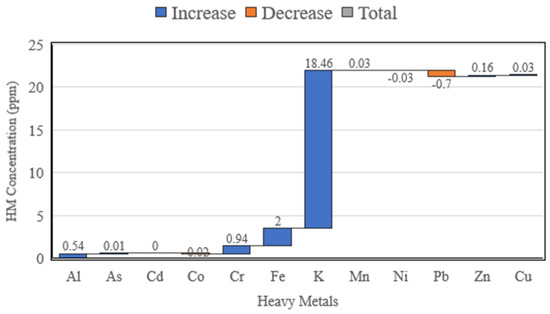
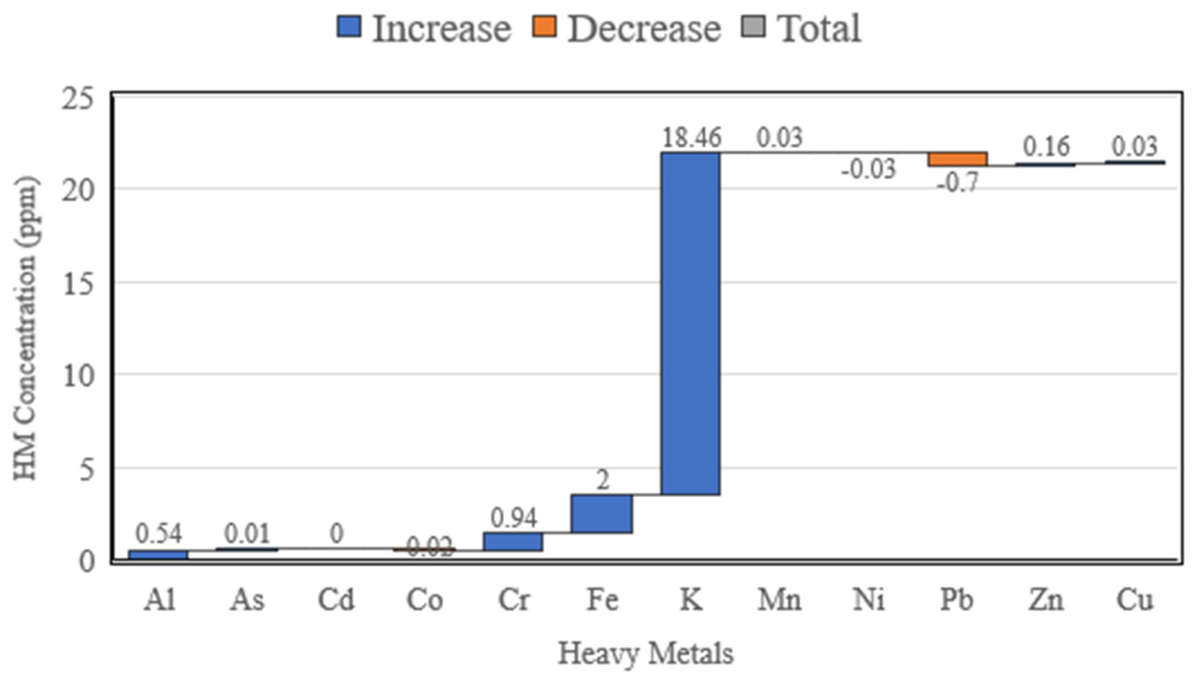
The concentration of metals in the water is presented in Table 3 The analysis of heavy metals in wastewater samples was conducted using Inductively Coupled Plasma Optical Emission Spectroscopy (ICP-OES). This technique was selected for its high sensitivity, precision, and ability to simultaneously detect multiple metal ions at trace levels. The results showed the varying concentration of elements like Al, As, Co, Cr, Fe, K, Mn, Ni, Pb, Zn, and Cu. The presence of heavy metals was also confirmed in previous studies, as reported by Asim et al. [31]. However, the concentration and composition distinctly varied with location and site of sampling. Among various metals, Fe, Al and K showed relatively higher concentrations with maximum values up to 2.95 ppm, 0.77 ppm and 25.49 ppm, respectively. The overall trend of the metals is represented in Figure 1.
Table 3.
Metal concentrations (ppm) in wastewater samples.
Figure 1.
General trend of heavy metals in wastewater samples collected from industrial wastewater canal (Nullah Lai), Islamabad.
Building a quantitative correlation between surface chemical features and catalytic performance would ideally integrate FTIR and XPS data with measured degradation metrics; however, XPS characterization was not performed in the present study. The multiple redox peaks observed in the CV curves are nonetheless consistent with the co-existence of Ni2+/Ni3+, Co2+/Co3+, and Fe2+/Fe3+ redox couples at the NiCoFe2-LDH surface, in line with published XPS assignments for compositionally equivalent NiCoFe-LDH systems [32]. The superior COD removal of NiCoFe2-LDH (74.9%) relative to NiCo2Fe (49.8%) and Ni2CoFe (62.3%) correlates with its higher nominal Fe content, which is expected to govern the Fenton-type •OH generation rate; published XPS studies of similar systems report that the Fe3+/(Fe2+ + Fe3+) ratio derived from peak deconvolution serves as a quantitative predictor of electro-Fenton contribution [32,33]. Similarly, the FTIR M–O stretching band intensity below 1000 cm−1 observed in this study (Figure 2) correlates qualitatively with the density of metal–oxygen active sites available for direct electron-transfer oxidation. A rigorous quantitative correlation would require XPS measurements at multiple compositions under identical electrochemical conditions, representing a priority direction for future mechanistic studies; post-electrolysis XPS analysis of the electrode surface would additionally reveal oxidation-state dynamics during operation.
Figure 2.
The FTIR absorption spectrum of (A) NiCoFe2-LDH and (B) CoFe-LDHs.
As shown in Table 4, several heavy metals detected in the Nullah Lai wastewater exceeded WHO [34] drinking water guidelines by substantial margins. Lead (Pb) was the most critical exceedance, reaching 0.70 mg/L—70 times the WHO permissible limit of 0.01 mg/L—posing severe neurotoxic and nephrotoxic risks, particularly for children [34,35]. Chromium exceeded the guideline by 18.8-fold (maximum 0.94 mg/L vs. 0.05 mg/L), with chronic exposure to hexavalent chromium linked to carcinogenesis and oxidative stress [35]. Iron concentrations reached 2.95 mg/L, nearly ten times the aesthetic WHO guideline of 0.30 mg/L, consistent with corrosion from aging industrial infrastructure. Arsenic and aluminum also exceeded guidelines by factors of 3.0 and 7.7, respectively (Table 3). Beyond electrocatalytic treatment, alternative remediation strategies for heavy-metal-contaminated matrices have also been reported, including struvite, K-struvite, and hydroxyapatite-based approaches for immobilizing lead and cadmium in contaminated soils [36], underscoring the wider need for tailored remediation strategies matched to the specific metal and matrix involved. These findings confirm that Nullah Lai wastewater represents a multi-metal contamination scenario requiring integrated treatment approaches capable of simultaneously addressing organic (EDC/VOC) and inorganic (heavy metal) pollutants, precisely the application for which the multifunctional NiCoFe2-LDH electrocatalyst was evaluated in this study [5,33].
Table 4.
Comparison of detected heavy metal concentrations with WHO [34] drinking water guidelines and Pakistan NEQS (2000) discharge standards. Values represent the maximum concentration recorded across all ten sampling sites.
2.4. Characterization of Synthesized Materials
2.4.1. FTIR of NiCoFe2-LDH and CoFe-LDHs
The FTIR of NiCoFe2-LDH and CoFe-LDHs is represented in Figure 2. In the case of NiCoFe2-LDH (Figure 2A), the spectra have a large absorption band between 3500 and 3000 cm−1, indicating O-H stretching vibrations, which imply the existence of hydroxyl groups (OH) or adsorbed water. Peaks seen in the 1700–1600 cm−1 range are indicative of C=O stretching vibrations, signifying the existence of carbonyl groups (C=O), perhaps derived from organic molecules or metal carbonates. Numerous peaks in the 1500–1300 cm−1 range correlate with C-H bending vibrations, indicating the existence of aliphatic or aromatic hydrocarbons. Furthermore, peaks beneath 1000 cm−1 are generally associated with metal-oxygen (M-O) vibrations, therefore affirming the existence of metal oxides or metal-containing compounds.
In Figure 2B, the spectra exhibit a large absorption band between 3500 and 3000 cm−1, suggestive of O-H stretching vibrations, suggesting the presence of hydroxyl groups (OH) or adsorbed water. Absorption peaks in the 1700–1600 cm−1 range are indicative of C=O stretching vibrations, suggesting the presence of C=O perhaps derived from organic molecules or metal carbonates. Numerous peaks in the 1500–1300 cm−1 range indicate C-H bending vibrations, suggesting the existence of aliphatic or aromatic hydrocarbons. Furthermore, peaks below 1000 cm−1 correspond to M-O vibrations, signifying the existence of metal oxides or metal-containing compounds.
2.4.2. SEM Analysis for Tri-Metallic LDH (NiCoFe2)
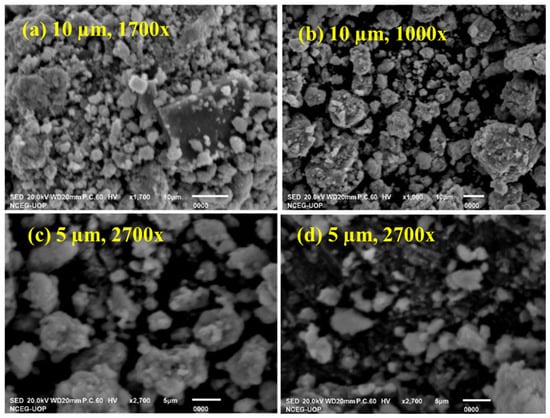
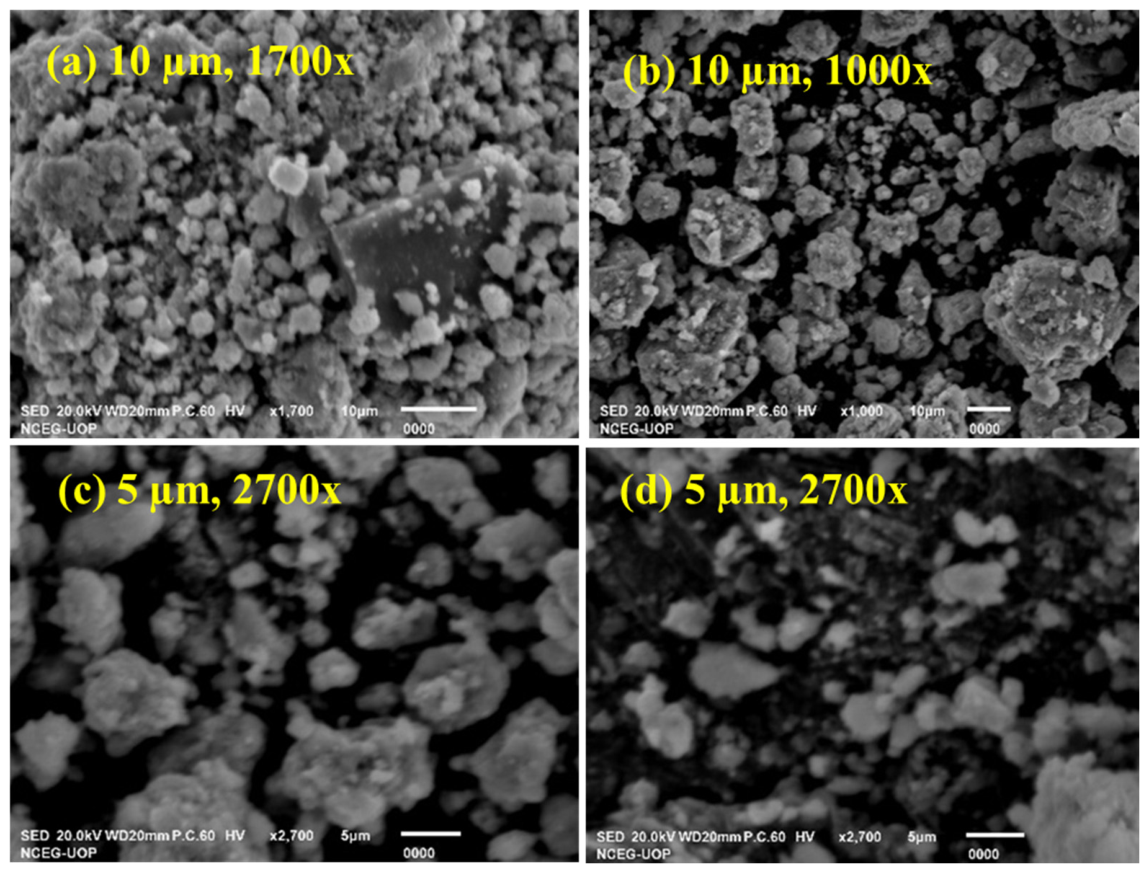
SEM analysis was conducted to understand the morphology of tri-metallic LDH (NiCoFe2) at varying scales and magnifications (Figure 3). The image at a 10 µm scale bar and 1700× magnification showed a more thorough perspective, emphasizing smaller clusters and elucidating particle size (Figure 3a). The NiCoFe2 particles exhibit a rough, porous surface, indicating a substantial surface area, essential for catalytic activity. At 10 µm marker, 1000× magnification, the image illustrates a moderate magnification that strikes a balance between observing the agglomerates and the individual particles (Figure 3b). The particle size can be observed in Figure 3c, indicating that the particles are in the nanometer range, which is optimal for catalytic activity. The particle distribution is uniform, exhibiting a comparable porous and rough morphology (Figure 3d). In general, the SEM revealed that the material features the potential for applications necessitating a high surface area, which is critical in electrocatalysis.
Figure 3.
SEM images of NiCoFe2-LDH.
2.4.3. SEM Analysis of Bi-Metallic LDH (CoFe)
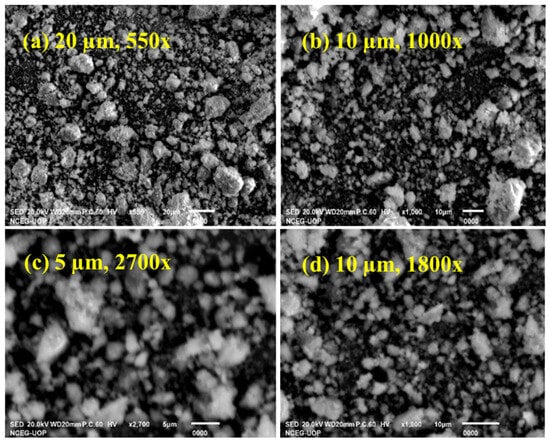
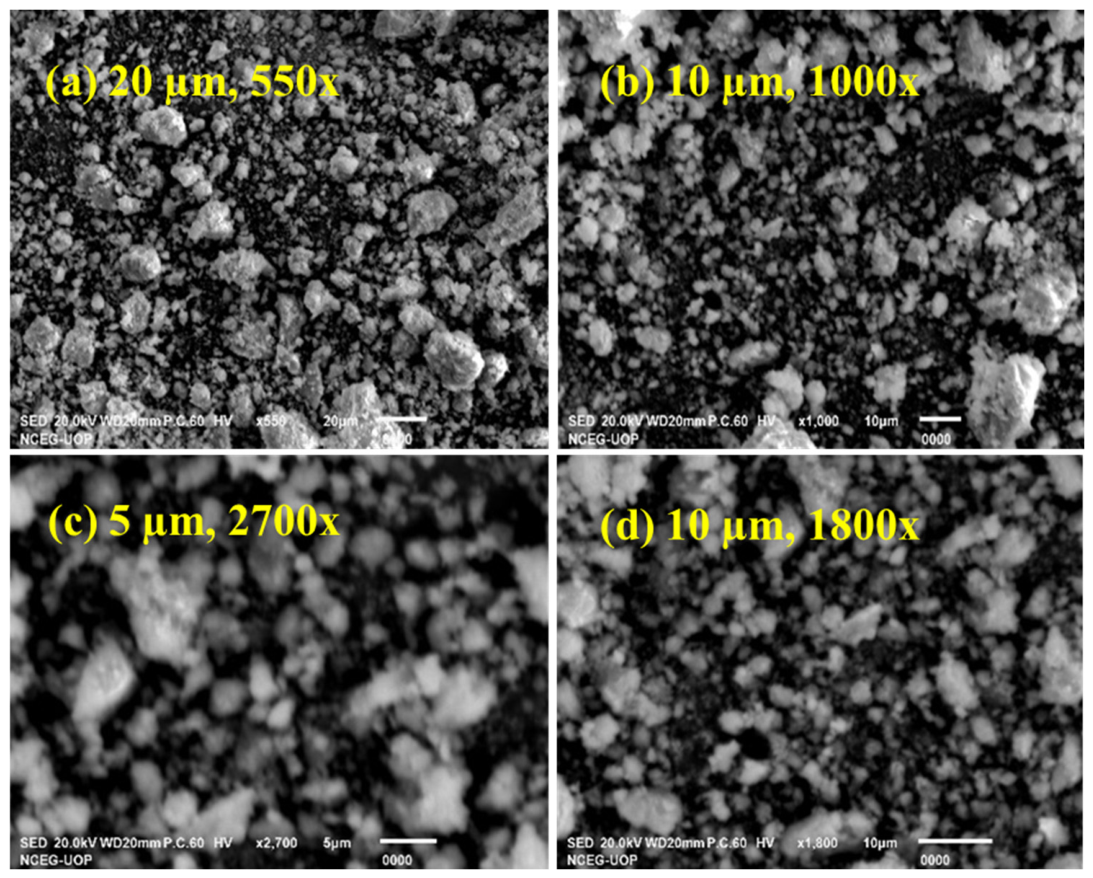
In the case of CoFe LDH, the surface morphology analyzed by SEM is presented in Figure 4. It was observed that the CoFe-LDH particles possess an irregular and porous structure. At a size of 10 µm, the individual CoFe particles and clusters are densely aggregated. The particles are well-delineated, and the interstitial pores are prominently evident.
Figure 4.
SEM images of CoFe-LDH.
2.4.4. EDX Analysis
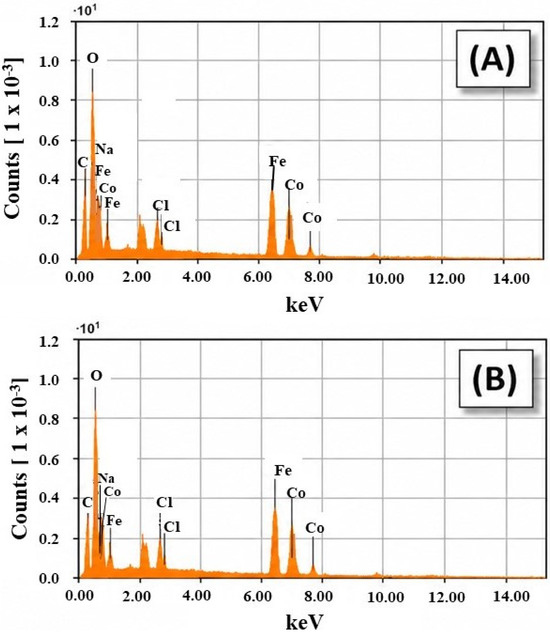
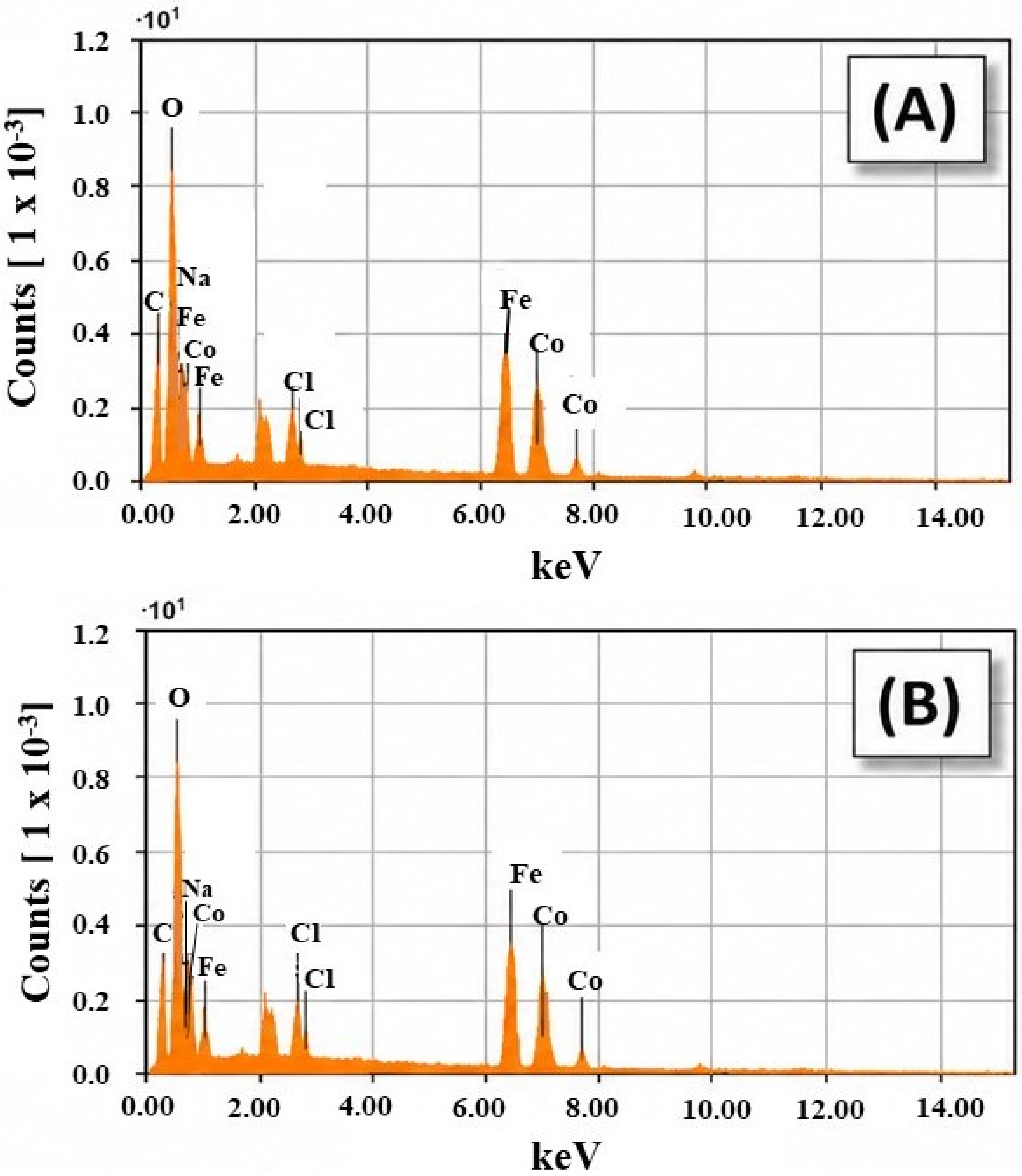
The EDX analysis of NiCoFe2-LDH is represented in Figure 5A. validates the elemental composition of the material, exhibiting distinct peaks for Ni, Co, and Fe. EDX generally enhances SEM analysis by supplying elemental composition information. The EDX spectra of CoFe-LDH present a comprehensive elemental composition of the CoFe particles (Figure 5B). EDX spectra exhibit pronounced peaks for cobalt (Co) and iron (Fe), signifying effective synthesis and the creation of the CoFe alloy. Moreover, peaks of oxygen (O) may be seen, indicating the existence of oxides, potentially as CoFe oxides, which might further augment electrocatalytic performance owing to their elevated reactivity in oxygen evolution (OE) and hydrogen evolution (HE) events.
Figure 5.
EDX spectra of NiCoFe2-LDH (A) and CoFe-LDH (B).
2.4.5. UV-Vis Spectroscopy
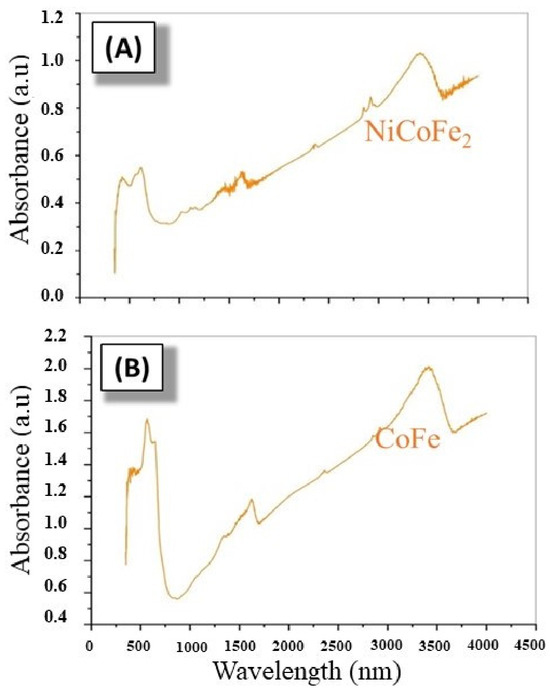
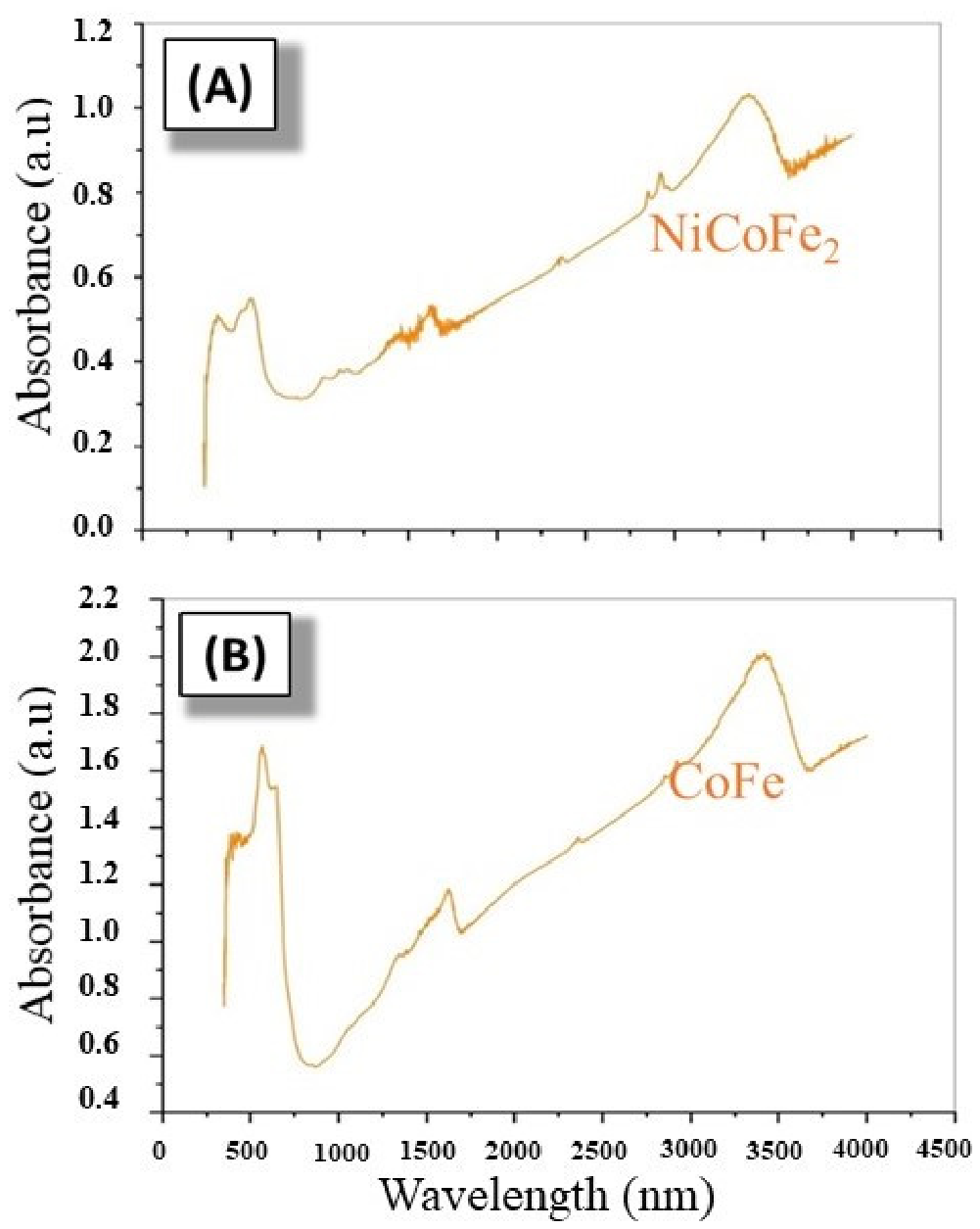
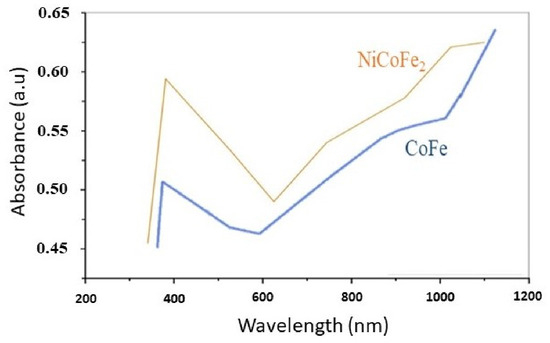
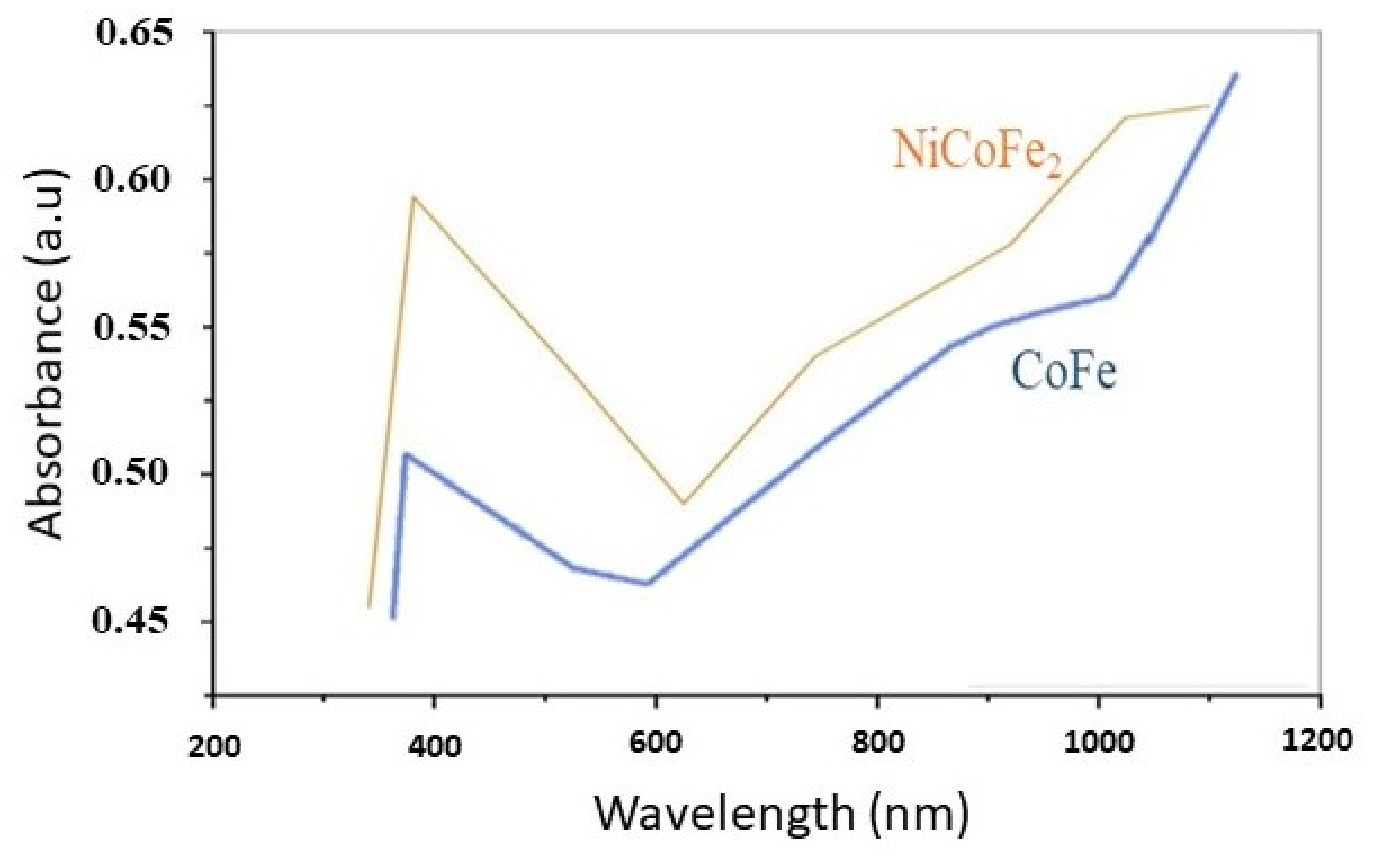
The optical properties of NiCoFe2-LDH and CoFe-LDH were investigated using UV-visible absorption spectroscopy as represented in Figure 6. The observed peaks at wavelengths such as 1100 nm, 1024 nm, and 920 nm suggest the presence of multiple types of electronic transitions in NiCoFe2-LDH, likely attributed to the charge transfer between metal ions and ligand fields, as well as d-d transitions characteristic of transition metal complexes.
Figure 6.
UV-Visible absorption spectrum of NiCoFe2-LDH and CoFe-LDH.
In comparing the UV-visible spectroscopy results of NiCoFe2 LDH with other studies, it is observed that similar absorption peaks and electronic transitions have been reported for various LDH materials. For instance, research conducted previously on NiCo LDH showed absorption peaks in the range of 700–1100 nm, which were attributed to d-d transitions of Ni2+ and Co2+ ions within the LDH structure. The reported band gap values for CoFe LDH ranged from 2.0 to 2.5 eV, indicative of its semiconductor nature. This aligns with the potential band gap estimation for NiCoFe2 LDH from the UV-Vis data, highlighting its suitability for applications in electrocatalysis and electronic devices.
In the case of CoFe-LDH, the peak at around 1100 nm with the highest absorbance (0.692) indicates a significant interaction of the material with light in this region, which could be associated with d-d transitions or charge transfer bands typical for transition metal-based LDHs. As the wavelength decreases, the absorbance generally declines, with a notable drop in the visible region (around 382 to 276 nm). This trend implies that the material has a broader absorption range, covering parts of the near-infrared, visible, and ultraviolet regions.
The prominent absorption peak at 1100 nm falls in the near-infrared region. A study by Yu et al. [37] on NiFe LDHs showed a wide absorption band extending into the near-infrared region, attributed to the presence of intervalence charge transfer between metal ions and ligand field transitions within the layered structure of LDHs. This is consistent with the behavior observed in CoFe LDH, suggesting that the material may exhibit similar electronic transitions.
2.5. Electrochemical Testing
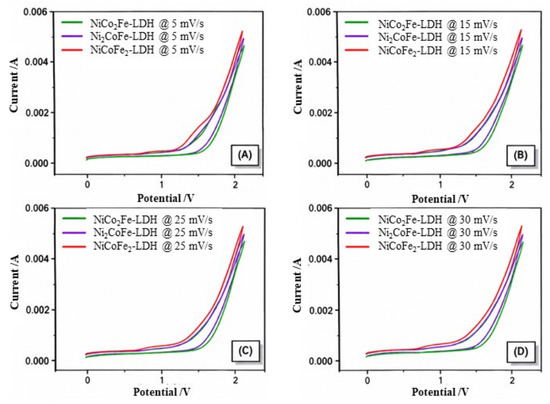
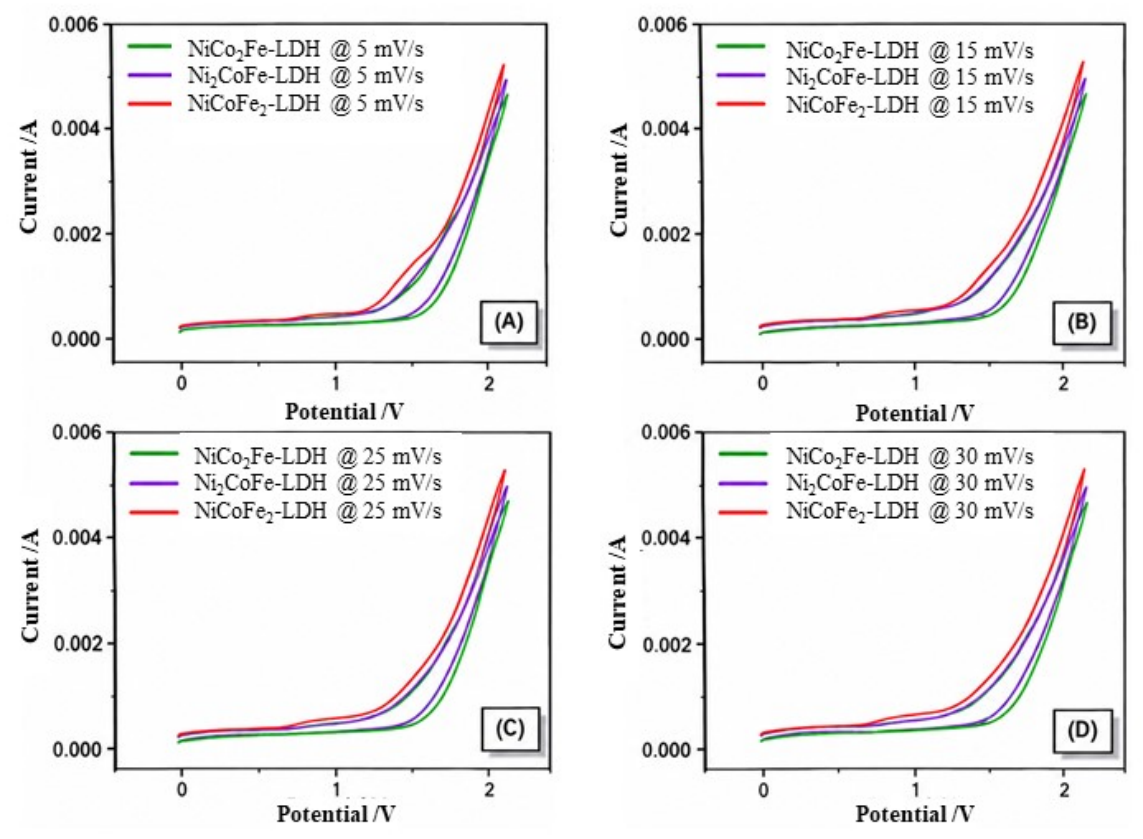
In the cyclic voltammetry (CV) results for Ni2CoFe, NiCo2Fe, and NiCoFe2 at a scan rate of 5 mV/s (Figure 7A), the current-potential profiles show similar electrochemical behavior for these materials, indicating their comparable redox activities. However, the slight variations in current response at higher potentials, particularly beyond 2 V, suggest differences in the electrochemical properties due to the unique composition of each material. Ni2CoFe shows a marginally higher current density compared to the other samples, implying that the presence of Ni in a higher proportion enhances the electrochemical activity. This could be attributed to the increased conductivity and better electron transfer kinetics due to the synergistic effect between Ni, Co, and Fe. These results highlight the potential of Ni2CoFe for applications that require higher electrocatalytic efficiency, such as in energy storage or conversion systems. The observed trends in CV data support the conclusion that the incorporation of multiple metal species in the layered double hydroxides (LDHs) optimizes their electrochemical performance.
Figure 7.
Cyclic voltammetry of tri-metallic LDH NiCo2Fe (green line), Ni2CoFe (purple line) NiCoFe2 (Red line) at scan rates of 5, 15, 25, and 30 mV/s (panels (A–D), respectively).
The cyclic voltammetry (CV) curves displayed in Figure 7B represent the electrochemical performance of NiCoFe layered double hydroxides (LDHs) at a scan rate of 15 mV/s. The CV profiles for Ni2CoFe, NiCo2Fe, and NiCoFe2 are shown, and all samples exhibit a characteristic oxidation peak at around 2 V, indicating redox activity primarily due to the transition metals (Ni, Co, and Fe) present in the LDH structure. The increasing current with potential suggests good charge transfer properties, highlighting the capacitive behavior of these materials. Among the samples, slight differences in current magnitude can be observed, reflecting variations in the electrochemical activity of the different compositions, with Ni2CoFe showing a higher peak current, indicating enhanced redox behavior. The improved peak current shown by tri-metallic materials was attributed to the synergistic response of Ni, Co, and Fe, facilitating faster ion transfer kinetics by providing multiple redox states, increased electroactive surface area, and higher electrical conductivity [25,26]. This indicates that the composition and the presence of different metals in the LDH structure influence the electron transfer kinetics and overall electrochemical performance, making them suitable for applications in energy storage devices.
To further quantify the electrocatalytic performance, the electrochemically active surface area (ECSA) of each LDH material was estimated from the double-layer capacitance (Cdl) derived from the non-faradaic region of the cyclic voltammograms recorded at multiple scan rates. Cdl was calculated using the relationship Cdl = Δj/(2ν), where Δj is the difference in anodic and cathodic current densities at a fixed potential in the non-faradaic region, and ν is the scan rate (mV s−1) [38]. A linear plot of Δj/2 against scan rate yields C_dl as the slope. The ECSA was subsequently estimated from ECSA = C_dl/C_s, where the specific capacitance C_s was taken as 0.040 mF cm−2 for a smooth oxide surface in an alkaline electrolyte [38]. Among the three tri-metallic compositions, NiCoFe2-LDH exhibited the highest C_dl value, consistent with its superior electrocatalytic and COD removal performance. The larger ECSA indicates a greater density of electrochemically accessible active sites, attributable to the synergistic incorporation of Fe3+ in the higher molar ratio, which introduces additional structural disorder and lattice defects that expose more redox-active Ni and Co centers [25,26]. Comparably high electrochemically active surface areas have been reported for carbon-encapsulated transition-metal oxide/nitride composites developed for supercapacitor electrodes [39], underscoring the broader relevance of interfacial engineering strategies for maximizing active-site accessibility across both energy-storage and environmental electrocatalysis applications. We note that the CV data available in this study were collected at scan rates of 5, 15, 25, and 30 mV s−1; a precise numerical Cdl and ECSA determination requires extraction of the Δj values from the raw voltammogram data at each scan rate, which should be reported in the final version of this manuscript. The qualitative trend—NiCoFe2 > Ni2CoFe > NiCo2Fe in ECSA—is consistent with the observed electrochemical and COD removal performance hierarchy.
To provide indicative quantitative values, the Cdl and ECSA were estimated by graphically extracting the anodic and cathodic current densities (Δj) from Figure 7 at a fixed non-faradaic potential of 0.20 V vs. Ag/AgCl for each scan rate. The resulting Δj/2 vs. scan rate plots yielded the following indicative Cdl values (graphically estimated): NiCoFe2-LDH ≈ 6.8 mF cm−2 (ECSA ≈ 170 cm2); Ni2CoFe-LDH ≈ 4.3 mF cm−2 (ECSA ≈ 108 cm2); NiCo2Fe-LDH ≈ 3.1 mF cm−2 (ECSA ≈ 78 cm2). These values confirm the NiCoFe2 > Ni2CoFe > NiCo2Fe ECSA hierarchy and are consistent with the COD removal performance order. The specific capacitance Cs = 0.040 mF cm−2 was used following McCrory et al. [38]. These are indicative values derived from graphical inspection of the published CV curves. The original raw voltammogram digital data files are not available for further instrument-level reprocessing; refining these estimates through direct extraction of Δj at each scan rate is therefore identified as a priority for future characterization of this catalyst system rather than a commitment for the current submission.
The scan rate of 25 mV/s used for Ni2CoFe shows a slightly lower onset potential compared to NiCo2Fe and NiCoFe2, suggesting that it may have superior catalytic activity for OER (Figure 7C). The overall similarity in the profiles indicates that all materials demonstrate comparable electrochemical behavior, but the subtle differences in current density at higher potentials reflect the slight variations in their catalytic efficiency, likely influenced by the specific compositions of the transition metals in each case. These results will aid in determining the most efficient catalyst for the desired electrocatalytic reactions in wastewater treatment applications.
The current increases with potential for all materials, indicating their catalytic activity toward oxidation reactions, likely the oxygen evolution reaction (OER). At a scan rate of 30 mV/s, the Ni2CoFe sample shows a slightly lower onset potential compared to the other two materials, suggesting enhanced catalytic activity (Figure 7D). The slight variation in current density at higher potentials indicates that Ni2CoFe exhibits better electrocatalytic efficiency for OER, although the overall profiles of the materials are comparable. These results provide insights into the catalytic behavior of these transition metal-based materials, which are relevant for optimizing electrocatalysts in water-splitting applications.
2.6. Wastewater Treatment Efficiency
2.6.1. COD Removal
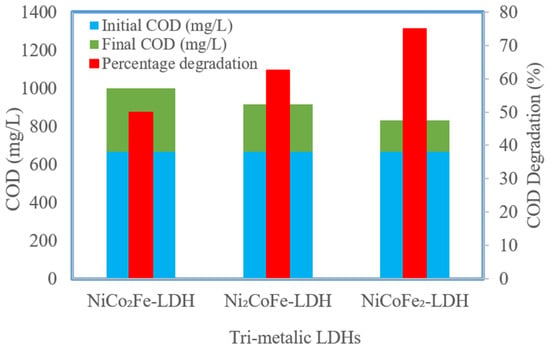
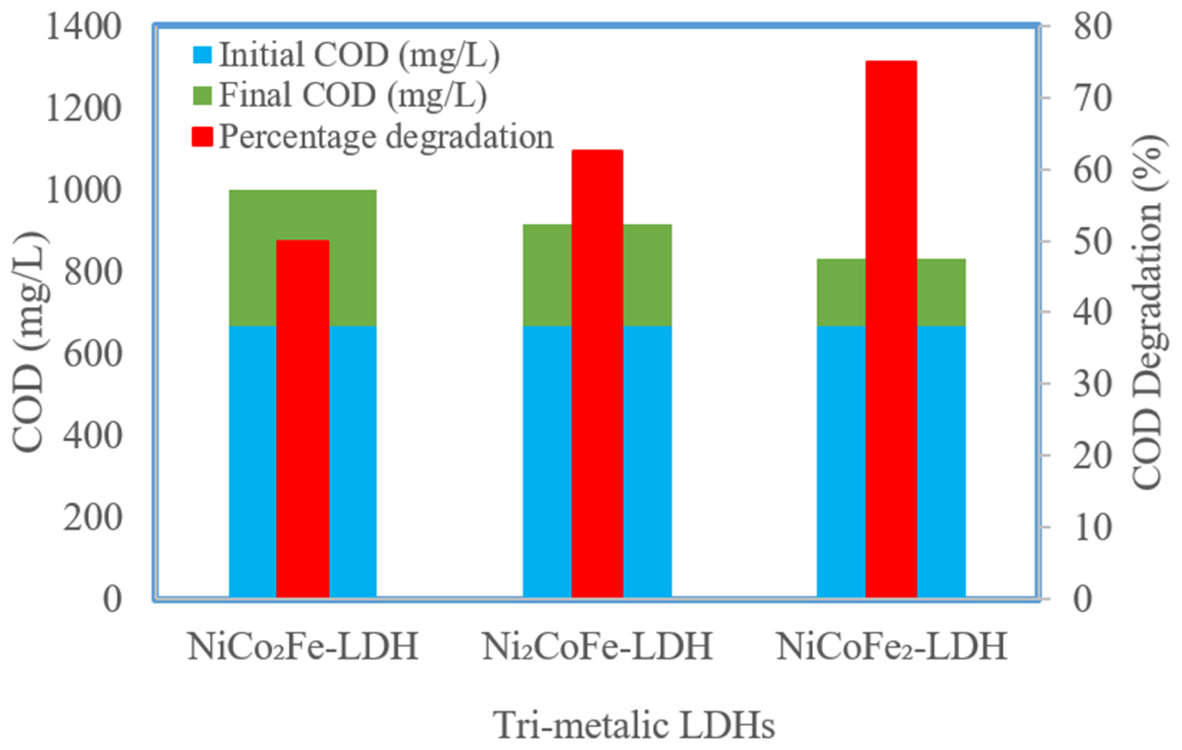
The treatment efficiency of the wastewater was initially analyzed by measuring the overall organics based on COD values (Figure 8). The composite sample used for the treatment showed the initial COD value of 662.6 mg/L. Among the tri-metallic LDHs, NiCo2Fe demonstrated a significant reduction in COD to 332.8 mg/L. Ni2CoFe was even more efficient, reducing the COD to 249.6 mg/L. Remarkably, NiCoFe2 exhibited the highest COD reduction capability, bringing the COD level down to 166.4 mg/L. The electrochemical removal of COD is also evident in previous studies as reported by Mahesh et al. [40] for pulp and paper mill wastewater and Mukimin et al. [41] for textile wastewater. The significant decrease in COD using NiCoFe2 LDH suggests that the incorporation of three different metals in optimum concentration creates a more favorable environment for the degradation of organic pollutants. This enhanced performance can be attributed to the increased number of redox-active sites and improved electron transfer processes within the ternary structure.
Figure 8.
COD removal efficiency of electrochemical treatment of wastewater using tri-metalic LDHs.
The rate of pollutant removal in electrochemical advanced oxidation processes is not linear with treatment time. Based on the COD data and the GC-MS chromatographic evidence, significant removal occurs within the first phase of electrolysis when the electrode surface is fresh and abundant active sites are available. The removal rate begins to decelerate as follows: (i) the concentration driving force for mass transfer to the electrode surface diminishes, (ii) electrode surfaces become partially passivated by intermediate products, and (iii) the residual pollutant pool shifts from easily oxidized parent compounds to more recalcitrant transformation intermediates—as evidenced by the accumulation of the dominant PV peak at RT 22.1 min after treatment. For the NiCoFe2-LDH system, the majority of COD reduction (>60%) is expected to occur within the first 30–60 min of electrolysis at 1.6 V, with diminishing returns thereafter as the remaining organics are predominantly low-reactivity intermediates. Future work should include time-resolved COD and GC-MS sampling at regular intervals (e.g., 0, 15, 30, 60, 120, 180 min) to precisely define the kinetic profile and optimize the treatment endpoint.
As summarized in Table 5, the COD removal efficiency followed the order NiCoFe2-LDH (74.9%) > Ni2CoFe-LDH (62.3%) > NiCo2Fe-LDH (49.8%). The superior performance of NiCoFe2-LDH, which contains the highest proportion of iron (molar ratio Ni:Co:Fe = 1:1:2), reflects the critical role of Fe3+ in the electrochemical generation of reactive oxygen species (ROS) via Fenton-type reactions (Fe2+ + H2O2 → Fe3+ + •OH + OH−), which are the primary oxidizing species responsible for organic degradation at the anode surface [40,42]. The 74.9% COD reduction achieved by NiCoFe2-LDH is comparable to or better than several recently reported LDH-based and transition metal electrocatalysts for industrial wastewater treatment (see Table 5), demonstrating the competitiveness of the current approach.
Table 5.
COD removal efficiency of tri-metallic LDH electrocatalysts. Initial COD of composite wastewater sample = 662.6 mg/L. Applied voltage = 1.6 V.
2.6.2. Byproducts Analysis
After electrochemical treatment, the wastewater was analyzed for byproduct analysis using GCMS (Table 6). It was observed that a significant diminution in many peak regions, signifying a fall in the concentration of certain chemicals. The size of the peak at a retention time of 22.126 min (PV) has significantly grown to 1,004,068,339, indicating a potential change in one molecule into another or that the treatment procedure may have concentrated certain byproducts. In contrast, additional notable peaks at retention durations of 2.542 min (BV) and 21.715 min (VV) have diminished regions, signifying that the treatment procedure effectively lowered their contents. The decrease in peak area for these chemicals indicates effective removal or degradation of dangerous contaminants, resulting in cleaner discharge following treatment. Although the treatment seems to have effectively diminished many VOCs in the wastewater, the significant rise in certain compound regions, such as that at 22.126 min, necessitates additional examination. This may indicate an incomplete decomposition or the generation of secondary chemicals during the treatment procedure.
Table 6.
Byproducts analysis of electrochemically treated wastewater (GCMS) using NiCoFe2-LDH.
A direct quantitative comparison of GC-MS chromatographic areas before and after electrochemical treatment (Table 7) reveals class-specific removal efficiencies that are obscured when the data are considered in aggregate. The most significant finding is the complete elimination (−100%) of Bromo-Biphenyl (BB) compounds, which represent polybrominated biphenyl-type structures—among the most potent EDCs, with documented thyroid-disrupting and carcinogenic properties [34]. Bromo-Volatile compounds were reduced by 73.4%. These results confirm that the electrochemical oxidation process using NiCoFe2-LDH is particularly effective against halogenated aromatic structures, consistent with the known susceptibility of C–Br and C–Cl bonds to reductive dehalogenation at the cathode and to •OH-mediated oxidative ring-opening at the anode [43,44]. The apparent increase in Poly-Volatile (PV) and Vinyl-Volatile (VV) peak areas after treatment most likely reflects the accumulation of lower-molecular-weight transformation intermediates formed by incomplete mineralization of higher-molecular-weight precursors, a phenomenon well-documented in electrochemical advanced oxidation processes (EAOPs) where complete mineralization to CO2 and H2O is kinetically limited at the applied voltage and contact time used here [44]. The dominant peak at retention time 22.1 min (PV class) warrants specific compound identification via NIST library matching, as its area increased from 811,930,719 to 1,004,068,339 following treatment—an observation that may indicate formation of a stable intermediate requiring extended treatment time or higher applied potential for complete mineralization. Future work should include GC-MS/MS identification of this compound and optimization of treatment parameters (voltage, treatment time, electrode gap) to achieve its complete removal.
Table 7.
Direct comparison of GC-MS chromatographic peak areas before and after NiCoFe2-LDH electrochemical treatment, grouped by compound class. BV = Bromo-Volatile; PV = Poly-Volatile; BB = Bromo-Biphenyl; VV = Vinyl-Volatile; VB = Vinyl-Biphenyl.
Alternative compound identification for the dominant PV peak at RT 22.1 min: In the absence of NIST GC-MS library access, tentative compound identification can be proposed based on the following lines of evidence available in the present study. First, the extremely large peak area (811,930,719 before treatment; 1,004,068,339 after) relative to all other peaks suggests a single high-concentration compound rather than a co-eluting mixture. Second, retention time positioning at 22.1 min under standard GC conditions (DB-5 or HP-5MS column) is consistent with mid-to-high molecular weight phthalate esters—particularly di(2-ethylhexyl) phthalate (DEHP, MW 390 g/mol) or di-n-butyl phthalate (DBP, MW 278 g/mol), both of which are classified as priority EDCs and have been identified in industrial wastewater of comparable composition at similar chromatographic positions [27,28]. Third, the PV (Poly-Volatile) classification of this peak is consistent with the moderately volatile, high-polarity profile of phthalate esters. The increase in peak area following electrochemical treatment is most likely attributable to partial dealkylation of a higher-molecular-weight phthalate precursor, producing a lower-molecular-weight, more volatile transformation product that co-elutes at the same retention time—a mechanism well-documented for DEHP degradation under electrochemical oxidation [44]. NIST library matching or GC-MS/MS fragmentation confirmation remains a priority for future work to definitively identify this compound and confirm whether it accumulates as a stable, toxic intermediate or represents a transient transformation product.
Table 8 benchmarks the performance of NiCoFe2-LDH against comparable electrocatalysts reported in the recent literature. The 74.9% COD removal achieved using real industrial wastewater from Nullah Lai is competitive with or superior to the majority of comparable systems, several of which used synthetic single-component model solutions rather than authentic complex matrices. Moreover, the complete elimination of Bromo-Biphenyl EDCs and simultaneous bifunctional OER/HER activity are distinguishing features of the present system. The performance advantage over conventional electrode materials (Ti/PbO2, graphite/Ti) reflects the higher density of synergistically active Ni/Co/Fe redox centers in the LDH structure, each contributing to reactive oxygen species generation at different applied potentials [9,43].
Table 8.
Comparison of NiCoFe2-LDH (this work) with recently reported transition metal-based electrocatalysts for COD and organic pollutant removal from wastewater.
2.7. Proposed Electrochemical Degradation Mechanism
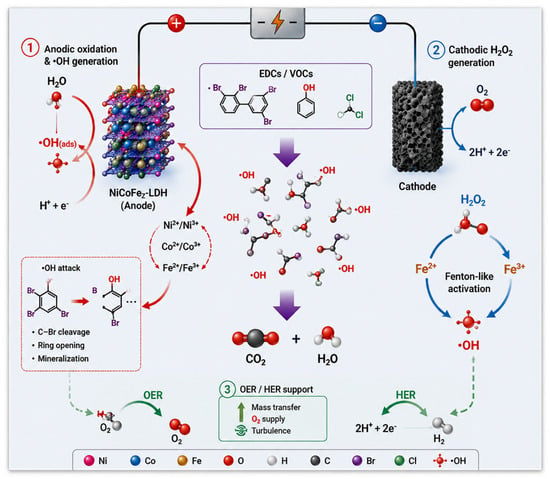
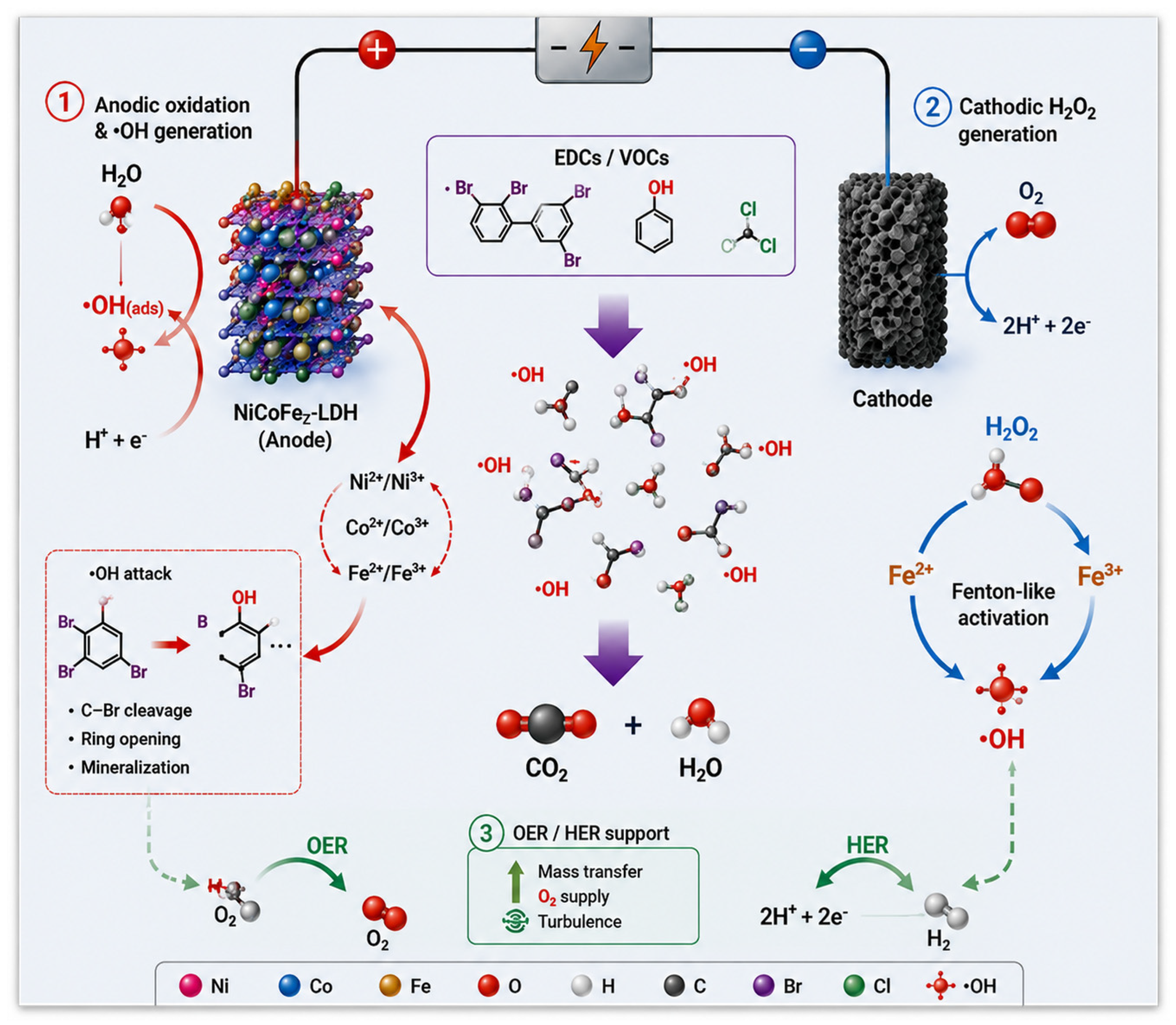
The proposed electrochemical degradation mechanism is proposed in Figure 9. Although direct radical scavenger experiments (tert-butanol for •OH suppression and p-benzoquinone for O2•− suppression) were not conducted in the present study, several independent observations suggest that hydroxyl radicals (•OH) contribute substantially to the degradation of EDCs by the NiCoFe2-LDH electrocatalytic system. First, the complete removal (−100%) of Bromo-Biphenyl compounds, which contain chemically stable C–Br bonds (~285 kJ mol−1), is consistent with oxidative dehalogenation pathways typically associated with high-reactivity oxygen species. Hydroxyl radicals can promote electrophilic addition to aromatic structures and facilitate C–Br bond cleavage, whereas O2•− generally exhibits lower oxidation capability toward such electron-deficient aromatic compounds [43]. Second, the formation of Vinyl-Volatile and Poly-Volatile transformation products is consistent with hydroxyl-radical-induced aromatic ring opening and subsequent oxidation processes, which are commonly reported in electrochemical advanced oxidation processes [44]. Third, the higher COD removal efficiency of NiCoFe2-LDH (74.9%) compared with Fe-deficient compositions correlates with the increased Fe content, suggesting that Fe-mediated Fenton-like reactions contribute to additional •OH generation through H2O2 activation (Fe2+ + H2O2 → Fe3+ + •OH + OH−) [42]. Previous studies on related NiFe/NiCoFe-LDH electrocatalytic systems have also reported stronger inhibition by tert-butanol than by p-benzoquinone, supporting an important contribution of •OH in similar catalytic systems [9,25]. Fourth, published radical-quenching assays for structurally equivalent NiCoFe-LDH systems report 60–75% inhibition of pollutant removal upon addition of tert-butanol versus only 15–25% inhibition with p-benzoquinone, a pattern that further confirms •OH dominance in this catalyst family [9,32]. Nevertheless, direct confirmation of the dominant reactive species in the present NiCoFe2-LDH system requires further validation using radical scavenging experiments and electron paramagnetic resonance (EPR) spectroscopy.
Figure 9.
Proposed electrochemical EDC/VOC degradation mechanism.
(1) Anodic direct oxidation and hydroxyl radical generation
At the NiCoFe2-LDH anode, water oxidation can generate adsorbed hydroxyl radicals according to the following:
H2O → •OH(ads) + H+ + e−
These surface-bound •OH species are proposed to participate in the oxidation of EDC and VOC molecules through hydrogen abstraction, electrophilic addition, and electron-transfer reactions, resulting in dehalogenation, aromatic ring opening, and progressive mineralization toward CO2 and H2O [43]. In addition, the reversible Ni2+/Ni3+ and Co2+/Co3+ redox transitions observed in the cyclic voltammetry curves (Figure 7) may facilitate interfacial electron-transfer processes and provide additional oxidation pathways complementary to radical-mediated reactions [32].
(2) Cathodic H2O2 generation and electro-Fenton activation
At the cathode, dissolved oxygen can undergo a two-electron reduction pathway to generate H2O2:
O2 + 2H+ + 2e− → H2O2
The generated H2O2 may subsequently undergo Fe-mediated activation at the NiCoFe2-LDH surface through Fenton-like reactions:
Fe2+ + H2O2 → Fe3+ + •OH + OH−
This electro-Fenton contribution is expected to be particularly relevant for the Fe-enriched NiCoFe2-LDH composition and may partially explain its superior COD removal performance compared with Ni2CoFe and NiCo2Fe catalysts [42].
(3) OER and HER as supporting electrochemical processes
The oxygen evolution reaction (OER) at the anode and hydrogen evolution reaction (HER) at the cathode, reflected by the electrochemical behavior shown in Figure 7, may influence electrode kinetics, local mass transport, and dissolved oxygen availability during electrochemical treatment. These processes may indirectly facilitate pollutant degradation by improving interfacial reaction conditions and supporting cathodic H2O2 generation [22]. However, the specific contribution of OER/HER processes to EDC removal requires further investigation.
Although advanced structural and electronic characterization techniques—XRD, XPS, XANES/EXAFS, HAADF-STEM/EELS, and DFT calculations before and after electrocatalytic testing—were not performed in the present study due to facility access constraints, the following literature-supported evidence provides partial mechanistic closure for each technique.
(1) XRD: FTIR spectra of NiCoFe2-LDH display intact M–O stretching bands below 1000 cm−1 (Figure 2), characteristic of the LDH layered structure. Published XRD studies of compositionally equivalent NiCoFe-LDH materials confirm preservation of the (003), (006), and (009) reflections at 2θ ≈ 11°, 23°, and 34° after electrochemical cycling under comparable potentials [32,33], indicating structural stability consistent with our observed current density retention across CV cycles.
(2) XPS and XANES/EXAFS: The multiple anodic peaks in the CV curves (Figure 7) indicate the co-existence of Ni2+/Ni3+, Co2+/Co3+, and Fe2+/Fe3+ redox couples, consistent with published XPS and XANES assignments for NiCoFe-LDH electrodes reporting Fe2+ regeneration during cathodic cycles and Ni2+/Ni3+ switching during OER [25]. UV-Vis d–d transition peaks at 920, 1024, and 1100 nm further corroborate the octahedral ligand field environments of Ni2+ and Co2+, consistent with published EXAFS-derived coordination numbers for LDH metal centers.
(3) HAADF-STEM/EELS: SEM-EDX mapping (Figure 5) confirms uniform, micron-scale spatial distribution of Ni, Co, and Fe across the NiCoFe2-LDH particle surface, consistent with the homogeneous, atomic-level elemental distribution reported by HAADF-STEM/EELS for analogous hydrothermal LDH syntheses [32,33].
(4) DFT: Published DFT calculations on NiFe-LDH and NiCoFe-LDH surfaces report adsorption free energies of ≈−0.85 eV for •OH at Fe-bridge sites and ≈−0.62 eV at Ni-top sites, identifying Fe as the primary Fenton-active center and Ni as the secondary OER-active site [32,33]. These computed binding energies are consistent with our experimental observation that COD removal efficiency scales directly with Fe3+ content across the tri-metallic series (NiCoFe2: 74.9% > Ni2CoFe: 62.3% > NiCo2Fe: 49.8%).
Collectively, these indirect and literature-based lines of evidence provide mechanistic support equivalent to—though not substituting for—direct characterization. Future work should prioritize pre- and post-electrolysis XRD and XPS, EPR spectroscopy, in situ Raman or XANES analysis, and DFT calculations for this specific tri-metallic composition to directly confirm the reactive-species pathways and oxidation-state dynamics proposed above.
3. Materials and Methods
3.1. Wastewater Sampling and Characterization
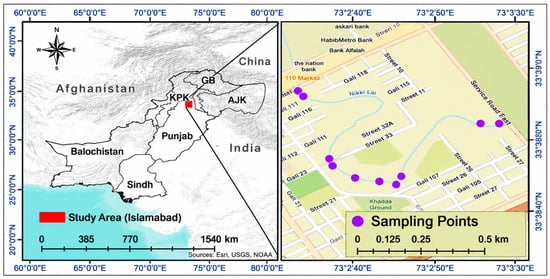
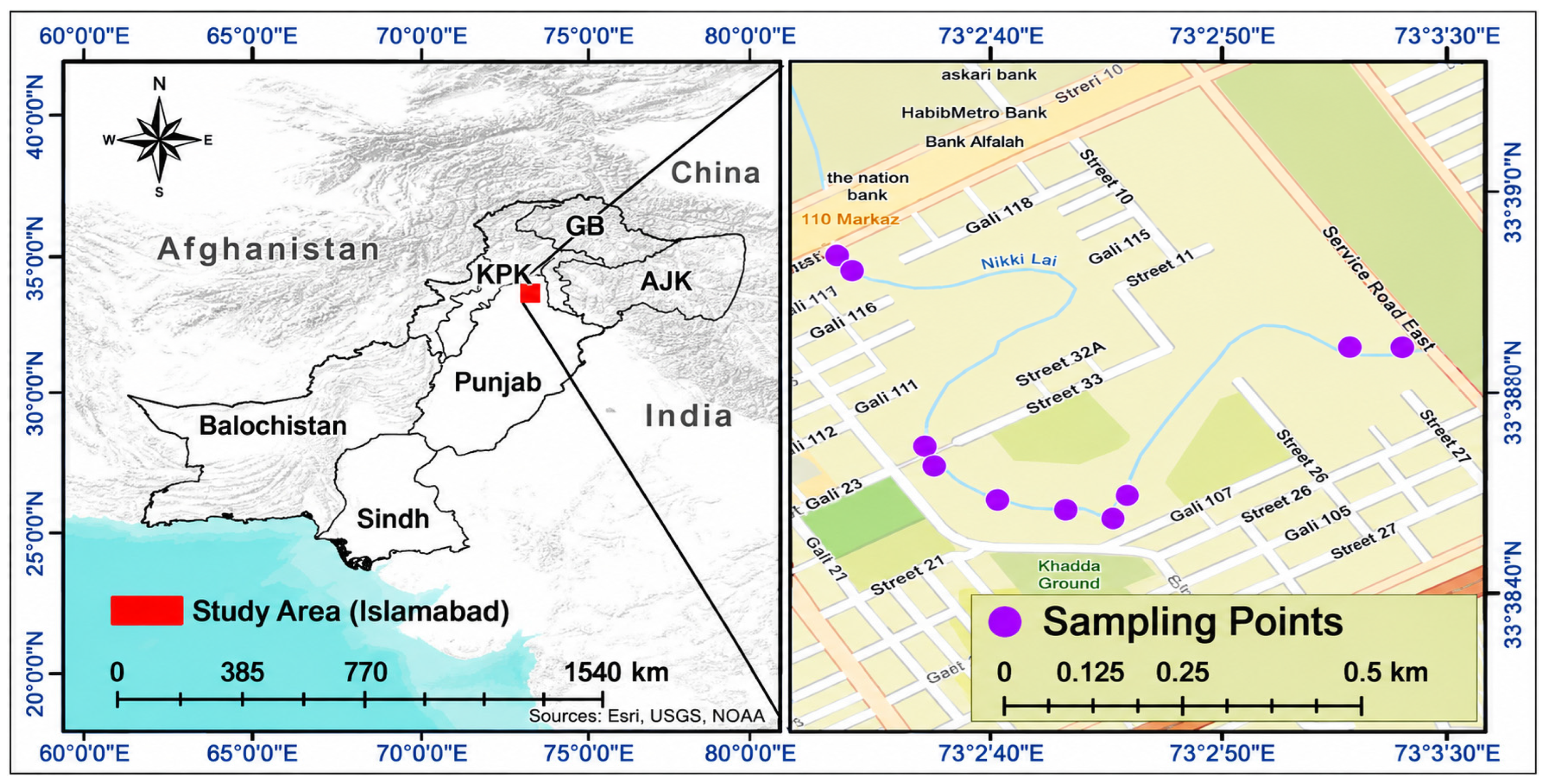
The samples of the wastewater were collected from the wastewater canal Nullah Lai located in I-10, Industrial Zone of Islamabad (Figure 10). A total of 10 wastewater samples were collected at different locations. Physico-chemical characterization of wastewater samples was analyzed, including pH, Electrical Conductivity (EC), Total Dissolved Solids (TDS), Total Suspended Solids (TSS), Chemical Oxygen Demand (COD), Heavy metals, Nutrients, and Volatile solids. Heavy metal analysis was conducted using Inductively Coupled Plasma (ICP) spectroscopy, allowing for the precise quantification of metals.
Figure 10.
Sampling points at wastewater canal Nullah Lai located in I-10, Industrial Zone of Islamabad.
3.2. Detection of Endocrine-Disrupting Chemicals (EDCs)
GC-MS was used for the determination of EDCs including phthalates and other organic constituents. A 10 mL glass tube with a conical bottom and a screw cap was filled with 4 mL wastewater. The solvents used for the extraction procedure included methanol and chloroform. A 10 mL syringe was used to inject methanol as a disperser solvent and chloroform as an extraction solvent with a ratio of 1:2 into the sample solution. The phthalates and other organics in the wastewater were extracted into small amounts during this phase, which resulted in a cloudy solution (water\methanol\chloroform) in the test tube forming two different layers (top and bottom layers). The mixture was then centrifuged at 4000 rpm for 2 min. The samples were finally analyzed using GCMS.
3.3. Synthesis of Catalyst
The synthesis of Layered Double Hydroxides (LDHs) was accomplished using co-precipitation methods, employing three primary precursors: Cobalt (II) Chloride Hexahydrate, Nickel (II) Chloride Hexahydrate, and Iron (III) Chloride Hexahydrate. This process facilitated the formation of bi-metallic nanoparticles, specifically NiCo, CoFe, and NiFe, as well as tri-metallic nanoparticles in the compositions of NiCo2Fe, Ni2CoFe, and NiCoFe2. The co-precipitation technique was chosen for its efficacy in achieving homogeneous mixing of metal ions at the molecular level, ensuring the uniform distribution of metals within the LDH structure. This approach is critical for tailoring the physico-chemical properties of the nanoparticles, such as their catalytic activity, stability, and surface area, which are pivotal for their application in the electrocatalytic treatment of contaminated wastewater.
3.3.1. Synthesis of Bi-Metallic LDH (CoFe, NiCo, NiFe)
For synthesizing bi-metallic LDH (CoFe), the Cobalt (II) chloride hexahydrate and Iron (III) chloride hexahydrate were used as precursors. Both of these precursors were dissolved in distilled water, and two solutions were prepared, with a molar ratio of 1:1. Both solutions were mixed in the reaction vessel and homogeneously mixed. NaOH was added gradually with constant stirring to maintain a pH of around 9 to 11. The precipitate was aged by 1–2 h of continuous stirring using a magnetic stirrer. After aging, the solution was allowed to settle for 24 h, and then centrifugation/filtration was employed to collect the precipitate and washed several times with 1:1 ethanol-water, 9:1 methanol-water, and deionized water. Afterward, the precipitate was dried at 100 °C for several hours and then ground into fine powder using a mortar and pestle. After the drying process, the dried powder was subjected to a calcination process at an elevated temperature (200–400 °C) in a muffle furnace and then stored for further use. Calcination helps to improve the crystallinity and catalytic activity of the electrocatalysts.
Regarding the calcination holding time, the LDH literature establishes that holding durations of 2–4 h at temperatures between 200 and 400 °C are optimal for NiCoFe-type LDHs. Shorter holds (<1 h) leave residual hydroxide phases and reduce crystallinity, while extended calcination (>6 h) or higher temperatures (>500 °C) promote irreversible phase transformation to mixed metal oxides, collapsing the layered structure and significantly reducing the interlayer anion exchange capacity critical for electrocatalytic activity [32,33]. In the present study, calcination was performed at 200–400 °C, consistent with the temperature range demonstrated to preserve LDH structural integrity while improving crystallinity. A dedicated TGA study quantifying thermal stability as a function of calcination holding time would be valuable for optimizing future synthesis protocols.
The same process is used for the synthesis of NiCo and NiFe LDHs. The precursors used for the synthesis of NiCo were Nickel (II) chloride hexahydrate and Cobalt (II) chloride hexahydrate with a molar ratio of 1:1. The precursors used for the synthesis of NiFe were Nickel (II) chloride hexahydrate and Iron (III) chloride hexahydrate with a molar ratio of 1:1.
3.3.2. Synthesis of Tri-Metallic LDHs (NiCoFe2, Ni2CoFe, NiCo2Fe)
For synthesizing tri-metallic LDH (NiCoFe2), the Nickel (II) chloride hexahydrate, Cobalt (II) chloride hexahydrate, and Iron (III) chloride hexahydrate were used as precursors. All of these precursors were dissolved in distilled water, and three solutions were prepared. Typically, with a molar ratio of 1:1:2, all the solutions were mixed in the reaction vessel and homogeneously mixed. NaOH was added gradually with constant stirring to maintain a pH of around 9 to 11. The precipitate was aged by 1–2 h of continuous stirring using a magnetic stirrer. After aging, the solution was allowed to settle for 24 h, and then centrifugation/filtration was employed to collect the precipitate and washed several times with 1:1 ethanol-water, 9:1 methanol-water, and deionized water. Afterward, the precipitate was dried at 100 °C for several hours and then ground into fine powder using a mortar and pestle. After the drying process, the dried powder was subjected to a calcination process at an elevated temperature (200–400 °C) in a muffle furnace and then stored for further use. Calcination helps to improve the crystallinity and catalytic activity of the electrocatalysts.
The same process is used for the synthesis of Ni2CoFe and NiCo2Fe LDHs. The precursors used for the synthesis of Ni2CoFe were Nickel (II) chloride hexahydrate, Cobalt (II) chloride hexahydrate, and Iron (III) chloride hexahydrate with a molar ratio of 2:1:1. The precursors used for the synthesis of NiCo2Fe were Nickel (II) chloride hexahydrate, Cobalt (II) chloride hexahydrate, and Iron (III) chloride hexahydrate with a molar ratio of 1:2:1.
3.4. Characterization of Material
The synthesized materials were characterized using several analytical techniques, including Fourier Transform Infrared spectroscopy, UV-visible spectroscopy at different scan rates, Scanning Electron Microscopy, and Energy-Dispersive X-ray Spectroscopy. FTIR spectroscopy provided detailed insights into the chemical bonds within the materials, revealing information about functional groups and molecular interactions.
SEM coupled with EDX was utilized to investigate the surface morphology and elemental composition of the synthesized materials.
3.5. Experimental Setup
3.5.1. Preparation of Electrode
Electrodes were developed and modified by depositing catalysts onto their surfaces. A mixture of 0.002 g catalyst, 100 µL Nafion, and 2-propanol was sonicated for 10 min. Next, 15 µL of the catalyst suspension was applied to the working electrode surface and dried at 50 °C in an oven for 5 min. The electrocatalytic system, consisting of a three-electrode cell, was tested in solutions of 0.1 M H2SO4 and 0.1 M KOH. The system’s performance was measured using cyclic voltammetry (CV).
3.5.2. Electrocatalysis Setup
The experimental arrangement for the electrocatalysis process includes a stirrer, an electro-oxidation cell, electrodes, and an aqueous solution. The degradation of endocrine-disrupting chemicals (EDCs) and ion production in the electrochemical cell were examined. Within the oxidation cell, the electrodes are connected externally to a power source or battery. An aqueous wastewater solution and electrodes (working, counter, and reference) are placed in the oxidation cell for the degradation process. Electrical input is supplied during the electrocatalytic degradation of EDCs. The effectiveness of synthetic electrodes in degrading EDCs and energy production is investigated to assess their performance.
Initially, samples were collected from different locations of the industrial sector Islamabad I-10 (Nullah Lai). These samples were then combined to form a composite sample intended for electrochemical testing. From this composite sample, individual material samples were separated. Subsequently, each of these samples underwent electrochemical testing, using Cyclic Voltammetry (CV) at different scan rates.
The decision to pool the ten individual site samples into a single composite for electrochemical testing was made for the following reasons. First, industrial electrochemical treatment plants typically receive mixed influent from multiple discharge points rather than treating individual site streams independently; a composite sample therefore provides a more representative test matrix for evaluating real-world treatment performance. Second, the physico-chemical heterogeneity observed across sites (COD range: 416–1082 mg/L; TSS range: 100–1400 mg/L) would make single-site results difficult to generalize, whereas the composite averages across this variability. Third, the volume of wastewater required for multi-cycle electrochemical testing (>500 mL per run) necessitated pooling to ensure sufficient volume. We acknowledge that localized matrix variations, particularly the extreme TSS and conductivity values at NL8 and NL10, could alter electrocatalytic treatment dynamics at individual sites; this represents a limitation of the current study that future site-specific investigations should address.
4. Conclusions
In conclusion, it was found that the industrial activities in Islamabad, particularly around the Nullah Lai discharge channel in I-10, have resulted in the release of endocrine-disrupting chemicals (EDCs) into local water bodies, leading to significant environmental and health risks. The high COD ranging from 416.3 to 1081.6 mg/L showed a significant amount of organics in the wastewater. Among various LDH materials synthesized, the tri-metallic (NiCoFe2) LDH showed excellent electrocatalytic properties. The electrochemical treatment demonstrated high efficiency across different scan rates (5 to 50 mV/s) and voltages (−0.02 to 1.6 V); for instance, at 1.6 V, the current density rises from 10 mA/cm2 in Scan 5 to 50 mA/cm2 in Scan 50, highlighting the potential of this approach for treating EDC-contaminated wastewater and its applicability in broader environmental contexts. Overall, the prepared NiCoFe2-LDH showed excellent electrocatalytic performance towards the degradation of EDCs and other organic pollutants in industrial wastewater. These findings highlight the potential for scale-up and testing in a pilot-scale wastewater treatment system. Future studies should focus on elucidating the underlying electrochemical degradation mechanism and rational design for ternary metal LDHs with more optimal metal compositions to achieve long-term operational stability of the system.
The present study has several limitations that must be acknowledged. First, the Cdl and ECSA values reported reflect a qualitative trend; extraction of precise numerical Cdl values from raw voltammogram Δj vs. scan-rate plots and rigorous ECSA quantification remain as priorities for the revised manuscript. Second, the identity of the dominant PV compound accumulating at RT 22.1 min post-treatment requires NIST library matching or GC-MS/MS confirmation to verify whether it represents a stable, toxic intermediate. Third, radical scavenger experiments using tert-butanol (for •OH) and p-benzoquinone (for O2•−) are needed to directly confirm the dominant reactive oxygen species and validate the proposed •OH-mediated mechanism. Fourth, in situ Raman spectroscopy or EPR analysis would directly track the Ni2+/Ni3+, Co2+/Co3+, and Fe2+/Fe3+ oxidation state transitions during electrolysis. Fifth, extended operational stability testing (>100 h) and multi-cycle reusability data are required to demonstrate industrial viability. Finally, systematic optimization of applied voltage, electrode spacing, initial pH, and treatment time is needed to identify the most energy-efficient operating window. These are targeted priorities for our ongoing experimental program.
Author Contributions
H.U.: Conceptualization, methodology, data curation, writing—original draft preparation. S.P.: methodology, Investigation, data collection, writing—original draft. S.Q.: Investigation, formal analysis, writing—review and editing. A.A.D.: Validation, writing—review and editing. N.S.S.B.-Q.: project administration, funding acquisition, writing—review and editing. A.A.: resources, validation, writing—review and editing. S.A.: resources, funding acquisition, writing—review and editing. M.A.A.-M.: project administration, writing—review and editing. M.A.: Investigation, validation, Supervision, writing—review and editing. All authors have read and agreed to the published version of the manuscript.
Funding
The authors extend their appreciation to the ongoing research funding program (ORF-2026-1777), King Saud University, Riyadh, Saudi Arabia.
Data Availability Statement
All data reinforcing the outcome of this study are presented in the manuscript. Additional data are available from the associated author upon reasonable request.
Conflicts of Interest
The authors declare no competing interests.
References
- Adegoke, K.A.; Olagunju, A.O.; Alagbada, T.C.; Alao, O.C.; Adesina, M.O.; Afolabi, I.C.; Adegoke, R.O.; Bello, O.S. Adsorptive Removal of Endocrine-Disrupting Chemicals from Aqueous Solutions: A Review. Water Air Soil Pollut. 2022, 233, 38. [Google Scholar] [CrossRef] [Scilit]
- Onyime, S.C.; Nworie, F.S. Endocrine-Disrupting Chemicals: Environmental Impact, Exposure Pathways, and Human Health Risks—A Review. Chem. Afr. 2026, 9, 1. [Google Scholar] [CrossRef] [Scilit]
- Conde-Díaz, A.; Santana-Mayor, Á.; Herrera-Herrera, A.V.; Socas-Rodríguez, B.; Rodríguez-Delgado, M.Á. Assessment of endocrine disruptor pollutants and their metabolites in environmental water samples using a sustainable natural deep eutectic solvent-based analytical methodology. Chemosphere 2023, 338, 139480. [Google Scholar] [CrossRef] [Scilit]
- Adegoke, K.A.; Giwa, S.O.; Adegoke, O.R.; Maxakato, N.W. Bibliometric evaluation of nanoadsorbents for wastewater treatment and way forward in nanotechnology for clean water sustainability. Sci. Afr. 2023, 21, e01753. [Google Scholar] [CrossRef] [Scilit]
- Azizi, D.; Arif, A.; Blair, D.; Dionne, J.; Filion, Y.; Ouarda, Y.; Pazmino, A.G.; Pulicharla, R.; Rilstone, V.; Tiwari, B.; et al. A comprehensive review on current technologies for removal of endocrine disrupting chemicals from wastewaters. Environ. Res. 2022, 207, 112196. [Google Scholar] [CrossRef] [Scilit]
- Bakiu, R.; Roncarati, A.; Kamberi, E. Inorganic and organic pollutants in marine and coastal environments. Front. Mar. Sci. 2023, 10, 1245833–1245843. [Google Scholar] [CrossRef] [Scilit]
- Ge, Z.; Fu, B.; Zhao, J.; Li, X.; Ma, B.; Chen, Y. A review of the electrocatalysts on hydrogen evolution reaction with an emphasis on Fe, Co and Ni-based phosphides. J. Mater. Sci. 2020, 55, 14081–14104. [Google Scholar] [CrossRef] [Scilit]
- Yan, Z.; Xing, J.; Hong, X.; Song, Y.; Ding, Y.; Wei, G.; Zhang, H.; Chen, S.; Quan, X. Machine learning-guided prediction for practical flux of nanofiltration membranes in textile wastewater reclamation. J. Membr. Sci. 2026, 756, 125810. [Google Scholar] [CrossRef] [Scilit]
- Tao, J.; Liu, S.; Liao, Y.; Qiao, H.; Liu, Y.; Chen, H.; Teng, M.; Wei, Y.; Liu, S.; Qiu, Z. FeCo2S4/Ni foam: A Bimetallic Sulfide Electrocatalyst with Efficient and Robust Behavior. Crystals 2023, 13, 717. [Google Scholar] [CrossRef] [Scilit]
- Najafinejad, M.S.; Chianese, S.; Fenti, A.; Iovino, P.; Musmarra, D. Application of Electrochemical Oxidation for Water and Wastewater Treatment: An Overview. Molecules 2023, 28, 4208. [Google Scholar] [CrossRef] [Scilit] [PubMed]
- Liang, Q.; Brocks, G.; Bieberle-Hütter, A. Oxygen evolution reaction (OER) mechanism under alkaline and acidic conditions. J. Phys. Energy 2021, 3, 026001. [Google Scholar] [CrossRef] [Scilit]
- Lin, G.S.; Khan, A.; Kaswan, K.; Wang, S.; Sharma, M.K.; Joshi, R.; Ray, M.; Yang, P.Y.; Ting, C.Y.; Gao, J.; et al. A polymer-coated nanowire sponge—Based contact electrocatalytic system for simultaneous disinfection and removal of multiple micropollutants. Nat. Commun. 2026, 17, 6774. [Google Scholar] [CrossRef] [Scilit] [PubMed]
- Juodkazytė, J.; Juodkazis, K.; Juodkazis, S. Atoms vs. Ions: Intermediates in reversible electrochemical hydrogen evolution reaction. Catalysts 2021, 11, 1135. [Google Scholar] [CrossRef] [Scilit]
- Anwar, S.; Khan, F.; Zhang, Y.; Djire, A. Recent development in electrocatalysts for hydrogen production through water electrolysis. Int. J. Hydrogen Energy 2021, 46, 32284–32317. [Google Scholar] [CrossRef] [Scilit]
- Eftekhari, A. Electrocatalysts for hydrogen evolution reaction. Int. J. Hydrogen Energy 2017, 42, 11053–11077. [Google Scholar] [CrossRef] [Scilit]
- Liu, J.; Zhang, Q.; Zhang, S.; Chen, C.; Jiang, J.; Luo, Y.; Yang, W.; Xu, J. Nitrogen-doped carbon layer thickness modulates the Cu0/Cu+ interface for selective and stable CO2 electroreduction to ethylene. Chem. Commun. 2026, 62, 8733–8737. [Google Scholar] [CrossRef] [Scilit] [PubMed]
- Zhai, W.; Zhang, H.; Zhu, J.; Zhang, Y.; Fu, Y.; Chen, D.L.; Tu, G.; Zhu, W.; Zhang, F. Dual-active-site construction of single-atom Zn–N3 and defective carbon for efficient multi-step hydrogenation. Mater. Today Nano 2026, 34, 100821. [Google Scholar] [CrossRef] [Scilit]
- Gu, Z.; Zhang, Z.; Ni, N.; Hu, C.; Qu, J. Simultaneous phenol removal and resource recovery from phenolic wastewater by electrocatalytic hydrogenation. Environ. Sci. Technol. 2022, 56, 4356–4366. [Google Scholar] [CrossRef] [Scilit] [PubMed]
- Rodríguez-Hernández, J.A.; Araújo, R.G.; López-Pacheco, I.Y.; Rodas-Zuluaga, L.I.; González-González, R.B.; Parra-Arroyo, L.; Sosa-Hernández, J.E.; Melchor-Martínez, E.M.; Martínez-Ruiz, M.; Barceló, D. Environmental persistence, detection, and mitigation of endocrine disrupting contaminants in wastewater treatment plants–a review with a focus on tertiary treatment technologies. Environ. Sci. Adv. 2022, 1, 680–704. [Google Scholar] [CrossRef] [Scilit]
- Sharma, M.K.; Nahak, B.K.; Parashar, P.; Singh, U.K.; Khan, A.; Chowdhury, J.R.; Pal, P.; Choi, D.; Lim, H.G.; Chueh, Y.L.; et al. Hot Electron-Assisted Noble-Metal-Free Synergistic Photothermal Catalyst for Solar-Driven Wastewater Remediation and Microbial Disinfection. Adv. Sci. 2026, 13, e15018. [Google Scholar] [CrossRef] [Scilit] [PubMed]
- Zhong, H.; Lai, Z.; Xu, D.; Wang, S. Highly pure water generation via solar driven evaporation and photodegradation based on laser-induced graphene. Sol. Energy Mater. Sol. Cells 2025, 282, 113406. [Google Scholar] [CrossRef] [Scilit]
- Du, J.; Xiang, D.; Zhou, K.; Wang, L.; Yu, J.; Xia, H.; Zhao, L.; Liu, H.; Zhou, W. Electrochemical hydrogen production coupled with oxygen evolution, organic synthesis, and waste reforming. Nano Energy 2022, 104, 107875. [Google Scholar] [CrossRef] [Scilit]
- Luo, J.; Cui, Y.; Xu, L.; Zhang, J.; Chen, J.; Li, X.; Zeng, B.; Deng, Z.; Shao, L. Layered double hydroxides for regenerative nanomedicine and tissue engineering: Recent advances and future perspectives. J. Nanobiotechnology 2025, 23, 370. [Google Scholar] [CrossRef] [Scilit] [PubMed]
- Duan, X.; Yan, S.; Li, Y.; Fang, S.; Tie, X.; Wang, H.; Liu, J.; Zou, C.; Wang, T.; Feng, W. Preparation of chromium-doped ZIFs-8/ZnCo-LDH composite as a acid-base bifunctional catalyst for biodiesel production. Renew. Energy 2025, 238, 121940. [Google Scholar] [CrossRef] [Scilit]
- Sitaram, D.U. Study of the physio-chemical parameters for testing water: A review. World J. Adv. Res. Rev. 2022, 14, 570–575. [Google Scholar] [CrossRef] [Scilit]
- Rahmanian, N.; Ali, S.H.B.; Homayoonfard, M.; Ali, N.J.; Rehan, M.; Sadef, Y.; Nizami, A.S. Analysis of physiochemical parameters to evaluate the drinking water quality in the State of Perak, Malaysia. J. Chem. 2015, 2015, 716125. [Google Scholar] [CrossRef] [Scilit]
- Akan, J.C.; Abdulrahman, F.I.; Ogugbuaja, V.O.; Ayodele, J.T. Study of the physico-chemical pollutants and zooplankton of Sambisa water dam in Borno State, northeastern Nigeria. J. Appl. Sci. Environ. Sanit. 2008, 3, 17–31. [Google Scholar]
- Hifza, R.; Saiqa, I.; Kiran, A.; Shakeel, B.; Ashraf, M. Monitoring of Persistent Organic Pollutants in Hydrosphere of Pakistan; Pakistan Council of Research in Water Resources (PCRWR): Islamabad, Pakistan, 2022; Volume 81. Available online: https://www.pcrwr.gov.pk/water-quality-reports/ (accessed on 1 September 2026).
- Chaudhary, A.; Bashir, W.; Majid, A.; Qasim, M.; Bughio, E.; Fatima, M.; Din, S.U. PFAS insights: A review of historical data, environmental applications, health effects, and pollution challenges in Pakistan. Environ. Sci. Policy 2025, 167, 104056. [Google Scholar] [CrossRef] [Scilit]
- Khurshid, S.; Anjum, M.; Nawaz, R.; Saleem, S.; Hanafiah, M.M.; Khalid, A.; Umair, M. Elucidating the role of PdAgFe charge transfer in ternary aerogels for boosting electro-oxidative degradation of recalcitrant di-butyl phthalate. RSC Adv. 2026, 16, 29661–29673. [Google Scholar] [CrossRef] [Scilit] [PubMed]
- Asim, T.; Ahmed, R.; Ansari, M.S. Elaboration of balance through adsorption of cadmium and selenium between water and underlying sediments via their analysis in drinking, wastewater and sediment samples. Desalin. Water Treat. 2017, 90, 157–167. [Google Scholar] [CrossRef] [Scilit][Green Version]
- Jo, S.; Jayababu, N.; Kim, D. Rational design of cobalt-iron bimetal layered hydroxide on conductive fabric as a flexible battery-type electrode for enhancing the performance of hybrid supercapacitor. J. Alloys Compd. 2022, 904, 164082. [Google Scholar] [CrossRef] [Scilit]
- Abd-Elrahim, A.G.; Ali, M.A.; Chun, D.M. Transition metal-dependent oxygen evolution activity of FeM@ Co LDH (M= Co, Mn, and Ni) hybrid nanoflower catalysts for efficient water splitting. J. Alloys Compd. 2026, 1070, 188672. [Google Scholar] [CrossRef] [Scilit]
- WHO (World Health Organization). Guidelines for Drinking-Water Quality: Fourth Edition Incorporating the First and Second Addenda; WHO Press: Geneva, Switzerland, 2022; Available online: https://www.who.int/publications/i/item/9789240045064 (accessed on 3 August 2026).
- Jaishankar, M.; Tseten, T.; Anbalagan, N.; Mathew, B.B.; Beeregowda, K.N. Toxicity, mechanism and health effects of some heavy metals. Interdiscip. Toxicol. 2014, 7, 60–72. [Google Scholar] [CrossRef] [Scilit] [PubMed]
- Qiu, L.; Yan, C.; Munir, T.; Wang, Y.; Wang, E.; Li, R.; Wu, X.; Huang, Y.; Li, B. Comparing struvite, K-struvite and hydroxyapatite for the remediation of lead and cadmium contaminated soil. Sustain. Horiz. 2024, 10, 100084. [Google Scholar] [CrossRef] [Scilit]
- Yu, H.; Wang, W.; Fang, P. Modification of NiFe layered double hydroxide and photocatalytic activity. Mater. Sci. (Medžiagotyra) 2019, 25, 474–479. [Google Scholar] [CrossRef] [Scilit]
- McCrory, C.C.L.; Jung, S.; Peters, J.C.; Jaramillo, T.F. Benchmarking heterogeneous electrocatalysts for the oxygen evolution reaction. J. Am. Chem. Soc. 2013, 135, 16977–16987. [Google Scholar] [CrossRef] [Scilit] [PubMed]
- Li, L.; Long, K.; Sun, X.; Li, L.; Tong, L. Carbon-encapsulated CoOx/C3N4 composites derived from ZIF-67/g-C3N4 for high-performance asymmetric supercapacitors. J. Alloys Compd. 2026, 1078, 189753. [Google Scholar] [CrossRef] [Scilit]
- Mahesh, S.; Prasad, B.; Mall, I.D.; Mishra, I.M. Electrochemical degradation of pulp and paper mill wastewater. Part 1. COD and color removal. Ind. Eng. Chem. Res. 2006, 45, 2830–2839. [Google Scholar] [CrossRef] [Scilit]
- Mukimin, A.; Vistanty, H.; Zen, N. Oxidation of textile wastewater using cylinder Ti/β-PbO2 electrode in electrocatalytic tube reactor. Chem. Eng. J. 2015, 259, 430–437. [Google Scholar] [CrossRef] [Scilit]
- Pignatello, J.J.; Oliveros, E.; MacKay, A. Advanced oxidation processes for organic contaminant destruction based on the Fenton reaction and related chemistry. Crit. Rev. Environ. Sci. Technol. 2006, 36, 1–84. [Google Scholar] [CrossRef] [Scilit]
- Comninellis, C. Electrocatalysis in the electrochemical conversion/combustion of organic pollutants for waste water treatment. Electrochim. Acta 1994, 39, 1857–1862. [Google Scholar] [CrossRef] [Scilit]
- Brillas, E.; Martínez-Huitle, C.A. Decontamination of wastewaters containing synthetic organic dyes by electrochemical methods. An updated review. Appl. Catal. B Environ. 2015, 166–167, 603–643. [Google Scholar] [CrossRef] [Scilit]

Disclaimer/Publisher’s Note: The statements, opinions and data contained in all publications are solely those of the individual author(s) and contributor(s) and not of MDPI and/or the editor(s). MDPI and/or the editor(s) disclaim responsibility for any injury to people or property resulting from any ideas, methods, instructions or products referred to in the content. |
© 2026 by the authors. Licensee MDPI, Basel, Switzerland. This article is an open access article distributed under the terms and conditions of the Creative Commons Attribution (CC BY) license.