


Abstract
Zeolitic imidazolate framework-8 (ZIF-8) is an important support for enzyme immobilization due to its good biocompatibility and structural tunability. However, the inherent structural characteristics of conventional ZIF-8 suffer from limited specific surface area, thereby restricting the achievable enzyme loading. In this study, we developed a novel alkali-induced (IA) strategy using sodium hydroxide to prepare IA-ZIF-8 with markedly enhanced textural properties. Subsequently, Pseudomonas fluorescens lipase (PFL) was successfully immobilized onto IA-ZIF-8 via physical adsorption, and the optimal conditions were systematically investigated. Compared with conventional ZIF-8, IA-ZIF-8 achieved a larger specific surface area (1462.3 m2/g), and a 9.8% increase in PFL loading. The resulting biocatalyst, IA-ZIF-8-PFL, exhibited significantly enhanced thermal and pH stability due to the confinement effect and protective microenvironment from the carrier. When the biocatalyst was applied to the chiral resolution of (R,S)-1-phenylethanol, it showed satisfactory catalytic activity and enantioselectivity with a conversion of 24.4% and an ees of 25.7%. In addition, IA-ZIF-8-PFL retained satisfactory reusability over five successive cycles. This work demonstrates that IA-ZIF-8 is a highly efficient carrier for immobilizing lipase and offers a green biocatalyst for the efficient preparation of chiral drug intermediates.
1. Introduction
Lipase (E.C.3.1.1.3) is a triacylglycerol acyl-hydrolase that is widely used as a biocatalyst for industry, food, and medicine with continually growing production and market demands [1,2]. However, the activity of free lipase is unstable, easily influenced by external environmental conditions and the intrinsic properties of the enzyme itself, and it is difficult to recover and reuse. Therefore, free lipase application in industry and medical science faces many limitations [2]. Immobilization technology converts free enzymes into aggregated states or anchors them onto specific carriers to form heterogeneous catalysts, which not only preserves catalytic activity but also enhances enzymatic stability [3]. Meanwhile, it facilitates the rapid and convenient separation of the catalyst from the reaction. Accordingly, the development of an efficient immobilization protocol is critically important for enhancing both the reusability and stability of lipase.
Moreover, lipase is an important enzyme for chiral resolution and has been widely applied in the resolution of chiral alcohols, amines and esters [4,5]. Especially after the “thalidomide incident”, governments worldwide realized the importance and market position of chiral drugs and strengthened their monitoring and management. Optically active alcohols, such as (R,S)-1-phenylethanol, are important intermediates in fine chemicals and drug synthesis. Among them, (S)-1-phenylethanol and its derivatives are synthetic precursors of many chiral drugs and bioactive compounds, such as the antidepressant sertraline, (S)-isoproterenol, and the immunostimulant levamisole [6,7]. Among various lipases, the Pseudomonas fluorescens lipase (PFL) can specifically and selectively catalyze the esterification or transesterification of (R)-1-phenylethanol with acyl donors to generate (R)-phenylethyl esters, thereby separating and obtaining high-purity (S)-1-phenylethanol [8]. Therefore, the development of a highly efficient chiral resolution technology for (R,S)-1-phenylethanol based on PFL and the formation of pure (S)-1-phenylethanol has great scientific and economic value.
Furthermore, PFL exhibits unique enzymatic characteristics and catalytic versatility. In combination with immobilization methods, PFL shows remarkable potential to achieve high-performance applications in multiple fields including pharmaceuticals, energy, and environmental protection. Immobilization methods applicable to PFL include physical adsorption, covalent binding, encapsulation, and crosslinking [9,10]. Each has advantages and disadvantages and can be applied to specific catalytic reactions. Among them, physical adsorption, which immobilizes the enzyme on a carrier with the forces between the enzyme and the carrier including van der Waals forces, is simple to operate, low in cost, and has a good capacity for retaining enzyme activity [11].
Metal–organic frameworks (MOFs), particularly zeolitic imidazolate framework-8 (ZIF-8), have emerged as versatile supports for lipase immobilization owing to their good biocompatibility, tunable compositions, and chemical and thermal stability [12]. To date, lipases have been immobilized into MOFs through various methods, including physical adsorption, encapsulation, biomimetic mineralization, and covalent attachment [10,13,14,15]. Encapsulation can protect enzymes from being denatured by heat or chemicals, whereas the adsorption process is simple, usually avoiding the need for the direct chemical modification of the enzymes [12,15]. Nevertheless, the limited specific surface area of conventional ZIF-8 restricts the amount of enzyme that can be loaded, thereby reducing the catalytic performance of the immobilized enzyme [16].
The synthesis of ZIF-8 relies on the deprotonation of 2-methylimidazole (2-Hmim) to generate the imidazolate linker that coordinates with Zn2+ [17]. Some alkaline additives such as triethylamine (TEA) [18] and aqueous ammonia (NH3·H2O) [17] have been widely used to accelerate this deprotonation process. However, their practical application is limited by the toxicity and strong odor of TEA, as well as the strict volatility requirements of NH3·H2O, which affects the reproducibility between batches [19]. In response, the synthesis routes using sodium hydroxide (NaOH) as a base-assisted, solvent-free, and aqueous phase have been explored as greener alternatives [19,20]. However, the crystallization behavior and textural properties of ZIF-8 remain highly solvent-dependent [21]. Although pure water systems are harmless to the environment, they tend to yield products with limited specific surface area, which may be attributed to the competitive coordination of water molecules [22]. In contrast, methanol can effectively dissolve Zn2+ salts and 2- Hmim, and it can promote rapid nucleation and crystal growth under mild conditions. Therefore, it has become the most widely used solvent for preparing ZIF-8 [21].
Herein, we developed a simple alkali-induced (IA) synthesis strategy: that is, introducing NaOH into the methanol-based reaction system to prepare ZIF-8 (IA-ZIF-8). This method combines the efficient deprotonation ability of NaOH with the excellent solvation environment of methanol, yielding ZIF-8 with a significantly enhanced specific surface area compared to conventionally synthesized counterparts. We systematically characterized crystallinity, porosity, Brunauer–Emmett–Teller (BET) specific surface area and enzyme loading for both IA-ZIF-8 and conventional ZIF-8. Subsequently, PFL was immobilized onto IA-ZIF-8 via physical adsorption, and the immobilization parameters were gradually optimized. The obtained biocatalyst was thoroughly evaluated in terms of thermal and pH stability, reusability, and enantioselective performance in the chiral resolution of (R,S)-1-phenylethanol.
2. Results and Discussion
2.1. Characterization of the Samples
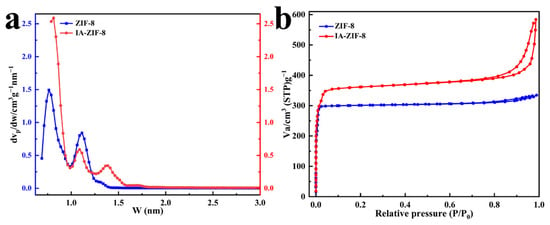
N2 adsorption–desorption isotherms and pore size distribution analysis were employed to comprehensively characterize the textural properties of the synthesized supports (Figure 1). The comprehensive characterization of conventional ZIF-8, including scanning electron microscopy (SEM), powder X-ray diffraction (p-XRD), and Fourier transform infrared spectroscopy (FTIR), is presented in Figure S1. Conventional ZIF-8 exhibits a BET surface area of 1262.1 m2/g and a micropore volume of 0.439 cm3/g (Table S1). In contrast, IA-ZIF-8 demonstrates significantly enhanced textural characteristics: a BET surface area of 1462.3 m2/g, a micropore volume of 0.526 cm3/g, and an expanded average pore diameter ranging from 0.8 to 1.2 nm (Figure 1a). Meanwhile, the BET surface area of IA-ZIF-8 exceeds that of ZIF-8 synthesized with NH3·H2O [17] or TEA [18], clearly demonstrating the benefit of combining NaOH with methanol. Both IA-ZIF-8 and IA-ZIF-8-PFL exhibit Type I isotherms, which are typical of highly microporous frameworks (Figure 1b) [22]. The improved textural parameters of IA-ZIF-8 are attributable to alkaline induction during synthesis [19], wherein NaOH addition accelerates the deprotonation of 2-Hmim, thereby exerting precise control over nucleation kinetics and crystal growth pathways [19,21]. With respect to enzyme loading, IA-ZIF-8 achieves 249.3 mgprotein/gsupport, surpassing conventional ZIF-8 (227.0 mgprotein/gsupport) by an absolute increment of 22.3 mgprotein/gsupport (a relative increase of 9.8%). Given that the average pore diameter of IA-ZIF-8 (1.2 nm) remains substantially smaller than the size of PFL(~3–6 nm), its immobilization is considered to occur primarily via surface adsorption rather than intraporous diffusion [23]. Consequently, the enhanced enzyme loading of IA-ZIF-8 is ascribed to its larger external surface area, which affords a higher density of accessible binding sites for PFL anchoring [16].
Figure 1.
Pore size distribution (a) and N2 adsorption−desorption isotherm (b) of conventional and alkali-induced ZIF-8.
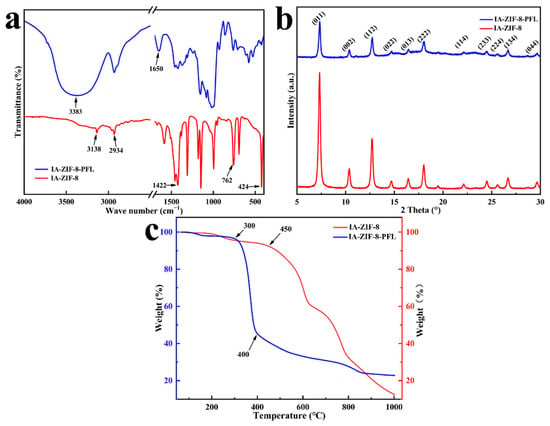
The FTIR spectra of IA-ZIF-8 and IA-ZIF-8-PFL are presented in Figure 2a. For pristine IA-ZIF-8, the characteristic absorption peaks match well with those of the standard ZIF-8 structure [24]. For example, the band at 2934 cm−1 is attributable to the saturated C–H stretching vibration, whereas the absorption peak at 3138 cm−1 is due to the unsaturated C–H stretching vibration of the imidazole ring. The typical absorption peak of Zn–N’s stretching of ZIF-8 appears at 424 cm−1. Additionally, the fingerprint peaks at 762 cm−1 and 1422 cm−1 are assigned to the skeletal vibration modes of the imidazole rings, which is consistent with previous reports of ZIF-8 [13,20]. Compared with IA-ZIF-8, IA-ZIF-8-PFL exhibits two new characteristic absorption peaks in its spectrum, which are attributed to the protein. The broad absorption peak at 3383 cm−1 is attributed to the N–H stretching vibration of amide groups, and the strong peak at 1650 cm−1 is ascribed to the C=O stretching vibration of the amide I band [25]. The results of FTIR indicate that PFL was successfully immobilized on the surface of IA-ZIF-8.
Figure 2.
Characterization of IA-ZIF-8 and IA-ZIF-8-PFL. (a) FTIR spectrum. (b) p-XRD pattern. (c) TGA curve.
The p-XRD patterns of IA-ZIF-8 and IA-ZIF-8-PFL are shown in Figure 2b. The p-XRD patterns of all tested samples are the same, containing 11 sharp and distinct characteristic peaks at 2θ values of 7.3°, 10.4°, 12.7°, 14.7°, 16.5°, 18.1°, 22.2°, 23.4°, 24.6°, 25.6°, and 26.7°, which can be indexed to the (011), (002), (112), (022), (013), (222), (114), (233), (224), (134) and (044) plane reflections of ZIF-8, respectively [26]. Compared with the p-XRD pattern of IA-ZIF-8, only the diffraction intensity of the characteristic peaks changes in IA-ZIF-8-PFL, and no distinct peak shift is observed, revealing that the crystalline structure of IA-ZIF-8 is not greatly changed by the immobilization process, which is consistent with the earlier report [27].
The thermal stability of IA-ZIF-8 and IA-ZIF-8-PFL from 20 to 1000 °C was evaluated by Thermogravimetric analysis (TGA) (Figure 2c). Both samples exhibited minimal weight loss (3.5%) from 25 °C to 300 °C. In contrast to IA-ZIF-8, the rapid weight loss of IA-ZIF-8-PFL between 300 °C and 400 °C is attributed to the pyrolysis of PFL protein molecules [5]. Above 400 °C, the additional weight loss is attributed to pyrolysis of the organic components of IA-ZIF-8. These results show that PFL was successfully immobilized onto IA-ZIF-8.
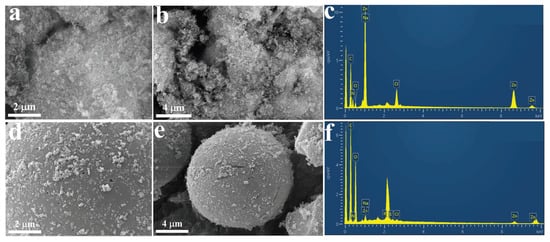
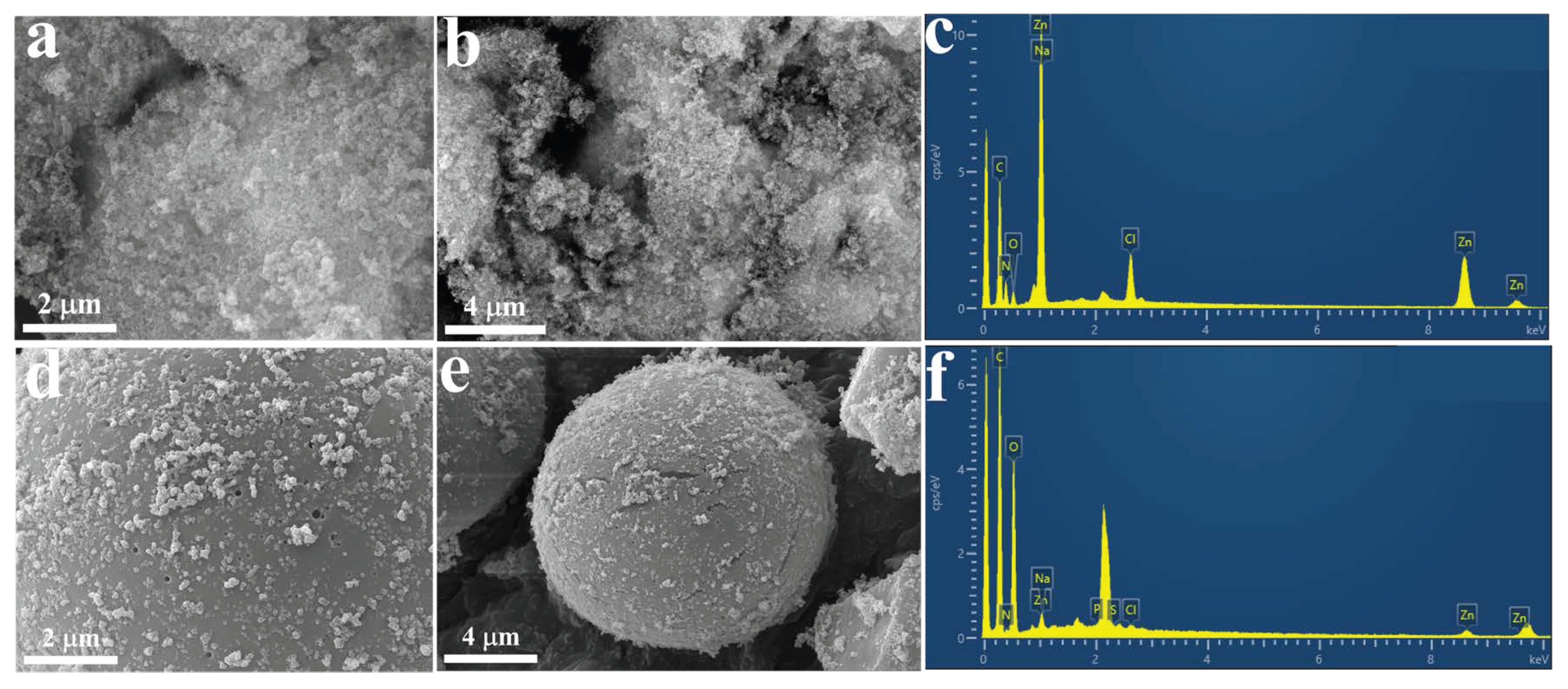
Figure 3a,b show the SEM images of IA-ZIF-8 captured at different magnifications. The images reveal fine crystalline particles formed by the spontaneous aggregation of IA-ZIF-8 nanocrystals. The irregularity of these crystals reflects the uneven microstructure of IA-ZIF-8. Figure 3c shows the energy dispersive X-ray spectrometry (EDS) results of IA-ZIF-8, which shows that IA-ZIF-8 mainly contains carbon (C), nitrogen (N) and zinc (Zn), and the results are consistent with the theoretical elemental composition of IA-ZIF-8. Figure 3d,e are SEM images of IA-ZIF-8-PFL at different magnifications. As compared to pristine IA-ZIF-8, the particles of IA-ZIF-8-PFL appear more aggregated under the same magnification, which may be associated with protein adsorption on the carrier surface altering the particle–particle interactions [27]. In addition, compared with the EDS pattern of IA-ZIF-8, the result of IA-ZIF-8-PFL exhibits an additional sulfur signal (Figure 3f). The sulfur originates from the inherent sulfur groups of PFL, which also confirms that PFL was successfully immobilized on IA-ZIF-8.
Figure 3.
SEM images and EDS patterns of (a–c) IA-ZIF-8 and (d–f) IA-ZIF-8-PFL.
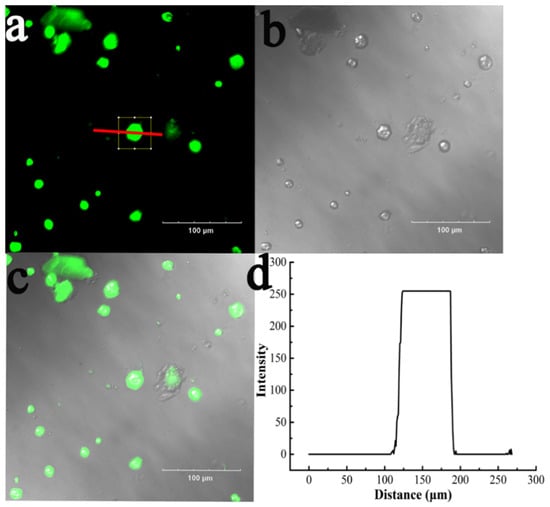
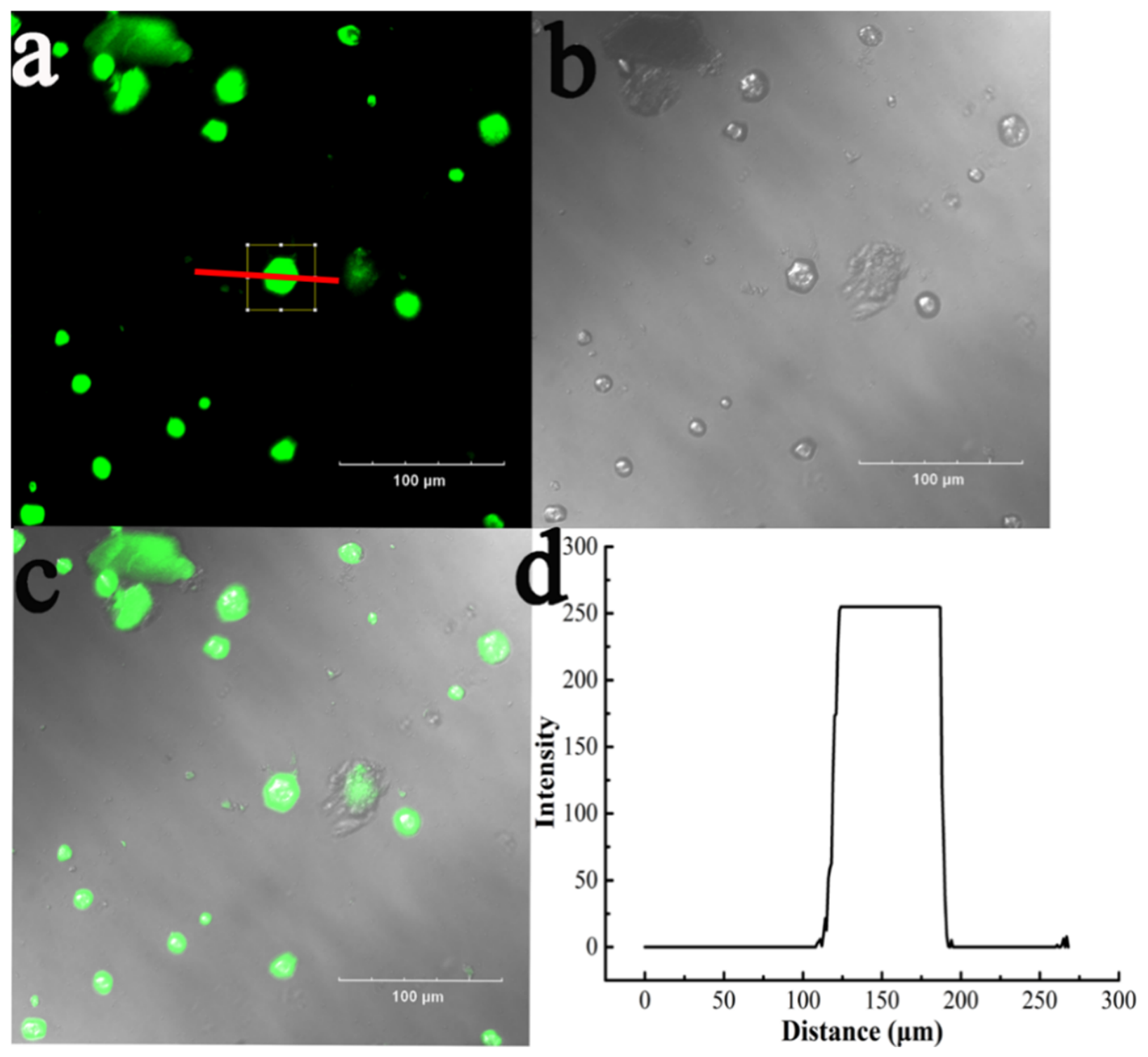
To further confirm the successful immobilization of PFL onto IA-ZIF-8, the visual observation of IA-ZIF-8-PFL was carried out in confocal laser scanning microscopy (CLSM) (Figure 4). PFL was first labeled with the green fluorescent dye fluorescein isothiocyanate (FITC), and then the FITC-labeled PFL was immobilized on IA-ZIF-8 [27]. The resulting fluorescence co-localized with the immobilized PFL on the IA-ZIF-8 surface. Dark-field, bright-field, and merged fluorescence images are shown in Figure 4a, Figure 4b and Figure 4c, respectively. These images reveal clear co-localization between the labeled enzyme and IA-ZIF-8, which verifies the successful immobilization of PFL onto IA-ZIF-8. In addition, the remarkable 2D fluorescence intensity profile (Figure 4d) demonstrates the high protein loading ability of IA-ZIF-8 [5]. Furthermore, IA-ZIF-8 displays promise as an effective support for various enzymes, including other lipases, proteases, and oxidoreductases, due to its favorable surface properties and micropore structure [23].
Figure 4.
Distribution of PFL on IA-ZIF-8 according to CLSM. (a) Dark-field image of IA-ZIF-8-PFL; (b) Bright-field image of IA-ZIF-8-PFL; (c) Merged image of bright-field and dark-field for IA-ZIF-8-PFL; (d) 2D fluorescence intensity profile along the red line in Figure 4a.
2.2. Optimization of PFL Immobilization Conditions
Immobilization technology is an effective way to improve enzyme operation and storage [7]. In this study, the immobilization conditions were optimized via single-factor experiments, including concentration of enzyme (mg/mL), temperature (°C), time (h), and pH value of the immobilized system.
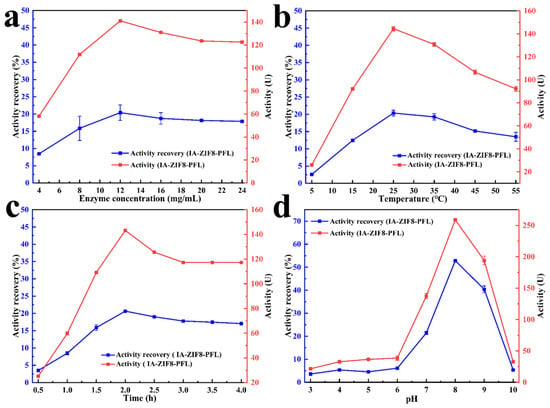
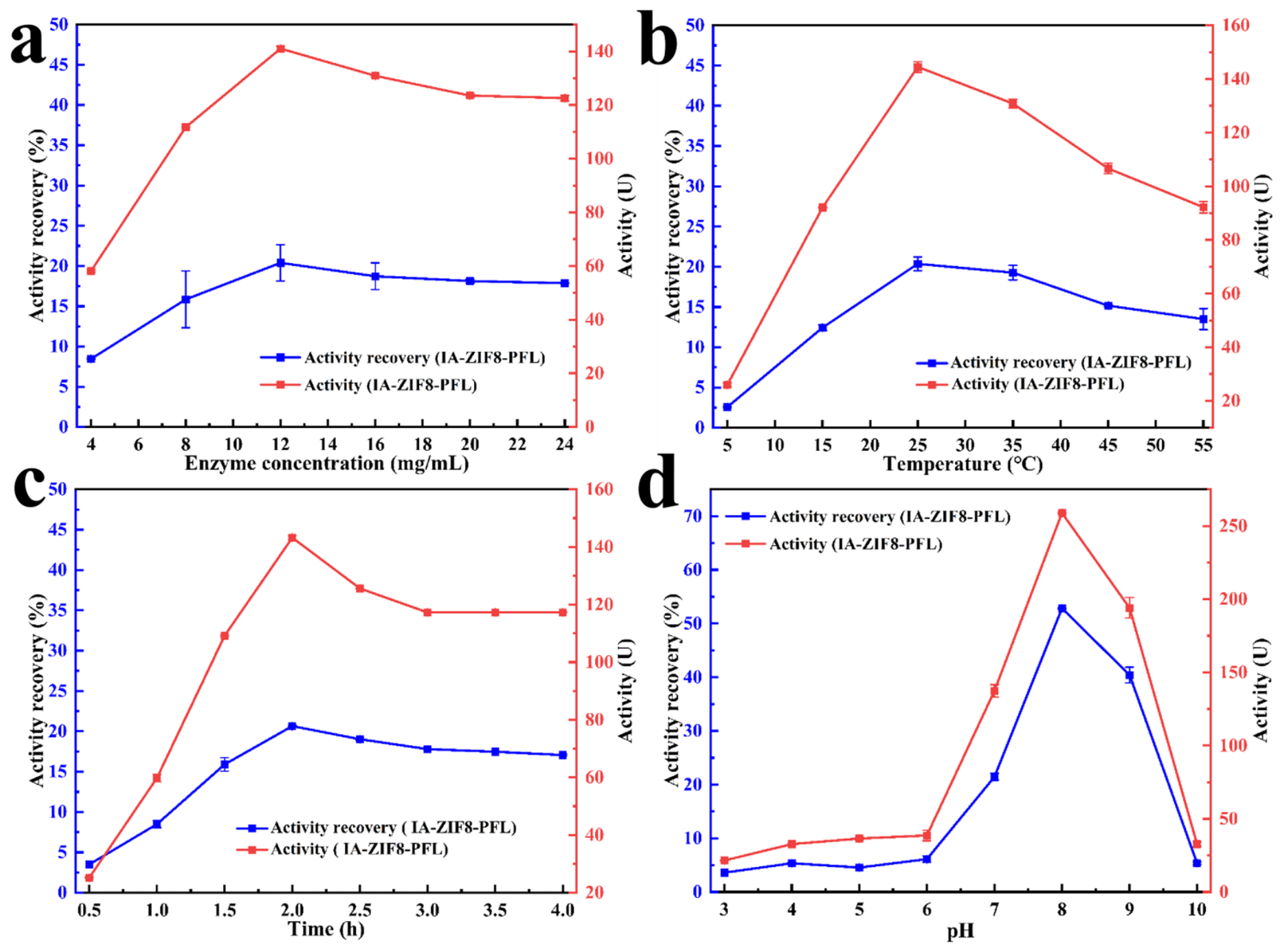
Firstly, the effects of enzyme concentrations (4–24 mg/mL) on the activity and activity recovery of IA-ZIF-8-PFL were evaluated (Figure 5a). The immobilization was performed in 5 mL of Tris-HCl buffer (50 mM, pH 7.0) that contained 20 mg IA-ZIF-8 with a rotational speed of 40 rpm. The activity and activity recovery of IA-ZIF-8-PFL exhibited similar trends, increasing with enzyme concentration from 4 to 12 mg/mL, and the maximum values are 141.1 U and 20.4%, respectively, at 12 mg/mL. However, further increasing the enzyme concentration led to a decrease, which may be due to adsorption saturation of IA-ZIF-8 [27]. Excessive loading of lipase may result in the formation of PFL molecules multilayers, which further cover up each other’s active sites, and thus the catalytic efficiency is decreased [28].
Figure 5.
Optimization of the immobilization parameters. Conditions: (a) 5 mL Tris-HCl buffer, pH 7.0, 20 mg IA-ZIF-8, 25 °C, 2.0 h; (b) 5 mL Tris-HCl buffer, pH 7.0, 20 mg IA-ZIF-8, 12 mg/mL PFL, 2.0 h; (c) 5 mL Tris-HCl buffer, pH 7.0, 20 mg IA-ZIF-8, 12 mg/mL PFL, 25 °C; (d) 5 mL Tris-HCl buffer, 20 mg IA-ZIF-8, 12 mg/mL PFL, 25 °C, 2.0 h.
Subsequently, immobilization was performed in 5 mL Tris-HCl buffer (50 mM, pH 7.0), 20 mg IA-ZIF-8, enzyme concentration of 12 mg/mL, and a rotational speed of 40 rpm. The effects of immobilization temperatures (5, 15, 25, 35, 45 and 55 °C) on activity and activity recovery of IA-ZIF-8-PFL were then examined (Figure 5b). The activity and activity recovery of IA-ZIF-8-PFL increased gradually with the rise of the temperature from 5 to 25 °C and show maximum values of 144.5 U and 20.4%, respectively, at 25 °C. Further increasing of temperature above 25 °C caused a sharp decline of activity recovery. This may be attributed to denaturation and the unfolding of tertiary structure of the PFL enzyme at too high temperature, so that the folding of the active conformation of the PFL enzyme is affected and the catalytic ability is damaged [5]. Meanwhile, high temperature also weakens the interaction between the enzyme and the IA-ZIF-8 carrier, resulting in the leakage of enzyme and poor immobilization efficiency.
The effects of immobilization time were sequentially evaluated under the following conditions: 5 mL Tris-HCl buffer (50 mM, pH 7.0), 20 mg IA-ZIF-8, enzyme concentration of 12 mg/mL, immobilization temperature of 25 °C and rotational speed of 40 rpm. The effects of different immobilization times (0.5, 1.0, 1.5, 2.0, 2.5, 3.0, 3.5 and 4.0 h) on the activity and activity recovery of IA-ZIF-8-PFL were also explored (Figure 5c). The activity and activity recovery of IA-ZIF-8-PFL increased rapidly with prolonging immobilization time from 0.5 to 2.0 h and reached maximum values of 143.2 U, 20.7%, respectively, at 2.0 h. No obvious increase of activity was observed when the immobilization time exceeded 2.0 h, which indicates that the number of adsorption sites in the IA-ZIF-8 carrier was completely occupied by PFL enzyme molecules and had reached the adsorption equilibrium. Excessive immobilization time may slightly aggregate enzyme molecules on the carrier surface, blocking some active sites, and thus does not further boost the catalytic activity [27].
Finally, the immobilization system was carried out in 5 mL buffer solution with different pH values (3.0, 4.0, 5.0, 6.0, 7.0, 7.5, 8.0, 9.0 and 10.0), 20 mg IA-ZIF-8, enzyme concentration of 12 mg/mL, immobilization temperature of 25 °C, immobilization time of 2.0 h, and a rotational speed of 40 rpm. The effects of pH on activity and activity recovery of IA-ZIF-8-PFL were investigated (Figure 5d). The activity and activity recovery of IA-ZIF-8-PFL increased smoothly as the pH increased from 6.0 to 8.0, with the maximum of activity and activity recovery reaching 258.9 U, 52.8%, respectively, at pH 8.0. The activity and activity recovery of IA-ZIF-8-PFL dropped significantly at pH values above 8.0. The pH of the immobilization system influences the surface charges of PFL and IA-ZIF-8, as well as the conformation of the active center of the enzyme. At pH 8.0, the electrostatic interaction between PFL and IA-ZIF-8 is optimal, so that PFL is easily immobilized. Under excessively acidic or alkaline conditions, the spatial structure of the PFL changes, leading to inactivation of the active sites, which weakens the binding force between PFL and IA-ZIF-8, further resulting in low immobilization efficiency and low activity [29].
2.3. Thermal and pH Stability
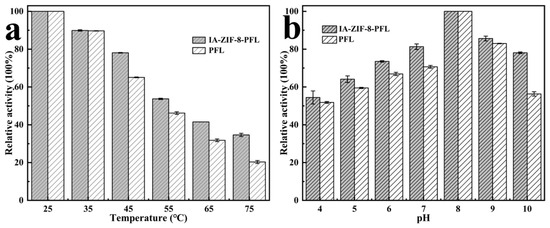
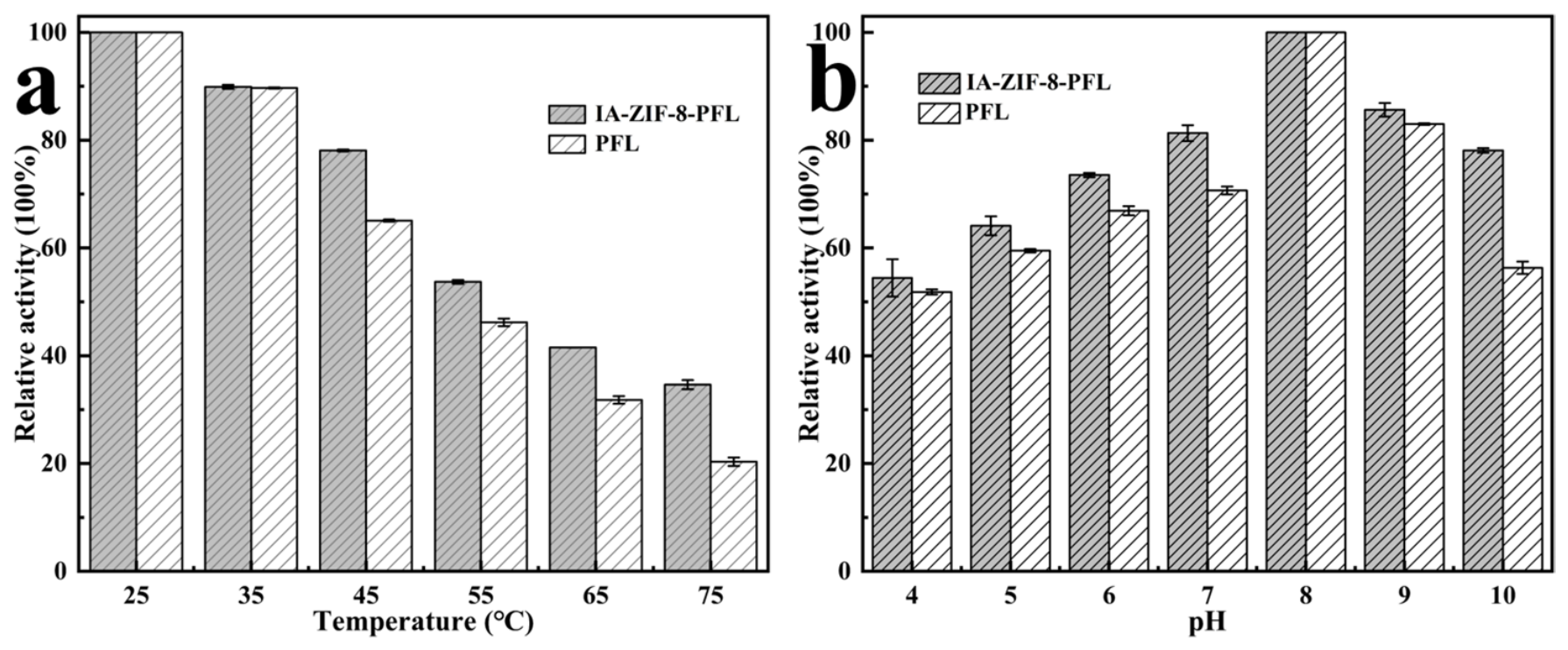
Thermal and pH stability are critical parameters for assessing the practical applicability of immobilized enzymes [10]. To ensure a fair comparison, thermal and pH stability assays were respectively performed using equal amounts of free and immobilized PFL protein. The thermal and pH stabilities of free PFL and IA-ZIF-8-PFL were systematically studied (Figure 6). The thermal stabilities of free PFL and IA-ZIF-8-PFL were investigated from 25 to 75 °C (Figure 6a). For free PFL, the relative activity declined rapidly as the temperature increased. After incubation at 55 °C for 2 h, the relative activity of free PFL retained only 46.2%, and very little activity could be detected beyond 75 °C. In contrast, IA-ZIF-8-PFL exhibited much stronger thermal stability. Moreover, the relative activity of IA-ZIF-8-PFL still remained 53.7% at 55 °C and even 34.6% at 75 °C. Thus, the improved thermal stability of IA-ZIF-8-PFL is attributed to the confinement effect of the IA-ZIF-8 carrier, which confines the conformational unfolding of PFL at high temperature [30]. At the same time, strong interactions (e.g., electrostatic interactions) between PFL and IA-ZIF-8 also stabilize the tertiary structure of PFL, prevent its thermal denaturation and render it tolerant to high temperature [12].
Figure 6.
Thermal (a) and pH (b) stability of free and immobilized PFL.
The pH stability of free PFL and IA-ZIF-8-PFL was evaluated over the pH range of 4.0–10.0 (Figure 6b). Free PFL is highly sensitive to pH variation. It maintains high activity in the pH range of 7.0–9.0, and the relative activity decreases to less than 60% at pH ≤ 5.0 or pH ≥ 10.0, indicating a serious damage of its active site structure in strong acid or strong alkali. Notably, IA-ZIF-8-PFL exhibited a broad pH stability range, retaining 64.1% relative activity at pH 5.0 and even retaining 78.1% relative activity at pH 10.0. The enhanced pH stability primarily comes from the microenvironment provided by IA-ZIF-8, which buffers extreme pH fluctuations and reduces the direct contact between PFL and the harsh bulk solution. Moreover, carrier–enzyme interaction also protects the conformation of the active site of PFL from denaturation by pH changes and thus broadens the effective pH range for the catalytic reaction [15].
2.4. Chiral Resolution of (R,S)-1-Phenylethanol
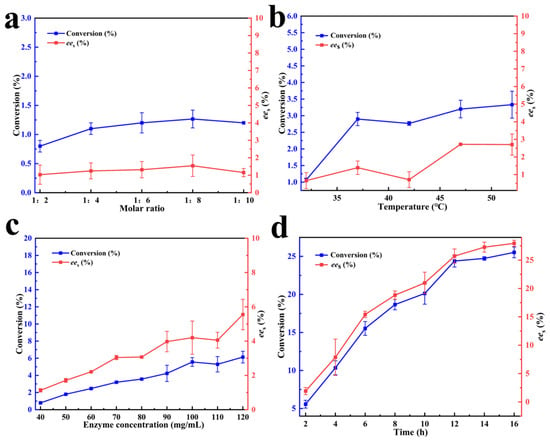
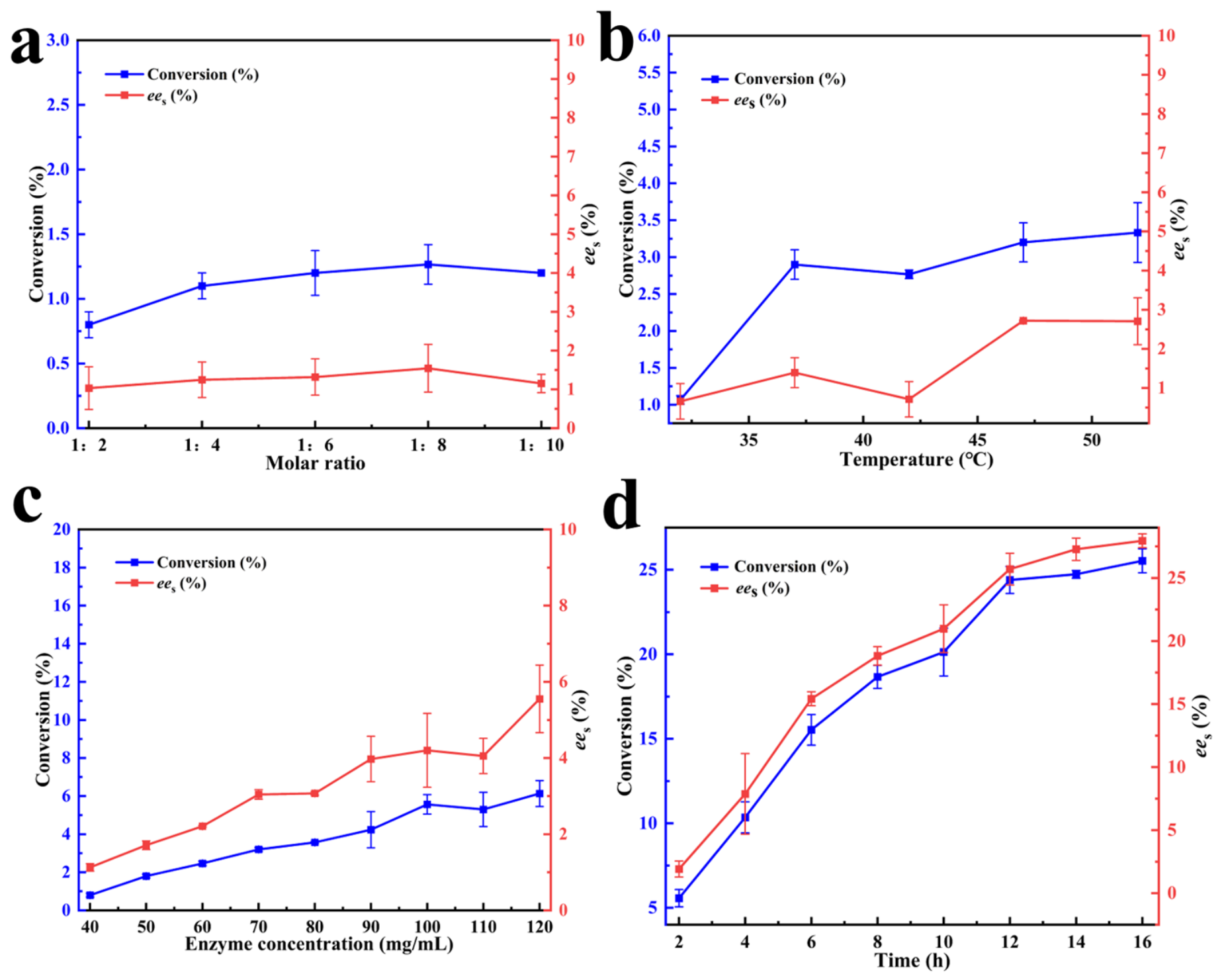
Optically pure alcohols are indispensable intermediates in chiral pharmaceutical synthesis. The lipase-catalyzed kinetic resolution of (R,S)-1-phenylethanol serves as a classic model reaction for evaluating enantioselective biocatalysts [4]. As a hydrophilic protein, free PFL tends to aggregate and lose catalytic activity in non-polar organic solvents [24]. Immobilizing lipase onto carrier can address this limitation, achieving its catalysis in organic phase systems [23]. In this study, the asymmetric catalytic performance of IA-ZIF-8-PFL was studied by the acylation reaction of (R,S)-1-phenylethanol (Figure 7). Reaction parameters were gradually optimized via single-factor experiments, including the molar ratio of (R,S)-1-phenylethanol to vinyl acetate, reaction temperature (°C), immobilized enzyme concentration (mg/mL), and reaction time (h) with conversion and enantiomeric excess of the substrate (ees) as the main evaluation index. Moreover, the enantiomeric ratio (E) and enantiomeric excess of the product (eep) (Table S2) were calculated from the experimental conversion and ees according to the mathematical model [31,32].
Figure 7.
Optimization of chiral resolution of (R,S)-1-phenylethanol. Conditions: (a) 1.25 mL n-hexane, 12 μL (R,S)-1-phenylethanol, 25 °C, 2 h, 40 mg/mL IA-ZIF-8-PFL; (b) 1.25 mL n-hexane, 12 μL (R,S)-1-phenylethanol, 37 μL vinyl acetate, 2 h, 40 mg/mL IA-ZIF-8-PFL; (c) 1.25 mL n-hexane, 12 μL (R,S)-1-phenylethanol, 37 μL vinyl acetate, 37 °C, 2 h; (d) 1.25 mL n-hexane, 12 μL (R,S)-1-phenylethanol, 37 μL vinyl acetate, 37 °C, 100 mg/mL IA-ZIF-8-PFL.
The molar ratio of (R,S)-1-phenylethanol to vinyl acetate has a significant effect on the resolution efficiency (Figure 7a). At lower concentrations of vinyl acetate, the conversion increases gradually with increasing molar ratio and reaches the maximum value of 1.1% with an ees of 1.2% when the molar ratio is 1:4. Sufficient acyl donor amounts can facilitate the complete acylation of the preferred enantiomer, drive the reaction equilibrium forward, and improve the overall enantioselectivity. However, no further improvement in conversion or ees was found at the molar ratio exceeding 1:4. Excessive vinyl acetate may dilute the effective substrate concentration and alter the microenvironment near the active site, further potentially weakening substrate–enzyme interactions and reducing catalyst selectivity [4].
Reaction temperature obviously regulates both the catalytic activity and enantioselectivity of IA-ZIF-8-PFL (Figure 7b). The conversion and ees increases gradually with the reaction temperature from 25 to 37 °C and reaches the highest value of 2.9% with an ees of 1.4% at 37 °C. Moderate temperatures increase molecular motion, accelerate substrate diffusion to the active site, and induce favorable conformational changes of PFL that enhance catalytic efficiency and enantioselectivity [13]. However, no obvious increase in conversion is observed when reaction temperature exceeds 37 °C. Excessively high temperatures not only waste energy but also cause enzyme inactivation [27].
Enzyme concentration also has a significant influence on reaction rate and resolution efficiency (Figure 7c). Conversion and ees present a rapid increase with increasing IA-ZIF-8-PFL concentration from 40 to 100 mg/mL, and it reaches its highest conversion of 5.6% with an ees of 4.2% at an enzyme concentration of 100 mg/mL. Higher enzyme dosage provides more active sites, accelerating the acylation reaction and improving conversion. Further increasing the enzyme dosage beyond 100 mg/mL does not significantly improve the conversion and ees, indicating reaction saturation [27]. Excessive enzyme loading causes particle aggregation, which hinders substrate diffusion and leaves active sites underutilized, thereby limiting further improvements in catalytic efficiency [10].
Reaction time directly determines the conversion of the substrate and ees (Figure 7d). Conversion and ees increases greatly from 2 to 12 h, with an optimal conversion of 24.4%, ees of 25.7%, eep of 79.6% and an E value of 11.3 when the reaction time is 12 h. Prolonging the reaction time allows sufficient substrate–enzyme contact, enabling the complete acylation of the (R)-enantiomer and the effective enrichment of the (S)-enantiomer. Further extending the reaction time beyond 12 h brings no substantial increase in conversion and ees. The reaction beyond the optimum may promote the non-specific acylation of the (S)-enantiomer, reducing the enantiomeric purity of the residual substrate and disturbing resolution efficiency [4,5].
2.5. Reusability of IA-ZIF-8-PFL
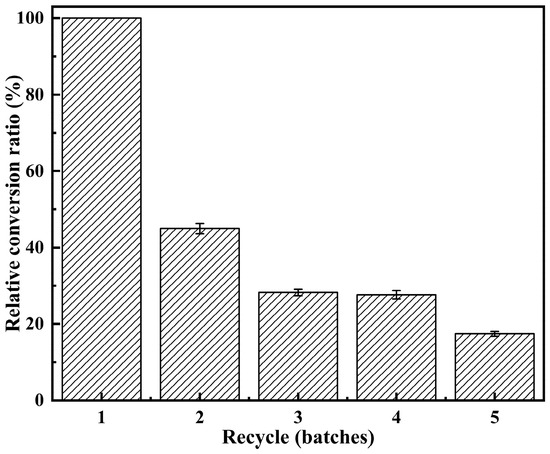
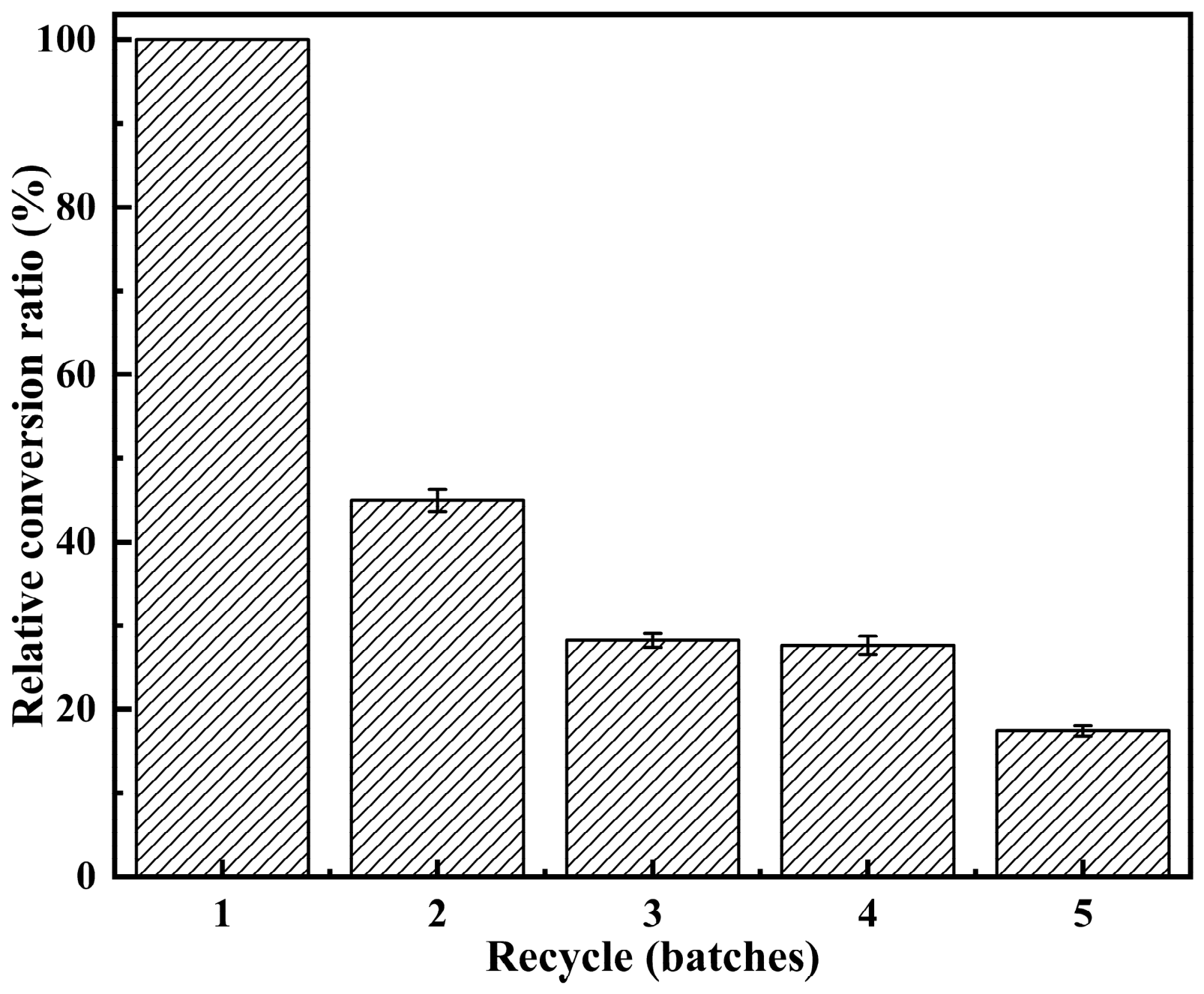
The reusability of IA-ZIF-8-PFL for the kinetic resolution of (R,S)-1-phenylethanol was evaluated over five successive cycles, revealing a gradual decline in relative conversion ratio (Figure 8). The relative conversion ratio was 100% in the first cycle and retained 17.4% by the fifth cycle. Although the IA-ZIF-8 provides a stabilizing confinement effect for the immobilized enzyme, mechanical agitation during shaking and solvent rinsing between cycles likely caused partial enzyme desorption from the IA-ZIF-8 surface [4,15]. Furthermore, hydrophobic substrates (e.g., vinyl acetate) may be adsorbed onto the IA-ZIF-8 surface, potentially blocking micropores and restricting substrate access to active sites [33]. The observed activity decline may also come from mechanical enzyme detachment and potential framework degradation during agitation and washing. However, the direct quantification of enzyme leaching in the nonpolar solvent was not feasible due to the difficulty in recovering lipase [24]. Future work could focus on surface engineering to enhance mechanical stability and antifouling properties, as well as on the development analytical methods to quantitate enzyme desorption in organic media.
Figure 8.
The reusability of IA-ZIF-8-PFL.
2.6. Comparison of IA-ZIF-8-PFL and Other Immobilized Lipases
Table S3 summarizes the catalytic versatility of Pseudomonas sp. lipases in the kinetic resolution of multiple racemic substrates, including 1-(4-bromophenyl) ethanol [34], nerol [10], p-nitrophenyl butyrate [35], 4-methoxymandelic acid [36] and 1-phenylethanol [24]. Unlike complex immobilization strategies that rely on covalent binding or multi-step encapsulation (e.g., PFL@ZIF-8@ZIF-67 [10], or PFL-PEG@UiO-66(Zr) [36]), the IA-ZIF-8-PFL biocatalyst was prepared via simple physical adsorption. This mild method avoids the use of toxic cross-linking agents, thereby preserving the native conformation of the enzyme and its interfacial activation ability. Under mild reaction conditions (37 °C, 12 h), IA-ZIF-8-PFL achieved a conversion of 24.4% with an eep of 79.6%. In contrast, a highly optimized composite catalytic system (e.g., PFL@ZIF-8@ZIF-67) reached 99% conversion under slightly higher temperature (50 °C) and extended reaction time (36 h) [10], and the enantioselectivity remains promising for further optimization. For the same substrates, the catalytic performances of different biocatalysts vary considerably; for instance, PFL@MIL-101(Cr) yielded 13% conversion with 97% eep, whereas PFL-PEG@UiO-66(Zr) achieved 49% conversion with 99% eep under 50 °C for 22 h [36]. The difference in conversion found in this study may be attributed to the milder reaction conditions, together with probable steric hindrance and the restricted diffusion of substrates in the pores of IA-ZIF-8. Although IA-ZIF-8-PFL exhibits moderate conversion and gradually decreasing activity over five reuse cycles, the eco-friendly preparation route and excellent enantioselectivity highlight the potential of IA-ZIF-8 as a viable platform for chiral synthesis, and therefore it is worthy of further optimization in terms of reaction engineering or surface functionalization.
3. Materials and Methods
3.1. Materials
3.1.1. Reagents
Commercial PFL (≥20,000 U/g) was purchased from Sigma-Aldrich (Darmstadt, Germany). Zinc acetate dihydrate (Zn(CH3COO)2·2H2O), methanol, NaOH, 2-Hmim, FITC, coomassie brilliant blue G250, olive oil, polyvinyl alcohol, bovine serum albumin (BSA), and phenolphthalein indicator were commercially obtained from Sinopharm Chemical Reagent Co., Ltd. (Shanghai, China). Unless otherwise specified, all reagents were of analytical grade or higher.
3.1.2. Instruments
The main instruments used included an X-ray diffractometer (SmartLab9, Rigaku, Tokyo, Japan), electronic analytical balance (FA1204, Lichen, Shanghai, China), water bath shaker (SHA-B, Lichen, Shanghai, China), BET surface area analyzer (BELSORP MINI X, Osaka, Japan), drying oven (101-0BS, Lichen, Shanghai, China), SEM (Apreo 2, Thermo Fisher Scientific, Waltham, MA, USA), bench pH meter (LC-PH-2B, Lichen, Shanghai, China), thermogravimetric analyzer (STA 449F5, NETZSCH, Weimar, Germany), multi-functional rotary shaker (QB-208, Haimen Kylin-Bell, Nantong, China), homogenizer (FJ200-SH, Huxi, Shanghai, China), refrigerated centrifuge (5920R, Eppendorf, Hamburg, Germany), vacuum freeze dryer (10N/C, SCIENTZ, Ningbo, China), FTIR (Nicolet-iS10, Thermo Fisher Scientific, Waltham, MA, USA), ultrasonic cleaner (KQ3200E, Supmile, Suzhou, China), high-performance liquid chromatograph (LC-10T, Science Technology, Hangzhou, China).
3.2. Methods
3.2.1. Construction of Conventional ZIF-8 and IA-ZIF-8
Conventional ZIF-8 and IA-ZIF-8 were prepared using a solvothermal method in anhydrous methanol with the same reaction and post-treatment procedures. The total volume of the two reactions was maintained at 30 mL, and they were sealed in a Teflon-lined autoclave. After being reacted at 120 °C for 4 h, the two autoclaves were cooled to room temperature. To obtain conventional ZIF-8, the molar ratio of Zn2+ to 2-Hmim was kept as 1:2 by dissolving 219.5 mg of Zn(CH3COO)2·2H2O and 164.2 mg of 2-Hmim in 30 mL of anhydrous methanol. For IA-ZIF-8 synthesis, the molar ratio of Zn2+, NaOH and 2-Hmim was fixed firmly at 1:4:2, respectively. In the preparation of IA-ZIF-8, 5 mL of Zn(CH3COO)2·2H2O (219.5 mg) solution, 5 mL of NaOH (160 mg) solution and 5 mL of 2-Hmim (164.2 mg) solution were successively added into the autoclave. Then, 15 mL of anhydrous methanol was added to make the total reaction volume 30 mL. Finally, the products were collected by centrifugation at 12,000 rpm for 5 min, washed with fresh methanol several times, and dried at 50 °C for 6 h.
3.2.2. PFL Immobilization
A total of 20 mg of IA-ZIF-8 was suspended in 5.0 mL of phosphate buffer (50 mM, pH 7.0) with the aid of ultrasonication. Then, a certain amount of PFL powder was then added to the suspension and briefly sonicated. The mixture was incubated on a shaker at 40 rpm. The immobilized PFL was collected by centrifugation and washed with phosphate buffer (50 mM, pH 7.0). All washings and the supernatant were combined for enzyme activity assay. Finally, the product was vacuum freeze-dried, and the white powder of immobilized PFL was obtained, denoted as IA-ZIF-8-PFL. The enzyme loading (mgprotein/gsupport) was calculated as follows [36]:
where C0 and C1 are the initial and final protein concentration (mg/mL), respectively. V is the volume of the immobilization solution (mL). m is the weight of IA-ZIF-8 (g). Protein concentration was assayed by the Bradford method with BSA as the standard [37].
3.2.3. Enzyme Activity Assay
Enzyme activity was evaluated via olive oil hydrolysis. Briefly, an emulsion was prepared by mixing 5 mL of Tris-HCl buffer (50 mM, pH 7.5) with 4 mL of olive oil, followed by pre-incubation at 37 °C for 5 min in a water bath shaker. A total of 30 mg of immobilized or free PFL was then added to the emulsion and homogenized by brief ultrasonication. The reaction proceeded at 37 °C, 200 rpm for 20 min. Finally, the reaction was terminated by rapidly adding 15 mL of ethanol. The released free fatty acids were quantified by acid-base titration. The enzyme activity was calculated as follows:
where V is the volume of NaOH consumed for the sample (mL); V0 is the volume consumed for the blank control (mL); C represents the molar concentration of the NaOH titrant (M); X is the dilution factor; t is the reaction time (min). One unit (U) of lipase activity was defined as the amount of enzyme releasing 1 μmol of free fatty acid per minute under the assay conditions.
The activity recovery was calculated as follows [13]:
3.2.4. Thermal and pH Stability Assays
The thermal and pH stability of free PFL and IA-ZIF-8-PFL were evaluated in triplicate. For thermal stability assessment, each sample (20 mg) was suspended in 5 mL of Tris-HCl buffer (50 mM, pH 7.5). The suspensions were incubated at various temperatures (25–75 °C) for 2 h. After cooling to room temperature, the residual enzyme activity was measured. For pH stability, 20 mg of free PFL or IA-ZIF-8-PFL was incubated in buffers ranging from pH 4.0 to 10.0 (at 1.0 pH intervals) for 6 h at 4 °C. The relative activity was calculated as follows [38]:
where A is the residual activity under the tested condition, and Amax is the maximum activity under the optimal condition.
3.2.5. Enantioselective Acylation by IA-ZIF-8-PFL
IA-ZIF-8-PFL was accurately weighed and added to a sealed vial containing 1.25 mL of n-hexane along with specified amounts of vinyl acetate and (R,S)-1-phenylethanol. Then, the vial was sealed and incubated in a thermostated shaker at 200 rpm. After the reaction, the supernatant was collected and filtered through a 0.22 μm membrane. Enantiomeric composition was analyzed by HPLC equipped with a chiral column (OD-H, 5 µm, 4.6 mm × 250 mm, DAICEL, Shanghai, China) using a mobile phase of n-hexane/isopropanol (95:5, v/v) at 1.0 mL/min with UV detection at 254 nm. Conversion, ees, E and eep were calculated according to the previous literature [4,31,32].
3.2.6. Characterization
FTIR spectra were recorded on a Nicolet-iS10 (Waltham, MA, USA) using the KBr-pellet method. p-XRD patterns were obtained using a Rigaku SmartLab9 diffractometer (Tokyo, Japan) with a Cu Kα source at room temperature. TGA was performed on a NETZSCH STA 449F5 instrument (Weimar, Germany) from 25 °C to 1000 °C at 10 °C/min under N2 atmosphere. SEM was employed to characterize the surface morphologies of IA-ZIF-8 and IA-ZIF-8-PFL. IA-ZIF-8-PFL was visualized using CLSM (FV1000, Olympus, Tokyo, Japan) [27].
3.2.7. Reusability Assay
The reusability of IA-ZIF-8-PFL was evaluated in the enantioselective acylation of (R,S)-1-phenylethanol, with product enantiomers monitored by HPLC. Each reaction (1.25 mL total volume) contained 12 μL (R,S)-1-phenylethanol, 37 μL vinyl acetate, and n-hexane as the solvent. After preheating at 37 °C, 125 mg of IA-ZIF-8-PFL was introduced, and the reaction proceeded for 8 h. After each cycle, IA-ZIF-8-PFL was recovered by centrifugation, washed with n-hexane, and reused. The conversion in the first cycle was set as 100% relative activity.
4. Conclusions
In summary, an alkali-induced strategy was developed to prepare IA-ZIF-8 with improved textural properties and enhanced enzyme loading capacity. PFL was successfully immobilized onto IA-ZIF-8 via physical adsorption under optimized conditions. Compared with free PFL, IA-ZIF-8-PFL exhibited significantly improved thermal stability and pH stability. When applied to the chiral resolution of (R,S)-1-phenylethanol, the biocatalyst demonstrated favorable catalytic activity and enantioselectivity. Furthermore, IA-ZIF-8-PFL retained recyclability over five cycles. Although direct comparison with ZIF-8-PFL under identical conditions is not feasible due to enzyme batch limitations, the improved support properties and biocatalyst performance demonstrated here clearly highlight the potential of the alkali-induced strategy, and the role of alkali treatment in retaining enzyme activity awaits validation in future work. As a consequence, this study provides a straightforward way to improve ZIF-8, a promising route towards the efficient synthesis of chiral drug intermediate.
Supplementary Materials
The following supporting information can be downloaded at: https://www.mdpi.com/article/10.3390/catal16090765/s1, Figure S1: SEM images (a) and (b), p-XRD pattern (c) and FTIR spectrum (d) of conventional ZIF-8; Table S1: Comparison of conventional and alkali-induced ZIF-8; Table S2: Effect of different reaction conditions on the resolution of (R,S)-1-phenylethanol by IA-ZIF-8-PFL; Table S3: Comparison of catalytic performance of IA-ZIF-8-PFL with representative immobilized lipase systems for enantioselective reactions.
Author Contributions
Writing—original draft preparation, J.W. and X.S.; Investigation, X.S., S.X., R.Y., T.W., Z.M., P.W. and X.L.; Software, X.S.; Writing—review and editing, J.W., Z.M. and K.L.; Supervision, J.W. and K.L.; Funding acquisition, J.W. All authors have read and agreed to the published version of the manuscript.
Funding
This research was funded by the Natural Science Foundation of Jiangsu Province (BK20220301), the Jiangsu Province High-Level Innovation and Entrepreneurship Talent Introduction Plan (JSSCBS20221009), the Qing Lan Project of Jiangsu Province (Su Teacher [2024]14), and the Science Projects of Taicang City, China (TC2022JC29).
Data Availability Statement
The data presented in this study are available on request from the corresponding authors.
Acknowledgments
Graphical abstract created with BioGDP.com.
Conflicts of Interest
The authors declare no conflicts of interest.
References
- Sousa, R.R.d.; dos Santos, M.M.; Medeiros, M.W.R.; Manoel, E.A.; Berenguer-Murcia, Á.; Freire, D.M.G.; Fernandez-Lafuente, R.; Ferreira-Leitão, V.S. Immobilized Lipases in the Synthesis of Short-Chain Esters: An Overview of Constraints and Perspectives. Catalysts 2025, 15, 375. [Google Scholar] [CrossRef] [Scilit]
- Alzahrani, A.A.; Krayem, N.; Alonazi, M.; Al-Ghamdi, J.M.; Horchani, H.; Ben Bacha, A. Versatile Biocatalyst: Lipase from Streptomyces gobitricini for Ester Synthesis and Detergent Innovation. Front. Bioeng. Biotechnol. 2025, 13, 1589087. [Google Scholar] [CrossRef] [Scilit]
- Cieh, N.L.; Mokhtar, M.N.; Baharuddin, A.S.; Mohammed, M.A.P.; Wakisaka, M. Progress on Lipase Immobilization Technology in Edible Oil and Fat Modifications. Food Rev. Int. 2024, 1, 457–503. [Google Scholar] [CrossRef] [Scilit]
- Magalhães, R.R.; Abrantes, P.G.; Abrantes, P.G.; Costa, I.F.; Teotonio, E.E.S.; Vale, J.A. Chitosan Functionalized with EDTA as A New Support for Enzyme Immobilization and Its Application on Enzymatic Resolution of (R,S)-1-phenylethanol. Process Biochem. 2025, 149, 128–136. [Google Scholar] [CrossRef] [Scilit]
- Wang, J.; Li, K.; He, Y.; Wang, Y.; Yan, J.; Xu, L.; Han, X.; Yan, Y. Lipase Immobilized on a Novel Rigid-Flexible Dendrimer-Grafted Hierarchically Porous Magnetic Microspheres for Effective Resolution of (R,S)-1-Phenylethanol. ACS Appl. Mater. Interfaces 2020, 4, 4906–4916. [Google Scholar] [CrossRef] [Scilit]
- Fatima, S.; Faryad, A.; Ataa, A.; Joyia, F.A.; Parvaiz, A. Microbial Lipase Production: A Deep Insight Into the Recent Advances of Lipase Production and Purification Techniques. Biotechnol. Appl. Biochem. 2021, 3, 445–458. [Google Scholar] [CrossRef] [Scilit]
- Ghofrani, S.; Allameh, A.; Yaghmaei, P.; Norouzian, D. Immobilization of Candida rugosa Lipase for Resolution of Racimic Ibuprofen. DARU J. Pharm. Sci. 2021, 1, 117–123. [Google Scholar] [CrossRef] [Scilit]
- Patel, R.; Trivedi, U.; Patel, K. Lipases: An Efficient Biocatalyst for Biotechnological Applications. J. Microbiol. Biotechnol. Food Sci. 2022, 5, e2498. [Google Scholar] [CrossRef] [Scilit]
- Siódmiak, T.; Dulęba, J.; Haraldsson, G.G.; Siódmiak, J.; Marszałł, M.P. The Studies of Sepharose-Immobilized Lipases: Combining Techniques for the Enhancement of Activity and Thermal Stability. Catalysts 2023, 5, 887. [Google Scholar] [CrossRef] [Scilit]
- Wang, Q.; Xiong, J.; Xu, H.; Sun, W.; Pan, X.; Cui, S.; Lv, S.; Zhang, Y. Enhanced Enzymatic Performance of Immobilized Pseudomonas fluorescens Lipase on ZIF-8@ZIF-67 and Its Application to the Synthesis of Neryl Acetate with Transesterification Reaction. Molecules 2024, 12, 2922. [Google Scholar] [CrossRef] [Scilit]
- Barelli, L.; Bidini, G.; Pelosi, D.; Sisani, E. Enzymatic Biofuel Cells: A Review on Flow Designs. Energies 2021, 4, 910. [Google Scholar] [CrossRef] [Scilit]
- Yang, X.; Zhang, J.; Tian, X.; Qin, J.; Zhang, X.; Ma, L. Enhanced Activity of Enzyme Immobilized on Hydrophobic ZIF-8 Modified by Ni2+ Ions. Angew. Chem. Int. Ed. 2023, 135, e202216699. [Google Scholar] [CrossRef] [Scilit]
- Adnan, M.; Li, K.; Xu, L.; Yan, Y. X-Shaped ZIF-8 for Immobilization Rhizomucor miehei Lipase via Encapsulation and Its Application toward Biodiesel Production. Catalysts 2018, 3, 96. [Google Scholar] [CrossRef] [Scilit]
- Wang, J.; Li, K.; He, Y.; Liu, X.; Wang, P.; Xu, L.; Yan, J.; Yan, Y. Bi-Enzyme Directed Self-Assembled System Toward Biomimetic Synthesis of Fatty Acid Hydroperoxides Like Soybean. Compos. Part B Eng. 2021, 222, 109091. [Google Scholar] [CrossRef] [Scilit]
- Hu, Y.; Zhou, H.; Dai, L.; Liu, D.; Al-Zuhair, S.; Du, W. Lipase Immobilization on Macroporous ZIF-8 for Enhanced Enzymatic Biodiesel Production. ACS Omega 2021, 3, 2143–2148. [Google Scholar] [CrossRef] [Scilit]
- Li, Y.; Zhou, H.; Dai, L.; Liu, D.; Al-Zuhair, S.; Du, W. Immobilization of Lipase from Thermomyces lanuginosus in Magnetic Macroporous ZIF-8 Improves Lipase Reusability in Biodiesel Preparation. ACS Omega 2021, 1, 274–280. [Google Scholar] [CrossRef] [Scilit]
- Yao, J.; He, M.; Wang, K.; Chen, R.; Zhong, Z.; Wang, H. High-yield Synthesis of Zeolitic Imidazolate Frameworks from Stoichiometric Metal and Ligand Precursor Aqueous Solutions at Room Temperature. CrystEngComm 2013, 15, 3601–3606. [Google Scholar] [CrossRef] [Scilit]
- Butova, V.V.; Budnyk, A.P.; Bulanova, E.A.; Lamberti, C.; Soldatov, A.V. Hydrothermal Synthesis of High Surface Area ZIF-8 with Minimal Use of TEA. Solid State Sci. 2017, 69, 13–21. [Google Scholar] [CrossRef] [Scilit]
- Yang, K.; Cheng, S.; Li, S.; Zhu, K.; Yao, Z. Exploration of a Green Synthesis Route of ZIF-8 and Testing of Its Dye Adsorption Performance. J. Organomet. Chem. 2025, 1031, 123591. [Google Scholar] [CrossRef] [Scilit]
- Ji, P.; Tian, R.; Zheng, H.; Jiang, J.; Sun, J.; Peng, J. Solvent-Free Synthesis of ZIF-8 from Zinc Acetate with the Assistance of Sodium Hydroxide. Dalton Trans. 2020, 49, 12555–12558. [Google Scholar] [CrossRef] [Scilit]
- Tran, T.V.; Dang, H.H.; Nguyen, H.; Nguyen, N.T.T.; Nguyen, D.H.; Nguyen, T.T.T. Synthesis Methods, Structure, and Recent Trends of ZIF-8-Based Materials in the Biomedical Field. Nanoscale Adv. 2025, 13, 3941–3960. [Google Scholar] [CrossRef] [Scilit]
- Malekmohammadi, M.; Fatemi, S.; Razavian, M.; Nouralishahi, A. A Comparative Study on ZIF-8 Synthesis in Aqueous and Methanolic Solutions: Effect of Temperature and Ligand Content. Solid State Sci. 2019, 91, 108–112. [Google Scholar] [CrossRef] [Scilit]
- Wang, X.; Lan, P.C.; Ma, S. Metal-Organic Frameworks for Enzyme Immobilization: Beyond Host Matrix Materials. ACS Cent. Sci. 2020, 9, 1497–1506. [Google Scholar] [CrossRef] [Scilit]
- Ou, J.; Yuan, X.; Liu, Y.; Zhang, P.; Xu, W.; Tang, K. Lipase from Pseudomonas cepacia Immobilized into ZIF-8 as Bio-Catalyst for Enantioselective Hydrolysis and Transesterification. Process Biochem. 2021, 102, 132–140. [Google Scholar] [CrossRef] [Scilit]
- Bösiger, P.; Tegl, G.; Richard, I.M.T.; Le Gat, L.; Huber, L.; Stagl, V.; Mensah, A.; Guebitz, G.M.; Rossi, R.M.; Fortunato, G. Enzyme Functionalized Electrospun Chitosan Mats for Antimicrobial Treatment. Carbohydr. Polym. 2018, 181, 551–559. [Google Scholar] [CrossRef] [Scilit]
- Zhou, K.; Mousavi, B.; Luo, Z.; Phatanasri, S.; Chaemchuen, S.; Verpoort, F. Characterization and Properties of Zn/Co Zeolitic Imidazolate Frameworks vs. ZIF-8 and ZIF-67. J. Mater. Chem. A 2017, 3, 952–957. [Google Scholar] [CrossRef] [Scilit]
- Wang, J.; Li, K.; He, Y.; Wang, Y.; Han, X.; Yan, Y. Enhanced Performance of Lipase Immobilized onto Co2+-chelated Magnetic Nanoparticles and Its Application in Biodiesel Production. Fuel 2019, 255, 115794. [Google Scholar] [CrossRef] [Scilit]
- Maddigan, N.K.; Linder-Patton, O.M.; Falcaro, P.; Sumby, C.J.; Bell, S.G.; Doonan, C.J. Influence of the Synthesis and Storage Conditions on the Activity of Candida antarctica Lipase B ZIF-8 Biocomposites. ACS Appl. Mater. Interfaces 2021, 44, 51867–51875. [Google Scholar] [CrossRef] [Scilit]
- Martins, P.A.; Trobo-Maseda, L.; Lima, F.A.; de Morais Júnior, W.G.; De Marco, J.L.; Salum, T.F.C.; Guisán, J.M. Omega-3 Production by Fish Oil Hydrolysis Using A Lipase from Burkholderia gladioli BRM58833 Immobilized and Stabilized by Post-immobilization Techniques. Biochem. Biophys. Rep. 2022, 29, 101193. [Google Scholar] [CrossRef] [Scilit]
- Liang, W.; Wied, P.; Carraro, F.; Sumby, C.J.; Nidetzky, B.; Tsung, C.; Falcaro, P.; Doonan, C.J. Metal-Organic Framework-Based Enzyme Biocomposites. Chem. Rev. 2021, 3, 1077–1129. [Google Scholar] [CrossRef] [Scilit]
- Chen, C.S.; Fujimoto, Y.; Girdaukas, G.; Sih, C.J. Quantitative Analyses of Biochemical Kinetic Resolutions of Enantiomers. J. Am. Chem. Soc. 1982, 104, 7294–7299. [Google Scholar] [CrossRef] [Scilit]
- He, H.; Han, H.; Shi, H.; Tian, Y.; Sun, F.; Song, Y.; Li, Q.; Zhu, G. Construction of Thermophilic Lipase-Embedded Metal-Organic Frameworks via Biomimetic Mineralization: A Biocatalyst for Ester Hydrolysis and Kinetic Resolution. ACS Appl. Mater. Interfaces 2016, 37, 24517–24524. [Google Scholar] [CrossRef] [Scilit]
- Lee, J.; Lee, K.; Kim, J. Fiber-Based Gas Filter Assembled via In Situ Synthesis of ZIF-8 Metal Organic Frameworks for an Optimal Adsorption of SO2: Experimental and Theoretical Approaches. ACS Appl. Mater. Interfaces 2021, 1, 1620–1631. [Google Scholar] [CrossRef] [Scilit]
- Sun, C.; Wu, S.; Wu, Y.; Sun, B.; Zhang, P.; Tang, K. Lipase AK from Pseudomonas fluorescens Immobilized on Metal Organic Frameworks for Efficient Biosynthesis of Enantiopure (S)-1-(4-bromophenyl) ethanol. Process Biochem. 2023, 124, 132–139. [Google Scholar] [CrossRef] [Scilit]
- Naseri, M.; Pitzalis, F.; Carucci, C.; Medda, L.; Fotouhi, L.; Magner, E.; Salis, A. Lipase and Laccase Encapsulated on Zeolite Imidazolate Framework: Enzyme Activity and Stability from Voltammetric Measurements. ChemCatChem 2018, 23, 5425–5433. [Google Scholar] [CrossRef] [Scilit]
- Yuan, X.; Liu, Y.; Cao, F.; Zhang, P.; Ou, J.; Tang, K. Immobilization of Lipase onto Metal-Organic Frameworks for Enantioselective Hydrolysis and Transesterification. AICHE J. 2020, 9, e16292. [Google Scholar] [CrossRef] [Scilit]
- Bradford, M.M. A Rapid and Sensitive Method for the Quantitation of Microgram Quantities of Protein Utilizing the Principle of Protein-Dye Binding. Anal. Biochem. 1976, 72, 248–254. [Google Scholar] [CrossRef]
- Wu, S.; Lia, Y. Application of Bacterial Cellulose Pellets in Enzyme Immobilization. J. Mol. Catal. B Enzym. 2008, 54, 103–108. [Google Scholar] [CrossRef] [Scilit]
Disclaimer/Publisher’s Note: The statements, opinions and data contained in all publications are solely those of the individual author(s) and contributor(s) and not of MDPI and/or the editor(s). MDPI and/or the editor(s) disclaim responsibility for any injury to people or property resulting from any ideas, methods, instructions or products referred to in the content. |
© 2026 by the authors. Licensee MDPI, Basel, Switzerland. This article is an open access article distributed under the terms and conditions of the Creative Commons Attribution (CC BY) license.