


Abstract
Poly(ethylene terephthalate) (PET) hydrolases have emerged as promising biocatalysts for closed-loop plastic recycling. Among the most efficient enzymes reported to date, LCC-ICCG exhibits exceptional PET-depolymerization performance under industrially relevant conditions. However, the molecular basis for its superior activity relative to engineered PETases such as FAST-PETase and HotPETase remains incompletely understood. Here, we combine microsecond-scale molecular dynamics simulations, quantum mechanical cluster calculations, pre-reaction-state analysis, noncovalent-interaction mapping, and distortion/interaction activation strain analysis to compare LCC-ICCG with FAST-PETase and HotPETase. The simulations show that LCC-ICCG samples catalytically competent pre-reaction-state geometries more frequently, mainly because V212 reshapes the local environment around the scissile ester. This residue relieves steric congestion, supports weak C–H···O guided substrate preorganization, and reinforces both the Asp-His catalytic dyad and the W190-associated pocket architecture. Density functional theory calculations further indicate that this preorganized active site lowers the acylation barrier to 15.5 kcal/mol by reducing substrate distortion and strengthening transition-state interactions. High-temperature simulations show that LCC-ICCG better preserves near-attack geometries at 350 K, linking thermal robustness to sustained catalytic preorganization. Moreover, reciprocal I208V mutations in IsPETase-derived enzymes enrich pre-reaction-state populations, supporting the transferability of the V212-centered design principle. Overall, these results establish pre-reaction-state stabilization as a key determinant of PET-hydrolase efficiency and provide mechanistic design rules for engineering next-generation PET depolymerases.
1. Introduction
Developing efficient recycling strategies for commodity plastics is essential for improving polymer circularity and reducing environmental accumulation [1,2]. Poly(ethylene) terephthalate (PET) is particularly important because of its broad use in packaging, textiles, and consumer products. PET is a petroleum-derived synthetic polyester composed of terephthalic acid (TPA) and ethylene glycol (EG) units connected through ester bonds. Its high durability, moisture resistance, and chemical persistence make PET attractive for industrial use but also contribute to its long-term accumulation in the environment [3]. The recycling methods of PET waste mainly include physical, chemical, and biological recycling [4]. Among these, enzymatic PET depolymerization has attracted increasing attention because it can operate under milder conditions and directly recover monomeric or oligomeric building blocks for closed-loop recycling [5,6].
To date, numerous PET-active hydrolase enzymes have been discovered [7,8], engineered [9,10,11], and evolved for improved depolymerization activity [12]. The catalytic activity and physicochemical properties of Ideonella sakaiensis (IsPETase) have been improved through directed evolution and rational engineering, resulting in engineered variants such as FAST-PETase and HotPETase. The FAST-PETase enzyme designed by machine learning techniques contains five mutations with respect to wild-type IsPETase (S121E/D186H/R224Q/N233K/R280A) and exhibited superior catalytic activity in the 30–50 °C range [13]. The highly thermostable variant of IsPETase, namely HotPETase, with a Tm of 82.5 °C, showed good PET hydrolyzing performances [14]. Among the best-performing PET hydrolases reported to date, Tournier et al. developed LCC-ICCG, an engineered variant of leaf-branch compost cutinase (LCC) carrying the F243I, D238C, S283C, and Y127G substitutions; the one-letter identities of the substituted residues (I-C-C-G) give rise to the suffix ICCG. LCC-ICCG combines enhanced thermostability with high catalytic activity at elevated temperatures and enables high PET conversion under industrially relevant substrate loadings [15].
Standardized PET hydrolysis assays have further highlighted the strong industrial potential of LCC-ICCG. In comparative experiments involving representative PET hydrolases, including FAST-PETase, HotPETase, PES-H1L92F/Q94Y, and LCC-ICCG [16], FAST-PETase achieved approximately 15% PET conversion after 24 h at 50 °C but underwent rapid deactivation within the first two hours. HotPETase displayed moderately improved activity, achieving around 26% PET conversion within 24 h at 60 °C, but its catalytic efficiency also decreased significantly after 2–3 h. Both enzymes are engineered variants derived from IsPETase. By contrast, LCC-ICCG maintained substantially higher activity under conditions closer to industrial operation. Its superior thermostability enables catalysis near the glass-transition temperature of PET, thereby accelerating polymer-chain mobility and depolymerization kinetics while limiting undesirable recrystallization. These characteristics make LCC-ICCG one of the most promising PET hydrolases for scalable enzymatic PET recycling. Previous computational studies have shown that PET hydrolases operate as serine hydrolases and follow the canonical cutinase-like mechanism, involving acylation and deacylation steps [17,18,19]. Several quantum mechanical/molecular mechanical studies have examined the catalytic mechanism and energetics of ester hydrolysis in PETase and related enzymes [20,21]. Although thermostability, substrate adsorption, and binding affinity have been implicated in the superior performance of LCC-ICCG, the microscopic origin that directly connects active-site structure to a lowered chemical barrier remains unresolved. A residue-level understanding of this process is essential for rationally designing PET hydrolases with improved activity, stability, and industrial compatibility.
Here, we have performed molecular dynamics (MD) simulations and density functional theory (DFT) calculations to unveil the enhanced catalytic mechanism of LCC-ICCG in comparison with HotPETase and FAST-PETase.
By integrating pre-reaction-state (PRS) analysis, noncovalent-interaction analysis, quantum theory of atoms in molecules (QTAIM) analysis, and distortion/interaction activation strain (DIAS) analysis, we identify how local steric relief and active-site preorganization promote productive nucleophilic attack on the PET ester bond. Our results show that V212 in LCC-ICCG plays a central role in stabilizing near-attack geometries, strengthening the catalytic dyad, and reducing the substrate distortion penalty during acylation. These findings provide a mechanistic framework for understanding LCC-ICCG activity and suggest transferable design principles for engineering next-generation PET depolymerases.
2. Results and Discussion
2.1. Structural Dynamics and PET Binding Mode
To understand why LCC-ICCG displays higher PET-depolymerization activity than advanced IsPETase-derived enzymes, we first examined whether the three enzyme-substrate complexes differ in their global stability and local substrate-binding architecture. Microsecond-scale MD simulations were performed for LCC-ICCG, HotPETase, and FAST-PETase in complex with a PET trimer. All trajectories remained close to their respective crystal structures, with Cα RMSD values fluctuating between 1.4 and 1.8 Å (Figure S1). RMSF analysis further showed that the catalytic triad, oxyanion-hole region, and W-loop remained comparatively constrained in all three enzymes (Figure S2), although their local dynamical behavior differed near the scissile ester-binding region.
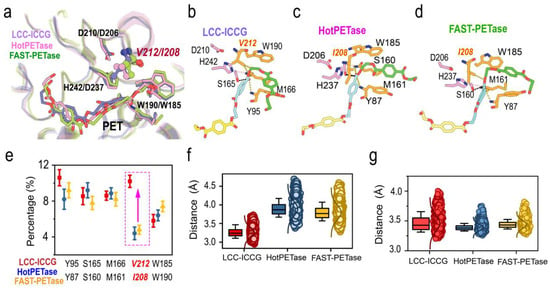
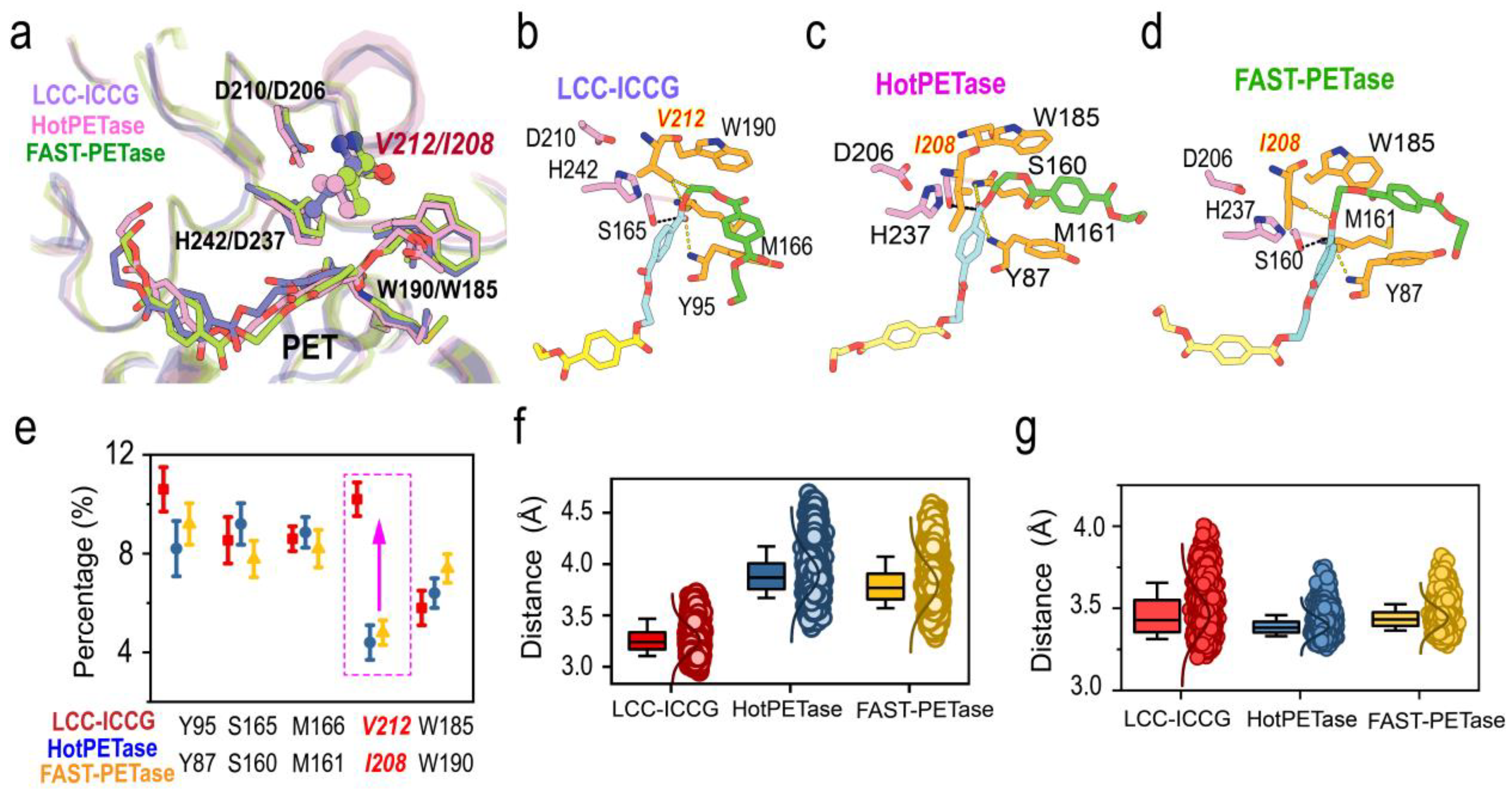
The structures were aligned using structurally equivalent residues in the catalytic core (Figure 1a). Representative conformations extracted from the equilibrated trajectories showed that the three enzymes share a broadly conserved PET-binding topology. In each complex, one PET repeat unit occupies the catalytic +1 subsite, while the adjacent upstream and downstream units extend toward the −1 and +2 subsites, respectively (Figure 1b–d). This arrangement is consistent with the view that PET hydrolases bind only a limited number of PET repeat units tightly inside the active cleft, whereas more distal polymer segments remain comparatively flexible on the enzyme surface. In LCC-ICCG, residues Y95, M166, and W190 contribute to the stabilization of the downstream +2 unit, while G94, S165, H242, I243, and V212 define the immediate chemical environment around the +1 scissile ester. This is consistent with previous experimental and computational studies showing that only one to two PET repeats are tightly anchored in the active site while additional units remain relatively flexible on the surface [22]. Because the scissile ester carbonyl directly participates in the acylation reaction, subsequent analyses focused on the local environment surrounding this reactive group. Per-residue MM/GBSA decomposition revealed a conserved set of substrate-recognition residues but also highlighted a key difference in the catalytic pocket.
Figure 1.
Structural comparison and PET-binding characteristics of LCC-ICCG, HotPETase, and FAST-PETase. (a) Superposition of representative PET-bound active-site conformations of LCC-ICCG, HotPETase, and FAST-PETase obtained from CPPTRAJ clustering analysis of the equilibrated MD trajectories. The structures were aligned using structurally equivalent residues in the catalytic core. Representative PET-bound conformations of (b) LCC-ICCG, (c) HotPETase, and (d) FAST-PETase were obtained from the corresponding trajectory-clustering analyses. (e) Per-residue binding-energy decomposition calculated using the MM/GBSA method. (f) Distance distributions between V212/I208 and the scissile ester group. (g) Distance distributions between W190/W185 and the downstream PET unit.
In HotPETase and FAST-PETase, Y87, S160, M161, W185, and I208 contributed substantially to PET binding, whereas the corresponding residues in LCC-ICCG were Y95, Y127, S165, M166, W190, and V212 (Figure 1e). Notably, V212 in LCC-ICCG accounts for 10.2% of the total binding energy-more than twice the contribution of the corresponding I208 residue in HotPETase (4.5%) and FAST-PETase (4.8%). This result suggests that V212 is not merely a passive structural substitution but acts as a local energetic hotspot that helps organize the substrate near the chemical reaction center.
Distance analysis further clarified the role of this residue. The Cγ atom of V212 remained approximately 3.1–3.3 Å from the non-carbonyl oxygen of the scissile ester, whereas the corresponding I208 side chain in HotPETase and FAST-PETase was located farther away, typically around 3.7–4.0 Å (Figure 1e,f). This apparently small difference has important mechanistic implications. The shorter and less bulky valine side chain relieves steric congestion within the narrow catalytic cleft, allowing the PET ester to approach the catalytic serine more closely without excessive deformation. In contrast, the additional methylene group of isoleucine increases local steric bulk and restricts the ability of the PET chain to adopt an optimally aligned near-attack geometry. The smaller valine side chain thus reduces steric congestion around the ester linkage and enables tighter packing of the PET chain in LCC-ICCG. Solvent-accessible surface area (SASA) analysis of the active site-defined as the catalytic triad, oxyanion hole, and key interface residues (Y95, M166, W190, V212 in LCC-ICCG; Y87, M161, W185, I208 in HotPETase/FAST-PETase)-further supports this view. Replica-level analysis showed that LCC-ICCG exhibited a significantly lower active-site SASA than HotPETase and FAST-PETase (Holm-adjusted p = 0.018 and 0.009, respectively), consistent with a less solvent-exposed and more compact PET-binding environment (Figure S3). The oxyanion hole was preserved in all three systems and is formed by the backbone amide groups of conserved tyrosine and methionine residues (Y95/M166 in LCC-ICCG and Y87/M161 in HotPETase and FAST-PETase). These backbone NH groups-maintained hydrogen-bonding interactions with the carbonyl oxygen of the reactive ester, with average donor-acceptor distances of approximately 3.3–3.5 Å. These interactions are expected to stabilize the developing negative charge during formation of the tetrahedral intermediate. In addition, Y95/Y87 engaged in π-π stacking with the aromatic ring of the downstream PET unit, reinforcing substrate binding at the +2 subsite (Figure S4).
The conserved W-loop tryptophan also contributed to substrate recognition. W190 in LCC-ICCG and W185 in HotPETase/FAST-PETase maintained edge-to-face π-π interactions with PET aromatic rings and hydrophobic contacts with nearby ethylene glycol segments. Representative conformations further illustrate the different orientations sampled by W190 in LCC-ICCG and W185 in HotPETase and FAST-PETase (Figure S5). However, these interactions primarily stabilized distal portions of the PET chain rather than directly controlling the geometry of the scissile ester [23,24]. Thus, although the W-loop remains important for substrate binding and conformational adaptability, the simulations indicate that the decisive difference among the three enzymes lies closer to the reactive ester, where V212 in LCC-ICCG provides a more favorable balance of steric relief, packing, and local preorganization.
Taken together, the structural and energetic analyses suggest that LCC-ICCG does not outperform HotPETase and FAST-PETase simply by binding PET more strongly in a global sense. Instead, its advantage lies in the formation of a more productive binding mode. V212 reshapes the immediate microenvironment of the scissile ester, allowing the substrate to become more deeply buried, more tightly packed, and more favorably aligned for nucleophilic attack. This distinction between general substrate binding and chemically productive binding is central to understanding the enhanced catalytic performance of LCC-ICCG.
2.2. LCC-ICCG Preferentially Samples Catalytically Competent Pre-Reaction States
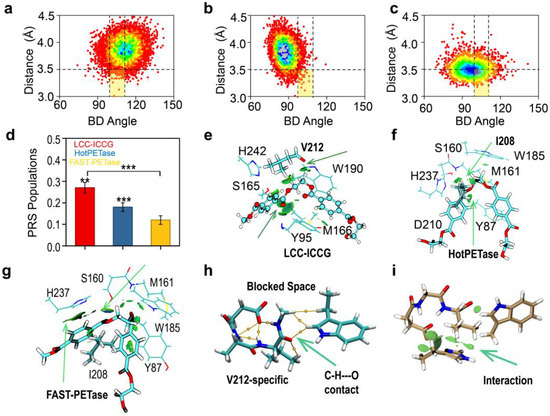
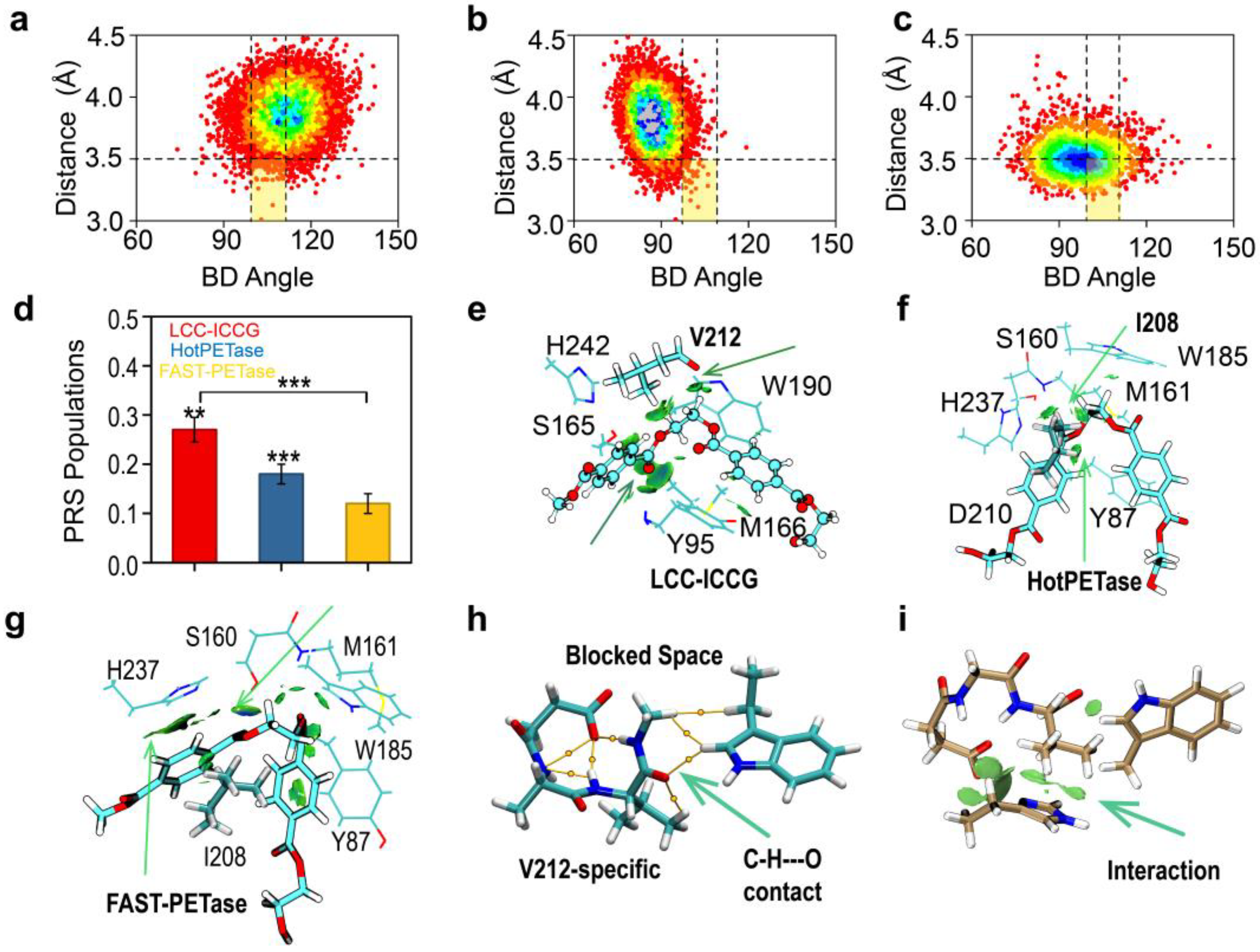
Because enzymatic catalysis depends not only on substrate binding but also on the ability to generate reactive geometries, we next quantified the population of pre-reaction states. The acylation step of PET hydrolysis involves nucleophilic attack of Ser-Oγ on the carbonyl carbon of the scissile ester, producing a tetrahedral intermediate. According to the Bürgi–Dunitz trajectory, productive carbonyl attack requires both an appropriate nucleophile-electrophile distance and a favorable approach angle. We therefore defined a PRS using two geometric criteria: productive attack requires both a distance d(C···Oγ) ≤ 3.5 Å and Oγ-C=O approach angle of 100–110° [25,26,27]. This definition of pre-reaction state (PRS) does not represent a full reaction coordinate; rather, it provides an ensemble-level descriptor of how frequently the enzyme-substrate complex samples geometries that are competent for the subsequent chemical step. Across 1µs trajectories, LCC-ICCG populates PRS conformations with a striking 32.3% occupancy, whereas FAST-PETase and HotPETase achieve only 11.4% and 8.2%, respectively (Figure 2a–c). In LCC-ICCG, the attack angle was also more tightly distributed within the Bürgi–Dunitz-compatible range, which should favor productive n(Oγ) to π*(C=O) orbital overlap. Thus, LCC-ICCG improves catalysis at the level of conformational selection: it increases the probability that thermal fluctuations generate a reactive enzyme-substrate complex before the chemical barrier is crossed.
Figure 2.
Pre-reaction-state (PRS) analysis and non-covalent interaction analysis of PET-bound LCC-ICCG, HotPETase, and FAST-PETase. Joint distributions of the nucleophilic attack distance d(C···Oγ) and Bürgi–Dunitz angle for (a) LCC-ICCG, (b) HotPETase, and (c) FAST-PETase. The dashed boundaries indicate the geometric criteria used to define PRS conformations. (d) Comparison of PRS populations among the three enzymes. Asterisks indicate statistical significance: ** p < 0.01 and *** p < 0.001. IGMH noncovalent-interaction analysis of PET-bound (e) LCC-ICCG, (f) HotPETase, and (g) FAST-PETase. Green isosurfaces indicate weak attractive interactions dominated by van der Waals and dispersion contributions. (h) Visualization of the V212-centered local steric environment and weak C–H···O contact adjacent to the scissile ester. (i) QTAIM analysis of the V212-centered interaction network.
To identify the structural basis of this PRS enrichment, representative PRS conformations were subjected to IGMH noncovalent-interaction analysis. As a result, LCC-ICCG exhibited more pronounced green isosurfaces around the scissile ester and adjacent active-site residues than HotPETase or FAST-PETase (Figure 2e–g). These isosurfaces correspond to weak attractive interactions, mainly dispersion and weak hydrogen-bond-like contacts. The most relevant interaction involved V212, which formed close contacts with the ester oxygen and neighboring methylene groups of the PET chain. This interaction pattern suggests that V212 acts as a local geometric guide that helps hold the scissile ester in a near-attack orientation.
Importantly, the role of V212 should not be interpreted as a strong conventional hydrogen bond. The C–H···O interaction involving V212 is weak and transient. Its catalytic significance lies instead in its cumulative effect on the conformational ensemble. By repeatedly favoring ester orientations compatible with nucleophilic attack, this weak contact biases the substrate toward a higher PRS population. In enzymatic catalysis, such weak interactions can be highly influential when they act cooperatively with steric confinement, oxyanion-hole stabilization, and catalytic-dyad preorganization.
The catalytic Asp-His dyad also showed more favorable organization in LCC-ICCG. Distance analysis revealed a bifurcated hydrogen-bonding pattern between H242 and D210, with Nδ1-H of H242···Oδ1/2(D210) distances of approximately 2.9–3.0 Å. In HotPETase and FAST-PETase, the corresponding H237-D206 interaction was dominated by a single hydrogen bond and appeared less symmetrically stabilized. The hydrogen bond strength was calculated based on a robust and applicable method via the electron density at bond critical points, which is predicted to be −5.6, −1.8 and −2.1 kcal/mol in case of LCC-ICCG, HotPETase and FAST-PETase, respectively [28].
This stronger dyad interaction may enhance the ability of histidine to act as a general base during acylation, thereby improving proton transfer from Ser-Oγ during nucleophilic activation (Figure 2h). D206 acquires a more basic character favoring the interaction with the protonated H237 in the transition state of the acylation stage. QTAIM analysis further revealed that V212 participates in a broader active-site interaction network. Bond critical points were observed between V212 and neighboring residues, including D210 and W190, indicating that V212 contributes not only to substrate positioning but also to the local structural coherence of the catalytic pocket (Figure 2i). Through these contacts, V212 may help stabilize the relative arrangement of the catalytic dyad and the W190-containing substrate-binding region. This effect provides a structural explanation for why a single residue near the scissile ester can influence both reaction geometry and active-site dynamics.
The comparison with HotPETase and FAST-PETase highlights the importance of steric compatibility. The corresponding I208 residue has a larger side chain, which increases steric congestion around the ester-binding region. The comparison with HotPETase and FAST-PETase highlights the importance of steric compatibility. The corresponding I208 residue has a larger side chain than V212 and therefore occupies more space around the ester-binding region. In the trajectories, the I208-containing environments were associated with broader nucleophilic-attack distance distributions and lower PRS populations than observed for LCC-ICCG (Figure 2a–d), consistent with reduced sampling of productive near-attack conformations. Thus, the reduced PRS populations in HotPETase and FAST-PETase are not simply due to weaker binding but to less effective preorganization of the bound substrate. Overall, the PRS analysis provides a mechanistic bridge between structural dynamics and catalytic efficiency. LCC-ICCG increases the fraction of time that the enzyme-substrate complex occupies a geometry suitable for acylation. This conformational advantage arises from a V212-centered microenvironment that combines steric relief, weak C–H···O guidance, catalytic-dyad reinforcement, and W-loop stabilization. These features create a preorganized active site that is expected to require less structural rearrangement to reach the transition state.
2.3. Quantum Mechanical Calculations Link Active-Site Preorganization to a Lower Acylation Barrier
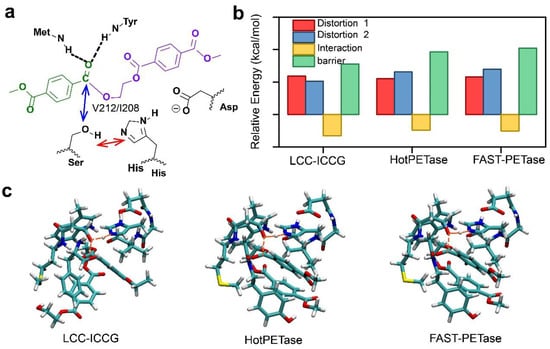
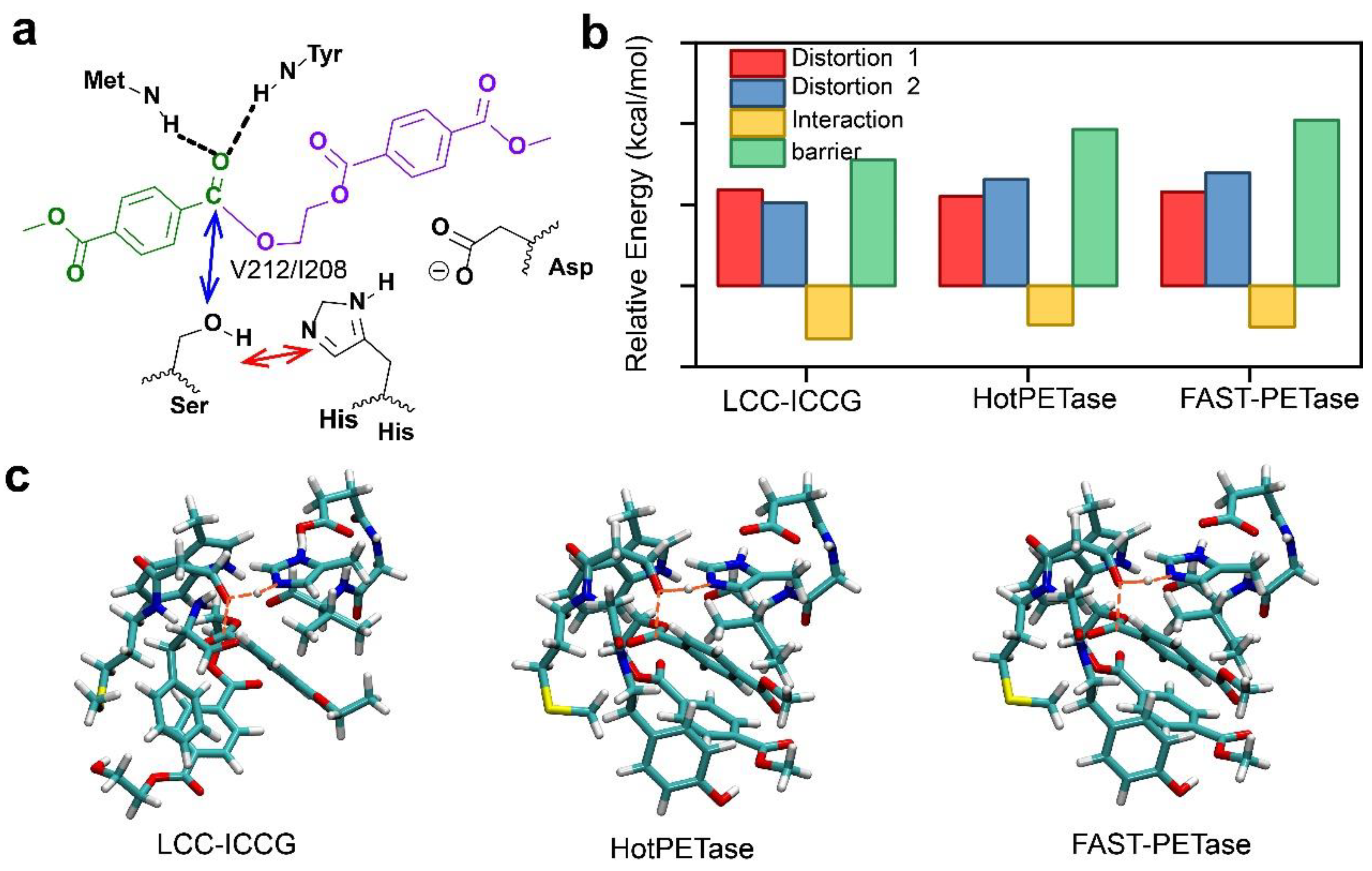
To determine whether the PRS enrichment observed in MD simulations translates into a lower chemical barrier, we performed quantum mechanical cluster calculations for the acylation step [29,30]. Representative near-attack conformations were extracted from the MD trajectories and used as starting structures for DFT calculations. This strategy connects the dynamic ensemble sampled by MD with the electronic reorganization required for bond formation, allowing us to evaluate whether the more frequent PRS formation in LCC-ICCG has direct energetic consequences. In all three systems, acylation followed the canonical serine-hydrolase mechanism. The catalytic histidine abstracts the proton from Ser-Oγ, thereby activating the serine nucleophile for attack on the ester carbonyl carbon. The resulting tetrahedral transition state is stabilized by the oxyanion hole formed by conserved tyrosine and methionine backbone amides (Figure 3a). Researchers used the QM/MM MD method to study the reaction mechanism of PETase, finding that rate-limiting acylation has a free energy barrier of 20.0 kcal/mol, consistent with the range of experimental values of 18.0–18.7 kcal/mol [31,32]. The optimized transition-state geometries showed similar overall features among the enzymes, with C···Oγ distances of 1.97 Å for LCC-ICCG, 2.04 Å for HotPETase, and 2.02 Å for FAST-PETase. These values indicate that the three systems undergo the same elementary chemical transformation.
Figure 3.
Computed mechanism of enzymatic PET biodegradation. (a) The system described at the quantum mechanical level. The potential energy profile is reported in kcal/mol. (b) A distortion/interaction activation strain analysis was performed using the theozyme model. (c) Optimized transition-state structures of LCC-ICCG, HotPETase, and FAST-PETase during acylation.
Although the optimized transition-state structures showed similar overall geometric features, the calculated energetic costs of reaching these states differed substantially (Figure 3c). The oxyanion hole, formed by the backbone NH groups of Tyr and Met residues, stabilizes the developing negative charge [33,34]. The computed acylation barrier for LCC-ICCG was 15.5 kcal/mol, which was 3.8 and 4.9 kcal/mol lower than the barriers calculated for HotPETase and FAST-PETase, respectively. The barrier predicted for LCC-ICCG aligns well with experimental kcat values (0.7–4.8 s−1; 13.5–18.0 kcal/mol via the Eyring equation), supporting the validity of the computational model. This result is consistent with the MD-derived PRS analysis: the enzyme that most frequently samples reactive geometries also exhibits the lowest transition-state barrier. The agreement between these independent levels of analysis supports a mechanistic model in which LCC-ICCG accelerates PET hydrolysis by reducing the conformational and energetic cost of reaching the acylation transition state.
To dissect the energetic origin of the barrier reduction, we performed distortion/interaction activation strain (DIAS) analysis using a theozyme-based DFT cluster model [35,36]. This analysis partitions the activation energy into two components: the distortion energy required to deform the enzyme-substrate fragments into their transition-state geometry, and the interaction energy gained when these distorted fragments interact at the transition state. This framework is particularly useful for distinguishing whether catalysis is enhanced mainly by reducing the structural penalty of reaching the transition state or by strengthening stabilizing interactions within the transition state. The DIAS results indicate that LCC-ICCG benefits from a reduced distortion penalty (Figure 3b). The PET ester in LCC-ICCG is already positioned closer to the transition-state geometry in the PRS ensemble, so less additional deformation is required during nucleophilic attack. In contrast, HotPETase and FAST-PETase must overcome a larger structural rearrangement cost because the bound PET chain more frequently occupies geometries that are displaced from the optimal Bürgi–Dunitz trajectory. This finding directly links the PRS population to the activation barrier: the higher PRS abundance in LCC-ICCG reflects a lower conformational reorganization penalty during acylation.
In addition to lowering the distortion cost, LCC-ICCG also displays more favorable transition-state interactions. The theozyme model identifies enhanced dispersion stabilization as a major contributor to transition-state stabilization, with an estimated contribution of −6.5 kcal/mol. These interactions arise from the tighter packing of the PET chain within the LCC-ICCG active pocket. The smaller V212 side chain permits close substrate packing without severe steric clash, whereas I208 in HotPETase and FAST-PETase restricts access to the same productive geometry. Therefore, steric relief and dispersion stabilization act cooperatively: V212 both creates the space needed for the PET ester to adopt a near-attack geometry and provides weak attractive contacts that help stabilize that geometry. The electronic structure of the transition state further supports this interpretation. In LCC-ICCG, the shorter nucleophilic approach distance and more constrained attack angle promote more effective n(Oγ) to π*(C=O) orbital overlap. This stereoelectronic alignment is essential for carbonyl attack and tetrahedral-intermediate formation.
These results refine the mechanistic interpretation of the V212 effect. The improved activity of LCC-ICCG is not caused by a single strong interaction but by a coordinated reduction in the energetic cost of reaching the transition state. Thus, the quantum mechanical calculations provide an energetic foundation for the MD observations. LCC-ICCG lowers the acylation barrier because its active site better aligns the substrate, reduces distortion requirements, and stabilizes the transition state.
2.4. LCC-ICCG Preserves Productive Catalytic Geometry at Elevated Temperature
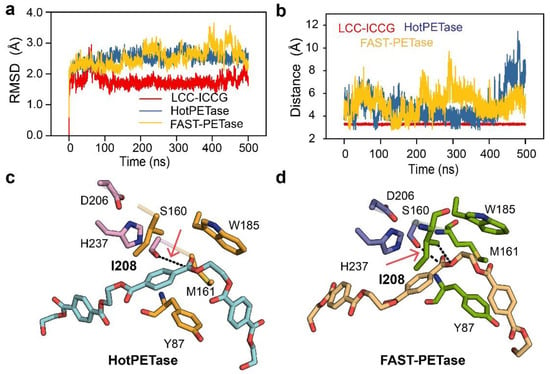
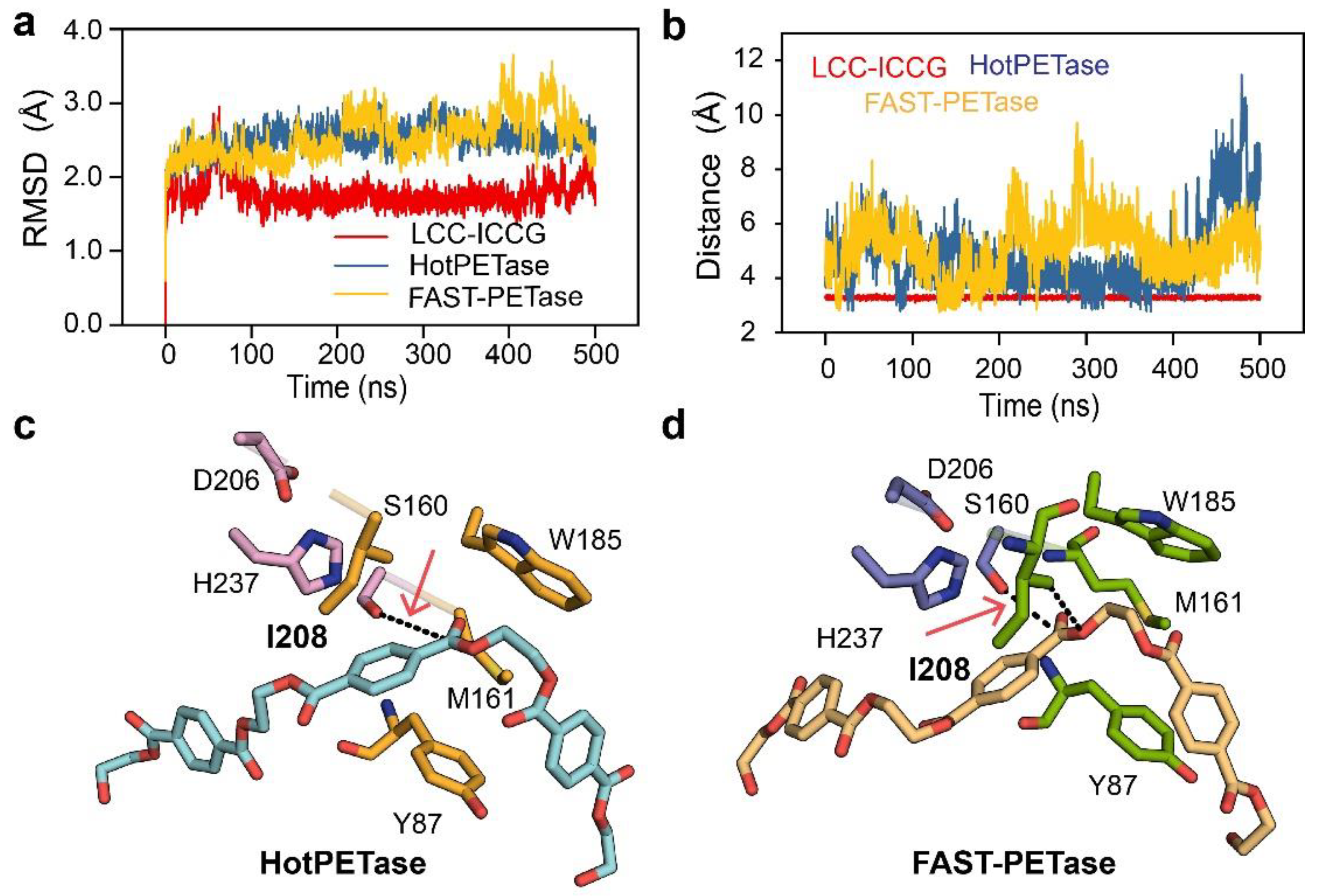
Industrial PET depolymerization benefits from elevated reaction temperatures because PET chain mobility increases near the glass-transition region. However, higher temperatures can also disrupt the active-site geometry required for catalysis. We therefore performed 500 ns MD simulations at 350 K to test whether the three enzymes differ in their ability to preserve productive enzyme-substrate configurations under thermal stress (Figure S6). LCC-ICCG rapidly reached a stable RMSD of approximately 1.5 Å, whereas HotPETase and FAST-PETase stabilized at higher RMSD values of approximately 2.1 and 2.4 Å, respectively (Figure 4a). This result indicates that LCC-ICCG maintains stronger global scaffold stability at elevated temperature.
Figure 4.
High-temperature MD analysis at 350 K. (a) RMSD evolution showing enhanced global stability of LCC-ICCG relative to HotPETase and FAST-PETase. (b) Distributions of the nucleophilic attack distance d(C···Oγ), the defining geometric parameter for PRS formation. LCC-ICCG maintains near-attack distances, whereas HotPETase and FAST-PETase undergo substantial distortion. (c,d) Representative conformations obtained from CPPTRAJ clustering analysis of the equilibrated 350 K trajectories, illustrating the preservation of productive PET positioning in LCC-ICCG and the loss of productive alignment in HotPETase and FAST-PETase.
The distribution of the nucleophilic attack distance d(C···Oγ) clearly separated LCC-ICCG from the two IsPETase-derived enzymes. In LCC-ICCG, this distance remained narrowly distributed around approximately 3.3 Å, indicating that the PET ester continued to sample near-attack conformations even at 350 K (Figure 4b). By contrast, HotPETase and FAST-PETase displayed broad distance distributions extending from approximately 3.8 to 10.2 Å. Such broadening reflects partial loss of substrate anchoring and disruption of the geometric relationship between Ser-Oγ and the scissile carbonyl carbon. Representative structures further illustrated this distinction. In LCC-ICCG, the PET chain remained inserted in the catalytic cleft, and the scissile ester retained a favorable orientation relative to the catalytic serine and oxyanion hole. In HotPETase and FAST-PETase, the substrate more frequently shifted away from the active center, disrupting the Bürgi–Dunitz alignment required for acylation (Figure 4c,d). These conformational changes explain why elevated temperature may not translate into improved catalytic chemistry for less thermally robust enzymes: increased polymer mobility is beneficial only if the enzyme can simultaneously preserve a productive active-site geometry [37,38]. The 350 K simulations therefore extend the PRS model from ambient dynamics to industrially relevant thermal conditions. LCC-ICCG is superior not only because it forms PRS conformations more frequently but also because it maintains these conformations under thermal perturbation. This dual advantage is mechanistically important. At elevated temperature, a PET hydrolase must satisfy two requirements: it must remain structurally stable, and it must continue to organize the substrate for nucleophilic attack. LCC-ICCG satisfies both requirements more effectively than HotPETase and FAST-PETase. These results also help rationalize the experimentally observed high-temperature performance of LCC-ICCG. The enzyme does not merely tolerate elevated temperature as a passive stable scaffold. Instead, its thermal robustness preserves the local stereoelectronic arrangement needed for acylation. Therefore, the superior catalytic behavior of LCC-ICCG under high-temperature PET-depolymerization conditions can be understood as a consequence of temperature-resistant active-site preorganization.
2.5. I208V Mutation Supports the Transferability of the V212-Centered Design Principle
The analyses above suggest that V212 promotes LCC-ICCG activity by reducing steric congestion and enriching PRS conformations. To test whether this principle can be transferred to IsPETase-derived scaffolds, we introduced the reciprocal I208V mutation into HotPETase and FAST-PETase. This mutation was designed to reduce side-chain bulk at the position corresponding to V212 in LCC-ICCG while preserving the hydrophobic character of the local environment.
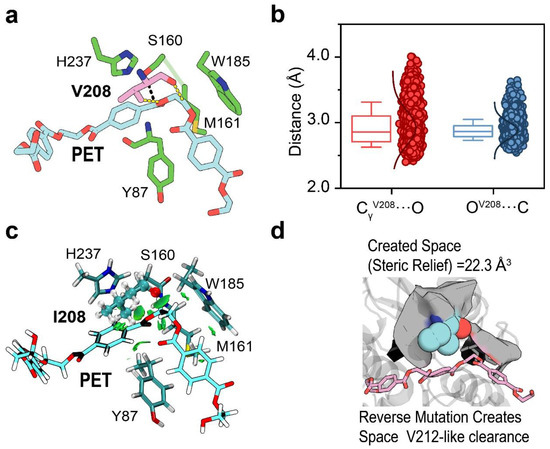
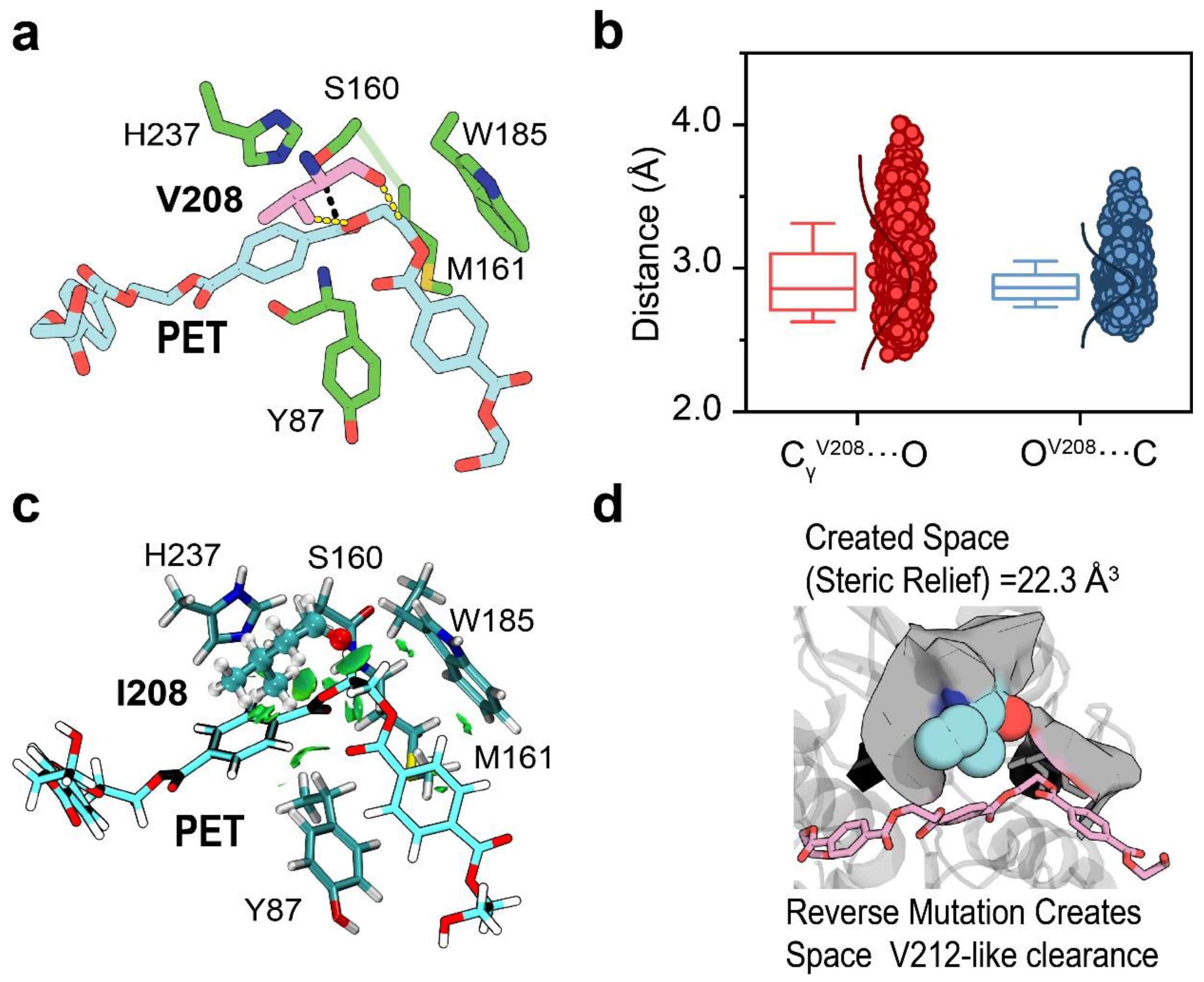
MD simulations of the I208V mutants showed that the introduced V208 residue partially recapitulates the interaction behavior of V212. V208 formed close contacts of approximately 3.1 Å with the non-carbonyl oxygen of the scissile ester and engaged adjacent PET methylene groups within approximately 3.0–3.3 Å (Figure 5a,b). These contacts resemble the weak C–H···O and dispersion-dominated interactions observed for V212 in LCC-ICCG. IGMH analysis further revealed green isosurfaces around V208, indicating that the mutation strengthens weak attractive interactions within the ester-binding region (Figure 5c).
Figure 5.
Transferability of the V212 design principle through I208V mutation. (a) Structural model showing V208 interactions with the PET ester group and adjacent methylene units. (b) Time-averaged distance profiles showing close positioning of V208 relative to key PET atomic centers. (c) IGMH analysis showing dispersion-dominated interactions, represented by green isosurfaces, formed by V208 within the active pocket. (d) Changes in spatial extent after mutation.
Functionally, the mutation increased the PRS population from 11.4% to 21.3%. This near-doubling of catalytically competent conformations provides direct support for the proposed mechanism. Reducing steric bulk near the scissile ester improves the probability that the substrate adopts a near-attack geometry. The result also indicates that the beneficial role of valine at this position is not unique to the LCC scaffold; rather, it represents a transferable local design principle that can be applied to related PET hydrolases (Figure 5d).
This distinction is important for enzyme engineering. A single mutation can enrich productive conformations, but optimal PET hydrolase design will likely require simultaneous optimization of several coupled features: local steric relief near the scissile ester, stabilization of the oxyanion-hole interaction, control of W-loop dynamics, preservation of the Asp-His proton-transfer network, and global thermostability under reaction conditions. The I208V mutation therefore provides mechanistic validation of the V212 design rule while also highlighting the need to embed this local feature into a compatible scaffold environment. This scaffold dependence is consistent with recent surface-charge engineering studies showing that the effects of PETase mutations on active-site flexibility and hydrolytic activity depend on both the parental enzyme background and PET substrate morphology [37,38]. Recent paradigm-shifting studies have underscored the vital role of global enzyme dynamics, surface charge distributions, and conformational selection during these non-chemical steps [39,40].
Finally, it should be emphasized that PET depolymerization is a multi-step process. Macroscopic activity depends on enzyme adsorption to the polymer surface, extraction of a PET chain from the solid substrate, binding into the active cleft, acylation and deacylation chemistry, product release, and long-term enzyme stability. The V212/I208V principle proposed here specifically targets the chemical preorganization and acylation step. It should therefore be regarded as one component of a broader engineering strategy rather than a complete explanation for all aspects of PET-depolymerization performance.
3. Materials and Methods
3.1. System Preparation
The initial protein structures of LCC-ICCG, HotPETase, and FAST-PETase were obtained from experimentally resolved crystal structures deposited in the Protein Data Bank. The PDB IDs used in this study were 6THT for LCC-ICCG, 7QVH for HotPETase, and 7SH6 for FAST-PETase. Structural templates were selected primarily according to sequence correspondence to the engineered variants studied here, followed by crystallographic resolution and completeness of the catalytic and substrate-binding regions. PDB 6THT was selected as the closest experimentally determined representation of the LCC-ICCG scaffold. This structure contains the four defining ICCG substitutions but also carries the catalytically inactivating S165A substitution introduced for crystallographic characterization. PDB 7QVH and 7SH6 correspond directly to the experimentally characterized HotPETase and FAST-PETase variants, respectively. Chain A was used for all three structural templates after confirming completeness of the catalytic and substrate-binding regions (Table S1). The PET substrate was represented by a trimeric oligomer, 2-hydroxyethyl-(mono-hydroxyethyl terephthalate)_3, hereafter referred to as the PET trimer, consistent with previous simulation studies [41,42]. Missing hydrogen atoms were added before system construction, and crystallographic water molecules and non-protein components that were not involved in substrate recognition were removed unless otherwise specified. The substrate model was selected because it is sufficiently long to capture interactions among the −1, +1, and +2 binding subsites while remaining computationally tractable for microsecond-scale simulations and quantum mechanical calculations. The initial conformational ensemble of the PET trimer was generated using CREST with the semiempirical GFN2-xTB method [43]. Representative low-energy conformers were then used for subsequent docking and molecular dynamics simulations. Electrostatic potential (ESP) calculations were carried out at the HF/6-31G(d) level followed by two-stage RESP charge fitting [44]. Bonded and non-bonded force-field parameters for the substrate were generated using Antechamber in the AmberTools suite [45].
3.2. Docking and MD Simulations
Enzyme–substrate docking was performed using AutoDock Vina version 1.2.0 with the Vina scoring function [46,47]. Receptor and PET-trimer PDBQT files were prepared using AutoDockTools in MGLTools version 1.5.7, employing prepare_receptor4.py and prepare_ligand4.py with their default settings. Polar hydrogen atoms were included, nonpolar hydrogen atoms were merged, and Gasteiger partial charges were assigned during PDBQT preparation. The receptors were treated as rigid, whereas rotatable bonds of the PET trimer were treated as flexible. The Gasteiger charges were used only for preparation of the docking inputs; the RESP charges described in Section 3.1 were used for subsequent MD parameterization of the PET trimer. For each enzyme, a 30 × 30 × 30 Å search box was centered on the Oγ atom of the catalytic serine (Ser165 in LCC-ICCG and Ser160 in HotPETase and FAST-PETase). Docking was performed using the default stochastic search algorithm with exhaustiveness = 64, num_modes = 20, and energy_range = 5 kcal/mol (Figure S7). Enzyme-substrate docking poses were filtered based on strict geometric prerequisites for serine hydrolase activity: (i) the scissile carbonyl oxygen must be oriented toward the oxyanion hole formed by Tyr and Met, and (ii) the distance between Ser-OY and the carbonyl carbon must be below 4.5Å. The protonation states of titratable residues were assigned according to the experimental pH conditions using PROPKA 3.0 [48].
The protonation states of titratable residues were assigned at pH 8.0, corresponding to the experimental conditions used in the comparative PET-hydrolysis study. In particular, the catalytic histidine residue was assigned in a protonation state compatible with its role in the Ser-His-Asp catalytic triad [48]. Specifically, the histidine residue in the catalytic triad was protonated at the δ-nitrogen position. To verify the robustness of our starting configurations, alternative docking poses meeting these criteria were subjected to independent MD simulations. This procedure ensured that subsequent mechanistic analyses were based on enzyme-substrate complexes that were both structurally stable and catalytically plausible.
All molecular dynamics simulations were performed using the GPU-accelerated pmemd. CUDA engine in Amber 22 with a 2 fs integration time step [49]. Each enzyme-substrate complex was solvated in a cubic TIP3P water box with a minimum buffer distance of 10 Å between the solute and the box boundary. Counterions were added to neutralize the total charge of each system. Periodic boundary conditions were applied in all three dimensions. Energy minimization was performed in two stages. First, water molecules and counterions were relaxed while restraining the protein and substrate heavy atoms. Second, the entire system was minimized without positional restraints to remove unfavorable contacts. After minimization, the systems were gradually heated from 0 to 300 K over 100 ps using a Langevin thermostat. The heated systems were then equilibrated in the NVT ensemble, followed by additional equilibration in the NPT ensemble at 1 bar. Pressure regulation was performed using a Berendsen barostat during equilibration. Production runs were performed at 300 K and 1 bar with a 2 fs time step. Each enzyme–PET complex was simulated in five independent 1-μs production replicas initiated with independently assigned initial velocities and random-number seeds. The common 20–100 ns interval was used for replica-level structural and statistical analyses after exclusion of the initial relaxation period [50]. Production MD simulations were performed using the GPU-accelerated pmemd. CUDA engine in Amber 22 on NVIDIA Tesla V100 GPUs, with each production trajectory executed on a single GPU. A 2-fs integration time step was used. For the present solvated enzyme–PET systems, the observed production rate was approximately 340 ns/day per GPU, corresponding to approximately 7 h for a 100 ns trajectory and approximately 70 h for a 1-μs trajectory, with minor variation depending on system size (Table S2).
Trajectories in which the PET substrate remained stably bound within the catalytic cleft and maintained a catalytically relevant orientation were further extended to 1 μs for detailed mechanistic analysis. A trajectory was considered suitable for extended mechanistic analysis when the PET substrate remained associated with the active-site cleft and repeatedly sampled nucleophilic attack distances d(C···Oγ) ≤ 4.0 Å during the initial production stage. Importantly, global structural stability, substrate binding mode, and active-site geometry were evaluated across all replicas, while detailed PRS, noncovalent-interaction, and QM model construction were performed using equilibrated regions of the extended trajectories.
Trajectory analyses were performed using CPPTRAJ scripts [51]. Representative conformations used for structural visualization were obtained by clustering the equilibrated MD trajectories using the clustering functionality implemented in CPPTRAJ. The representative structure of the dominant conformational cluster was used to illustrate the characteristic enzyme–substrate binding geometry rather than selecting an arbitrary snapshot from a specific simulation time point. Root-mean-square deviation (RMSD) values were calculated using the protein Cα atoms after alignment to the initial minimized structure. Root-mean-square fluctuation (RMSF) values were calculated for each residue to evaluate local flexibility, with particular attention to the catalytic triad, oxyanion-hole region, W-loop, and substrate-binding residues. Independent MD replicas were treated as the statistical units for replica-level comparisons. For scalar descriptors, each replica was summarized by its time-averaged value over the common equilibrated 20–100 ns analysis interval. The two prespecified comparisons of LCC-ICCG with HotPETase and FAST-PETase were performed using two-sided Welch’s t-tests, followed by Holm correction for multiple comparisons. Data are reported as mean ± SD across independent replicas (n = 5 per enzyme), and exact adjusted p values are provided where applicable. Individual trajectory frames were not treated as statistically independent observations.
All structural figures were prepared using VMD 1.9.3 and PyMOL 3.1. Distance distributions, angle distributions, RMSD, RMSF, SASA, and PRS populations were plotted from equilibrated trajectory data. Binding free energies were estimated using the MM/GBSA method. MM/GBSA binding free energy calculations were averaged across the equilibrated windows of all five replicas to ensure statistical convergence, with snapshots extracted every 1 ns [52,53]. Per-residue energy decomposition was performed to identify residues that contribute most strongly to PET recognition and active-site stabilization. The decomposition analysis focused on residues located in the catalytic cleft, oxyanion-hole region, W-loop, and substrate-binding subsites.
3.3. DFT Calculations
The reaction mechanism was investigated using a quantum mechanical cluster (theozyme) model, an all-QM approach that has been extensively validated for studying enzymatic catalysis. Pre-reaction state (PRS) structures closest to the transition state, identified from theozyme models, were extracted from MD trajectories and used as starting geometries.
All geometry optimizations were carried out using the ωB97X-D functional with the 6-31+G(d) basis set as implemented in Gaussian 16 [54]. The ωB97X-D functional was selected because it includes long-range correction and empirical dispersion, which are important for describing weak noncovalent interactions in enzyme active sites. Frequency calculations were performed to confirm the nature of stationary points. Transition states were verified by the presence of a single imaginary frequency corresponding to the nucleophilic attack/proton-transfer coordinate. Intrinsic reaction coordinate calculations were performed to confirm that each transition state connects the corresponding reactant and tetrahedral-intermediate states. Solvent effects arising from the protein environment were approximated via single-point calculations using the SMD implicit solvation model (ε = 4). Zero-point energy (ZPE) corrections were obtained from frequency calculations [55].
To decompose the origin of barrier heights, a distortion/interaction activation strain (DIAS) analysis was conducted [56,57]. Within this framework, the activation energy (ΔE⧧) is partitioned into: the distortion energy (ΔEdist), which is needed to distort the isolated reactants into transition-state geometry, and the interaction energy (ΔEint) resulting from bringing the two distorted isolated fragments together. DIAS was evaluated at the intrinsic TS for each enzyme. Noncovalent interactions within representative enzyme-substrate complexes were analyzed using the independent gradient model based on Hirshfeld partitioning (IGMH) and atoms-in-molecules (AIM) through Multiwfn 3.7 program [58,59,60,61,62]. The resulting isosurfaces were colored according to the sign(λ2)ρ function, where blue indicates strong attractive interactions, green indicates weak attractive interactions such as van der Waals or dispersion interactions, and red indicates steric repulsion.
4. Conclusions
In this work, we provide a mechanistic explanation for the superior PET-depolymerization activity of LCC-ICCG by linking active-site dynamics, pre-reaction-state formation, and acylation energetics. Although LCC-ICCG, HotPETase, and FAST-PETase share the same serine-hydrolase catalytic framework, they differ substantially in their ability to convert substrate binding into chemically productive binding. LCC-ICCG samples catalytically competent pre-reaction states far more frequently than the two IsPETase-derived enzymes, indicating that its catalytic advantage originates not only from stability or affinity but also from more effective active-site preorganization.
Our multiscale simulations identify V212 as a key residue that reshapes the local reaction environment around the scissile ester. By reducing steric congestion, supporting weak C–H···O guided substrate alignment, reinforcing the Asp-His hydrogen-bonding network, and stabilizing the W190-associated pocket architecture, V212 increases the population of Bürgi–Dunitz-compatible near-attack conformations. This preorganized ensemble reduces the structural distortion required to reach the transition state and lowers the computed acylation barrier to 15.5 kcal/mol. High-temperature simulations further show that LCC-ICCG preserves productive catalytic geometry at 350 K, providing a structural basis for its robust performance under elevated-temperature PET-depolymerization conditions.
Reciprocal I208V mutation in IsPETase-derived enzymes enriches PRS populations and strengthens local dispersion-dominated contacts around the ester bond, validating the transferability of the V212-centered design principle. Together, these results establish active-site steric relief, weak stereoelectronic preorganization, catalytic-dyad reinforcement, and transition-state distortion reduction as mechanistic determinants of efficient PET hydrolysis. More broadly, this study highlights that engineering PET hydrolases should not focus solely on global thermostability or substrate affinity; instead, rational design should also optimize the conformational probability of reaching chemically competent states. This framework provides actionable guidance for developing next-generation PET depolymerases for closed-loop polymer recycling.
Supplementary Materials
The following supporting information can be downloaded at: https://www.mdpi.com/article/10.3390/catal16080730/s1, Figure S1: Reproducibility of global structural dynamics across independent MD replicas; Figure S2: Replica-level RMSF analysis; Figure S3: Replica-level SASA analysis; Figure S4: Aromatic stacking interactions between PET and active-site residues; Figure S5: Representative W-loop conformations; Figure S6: Initial PET-trimer docking conformations; Figure S7. Time evolution of the minimum separation between the enzyme–PET complexes and their periodic images. Table S1: Structural-template information; Table S2: Composition of the enzyme–PET systems used for molecular dynamics simulations; Supplementary Data S1: MD input files and analysis scripts.
Author Contributions
C.L.: Conceptualization, Methodology, Molecular dynamics simulations, DFT calculations, Visualization, Writing—original draft. D.-Q.W.: Supervision, Resources, Writing—review and editing. W.M.: Computational modeling, Formal analysis, Mechanistic interpretation, Figure preparation, Writing—review. J.L.: Conceptualization, Supervision, Project administration, funding acquisition, Writing—review and editing. All authors have read and agreed to the published version of the manuscript.
Funding
This work was supported by the National Key R&D Program of China (2024YFA1306400) and the National Natural Science Foundation of China (32570803, 32030063).
Data Availability Statement
The data supporting the findings of this study are provided within the article and its Supporting Information. The data presented in this study are available from the corresponding author upon reasonable request.
Conflicts of Interest
The authors declare no conflicts of interest.
References
- Ellis, L.D.; Rorrer, N.A.; Sullivan, K.P.; Otto, M.; McGeehan, J.E.; Román-Leshkov, Y.; Wierckx, N.; Beckham, G.T. Chemical and biological catalysis for plastics recycling and upcycling. Nat. Catal. 2021, 4, 539–556. [Google Scholar] [CrossRef] [Scilit]
- Garcia, J.M.; Robertson, M.L. The future of plastics recycling. Science 2017, 358, 870–872. [Google Scholar] [CrossRef] [Scilit] [PubMed]
- Tournier, V.; Duquesne, S.; Guillamot, F.; Cramail, H.; Taton, D.; Marty, A.; André, I. Enzymes’ power for plastics degradation. Chem. Rev. 2023, 123, 5612–5651. [Google Scholar] [CrossRef] [Scilit] [PubMed]
- Wei, R.; Tiso, T.; Bertling, J.; O’Connor, K.; Blank, L.M.; Bornscheuer, U.T. Possibilities and Limitations of Biotechnological Plastic Degradation and Recycling. Nat. Catal. 2020, 3, 867–871. [Google Scholar] [CrossRef] [Scilit]
- Oda, K.; Wlodawer, A. Development of enzyme-based approaches for recycling PET on an industrial scale. Biochemistry 2024, 63, 369–401. [Google Scholar] [CrossRef] [Scilit] [PubMed]
- Yoshida, S.; Hiraga, K.; Takehana, T.; Taniguchi, I.; Yamaji, H.; Maeda, Y.; Toyohara, K.; Miyamoto, K.; Kimura, Y.; Oda, K. A bacterium that degrades and assimilates poly(ethylene terephthalate). Science 2016, 351, 1196–1199. [Google Scholar] [CrossRef] [Scilit] [PubMed]
- Han, X.; Liu, W.; Huang, J.-W.; Ma, J.; Zheng, Y.; Ko, T.-P.; Xu, L.; Cheng, Y.-S.; Chen, C.-C.; Guo, R.-T. Structural insight into catalytic mechanism of PET hydrolase. Nat. Commun. 2017, 8, 2106. [Google Scholar] [CrossRef] [Scilit] [PubMed]
- Seo, H.; Hong, H.; Park, J.; Lee, S.H.; Ki, D.; Ryu, A.; Sagong, H.-Y.; Kim, K.-J. Landscape profiling of PET depolymerases using a natural sequence cluster framework. Science 2025, 387, eadp5637. [Google Scholar] [CrossRef] [Scilit] [PubMed]
- Richter, P.K.; Blázquez-Sánchez, P.; Zhao, Z.; Engelberger, F.; Wiebeler, C.; Künze, G.; Frank, R.; Krinke, D.; Frezzotti, E.; Lihanova, Y.; et al. Structure and function of the metagenomic plastic-degrading polyester hydrolase PHL7 bound to its product. Nat. Commun. 2023, 14, 1905. [Google Scholar] [CrossRef] [Scilit] [PubMed]
- Shi, L.; Liu, P.; Tan, Z.; Zhao, W.; Gao, J.; Gu, Q.; Ma, H.; Liu, H.; Zhu, L. Complete depolymerization of PET wastes by an evolved PET hydrolase from directed evolution. Angew. Chem. Int. Ed. 2023, 62, e202218390. [Google Scholar] [CrossRef] [Scilit] [PubMed]
- Cui, Y.; Chen, Y.; Sun, J.; Zhu, T.; Pang, H.; Li, C.; Geng, W.-C.; Wu, B. Computational redesign of a hydrolase for nearly complete PET depolymerization at industrially relevant high-solids loading. Nat. Commun. 2024, 15, 1417. [Google Scholar] [CrossRef] [Scilit] [PubMed]
- Hong, H.S.; Ki, D.; Seo, H.; Park, J.; Jang, J.; Kim, K.J. Discovery and rational engineering of PET hydrolase with both mesophilic and thermophilic PET hydrolase properties. Nat. Commun. 2023, 14, 4556. [Google Scholar] [CrossRef] [Scilit] [PubMed]
- Lu, H.; Diaz, D.J.; Czarnecki, N.J.; Zhu, C.; Kim, W.; Shroff, R.; Acosta, D.J.; Alexander, B.R.; Cole, H.O.; Zhang, Y.; et al. Machine learning-aided engineering of hydrolases for PET depolymerization. Nature 2022, 604, 662–667. [Google Scholar] [CrossRef] [Scilit] [PubMed]
- Bell, E.L.; Smithson, R.; Kilbride, S.; Foster, J.; Hardy, F.J.; Ramachandran, S.; Tedstone, A.A.; Haigh, S.J.; Garforth, A.A.; Day, P.J.R.; et al. Directed evolution of an efficient and thermostable PET depolymerase. Nat. Catal. 2022, 5, 673–681. [Google Scholar] [CrossRef] [Scilit]
- Tournier, V.; Topham, C.M.; Gilles, A.; David, B.; Folgoas, C.; Moya-Leclair, E.; Kamionka, E.; Desrousseaux, M.L.; Texier, H.; Gavalda, S.; et al. An engineered PET depolymerase to break down and recycle plastic bottles. Nature 2020, 580, 216–219. [Google Scholar] [CrossRef] [Scilit] [PubMed]
- Arnal, G.; Anglade, J.; Gavalda, S.; Tournier, V.; Chabot, N.; Bornscheuer, U.T.; Weber, G.; Marty, A. Assessment of four engineered PET degrading enzymes considering large-scale industrial applications. ACS Catal. 2023, 13, 13156–13166. [Google Scholar] [CrossRef] [Scilit] [PubMed]
- Zheng, M.; Li, Y.W.; Dong, W.L.; Zhang, W.X.; Feng, S.S.; Zhang, Q.Z.; Wang, W.X. Depolymerase-catalyzed polyethylene terephthalate hydrolysis: A unified mechanism revealed by quantum mechanics/molecular mechanics analysis. ACS Sustain. Chem. Eng. 2022, 10, 7341–7348. [Google Scholar] [CrossRef] [Scilit]
- Zheng, M.; Li, Y.; Dong, W.; Feng, S.; Zhang, Q.; Wang, W. Computational biotransformation of polyethylene terephthalate by depolymerase: A QM/MM approach. J. Hazard. Mater. 2022, 423, 127017. [Google Scholar] [CrossRef] [Scilit] [PubMed]
- Pinto, A.V.; Ferreira, P.; Neves, R.P.P.; Fernandes, P.A.; Ramos, M.J.; Magalhães, A.L. Reaction mechanism of MHETase, a PET degrading enzyme. ACS Catal. 2021, 11, 10416–10428. [Google Scholar] [CrossRef] [Scilit]
- Zheng, M.; Li, Y.; Dong, W.; Zhang, Q.; Wang, W. Hydrolase-Catalyzed Depolymerization Mechanism toward Crystalline and Amorphous Polyethylene Terephthalate. ACS Sustain. Chem. Eng. 2024, 12, 10252−10259. [Google Scholar] [CrossRef] [Scilit]
- Jerves, C.; Neves, R.P.P.; Ramos, M.J.; da Silva, S.; Fernandes, P.A. Reaction mechanism of the PET degrading enzyme PETase studied with DFT/MM molecular dynamics simulations. ACS Catal. 2021, 11, 11626–11638. [Google Scholar] [CrossRef] [Scilit]
- Jäckering, A.; Göttsch, F.; Schäffler, M.; Doerr, M.; Bornscheuer, U.; Wei, R.; Strodel, B. From Bulk to Binding: Decoding the Entry Of PET into Hydrolase Binding Pockets. JACS Au 2024, 4, 4000–4012. [Google Scholar] [CrossRef] [Scilit] [PubMed]
- Crnjar, A.; Griñen, A.; Kamerlin, S.C.L.; Ramírez-Sarmiento, C.A. Conformational selection of a tryptophan side chain drives the generalized increase in activity of PET hydrolases through a Ser/Ile double mutation. ACS Org. Inorg. Au 2023, 3, 109–119. [Google Scholar] [CrossRef] [Scilit] [PubMed]
- Yin, Q.; Zhang, J.; Ma, S.; Gu, T.; Wang, M.; You, S.; Ye, S.; Su, R.; Wang, Y.; Qi, W. Efficient polyethylene terephthalate biodegradation by an engineered Ideonella sakaiensis PETase with a fixed substrate-binding W156 residue. Green Chem. 2024, 26, 2560–2570. [Google Scholar] [CrossRef] [Scilit]
- Sadiq, S.K.; Coveney, P.V. Computing the role of near attack conformations in an enzyme-catalyzed nucleophilic bimolecular reaction. J. Chem. Theory Comput. 2015, 11, 316–324. [Google Scholar] [CrossRef] [Scilit] [PubMed]
- Newberry, R.W.; Raines, R.T. The n→π* interaction. Acc. Chem. Res. 2017, 50, 1838–1846. [Google Scholar] [CrossRef] [Scilit] [PubMed]
- Luo, S.; Liu, L.; Lyu, C.-J.; Sim, B.; Liu, Y.; Gong, H.; Nie, Y.; Zhao, Y.-L. Understanding the effectiveness of enzyme pre-reaction state by a quantum-based machine learning model. Cell Rep. Phys. Sci. 2022, 3, 101128. [Google Scholar] [CrossRef] [Scilit]
- Emamian, S.; Lu, T.; Kruse, H.; Emamian, H. Exploring nature and predicting strength of hydrogen bonds: A correlation analysis between atoms-in-molecules descriptors, binding energies, and energy components of symmetry-adapted perturbation theory. J. Comput. Chem. 2019, 40, 2868–2881. [Google Scholar] [CrossRef] [Scilit] [PubMed]
- Himo, F. Recent trends in quantum chemical modeling of enzymatic reactions. J. Am. Chem. Soc. 2017, 139, 6780–6786. [Google Scholar] [CrossRef] [Scilit] [PubMed]
- Sheng, X.; Himo, F. The quantum chemical cluster approach in biocatalysis. Acc. Chem. Res. 2023, 56, 938–947. [Google Scholar] [CrossRef] [Scilit] [PubMed]
- Chen, C.C.; Han, X.; Li, X.; Jiang, P.; Niu, D.; Ma, L.; Liu, W.; Li, S.; Qu, Y.; Hu, H.; et al. General features to enhance enzymatic activity of poly (ethylene terephthalate) hydrolysis. Nat. Catal. 2021, 4, 425–430. [Google Scholar] [CrossRef] [Scilit]
- Pirillo, V.; Pollegioni, L.; Molla, G. Analytical methods for the investigation of enzyme-catalyzed degradation of polyethylene terephthalate. FEBS J. 2021, 288, 4730–4745. [Google Scholar] [CrossRef] [Scilit] [PubMed]
- Joho, Y.; Royan, S.; Caputo, A.T.; Newton, S.; Peat, T.S.; Newman, J.; Jackson, C.; Ardevol, A. Enhancing PET degrading enzymes: A combinatory approach. ChemBioChem 2024, 25, e202400084. [Google Scholar] [CrossRef] [Scilit] [PubMed]
- Burgin, T.; Pollard, B.C.; Knott, B.C.; Mayes, H.B.; Crowley, M.F.; McGeehan, J.E.; Beckham, G.T.; Woodcock, H.L. The reaction mechanism of the Ideonella sakaiensis PETase enzyme. Commun. Chem. 2024, 7, 65. [Google Scholar] [CrossRef] [Scilit] [PubMed]
- Shao, Q.; Hollenbeak, A.C.; Jiang, Y.; Ran, X.; Bachmann, B.O.; Yang, Z.J. SubTuner leverages physics-based modeling to comple ment AI in enzyme engineering toward non-native substrates. Chem Catal. 2025, 5, 101334. [Google Scholar] [CrossRef] [Scilit] [PubMed]
- Kiss, G.; Celebi-Oelcuem, N.; Moretti, R.; Baker, D.; Houk, K.N. Computational enzyme design. Angew. Chem. Int. Ed. 2013, 52, 5700–5725. [Google Scholar] [CrossRef] [Scilit] [PubMed]
- Ding, K.; Levitskaya, Z.; Sana, B.; Pasula, R.R.; Kannan, S.; Adam, A.; Sundaravadanam, V.V.; Verma, C.; Lim, S.; Ghadessy, J.F. Modulation of PETase active site flexibility and activity on morphologically distinct polyethylene terephthalate substrates by surface charge engineering. Biochem. Eng. J. 2024, 209, 109420. [Google Scholar] [CrossRef] [Scilit]
- Zeng, W.; Li, X.; Yang, Y.; Min, J.; Huang, J.-W.; Liu, W.; Niu, D.; Yang, X.; Han, X.; Zhang, L.; et al. Substrate-binding mode of a thermophilic PET hydrolase and engineering the enzyme to enhance the hydrolytic efficacy. ACS Catal. 2022, 12, 3033–3040. [Google Scholar] [CrossRef] [Scilit]
- Ding, Y.; Zhang, S.; Kong, X.; Hess, H.; Zhang, Y. Replicating PET hydrolytic activity by positioning active sites with smaller synthetic protein scaffolds. Adv. Sci. 2025, 12, 2500859. [Google Scholar] [CrossRef] [Scilit] [PubMed]
- Brinch-Pedersen, W.; Keller, M.B.; Dorau, R.; Paul, B.; Jensen, K.; Borch, K.; Westh, P. Discovery and surface charge engineering of fungal cutinases for enhanced activity on poly(ethylene terephthalate). ACS Sustain. Chem. Eng. 2024, 12, 7329–7337. [Google Scholar] [CrossRef] [Scilit]
- García-Meseguer, R.; Ortí, E.; Tuñón, I.; Ruiz-Pernía, J.J.; Aragó, J. Insights into the enhancement of the poly (ethylene terephthalate) degradation by FAST-PETase from computational modeling. J. Am. Chem. Soc. 2023, 145, 19243–19255. [Google Scholar] [CrossRef] [Scilit] [PubMed]
- Liu, Y.-J.; Yan, F.; Dong, W.; Sun, Y.; Wei, R.; Feng, Y. Optimized whole-cell depolymerization of polyethylene terephthalate to monomers using engineered Clostridium thermocellum. J. Hazard. Mater. 2025, 488, 137441. [Google Scholar] [CrossRef] [Scilit] [PubMed]
- Pracht, P.; Bohle, F.; Grimme, S. Automated exploration of the low-energy chemical space with fast quantum chemical methods. Phys. Chem. Chem. Phys. 2020, 22, 7169–7192. [Google Scholar] [CrossRef] [Scilit] [PubMed]
- Kirschner, K.N.; Yongye, A.B.; Tschampel, S.M.; González-Outeiriño, J.; Daniels, C.R.; Foley, B.L.; Woods, R.J. GLYCAM06: A generalizable biomolecular force field. Carbohydrates. J. Comput. Chem. 2008, 29, 622–655. [Google Scholar] [CrossRef] [Scilit] [PubMed]
- Tang, S.; Chen, R.; Lin, M.; Lin, Q.; Zhu, Y.; Ding, J.; Hu, H.; Ling, M.; Wu, J. Accelerating AutoDock Vina with GPUs. Molecules 2022, 27, 3041. [Google Scholar] [CrossRef] [Scilit] [PubMed]
- Eberhardt, J.; Santos-Martins, D.; Tillack, A.F.; Forli, S. AutoDock Vina 1.2.0: New docking methods, expanded force field, and Python bindings. J. Chem. Inf. Model. 2021, 61, 3891–3898. [Google Scholar] [CrossRef] [Scilit] [PubMed]
- Case, D.A.; Aktulga, H.M.; Belfon, K.; Cerutti, D.S.; Cisneros, G.A.; Cruzeiro, V.W.D.; Forouzesh, N.; Giese, T.J.; Götz, A.W.; Gohlke, H.; et al. AmberTools. J. Chem. Inf. Model. 2023, 63, 6183–6191. [Google Scholar] [CrossRef] [Scilit] [PubMed]
- Olsson, M.H.M.; Søndergaard, C.R.; Rostkowski, M.; Jensen, J.H. PROPKA3: Consistent treatment of internal and surface residues in empirical pKa predictions. J. Chem. Theory Comput. 2011, 7, 525–537. [Google Scholar] [CrossRef] [Scilit] [PubMed]
- Salomon-Ferrer, R.; Götz, A.W.; Poole, D.; Le Grand, S.; Walker, R.C. Routine microsecond molecular dynamics simulations with AMBER on GPUs. 2. Explicit solvent particle mesh Ewald. J. Chem. Theory Comput. 2013, 9, 3878–3888. [Google Scholar] [CrossRef] [Scilit] [PubMed]
- Knapp, B.; Ospina, L.; Deane, C.M. Avoiding false positive conclusions in molecular simulation: The importance of replicas. J. Chem. Theory Comput. 2018, 14, 6127–6138. [Google Scholar] [CrossRef] [Scilit] [PubMed]
- Roe, D.R.; Cheatham, T.E. Parallelization of CPPTRAJ enables large scale analysis of molecular dynamics trajectory data. J. Comput. Chem. 2018, 39, 2110–2117. [Google Scholar] [CrossRef] [Scilit] [PubMed]
- Miller, B.R.; McGee, T.D.; Swails, J.M.; Homeyer, N.; Gohlke, H.; Roitberg, A.E. MMPBSA.py: An efficient program for end-state free energy calculations. J. Chem. Theory Comput. 2012, 8, 3314–3321. [Google Scholar] [CrossRef] [Scilit] [PubMed]
- Wang, E.; Sun, H.; Wang, J.; Wang, Z.; Liu, H.; Zhang, J.Z.H.; Hou, T. End-point binding free energy calculation with MM/PBSA and MM/GBSA: Strategies and applications in drug design. Chem. Rev. 2019, 119, 9478–9508. [Google Scholar] [CrossRef] [Scilit] [PubMed]
- Frisch, M.J.; Trucks, G.W.; Schlegel, H.B.; Scuseria, G.E.; Robb, M.A.; Cheeseman, J.R.; Scalmani, V.G.; Barone, V.; Petersson, G.A.; Nakatsuji, H.; et al. Gaussian 16, Revision A.03; Gaussian, Inc.: Wallingford, CT, USA, 2016. [Google Scholar]
- Marenich, A.V.; Cramer, C.J.; Truhlar, D.G. Universal solvation model based on solute electron density and on a continuum model of the solvent defined by the bulk dielectric constant and atomic surface tensions. J. Phys. Chem. B 2009, 113, 6378–6396. [Google Scholar] [CrossRef] [Scilit] [PubMed]
- Bickelhaupt, F.M.; Houk, K.N. Analyzing reaction rates with the distortion/interaction-activation strain model. Angew. Chem. Int. Ed. 2017, 56, 10070–10086. [Google Scholar] [CrossRef] [Scilit] [PubMed]
- Zholdassov, Y.S.; Yuan, L.; Garcia, S.R.; Kwok, R.W.; Boscoboinik, A.; Valles, D.J.; Marianski, M.; Martini, A.; Carpick, R.W.; Braunschweig, A.B. Acceleration of Diels-Alder reactions by mechanical distortion. Science 2023, 380, 1053–1058. [Google Scholar] [CrossRef] [Scilit] [PubMed]
- Lu, T.; Chen, Q. Independent gradient model based on Hirshfeld partition: A new method for visual study of interactions in chemical systems. J. Comput. Chem. 2022, 43, 539–555. [Google Scholar] [CrossRef] [Scilit] [PubMed]
- Bader, R.F.W. A quantum theory of molecular structure and its applications. Chem. Rev. 1991, 91, 893–928. [Google Scholar] [CrossRef] [Scilit]
- Lu, T.; Chen, F. Multiwfn: A multifunctional wavefunction analyzer. J. Comput. Chem. 2012, 33, 580–592. [Google Scholar] [CrossRef] [Scilit] [PubMed]
- Lu, T. A comprehensive electron wavefunction analysis toolbox for chemists,Multiwfn. J. Chem. Phys. 2024, 161, 082503. [Google Scholar] [CrossRef] [Scilit] [PubMed]
- Humphrey, W.; Dalke, A.; Schulten, K. VMD: Visual molecular dynamics. J. Mol. Graph. Model. 1996, 14, 33–38. [Google Scholar] [CrossRef] [Scilit] [PubMed]
Disclaimer/Publisher’s Note: The statements, opinions and data contained in all publications are solely those of the individual author(s) and contributor(s) and not of MDPI and/or the editor(s). MDPI and/or the editor(s) disclaim responsibility for any injury to people or property resulting from any ideas, methods, instructions or products referred to in the content. |
© 2026 by the authors. Licensee MDPI, Basel, Switzerland. This article is an open access article distributed under the terms and conditions of the Creative Commons Attribution (CC BY) license.