


Abstract
Selective catalytic reduction (NH3-SCR) technology is the predominant technique for industrial flue gas denitrification, with its improvement dependent on the development of highly efficient catalysts. As the most widely employed support for vanadium-based DeNOx catalysts, TiO2 exerts significant influences on the dispersion state of active species and the catalytic performance through its physicochemical properties. In this work, three VMoOx@TiO2 catalysts were prepared using three different Ti precursors. Multiple characterization techniques were employed to systematically investigate the effects of different support origins on the surface morphology, acid-base properties, and redox performance of the catalysts. The results revealed that the tetrabutyl titanate-derived support possesses the largest specific surface area and most abundant mesoporous structure, facilitating highly dispersed V and Mo species. XPS analysis demonstrated that V4+ proportion increased from 38.9% to 56.6% and Mo6+ proportion increased from 50.2% to 78.9% from Catalyst A to C, attributed to enhanced V–O–Mo bridge bond electron transfer. DFT calculations confirmed that the electron transfer driving force on Catalyst C was the largest, and the NH3 adsorption energy at Lewis acid sites reached −102.4 kJ/mol, significantly exceeding those of Catalysts A and B. The potential energy surface analysis revealed that the rate-determining step exhibited the lowest energy barrier on Catalyst C, consistent with its superior DeNOx activity: it reaches complete NO conversion at 350 °C and displays optimal sulfur resistance. This study integrates experimental characterization with theoretical computation to establish the structure–activity relationship between TiO2 support properties and the DeNOx performance of vanadium-molybdenum catalysts, providing both theoretical guidance and a scientific basis for the rational design of high-performance SCR DeNOx catalysts.
1. Introduction
Nitrogen oxides (NOx) are primary atmospheric pollutants discharged from the coal power, steel and cement industries [1,2]. They trigger acid rain, photochemical smog and PM2.5, seriously endangering ecological and human health [3,4,5]. Rising environmental standards and widespread ultra-low emission limits raise stricter demands for NOx abatement. Its high efficiency, stable performance and mature processes make NH3-SCR the dominant denitrification method for industrial stationary flue gas [6,7,8]. However, the catalytic system of this technology lacks sufficient low-temperature denitrification activity, making it incompatible with low-temperature flue gas from non-power industries including cement, glass and waste incineration [9,10]. Therefore, scholars worldwide have extensively researched and developed low-temperature SCR catalysts.
To overcome these constraints, numerous low-temperature and non-vanadium catalysts have been explored. Manganese-based oxides (MnOx/TiO2, Mn/Cu-cordierite) are the most active at low temperature but suffer from poor SO2/H2O resistance, which SiO2 modification can partly relieve [11,12,13]. Cerium-based catalysts, including CeTiOx solid solutions and transition-metal- (especially Mo-) doped CeO2(-TiO2), gain strong redox capacity and acidity through DFT-guided design [10,14,15]. LDH-derived NiMnAlOx, Co–Mn–Fe–Al–LDO and TiO2/CoMnFeOx give near-complete conversion with high N2 selectivity, while Cu–Mn spinel, CuO/red-mud and Fe-SSZ-13 broaden the active window and clarify NH3 activation at unsaturated cationic sites [16,17,18,19]. Vanadium-based systems are likewise refined via polymeric vanadyl sites, Ce/Ta co-doping and reuse of spent V2O5–WO3/TiO2 [20,21]. The typical formulation of commercial NH3-SCR catalysts is V2O5–WO3(MoO3)/TiO2, where V2O5 serves as the primary active component, WO3 or MoO3 functions as the promoter to broaden the temperature window and suppress SO2 oxidation, and TiO2 (anatase phase) acts as the support to provide a high specific surface area and favorable dispersion of active species [22,23,24]. Tungsten-based catalysts possess outstanding acidity, redox capacity and adsorption performance [25]. Tungsten doping is a widely adopted modification strategy for denitrification catalysts, and existing studies have verified that it can enhance the poison resistance and catalytic activity of catalysts [26,27]. Vanadium-based catalysts are widely adopted as commercial denitrification catalysts owing to their favorable sulfur resistance and catalytic activity [28,29,30]. Molybdenum doping increases the total amount of Brønsted and Lewis acid sites on catalysts, strengthens the adsorption and activation of NH3, results in high NOx conversion efficiency, and simultaneously restrains ammonia slip [31].
The structural and surface properties of the support play a critical role in determining the DeNOx performance of SCR catalysts [32,33]. In this catalytic system, the TiO2 support not only provides physical scaffolding for the active components, but its crystal phase structure, specific surface area, surface hydroxyl density, and other physicochemical properties also directly influence the dispersion state, chemical environment, and interaction strength between the active species V and Mo and the support, thereby exerting decisive effects on the DeNOx performance of the catalyst [34,35,36]. Studies have demonstrated that the crystal structure and surface vacancy characteristics of supports directly govern the dispersion and catalytic activity of active species [37]. Doping SiO2 into TiO2 to construct TiO2–SiO2 composite supports can inhibit the crystallization of TiO2 and increase the specific surface area, thereby enhancing the wide-temperature deNOx activity and sulfur resistance [13]. Co-doping of Ce and Ta into the TiO2 support has also been shown to broaden the active temperature window of vanadia-based catalysts through synergistic effects [38]. Furthermore, the preparation of low-temperature SCR catalysts using TiO2 recovered from spent catalysts has confirmed the regulatory role of TiO2 source on the distribution of active species [39]. However, most existing work has focused on post-treatment modification or elemental doping of a pre-formed TiO2 support, whereas the influence of the TiO2 precursor source itself on the final catalyst has received insufficient systematic attention [40,41]. In industrial practice, the TiO2 used as catalyst support can be derived from various sources, including commercial titanium dioxide pigment, TiO2 prepared by hydrolysis of titanyl sulfate (TiOSO4), and TiO2 synthesized via sol–gel- methods using organic titanium precursors such as tetrabutyl titanate. These TiO2 materials from different sources exhibit significant differences in phase composition, particle size distribution, specific surface area, and surface chemical properties [42,43,44].
Based on the above research background, this work selected three industrially representative TiO2 precursors—titanium dioxide powder (direct use type), titanyl sulfate (hydrolysis-precipitation type), and tetrabutyl titanate (organic alkoxide hydrolysis type)—to prepare TiO2 supports, followed by loading V2O5–MoO3 via incipient wetness impregnation to prepare catalysts VMoOx@TiO2-A, VMoOx@TiO2-B, and VMoOx@TiO2-C, respectively. Multiple characterization techniques (SEM, TEM, XRD, XPS, NH3-TPD, H2-TPR, CO2-TPD and BET) were combined with DFT calculations to reveal the effects of support origin on catalyst structure and surface chemistry, and the NH3-SCR activity and sulfur resistance were evaluated in a fixed-bed reactor. This study aims to elucidate the structure–activity relationship between TiO2 support origin and DeNOx performance of vanadium-molybdenum catalysts, providing scientific basis for the optimized selection of industrial SCR catalyst supports.
2. Results and Discussion
2.1. Surface Morphology and Composition Analysis
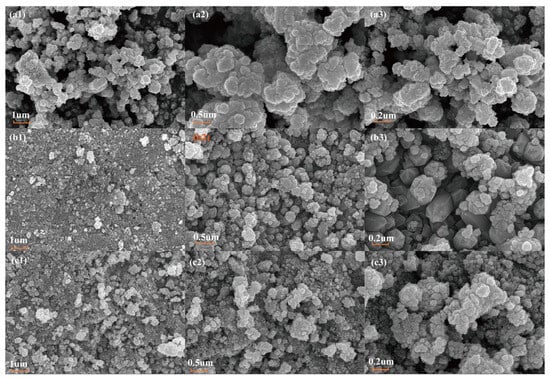
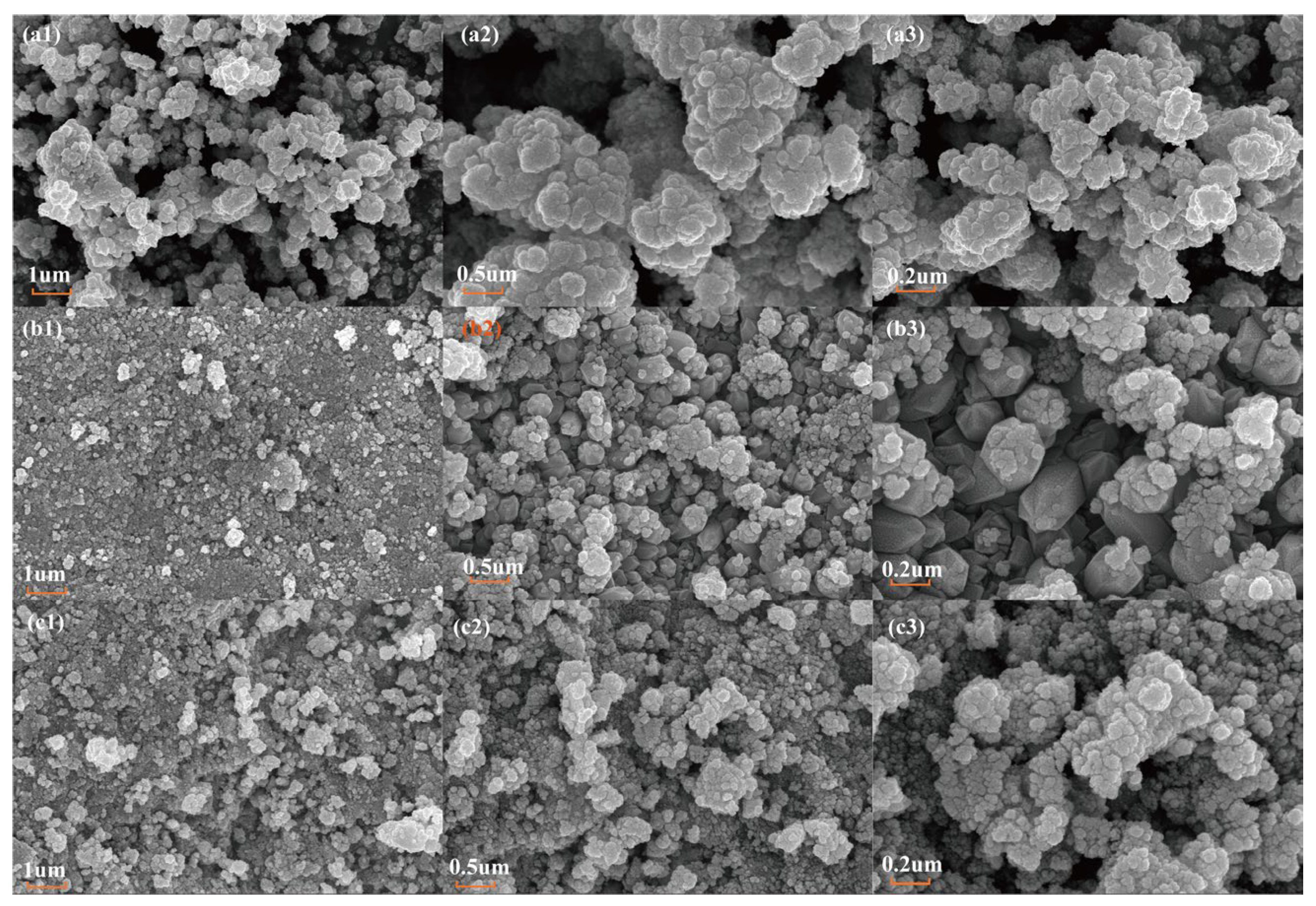
Figure 1 presents the scanning electron microscopy (SEM) images of the three catalysts VMoOx@TiO2-A, VMoOx@TiO2-B, and VMoOx@TiO2-C. As can be observed, the three catalysts exhibit distinctly different surface microstructural features. The VMoOx@TiO2-A catalyst (with titanium dioxide powder as support) displays relatively regular particle morphology with a uniform particle size distribution, while obvious agglomeration exists among particles, which is consistent with the characteristics of commercial titanium dioxide powder possessing a relatively large particle size and small specific surface area. The VMoOx@TiO2-B catalyst (prepared by titanyl sulfate hydrolysis) exhibits a finer and more dispersed nanoparticle morphology, with inter-particle stacking forming abundant pore structures, indicating that the titanyl sulfate hydrolysis process favors the formation of high-surface-area TiO2 supports. The VMoOx@TiO2-C catalyst (prepared by tetrabutyl titanate hydrolysis) shows amorphous to weakly crystalline morphological features, with fine and uniformly dispersed particles and a porous fluffy surface structure, which is attributed to the unique gel network structure formed during the sol–gel process of organic titanium precursors, generating a hierarchical meso-microporous channel system after calcination.
Figure 1.
SEM images of ((a1): Mag = 10KX, (a2): Mag = 20KX, (a3): Mag = 50KX) VMoOx@TiO2-A, ((b1): Mag = 10KX, (b2): Mag = 20KX, (b3): Mag = 50KX) VMoOx@TiO2-B, and ((c1): Mag = 10KX, (c2): Mag = 20KX, (c3): Mag = 50KX) VMoOx@TiO2-C.
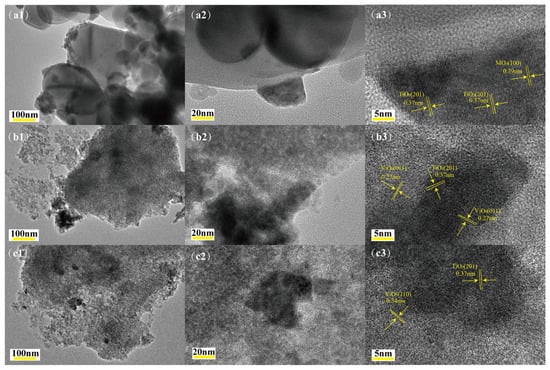
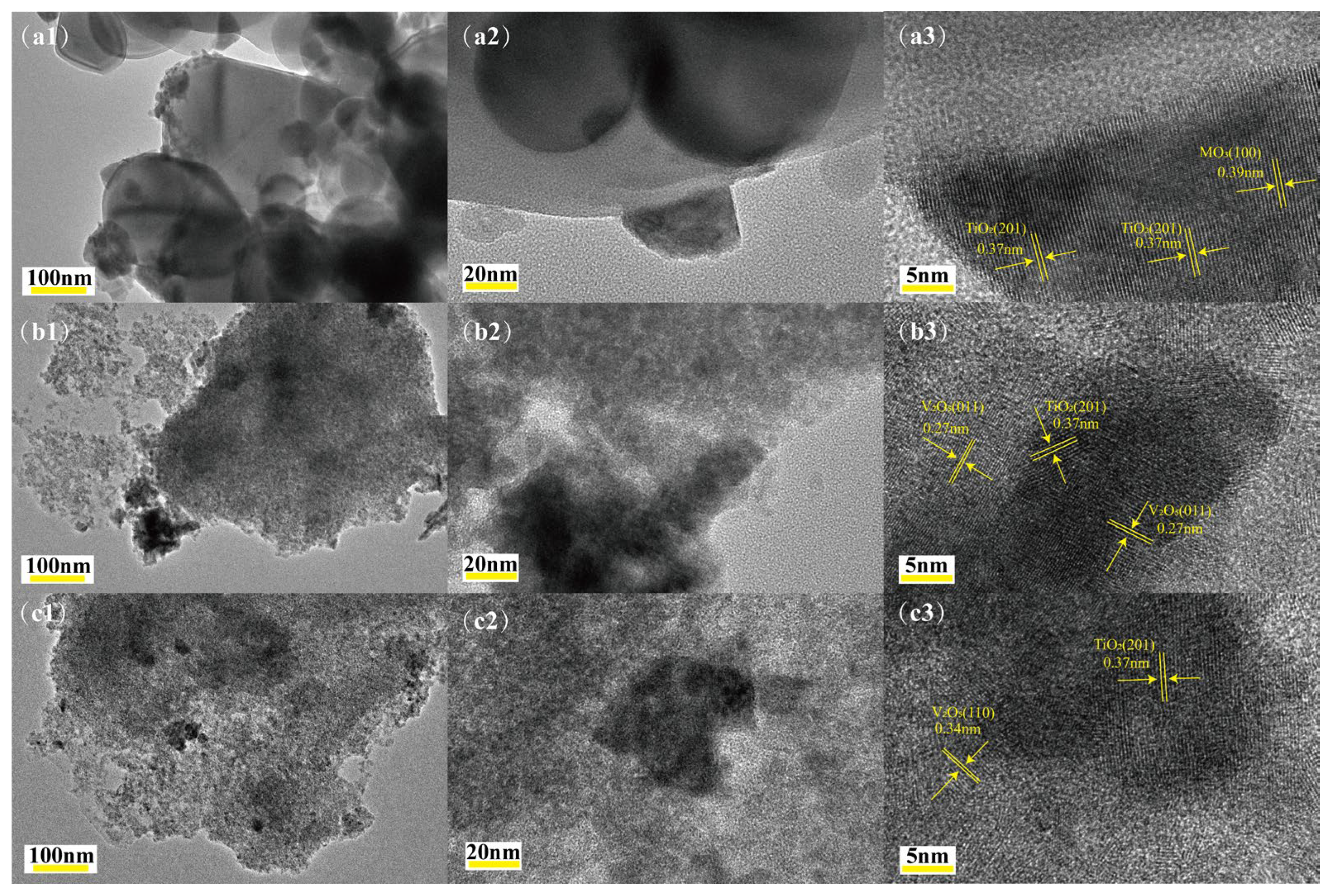
Figure 2 presents the transmission electron microscopy (TEM) images of the three catalysts. From the high-resolution TEM images, lattice fringes of TiO2 can be identified in all three catalysts, but their clarity and distribution patterns differ. Clear anatase-phase TiO2 lattice fringes with an interplanar spacing of approximately 0.37 nm corresponding to the anatase (201) plane can be observed in VMoOx@TiO2-A, indicating that the titanium dioxide powder support possesses good crystallinity. In VMoOx@TiO2-B, the TiO2 grain size is significantly reduced with an increased lattice fringe density, and the high dispersion characteristics of V and Mo oxide species on the support surface can be observed in some regions, with no obvious V2O5 or MoO3 lattice fringes detected, suggesting that the active components achieved favorable monolayer or sub-monolayer dispersion on the high-surface-area support. VMoOx@TiO2-C exhibits the finest TiO2 nanocrystallites with short and disordered lattice fringes, indicating that TiO2 prepared by the sol–gel method possesses lower crystallinity. Such weakly crystalline features are conducive to forming more surface defect sites and oxygen vacancies, providing additional anchoring sites for active components [45,46].
Figure 2.
TEM images of VMoOx@TiO2-A (a1–a3), VMoOx@TiO2-B (b1–b3), and VMoOx@TiO2-C (c1–c3).
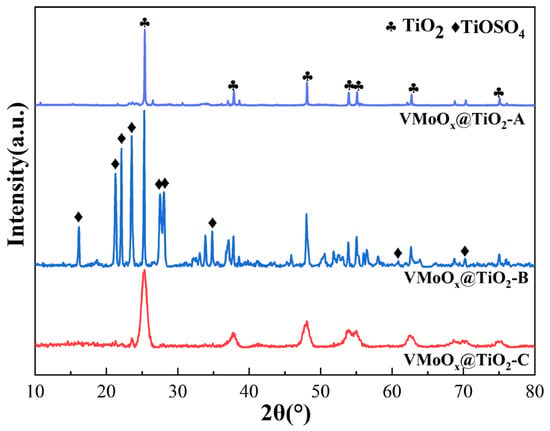
Figure 3 shows the XRD patterns of three catalysts. Compared with standard PDF cards, all three catalysts exhibit characteristic diffraction peaks of anatase TiO2 (PDF#21-1272) at 2θ = 25.3°, 37.8°, 48.0°, 53.9°, 55.1°, 62.7°, and 70.3°, corresponding to the (101), (004), (200), (105), (211), (204), and (220) crystal planes, respectively. The VMoOx@TiO2-B catalyst additionally displays distinct TiOSO4 (PDF#49-0467) diffraction peaks, with major characteristic peaks located at 2θ = 16.2°, 21.4°, 23.6°, 27.6°, 28.1°, and 34.8°, among which the (111) plane diffraction peak at 23.6° exhibits the highest intensity. This indicates that the titanyl sulfate precursor retains partial sulfate structure after calcination without complete transformation into anatase TiO2, which also provides a chemical microenvironment distinct from anatase TiO2 for anchoring the active components. The diffraction peaks of VMoOx@TiO2-A are sharp with high intensity, indicating that the titanium white support possesses high crystallinity and large crystallite size. The diffraction peak intensity of VMoOx@TiO2-C is significantly reduced with increased full width at half maximum (FWHM). According to the Scherrer equation, its crystallite size is markedly decreased, suggesting that tetrabutyl titanate forms low-crystallinity nano-anatase TiO2 after hydrolysis and calcination. No characteristic diffraction peaks of V2O5 or MoO3 are detected in the patterns of all three catalysts, indicating that V and Mo oxides exist in a highly dispersed amorphous state at low loadings.
Figure 3.
XRD patterns of the three catalysts.
2.2. Chemical Properties Analysis of Catalysts
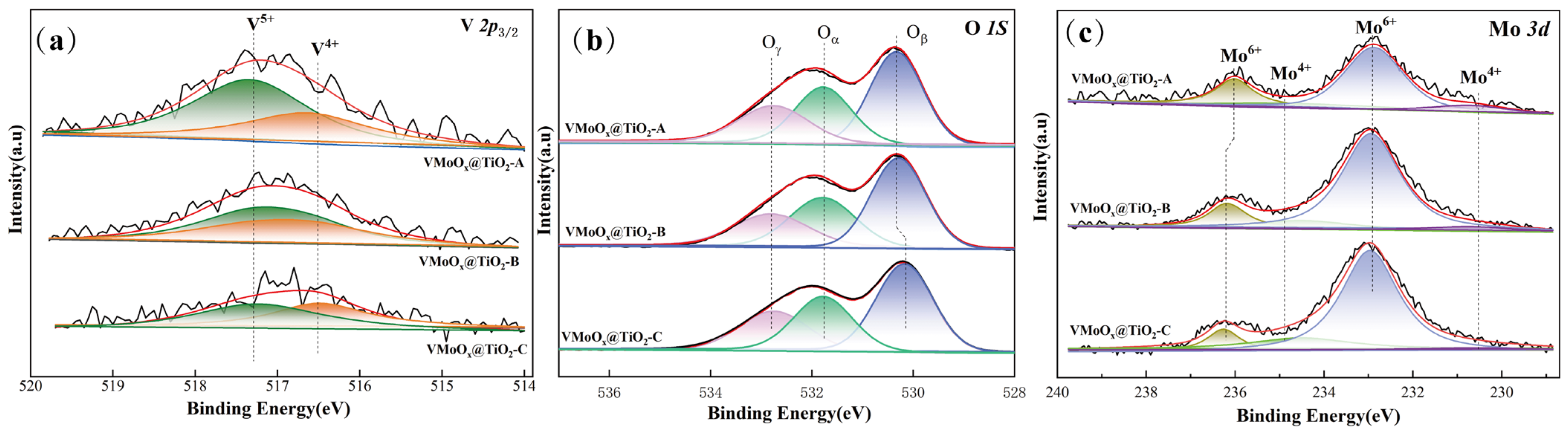
To gain deeper insight into the chemical states and relative contents of surface elements on the three catalysts, X-ray photoelectron spectroscopy (XPS) was employed for surface chemical analysis, with the results shown in Figure 4. In Figure 4a, the V 2p3/2 spectra of the three catalysts can be fitted with two peak components, located at approximately 516.4 eV and 517.2 eV, which are attributed to V4+ and V5+ species, respectively [47]. As shown in Table 1, the relative proportions of V5+ and V4+ differ significantly among the three catalysts. From VMoOx@TiO2-A to VMoOx@TiO2-C, the V4+ proportion exhibits an increasing trend of 38.9% → 45.9% → 56.6%. This result indicates that different TiO2 supports exert significant regulatory effects on the chemical valence distribution of vanadium species. The TiO2 support prepared from the organic titanium precursor (tetrabutyl titanate) possesses stronger electron-donating capability on its surface, promoting the partial reduction of V5+ to V4+, and its higher specific surface area and abundant surface defect sites allow vanadium species to exist in a more dispersed low-polymeric state, which is favorable for the stabilization of V4+. According to the “acid–redox” dual-cycle mechanism proposed by Topsoe et al., the efficient cycling of the V5+/V4+ redox couple is crucial for the sustained progress of the NH3-SCR reaction [48].
Figure 4.
XPS spectra of V 2p3/2 (a), O 1s (b), and Mo 3d (c) for the three catalysts.
Table 1.
Relative proportions of elemental species on the three catalysts.
Figure 4b presents the O 1s XPS peak fitting results of the three catalysts. The O 1s spectra of all three catalysts can be fitted into three peak components: the peak at approximately 529.8 eV is attributed to lattice oxygen Oα, the peak at approximately 531.2 eV corresponds to chemisorbed oxygen/surface oxygen vacancy sites Oβ, and the peak at approximately 532.5 eV is assigned to surface hydroxyl oxygen or oxygen species in adsorbed water Oγ [49]. As shown in Table 1, the Oα proportions of the three catalysts show minor differences, indicating that the bulk lattice oxygen content is essentially comparable among the three catalysts. It is should be noted that the chemisorbed oxygen Oβ plays a crucial role in the SCR DeNOx reaction. Studies have demonstrated that chemisorbed oxygen Oβ possesses high oxidation activity and can effectively oxidize NO to NO2, thereby promoting the fast SCR reaction. The Oβ content is relatively abundant in all three catalysts (all above 45%), with VMoOx@TiO2-B exhibiting the highest Oβ proportion of 47.9%, indicating the strongest NO oxidation capability.
The Mo 3d XPS spectra of the three catalysts in Figure 4c reveal that Mo species coexist in two valence states of Mo6+ and Mo4+ after peak deconvolution [50]. As shown in Table 1, the valence distribution trend of Mo species is opposite to that of V species—from catalyst A to C, the Mo6+ proportion increases (69.8% → 71.5% → 78.9%), while the V4+ proportion also increases (38.9% → 45.9% → 56.6%). This intriguing complementary variation pattern suggests possible electron transfer interactions between V and Mo species. On high-surface-area supports, V and Mo species are highly dispersed and form stronger V–O–Mo bridge bond interactions. Mo6+ can transfer electrons to V5+ species through V–O–Mo bridge bonds, i.e., Mo6+ + V5+ → Mo6+ + V4+ (or electron transfer from Mo to V promotes the partial reduction of V5+ to V4+). The presence of high-valence Mo6+ is favorable for the formation of Lewis acid sites on the catalyst surface, promoting NH3 adsorption and activation [51]. Furthermore, the high Mo6+ proportion indicates that Mo species maintain a high oxidation state on high-surface-area supports, which is beneficial for their function of suppressing SO2 oxidation at V sites [52].
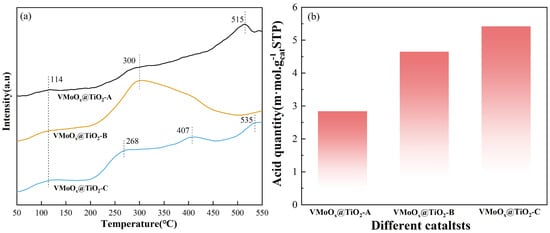
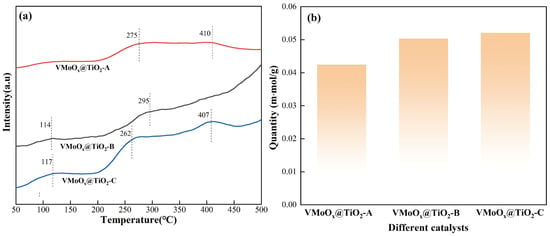
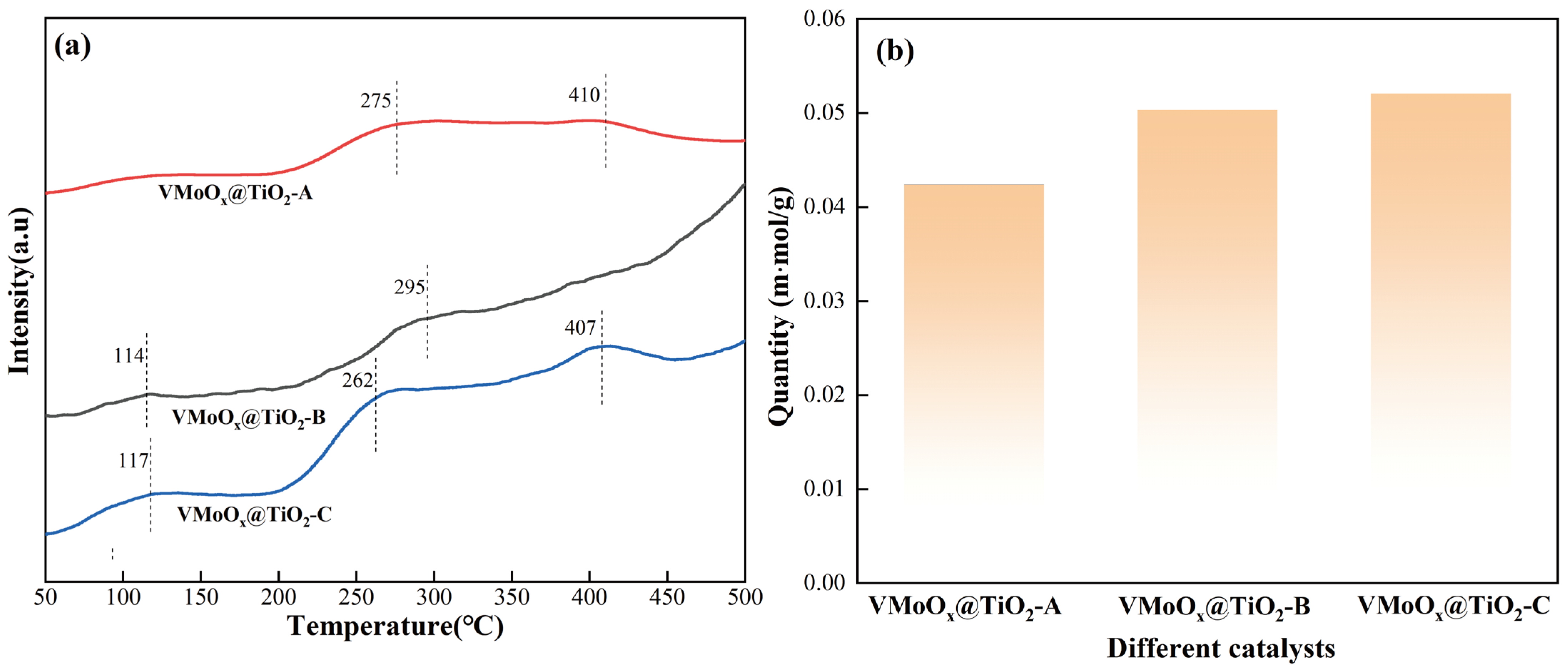
Figure 5 presents the NH3 temperature-programmed desorption (NH3-TPD) profiles of the three catalysts. NH3-TPD is an important technique for evaluating the surface acid strength and acid amount of catalysts, which is of critical significance for understanding the NH3 adsorption–activation behavior in the SCR reaction [53]. The NH3-TPD curves of all three catalysts exhibit two distinct NH3 desorption peaks: a low-temperature desorption peak (100–300 °C region) and a high-temperature desorption peak (300–550 °C region), corresponding to NH3 desorption from weak acid sites and medium-strong acid sites, respectively. The low-temperature desorption peak is primarily attributed to NH3 desorption from Lewis acid sites, while the high-temperature desorption peak corresponds to NH3 desorption in the form of NH4+ from Brønsted acid sites (such as V–OH and Mo–OH). Comparative analysis of the NH3-TPD results reveals that VMoOx@TiO2-B and VMoOx@TiO2-C exhibit larger NH3 desorption peak areas, particularly in the high-temperature desorption peak region, indicating that these two catalysts possess more medium-strong acid sites, which is favorable for maintaining effective NH3 adsorption and activation over a wider temperature range. This is consistent with the high dispersion of active components V and Mo, forming more exposed acid sites on these two catalysts.
Figure 5.
(a) NH3-TPD curves and (b) acid amount diagram of the three catalysts.
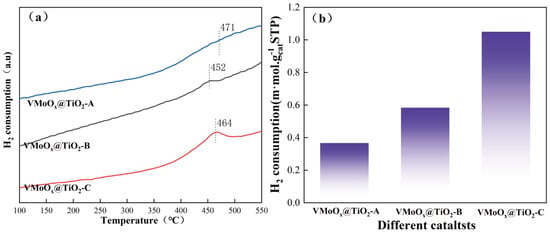
Figure 6 presents the H2 temperature-programmed reduction (H2-TPR) profiles of the three catalysts. The low-temperature reduction peak (approximately 350–500 °C) is primarily attributed to the reduction of highly dispersed surface V5+ species to V3+ and the partial reduction of Mo6+ to Mo4+. The high-temperature reduction peak (approximately 500–700 °C) corresponds to the deep reduction of bulk V2O5 and the further reduction of MoO3. It is noteworthy that the VMoOx@TiO2-C catalyst exhibits the lowest low-temperature reduction peak temperature, indicating that the V and Mo species on this catalyst possess the strongest low-temperature reducibility, i.e., the highest redox activity. This corroborates the XPS analysis result showing that this catalyst has the highest surface V4+ proportion. The low-temperature reduction peak temperature of VMoOx@TiO2-B is intermediate, while that of VMoOx@TiO2-A is the highest, indicating that V species on the titanium dioxide powder support have the weakest reducibility.
Figure 6.
(a) H2-TPR curves and (b) H2 consumption of the three catalysts.
Figure 7 presents the CO2 temperature-programmed desorption (CO2-TPD) profiles of the three catalysts. CO2-TPD is used to characterize the distribution and strength of basic sites on the catalyst surface. The CO2-TPD curves of the three catalysts show that CO2 desorption mainly concentrates in the low-temperature region (100–300 °C), corresponding to CO2 desorption from weak basic sites, while CO2 desorption in the high-temperature region (>400 °C) is relatively low, indicating that the catalyst surface is dominated by acid sites with relatively few basic sites. Comparative analysis reveals that the CO2 desorption amounts of the three catalysts show minor differences (within 10%). The fewer basic sites can inhibit the adsorption of SO2 (an acidic gas) on the catalyst surface, thereby enhancing the sulfur resistance of the catalysts.
Figure 7.
(a) CO2-TPD curves and (b) base amount diagram of the three catalysts.
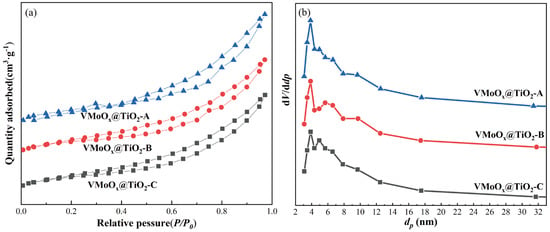
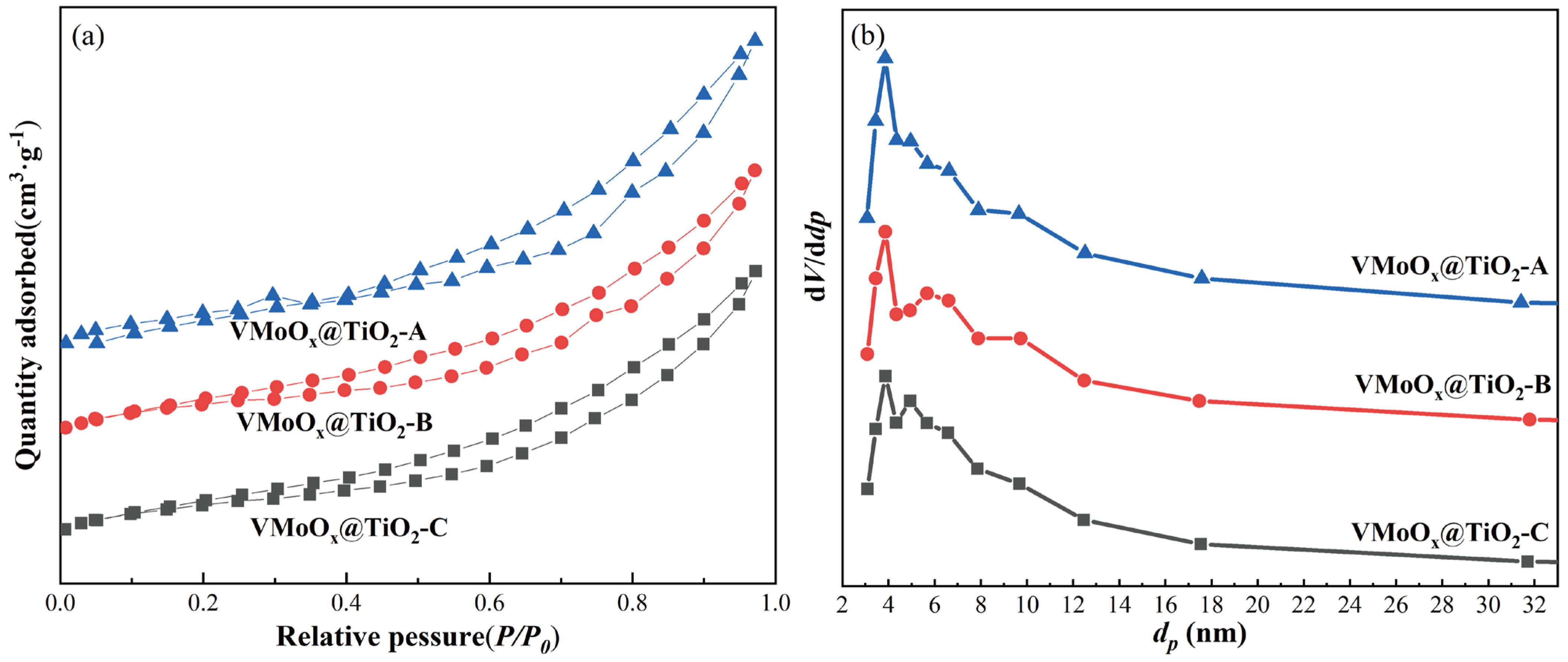
Figure 8 presents the N2 adsorption–desorption isotherms and pore size distribution curves of the three catalysts. The results show that the N2 adsorption–desorption isotherms of all three catalysts belong to Type IV isotherms accompanied by H2-type hysteresis loops, indicating that all catalysts possess mesoporous structures. The data in Table 2 show that the VMoOx@TiO2-A catalyst has the smallest BET specific surface area with a smaller pore volume and larger average pore diameter, which is consistent with the characteristics of the titanium dioxide powder raw material having larger particles and limited specific surface area. The specific surface area of the VMoOx@TiO2-B catalyst is significantly increased, with pore size distribution concentrated in the smaller mesopore range, indicating that TiO2 nanoparticles generated from titanyl sulfate hydrolysis form abundant mesopores through inter-particle stacking. The VMoOx@TiO2-C catalyst exhibits the largest specific surface area, which is attributed to the three-dimensional gel network structure formed during the sol–gel process of the organic titanium precursor. The larger specific surface area provides more anchoring sites for high dispersion of active components, facilitating the formation of more exposed active sites and thereby enhancing catalytic activity. Meanwhile, the abundant mesoporous structure facilitates the diffusion and mass transfer of reactant molecules, reducing internal diffusion resistance and improving the effective utilization of the catalyst.
Figure 8.
(a) N2 adsorption–desorption isotherms and (b) pore size distribution curves of the three catalysts.
Table 2.
Specific surface area and pore structure data of the three catalysts.
2.3. Catalytic DeNOx Activity
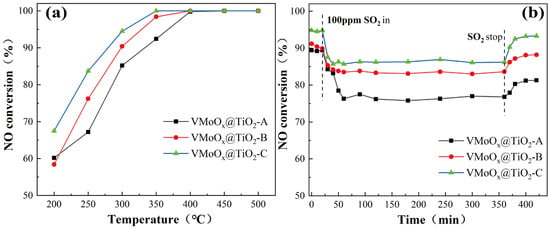
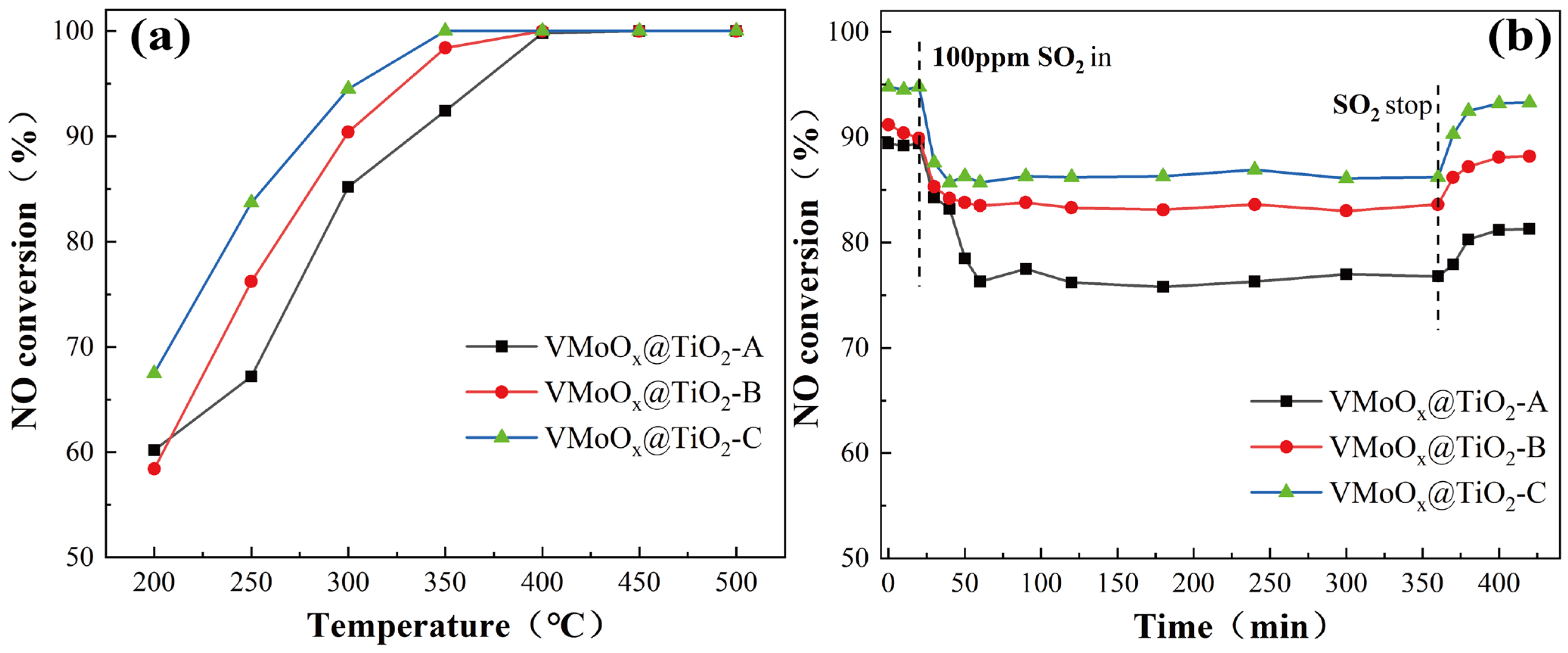
Figure 9a shows the NOx conversion as a function of temperature for the three catalysts in the temperature range of 150–450 °C. As can be observed, all three catalysts exhibit a characteristic volcano-shaped activity profile with DeNOx activity first increasing and then decreasing with rising temperature. In the low-temperature region (<250 °C), the catalytic activity is kinetically limited, resulting in low denitrification efficiency. As the temperature increases, the reaction rate gradually rises and catalytic activity improves. The VMoOx@TiO2-C catalyst demonstrates the most outstanding low-temperature DeNOx activity, achieving high NOx conversion at relatively lower temperatures with the widest activity temperature window. The activity of VMoOx@TiO2-B is intermediate, while VMoOx@TiO2-A exhibits the lowest low-temperature activity, requiring higher temperatures to achieve desirable denitrification efficiency. This is attributed to the larger specific surface area and high abundance of surface acid sites of the VMoOx@TiO2-C catalyst, where the synergistic effects of multiple favorable factors result in the optimal DeNOx catalytic performance.
Figure 9.
(a) DeNOx activity and (b) sulfur resistance performance of the three catalysts.
Figure 9b shows the variation of DeNOx activity over time for the three catalysts in the presence of SO2. Upon introduction of 100 ppm SO2 into the reaction atmosphere, all three catalysts exhibit different degrees of activity decline, but the decline rates and ultimate stabilized activities differ significantly. The VMoOx@TiO2-A catalyst shows the most pronounced activity decrease in the presence of SO2, indicating the weakest sulfur resistance. This is primarily because the lower specific surface area results in low active site density, and the proportion of effective active sites lost due to SO2 poisoning is larger. The VMoOx@TiO2-B and VMoOx@TiO2-C catalysts demonstrate better sulfur resistance stability. In particular, the VMoOx@TiO2-C catalyst maintains relatively high DeNOx activity even after prolonged exposure to SO2. Its excellent sulfur resistance can be attributed to the following factors: the high specific surface area and abundant pore structure provide a dense distribution of active sites, ensuring that sufficient active sites remain to sustain the DeNOx reaction even when some sites are poisoned by SO2; the strong surface acidity and weak basicity suppress the chemisorption and oxidation of SO2 to SO3; and the strong redox capability facilitates the regeneration of partially sulfated catalyst active sites at elevated temperatures.
2.4. Theoretical Computational Study of Catalysts
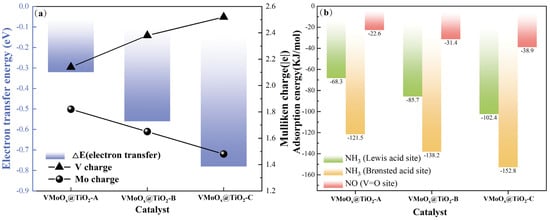
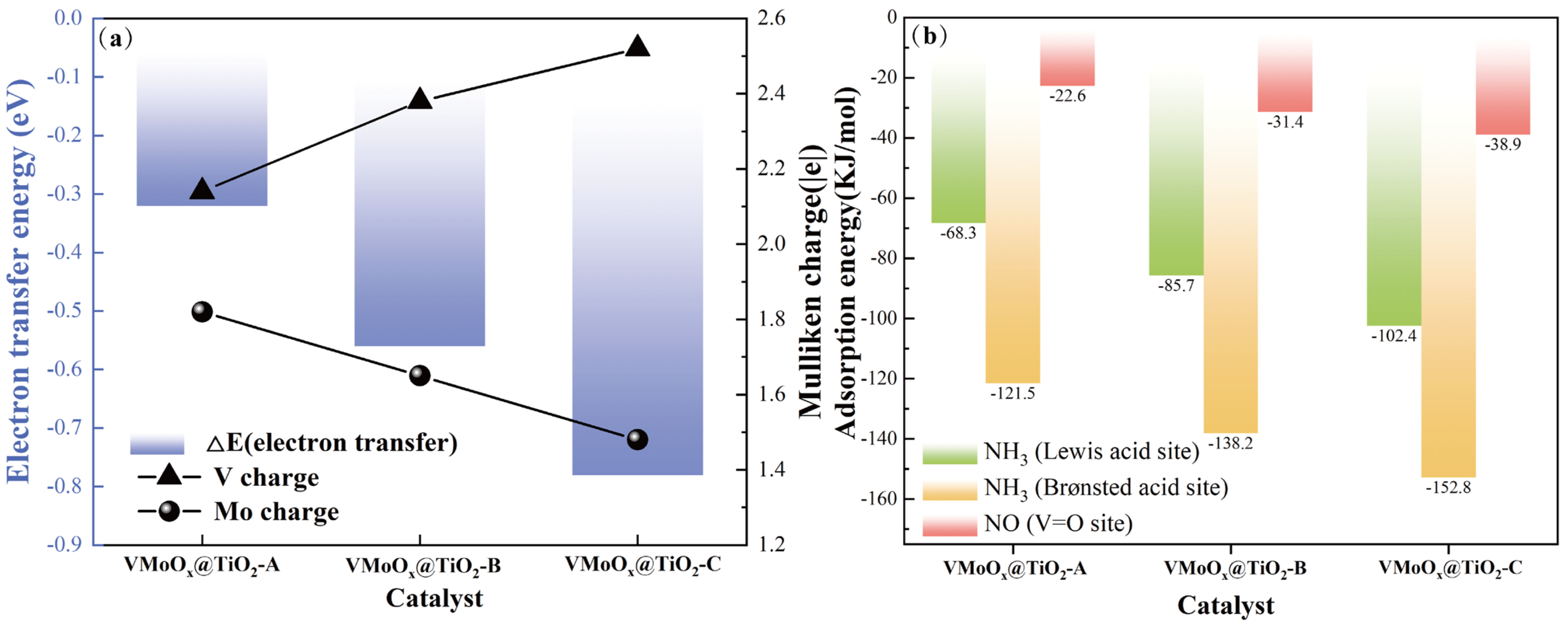
To reveal the intrinsic mechanism behind the different catalytic performances induced by various titanium sources, theoretical calculation analyses were carried out on the three catalysts. The detailed theoretical calculation methods are presented in the Supplementary Materials. Figure 10a presents the comparison of DFT-calculated adsorption energies of NH3 and NO on the three catalysts. The computational results clearly demonstrate that the absolute values of NH3 and NO adsorption energies on Catalyst C (prepared from tetrabutyl titanate) are significantly higher than those on Catalyst A (titanium dioxide pigment) and Catalyst B (titanyl sulfate). The adsorption energy of NH3 at V5+ Lewis acid sites increased from −68.3 kJ/mol on Catalyst A to −85.7 kJ/mol on Catalyst B and −102.4 kJ/mol on Catalyst C. This trend is highly consistent with the experimental NH3-TPD results. Catalyst C exhibited the largest NH3 desorption peak area, indicating the most abundant acidic sites and strongest NH3 adsorption capacity. The high specific surface area of Catalyst C enables V species to exist in a highly dispersed monomeric form, exposing more accessible V5+ Lewis acid sites. Meanwhile, its higher V4+ proportion (56.6%) implies a stronger electron-donating ability of the V centers. It should be clarified that the Lewis acid site here is the coordinatively unsaturated V5+ cation, which acts as an electron acceptor owing to its empty d orbital; the nitrogen lone pair of NH3 is donated into this empty d orbital to form an N → V dative (coordinate) bond.
Figure 10.
(a) DFT-calculated adsorption energies of NH3 and NO on three catalysts and (b) V–O–Mo bridge bond electron transfer energies and Mulliken charge distribution.
The adsorption energy of NH3 forming NH4+ on V–OH Brønsted acid sites was stronger, measuring −121.5 kJ/mol for Catalyst A, −138.2 kJ/mol for Catalyst B, and −152.8 kJ/mol for Catalyst C. The NH3 adsorption energy at Brønsted acid sites was universally higher than that at Lewis acid sites by approximately 50–55 kJ/mol. The adsorption energy of NO at V=O sites was relatively weak (−22.6 to −38.9 kJ/mol), falling within the range of physisorption to weak chemisorption.
Figure 10b reveals the regulatory mechanism of V–O–Mo bridge bond electron transfer on catalyst activity. The DFT-calculated V5+ → V4+ electron transfer energies (through V–O–Mo bridge bonds) were −0.32 eV for Catalyst A, −0.56 eV for Catalyst B, and −0.78 eV for Catalyst C. This electron transfer process can be described as:
V5+–O–Mo4+ → V4+–O–Mo6+
The negative electron transfer energy indicates that the V4+–O–Mo6+ configuration is thermodynamically more stable. The driving force for this electron transfer in Catalyst C is the largest (−0.78 eV), which corresponds perfectly with the experimental XPS results. Catalyst C exhibits the highest V4+ proportion (56.6%) and the highest Mo6+ proportion (78.9%), forming a complementary distribution pattern of simultaneous V4+ and Mo6+ enrichment.
From Catalyst A to C, the positive charge on V atoms progressively decreased (+1.82 → +1.65 → +1.48 |e|), indicating that V acquired a higher electron density (corresponding to V5+ → V4+ reduction). Simultaneously, the positive charge on Mo atoms progressively increased (+2.14 → +2.38 → +2.52 |e|), reflecting the oxidation of Mo to higher oxidation states (Mo4+ → Mo6+). This synergistic electron transfer between V and Mo through V–O–Mo bridge bonds represents the characteristic interaction formed when V and Mo species are highly dispersed on high-surface-area carriers (Catalyst C).
From the perspective of catalytic performance, the V5+/V4+ redox cycle is essential for the sustained progression of NH3-SCR reactions. DFT calculations demonstrate that the stable existence of V4+ on Catalyst C lowers the V5+/V4+ redox potential, facilitating rapid re-oxidation and regeneration of V sites during the reaction process. Meanwhile, high-oxidation-state Mo6+ favors the formation of additional Lewis acid sites, promoting NH3 adsorption and activation. Furthermore, high-valence Mo6+ effectively suppresses the oxidation reaction of SO2 → SO3 on V sites, thereby enhancing the sulfur resistance of the catalyst.
2.5. NH3-SCR Reaction Pathway and Potential Energy Surface
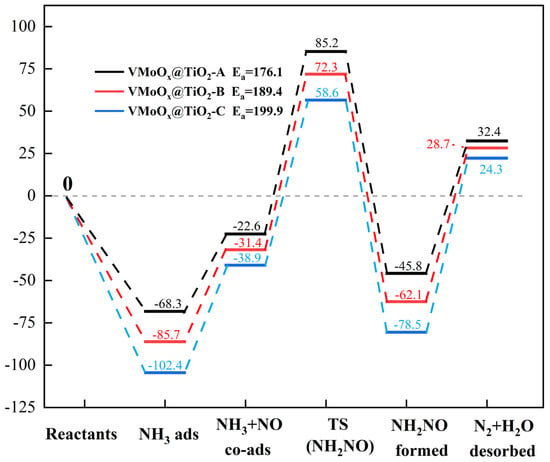
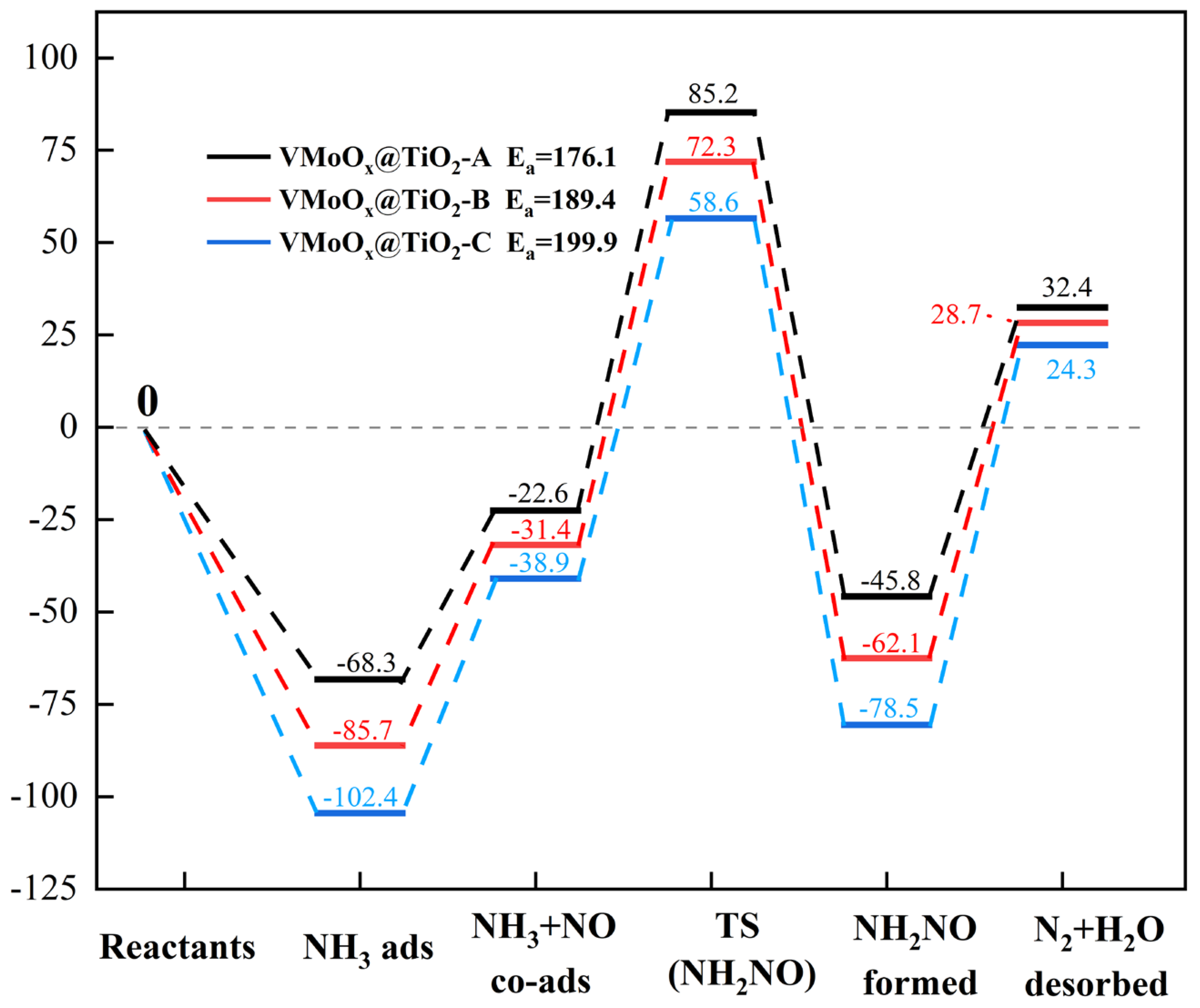
Figure 11 presents the potential energy surfaces of the NH3-SCR reaction on the three catalysts. The reaction proceeds through the classical acid-redox dual-cycle pathway, encompassing the following key steps.
Figure 11.
DFT-calculated potential energy surface of the NH3-SCR reaction pathway on three VMoOx/TiO2 catalysts. The reaction proceeds through NH3 adsorption, NO co-adsorption, NH2NO transition state, and N2 + H2O product desorption.
- (1)
- NH3 adsorption and activation: NH3 adsorbs and becomes activated at Lewis acid sites or Brønsted acid sites on the catalyst surface, forming coordinated NH3-V or NH4+ species, respectively. Catalyst C exhibits the greatest NH3 adsorption depth (−102.4 kJ/mol), providing the most favorable initial conditions for the reaction.
- (2)
- NO approach and co-adsorption: The activated NH3 species and gas-phase NO form a co-adsorbed state on the catalyst surface. Catalyst C exhibits the largest co-adsorption stabilization energy (−141.3 kJ/mol), indicating its strongest capacity for synergistic immobilization of both reactants on the surface.
- (3)
- Transition state formation (NH2NO): This constitutes the rate-determining step of the reaction. The N–H bond in NH3 undergoes cleavage, and the NH2 radical combines with NO to form the NH2NO intermediate. The DFT-calculated absolute energy levels of the transition state are: 85.2 kJ/mol for Catalyst A, 72.3 kJ/mol for Catalyst B, and 58.6 kJ/mol for Catalyst C. Catalyst C exhibits the lowest transition state energy, implying that at identical temperature conditions, the SCR reaction on Catalyst C possesses the fastest intrinsic rate.
- (4)
- NH2NO decomposition and product desorption: The NH2NO intermediate undergoes N–N bond rearrangement to generate N2 and H2O products, which subsequently desorb from the catalyst surface. Catalyst C exhibits the lowest product desorption energy (24.3 kJ/mol), facilitating rapid regeneration of active sites and sustained progression of the catalytic cycle.
3. Materials and Methods
3.1. Catalyst Preparation
Titanium dioxide powder, titanyl sulfate and tetrabutyl titanate were selected as three titanium precursors for carrier synthesis. Exactly 9.5 g of titanium dioxide powder, 19.1 g of titanyl sulfate and 40.5 g of tetrabutyl titanate were weighed and placed into separate beakers. Meanwhile, 0.38 g of ammonium metavanadate and 0.57 g of ammonium heptamolybdate were dissolved in 50 mL of deionized water, followed by intense stirring with a glass rod until all solid particles dissolved to obtain distinct impregnation solutions. Each impregnation solution was poured into the corresponding beaker loaded with a titanium precursor, and the mixture was magnetically stirred at 600 r/min for 30 min to achieve full homogeneity. Afterwards, the mixture was moved into an oven and dried at 110 °C for 8 h, and subsequently calcined at 500 °C for 6 h to yield VMoOx@TiO2-X catalysts (where X = A, B and C represent titanium dioxide powder, titanyl sulfate and tetrabutyl titanate as titanium sources, respectively). The manufacturer information for all chemical reagents used in this work is provided in the Supplementary Materials.
3.2. Catalyst Testing Methods
The catalyst (1 mL) was loaded into a fixed-bed quartz reactor (inner diameter: 8 mm) to investigate the NH3-SCR catalytic activity. A gas flow rate of 500 mL·min−1 corresponded to a gas hourly space velocity (GHSV) of 30,000 h−1. The reaction gas consisted of 500 ppm NO, 500 ppm NH3 (when used), 6 vol.% O2, with the balance being N2. The NO concentrations at the reactor inlet and outlet were measured using a flue gas analyzer (MRU VarioPlus, Neckarsulm-Obereisesheim, Germany). The catalytic activity was calculated according to Equation (2):
NOx conversion (%) = (NOx,in − NOx,out)/NOx,in × 100%
Detailed characterization and theoretical calculation methods of the catalysts are provided in the Supplementary Materials.
4. Conclusions
In this work, TiO2 supports were prepared using titanium dioxide powder, titanyl sulfate, and tetrabutyl titanate as Ti precursors, followed by the preparation of three V2O5–MoO3/TiO2 catalysts (VMoOx@TiO2-A, VMoOx@TiO2-B, and VMoOx@TiO2-C, respectively) via incipient wetness impregnation. The effects of support origin on catalyst structure and DeNOx performance were systematically investigated through multiple characterization techniques combined with density functional theory (DFT) calculations. The tetrabutyl titanate-derived support possesses the smallest grain size, the largest specific surface area, and the most abundant mesoporous structure, facilitating the high dispersion of V and Mo species. XPS analysis reveals that from Catalyst A to C, the V4+ proportion increases from 38.9% to 56.6% and the Mo6+ proportion increases from 50.2% to 78.9%, which was attributed to enhanced V–O–Mo bridge bond electron transfer interactions. DFT calculations based on the Ti2V1Mo1On cluster model quantitatively confirmed this mechanism, with calculated V5+ → V4+ electron transfer energies of −0.32 eV for Catalyst A, −0.56 eV for Catalyst B, and −0.78 eV for Catalyst C, demonstrating that the high-surface-area support promotes the thermodynamically favorable V4+–O–Mo6+ configuration. Mulliken charge analysis further revealed progressive reduction in positive charge on V atoms (+1.82 → +1.65 → +1.48 |e|) accompanied by progressive increase on Mo atoms (+2.14 → +2.38 → +2.52 |e|), consistent with the complementary V4+/Mo6+ enrichment observed experimentally. DFT-calculated adsorption energies demonstrate that Catalyst C exhibits significantly enhanced NH3 adsorption at both Lewis acid sites (V5+, −102.4 kJ/mol) and Brønsted acid sites (V–OH, −152.8 kJ/mol) compared to Catalysts A and B, in excellent agreement with NH3-TPD results. The potential energy surface analysis of the NH3-SCR reaction pathway reveals that Catalyst C possesses the lowest transition state energy barrier for NH2NO formation (58.6 kJ/mol vs. 72.3 kJ/mol for B and 85.2 kJ/mol for A), the strongest reactant co-adsorption stabilization (−141.3 kJ/mol), and the lowest product desorption energy (24.3 kJ/mol), collectively explaining its fastest intrinsic reaction rate. NH3-TPD and H2-TPR confirm that VMoOx@TiO2-C possesses the most abundant surface acid sites and the strongest low-temperature redox capability, achieving complete NO conversion at 350 °C with optimal sulfur resistance stability. This study integrates experimental characterization with DFT theoretical computation to establish a comprehensive structure–activity relationship between TiO2 support properties and the DeNOx performance of vanadium-molybdenum catalysts from both macroscopic and atomic-scale perspectives, providing a scientific basis for the optimized selection of industrial SCR catalyst supports.
Supplementary Materials
The following supporting information can be downloaded at: https://www.mdpi.com/article/10.3390/catal16080700/s1. Experimental raw materials; Material characterization methods; Theoretical calculation methods; Figure S1: Ti2V1Mo1On cluster model representing the V–O–Mo/TiO2 catalyst surface. The model includes Lewis acid sites (V5+), Brønsted acid sites (V–OH), and V–O–Mo bridge bonds.
Author Contributions
Conceptualization, J.Q.; methodology, J.Q. and X.M.; software, J.Q., X.M., C.W. and Y.B.; validation, J.Q. and C.W.; formal analysis, J.Q., X.M., C.W. and Y.B.; investigation, J.Q., X.M. and C.W.; resources, J.Q., X.M. and C.W.; writing—original draft preparation, J.Q., X.M., C.W. and Y.B.; writing—review and editing, J.Q., C.W. and Y.B.; visualization, J.Q.; supervision, J.Q. and X.M.; project administration, X.M. and C.W.; funding acquisition, X.M. All authors have read and agreed to the published version of the manuscript.
Funding
The authors gratefully acknowledge the financial Supported by CHN Energy Investment Group Shanxi Electric Power Company (E348100034).
Data Availability Statement
The original contributions presented in this study are included in the article/Supplementary Materials. Further inquiries can be directed to the corresponding authors.
Conflicts of Interest
Author Jie Qin is employed by the company Shanxi Lujin Wangqu Power Generation Co., Ltd., author Xianbin Ma is employed by the CHN Energy Investment Group Shanxi Electric Power Company, author Chunling Wang is employed by the National Environmental Protection Research Institute for Electric Power Co., Ltd., and author Yuan Bai is employed by the Guodian Environmental Research Institute Co., Ltd.
References
- Baleta, J.; Mikulcic, H.; Vujanovic, M.; Petranovic, Z.; Duic, N. Numerical simulation of urea based selective non-catalytic reduction deNOx process for industrial applications. Energy Convers. Manag. 2016, 125, 59–69. [Google Scholar] [CrossRef] [Scilit]
- Dai, H.X. Environmental catalysis: A solution for the removal of atmospheric pollutants. Sci. Bull. 2015, 60, 1708–1710. [Google Scholar] [CrossRef] [Scilit]
- Busca, G.; Lietti, L.; Ramis, G.; Berti, F. Chemical and mechanistic aspects of the selective catalytic reduction of NOx by ammonia over oxide catalysts: A review. Appl. Catal. B Environ. 1998, 18, 1–36. [Google Scholar] [CrossRef] [Scilit]
- Boningari, T.; Smirniotis, P.G. Impact of nitrogen oxides on the environment and human health: Mn-based materials for the NOx abatement. Curr. Opin. Chem. Eng. 2016, 13, 133–141. [Google Scholar] [CrossRef] [Scilit]
- Pu, Y.J.; Xie, X.Y.; Jiang, W.J.; Yang, L.; Jiang, X.; Yao, L. Low-temperature selective catalytic reduction of NOx with NH3 over zeolite catalysts: A review. Chin. Chem. Lett. 2020, 31, 2549–2555. [Google Scholar] [CrossRef] [Scilit]
- Han, L.P.; Cai, S.X.; Gao, M.; Hasegawa, J.; Wang, P.L.; Zhang, J.P.; Shi, L.Y.; Zhang, D.S. Selective Catalytic Reduction of NOx with NH3 by Using Novel Catalysts: State of the Art and Future Prospects. Chem. Rev. 2019, 119, 10916–10976. [Google Scholar] [CrossRef] [Scilit] [PubMed]
- Forzatti, P. Present status and perspectives in de-NOx SCR catalysis. Appl. Catal. A Gen. 2001, 222, 221–236. [Google Scholar] [CrossRef] [Scilit]
- Liu, F.; He, H.; Zhang, C. Novel iron titanate catalyst for the selective catalytic reduction of NO with NH3 in the medium temperature range. Chem. Commun. 2008, 44, 2043–2045. [Google Scholar] [CrossRef] [Scilit] [PubMed]
- Yan, Q.H.; Xiao, J.W.; Gui, R.R.; Chen, Z.Y.; Wang, Y.X.; Li, Y.R.; Zhu, T.Y.; Wang, Q.; Xin, Y.J. Insights into enhancement of NH3-SCR activity and N2 selectivity of LDHs-derived NiMnAlOx catalysts: Combination of experiments and DFT calculations. Appl. Catal. B Environ. 2024, 343, 123489. [Google Scholar] [CrossRef] [Scilit]
- Yang, Z.D.; Song, J.Y.; Zhang, G.M.; Sun, X.; Cheng, S.Y.; Zhang, X.; Jiang, Y. Unraveling the promotion for SO2 and H2O resistance of transition metal-doped CeO2–TiO2 catalysts in NH3-SCR reaction: A DFT study. J. Hazard. Mater. 2025, 489, 137563. [Google Scholar] [CrossRef] [Scilit] [PubMed]
- Wei, L.; Cui, S.P.; Guo, H.X.; Ma, X.Y. Study on the role of Mn species in low temperature SCR on MnOx/TiO2 through experiment and DFT calculation. Mol. Catal. 2018, 445, 102–110. [Google Scholar] [CrossRef] [Scilit]
- Zhang, L.; Jia, Y.; Shu, H.; Wen, X.; Luo, M.; Wang, Y.S.; Xu, D. Application of surfactant-modified cordierite-based catalysts in denitration process. Fuel 2020, 268, 117242. [Google Scholar] [CrossRef] [Scilit]
- Qing, M.X.; Zhang, L.L.; Liu, L.; Chen, Y.X.; Su, Y.D.; Su, S.; Hu, S.; Wang, Y.; Xiang, J. Depth investigation of the regulation mechanism of SiO2 on the denitrification performance and sulfur resistance of MnCe/Ti SCR catalyst. Chem. Eng. J. 2023, 475, 145852. [Google Scholar] [CrossRef] [Scilit]
- Liu, B.; Liu, J.; Xin, L.; Zhang, T.; Xu, Y.B.; Jiang, F.; Liu, X.H. Unraveling Reactivity Descriptors and Structure Sensitivity in Low-Temperature NH3-SCR Reaction over CeTiOx Catalysts: A Combined Computational and Experimental Study. ACS Catal. 2021, 11, 7613–7636. [Google Scholar] [CrossRef] [Scilit]
- Wu, B.Y.; Huang, Z.S.; Zhao, D.F.; Hu, F.J.; Peng, B.X.; Pu, N.; Zhang, S.G.; Huang, X.B. Computational screening-aided design of transition metal-doped CeO2 as NH3-SCR catalysts. Rare Met. 2025, 44, 6303–6318. [Google Scholar] [CrossRef] [Scilit]
- Chen, S.N.; Vasiliades, M.A.; Yan, Q.H.; Yang, G.P.; Du, X.S.; Zhang, C.; Li, Y.R.; Zhu, T.Y.; Wang, Q.; Efstathiou, A.M. Remarkable N2-selectivity enhancement of practical NH3-SCR over Co0.5Mn1Fe0.25Al0.75Ox-LDO: The role of Co investigated by transient kinetic and DFT mechanistic studies. Appl. Catal. B Environ. 2020, 277, 119186. [Google Scholar] [CrossRef] [Scilit]
- Chen, Z.Y.; Zhao, J.R.; Gao, Y.S.; Song, X.Z.; Liu, G.C.; Xin, S.S.; Zhou, C.Z.; Xin, Y.J.; Wang, Q.; Yan, Q.H. Insights into enhancement of low-temperature NH3-SCR activity and SO2 resistance of TiO2/CoMnFeOx LDOs catalysts: Combination of experimental and DFT calculations. Sep. Purif. Technol. 2025, 366, 132819. [Google Scholar] [CrossRef] [Scilit]
- Li, J.; Zhao, K.; Zhou, Z.; Chen, Y.; Yu, J.; Qiu, L.; Zhao, S. Enhancing CO catalytic oxidation performance in desulfurized flue gas of Cu-doped OMS-2 via alkali treatment. J. Taiwan Inst. Chem. Eng. 2026, 188, 106758. [Google Scholar] [CrossRef] [Scilit]
- Qi, L.; Sun, Z.G.; Tang, Q.; Wang, J.; Huang, T.Z.; Sun, C.Z.; Gao, F.; Tang, C.J.; Dong, L. Getting insight into the effect of CuO on red mud for the selective catalytic reduction of NO by NH3. J. Hazard. Mater. 2020, 396, 122459. [Google Scholar] [CrossRef] [Scilit] [PubMed]
- Li, Z.C.; Gao, M.; Lv, Z.H.; Duan, R.C.; Shan, Y.L.; Li, H.W.; He, G.Z.; He, H. Uncovering the Dinuclear Mechanism of NO2-Involved NH3-SCR over Supported V2O5/TiO2 Catalysts. Environ. Sci. Technol. 2023, 57, 17577–17587. [Google Scholar] [CrossRef] [Scilit] [PubMed]
- Jung, M.G.; Shin, J.H.; Kwon, D.W.; Hong, S.C. Promotional effects of Me (Sb, La, Ce, Mo) additives on the NH3-SCR activity and SO2 durability of V2O5–WO3/TiO2 catalysts. Process Saf. Environ. Prot. 2024, 183, 911–924. [Google Scholar] [CrossRef] [Scilit]
- Lai, J.K.; Wachs, I.E. A Perspective on the Selective Catalytic Reduction (SCR) of NO with NH3 by Supported V2O5–WO3/TiO2 Catalysts. ACS Catal. 2018, 8, 6537–6551. [Google Scholar] [CrossRef] [Scilit]
- Kwon, D.W.; Park, K.H.; Hong, S.C. Enhancement of SCR activity and SO2 resistance on VOx/TiO2 catalyst by addition of molybdenum. Chem. Eng. J. 2016, 284, 315–324. [Google Scholar] [CrossRef] [Scilit]
- Lian, Z.H.; Liu, L.; Lin, C.X.; Shan, W.P.; He, H. Hydrothermal Aging Treatment Activates V2O5/TiO2 Catalysts for NOx Abatement. Environ. Sci. Technol. 2022, 56, 9744–9750. [Google Scholar] [CrossRef] [Scilit] [PubMed]
- Can, F.; Courtois, X.; Duprez, D. Tungsten-Based catalysts for environmental applications. Catalysts 2021, 11, 703. [Google Scholar] [CrossRef] [Scilit]
- Jin, Y.Y.; Fan, K.H.; Hu, B.; Li, J.Y.; Hu, B.Y.; Jin, L.Y.; Li, J.Y.; Liu, X.S. Highly synergistic effects of Fe–W catalysts to enhance medium-low temperature NH3-SCR activity. Mol. Catal. 2024, 563, 114271. [Google Scholar] [CrossRef] [Scilit]
- She, Y.; Meng, H.; Shen, Z.H.; Niu, W.K.; Peng, C.Q.; Li, K.; Miao, H.S.; Xing, X.D.; Zhang, Z.H. Unveiling the effect of W and Co on PbO resistance over FeCe catalyst for low-temperature NH3-SCR of NO. J. Hazard. Mater. 2025, 487, 137221. [Google Scholar] [CrossRef] [Scilit] [PubMed]
- Zhang, J.; Li, X.C.; Chen, P.A.; Zhu, B.Q. Research Status and Prospect on Vanadium-Based Catalysts for NH3-SCR Denitration. Materials 2018, 11, 1632. [Google Scholar] [CrossRef] [Scilit] [PubMed]
- Song, I.; Jeon, S.W.; Lee, H.; Kim, D. Tailoring the mechanochemical interaction between vanadium oxides and zeolite for sulfur-resistant DeNOx catalysts. Appl. Catal. B Environ. 2022, 316, 121672. [Google Scholar] [CrossRef] [Scilit]
- Jiang, L.J.; Liu, Q.C.; Ran, G.J.; Kong, M.; Ren, S.; Yang, J.; Li, J.L. V2O5-modified Mn–Ce/AC catalyst with high SO2 tolerance for low-temperature NH3-SCR of NO. Chem. Eng. J. 2019, 370, 810–821. [Google Scholar] [CrossRef] [Scilit]
- Zhu, L.; Zhong, Z.P.; Yang, H.; Wang, C.H. Effect of MoO3 on vanadium based catalysts for the selective catalytic reduction of NOx with NH3 at low temperature. J. Environ. Sci. 2017, 56, 169–179. [Google Scholar] [CrossRef] [Scilit] [PubMed]
- Özdemir, J.H.; Erol, M.; Öztürk, K.; Özdemir, O.K. Investigation of the effects of supporting material modification on the nucleation behavior of Pt catalysts. Int. J. Hydrogen Energy 2023, 48, 22967–22977. [Google Scholar] [CrossRef] [Scilit]
- Yang, L.; Zhao, T.K.; Jalil, A.; Shu, Y.; Yin, Y.Z.; Jia, W.Y.; Jiang, T. Activity competition of catalysts and supports materials on the growth of carbon nanotubes with ZrO2/Fe catalyst. Appl. Surf. Sci. 2023, 637, 157889. [Google Scholar] [CrossRef] [Scilit]
- Wang, K.Q.; Lin, B.; Xiao, W.D. Influence of Calcination Temperature over Vanadium-Molybdenum Catalysts for the Selective Catalytic Reduction of NOx with NH3. Ind. Eng. Chem. Res. 2024, 63, 5666–5677. [Google Scholar] [CrossRef] [Scilit]
- Cui, D.; Pan, K.K.; Liu, H.; Wang, P.P.; Yu, F. Effects of SiO2, Al2O3 and TiO2 Catalyst Carriers on CO-SCR Denitration Performance of Bimetallic CuCe Catalysts. Catalysts 2025, 15, 833. [Google Scholar] [CrossRef] [Scilit]
- Yao, X.J.; Zhao, W.X.; Rong, J.; Luo, W.; Kang, K.K.; Long, L.L.; Chen, Y. Influence of preparation methods of supports on the deNOx performance and alkali-metal resistance over TiO2/CeO2 catalysts in NH3-SCR reaction. Fuel 2022, 320, 123920. [Google Scholar] [CrossRef] [Scilit]
- Yao, X.J.; Kong, T.T.; Yu, S.H.; Li, L.L.; Yang, F.M.; Dong, L. Influence of different supports on the physicochemical properties and denitration performance of the supported Mn-based catalysts for NH3-SCR at low temperature. Appl. Surf. Sci. 2017, 402, 208–217. [Google Scholar] [CrossRef] [Scilit]
- Liu, L.; Shen, X.; Lian, Z.H.; Lin, C.X.; Zhu, Y.; Shan, W.P.; He, H. Promotion effect of Ce and Ta co-doping on the NH3-SCR performance over V2O5/TiO2 catalyst. J. Environ. Sci. 2025, 150, 332–339. [Google Scholar] [CrossRef] [Scilit] [PubMed]
- Zhou, X.; Pfeiffer, H.; Zhou, J.H.; Shang, Z.; Hu, J.H.; Tursun, R.; Xu, S.M. A green approach for preparation of MnFeTi Low-temperature NH3-SCR catalysts: Utilizing spent V2O5–WO3/TiO2 Catalysts. Resour. Conserv. Recycl. 2024, 204, 107479. [Google Scholar] [CrossRef] [Scilit]
- Jia, S.P.; Wang, H.; Cheng, T.; Zhang, H.N.; Wang, H.Q.; Xue, C.R.; Hu, S.L. TiO2 modification with multi-acid treatment for efficient interfacial perovskite-TiO2 electron transport. J. Alloys Compd. 2022, 898, 162837. [Google Scholar] [CrossRef] [Scilit]
- Quiroz, H.P.; Calderón, J.A.; Ramírez, Y.P.; Dussan, A. TiO2 and TiO2: Co nanostructures for enhanced non-volatile memory: Insights into surface modification. Ceram. Int. 2025, 51, 38199–38211. [Google Scholar] [CrossRef] [Scilit]
- Machli, M.; Lemonidou, A.A. Optimization of V2O5–MgO/TiO2 catalyst for the oxidative dehydrogenation of propane effect of magnesia loading and preparation procedure. Catal. Lett. 2005, 99, 221–230. [Google Scholar] [CrossRef] [Scilit]
- Wang, W.Z.; Wang, S.L.; Gu, S.S.; Zhu, X.L.; Huang, X.Q.; Huang, L.; Shen, Y.S. High-temperature selective reduction of NOx into N2 catalyzed by different ion-doped titania. Chem. Eng. J. 2024, 490, 151720. [Google Scholar] [CrossRef] [Scilit]
- Cai, X.; Liu, X.; Hao, Z.X.; Lin, R. Improved Pt dispersion and catalytic performance by modified carbon support with low surface oxygen content and more mesopores. J. Power Sources 2024, 604, 234478. [Google Scholar] [CrossRef] [Scilit]
- Xu, R.; Zhou, X.W.; Shen, T.Y.; Deng, C.S.; Hao, S.C.; Zhao, X.Y.; Li, J.J.; Liu, B.; Ma, J.T. Uniform growth of colloidal particles via internal gelation process. Colloids Surf. A Physicochem. Eng. Asp. 2023, 674, 131557. [Google Scholar] [CrossRef] [Scilit]
- Valladares, L.D.; Domínguez, A.B.; Félix, L.L.; Kargin, J.B.; Mukhambetov, D.G.; Kozlovskiy, A.L.; Moreno, N.O.; Santibañez, J.F.; Cabrera, R.C.; Barnes, C.H.W. Characterization and magnetic properties of hollow α-Fe2O3 microspheres obtained by sol gel and spray roasting methods. J. Sci. Adv. Mater. Devices 2019, 4, 483–491. [Google Scholar] [CrossRef] [Scilit]
- Zhang, G.D.; Feng, C.; Huang, X.S.; Cui, R.J.; Tang, Z.C. Establishing a clear functional differentiation among active species via H2 reduction technology enabled efficient elimination of NO and CO for V-based catalysts under oxygen-rich conditions. Appl. Catal. B Environ. 2026, 385, 126306. [Google Scholar] [CrossRef] [Scilit]
- Topsoe, N.Y. Mechanism of the selective catalytic reduction of nitric oxide by ammonia elucidated by in situ on-line Fourier transform infrared spectroscopy. Science 1994, 265, 1217–1219. [Google Scholar] [CrossRef] [Scilit] [PubMed]
- Qu, Y.; Xu, G.; Chen, C.; Guo, J.; Liu, D.; Jia, H.; Guo, H.; Jia, S.; Jia, J.; Zhang, Y.; et al. A guideline to optimizing the performance of V2O5–MoO3/TiO2 catalysts for low-temperature SCR denitrification in industrial application. Ind. Chem. Mater. 2025, 4, 200–211. [Google Scholar] [CrossRef] [Scilit]
- Zhang, B.Y.; Haque, F.; Ramesan, S.; Afrin, S.; Khan, M.W.; Ding, H.; Zhou, X.; Ma, Q.; Zhang, J.; Ou, R.; et al. Ultrathin Multi-Doped Molybdenum Oxide Nanodots as a Tunable Selective Biocatalyst. Adv. Sci. 2025, 12, e00643. [Google Scholar] [CrossRef] [Scilit] [PubMed]
- Liu, Z.; Zhou, Z.; Qi, G.; Zhu, T. Selective catalytic reduction of NOx with NH3 over MoO3/Mn–Zr composite oxide catalyst. Appl. Surf. Sci. 2019, 466, 459–465. [Google Scholar] [CrossRef] [Scilit]
- Wang, X.; Liao, W.; Cao, Y.; Liu, Y.; Wu, Z. The SCR performances and SO2 oxidation behaviors of various V2O5–MoO3/TiO2 catalysts with different surface area: The influences of vanadium polymerization states. J. Hazard. Mater. 2026, 509, 142077. [Google Scholar] [CrossRef] [Scilit] [PubMed]
- Shi, M.; Kong, W.; Li, J.; Jiao, L.; Zhang, S.; Zhong, Q. Dual Ce and Ce–Mn interfacial sites for low-temperature NH3-SCR: Modulating surface acidity and synergistic catalysis. Fuel 2026, 427, 139756. [Google Scholar] [CrossRef] [Scilit]

Disclaimer/Publisher’s Note: The statements, opinions and data contained in all publications are solely those of the individual author(s) and contributor(s) and not of MDPI and/or the editor(s). MDPI and/or the editor(s) disclaim responsibility for any injury to people or property resulting from any ideas, methods, instructions or products referred to in the content. |
© 2026 by the authors. Licensee MDPI, Basel, Switzerland. This article is an open access article distributed under the terms and conditions of the Creative Commons Attribution (CC BY) license.