


Abstract
Material screening, including oxide catalyst discovery, remains constrained by costly synthesis-and-test cycles, making sample-efficient experiment selection a central challenge. Active learning can accelerate this process, but standard acquisition rules mainly optimize predictive utility and offer limited support for clarifying the causal structure behind material-screening targets. CIAL is a causal-structure-aware acquisition framework. It combines an intervention-inspired graph-structure term with expected improvement, using an adaptive schedule that begins with structure clarification and shifts toward prediction-oriented exploitation. On synthetic benchmarks with known ground-truth causal graphs, CIAL reduces final-iteration structural Hamming distance by 76.2% relative to the standard EI baseline; significance is assessed using two-sided Welch’s t-tests on final-iteration metrics across five random seeds, with for SHD and for F1. For real-data screening, CIAL is evaluated on a Materials Project transition metal oxide benchmark built from filtered oxide entries with formation-energy labels and generic bulk/compositional descriptors. Formation energy is an upstream stability-relevant property, not a direct catalytic activity label. On the main MP benchmark, CIAL is competitive with EI; its clearest advantage over EI appears under NOTEARS-based cross-split validation, but random sampling achieves the highest inferred-reference graph agreement in several real-data settings. An exploratory OC20 catalyst dataset check follows the same ordering but remains statistically inconclusive. Ablation results show that neither the causal nor the predictive component alone recovers the full benefit of the combined policy. CIAL improves graph recovery on controlled synthetic benchmarks; the real-data evidence is mixed and protocol-dependent, establishing CIAL as a proof-of-concept structure-aware acquisition method rather than a validated catalyst-discovery framework.
1. Introduction
Catalyst discovery and material screening are central to clean-energy technologies such as water splitting, fuel cells, and CO2 conversion, yet practical discovery pipelines remain constrained by expensive, time-consuming experimentation. In many settings, identifying a promising material still requires large numbers of synthesis-and-test cycles, making sample efficiency a central methodological challenge. Recent progress in machine learning has improved computational screening, but predictive efficiency alone does not fully address the need for mechanistic understanding.
Active learning has therefore become an attractive strategy for material screening because it prioritizes the experiments that should be performed next. In catalyst and materials science, it has been used to accelerate optimization and reduce labeling cost across both computational and experimental workflows [1,2,3,4,5,6]. However, standard acquisition rules such as uncertainty sampling and expected improvement (EI) are designed primarily to improve predictive performance. They can identify informative or high-value candidates without distinguishing whether the associated descriptors are genuinely causal or merely correlated with performance because of confounding.
This distinction matters in material screening. A descriptor that improves prediction accuracy is not necessarily one that directly drives materials’ behavior. The difference is especially important when the goal is not only to rank candidates but also to generate descriptor-level hypotheses. Related work in causal discovery and causal inference has provided tools for recovering structural relations from data [7,8,9], while data-driven studies in catalysis have increasingly emphasized the value of mechanistically meaningful descriptors [10,11,12,13]. Broader work on causal active learning, causal Bayesian optimization, and optimal intervention design provides foundational methods for selecting experiments to learn causal structure or optimize causal effects [14,15,16]. In this work, the term “intervention” is used in a heuristic, graph-theoretic sense: it refers to the graph-structure change induced by adding a candidate observation, not to a physical experimental do-intervention. CIAL therefore targets retrospective material-screening benchmarks where no physical do-intervention is performed, combining an intervention-inspired graph-change heuristic with expected improvement. However, these directions have rarely been unified in a single active-learning framework for material screening. As a result, current workflows often optimize what is easiest to predict rather than what is most useful for clarifying the underlying mechanism.
We present Causal Intervention Active Learning (CIAL), a causal-structure-aware acquisition framework that balances structure identification with predictive optimization. Candidate measurements are scored by expected improvement and by an intervention-inspired value that estimates how much a candidate may clarify uncertain graph structure. These terms are combined through an adaptive weighting schedule, , so that early iterations emphasize graph clarification and later iterations shift toward prediction-oriented exploitation.
Transition metal oxides are an important class of oxygen evolution reaction (OER) catalyst candidates; therefore, we use OER catalyst discovery as the motivating application. The real-data benchmark is a conservative upstream screening setting built from Materials Project transition metal oxide entries, formation-energy labels, and generic bulk/compositional descriptors. Formation energy captures a stability-relevant target; direct OER activity or overpotential assessment would require reaction-specific labels or experiments.
We evaluate CIAL on synthetic benchmarks with known ground-truth causal graphs and on a Materials Project transition metal oxide benchmark built from filtered oxide entries, formation-energy labels, and generic bulk/compositional descriptors. On the synthetic benchmark, CIAL reduces final-iteration SHD by 76.2% relative to the standard EI baseline, with statistically significant differences across five random seeds ( for SHD and for F1). The real-data analysis follows a cross-split inferred-reference protocol and includes an exploratory OC20 check. CIAL is competitive with EI on the main MP benchmark; its clearest advantage over EI occurs under NOTEARS-based cross-split validation, and the OC20 results follow the same ordering, although the 20-seed MP summary is borderline and OC20 is statistically inconclusive.
Taken together, this study contributes a material-screening active-learning framework that couples causal-structure clarification with predictive acquisition, a practical intervention-inspired graph value combined with an adaptive IV–EI schedule, and benchmark evidence that the combined policy improves graph recovery on synthetic data while giving protocol-dependent real-data evidence that should be interpreted cautiously when generating material-screening hypotheses. In that sense, CIAL is intended not only as a more informative acquisition rule but also as a tool for generating descriptor-level, mechanistically plausible hypotheses for future testing under realistic material-screening constraints.
2. Experiments
We evaluate CIAL under a common experimental protocol spanning synthetic and real-data settings. This section defines the acquisition setting, describes the components of the policy, and outlines the benchmark design used throughout the paper.
We consider a dataset where is a D-dimensional descriptor vector, for example electronic-structure features, composition, and geometry, while is the target property, for example, formation energy or another benchmark target. We assume there exists an underlying causal directed acyclic graph (DAG) over the descriptors and target, where edges represent causal relationships. For synthetic benchmarks, this graph is known and is used as ground truth. For real-data benchmarks, graph-learning scores are computed against protocol-defined inferred reference graphs.
The goal of active learning is to sequentially select experiments under two coupled objectives: improving predictive utility and clarifying the causal structure. Throughout this paper, we write the acquisition problem in minimization form, consistent with the Materials Project benchmark in which lower formation-energy values are preferred within the screening pipeline. After N experiments, we have an updated dataset and an estimated causal graph .
At iteration , we have a pool of candidate experiments . Each candidate represents a candidate material configuration to be queried, whether through a synthetic oracle, a retrospective computational benchmark, or a future synthesis-and-test workflow. We must select one candidate to add to our dataset.
2.1. CIAL Acquisition Policy
The CIAL acquisition policy combines a causal term, which favors experiments expected to clarify the current graph estimate, with a predictive term, which favors experiments expected to improve the target value. We introduce the two components separately before defining their adaptive combination.
2.1.1. Causal Intervention Value
The causal component is the causal intervention value (IV), an intervention-inspired heuristic for estimating how strongly a candidate may change uncertain graph structure. Formally,
where is the estimated causal graph after augmenting the dataset with the candidate query result, and is a graph distance metric (we use structural Hamming distance). The quantity is therefore a proxy for expected graph-structure change. A large IV can indicate informative graph clarification, but it can also reflect graph-estimation instability in noisy or undersampled real-data settings. The present implementation does not impose an explicit stability threshold on IV; future work could incorporate bootstrap stability selection or instability-aware regularization to prevent unstable graph estimates from dominating acquisition.
Intuitively, IV is high when the candidate is likely to change the current causal estimate in a meaningful way. This typically occurs in situations where the following are true:
- perturbs descriptors attached to adjacencies that remain ambiguous in the current graph estimate;
- helps distinguish competing collider or v-structure explanations;
- probes a region where bootstrap graph estimates remain unstable.
To compute IV efficiently, we approximate the expectation in (1) using the current causal graph estimate. Specifically, we compute IV as a weighted sum over uncertain edges:
where is the set of structurally ambiguous edges in the current causal estimate, is the uncertainty weight for edge , and is the expected change in that edge’s uncertainty from performing experiment .
In implementation, each uncertain edge has an associated edge-confidence score from bootstrap PC runs. We set
thus, edges near (maximally ambiguous) receive the largest weights. For a candidate , we estimate
where is approximated by a one-step surrogate update that uses the GP posterior predictive mean at as a pseudo-observation. In other words, we use a plug-in approximation of the expectation in (1): the bootstrap edge-confidence change is estimated after a single surrogate-guided update without integrating over all possible outcomes at . This plug-in approximation keeps per-iteration complexity practical: it uses only the posterior mean instead of propagating the full predictive distribution through every possible graph update, yet it still ties IV directly to edge-level ambiguity reduction.
2.1.2. Expected Improvement
The predictive component is the standard expected improvement (EI) [17], which measures the expected gain relative to the current best observation:
where is the best (lowest) target value observed so far and is the predicted target distribution at (modeled as Gaussian from the GP posterior).
EI is effective for exploitation, directing experiments toward promising regions of the descriptor space. However, it does not consider causal structure and may repeatedly sample from the same causal regime without ever clarifying the underlying mechanisms.
2.1.3. Adaptive Combination
CIAL combines IV and EI using an adaptive weighting schedule:
Before combination, IV and EI are normalized within the candidate pool at each iteration so that neither term dominates solely because of raw scale. Specifically, IV is divided by its maximum value in the pool,
and EI is normalized similarly,
with to avoid division by zero when all values are zero. Both transformations are positive monotone scalings; therefore, they preserve the ranking of candidates within the pool and do not change the selected sample. The adaptive weight is defined as
where N is the current iteration number, running from 1 to .
This schedule has an intuitive interpretation. At the first iteration (), , and CIAL prioritizes causal exploration via IV. At the final iteration (), , and CIAL shifts its emphasis toward exploitation via EI. This balances the need to understand causal structure early, when interventions are most informative, with the need to optimize predictions later, when the causal structure is relatively stable.
The adaptive schedule also reflects the diminishing returns of causal exploration: once the causal graph is well determined in a synthetic setting where the graph is identifiable, additional intervention experiments provide little benefit, and resources should be directed toward prediction optimization.
2.2. Model Components
2.2.1. Causal Structure Learning
CIAL uses the PC algorithm [7,9] for causal structure learning. The PC algorithm is a constraint-based method that discovers causal structure by testing conditional independencies in the data. Our implementation follows the standard PC workflow described in the causal-discovery literature.
The PC algorithm outputs a completed partially directed acyclic graph (CPDAG) representing the Markov equivalence class of possible causal graphs. We use the CPDAG as the structural summary of the current causal estimate. In particular, adjacencies whose orientation remains unresolved in the CPDAG are treated as structurally ambiguous, and their ambiguity is quantified more finely by the bootstrap edge-confidence scores used in the IV calculation.
For real-data sensitivity analysis, we also evaluate non-PC graph-learning backends, with NOTEARS [18] used for the cross-split results reported in Section 3. Backend-dependent results are interpreted as empirical benchmark behavior under the inferred-reference protocol.
2.2.2. Gaussian Process Surrogate Model
For the predictive component, we use Gaussian Process (GP) regression [19] as our surrogate model. GPs provide principled uncertainty quantification, which is essential for EI calculation, and the GP posterior mean is also used in the one-step surrogate update for IV.
We use the scikit-learn implementation with an RBF kernel. Hyperparameters are optimized by maximizing the marginal likelihood on the current dataset. When the dataset is too small for reliable hyperparameter estimation, we retain a fixed default length scale to avoid unstable kernel fitting.
2.3. Selection Procedure
Algorithm 1 summarizes the full CIAL selection loop used throughout the experiments.
| Algorithm 1 Causal Intervention Active Learning (CIAL) |
|
2.4. Benchmark Configuration
We evaluate CIAL in two settings: (i) synthetic data with known ground-truth causal graphs under a shared protocol and (ii) a Materials Project transition metal oxide benchmark constructed from filtered oxide entries, formation-energy labels, and bulk/compositional descriptors. The main baselines are random sampling, uncertainty sampling, and expected improvement (EI). To isolate the contribution of each term in the acquisition rule, we also report two ablations: CIAL-IV-only () and CIAL-EI-only (). The pure EI baseline and CIAL-EI-only () are mechanically identical under the same random seed: both use the same GP model, the same EI formula, the same candidate pool, and the same selection rule. Because the EI normalization used in CIAL-EI-only is a positive monotone scaling, it preserves the candidate ranking; the retained causal-graph updates do not enter the acquisition score. A controlled five-seed comparison confirms that the two variants select identical candidate sequences and yield identical final SHD/F1 (see Supplementary Data). CIAL-EI-only is therefore reported as a timing-only variant of the EI baseline; the numerical difference between EI and CIAL-EI-only in earlier ablation tables reflected independent random seeds across separate pipeline files.
On synthetic data, performance is measured by structural Hamming distance (SHD), which counts the edge insertions, deletions, and reversals needed to match the estimated graph to the ground truth, and by Edge F1 score, which summarizes edge recovery accuracy. For real-data benchmarks, SHD and F1 are computed against inferred reference graphs generated from held-out split information. These scores therefore compare acquisition behavior under a defined protocol and do not establish absolute causal correctness.
The real-data cross-split protocol divides each dataset into two parts using a fixed split seed. A reference graph is inferred on Split A, active learning is run on Split B, and graph-recovery scores compare the learned graph with the inferred reference graph. For the Materials Project NOTEARS analysis, we report both the first 10 seeds and the completed 20-seed summary. For OC20, we report an exploratory five-seed NOTEARS summary.
Unless otherwise stated, significance is evaluated on final-iteration metrics across five random seeds using two-sided Welch’s t-tests. For the 10-seed and 20-seed NOTEARS summaries, the same Welch’s t-test convention is applied to the corresponding seed sets. We report unadjusted p-values and treat them as supportive rather than definitive evidence given the small sample sizes. Causal structure learning is implemented with a standard PC algorithm for the primary synthetic pipeline, Gaussian Process regression is implemented with scikit-learn, and all experiments are repeated over the seed counts stated for each benchmark.
2.5. Materials Project Validation Data
For the real-data study, we summarize the Materials Project transition metal oxide benchmark used for validation and the Gaussian Process diagnostics associated with the expected-improvement component.
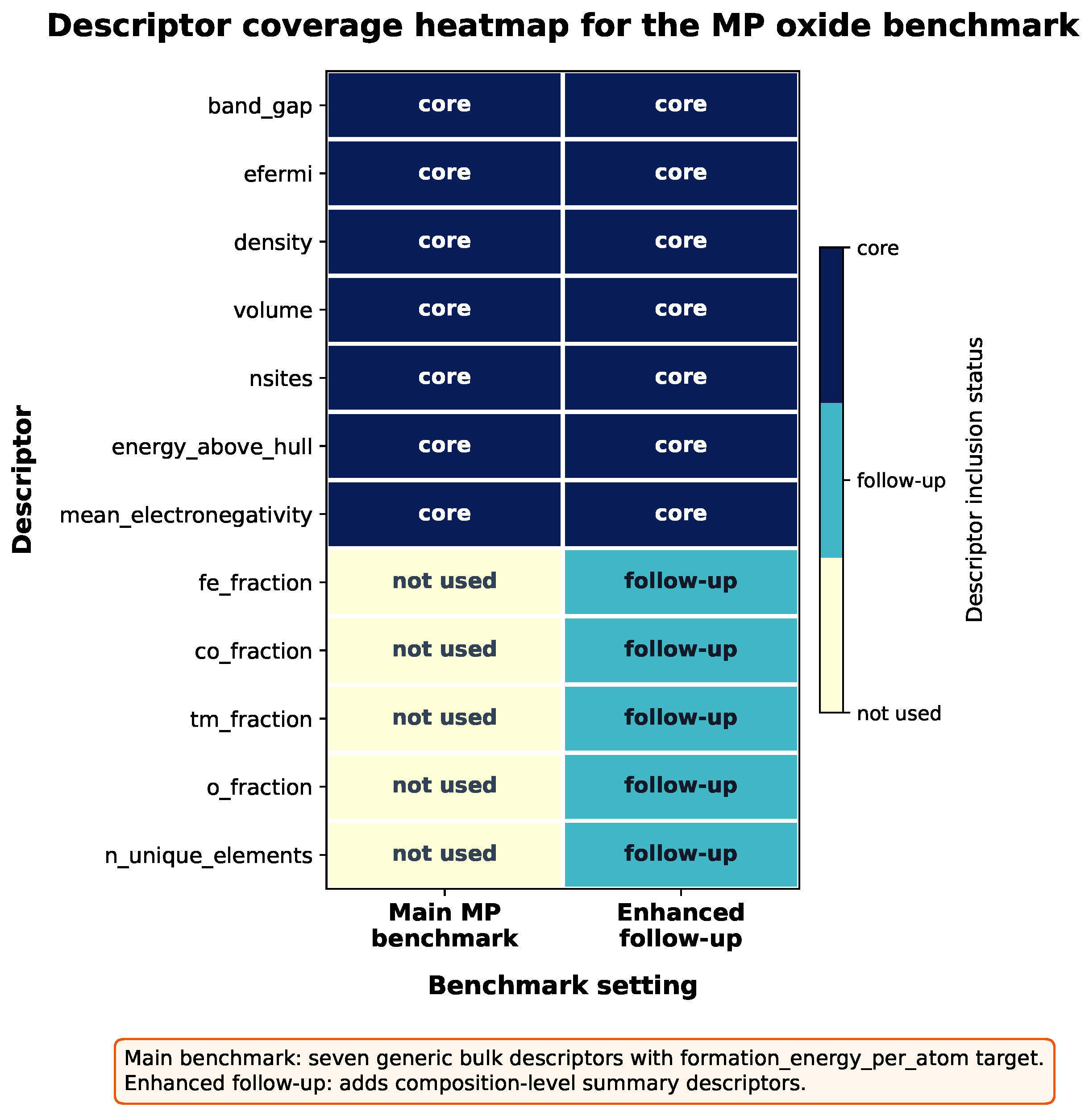
The Materials Project dataset is built from 41,758 filtered transition metal oxide entries (Table 1). The main benchmark uses formation_energy_per_atom as the target together with seven generic bulk descriptors: band gap, Fermi energy, density, volume, number of sites, energy above hull, and mean electronegativity. Enhanced follow-up runs add compositional descriptors such as Fe and Co fractions.
Table 1.
Summary of the Materials Project transition metal oxide benchmark used in the real-data study. The benchmark uses generic bulk and compositional descriptors with formation-energy labels, supporting a conservative material-screening interpretation.
For the CIAL acquisition function, we use a Gaussian Process with an RBF kernel to predict the benchmark target from Materials Project descriptors. The model supplies both the point predictions and the uncertainty estimates required by expected improvement. Table 2 reports the surrogate setup and interpretation boundary for the benchmark.
Table 2.
Gaussian Process surrogate setup for the Materials Project benchmark. This table documents the surrogate configuration and interpretation boundary for the EI component within the benchmark loop.
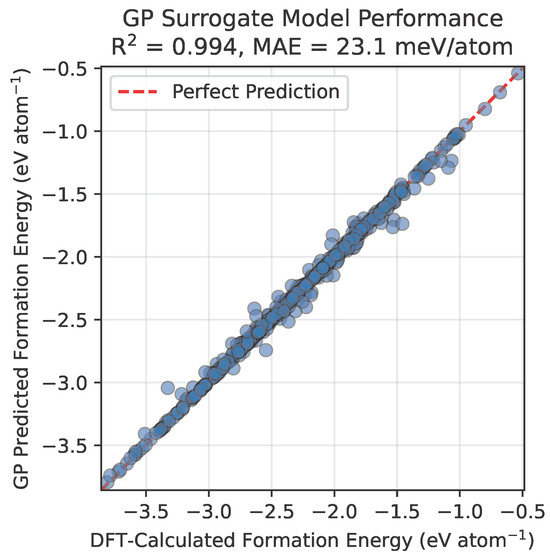
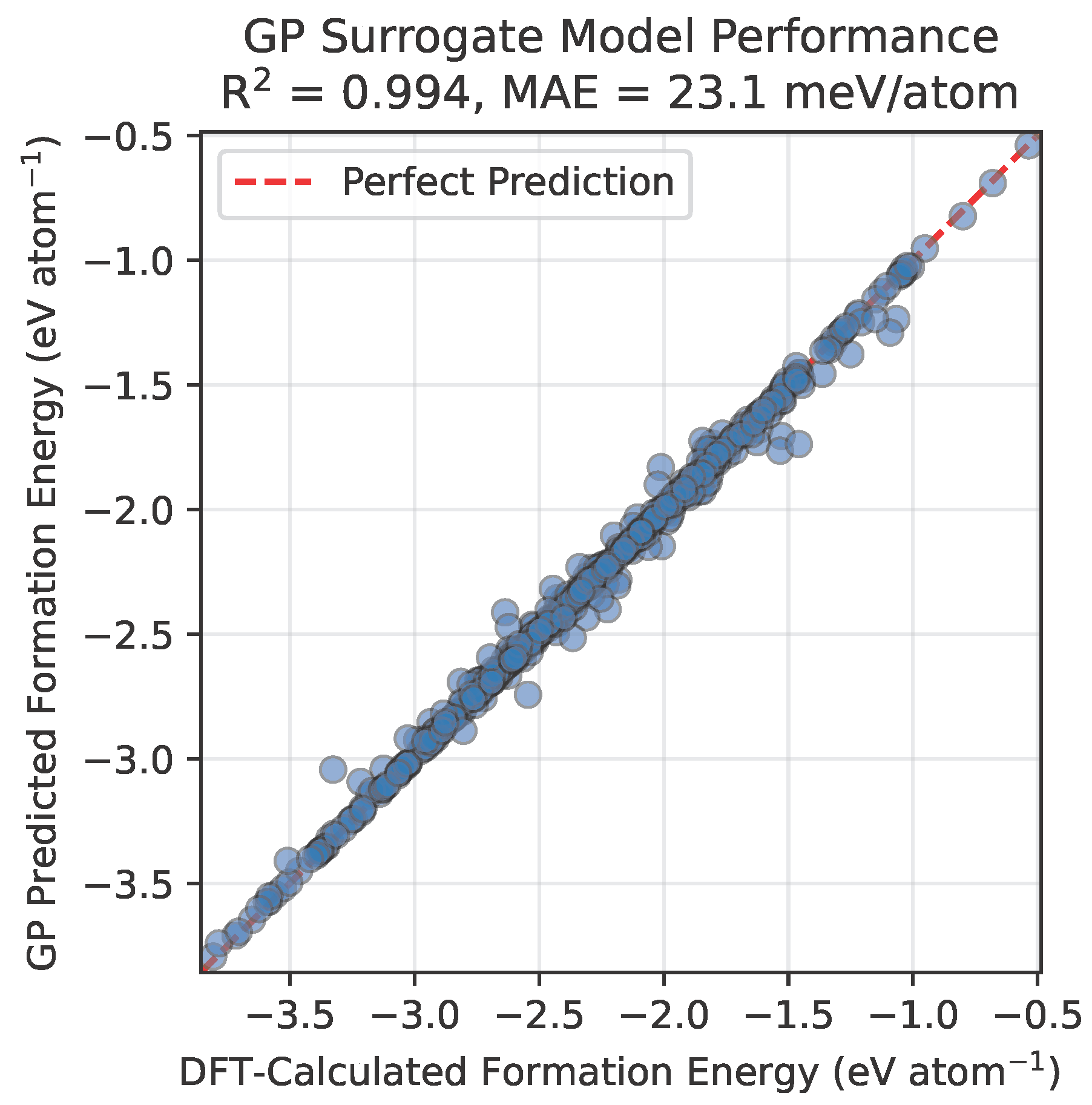
Because the surrogate diagnostics discussed here come from within-benchmark fitting, they document the EI component used inside the benchmark loop. Figure 1 shows the fitted relationship through a parity plot comparing GP predictions with benchmark target values.
Figure 1.
Gaussian Process parity plot on the Materials Project benchmark. GP predictions (y-axis) are plotted against benchmark target values (x-axis), with the red dashed line indicating perfect prediction. The reported and MAE meV/atom are in-sample diagnostics summarizing the fitted surrogate behavior used inside the benchmark loop; they should not be interpreted as external predictive validation.
2.6. OC20 Exploratory Cross-Dataset Check
As a supplementary cross-dataset sensitivity check, we include a small exploratory evaluation on the Open Catalyst 2020 (OC20) dataset [20]. We use a filtered subset of transition metal oxide–containing structures from the OC20 IS2RE/IS2RS training–validation partition, retaining relaxed bulk entries with composition and energy information. After filtering to oxides and removing entries with missing target values, the subset contains approximately 3000–4000 candidates before subsampling (exact counts depend on the filtering threshold). The target property is the OC20 relaxed total energy per atom, and the descriptor set mirrors the main MP benchmark where available: bulk-derived descriptors including inferred band gap proxy, density, volume, number of sites, and compositional summaries. The same NOTEARS backend, cross-split protocol, initial labeled set size (), active-learning budget ( selected samples, 15 query steps with batch size 10), candidate pool subsampled to 2000, and five-seed repetition used for the NOTEARS MP sensitivity analysis are applied. Because the OC20 target is a total energy rather than a formation energy, results are not directly comparable to MP and are reported only as supplementary context. The OC20 data and inferred reference graphs are generated with the same pipeline script used for MP; reproducibility details are provided in the repository.
3. Results
We begin with graph-recovery results on synthetic data; turn to the Materials Project transition metal oxide benchmark; and finally report supporting analyses of descriptor coverage, causal-backend sensitivity, and computational cost.
3.1. Main Results on Synthetic Data
Table 3 shows that CIAL performs best on the synthetic benchmark under the unified benchmark pipeline outputs. CIAL achieves a SHD of and an F1 score of . The EI baseline reaches SHD and F1, the uncertainty baseline reaches SHD and F1, and random sampling reaches SHD and F1.
Table 3.
Main results on synthetic data (5 seeds, mean ± standard deviation). Relative to the standard EI baseline, CIAL reduces mean SHD by 76.2%; two-sided Welch’s t-tests on final-iteration metrics give for SHD and for Edge F1.
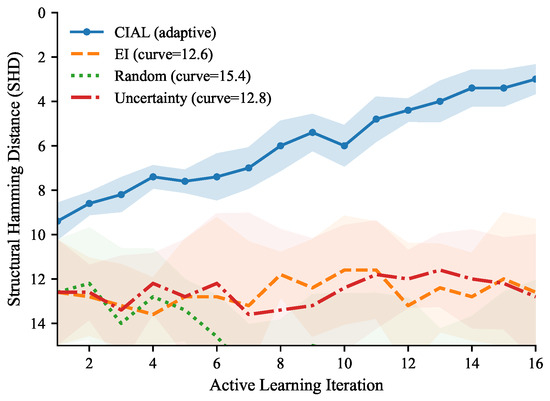
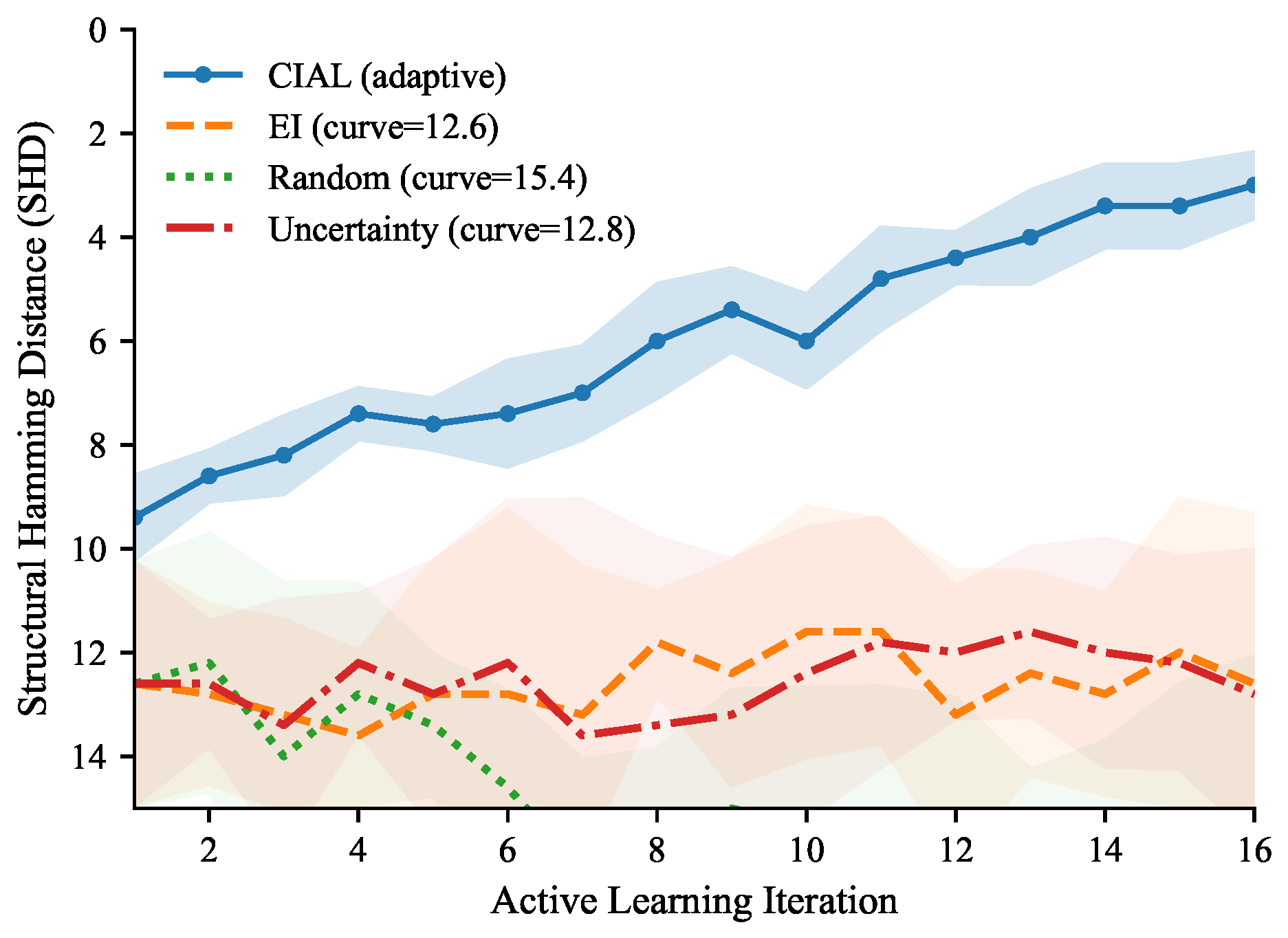
Relative to the EI baseline, CIAL lowers mean SHD by 76.2%. The difference remains statistically significant under two-sided Welch’s t-tests on final-iteration metrics ( for SHD and for F1). Under this synthetic protocol, the clearest conclusion is that incorporating causal structure into the acquisition rule leads to better final graph recovery. Figure 2 complements this table-level comparison by showing the full iterationwise SHD trajectories, where CIAL maintains faster and consistently lower SHD than the baseline methods over most of the active-learning budget.
Figure 2.
Causal structure recovery (SHD) vs. number of active learning iterations on synthetic data. CIAL is shown as a full iterationwise trajectory averaged over 5 random seeds, with the shaded band indicating ± standard deviation. The EI, random sampling, and uncertainty baselines are shown as horizontal reference lines at their final SHD values solely because their per-iteration histories were not retained in this pipeline; all methods were evaluated under the same unified benchmark and the same final-iteration metric. The CIAL-EI-only ablation trajectory is reported separately in Figure 3 and Table 4. CIAL (solid) shows faster and better recovery than the baselines throughout most of the active-learning budget.
3.2. Ablation Study
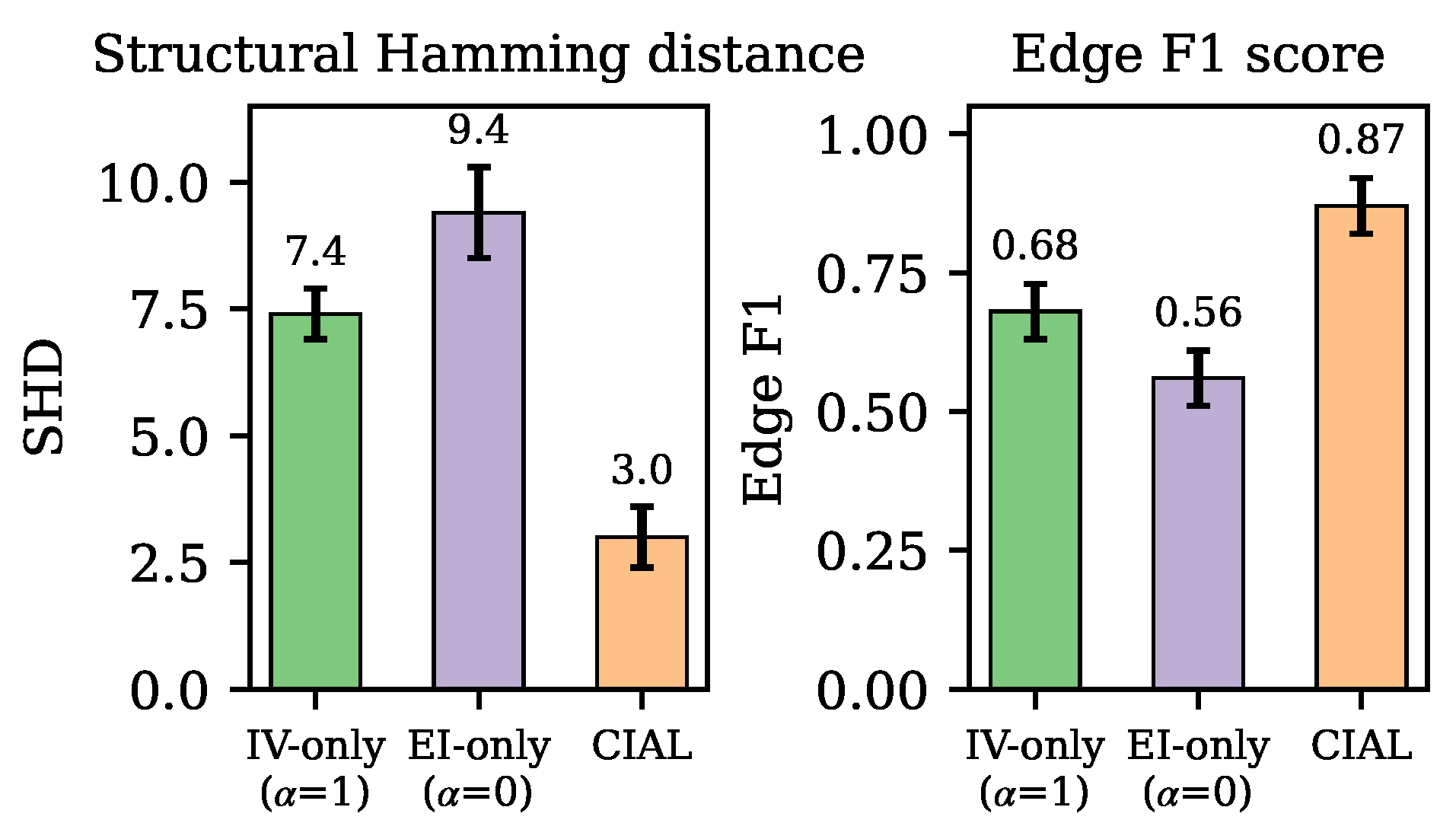
Table 4 indicates that both components of CIAL contribute materially to performance. CIAL-IV-only () achieves a SHD of , which is better than the standard EI baseline () but still clearly worse than CIAL (). This pattern shows that the causal-intervention term is informative on its own but not sufficient to recover the full performance of the combined policy.
Table 4.
Ablation study results (5 seeds, mean ± standard deviation). Both the causal-intervention and predictive (EI) components are necessary for optimal performance. CIAL-EI-only () is mechanically identical to the pure EI baseline under the same random seed; the reported value comes from an independent pipeline run and is shown to illustrate the standalone predictive-only ablation.
CIAL-EI-only () achieves a SHD of and an F1 of . With matched random seeds, it is mechanically identical to the pure EI baseline (Section 2); the standalone value shown here comes from an independent pipeline run and confirms that a predictive-only acquisition rule does not recover the full benefit of the adaptive causal–predictive combination.
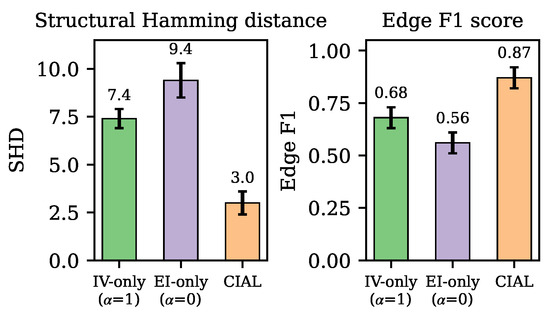
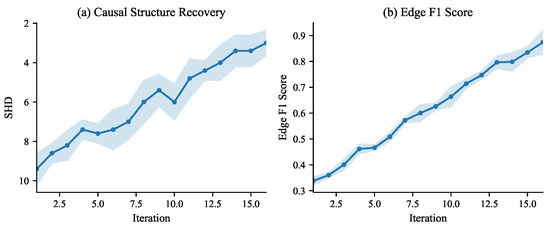
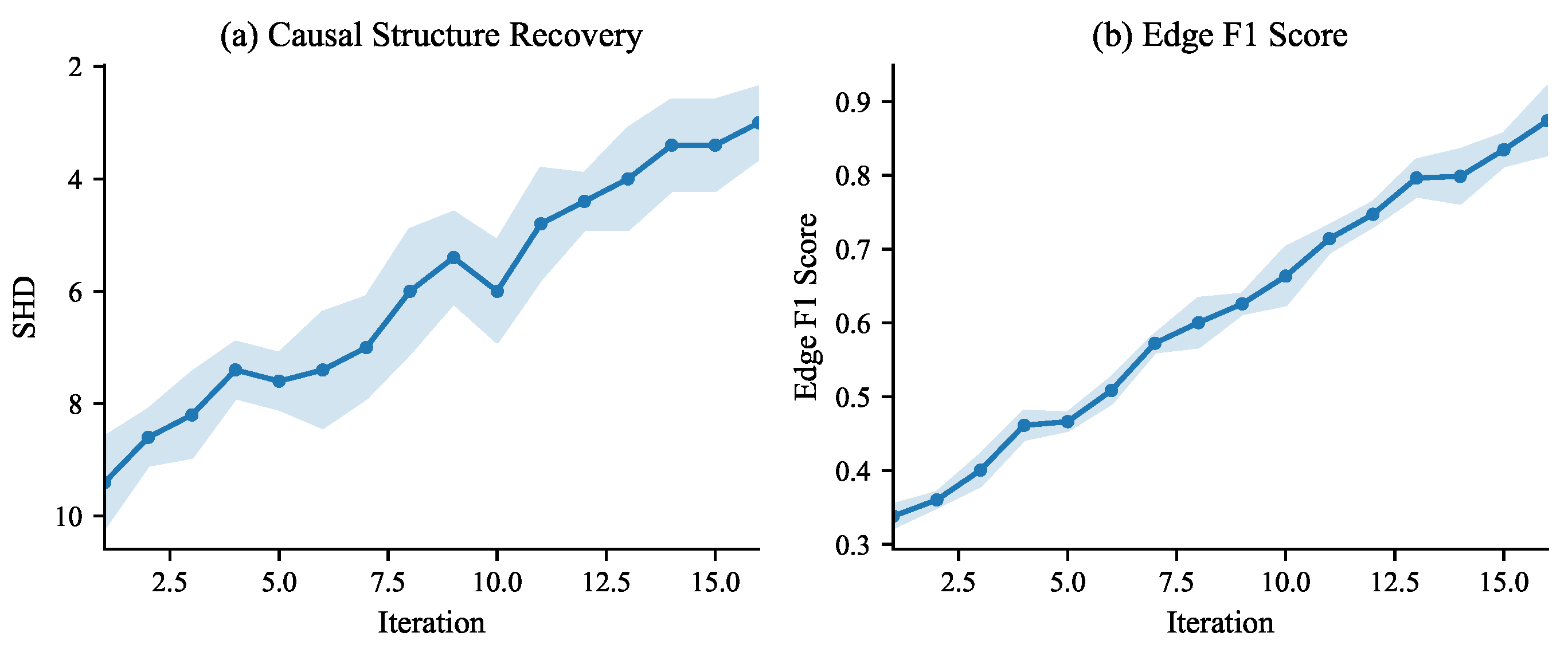
The ablation results therefore suggest that causal exploration and predictive exploitation play distinct and complementary roles. Figure 3 provides a visual summary of this pattern, showing that the combined CIAL policy consistently outperforms both single-component variants across seeds. Figure 4 further illustrates this behavior over iterations, with decreasing SHD and increasing edge F1 as CIAL progressively clarifies structure while improving predictive quality. The corresponding -strategy comparison is reported in Appendix A because it uses a separate long-horizon synthetic protocol.
Figure 3.
Ablation study comparing all methods on synthetic data using the unified benchmark pipeline results. CIAL achieves the best SHD recovery, while both the predictive-only and causal-only variants remain clearly worse, supporting the contribution of both IV and EI components. Error bars show ± standard deviation over 5 seeds.
Figure 4.
CIAL learning curves on synthetic data over 16 iterations. (a) SHD decreases as causal structure is recovered. (b) Edge F1 score increases correspondingly. Shaded regions indicate ± standard deviation over 5 seeds.
3.3. Real-Data Oxide-Screening Validation
Because no ground-truth causal graph is available for the Materials Project oxide benchmark or the exploratory OC20 [20] check, the real-data scores in Table 5 are cross-split graph-agreement F1 values computed against inferred reference graphs, not absolute causal-recovery F1.
Table 5.
Representative real-data results on the Materials Project transition metal oxide benchmark and exploratory OC20 oxide dataset check. Because no ground-truth causal graph is available, the metric is cross-split graph-agreement F1 against inferred reference graphs, not absolute causal-recovery F1.
On the main seven-feature MP benchmark, CIAL reaches F1 , EI reaches , and random sampling reaches . CIAL is therefore close to EI but does not exceed it in this generic-descriptor setting.
The clearest CIAL-over-EI advantage occurs under NOTEARS-based MP cross-split validation. In the 10-seed summary, CIAL reaches F1 compared with EI at (). The ordering persists in the 20-seed summary, with CIAL at and EI at , but the p-value weakens to a borderline level ().
Random sampling is not a weak baseline in this real-data graph-recovery setting: it reaches in the 10-seed NOTEARS MP summary and in the 20-seed summary, exceeding both acquisition policies against the inferred reference graph. This pattern indicates that broad descriptor-space coverage can aid inferred graph recovery even when it is not optimization-directed, and it raises the question of whether IV should be augmented with an explicit coverage term in early iterations.
The exploratory OC20 NOTEARS check follows the same CIAL-over-EI ordering, with CIAL at and EI at , but the difference is statistically inconclusive (), and random sampling remains higher at . OC20 therefore offers only supplementary cross-dataset context.
Collectively, the real-data results are bounded: CIAL remains competitive on the main MP benchmark, its clearest advantage appears with NOTEARS under cross-split validation, and OC20 follows a similar ordering without reaching significance. These results do not establish causal correctness on real catalyst data.
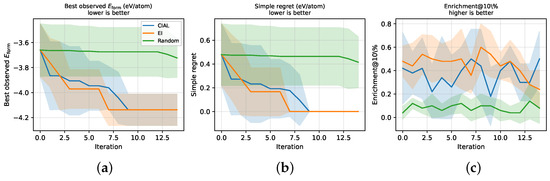
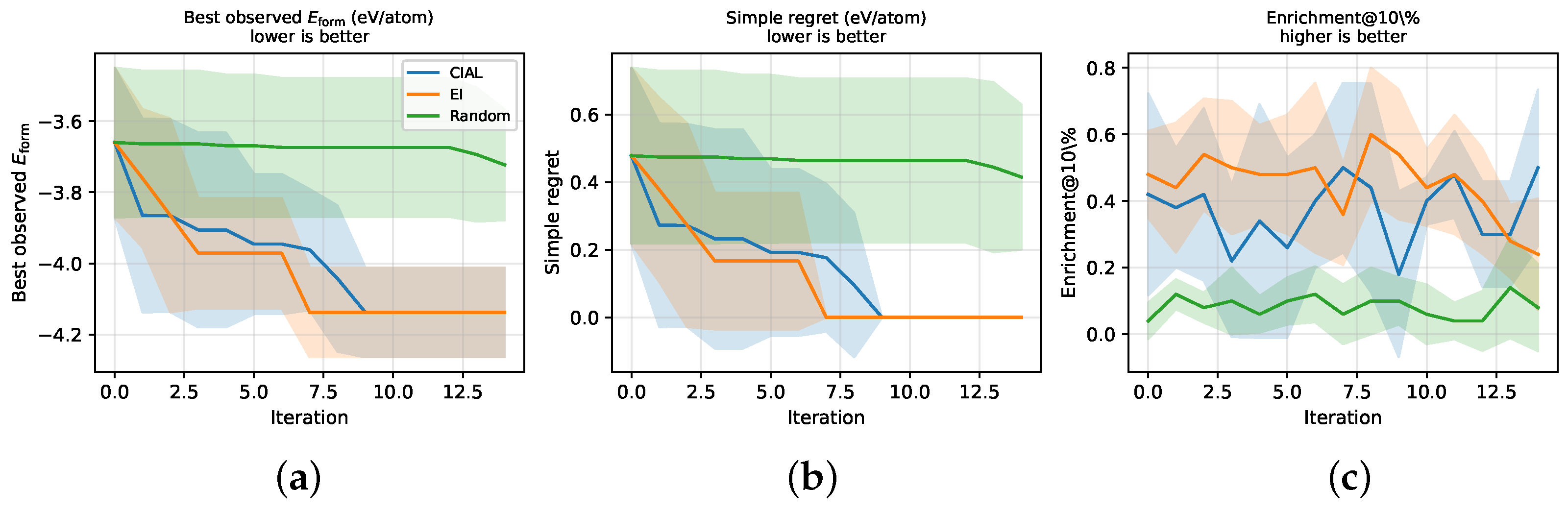
Table 6 reports target-optimization metrics on the same main MP benchmark. Despite the mixed graph-agreement F1 pattern, CIAL and EI both identify candidates whose formation energy equals the pool minimum (simple regret ), whereas random sampling leaves eV/atom of simple regret on average. The enrichment of low-energy candidates is also much higher for the acquisition policies: EI reaches and CIAL reaches , compared with random sampling at . This separation demonstrates that the real-data benchmark retains practical screening utility even when inferred-reference F1 does not favor CIAL over the baselines. Figure 5 shows the corresponding trajectories.
Table 6.
Target-optimization metrics on the main Materials Project transition metal oxide benchmark (7 features, 5 seeds, mean ± standard deviation). Lower best observed formation energy, lower regret, and higher enrichment of low-energy candidates indicate better screening utility. Hold-out validation RMSE is also reported for predictive performance.
Figure 5.
Target-optimization trajectories on the main MP transition metal oxide benchmark (mean ± standard deviation over 5 seeds). (a) Best observed formation energy, (b) simple regret, and (c) enrichment of the lowest-energy 10% of the pool. CIAL and EI both reach zero simple regret and substantially higher enrichment than random sampling, while random sampling fails to find the pool minimum within the active-learning budget.
Supporting Visual Analyses
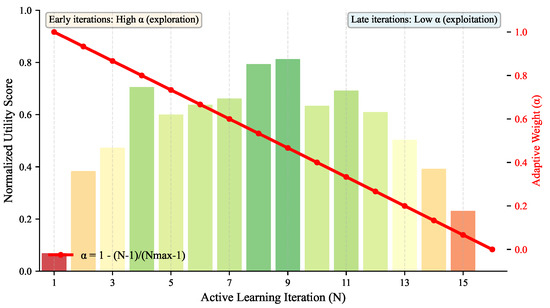
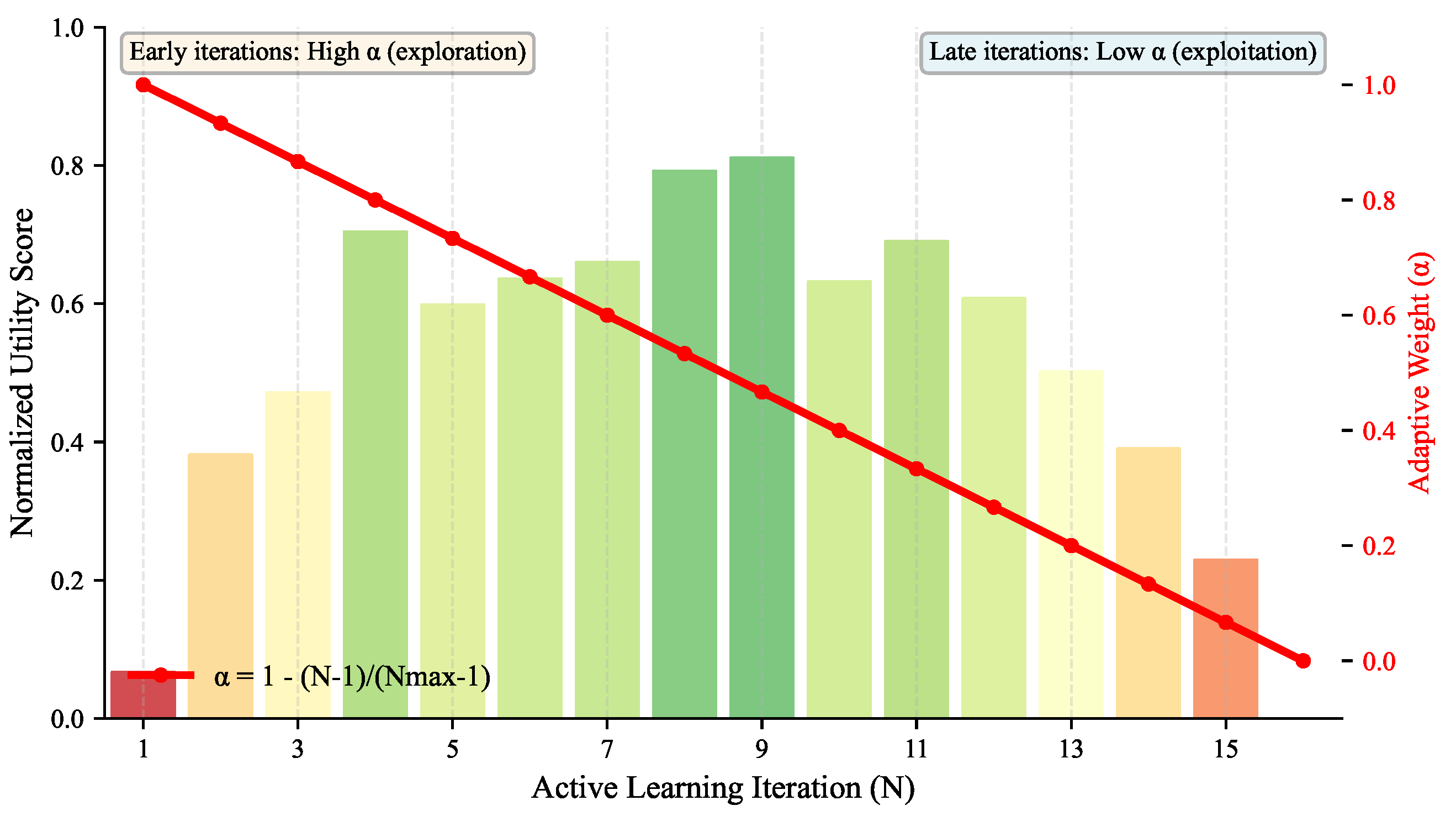
Several visual summaries help contextualize the real-data results. Figure 6 shows how CIAL moves from causal-structure exploration (high ) in early iterations to predictive exploitation (low ) later in the run. The adaptive weight schedule gives priority to experiments that reduce causal ambiguity when uncertainty is high and gradually shifts toward high-value predictions as the graph becomes clearer.
Figure 6.
Adaptive weight schedule evolution during CIAL iterations on synthetic data. The heatmap shows normalized utility scores across 16 active learning iterations (averaged over 5 seeds), depicting how CIAL transitions from causal exploration (high , early iterations) to predictive exploitation (low , late iterations). The red curve overlays the theoretical weight function for .
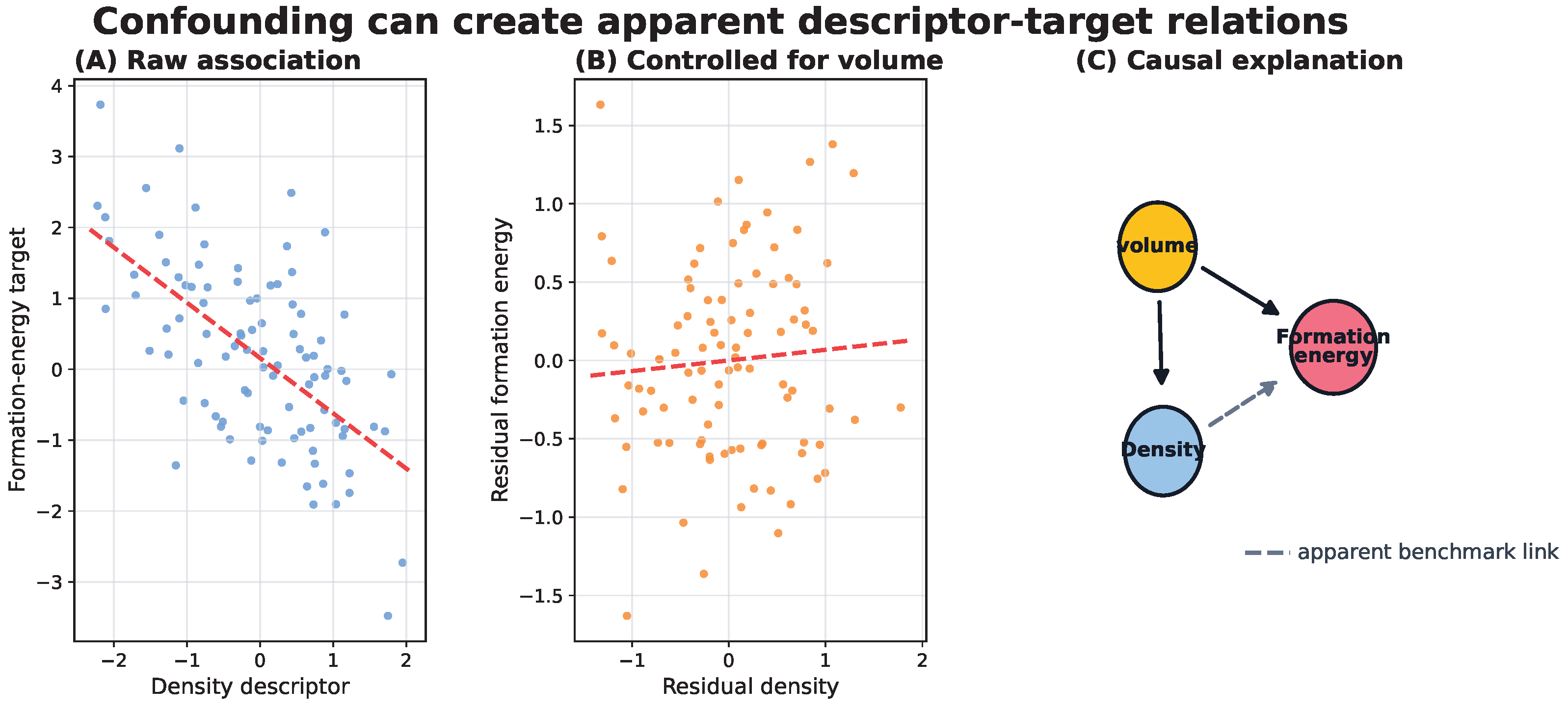
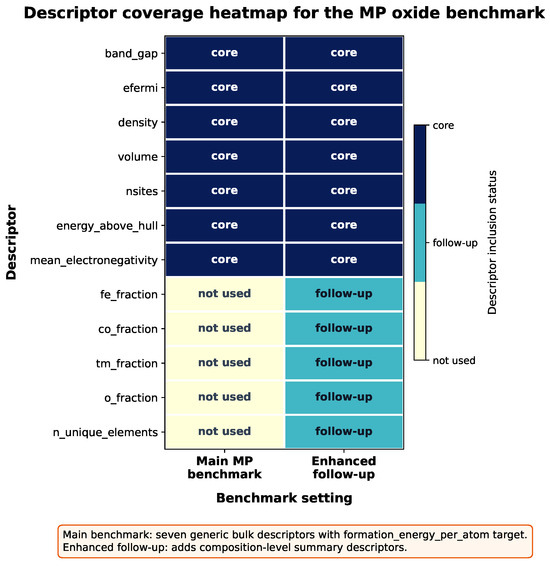
Figure 7 lists the descriptor families used in the Materials Project benchmark and in the enhanced follow-up runs. It shows that the real-data analysis relies mainly on generic bulk descriptors, with compositional variables added in selected follow-up experiments. Additional visual summaries are provided in Appendix A: Figure A1 shows the runtime comparison corresponding to Table 7, Figure A2 illustrates the descriptor-to-target interpretation used for the Materials Project benchmark, and Figure A3 gives a generic confounding example for interpreting descriptor–target associations.
Figure 7.
Descriptor coverage heatmap for the Materials Project benchmark. The matrix distinguishes the main bulk-descriptor MP benchmark from enhanced follow-up runs that add compositional summaries.
Table 7.
Scalability analysis: runtime per iteration (mean ± standard deviation, seconds) for all six methods using the unified benchmark pipeline results. Relative-to-EI multipliers are approximate and are computed from the underlying unrounded runtime means before display rounding. These runtimes reflect the shared synthetic-benchmark pipeline used for runtime comparison. CIAL incurs the highest computational cost because it updates causal structure each round, but the absolute runtime remains on the order of a few seconds per iteration.
3.4. Scalability Analysis
Table 7 reports the runtime analysis using the unified benchmark pipeline outputs. The lightweight baselines remain near – s per iteration (random sampling: ; the EI baseline: ; uncertainty: ), whereas the causal-structure-aware variants are substantially more expensive. CIAL requires s per iteration, compared with for CIAL-IV-only and for CIAL-EI-only; updating causal structure at every iteration makes CIAL approximately 40.15× slower than the EI baseline.
Even so, the absolute runtime remains on the order of a few seconds per iteration. In retrospective computational screening workflows where downstream validation is much slower, that overhead may still be acceptable in exchange for better graph recovery and descriptor-level insight. A graphical summary of the same runtime comparison is provided as Figure A1.
4. Discussion
The results suggest that the main advantage of CIAL is not simply a lower final SHD but a different allocation of the active-learning budget. Early rounds are used to reduce graph ambiguity through intervention-oriented queries, and later rounds shift naturally toward predictive improvement as the causal estimate stabilizes. The -strategy comparison reinforces this interpretation: the adaptive schedule performs best because it avoids committing too early to either pure exploration or pure exploitation.
The strongest evidence in this paper comes from the controlled synthetic benchmark, where the ground-truth causal graph is known; the real-data analyses should be interpreted as exploratory and protocol-dependent. The evidentiary strength differs substantially between the synthetic and real-data analyses. For the synthetic benchmark, the causal graph is known, and so SHD and F1 directly measure recovery of a known structure. In the Materials Project and OC20 analyses, by contrast, the reference graphs are inferred from data splits. Those real-data scores are useful for comparing acquisition behavior under a fixed protocol, but they do not establish causal correctness.
The Materials Project benchmark must also be judged by its target and descriptors. Formation energy is an upstream stability-relevant screening property for oxides, not a direct catalytic activity label. Bulk descriptors such as band gap, energy above hull, density, volume, and elemental fractions can prioritize oxide candidate spaces, but their link to catalytic activity requires validation with reaction-specific labels, adsorption-energy descriptors, or closed-loop experiments.
The NOTEARS cross-split results reveal a diversity–optimization tension in real-data graph recovery. Random sampling achieves higher F1 than both CIAL and EI against the inferred reference graph, which means that representative coverage of the descriptor distribution can outweigh optimization-directed acquisition for graph estimation in these settings. This pattern suggests that, for the MP and OC20 inferred-reference protocols, broad coverage is at least as important as the intervention-value signal for recovering stable graph structure. At the same time, the optimization metrics in Table 6 show that the acquisition policies still deliver practical screening value: CIAL and EI both locate the pool-minimum formation energy and enrich low-energy candidates far more than Random. The two metrics therefore measure different things—graph-estimation coverage and optimization utility—and the real-data evidence is strongest when both are considered together. One implication is that the IV term should not rely exclusively on graph-change magnitude; early iterations may need an explicit coverage or diversity bonus so that optimization does not collapse the sample onto a narrow high-utility region before the causal structure is well determined. The random sampling baseline does not invalidate the synthetic results, but it does bound the real-data claim: CIAL’s advantage is clearest when the acquisition can be shaped to balance graph clarification, predictive utility, and descriptor-space coverage.
The real-data results also depend on the backend. NOTEARS provides the clearest positive CIAL-over-EI trend among the tested real-data settings, but the 20-seed MP summary is borderline and the OC20 check is statistically inconclusive. PC-based configurations are less stable in the present small-sample real-data setting. This backend sensitivity is consistent with the earlier observation that a large IV can reflect graph-estimation instability when the reference graph is itself inferred from limited or noisy data: the IV term may then reward candidates that perturb an unstable estimate rather than clarify a true structure. No backend should be interpreted as definitive causal validation without external experimental or mechanistic evidence.
These observations motivate extending the validation to other reaction classes, including HER and CO2RR [12,21], as well as tighter integration with experimental workflows, more efficient causal-structure updates, and stronger theoretical guidance for schedule design. Future work should also evaluate diversity-augmented acquisition rules and compare causal backends under controlled sample-size regimes. Additional tests on broader synthetic systems with hidden confounders, nonlinear structural equations, and varied graph densities would help characterize robustness. Finally, comparisons with entropy-search, mutual-information, and causal Bayesian optimization acquisition rules, together with prospective catalytic measurements, are needed to connect retrospective screening benchmarks with real discovery workflows.
5. Conclusions
We present Causal Intervention Active Learning (CIAL) as a structure-aware acquisition framework for oxide material screening that combines causal intervention value with expected improvement through an adaptive weighting schedule. On the synthetic benchmark with known ground-truth causal graphs, this design yields substantially stronger graph recovery than the standard baselines, including a 76.2% lower final SHD than the standard EI baseline, with statistically significant final-iteration differences across five random seeds ( for SHD and for F1). Ablation results further show that neither the causal-intervention term nor the predictive term alone recovers the full benefit of the combined policy.
On the Materials Project transition metal oxide benchmark, CIAL remains competitive with EI in the main generic-descriptor setup; its clearest real-data advantage occurs under NOTEARS-based cross-split validation and weakens to a borderline result in the 20-seed summary. The exploratory OC20 check follows the same CIAL-over-EI ordering but is statistically inconclusive. These real-data results are protocol-dependent screening evidence, and direct validation of catalyst mechanisms remains a task for reaction-specific labels or experiments.
For oxide material screening, CIAL can support upstream screening of transition metal oxide candidates and descriptor-hypothesis generation, but direct catalytic activity validation will require reaction-specific labels, adsorption-energy benchmarks, or experimental closed-loop studies. The overall pattern points naturally toward broader validation on additional catalyst classes such as HER and CO2RR [12,21], tighter integration with experimental workflows, more efficient causal-structure updates, stronger theoretical guidance for schedule design, and acquisition rules that explicitly balance graph clarification, predictive utility, and diversity. In that sense, CIAL is best understood as a practical starting point for active-learning systems that aim not only to improve material screening efficiency but also to support more testable causal hypotheses about material screening targets.
Author Contributions
Conceptualization, methodology, software, formal analysis, investigation, visualization, writing—original draft preparation: P.C. Validation, data curation, investigation, writing—review and editing: X.W. Methodology, resources, investigation, writing—review and editing: Y.Y. Conceptualization, supervision, project administration, funding acquisition, writing—review and editing: W.W. All authors have read and agreed to the published version of the manuscript.
Funding
This work was supported by the Scientific Research Project of the Education Department of Anhui Province (2025AHGXZK31115, 2025AHGXZK30446, and 2025AHGXZK40579), the 2025 Annual School-Level Scientific Research Project of Wuhu Institute of Technology (wzyrc202517 and wzyre202518), the Wuhu Science and Technology Bureau Platform Project (WHSYFZX202307), and the Provincial Engineering Research Center Open Project (TZDXDL-2025-002).
Institutional Review Board Statement
Not applicable.
Informed Consent Statement
Not applicable.
Data Availability Statement
The synthetic benchmarking datasets and CIAL implementation materials, including figure-generation scripts, are available at https://github.com/peter5991/Article-Data (accessed on 1 March 2026). For the real-data benchmark, the Materials Project portion was constructed from filtered transition metal oxide entries retrieved from the Materials Project database in March 2026 through the public REST API (mp-api v0.41+). The source database is available at https://materialsproject.org/ (accessed on 1 March 2026). The real-data target is formation_energy_per_atom, and the descriptor set consists of bulk and compositional features extracted from these oxide entries. Filtering criteria and descriptor-extraction procedures are documented in the accompanying code repository [22].
Acknowledgments
The authors thank the School of Material Engineering, Wuhu Institute of Technology, for institutional support in project coordination, research organization, and manuscript preparation. The authors also acknowledge the Australian Institute for Bioengineering and Nanotechnology (AIBN), The University of Queensland, for academic exchange and interdisciplinary discussion that supported the development of this study. All scientific judgments, result verification, and final editorial decisions were made by the authors.
Conflicts of Interest
The authors declare no conflicts of interest.
Abbreviations
The following abbreviations are used in this manuscript:
| CIAL | Causal Intervention Active Learning |
| IV | Intervention Value |
| EI | Expected Improvement |
| SHD | Structural Hamming Distance |
| GP | Gaussian Process |
| DAG | Directed Acyclic Graph |
| CPDAG | Completed Partially Directed Acyclic Graph |
| PC | PC Algorithm |
| DFT | Density Functional Theory |
| RBF | Radial Basis Function |
Appendix A. Auxiliary Visual Analyses
This appendix provides auxiliary visual summaries of the runtime analysis, Materials Project descriptor interpretation, and generic confounding discussion in the main manuscript. These figures keep the main text focused on the primary quantitative results while retaining visual documentation that supports interpretation.
Figure A1.
Runtime per iteration for all methods using the unified benchmark pipeline results. Random, EI, and Uncertainty remain near – s per round, whereas the causal-structure-aware variants are more expensive; CIAL reaches s per iteration because it updates the causal structure at every round.
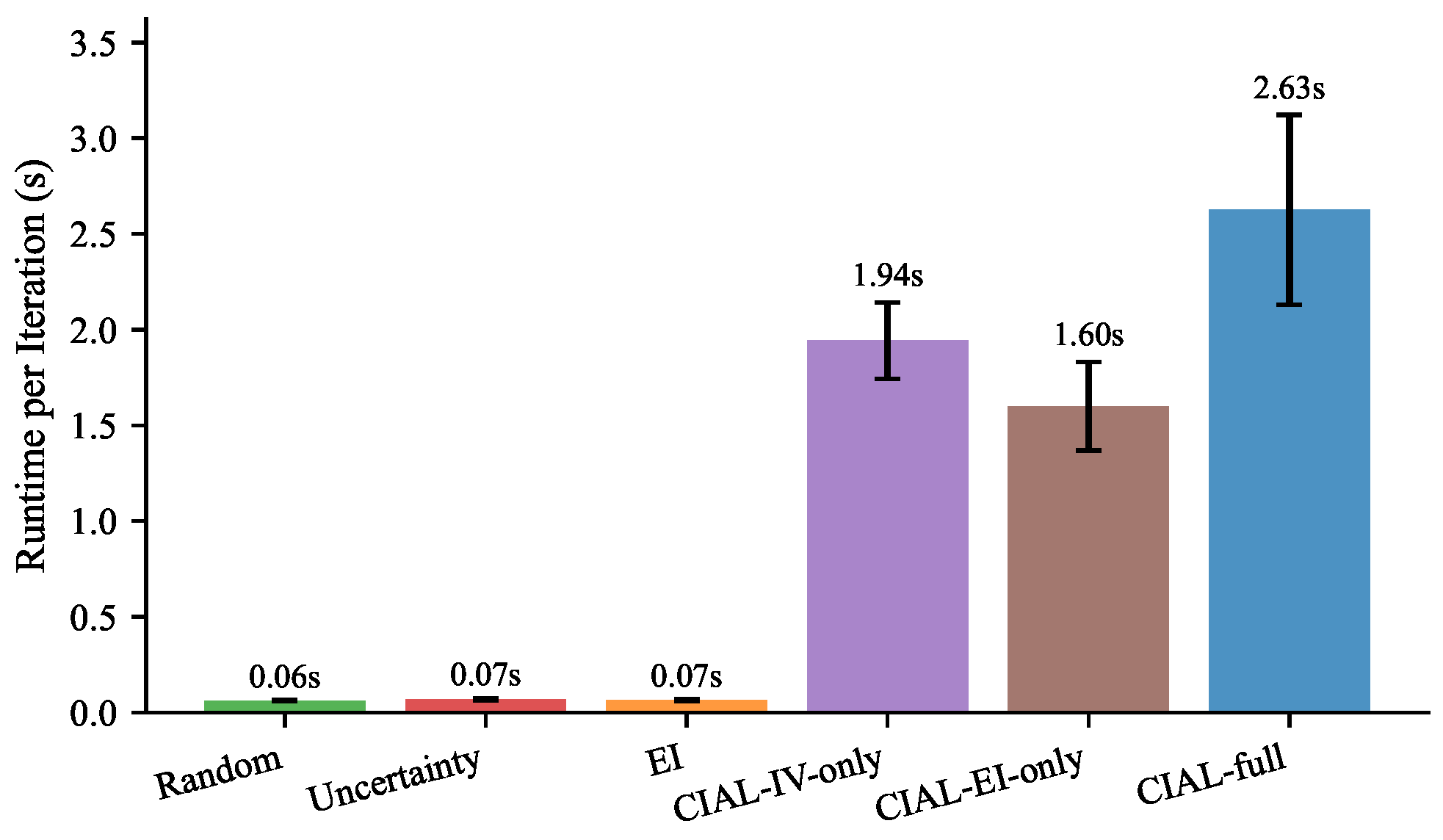
Figure A2.
Descriptor-association schematic for the Materials Project benchmark. Solid arrows denote descriptor-to-target relations emphasized in the benchmark discussion, whereas dashed links indicate correlated background structure among generic oxide descriptors. The arrows are illustrative and do not represent validated causal effects inferred from the Materials Project or OC20 data.
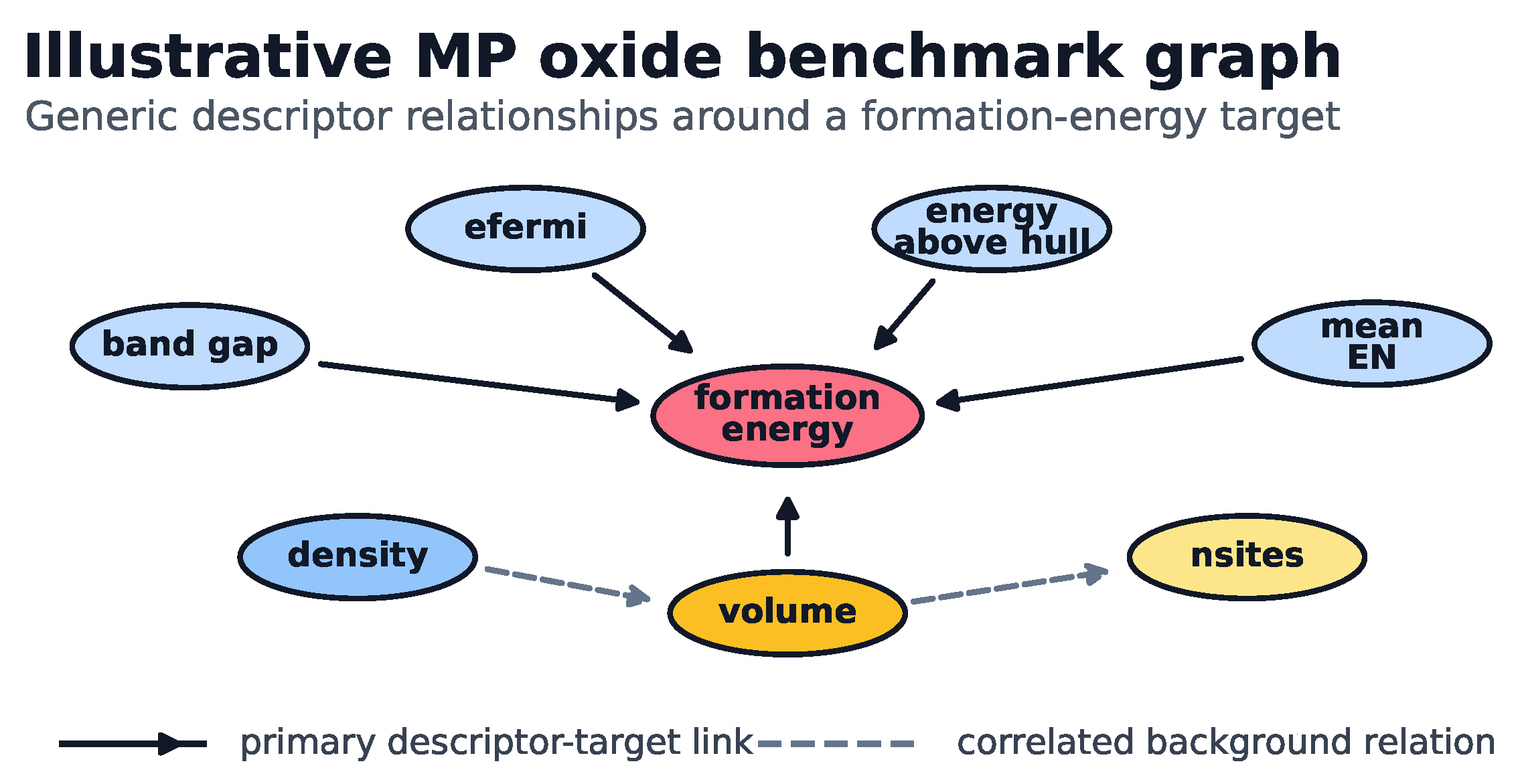
Figure A3.
Toy confounding example showing how generic benchmark descriptors can appear predictive without being directly causal. (A) A raw correlation in a toy example. (B) The relationship after controlling for a confounding variable. (C) A corresponding schematic causal graph. This example is purely illustrative and is not inferred from the Materials Project or OC20 data.
Appendix A.1. Comparison of α Strategies
Table A1 compares different strategies across three active learning budgets () under a separate long-horizon synthetic protocol. The adaptive schedule achieves the best mean final performance at every budget level. The ranking is also stable across budgets: the adaptive schedule ranks first, and fixed EI-only () ranks last in all three settings.
These results suggest that a fixed objective is less effective than allowing the acquisition rule to move from causal exploration toward prediction-focused exploitation as the budget is spent. Table 3 and Table A1 were generated under different benchmark settings with different evaluation objectives: Table 3 reports unified benchmark pipeline outputs for cross-method comparison in the main setting, whereas Table A1 reports a separate long-horizon protocol for within-protocol -strategy ranking across budgets. Accordingly, absolute SHD/F1 values such as 3.0 and 6.5 at are protocol-specific quantities.
Table A1.
Comparison of strategies across different active learning budgets (). The adaptive linear schedule outperforms all fixed weighting strategies consistently across budget sizes. Results are from the long-horizon synthetic protocol (5 seeds) and are intended for within-protocol strategy ranking; absolute SHD/F1 values are not directly comparable to Table 3, which uses a separate unified benchmark pipeline setting.
Appendix A.2. Synthetic Benchmark Configuration
Table A2 gives the full configuration of the controlled synthetic benchmark used for the primary graph-recovery claim. Variable labels are generic placeholders for readability; the benchmark is defined by the hand-designed linear Gaussian SEM structure and coefficients.
Table A2.
Synthetic benchmark configuration. Variable labels are generic placeholders for readability; the benchmark is defined by the hand-designed linear Gaussian SEM structure and coefficients. The same ground-truth DAG is used across all random seeds; seeds vary only the finite-sample noise realizations.
References
- Lookman, T.; Balachandran, P.V.; Xue, D.; Yuan, R. Active learning in materials science with emphasis on adaptive sampling using uncertainties for targeted design. npj Comput. Mater. 2019, 5, 21. [Google Scholar] [CrossRef] [Scilit]
- Kim, M.; Ha, M.Y.; Jung, W.B.; Yoon, J.; Shin, E. Searching for an Optimal Multi-Metallic Alloy Catalyst by Active Learning Combined with Experiments. Adv. Mater. 2022, 34, 2108900. [Google Scholar] [CrossRef] [Scilit] [PubMed]
- Wang, A.; Liang, H.; McDannald, A. Benchmarking active learning strategies for materials optimization and discovery. Oxf. Open Mater. Sci. 2022, 2, itac006. [Google Scholar] [CrossRef] [Scilit]
- Nie, S.; Xiang, Y.; Wu, L.; Lin, G.; Liu, Q.; Chu, S. Active Learning Guided Discovery of High Entropy Oxides Featuring High H2-Production. J. Am. Chem. Soc. 2024, 146, 29325–29334. [Google Scholar] [CrossRef] [Scilit] [PubMed]
- Jayarathna, R.; Onsree, T.; Drummond, R. Experimental discovery of novel ammonia synthesis catalysts via active learning. J. Mater. Chem. A 2024, 12, 5638–5646. [Google Scholar] [CrossRef] [Scilit]
- Bi, J.; Xu, Y.; Conrad, F.; Wiemer, H.; Ihlenfeldt, S. A comprehensive benchmark of active learning strategies with AutoML for small-sample regression in materials science. Sci. Rep. 2025, 15, 37167. [Google Scholar] [CrossRef] [Scilit] [PubMed]
- Spirtes, P.; Glymour, C.N.; Scheines, R. Causation, Prediction, and Search, 2nd ed.; MIT Press: Cambridge, MA, USA, 2000. [Google Scholar]
- Pearl, J. Causality: Models, Reasoning, and Inference, 2nd ed.; Cambridge University Press: Cambridge, UK, 2009. [Google Scholar]
- Biswas, R.; Mukherjee, S. Consistent causal inference from time series with PC algorithm and its time-aware extension. Stat. Comput. 2024, 34, 14. [Google Scholar] [CrossRef] [Scilit]
- Mok, D.H.; Li, H.; Zhang, G.; Lee, C.; Jiang, K.; Back, S. Data-driven discovery of electrocatalysts for CO2 reduction using active motifs-based machine learning. Nat. Commun. 2023, 14, 7303. [Google Scholar] [CrossRef] [Scilit] [PubMed]
- Foppa, L.; Sutton, C.; Ghiringhelli, L.M.; De, S.; Löser, P.; Schunk, S.A.; Schaefer, A.; Scheffler, M. Learning Design Rules for Selective Oxidation Catalysts from High-Throughput Experimentation and Artificial Intelligence. ACS Catal. 2021, 12, 2223–2232. [Google Scholar] [CrossRef] [Scilit] [PubMed]
- Han, Z.; Tao, S.; Jia, Y.; Zhang, M.; Ma, R.; Xiao, X.; Zhou, J.; Gao, R.; Cui, K.; Wang, T.; et al. Data-Driven Insight into the Universal Structure-Property Relationship of Catalysts in Lithium-Sulfur Batteries. J. Am. Chem. Soc. 2025, 147, 22851–22863. [Google Scholar] [CrossRef] [Scilit] [PubMed]
- Zhang, Z.; Lu, S.; Zhu, M.; Wang, F.; Yang, K.; Dong, B.; Yao, Q.; Hu, W. Enhancing Water Oxidation Performance of Transition Metal Oxides by Atomically Precise Heteroatom Doping. J. Am. Chem. Soc. 2025, 147, 22806–22817. [Google Scholar] [CrossRef] [Scilit] [PubMed]
- Tong, S.; Koller, D. Active Learning for Structure in Bayesian Networks. In Proceedings of the Seventeenth International Joint Conference on Artificial Intelligence, IJCAI 2001; Morgan Kaufmann: San Francisco, CA, USA, 2001; pp. 863–869. [Google Scholar]
- Hauser, A.; Bühlmann, P. Characterization and greedy learning of interventional Markov equivalence classes of directed acyclic graphs. J. Mach. Learn. Res. 2012, 13, 2409–2464. [Google Scholar]
- Aglietti, V.; Lu, X.; Frazier, P. Causal Bayesian Optimization. In Proceedings of the Twenty-Third International Conference on Artificial Intelligence and Statistics, Online, 26–28 August 2020; Volume 108, pp. 3155–3164. [Google Scholar]
- Jones, D.R.; Schonlau, M.; Welch, W.J. Efficient Global Optimization of Expensive Black-Box Functions. J. Glob. Optim. 1998, 13, 455–492. [Google Scholar] [CrossRef] [Scilit]
- Zheng, X.; Aragam, B.; Ravikumar, P.K.; Xing, E.P. DAGs with NO TEARS: Continuous Optimization for Structure Learning. In Proceedings of the Advances in Neural Information Processing Systems; Curran Associates, Inc.: Red Hook, NY, USA, 2018; Volume 31, pp. 9472–9483. [Google Scholar]
- Rasmussen, C.E.; Williams, C.K.I. Gaussian Processes for Machine Learning; MIT Press: Cambridge, MA, USA, 2006. [Google Scholar]
- Chanussot, L.; Das, A.; Goyal, S.; Lavril, T.; Shuaibi, M.; Riviere, M.; Tran, K.; Heras-Domingo, J.; Ho, C.; Hu, W.; et al. Open Catalyst 2020 (OC20) Dataset and Community Challenges. ACS Catal. 2021, 11, 6059–6072. [Google Scholar] [CrossRef] [Scilit]
- Tan, X.; Mo, W.; Lin, X.; Loh, J.Y.; Mohamed, A.; Ong, W.J. Retrospective insights into recent MXene-based catalysts for CO2 electro/photoreduction: How far have we gone? Nanoscale 2023, 15, 6536–6562. [Google Scholar] [CrossRef] [Scilit] [PubMed]
- Jain, A.; Ong, S.P.; Hautier, G.; Chen, W.; Richards, W.D.; Dacek, S.; Cholia, S.; Gunter, D.; Skinner, D.; Ceder, G.; et al. Commentary: The Materials Project: A materials genome approach to accelerating materials innovation. APL Mater. 2013, 1, 011002. [Google Scholar] [CrossRef] [Scilit]

Disclaimer/Publisher’s Note: The statements, opinions and data contained in all publications are solely those of the individual author(s) and contributor(s) and not of MDPI and/or the editor(s). MDPI and/or the editor(s) disclaim responsibility for any injury to people or property resulting from any ideas, methods, instructions or products referred to in the content. |
© 2026 by the authors. Licensee MDPI, Basel, Switzerland. This article is an open access article distributed under the terms and conditions of the Creative Commons Attribution (CC BY) license.