


Abstract
Plasma-catalytic oxidation is a promising approach for the abatement of volatile organic compounds (VOCs), yet its efficiency is often limited by the ineffective utilization of plasma-generated reactive oxygen species and incomplete oxidation pathways. In this work, a composite catalyst was constructed by integrating spinel-type NiCo2O4 with three-dimensional cubic mesoporous KIT-6 to couple efficient mass transfer with redox-active surface functionality for plasma-catalytic degradation of toluene. The performance of NiCo/KIT-6 was systematically evaluated in a dielectric barrier discharge (DBD) reactor and compared with Ni/KIT-6, Co/KIT-6, and NTP-only systems. XPS, O2-TPD, H2-TPR, and apparent dielectric measurements were employed to elucidate catalyst properties relevant to plasma–surface interactions. NiCo/KIT-6 exhibits superior overall performance in terms of toluene conversion, COx selectivity, and CO2 selectivity over a wide range of specific input energies. This enhancement is closely associated with the integrated regulation of surface redox properties, oxygen activation capability, and apparent dielectric response by the NiCo2O4/KIT-6 composite structure, which may promote reactive oxygen utilization and facilitates effective plasma–surface redox processes. These results provide insights into the rational design of composite catalysts for plasma-assisted oxidation of aromatic VOCs.
1. Introduction
Volatile organic compounds (VOCs) are major contributors to atmospheric pollution, posing direct threats to human health and playing an important role in the formation of tropospheric ozone and secondary organic aerosols, thereby exacerbating photochemical smog and fine particulate matter pollution [1,2]. In recent years, non-thermal plasma (NTP) technology has attracted increasing interest as an advanced VOCs abatement technique because it can generate energetic electrons and a variety of reactive species under ambient conditions, enabling rapid activation and decomposition of VOCs molecules [3]. Nevertheless, NTP-only systems often suffer from limited utilization efficiency of plasma-generated reactive species and incomplete oxidation pathways, which results in high energy consumption and insufficient mineralization. To overcome these intrinsic limitations, the integration of catalysts with plasma to construct plasma-catalytic systems has been widely recognized as an effective strategy for improving VOCs removal efficiency and oxidation performance [4,5].
Even in plasma-catalytic systems, the capture and effective utilization of reactive oxygen species such as •O, •OH, and O3 remain challenging. Although these species can be generated efficiently under non-thermal plasma conditions, their extremely short lifetimes in the gas phase mean that, without suitable surface enrichment and interfacial coupling with active sites, a considerable fraction may undergo self-decomposition or participate in non-selective side reactions, thereby limiting overall reaction efficiency and mineralization [3,6]. Consequently, the development of composite catalytic materials that integrate high surface area, efficient mass transport, and surface sites capable of coupling plasma-generated species with redox-active centers is essential for improving plasma-assisted VOCs degradation. Ordered mesoporous materials have therefore attracted considerable attention owing to their regular pore structures, high surface areas, and thermal stability, which are advantageous for adsorption and diffusion in VOCs catalytic oxidation [7,8]. Among them, three-dimensional cubic KIT-6 (Ia3d) possesses a bicontinuous mesoporous network with interconnected channels, offering enhanced molecular diffusion and mass transfer compared with one-dimensional mesoporous materials such as SBA-15 [9]. This unique architecture provides an effective platform for dispersing active components and facilitating the transport and utilization of plasma-generated reactive oxygen species. Previous studies have demonstrated that loading noble metals or transition-metal oxides onto KIT-6 can significantly improve catalytic activity and stability in VOCs oxidation, highlighting its role as both an adsorption-diffusion medium and an interface for heterogeneous reactions [10,11].
Among transition-metal oxides, Co3O4-based catalysts have been widely investigated for the catalytic oxidation of aromatic VOCs due to the reversible Co2+/Co3+ redox couple, the presence of oxygen vacancies, and favorable π–d interactions with aromatic rings, which collectively facilitate adsorption and initial activation of aromatic molecules [12,13,14,15]. However, the catalytic performance of monometallic oxides is often constrained by limited redox flexibility and oxygen mobility. In contrast, bimetallic oxides can provide enhanced electronic tunability and interfacial reactivity through synergistic interactions between different metal centers. As a typical spinel-type bimetallic oxide, NiCo2O4 combines the aromatic affinity associated with Co-based oxides with multiple reversible Ni2+/Ni3+ and Co2+/Co3+ redox couples, offering improved redox adaptability and surface oxygen activation capability [16,17]. These structural and electronic features are expected to favor the enrichment and transformation of plasma-generated reactive oxygen species at the catalyst surface and to facilitate their coupling with variable-valence metal centers, thereby providing a promising active phase for plasma-assisted oxidation of aromatic VOCs.
Based on the above analysis, this study aims to integrate three-dimensional cubic KIT-6 with spinel-type NiCo2O4 to construct a composite catalyst that combines high surface area, efficient mass transport, and redox-active metal-oxygen functionality, and to systematically evaluate its performance in plasma-catalytic degradation of toluene. To clarify the role of the bimetallic spinel phase and the contribution of the mesoporous framework, the catalytic behavior of the NiCo2O4/KIT-6 composite is further compared with that of NiO- and Co3O4-based counterparts. Through this comparative approach, the synergistic effects arising from the coupling of the spinel oxide with the ordered mesoporous structure are examined, with particular emphasis on reactive oxygen utilization, plasma–surface interaction, and the oxidation efficiency of toluene.
2. Results and Discussion
2.1. Structural and Surface Properties
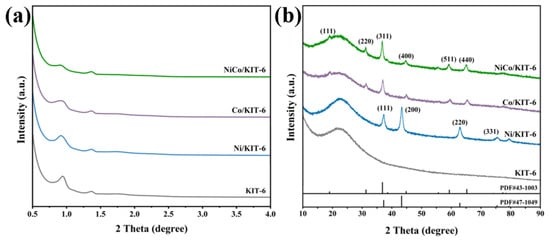
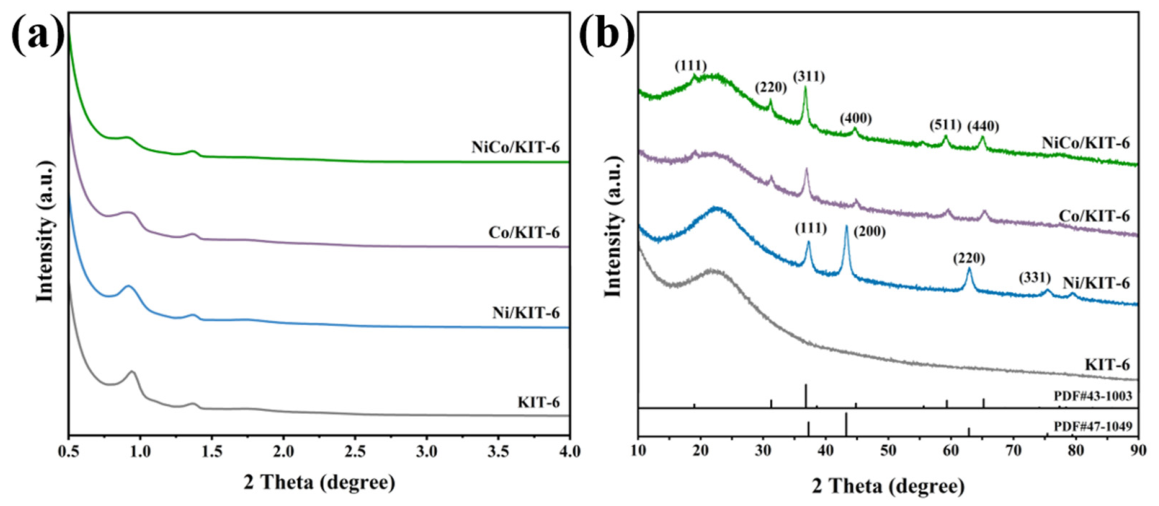
The XRD patterns of all samples are shown in Figure 1. In the low-angle region (Figure 1a), two distinct reflections at 0.94° and 1.36° can be indexed to the (211) and (200) planes of the Ia3d cubic symmetry, respectively [18,19]. These features confirm the typical three-dimensional bicontinuous Ia3d mesostructure characteristic of KIT-6. After loading the active phases, the low-angle diffraction peaks are noticeably weakened, which can be attributed to partial filling of the mesoporous channels by the deposited species. This filling reduces the electron-density contrast between the silica framework and the pore voids, thereby diminishing the scattering intensity associated with the ordered mesostructure. Nevertheless, the characteristic Ia3d symmetry remains discernible, indicating that the long-range mesoscopic order of KIT-6 is largely preserved. The wide-angle XRD patterns of the samples are shown in Figure 1b. The broad diffraction feature centered at approximately 27.4° is assigned to the amorphous silica walls of the KIT-6 support. For Ni/KIT-6, diffraction peaks located at 37.3°, 43.3°, 62.9°, and 75.5° can be indexed to the (111), (200), (220), and (311) planes of cubic NiO (PDF#47-1049). In the case of Co/KIT-6, the reflections at 19.1°, 31.3°, 37.0°, 44.8°, 59.6°, and 65.5° correspond to the (111), (220), (311), (400), (511), and (440) planes of the spinel Co3O4 phase (PDF#43-1003). For NiCo/KIT-6, the diffraction peaks exhibit a slight shift toward lower angles relative to those of Co/KIT-6, which can be ascribed to partial substitution of Co by the larger Ni2+ ions. This substitution leads to a modest expansion of the spinel lattice and reflects the incorporation of Ni and Co cations within the octahedral and tetrahedral sites of the spinel framework [20].
Figure 1.
(a) Low-angle and (b) wide-angle XRD patterns of samples.
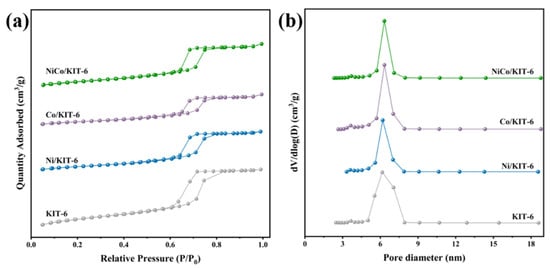
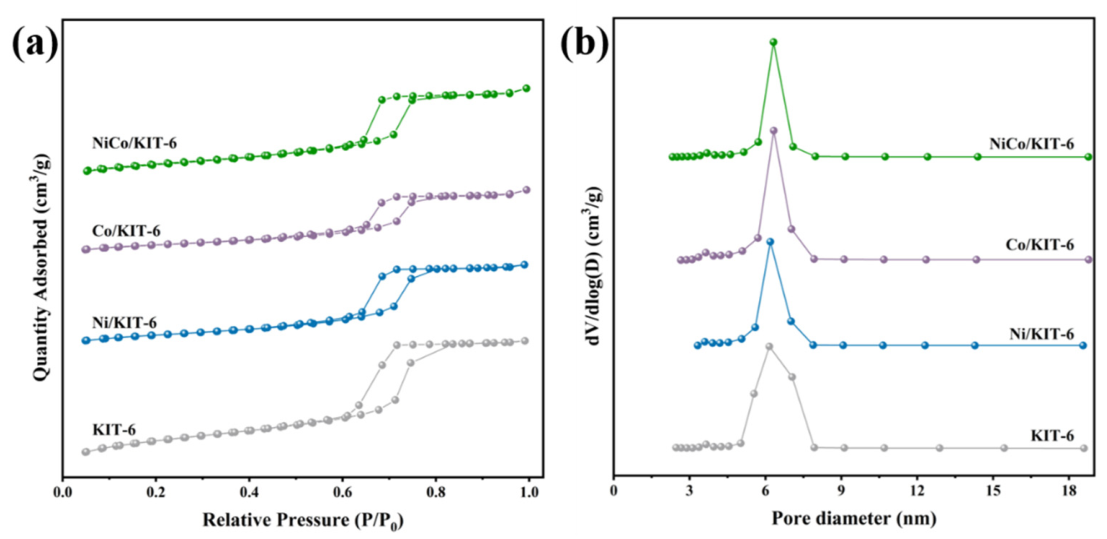
The nitrogen adsorption–desorption isotherms and pore size distributions of the samples are shown in Figure 2. All four samples display typical type IV isotherms with step-like hysteresis loops in the P/P0 range of 0.6–0.9, corresponding to H1-type hysteresis [21], which indicates well-ordered mesoporous structures. Upon metal loading, the mesoporous framework of KIT-6 is largely preserved, although a slight decrease in adsorption capacity and a modest broadening of the hysteresis loops are observed. These changes indicate that a fraction of the mesopores is partially occupied by the deposited metal oxides or that minor structural adjustments occur upon impregnation and calcination. The textural properties of the samples, including specific surface area, pore volume, and average pore diameter, are summarized in Table 1. Brunauer-Emmett-Teller (BET) analysis shows that pristine KIT-6 exhibits a high specific surface area of 910.9 m2/g and a pore volume of 1.31 cm3/g. After metal oxide loading, both parameters decrease, which can be primarily attributed to partial pore filling by the active phases. Notably, NiCo/KIT-6 retains a comparatively higher surface area and pore volume among the modified samples, suggesting that its mesoporous framework remains more accessible. Furthermore, the average pore diameter derived from the desorption branch using the Barrett–Joyner–Halenda (BJH) method shows only a slight reduction after metal loading, indicating that the ordered mesoporous structure of KIT-6 is largely maintained.
Figure 2.
(a) Nitrogen adsorption–desorption isotherms and (b) pore size distributions of the samples.
Table 1.
Physicochemical properties of the samples.
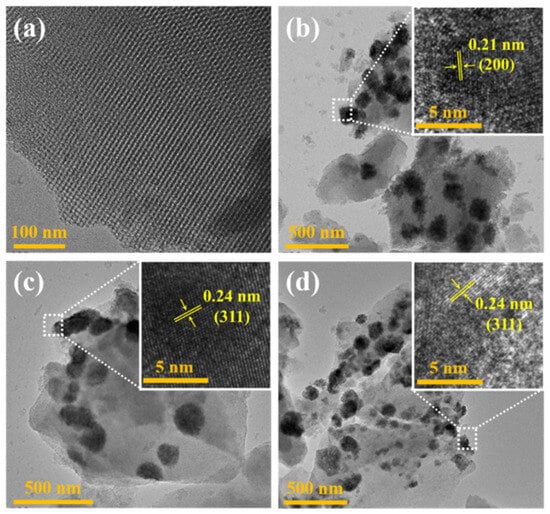
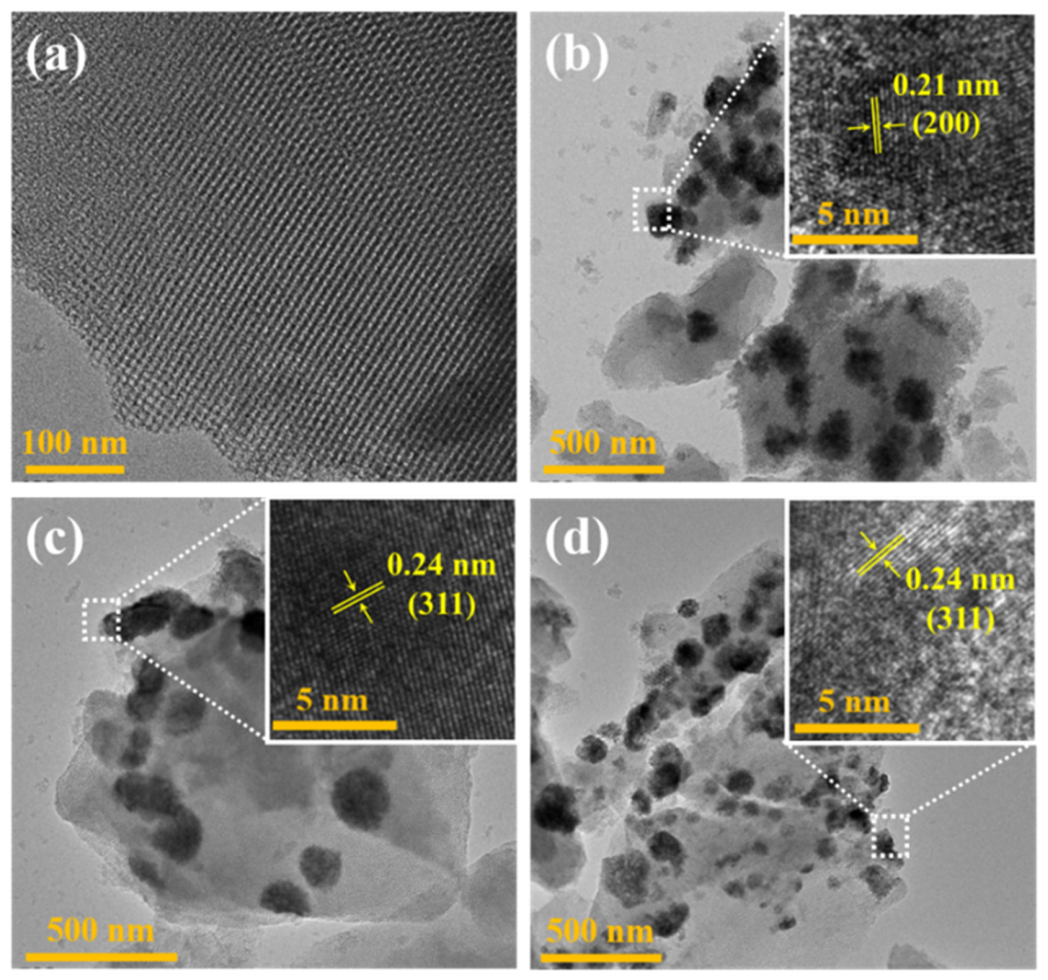
TEM was employed to examine the mesoporous structure of the samples, as illustrated in Figure 3. KIT-6 displays a highly ordered cubic mesoporous framework, with an interfringe distance of approximately 10 nm. For the metal-oxide-loaded samples, well-dispersed oxide nanoparticles are clearly observed both on the external surfaces and within the mesoporous channels. In detail, the lattice spacing of about 0.21 nm in Figure 3b can be indexed to the (200) plane of NiO, whereas the lattice fringes with a spacing of ~0.24 nm in Figure 3c,d are attributed to the (311) planes of Co3O4 and NiCo2O4, respectively. Although slight diffraction peak shift are detected in the XRD patterns, the interplanar spacings measured by HRTEM remain essentially unchanged, which can be ascribed to the localized nature of HRTEM observation and its limited precision relative to bulk-averaged XRD analysis.
Figure 3.
TEM and HRTEM images of (a) KIT-6, (b) Ni/KIT-6, (c) Co/KIT-6, and (d) NiCo/KIT-6.
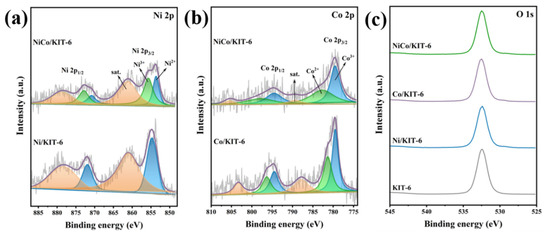
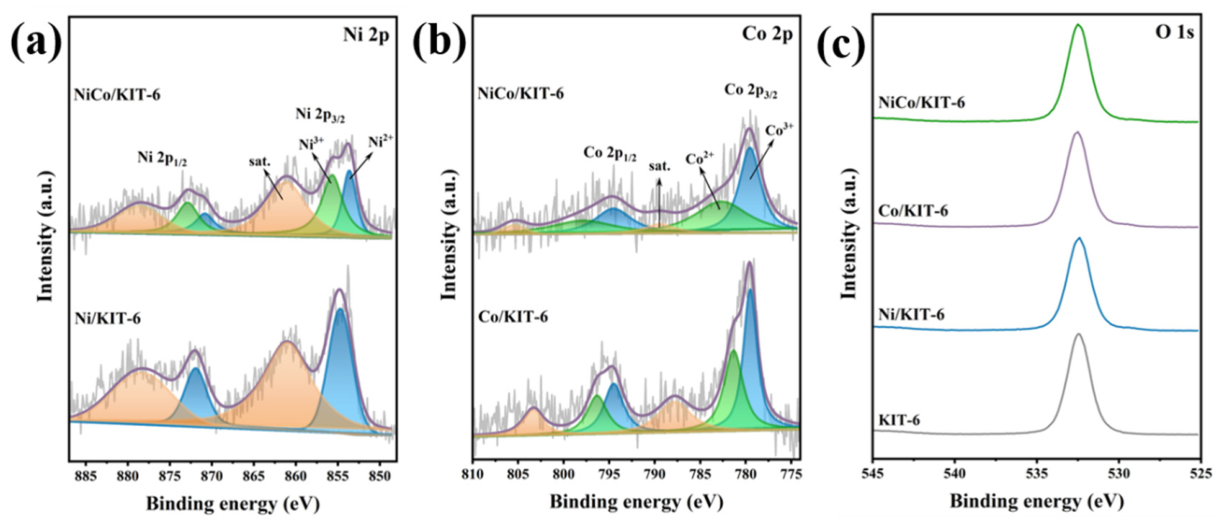
XPS was performed to elucidate the surface chemical states of the catalysts, and the corresponding high-resolution Ni 2p, Co 2p, and O 1s spectra are presented in Figure 4. In the Ni 2p region (Figure 4a), spectrum is split into the Ni 2p3/2 and Ni 2p1/2 components as expected from spin–orbit (j-j) coupling, and deconvolution of the Ni 2p3/2 envelope reveals that Ni/KIT-6 is characterized by a Ni2+ contribution at 854.7 eV together with a shake-up satellite at 861.0 Ev [22], whereas NiCo/KIT-6 requires three components corresponding to Ni2+ (853.6 eV), Ni3+ (855.6 eV), and a satellite peak at 861.2 eV [23,24]. Compared with Ni/KIT-6, NiCo/KIT-6 exhibits an overall negative shift of the Ni2+ binding energy accompanied by the emergence of Ni3+ species, indicating that the incorporation of Co modifies the local electronic environment around Ni and leads to a redistribution of its oxidation-state population reflected in the Ni 2p spectra. As shown in Figure 4b, the Co 2p spectra of Co/KIT-6 and NiCo/KIT-6 can both be deconvoluted into three components corresponding to Co3+, Co2+, and their associated satellite peaks, with the Co3+ species in both samples exhibiting Co 2p3/2 and Co 2p1/2 binding energies centered at 779.5 eV and 794.5 eV, respectively [25,26]. Compared with Co/KIT-6, the Co2+ species in NiCo/KIT-6 display an overall shift toward higher binding energy, and quantitative analysis further reveals that the Co2+/Co3+ ratio increases from 0.79 for Co/KIT-6 to 0.92 for NiCo/KIT-6, indicating that the incorporation of Ni modifies the valence-state distribution of Co and leads to a higher relative fraction of Co2+ species, which reflects an altered electronic environment and a strengthened redox flexibility of Co centers in the Ni-Co spinel system. The high-resolution O 1s spectra, shown in Figure 4c, exhibit very similar peak shapes and binding-energy positions for all samples, indicating that no pronounced differences can be resolved based solely on O 1s XPS analysis. This behavior can be primarily attributed to the use of KIT-6 as a SiO2 support, whose surface is dominated by abundant Si-O-Si species that contribute overwhelmingly to the O 1s signal and thereby mask subtle variations associated with metal-related oxygen species [27].
Figure 4.
(a) Ni 2p, (b) Co 2p, and (c) O 1s XPS spectra of samples.
2.2. Redox and Dielectric Behaviors
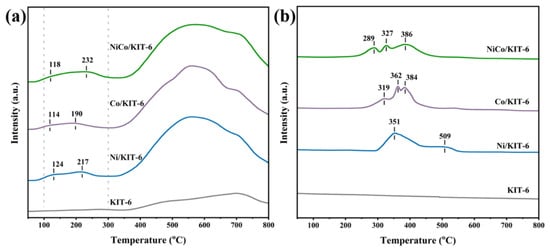
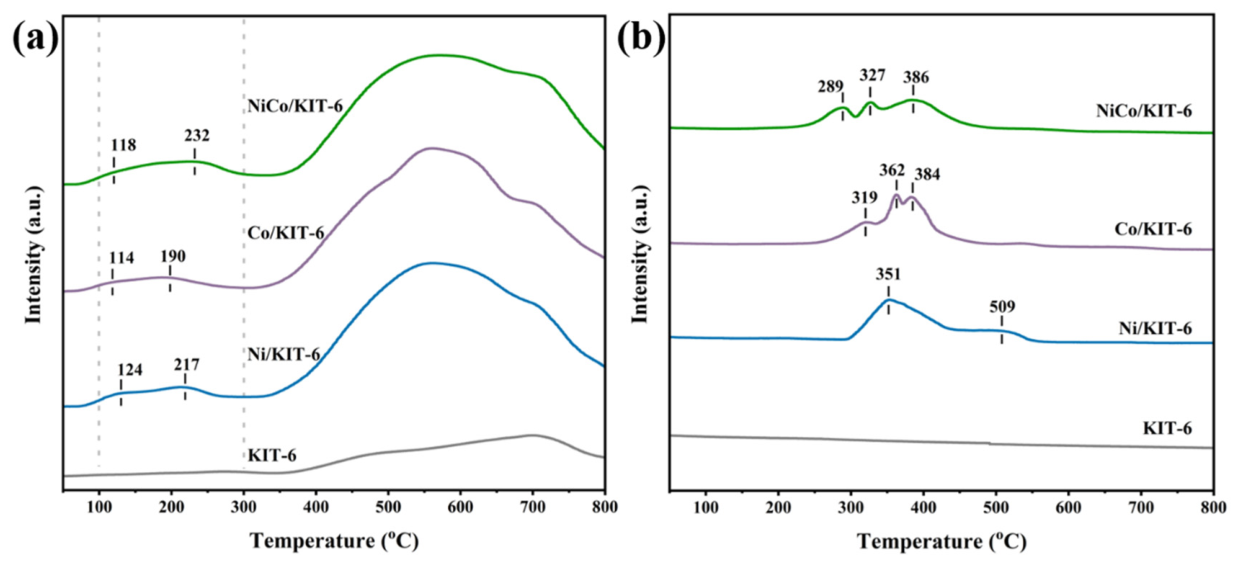
Accordingly, O2-TPD was employed to further characterize the surface oxygen species, with particular emphasis on their availability and activity, and the corresponding profiles are shown in Figure 5a. Oxygen species on catalyst surfaces are commonly classified as physisorbed oxygen (O2), chemisorbed oxygen species (O2−, O22−, and O−), and lattice oxygen (O2−) [28]. Under the present experimental conditions, no low temperature desorption signals associated with physisorbed oxygen were detected. In contrast, the desorption peaks appearing between 100 °C and 300 °C are assigned to chemisorbed oxygen species, which represent readily removable and highly reactive surface oxygen. Because these species are often anchored on oxygen vacancy related defect sites, their abundance can be taken as an indicator of the surface capability to capture and utilize reactive oxygen species under plasma-dominated conditions, thereby promoting subsequent oxidation reactions during VOCs degradation [29]. As shown in the O2-TPD profiles, all metal loaded catalysts exhibit markedly enhanced chemisorbed oxygen desorption in this temperature region compared with pristine KIT-6, indicating a substantially higher abundance of surface active oxygen species. Quantitative results summarized in Table 1 demonstrate that NiCo/KIT-6 exhibits the highest proportion of chemisorbed oxygen among all investigated samples. This enrichment of surface chemisorbed oxygen indicates a greater density of readily accessible active sites that can effectively participate in the adsorption, activation, and regeneration of reactive oxygen species, thereby providing a favorable surface environment for the deep oxidation of toluene, particularly under plasma-dominated conditions. Desorption features observed at temperatures above 300 °C are attributed to lattice oxygen species [30]. Given the relatively low operating temperature of the NTP-catalysis system, lattice oxygen species that are typically activated through high-temperature desorption processes are expected to play a limited role via conventional thermally driven Mars–van Krevelen pathways. Instead, the observed catalytic activity under plasma-dominated conditions is more plausibly associated with surface chemisorbed oxygen species and defect-related active oxygen, which can be readily generated and continuously replenished through plasma-induced reactions, including ozone decomposition and the formation of reactive oxygen species [31,32].
Figure 5.
(a) O2-TPD and (b) H2-TPR profiles of samples.
Since the generation and stabilization of surface active oxygen species are closely related to the reducibility of metal-oxygen entities, H2-TPR was further conducted to elucidate the redox characteristics underlying the O2-TPD observations, as illustrated by the profiles in Figure 5b. Pristine KIT-6 shows no detectable reduction features because framework Si4+ in mesoporous SiO2 is essentially unreducible over the tested temperature window, consistent with previous studies [33]. Ni/KIT-6 exhibits two reduction events. The peak at ~351 °C is attributed to weakly bound or highly dispersed NiO species, whereas the broad feature centered at ~509 °C is assigned to Ni2+ species strongly coupled to the SiO2 surface, for which reduction is delayed by pronounced metal-support interactions [34]. Co/KIT-6 displays three peaks at 319 °C, 362 °C, and 384 °C. The low-temperature signal (319 °C) is associated with the initial reduction of surface or highly dispersed Co3+ to Co2+, the intermediate peak (362 °C) corresponds to the predominant bulk conversion of Co3O4 to CoO, and the high-temperature peak (384 °C) is assigned to the subsequent reduction of CoO to metallic Co [35]. A similar reduction pattern is observed for NiCo/KIT-6, with peaks at ~289 °C, 327 °C, and 386 °C. The first peak (289 °C) is ascribed to the preferential reduction of highly dispersed trivalent cations (Ni3+/Co3+), followed by the bulk reduction of the spinel lattice to mixed (Ni,Co)O at 327 °C, and finally the reduction of divalent oxides to metallic Ni and Co at 386 °C [17,36]. Notably, relative to Ni/KIT-6 and Co/KIT-6, the reduction peaks of NiCo/KIT-6 shift consistently toward lower temperatures, indicating an enhanced low-temperature reducibility arising from the synergistic interaction between Ni and Co. In plasma-catalytic systems, where catalyst surfaces are frequently exposed to alternating reducing and oxidizing environments, such facilitated reducibility is expected to lower the kinetic barrier for redox transitions. This redox behavior provides a favorable basis for the enhanced surface oxygen activity observed in O2-TPD and supports the improved utilization and transformation of reactive oxygen species under plasma excitation.
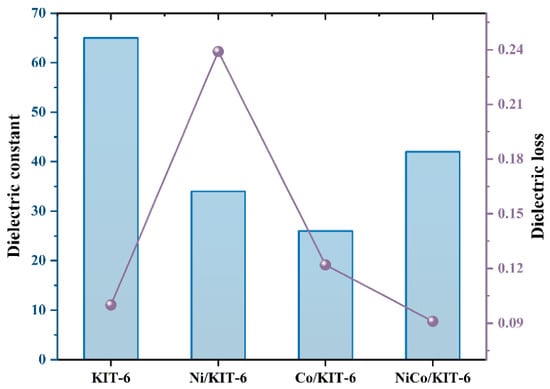
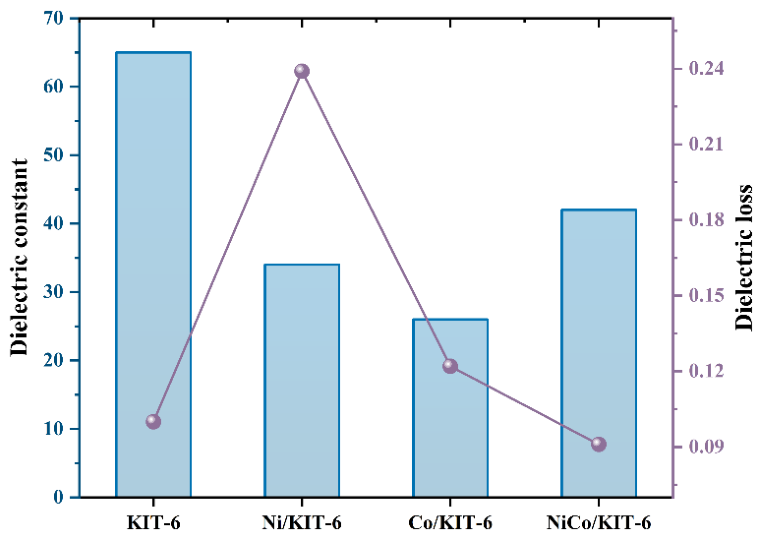
To characterize the dielectric behavior of the samples at the plasma discharge frequency, their dielectric properties were measured using a parallel-plate capacitor configuration at 10 kHz and room temperature. As shown in Figure 6, pristine KIT-6 exhibits the highest apparent relative permittivity (ε = 65) with a dielectric loss factor (tan δ) of about 0.10. Comparable high apparent dielectric responses have also been reported in SiO2-containing heterogeneous systems, where the enhanced dielectric response was associated with interfacial effects [37]. Upon loading single metal oxides, the apparent relative permittivity decreases to 34 for Ni/KIT-6 and 26 for Co/KIT-6, accompanied by an increase in dielectric loss to 0.24 and 0.12, respectively. In comparison, NiCo/KIT-6 displays an intermediate apparent relative permittivity (ε = 42) together with the lowest dielectric loss among all samples (tan δ = 0.09). Notably, the combination of a moderate apparent relative permittivity and suppressed dielectric loss distinguishes NiCo/KIT-6 from the single-metal counterparts, suggesting that the formation of the NiCo2O4 spinel may contribute to a more balanced dielectric response at the discharge frequency. It is widely recognized that the dielectric properties of packing materials constitute an important physical factor in packed-bed DBD systems. Previous studies on plasma-catalysis have pointed out that material properties, including relative permittivity and dielectric loss, can influence the electrical environment of the discharge, such as electric-field distribution, charge accumulation, and energy dissipation under alternating electric fields [38,39]. In particular, excessively high permittivity may induce pronounced local field distortion and charge buildup, whereas high dielectric loss is generally associated with increased energy dissipation through polarization or conductive pathways rather than effective discharge processes. By contrast, materials with moderate permittivity can help mitigate excessive charge accumulation and field localization, while a low dielectric loss minimizes dielectric energy dissipation, together helping to sustain a stable discharge environment under plasma excitation [40,41].
Figure 6.
Dielectric properties of samples.
2.3. Plasma-Catalytic Performance
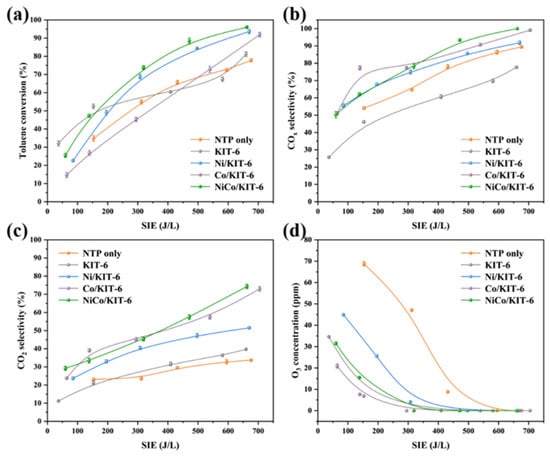
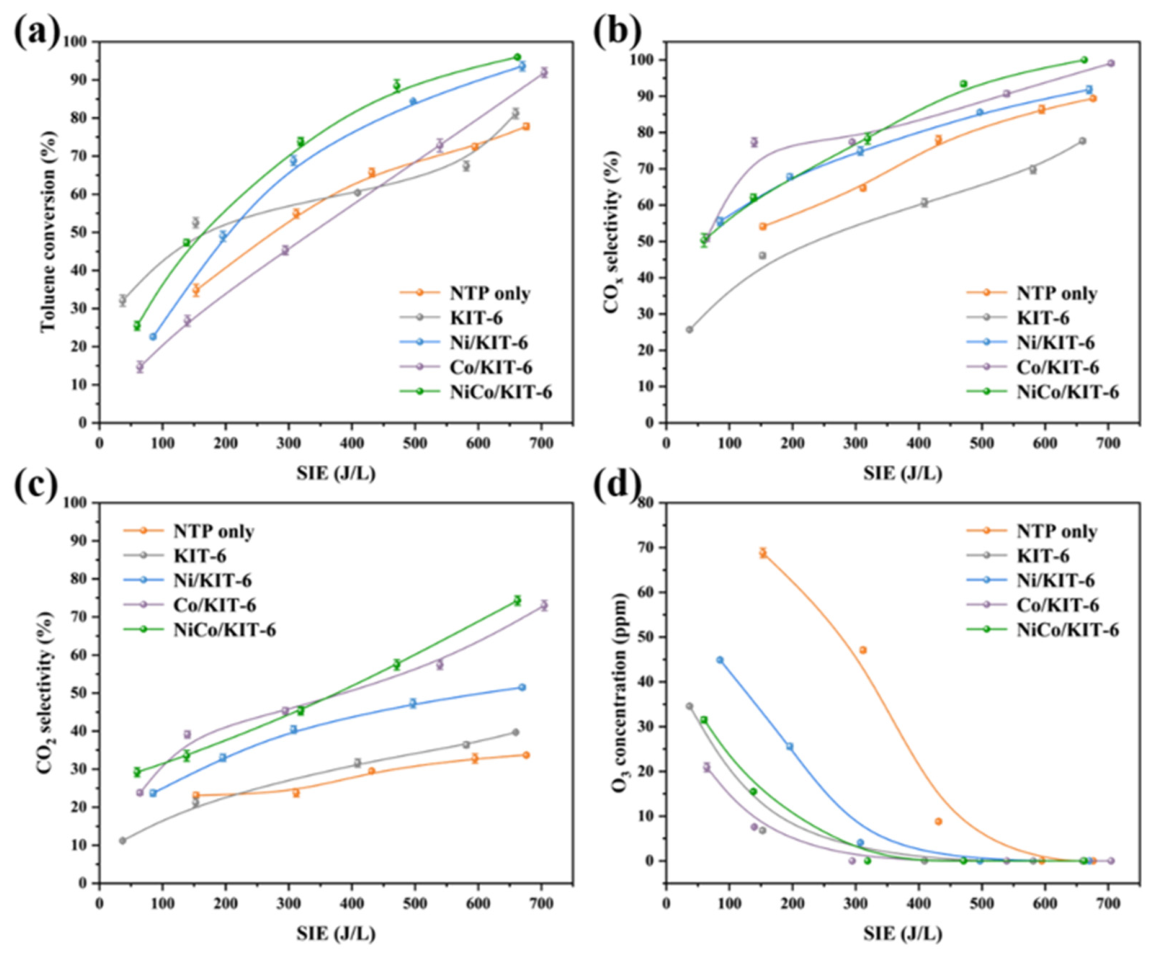
Figure 7 summarizes the plasma-catalytic performance of the investigated systems for toluene degradation. Regardless of catalyst loading, the toluene conversion increases monotonically with increasing SIE, indicating that a higher energy input enhances the availability of effective reaction energy and facilitates the activation and oxidation of toluene molecules under plasma excitation [42]. In the NTP-only system, increasing the SIE from 153 J/L to 676 J/L raises the toluene conversion from 34.8% to 77.8%, accompanied by COx selectivities of 54.1–89.4%. Nevertheless, the oxidation of converted carbon toward CO2 remains limited based on the detected carbon oxides, as evidenced by the relatively low CO2 selectivity of only 23.1–33.7%, indicating that part of the converted carbon may remain in incompletely oxidized intermediates rather than being fully oxidized to CO2. Among all catalysts, NiCo/KIT-6 exhibits the most favorable plasma-catalytic performance across the investigated energy range. When the SIE is increased from 60 J/L to 663 J/L, the toluene conversion, COx selectivity, and CO2 selectivity reach 25.5–96.0%, 50.3–99.9%, and 29.2–74.3%, respectively. Since the COx selectivity was calculated on a carbon basis, the fraction of converted carbon not detected as CO or CO2 can be estimated as 100% − COx selectivity. For NiCo/KIT-6, this fraction decreases from 49.7% to approximately 0.1% with increasing SIE, suggesting that most of the converted toluene carbon was transformed into carbon oxides and that the accumulation of incompletely oxidized carbon-containing intermediates was limited. In addition, NiCo/KIT-6 also outperformed the mechanically mixed Ni/KIT-6 + Co/KIT-6 (Figure S1), suggesting the enhanced performance is not simply derived from the additive contribution of separated Ni and Co oxide species. Moreover, compared with previously reported plasma catalysts under similar operating conditions [43,44,45,46,47], NiCo/KIT-6 delivers higher energy efficiency while maintaining high toluene conversion and CO2 selectivity (Table S1), highlighting its favorable energy utilization for plasma-catalytic toluene oxidation. By comparison, although Ni/KIT-6 also displays relatively high toluene conversion, its COx and CO2 selectivities are consistently lower than those observed over NiCo/KIT-6. A distinct performance trend is observed for Co/KIT-6. Under low SIE conditions, its toluene conversion is even lower than that obtained over KIT-6 and in the NTP-only system, while comparatively higher COx and CO2 selectivities are achieved. With further increases in SIE, the toluene conversion over Co/KIT-6 improves markedly but remains inferior to that of NiCo/KIT-6 throughout the investigated energy window. For KIT-6, the high specific surface area combined with the three-dimensionally interconnected mesoporous structure favors the initial conversion of toluene under low SIE conditions. However, further increases in input energy density result in only marginal enhancement of toluene conversion. Moreover, owing to the absence of metal active sites, KIT-6 exhibits a limited ability to promote the mineralization of intermediates, leading to low CO2 selectivity. Its COx selectivity is even lower than that of the NTP-only system, which may be attributed to the influence of the packing material on the gas-phase plasma reaction environment. This may alter certain gas-phase oxidation pathways and reduces the overall efficiency of COx formation.
Figure 7.
Effect of SIE on the plasma-catalytic performance of samples: (a) toluene conversion, (b) COx selectivity, (c) CO2 selectivity, and (d) O3 concentration.
Figure 7d illustrates the O3 concentration measured at the outlet of the DBD reactor. For all investigated systems, the ozone concentration exhibits a gradual decrease with increasing SIE, which can be attributed to the enhanced decomposition and consumption of O3 under conditions where high-energy electrons and reactive species become increasingly abundant. Compared with the catalyst-packed configurations, the NTP-only system yields a higher O3 concentration in the effluent, indicating that the introduction of packing materials markedly influences O3 generation and stability within the discharge environment. Further comparison among the catalyst-packed systems reveals that the O3 concentrations produced over Ni/KIT, Co/KIT, and NiCo/KIT show an overall positive correlation with their dielectric constants, whereas KIT-6, despite possessing the highest dielectric constant, generates a relatively low O3 concentration at the reactor outlet. This observation suggests that O3 formation is not governed solely by the dielectric constant, and that the support structure, together with its combined modulation of discharge behavior and ozone stability, plays an important role in determining the observed ozone levels [41,48].
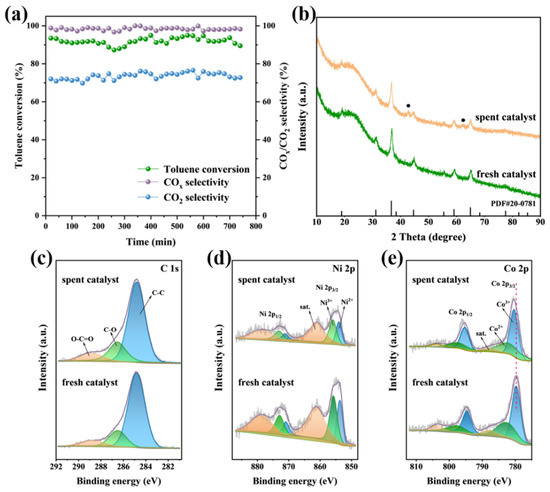
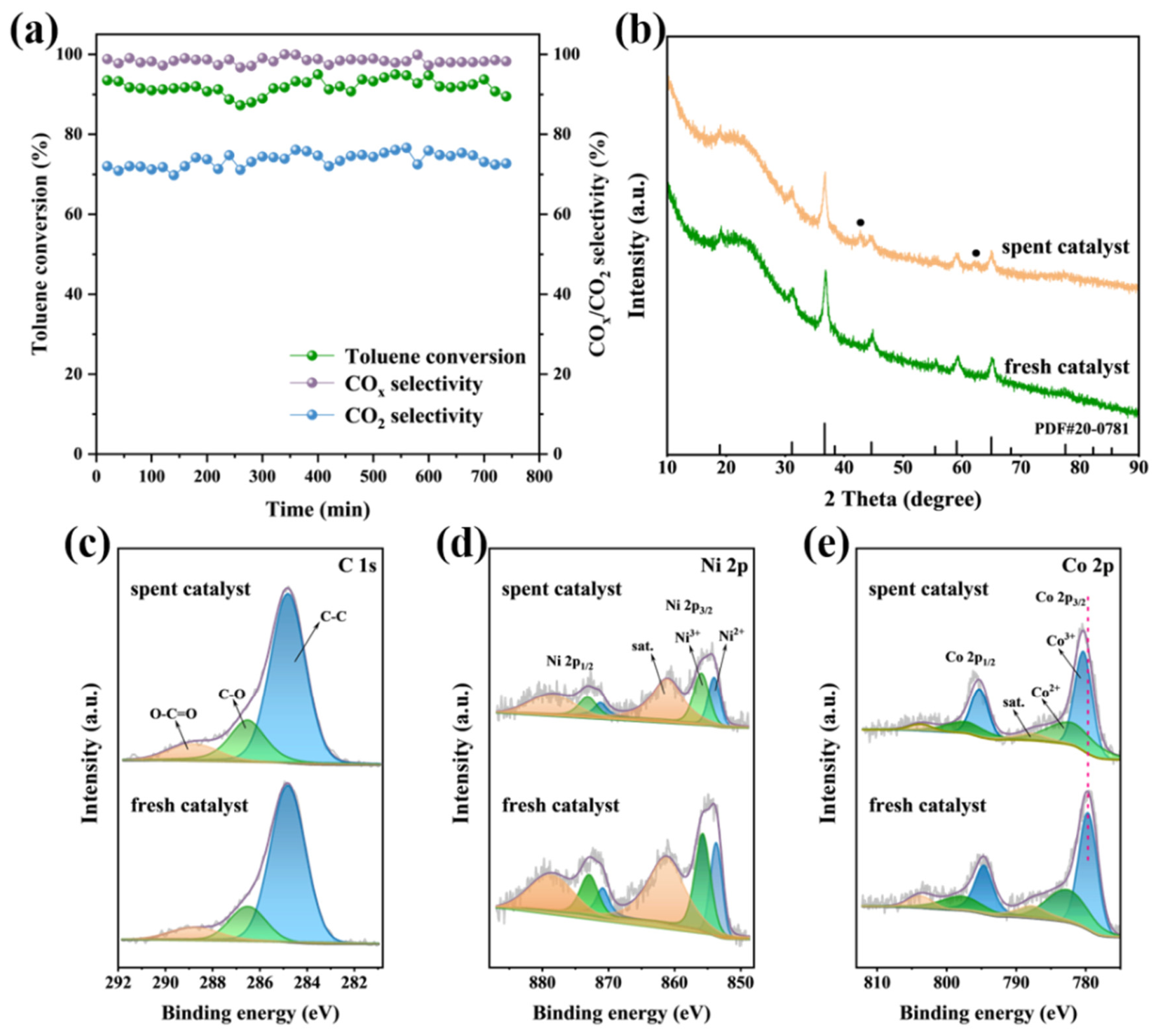
To evaluate the stability of the catalyst, a 12 h stability test was conducted over the NiCo/KIT-6 catalyst at SIE of 600 J/L, as shown in Figure 8a. After prolonged plasma-catalytic reaction, the catalyst maintained relatively stable catalytic performance, with no obvious decrease in toluene conversion, COx selectivity, and CO2 selectivity, indicating the good stability of NiCo/KIT-6. To further evaluate the post-reaction structural stability of the catalyst from the perspectives of crystalline phase structure and surface chemical state, XRD and XPS characterizations were performed on the fresh and spent NiCo/KIT-6 catalysts, as shown in Figure 8b–e. The XRD results (Figure 8b) show that the spent catalyst still retained the main diffraction peaks of the NiCo2O4 spinel phase, indicating that its main crystalline structure was basically preserved during the long-term plasma-catalytic reaction. Notably, weak new diffraction peaks appeared at around 42.8° and 62.3° after the reaction, which may be associated with the formation of a small amount of rock-salt NiO/CoO-like species or Ni-Co mixed monoxide, suggesting that partial Ni-Co oxide species underwent reaction-induced reconstruction during the reaction [49].
Figure 8.
(a) Stability test of NiCo/KIT-6 at 600 J/L; (b) XRD patterns, (c) C 1s XPS spectra, (d) Ni 2p XPS spectra, and (e) Co 2p XPS spectra of fresh and spent NiCo/KIT-6.
The surface chemical states of the fresh and spent NiCo/KIT-6 catalysts were further analyzed by XPS. The C 1s spectra (Figure 8c) were deconvoluted into three components at approximately 284.8, 286.5, and 288.8 eV, corresponding to C-C/C=C, C-O, and O-C=O species, respectively [32,50]. The O-C=O component is generally associated with oxygen-containing carbonaceous intermediates formed during toluene oxidation, such as carboxyl or carboxylate species. After the stability test, no obvious π–π* shake-up satellite peak was observed in the high binding energy region, and the relative proportion of O-C=O changed only marginally, indicating that no significant accumulation of carbon-containing byproducts or coke-like deposits occurred on the catalyst surface. The Ni 2p spectra (Figure 8d) showed only minor changes after the stability test, suggesting that the chemical environment of surface Ni species was slightly affected. In contrast, the Co 2p spectra (Figure 8e) exhibited more pronounced changes. After the stability test, the Co3+ component shifted toward higher binding energy, whereas the Co2+ component shifted toward lower binding energy, indicating a redistribution of the local electronic environment of surface Co species. In particular, the negative shift of Co2+ suggests increased electron density around Co2+ species, which is consistent with the formation of CoO-like or Ni-Co mixed monoxide species. Combined with the newly emerged diffraction peaks in the XRD pattern, these XPS results further support the partial structural reconstruction of Ni-Co oxide species during the plasma-catalytic reaction. Although a small amount of new crystalline species appeared after the stability test, the main spinel structure and catalytic performance were well maintained, demonstrating the good stability of NiCo/KIT-6 during long-term plasma-catalytic oxidation of toluene.
2.4. Discussion
In plasma-catalytic toluene degradation, the SIE primarily determines the discharge intensity and the generation of gas-phase reactive species, thereby governing the initial activation of toluene molecules. With increasing energy input, the accompanying temperature rise promotes O3 decomposition [51]. Meanwhile, the population of energetic electrons and reactive species is enhanced, promoting molecular excitation and bond cleavage while further accelerating O3 decomposition and consumption [52]. This behavior accounts for the universal decrease in ozone concentration observed with increasing SIE across all systems. Under NTP-only conditions, the lack of packing materials results in a reaction regime dominated by gas-phase plasma chemistry, in which catalyst interfaces are absent for O3 activation into more reactive oxygen species, leading to relatively high toluene conversion but limited further oxidation of intermediates toward CO2 [53].
Upon introducing catalyst packing, the reaction pathway progressively shifts from a purely gas-phase process toward a gas-surface coupled oxidation process, in which the overall oxidation efficiency becomes increasingly dependent on the surface redox capability of the catalyst [38,54]. Among the investigated materials, NiCo/KIT-6 exhibits a clear advantage in this respect. The electronic interaction between Ni and Co in the NiCo2O4 spinel may contribute to more flexible metal valence states, a higher availability of low-temperature reactive oxygen species, and more readily accessible redox behavior, as inferred from XPS, O2-TPD, and H2-TPR analyses. These complementary characterizations provide insight into the intrinsic redox properties and oxygen activation capability of NiCo/KIT-6, which may facilitate the surface conversion of plasma-activated intermediates and are consistent with the observed enhancement in toluene conversion and CO2 selectivity over a wide range of energy densities [55,56].
At low energy densities, the outlet O3 concentration reflects the net balance between O3 formation governed by the discharge environment and its consumption via surface-mediated pathways. The dielectric properties of the packing materials modulate the local electric field and microdischarge behavior, thereby influencing ozone generation, while the catalyst surface determines the efficiency of O3 utilization and subsequent oxidation reactions [57,58]. In this regime, Co/KIT-6 exhibits a lower O3 concentration, which can be attributed to the combined effect of a relatively less favorable discharge environment and effective surface consumption of available oxidizing equivalents. However, its relatively limited redox flexibility and lower availability of readily activated surface oxygen species may constrain the initial activation of toluene, resulting in low overall conversion despite relatively high CO2 selectivity. By contrast, NiCo/KIT-6 promotes more efficient initial activation of toluene, which is closely associated with the Ni-Co interactions that provide more accessible redox states and enhanced surface oxygen activation. Meanwhile, its dielectric characteristics sustain a more intense and stable discharge, leading to increased ozone generation. Under low SIE conditions, residual ozone may persist when surface oxidation becomes kinetically limited by competitive adsorption of toluene and partially oxidized intermediates [58,59,60]. These results suggest that ozone concentration reflects the balance between plasma-driven oxidant generation over NiCo/KIT-6 and surface-mediated consumption, rather than the extent of oxidation toward CO2. The elevated ozone level observed at low energy input thus may originate from strong oxidant formation coupled with limited surface utilization, a mismatch that is progressively alleviated at higher energy input, where markedly enhanced COx and CO2 selectivities are consistent with the improved ability of NiCo/KIT-6 to effectively utilize reactive oxidants.
3. Conclusions
This work systematically investigates the plasma-catalytic degradation of toluene over KIT-6-supported NiO, Co3O4, and NiCo2O4 catalysts. NiCo/KIT-6 exhibits the most favorable overall performance in terms of toluene conversion, COx and CO2 selectivity. Based on the combined results of catalytic performance and physicochemical characterizations, the superior activity of NiCo/KIT-6 is proposed to be closely associated with the integrated regulation of surface redox properties, oxygen activation capability, and apparent dielectric response by the NiCo2O4 spinel structure. These features may facilitate plasma–surface interaction and promote the further oxidation of toluene-derived intermediates toward CO2. Overall, the study highlights the importance of jointly optimizing catalytic redox properties and the discharge environment for efficient plasma-assisted VOCs abatement.
4. Experimental
4.1. Chemical Reagents
The reagents used in this study included P123 (poly(ethyleneglycol)-block-poly(propyleneglycol)-block-poly(ethylene glycol), MW = 5800), hydrochloric acid (HCl, 35 wt.%), n-butanol (CH3(CH2)3OH), tetraethyl orthosilicate (TEOS), nickel nitrate hexahydrate (Ni(NO3)2·6H2O), cobalt nitrate hexahydrate (Co(NO3)2·6H2O), anhydrous ethanol (CH3CH2OH), and sodium hydroxide (NaOH). P123 was obtained from Sigma-Aldrich (St. Louis, MO, USA), HCl and CH3CH2OH were supplied by Sinopharm Chemical Reagent Co., Ltd. (Shanghai, China), and all other chemicals were purchased from Shanghai Aladdin Biochemical Technology Co., Ltd. (Shanghai, China). All chemicals were of analytical grade and used without further purification.
4.2. Preparation of KIT-6
KIT-6 was synthesized following the previously reported method with some modification [9]. Briefly, 3.6 g of P123 was dissolved in a mixture of 7.08 g of HCl and 130.2 g of deionized water. Subsequently, 3.6 g of n-butanol was added dropwise, and the mixture was stirred for an additional 1 h. Then, 7.74 g of TEOS was introduced into the solution, followed by continuous stirring at 35 °C for 24 h. The resulting mixture was transferred to a Teflon-lined stainless-steel autoclave and subjected to hydrothermal treatment at 100 °C for 24 h. The product was collected by filtration, washed thoroughly with deionized water, and vacuum-dried at 90 °C overnight. Finally, the white powder was calcined in air at 550 °C for 5 h with a heating rate of 2 °C/min to obtain the KIT-6.
4.3. Preparation of Catalysts
A series of metal-modified KIT-6 mesoporous catalysts were synthesized via an incipient wetness impregnation method. In a typical procedure, a certain amount of metal precursors (Ni(NO3)2·6H2O and Co(NO3)2·6H2O) was dissolved in ethanol to form a homogeneous solution. The pre-prepared KIT-6 powder was then introduced into the solution and magnetically stirred at room temperature for 12 h. The resulting mixture was dried at 90 °C overnight, followed by calcination at 400 °C for 3 h with a heating rate of 2 °C/min to yield the final catalysts. The mass fraction of NiCo2O4, NiO, or Co3O4 in each corresponding catalyst was controlled at approximately 12%. The resulting catalysts were hereafter referred to as NiCo/KIT-6, Ni/KIT-6, and Co/KIT-6, respectively. For comparison, a mechanically mixed control sample was prepared by physically mixing the as-prepared Ni/KIT-6 and Co/KIT-6 catalysts. The mixing ratio was calculated to maintain the Ni/Co molar ratio of NiCo2O4 and a comparable total metal oxide loading of approximately 12 wt.%. The obtained sample was denoted as mechanically mixed Ni/KIT-6 + Co/KIT-6.
4.4. Catalysts Characterization
The phase structures of the catalysts were examined by X-ray diffraction (XRD) on an Anton Paar XRDynamic500 diffractometer (Anton Paar GmbH, Graz, Austria) using Cu Kα radiation. Nitrogen adsorption–desorption isotherms were recorded on a Micromeritics ASAP 2460 analyzer (Micromeritics Instrument Corporation, Norcross, GA, USA), from which the specific surface areas were calculated using the Brunauer-Emmett-Teller (BET) method and the pore volumes and pore size distributions were derived using the Barrett–Joyner–Halenda (BJH) method. Transmission electron microscopy (TEM) was performed on a FEI Talos F200x microscope (FEI Company, Hillsboro, OR, USA), with the samples dispersed in ethanol, and deposited onto Cu grids. Surface chemical states were analyzed by X-ray photoelectron spectroscopy (XPS, Thermo Scientific K-Alpha, Thermo Fisher Scientific, East Grinstead, UK). H2 temperature-programmed reduction (H2-TPR) and O2 temperature-programmed desorption (O2-TPD) measurements were conducted over the temperature range of 50–800 °C. Prior to testing, all samples were pretreated under an inert gas flow. H2-TPR experiments were carried out at a heating rate of 10 °C/min in a flow of 10% H2/Ar (30 mL/min), while O2-TPD measurements were performed after oxygen adsorption under 10% O2/He (30 mL/min), followed by temperature-programmed desorption under He atmosphere. The signals were monitored using a thermal conductivity detector (TCD). The dielectric properties of the catalysts were measured using a parallel-plate capacitor method at 10 kHz and 25 °C with a LCR meter (E4980AL, Keysight Technologies, Santa Rosa, CA, USA). The samples were pressed into disk-shaped pellets and coated with gold on both sides as electrodes, allowing direct measurement of capacitance and dielectric loss. The relative permittivity values obtained from these pressed powder pellets are therefore referred to as apparent relative permittivity, which were used for qualitative comparison of the apparent dielectric responses among different catalysts.
4.5. Plasma-Catalytic Performance Evaluation
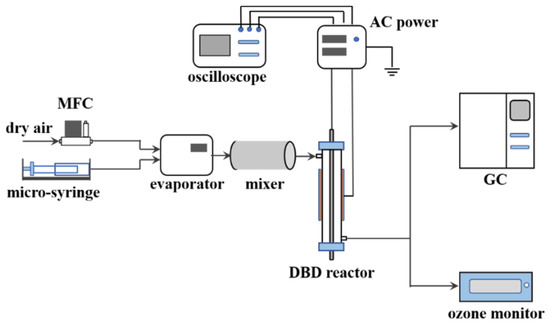
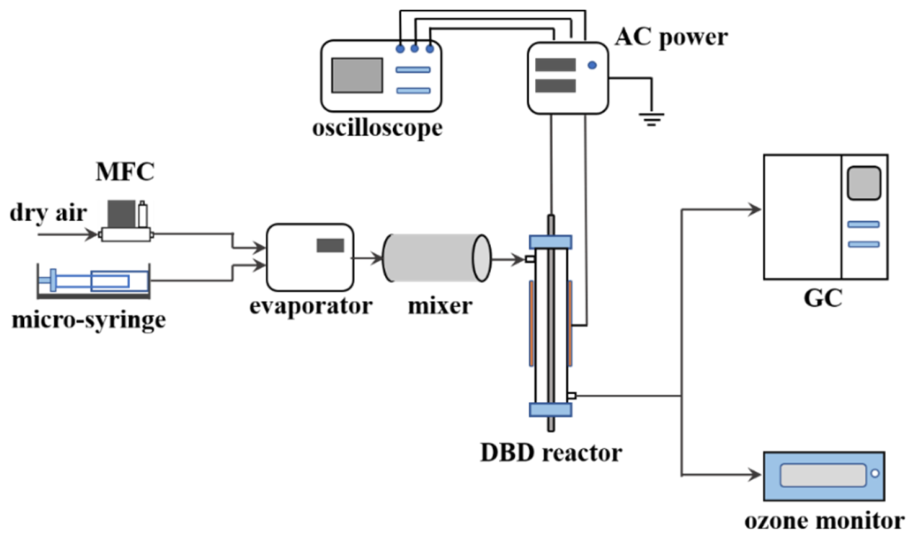
The experimental setup for evaluating the catalytic performance is illustrated in Figure 9. It mainly consists of a toluene generation unit, a dielectric barrier discharge (DBD) reactor, a power supply, and an exhaust gas analysis system. Air was supplied by an air compressor and passed through 3A molecular sieve to remove moisture. The dried air then entered the evaporator, where it swept over the toluene liquid continuously injected by a micro-syringe pump, thereby generating a toluene gas stream with a stable concentration (550 ppm).
Figure 9.
Schematic diagram of experimental setup.
The DBD reactor was constructed based on a quartz tube with an outer diameter of 10 mm and an inner diameter of 8 mm. A stainless steel rod with an outer diameter of 2 mm was positioned along the central axis of the quartz tube and served as the high-voltage electrode. A 40 mm-long Cu foil was wrapped around the outer surface of the quartz tube, functioning as the grounded electrode. A total of 500 mg of catalyst (40–60 mesh) was placed in the discharge region and fixed with quartz wool, and the gas hourly space velocity (GHSV) was controlled at 30,000 mL/(g·h). A high-voltage AC power supply (CTP-2000, Suman, Nanjing, China) was employed to generate non-thermal plasma, with the operating frequency maintained at approximately 10 kHz during all experiments. The discharge voltage and current waveforms in the DBD reactor were monitored using an oscilloscope (TBS 1102C, Tektronix, Inc., Beaverton, OR, USA). The discharge power of the DBD reactor was determined by the V-Q Lissajous method, and the specific input energy (SIE) was calculated as follows:
where P represents the discharge power, and Q denotes the total gas flow rate.
The concentrations of toluene, CO, and CO2 were analyzed using an online gas chromatograph (F70, Fuli, Taizhou, China) equipped with a flame ionization detector (FID) and a methane conversion furnace. The O3 concentration was measured by an ozone monitor (Model 106-M, 2B Technologies, Boulder, CO, USA). All measurements were conducted after the reaction reached a steady state and were repeated five times. The toluene conversion (ηtoluene), mineralization efficiency (SCOx), and CO2 (SCO2) selectivity were calculated as follows:
where and represent the inlet and outlet concentrations of toluene, respectively, and and denote the outlet concentrations of CO and CO2.
Supplementary Materials
The following supporting information can be downloaded at: https://www.mdpi.com/article/10.3390/catal16060528/s1, Figure S1: Comparison of plasma-catalytic performance of NiCo/KIT-6 and mechanically mixed Ni/KIT-6 + Co/KIT-6; Table S1: Comparison of plasma-catalytic toluene degradation performance over different catalysts.
Author Contributions
S.C.: conceptualization, methodology, investigation, formal analysis, funding acquisition, and writing—original draft; M.H.: investigation, formal analysis, funding acquisition, and writing—original draft; S.L.: writing—review & editing; W.Z.: investigation; B.Z.: resources; Y.C.: resources and supervision. All authors have read and agreed to the published version of the manuscript.
Funding
This research was financially supported by the National Natural Science Foundation of China (No. 52400138), the National Undergraduate Innovation and Entrepreneurship Training Program of China (No. 202510340048), and the Fundamental Research Funds for Zhejiang Provincial Universities and Research Institutes.
Data Availability Statement
Data are contained within the article and Supplementary Materials.
Conflicts of Interest
There are no conflicts to declare.
References
- Li, B.; Ho, S.; Li, X.; Guo, L.; Chen, A.; Hu, L.; Yang, Y.; Chen, D.; Lin, A.; Fang, X. A comprehensive review on anthropogenic volatile organic compounds (VOCs) emission estimates in China: Comparison and outlook. Environ. Int. 2021, 156, 106710. [Google Scholar] [CrossRef] [Scilit]
- Sun, Y.; Luo, H.; Li, Y.; Zhou, W.; Xu, W.; Fu, P.; Zhao, D. Atmospheric organic aerosols: Online molecular characterization and environmental impacts. npj Clim. Atmos. Sci. 2025, 8, 305. [Google Scholar] [CrossRef] [Scilit]
- He, Y.; Shen, J.; Alharbi, N.S.; Chen, C.L. Volatile organic compounds degradation by nonthermal plasma: A review. Environ. Sci. Pollut. Res. 2023, 30, 32123–32152. [Google Scholar] [CrossRef] [Scilit]
- Li, S.; Dang, X.; Yua, X.; Abbas, G.; Zhang, Q.; Cao, L. The application of dielectric barrier discharge non-thermal plasma in VOCs abatement: A review. Chem. Eng. J. 2020, 388, 124275. [Google Scholar] [CrossRef] [Scilit]
- Belkessa, N.; Assadi, A.A.; Bouzaza, A.; Nguyen-Tri, P.; Amrane, A.; Khezami, L. A review of non-thermal plasma-catalysis: The mutual influence and sources of synergetic effect for boosting volatile organic compounds removal. Environ. Res. 2024, 257, 119333. [Google Scholar] [CrossRef] [Scilit]
- Nguyen, V.T.; Dinh, D.K.; Lan, N.M.; Trinh, Q.H.; Hossain, M.M.; Mok, Y.S. Critical role of reactive species in the degradation of VOC in a plasma honeycomb catalyst reactor. Chem. Eng. Sci. 2023, 276, 118830. [Google Scholar] [CrossRef] [Scilit]
- Gao, W.; Tang, X.; Yi, H.; Jiang, S.; Yu, Q.; Xie, X.; Zhuang, R. Mesoporous molecular sieve-based materials for catalytic oxidation of VOC: A review. J. Environ. Sci. 2023, 125, 112–134. [Google Scholar] [CrossRef] [Scilit] [PubMed]
- Zhu, L.; Shen, D.; Luo, K.H. A critical review on VOCs adsorption by different porous materials: Species, mechanisms and modification methods. J. Hazard. Mater. 2020, 389, 122102. [Google Scholar] [CrossRef] [Scilit] [PubMed]
- Kleitz, F.; Choi, S.H.; Ryoo, R. Cubic Ia3d large mesoporous silica: Synthesis and replication to platinum nanowires, carbon nanorods and carbon nanotubes. Chem. Commun. 2003, 17, 2136–2137. [Google Scholar] [CrossRef] [Scilit]
- He, F.; Luo, J.; Liu, S. Novel metal loaded KIT-6 catalysts and their applications in the catalytic combustion of chlorobenzene. Chem. Eng. J. 2016, 294, 362–370. [Google Scholar] [CrossRef] [Scilit]
- Wang, Z.; Qin, Y.; Pan, F.; Li, Z.; Zhang, W.; Wu, F.; Chen, D.; Wen, W.; Li, J. Mesoporous silica-supported manganese oxides for complete oxidation of volatile organic compounds: Influence of mesostructure, redox properties, and hydrocarbon dimension. Ind. Eng. Chem. Res. 2018, 57, 7374–7382. [Google Scholar] [CrossRef] [Scilit]
- Lei, X.; Wang, J.; Wang, T.; Wang, X.; Xie, X.; Huang, H.; Li, D.; Ao, Z. Toluene decomposition by non-thermal plasma assisted CoOx-γ-Al2O3: The relative contributions of specific energy input of plasma, Co3+ and oxygen vacancy. J. Hazard. Mater. 2023, 456, 131613. [Google Scholar] [CrossRef] [Scilit] [PubMed]
- Bao, L.; Zhu, S.; Chen, Y.; Wang, Y.; Meng, W.; Xu, S.; Lin, Z.; Li, X.; Sun, M.; Guo, L. Anionic defects engineering of Co3O4 catalyst for toluene oxidation. Fuel 2022, 314, 122774. [Google Scholar] [CrossRef] [Scilit]
- Ma, Y.; Wang, L.; Ma, J.; Wang, H.; Zhang, C.; Deng, H.; He, H. Investigation into the enhanced catalytic oxidation of o-xylene over MOF-derived Co3O4 with different shapes: The role of surface twofold-coordinate lattice oxygen (O2f). ACS Catal. 2021, 11, 6614–6625. [Google Scholar] [CrossRef] [Scilit]
- Chen, C.; Liu, X.; Ma, M.; Tian, M.; Zhao, Y.; Jian, Y.; Yu, Y.; Zhang, H.; He, C. High-efficiency toluene degradation over Co@N-doped hollow carbon by plasma catalysis: O3-induced bifunctional sites and synergy. Appl. Catal. B Environ. Energy 2025, 369, 125156. [Google Scholar] [CrossRef] [Scilit]
- Zhang, M.; Sui, X.; Zhang, X.; Niu, M.; Li, C.; Wan, H.; Qiao, Z.; Xie, H.; Li, X. Multi-defects engineering of NiCo2O4 for catalytic propane oxidation. Appl. Surf. Sci. 2022, 600, 154040. [Google Scholar] [CrossRef] [Scilit]
- Liu, S.; Wang, H.; Wang, S.; Dai, Y.; Liu, B.; Liu, Y.; Dang, F.; Smith, K.J.; Nie, X.; Hou, S.; et al. Engineering morphology and Ni substitution of NixCo3–xO4 spinel oxides to promote catalytic combustion of ethane: Elucidating the influence of oxygen defects. ACS Catal. 2023, 13, 4683–4699. [Google Scholar] [CrossRef] [Scilit]
- Lezanska, M.; Wloch, J.; Szymański, G.; Szpakowska, I.; Kornatowski, J. Properties of CMK-8 carbon replicas obtained from KIT-6 and pyrrole at various contents of ferric catalyst. Catal. Today 2010, 150, 77–83. [Google Scholar] [CrossRef] [Scilit]
- Jakhar, S.; Malik, P.; Sehrawat, S.; Boora, A.; Rohilla, B.; Nain, S.; Duhan, S. One step hydrothermal synthesis of Fe2O3/KIT-6 nanocomposite as highly responsive humidity sensor. J. Porous Mater. 2024, 31, 1763–1775. [Google Scholar] [CrossRef] [Scilit]
- Rosen, J.; Hutchings, G.S.; Jiao, F. Synthesis, structure, and photocatalytic properties of ordered mesoporous metal-doped Co3O4. J. Catal. 2014, 310, 2–9. [Google Scholar] [CrossRef] [Scilit]
- Brunauer, S.; Deming, L.S.; Deming, W.E.; Teller, E. On a Theory of the van der Waals Adsorption of Gases. J. Am. Chem. Soc. 1940, 62, 1723–1732. [Google Scholar] [CrossRef] [Scilit]
- Grosvenor, A.P.; Biesinger, M.C.; Smart, R.S.C.; McIntyre, N.S. New interpretations of XPS spectra of nickel metal and oxides. Surf. Sci. 2006, 600, 1771–1779. [Google Scholar] [CrossRef] [Scilit]
- Liang, J.; Fan, Z.; Chen, S.; Ding, S.; Yang, G. Hierarchical NiCo2O4 nanosheets@halloysite nanotubes with ultrahigh capacitance and long cycle stability as electrochemical pseudocapacitor materials. Chem. Mater. 2014, 26, 4354–4360. [Google Scholar] [CrossRef] [Scilit]
- Wang, T.; Qiu, L.; Li, H.; Zhang, C.; Sun, Y.; Xi, S.; Ge, J.; Xu, Z.J.; Wang, C. Facile synthesis of palladium incorporated NiCo2O4 spinel for low temperature methane combustion: Activate lattice oxygen to promote activity. J. Catal. 2021, 404, 400–410. [Google Scholar] [CrossRef] [Scilit]
- Choya, A.; de Rivas, B.; González-Velasco, J.R.; Gutiérrez-Ortiz, J.I.; López-Fonseca, R. Optimisation of bimetallic Co-Ni supported catalysts for oxidation of methane in natural gas vehicles. Appl. Catal. B Environ. 2021, 284, 119712. [Google Scholar] [CrossRef] [Scilit]
- Wang, D.; Cuo, Z.; Li, S.; Zhang, M.; Chen, Y. In situ anchored NiCo2O4 on a nickel foam as a monolithic catalyst by electro-deposition for improved benzene combustion performance. CrystEngComm 2020, 22, 2371–2379. [Google Scholar] [CrossRef] [Scilit]
- Gao, X.; Bare, S.R.; Fierro, J.L.G.; Banares, M.A.; Wachs, I.E. Preparation and in-situ spectroscopic characterization of molecularly dispersed titanium oxide on silica. J. Phys. Chem. B. 1998, 102, 5653–5666. [Google Scholar] [CrossRef] [Scilit]
- Song, H.; Hu, F.; Peng, Y.; Li, K.; Bai, S.; Li, J. Non-thermal plasma catalysis for chlorobenzene removal over CoMn/TiO2 and CeMn/TiO2: Synergistic effect of chemical catalysis and dielectric constant. Chem. Eng. J. 2018, 347, 447–454. [Google Scholar] [CrossRef] [Scilit]
- Feng, X.; Tian, M.; He, C.; Li, L.; Shi, J.; Yu, Y.; Cheng, J. Yolk-shell-like mesoporous CoCrOx with superior activity and chlorine resistance in dichloromethane destruction. Appl. Catal. B Environ. 2020, 264, 118493. [Google Scholar] [CrossRef] [Scilit]
- Zheng, J.; Chu, W.; Zhang, H.; Jiang, C.; Dai, X. CO oxidation over Co3O4/SiO2 catalysts: Effects of porous structure of silica and catalyst calcination temperature. J. Nat. Gas Chem. 2010, 19, 583–588. [Google Scholar] [CrossRef] [Scilit]
- Dou, B.; Liu, D.; Zhang, Q.; Zhao, R.; Hao, Q.; Bin, F.; Cao, J. Enhanced removal of toluene by dielectric barrier discharge coupling with Cu-Ce-Zr supported ZSM-5/TiO2/Al2O3. Catal. Commun. 2017, 92, 15–18. [Google Scholar] [CrossRef] [Scilit]
- Bo, Z.; Yang, S.; Kong, J.; Zhu, J.; Wang, Y.; Yang, H.; Li, X.; Yan, J.; Cen, K.; Tu, X. Solar-enhanced plasma-catalytic oxidation of toluene over a bifunctional graphene fin foam decorated with nanofin-like MnO2. ACS Catal. 2020, 10, 4420–4432. [Google Scholar] [CrossRef] [Scilit] [PubMed]
- Liu, Q.; Li, J.; Zhao, Z.; Gao, M.; Kong, L.; Liu, J.; Wei, Y. Design, synthesis and catalytic performance of vanadium-incorporated mesoporous silica KIT-6 catalysts for the oxidative dehydrogenation of propane to propylene. Catal. Sci. Technol. 2016, 6, 5927–5941. [Google Scholar] [CrossRef] [Scilit]
- Xia, W.; Hou, Y.; Chang, G.; Weng, W.; Han, G.; Wan, H. Partial oxidation of methane into syngas (H2 + CO) over effective high-dispersed Ni/SiO2 catalysts synthesized by a sol-gel method. Int. J. Hydrogen Energy 2012, 37, 8343–8353. [Google Scholar] [CrossRef] [Scilit]
- Bao, T.; Zhao, Z.; Dai, Y.; Lin, X.; Jin, R.; Wang, G.; Muhammad, T. Supported Co3O4-CeO2 catalysts on modified activated carbon for CO preferential oxidation in H2-rich gases. Appl. Catal. B Environ. 2012, 119–120, 62–73. [Google Scholar] [CrossRef] [Scilit]
- Zhang, S.; Zhu, X.; Zheng, C.; Hu, D.; Zhang, J.; Gao, X. Study on catalytic soot oxidation over spinel type ACo2O4 (A = Co, Ni, Cu, Zn) catalysts. Aerosol Air Qual. Res. 2017, 17, 2317–2327. [Google Scholar] [CrossRef] [Scilit]
- Dutta, K.; De, S.K. Electrical conductivity and dielectric properties of SiO2 nanoparticles dispersed in conducting polymer matrix. J. Nanopart. Res. 2007, 9, 631–638. [Google Scholar] [CrossRef] [Scilit]
- Neyts, E.C.; Ostrikov, K.; Sunkara, M.K.; Bogaerts, A. Plasma catalysis: Synergistic effects at the nanoscale. Chem. Rev. 2015, 115, 13408–13446. [Google Scholar] [CrossRef] [Scilit] [PubMed]
- Zhang, Y.; Neyts, E.C.; Bogaerts, A. Influence of the material dielectric constant on plasma generation inside catalyst pores. J. Phys. Chem. C 2016, 120, 25923–25934. [Google Scholar] [CrossRef] [Scilit]
- Arumugam, S.; Schröder, P.; Schoenemann, T.; Neubauer, Y. Characteristics of generic dielectric materials and char as bed materials of a dielectric barrier discharge reactor under high temperature and wide frequency range. Energies 2022, 15, 9241. [Google Scholar] [CrossRef] [Scilit]
- Laer, K.V.; Bogaerts, A. Influence of gap size and dielectric constant of the packing material on the plasma behaviour in a packed bed DBD reactor: A fluid modelling study. Plasma Process. Polym. 2017, 14, 1600129. [Google Scholar] [CrossRef] [Scilit]
- Wang, B.; Chi, C.; Xu, M.; Wan, C.; Meng, D. Plasma-catalytic removal of toluene over CeO2-MnOx catalysts in an atmosphere dielectric barrier discharge. Chem. Eng. J. 2017, 322, 679–692. [Google Scholar] [CrossRef] [Scilit]
- Bo, Z.; Zhu, J.; Yang, S.; Yang, H.; Yan, J.; Cen, K. Enhanced plasma-catalytic decomposition of toluene over Co–Ce binary metal oxide catalysts with high energy efficiency. RSC Adv. 2019, 9, 7447. [Google Scholar] [CrossRef] [Scilit]
- Zang, X.; Sun, H.; Wang, W.; Zhao, S.; Li, Z.; Ye, Z. Plasma-catalytic removal of toluene over bimetallic M/Mn-BTC catalysts in dielectric barrier discharge reactor. Sep. Purif. Technol. 2024, 331, 125667. [Google Scholar] [CrossRef] [Scilit]
- Zhao, Y.; Zhuang, Y.; Ye, K.; Wu, Y.; Luo, C.; Li, D.; Zhang, Y.; Yao, J.; Ali, S. Decomposition of VOCs by a novel catalytic DBD plasma reactor: A pilot study. ChemistrySelect 2022, 7, e202201614. [Google Scholar] [CrossRef] [Scilit]
- Xong, R.; Cao, Q.; Gao, Y.; Luan, T.; Li, Y.; Man, Q.; Zhang, Z.; Chen, B. Synergistic catalytic performance of toluene degradation based on Non-thermal plasma and Mn/Ce-based bimetal-organic frameworks. Molecules 2022, 27, 7363. [Google Scholar] [CrossRef] [Scilit]
- Wu, Z.; Zhu, D.; Chen, Z.; Yao, S.; Li, J.; Gao, E.; Wang, W. Enhanced energy effciency and reduced nanoparticle emission on plasma catalytic oxidation of toluene using Au/γ-Al2O3 nanocatalyst. Chem. Eng. J. 2022, 427, 130983. [Google Scholar] [CrossRef] [Scilit]
- Shang, K.; Cao, W.; Huan, W.; Jiang, N.; Lu, N.; Li, J. Effect of megapore particles packing on dielectric barrier discharge, O3 generation and benzene degradation. Plasma Sci. Technol. 2022, 24, 015501. [Google Scholar] [CrossRef] [Scilit]
- Baraik, K.; Bhakar, A.; Srihari, V.; Bhaumik, I.; Mukherjee, C.; Gupta, M.; Yadav, A.K.; Tiwari, P.; Phase, D.M.; Jha, S.N.; et al. Structural, optical and electronic properties of Ni1-xCoxO in the complete composition range. RSC Adv. 2020, 10, 43497. [Google Scholar] [CrossRef] [Scilit]
- Chen, C.; Kosari, M.; He, C.; Ma, M.; Tian, M.; Jiang, Z.; Albilali, R. Realizing toluene deep mineralization by coupling nonthermal plasma and nitrogen-enriched hollow hybrid carbon. ACS Appl. Mater. Interfaces 2022, 14, 990–1001. [Google Scholar] [CrossRef] [Scilit]
- Nguyen, V.T.; Nguyen, D.B.; Heo, I.; Mok, Y.S. Efficient degradation of styrene in a nonthermal plasma–catalytic system over Pd/ZSM-5 catalyst. Plasma Chem. Plasma Process. 2020, 40, 1207–1220. [Google Scholar] [CrossRef] [Scilit]
- Nguyen, V.T.; Nguyen, D.B.; Mok, Y.S.; Hossain, M.M.; Saud, S.; Yoon, K.H.; Dinh, D.K.; Ryu, S.; Jeon, H.; Kim, S.B. Removal of ethyl acetate in air by using different types of corona discharges generated in a honeycomb monolith structure coated with Pd/γ-alumina. J. Hazard. Mater. 2021, 416, 126162. [Google Scholar] [CrossRef] [Scilit] [PubMed]
- Chang, T.; Shen, Z.; Huang, Y.; Lu, J.; Ren, D.; Sun, J.; Cao, J.; Liu, H. Post-plasma-catalytic removal of toluene using MnO2-Co3O4 catalysts and their synergistic mechanism. Chem. Eng. J. 2018, 348, 15–25. [Google Scholar] [CrossRef] [Scilit]
- Vandenbroucke, A.M.; Morent, R.; De Geyter, N.; Leys, C. Non-thermal plasmas for non-catalytic and catalytic VOC abatement. J. Hazard. Mater. 2011, 195, 30–54. [Google Scholar] [CrossRef] [Scilit]
- Feng, X.; Chen, C.; He, C.; Chai, S.; Yu, Y.; Cheng, J. Non-thermal plasma coupled with MOF-74 derived Mn-Co-Ni-O porous composite oxide for toluene efficient degradation. J. Hazard. Mater. 2020, 383, 121143. [Google Scholar] [CrossRef] [Scilit]
- Wu, K.; Sun, Y.; Liu, J.; Xiong, J.; Wu, J.; Zhang, J.; Fu, M.; Chen, L.; Huang, H.; Ye, D. Nonthermal plasma catalysis for toluene decomposition over BaTiO3-based catalysts by Ce doping at A-sites: The role of surface-reactive oxygen species. J. Hazard. Mater. 2021, 405, 124156. [Google Scholar] [CrossRef] [Scilit]
- Kogelschatz, U.; Eliasson, B.; Egli, W. From ozone generators to flat television screens: History and future potential of dielectric-barrier discharges. Pure Appl. Chem. 1999, 71, 1819–1828. [Google Scholar] [CrossRef] [Scilit]
- Roland, U.; Holzer, F.; Kopinke, F.D. Combination of non-thermal plasma and heterogeneous catalysis for oxidation of volatile organic compounds: Part 2. Ozone decomposition and deactivation of γ-Al2O3. Appl. Catal. B Environ. 2005, 58, 217–226. [Google Scholar] [CrossRef] [Scilit]
- Harling, A.M.; Glover, D.J.; Whitehead, J.C.; Zhang, K. The role of ozone in the plasma-catalytic destruction of environmental pollutants. Appl. Catal. B Environ. 2009, 90, 157–161. [Google Scholar] [CrossRef] [Scilit]
- Tu, X.; Gallon, H.J.; Whitehead, J.C. Transition behavior of packed-bed dielectric barrier discharge in argon. IEEE Trans. Plasma Sci. 2011, 39, 2172–2173. [Google Scholar] [CrossRef] [Scilit]

Disclaimer/Publisher’s Note: The statements, opinions and data contained in all publications are solely those of the individual author(s) and contributor(s) and not of MDPI and/or the editor(s). MDPI and/or the editor(s) disclaim responsibility for any injury to people or property resulting from any ideas, methods, instructions or products referred to in the content. |
© 2026 by the authors. Licensee MDPI, Basel, Switzerland. This article is an open access article distributed under the terms and conditions of the Creative Commons Attribution (CC BY) license.