


Abstract
A TiO2/hydrazine system was investigated as a proof-of-concept platform for coupling chemical CO2 capture with light-driven H2 evolution under UV irradiation. Hydrazine served as the CO2 capture agent, leading to the formation of carbamate-type intermediates, while TiO2 acted as the photoresponsive solid. FT-IR, UV-Vis, and mass spectrometry analyses supported carbamate formation after CO2 uptake and confirmed H2 generation during irradiation, reaching a maximum of 33.2 μmol under the conditions evaluated. Deuterated experiments showed no detectable HD or D2, indicating that H2 evolution predominantly proceeded via hydrazine dehydrogenation rather than direct water splitting. On the basis of the available spectroscopic evidence, a tentative pathway involving carbamate intermediates and nitrogen-containing oxidation products is proposed. However, key control experiments required to confirm a strictly photocatalytic origin of H2 evolution were not performed in the present exploratory study. Therefore, the observed behavior is more appropriately interpreted as preliminary photoinduced reactivity in a TiO2/hydrazine/CO2 system rather than definitive proof of a fully established photocatalytic mechanism. Overall, the results establish a preliminary proof of concept, while the limitations related to control experiments, product identification, quantification, and reproducibility are recognized.
Keywords:
artificial photosynthesis; CO2 capture; hydrazine; TiO2; UV irradiation; hydrogen; carbamate 1. Introduction
In a world increasingly affected by global warming, the energy sector faces the big challenge of identifying sources that are not only competitive but also guarantee sustainability and security. Actual energy systems depend on fossil fuels such as oil, natural gas and coal, whose combustion produces large quantities of carbon dioxide (CO2) and other greenhouse gases into the atmosphere. It is estimated that around 75% of global CO2 emissions originate from the energy sector, making it a principal agent of climate change [1,2]. This situation has motivated the development of efficient and innovative energy technologies, including the valorization of CO2 to produce value-added products or synthetic fuels through processes like Artificial Photosynthesis, thus contributing to the decarbonization of the atmosphere.
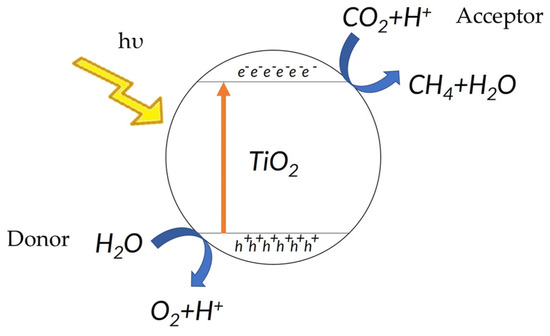
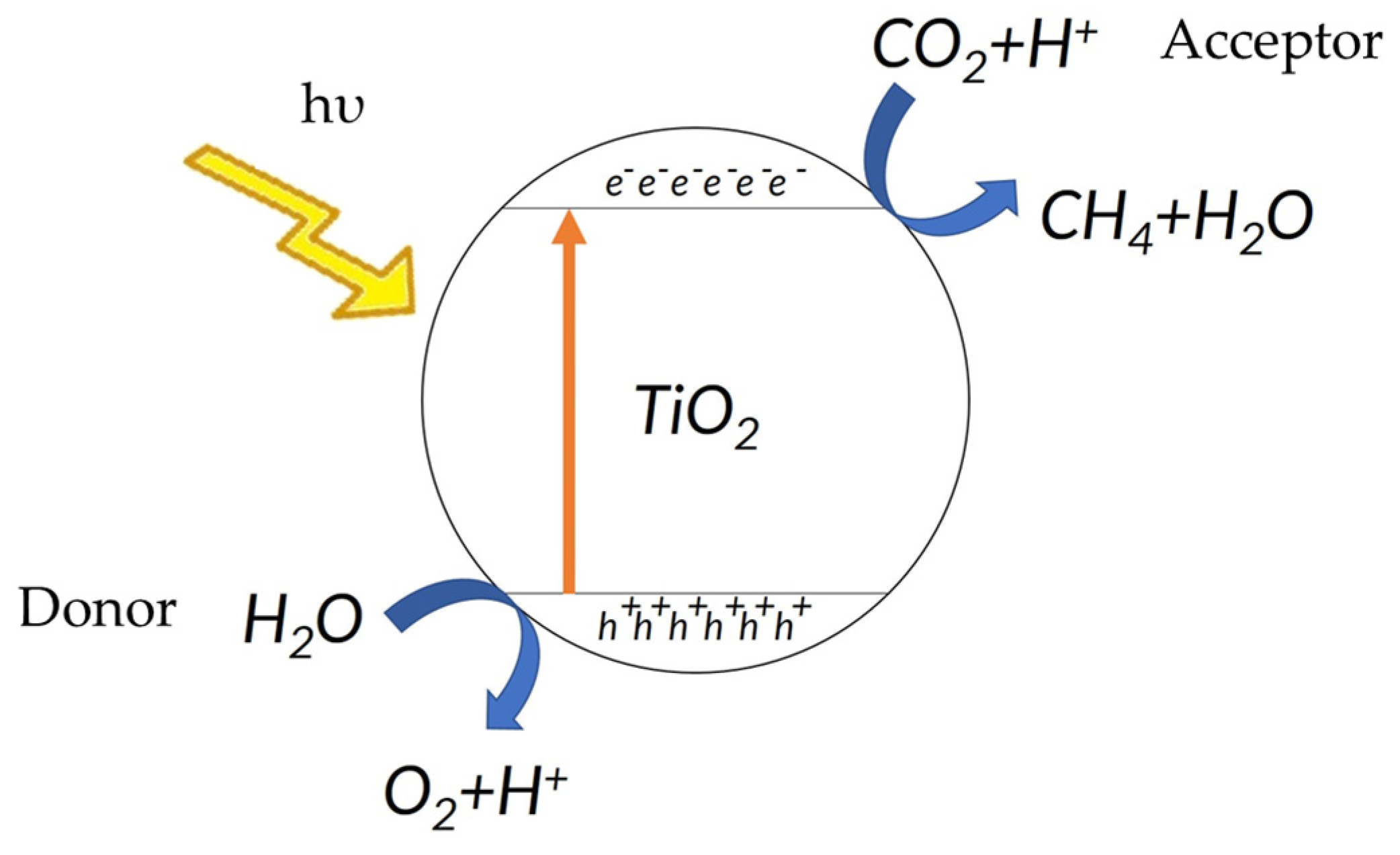
Inspired by the natural process in plants, Artificial Photosynthesis uses light-induced reactions to capture CO2 and convert it into solar fuels, such as green hydrogen and hydrocarbons [3,4]. Natural photosynthesis begins with light absorption, leading to energy transfers and chemical reactions that produce ATP and NADPH, which are then utilized for CO2 fixation [5,6]. Artificial photosynthesis seeks to mimic this by employing semiconductor materials as replacements for living cells. As shown in Figure 1, UV irradiation of semiconductor materials such as titanium dioxide (TiO2) can generate electron-hole pairs that may drive redox reactions relevant to artificial photosynthesis [7,8]. However, simulating this process is complex due to significant thermodynamic and quantum barriers, as both CO2 (ΔG0 = 394.4 kJ·mol−1) and H2O (ΔG0 = 237.2 kJ·mol−1) are highly stable molecules requiring substantial energy input for activation [9,10].
Figure 1.
Schematic representation of light-induced charge generation in titanium dioxide (TiO2) under UV irradiation and possible associated redox processes relevant to CO2 conversion and hydrogen evolution.
To address these obstacles, this work proposes the use of titanium dioxide (TiO2), an abundant and low-cost photocatalyst that absorbs UV light, combined with hydrazine (N2H4), a strong reducing agent that acts as a chemical capturer of CO2 to form carbamates, thus helping to overcome thermodynamic barriers [11,12]. From a renewable energy perspective, this approach is driven by the fact that synthetic hydrocarbons diversify the current energy portfolio, reducing dependence on fossil fuels. The key characteristic of synthetic fuels produced this way is the use of solar energy, an endless and clean energy source, creating a CO2 consumption–production cycle that would reduce the carbon footprint in the atmosphere while enhancing energy security [13,14].
The main objective of this work is to explore a light-driven artificial-photosynthesis-inspired system combining water, hydrazine as a CO2 capture agent, and TiO2 as a UV-responsive solid. To achieve this, the specific objectives were to (i) construct and optimize a UV-LED photoreactor for TiO2 activation, (ii) evaluate the capture of CO2 by hydrazine to form carbamates, (iii) characterize the gaseous and liquid products formed upon UV irradiation using FT-IR and mass spectrometry, and (iv) propose a reasonable and explicitly tentative reaction pathway consistent with the available evidence. Given the exploratory nature of this study and the absence of critical control experiments, the goal is not to claim a fully validated photocatalytic solar-fuel process, but rather to examine whether coupling chemical CO2 capture with UV-induced reactivity in the presence of TiO2 can generate detectable hydrogen and chemically transformed intermediates.
2. Results
2.1. CO2 Capture and Carbamate Formation
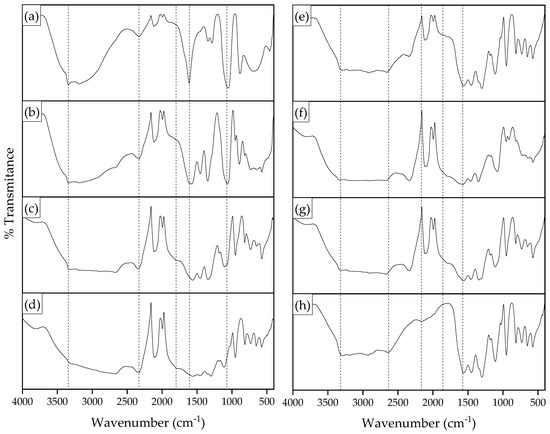
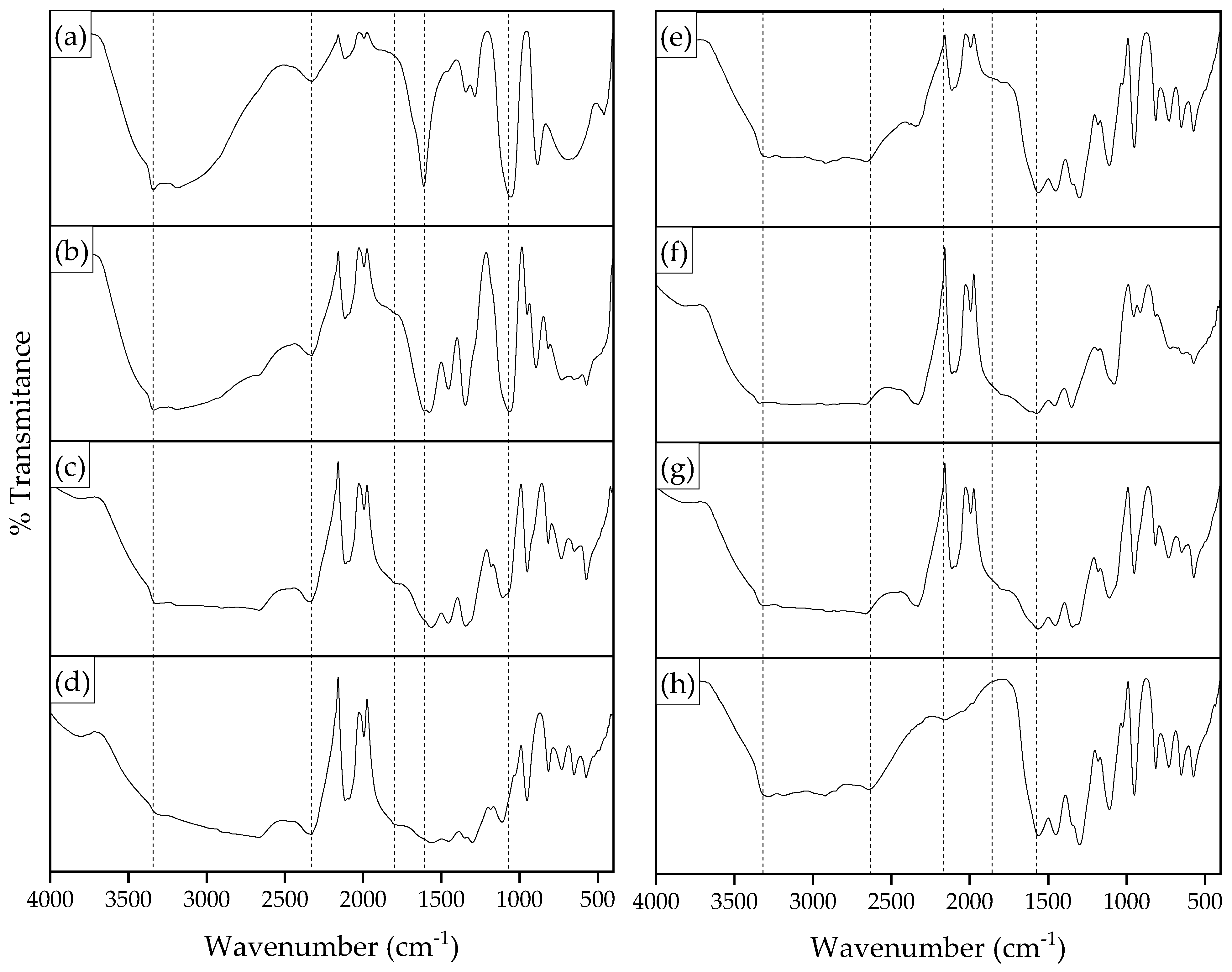
Controlled introduction of CO2 into aqueous hydrazine produced carbamate-type species, as indicated by FT-IR analysis (Figure 2). Compared with the spectrum of the hydrazine solution prior to gas injection, the post-capture spectra showed new bands attributable to carbonyl-containing and carbamate-related functionalities. In particular, absorptions near 1680 cm−1 were assigned to C=O stretching vibrations, while features in the 1400–1000 cm−1 region were consistent with coupled C–O and C–N stretching modes. At the same time, the broad band in the 3700–3000 cm−1 region, associated with overlapping N–H and O–H stretching vibrations, decreased in intensity, suggesting the participation of hydrazine functional groups in CO2 capture.
Figure 2.
FT-IR spectra showing: (a) pure hydrazine solution (control); (b–d) carbamate formation after CO2 injection at (b) 0.5 g, (c) 1.4 g, and (d) 2.0 g; (e–h) samples after light-induced H2 evolution: (e) with 2.0 g CO2 and NADP+, (f) 0.5 g CO2, (g) 1.4 g CO2, (h) 2.0 g CO2.
The intensity of the carbamate-related bands increased with increasing CO2 loading from 0.5 g to 2.0 g, indicating progressive formation of CO2-derived intermediates in solution. These observations are consistent with the formation of hydrazine-derived carbamates in aqueous medium.
2.2. Mass Spectrometry Analysis of Gaseous Products (Batches 1, 2, and 3)
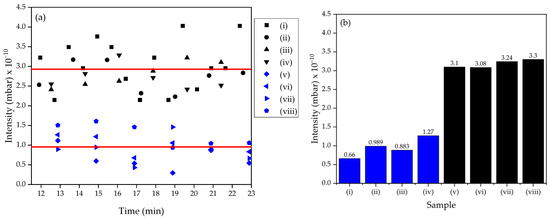
Mass spectrometry analysis of the gas phase showed the presence of molecular hydrogen in the irradiated reaction systems. A signal at m/z = 2 was consistently detected after irradiation, consistent with H2 formation. In the deuterated experiments, no significant signals corresponding to HD (m/z = 3) or D2 (m/z = 4) were observed, suggesting that the evolved hydrogen did not originate predominantly from the deuterated solvent. Figure 3 summarizes the comparative gas-phase response obtained under the different irradiation conditions.
Figure 3.
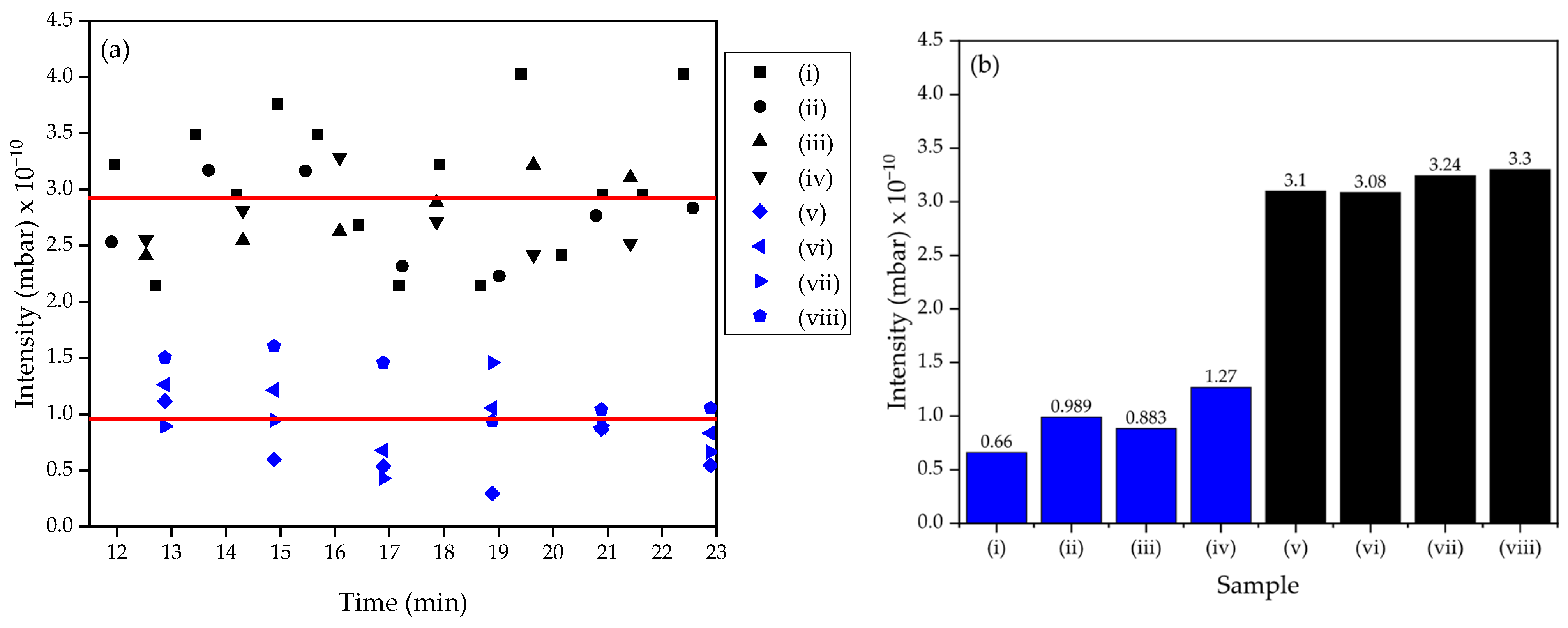
Mass spectrometry analysis of H2 production, representative m/z = 2 signal, mean H2 signal intensities for eight samples in (a): (i–iv) with 380 nm LED array and (v–viii) with UV-A lamp, red lines represent the arithmethic means; and (b) comparison of hydrogen signal intensity under different irradiation conditions.
Hydrogen quantification was estimated from the integrated mass spectrometric response assigned to m/z = 2 using the instrument response under a constant analytical configuration, and the resulting values are therefore presented as semi-quantitative estimates rather than as absolute gas-chromatographic determinations. Because the present study did not include external calibration with certified H2 standards across the full concentration range, these values should be interpreted primarily as comparative measurements between experimental batches operated under the same analytical method.
Under this approach, the maximum estimated H2 production was 33.2 μmol in Batch 1 (Table 1). Batch 2 produced 18.2 μmol, while Batch 3 produced 31.99 μmol. In this work, hydrogen yield was estimated as the percentage ratio of experimentally estimated moles of H2 to the theoretical maximum moles of H2 obtainable from the initial hydrazine content, assuming complete dehydrogenation under the tested reaction conditions. On this basis, the highest calculated yield was 0.0151% for Batch 1, followed by 0.0083% for Batch 2 and 0.0146% for Batch 3.
Table 1.
Quantification of hydrogen production for different experimental batches.
Although these values indicate measurable H2 evolution under irradiation, the yields are very low and should be interpreted only as preliminary proof-of-concept results. In addition, because the experimental batches differed simultaneously in several variables, including irradiation source, reaction time, reactor geometry, and the presence or absence of NADP+ and D2O, direct causal comparison among batches must be made with caution. Most importantly, because essential control experiments were not conducted, the gas evolution observed here cannot yet be assigned unambiguously to a purely photocatalytic pathway.
2.3. FT-IR Analysis of Liquid Products (Batches 2 and 3)
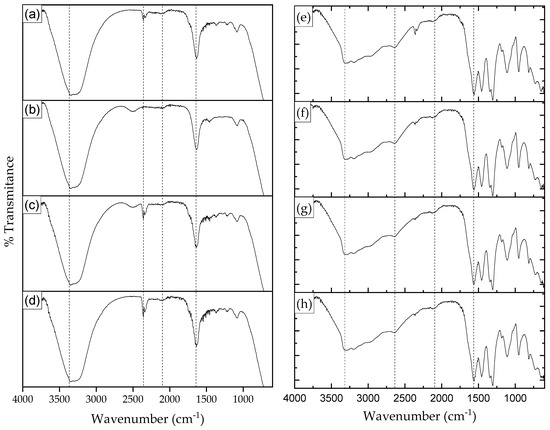
FT-IR spectra of the post-reaction liquid samples revealed the persistence of carbamate-related bands together with additional features suggesting chemical transformation during irradiation (Figure 4). In Batch 2, broad absorptions in the 3700–3000 cm−1 region were assigned to overlapping O–H and N–H stretching vibrations. Signals in the 3000–2800 cm−1 interval suggested the presence of C–H-containing species, possibly associated with partially transformed organic products. The region between 1700 and 1550 cm−1 contained bands compatible with carbonyl-containing species, while the 1550–1450 cm−1 interval included contributions that may arise from overlapping C–N stretching and N–H bending modes. The complex 1200–1000 cm−1 region likely contained overlapping contributions from C–O, C–N, N–N, and, where applicable, phosphorus-containing groups associated with NADP+. The 800–500 cm−1 interval contained the expected Ti–O–Ti lattice vibrations from TiO2.
Figure 4.
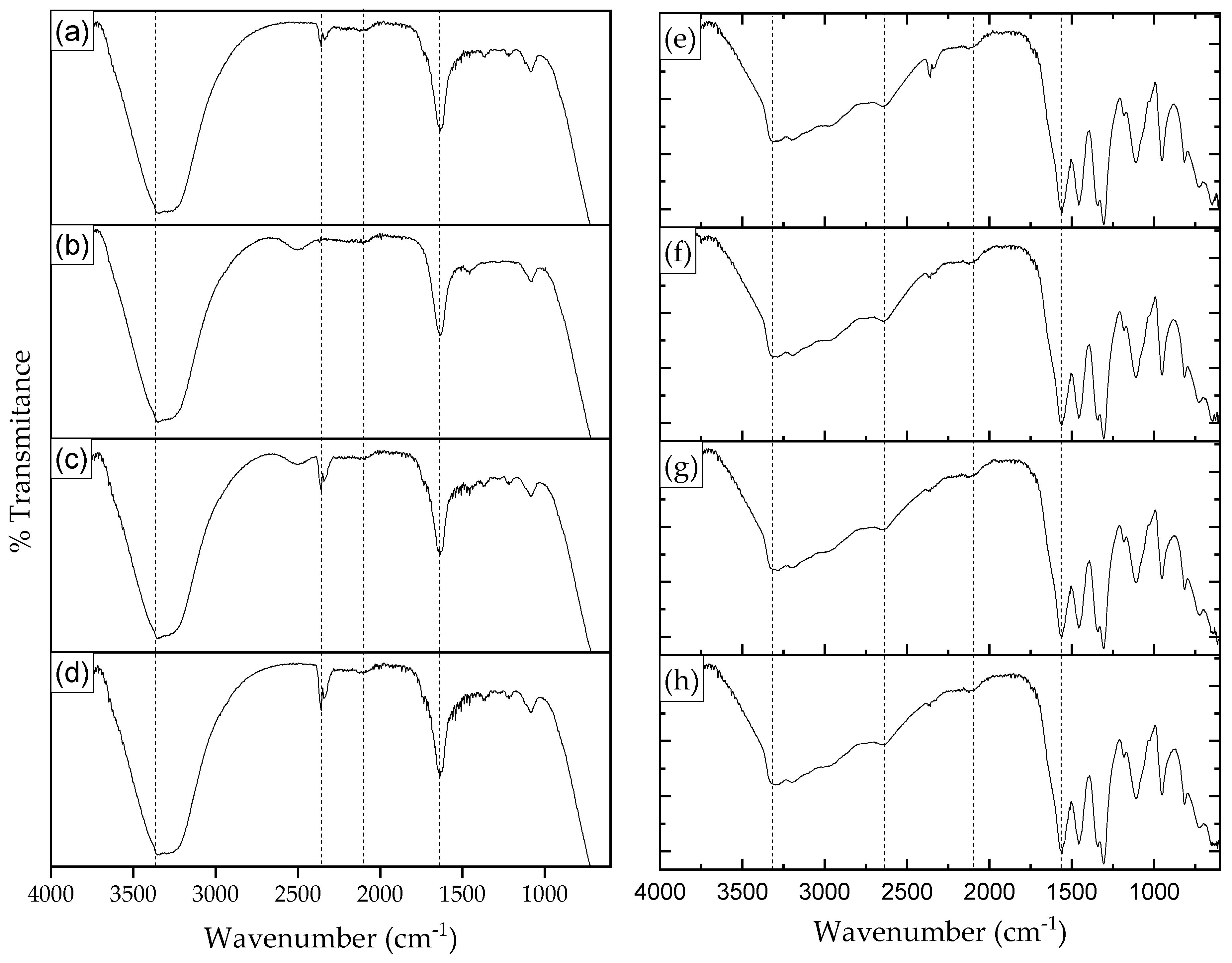
(a–d) FT-IR spectra of the liquid products from Batch 2 reactions (Samples 1, 2, 3, and 4) under UV-A lamp illumination; (e–h) FT-IR spectra of the liquid products from Batch 3 reactions (Samples 5, 6, 7, and 8) under enhanced 380 nm LED illumination.
In Batch 3, the spectra displayed similar features but with improved band intensity and spectral definition. Sample 5 showed an additional band in the 2250–2350 cm−1 region. At this stage, this feature can only be assigned tentatively to strongly unsaturated nitrogen-containing species such as nitrile-like or carbodiimide-like functionalities; however, this interpretation is not conclusive from FT-IR evidence alone and would require confirmation by complementary structural methods.
Overall, the FT-IR data support the persistence of CO2-derived nitrogen-containing intermediates after irradiation, but specific product assignments should be regarded as provisional because of band overlap and the lack of orthogonal molecular identification techniques.
2.4. UV-Vis Analysis of CO2 Capture Samples
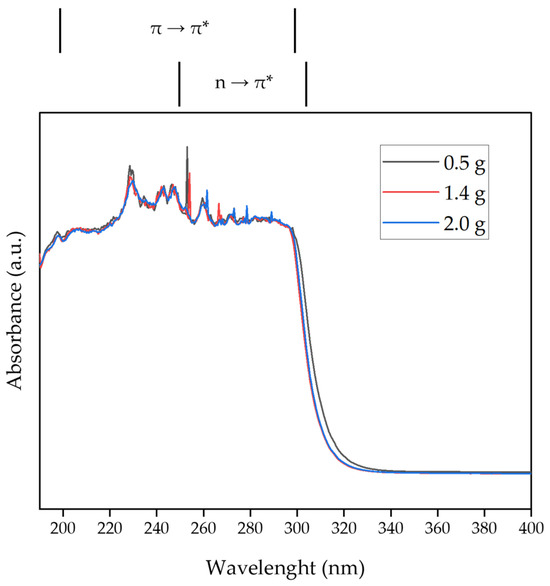
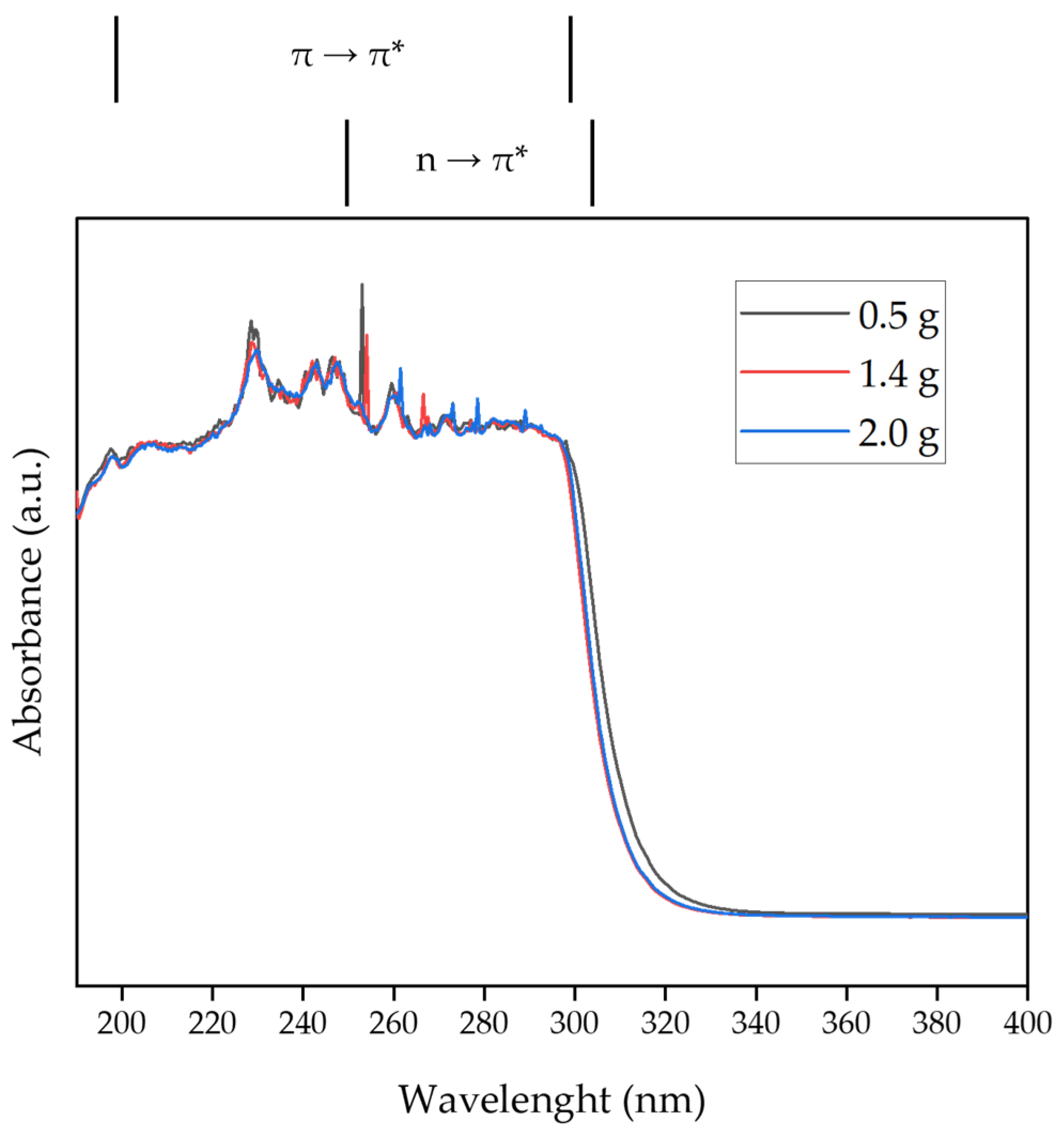
UV-Vis spectroscopy was employed as a complementary tool to examine the post-reaction liquid samples obtained at different CO2 loadings. As presented in Figure 5, all samples showed a similar spectral profile, with a strong absorption maximum at approximately 228–230 nm, broad features in the 240–300 nm range, and a sharp decrease in absorbance above 300 nm. The intense band at 228–230 nm is consistent with π→π∗ transitions of carbamate-related species, while the broader absorption between 240 and 300 nm may be attributed to overlapping n→π∗ transitions of carbonyl- and nitrogen-containing products formed during CO2 capture. Considering the reaction chemistry reported for hydrazine-based systems, these absorptions are more appropriately interpreted as the combined response of mono-carbamate and di-carbamate species in equilibrium rather than as signatures of isolated N–N or N–C bonds. The 2.0 g sample exhibited slightly more pronounced absorption in the 230–280 nm region, suggesting a higher relative abundance of UV-active intermediates, although the strong overlap of bands prevents an unambiguous assignment.
Figure 5.
UV-Vis absorption spectra of the post-reaction liquid samples obtained from Batch 0 at different CO2 loadings, corresponding to 0.5 g, 1.4 g, and 2.0 g of carbamate-containing liquid.
3. Discussion
3.1. Interpretation of the CO2 Capture Step
The FT-IR data in Figure 2 indicate that hydrazine reacts effectively with CO2 in aqueous medium to produce carbamate-type species, in agreement with previous reports on hydrazine-based CO2 capture chemistry [15,16]. The appearance of carbonyl-related and C–N/C–O bands after gas loading supports the interpretation that the stable CO2 molecule becomes chemically activated through carbamate formation.
This chemical activation step is likely central to the present system. Rather than relying exclusively on direct photocatalytic reduction of dissolved CO2, the system first transforms CO2 into a chemically bound intermediate that may then participate in subsequent light-driven reactions or interact with the TiO2 surface.
3.2. Light-Induced Reactivity and H2 Production
The production of H2 under UV irradiation (Figure 3, Table 1) demonstrates that the TiO2/hydrazine/CO2 system is chemically reactive under illuminated conditions. However, in the absence of critical control experiments—such as TiO2 + hydrazine without CO2, hydrazine + CO2 without TiO2, and dark controls—the present data do not yet allow an unambiguous attribution of H2 evolution exclusively to photocatalysis at the TiO2 surface.
Within this limitation, the irradiated TiO2-containing system is consistent with a photoinduced process in which UV excitation of TiO2 may contribute to charge generation and redox chemistry, while hydrazine likely serves as the principal hydrogen source. The absence of HD or D2 (m/z = 3 or 4) in the deuterated experiments strongly suggests that the evolved H2 does not originate predominantly from solvent splitting, but rather from hydrazine dehydrogenation. This interpretation is also consistent with the presence of nitrogen-containing bands in the FT-IR spectra after reaction [17,18].
Accordingly, the current evidence supports the statement that H2 evolution occurs under UV irradiation in the presence of TiO2 and hydrazine, but the extent to which TiO2-mediated photocatalysis, direct photochemistry, thermally assisted decomposition, or coupled pathways contribute to the observed response remains to be established experimentally [19,20].
3.3. Influence of Experimental Parameters on H2 Yield
The differences in estimated H2 production between batches can be associated with several experimental factors, although the exploratory design of the study prevents strict variable-by-variable interpretation. Batch 2 included NADP+ in some samples and showed lower H2 yield compared to Batch 1. NADP+ is known to act as an electron mediator in natural photosynthesis [21], but in the present system its role remains uncertain. Its presence may have introduced competing redox pathways or contributed to the formation of additional phosphorus-containing and nitrogen-containing species, as suggested by the more complex FT-IR response in the 1200–1000 cm−1 region. This interpretation, however, remains tentative.
The addition of D2O in Batches 2 and 3 may also have influenced reaction kinetics through isotopic effects on hydrogen bonding and proton-transfer steps. At the same time, the absence of HD or D2 supports the conclusion that the detected H2 originated mainly from hydrazine rather than from the solvent.
A major operational difference existed between Batch 2 (UV-A lamp, 18 mW cm−2) and Batch 3 (380 nm LED array, 156 mW cm−2). The higher m/z = 2 response observed for Batch 3 suggests that stronger and more wavelength-matched irradiation enhanced the light-driven behavior of the system. Because 380 nm irradiation is close to the anatase TiO2 excitation threshold, this condition may favor more efficient photoexcitation of TiO2 [22,23]. Nevertheless, since the batches also differed in other aspects, this trend should be interpreted as suggestive rather than mechanistically definitive.
3.4. Tentative Reaction Pathway
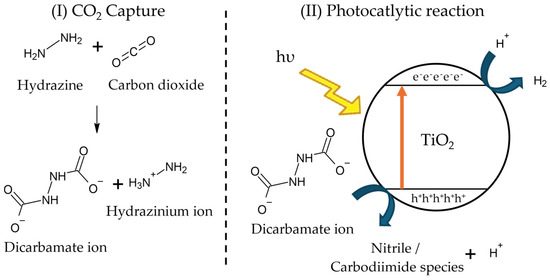
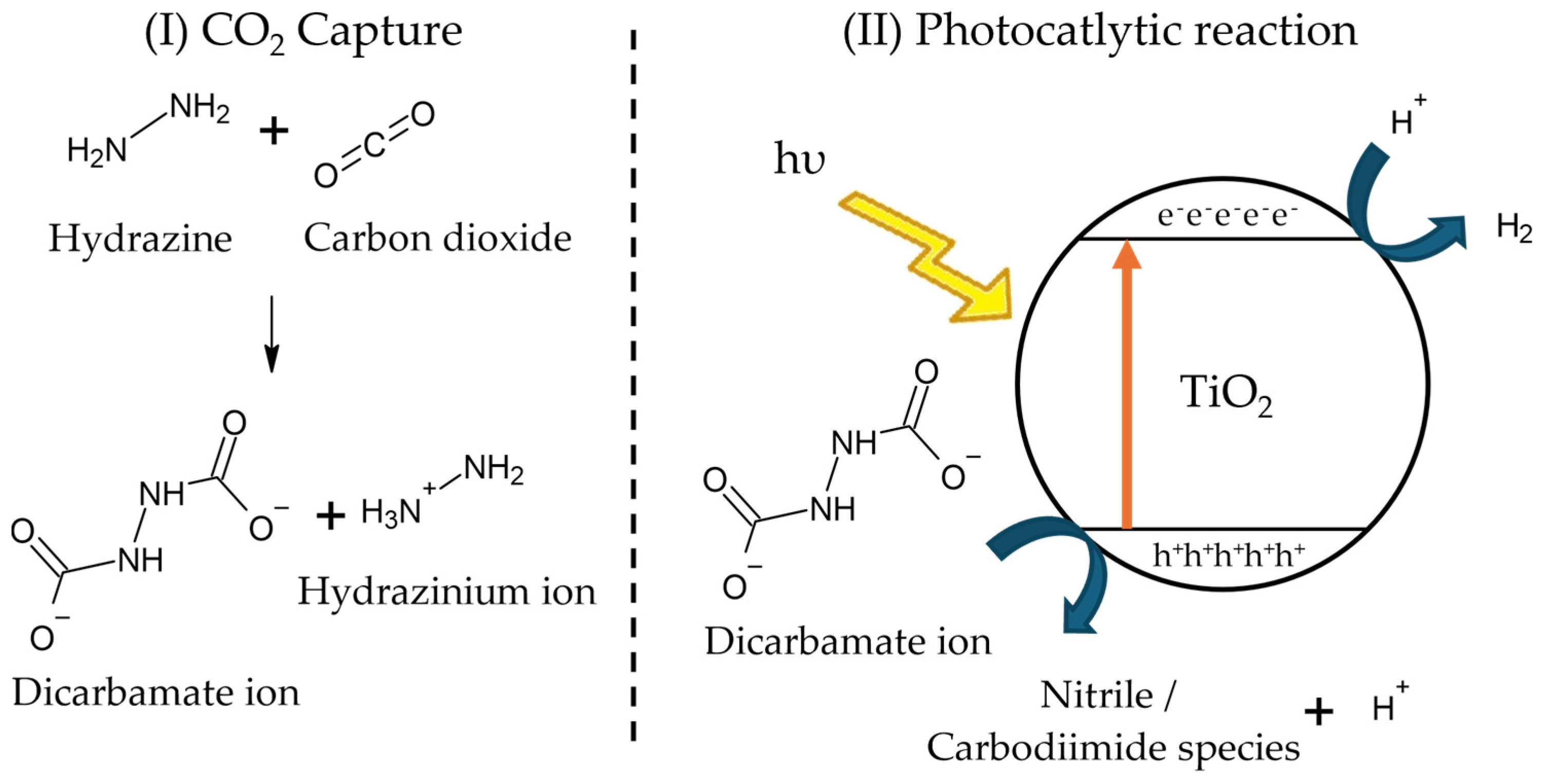
Based on the available spectroscopic evidence, a tentative reaction pathway may be proposed, while explicitly recognizing that it is not yet experimentally validated in mechanistic detail. As shown in Scheme 1 (I), hydrazine first reacts with CO2 in solution to form carbamate-type intermediates [15,24,25]. Upon UV irradiation in the presence of TiO2, the system undergoes light-induced chemical transformation. One plausible interpretation is that hydrazine or hydrazine-derived species undergo oxidation/dehydrogenation steps, while reduction equivalents contribute to H2 evolution.
Scheme 1.
(I) CO2 capture and carbamate formation. (II) Proposed reaction pathway for the TiO2-light-induced H2 evolution and Nitrile/Carbodiimide species production.
The deuterated experiments suggest that hydrogen evolution is associated primarily with hydrazine rather than solvent-derived water splitting. In parallel, the persistence of carbamate-related bands and the appearance of additional nitrogen-containing signals in the FT-IR spectra indicate that some of the captured CO2-derived species remain in solution and may participate in secondary transformations.
The resulting liquid-phase products have not yet been identified conclusively. Therefore, species such as nitrile-like or carbodiimide-like products should be considered only as tentative assignments consistent with selected FT-IR features, particularly the band in the 2250–2350 cm−1 region. Overall, Scheme 1 should be understood as a working hypothesis intended to organize the observed spectroscopic trends.
3.5. Sustainability Considerations and Future Work
Although this work is inspired by concepts from artificial photosynthesis and CO2 utilization, the use of hydrazine introduces clear environmental, health, and process-sustainability limitations. Hydrazine is toxic and hazardous, and its production is itself energy-intensive. Therefore, the present system should not be interpreted as a green or scalable energy technology in its current form. Rather, it serves as a laboratory model for exploring whether chemical CO2 capture and light-induced H2 evolution can be coupled in a single reaction framework [26,27].
Future work should focus first on the critical control experiments required to validate the origin of H2 evolution, including: (i) TiO2 + hydrazine under irradiation without CO2, (ii) hydrazine + CO2 under irradiation without TiO2, and (iii) dark controls for the complete reaction mixture. In addition, future studies should include statistically supported replicates, external calibration for gas quantification, structural identification of liquid-phase products by complementary techniques, and mechanistic validation through photoelectrochemical and computational methods, including DFT.
A broader evaluation of energy balance, environmental impact, and process viability would also be essential before any technological implications could be considered.
4. Materials and Methods
4.1. Materials
Hydrazine monohydrate (N2H4·H2O, 64–65%, reagent grade 98%), titanium dioxide (TiO2, anatase powder, 99.8% trace metals basis), Deuterium oxide (D2O, 99.9 atom %), and nicotinamide adenine dinucleotide phosphate (NADP+, disodium salt, approximately 98%) were purchased from Sigma-Aldrich (St. Louis, MO, USA). Carbon dioxide (CO2, Research Grade UN 1013) and nitrogen (N2, Research Grade UN 1066) were supplied by INFRA (Mexico City, Mexico). All reagents were used as received without further purification.
4.2. Photoreactor Design
A custom photoreactor was designed and assembled for the UV light-induced experiments. Two illumination configurations were used.
In the first configuration, a UV-A lamp emitting in the 380–400 nm range with an irradiance of 18 mW cm−2 was employed. This setup was used for Batch 1 and Batch 2 experiments.
In the second configuration, implemented for Batch 3, the reactor was upgraded with an array of 200 UV LEDs centered at 380 nm. The LEDs were mounted on phenolic boards and provided an irradiance of 156 mW cm−2 at the sample surface. This wavelength was selected to closely match the anatase TiO2 band-gap excitation region.
A cooling fan (YOUNUON, model YN-Server-Cooling Fans, 12 V, 0.45 A; YOUNUON, Wuxi, China) was used to maintain thermal stability during prolonged irradiation periods. Batch 1 reactions were conducted in a 1 mL quartz cuvette supplied by YiXing Purshee Optical Elements Co., Ltd. (Yixing, China), whereas Batches 2 and 3 were carried out in hermetically sealed 25–50 mL borosilicate flasks (manufactured in Mexico City, Mexico) fitted with septum caps from KSTEK (Suzhou, China) to allow gas accumulation and sampling [24,25].
4.3. Experimental Procedure
4.3.1. Batch 1: CO2 Capture and Photoinduced Conversion
Three samples containing 5.5 g of aqueous hydrazine were prepared [15]. CO2 was introduced into each sample while the mass increase was monitored using an analytical balance (Mettler Toledo, MS105DU; Switzerland). Final CO2 loads of 0.5 g, 1.4 g, and 2.0 g were obtained. The resulting solutions were then transferred to the reaction vessel, and 2.0 mg of TiO2 was added. The suspensions were irradiated under the UV-A lamp configuration for 24 h with continuous magnetic stirring.
4.3.2. Batch 2: Photoinduced Conversion with UV-A Irradiation
Batch 2 experiments were scaled using the most favorable condition identified in Batch 1, corresponding to 2.0 g of CO2 per 5.5 g of hydrazine solution. The required quantities of hydrazine, captured CO2, and TiO2 were placed in sealed borosilicate flasks. In selected experiments, D2O (1 mL) and/or NADP+ were added. Before irradiation, the reaction system was purged with N2 for 5 min to remove atmospheric oxygen. The flasks were then irradiated for two weeks under the UV-A lamp configuration with magnetic stirring.
4.3.3. Batch 3: Photoinduced Conversion Under 380 nm LED Irradiation
Batch 3 experiments followed the same general protocol as Batch 2 but were performed using the optimized 380 nm LED array instead of the UV-A lamp. Four tests were conducted under two-week irradiation conditions, varying the presence of NADP+, D2O, and TiO2 loading as defined in the experimental design.
Methodological note: The present study was exploratory and did not include a full factorial design. Therefore, the experimental batches should not be interpreted as isolated variable-by-variable comparisons.
4.4. Product Analysis
4.4.1. Gas Phase Analysis by Mass Spectrometry
After irradiation, gaseous products were displaced with N2 and collected in 200 mL Tedlar gas-sampling bags. Gas analysis was performed using a mass spectrometer (DSMS HIDEN ANALYTICAL BALZERS TCP 015; WA, Hiden Analytical, Warrington, England) operating in residual gas analysis mode. The instrument was set to an emission current of 1000 μA, electron energy of 60 eV, and a scanned mass range of 0.4–50 amu with a step size of 0.05 amu. Gaseous species were identified according to their characteristic m/z values, with particular attention to H2, HD, D2, CO2, O2, and water-related fragments.
For the purposes of this exploratory study, the m/z = 2 response was used as an indicator of H2 formation and as the basis for semi-quantitative estimation of hydrogen production under a fixed analytical setup. Because a full external calibration with certified H2 standards was not performed, the absolute H2 amounts reported should be interpreted as method-dependent estimates suitable primarily for internal comparison among experiments performed under the same instrumental conditions.
4.4.2. Liquid Phase Analysis by FT-IR Spectroscopy
After each experiment, the liquid phase was recovered and filtered through a 0.45 μm PES membrane to remove suspended TiO2 particles. FT-IR spectra were recorded using a FT-IR spectrometer (PerkinElmer Spectrum GX; Shelton, CT, USA) in transmission mode over the range 4000–400 cm−1 with a resolution of 4 cm−1. Background subtraction was performed using a clean reference spectrum. Band assignments were made by comparison with literature data for carbamates, hydrazine derivatives, and related nitrogen-containing compounds.
4.4.3. UV-Vis Spectroscopy
UV-Vis spectra of selected liquid products were recorded as complementary evidence of chemical changes after CO2 capture and photoinduced conversion. The post-reaction samples were analyzed in the wavelength range of 190–400 nm. Spectral profiles were compared for solutions prepared with different CO2 loadings (0.5, 1.4, and 2.0 g) in order to identify variations in the UV absorption region associated with the formation of carbamate-type and other nitrogen-containing species.
5. Conclusions
A hydrazine-assisted CO2 capture system combined with TiO2 under UV irradiation was evaluated as an artificial-photosynthesis-inspired platform for light-induced hydrogen evolution. FT-IR results demonstrated that hydrazine efficiently captures CO2 and forms carbamate-type intermediates in aqueous medium. Under irradiation, the system generated molecular hydrogen, confirming chemical reactivity in the illuminated TiO2/hydrazine/CO2 system under the tested conditions.
The maximum estimated H2 production observed was 33.2 μmol, and the highest calculated H2 yield was 0.0151% relative to the theoretical hydrogen obtainable from the initial hydrazine content. Deuterated experiments showed no detectable HD or D2, indicating that hydrogen evolution originated predominantly from hydrazine dehydrogenation rather than direct water splitting. UV-Vis and FT-IR analyses further supported the presence of nitrogen-containing and carbamate-related species in the liquid phase after reaction.
At the same time, the present work has important limitations. No carbon-based synthetic fuel was identified or quantified, the experimental design was not fully controlled across all variables, and key control experiments were not included. Therefore, the study should be interpreted as a preliminary proof of concept of photoinduced reactivity, rather than as a demonstration of a fully validated photocatalytic solar-fuel process.
Future work should prioritize the corresponding dark and component control experiments, improve reproducibility and statistical treatment, strengthen gas quantification, identify liquid-phase products by complementary analytical methods, validate mechanisms through DFT and photoelectrochemical studies, and replace hydrazine with safer and more sustainable capture/reducing agents.
Author Contributions
Conceptualization, Funding acquisition, Supervision, Resources, and Writing—review and editing, S.O.F.V.; Investigation, Formal analysis, and Methodology, E.L.Á.; Visualization and Writing—original draft, D.M.M.L. All authors have read and agreed to the published version of the manuscript.
Funding
This research received no external funding. The APC was funded by the Instituto Politécnico Nacional (IPN).
Data Availability Statement
Data are contained within the article.
Acknowledgments
Ektaí López Ángeles gratefully acknowledges the support provided by the Consejo Nacional de Ciencia y Tecnología (CONACYT). The authors thank the Laboratorio de Química e Ingeniería Verde, ESIQIE, Instituto Politécnico Nacional (IPN), for access to laboratory facilities, and the Universidad Autónoma Metropolitana (UAM) for access to mass spectrometry instrumentation.
Conflicts of Interest
The authors declare no conflicts of interest.
Abbreviations
The following abbreviations are used in this manuscript:
| ATP | Adenosine Triphosphate |
| D2 | Molecular Deuterium |
| HD | Molecular Deuteride |
| FT-IR | Fourier Transform Infrared |
| Photon energy | |
| LED | Light-Emitting Diode |
| NADP+ | Nicotinamide Adenine Dinucleotide Phosphate |
| NADPH | Nicotinamide Adenine Dinucleotide Phosphate reduced |
| PES | Polyethersulfone |
| UV-Vis | Ultraviolet-Visible |
| UV-A | Ultraviolet A |
References
- Ferrari, L.; Masera, O.; Straffon, A. Transición Energética Justa y Sustentable. Contexto y Estratégias para México; Fondo de Cultura Economica: Mexico City, Mexico, 2024; ISBN 607-16-8400-5. [Google Scholar]
- Zhou, B.; Zhou, P.; Dong, W.; Mi, Z. Gallium Nitride-Based Artificial Photosynthesis Integrated Devices for Solar Hydrogen Generation and Carbon Dioxide Reduction; Wiley: Hoboken, NJ, USA, 2024; ISBN 978-1-119-60086-2. [Google Scholar]
- Cheekatamarla, P.; Gluesenkamp, K.; Kowalski, S.; Li, Z. Global Primary Energy Sources and Their Carbon Intensity, 1st ed.; Synthesis Lectures on Engineering, Science, and Technology; Springer: Cham, Switzerland, 2024; ISBN 978-3-031-45364-9. [Google Scholar]
- Machín, A.; Cotto, M.; Ducongé, J.; Márquez, F. Artificial Photosynthesis: Current Advancements and Future Prospects. Biomimetics 2023, 8, 298. [Google Scholar] [CrossRef] [Scilit] [PubMed]
- Paul, M.J. Photosynthetic Carbon Dioxide Fixation; Academic Press: London, UK, 2013; ISBN 978-0-12-378631-9. [Google Scholar]
- Taiz, L.; Møller, I.M.; Murphy, A.; Peer, W.A. Fundamentals of Plant Physiology; Oxford University Press: Oxford, UK, 2024; ISBN 978-0-19-761416-7. [Google Scholar]
- Rhodes, C.J. Novel Catalysts for Water Splitting and Green Chemistry Applications. Sci. Prog. 2013, 96, 309–316. [Google Scholar] [CrossRef] [Scilit]
- Tonmoy, M.A.-R.; Mahmud, H.; Ahsanul Habib, A.K.M. A Short Review on the Effects of Doping in TiO2: A Potential Nano-Photocatalyst for Hydrogen Production by Artificial Photosynthesis Process. In Proceedings of the 2024 7th International Conference on Development in Renewable Energy Technology (ICDRET); IEEE: Piscataway, NJ, USA, 2024; pp. 1–6. [Google Scholar]
- Rashid, M.A.M.; Acter, T.; Uddin, N. The Solvation Dynamics of CO2 by Quantum Mechanical Molecular Dynamics. Chem. Phys. Lett. 2023, 832, 140861. [Google Scholar] [CrossRef] [Scilit]
- Zhang, L.; Jiang, H.; Gu, D.; Wang, M.; Li, C.; Yan, C.; Yuan, D.; Wang, B. Framework, Chemical Model, and Efficiency Analysis of Solar Multifield-Driven Hybrid Chemical Utilization for Splitting Environmentally Stable Molecules to Energetic Molecules. Ionics 2021, 27, 5339–5346. [Google Scholar] [CrossRef] [Scilit]
- Hossen, M.A.; Solayman, H.M.; Leong, K.H.; Sim, L.C.; Yaacof, N.; Abd Aziz, A.; Lihua, W.; Monir, M.U. A Comprehensive Review on Advances in TiO2 Nanotube (TNT)-Based Photocatalytic CO2 Reduction to Value-Added Products. Energies 2022, 15, 8751. [Google Scholar] [CrossRef] [Scilit]
- Roy, N.; Bhunia, K.; Terashima, C.; Fujishima, A.; Pradhan, D. Citrate-Capped Hybrid Au-TiO2 Nanomaterial for Facile and Enhanced Electrochemical Hydrazine Oxidation. ACS Omega 2017, 2, 1215–1221. [Google Scholar] [CrossRef] [Scilit]
- Li, Y.; Guan, B.; Guo, J.; Chen, Y.; Ma, Z.; Zhuang, Z.; Zhu, C.; Dang, H.; Chen, L.; Shu, K.; et al. Renewable Synthetic Fuels: Research Progress and Development Trends. J. Clean. Prod. 2024, 450, 141849. [Google Scholar] [CrossRef] [Scilit]
- Rosa, R.N. The Role of Synthetic Fuels for a Carbon Neutral Economy. C 2017, 3, 11. [Google Scholar] [CrossRef] [Scilit]
- Lee, B.; Stowe, H.M.; Lee, K.H.; Hur, N.H.; Hwang, S.-J.; Paek, E.; Hwang, G.S. Understanding CO2 Capture Mechanisms in Aqueous Hydrazine via Combined NMR and First-Principles Studies. Phys. Chem. Chem. Phys. 2017, 19, 24067–24075. [Google Scholar] [CrossRef] [Scilit]
- Wang, Y.; Wei, J.-X.; Tang, H.-L.; Shao, L.-H.; Dong, L.-Z.; Chu, X.-Y.; Jiang, Y.-X.; Zhang, G.-L.; Zhang, F.-M.; Lan, Y.-Q. Artificial Photosynthetic System for Diluted CO2 Reduction in Gas-Solid Phase. Nat. Commun. 2024, 15, 8818. [Google Scholar] [CrossRef] [Scilit]
- Rafique, M.; Hajra, S.; Irshad, M.; Usman, M.; Imran, M.; Assiri, M.A.; Ashraf, W.M. Hydrogen Production Using TiO2-Based Photocatalysts: A Comprehensive Review. ACS Omega 2023, 8, 25640–25648. [Google Scholar] [CrossRef] [Scilit] [PubMed]
- Zhao, W.; Ai, Z.; Dai, J.; Zhang, M. Enhanced Photocatalytic Activity for H2 Evolution under Irradiation of UV–Vis Light by Au-Modified Nitrogen-Doped TiO2. PLoS ONE 2014, 9, e103671. [Google Scholar] [CrossRef] [Scilit]
- Long, J.; Hu, C.; Yao, Q.; Wang, K.; Feng, G.; Cao, S.; Lu, Z.-H. Light-Promoted Hydrazine Dehydrogenation over Ni/NH2-MIL-125: Unraveling Mechanisms for Efficient Hydrogen Production. Adv. Sci. 2026, 13, e19320. [Google Scholar] [CrossRef] [Scilit] [PubMed]
- Zhang, H.; Duan, M.; Guo, S.; Leeflang, R.; Szalay, D.; Li, J.; Tseng, J.; Wu, S.; Cai, S.; Prabhakaran, D.; et al. Hydrazine-Mediated Thermally Assisted Photocatalytic Ammonia Decomposition Over Layered Protonated Perovskites. Adv. Sci. 2025, 12, e11212. [Google Scholar] [CrossRef] [Scilit]
- Shlosberg, Y.; Eichenbaum, B.; Tóth, T.N.; Levin, G.; Liveanu, V.; Schuster, G.; Adir, N. NADPH Performs Mediated Electron Transfer in Cyanobacterial-Driven Bio-Photoelectrochemical Cells. iScience 2021, 24, 101892. [Google Scholar] [CrossRef] [Scilit]
- Million-Picallion, L.; Berger, G.; Lefèvre, G.; Delaunay, S.; Mansour, C. Stability of Hydrazine, Morpholine and Ethanolamine at 275 °C and In Situ Measurement of Redox and Acid–Base Properties. J. Solut. Chem. 2015, 44, 1900–1919. [Google Scholar] [CrossRef] [Scilit]
- Zhang, Z.; Liu, S.; Yan, J.; Meng, Y.; Hu, D.; Gao, F. Hydrazine-Induced Sulfur Vacancies Promote Interfacial Charge Redistribution in ZnS/Gel-Derived TiO2 for Enhanced CO2 Activation and Methanation. Gels 2026, 12, 39. [Google Scholar] [CrossRef] [Scilit]
- Li, J.; Hodapp, P.; Ladewig, B.P.; Jung, N.; Dittmeyer, R. A Batch Photoreactor for Small-Scale Laboratory Research—A Technical Note. ChemRxiv 2022, 2022. [Google Scholar] [CrossRef] [Scilit]
- Riddell, A.; Kvist, P.; Bernin, D. A 3D Printed Photoreactor for Investigating Variable Reaction Geometry, Wavelength, and Fluid Flow. Rev. Sci. Instrum. 2022, 93, 084103. [Google Scholar] [CrossRef] [Scilit]
- Yamada, T.; Nishiyama, H.; Akatsuka, H.; Nishimae, S.; Ishii, Y.; Hisatomi, T.; Domen, K. Production of Methane by Sunlight-Driven Photocatalytic Water Splitting and Carbon Dioxide Methanation as a Means of Artificial Photosynthesis. ACS Eng. Au 2023, 3, 352–363. [Google Scholar] [CrossRef] [Scilit]
- Zhang, P.; Huo, Y.; Wang, F.; Fang, F.; Sun, D. Direct Electrochemical Seawater Splitting for Green Hydrogen and Artificial Reefs. ACS Appl. Energy Mater. 2023, 6, 7636–7642. [Google Scholar] [CrossRef] [Scilit]

Disclaimer/Publisher’s Note: The statements, opinions and data contained in all publications are solely those of the individual author(s) and contributor(s) and not of MDPI and/or the editor(s). MDPI and/or the editor(s) disclaim responsibility for any injury to people or property resulting from any ideas, methods, instructions or products referred to in the content. |
© 2026 by the authors. Licensee MDPI, Basel, Switzerland. This article is an open access article distributed under the terms and conditions of the Creative Commons Attribution (CC BY) license.