


Abstract
N2O (Nitrous oxide) is a potent greenhouse gas with a global warming potential nearly 300 times that of CO2 and poses a critical environmental challenge, particularly in semiconductor and display manufacturing, where it is emitted during plasma processes. However, catalytic N2O abatement in O2-rich environments remains inefficient because O2 competitively occupies active sites and hinders the turnover of surface oxygen species. To clarify how support properties govern this inhibition, Co-based catalysts supported on beta zeolite, CeO2, and TiO2, together with unsupported Co3O4, were comparatively evaluated for direct N2O decomposition. Among them, Co/Beta exhibited the highest performance, achieving >95% N2O conversion at 450 °C in the presence of 5% O2 with excellent long-term stability. Co/Beta possessed a high specific surface area (649 m2 g−1) and a mesoporous framework that favored uniform Co dispersion and reactant accessibility, while its high Co2+/(Co2+ + Co3+) ratio (75.5%) and large fraction of chemisorbed oxygen species (79.9%) promoted oxygen-vacancy formation and facile oxygen exchange. These results indicate that the ability of Co/Beta to maintain high activity in the presence of oxygen stems from support-modulated cobalt surface states and enhanced oxygen turnover behavior. These findings provide a support-design principle for stable N2O decomposition under oxygen-containing exhaust conditions.
1. Introduction
Fluorinated gases such as CF4, C2F6, and HFCs (Hydrofluorocarbons), which have global warming potentials notably exceeding that of CO2, have long been used for etching and chamber cleaning in the semiconductor and display industries [1,2,3,4]. These gases are directly emitted into the atmosphere or partially converted to CO2 during plasma decomposition, thereby posing environmental concerns. To address these issues, NF3 has been adopted as an alternative cleaning gas owing to its higher cleaning efficiency and lower direct-emission levels. Currently, semiconductor manufacturing facilities are reducing the use of C-containing gases and expanding that of N-containing gases as alternatives [5]. However, the utilization of N-containing gases introduces another environmental challenge because N2O is generated as a byproduct during the plasma decomposition of NF3, which is directly emitted during plasma-enhanced chemical vapor deposition processes when incompletely consumed during oxide film deposition [6,7]. These emission mechanisms, coupled with the scale-up of industrial production, have become major contributors to the increasing release of N2O, which is a potent greenhouse gas with a global warming potential nearly 300 times that of CO2 and an atmospheric lifetime exceeding 100 years [8,9,10,11]. Moreover, N2O participates in stratospheric photolysis reactions, accelerating ozone layer depletion [12,13,14]. Therefore, N2O emissions from the semiconductor and display industries intensify climate change and environmental degradation and should therefore be urgently mitigated.
N2O abatement strategies include thermal decomposition, direct catalytic decomposition, selective catalytic reduction, photocatalytic decomposition, and electrochemical reduction [12]. Conventional thermal decomposition requires high operating temperatures (>1000 °C), is energy-inefficient, and produces NOx in process or exhaust gas streams. In contrast, direct catalytic decomposition proceeds efficiently in the intermediate temperature range of 300–600 °C, requires no additional reducing agents, and avoids the formation of secondary pollutants such as NOx [15,16,17], thus holding great promise. N2O decomposition proceeds via two primary surface reaction mechanisms, namely the Langmuir–Hinshelwood (L–H) and Eley–Rideal (E–R) pathways. In the L–H mechanism, two adsorbed O species (O*), (where * denotes a vacant active site on the catalyst surface and O* represents an oxygen atom adsorbed on such a site) recombine and desorb as O2, whereas in the E–R mechanism, gaseous N2O directly reacts with surface O* to produce N2 and O2. The reaction steps for each mechanism are as follows [18,19,20]:
(i) Overall reaction
2N2O → 2N2 + O2
(ii) L–H pathway
N2O + * → N2O*
N2O* → N2 + O*
2O* → O2 + 2*
(iii) E–R pathway
N2O + O* → N2 + O2 + *
Under O2-rich conditions, catalytic performance is often suppressed because excess O2 can accumulate on the surface and limit the accessibility of reactive sites for N2O activation. Moreover, the accumulation of less reactive O species can block active sites and hinder the rate-determining step of O recombination and desorption, ultimately resulting in reduced conversion efficiency and catalyst deactivation [10,21,22,23]. Consequently, considerable attention has been devoted to developing high O2-tolerance catalysts that can preserve reactive surface O species while effectively desorbing or removing inactive ones to prevent site blockage, thereby maintaining high conversion efficiency and ensuring stable N2O decomposition in O2-containing environments.
Accordingly, Co-based catalysts were synthesized using wet impregnation or calcination, employing various supports including beta zeolite, CeO2, and TiO2, as well as unsupported Co3O4. These catalysts were systematically evaluated to assess their resistance to activity suppression caused by competitive adsorption during N2O decomposition under O2-rich conditions. Among them, beta zeolite is anticipated to offer distinct advantages owing to its high surface area, uniform Co dispersion, and abundant chemisorbed oxygen species, which collectively stabilize the surface cobalt oxide species with a higher Co2+/(Co2+ + Co3+) ratio and promote the formation of oxygen vacancies. Such features may provide favorable conditions for N2O decomposition by facilitating the recombination and desorption of surface oxygen species involved in the L–H and E–R pathways.
2. Results and Discussion
2.1. Structural and Textural Properties
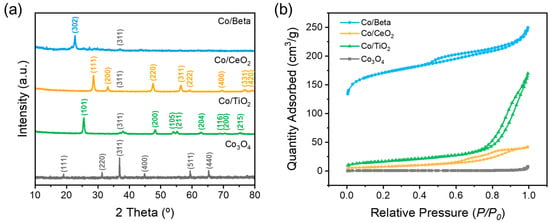
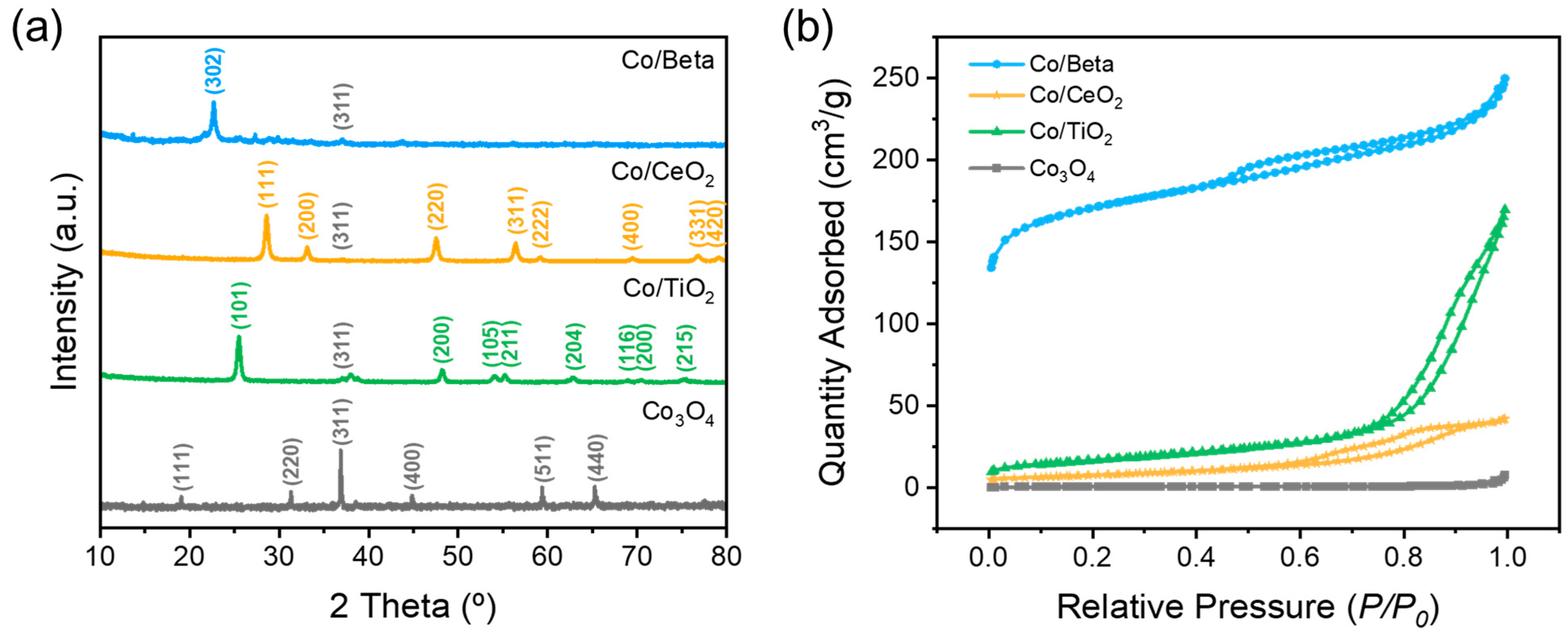
The X-ray diffraction patterns of different catalysts are presented in Figure 1a. The pattern of Co3O4 featured peaks at 36.8° (311), 44.8° (400), and 65.2° (440), which matched the characteristic spinel structure of Co3O4 [24,25]. The pattern of Co/Beta featured a sharp peak at 20.6° (302) corresponding to the beta zeolite framework [26,27]. The pattern of Co/CeO2 showed strong peaks at 28.5° (111), 33.0° (200), and 47.4° (220) corresponding to fluorite-type CeO2 [28,29]. The pattern of Co/TiO2 featured peaks at 25.3° (101), 48.0° (200), and 55.1° (211) corresponding to anatase TiO2 [30,31]. The patterns of all supported catalysts featured a weak (311) peak of spinel Co3O4, indicating that the Co species were partially crystallized and highly dispersed on the support because of strong metal–support interactions during impregnation and calcination [32,33]. The N2 adsorption–desorption isotherms of all catalysts (Figure 1b) were of type IV and featured H3 hysteresis loops in the relative pressure (P/P0) range of 0.4–0.9, indicating mesoporous structures hosting capillary condensation. Co/Beta showed the highest N2 uptake and surface area, which suggested the formation of a well-developed mesoporous network [34,35]. Co/TiO2 and Co/CeO2 also exhibited mesoporous characteristics [36,37,38], although to a lesser extent. In contrast, Co3O4 displayed the lowest N2 adsorption capacity, which indicated a poorly developed porous structure with limited textural properties [39].
Figure 1.
(a) X-ray diffraction patterns and (b) N2 adsorption–desorption isotherms of the beta zeolite–supported Co catalyst (Co/Beta), Co/CeO2, Co/TiO2, and Co3O4.
These results demonstrate that the support material notably influenced the textural properties of the Co-based catalysts. BET analysis (Table 1) confirmed these observations. Among the catalysts, Co/Beta exhibited the most developed micro–mesoporous structure, whereas Co3O4 showed severely limited porosity. Co/TiO2 and Co/CeO2 displayed intermediate textural characteristics. Although Co/CeO2 and Co/TiO2 had larger average pore sizes than Co/Beta, their overall surface areas were substantially lower, indicating that the exceptionally high surface area of Co/Beta primarily originated from a dense network of fine pores. Notably, Beta zeolite possesses a twelve-membered straight-channel framework with relatively large pore openings, which ensures uniform metal dispersion and facilitates reactant diffusion. These structural features contribute to the stabilization of the supported Co species and promote their uniform dispersion and efficient reactant diffusion within the porous channels under reaction conditions [27].
Table 1.
Textural properties of Co/Beta, Co/CeO2, Co/TiO2, and Co3O4 derived from their N2 adsorption–desorption isotherms.
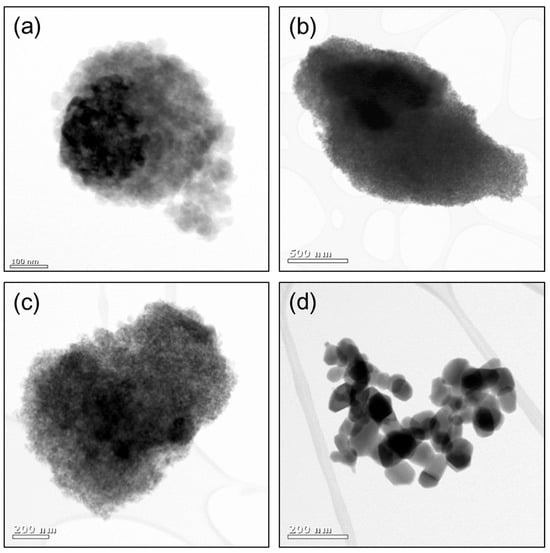
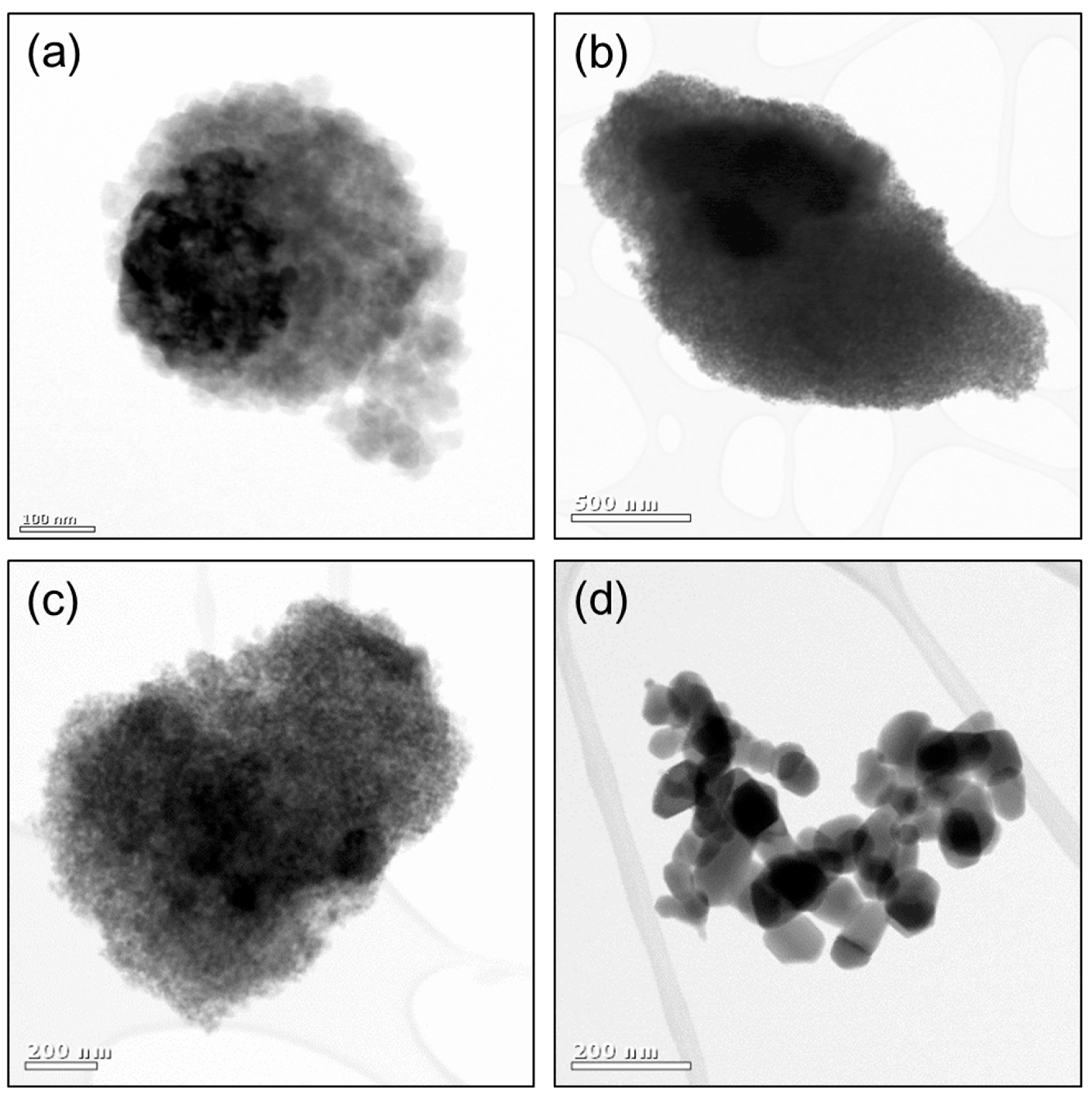
The spatial distribution and structural form of cobalt species were examined using TEM (Figure 2). The overall particle morphology and intrinsic microstructures of the supports were first identified from the SEM images provided in the Supporting Information (Figure S1), and high-resolution structural observations were subsequently performed using TEM.
Figure 2.
Transmission electron microscopy images of (a) Co/Beta, (b) Co/CeO2, (c) Co/TiO2, and (d) Co3O4.
In the Co/Beta sample (Figure 2a), the porous framework of Beta zeolite was clearly resolved, while no discrete Co3O4 crystallites were detected. This suggests that cobalt species exist as ultrafine (< nm-scale) CoOx domains or partially amorphous/ionic entities located on the external surface or within the pore network [40,41]. Similar features were observed for the Co/CeO2 and Co/TiO2 samples (Figure 2b,c), where no well-defined crystalline Co3O4 nanoparticles were present and only mild contrast variations appeared across the support particles. These observations are consistent with the absence or broadening of Co3O4 reflections in the XRD patterns.
In contrast, the bulk Co3O4 sample (Figure 2d) exhibited numerous crystallites with well-defined boundaries, with particle sizes ranging widely from approximately 32 to 131 nm. The corresponding size distribution extracted from multiple TEM images is provided in the Supporting Information (Figure S2), showing an average crystallite size of 73.1 nm. These results clearly demonstrate that, unlike the supported catalysts containing ultrafine and amorphous CoOx species, the bulk Co3O4 sample forms relatively large and well-crystallized Co3O4 particles.
HAADF–STEM–EDS mapping (Figure S3) further supports these findings: cobalt signals were broadly distributed over the support particles in the supported catalysts without any micron-scale aggregation, whereas intense Co signals were localized on individual crystallites in the bulk Co3O4 sample. These structural observations provide essential groundwork for interpreting the subsequent XPS-based electronic-structure analysis and comparing the catalytic performance among the samples.
2.2. Catalytic Decomposition of N2O
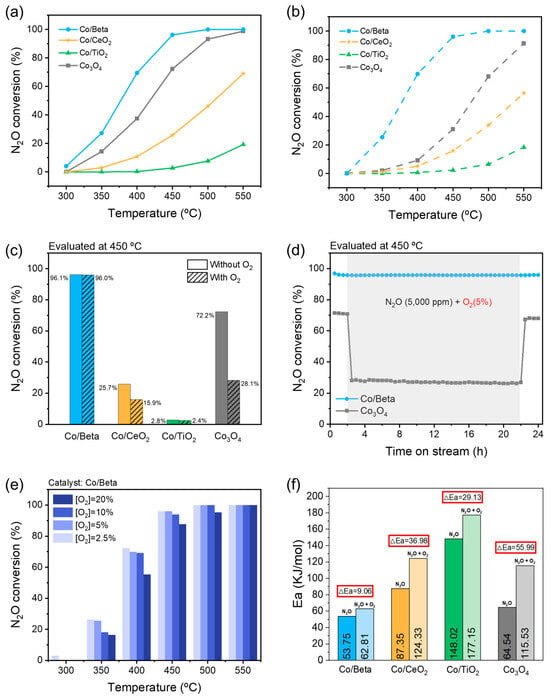
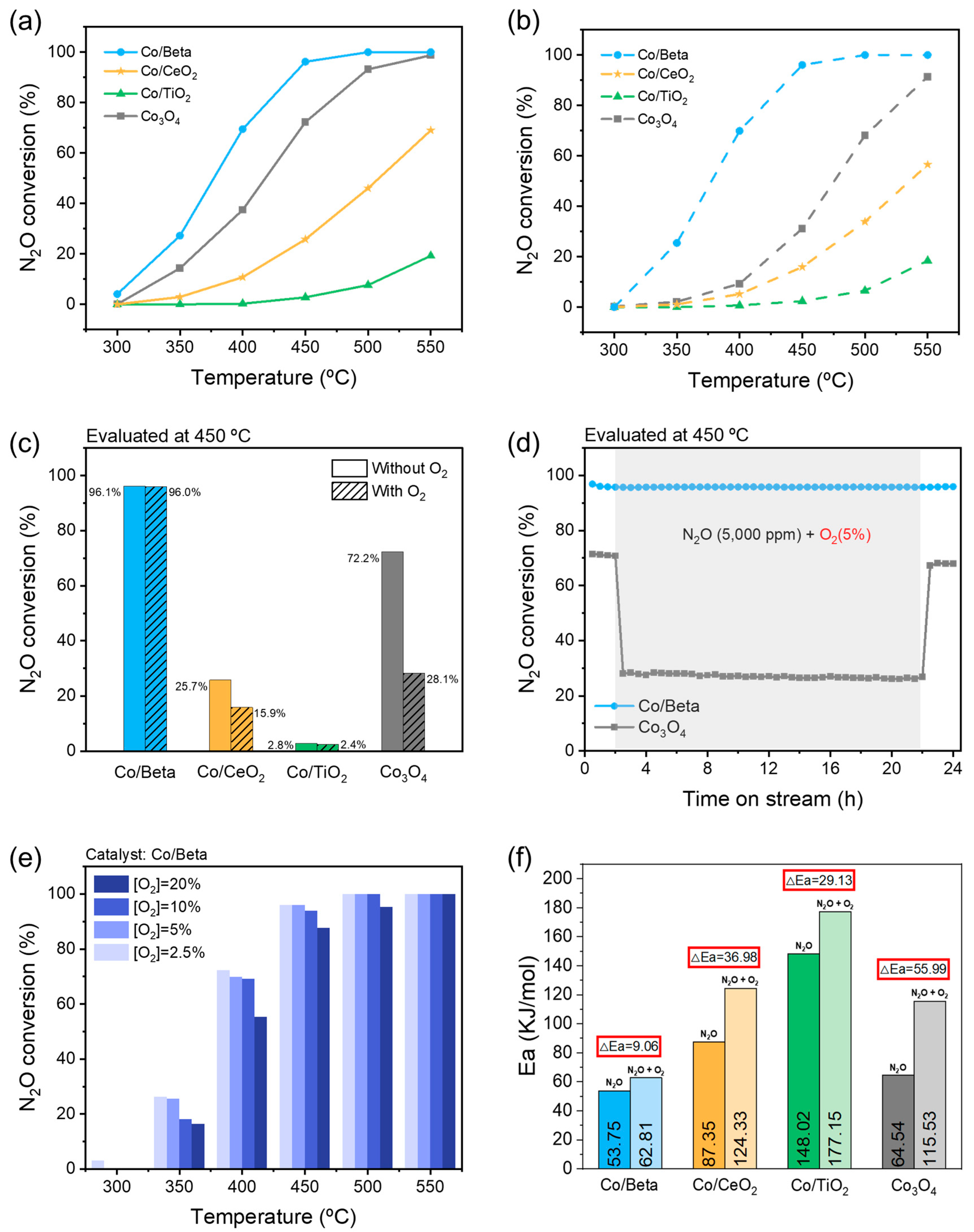
N2O decomposition performance was evaluated under two conditions, namely 5000 ppm N2O without O2 and with 5% O2, with the respective N2O conversion–temperature profiles presented in Figure 3a,b. In the absence of O2 (Figure 3a), catalytic activity followed the order of Co/Beta (96% N2O conversion at 450 °C) > Co3O4 > Co/CeO2 > Co/TiO2. The same trend was observed in the presence of O2 (Figure 3b). Generally, in N2O decomposition reactions, N2O must be reduced on the catalyst surface to produce N2 and O2 [42]. However, in O2-containing atmospheres, O2 can accumulate on surface sites and interfere with the adsorption or activation steps required for N2O conversion, thereby suppressing the overall reaction rate [20]. In the presence of O2, the activities of Co/CeO2 and Co3O4 markedly decreased, whereas Co/TiO2 showed little change and Co/Beta maintained stable activity. For Co/Beta, the N2O conversion achieved at 450 °C in the presence of O2 (96%) was only marginally lower than that achieved under O2-free conditions (96.1%), indicating a negligible activity loss (Figure 3c). In contrast, Co3O4 exhibited a decrease in N2O conversion from 72.2% to 28.1% under the same conditions, corresponding to an approximately 44 percentage-point drop and indicating high sensitivity to O2, while Co/CeO2 also showed a clear loss of activity. By comparison, Co/TiO2 showed only a minor change, which is likely due to its already low intrinsic activity under O2-free conditions; therefore, the additional inhibitory effect of O2 was not prominently reflected in the conversion profile [43]. During long-term stability testing (Figure 3d), Co3O4 showed a notable activity decrease when O2 was introduced, although an almost complete recovery to the initial level was observed after O2 removal. This behavior indicates that deactivation was mainly caused by the reversible accumulation of O2 on surface sites, which temporarily limited access to reactive sites, rather than irreversible structural changes. Co/Beta maintained a consistently high N2O conversion for >24 h regardless of O2 presence, thus demonstrating a superior O2 tolerance and long-term durability.
Figure 3.
N2O conversion–temperature profiles of Co-based catalysts obtained in the (a) absence and (b) presence of O2. (c) N2O conversion achieved by catalysts at 450 °C in the presence and absence of O2. (d) Results of long-term stability testing under alternating O2 on/off conditions. The grey shaded region indicates the period in which O2 was present. (e) N2O conversion as a function of O2 concentration for Co/Beta. (f) Apparent activation energies (Ea) for N2O decomposition over all catalysts under N2O-only and N2O + O2 (5%) Reaction conditions: 5000 ppm N2O, 5% O2 (when used) balanced by N2, total flow rate of 500 cc min−1, GHSV of 60,000 h−1.
To elucidate the material-dependent O2 tolerance more clearly, additional N2O decomposition experiments were conducted by varying the O2 concentration from 2.5 to 20% (Figure 3e). Co/Beta maintained nearly identical N2O conversion across the entire O2 range, and the activity loss at 450 °C remained negligible even under 20% O2. Such behavior suggests that O2 does not significantly hinder access to the active Co species on Co/Beta and that the accumulation of strongly bound, inactive oxygen species is effectively suppressed. Consequently, Co/Beta exhibits stable N2O decomposition performance regardless of external O2 partial pressure.
In contrast, Co3O4 displayed a pronounced decrease in N2O conversion as the O2 concentration increased over the whole temperature range (Figure S4). This O2-induced inhibition can be interpreted in the context of the mechanistic behaviors reported for metal oxides. N2O decomposition may proceed through both Langmuir–Hinshelwood (L–H) and Eley–Rideal (E–R) routes, and oxygen inhibition has been observed for both pathways. Excess O2 can accumulate on the surface and limit the accessibility or turnover of reactive oxygen species—often described as competitive adsorption behavior—which hinders the regeneration or utilization of O*. In addition, high O2 concentrations may oversaturate the surface or shift the oxidation state of Co centers (Co2+ → Co3+), thereby suppressing the N2O activation step associated with the E–R pathway as well [44].
Therefore, the contrasting O2 responses of Co/Beta and Co3O4 indicate that the Co species in Co/Beta are inherently less susceptible to O2-induced site blocking and surface oxygen oversaturation due to their framework-stabilized structural and surface characteristics. To further clarify these mechanistic differences, additional characterization analyses were performed.
Figure 3f compares the apparent activation energies (Ea) obtained from the Arrhenius plots for N2O decomposition, with the full temperature-dependent Arrhenius plots provided in the Supporting Information (Figure S5). Under N2O-only conditions (5000 ppm N2O, 5% O2 when used, N2 balance, GHSV = 500,000 h−1), Co/Beta exhibited the lowest Ea value, suggesting relatively facile activation of the N–O bond. In contrast, Co/CeO2, Co/TiO2, and Co3O4 displayed higher Ea values, indicating limited formation of reactive O* species in the low-temperature region [18,45].
When 5% O2 was introduced, the apparent activation energies for N2O decomposition over Co/CeO2, Co/TiO2, and Co3O4 increased noticeably, indicating that the reaction required a higher energy barrier in the presence of oxygen. This behavior can be attributed to O2-induced inhibition, including competitive adsorption and the accumulation of less-reactive oxygen species on the catalyst surface, which hinder active-site regeneration. In contrast, Co/Beta showed only a small change in apparent activation energy upon O2 addition. This result indicates that the apparent activation energy for N2O decomposition over Co/Beta changed only slightly in the presence of O2, suggesting that the reaction energy barrier was minimally influenced by oxygen. The Arrhenius plots in the Supporting Information (Figure S5) further support this interpretation, as Co/Beta exhibits very similar slopes under N2O-only and N2O + O2 conditions, indicating only a minor kinetic penalty in the presence of oxygen.
2.3. Surface Chemical States, Redox and Adsorption Properties
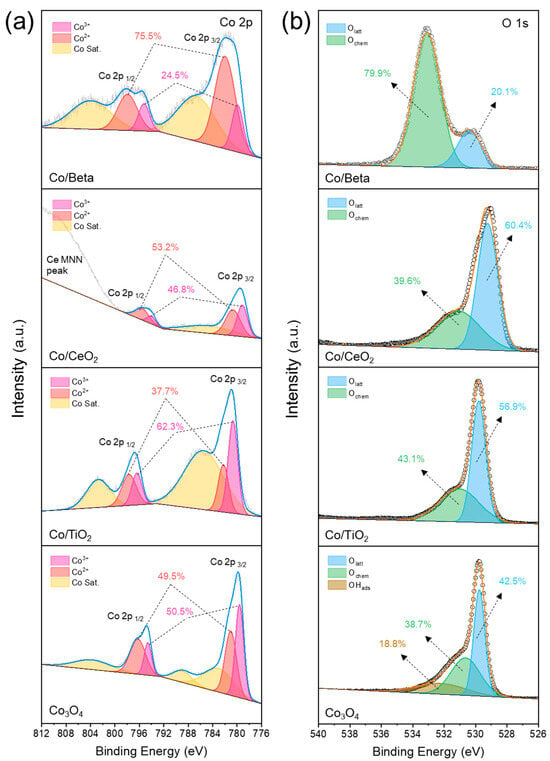
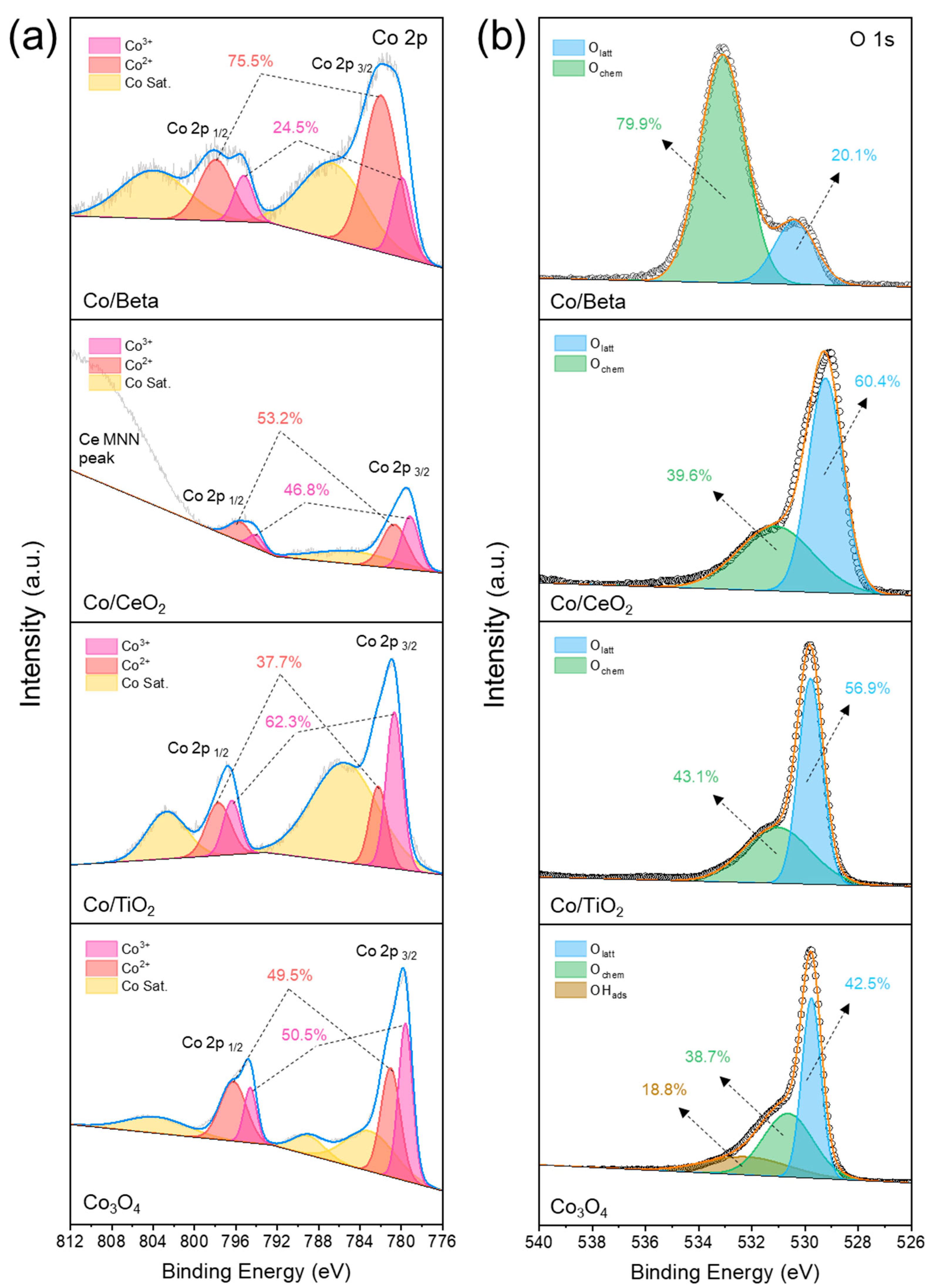
The X-ray photoelectron spectra of all catalysts featured Co 2p (Figure 4a) and O 1s (Figure 4b) signals. All Co 2p spectra featured Co2+ and Co3+ peaks. For Co/CeO2, the Co 2p region partially overlapped with the Ce MNN Auger peak; however, deconvolution enabled a clear distinction of the Co2+ and Co3+ contributions [46]. The binding energies of the Co 2p peaks were reported to vary within ±0.5 eV depending on the catalyst type, which was attributed to differences in the electronic environment and metal–support interaction—a phenomenon commonly observed for supported Co oxide catalysts. For Co/Beta, the Co2+ peaks were observed at 781.9 eV (2p3/2) and 797.9 eV (2p1/2), while the Co3+ peaks appeared at 779.9 eV (2p3/2) and 795.2 eV (2p1/2) [47,48,49]. The simultaneous presence of both Co2+ and Co3+ indicated the formation of a mixed-valence Co oxide phase with a spinel-type structure on the beta zeolite support.
Figure 4.
X-ray photoelectron spectroscopy spectra of (a) Co 2p and (b) O 1s spectra for Co/Beta, Co/CeO2, Co/TiO2, and Co3O4. The blue line in the Co 2p spectra and the orange line in the O 1s spectra represent the overall fitted envelopes.
Based on the deconvolution results, the Co2+/(Co2+ + Co3+) ratios followed the order of Co/Beta (75.5%) > Co/CeO2 (53.2%) > Co3O4 (49.5%) > Co/TiO2 (37.7%). As Co2+ is recognized as the primary active site responsible for cleaving the N–O bond in N2O, a higher Co2+/(Co2+ + Co3+) ratio is beneficial for enhancing catalytic activity [29]. Therefore, the superior catalytic performance of Co/Beta can be directly ascribed to its high Co2+/(Co2+ + Co3+) ratio, with the redox behavior of surface cobalt oxide species having a higher Co2+/(Co2+ + Co3+) ratio playing a critical role in the N2O decomposition mechanism. In particular, electron exchange between Co2+ and Co3+ facilitates the formation of oxygen vacancies. The surface cobalt oxide species having a higher Co2+/(Co2+ + Co3+) ratio is also indicative of the degree of surface defects and shows a positive correlation with the presence of oxygen vacancies. These vacancies further promote catalytic activity by enhancing oxygen mobility and active site availability [19,50].
The O 1s spectra provided further insights into the surface oxygen species. Co/Beta exhibited a remarkably high proportion of Ochem, accounting for 79.9% of the total surface oxygen. This high Ochem content suggests that the Co/Beta surface may contain abundant oxygen vacancies [51,52], which are generally associated with enhanced oxygen mobility and easier desorption. The presence of abundant Ochem is also likely to facilitate the reduction of Co3+ to Co2+, thereby contributing to the increased Co2+/(Co2+ + Co3+) ratio. In comparison, the Ochem contents of Co3O4, Co/TiO2, and Co/CeO2 were 47.6%, 43.1%, and 39.6%, respectively [53,54]. These lower Ochem values correlate with the reduced Co2+/(Co2+ + Co3+) ratios and the lower densities of reactive oxygen species observed for these catalysts, which are probably related to differences in their electronic structures and metal–support interactions.
Co-based catalysts are generally deactivated under O2-rich conditions because of the competitive adsorption of N2O and O2 on the same active sites [10,21,55]. However, Co/Beta maintained stable performance even in the presence of O2. This finding can be explained by the results of XPS analysis, which show that the beta zeolite not only stabilized the surface Co species with a higher Co2+/(Co2+ + Co3+) ratio but also promoted the formation of a surface structure with an exceptionally high content of Ochem. Such characteristics are likely to accelerate the turnover and low-temperature desorption of surface oxygen species during O2 adsorption–desorption, thereby alleviating site blocking and mitigating the inhibitory effect of O2. Moreover, the three-dimensional channel system of beta zeolite promotes the uniform dispersion of Co species and efficient mass transport, which help maintain active-site accessibility and suppress O2-induced site blockage under O2-rich conditions.
Co/Beta exhibited the highest Co2+/(Co2+ + Co3+) ratio (75.5%) and Ochem (79.9%) fractions among the tested catalysts (Table 2), which highlighted its excellent surface redox properties essential for achieving high catalytic activity and O2 tolerance. The structural and electronic advantages provided by the beta zeolite promoted the stabilization of surface cobalt oxide species with a higher Co2+/(Co2+ + Co3+) ratio, while the enhanced Co3+ ↔ Co2+ redox cycling facilitated the formation of oxygen vacancies, which in turn contributed to improved O2 mobility and greater exposure of active sites [56], thereby enabling efficient N2O decomposition even under O2-rich conditions. This interpretation is further supported by the H2-TPR, O2-TPD, and N2O-TPD results, which revealed facile Co3+ → Co2+ reduction, abundant low-temperature oxygen desorption, and enhanced N2O activation.
Table 2.
Relative surface ratios of Co2+/(Co2+ + Co3+) and Ochem/(Ochem + Olatt) determined by means of X-ray photoelectron spectroscopy.
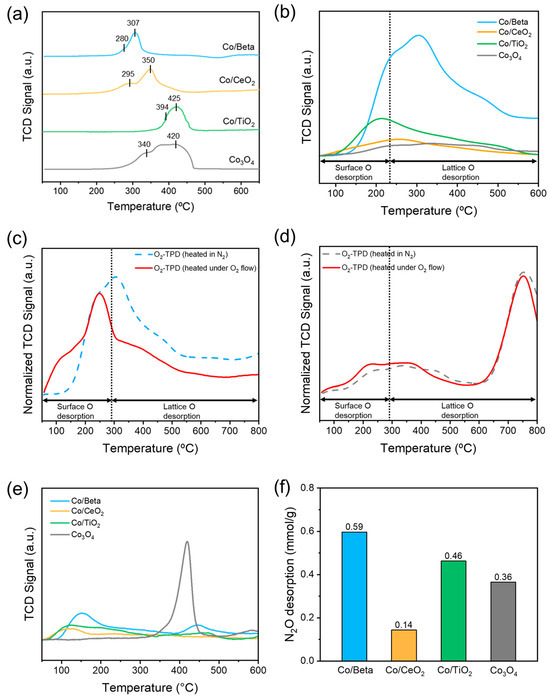
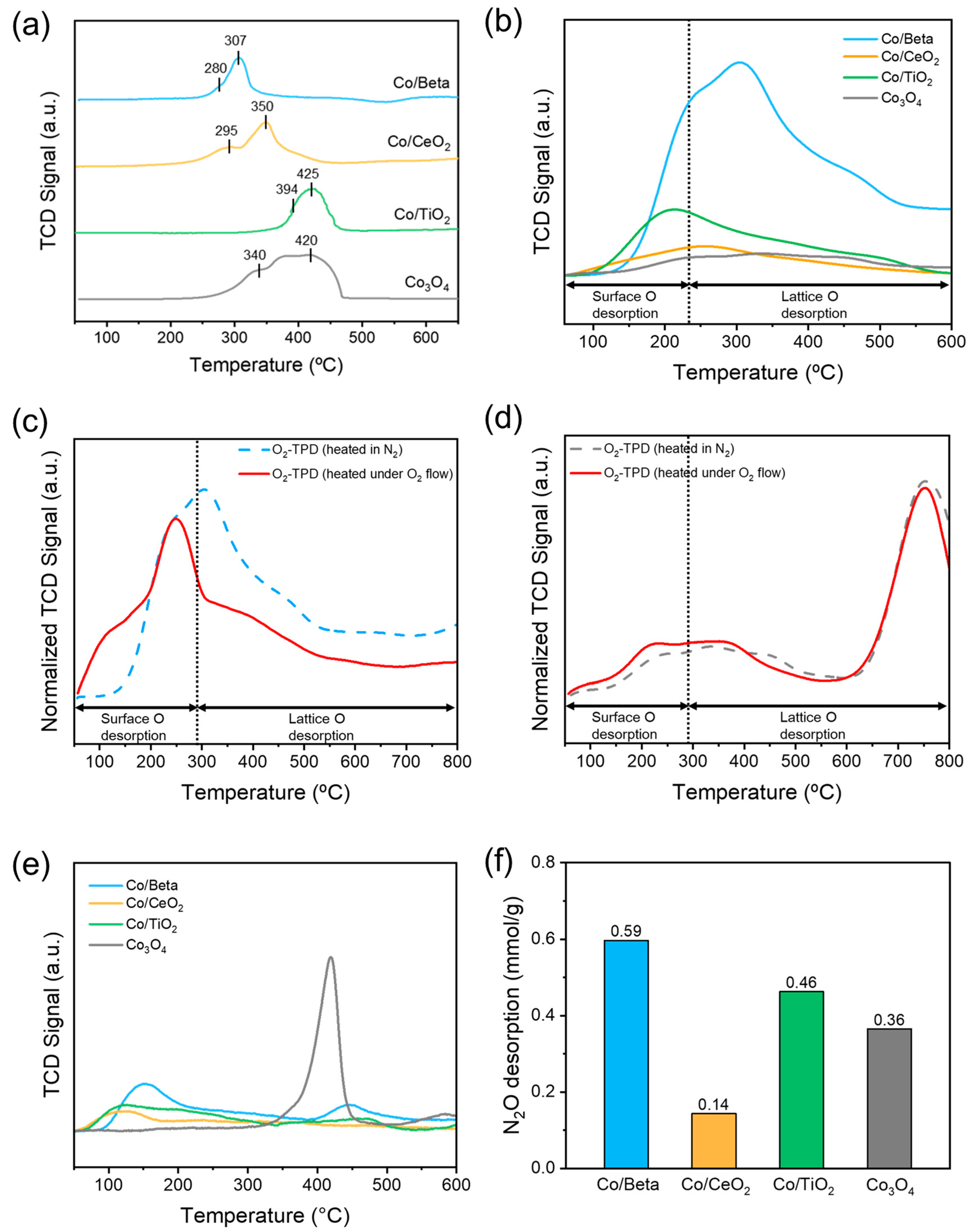
Catalyst reducibility was evaluated by H2-TPR (Figure 5a). Co/Beta exhibited two well-defined reduction peaks at 280 and 307 °C, attributable to the reduction of surface Co3+ species in Co3O4 to Co2+ and bulk reduction of Co3O4 to CoO [32]. These low-temperature reduction features indicated that Co species were highly dispersed within the beta zeolite framework and that excessive metal–support interactions were effectively mitigated, which facilitated reduction. Notably, the 12-membered straight-channel structure of beta zeolite provided sufficient spatial capacity for Co dispersion and enabled the uniform anchoring of metal ions, which enhanced the reducibility and accessibility of active sites. Co/CeO2 displayed two reduction peaks at 295 and 350 °C [57], attributable to the stepwise reduction of Co3O4 to CoO and Co0, respectively. This low-temperature reduction behavior was probably promoted by the O storage capacity of CeO2 and its ability to facilitate lattice O mobility [58]. For unsupported Co3O4, two peaks at 340 and 420 °C were observed [59,60], corresponding to the conventional stepwise reduction of Co3O4 to CoO and Co0, respectively. For Co/TiO2, two higher-temperature peaks at 394 and 425 °C were observed [61], suggesting delayed reducibility due to the strong anchoring of Co species on the TiO2 surface or their poor dispersion. These reduction features were strongly support-dependent, with Co/Beta showing the most favorable low-temperature reducibility. Overall, Co/Beta exhibited the lowest reduction temperatures, indicating that the Co3+ → Co2+ transition occurred most readily under the applied conditions [62]. This observation was consistent with the XPS results, which showed that Co/Beta possessed the highest Co2+/(Co2+ + Co3+) ratio (75.5%). The concordance between the XPS and H2-TPR results indicates that the beta zeolite facilitated the formation and stabilization of catalytically active Co2+ species, thereby contributing to the enhanced intrinsic activity for N2O decomposition.
Figure 5.
(a) H2 temperature-programmed reduction profiles of Co/Beta, Co/CeO2, Co/TiO2, and Co3O4. (b) O2 temperature-programmed desorption profiles of the catalysts. (c,d) O2-TPD profiles of Co/Beta (c) and Co3O4 (d) recorded after O2 pre-adsorption under different heating atmospheres (heated in N2 vs. under continuous O2 flow). The vertical dashed line separates the surface oxygen and lattice oxygen desorption regions. (e) N2O temperature-programmed desorption profiles and (f) comparison of N2O desorption amounts.
The O2 desorption characteristics of the catalysts were investigated via O2-TPD (Figure 5b). Under O2-rich conditions, molecular O2 can compete with N2O for accessible surface sites and can also increase the surface oxygen coverage, both of which may inhibit N2O decomposition [45,63]. Therefore, probing the adsorption–desorption behavior of oxygen is important for assessing the O2 tolerance of catalysts. In many N2O decomposition systems, the overall rate is strongly influenced by the removal of surface oxygen species(O*) formed during N–O bond scission, because slow O* recombination/desorption hampers active-site regeneration [64]. Accordingly, a catalyst that can efficiently turnover and desorb adsorbed oxygen is expected to show improved stability in O2-containing feeds.
Figure 5b illustrates these differences in O2 desorption behavior among the catalysts. O2-TPD profiles provide information on the amount, desorption temperature, and reactivity of surface and lattice O. In particular, the low-temperature region (60–240 °C) is mainly associated with desorption of highly reactive surface O species such as O2− (superoxide) or O− (chemisorbed atomic O), which are generally regarded as active O species that can directly participate in N2O decomposition. In contrast, temperatures of above 240 °C correspond to the gradual desorption of lattice O, which is relatively unreactive and contributes to the reaction only at elevated temperatures [29].
As shown in Figure 5b, the O2-TPD profiles reveal clear differences in oxygen desorption behavior among Co/Beta, Co/CeO2, Co/TiO2, and Co3O4. Following the common assignment, the low-temperature region (60–240 °C) is mainly associated with the release of weakly bound, labile surface oxygen species (e.g., defect- or vacancy-associated oxygen), whereas the higher-temperature region (>240 °C) reflects the gradual desorption of more strongly bound oxygen, often linked to lattice/subsurface oxygen and oxygen migration processes [65,66]. Notably, Co/Beta exhibits the largest low-temperature desorption feature, indicating a higher abundance of readily removable surface oxygen species and a greater oxygen turnover capability compared with the oxide-supported catalysts. In contrast, Co3O4 shows the weakest desorption signal over the entire temperature range, suggesting limited oxygen lability and a less efficient regeneration of oxygen-covered sites. Co/TiO2 and Co/CeO2 display intermediate behavior, with Co/TiO2 exhibiting a more pronounced low-temperature feature than Co/CeO2. Overall, these trends suggest that the greater oxygen lability/turnover of Co/Beta under O2-rich feeds may mitigate O2-induced inhibition by promoting active-site regeneration and preserving access to reactive sites.
To further probe oxygen desorption under O2-rich environments, O2-TPD profiles were collected after O2 pre-adsorption while heating either in inert N2 or under a continuous O2 flow (Figure 5c,d). Unlike conventional TPD in N2, heating under O2 flow enables concurrent desorption and re-adsorption/oxygen exchange, thereby providing a qualitative descriptor of dynamic oxygen turnover relevant to N2O decomposition in the presence of O2. For Co/Beta, the profile recorded under O2 flow shows a pronounced shift of the low-temperature desorption feature to lower temperatures compared with the N2-heated trace (Figure 5c), demonstrating that surface oxygen species are more readily removed and turned over under O2-containing feeds. This facilitated oxygen turnover is expected to accelerate active-site regeneration and mitigate O2-induced inhibition by preventing excessive oxygen coverage and maintaining access to reactive sites [45,67]. In contrast, Co3O4 exhibits only minor changes in the low-temperature region and retains a prominent high-temperature desorption feature under O2 flow (Figure 5d), indicating more strongly stabilized oxygen species and less efficient regeneration of oxygen-covered sites in O2-rich environments. Overall, these atmosphere-dependent O2-TPD behaviors support a higher oxygen turnover capability for Co/Beta under O2, consistent with its improved robustness during O2-containing N2O decomposition.
The results of N2O-TPD measurements are presented in Figure 5e,f. Co3O4 exhibited a sharp and intense single high-temperature peak centered at ~420 °C, which indicates a lack of low-temperature active oxygen species and suggests that N2O activation primarily occurred through lattice O at elevated temperatures (Figure 5e). Compared with the other catalysts, Co/Beta displayed a markedly stronger low-temperature peak at ~200 °C, which implied the presence of abundant reactive O species such as O2− or O− that facilitated N2O dissociation and O2 release at lower temperatures [55,68]. Co/CeO2 and Co/TiO2 exhibited broad and weak desorption features across the entire temperature range, which suggested a heterogeneous distribution of active sites with low intrinsic activity.
Figure 5f compares different catalysts in terms of their N2O desorption amounts. Co/Beta exhibited the highest desorption amount, which confirmed its superior ability to supply active O species at low temperatures and agreed with the results of O2-TPD measurements (Figure 5b). The O2-TPD curve of Co/Beta showed a strong low-temperature desorption peak below 200 °C, indicating the facile release of surface-active O species and high O mobility. Therefore, the abundance of low-temperature O species and their facile desorption, as evidenced by O2-TPD and N2O-TPD results, represent key factors governing the O2 tolerance and sustained N2O decomposition activity of catalysts.
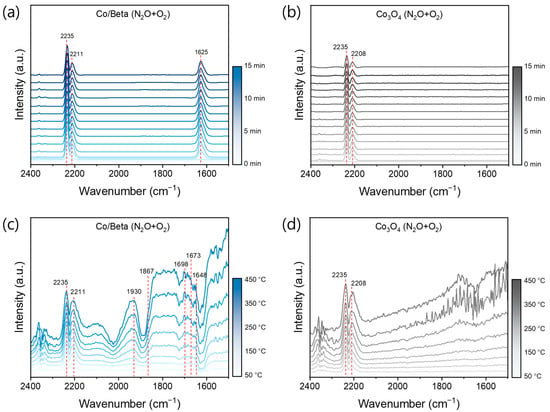
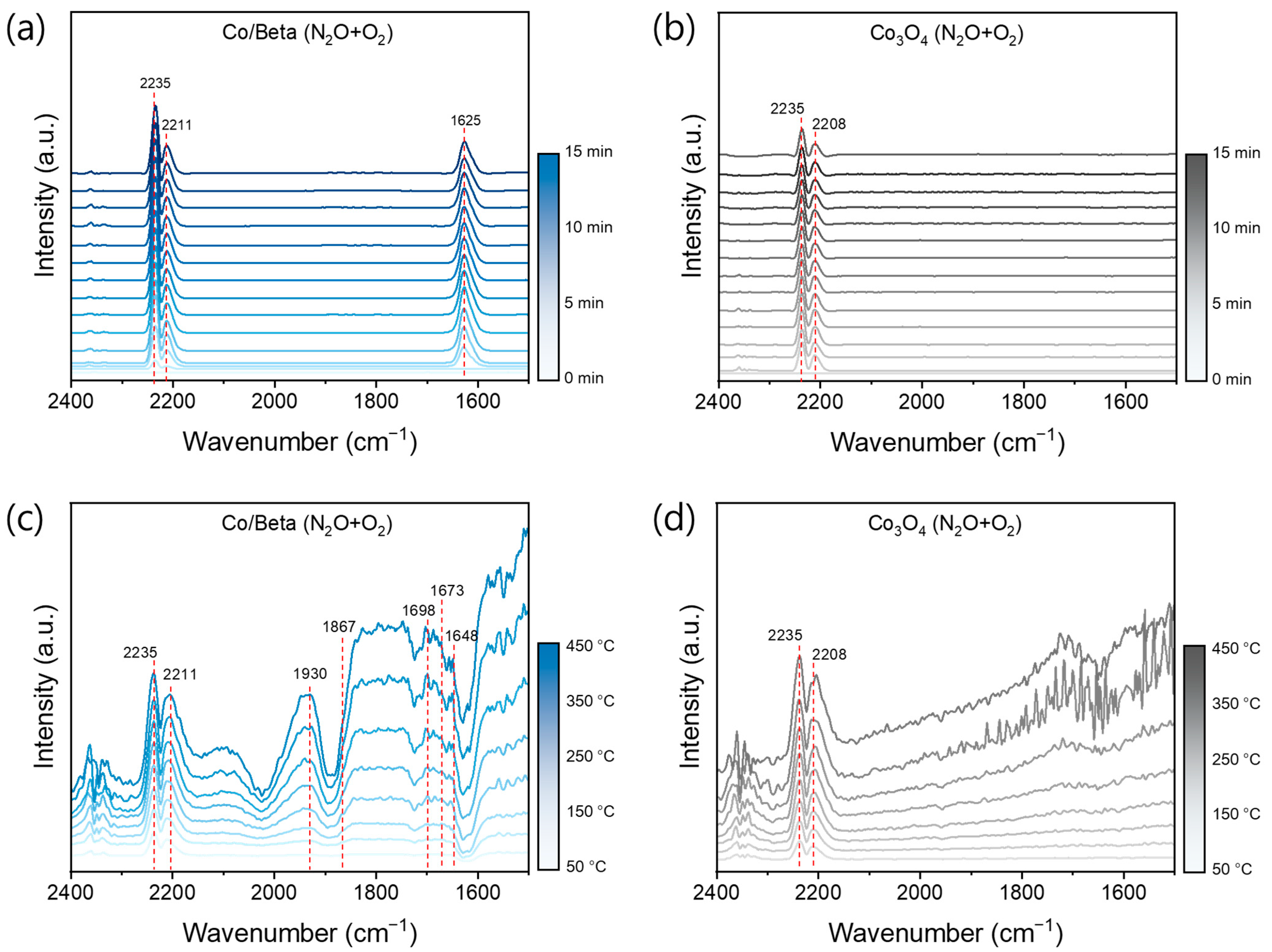
Figure 6 shows the in situ DRIFTS spectra of Co/Beta and Co3O4 recorded under a continuous flow of 1000 ppm N2O + 5% O2 in N2 (500 sccm), used to elucidate the nature of surface species formed under reaction-relevant conditions. To directly monitor the temperature-dependent evolution of adsorbates during N2O decomposition in the presence of oxygen, spectra were first collected during an adsorption stage at 50 °C for 15 min (Figure 6a,b), followed by temperature-programmed measurements under the same continuous-flow condition while increasing the temperature from 100 to 450 °C (Figure 6c,d).
Figure 6.
In situ diffuse reflectance infrared Fourier transform spectra of Co/Beta and Co3O4 under 1000 ppm N2O + 5% O2 in N2 (500 sccm): adsorption at 50 °C (a,b) and temperature-programmed measurement under continuous flow (c,d), temperature-dependent evolution of surface species.
The characteristic spectral signatures of adsorbed N2O were observed as paired bands in the 2240–2200 cm−1 region, assigned to N–N stretching. These paired features are widely recognized as fingerprint signals of weakly bound N2O on oxide- and Co-based catalysts [69]. In addition, NOx-related surface species were monitored mainly in the 1950–1500 cm−1 region. A band near ~1930 cm−1 is consistent with nitrosyl-/NO-derived adsorbates on cobalt sites [70], whereas a feature around 1867 cm−1 is commonly assigned to adsorbed NO on metal cation sites [71]. Bands in the 1700–1650 cm−1 region are commonly assigned to nitrate/nitrite-type surface species, and features near ~1624–1625 cm−1 can likewise be attributed to nitrate/nitrite-related adsorbates [72,73]. However, nitrate/nitrite-related bands can be weak or even absent during temperature-programmed measurements because these species are thermally labile and decompose rapidly at elevated temperatures [71]. Therefore, the absence of distinct bands in these regions should be interpreted as limited steady-state accumulation rather than conclusive evidence for the complete suppression of transient NOx formation [73].
In the adsorption step at 50 °C (Figure 6a,b) under a continuous flow of N2O + O2, both Co/Beta and Co3O4 exhibit the characteristic paired bands in the 2240–2200 cm−1 region (2235/2211 cm−1 for Co/Beta and 2235/2208 cm−1 for Co3O4), indicating that N2O is readily adsorbed on both catalysts at low temperature. A clear difference, however, is that nitrate/nitrite-related features below 1700 cm−1 are discernible for Co/Beta, whereas no comparable features are clearly resolved on Co3O4 within the same adsorption period.
This selective appearance on Co/Beta can be attributed to the distinct surface environment created by the Beta zeolite support. The Brønsted/Lewis acidity and microporous confinement of Beta can promote the transient formation and detection of nitrate/nitrite-type species at low temperature [74,75]. Importantly, such species are often thermally labile and therefore are not necessarily expected to persist as strongly accumulated, site-blocking adsorbates under the subsequent high-temperature reaction regime. In addition, Co/Beta likely provides a higher density of well-dispersed cobalt sites than bulk Co3O4, consistent with the XPS results (Figure 4 and Table 2). This interpretation is further supported by the XRD pattern (Figure 2a), where the Co3O4 reflections for Co/Beta are very weak, suggesting that cobalt oxide domains are highly dispersed and/or present as small crystallites. Specifically, Co/Beta shows a markedly higher surface Co2+ fraction (Co2+/(Co2+ + Co3+) = 75.5%) than Co3O4 (49.5%), together with a notably elevated Ochem ratio (Ochem/(Ochem + Olatt) = 79.9% for Co/Beta, compared with 47.6% for Co3O4). The coexistence of Co2+-enriched sites and abundant labile surface oxygen species suggests more facile surface redox chemistry and oxygen exchange on Co/Beta under N2O + O2, which can mitigate O2-induced inhibition during N2O decomposition. By contrast, on Co3O4, nitrate/nitrite-type species may either form only to a limited extent or be rapidly transformed/decomposed without leaving detectable signatures over the same timescale.
During the subsequent temperature-programmed measurements under continuous N2O + O2 flow (Figure 6c,d), the evolution of surface species differs markedly between Co/Beta and Co3O4. For Co/Beta (Figure 6c), the N2O twin bands at 2235 and 2211 cm−1 progressively decrease with increasing temperature, while new bands develop in the 1950–1500 cm−1 region. In particular, features near ~1930 and ~1867 cm−1 emerge, which are consistent with nitrosyl-/NO-derived adsorbates on cobalt sites and adsorbed NO on metal cation sites, respectively. Additional bands also appear in the 1700–1600 cm−1 region (e.g., ~1698, 1673, and 1648 cm−1), suggesting the formation and evolution of nitrate/nitrite-type surface species under the reaction stream. Importantly, these NOx-related features are better interpreted as dynamically evolving intermediates rather than as stably accumulated, site-blocking poisons, as evidenced by their pronounced temperature-dependent formation and transformation. This behavior suggests that adsorbed N2O is transformed into reactive surface intermediates during heating and that surface turnover remains active on Co/Beta under O2-containing conditions. Consistent with the XPS/O2TPD indications of abundant labile oxygen and facile oxygen exchange, such dynamic intermediate evolution suggests a more efficient turnover of oxygen-covered sites, thereby maintaining access to reactive sites even at elevated temperatures [45].
In contrast, Co3O4 (Figure 6d) exhibits a comparatively limited development of NOx-related bands over the same temperature range. The N2O twin bands at 2235 and 2208 cm−1 persist to higher temperatures with only moderate attenuation, and a broad feature around ~1718 cm−1 becomes discernible at elevated temperatures, whereas distinct nitrosyl/NO bands in the 1900–1800 cm−1 region are not clearly resolved. This behavior suggests that, under O2-rich flow, the Co3O4 surface may experience stronger competitive oxygen occupation of accessible sites, which can restrict N2O activation and limit the detectable accumulation of NOx-type intermediates [63]. Overall, the temperature-programmed DRIFTS profiles indicate that Co/Beta sustains a more dynamic surface redox chemistry—characterized by the formation and transformation of reactive intermediates—whereas Co3O4 shows comparatively muted intermediate evolution, consistent with stronger O2-induced inhibition.
2.4. Effects of Coexisting Gases on Catalytic Performance
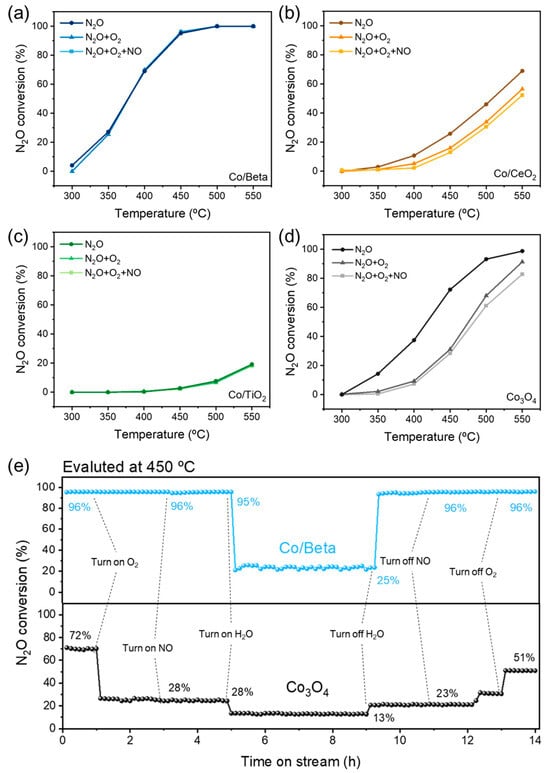
N2O decomposition rarely occurs in single-gas environments, as O2, NO, and H2O commonly coexist and can significantly affect catalytic behavior. O2 and NO compete with N2O for the same active sites on the catalyst surface, whereas H2O tends to form hydroxyl species blocking or deactivating these sites [76,77,78,79,80]. Consequently, catalytic activity and stability can be notably suppressed depending on the type and concentration of coexisting gases, and evaluating the influence of O2, NO, and H2O is essential for understanding catalyst behavior under realistic operating conditions.
Figure 7a–d compare the N2O decomposition performances of Co/Beta, Co/CeO2, Co/TiO2, and Co3O4 under various coexisting-gas conditions. Although the presence of O2 and NO inhibited all catalysts, the inhibition extent depended on the support. Co/Beta exhibited the highest activity, which is primarily attributed to its abundant low-temperature active oxygen species and favorable surface redox properties. The high surface area and mesoporous framework of beta zeolite contributed to improving the uniform dispersion of Co species and reactant accessibility, thereby supporting the overall catalytic performance, although they do not serve as direct determining factors. In addition, XPS and O2/N2O-TPD analyses revealed that Co/Beta possessed the highest Co2+/(Co2+ + Co3+) ratio (75.5%) and Ochem (79.9%) fractions, both of which promoted O vacancy formation and enhanced O mobility, thereby accounting for the outstanding O2 tolerance. Indeed, Co/Beta achieved nearly complete N2O conversion above 450 °C and maintained remarkable resistance to O2 and NO. In contrast, Co/CeO2 and Co3O4 suffered from severe activity loss due to competitive adsorption, with Co3O4 showing 72% conversion at 450 °C but >40% inhibition when coexisting gases were introduced. Co/TiO2 displayed intrinsically poor performance with negligible improvement or inhibition under O2 and NO. This behavior was attributed to low surface area, which restricted Co dispersion, and limited O mobility, which hindered the supply of reactive O species. Additionally, under conditions where O2, NO, and H2O coexisted, all catalysts exhibited pronounced activity suppression, with H2O exacerbating the inhibitory effect (Figure S6). These results demonstrate that water acts as a critical poisoning species under realistic flue gas compositions.
Figure 7.
N2O decomposition performances of (a) Co/Beta, (b) Co/CeO2, (c) Co/TiO2, and (d) Co3O4 under various conditions, namely 500 ppm N2O, 5% O2 (when used), 500 ppm NO (when used), N2 balance, GHSV = 60,000 h−1. (e) Time-on-stream-dependent N2O conversion over Co/Beta and Co3O4 at 450 °C with the sequential introduction and removal of O2, NO, and H2O (5% O2, 500 ppm NO, and 5% H2O when used).
Figure 7e shows the time-dependent behavior of Co/Beta and Co3O4 during the sequential introduction and removal of coexisting gases (500 ppm N2O, 5% O2, 500 ppm NO, and 5% H2O, N2 balance, GHSV = 60,000 h−1). For Co/Beta, the N2O conversion was 96% at 450 °C under N2O alone and decreased by <1% when O2 and NO were introduced sequentially, indicating remarkable stability. By contrast, Co3O4 exhibited an initial conversion of 72% for N2O alone, which dropped sharply to 28% upon the co-feeding of O2 and NO. The introduction of H2O caused a dramatic decline, reducing N2O conversion over Co/Beta and Co3O4 to 25% and 13%, respectively. Upon the sequential removal of coexisting gases, Co/Beta rapidly recovered to >96% conversion immediately after H2O was cut off and fully restored its initial activity once NO and O2 were subsequently removed. In contrast, Co3O4 showed only minimal recovery from 13% to 23% after H2O removal, and its conversion stabilized at 51% after all coexisting gases had been eliminated, which corresponded to an irreversible initial activity loss of 21%. These results suggest that the superior performance of Co/Beta was due to its high Co2+/(Co2+ + Co3+) ratio and abundant Ochem, which helped stabilize the surface active sites and sustain activity in the presence of impurities, whereas Co3O4 suffered from irreversible poisoning due to the formation of hydroxyl species under H2O-rich conditions.
Co3O4 suffered from substantial irreversible deactivation in the presence of H2O, which resulted in poor long-term stability. In contrast, Co/Beta showed negligible inhibition under O2 and NO, exhibited the complete recovery of its initial activity after coexisting-gas removal, and maintained high N2O conversion (96%) even at 550 °C in the presence of O2, NO, and H2O. Therefore, although both catalysts were vulnerable to water vapor, Co/Beta demonstrated excellent reversibility and high-temperature stability, thus holding promise for practical applications in N2O abatement under coexisting-gas conditions.
3. Materials and Methods
3.1. Materials
Cobalt(II) nitrate hexahydrate (Co(NO3)2·6H2O, CAS 10026-22-9, product no. 230375, reagent grade, 98%) and Ammonium-form beta zeolite (Al2O5Si, CAS 1318-02-1, product no. 045874) were purchased from Thermo Fisher Scientific (Waltham, MA, USA). Cerium oxide (CeO2, CAS 1306-38-3, product no. 202975, powder, 99.995% trace metals basis) were purchased from Sigma-Aldrich (St. Louis, MO, USA). Titanium(IV) oxide (anatase, TiO2, CAS 1317-70-0, catalog no. 8613-1405, assay 98%, CP grade) was purchased from Daejung Chemicals & Metals Co., Ltd. (Siheung, Republic of Korea).
3.2. Catalytic Synthesis
The catalysts were synthesized using a wet impregnation method. Co was introduced in the form of cobalt (II) nitrate hexa-hydrate. Ammonium-form beta zeolite, cerium (IV) oxide, and titanium dioxide were used as supports. An appropriate amount of cobalt (II) nitrate hexa-hydrate was dissolved in deionized water to prepare a 5 wt% Co solution. The solution was supplemented with the desired support, stirred at 80 °C for 6 h using a magnetic hot plate, and then heated at 60 °C overnight in an oil bath to evaporate the solvent. The obtained powder was calcined in air at 550 °C for 6 h at a heating rate of 5 °C min−1 to afford a catalyst with a Co loading of 5 wt%. Additionally, cobalt (II) nitrate hexa-hydrate was calcined under the abovementioned conditions to obtain Co3O4. Hereafter, these catalysts were denoted as Co/Beta, Co/CeO2, Co/TiO2, and Co3O4, respectively.
3.3. Catalytic Characterization
Structural characteristics were probed by X-ray diffraction (D8 Advance, Bruker, Billerica, MA, USA) using Cu Kα radiation over a 2θ range of 10–80°. Specific surface areas and pore volumes were determined by BET and Barrett–Joyner–Halenda methods, respectively, using an ASAP 2020 instrument (Micromeritics Instrument Corporation, Norcross, GA, USA). Prior to measurements, the samples were pretreated at 150 °C for 4 h under vacuum with N2 gas exposure to remove impurities and moisture. Catalyst morphology was examined using field-emission scanning electron microscopy (JSM-7600, JEOL Ltd., Akishima, Japan), and Co distributions were determined using energy-dispersive X-ray spectroscopy (EDS). High-resolution transmission electron microscopy (HR-TEM) and scanning transmission electron microscopy (STEM) were performed using an aberration-corrected HR-(S)TEM instrument (JEM-2200FS, JEOL, 200 kV) to examine the nanoscale structure and morphology of the catalysts. The chemical states of surface elements were probed by X-ray photoelectron spectroscopy (XPS; K-Alpha, Thermo Fisher Scientific, USA) using Al Kα radiation (λ = 1.4866 Å), with binding energies calibrated using the C 1s peak at 284.6 eV. Temperature-programmed reduction with H2 (H2-TPR), temperature-programmed desorption of O2 (O2-TPD), and N2O-TPD measurements were conducted using a chemisorption analyzer (AutoChem II 2920, Micromeritics, USA) by increasing the temperature from 100 °C to 700 °C at a rate of 10 °C min−1. For O2-TPD, the heating step was carried out either under N2 or under continuous O2 flow to evaluate atmosphere-dependent oxygen desorption behavior. In situ diffuse reflectance infrared Fourier transform (DRIFT) spectra were recorded using a Fourier transform infrared spectrometer (Vertex 80v, Bruker, USA) equipped with a Harrick DRIFT cell and liquid N2–cooled mercury cadmium telluride detector. The analyses were carried out under a continuous flow of 1000 ppm N2O + 5% O2 in N2 (500 sccm). N2O adsorption was performed at 50 °C, followed by temperature-programmed measurements under the same feed from 100 to 450 °C in 50 °C steps to track the evolution of surface species.
3.4. Catalytic Performance Test
N2O conversion performance was evaluated in a fixed-bed quartz reactor with an inner diameter of 12.7 mm and a length of 400 mm. The feed-gas flow rate was controlled using mass flow controllers (Brooks Instruments, Hatfield, PA, USA). The reactant gas mixture consisted of 5000 ppm N2O, 5% O2 (when used), 500 ppm NO (when used), 5% H2O (when used), and balance N2, with a total flow rate of 500 mL min−1. The reactant gases were supplied using commercially available mixed-gas cylinders and introduced through the mass flow control system. Water vapor was introduced by metering liquid water with a liquid pump (NEXT 109M, NEXT COMPANY Ltd., Gwangmyeong, Republic of Korea), followed by vaporization into the reactant stream. Powdered catalysts were loaded in an amount corresponding to 0.5 mL, giving a gas hourly space velocity (GHSV) of 60,000 h−1.
Catalytic tests were conducted over the temperature range of 300–550 °C. The reactor temperature was continuously measured in real time using thermocouples connected to the fixed-bed reactor control program, and the temperature profile was monitored and recorded through the reactor monitoring system. To reflect the temperature near the catalyst bed as accurately as possible, the thermocouples were positioned at the upper part of the quartz reactor, as close as possible to the catalyst zone. Prior to entering the reactor, the feed-gas composition was adjusted in a bypass line and then switched to the reactor line for catalytic evaluation. The inlet and outlet concentrations of gases other than O2 were analyzed using Fourier transform infrared spectroscopy (CX-4000, Gasmet, Vantaa, Finland), while the O2 concentration was monitored using a gas analysis spectrometer (DSM-XT, Hausnet S.R.L, Buenos Aires, Argentina). N2O conversion was calculated as follows:
where [N2O]in and [N2O]out are the inlet and outlet N2O concentrations, respectively.
For the determination of apparent activation energy, kinetic measurements were carried out under high-GHSV and low-conversion conditions to minimize transport limitations. The experiments were performed under a feed containing 5000 ppm N2O, 5% O2 (when used), and N2 balance at a GHSV of 500,000 h−1. Since the catalytic activities differed among the samples, the catalyst amount and temperature range were adjusted for each catalyst to obtain reliable kinetic data within an appropriate conversion range. Specifically, the catalyst amounts used were 0.03 g for Co/Beta, 0.143 g for Co/CeO2, 0.044 g for Co/TiO2, and 0.134 g for Co3O4, while the temperature ranges were 300–450 °C for Co/Beta, 450–550 °C for Co/CeO2, 450–650 °C for Co/TiO2, and 350–500 °C for Co3O4, with 25 °C intervals. The reaction rate constant was derived from the measured N2O conversion, and the apparent activation energy was determined from the slope of the corresponding Arrhenius plot.
4. Conclusions
Co-based catalysts supported on Beta zeolite, CeO2, and TiO2, together with unsupported Co3O4, were comparatively evaluated for direct N2O decomposition under O2-containing conditions. Among the tested catalysts, Co/Beta exhibited the highest activity and the best O2 tolerance, achieving >95% N2O conversion at 450 °C in the presence of 5% O2 and maintaining stable performance during long-term operation. In contrast, Co/CeO2 and Co3O4 showed clear O2-induced inhibition, whereas Co/TiO2 exhibited intrinsically low activity with little additional change upon O2 introduction.
The superior performance of Co/Beta was associated with its favorable surface and structural characteristics. XPS analysis revealed that Co/Beta possessed the highest Co2+/(Co2+ + Co3+) ratio and the largest fraction of chemisorbed oxygen species, while H2-TPR, O2-TPD, N2O-TPD, and in situ DRIFTS analyses consistently indicated enhanced oxygen mobility, facile oxygen turnover, and stable surface reaction behavior under O2-containing conditions. These features contributed to suppressing O2-induced inhibition and sustaining N2O decomposition activity.
Additional coexisting-gas tests showed that Co/Beta retained high stability in the presence of O2 and NO, while H2O caused reversible inhibition. Overall, these findings demonstrate that support-dependent control of cobalt surface states and oxygen behavior is a key factor in achieving stable N2O decomposition under oxygen-containing conditions, and that Co/Beta is a promising catalyst for practical N2O abatement in semiconductor and display manufacturing processes.
Supplementary Materials
The following supporting information can be downloaded at: https://www.mdpi.com/article/10.3390/catal16050384/s1, Figure S1: Field-emission scanning electron microscopy images and Co distributions of (a) Co/Beta, (b) Co/CeO2, (c) Co/TiO2, and (d) Co3O4.; Figure S2: Particle-size distribution of bulk Co3O4 calculated from TEM measurement; Figure S3: HAADF–STEM–EDS elemental mapping images of (a) Co/Beta, (b) Co/CeO2, (c) Co/TiO2, and (d) Co3O4; Figure S4: N2O conversion as a function of O2 concentration for Co3O4 Reaction condition: 5000 ppm N2O, O2 (2.5–20%), N2 balance, GHSV = 60,000 h−1; Figure S5: Arrhenius plots for N2O decomposition over (a) Co/Beta, (b) Co/CeO2, (c) Co/TiO2, and (d) Co3O4 catalysts; Figure S6: N2O decomposition performances of (a) Co/Beta, (b) Co/CeO2, (c) Co/TiO2, and (d) Co3O4 under various conditions, namely 500 ppm N2O, 5% O2 (when used), 500 ppm NO (when used), 5% H2O (when used) N2 balance, GHSV = 60,000 h−1.
Author Contributions
Conceptualization, S.-H.S.; formal analysis, S.-H.S., D.K. and N.K.; investigation, S.-H.S. and N.K.; data curation, S.-H.S.; writing—original draft preparation, S.-H.S.; methodology, D.K. and B.J.; writing—review and editing, M.-J.L., H.L. and H.-D.K.; supervision, M.-J.L., B.Y., H.L. and H.-D.K.; project administration, B.J.; validation, B.Y.; funding acquisition, H.L. and H.-D.K. All authors have read and agreed to the published version of the manuscript.
Funding
This research was financially supported by the Korea Institute of Industrial Technology (KITECH-UR-24-0035), the National Research Foundation of Korea (RS-2023-00281705), and the Ministry of Trade, Industry and Energy (RS-2024-00432405). The authors gratefully acknowledge this support.
Data Availability Statement
The original contributions presented in this study are included in the article and Supplementary Materials. Any further inquiries regarding the data may be directed to the corresponding authors.
Conflicts of Interest
The authors declare that they have no known competing financial interests or personal relationships that could have appeared to influence the work reported in this paper.
Abbreviations
The following abbreviations are used in this manuscript:
| L–H | Langmuir–Hinshelwood |
| E–R | Eley–Rideal |
| Ea | Apparent activation energy |
| XRD | X-ray diffraction |
| BET | Brunauer–Emmett–Teller |
| BJH | Barrett–Joyner–Halenda |
| SEM | Scanning electron microscopy |
| EDS | Energy-dispersive X-ray spectroscopy |
| TEM | Transmission electron microscopy |
| HR-TEM | High-resolution transmission electron microscopy |
| STEM | Scanning transmission electron microscopy |
| HAADF-STEM | High-angle annular dark-field scanning transmission electron microscopy |
| XPS | X-ray photoelectron spectroscopy |
| H2-TPR | H2 temperature-programmed reduction |
| O2-TPD | O2 temperature-programmed desorption |
| N2O-TPD | N2O temperature-programmed desorption |
| DRIFTS | Diffuse reflectance infrared Fourier transform spectroscopy |
| FTIR | Fourier transform infrared spectroscopy |
| GHSV | Gas hourly space velocity |
References
- Shen, Q.; Li, L.; Li, J.; Tian, H.; Hao, Z. A study on N2O catalytic decomposition over Co/MgO catalysts. J. Hazard. Mater. 2009, 163, 1332–1337. [Google Scholar] [CrossRef] [Scilit] [PubMed]
- Chang, M.B.; Lee, H.M. Abatement of perfluorocarbons with combined plasma catalysis in atmospheric-pressure environment. Catal. Today 2004, 89, 109–115. [Google Scholar] [CrossRef] [Scilit]
- Zhu, J.; Hu, J.; Xiao, H.; Yang, L.; Yang, M.; Wang, S.; Zhang, J.; Xing, H. Aluminum-based metal organic frameworks for greenhouse gases CF4 and C2F6 capture with excellent capacity and selectivity. Sep. Purif. Technol. 2024, 331, 125614. [Google Scholar] [CrossRef] [Scilit]
- Chang, M.B.; Chang, J.-S. Abatement of PFCs from semiconductor manufacturing processes by nonthermal plasma technologies: A critical review. Ind. Eng. Chem. Res. 2006, 45, 4101–4109. [Google Scholar] [CrossRef] [Scilit]
- Wang, Y.F.; Wang, L.C.; Shih, M.; Tsai, C.H. Effects of experimental parameters on NF3 decomposition fraction in an oxygen-based RF plasma environment. Chemosphere 2004, 57, 1157–1163. [Google Scholar] [CrossRef] [Scilit] [PubMed]
- Zhou, Y.; Li, Y.; Ong, E. Advancements in greenhouse gas emission reduction methodology for fluorinated compounds and N2O in the semiconductor industry via abatement systems. Front. Energy Res. 2024, 11, 1234486. [Google Scholar] [CrossRef] [Scilit]
- Chun, I.; Efremov, A.; Yeom, G.Y.; Kwon, K.-H. A comparative study of CF4/O2/Ar and C4F8/O2/Ar plasmas for dry etching applications. Thin Solid Film. 2015, 579, 136–143. [Google Scholar] [CrossRef] [Scilit]
- Bao, S.; Lu, X.; Yu, L.; Song, Y.; Fu, H.; Qu, X.; Park, J.Y.; Zheng, S. Uniform and fully exposed Rh clusters on defect-rich CeO2 enable efficient catalytic N2O decomposition. Appl. Catal. A Gen. 2025, 693, 120122. [Google Scholar] [CrossRef] [Scilit]
- Önder, G.T. Tracking the future of global N2O gas emissions with data-driven forecasts. J. Atmos. Sol.-Terr. Phys. 2025, 274, 106577. [Google Scholar] [CrossRef] [Scilit]
- Richards, N.; Carter, J.H.; Nowicka, E.; Parker, L.A.; Pattisson, S.; He, Q.; Dummer, N.F.; Golunski, S.; Hutchings, G.J. Structure-sensitivity of alumina supported palladium catalysts for N2O decomposition. Appl. Catal. B Environ. 2020, 264, 118501. [Google Scholar] [CrossRef] [Scilit]
- Wu, Q.; Wang, H.; Ran, X.; Zhou, M.; Wang, Y. Recent advances in variability analysis of N2O emissions from WWTPs and innovative mitigation/utilization approaches. Environ. Res. 2025, 285, 122448. [Google Scholar] [CrossRef] [Scilit] [PubMed]
- Wu, X.; Du, J.; Gao, Y.; Wang, H.; Zhang, C.; Zhang, R.; He, H.; Lu, G.M.; Wu, Z. Progress and challenges in nitrous oxide decomposition and valorization. Chem. Soc. Rev. 2024, 53, 8379–8423. [Google Scholar] [CrossRef] [Scilit]
- Lal, S.; Sheel, V. A study of the atmospheric photochemical loss of N2O based on trace gas measurements. Chemosphere-Glob. Change Sci. 2000, 2, 455–463. [Google Scholar] [CrossRef] [Scilit]
- Li, L.; Xu, J.; Hu, J.; Han, J. Reducing nitrous oxide emissions to mitigate climate change and protect the ozone layer. Environ. Sci. Technol. 2014, 48, 5290–5297. [Google Scholar] [CrossRef] [Scilit]
- Cao, H.; Yuan, X.; Du, J.; Ren, M.; Wang, Y.; Wang, X.; Shan, Y.; He, H. High-temperature treatment promotes N2O decomposition over Fe-impregnated Al-rich SSZ-13 zeolites. Catal. Today 2024, 433, 114670. [Google Scholar] [CrossRef] [Scilit]
- Xu, M.X.; Wang, H.X.; Ouyang, H.D.; Zhao, L.; Lu, Q. Direct catalytic decomposition of N2O over bismuth modified NiO catalysts. J. Hazard. Mater. 2021, 401, 123334. [Google Scholar] [CrossRef] [Scilit]
- Galle, M.; Agar, D.; Watzenberger, O. Thermal N2O decomposition in regenerative heat exchanger reactors. Chem. Eng. Sci. 2001, 56, 1587–1595. [Google Scholar] [CrossRef] [Scilit]
- Lin, F.; Andana, T.; Wu, Y.; Szanyi, J.; Wang, Y.; Gao, F. Catalytic site requirements for N2O decomposition on Cu-, Co-, and Fe-SSZ-13 zeolites. J. Catal. 2021, 401, 70–80. [Google Scholar] [CrossRef] [Scilit]
- Zhao, H.; Wang, P.; Li, Z.; Ao, C.; Zhao, X.; Lin, H. Improved activity and significant O2 resistance of Cs doped Co3O4 catalyst for N2O decomposition. J. Environ. Chem. Eng. 2024, 12, 113907. [Google Scholar] [CrossRef] [Scilit]
- Zhuang, Z.; Guan, B.; Chen, J.; Zheng, C.; Zhou, J.; Su, T.; Chen, Y.; Zhu, C.; Hu, X.; Zhao, S.; et al. Review of nitrous oxide direct catalytic decomposition and selective catalytic reduction catalysts. Chem. Eng. J. 2024, 486, 150374. [Google Scholar] [CrossRef] [Scilit]
- Parres-Esclapez, S.; Illán-Gómez, M.J.; de Lecea, C.S.-M.; Bueno-López, A. On the importance of the catalyst redox properties in the N2O decomposition over alumina and ceria supported Rh, Pd and Pt. Appl. Catal. B Environ. 2010, 96, 370–378. [Google Scholar] [CrossRef] [Scilit]
- Pekridis, G.; Athanasiou, C.; Konsolakis, M.; Yentekakis, I.V.; Marnellos, G.E. N2O Abatement Over γ-Al2O3 Supported Catalysts: Effect of Reducing Agent and Active Phase Nature. Top. Catal. 2009, 52, 1880–1887. [Google Scholar] [CrossRef] [Scilit]
- Yang, H.; Cheng, D.; Zhang, Q.; Zhou, X.; Du, J.; Alonso-Vante, N.; Huang, Z.; Yang, J. Iron-supported on alkali-treated zeolites for efficient catalytic decomposition of low-concentration N2O for marine fuel aftertreatment. J. Environ. Chem. Eng. 2025, 13, 117715. [Google Scholar] [CrossRef] [Scilit]
- Grzybek, G.; Stelmachowski, P.; Gudyka, S.; Duch, J.; Ćmil, K.; Kotarba, A.; Sojka, Z. Insights into the twofold role of Cs doping on deN2O activity of cobalt spinel catalyst—Towards rational optimization of the precursor and loading. Appl. Catal. B Environ. 2015, 168–169, 509–514. [Google Scholar] [CrossRef] [Scilit]
- Li, S.; Wang, J.; Shang, R.; Zhao, J.; Xu, Q.; Wang, H.; Liu, J. Multiple cobalt species on HZSM-5 cooperative catalyzing N2O decomposition. Mol. Catal. 2024, 552, 113706. [Google Scholar] [CrossRef] [Scilit]
- Lei, W.; Li, L.; Chen, X. Fast synthesis of hierarchical nanosized pure Si-Beta zeolite with low organic template content via the solvent-free method. J. Solid State Chem. 2022, 308, 122899. [Google Scholar] [CrossRef] [Scilit]
- Li, A.; Wang, P.; Zhang, L.; Zhao, H.; Jin, M.; Lei, L. Effect of different skeleton structures on N2O decomposition from ammonia-fueled engines using Fe-based zeolite catalysts. Fuel 2024, 378, 132888. [Google Scholar] [CrossRef] [Scilit]
- Shanmugam, P.; Kuppuswamy, G.P.; Pushparaj, K.; Arumugam, B.; Sundaramurthy, A.; Sivalingam, Y. CeO2 nanoparticles based extended gate field effect transistor for enzyme free detection of glucose. J. Mater. Sci. Mater. Electron. 2021, 33, 9483–9489. [Google Scholar] [CrossRef] [Scilit]
- Jung, M.G.; Seo, J.E.; Ha, H.P.; Lee, H.; Lee, J.-H.; Kwon, D.W. Unveiling the tailorable catalytic surface properties of ceria-promoted cobalt binary spinel catalysts for efficient N2O direct decomposition. Chem. Eng. J. 2025, 505, 159305. [Google Scholar] [CrossRef] [Scilit]
- El-Desoky, M.M.; Morad, I.; Wasfy, M.H.; Mansour, A.F. Synthesis, structural and electrical properties of PVA/TiO2 nanocomposite films with different TiO2 phases prepared by sol–gel technique. J. Mater. Sci. Mater. Electron. 2020, 31, 17574–17584. [Google Scholar] [CrossRef] [Scilit]
- Jung, J.; Kim, W.-G.; Kim, T.H.; Lee, M.-J.; Ye, B.; Jeung, B.; Lee, S.; Kim, H.-D. Highly dispersed V2O5-WO3 in modified morphology of flower-like TiO2 for NH3-selective catalytic reduction over wide temperatures. Process Saf. Environ. Prot. 2024, 183, 77–86. [Google Scholar] [CrossRef] [Scilit]
- Kang, B.; Zhang, R.; Guo, M.; Guo, X.; Di, Z.; Wei, Y.; Jia, J. Topological Aspect of the Distribution of Co Species and N2O Decomposition Performance for Co/Zeolite Catalysts. Energy Fuels 2023, 37, 18019–18029. [Google Scholar] [CrossRef] [Scilit]
- Deng, K.; Lin, L.; Rui, N.; Vovchok, D.; Zhang, F.; Zhang, S.; Senanayake, S.D.; Kim, T.; Rodriguez, J.A. Studies of CO2 hydrogenation over cobalt/ceria catalysts with in situ characterization: The effect of cobalt loading and metal–support interactions on the catalytic activity. Catal. Sci. Technol. 2020, 10, 6468–6482. [Google Scholar] [CrossRef] [Scilit]
- Liu, X.; Sun, J.; Li, S.; Yang, K.; Su, T.; Lü, H.; Zhu, Z. Dependence of ε-caprolactone selectivity on diffusion performance over Sn-Beta zeolite catalyst for Baeyer-Villiger oxidation of cyclohexanone. Chem. Eng. J. 2025, 519, 165611. [Google Scholar] [CrossRef] [Scilit]
- Li, X.; Cao, L.; Jia, D.; Sun, Y. Direct synthesis of dimethyl carbonate from methanol and carbon dioxide over Co-Ce-Zr ternary metal solid solution. Fuel Process. Technol. 2024, 266, 108157. [Google Scholar] [CrossRef] [Scilit]
- Tang, T.; Wang, T.; Gao, Y.; Xiao, H.; Xu, J. Two step method for preparing TiO2/Ag/rGO heterogeneous nanocomposites and its photocatalytic activity under visible light irradiation. J. Mater. Sci. Mater. Electron. 2019, 30, 8471–8478. [Google Scholar] [CrossRef] [Scilit]
- Zhao, G.; Liang, H.; Xu, H.; Li, C.; Tan, Q.; Zhang, D. Catalytic wet peroxide degradation of acrylonitrile wastewater by ordered mesoporous Ag/CeO2: Synthesis, performance and kinetics. RSC Adv. 2021, 11, 15959–15968. [Google Scholar] [CrossRef] [Scilit] [PubMed]
- Ni, Z.; Djitcheu, X.; Gao, X.; Wang, J.; Liu, H.; Zhang, Q. Effect of preparation methods of CeO2 on the properties and performance of Ni/CeO2 in CO2 reforming of CH4. Sci. Rep. 2022, 12, 5344. [Google Scholar] [CrossRef] [Scilit]
- Chen, H.; Yang, M.; Liu, Y.; Yue, J.; Chen, G. Influence of Co3O4 Nanostructure Morphology on the Catalytic Degradation of p-Nitrophenol. Molecules 2023, 28, 7396. [Google Scholar] [CrossRef] [Scilit]
- Zhu, J.; Kailasam, K.; Fischer, A.; Thomas, A. Supported Cobalt Oxide Nanoparticles As Catalyst for Aerobic Oxidation of Alcohols in Liquid Phase. ACS Catal. 2011, 1, 342–347. [Google Scholar] [CrossRef] [Scilit]
- Yan, X.; Tian, L.; He, M.; Chen, X. Three-Dimensional Crystalline/Amorphous Co/Co3O4 Core/Shell Nanosheets as Efficient Electrocatalysts for the Hydrogen Evolution Reaction. Nano Lett. 2015, 15, 6015–6021. [Google Scholar] [CrossRef] [Scilit]
- Konsolakis, M. Recent Advances on Nitrous Oxide (N2O) Decomposition over Non-Noble-Metal Oxide Catalysts: Catalytic Performance, Mechanistic Considerations, and Surface Chemistry Aspects. ACS Catal. 2015, 5, 6397–6421. [Google Scholar] [CrossRef] [Scilit]
- Jirátová, K.; Kovanda, F.; Balabánová, J.; Koloušek, D.; Klegová, A.; Pacultová, K.; Obalová, L. Cobalt oxide catalysts supported on CeO2–TiO2 for ethanol oxidation and N2O decomposition. React. Kinet. Mech. Catal. 2017, 121, 121–139. [Google Scholar] [CrossRef] [Scilit]
- Kaczmarczyk, J.; Zasada, F.; Janas, J.; Indyka, P.; Piskorz, W.; Kotarba, A.; Sojka, Z. Thermodynamic Stability, Redox Properties, and Reactivity of Mn3O4, Fe3O4, and Co3O4 Model Catalysts for N2O Decomposition: Resolving the Origins of Steady Turnover. ACS Catal. 2016, 6, 1235–1246. [Google Scholar] [CrossRef] [Scilit]
- Sadovskaya, E.; Pinaeva, L.; Skazka, V.; Prosvirin, I. Kinetics of Oxygen Exchange and N2O Decomposition Reaction over MeOx/CeO2 (Me = Fe, Co, Ni) Catalysts. Materials 2023, 16, 929. [Google Scholar] [CrossRef] [Scilit]
- Shi, Y.; Fu, J.; Hui, K.; Liu, J.; Gao, C.; Chang, S.; Chen, Y.; Gao, X.; Gao, T.; Xu, L.; et al. Promoting the electrochemical properties of yolk-shell-structured CeO2 composites for lithium-ion batteries. Microstructures 2021, 1, 2021005. [Google Scholar] [CrossRef] [Scilit]
- Boroń, P.; Chmielarz, L.; Casale, S.; Calers, C.; Krafft, J.-M.; Dzwigaj, S. Effect of Co content on the catalytic activity of CoSiBEA zeolites in N2O decomposition and SCR of NO with ammonia. Catal. Today 2015, 258, 507–517. [Google Scholar] [CrossRef] [Scilit]
- Wang, L.; Qi, T.; Wang, J.; Zhang, S.; Xiao, H.; Ma, Y. Uniform dispersion of cobalt nanoparticles over nonporous TiO2 with low activation energy for magnesium sulfate recovery in a novel magnesia-based desulfurization process. J. Hazard. Mater. 2018, 342, 579–588. [Google Scholar] [CrossRef] [Scilit]
- Yao, D.; Cao, S.; Wei, P.; Zhang, P.; Cheng, F.; Zeng, Y.; Fu, H.; Wu, Z. Efficient catalytic decomposition of N2O over neodymium-modified Co3O4 catalysts. Chem. Eng. J. 2025, 521, 167174. [Google Scholar] [CrossRef] [Scilit]
- Xu, L.; Jiang, Q.; Xiao, Z.; Li, X.; Huo, J.; Wang, S.; Dai, L. Plasma-Engraved Co3O4 Nanosheets with Oxygen Vacancies and High Surface Area for the Oxygen Evolution Reaction. Angew. Chem. Int. Ed. Engl. 2016, 55, 5277–5281. [Google Scholar] [CrossRef] [Scilit]
- Li, Q.; Zhou, X.; Zhao, W.; Peng, C.; Wu, H.; Chen, H. Pt/Fe co-loaded mesoporous zeolite beta for CO oxidation with high catalytic activity and water resistance. RSC Adv. 2019, 9, 28089–28094. [Google Scholar] [CrossRef] [Scilit] [PubMed]
- Wang, F.; Qu, D.; Wang, S.; Liu, G.; Zhao, Q.; Hu, J.; Dong, W.; Huang, Y.; Xu, J.; Chen, Y. Bismuth-Decorated Beta Zeolites Catalysts for Highly Selective Catalytic Oxidation of Cellulose to Biomass-Derived Glycolic Acid. Int. J. Environ. Res. Public Health 2022, 19, 16298. [Google Scholar] [CrossRef] [Scilit]
- Wang, H.; Wang, Y.; Lu, L.; Ma, Q.; Feng, R.; Xu, S.; James, T.D.; Wang, L. Reducing Valence States of Co Active Sites in a Single-Atom Nanozyme for Boosted Tumor Therapy. Adv. Funct. Mater. 2022, 32, 2200331. [Google Scholar] [CrossRef] [Scilit]
- Zhang, M.; Xu, M.; Hu, H.; Qin, J.; Zhou, S.; Kong, Y. Micro-morphology highly uniform mesoporous Co3O4 spheres: Shape-controlled fabrication by a salt-assisted template-free method and enhanced catalytic performance of styrene epoxidation. J. Mater. Sci. 2022, 57, 11546–11562. [Google Scholar] [CrossRef] [Scilit]
- Zhao, F.; Wang, D.; Li, X.; Yin, Y.; Wang, C.; Qiu, L.; Yu, J.; Chang, H. Enhancement of Cs on Co3O4 for N2O Catalytic Decomposition: N2O Activation and O2 Desorption. Ind. Eng. Chem. Res. 2022, 61, 13854–13862. [Google Scholar] [CrossRef] [Scilit]
- Li, Y.; Li, J.; Dai, Y.; Li, X.; Shao, C.; Sun, Y.; Wang, R.; Zou, J. Co3O4@carbon with high Co2+/Co3+ ratios derived from ZIF-67 supported on N-doped carbon nanospheres as stable bifunctional oxygen catalysts. Mater. Today Energy 2021, 21, 100737. [Google Scholar] [CrossRef] [Scilit]
- Xue, L.; Zhang, C.; He, H.; Teraoka, Y. Catalytic decomposition of N2O over CeO2 promoted Co3O4 spinel catalyst. Appl. Catal. B Environ. 2007, 75, 167–174. [Google Scholar] [CrossRef] [Scilit]
- Ahn, S.-Y.; Jang, W.-J.; Shim, J.-O.; Jeon, B.-H.; Roh, H.-S. CeO2-based oxygen storage capacity materials in environmental and energy catalysis for carbon neutrality: Extended application and key catalytic properties. Catal. Rev. 2023, 66, 1316–1399. [Google Scholar] [CrossRef] [Scilit]
- Wu, M.; Chen, S.; Soomro, A.; Ma, S.; Zhu, M.; Hua, X.; Xiang, W. Investigation of synergistic effects and high performance of La-Co composite oxides for toluene catalytic oxidation at low temperature. Environ. Sci. Pollut. Res. Int. 2019, 26, 12123–12135. [Google Scholar] [CrossRef] [Scilit] [PubMed]
- Xue, L.; Yuan, C.; Wu, S.; Huang, Z.; Yan, Z.; Streiff, S.; Xu, H.; Shen, W. Preparation of Mn-Doped Co3O4 Catalysts by an Eco-Friendly Solid-State Method for Catalytic Combustion of Low-Concentration Methane. Catalysts 2023, 13, 529. [Google Scholar] [CrossRef] [Scilit]
- Li, H.; Wang, S.; Wang, X.; Tang, N.; Pan, S.; Hu, J. Comparative study of Co/TiO2, Co–Mn/TiO2 and Co–Mn/Ti–Ce catalysts for oxidation of elemental mercury in flue gas. Chem. Pap. 2017, 71, 1569–1578. [Google Scholar] [CrossRef] [Scilit]
- Wang, R.; Zheng, K.; Hu, S.; Wu, R.; Dang, H.; Lin, X.; Wang, L.; Zhang, L.; Zhao, Y.; Wang, Y. Volcano-type trend between precipitation pH and catalytic performance of Co-Ce catalysts towards N2O decomposition. J. Alloys Compd. 2025, 1030, 180875. [Google Scholar] [CrossRef] [Scilit]
- Grzybek, G.; Gryboś, J.; Indyka, P.; Janas, J.; Ciura, K.; Leszczyński, B.; Zasada, F.; Kotarba, A.; Sojka, Z. Evaluation of the inhibiting effect of H2O, O2, and NO on the performance of laboratory and pilot K-ZnxCo3-xO4 catalysts supported on α-Al2O3 for low-temperature N2O decomposition. Appl. Catal. B Environ. 2021, 297, 120435. [Google Scholar] [CrossRef] [Scilit]
- Kondratenko, E.V.; Pérez-Ramírez, J. Mechanism and Kinetics of Direct N2O Decomposition over Fe−MFI Zeolites with Different Iron Speciation from Temporal Analysis of Products. J. Phys. Chem. B 2006, 110, 22586–22595. [Google Scholar] [CrossRef] [Scilit]
- Liu, Q.; Wang, L.-C.; Chen, M.; Cao, Y.; He, H.-Y.; Fan, K.-N. Dry citrate-precursor synthesized nanocrystalline cobalt oxide as highly active catalyst for total oxidation of propane. J. Catal. 2009, 263, 104–113. [Google Scholar] [CrossRef] [Scilit]
- Qu, Z.; Wang, Z.; Zhang, X.; Wang, H. Role of different coordinated Cu and reactive oxygen species on the highly active Cu–Ce–Zr mixed oxides in NH3-SCO: A combined in situ EPR and O2-TPD approach. Catal. Sci. Technol. 2016, 6, 4491–4502. [Google Scholar] [CrossRef] [Scilit]
- Satsuma, A.; Maeshima, H.; Watanabe, K.; Hattori, T. Effect of oxygen on decomposition of nitrous oxide over various metal oxide catalysts. Energy Convers. Manag. 2001, 42, 1997–2003. [Google Scholar] [CrossRef] [Scilit]
- Xiong, S.; Chen, J.; Huang, N.; Yang, S.; Peng, Y.; Li, J. Balance between Reducibility and N2O Adsorption Capacity for the N2O Decomposition: CuxCoy Catalysts as an Example. Environ. Sci. Technol. 2019, 53, 10379–10386. [Google Scholar] [CrossRef] [Scilit] [PubMed]
- Gong, Y.; Liu, Z.; Li, Z.; Liu, C.; Yan, N.; Ma, L. Boosting N2O Decomposition by Fabricating the Cs-O-Co Structure over Co3O4 with Single-Layer Atoms of Cs. Environ. Sci. Technol. 2024, 58, 906–914. [Google Scholar] [CrossRef] [Scilit]
- Schuurman, Y.; van Veen, A.C.; Chupin, C.; Mirodatos, C. Can isotopic transient and formal steady-state kinetics lead to a converging surface chemistry analysis? Case study on the selective reduction of NO by CH4 over Co-ZSM-5 catalysts. Top. Catal. 2006, 39, 45–52. [Google Scholar] [CrossRef] [Scilit]
- Liu, Y.; Tian, M.; Pan, L.; Wang, L.; Li, H.; Xu, R.; Chen, B. Synergistic mechanism for simultaneous abatement of nitrous oxide and multi-pollutants over Fe-Beta catalysts in p-phenylenediamine production tail gas. Environ. Sci. Nano 2025, 12, 5389–5406. [Google Scholar] [CrossRef] [Scilit]
- Sui, C.; Yuan, F.; Zhang, Z.; Zhang, C.; Niu, X.; Zhu, Y. Effect of Ru Species on N2O Decomposition over Ru/Al2O3 Catalysts. Catalysts 2016, 6, 173. [Google Scholar] [CrossRef] [Scilit]
- Li, S.; Zhang, C.; Li, J.; Li, Y.; Wang, H.; Li, C.; Song, Y. Direct catalytic decomposition of N2O over Cox/RPSA catalysts. Res. Chem. Intermed. 2019, 45, 3601–3616. [Google Scholar] [CrossRef] [Scilit]
- Isapour, G.; Wang, A.; Han, J.; Feng, Y.; Grönbeck, H.; Creaser, D.; Olsson, L.; Skoglundh, M.; Härelind, H. In situ DRIFT studies on N2O formation over Cu-functionalized zeolites during ammonia-SCR. Catal. Sci. Technol. 2022, 12, 3921–3936. [Google Scholar] [CrossRef] [Scilit]
- Jia, L.; Liu, J.; Huang, D.; Zhao, J.; Zhang, J.; Li, K.; Li, Z.; Zhu, W.; Zhao, Z.; Liu, J. Interface Engineering of a Bifunctional Cu-SSZ-13@CZO Core–Shell Catalyst for Boosting Potassium Ion and SO2 Tolerance. ACS Catal. 2022, 12, 11281–11293. [Google Scholar] [CrossRef] [Scilit]
- Konsolakis, M.; Yentekakis, I.V.; Pekridis, G.; Kaklidis, N.; Psarras, A.C.; Marnellos, G.E. Insights into the role of SO2 and H2O on the surface characteristics and de-N2O efficiency of Pd/Al2O3 catalysts during N2O decomposition in the presence of CH4 and O2 excess. Appl. Catal. B Environ. 2013, 138–139, 191–198. [Google Scholar] [CrossRef] [Scilit]
- Li, Y.; Sundermann, A.; Gerlach, O.; Low, K.-B.; Zhang, C.C.; Zheng, X.; Zhu, H.; Axnanda, S. Catalytic decomposition of N2O on supported Rh catalysts. Catal. Today 2020, 355, 608–619. [Google Scholar] [CrossRef] [Scilit]
- Wang, Q.; Yang, W.; Dang, H.; Li, L.; Wu, R.; Wang, Y.; Zhao, Y. Enhancement of N2O decomposition performance by co-doping of Ni and Y to Co3O4 catalyst. J. Environ. Chem. Eng. 2024, 12, 112463. [Google Scholar] [CrossRef] [Scilit]
- Wei, X.; Wang, Y.; Li, X.; Wu, R.; Zhao, Y. Co3O4 supported on bone-derived hydroxyapatite as potential catalysts for N2O catalytic decomposition. Mol. Catal. 2020, 491, 111005. [Google Scholar] [CrossRef] [Scilit]
- Zhu, H.; Li, Y.; Zheng, X. In-situ DRIFTS study of CeO2 supported Rh catalysts for N2O decomposition. Appl. Catal. A Gen. 2019, 571, 89–95. [Google Scholar] [CrossRef] [Scilit]

Disclaimer/Publisher’s Note: The statements, opinions and data contained in all publications are solely those of the individual author(s) and contributor(s) and not of MDPI and/or the editor(s). MDPI and/or the editor(s) disclaim responsibility for any injury to people or property resulting from any ideas, methods, instructions or products referred to in the content. |
© 2026 by the authors. Licensee MDPI, Basel, Switzerland. This article is an open access article distributed under the terms and conditions of the Creative Commons Attribution (CC BY) license.