


Abstract
High-entropy alloys (HEAs) exhibit excellent catalytic activity owing to their unique structure and chemical properties. The construction of hierarchical porous HEA catalysts via laser powder bed fusion (LPBF, a typical 3D printing technology) and dealloying techniques opens new avenues for boosting catalytic performance. This study reports the fabrication of a hierarchical porous FeCoNiCuAl HEA catalyst through a two-step strategy: LPBF and subsequent dealloying. The macroscopic triply periodic minimal surface (TPMS) structure of the HEA catalyst was constructed through LPBF, followed by dealloying to create a nanoporous structure on the catalyst surface. The hierarchical porous FeCoNiCuAl HEA catalyst exhibited a catalytic activity 4.33 times higher than that of the pristine, non-porous FeCoNiCuAl HEA (HEA-0). Furthermore, the catalyst maintained nearly 100% degradation efficiency for Acid Red G (ARG) after 20 consecutive catalytic cycles, demonstrating exceptional stability. This stepwise strategy for constructing hierarchical porous structures not only accelerates mass transfer via the macroporous framework but also significantly increases the density of accessible active sites through the nanoporous surface, thereby synergistically enhancing the catalytic activity of HEAs. This work provides a novel and scalable approach for developing high-performance porous HEA catalysts for wastewater treatment.
1. Introduction
High-entropy alloy catalysts (HEAs), featuring flexible multi-element compositions, exceptional chemical stability, and versatile catalytic activity, hold significant research value and broad application prospects in diverse catalytic fields [1,2,3]. Specifically, HEA catalysts can effectively modulate the electronic structure of active sites and reduce the energy barriers for the formation of reaction intermediates. Furthermore, the multiple elements on HEA surfaces create diverse atomic configurations, which facilitate various adsorption modes for both reactants and intermediates. Benefiting from their complex elemental composition, HEAs exhibit remarkable potential and inherent advantages in addressing the degradation of complex pollutants in wastewater [4,5]. Compared to traditional single-component catalysts such as Cu, Co, and Fe, the synergistic effects of multi-component design and tunable surface chemical properties endow HEAs with the ability to efficiently activate peroxymonosulfate (PMS). This activation generates high concentrations of sulfate radicals (SO4•−) and hydroxyl radicals (•OH), thereby significantly enhancing the degradation efficiency of target pollutants [6,7,8,9].
Hierarchical porous structures, featuring multiple pore scales, provide a new strategy for enhancing the catalytic activity of HEAs [10]. Specifically, in hierarchical porous HEA catalysts, macropores can effectively accelerate mass transfer, while micropores/nanopores significantly increase the density of accessible active sites required for catalytic reactions [11,12,13]. Li et al. [14] synthesized a self-supported hierarchical porous FeCoNiCu-based HEA electrocatalyst via a combination of physical metallurgy and dealloying methods, which exhibited exceptional performance in water splitting. Additionally, various approaches have been developed for fabricating hierarchical porous materials, including dual surfactant templating [15,16,17], colloidal crystal templating [18,19], and polymer templating [20,21,22]. Among these strategies, the integration of 3D printing (also known as additive manufacturing) with dealloying emerges as a versatile and controllable new method for constructing hierarchical porous HEAs.
3D printing technology enables precise control over the macroscopic structure of materials through digital design, rendering it highly advantageous for constructing hierarchical porous architectures [23,24]. The dealloying process selectively removes specific alloy elements to tailor the material’s microporous/nanoporous structure. The porous structure formed after dealloying not only increases the catalyst’s specific surface area but also promotes intimate interactions between reactants and the catalyst surface, thereby significantly enhancing reaction kinetics and efficiency. Zhang et al. [24] combined selective laser melting (SLM)-based 3D printing with a one-step dealloying process to fabricate a free-standing hierarchical nanoporous Cu-based material, which exhibited high efficiency as an electrocatalyst for methanol oxidation. Li et al. [25] developed 3D-printed and dealloyed 3DNP-Cu/ZnO structural catalysts and reactors (SCRs) for methanol steam reforming, achieving 98.3% methanol conversion and 0.86% CO selectivity. The enhanced catalytic performance was attributed to a high Cu+/(Cu0 + Cu+) ratio and superior mass/heat transfer properties. Despite these advances, previous studies have predominantly utilized binary or ternary alloys as precursors. In contrast, there are relatively few reports on fabricating hierarchical porous catalysts by employing HEAs as precursors and integrating 3D printing with dealloying techniques, which motivates the present study.
Laser Powder Bed Fusion (LPBF) is a widely used additive manufacturing technology for metal 3D printing. It works by melting metal powder with a laser beam and solidifying it layer by layer to gradually build complex three-dimensional metal components [26]. LPBF can fabricate highly intricate and complex structures, providing significant advantages in catalytic applications that require high customization and complex geometries, making it an ideal choice for printing HEA catalysts [27]. The integration of LPBF, Triply Periodic Minimal Surface (TPMS) geometric design, and HEA material properties is emerging as a significant direction for developing novel high-performance catalysts. Porous HEA catalysts based on TPMS architectures demonstrate considerable potential in catalysis, owing to their tunable pore structures, high specific surface area, and excellent structural stability [28,29,30]. The smooth curvature and inherent self-supporting characteristics of TPMS make these structures particularly suitable for fabrication via the LPBF process, enabling the monolithic forming of complex porous HEA catalysts [31]. This synergistic design approach provides a promising pathway for fabricating advanced catalytic systems that exhibit high activity, superior selectivity, and extended service life.
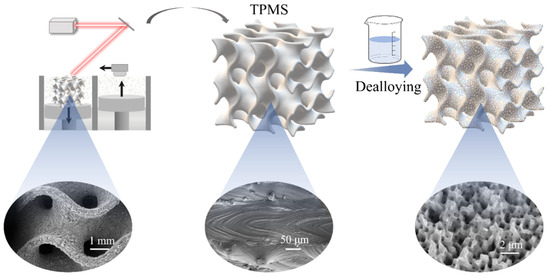
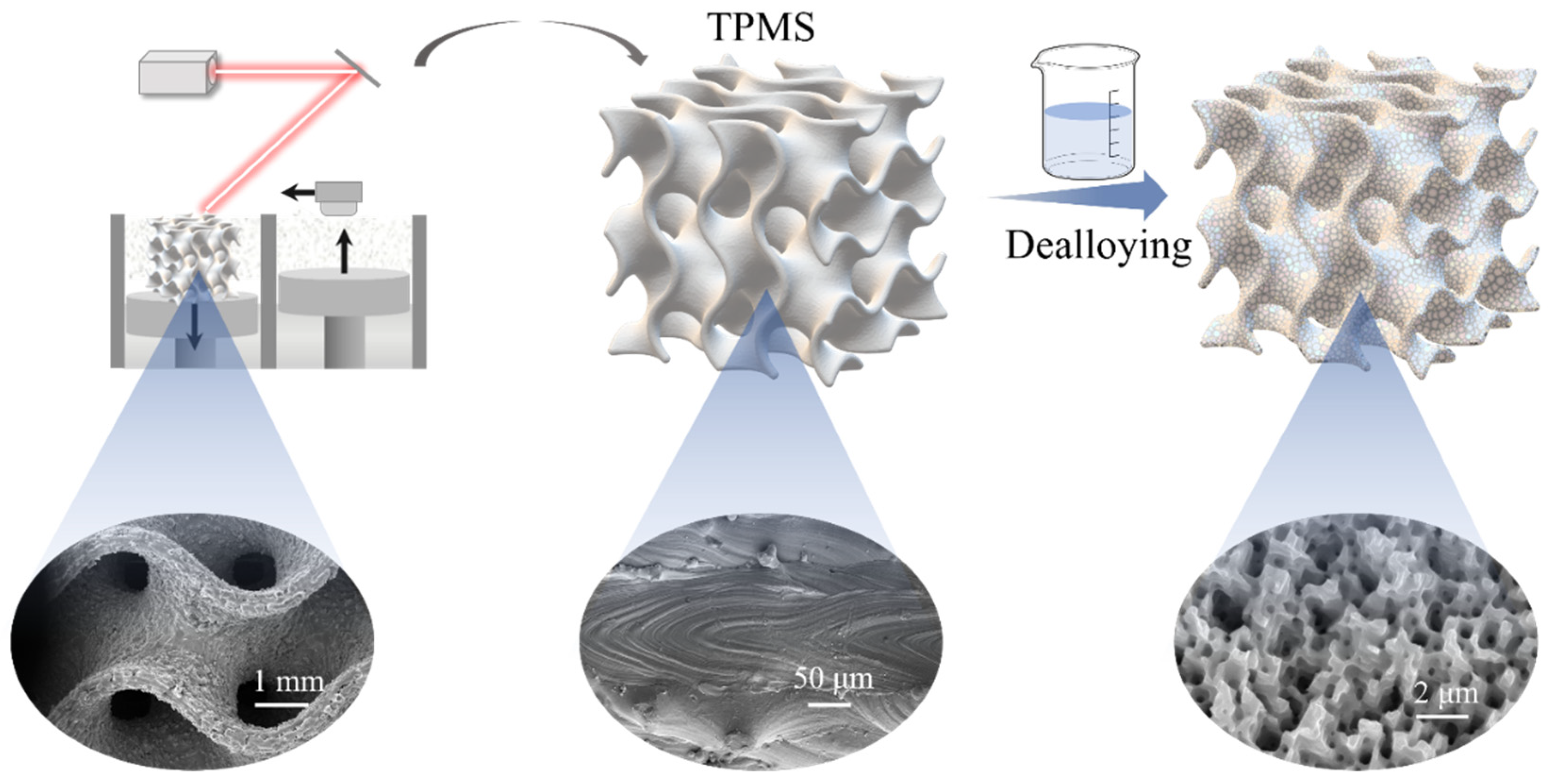
In this study, hierarchical porous FeCoNiCuAl HEA catalysts were fabricated via a two-step strategy combining LPBF and chemical dealloying. The preparation process is illustrated in Figure 1. Firstly, a macroscopic TPMS structure of FeCoNiCuAl was fabricated via LPBF, with a TPMS unit cell dimension of 5 mm and an overall sample size of 10 × 10 × 10 mm3. Subsequently, a chemical dealloying method was employed to introduce nanopores on the surface of the TPMS structure, forming a hierarchical porous structure that combines macroscopic and microscopic features. Additionally, the application performance of the FeCoNiCuAl HEA hierarchically porous catalysts in wastewater treatment was further investigated.
Figure 1.
Schematic of a hierarchical porous FeCoNiCuAl HEA catalyst via LPBF and dealloying.
2. Results and Discussion
2.1. Dealloying Effect
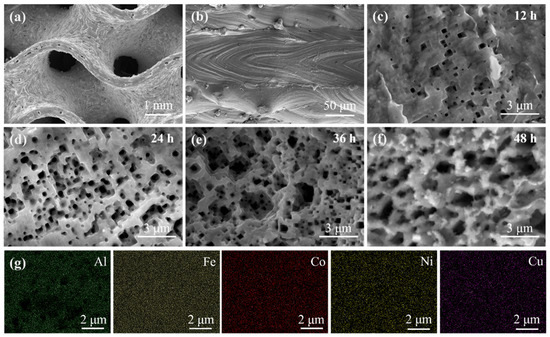
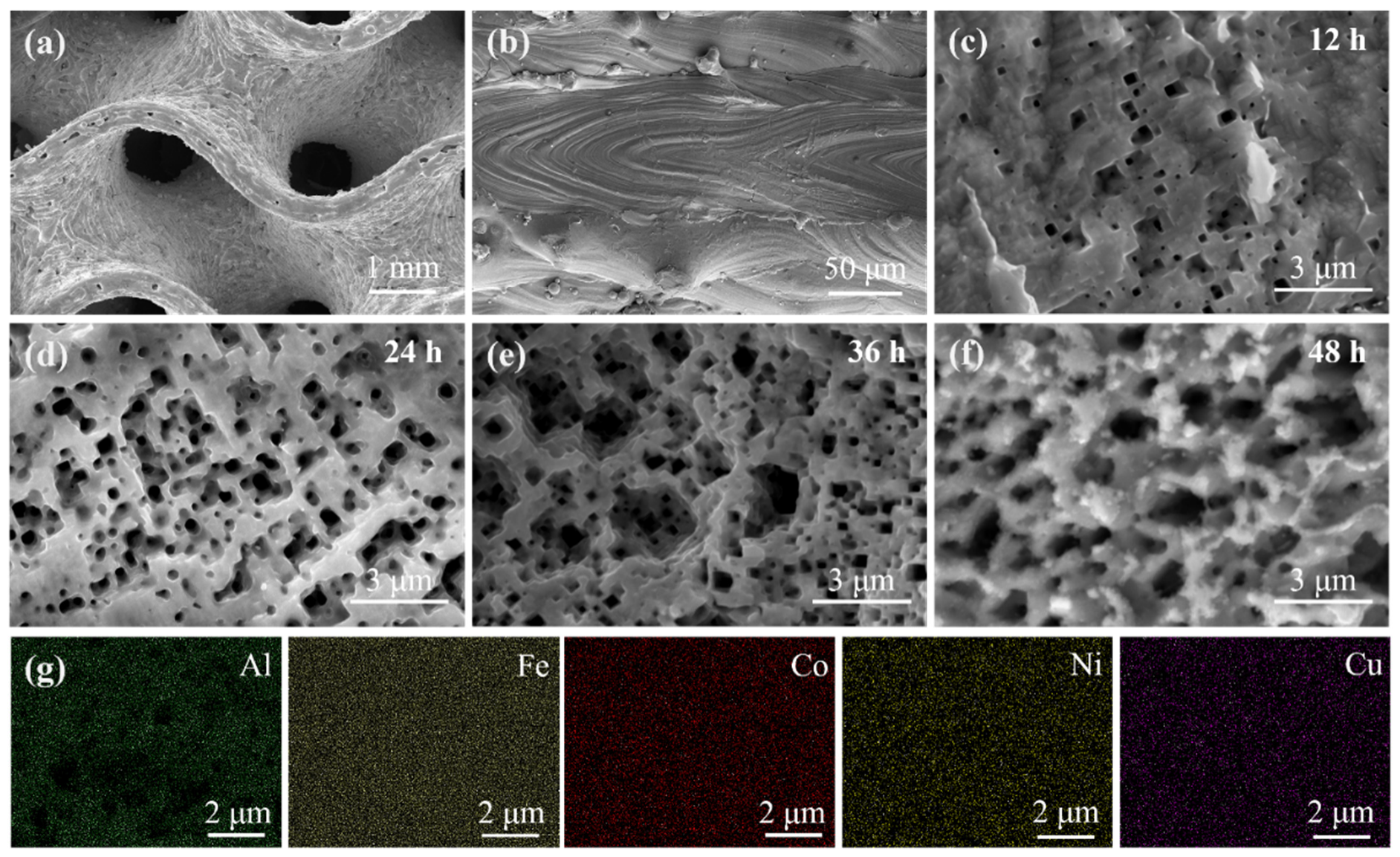
Scanning electron microscopy (SEM) was employed to characterize the microscopic morphology of the samples, with a focus on analyzing pore structure evolution and surface features. The sample exhibits a TPMS-derived pore network that is both continuous and fully interconnected. This design ensures permeability across the complete geometry, thereby optimizing internal fluid dynamics (Figure 2a). The precursors’ surface exhibits distinct melt pool features formed during the LPBF process (Figure 2b). The dealloying effect as a function of time is shown in Figure 2c–f. Only a few small pores are present on the catalytic surface after soaking in a 3% HCl solution for 12 h. After 24 h of dealloying, a significant number of pores formed on the surface of the sample. As the dealloying time extended to 36 h, the small pores gradually enlarged and interconnected, forming larger pores. However, when the time increased to 48 h, the pores gradually collapsed, and the pore structure on the sample’s surface appeared significantly damaged. As illustrated in Figure 2g, the five elements are uniformly distributed on the surface of the sample after 24 h of dealloying. Characterization of the metal ion content in the leachate after 24 h of dealloying by ICP-OES revealed that the proportion of the removed metal elements is nearly equal (Table 1). These results demonstrate the successful preparation of the FeCoNiCuAl porous high-entropy alloy.
Figure 2.
Morphology of samples: (a) macroscopic TPMS structure of the precursor; (b) melting pool of the precursor printed by LPBF; (c–f) SEM images of LPBF FeCoNiCuAl samples chemically dealloyed in 3% HCl aqueous solution for 12, 24, 36, and 48 h at 25 °C; (g) elemental distribution of the sample after 24 h of dealloying.
Table 1.
ICP-OES analysis of the FeCoNiCuAl HEA sample after 24 h dealloying in 3% HCl aqueous solution.
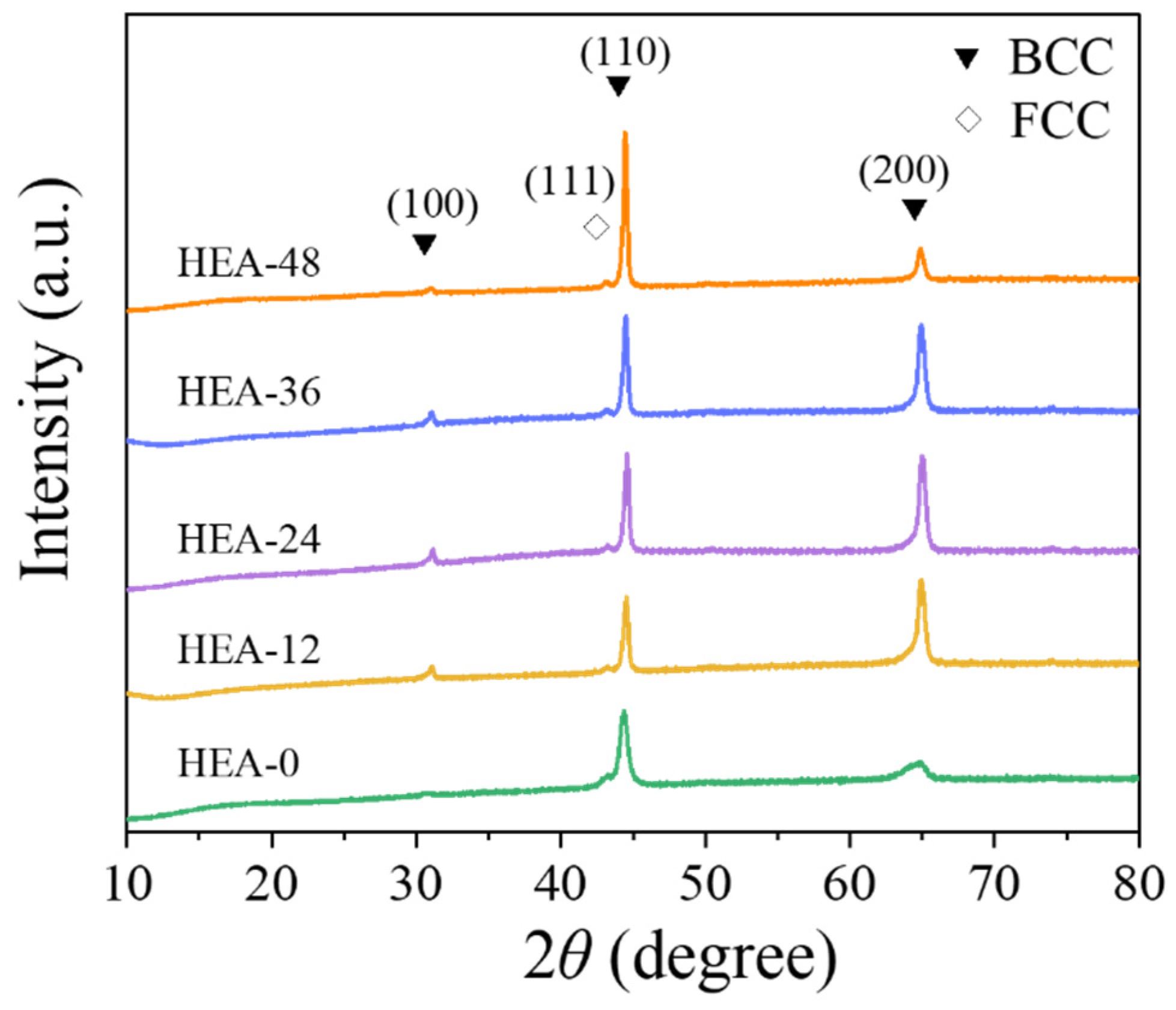
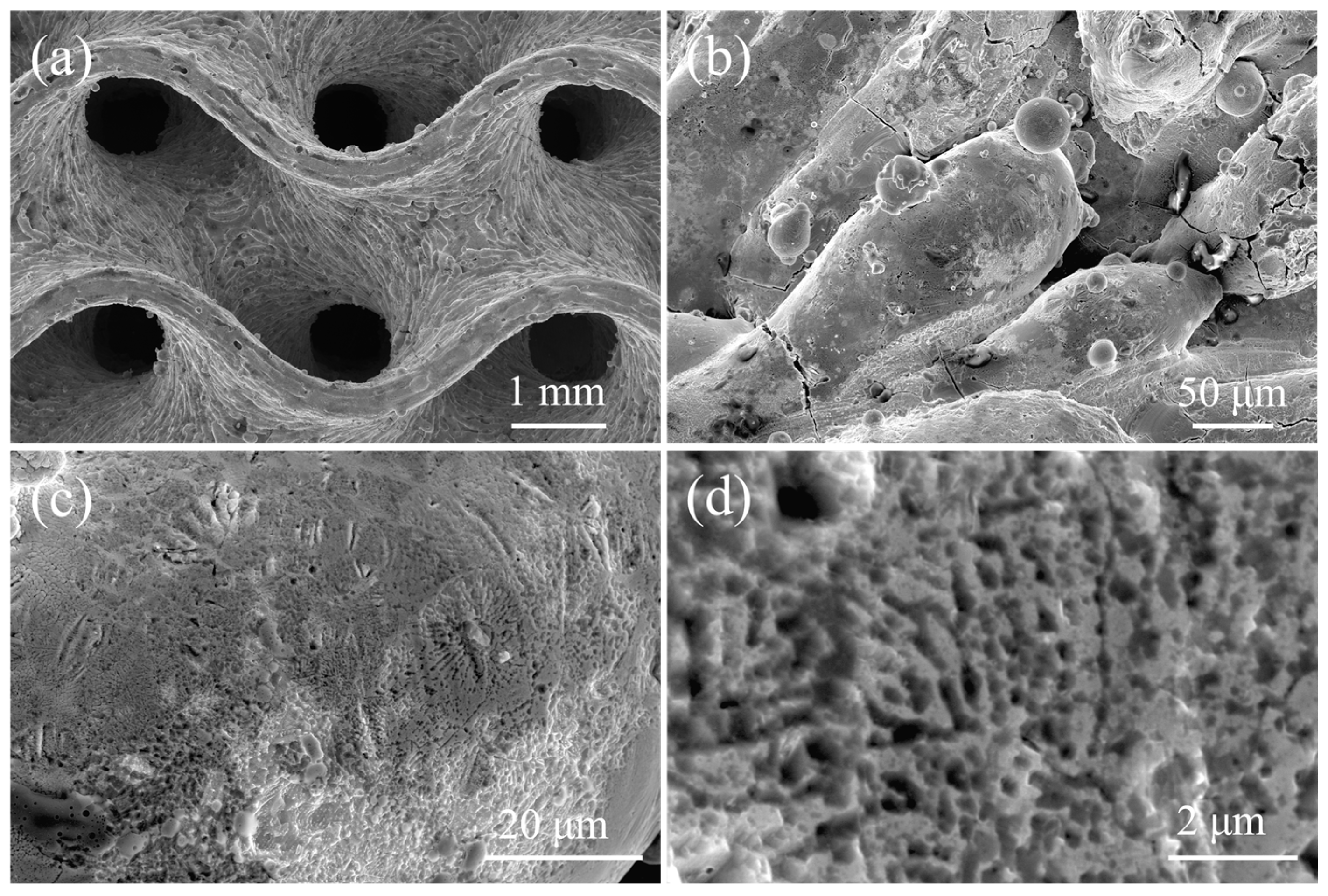
The X-ray diffraction (XRD) patterns of the FeCoNiCuAl HEA catalyst are shown in Figure 3. Both samples exhibit FCC and BCC phases, indicating that the crystallographic structure is preserved through dealloying. The diffraction peaks at 31.1°, 43.3°, 44.5°, and 65.0° are assigned to the (100), (111), (110), and (200) crystal planes, respectively [32]. The hierarchical structure of HEA-24 is directly revealed by SEM at different length scales (Figure 4). As shown in Figure 4a, the sample retains the designed macroporous TPMS structure after dealloying. Figure 4b displays the melt pool structure resulting from LPBF. A magnified view in Figure 4c reveals a densely nanoporous surface. Further magnification in Figure 4d details the morphology of these nanopores. This multiscale visualization unequivocally demonstrates the successful integration of nanopores within the macroscopic TPMS framework. The nanoporous structure was quantified by N2 physisorption. The BET specific surface area increased dramatically from 0.0335 m2/g for HEA-0 to 1.2847 m2/g for HEA-24, representing a 38-fold enhancement (Figure S1a and Table S1). The corresponding pore size distribution is shown in Figure S1b.
Figure 3.
XRD patterns for the FeCoNiCuAl HEA catalysts.
Figure 4.
Direct visualization of the hierarchical porous structure in HEA-24: (a) macroscopic TPMS structure; (b) melt pool structure; (c) enlarged view of a melt pool; (d) nanoporous morphology.
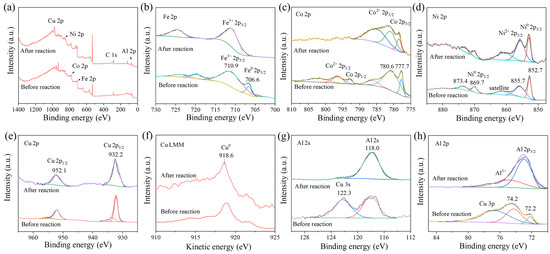
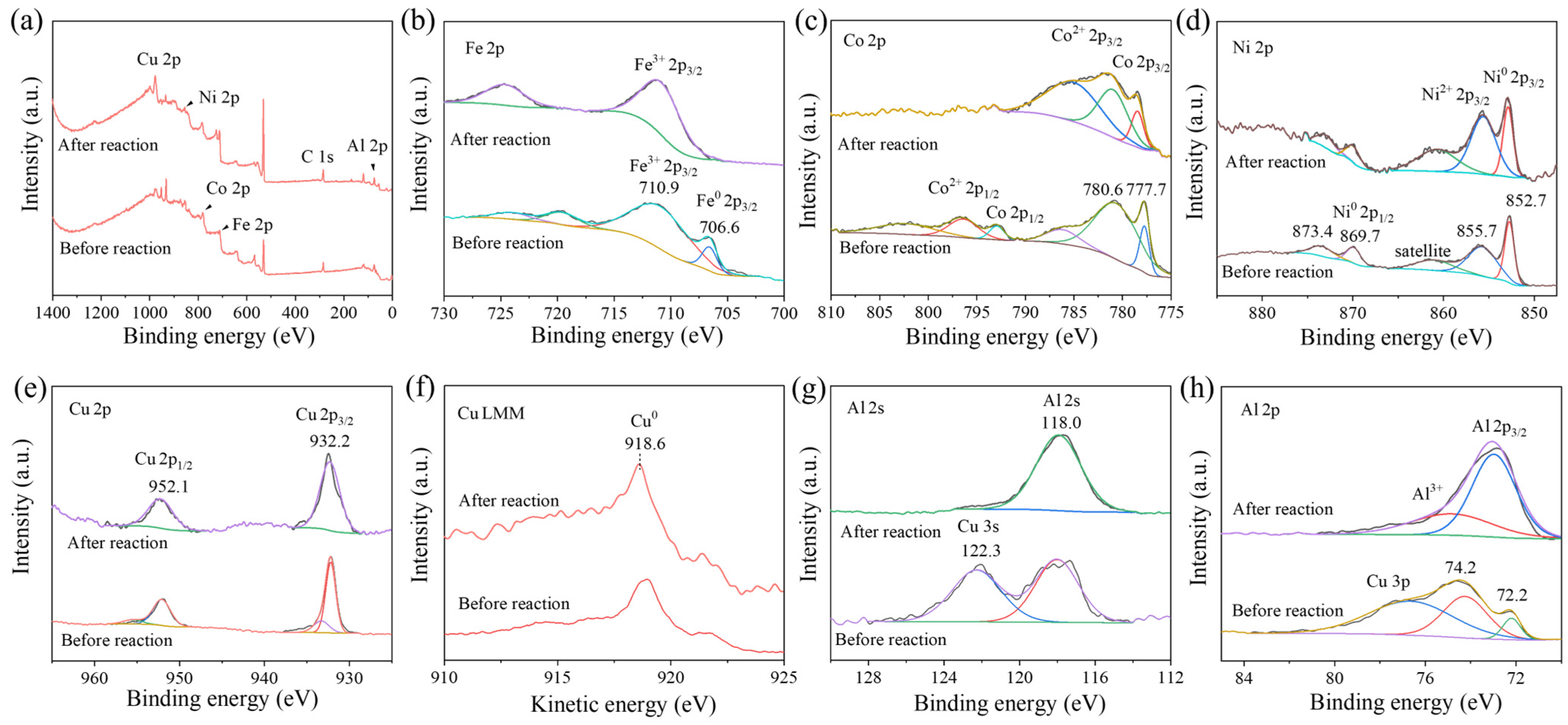
X-ray photoelectron spectroscopy (XPS) analysis of the HEA-24 sample was conducted to investigate its elemental composition and the oxidation states of the individual elements. The XPS survey spectrum (Figure 5a) indicates that the sample primarily consists of Fe, Co, Ni, Cu, and Al elements. The high-resolution spectra (Figure 5b) of Fe 2p show the peaks at 706.6 and 710.9 eV corresponding to Fe0 and Fe3+, respectively [33,34]. In the Co 2p spectrum (Figure 5c), the peaks at 777.7 and 780.6 eV correspond to Co0 and Co3+, respectively. Similarly, in the Ni 2p spectrum (Figure 5d), the peaks at 852.7 eV and 855.7 eV correspond to Ni0 and Ni2+, respectively. The XPS spectrum of Cu (Figure 5e) primarily exhibits two peaks at 932.2 and 952.1 eV, which can be attributed to Cu0 or Cu+. A peak at 918.8 eV in the Cu LMM Auger spectrum (Figure 5f) confirms that Cu primarily exists in the form of Cu0 [4,35]. The Al 2p and Al 2s spectra (Figure 5g,h) confirm that Al exists in both the metallic (Al0) and oxidized (Al3+) states [36]. These results further confirm the successful formation of the nanoporous FeCoNiCuAl HEA.
Figure 5.
XPS spectra of HEA-24 before and after catalyst reaction: (a) survey scan; (b) Fe 2p; (c) Co 2p; (d) Ni 2p; (e) Cu 2p; (f) Cu LMM; (g) Al 2p; (h) Al 2s.
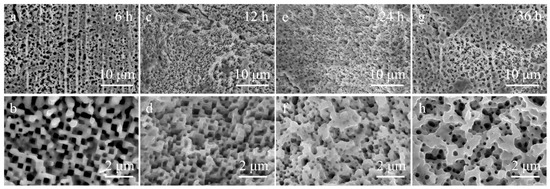
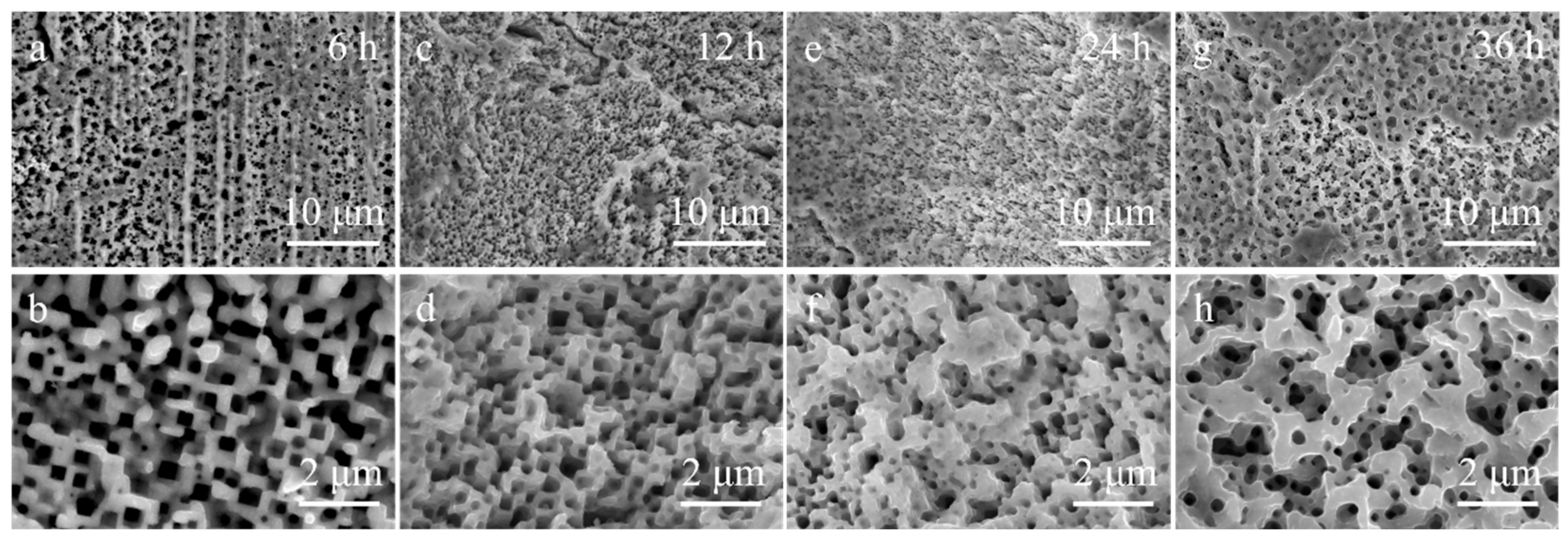
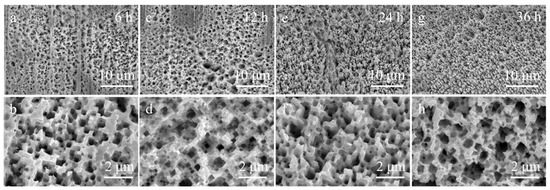
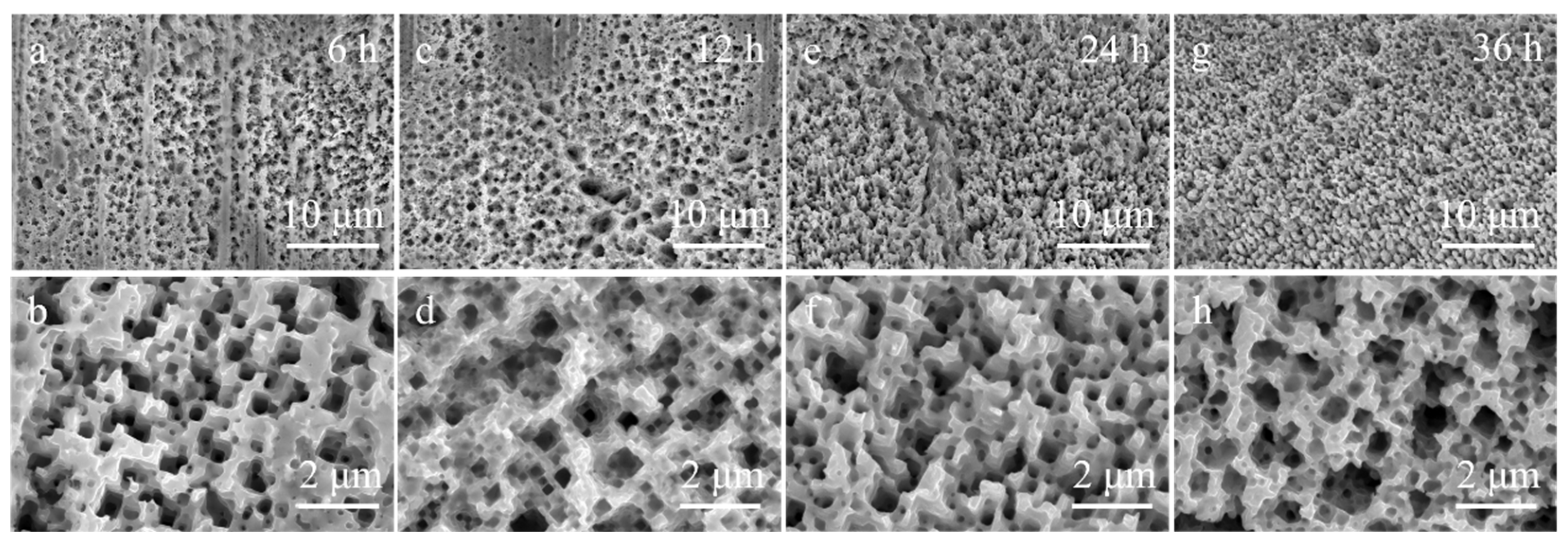
Varying the concentration of the corrosive solution allows for further control over the formation of nanopores on the surface of the FeCoNiCuAl HEA. Compared to the unevenly distributed pores formed after 12 h of dealloying in 3% HCl, increasing the HCl concentration to 6% results in more uniformly distributed nanopores on the sample after just 6 h of dealloying (Figure 6). This suggests that the higher concentration of the corrosive solution accelerates the dealloying process. As the soaking time increases, the pores on the sample gradually grow and coalesce, forming larger pores. This phenomenon can also be observed at a higher corrosive solution concentration (12% HCl) in Figure 7.
Figure 6.
Surface morphologies of catalysts by chemical dealloying of LPBF FeCoNiCuAl in 6% HCl aqueous solution for (a,b) 6, (c,d) 12, (e,f) 24, and (g,h) 36 h at 25 °C.
Figure 7.
Surface morphologies of samples in 12% HCl aqueous solution for (a,b) 6, (c,d) 12, (e,f) 24, and (g,h) 36 h at 25 °C.
2.2. Formation Mechanism
The formation of nanoporous structures in FeCoNiCuAl HEA under the action of HCl can be explained by several factors working in concert. Firstly, Al is the most active element and dissolves preferentially in the HCl corrosion process. After dissolution, it leaves behind a metal skeleton, forming pores. Over time, other elements such as Fe, Co, Ni, and Cu may also be partially dissolved, promoting the development and connection of pores. Secondly, HEAs exhibit varying diffusion rates of different metal atoms, which can cause some elements to dissolve or migrate to the surface preferentially. The differences in dissolution and diffusion can lead to the formation of vacancies on the surface, which further grow into pores and connect, contributing to the formation of a nanoporous structure. Finally, the high temperature and acidic solution enhance interface reactions, creating more active sites on the metal surface, thus facilitating pore expansion and connection.
2.3. Catalytic Performance
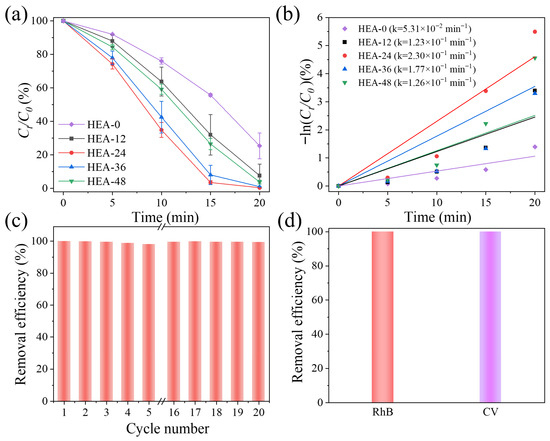
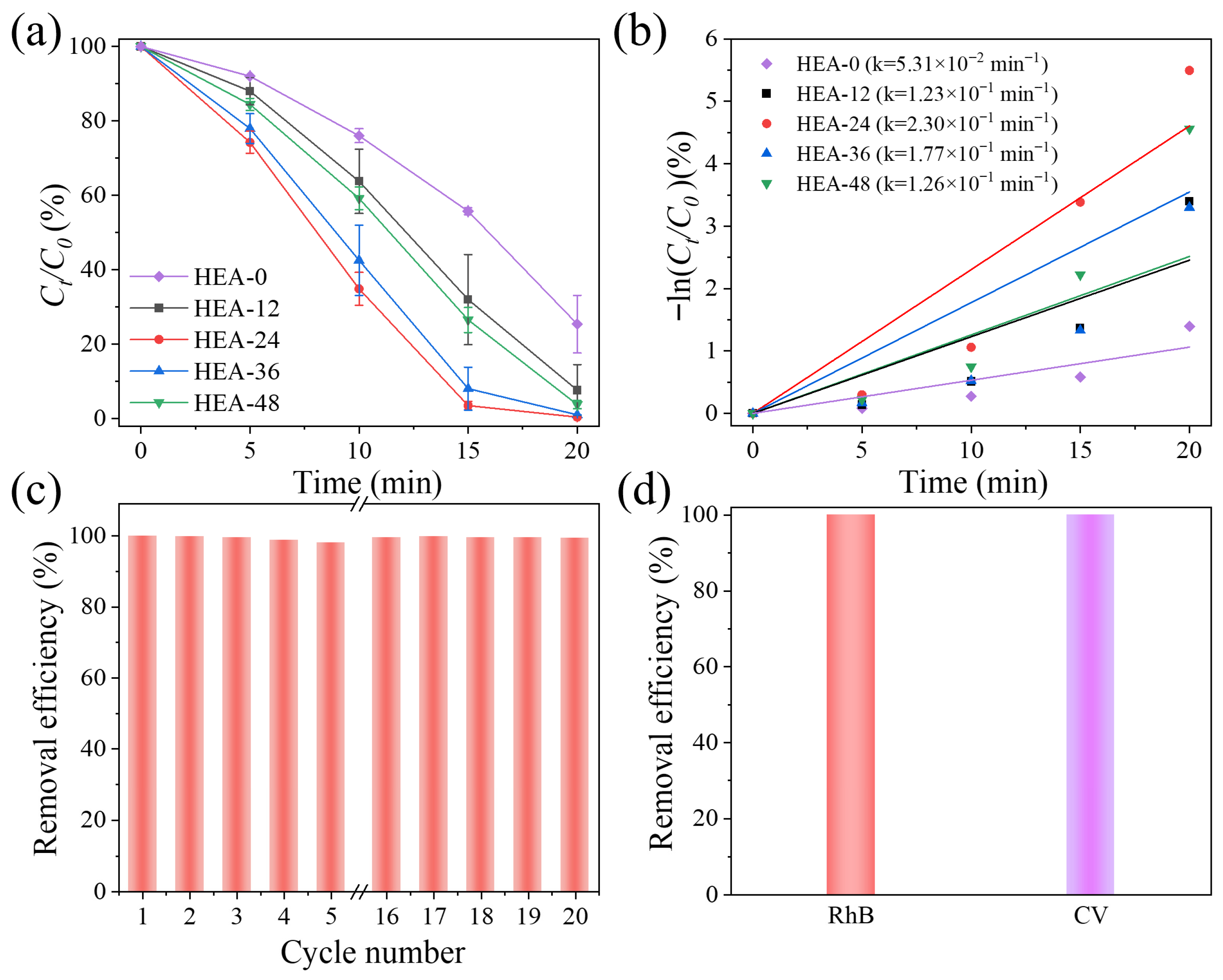
The assessment of catalytic degradation performance was conducted in a reaction system where PMS and ARG were utilized as the oxidant and target pollutant, without requiring pH adjustment. As illustrated in Figure 8a, sample HEA-0 achieved approximately 75% degradation of ARG within 20 min. The catalytic activity exhibits a notable increase as the dealloying time of the sample is extended. Among the prepared samples, HEA-24 exhibited the highest activity, achieving an ARG degradation rate of over 96% within 15 min and nearly complete degradation within 20 min. Notably, the HEA-24/PMS system demonstrated a reaction rate constant (k) of 2.30 × 10⁻¹, exceeding that of the HEA-0 system (5.31 × 10⁻² min−1) by a factor of approximately 4.33 (Figure 8b). This remarkable activity boost can be directly attributed to the hierarchical porous structure: the macroporous TPMS framework facilitates rapid mass transfer, as evidenced by the negligible effect of stirring speed on the reaction rate (Figure S2). Meanwhile, the dealloying-induced nanoporous surface provides a vastly increased density of accessible active sites, as quantitatively evidenced by the 38-fold increase in BET surface area [37]. The observed decline in catalytic activity with extended dealloying time is attributed to excessive dealloying. As shown in Figure 2e,f, prolonged etching leads to the coalescence of nanopores into larger cavities and the incipient collapse of the porous structure. This morphological degradation is expected to significantly reduce the specific surface area and hinder the accessibility of reactants to active sites, resulting in diminished catalytic activity.
Figure 8.
Catalytic performance of the fabricated samples: (a) ARG degradation efficiency under various dealloying times (etchant: 3% HCl, temperature: 25 °C); (b) comparison of the apparent reaction rate constants (k); (c) cycling stability test for ARG degradation; (d) degradation efficiency for different pollutant types.
The stability of the HEA-24 catalyst was thoroughly assessed through repeated ARG degradation experiments. Even after 20 cycles, HEA-24 maintained nearly 100% ARG removal efficiency, demonstrating outstanding stability and reusability (Figure 8c). The catalyst has the potential for even greater durability, as it is entirely composed of FeCoNiCuAl without the inclusion of any inert materials as a support, allowing it to continuously provide the active species required for the reaction during the process. XPS analysis was performed on the HEA-24 catalyst after 20 cycles (Figure 5). The metallic iron (Fe0) signal was markedly attenuated compared to that of the fresh catalyst (Figure 5b). This suggests that surface Fe0 species are consumed during the catalytic process, likely acting as a direct electron donor for the initial activation of PMS [38]. The generated Fe2+ can further participate in a Fenton-like cycle to sustain radical generation. Furthermore, the versatility of the synthesized nanoporous HEA catalyst was evaluated using different dye pollutants, such as Rhodamine B (RhB) and Crystal Violet (CV). Degradation rates exceeding 99% were achieved for both (Figure 8d). In contrast to conventional powdered catalysts, this monolithic, structured catalyst offers significantly easier recovery and reuse, highlighting its greater practical potential for water remediation.
3. Methodology
3.1. Material Preparation
Double Gyroid TPMS structure catalytic precursors were fabricated using LPBF printing. The overall dimensions of the precursor were 10 mm in length, width, and height. FeCoNiCuAl pre-alloyed powder with equal atomic ratios and a particle size distribution of less than 53 μm was selected for printing. The laser power and scanning speed were set to 270 W and 1000 mm/s, respectively. The scan spacing and powder layer thickness were 0.10 mm and 0.03 mm, respectively, with a 60° laser rotation applied per layer. High-purity argon gas was employed to maintain the oxygen content during the printing process below 0.05%. The chemical dealloying of the TPMS FeCoNiCuAl precursors was performed in 3% HCl aqueous solutions at 25 °C, with different leaching times of 0, 12, 24, 36, and 48 h successively applied, respectively. The corresponding samples are labeled as HEA-0 (pristine, non-dealloyed), HEA-12, HEA-24, HEA-36, and HEA-48. Different solutions with concentration levels of 6% and 12% were used to investigate the effects of HCl concentration. All dealloyed samples were cleaned with deionized water and anhydrous ethanol prior to subsequent characterization or testing.
3.2. Characterization
The samples were fabricated via a LPBF system (CR-SLM100, CharmRay, Yantai, China). Their crystal structure and surface morphology were characterized using X-ray diffraction (XRD; 7000SX, Shimadzu, Kyoto, Japan) and scanning electron microscopy (SEM; Quanta650 FEG, FEI, Hillsboro, OR, USA), respectively. Chemical composition was analyzed by X-ray photoelectron spectroscopy (XPS; AXIS SUPRA+, Shimadzu), and the metal ion content in the dealloying solution was quantified through inductively coupled plasma optical emission spectrometry (ICP-OES; Prodigy Plus, Leeman Labs, Hudson, NH, USA). The specific surface area and pore size distribution were measured by N2 physisorption using a surface area and porosity analyzer (3Flex, Micromeritics, Norcross, GA, USA).
3.3. Experimental Procedures and Analytic Methods
A typical experiment was conducted using the nanoporous TPMS HEA as the catalyst in a system containing 100 mL of ARG solution (10 mg/L) and 0.02 g of PMS. The mixture was stirred at a constant speed of 500 rpm throughout the reaction. At 3 min intervals, approximately 3 mL aliquots were withdrawn and immediately analyzed for absorbance using a UV-Vis spectrophotometer (AOE Instrument, UV-1900PC, Shanghai, China). The degradation efficiency was calculated based on the absorbance at λ = 505 nm for ARG, measured at the initial time (C0) and at designated time points (Ct). The maximum absorbance wavelengths for RhB and CV were confirmed to be 554 nm and 590 nm, respectively. After each cycle, the catalyst was recovered via ultrasonic cleaning in deionized water and anhydrous ethanol.
4. Conclusions
Constructing hierarchical porous structures is an effective approach to enhancing the catalytic activity of high-entropy alloy catalysts. In this study, the macroscopic TPMS structure of the FeCoNiCuAl HEA catalyst was constructed using LPBF technology, followed by dealloying to introduce a nanoporous structure on the catalyst surface. By adjusting the dealloying time and the concentration of the corrosive solution, the formation of nanoporous structures can be easily controlled. The dealloyed catalyst exhibited a 4.33-fold increase in activity for the degradation of ARG and maintained its catalytic performance without significant decline after 20 cycles. Additionally, the catalyst achieved over 99% degradation efficiency for various dyes, such as RhB and CV. This study provides valuable insights for fabricating hierarchical porous HEA catalysts, highlighting the potential of these materials in advanced catalytic applications.
Supplementary Materials
The following supporting information can be downloaded at https://www.mdpi.com/article/10.3390/catal16030235/s1, Figure S1. N2 physisorption analysis of HEA-24. (a) Adsorption-desorption isotherm at 77 K; (b) BJH pore size distribution plot, indicating a predominant pore size centered around 0–20 nm. Figure S2. Effect of stirring speed on the catalytic degradation of ARG by HEA-24. Table S1. Textural properties of the HEA catalysts from N2 physisorption.
Author Contributions
Conceptualization, X.Z. and C.C.; methodology, X.Z.; software, C.Z. and H.Y.; investigation, C.Z. and J.L.; resources, J.C. and C.C.; data curation, X.Z.; writing—original draft preparation, X.Z.; writing—review and editing, J.C. and C.C.; supervision, J.C. and C.C.; funding acquisition, C.C.; formal analysis, X.Z.; visualization, C.Z. and K.C. All authors have read and agreed to the published version of the manuscript.
Funding
The research was funded by the National Natural Science Foundation of China (No. 52375335), the National MCF Energy R&D Program (No. 2022YFE03210400), and the Postdoctor Project of Hubei Province (No. 2024HBBHCXB013).
Data Availability Statement
The data presented in this study are available on request from the corresponding author.
Conflicts of Interest
The authors declare no conflicts of interest.
References
- Wang, B.; Yao, Y.; Yu, X.; Wang, C.; Wu, C.; Zou, Z. Understanding the enhanced catalytic activity of high entropy alloys: From theory to experiment. J. Mater. Chem. A 2021, 9, 19410–19438. [Google Scholar] [CrossRef] [Scilit]
- Chen, Z.W.; Li, J.; Ou, P.; Huang, J.E.; Wen, Z.; Chen, L.; Yao, X.; Cai, G.; Yang, C.C.; Singh, C.V.; et al. Unusual Sabatier principle on high entropy alloy catalysts for hydrogen evolution reactions. Nat. Commun. 2024, 15, 359. [Google Scholar] [CrossRef] [Scilit]
- Luo, J.; Li, X.; Ye, Y.; Zhou, T.; Wu, W.; Li, H.; Yang, Q.; Yan, H.; Zeng, J. Progressive Fabrication of a Pt-Based High-Entropy-Alloy Catalyst toward Highly Efficient Propane Dehydrogenation. Angew. Chem. Int. Ed. 2025, 64, e202419093. [Google Scholar] [CrossRef] [Scilit]
- Das, S.; Sanjay, M.; Gautam, A.R.S.; Behera, R.; Tiwary, C.S.; Chowdhury, S. Low bandgap high entropy alloy for visible light-assisted photocatalytic degradation of pharmaceutically active compounds: Performance assessment and mechanistic insights. J. Environ. Manag. 2023, 342, 118081. [Google Scholar] [CrossRef] [Scilit]
- Wu, S.-K.; Pan, Y.; Wang, N.; Lu, T.; Dai, W.-J. Azo dye degradation behavior of AlFeMnTiM (M = Cr, Co, Ni) high-entropy alloys. Int. J. Miner. Metall. Mater. 2019, 26, 124–132. [Google Scholar] [CrossRef] [Scilit]
- Wang, Y.; Li, D.; Ge, X.; Yu, J.; Zhao, Y.; Bu, Y. Anchored Cobalt Nanoparticles on Layered Perovskites for Rapid Peroxymonosulfate Activation in Antibiotic Degradation. Adv. Mater. 2024, 36, 2402935. [Google Scholar] [CrossRef] [Scilit] [PubMed]
- Hodges, B.C.; Cates, E.L.; Kim, J.-H. Challenges and prospects of advanced oxidation water treatment processes using catalytic nanomaterials. Nat. Nanotechnol. 2018, 13, 642–650. [Google Scholar] [CrossRef] [Scilit]
- Zhao, Z.; Wang, P.; Song, C.; Zhang, T.; Zhan, S.; Li, Y. Enhanced Interfacial Electron Transfer by Asymmetric Cu-Ov-In Sites on In2O3 for Efficient Peroxymonosulfate Activation. Angew. Chem. Int. Ed. 2023, 62, e202216403. [Google Scholar] [CrossRef] [Scilit]
- Guo, S.; Tang, H.; You, L.; Zhang, H.; Li, J.; Zhou, K. Combustion synthesis of mesoporous CoAl2O4 for peroxymonosulfate activation to degrade organic pollutants. Chin. Chem. Lett. 2021, 32, 2828–2832. [Google Scholar] [CrossRef] [Scilit]
- Guo, S.; Chen, M.; Wei, Y.; You, L.; Cai, C.; Wei, Q.; Zhou, K. Designing hierarchically porous zero-valent iron via 3D printing to degrade organic pollutants by activating peroxymonosulfate using high-valent iron-oxo species. Chem. Eng. J. 2023, 476, 146523. [Google Scholar] [CrossRef] [Scilit]
- Liu, Z.; Wang, E.; Mei, J.; Wang, A.; Zou, Y.; Wang, C.; Shang, H.; Gong, Y.; Duan, A.; Xu, C.; et al. Hierarchical porous Pt/Hβ catalyst with controllable acidity for efficient hydrogenation of naphthalene. Chem. Eng. J. 2024, 481, 148763. [Google Scholar] [CrossRef] [Scilit]
- Wang, Y.; Wang, H.; Li, B.; Han, P.; Qi, G.; Gao, D.; Wei, Z.; Tao, S. Facile synthesis of hierarchically porous carbon monolith without templating agent for various applications in energy and catalysis. Carbon 2024, 230, 119645. [Google Scholar] [CrossRef] [Scilit]
- Gong, H.; Sun, G.; Shi, W.; Li, D.; Zheng, X.; Shi, H.; Liang, X.; Yang, R.; Yuan, C. Nano-Au-decorated hierarchical porous cobalt sulfide derived from ZIF-67 toward optimized oxygen evolution catalysis: Important roles of microstructures and electronic modulation. Carbon Energy 2024, 6, e432. [Google Scholar] [CrossRef] [Scilit]
- Li, R.; Liu, X.; Liu, W.; Li, Z.; Chan, K.C.; Lu, Z. Design of Hierarchical Porosity Via Manipulating Chemical and Microstructural Complexities in High-Entropy Alloys for Efficient Water Electrolysis. Adv. Sci. 2022, 9, 2105808. [Google Scholar] [CrossRef] [Scilit] [PubMed]
- Tian, Q.; Liu, Z.; Zhu, Y.; Dong, X.; Saih, Y.; Basset, J.-M.; Sun, M.; Xu, W.; Zhu, L.; Zhang, D.; et al. Beyond Creation of Mesoporosity: The Advantages of Polymer-Based Dual-Function Templates for Fabricating Hierarchical Zeolites. Adv. Funct. Mater. 2016, 26, 1881–1891. [Google Scholar] [CrossRef] [Scilit]
- Li, C.; Hu, Z.; Jiang, G.; Zhang, Y.; Wu, Z. 3D Carbon Microspheres with a Maze-Like Structure and Large Mesopore Tunnels Built From Rapid Aerosol-Confined Coherent Salt/Surfactant Templating. Small 2024, 20, 2305316. [Google Scholar] [CrossRef] [Scilit]
- Li, B.; Zhang, L.; Zhao, Z.; Zou, Y.; Chen, B.; Fu, X.; Wang, F.; Long, S.; Guo, W.; Liang, J.; et al. Unraveling hierarchical hollow NiCo2S4/MXene/N-doped carbon microspheres via dual templates for high-performance hybrid supercapacitors. Chem. Eng. J. 2024, 487, 150730. [Google Scholar] [CrossRef] [Scilit]
- Zhang, C.; Wang, Q.; Song, Y.; Wang, G.; Wang, H. 3D ordered hierarchically porous carbon derived from colloidal crystal templates towards alkali metal-ion batteries. Carbon 2023, 201, 76–99. [Google Scholar] [CrossRef] [Scilit]
- Davis, M.; Ramirez, D.A.; Hope-Weeks, L.J. Formation of Three-Dimensional Ordered Hierarchically Porous Metal Oxides via a Hybridized Epoxide Assisted/Colloidal Crystal Templating Approach. ACS Appl. Mater. Interfaces 2013, 5, 7786–7792. [Google Scholar] [CrossRef] [Scilit]
- Hu, Y.; Yue, Y.-Y.; Wang, C.; Zhu, H.-B.; Oyama, S.T.; Bao, X.-J. An environment-friendly and acid-degradable polymer templated synthesis of single-crystal hierarchical zeolites. J. Mater. Chem. A 2022, 10, 15698–15707. [Google Scholar] [CrossRef] [Scilit]
- Huang, J.; Liu, C.; Jin, Y.; Chen, J. Hierarchical porous carbon synthesis by carbonized polymer dots-based sacrificial template for high-performance supercapacitors. Chem. Eng. J. 2023, 461, 141930. [Google Scholar] [CrossRef] [Scilit]
- Xiong, H.; Sun, G.; Liu, Z.; Zhang, L.; Li, L.; Zhang, W.; Du, F.; Qiao, Z.-A. Polymer Stabilized Droplet Templating towards Tunable Hierarchical Porosity in Single Crystalline Na3V2(PO4)3 for Enhanced Sodium-Ion Storage. Angew. Chem. Int. Ed. 2021, 60, 10334–10341. [Google Scholar] [CrossRef] [Scilit]
- Zhu, C.; Qi, Z.; Beck, V.A.; Luneau, M.; Lattimer, J.; Chen, W.; Worsley, M.A.; Ye, J.; Duoss, E.B.; Spadaccini, C.M.; et al. Toward digitally controlled catalyst architectures: Hierarchical nanoporous gold via 3D printing. Sci. Adv. 2018, 4, eaas9459. [Google Scholar] [CrossRef] [Scilit]
- Zhang, Y.; Sun, X.; Nomura, N.; Fujita, T. Hierarchical Nanoporous Copper Architectures via 3D Printing Technique for Highly Efficient Catalysts. Small 2019, 15, 1805432. [Google Scholar] [CrossRef] [Scilit]
- Li, C.; Yao, X.; Zhang, R.; Zheng, H.; Yuan, S.; Yu, X.; Li, B.; Zhu, M.; Tu, S.-T. Structured nanoporous Cu/ZnO catalysts for on-board methanol steam reforming prepared by laser powder bed fusion and dealloying. Chem. Eng. J. 2024, 487, 150467. [Google Scholar]
- Sefene, E.M. State-of-the-art of selective laser melting process: A comprehensive review. J. Manuf. Syst. 2022, 63, 250–274. [Google Scholar] [CrossRef] [Scilit]
- Guo, S.; Ding, Y.; Zhou, K. 3D-Printing Technologies for Environmental and Water Applications. ACS EST Water 2024, 4, 3611–3613. [Google Scholar] [CrossRef] [Scilit]
- Li, W.; Ding, J.; Chen, X.; Wang, Y.; Song, X.; Zhang, S. A 3D-printed CuNi alloy catalyst with a triply periodic minimal surface for the reverse water-gas shift reaction. J. Mater. Chem. A 2024, 12, 314–320. [Google Scholar] [CrossRef] [Scilit]
- Ellebracht, N.C.; Roy, P.; Moore, T.; Gongora, A.E.; Oyarzun, D.I.; Stolaroff, J.K.; Nguyen, D.T. 3D printed triply periodic minimal surfaces as advanced structured packings for solvent-based CO2 capture. Energy Environ. Sci. 2023, 16, 1752–1762. [Google Scholar] [CrossRef] [Scilit]
- Han, L.; Che, S. An Overview of Materials with Triply Periodic Minimal Surfaces and Related Geometry: From Biological Structures to Self-Assembled Systems. Adv. Mater. 2018, 30, 1705708. [Google Scholar] [CrossRef] [Scilit]
- Tian, L.; Sun, B.; Yan, X.; Sharf, A.; Tu, C.; Lu, L. Continuous transitions of triply periodic minimal surfaces. Addit. Manuf. 2024, 84, 104105. [Google Scholar] [CrossRef] [Scilit]
- Wu, Z.; Li, B.; Chen, M.; Yang, Y.; Zheng, R.; Yuan, L.; Li, Z.; Tan, X.; Xu, H. Tailoring magnetic property and corrosion resistance of FeCoNiCuAl high-entropy alloy with Ce additive. J. Alloys Compd. 2022, 901, 163665. [Google Scholar]
- Guo, S.; Yang, Z.; Zhang, H.; Yang, W.; Li, J.; Zhou, K. Enhanced photocatalytic degradation of organic contaminants over CaFe2O4 under visible LED light irradiation mediated by peroxymonosulfate. J. Mater. Sci. Technol. 2021, 62, 34–43. [Google Scholar]
- Guo, S.; Wang, H.; Yang, W.; Fida, H.; You, L.; Zhou, K. Scalable synthesis of Ca-doped α-Fe2O3 with abundant oxygen vacancies for enhanced degradation of organic pollutants through peroxymonosulfate activation. Appl. Catal. B Environ. 2020, 262, 118250. [Google Scholar]
- Xu, X.; Guo, Y.; Bloom, B.P.; Wei, J.; Li, H.; Li, H.; Du, Y.; Zeng, Z.; Li, L.; Waldeck, D.H. Elemental Core Level Shift in High Entropy Alloy Nanoparticles via X-ray Photoelectron Spectroscopy Analysis and First-Principles Calculation. ACS Nano 2020, 14, 17704–17712. [Google Scholar]
- Paparazzo, E. XPS, AES and EELS studies of Al surfaces. Vacuum 2001, 62, 47–60. [Google Scholar] [CrossRef] [Scilit]
- Yang, C.; Zhang, C.; Liu, L. Excellent degradation performance of 3D hierarchical nanoporous structures of copper towards organic pollutants. J. Mater. Chem. A 2018, 6, 20992–21002. [Google Scholar] [CrossRef] [Scilit]
- Guo, S.; Yang, M.; Gao, X.; Huang, Y.; Huang, Y.; You, L.; Han, C.; Cai, C.; Chen, F.; Chen, R. 3D-Printed Porous High-Entropy Alloy Boosts Peroxymonosulfate Activation for Long-Term Organic Pollutant Degradation. Rare Met. 2026, e70134. [Google Scholar] [CrossRef] [Scilit]

Disclaimer/Publisher’s Note: The statements, opinions and data contained in all publications are solely those of the individual author(s) and contributor(s) and not of MDPI and/or the editor(s). MDPI and/or the editor(s) disclaim responsibility for any injury to people or property resulting from any ideas, methods, instructions or products referred to in the content. |
© 2026 by the authors. Licensee MDPI, Basel, Switzerland. This article is an open access article distributed under the terms and conditions of the Creative Commons Attribution (CC BY) license.