


Abstract
Non-thermal plasma (NTP)–catalytic coupling is a promising technology for controlling volatile organic compounds (VOCs), but it suffers from issues such as low degradation efficiency and a high number of by-products. Designing and preparing efficient catalysts is a key approach to addressing these issues. Here, a series of Cu+/Mn-MIL-100 catalysts with different Cu+ loads were successfully prepared by a double solvent approach (DSA) and methanol vapor reduction strategy. The results of toluene activity tests showed that 0.2Cu+/Mn-MIL-100 samples performed the best toluene degradation efficiency among these samples. When the specific input density was 536 J·L−1, the toluene removal efficiency and the selectivity of CO2 and COx reached 90.7%, 46.5% and 90.6%, respectively. In the meantime, the production of by-products such as NOx and O3 was inhibited. The catalyst characterization (such as XRD and XPS) results showed that most of the loaded Cu2+ ions were transformed to Cu+ ions. In addition, the π-complexation between Mn-MIL-100 and Cu+ ions promoted the degradation of toluene.
1. Introduction
Advanced oxidation processes (AOPs) are widely recognized as effective technologies for the degradation of organic pollutants because they can generate highly reactive species, such as hydroxyl radicals, superoxide radicals, and other reactive oxygen species, which are capable of oxidizing a broad range of organic compounds [1]. Among various AOPs, non-thermal plasma (NTP) has attracted increasing attention due to its high reactivity, rapid response, and mild operating conditions [2]. In plasma-based degradation processes, plasma acts as an energy source that activates gas molecules and generates electrons, ions, radicals, and excited species. These reactive species can initiate a series of physical and chemical reactions, leading to the decomposition of organic pollutants [1,2]. Because of these characteristics, plasma processes are considered an important branch of AOPs for the degradation of organic pollutants, including volatile organic compounds (VOCs).
Plasma reactions are widely employed for treating VOC emissions due to their high reactivity and rapid response. However, plasma-alone reactors suffer from issues such as low energy utilization, incomplete degradation, numerous by-products, and poor CO2 selectivity [3]. The hunt for appropriate catalysts is a research hotspot in the field of plasma-catalyzed VOC degradation because the high selectivity of catalysts combined with the high reactivity of plasma greatly increases pollutant degradation efficiency and CO2 selectivity [4,5]. plasma-catalyzed VOC degradation depends heavily on surface reactions, thus catalysts with well-developed pore structures and superior adsorption qualities are ideal targets [6,7,8].
Metal–organic frameworks (MOFs) hold immense potential in gas separation, gas storage, and heterogeneous catalysis due to their ultra-large specific surface area, developed pore structures, and tunable material architecture [9]. In recent years, numerous studies have loaded transition metal ions (particularly Group D elements) onto adsorbent materials such as molecular sieves, porous materials, and MOFs to achieve more suitable adsorption effects [10]. Ahmed [11] et al. prepared a series of CuCl/MIL-100(Cr) materials for fuel denitrogenation, achieving a 15% increase in indole adsorption capacity. Chang et al. [12] prepared Cu+/MIL-101 materials for ethylene/ethane separation, elevating the ethylene/ethane selectivity to 8.7 (compared to 1.78 for MIL-101 alone).
Our previous work investigated the catalytic degradation of toluene using low-temperature plasma-assisted Mn-MIL-100 modified materials [13]. Building upon the previous work, this work doped transition metal ions from Group D into the MOFs matrix. Leveraging the π-coordination interaction between transition metal ions and MOFs [14,15], this approach enhances the catalyst’s adsorption capacity for pollutants. This work selected Cu ions as the doped transition metal ions. Employing a dual-solvent method, Cu2+ ions were loaded into the pores of the Mn-MIL-100 framework. Simultaneously, methanol vapor reduction was used to reduce the loaded Cu2+ ions to Cu+ ions, ultimately yielding a series of Cu+/Mn-MIL-100 materials. Finally, the Cu+/Mn-MIL-100 materials were integrated with a low-temperature plasma reactor. The enhancement effect of Cu+ ions on the toluene degradation performance of the Mn-MIL-100 samples was investigated through evaluation parameters including toluene degradation rate, CO2/COx selectivity, energy efficiency, and O3 and NOx generation. Compared with previous studies on plasma–catalytic VOC degradation and MOF-based catalysts, the novelty of the present study lies in the following aspects. First, unlike conventional approaches that mainly focus on the catalytic performance of pristine MOFs or metal-oxide catalysts, this work stabilizes Cu+ ions within the Mn-MIL-100 matrix through a dual-solvent approach combined with a methanol vapor reduction strategy. Second, the constructed Cu+/Mn-MIL-100 catalyst system enables efficient plasma–catalytic toluene degradation, achieving a toluene removal efficiency of 90.7% and a COx selectivity of 90.6% under a specific input density of 536 JL-1, while simultaneously inhibiting the formation of by-products such as NOx and O3. Third, this study reveals that the π-complexation between Cu+ ions and Mn-MIL-100 promotes toluene adsorption and degradation, providing new insight into the design of functionalized MOF-based catalysts for plasma–catalytic VOC abatement.
2. Results and Discussion
2.1. Characterization of the Catalysts
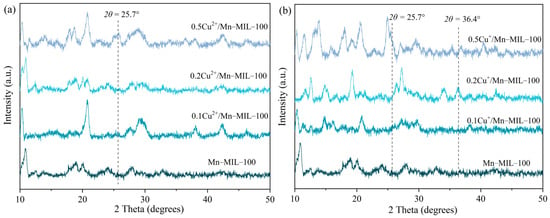
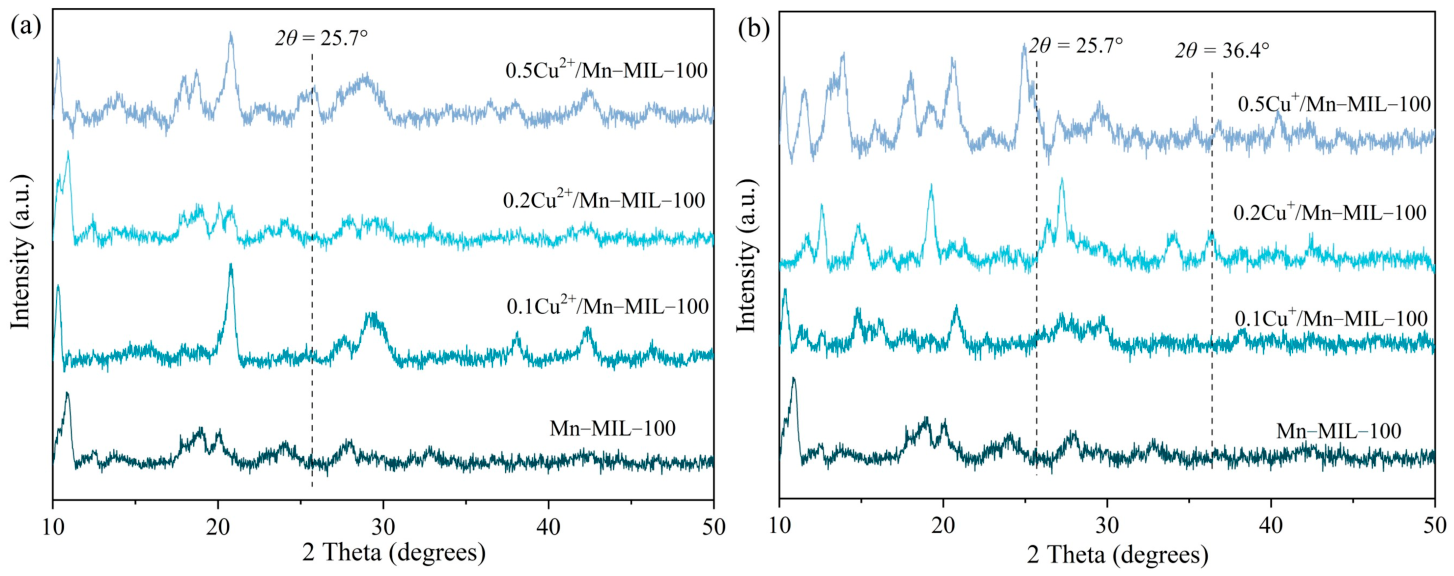
The XRD patterns of Mn-MIL-100 loaded with Cu in various valence states were obtained and compared in Figure 1. There were no appreciable variations in the XRD patterns of XCu2+/Mn-MIL-100 and XCu+/Mn-MIL-100 from the pristine Mn-MIL-100 material. This suggests that the Cu-loaded and methanol-vapor-treated Mn-MIL-100 materials maintained their original crystal structures. Figure 1a shows a strong peak at 2θ = 25.7° for the 0.5 Cu2+/Mn-MIL-100, which corresponds to the typical peak of Cu2(NO3)(OH)3 [16], indicating successful Cu2+ loading. In other samples, the peak intensity at this location is lower, most likely due to insufficient copper ion loading to produce a unique crystalline structure. Figure 1b displays the XRD patterns for the XCu+/Mn-MIL-100 samples. The peak at 2θ = 25.7° substantially attenuated or even disappeared. Additionally, for the 0.2Cu2+/Mn-MIL-100, a new peak that corresponds to Cu2O occurs at 2θ = 36.4°. The absence of significant peaks at 2θ = 43.4° and 50.6° (related with Cu0) suggests that the majority of Cu2+ in 0.2Cu+/Mn-MIL-100 were reduced to Cu+ ions after methanol vapor reduction treatment, resulting in a Cu2O structure [17].
Figure 1.
XRD pattern of XCu2+/Mn-MIL-100 (a) and XCu+/Mn-MIL-100 (b).
The XRD patterns of Mn-MIL-100 loaded with Cu in various valence states were obtained and compared, as shown in Figure 1. The main diffraction peaks of the pristine Mn-MIL-100 are in perfect agreement with the simulated pattern and the reported literature [18,19], confirming the successful synthesis of the Mn-MIL-100 framework. The characteristic peaks at 2θ = 10.4°, 10.7°, and 20.1° can be indexed to the (113), (428), and (333) planes of Mn-MIL-100, respectively, which crystallizes in a cubic structure with the space group Fd-3m, No. 227 and lattice parameters of a = b = c = 73.3 Å, α = β = γ = 90° [20]. For the XCu2+/Mn-MIL-100 samples, no appreciable variations in the XRD patterns were observed compared with the pristine Mn-MIL-100, suggesting that Cu loading and subsequent methanol vapor treatment did not destroy the original crystal structure of Mn-MIL-100. As shown in Figure 1a, a strong peak at 2θ = 25.7° appears for 0.5Cu2+/Mn-MIL-100, which corresponds to the typical diffraction of Cu2(NO3)(OH)3 (JCPDS No. 96-900-8311) [16,21], indicating the successful loading of Cu2+ species. In the other samples, the peak intensity at this position is lower, most likely because the copper loading is insufficient to form a distinct crystalline Cu2(NO3)(OH)3 phase. Figure 1b displays the XRD patterns of the XCu+/Mn-MIL-100 samples after methanol vapor reduction. The peak at 2θ = 25.7° is substantially attenuated or even disappears, indicating the decomposition or transformation of the Cu2(NO3)(OH)3 phase. Meanwhile, for 0.2Cu+/Mn-MIL-100, a new peak corresponding to Cu2O appears at 2θ = 36.4° (JCPDS No. 96-900-7498) [17,21]. Cu2O crystallizes in a cubic structure with the space group Pn-3m, No. 224 and a lattice parameter of a ≈ 4.27 Å. The absence of significant peaks at 2θ = 43.4° and 50.6°, which are characteristic of metallic Cu0 (JCPDS No. 96-901-3015), suggests that most of the Cu2+ species in 0.2Cu+/Mn-MIL-100 were reduced to Cu+ ions after methanol vapor reduction, resulting in the formation of a Cu2O structure [21]. These results confirm that Cu+ ions were successfully stabilized within the Mn-MIL-100 framework, while the parent MOF structure was well preserved.
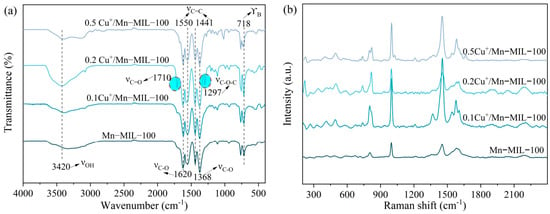
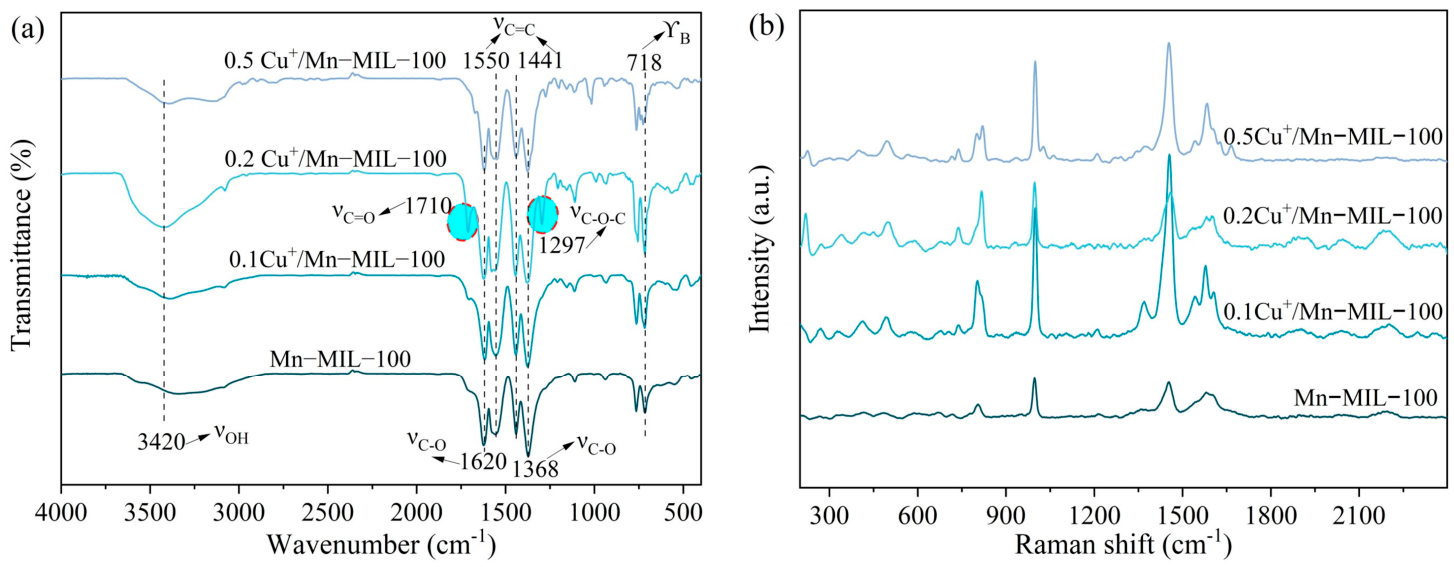
The FTIR spectra of Mn-MIL-100 loaded with Cu in various valence states were obtained and compared in Figure 2a and Figure S1. A wide broad band with a center at 3420 cm−1 is ascribed to the guest molecules (H2O and/or ethanol). The bands at 1620 and 1368 cm−1 correspond to the symmetric and asymmetric C–O stretching of the carboxylate (represents for the BTC anions) [22]. The bands at 1570 and 1441 cm−1 belong to the C=C stretching vibration of aromatic nucleus [23]. The strong band at 718 cm−1 of the fingerprint region corresponds to the ring-out-of-plane vibration of the benzene core of the linker 1,3,5-trimesate [24]. Interestingly, for catalyst 0.2Cu+/Mn-MIL-100, the strong shoulders at 1710 and 1297 cm−1 can be ascribed to the C=O and C–O–C stretching vibration of ester [25]. This indicates that there are uncoordinated organic chains in catalyst 0.2Cu+/Mn-MIL-100, which undergo esterification when it comes into contact with methanol vapor. The typical Raman spectra of XCu+/Mn-MIL-100 were also acquired, and they match the data that has been published in the literature exactly (Figure 2b) [26].
Figure 2.
FTIR (a) and Raman (b) spectra of XCu+/Mn-MIL-100.
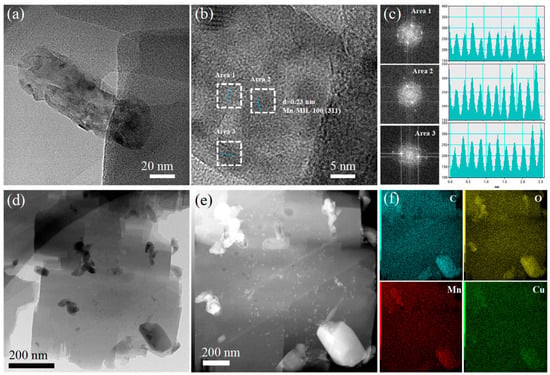
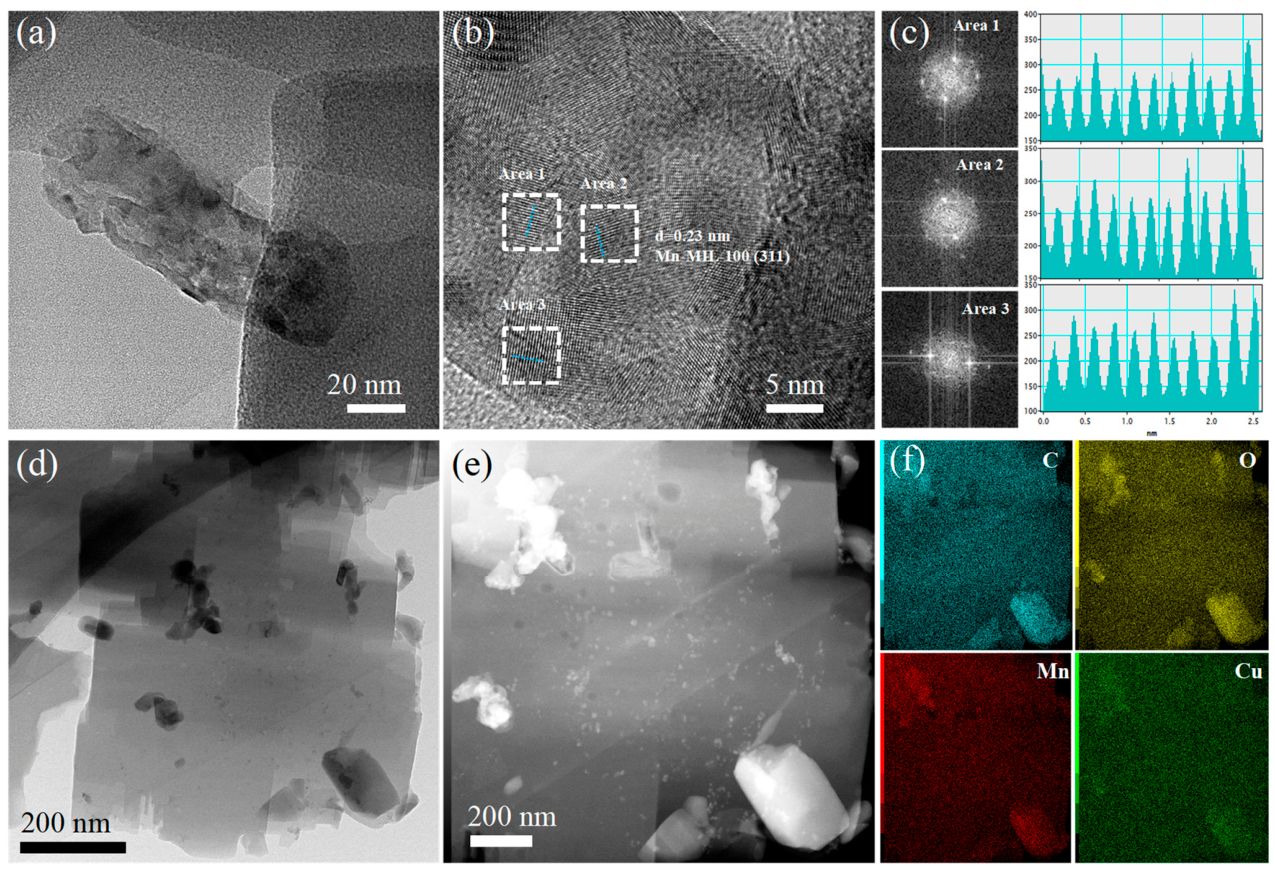
FE-SEM and TEM were carried out to evaluate the microstructure and element distribution of the prepared XCu+/Mn-MIL-100. From Figure S2, it is seen that the morphology of Mn-MIL-100 changed after Cu loading. With the increase in Cu addition, Mn-MIL-100 changed from the original polygonal particles to rod-like structures (0.1Cu+/Mn-MIL-100), sheet-like structures (0.2Cu+/Mn-MIL-100) and then back to particle morphology (0.5Cu+/Mn-MIL-100). Furthermore, TEM, HR-TEM and corresponding SAED patterns (Figure 3a–d) reveal that 0.2Cu+/Mn-MIL-100 is composed of flake structures and nanoparticles, and the fringe spacing of the selected areas (area 1, area 2 and area 3) are ca. 0.23 nm, representing the (311) plane of Mn-MIL-100 nanocrystals [27]. HAADF-STEM-EDS images (Figure 3e,f) confirm the consistent distribution of C, O, Mn, and Cu elements in 0.2Cu+/Mn-MIL-100.
Figure 3.
TEM images (a,d), HR-TEM (b) and corresponding SAED patterns (c), and HAADF-STEM (e) and elemental mappings images (f) of 0.2Cu+/Mn-MIL-100.
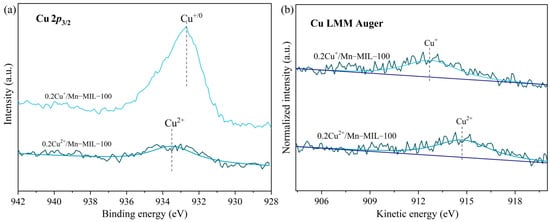
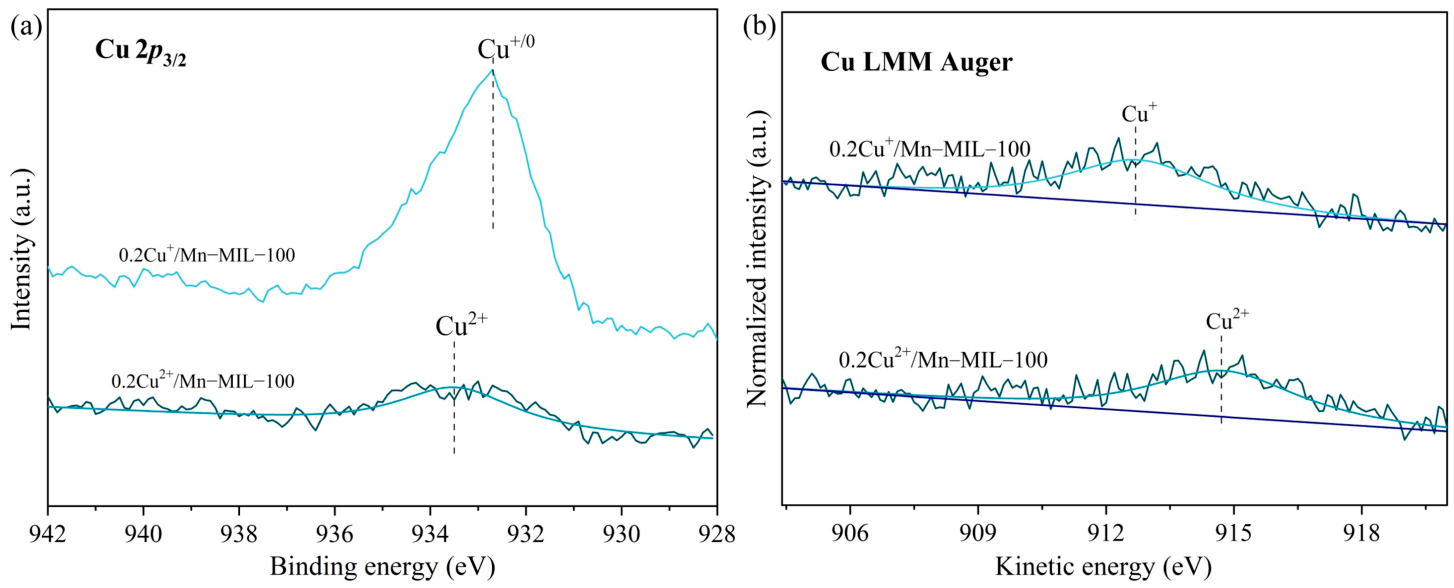
XPS analysis was performed to investigate the valence states of Cu loaded onto XCu+/Mn-MIL-100 catalysts. Figure S3 exhibits high-resolution Cu 2p XPS spectra peaks with binding energies of 934.8 eV and 932.5 eV, which correspond to Cu2+ and Cu+/0, respectively [28]. 0.5Cu+/Mn-MIL-100 showed both Cu2+ and Cu+/0 peaks, suggesting that alone a fraction of the Cu2+ was converted to Cu+/0 during the reduction process, which is in line with the XRD findings. However, for the 0.2Cu+/Mn-MIL-100 sample, no Cu2+ peak was observed, suggesting that most of the Cu element in this sample exist as Cu+/0 (Figure 4a). To determine the co-existing Cu+ and Cu0, the Cu LMM Auger electron spectroscopy (AES) investigation was performed on 0.2Cu2+/Mn-MIL-100 and 0.2Cu+/Mn-MIL-100 (Figure 4b). Comparing 0.2Cu+/Mn-MIL-100 to 0.2Cu2+/Mn-MIL-100, a distinct characteristic peak at KE = 913.2 eV that corresponds to Cu+ was observed [29]. According to this result, most of the Cu2+ in 0.2Cu2+/Mn-MIL-100 was converted to Cu+ after methanol vapor reduction treatment. Moreover, the contents of Cu in XCu+/Mn-MIL-100 were measured by using ICP-MS investigation. The Cu loadings of 0.1Cu+/Mn-MIL-100, 0.2Cu+/Mn-MIL-100, and 0.5Cu+/Mn-MIL-100 were 0.12 wt%, 0.31 wt%, and 0.71 wt%, respectively.
Figure 4.
XPS profiles of Cu 2p3/2 (a) and Auger electron spectroscopy profiles of Cu LMM (b) of 0.2Cu+/Mn-MIL-100 and 0.2Cu2+/Mn-MIL-100.
2.2. Catalytic Performance
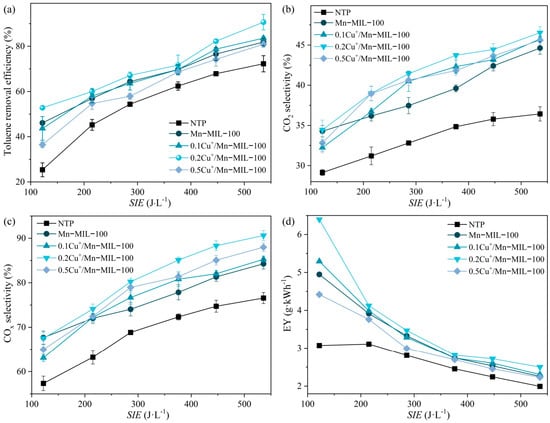
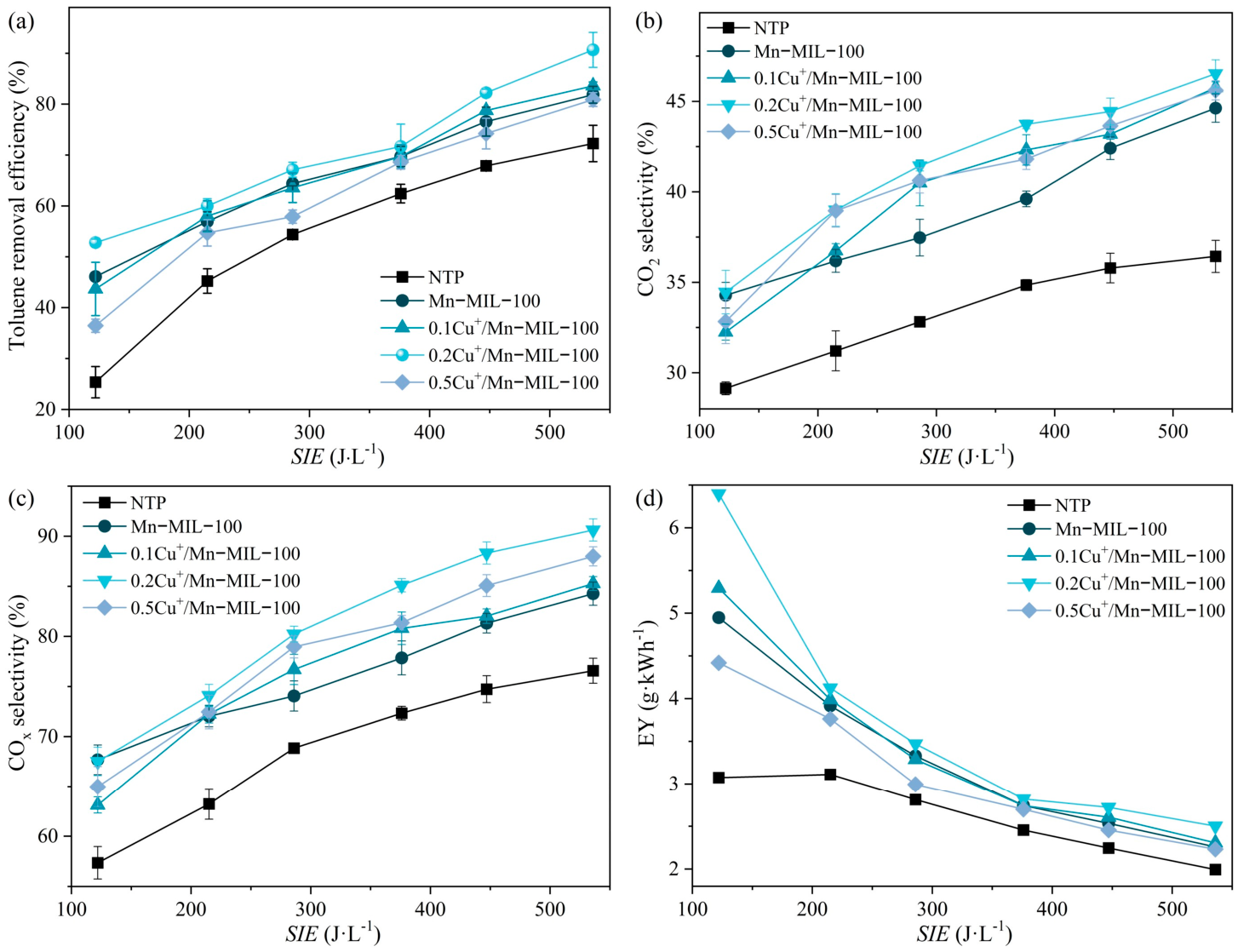
The prepared XCu+/Mn-MIL-100 catalysts were tested for toluene deep degradation by coupling NTP and compared to the degradation achieved by NTP alone (empty tube, no catalyst). Energy density plays a decisive role in the plasma degradation of VOCs. Investigating how energy density affects toluene decomposition efficiency is therefore essential. Figure 5 displays the results demonstrating that energy density affects toluene decomposition. In both the NTP–catalyst synergistic system and the NTP-alone system, the toluene degradation rate and CO2/COx selectivity rose as SIE increased. Specifically, for the NTP-alone system, the toluene removal efficiency (TRE) increased from 25.4% to 72.3% as the SIE rose from 122 J·L−1 to 536 J·L−1 (Figure 5a). The selectivities for CO2 and COx increased from 29.1% to 36.4% and 57.4% to 76.6%, respectively, when the SIE was increased from 122 J·L−1 to 536 J·L−1 (Figure 5b,c). However, the EY decreased from 3.07 to 1.99 g·kWh−1 (Figure 5d). This is because a larger energy density causes more micro-discharges every half-cycle during discharge, which raises the electron density. This heightened electron density generates highly reactive species within the discharge zone. These reactive species collide with and react with toluene molecules, forming intermediate degradation products that accelerate the degradation process. Consequently, the degradation rate of toluene and the CO2/COx selectivity ultimately improve. However, as energy density continues to increase, the rate of improvement in degradation efficiency lags behind the rate of increase in energy density.
Figure 5.
Variation in toluene degradation efficiency (a), CO2 selectivity (b), COx selectivity (c), and energy efficiency (d) with SIE in NTP-alone and NTP-catalyst synergistic systems.
For the NTP-synergistic catalyst system, the synergistic interaction between the catalyst and plasma significantly enhances toluene degradation efficiency. The addition of XCu+/Mn-MIL-100 catalysts substantially increases the toluene degradation rate (at any input energy density). At an SIE of 536 J·L−1, the toluene degradation rate reached 82%, representing an approximately 10% increase compared to the plasma-alone system. Compared to the NTP-alone system, plasma-XCu+/Mn-MIL-100 systems exhibited varying degrees of improvement in toluene degradation rates. As presented in Figure 5a, NTP-0.2Cu+/Mn-MIL-100 displayed the highest efficiency in degrading toluene. A steep rise in the degradation rate was observed, from 52.8% to 90.7%, as the SIE increased from 122 to 536 J·L−1. This performance surpasses that of the NTP-alone system by about 20% and the Mn-MIL-100 by roughly 10%. For the 0.1Cu+/Mn-MIL-100 sample, elevating the SIE from 122 to 536 J·L−1 boosted its toluene degradation rate from 43.7% to 83.6%. The near-superimposable degradation curves of 0.1Cu+/Mn-MIL-100 and Mn-MIL-100 confirm their nearly identical catalytic activity. The low Cu+ loading (0.12 wt%) provided minimal enhancement, resulting in similar toluene degradation activity for 0.1Cu+/Mn-MIL-100 and Mn-MIL-100. Similarly, 0.5Cu+/Mn-MIL-100 showed enhanced toluene degradation over the plasma-alone system, with the rate increasing from 36.5% to 80.9% as the SIE rose from 122 to 536 J·L−1. Nonetheless, its activity remained marginally lower than that of 0.1Cu+/Mn-MIL-100 across almost the entire energy density range. A decline in energy efficiency was observed in both the plasma-alone and NTP–catalyst systems with the rise in energy density. The NTP-alone system saw a drop from 3.07 to 1.99 g·kWh−1 as the SIE increased from 122 to 536 J·L−1. In contrast, the 0.2Cu+/Mn-MIL-100 catalyst exhibited superior performance, achieving the highest energy efficiency. Nevertheless, its efficiency also declined from 6.40 to 2.50 g·kWh−1 over the same energy density range, yet reached a maximum value twice that of the plasma-alone system (Figure 5d).
The selectivities of CO and COx (CO and CO2), the primary products of toluene degradation, are further studied to evaluate the performance of the NTP-catalysis system. With the introduced catalyst, Mn-MIL-100 exhibited promoted selectivity for CO2 and COx, which increased concurrently with SIE. Specifically, as the SIE rose from 122 to 536 J·L−1, the selectivities for CO2 and COx increased from 34.3% to 44.6% and from 67.7% to 84.3%, respectively (Figure 5b,c). Simultaneously, 0.2Cu+/Mn-MIL-100 delivered the highest CO2/COx selectivity, with both values increasing as the SIE rose from 122 to 536 J·L−1, CO2 selectivity from 34.5% to 46.5% and COx selectivity from 67.5% to 90.6%. Under the same conditions, 0.1Cu+/Mn-MIL-100 and 0.5Cu+/Mn-MIL-100 also performed well, with their CO2/COx selectivities rising from 32.2%/63.1% to 45.8%/85.3% and from 32.8%/65.0% to 45.6%/88.0%, respectively. A marked improvement in CO2/COx selectivity was achieved by incorporating Cu+ into the Mn-MIL-100 framework. Although being less effective than Mn-MIL-100 at degrading toluene, 0.5Cu+/Mn-MIL-100 showed noticeably higher CO2/COx selectivity at SIE exceeding 215 J·L−1. This enhancement is attributed to the role of Cu+ sites in mineralizing toluene degradation intermediates and promoting the subsequent oxidation of CO to CO2 [30,31]. A comprehensive assessment of toluene degradation efficiency, CO2/COx selectivity, and energy efficiency reveals the following order of catalytic effectiveness, with the NTP-0.2Cu+/Mn-MIL-100 system being the most effective, followed by NTP-0.1Cu+/Mn-MIL-100, NTP-0.5Cu+/Mn-MIL-100, NTP-Mn-MIL-100, and finally the NTP-alone system. The observed performance enhancement is likely due to the efficient incorporation and subsequent reduction of Cu2+ to Cu+ in the 0.2Cu+/Mn-MIL-100 catalyst. The π-coordination of Cu+ with the MOF promotes toluene adsorption, extending its residence time for a more complete reaction with reactive oxygen species and thus improving degradation efficiency [32,33]. The reactive oxygen species in this system mainly originate from the non-thermal plasma discharge. high-energy electrons generated in the discharge collide with O2 and H2O molecules, producing atomic oxygen (O•), ozone (O3), hydroxyl radicals (OH•), and other excited oxygen species. Compared with reported MOF-based catalysts (Table 1) [8,9,13,34,35,36,37], 0.2Cu+/Mn-MIL-100 shows a favorable balance among toluene removal, COx selectivity, and energy efficiency. It achieves 90.7% toluene removal, 90.6% COx selectivity, and 6.40 g·kW−1·h−1, while inhibiting NOx and O3. For example, although LA-8 and M-BTC(Mn) show higher toluene removal (94.7% and 96.27%), LA-8 has lower COx selectivity (92.4%) and energy efficiency (5.19 g·kW−1·h−1) [13], and M-BTC(Mn) requires a much higher SIE (766.35 J·L−1) with lower CO2 selectivity (53.5%) [35]. Co2Ni3-MOF-74 and MCNO show lower toluene removal (78% and 75.7%) [9]. These results highlight the balanced performance of 0.2Cu+/Mn-MIL-100.
Table 1.
A comparison of toluene decomposition performance with previous works in the literature.
To further clarify the role of the copper reduction stage, the activity of 0.2Cu2+/Mn-MIL-100 was also tested under the same conditions. Its toluene removal efficiency was only 78.6%, with a COx selectivity of 82.1%, both much lower than those of 0.2Cu2+/Mn-MIL-100 (90.7% and 90.6%, respectively) (Figure S4). This confirms that the methanol vapor reduction step is essential for forming the active Cu+ species. Cu+ can form π-complexation with Mn-MIL-100, enhancing adsorption and degradation, whereas Cu2+ lacks this ability and shows poor activity.
The role of Mn in the Mn-MIL-100 framework should also be emphasized. As the metal node, Mn provides redox-active sites, and the Mn3+/Mn4+ redox couple promotes electron transfer and the generation of reactive oxygen species, which are essential for the deep oxidation of toluene to CO2 and COx. The framework also offers abundant adsorption sites. As shown in Figure 5, the NTP + Mn-MIL-100 system improves toluene removal and COx selectivity compared with NTP alone. When Cu+ is loaded, Cu+ forms π-complexation with the Mn-MIL-100 framework, enhancing toluene adsorption, while the Mn sites promote the oxidation of adsorbed toluene. This synergistic effect between Cu+ and Mn sites contributes to the excellent performance of Cu+/Mn-MIL-100.
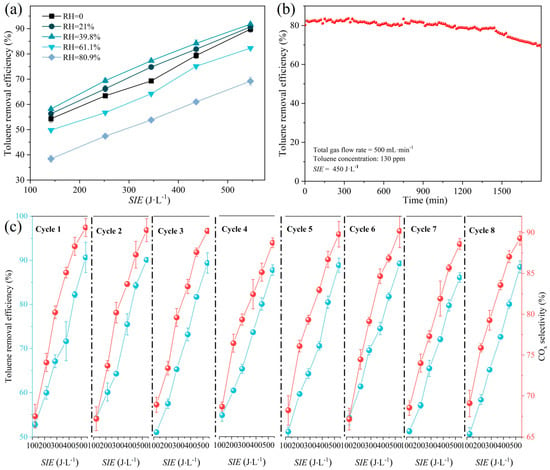
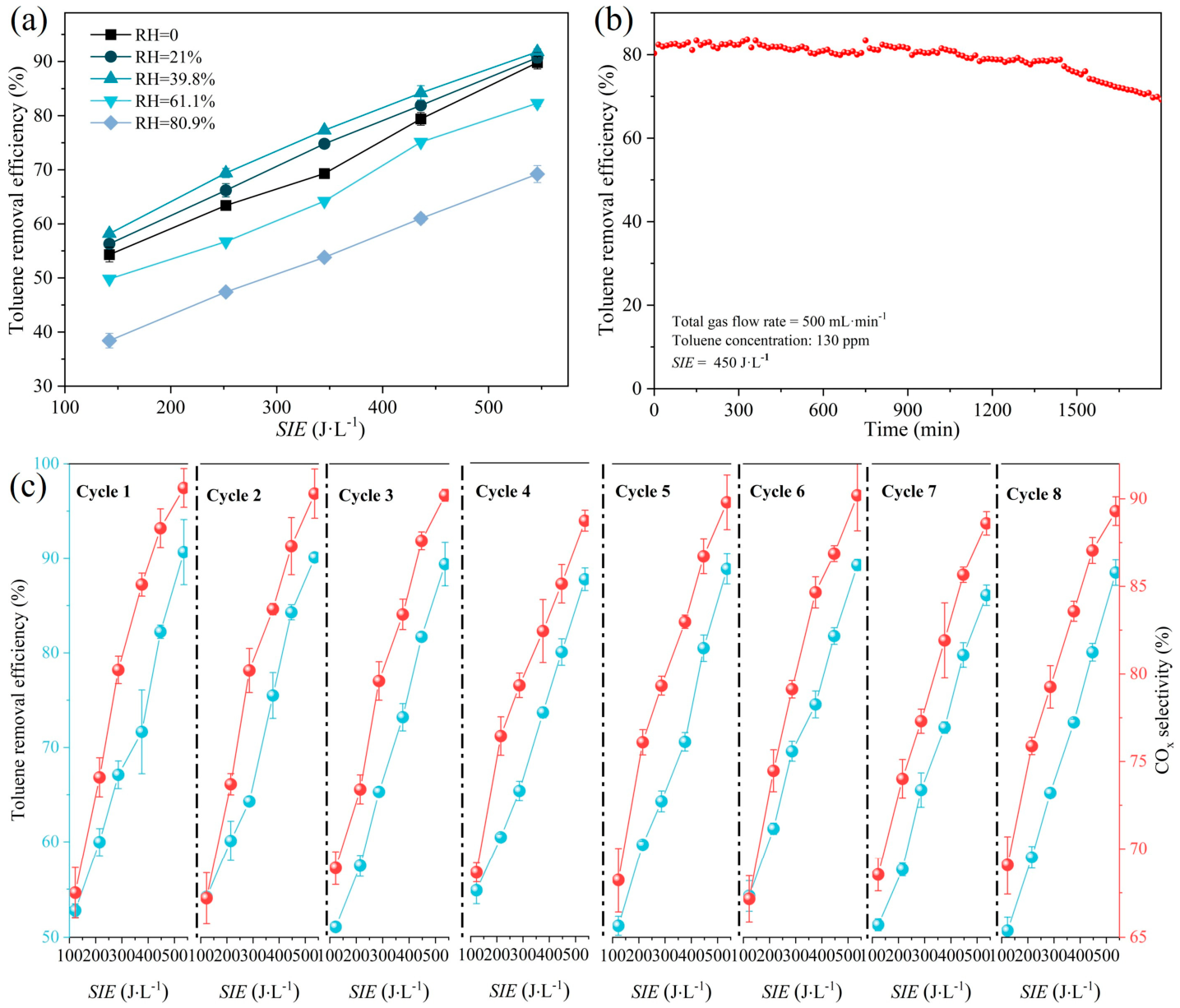
A moisture resistance test was conducted on the 0.2Cu+/Mn-MIL-100 catalyst to assess its performance under severe conditions. The total gas flow rate was maintained at 500 mL·min−1, and the relative humidity of the feed stream was modulated via the steam flow rate. Measurements of toluene degradation rates were performed at preset relative humidity levels of 0%, 21.0%, 39.8%, 61.1%, and 80.9%. As illustrated in Figure 6a, toluene degradation under identical SIE is promoted by increasing relative humidity up to 39.8%, albeit to a limited extent. Notably, at the SIE of 550 J·L−1, the degradation rates converge at approximately 90%, indicating a plateau where further enhancement is negligible. This suggests that the promotional effect of low water vapor concentrations diminishes once degradation approaches its ceiling. In contrast, a further increase in relative humidity to 80.9% severely inhibits degradation across all energy densities. This suppression is most pronounced at 546 J·L−1, with the degradation rate plummeting from 89.8% (at 0% RH) to 69.2%, marking a reduction of over 20%. As established in the previous literature, trace water vapor synergizes with plasma discharge to generate reactive species like hydroxyl radicals (•OH), which promote the complete oxidation of toluene [38]. However, elevated humidity rapidly quenches high-energy electrons. This inefficient energy dissipation, combined with the adsorption of excess water on the dielectric surface, increases its conductivity and dielectric constant. Consequently, both the discharge current and the population of high-energy electrons diminish significantly, leading to a marked decline in toluene degradation efficiency.
Figure 6.
Moisture resistance test (a), stability test (b) and cyclic performance test (c) of 0.2Cu+/Mn-MIL-100 synergistic plasma–catalyst for toluene degradation.
A 30 h stability test for toluene degradation was performed over 0.2Cu+/Mn-MIL-100 under continuous flow (450 J·L−1, 130 ppm, 500 mL·min−1). The toluene concentration at the reactor outlet was monitored at 15 min intervals, as summarized in Figure 6b. The results revealed that during the initial 24 h, the toluene degradation rate remained highly stable, fluctuating only slightly between 79% and 82%, and averaging around 80%. This indicates the outstanding stability of the 0.2Cu+/Mn-MIL-100 sample in toluene degradation over a period exceeding 20 h. In the subsequent 6 h, however, the degradation rate gradually declined, dropping below 70% by the 30 h mark, though the sample still retained notable catalytic activity. These findings confirm that the 0.2Cu+/Mn-MIL-100 sample possesses excellent stability in synergistically promoting plasma-assisted toluene degradation at low temperatures, maintaining high performance with virtually no loss of efficiency throughout the 20 h test duration. Although the catalyst maintained high stability during the first 20 h, the decline after 24 h was investigated by post-reaction XPS (Figures S5 and S6). The results show that part of the Cu+ was oxidized to Cu2+ during the long-term reaction. This oxidation weakens the π-complexation between Cu+ and Mn-MIL-100, reducing toluene adsorption and leading to the gradual drop in removal efficiency. The accumulation of carbonaceous deposits and the competitive adsorption of by-products may also contribute to this decline. These findings indicate that stabilizing Cu+ species is essential for long-term performance, and future work will focus on regeneration strategies. Moreover, the FE-SEM images (Figure S7) of the spent 0.2Cu+/Mn-MIL-100 show that the overall morphology was largely preserved, but a slight increase in particle size was observed, indicating minor particle growth or partial agglomeration during prolonged reaction.
The reusability of 0.2Cu+/Mn-MIL-100 was evaluated over eight consecutive cycles under identical conditions. As shown in Figure 6c, at the SIE of 536 J·L−1, the toluene removal efficiency decreased only slightly from 90.7% in the first cycle to 88.5% after eight cycles, while the COx selectivity decreased from 90.6% to 89.3%. The slight decline is mainly due to the partial oxidation of Cu+ to Cu2+, as confirmed by post-reaction XPS, and to minor particle growth observed by FE-SEM. Nevertheless, the catalyst still maintained high activity and selectivity after eight cycles, indicating excellent reusability and stability for practical applications.
2.3. By-Product Analysis
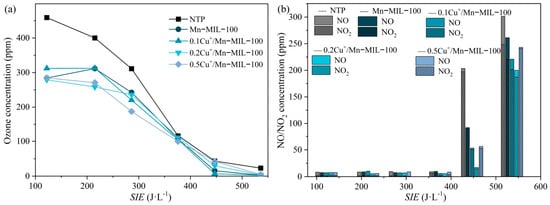
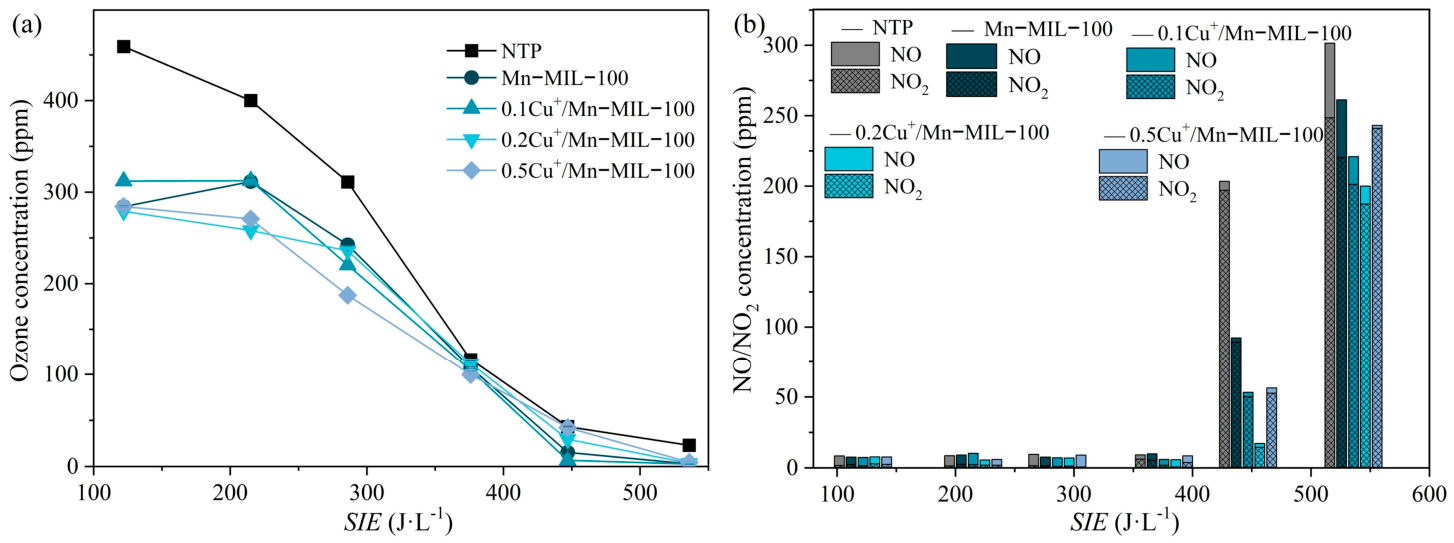
Ozone (O3), a common By-Product of plasma discharge, shows a negative correlation with the SIE. As illustrated in Figure 7a, the O3 concentration in a plasma-alone system decreases progressively as the energy density rises. Increasing the energy density from 122 to 536 J·L−1 causes the O3 concentration to plummet from 460 ppm to just 23 ppm. This trend aligns with the two-step formation mechanism outlined in the previous literature [39,40], which involves the generation and subsequent consumption of reactive oxygen species. The specific mechanism of O3 formation is described by Equations (1)–(3).
Figure 7.
Generation of ozone (a) and NOx (b) with SIE during toluene degradation.
O(1D) and O(3P) represent the excited and ground states of oxygen atoms, respectively. M denotes a third-body collision partner, such as N2, O2, or H2O, which is abundant in the plasma discharge. M helps to conserve energy and momentum during the reaction but does not participate in the chemical transformation itself. Therefore, it remains unchanged on both sides of the equation.
A significant suppression of O3 concentration was observed in the plasma–catalyst synergistic system relative to plasma alone. This suppressing effect was most notable at lower SIE (<300 J·L−1). At higher SIE levels (>300 J·L−1), the O3 concentration decreased to amounts approaching the detection limit. Although the relative reduction compared to the plasma-alone benchmark was comparable in this high-energy regime, this is because the absolute O3 yield from the plasma-alone system was already substantially low at 500 J·L−1, thereby limiting the absolute removal margin. This confirms the superior O3 suppression capability of various plasma–catalyst systems. Consistent with the literature [23,41], the decomposition of O3 in these systems can be attributed to thermal decomposition, chemical reaction consumption, and catalytic decomposition, as formulated in Equations (4)–(6).
* represents the active site of catalysts.
O3 + * → O* + O2
O3 + O* → O2 * + O2
O2* → O2 + *
In plasma-assisted catalyst systems, O3 produced during plasma discharge is initially adsorbed onto the catalytic active sites, where it decomposes into oxygen molecules and reactive oxygen atoms. These oxygen atoms then react with gas-phase O3 to form adsorbed peroxo intermediates, which subsequently desorb from the surface as free oxygen. Throughout this cycle, the catalyst actively facilitates the adsorption, decomposition, and desorption of O3, effectively creating a dynamic process of O3 consumption and regeneration at the active sites. This mechanism is key to suppressing O3 accumulation in the system. Consequently, the presence of the catalyst significantly reduces net O3 emission, as it continuously promotes O3 decomposition while supporting efficient toluene oxidation—evidenced by the high toluene degradation rate, which reflects the effective utilization of O3 in the reaction process.
The formation of nitrogen oxides (NOx) is an inherent consequence of plasma discharge, where reactive nitrogen and oxygen species generated during the process initiate excitation reactions that lead to NOx production [42]. As previously noted, both the speciation and concentration of NOx are strongly influenced by reactor conditions, including system configuration, input energy density, and gas-phase humidity [43]. In standalone plasma configurations, NOx emissions (mainly NO and NO2) remain low at SIE below 376 J·L−1. However, beyond this threshold, NOx levels increase significantly, with NO2 exhibiting a pronounced surge above 200 ppm. For instance, raising the SIE from 122 J·L−1 to 536 J·L−1 caused total NOx to rise from 8.4 ppm to 301.5 ppm, while NO2 concentrations increased sharply from 1.6 ppm to 248.5 ppm (Figure 7b). These results clearly establish SIE as the primary factor controlling NO2/NOx formation. At lower energy inputs, NOx output remains minimal, whereas higher SIE values trigger a rapid escalation in emissions.
In contrast to NTP-alone systems, the integration of catalysts in NTP–catalyst synergy significantly suppresses NOx formation during reaction. When the SIE was increased from 122 J·L−1 to 536 J·L−1, the Mn-MIL-100 sample exhibited a sharp rise in NO2 and NOx concentrations, from 1.9 ppm to 219.8 ppm and from 7.1 ppm to 260.8 ppm, respectively. By comparison, Cu+-doped catalysts displayed markedly inhibited NO2/NOx generation. Among them, 0.2Cu+/Mn-MIL-100 maintained low NO2 and NOx outputs—reaching only 14.0 ppm and 16.7 ppm, respectively—up to an SIE of 447 J·L−1. This enhanced suppression is ascribed to the incorporation of Cu+, which facilitates the rapid oxidation of NOx.
2.4. Reaction Mechanism Investigation
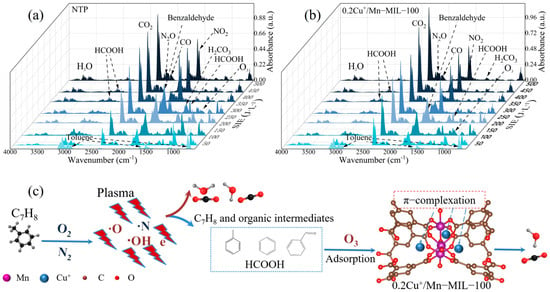
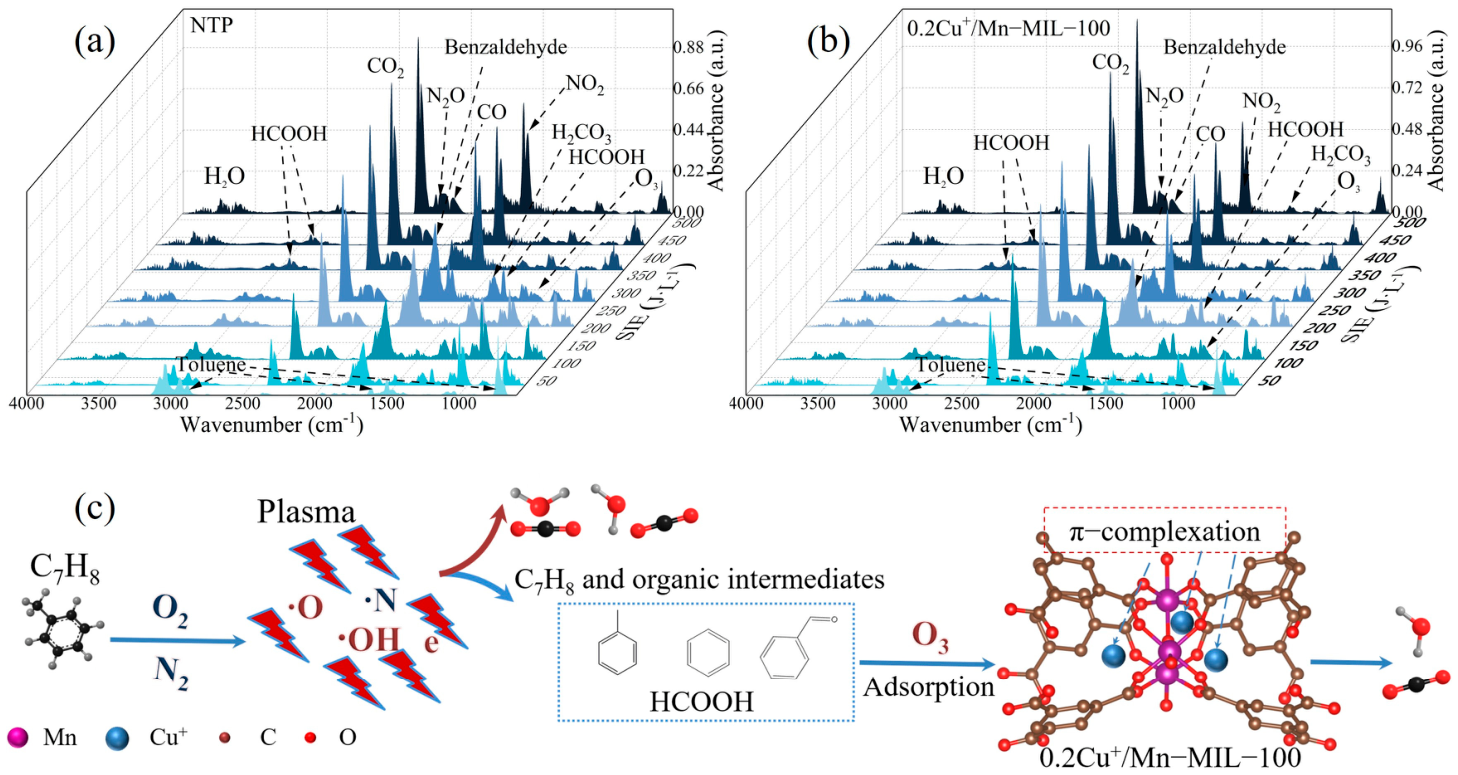
In situ FTIR spectroscopy was used to track the evolution of gaseous intermediates and products during toluene degradation in NTP and NTP-catalysis systems, thereby providing mechanistic insights into the performance enhancement. As presented in Figure 8, prior to discharge initiation (SIE = 0 J·L−1), the spectrum exhibited characteristic toluene bands at 3100–2800 cm−1 (C–H stretch), 1500 cm−1 (aromatic C=C stretch), 1010 cm−1 (aromatic iN-plane C–H bend), and 740 cm−1 (aromatic out-of-plane C–H bend). The evolution of the FTIR spectrum with increasing SIE in the NTP-alone system (Figure 8a) reveals the formation of new species. Beyond the water vapor band (3700–3500 cm−1), the emergence of peaks at 2938, 2880, 1732, and 1243 cm−1 indicates the presence of formic acid (HCOOH) [11]. The detection of N2O, CO, and NO2 is provided by their characteristic absorption doublets at 2238/2205, 2176/2106, and 1628/1600 cm−1, respectively [11]. Additional products, including benzaldehyde (1735 cm−1) and carbonic acid (1350 cm−1), were also identified [12,44]. A notable trend observed was the progressive intensification of the CO2 doublet (2360 and 2342 cm−1), which stands in direct contrast to the diminishing bands of O3 (1055 and 1035 cm−1), highlighting an inverse correlation between their concentrations under increasing SIE. The wavenumbers, along with their associated intermediates and products, are summarized in Table 2 [12,44,45,46,47,48,49]. Comparative in situ FTIR analysis of the NTP-catalysis system’s exhaust stream (Figure 8b and Figure S8) revealed analogous spectral bands, corroborating the presence of similar by-products and a shared toluene degradation pathway to CO2 in the plasma reactor coupled with XCu+/Mn-MIL-100 samples. The introduction of the 0.2Cu+/Mn-MIL-100 catalyst significantly suppressed the signal intensity of major gaseous by-products (e.g., NO2, O3). The suppression effect arises from π-complexation between Cu+ and Mn-MIL-100, promoting the decomposition of O3 into reactive oxygen species. The subsequent generation of these oxidative species accelerates the degradation of both toluene and its intermediates.
Figure 8.
In situ FTIR of the effluents of toluene degradation by NTP (a) and NTP+0.2Cu+/Mn-MIL-100 (b) at different specific input energies, and post-plasma–catalytic reaction mechanism over 0.2Cu+/Mn-MIL-100 (c).
Table 2.
A summary of the compounds detected in the plasma exhaust stream.
Combined with the catalyst characterizations, catalytic performance results, in situ FTIR results, and previous studies [4,8,50], a reasonable two-step reaction mechanism for toluene degradation to CO2 and H2O in the NTP-coupled 0.2Cu+/Mn-MIL-100 system is proposed (Figure 8c). In the first step, high-energy electrons, charged ions, free radicals, and photons generated by the plasma discharge directly attack C7H8, degrading part of the toluene into organic intermediates, CO2, and H2O. In the second step, the remaining toluene and organic intermediates are strongly adsorbed on the surface of 0.2Cu+/Mn-MIL-100 through the π-complexation between Cu+ ions and the Mn-MIL-100 framework. These adsorbed species are then deeply oxidized to CO2 and H2O by surface active oxygen species. Specifically, O3 is decomposed over the Mn3+/Mn4+ redox sites of Mn-MIL-100 to generate surface atomic oxygen (O*), which serves as the primary active oxygen species, while plasma-generated reactive oxygen species such as O•, OH•, and O2− also participate in the oxidation. The synergistic effect of Cu+ sites (enhanced adsorption via π-complexation) and Mn sites (reactive oxygen species generation and oxidation) promotes the complete oxidation of toluene and its intermediates, resulting in high toluene removal efficiency, high COx selectivity, and suppressed formation of by-products such as NOx and O3.
3. Experimental Section
3.1. Synthesis of Mn-MIL-100
Based on our previous work [13], Mn-MIL-100 was synthesized by hydrothermal reaction. Typically, 0.84 g of trimesic acid (H3BTC) was placed into a beaker containing 50 mL of anhydrous ethanol and stirred continuously until the powder was completely dissolved in the ethanol to obtain a H3BTC ethanol solution. Subsequently, a pipette was used to measure 1 mL of manganese nitrate solution (50 wt.% Mn(NO3)2) and add it dropwise to the obtained H3BTC ethanol solution while stirring continuously to mix thoroughly. Once the solutions were thoroughly mixed, the resulting mixture was transferred into a TefloN-lined autoclave and maintained at 125 °C for 2 h. After the reactor cooled to room temperature, the resulting precipitate was collected by centrifugation, washed with anhydrous ethanol three times, left to dry at 60 °C overnight, and vacuuM-activated at 100 °C to obtain Mn-MIL-100, a brown powder.
3.2. Synthesis of XCu+/Mn-MIL-100 Samples
In total, 200 mg of the Mn-MIL-100 powder was placed in a 150 mL round-bottom flask. Afterwards, 40 mL of N-hexane (C6H14) was added to the flask and sonicated for 40 min to uniformly disperse the Mn-MIL-100 and N-hexane solution, and stirred continuously for 0.5 h at 600 rpm. Next, 200 μL of copper nitrate solutions with various concentrations (0.1, 0.2, and 0.5 mol·L−1) were injected dropwise into the above solution. The resulting mixture was stirred continuously. After 4 h, the mixture was filtered and washed several times with ethanol to obtain a brown powder. The resulting powder was placed in a vacuum drying oven, dried overnight at 60 °C, and vacuuM-activated at 100 °C for 2 h to obtain Cu2+/Mn-MIL-100. In total, 0.2 g of the Cu2+/Mn-MIL-100 powder prepared above was placed on the platform within a Teflon reactor (as shown in Figure S9). Then, 10 mL of anhydrous methanol was added to the bottom of the reactor and reacted at 150 °C for 6 h. After the reactor cooled, the reduced powder was transferred and placed in a vacuum drying oven at 100 °C overnight to obtain Cu+/Mn-MIL-100. The synthesized Cu+/Mn-MIL-100 samples with Cu loading the theoretical calculated value of 0, 0.1, 0.2 and 0.5 mmol·g−1 were respectively denoted as Mn-MIL-100, 0.1Cu+/Mn-MIL-100, 0.2Cu+/Mn-MIL-100 and 0.5Cu+/Mn-MIL-100.
3.3. Catalyst Characterizations
The catalysts were studied using X-ray diffraction (XRD), field emission scanning electron microscopy (FE-SEM), transmission electron microscopy (TEM), X-ray photoelectron spectroscopy (XPS), Raman spectra, and Fourier transform infrared (FTIR). These characterization methods are described in detail in the Supplementary Materials.
3.4. Catalytic Activity
Catalytic activity was determined using a fixed-bed flow reactor with a cylindrical dielectric barrier discharge (DBD) plasma. Generally, a coaxial geometry quartz reaction tube (8 mm ID, 10 mm OD, and 285 mm length) with a high-voltage electrode (tungsten copper; 2 mm diameter and 200 mm length) and a grounded electrode (80 mesh copper wire net to form a 40 mm length plasma discharge zone) had its downstream section filled with 200 mg of prepared catalyst (40–60 mesh). The plasma was powered by a high-voltage alternating current (AC) power supply (CTP-2000K, Nanjin Suman, Nanjing, China) running at a frequency of 5–20 kHz. With the oscilloscope (TDS 2012 C, Tektronix, Beaverton, OR, USA), the applied voltage and current were measured. The discharge power of the BDB reactor was determined using the V-Q Lissajous method, and the specific input energy (SIE) of the discharge was computed using Equation (7):
P denotes DBD power, while Q denotes gas flow rate.
To control the initial concentration of toluene, the flow rate of pure nitrogen was fixed at approximately 130 ppm during the activity test. A 500 mL buffer chamber was used to mix the blow-off gas and carrier air (N2/O2 = 4:1). Mass flow controllers (MFCs) were used to control the total gas flow rate, which was set to 400 mL·min−1. Toluene, CO, and CO2 concentrations were determined using a gas chromatograph (GC9890 A, Shanghai Linghua, Shanghai, China). The NOx concentrations were measured using a NOx monitor (JNYQ-1-41, Xi’an, Shaanxi Province, China), and the O3 concentration was detected using an O3 detector (Model 106-M, 2B Technology, Boulder, CO, USA). An online Fourier transform infrared spectrometer (Bruker, Billerica, MA, USA) was used to monitor the gas composition at the DBD reactor’s outflow.
The average of three repeated measurements was used to compute all experimental results. The following definitions were used for the toluene degradation efficiency (ηtoluene), CO2 and COx selectivities ( and ), and energy yield (EY):
The initial and final concentrations of toluene are denoted by [C7H8]in and [C7H8]out, respectively; [CO2] and [CO] are the concentrations of CO2 and CO at the exit of the NTP-catalysis system, respectively; Mtoluene = 92 g·mol−1; Vm = 22.4 L·mol−1.
4. Conclusions
In this work, a series of XCu+/Mn-MIL-100 samples with different loadings and Cu ion valence states were successfully prepared using a dual-solvent method and a methanol vapor reduction method. Compared with the NTP-alone process, toluene activity tests showed that the Cu+/Mn-MIL-100 samples, in conjunction with low-temperature plasma, achieved excellent results in toluene degradation, improving the degradation rate, CO2/COx selectivity, and energy efficiency, while also inhibiting the generation of by-products such as NOx and O3. The highest degradation efficiency obtained with the 0.2Cu+/Mn-MIL-100 catalyst can reach up to 90.7% with a COx selectivity of 90.6%. Characterization results indicated that the Cu+/Mn-MIL-100 samples were successfully loaded with Cu+, and the π-complexation between Cu+ ions and MOF materials promoted toluene degradation. The present results will provide a new approach for developing functionalized MOFs for the next generation of plasma–catalysts as well as potential uses in other technological systems. In summary, this study provides a new strategy for stabilizing Cu+ ions in Mn-MIL-100 and constructing efficient Cu+/Mn-MIL-100 catalysts for plasma–catalytic toluene degradation. The main advantages are the successful stabilization of Cu+ ions, the enhanced toluene degradation efficiency and CO2/COx selectivity, the inhibition of NOx and O3, the revealed π-complexation effect, and the verified effects of humidity and long-term stability. The main limitations are that only toluene was tested as the target pollutant, scale-up and practical application validation were not performed, and the dynamic surface reaction pathways and intermediate evolution still need further investigation using in situ techniques. These limitations provide directions for future research.
Supplementary Materials
The following supporting information can be downloaded at https://www.mdpi.com/article/10.3390/catal16100900/s1, Catalyst characterizations; Figure S1: FTIR spectra of XCu2+/Mn-MIL-100; Figure S2: FE-SEM images of Mn-MIL-100 (a), 0.1Cu+/Mn-MIL-100 (b), 0.2Cu+/Mn-MIL-100 (c) and 0.5Cu+/Mn-MIL-100 (d).; Figure S3: Cu 2p3/2 XPS spectra of XCu+/Mn-MIL-100; Figure S4: Toluene removal efficiency and COx selectivity of 0.2Cu2+/Mn-MIL-100; Figure S5: Cu 2p3/2 XPS spectra of spent 0.2Cu+/Mn-MIL-100 and spent 0.5Cu+/Mn-MIL-100; Figure S6: Auger electron spectroscopy profiles of Cu LMM of spent 0.2Cu+/Mn-MIL-100 and spent 0.5Cu+/Mn-MIL-100; Figure S7: FE-SEM image of spent 0.2Cu+/Mn-MIL-100; Figure S8: In situ FTIR of the effluents of toluene degradation by NTP+Mn-MIL-100 (a), NTP+0.5Cu+/Mn-MIL-100 (b) and NTP+0.1Cu+/Mn-MIL-100 (c) at different specific input; Figure S9: A schematic illustration of the XCu2+/Mn-MIL-100 reduction treatment with methanol.
Author Contributions
Writing—original draft, C.C. and H.W.; methodology, C.C.; validation, L.Z. and Z.J.; investigation, X.L.; data curation, Z.J. and H.W.; writing—review and editing, C.C. and C.H.; supervision, M.M. and C.H.; funding acquisition, C.C. All authors have read and agreed to the published version of the manuscript.
Funding
This research was funded by the National Natural Science Foundation of China and the Shaanxi Province Postdoctoral Foundation, grant number 22506154 and 2023BSHEDZZ305.
Data Availability Statement
Data is available on request.
Conflicts of Interest
The authors declare no conflicts of interest.
References
- Petrović, M.; Jovanović, T.; Rančev, S.; Kovač, J.; Velinov, N.; Najdanović, S.; Kostić, M.; Bojić, A. Plasma modified electrosynthesized cerium oxide catalyst for plasma and photocatalytic degradation of RB 19 dye. J. Environ. Chem. Eng. 2022, 10, 107931. [Google Scholar] [CrossRef] [Scilit]
- Petrović, M.; Kostić, M.; Rančev, S.; Radivojević, D.; Vučić, M.R.; Hurt, A.; Bojić, A. Co-doped ZnO catalyst for non-thermal atmospheric pressure pulsating corona plasma degradation of reactive dye. Mater. Chem. Phys. 2024, 325, 129733. [Google Scholar] [CrossRef] [Scilit]
- Gao, X.; Deng, Y.; Weia, Z.G.; Li, Z.; Peng, N.; Li, X.; Li, L.; Jiang, L.; Qiu, S.; Zhao, D.; et al. Catalytic oxidation of volatile organic compounds by plasma-metal oxide coupling. J. Environ. Chem. Eng. 2025, 13, 116045. [Google Scholar] [CrossRef] [Scilit]
- Chen, C.; Liu, X.; Ma, M.; Tian, M.; Zhao, Y.; Jian, Y.; Yu, Y.; Zhang, H.; He, C. High-efficiency toluene degradation over Co@N-doped hollow carbon by plasma catalysis: O3-induced bifunctional sites and synergy. Appl. Catal. B Environ. Energy 2025, 369, 125156. [Google Scholar] [CrossRef] [Scilit]
- Zhou, A.; Zheng, H.; Zhao, K.; Lian, H.; Wang, C. A review of VOCs removal by cycled storage discharge plasma catalysis: Catalysts design, operation parameters, and applications. J. Environ. Chem. Eng. 2026, 14, 121260. [Google Scholar] [CrossRef] [Scilit]
- Xu, X.; Wang, P.; Xu, W.; Wu, J.; Chen, L.; Fu, M.; Ye, D. Plasma-catalysis of metal loaded SBA-15 for toluene removal: Comparison of continuously introduced and adsorption-discharge plasma system. Chem. Eng. J. 2016, 283, 276–284. [Google Scholar] [CrossRef] [Scilit]
- Yen, Y.; Wu, J.; Zhang, X.; Bai, Y.; Huang, C.-W.; Nguyen, V.-H. Degradation of chlorinated volatile organic compounds in waste gas by catalytic plasma system. J. Environ. Chem. Eng. 2024, 12, 112678. [Google Scholar] [CrossRef] [Scilit]
- Chen, C.; Kosari, M.; He, C.; Ma, M.; Tian, M.; Jiang, Z.; Albilali, R. Realizing toluene deep mineralization by coupling nonthermal plasma and nitrogen-enriched hollow hybrid carbon. ACS Appl. Mater. Interfaces 2022, 14, 990–1001. [Google Scholar] [CrossRef] [Scilit]
- Feng, X.; Chen, C.; He, C.; Chai, S.; Yu, Y.; Cheng, J. Non-thermal plasma coupled with MOF-74 derived Mn-Co-Ni-O porous composite oxide for toluene efficient degradation. J. Hazard. Mater. 2020, 383, 121143. [Google Scholar] [CrossRef] [Scilit]
- Kim, W.-K.; Maitlo, H.A.; Ha, S.-H.; Kim, K.-H. Leveraging coordination chemistry for next-generation catalytic adsorbents: Mechanisms, materials, and metrics for VOC control. Coord. Chem. Rev. 2026, 561, 217922. [Google Scholar] [CrossRef] [Scilit]
- Ahmed, I.; Jhung, S.H. Adsorptive denitrogenation of model fuel with CuCl-loaded metal–organic frameworks (MOFs). Chem. Eng. J. 2014, 251, 35–42. [Google Scholar] [CrossRef] [Scilit]
- Chang, G.; Bao, Z.; Ren, Q.; Deng, S.; Zhang, Z.; Su, B.; Xing, H.; Yang, Y. Fabrication of cuprous nanoparticles in MIL-101: An efficient adsorbent for the separation of olefin–paraffin mixtures. RSC Adv. 2014, 4, 20230–20233. [Google Scholar] [CrossRef] [Scilit]
- Huang, H.; Chen, C.; Yang, R.; Yu, Y.; Albilali, R.; He, C. Remarkable promotion effect of lauric acid on Mn-MIL-100 for non-thermal plasma-catalytic decomposition of toluene. Appl. Surf. Sci. 2020, 503, 144290. [Google Scholar] [CrossRef] [Scilit]
- Le, V.N.; Vo, T.K.; Lee, J.H.; Kim, J.C.; Kim, T.-H.; Oh, K.H.; Bae, Y.-S.; Kwak, S.K.; Kim, J. A novel approach to prepare Cu(I)Zn@MIL-100(Fe) adsorbent with high CO adsorption capacity, CO/CO2 selectivity and stability via controlled host-guest redox reaction. Chem. Eng. J. 2021, 404, 126492. [Google Scholar] [CrossRef] [Scilit]
- Vo, T.K.; Hau, D.C.; Nguyen, V.C.; Quang, D.T.; Kim, J. Double-solvent-assisted synthesis of bimetallic CuFe-incorporated MIL-101(Cr) for improved CO-adsorption performance and oxygen-resistant stability. Appl. Surf. Sci. 2021, 546, 149087. [Google Scholar] [CrossRef] [Scilit]
- He, Q.-X.; Jiang, Y.; Tan, P.; Liu, X.-Q.; Qin, J.-X.; Sun, L.-B. Controlled construction of supported Cu+ sites and their stabilization in MIL-100(Fe): Efficient adsorbents for benzothiophene capture. ACS Appl. Mater. Interfaces 2017, 9, 29445–29450. [Google Scholar] [CrossRef] [Scilit]
- Chen, C.; Kosari, M.; Jiang, Z.; Xi, S.; Xia, L.; Shao, Y.; He, C.; Zeng, H.C. Boosting CO2 hydrogenation to methanol via enriching the Cu-ZnO interface on layered double oxides. Small 2025, 21, 2412786. [Google Scholar] [CrossRef] [Scilit]
- Horcajada, P.; Surblé, S.; Serre, C.; Hong, D.-Y.; Seo, Y.K.; Chang, J.-S.; Grenèche, J.-M.; Margiolaki, I.; Férey, G. Synthesis and catalytic properties of MIL-100(Fe), an iron(III) carboxylate with large pores. Chem. Commun. 2007, 27, 2820–2822. [Google Scholar] [CrossRef] [Scilit]
- Solis-Salazar, L.D.; Pineda-Urbina, K.; Aguayo-Villarreal, I.A.; Rojas-Mayorga, C.K.; Muniz-Valencia, R.; Davila Guzman, N.E.; Bonilla-Petriciolet, A. Microwave-assisted synthesis of MIL-100(Al and Fe) for fluoride remediation: A dual experimental–computational approach. J. Solid State Chem. 2026, 356, 125804. [Google Scholar] [CrossRef] [Scilit]
- Reinsch, H.; Stock, N. Formation and characterisation of Mn-MIL-100. CrystEngComm 2013, 15, 544–550. [Google Scholar] [CrossRef] [Scilit]
- Chen, C.; Kosari, M.; Xi, S.; Lim, A.M.H.; He, C.; Zeng, H.Z. Optimizing the interfacial environment of triphasic ZnO-Cu-ZrO2 confined inside mesoporous silica spheres for enhancing CO2 hydrogenation to methanol. ACS EST Eng. 2023, 3, 638–650. [Google Scholar] [CrossRef] [Scilit]
- Rogge, S.M.J.; Bavykina, A.; Hajek, J.; Garcia, H.; Olivos-Suarez, A.I.; Sepúlveda-Escribano, A.; Vimont, A.; Clet, G.; Bazin, P.; Kapteijn, F.; et al. Metal-organic and covalent organic frameworks as single-site catalysts. Chem. Soc. Rev. 2017, 46, 3134–3184. [Google Scholar] [CrossRef] [Scilit]
- Bobbitt, N.S.; Mendonca, M.L.; Howarth, A.J.; Islamoglu, T.; Hupp, J.T.; Farha, O.K.; Snurr, R.Q. Metal-organic frameworks for the removal of toxic industrial chemicals and chemical warfare agents. Chem. Soc. Rev. 2017, 46, 3357–3385. [Google Scholar] [CrossRef] [Scilit]
- Li, X.; Li, S.; Zhang, J.; Zhu, H.; Zhao, J. Hierarchically porous wood/CuBTC/GO composites for efficient and selective CO2 capture. Wood Sci. Technol. 2026, 60, 26. [Google Scholar] [CrossRef] [Scilit]
- Cheng, Y.; Feng, T.; Ouyang, S.; Feng, Y.; Zhang, Y.; Luo, J.; Xu, Y.; Lian, Z.; Zhou, X. Green synthesis of ferulic acid-grafted xylooligosaccharides with enhanced antioxidant and anti-inflammatory activities. Int. J. Biol. Macromol. 2026, 362, 152144. [Google Scholar] [CrossRef] [Scilit]
- Lv, H.; Zhao, H.; Cao, T.; Qian, L.; Wang, Y.; Zhao, G. Efficient degradation of high concentration azo-dye wastewater by heterogeneous Fenton process with iron-based metal-organic framework. J. Mol. Catal. A Chem. 2015, 400, 81–89. [Google Scholar] [CrossRef] [Scilit]
- Wang, Y.; Yuan, L.; Hu, Z.; Ban, Y.; Yang, W. Synergistic multiscale design of metal-organic framework membrane via biomineralization-inspired templating for high-efficiency azeotrope separation. J. Am. Chem. Soc. 2026, 148, 6583–6590. [Google Scholar] [CrossRef] [Scilit]
- Zhang, D.F.; Wang, B.Q.; Gong, X.B.; Yang, Z.; Liu, Y. Selective reduction of nitrate to nitrogen gas by novel Cu2O-Cu0@Fe0 composite combined with HCOOH under UV radiation. Chem. Eng. J. 2019, 359, 1195–1204. [Google Scholar] [CrossRef] [Scilit]
- Dimitriy, V.; James, T.; Ivan, O.; Zhang, F.; Palomino, R.M.; Xu, W.; Harper, L.; Khatib, S.J.; Rodriguez, J.A.; Senanayake, S.D. Location and chemical speciation of Cu in ZSM-5 during the water–gas shift reaction. Catal. Today 2019, 323, 216–224. [Google Scholar] [CrossRef] [Scilit]
- He, K.; Zeng, S. Mutual effects of CO and benzene oxidation over Cu catalysts: The role of surface oxygen species and reaction pathways. Appl. Surf. Sci. 2024, 678, 161101. [Google Scholar] [CrossRef] [Scilit]
- Wang, Y.; Wu, K.; Xu, Y.; Zheng, Y.; Huang, F. Effect of silica on generation and stability of Cu+ cations in CuO/CeO2 catalysts for CO oxidation in H2-rich atmosphere. Int. J. Hydrog. Energy 2024, 53, 1065–1075. [Google Scholar] [CrossRef] [Scilit]
- Xue, Y.-Y.; Lei, J.; Lv, H.-J.; Liang, P.; Li, L.; Zhai, Q.-G. Spatially confined π-complexation within pore-space-partitioned metal-organic frameworks for enhanced light hydrocarbon separation and purification. Small 2024, 20, 2311555. [Google Scholar] [CrossRef] [Scilit]
- Ning, Y.; Zhao, B.; Min, W.; Li, X.; Yang, K.; Wang, H.; Zhang, Y. Confinement of monovalent metal ions within Co-doped MOF-5 for significantly enhanced ethylene dimerization. Surf. Interfaces 2026, 86, 108799. [Google Scholar] [CrossRef] [Scilit]
- Gromova, A.; Giraudon, J.-M.; Leus, K.; Nilkar, M.; Gromov, M.; Voort, P.V.D.; Leys, C.; Lamonier, J.-F.; Geyter, N.D.; Morent, R. Post-plasma catalysis for toluene abatement using Mn, Cu, and MnCu oxide on a hydroxyapatite support. J. Environ. Chem. Eng. 2026, 14, 122173. [Google Scholar] [CrossRef] [Scilit]
- Zang, X.; Wang, Q.; Sun, H.; Liu, W.; Li, Z.; Zheng, C.; Ye, Z.; Zhao, S. Excellent degradation of toluene by non-thermal plasma coupled with M-BTC MOF(M=Mn, Cu, Ce). Process Saf. Environ. Prot. 2023, 176, 196–206. [Google Scholar] [CrossRef] [Scilit]
- Rong, X.; Cao, Q.; Gao, Y.; Luan, T.; Li, Y.; Man, Q.; Zhang, Z.; Chen, B. Synergistic catalytic performance of toluene degradation based on non-thermal plasma and Mn/Ce-based bimetal-organic frameworks. Molecules 2022, 27, 7363. [Google Scholar] [CrossRef] [Scilit]
- Xu, Y.; Li, Z.; Qu, G.; Chen, Y.; Wu, H.; Ning, P.; Li, J. Removal of toluene by non-thermal plasma combined with CoxNiy-MOF-74 catalyst. Catal. Lett. 2024, 154, 2891–2902. [Google Scholar] [CrossRef] [Scilit]
- Nakagawa, Y.; Ono, R.; Oda, T. Investigation of humidity effect on atmospheric plasma decomposition of toxic gas with direct optical measurement of OH radicals. IEEE Trans. Ind. Appl. 2014, 50, 39–44. [Google Scholar] [CrossRef] [Scilit]
- Malik, M.A.; Hughes, D. Ozone synthesis improves by increasing number density of plasma channels and lower voltage in a nonthermal plasma. J. Phys. D. Appl. Phys. 2016, 49, 135202. [Google Scholar] [CrossRef] [Scilit]
- Olszewski, P.; Li, J.F.; Liu, D.X.; Walsh, J.L. Optimizing the electrical excitation of an atmospheric pressure plasma advanced oxidation process. J. Hazard. Mater. 2014, 279, 60–66. [Google Scholar] [CrossRef] [Scilit]
- Li, W.; Gibbs, G.V.; Oyama, S.T. Mechanism of ozone decomposition on a manganese oxide catalyst. 1. In situ Raman spectroscopy and ab initio molecular orbital calculations. J. Am. Chem. Soc. 1998, 120, 9041–9046. [Google Scholar] [CrossRef] [Scilit]
- Zhu, X.; Liu, S.; Cai, Y.; Gao, X.; Zhou, J.; Zheng, C.; Tu, X. Post-plasma catalytic removal of methanol over Mn-Ce catalysts in an atmospheric dielectric barrier discharge. Appl. Catal. B Environ. 2016, 183, 124–132. [Google Scholar] [CrossRef] [Scilit]
- Xu, X.; Wu, J.; Xu, W.; He, M.; Fu, M.; Chen, L.; Zhu, A.; Ye, D. High-efficiency non-thermal plasma-catalysis of cobalt incorporated mesoporous MCM-41 for toluene removal. Catal. Today 2017, 281, 527–533. [Google Scholar] [CrossRef] [Scilit]
- Peng, J.; Xian, S.; Xiao, J.; Huang, Y.; Xia, Q.; Wang, H.; Li, Z. A supported Cu(I)@MIL-100(Fe) adsorbent with high CO adsorption capacity and CO/N2 selectivity. Chem. Eng. J. 2015, 270, 282–289. [Google Scholar] [CrossRef] [Scilit]
- Li, J.; Na, H.; Zeng, X.; Zhu, T.; Liu, Z. In situ DRIFTS investigation for the oxidation of toluene by ozone over Mn/HZSM-5, Ag/HZSM-5 and Mn–Ag/HZSM-5 catalysts. Appl. Surf. Sci. 2014, 311, 690–696. [Google Scholar] [CrossRef] [Scilit]
- Ye, Z.; Veerapandian, S.K.P.; Onyshchenko, I.; Nikiforov, A.; De Geyter, N.; Giraudon, J.-M.; Lamonier, J.-F.; Morent, R. An in-depth investigation of toluene decomposition with a glass beads-packed bed dielectric barrier discharge reactor. Ind. Eng. Chem. Res. 2017, 56, 10215–10226. [Google Scholar] [CrossRef] [Scilit]
- Jiang, B.; Xu, K.; Li, J.; Lu, H.; Fei, X.; Yao, X.; Yao, S.; Wu, Z. Effect of supports on plasma catalytic decomposition of toluene using in situ plasma DRIFTS. J. Hazard. Mater. 2021, 405, 124203. [Google Scholar] [CrossRef] [Scilit]
- Wang, H.; Huang, Z.; Jiang, Z.; Jiang, Z.; Zhang, Y.; Zhang, Z.; Shangguan, W. Trifunctional C@MnO catalyst for enhanced stable simultaneously catalytic removal of formaldehyde and ozone. ACS Catal. 2018, 8, 3164–3180. [Google Scholar] [CrossRef] [Scilit]
- Wang, L.; He, H.; Zhang, C.; Wang, Y.; Zhang, B. Effects of precursors for manganese-loaded γ-Al2O3 catalysts on plasma-catalytic removal of o-xylene. Chem. Eng. J. 2016, 288, 406–413. [Google Scholar] [CrossRef] [Scilit]
- Kim, H.-H.; Ogata, A.; Futamura, S. Oxygen partial pressure-dependent behavior of various catalysts for the total oxidation of VOCs using cycled system of adsorption and oxygen plasma. Appl. Catal. B Environ. 2008, 79, 356–367. [Google Scholar] [CrossRef] [Scilit]

Disclaimer/Publisher’s Note: The statements, opinions and data contained in all publications are solely those of the individual author(s) and contributor(s) and not of MDPI and/or the editor(s). MDPI and/or the editor(s) disclaim responsibility for any injury to people or property resulting from any ideas, methods, instructions or products referred to in the content. |
© 2026 by the authors. Licensee MDPI, Basel, Switzerland. This article is an open access article distributed under the terms and conditions of the Creative Commons Attribution (CC BY) license.