


Abstract
Polyurethane foams (PUFs) account for approximately 5.3% of global plastic production and are highly persistent in the environment due to their resistance to degradation. Their progressive fragmentation into micro- and nanoplastics, together with the presence of hazardous additives and their ability to adsorb emerging contaminants, increases their environmental impact. This study evaluates the enzymatic degradation of rigid PUFs derived from industrial waste at the upper size limit of microplastics as a step toward developing environmentally sustainable strategies for mitigating plastic pollution across multiple scales. Rigid PUFs were treated using three laccase-based systems (purified, immobilized, and enzyme cocktail), and the transformation process was evaluated using Scanning Electron Microscopy (SEM), Fourier Transform Infrared Spectroscopy (FT-IR), Raman Spectroscopy, Gas Chromatography–Mass Spectrometry (GC-MS), and Dynamic Light Scattering (DLS). SEM analysis revealed surface erosion, cracking, and pore wall thinning, particularly in cocktail-treated samples. FT-IR and Raman spectra revealed chemical transformations in the polyurethane matrix, while GC-MS detected compounds consistent with polyurethane degradation byproducts, including 1-methylcycloheptene, 2,5-furandione, and aromatic amines, suggesting oxidative transformation of the polyurethane matrix. DLS measurements detected particles within the nanoscale size range, with diameters as small as 262.58 ± 15.65 nm following enzyme cocktail treatment. The maximal weight loss (5.36% ± 0.01) was achieved using purified laccase over a 24-day period. This study demonstrates the biocatalytic potential of laccase enzymes for polyurethane transformation and highlights their promise for the development of sustainable remediation strategies. These findings provide a foundation for future biotechnological applications targeting plastic waste and support the development of environmentally sustainable polymer degradation technologies.
1. Introduction
The low cost and versatility of plastics have enabled their widespread use across numerous applications. Global plastics production reached approximately 430.9 million tonnes in 2024, contributing substantially to the increasing generation of plastic waste and environmental pollution [1]. Despite growing efforts to improve waste management, only about 9% of plastic waste is ultimately recycled worldwide, whereas approximately 19% is incinerated, nearly 50% is disposed of in sanitary landfills, and the remaining 22% is inadequately managed through uncontrolled dumping, open burning, or leakage into the environment [2].
Polyurethane is one of the most widely produced synthetic polymers and is synthesized by the polyaddition of polyisocyanates and polyols to produce flexible or rigid foams with high chemical resistance [3]. PUFs account for approximately 5.3% of global plastic production [1] and are extensively used in insulation, packaging, refrigeration, and structural applications because of their low density, mechanical strength, and excellent thermal insulation [4,5,6,7,8]. However, end-of-life management still relies primarily on landfilling or incineration [9].
The accumulation of polyurethane waste contributes to soil and water pollution, while formulation additives and contaminants adsorbed during environmental exposure increase ecological and human health risks. Although considerable efforts have focused on developing biodegradable plastics or modifying polymer formulations [10], these approaches do not address the large quantities of legacy polyurethane waste already present in the environment. Alternative strategies such as recycling, upcycling, chemical degradation, and biodegradation continue to be investigated [11]. At the same time, although conventional wastewater treatment processes remove a substantial proportion of larger microplastics, their removal efficiency generally decreases as particle size decreases, particularly for smaller microplastics and nanoplastics, allowing a fraction of these particles to persist in treated effluents and ultimately reach aquatic environments [12,13]. Consequently, complementary degradation technologies are required to mitigate these increasingly persistent pollutants.
Polyurethane degradation is strongly influenced by polymer orientation, crystallinity, cross-linking density, and the distribution of functional groups along the polymer backbone. Biodegradation has emerged as a promising strategy because enzymatic oxidation or hydrolysis introduces new functional groups that increase polymer hydrophilicity and facilitate cleavage of the polymer backbone into lower-molecular-weight fragments with reduced mechanical integrity [14,15,16].
Enzymatic degradation has attracted increasing attention as a sustainable strategy for polyurethane recycling and environmental remediation. Several enzyme families—including urethanases, esterases, lipases, amidases, and cutinases—have been reported to degrade polyurethane through different catalytic mechanisms. Among them, urethanases have recently gained particular attention because they specifically cleave carbamate bonds, while recent structural and protein engineering studies have considerably expanded their potential for polyurethane depolymerization and recycling [17,18,19]. Cutinases and related esterases mainly hydrolyze ester bonds and therefore show higher activity toward polyester-containing polyurethane materials [17,19].
In contrast, laccases belong to the oxidoreductase family and are not known to hydrolyze urethane linkages directly [20]. Instead, they promote oxidative modification of susceptible polymer structures, introducing oxygen-containing functional groups that may increase surface polarity, enhance polymer accessibility, and facilitate subsequent physicochemical or biological degradation processes.
Among the different enzymatic strategies proposed for polyurethane degradation, only two studies have specifically investigated PUF degradation using laccase-mediated systems (LMS). This remains particularly relevant because most previous studies have focused on pristine polymers or chemically defined model substrates. In contrast, industrial polyurethane waste represents a much more complex matrix containing formulation additives, flame retardants, pigments, stabilizers, catalysts, and contaminants adsorbed during prolonged environmental exposure. Such complexity provides a strong rationale for investigating fungal laccases, whose broad substrate specificity, high redox potential, tolerance to acidic pH and elevated temperatures, and relatively simple production make them attractive candidates for treating real polyurethane waste under environmentally relevant conditions [21,22,23,24].
Magnin et al. (2021) evaluated a laccase-mediated system composed of commercial Trametes versicolor laccase and 1-hydroxybenzotriazole (HBT) [25]. Their study employed laboratory-synthesized PUFs lacking the additives and adsorbed contaminants characteristic of industrial waste. Although weight loss, reduced mechanical stability, and oligomer formation were reported after 18 days of incubation, the degradation products were not chemically identified. More recently, Zhu et al. (2025) investigated a bacterial laccase-mediated system using 2,2′-azino-bis(3-ethylbenzothiazoline-6-sulfonic acid) (ABTS) as a synthetic mediator for the degradation of pristine commercial and laboratory-synthesized foams [26]. The study emphasized the formation of a purple-colored compound attributed to the reaction between ABTS and a polyurethane degradation product; however, chromatographic evidence supporting the proposed degradation products was not presented. Moreover, the use of synthetic mediators may reduce process sustainability by increasing operational costs and promoting secondary reactions with degradation intermediates.
In the present work, rigid polyether PUF waste obtained from discarded refrigeration units was treated using purified, immobilized, and cocktail formulations of thermostable laccases from Pycnoporus sanguineus CS43 without synthetic mediators. These enzymes exhibit superior thermal stability (40–70 °C), broad pH tolerance (2–6) [27], and have previously demonstrated the ability to degrade a wide range of environmentally relevant contaminants, including pharmaceuticals and phenolic compounds [28,29]. Degradation was comprehensively evaluated using SEM, FTIR, Raman spectroscopy, DLS, and GC-MS to characterize structural modifications and identify degradation byproducts.
By investigating real industrial polyurethane waste rather than model polymers, employing a mediator-free system based on thermostable fungal laccases, and providing a comprehensive physicochemical characterization of degradation through complementary microscopic, spectroscopic, and chromatographic analyses, this study expands current knowledge of laccase-mediated polyurethane biodegradation under environmentally relevant conditions.
As polyurethane waste progressively fragments into smaller particles, the increasing surface-area-to-volume ratio makes surface-mediated oxidation an increasingly relevant process. In this context, improving our understanding of laccase-mediated polyurethane degradation may contribute to the future development of environmentally sustainable management strategies for persistent polyurethane waste, including the smaller plastic particles generated through environmental fragmentation.
2. Results and Discussion
2.1. PUF Weight Changes
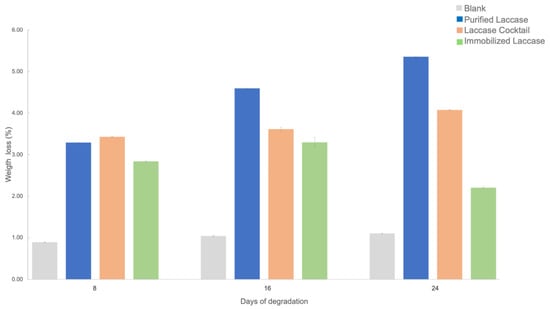
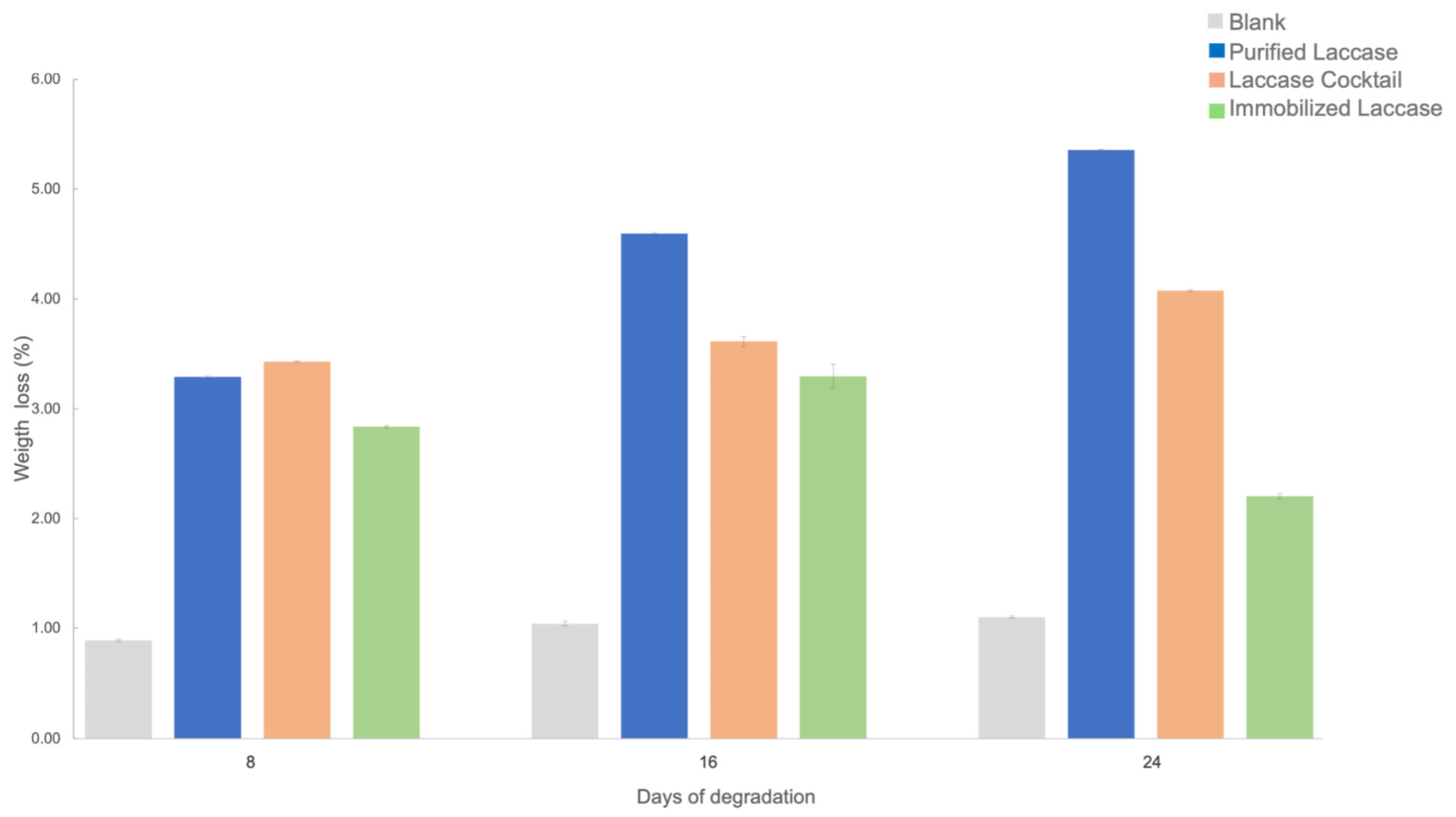
All enzymatic treatments produced measurable changes in polyurethane weight during the incubation period (Figure 1). Purified laccase showed the highest weight loss, reaching a maximum of 5.36 ± 0.01% after 24 days, followed by the laccase cocktail (4.08 ± 0.01%). In contrast, the immobilized laccase exhibited lower weight losses throughout the experiment, with a decrease after 24 days that is discussed in Section 2.2.
Figure 1.
Weight loss of 5-mm rigid PUF cubes after 8, 16, and 24 days of enzymatic degradation using purified laccase, laccase cocktail, and immobilized laccase. The initial mass of the PUF cubes ranged from 5.12 to 7.44 mg. Data are presented as means, and error bars represent the standard deviation of duplicate degradation experiments based on triplicate gravimetric measurements. Individual data points are provided in Table S1.
As shown in Figure 1, the system treated with the purified laccases demonstrated the best degradation performance (5.36 ± 0.01%) after 24 days. While enzyme cocktails are often used due to their natural mediators that enhance catalytic efficiency [30], the results suggest that the complex composition in the cocktail interfered with the degradation of PUFs.
Among the only two previous studies reporting laccase-mediated degradation of PUFs, Magnin et al. reported a weight loss of 2.3% for polyether PUF using a Trametes versicolor laccase-HBT system, whereas Zhu et al. obtained 3.81 ± 0.36% for commercial polyether foam using bacterial laccase with the synthetic mediator ABTS. In the present study, a maximum weight loss of 5.36 ± 0.01% was obtained using mediator-free thermostable fungal laccase and real industrial polyether polyurethane waste. Although the experimental approaches reported in the previous studies differed substantially from those of the present work—including the polyurethane substrate, enzyme source, mediator use, and incubation conditions—they collectively establish the feasibility of laccase-mediated transformation of PUFs and provide valuable context for interpreting the present findings. Building upon this limited body of knowledge, the present work further demonstrates that mediator-free thermostable fungal laccases can promote measurable oxidative transformation of real industrial polyurethane waste under environmentally relevant conditions.
In contrast, after 16 days of incubation, the immobilized laccase system experienced an apparent increase in weight, which is most likely associated with the deposition of TiO2 particles within the pores and on the walls of the PUF, as observed by SEM. Because a support-only control was not included in the experimental design, the individual contribution of TiO2 deposition cannot be quantified, and therefore the gravimetric behavior of the immobilized system should be interpreted with caution and will be further discussed in Section 2.2.
Minimal weight loss was observed in the blanks for each incubation time, with 0.80% (±0.01) weight loss at 8 days, 1.04% (±0.11) at 16 days, and 1.10% (±0.02) at 24 days. These losses are possibly caused by mechanical disruption due to the stirring of the samples. To better understand the influence of the different enzymatic treatments on foam weight changes, an analysis of variance (ANOVA) was conducted, demonstrating that weight loss differences between the blanks and all three enzymatic treatments were significant (p-value of 0.002). Therefore, the significantly greater weight losses observed in the enzyme-treated samples, compared with the blanks, support an enzyme-mediated contribution to polyurethane transformation. Statistical analysis can be found in Supplementary Information (Table S2).
Unlike urethanases, whose primary function is the hydrolysis of carbamate bonds and subsequent polyurethane depolymerization, laccases act predominantly through oxidative reactions occurring at the polymer surface. Consequently, direct comparisons based solely on weight loss may overlook the fundamentally different mechanisms involved. Surface oxidation is the expected mode of action of laccases and may represent an important initial step that increases surface polarity, introduces oxygen-containing functional groups, and facilitates subsequent physicochemical transformations of polyurethane.
This distinction is particularly relevant considering the intended application of this enzymatic system. The proposed strategy is therefore complementary rather than competitive with urethanase-based approaches. Whereas urethanases are attractive candidates for bulk polyurethane recycling, laccases may be especially valuable for environmentally sustainable treatment of micro- and nanoplastic pollution. At these dimensions, the surface-area-to-volume ratio increases dramatically, making oxidative surface modification substantially more relevant than in bulk materials. Moreover, fungal laccases simultaneously degrade a broad spectrum of persistent organic contaminants, as previously demonstrated for Pycnoporus sanguineus, enabling the development of integrated treatment technologies capable of acting not only on polyurethane-derived particles but also on the organic pollutants frequently associated with them. From this perspective, surface oxidation should be regarded as a desirable feature for environmental remediation rather than as a limitation.
Additionally, residual laccase activity was monitored at the same intervals to assess enzyme stability under the experimental conditions. The complete results are provided in the Supplementary Information (Table S3).
2.2. Scanning Electron Microscopy
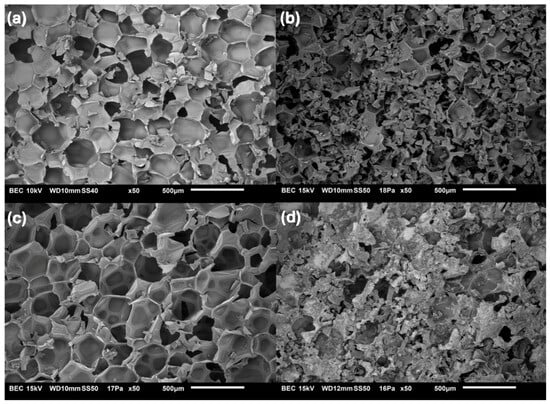
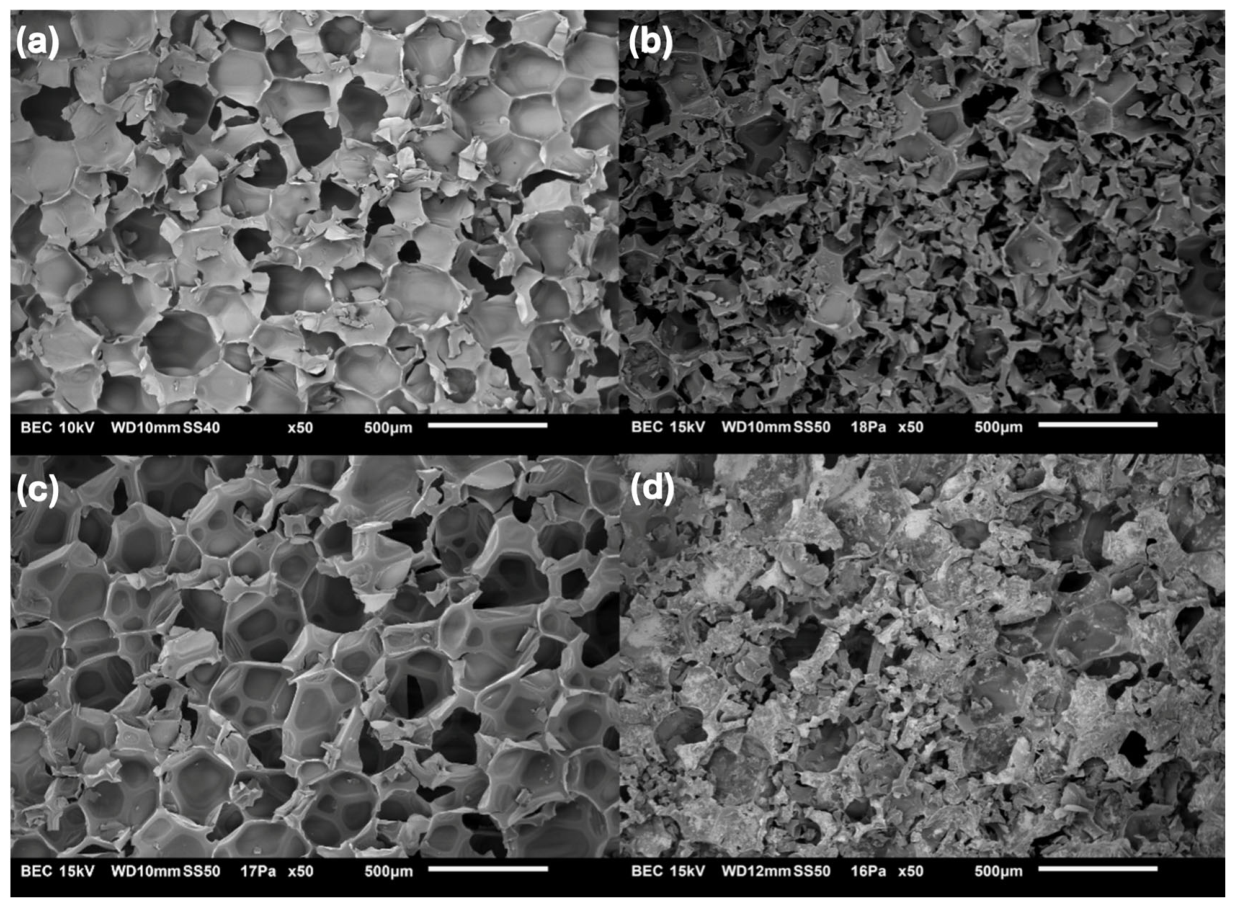
The effects of enzymatic degradation have been studied using electron microscopy to track changes in the surface morphology of PUF (Figure 2).
Figure 2.
Scanning electron microscopy micrograph of PUF. (a) control and enzymatic treated systems after 16 days of degradation with (b) purified laccase, (c) laccase cocktail, and (d) immobilized laccase.
As can be seen in Figure 2, the untreated PUF used as a control shows a distributed and interconnected polygonal cell morphology with an apparent closed cell structure [31,32,33].
Figure 2b–d shows samples after 16 days of treatment, where it is evident that the purified enzyme affected the entire foam structure, resulting in collapsed and broken cells and traces of polyurethane debris. In the case of the laccase cocktail (Figure 2c), the polyurethane cell walls appear translucent after treatment as their thickness is reduced. The effect of the immobilized enzyme on the PUF (Figure 2d) was comparable to that of purified laccase, but residual TiO2 was deposited in the polyurethane cells; due to the presence of residual TiO2, which may interfere with the results, further analysis by DLS and GC-MS of the immobilized laccase samples was not performed. Additional micrographs from days 8 and 24 are provided as supplementary information and show similar behavior with no visible significant differences (Figure S1) compared with Figure 2.
The above results suggest that all laccase enzyme arrays tested in this work are consistent with enzyme-mediated deterioration of the polyurethane structure, resulting in fragmentation, wall pitting, and cell wall thinning. This plausible scenario aligns with the results Magnin et al. (2021) reported on tailor-made PUF treated with Trametes versicolor laccase and HBT as a mediator [25].
2.3. Fourier Transform Infrared Spectroscopic Analysis
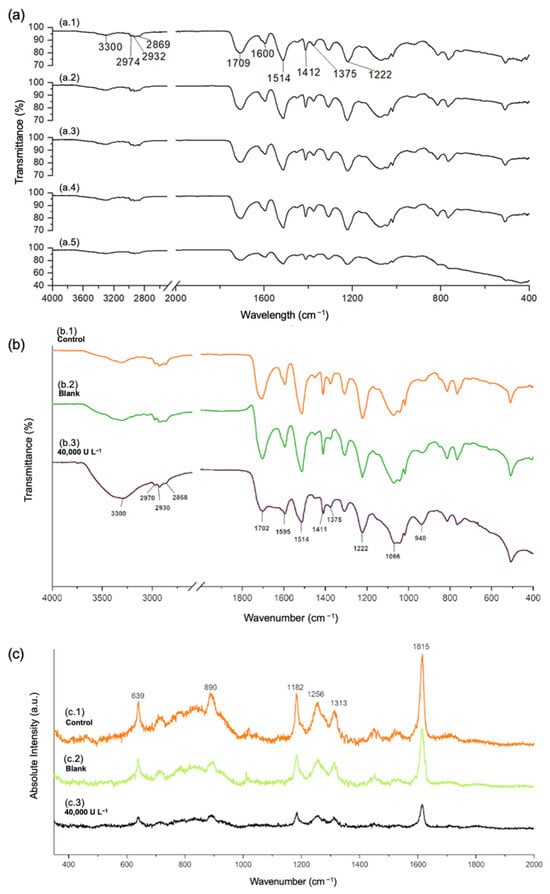
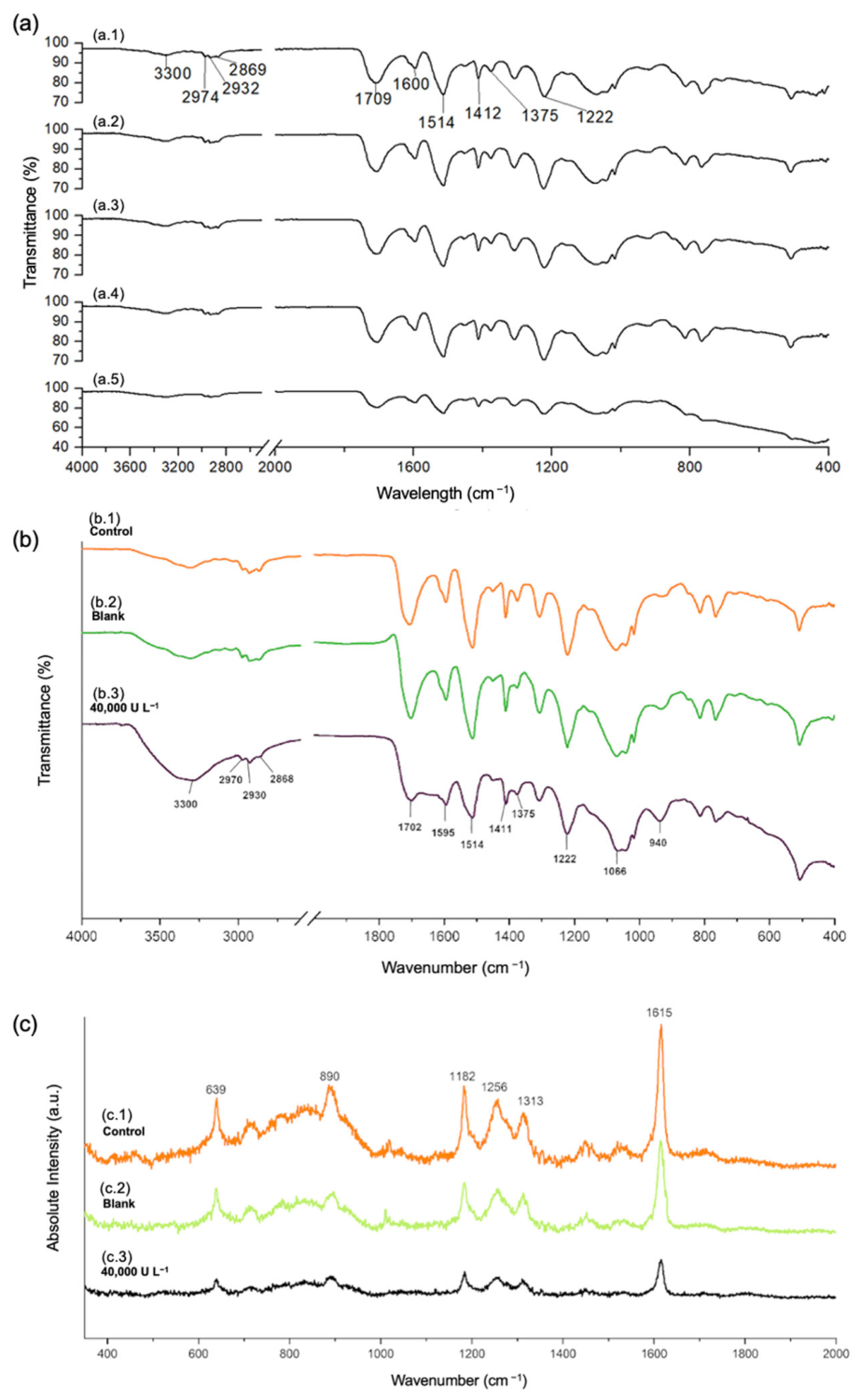
Figure 3a shows the Fourier Transform Infrared spectrum obtained from the PUF samples. For isocyanate segments, the stretching vibrations of N–H correspond to the broad absorption bands around 3300 cm−1, while the peak at 1514 cm−1 confirms the in-plane bending vibration of N–H. The peaks at about 1709 cm−1 and 1222 cm−1 are typical of the stretching vibration of C=O and the asymmetric stretching vibration of C–O (from the urethane linkage), respectively [34]. Since the PUF contains polyether-type polyol, the three groups of peaks near 2974 cm−1, 2932 cm−1, and 2869 cm−1 are caused by the stretching vibration of –CH and –CH2, while other modes of –CH2 vibrations are identified by the bands at 1412 cm−1 and 1375 cm−1. The C=C vibration in the benzene ring present in MDI-based polyurethane causes a weak absorption peak at 1600 cm−1. The stretching vibrations of C–O–C of the ether bond result in a broad and strong peak at 1068 cm−1 [35]. Although minor intensity changes can be observed in the 1709, 1514, and 1222 cm−1 bands belonging to the C=O, N–H, and C–O bonds, the modification and possible degradation of the urethane bond cannot be confirmed by FTIR using an enzyme concentration of 1000 U L−1. Less intense bands were observed for the PUF treated with immobilized laccase, which could be attributed to residual TiO2, as demonstrated via SEM. Similar results were reported by Magnin et al. [25,34], where the IR spectra of polyurethane after enzymatic treatment showed minimal intensity changes in the bands at 1655, 1530, 1410, and 1365 cm−1.
Figure 3.
Spectroscopic characterization of PUFs after enzymatic treatment. (a): FTIR spectrum of polyurethane samples after 24 days of treatment with an enzyme concentration of 1000 U L−1, (a.1) control, (a.2) blank, treatment with (a.3) purified laccase, (a.4) laccase cocktail, and (a.5) immobilized laccase. (b,c): FTIR spectrum of control, blank, and PUF samples and Raman spectrum of the same samples, exposed to 12 days of degradation by purified laccase with a concentration of 40,000 UL−1, respectively. Blank samples are PUF exposed to treatment conditions without the addition of enzyme. Control samples were not exposed to any treatment.
Considering that the invariability of the IR spectra was due to the insufficient initial enzyme concentration used in the treatment to induce changes detectable by the sensitivity of the IR technique, additional experiments were carried out. In these experiments, 5-mm rigid PUF cubes (initial mass: 5.12–7.44 mg) were treated for 12 days with the purified enzyme at concentrations of 10,000, 15,000 and 40,000 U L−1 (50, 75 and 200 U, respectively). The same experimental design was maintained for these treatments, including the corresponding controls, enzyme renewal every 48 h, and the same number of replicates.
Figure 3b shows the spectra corresponding to the control sample, the blank sample (PUF sample exposed to treatment conditions without enzyme), and the treated PUF sample exposed to high enzyme concentrations. As can be seen, the spectra show no significant differences between the control and the blank, indicating that the observed spectral changes are strongly associated with enzymatic treatment rather than incubation conditions alone.
The spectrum of the treated sample showed an increase and broadening of the signal at 3300 cm−1 due to an increase in –NH groups. This observation is consistent with chemical modification of urethane-associated structures within the polyurethane matrix, potentially involving the formation of intermediate oxidation products during enzymatic treatment. However, FT-IR analysis alone does not provide direct evidence of urethane bond oxidation or cleavage. In addition, a significant reduction in the signal at 1702 cm−1, corresponding to the carbonyl (C=O) groups characteristic of urethane, was observed. This indicates that the carbonyl groups are being transformed or removed as the enzyme breaks down the material’s structure [34]. Other signal reductions were observed at 1595 cm−1, associated with C=C stretching in aromatic rings, and at 1514 cm−1, associated with N-H bending adjacent to aromatic systems. These results reflect changes in the aromatic groups of the polyurethane, probably due to the oxidative action of laccase on these structures. A slight decrease in the intensity of the signal at 1411 cm−1 was also observed, due to a decrease in the bending vibrations of aliphatic groups, suggesting partial degradation of side chains within the polymer matrix [35,36].
A notable change was the appearance of and significant increase in a new signal at 940 cm−1. This peak is tentatively associated with the formation of secondary degradation products, potentially representing oxidized fragments generated during laccase-mediated transformation of polyurethane. The signal may correspond to vibrations of functional groups derived from these fragments, such as C–O–C, suggesting a modification of the polyurethane matrix due to enzymatic action [25,37].
2.4. Raman Spectroscopy
Figure 3c shows the Raman spectra of control PUF, treatment blank and PUF treated with 40,000 U L−1 of laccase enzyme. The bands at 639 cm−1 and 890 cm−1 are attributed to ring vibrations. The band at 1182 cm−1 can be assigned to CO stretching and C–H vibrations of the aromatic ring. The band at 1256 cm−1 is assigned to C–N stretching and N–H bending of urethane groups. The Raman band at 1313 cm−1 is attributed to CH2 wagging/twisting. Finally, the most intense band at 1615 cm−1 is assigned to benzene ring stretching [38,39]. No new bands appeared after enzymatic treatment, but clear changes in intensity were observed. In general, loss of intensity is correlated to the presence of less material, although in the case of polymers it can also be related to changes in crystallinity [40] or damage to the polymeric chain [41]. In the case of the 1615 cm−1 band, loss of intensity can be related to (a) chain scission mechanisms or (b) formation of volatile compounds [40], which could agree with the results observed via GC-MS analysis.
2.5. PUF Degradation Products
2.5.1. DLS Analysis
Analysis of the degradation of PUF residues using DLS provided valuable insights into the changes at the particle size level during the degradation process. Variations in particle size distribution as the polyurethane degrades were quantified after 24 days of treatment.
DLS analysis revealed an average particle size of 738.70 ± 106.50 nm for the control sample. Meanwhile, the PUF residues obtained after 24 days of treatment with purified laccase showed an average particle size value of 399.69 ± 23.63 nm. Although this study does not provide sufficient evidence that the enzyme degrades the plastic polymer, the decrease in particle size could indicate that the enzymatic treatment influences the breaking of the PUF into smaller fragments. On the other hand, the average particle size value after laccase cocktail treatment was 262.58 ± 15.65 nm; therefore, the cocktail also appears to degrade the PUF, resulting in an even more significant reduction in the size of the polyurethane debris compared to the control sample.
Both purified and cocktail laccase treatments resulted in a significant reduction in particle size compared to the blank sample, underscoring the potential of this enzymatic degradation as a promising approach for the degradation of rigid polyurethane waste. This finding should inspire further exploration and research in this area.
2.5.2. Particle Size Distribution
The size distribution analysis of SEM micrographs obtained from a small portion of the liquid fraction after the 24-day enzyme treatment was performed using ImageJ software version 1.54g (National Institutes of Health, USA). No debris particles were observed for the blank sample after 24 days of agitation at 40 °C in phosphate citrate buffer, indicating that the particulate debris was not caused by mechanical agitation, temperature, or exposure to water. In the case of purified laccase-treated PUF, a total of 20 debris particles with an average size of 3.65 ± 1.64 µm were detected in the liquid fraction. In contrast, the liquid fraction obtained after laccase cocktail treatment yielded 7 debris particles with an average size of 12.18 ± 4.64 µm (Figure S2). This can be explained by the fact that the laccase cocktail seemed to cause mainly wall thinning of the PUF as discussed in Section 3.2. These findings underscore the significant impact of different enzyme treatments on PUF structure and debris formation.
It is important to emphasize that the debris was suspended in the liquid fraction of the reaction, so it was necessary to perform several washing steps to remove the phosphates present in the buffer since these salts interfere with the SEM analysis, preventing the correct identification of the PUF degradation particles. The same washing method was applied to all the samples; with this previous washing, it is possible to lose particles; nevertheless, it can be observed, as previously verified with the SEM micrographs (Section 3.2), that there is a higher residual particle formation with the use of the purified enzyme treatment than with the cocktail treatment.
2.5.3. Identification of PUF Degradation Products Using Gas Chromatography–Mass Spectrometry (GC-MS)
Identification of the compounds associated with enzymatic treatment is essential for understanding the chemical transformations occurring during polyurethane oxidation. In the present study, the liquid fractions obtained after incubation with purified laccase or the laccase cocktail were analyzed by a two-step GC-MS approach targeting both semi-volatile and volatile compounds. Compound assignments were performed by comparison of the acquired mass spectra with the NIST11.L library, yielding high similarity scores for the major chromatographic peaks. The corresponding NIST11.L library match scores have been incorporated into the Supplementary Information (Table S4). Because no authentic analytical standards were analyzed, these identifications should be regarded as tentative according to accepted GC-MS practice. Consequently, the detected compounds are interpreted as treatment-associated chemical markers that provide evidence of enzymatic transformation of the polyurethane system.
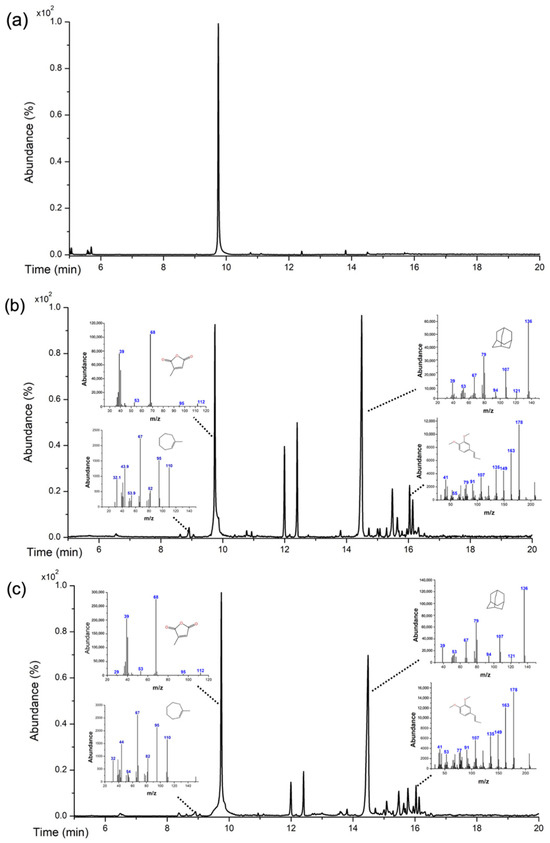
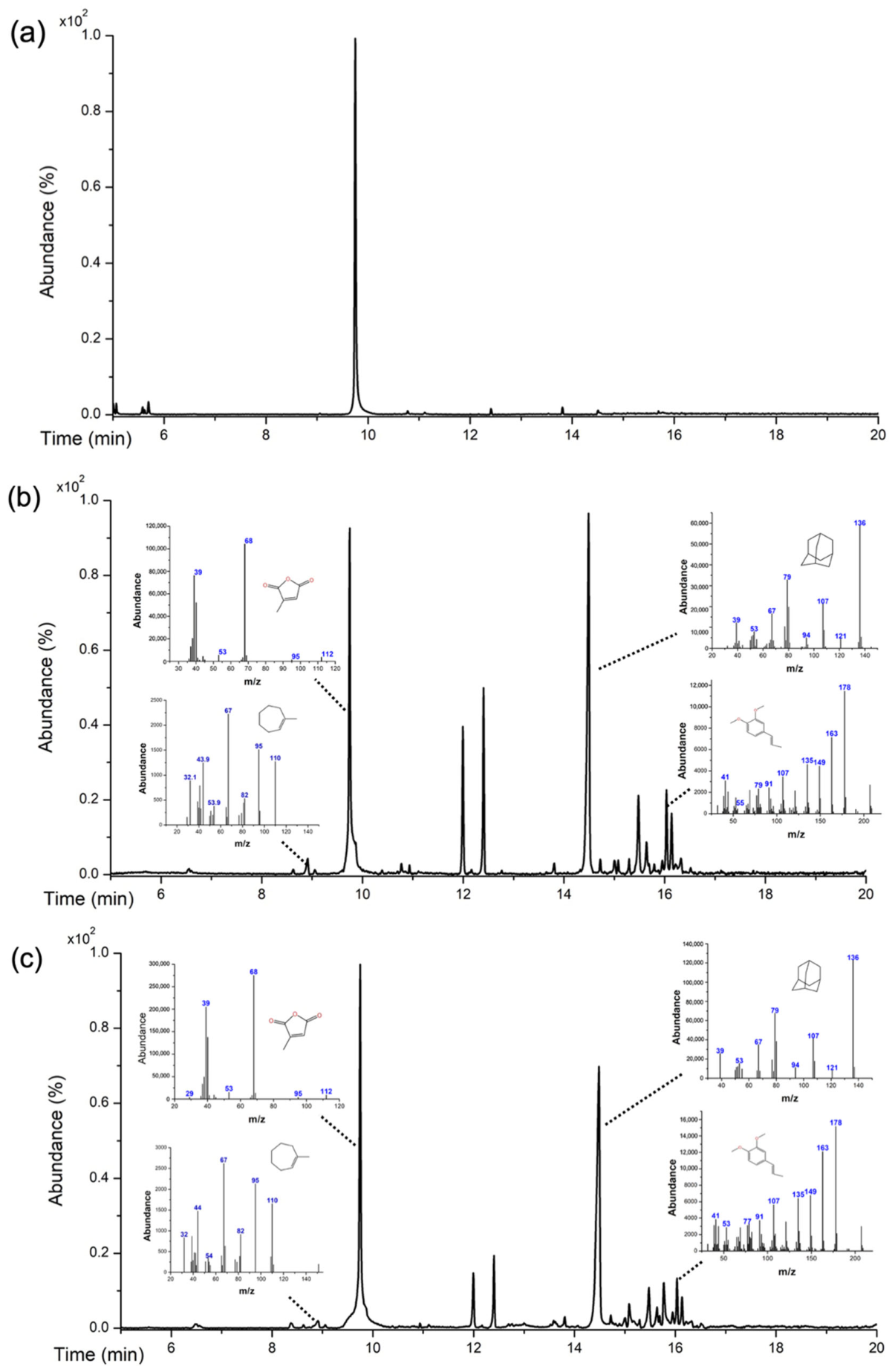
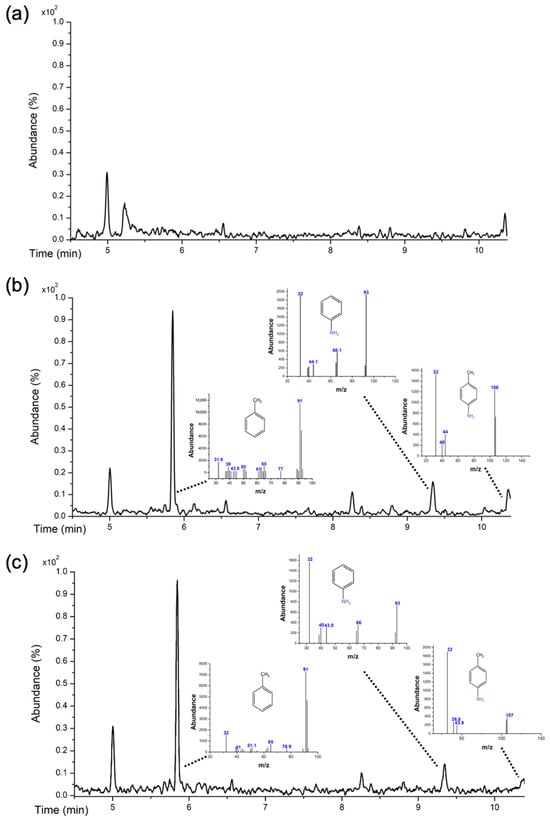
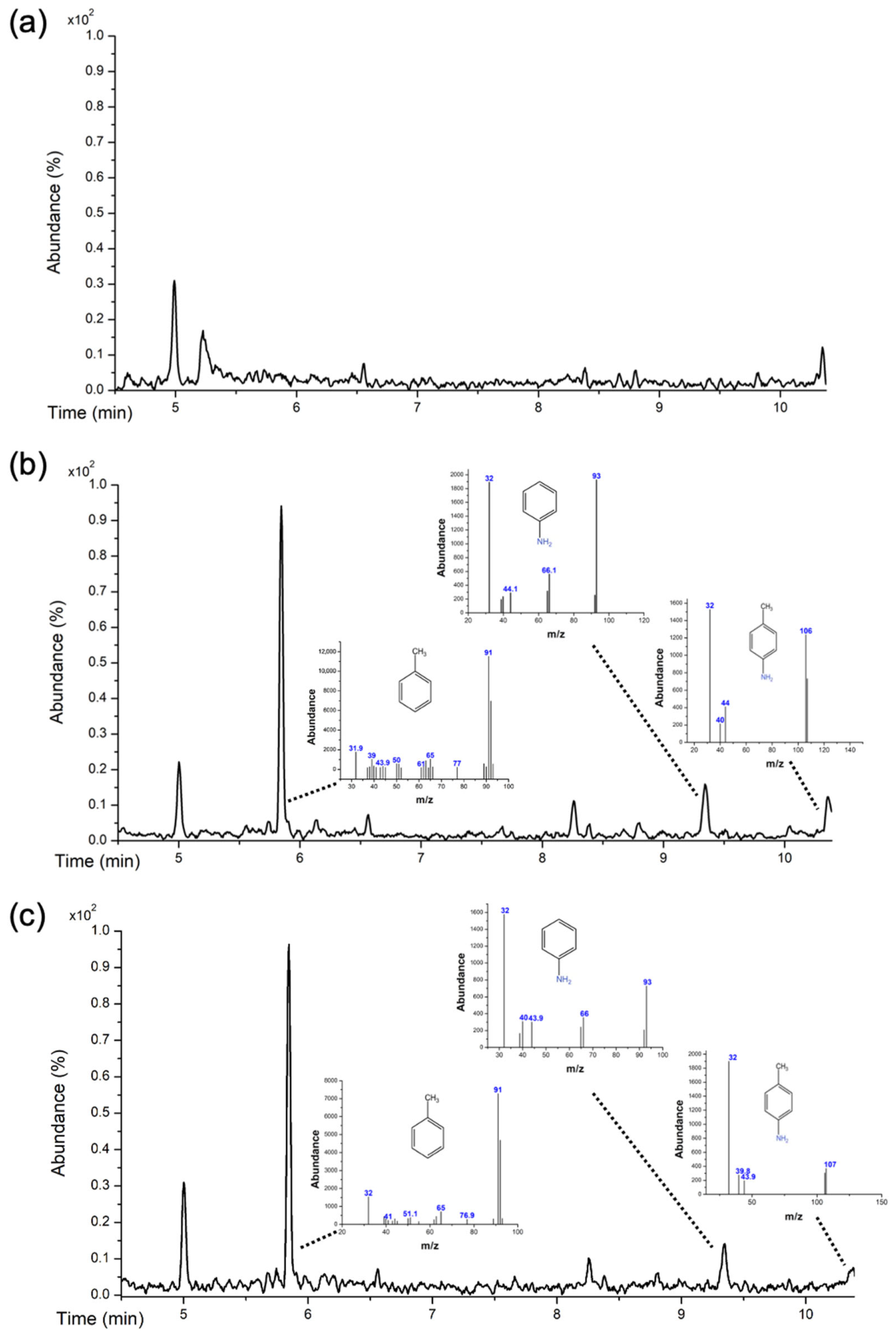
The tentatively identified compounds included 2,5-furandione, 1-methylcycloheptene, adamantane, 1,2-dimethoxy-4-(1-propenyl)-benzene, toluene, aniline, and p-methylaniline (Figure 4 and Figure 5). Duplicate GC-MS chromatograms from the purified laccase and laccase cocktail treatments are provided in the Supplementary Information (Figures S3 and S4). Because the material investigated in this study corresponds to real industrial polyurethane waste rather than a chemically defined model polymer, the detected compounds may originate from multiple sources, including transformation of the polymer matrix, oxidation, or release of formulation additives, antioxidants, stabilizers, pigments, flame retardants, residual manufacturing compounds, environmentally adsorbed organic contaminants, or secondary oxidation reactions occurring during enzymatic treatment. Therefore, individual compounds cannot be unequivocally assigned to a specific degradation pathway based solely on GC-MS library matching. Nevertheless, the appearance of several compounds exclusively in enzyme-treated samples, together with the concentration-dependent increase observed for multiple chromatographic signals, supports the idea that laccase treatment induces measurable chemical transformations within the polyurethane system.
Figure 4.
Identification of semi-volatile compounds. GC-MS Chromatograms of PUF degradation products after 24 days of treatment with (a) blank (PUF in pH 4 phosphate–citrate buffer), (b) purified laccase (PUF in pH 4 phosphate–citrate buffer and 5 U of laccase), and (c) laccase cocktail (PUF in pH 4 phosphate–citrate buffer and 5 U of laccase cocktail). Inset mass spectra correspond to the chromatographic peaks selected for compound identification.
Figure 5.
Identification of volatile compounds. GC-MS chromatograms of volatile byproducts of PUF degradation after 24 days of treatment with (a) blank (PUF in pH 4 phosphate–citrate buffer), (b) purified laccase (PUF in pH 4 phosphate–citrate buffer and 5 U of laccase), and (c) laccase cocktail (PUF in pH 4 phosphate–citrate buffer and 5 U of laccase cocktail). Inset mass spectra correspond to the chromatographic peaks selected for compound identification.
In the second stage of the analysis, the headspace technique was used to identify volatile compounds resulting from the degradation of PUF. Three major volatile compounds detected in the purified and cocktail-treated systems were toluene, aniline, and p-methylaniline, with retention times of 5.84, 9.35, and 10.37 min, respectively (Figure 5). These compounds have previously been reported in studies investigating the thermal and/or chemical degradation of polyurethane materials [36,42], supporting their consideration as plausible transformation products under the conditions evaluated in the present study.
The identified subproducts are generally strongly associated with the initial polymer structure. PUF is produced by combining diisocyanate MDI, which forms the hard segments (HS) of the structure, with polyester or polyether polyols, which form the soft segments (SS) within the molecule [43]. Although the precursors are known, the exact additives used in the synthesis must be determined because the foams are a proprietary formulation. Therefore, the degradation pathway can only be inferred.
Laccases are enzymes classified as copper-containing oxidoreductases (EC 1.10.3.2), facilitating the monoelectronic oxidation of various substrates, such as phenols and aromatic or aliphatic amines. These reactions form corresponding radicals, with molecular oxygen as the ultimate electron acceptor [44]. Few studies have correlated microbial or fungal laccase with the ability to perform specific polymer degradation [45,46]. Among polyurethane materials, the biodegradation of polyester polyurethane has been studied more extensively than polyether polyurethane [47]. In the case of the latter, the primary mechanism proposed for microorganisms involves the hydrolysis of the urethane group, while the oxidation of the ether bonds has received limited investigation.
This study contributes to the current understanding of laccase-mediated polyurethane transformation by characterizing the products generated during the enzymatic treatment of real industrial MDI-based rigid PUF waste using a mediator-free thermostable fungal laccase system.
The enzyme plays a crucial role in the degradation process, acting on the urethane segments within the polymer structure and facilitating cross-linking and aromatic ring reactions. This enzymatic action yields the diisocyanate MDI and the polyether, producing essential components in PUF synthesis. The degradation of MDI produces byproducts, including the compounds identified in these samples, such as p-methylaniline, which undergoes further reactions to produce aniline and toluene (Figure 5). Other interactions may give rise to radicals that initiate subsequent degradative chain reactions on the substrate [48,49].
Moreover, analyzing the chromatograms indicated that the degradation byproducts were detected at lower relative abundance in the sample treated with the laccase cocktail than in those treated with purified laccase. This observation is consistent with the results obtained from the complementary SEM, FT-IR, Raman, and gravimetric analyses, which collectively indicate that the purified laccase promoted more pronounced physicochemical changes in the PUF.
Although both enzymatic preparations were standardized to the same laccase activity (U L−1), the lower apparent performance of the laccase cocktail cannot be attributed to a single mechanism based on the present results. Previous studies with Pycnoporus sanguineus CS43 have demonstrated that this enzymatic system contains multiple laccase isoforms with distinct catalytic and stability properties [27]. Therefore, the differences observed in the present study may be associated with factors such as interactions between the enzymatic preparation and the polyurethane matrix or matrix-related effects. However, the present data do not allow the contribution of any individual mechanism to be established.
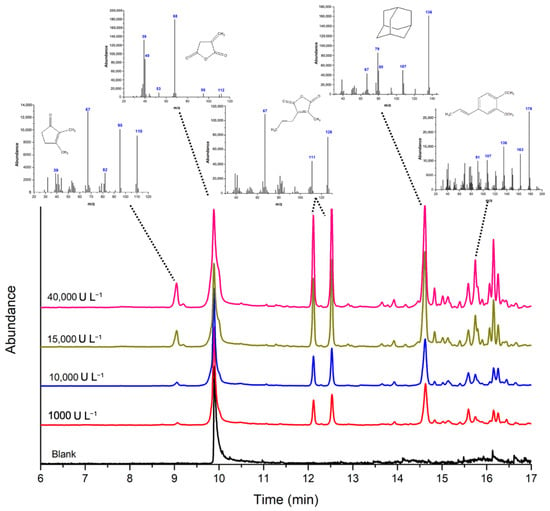
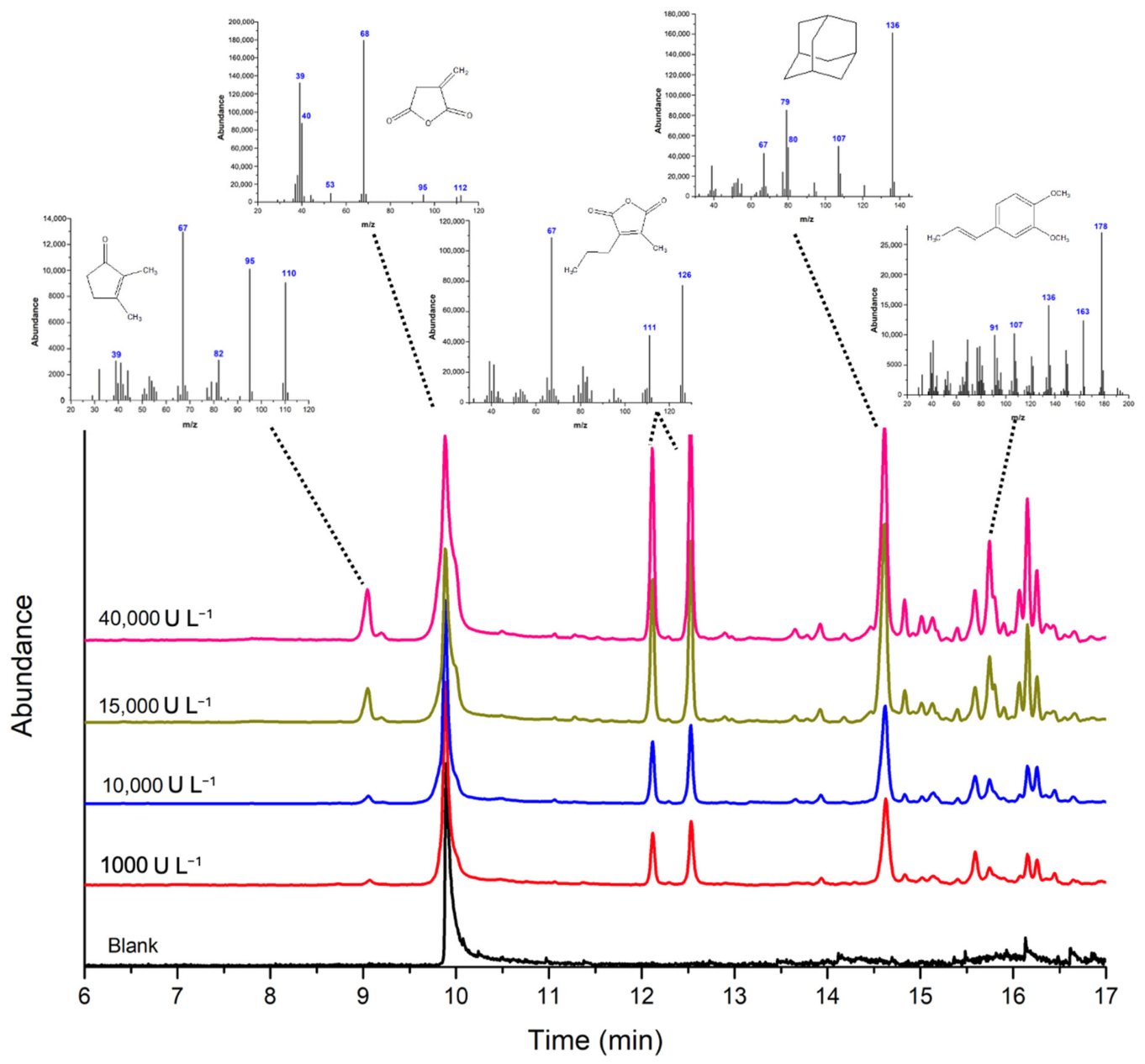
The liquid residue from PUF treated with purified enzyme concentrations of 10,000, 15,000, and 40,000 U L−1 was also analyzed using a two-step GC-MS procedure. As in the analysis presented in Section 2.5.3, Figure 6 shows the chromatograms obtained from the treatment of PUF with different concentrations of enzyme, revealing the consistent presence of dihydro-3-methylene-2,5-furandione with a retention time (RT) of 9.88 min in all samples, including the blank. The presence of this compound in PUF likely depends on the synthesis method, formulation, and production process used [7].
Figure 6.
GC-MS chromatograms of polyurethane degradation by laccase enzymes at concentrations of 1000, 10,000, 15,000, and 40,000 U L−1. Inset mass spectra correspond to the chromatographic peaks selected for compound identification: 2,3-dimethyl-2-cyclopenten-1-one (RT: 9.05 min), dihydro-3-methylene-2,5-furandione (RT: 9.88 min), 3-methyl-4-propyl-2,5-furandione (RT: 12.11 and 12.52 min), adamantane (RT: 14.61 min), and 1,2-dimethoxy-4-(1-propenyl)-benzene (RT: 15.74 min).
This analysis identified four additional semi-volatile compounds in the laccase-treated samples: 2,3-dimethyl-2-cyclopenten-1-one (RT: 9.05 min), 3-methyl-4-propyl-2,5-furandione (RT: 12.11 and 12.52 min), adamantane (RT: 14.61 min), and 1,2-dimethoxy-4-(1-propenyl)-benzene (RT: 15.74 min).
It was observed that the intensity of the peaks associated with the semi-volatile compounds increased with increasing laccase concentration in the treatment, except in the case of dihydro-3-methylene-2,5-furandione, whose intensity remained constant. This behavior suggests a direct relationship between the enzymatic activity and the generation of the mentioned byproducts, supporting that increasing laccase concentration promotes oxidative transformation of the polyurethane matrix.
In general, the identified byproducts are related to the initial structure of the polymer. In particular, the identification of adamantane (RT: 14.61 min), a cyclic compound with a rigid chemical structure and high thermal stability, stands out as evidence of possible complex structural transformations during polyurethane degradation. Similarly, the formation of 1,2-dimethoxy-4-(1-propenyl)-benzene (RT: 15.74 min) suggests the appearance of oxygenated aromatic derivatives possibly related to the modification of aromatic components present in the polymer matrix. The identification of 3-methyl-4-propyl-2,5-furandione is likely a byproduct of the modification or cleavage of dihydro-3-methylene-2,5-furandione during the action of laccase, implying a chemical transformation of the latter into the former.
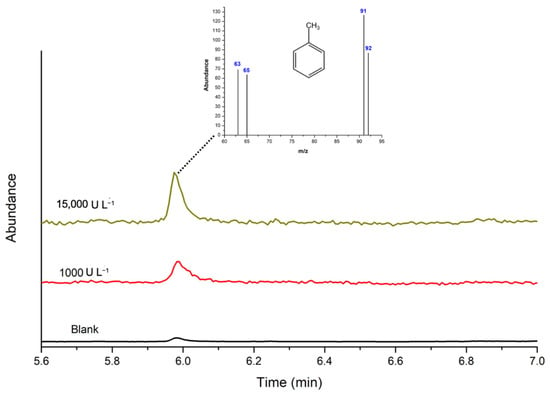
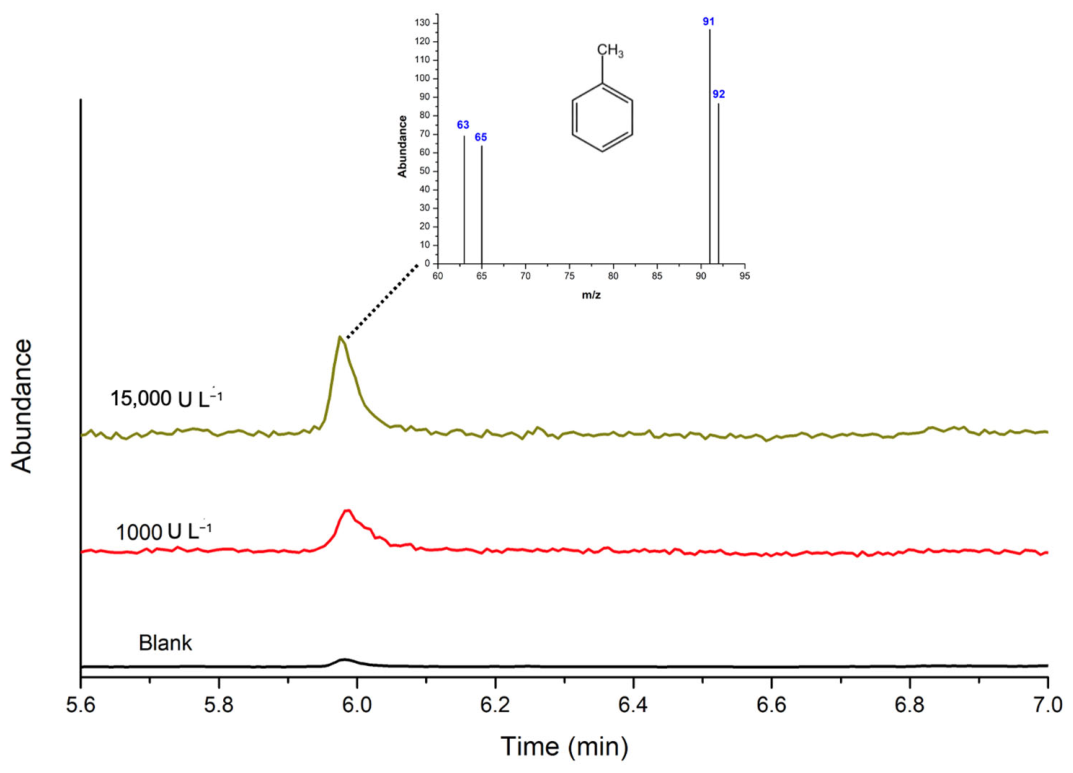
The headspace technique was also used to identify the volatile compounds resulting from the degradation of PUF treated with a high concentration of purified laccase. The results obtained with this technique confirmed the presence of toluene as a volatile product with a retention time of 5.9 min (Figure 7). Identifying toluene as a degradation product is significant because this compound is a common byproduct of the degradation of aromatic structures in polymeric materials such as polyurethane. The constant presence of toluene in the treated samples and the increase in signal intensity with increasing laccase concentration confirm that laccase is also involved in the release of volatile compounds derived from polyurethane degradation. This phenomenon could be related to the oxidation of the aromatic groups in the polyurethane structure, resulting in the formation of toluene, a volatile and low-molecular-weight compound [42].
Figure 7.
GC-MS chromatograms of volatile byproducts from polyurethane degradation. Taken together, these results provide converging evidence that the observed changes cannot be explained solely by incubation conditions. Blank controls showed no comparable spectroscopic or chromatographic changes, whereas increasing laccase concentration produced progressively greater FTIR and Raman modifications together with a concentration-dependent increase in GC-MS-detected degradation byproducts. In parallel, SEM revealed coherent morphological deterioration of the foam surface, including wall thinning, cracking, and fragmentation. Although these findings do not by themselves demonstrate complete polymer depolymerization, they strongly support that laccase treatment promotes chemical transformation and partial degradation of PUF under the conditions evaluated.
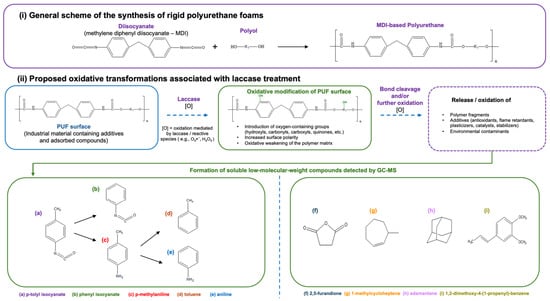
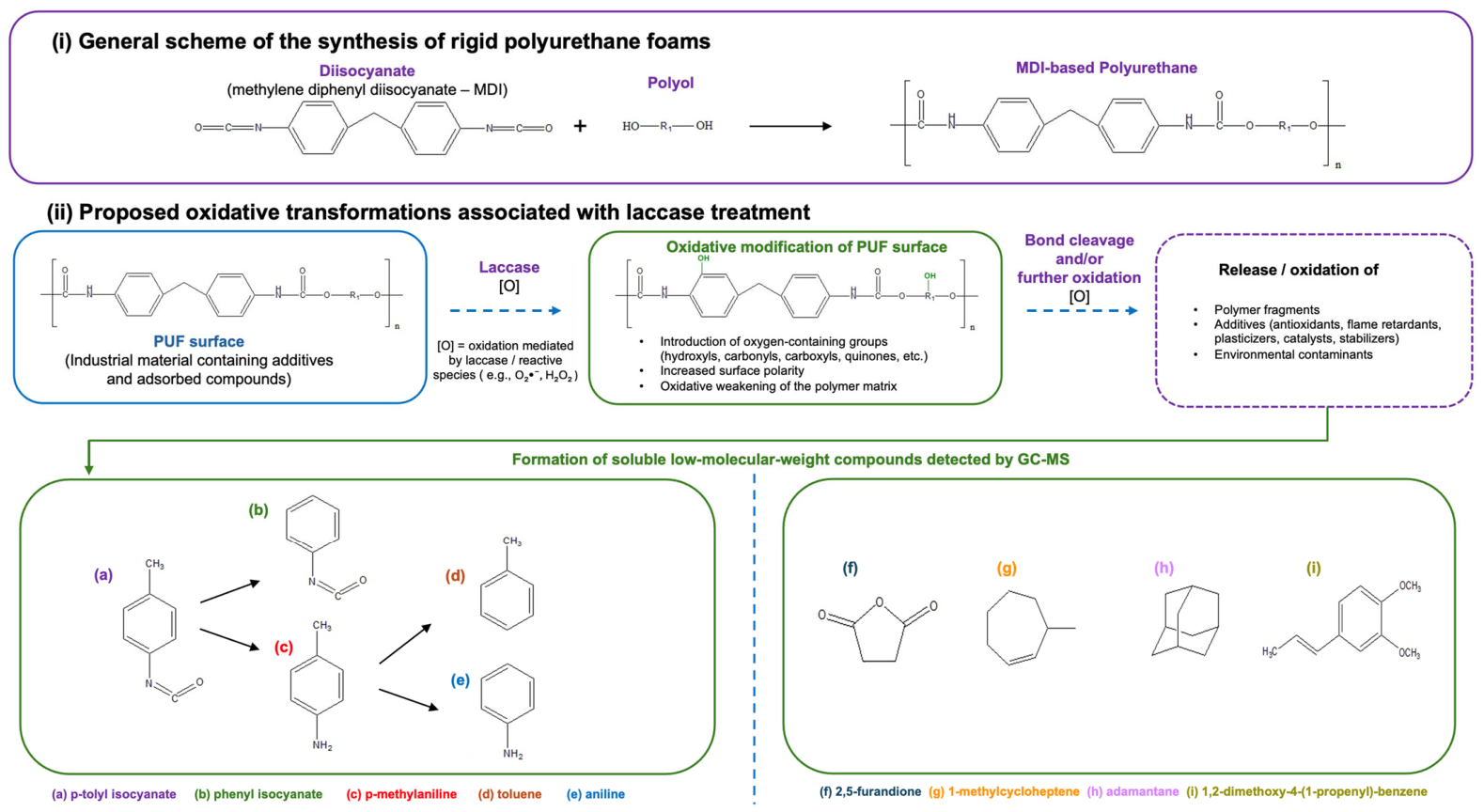
Considering the compounds identified by GC-MS together with the complementary information obtained from FTIR and Raman spectroscopy, a conceptual scheme illustrating possible chemical transformations associated with laccase treatment is proposed (Figure 8). Rather than representing a definitive degradation mechanism, this scheme summarizes plausible oxidative pathways consistent with the experimental observations and previous reports on polyurethane transformation. Because the material investigated corresponds to real industrial polyurethane waste, which contains formulation additives and may accumulate organic contaminants during service life, some detected compounds may originate not only from modification of the polymer matrix but also from oxidation or release of additives and other associated constituents. Therefore, the proposed scheme should be interpreted as a working hypothesis that supports the discussion of the observed chemical changes rather than as a complete mechanistic description of polyurethane degradation.
Figure 8.
Conceptual scheme of the oxidative transformations associated with laccase treatment of industrial PUF. Compounds (c), (d), and (e) were consistently detected in all enzyme-treated samples by headspace GC-MS (Figure 7), whereas compound (b) was identified only in a single sample treated with purified laccase (Supplementary Material, Figure S5). Compound (a) was not detected in the present study but has been previously reported in the literature as a possible precursor of compounds (b) and (c) [42]. Compounds (f) 2,5-furandione, (g) 1-methylcycloheptene, (h) adamantane, and (i) 1,2-dimethoxy-4-(1-propenyl)benzene could not be assigned to degradation of the polyurethane matrix. Because the material investigated corresponds to real industrial PUF, these compounds may originate from oxidative transformation of the polymer matrix, oxidation, release of formulation additives, or environmentally adsorbed contaminants accumulated during the service life of the material. Solid black arrows represent chemical transformations previously reported in the literature, whereas blue dashed arrows indicate proposed laccase-associated oxidative transformations of PUF.
3. Materials and Methods
3.1. Reagents and Materials
High-purity-grade standards of ABTS, monobasic sodium phosphate, dibasic sodium phosphate, and citric acid salt were obtained from Sigma-Aldrich, St. Louis, MO, USA. Anhydrous ethanol (HPLC grade) was supplied by Tedia, Fairfield, OH, USA. Titanium oxide nanoparticles (TiO2) and 3-aminopropyltriethoxysilane (APTES) were obtained from Sigma-Aldrich, St. Louis, MO, USA. Glutaraldehyde (GLU) was obtained from Merck Millipore, Burlington, MA, USA. A commercial refrigeration manufacturer donated a single piece of rigid MDI-based PUF waste, which was used as the source material for all degradation experiments.
3.2. Laccase Enzyme Production and Purification
Laccases from the native fungus Pycnoporus sanguineus CS43 were produced by growing Pycnoporus sanguineus in a tomato culture medium, as described in our previous work [27], where the production, purification, biochemical characterization, protein concentration, specific activity, and identification of the two major laccase isoforms (Lac I and Lac II) are reported in detail. The corresponding protein concentration and specific activity obtained using this production and purification protocol are reported in Ramírez-Cavazos et al. [27]. In addition, previous studies performed under the same production conditions demonstrated that lignin peroxidase and manganese peroxidase activities were not detected in the culture filtrate [23]. The laccase cocktail was prepared by filtering the mycelia from the tomato medium after 10 days of culture using a 0.2 μm pore-size filter. The filtrate was then concentrated by ultrafiltration using a tangential-flow filter with a membrane cutoff of 10 kDa (Sartorius Sartojet). This preparation was designated as the laccase cocktail and corresponded to the initial enzymatic preparation before chromatographic purification. The concentrated laccase cocktail was subsequently purified using a DEAE-cellulose ion-exchange column. Fractions exhibiting laccase activity were subsequently subjected to hydrophobic interaction chromatography. After completion of the purification process, the laccase-containing fractions were collected. The fractions containing Lac I and Lac II were pooled quantitatively without adjusting their relative volumes or activities; therefore, the isoforms were not recombined at a predetermined ratio, and their relative proportion reflected their recovery during purification. Although this ratio was not independently quantified in the present preparation, a Lac I:Lac II ratio of approximately 1:5 was previously reported for this fungal strain [27]. The resulting preparation was concentrated by ultrafiltration. This preparation was designated as purified laccase and was subsequently used in the immobilization experiments.
3.3. Laccase Immobilization
Laccases were immobilized, as reported in previous work by our research group [29]. Covalent immobilization of the purified laccase preparation was carried out on titania nanoparticles functionalized with APTES (5% wt.) and GLU (4% v/v) agents. For TiO2 functionalization, 400 mg of TiO2 was first dispersed in 15 mL of anhydrous ethanol and disaggregated with an ultrasonic bath sonicator for 5 min, followed by probe sonication for 15 min. APTES 5% was diluted in anhydrous ethanol, and this solution was added dropwise to the TiO2-ethanol suspension. Then, more anhydrous ethanol was added until a final TiO2 concentration of 6 mg mL−1 was reached. The mixture was placed under reflux for 24 h at 65 °C. Afterward, the nanoparticles were separated by filtration and washed with anhydrous ethanol. Finally, the TiO2 nanoparticles functionalized with APTES (TiO2-APTES) were dried under vacuum at room temperature. For GLU functionalization, TiO2-APTES nanoparticles were ground into a fine powder, and 50 mg were dispersed in a 4% (v/v) GLU solution previously dissolved in a 200 mM phosphate-buffered solution (pH 7) and left to react for 12 h. Unreacted GLU was removed by centrifugation and re-dispersed in a phosphate buffer; this washing step was repeated 3 times. TiO2-APTES nanoparticles functionalized with GLU were suspended in 5 mL of laccase solution (2000 U L−1) for enzyme immobilization for 72 h at 20 °C to obtain the immobilized laccase preparation (TiO2-Lac). Afterward, the unreacted laccase was removed by centrifugation and re-dispersed in phosphate-buffered solution, repeating this washing step 3 times.
3.4. Photometric Methods
3.4.1. Enzymatic Activity
The ABTS activity assay was used to determine enzymatic activity [50,51]. The oxidation of ABTS to ABTS+ was monitored at 420 nm using a 1 cm path-length quartz cuvette at room temperature (approximately 25 °C), with a molar extinction coefficient of ε420 = 3.6 × 10⁴ M−1 cm−1. The initial enzymatic activity of each enzyme preparation was determined in duplicate before the degradation experiments. One unit (U) of laccase activity was defined as the amount of laccase oxidizing 1 µmol of ABTS per minute [23,28].
To determine the activities of the laccase cocktail and purified laccase, 200 μL of a laccase solution and 200 μL of aqueous ABTS (5 mM) were added to 1600 μL of a pH 3 phosphate–citrate buffer solution, and 200 μL of the pH 3 phosphate–citrate buffer solution was used instead of the laccase solution to prepare the blank. For immobilized laccase activity, 50 mg of immobilized laccase was dispersed in 190 mL of the phosphate–citrate buffer solution (pH 3). Then, 10 mL of the ABTS solution (5 mM) was added to initiate the reaction, and aliquots were withdrawn from the medium every 30 s. Each aliquot was rapidly filtered through a 0.2 µm PTFE syringe filter to remove the immobilized laccase, and absorbance was measured at 420 nm. To monitor the immobilized enzyme activity during the degradation treatment, the residual immobilized enzyme was dispersed in 90 mL of the pH 3 phosphate–citrate buffer solution after the appropriate incubation time, and 10 mL of the 5 mM ABTS solution was added.
3.4.2. Protein Concentration
Protein concentration was quantified using the QuantiPro BCA Assay Kit (Sigma-Aldrich, USA), employing bovine serum albumin (BSA) as the standard, according to the recommended procedure for the kit. Absorbance was measured at 562 nm using a Multiskan SkyHigh Photometer (Thermo Fisher Scientific, Vantaa, Finland).
For the enzymatic treatments performed with a total activity of 5 U, the measured protein concentrations were 6.83 ± 0.02 µg mL−1 for the laccase cocktail and 6.03 ± 0.04 µg mL−1 for the purified laccase. For the immobilization process, a 5 mL aliquot of the purified preparation containing Lac I and Lac II, with a total activity of 10 U and, based on the protein measurements described above, a total protein concentration of 12.02 ± 0.08 µg mL−1, was used. After immobilization, 50 mg of the resulting material exhibited a laccase activity of 5 U.
3.5. Enzymatic Degradation
Before the degradation experiments, the PUF was rinsed with deionized water to remove surface dust and loose particles. The material was then allowed to dry at room temperature and stored in a desiccator, protected from dust and direct sunlight until use. Polyurethane cubes (5 × 5 × 5 mm) with an initial mass ranging from 5.12 to 7.44 mg were prepared from the same foam specimen. The PUF cubes were incubated with laccase enzymes for 24 days in 20 mL glass vials at 40 °C under constant shaking in the dark incubation conditions, without exposure to UV or visible light. The enzymatic treatments were normalized to an initial laccase activity of 5 U (1000 U L−1) in the 5 mL reaction medium to establish the same initial catalytic activity for all laccase preparations. For the laccase cocktail and purified laccase treatments, concentrated enzymatic preparations were added to phosphate-citrate buffer solution (pH 4) to obtain this initial laccase activity. For the immobilized laccase treatment, the amount of immobilized enzyme was adjusted to provide the same initial laccase activity (5 U) in 5 mL of phosphate-citrate buffer solution (pH 4). In addition, a blank consisting of PUF and buffer without laccase was included. All experiments were performed in duplicate.
The liquid fraction of each reaction was removed and replaced with fresh enzymatic solution throughout the 24-day treatment period, thereby minimizing the potential for significant enzyme accumulation between successive renewals. Residual enzymatic activity was monitored at the same interval to assess enzyme stability under the experimental conditions and to determine the appropriate interval for renewal of the enzymatic solution. The discarded liquid fractions were stored at 4 °C for subsequent analysis. The final liquid fraction collected after 24 days of enzymatic treatment was used for DLS, size distribution analysis, and GC-MS analysis to characterize the products present at the end of the incubation period. After 8, 16, and 24 days of incubation, the foam cubes were rinsed with Milli-Q water, dried for 48 h under vacuum, and weighed.
3.6. PUF Analysis
3.6.1. Scanning Electron Microscope (SEM) Analysis
To study the effect of enzymatic degradation on PUF surface morphology, PUFs were analyzed using a JEOL JSM-6010PLUS/LA Scanning Electron Microscope (JEOL Ltd., Tokyo, Japan) operating at working distances in the range of 9–12 mm and an acceleration voltage of 15 kV. Polyurethane samples were incubated for 8, 16, and 24 days. After each incubation period, the foam cubes were rinsed with Milli-Q water and dried under vacuum for 48 h. Subsequently, a part of each sample was sectioned for analysis. Selected samples were coated with a thin layer of gold by sputtering deposition using the Agar Scientific High-Resolution Sputter Coater (Agar Scientific Ltd., Stansted, Essex, UK).
3.6.2. Vibrational Spectroscopy Analysis
FTIR spectra were recorded in the mid-IR region (4000–400 cm−1) at a resolution of 4 cm−1 with 64 scans using a Perkin Elmer FT-IR Frontier spectrometer (PerkinElmer, Waltham, MA, USA). Raman spectra were obtained using a Renishaw InVia Raman spectrometer (Renishaw, Wotton-under-Edge, Gloucestershire, UK) with a 50× microscope objective (NA 0.75) and an 830 nm laser source, illuminating the samples with an electromagnetic power of approximately 1 mW; the signal was captured with an acquisition time of 10 s. All FTIR and Raman spectra were acquired under identical instrumental conditions and compared qualitatively based on changes in band position and relative intensity. No spectral normalization or statistical comparison was performed. Measurements for each sample were obtained in triplicate, with each measurement focused on a different region of the foam surface.
3.6.3. Weight Monitoring Procedure
The degradation ability of purified laccase, laccase cocktail, and immobilized laccase was evaluated based on the weight loss of PUF samples after 8, 16, and 24 days of incubation. Each treatment was performed using two independently prepared PUF samples. After incubation, samples were dried for 48 h and weighed on an analytical balance. The initial weight and the weight at each monitoring interval were measured in triplicate for each individual sample, and the average values were used to calculate weight loss, thereby minimizing instrumental uncertainty associated with gravimetric measurements.
3.7. Analysis of Particles and Polymer Degradation Byproducts
3.7.1. Dynamic Light Scattering (DLS) Analysis
For DLS analysis, a 2 mL aliquot of the liquid fraction with the degradation debris, obtained after 24 days of treatment, was vortexed, placed in capillary cells, and characterized with a Nanobrook 90 plus PALS particle size analyzer (Brookhaven Instruments Corporation, Holtsville, NY, USA) to quantify the particles associated with the fragmentation and cracking of the PUF. The particle size was determined from the maximum of the differential intensity distribution function, and the corresponding diameter was used as the representative particle size value.
3.7.2. Particle Size Distribution Analysis Procedure
A 3 mL aliquot of the liquid fraction with the degradation debris, after 24 days of enzymatic treatment, was collected for size distribution analysis. The suspension was centrifuged at 2000 rpm for 4 min, and then 200 µL of the pellet was deposited onto SEM sample holders and dried for further analysis. SEM micrographs were acquired with a JEOL JSM-6010PLUS/LA scanning electron microscope; working distances of 5–6 mm, and an accelerating voltage of 15 kV were used. The energy-dispersive X-ray spectroscopy (EDS) analysis used a field-emission scanning electron microscopy (FE-SEM) model Nova 200 manufactured by FEI company (Hillsboro, OR, USA), confirming the presence of plastic particles. Multiple SEM micrographs were acquired to facilitate the identification of particle debris associated with the enzymatic treatment. The scale bar included in each SEM micrograph was used to calibrate the images in ImageJ software version 1.54g (NIH, USA). The diameter of the identified particles was subsequently measured, and the resulting measurements were used to determine the particle size distribution.
3.7.3. Identification of Polyurethane Degradation Products Using GC-MS
An Agilent Technologies 7890B gas chromatograph with a 7697A headspace sampler coupled to a 5977A mass selective detector (Agilent Technologies, Santa Clara, CA, USA) was used to identify volatile byproducts from the degradation of PUF samples. A Zebron ZB-624 capillary column (Phenomenex, Torrance,CA , USA, 20 m × 180 µm × 1 µm) was employed, and the analysis was carried out using a sample volume of 2 mL. The oven was heated from 40 °C (held for 2 min) to 240 °C (held for 2 min) at 15 °C/min. Helium was used as a carrier gas at a flow rate of 1 mL/min. For the identification of semi-volatile degradation byproducts, a 7693 autosampler was coupled to a 5977A mass selective detector. A Zebron ZB-624 capillary column (20 m × 180 µm × 1 µm) was also employed, and the analysis was carried out using an injection volume of 1 µL. In this case, the oven was heated from 35 °C (held for 2 min) to 240 °C (held for 5 min) at 15 °C/min, with an equilibration time of 0.5 min, and helium at a flow rate of 1 mL/min was also used as a carrier gas. The detected compounds were tentatively identified by comparison of their experimental mass spectra with reference spectra in the NIST11.L library. The library Q-value was used as an initial criterion for spectral similarity, and the presence of characteristic ions of the proposed compounds was additionally evaluated. Because authentic analytical standards were not used for confirmation, the reported compounds were considered tentative identifications.
4. Conclusions
SEM analysis revealed consistent morphological alterations in PUF after laccase treatment, including surface erosion, cracking, pore wall thinning, and fragmentation. These structural changes were accompanied by significantly greater weight losses than those observed in the blank controls, supporting an enzyme-associated effect on polyurethane transformation. Among the evaluated systems, purified laccase produced the greatest weight loss (5.36 ± 0.01%) after 24 days, while the immobilized system exhibited lower apparent weight loss, potentially due to TiO2 deposition on the foam surface.
FTIR and Raman spectroscopy showed concentration-dependent modifications in characteristic polyurethane bands only at higher laccase concentrations, whereas blank samples exposed to identical incubation conditions showed no comparable spectral changes. These observations indicate that the detected chemical modifications were associated with enzymatic treatment rather than with temperature, agitation, or buffer exposure alone. GC-MS further revealed the presence of several volatile and semivolatile compounds, including 1-methylcycloheptene, adamantane, 1,2-dimethoxy-4-(1-propenyl)-benzene, 2,5-furandione, toluene, aniline, and p-methylaniline. Importantly, the abundance of several degradation products increased with increasing enzyme concentration, consistent with a concentration-dependent transformation associated with laccase treatment.
Taken together, the combined evidence from blank controls, concentration-dependent spectroscopic responses, GC-MS detection of potential byproducts, weight loss measurements, and morphological alterations provides converging evidence consistent with laccase-associated chemical transformation and fragmentation of rigid PUFs under the experimental conditions evaluated. However, this partial degradation should not be interpreted as complete remediation. Smaller particles generated during treatment and soluble aromatic degradation products may remain in the treated medium and require subsequent separation or downstream treatment. Moreover, the potential toxicity of these residual fractions and transformation products should be assessed before the environmental safety and practical applicability of the process can be established. While additional studies employing complementary molecular-level techniques will be valuable to further elucidate the degradation mechanism, the present work demonstrates that mediator-free thermostable fungal laccases constitute a promising and environmentally sustainable strategy for the treatment of industrial polyurethane waste. These findings provide a foundation for future development of biocatalytic technologies aimed at mitigating persistent plastic pollution, including micro- and nanoplastics. Although previous work supports the feasibility of scaling up biocatalyst production [52], further research is needed to establish the scalability and environmental sustainability of the complete PUF treatment process, particularly by reducing treatment time and enzyme consumption and optimizing operating conditions.
Supplementary Materials
The following supporting information can be downloaded at: https://www.mdpi.com/article/10.3390/catal16100872/s1, Table S1: Individual weight loss values of rigid polyurethane foam after 8, 16, and 24 days of enzymatic treatment; Table S2: Analysis of Variance (ANOVA) of Weight Monitoring; Table S3: Residual laccase activity during the enzymatic treatment of polyurethane; Figure S1: Scanning electron microscopy micrograph of polyurethane foam after 8 and 24 days of degradation with purified laccase, laccase cocktail, and Immobilized laccase; Figure S2: Particle size distribution of the residues generated after 24 h treatment of PUF with (a) enzyme cocktail and (b) purified enzyme; Table S4: Tentatively identified volatile compounds detected by GC–MS, including retention time (RT), Q value, and characteristic ions (m/z); Figure S3: GC-MS chromatograms for the tentative identification of semi-volatile PUF transformation products after 24 days of enzymatic treatment: (a) and (b) duplicate chromatograms from the purified laccase treatment, and (c) and (d) duplicate chromatograms from the laccase cocktail treatment; Figure S4: GC-MS chromatograms for the tentative identification of volatile PUF transformation products after 24 days of enzymatic treatment: (a) and (b) duplicate chromatograms from the purified laccase treatment, and (c) and (d) duplicate chromatograms from the laccase cocktail treatment; Figure S5: Gas chromatogram and mass spectra of the byproducts identified in a degradation sample of polyurethane sponge by purified laccase enzyme detected using a headspace sampler. The volatile compounds identified at their respective retention times were: (a) toluene (6.00 min), (b) aniline (9.35 min), (c) p-methylaniline (10.44 min), and (d) phenyl isocyanate (10.61 min).
Author Contributions
Conceptualization, C.O.-N. and N.O.-S.; methodology, S.F.L.-B. and I.A.-H. and N.O.-S.; validation, S.F.L.-B.; formal analysis, S.F.L.-B., A.G.-G. and Q.J.; resources, N.O.-S. and G.L.-B.; data curation, S.F.L.-B. and A.G.-G. and Q.J.; writing—review and editing, S.F.L.-B. and N.O.-S.; visualization, N.O.-S., Y.W. and G.L.-B.; supervision, N.O.-S.; project administration, N.O.-S. and G.L.-B.; funding acquisition, N.O.-S. and G.L.-B. and Y.W. All authors have read and agreed to the published version of the manuscript.
Funding
This research received no external funding.
Data Availability Statement
The data presented in this study are available in Mendeley Data at https://data.mendeley.com/preview/s2f4hwjwvy?a=8a866193-6ce7-437b-a96f-bdc11bda1125, accessed on 7 September 2026.
Acknowledgments
The authors acknowledge the Tecnológico de Monterrey Challenge-Based Research Funding Program, under the “Discovery Grants” modality [E116-EIC-GI10-A-T9-D], and the Mexican Secretariat of Science, Humanities, Technology, and Innovation (SECIHTI; formerly CONAHCYT) for support provided through the National Scholarship Program, particularly doctoral scholarship No. 838848 awarded to S.F.L.-B. The authors also thank the staff of the Water Center for Latin America and the Caribbean for providing access to its facilities.
Conflicts of Interest
The authors declare no conflict of interest.
Abbreviations
The following abbreviations are used in this manuscript:
| ABTS | 2,2′-azino-bis(3-ethylbenzothiazoline-6-sulfonic acid) |
| ANOVA | Analysis of variance |
| APTES | 3-Aminopropyl triethoxysilane |
| DLS | Dynamic Light Scattering |
| EDS | Energy Dispersive X-ray Spectroscopy |
| FE-SEM | Field emission scanning electron microscopy |
| FT-IR | Fourier Transform Infrared |
| GC-MS | Chromatography-Mass Spectrometry |
| GLU | Glutaraldehyde |
| HBT | 1-hydroxybenzotriazole |
| HS | Hard segments |
| LMS | Laccase-mediated system |
| PUFs | Polyurethane foams |
| RT | Retention time |
| SEM | Scanning Electron Microscopy |
| SS | Soft segments |
| TiO2 | Titanium oxide |
| TiO2-APTES | TiO2-nanoparticles functionalized with APTES |
| TiO2-Lac | Laccase immobilized on TiO2-nanoparticles |
| U | Unit |
References
- Plastics Europe—Enabling a Sustainable Future Plastics the Fast Facts 2025. Available online: https://plasticseurope.org/knowledge-hub/plastics-the-fast-facts-2025/ (accessed on 6 August 2026).
- Organisation for Economic Co-operation and Development (OECD). Global Plastics Outlook; OECD Publishing: Paris, France, 2022; ISBN 9789264584068. [Google Scholar]
- Amezúa-Arranz, C.; Santiago-Calvo, M.; Rodríguez-Pérez, M.Á. A New Synthesis Route to Produce Isocyanate-Free Polyurethane Foams. Eur. Polym. J. 2023, 197, 112366. [Google Scholar] [CrossRef] [Scilit]
- Cabulis, U.; Ivdre, A. Recent Developments in the Sustainability of the Production of Polyurethane Foams from Polyols Based on the First-to the Fourth-Generation of Biomass Feedstock. Curr. Opin. Green Sustain. Chem. 2023, 44, 100866. [Google Scholar] [CrossRef] [Scilit]
- Nakajima-Kambe, T.; Shigeno-Akutsu, Y.; Nomura, N.; Onuma, F.; Nakahara, T. Microbial Degradation of Polyurethane, Polyester Polyurethanes and Polyether Polyurethanes. Appl. Microbiol. Biotechnol. 1999, 51, 134–140. [Google Scholar] [CrossRef] [Scilit] [PubMed]
- Mušič, B.; Knez, N.; Bernard, J. Flame Retardant Behaviour and Physical-Mechanical Properties of Polymer Synergistic Systems in Rigid Polyurethane Foams. Polymers 2022, 14, 4616. [Google Scholar] [CrossRef] [Scilit] [PubMed]
- Wang, Z.; Wang, C.; Gao, Y.; Li, Z.; Shang, Y.; Li, H. Porous Thermal Insulation Polyurethane Foam Materials. Polymers 2023, 15, 3818. [Google Scholar] [CrossRef] [Scilit] [PubMed]
- Alsuhaibani, A.M.; Refat, M.S.; Qaisrani, S.A.; Jamil, F.; Abbas, Z.; Zehra, A.; Baluch, K.; Kim, J.G.; Mubeen, M. Green Buildings Model: Impact of Rigid Polyurethane Foam on Indoor Environment and Sustainable Development in Energy Sector. Heliyon 2023, 9, e14451. [Google Scholar] [CrossRef] [Scilit] [PubMed]
- Suprun, V.Y.; Marukha, V.; Sylovaniuk, V.P. Recycling Technologies for Polyurethane Wastes (A Survey). Mater. Sci. 2022, 57, 755–764. [Google Scholar] [CrossRef] [Scilit]
- Loredo-Treviño, A.; Gutiérrez-Sánchez, G.; Rodríguez-Herrera, R.; Aguilar, C.N. Microbial Enzymes Involved in Polyurethane Biodegradation: A Review. J. Polym. Environ. 2012, 20, 258–265. [Google Scholar] [CrossRef] [Scilit]
- Yang, W.; Dong, Q.; Liu, S.; Xie, H.; Liu, L.; Li, J. Recycling and Disposal Methods for Polyurethane Foam Wastes. Procedia Environ. Sci. 2012, 16, 167–175. [Google Scholar] [CrossRef] [Scilit]
- Iyare, P.U.; Ouki, S.K.; Bond, T. Microplastics Removal in Wastewater Treatment Plants: A Critical Review. Environ. Sci. 2020, 6, 2664–2675. [Google Scholar] [CrossRef] [Scilit]
- Romphophak, P.; Faikhaw, O.; Sairiam, S.; Thuptimdang, P.; Coufort-Saudejaud, C. Removal of Microplastics and Nanoplastics in Water Treatment Processes: A Systematic Literature Review. J. Water Process Eng. 2024, 64, 105669. [Google Scholar] [CrossRef] [Scilit]
- Howard, G.T. Biodegradation of Polyurethane: A Review. Int. Biodeterior. Biodegrad. 2002, 49, 245–252. [Google Scholar] [CrossRef] [Scilit]
- Salgado, C.A.; Silva, J.G.; de Almeida, F.A.; Vanetti, M.C.D. Biodegradation of Polyurethanes by Serratia Liquefaciens L135 and Its Polyurethanase: In Silico and in Vitro Analyses. Environ. Pollut. 2023, 333, 122016. [Google Scholar] [CrossRef] [Scilit] [PubMed]
- Howard, G.T.; Blake, R.C. Growth of Pseudomonas Fluorescens on a Polyester–Polyurethane and the Purification and Characterization of a Polyurethanase–Protease Enzyme. Int. Biodeterior. Biodegrad. 1998, 42, 213–220. [Google Scholar] [CrossRef] [Scilit]
- Branson, Y.; Söltl, S.; Buchmann, C.; Wei, R.; Schaffert, L.; Badenhorst, C.P.S.; Reisky, L.; Jäger, G.; Bornscheuer, U.T. Urethanases for the Enzymatic Hydrolysis of Low Molecular Weight Carbamates and the Recycling of Polyurethanes. Angew. Chem. Int. Ed. 2023, 62, e202216220. [Google Scholar] [CrossRef] [Scilit] [PubMed]
- Bayer, T.; Palm, G.J.; Berndt, L.; Meinert, H.; Branson, Y.; Schmidt, L.; Cziegler, C.; Somvilla, I.; Zurr, C.; Graf, L.G.; et al. Structural Elucidation of a Metagenomic Urethanase and Its Engineering Towards Enhanced Hydrolysis Profiles. Angew. Chem. Int. Ed. 2024, 63, e202404492. [Google Scholar] [CrossRef] [Scilit] [PubMed]
- Chen, Y.; Sun, J.; Shi, K.; Zhu, T.; Li, R.; Li, R.; Liu, X.; Xie, X.; Ding, C.; Geng, W.C.; et al. Glycolysis-Compatible Urethanases for Polyurethane Recycling. Science 2025, 390, 503–509. [Google Scholar] [CrossRef] [Scilit] [PubMed]
- Raczyńska, A.; Góra, A.; André, I. An Overview on Polyurethane-Degrading Enzymes. Biotechnol. Adv. 2024, 77, 108439. [Google Scholar] [CrossRef] [Scilit] [PubMed]
- Lu, L.; Zhao, M.; Zhang, B.B.; Yu, S.Y.; Bian, X.J.; Wang, W.; Wang, Y. Purification and Characterization of Laccase from Pycnoporus Sanguineus and Decolorization of an Anthraquinone Dye by the Enzyme. Appl. Microbiol. Biotechnol. 2007, 74, 1232–1239. [Google Scholar] [CrossRef] [Scilit] [PubMed]
- Vaithyanathan, V.K.; Savary, O.; Cabana, H. Performance Evaluation of Biocatalytic and Biostimulation Approaches for the Remediation of Trace Organic Contaminants in Municipal Biosolids. Waste Manag. 2021, 120, 373–381. [Google Scholar] [CrossRef] [Scilit] [PubMed]
- Rodríguez-Delgado, M.; Orona-Navar, C.; García-Morales, R.; Hernandez-Luna, C.; Parra, R.; Mahlknecht, J.; Ornelas-Soto, N. Biotransformation Kinetics of Pharmaceutical and Industrial Micropollutants in Groundwaters by a Laccase Cocktail from Pycnoporus Sanguineus CS43 Fungi. Int. Biodeterior. Biodegrad. 2016, 108, 34–41. [Google Scholar] [CrossRef] [Scilit]
- Wang, L.; Tan, Y.; Sun, S.; Zhou, L.; Wu, G.; Shao, Y.; Wang, M.; Xin, Z. Improving Degradation of Polycyclic Aromatic Hydrocarbons by Bacillus atrophaeus Laccase Fused with Vitreoscilla Hemoglobin and a Novel Strong Promoter Replacement. Biology 2022, 11, 1129. [Google Scholar] [CrossRef] [Scilit] [PubMed]
- Magnin, A.; Entzmann, L.; Pollet, E.; Avérous, L. Breakthrough in Polyurethane Bio-Recycling: An Efficient Laccase-Mediated System for the Degradation of Different Types of Polyurethanes. Waste Manag. 2021, 132, 23–30. [Google Scholar] [CrossRef] [Scilit] [PubMed]
- Zhu, X.; Duan, Y.; Lu, J.; Xia, W.; Peng, Y.; Liu, J.; Dong, W.; Jiang, M. An Efficient Bacterial Laccase-Mediated System for Polyurethane Foam Degradation. Front. Microbiol. 2025, 16, 1638208. [Google Scholar] [CrossRef] [Scilit] [PubMed]
- Ramírez-cavazos, L.I.; Junghanns, C.; Ornelas-soto, N.; Cárdenas-chávez, D.L.; Hernández-luna, C.; Demarche, P.; Enaud, E.; García-morales, R.; Agathos, S.N.; Parra, R. Purification and Characterization of Two Thermostable Laccases from Pycnoporus sanguineus and Potential Role in Degradation of Endocrine Disrupting Chemicals. J. Mol. Catal. B Enzym. 2014, 108, 32–42. [Google Scholar] [CrossRef] [Scilit]
- Garcia-Morales, R.; Rodríguez-Delgado, M.; Gomez-Mariscal, K.; Orona-Navar, C.; Hernandez-Luna, C.; Torres, E.; Parra, R.; Cárdenas-Chávez, D.; Mahlknecht, J.; Ornelas-Soto, N. Biotransformation of Endocrine-Disrupting Compounds in Groundwater: Bisphenol A, Nonylphenol, Ethynylestradiol and Triclosan by a Laccase Cocktail from Pycnoporus sanguineus CS43. Water Air Soil Pollut. 2015, 226, 251. [Google Scholar] [CrossRef] [Scilit] [PubMed]
- García-morales, R.; García-garcía, A.; Orona-navar, C.; Osma, J.F. Biotransformation of Emerging Pollutants in Groundwater by Laccase from P. sanguineus CS43 Immobilized onto Titania Nanoparticles. J. Environ. Chem. Eng. 2018, 6, 710–717. [Google Scholar] [CrossRef] [Scilit]
- Morrison, J.M.; Elshahed, M.S.; Youssef, N.H. Defined Enzyme Cocktail from the Anaerobic Fungus Orpinomyces sp. Strain C1A Effectively Releases Sugars from Pretreated Corn Stover and Switchgrass. Sci. Rep. 2016, 6, 29217. [Google Scholar] [CrossRef] [Scilit] [PubMed]
- Hood, M.A.; Wang, B.; Sands, J.M.; La Scala, J.J.; Beyer, F.L.; Li, C.Y. Morphology Control of Segmented Polyurethanes by Crystallization of Hard and Soft Segments. Polymer 2010, 51, 2191–2198. [Google Scholar] [CrossRef] [Scilit]
- Zhao, W.; Nolan, B.; Bermudez, H.; Hsu, S.L.; Choudhary, U.; van Walsem, J. Spectroscopic Study of the Morphology Development of Closed-Cell Polyurethane Foam Using Bio-Based Malonic Acid as Chain Extender. Polymer 2020, 193, 122344. [Google Scholar] [CrossRef] [Scilit]
- Jiang, L.; Chen, M.; Huang, Y.; Peng, J.; Zhao, J.; Chan, F.; Yu, X. Effects of Different Treatment Processes in Four Municipal Wastewater Treatment Plants on the Transport and Fate of Microplastics. Sci. Total Environ. 2022, 831, 154946. [Google Scholar] [CrossRef] [Scilit] [PubMed]
- Asefnejad, A.; Khorasani, M.T.; Behnamghader, A.; Farsadzadeh, B.; Bonakdar, S. Manufacturing of Biodegradable Polyurethane Scaffolds Based on Polycaprolactone Using a Phase Separation Method: Physical Properties and in Vitro Assay. Int. J. Nanomed. 2011, 6, 2375–2384. [Google Scholar] [CrossRef] [Scilit] [PubMed]
- Jiao, L.; Xiao, H.; Wang, Q.; Sun, J. Thermal Degradation Characteristics of Rigid Polyurethane Foam and the Volatile Products Analysis with TG-FTIR-MS. Polym. Degrad. Stab. 2013, 98, 2687–2696. [Google Scholar] [CrossRef] [Scilit]
- Kim, J.H.; Choi, S.H.; Park, M.G.; Park, D.H.; Son, K.H.; Park, H.Y. Biodegradation of Polyurethane by Japanese Carpenter Bee Gut-Associated Symbionts Xanthomonas Sp. HY-71, and Its Potential Application on Bioconversion. Environ. Technol. Innov. 2022, 28, 102822. [Google Scholar] [CrossRef] [Scilit]
- Fuensanta, M.; Khoshnood, A.; Rodríguez-Llansola, F.; Martín-Martínez, J.M. New Waterborne Polyurethane-Urea Synthesized with Ether-Carbonate Copolymer and Amino-Alcohol Chain Extenders with Tailored Pressure-Sensitive Adhesion Properties. Materials 2020, 13, 627. [Google Scholar] [CrossRef] [Scilit] [PubMed]
- Bruckmoser, K.; Resch, K. Investigation of Ageing Mechanisms in Thermoplastic Polyurethanes by Means of IR and Raman Spectroscopy. Macromol. Symp. 2014, 339, 70–83. [Google Scholar] [CrossRef] [Scilit]
- França de Sá, S.; Ferreira, J.L.; Matos, A.S.; Macedo, R.; Ramos, A.M. A New Insight into Polyurethane Foam Deterioration—The Use of Raman Microscopy for the Evaluation of Long-Term Storage Conditions. J. Raman Spectrosc. 2016, 47, 1494–1504. [Google Scholar] [CrossRef] [Scilit]
- Samuel, A.Z. Direct Estimation of Polymer Crystallinity with Raman Spectroscopy Using Ratio of Scattering Cross-Sections Estimated from Variable Temperature Measurements. Spectrochim. Acta A Mol. Biomol. Spectrosc. 2020, 224, 117431. [Google Scholar] [CrossRef] [Scilit] [PubMed]
- Guo, X.; Lin, Z.; Wang, Y.; He, Z.; Wang, M.; Jin, G. In-Line Monitoring the Degradation of Polypropylene under Multiple Extrusions Based on Raman Spectroscopy. Polymers 2019, 11, 1698. [Google Scholar] [CrossRef] [Scilit] [PubMed]
- Matuschek, G. Thermal Degradation of Different Fire Retardant Polyurethane Foams. Thermochim. Acta 1995, 263, 59–71. [Google Scholar] [CrossRef] [Scilit]
- Andler, R.; Tiso, T.; Blank, L.; Andreeßen, C.; Zampolli, J.; D’Afonseca, V.; Guajardo, C.; Díaz-Barrera, A. Current Progress on the Biodegradation of Synthetic Plastics: From Fundamentals to Biotechnological Applications. Rev. Environ. Sci. Biotechnol. 2022, 21, 829–850. [Google Scholar] [CrossRef] [Scilit]
- Jeon, J.; Baldrian, P.; Murugesan, K.; Chang, Y. Laccase-catalysed Oxidations of Naturally Occurring Phenols: From in Vivo Biosynthetic Pathways to Green Synthetic Applications. Microb. Biotechnol. 2012, 5, 318–332. [Google Scholar] [CrossRef] [Scilit] [PubMed]
- Kang, B.R.; Kim, S.B.; Song, H.A.; Lee, T.K. Accelerating the Biodegradation of High-Density Polyethylene (Hdpe) Using Bjerkandera Adusta Tbb-03 and Lignocellulose Substrates. Microorganisms 2019, 7, 304. [Google Scholar] [CrossRef] [Scilit] [PubMed]
- Sumathi, T.; Viswanath, B.; Sri Lakshmi, A.; Saigopal, D.V.R. Production of Laccase by Cochliobolus sp. Isolated from Plastic Dumped Soils and Their Ability to Degrade Low Molecular Weight PVC. Biochem. Res. Int. 2016, 2016, 9519527. [Google Scholar] [CrossRef] [Scilit] [PubMed]
- Loredo-Treviño, A.; García, G.; Velasco-Téllez, A.; Rodríguez-Herrera, R.; Aguilar, C.N. Polyurethane as Substrate for Fungal Strains. Adv. Biosci. Biotechnol. 2011, 2, 52–58. [Google Scholar] [CrossRef]
- Ignat, L.; Ignat, M.; Ciobanu, C.; Doroftei, F.; Popa, V.I. Effects of Flax Lignin Addition on Enzymatic Oxidation of Poly(Ethylene Adipate) Urethanes. Ind. Crops Prod. 2011, 34, 1017–1028. [Google Scholar] [CrossRef] [Scilit]
- Maestri, C.; Plancher, L.; Duthoit, A.; Hébert, R.L.; Di Martino, P. Fungal Biodegradation of Polyurethanes. J. Fungi 2023, 9, 760. [Google Scholar] [CrossRef] [Scilit] [PubMed]
- Martin, E.; Dubessay, P.; Record, E.; Audonnet, F.; Michaud, P. Recent Advances in Laccase Activity Assays: A Crucial Challenge for Applications on Complex Substrates. Enzym. Microb. Technol. 2024, 173, 110373. [Google Scholar] [CrossRef] [Scilit] [PubMed]
- Bourbonnais, R.; Paice, M.G. Oxidation of Non-phenolic Substrates. FEBS Lett. 1990, 267, 99–102. [Google Scholar] [CrossRef] [Scilit] [PubMed]
- Ramírez-Cavazos, L.I.; Junghanns, C.; Nair, R.; Cárdenas-Chávez, D.L.; Hernández-Luna, C.; Agathos, S.N.; Parra, R. Enhanced Production of Thermostable Laccases from a Native Strain of Pycnoporus sanguineus Using Central Composite Design. J. Zhejiang Univ. Sci. B 2014, 15, 343. [Google Scholar] [CrossRef] [Scilit] [PubMed][Green Version]
Disclaimer/Publisher’s Note: The statements, opinions and data contained in all publications are solely those of the individual author(s) and contributor(s) and not of MDPI and/or the editor(s). MDPI and/or the editor(s) disclaim responsibility for any injury to people or property resulting from any ideas, methods, instructions or products referred to in the content. |
© 2026 by the authors. Licensee MDPI, Basel, Switzerland. This article is an open access article distributed under the terms and conditions of the Creative Commons Attribution (CC BY) license.