


There was an error in the original publication [1]. A correction has been made to Section 2. Results and Discussion, 2.1. Structural Property and Morphology, Paragraph 2:
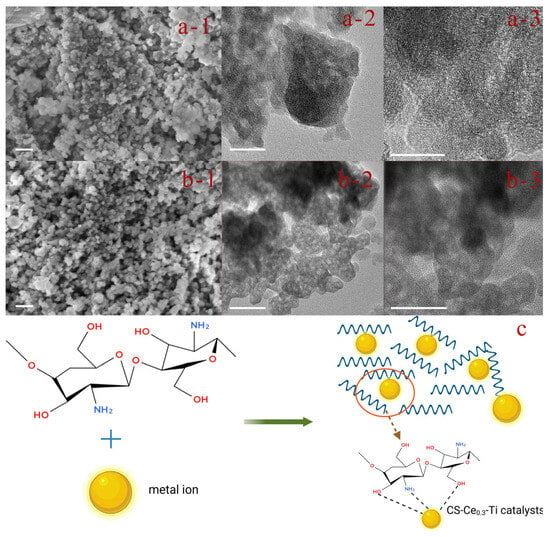
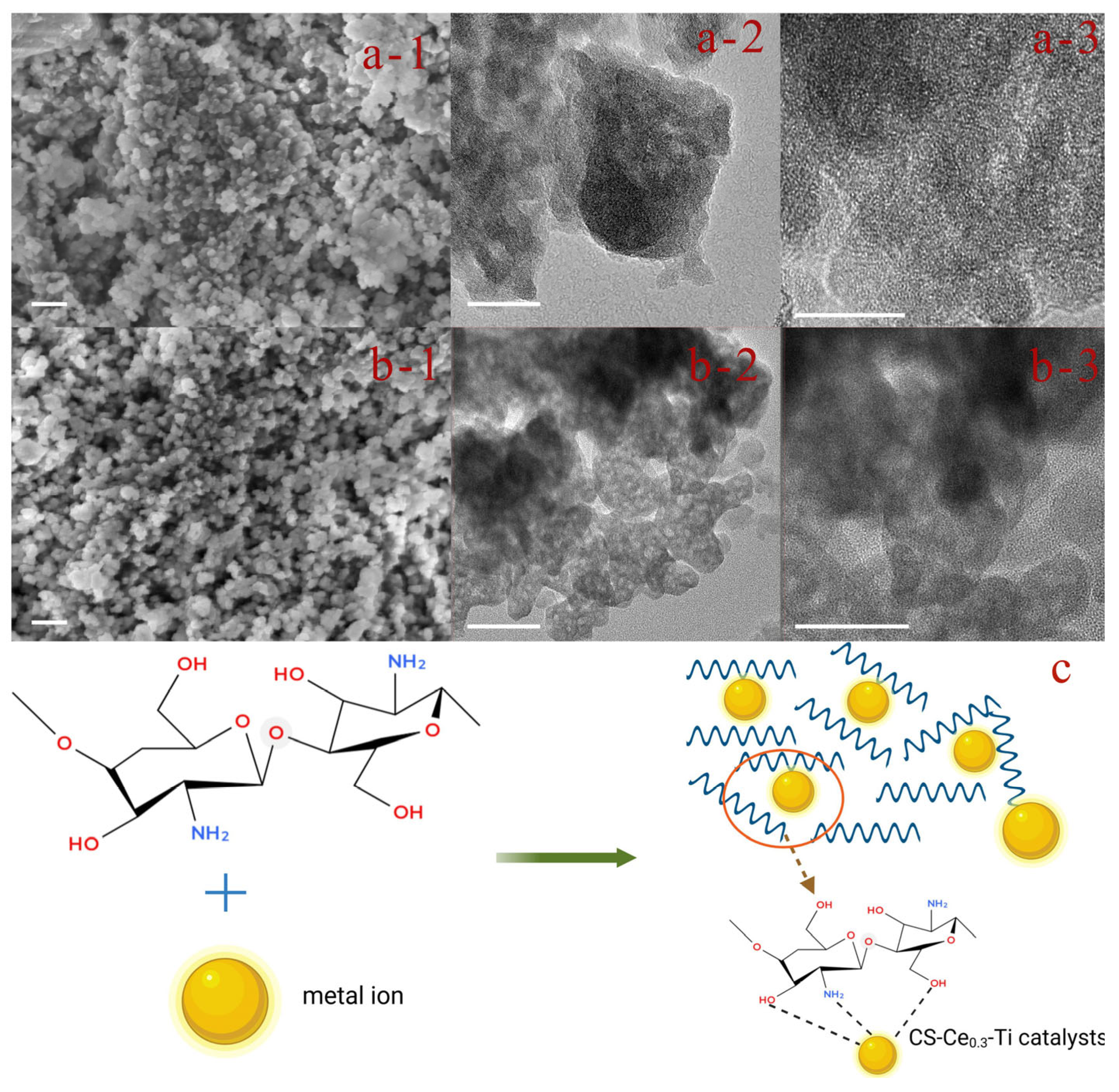
To further elucidate the morphology of the Ce-Ti catalyst modified by phosphotungstic acid, SEM + EDS and HRTEM characterizations were conducted on the CS-Ce0.3-Ti and 10%HPW-CS-Ce0.3-Ti samples, and the results are presented in Figure 2. As depicted in Figure 2(a-1), the Ce0.3-Ti catalyst displays a nanoparticulate morphology, accompanied by noticeable agglomeration. Following the modification process involving chitosan functionalization and phosphotungstic acid treatment, a significant enhancement in dispersibility was observed, with the absence of prominent particle aggregation (Figure 2(b-1)). And the EDS images (Figure 3) indicate that the HPW was evenly distributed throughout the catalyst, which is crucial for achieving consistent catalytic performance. This good dispersion is partly attributed to the interaction between polar groups such as hydroxyl and amino groups in chitosan molecules with the surface of metal oxides, which inhibits the aggregation and growth of metal particles, to a certain extent. Additionally, the interaction between HPW and Ce-Ti contributes to enhancing the dispersion of metals, resulting in a more uniform distribution of metal oxides on the carrier or in the solution. HRTEM analysis reveals that the 10HPW-CS-Ce0.3-Ti nanoparticles exhibit a more homogeneous size distribution compared to the Ce0.3-Ti sample (Figure 2(a-2,b-2)). Additionally, a significant presence of interparticle pores is observable, which enhances the accessibility of reactants to the catalytic active sites, thereby contributing to the superior catalytic performance. Upon further magnification (Figure 2(a-3,b-3)), the absence of discernible lattice fringes indicates the catalyst sample’s amorphous structure, consistent with the findings of the XRD analysis.
In the original publication [1], there was a mistake in Figure 2 as published. The corrected Figure 2 appears below.
Figure 2.
SEM and HRTEM images of (a) Ce0.3-Ti catalyst and (b) HPW-CS-Ce0.3-Ti catalyst, and (c) the formation mechanism of CS-Ce0.3-Ti catalysts.
The authors state that the scientific conclusions are unaffected. This correction was approved by the Academic Editor. The original publication has also been updated.
Reference
- Ma, M.; Zhang, R.; Shen, Y.; Zhou, X.; Zhai, Y.; Han, Y.; Wang, D.; Zhang, L.; Song, X.; Fang, D.; et al. Mesoporous Ce-Ti Catalysts Modified by Phosphotungstic Acid and Chitosan for the Synergistic Catalysis of CVOCs and NOx. Catalysts 2025, 15, 119. [Google Scholar] [CrossRef] [Scilit]
Disclaimer/Publisher’s Note: The statements, opinions and data contained in all publications are solely those of the individual author(s) and contributor(s) and not of MDPI and/or the editor(s). MDPI and/or the editor(s) disclaim responsibility for any injury to people or property resulting from any ideas, methods, instructions or products referred to in the content. |
© 2025 by the authors. Licensee MDPI, Basel, Switzerland. This article is an open access article distributed under the terms and conditions of the Creative Commons Attribution (CC BY) license (https://creativecommons.org/licenses/by/4.0/).