


Abstract
Herein we describe the development and optimization of a two-step procedure for the synthesis of N-protected 1-aminomethylphosphonium salts from imides, amides, carbamates, or lactams. Our “step-by-step” methodology involves the transformation of amide-type substrates to the corresponding hydroxymethyl derivatives, followed by the substitution of the hydroxyl group with a phosphonium moiety. The first step of the described synthesis was conducted based on well-known protocols for hydroxymethylation with formaldehyde or paraformaldehyde. In turn, the second (substitution) stage required optimization studies. In general, reactions of amide, carbamate, and lactam derivatives occurred at a temperature of 70 °C in a relatively short time (1 h). On the other hand, N-hydroxymethylimides reacted with triarylphosphonium salts at a much higher temperature (135 °C) and over longer reaction times (as much as 30 h). However, the proposed strategy is very efficient, especially when NaBr is used as a catalyst. Moreover, a simple work-up procedure involving only crystallization afforded good to excellent yields (up to 99%).
1. Introduction
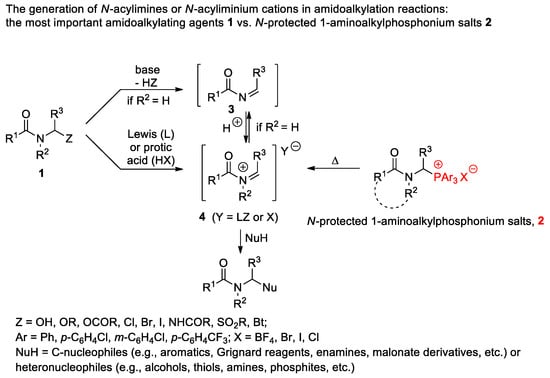
α-Amidoalkylation reactions have recently gained more importance in organic synthesis as a convenient method for new C-C and C-X(heteroatom) bond formation [1,2,3,4,5,6,7,8,9,10,11,12,13,14,15,16,17,18]. The crucial step in such reactions is the generation of the proper α-amidoalkylating agents (N-acylimines 3 or N-acyliminium cations 4) from the relevant precursors 1. Usually, for this purpose, it is necessary to use catalysts, either bases (for the generation of N-acylimines 3) or much more often acids (Lewis or protic acids, for the generation of N-acyliminium cations 4, see Scheme 1) [19,20,21,22,23,24,25,26,27,28].
Scheme 1.
Generation of N-acylimines and N-acyliminium cations in α-amidoalkylations.
Interesting exceptions are N-protected 1-aminoalkylphosphonium salts 2. This particular structure, especially the presence of a positively charged triarylphosphonium group (which easily departs as a triarylphosphine) in the direct vicinity of the N-acylamino group, facilitates the formation of N-acyliminium-type cations [16,29]. Besides, the reactivity of compounds 2 can be increased by structural modifications within the phosphonium moiety, e.g., by the introduction of electron-withdrawing substituents, which reduce the Cα-P+ bond strength and makes it even easier to break [30,31,32]. This procedure makes it possible to conduct α-amidoalkylations under mild conditions without the need for any catalyst [30,31,32,33].
Applications of N-protected 1-aminoalkylphosphonium salts 2 as α-amidoalkylating agents are widely reported in the literature, e.g., in the synthesis of phosphorus analogs of amino acids [34,35,36] or β-amino carbonyl compounds [33] (extremely valuable because of high and multidirectional biological activity). However, the possibilities for their synthetic utility are not limited only to the α-amidoalkylations. There are known Wittig reactions in which phosphonium salts 2 are used as ylide precursors [37,38]. It is also worth noting that some phosphonium salts 2 (e.g., phthalimidomethyltriphenylphosphonium bromide or chloride) exhibit biological activities, e.g., antitumor or nematocidal properties [39].
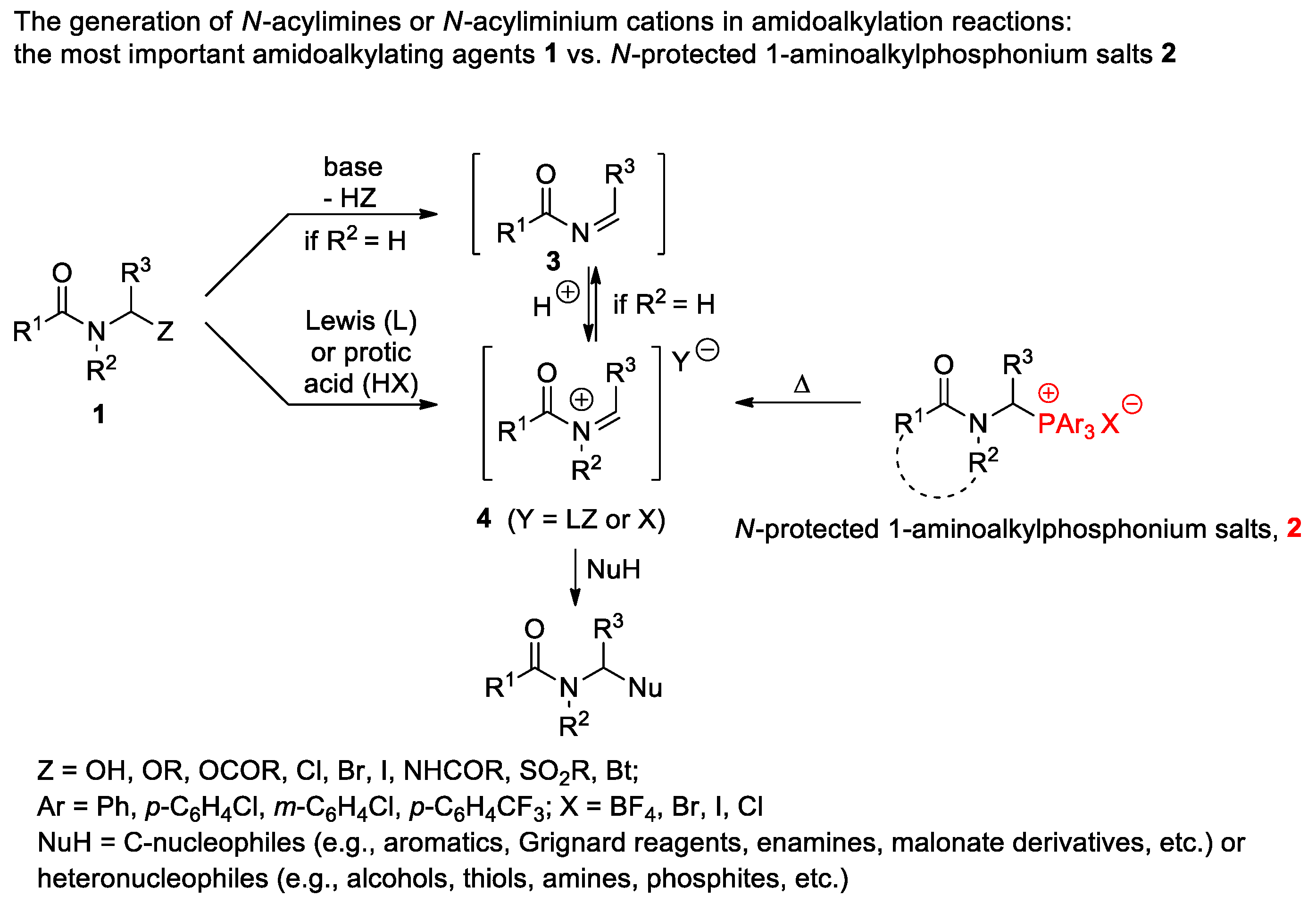
In the last few years, we have described some general and very efficient protocols for the synthesis of N-protected 1-aminoalkylphosphonium salts (Scheme 2, pathways A [29] and E [40]). However, they have some limitations in the preparation of N-protected aminomethylphosphonium salts, especially imidomethylphosphonium salts (see results and discussion).
Scheme 2.
Selected methods for the synthesis of N-protected 1-aminoalkyphosphonium salts 2.
In the literature, there are also several methods dedicated almost exclusively to the synthesis of N-protected aminomethylphosphonium salts, but in most cases, they have a quite narrow range of applicability and allow for the formation of only one class of phosphonium salts, e.g., N-imidomethylphosphonium salts (Scheme 2, pathway B, if R1, R2 = -C6H4CO-) [39,41], N-alkoxycarbonylaminomethylphosphonium salts (Scheme 2, pathway C) [42,43], ureidomethylphosphonium salts (Scheme 2, pathway D) [44], or N-acylaminomethylphosphonium salts (Scheme 2, pathways F [45] and G [46,47]). Moreover, they are often time-consuming and labor-intensive or require the use of toxic or troublesome reagents (not readily available or inconvenient to use) [16].
In this context, we would like to present our research on the two-step preparation of N-protected 1-aminomethylphosphonium salts from amides, carbamates, lactams, or imides. It can be considered as an interesting complement to previously described methods, especially for the synthesis of imidoalkylphosphonium salts.
2. Results and Discussion
In 2017, we reported the synthesis of 1-imidoalkylphosphonium salts and their application as α-imidoalkylating agents [32]. During the implementation of this work, we stumbled upon a problem with obtaining imidomethylphosphonium derivatives. At that time, the generally proposed method for synthesizing 1-imidoalkylphosphonium salts was inefficient for imidomethylphosphonium salts (three steps, including electrochemical alkoxylation, and total yields below 10%).
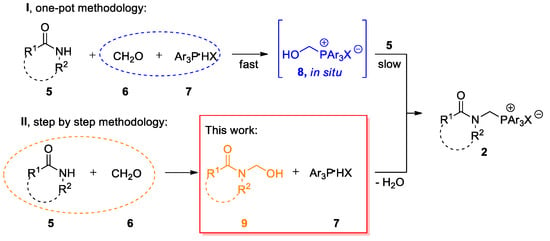
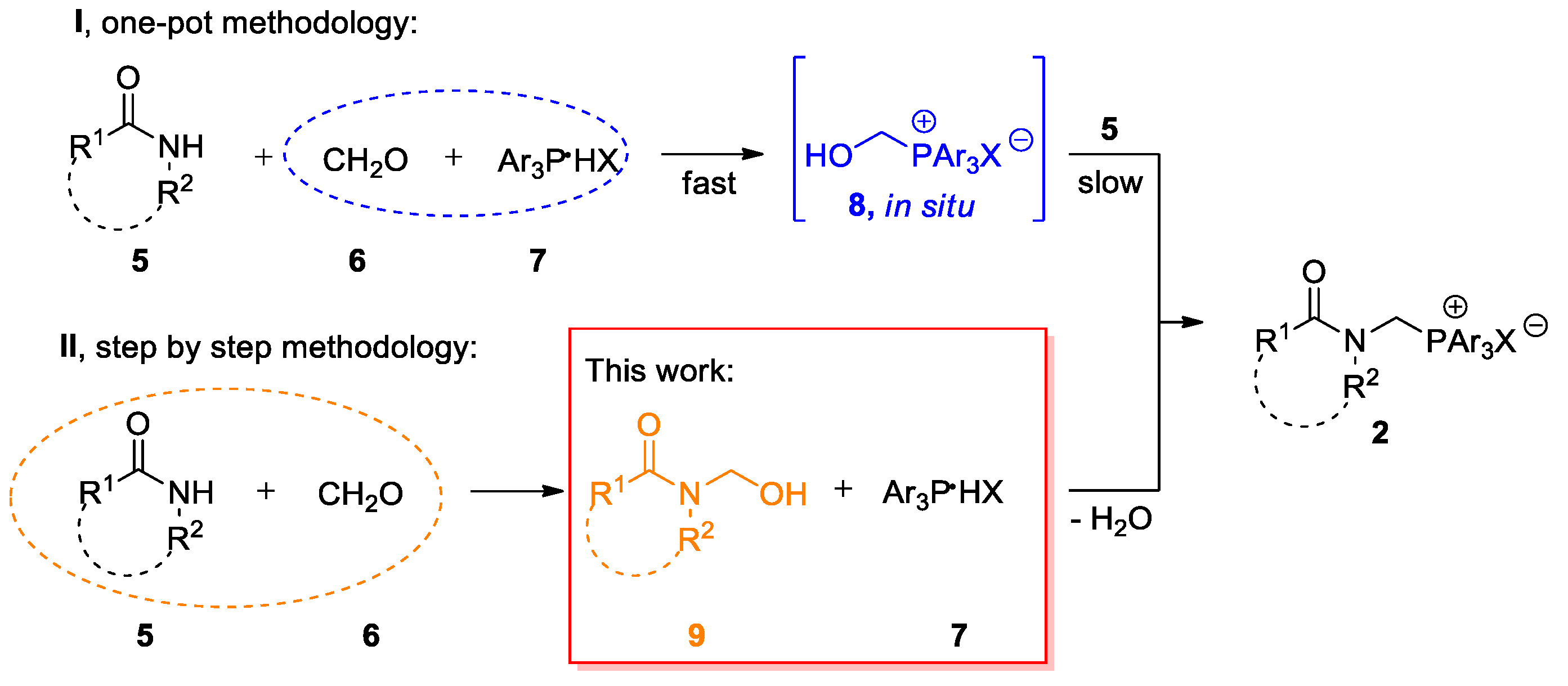
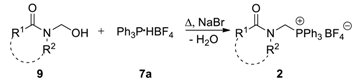
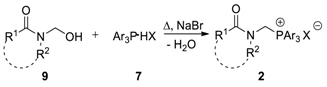
Recently, we described a one-pot methodology for the synthesis of N-protected 1-aminoalkylphosphonium salts based on the three-component coupling of aldehydes and either amides, carbamates, lactams, or imides in the presence of triarylphosphonium salts [40]. However, in this case, the preparation of imidomethylphosphonium salts also proved to be problematic. Condensations with imides required very high temperatures (150–170 °C) and often resulted in only trace amounts of products [40]. The low nucleophilicity of the nitrogen in imides seems to hinder the crucial stage of this synthesis, i.e., the reaction of imides with 1-hydroxymethylphosphonium salts 8 (which are rapidly formed in situ from aldehyde 6 and triarylphosphonium salts 7, Scheme 3, pathway I). Therefore, we decided to reverse the ongoing transformations and, in the first step, create N-hydroxymethylimides 9 from imides and aldehyde 6, and then treat them with triarylphosphonium salts 7 (Scheme 3, pathway II).
Scheme 3.
Methods for the synthesis of N-protected aminomethylphosphonium salts 2.
Procedures for the preparation of hydroxymethyl derivatives 9 have been known for years [48,49,50,51,52,53,54], so we focused on tuning the conditions for the second step, where the hydroxyl group is substituted by the phosphonium moiety.
Preliminary studies indicated that the reaction required a relatively high temperature (135 °C), so this transformation was tested by fusing N-hydroxymethylimides 9 (phthalimide derivative 9a: R1, R2 = -C6H4CO- and succinimide derivative 9b: R1, R2 = -CH2CH2CO-, see Table 1) with triphenylphosphonium tetrafluoroborate (Ph3P∙HBF4, 7a) at an elevated temperature (135 °C) and under reduced pressure (2000–2500 Pa). Moreover, there was a positive effect of NaBr addition (a bromide anion catalyst) on the reaction time and yield (compare entries 1 and 5 with 2–4 and 6, Table 1). The best results were obtained at 135 °C using 10 mol% NaBr as a catalyst.
Table 1.
Synthesis of N-protected aminomethyltriarylphosphonium salts 2–optimization studies.
Next, we examined how the type of N-protecting group affects the course of the reaction. N-hydroxymethylbenzamide (9c: R1 = Ph, R2 = H, Table 1; commercially available) was reacted with triphenylphosphonium tetrafluoroborate 7a under the aforementioned conditions, yielding good results (Table 1, entry 7). Further investigations revealed that the reaction occurred at temperatures as low as 70 °C and that the addition of NaBr was not essential (Table 1, see entries 8 and 9), although it facilitated the reaction and led to higher yields (as much as 20% higher).
Based on the data obtained from the optimization process, we performed the reactions on a preparative scale and isolated the products using only crystallization (no chromatography was necessary). The results confirmed all our previous observations (see Table 2). To evaluate the scope of the developed methodology, we synthesized a number of hydroxymethyl derivatives of imides, amides, carbamates, or lactams 9, and reacted them with various types of triarylphosphonium salts 7 (Ar3P∙HX).
Table 2.
Synthesis of N-protected aminomethyltriarylphosphonium salts 2-scope of application.
Generally, to obtain imidomethylphosphonium tetrafluoroborates with good yields, it was necessary to conduct the reaction at a relatively high temperature (135 °C, 3 h) in the presence of 10 mol% NaBr as catalyst (Table 2, compare entries 1–4). On the other hand, N-hydroxymethylamides, -carbamates, and -lactams reacted smoothly with triphenylphosphonium tetrafluoroborate 7a at 70 °C with good to very good yields (see Table 2, e.g., entries 12, 20, and 23).
The possibility of using other tetrafluoroborates was also explored. We showed that phosphonium salts substituted with both electron-withdrawing ((3-ClC6H4)3P∙HBF4, 7b), and electron-donating substituents ((4-MeOC6H4)3P∙HBF4, 7c) could be successfully used in the reaction. However, to obtain sufficiently high yields, a longer reaction time was required (Table 2, e.g., entries 7, 9, or 15). In turn, the use of triphenylphosphonium bromide (Ph3P∙HBr, 7d) instead of tetrafluoroborate (Table 2, e.g., entries 8 or 14) made the reaction more efficient even without a catalyst (the addition of NaBr was unnecessary).
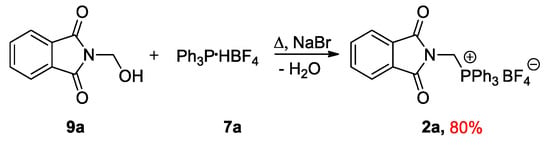
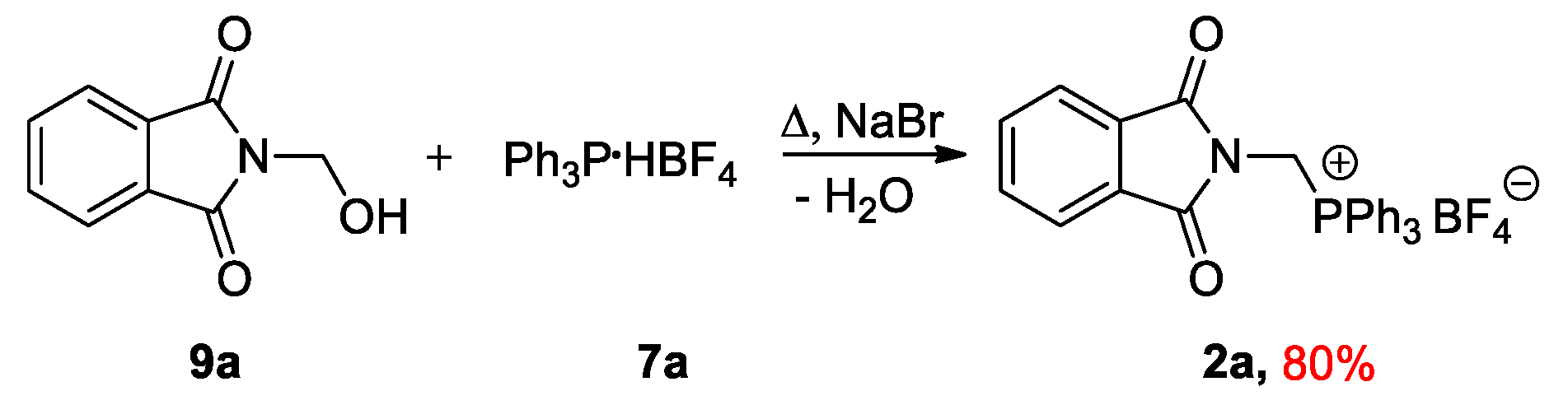
To present the practical usefulness of the described method, we synthesized a selected N-protected methylphosphonium salt 2a on a larger scale (up to 5 g, Scheme 4). We did not notice any difficulties and we were able to obtain the expected product with a yield of 80%.
Scheme 4.
5g-Scale synthesis of (N-phthalimido)methyltriphenylphosphonium tetrafluoroborate 2a.
3. Materials and Methods
3.1. General Information
The structures of all compounds obtained were confirmed by spectroscopic methods (NMR, IR). 1H, 13C{1H} (the proton decoupled 13C NMR) and 31P{1H} NMR (the proton decoupled 31P NMR) spectra were measured on Agilent NMR Magnet 400 at frequencies of 400, 100, and 161.9 MHz, respectively (Supplementary Materials). Tetramethylsilane (TMS) was used as the resonance shift standard (1H and 13C NMR). FT-IR spectra (ATR method) were recorded on an FT-IR spectrophotometer Nicolet 6700. High-resolution mass spectra (electrospray ionization) were recorded for unknown compounds on a Waters Xevo G2 quadrupole time-of-flight (Q-TOF) mass spectrometer. Melting points were determined (in capillaries) for crystalline substances and were uncorrected. Solvents (ACS grade) were stored over molecular sieves before use. All commercially available reagents, including compounds 5, 6, triphenylphosphonium bromide 7d, N-hydoxymethylbenzamide 9c, and N-hydroxymethylacetamide 9d were purchased and then used as received, without purification or modifications.
3.2. Syntheses
3.2.1. Substrate Synthesis
Triarylphosphonium tetrafluoroborates 7a–c were synthesized based on our previously described procedure [40]. N-hydroxymethylphthalimide 9a [48], N-hydroxymethylsuccinimide 9b [50], benzyl N-hydroxymethylcarbamate 9e [51], tert-butyl N-hydroxymethylcarbamate 9f [52], and N-hydroxymethyl-2-pyrrolidone 9g [53] were synthesized according to known procedures.
N-hydroxymethylphthalimide (9a) [48]. Colorless crystals (1.524 g, 86% yield), mp 143.0–145.0 °C. 1H NMR (400 MHz, DMSO-d6) δ 7.92-7.81 (m, 4H, aromatic), 6.36 (t, J = 7.0 Hz, 1H, OH), 4.96 (d, J = 6.4 Hz, 2H, CH2) ppm; 13C{1H} NMR (100 MHz, DMSO-d6) δ 167.4 (C=O), aromatic carbons: 134.7, 131.5, 123.3, 60.1 (CH2OH) ppm; IR (ATR) 3484, 1770, 1698, 1352, 1328, 1051 cm−1.
N-hydroxymethylsuccinimide (9b) [50]. Colorless crystals (0.904 g, 70% yield), mp 69.0–71.0 °C. 1H NMR (400 MHz, DMSO-d6) δ 6.25 (t, J = 7.2 Hz, 1H, OH), 4.72 (d, J = 7.2 Hz, 2H, NCH2), 2.62 (s, 4H, CH2-CH2) ppm; 13C{1H} NMR (100 MHz, DMSO-d6) δ 177.3 (C=O), 60.4 (CH2OH), 28.0 (CH2) ppm; IR (ATR) 3387, 1683, 1364, 1191, 1066 cm−1.
benzyl N-hydroxymethylcarbamate (9e) [51]. Colorless crystals (2.66g, 74% yield), mp 81.0–82.0 °C. 1H NMR (400 MHz, DMSO-d6) δ 7.90 (t, J = 6.3 Hz, 1H, NH), 7.44–7.25 (m, 5H, Ph), 5.63 (t, J = 6.5 Hz, 1H, OH), 5.04 (s, 2H, CH2O), 4.47 (dd~t, J = 6.5, 6,5 Hz, 2H, NCH2) ppm; 13C{1H} NMR (100 MHz, DMSO-d6) δ 156.0 (C=O), aromatic carbons: 136.9, 128.3, 127.8, 127.7, 65.2 (CH2O), 64.4 (CH2O) ppm; IR (ATR) 3345, 1695, 1519, 1250, 1232, 1026, 970 cm−1.
tert-butyl N-hydroxymethylcarbamate (9f) [52]. Colorless crystals (1.06 g, 36% yield), mp 63.0–65.0 °C. 1H NMR (400 MHz, DMSO-d6) δ 7.32 (t, J = 6.2 Hz, 1H, NH), 5.46 (t, J = 6.5 Hz, 1H, OH), 4.38 (dd~t, J = 6.5, 6.5 Hz, 2H, CH2), 1.39 (s, 9H, t-Bu) ppm; 13C{1H} NMR (100 MHz, DMSO-d6) δ 155.6 (C=O), 78.2 (C-O), 64.2 (CH2OH), 28.4 (CH3) ppm; IR (ATR) 3362, 1687, 1519, 1293, 1250, 1000, 943 cm−1.
N-hydroxymethyl-2-pyrrolidone (9g) [53,54]. Colorless crystals (0.507 g, 73% yield), mp 75.0–77.0 °C. 1H NMR (400 MHz, CDCl3) δ 4.79 (d, J = 7.4 Hz, 2H, CH2), 4.45 (t, J = 7.5 Hz, 1H, OH), 3.62–3.55 (m, 2H, NCH2), 2.45–2.35 (m, 2H, CH2) 2.10–1.99 (m, 2H, CH2) ppm; 13C{1H} NMR (100 MHz, CDCl3) δ 176.2 (C=O), 66.4 (CH2OH), 46.1 (CH2N), 31.3 (CH2), 17.8 (CH2) ppm; IR (ATR) 3260, 1649, 1463, 1261, 1197, 1036, 1024 cm−1.
3.2.2. Synthesis of N-Protected Aminomethylphosphonium Salts 2
The N-(hydroxymethyl)imide, -amide, -carbamate or -lactam (1 mmol), triarylphosphonium bromide or tetrafluoroborate (Ar3P·HX, 1 mmol), and CHCl3 (2.5 mL) were added to a 25 mL round-bottom flask. When necessary, the NaBr catalyst (which was previously heated at 60 °C under reduced pressure for a minimum of 1 h) was added to the mixture at a level of 5–20 mol% (see Table 1 and Table 2). The solvent was then evaporated from the resulting mixture using a rotary evaporator. The residue was fused at 135 °C or 70 °C under reduced pressure for the time noted in Table 1 and Table 2. The crude reaction product was dissolved in CH3CN or CH2Cl2 and then, after removal of NaBr (by decantation), was precipitated with Et2O. If necessary, the crystallization was repeated.
3.2.3. 5g-Scale Synthesis of (N-phthalimido)methyltriphenylphosphonium Tetrafluoroborate (2a)
N-(hydroxymethyl)phthalimide (2.30 g, 13 mmol), triphenylphosphonium tetrafluoroborate (4.55 g, 13 mmol), and CHCl3 (25 mL) were added to a 100 mL round bottom flask. The NaBr (0.1338 g, 1.3 mmol, 10 mol%), which was previously heated at 60 °C under reduced pressure for a minimum of 1 h, was added to the mixture. The solvent was then evaporated from the resulting mixture using a rotary evaporator. The residue was fused at 135 °C under reduced pressure for 3h. The crude reaction product was dissolved in CH3CN and then, after removal of NaBr by decantation, was precipitated with Et2O to obtain 5.3 g of pure product 2a with a yield of 80%.
(N-phthalimido)methyltriphenylphosphonium tetrafluoroborate (2a) [32]. Colorless crystals (397.2 mg, 78% yield), mp 243.5–245.5 °C. 1H NMR (400 MHz, CD3CN) δ 7.94–7.84 (m, 3H, aromatic), 7.83–7.73 (m, 10H, aromatic), 7.72–7.66 (m, 6H, aromatic), 5.44 (d, J = 4.2 Hz, 2H, CH2P) ppm; 13C{1H} NMR (100 MHz, CD3CN) δ 167.8 (C=O), aromatic carbons: 136.8 (d, J = 3.1 Hz), 136.1, 135.5 (d, J = 10.3 Hz), 132.3, 131.3 (d, J = 12.8 Hz), 124.7, 117.0 (d, J = 85.3 Hz), 35.6 (d, J = 60.3 Hz, CH2P) ppm; 31P{1H} NMR (161.9 MHz, CD3CN) δ 19.5 ppm; IR (ATR) 3300, 2971, 1740, 1685, 1632, 1321, 1266, 1222, 1139, 993, 975, 851 cm−1.
(N-succinimido)methyltriphenylphosphonium tetrafluoroborate (2b) [32]. Colorless crystals (327.5 mg, 71% yield), mp 224.5–226.5 °C. 1H NMR (400 MHz, CD3CN) 7.96–7.86 (m, 3H, aromatic), 7.82–7.69 (m, 12H, aromatic), 5.20 (d, J = 5.2 Hz, 2H, CH2P), 2.53 (d, J = 1.1 Hz, 4H, CH2CH2) ppm; 13C{1H} NMR (100 MHz, CD3CN) δ 177.4 (C=O), aromatic carbons: 136.8 (d, J = 3.2 Hz), 135.4 (d, J = 10.3 Hz), 131.3 (d, J = 12.9 Hz), 117.1 (d, J = 86.0 Hz), 35.6 (d, J = 60.1 Hz, CH2P), 28.8 (CH2) ppm; 31P{1H} NMR (161.9 MHz, CD3CN) δ 20.0 ppm; IR (ATR) 3069, 1712, 1436, 1395, 1315, 1148, 1112, 1047, 996 cm−1.
(N-phthalimido)methyltriphenylphosphonium bromide (2c). Colorless crystals (316.4 mg, 63% yield), mp 264.5–266.0 °C. 1H NMR (400 MHz, CD3CN) δ 7.90–7.84 (m, 3H, aromatic), 7.83–7.72 (m, 10H, aromatic), 7.71–7.64 (m, 6H, aromatic), 5.50 (d, J = 4.3 Hz, 2H, CH2P) ppm; 13C{1H} NMR (100 MHz, CD3CN) δ 167.7 (C=O), aromatic carbons: 136.7 (d, J = 3.1 Hz), 136.1, 135.5 (d, J = 10.1 Hz), 132.2, 131.3 (d, J = 12.9 Hz), 124.7, 117.0 (d, J = 85.7 Hz), 35.7 (d, J = 60.3 Hz, CH2P) ppm; 31P{1H} NMR (161.9 MHz, CD3CN) δ 19.5 ppm; IR (ATR) 3044, 1711, 1441, 1390, 1305, 1291, 1110, 1067, 895 cm−1. HRMS (TOF-ESI) calcd for C27H21NO2P [M+] 422.1310, found 422.1310.
(N-phthalimido)methyltris(3-chlorophenyl)phosphonium tetrafluoroborate (2d). Colorless crystals (459.5 mg, 75% yield), mp 203.0–205.0 °C. 1H NMR (400 MHz, CDCl3) δ 7.89–7.80 (m, 3H, aromatic), 7.80–7.73 (m, 7H, aromatic), 7.73–7.65 (m, 3H, aromatic), 7.62–7.55 (m, 3H, aromatic), 5.74 (d, J = 3.4 Hz, 2H, CH2P) ppm; 13C{1H} NMR (100 MHz, CDCl3) δ 166.3 (C=O), aromatic carbons: 137.0 (d, J = 16.9 Hz), 136.4 (d, J = 3.0 Hz), 135.3, 133.2 (d, J = 11.3 Hz), 132.8 (d, J = 10.0 Hz), 132.3 (d, J = 14.3 Hz), 130.7, 124.1, 117.3 (d, J = 84.4 Hz), 34.7 (d, J = 56.6 Hz, CH2P) ppm; 31P{1H} NMR (161.9 MHz, CDCl3) δ 21.9 ppm; IR (ATR) 3086, 3071, 2964, 2929, 1774, 1725, 1563, 1468, 1408, 1396, 1384, 1300, 1134, 1046, 995, 894 cm−1. HRMS (TOF-ESI) calcd for C27H18Cl3NO2P [M+] 524.0141, found 524.0140.
(N-phthalimido)methyltris(4-methoxyphenyl)phosphonium tetrafluoroborate (2e). Colorless crystals (389.5 mg, 65% yield), mp 196.0–198.0 °C. 1H NMR (400 MHz, CDCl3) δ 7.77–7.69 (m, 4H, aromatic), 7.67–7.58 (m, 6H, aromatic), 7.14–7.07 (m, 6H, aromatic), 5.42 (d, J = 4.2 Hz, 2H, CH2P), 3.88 (s, 9H, OCH3) ppm; 13C{1H} NMR (100 MHz, CDCl3) δ 166.5 (C=O), aromatic carbons: 165.2 (d, J = 3.0 Hz), 136.0 (d, J = 11.8 Hz), 134.9, 131.0, 123.9, 116.2 (d, J = 14.0 Hz), 106.6 (d, J = 93.9 Hz), 55.9 (OCH3), 35.1 (d, J = 60.9 Hz, CH2P) ppm; 31P{1H} NMR (161.9 MHz, CDCl3) δ 19.1 ppm; IR (ATR) 2943, 2848, 1719, 1593, 1505, 1395, 1304, 1267, 1185, 1112, 1033, 1022, 900 cm−1. HRMS (TOF-ESI) calcd for C30H27NO5P [M+] 512.1627, found 512.1627.
(N-succinimido)methyltriphenylphosphonium bromide (2f). Colorless crystals (427.0 mg, 94% yield), mp 237.0–238.5 °C. 1H NMR (400 MHz, CDCl3) 7.91–7.81 (m, 9H, aromatic), 7.80–7.69 (m, 6H, aromatic), 5.79 (d, J = 4.9 Hz, 2H, CH2P), 2.57 (s, 4H, CH2CH2) ppm; 13C{1H} NMR (100 MHz, CDCl3) δ 176.0 (C=O), aromatic carbons: 135.8 (d, J = 3.1 Hz), 134.3 (d, J = 10.3 Hz), 130.6(d, J = 12.9 Hz), 116.6 (d, J = 85.5 Hz), 36.3 (d, J = 56.7 Hz, CH2P), 28.4 (CH2) ppm; 31P{1H} NMR (161.9 MHz, CDCl3) δ 20.8 ppm; IR (ATR) 3586, 3387, 1704, 1392, 1144, 1110 cm−1. HRMS (TOF-ESI) calcd for C23H21NO2P [M+] 374.1310, found 374.1313.
(N-succinimido)methyltris(3-chlorophenyl)phosphonium tetrafluoroborate (2g). Colorless resin (389.5 mg, 69% yield). 1H NMR (400 MHz, CDCl3) δ 7.87-7.81 (m, 3H, aromatic), 7.79–7.72 (m, 6H, aromatic), 7.60–7.53 (m, 3H, aromatic), 5.39 (d, J = 4.6 Hz, 2H, CH2P), 2.60 (s, 4H, CH2CH2) ppm; 13C{1H} NMR (100 MHz, CDCl3) δ 176.3 (C=O), aromatic carbons: 136.9 (d, J = 17.1 Hz), 136.5 (d, J = 3.0 Hz), 133.1 (d, J = 11.6 Hz), 132.7 (d, J = 9.9 Hz), 132.5 (d, J = 14.3 Hz), 117.6 (d, J = 85.2 Hz), 34.9 (d, J = 58.2 Hz, CH2P), 28.1 (CH2) ppm; 31P{1H} NMR (161.9 MHz, CDCl3) δ 21.3 ppm; IR (ATR) 3072, 2977, 1709, 1564, 1469, 1397, 1307, 1131, 1050, 993 cm−1. HRMS (TOF-ESI) calcd for C23H18Cl3NO2P [M+] 476.0141, found 476.0141.
(N-benzoylamino)methyltriphenylphosphonium tetrafluoroborate (2i) [45]. Colorless crystals (439.8 mg, 91% yield), mp 194.0–195.5 °C. 1H NMR (400 MHz, CDCl3) δ 8.42 (br t, J = 6.1 Hz, 1H, NH), 7.83–7.73 (m, 9H, aromatic), 7.70–7.60 (m, 8H, aromatic), 7.50–7.40 (m, 1H, aromatic), 7.38–7.30 (m, 2H, aromatic), 5.32 (dd, J = 6.1, 3.1 Hz, 2H, CH2P) ppm; 13C{1H} NMR (100 MHz, CDCl3) δ 168.6 (d, J = 1.0 Hz, C=O), aromatic carbons: 135.3 (d, J = 3.1 Hz), 134.4 (d, J = 9.7 Hz), 132.4, 131.8, 130.3 (d, J = 12.6 Hz), 128.7, 127.5, 117.5 (d, J = 83.9 Hz), 38.2 (d, J = 57.0 Hz, CH2P) ppm; 31P{1H} NMR (161.9 MHz, CDCl3) δ 21.1 ppm; IR (ATR) 3348, 1655, 1533, 1438, 1112, 1055, 1026, 997 cm−1.
(N-benzoylamino)methyltriphenylphosphonium bromide (2j) [45]. Colorless crystals (447.7 mg, 94% yield), mp 233.5–235.5 °C. 1H NMR (400 MHz, CDCl3) δ 10.04 (br t, J = 6.0 Hz, 1H, NH), 7.93–7.86 (m, 8H, aromatic), 7.80–7.73 (m, 3H, aromatic), 7.69–7.59 (m, 6H, aromatic), 7.47–7.41 (m, 1H, aromatic), 7.39–7.32 (m, 2H, aromatic), 5.41 (dd, J = 6.1, 2.6 Hz, 2H, CH2P) ppm; 13C{1H} NMR (100 MHz, CDCl3) δ 168.5 (d, J = 0.7 Hz, C=O), aromatic carbons: 135.2 (d, J = 3.1 Hz), 134.7 (d, J = 9.7 Hz), 132.3, 131.9, 130.2 (d, J = 12.6 Hz), 128.6, 128.0, 117.9 (d, J = 83.8 Hz), 38.6 (d, J = 55.1 Hz, CH2P) ppm; 31P{1H} NMR (161.9 MHz, CDCl3) δ 21.1 ppm; IR (ATR) 3153, 3052, 1644, 1529, 1486, 1435, 1314, 1271, 1111 cm−1.
(N-benzoylamino)methyltris(3-chlorophenyl)phosphonium tetrafluoroborate (2k). Colorless crystals (404.7 mg, 69% yield), mp 172.5–174.5 °C. 1H NMR (400 MHz, CDCl3) δ 8.58 (br t, J = 5.7 Hz, 1H, NH), 7.88–7.81 (m, 3H, aromatic), 7.78–7.74 (m, 3H, aromatic), 7.72–7.56 (m, 8H, aromatic), 7.52–7.45 (m, 1H, aromatic), 7.40–7.34 (m, 2H, aromatic), 5.32 (dd, J = 6.0, 2.4 Hz, 2H, CH2P) ppm; 13C{1H} NMR (100 MHz, CDCl3) δ 168.8 (d, J = 0.7 Hz, C=O), aromatic carbons: 137.1 (d, J = 16.4 Hz), 136.0 (d, J = 3.0 Hz), 133.7 (d, J = 11.0 Hz), 132.8, 132.7 (d, J = 9.5 Hz), 132.0 (d, J = 14.0 Hz), 131.2, 128.9, 127.5, 119,0 (d, J = 83.2 Hz), 39.0 (d, J = 54.0 Hz, CH2P) ppm; 31P{1H} NMR (161.9 MHz, CDCl3) δ 16.4 ppm; IR (ATR) 3341, 1668, 1520, 1471, 1400, 1280, 1132, 1076, 1051, 995 cm−1. HRMS (TOF-ESI) calcd for C26H20Cl3NOP+ [M+] 498.0348, found 498.0348.
(N-acetylamino)methyltriphenylphosphonium tetrafluoroborate (2l) [45]. Colorless crystals (366.4 mg, 87% yield), mp 191.0–192.5 °C. 1H NMR (400 MHz, CDCl3) δ 7.89–7.77 (m, 4H, aromatic + NH), 7.78–7.66 (m, 12H, aromatic), 5.05 (dd, J = 6.3, 3.2 Hz, 2H, CH2P), 1.83 (d, J = 1.3 Hz, 3H, CH3) ppm; 13C{1H} NMR (100 MHz, CDCl3) δ 172.1 (d, J = 1.2 Hz, C=O), aromatic carbons: 135.4 (d, J = 3.1 Hz), 134.2 (d, J = 9.7 Hz), 130.4 (d, J = 12.6 Hz), 117.2 (d, J = 84.0 Hz), 37.4 (d, J = 57.9 Hz, CH2P), 22.1 (CH3) ppm; 31P{1H} NMR (161.9 MHz, CDCl3) δ 20.8 ppm; IR (ATR) 3382, 1684, 1519, 1438, 1112, 1086, 1056, 1012, 996 cm−1.
(N-acetylamino)methyltriphenylphosphonium bromide (2m) [45]. Colorless crystals (410.2 mg, 99% yield), mp 249.5–251.5 °C. 1H NMR (400 MHz, CDCl3) δ 9.66 (br t, J = 6.2 Hz, 1H, NH), 7.85–7.76 (m, 9H, aromatic), 7.71–7.62 (m, 6H, aromatic), 5.13 (dd, J = 6.3, 2.9 Hz, 2H, CH2P), 1.89 (d, J = 1.4 Hz, 3H, CH3) ppm; 13C{1H} NMR (100 MHz, CDCl3) δ 172.2 (d, J = 1.4 Hz, C=O), aromatic carbons: 135.3 (d, J = 3.1 Hz), 134.4 (d, J = 9.8 Hz), 130.3 (d, J = 12.6 Hz), 117.4 (d, J = 84.0 Hz), 37.6 (d, J = 56.8 Hz, CH2P), 22.6 (d, J = 0.5 Hz, CH3) ppm; 31P{1H} NMR (161.9 MHz, CDCl3) δ 20.7 ppm; IR (ATR) 3164, 3006, 1675, 1526, 1436, 1267, 1110 cm−1.
(N-acetylamino)methyltris(3-chlorophenyl)phosphonium tetrafluoroborate (2n). Colorless crystals (398.6 mg, 76% yield), mp 178.0–180.0 °C. 1H NMR (400 MHz, CDCl3) δ 7.99 (br t, J = 6.0 Hz, 1H, NH), 7.85–7.74 (m, 6H, aromatic), 7.74–7.68 (m, 3H, aromatic), 7.58–7.52 (m, 3H, aromatic), 5.09 (dd, J = 6.1, 2.5 Hz, 2H, CH2P), 1.84 (d, J = 1.4 Hz, 3H, CH3) ppm; 13C{1H} NMR (100 MHz, CDCl3) δ 172.4 (d, J = 1.2 Hz, C=O), aromatic carbons: 137.2 (d, J = 16.7 Hz), 136.2 (d, J = 3.0 Hz), 133.6 (d, J = 11.0 Hz), 132.6 (d, J = 9.5 Hz), 132.2 (d, J = 13.9 Hz), 118.8 (d, J = 83.3 Hz), 38.1 (d, J = 55.5 Hz, CH2P), 22.0 (CH3) ppm; 31P{1H} NMR (161.9 MHz, CDCl3) δ 20.6 ppm; IR (ATR) 3373, 1683, 1518, 1463, 1403, 1129, 1070, 1046, 1028, 994 cm−1. HRMS (TOF-ESI) calcd for C21H18Cl3NOP+ [M+] 436.0192, found 436.0193.
(N-benzyloxycarbonylamino)methyltriphenylphosphonium tetrafluoroborate (2o). Resin (338.8 mg, 66% yield). 1H NMR (400 MHz, CDCl3) δ 7.84–7.73 (m, 3H, aromatic), 7.72–7.59 (m, 12H, aromatic), 7.42–7.28 (m, 3H, aromatic), 7.22–7.13 (m, 2H, aromatic), 6.65 (br t, J = 6.02 Hz, 1H, NH), 5.11 (dd, J = 6.5, 2.1 Hz, 2H, CH2P), 4.90 (s, 2H, CH2O) ppm; 13C{1H} NMR (100 MHz, CDCl3) δ 156.8 (C=O), aromatic carbons: 135.3 (d, J = 3.0 Hz), 134.1 (d, J = 9.7 Hz), 133.8, 130.3 (d, J = 12.5 Hz), 128.4, 128.1, 127.9, 116.6 (d, J = 84.4 Hz), 67.4 (CH2O), 38.7 (d, J = 59.5 Hz, CH2P) ppm; 31P{1H} NMR (161.9 MHz, CDCl3) δ 19.6 ppm; IR (ATR) 3360, 1714, 1521, 1439, 1236, 1111, 1051, 996 cm−1. HRMS (TOF-ESI) calcd for C27H25NO2P+ [M+] 426.1623, found 426.1621.
(N-benzyloxycarbonylamino)methyltriphenylphosphonium bromide (2p). Colorless crystals (450.6 mg, 89% yield), mp 167.0–168.0 °C. 8.00 (br t, J = 6.3 Hz, 1H, NH), 7.86–7.74 (m, 9H, aromatic), 7.67–7.59 (m, 6H, aromatic), 7.32–7.27 (m, 3H, aromatic), 7.22–7.16 (m, 2H, aromatic), 5.36 (t, J = 6.3 Hz, 2H, CH2P), 4.90 (s, 2H, CH2O) ppm; 13C{1H} NMR (100 MHz, CDCl3) δ 156.9 (C=O), aromatic carbons: 135.9, 135.1 (d, J = 3.0 Hz), 134.3 (d, J = 9.7 Hz), 130.2 (d, J = 12.5 Hz), 128.3, 127.9, 117.1 (d, J = 83.6 Hz), 67.2 (CH2O), 39.2 (d, J = 58.5 Hz, CH2P) ppm; 31P{1H} NMR (161.9 MHz, CDCl3) δ 19.6 ppm; IR (ATR) 3164, 1697, 1517, 1497, 1403, 1268, 1228, 1113 cm−1. HRMS (TOF-ESI) calcd for C27H25NO2P+ [M+] 426.1623, found 426.1622.
(N-tert-butoxycarbonylamino)methylphosphonium bromide (2q). Colorless crystals (335.4 mg, 71% yield), mp 163.0–165.0 °C. 1H NMR (400 MHz, CDCl3) δ 7.90–7.75 (m, 9H, aromatic), 7.73–7.63 (m, 6H, aromatic), 7.36 (br t, J = 6.2 Hz, 1H, NH), 5.37 (br d, J = 6.3 Hz, 2H, CH2P), 1.21 (s, 9H, t-Bu) ppm; 13C{1H} NMR (100 MHz, CDCl3) δ 155.9 (C=O), aromatic carbons: 134.9 (d, J = 3.0 Hz), 134.4 (d, J = 9.6 Hz), 130.1 (d, J = 12.4 Hz), 117.5 (d, J = 83.3 Hz), 80.6 (C-O), 39.0 (d, J = 57.3 Hz, CH2P), 27.9 (CH3)ppm; 31P{1H} NMR (161.9 MHz, CDCl3) δ 19.6 ppm; IR (ATR) 3138, 2979, 1696, 1158, 1112 cm−1. HRMS (TOF-ESI) calcd for C24H27NO2P+ [M+] 392.1779, found 392.1790.
(2-oxopyrrolidin-1-yl)methyltriphenylphosphonium tetrafluoroborate (2r). Colorless crystals (380.1 mg, 85% yield), mp 167.0–169.0 °C. 1H NMR (400 MHz, CDCl3) δ 7.89–7.67 (m, 15H, aromatic), 5.32 (d, J = 3.7 Hz, 2H, CH2P), 3.37–3.25 (m, 2H, NCH2), 2.23–2.13 (m, 2H, CH2), 1.93–1.81 (m, 2H, CH2) ppm; 13C{1H} NMR (100 MHz, CDCl3) δ 176.6 (d, J = 1.7 Hz, C=O), aromatic carbons: 135.6 (d, J = 3.1 Hz), 133.9 (d, J = 10.0 Hz), 130.5 (d, J = 12.6 Hz), 116.7 (d, J = 83.8 Hz), 48.7 (NCH2), 39.4 (d, J = 58.9 Hz, CH2P), 29.4 (CH2), 18.2 (CH2) ppm; 31P{1H} NMR (161.9 MHz, CDCl3) δ 17.9 ppm; IR (ATR) 2968, 1671, 1439, 1425, 1271, 1112, 1032, 997 cm−1. HRMS (ESI-TOF) m/z: calcd for C23H23NOP+ [M+] 360.1517; Found 360.1518.
(2-oxopyrrolidin-1-yl)methyltris(4-methoxyphenyl)phosphonium tetrafluoroborate (2s). White resin (531.9 mg, 99% yield). 1H NMR (400 MHz, CDCl3) δ 7.72–7.56 (m, 6H, aromatic), 7.24–7.13 (m, 6H, aromatic), 5.13 (d, J = 3.9 Hz, 2H, CH2P), 3.28 (br t, J = 6.9 Hz, 2H, NCH2), 2.26–2.18 (m, 2H, CH2), 1.94–1.83 (m, 2H, CH2) ppm; 13C{1H} NMR (100 MHz, CDCl3) δ 176.5 (d, J = 1.8 Hz, C=O), aromatic carbons: 165.0 (d, J = 3.0 Hz), 135.8 (d, J = 11.6 Hz), 116.1 (d, J = 13.7 Hz), 107.2 (d, J = 92.3 Hz), 55.8 (OMe), 48.7 (NCH2), 39.9 (d, J = 62.2 Hz, CH2P), 29.6 (CH2), 18.2 (CH2) ppm; 31P{1H} NMR (161.9 MHz, CDCl3) δ 15.8 ppm; IR (ATR) 2950, 1690, 1591, 1567, 1504, 1299, 1185, 1111, 1050, 1015 cm−1. HRMS (ESI-TOF) m/z: calcd for C26H29NO4P+ [M+] 450.1834; Found 450.1834.
4. Conclusions
In this article, we describe the preparation of N-protected aminomethyltriarylphosphonium salts by a two-step synthesis from imides, amides, carbamates, or lactams. The first step of the synthesis, i.e., the hydroxymethylation of the substrates with formaldehyde (in the form of formalin or paraformaldehyde), is known and widely described in the literature. The second, crucial step-substitution of the hydroxyl group with a triarylphosphonium group-required some optimization. N-hydroxymethyl derivatives of amides, carbamates, and lactams reacted with triarylphosphonium salts under relatively mild conditions and in a short reaction time (70 °C, 1 h) to give the corresponding N-protected aminomethylphosphonium salts with good to very good yields (up to 99%). For N-hydroxymethylimides, more severe conditions were required (a higher temperature and longer reaction times: 135 °C, 3–30 h), but the products could also be effectively obtained (in up to 94% yield). In all cases, the use of NaBr as a catalyst had a positive effect on the course of the reaction. It is worth noting that the method also allows the synthesis of phosphonium salts with a modified structure of the triarylphosphonium moiety, not only triphenylphosphonium, but also tris(3-chlorophenyl)phosphonium or tris(4-methoxyphenyl)phosphonium salts. All these advantages make the developed protocol a good complementary alternative to the previously described literature methods for the synthesis of N-protected aminomethylphosphonium salts.
Supplementary Materials
The following are available online at https://www.mdpi.com/article/10.3390/catal11050552/s1, Apparatus for the synthesis of N-protected aminomethylphosphonium salts 2. 1H, 13C{1H}, 31P{1H} NMR, and IR spectra of N-protected aminomethylphosphonium salts 2. Supplementary data associated with this article can be found in the online version.
Author Contributions
Conceptualization, J.A.; Formal analysis, J.A., P.Z., D.K. and K.E.; Investigation, J.A., D.K., P.Z. and K.E.; Methodology, J.A.; Supervision, J.A.; Writing—original draft, J.A.; Writing—review & editing, J.A. All authors have read and agreed to the published version of the manuscript.
Funding
This work was supported under the Rector’s Habilitation Grant, Silesian University of Technology, No. 04/020/RGH20/1006, and the Rector’s Pro-Quality Grant, Silesian University of Technology, No. 04/020/RGJ20/0120.
Data Availability Statement
All data needed to support the conclusions in the paper are contained in the article.
Conflicts of Interest
The authors declare no conflict of interest.
References
- Zaugg, H.E. Recent Synthetic Methods Involving Intermolecular alpha-Amidoalkylation at Carbon. Synthesis 1970, 49–73. [Google Scholar] [CrossRef] [Scilit]
- Zaugg, H.E. α-Amidoalkylation at Carbon: Recent Advances—Part I. Synthesis 1984, 85–110. [Google Scholar] [CrossRef] [Scilit]
- Zaugg, H.E. α-Amidoalkylation at Carbon: Recent Advances—Part II. Synthesis 1984, 181–212. [Google Scholar] [CrossRef] [Scilit]
- Speckamp, W.N.; Hiemstra, H. Intramolecular reactions of N-acyliminium intermediates. Tetrahedron 1985, 41, 4367–4416. [Google Scholar] [CrossRef] [Scilit]
- Hiemstra, H.; Speckamp, W.N. N-Acyliminium Ions as Intermediates in Alkaloid Synthesis. Alkaloids 1988, 32, 271–339. [Google Scholar] [CrossRef] [Scilit]
- Katritzky, A.R.; Lan, X.; Yang, J.Z.; Denisko, O.V. Properties and Synthetic Utility of N-Substituted Benzotriazoles. Chem. Rev. 1998, 98, 409–548. [Google Scholar] [CrossRef] [Scilit]
- Katritzky, A.R.; Pernak, J.; Fan, W.-Q.; Saczewski, F. N-(1-Benzotriazol-1-ylalkyl)amides, Versatile α-Amidoalkylation Reagents. Part 1. α-Amidoalkylation of CH Acids. J. Org. Chem. 1991, 56, 4439–4443. [Google Scholar] [CrossRef] [Scilit]
- Katritzky, A.R.; Pernak, J.; Fan, W.-Q. N-[1-(Benzotriazol-1-yl)alkyl]amides, Versatile Amidoalkylation Reagents. Part 2. Amidoalkylation of Aromatic Compounds. Synthesis 1991, 868–870. [Google Scholar] [CrossRef] [Scilit]
- Speckamp, W.N.; Moolenaar, M.J. New developments in the chemistry of N-acyliminium ions and related intermediates. Tetrahedron 2000, 56, 3817–3856. [Google Scholar] [CrossRef] [Scilit]
- Maryanoff, B.E.; Zhang, H.C.; Cohen, J.H.; Turchi, I.J.; Maryanoff, C.A. Cyclizations of N-acyliminium ions. Chem. Rev. 2004, 104, 1431–1628. [Google Scholar] [CrossRef] [Scilit]
- Katritzky, A.R.; Manju, K.; Singh, S.K.; Meher, N.K. Benzotriazole mediated amino-, amido-, alkoxy- and alkylthioalkylation. Tetrahedron 2005, 61, 2555–2581. [Google Scholar] [CrossRef] [Scilit]
- Petrini, M. α-Amido Sulfones as Stable Precursors of Reactive N-Acylimino Derivatives. Chem. Rev. 2005, 105, 3949–3977. [Google Scholar] [CrossRef] [Scilit] [PubMed]
- Yazici, A.; Pyne, S.G. Intermolecular addition reactions of N-acyliminium ions (Part I). Synthesis 2009, 339–368. [Google Scholar] [CrossRef] [Scilit]
- Yazici, A.; Pyne, S.G. Intermolecular addition reactions of N-acyliminium ions (Part II). Synthesis 2009, 513–541. [Google Scholar] [CrossRef] [Scilit]
- Kataja, A.O.; Masson, G. Imine and iminium precursors as versatile intermediates in enantioselective organocatalysis. Tetrahedron 2014, 70, 8783–8815. [Google Scholar] [CrossRef] [Scilit]
- Mazurkiewicz, R.; Październiok-Holewa, A.; Adamek, J.; Zielińska, K. α-Amidoalkylating agents: Structure, synthesis, reactivity and application. Adv. Heterocycl. Chem. 2014, 111, 43–94. [Google Scholar] [CrossRef] [Scilit]
- Vinogradov, M.G.; Olga, V.; Turova, O.V.; Zlotin, S.G. The progress in the chemistry of N-acyliminium ions and their use in stereoselective organic synthesis. Russ. Chem. Rev. 2017, 86, 1–17. [Google Scholar] [CrossRef] [Scilit]
- Marcantoni, E.; Palmieri, A.; Petrini, M. Recent synthetic applications of α-amido sulfones as precursors of N-acylimino derivatives. Org. Chem. Front. 2019, 6, 2142–2182. [Google Scholar] [CrossRef] [Scilit]
- Ballini, R.; Palmieri, A.; Petrini, M.; Torregiani, E. Solventless Clay-Promoted Friedel−Crafts Reaction of Indoles with α-Amido Sulfones: Unexpected Synthesis of 3-(1-Arylsulfonylalkyl) Indoles. Org. Lett. 2006, 8, 4093–4096. [Google Scholar] [CrossRef] [Scilit]
- Thirupathi, P.; Kim, S.S. InBr3: A Versatile Catalyst for the Different Types of Friedel−Crafts Reactions. J. Org. Chem. 2009, 74, 7755–7761. [Google Scholar] [CrossRef] [Scilit]
- Kadam, S.T.; Thirupathi, P.; Kim, S.S. Amberlyst-15: An efficient and reusable catalyst for the Friedel–Crafts reactions of activated arenes and heteroarenes with α-amido sulfones. Tetrahedron 2009, 65, 10383–10389. [Google Scholar] [CrossRef] [Scilit]
- Das, B.; Damodar, K.; Bhunia, N.A. Simple and Efficient Access to α-Amino Phosphonates from N-Benzyloxycarbonylamino Sulfones Using Indium(III) Chloride. J. Org. Chem. 2009, 74, 5607–5609. [Google Scholar] [CrossRef] [Scilit]
- Thirupathi, P.; Kim, S.S. Regioselective Arylations of α-Amido Sulfones with Electron-Rich Arenes through Friedel–Crafts Alkylations Catalyzed by Ferric Chloride Hexahydrate: Synthesis of Unsymmetrical and Bis-Symmetrical Triarylmethanes. Eur. J. Org. Chem. 2010, 1798–1808. [Google Scholar] [CrossRef] [Scilit]
- Schneider, A.E.; Manolikakes, G. Bi(OTf)3-Catalyzed Multicomponent α-Amidoalkylation Reactions. J. Org. Chem. 2015, 80, 6193–6212. [Google Scholar] [CrossRef] [Scilit] [PubMed]
- Aranzamendi, E.; Arrasate, S.; Sotomayor, N.; González-Díaz, H.; Lete, E. Chiral Brønsted Acid Catalyzed Enantioselective α-Amidoalkylation Reactions: A Joint Experimental and Predictive Study. ChemistryOpen 2016, 5, 540–549. [Google Scholar] [CrossRef] [Scilit] [PubMed]
- Touati, B.; El Bouakher, A.; Azizi, M.S.; Taillier, C.; Ben Othman, R.; Trabelsi-Ayadi, M.; Antoniotti, S.; Dunach, E.; Dalla, V. Enolizable Carbonyls and N,O-Acetals:A Rational Approach for Room-Temperature Lewis Superacid-Catalyzed Direct α-Amidoalkylation of Ketones and Aldehydes. Chem. Eur. J. 2016, 22, 6012–6022. [Google Scholar] [CrossRef] [Scilit]
- Aranzamendi, E.; Sotomayor, N.; González-Díaz, H.; Lete, E. Phenolic Activation in Chiral Brønsted Acid-Catalyzed Intramolecular α-Amidoalkylation Reactions for the Synthesis of Fused Isoquinolines. ACS Omega 2017, 2, 2706–2718. [Google Scholar] [CrossRef] [Scilit]
- Zhang, S.; Shi, X.; Li, J.; Hou, Z.; Song, Z.; Su, X.; Peng, D.; Wang, F.; Yu, Y.; Zhao, G. Nickel-Catalyzed Amidoalkylation Reaction of γ-Hydroxy Lactams: An Access to 3-Substituted Isoindolinones. ACS Omega 2019, 4, 19420–19436. [Google Scholar] [CrossRef] [Scilit] [PubMed]
- Mazurkiewicz, R.; Adamek, J.; Październiok-Holewa, A.; Zielińska, K.; Simka, W.; Gajos, A.; Szymura, K. α-Amidoalkylating Agents from N-Acyl-α-amino Acids: 1-(N-Acylamino)alkyltriphenylphosphonium Salts. J. Org. Chem. 2012, 77, 1952–1960. [Google Scholar] [CrossRef] [Scilit]
- Adamek, J.; Węgrzyk, A.; Kończewicz, J.; Walczak, K.; Erfurt, K. 1-(N-Acylamino)alkyltriarylphosphonium Salts with Weakened Cα-P+ Bond Strength—Synthetic Applications. Molecules 2018, 23, 2453. [Google Scholar] [CrossRef] [Scilit]
- Adamek, J.; Węgrzyk, A.; Krawczyk, M.; Erfurt, K. Catalyst-free Friedel-Crafts reaction of 1-(N-acylamino)alkyltriarylphosphonium salts with electron-rich arenes. Tetrahedron 2018, 74, 2575–2583. [Google Scholar] [CrossRef] [Scilit]
- Adamek, J.; Mazurkiewicz, R.; Węgrzyk, A.; Erfurt, K. 1-Imidoalkylphosphonium salts with modulated Cα-P+ bond strength: Synthesis and application as new active α-imidoalkylating agents. Beilstein J. Org. Chem. 2017, 13, 1446–1455. [Google Scholar] [CrossRef] [Scilit] [PubMed]
- Październiok-Holewa, A.; Walęcka-Kurczyk, A.; Musioł, S.; Stecko, S. Catalyst-free Mannich-type reaction of 1-(N-acylamino)alkyltriphenylphosphonium salts with silyl enolates. Tetrahedron 2019, 75, 732–742. [Google Scholar] [CrossRef] [Scilit]
- Adamek, J.; Październiok-Holewa, A.; Zielińska, K.; Mazurkiewicz, R. Comparative Studies on the Amidoalkylating Properties of N-(1-Methoxyalkyl)Amides and 1-(N-Acylamino)Alkyltriphenylphosphonium Salts in the Michaelis–Arbuzov-Like Reaction: A New One-Pot Transformation of N-(1-Methoxyalkyl)Amides into Phosphonic or Phosphinic Analogs of N-Acyl-α-Amino Acids. Phosphorus Sulfur Silicon Relat. Elem. 2013, 188, 967–980. [Google Scholar] [CrossRef] [Scilit]
- Październiok-Holewa, A.; Adamek, J.; Mazurkiewicz, R.; Zielińska, K. Amidoalkylating Properties of 1-(N-Acylamino)Alkyltriphenylphosphonium Salts. Phosphorus Sulfur Silicon Relat. Elem. 2013, 188, 205–212. [Google Scholar] [CrossRef] [Scilit]
- Adamek, J.; Węgrzyk-Schlieter, A.; Steć, K.; Walczak, K.; Erfurt, K. Michaelis-Arbuzov-Type Reaction of 1-Imidoalkyltriarylphosphonium Salts with Selected Phosphorus Nucleophiles. Molecules 2019, 24, 3405. [Google Scholar] [CrossRef] [Scilit]
- Tan, E.S.; Naylor, J.C.; Groban, E.S.; Bunzow, J.R.; Jacobson, M.P.; Grandy, D.K.; Scanlan, T.S. The Molecular Basis of Species-Specific Ligand Activation of Trace Amine-Associated Receptor 1 (TAAR1). ACS Chem. Biol. 2009, 4, 209–220. [Google Scholar] [CrossRef] [Scilit] [PubMed]
- Tan, E.S.; Groban, E.S.; Jacobson, M.P.; Scanlan, T.S. Toward Deciphering the Code to Aminergic G Protein-Coupled Receptor Drug Design. Chem. Biol. 2008, 15, 343–353. [Google Scholar] [CrossRef] [Scilit]
- Dubois, R.J.; Lin, C.L.; Beisler, J.A. Synthesis and antitumor properties of some isoindolylalkylphosphonium salts. J. Med. Chem. 1978, 21, 303–306. [Google Scholar] [CrossRef] [Scilit]
- Adamek, J.; Zieleźny, P.; Erfurt, K. N-protected 1-aminoalkylphosphonium salts from amides, carbamates, lactams, or imides. J. Org. Chem. 2021, 86, 5852–5862. [Google Scholar] [CrossRef] [Scilit]
- Hellmann, H.; Schumacher, O. Verfahren zur Herstellung von Quartaeren Phosphoniumverbindungen. German Patent DE1176657 B, 27 August 1964. [Google Scholar]
- Kozhushko, B.N.; Gumenyuk, A.V.; Palichuk, Y.A.; Shokol, V.A. Trialkyl- and triaryl(isocyanatomethyl)chlorophosphoranes. Zh. Obshch. Khim. 1977, 47, 333–339. [Google Scholar]
- Shokol, V.A.; Kozushko, B.N.; Gumenyuk, A.V. Trialkyl- and aryldialkyl(isocyanatomethyl)ammonium chlorides. Zh. Obshch. Khim. 1977, 47, 1110–1118. [Google Scholar]
- Petersen, H.; Reuther, W. α-ureidoalkylierung von phosphor(III)-verbindungen. Justus Liebigs Ann. Chem. 1972, 766, 58–72. [Google Scholar] [CrossRef] [Scilit]
- Adamek, J.; Mrowiec-Białoń, J.; Październiok-Holewa, A.; Mazurkiewicz, R. Thermogravimetrical investigations of the dealkoxycarbonylation of N-acyl-α-triphenylphosphonioglycinates. Thermochim. Acta 2011, 512, 22–27. [Google Scholar] [CrossRef] [Scilit]
- Mazurkiewicz, R.; Pierwocha, A.W. Phosphoranylidene-5(4H)-oxazolones—A novel synthesis and properties. Monatsh. Chem. 1996, 127, 219–225. [Google Scholar] [CrossRef] [Scilit]
- Mazurkiewicz, R.; Październiok-Holewa, A.; Grymel, M. Synthesis and decarboxylation of N-acyl-α-triphenylphosphonio-α-amino acids: A new synthesis of α-(N-acylamino)alkyltriphenylphosphonium salts. Tetrahedron Lett. 2008, 49, 1801–1803. [Google Scholar] [CrossRef] [Scilit]
- Huang, Z.; Xu, J. Efficient synthesis of N-protected 1-substituted homotaurines from a xanthate and olefins. Tetrahedron 2013, 69, 1050–1056. [Google Scholar] [CrossRef] [Scilit]
- Kacprzak, K. Rapid and Convenient Microwave-Assisted Synthesis of Aromatic Imides and N-Hydroxymethylimides. Synth. Commun. 2003, 33, 1499–1507. [Google Scholar] [CrossRef] [Scilit]
- Mahfouz, N.M.; Omar, A.; Aboul-Fadl, T. Cyclic amide derivatives as potential prodrugs II: N-hydroxymethylsuccinimide-/isatin esters of some NSAIDs as prodrugs with an improved therapeutic index. Eur. J. Med. Chem. 1999, 34, 551–562. [Google Scholar] [CrossRef] [Scilit]
- Harding, K.E.; Marman, T.H.; Nam, D. Stereoselective Synthesis of γ-hydroxy-α-amino acids via intramolecular amidomercuration. Tetrahedron 1988, 44, 5605–5614. [Google Scholar] [CrossRef] [Scilit]
- Fustero, S.; Jiménez, D.; Moscardó, J.; Catalán, S.; del Pozo, C. Enantioselective Organocatalytic Intramolecular Aza-Michael Reaction: A Concise Synthesis of (+)-Sedamine, (+)-Allosedamine, and (+)-Coniine. Org. Lett. 2007, 9, 5283–5286. [Google Scholar] [CrossRef] [Scilit] [PubMed]
- Jouglet, B.; Oumoch, S.; Rousseau, G. An Efficient Hydroxymethylation of Lactams. Synth. Comm. 1995, 25, 3869–3874. [Google Scholar] [CrossRef] [Scilit]
- Takechi, H.; Tateuchi, S.; Machida, M.; Nishibata, Y.; Aoe, K.; Sato, Y.; Kanaoka, Y. Photoreactions of Succinimides with an N-Acyl Group in the Side Chain. Synthesis and Stereochemistry of Tricyclic Pyrrolo[1, 2-α]pyrazine Ring Systems. Chem. Pharm. Bull. 1986, 34, 3142–3152. [Google Scholar] [CrossRef] [Scilit]





Publisher’s Note: MDPI stays neutral with regard to jurisdictional claims in published maps and institutional affiliations. |
© 2021 by the authors. Licensee MDPI, Basel, Switzerland. This article is an open access article distributed under the terms and conditions of the Creative Commons Attribution (CC BY) license (https://creativecommons.org/licenses/by/4.0/).